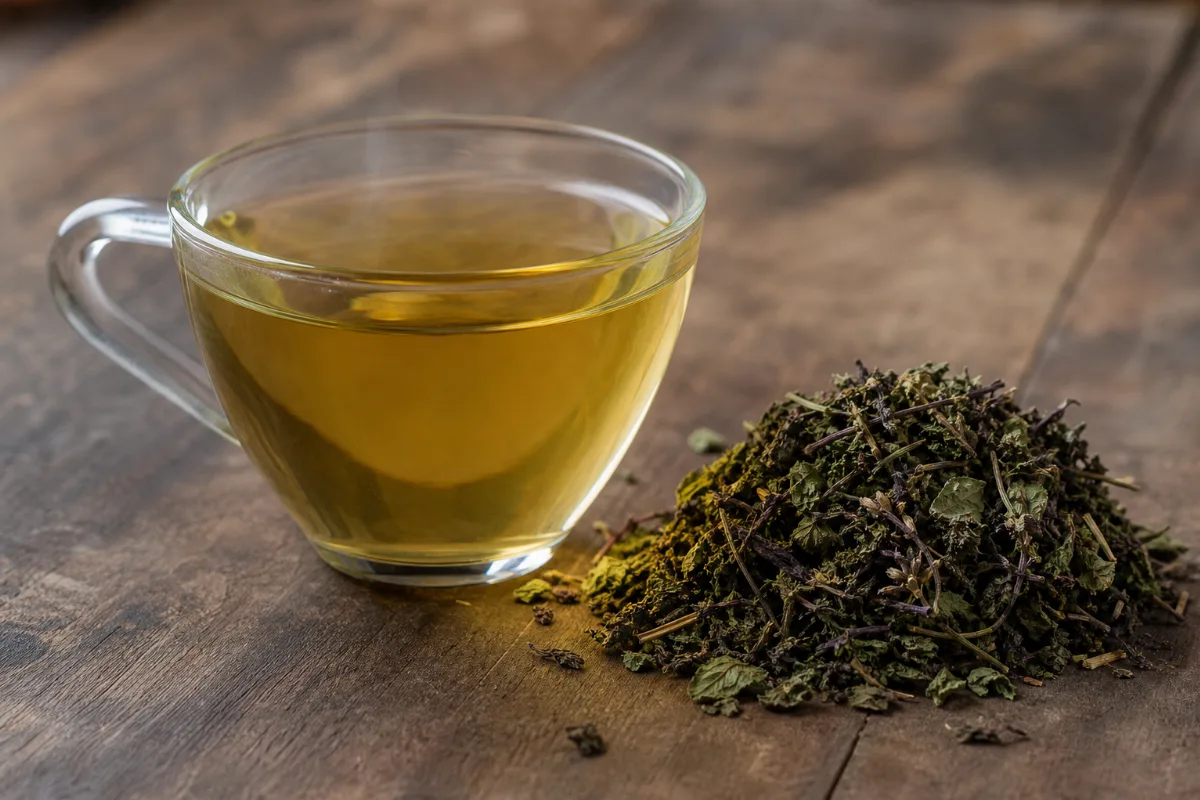
Herbal Teas & Extracts · Herbal tea
Tulsi (Holy Basil) Tea
Ocimum tenuiflorum L. (Ocimum sanctum) · also called Holy basil tea, tulasi tea, sacred basil tea
Tulsi tea is a herbal drink made from the leaves of holy basil, a plant used in Ayurveda and treated as sacred by many families in India. We found one small, four-day trial of the tea itself. The studies on stress and blood sugar mostly used capsules or powders, and their certainty is low or very low. Check with a doctor or pharmacist if you take diabetes medicine, blood thinners or thyroid medicine, or if you are pregnant or trying to conceive.
General information, not medical advice. Last substantive update · Not medically reviewed. A named clinician has not signed off on this page. Cultural and religious wording needs review by people from the Ayurvedic and Hindu traditions. How this page is made
About Tulsi (Holy Basil) Tea
Tulsi tea is a herbal tea from the leaves of holy basil (Ocimum tenuiflorum). One small four-day trial of the tea exists. Most research used capsules or powders. Blood sugar, blood thinning, thyroid and pregnancy are the main cautions.
What it is
Tulsi tea is made by steeping fresh or dried leaves of Ocimum tenuiflorum L., also called holy basil or Ocimum sanctum, a plant in the mint family (Lamiaceae). The GBIF plant database accepts Ocimum tenuiflorum and lists Ocimum sanctum as a synonym.
It is not the same as sweet basil, the cooking herb, and it is not true tea (Camellia sinensis). Tulsi leaf alone is not expected to contain tea-plant caffeine. That is an inference: one 2013 lab test of six teas ranked an organic tulsi tea lowest for caffeine but did not state its value in the abstract. Blends may add true tea, so read the label.
What the research shows
We found one trial of a tulsi tea: 44 people in Japan having radioactive iodine treatment after thyroid cancer surgery drank holy basil tea or water for four days. The tea group had smaller changes in anxiety scores and some saliva measures. The trial was small, short, and funded by a spice promotion foundation.
Most other research used capsules, powders or standardised extracts. Two placebo-controlled trials of branded extracts reported lower stress scores, and a 2022 review of human trials found the effect of most plants on stress hormones unclear. A 2017 review of 24 human studies reported favourable results in all of them, but only 8 used a placebo, most were small, and the authors warn effects may be overestimated.
Tea, extract and capsules
A cup of tulsi tea is a water preparation of the leaf. The trials used capsules, leaf powder or standardised alcohol extracts, which are more concentrated and made differently. The only other tea study was of a five-herb blend, so its result belongs to the blend.
That means the benefits found with capsules cannot be assumed for tea, and the cautions found with capsules or in animals cannot be assumed away for tea. Any amounts are a question for your doctor or pharmacist.
Where it is used
A 2017 review says tulsi is highly revered for its medicinal uses in the Ayurvedic and Siddha medical systems and that a tea infusion has been used traditionally for stomach and liver complaints. Papers also describe tulsi as a sacred herb that is grown at home and used in daily rituals, and a 2022 UK study found its religious meaning is part of why many South Asian families keep a plant.
We describe this as the sources state it. It is tradition, not evidence that the tea works. We did not research older texts or dates.
What happens in the body
How tulsi might act is not established. In one funded trial an extract was linked to lower hair cortisol, a stress hormone. In 22 healthy adults an extract raised some immune lab values. Amounts of active compounds in a cup of tea, and how much is absorbed, were not found.
At a glance
Traditional uses history, not proof
- India: tulsi is highly revered in the Ayurvedic and Siddha medical systems, according to a 2017 review
- The same review says a tea infusion has been used traditionally for stomach and liver complaints
- Papers describe tulsi as a sacred herb that is grown at home and used in daily rituals. Tradition is not proof that the tea works.
Studied for research
- Anxiety around radioactive iodine treatment (basil tea, one small trial), very low
- General stress (extract capsules), low
- Generalized anxiety (extract capsules, no comparison group), very low
- Attention and thinking tests (extract capsules), very low
- Blood sugar in type 2 diabetes (leaf powder), very low
- Blood fats and weight (extract capsules, pilot), very low
- Immune blood markers (extract capsules; five-herb tea blend), very low
- Stomach and liver complaints (traditional tea use), insufficient
Main compounds
- Known in tulsi: eugenol, caryophyllene, ursolic acid and others (amounts in a cup of tea not found)
- Caffeine: not expected, because tulsi is not the tea plant (an inference; one lab test did not give a value)
Common forms
- Herbal tea from fresh or dried tulsi leaf (one small trial of this form)
- Tea bags, often blends: check the label for every herb
- Extract capsules and leaf powder (the forms in most trials; not tea)
- Five-herb tea blend with ashwagandha, licorice, ginger and cardamom (one branded blend was studied)
Research links: Tea trial in radioiodine therapy, Heliyon (2023) · Systematic review of 24 human studies (2017) · Holixer extract trial in stressed adults (2022) · Holy basil leaves in type 2 diabetes (1996) · DNA test of market tulsi powders (2024) · Research Library · Genes & Biomarkers Library
What it is and its history
- Accepted scientific name
- Ocimum tenuiflorum L.
- Naming authority
- Accepted in the GBIF backbone (usageKey 2927100), checked by API on 2026-10-25.
- Synonyms
- Ocimum sanctum L. (the name used in most older papers; GBIF treats it as a synonym of Ocimum tenuiflorum, usageKey 2927101)
- Common names
- Tulsi; tulasi; holy basil; sacred basil (English and Hindi (transliterated))
- Family or group
- Lamiaceae (the mint family)
- Classification
- Plantae > Tracheophyta > Lamiales > Lamiaceae > Ocimum > Ocimum tenuiflorum
- Native range
- The 2017 review says tulsi is indigenous to the Indian continent. Detailed range was not verified for this page.
- Habitat
- Not verified.
- What it looks like
- Roots: Not verified.; Stems: Not verified.; Leaves: The leaf is the part used for tea and in the trials of leaf extracts.; Flowers: Not verified.; Fruit: Not verified.
- Cultivation
- The 2022 UK study found tulsi is widely grown in South Asian households. Other cultivation detail was not verified.
- Harvest and processing
- Tea is made from the leaves, fresh or dried. No source we read describes how commercial tulsi tea is processed.
- Look-alikes and adulterants
- Name: Sweet basil (Ocimum basilicum); Note: The common cooking basil is a different species. Research on tulsi should not be applied to it.; Name: Ocimum gratissimum; Note: A different species found in 2 of 30 Indian market tulsi powders and possibly substituted in UK household plants (p38520476, p36432888).
- Sustainability and conservation
- Not verified.
Photographs
Traditional use and history history, not clinical proof
| Tradition or era | Documented use | Source |
|---|---|---|
| Ayurvedic and Siddha medicine (India) | A 2017 review says tulsi is highly revered for its medicinal uses in the Ayurvedic and Siddha medical systems and that a tea infusion has been used traditionally for stomach and liver complaints. | p28400848 |
| Cultural and religious significance | Papers describe tulsi as a sacred herb and note that growing it has spiritual meaning and that it is used in daily rituals. A 2022 study of people in the UK found its religious meaning, origins and shared knowledge are part of why South Asian families grow it at home. We describe this respectfully and only as the sources state it. | p25624701, p36432888, p21619917 |
| Modern research record | The 2017 review found 24 human studies of tulsi, none of tea alone. A 2023 trial tested a holy basil tea in 44 people for four days. | p28400848, p37829808 |
| Important note | The items above describe tradition and use, not proof. Benefit is judged only by trials (see the Benefits and Evidence tabs). Dates and classical texts were not checked. | not applicable |
Traditional use shows how it was used. It does not show that it works or is safe today.
What is inside, and how it may work
What it contains and how those compounds act in cells and animals. Laboratory and animal mechanisms are not proven effects in people.
Main compounds
| Compound | Family | Where it is concentrated | Activity studied | Level of evidence |
|---|---|---|---|---|
| No active compound content for a cup of tea was found | not applicable | Leaf | Papers name eugenol (the clove-smelling oil), caryophyllene, ursolic and oleanolic acid, rosmarinic acid and flavones such as apigenin and luteolin in tulsi, and the 2024 DNA paper names methyl eugenol in purple tulsi. We did not verify amounts for tea, so none are claimed. Compound identities and PubChem numbers were not re-checked for this page. 3 | Not established |
Mechanisms, receptors and pathways
| Target or pathway | Gene or receptor | What was found | Level |
|---|---|---|---|
| Stress hormone (cortisol) system | Not specified | In an 8-week trial of stressed adults a standardised extract was linked to lower hair cortisol and a smaller cortisol response to a lab stressor than placebo. A 2022 systematic review found the effect of most plants on this system in people unclear. How it works is not established, and none of this was tested with tea. 13 14 | Human clinical |
| Immune cells | Not specified | In 22 healthy adults, extract capsules raised NK cells, T-helper cells and two signalling proteins compared with placebo. The meaning for infections was not tested. 15 | Human clinical |
| Thyroid hormone (T4) in mice | Not specified | A leaf extract lowered T4 in male mice. The human relevance is unknown. 17 | Animal research |
Absorption, metabolism and elimination
- Absorption
- Not found for tulsi tea.
- Distribution
- Not found.
- Metabolism
- Not found for tulsi tea. A seed oil lengthened sleeping time in rats, which the authors link to slower liver metabolism (p11694358).
- Elimination
- Not found.
- Bioavailability
- Not found for tea.
Isolated compounds versus whole extracts
A cup of tulsi tea is a water preparation of the leaf. The stress, blood sugar and immune trials used capsules, leaf powder or standardised alcohol extracts, which are more concentrated and made differently. The only tea trials were a four-day trial of plain holy basil leaf tea and studies of a five-herb blend. Results from one form should not be assumed for another. Purified compounds such as eugenol are not the same as the whole leaf.
Nutritional composition
Tulsi tea is a drink, not a meaningful source of vitamins or minerals; no nutrient data were read for this page.
1 low certainty6 very low certainty1 not enough evidence
What was looked at
The 8 benefits and uses checked for Tulsi (Holy Basil) Tea, each with how strong the evidence is. Tap one to open it.
- Anxiety during radioactive iodine treatment: holy basil tea (one small trial)Very low certainty
- General stress (leaf extract capsules, not tea)Low certainty
- Generalized anxiety disorder (leaf extract capsules, one uncontrolled study)Very low certainty
- Attention and thinking speed (leaf extract capsules, healthy adults)Very low certainty
- Blood sugar in type 2 diabetes (leaf powder and other forms, not tea)Very low certainty
- Blood fats, weight and insulin (leaf extract capsule, one pilot study)Very low certainty
- Immune blood markers (leaf extract capsules; a five-herb tea blend)Very low certainty
- Stomach and liver complaints (traditional tea use, no trial)Not enough evidence
Lab markers tracked in the studies
Stress and anxiety scoresCortisol (hair and saliva)Reaction time and error rate (thinking tests)Fasting and after-meal blood glucoseBlood fats (triglycerides, LDL, HDL)Natural killer cells and immune messengers
What is Tulsi (Holy Basil) Tea good for?
The main studied uses of tulsi and how strong the evidence is. Where a result comes from a capsule, powder or blend, it is said so. None of these is a treatment claim.
Benefits, one by one
Each card is a research question, not a promise. Tap a goal to filter. Open a card to see the studies, doses and limits.
Anxiety during radioactive iodine treatment: holy basil tea (one small trial)
Very low certaintyOne small trial in Japan gave holy basil tea to people having radioactive iodine treatment after thyroid cancer surgery. Their anxiety scores changed less than in people who drank water. It is the only trial of a tulsi tea we found, and it is small and short.
1 studiesTea made from dried holy basil (Ocimum tenuiflorum) leaves. Amounts a…
Studies, doses and limits
What the trials found
A randomised trial of 44 people (22 per group) in Japan. The group drinking basil tea after each meal for four days had a smaller change in anxiety scores (state and trait) and in some saliva measures than the group drinking distilled water (P < 0.05). The study was funded by a spice promotion foundation.
Results
Lower anxiety score change than water, over four days.
Effect sizes as reported
Numbers are not in the abstract; differences reported as P < 0.05.
Why this rating
One small, four-day trial in a very specific group, compared with water rather than a placebo tea, funded by a spice foundation, with no replication.
Form and dose studied
Tea made from dried holy basil (Ocimum tenuiflorum) leaves. Amounts are not given here; ask a doctor or pharmacist.
Who was studied
People after thyroid removal for thyroid cancer having radioactive iodine treatment. Not tested in the general public.
Limits
Small, short, water comparison, specific medical setting. Does not show that tulsi tea treats anxiety or any thyroid condition.
Why researchers looked
Radioactive iodine treatment can cause anxiety and a sore, dry mouth, and the researchers tested a tea of holy basil leaves.
Traditional use
A 2017 review says a tea infusion of tulsi has been used traditionally for stomach and liver complaints, not for anxiety.
Proposed mechanism Not established
Not established. The authors suggest the tea protected the mouth and salivary glands; how it might lower anxiety was not shown.
A proposed mechanism does not show that the effect happens in people.
No adverse events are described in the abstract. See the Safety tab.
General stress (leaf extract capsules, not tea)
Low certaintyTwo placebo-controlled trials of branded tulsi extract capsules reported lower stress scores than placebo. One was funded by the extract maker, the other tested a commercial extract, and neither tested tea.
4 studiesStandardised leaf extracts in capsules (OciBest and Holixer). Not tea…
Studies, doses and limits
What the trials found
In 150 adults with general stress (India, 6 weeks) a standardised Ocimum tenuiflorum extract lowered a self-rated symptom score more than placebo (P <= 0.05). In 100 stressed adults (Australia, 8 weeks) another standardised extract improved the Perceived Stress Scale (p = 0.003) and an insomnia score (p = 0.025) more than placebo, and lowered hair cortisol and responses to a lab stress test. The 2017 review of 24 human studies reported favourable results for stress but warns that effects may be overestimated.
Results
Lower stress scores than placebo in two extract trials.
Effect sizes as reported
First trial: overall improvement reported as 1.6 times placebo. Second trial: p-values only in the abstract.
Why this rating
Two double-blind placebo trials agree, but both tested commercial extracts (one funded by its maker), use self-rated scores, are short, and tested capsules, not tea.
Form and dose studied
Standardised leaf extracts in capsules (OciBest and Holixer). Not tea. Amounts are not given here.
Who was studied
Adults with stress symptoms in India and Australia.
Limits
Extracts, not tea; commercial products, one funded by its maker; self-rated outcomes; short trials.
Why researchers looked
Tulsi is called an adaptogen in Ayurveda, a herb said to help the body cope with stress.
Traditional use
Ayurvedic and Siddha traditions revere tulsi; see the identity file. Tradition is not evidence.
Proposed mechanism Not established
Not established. Lab and animal work suggests effects on stress hormones, but a 2022 review of human trials called the effect of most plants on the stress hormone system unclear.
A proposed mechanism does not show that the effect happens in people.
No serious adverse effects were reported in either trial.
Generalized anxiety disorder (leaf extract capsules, one uncontrolled study)
Very low certaintyOne small hospital study in India reported lower anxiety scores after two months of tulsi leaf extract capsules. It had no placebo or comparison group, so it cannot show the herb did it.
1 studiesLeaf extract capsules. Not tea.
Studies, doses and limits
What the trials found
35 people with generalized anxiety disorder took leaf extract capsules twice a day for 60 days. Anxiety, stress and depression scores fell (p<0.001). The abstract describes no comparison group.
Results
Lower scale scores over 60 days in people who all received the extract.
Effect sizes as reported
Not given in the abstract.
Why this rating
No comparison group, small, one hospital, capsules not tea.
Form and dose studied
Leaf extract capsules. Not tea.
Who was studied
Adults with generalized anxiety disorder in India.
Limits
No placebo; improvement over time can happen without any treatment.
Why researchers looked
Animal work suggested calming effects, and researchers tried it in people with anxiety disorder.
Traditional use
See the identity file.
Proposed mechanism Not established
Not established.
A proposed mechanism does not show that the effect happens in people.
None described in the abstract.
Attention and thinking speed (leaf extract capsules, healthy adults)
Very low certaintyA 30-day placebo-controlled study of tulsi leaf extract capsules in healthy adults found faster reaction times and fewer errors on some thinking tests than placebo. It did not test tea, and the abstract does not give the number of people.
1 studiesEthanol leaf extract in capsules. Not tea.
Studies, doses and limits
What the trials found
In healthy volunteers, an ethanol leaf extract for 30 days improved reaction time and error rate on the Sternberg and Stroop tests more than placebo. Salivary cortisol and an anxiety score improved over time in the extract group only, but the difference from placebo was not significant except for one brain-signal measure (P300 latency).
Results
Better scores than placebo on some, not all, thinking measures.
Effect sizes as reported
Not given in the abstract.
Why this rating
Number of people, blinding and funding not stated in the abstract; the placebo group also improved early on; extract not tea.
Form and dose studied
Ethanol leaf extract in capsules. Not tea.
Who was studied
Healthy adult volunteers.
Limits
Unclear size; practice effects; short; not tea.
Why researchers looked
Animal studies suggested effects on memory and thinking.
Traditional use
See the identity file.
Proposed mechanism Not established
Not established.
A proposed mechanism does not show that the effect happens in people.
None described in the abstract.
Blood sugar in type 2 diabetes (leaf powder and other forms, not tea)
Very low certaintyA small 1996 trial of holy basil leaf powder found lower blood sugar than placebo in people with type 2 diabetes. A 2017 review lists more small studies, mostly of other forms. No trial of tea measured blood sugar.
2 studiesLeaf powder in the trial; a decoction in the 1964 study. Not a tea in…
Studies, doses and limits
What the trials found
In a single-blind crossover trial of 40 adults with type 2 diabetes in India, leaf powder lowered fasting blood glucose by 21.0 mg/dl (95% CI -31.4 to -11.2) and after-meal glucose by 15.8 mg/dl (95% CI -27.0 to -5.6) compared with placebo leaves. The 2017 review also lists a 1964 study of ten people given a simmered whole-plant decoction, where blood glucose fell in nine; it is very old and very small. The review says only 8 of 24 tulsi studies used a placebo and that effects may be overestimated.
Results
Lower fasting and after-meal glucose than placebo in a small crossover trial.
Effect sizes as reported
Fasting -21.0 mg/dl; after-meal -15.8 mg/dl.
Why this rating
Small, old, single-blind trials of leaf powder and other forms; tea not tested; the review notes weak study quality.
Form and dose studied
Leaf powder in the trial; a decoction in the 1964 study. Not a tea infusion. Amounts are not given here.
Who was studied
Adults with type 2 diabetes in India.
Limits
Single-blind, small, short; the abstract does not say whether diabetes medicines changed.
Why researchers looked
Animal studies suggested tulsi lowers blood sugar.
Traditional use
See the identity file.
Proposed mechanism Not established
Not established in people.
A proposed mechanism does not show that the effect happens in people.
Because tulsi can lower blood sugar, ask your doctor if you take diabetes medicine.
Blood fats, weight and insulin (leaf extract capsule, one pilot study)
Very low certaintyA 30-person open-label pilot study found some blood fat and insulin numbers improved in people taking tulsi extract capsules, but only HDL differed from people given nothing.
1 studiesExtract capsule. Not tea.
Studies, doses and limits
What the trials found
In 30 young overweight or obese adults in India (16 tulsi, 14 untreated, 8 weeks, no placebo), triglycerides, LDL, HDL, BMI, insulin and insulin resistance improved within the tulsi group. Compared with the untreated group only the HDL improvement was significant (p = 0.037).
Results
Mostly within-group changes.
Effect sizes as reported
p-values only in the abstract.
Why this rating
Open label, no placebo, 30 people, capsule not tea, only one measure differed from controls.
Form and dose studied
Extract capsule. Not tea.
Who was studied
Young overweight and obese adults.
Limits
Pilot; unblinded.
Why researchers looked
Tulsi is traditionally used in metabolic complaints and animal studies suggested effects on blood fats.
Traditional use
See the identity file.
Proposed mechanism Not established
Not established.
A proposed mechanism does not show that the effect happens in people.
Liver enzymes did not change significantly in either group.
Immune blood markers (leaf extract capsules; a five-herb tea blend)
Very low certaintyA small crossover trial of tulsi extract capsules and two studies of a five-herb branded tea (tulsi among them) found higher immune lab values. None counted colds or infections, and the blend result cannot be credited to tulsi.
2 studiesEthanol extract capsules; a five-herb branded tea. Neither is a plain…
Studies, doses and limits
What the trials found
In 22 healthy adults, 4 weeks of ethanol leaf extract capsules raised interferon-gamma (p=0.039), interleukin-4 (p=0.001), T-helper cells (p=0.001) and NK cells (p=0.017) compared with placebo. Two double-blind studies (32 and 110 adults over 55 with low NK cell activity) found higher NK cell activity after a branded tea fortified with ashwagandha, licorice, ginger, tulsi and cardamom than after regular tea. The tea maker, Unilever, ran the studies.
Results
Higher immune lab values than placebo or regular tea.
Effect sizes as reported
p-values only; the tea abstract gives no numbers.
Why this rating
Lab markers only, tiny trials, blend cannot be split, industry-run tea study; no infections counted.
Form and dose studied
Ethanol extract capsules; a five-herb branded tea. Neither is a plain tulsi tea.
Who was studied
Healthy adults; older adults with low NK cell activity.
Limits
A higher lab value is not proof of better protection.
Why researchers looked
Tradition says tulsi leaf supports immunity, and animal work suggested immune effects.
Traditional use
The 2011 paper says it is traditionally believed that eating tulsi leaf on an empty stomach increases immunity. That is a belief, not a finding.
Proposed mechanism Not established
Not established.
A proposed mechanism does not show that the effect happens in people.
The blend carries the cautions of every herb in it, for example licorice. See the Safety tab.
Stomach and liver complaints (traditional tea use, no trial)
Not enough evidenceA 2017 review says a tea infusion of tulsi has been used traditionally for stomach and liver complaints. We found no trial of the tea for either.
1 studiesTea infusion (traditional).
Studies, doses and limits
What the trials found
No human study of tulsi tea for stomach or liver complaints was found.
Results
No trial.
Why this rating
Tradition only; no human study.
Form and dose studied
Tea infusion (traditional).
Who was studied
Not studied.
Limits
Tradition is not evidence that the tea works.
Why researchers looked
Traditional use only.
Traditional use
Reported by the review as a traditional use of the tea infusion.
Proposed mechanism Not established
Not established.
A proposed mechanism does not show that the effect happens in people.
See the Safety tab.
Connections to the rest of health
How Tulsi (Holy Basil) Tea connects to the rest of our health knowledge graph. Every link says what kind of connection it is. A safety link (for example to the liver) is a warning, not a benefit. A study that merely mentions a topic never creates a benefit link.
Explore every connection: goals, body systems, organs, symptoms, genes
A. Wellness goals
| Connected to | Kind of connection | Evidence status | Context | Studies |
|---|---|---|---|---|
| Anxiety Support | Very low certainty | Anxiety during radioactive iodine treatment: holy basil tea (one small trial): One small trial in Japan gave holy basil tea to people having radioactive iodine treatment after thyroid cancer surgery. Their anxiety scores changed less than in people who drank water. It is the only trial of a tulsi tea we found, and it is small and short. Generalized anxiety disorder (leaf extract capsules, one uncontrolled study): One small hospital study in India reported lower anxiety scores after two months of tulsi leaf extract capsules. It had no placebo or comparison group, so it cannot show the herb did it. | 16 6 | |
| Stress Reduction | Very low certainty | Anxiety during radioactive iodine treatment: holy basil tea (one small trial): One small trial in Japan gave holy basil tea to people having radioactive iodine treatment after thyroid cancer surgery. Their anxiety scores changed less than in people who drank water. It is the only trial of a tulsi tea we found, and it is small and short. General stress (leaf extract capsules, not tea): Two placebo-controlled trials of branded tulsi extract capsules reported lower stress scores than placebo. One was funded by the extract maker, the other tested a commercial extract, and neither tested tea. | 16 22 13 14 12 | |
| Mental Clarity | Very low certainty | Attention and thinking speed (leaf extract capsules, healthy adults): A 30-day placebo-controlled study of tulsi leaf extract capsules in healthy adults found faster reaction times and fewer errors on some thinking tests than placebo. It did not test tea, and the abstract does not give the number of people. | 20 | |
| Better Focus | Very low certainty | Attention and thinking speed (leaf extract capsules, healthy adults): A 30-day placebo-controlled study of tulsi leaf extract capsules in healthy adults found faster reaction times and fewer errors on some thinking tests than placebo. It did not test tea, and the abstract does not give the number of people. | 20 | |
| Blood Sugar Balance | Very low certainty | Blood sugar in type 2 diabetes (leaf powder and other forms, not tea): A small 1996 trial of holy basil leaf powder found lower blood sugar than placebo in people with type 2 diabetes. A 2017 review lists more small studies, mostly of other forms. No trial of tea measured blood sugar. | 1 12 | |
| Cholesterol Balance | Very low certainty | Blood fats, weight and insulin (leaf extract capsule, one pilot study): A 30-person open-label pilot study found some blood fat and insulin numbers improved in people taking tulsi extract capsules, but only HDL differed from people given nothing. | 21 | |
| Weight Management | Very low certainty | Blood fats, weight and insulin (leaf extract capsule, one pilot study): A 30-person open-label pilot study found some blood fat and insulin numbers improved in people taking tulsi extract capsules, but only HDL differed from people given nothing. | 21 | |
| Immune Support | Very low certainty | Immune blood markers (leaf extract capsules; a five-herb tea blend): A small crossover trial of tulsi extract capsules and two studies of a five-herb branded tea (tulsi among them) found higher immune lab values. None counted colds or infections, and the blend result cannot be credited to tulsi. | 15 5 | |
| Digestive Support | Not enough evidence | Stomach and liver complaints (traditional tea use, no trial): A 2017 review says a tea infusion of tulsi has been used traditionally for stomach and liver complaints. We found no trial of the tea for either. | 12 |
B. Body systems
| Connected to | Kind of connection | Evidence status | Context | Studies |
|---|---|---|---|---|
| Blood sugar and thyroid | Adverse effect or risk | Very low certainty | Lower glucose in a small trial; lower T4 in mice. Preparation or compound: Tulsi leaf powder (glucose) and leaf extract (T4 in mice) |
1 17 |
| Stress and anxiety | Low certainty | Two extract trials show lower stress scores; tea tested once, in a small trial. Preparation or compound: Tulsi extract capsules; holy basil tea (one small trial) |
16 22 13 | |
| Blood sugar | Very low certainty | Lower glucose in a small trial; tea untested. Preparation or compound: Tulsi leaf powder |
1 | |
| Nervous System | Biological association | Very low certainty | Studied for: Anxiety during radioactive iodine treatment: holy basil tea (one small trial) Studied for: General stress (leaf extract capsules, not tea) | 16 22 13 14 12 6 20 |
| Endocrine System | Biological association | Very low certainty | Studied for: Blood sugar in type 2 diabetes (leaf powder and other forms, not tea) | 1 12 |
| Cardiovascular System | Biological association | Very low certainty | Studied for: Blood fats, weight and insulin (leaf extract capsule, one pilot study) | 21 |
| Immune System | Biological association | Very low certainty | Studied for: Immune blood markers (leaf extract capsules; a five-herb tea blend) | 15 5 |
| Digestive System | Biological association | Not enough evidence | Studied for: Stomach and liver complaints (traditional tea use, no trial) | 12 |
E. Health conditions
| Connected to | Kind of connection | Evidence status | Context | Studies |
|---|---|---|---|---|
| Pregnancy and breastfeeding | Contraindication | Very low certainty | Animal findings only; no human data. Preparation or compound: Tulsi leaf extract and eugenol |
18 23 2 |
| Pregnancy and fertility | Contraindication | Very low certainty | Animal findings only; no human data. Preparation or compound: Tulsi leaf extract (animal studies) |
18 23 2 |
I. Biomarkers
| Connected to | Kind of connection | Evidence status | Context | Studies |
|---|---|---|---|---|
| Stress and anxiety scores | Biological association | Low certainty | Measured in trials: lowered. A lab change is not the same as a health benefit. | 16 13 22 |
| Cortisol (hair and saliva) | Biological association | Very low certainty | Measured in trials: lowered. A lab change is not the same as a health benefit. | 13 20 14 |
| Reaction time and error rate (thinking tests) | Biological association | Very low certainty | Measured in trials: improved. A lab change is not the same as a health benefit. | 20 |
| Fasting and after-meal blood glucose | Biological association | Very low certainty | Measured in trials: lowered. A lab change is not the same as a health benefit. | 1 12 |
| Blood fats (triglycerides, LDL, HDL) | Biological association | Very low certainty | Measured in trials: mixed. A lab change is not the same as a health benefit. | 21 |
| Natural killer cells and immune messengers | Biological association | Very low certainty | Measured in trials: raised. A lab change is not the same as a health benefit. | 15 5 |
L. Active compounds
| Connected to | Kind of connection | Evidence status | Context | Studies |
|---|---|---|---|---|
| No active compound content for a cup of tea was found | Biological association | Not established | Papers name eugenol (the clove-smelling oil), caryophyllene, ursolic and oleanolic acid, rosmarinic acid and flavones such as apigenin and luteolin in tulsi, and the 2024 DNA paper names methyl eugenol in purple tulsi. We did not verify amounts for tea, so none are claimed. Compound identities and PubChem numbers were not re-checked for this page. Preparation or compound: Leaf |
3 |
Each connection is stored with the ingredient, the connected record, the kind of connection, the evidence status, the supporting studies, the preparation or compound involved, and a review date (last reviewed October 25, 2026).
The evidence
The research centre for Tulsi (Holy Basil) Tea. Every record here was checked against PubMed or the publisher's page; we never list a study we have not verified.
Evidence by outcome
Bars show how many studies we found for each outcome, not how well it works. People are added up across trials only (reviews are not added, to avoid double counting).
How we rate evidence
High certainty
Several well-run trials or reviews agree; further research is unlikely to change the picture much.
Moderate certainty
Good trials point the same way, but some doubt remains.
Low certainty
Small, short or inconsistent trials. The finding could change with better research.
Very low certainty
Very little or very weak human data. Treat as a possibility only.
Mixed findings
Trials or reviews disagree with each other.
Not enough evidence
Not enough human research to say either way.
Evidence against
Good research found no benefit, or found harm.
We take the reviewers' own risk-of-bias and GRADE statements where they exist, and otherwise judge from study size, design, consistency, directness and whether a product matches what is sold. Many publications do not make evidence high. Method note: We checked the plant name through GBIF, searched PubMed for tea trials and for liver, allergy, bleeding and pregnancy reports, read the abstract of every cited paper, and read the full text of the 2017 systematic review. Agency pages for holy basil were not found. The no-caffeine statement is an inference and is labelled so.
Study library: every study we checked 24
| Study | Design | People | Product, dose, length | Result |
|---|---|---|---|---|
| Agrawal 1996 Randomized placebo-controlled, single blind trial of holy basil leaves in patients with noninsulin-dependent diabetes mellitus. Int J Clin Pharmacol Ther · PMID 8880292 |
Controlled trial |
40 Adults with non-insulin-dependent (type 2) diabetes, India (40 people per the 2017 review table) |
Holy basil leaves (Ocimum sanctum), as leaf powder (not tea) leaf not reproduced here crossover, about 4 to 5 weeks per phase (per the 2017 review) · vs Placebo leaves (spinach leaf powder per the review) |
Fasting blood glucose fell by 21.0 mg/dl with holy basil compared with placebo (95% CI -31.4 to -11.2; p < 0.001; 17.6% lower) and after-meal glucose fell by 15.8 mg/dl (CI -27.0 to -5.6; p < 0.02; 7.3% lower). Urine glucose showed a similar trend and total cholesterol a mild reduction. Fasting glucose -21.0 mg/dl and after-meal glucose -15.8 mg/dl versus placebo (Fasting -31.4 to -11.2 mg/dl; after meal -27.0 to -5.6 mg/dl) Methods, limits and fundingOutcomes: Fasting and after-meal blood sugar, total cholesterol, urine sugar Limitations: Single-blind (researchers knew who got what), small and old. Leaf powder, not tea. The abstract does not say how many finished or whether diabetes medicines were changed. Abstract only. Funding and conflicts: Not stated in the abstract. Read: abstract |
| Ahmed 2002 Reversible anti-fertility effect of benzene extract of Ocimum sanctum leaves on sperm parameters and fructose content in rats. J Basic Clin Physiol Pharmacol · PMID 12099405 · DOI |
Animal research animal |
Male albino rats | Benzene extract of Ocimum sanctum leaves (a solvent extract, not a food or tea) leaf not reproduced here 48 days · vs Untreated control |
Sperm count, motility and forward speed fell, abnormal sperm rose and fructose fell. Values returned to normal two weeks after treatment stopped. The authors attribute this to an anti-androgenic effect. Reversible fall in sperm count and motility in rats Methods, limits and fundingOutcomes: Sperm count, motility, abnormal sperm, fructose Limitations: A solvent extract no one drinks, in rats, one dose. Sample size not in the abstract. Abstract only. Funding and conflicts: Not stated in the abstract. Read: abstract |
| Balaji 2024 Development of an allele-specific PCR (AS-PCR) method for identifying high-methyl eugenol-containing purple Tulsi (Ocimum tenuiflorum L.) in market samples. Mol Biol Rep · PMID 38520476 · DOI |
Other other |
30 30 tulsi powders bought in Indian markets |
DNA test of market tulsi powders leaf powders not reproduced here |
Of 30 market powders, 80% were purple tulsi, 3.5% green tulsi, about 10% a mixture, and two samples (6.5%) were not Ocimum tenuiflorum but Ocimum gratissimum. The authors say purple tulsi contains higher amounts of methyl eugenol, which they describe as moderately toxic and potentially carcinogenic. 2 of 30 powders were the wrong species Methods, limits and fundingOutcomes: Which type of tulsi, or which species, each powder contained Limitations: Powders in India, not teabags sold elsewhere. The authors cite other reports for the methyl eugenol statement; no content values or human risk figures are in the abstract. Abstract only. Funding and conflicts: Not stated in the abstract. Read: abstract |
| Bhamra 2022 The Cultural and Commercial Value of Tulsi (Ocimum tenuiflorum L.): Multidisciplinary Approaches Focusing on Species Authentication. Plants (Basel) · PMID 36432888 · DOI |
Other other |
Interviews with people in the UK, 33 reference plant specimens and 47 commercial products | DNA barcoding of tulsi plants and products various not reproduced here |
Interviews showed the cultural significance of tulsi, including its origins, shared knowledge, religious meaning and medicinal uses, and that tulsi is widely grown in South Asian households in the UK. A possible substitution of Ocimum gratissimum for Ocimum tenuiflorum was found among participants. The 47 commercial samples were difficult to authenticate, possibly because manufacturing damaged the DNA. Commercial products hard to verify by DNA Methods, limits and fundingOutcomes: Cultural meaning of tulsi and species identity Limitations: Interview and DNA study, not a safety study. Abstract only. Funding and conflicts: The authors declare no conflict of interest. Read: abstract |
| Bhat 2010 In vivo enhancement of natural killer cell activity through tea fortified with Ayurvedic herbs. Phytother Res · PMID 19504465 · DOI |
Controlled trial |
142 Healthy adults aged 55 or older in India with low natural killer (NK) cell activity and a history of recurrent coughs and colds (two studies: 32 and 110 people) |
A branded tea fortified with five herbs: ashwagandha, licorice, ginger, tulsi (Ocimum sanctum) and cardamom mixed herbs not reproduced here · vs Regular tea |
NK cell activity was significantly higher after the fortified tea than after regular tea in the pilot study (32 people) and in a crossover study (110 people). Higher NK cell activity than regular tea; no numbers in the abstract Methods, limits and fundingOutcomes: Ex vivo natural killer (NK) cell activity Limitations: Five herbs in one tea, so tulsi cannot be separated from the others. A lab marker only; the abstract reports no infections counted. The authors work for Unilever, which makes the tea. Abstract only. Funding and conflicts: Authors are from Unilever Food and Health Research Institute; funding is not stated in the abstract. Read: abstract |
| Bhattacharyya 2008 Controlled programmed trial of Ocimum sanctum leaf on generalized anxiety disorders. Nepal Med Coll J · PMID 19253862 |
Clinical trial uncontrolled |
35 35 hospital patients in India with generalized anxiety disorder (21 men, 14 women, average age 38.4) |
Ocimum sanctum leaf extract capsules (not tea) leaf not reproduced here 60 days |
Anxiety was significantly reduced (p<0.001) along with related stress and depression, and attention and willingness to adjust improved (p<0.001) over 60 days. Lower scale scores over time; scale values not given in the abstract Methods, limits and fundingOutcomes: Anxiety, stress and depression rating scales; attention and willingness to adjust Limitations: One group of 35 treated people and no placebo or comparison group described, so improvement cannot be credited to the herb. Small, one hospital, capsule not tea. Abstract only. Funding and conflicts: Not stated in the abstract. Read: abstract |
| Chandrasekaran 2013 Evaluation of the mutagenic potential and acute oral toxicity of standardized extract of Ocimum sanctum (OciBest). Hum Exp Toxicol · PMID 23424203 · DOI |
Animal research animal |
Bacteria, cultured cells and rats | OciBest standardised Ocimum sanctum extract not reproduced here acute (14 days of observation) · vs Controls |
The extract did not cause mutations in bacteria and did not cause chromosome damage in cultured cells in the standard tests. In rats given a large single dose, no treatment-related toxic effects were seen over 14 days. No mutation or acute toxicity signal in these tests Methods, limits and fundingOutcomes: Mutation tests and acute toxicity Limitations: A commercial extract tested at the maker research centre (first author address). Tests short; not tea. Abstract only. Funding and conflicts: The first author works at Natural Remedies, the extract maker. Read: abstract |
| Cohen 2014 Tulsi - Ocimum sanctum: A herb for all reasons. J Ayurveda Integr Med · PMID 25624701 · DOI |
Narrative review |
Narrative review of lab, animal and human research and of cultural use | Tulsi (various) various not reproduced here |
The author concludes that research supports effects on psychological stress through memory and cognition and through anxiety-reducing and antidepressant-like effects, and describes tulsi as preeminent among Ayurvedic herbs. The abstract notes that growing tulsi has spiritual significance and that tulsi is used in daily rituals. Narrative summary; no numbers Methods, limits and fundingOutcomes: Tradition, stress, memory, metabolic and antimicrobial effects, cultivation Limitations: Narrative, not systematic, and promotional in tone. The author is a paid consultant to Organic India, a tulsi product maker (the journal says the company had no input). Much of the anxiety and antidepressant evidence is from animals. Abstract only. Funding and conflicts: The author is a paid consultant and adviser to Organic India Pvt. Ltd., which makes tulsi products. Read: abstract |
| Editorial check 2026 PubMed gap searches for tulsi: tea trials, liver injury, allergy, bleeding, pregnancy and breastfeeding PubMed searches run 2026-10-25 · Source |
Search log |
not applicable | Tulsi, holy basil, Ocimum sanctum, Ocimum tenuiflorum |
A search for tulsi/holy basil with tea or infusion and a trial or randomised design found one tea trial (p37829808) and one blended tea study (p19504465). A search for liver injury case reports returned no results. A search for allergy, contact dermatitis or anaphylaxis returned five records whose titles were not about a tulsi allergy case. A search for warfarin, bleeding or anticoagulant returned records whose titles were mostly dental or unrelated (titles of the first nine checked). A search for pregnancy, breastfeeding or lactation returned titles that were animal, unrelated or traditional-medicine reviews; no human pregnancy or breastfeeding study with tulsi was seen in the titles checked. Only titles were read for these searches. No case reports or human safety studies found for these questions Methods, limits and fundingOutcomes: Whether case reports or human studies exist for each safety question Limitations: Title-level searching; not a systematic review. Absence of reports is not proof of safety. Funding and conflicts: Not applicable (reference or guidance document). Read: search |
| Editorial check 2026 Check for agency pages on holy basil (tulsi): NCCIH, Memorial Sloan Kettering, MedlinePlus, EMA, LiverTox, LactMed Direct web requests, 2026-10-25 · Source |
Authoritative guidance |
not applicable | Holy basil (Ocimum tenuiflorum) |
On 2026-10-25 requests for holy basil pages at Memorial Sloan Kettering, NCCIH and MedlinePlus returned page-not-found. The EMA, LiverTox and LactMed pages were not opened or could not be searched reliably. No agency statement on tulsi tea was read. This is not proof that none exists. Not found Methods, limits and fundingOutcomes: Whether an agency statement on holy basil or tulsi could be found Limitations: Guessed addresses only; sites may hold pages at other addresses. Funding and conflicts: Not applicable (reference or guidance document). Read: not-found |
| GBIF Secretariat 2026 GBIF backbone match: Ocimum tenuiflorum L. and Ocimum sanctum L. GBIF species API · Source |
Taxonomy database plant |
not applicable | Ocimum tenuiflorum whole plant |
Checked by API on 2026-10-25: usageKey 2927100, "Ocimum tenuiflorum L.", rank species, status ACCEPTED, family Lamiaceae, exact match. A match for "Ocimum sanctum" returns usageKey 2927101, "Ocimum sanctum L.", status SYNONYM of 2927100. Reference summary Methods, limits and fundingOutcomes: Accepted name and family Limitations: Taxonomy only. Funding and conflicts: Not applicable (reference or guidance document). Read: api |
| Jamshidi 2017 The Clinical Efficacy and Safety of Tulsi in Humans: A Systematic Review of the Literature. Evid Based Complement Alternat Med · PMID 28400848 · DOI |
Systematic review |
1111 24 human studies of tulsi (1,111 people aged 10 to 80, 2 to 13 weeks) |
Tulsi in many forms (powder, leaf extract capsules, fresh leaf, juice, tincture, a 1964 whole-plant decoction) leaf and whole plant, mixed not reproduced here 2 to 13 weeks · vs Various; only 8 of the 24 studies used a placebo |
All 24 studies reported favourable outcomes and none reported significant adverse events. Fifteen reported no adverse events, eight did not describe them, and one reported occasional nausea. Only 3 of 24 scored as high quality on the Jadad scale (the discussion says 7 of 24 can be considered high quality); the authors say effects may have been overestimated, and many studies did not give the plant type, form or species. The longest study lasted 13 weeks. The paper mentions a traditional tea infusion for stomach and liver complaints and one 1964 decoction study of 10 people with type 2 diabetes. It does not list a trial of tulsi tea. No pooled numbers; favourable results in all 24 studies Methods, limits and fundingOutcomes: Clinical outcomes (blood sugar, lipids, stress, immunity, cognition) and adverse events Limitations: Not a meta-analysis. All studies reported as favourable, which can signal publication bias. Included theses and conference papers; most studies were small and unblinded. The review is inconsistent about how many studies were high quality (3 or 7 of 24). A co-author is a paid consultant to a tulsi producer. Full text read. Funding and conflicts: Professor Cohen, a co-author, declares she is paid as a consultant and adviser to Organic India, a tulsi product maker (conflict statement in the paper). The authors say the company had no input. A co-author is supported by a university scholarship. Read: full-text |
| Lopresti 2022 A randomized, double-blind, placebo-controlled trial investigating the effects of an Ocimum tenuiflorum (Holy Basil) extract (Holixer) on stress, mood, and sleep in adults experiencing stress. Front Nutr · PMID 36185698 · DOI |
Controlled trial |
100 100 adults aged 18 to 65 experiencing stress, Australia |
Holixer, a standardised Ocimum tenuiflorum extract (capsule, not tea) not reproduced here 8 weeks · vs Placebo |
Greater improvement than placebo on the Perceived Stress Scale (p = 0.003) and the Athens Insomnia Scale (p = 0.025); hair cortisol lower at week 8 (p = 0.025). After the lab stress test, salivary cortisol (p = 0.001), salivary amylase (p = 0.001), systolic (p = 0.010) and diastolic (p = 0.025) blood pressure and subjective stress ratings (p < 0.001) were lower than on placebo. No major adverse effects. The authors say the sleep findings are subjective and need confirming with gold-standard sleep measures. Better than placebo on stress, insomnia score and several stress markers; only p-values in the abstract Methods, limits and fundingOutcomes: Perceived Stress Scale (primary), mood, insomnia and sleep scores, Fitbit sleep tracking, hair cortisol, and salivary cortisol, amylase, blood pressure and subjective stress after a lab stress test (Maastricht Acute Stress Test) Limitations: Extract capsules, not tea. Registered trial (ACTRN12621000609853). Funded by the extract maker; the funder says it did not take part in design, analysis or reporting. Fitbit and mood results are not in the abstract. Abstract only. Funding and conflicts: Funded by Natural Remedies Pty Ltd, the maker of Holixer. The lead author runs a contract research company paid by nutraceutical firms. Read: abstract |
| Lopresti 2022 Modulation of the hypothalamic-pituitary-adrenal (HPA) axis by plants and phytonutrients: a systematic review of human trials. Nutr Neurosci · PMID 33650944 · DOI |
Systematic review |
52 randomised human studies of single plants or plant nutrients on stress hormones, including holy basil | Many plants and extracts, including holy basil various not reproduced here varied · vs Control interventions |
Because the studies differed so much, the effect of plant products on the stress hormone system in people was unclear. The most consistent finding was a morning cortisol-lowering effect from ashwagandha. Holy basil is in the list of plants studied. Unclear for most plants Methods, limits and fundingOutcomes: Cortisol and related stress hormones Limitations: Does not give holy basil results separately in the abstract. Abstract only. Funding and conflicts: Not stated in the abstract. Two authors also wrote the Holixer trial (p36185698). Read: abstract |
| Mondal 2011 Double-blinded randomized controlled trial for immunomodulatory effects of Tulsi (Ocimum sanctum Linn.) leaf extract on healthy volunteers. J Ethnopharmacol · PMID 21619917 · DOI |
Controlled trial |
24 Healthy adult volunteers, India (24 enrolled, 22 analysed) |
Tulsi (Ocimum sanctum) ethanolic leaf extract capsule (not tea) leaf not reproduced here 4 weeks, crossover · vs Placebo capsule |
After 4 weeks of the extract there were higher levels of interferon-gamma (p=0.039) and interleukin-4 (p=0.001) in stimulated blood cultures and a higher share of T-helper cells (p=0.001) and NK cells (p=0.017) than with placebo. Higher immune lab values than placebo; p-values only Methods, limits and fundingOutcomes: Immune signals in blood: interferon-gamma, interleukin-4, T-helper cells, NK cells Limitations: Only 22 healthy people analysed. No illnesses or infections counted, so a higher lab value is not proof of better protection. Capsule not tea. Abstract only. Funding and conflicts: Not stated in the abstract. Read: abstract |
| Nomura 2023 Benefits of basil tea for patients with differentiated thyroid cancer during radioiodine therapy: A randomized controlled trial. Heliyon · PMID 37829808 · DOI |
Controlled trial |
44 People in Japan who had had their thyroid removed for thyroid cancer and were having radioactive iodine treatment (22 per group) |
Holy basil (Ocimum tenuiflorum) tea, made from dried leaves and drunk after each meal leaf not reproduced here 4 days · vs Distilled water (not a placebo tea) |
The change in anxiety scores (state and trait) was significantly lower in the basil tea group than in the water group (P < 0.05). Changes in cariogenic bacteria, ammonia, protein and occult blood in saliva were also significantly lower with the tea (P < 0.05). The authors report a difference in the gland scan washout ratio between the groups and conclude the tea protected the mouth and salivary glands and relieved anxiety linked to the treatment. Lower anxiety score change and lower saliva changes than water (P < 0.05); numbers not given in the abstract Methods, limits and fundingOutcomes: Anxiety (State-Trait Anxiety Inventory), saliva tests, salivary gland scan Limitations: Small (44 people) and very short (4 days). Water, not a placebo tea, was the comparison, so people knew what they drank. The trial is about side effects of radioactive iodine treatment, not about treating any thyroid condition with tulsi. Funded by a spice promotion foundation. Abstract only. Funding and conflicts: The authors report funding from the Yamazaki Spice Promotion Foundation. Read: abstract |
| Panda 1998 Ocimum sanctum leaf extract in the regulation of thyroid function in the male mouse. Pharmacol Res · PMID 9721597 · DOI |
Animal research animal |
Male mice | Ocimum sanctum leaf extract leaf not reproduced here 15 days · vs Control |
The extract at 0.5 g per kg body weight for 15 days significantly lowered serum T4. No marked change in T3, the T3/T4 ratio or cholesterol. The authors conclude the extract appears antithyroidic and antioxidant in this model. Lower T4 in mice Methods, limits and fundingOutcomes: Blood T3, T4, cholesterol, liver enzymes and antioxidant enzymes Limitations: One dose in mice, far above what a person gets from a drink. No human thyroid data found. Abstract only. Funding and conflicts: Not stated in the abstract. Read: abstract |
| Poli 2019 A comparative study of eugenol and Ocimum sanctum Linn. leaf extract on the antifertility effect in female albino rats. J Chin Med Assoc · PMID 30908416 · DOI |
Animal research animal |
Female albino rats | Pure eugenol and Ocimum sanctum leaf extract by mouth leaf not reproduced here 15 days · vs Control |
Eugenol lengthened the oestrous cycle; the leaf extract did not change it significantly. Eugenol raised estradiol and progesterone; the leaf extract raised only progesterone. The authors conclude both raised hormone levels, leading to reduced ovulation and impaired fertility. Raised female hormones in rats; authors report reduced ovulation Methods, limits and fundingOutcomes: Oestrous cycle, estradiol, progesterone, ovarian protein Limitations: Rats, 15 days, one extract dose. The abstract itself shows the extract changed less than eugenol. Two published comments on this paper exist; their content was not read. No human data. Abstract only. Funding and conflicts: Not stated in the abstract. Read: abstract |
| Rabiul 2013 Caffeine and total polyphenol contents of market tea cultivated and processed in Bangladesh. Malays J Nutr · PMID 24800393 |
Other other |
6 Six brands of market tea in Bangladesh |
Lab measurement of caffeine in six teas, one of them an organic tulsi tea dried tea products not reproduced here |
Caffeine across the six teas ranged from 0.99% to 2.08% (g per 100 g material). The ranking of caffeine from highest to lowest placed Organic Tulsi Tea last, below Organic Zinger (ginger) Tea; the abstract does not give the tulsi tea value. The organic tulsi tea ranked lowest in caffeine of six teas; its value is not in the abstract Methods, limits and fundingOutcomes: Caffeine and polyphenol content Limitations: One brand, one country, no value given for the tulsi tea in the abstract, so zero caffeine is not shown. The brand may have contained other ingredients. Abstract only. Funding and conflicts: Not stated in the abstract. Read: abstract |
| Sampath 2015 Holy basil (Ocimum sanctum Linn.) leaf extract enhances specific cognitive parameters in healthy adult volunteers: A placebo controlled study. Indian J Physiol Pharmacol · PMID 26571987 |
Controlled trial |
Healthy adult volunteers (number not given in the abstract) | Ethanolic leaf extract of Ocimum sanctum (capsule, not tea) leaf not reproduced here 30 days · vs Placebo |
Compared with placebo, the extract group improved more on reaction time and error rate in the Sternberg test and on reaction time and error rate in the Stroop tasks. Salivary cortisol and the anxiety inventory improved over time in the extract group only, but the between-group difference was significant only for P300 latency. There were no changes in heart rate or galvanic skin response. The placebo group also improved in the first 15 days. Faster reaction time and fewer errors on some tests than placebo; values not given in the abstract Methods, limits and fundingOutcomes: Sternberg and Stroop thinking tests, P300 latency, salivary cortisol, State-Trait Anxiety Inventory, heart rate, galvanic skin response Limitations: Extract capsules, not tea. The number of people, blinding and funding are not in the abstract. Healthy volunteers and a short trial. Abstract only. Funding and conflicts: Not stated in the abstract. Read: abstract |
| Satapathy 2017 Effect of Tulsi (Ocimum sanctum Linn.) Supplementation on Metabolic Parameters and Liver Enzymes in Young Overweight and Obese Subjects. Indian J Clin Biochem · PMID 28811698 · DOI |
Controlled trial |
30 30 young overweight or obese adults, India (16 took tulsi, 14 no treatment) |
Tulsi (Ocimum sanctum) extract capsule (not tea) not reproduced here 8 weeks · vs No treatment (open label) |
In the tulsi group triglycerides, LDL, HDL, VLDL, BMI, insulin and insulin resistance improved over 8 weeks. Compared with the untreated group, only the HDL improvement was significant (p = 0.037). The liver enzymes SGOT and SGPT did not change significantly in either group. Within-group improvements; only HDL differed from the untreated group Methods, limits and fundingOutcomes: Blood fats, BMI, insulin, insulin resistance, liver enzymes (SGOT, SGPT) Limitations: Pilot study: 30 people, open label, no placebo, no blinding. Capsule not tea. Abstract only. Funding and conflicts: The authors declare no financial conflict of interest. Read: abstract |
| Saxena 2012 Efficacy of an Extract of Ocimum tenuiflorum (OciBest) in the Management of General Stress: A Double-Blind, Placebo-Controlled Study. Evid Based Complement Alternat Med · PMID 21977056 · DOI |
Controlled trial |
150 150 adults in India with general stress symptoms (79 placebo, 71 extract) |
OciBest, a standardised Ocimum tenuiflorum extract (capsule, not tea) not reproduced here 6 weeks · vs Placebo |
After six weeks, forgetfulness, recent sexual problems, frequent exhaustion and recent sleep problems fell more than on placebo (P <= 0.05), and the total symptom score fell more than on placebo (P <= 0.05). The authors report an overall improvement 1.6 times (39% more) than placebo. No adverse events were reported. Total symptom score lower than placebo (P <= 0.05); overall improvement 1.6 times placebo as reported by the authors Methods, limits and fundingOutcomes: Self-rated stress symptom scores at weeks 0, 2, 4 and 6 Limitations: Extract capsules, not tea. Self-rated symptom scale. The plant part and extract strength are not in the abstract. A commercial extract; funding and any ties of the authors to the maker are not stated in the abstract. Abstract only. Funding and conflicts: Not stated in the abstract; the extract is a commercial product (OciBest, Natural Remedies). Read: abstract |
| Sethi 2010 Effect of tulsi (Ocimum Sanctum Linn.) on sperm count and reproductive hormones in male albino rabbits. Int J Ayurveda Res · PMID 21455446 · DOI |
Animal research animal |
Male albino rabbits | Fresh Ocimum sanctum leaves added to the diet leaf not reproduced here 30 days · vs Normal diet |
Sperm count was significantly lower in the leaf group. Testosterone rose markedly while FSH and LH fell significantly. The authors suggest a possible use as a male contraceptive. Lower sperm count in rabbits Methods, limits and fundingOutcomes: Sperm count, testosterone, FSH, LH Limitations: Animal study; fresh leaf amounts per rabbit cannot be compared with a cup of tea. No human fertility study found. Abstract only. Funding and conflicts: The authors declare no conflict of interest. Read: abstract |
| Singh 2001 Effect of Ocimum sanctum fixed oil on blood pressure, blood clotting time and pentobarbitone-induced sleeping time. J Ethnopharmacol · PMID 11694358 · DOI |
Animal research animal |
Anaesthetised dogs and rats | Ocimum sanctum fixed oil (seed oil, not leaf or tea) seed (fixed oil) not reproduced here acute · vs Controls and aspirin comparison |
The oil lowered blood pressure in dogs, increased blood clotting time by an amount comparable to aspirin (possibly through reduced platelet clumping) and lengthened pentobarbitone-induced sleeping time in rats, which the authors link to slower liver breakdown of that drug. Longer clotting time, lower blood pressure and longer sleeping time in animals Methods, limits and fundingOutcomes: Blood pressure, clotting time, sleeping time Limitations: Seed oil is not leaf tea. Animals only; doses not in the abstract. Abstract only. Funding and conflicts: Not stated in the abstract. Read: abstract |
What we do not know yet
- Only one small four-day trial of a plain tulsi tea was found.
- Capsule and extract trials cannot show what a cup of tea does.
- Both stress trials tested commercial extracts and no independent replication was found.
- No human data on pregnancy, breastfeeding, fertility, clotting or thyroid function.
- No tea survey for pesticides or heavy metals.
- Agency statements (NCCIH, EMA, LiverTox, LactMed, MSK) were not found.
- Whether tulsi tea contains any caffeine was not measured in a value we could read.
How new research is added
New studies are found by a saved PubMed search and placed in a review queue. A person checks each one before it is added.
Lab markers
What changed in blood or saliva tests during trials. A changed number is not the same as feeling or being healthier, and we give no "normal ranges".
Hormonal 1
Cortisol (hair and saliva)
Lowered in trials
A hormone released during stress, measured in hair or saliva.
Very low certaintyResults and what it means
Why it was measured
Used as a stress marker.
Statistical vs. clinical meaning
A lab value; a lower number does not by itself mean a person is better. A 2022 review of human trials called the effect of most plants on stress hormones unclear.
Safety implication
Long-term effects of lowering cortisol were not studied.
| Study | Result | People | Product |
|---|---|---|---|
| 13 | Hair cortisol lower at week 8 (p = 0.025); salivary cortisol lower after a lab stress test (p = 0.001) | 100 stressed adults | Standardised extract capsules (not tea) |
| 20 | Salivary cortisol improved over time in the extract group only; difference from placebo not significant | Healthy volunteers, number not in abstract | Ethanol leaf extract capsules (not tea) |
Metabolic 1
Fasting and after-meal blood glucose
Lowered in trials
Sugar in the blood, measured fasting or after a meal.
Very low certaintyResults and what it means
Why it was measured
The main outcome in diabetes studies.
Statistical vs. clinical meaning
Small effect in a small, old, single-blind trial.
Safety implication
May add to the effect of diabetes medicines (theory; low blood sugar was not looked for).
| Study | Result | People | Product |
|---|---|---|---|
| 1 | Fasting -21.0 mg/dl (95% CI -31.4 to -11.2); after meal -15.8 mg/dl (95% CI -27.0 to -5.6) versus placebo | 40 adults with type 2 diabetes | Holy basil leaf powder, crossover (not tea) |
Other 4
Stress and anxiety scores
Lowered in trials
Questionnaires where people rate how stressed or anxious they feel.
Low certaintyResults and what it means
Why it was measured
The main outcome of the stress and anxiety studies.
Statistical vs. clinical meaning
Self-rated scores that can be affected by expectation; tea result very-low certainty.
Safety implication
No serious adverse effects reported in these studies.
| Study | Result | People | Product |
|---|---|---|---|
| 16 | Anxiety score change significantly smaller than with water (P < 0.05) | 44 people having radioactive iodine treatment | Holy basil tea for 4 days |
| 13 | Perceived Stress Scale better than placebo (p = 0.003) | 100 stressed adults | Standardised extract capsules for 8 weeks (not tea) |
| 22 | Total stress symptom score lower than placebo (P <= 0.05) | 150 adults with stress symptoms | Standardised extract capsules for 6 weeks (not tea) |
Reaction time and error rate (thinking tests)
Improved in trials
Computer tests of how fast and how accurately a person responds.
Very low certaintyResults and what it means
Why it was measured
Used to test attention and thinking speed.
Statistical vs. clinical meaning
Small lab tests; practice effects are possible.
Safety implication
None described.
| Study | Result | People | Product |
|---|---|---|---|
| 20 | Faster reaction time and fewer errors on the Sternberg and Stroop tests than placebo | Healthy volunteers, number not in abstract | Ethanol leaf extract capsules for 30 days (not tea) |
Blood fats (triglycerides, LDL, HDL)
Mixed results in trials
Fats and cholesterol carried in the blood.
Very low certaintyResults and what it means
Why it was measured
Used to judge heart risk.
Statistical vs. clinical meaning
Pilot result only.
Safety implication
Liver enzymes unchanged.
| Study | Result | People | Product |
|---|---|---|---|
| 21 | Triglycerides, LDL, HDL and VLDL improved within the tulsi group; only HDL differed from the untreated group (p = 0.037) | 30 overweight or obese adults | Extract capsule for 8 weeks (not tea) |
Natural killer cells and immune messengers
Raised in trials
White blood cells and signalling proteins measured in blood samples.
Very low certaintyResults and what it means
Why it was measured
Used as markers of immune activity.
Statistical vs. clinical meaning
A higher lab value does not show fewer infections.
Safety implication
Unknown for people on immune-suppressing medicines.
| Study | Result | People | Product |
|---|---|---|---|
| 15 | NK cells (p=0.017), T-helper cells (p=0.001), interferon-gamma (p=0.039), IL-4 (p=0.001) higher than placebo | 22 healthy adults | Ethanol leaf extract capsules for 4 weeks (not tea) |
| 5 | NK cell activity higher than with regular tea in two studies | 32 and 110 adults over 55 | Five-herb branded tea including tulsi |
Safety
What studies and official sources say about side effects, medicines and who should check first. Each point shows what kind of evidence it comes from.
Main points to know 7
- Tea itself has almost no safety testing. We found one four-day trial of holy basil tea (44 people) and no long-term data for the tea. The safety information that exists comes from other forms. A 2017 review of 24 human studies (1,111 people, 2 to 13 weeks) found 15 reported no adverse events, 8 did not describe any, and one reported occasional nausea. All were short and many were small, so rare or long-term problems cannot be ruled out. Not finding problems is not proof of safety. Systematic review 16 12
- Pregnancy and trying to conceive: animal findings and no human data. In female rats, tulsi leaf extract and the compound eugenol raised hormone levels and the authors reported reduced ovulation and impaired fertility. In male rabbits fresh leaves lowered sperm count, and in male rats a solvent extract lowered sperm count and movement, which returned to normal two weeks after stopping. We found no human study of tulsi in pregnancy, breastfeeding or fertility. This is a precaution built on animal studies and missing human data, not proof that tea harms a pregnancy. Ask your doctor or midwife. Animal research 18 23 2 9
- It may lower blood sugar: tell your prescriber if you take diabetes medicine. In a small 1996 crossover trial, holy basil leaf powder lowered fasting blood glucose by 21.0 mg/dl and after-meal glucose by 15.8 mg/dl compared with placebo in people with type 2 diabetes. Low blood sugar was not looked for in that trial. This was leaf powder, not tea. Controlled trial 1 12
- Thyroid: a mouse study found lower T4; no human thyroid data. In male mice, a leaf extract given for 15 days lowered thyroxine (T4), and the authors called it antithyroidic. No study of thyroid function in people drinking tulsi was found. The tea trial in people with thyroid cancer tested anxiety and mouth side effects of radioactive iodine treatment, not thyroid function. If you have a thyroid condition or take thyroid medicine, ask your prescriber. Animal research 17 16
- Blood clotting: possible in theory, unproven in people. A fixed oil from tulsi seeds lengthened clotting time in dogs by about as much as aspirin. That is a seed oil, not tea, and no human bleeding report was found. If you take warfarin or another blood thinner, or have surgery planned, mention tulsi to your doctor or pharmacist. Pharmacological theory 24 9
- Check you have the right plant. DNA tests of 30 tulsi powders from Indian markets found two (6.5%) were a different species, Ocimum gratissimum. A UK study found 47 commercial samples hard to authenticate by DNA and possible species substitution in household plants. The 2024 authors say purple tulsi, most of the powders, contains more methyl eugenol, which they describe as moderately toxic and potentially carcinogenic; no amounts or human risk figures were given. Tulsi (holy basil) is not the same plant as sweet basil. Other 3 4
- Blends carry every herb's cautions. The only studied tea blend mixed tulsi with ashwagandha, licorice, ginger and cardamom. Read the full ingredient list: a blend carries the cautions of each herb, for example licorice. Controlled trial 5
Side effects 7
| Effect | How often | Severity and recovery | Evidence |
|---|---|---|---|
| Nausea or stomach upset From extract capsules, not tea. The 4-day tea trial abstract describes no adverse events. | One study out of 24 reported occasional mild nausea (extract capsules before meals) | mild Not described | Systematic review 12 21 |
| No serious adverse effects in short trials Short, mostly small, many funded by product makers. | None reported in the two extract trials for stress; a no-events report in 15 of 24 studies in the review | mild Not applicable | Controlled trial 22 13 12 |
| Low blood sugar when combined with diabetes drugs A theoretical risk from the glucose lowering seen in a small trial of leaf powder. | Unknown; not looked for in the trials read | moderate Not applicable | Controlled trial 1 |
| Longer clotting time or easier bleeding Based on a seed oil in dogs. | Not reported in any human study found | moderate Not applicable | Pharmacological theory 24 |
| Lower sperm count (men) or changed hormones (women) No human fertility study found. | Animal studies only; no rate in people | moderate In the rat study sperm values recovered two weeks after stopping | Animal research 2 23 18 |
| Lower thyroxine (T4) No human thyroid study found. | Mouse study only | moderate Not tested | Animal research 17 |
| Allergic reaction Tulsi is in the mint family (Lamiaceae); allergy to related plants is a general precaution. A title search found no tulsi allergy case. | No case report found | serious Not applicable | Pharmacological theory 9 |
Liver
We found no published case of liver injury from holy basil in a PubMed case-report search, and we did not find a LiverTox entry for it (not searched thoroughly). In one small open-label pilot (16 overweight adults taking extract capsules for 8 weeks) the liver enzymes SGOT and SGPT did not change significantly. That is reassuring but small. Herb liver injuries are often missed unless a product is named, so no reports does not mean none occur. 21 9 10
How often. No frequency of human liver injury exists. No reports were found, which is not proof that none occur.
Monitoring. No agency monitoring advice was found. Yellow skin or eyes, dark urine, pale stools or severe itching: stop and see a doctor.
This is a safety connection. It is not evidence that Tulsi (Holy Basil) Tea supports liver health.
Medicines and supplements 7
| With | Why it matters | Importance | Evidence | What to do |
|---|---|---|---|---|
| Diabetes medicines (insulin, metformin, glibenclamide and others) prescription | Leaf powder lowered blood glucose in a small trial of people with type 2 diabetes, so the effect could add to the medicine. | Low blood sugar was not looked for. Evidence is a small, single-blind trial of leaf powder, not tea. | Controlled trial Low certainty 1 12 | Tell your prescriber or pharmacist, and know the signs of low blood sugar (sweating, shakiness, hunger, confusion). |
| Blood thinners and antiplatelet medicines (warfarin, apixaban, clopidogrel, aspirin) prescription | Tulsi seed oil lengthened clotting time in dogs by about as much as aspirin. | Animal evidence with a seed oil. No human bleeding report found. | Pharmacological theory Very low certainty 24 9 | Tell your prescriber or pharmacist before drinking it regularly, especially with warfarin or before surgery. |
| Thyroid medicines (levothyroxine) and anti-thyroid drugs prescription | A leaf extract lowered T4 in mice. | Animal only; human effect unknown. | Animal research Very low certainty 17 | Ask your prescriber first and about thyroid tests if you start. |
| Sedatives, sleeping pills and alcohol prescription | A tulsi seed oil lengthened pentobarbitone sleeping time in rats, which the authors link to slower breakdown in the liver. | Animal only, seed oil. No human sedation report found. | Animal research Very low certainty 24 | Be cautious combining until you know how you react. |
| Blood pressure medicines prescription | Tulsi seed oil lowered blood pressure in anaesthetised dogs. | Animal only; the effect of tea in people is unknown. | Pharmacological theory Very low certainty 24 | Check your blood pressure if you add it to blood pressure medicines. |
| Fertility treatment and hormone medicines prescription | Extract and eugenol changed estradiol and progesterone in female rats; extracts changed sperm values in male rats and rabbits. | Animal only. | Animal research Very low certainty 18 2 23 | Ask your doctor before using it while trying to conceive or on fertility treatment. |
| Licorice, ashwagandha and other herbs in a blend herb | The studied tea blend contained licorice, ashwagandha, ginger and cardamom as well as tulsi. | Each herb adds its own cautions. | Controlled trial Low certainty 5 | Read the full ingredient list of any blend. |
Who should check first 9
| Situation | Advice | Evidence |
|---|---|---|
| Pregnancy | Ask your doctor or midwife before drinking it regularly. No human safety data; animal studies suggest hormone and fertility effects. This is a precaution, not proof of harm. | Animal research 18 9 |
| Breastfeeding | No information on tulsi tea in breast milk was found. Ask your doctor. | Authoritative guidance 10 9 |
| Trying to conceive (either partner) | Animal studies show lower sperm counts and altered hormones; no human data. Ask your doctor. | Animal research 2 23 18 |
| Children | No safety guidance for children was found. The 2017 review included people aged 10 to 80, but child data were not examined. Ask a paediatrician. | Systematic review 12 |
| Diabetes treated with insulin or tablets | Use only with your prescriber's knowledge. | Controlled trial 1 |
| Bleeding disorders, blood thinners or planned surgery | Ask your doctor or pharmacist. This is theory from a seed oil in dogs. | Pharmacological theory 24 |
| Thyroid disease or thyroid medicine | Ask your prescriber first. Mouse data show lower T4. | Animal research 17 |
| Allergy to basil or other mint-family plants | Avoid or ask your doctor. No tulsi allergy case was found; this is a general precaution. | Pharmacological theory 9 |
| Liver disease | No data. As with any herb, discuss it with your doctor. | Authoritative guidance 10 |
Overdose, product quality and regulators
Summary. In the animal tests we read, a commercial tulsi extract showed no mutation or chromosome damage in standard lab tests and no toxic effects in rats after one large dose. No human overdose data were found, and no tests of tea were read.
Animal. OciBest extract: not mutagenic in bacteria, no chromosome damage in cultured cells, and no treatment-related toxic effects in rats over 14 days after a single large dose (tested at the extract maker research centre).
Human doses studied. Amounts are not given here. Studies lasted 2 to 13 weeks; ask a doctor or pharmacist about amounts.
High dose or long term signals. No human long-term data beyond 13 weeks. In animals, hormone, sperm and thyroxine effects were seen at doses far above a drink.
Overdose response. No human overdose case was found.
Genotoxicity. The commercial extract was not genotoxic in the standard tests (p23424203). Methyl eugenol, higher in purple tulsi according to the 2024 authors, is described by them as potentially carcinogenic; no measurements or human risk numbers were read.
Toxic or hazardous parts. No toxic plant part was identified in the sources read. The concern for consumers is the wrong species, not a poisonous part of tulsi itself.
Species identity is the documented quality problem. We found no survey of pesticide or heavy metal residues in tulsi tea, so quality is unknown, not known to be good.
Wrong species (Ocimum gratissimum). 2 of 30 Indian market tulsi powders (6.5%) were Ocimum gratissimum, not Ocimum tenuiflorum. A UK study found possible substitution in household plants and could not authenticate 47 commercial products by DNA. 3 4
Purple versus green tulsi. 80% of the 30 powders were purple tulsi, which the authors say has more methyl eugenol. How much is in a cup of tea, and whether it matters at normal intake, was not shown. 3
Heavy metals and pesticides. No survey of tulsi teabags or leaf was found. 9
| Body | Action | Date |
|---|
When to get medical help
- Trouble breathing, swelling of the face or throat or a widespread rash soon after drinking it: call emergency services (possible allergy).
- Yellow skin or eyes, dark urine, pale stools or severe itching: stop and get medical care the same day (liver warning signs; none are documented for tulsi, but any herb can rarely cause them).
- Shakiness, sweating, confusion or fainting if you take diabetes medicine: check your blood sugar and treat low sugar; call for help if you cannot recover.
- Unusual bruising, nosebleeds, blood in urine or stool, or heavy bleeding while on blood thinners: seek medical care promptly.
- Pregnancy with vaginal bleeding or cramps: contact your doctor.
Stop using the product and contact a clinician or emergency service. In the US, Poison Control is 1-800-222-1222.
General information only, not medical advice. Ask a clinician or pharmacist before use, especially with medicines, in pregnancy or with a health condition. See the Natural Remedy Safety guide.
Frequently asked questions
What is tulsi tea?
A herbal tea made from the leaves of holy basil (Ocimum tenuiflorum, also called Ocimum sanctum). It is not true tea and not sweet basil.
Is tulsi tea caffeine-free?
Tulsi is not the tea plant, so tulsi leaf alone is not expected to contain caffeine. That is an inference. One lab test of six teas ranked an organic tulsi tea lowest for caffeine but its abstract gave no value. Blends may add true tea, so read the label.
Has tulsi tea itself been studied?
Does tulsi tea help with stress or anxiety?
Does tulsi lower blood sugar?
Do the capsule studies apply to tea?
Is tulsi tea safe in pregnancy or when trying to conceive?
Does tulsi tea interact with medicines?
Does it affect the thyroid or the liver?
How do I know I am getting the right plant?
DNA tests found 2 of 30 Indian market tulsi powders were another species, and a UK study could not authenticate 47 commercial products by DNA. Look for the Latin name Ocimum tenuiflorum on the label. Purple tulsi may carry more methyl eugenol, which the authors call potentially carcinogenic; amounts in tea were not measured.
Why is tulsi called sacred?
Explore by health goal
Anxiety SupportStress ReductionMental ClarityBetter FocusBlood Sugar BalanceCholesterol BalanceWeight ManagementImmune SupportDigestive Support
Editorial transparency
- Written by
- AlternativeMed editorial team. Research compiled with AI assistance, then checked against the original sources.
- Medical review
- None. This page has not been reviewed by a physician or pharmacist.
- First published
- 2026-10-25
- Last substantive update
- 2026-10-25
- How we research
- We checked the plant name through GBIF, searched PubMed for tea trials and for liver, allergy, bleeding and pregnancy reports, read the abstract of every cited paper, and read the full text of the 2017 systematic review. Agency pages for holy basil were not found. The no-caffeine statement is an inference and is labelled so.
- How we rate evidence
- See "How we rate evidence" in the Evidence tab.
- Independence
- No product is promoted on this page. No affiliate links are shown. Funding is stated where the abstracts give it: the tea trial was funded by a spice promotion foundation and one extract trial by its maker.
Sources 24
Each source was opened and checked. Where we read only the abstract, it says so. The small numbers in the text point here.
- Agrawal P, Rai V, Singh RB. Randomized placebo-controlled, single blind trial of holy basil leaves in patients with noninsulin-dependent diabetes mellitus.. Int J Clin Pharmacol Ther. 1996. PMID 8880292. (abstract)
- Ahmed M, Ahamed RN, Aladakatti RH, Ghosesawar MG. Reversible anti-fertility effect of benzene extract of Ocimum sanctum leaves on sperm parameters and fructose content in rats.. J Basic Clin Physiol Pharmacol. 2002. PMID 12099405. DOI 10.1515/jbcpp.2002.13.1.51. (abstract)
- Balaji R, Parani M. Development of an allele-specific PCR (AS-PCR) method for identifying high-methyl eugenol-containing purple Tulsi (Ocimum tenuiflorum L.) in market samples.. Mol Biol Rep. 2024. PMID 38520476. DOI 10.1007/s11033-024-09365-0. (abstract)
- Bhamra SK, Heinrich M, Johnson MRD, Howard C, Slater A. The Cultural and Commercial Value of Tulsi (Ocimum tenuiflorum L.): Multidisciplinary Approaches Focusing on Species Authentication.. Plants (Basel). 2022. PMID 36432888. DOI 10.3390/plants11223160. (abstract)
- Bhat J, Damle A, Vaishnav PP, Albers R, Joshi M, Banerjee G. In vivo enhancement of natural killer cell activity through tea fortified with Ayurvedic herbs.. Phytother Res. 2010. PMID 19504465. DOI 10.1002/ptr.2889. (abstract)
- Bhattacharyya D, Sur TK, Jana U, Debnath PK. Controlled programmed trial of Ocimum sanctum leaf on generalized anxiety disorders.. Nepal Med Coll J. 2008. PMID 19253862. (abstract)
- Chandrasekaran CV, Srikanth HS, Anand MS, Allan JJ, Viji MM, Amit A. Evaluation of the mutagenic potential and acute oral toxicity of standardized extract of Ocimum sanctum (OciBest).. Hum Exp Toxicol. 2013. PMID 23424203. DOI 10.1177/0960327112472992. (abstract)
- Cohen MM. Tulsi - Ocimum sanctum: A herb for all reasons.. J Ayurveda Integr Med. 2014. PMID 25624701. DOI 10.4103/0975-9476.146554. (abstract)
- Editorial check. PubMed gap searches for tulsi: tea trials, liver injury, allergy, bleeding, pregnancy and breastfeeding. PubMed searches run 2026-10-25. 2026. (search)
- Editorial check. Check for agency pages on holy basil (tulsi): NCCIH, Memorial Sloan Kettering, MedlinePlus, EMA, LiverTox, LactMed. Direct web requests, 2026-10-25. 2026. (not-found)
- GBIF Secretariat. GBIF backbone match: Ocimum tenuiflorum L. and Ocimum sanctum L.. GBIF species API. 2026. (api)
- Jamshidi N, Cohen MM. The Clinical Efficacy and Safety of Tulsi in Humans: A Systematic Review of the Literature.. Evid Based Complement Alternat Med. 2017. PMID 28400848. DOI 10.1155/2017/9217567. (full-text)
- Lopresti AL, Smith SJ, Metse AP, Drummond PD. A randomized, double-blind, placebo-controlled trial investigating the effects of an Ocimum tenuiflorum (Holy Basil) extract (Holixer) on stress, mood, and sleep in adults experiencing stress.. Front Nutr. 2022. PMID 36185698. DOI 10.3389/fnut.2022.965130. (abstract)
- Lopresti AL, Smith SJ, Drummond PD. Modulation of the hypothalamic-pituitary-adrenal (HPA) axis by plants and phytonutrients: a systematic review of human trials.. Nutr Neurosci. 2022. PMID 33650944. DOI 10.1080/1028415X.2021.1892253. (abstract)
- Mondal S, Varma S, Bamola VD, et al.. Double-blinded randomized controlled trial for immunomodulatory effects of Tulsi (Ocimum sanctum Linn.) leaf extract on healthy volunteers.. J Ethnopharmacol. 2011. PMID 21619917. DOI 10.1016/j.jep.2011.05.012. (abstract)
- Nomura K, Nakayama M, Okizaki A. Benefits of basil tea for patients with differentiated thyroid cancer during radioiodine therapy: A randomized controlled trial.. Heliyon. 2023. PMID 37829808. DOI 10.1016/j.heliyon.2023.e20691. (abstract)
- Panda S, Kar A. Ocimum sanctum leaf extract in the regulation of thyroid function in the male mouse.. Pharmacol Res. 1998. PMID 9721597. DOI 10.1006/phrs.1998.0338. (abstract)
- Poli V, Challa C. A comparative study of eugenol and Ocimum sanctum Linn. leaf extract on the antifertility effect in female albino rats.. J Chin Med Assoc. 2019. PMID 30908416. DOI 10.1097/JCMA.0000000000000034. (abstract)
- Rabiul IG, Gias UM, Mahfuzur RM, Yousuf A. Caffeine and total polyphenol contents of market tea cultivated and processed in Bangladesh.. Malays J Nutr. 2013. PMID 24800393. (abstract)
- Sampath S, Mahapatra SC, Padhi MM, Sharma R, Talwar A. Holy basil (Ocimum sanctum Linn.) leaf extract enhances specific cognitive parameters in healthy adult volunteers: A placebo controlled study.. Indian J Physiol Pharmacol. 2015. PMID 26571987. (abstract)
- Satapathy S, Das N, Bandyopadhyay D, Mahapatra SC, Sahu DS, Meda M. Effect of Tulsi (Ocimum sanctum Linn.) Supplementation on Metabolic Parameters and Liver Enzymes in Young Overweight and Obese Subjects.. Indian J Clin Biochem. 2017. PMID 28811698. DOI 10.1007/s12291-016-0615-4. (abstract)
- Saxena RC, Singh R, Kumar P, et al.. Efficacy of an Extract of Ocimum tenuiflorum (OciBest) in the Management of General Stress: A Double-Blind, Placebo-Controlled Study.. Evid Based Complement Alternat Med. 2012. PMID 21977056. DOI 10.1155/2012/894509. (abstract)
- Sethi J, Yadav M, Sood S, Dahiya K, Singh V. Effect of tulsi (Ocimum Sanctum Linn.) on sperm count and reproductive hormones in male albino rabbits.. Int J Ayurveda Res. 2010. PMID 21455446. DOI 10.4103/0974-7788.76782. (abstract)
- Singh S, Rehan HM, Majumdar DK. Effect of Ocimum sanctum fixed oil on blood pressure, blood clotting time and pentobarbitone-induced sleeping time.. J Ethnopharmacol. 2001. PMID 11694358. DOI 10.1016/s0378-8741(01)00336-1. (abstract)
Where to buy
Check the label first. Whatever you buy, look for these:
- The herb is the first or only ingredient
- Organic or lab-tested if that matters to you
- Loose leaf or tea bags, and how long they have been stored
- If you take medicines or are pregnant, ask a pharmacist about the herb first
Talk to a pharmacist or doctor before you start any supplement, especially if you take medicines. See the Safety tab for interactions.
Support our free guides: as an Amazon Associate we earn from qualifying purchases. Full disclosure.


