Herbs & Botanicals · Herbs · Plant used on the skin for sore joints, sprains and bruises, with fair trial results; not safe to swallow
Comfrey
Symphytum officinale L. · also called Comfrey, common comfrey, boneset, knitbone; consuelda mayor (Spanish), grande consoude (French), Beinwell (German)
Comfrey is a leafy plant of the borage family with a thick root, used for centuries as a rub for sprains, bruises, sore joints and wounds. Creams and ointments made from the root or herb are studied for knee osteoarthritis, back pain and ankle sprains. The plant contains pyrrolizidine alkaloids that can damage the liver if swallowed, so oral use is not recommended and skin use is limited.
General information, not medical advice. Last substantive update · Not medically reviewed. A named clinician has not signed off on this page. How this page is made
About Comfrey
Comfrey (Symphytum officinale) is a leafy plant of the borage family. Its root and above-ground herb are made into ointments and creams that are rubbed on sprains, bruises and sore joints. Trials of these skin products found less pain in knee osteoarthritis, back pain and sprains than with placebo or a weak cream. The plant contains pyrrolizidine alkaloids that can damage the liver if swallowed, so oral use is not recommended. The EU allows comfrey root only as a short-term skin treatment for adults on unbroken skin.
What it is
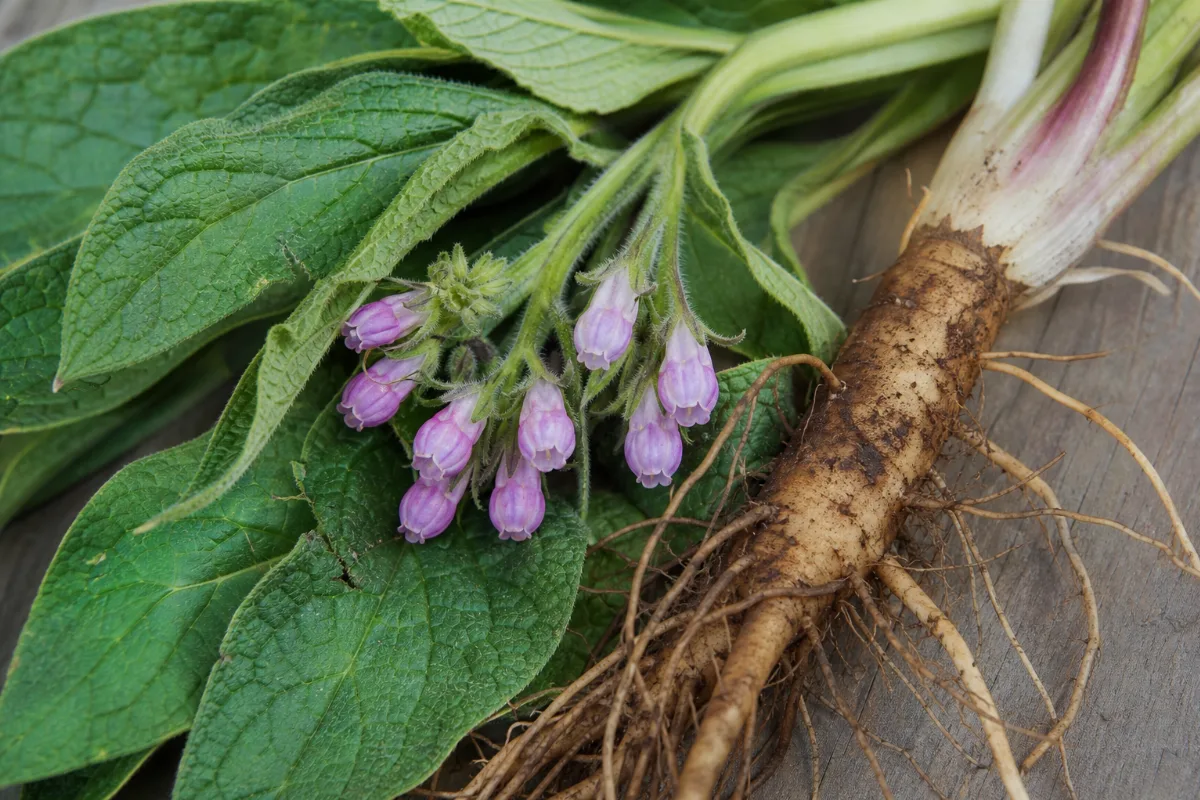
Comfrey (Symphytum officinale) is a leafy plant of the borage family (Boraginaceae). The root is the traditional medicinal part, and the above-ground herb is also used in some creams. It is sold mostly as ointments and creams for the skin.
This page covers comfrey on the skin. Comfrey for swallowing (tea, capsules, powder) is not recommended because of liver risk. Homeopathic Symphytum is a very dilute, separate product and is labelled where it appears.
Traditional and current uses
Comfrey has been rubbed on sprains, bruises, sore joints and wounds in Europe for centuries, and its folk name is knitbone. A 2026 review says traditional use goes back more than 2,000 years.
The EU herbal committee lists comfrey root ointment as a traditional herbal medicine for minor sprains and bruises, adopted in 2015 and corrected in 2024. This rests on long use, not on trial proof.
What is in it and how it works
Allantoin and rosmarinic acid are discussed as the active principles of the root and show anti-inflammatory and antioxidant activity in lab tests. The plant also contains pyrrolizidine alkaloids, such as lycopsamine, intermedine, symphytine and echimidine, which are the cause of the liver risk.
Removing the alkaloids from a root extract did not change the anti-inflammatory signals measured in a cell test. All of this is lab or animal work; no study shows how comfrey works in people.
What the research shows
The best-studied use is comfrey root ointment for knee osteoarthritis: a 220-person trial found a large pain drop compared with placebo, and Cochrane rates it moderate. Back pain and ankle sprain trials are also positive but low certainty. One compared comfrey with diclofenac gel and found it not worse.
Wound trials in adults and children used a comfrey herb cream and compared 10% with 1% strength, not with an inert cream. Most of the main trials come from one product family and are linked to its maker, and no independent copy of them was found. Nothing about comfrey reaches high certainty.
At a glance
Traditional uses history, not proof
- Europe, long-standing: comfrey root ointment is a traditional herbal medicine for minor sprains and bruises (EU monograph).
- Folk medicine: "knitbone" for broken bones and tissue repair; used on wounds and swollen joints (2026 review).
- Past use as a vegetable, tea and swallowed remedy is now considered unsafe because of liver toxicity (FDA 2001; reviews).
Studied for research
- Knee osteoarthritis pain (skin ointment), moderate
- Acute back pain (skin ointment or cream), low
- Ankle sprain (skin ointment or cream), low
- Fresh scrapes in adults and children (herb cream), low
- Bruises from blood-thinner injections, low
- Broken bones, insufficient (traditional use only)
Main compounds
- Allantoin and rosmarinic acid: discussed as the pharmacologically active principles of the root
- Pyrrolizidine alkaloids (lycopsamine, intermedine, symphytine, echimidine and others): liver-toxic and cancer-causing in animals
- Phenolic acids such as salvianolic acid isomers: antioxidant in test tubes
Common forms
- Ointments and creams made from a liquid root extract for the skin
- A herb concentrate cream made from fresh above-ground comfrey (used in Czech trials)
- Combination creams (with other ingredients) used in some trials
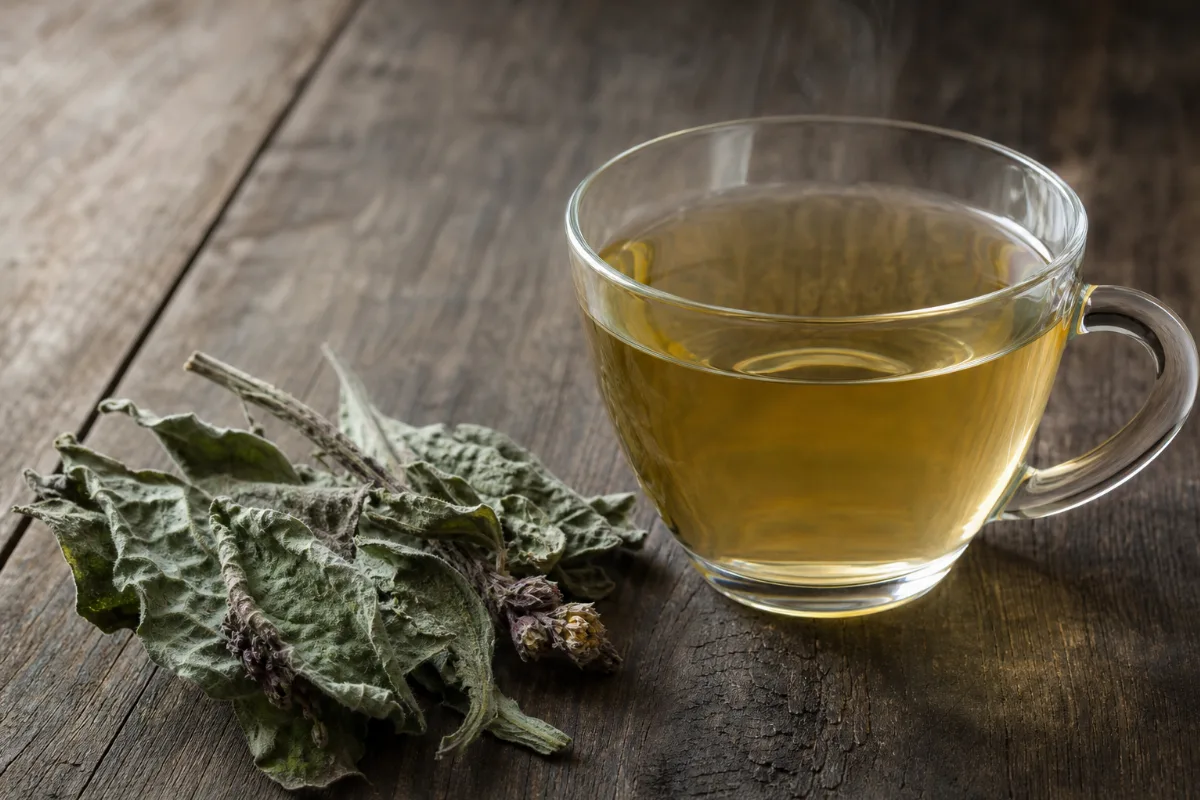
- Comfrey tea, capsules and powders for swallowing are not recommended
Research links: EU herbal medicine page for comfrey root (European Medicines Agency) · EU final herbal monograph on comfrey root (EMA PDF) · FDA letter of 6 July 2001 advising removal of comfrey supplements (archived copy) · Cochrane review: topical herbal therapies for osteoarthritis · Research Library · Genes & Biomarkers Library
The plant and its history
- Accepted scientific name
- Symphytum officinale L.
- Naming authority
- L. (Linnaeus), Boraginaceae (GBIF species key 7558421, accepted).
- Synonyms
- Not listed in the GBIF match read; not verified.
- Common names
- Comfrey; common comfrey; boneset; knitbone (folk name) (English); Grande consoude; consoude officinale (French); Beinwell; Arznei-Beinwell (German); Consuelda mayor (Spanish)
- Botanical family
- Boraginaceae (borage family). Other plants in related families that make PAs include borage and coltsfoot (a daisy-family plant), reviewed together in the 2020 case-report review.
- Classification
- Plantae > Tracheophyta > Magnoliopsida > Boraginales > Boraginaceae > Symphytum > Symphytum officinale
- Native range
- Not verified from a primary botanical source in this file.
- Habitat
- Not verified from a primary source.
- What the plant looks like
- Roots: Root is the traditional medicinal part in the EU monograph (comfrey root, Symphyti radix).; Stems: Not verified.; Leaves: Leaves are used in herb creams (aerial parts) and in teas.; Flowers: Flowers contain PAs; a rat study tested flower extracts.; Fruit: Not verified.
- Cultivation
- Not verified. Trial herb creams used fresh cultivated Symphytum x uplandicum (Russian comfrey).
- Harvest and processing
- The EU preparation is a liquid extract made with 65% ethanol (2:1). The Czech trial cream used a 2.5:1 aqueous-ethanol pressed concentrate of fresh herb.
- Look-alikes and adulterants
- Name: Russian comfrey (Symphytum x uplandicum Nyman); Note: A hybrid used in the Czech trial herb creams. The FDA letter lists it with S. officinale and prickly comfrey as comfrey species of concern.; Name: Prickly comfrey (Symphytum asperum); Note: Named in the FDA 2001 letter alongside S. officinale.; Name: Other PA-containing plants such as borage and coltsfoot; Note: Reviewed with comfrey in the 2020 case-report review; the review found species were often not clearly identified in case reports.
- Sustainability and conservation
- Not verified.
The plant and the parts used
Traditional use and history history, not clinical proof
| Tradition or era | Documented use | Source |
|---|---|---|
| Europe, long-standing | The EU monograph classes comfrey root ointment as a traditional herbal medicine for minor sprains and bruises, based on long-standing use. Two reviews (Mei 2010 from an FDA laboratory, and Liu 2026) say it has been used as a vegetable, tea and herbal medicine for more than 2,000 years; the claim comes from the review authors. | p21170807 |
| Centuries-old; folk name knitbone | Used on wounds, fractures and soft-tissue injuries in traditional European medicine (2026 review, Liu et al.). | p41993578 |
| 1980s onwards | Case reports of liver disease after swallowing comfrey (1985 and 1990 in this file); later regulatory action is described in the safety file. Details of laws in each country are not verified here. | p2103401 |
| 2001 | US FDA letter advising supplement makers to remove comfrey products; FTC injunction against marketing comfrey for internal use or open wounds. | s-fda-comfrey-letter-2001 |
| 2015, revised 2024 | EU final herbal monograph for comfrey root skin products adopted 5 May 2015; corrected 31 January 2024 to add PA limits. | s-ema-hmpc-comfrey-root-monograph-2024 |
Traditional use shows how a plant was used. It does not show that a supplement works or is safe today.
What is inside, and how it may work
What the plant contains and how those compounds act in cells and animals. Laboratory and animal mechanisms are not proven effects in people.
Main compounds
| Compound | Family | Where it is concentrated | Activity studied | Level of evidence |
|---|---|---|---|---|
| Allantoin PubChem 204 | purine-derived compound (ureide) | Root | Discussed with rosmarinic acid as a pharmacologically active principle of comfrey root (Benedek 2010). A 2026 review attributes anti-inflammatory and tissue-repair effects to it; not shown in people. 6 27 33 | Laboratory research |
| Rosmarinic acid PubChem 5281792 | phenolic acid | Root 7.55 mg per g of a 65% ethanol root extract (Trifan 2018) | Main phenolic compound of the root extract; antioxidant in lab assays. 42 33 | Laboratory research |
| Lycopsamine and intermedine PubChem 107938 | pyrrolizidine alkaloids (monoesters) | Root, leaf Total PA 0.07% in one Polish commercial root sample (Brauchli 1982) | Toxic to the liver after being changed by liver enzymes; major comfrey PAs. The crude alkaloid extract was more toxic than purified lycopsamine or intermedine in chicks. 8 9 33 | Animal research |
| Acetylated lycopsamine and intermedine (7-acetyllycopsamine, 7-acetylintermedine) PubChem 156006 | pyrrolizidine alkaloids | Root | Main PA N-oxides in root samples (Trifan 2018; Brauchli 1982). 42 8 | Laboratory research |
| Symphytine, echimidine, lasiocarpine and symlandine PubChem 5281754 | pyrrolizidine alkaloids (diesters) | Root, leaf | Hepatotoxic alkaloids named in comfrey reviews; symphytine and echimidine were measured in leaf teas. PubChem CIDs: echimidine 5281729, lasiocarpine 5281735, symlandine 5281753. 30 34 33 | Animal research |
| Salvianolic acid isomers and other caffeic acid oligomers | phenolic acids | Root | Caffeic acid trimers and tetramers (isomers of salvianolic acid A, B and C) were reported for the first time in comfrey root in 2018; antioxidant in test tubes. A PubChem CID was not checked for these isomers. 42 | Laboratory research |
Mechanisms, receptors and pathways
| Target or pathway | Gene or receptor | What was found | Level |
|---|---|---|---|
| NF-kappa B and MAPK inflammation signalling | NF-kB; MAPK | A 2026 review says allantoin, rosmarinic acid and other comfrey compounds are anti-inflammatory mainly by inhibiting NF-kappa B and MAPK pathways and reducing inflammatory messengers. This is from lab and animal work. 27 | Laboratory research |
| Inflammatory messengers in white blood cells | IL-1 beta; IL-8; TNF-alpha | In stimulated human neutrophils, comfrey root extracts with or without PA depletion did not significantly change release of IL-1 beta, IL-8 and TNF-alpha; antioxidant power was unchanged by PA removal. 43 | Laboratory research |
| Antioxidant activity | Free radicals; 15-lipoxygenase | A comfrey root extract was a strong antioxidant in test-tube assays and inhibited 15-lipoxygenase. 42 | Laboratory research |
| Liver activation of PAs to DNA-damaging pyrroles | Liver cytochrome enzymes (microsomal); DNA | PAs are changed by liver enzymes into reactive chemicals that bind DNA (DHP-derived adducts) in liver cells; comfrey and the PA riddelliine gave similar adduct patterns and mutations. 30 41 29 | Animal research |
| Wound repair and bleeding | Fibroblasts; clotting | In rats, leaf and flower extracts hastened wound closure and shortened bleeding time; in cells, a four-herb homeopathic combination raised fibroblast movement. Not shown in people. 12 19 | Animal research |
Absorption, metabolism and elimination
- Absorption
- No human blood-level data for comfrey compounds from creams or ointments were found. In human skin diffusion cells only 0.04 to 0.22% (epidermis, 24 h) to 0.6% of lycopsamine crossed. In rats, 0.1 to 0.4% of a high dose of PA N-oxides appeared in urine after skin application, 20 to 50 times less than after oral dosing.
- Distribution
- Not studied in people.
- Metabolism
- PAs are changed by liver enzymes into reactive pyrroles. On human skin, microbes (ex vivo, ten donors) broke PA derivatives into deacetylated and de-esterified forms without forming free alkaloids.
- Elimination
- In rats, PA N-oxides were excreted in urine within 2 days. Not studied in people.
- Bioavailability
- Oral bioavailability of PAs is described as good in a 2017 paper abstract (confirmed good absorption from the gut); no human figure was found.
Isolated compounds versus whole extracts
The EU monograph covers a whole-root liquid extract for the skin. In chicks, a crude comfrey alkaloid extract was more toxic than the purified PAs lycopsamine and intermedine, so limits based on single compounds may understate comfrey's toxicity. Removing PAs from a root extract did not change antioxidant or cytokine-release results in cell tests, suggesting the PAs are not what drives the anti-inflammatory signals measured, but this is lab work. The knee, back and ankle trials used a PA-free extract (Kytta-Salbe f according to a separate paper), a herb concentrate (Traumaplant), or a blend; raw comfrey was not tested as a treatment.
Nutritional composition
Comfrey leaves have been eaten as a vegetable and drunk as a tea, but the PAs make this unsafe and agencies advise against it. Comfrey is not a source of nutrients worth relying on. No food-interaction studies were found.
1 moderate certainty10 low certainty3 not enough evidence
What was looked at
The 14 benefits and uses checked for Comfrey, each with how strong the evidence is. Tap one to open it.
- Knee osteoarthritis: comfrey root extract ointment (Kytta-Salbe f)Moderate certainty
- Knee osteoarthritis: comfrey root cream blended with tannic acid and eucalyptusLow certainty
- Acute back pain: comfrey root extract ointment (Kytta-Salbe f)Low certainty
- Acute back pain: comfrey root extract plus methyl nicotinate creamLow certainty
- Back muscle pain: comfrey herb (leaf and stem) cream, 10% versus 1%Low certainty
- Ankle sprain: comfrey root extract ointment versus placeboLow certainty
- Ankle sprain: comfrey root extract ointment compared with diclofenac gelLow certainty
- Ankle sprain: comfrey herb cream, 10% versus 1%Low certainty
- Fresh scrapes and abrasions: comfrey herb cream, 10% versus 1%Low certainty
- Children's scrapes: comfrey herb cream, 10% versus 1%Low certainty
- Bruises from enoxaparin (blood-thinner) injections: comfrey ointmentLow certainty
- Pain and swelling after dental implant surgery: homeopathic Symphytum 5CHNot enough evidence
- Wound closure and bleeding: lab and animal studies of comfreyNot enough evidence
- Broken bones and tissue repair ("knitbone"): traditional use onlyNot enough evidence
Lab markers tracked in the studies
Pain score (visual scale and WOMAC pain)Pain on pressure (tonometer or algometer)WOMAC total score (pain, stiffness and function in osteoarthritis)Ankle swelling (figure-of-eight measurement)Back function (Oswestry disability index) and painkiller useTime to heal a scrapeBruise size and colourPhysician rating of wound-healing efficacyPain and swelling after dental implant surgery
What is Comfrey good for?
The main studied uses and how strong the human evidence is for each. "Moderate" means one fair-quality trial, "low" means small, short or flawed studies, and "insufficient" means no firm conclusion. Every use here is comfrey on the skin, or a different product (homeopathic, or animal work) that is labelled.
Benefits, one by one
Each card is a research question, not a promise. Tap a goal to filter. Open a card to see the studies, doses and limits.
Knee osteoarthritis: comfrey root extract ointment (Kytta-Salbe f)
Moderate certaintyOne 3-week trial of 220 people found a comfrey root ointment cut knee pain far more than a placebo ointment. The Cochrane review rates this as moderate-certainty evidence, but it rests on one trial.
3 studiesComfrey root extract ointment on the knee, 3 times a day for 3 weeks …
Studies, doses and limits
What the trials found
Grube 2007: 220 adults with painful knee osteoarthritis (average age 57.9, complaints for 6.5 years on average) used 6 g a day of comfrey root extract ointment or placebo for 3 weeks. The Cochrane review of topical herbs for osteoarthritis (Cameron 2013) found this single comfrey trial and rated it moderate quality.
Results
Pain on a 100 mm scale fell 51.6 mm (54.7%) with comfrey and 10.1 mm (10.7%) with placebo. WOMAC total fell 58.0% against 14.1%. Quality of life, knee movement and global ratings also favoured comfrey. Adverse events in the Cochrane summary: 6% with comfrey and 14% with placebo.
Effect sizes as reported
Pain difference 41.5 mm (95% CI 34.8 to 48.2); WOMAC difference 45.7 mm (95% CI 37.1 to 54.3). Cochrane: mean difference -41.5 (95% CI -48 to -34); adverse events RR 0.47 (95% CI 0.20 to 1.10).
Why this rating
The Cochrane review rated the evidence moderate. It is a single trial, only 3 weeks long, and the author list is linked to the maker of the product (Merck Selbstmedikation GmbH).
Form and dose studied
Comfrey root extract ointment on the knee, 3 times a day for 3 weeks (trial form only; ask a doctor or pharmacist about amounts). A separate paper describes this product's extract as PA-free; a raw comfrey plant product is not the same thing.
Who was studied
Adults with painful knee osteoarthritis.
Limits
One trial; short; industry-linked; no long-term follow-up.
Why researchers looked
Knee osteoarthritis causes long-term pain and stiffness, and people look for creams with fewer side effects than painkiller pills.
Traditional use
Comfrey has been used on the skin for sprains, bruises, sore joints and broken bones ("knitbone") in Europe for a very long time. The EU lists comfrey root ointment as a traditional medicine for minor sprains and bruises.
Proposed mechanism Preliminary mechanism
Lab and animal work suggests comfrey root compounds such as allantoin and rosmarinic acid have anti-inflammatory and tissue-repair effects (for example on NF-kappa B and MAPK signalling), but no study shows how comfrey works in people.
A proposed mechanism does not show that the effect happens in people.
Comfrey must not be swallowed and has strict skin-use limits (not on broken skin, short courses only). See the safety section.
Knee osteoarthritis: comfrey root cream blended with tannic acid and eucalyptus
Low certaintyA small 6-week trial of 43 people found creams with 10% or 20% comfrey root extract beat a reference cream for knee pain, stiffness and daily function. The cream also had tannic acid and eucalyptus, so comfrey cannot be credited alone.
1 studiesCream with 10% or 20% comfrey root extract plus tannic acid and eucal…
Studies, doses and limits
What the trials found
Smith and Jacobson 2011: 43 adults aged 45 to 83 with primary knee osteoarthritis were randomly given 10% comfrey root extract cream, 20% comfrey root extract cream, or a eucalyptus reference cream, 3 times a day for 6 weeks.
Results
Both comfrey creams were better than the reference cream on WOMAC pain, stiffness and daily function (each P < .01). Two people in each comfrey group had a minor, temporary rash or itching.
Effect sizes as reported
P values only in the abstract; no group means or confidence intervals.
Why this rating
Only 43 people, a blended cream (so comfrey cannot be separated from tannic acid and eucalyptus), and the abstract gives no effect sizes or funding.
Form and dose studied
Cream with 10% or 20% comfrey root extract plus tannic acid and eucalyptus, 3 times a day for 6 weeks (trial form only). Whether the extract was PA-free is not stated.
Who was studied
Adults aged 45 to 83 with primary knee osteoarthritis.
Limits
Small; blend product; mild skin rash or itching in 2 people in each comfrey group.
Why researchers looked
A second, independent-looking test of comfrey creams for knee osteoarthritis.
Traditional use
Comfrey has been used on the skin for sprains, bruises, sore joints and broken bones ("knitbone") in Europe for a very long time. The EU lists comfrey root ointment as a traditional medicine for minor sprains and bruises.
Proposed mechanism Preliminary mechanism
Lab and animal work suggests comfrey root compounds such as allantoin and rosmarinic acid have anti-inflammatory and tissue-repair effects (for example on NF-kappa B and MAPK signalling), but no study shows how comfrey works in people.
A proposed mechanism does not show that the effect happens in people.
Comfrey must not be swallowed and has strict skin-use limits (not on broken skin, short courses only). See the safety section. Mild rash and itching were seen in this trial.
Acute back pain: comfrey root extract ointment (Kytta-Salbe f)
Low certaintyOne 5-day trial of 120 people found a comfrey root ointment reduced pain on movement far more than a placebo ointment. The Cochrane back-pain review rates it low-quality evidence for short-term pain.
3 studiesComfrey root extract ointment, 4 g three times a day for 5 days (tria…
Studies, doses and limits
What the trials found
Giannetti 2010: 120 adults (average age 36.9) with acute upper or lower back pain used comfrey root extract ointment (4 g, 3 times a day) or placebo for 5 days. Cochrane herbal medicine for low-back pain (Oltean 2014; Gagnier 2016) counted this trial and rated the evidence low quality.
Results
Pain on standardised movement fell by about 95.2% (median) with comfrey and 37.8% with placebo, with consistent results on the secondary measures, and an effect reported after 1 hour. The Cochrane review found no significant adverse events in the herbal back-pain trials.
Effect sizes as reported
Group difference was significant; no confidence interval in the abstract.
Why this rating
Cochrane graded it low quality (one trial, 120 people, 5 days). The result is large, but one industry-linked trial is not enough for more.
Form and dose studied
Comfrey root extract ointment, 4 g three times a day for 5 days (trial form only).
Who was studied
Adults with acute back pain, average age about 37.
Limits
Single, short trial; no long follow-up; industry-linked.
Why researchers looked
Sudden back pain is common and short courses of rubs are widely used.
Traditional use
Comfrey has been used on the skin for sprains, bruises, sore joints and broken bones ("knitbone") in Europe for a very long time. The EU lists comfrey root ointment as a traditional medicine for minor sprains and bruises.
Proposed mechanism Preliminary mechanism
Lab and animal work suggests comfrey root compounds such as allantoin and rosmarinic acid have anti-inflammatory and tissue-repair effects (for example on NF-kappa B and MAPK signalling), but no study shows how comfrey works in people.
A proposed mechanism does not show that the effect happens in people.
Comfrey must not be swallowed and has strict skin-use limits (not on broken skin, short courses only). See the safety section.
Acute back pain: comfrey root extract plus methyl nicotinate cream
Low certaintyA 5-day trial of 379 people found a cream with 35% comfrey root extract and a skin-warming ingredient worked better than the warming ingredient alone or placebo. Comfrey cannot be separated from the second ingredient.
1 studiesCream with 35% comfrey root extract plus 1.2% methyl nicotinate, a 12…
Studies, doses and limits
What the trials found
Pabst 2013: 379 adults with acute upper or low back pain were randomly given comfrey extract plus methyl nicotinate (n=163), methyl nicotinate alone (n=164) or placebo cream (n=52), three times a day for 5 days.
Results
Pain on standardised movement was lower in the combination group than in both other groups (ANOVA p < 0.0001). Methyl nicotinate alone also had a considerable effect.
Effect sizes as reported
p < 0.0001 for the primary comparison; no numbers in the abstract.
Why this rating
A combination product, so the comfrey effect is not isolated; the placebo group was small; the first author is listed with Merck Selbstmedikation GmbH.
Form and dose studied
Cream with 35% comfrey root extract plus 1.2% methyl nicotinate, a 12 cm layer 3 times a day for 5 days (trial form only).
Who was studied
Adults with acute back pain.
Limits
Combination product; short; industry-linked.
Why researchers looked
Tests a combination cream for acute back pain.
Traditional use
Comfrey has been used on the skin for sprains, bruises, sore joints and broken bones ("knitbone") in Europe for a very long time. The EU lists comfrey root ointment as a traditional medicine for minor sprains and bruises.
Proposed mechanism Preliminary mechanism
Lab and animal work suggests comfrey root compounds such as allantoin and rosmarinic acid have anti-inflammatory and tissue-repair effects (for example on NF-kappa B and MAPK signalling), but no study shows how comfrey works in people.
A proposed mechanism does not show that the effect happens in people.
Comfrey must not be swallowed and has strict skin-use limits (not on broken skin, short courses only). See the safety section.
Back muscle pain: comfrey herb (leaf and stem) cream, 10% versus 1%
Low certaintyA trial of 215 people found a cream with 10% comfrey herb concentrate eased back pain more than a 1% version of the same cream. This is not a placebo comparison, and it uses the above-ground herb rather than the root.
1 studiesTraumaplant cream 10% concentrate of fresh comfrey herb (Symphytum x …
Studies, doses and limits
What the trials found
Kucera 2005: 215 adults with upper or lower back pain were given Traumaplant cream (10% of a pressed concentrate of fresh Symphytum uplandicum herb) or the same cream at 1%.
Results
The 10% cream was better for pain on movement (P < 5 x 10^-9), at rest (P < .001) and on pressing (P = 5 x 10^-5). Number needed to treat 3.2. Global efficacy and speed of onset also favoured the 10% cream.
Effect sizes as reported
Number needed to treat 3.2.
Why this rating
Dose-comparison against a weak cream rather than placebo; one trial; the manufacturer is named; PA content not stated.
Form and dose studied
Traumaplant cream 10% concentrate of fresh comfrey herb (Symphytum x uplandicum) (trial form only). A different plant part from the root ointments above.
Who was studied
Adults with back pain.
Limits
Not an inert placebo; one trial.
Why researchers looked
Tests whether a stronger comfrey herb cream works better than a weak one for sore back muscles.
Traditional use
Comfrey has been used on the skin for sprains, bruises, sore joints and broken bones ("knitbone") in Europe for a very long time. The EU lists comfrey root ointment as a traditional medicine for minor sprains and bruises.
Proposed mechanism Preliminary mechanism
Lab and animal work suggests comfrey root compounds such as allantoin and rosmarinic acid have anti-inflammatory and tissue-repair effects (for example on NF-kappa B and MAPK signalling), but no study shows how comfrey works in people.
A proposed mechanism does not show that the effect happens in people.
Comfrey must not be swallowed and has strict skin-use limits (not on broken skin, short courses only). See the safety section.
Ankle sprain: comfrey root extract ointment versus placebo
Low certaintyIn an 8-day trial of 142 people with sprained ankles, a comfrey root ointment beat placebo for pain on pressure and swelling.
1 studiesComfrey root extract ointment 4 times a day for 8 days (trial form on…
Studies, doses and limits
What the trials found
Koll 2004: 142 adults (average age 31.8, 78.9% men) with an acute one-sided ankle sprain used Kytta-Salbe f comfrey root ointment 4 times a day for 8 days or placebo.
Results
Comfrey was better than placebo for pain on pressure (p < 0.0001) and ankle swelling (p = 0.0001). Ankle mobility and global ratings also favoured comfrey. No adverse drug reactions were reported on comfrey.
Effect sizes as reported
p-values only in the abstract.
Why this rating
One placebo-controlled trial, short, industry-linked (first author with Merck Selbstmedikation GmbH); no effect sizes in the abstract.
Form and dose studied
Comfrey root extract ointment 4 times a day for 8 days (trial form only).
Who was studied
Adults with acute ankle sprain; mostly men.
Limits
Single trial; short.
Why researchers looked
Sprains are common sports and everyday injuries, and the EU listing for comfrey root is for minor sprains and bruises.
Traditional use
Comfrey has been used on the skin for sprains, bruises, sore joints and broken bones ("knitbone") in Europe for a very long time. The EU lists comfrey root ointment as a traditional medicine for minor sprains and bruises.
Proposed mechanism Preliminary mechanism
Lab and animal work suggests comfrey root compounds such as allantoin and rosmarinic acid have anti-inflammatory and tissue-repair effects (for example on NF-kappa B and MAPK signalling), but no study shows how comfrey works in people.
A proposed mechanism does not show that the effect happens in people.
Comfrey must not be swallowed and has strict skin-use limits (not on broken skin, short courses only). See the safety section.
Ankle sprain: comfrey root extract ointment compared with diclofenac gel
Low certaintyIn a 164-person trial, comfrey ointment was shown to be not worse than diclofenac gel for ankle sprain pain, and a later re-analysis of the same data claimed it was better. Patients knew which treatment they used.
2 studiesComfrey root extract ointment, 6 cm layer, 4 times a day for about 7 …
Studies, doses and limits
What the trials found
Predel 2005: 164 outpatients (average age 29.0, 47.6% women) with an acute one-sided ankle sprain used comfrey root ointment (n=82) or diclofenac gel (n=82) four times a day for 7 +/- 1 days; observers were blinded. D'Anchise 2007 re-analysed the same data for superiority.
Results
Comfrey was confirmed to be not worse (non-inferior) than diclofenac on pain on pressure. The re-analysis found comfrey scored 61.1 h*N/cm2 higher on the pressure-pain measure. Safety was reported as excellent in both groups.
Effect sizes as reported
Non-inferiority CI 19.01 to 103.09 h*N/cm2; re-analysis mean difference +61.1 (95% CI 19.08 to 103.09).
Why this rating
The two reports are one trial. Only observers were blinded. The superiority claim was made after the fact. The first author is linked to the maker.
Form and dose studied
Comfrey root extract ointment, 6 cm layer, 4 times a day for about 7 days (trial form only).
Who was studied
Adults with acute ankle sprain, average age 29.
Limits
One trial counted twice; no placebo group.
Why researchers looked
Diclofenac gel is a standard pain-relief gel for sprains, so this compares comfrey with a drug.
Traditional use
Comfrey has been used on the skin for sprains, bruises, sore joints and broken bones ("knitbone") in Europe for a very long time. The EU lists comfrey root ointment as a traditional medicine for minor sprains and bruises.
Proposed mechanism Preliminary mechanism
Lab and animal work suggests comfrey root compounds such as allantoin and rosmarinic acid have anti-inflammatory and tissue-repair effects (for example on NF-kappa B and MAPK signalling), but no study shows how comfrey works in people.
A proposed mechanism does not show that the effect happens in people.
Comfrey must not be swallowed and has strict skin-use limits (not on broken skin, short courses only). See the safety section.
Ankle sprain: comfrey herb cream, 10% versus 1%
Low certaintyIn a trial of 203 people with sprained ankles, a 10% comfrey herb cream eased pain, loss of function and swelling more than a 1% version of the same cream.
1 studiesTraumaplant cream containing 10% comfrey herb concentrate (trial form…
Studies, doses and limits
What the trials found
Kucera 2004: 203 patients with acute ankle sprain used Traumaplant cream (10% of a pressed juice of fresh Symphytum x uplandicum herb; n=104) or the same cream at 1% (n=99).
Results
Pain on movement, pain at rest and loss of function fell more with the 10% cream on days 3-4 and 7 (p < 0.001). Swelling was lower on days 3-4 (p < 0.01). Efficacy was good to excellent in 85.6% with the 10% cream and 65.7% with the 1% cream. Tolerability was excellent.
Effect sizes as reported
85.6% versus 65.7% rated good to excellent on days 3-4.
Why this rating
The comparison is 10% against 1%, not an inert placebo; PA content not stated; one trial.
Form and dose studied
Traumaplant cream containing 10% comfrey herb concentrate (trial form only). A different plant part from the root ointments.
Who was studied
Adults with acute ankle sprain.
Limits
Not placebo-controlled; one trial.
Why researchers looked
Tests the dose-response of a comfrey herb cream.
Traditional use
Comfrey has been used on the skin for sprains, bruises, sore joints and broken bones ("knitbone") in Europe for a very long time. The EU lists comfrey root ointment as a traditional medicine for minor sprains and bruises.
Proposed mechanism Preliminary mechanism
Lab and animal work suggests comfrey root compounds such as allantoin and rosmarinic acid have anti-inflammatory and tissue-repair effects (for example on NF-kappa B and MAPK signalling), but no study shows how comfrey works in people.
A proposed mechanism does not show that the effect happens in people.
Comfrey must not be swallowed and has strict skin-use limits (not on broken skin, short courses only). See the safety section.
Fresh scrapes and abrasions: comfrey herb cream, 10% versus 1%
Low certaintyIn a trial of 278 people with fresh scrapes, a 10% comfrey herb cream healed wounds about 3 days sooner than a 1% version of the same cream. It is not a placebo comparison, and the EU advises against putting comfrey root products on broken skin.
4 studiesComfrey herb cream (10% concentrate), amount not stated in the abstra…
Studies, doses and limits
What the trials found
Barna 2007 (article in German, abstract read): 278 patients with fresh abrasions (64 aged up to 20) used Traumaplant cream (10% concentrate from comfrey aerial parts, Symphytum x uplandicum, n=137) or the same cream at 1% (n=141); 10-day follow-up.
Results
Wound size fell by 49 +/- 19% per day with the 10% cream and 29 +/- 13% per day with the 1% cream. Time to complete healing was estimated at 4.08 against 7.05 days (2.97 days faster). Physicians rated efficacy good to very good in 93.4% against 61.7%. No skin reactions or adverse effects were reported.
Effect sizes as reported
Healing 2.97 days faster (4.08 vs 7.05 days); no confidence interval in the abstract.
Why this rating
Comparison against a weak cream rather than placebo; one research group; no independent replication; the trial treated broken skin, which the EU monograph for comfrey root says not to do. A 2023 review of paediatric skin studies also says comfrey appears to help wounds but many studies were low quality.
Form and dose studied
Comfrey herb cream (10% concentrate), amount not stated in the abstract (trial form only). Not the same as comfrey root ointments.
Who was studied
People with fresh abrasions.
Limits
Not placebo-controlled; broken skin; PA content not stated.
Why researchers looked
Comfrey has a long history on wounds.
Traditional use
Used on wounds and bruises across Europe for centuries.
Proposed mechanism Preliminary mechanism
Lab and animal work suggests allantoin and plant phenolics may speed cell repair, but this is not shown in people.
A proposed mechanism does not show that the effect happens in people.
Broken skin is where the EU advises against comfrey root products, and the 2001 FTC injunction cited by FDA covered marketing comfrey for open wounds. Ask a doctor or pharmacist before putting any comfrey product on a wound.
Children's scrapes: comfrey herb cream, 10% versus 1%
Low certaintyIn 108 children aged 3 to 12 with fresh scrapes, a 10% comfrey herb cream healed faster than a 1% version. The EU does not recommend comfrey root products under 18.
3 studiesComfrey herb cream (10% concentrate) (trial form only).
Studies, doses and limits
What the trials found
Barna 2012: 108 children aged 3 to 12 (54 per group) with fresh abrasions used Traumaplant cream (10% concentrate from comfrey aerial parts, Symphytum x uplandicum) or the same cream at 1%.
Results
50% healing came 0.9 days sooner with the 10% cream. Healing rate 0.38 +/- 0.18 per day with 10% against 0.26 +/- 0.14 per day with 1% (p = 0.0002). Physicians rated efficacy good or very good in 90.7% and 92.6% (at 2-3 and 7-9 days) against 55.6% and 74.0%. No adverse effects or irritation were reported.
Effect sizes as reported
Rate 0.38 vs 0.26 per day; 95% CI for rate 0.33 to 0.4 and 0.222 to 0.297.
Why this rating
Dose comparison against a weak cream, not placebo; one research group; funding not stated.
Form and dose studied
Comfrey herb cream (10% concentrate) (trial form only).
Who was studied
Children aged 3 to 12.
Limits
Not placebo-controlled; PAs not measured; the EU says safety in under-18s is not established.
Why researchers looked
Children get many scrapes, and parents look for gentle remedies.
Traditional use
Used on wounds and bruises for centuries.
Proposed mechanism Preliminary mechanism
Lab and animal work only; see the adult wound entry.
A proposed mechanism does not show that the effect happens in people.
The EU monograph says use under 18 is not recommended and not to use on broken skin. Do not use comfrey on a child without asking a doctor.
Bruises from enoxaparin (blood-thinner) injections: comfrey ointment
Low certaintyIn 80 heart patients, a comfrey ointment on injection-site bruises made them smaller and fade sooner than a placebo ointment. The abstract gives no numbers.
2 studiesComfrey ointment (strength and plant part not stated).
Studies, doses and limits
What the trials found
Bagheri 2021: 80 patients with acute coronary syndrome were randomised to comfrey ointment or placebo for bruises from enoxaparin injections (40 per group); size and colour were recorded daily. Iran, one site.
Results
Bruises were smaller in the comfrey group on days 2 to 5, and bruise colour changed faster. Both groups improved over time.
Effect sizes as reported
Significant differences reported; no numbers in the abstract.
Why this rating
Small, one site, no numbers in the abstract, product and strength not stated.
Form and dose studied
Comfrey ointment (strength and plant part not stated).
Who was studied
Adults with acute coronary syndrome on enoxaparin.
Limits
Small; abstract only.
Why researchers looked
Blood-thinner injections often leave bruises.
Traditional use
Comfrey has been used on bruises for centuries (EU: minor sprains and bruises).
Proposed mechanism Preliminary mechanism
Lab and animal work suggests comfrey root compounds such as allantoin and rosmarinic acid have anti-inflammatory and tissue-repair effects (for example on NF-kappa B and MAPK signalling), but no study shows how comfrey works in people.
A proposed mechanism does not show that the effect happens in people.
Used on intact skin around injection sites. Patients on blood thinners should still ask their care team before using any skin product.
Pain and swelling after dental implant surgery: homeopathic Symphytum 5CH
Not enough evidenceA non-randomised study of dental implant patients found less pain and swelling with homeopathic Symphytum 5CH added to ketoprofen, but the result was no longer significant once the authors adjusted for differences between the groups. This is a very dilute homeopathic product, not a herbal cream.
1 studiesHomeopathic Symphytum 5CH by mouth (a very dilute preparation, not he…
Studies, doses and limits
What the trials found
Mazzocchi 2012: 100 implants in 57 patients treated with ketoprofen alone against 100 implants in 60 patients treated with ketoprofen plus Symphytum 5CH, chosen by the dentist's usual practice.
Results
Unadjusted odds ratios favoured Symphytum (pain 0.23, 95% CI 0.13-0.41; swelling 0.24, 95% CI 0.13-0.44). After adjustment the intervals widened and results were no longer significant (pain OR 0.15, 95% CI 0.07-34.56; swelling OR 0.18, 95% CI 0.07-46.78). The authors say no firm conclusion can be drawn.
Effect sizes as reported
Not significant after adjustment.
Why this rating
Not randomised, groups differed (mainly sex), homeopathic dilution.
Form and dose studied
Homeopathic Symphytum 5CH by mouth (a very dilute preparation, not herbal comfrey).
Who was studied
Dental implant patients.
Limits
Observational; confounded.
Why researchers looked
Homeopathic Symphytum is sometimes given for bone healing.
Traditional use
Comfrey is called "knitbone" in folk medicine.
Proposed mechanism Pharmacological theory
No plausible herbal mechanism at homeopathic dilution is shown.
A proposed mechanism does not show that the effect happens in people.
Homeopathic dilutions contain no measurable herb; this entry says nothing about herbal comfrey safety.
Wound closure and bleeding: lab and animal studies of comfrey
Not enough evidenceIn rats, extracts of comfrey leaf and flower helped wounds close and stopped bleeding sooner, and a four-herb homeopathic spray that included comfrey moved cells across a scratch in a dish. These are not human results.
2 studiesNot applicable to people.
Studies, doses and limits
What the trials found
Dolgošev 2026 (rats): flower extract closed wounds by day 10 against day 12 for the reference group; leaf extract cut bleeding time to 44.3 s against 64.1 s (reference) and 144.3 s (control). Hostanska 2012 (mouse fibroblast cells): a four-herb low-potency homeopathic spray (arnica 4x, calendula 4x, hypericum 4x, Symphytum 6x) raised cell migration and scratch closure.
Results
Rat wound closure 10 vs 12 days; bleeding time 44.3 vs 64.1 vs 144.3 s; cell scratch closure 59.5% vs 22.1% (combination spray vs solvent).
Effect sizes as reported
Lab and rat figures as reported; no human numbers.
Why this rating
Animal and cell work only; the cell study used a four-herb homeopathic combination.
Who was studied
Rats; mouse cells.
Limits
No human data; comfrey cannot be separated in the combination spray.
Why researchers looked
Researchers want to find which comfrey parts do the repair work.
Traditional use
Used on wounds for centuries.
Proposed mechanism Animal research
In rats, leaf and flower extracts (richer in phenolic compounds, lower in PAs than root) closed wounds sooner and shortened bleeding time; cell studies show a combination spray raised fibroblast movement.
A proposed mechanism does not show that the effect happens in people.
Root extracts had the highest PA levels in the rat study.
Broken bones and tissue repair ("knitbone"): traditional use only
Not enough evidenceComfrey is called "knitbone" in folk medicine, and a 2026 review says it has been used for more than 2,000 years for wounds, fractures and inflammation. We found no human trial showing it helps broken bones heal.
1 studiesNot applicable.
Studies, doses and limits
What the trials found
Liu 2026 (narrative review) lists traditional use for fractures and says trials show benefit for pain and sprain; it presents no fracture trial. We found no human fracture trial.
Results
No human result on fracture healing.
Why this rating
Only traditional use and lab models.
Limits
No human studies on fractures.
Why researchers looked
The folk name comes from the belief that comfrey helps bones knit.
Traditional use
Used for wounds, fractures and soft-tissue injuries in European traditional medicine, per the 2026 review.
Proposed mechanism Preliminary mechanism
Allantoin, rosmarinic acid and other compounds show anti-inflammatory and repair-related activity in lab models; not shown in people for fractures.
A proposed mechanism does not show that the effect happens in people.
Do not swallow comfrey for bone healing. See a doctor for any suspected fracture.
Connections to the rest of health
How Comfrey connects to the rest of our health knowledge graph. Every link says what kind of connection it is. A safety link (for example to the liver) is a warning, not a benefit. A study that merely mentions a topic never creates a benefit link.
Explore every connection: goals, body systems, organs, symptoms, genes
A. Wellness goals
| Connected to | Kind of connection | Evidence status | Context | Studies |
|---|---|---|---|---|
| Joint Support | Demonstrated clinical effect | Moderate certainty | Knee osteoarthritis: comfrey root extract ointment (Kytta-Salbe f): One 3-week trial of 220 people found a comfrey root ointment cut knee pain far more than a placebo ointment. The Cochrane review rates this as moderate-certainty evidence, but it rests on one trial. | 18 10 13 |
| Joint Support | Potential benefit | Low certainty | Knee osteoarthritis: comfrey root cream blended with tannic acid and eucalyptus: A small 6-week trial of 43 people found creams with 10% or 20% comfrey root extract beat a reference cream for knee pain, stiffness and daily function. The cream also had tannic acid and eucalyptus, so comfrey cannot be credited alone. Acute back pain: comfrey root extract ointment (Kytta-Salbe f): One 5-day trial of 120 people found a comfrey root ointment reduced pain on movement far more than a placebo ointment. The Cochrane back-pain review rates it low-quality evidence for short-term pain. | 40 17 35 16 23 38 11 |
| Muscle Recovery | Potential benefit | Low certainty | Acute back pain: comfrey root extract ointment (Kytta-Salbe f): One 5-day trial of 120 people found a comfrey root ointment reduced pain on movement far more than a placebo ointment. The Cochrane back-pain review rates it low-quality evidence for short-term pain. Acute back pain: comfrey root extract plus methyl nicotinate cream: A 5-day trial of 379 people found a cream with 35% comfrey root extract and a skin-warming ingredient worked better than the warming ingredient alone or placebo. Comfrey cannot be separated from the second ingredient. | 17 35 16 36 25 23 38 11 24 |
| Healthy Skin | Potential benefit | Low certainty | Fresh scrapes and abrasions: comfrey herb cream, 10% versus 1%: In a trial of 278 people with fresh scrapes, a 10% comfrey herb cream healed wounds about 3 days sooner than a 1% version of the same cream. It is not a placebo comparison, and the EU advises against putting comfrey root products on broken skin. Children's scrapes: comfrey herb cream, 10% versus 1%: In 108 children aged 3 to 12 with fresh scrapes, a 10% comfrey herb cream healed faster than a 1% version. The EU does not recommend comfrey root products under 18. | 4 22 13 44 5 3 |
| Muscle Recovery | Preliminary mechanism | Not enough evidence | Pain and swelling after dental implant surgery: homeopathic Symphytum 5CH: A non-randomised study of dental implant patients found less pain and swelling with homeopathic Symphytum 5CH added to ketoprofen, but the result was no longer significant once the authors adjusted for differences between the groups. This is a very dilute homeopathic product, not a herbal cream. | 28 |
| Healthy Skin | Preliminary mechanism | Not enough evidence | Wound closure and bleeding: lab and animal studies of comfrey: In rats, extracts of comfrey leaf and flower helped wounds close and stopped bleeding sooner, and a four-herb homeopathic spray that included comfrey moved cells across a scratch in a dish. These are not human results. | 12 19 |
| Joint Support | Traditional use | Not enough evidence | Broken bones and tissue repair ("knitbone"): traditional use only: Comfrey is called "knitbone" in folk medicine, and a 2026 review says it has been used for more than 2,000 years for wounds, fractures and inflammation. We found no human trial showing it helps broken bones heal. | 27 |
B. Body systems
| Connected to | Kind of connection | Evidence status | Context | Studies |
|---|---|---|---|---|
| Reproductive system | Contraindication | Not enough evidence | Not recommended (EMA); foetal liver toxicity in rats with a PA given by mouth. Preparation or compound: Comfrey in pregnancy and breastfeeding |
13 |
| Musculoskeletal System | Biological association | Moderate certainty | Studied for: Knee osteoarthritis: comfrey root extract ointment (Kytta-Salbe f) Studied for: Knee osteoarthritis: comfrey root cream blended with tannic acid and eucalyptus | 18 10 13 40 17 35 16 36 25 23 38 11 24 28 27 |
| Integumentary System | Biological association | Low certainty | Studied for: Fresh scrapes and abrasions: comfrey herb cream, 10% versus 1% Studied for: Children's scrapes: comfrey herb cream, 10% versus 1% | 4 22 13 44 5 3 12 19 |
C. Body parts and organs
| Connected to | Kind of connection | Evidence status | Context | Studies |
|---|---|---|---|---|
| Liver | Adverse effect or risk | Low certainty | Hepatic veno-occlusive disease in case reports after oral comfrey; supported by animal toxicology and FDA advice (2001). Preparation or compound: Swallowed comfrey; pyrrolizidine alkaloids (lycopsamine, intermedine, symphytine, echimidine) |
45 39 41 44 |
| Skin | Adverse effect or risk | Low certainty | Minor rash or itching in a small knee trial; EU says not on broken skin. Preparation or compound: Comfrey creams and ointments |
40 13 |
| Joints | Potential benefit | Moderate certainty | Knee osteoarthritis pain: one 220-person trial, rated moderate by Cochrane. Preparation or compound: Comfrey root extract ointment on the skin |
18 10 |
| Muscles | Potential benefit | Low certainty | Back pain and ankle sprain: short single trials, low certainty. Preparation or compound: Comfrey root ointment; herb cream |
17 23 25 |
| Liver blood vessels (small hepatic veins) | Adverse effect or risk | Low certainty | Veno-occlusive disease means obstruction of small liver veins. Preparation or compound: Pyrrolizidine alkaloid metabolites |
41 39 |
I. Biomarkers
| Connected to | Kind of connection | Evidence status | Context | Studies |
|---|---|---|---|---|
| Pain score (visual scale and WOMAC pain) | Biological association | Low certainty | Measured in trials: lowered. A lab change is not the same as a health benefit. | 18 40 17 25 |
| Pain on pressure (tonometer or algometer) | Biological association | Low certainty | Measured in trials: lowered. A lab change is not the same as a health benefit. | 23 38 11 |
| WOMAC total score (pain, stiffness and function in osteoarthritis) | Biological association | Low certainty | Measured in trials: lowered. A lab change is not the same as a health benefit. | 18 40 |
| Ankle swelling (figure-of-eight measurement) | Biological association | Low certainty | Measured in trials: lowered. A lab change is not the same as a health benefit. | 23 24 |
| Back function (Oswestry disability index) and painkiller use | Biological association | Not enough evidence | Measured in trials: mixed. A lab change is not the same as a health benefit. | 17 |
| Time to heal a scrape | Biological association | Low certainty | Measured in trials: lowered. A lab change is not the same as a health benefit. | 4 5 |
| Bruise size and colour | Biological association | Low certainty | Measured in trials: lowered. A lab change is not the same as a health benefit. | 3 |
| Physician rating of wound-healing efficacy | Biological association | Low certainty | Measured in trials: raised. A lab change is not the same as a health benefit. | 4 5 |
| Pain and swelling after dental implant surgery | Biological association | Not enough evidence | Measured in trials: no-change. A lab change is not the same as a health benefit. | 28 |
J. Genes, receptors and enzymes
| Connected to | Kind of connection | Evidence status | Context | Studies |
|---|---|---|---|---|
| NF-kappa B | Preliminary mechanism | In vitro | Anti-inflammatory target proposed for comfrey compounds; review of lab work. | 27 |
| MAPK pathway | Preliminary mechanism | In vitro | Proposed target; review of lab work. | 27 |
| IL-1 beta, IL-8, TNF-alpha | Preliminary mechanism | In vitro | Release from stimulated white blood cells not changed by PA removal in a cell test. | 43 |
K. Biological pathways
L. Active compounds
| Connected to | Kind of connection | Evidence status | Context | Studies |
|---|---|---|---|---|
| Allantoin | Biological association | In vitro | Discussed with rosmarinic acid as a pharmacologically active principle of comfrey root (Benedek 2010). A 2026 review attributes anti-inflammatory and tissue-repair effects to it; not shown in people. Preparation or compound: Root |
6 27 33 |
| Rosmarinic acid | Biological association | In vitro | Main phenolic compound of the root extract; antioxidant in lab assays. Preparation or compound: Root |
42 33 |
| Lycopsamine and intermedine | Biological association | Animal | Toxic to the liver after being changed by liver enzymes; major comfrey PAs. The crude alkaloid extract was more toxic than purified lycopsamine or intermedine in chicks. Preparation or compound: Root, leaf |
8 9 33 |
| Acetylated lycopsamine and intermedine (7-acetyllycopsamine, 7-acetylintermedine) | Biological association | In vitro | Main PA N-oxides in root samples (Trifan 2018; Brauchli 1982). Preparation or compound: Root |
42 8 |
| Symphytine, echimidine, lasiocarpine and symlandine | Biological association | Animal | Hepatotoxic alkaloids named in comfrey reviews; symphytine and echimidine were measured in leaf teas. PubChem CIDs: echimidine 5281729, lasiocarpine 5281735, symlandine 5281753. Preparation or compound: Root, leaf |
30 34 33 |
| Salvianolic acid isomers and other caffeic acid oligomers | Biological association | In vitro | Caffeic acid trimers and tetramers (isomers of salvianolic acid A, B and C) were reported for the first time in comfrey root in 2018; antioxidant in test tubes. A PubChem CID was not checked for these isomers. Preparation or compound: Root |
42 |
Each connection is stored with the ingredient, the connected record, the kind of connection, the evidence status, the supporting studies, the preparation or compound involved, and a review date (last reviewed October 25, 2026).
Evidence at a glance: what changed in 9 lab markers
Tap a number to show only those markers. Counts are markers, not people.
The evidence
The research centre for Comfrey. Every record here was checked against PubMed or the publisher's page; we never list a study we have not verified.
Evidence by outcome
Bars show how many studies we found for each outcome, not how well it works. People are added up across trials only (reviews are not added, to avoid double counting).
How we rate evidence
High certainty
Several well-run trials or reviews agree; further research is unlikely to change the picture much.
Moderate certainty
Good trials point the same way, but some doubt remains.
Low certainty
Small, short or inconsistent trials. The finding could change with better research.
Very low certainty
Very little or very weak human data. Treat as a possibility only.
Mixed findings
Trials or reviews disagree with each other.
Not enough evidence
Not enough human research to say either way.
Evidence against
Good research found no benefit, or found harm.
We take the reviewers' own risk-of-bias and GRADE statements where they exist, and otherwise judge from study size, design, consistency, directness and whether a product matches what is sold. Many publications do not make evidence high. Method note: We searched PubMed, read the EU final herbal monograph for comfrey root and the FDA 2001 letter (archived copy), and checked plant names in GBIF and NCBI Taxonomy and compounds in PubChem. Each cited study was looked up in PubMed and its abstract read; where only an abstract was read, numbers come from it alone. Certainty ratings are ours, using plain categories, except that we follow the Cochrane reviews for the knee osteoarthritis and back-pain comparisons.
Study library: every study we checked 45
| Study | Design | People | Product, dose, length | Result |
|---|---|---|---|---|
| Altamirano 2005 Investigation of pyrrolizidine alkaloids and their N-oxides in commercial comfrey-containing products and botanical materials by liquid chromatography electrospray ionization mass spectrometry. J AOAC Int · PMID 15859063 |
Laboratory analysis of products in-vitro |
Ten herbal remedies and botanical materials | Commercial comfrey-containing products various |
All products labelled as containing comfrey had measurable PAs. The paper notes PAs may cause acute liver failure, cirrhosis, lung disease, and are carcinogenic in animals. Every comfrey-labelled product tested contained PAs Methods, limits and fundingOutcomes: Presence of PAs and N-oxides Limitations: Ten products tested in the US around 2005; may not reflect today. Funding and conflicts: Authors work at the US FDA. Read: abstract |
| Avila 2020 A systematic review and quality assessment of case reports of adverse events for borage (Borago officinalis), coltsfoot (Tussilago farfara) and comfrey (Symphytum officinale). Fitoterapia · PMID 32105669 · DOI |
Systematic review of case reports |
11 Case reports of harm linked to comfrey, coltsfoot or borage by mouth |
Oral comfrey, coltsfoot, borage various |
Eleven reports were found (none about borage). Nine showed some association between what was swallowed and the harm. Species were often not clearly identified, so the authors call these cases an unreliable body of evidence for oral comfrey safety and suggest toxicology studies of whole preparations may be better. Case reports are weak evidence, but the toxicology is not disputed here Methods, limits and fundingOutcomes: Reliability of case reports for PA harm Limitations: Funded by the National Institute of Medical Herbalists (UK). Authors declared no conflict. Funding and conflicts: Funded by the National Institute of Medical Herbalists, UK. Read: abstract |
| Bagheri 2021 The Effect of Comfrey on Enoxaparin-Induced Bruise in Patients with Acute Coronary Syndrome: A Randomised Clinical Trial. J Pharmacopuncture · PMID 35028171 · DOI |
Rct (double blind, placebo controlled) |
80 80 patients with acute coronary syndrome who developed bruises after enoxaparin injections |
Comfrey ointment (Symphytum officinale); strength and plant part not stated in the abstract · vs placebo ointment |
Bruise size was smaller in the comfrey group than the placebo group on days 2 to 5. Bruise colour differed significantly between groups, with a shorter healing course with comfrey. Comfrey ointment shortened bruise healing in this small trial Methods, limits and fundingOutcomes: Bruise size and colour recorded daily Limitations: Abstract gives no numbers. Small, one site. Product and PA content not stated. Applied to intact skin around injection sites. Funding and conflicts: Authors declared no conflict of interest. Read: abstract |
| Barna 2007 [Wound healing effects of a Symphytum herb extract cream (Symphytum x uplandicum NYMAN: ): results of a randomized, controlled double-blind study]. Wien Med Wochenschr · PMID 18157595 · DOI |
Rct (double blind, dose comparison) |
278 278 patients with fresh skin abrasions (64 aged up to 20) |
Traumaplant cream: 10% concentrate from the aerial parts of comfrey (Symphytum x uplandicum Nyman) herb (aerial parts) cream, amount not stated in the abstract 10-day observation · vs the same cream at 1% (n=141); 10% group n=137 |
Wound size fell by 49 +/- 19% per day with the 10% cream and 29 +/- 13% with the 1% cream (p < 5x10^-21). Estimated time to complete healing was 4.08 days with 10% and 7.05 days with 1% (2.97 days faster). Physicians rated efficacy good to very good in 93.4% against 61.7%. No adverse effects or skin reactions were reported. Higher-strength cream healed fresh abrasions about 3 days sooner than the 1% version Methods, limits and fundingOutcomes: Wound size reduction in the first 2-3 days, time to full healing (from regression), physician and patient ratings Limitations: Compared with a 1% cream, not an inert placebo. The trial treated fresh broken skin, which the EU comfrey root monograph says not to do. P-values are extremely small and no confidence interval is given. Article is in German; abstract read. Funding and conflicts: Funding not stated in the abstract. Cream is a commercial product. Read: abstract |
| Barna 2012 Randomized double-blind study: wound-healing effects of a Symphytum herb extract cream (Symphytum×uplandicum Nyman) in children. Arzneimittelforschung · PMID 22549241 · DOI |
Rct (double blind, dose comparison) |
108 108 children aged 3 to 12 with fresh abrasions (54 per group) |
Traumaplant cream: 10% concentrate from the aerial parts of comfrey (Symphytum x uplandicum Nyman) herb (aerial parts) cream, amount not stated in the abstract · vs the same cream at 1% |
50% healing was reached 0.9 days earlier with the 10% cream. Healing rate was 0.38 +/- 0.18 per day with 10% against 0.26 +/- 0.14 per day with 1% (p = 0.0002). Physicians rated efficacy good or very good in 90.7% and 92.6% (after 2-3 and 7-9 days) against 55.6% and 74.0%. No adverse effects or irritation were reported. Higher-strength cream healed children's abrasions faster than a 1% version (95% CI for rate 0.33 to 0.4 (10%) and 0.222 to 0.297 (1%)) Methods, limits and fundingOutcomes: Time to 50% healing, healing rate, physician and parent/child ratings Limitations: Compared with a 1% cream, not an inert placebo. The EU comfrey root monograph does not recommend use under 18 and says not to use on broken skin, so this trial used the herb in exactly the situations the EU advises against. Funding and conflicts: Funding not stated in the abstract. Read: abstract |
| Benedek 2010 Absence of mutagenic effects of a particular Symphytum officinale L. liquid extract in the bacterial reverse mutation assay. Phytother Res · PMID 19827020 · DOI |
In vitro mutation test (Ames test) in-vitro |
Salmonella typhimurium strains with and without liver enzymes | PA-free liquid extract of comfrey root used in Kytta-Salbe f and Kytta-Plasma f root lab assay · vs reference mutagens |
No biologically relevant rise in revertant colonies in any of the five strains, with or without liver enzymes. The PA-free extract was not mutagenic in this bacterial test Methods, limits and fundingOutcomes: Gene mutations in bacteria Limitations: Bacterial test only. It does not cover cancer in animals or people. Authors are from PhytoLab, which tests plant products. Funding and conflicts: Funding not stated in the abstract. The authors are from PhytoLab GmbH, and the extract tested is the one used in the Kytta products, so treat as industry-linked. Read: abstract |
| Betz 1994 Determination of pyrrolizidine alkaloids in commercial comfrey products (Symphytum sp.). J Pharm Sci · PMID 8071814 · DOI |
Laboratory analysis of products in-vitro |
11 11 comfrey-containing products bought in Washington, DC in May-June 1989 |
Commercial comfrey products root, leaf, mixtures |
Nine of 11 products had measurable PAs, from 0.1 to 400.0 ppm. Highest levels were in bulk comfrey root, then bulk leaf. Leaf mixed with other ingredients had the lowest levels. Comfrey products had very different PA levels Methods, limits and fundingOutcomes: PA content Limitations: Old (1989) market sample. Funding and conflicts: Authors work at the US FDA. Read: abstract |
| Brauchli 1982 Pyrrolizidine alkaloids from Symphytum officinale L. and their percutaneous absorption in rats. Experientia · PMID 7128756 · DOI |
Animal study (rats) animal |
Rats given a comfrey root extract on the skin or by mouth | Crude alcoholic extract of Polish comfrey root (total PA 0.07%), 194 mg PA N-oxides per kg body weight root 194 mg PA N-oxides/kg on the skin 2 days urine collection · vs oral dosing for comparison |
After skin application, 0.1 to 0.4% of the dose appeared in urine in 2 days. Oral dosing led to 20 to 50 times higher urinary excretion of N-oxides and free alkaloids. Little N-oxide was converted to free alkaloid. Skin absorption in rats was low compared with oral Methods, limits and fundingOutcomes: PA N-oxides in urine Limitations: Rat study from 1982; a very high dose; not a measure of safety in people. Funding and conflicts: Funding and conflicts of interest not stated in the abstract. Read: abstract |
| Brown 2016 The comparative toxicity of a reduced, crude comfrey (Symphytum officinale) alkaloid extract and the pure, comfrey-derived pyrrolizidine alkaloids, lycopsamine and intermedine in chicks (Gallus gallus domesticus). J Appl Toxicol · PMID 26177929 · DOI |
Animal study (chicks) animal |
Male chicks fed comfrey alkaloid extract or purified PAs for 10 days | Reduced crude comfrey alkaloid extract versus purified lycopsamine and intermedine whole plant extract daily doses of 0.04 to 1.04 mmol per kg for 10 days 10 days plus 7 days · vs purified PAs |
The crude extract was more toxic than the purified lycopsamine or intermedine. The authors say this suggests greater-than-additive toxicity and that safety limits based on purified compounds may underestimate comfrey's toxicity. Whole alkaloid extract more toxic than single PAs in chicks Methods, limits and fundingOutcomes: Clinical signs, blood tests and tissue damage Limitations: Chick study; oral doses. Funding and conflicts: US government laboratory; no conflict stated in the abstract. Read: abstract |
| Cameron 2013 Topical herbal therapies for treating osteoarthritis. Cochrane Database Syst Rev · PMID 23728701 · DOI |
Systematic review (Cochrane) |
785 Seven trials, 785 people, topical herbal products for osteoarthritis; one comfrey trial of 220 people with knee osteoarthritis |
Comfrey extract gel (as described by the review; the trial it covers is the 220-person Kytta-Salbe f trial) root 3 weeks · vs placebo |
The review rated the single comfrey trial as moderate-quality evidence. Pain at 3 weeks: placebo group 83.5 on a 100-point scale; comfrey reduced pain by a further 41.5 points. Function was not reported. Adverse events: 6% (7/110) with comfrey and 14% (15/110) with placebo. Overall the review says the quality and quantity of current studies are insufficient. Comfrey extract gel probably improves pain (moderate certainty, one trial) (Pain mean difference -41.5 (95% CI -48 to -34); adverse events RR 0.47 (95% CI 0.20 to 1.10)) Methods, limits and fundingOutcomes: Pain and function in osteoarthritis Limitations: Only one comfrey trial, with a high baseline pain level; the review calls for larger high-quality studies. Funding and conflicts: Conflict of interest statement: none known. Read: abstract |
| D'Anchise 2007 Comfrey extract ointment in comparison to diclofenac gel in the treatment of acute unilateral ankle sprains (distortions). Arzneimittelforschung · PMID 18193693 · DOI |
Re analysis of the diclofenac trial data (Predel 2005) for superiority |
164 Same 164 ankle-sprain patients as the Predel 2005 trial |
Comfrey root extract ointment compared with diclofenac gel root as in the original trial about 7 days · vs diclofenac gel |
Re-analysed for superiority, the comfrey group scored 61.1 h*N/cm2 higher on the pressure-pain measure than the diclofenac group. The authors say this shows superiority. Safety was described as excellent in both groups. Reported as better than diclofenac gel on the primary measure (95% CI 19.08 to 103.09 h*N/cm2) Methods, limits and fundingOutcomes: Pain on pressure (area under the curve, visits 1 to 2), pain, swelling, movement Limitations: This is the same patients re-analysed, not a second trial. The superiority claim was made after the study was designed only to show non-inferiority. Funding and conflicts: Funding and conflicts of interest not stated in the abstract. Read: abstract |
| Dolgošev 2026 Organ-Specific Phytochemical Profiles, Wound-Healing and Hemostatic Activities of Symphytum officinale Aerial Parts and Roots with Differential Pyrrolizidine Alkaloid Content. Molecules · PMID 42357554 · DOI |
Animal study (rats) plus chemical analysis animal |
Rats with experimental wounds and bleeding tests | Extracts of comfrey root, leaf and flower made with different solvents root, leaf, flower wounds followed for up to about 12 days · vs reference preparation and untreated control |
A flower extract (S13) reached complete wound closure by day 10 against day 12 for the reference group. A leaf extract (S7) cut bleeding time to 44.3 s against 64.1 s for the reference and 144.3 s for the control. Root extracts had higher pyrrolizidine alkaloid levels; leaf and flower extracts had more phenolic compounds. Leaf and flower extracts helped rat wounds and bleeding in the lab Methods, limits and fundingOutcomes: Wound closure, bleeding time, wound fluid cells, plant chemistry Limitations: Animal study only; reference preparation is not named in the abstract. Funding and conflicts: Authors declared no conflicts of interest. Read: abstract |
| European Medicines Agency 2024 European Union herbal monograph on Symphytum officinale L., radix (EMA/HMPC/572846/2009 Corr 1) EMA · Source |
Authoritative guidance (regulatory monograph) |
Adults, skin use | Liquid extract of comfrey root (ethanol 65%, drug-extract ratio 2:1) in semi-solid forms for the skin root |
Traditional herbal medicine for relief of minor sprains and bruises. 10% liquid extract, a thin layer twice a day, not for more than 10 days. Not for broken or irritated skin; avoid eyes and mucous membranes. Under 18 not recommended. Pregnancy and breastfeeding not recommended. Hypersensitivity is the only contraindication listed. Interactions: none reported. Undesirable effects: none known. PA daily exposure to be limited to below 1 microgram a day for adults. Adequate tests on reproductive toxicity, genotoxicity and carcinogenicity have not been performed. Skin use only, short and adult only Methods, limits and fundingOutcomes: Traditional use, safety limits Limitations: Corrected version of 31 January 2024 read as text. The EMA product web page summary I read separately quoted a 0.35 microgram figure; the monograph text I read says 1 microgram; the difference is not resolved here. Read: full-text |
| European Medicines Agency 2024 EMA herbal medicine page: Symphyti radix (comfrey root) EMA website · Source |
Authoritative guidance (regulatory web page) |
Adults, skin use | Comfrey root, semi-solid products for the skin root |
Final EU monograph, opinion and assessment report first published 5 June 2015; the page lists the monograph reference EMA/HMPC/572846/2009 Corr 1, an addendum to the assessment report (EMA/HMPC/313662/2023, published 11 March 2024) and a periodic-review consultation in 2022. Use limit shown: not longer than 10 days; adults only. EU status: traditional-use monograph exists Methods, limits and fundingOutcomes: Status and document list Limitations: Page text was read through a summarising tool; details checked against the PDF monograph. Read: summary-only |
| GBIF Secretariat 2026 GBIF Backbone Taxonomy: Symphytum officinale L. GBIF API · Source |
Database record |
Plant name | Symphytum officinale L. |
GBIF species match: Symphytum officinale L., key 7558421, rank species, status accepted, exact match, confidence 99; family Boraginaceae, order Boraginales, class Magnoliopsida, phylum Tracheophyta, kingdom Plantae. English names include common comfrey; French: consoude officinale, grande consoude; German: Beinwell. Accepted species Methods, limits and fundingOutcomes: Accepted name check Limitations: Read through the GBIF API on 2026-10-25. Read: full-text |
| Gagnier 2016 Herbal Medicine for Low Back Pain: A Cochrane Review. Spine (Phila Pa 1976) · PMID 26630428 · DOI |
Systematic review (Cochrane, journal version) |
2050 14 trials, 2050 adults with non-specific low-back pain |
Herbal medicines including comfrey (Symphytum officinale) topical various · vs placebo or active |
Capsicum reduced pain more than placebo. Devil's claw, willow bark, comfrey, Brazilian arnica and lavender oil also seemed to reduce pain more than placebo, but evidence was of moderate quality at best. No significant adverse events were noted in the trials. Herbal topicals possibly better than placebo; evidence moderate at best Methods, limits and fundingOutcomes: Pain and function in low-back pain Limitations: Same review as the Cochrane report; reporting in trials was poor. Funding and conflicts: Not stated in the abstract. Read: abstract |
| Giannetti 2010 Efficacy and safety of comfrey root extract ointment in the treatment of acute upper or lower back pain: results of a double-blind, randomised, placebo controlled, multicentre trial. Br J Sports Med · PMID 19460762 · DOI |
Rct (double blind, placebo controlled, several centres) |
120 120 adults, average age 36.9, with acute upper or lower back pain |
Comfrey root extract ointment (Kytta-Salbe f) root 4 g per application, 3 times a day 5 days (SD 1) · vs placebo ointment |
Pain on active movement fell by about 95.2% (median) with comfrey and 37.8% with placebo. The abstract says results were consistent across primary and secondary measures and reports an effect after 1 hour. Significant difference favouring comfrey over placebo Methods, limits and fundingOutcomes: Pain on standardised movement (area under the curve of a visual scale, primary), pain at rest, pressure pain, analgesic use, Oswestry disability Limitations: Short (5 days). The abstract gives no confidence interval. The authors call the effect remarkably potent, which is stronger language than a single trial can carry. Funding and conflicts: Not stated in the abstract. Co-author Staiger and the Kytta product series are linked to Merck Selbstmedikation GmbH on related papers; treat as industry-linked. Read: abstract |
| Grube 2007 Efficacy of a comfrey root (Symphyti offic. radix) extract ointment in the treatment of patients with painful osteoarthritis of the knee: results of a double-blind, randomised, bicenter, placebo-controlled trial. Phytomedicine · PMID 17169543 · DOI |
Rct (double blind, placebo controlled, two centres) |
220 220 adults with painful knee osteoarthritis, average age 57.9, complaints for 6.5 years on average |
Comfrey root extract ointment (Kytta-Salbe f) root 6 g a day (3 x 2 g) 3 weeks · vs placebo ointment |
Pain score fell 51.6 mm (54.7%) with comfrey and 10.1 mm (10.7%) with placebo. Group difference 41.5 mm. WOMAC total fell 60.4 mm (58.0%) with comfrey and 14.7 mm (14.1%) with placebo. Quality of life, knee angle and global ratings also favoured comfrey. Comfrey ointment clearly better than placebo for pain over 3 weeks (95% CI 34.8 to 48.2 mm for pain; 37.1 to 54.3 mm for WOMAC) Methods, limits and fundingOutcomes: Pain on a 0-100 mm visual scale (primary), WOMAC total score, quality of life, knee mobility Limitations: Only 3 weeks. The extract is PA-free according to a separate paper (Benedek 2010), but this abstract does not say so. Authors link to the product maker. Funding and conflicts: Not stated in the abstract. The first author is listed with Merck Selbstmedikation GmbH, and the test product (Kytta-Salbe f) is a branded product, so treat this as industry-linked. Read: abstract |
| Hostanska 2012 A homeopathic remedy from arnica, marigold, St. John's wort and comfrey accelerates in vitro wound scratch closure of NIH 3T3 fibroblasts. BMC Complement Altern Med · PMID 22809174 · DOI |
In vitro study (fibroblast cells) in-vitro |
Mouse fibroblast cells (NIH 3T3) in a scratch assay | Commercial low-potency homeopathic spray mixing Arnica montana 4x, Calendula 4x, Hypericum 4x and Symphytum officinale 6x 1:100 dilution lab assay · vs succussed solvent and unsuccussed solvent |
The combination at 1:100 raised fibroblast migration by 31.9% against 14.7% for the succussed solvent (p < 0.001) and closed 59.5% of the scratch against 22.1% (p < 0.001). Cell growth was not stimulated. Lab effect of a four-herb homeopathic combination on cell movement Methods, limits and fundingOutcomes: Cell viability, proliferation, migration and scratch closure Limitations: Lab study, a four-herb homeopathic combination: comfrey cannot be separated out and the dilution is not a herbal extract. Funding and conflicts: Funding not stated in the abstract. Read: abstract |
| Jedlinszki 2017 Penetration of lycopsamine from a comfrey ointment through human epidermis. Regul Toxicol Pharmacol · PMID 27840092 · DOI |
In vitro skin absorption study in-vitro |
Human epidermis and a synthetic membrane in diffusion cells | Lycopsamine from a comfrey (Symphytum) product 24 hours |
Through a synthetic membrane 0.11 to 0.72% of lycopsamine diffused in 24 h; through human epidermis only 0.04 to 0.22%. Low penetration of lycopsamine through human epidermis in the lab Methods, limits and fundingOutcomes: Diffusion of lycopsamine Limitations: Lab study; one PA; intact skin; the authors say limits on external use are not supported by data, which is their view. Funding and conflicts: Funding and conflicts of interest not stated in the abstract. Read: abstract |
| Kimel 2023 LC-MS/MS Evaluation of Pyrrolizidine Alkaloids Profile in Relation to Safety of Comfrey Roots and Leaves from Polish Sources. Molecules · PMID 37630423 · DOI |
Laboratory analysis of plant samples in-vitro |
Comfrey roots and leaves from Polish sources | Comfrey root and leaf samples analysed by LC-MS/MS root and leaf |
Leaf had lower PA content than root. Root PA profiles varied widely; leaf profiles were steadier. Content depended on growing conditions and origin. In some roots on the Polish herbal market, PA content may exceed the daily dose considered safe. PA levels differ a lot between samples Methods, limits and fundingOutcomes: Pyrrolizidine alkaloid content Limitations: Lab analysis of samples; not a clinical study. Funding and conflicts: Authors declared no conflict of interest. Read: abstract |
| Kloter 2023 Phytotherapy in paediatric skin disorders - A systematic literature review. Complement Ther Med · PMID 36958415 · DOI |
Systematic review |
2358 17 studies, 2358 children and adolescents, herbal medicines for atopic dermatitis, diaper rash and wounds; comfrey was one of 13 herbs |
Herbal preparations including comfrey various · vs various |
Eight of 17 studies were low quality (Jadad score). The authors found some indication that evening primrose oil may help atopic dermatitis and that comfrey appears to have a positive effect on wound healing. Comfrey wound-healing effect suggested; many studies low quality Methods, limits and fundingOutcomes: Efficacy of herbal medicines for paediatric skin disorders Limitations: Which comfrey trials were counted is not stated in the abstract. Funding and conflicts: Not stated in the abstract. Read: abstract |
| Koll 2004 Efficacy and tolerance of a comfrey root extract (Extr. Rad. Symphyti) in the treatment of ankle distorsions: results of a multicenter, randomized, placebo-controlled, double-blind study. Phytomedicine · PMID 15500257 · DOI |
Rct (double blind, placebo controlled, several centres) |
142 142 adults with acute one-sided ankle sprain, average age 31.8, 78.9% men |
Comfrey root extract ointment (Kytta-Salbe f) root 4 applications a day 8 days · vs placebo ointment |
Comfrey was clearly better than placebo for pain on pressure (p < 0.0001) and ankle swelling (p = 0.0001). Movement and global ratings also favoured comfrey. No adverse drug reactions were reported on the active treatment. Comfrey ointment better than placebo for pain and swelling over 8 days Methods, limits and fundingOutcomes: Pain on pressure measured with a tonometer (primary), ankle swelling (figure-of-eight), movement, global rating Limitations: No effect sizes in the abstract. Short follow-up. Funding and conflicts: Not stated in the abstract. The first author is listed with Merck Selbstmedikation GmbH, and the test product (Kytta-Salbe f) is a branded product, so treat this as industry-linked. Read: abstract |
| Kucera 2004 Efficacy and safety of topically applied Symphytum herb extract cream in the treatment of ankle distortion: results of a randomized controlled clinical double blind study. Wien Med Wochenschr · PMID 15638067 · DOI |
Rct (double blind, dose comparison, several centres) |
203 203 patients with acute ankle sprain |
Traumaplant cream: 10% of a 2.5:1 aqueous-ethanol pressed juice of fresh comfrey herb (Symphytum x uplandicum Nyman), equal to 25 g fresh herb per 100 g cream herb (aerial parts) cream, amount not stated in the abstract · vs 1% version of the same cream (n=99); 10% group n=104 |
The 10% cream gave a clearly larger fall in pain on movement, pain at rest and loss of function on days 3-4 and day 7 (p < 0.001). Swelling was lower on days 3-4 (p < 0.01). Efficacy was rated good to excellent in 85.6% with the 10% cream and 65.7% with the 1% cream on days 3-4. Tolerability was excellent. Higher-strength cream better than a low-strength version Methods, limits and fundingOutcomes: Pain on movement, pain at rest, function, swelling, efficacy rating Limitations: The comparison is 10% against 1% of the same cream, not an inert placebo. Different plant part (herb, not root). PA content is not stated in the abstract. Funding and conflicts: Funding and conflicts of interest not stated in the abstract. Read: abstract |
| Kucera 2005 Topical symphytum herb concentrate cream against myalgia: a randomized controlled double-blind clinical study. Adv Ther · PMID 16510384 · DOI |
Rct (double blind, reference controlled, several centres) |
215 215 adults with pain in the lower and upper back (myalgia) |
Traumaplant cream: 10% of a 2.5:1 aqueous-ethanol pressed concentrate of fresh comfrey herb (Symphytum x uplandicum Nyman), equal to 25 g fresh herb per 100 g cream herb (aerial parts) cream, amount not stated in the abstract · vs the same cream at 1% (2.5 g fresh herb per 100 g), not an inert placebo |
The 10% cream beat the 1% cream for pain on movement (P < 5 x 10^-9), pain at rest (P < .001) and pain on pressing (P = 5 x 10^-5). The number needed to treat was calculated as 3.2. Global efficacy and speed of onset also favoured the 10% cream. Higher-strength cream better than a low-strength version of the same cream (number needed to treat 3.2 (no interval in the abstract)) Methods, limits and fundingOutcomes: Pain on active movement (primary), pain at rest, pain on pressing, function Limitations: The comparison is 10% against 1%, not against placebo, so it shows a dose-related difference, not proof against an inert cream. Different plant part (herb, not root). PA content is not stated in the abstract. Funding and conflicts: The manufacturer (Harras Pharma Curarina) is named in the abstract; funding not stated. Treat as industry-linked. Read: abstract |
| Kuchta 2020 Safety of medicinal comfrey cream preparations (Symphytum officinale s.l.): The pyrrolizidine alkaloid lycopsamine is poorly absorbed through human skin. Regul Toxicol Pharmacol · PMID 32941922 · DOI |
In vitro skin absorption study in-vitro |
Human abdominal skin from donors in diffusion cells | Comfrey cream spiked with lycopsamine (a main PA) 24 hours |
In five of six cells there was no lycopsamine in the skin and 0.6 +/- 0.4% of the applied dose in the receptor fluid after 24 h. The worst-case calculation gave 4.9%, mostly because the method assumed PAs at the detection limit. The unspiked cream had no detectable PAs (limit 8 micrograms per kg). The authors say current PA guidelines overestimate topical risk. Very little lycopsamine crossed human skin in the lab Methods, limits and fundingOutcomes: Amount of lycopsamine passing through the skin Limitations: Lab test on excised skin, one PA, intact skin, a single 24-hour exposure. Not a blood test in people. The authors argue against current limits, which is an opinion. Funding and conflicts: Funding and conflicts of interest not stated in the abstract. Read: abstract |
| Liu 2026 Ethnopharmacological insights into Symphytum officinale L.: traditional uses, phytochemical composition, therapeutic potential, and clinical-toxicological implications. Front Pharmacol · PMID 41993578 · DOI |
Narrative review (PRISMA style) |
Literature on comfrey: traditional use, chemistry, trials and toxicity | Comfrey (Symphytum officinale) root and herb |
The review says traditional use goes back more than 2,000 years, that allantoin, rosmarinic acid, polysaccharides and lignans act on NF-kappa B and MAPK pathways, that trials show topical comfrey beats placebo in back pain, knee osteoarthritis, ankle sprain and myalgia and is non-inferior to diclofenac, and that hepatotoxic PAs (intermedine, lycopsamine) strictly limit internal use. Supportive review; repeats trial findings Methods, limits and fundingOutcomes: Overview of traditional use, compounds, trials and safety Limitations: A narrative review that mostly restates the trials above; mechanism claims come from lab and animal work. Funding and conflicts: Authors declared no commercial or financial relationships. Read: abstract |
| Mazzocchi 2012 Observational study of the use of Symphytum 5CH in the management of pain and swelling after dental implant surgery. Homeopathy · PMID 23089216 · DOI |
Observational study (not randomised) |
117 100 implants in 57 patients (ketoprofen alone) compared with 100 implants in 60 patients (ketoprofen plus Symphytum 5CH) after titanium dental implant surgery |
Homeopathic Symphytum 5CH (a very dilute preparation, taken by mouth; not a herbal extract) after surgery, length not stated · vs ketoprofen alone |
Before adjustment the Symphytum group seemed to do better (odds ratio for pain 0.23, 95% CI 0.13-0.41; swelling 0.24, 0.13-0.44). After correcting for sex and implant features the intervals widened and results were no longer significant (pain OR 0.15, 95% CI 0.07-34.56; swelling OR 0.18, 0.07-46.78). The authors say no firm conclusion can be drawn. Not significant after adjustment (See results) Methods, limits and fundingOutcomes: Pain and swelling after surgery Limitations: Not randomised; groups differed at baseline (mainly sex). Homeopathic dilution, so this says nothing about comfrey herbal creams. Funding and conflicts: Funding not stated in the abstract. Read: abstract |
| Mei 2005 Mutagenicity of comfrey (Symphytum Officinale) in rat liver. Br J Cancer · PMID 15726100 · DOI |
Animal study (transgenic rats) animal |
Big Blue transgenic rats fed comfrey | Comfrey (plant material given in the diet) · vs untreated rats |
Comfrey was mutagenic in rat liver, and the kinds of mutations suggest tumour formation comes from the plant's pyrrolizidine alkaloids. Mutagenic in rat liver Methods, limits and fundingOutcomes: Mutations in rat liver Limitations: Rat study; doses not given in the abstract. Funding and conflicts: Authors work at the US FDA National Center for Toxicological Research. Read: abstract |
| Mei 2010 Metabolism, genotoxicity, and carcinogenicity of comfrey. J Toxicol Environ Health B Crit Rev · PMID 21170807 · DOI |
Narrative review (US FDA toxicology centre) |
Comfrey metabolism and toxicity in rodents and people | Comfrey and its pyrrolizidine alkaloids whole plant |
Comfrey produces liver toxicity in livestock and people and cancer in experimental animals. It contains as many as 14 PAs (including echimidine, lycopsamine, intermedine, lasiocarpine, symphytine, symlandine). The review concludes comfrey is mutagenic in liver and that its PAs appear responsible for the toxicity and tumours. Comfrey PAs damage DNA in liver cells Methods, limits and fundingOutcomes: Genotoxicity and carcinogenicity of comfrey Limitations: Mostly rodent and cell data; no human cancer figures. Funding and conflicts: Authors work at the US FDA National Center for Toxicological Research. Read: abstract |
| Melnyk 2024 Skin microbiota metabolism of natural products from comfrey root (Symphytum officinale L.). J Ethnopharmacol · PMID 37506778 · DOI |
Laboratory study (human skin microbes) in-vitro |
Skin microbes from ten healthy donors incubated with comfrey root extract | Hydroethanolic comfrey root extract root lab incubation |
Skin microbes broke down extract compounds, mainly modifying PA derivatives into deacetylated and de-esterified forms. They did not turn them into free alkaloids. The authors suggest occasional external use is unlikely to pose a substantial risk. Skin microbes changed PA derivatives but did not make free alkaloids in the lab Methods, limits and fundingOutcomes: How skin microbes change the extract Limitations: Lab study; the safety conclusion is the authors' suggestion. Funding and conflicts: Funding and conflicts of interest not stated in the abstract. Read: abstract |
| NCBI 2026 NCBI Taxonomy: Symphytum officinale (taxid 278672) NCBI Taxonomy · Source |
Database record |
Plant name | Symphytum officinale |
NCBI Taxonomy lists Symphytum officinale as a species (taxid 278672), status active, common name common comfrey. Active species record Methods, limits and fundingOutcomes: Name check Limitations: Read through the NCBI esummary API on 2026-10-25. Read: full-text |
| NCBI PubChem 2026 PubChem compound records checked for comfrey constituents PubChem PUG REST · Source |
Database record |
Chemistry | Allantoin, rosmarinic acid, lycopsamine, intermedine, symphytine, echimidine, lasiocarpine, 7-acetyllycopsamine, symlandine |
CIDs returned by name search: allantoin 204; rosmarinic acid 5281792; lycopsamine 107938; intermedine 114843; symphytine 5281754; echimidine 5281729; lasiocarpine 5281735; 7-acetyllycopsamine 156006; symlandine 5281753. CIDs confirmed Methods, limits and fundingOutcomes: CID check Limitations: A name search returns the compound the database matches to the name; the plant content of each compound comes from the papers cited, not from PubChem. Read: full-text |
| Oberlies 2004 Analysis of herbal teas made from the leaves of comfrey (Symphytum officinale): reduction of N-oxides results in order of magnitude increases in the measurable concentration of pyrrolizidine alkaloids. Public Health Nutr · PMID 15482618 · DOI |
Laboratory analysis of products in-vitro |
Teas made from comfrey leaf bought from three suppliers | Comfrey leaf tea leaf prepared the way consumers do |
Levels varied a lot between suppliers. Symphytine measured much higher when N-oxides were chemically reduced before testing, so earlier tests could understate PA content. The authors say teas from comfrey leaves may be ill-advised. Comfrey leaf tea contained hepatotoxic PAs, varying by supplier Methods, limits and fundingOutcomes: Levels of symphytine and echimidine Limitations: Three samples; lab study. Funding and conflicts: Funding and conflicts of interest not stated in the abstract. Read: abstract |
| Oltean 2014 Herbal medicine for low-back pain. Cochrane Database Syst Rev · PMID 25536022 · DOI |
Systematic review (Cochrane) |
2050 14 trials, 2050 adults with non-specific low-back pain; one comfrey trial of 120 people |
Comfrey root extract ointment (Kytta-Salbe), as covered by the review root 5 days · vs placebo ointment |
The review found low-quality evidence from one trial (120 people) that Kytta-Salbe comfrey extract ointment is better than placebo ointment for short-term pain. No significant adverse events were noted within the included trials. Capsicum cream had the strongest evidence among the herbs; comfrey, devil's claw, willow bark and others were rated moderate at best. Comfrey ointment better than placebo for short-term back pain (low-quality evidence) Methods, limits and fundingOutcomes: Pain and function in low-back pain Limitations: One trial. The review notes that reporting in these trials was poor. Funding and conflicts: Senior author previously worked at a company that produced ingredients covered in the review; Cochrane says this does not look like a conflict. Read: abstract |
| Pabst 2013 Combination of comfrey root extract plus methyl nicotinate in patients with conditions of acute upper or low back pain: a multicentre randomised controlled trial. Phytother Res · PMID 22887778 · DOI |
Rct (double blind, three arms, placebo controlled, several centres) |
379 379 adults with acute upper or lower back pain |
Cream with 35% comfrey root extract plus 1.2% methyl nicotinate (a skin-warming ingredient) root 12 cm layer of cream 3 times a day 5 days · vs methyl nicotinate alone (n=164) or placebo cream (n=52) |
The comfrey plus methyl nicotinate cream gave a smaller pain area under the curve than methyl nicotinate alone or placebo (P < 0.0001). Methyl nicotinate alone also had a considerable effect. Combination better than either methyl nicotinate alone or placebo Methods, limits and fundingOutcomes: Pain on standardised movement (area under the curve, primary), pain at rest, pressure pain, painkiller use, Oswestry disability Limitations: A combination product, so the comfrey part cannot be judged alone. The placebo arm was small (52). Funding and conflicts: Not stated in the abstract. The first author is listed with Merck Selbstmedikation GmbH; treat as industry-linked. Read: abstract |
| Plaza 2022 Support for Regulatory Assessment of Percutaneous Absorption of Retronecine-type Pyrrolizidine Alkaloids through Human Skin. Planta Med · PMID 34116569 · DOI |
In vitro skin absorption study in-vitro |
Human skin model, OECD-guideline test | Comfrey root formulation spiked with three retronecine-type PAs root |
Measured penetration of all three PAs was low and compared favourably with existing in-vitro data. Low skin penetration of PAs in the lab Methods, limits and fundingOutcomes: Percutaneous absorption of three PAs Limitations: Lab study. Three of the authors work for Procter & Gamble, which makes a comfrey root cream: industry-linked. Funding and conflicts: Employees of Procter & Gamble (comfrey root cream maker) and Charles River Laboratories. Read: abstract |
| Predel 2005 Efficacy of a comfrey root extract ointment in comparison to a diclofenac gel in the treatment of ankle distortions: results of an observer-blind, randomized, multicenter study. Phytomedicine · PMID 16323288 · DOI |
Rct (observer blind, active controlled, non inferiority, several centres) |
164 164 outpatients with acute one-sided ankle sprain, average age 29.0, 47.6% women |
Comfrey root extract ointment (Kytta-Salbe f), 6 cm layer root 4 times a day 7 +/- 1 days · vs diclofenac gel (1.16 g diclofenac diethylamine salt) |
Comfrey was shown to be not worse than diclofenac gel for pain on pressure. The abstract adds that results suggest comfrey may be better. Non-inferior to diclofenac gel (95% CI for the difference (comfrey minus diclofenac) 19.01 to 103.09 h*N/cm2) Methods, limits and fundingOutcomes: Pain on pressure (area under the curve, primary), swelling, pain on a visual scale, movement, rescue paracetamol, global ratings Limitations: Observer-blind only (patients knew what they used). Not a placebo trial. Funding and conflicts: Not stated in the abstract. The first author is listed with Merck Selbstmedikation GmbH, and the test product (Kytta-Salbe f) is a branded product, so treat this as industry-linked. Read: abstract |
| Ridker 1985 Hepatic venocclusive disease associated with the consumption of pyrrolizidine-containing dietary supplements. Gastroenterology · PMID 3972224 · DOI |
Case report with chemical analysis |
1 A 49-year-old woman with hepatic veno-occlusive disease |
Dietary supplements, including a powder said to contain ground comfrey root (Symphytum sp.) root at least 85 mg PAs over 6 months (about 15 micrograms per kg a day), calculated by the authors 6 months before admission |
Biopsy showed obliterated small liver veins and centrilobular necrosis. Analysis of the supplements found pyrrolizidine alkaloids, mainly in the comfrey root powder. The authors conclude low-level, long exposure can cause veno-occlusive disease. Case linking long-term oral comfrey root powder to liver disease Methods, limits and fundingOutcomes: Liver biopsy and supplement analysis Limitations: Single case; other supplements were also taken; the dose is the authors' estimate. Funding and conflicts: Funding and conflicts of interest not stated in the abstract. Read: abstract |
| Smith 2011 Effect of a blend of comfrey root extract (Symphytum officinale L.) and tannic acid creams in the treatment of osteoarthritis of the knee: randomized, placebo-controlled, double-blind, multiclinical trials. J Chiropr Med · PMID 22014903 · DOI |
Rct (double blind, placebo controlled, several clinics) |
43 43 adults aged 45 to 83 with primary knee osteoarthritis |
Cream with 10% or 20% comfrey root extract, blended with tannic acid and eucalyptus root cream applied 3 times a day 6 weeks · vs reference cream with eucalyptus only |
Both comfrey creams were better than the reference cream on pain, stiffness and daily function (each P < .01). Two people in each comfrey group had a minor skin rash or itching that settled. Both strengths beat the reference cream Methods, limits and fundingOutcomes: WOMAC pain, stiffness and daily function Limitations: Small trial (43 people). It is a blend with tannic acid and eucalyptus, so the comfrey effect cannot be separated out. Whether the extract was PA-free is not stated in the abstract. Funding and conflicts: Funding and conflicts of interest not stated in the abstract. Read: abstract |
| Stickel 2000 The efficacy and safety of comfrey. Public Health Nutr · PMID 11276298 · DOI |
Narrative review |
Comfrey and pyrrolizidine alkaloid liver injury | Comfrey leaf and root products leaf and root |
The review says comfrey leaf use was recognised as a health hazard with liver toxicity in people and cancer-causing potential in rodents, blamed on pyrrolizidine alkaloids and their N-oxides. The main liver injury is veno-occlusive disease (blocked small liver veins leading to cirrhosis and liver failure). The authors note the ban on distributing comfrey in Germany and Canada. Warns against oral comfrey Methods, limits and fundingOutcomes: Efficacy and safety of comfrey Limitations: A review from 2000 summarising case reports and animal work; regulatory statements are the authors' account, not primary documents. Funding and conflicts: Funding and conflicts of interest not stated in the abstract. Read: abstract |
| Trifan 2018 Is comfrey root more than toxic pyrrolizidine alkaloids? Salvianolic acids among antioxidant polyphenols in comfrey (Symphytum officinale L.) roots. Food Chem Toxicol · PMID 29288756 · DOI |
Laboratory study in-vitro |
A 65% ethanol extract of comfrey root | Comfrey root extract (65% ethanol) root lab assays · vs known antioxidants |
Rosmarinic acid was the main phenolic compound (7.55 mg per g extract). Caffeic acid trimers and tetramers (salvianolic acid A, B, C isomers) were found for the first time. Acetylintermedine, acetyllycopsamine and their N-oxides were the main PAs. The extract had strong antioxidant activity. Root extract is a rich source of phenolic antioxidants Methods, limits and fundingOutcomes: Phenolic compounds and antioxidant power Limitations: Test-tube work. Funding and conflicts: Funding and conflicts of interest not stated in the abstract. Read: abstract |
| Trifan 2023 Influence of pyrrolizidine alkaloids depletion upon the biological activity of Symphytum officinale L. extracts. J Ethnopharmacol · PMID 36493995 · DOI |
Laboratory study in-vitro |
Comfrey root extracts with or without PA removal; isolated human neutrophils | Comfrey root extracts: PA-depleted (below 2 ppm PAs), mucilage-depleted and undepleted root lab assays · vs undepleted extract |
PA removal did not significantly change antioxidant power or the release of IL-1 beta, IL-8 and TNF-alpha in the cell test. Removing mucilage raised rosmarinic acid and related compounds. In this lab test, taking out the PAs did not reduce the anti-inflammatory signals measured Methods, limits and fundingOutcomes: Chemistry, antioxidant tests and release of IL-1 beta, IL-8 and TNF-alpha from stimulated white blood cells Limitations: Cell and test-tube work; says nothing about pain in people. Funding and conflicts: Two authors work for Alpinamed AG, a company; otherwise none declared. Read: abstract |
| US Food and Drug Administration 2001 FDA Advises Dietary Supplement Manufacturers to Remove Comfrey Products From the Market (letter, 6 July 2001) FDA (archived page) · Source |
Authoritative guidance (regulatory letter) |
US dietary supplement makers | Comfrey (Symphytum officinale, S. asperum, S. x uplandicum) dietary supplements whole plant |
FDA says comfrey and other pyrrolizidine alkaloid sources are a serious health hazard when ingested, are established liver toxins in animals, are linked to veno-occlusive disease, and that there is evidence they are carcinogens. It says no exposure level known to be harmless could be determined. FDA believes dietary supplements containing comfrey or any other source of PAs are adulterated and strongly recommends removal from the market. It notes an FTC injunction prohibiting marketing of comfrey products intended for internal use or use on open wounds and requiring a warning on products for external use. FDA 2001: supplements with comfrey should be taken off the market Methods, limits and fundingOutcomes: Safety advisory Limitations: The letter is about dietary supplements (things swallowed). It states that cause-and-effect between comfrey and human cases was not firmly established. Read on an archived copy. Read: full-text |
| Yeong 1990 Hepatic veno-occlusive disease associated with comfrey ingestion. J Gastroenterol Hepatol · PMID 2103401 · DOI |
Case report |
1 A 23-year-old man with a mostly vegetarian diet who took comfrey leaves |
Comfrey leaves taken by mouth (amount not stated in the abstract) leaf |
He developed hepatic veno-occlusive disease with severe portal hypertension and died of liver failure. Other known causes were excluded. The authors suggest a possible causal link and say only two other human cases had been documented. Possible link between comfrey leaf and fatal liver disease Methods, limits and fundingOutcomes: Liver disease course Limitations: Single case; the exact product and the PA dose are unknown. Funding and conflicts: Funding and conflicts of interest not stated in the abstract. Read: abstract |
What we do not know yet
- What the evidence supports: comfrey root ointment reduced knee osteoarthritis pain compared with placebo in one 220-person trial (moderate certainty by Cochrane). Back pain, ankle sprain and scrape healing are positive but low certainty.
- What is uncertain: whether results hold up outside one product family and its authors; whether PA-free and raw comfrey products differ in safety; how much alkaloid enters the body from skin use (no blood tests found); and whether repeated or longer use is safe. The wound trials compared 10% with 1% cream, not with placebo.
- No trial in pregnancy or breastfeeding was found. No oral trial exists or should. LiverTox, LactMed, NCCIH, Commission E and WHO documents were not read; the UK, Australia and Canada rules could not be confirmed from primary sources, and Germany and Canada rest on a 2000 review abstract.
How new research is added
New studies are found by a saved PubMed search and are placed in a review queue. A person reads each one before it changes any evidence rating or safety wording. New publications never change ratings automatically.
Lab markers
What changed in blood or saliva tests during trials. A changed number is not the same as feeling or being healthier, and we give no "normal ranges".
Other 9
Pain score (visual scale and WOMAC pain)
Lowered in trials
How much pain a person reports on a scale from none to worst.
Low certaintyResults and what it means
Why it was measured
The main thing people want a rub to improve.
Statistical vs. clinical meaning
Large drops in small, short, mostly industry-linked trials. Pain is reported by the person, and no long-term follow-up exists.
Safety implication
Pain is a symptom, not a safety signal.
| Study | Result | People | Product |
|---|---|---|---|
| 18 | Knee: pain fell 51.6 mm with comfrey and 10.1 mm with placebo (difference 41.5 mm, 95% CI 34.8 to 48.2). | 220 adults, knee osteoarthritis | Comfrey root extract ointment vs placebo, 3 weeks |
| 40 | Knee: WOMAC pain lower with 10% and 20% comfrey creams than reference cream (P < .01). | 43 adults, knee osteoarthritis | Comfrey root extract cream with tannic acid and eucalyptus, 6 weeks |
| 17 | Back: pain on movement fell about 95.2% (median) with comfrey and 37.8% with placebo. | 120 adults, acute back pain | Comfrey root extract ointment vs placebo, 5 days |
| 25 | Back: 10% herb cream beat 1% cream for pain on movement (P < 5 x 10^-9); NNT 3.2. | 215 adults, back pain | Comfrey herb cream 10% vs 1% |
Pain on pressure (tonometer or algometer)
Lowered in trials
The pain a person feels when a device presses on the injured area with a measured force.
Low certaintyResults and what it means
Why it was measured
Gives a measurement less affected by how a person describes pain.
Statistical vs. clinical meaning
The two diclofenac papers describe one trial. A device measure is still only one aspect of recovery.
Safety implication
Not a safety signal.
| Study | Result | People | Product |
|---|---|---|---|
| 23 | Ankle sprain: comfrey beat placebo for pain on pressure (p < 0.0001). | 142 adults, ankle sprain | Comfrey root extract ointment vs placebo, 8 days |
| 38 | Ankle sprain: comfrey not worse than diclofenac gel; difference in area under the curve 19.01 to 103.09 h*N/cm2 (95% CI). | 164 adults, ankle sprain | Comfrey root extract ointment vs diclofenac gel, 7 days |
| 11 | Same data re-analysed: comfrey +61.1 h*N/cm2 over diclofenac (95% CI 19.08 to 103.09). | 164 adults, ankle sprain | Comfrey vs diclofenac gel |
WOMAC total score (pain, stiffness and function in osteoarthritis)
Lowered in trials
A questionnaire score for knee or hip osteoarthritis covering pain, stiffness and everyday function.
Low certaintyResults and what it means
Why it was measured
A standard way to track osteoarthritis symptoms.
Statistical vs. clinical meaning
The larger trial is industry-linked; the second is small and has no effect sizes.
Safety implication
Not a safety signal.
| Study | Result | People | Product |
|---|---|---|---|
| 18 | WOMAC total fell 60.4 mm (58.0%) with comfrey and 14.7 mm (14.1%) with placebo (difference 45.7 mm, 95% CI 37.1 to 54.3). | 220 adults, knee osteoarthritis | Comfrey root extract ointment vs placebo, 3 weeks |
| 40 | Pain, stiffness and daily function each improved more with 10% and 20% comfrey creams than with reference cream (P < .01). | 43 adults, knee osteoarthritis | Comfrey root extract cream blend, 6 weeks |
Ankle swelling (figure-of-eight measurement)
Lowered in trials
The distance around the ankle and foot, measured with a tape in a figure-of-eight, as a measure of swelling.
Low certaintyResults and what it means
Why it was measured
Swelling is a core sign of sprains.
Statistical vs. clinical meaning
Two small trials; one without a placebo group.
Safety implication
Not a safety signal.
| Study | Result | People | Product |
|---|---|---|---|
| 23 | Ankle swelling was lower with comfrey than placebo (p = 0.0001). | 142 adults, ankle sprain | Comfrey root extract ointment vs placebo, 8 days |
| 24 | Swelling was lower with the 10% herb cream than the 1% cream on days 3-4 (p < 0.01). | 203 patients, ankle sprain | Comfrey herb cream 10% vs 1% |
Back function (Oswestry disability index) and painkiller use
Mixed results in trials
A questionnaire about how much back pain limits daily activities, and how many rescue painkillers were used.
Not enough evidenceResults and what it means
Why it was measured
Shows whether less pain also means people can move.
Statistical vs. clinical meaning
The numbers for these secondary measures are not in the abstract.
Safety implication
Not a safety signal.
| Study | Result | People | Product |
|---|---|---|---|
| 17 | The abstract says results were consistent across primary and secondary measures including Oswestry disability and analgesic use, but gives no numbers for these. | 120 adults, acute back pain | Comfrey root extract ointment vs placebo, 5 days |
Time to heal a scrape
Lowered in trials
How many days a fresh scrape takes to heal fully or half-way.
Low certaintyResults and what it means
Why it was measured
The main aim of a wound cream.
Statistical vs. clinical meaning
Two linked trials against a weak cream, not placebo.
Safety implication
Not a safety signal.
| Study | Result | People | Product |
|---|---|---|---|
| 4 | Estimated time to complete healing 4.08 days with 10% cream against 7.05 days with 1% cream. | 278 patients, fresh abrasions | Comfrey herb cream 10% vs 1% |
| 5 | 50% healing 0.9 days sooner with the 10% cream; healing rate 0.38 vs 0.26 per day. | 108 children, fresh abrasions | Comfrey herb cream 10% vs 1% |
Bruise size and colour
Lowered in trials
How big a bruise is and how quickly its colour fades.
Low certaintyResults and what it means
Why it was measured
Tracks how quickly a bruise clears.
Statistical vs. clinical meaning
One small trial, abstract without numbers.
Safety implication
Not a safety signal.
| Study | Result | People | Product |
|---|---|---|---|
| 3 | Bruises were smaller on days 2 to 5 and colour changed faster with comfrey ointment than placebo; no numbers in the abstract. | 80 patients on enoxaparin | Comfrey ointment vs placebo |
Physician rating of wound-healing efficacy
Raised in trials
A doctor's judgement of how well the wound healed, on a scale from poor to very good.
Low certaintyResults and what it means
Why it was measured
A global measure doctors use.
Statistical vs. clinical meaning
Doctors judged results; the comparison is a weak cream, not placebo.
Safety implication
Not a safety signal.
Pain and swelling after dental implant surgery
No clear change in trials
How much pain and swelling people have after dental implant surgery, graded on an ordinal scale.
Not enough evidenceResults and what it means
Why it was measured
Tests whether a homeopathic add-on reduces post-surgery discomfort.
Statistical vs. clinical meaning
Not randomised; results not significant after adjustment.
Safety implication
Not a safety signal.
| Study | Result | People | Product |
|---|---|---|---|
| 28 | Unadjusted odds ratios favoured Symphytum 5CH, but after adjusting for baseline differences the effect was no longer significant (pain OR 0.15, 95% CI 0.07-34.56; swelling OR 0.18, 95% CI 0.07-46.78). | 117 patients, 200 implants | Homeopathic Symphytum 5CH plus ketoprofen vs ketoprofen alone |
Safety
What studies and official sources say about side effects, medicines and who should check first. Each point shows what kind of evidence it comes from.
Main points to know 8
- Do not swallow comfrey. Oral use is not recommended.. Comfrey contains pyrrolizidine alkaloids (PAs) that can damage the liver and are cancer-causing in animals. The EU herbal committee covers comfrey root only as a product for the skin. The US FDA said in 2001 that supplements with comfrey are a serious health hazard when swallowed and should be removed from the market. Do not take comfrey as a tea, capsule, powder, juice or food. Authoritative guidance 13 44 41
- Swallowed comfrey has been linked to a blocked-liver-vein disease (veno-occlusive disease).. Case reports describe people who developed hepatic veno-occlusive disease after taking comfrey leaves or comfrey root powder. One 23-year-old man died of liver failure. A woman who took supplements including comfrey root powder for about 6 months developed the disease; the authors estimated at least 85 mg of PAs, about 15 micrograms per kg a day. A 2020 review of 11 such case reports found the cases an unreliable body of evidence on their own, mainly because the plant swallowed was often not clearly identified. The liver risk of PAs is supported by animal and cell studies as well. Case report 45 39 2 41
- The alkaloids damage DNA and cause liver tumours in rodents.. A review from the US FDA research centre says comfrey is mutagenic in liver and causes cancer in experimental animals, and that its PAs appear responsible. In transgenic rats, comfrey was mutagenic in liver. No human cancer figures were found. Animal research 30 29
- On the skin: intact skin only, adults only, no more than 10 days.. The EU monograph for comfrey root (final, corrected 31 January 2024) allows only skin products. It says: not to be used for more than 10 days; not on broken or irritated skin; avoid eyes and mucous membranes; use under 18 is not recommended; and the daily PA exposure should be below 1 microgram. It covers only a 10% liquid root extract, a thin layer twice a day. Hypersensitivity is the only contraindication it lists. Ask a doctor or pharmacist before using any comfrey product on the skin. Authoritative guidance 13
- Some trials used comfrey on broken skin and in children.. The Czech wound trials used a comfrey herb cream on fresh scrapes, including in 108 children aged 3 to 12. The EU root monograph says not to use comfrey on broken skin and does not recommend use under 18. Trial results do not override this advice. Authoritative guidance 4 5 13
- Pregnancy and breastfeeding: not recommended.. The EU monograph says safety in pregnancy and breastfeeding has not been established, that isolated PAs caused reproductive toxicity in animals, and that use in pregnancy and breastfeeding is not recommended. In rats, the PA lasiocarpine given by mouth at 35 mg/kg in pregnancy caused foetal liver toxicity. Authoritative guidance 13
- Little of the alkaloid crosses skin in lab tests, but people have not been measured.. In lab tests on human skin, only about 0.04 to 0.22% (epidermis) or 0.6% of lycopsamine got through in 24 hours. In rats, skin application gave 20 to 50 times less PA in urine than swallowing. No blood levels of PAs after comfrey cream use in people were found. The skin studies include two sponsored by or linked to a comfrey cream maker (Procter & Gamble) and one that argues current limits are too strict, so treat the reassurance as preliminary. Laboratory research 26 20 37 8
- PA-free extract is not the same as raw comfrey.. The extract in the Kytta-Salbe and Kytta-Plasma products is described in a 2010 paper as PA-free, and it was not mutagenic in a bacterial test. Lab work on PA-depleted root extracts found under 2 ppm PAs. Raw comfrey is different: PA levels vary between samples and suppliers, and some root samples may exceed the daily amount considered safe. Do not assume a product is PA-free unless the label and the maker say so and give test results. Laboratory research 6 43 21 7 1
Side effects 5
| Effect | How often | Severity and recovery | Evidence |
|---|---|---|---|
| Liver injury: hepatic veno-occlusive disease (blocked small liver veins), portal hypertension, cirrhosis and liver failure after swallowing comfrey Frequency not known. Case reports are individual stories; a 2020 review found their plant identification unreliable. Animal toxicology supports the mechanism. | Not established | severe Can end in liver failure and death; one reported death. Treatment named in a review is to stop the intake and, if liver failure is imminent, transplant. | Case report 45 39 41 |
| Cancer risk from PAs (liver tumours in rodents) From rodent studies. Human risk is not quantified. | Not established | severe Not applicable | Animal research 30 29 |
| Lung toxicity and other organ harm from PAs The FDA letter says PAs are toxic to tissues other than liver; an FDA laboratory paper says PAs may cause pneumonitis or pulmonary hypertension; chick toxicity was shown for the whole alkaloid extract. | Not established | severe Not stated | Authoritative guidance 44 1 9 |
| Mild skin rash or itching with comfrey creams Most other trials reported no adverse drug reactions or skin reactions, which is expected in short trials but does not rule out rarer events. | In the 43-person knee trial, 2 people in each comfrey group had a minor rash or itching that settled. In the 220-person knee trial, 6% (7/110) on comfrey and 14% (15/110) on placebo had adverse events. | mild Settled quickly in the knee trial by changing applications. | Controlled trial 40 10 |
| No adverse effects reported in the wound trials, but those trials were short and not designed to find rare harms EU monograph: undesirable effects none known; overdose: no case reported. | Not established | not stated Not applicable | Controlled trial 4 5 23 |
Liver
Swallowed comfrey is linked to liver injury through its pyrrolizidine alkaloids. The best-described injury is hepatic veno-occlusive disease. This is supported by case reports, animal studies and agency statements. For comfrey used only on the skin we found no published human liver injury case, but absence of reports is not proof of safety. No human blood levels of PAs after cream use were found. 45 39 2 41 30
How often. No frequency of liver injury from comfrey was found. A 2020 systematic review of 11 case reports (comfrey, coltsfoot) judged the plant identification unreliable.
Monitoring. No agency monitoring advice for skin use was found. People with liver disease should ask a doctor before using comfrey on the skin. LiverTox could not be read (its web page returned a bot-check page), so its rating for comfrey is not reported here.
This is a safety connection. It is not evidence that Comfrey supports liver health.
Medicines and supplements 4
| With | Why it matters | Importance | Evidence | What to do |
|---|---|---|---|---|
| Other plant products that contain pyrrolizidine alkaloids (for example borage, coltsfoot, and unprocessed butterbur), taken by mouth herb | Theory: PA exposure from different plants may add together because the same liver-toxic chemistry is involved. The FDA letter speaks of comfrey or any other source of PAs. | No interaction study was found. The EU monograph says no interactions are reported. | Pharmacological theory Very low certainty 44 13 | Do not combine PA-containing products by mouth. Check labels on herbal teas and supplements. |
| Alcohol, and other liver-stressing drugs or herbs (for example high-dose paracetamol) prescription | Theory: PA toxicity depends on liver enzymes that change the alkaloids into reactive chemicals, so a stressed liver may be less able to cope. No study tested this combination. | Unknown. The EU monograph lists no interactions for the skin product. | Pharmacological theory Very low certainty 41 13 | If you have liver disease or drink heavily, ask a doctor before using comfrey, and never swallow it. |
| Diclofenac gel and other skin painkillers used on the same area prescription | No mechanism or combination data. One trial compared comfrey ointment with diclofenac gel; it did not test using both. | Unknown. | Controlled trial Not enough evidence 38 | Ask a pharmacist before layering skin products on the same area. |
| Blood thinners (heparin, enoxaparin, warfarin) and bruise treatments prescription | A small trial applied comfrey ointment to bruises caused by enoxaparin injections without reported harm in the abstract. A rat study found leaf extract shortened bleeding time; this is animal work. | No interaction reported by the EU. No human study of comfrey with blood thinners was found beyond the bruise trial. | Controlled trial Very low certainty 3 12 13 | Ask your care team before using any skin product on injection-site bruises. |
Who should check first 8
| Situation | Advice | Evidence |
|---|---|---|
| Any use by mouth (tea, capsules, powder, juice, eating the leaves or root) | Avoid. Oral use is not recommended; FDA says supplements with comfrey should not be marketed. | Authoritative guidance 44 13 |
| Broken, wounded or irritated skin, and open wounds | Do not use comfrey root products on broken skin. The EU monograph says so, and a 2001 US injunction cited by FDA covered open-wound marketing. The Czech wound trials used herb cream on fresh scrapes; ask a doctor first. | Authoritative guidance 13 44 4 |
| Pregnancy and breastfeeding | Not recommended (EU). Safety is not established; animal reproductive toxicity was seen with isolated PAs. | Authoritative guidance 13 |
| Children and adolescents under 18 | Not recommended (EU, due to lack of adequate data), even though Czech trials treated children aged 3 to 12. | Authoritative guidance 13 5 |
| Allergy to comfrey or its ingredients | Do not use. The EU monograph lists hypersensitivity as the only contraindication. | Authoritative guidance 13 |
| Use for more than 10 days | EU: not to be used for more than 10 days. Ask a doctor if symptoms last. | Authoritative guidance 13 |
| Liver disease, or heavy alcohol use | Not a listed contraindication for skin use, but ask a doctor first. Never swallow. | Pharmacological theory 41 |
| Eyes and mucous membranes | Avoid contact (EU). | Authoritative guidance 13 |
Overdose, product quality and regulators
Summary. All parts of the comfrey plant contain PAs, which are changed by liver enzymes into reactive chemicals that damage liver cells and DNA. Comfrey contains as many as 14 PAs. Root generally has more than leaf, but amounts vary a lot between samples.
Animal. In transgenic rats, comfrey was mutagenic in liver. In chicks, a crude comfrey alkaloid extract was more toxic than purified lycopsamine or intermedine, suggesting toxicity can be greater than the sum of single alkaloids. In pregnant rats, lasiocarpine at 35 mg/kg by mouth caused foetal liver toxicity (as quoted by EMA).
Human doses studied. Skin creams and ointments were studied for 3 days to 6 weeks in trials, up to 6 g of ointment a day (knee trial). No oral human trial was found. One case report estimated at least 85 mg PAs over 6 months.
High dose or long term signals. The EU limits skin use to 10 days and PA daily exposure to below 1 microgram. A Polish study found some roots may contain PAs above the daily amount considered safe. A lab study found leaf tea PA levels vary a lot by supplier and may be underestimated unless N-oxides are counted.
Overdose response. The EU monograph says no case of overdose has been reported for the monograph preparations (skin use). For swallowed comfrey, case reports above describe liver injury.
Genotoxicity. The EU says adequate tests of genotoxicity and carcinogenicity have not been performed on the monograph product itself. Whole comfrey is mutagenic in rat liver. A PA-free liquid extract used in Kytta products was not mutagenic in a bacterial reverse-mutation test (Ames), which cannot rule out liver or cancer effects.
Toxic plant parts. Root, leaf and flower all contain PAs. In one lab study, root extracts had higher PA levels than leaf and flower extracts; a Polish study confirmed leaf had lower PA content than root.
Comfrey products vary in how much PA they contain, and raw comfrey is by nature a PA source. Species can also be confused.
PA content varies widely. In 11 US comfrey products bought in 1989, 9 had measurable PAs, from 0.1 to 400 ppm; bulk root was highest. A later US FDA lab paper found all comfrey-labelled products it tested (10 remedies) contained PAs. A 2023 Polish study found PAs differ with growing conditions and origin. 7 1 21
Comfrey tea. PA levels in comfrey leaf tea differed by supplier and were much higher once N-oxides were counted. 34
Species identity. A 2020 review of case reports found uncertainty about which plant was swallowed. The FDA letter names Symphytum officinale, S. asperum (prickly comfrey) and S. x uplandicum (Russian comfrey) as comfrey species of concern; the trial herb cream used Symphytum x uplandicum. 2 44 4
Lab removal of PAs. Depleted root extracts had under 2 ppm PAs. Whether a given retail product is PA-free depends on its maker; no independent testing result was found. 43
| Body | Action | Date |
|---|---|---|
| European Medicines Agency, Committee on Herbal Medicinal Products (HMPC) (European Union) | Final EU herbal monograph on Symphytum officinale L., radix (EMA/HMPC/572846/2009 Corr 1): traditional herbal medicine for minor sprains and bruises; semi-solid products for the skin; 10% liquid extract (2:1 DER, ethanol 65%), thin layer twice a day; not for more than 10 days; not on broken skin; under 18 not recommended; pregnancy and breastfeeding not recommended; PA daily exposure below 1 microgram; adequate genotoxicity and carcinogenicity tests not performed. source | Adopted 2015-05-05; corrected 2024-01-31 |
| US Food and Drug Administration (United States) | Letter of 6 July 2001: comfrey (S. officinale, S. asperum, S. x uplandicum) and other PA sources in dietary supplements are a serious hazard when ingested; FDA believes such supplements are adulterated and strongly recommends removal from the market. Notes a Federal Trade Commission injunction against marketing comfrey products for internal use or use on open wounds and requiring a warning on external-use products. source | 2001-07-06 |
When to get medical help
- Swelling of the belly, rapid weight gain, pain in the upper right belly, or vomiting blood after swallowing comfrey: get urgent medical help.
- Yellow skin or eyes, dark urine, pale stools, or severe tiredness after swallowing comfrey.
- Swelling of the face, lips or tongue, trouble breathing or a spreading hive-type rash after skin use.
- Spreading redness, blistering or oozing under a comfrey product on the skin.
- Confusion or unusual sleepiness after swallowing comfrey.
- If you swallowed comfrey, tell a doctor and call poison control.
Stop the supplement and contact a clinician or emergency service. In the US, Poison Control is 1-800-222-1222.
General information only, not medical advice. Ask a clinician or pharmacist before use, especially with medicines, in pregnancy or with a health condition. See the Natural Remedy Safety guide.
Frequently asked questions
Is it safe to take comfrey by mouth?
No. Oral use is not recommended. Comfrey contains pyrrolizidine alkaloids that can damage the liver, and they cause tumours in animals. The EU herbal committee covers comfrey root only as a skin product, and the US FDA said in 2001 that comfrey supplements are a serious health hazard and should be removed from the market. Do not take comfrey as a tea, capsule, powder or food.
Why can comfrey harm the liver?
The alkaloids are changed by liver enzymes into reactive chemicals that damage liver cells and DNA. The best-described injury is veno-occlusive disease, where the small veins of the liver get blocked, which can lead to cirrhosis and liver failure. Case reports include a 23-year-old man who died after taking comfrey leaves. A 2020 review judged such case reports an unreliable basis on their own because the plant swallowed was often not clearly identified, but animal studies and agency statements support the risk.
Does comfrey cream help knee arthritis?
Probably, for pain, over a few weeks. One 220-person trial of a comfrey root ointment found a large pain drop compared with placebo, and Cochrane rates the evidence moderate. It is one trial, only 3 weeks long, and its authors are linked to the maker. A smaller 43-person trial of a comfrey blend cream also beat a reference cream.
Does comfrey help back pain?
Is comfrey as good as diclofenac gel for a sprained ankle?
In one 164-person trial comfrey ointment was shown to be not worse than diclofenac gel for pain on pressure, and a later re-analysis of the same data claimed it did better. Patients knew which product they used, and the authors are linked to the maker. A separate 142-person trial found comfrey beat placebo for pain and swelling.
Can I put comfrey on cuts and wounds?
The EU monograph says not to use comfrey root products on broken or irritated skin. The Czech trials did use a comfrey herb cream on fresh scrapes and found faster healing than a 1% version of the cream, but they did not use a plain placebo. Ask a doctor or pharmacist before putting comfrey on any open skin.
Is comfrey safe in pregnancy or while breastfeeding?
Not recommended. The EU monograph says safety has not been established, and animal studies of isolated alkaloids showed reproductive toxicity. In pregnant rats a comfrey alkaloid given by mouth caused fetal liver toxicity. We could not read LactMed for this page.
Can children use comfrey?
What are the limits for putting comfrey on the skin?
The EU monograph says intact skin only, adults only, thin layer, and no more than 10 days; avoid eyes and mucous membranes, and do not use if you are allergic. It also says daily exposure to the alkaloids should be below 1 microgram. Ask a doctor or pharmacist about amounts and about how long to use any product.
Is PA-free comfrey safe?
A PA-free comfrey root extract (used in some branded ointments) was not mutagenic in a bacterial test, and lab tests found little alkaloid crossing human skin. But raw comfrey products vary a lot in alkaloid content, and no human blood tests after cream use were found. Do not assume a product is PA-free unless the maker states it and gives test results.
Does comfrey interact with medicines?
The EU monograph says no interactions are reported, and no interaction studies were found. In theory, swallowing comfrey together with other alkaloid-containing plants or liver-stressing substances such as alcohol could add to liver risk, but that is theory only. Ask a pharmacist before layering comfrey with other skin products.
Explore by health goal
Editorial transparency
- Written by
- AlternativeMed editorial team. Research compiled with AI assistance, then checked against PubMed records.
- Medical review
- None. This page has not been reviewed by a physician or pharmacist.
- First published
- 2026-10-25
- Last substantive update
- 2026-10-25
- How we research
- We searched PubMed, read the EU final herbal monograph for comfrey root and the FDA 2001 letter (archived copy), and checked plant names in GBIF and NCBI Taxonomy and compounds in PubChem. Each cited study was looked up in PubMed and its abstract read; where only an abstract was read, numbers come from it alone. Certainty ratings are ours, using plain categories, except that we follow the Cochrane reviews for the knee osteoarthritis and back-pain comparisons.
- How we rate evidence
- See "How we rate evidence" in the Evidence tab.
- Independence
- No product is promoted on this page. No affiliate links are shown. If one is added later it will be labelled and kept apart from the evidence.
Sources 45
Each source was opened and checked. Where we read only the abstract, it says so. The small numbers in the text point here.
- Altamirano JC, Gratz SR, Wolnik KA. Investigation of pyrrolizidine alkaloids and their N-oxides in commercial comfrey-containing products and botanical materials by liquid chromatography electrospray ionization mass spectrometry.. J AOAC Int. 2005. PMID 15859063. (abstract)
- Avila C, Breakspear I, Hawrelak J et al.. A systematic review and quality assessment of case reports of adverse events for borage (Borago officinalis), coltsfoot (Tussilago farfara) and comfrey (Symphytum officinale).. Fitoterapia. 2020. PMID 32105669. DOI 10.1016/j.fitote.2020.104519. (abstract)
- Bagheri Z, Azizi A, Oshvandi K et al.. The Effect of Comfrey on Enoxaparin-Induced Bruise in Patients with Acute Coronary Syndrome: A Randomised Clinical Trial.. J Pharmacopuncture. 2021. PMID 35028171. DOI 10.3831/KPI.2021.24.4.196. (abstract)
- Barna M, Kucera A, Hladícova M et al.. [Wound healing effects of a Symphytum herb extract cream (Symphytum x uplandicum NYMAN: ): results of a randomized, controlled double-blind study].. Wien Med Wochenschr. 2007. PMID 18157595. DOI 10.1007/s10354-007-0474-y. (abstract)
- Barna M, Kucera A, Hladíkova M et al.. Randomized double-blind study: wound-healing effects of a Symphytum herb extract cream (Symphytum×uplandicum Nyman) in children.. Arzneimittelforschung. 2012. PMID 22549241. DOI 10.1055/s-0032-1308981. (abstract)
- Benedek B, Ziegler A, Ottersbach P. Absence of mutagenic effects of a particular Symphytum officinale L. liquid extract in the bacterial reverse mutation assay.. Phytother Res. 2010. PMID 19827020. DOI 10.1002/ptr.3000. (abstract)
- Betz JM, Eppley RM, Taylor WC et al.. Determination of pyrrolizidine alkaloids in commercial comfrey products (Symphytum sp.).. J Pharm Sci. 1994. PMID 8071814. DOI 10.1002/jps.2600830511. (abstract)
- Brauchli J, Lüthy J, Zweifel U et al.. Pyrrolizidine alkaloids from Symphytum officinale L. and their percutaneous absorption in rats.. Experientia. 1982. PMID 7128756. DOI 10.1007/BF01955382. (abstract)
- Brown AW, Stegelmeier BL, Colegate SM et al.. The comparative toxicity of a reduced, crude comfrey (Symphytum officinale) alkaloid extract and the pure, comfrey-derived pyrrolizidine alkaloids, lycopsamine and intermedine in chicks (Gallus gallus domesticus).. J Appl Toxicol. 2016. PMID 26177929. DOI 10.1002/jat.3205. (abstract)
- Cameron M, Chrubasik S. Topical herbal therapies for treating osteoarthritis.. Cochrane Database Syst Rev. 2013. PMID 23728701. DOI 10.1002/14651858.CD010538. (abstract)
- D'Anchise R, Bulitta M, Giannetti B. Comfrey extract ointment in comparison to diclofenac gel in the treatment of acute unilateral ankle sprains (distortions).. Arzneimittelforschung. 2007. PMID 18193693. DOI 10.1055/s-0031-1296672. (abstract)
- Dolgošev G, Kolesnyk YM, Hancheva O et al.. Organ-Specific Phytochemical Profiles, Wound-Healing and Hemostatic Activities of Symphytum officinale Aerial Parts and Roots with Differential Pyrrolizidine Alkaloid Content.. Molecules. 2026. PMID 42357554. DOI 10.3390/molecules31122159. (abstract)
- European Medicines Agency, HMPC. European Union herbal monograph on Symphytum officinale L., radix (EMA/HMPC/572846/2009 Corr 1). EMA. 2024. (full-text)
- European Medicines Agency. EMA herbal medicine page: Symphyti radix (comfrey root). EMA website. 2024. (summary-only)
- GBIF Secretariat. GBIF Backbone Taxonomy: Symphytum officinale L.. GBIF API. 2026. (full-text)
- Gagnier JJ, Oltean H, van Tulder MW et al.. Herbal Medicine for Low Back Pain: A Cochrane Review.. Spine (Phila Pa 1976). 2016. PMID 26630428. DOI 10.1097/BRS.0000000000001310. (abstract)
- Giannetti BM, Staiger C, Bulitta M et al.. Efficacy and safety of comfrey root extract ointment in the treatment of acute upper or lower back pain: results of a double-blind, randomised, placebo controlled, multicentre trial.. Br J Sports Med. 2010. PMID 19460762. DOI 10.1136/bjsm.2009.058677. (abstract)
- Grube B, Grünwald J, Krug L et al.. Efficacy of a comfrey root (Symphyti offic. radix) extract ointment in the treatment of patients with painful osteoarthritis of the knee: results of a double-blind, randomised, bicenter, placebo-controlled trial.. Phytomedicine. 2007. PMID 17169543. DOI 10.1016/j.phymed.2006.11.006. (abstract)
- Hostanska K, Rostock M, Melzer J et al.. A homeopathic remedy from arnica, marigold, St. John's wort and comfrey accelerates in vitro wound scratch closure of NIH 3T3 fibroblasts.. BMC Complement Altern Med. 2012. PMID 22809174. DOI 10.1186/1472-6882-12-100. (abstract)
- Jedlinszki N, Balázs B, Csányi E et al.. Penetration of lycopsamine from a comfrey ointment through human epidermis.. Regul Toxicol Pharmacol. 2017. PMID 27840092. DOI 10.1016/j.yrtph.2016.11.015. (abstract)
- Kimel K, Godlewska S, Gleńsk M et al.. LC-MS/MS Evaluation of Pyrrolizidine Alkaloids Profile in Relation to Safety of Comfrey Roots and Leaves from Polish Sources.. Molecules. 2023. PMID 37630423. DOI 10.3390/molecules28166171. (abstract)
- Kloter E, Albanese F, Schweighoffer R et al.. Phytotherapy in paediatric skin disorders - A systematic literature review.. Complement Ther Med. 2023. PMID 36958415. DOI 10.1016/j.ctim.2023.102942. (abstract)
- Koll R, Buhr M, Dieter R et al.. Efficacy and tolerance of a comfrey root extract (Extr. Rad. Symphyti) in the treatment of ankle distorsions: results of a multicenter, randomized, placebo-controlled, double-blind study.. Phytomedicine. 2004. PMID 15500257. DOI 10.1016/j.phymed.2004.02.001. (abstract)
- Kucera M, Barna M, Horácek O et al.. Efficacy and safety of topically applied Symphytum herb extract cream in the treatment of ankle distortion: results of a randomized controlled clinical double blind study.. Wien Med Wochenschr. 2004. PMID 15638067. DOI 10.1007/s10354-004-0114-8. (abstract)
- Kucera M, Barna M, Horàcek O et al.. Topical symphytum herb concentrate cream against myalgia: a randomized controlled double-blind clinical study.. Adv Ther. 2005. PMID 16510384. DOI 10.1007/BF02849961. (abstract)
- Kuchta K, Schmidt M. Safety of medicinal comfrey cream preparations (Symphytum officinale s.l.): The pyrrolizidine alkaloid lycopsamine is poorly absorbed through human skin.. Regul Toxicol Pharmacol. 2020. PMID 32941922. DOI 10.1016/j.yrtph.2020.104784. (abstract)
- Liu X, Huang X, Song X. Ethnopharmacological insights into Symphytum officinale L.: traditional uses, phytochemical composition, therapeutic potential, and clinical-toxicological implications.. Front Pharmacol. 2026. PMID 41993578. DOI 10.3389/fphar.2026.1793084. (abstract)
- Mazzocchi A, Montanaro F. Observational study of the use of Symphytum 5CH in the management of pain and swelling after dental implant surgery.. Homeopathy. 2012. PMID 23089216. DOI 10.1016/j.homp.2012.07.002. (abstract)
- Mei N, Guo L, Fu PP et al.. Mutagenicity of comfrey (Symphytum Officinale) in rat liver.. Br J Cancer. 2005. PMID 15726100. DOI 10.1038/sj.bjc.6602420. (abstract)
- Mei N, Guo L, Fu PP et al.. Metabolism, genotoxicity, and carcinogenicity of comfrey.. J Toxicol Environ Health B Crit Rev. 2010. PMID 21170807. DOI 10.1080/10937404.2010.509013. (abstract)
- Melnyk N, Popowski D, Strawa JW et al.. Skin microbiota metabolism of natural products from comfrey root (Symphytum officinale L.).. J Ethnopharmacol. 2024. PMID 37506778. DOI 10.1016/j.jep.2023.116968. (abstract)
- NCBI. NCBI Taxonomy: Symphytum officinale (taxid 278672). NCBI Taxonomy. 2026. (full-text)
- NCBI PubChem. PubChem compound records checked for comfrey constituents. PubChem PUG REST. 2026. (full-text)
- Oberlies NH, Kim NC, Brine DR et al.. Analysis of herbal teas made from the leaves of comfrey (Symphytum officinale): reduction of N-oxides results in order of magnitude increases in the measurable concentration of pyrrolizidine alkaloids.. Public Health Nutr. 2004. PMID 15482618. DOI 10.1079/phn2004624. (abstract)
- Oltean H, Robbins C, van Tulder MW et al.. Herbal medicine for low-back pain.. Cochrane Database Syst Rev. 2014. PMID 25536022. DOI 10.1002/14651858.CD004504.pub4. (abstract)
- Pabst H, Schaefer A, Staiger C et al.. Combination of comfrey root extract plus methyl nicotinate in patients with conditions of acute upper or low back pain: a multicentre randomised controlled trial.. Phytother Res. 2013. PMID 22887778. DOI 10.1002/ptr.4790. (abstract)
- Plaza A, Toner F, Harris J et al.. Support for Regulatory Assessment of Percutaneous Absorption of Retronecine-type Pyrrolizidine Alkaloids through Human Skin.. Planta Med. 2022. PMID 34116569. DOI 10.1055/a-1505-8524. (abstract)
- Predel HG, Giannetti B, Koll R et al.. Efficacy of a comfrey root extract ointment in comparison to a diclofenac gel in the treatment of ankle distortions: results of an observer-blind, randomized, multicenter study.. Phytomedicine. 2005. PMID 16323288. DOI 10.1016/j.phymed.2005.06.001. (abstract)
- Ridker PM, Ohkuma S, McDermott WV et al.. Hepatic venocclusive disease associated with the consumption of pyrrolizidine-containing dietary supplements.. Gastroenterology. 1985. PMID 3972224. DOI 10.1016/s0016-5085(85)80027-5. (abstract)
- Smith DB, Jacobson BH. Effect of a blend of comfrey root extract (Symphytum officinale L.) and tannic acid creams in the treatment of osteoarthritis of the knee: randomized, placebo-controlled, double-blind, multiclinical trials.. J Chiropr Med. 2011. PMID 22014903. DOI 10.1016/j.jcm.2011.01.003. (abstract)
- Stickel F, Seitz HK. The efficacy and safety of comfrey.. Public Health Nutr. 2000. PMID 11276298. DOI 10.1017/s1368980000000586. (abstract)
- Trifan A, Opitz SEW, Josuran R et al.. Is comfrey root more than toxic pyrrolizidine alkaloids? Salvianolic acids among antioxidant polyphenols in comfrey (Symphytum officinale L.) roots.. Food Chem Toxicol. 2018. PMID 29288756. DOI 10.1016/j.fct.2017.12.051. (abstract)
- Trifan A, Czerwińska ME, Zengin G et al.. Influence of pyrrolizidine alkaloids depletion upon the biological activity of Symphytum officinale L. extracts.. J Ethnopharmacol. 2023. PMID 36493995. DOI 10.1016/j.jep.2022.116010. (abstract)
- US Food and Drug Administration, Office of Nutritional Products, Labeling, and Dietary Supplements. FDA Advises Dietary Supplement Manufacturers to Remove Comfrey Products From the Market (letter, 6 July 2001). FDA (archived page). 2001. (full-text)
- Yeong ML, Swinburn B, Kennedy M et al.. Hepatic veno-occlusive disease associated with comfrey ingestion.. J Gastroenterol Hepatol. 1990. PMID 2103401. DOI 10.1111/j.1440-1746.1990.tb01827.x. (abstract)


