
Herbs & Botanicals · Herbs · The beer herb, also sold as a sleep and menopause supplement, with only low-certainty evidence for any use
Hops
Humulus lupulus L. · also called Hops, common hop, hop cones (strobiles), lúpulo (Spanish), houblon (French), Hopfen (German)
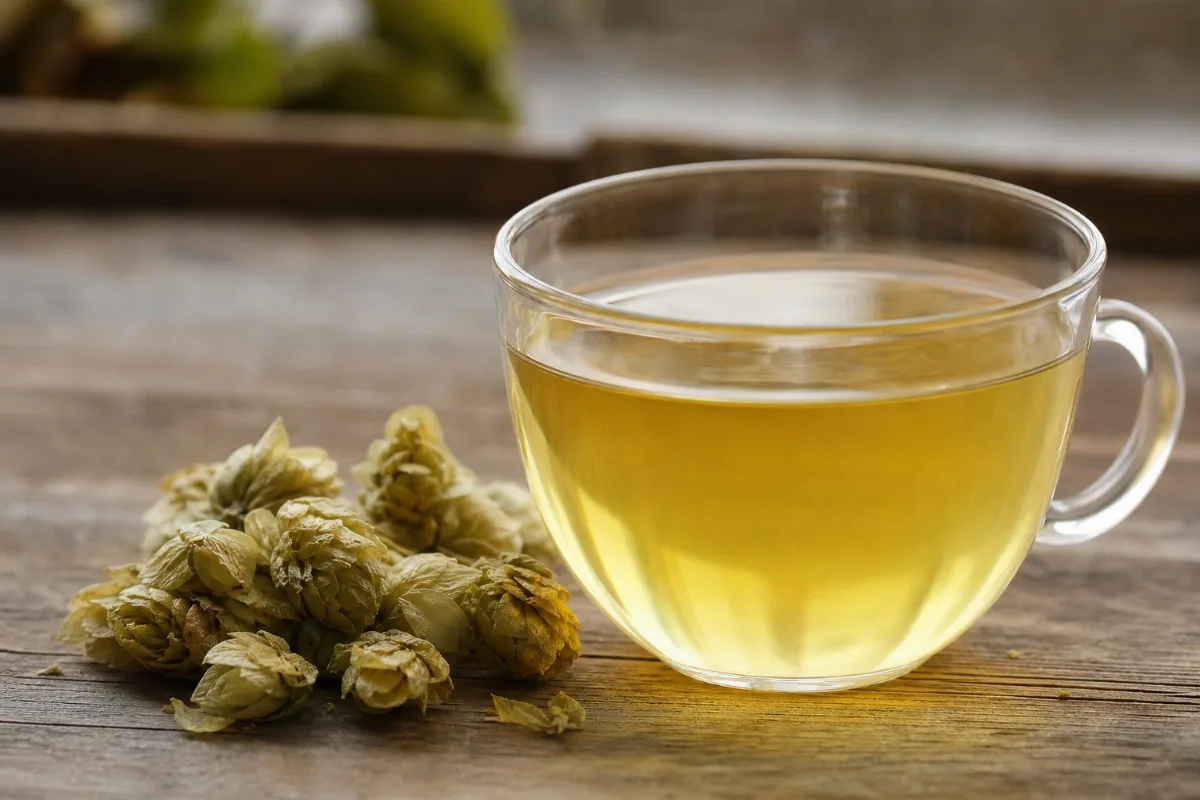
Hops are the papery green cones of a climbing plant in the hemp family, best known for flavouring beer. The cones, their extracts and valerian-hops combinations are also sold for sleep, stress and menopause symptoms.
General information, not medical advice. Last substantive update · Not medically reviewed. A named clinician has not signed off on this page. How this page is made
About Hops
Hops (Humulus lupulus) are best known for flavouring beer, and the cones are also used as a traditional herbal medicine for mild stress and to aid sleep. Research is limited: sleep trials mostly test valerian plus hops, a handful of small trials look at stress, menopause, belly fat and thinking, and the best-documented harms are drowsiness, plant-estrogen concerns and, in dogs, poisoning.
What it is
Hops (Humulus lupulus) are the female cones (strobiles) of a climbing plant in the Cannabaceae family. It is an accepted species in the GBIF and NCBI databases. It is related to cannabis but is a different plant.
The cones are used in brewing, and as a tea, extract or tincture. The EU monograph covers comminuted or powdered cone and its dry and liquid extracts.
Traditional and current uses
The EU recognises hop strobile as a traditional herbal medicine for relief of mild mental stress and to aid sleep. This is based on long use, not on trial proof, and it advises seeing a doctor if symptoms last more than two weeks.
Modern uses go further: sleep (usually with valerian), menopause symptoms, appetite and weight, and mood. Evidence for these ranges from low to insufficient.
What is in it and how it works
Hops contain bitter acids (humulone, lupulone), prenylated flavonoids (xanthohumol, isoxanthohumol, 6- and 8-prenylnaringenin) and oils. In lab tests humulone and 6-prenylnaringenin strengthen the brain's calming GABA-A receptors, and a valerian-hops extract acted on adenosine in a brain-wave test. These are lab clues, not proof of how hops work in people.
8-Prenylnaringenin is described as one of the most potent plant estrogens known; it can also be made in the gut from isoxanthohumol, and people differ widely in how much they make. Xanthohumol has been tested as a pure compound in small safety trials. Special processed extracts (matured hop bitter acids, bitter hop extract) are not the same as whole hops.
What the research shows
Sleep: a 184-adult trial of a valerian-hops tablet found modest gains and few results that beat placebo; one trial found valerian-hops beat placebo where valerian alone did not. Stress and anxiety: one 36-person pilot. Menopause: small, mixed trials. Belly fat: one 200-person company-sponsored trial. Attention: two small trials from one group.
Many studies were small, short, open or company-linked, and only abstracts were read for almost every paper.
At a glance
Traditional uses history, not proof
- Traditional European herbal medicine: the female cones have long been used mainly for sleep problems (a review of the plant). The EU monograph (2014) accepts hop strobile as a traditional herbal medicine for mild mental stress and to aid sleep, based only on long use.
- Brewing: hops give beer its bitterness, flavour and aroma. This is a food use, not a medicine claim.
- Pharmacopoeias: hops are allowed in several official pharmacopoeias, mainly for anxiety states (a 2022 review).
- German Commission E is reported by one trial's authors to approve hops for restlessness and anxiety; we did not read the monograph, so this is not verified.
Studied for research
- Sleep problems (valerian-hops combinations), low
- Stress, anxiety and low mood (hop extract), low
- Attention and memory in older adults (matured hop bitter acids), low
- Menopausal hot flashes (8-prenylnaringenin extracts), low, mixed
- Belly fat and appetite (matured and bitter hop extracts), low
- Blood fats, blood vessels, inflammation and gut (small studies), very low to insufficient
Main compounds
- Xanthohumol, the main prenylated chalcone: anti-inflammatory and gut-bacteria effects in small human trials
- 8-Prenylnaringenin (8-PN), a very potent plant estrogen that can also form in the gut from isoxanthohumol
- Humulone and lupulone (hop alpha and beta acids), bitter acids that calm GABA receptors in lab tests
- Iso-alpha acids and matured hop bitter acids formed by heating or oxidising hops
- Isoxanthohumol and 6-prenylnaringenin, related prenylflavonoids
Common forms
- Dried cones or comminuted cones as a tea (hop tea)
- Dry and liquid extracts and tinctures of the cone
- Valerian-and-hops tablets and liquid combinations
- Hop extracts standardised to 8-prenylnaringenin or to bitter acids
- Beer and non-alcoholic beer (a different product, not a supplement)
- Spent brewing hops (poisonous to dogs)
Research links: EU herbal monograph on hop strobile (European Medicines Agency, 2014) · EMA page: Lupuli flos herbal medicinal product · NIH LiverTox: Hops · Research Library · Genes & Biomarkers Library
The plant and its history
- Accepted scientific name
- Humulus lupulus L.
- Naming authority
- L.; published in Species Plantarum, page 1028 (1753) (GBIF)
- Synonyms
- Cannabis lupulus (L.) Scop.; Humulus vulgaris Gilib.; Humulus volubilis Salisb.; Humulus yunnanensis Hu (listed by GBIF as a synonym); Lupulus communis Gaertn.; Humulus lupulus var. silvestris Alef. and other varieties (GBIF list)
- Common names
- Hop (English); Hops (English); Common hop (English); Bine (English); Lúpulo (Spanish); Houblon (French); Hopfen (German)
- Botanical family
- Cannabaceae (the hemp family; it also holds Cannabis sativa L., GBIF key 5361880). Hops and cannabis are relatives but are different plants with different chemistry.
- Classification
- Plantae > Tracheophyta > Magnoliopsida > Rosales > Cannabaceae > Humulus > Humulus lupulus
- Native range
- Not verified from a primary botanical source in this file.
- Habitat
- Not verified.
- What the plant looks like
- Roots: Not verified; not the medicinal part.; Stems: Not verified in this file (a climbing plant is the usual description, but we did not confirm it from a source read).; Leaves: Not the medicinal part under the EU monograph.; Flowers: The female inflorescences, called cones or strobili, are the part used (a 2022 review).; Fruit: Not verified.
- Cultivation
- Not verified from a primary source; the plant is grown commercially for brewing (the reviews we read say hops are mainly a beer ingredient).
- Harvest and processing
- The EU monograph covers comminuted or powdered hop strobile and dry or liquid extracts or tinctures. "Spent hops" are the brewing leftovers that have poisoned dogs.
- Look-alikes and adulterants
- Name: Humulus japonicus Siebold & Zucc. (Japanese hop); Note: GBIF lists it as a synonym of Humulus scandens (Lour.) Merr. (key 2984537), a different species from the common hop. A lab abstract notes its hop-like allergen cross-reactivity was studied (not read here).; Name: Humulus yunnanensis Hu; Note: GBIF lists this name as a synonym of Humulus lupulus in its backbone.
- Sustainability and conservation
- Not verified; no assessment was retrieved. Hop is a widely cultivated plant.
The plant and the parts used
Traditional use and history history, not clinical proof
| Tradition or era | Documented use | Source |
|---|---|---|
| Traditional European herbal medicine | The female cones have long been used in traditional medicine mainly for sleep problems (a review of the plant's pharmacology). The EU monograph recognises hop strobile as a traditional herbal medicine for relief of mild symptoms of mental stress and to aid sleep. | s-ema-hmpc-hops |
| Beer brewing | Hops are a main ingredient of beer, giving bitterness, flavour and aroma (several abstracts). | p36559547 |
| Pharmacopoeias | A 2022 review says hops are allowed in several official pharmacopoeias, mainly for anxiety states; and the Ph. Eur. monograph for hops (ref. 1/2011:1222) is cited by the EU monograph. | s-ema-hmpc-hops |
| German Commission E | Reported by a trial's authors to approve hops for restlessness and anxiety/mood disorders. | s-commission-e-hops |
| Older sources, Wikipedia and herbals | Stories such as hop pillows or hop pickers feeling sleepy are widely repeated; we did not verify them from a primary source and NOT verified applies to them. | p18308492 |
Traditional use shows how a plant was used. It does not show that a supplement works or is safe today.
What is inside, and how it may work
What the plant contains and how those compounds act in cells and animals. Laboratory and animal mechanisms are not proven effects in people.
Main compounds
| Compound | Family | Where it is concentrated | Activity studied | Level of evidence |
|---|---|---|---|---|
| Xanthohumol PubChem 639665 | prenylated chalcone (prenylflavonoid) | Strobile Not stated in the abstracts read | Main hop prenylated chalcone; anti-inflammatory and gut-microbiome effects in human studies; safe at 24 mg a day for 8 weeks in 30 healthy adults. 35 29 30 36 43 | Human data |
| 8-Prenylnaringenin (8-PN) PubChem 480764 | prenylated flavanone | Strobile (small amounts); formed in the gut from isoxanthohumol Not stated in the abstracts read | Called one of the most potent plant estrogens; binds estrogen receptor alpha; blood level after 500 mg single dose Cmax 2,834 nmol/L. 10 31 9 43 | Human data |
| 6-Prenylnaringenin (6-PN) PubChem 155094 | prenylated flavanone | Strobile Not stated | Boosted GABA-A receptors in lab tests; less bioavailable than 8-PN (Cmax 543 vs 2,834 nmol/L). 4 10 43 | Laboratory research |
| Isoxanthohumol PubChem 513197 | prenylated flavanone | Strobile; common in beer Not stated | Weakly estrogenic; turned into 8-PN by gut bacteria and liver CYP1A2; blocked CYP2C8 strongly in lab tests. 25 7 67 43 | Laboratory research |
| Humulone (alpha acid) PubChem 442911 | prenylated phloroglucinol (bitter acid) | Strobile (lupulin glands) 35 to 70% of hop alpha acids (per an abstract) | Positive modulator of GABA-A receptors in lab tests; shortened sleep onset in mice at 20 mg/kg injected. 5 43 | Animal research |
| Lupulone (beta acid) PubChem 68051 | bitter acid | Strobile Not stated | Named among hop bitter acids with sedative activity in animal work. 37 43 | Animal research |
| Isohumulones (iso-alpha acids) PubChem 93090 | bitter acids formed by heating | Produced when hops are boiled in brewing Not stated | Absorbed fast (peak 0.5 h) with half-life about 30 minutes after beer; used in isomerised hop extract that widened arteries in a single-dose trial. 49 59 43 | Human data |
| Matured hop bitter acids | oxidised alpha-acid derivatives | Oxidised hop extract Not stated | Oxides derived from alpha acids, structurally like iso-alpha acids; studied at 35 mg a day for body fat, mood and cognition. 40 20 | Human data |
| 2-Methyl-3-buten-2-ol PubChem 8257 | small alcohol (alpha-acid breakdown product) | Formed on storage of hops Not stated | Proposed by one trial's authors as a sedative principle behind hops raising GABA; this is a hypothesis in their abstract, not tested there. 18 43 | Pharmacological theory |
Mechanisms, receptors and pathways
| Target or pathway | Gene or receptor | What was found | Level |
|---|---|---|---|
| GABA-A receptor positive modulation | GABRA1 / GABA-A receptor | Humulone and 6-prenylnaringenin boosted GABA-A receptor activity at low micromolar concentrations; humulone shortened sleep onset and lengthened sleep in mice; ethanol added to the lab effect. 4 5 37 | Laboratory research |
| Adenosine receptor mechanism | ADORA1 | A fixed valerian-hop extract reduced or blocked caffeine-induced brain-wave arousal in 32 healthy volunteers, read by the authors as an adenosine-related effect. 52 | Human data |
| Estrogen receptor activation | ESR1 | 8-prenylnaringenin binds and activates estrogen receptor alpha; it activated ERK signalling in breast cancer cells like estradiol but not the PI3K/Akt route, and slowed cell division in that cell model. 9 31 | Laboratory research |
| Estrogen metabolism in breast cells | CYP1A1 / CYP1B1 / AhR | Hop extract and 6-PN favoured the non-toxic 2-hydroxylation route via CYP1A1; hops also reduced 4-hydroxylation and estrogen-induced malignant change in MCF-10A cells. 65 26 | Laboratory research |
| Aromatase inhibition | CYP19A1 | Xanthohumol, isoxanthohumol, 8-PN and several beers reduced aromatase activity in cell tests. 39 | Laboratory research |
| Drug-metabolising enzyme inhibition | CYP2C8 / CYP2C9 / CYP2C19 / CYP1A2 | A hop extract blocked CYP2C8 (93%), CYP2C9 (88%), CYP2C19 (70%) and CYP1A2 (27%) at 5 micrograms/ml. 67 | Laboratory research |
| Glucuronidation (UGT) inhibition | UGT1A1 / UGT2B7 | Valerian-hops extracts cut formation of acetaminophen, estradiol, morphine and testosterone glucuronides in human liver microsomes. 2 | Laboratory research |
| Drug transporters | ABCB1 (P-glycoprotein) / ABCC1 (MRP1) | 8-prenylnaringenin inhibited both pumps in human cell tests. 66 | Laboratory research |
| Bitter taste and gut hormones | Gut bitter receptors; CCK, GLP-1, PYY, ghrelin | A 500 mg bitter hop extract raised ghrelin, CCK, GLP-1 and PYY and lowered insulin response in 19 men; a tube-delivery trial found only modest PYY changes. 63 6 | Human data |
| Toll-like receptor 4 signalling | TLR4 / CD14 | A xanthohumol-rich hop extract lowered toxin-induced inflammatory signalling in white blood cells taken from nine women and in transfected cells. 30 | Human data |
| Gut microbiota | Gut bacteria (Prevotella, Ruminococcus) | Xanthohumol 24 mg a day for 8 weeks did not change overall gut composition but changed some groups by gut type and reduced bile-acid metabolites in some. 29 | Human data |
Absorption, metabolism and elimination
- Absorption
- Xanthohumol (single oral doses of 20, 60 or 180 mg in 48 people): peaked at about 1 hour and again at 4 to 5 hours; Cmax 33, 48 and 120 mg/L (as printed in the abstract); conjugates were the main forms in blood. 8-prenylnaringenin (single 500 mg of the pure compound in 16 people): Cmax 2,834 nmol/L and AUC 15,801 nmol/L x h, about 4 to 5 times higher than 6-PN. Iso-alpha acids from beer were absorbed quickly, with a peak at 0.5 h.
- Distribution
- No human tissue distribution data were found. In mice 8-PN reached kidney, liver, muscle, lung, pancreas, heart, spleen and brain, in higher amounts than the non-prenylated naringenin.
- Metabolism
- 8-PN: CYP2C19 and CYP2C8 oxidise the prenyl group; human liver microsomes made 12 metabolites. Isoxanthohumol is turned into 8-PN by CYP1A2 and by gut bacteria: in 50 postmenopausal women 60% were poor, 25% moderate and 15% strong 8-PN producers, and recent antibiotics seemed to lower production. Xanthohumol and isoxanthohumol travel mostly as glucuronide conjugates.
- Elimination
- Xanthohumol half-life was about 20 hours (60 mg) and 18 hours (180 mg). Iso-alpha acid half-life in beer drinkers was estimated at about 30 minutes in five volunteers. Elimination of hop extracts as a whole was not studied.
- Bioavailability
- Urinary recovery of hop flavonoids was low and varied widely between people; 8PN was undetectable in most people after xanthohumol dosing.
Isolated compounds versus whole extracts
Hops are a mixture. The EU monograph covers whole strobile and its extracts, and the sleep trials used hop extract with valerian. In one trial valerian plus hops beat placebo while valerian alone did not, which suggests hops add something, but it cannot be tied to one compound. Lab work shows several compounds (humulone, 6-PN, xanthohumol) can calm brain receptors. The estrogen-like action comes mainly from 8-prenylnaringenin, which is present in small amounts in hops but can be made in the body from isoxanthohumol, and how much depends on each person's gut bacteria. Xanthohumol and 8-PN have been tested as pure compounds for safety and blood levels; those results should not be applied to hop tea or ordinary supplements. Matured hop bitter acids and bitter hop extracts for weight are special processed extracts, not whole hops.
Nutritional composition
A nutrient table does not apply: hops are used in small amounts as a flavouring and medicine, and we found no nutrient data in the sources read. Beer and non-alcoholic beer contain many other compounds besides hops, so trial results with beer are not hop-only results.
6 low certainty5 very low certainty2 not enough evidence
What was looked at
The 13 benefits and uses checked for Hops, each with how strong the evidence is. Tap one to open it.
- Sleep problems: valerian-and-hops combination products (4 weeks)Low certainty
- Falling asleep after a single dose of valerian-hops extractVery low certainty
- Sleep after non-alcoholic beer (a drink with hops)Very low certainty
- Stress, anxiety and low mood: hop dry extract in healthy young adultsLow certainty
- Mood and tiredness: matured hop bitter acids in beer-type drinksVery low certainty
- Attention and memory: matured hop bitter acids in older adultsLow certainty
- Menopausal hot flashes and other menopause complaintsLow certainty
- Sexual function after menopause (hop vaginal gel)Not enough evidence
- Belly fat: matured hop extract in overweight adultsLow certainty
- Appetite and weight loss: bitter hop extractLow certainty
- Blood fats and insulin in metabolic syndrome (hop plus acacia)Very low certainty
- Blood vessel widening after a hop bitter-acid extractVery low certainty
- Inflammation and gut: xanthohumol (a hop compound)Not enough evidence
Lab markers tracked in the studies
Time to fall asleep (sleep latency)Sleep duration (wearable-tracked)Sleep amount on EEG (electrohypnogram)Morning cortisol (blood)Depression, anxiety and stress scores (DASS-21)Symbol Digit Modalities Test (attention score)Beta-endorphin (blood)Transthyretin (serum protein)Stroop test and verbal fluencyKupperman Menopausal IndexHot flash frequencyHormone profile and womb lining thicknessVisceral fat area (CT scan)Energy eaten at the next mealsGut hormones (ghrelin, CCK, GLP-1, PYY)Flow-mediated vasodilatation (FMD)Triglycerides and TG:HDL ratioFasting insulin and HOMA scoreInflammatory signals from white blood cells (ex vivo)Gamma-glutamyltransferase (GGT) and BMI
What is Hops good for?
The main proposed uses and how strong the human evidence is for each. "Low" means small or inconsistent studies, "very low" means one small, open or mixed-product study, and "insufficient" means there is not enough to judge. Nothing about hops is rated higher than low. Many results come from valerian-hops combinations, beer-type drinks, special oxidised extracts or pure compounds, which cannot be moved to ordinary hop tea or other products. For amounts, ask a doctor or pharmacist.
Benefits, one by one
Each card is a research question, not a promise. Tap a goal to filter. Open a card to see the studies, doses and limits.
Sleep problems: valerian-and-hops combination products (4 weeks)
Low certaintyMost of the sleep research on hops tests a combination of valerian and hops, not hops alone. These trials show modest effects, and in the largest trial few results beat placebo.
5 studiesTablets or extracts of valerian plus hop dry extract. Dosing is not c…
Studies, doses and limits
What the trials found
Morin 2005: 184 adults with mild insomnia, 4 weeks of a valerian-hops tablet vs placebo vs diphenhydramine; subjective sleep improved modestly but few comparisons with placebo were significant, and lab sleep recordings showed no group differences; quality of life (physical) improved more with valerian-hops. Koetter 2007: a fixed valerian-hops combination cut sleep latency more than placebo, while valerian alone did not (abstract gives no participant number). Schicktanz 2025: a 40-person feasibility trial; exploratory finding of 21.7 more minutes of tracked sleep a day, no change in daytime thinking or mood. Salter 2010 reviewed 16 studies: 12 reported some sleep improvement with valerian alone or with hops, with reviewers asking for better trials.
Results
Modest and mixed. Subjective gains in some trials; objective lab-recorded sleep did not differ in the largest one.
Effect sizes as reported
Morin: modest, mostly not significant vs placebo. Koetter: sleep latency reduced vs placebo (no numbers in the abstract). Schicktanz: +21.7 min a day (p = 0.019, exploratory).
Why this rating
Small to medium trials of a combination product, some with weak design, mixed results and abstract-only reading. Hops cannot be given credit separately.
Form and dose studied
Tablets or extracts of valerian plus hop dry extract. Dosing is not covered here.
Who was studied
Adults with mild or occasional insomnia (mostly 40s).
Limits
Combination products only; hops-alone trials for insomnia are missing. Short (3 to 4 weeks). Two of the trials used the same branded extract (Ze 91019).
Why researchers looked
Hops and valerian are often sold together for sleep, so companies and universities tested the pair.
Traditional use
Hop cones (strobiles) have been used in European folk medicine for restlessness and poor sleep. The EU herbal monograph (2014) accepts them as a traditional herbal medicine for relief of mild symptoms of mental stress and to aid sleep, based only on long use, not on proof from trials. Hop pillows and hop-and-valerian preparations are old customs.
Proposed mechanism Preliminary mechanism
In lab tests hop compounds boost the brain's calming GABA-A receptors, and a valerian-hops extract acted on adenosine (a sleep-pressure chemical) in a brain-wave test in healthy volunteers. These are not proof of how it works in sleepers.
A proposed mechanism does not show that the effect happens in people.
Hops can make you sleepy. The EU monograph says it may impair the ability to drive and use machines. Full safety is in the safety section.
Falling asleep after a single dose of valerian-hops extract
Very low certaintyOne small lab study found more sleep time on the first night with a valerian-hops liquid extract; a brain-wave test also suggested a calming effect against caffeine.
2 studiesA liquid valerian-hops extract given once.
Studies, doses and limits
What the trials found
Dimpfel 2008: 20 poor sleepers on the extract vs 22 on placebo, one lab night; sleep time and deeper sleep were higher on the extract (p < 0.01). Schellenberg 2004: 16 people per group; the extract reduced or blocked caffeine arousal on EEG.
Results
Positive in small single-night experiments; no insomnia outcomes beyond one night.
Effect sizes as reported
Sleep quantity p < 0.01; EEG measure correlated with sleep rating r = 0.48.
Why this rating
One small single-night trial and one brain-wave test; non-standard EEG method; combination product.
Form and dose studied
A liquid valerian-hops extract given once.
Who was studied
Poor sleepers; healthy volunteers.
Limits
Single night only, 42 people, mixed product, no sleep-lab polysomnography.
Why researchers looked
Researchers wanted to know whether one dose is enough or whether the extract must be taken for weeks.
Traditional use
Hop cones (strobiles) have been used in European folk medicine for restlessness and poor sleep. The EU herbal monograph (2014) accepts them as a traditional herbal medicine for relief of mild symptoms of mental stress and to aid sleep, based only on long use, not on proof from trials. Hop pillows and hop-and-valerian preparations are old customs.
Proposed mechanism Preliminary mechanism
The authors link the effect to adenosine receptors; in healthy volunteers the extract reduced or blocked caffeine's brain-wave arousal at 60 minutes.
A proposed mechanism does not show that the effect happens in people.
Hops can make you sleepy. The EU monograph says it may impair the ability to drive and use machines. Full safety is in the safety section.
Sleep after non-alcoholic beer (a drink with hops)
Very low certaintyTwo small open studies found people fell asleep faster after a hop-containing non-alcoholic beer with dinner. There was no placebo beer, so the result is weak.
2 studiesOrdinary non-alcoholic beer with a meal.
Studies, doses and limits
What the trials found
Franco 2012: 17 female nurses on shifts, 333 ml non-alcoholic beer at supper for 14 days vs their own no-beer period; sleep latency 12.0 vs 20.5 minutes by wrist sensor (p <= 0.05). Franco 2014: 30 university students, one beer at dinner for 14 days vs a 7-day control week; sleep latency and global sleep score better (p < 0.05).
Results
Positive in two open, uncontrolled studies.
Effect sizes as reported
Sleep latency 12.01 vs 20.50 minutes (nurses).
Why this rating
No placebo drink, no blinding, small groups; beer contains many other compounds besides hops.
Form and dose studied
Ordinary non-alcoholic beer with a meal.
Who was studied
Healthy stressed young adults, shift-working nurses.
Limits
Not a hop extract trial; same research group; short. Does not apply to alcoholic beer, which affects sleep in other ways.
Why researchers looked
Beer is the best-known hop product, so researchers asked whether the hops in a non-alcoholic beer calm stressed people.
Traditional use
Brewers and herbalists have long said hops make people drowsy; the claim is old but not trial-tested in beer until recently.
Proposed mechanism Pharmacological theory
The authors suggest hop breakdown products raise GABA; this is not shown in these studies.
A proposed mechanism does not show that the effect happens in people.
Beer with alcohol is a different product. Alcohol can disturb sleep and mix badly with sedatives. Non-alcoholic beer still contains a trace of alcohol in some countries.
Stress, anxiety and low mood: hop dry extract in healthy young adults
Low certaintyOne small crossover trial found lower anxiety, depression and stress scores after 4 weeks of a hop extract, compared with placebo.
5 studiesHop dry extract capsules once a day.
Studies, doses and limits
What the trials found
Kyrou 2017: 36 healthy young adults (31 women) with at least mild symptoms on a 21-item questionnaire; 4 weeks of hop dry extract vs 4 weeks of placebo in a crossover. Scores fell more with hops (anxiety 9.2 to 5.1, depression 11.9 to 9.2, stress 19.1 to 11.6; p < 0.05 vs placebo). Morning cortisol did not change. A review of GABA-acting plants (Savage 2018) lists hops among ten plants with preclinical and clinical support, with no hops-specific figures in its abstract.
Results
Positive in one small trial; no replication found.
Effect sizes as reported
DASS-21 anxiety 9.2 to 5.1; depression 11.9 to 9.2; stress 19.1 to 11.6 (hops).
Why this rating
One 36-person crossover pilot, self-rated scales, young mostly female participants, 4 weeks, no second trial.
Form and dose studied
Hop dry extract capsules once a day.
Who was studied
Healthy university adults with mild symptoms.
Limits
Pilot; not people with a diagnosed anxiety or depression disorder; no long-term follow-up.
Why researchers looked
Hops are approved in Germany for restlessness and anxiety, and the trial tested that claim in people with mild symptoms.
Traditional use
Hop cones (strobiles) have been used in European folk medicine for restlessness and poor sleep. The EU herbal monograph (2014) accepts them as a traditional herbal medicine for relief of mild symptoms of mental stress and to aid sleep, based only on long use, not on proof from trials. Hop pillows and hop-and-valerian preparations are old customs.
Proposed mechanism Preliminary mechanism
GABA-A receptor boosting by humulone and 6-prenylnaringenin in lab tests; hop mixtures raised sleep time in mice. Not shown in people.
A proposed mechanism does not show that the effect happens in people.
If you are depressed, talk to a doctor before using a sedating herb. See safety.
Mood and tiredness: matured hop bitter acids in beer-type drinks
Very low certaintyA Japanese brewer's research group found better mood and less tiredness after 3 weeks of a non-alcoholic beer with oxidised hop bitter acids, but the study had no control group.
2 studiesBeer-type drink or capsule with 35 mg matured hop bitter acids.
Studies, doses and limits
What the trials found
Fukuda 2022: 97 healthy adults in a single-arm study drank a non-alcoholic beer with 35 mg of matured hop bitter acids for 3 weeks; mood, anxiety, depression, fatigue, vigor, sleep quality and work performance improved vs baseline. Fukuda 2020 (JAFC): in a placebo-controlled trial of 60 adults, subjective fatigue (p = 0.008) and anxiety (p = 0.043) improved at 12 weeks with the bitter acids.
Results
Positive; the strongest design (the placebo-controlled one) shows smaller, p-value-borderline gains.
Effect sizes as reported
Fatigue p = 0.008, anxiety p = 0.043 (12-week trial).
Why this rating
One single-arm trial with no control and company funding; a small placebo-controlled trial with many outcomes tested.
Form and dose studied
Beer-type drink or capsule with 35 mg matured hop bitter acids.
Who was studied
Healthy adults 20 to 72.
Limits
Industry-linked (Kirin Holdings funded the 2022 study and holds patents). Not the same as ordinary hops or hop tea.
Why researchers looked
A brewing company developed a special oxidised hop extract and tested it for mood and mental tiredness.
Traditional use
The extract is a modern product, not a traditional one.
Proposed mechanism Animal research
The researchers propose that these bitter acids act through the vagus nerve (from mouse work); not shown in these trials.
A proposed mechanism does not show that the effect happens in people.
Not studied in people with mood disorders.
Attention and memory: matured hop bitter acids in older adults
Low certaintyTwo 12-week trials of an oxidised hop extract found small gains in attention and some memory tests in people aged 45 and over who felt their thinking had slipped. Both come from the same research group.
2 studiesCapsules with matured hop bitter acids (35 mg a day in one trial).
Studies, doses and limits
What the trials found
Fukuda 2020 (J Alzheimers Dis): 100 adults aged 45 to 69 with subjective cognitive decline took capsules or placebo for 12 weeks. Attention (Symbol Digit Modalities Test) was higher with the extract (p = 0.045); beta-endorphin lower (p = 0.043); transthyretin, a possible marker of mild cognitive impairment, higher (p = 0.048); memory retrieval improved in a subgroup. Fukuda 2020 (JAFC): 60 adults, 35 mg a day for 12 weeks; verbal fluency change at week 6 (p = 0.034) and Stroop test at week 12 (p = 0.019) improved.
Results
Small positive findings across tests; many tests, borderline p-values.
Effect sizes as reported
SDMT p = 0.045; verbal fluency p = 0.034; Stroop p = 0.019.
Why this rating
Two small, 12-week trials from one group, only some of many outcomes significant, subgroup analysis, funding not stated in the abstracts (the group is linked to Kirin Holdings in other papers).
Form and dose studied
Capsules with matured hop bitter acids (35 mg a day in one trial).
Who was studied
Healthy adults 45 to 69 with perceived cognitive decline.
Limits
Not people with diagnosed dementia; no independent replication.
Why researchers looked
Mouse work suggested these bitter acids might protect thinking, so the group tested adults with subjective cognitive decline.
Traditional use
No traditional use for this; it is a new use of a modern extract.
Proposed mechanism Animal research
In mice the authors link the effect to vagus-nerve activation; this is not shown in the human trials.
A proposed mechanism does not show that the effect happens in people.
No safety problems were noted in the abstracts.
Menopausal hot flashes and other menopause complaints
Low certaintySmall trials of hop extract (mostly standardised to 8-prenylnaringenin) show fewer menopause symptoms than placebo in some trials and not in others. The results are inconsistent and the trials are small.
7 studiesHop extracts standardised to 8-prenylnaringenin, tablets of hop extra…
Studies, doses and limits
What the trials found
Heyerick 2006: 67 menopausal women, 12 weeks; everyone improved, including placebo; the lower-dose hop group beat placebo at 6 weeks (p = 0.023) but not at 12 weeks (p = 0.086); the higher dose did worse than the lower one. Erkkola 2010: 36 women, 16-week crossover; overall effect not significant, later-period differences significant for Kupperman index (p = 0.02) and visual scale (p = 0.03). Aghamiri 2016: 120 women, 12 weeks; Greene score fell 23.4 points more and hot flashes 23.8 fewer than placebo at week 12 (very large numbers; extract and dose not stated in the abstract). Kim 2021: 78 women with moderate to severe symptoms, a combined soy and hop extract for 12 weeks; Kupperman score fell 20.6 vs 14.8 points with placebo (p < 0.05); combination, so hops cannot be credited alone. Trius-Soler 2021: 6 months of beer (alcoholic or non-alcoholic) lowered symptom scores vs a no-beer group in 34 women; beer is not a hop extract. Keiler 2013 calls human data few and inconclusive; Chadwick 2006 found only two menopause trials up to 2003.
Results
Mixed: positive in some small trials, inconclusive in others, large placebo responses.
Effect sizes as reported
Heyerick: p = 0.023 at 6 weeks, p = 0.086 at 12 weeks (100 microgram group). Aghamiri: Greene -23.4 (CI -25.1 to -21.6). Kim: -20.6 vs -14.8 points.
Why this rating
Four small trials (36 to 120 women) with large placebo effects, inconsistent dose response, one very large effect from a single centre, and one trial of a soy-hop combination. No hot-flash trial longer than 12 weeks.
Form and dose studied
Hop extracts standardised to 8-prenylnaringenin, tablets of hop extract, and a soy-hop combination. Dosing is not covered here.
Who was studied
Menopausal and postmenopausal women.
Limits
Short follow-up, small, mixed extracts. Long-term effect on breast and womb tissue is unknown.
Why researchers looked
8-prenylnaringenin (8-PN) is one of the strongest plant estrogens identified, so researchers tested hop extracts for hot flashes.
Traditional use
The EU herbal monograph does not list menopause as a traditional use of hops; its only traditional indication is mild mental stress and sleep. Interest in menopause comes from modern lab findings on 8-prenylnaringenin.
Proposed mechanism Animal research
8-PN binds estrogen receptors, preferring the alpha type; in animals it lowered LH and FSH and raised uterine weight. Human relevance of these animal findings for hot flashes is not proven.
A proposed mechanism does not show that the effect happens in people.
Hops contain 8-prenylnaringenin, one of the strongest plant estrogens known. See the safety section before using hop products if you have a hormone-sensitive condition.
Sexual function after menopause (hop vaginal gel)
Not enough evidenceOne Iranian trial found no difference in sexual function scores between a hop vaginal gel and vaginal estradiol cream, but there was no placebo group.
1 studiesA vaginal gel with hop extract (not a swallowed product).
Studies, doses and limits
What the trials found
Vahedpoorfard 2023: 63 postmenopausal women; a hop gel (daily for 7 days, then twice weekly for 2 months) vs vaginal estradiol; Female Sexual Function Index scores did not differ between groups and no adverse events were reported.
Results
No difference from estradiol; no placebo comparison.
Effect sizes as reported
FSFI total and subscales: no significant difference (p > 0.05).
Why this rating
One 63-person trial with no placebo; no difference from estradiol does not show that hop works.
Form and dose studied
A vaginal gel with hop extract (not a swallowed product).
Who was studied
Postmenopausal women with sexual dysfunction.
Limits
No placebo group; 2-month follow-up; one centre.
Why researchers looked
Low estrogen after menopause can dry and thin the vaginal lining; hop is a plant estrogen, so a gel was tested against estradiol.
Traditional use
No traditional use is documented for this in the EU herbal monograph; it is a modern research idea.
Proposed mechanism Pharmacological theory
Plant estrogen action on vaginal tissue is the proposed route; not proven in this trial.
A proposed mechanism does not show that the effect happens in people.
Hop is an estrogen-like plant: a vaginal gel could have effects on the breast or womb that this trial did not look at.
Belly fat: matured hop extract in overweight adults
Low certaintyA 200-person Japanese trial found less visceral (belly) fat after 12 weeks of a matured hop extract drink than placebo. The trial was sponsored by a brewer.
2 studiesA drink with matured hop extract (35 mg bitter acids a day).
Studies, doses and limits
What the trials found
Morimoto-Kobayashi 2016: 200 healthy adults with BMI 25 to under 30, drink with 35 mg matured hop bitter acids vs placebo for 12 weeks; visceral fat area (CT scan) fell more with hops at 8 and 12 weeks, and total fat area at 12 weeks; body fat ratio fell; no related adverse events. Suzuki 2018: re-analysis of the same data; visceral fat change correlated with daily steps in the hop group (r = -0.208, p = 0.048); the effect of hops combined with walking was borderline (p = 0.055).
Results
Positive in one trial; a re-analysis of the same trial is not an independent result.
Effect sizes as reported
Visceral and total fat area lower than placebo (numbers not in the abstract).
Why this rating
One well-sized trial from one company; no independent replication; Japanese adults only; 12 weeks; the second paper uses the same data.
Form and dose studied
A drink with matured hop extract (35 mg bitter acids a day).
Who was studied
Healthy overweight adults aged 20 to 64.
Limits
Company-sponsored; healthy overweight (not obese or diabetic) adults; no long-term follow-up.
Why researchers looked
Hop bitter acids called iso-alpha acids were reported in earlier work to reduce body fat; a milder oxidised extract was tested.
Traditional use
No traditional use is documented for this in the EU herbal monograph; it is a modern research idea.
Proposed mechanism Animal research
Bitter hop acids may act on fat metabolism and on receptors that regulate sugar and fat; the human relevance of this is not shown here.
A proposed mechanism does not show that the effect happens in people.
No related adverse events in the trial. Product-maker links are noted in the studies.
Appetite and weight loss: bitter hop extract
Low certaintyA gut-hormone trial found that men ate less after a bitter hop extract, but a second gut trial found no effect on appetite, and a 24-week weight-loss trial reported more fat loss than placebo.
4 studiesBitter hop extract capsules (an unusual, very bitter extract, not hop…
Studies, doses and limits
What the trials found
Walker 2022: 19 healthy-weight men; 500 mg bitter hop extract capsules lowered energy intake (about 4,470 kJ vs 5,383 kJ placebo, p = 0.004 to 0.006) and changed gut hormones; stomach and bowel discomfort rose, with mild to severe symptoms with the quick-release capsule. Bitarafan 2023: 26 men; hop extract delivered by tube into the duodenum or stomach had no effect on appetite, symptoms or energy intake, and only a modest, short effect on pyloric pressure and PYY at the higher dose. Walker 2019: 30 men, 24-hour water fast; hunger over 10% lower in the last 6 hours with either dose (p < 0.05). Walker 2026: 150 adults, 24-week weight-loss programme; 3.8% more weight loss and 3.9 kg more fat loss than placebo (p < 0.05), muscle mass unchanged by bioimpedance.
Results
Mixed: positive in capsule trials, negative in the tube trial; the longest trial is positive but from the product's licence holder.
Effect sizes as reported
Energy intake 4,473 and 4,439 kJ vs 5,383 kJ (Walker 2022); weight -3.8% and fat mass -3.9 kg vs placebo (Walker 2026).
Why this rating
Small acute trials in men, one negative trial, one 24-week trial using bioimpedance, and a licensing link between the research institute and the supplement maker.
Form and dose studied
Bitter hop extract capsules (an unusual, very bitter extract, not hop tea).
Who was studied
Healthy-weight men; adults with overweight or obesity.
Limits
Mostly men; short; the weight-loss trial is the only longer one; unblinded stomach effects may unmask the capsule.
Why researchers looked
Bitter tastes can trigger hormones from the gut that signal fullness; hop extract is very bitter.
Traditional use
No traditional use is documented for this in the EU herbal monograph; it is a modern research idea.
Proposed mechanism Preliminary mechanism
Bitter receptors in the gut lining can release hormones such as CCK, GLP-1 and PYY; this was measured in the first trial.
A proposed mechanism does not show that the effect happens in people.
Stomach discomfort, nausea and bloating were reported in the first trial.
Blood fats and insulin in metabolic syndrome (hop plus acacia)
Very low certaintyOne 12-week trial of a combination of hop iso-alpha acids and acacia extract found lower triglycerides and insulin resistance than placebo in the 3-tablet group. It is a mixed product, so hops cannot be credited alone.
1 studiesTablets with hop rho-iso-alpha acids and acacia proanthocyanidins.
Studies, doses and limits
What the trials found
Minich 2010: 104 adults with metabolic syndrome took tablets with 100 mg hop rho-iso-alpha acids plus 500 mg acacia proanthocyanidins (3 or 6 a day) or placebo for 12 weeks; the 3-tablet group had greater falls in triglycerides, TG:HDL ratio, fasting insulin and HOMA score than placebo.
Results
Positive in one trial of a combination product.
Effect sizes as reported
Greater reductions than placebo; numbers not in the abstract.
Why this rating
One trial, combination product, abstract has no numbers or funding statement.
Form and dose studied
Tablets with hop rho-iso-alpha acids and acacia proanthocyanidins.
Who was studied
Adults with metabolic syndrome.
Limits
Cannot say whether hop or acacia did the work; no independent trial found.
Why researchers looked
Hop iso-alpha acids were reported in cell and animal work to affect insulin signalling.
Traditional use
No traditional use is documented for this in the EU herbal monograph; it is a modern research idea.
Proposed mechanism Laboratory research
In cells and mice the combination changed fat storage and insulin signalling.
A proposed mechanism does not show that the effect happens in people.
Not studied with diabetes or lipid medicines.
Blood vessel widening after a hop bitter-acid extract
Very low certaintyIn one small crossover test, the arteries of smokers and non-smokers widened more 30 and 120 minutes after a dose of hop bitter acids than after placebo.
1 studiesA single dose of isomerised hop extract (iso-alpha acids).
Studies, doses and limits
What the trials found
Tomita 2017: 12 smokers and 11 non-smokers took an isomerised hop extract and placebo in random order; flow-mediated vasodilatation increased 30 and 120 minutes after the extract in both groups.
Results
Positive acute change; no long-term outcome.
Effect sizes as reported
FMD higher at 30 and 120 min (p-values not in the abstract).
Why this rating
One small single-dose crossover trial; a short-lived measurement of artery function, not a heart outcome.
Form and dose studied
A single dose of isomerised hop extract (iso-alpha acids).
Who was studied
Smokers and non-smokers, 23 people.
Limits
Acute test; surrogate marker.
Why researchers looked
Smoking damages the lining of blood vessels; hop iso-alpha acids have antioxidant activity in the lab.
Traditional use
No traditional use is documented for this in the EU herbal monograph; it is a modern research idea.
Proposed mechanism Laboratory research
In cultured blood-vessel cells the extract reduced oxidative stress and protected against low-oxygen damage.
A proposed mechanism does not show that the effect happens in people.
None noted in the abstract.
Inflammation and gut: xanthohumol (a hop compound)
Not enough evidenceSmall human trials of pure xanthohumol so far test safety and gut bacteria, not health benefits. One single-dose study found calmer inflammatory signals in white blood cells in the lab.
4 studiesPure xanthohumol capsules or a xanthohumol-rich hop extract.
Studies, doses and limits
What the trials found
Langley 2021: 30 healthy adults, 24 mg a day for 8 weeks of pure xanthohumol vs placebo; no clinically relevant differences in lab tests, weight or quality of life. Jamieson 2024: the same trial; some bacteria changed by gut type, no change in overall composition. Jung 2022: 9 women, one tiny dose in a hop extract; white blood cells challenged with bacterial toxin in the lab released fewer inflammatory signals. Bradley 2026: 20 adults with Crohn's disease, 24 mg a day for 8 weeks; well tolerated; BMI and GGT differed from placebo; disease-activity result not given in the abstract.
Results
No clinical benefit shown; safety and lab findings only.
Effect sizes as reported
Crohn's trial: BMI -0.67 (p = 0.04), GGT -4.8 U/L (p = 0.02).
Why this rating
Early safety trials (first-stage and second-stage) with 9 to 30 people; no symptoms or disease outcome reported; pure xanthohumol, not hop tea or ordinary extracts.
Form and dose studied
Pure xanthohumol capsules or a xanthohumol-rich hop extract.
Who was studied
Healthy adults; adults with Crohn's disease.
Limits
Safety-focused; very small; not hops as sold for sleep.
Why researchers looked
Xanthohumol is the main prenylated chalcone in hops and shows anti-inflammatory activity in cell and animal work.
Traditional use
No traditional use is documented for this in the EU herbal monograph; it is a modern research idea.
Proposed mechanism Preliminary mechanism
Xanthohumol dampened toll-like receptor 4 signalling in lab-tested white blood cells; in people it shaped some gut-bacteria groups depending on each person's gut type.
A proposed mechanism does not show that the effect happens in people.
No serious adverse events in the 8-week trials.
Connections to the rest of health
How Hops connects to the rest of our health knowledge graph. Every link says what kind of connection it is. A safety link (for example to the liver) is a warning, not a benefit. A study that merely mentions a topic never creates a benefit link.
Explore every connection: goals, body systems, organs, symptoms, genes
A. Wellness goals
| Connected to | Kind of connection | Evidence status | Context | Studies |
|---|---|---|---|---|
| Better sleep | Potential benefit | Low certainty | Modest effects; sedation is also the main safety issue. Sleep problems: valerian-and-hops combination products (4 weeks): Most of the sleep research on hops tests a combination of valerian and hops, not hops alone. These trials show modest effects, and in the largest trial few results beat placebo. Preparation or compound: Valerian-hops combinations |
41 33 16 53 50 13 52 18 19 |
| Menopause support | Potential benefit | Low certainty | Small, mixed trials for hot flashes and menopause symptom scores. Menopausal hot flashes and other menopause complaints: Small trials of hop extract (mostly standardised to 8-prenylnaringenin) show fewer menopause symptoms than placebo in some trials and not in others. The results are inconsistent and the trials are small. Preparation or compound: Hop extract standardised to 8-prenylnaringenin; soy-hop combination |
28 17 1 32 60 31 12 61 |
| Anxiety support | Potential benefit | Low certainty | One 36-person crossover pilot found lower anxiety, depression and stress scores. Stress, anxiety and low mood: hop dry extract in healthy young adults: One small crossover trial found lower anxiety, depression and stress scores after 4 weeks of a hop extract, compared with placebo. Preparation or compound: Hop dry extract |
34 51 4 5 37 |
| Weight management | Potential benefit | Low certainty | One 200-person belly-fat trial and mixed appetite trials; industry-linked. Belly fat: matured hop extract in overweight adults: A 200-person Japanese trial found less visceral (belly) fat after 12 weeks of a matured hop extract drink than placebo. The trial was sponsored by a brewer. Preparation or compound: Matured hop extract; bitter hop extract |
40 63 6 64 56 62 |
| Sleep Quality | Potential benefit | Low certainty | Sleep problems: valerian-and-hops combination products (4 weeks): Most of the sleep research on hops tests a combination of valerian and hops, not hops alone. These trials show modest effects, and in the largest trial few results beat placebo. Sleep after non-alcoholic beer (a drink with hops): Two small open studies found people fell asleep faster after a hop-containing non-alcoholic beer with dinner. There was no placebo beer, so the result is weak. | 41 33 53 50 16 18 19 |
| Calm Relaxation | Potential benefit | Very low certainty | Falling asleep after a single dose of valerian-hops extract: One small lab study found more sleep time on the first night with a valerian-hops liquid extract; a brain-wave test also suggested a calming effect against caffeine. Stress, anxiety and low mood: hop dry extract in healthy young adults: One small crossover trial found lower anxiety, depression and stress scores after 4 weeks of a hop extract, compared with placebo. | 13 52 34 51 4 5 37 |
| Stress Reduction | Potential benefit | Low certainty | Stress, anxiety and low mood: hop dry extract in healthy young adults: One small crossover trial found lower anxiety, depression and stress scores after 4 weeks of a hop extract, compared with placebo. Mood and tiredness: matured hop bitter acids in beer-type drinks: A Japanese brewer's research group found better mood and less tiredness after 3 weeks of a non-alcoholic beer with oxidised hop bitter acids, but the study had no control group. | 34 51 4 5 37 22 20 |
| Mood Balance | Potential benefit | Low certainty | Stress, anxiety and low mood: hop dry extract in healthy young adults: One small crossover trial found lower anxiety, depression and stress scores after 4 weeks of a hop extract, compared with placebo. Mood and tiredness: matured hop bitter acids in beer-type drinks: A Japanese brewer's research group found better mood and less tiredness after 3 weeks of a non-alcoholic beer with oxidised hop bitter acids, but the study had no control group. | 34 51 4 5 37 22 20 |
| Reduce Fatigue | Potential benefit | Very low certainty | Mood and tiredness: matured hop bitter acids in beer-type drinks: A Japanese brewer's research group found better mood and less tiredness after 3 weeks of a non-alcoholic beer with oxidised hop bitter acids, but the study had no control group. | 22 20 |
| Cognitive Performance | Potential benefit | Low certainty | Attention and memory: matured hop bitter acids in older adults: Two 12-week trials of an oxidised hop extract found small gains in attention and some memory tests in people aged 45 and over who felt their thinking had slipped. Both come from the same research group. | 21 20 |
| Memory Support | Potential benefit | Low certainty | Attention and memory: matured hop bitter acids in older adults: Two 12-week trials of an oxidised hop extract found small gains in attention and some memory tests in people aged 45 and over who felt their thinking had slipped. Both come from the same research group. | 21 20 |
| Mental Clarity | Potential benefit | Low certainty | Attention and memory: matured hop bitter acids in older adults: Two 12-week trials of an oxidised hop extract found small gains in attention and some memory tests in people aged 45 and over who felt their thinking had slipped. Both come from the same research group. | 21 20 |
| Brain Health | Potential benefit | Low certainty | Attention and memory: matured hop bitter acids in older adults: Two 12-week trials of an oxidised hop extract found small gains in attention and some memory tests in people aged 45 and over who felt their thinking had slipped. Both come from the same research group. | 21 20 |
| Womens Wellness | Potential benefit | Low certainty | Menopausal hot flashes and other menopause complaints: Small trials of hop extract (mostly standardised to 8-prenylnaringenin) show fewer menopause symptoms than placebo in some trials and not in others. The results are inconsistent and the trials are small. Sexual function after menopause (hop vaginal gel): One Iranian trial found no difference in sexual function scores between a hop vaginal gel and vaginal estradiol cream, but there was no placebo group. | 28 17 1 32 60 31 12 61 |
| Hormone Balance | Potential benefit | Low certainty | Menopausal hot flashes and other menopause complaints: Small trials of hop extract (mostly standardised to 8-prenylnaringenin) show fewer menopause symptoms than placebo in some trials and not in others. The results are inconsistent and the trials are small. | 28 17 1 32 60 31 12 |
| Libido Support | Potential benefit | Not enough evidence | Sexual function after menopause (hop vaginal gel): One Iranian trial found no difference in sexual function scores between a hop vaginal gel and vaginal estradiol cream, but there was no placebo group. | 61 |
| Metabolic Health | Potential benefit | Low certainty | Belly fat: matured hop extract in overweight adults: A 200-person Japanese trial found less visceral (belly) fat after 12 weeks of a matured hop extract drink than placebo. The trial was sponsored by a brewer. Appetite and weight loss: bitter hop extract: A gut-hormone trial found that men ate less after a bitter hop extract, but a second gut trial found no effect on appetite, and a 24-week weight-loss trial reported more fat loss than placebo. | 40 56 63 6 62 64 38 |
| Digestive Support | Potential benefit | Low certainty | Appetite and weight loss: bitter hop extract: A gut-hormone trial found that men ate less after a bitter hop extract, but a second gut trial found no effect on appetite, and a 24-week weight-loss trial reported more fat loss than placebo. Inflammation and gut: xanthohumol (a hop compound): Small human trials of pure xanthohumol so far test safety and gut bacteria, not health benefits. One single-dose study found calmer inflammatory signals in white blood cells in the lab. | 63 6 62 64 35 29 30 8 |
| Blood Sugar Balance | Potential benefit | Very low certainty | Blood fats and insulin in metabolic syndrome (hop plus acacia): One 12-week trial of a combination of hop iso-alpha acids and acacia extract found lower triglycerides and insulin resistance than placebo in the 3-tablet group. It is a mixed product, so hops cannot be credited alone. | 38 |
| Cholesterol Balance | Potential benefit | Very low certainty | Blood fats and insulin in metabolic syndrome (hop plus acacia): One 12-week trial of a combination of hop iso-alpha acids and acacia extract found lower triglycerides and insulin resistance than placebo in the 3-tablet group. It is a mixed product, so hops cannot be credited alone. | 38 |
| Heart Health | Potential benefit | Very low certainty | Blood vessel widening after a hop bitter-acid extract: In one small crossover test, the arteries of smokers and non-smokers widened more 30 and 120 minutes after a dose of hop bitter acids than after placebo. | 59 |
| Healthy Aging | Potential benefit | Very low certainty | Blood vessel widening after a hop bitter-acid extract: In one small crossover test, the arteries of smokers and non-smokers widened more 30 and 120 minutes after a dose of hop bitter acids than after placebo. | 59 |
| Inflammation Balance | Potential benefit | Not enough evidence | Inflammation and gut: xanthohumol (a hop compound): Small human trials of pure xanthohumol so far test safety and gut bacteria, not health benefits. One single-dose study found calmer inflammatory signals in white blood cells in the lab. | 35 29 30 8 |
| Gut Health | Potential benefit | Not enough evidence | Inflammation and gut: xanthohumol (a hop compound): Small human trials of pure xanthohumol so far test safety and gut bacteria, not health benefits. One single-dose study found calmer inflammatory signals in white blood cells in the lab. | 35 29 30 8 |
B. Body systems
| Connected to | Kind of connection | Evidence status | Context | Studies |
|---|---|---|---|---|
| Reproductive system | Contraindication | Very low certainty | Estrogenic activity; caution with hormone-sensitive conditions; no long-term human data. Preparation or compound: 8-prenylnaringenin (plant estrogen) |
31 9 69 |
| Digestive system | Adverse effect or risk | Low certainty | Nausea, bloating and discomfort in a single-dose trial of 19 men. Preparation or compound: Bitter hop extract 500 mg |
63 |
| Nervous System | Biological association | Low certainty | Studied for: Sleep problems: valerian-and-hops combination products (4 weeks) Studied for: Falling asleep after a single dose of valerian-hops extract | 41 33 53 50 16 13 52 34 51 4 5 37 22 20 21 |
| Sleep Recovery | Biological association | Low certainty | Studied for: Sleep problems: valerian-and-hops combination products (4 weeks) Studied for: Falling asleep after a single dose of valerian-hops extract | 41 33 53 50 16 13 52 18 19 |
| Stress Mood | Biological association | Low certainty | Studied for: Stress, anxiety and low mood: hop dry extract in healthy young adults Studied for: Mood and tiredness: matured hop bitter acids in beer-type drinks | 34 51 4 5 37 22 20 |
| Reproductive System | Biological association | Low certainty | Studied for: Menopausal hot flashes and other menopause complaints Studied for: Sexual function after menopause (hop vaginal gel) | 28 17 1 32 60 31 12 61 |
| Endocrine System | Biological association | Low certainty | Studied for: Menopausal hot flashes and other menopause complaints | 28 17 1 32 60 31 12 |
| Metabolism Weight | Biological association | Low certainty | Studied for: Belly fat: matured hop extract in overweight adults Studied for: Appetite and weight loss: bitter hop extract | 40 56 63 6 62 64 38 |
| Digestive System | Biological association | Low certainty | Studied for: Appetite and weight loss: bitter hop extract Studied for: Inflammation and gut: xanthohumol (a hop compound) | 63 6 62 64 35 29 30 8 |
| Cardiovascular System | Biological association | Very low certainty | Studied for: Blood fats and insulin in metabolic syndrome (hop plus acacia) Studied for: Blood vessel widening after a hop bitter-acid extract | 38 59 |
| Immune System | Biological association | Not enough evidence | Studied for: Inflammation and gut: xanthohumol (a hop compound) | 35 29 30 8 |
C. Body parts and organs
| Connected to | Kind of connection | Evidence status | Context | Studies |
|---|---|---|---|---|
| Brain | Adverse effect or risk | Very low certainty | Calming (sedating) effect on GABA-A receptors in lab tests; the EU monograph says driving may be impaired. Preparation or compound: Hop extracts, humulone, 6-prenylnaringenin |
4 5 16 |
| Reproductive organs (breast and womb) | Biological association | Very low certainty | Cell tests show mixed signals (receptor activation and slowed growth); 12-week trials saw no change in womb lining thickness. Preparation or compound: 8-PN, hop extract |
9 26 32 |
| Skin | Adverse effect or risk | Very low certainty | Contact and airborne dermatitis in hop workers; hop extract in a cream was an allergen source. Preparation or compound: Fresh and dried hop cones and leaves |
55 48 |
| Airways | Adverse effect or risk | Very low certainty | Cross-reactivity with pollen allergens in lab tests; conjunctivitis and airborne dermatitis reported in workers. Preparation or compound: Hop pollen and plant protein |
47 55 |
| Liver | Biological association | Very low certainty | No human liver injury reported; LiverTox rating is E per a search summary. Preparation or compound: Xanthohumol, hops |
44 35 14 |
G. Root causes and contributing factors
| Connected to | Kind of connection | Evidence status | Context | Studies |
|---|---|---|---|---|
| Medication interactions | Drug or supplement interaction | Very low certainty | In-vitro enzyme and transporter inhibition; theory-based sedative stacking. Preparation or compound: Hop extracts |
67 66 2 |
I. Biomarkers
| Connected to | Kind of connection | Evidence status | Context | Studies |
|---|---|---|---|---|
| CYP2C9 enzyme | Drug or supplement interaction | Very low certainty | Strong inhibition in human enzyme tests; no human interaction study. Preparation or compound: Hop extract, 8-PN, isoxanthohumol |
67 |
| CYP2C19 enzyme | Drug or supplement interaction | Very low certainty | Inhibition in human enzyme tests and a route of 8-PN metabolism. Preparation or compound: Hop extract, 8-PN |
67 25 |
| Estrogen | Biological association | Very low certainty | Strong plant estrogen in lab tests; no hormone change in two short trials. Preparation or compound: 8-prenylnaringenin |
32 60 31 |
| Time to fall asleep (sleep latency) | Biological association | Low certainty | Measured in trials: lowered. A lab change is not the same as a health benefit. | 33 18 19 41 |
| Sleep duration (wearable-tracked) | Biological association | Very low certainty | Measured in trials: raised. A lab change is not the same as a health benefit. | 53 |
| Sleep amount on EEG (electrohypnogram) | Biological association | Very low certainty | Measured in trials: raised. A lab change is not the same as a health benefit. | 13 |
| Morning cortisol (blood) | Biological association | Low certainty | Measured in trials: no-change. A lab change is not the same as a health benefit. | 34 |
| Depression, anxiety and stress scores (DASS-21) | Biological association | Low certainty | Measured in trials: lowered. A lab change is not the same as a health benefit. | 34 |
| Symbol Digit Modalities Test (attention score) | Biological association | Low certainty | Measured in trials: raised. A lab change is not the same as a health benefit. | 21 |
| Beta-endorphin (blood) | Biological association | Very low certainty | Measured in trials: lowered. A lab change is not the same as a health benefit. | 21 |
| Transthyretin (serum protein) | Biological association | Very low certainty | Measured in trials: raised. A lab change is not the same as a health benefit. | 21 |
| Stroop test and verbal fluency | Biological association | Low certainty | Measured in trials: mixed. A lab change is not the same as a health benefit. | 20 |
| Kupperman Menopausal Index | Biological association | Low certainty | Measured in trials: lowered. A lab change is not the same as a health benefit. | 28 17 32 |
| Hot flash frequency | Biological association | Low certainty | Measured in trials: lowered. A lab change is not the same as a health benefit. | 1 28 |
| Hormone profile and womb lining thickness | Biological association | Low certainty | Measured in trials: no-change. A lab change is not the same as a health benefit. | 32 60 |
| Visceral fat area (CT scan) | Biological association | Low certainty | Measured in trials: lowered. A lab change is not the same as a health benefit. | 40 56 |
| Energy eaten at the next meals | Biological association | Very low certainty | Measured in trials: mixed. A lab change is not the same as a health benefit. | 63 6 |
| Gut hormones (ghrelin, CCK, GLP-1, PYY) | Biological association | Low certainty | Measured in trials: raised. A lab change is not the same as a health benefit. | 63 6 |
| Flow-mediated vasodilatation (FMD) | Biological association | Very low certainty | Measured in trials: raised. A lab change is not the same as a health benefit. | 59 |
| Triglycerides and TG:HDL ratio | Biological association | Very low certainty | Measured in trials: lowered. A lab change is not the same as a health benefit. | 38 |
| Fasting insulin and HOMA score | Biological association | Very low certainty | Measured in trials: lowered. A lab change is not the same as a health benefit. | 38 |
| Inflammatory signals from white blood cells (ex vivo) | Biological association | Very low certainty | Measured in trials: lowered. A lab change is not the same as a health benefit. | 30 |
| Gamma-glutamyltransferase (GGT) and BMI | Biological association | Very low certainty | Measured in trials: lowered. A lab change is not the same as a health benefit. | 8 |
J. Genes, receptors and enzymes
| Connected to | Kind of connection | Evidence status | Context | Studies |
|---|---|---|---|---|
| ESR1 (estrogen receptor alpha) | Preliminary mechanism | In vitro | Activated by 8-prenylnaringenin in breast cell tests. | 9 31 |
| GABRA1 / GABA-A receptor | Preliminary mechanism | In vitro | Positive modulation by humulone and 6-PN in lab tests. | 4 5 |
| CYP2C9 | Preliminary mechanism | In vitro | Inhibited 88% by hop extract at 5 micrograms/ml. | 67 |
| CYP2C19 | Preliminary mechanism | In vitro | Inhibited 70%; also metabolises 8-PN. | 67 25 |
| CYP2C8 | Preliminary mechanism | In vitro | Inhibited 93%; metabolises 8-PN. | 67 25 |
| CYP1A2 | Preliminary mechanism | In vitro | Inhibited 27%; makes 8-PN from isoxanthohumol. | 67 25 |
| CYP1A1 | Preliminary mechanism | In vitro | Induced by hop extract and 6-PN via AhR in breast cells. | 65 |
| CYP19A1 (aromatase) | Preliminary mechanism | In vitro | Activity reduced by hop prenylflavonoids in cells. | 39 |
| ABCB1 (P-glycoprotein) and ABCC1 (MRP1) | Preliminary mechanism | In vitro | Inhibited by 8-PN. | 66 |
| UGT1A1 and UGT2B7 | Preliminary mechanism | In vitro | Reduced activity with valerian-hop extracts. | 2 |
| TLR4 and CD14 | Preliminary mechanism | Human | Xanthohumol-rich extract lowered signalling in blood cells. | 30 |
K. Biological pathways
L. Active compounds
| Connected to | Kind of connection | Evidence status | Context | Studies |
|---|---|---|---|---|
| Xanthohumol | Biological association | Human | Main hop prenylated chalcone; anti-inflammatory and gut-microbiome effects in human studies; safe at 24 mg a day for 8 weeks in 30 healthy adults. Preparation or compound: Strobile |
35 29 30 36 43 |
| 8-Prenylnaringenin (8-PN) | Biological association | Human | Called one of the most potent plant estrogens; binds estrogen receptor alpha; blood level after 500 mg single dose Cmax 2,834 nmol/L. Preparation or compound: Strobile (small amounts); formed in the gut from isoxanthohumol |
10 31 9 43 |
| 6-Prenylnaringenin (6-PN) | Biological association | In vitro | Boosted GABA-A receptors in lab tests; less bioavailable than 8-PN (Cmax 543 vs 2,834 nmol/L). Preparation or compound: Strobile |
4 10 43 |
| Isoxanthohumol | Biological association | In vitro | Weakly estrogenic; turned into 8-PN by gut bacteria and liver CYP1A2; blocked CYP2C8 strongly in lab tests. Preparation or compound: Strobile; common in beer |
25 7 67 43 |
| Humulone (alpha acid) | Biological association | Animal | Positive modulator of GABA-A receptors in lab tests; shortened sleep onset in mice at 20 mg/kg injected. Preparation or compound: Strobile (lupulin glands) |
5 43 |
| Lupulone (beta acid) | Biological association | Animal | Named among hop bitter acids with sedative activity in animal work. Preparation or compound: Strobile |
37 43 |
| Isohumulones (iso-alpha acids) | Biological association | Human | Absorbed fast (peak 0.5 h) with half-life about 30 minutes after beer; used in isomerised hop extract that widened arteries in a single-dose trial. Preparation or compound: Produced when hops are boiled in brewing |
49 59 43 |
| Matured hop bitter acids | Biological association | Human | Oxides derived from alpha acids, structurally like iso-alpha acids; studied at 35 mg a day for body fat, mood and cognition. Preparation or compound: Oxidised hop extract |
40 20 |
| 2-Methyl-3-buten-2-ol | Biological association | Pharmacological theory | Proposed by one trial's authors as a sedative principle behind hops raising GABA; this is a hypothesis in their abstract, not tested there. Preparation or compound: Formed on storage of hops |
18 43 |
Each connection is stored with the ingredient, the connected record, the kind of connection, the evidence status, the supporting studies, the preparation or compound involved, and a review date (last reviewed October 25, 2026).
Evidence at a glance: what changed in 20 lab markers
Tap a number to show only those markers. Counts are markers, not people.
The evidence
The research centre for Hops. Every record here was checked against PubMed or the publisher's page; we never list a study we have not verified.
Evidence by outcome
Bars show how many studies we found for each outcome, not how well it works. People are added up across trials only (reviews are not added, to avoid double counting).
How we rate evidence
High certainty
Several well-run trials or reviews agree; further research is unlikely to change the picture much.
Moderate certainty
Good trials point the same way, but some doubt remains.
Low certainty
Small, short or inconsistent trials. The finding could change with better research.
Very low certainty
Very little or very weak human data. Treat as a possibility only.
Mixed findings
Trials or reviews disagree with each other.
Not enough evidence
Not enough human research to say either way.
Evidence against
Good research found no benefit, or found harm.
We take the reviewers' own risk-of-bias and GRADE statements where they exist, and otherwise judge from study size, design, consistency, directness and whether a product matches what is sold. Many publications do not make evidence high. Method note: We searched PubMed, read the full EU herbal monograph on hop strobile, and checked plant names in GBIF and NCBI and compound IDs in PubChem. Only abstracts were read for nearly all studies. Some sources were not verified: the LiverTox page was blocked and is known only from a search summary, the German Commission E monograph is known only from one trial's authors, and no NCCIH, FDA, LactMed or WHO entry was read. Two dog-poisoning counts in one abstract do not match and are flagged. Certainty ratings are the compiler's own reading, not formal grades.
Study library: every study we checked 69
| Study | Design | People | Product, dose, length | Result |
|---|---|---|---|---|
| Aghamiri 2016 The effect of Hop (Humulus lupulus L.) on early menopausal symptoms and hot flashes: A randomized placebo-controlled trial. Complement Ther Clin Pract · PMID 25982391 · DOI |
Controlled trial |
120 Women with early menopausal symptoms |
Hop tablets (extract and dose not stated in the abstract) strobile 12 weeks · vs Placebo |
Greene score lower with hops at 4, 8 and 12 weeks (adjusted differences -10.0, -18.6, -23.4); hot flashes lower (adjusted differences -8.4, -17.1, -23.8). Greene -23.4 at week 12 (CI -25.1 to -21.6); hot flashes -23.8 at week 12 (CI -21.1 to -26.4) Methods, limits and fundingOutcomes: Greene scale and hot flash diary Limitations: Single-centre Iranian trial; the sizes of effect are very large for an herbal product and the abstract does not name the extract or dose, so they should be read cautiously. Registration: IRCT2013010110324N7 Read: abstract |
| Alkharfy 2007 Effect of valerian, valerian/hops extracts, and valerenic acid on glucuronidation in vitro. Xenobiotica · PMID 17484515 · DOI |
Laboratory research in-vitro |
Human liver microsomes | Valerian and valerian-hops extracts and valerenic acid root plus strobile |
Two herbal extracts reduced the making of acetaminophen, estradiol, morphine and testosterone glucuronides; the authors suspect valerenic acid (from valerian). Estradiol 3-glucuronidation cut by nearly 87% Methods, limits and fundingOutcomes: Glucuronidation (a drug-clearing step) Limitations: Test-tube study of valerian with and without hops; the effect is not tied to hops alone. Read: abstract |
| Becker 2023 A retrospective evaluation of hops ingestion in 177 dogs (2005-2018). J Vet Emerg Crit Care (San Antonio) · PMID 36908194 · DOI |
Observational animal |
177 Dogs reported to Pet Poison Helpline 2005 to 2018 |
Hops swallowed (known or suspected) strobile Signs mostly 2 to 8 hours after eating |
Signs in 74% (131 of 177): fast breathing, fever and vomiting. Outcome known for 83; 79 of 83 (95.2%) survived. Severe fever (above 41.4 C) in 8 dogs, 3 of whom died. 95.2% survival of known outcomes Methods, limits and fundingOutcomes: Signs and survival Limitations: Outcome known for fewer than half of the cases. Read: abstract |
| Benkherouf 2020 Hops compounds modulatory effects and 6-prenylnaringenin dual mode of action on GABA(A) receptors. Eur J Pharmacol · PMID 32001220 · DOI |
Laboratory research in-vitro |
Rat brain membranes and cell assays | Hop compounds humulone and 6-prenylnaringenin strobile compounds |
Humulone (an alpha acid) and 6-prenylnaringenin boosted GABA-A receptor activity at low micromolar concentrations in lab tests. IC50 about 3.2 and 3.7 micromolar Methods, limits and fundingOutcomes: GABA-A receptor modulation Limitations: Laboratory only; no human relevance shown. Read: abstract |
| Benkherouf 2020 Humulone Modulation of GABA(A) Receptors and Its Role in Hops Sleep-Promoting Activity. Front Neurosci · PMID 33177986 · DOI |
Animal research animal |
Cell assays, rat brain membranes and BALB/c mice | Humulone (hop alpha acid) alone and with ethanol strobile compound 10 to 20 mg/kg by injection in mice |
Humulone boosted GABA-A receptor currents, shortened pentobarbital sleep onset, lengthened sleep and cut spontaneous movement in mice. Ethanol added to the lab effect. Sedative effect in mice Methods, limits and fundingOutcomes: GABA-A receptor currents; sleep onset and duration with pentobarbital or ethanol; movement Limitations: Injected doses in mice; not a measure of tea, capsules or beer in people. Read: abstract |
| Bitarafan 2023 Effects of intraduodenal or intragastric administration of a bitter hop extract (Humulus lupulus L.), on upper gut motility, gut hormone secretion and energy intake in healthy-weight men. Appetite · PMID 36781111 · DOI |
Controlled trial |
26 Healthy lean men (15 in part A, 11 in part B) |
Bitter hop extract given directly into the duodenum or stomach through a tube strobile 100 or 250 mg Single dose · vs Vehicle (canola oil) |
The 250 mg dose in the duodenum modestly raised pyloric pressure and PYY. No effect on appetite, symptoms or energy intake at any dose or route; the authors conclude no appetite-suppressant effect. No energy-intake effect Methods, limits and fundingOutcomes: Gut pressure, CCK, PYY, appetite, energy intake Limitations: Tube delivery in a gut lab, 26 men, not capsule use; contradicts the 2022 capsule trial on the energy-intake result. Funding and conflicts: None declared. Read: abstract |
| Bolca 2007 Microbial and dietary factors associated with the 8-prenylnaringenin producer phenotype: a dietary intervention trial with fifty healthy post-menopausal Caucasian women. Br J Nutr · PMID 17521469 · DOI |
Uncontrolled trial |
50 Healthy postmenopausal women |
Hop-based supplements three times a day strobile Three times a day 5 days |
Urinary recovery was low and varied; women were classed as poor (60%), moderate (25%) or strong (15%) 8-PN producers by gut bacteria; recent antibiotics seemed to lower production. 60% poor, 25% moderate, 15% strong producers Methods, limits and fundingOutcomes: Urinary recovery of hop flavonoids and 8-PN production from isoxanthohumol Limitations: Five-day study, no placebo. Read: abstract |
| Bradley 2026 Safety and Tolerability of Xanthohumol in Adults With Crohn's Disease: Results of a Triple-Masked, Randomized, Placebo-Controlled Phase 2 Trial. Mol Nutr Food Res · PMID 41834265 · DOI |
Controlled trial |
20 Adults with active Crohn's disease |
Xanthohumol 24 mg a day strobile compound 24 mg a day 8 weeks · vs Placebo |
Well tolerated; no serious adverse events attributed; minor lab changes; BMI and gamma-GT differences favoured xanthohumol (p = 0.04 and 0.02). Disease activity was not the primary outcome. BMI -0.67, GGT -4.8 U/L vs placebo Methods, limits and fundingOutcomes: Safety; disease activity (CDAI) Limitations: A safety trial in 20 people; the abstract reports no disease-activity result. Funding and conflicts: Authors had earlier grant support and product from Metagenics. Read: abstract |
| Brunelli 2007 8-Prenylnaringenin, inhibits estrogen receptor-alpha mediated cell growth and induces apoptosis in MCF-7 breast cancer cells. J Steroid Biochem Mol Biol · PMID 17681752 · DOI |
Laboratory research in-vitro |
MCF-7 human breast cancer cells | 8-prenylnaringenin strobile compound |
8-PN activated estrogen receptor alpha signalling like estradiol but did not activate the PI3K/Akt route, and in this system it slowed cell cycle progression and caused cell death. Cell data only Methods, limits and fundingOutcomes: Estrogen receptor signalling and cell growth Limitations: Cells only; says nothing about breast cancer risk in women. Read: abstract |
| Calvo-Castro 2018 The Oral Bioavailability of 8-Prenylnaringenin from Hops (Humulus Lupulus L.) in Healthy Women and Men is Significantly Higher than that of its Positional Isomer 6-Prenylnaringenin in a Randomized Crossover Trial. Mol Nutr Food Res · PMID 29363261 · DOI |
Controlled trial |
16 Healthy women and men |
Pure 8-prenylnaringenin or 6-prenylnaringenin (500 mg single dose) strobile compounds 500 mg single dose Single dose · vs Placebo |
8-PN reached much higher blood levels than 6-PN (Cmax 2,834 vs 543 nmol/L; AUC 15,801 vs 3,635 nmol/L x h). 8-PN about 4 to 5 times more available than 6-PN Methods, limits and fundingOutcomes: Blood levels, safety Limitations: Pure compound at a high single dose, not an ordinary hop extract. Read: abstract |
| Carbone 2022 An Updated Review of the Genus Humulus: A Valuable Source of Bioactive Compounds for Health and Disease Prevention. Plants (Basel) · PMID 36559547 · DOI |
Narrative review mixed |
Genus Humulus | Hop and other Humulus species strobile |
Reports strobile contents (bitter acids, polyphenols, prenylflavonoids), reports of anti-inflammatory and phytoestrogen activity, and says hop is allowed in several pharmacopoeias mainly for anxiety states. Review Methods, limits and fundingOutcomes: Overview Limitations: Narrative review using bibliometric analysis. Read: abstract |
| Chadwick 2006 The pharmacognosy of Humulus lupulus L. (hops) with an emphasis on estrogenic properties. Phytomedicine · PMID 16360942 · DOI |
Narrative review |
Hop pharmacognosy and estrogenic activity | Hops strobile |
Found only two trials of hops for menopausal symptoms up to 2003. Review Methods, limits and fundingOutcomes: Review through 2003 Limitations: Old review (through 2003). Read: abstract |
| Dimpfel 2008 Sleep improving effects of a single dose administration of a valerian/hops fluid extract - a double blind, randomized, placebo-controlled sleep-EEG study in a parallel design using electrohypnograms. Eur J Med Res · PMID 18559301 |
Controlled trial |
42 Poor sleepers identified by questionnaire |
Valerian-hops fluid extract (2 ml in 50 ml water, single dose 15 min before EEG) root (valerian) plus strobile (hop) 2 ml, single One night (after a reference night) · vs Placebo |
Time spent asleep was higher with the extract than placebo (p < 0.01), and time in deeper sleep differed between reference and treatment night (p < 0.01). The EEG measure correlated with the sleep-quality rating (r = 0.48). p < 0.01 for sleep quantity measures Methods, limits and fundingOutcomes: Sleep EEG (electrohypnogram) and sleep questionnaire Limitations: One night only, 20 vs 22 people, a non-standard EEG method, combination product. Funding not stated in the abstract. Read: abstract |
| Dorn 2010 Xanthohumol feeding does not impair organ function and homoeostasis in mice. Food Chem Toxicol · PMID 20427021 · DOI |
Animal research animal |
Female BALB/c mice | Xanthohumol in feed strobile compound About 1000 mg/kg body weight a day 3 weeks · vs Standard diet |
No signs of toxicity in organs or serum biochemistry; no liver injury markers. No toxicity at about 1000 mg/kg Methods, limits and fundingOutcomes: Organ function and liver Limitations: Mice only, 3 weeks. Read: abstract |
| Duncan 1997 Malignant hyperthermia-like reaction secondary to ingestion of hops in five dogs. J Am Vet Med Assoc · PMID 8977648 |
Case series animal |
5 Five dogs (four Greyhounds) |
Spent hops swallowed (brewing waste) strobile Not given Onset about 3 hours |
Marked fever (hyperthermia), restlessness, panting, vomiting, abdominal pain and seizures; four of five dogs died. Four of five dogs died Methods, limits and fundingOutcomes: Clinical signs Limitations: Five dogs only; a Greyhound over-representation suggested a malignant-hyperthermia-like reaction. Read: abstract |
| EMA Committee on Herbal Medicinal Products (HMPC) 2014 Community herbal monograph on Humulus lupulus L., flos (hop strobile) EMA/HMPC/682384/2013 · Source |
Authoritative guidance |
Adolescents, adults, elderly; traditional use only | Hop strobile (tea, powder, liquid extracts, tincture, dry extract) strobile (cone) |
Traditional herbal medicine for relief of mild symptoms of mental stress and to aid sleep, based only on long use. Contraindication: allergy to the plant. Not recommended in children under 12, in pregnancy or breastfeeding. May impair driving. Interactions: none reported. Undesirable effects: none known. No overdose reported. Genotoxicity, reproductive toxicity and cancer tests have not been done. See a doctor if symptoms last more than two weeks. Methods, limits and fundingOutcomes: Indication, contraindications, warnings, interactions, pregnancy and lactation, driving, adverse effects, overdose Limitations: Traditional-use document: it does not prove that hops work. Adopted 6 May 2014 (first systematic review; the earlier version dates from 8 May 2008). EMA lists the monograph as under an ongoing call for scientific data. Read: full-text |
| Erkkola 2010 A randomized, double-blind, placebo-controlled, cross-over pilot study on the use of a standardized hop extract to alleviate menopausal discomforts. Phytomedicine · PMID 20167461 · DOI |
Controlled trial |
36 Menopausal women |
Hop extract standardised to 100 micrograms 8-prenylnaringenin a day strobile 100 micrograms 8-PN a day 16 weeks crossover (8 weeks each) · vs Placebo |
After 8 weeks both groups improved, placebo slightly more. The overall treatment effect was not significant; at 16 weeks time-specific differences were significant for Kupperman index (p = 0.02) and VAS (p = 0.03). Overall effect not significant; KI p = 0.02 and VAS p = 0.03 at week 16 only Methods, limits and fundingOutcomes: Kupperman index, Menopause Rating Scale, visual analogue scale Limitations: Pilot, 36 women, first-period result did not favour hops, carry-over possible in a crossover, time-specific tests after a non-significant overall effect. Funding not stated in the abstract. Read: abstract |
| Franco 2012 The sedative effect of non-alcoholic beer in healthy female nurses. PLoS One · PMID 22815680 · DOI |
Non randomised trial |
17 Healthy female nurses on rotating or night shifts |
Non-alcoholic beer containing hops (333 ml, 0.0% alcohol) with supper strobile (as beer) 333 ml with supper 14 days · vs The same women without beer (own control) |
Sleep latency 12.0 vs 20.5 minutes (p <= 0.05); total activity during sleep lower (p <= 0.05); state anxiety 18.1 vs 20.7 (no test result given in the abstract). Sleep latency 12.01 vs 20.50 min Methods, limits and fundingOutcomes: Sleep (wrist actigraphy), anxiety (STAI) Limitations: Open trial, no placebo beer, 17 women, same people compared before and after; a drink with many other ingredients (malt, polyphenols), so hops cannot be isolated. Read: abstract |
| Franco 2014 Effect of non-alcoholic beer on Subjective Sleep Quality in a university stressed population. Acta Physiol Hung · PMID 25183509 · DOI |
Uncontrolled trial |
30 University students under exam stress |
Non-alcoholic beer with dinner strobile (as beer) One beer at dinner 14 days after a 7-day control week · vs Own control week |
Sleep latency and global PSQI score improved (p < 0.05). p < 0.05 for latency and global score Methods, limits and fundingOutcomes: Pittsburgh Sleep Quality Index Limitations: No placebo drink, no blinding, 30 students; hops cannot be separated from the rest of beer. Read: abstract |
| Fukuda 2020 Effects of Hop Bitter Acids, Bitter Components in Beer, on Cognition in Healthy Adults: A Randomized Controlled Trial. J Agric Food Chem · PMID 31808686 · DOI |
Controlled trial |
60 Healthy adults aged 45 to 64 aware of cognitive decline |
Matured hop bitter acids (MHBA) strobile (oxidised hop extract) 35 mg a day 12 weeks · vs Placebo |
Verbal fluency change at week 6 higher with MHBA (p = 0.034); Stroop score lower at week 12 (p = 0.019); subjective fatigue (p = 0.008) and anxiety (p = 0.043) improved at week 12. p = 0.034, 0.019, 0.008, 0.043 for the four outcomes named Methods, limits and fundingOutcomes: Verbal fluency, Stroop test, subjective fatigue and anxiety Limitations: Small, 12 weeks, many outcomes tested without any correction mentioned, healthy people with self-perceived decline. The abstract gives no funding statement; the same lead author's 2022 beer study was funded by Kirin Holdings, which holds patents on these products. Read: abstract |
| Fukuda 2020 Supplementation with Matured Hop Bitter Acids Improves Cognitive Performance and Mood State in Healthy Older Adults with Subjective Cognitive Decline. J Alzheimers Dis · PMID 32474473 · DOI |
Controlled trial |
100 Adults aged 45 to 69 with subjective cognitive decline |
Matured hop bitter acids (MHBA) capsules strobile (oxidised hop extract) 12 weeks · vs Placebo |
Attention score higher (p = 0.045) and beta-endorphin lower (p = 0.043) with MHBA at 12 weeks; transthyretin higher (p = 0.048). Memory retrieval improved in a subgroup. SDMT p = 0.045; beta-endorphin p = 0.043; transthyretin p = 0.048 Methods, limits and fundingOutcomes: Symbol Digit Modalities Test (attention), memory tests, mood, blood markers Limitations: Several outcomes tested, only some significant, a subgroup finding, p-values close to 0.05. The abstract gives no funding statement (it points to disclosures online, which we did not open). The same research group published a 2022 beer study funded by Kirin Holdings, the patent holder for matured hop bitter acid products. Funding and conflicts: Not stated in the abstract. Read: abstract |
| Fukuda 2022 Effect of non-alcoholic beer containing matured hop bitter acids on mood states in healthy adults: A single-arm pilot study. Nurs Health Sci · PMID 34741379 · DOI |
Uncontrolled trial |
97 Healthy adults aged 23 to 72 |
Non-alcoholic beer containing 35 mg matured hop bitter acids strobile (as beer) 35 mg MHBA in the beer 3 weeks · vs Own baseline (single-arm, open label) |
Total mood, anxiety, depression, fatigue and vigor, sleep quality and presenteeism improved against baseline. Improvements vs baseline; no control group Methods, limits and fundingOutcomes: Mood states, sleep quality, work performance Limitations: No control group and no blinding, so placebo and expectation effects cannot be ruled out. Study funded by Kirin Holdings, which holds patents on the MHBA products. Funding and conflicts: Funder Kirin Holdings; some authors are employees; the company holds patents on the MHBA products. Read: abstract |
| GBIF 2026 GBIF Backbone Taxonomy: Humulus lupulus L. GBIF API (usageKey 2984535) · Source |
Database plant |
Not applicable | Humulus lupulus L. strobile |
Accepted species, family Cannabaceae, order Rosales, authority L., published in Species Plantarum 1753 page 1028. Synonyms include Cannabis lupulus (L.) Scop., Humulus vulgaris Gilib., Humulus volubilis Salisb. and Humulus yunnanensis Hu. Humulus japonicus is a synonym of Humulus scandens (Lour.) Merr. in GBIF. Methods, limits and fundingOutcomes: Accepted name, family, synonyms, vernacular names Limitations: Queried by API on 2026-10-25. Read: full-text |
| German Commission E (cited by Kyrou et al.) 2017 German Commission E monograph on hops (as cited in a 2017 trial abstract) Quoted in PMID 28742505 · Source |
Authoritative guidance |
Adults | Hops strobile |
The trial authors write that hops are approved by the German Commission E for anxiety/mood disorders and restlessness. Methods, limits and fundingOutcomes: Approved use Limitations: NOT verified: we did not read the Commission E monograph, only the trial authors' one-line mention. Read: summary-only |
| Guo 2006 Identification of human hepatic cytochrome P450 enzymes involved in the metabolism of 8-prenylnaringenin and isoxanthohumol from hops (Humulus lupulus L.). Drug Metab Dispos · PMID 16611861 · DOI |
Laboratory research in-vitro |
Human liver microsomes | 8-prenylnaringenin and isoxanthohumol strobile compounds |
CYP2C19 and CYP2C8 break down 8-PN; CYP1A2 turns isoxanthohumol into 8-PN. The authors suggest person-to-person differences in estrogenic effect. Km 3.7 to 17.8 micromolar Methods, limits and fundingOutcomes: Which enzymes break down hop prenylflavonoids Limitations: Lab only. Read: abstract |
| Hemachandra 2012 Hops (Humulus lupulus) inhibits oxidative estrogen metabolism and estrogen-induced malignant transformation in human mammary epithelial cells (MCF-10A). Cancer Prev Res (Phila) · PMID 21997247 · DOI |
Laboratory research in-vitro |
MCF-10A human breast cells | Hop extract, 8-PN, xanthohumol strobile Extract 5 micrograms/ml; 8-PN 50 nmol/L |
Hops and 8-PN reduced 4-hydroxylation of estradiol and estrogen-induced malignant transformation of the cells; xanthohumol did not. Cell data only Methods, limits and fundingOutcomes: Estrogen-induced malignant change in cells Limitations: Cells only. Read: abstract |
| Herzinger 2004 Anaphylaxis to wheat beer. Ann Allergy Asthma Immunol · PMID 15237771 · DOI |
Case report |
1 A 59-year-old man |
Wheat beer strobile (as beer) |
The cause was wheat allergy; tests to hops were negative. Single case Methods, limits and fundingOutcomes: Cause of anaphylaxis to beer Limitations: One case; useful only to show that beer reactions are not always caused by hops. Read: abstract |
| Heyerick 2006 A first prospective, randomized, double-blind, placebo-controlled study on the use of a standardized hop extract to alleviate menopausal discomforts. Maturitas · PMID 16321485 · DOI |
Controlled trial |
67 Menopausal women |
Hop extract standardised to 8-prenylnaringenin (8-PN) strobile 100 or 250 micrograms 8-PN a day (per the abstract) 12 weeks · vs Placebo |
All groups, placebo too, improved. The 100 microgram group beat placebo at 6 weeks (p = 0.023) but not at 12 weeks (p = 0.086). Hot flush score fell more than placebo in both hop groups at 6 weeks (p < 0.01). No dose-response: the higher dose did worse than the lower. 100 microgram group vs placebo: p = 0.023 at 6 weeks, p = 0.086 at 12 weeks Methods, limits and fundingOutcomes: Modified Kupperman index, patient questionnaire, hot flush score Limitations: Small (67 women), large placebo response, higher dose less active than lower dose, benefit not significant at 12 weeks overall. Funding not stated in the abstract. Read: abstract |
| Jamieson 2024 Gut enterotype-dependent modulation of gut microbiota and their metabolism in response to xanthohumol supplementation in healthy adults. Gut Microbes · PMID 38358253 · DOI |
Controlled trial |
30 Healthy adults |
Xanthohumol 24 mg a day strobile compound 24 mg a day 8 weeks · vs Placebo |
No significant change in overall gut-bacteria composition; some bacteria groups changed depending on each person's gut type, and bile-acid metabolites fell in some types. Gut-type dependent changes only Methods, limits and fundingOutcomes: Gut bacteria composition, bile-acid metabolites Limitations: Secondary outcomes of a 30-person safety trial; no health benefit measured. Registration: NCT03735420 Read: abstract |
| Jung 2022 A Xanthohumol-Rich Hop Extract Diminishes Endotoxin-Induced Activation of TLR4 Signaling in Human Peripheral Blood Mononuclear Cells: A Study in Healthy Women. Int J Mol Sci · PMID 36293555 · DOI |
Controlled trial |
9 Healthy normal-weight women (single-blind crossover) |
Xanthohumol-rich hop extract (0.125 mg xanthohumol, single dose) strobile extract 0.125 mg xanthohumol, single dose Single dose · vs Placebo |
White blood cells taken after the dose released fewer inflammatory signals when challenged in the lab. Reduced ex vivo cytokine release Methods, limits and fundingOutcomes: Inflammatory cytokine release from white blood cells exposed to bacterial toxin in the lab Limitations: Nine women, one dose, lab-stimulated blood cells; no clinical outcome. Registration: NCT04847193 Read: abstract |
| Keiler 2013 Hop extracts and hop substances in treatment of menopausal complaints. Planta Med · PMID 23512496 · DOI |
Narrative review |
Menopause, hop extract and 8-prenylnaringenin | Hop extract and 8-PN strobile |
Human studies are few and inconclusive on hot flushes. 8-PN activates estrogen receptor alpha, is only slightly uterus-stimulating but has estrogenic effects on the breast gland in animals. Safety and efficacy data are scarce. Review Methods, limits and fundingOutcomes: Overview of menopause research Limitations: Narrative review, not a pooled analysis. Read: abstract |
| Kim 2021 Efficacy and Safety of a Standardized Soy and Hop Extract on Menopausal Symptoms: A 12-Week, Multicenter, Randomized, Double-Blind, Placebo-Controlled Clinical Trial. J Altern Complement Med · PMID 34399063 · DOI |
Controlled trial |
78 Women with moderate to severe menopausal symptoms (Kupperman index above 20) |
Combined soy and hop extract (190 mg in total) strobile plus soy 190 mg combined extract 12 weeks · vs Placebo |
Symptom score fell by 20.6 points vs 14.8 with placebo (p < 0.05). No significant change in endometrial thickness or hormone profiles in either group. No serious adverse events. -20.61 vs -14.80 points (p < 0.05) Methods, limits and fundingOutcomes: Kupperman index, bone markers, hormones, endometrial thickness, safety Limitations: Soy and hop combination, so the effect cannot be credited to hops alone. 12 weeks only. Registration: KCT0006019 Read: abstract |
| Koetter 2007 A randomized, double blind, placebo-controlled, prospective clinical study to demonstrate clinical efficacy of a fixed valerian hops extract combination (Ze 91019) in patients suffering from non-organic sleep disorder. Phytother Res · PMID 17486686 · DOI |
Controlled trial |
Adults with non-organic insomnia (ICD-10 F51.0 to F51.2) and sleep latency of 30 minutes or more at baseline | Fixed valerian-hops dry extract combination Ze 91019 (valerian 500 mg plus hop 120 mg dry extract) vs valerian extract alone root (valerian) plus strobile (hop) See substance 4 weeks · vs Placebo; valerian extract alone |
The combination reduced sleep latency more than placebo; valerian extract alone did not beat placebo. Number of participants not given in the abstract Methods, limits and fundingOutcomes: Sleep latency (home recorder system) Limitations: Combination product. Participant number, effect sizes and funding are not in the abstract. Read: abstract |
| Kyrou 2017 Effects of a hops (Humulus lupulus L.) dry extract supplement on self-reported depression, anxiety and stress levels in apparently healthy young adults: a randomized, placebo-controlled, double-blind, crossover pilot study. Hormones (Athens) · PMID 28742505 · DOI |
Controlled trial |
36 Healthy young adults (mean age 24.7, 31 women) with at least mild depression, anxiety and stress scores on DASS-21 |
Hop dry extract (Melcalin hops), two 0.2 g capsules once daily strobile Two 0.2 g capsules daily 4 weeks per period, 2-week washout, crossover · vs Placebo |
Anxiety, depression and stress scores fell more with hops than with placebo (all p < 0.05): anxiety 9.2 to 5.1, depression 11.9 to 9.2, stress 19.1 to 11.6. No change in morning cortisol or body weight. Hops: anxiety 9.2 to 5.1, depression 11.9 to 9.2, stress 19.1 to 11.6 (all p < 0.05 vs placebo) Methods, limits and fundingOutcomes: DASS-21 depression, anxiety and stress scores; morning cortisol; body weight Limitations: Pilot, 36 people, mostly young women, self-report scales, 4 weeks; cortisol did not move. Cited the German Commission E approval in its conclusion. Funding not stated in the abstract. Read: abstract |
| Langley 2021 Xanthohumol Microbiome and Signature in Healthy Adults (the XMaS Trial): Safety and Tolerability Results of a Phase I Triple-Masked, Placebo-Controlled Clinical Trial. Mol Nutr Food Res · PMID 33629812 · DOI |
Controlled trial |
30 Healthy volunteers |
Pure xanthohumol (99.8%) strobile compound 24 mg a day 8 weeks · vs Placebo |
No clinically relevant differences from placebo in lab tests, weight, vital signs or quality of life; no serious adverse events. Non-serious events: 58 in the xanthohumol group and 42 in placebo. No clinically relevant differences Methods, limits and fundingOutcomes: Safety bloods, vitals, adverse events Limitations: Small phase I trial of the pure compound, not whole hops. Read: abstract |
| Legette 2014 Human pharmacokinetics of xanthohumol, an antihyperglycemic flavonoid from hops. Mol Nutr Food Res · PMID 24038952 · DOI |
Controlled trial |
48 24 men and 24 women |
Pure xanthohumol single dose strobile compound 20, 60 or 180 mg Single dose, blood for 120 hours |
Xanthohumol and isoxanthohumol conjugates were the main forms in blood; 8-PN and 6-PN were undetectable in most people; xanthohumol half-life about 18 to 20 hours. Half-life about 20 hours (60 mg) Methods, limits and fundingOutcomes: Blood levels Limitations: Pure compound, single dose. Read: abstract |
| Min 2021 GABA(A) Receptor-Mediated Sleep-Promoting Effect of Saaz-Saphir Hops Mixture Containing Xanthohumol and Humulone. Molecules · PMID 34885687 · DOI |
Animal research animal |
Mice and rats | Saaz-Saphir hop mixture, xanthohumol and humulone strobile 3 weeks oral in animals |
The hop mixture increased sleep time and brain GABA and receptor levels in animals; GABA antagonists reduced the effect. Animal sleep time up Methods, limits and fundingOutcomes: Sleep time in a caffeine insomnia model, brain GABA and GABA-A receptor expression Limitations: Animal study only. Funding and conflicts: Funders had no role in design, analysis or publication (stated). Read: abstract |
| Minich 2010 Hop and Acacia Phytochemicals Decreased Lipotoxicity in 3T3-L1 Adipocytes, db/db Mice, and Individuals with Metabolic Syndrome. J Nutr Metab · PMID 20721358 · DOI |
Controlled trial |
104 Adults with metabolic syndrome |
Tablets with rho-iso-alpha acids (hop, 100 mg) plus Acacia nilotica proanthocyanidins (500 mg) strobile extract plus acacia 3 or 6 tablets a day 12 weeks · vs Placebo |
The 3-tablet group had larger falls than placebo in triglycerides, TG:HDL ratio, fasting insulin and HOMA score. Greater reductions vs placebo (numbers not in the abstract) Methods, limits and fundingOutcomes: Triglycerides, TG:HDL, fasting insulin, HOMA Limitations: Combination of hop and acacia extracts; the abstract gives no numbers and no funding statement. The abstract mentions the benefit for the 3-tablet group only. Read: abstract |
| Monteiro 2006 Effect of hop (Humulus lupulus L.) flavonoids on aromatase (estrogen synthase) activity. J Agric Food Chem · PMID 16608212 · DOI |
Laboratory research in-vitro |
Human placental-derived (JAR) cells | Xanthohumol, isoxanthohumol, 8-PN and beers strobile compounds |
The compounds and several beers reduced aromatase activity in cell tests. IC50 values given in full paper Methods, limits and fundingOutcomes: Aromatase (estrogen-making enzyme) activity Limitations: Cells only. Read: abstract |
| Morimoto-Kobayashi 2016 Matured hop extract reduces body fat in healthy overweight humans: a randomized, double-blind, placebo-controlled parallel group study. Nutr J · PMID 26960416 · DOI |
Controlled trial |
200 Healthy adults aged 20 to 64 with BMI 25 to under 30 |
Beverage containing matured hop extract (35 mg matured hop bitter acids), 350 ml a day strobile (oxidised hop extract) 35 mg MHBA in 350 ml 12 weeks · vs Placebo beverage |
Visceral fat area fell more with the extract than with placebo at 8 and 12 weeks, and total fat area at 12 weeks; body fat ratio also fell more. No related adverse events. Significant visceral fat reduction at 8 and 12 weeks (numbers not in the abstract) Methods, limits and fundingOutcomes: Abdominal fat area by CT scan Limitations: Japan only, 12 weeks, Kirin-sponsored line of research (declared in the follow-up analysis), exact fat-area numbers not in the abstract. Funding and conflicts: Sponsor Kirin Co.; follow-up paper lists employees as authors. Registration: UMIN000014185 Read: abstract |
| Morin 2005 Valerian-hops combination and diphenhydramine for treating insomnia: a randomized placebo-controlled clinical trial. Sleep · PMID 16335333 · DOI |
Controlled trial |
184 Adults (mean age 44.3) with mild insomnia, 9 US sleep centres |
Valerian plus hop standardised extract combination tablets (valerian 187 mg native extract, hop 41.9 mg native extract per the abstract) root (valerian) plus strobile (hop) Two tablets nightly 28 days · vs Placebo; diphenhydramine 25 mg x2 for 14 days then placebo |
Modest subjective sleep improvements with both the valerian-hops combination and diphenhydramine, but few comparisons with placebo reached statistical significance. No group differences on any polysomnography sleep-continuity measure. Physical quality of life improved more with valerian-hops than placebo at 28 days. No serious adverse events, no rebound insomnia. Reviewers call it a modest hypnotic effect; most comparisons with placebo were not significant Methods, limits and fundingOutcomes: Sleep diaries, polysomnography, clinician and patient ratings, quality of life, safety Limitations: Combination product (cannot credit hops alone). The abstract gives no funding statement. Read: abstract |
| NCBI 2017 NCBI Taxonomy: Humulus lupulus (European hop) NCBI Taxonomy, taxid 3486 · Source |
Database plant |
Not applicable | Humulus lupulus unspecified |
Species rank, common name European hop, taxid 3486 (record modified 2017). Methods, limits and fundingOutcomes: Accepted species record Limitations: Queried by API (esummary) on 2026-10-25. Read: full-text |
| NCBI PubChem 2026 PubChem compound records for hop constituents PubChem PUG REST · Source |
Database compound |
Not applicable | Hop compounds strobile |
CIDs confirmed by name search on 2026-10-25: xanthohumol 639665; 8-prenylnaringenin 480764; 6-prenylnaringenin 155094; isoxanthohumol 513197; humulone 442911; lupulone 68051; isohumulone 93090; 2-methyl-3-buten-2-ol 8257. Methods, limits and fundingOutcomes: Compound identifiers and formulas Limitations: Name lookup returns the first matching record; stereoisomer records may differ. Read: full-text |
| NIDDK LiverTox (NCBI Bookshelf) 2018 LiverTox: Hops (Humulus lupulus) NBK548872 · Source |
Authoritative guidance |
General | Hops (Humulus lupulus) unspecified |
Per a web-search summary of the entry (the page itself was blocked by a verification screen and could not be opened): rated likelihood score E (unlikely cause of clinically apparent liver injury); hops not implicated in enzyme rises or clinically apparent liver injury; last updated 2018. Methods, limits and fundingOutcomes: Likelihood of causing liver injury Limitations: NOT verified from the page itself. Only a search-engine summary was seen. Read: summary-only |
| Nikolic 2004 Metabolism of 8-prenylnaringenin, a potent phytoestrogen from hops (Humulus lupulus), by human liver microsomes. Drug Metab Dispos · PMID 14744951 · DOI |
Laboratory research in-vitro |
Human liver microsomes | 8-prenylnaringenin strobile compound |
Twelve metabolites were found, mostly from oxidation of the prenyl group. 12 metabolites Methods, limits and fundingOutcomes: Metabolism Limitations: Lab only. Read: abstract |
| Pfaff 2022 Retrospective analysis of hops toxicosis in dogs (2002-2014): 71 cases. J Vet Emerg Crit Care (San Antonio) · PMID 34498796 · DOI |
Observational animal |
71 Dogs with known hop ingestion, ASPCA poison control and Tufts records 2002 to 2014 |
Hops swallowed strobile Median 2 vs 2.5 oz between survivors and non-survivors Death at a median of 10.7 hours in non-survivors |
Fever (hyperthermia) in 96% of dogs; 77% survived with intensive treatment per the abstract; each degree of body-temperature rise was linked to 78% higher odds of death; survivors recovered fully. 96% hyperthermia; 77% survival (stated) Methods, limits and fundingOutcomes: Signs, treatment, survival Limitations: Retrospective poison-control cases. The abstract states 59 survivors of 71 (which would be 83%) and 77% survival; we quote the abstract's wording and note the mismatch. Read: abstract |
| Piasecka-Kwiatkowska 2024 Allergenic Potential of Common Hops (Humulus lupulus L.) in the Context of Cross-Reactions with Pollen Allergens. Nutrients · PMID 39519459 · DOI |
Laboratory research in-vitro |
Hop stalk, leaf and cone proteins tested with antibodies and sera of three pollen-allergic patients | Hop protein extracts of three cultivars stalk, leaf, strobile |
Native hop proteins showed cross-reactivity with the main pollen allergens in lab tests. Cross-reactivity seen Methods, limits and fundingOutcomes: Immune cross-reactivity with birch, mugwort and grass pollen allergens Limitations: Preliminary lab study with three patient samples. Read: abstract |
| Pradalier 2002 [Systemic urticaria induced by hops]. Allerg Immunol (Paris) · PMID 12512192 |
Case report |
1 One patient |
Wild hop unspecified |
Repeated whole-body hives with joint pain and fever were traced to wild hop and treated with corticosteroids. Single case Methods, limits and fundingOutcomes: Systemic hives with joint pain and fever Limitations: One case, from a French-language paper whose abstract is in English. Read: abstract |
| Rodda 2014 Pharmacokinetics of iso-α-acids in volunteers following the consumption of beer. J Anal Toxicol · PMID 24778090 · DOI |
Uncontrolled trial |
5 Five volunteers |
Beer with higher or lower iso-alpha-acids strobile (as beer) Small volumes 6 hours |
Iso-alpha acids were absorbed quickly (peak at 0.5 h) and the estimated half-life was about 30 minutes. Half-life about 30 minutes Methods, limits and fundingOutcomes: Blood levels of iso-alpha acids Limitations: Five people; a forensic-method paper. Read: abstract |
| Salter 2010 Treating primary insomnia - the efficacy of valerian and hops. Aust Fam Physician · PMID 20628685 |
Systematic review |
Adults with primary insomnia | Valerian alone or with hops root plus strobile Various Various · vs Various |
Sixteen studies met the criteria; twelve found valerian alone or with hops linked to some improvement in sleep measures. Authors say the results need caution because the studies differed widely, and more good trials are needed. 12 of 16 studies reported some improvement Methods, limits and fundingOutcomes: Efficacy in primary insomnia Limitations: A review of mostly valerian studies, covers literature to 2009. Not a pooled analysis. Read: abstract |
| Savage 2018 GABA-modulating phytomedicines for anxiety: A systematic review of preclinical and clinical evidence. Phytother Res · PMID 29168225 · DOI |
Systematic review |
Preclinical and clinical studies of GABA-acting plants for anxiety | Ten plants including hops various Various Various · vs Various |
Ten plants, hops among them, had both GABA-related preclinical findings and human trials. The review reports comparative anxiolytic effect to current medicines with good safety, but the abstract gives no hops-specific figures. No hops-specific numbers in the abstract Methods, limits and fundingOutcomes: Preclinical and clinical evidence Limitations: Overall statement for ten plants, not hops alone; the abstract gives no certainty rating. Read: abstract |
| Schellenberg 2004 The fixed combination of valerian and hops (Ze91019) acts via a central adenosine mechanism. Planta Med · PMID 15254851 · DOI |
Controlled trial |
32 Healthy volunteers (16 per group) given caffeine 200 mg |
Fixed valerian-hop extract combination Ze 91019 (2 or 6 tablets) root plus strobile 2 or 6 tablets Single dose · vs Placebo |
The extract reduced (2 tablets) or blocked (6 tablets) the caffeine arousal at 60 minutes, which the authors read as an adenosine-related effect. Reduced or blocked caffeine arousal Methods, limits and fundingOutcomes: EEG arousal after caffeine Limitations: A brain-wave test in healthy volunteers, not a sleep or insomnia outcome; the group count is from the abstract (16 per group). Read: abstract |
| Schicktanz 2025 Effects of a Valerian-Hops Extract Combination (Ze 91019) on Sleep Duration and Daytime Cognitive and Psychological Parameters in Occasional Insomnia: A Randomized Controlled Feasibility Trial. Brain Behav · PMID 40462685 · DOI |
Controlled trial |
40 Adults with occasional sleep problems |
Valerian-hops extract combination Ze 91019 root (valerian) plus strobile (hop) 21 days of treatment after a 21-day run-in · vs Placebo |
Feasible. Exploratory analysis: sleep duration up by 21.7 minutes a day (p = 0.019) and by 48.7 minutes on the shortest night; no significant effects on cognitive or psychological measures; well tolerated. +21.7 min/day sleep duration (exploratory, p = 0.019) Methods, limits and fundingOutcomes: Feasibility, wearable-tracked sleep duration, daily online cognitive tests, mood and stress surveys Limitations: Feasibility trial, 40 people, exploratory analysis, Fitbit-type tracker rather than lab sleep recording. Combination product. Registration: NCT05684523 Read: abstract |
| Spiess 2022 Medicinal Plants for the Treatment of Mental Diseases in Pregnancy: An In Vitro Safety Assessment. Planta Med · PMID 34624906 · DOI |
Laboratory research in-vitro |
BeWo b30 placental cell model | Hop extract and other mood herbs strobile Up to 30 micrograms/ml |
No harmful effects up to 30 micrograms/ml for hops among the herbs tested; minimal cytotoxicity at 100 micrograms/ml. The authors say studies in pregnant women are needed. No harm at tested concentrations Methods, limits and fundingOutcomes: Cell toxicity, DNA damage, metabolism Limitations: Placental cell line only; not a pregnancy study. Read: abstract |
| Spiewak 2002 Occupational airborne and hand dermatitis to hop (Humulus lupulus) with non-occupational relapses. Ann Agric Environ Med · PMID 12498595 |
Case report |
1 A 57-year-old hop farmer |
Fresh and dried hop leaves and cones; beauty cream and herbal sedative containing hop extract leaf and strobile |
Airborne and hand dermatitis with eyelid swelling and conjunctivitis; prick tests were positive to leaf and cone extracts and a cone patch test was positive; the herbal sedative and a beauty cream containing hop extract were found as new sources of allergen. Single case Methods, limits and fundingOutcomes: Skin tests and relapses Limitations: One case; occupational exposure. Read: abstract |
| Suzuki 2018 The relationship between the effect of matured hop extract and physical activity on reducing body fat: re-analysis of data from a randomized, double-blind, placebo-controlled parallel group study. Nutr J · PMID 30376838 · DOI |
Controlled trial |
200 Overweight Japanese adults (re-analysis) |
Matured hop extract strobile (oxidised hop extract) Same as parent trial 12 weeks · vs Placebo |
Visceral fat change correlated with steps in the active group (r = -0.208, p = 0.048); the interaction with walking was borderline (p = 0.055). r = -0.208, p = 0.048 Methods, limits and fundingOutcomes: Link between daily steps and fat change Limitations: Post-hoc re-analysis of the same trial, borderline results. Authors are employees of the sponsor Kirin. Funding and conflicts: Authors are employees of Kirin Co., Ltd., the study sponsor. Registration: UMIN000014185 Read: abstract |
| Tanaka 2022 8-Prenylnaringenin tissue distribution and pharmacokinetics in mice and its binding to human serum albumin and cellular uptake in human embryonic kidney cells. Food Sci Nutr · PMID 35432956 · DOI |
Animal research animal |
C57/BL6 mice; human serum albumin and kidney cells | 8-prenylnaringenin strobile compound 50 mg/kg 22 days feeding |
8-PN reached kidneys, liver, muscle, lungs, pancreas, heart, spleen and brain in mice, in higher amounts than the non-prenylated naringenin. Kidney 16.8 nmol/g, liver 14.8, brain 0.31 Methods, limits and fundingOutcomes: Tissue distribution and blood levels Limitations: Mice only. Funding and conflicts: Partly funded by Dicel Corporation; two authors are Dicel employees. Read: abstract |
| Tjeerdsma 2023 Analysis of Safety Concerns on Herbal Products with Assumed Phytoestrogenic Activity. Pharmaceuticals (Basel) · PMID 37631050 · DOI |
Observational |
Adverse-reaction reports (Netherlands Lareb and WHO VigiBase) and a scoping review of phytoestrogen products | Products with assumed phytoestrogen activity including hops various |
In the Dutch Lareb database, 67 reports involved such products, and hops were named in 32.8% of them (second after black cohosh at 47.8%). Reactions were most often stomach and gut, skin, reproductive system and breast disorders. The review linked phytoestrogen products with postmenopausal bleeding. Hops: 32.8% of 67 Dutch reports Methods, limits and fundingOutcomes: Reported adverse reactions Limitations: Spontaneous reports: they cannot give rates or prove cause. Many reports involved mixed products. Read: abstract |
| Tomita 2017 Acute improvement of endothelial functions after oral ingestion of isohumulones, bitter components of beer. Biochem Biophys Res Commun · PMID 28131837 · DOI |
Controlled trial |
23 12 smokers and 11 non-smokers |
Isomerised hop extract (isohumulones, hop bitter acids) single oral dose strobile (processed extract) Single oral dose (amount not in the abstract) Single dose, crossover · vs Placebo |
Artery widening rose 30 and 120 minutes after the extract in both smokers and non-smokers; the extract also protected cultured cells. FMD rose at 30 and 120 min (p-values not given in the abstract) Methods, limits and fundingOutcomes: Flow-mediated vasodilatation (artery widening) Limitations: Acute test in 23 people; a short-lived blood-vessel measure, not heart disease. Read: abstract |
| Trius-Soler 2021 Moderate Consumption of Beer (with and without Ethanol) and Menopausal Symptoms: Results from a Parallel Clinical Trial in Postmenopausal Women. Nutrients · PMID 34209273 · DOI |
Non randomised trial |
37 Postmenopausal women |
Beer with alcohol (330 ml a day), non-alcoholic beer (660 ml a day) or no beer strobile (as beer) See substance 6 months · vs Control group without beer |
Both beers lowered symptom severity vs control (p = 0.009 and 0.033). Sex hormone profile did not differ. p = 0.009 (alcoholic beer), p = 0.033 (non-alcoholic) Methods, limits and fundingOutcomes: Menopausal symptom severity, hormones, lipids, blood pressure Limitations: Small (34 finishers, 7 in one arm); the abstract does not say people were randomly assigned; beer, not hop extract. Funded partly by alcohol and brewing groups. Funding and conflicts: Authors report funding or fees from alcohol-research and brewing-industry bodies. Read: abstract |
| Vahedpoorfard 2023 Effect of Humulus lupulus L. (Hop) on Postmenopausal Sexual Dysfunction: A Randomized Clinical Trial. Int J Clin Pract · PMID 37101856 · DOI |
Controlled trial |
63 Postmenopausal women with sexual dysfunction |
Vaginal gel containing hop extract strobile Daily for 7 days, then twice weekly 2 months · vs Vaginal estradiol 0.625 mg (no placebo) |
No significant difference in FSFI scores between the hop gel and estradiol groups; the authors say the gel was as effective as estradiol, with no adverse events. No difference in FSFI vs estradiol (p > 0.05) Methods, limits and fundingOutcomes: Female Sexual Function Index (FSFI) Limitations: No placebo group, so improvement cannot be credited to hops. "No difference" from estradiol does not prove equivalence. Applied to the vagina, so not a swallowed product. Registration: IRCT20210405050859N1 Read: abstract |
| Walker 2019 New Zealand Bitter Hops Extract Reduces Hunger During a 24 h Water Only Fast. Nutrients · PMID 31766216 · DOI |
Controlled trial |
30 Adult men doing a 24-hour water-only fast |
Bitter hops-based appetite suppressant (Amarasate), 100 or 250 mg twice daily at 16 and 20 hours strobile 100 or 250 mg at 16 h and 20 h 24-hour fast, 3 weekly sessions · vs Placebo |
Hunger fell by more than 10% from 18 to 24 hours with both doses (p < 0.05); the lunchtime hunger rise seen with placebo was absent. >10% hunger reduction (p < 0.05) Methods, limits and fundingOutcomes: Hunger ratings Limitations: Subjective hunger in 30 men over a single fast each; research institute holds a licence with the supplement maker. Funding and conflicts: The research institute has a licensing agreement with Calocurb Ltd; internal funding. Read: abstract |
| Walker 2022 An extract of hops (Humulus lupulus L.) modulates gut peptide hormone secretion and reduces energy intake in healthy-weight men: a randomized, crossover clinical trial. Am J Clin Nutr · PMID 35102364 · DOI |
Controlled trial |
19 Healthy-weight men |
Bitter hop extract capsules (500 mg), gastric or duodenal release strobile 500 mg single dose Single day per treatment, 1-week washout · vs Placebo |
Total energy intake fell with both hop treatments (about 4,470 kJ vs 5,383 kJ placebo, p = 0.006 and 0.004). Ghrelin, CCK, GLP-1 and PYY rose; insulin fell without a change in blood sugar. Gut discomfort (nausea, bloating) rose, with mild to severe stomach and gut symptoms in the quick-release group. Self-rated appetite did not change. Energy intake 4,473 kJ and 4,439 kJ vs 5,383 kJ placebo Methods, limits and fundingOutcomes: Energy intake at lunch and snack, gut hormones, appetite, discomfort Limitations: Single-day test in 19 lean men. The abstract gives no funding statement; the same lead author's 2019 trial of a hop supplement declares a licence between the authors' institute and Calocurb Ltd. Read: abstract |
| Walker 2026 Bitter hop nutraceutical stimulates fat mass loss while preserving muscle mass in a cohort of individuals with overweight or obesity receiving diet and exercise advice. Obes Pillars · PMID 42494803 · DOI |
Controlled trial |
150 Adults with overweight or obesity on a 24-week weight-loss programme (128 completed) |
Bitter hop extract 500 mg a day strobile 500 mg a day, split before meals 24 weeks · vs Placebo |
Weight fell 3.8% more and fat mass 3.9 kg more than with placebo (p < 0.05); no loss of muscle mass by bioimpedance. Weight -3.8%, fat mass -3.9 kg vs placebo Methods, limits and fundingOutcomes: Weight, fat mass (bioimpedance), appetite Limitations: Bioimpedance, not a scan, 128 completers of 150; the research institute holds a licence with the supplement maker and a minor shareholding. Funding and conflicts: Institute has licensed the extract to Calocurb Ltd and holds a minor shareholding. Registration: ACTRN12625001011471 Read: abstract |
| Wang 2016 Hop (Humulus lupulus L.) Extract and 6-Prenylnaringenin Induce P450 1A1 Catalyzed Estrogen 2-Hydroxylation. Chem Res Toxicol · PMID 27269377 · DOI |
Laboratory research in-vitro |
Human breast cell lines (MCF-10A, MCF-7) | Hop extract and hop compounds strobile |
Hop extract and 6-prenylnaringenin favoured the non-toxic estrogen 2-hydroxylation route via CYP1A1. Cell data only Methods, limits and fundingOutcomes: Estrogen metabolism and P450 1A1 induction Limitations: Lab study in cells. Read: abstract |
| Wesołowska 2010 8-Prenylnaringenin is an inhibitor of multidrug resistance-associated transporters, P-glycoprotein and MRP1. Eur J Pharmacol · PMID 20633549 · DOI |
Laboratory research in-vitro |
Human cells and red blood cells | 8-prenylnaringenin strobile compound |
8-PN inhibited the drug pumps MRP1 and P-glycoprotein in cell tests. IC50 5.76 micromolar for MRP1 Methods, limits and fundingOutcomes: Drug-transporter inhibition Limitations: Lab only. Read: abstract |
| Yuan 2014 Inhibition of human cytochrome P450 enzymes by hops (Humulus lupulus) and hop prenylphenols. Eur J Pharm Sci · PMID 24342125 · DOI |
Laboratory research in-vitro |
Human enzyme assays | Standardised hop extract and hop prenylphenols strobile Extract at 5 micrograms/ml |
The extract blocked CYP2C8 (93%), CYP2C9 (88%), CYP2C19 (70%) and CYP1A2 (27%); 8-prenylnaringenin and isoxanthohumol were the most potent. The authors say this may affect drugs cleared by the CYP2C family. IC50 0.8 (2C8), 0.9 (2C9), 3.3 (2C19), 9.4 (1A2) micrograms/ml Methods, limits and fundingOutcomes: Inhibition of drug-metabolising CYP enzymes Limitations: Test-tube study; no human interaction study has confirmed this. Read: abstract |
| Zanoli 2008 Pharmacognostic and pharmacological profile of Humulus lupulus L. J Ethnopharmacol · PMID 18308492 · DOI |
Narrative review mixed |
Hop pharmacognosy and pharmacology | Hops strobile |
Reviews sleep traditions, laboratory work on sedative principles and the limits of the evidence. Review Methods, limits and fundingOutcomes: Overview Limitations: Narrative review; results variable. Read: abstract |
| Štulíková 2018 Therapeutic Perspectives of 8-Prenylnaringenin, a Potent Phytoestrogen from Hops. Molecules · PMID 29543713 · DOI |
Narrative review |
8-prenylnaringenin | 8-prenylnaringenin from hops strobile compound |
Calls 8-PN a potent phytoestrogen; notes possible adverse effects with long-term use of phytoestrogens, and a need for safety data. Review Methods, limits and fundingOutcomes: Overview of therapeutic perspectives Limitations: Narrative review. Read: abstract |
What we do not know yet
- What the evidence supports: nothing about hops is above low certainty. Sleep (as valerian-hops), stress and anxiety, menopause symptoms, belly fat and attention in older adults are low; the rest is very low or insufficient.
- No trial tested hop extract or tea alone for insomnia, and none compared hops with valerian or with standard insomnia care.
- The stress and anxiety result is one 36-person pilot, and the memory and belly-fat results come from one brewer-linked research group without independent replication.
- Menopause trials are small, use different extracts, and one very large effect came from a single centre whose abstract does not name the extract or dose.
- No long-term human data exist on hop plant estrogens and breast or womb tissue.
- No human study of drug interactions was found; enzyme findings are from test tubes.
- The German Commission E, FDA, NCCIH, LactMed and WHO entries were not read, and the LiverTox page was seen only through a search summary.
- Only abstracts were read for every study; the EU monograph was read in full. For amounts, ask a doctor or pharmacist.
How new research is added
New studies are found by a saved PubMed search and are placed in a review queue. A person reads each one before it changes any evidence rating or safety wording. New publications never change ratings automatically.
Lab markers
What changed in blood or saliva tests during trials. A changed number is not the same as feeling or being healthier, and we give no "normal ranges".
Hormonal 2
Morning cortisol (blood)
No clear change in trials
A stress hormone measured in blood.
Low certaintyResults and what it means
Why it was measured
Tested to see whether hops change the body's stress response.
Statistical vs. clinical meaning
A single morning measure; shows the symptom score change was not matched by a cortisol change.
Safety implication
None noted.
| Study | Result | People | Product |
|---|---|---|---|
| 34 | No significant change with hops or placebo, even though self-reported stress scores fell | Healthy young adults, n = 36 | Hop dry extract, 4 weeks |
Hormone profile and womb lining thickness
No clear change in trials
Blood levels of sex hormones and the ultrasound thickness of the womb lining (endometrium).
Low certaintyResults and what it means
Why it was measured
Checked in menopause trials to see if an estrogen-like herb changes the body's own hormones or the womb lining.
Statistical vs. clinical meaning
No change in 12 weeks to 6 months, which does not rule out changes over years.
Safety implication
Reassuring for the short term only; long-term effects on breast and womb are not studied.
| Study | Result | People | Product |
|---|---|---|---|
| 32 | Endometrial thickness and hormone profiles did not change significantly in either group | Menopausal women, n = 78 | Soy plus hop extract, 12 weeks |
| 60 | Sex hormone profile did not differ between beer and control groups | Postmenopausal women, n = 34 finishers | Beer with or without alcohol, 6 months |
Metabolic 2
Triglycerides and TG:HDL ratio
Lowered in trials
Blood fats; a higher triglyceride to HDL ratio goes with insulin resistance.
Very low certaintyResults and what it means
Why it was measured
Part of the metabolic syndrome picture.
Statistical vs. clinical meaning
Combination product; no numbers in the abstract.
Safety implication
None noted.
| Study | Result | People | Product |
|---|---|---|---|
| 38 | Larger falls than placebo in the 3-tablet group (numbers not in the abstract) | Adults with metabolic syndrome, n = 104 | Hop rho-iso-alpha acids plus acacia proanthocyanidins, 12 weeks |
Fasting insulin and HOMA score
Lowered in trials
Fasting insulin and a calculated score of insulin resistance (HOMA).
Very low certaintyResults and what it means
Why it was measured
Insulin resistance underlies metabolic syndrome.
Statistical vs. clinical meaning
Combination product; abstract gives no numbers.
Safety implication
Not tested with diabetes medicines.
| Study | Result | People | Product |
|---|---|---|---|
| 38 | Greater reductions in fasting insulin and HOMA than placebo in the 3-tablet group | Adults with metabolic syndrome, n = 104 | Hop plus acacia tablets, 12 weeks |
Organ function 1
Gamma-glutamyltransferase (GGT) and BMI
Lowered in trials
GGT is a liver-related blood enzyme; BMI is weight relative to height.
Very low certaintyResults and what it means
Why it was measured
Safety labs in the Crohn's trial.
Statistical vs. clinical meaning
Secondary safety labs in 20 people; the authors say these may reflect a beneficial effect but did not test it.
Safety implication
No harmful liver changes were reported (laboratory elevations minor and transient).
| Study | Result | People | Product |
|---|---|---|---|
| 8 | GGT -4.8 U/L (95% CI 0.8 to 8.8, p = 0.02) and BMI -0.67 (p = 0.04) vs placebo | Adults with active Crohn's disease, n = 20 | Xanthohumol 24 mg a day, 8 weeks |
Other 15
Time to fall asleep (sleep latency)
Lowered in trials
Minutes taken to fall asleep after getting into bed.
Low certaintyResults and what it means
Why it was measured
The most common sleep outcome in insomnia trials.
Statistical vs. clinical meaning
Statistically significant in the extract trial and two uncontrolled beer studies; the large Morin trial found no polysomnography difference.
Safety implication
None noted.
| Study | Result | People | Product |
|---|---|---|---|
| 33 | Sleep latency fell more with valerian-hops extract than with placebo (valerian alone did not beat placebo). | Adults with non-organic insomnia | Valerian plus hops extract Ze 91019 |
| 18 | 12.01 vs 20.50 minutes (p <= 0.05) | Female nurses on shifts, n = 17 | Non-alcoholic beer, 14 days (no placebo) |
| 19 | Sleep latency improved (p < 0.05), no numbers in the abstract | University students, n = 30 | Non-alcoholic beer, 14 days (no placebo) |
Sleep duration (wearable-tracked)
Raised in trials
Hours or minutes asleep per night as estimated by a wearable tracker.
Very low certaintyResults and what it means
Why it was measured
Used in a recent feasibility trial of the valerian-hops combination.
Statistical vs. clinical meaning
Exploratory result in a feasibility trial; wearable trackers estimate sleep only roughly.
Safety implication
None noted.
| Study | Result | People | Product |
|---|---|---|---|
| 53 | +21.7 minutes a day vs placebo (p = 0.019); +48.7 minutes on the shortest night; exploratory | Adults with occasional sleep problems, n = 40 | Valerian-hops Ze 91019, 21 days |
Sleep amount on EEG (electrohypnogram)
Raised in trials
A brain-wave based score of time spent asleep and in deeper sleep.
Very low certaintyResults and what it means
Why it was measured
Used to test a single dose.
Statistical vs. clinical meaning
One night, small groups, an uncommon scoring method.
Safety implication
None noted.
| Study | Result | People | Product |
|---|---|---|---|
| 13 | Time asleep and time in deeper sleep higher with valerian-hops than placebo (p < 0.01) | Poor sleepers, 20 vs 22 | Valerian-hops liquid extract, single dose |
Depression, anxiety and stress scores (DASS-21)
Lowered in trials
A 21-item self-rated questionnaire of how bad each of three feelings has been over the past week.
Low certaintyResults and what it means
Why it was measured
The main outcome of the hop extract pilot.
Statistical vs. clinical meaning
Self-reported; placebo group also improved; one small trial.
Safety implication
None noted.
| Study | Result | People | Product |
|---|---|---|---|
| 34 | Anxiety 9.2 to 5.1, depression 11.9 to 9.2, stress 19.1 to 11.6; all better than placebo (p < 0.05) | Healthy young adults with mild symptoms, n = 36 | Hop dry extract, 4 weeks (crossover) |
Symbol Digit Modalities Test (attention score)
Raised in trials
A paper test where you match symbols to digits quickly; a higher score means better attention and speed.
Low certaintyResults and what it means
Why it was measured
A simple measure of attention and processing speed.
Statistical vs. clinical meaning
A borderline p-value among many tests; effect size not stated in the abstract.
Safety implication
None noted.
| Study | Result | People | Product |
|---|---|---|---|
| 21 | Higher at week 12 with matured hop bitter acids than placebo (p = 0.045) | Adults 45 to 69 with subjective cognitive decline, n = 100 | Matured hop bitter acids, 12 weeks |
Beta-endorphin (blood)
Lowered in trials
A natural pain-and-stress-relieving chemical made by the body.
Very low certaintyResults and what it means
Why it was measured
Measured as a possible marker of mood and stress.
Statistical vs. clinical meaning
A lab marker; what it means for daily life is unclear.
Safety implication
None noted.
| Study | Result | People | Product |
|---|---|---|---|
| 21 | Lower at week 12 with matured hop bitter acids than placebo (p = 0.043) | Adults 45 to 69 with subjective cognitive decline, n = 100 | Matured hop bitter acids, 12 weeks |
Transthyretin (serum protein)
Raised in trials
A blood protein that carries thyroid hormone; the authors call lower levels a possible marker of mild cognitive impairment.
Very low certaintyResults and what it means
Why it was measured
Used as a possible early marker of thinking decline.
Statistical vs. clinical meaning
A putative marker, borderline p-value; no proof the change means better thinking.
Safety implication
None noted.
| Study | Result | People | Product |
|---|---|---|---|
| 21 | Higher at week 12 with matured hop bitter acids than placebo (p = 0.048) | Adults 45 to 69 with subjective cognitive decline, n = 100 | Matured hop bitter acids, 12 weeks |
Stroop test and verbal fluency
Mixed results in trials
Timed word tests: the Stroop test measures how well you ignore distraction; verbal fluency counts words you can list in a set time.
Low certaintyResults and what it means
Why it was measured
Common measures of attention and word recall.
Statistical vs. clinical meaning
Two of several cognitive tests were significant at different weeks.
Safety implication
None noted.
| Study | Result | People | Product |
|---|---|---|---|
| 20 | Verbal fluency change at week 6 higher (p = 0.034) and Stroop score lower at week 12 (p = 0.019) with matured hop bitter acids vs placebo | Healthy adults 45 to 64, n = 60 | Matured hop bitter acids 35 mg a day, 12 weeks |
Kupperman Menopausal Index
Lowered in trials
A score of common menopause complaints (hot flushes, sweating, sleep, mood, joint pain and others) rated by the woman; higher means more or worse symptoms.
Low certaintyResults and what it means
Why it was measured
The standard symptom score for menopause herbs.
Statistical vs. clinical meaning
Mixed; large placebo response; one combination product.
Safety implication
See safety for hormone-sensitive conditions.
| Study | Result | People | Product |
|---|---|---|---|
| 28 | Hop at 100 micrograms 8-PN beat placebo at 6 weeks (p = 0.023), not at 12 weeks (p = 0.086); everyone including placebo improved | Menopausal women, n = 67 | Hop extract standardised on 8-PN |
| 17 | Overall effect not significant; difference at 16 weeks (p = 0.02) | Menopausal women, n = 36 | Hop extract, 100 micrograms 8-PN, crossover |
| 32 | -20.61 vs -14.80 points (p < 0.05) | Women with moderate to severe symptoms, n = 78 | Soy plus hop extract 12 weeks |
Hot flash frequency
Lowered in trials
How many hot flashes a woman records per week or day.
Low certaintyResults and what it means
Why it was measured
The main complaint for which hops are tried.
Statistical vs. clinical meaning
Effects in one trial are unusually large; the extract and dose are not given in its abstract.
Safety implication
See safety.
| Study | Result | People | Product |
|---|---|---|---|
| 1 | Fewer hot flashes than placebo at weeks 4, 8 and 12 (adjusted differences -8.4, -17.1, -23.8) | Women with early menopausal symptoms, n = 120 | Hop tablets, 12 weeks |
| 28 | Hot-flush score fell more than placebo in both hop groups at 6 weeks (p < 0.01) | Menopausal women, n = 67 | Hop extract standardised on 8-PN |
Visceral fat area (CT scan)
Lowered in trials
The area of fat around the abdominal organs, measured by CT scan.
Low certaintyResults and what it means
Why it was measured
Belly fat is linked to metabolic disease.
Statistical vs. clinical meaning
One sponsor-linked trial; CT area change is real but its effect on health is not shown.
Safety implication
No related adverse events.
| Study | Result | People | Product |
|---|---|---|---|
| 40 | Lower than placebo at 8 and 12 weeks (numbers not in the abstract) | Overweight Japanese adults, n = 200 | Matured hop extract 35 mg bitter acids a day, 12 weeks |
Energy eaten at the next meals
Mixed results in trials
Kilojoules eaten at a free-choice lunch and snack after taking a capsule.
Very low certaintyResults and what it means
Why it was measured
A direct test of whether bitter hop extract reduces food intake.
Statistical vs. clinical meaning
The two trials disagree.
Safety implication
Gut discomfort in the first trial.
Gut hormones (ghrelin, CCK, GLP-1, PYY)
Raised in trials
Hormones released by the gut that signal hunger (ghrelin) or fullness (CCK, GLP-1, PYY).
Low certaintyResults and what it means
Why it was measured
The proposed route by which bitter hop extract could reduce appetite.
Statistical vs. clinical meaning
Hormone changes were measured but did not translate into lower self-rated appetite.
Safety implication
None noted.
| Study | Result | People | Product |
|---|---|---|---|
| 63 | Pre-lunch ghrelin and post-meal CCK, GLP-1 and PYY rose vs placebo; insulin and GIP responses fell without a change in blood sugar | Healthy-weight men, n = 19 | Bitter hop extract 500 mg |
| 6 | PYY rose modestly at the higher dose in the duodenum only | Healthy lean men | Hop extract by tube |
Flow-mediated vasodilatation (FMD)
Raised in trials
How much an artery widens after a brief blockage of blood flow; a measure of blood-vessel lining health.
Very low certaintyResults and what it means
Why it was measured
A common test of early blood-vessel changes.
Statistical vs. clinical meaning
Acute change after one dose; no long-term benefit shown.
Safety implication
None noted.
| Study | Result | People | Product |
|---|---|---|---|
| 59 | Increased 30 and 120 minutes after the hop extract in smokers and non-smokers | Smokers n = 12, non-smokers n = 11 | Isomerised hop extract, single dose |
Inflammatory signals from white blood cells (ex vivo)
Lowered in trials
Cytokines released by blood cells after they are exposed to bacterial toxin in the lab.
Very low certaintyResults and what it means
Why it was measured
Used to test whether xanthohumol dampens inflammation signalling.
Statistical vs. clinical meaning
Lab-induced inflammation in blood cells from nine women; not a health outcome.
Safety implication
None noted.
| Study | Result | People | Product |
|---|---|---|---|
| 30 | Release was lower in cells taken after xanthohumol-rich hop extract vs placebo | Healthy normal-weight women, n = 9 | Single dose 0.125 mg xanthohumol in a hop extract |
Safety
What studies and official sources say about side effects, medicines and who should check first. Each point shows what kind of evidence it comes from.
Main points to know 9
- Hops can make you drowsy: avoid driving or machinery if you feel sleepy. The EU herbal monograph says hop preparations may impair the ability to drive and use machines, and that affected people should not drive or operate machinery. It lists undesirable effects as none known and says no case of overdose has been reported. In the 4-week valerian-hops trial in 184 adults there were no significant residual effects the next day, no serious adverse events and no rebound insomnia after stopping, but this was a combination product. Doctors or practitioners should be consulted if symptoms last more than two weeks. Authoritative guidance 16 41
- Sedation and depression: take extra care if you have low mood or take sedating medicines. The EU monograph we read has no separate depression warning, and in one 4-week pilot, scores for depression were lower on a hop extract than on placebo in healthy young adults who had at least mild symptoms. Some herb guides advise caution in depression with sedating herbs; we could not verify such wording in the EU monograph, so we treat it as a precaution, not a proven harm. Hops act on the brain's calming (GABA-A) system in lab tests, so adding them to sleeping pills, anti-anxiety medicines or alcohol could add to sleepiness in theory; no study has tested this in people. If you are depressed, see a doctor first and tell them about any hop or valerian products. Pharmacological theory 16 34 4 5
- Hops are a strong plant estrogen source: ask your doctor first if you have a hormone-sensitive condition. Hops contain 8-prenylnaringenin (8-PN), described as one of the most potent plant estrogens known. In breast-cell tests 8-PN switched on estrogen receptor signalling but also slowed cell division, and a hop extract reduced estrogen-induced change in breast cells; other lab work shows hop compounds can lower the estrogen-making enzyme aromatase. In animals 8-PN has estrogenic effects on the mammary gland. In women, a 12-week soy-hop trial found no change in womb lining thickness or hormone levels, and a 6-month beer trial found no change in sex hormones. No study followed breast or womb tissue in women for years. People with a history of breast, ovarian or womb cancer, endometriosis, fibroids, or who take tamoxifen or aromatase inhibitors should ask their doctor before using hop supplements or extracts. A review of Dutch and WHO adverse-reaction reports linked phytoestrogen products in general with postmenopausal bleeding, and hops were named in about a third of the Dutch reports. These are spontaneous reports, not rates. Pharmacological theory 31 9 26 39 32 60 58 69
- Pregnancy and breastfeeding: not recommended. The EU monograph says safety in pregnancy and breastfeeding has not been established, use is not recommended, and no fertility data exist. Genotoxicity, reproductive toxicity and cancer tests have not been done. One lab study on a placental cell line found no harm at concentrations up to 30 micrograms/ml, but its authors say studies in pregnant women are needed. This is about hop extracts and teas; drinking alcoholic beer in pregnancy is a separate problem we did not review. Authoritative guidance 16 54
- Dogs: hops are poisonous to dogs, and spent hops from home brewing are a known cause. Veterinary reports describe dogs that swallowed hops, mostly spent hops from brewing: a case series of five dogs (four Greyhounds) with fever, panting, seizures and four deaths; a 71-dog poison-control review (fever in 96%, 77% survived per its abstract); and a 177-dog review (95.2% of the 83 with known outcome survived; signs began mostly 2 to 8 hours after eating). The cause is not fully known; authors suggest a malignant-hyperthermia-like reaction. Keep hops, hop pellets, spent brewing hops and hop supplements away from dogs, and call a vet at once if a dog has eaten any. Case report 15 46 3
- Allergy: hop pollen and plant contact can cause skin and breathing reactions. Case reports describe hop-farm workers with airborne dermatitis, eyelid swelling and conjunctivitis, and one person with repeated whole-body hives, joint pain and fever from hop. A herbal sedative and a face cream containing hop extract were identified as sources of allergen in one case. A lab study found hop proteins react with antibodies to birch, mugwort and grass pollen, so people with pollen allergy might react. The EU monograph lists allergy to the plant as the only contraindication. These are cases and lab findings; how often it occurs is unknown. Case report 55 48 47 16
- Beer is not the same as a hop supplement, and alcohol brings its own risks. Most hop products in trials were capsules, tablets or extracts. Beer-type products in the trials were non-alcoholic beers. Alcoholic beer adds alcohol, which has its own effects on sleep, pregnancy, driving and medicines. In lab tests alcohol increased the calming effect of a hop compound on brain receptors. Reactions to beer are not always from hops: one reported anaphylaxis after wheat beer was traced to wheat, and hop tests were negative. Laboratory research 5 27 18 22
- Do not use medicinal hop products for more than two weeks without advice; children under 12 are not covered. The EU monograph says if symptoms last more than two weeks a doctor or qualified practitioner should be consulted. Use in children under 12 is not recommended because of lack of data. Trials ran 3 days to 6 months; xanthohumol alone was tested for 8 weeks at 24 mg a day with no serious adverse events, and a 24-week weight-loss trial of a bitter hop extract is the longest we found. Authoritative guidance 16 35 64
- A bitter hop extract can upset the stomach. In a single-day trial of 19 men, a 500 mg bitter hop extract caused nausea, bloating and stomach discomfort, with mild to severe stomach and gut symptoms with the quick-release capsule only. Symptoms are a reason to avoid concentrated bitter extracts on an empty stomach, but the trial gave no instruction on this and the other hop trials listed few problems. Controlled trial 63 6
Side effects 8
| Effect | How often | Severity and recovery | Evidence |
|---|---|---|---|
| Drowsiness and impaired driving EMA says hop preparations may impair driving; the monograph lists undesirable effects as none known. No residual effect was found the morning after in the valerian-hops trial. | Not established | moderate Not stated | Authoritative guidance 16 |
| Stomach discomfort, nausea, bloating After a single 500 mg dose of bitter hop extract in 19 men; mild to severe stomach and gut symptoms with the quick-release capsule only. | Not established | mild to severe Not stated | Controlled trial 63 |
| Contact dermatitis, airborne dermatitis, conjunctivitis In a 57-year-old hop farmer; the herbal sedative and a cream containing hop extract also triggered relapses. | Not established | moderate Recurred after repeated exposure in one case | Case report 55 |
| Whole-body hives with joint pain and fever One patient, four episodes; wild hop was proven to be the trigger. | Not established | moderate Responded to corticosteroids | Case report 48 |
| Hyperthermia, panting, vomiting and seizures in dogs This is a pet poisoning, not a human effect. Four of five dogs died in the first case series; survival was 77% and 95.2% in the two larger reviews (the first abstract's number does not match its own counts). | Fever in 96% of 71 dogs; 74% of 177 dogs showed signs | serious Most survivors recovered fully within 24 hours; some dogs died | Case report 15 46 3 |
| Postmenopausal bleeding (phytoestrogen products in general) A scoping review linked products with assumed phytoestrogen activity with postmenopausal bleeding; hops are among those in Dutch reports but the review does not tie bleeding to hops alone. | Not established | moderate Not stated | Authoritative guidance 58 |
| Adverse event reports listed for hop products Reports are most often stomach and gut, skin, reproductive system and breast disorders; cannot show cause or frequency. | 32.8% of 67 Dutch phytoestrogen reports named hops | not stated Not stated | Authoritative guidance 58 |
| No serious adverse events in short trials Xanthohumol 24 mg a day for 8 weeks in healthy adults and in Crohn's disease; valerian-hops for 4 weeks; soy-hop for 12 weeks. | 58 non-serious events with xanthohumol vs 42 with placebo over 8 weeks (30 people) | not applicable Not applicable | Controlled trial 35 8 41 32 |
Liver
We found no human case report of liver injury from hops. The NIH LiverTox page for hops is reported (in a search summary, not read directly because the page was blocked) to give it the lowest-risk rating, E (unlikely cause of clinically apparent liver injury). In an 8-week trial of pure xanthohumol (24 mg a day) the blood chemistry panels did not differ in any clinically relevant way from placebo; in Crohn's disease the blood marker GGT was lower than on placebo. In mice fed about 1000 mg/kg a day of xanthohumol for 3 weeks, no organ or liver damage was found. 44 35 8 14
How often. No rate of liver injury could be given. Absence of reports is not proof of safety; the xanthohumol trials had 20 to 30 people in total.
Monitoring. No agency monitoring advice was found. People with liver disease should ask their doctor before regular use.
This is a safety connection. It is not evidence that Hops supports liver health.
Medicines and supplements 8
| With | Why it matters | Importance | Evidence | What to do |
|---|---|---|---|---|
| Sleeping pills, benzodiazepines, other sedatives and alcohol prescription | In lab tests hop compounds (humulone, 6-prenylnaringenin) strengthen the brain's calming GABA-A receptor; ethanol enhanced the humulone effect and hop compounds added to each other. | No study in people tested hops with sedatives. EMA lists no interactions reported. Possible added sleepiness. | Pharmacological theory Very low certainty 16 4 5 | If you take sedatives or drink alcohol, talk to your doctor or pharmacist before adding hops. Do not drive if drowsy. |
| Valerian, kava and other sedating herbs supplement | Same calming-system theory; many hop products already contain valerian. | Valerian plus hops was tested together in trials without serious events, but stacking several sedating herbs has not been studied. | Pharmacological theory Very low certainty 41 4 | Do not stack several sedating herbs without advice. |
| Medicines broken down by CYP2C8, CYP2C9 or CYP2C19 prescription | In human enzyme tests a standardised hop extract at 5 micrograms/ml blocked CYP2C8 (93%), CYP2C9 (88%) and CYP2C19 (70%); the strongest blockers were isoxanthohumol and 8-prenylnaringenin. | The authors say this may affect the safety and effectiveness of CYP2C drugs. No human interaction study has been done, so the real-world importance is unknown. Examples of drugs cleared this way, such as the blood thinner warfarin and some seizure medicines, are our general pharmacology examples, not hop-specific tests. | Laboratory research Very low certainty 67 25 | If you take warfarin, seizure medicines or other drugs with a narrow safety margin, ask your pharmacist before using hop extracts. |
| Medicines broken down by CYP1A2 (for example caffeine-type drugs) prescription | The hop extract blocked CYP1A2 by 27% in the same lab test, with time-dependent inactivation seen only for this enzyme. | Smaller effect than for CYP2C; no human data. | Laboratory research Very low certainty 67 | Mention hops to your pharmacist if you take a drug that is cleared by CYP1A2. |
| Medicines cleared by glucuronidation (acetaminophen, morphine and hormones) prescription | In human liver microsomes valerian and valerian-hops extracts cut the making of acetaminophen, estradiol, morphine and testosterone glucuronides; the authors suspect valerenic acid from valerian. | Test-tube result on valerian-hops products; effect of hops alone unknown. | Laboratory research Very low certainty 2 | No action beyond telling your pharmacist about valerian-hops products. |
| Hormone therapy, hormonal contraceptives, tamoxifen and aromatase inhibitors prescription | Hop 8-prenylnaringenin acts on estrogen receptors; hop compounds lowered aromatase activity in cells; 8-PN is cleared by CYP2C8/2C19. | No study tested this combination. A plant estrogen could add to or oppose these medicines in theory. | Pharmacological theory Very low certainty 9 39 25 69 | Ask your doctor first, especially if you take medicine for breast cancer. |
| Caffeine food | A valerian-hop extract reduced or blocked caffeine's brain-wave arousal in healthy volunteers. | A brain-wave finding with a combination product; shows opposing effects, not harm. | Controlled trial Very low certainty 52 | Coffee late in the day may work against a sleep product. |
| Drugs moved by the pumps P-glycoprotein and MRP1 prescription | In human cell tests 8-prenylnaringenin blocked both pumps (IC50 5.76 micromolar for MRP1) but did not make a cancer drug more toxic to resistant cells. | No human data. | Laboratory research Very low certainty 66 | No action; flagged for pharmacists. |
Who should check first 8
| Situation | Advice | Evidence |
|---|---|---|
| Allergy to hops, or earlier reaction to a hop product | Do not use. The EU monograph lists hypersensitivity to the plant as the contraindication. | Authoritative guidance 16 |
| Pollen allergy (birch, mugwort, grass) with a history of reactions to plant products | Be careful; lab tests show hop proteins react with pollen-allergy antibodies. Not proven to cause reactions in people. | Laboratory research 47 |
| Pregnancy and breastfeeding | Use is not recommended; no safety or fertility data (EMA). | Authoritative guidance 16 54 |
| Children under 12 | Not recommended: not enough data (EMA). | Authoritative guidance 16 |
| Breast, ovarian or womb cancer (past or present), endometriosis, fibroids or other hormone-sensitive conditions | Ask your doctor before using hop extracts or supplements because 8-prenylnaringenin is a strong plant estrogen; no long-term human data exist. | Pharmacological theory 69 31 9 |
| Driving, machinery or work needing alertness | Do not drive or use machinery if drowsy (EMA). | Authoritative guidance 16 |
| Depression or taking sedating medicine or alcohol | See a doctor before use (precaution; see key safety). | Pharmacological theory 16 4 |
| Dogs and pets at home | Keep hop products, hop pellets and spent brewing hops out of reach of dogs. | Case report 15 46 3 |
Overdose, product quality and regulators
Summary. No human overdose has been reported (EMA). The best-documented poisoning is in dogs. Genotoxicity, reproductive toxicity and cancer tests have not been done (EMA).
Animal. In mice, feeding about 1000 mg/kg a day of xanthohumol for 3 weeks caused no organ or liver damage. In dogs, swallowing hops (mostly spent brewing hops) caused fever, fast breathing, vomiting and seizures; four of five dogs died in the first reported series.
Human doses studied. Trials gave hop extracts or products for single doses to 6 months; xanthohumol 24 mg a day for 8 weeks; 8-prenylnaringenin or 6-prenylnaringenin as a single 500 mg dose in 16 healthy volunteers with no safety signal stated in the abstract.
High dose or long term signals. No long-term human data on estrogen-like effects of hops on breast or womb tissue were found.
Overdose response. Humans: no case of overdose reported (EMA). Dogs: signs usually start within 2 to 8 hours; severe fever (above 41.4 C) was linked to death.
Genotoxicity. EMA says adequate tests on genotoxicity have not been performed.
Toxic plant parts. Hop cones (strobiles), including spent hops left over from brewing, are toxic to dogs. For people, handling the plant can cause contact allergy.
We did not find a quality or contamination study of hop products in the sources read.
Content of estrogenic compounds can vary. Hop extracts in trials were standardised to 8-prenylnaringenin or to bitter acids, and the cells and animals tests used extracts with chosen marker amounts. Whether ordinary supplements vary is not shown in the papers we read. A research group notes that standardising botanical extracts to several chemical markers matters for safety and activity. 65 28
Many products combine hops with valerian or other herbs. The sleep trials used valerian-hops combinations and the menopause trials sometimes used soy-hop or other blends, so labels should be checked for all ingredients. 41 32
| Body | Action | Date |
|---|---|---|
| European Medicines Agency, Committee on Herbal Medicinal Products (HMPC) (European Union) | Community herbal monograph on Humulus lupulus L., flos (EMA/HMPC/682384/2013): traditional herbal medicine for relief of mild symptoms of mental stress and to aid sleep. Contraindication: allergy to the plant. Not recommended under 12 or in pregnancy and breastfeeding. May impair driving. EMA lists the monograph as having an ongoing call for scientific data. source | 2014-05-06 |
When to get medical help
- Hives, swelling of the face or lips, wheezing or trouble breathing after a hop product (allergy): get emergency help
- A dog that has eaten hops, even a small amount, especially with panting, vomiting, restlessness or a fever: call a vet or animal poison line at once
- Seizure, collapse or very high fever in a dog or person after hop exposure
- Worsening low mood, hopelessness or thoughts of harming yourself while using any sedating herb: contact a doctor or a crisis line
- Vaginal bleeding after menopause while using a hop or other plant-estrogen product: see a doctor
- Severe drowsiness that makes driving or caring for children unsafe
Stop the supplement and contact a clinician or emergency service. In the US, Poison Control is 1-800-222-1222.
General information only, not medical advice. Ask a clinician or pharmacist before use, especially with medicines, in pregnancy or with a health condition. See the Natural Remedy Safety guide.
Frequently asked questions
Do hops help you sleep?
A little, in some trials, but the evidence is weak. Most sleep trials used valerian and hops together. The largest (184 adults) found modest self-reported improvement and few results that beat placebo, and sleep-lab recordings did not differ. A smaller trial found valerian-hops shortened sleep latency while valerian alone did not. No trial tested hops alone for insomnia. The EU lists hops as a traditional medicine to aid sleep, based on long use.
Is valerian-and-hops better than hops alone?
Do hops reduce anxiety or stress?
One 36-person pilot found lower anxiety, depression and stress scores after 4 weeks of hop extract than placebo in young adults with mild symptoms. Morning cortisol did not change. It has not been repeated, so the certainty is low. A review lists hops among plants that act on the brain's calming system, but gives no hops-specific figures in its abstract.
Do hops help menopause hot flashes?
Can I use hops if I have breast cancer or another hormone-sensitive condition?
Ask your doctor first. Hops contain 8-prenylnaringenin, described as one of the most potent plant estrogens. Cell and animal findings are mixed and no study has followed breast or womb tissue in women for years. Short trials saw no change in womb lining thickness or hormones. Also ask before using hops with tamoxifen or aromatase inhibitors.
Can I take hops with sleeping pills, alcohol or other medicines?
Ask your pharmacist. The EU says no interactions have been reported, but no study tested this. In lab tests hop compounds strengthen the brain's calming system and alcohol added to that effect, so extra sleepiness is possible in theory. In test tubes a hop extract also blocked liver enzymes (CYP2C8, 2C9, 2C19) that clear some medicines; no human study confirms this.
Are hops safe in pregnancy, breastfeeding or for children?
Are hops dangerous to dogs?
Yes. Veterinary reports describe dogs, especially after eating spent brewing hops, with fever, fast breathing, vomiting and seizures. In a case series four of five dogs died; larger reviews found most dogs survived with treatment, but some had severe fever and died. Keep hops and hop products away from dogs, and call a vet at once if a dog eats any.
Is non-alcoholic beer or beer a good way to get the benefits?
Can hops cause an allergy?
Yes, in some people. Case reports describe skin and airborne reactions in hop farm workers and whole-body hives, and a herbal sedative and face cream with hop extract triggered one case. A lab study found hop proteins react with pollen antibodies. The EU lists allergy to the plant as the contraindication. How often it happens is unknown.
Will hops make me drowsy, and can I drive?
Are hops safe if I am depressed?
Talk to your doctor first. Hops are sedating, and some herb guides advise caution in depression, but the EU monograph we read has no such warning, and a small pilot found lower depression scores on hops in healthy young adults with mild symptoms. Hops have not been tested in people with diagnosed depression.
Explore by health goal
Better SleepMetabolic HealthSleep QualityCalm RelaxationStress ReductionMood BalanceMenopause SupportWomens WellnessWeight ManagementDigestive SupportAnxiety SupportReduce FatigueCognitive PerformanceMemory SupportMental ClarityBrain HealthHormone BalanceLibido SupportBlood Sugar BalanceCholesterol BalanceHeart HealthHealthy AgingInflammation BalanceGut Health
Editorial transparency
- Written by
- AlternativeMed editorial team. Research compiled with AI assistance, then checked against PubMed records.
- Medical review
- None. This page has not been reviewed by a physician or pharmacist.
- First published
- 2026-10-25
- Last substantive update
- 2026-10-25
- How we research
- We searched PubMed, read the full EU herbal monograph on hop strobile, and checked plant names in GBIF and NCBI and compound IDs in PubChem. Only abstracts were read for nearly all studies. Some sources were not verified: the LiverTox page was blocked and is known only from a search summary, the German Commission E monograph is known only from one trial's authors, and no NCCIH, FDA, LactMed or WHO entry was read. Two dog-poisoning counts in one abstract do not match and are flagged. Certainty ratings are the compiler's own reading, not formal grades.
- How we rate evidence
- See "How we rate evidence" in the Evidence tab.
- Independence
- No product is promoted on this page. No affiliate links are shown. If one is added later it will be labelled and kept apart from the evidence.
Sources 69
Each source was opened and checked. Where we read only the abstract, it says so. The small numbers in the text point here.
- Aghamiri V, Mirghafourvand M, Mohammad-Alizadeh-Charandabi S, et al.. The effect of Hop (Humulus lupulus L.) on early menopausal symptoms and hot flashes: A randomized placebo-controlled trial.. Complement Ther Clin Pract. 2016. PMID 25982391. DOI 10.1016/j.ctcp.2015.05.001. (abstract)
- Alkharfy KM, Frye RF. Effect of valerian, valerian/hops extracts, and valerenic acid on glucuronidation in vitro.. Xenobiotica. 2007. PMID 17484515. DOI 10.1080/00498250601050420. (abstract)
- Becker J, Brutlag AG, Hovda L, et al.. A retrospective evaluation of hops ingestion in 177 dogs (2005-2018).. J Vet Emerg Crit Care (San Antonio). 2023. PMID 36908194. DOI 10.1111/vec.13282. (abstract)
- Benkherouf AY, Logrén N, Somborac T, et al.. Hops compounds modulatory effects and 6-prenylnaringenin dual mode of action on GABA(A) receptors.. Eur J Pharmacol. 2020. PMID 32001220. DOI 10.1016/j.ejphar.2020.172962. (abstract)
- Benkherouf AY, Eerola K, Soini SL, et al.. Humulone Modulation of GABA(A) Receptors and Its Role in Hops Sleep-Promoting Activity.. Front Neurosci. 2020. PMID 33177986. DOI 10.3389/fnins.2020.594708. (abstract)
- Bitarafan V, Fitzgerald PCE, Poppitt SD, et al.. Effects of intraduodenal or intragastric administration of a bitter hop extract (Humulus lupulus L.), on upper gut motility, gut hormone secretion and energy intake in healthy-weight men.. Appetite. 2023. PMID 36781111. DOI 10.1016/j.appet.2023.106490. (abstract)
- Bolca S, Possemiers S, Maervoet V, et al.. Microbial and dietary factors associated with the 8-prenylnaringenin producer phenotype: a dietary intervention trial with fifty healthy post-menopausal Caucasian women.. Br J Nutr. 2007. PMID 17521469. DOI 10.1017/S0007114507749243. (abstract)
- Bradley R, A Staab C, E Jamieson P, et al.. Safety and Tolerability of Xanthohumol in Adults With Crohn's Disease: Results of a Triple-Masked, Randomized, Placebo-Controlled Phase 2 Trial.. Mol Nutr Food Res. 2026. PMID 41834265. DOI 10.1002/mnfr.70438. (abstract)
- Brunelli E, Minassi A, Appendino G, et al.. 8-Prenylnaringenin, inhibits estrogen receptor-alpha mediated cell growth and induces apoptosis in MCF-7 breast cancer cells.. J Steroid Biochem Mol Biol. 2007. PMID 17681752. DOI 10.1016/j.jsbmb.2007.04.003. (abstract)
- Calvo-Castro LA, Burkard M, Sus N, et al.. The Oral Bioavailability of 8-Prenylnaringenin from Hops (Humulus Lupulus L.) in Healthy Women and Men is Significantly Higher than that of its Positional Isomer 6-Prenylnaringenin in a Randomized Crossover Trial.. Mol Nutr Food Res. 2018. PMID 29363261. DOI 10.1002/mnfr.201700838. (abstract)
- Carbone K, Gervasi F. An Updated Review of the Genus Humulus: A Valuable Source of Bioactive Compounds for Health and Disease Prevention.. Plants (Basel). 2022. PMID 36559547. DOI 10.3390/plants11243434. (abstract)
- Chadwick LR, Pauli GF, Farnsworth NR. The pharmacognosy of Humulus lupulus L. (hops) with an emphasis on estrogenic properties.. Phytomedicine. 2006. PMID 16360942. DOI 10.1016/j.phymed.2004.07.006. (abstract)
- Dimpfel W, Suter A. Sleep improving effects of a single dose administration of a valerian/hops fluid extract - a double blind, randomized, placebo-controlled sleep-EEG study in a parallel design using electrohypnograms.. Eur J Med Res. 2008. PMID 18559301. (abstract)
- Dorn C, Bataille F, Gaebele E, et al.. Xanthohumol feeding does not impair organ function and homoeostasis in mice.. Food Chem Toxicol. 2010. PMID 20427021. DOI 10.1016/j.fct.2010.04.030. (abstract)
- Duncan KL, Hare WR, Buck WB. Malignant hyperthermia-like reaction secondary to ingestion of hops in five dogs.. J Am Vet Med Assoc. 1997. PMID 8977648. (abstract)
- EMA Committee on Herbal Medicinal Products (HMPC). Community herbal monograph on Humulus lupulus L., flos (hop strobile). EMA/HMPC/682384/2013. 2014. (full-text)
- Erkkola R, Vervarcke S, Vansteelandt S, et al.. A randomized, double-blind, placebo-controlled, cross-over pilot study on the use of a standardized hop extract to alleviate menopausal discomforts.. Phytomedicine. 2010. PMID 20167461. DOI 10.1016/j.phymed.2010.01.007. (abstract)
- Franco L, Sánchez C, Bravo R, et al.. The sedative effect of non-alcoholic beer in healthy female nurses.. PLoS One. 2012. PMID 22815680. DOI 10.1371/journal.pone.0037290. (abstract)
- Franco L, Bravo R, Galán C, et al.. Effect of non-alcoholic beer on Subjective Sleep Quality in a university stressed population.. Acta Physiol Hung. 2014. PMID 25183509. DOI 10.1556/APhysiol.101.2014.3.10. (abstract)
- Fukuda T, Obara K, Saito J, et al.. Effects of Hop Bitter Acids, Bitter Components in Beer, on Cognition in Healthy Adults: A Randomized Controlled Trial.. J Agric Food Chem. 2020. PMID 31808686. DOI 10.1021/acs.jafc.9b06660. (abstract)
- Fukuda T, Ohnuma T, Obara K, et al.. Supplementation with Matured Hop Bitter Acids Improves Cognitive Performance and Mood State in Healthy Older Adults with Subjective Cognitive Decline.. J Alzheimers Dis. 2020. PMID 32474473. DOI 10.3233/JAD-200229. (abstract)
- Fukuda T, Akiyama S, Takahashi K, et al.. Effect of non-alcoholic beer containing matured hop bitter acids on mood states in healthy adults: A single-arm pilot study.. Nurs Health Sci. 2022. PMID 34741379. DOI 10.1111/nhs.12898. (abstract)
- GBIF. GBIF Backbone Taxonomy: Humulus lupulus L.. GBIF API (usageKey 2984535). 2026. (full-text)
- German Commission E (cited by Kyrou et al.). German Commission E monograph on hops (as cited in a 2017 trial abstract). Quoted in PMID 28742505. 2017. (summary-only)
- Guo J, Nikolic D, Chadwick LR, et al.. Identification of human hepatic cytochrome P450 enzymes involved in the metabolism of 8-prenylnaringenin and isoxanthohumol from hops (Humulus lupulus L.).. Drug Metab Dispos. 2006. PMID 16611861. DOI 10.1124/dmd.105.008250. (abstract)
- Hemachandra LP, Madhubhani P, Chandrasena R, et al.. Hops (Humulus lupulus) inhibits oxidative estrogen metabolism and estrogen-induced malignant transformation in human mammary epithelial cells (MCF-10A).. Cancer Prev Res (Phila). 2012. PMID 21997247. DOI 10.1158/1940-6207.CAPR-11-0348. (abstract)
- Herzinger T, Kick G, Ludolph-Hauser D, et al.. Anaphylaxis to wheat beer.. Ann Allergy Asthma Immunol. 2004. PMID 15237771. DOI 10.1016/S1081-1206(10)61436-6. (abstract)
- Heyerick A, Vervarcke S, Depypere H, et al.. A first prospective, randomized, double-blind, placebo-controlled study on the use of a standardized hop extract to alleviate menopausal discomforts.. Maturitas. 2006. PMID 16321485. DOI 10.1016/j.maturitas.2005.10.005. (abstract)
- Jamieson PE, Smart EB, Bouranis JA, et al.. Gut enterotype-dependent modulation of gut microbiota and their metabolism in response to xanthohumol supplementation in healthy adults.. Gut Microbes. 2024. PMID 38358253. DOI 10.1080/19490976.2024.2315633. (abstract)
- Jung F, Staltner R, Baumann A, et al.. A Xanthohumol-Rich Hop Extract Diminishes Endotoxin-Induced Activation of TLR4 Signaling in Human Peripheral Blood Mononuclear Cells: A Study in Healthy Women.. Int J Mol Sci. 2022. PMID 36293555. DOI 10.3390/ijms232012702. (abstract)
- Keiler AM, Zierau O, Kretzschmar G. Hop extracts and hop substances in treatment of menopausal complaints.. Planta Med. 2013. PMID 23512496. DOI 10.1055/s-0032-1328330. (abstract)
- Kim HI, Kim MK, Lee I, et al.. Efficacy and Safety of a Standardized Soy and Hop Extract on Menopausal Symptoms: A 12-Week, Multicenter, Randomized, Double-Blind, Placebo-Controlled Clinical Trial.. J Altern Complement Med. 2021. PMID 34399063. DOI 10.1089/acm.2021.0027. (abstract)
- Koetter U, Schrader E, Käufeler R, et al.. A randomized, double blind, placebo-controlled, prospective clinical study to demonstrate clinical efficacy of a fixed valerian hops extract combination (Ze 91019) in patients suffering from non-organic sleep disorder.. Phytother Res. 2007. PMID 17486686. DOI 10.1002/ptr.2167. (abstract)
- Kyrou I, Christou A, Panagiotakos D, et al.. Effects of a hops (Humulus lupulus L.) dry extract supplement on self-reported depression, anxiety and stress levels in apparently healthy young adults: a randomized, placebo-controlled, double-blind, crossover pilot study.. Hormones (Athens). 2017. PMID 28742505. DOI 10.14310/horm.2002.1738. (abstract)
- Langley BO, Ryan JJ, Hanes D, et al.. Xanthohumol Microbiome and Signature in Healthy Adults (the XMaS Trial): Safety and Tolerability Results of a Phase I Triple-Masked, Placebo-Controlled Clinical Trial.. Mol Nutr Food Res. 2021. PMID 33629812. DOI 10.1002/mnfr.202001170. (abstract)
- Legette L, Karnpracha C, Reed RL, et al.. Human pharmacokinetics of xanthohumol, an antihyperglycemic flavonoid from hops.. Mol Nutr Food Res. 2014. PMID 24038952. DOI 10.1002/mnfr.201300333. (abstract)
- Min B, Ahn Y, Cho HJ, et al.. GABA(A) Receptor-Mediated Sleep-Promoting Effect of Saaz-Saphir Hops Mixture Containing Xanthohumol and Humulone.. Molecules. 2021. PMID 34885687. DOI 10.3390/molecules26237108. (abstract)
- Minich DM, Lerman RH, Darland G, et al.. Hop and Acacia Phytochemicals Decreased Lipotoxicity in 3T3-L1 Adipocytes, db/db Mice, and Individuals with Metabolic Syndrome.. J Nutr Metab. 2010. PMID 20721358. DOI 10.1155/2010/467316. (abstract)
- Monteiro R, Becker H, Azevedo I, et al.. Effect of hop (Humulus lupulus L.) flavonoids on aromatase (estrogen synthase) activity.. J Agric Food Chem. 2006. PMID 16608212. DOI 10.1021/jf053162t. (abstract)
- Morimoto-Kobayashi Y, Ohara K, Ashigai H, et al.. Matured hop extract reduces body fat in healthy overweight humans: a randomized, double-blind, placebo-controlled parallel group study.. Nutr J. 2016. PMID 26960416. DOI 10.1186/s12937-016-0144-2. (abstract)
- Morin CM, Koetter U, Bastien C, et al.. Valerian-hops combination and diphenhydramine for treating insomnia: a randomized placebo-controlled clinical trial.. Sleep. 2005. PMID 16335333. DOI 10.1093/sleep/28.11.1465. (abstract)
- NCBI. NCBI Taxonomy: Humulus lupulus (European hop). NCBI Taxonomy, taxid 3486. 2017. (full-text)
- NCBI PubChem. PubChem compound records for hop constituents. PubChem PUG REST. 2026. (full-text)
- NIDDK LiverTox (NCBI Bookshelf). LiverTox: Hops (Humulus lupulus). NBK548872. 2018. (summary-only)
- Nikolic D, Li Y, Chadwick LR, et al.. Metabolism of 8-prenylnaringenin, a potent phytoestrogen from hops (Humulus lupulus), by human liver microsomes.. Drug Metab Dispos. 2004. PMID 14744951. DOI 10.1124/dmd.32.2.272. (abstract)
- Pfaff A, Sobczak BR, Babyak JM, et al.. Retrospective analysis of hops toxicosis in dogs (2002-2014): 71 cases.. J Vet Emerg Crit Care (San Antonio). 2022. PMID 34498796. DOI 10.1111/vec.13141. (abstract)
- Piasecka-Kwiatkowska D, Blacharska K, Springer E. Allergenic Potential of Common Hops (Humulus lupulus L.) in the Context of Cross-Reactions with Pollen Allergens.. Nutrients. 2024. PMID 39519459. DOI 10.3390/nu16213626. (abstract)
- Pradalier A, Campinos C, Trinh C. [Systemic urticaria induced by hops].. Allerg Immunol (Paris). 2002. PMID 12512192. (abstract)
- Rodda LN, Gerostamoulos D, Drummer OH. Pharmacokinetics of iso-α-acids in volunteers following the consumption of beer.. J Anal Toxicol. 2014. PMID 24778090. DOI 10.1093/jat/bku038. (abstract)
- Salter S, Brownie S. Treating primary insomnia - the efficacy of valerian and hops.. Aust Fam Physician. 2010. PMID 20628685. (abstract)
- Savage K, Firth J, Stough C, et al.. GABA-modulating phytomedicines for anxiety: A systematic review of preclinical and clinical evidence.. Phytother Res. 2018. PMID 29168225. DOI 10.1002/ptr.5940. (abstract)
- Schellenberg R, Sauer S, Abourashed EA, et al.. The fixed combination of valerian and hops (Ze91019) acts via a central adenosine mechanism.. Planta Med. 2004. PMID 15254851. DOI 10.1055/s-2004-827180. (abstract)
- Schicktanz N, Gerhards C, Schlitt T, et al.. Effects of a Valerian-Hops Extract Combination (Ze 91019) on Sleep Duration and Daytime Cognitive and Psychological Parameters in Occasional Insomnia: A Randomized Controlled Feasibility Trial.. Brain Behav. 2025. PMID 40462685. DOI 10.1002/brb3.70600. (abstract)
- Spiess D, Winker M, Chauveau A, et al.. Medicinal Plants for the Treatment of Mental Diseases in Pregnancy: An In Vitro Safety Assessment.. Planta Med. 2022. PMID 34624906. DOI 10.1055/a-1628-8132. (abstract)
- Spiewak R, Dutkiewicz J. Occupational airborne and hand dermatitis to hop (Humulus lupulus) with non-occupational relapses.. Ann Agric Environ Med. 2002. PMID 12498595. (abstract)
- Suzuki S, Yamazaki T, Takahashi C, et al.. The relationship between the effect of matured hop extract and physical activity on reducing body fat: re-analysis of data from a randomized, double-blind, placebo-controlled parallel group study.. Nutr J. 2018. PMID 30376838. DOI 10.1186/s12937-018-0405-3. (abstract)
- Tanaka Y, Okuyama H, Nishikawa M, et al.. 8-Prenylnaringenin tissue distribution and pharmacokinetics in mice and its binding to human serum albumin and cellular uptake in human embryonic kidney cells.. Food Sci Nutr. 2022. PMID 35432956. DOI 10.1002/fsn3.2733. (abstract)
- Tjeerdsma AM, van Hunsel FPAM, van de Koppel S, et al.. Analysis of Safety Concerns on Herbal Products with Assumed Phytoestrogenic Activity.. Pharmaceuticals (Basel). 2023. PMID 37631050. DOI 10.3390/ph16081137. (abstract)
- Tomita J, Mochizuki S, Fujimoto S, et al.. Acute improvement of endothelial functions after oral ingestion of isohumulones, bitter components of beer.. Biochem Biophys Res Commun. 2017. PMID 28131837. DOI 10.1016/j.bbrc.2017.01.133. (abstract)
- Trius-Soler M, Marhuenda-Muñoz M, Laveriano-Santos EP, et al.. Moderate Consumption of Beer (with and without Ethanol) and Menopausal Symptoms: Results from a Parallel Clinical Trial in Postmenopausal Women.. Nutrients. 2021. PMID 34209273. DOI 10.3390/nu13072278. (abstract)
- Vahedpoorfard Z, Ferdosi S, Rahimi H, et al.. Effect of Humulus lupulus L. (Hop) on Postmenopausal Sexual Dysfunction: A Randomized Clinical Trial.. Int J Clin Pract. 2023. PMID 37101856. DOI 10.1155/2023/9528335. (abstract)
- Walker E, Lo K, Tham S, et al.. New Zealand Bitter Hops Extract Reduces Hunger During a 24 h Water Only Fast.. Nutrients. 2019. PMID 31766216. DOI 10.3390/nu11112754. (abstract)
- Walker EG, Lo KR, Pahl MC, et al.. An extract of hops (Humulus lupulus L.) modulates gut peptide hormone secretion and reduces energy intake in healthy-weight men: a randomized, crossover clinical trial.. Am J Clin Nutr. 2022. PMID 35102364. DOI 10.1093/ajcn/nqab418. (abstract)
- Walker E, Lo K, Smirk I, et al.. Bitter hop nutraceutical stimulates fat mass loss while preserving muscle mass in a cohort of individuals with overweight or obesity receiving diet and exercise advice.. Obes Pillars. 2026. PMID 42494803. DOI 10.1016/j.obpill.2026.100299. (abstract)
- Wang S, Dunlap TL, Howell CE, et al.. Hop (Humulus lupulus L.) Extract and 6-Prenylnaringenin Induce P450 1A1 Catalyzed Estrogen 2-Hydroxylation.. Chem Res Toxicol. 2016. PMID 27269377. DOI 10.1021/acs.chemrestox.6b00112. (abstract)
- Wesołowska O, Wiśniewski J, Sroda K, et al.. 8-Prenylnaringenin is an inhibitor of multidrug resistance-associated transporters, P-glycoprotein and MRP1.. Eur J Pharmacol. 2010. PMID 20633549. DOI 10.1016/j.ejphar.2010.06.069. (abstract)
- Yuan Y, Qiu X, Nikolić D, et al.. Inhibition of human cytochrome P450 enzymes by hops (Humulus lupulus) and hop prenylphenols.. Eur J Pharm Sci. 2014. PMID 24342125. DOI 10.1016/j.ejps.2013.12.003. (abstract)
- Zanoli P, Zavatti M. Pharmacognostic and pharmacological profile of Humulus lupulus L.. J Ethnopharmacol. 2008. PMID 18308492. DOI 10.1016/j.jep.2008.01.011. (abstract)
- Štulíková K, Karabín M, Nešpor J, et al.. Therapeutic Perspectives of 8-Prenylnaringenin, a Potent Phytoestrogen from Hops.. Molecules. 2018. PMID 29543713. DOI 10.3390/molecules23030660. (abstract)
Where to buy
Check the label first. Whatever you buy, look for these:
- The plant part and the extract type or ratio on the label
- A standardized amount of the active compounds, where relevant
- A third-party testing mark (USP, NSF or ConsumerLab)
- Interactions: ask a pharmacist if you take medicines, are pregnant or have a medical condition
Talk to a pharmacist or doctor before you start any supplement, especially if you take medicines. See the Safety tab for interactions.
Support our free guides: as an Amazon Associate we earn from qualifying purchases. Full disclosure.


