Herbs & Botanicals · Herbs · Pungent root with combination-product trials and real irritation cautions
Horseradish
Armoracia rusticana P.Gaertn., B.Mey. & Scherb. (root). Not the same plant as wasabi (Eutrema japonicum) or nasturtium (Tropaeolum majus). · also called Meerrettich (German)
Horseradish is a hardy plant of the mustard and cabbage family. Its thick root is grated as a hot condiment and, in Europe, used as a herbal medicine. Crushing the root releases mustard oils (isothiocyanates), which are strong irritants and also stop bacteria growing in lab dishes. All human trials tested a fixed tablet of horseradish root with nasturtium herb, not horseradish alone, and most are linked to its maker. Nothing is rated above low certainty.
General information, not medical advice. Last substantive update · Not medically reviewed. A named clinician has not signed off on this page. How this page is made
About Horseradish
Horseradish (Armoracia rusticana) is a pungent root used as a condiment and, in Europe, as a herbal medicine for chest, sinus and bladder infections. The human research is about one product: a fixed tablet of nasturtium herb and horseradish root. In that form, one trial found bronchitis symptoms eased faster than with placebo, one found fewer respiratory infections, and two found fewer repeat bladder infections; all are rated low and are linked to the maker. In a trial against an antibiotic for active cystitis, results were inconclusive. Horseradish alone has no human trial. The main cautions are irritation of the mouth and stomach, avoiding it with ulcers, kidney inflammation and in young children (secondary source), a bladder-tumour finding in male rats with the pure mustard oil at high doses, unknown safety in pregnancy and breastfeeding, and a theoretical thyroid concern. For amounts, ask a doctor or pharmacist.
What it is
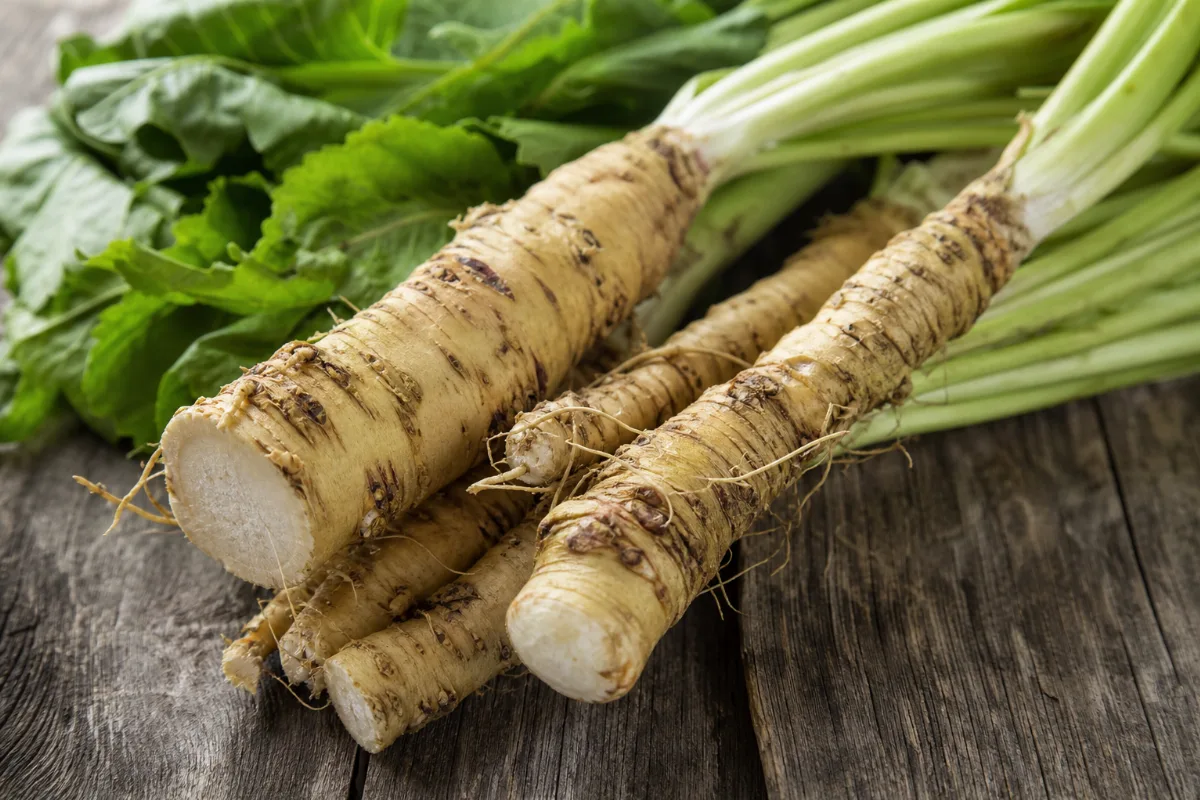
Horseradish is Armoracia rusticana, a perennial of the mustard and cabbage family (Brassicaceae). The thick root is the part used. When the root is crushed, an enzyme turns stored glucosinolates into mustard oils, which cause the sharp sting. Do not confuse it with wasabi (Eutrema japonicum), a related plant, or with nasturtium (Tropaeolum majus), a garden flower from another family that is paired with horseradish in the studied tablet.
Traditional and current uses
A secondary reference page says the German Commission E lists horseradish root for catarrh of the airways, as support in urinary tract infections and, on the skin, for minor muscle aches. A lab paper adds a traditional use against infections of the airways and bladder. These statements are not checked against the original monograph. 'Traditional' means long use, not proof. A fixed nasturtium and horseradish tablet is marketed in Germany for infections of the bronchi, sinuses and urinary tract.
What the research shows
All human trials tested the Angocin combination tablet. In acute bronchitis (384 patients), symptoms eased faster than with placebo from day 3 to day 10. In prevention (351 adults), 13.3% of the higher-schedule group and 25.6% of the placebo group caught a new respiratory infection once the first week was left out. In recurring bladder infections, one trial found 0.43 versus 0.77 repeats per person (per protocol) and another found a 36% lower risk that faded after treatment stopped. Against an antibiotic for active cystitis, a trial stopped early and could not show the tablet was as good. For sinusitis only non-randomised studies exist. Most authors are linked to the maker. Lab studies show bacteria-stopping, anti-inflammatory and antioxidant effects in dishes; none has been shown to help a person.
At a glance
Traditional uses history, not proof
- European herbal medicine: catarrh (mucus) of the airways, as support in urinary tract infections, and on the skin for minor muscle aches, per a secondary page summarising the German Commission E (not verified)
- Ethnomedicine: infections of the airways and bladder, per the introduction of a lab paper (secondary statement)
- Food: a pungent condiment
Studied for research
- Acute bronchitis, low certainty (one trial of a combination tablet)
- Preventing respiratory infections, low (one trial of a combination tablet)
- Acute sinusitis, very low (non-randomised studies only)
- Preventing repeat bladder infections, low (two trials of a combination tablet)
- Acute cystitis, very low (one stopped-early trial)
- Catheter or neurogenic bladder infections, very low (small observational studies)
- Bacterial growth, inflammation signals, antioxidant action, gut muscle and nerve growth, insufficient (cells and animal tissue)
Main compounds
- Glucosinolates (sinigrin, gluconasturtiin)
- Isothiocyanates (allyl, phenethyl, benzyl, 5-phenylpentyl)
- Kaempferol flavonoids
- Peroxidase enzymes (a laboratory tool, not a health use)
Common forms
- Fixed tablet of nasturtium herb and horseradish root (Angocin Anti-Infekt N, tested in the trials)
- Fermented and non-fermented root extracts (lab studies)
- Fresh grated root and sauces (condiment; not studied as medicine)
Research links: PubMed search: Armoracia rusticana · GBIF: Armoracia rusticana · Bronchitis trial (Phytomedicine, 2023) · Repeat bladder infection trial (BMC Complement Med Ther, 2026) · NTP report on allyl isothiocyanate · Research Library · Genes & Biomarkers Library
The plant and its history
- Accepted scientific name
- Armoracia rusticana P.Gaertn., B.Mey. & Scherb.
- Naming authority
- P.Gaertn., B.Mey. & Scherb.
- Synonyms
- Cochlearia armoracia L.; Cardamine armoracia (L.) Kuntze; Armoracia lapathifolia Gilib.; Armoracia rustica Schur; Armoracia sativa Bernh.; Armoracia armoracia (L.) Britton; Armoracia amoracia (L.) Cockerell
- Common names
- Horseradish (English); Rabano picante, rabano rusticano (Spanish); Meerrettich, Kren (German)
- Botanical family
- Brassicaceae (mustard or cabbage family)
- Classification
- Plantae > Tracheophyta > Magnoliopsida > Brassicales > Brassicaceae > Armoracia > Armoracia rusticana
- Native range
- Not covered in the sources we read.
- Habitat
- Not covered in the sources we read. Described in lab papers as a perennial crop.
- What the plant looks like
- Roots: The thick root is the part used for food and medicine (lab papers).; Stems: Not covered in the sources we read.; Leaves: Leaves have been studied as a juice in food research; not covered for appearance.; Flowers: Not covered in the sources we read.; Fruit: Not covered in the sources we read.
- Cultivation
- Described as a perennial crop; details not covered in the sources we read.
- Harvest and processing
- The root is crushed or grated, which lets the plant enzyme myrosinase turn glucosinolates into the pungent isothiocyanates; cooking the plant stops the enzyme (glucosinolate review). Medicinal studies used fermented and non-fermented root extracts and a dried root and herb tablet.
- Look-alikes and adulterants
- Name: Wasabi (Eutrema japonicum); Note: A different plant of the same family (GBIF key 5375216). Its main pungent compound is also allyl isothiocyanate. Sold wasabi paste may be made from horseradish; we did not check this in a source.; Name: Nasturtium (Tropaeolum majus); Note: The garden flower used with horseradish in the Angocin product. It is in a different family, Tropaeolaceae (GBIF key 2889934), but also makes mustard oils. The trials tested the pair together.; Name: Black mustard (Brassica nigra); Note: A mustard-family seed spice (GBIF key 3042658); also makes allyl isothiocyanate.
- Sustainability and conservation
- Not covered in the sources we read.
Traditional use and history history, not clinical proof
| Tradition or era | Documented use | Source |
|---|---|---|
| European folk and herbal medicine | Traditionally used for infections of the respiratory tract and the urinary bladder, per the introduction of a 2017 lab paper. | p28182113 |
| Ethnomedicine (general) | Described as having a long history in ethnomedicine, and the root as an extremely pungent condiment, per a 2015 lab paper. | p26411988 |
| German Commission E | Approved for catarrh of the airways, as support in urinary tract infection, and externally for minor muscle aches, per a secondary reference page. Not read in the original monograph. | s-altmeyers-armoraciae |
| Modern German practice (late 20th century onward) | A fixed horseradish and nasturtium combination has been marketed in Germany for decades; the 2012 trial paper says clinical experience with it existed for decades. | p23083066 |
| EMA / HMPC and ESCOP | No monograph found; a secondary page lists both as 'not processed'. | s-search-regulatory-notfound |
Traditional use shows how a plant was used. It does not show that a supplement works or is safe today.
What is inside, and how it may work
What the plant contains and how those compounds act in cells and animals. Laboratory and animal mechanisms are not proven effects in people.
Main compounds
| Compound | Family | Where it is concentrated | Activity studied | Level of evidence |
|---|---|---|---|---|
| Sinigrin (allyl glucosinolate) PubChem 6911854 | glucosinolates | root | A stored sugar-bound compound that turns into allyl isothiocyanate when the root is crushed. Named as a main glucosinolate of horseradish by a secondary page. 4 29 | Other |
| Gluconasturtiin PubChem 656555 | glucosinolates | root | A second main glucosinolate of horseradish (secondary page); it turns into phenethyl isothiocyanate when crushed. 4 29 | Other |
| Allyl isothiocyanate (AITC) PubChem 5971 | isothiocyanates | root | Main pungent mustard oil of crushed horseradish (a 2017 lab paper calls it the principal pungent constituent). Lowered bacterial growth in lab tests; caused bladder tumours in male rats at high doses; not responsible for the anti-inflammatory effect of one root extract. 15 25 16 29 | Animal research |
| Phenethyl isothiocyanate (PEITC) PubChem 16741 | isothiocyanates | root | Second main mustard oil of horseradish; part of the isothiocyanate mixture tested against bacteria. 7 16 29 | Laboratory research |
| Benzyl isothiocyanate (BITC) PubChem 2346 | isothiocyanates | nasturtium herb (in the combination) | Part of the isothiocyanate mixture of the nasturtium-horseradish product; in the lab it stopped bacteria growing in the mixture. 7 16 29 | Laboratory research |
| 5-Phenylpentyl isothiocyanate PubChem 3025718 | isothiocyanates | root and aerial parts | New autolysis product found in crushed horseradish; relaxed rat colon muscle strongly in a lab bath and was antimicrobial and cytotoxic. 8 30 | Animal research |
| Kaempferol glycosides (flavonoids) PubChem 5280863 | flavonoids | root | A variety of kaempferol sugar compounds were found in root extracts; they did not add to antibacterial activity but are useful for quality control (review). 26 29 | Laboratory research |
| Vitamin C (ascorbic acid) PubChem 54670067 | vitamins | root | A secondary page lists high vitamin C content. No amount was found in the sources we read. 4 29 | Other |
| Peroxidase enzymes (horseradish peroxidase, HRP) | enzymes | root | Horseradish is the classic source of the enzyme HRP, widely used as a tracer in laboratory tests. This is a laboratory tool use. No health benefit of eating the enzyme was found; many PubMed hits for 'horseradish' are about this enzyme and were set aside. | Other |
| Hydantoin and thiohydantoin compounds | other | root | New compounds from the root; two raised nerve growth factor release in rat cells. 20 | Laboratory research |
Mechanisms, receptors and pathways
| Target or pathway | Gene or receptor | What was found | Level |
|---|---|---|---|
| Crushing releases mustard oils (myrosinase reaction) | Myrosinase enzyme; glucosinolates become isothiocyanates | When the raw plant is crushed, the enzyme myrosinase turns glucosinolates into isothiocyanates and other products; cooking inactivates the enzyme, so glucosinolates may be absorbed whole. 28 | Laboratory research |
| Bacterial growth | Not specified | A mix of benzyl, allyl and phenylethyl isothiocyanates stopped growth of respiratory and urinary bacteria in dishes, with resistant and non-resistant strains similarly affected; urinary E. coli entry into bladder cells fell by 31.9%. 7 23 6 | Laboratory research |
| Inflammation signalling (NF-kB, COX-2, MAPK) | NF-kB p65, NOS, COX-2, TNF-alpha, IL-6; ERK1/2 and c-Jun; PGE2, LTB4 | Root extracts lowered these signals in mouse macrophages and human blood immune cells; allyl isothiocyanate was not the cause in one study. 22 15 | Laboratory research |
| Antioxidant defence | Heme oxygenase-1; Nrf2/Keap1 (review) | A root extract raised heme oxygenase-1 in mouse cells; a review says isothiocyanates can modulate Nrf2/Keap1 signalling. 22 16 | Laboratory research |
| Gut smooth muscle | Not specified | Pure phenylalkyl isothiocyanates relaxed rat distal colon, one almost 100 times more potently than papaverine. 8 | Animal research |
| Nerve growth factor release | NGF | Two root hydantoins raised NGF secretion to about 154% and 142% of control in rat glioma cells. 20 | Laboratory research |
| Bladder lining in rats | Not specified | High-dose allyl isothiocyanate by stomach tube caused bladder papillomas in male rats; the NTP report summary does not give the mechanism. 25 | Animal research |
| Thyroid hormone levels in rats | fT4, fT3 | Pure allyl isothiocyanate lowered fT4 and fT3 in diabetic rats and enlarged the thyroid at the highest dose; a 2024 systematic review found little sign of thyroid harm from Brassica vegetables in people. 27 12 | Animal research |
Absorption, metabolism and elimination
- Absorption
- No human data for horseradish found. A review says that after raw plants are crushed isothiocyanates form and are absorbed, and that after cooking intact glucosinolates may be partly absorbed.
- Distribution
- No data.
- Metabolism
- No human or animal data read for horseradish. An abstract of a method for allyl isothiocyanate and its phase II metabolites appeared in searches but was not read.
- Elimination
- No data read.
- Bioavailability
- Not studied for horseradish or the combination tablet in the sources we read.
Isolated compounds versus whole extracts
Most lab work uses purified or synthetic isothiocyanates (allyl, benzyl, phenylethyl), not the whole root. A review found that only isothiocyanate-containing root extracts had antibacterial activity, while other compounds did not add to it. In one cell study the anti-inflammatory effect of the root extract was not due to allyl isothiocyanate, so the whole root may act differently from the single compound. All human trials used a fixed combination of nasturtium herb and horseradish root, so neither the whole root alone nor any single compound was tested in people.
Nutritional composition
Horseradish root is eaten as a pungent condiment. A secondary page says the root is high in vitamin C; we found no measured nutrient values in the sources we read, so we make no claims about nutrition.
3 low certainty3 very low certainty6 not enough evidence
What was looked at
The 12 benefits and uses checked for Horseradish, each with how strong the evidence is. Tap one to open it.
- Acute bronchitis: a nasturtium and horseradish combinationLow certainty
- Preventing respiratory infections: a nasturtium and horseradish combinationLow certainty
- Acute sinusitis: a nasturtium and horseradish combinationVery low certainty
- Calming inflammation signals (cell experiments only)Not enough evidence
- Preventing repeat bladder infections: a nasturtium and horseradish combinationLow certainty
- Treating a bladder infection that has started (acute cystitis)Very low certainty
- Urinary infections with a catheter or a neurogenic bladderVery low certainty
- Stopping bacterial growth (lab tests only)Not enough evidence
- Antioxidant activity (lab tests only)Not enough evidence
- Relaxing gut muscle (rat tissue only)Not enough evidence
- Nerve growth signals from root compounds (cells only)Not enough evidence
- External use for minor muscle aches (traditional)Not enough evidence
Lab markers tracked in the studies
Bronchitis severity score (BSS)Share of people with a new respiratory infectionAverage symptom score in sinus, chest or urinary infectionNew infection diagnoses after the first visitNumber or rate of repeat urinary infectionsGerm count in urine (CFU/mL)Later antibiotic prescriptionsUrinary infection symptom score
What is Horseradish good for?
The main studied uses and how strong the evidence is for each. All human evidence is for a fixed tablet of nasturtium herb and horseradish root, not horseradish alone. "Insufficient" means only lab, animal or traditional evidence exists. Results apply only to the named product.
Benefits, one by one
Each card is a research question, not a promise. Tap a goal to filter. Open a card to see the studies, doses and limits.
Acute bronchitis: a nasturtium and horseradish combination
Low certaintyOne placebo-controlled trial of 384 people found that a fixed combination of nasturtium herb and horseradish root cleared bronchitis symptoms faster than placebo. It is the best-studied respiratory use, but the product is a combination, the trial links to its maker, and horseradish on its own has not been tested.
3 studiesAngocin Anti-Infekt N, a fixed combination of nasturtium herb and hor…
Studies, doses and limits
What the trials found
Albrecht 2023 (phase IV randomised, double-blind): 384 patients with acute bronchitis, 195 on the combination (Angocin Anti-Infekt N: nasturtium herb plus horseradish root) and 189 on placebo. The main measure was the bronchitis severity score, which adds ratings of five symptoms. Compared with placebo, symptoms improved faster from day 3, with less cough, less mucus and less chest pain, and the difference lasted to day 10. The authors were the principal investigator, the project manager of the trial's contract research organisation and the statistician. Goos 2006 (not randomised): 634 people with acute bronchitis chose the combination (469) or antibiotics (165); symptom scores fell 78.3% and 80.3%, and the authors called the two comparable.
Results
Faster improvement in cough, mucus and chest pain than placebo, from day 3 to day 10, for the combination product. The abstract gives no numbers.
Effect sizes as reported
Not given as numbers in the abstract (randomised trial). Observational cohort: symptom score fell 78.3% (combination) versus 80.3% (antibiotics).
Why this rating
One randomised placebo-controlled trial of a combination product with industry-linked authors, no numbers in the abstract, and no independent repeat. The cohort is not randomised.
Form and dose studied
Angocin Anti-Infekt N, a fixed combination of nasturtium herb and horseradish root. Horseradish root alone, fresh grated root or kitchen horseradish were not tested.
Who was studied
Adults with acute bronchitis in the randomised trial; people aged 4 and over in the cohort.
Limits
Combination product, so the horseradish share cannot be separated. Industry-linked. The trial abstract has no effect numbers.
Why researchers looked
Horseradish root and nasturtium herb both release mustard oils (isothiocyanates) when crushed. Lab work shows these oils can stop some respiratory bacteria from growing, so the pair was tested for chest infections.
Traditional use
Horseradish root is a pungent condiment. In Europe the root has long been used for catarrh (mucus) of the airways, and the German Commission E (as summarised by a secondary reference page) lists it for that use.
Proposed mechanism Laboratory research
In lab tests a mixture of the three isothiocyanates found in the pair stopped growth of several respiratory bacteria (for example H. influenzae and M. catarrhalis). Horseradish root extract also lowered inflammation signals in immune cells in a dish. These are lab findings only. The lab bacteria work does not by itself explain a symptom benefit.
A proposed mechanism does not show that the effect happens in people.
The combination was reported as well tolerated in the studies. Horseradish is a strong irritant of the mouth and stomach; see the safety file. See a doctor for fever, breathlessness or cough that lasts.
Preventing respiratory infections: a nasturtium and horseradish combination
Low certaintyOne randomised trial of 351 adults found fewer new respiratory infections over up to 12 weeks with the combination than with placebo. The result was clearest after infections in the first week were left out. The product is a combination and horseradish alone was not tested.
2 studiesAngocin Anti-Infekt N tablets at two schedules versus placebo. No oth…
Studies, doses and limits
What the trials found
Fintelmann 2012 (phase III, double-blind, double-dummy, EudraCT 2010-023227-26): 351 people aged 18 to 75 were split into a higher-schedule group, a lower-schedule group and a placebo group for up to 84 days. With infections in the first 7 days excluded (n = 344), new respiratory tract infections occurred in 13.3% (higher), 18.4% (lower) and 25.6% (placebo); the trend test gave p = 0.0171. Per protocol (n = 334): 12.7%, 18.6% and 24.3% (p = 0.0266). The infections that did occur were not milder or shorter. No data on children, teenagers or people over 75. Kassner 2026 (database study, funded by the maker): people given the combination on the day of diagnosis of an upper respiratory infection or sinusitis had fewer new diagnoses than people given other plant medicines, nasal medicines and mucus thinners, or antibiotics.
Results
Fewer new respiratory infections than placebo in adults over up to 12 weeks, after leaving out infections in the first week.
Effect sizes as reported
Infection rate 13.3% / 18.4% / 25.6% (higher schedule / lower schedule / placebo), p for trend = 0.0171 (ITT excluding infections in days 1-7).
Why this rating
One randomised trial of 351 people with an industry-linked author group; the main result depends on excluding the first week; severity and duration did not differ; no independent repeat.
Form and dose studied
Angocin Anti-Infekt N tablets at two schedules versus placebo. No other form was tested.
Who was studied
Adults aged 18 to 75 only.
Limits
Combination product. Excluding early infections was a choice the authors made after reasoning about incubation time. Database study shows association only and is funded by the maker.
Why researchers looked
The combination has been sold in Germany for decades and was tested to see whether taking it regularly cuts the number of colds and chest infections.
Traditional use
Horseradish root is a pungent condiment. In Europe the root has long been used for catarrh (mucus) of the airways, and the German Commission E (as summarised by a secondary reference page) lists it for that use.
Proposed mechanism Preliminary mechanism
The proposed way is a direct effect of mustard oils on germs in the airways, plus some calming of inflammation signals seen in cells. Lab only; no study shows this happens in the human airway.
A proposed mechanism does not show that the effect happens in people.
The trial abstract says the product was well tolerated. Long-term use beyond 12 weeks was not studied.
Acute sinusitis: a nasturtium and horseradish combination
Very low certaintyNo randomised trial of sinusitis was found. Two industry-linked cohort studies (not randomised) found similar symptom improvement with the combination and with antibiotics, and a database study linked it to fewer later infection diagnoses. These designs cannot prove it works.
4 studiesAngocin Anti-Infekt N, chosen and dosed by the treating doctor. Nothi…
Studies, doses and limits
What the trials found
Goos 2006 (prospective cohort, not randomised, 251 centres in Germany): 408 people with acute sinusitis chose the combination and 128 chose antibiotics. Symptom scores fell 81.3% versus 84.6%; the authors state non-inferiority. Goos 2007 (cohort, children and teenagers 4 to 18): 197 on the combination and 100 on antibiotics had sinusitis; the score fell 84.8% versus 85.5%. Overall adverse events in that study were 0.6% versus 3.9%. Kassner 2026 (database study, funded by the maker): linked to fewer new diagnoses of upper respiratory infection or sinusitis and fewer later antibiotic prescriptions than comparison groups. Symptom improvement in a group that chose the treatment is not proof the treatment caused it.
Results
Symptom scores fell by about 81% to 85% with the combination, about the same as with antibiotics, in non-randomised cohorts.
Effect sizes as reported
Adults: 81.3% (combination) vs 84.6% (antibiotics), 95% CI of the difference -8.5% to 1.8%. Children: 84.8% vs 85.5%.
Why this rating
No randomised trial for this use. Cohorts were not randomised, doctors and patients chose the treatment, groups differed at the start, and the authors are linked to the maker.
Form and dose studied
Angocin Anti-Infekt N, chosen and dosed by the treating doctor. Nothing else tested.
Who was studied
People aged 4 and over in Germany.
Limits
No blinding or randomisation; the children's study is in German and only its abstract was read; groups differed at the start (the combination group had milder symptoms and was younger).
Why researchers looked
Sinus infections are common, and the combination is licensed in Germany for acute inflammation of the bronchi, sinuses and urinary tract, according to a secondary source.
Traditional use
Used traditionally for catarrh of the airways (secondary source). The studies below tested a medicinal combination and not eating horseradish as a food.
Proposed mechanism Laboratory research
Mustard oils from the root are volatile and can reach the airways; in a dish they inhibit bacteria. No study shows this in a human sinus.
A proposed mechanism does not show that the effect happens in people.
Do not delay medical care for severe, one-sided or long-lasting sinus pain, swelling around the eyes or high fever.
Calming inflammation signals (cell experiments only)
Not enough evidenceHorseradish root extracts lowered inflammation signals in mouse and human immune cells in a dish. No person was tested, so this is not evidence that it reduces inflammation in the body.
2 studiesAqueous and other root extracts in cell tests; concentrations in a di…
Studies, doses and limits
Results
Lab: lower inflammation signals in cells treated with horseradish root extracts.
Effect sizes as reported
Not given as numbers here. Human cells: TNF-alpha lowered at 37 ug/mL and above; COX-2 and PGE2 lowered at 4 ug/mL and above.
Why this rating
Cells in a dish only; no human or animal outcome.
Form and dose studied
Aqueous and other root extracts in cell tests; concentrations in a dish do not translate to amounts eaten.
Limits
Mouse cell line and human blood cells; one study partly supported by the maker of Angocin.
Why researchers looked
Researchers wanted to know whether the root does more than kill germs, since people use it for sore, inflamed airways.
Traditional use
Used traditionally for catarrh of the airways (secondary source).
Proposed mechanism Laboratory research
In mouse macrophage cells, root extracts lowered nitric oxide, TNF-alpha and IL-6 and the activation of NF-kB. In human blood immune cells, an aqueous extract lowered TNF-alpha, COX-2, PGE2 and LTB4, and the authors found allyl isothiocyanate was not the cause of that effect.
A proposed mechanism does not show that the effect happens in people.
None specific.
Preventing repeat bladder infections: a nasturtium and horseradish combination
Low certaintyTwo placebo-controlled trials (174 and 224 people) found fewer repeat urinary infections on the combination than on placebo. The first reported only a per-protocol result; the second found a 36% lower risk that faded after treatment stopped. Both trials link to the product's maker, and horseradish alone was not tested.
5 studiesAngocin Anti-Infekt N tablets taken continuously for 90 days or six m…
Studies, doses and limits
What the trials found
Albrecht 2007 (randomised, double-blind, placebo-controlled, 90 days): 174 adults aged 18 to 75 with chronically recurring lower UTIs were enrolled (45 were screening failures). In the per-protocol group there were 0.43 recurrent UTIs per person on the combination versus 0.77 on placebo (p = 0.035). Adverse events were reported by 36 people on the combination and 37 on placebo; two serious events occurred on placebo and one on the combination (not linked to it). Albrecht 2026 (phase III, randomised, double-blind, EudraCT 2013-004653-25): 217 women (110 combination, 107 placebo) with recurring uncomplicated cystitis took it for six months. Recurrence by day 180 was 36% on the combination and 48% on placebo (hazard ratio 0.64, 95% CI 0.42 to 0.97, p = 0.0327). The benefit pointed the same way up to 360 days but was no longer statistically significant. There were no significant differences in adverse effects. The sponsor was Repha GmbH, the maker, and the contract research organisation designed and prepared the paper for the sponsor. Bieri 2025 (retrospective, 43 people with long-term neurogenic bladder, no control group): recurrent UTIs fell from 58.1% to 23.3% of people over at least 12 months of use.
Results
Fewer repeat urinary infections than placebo in two randomised trials, with a modest and borderline effect in the larger newer trial. A small uncontrolled study in people with neurogenic bladder pointed the same way.
Effect sizes as reported
Trial 1: 0.43 vs 0.77 recurrences per person (per protocol, p = 0.035). Trial 2: hazard ratio 0.64 (95% CI 0.42 to 0.97). Cohort: recurrent UTI 58.1% to 23.3%.
Why this rating
Two randomised placebo-controlled trials point the same way, but both are industry-linked, the first reports only a per-protocol result, the second is borderline and not significant in follow-up, and the product is a combination. No independent trial or systematic review was found.
Form and dose studied
Angocin Anti-Infekt N tablets taken continuously for 90 days or six months. Nothing else was tested.
Who was studied
Adults with recurring cystitis; the 2026 trial analysed women. People with neurogenic bladder in the cohort.
Limits
Combination product; both trials linked to the maker; effect borderline; no head-to-head comparison with other prevention methods.
Why researchers looked
Repeat bladder infections are common and usually treated with antibiotics. Mustard oils from horseradish and nasturtium stop some urinary bacteria from growing in the lab, so the combination was tested as a way to prevent repeats.
Traditional use
Horseradish root is traditionally used in Europe as a support in urinary tract infections; the German Commission E lists this use (per a secondary reference page).
Proposed mechanism Laboratory research
In lab tests, a mixture of isothiocyanates from the pair stopped growth of 217 urinary E. coli isolates (including multidrug-resistant ones) and cut bacterial entry into human bladder cells by 31.9% on average. Whether enough active compound reaches the bladder in people was not shown in the studies we read.
A proposed mechanism does not show that the effect happens in people.
Trials reported no significant differences in adverse events versus placebo. Not a replacement for care: fever, back pain or blood in urine need a doctor.
Treating a bladder infection that has started (acute cystitis)
Very low certaintyOne randomised trial compared the nasturtium and horseradish combination with an antibiotic in acute cystitis. It stopped early after 96 people, found similar responder rates (45.5% vs 51.1%) but could not show the herbal product was as good, so the result is inconclusive. Large database studies suggest fewer repeat infections than with antibiotics, but these are not trials.
4 studiesIn the randomised trial, five tablets four times a day for 7 days of …
Studies, doses and limits
What the trials found
Stange 2017 (randomised, double-blind, double-dummy, phase III, 26 centres in Germany): adults (median age 38.5; 90% women) with acute uncomplicated cystitis took the combination for 7 days or the antibiotic co-trimoxazole for 3 days. Only 96 of the 356 planned patients were randomised (45 and 51), and 51 were analysed per protocol. Responders (germ count in urine fell from above 100,000 to below 1,000 CFU/mL by day 15): 10 of 22 (45.5%) on the combination and 15 of 29 (51.1%) on the antibiotic, difference -6.27% (95% CI -33.90 to 21.3). Non-inferiority could not be assumed. One relapse in each group in the next 21 days. Kassner 2024 (retrospective database study of 13,662 people in Germany, 2005-2021; authors include Repha employees): compared with antibiotics, the combination was linked to lower odds of early relapse (OR 0.74, 0.62-0.87), further sporadic UTI (OR 0.68, 0.58-0.78) and recurrent UTI (OR 0.63, 0.48-0.82). Pyelonephritis was not significantly different (HR 0.67, 0.43-1.06). Goos 2006 (cohort, not randomised): UTI symptom score fell 81.2% (combination, n = 346) versus 87.9% (antibiotics, n = 133); the abstract says the non-inferiority margin was exceeded by only 3%.
Results
Randomised trial: inconclusive. Cohort and database studies: similar symptom relief and fewer later recurrences than antibiotics, with big uncertainty because prescribing was not random.
Effect sizes as reported
Responders 45.5% vs 51.1%, difference -6.27% (95% CI -33.90 to 21.3). Database study: OR 0.74 (early relapse), 0.68 (sporadic UTI), 0.63 (recurrent UTI).
Why this rating
The only randomised trial was cut short and could not show equivalence to the antibiotic; the other evidence is non-randomised and industry-linked.
Form and dose studied
In the randomised trial, five tablets four times a day for 7 days of the combination. Horseradish alone was not tested.
Who was studied
Mostly adult women with uncomplicated cystitis (the cystitis trial had 90% women). We found no data for pregnancy or for kidney infection (pyelonephritis).
Limits
Underpowered trial; combination product; database studies cannot remove differences between who gets which prescription.
Why researchers looked
To see whether a plant combination could replace or reduce antibiotics for simple bladder infections.
Traditional use
Support in urinary tract infections is a traditional use (secondary source).
Proposed mechanism Laboratory research
Mustard oils stopped growth of many urinary and other bacteria in lab tests. Lab results do not show a cure in the body.
A proposed mechanism does not show that the effect happens in people.
An untreated or under-treated bladder infection can spread to the kidneys. Seek a doctor for fever, flank pain, vomiting, blood in urine or symptoms that do not clear.
Urinary infections with a catheter or a neurogenic bladder
Very low certaintyTwo small non-randomised studies looked at hospital patients with catheters and people with neurogenic bladder. Used alone, the combination healed less than half of catheter-linked infections (46%), while recurrences were lower when it was added to antibiotics. These are observations, not trials.
2 studiesAngocin Anti-Infekt N, alone or with antibiotics, in hospital or spec…
Studies, doses and limits
What the trials found
Lau 2018 (observational, 96 hospital inpatients with catheter-associated UTI, 5 weeks; German): 42% used the combination alone, 29% added it to antibiotics, 29% took antibiotics alone. All initial infections healed with add-on use and with antibiotics alone (after about 10.5 and 9 days). The combination alone healed 46% after an average of 28 days. Recurrence was 50% with the combination (alone or as add-on) versus 79.3% with antibiotics alone. Adverse events were 23.8%, 44.8% and 34.5%. Bieri 2025 (retrospective, 43 people with chronic neurogenic bladder, at least 12 months): recurrent UTIs fell from 58.1% to 23.3% of people, people without UTIs rose from 14.0% to 39.5% and antibiotic prescriptions fell (p = 0.008). No control group.
Results
Alone it cured fewer than half of catheter-linked infections; as an add-on it was linked to fewer recurrences than antibiotics alone.
Effect sizes as reported
Recurrence 50% vs 79.3%; cure 46% (alone, mean 28 days) vs 100% (add-on or antibiotics alone).
Why this rating
Small, non-randomised, partly retrospective studies with no blinding and linked authors.
Form and dose studied
Angocin Anti-Infekt N, alone or with antibiotics, in hospital or specialist care.
Who was studied
Hospital inpatients with catheters; people with chronic neurogenic bladder dysfunction.
Limits
No randomisation; groups differed; no control group in the neurogenic study; combination product.
Why researchers looked
People with catheters or spinal conditions get frequent UTIs and often resistant germs, so researchers looked for prevention options beyond repeated antibiotics.
Traditional use
No traditional use specific to catheters.
Proposed mechanism Laboratory research
Same lab mustard-oil findings as for other urinary infections; not shown in catheter patients.
A proposed mechanism does not show that the effect happens in people.
These patients are at higher risk of serious infection. Treatment decisions belong with their specialist, not with self-treatment.
Stopping bacterial growth (lab tests only)
Not enough evidenceMustard oils from horseradish and nasturtium stopped many bacteria from growing in dishes, including some drug-resistant ones. This is the main reason the plants are studied, but a result in a dish does not show a treatment effect in a person.
5 studiesPure or mixed synthetic isothiocyanates and native plant preparations…
Studies, doses and limits
Results
Lab: broad antibacterial activity, strongest against some respiratory bacteria.
Effect sizes as reported
Mean MIC90 0.17 mg/mL for 217 urinary E. coli isolates (mixture of synthetic isothiocyanates).
Why this rating
Dish studies only.
Form and dose studied
Pure or mixed synthetic isothiocyanates and native plant preparations in lab tests; not whole-root eating.
Limits
Several of these studies come from groups linked to the product maker. Dish concentrations do not tell us what happens in a body.
Why researchers looked
Crushing the root makes volatile isothiocyanates, which are known to be toxic to germs.
Traditional use
Traditional use against infections of the airways and bladder (secondary source).
Proposed mechanism Laboratory research
Lab tests of an isothiocyanate mixture found high susceptibility in H. influenzae, M. catarrhalis, S. marcescens, P. vulgaris and Candida, intermediate in S. aureus, S. pyogenes, S. pneumoniae, K. pneumoniae, E. coli and P. aeruginosa and low in viridans streptococci and enterococci. A gas-phase test with the native herbs found activity against H. influenzae, E. coli, P. aeruginosa, MSSA, MRSA and S. pyogenes. A review of extracts found only isothiocyanate-containing extracts had antibacterial activity. Horseradish extracts also stopped fish pathogens in a separate study.
A proposed mechanism does not show that the effect happens in people.
The same compounds are irritants; see the safety file.
Antioxidant activity (lab tests only)
Not enough evidenceA root extract was rich in phenols and protected cells from damage caused by oxidative stress in a dish. No person or animal was tested.
2 studiesWater and hydroalcoholic extracts.
Studies, doses and limits
Results
Lab: antioxidant effects in a dish.
Effect sizes as reported
Not given as numbers.
Why this rating
Cells and chemical tests only.
Form and dose studied
Water and hydroalcoholic extracts.
Limits
Antioxidant tests in a dish rarely predict a benefit in people.
Why researchers looked
Plant extracts rich in sulfur compounds and flavonoids are often screened for antioxidant action.
Proposed mechanism Laboratory research
A water extract had more total phenols and reducing power than an alcohol extract and protected cells against oxidative death. In mouse cells a root extract also lowered reactive oxygen species and raised the protective enzyme heme oxygenase-1.
A proposed mechanism does not show that the effect happens in people.
None specific.
Relaxing gut muscle (rat tissue only)
Not enough evidenceA compound found in crushed horseradish relaxed rat colon muscle in a lab bath. Nobody has tested this in people, and it does not mean horseradish settles the gut. Horseradish is more often an irritant to the stomach.
1 studiesPure synthetic compounds and crushed-plant autolysates.
Studies, doses and limits
Results
Lab: relaxation of rat colon muscle by pure compounds.
Effect sizes as reported
Not given as numbers here.
Why this rating
Animal tissue and cells only.
Form and dose studied
Pure synthetic compounds and crushed-plant autolysates.
Limits
Isolated tissue; tested compounds, not food; cell-killing effects also seen.
Why researchers looked
Researchers found a new isothiocyanate in crushed horseradish and tested it on tissue.
Proposed mechanism Animal research
Five phenylalkyl isothiocyanates relaxed rat distal colon muscle; the new 5-phenylpentyl isothiocyanate was almost 100 times more potent than the drug papaverine in that test. The compounds also had non-selective antimicrobial and cell-killing effects.
A proposed mechanism does not show that the effect happens in people.
The same compounds killed cells in the lab, which is a reminder that they are irritants.
Nerve growth signals from root compounds (cells only)
Not enough evidenceNewly found compounds from the root raised nerve growth factor release in rat cells in a dish. This is very early chemistry and says nothing about brain or nerve health in people.
1 studiesPurified compounds, not whole root.
Studies, doses and limits
Results
Lab: higher nerve growth factor release in rat cells.
Effect sizes as reported
NGF secretion 153.59 +/- 5.44% and 141.99 +/- 5.21% of control.
Why this rating
Isolated compounds in cells.
Form and dose studied
Purified compounds, not whole root.
Limits
Compounds from the root were purified; the amount in food or products is not known.
Why researchers looked
Scientists screen plant compounds for nerve-protective activity.
Proposed mechanism Laboratory research
Two hydantoin compounds isolated from horseradish roots raised nerve growth factor secretion by C6 glioma cells to about 154% and 142% of control, and one compound marginally lowered nitric oxide in stimulated mouse microglia.
A proposed mechanism does not show that the effect happens in people.
None specific.
External use for minor muscle aches (traditional)
Not enough evidenceA secondary reference page says German Commission E lists horseradish on the skin for minor muscle aches because it makes the skin red and warm. We found no study of this use, and the same mustard oils can burn or blister skin.
1 studiesNone.
Studies, doses and limits
Results
No study.
Why this rating
No study; traditional and regulatory-text use only.
Limits
No trial; secondary source.
Why researchers looked
A traditional counter-irritant: the sting draws blood to the skin.
Traditional use
Listed by the German Commission E for external use on minor muscle aches (secondary source; the monograph text was not read).
Proposed mechanism Pharmacological theory
Pharmacological theory: mustard oils irritate skin nerves and widen skin blood vessels. No study tested this for horseradish.
A proposed mechanism does not show that the effect happens in people.
Horseradish irritates skin and mucous membranes (secondary source); do not apply to broken skin or near eyes.
Connections to the rest of health
How Horseradish connects to the rest of our health knowledge graph. Every link says what kind of connection it is. A safety link (for example to the liver) is a warning, not a benefit. A study that merely mentions a topic never creates a benefit link.
Explore every connection: goals, body systems, organs, symptoms, genes
A. Wellness goals
| Connected to | Kind of connection | Evidence status | Context | Studies |
|---|---|---|---|---|
| Immune Support | Potential benefit | Low certainty | Acute bronchitis: a nasturtium and horseradish combination: One placebo-controlled trial of 384 people found that a fixed combination of nasturtium herb and horseradish root cleared bronchitis symptoms faster than placebo. It is the best-studied respiratory use, but the product is a combination, the trial links to its maker, and horseradish on its own has not been tested. Preventing respiratory infections: a nasturtium and horseradish combination: One randomised trial of 351 adults found fewer new respiratory infections over up to 12 weeks with the combination than with placebo. The result was clearest after infections in the first week were left out. The product is a combination and horseradish alone was not tested. | 2 13 4 9 18 14 1 3 5 23 33 17 19 |
| Inflammation Balance | Preliminary mechanism | Not enough evidence | Calming inflammation signals (cell experiments only): Horseradish root extracts lowered inflammation signals in mouse and human immune cells in a dish. No person was tested, so this is not evidence that it reduces inflammation in the body. | 22 15 |
| Immune Support | Preliminary mechanism | Not enough evidence | Stopping bacterial growth (lab tests only): Mustard oils from horseradish and nasturtium stopped many bacteria from growing in dishes, including some drug-resistant ones. This is the main reason the plants are studied, but a result in a dish does not show a treatment effect in a person. | 7 6 23 26 21 |
| Healthy Aging | Preliminary mechanism | Not enough evidence | Antioxidant activity (lab tests only): A root extract was rich in phenols and protected cells from damage caused by oxidative stress in a dish. No person or animal was tested. | 21 22 |
| Digestive Support | Preliminary mechanism | Not enough evidence | Relaxing gut muscle (rat tissue only): A compound found in crushed horseradish relaxed rat colon muscle in a lab bath. Nobody has tested this in people, and it does not mean horseradish settles the gut. Horseradish is more often an irritant to the stomach. | 8 |
| Brain Health | Preliminary mechanism | Not enough evidence | Nerve growth signals from root compounds (cells only): Newly found compounds from the root raised nerve growth factor release in rat cells in a dish. This is very early chemistry and says nothing about brain or nerve health in people. | 20 |
| Joint Support | Traditional use | Not enough evidence | External use for minor muscle aches (traditional): A secondary reference page says German Commission E lists horseradish on the skin for minor muscle aches because it makes the skin red and warm. We found no study of this use, and the same mustard oils can burn or blister skin. | 4 |
B. Body systems
| Connected to | Kind of connection | Evidence status | Context | Studies |
|---|---|---|---|---|
| Digestive system | Adverse effect or risk | Not enough evidence | Stomach and mucous membrane irritation listed by a secondary page; no trial. Stomach and mucous membrane irritation per a secondary page; no trial. Preparation or compound: Horseradish root by mouth |
4 |
| Urinary system | Adverse effect or risk | Not enough evidence | Bladder papillomas in male rats in the NTP study; human relevance unknown. Preparation or compound: Allyl isothiocyanate (pure compound, high doses) |
25 |
| Urinary system | Potential benefit | Low certainty | Two placebo-controlled trials point to fewer repeat bladder infections; industry-linked. Preparation or compound: Nasturtium herb + horseradish root combination tablet |
1 3 |
| Respiratory system | Potential benefit | Low certainty | One trial each for acute bronchitis and for preventing respiratory infections; industry-linked. Preparation or compound: Nasturtium herb + horseradish root combination tablet |
2 9 |
| Respiratory System | Biological association | Low certainty | Studied for: Acute bronchitis: a nasturtium and horseradish combination Studied for: Preventing respiratory infections: a nasturtium and horseradish combination | 2 13 4 9 18 14 |
| Immune System | Biological association | Low certainty | Studied for: Preventing respiratory infections: a nasturtium and horseradish combination Studied for: Calming inflammation signals (cell experiments only) | 9 18 22 15 7 6 23 26 21 |
| Urinary System | Biological association | Low certainty | Studied for: Preventing repeat bladder infections: a nasturtium and horseradish combination Studied for: Treating a bladder infection that has started (acute cystitis) | 1 3 5 23 4 33 17 13 19 |
| Digestive System | Biological association | Not enough evidence | Studied for: Relaxing gut muscle (rat tissue only) | 8 |
| Nervous System | Biological association | Not enough evidence | Studied for: Nerve growth signals from root compounds (cells only) | 20 |
| Musculoskeletal System | Biological association | Not enough evidence | Studied for: External use for minor muscle aches (traditional) | 4 |
C. Body parts and organs
| Connected to | Kind of connection | Evidence status | Context | Studies |
|---|---|---|---|---|
| Thyroid | Adverse effect or risk | Not enough evidence | Lower thyroid hormones in diabetic rats; a 2024 review doubts harm from Brassica vegetables in people. Preparation or compound: Allyl isothiocyanate (pure compound, rats); glucosinolates |
27 12 |
| Kidneys | Contraindication | Not enough evidence | Nephritis listed as contraindication by a secondary page; unverified. Preparation or compound: Horseradish root |
4 |
I. Biomarkers
| Connected to | Kind of connection | Evidence status | Context | Studies |
|---|---|---|---|---|
| Bronchitis severity score (BSS) | Biological association | Low certainty | Measured in trials: lowered. A lab change is not the same as a health benefit. | 2 |
| Share of people with a new respiratory infection | Biological association | Low certainty | Measured in trials: lowered. A lab change is not the same as a health benefit. | 9 |
| Average symptom score in sinus, chest or urinary infection | Biological association | Very low certainty | Measured in trials: lowered. A lab change is not the same as a health benefit. | 13 14 |
| New infection diagnoses after the first visit | Biological association | Very low certainty | Measured in trials: lowered. A lab change is not the same as a health benefit. | 18 |
| Number or rate of repeat urinary infections | Biological association | Low certainty | Measured in trials: lowered. A lab change is not the same as a health benefit. | 1 3 5 |
| Germ count in urine (CFU/mL) | Biological association | Very low certainty | Measured in trials: mixed. A lab change is not the same as a health benefit. | 33 |
| Later antibiotic prescriptions | Biological association | Very low certainty | Measured in trials: lowered. A lab change is not the same as a health benefit. | 17 5 |
| Urinary infection symptom score | Biological association | Very low certainty | Measured in trials: lowered. A lab change is not the same as a health benefit. | 13 14 |
J. Genes, receptors and enzymes
| Connected to | Kind of connection | Evidence status | Context | Studies |
|---|---|---|---|---|
| Myrosinase | Preliminary mechanism | In vitro | Turns glucosinolates into isothiocyanates when the root is crushed. | 28 |
| COX-2 and the MAPK (ERK1/2, c-Jun) pathway | Preliminary mechanism | In vitro | COX-2 protein and PGE2 lowered by an aqueous root extract in human blood cells. | 15 |
K. Biological pathways
| Connected to | Kind of connection | Evidence status | Context | Studies |
|---|---|---|---|---|
| NF-kB | Preliminary mechanism | In vitro | Activation lowered by root extracts in mouse macrophage cells. | 22 |
| Nrf2/Keap1 | Preliminary mechanism | In vitro | Isothiocyanates are said to modulate this pathway in a review; not tested for horseradish itself. | 16 |
| Thyroid hormones (fT4, fT3) | Preliminary mechanism | Animal | Lowered by pure allyl isothiocyanate in diabetic rats. | 27 |
L. Active compounds
| Connected to | Kind of connection | Evidence status | Context | Studies |
|---|---|---|---|---|
| Sinigrin (allyl glucosinolate) | Biological association | Other | A stored sugar-bound compound that turns into allyl isothiocyanate when the root is crushed. Named as a main glucosinolate of horseradish by a secondary page. Preparation or compound: root |
4 29 |
| Gluconasturtiin | Biological association | Other | A second main glucosinolate of horseradish (secondary page); it turns into phenethyl isothiocyanate when crushed. Preparation or compound: root |
4 29 |
| Allyl isothiocyanate (AITC) | Biological association | Animal | Main pungent mustard oil of crushed horseradish (a 2017 lab paper calls it the principal pungent constituent). Lowered bacterial growth in lab tests; caused bladder tumours in male rats at high doses; not responsible for the anti-inflammatory effect of one root extract. Preparation or compound: root |
15 25 16 29 |
| Phenethyl isothiocyanate (PEITC) | Biological association | In vitro | Second main mustard oil of horseradish; part of the isothiocyanate mixture tested against bacteria. Preparation or compound: root |
7 16 29 |
| Benzyl isothiocyanate (BITC) | Biological association | In vitro | Part of the isothiocyanate mixture of the nasturtium-horseradish product; in the lab it stopped bacteria growing in the mixture. Preparation or compound: nasturtium herb (in the combination) |
7 16 29 |
| 5-Phenylpentyl isothiocyanate | Biological association | Animal | New autolysis product found in crushed horseradish; relaxed rat colon muscle strongly in a lab bath and was antimicrobial and cytotoxic. Preparation or compound: root and aerial parts |
8 30 |
| Kaempferol glycosides (flavonoids) | Biological association | In vitro | A variety of kaempferol sugar compounds were found in root extracts; they did not add to antibacterial activity but are useful for quality control (review). Preparation or compound: root |
26 29 |
| Vitamin C (ascorbic acid) | Biological association | Other | A secondary page lists high vitamin C content. No amount was found in the sources we read. Preparation or compound: root |
4 29 |
| Peroxidase enzymes (horseradish peroxidase, HRP) | Biological association | Other | Horseradish is the classic source of the enzyme HRP, widely used as a tracer in laboratory tests. This is a laboratory tool use. No health benefit of eating the enzyme was found; many PubMed hits for 'horseradish' are about this enzyme and were set aside. Preparation or compound: root |
|
| Hydantoin and thiohydantoin compounds | Biological association | In vitro | New compounds from the root; two raised nerve growth factor release in rat cells. Preparation or compound: root |
20 |
Each connection is stored with the ingredient, the connected record, the kind of connection, the evidence status, the supporting studies, the preparation or compound involved, and a review date (last reviewed October 25, 2026).
Evidence at a glance: what changed in 8 lab markers
Tap a number to show only those markers. Counts are markers, not people.
The evidence
The research centre for Horseradish. Every record here was checked against PubMed or the publisher's page; we never list a study we have not verified.
Evidence by outcome
Bars show how many studies we found for each outcome, not how well it works. People are added up across trials only (reviews are not added, to avoid double counting).
How we rate evidence
High certainty
Several well-run trials or reviews agree; further research is unlikely to change the picture much.
Moderate certainty
Good trials point the same way, but some doubt remains.
Low certainty
Small, short or inconsistent trials. The finding could change with better research.
Very low certainty
Very little or very weak human data. Treat as a possibility only.
Mixed findings
Trials or reviews disagree with each other.
Not enough evidence
Not enough human research to say either way.
Evidence against
Good research found no benefit, or found harm.
We take the reviewers' own risk-of-bias and GRADE statements where they exist, and otherwise judge from study size, design, consistency, directness and whether a product matches what is sold. Many publications do not make evidence high. Method note: We searched PubMed for Armoracia rusticana, horseradish and the nasturtium-horseradish combination, set aside papers about the laboratory enzyme horseradish peroxidase, checked plant names in GBIF and NCBI Taxonomy and compounds in PubChem, and read abstracts only. Certainty ratings are the compiler's own reading, not formal grades. No study is cited that we could not verify.
Study library: every study we checked 33
| Study | Design | People | Product, dose, length | Result |
|---|---|---|---|---|
| Albrecht 2007 A randomised, double-blind, placebo-controlled trial of a herbal medicinal product containing Tropaeoli majoris herba (Nasturtium) and Armoraciae rusticanae radix (Horseradish) for the prophylactic treatment of patients with chronically recurrent lower urinary tract infections. Curr Med Res Opin · PMID 17723159 · DOI |
Controlled trial |
174 Adults aged 18-75 with chronically recurrent lower urinary tract infections (174 enrolled; 45 were screening failures) |
Angocin Anti-Infekt N (fixed combination of nasturtium herb, Tropaeoli majoris herba, and horseradish root, Armoraciae rusticanae radix; made by Repha GmbH) nasturtium herb + horseradish root (combination) Twice daily (amount not given in the abstract) 90 days · vs Placebo |
Per-protocol analysis: 0.43 recurrent UTIs per person on the combination versus 0.77 on placebo (p = 0.035). 36 people on the combination and 37 on placebo reported adverse events. Two serious events on placebo and one on the combination (judged not linked to it). 0.43 vs 0.77 recurrences per person (per-protocol) Methods, limits and fundingOutcomes: Number of recurrent UTIs during the study Limitations: The abstract gives only the per-protocol result. Participant numbers in the abstract are unclear because 45 of those enrolled were screening failures. Combination product. Funding and conflicts: Industry-linked: Angocin is a Repha GmbH product; the abstract does not state the funder, but authors work for or with the maker or its contract research organisation (Mediconomics GmbH). Read: abstract |
| Albrecht 2023 A combination of Tropaeolum majus herb and Armoracia rusticana root for the treatment of acute bronchitis. Phytomedicine · PMID 37167822 · DOI |
Controlled trial |
384 Adults with acute bronchitis (195 on the combination, 189 on placebo) |
Angocin Anti-Infekt N (fixed combination of nasturtium herb, Tropaeoli majoris herba, and horseradish root, Armoraciae rusticanae radix; made by Repha GmbH) nasturtium herb + horseradish root (combination) Treatment until day 10 · vs Placebo |
Symptoms healed faster than with placebo from day 3, with less coughing, less mucus and less chest pain; the effect lasted to day 10. Not given as numbers in the abstract Methods, limits and fundingOutcomes: Bronchitis severity score (BSS: sum of five bronchitis symptom ratings) Limitations: Combination product, so horseradish alone is not tested. Effect sizes are not in the abstract. The authors were the principal investigator, the project manager of the contract research organisation and the statistician. Funding and conflicts: Authors declare they do not benefit from a relationship with the sponsor; the sponsor is not named in the abstract. Product maker is Repha GmbH. Read: abstract |
| Albrecht 2026 Clinical evaluation of the efficacy and safety of nasturtium herb and horseradish root versus placebo in the continuous prophylaxis of recurrent uncomplicated cystitis: a double-blind randomised clinical trial. BMC Complement Med Ther · PMID 41782129 · DOI |
Controlled trial |
224 Adults with recurring uncomplicated cystitis (224 enrolled; 217 women in the main analysis; 110 on the combination, 107 on placebo) |
Angocin Anti-Infekt N (fixed combination of nasturtium herb, Tropaeoli majoris herba, and horseradish root, Armoraciae rusticanae radix; made by Repha GmbH) nasturtium herb + horseradish root (combination) Six months of prophylaxis; follow-up to 360 days · vs Placebo |
Cumulative recurrence in the placebo group was about 40% by day 90 and 48% by day 180; with the combination it was 26% and 36%. Overall recurrence risk was 36% lower (hazard ratio 0.64, 95% CI 0.42 to 0.97, p = 0.0327). The benefit stayed in the same direction during follow-up to 360 days but was no longer statistically significant. No significant differences between groups in any reported adverse effect. HR 0.64 (95% CI 0.42 to 0.97) Methods, limits and fundingOutcomes: Rate of first recurrent UTI by day 180 Limitations: One trial of this kind of size; enrolled women only in the main analysis; the effect was borderline and faded in follow-up. Combination product. Funding and conflicts: Sponsor: Repha GmbH (the maker). The trial was designed and prepared for publication by Mediconomics GmbH on behalf of Repha. Industry-linked. Registration: EudraCT 2013-004653-25 Read: abstract |
| Altmeyers Encyclopedia 2025 Altmeyers Encyclopedia: Armoraciae rusticanae radix (horseradish root), secondary reference page Web page · Source |
Other |
Not applicable | Secondary page (not an official source). It reports Commission E uses (airway catarrh, support in urinary tract infection, external use for minor muscle aches); contraindications for children under 4, gastrointestinal ulcers and nephritis (kidney inflammation); skin and mucous membrane irritation and stomach irritation as side effects; no interactions or pregnancy information mentioned; HMPC and ESCOP status given as not processed. It also advises standardised preparations and gives a daily amount of fresh root, which we do not use. Methods, limits and fundingLimitations: Machine-assisted summary of a secondary page; the original Commission E text was not read. The page's statements are labelled secondary throughout. Read: summary-only | |
| Bieri 2025 Effects of a Prophylactic Treatment with Horseradish Root and Nasturtium Herb on Urinary Tract Infections in Individuals with Chronic Neurogenic Lower Urinary Tract Dysfunction: A Retrospective Cohort Study. Urol Int · PMID 39217981 · DOI |
Cohort study |
43 Adults with long-term neurogenic bladder dysfunction (mean age 49) who took the combination for at least 12 months |
Angocin Anti-Infekt N (fixed combination of nasturtium herb, Tropaeoli majoris herba, and horseradish root, Armoraciae rusticanae radix; made by Repha GmbH) nasturtium herb + horseradish root (combination) At least 12 months |
The share with recurrent UTIs fell from 58.1% to 23.3% (p < 0.0001); the share with no UTIs rose from 14.0% to 39.5% (p = 0.001); antibiotic prescriptions fell (p = 0.008). 58.1% to 23.3% with recurrent UTIs Methods, limits and fundingOutcomes: Share of people with recurrent UTIs (3 or more a year), people with none, and antibiotic prescriptions Limitations: Retrospective, no control group, 43 people, so changes could be chance or other care. Combination product. Funding and conflicts: Not stated in the abstract. Read: abstract |
| Conrad 2006 [In vitro study to evaluate the antibacterial activity of a combination of the haulm of nasturtium (Tropaeoli majoris herba) and of the roots of horseradish (Armoraciae rusticanae radix)]. Arzneimittelforschung · PMID 17260672 · DOI |
Laboratory research in-vitro |
13 species of bacteria, 20 isolates each, in a gas-phase lab test | Native preparations of nasturtium herb and horseradish root (about 2.5 to 1) nasturtium herb + horseradish root Preparations from 50 mg nasturtium / 20 mg horseradish upward 24 and 92 hours of incubation |
Relevant activity against H. influenzae, M. catarrhalis, E. coli, P. aeruginosa, MSSA, MRSA and S. pyogenes (the amounts needed were smallest for H. influenzae). Not given as numbers here Methods, limits and fundingOutcomes: Colony counts and minimum inhibitory concentration (MIC90) Limitations: Lab only. Article is in German; only the abstract was read. Funding and conflicts: Not stated in the abstract. Read: abstract |
| Conrad 2013 Broad spectrum antibacterial activity of a mixture of isothiocyanates from nasturtium (Tropaeoli majoris herba) and horseradish (Armoraciae rusticanae radix). Drug Res (Stuttg) · PMID 23447075 · DOI |
Laboratory research in-vitro |
Clinical bacteria and Candida strains in lab tests | A mixture of benzyl, allyl and phenylethyl isothiocyanates mixed in the same proportions as the licensed nasturtium-horseradish product nasturtium + horseradish (nature-identical compounds) Concentrations as % of ITC (v/v) Lab test |
H. influenzae, M. catarrhalis, S. marcescens, P. vulgaris and Candida were highly susceptible; S. aureus, S. pyogenes, S. pneumoniae, K. pneumoniae, E. coli and P. aeruginosa were intermediate; viridans streptococci and enterococci were weakly susceptible. Resistant and non-resistant bacteria were similarly susceptible. Not given as numbers here Methods, limits and fundingOutcomes: Minimum inhibitory and bactericidal concentrations Limitations: Lab test of a compound mixture, not of the whole root; shows nothing about effects in a body. Funding and conflicts: Not stated; Freiburg university group. Read: abstract |
| Dekić 2017 Spasmolytic, antimicrobial and cytotoxic activities of 5-phenylpentyl isothiocyanate, a new glucosinolate autolysis product from horseradish (Armoracia rusticana P. Gaertn., B. Mey. & Scherb., Brassicaceae). Food Chem · PMID 28490082 · DOI |
Laboratory research animal |
Rat colon tissue, cancer and non-cancer cell lines, and microbes | Horseradish above- and underground autolysates (what forms when the plant is crushed) and five synthetic phenylalkyl isothiocyanates, including the newly found 5-phenylpentyl isothiocyanate root and aerial parts Lab test |
The isothiocyanates relaxed rat colon muscle; 5-phenylpentyl isothiocyanate was almost 100 times more potent than papaverine. They also had broad, non-selective antimicrobial activity and a cytotoxic effect on cells. Not given as numbers here Methods, limits and fundingOutcomes: Spasm of rat colon, cell killing, antimicrobial activity Limitations: Animal tissue and cells; pure compounds; not tested in people. Funding and conflicts: Not stated in the abstract. Read: abstract |
| Fintelmann 2012 Efficacy and safety of a combination herbal medicinal product containing Tropaeoli majoris herba and Armoraciae rusticanae radix for the prophylactic treatment of patients with respiratory tract diseases: a randomised, prospective, double-blind, placebo-controlled phase III trial. Curr Med Res Opin · PMID 23083066 · DOI |
Controlled trial |
351 Adults aged 18-75 with no current infection, followed for new respiratory tract infections (three groups: higher dose, lower dose, placebo) |
Angocin Anti-Infekt N (fixed combination of nasturtium herb, Tropaeoli majoris herba, and horseradish root, Armoraciae rusticanae radix; made by Repha GmbH) nasturtium herb + horseradish root (combination) Two tablet schedules compared with placebo (details in the abstract) Up to 84 days · vs Placebo |
With infections in the first 7 days removed (intention-to-treat, n = 344), infections occurred in 13.3% on the higher schedule, 18.4% on the lower schedule and 25.6% on placebo (trend test p = 0.0171). Per protocol (n = 334): 12.7%, 18.6%, 24.3% (p = 0.0266). Infection type, intensity and duration did not differ between groups. 13.3% vs 18.4% vs 25.6% (ITT, early infections excluded) Methods, limits and fundingOutcomes: Number of new respiratory tract infections during treatment Limitations: The main result depends on leaving out infections in the first 7 days (the authors call this a sensitivity analysis). Only adults 18 to 75 studied. Combination product. Funding and conflicts: Not stated in the abstract. The product is made by Repha GmbH and an author is from the contract research organisation that works on its trials (see other entries). Treat as industry-linked. Registration: EudraCT 2010-023227-26 Read: abstract |
| GBIF 2026 GBIF backbone: Armoracia rusticana P.Gaertn., B.Mey. & Scherb. (usage key 3041022) Database · Source |
Other |
Not applicable | GBIF API (checked 2026-10-25): ACCEPTED, family Brassicaceae, order Brassicales, genus Armoracia. Synonyms listed include Cochlearia armoracia L., Cardamine armoracia (L.) Kuntze, Armoracia lapathifolia Gilib., Armoracia rustica Schur and Armoracia sativa Bernh. Methods, limits and fundingRead: full-text | |
| GBIF 2026 GBIF backbone checks: Eutrema japonicum (usage key 5375216), Tropaeolum majus L. (2889934), Brassica nigra (3042658) Database · Source |
Other |
Not applicable | GBIF API (checked 2026-10-25): Eutrema japonicum (Miq.) Koidz. ACCEPTED, Brassicaceae (Wasabia japonica is a listed synonym); Tropaeolum majus L. ACCEPTED, family Tropaeolaceae (a different family from horseradish); Brassica nigra ACCEPTED, Brassicaceae. Methods, limits and fundingRead: full-text | |
| Galanty 2024 Do Brassica Vegetables Affect Thyroid Function?-A Comprehensive Systematic Review. Int J Mol Sci · PMID 38612798 · DOI |
Systematic review |
123 articles (in vitro, animal, human) on Brassica vegetables and thyroid function | Brassica vegetables and extracts (not horseradish specifically) various vegetables Dietary Review |
The authors say most results cast doubt on the idea that Brassica plants harm thyroid function in people; eating them as part of the diet, with enough iodine, showed no adverse thyroid effects. Not applicable Methods, limits and fundingOutcomes: Thyroid mass, TSH, T3, T4, iodine uptake Limitations: Covers Brassica vegetables, not horseradish root or concentrated products; the abstract does not say whether people with existing thyroid disease were assessed. Funding and conflicts: No conflicts declared. Read: abstract |
| Goos 2006 [Efficacy and safety profile of a herbal drug containing nasturtium herb and horseradish root in acute sinusitis, acute bronchitis and acute urinary tract infection in comparison with other treatments in the daily practice/results of a prospective cohort study]. Arzneimittelforschung · PMID 16618018 · DOI |
Cohort study |
1649 Patients aged 4 and older from 251 centres in Germany with acute sinusitis, bronchitis or UTI, (1,223 on the combination, 426 on antibiotics) |
Angocin Anti-Infekt N (fixed combination of nasturtium herb, Tropaeoli majoris herba, and horseradish root, Armoraciae rusticanae radix; made by Repha GmbH) nasturtium herb + horseradish root (combination) Chosen by the doctor 7-14 days or until recovered · vs Standard antibiotics (not randomised; doctor and patient chose) |
Symptom score fell 81.3% (combination) vs 84.6% (antibiotics) in sinusitis, 78.3% vs 80.3% in bronchitis and 81.2% vs 87.9% in UTI. The authors state non-inferiority for sinusitis and bronchitis; for UTI the abstract says the margin was exceeded by only 3%. Adverse events: 1.5% (combination) vs 6.8% (antibiotics). Sinusitis difference CI -8.5% to 1.8% Methods, limits and fundingOutcomes: Fall in the average symptom score Limitations: Not randomised; the doctor and patient chose the treatment; the abstract's numbers contain a typing error for bronchitis, so only the percentages are quoted. Combination product. Funding and conflicts: Authors from Repha GmbH (the maker). Industry-linked. Read: abstract |
| Goos 2007 [On-going investigations on efficacy and safety profile of a herbal drug containing nasturtium herb and horseradish root in acute sinusitis, acute bronchitis and acute urinary tract infection in children in comparison with other antibiotic treatments]. Arzneimittelforschung · PMID 17515295 · DOI |
Cohort study |
858 Children and teenagers aged 4-18 with acute sinusitis (297), bronchitis (290) or UTI (271), at 65 sites in Germany (523 on the combination, 335 on antibiotics) |
Angocin Anti-Infekt N (fixed combination of nasturtium herb, Tropaeoli majoris herba, and horseradish root, Armoraciae rusticanae radix; made by Repha GmbH) nasturtium herb + horseradish root (combination) Chosen by the doctor 7-14 days or until recovered · vs Standard antibiotics (not randomised) |
Average symptom score fell 85.3% with the combination and 85.7% with antibiotics (p = 0.828); the authors judged them equivalent. Adverse events: 3 children (0.6%) on the combination versus 14 (3.9%) on antibiotics. The groups differed at the start: the combination group was younger, had more concomitant diseases and milder symptoms. 85.3% vs 85.7% fall in score (CI of difference -3.87% to 3.10%) Methods, limits and fundingOutcomes: Fall in the average symptom score; adverse events Limitations: Not randomised; baseline differences; combination product. This study is in German; only the abstract was read. Funding and conflicts: Authors from Repha GmbH (the maker). Industry-linked. Read: abstract |
| Herz 2017 Evaluation of an Aqueous Extract from Horseradish Root (Armoracia rusticana Radix) against Lipopolysaccharide-Induced Cellular Inflammation Reaction. Evid Based Complement Alternat Med · PMID 28182113 · DOI |
Laboratory research in-vitro |
Human blood immune cells (PBMC) stimulated with LPS | Aqueous extract of horseradish root (Armoracia rusticana radix) and HPLC fractions root Cell experiment · vs LPS-only cells |
The extract lowered TNF-alpha release at 37 ug/mL and above, and lowered COX-2 protein and PGE2 at 4 ug/mL and above, and LTB4. Allyl isothiocyanate was not the cause of the effect. Not given as numbers in the abstract Methods, limits and fundingOutcomes: TNF-alpha, COX-2, PGE2, LTB4, ERK1/2 and c-Jun Limitations: Cells in a dish, not people. Funding and conflicts: Partly supported by a grant from Repha GmbH (the maker of Angocin); the abstract says Repha was not involved in the conduct, interpretation or publishing. Read: abstract |
| Hoch 2024 Isothiocyanates in medicine: A comprehensive review on phenylethyl-, allyl-, and benzyl-isothiocyanates. Pharmacol Res · PMID 38354869 · DOI |
Review in-vitro |
Narrative review of three isothiocyanates (phenylethyl, allyl, benzyl) and of the Angocin product | Isothiocyanates; Angocin is described as comprising horseradish root (80 mg) and nasturtium herb (200 mg) root + herb Review |
Summarises lab and clinical work; says the antimicrobial effect of the product was shown in vitro and in clinical trials and is mostly due to isothiocyanates. Not applicable Methods, limits and fundingOutcomes: Anti-inflammatory, antioxidant, antimicrobial and anticancer research summary Limitations: Narrative review (not a systematic review); only the start of the abstract was read. Funding and conflicts: Not stated in the abstract. Read: abstract |
| Kassner 2024 Effectiveness of a Combination of Nasturtium Herb and Horseradish Root (Angocin(®)Anti-Infekt N) Compared to Antibiotics in Managing Acute and Recurrent Urinary Tract Infections: A Retrospective Real-world Cohort Study. Antibiotics (Basel) · PMID 39596731 · DOI |
Cohort study |
13662 Patients in Germany diagnosed with acute UTI or cystitis, 2005-2021 (2,277 given the combination, 11,385 given antibiotics, matched) |
Angocin Anti-Infekt N (fixed combination of nasturtium herb, Tropaeoli majoris herba, and horseradish root, Armoraciae rusticanae radix; made by Repha GmbH) nasturtium herb + horseradish root (combination) Follow-up up to 365 days · vs Standard antibiotics (matched on propensity scores) |
Compared with antibiotics, the combination was linked to lower odds of early relapse (OR 0.74, 95% CI 0.62-0.87), of further sporadic UTI (OR 0.68, 0.58-0.78) and of recurrent UTI (OR 0.63, 0.48-0.82), and to fewer later antibiotic prescriptions. Pyelonephritis: HR 0.67 (0.43-1.06), not significant. OR 0.74, 0.68, 0.63 (see results) Methods, limits and fundingOutcomes: Early relapse, later UTIs, recurrent UTI, later antibiotic prescriptions, pyelonephritis, sick leave Limitations: Retrospective database study; prescribing choices by doctors and patients differ and cannot be fully matched. Shows association, not cause. Funding and conflicts: Three authors are employees of Repha GmbH (the maker); two others received honoraria from Repha. Industry-linked. Read: abstract |
| Kassner 2026 An Epidemiological Study on the Effectiveness of Nasturtium Herb and Horseradish Root (Angocin(®)Anti-Infekt N) as well as Other Phytopharmaceuticals, Synthetic Products, and Antibiotics on the Course of Acute Upper Respiratory Tract Infection (aURTI). Antibiotics (Basel) · PMID 42041299 · DOI |
Cohort study |
Patients with acute upper respiratory tract infection or acute sinusitis in German general practice, 2005-2024 (3,501 on the combination, each comparison group 17,505) | Angocin Anti-Infekt N (fixed combination of nasturtium herb, Tropaeoli majoris herba, and horseradish root, Armoraciae rusticanae radix; made by Repha GmbH) nasturtium herb + horseradish root (combination) Follow-up (length in the paper) · vs Other plant medicines, nasal medicines and mucus thinners, or antibiotics (matched) |
The combination was linked to fewer new diagnoses (HR 0.78 vs other plant medicines, 0.79 vs nasal medicines and mucus thinners, 0.85 vs antibiotics) and to fewer later antibiotic prescriptions (HR 0.92, 0.87 and 0.62), and to the most favourable sick-leave pattern. HR 0.78 to 0.85 for new diagnosis (95% CIs: 0.68-0.86; 0.71-0.88; 0.77-0.95) Methods, limits and fundingOutcomes: New diagnosis of the same infections, later antibiotic prescriptions, progress to chronic disease, sick leave Limitations: Retrospective database study; association only. Prescribing differences cannot be fully removed. Funding and conflicts: Funded by Repha GmbH (the maker); three authors are its employees. Industry-linked. Read: abstract |
| Lau 2018 [Phytotherapy in catheter-associated urinary tract infection : Observational study recording the efficacy and safety of a fixed herbal combination containing Tropaeoli majoris herba and Armoraciae rusticanae radix]. Urologe A · PMID 30054678 · DOI |
Cohort study |
96 Hospital inpatients with catheter-associated UTI (96 completed 5 weeks) |
Angocin Anti-Infekt N (fixed combination of nasturtium herb, Tropaeoli majoris herba, and horseradish root, Armoraciae rusticanae radix; made by Repha GmbH) nasturtium herb + horseradish root (combination) Mostly 3 x 4 or 3 x 3 tablets a day, below the upper recommended level 5-week observation · vs Antibiotics alone (not randomised) |
All initial infections healed with add-on use and with antibiotics alone (after about 10.5 and 9 days). The combination alone healed 46% after an average of 28 days. Recurrence was 50% with the combination (alone or as add-on) versus 79.3% with antibiotics alone. Adverse events: 23.8% (combination alone), 44.8% (add-on), 34.5% (antibiotics alone). Recurrence 50% vs 79.3% Methods, limits and fundingOutcomes: Healing of the infection, germ counts, blood inflammation markers, recurrence, adverse events Limitations: Observational, patients not randomised, three small groups. The combination alone cured less than half of the infections. Funding and conflicts: Not stated in the abstract; an author is from the contract research organisation. Treat as industry-linked. Read: abstract |
| Lee 2019 Thiohydantoin and Hydantoin Derivatives from the Roots of Armoracia rusticana and Their Neurotrophic and Anti-neuroinflammatory Activities. J Nat Prod · PMID 31625742 · DOI |
Laboratory research in-vitro |
Rat glioma cells and mouse microglia | Hydantoin and thiohydantoin compounds isolated from horseradish roots root Lab test |
Two compounds raised nerve growth factor secretion (about 154% and 142% of control); one compound marginally lowered nitric oxide (IC50 32.6 uM). NGF 153.59 +/- 5.44% and 141.99 +/- 5.21% Methods, limits and fundingOutcomes: Nerve growth factor release; nitric oxide in stimulated microglia Limitations: Isolated compounds in cells; very early research. Funding and conflicts: Not stated in the abstract. Read: abstract |
| Manuguerra 2020 The antioxidant power of horseradish, Armoracia rusticana, underlies antimicrobial and antiradical effects, exerted in vitro. Nat Prod Res · PMID 30461310 · DOI |
Laboratory research in-vitro |
Fish-pathogen bacteria and cell cultures | Water and hydroalcoholic extracts of horseradish (Armoracia rusticana) unspecified Not given Lab test |
The extracts inhibited fish pathogens, the water extract had more phenols and reducing power than the alcohol extract, and the extract protected cells against death from oxidative stress. Not given as numbers in the abstract Methods, limits and fundingOutcomes: Antibacterial activity, phenolic content, reducing power, protection of cells from oxidative stress Limitations: Fish bacteria and cells; shows nothing about people. Funding and conflicts: Not stated in the abstract. Read: abstract |
| Marzocco 2015 Anti-inflammatory activity of horseradish (Armoracia rusticana) root extracts in LPS-stimulated macrophages. Food Funct · PMID 26411988 · DOI |
Laboratory research in-vitro |
Mouse macrophage cells (J774A.1) stimulated with bacterial LPS | Extracts of three horseradish (Armoracia rusticana) root accessions root Not given in the abstract Cell experiment · vs Untreated and LPS-only cells |
The extracts lowered nitric oxide, TNF-alpha and IL-6 release, lowered NOS and COX-2 expression and NF-kB p65 activation, lowered reactive oxygen species and raised heme oxygenase-1. Not given as numbers in the abstract Methods, limits and fundingOutcomes: Nitric oxide, TNF-alpha, IL-6, enzymes and NF-kB activation Limitations: Mouse cells in a dish. This does not show an effect in people. Funding and conflicts: Not stated in the abstract. Read: abstract |
| Mutters 2018 Treating urinary tract infections due to MDR E. coli with Isothiocyanates - a phytotherapeutic alternative to antibiotics? Fitoterapia · PMID 30031115 · DOI |
Laboratory research in-vitro |
217 217 clinical E. coli isolates from urinary infections (54.5% multidrug-resistant) and human bladder cells |
A mixture of three synthetic isothiocyanates found in nasturtium and horseradish nasturtium + horseradish (nature-identical compounds) Concentrations in broth Lab test |
Mean MIC90 was 0.17 mg/mL. Multidrug-resistant E. coli were somewhat less susceptible (p = 0.01). Bacterial entry into bladder cells fell by 31.9% on average. 31.9% fewer bacteria entering cells Methods, limits and fundingOutcomes: Susceptibility (MIC90) and bacterial entry into bladder cells Limitations: Lab test of synthetic compounds; the authors say clinical studies are needed. Funding and conflicts: Not stated in the abstract. Read: abstract |
| NCBI 2026 NCBI Taxonomy: Armoracia rusticana (taxonomy id 3704) Database · Source |
Other |
Not applicable | NCBI Entrez taxonomy search for 'Armoracia rusticana' returned one record, id 3704 (checked 2026-10-25). Methods, limits and fundingRead: full-text | |
| National Toxicology Program 1982 NTP Technical Report 234: Carcinogenesis bioassay of allyl isothiocyanate (CAS 57-06-7) in F344/N rats and B6C3F1 mice (gavage study) NTP Technical Report 234 · Source |
Animal research animal |
Not applicable | Two-year gavage study, 50 animals per sex per group, 12 or 25 mg/kg five days a week in corn oil, report dated October 1982. Male rats: bladder transitional-cell papillomas 0/49 (control), 2/49 and 4/49 with a significant dose trend; NTP concluded allyl isothiocyanate was carcinogenic for male F344/N rats. Female rats: equivocal evidence (subcutaneous fibrosarcomas). Mice: no evidence of carcinogenicity. Methods, limits and fundingLimitations: Read the NTP abstract page. High doses by stomach tube in rats; not a measure of risk from eating horseradish. Human relevance is unclear. Read: summary-only | |
| Negro 2022 Phytochemical and functional analysis of horseradish (Armoracia rusticana) fermented and non-fermented root extracts. Fitoterapia · PMID 35988845 · DOI |
Review in-vitro |
Review plus lab analysis of horseradish root extracts | Fermented and non-fermented horseradish root extracts (LC-MS profiling; antibacterial tests) root Review and lab analysis |
Only isothiocyanate-containing extracts and fractions had antibacterial activity; the many other compounds did not add significantly. New flavonol glycosides were found. Not applicable Methods, limits and fundingOutcomes: Chemistry and antibacterial activity Limitations: Review and lab work; one author works for Repha GmbH. Funding and conflicts: One author is from Repha GmbH (the maker of Angocin). Read: abstract |
| Okulicz 2021 Differentiated Effects of Allyl Isothiocyanate in Diabetic Rats: From Toxic to Beneficial Action. Toxins (Basel) · PMID 35050980 · DOI |
Animal research animal |
Diabetic rats (high-fat diet plus streptozotocin) | Allyl isothiocyanate (pure compound, not horseradish) pure compound 2.5, 5 and 25 mg/kg a day by stomach tube 2 weeks · vs Untreated diabetic rats |
At all doses AITC lowered free T4 and free T3, raised liver triglycerides, LDL cholesterol and direct bilirubin. At 25 mg/kg it caused thyroid gland enlargement and lowered pancreatic enzymes. At 2.5 and 5 mg/kg blood glucose fell. Not given as numbers in the abstract Methods, limits and fundingOutcomes: Thyroid hormones, blood glucose, lipids, bilirubin, liver triglycerides, enzymes Limitations: Rats given a pure compound by stomach tube at amounts that cannot be compared to eating horseradish. Funding and conflicts: No conflict declared. Read: abstract |
| Prieto 2019 Glucosinolates: Molecular structure, breakdown, genetic, bioavailability, properties and healthy and adverse effects. Adv Food Nutr Res · PMID 31445598 · DOI |
Review in-vitro |
Review of glucosinolates in Brassicaceae (including horseradish) | Glucosinolates and their breakdown products various plants Review |
Explains that when the raw plant is crushed, the enzyme myrosinase turns glucosinolates into isothiocyanates, nitriles and other compounds; cooking stops the enzyme. Not applicable Methods, limits and fundingOutcomes: Structure, breakdown, bioavailability, healthy and adverse effects Limitations: General review of many plants; not specific to horseradish. Funding and conflicts: Not stated. Read: abstract |
| PubChem 2026 PubChem compound records checked by API Database · Source |
Other |
Not applicable | PubChem REST API (checked 2026-10-25) returned: allyl isothiocyanate CID 5971 (C4H5NS); sinigrin CID 6911854; phenethyl isothiocyanate CID 16741; benzyl isothiocyanate CID 2346; gluconasturtiin CID 656555; kaempferol CID 5280863; L-ascorbic acid CID 54670067. Methods, limits and fundingRead: full-text | |
| PubChem 2026 PubChem: 5-phenylpentyl isothiocyanate (CID 3025718) Database · Source |
Other |
Not applicable | PubChem REST API (checked 2026-10-25): CID 3025718, C12H15NS. Methods, limits and fundingRead: full-text | |
| Search 2026 Searches for EMA/HMPC, NCCIH, LiverTox and LactMed horseradish entries Web search · Source |
Other |
Not applicable | NCCIH page https://www.nccih.nih.gov/health/horseradish returned HTTP 404 (checked 2026-10-25). A web search found no EMA/HMPC monograph; a secondary page lists HMPC as not processed. LiverTox, LactMed, WHO and FDA were not searched or read. Methods, limits and fundingLimitations: Absence in our search is not proof that no entry exists. Read: summary-only | |
| Search results 2026 Web search summary: horseradish in pregnancy and breastfeeding (RxList and e-lactancia snippets) Web search · Source |
Other |
Not applicable | A web search returned two disagreeing secondary snippets: RxList lists horseradish as contraindicated in pregnancy and breastfeeding; the e-lactancia database rates the root compatible with breastfeeding at herbal doses. We did not open either page. Methods, limits and fundingLimitations: Search snippets only, not read in full; unverified. Read: summary-only | |
| Stange 2017 Results of a randomized, prospective, double-dummy, double-blind trial to compare efficacy and safety of a herbal combination containing Tropaeoli majoris herba and Armoraciae rusticanae radix with co-trimoxazole in patients with acute and uncomplicated cystitis. Res Rep Urol · PMID 28352615 · DOI |
Controlled trial |
96 Adults (median age 38.5; 90% women) with acute uncomplicated cystitis |
Angocin Anti-Infekt N (fixed combination of nasturtium herb, Tropaeoli majoris herba, and horseradish root, Armoraciae rusticanae radix; made by Repha GmbH) nasturtium herb + horseradish root (combination) Five tablets four times a day 7 days, then 21 days off treatment · vs Co-trimoxazole (antibiotic), 3 days; double-dummy |
Responders: 10 of 22 (45.5%) on the herbal combination versus 15 of 29 (51.1%) on the antibiotic in the per-protocol group. The trial stopped early because recruitment was slow. Non-inferiority was not shown. One relapse in each group; both treatments were well tolerated. Difference -6.27 percentage points (95% CI -33.90 to 21.3) Methods, limits and fundingOutcomes: Responder rate: germ count in urine fell from above 100,000 to below 1,000 CFU/mL by day 15 Limitations: Only 96 of the planned 356 patients were randomised, and only 51 were analysed per protocol, so the result is very uncertain. Combination product. Funding and conflicts: The abstract says Repha GmbH was not involved in trial design, data collection, analysis or the decision to publish; the authors report no conflicts. Several authors are from the contract research organisation. Read: abstract |
What we do not know yet
- What the evidence supports: low-certainty benefit for bronchitis, infection prevention and repeat bladder infection prevention, all from a nasturtium and horseradish combination tablet with industry-linked trials.
- What is uncertain: horseradish alone, kitchen horseradish and sauces were never tested; sinusitis has no randomised trial; the cystitis comparison with an antibiotic was inconclusive.
- No data on pregnancy, breastfeeding, children under 4, kidney or thyroid disease, long-term use or interactions.
- The thyroid and cancer findings come from rats given purified compounds; their meaning for people is unknown.
- Not verified: the Commission E monograph, EMA, LiverTox, LactMed, WHO and FDA were not read; NCCIH has no page at the address checked. Only abstracts were read.
How new research is added
New studies are found by a saved PubMed search and are placed in a review queue. A person reads each one before it changes any evidence rating or safety wording.
Lab markers
What changed in blood or saliva tests during trials. A changed number is not the same as feeling or being healthier, and we give no "normal ranges".
Other 8
Bronchitis severity score (BSS)
Lowered in trials
A doctor-rated total of five bronchitis symptoms (such as cough, mucus, chest pain), where a lower total means milder illness.
Low certaintyResults and what it means
Why it was measured
It was the main measure in the 2023 randomised bronchitis trial.
Statistical vs. clinical meaning
A symptom score rated by clinicians is a clinical outcome, but the size of the change is not available from the abstract.
Safety implication
None specific.
| Study | Result | People | Product |
|---|---|---|---|
| 2 | Score fell faster than on placebo from day 3 to day 10; numbers not in the abstract. | 384 patients with acute bronchitis | Nasturtium herb + horseradish root combination |
Share of people with a new respiratory infection
Lowered in trials
The percentage of study participants who caught a new respiratory tract infection during treatment.
Low certaintyResults and what it means
Why it was measured
Main measure in the prevention trial.
Statistical vs. clinical meaning
Counts of infections are a clinical outcome. Severity and duration of infections that did occur did not differ.
Safety implication
None specific.
| Study | Result | People | Product |
|---|---|---|---|
| 9 | 13.3% (higher schedule), 18.4% (lower schedule), 25.6% (placebo); p for trend 0.0171 (infections in the first 7 days left out). | 344 adults in the intention-to-treat analysis | Nasturtium herb + horseradish root combination, two schedules |
Average symptom score in sinus, chest or urinary infection
Lowered in trials
A 0-to-3 rating of each symptom by the doctor, averaged and compared with the start.
Very low certaintyResults and what it means
Why it was measured
Primary measure in two cohort studies.
Statistical vs. clinical meaning
Not randomised, so the similar fall cannot show the combination caused it.
Safety implication
Adverse events were less common with the combination in both cohorts (1.5% vs 6.8% in adults overall; 0.6% vs 3.9% in children), but groups were not randomised.
| Study | Result | People | Product |
|---|---|---|---|
| 13 | Sinusitis: score fell 81.3% (combination) vs 84.6% (antibiotics). | 536 people with acute sinusitis (408 and 128) | Combination vs antibiotics, chosen by doctor |
| 14 | Sinusitis in 4-18 year olds: 84.8% vs 85.5%. | 297 children and teenagers (197 and 100) | Combination vs antibiotics, chosen by doctor |
New infection diagnoses after the first visit
Lowered in trials
Whether patients were diagnosed again with an upper respiratory infection or sinusitis in the months after the first one.
Very low certaintyResults and what it means
Why it was measured
Outcome in a large database study.
Statistical vs. clinical meaning
Association from prescription records, not a trial; funded by the maker.
Safety implication
None specific.
| Study | Result | People | Product |
|---|---|---|---|
| 18 | Hazard ratio 0.78 versus other plant medicines, 0.79 versus nasal medicines and mucus thinners, 0.85 versus antibiotics. | 3,501 on the combination, 17,505 in each matched comparison group | Combination prescribed on the day of diagnosis |
Number or rate of repeat urinary infections
Lowered in trials
How many new bladder infections a person gets during follow-up, counted by symptoms plus a urine test.
Low certaintyResults and what it means
Why it was measured
It is the main outcome of the two prevention trials.
Statistical vs. clinical meaning
This is a clinical outcome. The effect was moderate and not significant during follow-up after stopping.
Safety implication
None specific.
| Study | Result | People | Product |
|---|---|---|---|
| 1 | 0.43 vs 0.77 recurrent UTIs per person (per protocol, p = 0.035) | Adults 18-75 with chronic recurrent lower UTIs | Combination vs placebo, 90 days |
| 3 | Cumulative recurrence by day 180: 36% vs 48%; HR 0.64 (95% CI 0.42-0.97) | 217 women with recurring cystitis | Combination vs placebo, 6 months |
| 5 | People with recurrent UTIs: 58.1% to 23.3% (no control) | 43 people with neurogenic bladder | Combination for at least 12 months |
Germ count in urine (CFU/mL)
Mixed results in trials
How many colony-forming units of bacteria grow from a millilitre of urine. The trial counted people whose count fell from above 100,000 to below 1,000.
Very low certaintyResults and what it means
Why it was measured
It was the main outcome of the cystitis trial against an antibiotic.
Statistical vs. clinical meaning
Trial stopped early; a laboratory result, not symptom relief; confidence interval very wide.
Safety implication
None specific.
| Study | Result | People | Product |
|---|---|---|---|
| 33 | Responders 10/22 (45.5%) on the combination vs 15/29 (51.1%) on the antibiotic; difference -6.27% (95% CI -33.90 to 21.3) | 51 people per protocol | Combination for 7 days vs co-trimoxazole for 3 days |
Later antibiotic prescriptions
Lowered in trials
How often a patient was given another antibiotic after the first visit.
Very low certaintyResults and what it means
Why it was measured
A practical sign of repeat infection and of antibiotic use.
Statistical vs. clinical meaning
Prescribing is influenced by doctors and by earlier choices; the studies are not randomised.
Safety implication
Fewer antibiotic courses could mean less antibiotic exposure, but only if infections are truly prevented.
| Study | Result | People | Product |
|---|---|---|---|
| 17 | OR 0.63 (95% CI 0.53-0.74) at 1-30 days and OR 0.56 (0.49-0.64) at 31-365 days versus antibiotics | 2,277 on the combination, 11,385 on antibiotics (matched) | Combination vs antibiotics within 4 days of diagnosis |
| 5 | Antibiotic prescriptions fell (p = 0.008) | 43 people with neurogenic bladder | Combination for at least 12 months |
Urinary infection symptom score
Lowered in trials
A 0-to-3 doctor rating of each UTI symptom, averaged and compared with the start.
Very low certaintyResults and what it means
Why it was measured
Primary measure in two cohort studies.
Statistical vs. clinical meaning
Not randomised; antibiotics gave a slightly larger fall in both groups.
Safety implication
None specific.
| Study | Result | People | Product |
|---|---|---|---|
| 13 | UTI: score fell 81.2% (combination, n = 346) vs 87.9% (antibiotics, n = 133) | 479 people with UTI, aged 4 and over | Combination vs antibiotics, doctor and patient choice |
| 14 | UTI in 4-18 year olds: 89.9% vs 93.1% | 271 children and teenagers (148 and 123) | Combination vs antibiotics, doctor and patient choice |
Safety
What studies and official sources say about side effects, medicines and who should check first. Each point shows what kind of evidence it comes from.
Main points to know 6
- Horseradish is a strong irritant to the mouth, throat, stomach and skin. A secondary reference page lists skin and mucous membrane irritation and stomach lining irritation as the side effects of horseradish root taken by mouth. Lab work agrees in principle: the mustard oils in crushed root killed cells and microbes in dishes and relaxed rat gut muscle. No trial measured burns or stomach harm from horseradish itself, because the trials tested a combination tablet. Authoritative guidance 4 8
- Who should avoid it, as a secondary page states. The same secondary page lists children under 4 years, stomach or bowel ulcers and kidney inflammation (nephritis) as contraindications. It attributes the plant's uses to the German Commission E, but we did not read the monograph, so treat the list as unverified. Authoritative guidance 4
- A mustard-oil compound caused bladder tumours in male rats at high doses. In a two-year US National Toxicology Program study, allyl isothiocyanate (the main mustard oil of horseradish) given by stomach tube at 12 or 25 mg/kg five days a week caused bladder transitional-cell papillomas in male rats (0 of 49, 2 of 49 and 4 of 49 animals), with equivocal evidence in female rats and none in mice. These were purified compound doses in animals, not people eating horseradish, and human risk is unknown. Animal research 25
- Thyroid: unclear for horseradish itself. Glucosinolates in this plant family are suspected of lowering thyroid function. A 2024 systematic review of 123 studies concluded the evidence casts doubt on harm to thyroid function in people eating Brassica vegetables, especially with enough iodine. In diabetic rats, pure allyl isothiocyanate at 2.5 to 25 mg/kg a day for two weeks lowered thyroid hormones. Nothing was found on horseradish root in people with thyroid disease. Animal research 12 27 28
- In the trials, the combination tablet looked well tolerated. In placebo-controlled trials adverse events did not differ significantly from placebo (36 versus 37 people in a 174-person trial; no significant differences in a 217-person trial). These trials tested the Angocin nasturtium-and-horseradish combination, were linked to the maker, and lasted up to six months, so they say little about long-term use, raw root or horseradish sauce. Controlled trial 1 3 9
- Pregnancy and breastfeeding are not established. No trial studied pregnancy. Web search snippets disagree: one drug-information listing says contraindicated, a lactation database rates the root compatible with breastfeeding at herbal doses. We did not read either page, so the safest reading is that safety is not established. Authoritative guidance 32
Side effects 4
| Effect | How often | Severity and recovery | Evidence |
|---|---|---|---|
| Irritation of skin and mucous membranes (mouth, throat) and of the stomach lining From a secondary reference page for horseradish root. No frequency is given. Horseradish sauce and fresh root were not studied in a trial. | Not established | Not stated; described as irritation Not stated | Authoritative guidance 4 |
| Adverse events with the combination tablet versus placebo in prevention trials Angocin Anti-Infekt N (nasturtium herb + horseradish root). Types of events are not listed in the abstracts. | 36 of 174 enrolled on the combination and 37 on placebo reported an adverse event (2007 trial); no significant difference between groups in the 2026 trial | Two serious events on placebo and one on the combination, judged not linked to the study drug (2007 trial) Not stated in the abstracts | Controlled trial 1 3 |
| Adverse events in non-randomised cohorts, combination versus antibiotics Doctor and patient chose the treatment, so groups are not comparable. The abstracts do not list event types. | Adults: 1.5% (combination) vs 6.8% (antibiotics). Children 4-18: 0.6% vs 3.9%. Catheter patients: 23.8% (combination alone), 44.8% (add-on), 34.5% (antibiotics alone) | Not stated Not stated | Case series 13 14 19 |
| Lower thyroid hormones, higher liver fat, LDL cholesterol and bilirubin; thyroid enlargement at the highest dose, in diabetic rats given pure allyl isothiocyanate Pure compound by stomach tube at 2.5, 5 and 25 mg/kg a day for 2 weeks. Not horseradish and not people. | Not established | Not stated Not stated | Animal research 27 |
Liver
We did not read a LiverTox entry for horseradish and did not search for one. No liver injury case with horseradish was found in the studies we read. In diabetic rats, pure allyl isothiocyanate raised liver triglyceride content and direct bilirubin; that is an animal finding with a purified compound. 27 31
How often. Not known; no human case or frequency data found.
Monitoring. No monitoring advice found. Yellow skin or eyes, dark urine or pale stools need a doctor.
This is a safety connection. It is not evidence that Horseradish supports liver health.
Medicines and supplements 4
| With | Why it matters | Importance | Evidence | What to do |
|---|---|---|---|---|
| Thyroid medicines (levothyroxine, anti-thyroid drugs) and iodine deficiency drug | Glucosinolate breakdown products from plants in the cabbage family are suspected of reducing thyroid hormone production; the effect in people is doubtful in a 2024 review. | Unknown for horseradish; no study. | Pharmacological theory Not enough evidence 12 27 | Ask a doctor first if you have thyroid disease or take thyroid medicine and plan regular or concentrated use. |
| Medicines that irritate the stomach (for example anti-inflammatory painkillers) drug | Both can irritate the stomach lining, so stacking them could add up. This is theory based on the irritation warning; no study tested it. | Unknown. | Pharmacological theory Not enough evidence 4 | If you have a history of stomach ulcers, avoid medicinal amounts of horseradish and check with a doctor. |
| Antibiotics drug | The combination was used with antibiotics in hospital patients (add-on group) without a reported extra safety problem, and lab work found it did not matter whether bacteria were drug-resistant. No interaction study was done. | Not assessed. | Case series Not enough evidence 19 7 | Do not use a herbal product instead of an antibiotic your doctor prescribed for a confirmed infection. |
| Other medicines and supplements in general drug | No interaction study, case report or monograph statement was found in the sources we read. The secondary reference page says no interactions are mentioned. | Unknown; absence of reports is not proof of safety. | Authoritative guidance Not enough evidence 4 | Tell your pharmacist or doctor about every medicine and supplement before taking medicinal amounts. |
Who should check first 6
| Situation | Advice | Evidence |
|---|---|---|
| Stomach or bowel ulcers | Avoid taking medicinal amounts by mouth. A secondary reference page lists ulcers as a contraindication because the root irritates the stomach lining. | Authoritative guidance 4 |
| Kidney inflammation (nephritis) or kidney disease | Avoid unless a doctor advises otherwise. This comes from the same secondary page; we could not confirm it in the Commission E text. | Authoritative guidance 4 |
| Children under 4 years | Do not use the root medicinally (secondary page). Children aged 4 to 18 were included in one German cohort of the combination product (523 children given it), but that was not a randomised trial and nobody under 4 was studied. | Authoritative guidance 4 14 |
| Pregnancy and breastfeeding | Safety is not established. Use only food amounts unless a doctor agrees; search snippets disagreed and were not read in full. | Authoritative guidance 32 |
| Thyroid disease or low iodine intake | Check with a doctor before regular or concentrated use. The risk from horseradish is not shown; this is a precaution because of the glucosinolates. | Pharmacological theory 12 27 |
| Applying to the skin | The root is an irritant on skin and mucous membranes; do not apply to broken skin, the eyes or the face, and stop if burning or blistering occurs. No patch-test or allergy study was found. | Authoritative guidance 4 |
Overdose, product quality and regulators
Summary. Horseradish as a food is normally eaten in small amounts. We found no poisoning report or lethal dose for the root in the sources we read, but the main mustard oil, allyl isothiocyanate, caused bladder tumours in male rats at high doses, and the root is a strong irritant.
Animal. NTP two-year gavage study (1982): allyl isothiocyanate at 12 or 25 mg/kg, five days a week, in rats and mice. Male rats: bladder transitional-cell papillomas in 0 of 49, 2 of 49 and 4 of 49 (significant dose trend); NTP judged it carcinogenic for male rats. Female rats: equivocal evidence (fibrosarcomas under the skin). Mice: no evidence. In diabetic rats, pure allyl isothiocyanate at 2.5 to 25 mg/kg a day lowered thyroid hormones and, at the highest dose, enlarged the thyroid.
Human doses studied. Trials in people used a combination tablet for up to six months; the horseradish content of the tablets was not given in the abstracts of the trials we read.
High dose or long term signals. Animal signals only (bladder tumours in male rats, thyroid effects in diabetic rats). The longest human use reported was at least 12 months, in a 43-person retrospective cohort without a control group.
Overdose response. No data found.
Genotoxicity. A 2021 rat paper's introduction says allyl isothiocyanate has been reported to be genotoxic, carcinogenic and goitrogenic (authors' summary, not a primary test we read).
Toxic plant parts. The root is the part used and is the part with the highest mustard-oil content in the sources we read. No part is listed as poisonous in the sources we read. We did not find safety data for leaves.
We found no study of contaminants, pesticides, heavy metals or adulteration in horseradish products. Quality problems are therefore unknown.
| Body | Action | Date |
|---|---|---|
| NCCIH (US National Center for Complementary and Integrative Health) (United States) | Not found: https://www.nccih.nih.gov/health/horseradish returned HTTP 404 on 2026-10-25. source | 2026-10-25 |
| US National Toxicology Program (United States) | Technical report 234 (1982): allyl isothiocyanate carcinogenic for male F344/N rats (bladder papillomas); equivocal in female rats; no evidence in mice. source | 1982-10 |
When to get medical help
- Fever, back or side pain, vomiting or blood in the urine during a urinary infection: these can mean a kidney infection and need a doctor the same day.
- Severe or worsening stomach pain, black stools or vomiting blood after taking horseradish.
- Burning or blistering of the skin, mouth or throat that does not settle, or swelling of the face or lips with trouble breathing.
- Breathlessness, high fever or a cough that lasts more than a few days or gets worse during a chest infection.
- Yellow skin or eyes, dark urine or pale stools.
Stop the supplement and contact a clinician or emergency service. In the US, Poison Control is 1-800-222-1222.
General information only, not medical advice. Ask a clinician or pharmacist before use, especially with medicines, in pregnancy or with a health condition. See the Natural Remedy Safety guide.
Frequently asked questions
What is horseradish used for?
Does horseradish help bladder infections?
Possibly, as a preventive. Two placebo-controlled trials of the nasturtium and horseradish tablet found fewer repeat infections, but the makers are linked to both trials, the benefit was modest, and horseradish alone was not tested. In a trial against an antibiotic for an infection that had already started, results were inconclusive because it stopped early.
Does horseradish help bronchitis or sinus infections?
Can horseradish replace antibiotics?
No. In the only randomised comparison with an antibiotic for cystitis, the trial stopped early and could not show the herbal tablet was as good, and in hospital patients with catheter infections the tablet alone healed 46% against 100% with antibiotics. See a doctor for a suspected infection, especially with fever, back pain or blood in the urine.
Does horseradish boost the immune system?
Does horseradish kill germs?
Is horseradish bad for the stomach?
It can be. A secondary reference page lists irritation of the mouth, throat and stomach lining as side effects, and stomach or bowel ulcers as a reason to avoid medicinal use. Horseradish is not a medicine to take on an empty, sore stomach.
Can horseradish cause cancer?
One pure mustard oil in horseradish, allyl isothiocyanate, caused bladder tumours in male rats given high doses by stomach tube for two years in a US government study, with no evidence in mice. That does not show eating horseradish causes cancer in people, and human risk is unknown.
Is horseradish safe for the thyroid?
Unclear for horseradish. A 2024 review of 123 studies cast doubt on thyroid harm from cabbage-family vegetables in people, especially with enough iodine. In diabetic rats, pure allyl isothiocyanate lowered thyroid hormones. Ask your doctor if you have thyroid disease and plan regular or concentrated use.
Is horseradish safe in pregnancy or breastfeeding, or for children?
Does horseradish interact with medicines?
Has any health agency approved horseradish?
The German Commission E is reported by a secondary page to list it for airway catarrh, urinary tract infection support and external muscle aches, though we did not read the monograph. We found no EMA monograph, and the NCCIH page does not exist. A nasturtium and horseradish tablet is authorised in Germany according to a 2024 review abstract. For amounts, ask a doctor or pharmacist.
Explore by health goal
Immune SupportInflammation BalanceHealthy AgingDigestive SupportBrain HealthJoint Support
Editorial transparency
- Written by
- AlternativeMed editorial team. Research compiled with AI assistance, then checked against PubMed records.
- Medical review
- None. This page has not been reviewed by a physician or pharmacist.
- First published
- 2026-10-25
- Last substantive update
- 2026-10-25
- How we research
- We searched PubMed for Armoracia rusticana, horseradish and the nasturtium-horseradish combination, set aside papers about the laboratory enzyme horseradish peroxidase, checked plant names in GBIF and NCBI Taxonomy and compounds in PubChem, and read abstracts only. Certainty ratings are the compiler's own reading, not formal grades. No study is cited that we could not verify.
- How we rate evidence
- See "How we rate evidence" in the Evidence tab.
- Independence
- No product is promoted on this page. No affiliate links are shown. Most trial authors are linked to the product's maker, which we flag on each study.
Sources 33
Each source was opened and checked. Where we read only the abstract, it says so. The small numbers in the text point here.
- Albrecht U, Goos KH, Schneider B. A randomised, double-blind, placebo-controlled trial of a herbal medicinal product containing Tropaeoli majoris herba (Nasturtium) and Armoraciae rusticanae radix (Horseradish) for the prophylactic treatment of patients with chronically recurrent lower urinary tract infections.. Curr Med Res Opin. 2007. PMID 17723159. DOI 10.1185/030079907X233089. (abstract)
- Albrecht U, Stefenelli U, Stange R. A combination of Tropaeolum majus herb and Armoracia rusticana root for the treatment of acute bronchitis.. Phytomedicine. 2023. PMID 37167822. DOI 10.1016/j.phymed.2023.154838. (abstract)
- Albrecht U, Schmitz G, Stefenelli U, et al.. Clinical evaluation of the efficacy and safety of nasturtium herb and horseradish root versus placebo in the continuous prophylaxis of recurrent uncomplicated cystitis: a double-blind randomised clinical trial.. BMC Complement Med Ther. 2026. PMID 41782129. DOI 10.1186/s12906-026-05328-z. (abstract)
- Altmeyers Encyclopedia. Altmeyers Encyclopedia: Armoraciae rusticanae radix (horseradish root), secondary reference page. Web page. 2025. (summary-only)
- Bieri AM, Wöllner J, Pannek J, et al.. Effects of a Prophylactic Treatment with Horseradish Root and Nasturtium Herb on Urinary Tract Infections in Individuals with Chronic Neurogenic Lower Urinary Tract Dysfunction: A Retrospective Cohort Study.. Urol Int. 2025. PMID 39217981. DOI 10.1159/000541248. (abstract)
- Conrad A, Kolberg T, Engels I, et al.. [In vitro study to evaluate the antibacterial activity of a combination of the haulm of nasturtium (Tropaeoli majoris herba) and of the roots of horseradish (Armoraciae rusticanae radix)].. Arzneimittelforschung. 2006. PMID 17260672. DOI 10.1055/s-0031-1296796. (abstract)
- Conrad A, Biehler D, Nobis T, et al.. Broad spectrum antibacterial activity of a mixture of isothiocyanates from nasturtium (Tropaeoli majoris herba) and horseradish (Armoraciae rusticanae radix).. Drug Res (Stuttg). 2013. PMID 23447075. DOI 10.1055/s-0032-1331754. (abstract)
- Dekić MS, Radulović NS, Stojanović NM, et al.. Spasmolytic, antimicrobial and cytotoxic activities of 5-phenylpentyl isothiocyanate, a new glucosinolate autolysis product from horseradish (Armoracia rusticana P. Gaertn., B. Mey. & Scherb., Brassicaceae).. Food Chem. 2017. PMID 28490082. DOI 10.1016/j.foodchem.2017.03.150. (abstract)
- Fintelmann V, Albrecht U, Schmitz G, et al.. Efficacy and safety of a combination herbal medicinal product containing Tropaeoli majoris herba and Armoraciae rusticanae radix for the prophylactic treatment of patients with respiratory tract diseases: a randomised, prospective, double-blind, placebo-controlled phase III trial.. Curr Med Res Opin. 2012. PMID 23083066. DOI 10.1185/03007995.2012.742048. (abstract)
- GBIF. GBIF backbone: Armoracia rusticana P.Gaertn., B.Mey. & Scherb. (usage key 3041022). Database. 2026. (full-text)
- GBIF. GBIF backbone checks: Eutrema japonicum (usage key 5375216), Tropaeolum majus L. (2889934), Brassica nigra (3042658). Database. 2026. (full-text)
- Galanty A, Grudzińska M, Paździora W, et al.. Do Brassica Vegetables Affect Thyroid Function?-A Comprehensive Systematic Review.. Int J Mol Sci. 2024. PMID 38612798. DOI 10.3390/ijms25073988. (abstract)
- Goos KH, Albrecht U, Schneider B. [Efficacy and safety profile of a herbal drug containing nasturtium herb and horseradish root in acute sinusitis, acute bronchitis and acute urinary tract infection in comparison with other treatments in the daily practice/results of a prospective cohort study].. Arzneimittelforschung. 2006. PMID 16618018. DOI 10.1055/s-0031-1296717. (abstract)
- Goos KH, Albrecht U, Schneider B. [On-going investigations on efficacy and safety profile of a herbal drug containing nasturtium herb and horseradish root in acute sinusitis, acute bronchitis and acute urinary tract infection in children in comparison with other antibiotic treatments].. Arzneimittelforschung. 2007. PMID 17515295. DOI 10.1055/s-0031-1296611. (abstract)
- Herz C, Tran HT, Márton MR, et al.. Evaluation of an Aqueous Extract from Horseradish Root (Armoracia rusticana Radix) against Lipopolysaccharide-Induced Cellular Inflammation Reaction.. Evid Based Complement Alternat Med. 2017. PMID 28182113. DOI 10.1155/2017/1950692. (abstract)
- Hoch CC, Shoykhet M, Weiser T, et al.. Isothiocyanates in medicine: A comprehensive review on phenylethyl-, allyl-, and benzyl-isothiocyanates.. Pharmacol Res. 2024. PMID 38354869. DOI 10.1016/j.phrs.2024.107107. (abstract)
- Kassner N, Wonnemann M, Ziegler Y, et al.. Effectiveness of a Combination of Nasturtium Herb and Horseradish Root (Angocin(®)Anti-Infekt N) Compared to Antibiotics in Managing Acute and Recurrent Urinary Tract Infections: A Retrospective Real-world Cohort Study.. Antibiotics (Basel). 2024. PMID 39596731. DOI 10.3390/antibiotics13111036. (abstract)
- Kassner N, Wonnemann M, Ziegler Y, et al.. An Epidemiological Study on the Effectiveness of Nasturtium Herb and Horseradish Root (Angocin(®)Anti-Infekt N) as well as Other Phytopharmaceuticals, Synthetic Products, and Antibiotics on the Course of Acute Upper Respiratory Tract Infection (aURTI).. Antibiotics (Basel). 2026. PMID 42041299. DOI 10.3390/antibiotics15040336. (abstract)
- Lau I, Albrecht U, Kirschner-Hermanns R. [Phytotherapy in catheter-associated urinary tract infection : Observational study recording the efficacy and safety of a fixed herbal combination containing Tropaeoli majoris herba and Armoraciae rusticanae radix].. Urologe A. 2018. PMID 30054678. DOI 10.1007/s00120-018-0740-1. (abstract)
- Lee TH, Khan Z, Kim SY, et al.. Thiohydantoin and Hydantoin Derivatives from the Roots of Armoracia rusticana and Their Neurotrophic and Anti-neuroinflammatory Activities.. J Nat Prod. 2019. PMID 31625742. DOI 10.1021/acs.jnatprod.9b00527. (abstract)
- Manuguerra S, Caccamo L, Mancuso M, et al.. The antioxidant power of horseradish, Armoracia rusticana, underlies antimicrobial and antiradical effects, exerted in vitro.. Nat Prod Res. 2020. PMID 30461310. DOI 10.1080/14786419.2018.1517121. (abstract)
- Marzocco S, Calabrone L, Adesso S, et al.. Anti-inflammatory activity of horseradish (Armoracia rusticana) root extracts in LPS-stimulated macrophages.. Food Funct. 2015. PMID 26411988. DOI 10.1039/c5fo00475f. (abstract)
- Mutters NT, Mampel A, Kropidlowski R, et al.. Treating urinary tract infections due to MDR E. coli with Isothiocyanates - a phytotherapeutic alternative to antibiotics?. Fitoterapia. 2018. PMID 30031115. DOI 10.1016/j.fitote.2018.07.012. (abstract)
- NCBI. NCBI Taxonomy: Armoracia rusticana (taxonomy id 3704). Database. 2026. (full-text)
- National Toxicology Program. NTP Technical Report 234: Carcinogenesis bioassay of allyl isothiocyanate (CAS 57-06-7) in F344/N rats and B6C3F1 mice (gavage study). NTP Technical Report 234. 1982. (summary-only)
- Negro EJ, Sendker J, Stark T, et al.. Phytochemical and functional analysis of horseradish (Armoracia rusticana) fermented and non-fermented root extracts.. Fitoterapia. 2022. PMID 35988845. DOI 10.1016/j.fitote.2022.105282. (abstract)
- Okulicz M, Hertig I, Szkudelski T. Differentiated Effects of Allyl Isothiocyanate in Diabetic Rats: From Toxic to Beneficial Action.. Toxins (Basel). 2021. PMID 35050980. DOI 10.3390/toxins14010003. (abstract)
- Prieto MA, López CJ, Simal-Gandara J. Glucosinolates: Molecular structure, breakdown, genetic, bioavailability, properties and healthy and adverse effects.. Adv Food Nutr Res. 2019. PMID 31445598. DOI 10.1016/bs.afnr.2019.02.008. (abstract)
- PubChem. PubChem compound records checked by API. Database. 2026. (full-text)
- PubChem. PubChem: 5-phenylpentyl isothiocyanate (CID 3025718). Database. 2026. (full-text)
- Search. Searches for EMA/HMPC, NCCIH, LiverTox and LactMed horseradish entries. Web search. 2026. (summary-only)
- Search results. Web search summary: horseradish in pregnancy and breastfeeding (RxList and e-lactancia snippets). Web search. 2026. (summary-only)
- Stange R, Schneider B, Albrecht U, et al.. Results of a randomized, prospective, double-dummy, double-blind trial to compare efficacy and safety of a herbal combination containing Tropaeoli majoris herba and Armoraciae rusticanae radix with co-trimoxazole in patients with acute and uncomplicated cystitis.. Res Rep Urol. 2017. PMID 28352615. DOI 10.2147/RRU.S121203. (abstract)
Where to buy
Check the label first. Whatever you buy, look for these:
- The plant part and the extract type or ratio on the label
- A standardized amount of the active compounds, where relevant
- A third-party testing mark (USP, NSF or ConsumerLab)
- Interactions: ask a pharmacist if you take medicines, are pregnant or have a medical condition
Talk to a pharmacist or doctor before you start any supplement, especially if you take medicines. See the Safety tab for interactions.
Support our free guides: as an Amazon Associate we earn from qualifying purchases. Full disclosure.


