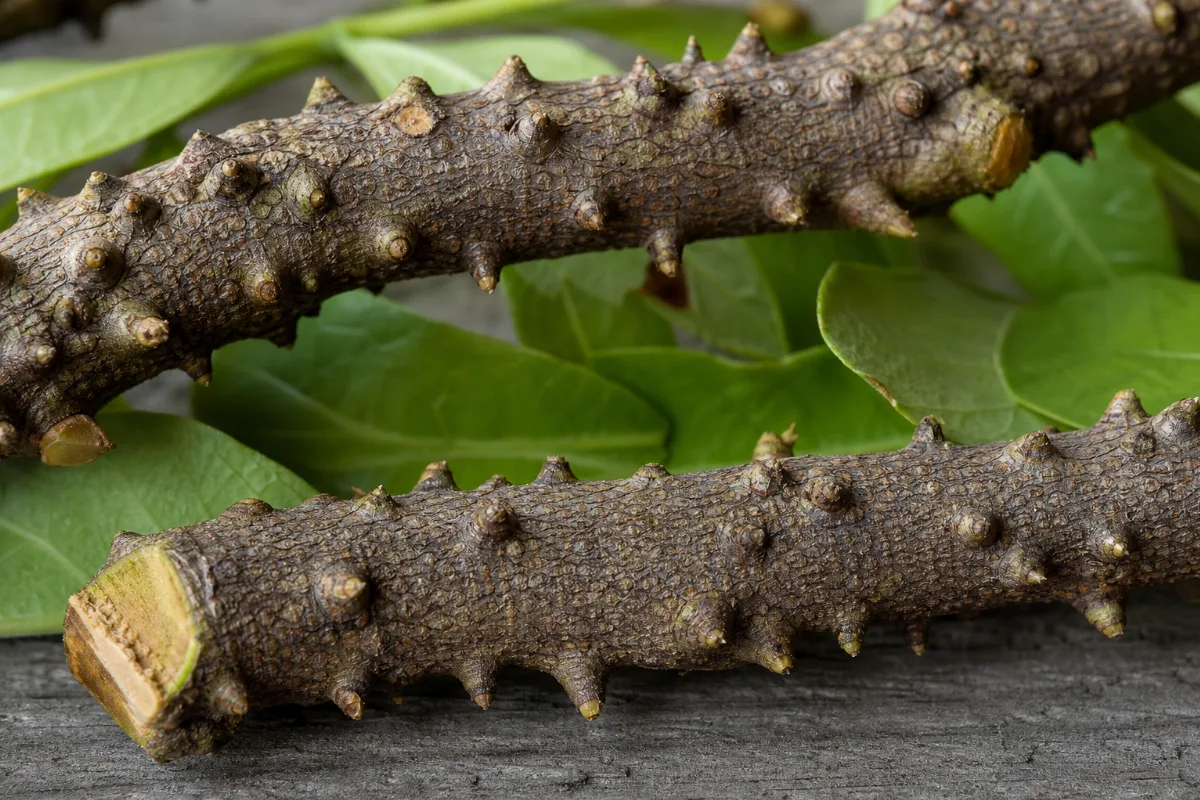
Herbs & Botanicals · Traditional toothache bark
Prickly Ash
Zanthoxylum americanum · also called Northern prickly ash, toothache tree, toothache bark, yellow wood, pepper wood
Prickly ash is a thorny North American shrub. Its bark was traditionally chewed for toothache and its berries used for poor circulation. No trial in people has tested it for any use, and the lab research is small. The key caution: it has had almost no safety testing, may raise stomach acid, and should be avoided in pregnancy.
General information, not medical advice. Last substantive update · Not medically reviewed. A named clinician has not signed off on this page. How this page is made
About Prickly Ash
Northern prickly ash (Zanthoxylum americanum) is a thorny shrub from North America. Its bark has been used for toothache, pain and cramps, and its berries for circulation. Almost no modern research exists, none in people, and safety is not established.
What it is
Northern prickly ash is a woody shrub of the citrus family. Native American healers used its bark and berries as medicine, which is why it is also called the toothache tree.
It is not the same as Sichuan pepper (a spice from a related species), southern prickly ash (also called Hercules club), or ash trees.
What makes it distinctive
Lab work found light-activating furanocoumarins such as psoralen, mostly in the fruit and leaf and much less in the bark. It also holds coumarin-type compounds and lignans.
Its relatives in Asia contain tingling, mouth-numbing compounds called sanshools. We did not find proof that northern prickly ash bark has them.
What people use it for
Traditionally the bark was chewed for toothache or boiled into a tea for cramps, and for muscle and joint pain. The berries were used for poor circulation. Long use is not proof that it works.
What the research shows
The evidence is extremely thin. We found no trial in people for any use, and no animal study of pain or circulation. The few papers are lab studies. Extracts slowed fungi in dishes, an effect that tracked furanocoumarin content. They had weak or no effect on gonorrhoea bacteria. Compounds isolated from the plant slowed leukaemia cells in a dish.
Large reviews of the whole Zanthoxylum family describe promising lab activity, but they cover many species and do not show that northern prickly ash works.
At a glance
Traditional uses history, not proof
- Toothache (bark chewed or packed around the tooth)
- Muscle and joint pain, arthritis
- Intestinal cramps and upset stomach
- Poor circulation, leg pain and cold fingers (berries)
- Sore throat, wounds and infections
Studied for research
- Toothache: tradition only, no trials
- Circulation: tradition only, no trials
- Pain and arthritis: tradition only, no trials
- Fungal and bacterial infections: lab dishes only, mixed
- Leukaemia cells: lab chemistry on isolated compounds
Main compounds
- Furanocoumarins such as psoralen (mostly in fruit and leaf)
- Pyranocoumarins such as xanthyletin
- Lignans such as sesamin and asarinin
- Alkaloids such as chelerythrine (reported by a summary)
- Sanshool-type tingling amides (found in relatives; not confirmed in this species)
Common forms
- Bark tea (decoction)
- Chewed bark
- Tincture
- Capsules
- Berries (fruit)
Research links: Antifungal constituents of northern prickly ash (2005) · Cytotoxic coumarins and lignans from northern prickly ash (2001) · Furanocoumarins and DNA copying, lab (2004) · Canadian First Nations plants against gonorrhoea bacteria, lab (2011) · Zanthoxylum genus review (2023) · Prickly ash research summary (EBSCO, 2024) · Natural Medicines monograph (via vital.ly) · Research Library · Genes & Biomarkers Library
The plant and its history
- Accepted scientific name
- Zanthoxylum americanum Mill.
- Naming authority
- Mill.
- Common names
- Northern prickly ash (English); Toothache tree (English); Toothache bark (English); Yellow wood (English); Pepper wood (English); Clavalier d'Amerique (French)
- Botanical family
- Rutaceae (citrus family)
- Classification
- Plantae > Sapindales > Rutaceae > Zanthoxylum > Zanthoxylum americanum
- Native range
- A woody shrub native to North America (Natural Medicines monograph). A precise range was not confirmed in a source we read.
- Habitat
- Not described in the sources read.
- What the plant looks like
- Roots: Not described.; Stems: Prickly stems (from the common name). Bark is the main medicinal part. Other details not described in the sources read.; Leaves: Leaves contain furanocoumarins (lab analysis).; Flowers: Not described.; Fruit: Berry-like fruit, called berries in traditional use; richer in furanocoumarins than bark.
- Cultivation
- Not verified.
- Harvest and processing
- Not described. Bark is dried and boiled as a tea or made into a tincture (research summary).
- Look-alikes and adulterants
- Name: Southern prickly ash / Hercules club (Zanthoxylum clava-herculis); Note: A separate accepted species (GBIF key 8681996). The drug reference tells readers not to confuse the two. Its safety is not covered here.; Name: Sichuan pepper / Chinese prickly ash (Zanthoxylum bungeanum); Note: A separate accepted species (GBIF key 7269010), used as a numbing spice. See our Szechuan pepper spice page. Spice-research findings on sanshools do not transfer directly to northern prickly ash bark.; Name: Ash trees (Fraxinus); Note: A different genus. The drug reference warns not to confuse them.
- Sustainability and conservation
- Not assessed here.
Traditional use and history history, not clinical proof
| Tradition or era | Documented use | Source |
|---|---|---|
| Native American medicine (as described in a 2024 summary) | Bark for intestinal cramps, dry mouth, muscle and joint pain, toothache, nervous disorders, arthritis and leg ulcers; berries for circulatory problems such as intermittent claudication and Raynaud syndrome. Bark tea, tincture, or chewing the bark for tooth pain. | s-ebsco-2024 |
| Modern herbal use | Sold as bark, capsules and tinctures for infections, sore throat, toothache and wounds. The drug reference says there is no good scientific evidence for these uses. | s-trc-2022 |
Traditional use shows how a plant was used. It does not show that a supplement works or is safe today.
What is inside, and how it may work
What the plant contains and how those compounds act in cells and animals. Laboratory and animal mechanisms are not proven effects in people.
Main compounds
| Compound | Family | Where it is concentrated | Activity studied | Level of evidence |
|---|---|---|---|---|
| Psoralen PubChem 6199 | furanocoumarin | fruit and leaf (much less in bark) | Light-activating; correlated with antifungal activity in the lab; possible sun-sensitivity concern. 1 11 10 | Laboratory research |
| 8-Methoxypsoralen (methoxsalen) PubChem 4114 | furanocoumarin | fruit and leaf (much less in bark) | Confirmed in extracts by HPLC; light-activating. 1 10 | Laboratory research |
| Imperatorin PubChem 10212 | furanocoumarin | fruit and leaf (much less in bark) | Confirmed in extracts by HPLC. 1 10 | Laboratory research |
| Xanthyletin PubChem 65188 | pyranocoumarin | isolated from plant material (part not stated in abstract) | Slowed leukaemia cells in a dish (IC50 3.84 ppm). 6 10 | Laboratory research |
| Xanthoxyletin PubChem 66548 | pyranocoumarin | isolated from plant material (part not stated in abstract) | Slowed leukaemia cells in a dish (IC50 3.48 ppm). 6 10 | Laboratory research |
| Alloxanthoxyletin and dipetaline | pyranocoumarin | isolated from plant material (part not stated in abstract) | Slowed leukaemia cells in a dish (IC50 1.31 and 0.68 ppm). PubChem IDs were not looked up. 6 | Laboratory research |
| Sesamin PubChem 72307 | lignan | isolated from plant material (part not stated in abstract) | Slowed leukaemia cells in a dish (IC50 2.71 ppm). 6 10 | Laboratory research |
| Asarinin PubChem 101612 | lignan | isolated from plant material (part not stated in abstract) | Slowed leukaemia cells in a dish (IC50 4.12 ppm). 6 10 | Laboratory research |
| Chelerythrine PubChem 2703 | isoquinoline (benzophenanthridine) alkaloid | not stated | A research summary reports activity against resistant staph bacteria in test tubes and lists alkaloids as potentially toxic. Not traced to an original paper. 4 10 | Secondary source |
| Hydroxy-alpha-sanshool PubChem 10084135 | alkamide (sanshool-type amide) | fruit coat of Sichuan pepper species | The main tingling compound in Zanthoxylum spices. Whether northern prickly ash bark or berries contain it was not confirmed in the sources read. 7 2 10 | Genus level |
Mechanisms, receptors and pathways
| Target or pathway | Gene or receptor | What was found | Level |
|---|---|---|---|
| Fungal growth | not specified | Antifungal activity of the extracts tracked closely with furanocoumarin content and depended on light. 1 | Laboratory research |
| DNA polymerisation | not specified | Psoralen and 5-methoxypsoralen inhibited DNA copying in a cell-free test, and husk extracts did so more strongly, suggesting other inhibitors too. 11 | Laboratory research |
| Tingling and numbing (genus-level) | TRPV1, TRPA1, KCNK channels | Sanshool-type amides cause tingling by acting on nerve ion channels. Shown in work on Chinese prickly ash and relatives, not on northern prickly ash. 7 2 | Genus level review |
| Leukaemia cell growth | not specified | Isolated pyranocoumarins and lignans reduced thymidine incorporation in HL-60 cells. 6 | Laboratory research |
Absorption, metabolism and elimination
- Absorption
- Not studied for northern prickly ash.
- Distribution
- Not studied.
- Metabolism
- Not studied.
- Elimination
- Not studied.
- Bioavailability
- Not established. One review of Chinese prickly ash sanshools says they are unstable and break down by oxidation; this may not apply to northern prickly ash.
Isolated compounds versus whole extracts
All the lab chemistry comes from solvent extracts or isolated compounds (furanocoumarins, pyranocoumarins, lignans). Extract of the husk worked more strongly than the pure furanocoumarins, so whole-plant effects are not the sum of single compounds. Nothing links these results to a bark tea or tincture.
Nutritional composition
Northern prickly ash is a medicinal shrub, not a nutrient.
3 very low certainty4 not enough evidence
What was looked at
The 7 benefits and uses checked for Prickly Ash, each with how strong the evidence is. Tap one to open it.
- Toothache (traditional bark use)Not enough evidence
- Circulation, leg cramps and cold fingers (traditional berry use)Not enough evidence
- Muscle and joint pain, arthritis (traditional use)Not enough evidence
- Infections and fungi (lab only)Very low certainty
- Digestive complaints (traditional use; may worsen some)Not enough evidence
- Slowing leukaemia cells in a dishVery low certainty
- Interference with DNA copying in a test tubeVery low certainty
Lab markers tracked in the studies
Fungal growth inhibition in disk testsGonorrhoea bacteria minimum inhibitory concentrationLeukaemia cell growth (thymidine incorporation)
What is Prickly Ash good for?
What prickly ash has been used for and how strong the evidence is. Nothing here is proven in people.
Benefits, one by one
Each card is a research question, not a promise. Tap a goal to filter. Open a card to see the studies, doses and limits.
Toothache (traditional bark use)
Not enough evidenceThe bark has a long tradition in North America as a "toothache tree". It was chewed or packed around a sore tooth. We found no trial in people. Reference summaries say there is no good evidence it works.
4 studiesTraditionally bark chewed or held on the tooth; no tested product.
Studies, doses and limits
What the trials found
No human trial. A consumer drug reference says there is no good scientific evidence for toothache or sore throat. A research summary says there are no documented medical uses of the bark.
Results
No human results exist.
Effect sizes as reported
None available.
Why this rating
Tradition and a genus-level theory only. No trial of any kind in people for this species.
Form and dose studied
Traditionally bark chewed or held on the tooth; no tested product.
Who was studied
No data in any group. Not studied in children.
Limits
Numbing could hide pain from a real problem such as an abscess. Species mix-ups (northern prickly ash, southern prickly ash, Sichuan pepper) make claims hard to compare.
Why researchers looked
It gives the plant its folk name. Related prickly ash species in Asia contain compounds that cause tingling and numbness in the mouth, so numbing is the usual guess for how it might have worked.
Traditional use
The bark was chewed or packed around a sore tooth in Native American medicine, according to the sources we read. Long use is not proof that it works.
Proposed mechanism Pharmacological theory
Not shown for northern prickly ash. In the genus, sanshool-type amides cause tingling and numbness by acting on nerve ion channels. Whether northern prickly ash bark has them in useful amounts was not confirmed in anything we read.
A proposed mechanism does not show that the effect happens in people.
Mouth tingling or numbing is possible. See a dentist for tooth pain, especially with swelling or fever.
Circulation, leg cramps and cold fingers (traditional berry use)
Not enough evidenceThe berries were traditionally used for poor circulation, including leg pain when walking (intermittent claudication) and Raynaud syndrome. We found no trial of any kind. Do not treat these conditions with it.
2 studiesTraditionally berries or bark as tea or tincture; no tested product.
Studies, doses and limits
What the trials found
None. A research summary lists these as proposed uses only.
Results
No human results exist.
Effect sizes as reported
None available.
Why this rating
Traditional claim only. No study in people found.
Form and dose studied
Traditionally berries or bark as tea or tincture; no tested product.
Who was studied
No data.
Limits
Claudication and Raynaud syndrome can signal serious vascular disease that needs medical care.
Why researchers looked
A research summary lists circulation problems as a traditional use of the berries.
Traditional use
Bark and berries were taken as tea or tincture for a "cold", sluggish circulation.
Proposed mechanism Traditional use
No mechanism has been shown. The consumer drug reference we read does not mention circulation as a use.
A proposed mechanism does not show that the effect happens in people.
Coumarin-type compounds are present, but no bleeding or blood-thinner study was found. See the Safety tab.
Muscle and joint pain, arthritis (traditional use)
Not enough evidenceThe bark was used for muscle and joint pain and arthritis. Summaries describe pain-easing and anti-inflammatory ideas as promising, but no trial in people has tested it.
3 studiesNo tested product.
Studies, doses and limits
What the trials found
None for northern prickly ash. The 2021 genus review says Zanthoxylum species are used for inflammation and pain, but this is not specific to this plant.
Results
No human results exist.
Effect sizes as reported
None available.
Why this rating
Traditional use and genus-level lab work only.
Form and dose studied
No tested product.
Who was studied
No data.
Limits
Genus reviews mix many species; their findings cannot be applied to northern prickly ash.
Why researchers looked
It is one of the main traditional uses and fits the genus, where many species are used for pain and inflammation.
Traditional use
Bark tea or tincture for rheumatism and stiffness.
Proposed mechanism Pharmacological theory
Not shown for this species. Genus-wide reviews report anti-inflammatory activity in lab and animal studies of other Zanthoxylum species.
A proposed mechanism does not show that the effect happens in people.
Long-term safety is unknown.
Infections and fungi (lab only)
Very low certaintyIn test tubes, extracts of the leaf, fruit, stem, bark and root slowed several fungi. The strongest were fruit and leaf, which hold more of the light-activated furanocoumarins than the bark does. A separate screen found weak or no effect on gonorrhoea bacteria. Nothing has been tested in people.
3 studiesLab extracts of different plant parts; no tested human product.
Studies, doses and limits
What the trials found
None.
Results
All extracts inhibited at least eight of 11 fungi in disk tests; fruit and leaf strongest; fungal inhibition correlated with furanocoumarin content (r2 = 0.902). Gonorrhoea isolates: weak or no activity (MIC 256 ug/mL or more).
Effect sizes as reported
Correlation between furanocoumarin content and inhibition zones r2 = 0.902 (abstract).
Why this rating
Test-tube work only. Light-dependent activity of fruit and leaf does not translate to bark taken by mouth.
Form and dose studied
Lab extracts of different plant parts; no tested human product.
Who was studied
Not applicable.
Limits
Disk assays are a first screen. Furanocoumarins that work under light are the same compounds that raise skin sun-sensitivity concerns.
Why researchers looked
Prickly ash was used for wounds, sore throat and infections, so researchers tested whether it can slow microbes.
Traditional use
Used for wounds, sore throat and infections, according to the drug reference we read.
Proposed mechanism Laboratory research
Furanocoumarins (psoralen, 8-methoxypsoralen, imperatorin) linked closely to fungal inhibition, and activity depended on light. In a cell-free test these compounds interfered with DNA copying.
A proposed mechanism does not show that the effect happens in people.
The same furanocoumarins can make skin more sensitive to sun in other plants. See the Safety tab.
Digestive complaints (traditional use; may worsen some)
Not enough evidenceThe bark was used for intestinal cramps, gastritis and diarrhoea. No trial supports this, and a drug reference warns it might increase stomach acid. People with ulcers or inflammatory bowel disease are told to avoid it.
2 studiesNo tested product.
Studies, doses and limits
What the trials found
None. Two summaries advise avoiding it with ulcers or inflammatory bowel disease, the opposite of the traditional claim.
Results
No human results exist.
Effect sizes as reported
None available.
Why this rating
Traditional claim only; safety sources point the other way for some gut conditions.
Form and dose studied
No tested product.
Who was studied
People with ulcer, IBS, ulcerative colitis or Crohn disease are told to avoid it.
Limits
The acid claim comes from a secondary reference and no measurement of stomach acid was found.
Why researchers looked
Intestinal cramps are one of the older listed uses of the bark.
Traditional use
Bark tea for cramps and upset stomach.
Proposed mechanism Traditional use
Not established. A drug reference says it may raise stomach acid.
A proposed mechanism does not show that the effect happens in people.
See the Safety tab for gut effects.
Slowing leukaemia cells in a dish
Very low certaintyCompounds isolated from northern prickly ash (four pyranocoumarins and two lignans) slowed the growth of human leukaemia cells in a dish. This is lab chemistry, not a cancer treatment, and tells us nothing about taking the bark.
1 studiesIsolated compounds in culture.
Studies, doses and limits
What the trials found
None.
Results
All six compounds slowed HL-60 cell growth. Dipetaline was the most active (IC50 0.68 ppm).
Effect sizes as reported
IC50 values 0.68 to 4.12 ppm (abstract).
Why this rating
Isolated compounds on one cell line.
Form and dose studied
Isolated compounds in culture.
Who was studied
Not applicable.
Limits
Cell-line results rarely carry over to people.
Why researchers looked
Researchers screen plant compounds for activity against cancer cells.
Traditional use
Not a traditional use.
Proposed mechanism Laboratory research
The compounds reduced a marker of DNA building (thymidine incorporation) in HL-60 cells.
A proposed mechanism does not show that the effect happens in people.
Do not use prickly ash to treat any cancer.
Interference with DNA copying in a test tube
Very low certaintyTwo furanocoumarins found in the plant, psoralen and 5-methoxypsoralen, interfered with DNA copying in a cell-free test. The husk extract did so more strongly than the pure compounds. This is a lab mechanism and also explains why these compounds are a safety concern.
1 studiesExtracts and pure compounds in a test tube.
Studies, doses and limits
What the trials found
None.
Results
Husk extracts inhibited DNA copying more than single or mixed furanocoumarins.
Effect sizes as reported
Not given in the abstract.
Why this rating
Cell-free lab assay.
Form and dose studied
Extracts and pure compounds in a test tube.
Who was studied
Not applicable.
Limits
A mechanism observation, not a health benefit.
Why researchers looked
To understand why the extracts stop fungi growing.
Traditional use
Not a traditional use.
Proposed mechanism Laboratory research
Furanocoumarins inhibit DNA polymerisation in a PCR-based assay, depending on the DNA base mix.
A proposed mechanism does not show that the effect happens in people.
Not tested in pregnancy. See the Safety tab.
Connections to the rest of health
How Prickly Ash connects to the rest of our health knowledge graph. Every link says what kind of connection it is. A safety link (for example to the liver) is a warning, not a benefit. A study that merely mentions a topic never creates a benefit link.
Explore every connection: goals, body systems, organs, symptoms, genes
A. Wellness goals
| Connected to | Kind of connection | Evidence status | Context | Studies |
|---|---|---|---|---|
| Pain Relief | Traditional use | Not enough evidence | Toothache (traditional bark use): The bark has a long tradition in North America as a "toothache tree". It was chewed or packed around a sore tooth. We found no trial in people. Reference summaries say there is no good evidence it works. Muscle and joint pain, arthritis (traditional use): The bark was used for muscle and joint pain and arthritis. Summaries describe pain-easing and anti-inflammatory ideas as promising, but no trial in people has tested it. | 12 4 2 7 9 8 |
| Oral Health | Traditional use | Not enough evidence | Toothache (traditional bark use): The bark has a long tradition in North America as a "toothache tree". It was chewed or packed around a sore tooth. We found no trial in people. Reference summaries say there is no good evidence it works. | 12 4 2 7 |
| Circulation Support | Traditional use | Not enough evidence | Circulation, leg cramps and cold fingers (traditional berry use): The berries were traditionally used for poor circulation, including leg pain when walking (intermittent claudication) and Raynaud syndrome. We found no trial of any kind. Do not treat these conditions with it. | 4 12 |
| Joint Support | Traditional use | Not enough evidence | Muscle and joint pain, arthritis (traditional use): The bark was used for muscle and joint pain and arthritis. Summaries describe pain-easing and anti-inflammatory ideas as promising, but no trial in people has tested it. | 4 9 8 |
| Immune Support | Preliminary mechanism | Very low certainty | Infections and fungi (lab only): In test tubes, extracts of the leaf, fruit, stem, bark and root slowed several fungi. The strongest were fruit and leaf, which hold more of the light-activated furanocoumarins than the bark does. A separate screen found weak or no effect on gonorrhoea bacteria. Nothing has been tested in people. Interference with DNA copying in a test tube: Two furanocoumarins found in the plant, psoralen and 5-methoxypsoralen, interfered with DNA copying in a cell-free test. The husk extract did so more strongly than the pure compounds. This is a lab mechanism and also explains why these compounds are a safety concern. | 1 11 3 |
| Digestive Support | Traditional use | Not enough evidence | Digestive complaints (traditional use; may worsen some): The bark was used for intestinal cramps, gastritis and diarrhoea. No trial supports this, and a drug reference warns it might increase stomach acid. People with ulcers or inflammatory bowel disease are told to avoid it. | 4 12 |
| Cellular Health | Preliminary mechanism | Very low certainty | Slowing leukaemia cells in a dish: Compounds isolated from northern prickly ash (four pyranocoumarins and two lignans) slowed the growth of human leukaemia cells in a dish. This is lab chemistry, not a cancer treatment, and tells us nothing about taking the bark. | 6 |
B. Body systems
| Connected to | Kind of connection | Evidence status | Context | Studies |
|---|---|---|---|---|
| Oral Health | Biological association | Not enough evidence | Studied for: Toothache (traditional bark use) | 12 4 2 7 |
| Nervous System | Biological association | Not enough evidence | Studied for: Toothache (traditional bark use) | 12 4 2 7 |
| Cardiovascular System | Biological association | Not enough evidence | Studied for: Circulation, leg cramps and cold fingers (traditional berry use) | 4 12 |
| Musculoskeletal System | Biological association | Not enough evidence | Studied for: Muscle and joint pain, arthritis (traditional use) | 4 9 8 |
| Immune System | Biological association | Very low certainty | Studied for: Infections and fungi (lab only) Studied for: Slowing leukaemia cells in a dish | 1 11 3 6 |
| Digestive System | Biological association | Not enough evidence | Studied for: Digestive complaints (traditional use; may worsen some) | 4 12 |
I. Biomarkers
| Connected to | Kind of connection | Evidence status | Context | Studies |
|---|---|---|---|---|
| Fungal growth inhibition in disk tests | Biological association | Very low certainty | Measured in trials: lowered. A lab change is not the same as a health benefit. | 1 |
| Gonorrhoea bacteria minimum inhibitory concentration | Biological association | Very low certainty | Measured in trials: no-change. A lab change is not the same as a health benefit. | 3 |
| Leukaemia cell growth (thymidine incorporation) | Biological association | Very low certainty | Measured in trials: lowered. A lab change is not the same as a health benefit. | 6 |
K. Biological pathways
| Connected to | Kind of connection | Evidence status | Context | Studies |
|---|---|---|---|---|
| TRPV1, TRPA1, KCNK (genus-level) | Preliminary mechanism | Genus level review | Targets of sanshool-type amides in Chinese prickly ash. Not shown for northern prickly ash. | 7 |
L. Active compounds
| Connected to | Kind of connection | Evidence status | Context | Studies |
|---|---|---|---|---|
| Psoralen | Very low certainty | A light-activating furanocoumarin found in the plant, mostly in fruit and leaf. Photosensitivity is a theoretical concern. A light-activating furanocoumarin found mostly in fruit and leaf extracts. Preparation or compound: fruit and leaf extracts |
1 | |
| Coumarins | Drug or supplement interaction | Not enough evidence | Pyranocoumarins were isolated from the plant. A bleeding or blood-thinner effect is theoretical and unstudied for this plant. Pyranocoumarins were isolated from the plant. A blood-thinner interaction is theoretical and unstudied. Preparation or compound: bark |
6 |
| Psoralen | Biological association | In vitro | Light-activating; correlated with antifungal activity in the lab; possible sun-sensitivity concern. Preparation or compound: fruit and leaf (much less in bark) |
1 11 10 |
| 8-Methoxypsoralen (methoxsalen) | Biological association | In vitro | Confirmed in extracts by HPLC; light-activating. Preparation or compound: fruit and leaf (much less in bark) |
1 10 |
| Imperatorin | Biological association | In vitro | Confirmed in extracts by HPLC. Preparation or compound: fruit and leaf (much less in bark) |
1 10 |
| Xanthyletin | Biological association | In vitro | Slowed leukaemia cells in a dish (IC50 3.84 ppm). Preparation or compound: isolated from plant material (part not stated in abstract) |
6 10 |
| Xanthoxyletin | Biological association | In vitro | Slowed leukaemia cells in a dish (IC50 3.48 ppm). Preparation or compound: isolated from plant material (part not stated in abstract) |
6 10 |
| Alloxanthoxyletin and dipetaline | Biological association | In vitro | Slowed leukaemia cells in a dish (IC50 1.31 and 0.68 ppm). PubChem IDs were not looked up. Preparation or compound: isolated from plant material (part not stated in abstract) |
6 |
| Sesamin | Biological association | In vitro | Slowed leukaemia cells in a dish (IC50 2.71 ppm). Preparation or compound: isolated from plant material (part not stated in abstract) |
6 10 |
| Asarinin | Biological association | In vitro | Slowed leukaemia cells in a dish (IC50 4.12 ppm). Preparation or compound: isolated from plant material (part not stated in abstract) |
6 10 |
| Chelerythrine | Biological association | Secondary source | A research summary reports activity against resistant staph bacteria in test tubes and lists alkaloids as potentially toxic. Not traced to an original paper. Preparation or compound: not stated |
4 10 |
| Hydroxy-alpha-sanshool | Biological association | Genus level | The main tingling compound in Zanthoxylum spices. Whether northern prickly ash bark or berries contain it was not confirmed in the sources read. Preparation or compound: fruit coat of Sichuan pepper species |
7 2 10 |
Each connection is stored with the ingredient, the connected record, the kind of connection, the evidence status, the supporting studies, the preparation or compound involved, and a review date (last reviewed October 25, 2026).
Evidence at a glance: what changed in 3 lab markers
Tap a number to show only those markers. Counts are markers, not people.
The evidence
The research centre for Prickly Ash. Every record here was checked against PubMed or the publisher's page; we never list a study we have not verified.
Evidence by outcome
Bars show how many studies we found for each outcome, not how well it works. People are added up across trials only (reviews are not added, to avoid double counting).
How we rate evidence
High certainty
Several well-run trials or reviews agree; further research is unlikely to change the picture much.
Moderate certainty
Good trials point the same way, but some doubt remains.
Low certainty
Small, short or inconsistent trials. The finding could change with better research.
Very low certainty
Very little or very weak human data. Treat as a possibility only.
Mixed findings
Trials or reviews disagree with each other.
Not enough evidence
Not enough human research to say either way.
Evidence against
Good research found no benefit, or found harm.
We take the reviewers' own risk-of-bias and GRADE statements where they exist, and otherwise judge from study size, design, consistency, directness and whether a product matches what is sold. Many publications do not make evidence high. Method note: We built on our existing summary, read PubMed abstracts, and checked GBIF and PubChem. The EBSCO and Natural Medicines pages were opened and read. Genus-wide reviews are used only as background. Most studies were read as abstracts only.
Study library: every study we checked 12
| Study | Design | People | Product, dose, length | Result |
|---|---|---|---|---|
| Bafi-Yeboa 2005 Antifungal constituents of northern prickly ash, Zanthoxylum americanum Mill. Phytomedicine · PMID 15957372 · DOI |
Laboratory research in-vitro |
11 fungal strains in disk tests | Northern prickly ash (Zanthoxylum americanum) extracts of leaf, fruit, stem, bark and root leaf, fruit, stem, bark, root not given here not given here · vs none |
All extracts inhibited at least eight of 11 fungal species in disk tests. Activity depended on light. Fruit and leaf extracts were the most active. Psoralen, 8-methoxypsoralen and imperatorin were confirmed in the extracts. Furanocoumarin content was high in fruit and leaf and low in bark and wood, and correlated with fungal inhibition (r2 = 0.902). Broad antifungal activity in the lab, linked to furanocoumarins Methods, limits and fundingOutcomes: Fungal growth inhibition zones; furanocoumarin content by HPLC Limitations: Test-tube disk assay only. Light-dependent activity in a dish does not show that a bark preparation treats a fungal infection in a person. Funding and conflicts: Not stated in abstract Read: abstract |
| Chruma 2018 Polyunsaturated fatty acid amides from the Zanthoxylum genus - from culinary curiosities to probes for chemical biology. Nat Prod Rep · PMID 29299588 · DOI |
Narrative review plant |
Chemistry review of Zanthoxylum alkamides | Zanthoxylum alkamides (sanshool-type amides) fruit coat (pericarp) of several species not given here not given here · vs none |
The review says the fruit coats of several Zanthoxylum species ("prickly ash") are used in Asian cooking, especially Sichuan cuisine, for tingling and numbing sensations caused by alkamides. It covers how these compounds are made in the lab and tested. Explains where the tingling comes from in the genus Methods, limits and fundingOutcomes: Chemistry and biological evaluation of alkamides Limitations: The abstract does not say which species have which alkamides. It does not show that northern prickly ash bark numbs the mouth in the same way. Funding and conflicts: Not stated in abstract Read: abstract |
| Cybulska 2011 Extracts of Canadian first nations medicinal plants, used as natural products, inhibit Neisseria gonorrhoeae isolates with different antibiotic resistance profiles. Sex Transm Dis · PMID 21301385 · DOI |
Laboratory research in-vitro |
Gonorrhoea bacteria isolates in culture | Ethanol extract of prickly ash (Northern prickly ash (Zanthoxylum americanum)) among 14 Canadian plants as studied not given here not given here · vs none |
Four of the 14 plants (bearberry, goldenseal, black cherry, roseroot) inhibited all isolates. Prickly ash had weak or no activity, with minimum inhibitory concentrations of 256 ug/mL or more. Weak or no activity against gonorrhoea bacteria in the lab Methods, limits and fundingOutcomes: Minimum inhibitory concentration against Neisseria gonorrhoeae Limitations: Test-tube screen. The plant part was not given in the abstract. A negative lab screen for one bacterium. Funding and conflicts: Not stated in abstract Read: abstract |
| EBSCO CAM Review Board 2024 Prickly ash's therapeutic uses (Research Starter) EBSCO · Source |
Narrative review plant |
not applicable | Prickly ash (Zanthoxylum americanum) bark and berries bark, berries not given here not given here · vs none |
Read 2026-10-25. Says the bark was traditionally used for intestinal cramps, dry mouth, muscle and joint pain, toothache and nervous disorders, and the berries for circulatory problems such as intermittent claudication and Raynaud syndrome. States there are no documented medical uses of the bark, no double-blind placebo-controlled trials, and that clinical studies in humans are severely lacking. Says the plant has not had a modern safety evaluation, contains potentially toxic alkaloids, and that safety is not established in young children, pregnancy, nursing or severe liver or kidney disease. Advises people with IBS, ulcerative colitis or Crohn disease to avoid it. Mentions chelerythrine activity against resistant staph bacteria in test tubes. not applicable Methods, limits and fundingOutcomes: see results Limitations: Secondary consumer-level summary; the abstract-level claims were not checked against the original papers it lists. Funding and conflicts: not applicable Read: full-text |
| GBIF 2026 GBIF species match: Zanthoxylum americanum Mill. (key 3190089) GBIF · Source |
Database record plant |
not applicable | Northern prickly ash (Zanthoxylum americanum) whole plant not given here not given here · vs none |
GBIF API on 2026-10-25: Zanthoxylum americanum Mill. is ACCEPTED (exact match), family Rutaceae, order Sapindales. Z. clava-herculis L. (key 8681996) and Z. bungeanum Maxim. (key 7269010) are separate accepted species. not applicable Methods, limits and fundingOutcomes: see results Limitations: Taxonomy database record. NCBI Taxonomy was not checked. Funding and conflicts: not applicable Read: full-text |
| Ju 2001 Cytotoxic coumarins and lignans from extracts of the northern prickly ash (Zanthoxylum americanum) Phytother Res · PMID 11507740 · DOI |
Laboratory research in-vitro |
Human leukaemia (HL-60) cells in culture | Four pyranocoumarins (dipetaline, alloxanthoxyletin, xanthoxyletin, xanthyletin) and two lignans (sesamin, asarinin) isolated from Northern prickly ash (Zanthoxylum americanum) as studied not given here not given here · vs none |
All six compounds reduced thymidine incorporation in HL-60 cells. Dipetaline was the most active (IC50 0.68 ppm), then alloxanthoxyletin (1.31), sesamin (2.71), xanthoxyletin (3.48), xanthyletin (3.84) and asarinin (4.12 ppm). Slowed leukaemia cell growth in a dish Methods, limits and fundingOutcomes: Incorporation of tritiated thymidine (a marker of cell growth) Limitations: Isolated compounds on one cancer cell line. Not a treatment finding. Says nothing about whole bark or berries taken by mouth. Funding and conflicts: Not stated in abstract Read: abstract |
| Luo 2022 Composition, structure and flavor mechanism of numbing substances in Chinese prickly ash in the genus Zanthoxylum: A review. Food Chem · PMID 34731789 · DOI |
Narrative review plant |
Food-chemistry review of Chinese prickly ash | Sanshool-type unsaturated amides from Chinese prickly ash (Zanthoxylum bungeanum and relatives) fruit coat not given here not given here · vs none |
Sanshool-based unsaturated amides are the main cause of the tingling. They are unstable and break down by oxidation. Different sanshools act on different ion channels (TRPV1, TRPA1 and KCNK). Sanshools cause tingling by acting on nerve ion channels (mostly in Chinese prickly ash) Methods, limits and fundingOutcomes: Composition and tingling mechanism Limitations: About Chinese prickly ash as a spice, not northern prickly ash bark. Funding and conflicts: Not stated in abstract Read: abstract |
| Mutinda 2023 Ethnobotanical uses, phytochemistry and pharmacology of pantropical genus Zanthoxylum L. (Rutaceae): An update. J Ethnopharmacol · PMID 36513263 · DOI |
Narrative review plant |
Genus review (many species) | Zanthoxylum species (genus-wide) fruit, seed, twig, leaf, stem not given here not given here · vs none |
Over 400 compounds have been isolated in the genus, including alkaloids, flavonoids, coumarins, lignans and amides. Lab and animal work showed anti-cancer, antimicrobial and other activities. The authors call for safety approval work, clinical trials and pharmacokinetic studies. Genus-level overview; clinical trials and safety work still needed Methods, limits and fundingOutcomes: Ethnobotany, chemistry, pharmacology Limitations: Genus-wide. Claims that traditional uses are confirmed rest on lab and animal studies, not on trials in people. Funding and conflicts: Not stated in abstract Read: abstract |
| Okagu 2021 Zanthoxylum Species: A Comprehensive Review of Traditional Uses, Phytochemistry, Pharmacological and Nutraceutical Applications. Molecules · PMID 34209371 · DOI |
Narrative review plant |
Genus review (many species) | Zanthoxylum species extracts and compounds (genus-wide, not specific to northern prickly ash) various not given here not given here · vs none |
The review says many Zanthoxylum species are used as food and for inflammation, pain, hypertension and brain conditions. It reports over 500 isolated compounds and says the extracts show promising activity that deserves more research. Some active compounds have not been identified. Genus-level overview; promising lab activity Methods, limits and fundingOutcomes: Traditional uses, compounds, lab and animal activity, toxicity Limitations: Covers the whole genus and a focus on metabolic and neuronal health. It does not give species-level evidence for northern prickly ash. Funding and conflicts: Not stated in abstract Read: abstract |
| PubChem (NCBI) 2026 PubChem compound records for prickly ash constituents PubChem · Source |
Database record plant |
not applicable | Psoralen, methoxsalen, imperatorin, sesamin, asarinin, xanthyletin, xanthoxyletin, chelerythrine, hydroxy-alpha-sanshool various not given here not given here · vs none |
PubChem name lookups on 2026-10-25 returned CIDs: psoralen 6199, methoxsalen (8-methoxypsoralen) 4114, imperatorin 10212, sesamin 72307, asarinin 101612, xanthyletin 65188, xanthoxyletin 66548, chelerythrine 2703, hydroxy-alpha-sanshool 10084135. not applicable Methods, limits and fundingOutcomes: see results Limitations: Records confirm the compounds exist; they do not say how much is in any one plant. Funding and conflicts: not applicable Read: full-text |
| Smith 2004 Inhibition of DNA polymerization and antifungal specificity of furanocoumarins present in traditional medicines. Photochem Photobiol · PMID 15291300 · DOI |
Laboratory research in-vitro |
Cell-free PCR assay | Psoralen, 5-methoxypsoralen and husk extracts of Northern prickly ash (Zanthoxylum americanum) husk (fruit coat) not given here not given here · vs none |
Psoralen and 5-methoxypsoralen inhibited DNA copying in the test, in different ways depending on how AT-rich the DNA was. The prickly ash husk extracts inhibited it more than the single or mixed furanocoumarins, so other inhibitory compounds are likely present. Furanocoumarins interfered with DNA copying in a test tube Methods, limits and fundingOutcomes: Inhibition of DNA polymerisation in a PCR-based assay Limitations: Cell-free assay. Shows that these compounds can act on DNA in the lab; not a result in people. Funding and conflicts: Not stated in abstract Read: abstract |
| Therapeutic Research Center 2022 Northern prickly ash monograph (Therapeutic Research Center, via vital.ly) Natural Medicines (via vital.ly) · Source |
Authoritative guidance plant |
not applicable | Northern prickly ash (Zanthoxylum americanum) bark, berries, root not given here not given here · vs none |
Read 2026-10-25 (last updated 2022-11-21 per the page). Says there is no good scientific evidence for infections, sore throat, toothache, wounds or other uses, and not enough reliable information to know if it is safe or what the side effects are. Bark is "possibly unsafe" in pregnancy; berry and root safety is unknown. Not enough information for breastfeeding. It might raise stomach acid, so avoid with ulcer or other gut conditions. Lists minor interactions with antacids, H2-blockers and proton pump inhibitors. Lists no known herb or food interactions. Warns not to confuse it with ash, Chinese prickly ash or Hercules club. not applicable Methods, limits and fundingOutcomes: see results Limitations: A commercial reference summary; it lists no anticoagulant interaction, but that is an absence of data, not proof of safety. Funding and conflicts: not applicable Read: full-text |
What we do not know yet
- No trial in people for any use.
- No animal study of pain, inflammation or circulation.
- No safety or toxicity study.
- No test of bleeding, blood-thinner or sun-sensitivity effects.
- Sanshool (mouth-numbing) content of this species not confirmed.
- No EMA, NCCIH, LiverTox or LactMed record could be found.
How new research is added
New studies are found by a saved PubMed search and are placed in a review queue. A person reads each one before it changes any evidence rating or safety wording.
Lab markers
What changed in blood or saliva tests during trials. A changed number is not the same as feeling or being healthier, and we give no "normal ranges".
Other 3
Fungal growth inhibition in disk tests
Lowered in trials
How far a plant extract stops a fungus growing around a paper disk in a dish.
Very low certaintyResults and what it means
Why it was measured
A first lab screen for antifungal activity.
Statistical vs. clinical meaning
Lab screen only; not a result in people.
Safety implication
None for people from this test.
| Study | Result | People | Product |
|---|---|---|---|
| 1 | Extracts of all five plant parts inhibited at least eight of 11 fungal species; fruit and leaf were most active. | 11 fungal strains in culture | Northern prickly ash extracts (600 ug per disk) |
Gonorrhoea bacteria minimum inhibitory concentration
No clear change in trials
The lowest extract level that stops a bacterium growing.
Very low certaintyResults and what it means
Why it was measured
A first lab screen for antibacterial activity.
Statistical vs. clinical meaning
A negative lab screen.
Safety implication
None.
| Study | Result | People | Product |
|---|---|---|---|
| 3 | Prickly ash extract had weak or no activity (MIC 256 ug/mL or more) while four other plants worked at far lower levels. | Neisseria gonorrhoeae isolates | Ethanol extract of prickly ash |
Leukaemia cell growth (thymidine incorporation)
Lowered in trials
How much a cell line builds new DNA, used as a measure of growth.
Very low certaintyResults and what it means
Why it was measured
A first lab screen for anti-cancer activity.
Statistical vs. clinical meaning
Lab screen only.
Safety implication
None for people from this test.
| Study | Result | People | Product |
|---|---|---|---|
| 6 | All six isolated compounds reduced thymidine incorporation; dipetaline was strongest. | HL-60 human leukaemia cells | Isolated pyranocoumarins and lignans from northern prickly ash |
Safety
What studies and official sources say about side effects, medicines and who should check first. Each point shows what kind of evidence it comes from.
Main points to know 5
- Almost no safety testing in people. A research summary says prickly ash has had no modern scientific safety evaluation and contains potentially toxic alkaloids, with unknown effects. A drug reference says there is not enough reliable information to know if it is safe or what the side effects are. Treat it as an unknown, not as a mild herb. Authoritative guidance 4 12
- Pregnancy and breastfeeding: avoid. The drug reference calls the bark possibly unsafe by mouth in pregnancy. Berry and root safety is unknown. For breastfeeding it says there is not enough information and advises staying on the safe side. Authoritative guidance 12 4
- Stomach and bowel conditions. The drug reference says it might raise stomach acid and advises against use with an ulcer or other gut condition. The research summary advises people with IBS, ulcerative colitis or Crohn disease to avoid it. These are statements from secondary sources; no measurement was found. Authoritative guidance 12 4
- Coumarin compounds: possible sun sensitivity and bleeding (theoretical). Lab work found furanocoumarins (psoralen, 8-methoxypsoralen, imperatorin) in the plant, mostly in fruit and leaf and much less in bark, and pyranocoumarins were isolated from it. Furanocoumarins such as psoralen are known light-activating compounds, and some coumarin-type compounds affect blood clotting in other plants. We found no report of skin reactions or bleeding in people using northern prickly ash, and the drug reference lists no blood-thinner interaction. This is a caution based on chemistry, not on a reported case. Pharmacological theory 1 6 12
- Mouth tingling or numbing. Prickly ash relatives are known for tingling and numbing of the mouth from sanshool-type amides. Whether northern prickly ash bark or berries do this, and how strongly, was not confirmed in the sources we read. Numbing can hide the signs of a dental infection. Pharmacological theory 2 7
Side effects 4
| Effect | How often | Severity and recovery | Evidence |
|---|---|---|---|
| Stomach upset or more stomach acid Stated as a possibility by the drug reference. No trial or case report was found. | Not established | mild to moderate (unknown) Unknown | Authoritative guidance 12 |
| Mouth tingling or numbness Described for the spice relatives; not confirmed for northern prickly ash. | Not established | mild Expected to pass (not studied for this plant) | Pharmacological theory 2 7 |
| Skin more sensitive to sun (photosensitivity) Theoretical, from furanocoumarins found mainly in fruit and leaf. No case report for this plant was found. | Not established | unknown Unknown | Pharmacological theory 1 |
| Unknown effects of its alkaloids The research summary says the plant contains potentially toxic alkaloids and that harm is unknown. | Not established | unknown Unknown | Authoritative guidance 4 |
Liver
No human case of liver injury from northern prickly ash was found, but this is an absence of data, not proof of safety. We did not locate a LiverTox entry for it (not verified). The research summary says safety has not been established in people with severe liver or kidney disease. 4
How often. Unknown.
Monitoring. No official monitoring advice found. Yellow skin or eyes, dark urine or severe tiredness need prompt medical attention.
This is a safety connection. It is not evidence that Prickly Ash supports liver health.
Medicines and supplements 4
| With | Why it matters | Importance | Evidence | What to do |
|---|---|---|---|---|
| Acid-reducing medicines (antacids, H2 blockers such as famotidine, proton pump inhibitors such as omeprazole) prescription | If prickly ash raises stomach acid, it could weaken these medicines. | Rated minor by the drug reference. Based on a theory, not a study. | Authoritative guidance Very low certainty 12 | Tell your pharmacist if you use acid-reducing medicines and are thinking of prickly ash. |
| Blood thinners and antiplatelet medicines (warfarin, apixaban, aspirin, clopidogrel) and other medicines or herbs that affect bleeding prescription | The plant contains coumarin-type compounds. Some coumarins affect clotting in other plants, but no clotting effect has been shown for northern prickly ash. | Unknown. The drug reference lists no such interaction, and no study or case report was found. A theoretical caution only. | Pharmacological theory Not enough evidence 6 12 | If you take a blood thinner, or are due for surgery or dental work, ask your doctor or pharmacist before using it. Do not stop or change your medicine on your own. |
| Medicines or products that make skin sensitive to sun (for example some antibiotics, retinoids, or psoralen treatments) prescription | Furanocoumarins are light-activating compounds, so effects could add up. | Unknown. Theoretical. | Pharmacological theory Not enough evidence 1 | Ask a pharmacist. Protect skin from strong sun if you use a fruit or leaf product. |
| Other herbs and foods herb-food | None identified. | The drug reference lists no known herb or food interactions. Absence of a listed interaction is not proof there is none. | Authoritative guidance Not enough evidence 12 | Tell your pharmacist about all supplements you use. |
Who should check first 6
| Situation | Advice | Evidence |
|---|---|---|
| Pregnancy | Avoid. The drug reference calls the bark possibly unsafe in pregnancy and says berry and root safety is unknown. | Authoritative guidance 12 4 |
| Breastfeeding | Avoid. There is not enough information and the drug reference advises staying on the safe side. No LactMed entry was found (not verified). | Authoritative guidance 12 |
| Ulcer, gastritis, IBS, ulcerative colitis or Crohn disease | Avoid. The sources say it might raise stomach acid or worsen these conditions. | Authoritative guidance 12 4 |
| Babies and young children | Avoid. Safety in young children has not been established. | Authoritative guidance 4 |
| Severe liver or kidney disease | Avoid. Safety has not been established. | Authoritative guidance 4 |
| Taking blood thinners, a bleeding disorder, or planned surgery or dental work | Ask a doctor or pharmacist first. This is a precaution based on chemistry; no reports of bleeding were found. | Pharmacological theory 6 12 |
Overdose, product quality and regulators
Summary. No toxicity study of northern prickly ash in animals or people was found. The only statement is from a research summary: the plant contains potentially toxic alkaloids, with unknown effects.
Animal. No animal toxicity study was found.
Human doses studied. Not given here.
High dose or long term signals. No long-term data of any kind.
Overdose response. Not described for this plant.
Genotoxicity. Not found in the sources read. In a cell-free test, furanocoumarins from the plant interfered with DNA copying; this is a lab observation and not a finding of genetic damage in people.
Toxic plant parts. Fruit and leaf were much richer in furanocoumarins than bark and wood in a lab analysis. Which part is safest is unknown.
The main risk is getting the wrong plant or an unstandardised product.
Mix-up with look-alike plants and spices. The drug reference warns not to confuse northern prickly ash with ash trees, Chinese prickly ash or Hercules club. Hercules club is southern prickly ash (Zanthoxylum clava-herculis); Chinese prickly ash or Sichuan pepper is Zanthoxylum bungeanum. These are accepted separate species in GBIF. Their effects and safety are not the same and cannot be assumed to match. 12 5
Product content not standardised. Our existing summary notes that capsule and tincture content and species are not standardised. A lab analysis found that fruit, leaf and bark differ a lot in furanocoumarin content, so the plant part matters. 1 4
| Body | Action | Date |
|---|---|---|
| Natural Medicines (Therapeutic Research Center) (USA) | Monograph says safety and effectiveness are not established; bark possibly unsafe in pregnancy; avoid with stomach or gut conditions. source | 2022 |
When to get medical help
- Black or bloody stools, vomiting blood, or severe stomach pain
- Unusual bruising, nosebleeds that will not stop, or bleeding gums (especially if you take a blood thinner)
- Severe sunburn-like rash or blistering of skin exposed to sun
- Swelling of the face or mouth, trouble breathing, or hives
- Yellow skin or eyes, dark urine or pale stools
- A toothache with swelling, fever or a bad taste: see a dentist rather than numbing the pain
Stop the supplement and contact a clinician or emergency service. In the US, Poison Control is 1-800-222-1222.
General information only, not medical advice. Ask a clinician or pharmacist before use, especially with medicines, in pregnancy or with a health condition. See the Natural Remedy Safety guide.
Frequently asked questions
What is northern prickly ash?
Does it help toothache?
Does it improve circulation?
No study was found. It is a traditional use of the berries only. Leg pain when walking or cold, colour-changing fingers need a doctor.
Does it treat infections?
Does it fight cancer?
No. Isolated compounds slowed leukaemia cells in a dish. That is early lab chemistry and not a treatment.
Is it safe in pregnancy or breastfeeding?
Is it safe for children?
Safety in young children has not been established, so avoid it.
Can it interact with blood thinners?
Can it make skin sensitive to sun?
This is possible in theory. Fruit and leaf extracts were rich in light-activating furanocoumarins, with much less in bark. We found no report in people.
Will it numb my mouth like Sichuan pepper?
Is it the same as Sichuan pepper or southern prickly ash?
Is there a safe amount to take?
We cannot give amounts because no tested amount exists. Ask a doctor or pharmacist before using it.
Explore by health goal
Pain ReliefImmune SupportOral HealthCirculation SupportJoint SupportDigestive SupportCellular Health
Editorial transparency
- Written by
- AlternativeMed editorial team. Research compiled with AI assistance, then checked against PubMed records.
- Medical review
- None. This page has not been reviewed by a physician or pharmacist.
- First published
- 2026-10-25
- Last substantive update
- 2026-10-25
- How we research
- We built on our existing summary, read PubMed abstracts, and checked GBIF and PubChem. The EBSCO and Natural Medicines pages were opened and read. Genus-wide reviews are used only as background. Most studies were read as abstracts only.
- How we rate evidence
- See "How we rate evidence" in the Evidence tab.
- Independence
- No product is promoted on this page. No affiliate links are shown. If one is added later it will be labelled and kept apart from the evidence.
Sources 12
Each source was opened and checked. Where we read only the abstract, it says so. The small numbers in the text point here.
- Bafi-Yeboa NF, Arnason JT, Baker J, Smith ML. Antifungal constituents of northern prickly ash, Zanthoxylum americanum Mill.. Phytomedicine. 2005. PMID 15957372. DOI 10.1016/j.phymed.2003.12.005. (abstract)
- Chruma JJ, Cullen DJ, Bowman L, Toy PH. Polyunsaturated fatty acid amides from the Zanthoxylum genus - from culinary curiosities to probes for chemical biology.. Nat Prod Rep. 2018. PMID 29299588. DOI 10.1039/c7np00044h. (abstract)
- Cybulska P, Thakur SD, Foster BC, Scott IM, Leduc RI, Arnason JT. Extracts of Canadian first nations medicinal plants, used as natural products, inhibit Neisseria gonorrhoeae isolates with different antibiotic resistance profiles.. Sex Transm Dis. 2011. PMID 21301385. DOI 10.1097/OLQ.0b013e31820cb166. (abstract)
- EBSCO CAM Review Board. Prickly ash's therapeutic uses (Research Starter). EBSCO. 2024. (full-text)
- GBIF. GBIF species match: Zanthoxylum americanum Mill. (key 3190089). GBIF. 2026. (full-text)
- Ju Y, Still CC, Sacalis JN, Li J, Ho CT. Cytotoxic coumarins and lignans from extracts of the northern prickly ash (Zanthoxylum americanum). Phytother Res. 2001. PMID 11507740. DOI 10.1002/ptr.686. (abstract)
- Luo J, Ke J, Hou X, Li S, Luo Q, Wu H. Composition, structure and flavor mechanism of numbing substances in Chinese prickly ash in the genus Zanthoxylum: A review.. Food Chem. 2022. PMID 34731789. DOI 10.1016/j.foodchem.2021.131454. (abstract)
- Mutinda ES, Kimutai F, Mkala EM, Waswa EN, Odago WO, Nanjala C. Ethnobotanical uses, phytochemistry and pharmacology of pantropical genus Zanthoxylum L. (Rutaceae): An update.. J Ethnopharmacol. 2023. PMID 36513263. DOI 10.1016/j.jep.2022.115895. (abstract)
- Okagu IU, Ndefo JC, Aham EC, Udenigwe CC. Zanthoxylum Species: A Comprehensive Review of Traditional Uses, Phytochemistry, Pharmacological and Nutraceutical Applications.. Molecules. 2021. PMID 34209371. DOI 10.3390/molecules26134023. (abstract)
- PubChem (NCBI). PubChem compound records for prickly ash constituents. PubChem. 2026. (full-text)
- Smith ML, Gregory P, Bafi-Yeboa NF, Arnason JT. Inhibition of DNA polymerization and antifungal specificity of furanocoumarins present in traditional medicines.. Photochem Photobiol. 2004. PMID 15291300. DOI 10.1562/2003-12-10-ra.1. (abstract)
- Therapeutic Research Center. Northern prickly ash monograph (Therapeutic Research Center, via vital.ly). Natural Medicines (via vital.ly). 2022. (full-text)