Legumes · Legume
Soy Flour and Textured Soy Protein
Glycine max (ground, defatted or textured soybeans) · also called Defatted soy flour, textured vegetable protein (TVP), soy protein concentrate
Soy flour and textured soy protein are concentrated soy protein foods made from soybeans. By USDA data, defatted soy flour has 51.5 g of protein and 17.5 g of fibre per 100 g. Soy protein in place of other protein lowers LDL cholesterol a little in trials, but these exact products were not tested alone. The main cautions are soy allergy, MAOI antidepressants, thyroid medicine questions and salt in some concentrates.
General information, not medical advice. Last substantive update · Not medically reviewed. A named clinician has not signed off on this page. How this page is made
About Soy Flour and Textured Soy Protein
Soy flour and textured soy protein are soy protein foods made from ground or processed soybeans. By USDA data the flours and concentrate are concentrated sources of protein. They are foods, not proven remedies: the cholesterol findings come from studies of soy protein and plant protein in general, and these exact products were not tested alone.
What they are
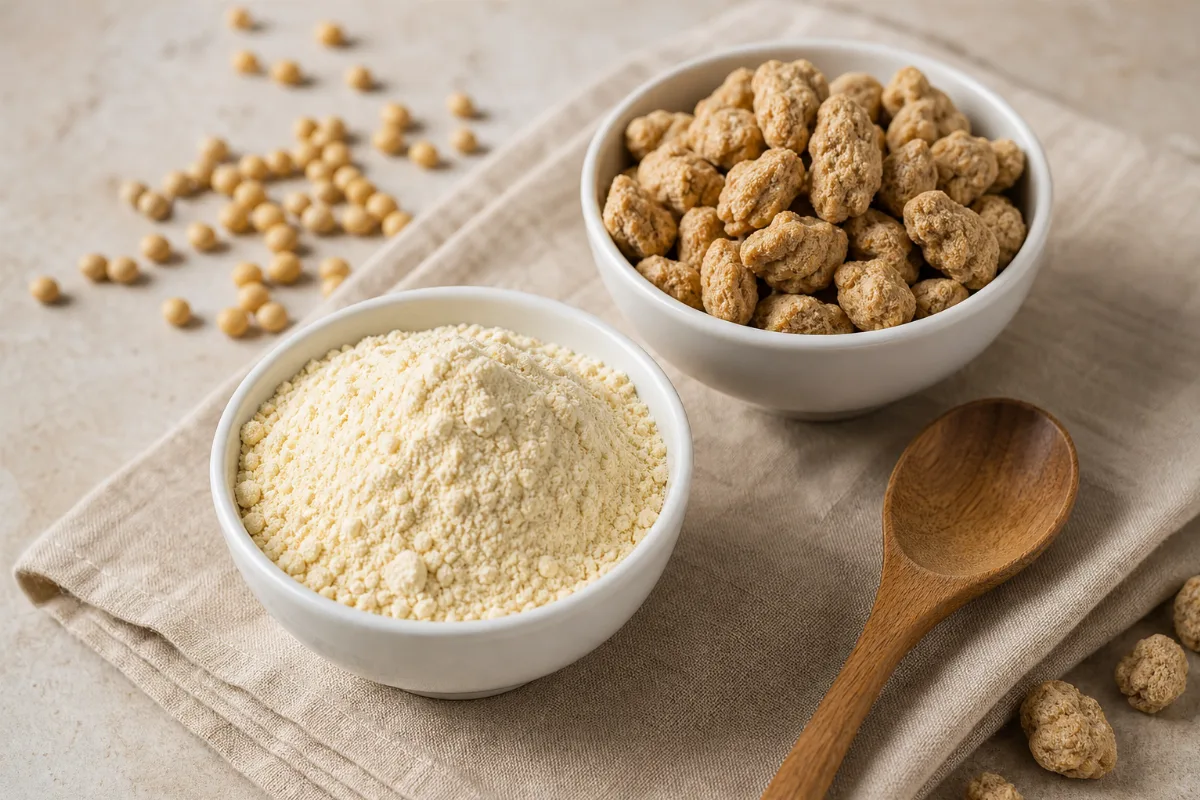
Soy flour is ground soybeans (Glycine max). USDA lists full-fat soy flour (raw), defatted soy flour, and soy protein concentrate produced by acid wash. Our existing summary describes textured soy protein as soy flour extruded with heat into chewy pieces, often called TVP. USDA has no textured soy protein item in the records searched.
USDA data per 100 g. Full-fat soy flour: 434 kcal, 37.8 g protein, 20.6 g fat, 9.6 g fibre, 206 mg calcium, 6.37 mg iron, 2520 mg potassium. Defatted soy flour: 327 kcal, 51.5 g protein, 1.22 g fat, 17.5 g fibre, 241 mg calcium, 9.24 mg iron, 2380 mg potassium. Soy protein concentrate (acid wash): 328 kcal, 63.6 g protein, 0.46 g fat, 5.5 g fibre, 363 mg calcium, 10.8 mg iron, 450 mg potassium.
Check the label: the products differ
The three USDA items differ a lot. Full-fat flour keeps the oil (20.6 g fat per 100 g). Defatted flour has almost none (1.22 g) and the most fibre (17.5 g). The concentrate has the most protein (63.6 g) but only 5.5 g of fibre and 900 mg of sodium per 100 g, against 13 mg and 20 mg for the two flours. Textured products and mixes depend on the brand.
A 2007 lab study of commercial products found 120 to 340 mg of isoflavones per 100 g in whole and defatted soy flours, 88 to 164 in soy protein isolates and 66 to 183 in textured soy proteins. Extrusion destroyed some isoflavones. This is food chemistry, not a health result.
What the research shows
The firmest findings are about soy protein and plant protein, not flour or textured protein alone. Soy protein in place of other protein lowered LDL by about 4.76 mg/dL across 43 trials, and plant protein in place of animal protein lowered it by 0.16 mmol/L across 112 trials. These are swaps, and the changes are small.
One small 2026 study of 17 adults with overweight or obesity found that replacing 30% of the refined flour in bread and arepas with soy flour gave a smaller blood sugar rise over two hours. Insulin, hunger and fullness did not change. A 2025 review found iron in meals with soy flour and soy concentrate was absorbed about as well as iron from soybeans, with wide variation.
Isoflavones, the estrogen-like plant compounds in soy, have mostly been tested as preparations. They gave a small, mixed benefit for menopause symptoms and no significant effect on hot flushes. In 40 trials in postmenopausal women they did not significantly change womb lining, vaginal cells, FSH or estradiol. Breast cancer links are observational.
Food versus supplements
The cholesterol results are for soy protein or plant protein in many forms, including powders. The menopause, hormone and breast cancer results are mostly for isoflavones, as supplements or mixed with foods. NCCIH says soy supplements have not been shown to lower breast cancer risk and that effects may differ between soy products. Soy protein isolate, protein powders and isoflavone supplements are different products from the flours and textured protein described here.
At a glance
Traditional uses history, not proof
- Used as a protein-rich food ingredient in baking, meat-free dishes and shakes
- Soybeans have long been eaten as food; this is not proof that these products treat any condition
Studied for research
- Protein, fibre and minerals, high certainty for the nutrient content (USDA), which varies by product
- Cholesterol, moderate certainty for soy and plant protein swaps, indirect for flour and textured protein
- Blood sugar after a meal, very low certainty (one small study of soy flour replacing part of refined flour)
- Iron absorption, low certainty (narrative review that included soy flour and concentrate)
- Menopause symptoms, mixed (isoflavone preparations, not these foods)
- Hormone and estrogen measures, moderate certainty of no clear estrogen-like effect (isoflavone studies)
- Breast cancer risk and survival, low certainty (observational)
Main compounds
- Soy protein
- Dietary fibre
- Isoflavones (genistein, daidzein, glycitein)
- Iron, potassium, magnesium and folate
- Sodium (high in the USDA concentrate item)
Common forms
- Full-fat soy flour (raw) and defatted soy flour (USDA values read)
- Soy protein concentrate produced by acid wash (USDA values read)
- Textured soy protein or TVP (no USDA item; label values vary)
- Soy protein isolate, powders and isoflavone supplements are different products and are not covered
Research links: 2019 review: soy protein and LDL cholesterol (43 trials) · 2025 review: iron absorption from soy · 2023 review: soy and levothyroxine · Research Library · Genes & Biomarkers Library
What it is and its history
- Accepted scientific name
- Glycine max (L.) Merr.
- Naming authority
- (L.) Merr. (GBIF accepted; the plant whose seeds are ground, defatted or textured into these products)
- Common names
- Soy flour (English); Defatted soy flour (English); Textured soy protein (English); Textured vegetable protein (TVP) (English); Soy protein concentrate (English)
- Family or group
- Fabaceae (the legume or pea family), as given by GBIF. Soy flour and textured soy protein are processed foods made from soybeans, not plants.
- Classification
- Plantae > Tracheophyta > Magnoliopsida > Fabales > Fabaceae > Glycine > Glycine max
- Native range
- Not verified from a source read.
- Habitat
- Not verified from a source read.
- What it looks like
- Roots: Not verified.; Stems: Not verified.; Leaves: Not verified.; Flowers: Not verified.; Fruit: These products are made from mature soybean seeds. USDA gives household portions of 1 cup (84 g) for stirred full-fat soy flour and 1 cup (105 g) for defatted soy flour.
- Cultivation
- Not verified from a source read.
- Harvest and processing
- USDA lists soy flour full-fat (raw), defatted soy flour and soy protein concentrate produced by acid wash. Our existing summary describes textured soy protein as soy flour extruded with heat into chewy pieces, and a 2007 lab study says extrusion destroyed some isoflavones. No food-science or regulator page describing how each product is made was read.
- Look-alikes and adulterants
- Name: Tofu, soy milk, edamame, tempeh and soy sauce; Note: Other soy foods with their own pages; they differ in nutrients, tyramine and processing.; Name: Soy protein isolate; Note: A more refined powder that is not the same as the concentrate; the 2025 iron review says isolates may reduce iron absorption.; Name: Soy protein and isoflavone supplements; Note: Supplements are not these foods, and several of the trials read used them.
- Sustainability and conservation
- Not assessed.
Photographs
What is inside, and how it may work
What it contains and how those compounds act in cells and animals. Laboratory and animal mechanisms are not proven effects in people.
Main compounds
| Compound | Family | Where it is concentrated | Activity studied | Level of evidence |
|---|---|---|---|---|
| Soy protein | protein | Seed (flour, concentrate, textured pieces) USDA per 100 g: 37.8 g (full-fat flour); 51.5 g (defatted flour); 63.6 g (concentrate) | In pooled trials, soy protein in place of other protein lowered LDL cholesterol a little; it is also the source of the soy allergen. 22 23 24 1 | Human data |
| Dietary fibre | fibre | Seed USDA per 100 g: 9.6 g (full-fat flour); 17.5 g (defatted flour); 5.5 g (concentrate) | Fibre can cause gas in some people; the effect of these products on digestion was not tested in the sources read. 22 23 24 | Nutrient database |
| Isoflavones (genistein, daidzein, glycitein and their forms) | isoflavone | Seed Lab study: 120 to 340 mg per 100 g in whole and defatted soy flours; 88 to 164 in soy protein isolates; 66 to 183 in commercial textured soy proteins (wet basis, as aglycones) | NCCIH describes isoflavones as compounds similar in structure to estrogen. In pooled trials they had no significant effect on four estrogen measures in postmenopausal women. 4 20 16 | Human data |
| Iron, potassium, magnesium and folate | minerals and vitamin | Seed USDA per 100 g (defatted flour): iron 9.24 mg, potassium 2380 mg, magnesium 290 mg, folate 305 micrograms | Nutrient amounts only. A 2025 review says soy iron absorption varies widely and improves with low phytic acid and vitamin C in the meal. 23 6 | Nutrient database |
| Sodium (added in processing) | mineral | Not a seed component; depends on processing USDA per 100 g: 13 mg (full-fat flour); 20 mg (defatted flour); 900 mg (concentrate, acid wash) | Relevant for people watching salt; textured products and mixes vary by label. 22 23 24 | Nutrient database |
Mechanisms, receptors and pathways
| Target or pathway | Gene or receptor | What was found | Level |
|---|---|---|---|
| Estrogen receptors and isoflavones | Not specified in the sources read | NCCIH describes isoflavones as similar in structure to estrogen. The pooled trials of actual hormone and tissue measures in postmenopausal women found no significant effect. 20 16 | Human data |
| Cholesterol lowering by soy protein | Not specified in the sources read | NCCIH says that replacing other protein with soy protein may lower cholesterol to a small extent. The mechanism was not stated in the sources read. 20 1 | Human data |
| Extrusion and isoflavones | Not applicable | In commercial products the extrusion process destroyed some isoflavones and shifted their forms, less so in concentrates. Lab food chemistry only. 4 | Lab |
Absorption, metabolism and elimination
- Absorption
- A 2025 review of human isotope studies found iron absorption from meals with soy flour and soy protein concentrate similar to soybeans, 4.1% to 22.2% after adjusting for iron status. Other nutrients were not found.
- Distribution
- Not found.
- Metabolism
- Not found.
- Elimination
- Not found.
- Bioavailability
- Iron: see absorption. Low phytic acid and vitamin C improved absorption in the review. Other nutrients were not found.
Isolated compounds versus whole extracts
Soy flour, concentrate and textured protein are already processed: they have more protein per 100 g than soybeans and different amounts of fibre, isoflavones and sodium. The cholesterol results are for soy protein or plant protein in many forms. The menopause, hormone and breast cancer results are mostly for isoflavones, as supplements or mixed with foods. NCCIH says soy supplements have not been shown to lower breast cancer risk and that effects may differ between soy products.
Nutritional composition
Nutrition from USDA FoodData Central (SR Legacy records, April 2019 update date; values read 2026-10-26 from a saved copy of the data feed). Per 100 g. Soy flour, full-fat, raw (FDC 174273): 434 kcal, 37.8 g protein, 20.6 g fat, 31.9 g carbohydrate, 9.6 g fibre, 206 mg calcium, 6.37 mg iron, 429 mg magnesium, 494 mg phosphorus, 2520 mg potassium, 13 mg sodium, 3.92 mg zinc, 2.92 mg copper, 345 micrograms folate. Soy flour, defatted (FDC 174275): 327 kcal, 51.5 g protein, 1.22 g fat, 33.9 g carbohydrate, 17.5 g fibre, 241 mg calcium, 9.24 mg iron, 290 mg magnesium, 674 mg phosphorus, 2380 mg potassium, 20 mg sodium, 2.46 mg zinc, 4.06 mg copper, 305 micrograms folate. Soy protein concentrate, produced by acid wash (FDC 174301): 328 kcal, 63.6 g protein, 0.46 g fat, 25.4 g carbohydrate, 5.5 g fibre, 363 mg calcium, 10.8 mg iron, 140 mg magnesium, 839 mg phosphorus, 450 mg potassium, 900 mg sodium, 4.4 mg zinc, 0.976 mg copper, 340 micrograms folate. Worked out from USDA's portion weights (the per-100-g values multiplied): 1 cup of defatted soy flour (105 g) is about 343 kcal and 54 g protein; 1 tablespoon (6.6 g) is about 22 kcal and 3.4 g protein. 1 cup of stirred full-fat soy flour (84 g) is about 365 kcal and 32 g protein; 1 tablespoon (5.2 g) is about 23 kcal and 2.0 g protein. The soy protein concentrate record lists only a 1 oz (28.35 g) portion, about 93 kcal, 18 g protein and 255 mg sodium. A search of USDA SR Legacy and Foundation foods found no textured soy protein or textured vegetable protein item, so read the product label.
1 high certainty2 moderate certainty1 mixed findings2 low certainty1 very low certainty
What was looked at
The 7 benefits and uses checked for Soy Flour and Textured Soy Protein, each with how strong the evidence is. Tap one to open it.
- Protein, fibre and minerals (nutrient content)High certainty
- Cholesterol (soy protein and plant protein swaps)Moderate certainty
- Blood sugar after a meal (soy flour replacing part of refined flour)Very low certainty
- Iron absorption from soy flour and soy proteinLow certainty
- Menopause symptoms (isoflavone preparations)Mixed findings
- Hormone and estrogen measures (isoflavone studies)Moderate certainty
- Breast cancer risk and survival (observational)Low certainty
Lab markers tracked in the studies
LDL cholesterolTotal cholesterolEstradiol (an estrogen hormone)Blood glucose after a mealTSH (thyroid-stimulating hormone)
What is Soy Flour and Textured Soy Protein good for?
The main studied uses and how strong the human evidence is for each. Most results are for soy protein, plant protein or isoflavones in general, not for soy flour or textured soy protein on their own.
Benefits, one by one
Each card is a research question, not a promise. Tap a goal to filter. Open a card to see the studies, doses and limits.
Protein, fibre and minerals (nutrient content)
High certaintyBy USDA data, defatted soy flour has 51.5 g of protein and 17.5 g of fibre per 100 g. Full-fat soy flour has 37.8 g of protein and 9.6 g of fibre, and soy protein concentrate has 63.6 g of protein. All three are also rich in potassium, magnesium, iron and folate on paper.
3 studiesUSDA items: full-fat soy flour (raw), defatted soy flour, and soy pro…
Studies, doses and limits
What the trials found
No trial was read showing that eating soy flour or textured soy protein corrects low protein, iron or any other shortfall. The USDA figures describe the products on paper. Iron absorption is covered separately under Other studied uses.
Results
Soy flours and the concentrate are concentrated sources of protein on paper. Textured soy protein has no USDA entry, so its numbers depend on the product label.
Effect sizes as reported
USDA per 100 g. Full-fat soy flour (raw): 434 kcal, 37.8 g protein, 20.6 g fat, 9.6 g fibre, 206 mg calcium, 6.37 mg iron, 429 mg magnesium, 2520 mg potassium, 13 mg sodium, 345 micrograms folate. Defatted soy flour: 327 kcal, 51.5 g protein, 1.22 g fat, 17.5 g fibre, 241 mg calcium, 9.24 mg iron, 290 mg magnesium, 2380 mg potassium, 20 mg sodium, 305 micrograms folate. Soy protein concentrate (acid wash): 328 kcal, 63.6 g protein, 0.46 g fat, 5.5 g fibre, 363 mg calcium, 10.8 mg iron, 140 mg magnesium, 450 mg potassium, 900 mg sodium, 340 micrograms folate.
Why this rating
High that the USDA items contain these nutrients. Not tested as a treatment for any shortfall, and USDA has no textured soy protein item.
Form and dose studied
USDA items: full-fat soy flour (raw), defatted soy flour, and soy protein concentrate produced by acid wash. Roasted, low-fat and isolate items, textured soy protein and branded products were not read.
Who was studied
General adult diet.
Limits
Nutrient facts, not trials. Products differ by brand and processing; the concentrate item has 900 mg of sodium per 100 g while the flours have 13 to 20 mg.
Why researchers looked
People use soy flour and textured soy protein to add protein, and sometimes fibre and minerals, to baking, meat-free dishes and shakes.
Traditional use
Soy flour and textured soy protein are modern food ingredients. Long use of soybeans as food is not proof that these products treat any condition.
Proposed mechanism Nutrient database
These are nutrient amounts in the food, taken from USDA tables.
A proposed mechanism does not show that the effect happens in people.
Soy is a major food allergen; see the Safety tab.
Cholesterol (soy protein and plant protein swaps)
Moderate certaintyIn trials, soy protein in place of other protein lowered LDL ('bad') cholesterol by about 4.76 mg/dL, and plant protein in place of animal protein lowered it by about 0.16 mmol/L. The trials did not test soy flour or textured soy protein on their own, and the change is small.
3 studiesSoy protein in many forms (foods and powders) in the first analysis; …
Studies, doses and limits
What the trials found
A pooled analysis of 43 controlled trials (41 with LDL data) found that soy protein, median 25 g a day for a median of 6 weeks, lowered LDL by 4.76 mg/dL and total cholesterol by 6.41 mg/dL compared with non-soy protein, which the authors call about 3 to 4%. About 75% of trials showed a fall, but only a minority were individually significant. A pooled analysis of 112 trials found plant protein in place of animal protein lowered LDL by 0.16 mmol/L (moderate-quality evidence by GRADE).
Results
A small average fall in LDL when soy or plant protein replaced other protein in short trials. Soy flour and textured soy protein were not tested alone.
Effect sizes as reported
Soy protein: LDL -4.76 mg/dL (95% CI -6.71 to -2.80); total cholesterol -6.41 mg/dL (-9.30 to -3.52). Plant protein: LDL -0.16 mmol/L; non-HDL -0.18 mmol/L; apoB -0.05 g/L.
Why this rating
Moderate that swapping soy or plant protein for other protein lowers LDL a little (the plant-protein analysis is rated moderate-quality by its authors). Indirect for flour and textured protein, which were not tested alone. One author of the soy analysis is listed at a soy industry body (Soy Nutrition Institute).
Form and dose studied
Soy protein in many forms (foods and powders) in the first analysis; plant protein of many kinds in the second.
Who was studied
Adults, baseline LDL 110 to 201 mg/dL in the soy analysis.
Limits
Trials were short with large differences between them. These are swaps, not additions to an unchanged diet. Not specific to flour or textured protein.
Why researchers looked
Soy flour, concentrate and textured protein are ways of eating soy protein, which has been studied for cholesterol for many years.
Traditional use
Soy flour and textured soy protein are modern food ingredients. Long use of soybeans as food is not proof that these products treat any condition.
Proposed mechanism Authoritative guidance
Not shown for these products. NCCIH says that replacing other protein with soy protein may lower cholesterol to a small extent, and that isoflavones may not have the same effect.
A proposed mechanism does not show that the effect happens in people.
None specific beyond the allergy and medicine points on the Safety tab.
Blood sugar after a meal (soy flour replacing part of refined flour)
Very low certaintyIn one small 2026 study of 17 adults with overweight or obesity, replacing 30% of the refined flour in bread and arepas with soy flour lowered the blood glucose rise over two hours. Insulin, hunger and fullness did not change.
1 studiesSoy flour (type not stated in the abstract) in bread, tortillas and a…
Studies, doses and limits
What the trials found
A randomised, repeated-measures study had 17 adults eat bread, tortillas or arepas with 0%, 10% or 30% of the flour replaced by soy flour, in random order on separate visits. At 30% replacement the two-hour glucose rise was smaller for bread (p = 0.03) and arepas (p = 0.04), and glucose was lower at 90 to 120 minutes for tortillas (p = 0.0009). Insulin, hunger and fullness did not differ, and liking was kept.
Results
A smaller blood sugar rise after single test meals. It says nothing about long-term blood sugar control.
Effect sizes as reported
Only p-values are given in the abstract.
Why this rating
Very low: one small study (17 people), single meals, several foods with few people each, and no effect sizes in the abstract.
Form and dose studied
Soy flour (type not stated in the abstract) in bread, tortillas and arepas.
Who was studied
Adults with overweight or obesity.
Limits
Tiny sample, short test, results given as p-values only, funding not stated in the abstract.
Why researchers looked
Soy flour is added to wheat and corn foods to raise their protein and fibre.
Traditional use
Soy flour and textured soy protein are modern food ingredients. Long use of soybeans as food is not proof that these products treat any condition.
Proposed mechanism Not established
Not established in the abstract.
A proposed mechanism does not show that the effect happens in people.
See the Safety tab for allergy.
Iron absorption from soy flour and soy protein
Low certaintyA 2025 review of human isotope studies found that iron in meals made with soy flour (full-fat, defatted and texturised) and soy protein concentrate was absorbed about as well as iron from soybeans, which varied a lot, from 4.1% to 22.2%. Soy protein isolates may reduce it.
1 studiesSoy flour (full-fat, defatted, texturized), soy protein concentrate a…
Studies, doses and limits
What the trials found
The authors adjusted iron absorption for iron status. Soybeans in meals gave 4.1% to 22.2% absorption, equal to 13% to 70% of daily absorbed-iron needs for men and 10% to 40% for women. Similar results were found for meals with soy flour and soy protein concentrates. Replacing up to 30% of meat with soy concentrates or isolates in a meal did not meaningfully reduce total iron absorption.
Results
Soy flour and concentrate can contribute iron that the body takes up, with wide variation. Long-term effects on iron status have not been assessed.
Effect sizes as reported
Adjusted absorption 4.1% to 22.2% from soybeans in meals.
Why this rating
Low: a narrative review of isotope studies with wide variation, not a pooled analysis, and no long-term data on iron status.
Form and dose studied
Soy flour (full-fat, defatted, texturized), soy protein concentrate and isolate, in meals.
Who was studied
People older than 3 years in the studies reviewed.
Limits
Narrative review. The authors say soy variety, processing and protein profile still need study.
Why researchers looked
Soy ingredients contain iron, and plant-based foods are often used in place of meat.
Traditional use
Soy flour and textured soy protein are modern food ingredients. Long use of soybeans as food is not proof that these products treat any condition.
Proposed mechanism Narrative review
The review says low phytic acid in the food, and vitamin C eaten with the meal, improved absorption of the iron found naturally in soy.
A proposed mechanism does not show that the effect happens in people.
None specific.
Menopause symptoms (isoflavone preparations)
Mixed findingsA 2025 pooled analysis of soy isoflavone preparations found a small overall improvement in menopause symptoms in perimenopausal women but no significant effect on hot flushes. Flour and textured protein were not tested.
2 studiesSoy isoflavone preparations, not flour or textured protein.
Studies, doses and limits
What the trials found
Across 12 trials in perimenopausal women, isoflavones gave a small overall improvement (7 trials, 533 women). They helped headache, psychosocial symptoms, palpitation and depression scores, but showed no significant effect on hot flushes, sweating, insomnia, fatigue or vasomotor symptoms. The authors warn the samples were small. NCCIH says the effect on hot flashes may be small and results have not been completely consistent.
Results
A small, mixed effect from isoflavone preparations. No trial of soy flour or textured soy protein was read.
Effect sizes as reported
Overall symptoms Hedges' g -0.25; headache -0.38; psychosocial -0.29; palpitation -0.42; depression -0.72.
Why this rating
Mixed: a small overall benefit, no clear effect on hot flushes, small samples, and the trials used isoflavone preparations, not these foods.
Form and dose studied
Soy isoflavone preparations, not flour or textured protein.
Who was studied
Perimenopausal women.
Limits
Small samples. Not the foods on this page. Funding is not stated in the abstract.
Why researchers looked
Isoflavones in soy are similar in structure to estrogen, so researchers tested them for menopause symptoms.
Traditional use
Soy flour and textured soy protein are modern food ingredients. Long use of soybeans as food is not proof that these products treat any condition.
Proposed mechanism Authoritative guidance
NCCIH describes isoflavones as compounds similar in structure to the hormone estrogen. How they might act on symptoms was not shown in the sources read.
A proposed mechanism does not show that the effect happens in people.
See Safety for hormone-sensitive conditions.
Hormone and estrogen measures (isoflavone studies)
Moderate certaintyIn 40 trials in postmenopausal women, soy isoflavones had no significant effect on womb lining thickness, vaginal cells, FSH or estradiol. This is a no-effect finding for isoflavones, not a trial of soy flour or textured protein.
2 studiesSoy isoflavones as foods or supplements, median 75 mg a day in the 20…
Studies, doses and limits
What the trials found
A 2025 pooled analysis of 40 randomised trials (3,285 postmenopausal women) found no significant effect of isoflavones on endometrial thickness, vaginal maturation index, FSH or estradiol, and the authors rate the certainty as high to moderate. A 2009 pooled analysis of 47 trials found no change in estradiol, estrone or SHBG in premenopausal women, but FSH and LH about 20% lower and menstrual cycles about one day longer; in postmenopausal women there were no significant effects.
Results
No clear estrogen-like effect on these measures in postmenopausal women.
Effect sizes as reported
Endometrial thickness -0.22 mm; vaginal maturation index 2.31; FSH -0.02 IU/L; estradiol +1.61 pmol/L (none significant).
Why this rating
Moderate that isoflavones have no clear effect on these measures in postmenopausal women. Not tested with soy flour or textured protein.
Form and dose studied
Soy isoflavones as foods or supplements, median 75 mg a day in the 2025 analysis (trial detail, not advice).
Who was studied
Mostly postmenopausal women.
Limits
Isoflavone amounts and forms differed. Soy foods, protein and isoflavones are mixed in the 2009 analysis.
Why researchers looked
Because isoflavones resemble estrogen, researchers asked whether soy acts like estrogen in the body.
Traditional use
Soy flour and textured soy protein are modern food ingredients. Long use of soybeans as food is not proof that these products treat any condition.
Proposed mechanism Authoritative guidance
NCCIH describes isoflavones as similar in structure to estrogen. The pooled trials looked at actual hormone and tissue measures.
A proposed mechanism does not show that the effect happens in people.
Relevant to hormone-sensitive conditions; see Safety.
Breast cancer risk and survival (observational)
Low certaintyObservational studies link higher soy isoflavone intake with lower breast cancer risk, and soy intake before diagnosis with slightly better survival. These studies cannot prove cause, and soy supplements have not been shown to lower risk.
3 studiesSoy foods and isoflavones in general.
Studies, doses and limits
What the trials found
A pooled analysis of prospective cohort studies found an inverse link between isoflavone intake and breast cancer in pre- and post-menopausal women, with no numbers in the abstract. Among women with breast cancer (12 articles, 37,275 women), soy intake before diagnosis went with slightly better overall survival (HR 0.84); results after diagnosis were not significant. NCCIH says the link is seen in Asian and Asian-American women and that soy supplements have not been shown to reduce breast cancer risk.
Results
A link, not proof. Soy flour and textured soy protein were not separated from other soy foods.
Effect sizes as reported
Before diagnosis: overall survival HR 0.84; breast-cancer-specific survival HR 0.89 (not significant). After diagnosis: HR 0.80 and 0.83 (neither significant).
Why this rating
Low: observational, with food questionnaires, soy foods and isoflavones mixed together.
Form and dose studied
Soy foods and isoflavones in general.
Who was studied
Women, mostly in Asian and Asian-American studies per NCCIH.
Limits
Observational. Funding is not stated in the abstracts.
Why researchers looked
Researchers compared soy intake with breast cancer risk and survival in groups of women.
Traditional use
Soy flour and textured soy protein are modern food ingredients. Long use of soybeans as food is not proof that these products treat any condition.
Proposed mechanism Not established
Not established in the sources read.
A proposed mechanism does not show that the effect happens in people.
Ask your cancer care team how soy fits your care.
Connections to the rest of health
How Soy Flour and Textured Soy Protein connects to the rest of our health knowledge graph. Every link says what kind of connection it is. A safety link (for example to the liver) is a warning, not a benefit. A study that merely mentions a topic never creates a benefit link.
Explore every connection: goals, body systems, organs, symptoms, genes
A. Wellness goals
| Connected to | Kind of connection | Evidence status | Context | Studies |
|---|---|---|---|---|
| Preventive Wellness | High certainty | Protein, fibre and minerals (nutrient content): By USDA data, defatted soy flour has 51.5 g of protein and 17.5 g of fibre per 100 g. Full-fat soy flour has 37.8 g of protein and 9.6 g of fibre, and soy protein concentrate has 63.6 g of protein. All three are also rich in potassium, magnesium, iron and folate on paper. Iron absorption from soy flour and soy protein: A 2025 review of human isotope studies found that iron in meals made with soy flour (full-fat, defatted and texturised) and soy protein concentrate was absorbed about as well as iron from soybeans, which varied a lot, from 4.1% to 22.2%. Soy protein isolates may reduce it. | 22 23 24 6 | |
| Cholesterol Balance | Demonstrated clinical effect | Moderate certainty | Cholesterol (soy protein and plant protein swaps): In trials, soy protein in place of other protein lowered LDL ('bad') cholesterol by about 4.76 mg/dL, and plant protein in place of animal protein lowered it by about 0.16 mmol/L. The trials did not test soy flour or textured soy protein on their own, and the change is small. | 1 8 20 |
| Heart Health | Demonstrated clinical effect | Moderate certainty | Cholesterol (soy protein and plant protein swaps): In trials, soy protein in place of other protein lowered LDL ('bad') cholesterol by about 4.76 mg/dL, and plant protein in place of animal protein lowered it by about 0.16 mmol/L. The trials did not test soy flour or textured soy protein on their own, and the change is small. | 1 8 20 |
| Blood Sugar Balance | Very low certainty | Blood sugar after a meal (soy flour replacing part of refined flour): In one small 2026 study of 17 adults with overweight or obesity, replacing 30% of the refined flour in bread and arepas with soy flour lowered the blood glucose rise over two hours. Insulin, hunger and fullness did not change. | 11 | |
| Healthy Weight | Very low certainty | Blood sugar after a meal (soy flour replacing part of refined flour): In one small 2026 study of 17 adults with overweight or obesity, replacing 30% of the refined flour in bread and arepas with soy flour lowered the blood glucose rise over two hours. Insulin, hunger and fullness did not change. | 11 | |
| Menopause Support | Mixed findings | Menopause symptoms (isoflavone preparations): A 2025 pooled analysis of soy isoflavone preparations found a small overall improvement in menopause symptoms in perimenopausal women but no significant effect on hot flushes. Flour and textured protein were not tested. | 9 20 | |
| Womens Wellness | Mixed findings | Menopause symptoms (isoflavone preparations): A 2025 pooled analysis of soy isoflavone preparations found a small overall improvement in menopause symptoms in perimenopausal women but no significant effect on hot flushes. Flour and textured protein were not tested. | 9 20 | |
| Hormone Balance | Moderate certainty | Hormone and estrogen measures (isoflavone studies): In 40 trials in postmenopausal women, soy isoflavones had no significant effect on womb lining thickness, vaginal cells, FSH or estradiol. This is a no-effect finding for isoflavones, not a trial of soy flour or textured protein. | 16 7 | |
| Womens Wellness | Moderate certainty | Hormone and estrogen measures (isoflavone studies): In 40 trials in postmenopausal women, soy isoflavones had no significant effect on womb lining thickness, vaginal cells, FSH or estradiol. This is a no-effect finding for isoflavones, not a trial of soy flour or textured protein. | 16 7 | |
| Womens Wellness | Low certainty | Breast cancer risk and survival (observational): Observational studies link higher soy isoflavone intake with lower breast cancer risk, and soy intake before diagnosis with slightly better survival. These studies cannot prove cause, and soy supplements have not been shown to lower risk. | 2 13 20 |
B. Body systems
| Connected to | Kind of connection | Evidence status | Context | Studies |
|---|---|---|---|---|
| Digestive System | Biological association | High certainty | Studied for: Protein, fibre and minerals (nutrient content) | 22 23 24 |
| Musculoskeletal System | Biological association | High certainty | Studied for: Protein, fibre and minerals (nutrient content) | 22 23 24 |
| Cardiovascular System | Biological association | Moderate certainty | Studied for: Cholesterol (soy protein and plant protein swaps) | 1 8 20 |
| Endocrine System | Biological association | Very low certainty | Studied for: Blood sugar after a meal (soy flour replacing part of refined flour) Studied for: Menopause symptoms (isoflavone preparations) | 11 9 20 16 7 |
| Blood | Biological association | Low certainty | Studied for: Iron absorption from soy flour and soy protein | 6 |
| Reproductive System | Biological association | Mixed findings | Studied for: Menopause symptoms (isoflavone preparations) Studied for: Hormone and estrogen measures (isoflavone studies) | 9 20 16 7 2 13 |
C. Body parts and organs
E. Health conditions
| Connected to | Kind of connection | Evidence status | Context | Studies |
|---|---|---|---|---|
| Food allergy | Adverse effect or risk | Documented risk | Soybeans are a major food allergen; challenge-verified soy allergy was about 0.3% in Europe. Soybeans are a major food allergen; about 0.3% of people in Europe had challenge-verified soy allergy. Preparation or compound: Soy protein in flour and textured protein |
17 15 |
| High cholesterol | Preliminary | Soy protein in place of other protein lowers LDL a little in pooled trials; not a treatment. Preparation or compound: Soy protein |
1 8 |
I. Biomarkers
| Connected to | Kind of connection | Evidence status | Context | Studies |
|---|---|---|---|---|
| LDL cholesterol | Biological association | Moderate certainty | Measured in trials: lowered. A lab change is not the same as a health benefit. | 1 8 |
| Total cholesterol | Biological association | Low certainty | Measured in trials: lowered. A lab change is not the same as a health benefit. | 1 |
| Estradiol (an estrogen hormone) | Biological association | Moderate certainty | Measured in trials: no significant change. A lab change is not the same as a health benefit. | 16 |
| Blood glucose after a meal | Biological association | Very low certainty | Measured in trials: lowered (30% soy flour replacement, small study). A lab change is not the same as a health benefit. | 11 |
| TSH (thyroid-stimulating hormone) | Biological association | Low certainty | Measured in trials: slightly raised (borderline). A lab change is not the same as a health benefit. | 12 |
K. Biological pathways
| Connected to | Kind of connection | Evidence status | Context | Studies |
|---|---|---|---|---|
| Protein | Preliminary mechanism | Nutrient database | Soy flours and concentrate are concentrated protein sources on paper. | 23 24 |
| Iron | Preliminary mechanism | Human | Soy flour iron is absorbed to a variable degree; low phytic acid and vitamin C help. | 6 |
| LDL cholesterol | Preliminary mechanism | Human | Soy protein in place of other protein lowers LDL a little. | 1 |
L. Active compounds
| Connected to | Kind of connection | Evidence status | Context | Studies |
|---|---|---|---|---|
| Soy protein | Biological association | Human | In pooled trials, soy protein in place of other protein lowered LDL cholesterol a little; it is also the source of the soy allergen. Preparation or compound: Seed (flour, concentrate, textured pieces) |
22 23 24 1 |
| Dietary fibre | Biological association | Nutrient database | Fibre can cause gas in some people; the effect of these products on digestion was not tested in the sources read. Preparation or compound: Seed |
22 23 24 |
| Isoflavones (genistein, daidzein, glycitein and their forms) | Biological association | Human | NCCIH describes isoflavones as compounds similar in structure to estrogen. In pooled trials they had no significant effect on four estrogen measures in postmenopausal women. Preparation or compound: Seed |
4 20 16 |
| Iron, potassium, magnesium and folate | Biological association | Nutrient database | Nutrient amounts only. A 2025 review says soy iron absorption varies widely and improves with low phytic acid and vitamin C in the meal. Preparation or compound: Seed |
23 6 |
| Sodium (added in processing) | Biological association | Nutrient database | Relevant for people watching salt; textured products and mixes vary by label. Preparation or compound: Not a seed component; depends on processing |
22 23 24 |
Each connection is stored with the ingredient, the connected record, the kind of connection, the evidence status, the supporting studies, the preparation or compound involved, and a review date (last reviewed October 26, 2026).
Evidence at a glance: what changed in 2 lab markers
Tap a number to show only those markers. Counts are markers, not people.
The evidence
The research centre for Soy Flour and Textured Soy Protein. Every record here was checked against PubMed or the publisher's page; we never list a study we have not verified.
Evidence by outcome
Bars show how many studies we found for each outcome, not how well it works. People are added up across trials only (reviews are not added, to avoid double counting).
How we rate evidence
High certainty
Several well-run trials or reviews agree; further research is unlikely to change the picture much.
Moderate certainty
Good trials point the same way, but some doubt remains.
Low certainty
Small, short or inconsistent trials. The finding could change with better research.
Very low certainty
Very little or very weak human data. Treat as a possibility only.
Mixed findings
Trials or reviews disagree with each other.
Not enough evidence
Not enough human research to say either way.
Evidence against
Good research found no benefit, or found harm.
We take the reviewers' own risk-of-bias and GRADE statements where they exist, and otherwise judge from study size, design, consistency, directness and whether a product matches what is sold. Many publications do not make evidence high. Method note: We started from our existing summary for soy flour and textured soy protein, re-checked nutrition against saved USDA FoodData Central records, read the health agency pages (NCCIH, FDA, MedlinePlus, NIDDK) and re-read PubMed abstracts for reviews, pooled analyses, one small trial and a lab survey. Only abstracts were read for studies. Items we could not verify are flagged in the research gaps.
Study library: every study we checked 24
| Study | Design | People | Product, dose, length | Result |
|---|---|---|---|---|
| Blanco Mejia 2019 A Meta-Analysis of 46 Studies Identified by the FDA Demonstrates that Soy Protein Decreases Circulating LDL and Total Cholesterol Concentrations in Adults. J Nutr · PMID 31006811 · DOI |
Systematic review meta analysis |
43 of 46 controlled trials in adults, baseline LDL 110 to 201 mg/dL (41 gave LDL data) | Soy protein (many forms, not tofu alone) in place of non-soy protein Soy protein foods and products Median 25 g of soy protein a day (trial detail, not advice) Median 6 weeks · vs Non-soy protein |
Soy protein lowered LDL by 4.76 mg/dL and total cholesterol by 6.41 mg/dL compared with non-soy protein. About 75% of trials showed a fall in LDL, but only a minority were individually significant. The authors describe this as about 3 to 4% lower LDL. LDL -4.76 mg/dL; total cholesterol -6.41 mg/dL (differences between trials were moderate to high, I2 55% and 74%) (LDL -6.71 to -2.80 mg/dL; total cholesterol -9.30 to -3.52 mg/dL) Methods, limits and fundingOutcomes: LDL cholesterol and total cholesterol Limitations: Soy protein in many forms, not tofu on its own. Trials were short. Large differences between trials. Funding and conflicts: Registered NCT03468127. Listed as non-US government research support. One author is listed at the Soy Nutrition Institute, a soy industry body; specific funding is not stated in the abstract. Registration: NCT03468127 Read: abstract |
| Boutas 2022 Soy Isoflavones and Breast Cancer Risk: A Meta-analysis. In Vivo · PMID 35241506 · DOI |
Systematic review meta analysis |
Prospective studies of soy isoflavone intake and breast cancer in pre- and post-menopausal women (number of studies not given in the abstract) | Soy isoflavones from food Soy isoflavones from food · vs Lower intake |
The pooled prospective studies showed an inverse link between isoflavone intake and breast cancer in pre- and post-menopausal women. The abstract does not give numbers. Inverse link; numbers not given in the abstract (Not given in the abstract) Methods, limits and fundingOutcomes: Breast cancer occurrence Limitations: Observational, so it cannot prove cause. The authors' conclusion that isoflavones 'can reduce' risk goes further than observational data allow. NCCIH notes the link is seen in Asian and Asian-American women and that supplements have not been shown to lower risk. Funding and conflicts: Funding is not stated in the abstract. Read: abstract |
| Gatta 2023 Interference or Noninterference Between Soy and Levothyroxine: That Is the Question. A Narrative Review of Literature. Endocr Pract · PMID 37633413 · DOI |
Narrative review |
Case reports, case series and original studies up to November 2022 | Soy products (including soy isoflavones) taken with levothyroxine Soy products with levothyroxine |
Few data, mainly case reports, suggested soy products might interfere with levothyroxine tablet absorption. The only prospective randomised crossover study showed no difference when levothyroxine and soy isoflavones were taken together. There was too little data on liquid levothyroxine to conclude anything. The authors judge any interference likely to have little clinical impact and say the question remains unanswered. No numbers in the abstract (Not applicable) Methods, limits and fundingOutcomes: Levothyroxine absorption Limitations: A narrative review of mostly case reports. Not tofu specific. Funding and conflicts: Funding is not stated in the abstract. Read: abstract |
| Genovese 2007 Commercial soy protein ingredients as isoflavone sources for functional foods (Genovese MI, Barbosa ACL, Pinto MS, Lajolo FM; Plant Foods Hum Nutr 2007) Plant Foods Hum Nutr · Source |
Laboratory analysis n/a |
Commercial soy ingredients tested in the lab | Whole and defatted soy flours, soy protein isolates, textured soy proteins Soy ingredients |
Total isoflavones ranged from 120 to 340 mg per 100 g in whole and defatted soy flours, 88 to 164 in soy protein isolates, and 66 to 183 in commercial textured soy proteins (wet basis, as aglycones). Soy hypocotyl flours had 542 to 851. Extrusion destroyed some isoflavones, less so in concentrates. Ranges above (Not applicable) Methods, limits and fundingOutcomes: Isoflavone content Limitations: A 2007 lab measurement of food chemistry, not a health result. Read through the AGRIS record of the abstract; PubMed was not used. Funding and conflicts: Not stated in the record read. Read: abstract |
| Gillman 2018 A reassessment of the safety profile of monoamine oxidase inhibitors: elucidating tired old tyramine myths. J Neural Transm · PMID 30255284 · DOI |
Narrative review |
Review of over 150 recent papers on foods, tyramine and MAOIs | Foods including soy sauces (tofu is not named in the abstract) Foods and MAOIs (review) |
Modern foods usually contain much less tyramine than in the past, and few foods now have problematic levels. The review says the risk from the blood pressure rise has been overstated and that MAOIs are of comparable safety to many newer drugs. It also says people differ in how strongly they react, so doctors' judgement and some care are still required. No numbers in the abstract (Not applicable) Methods, limits and fundingOutcomes: Tyramine in modern foods and blood pressure responses with MAOIs Limitations: A narrative review by one author. Tofu is not named in the abstract. Funding and conflicts: Funding is not stated in the abstract. Read: abstract |
| Hackl 2025 Absorption of Iron Naturally Present in Soy. Adv Nutr · PMID 40020920 · DOI |
Narrative review |
Human isotope studies of iron absorption from soy foods in people older than 3 years | Soybeans, soy flour (full fat, defatted and texturized), soy protein concentrate and isolate eaten in meals Soy ingredients as eaten |
Iron absorption from soybeans in meals varied widely, 4.1% to 22.2% after adjusting for iron status. Similar results were found for meals with soy flour (full fat, defatted and texturized) and soy protein concentrates, while soy protein isolates may reduce it. Replacing up to 30% of meat with soy concentrates or isolates in a meal did not meaningfully reduce total iron absorption. Low phytic acid and vitamin C eaten with the meal improved absorption. Adjusted absorption 4.1% to 22.2%; 13% to 70% (men) and 10% to 40% (women) of daily absorbed-iron needs (Not applicable) Methods, limits and fundingOutcomes: Iron absorption from soy in meals Limitations: A narrative review, not a pooled analysis. Absorption varied widely, the authors call for more work on soy variety and processing, and long-term effects on iron status have not been assessed. Funding and conflicts: Listed as non-US government research support; specific funders are not stated in the abstract. Read: abstract |
| Hooper 2009 Effects of soy protein and isoflavones on circulating hormone concentrations in pre- and post-menopausal women: a systematic review and meta-analysis. Hum Reprod Update · PMID 19299447 · DOI |
Systematic review meta analysis |
47 randomised or residential crossover trials (11 premenopausal, 35 postmenopausal, 1 perimenopausal) | Soy foods, soy protein or isoflavones Soy foods, soy protein or isoflavones Trial detail not given in the abstract At least 4 weeks · vs Control diets |
In premenopausal women soy or isoflavones did not change estradiol, estrone or SHBG, but lowered FSH and LH by about 20% and lengthened the menstrual cycle by about one day. In postmenopausal women there were no significant effects, with a small non-significant rise in estradiol of about 14%. The authors say the clinical meaning of these modest changes is not yet known. FSH and LH about 20% lower (premenopausal); cycle length +1.05 days; estradiol about +14% (postmenopausal, not significant) (Cycle length 0.13 to 1.97 days) Methods, limits and fundingOutcomes: Estradiol, estrone, SHBG, FSH, LH, menstrual cycle length Limitations: 2009 review. Soy foods, protein and isoflavones are mixed together; not tofu alone. Funding and conflicts: Funding is not stated in the abstract. Read: abstract |
| Li 2017 Effect of Plant Protein on Blood Lipids: A Systematic Review and Meta-Analysis of Randomized Controlled Trials. J Am Heart Assoc · PMID 29263032 · DOI |
Systematic review meta analysis |
112 randomised trials (at least 3 weeks) | Plant protein of many kinds (soy and others) in place of animal protein Plant protein foods and products Trial detail not given in the abstract At least 3 weeks · vs Animal protein |
Plant protein in place of animal protein lowered LDL, non-HDL cholesterol and apoB. The authors rate the evidence as moderate quality (GRADE) and ask for more high-quality trials. LDL -0.16 mmol/L; non-HDL -0.18 mmol/L; apoB -0.05 g/L (LDL -0.20 to -0.12; non-HDL -0.22 to -0.14; apoB -0.06 to -0.03) Methods, limits and fundingOutcomes: LDL cholesterol, non-HDL cholesterol, apolipoprotein B Limitations: Plant protein of many kinds, not tofu on its own. A swap result: it does not describe adding tofu on top of an unchanged diet. Funding and conflicts: Registered NCT02037321. Funding is not stated in the abstract. Registration: NCT02037321 Read: abstract |
| Luan 2025 Effects of soy isoflavones on menopausal symptoms in perimenopausal women: a systematic review and meta-analysis. PeerJ · PMID 40718787 · DOI |
Systematic review meta analysis |
12 trials in perimenopausal women (7 trials, 533 women, for overall symptoms) | Soy isoflavone preparations (not tofu) Soy isoflavone preparations Trial detail not given in the abstract Not given in the abstract · vs Control groups |
Soy isoflavones gave a small overall improvement in symptoms. They helped headache, psychosocial symptoms, palpitation and depression scores, but showed no significant effect on hot flushes, excessive sweating, insomnia, fatigue or vasomotor symptoms. The authors warn that the samples were small. Overall symptoms Hedges' g -0.25; headache -0.38; psychosocial -0.29; palpitation -0.42; depression -0.72 (Overall -0.42 to -0.08; headache -0.60 to -0.17; psychosocial -0.48 to -0.10; palpitation -0.63 to -0.22; depression -1.17 to -0.28) Methods, limits and fundingOutcomes: Overall menopausal symptoms and individual symptoms Limitations: Isoflavone preparations, not tofu. Small samples. Funding and conflicts: Funding is not stated in the abstract. Read: abstract |
| Messina 2006 Effects of soy protein and soybean isoflavones on thyroid function in healthy adults and hypothyroid patients: a review of the relevant literature. Thyroid · PMID 16571087 |
Narrative review |
14 trials of soy foods or isoflavones in presumably healthy people (thyroid was not the main outcome in any), plus literature on hypothyroid patients | Soy foods, soy protein or isoflavones Soy foods, soy protein or isoflavones |
In iodine-replete healthy adults the trials gave little evidence that soy foods or isoflavones harm thyroid function. Some evidence suggests soy foods may lower the absorption of thyroid hormone medicine and so raise the dose needed. The authors say hypothyroid adults need not avoid soy foods, and that there is a theoretical concern, from lab and animal data, for people with weak thyroid function or marginal iodine intake. They advise making sure iodine intake is adequate. No numbers in the abstract (Not applicable) Methods, limits and fundingOutcomes: Thyroid function in healthy adults; thyroid hormone needs in hypothyroid patients Limitations: A 2006 narrative review. With only one exception the 14 trials showed no effect or very modest changes. Funding and conflicts: Funding is not stated in the abstract. Read: abstract |
| Okoye 2026 Substituting Refined Flour with Soy Flour Improves Postprandial Glycemic Responses in Staple Foods Without Reducing Consumer Acceptability. Nutrients · PMID 42074986 · DOI |
Rct crossover |
17 17 adults with overweight or obesity (bread n=10, tortilla n=10, arepa n=8; some did more than one food) |
Soy flour replacing part of refined wheat or corn flour in bread, tortillas and arepas Soy flour (type not stated in the abstract) 0%, 10% or 30% of the flour replaced (trial detail, not advice) Single test meals on separate visits, blood drawn for 2 hours · vs Same food with 0% soy flour |
With 30% of the flour replaced by soy flour, the rise in blood glucose over two hours was smaller for bread (p = 0.03) and arepas (p = 0.04), and glucose was lower at 90 to 120 minutes for tortillas (p = 0.0009). Insulin, hunger and fullness did not differ. Liking was kept at 30% replacement. Glucose area under the curve lower at 30% replacement for bread and arepas; no numbers beyond p-values in the abstract (Not given in the abstract) Methods, limits and fundingOutcomes: Blood glucose and insulin after the meal, hunger, fullness and liking Limitations: A 2026 study of 17 people after single meals, not long-term blood sugar control. Only p-values are given in the abstract. Several foods and several tests per person. Funding and conflicts: Funding is not stated in the abstract. Read: abstract |
| Otun 2019 Systematic Review and Meta-analysis on the Effect of Soy on Thyroid Function. Sci Rep · PMID 30850697 · DOI |
Systematic review meta analysis |
18 articles of randomised trials of soy with thyroid hormones measured | Soy supplementation (as the abstract words it; soy foods and supplements not separated) Soy Not given in the abstract Not given in the abstract · vs Control |
No significant change in free T3 or free T4. TSH rose slightly. The authors say soy has no effect on thyroid hormones and only very modestly raises TSH, and that the clinical meaning of the rise, if any, is unclear. fT3 +0.027 pmol/L; fT4 -0.003 pmol/L; TSH +0.248 mIU/L (fT3 -0.052 to 0.107; fT4 -0.018 to 0.011; TSH 0.001 to 0.494) Methods, limits and fundingOutcomes: Free T3, free T4 and TSH (thyroid hormones) Limitations: Large differences between trials (I2 56% to 88%). Soy supplementation, not flour or textured protein specifically. The TSH result is borderline (p = 0.049). Funding and conflicts: Funding is not stated in the abstract. Read: abstract |
| Qiu 2019 Soy and isoflavones consumption and breast cancer survival and recurrence: a systematic review and meta-analysis. Eur J Nutr · PMID 30382332 · DOI |
Systematic review meta analysis |
37275 12 articles; 37,275 women with breast cancer |
Soy and isoflavone intake from food Soy and isoflavone intake from food · vs Lowest intake |
Soy intake before diagnosis was linked to slightly better overall survival (not clearly for breast cancer specific survival). No significant link was found for intake after diagnosis. Both before and after diagnosis, soy isoflavone intake was linked to a lower risk of recurrence. The authors call the evidence limited. Before diagnosis: overall survival HR 0.84; breast cancer specific survival HR 0.89 (not significant). After diagnosis: overall survival HR 0.80 and breast cancer specific survival HR 0.83 (neither significant) (Before diagnosis: overall survival 0.71 to 0.98; breast cancer specific 0.74 to 1.07. After: 0.62 to 1.04 and 0.64 to 1.07) Methods, limits and fundingOutcomes: Overall survival, breast cancer specific survival, recurrence Limitations: Observational. Soy and isoflavones, not tofu alone. Funding and conflicts: Funding is not stated in the abstract. Read: abstract |
| Schollenberger 2007 Natural occurrence of Fusarium toxins in soy food marketed in Germany. Int J Food Microbiol · PMID 16854487 |
Laboratory analysis n/a |
45 45 soy food samples from German shops: whole beans, soy nuts, flour and flakes, textured soy protein, tofu, protein isolate including infant formulas, and soy sauce |
Soy foods tested in the lab Soy foods |
At least one of the toxins tested was found in 11 of 45 samples. Deoxynivalenol, scirpentriol and zearalenone were found up to 260, 108 and 214 micrograms per kg; the other toxins did not exceed 61 micrograms per kg. The abstract does not say which product types were positive. 11 of 45 samples positive; highest DON 260 micrograms/kg (Not applicable) Methods, limits and fundingOutcomes: Mould toxins (Fusarium toxins) Limitations: A 2007 survey of German shop products, not a risk assessment. The abstract does not break results down by product or compare them with safety limits. Funding and conflicts: Funding is not stated in the abstract. Read: abstract |
| Spolidoro 2023 Prevalence estimates of eight big food allergies in Europe: Updated systematic review and meta-analysis. Allergy · PMID 37405695 · DOI |
Systematic review meta analysis |
93 studies in Europe, all ages (soy among eight allergens) | Not applicable (prevalence study) Soy allergy (all soy foods) |
Self-reported lifetime soy allergy was 0.5% and food-challenge-verified soy allergy (point prevalence) was 0.3%. Cow's milk allergy was much more common (5.7% self-reported). The authors found little change in prevalence over the decade. Soy self-reported lifetime prevalence 0.5%; challenge-verified point prevalence 0.3% (Self-reported 0.3 to 0.7%; challenge-verified 0.1 to 0.4%) Methods, limits and fundingOutcomes: Prevalence of food allergy, including soy Limitations: Europe only. Most studies were at moderate risk of bias. Not specific to tofu. Funding and conflicts: Registered PROSPERO CRD42021266657. Funding is not stated in the abstract. Registration: CRD42021266657 Read: abstract |
| Viscardi 2025 Effect of Soy Isoflavones on Measures of Estrogenicity: A Systematic Review and Meta-Analysis of Randomized Controlled Trials. Adv Nutr · PMID 39433088 · DOI |
Systematic review meta analysis |
3285 40 randomised trials (52 comparisons) in postmenopausal women |
Soy isoflavones (food or supplement) versus non-isoflavone controls Soy isoflavones Median 75 mg of isoflavones a day (trial detail, not advice) At least 3 months, median 24 weeks · vs Non-isoflavone controls |
Soy isoflavones had no statistically significant effect on any of the four measures. The authors rate the certainty as high to moderate and conclude that isoflavones do not show estrogen-like effects on these measures. Endometrial thickness -0.22 mm; vaginal maturation index 2.31; FSH -0.02 IU/L; estradiol 1.61 pmol/L (none significant) (Endometrial thickness -0.45 to 0.01; VMI -2.14 to 6.75; FSH -2.39 to 2.35; estradiol -1.17 to 4.38) Methods, limits and fundingOutcomes: Endometrial thickness, vaginal maturation index, FSH, estradiol Limitations: Postmenopausal women only. Isoflavone amounts and forms differed; this is not a tofu trial. The abstract's wording about promoting soy foods is the authors' view. Funding and conflicts: Registered PROSPERO CRD42023439239. Listed as non-US government research support; specific funders are not stated in the abstract. Registration: CRD42023439239 Read: abstract |
| s-fda-allergens US FDA: Food Allergies · Source |
Health agency n/a |
Methods, limits and fundingRead: full-text | ||
| s-gbif-glycine-max GBIF Backbone: Glycine max (L.) Merr. (usageKey 5359660) · Source |
Reference database n/a |
Methods, limits and fundingRead: full-text | ||
| s-medlineplus-foodallergy MedlinePlus: Food allergy · Source |
Health agency n/a |
Methods, limits and fundingRead: full-text | ||
| s-nccih-soy NCCIH (US National Institutes of Health): Soy: Usefulness and Safety · Source |
Health agency n/a |
Methods, limits and fundingRead: full-text | ||
| s-niddk-gas NIDDK: Eating, Diet, and Nutrition for Gas in the Digestive Tract · Source |
Health agency n/a |
Methods, limits and fundingRead: full-text | ||
| s-usda-fdc-174273 USDA FoodData Central: Soy flour, full-fat, raw (FDC 174273, SR Legacy, April 2019 record) · Source |
Reference database n/a |
Methods, limits and fundingRead: full-text | ||
| s-usda-fdc-174275 USDA FoodData Central: Soy flour, defatted (FDC 174275, SR Legacy, April 2019 record) · Source |
Reference database n/a |
Methods, limits and fundingRead: full-text | ||
| s-usda-fdc-174301 USDA FoodData Central: Soy protein concentrate, produced by acid wash (FDC 174301, SR Legacy, April 2019 record) · Source |
Reference database n/a |
Methods, limits and fundingRead: full-text |
What we do not know yet
- No trial of soy flour or textured soy protein on their own was found for cholesterol, blood sugar, menopause symptoms, hormones or iron status; most results are for soy protein, plant protein or isoflavones in general.
- The blood sugar finding is one small study of single meals and cannot show long-term control.
- USDA has no textured soy protein item, so its protein, fibre and sodium depend on the label.
- Tyramine in soy flour and textured soy protein, soy-peanut allergy overlap, kidney disease advice, young children, raw soy flour, residues, shelf life and soy protein isolate were not researched.
- The NCCIH statements on bone, blood pressure and type 2 diabetes were not checked against the studies they cite.
How new research is added
New studies are found by a saved PubMed search and placed in a review queue before the page changes.
Lab markers
What changed in blood or saliva tests during trials. A changed number is not the same as feeling or being healthier, and we give no "normal ranges".
Hormonal 2
Estradiol (an estrogen hormone)
No significant change in trials
The main estrogen hormone in the blood.
Moderate certaintyResults and what it means
Why it was measured
To see whether soy isoflavones act like estrogen in the body.
Statistical vs. clinical meaning
No clear estrogen-like effect on this measure in postmenopausal women.
Safety implication
Relevant to hormone-sensitive conditions; see Safety.
| Study | Result | People | Product |
|---|---|---|---|
| 16 | Estradiol +1.61 pmol/L (95% CI -1.17 to 4.38), not significant | 3,285 postmenopausal women in 40 trials | Soy isoflavones, median 75 mg a day, median 24 weeks (trial detail, not advice) |
TSH (thyroid-stimulating hormone)
Slightly raised (borderline) in trials
A pituitary hormone that tells the thyroid how much hormone to make. It rises when the thyroid is underactive.
Low certaintyResults and what it means
Why it was measured
To check whether soy affects thyroid function.
Statistical vs. clinical meaning
The authors call it a very modest rise of unclear clinical meaning; large differences between trials (I2 80%).
Safety implication
See the thyroid medicine point on the Safety tab.
| Study | Result | People | Product |
|---|---|---|---|
| 12 | TSH +0.248 mIU/L (95% CI 0.001 to 0.494); free T3 and free T4 not significantly changed | 18 articles of randomised trials of soy | Soy supplementation (foods and supplements not separated in the abstract) |
Metabolic 2
LDL cholesterol
Lowered in trials
The 'bad' cholesterol carried in the blood. Higher levels are linked to more heart disease.
Moderate certaintyResults and what it means
Why it was measured
It is the usual blood marker used in diet trials for heart risk.
Statistical vs. clinical meaning
A small average fall from a protein swap in short trials; soy flour and textured protein alone were not tested.
Safety implication
None specific.
| Study | Result | People | Product |
|---|---|---|---|
| 1 | LDL -4.76 mg/dL (95% CI -6.71 to -2.80) with soy protein versus non-soy protein | Adults in 41 trials with LDL data (baseline 110 to 201 mg/dL) | Soy protein, median 25 g a day, median 6 weeks (trial detail, not advice) |
| 8 | LDL -0.16 mmol/L with plant protein in place of animal protein | Adults in 112 randomised trials of at least 3 weeks | Plant protein of many kinds |
Total cholesterol
Lowered in trials
All the cholesterol carried in the blood, 'good' and 'bad' together.
Low certaintyResults and what it means
Why it was measured
A common blood fat marker reported in the same trials.
Statistical vs. clinical meaning
A small fall with large differences between trials.
Safety implication
None specific.
| Study | Result | People | Product |
|---|---|---|---|
| 1 | Total cholesterol -6.41 mg/dL (95% CI -9.30 to -3.52); differences between trials were large (I2 74%) | Adults in 43 trials with total cholesterol data | Soy protein, median 25 g a day, median 6 weeks (trial detail, not advice) |
Other 1
Blood glucose after a meal
Lowered (30% soy flour replacement, small study) in trials
How high blood sugar rises in the two hours after eating.
Very low certaintyResults and what it means
Why it was measured
A quick marker of how a food affects blood sugar.
Statistical vs. clinical meaning
A smaller rise after single meals in a very small study.
Safety implication
None specific.
| Study | Result | People | Product |
|---|---|---|---|
| 11 | Two-hour glucose area under the curve lower at 30% soy flour replacement for bread (p = 0.03) and arepas (p = 0.04) | 17 adults with overweight or obesity | Soy flour replacing 30% of refined flour (trial detail, not advice) |
Safety
What studies and official sources say about side effects, medicines and who should check first. Each point shows what kind of evidence it comes from.
Main points to know 4
- Soy is a major food allergen. The US FDA lists soybeans among the nine major food allergens, and MedlinePlus lists soy among common food allergies, mostly in children. Reactions range from hives and lip swelling to anaphylaxis. A 2023 European review put challenge-verified soy allergy at about 0.3% of people. Soy flour and textured soy protein are made from soybeans, so if you have a soy allergy they are not safe for you. They can be ingredients in packaged foods, and soy must be named on packaged food labels in the US, so read labels. Authoritative guidance 17 19 15
- Thyroid medicine (levothyroxine) and soy. A 2023 review found mainly case reports suggesting soy may interfere with levothyroxine tablets, and one randomised crossover study that found no difference. The authors think any effect has little clinical impact. A 2006 review says hypothyroid adults need not avoid soy foods but should make sure iodine intake is adequate. A 2019 pooled analysis of soy trials found no change in free T3 or free T4 and a very small rise in TSH of unclear meaning. Do not change a thyroid medicine on your own; ask your prescriber. Case reports and review 3 10 12
- MAOI antidepressants and tyramine. NCCIH reports that soy products high in tyramine, such as tofu and soy sauce, have been linked with dangerously high blood pressure in people taking MAOIs. Tyramine in soy flour and textured soy protein was not found in the sources read. A 2018 review says modern foods contain far less tyramine than in the past, but that people differ. If you take an MAOI, ask your prescriber or pharmacist about soy products, including products made with textured soy protein, and ask how the product was stored. Authoritative guidance 20 5
- Pregnancy and breastfeeding. NCCIH says soy in amounts greater than those commonly found in foods may be unsafe in pregnancy, and that little is known about such larger amounts while breastfeeding. It does not say that ordinary soy ingredients in food are unsafe. Concentrated soy protein powders and isoflavone supplements are a different product from food amounts; ask your midwife or doctor. Authoritative guidance 20
Side effects 2
| Effect | How often | Severity and recovery | Evidence |
|---|---|---|---|
| Allergic reactions to soy, from mild itching and hives to anaphylaxis Prevalence data are for soy in general, not for flour or textured protein specifically. | Europe, all ages: self-reported lifetime soy allergy 0.5% (95% CI 0.3 to 0.7); food-challenge-verified soy allergy 0.3% (0.1 to 0.4) | can be severe (anaphylaxis) Not described for soy in the sources read. | Observational 15 17 19 |
| Bloating, constipation, diarrhea and nausea NCCIH's list is for soy products and supplements in general; NIDDK names legumes (beans, peas, lentils) and does not name soy flour or textured protein in the part read. Soy flour and textured protein are concentrated in fibre (defatted soy flour has 17.5 g per 100 g by USDA), which was not tested as a cause. | No frequency given in NCCIH. NIDDK lists legumes among foods that can cause gas. | mild Not described. | Authoritative guidance 20 21 |
Liver
No liver injury from eating soy flour or textured soy protein was found in the sources read. A liver-safety source (such as LiverTox) was not searched.
How often. No frequency was found.
Monitoring. No agency monitoring advice was found.
This is a safety connection. It is not evidence that Soy Flour and Textured Soy Protein supports liver health.
Medicines and supplements 3
| With | Why it matters | Importance | Evidence | What to do |
|---|---|---|---|---|
| Levothyroxine (thyroid hormone tablets) prescription | Soy products may reduce absorption of levothyroxine tablets; this is based on case reports. | A 2023 review found mainly case reports and one randomised crossover study with no difference, and judged any effect to have little clinical impact. A 2006 review says soy foods may raise the dose of thyroid hormone needed, but hypothyroid adults need not avoid soy. A 2019 pooled analysis found no change in free T3 or free T4 and a small TSH rise of unclear meaning. | Case reports Very low certainty 3 10 12 | Do not change your medicine yourself. Ask your prescriber whether timing matters for you. |
| MAOI antidepressants (monoamine oxidase inhibitors) prescription | Tyramine in some soy products can raise blood pressure when an MAOI is blocking its breakdown. | NCCIH reports dangerously high blood pressure with high-tyramine soy products such as tofu and soy sauce. Tyramine in soy flour and textured soy protein was not found in the sources read. A 2018 review says modern foods contain much less tyramine and that the risk has been overstated, though people differ; soy flour and textured protein are not named in its abstract. | Authoritative guidance Low certainty 20 5 | Ask your prescriber or pharmacist before using soy products on an MAOI. |
| Other medicines prescription | NCCIH advises talking with your health care provider before using soy or other herbal products if you take any medicine. | No other specific interaction for soy flour or textured soy protein was found in the sources read. | Authoritative guidance Not enough evidence 20 | Tell your pharmacist what you take. |
Who should check first 5
| Situation | Advice | Evidence |
|---|---|---|
| Known or suspected soy allergy | Avoid soy flour, textured soy protein and other soy foods, and read labels. Ask an allergist about your own case. | Authoritative guidance 17 19 |
| Taking an MAOI antidepressant | Ask your prescriber or pharmacist about soy products before eating them. | Authoritative guidance 20 |
| Taking levothyroxine or having an underactive thyroid | Soy foods are not off limits, per a 2006 review, but ask your prescriber about timing and iodine. | Narrative review 10 3 |
| Salt-restricted diet (soy protein concentrate) | The USDA concentrate item has 900 mg of sodium per 100 g, against 13 to 20 mg for the soy flours. Textured products and mixes vary, so check the label. | Nutrient database 24 22 23 |
| Pregnancy or breastfeeding with concentrated soy protein or isoflavone products | NCCIH says amounts above those in foods may be unsafe in pregnancy and little is known while breastfeeding. Ask your midwife or doctor. | Authoritative guidance 20 |
Overdose, product quality and regulators
Summary. No toxicity from soy flour or textured soy protein as ordinary food was found in the sources read. The safety points are allergy, medicine questions and mould toxins found in a lab survey.
Animal. Not reviewed.
High dose or long term signals. NCCIH says soy protein supplements have been used safely in research for up to 16 weeks and extracts with concentrated isoflavones for up to 6 months. These are supplements, not flour. NCCIH says soy in pregnancy may be unsafe in amounts above those in foods.
Overdose response. Not found.
Genotoxicity. Not researched.
The one contamination source read is a 2007 German lab survey of 45 soy foods that included flour, flakes and textured soy protein. Pesticides, heavy metals, genetic modification, hexane or other processing residues were not researched.
Mould toxins (Fusarium). At least one toxin was found in 11 of 45 soy food samples. Deoxynivalenol was found up to 260 micrograms per kg and zearalenone up to 214. The abstract does not say which product types were positive or how the levels compare with safety limits. 14
| Body | Action | Date |
|---|---|---|
| US FDA (United States) | Food Allergies: soybeans are one of nine major food allergens; soy must be named on packaged food labels. source | 2026-03-11 |
| NCCIH (US National Institutes of Health) (United States) | Soy: Usefulness and Safety. Some people are allergic; high-tyramine soy products such as tofu and soy sauce and MAOIs have been reported to cause dangerously high blood pressure; soy above food amounts may be unsafe in pregnancy; little is known about larger amounts while breastfeeding. source | 2025-04 |
| MedlinePlus (US National Library of Medicine) (United States) | Food allergy: soy is among common food allergies, mostly in children; call 911 or the local emergency number for serious or whole-body reactions after eating any food. source | 2024-10-29 |
When to get medical help
- Trouble breathing, wheezing, swelling of the lips, face, tongue or throat, widespread hives, repeated vomiting, dizziness or collapse after eating soy flour, textured soy protein or another soy food (possible anaphylaxis): use epinephrine if prescribed, then call 911 or your local emergency number
- Signs of dangerously high blood pressure after eating soy products while taking an MAOI: seek urgent medical help
Stop using the product and contact a clinician or emergency service. In the US, Poison Control is 1-800-222-1222.
General information only, not medical advice. Ask a clinician or pharmacist before use, especially with medicines, in pregnancy or with a health condition. See the Natural Remedy Safety guide.
Frequently asked questions
What are soy flour and textured soy protein?
How much protein do soy flour and soy protein concentrate have?
Are soy flour and textured soy protein high in fibre?
Do soy flour or textured soy protein lower cholesterol?
Does soy flour affect blood sugar?
In one small 2026 study of 17 adults with overweight or obesity, replacing 30% of the refined flour in bread and arepas with soy flour gave a smaller two-hour blood sugar rise. It was single meals only, so it says nothing about long-term control.
Is the iron in soy flour absorbed?
A 2025 narrative review found iron absorption from meals with soy flour and soy protein concentrate was similar to soybeans, and varied widely (4.1% to 22.2% for soybeans). Low phytic acid and vitamin C helped; isolates may reduce it.
Who should avoid soy flour and textured soy protein because of allergy?
Do these soy products act like estrogen?
Are soy products safe with breast cancer or other hormone-sensitive conditions?
Do soy products affect thyroid medicine or the thyroid?
Case reports suggest soy might reduce absorption of levothyroxine tablets, but a randomised crossover study found no difference and a 2023 review thought any effect small. A 2019 pooled analysis found no change in free T3 or free T4 and a very small TSH rise. Ask your prescriber before changing anything.
Can I eat these if I take an MAOI antidepressant?
Ask your prescriber or pharmacist. NCCIH reports dangerously high blood pressure with high-tyramine soy products such as tofu and soy sauce. Tyramine in soy flour and textured protein was not found in the sources read, and a 2018 review says modern foods have much less tyramine, but people differ.
Are soy flour and textured soy protein safe in pregnancy?
NCCIH says soy in amounts greater than those commonly found in foods may be unsafe in pregnancy, and little is known about larger amounts while breastfeeding. It does not single out ordinary soy ingredients in food. Ask your midwife or doctor.
Explore by health goal
Womens WellnessPreventive WellnessCholesterol BalanceHeart HealthBlood Sugar BalanceHealthy WeightMenopause SupportHormone Balance
Editorial transparency
- Written by
- AlternativeMed editorial team. Research compiled with AI assistance, then checked against the sources listed.
- Medical review
- None. This page has not been reviewed by a physician or pharmacist.
- First published
- 2026-10-26
- Last substantive update
- 2026-10-26
- How we research
- We started from our existing summary for soy flour and textured soy protein, re-checked nutrition against saved USDA FoodData Central records, read the health agency pages (NCCIH, FDA, MedlinePlus, NIDDK) and re-read PubMed abstracts for reviews, pooled analyses, one small trial and a lab survey. Only abstracts were read for studies. Items we could not verify are flagged in the research gaps.
- How we rate evidence
- See "How we rate evidence" in the Evidence tab.
- Independence
- No product is promoted on this page. No affiliate links are shown. One cholesterol analysis cited includes an author listed at a soy industry body (Soy Nutrition Institute); this is stated where it is used.
Sources 24
Each source was opened and checked. Where we read only the abstract, it says so. The small numbers in the text point here.
- Blanco Mejia S, Messina M, Li SS, et al.. A Meta-Analysis of 46 Studies Identified by the FDA Demonstrates that Soy Protein Decreases Circulating LDL and Total Cholesterol Concentrations in Adults.. J Nutr. 2019. PMID 31006811. DOI 10.1093/jn/nxz020. (abstract)
- Boutas I, Kontogeorgi A, Dimitrakakis C, Kalantaridou SN. Soy Isoflavones and Breast Cancer Risk: A Meta-analysis.. In Vivo. 2022. PMID 35241506. DOI 10.21873/invivo.12737. (abstract)
- Gatta E, Maltese V, Cavadini M, Anelli V, et al.. Interference or Noninterference Between Soy and Levothyroxine: That Is the Question. A Narrative Review of Literature.. Endocr Pract. 2023. PMID 37633413. DOI 10.1016/j.eprac.2023.08.009. (abstract)
- Genovese MI, Barbosa ACL, Pinto MS, Lajolo FM. Commercial soy protein ingredients as isoflavone sources for functional foods (Genovese MI, Barbosa ACL, Pinto MS, Lajolo FM; Plant Foods Hum Nutr 2007). Plant Foods Hum Nutr. 2007. (abstract)
- Gillman PK. A reassessment of the safety profile of monoamine oxidase inhibitors: elucidating tired old tyramine myths.. J Neural Transm. 2018. PMID 30255284. DOI 10.1007/s00702-018-1932-y. (abstract)
- Hackl LS, Moretti D, Sabatier M. Absorption of Iron Naturally Present in Soy.. Adv Nutr. 2025. PMID 40020920. DOI 10.1016/j.advnut.2025.100396. (abstract)
- Hooper L, Ryder JJ, Kurzer MS, Lampe JW. Effects of soy protein and isoflavones on circulating hormone concentrations in pre- and post-menopausal women: a systematic review and meta-analysis.. Hum Reprod Update. 2009. PMID 19299447. DOI 10.1093/humupd/dmp010. (abstract)
- Li SS, Blanco Mejia S, Lytvyn L, et al.. Effect of Plant Protein on Blood Lipids: A Systematic Review and Meta-Analysis of Randomized Controlled Trials.. J Am Heart Assoc. 2017. PMID 29263032. DOI 10.1161/JAHA.117.006659. (abstract)
- Luan H, Liu Q, Guo Y, Fan H. Effects of soy isoflavones on menopausal symptoms in perimenopausal women: a systematic review and meta-analysis.. PeerJ. 2025. PMID 40718787. DOI 10.7717/peerj.19715. (abstract)
- Messina M, Redmond G. Effects of soy protein and soybean isoflavones on thyroid function in healthy adults and hypothyroid patients: a review of the relevant literature.. Thyroid. 2006. PMID 16571087. (abstract)
- Okoye SI, Carlson R, Dallmier K, Pepino MY. Substituting Refined Flour with Soy Flour Improves Postprandial Glycemic Responses in Staple Foods Without Reducing Consumer Acceptability.. Nutrients. 2026. PMID 42074986. DOI 10.3390/nu18081173. (abstract)
- Otun J, Sahebkar A, Ostlundh L, Atkin SL, et al.. Systematic Review and Meta-analysis on the Effect of Soy on Thyroid Function.. Sci Rep. 2019. PMID 30850697. DOI 10.1038/s41598-019-40647-x. (abstract)
- Qiu S, Jiang C. Soy and isoflavones consumption and breast cancer survival and recurrence: a systematic review and meta-analysis.. Eur J Nutr. 2019. PMID 30382332. DOI 10.1007/s00394-018-1853-4. (abstract)
- Schollenberger M, Muller HM, Rufle M, Terry-Jara H. Natural occurrence of Fusarium toxins in soy food marketed in Germany.. Int J Food Microbiol. 2007. PMID 16854487. (abstract)
- Spolidoro GCI, Ali MM, Amera YT, Nyassi S, et al.. Prevalence estimates of eight big food allergies in Europe: Updated systematic review and meta-analysis.. Allergy. 2023. PMID 37405695. DOI 10.1111/all.15801. (abstract)
- Viscardi G, Back S, Ahmed A, Yang S, et al.. Effect of Soy Isoflavones on Measures of Estrogenicity: A Systematic Review and Meta-Analysis of Randomized Controlled Trials.. Adv Nutr. 2025. PMID 39433088. DOI 10.1016/j.advnut.2024.100327. (abstract)
- . US FDA: Food Allergies. . . (full-text)
- . GBIF Backbone: Glycine max (L.) Merr. (usageKey 5359660). . . (full-text)
- . MedlinePlus: Food allergy. . . (full-text)
- . NCCIH (US National Institutes of Health): Soy: Usefulness and Safety. . . (full-text)
- . NIDDK: Eating, Diet, and Nutrition for Gas in the Digestive Tract. . . (full-text)
- . USDA FoodData Central: Soy flour, full-fat, raw (FDC 174273, SR Legacy, April 2019 record). . . (full-text)
- . USDA FoodData Central: Soy flour, defatted (FDC 174275, SR Legacy, April 2019 record). . . (full-text)
- . USDA FoodData Central: Soy protein concentrate, produced by acid wash (FDC 174301, SR Legacy, April 2019 record). . . (full-text)
Where to buy
Check the label first. Whatever you buy, look for these:
- A recent packed-on date: very old dried beans cook unevenly
- Organic or not, and the country of origin
- Whether you want dried or canned
- Soak and cook thoroughly; some raw beans are unsafe
Talk to a pharmacist or doctor before you start any supplement, especially if you take medicines. See the Safety tab for interactions.
Support our free guides: as an Amazon Associate we earn from qualifying purchases. Full disclosure.


