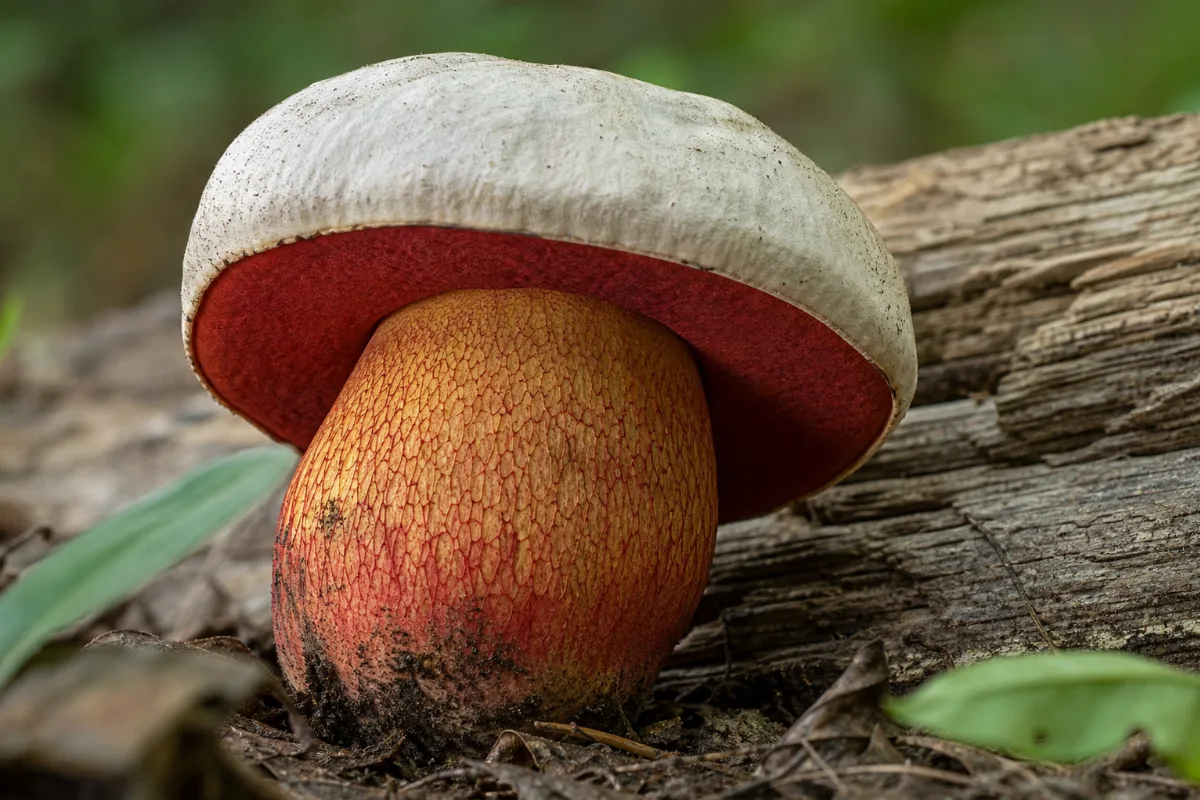
Mushrooms · Poisonous mushroom
Devil's bolete
Rubroboletus satanas · also called Satan's bolete (the German, French and Italian names all mean devil or Satan); older name Boletus satanas
The devil's bolete is a poisonous wild mushroom. Medical papers list it as a cause of stomach and bowel poisoning, and animal studies show its main toxin affects the blood and liver. How bad it is for one person cannot be predicted, and no safe amount is known. No study shows any health benefit. If someone has eaten it, call a poison centre.
General information, not medical advice. Last substantive update · Not medically reviewed. A named clinician has not signed off on this page. How this page is made
About Devil's bolete
The devil's bolete (Rubroboletus satanas) is a poisonous wild mushroom. Medical papers list it as a cause of stomach and bowel poisoning, and a Swiss hospital recorded 3 cases over 17 years. In animals, its main toxin, a protein called bolesatine, caused liver clots and clumped blood cells. No safe amount is known and no study shows a benefit. If someone has eaten it, call a poison centre.
What the poisoning looks like in reports
Human records are few. A Swiss emergency department saw 51 mushroom-poisoning cases from 2001 to 2017. Stomach or bowel symptoms were reported in 86%, there were no deaths and 80% went home within 24 hours. Boletus satanas was named among the poisonous mushrooms, with 3 cases. The abstract gives no separate details for those 3.
A 2019 review of poisoning syndromes places the devil's bolete in a separate group called hyperprocalcitoninemia mushroom poisoning. The abstract gives no detail, and we could not find the original report, so we cannot say what this involves in people.
What is known about the poison
The main toxin found is bolesatine, a protein of about 63,000 daltons that acts as a lectin. In test tubes and animals it stops cells making proteins, sticks platelets and red blood cells together, and in mice caused clots and blood pooling in the liver. It was found in the gut, kidney and liver of rats after being swallowed, and digestive enzymes did not break it down.
These are laboratory and animal findings on the purified protein. They do not prove that bolesatine is what makes people ill after eating the mushroom, and no study tells us how much of the mushroom is harmful. No source we read describes a way to remove the toxin by cooking, drying or freezing.
Why mix-ups happen, and why this page cannot help you sort them
Poisonings are often a mix-up. This page does not teach identification, on purpose. A photo, a smell, an app or a name is never proof that a wild mushroom is safe: in the Swiss records, the mushroom was identified in only 43% of cases. If a wild mushroom has been eaten and you are unsure what it was, call a poison centre and keep the leftovers. Many countries also have local mycological services.
What research exists
There are no clinical trials. The research is mostly laboratory work from 1989 to 1998 on the purified toxin: it made immune cells and thymus cells multiply at tiny amounts and killed cells at higher amounts. In one mouse model, an injected amount near the lethal range was followed by remission of an induced tumour in some mice. A 2018 French screen found 11 of 28 mushroom extracts (from seven species, including this one) slowed colon cancer cells in dishes. None of this shows a benefit from eating the mushroom.
Names and products
The accepted scientific name is Rubroboletus satanas. Many papers use the older name Boletus satanas. No supplement or food product made from this mushroom was found, and none is recommended here. No metal or pesticide findings for this species were found in the sources we read.
At a glance
Traditional uses history, not proof
- No traditional use as food or medicine is described in the sources we read.
- Medical papers list it as a cause of mushroom poisoning (Kohn 1997; Keller 2018).
- From 1989 to 1998 toxicologists studied its main toxin, a protein called bolesatine, in dishes and animals.
Studied for research
- Eating it as food: harm in poison reports, evidence against
- Immune cells (test tube and rats): very low evidence, laboratory work on a purified toxin
- Cancer cells (test tube and mice): very low evidence, not a treatment
- No clinical trial for any use
Main compounds
- Bolesatine (a toxic protein; the main toxin found in laboratory work)
Common forms
- Wild mushroom, usually eaten by mistake
- No supplement or product based on it was found
Research links: Poison Control (US): get help online or call 1-800-222-1222 · NHS: what to do in poisoning · Mushroom poisoning in Bern, 17 years (abstract) · Mushroom poisoning: a proposed new classification (abstract) · Disposition of bolesatine in rats (abstract) · Aspirin and heparin and bolesatine in mice (abstract) · Research Library · Genes & Biomarkers Library
What it is and its history
- Accepted scientific name
- Rubroboletus satanas
- Naming authority
- (Lenz) Kuan Zhao & Zhu L.Yang
- Synonyms
- Boletus satanas Lenz (the name used in most toxicology papers); Suillellus satanas (Lenz) Blanco-Dios; Suillus satanas (Lenz) Kuntze; Tubiporus satanas (Lenz) Maire; Boletus foetidus Lagger; Boletus marmoreus Roques; Boletus crataegi Smotl.; Rubroboletus satanas f. crataegi
- Common names
- Devil's bolete (English); Satans-Röhrling (German); Bolet Satan (French); Porcino malefico (Italian); Hřib satan (Czech); Satansopp (Norwegian)
- Family or group
- Boletaceae, a family of fungi (this is a mushroom, not a plant). Part concerned: the fruiting body, which is the mushroom.
- Classification
- Fungi > Basidiomycota > Agaricomycetes > Boletales > Boletaceae > Rubroboletus > Rubroboletus satanas
- Native range
- GBIF holds about 4,520 occurrence records (25 October 2026). Records are observations, not a map of native range, and native versus introduced status was not checked.
- Habitat
- Not reviewed.
- What it looks like
- Part used: The fruiting body (the mushroom). This page does not describe how to recognise the mushroom, on purpose; a photo, a smell or a name is never proof that a mushroom is safe.
- Look-alikes and adulterants
- Name: Other boletes; Note: Several species in the same family look alike to non-experts, and some are eaten. Mix-ups are a known cause of poisoning. This is not guidance for telling them apart. In a Swiss hospital series the mushroom was identified in only 43% of cases.
Traditional use and history history, not clinical proof
| Tradition or era | Documented use | Source |
|---|---|---|
| Taxonomy | Described scientifically as Boletus satanas by Lenz. GBIF now accepts it as Rubroboletus satanas, a genus name published in 2014, with Boletus satanas kept as a synonym. Most toxicology papers use the older name. | GBIF |
| Chemistry | From 1989 to 1998 a group of toxicologists published purification and mechanism studies of its main toxin, a glycoprotein they named bolesatine, including its first 20 amino acids (1992) and its action in animals and cells. | Kretz 1991, 1992; Ennamany 1994 to 1998; Gachet 1996 |
| Medical classification | A 1997 Czech review lists it as a cause of stomach-and-bowel poisoning. A 2019 review places it in a hyperprocalcitoninemia syndrome group. | Kohn 1997; White 2019 |
| Traditional use | No traditional food or medicine use is described in the sources we read. | n/a |
Traditional use shows how it was used. It does not show that it works or is safe today.
What is inside, and how it may work
What it contains and how those compounds act in cells and animals. Laboratory and animal mechanisms are not proven effects in people.
Main compounds
| Compound | Family | Where it is concentrated | Activity studied | Level of evidence |
|---|---|---|---|---|
| Bolesatine | lectin (glycoprotein) | Isolated from the mushroom; which part holds most was not found | Single-chain glycoprotein of about 63,000 daltons that binds galactose. Blocks protein making, breaks down GTP and ATP, clumps platelets and red blood cells, and causes liver clots in mice. At very low amounts it makes cells multiply in dishes. It is not a ribosome-inactivating protein. No PubChem compound record, because it is a protein. 11 13 5 7 6 | Laboratory research |
Mechanisms, receptors and pathways
| Target or pathway | Gene or receptor | What was found | Level |
|---|---|---|---|
| Protein making | n/a | Bolesatine inhibits protein making in cells, kidney cells, mouse liver and kidney, and rat mitochondria. It does not damage ribosomes the way plant ribosome-inactivating proteins do. It breaks down GTP (80% to 90%) and ATP (10% to 40%) in a test tube, which the authors say probably explains the effect (test-tube and mouse work). 5 12 13 11 | Laboratory research |
| Blood cells and clotting | n/a | In dishes the protein clumps human and rat platelets and human red blood cells. In mice it caused clots and blood pooling in the liver, partly reversed by aspirin, ticlopidine and heparin at low amounts (animal work). 7 6 | Animal research |
| Cell growth signals | protein kinase C | At very low amounts it switched on protein kinase C and made some cells multiply, and released interleukin-1 alpha and interleukin-2 from blood cells (test-tube and rat work). 3 4 14 2 | Animal research |
Absorption, metabolism and elimination
- Absorption
- In rats, labelled bolesatine given by mouth was found in the gut, kidney, liver, and to a lesser extent the thymus, spleen and lung. Not studied in people.
- Distribution
- In rats it was found in liver and kidney cell fractions: cytoplasm, mitochondria, ribosomes, microsomes and nuclei.
- Metabolism
- Digestive and other proteases tested did not break it down in its native or denatured form (one fragment was made from the denatured form by thermolysin).
- Elimination
- About 80% was eliminated in faeces and urine within 24 hours in rats.
- Bioavailability
- Not established in people.
Isolated compounds versus whole extracts
Almost all the laboratory work used the purified protein, not the whole mushroom. The whole mushroom is what people eat, and it may contain other substances. Nothing found about the purified toxin can be assumed for the mushroom, or the reverse.
Nutritional composition
The devil's bolete is not a food or nutrient. It is poisonous.
2 very low certainty1 evidence against
What was looked at
The 3 benefits and uses checked for Devil's bolete, each with how strong the evidence is. Tap one to open it.
What is Devil's bolete good for?
The uses people ask about and how strong the evidence is for each. None is shown to help. Read every row together with the Safety tab: this is a poisonous mushroom.
Benefits, one by one
Each card is a research question, not a promise. Tap a goal to filter. Open a card to see the studies, doses and limits.
Eating it as a food
Evidence againstThe devil's bolete is not a food. Medical papers list it as a cause of stomach and bowel poisoning, and laboratory work shows its main toxin damages cells and affects blood and organs in animals. There is no sign of any benefit.
5 studiesNot covered. This page gives no amounts, no preparation and no ways o…
Studies, doses and limits
What the trials found
Hospital records and reviews. In a Swiss emergency department over 17 years, 3 of 51 mushroom-poisoning cases involved Boletus satanas. A Czech review lists it among species that cause the stomach-and-bowel type of poisoning. A 2019 classification review puts it in a separate 'hyperprocalcitoninemia' syndrome group, but gives no detail in the abstract.
Results
Not a benefit. Stomach and bowel illness is the poisoning described in reports. Severity cannot be judged from the few records: the Swiss series as a whole had no deaths and mostly minor severity, while toxicology papers call it a cause of 'serious gastroenteritis'.
Why this rating
Case series, reviews and toxicology papers consistently show harm. They cannot show that any amount is safe, and a given mushroom's strength cannot be judged in advance.
Form and dose studied
Not covered. This page gives no amounts, no preparation and no ways of using the mushroom.
Who was studied
Adults and children who ate wild mushrooms by mistake. Nothing specific to this species by age or health status was found.
Limits
Only abstracts were read. The Swiss paper gives only 3 cases for this species with no separate details. The 2019 syndrome and the 1997 Czech review give no case numbers.
Why researchers looked
Hospitals and poison centres record it as a poisonous mushroom, and toxicologists studied its main toxin, a protein called bolesatine.
Traditional use
No traditional food or medicine use is described in the sources we read.
Proposed mechanism Laboratory research
The main toxin found is a protein called bolesatine (a lectin, 63,000 daltons). In test-tube and animal work it blocks the making of proteins in cells, sticks blood cells and platelets together, and in mice causes clots and blood pooling in the liver. How much of this happens in people who eat the mushroom is not known.
A proposed mechanism does not show that the effect happens in people.
This is a poisonous mushroom. Eating it can cause stomach and bowel illness, and animal studies show its main toxin affects the blood and organs. See the Safety tab first. If someone has eaten it, call a poison centre.
Laboratory work on its toxin and immune cells
Very low certaintyAt very tiny amounts the toxin made immune cells (lymphocytes) and thymus cells multiply in dishes and in rats. At higher amounts it is a poison. This is old laboratory work on a purified protein. It does not mean the mushroom helps the immune system.
4 studiesNot covered.
Studies, doses and limits
Results
Human T cells multiplied in dishes and released interleukin-1 alpha and interleukin-2. Rat thymus weight rose by 10% to 54% after the toxin was given by mouth in rats, and DNA synthesis in the thymus rose by more than 50% in one experiment.
Effect sizes as reported
Rat thymus weight +10% and +28% in two groups; +47% to 54% in a second run. Vero cell DNA synthesis +27% to +59%.
Why this rating
Test-tube and rat work from 1993 to 1995 with a purified toxin. No human or whole-mushroom data. The same protein is poisonous at higher amounts.
Form and dose studied
Not covered.
Limits
Only abstracts were read. Old studies from one research group. A mitogenic effect is not a benefit and may be harmful.
Why researchers looked
Toxicologists asked why a poison could also make cells multiply at very low amounts.
Proposed mechanism Laboratory research
Bolesatine is a lectin. At very low amounts it switched on protein kinase C and made cells divide (test-tube and rat work). At higher amounts it caused lipid damage and cell death in Vero cells (test-tube work).
A proposed mechanism does not show that the effect happens in people.
This is a poisonous mushroom. Eating it can cause stomach and bowel illness, and animal studies show its main toxin affects the blood and organs. See the Safety tab first. If someone has eaten it, call a poison centre.
Laboratory and mouse work on cancer cells
Very low certaintyIn test tubes, some extracts of the mushroom and its toxin slowed the growth of cancer cells. In one mouse experiment an injected dose of the purified toxin, close to a lethal amount, was followed by remission in some mice. This is early lab work. It is not a treatment and says nothing about eating the mushroom.
2 studiesNot covered.
Studies, doses and limits
Results
In mice with an induced abdominal tumour, remission was seen in 50% and 30% with two injected amounts and treated mice lived 90 days longer than controls. Of 28 extracts from seven wild mushrooms (including this one), 11 slowed growth of colon cancer cells in dishes; which extracts is not stated in the abstract.
Effect sizes as reported
Remission 50% and 30% in mice; survival to 120 days against 30 days for controls (as calculated from the abstract).
Why this rating
One 1995 mouse model and one test-tube screen. No human data. The toxin is lethal at close to the amounts used.
Form and dose studied
Not covered.
Limits
Only abstracts were read. The 2018 screen does not say which of the 28 extracts came from the devil's bolete.
Why researchers looked
Researchers screen natural poisons and extracts for anti-cancer activity.
Proposed mechanism Laboratory research
Bolesatine blocks protein making in cells, which can also stop tumour cells growing (test-tube and mouse work). Extract activity was not linked to antioxidant power, and the active compounds were not identified.
A proposed mechanism does not show that the effect happens in people.
This is a poisonous mushroom. Eating it can cause stomach and bowel illness, and animal studies show its main toxin affects the blood and organs. See the Safety tab first. If someone has eaten it, call a poison centre.
Connections to the rest of health
How Devil's bolete connects to the rest of our health knowledge graph. Every link says what kind of connection it is. A safety link (for example to the liver) is a warning, not a benefit. A study that merely mentions a topic never creates a benefit link.
Explore every connection: goals, body systems, organs, symptoms, genes
B. Body systems
| Connected to | Kind of connection | Evidence status | Context | Studies |
|---|---|---|---|---|
| Digestive system | Adverse effect or risk | Low certainty | Stomach and bowel illness is the poisoning type listed in a Swiss hospital series, a Czech review and toxicology papers. Preparation or compound: Mushroom (toxin bolesatine suspected) |
8 9 2 |
| Digestive System | Biological association | Evidence against | Studied for: Eating it as a food | 8 9 16 10 2 |
| Immune System | Biological association | Very low certainty | Studied for: Laboratory work on its toxin and immune cells | 14 2 3 4 |
C. Body parts and organs
| Connected to | Kind of connection | Evidence status | Context | Studies |
|---|---|---|---|---|
| Gut | Adverse effect or risk | Low certainty | The poisoning is described as gastroenteritis. Preparation or compound: Mushroom |
8 10 |
| Liver | Adverse effect or risk | Very low certainty | Clots and blood pooling in the liver in mice given the toxin by injection; not shown in people. Preparation or compound: Purified toxin (bolesatine) |
6 |
E. Health conditions
| Connected to | Kind of connection | Evidence status | Context | Studies |
|---|---|---|---|---|
| Mushroom poisoning | Adverse effect or risk | Moderate certainty | Listed as a poisonous species in hospital records and reviews. Preparation or compound: Mushroom |
8 9 16 |
| Vomiting | Adverse effect or risk | Low certainty | Part of the gastroenteritis described in reports; counts for this species were not found. Preparation or compound: Mushroom |
8 |
L. Active compounds
| Connected to | Kind of connection | Evidence status | Context | Studies |
|---|---|---|---|---|
| Bolesatine | Biological association | In vitro | Single-chain glycoprotein of about 63,000 daltons that binds galactose. Blocks protein making, breaks down GTP and ATP, clumps platelets and red blood cells, and causes liver clots in mice. At very low amounts it makes cells multiply in dishes. It is not a ribosome-inactivating protein. No PubChem compound record, because it is a protein. Preparation or compound: Isolated from the mushroom; which part holds most was not found |
11 13 5 7 6 |
Each connection is stored with the ingredient, the connected record, the kind of connection, the evidence status, the supporting studies, the preparation or compound involved, and a review date (last reviewed October 25, 2026).
Evidence at a glance: what the research found for 3 outcomes
Each outcome below is one thing researchers measured. Certainty is how far the evidence can be trusted, not how well it works. The full studies are on the next tab.
The evidence
The research centre for Devil's bolete. Every record here was checked against PubMed or the publisher's page; we never list a study we have not verified.
Evidence by outcome
Bars show how many studies we found for each outcome, not how well it works. People are added up across trials only (reviews are not added, to avoid double counting).
How we rate evidence
High certainty
Several well-run trials or reviews agree; further research is unlikely to change the picture much.
Moderate certainty
Good trials point the same way, but some doubt remains.
Low certainty
Small, short or inconsistent trials. The finding could change with better research.
Very low certainty
Very little or very weak human data. Treat as a possibility only.
Mixed findings
Trials or reviews disagree with each other.
Not enough evidence
Not enough human research to say either way.
Evidence against
Good research found no benefit, or found harm.
We take the reviewers' own risk-of-bias and GRADE statements where they exist, and otherwise judge from study size, design, consistency, directness and whether a product matches what is sold. Many publications do not make evidence high. Method note: We read PubMed records and abstracts for 16 papers, read the NHS, Poison Control and NSW poisons pages, and checked the scientific name in GBIF. Where a statement could not be checked, it is marked as unverified in our notes.
Study library: every study we checked 20
| Study | Design | People | Product, dose, length | Result |
|---|---|---|---|---|
| Basset 1995 Effects of bolesatine on a cell line from the SP2/O thymic lymphosarcoma. Toxicology · PMID 8545844 · DOI |
Animal research animal |
Mice with an induced abdominal tumour (ascites) and a mouse thymic lymphosarcoma cell line | Bolesatine, a toxic protein from Boletus satanas purified toxin |
Bolesatine stopped protein synthesis in the tumour cell line. In mice with the induced tumour, one injection at a fraction of the lethal amount gave remission in 50% and 30% of mice (two amounts), and treated mice lived 120 days, 90 days longer than control animals. Methods, limits and fundingOutcomes: Cell growth in dishes; remission and survival in mice Limitations: A single 1995 mouse model with an injected purified toxin, near the lethal range. It is not a treatment and says nothing about eating the mushroom. No human data. Funding and conflicts: Not stated in the abstract. Read: abstract |
| Ennamany 1994 Effect of bolesatine, a glycoprotein from Boletus satanas, on rat thymus in vivo. Toxicology · PMID 8197588 · DOI |
Animal research animal |
Rats given bolesatine by mouth (laboratory study) | Bolesatine, a glycoprotein from Boletus satanas purified toxin |
The abstract calls Boletus satanas 'a toxic mushroom which causes serious gastroenteritis'. In rats given bolesatine by mouth, the thymus grew heavier (10% and 28% in two groups, and 47% to 54% in a second run at lower amounts) and thymus DNA synthesis rose by more than 50%. The authors conclude it stimulates thymus cell growth in rats. Methods, limits and fundingOutcomes: Thymus weight and DNA synthesis in the thymus Limitations: Animal study. The thymus finding was not tested in people. The description of serious gastroenteritis in people is stated in the abstract without data. Funding and conflicts: Not stated in the abstract. Read: abstract |
| Ennamany 1995 Effect of bolesatine on phospholipid/calcium dependent protein kinase in Vero cells and in rat thymus. Arch Toxicol · PMID 8660140 · DOI |
Animal research animal |
Cell-free system, Vero (monkey kidney) cells and rat thymus | Bolesatine, a glycoprotein from Boletus satanas purified toxin |
At very low amounts bolesatine switched on protein kinase C directly. Vero cell DNA synthesis rose by 27%, 48% and 59% at three low concentrations. In rats given it by mouth, protein kinase C activity in the thymus rose. Methods, limits and fundingOutcomes: Activation of protein kinase C and cell growth Limitations: Lab and animal work with a purified protein. The authors also say higher amounts inhibit protein synthesis, which is the toxic effect. Not tested in people. Funding and conflicts: Not stated in the abstract. Read: abstract |
| Ennamany 1995 Lipid peroxidation induced by bolesatine, a toxin of Boletus satanas: implication in m5dC variation in Vero cells related to inhibition of cell growth. Cell Biol Toxicol · PMID 8788210 · DOI |
Laboratory in-vitro |
Vero (monkey kidney) cells in dishes | Bolesatine, a glycoprotein from Boletus satanas purified toxin |
Low concentrations made Vero cells multiply. Higher concentrations (above 20 ng/ml) raised a marker of fat damage (malonaldehyde) and the authors link this to cell death. Methods, limits and fundingOutcomes: Cell growth, lipid damage and DNA methylation Limitations: Test-tube work on one cell line. Shows a two-way effect (growth at tiny amounts, harm at higher amounts) but says nothing about eating the mushroom. Funding and conflicts: Not stated in the abstract. Read: abstract |
| Ennamany 1995 Mode of action of bolesatine, a cytotoxic glycoprotein from Boletus satanas Lenz. Mechanistic approaches. Toxicology · PMID 7624882 · DOI |
Laboratory in-vitro |
Rat liver ribosomes and protein-making systems in dishes | Bolesatine, a cytotoxic glycoprotein from Boletus satanas purified toxin |
Ribosomes treated with bolesatine stayed active. Bolesatine broke down the energy molecules GTP (80% to 90% at two amounts) and ATP (10% to 40%), and the authors conclude it is better classed as a nucleoside triphosphate phosphatase than as a direct protein-synthesis inhibitor. Methods, limits and fundingOutcomes: How the protein stops protein making Limitations: Test-tube work. How this works in a person who ate the mushroom is not known. Funding and conflicts: Not stated in the abstract. Read: abstract |
| Ennamany 1998 Aspirin and heparin prevent hepatic blood stasis and thrombosis induced by the toxic glycoprotein Bolesatine in mice. Hum Exp Toxicol · PMID 9865419 · DOI |
Animal research animal |
Mice given bolesatine by injection (laboratory study) | Bolesatine, a toxic glycoprotein from Boletus satanas purified toxin |
In mice, bolesatine caused clots (thrombi) and blood pooling in the liver 5 to 21 hours after injection, and changed blood cell counts. Aspirin, ticlopidine and heparin reversed these effects at low amounts of toxin, but did not prevent death at lethal amounts. The authors suggest the deaths at high amounts came from clotting combined with other toxic effects, and that blood-thinning drugs may help in human poisonings with low exposure. That last point is their suggestion; it was not tested in people. Methods, limits and fundingOutcomes: Blood clots and blood pooling in the liver; effect of aspirin, ticlopidine and heparin Limitations: Mouse study using injection of the purified toxin, not eating the mushroom. The effect in people was not studied. Nothing here is treatment advice: any treatment is for poison staff and doctors to decide. Funding and conflicts: Not stated in the abstract. Read: abstract |
| Gachet 1996 Bolesatine induces agglutination of rat platelets and human erythrocytes and platelets in vitro. Hum Exp Toxicol · PMID 8845205 · DOI |
Laboratory in-vitro |
Rat and human platelets and red blood cells in dishes | Bolesatine, a toxic glycoprotein from Boletus satanas purified toxin |
Bolesatine made human and rat platelets clump together from low thresholds (30 and 300 nM) and clumped all human red blood cells tested, with no blood-group preference. The authors say the clumping of platelets does not involve platelet activation. Methods, limits and fundingOutcomes: Clumping (agglutination) of blood cells Limitations: Test-tube work with the purified protein. It shows what the protein can do to blood cells in a dish, not what happens after eating the mushroom. Funding and conflicts: Not stated in the abstract. Read: abstract |
| Keller 2018 Mushroom Poisoning-A 17 Year Retrospective Study at a Level I University Emergency Department in Switzerland. Int J Environ Res Public Health · PMID 30558129 · DOI |
Case series |
51 51 mushroom-poisoning presentations at a Level I university emergency department in Bern, Switzerland, January 2001 to October 2017 |
Wild mushrooms eaten (many species) fruiting body |
Gastrointestinal disturbances were reported in 86% of the 51 cases. Among the poisonous mushrooms identified were Boletus satanas (3 cases), Amanita phalloides (3), Amanita muscaria (2) and Amanita pantherina (2). There were no deaths and 80% of patients went home within 24 hours. The authors say most presentations were of minor severity and related to edible species, for example from incorrect processing, but that poisonous mushrooms and severe complications were also recorded. Methods, limits and fundingOutcomes: Symptoms, mushroom identified, outcome, hospital stay Limitations: One hospital in one country. The abstract does not give symptoms, delay or outcome for the 3 devil's bolete cases alone, so their severity cannot be read from it. Mushroom type was identified in only 43% of cases. Funding and conflicts: Not stated in the abstract. Read: abstract |
| Kohn 1997 [Mushroom poisoning--classification, symptoms and therapy]. Vnitr Lek · PMID 9601842 |
Review |
A Czech-language review of mushroom poisoning (classification, symptoms and treatment) | Poisonous mushrooms (many species) fruiting body |
The abstract says the gastroenteric (stomach and bowel) type of mushroom poisoning is the most frequent and is caused by many species, for example Boletus satanas and Entoloma sinuatum. Methods, limits and fundingOutcomes: How mushroom poisonings are grouped, and how they are treated Limitations: Short abstract of a 1997 narrative review in Czech. No numbers for this species. Only the English abstract was read. Funding and conflicts: Not stated in the abstract. Read: abstract |
| Kretz 1991 Disposition of the toxic protein, bolesatine, in rats: its resistance to proteolytic enzymes. Xenobiotica · PMID 2003368 · DOI |
Animal research animal |
Rats and mice given the toxic protein bolesatine (laboratory study) | Bolesatine, a toxic protein purified from Boletus satanas purified toxin |
The abstract says bolesatine induces gastroenteritis in humans. Given by mouth to rats, labelled bolesatine was found in the gut, kidney and liver, and to a lesser extent in the thymus, spleen and lung. About 80% was eliminated in faeces and urine within 24 hours. The material in urine was not broken down, and none of six digestive and other proteases tested hydrolysed it in its native or denatured form (a fragment was made from the denatured form by thermolysin only). Methods, limits and fundingOutcomes: Where the toxin goes in the body and whether digestive enzymes break it down Limitations: Animal study from 1991 using the purified protein, not the whole mushroom. Applies to rats, not to people. The statement about gastroenteritis in humans is given in the abstract without a citation. Funding and conflicts: Not stated in the abstract. Read: abstract |
| Kretz 1991 Characterization of bolesatine, a toxic protein from the mushroom Boletus satanas Lenz and it's effects on kidney cells. Toxicology · PMID 1707561 · DOI |
Laboratory in-vitro |
MDCK (dog kidney) cells in dishes | Bolesatine, a toxic glycoprotein from Boletus satanas purified toxin |
Bolesatine blocked protein and DNA making in kidney cells in a dose-dependent way (half-maximal at 0.14 and 0.32 microM). Adding galactose to the dish reduced or abolished the toxic effect, which the authors take to mean galactose stops the toxin binding to the cell surface. Methods, limits and fundingOutcomes: Protein and DNA making in kidney cells; role of galactose Limitations: Cell-culture work. The galactose finding is a lab observation and is not advice to take anything. Funding and conflicts: Not stated in the abstract. Read: abstract |
| Kretz 1992 Inhibition of protein synthesis in liver and kidney of mice by bolesatine: mechanistic approaches to the mode of action at the molecular level. Toxicology · PMID 1631906 · DOI |
Animal research animal |
Mice (Swiss) treated with bolesatine; liver and kidney tissue | Bolesatine, a toxic glycoprotein from Boletus satanas purified toxin |
Protein making in mouse liver and kidney was blocked in a dose-dependent way. Bolesatine did not behave like the plant toxins called ribosome-inactivating proteins. Methods, limits and fundingOutcomes: Protein making in liver and kidney Limitations: Mouse study of the purified toxin. Not tested in people. Funding and conflicts: Not stated in the abstract. Read: abstract |
| Kretz 1992 Properties of bolesatine, a translational inhibitor from Boletus satanas Lenz. Amino-terminal sequence determination and inhibition of rat mitochondrial protein synthesis. Toxicol Lett · PMID 1471233 · DOI |
Laboratory in-vitro |
Purified protein and isolated rat liver mitochondria | Bolesatine, a toxic glycoprotein from Boletus satanas purified toxin |
Bolesatine is a single-chain glycoprotein of about 63,000 daltons. Its first 20 amino acids were sequenced. It inhibited protein making in isolated rat mitochondria, with a half-maximal concentration of 530 nM after 90 minutes. Methods, limits and fundingOutcomes: Protein structure; effect on protein making inside mitochondria Limitations: Test-tube work from 1992. Funding and conflicts: Not stated in the abstract. Read: abstract |
| Licastro 1993 Mitogenic activity and immunological properties of bolesatine, a lectin isolated from the mushroom Boletus satanas Lenz. Int J Biochem · PMID 8349019 · DOI |
Laboratory in-vitro |
Human white blood cells (T lymphocytes) in dishes | Bolesatine, a lectin purified from Boletus satanas purified toxin |
The protein was mitogenic (it made human T cells multiply) in a dose- and time-dependent way. At the best amounts it triggered release of interleukin-1 alpha and interleukin-2 from cultured blood cells. Methods, limits and fundingOutcomes: Whether the protein makes T cells multiply, and which immune messengers are released Limitations: Very short abstract. Test-tube work with the purified protein. No animal or human treatment. Funding and conflicts: Not stated in the abstract. Read: abstract |
| Morel 2018 Antiproliferative and Antioxidant Activities of Wild Boletales Mushrooms from France. Int J Med Mushrooms · PMID 29604910 · DOI |
Laboratory in-vitro |
Extracts of seven wild Boletales mushrooms from France, including Rubroboletus satanas, tested on a human colon cancer cell line | Cyclohexane, chloroform, ethanol and water extracts of the mushrooms fruiting body |
Of 28 extracts from seven mushrooms, 11 slowed the growth of HCT116 colon cancer cells. The abstract does not say which mushrooms they were. The authors say activity was not linked to antioxidant power and that further studies are needed to find the active compounds. Methods, limits and fundingOutcomes: Effect on HCT116 colon cancer cells; antioxidant tests Limitations: Test-tube work. The abstract does not say which of the 28 extracts came from the devil's bolete or what they did. Not a basis for any use. Funding and conflicts: Not stated in the abstract. Read: abstract |
| White 2019 Mushroom poisoning: A proposed new clinical classification. Toxicon · PMID 30439442 · DOI |
Review |
A literature review that proposes a new clinical classification of mushroom poisoning | Poisonous mushrooms (many species) fruiting body |
The authors propose six groups of mushroom poisoning. Group 4 (metabolic, endocrine and related) includes subgroup 4F, 'hyperprocalcitoninemia mushroom poisoning', attributed to Boletus satanas. Group 5 is mushrooms that cause stomach and bowel effects without other clinically significant effects. The abstract does not describe the 4F syndrome in detail. Methods, limits and fundingOutcomes: Groups of poisoning syndromes Limitations: The abstract gives no details of the devil's bolete syndrome and no case numbers. We looked for the original report of this syndrome in PubMed and did not find it, so it is NOT verified here. Funding and conflicts: Not stated in the abstract. Read: abstract |
| n/a 2026 Poison Control (National Capital Poison Center): home page and call advice n/a · Source |
Authoritative guidance n/a |
n/a | n/a |
The home page gives the poison help number 1-800-222-1222 (free, expert and confidential) and says to call 911 if the person collapses, has a seizure, has trouble breathing or cannot be awakened. Read 25 October 2026. Methods, limits and fundingOutcomes: What to do in a suspected poisoning in the US Limitations: A public page. Read: full-text |
| n/a 2026 NHS (UK): Poisoning n/a · Source |
Authoritative guidance n/a |
n/a | n/a |
The page says to call 999 or go to A&E if someone may have swallowed something harmful, has lost consciousness, has stopped breathing, has severe breathing difficulty or has a seizure, and to call NHS 111 if you are not sure whether something swallowed is harmful. It advises taking the substance or its packaging to show doctors, and not trying to make the person sick or giving food or drink. Read 25 October 2026. Methods, limits and fundingOutcomes: What to do in suspected poisoning in the UK Limitations: A public page. Read: full-text |
| n/a 2026 NSW Poisons Information Centre (Australia): home page n/a · Source |
Authoritative guidance n/a |
n/a | n/a |
The home page says the NSW Poisons Information Centre can be called 24/7 on 13 11 26 and to call Triple Zero (000) for an ambulance if someone is unconscious. Read 25 October 2026. Methods, limits and fundingOutcomes: What to do in a suspected poisoning in Australia Limitations: A public page. Read: full-text |
| n/a 2026 GBIF Backbone Taxonomy: Rubroboletus satanas (Lenz) Kuan Zhao & Zhu L.Yang n/a · Source |
Registry or database n/a |
n/a | n/a |
GBIF species key 7722553 is ACCEPTED, family Boletaceae, order Boletales, class Agaricomycetes, published in Phytotaxa 188(2): 70 (2014). The record lists 16 synonyms, including Boletus satanas Lenz, Suillus satanas, Tubiporus satanas and Suillellus satanas, and common names in many languages including Devil's Bolete (English), Satans-Roehrling (German), Bolet Satan (French) and Porcino malefico (Italian). About 4,520 occurrence records (25 October 2026). Read through the GBIF API on 25 October 2026. Methods, limits and fundingOutcomes: Accepted name, synonyms, family, common names Limitations: Records are observations, not a map of where the mushroom is native. Read: full-text |
What we do not know yet
- No clinical trial of the devil's bolete for any use, and no study of safe amounts.
- No case series devoted to this species; the only human counts are 3 cases in one Swiss hospital.
- Whether the toxin found in the laboratory causes the illness in people who eat the mushroom was not shown.
- No study of what cooking, drying or freezing does to the toxin.
- No studies in pregnancy, breastfeeding, children, older adults, pets or people on medicines.
How new research is added
New studies are found by a saved PubMed search and are placed in a review queue. A person reads each one before it changes this page.
Lab markers
What changed in blood or saliva tests during trials. A changed number is not the same as feeling or being healthier, and we give no "normal ranges".
Safety
What studies and official sources say about side effects, medicines and who should check first. Each point shows what kind of evidence it comes from.
Main points to know 5
- If someone has eaten it, call a poison centre now. Do not wait to see whether symptoms start. In the US call Poison Help at 1-800-222-1222 (free and confidential), or 911 if the person collapses, has a seizure, has trouble breathing or cannot be awakened. In the UK call NHS 111 if you are unsure and 999 in an emergency. In Australia the Poisons Information Centre line is 13 11 26, and Triple Zero (000) if someone is unconscious or not breathing. Do not try to make the person sick and do not give food or drink unless the poison service says so. Keep the mushroom, a photo or the leftovers to show staff. Authoritative guidance 17 18 19
- It is a poisonous mushroom that causes stomach and bowel illness. Medical papers list the devil's bolete among the mushrooms that cause stomach and bowel poisoning. A Swiss hospital recorded 3 cases over 17 years, among 51 poisonings of which 86% had stomach or bowel symptoms and none died. A toxicology paper calls it a cause of 'serious gastroenteritis' without giving numbers. How bad it is for any one person cannot be predicted. Case series 8 9 2 10
- Its main toxin is a protein that is hard to break down. The toxin bolesatine blocks protein making in cells. In rats, a labelled copy given by mouth reached the gut, kidney and liver, and digestive enzymes did not break it down. In mice, injected toxin caused clots and blood pooling in the liver. These are animal and test-tube findings. What they mean for a person who ate the mushroom is not known. Animal research 10 12 6
- No safe amount or safe way to prepare it is known. No source we read describes a safe amount or a way to remove the toxin by cooking, drying or freezing. Do not try to make it safe. None 10
- A photo, a name or an app is never proof that a wild mushroom is safe. In the Swiss records the mushroom type was identified in only 43% of cases. This page does not teach identification, on purpose. If a wild mushroom has been eaten and you are unsure what it was, call a poison centre and keep the leftovers. Case series 8
Side effects 2
| Effect | How often | Severity and recovery | Evidence |
|---|---|---|---|
| Stomach and bowel illness (gastroenteritis) Toxicology papers describe it as 'serious gastroenteritis'; the Swiss series described most presentations as minor. The two cannot be combined into one picture for this species. | 86% of 51 Swiss mushroom-poisoning cases (all species) had stomach or bowel symptoms; the number for the 3 devil's bolete cases is not given | moderate In the Swiss series 80% of all patients went home within 24 hours. Not given for this species alone. | Case series 8 9 2 10 |
| Possible effects on blood and organs (seen only in animals and test tubes) In mice, the toxin caused clots and blood pooling in the liver. In dishes it clumped human platelets and red blood cells. It blocked protein making in mouse liver and kidney. A 2019 classification review also lists a devil's bolete syndrome called hyperprocalcitoninemia, with no detail in its abstract. | Not known in people | unknown Not described in people | Animal research 6 7 12 |
Liver
No human liver injury from the devil's bolete was found in the sources we read. In mice the toxin caused clots and blood pooling in the liver and blocked protein making in liver and kidney. In rats it reached the liver and kidney after being swallowed. This is not an all-clear for people: nobody has studied it. 6 12 10
How often. Not studied in people. Animal findings only.
This is a safety connection. It is not evidence that Devil's bolete supports liver health.
Medicines and supplements 3
| With | Why it matters | Importance | Evidence | What to do |
|---|---|---|---|---|
| Blood-thinning medicines (such as aspirin, heparin, ticlopidine, warfarin) prescription and non-prescription | In mice, aspirin, ticlopidine and heparin reversed the clots and blood pooling caused by injected bolesatine at low amounts, but did not prevent death at lethal amounts. | Unknown in people. This is a mouse study of injected purified toxin. It is not advice to take any medicine after eating the mushroom. | Animal research Not enough evidence 6 | Tell the poison centre or emergency team about every medicine taken, especially blood thinners. They decide what is needed. |
| Medicines taken by mouth (tablets, capsules, contraceptive pills and others) prescription and non-prescription | Vomiting and diarrhoea may stop tablets staying down or being absorbed. This is a general effect of gut illness, not something measured for this mushroom. | Not studied. | Pharmacological theory Not enough evidence | Ask a doctor or pharmacist what to do about missed doses. |
| Alcohol substance | No interaction was described in the sources we read. | Unknown. Alcohol also irritates the gut. | None Not enough evidence | Tell the poison centre if alcohol was taken too. |
Who should check first 5
| Situation | Advice | Evidence |
|---|---|---|
| Anyone | It is a poisonous mushroom with no known benefit. Do not eat it, and do not prepare, cook, dry or freeze it in the hope of making it safe. No source we read describes a way to remove the toxin. | Case series 8 9 10 |
| Children | No data on this species in children were found. Call a poison centre at once if a child has put a wild mushroom in the mouth. | None |
| Pregnancy and breastfeeding | No data were found. Avoid it, and call a poison centre or doctor if it was eaten. | None |
| People with liver, kidney or blood-clotting problems, or taking blood thinners | No human data were found. In animals the toxin reached the liver and kidney and caused clotting changes, so tell the poison centre or doctor about these conditions if it was eaten. | Animal research 10 6 |
| Pets | No pet data were found in the sources we read. If a pet has eaten a wild mushroom, call a vet or an animal poison service. | None |
Overdose, product quality and regulators
Summary. The main toxin identified is bolesatine, a glycoprotein of about 63,000 daltons that works as a lectin. In test tubes and animals it blocks protein making, breaks down GTP and ATP, clumps platelets and red blood cells, and in mice causes clots and blood pooling in the liver.
Amounts. No safe amount has been established in any source we read. Animal toxicity figures exist in the abstracts but are not shown here, because they cannot be turned into an amount for a person.
Onset and course. No timing for people is given in the sources we read. In rats about 80% of a swallowed labelled dose left in faeces and urine within 24 hours.
Repeated use. No data on repeated or long-term eating were found.
Animal data. Bolesatine given by mouth to rats made thymus tissue grow. In mice it caused liver clots, and a single injection near the lethal range was followed by remission in some mice with an induced tumour. These are not safe or useful in people.
Toxic parts. Not studied. Treat the whole mushroom as poisonous.
Not read. Blood or urine levels in people, what cooking, drying or freezing does to the toxin, other toxins in the mushroom, and the original report behind the 'hyperprocalcitoninemia' syndrome were not found in the sources we read.
No supplement, extract or food product made from the devil's bolete was found. No metal or pesticide findings for this species were found in the sources we read.
Mix-ups with other wild mushrooms. Hospital records show the mushroom type was identified in only 43% of Swiss poisoning cases, so what was actually eaten is often not known. 8
| Body | Action | Date |
|---|---|---|
| Poison Control, National Capital Poison Center (United States) | Public poison guidance, not a rule about this mushroom: call 1-800-222-1222 (free, expert, confidential), and 911 if the person collapses, has a seizure, has trouble breathing or cannot be awakened. source | 2026-10-25 |
| NHS (United Kingdom) | Public guidance, not a rule about this mushroom: call 999 or go to A&E if someone may have swallowed something harmful, is unconscious, not breathing, has severe breathing difficulty or a seizure; call NHS 111 if unsure. source | 2026-10-25 |
| NSW Poisons Information Centre (Australia) | Public guidance, not a rule about this mushroom: call 13 11 26 (24/7), and Triple Zero (000) if someone is unconscious. source | 2026-10-25 |
When to get medical help
- If someone may have eaten this mushroom, or a wild mushroom that might be this one, call a poison centre right away, even if they seem fine. In the US call Poison Help at 1-800-222-1222 (free and confidential), or 911 if the person collapses, has a seizure, has trouble breathing or cannot be awakened. In the UK call NHS 111 if you are unsure and 999 in an emergency. In Australia the Poisons Information Centre line is 13 11 26, and Triple Zero (000) if someone is unconscious or not breathing.
- Go to hospital or call emergency services for repeated vomiting that will not stop, signs of dehydration (very dry mouth, no urine, dizziness when standing), confusion, fainting, a seizure, trouble breathing, severe belly pain, or unusual bruising or bleeding.
- Also seek care if stomach symptoms start 6 or more hours after a wild-mushroom meal, if they seem to improve and then return, or if several people ate the same meal. Some other wild mushrooms cause late and life-threatening illness.
- Take the mushroom, a photo or any leftovers to the hospital. Do not try to make the person sick.
If someone may be poisoned or in a crisis, contact a clinician or emergency service straight away. In the US, Poison Control is 1-800-222-1222.
General information only, not medical advice. Ask a clinician or pharmacist before use, especially with medicines, in pregnancy or with a health condition. See the Natural Remedy Safety guide.
Frequently asked questions
Is the devil's bolete poisonous?
What should I do if someone has eaten it?
Call a poison centre right away, even if the person feels fine. In the US call Poison Help at 1-800-222-1222 (free, confidential), or 911 if the person collapses, has a seizure, has trouble breathing or cannot be awakened. In the UK call NHS 111 if unsure, 999 in an emergency. In Australia call 13 11 26, or 000 if the person is unconscious. Do not try to make them sick. Keep the mushroom or a photo for the staff.
What are the symptoms?
The poisoning described in reports is stomach and bowel illness. In a Swiss series of 51 mushroom poisonings from many species, 86% had stomach or bowel symptoms. Symptom lists and timing for this species alone were not found. Seek care if symptoms start 6 or more hours after a wild-mushroom meal, or if they improve and return.
Is it dangerous or just an upset stomach?
What is the poison in it?
Does cooking, drying or freezing make it safe?
No source we read shows that it does, and no safe way to prepare it is known. In rats, digestive enzymes did not break the toxin down. Do not try to make it safe.
Can a photo or an app tell me if a wild mushroom is safe?
No. A photo, a smell or a name is never proof. In a Swiss hospital series the mushroom was identified in only 43% of cases. This page does not teach identification, on purpose. If you are unsure what was eaten, call a poison centre.
Does it help with any health problem?
Could it fight cancer?
Is it safe in pregnancy, for children or for pets?
No data were found for any of these. Avoid it. If a child, pet or pregnant person has eaten a wild mushroom, call a poison centre, doctor or vet.
Can it interact with medicines or alcohol?
No human interaction data were found. In mice, aspirin, ticlopidine and heparin reversed liver clotting from the injected toxin, but that is not advice for people. Tell the poison centre or doctors about every medicine taken, especially blood thinners, and about any alcohol.
Has the scientific name changed?
Yes. It is now Rubroboletus satanas. Many older papers call it Boletus satanas. Both names mean the same mushroom.
Explore by health goal
Editorial transparency
- Written by
- AlternativeMed editorial team. Research compiled with AI assistance, then checked against PubMed records.
- Medical review
- None. This page has not been reviewed by a physician or pharmacist.
- First published
- 2026-10-25
- Last substantive update
- 2026-10-25
- How we research
- We read PubMed records and abstracts for 16 papers, read the NHS, Poison Control and NSW poisons pages, and checked the scientific name in GBIF. Where a statement could not be checked, it is marked as unverified in our notes.
- How we rate evidence
- See "How we rate evidence" in the Evidence tab.
- Independence
- No product is promoted on this page. No affiliate links are shown. This page gives no dose, preparation, identification, picking, growing or sourcing advice.
Sources 20
Each source was opened and checked. Where we read only the abstract, it says so. The small numbers in the text point here.
- Basset L, Ennamany R, Portail JP, Kretz O, Deffieux G, Badoc A, Guillemain B, Creppy EE. Effects of bolesatine on a cell line from the SP2/O thymic lymphosarcoma.. Toxicology. 1995. PMID 8545844. DOI 10.1016/0300-483x(95)03113-t. (abstract)
- Ennamany R, Kretz O, Badoc A, Deffieux G, Creppy EE. Effect of bolesatine, a glycoprotein from Boletus satanas, on rat thymus in vivo.. Toxicology. 1994. PMID 8197588. DOI 10.1016/0300-483x(94)90219-4. (abstract)
- Ennamany R, Kretz O, Creppy EE. Effect of bolesatine on phospholipid/calcium dependent protein kinase in Vero cells and in rat thymus.. Arch Toxicol. 1995. PMID 8660140. DOI 10.1007/s002040050223. (abstract)
- Ennamany R, Marzetto S, Saboureau D, Creppy EE. Lipid peroxidation induced by bolesatine, a toxin of Boletus satanas: implication in m5dC variation in Vero cells related to inhibition of cell growth.. Cell Biol Toxicol. 1995. PMID 8788210. DOI 10.1007/BF01305906. (abstract)
- Ennamany R, Lavergne JP, Reboud JP, Dirheimer G, Creppy EE. Mode of action of bolesatine, a cytotoxic glycoprotein from Boletus satanas Lenz. Mechanistic approaches.. Toxicology. 1995. PMID 7624882. DOI 10.1016/0300-483x(95)03058-n. (abstract)
- Ennamany R, Bingen A, Creppy EE, Kretz O, Gut JP, Dubuisson L, Balabaud C, Bioulac Sage P, Kirn A. Aspirin and heparin prevent hepatic blood stasis and thrombosis induced by the toxic glycoprotein Bolesatine in mice.. Hum Exp Toxicol. 1998. PMID 9865419. DOI 10.1177/096032719801701106. (abstract)
- Gachet C, Ennamany R, Kretz O, Ohlmann P, Krause C, Creppy EE, Dirheimer G, Cazenave JP. Bolesatine induces agglutination of rat platelets and human erythrocytes and platelets in vitro.. Hum Exp Toxicol. 1996. PMID 8845205. DOI 10.1177/096032719601500105. (abstract)
- Keller SA, Klukowska-Rötzler J, Schenk-Jaeger KM, Kupferschmidt H, Exadaktylos AK, Lehmann B, Liakoni E. Mushroom Poisoning-A 17 Year Retrospective Study at a Level I University Emergency Department in Switzerland.. Int J Environ Res Public Health. 2018. PMID 30558129. DOI 10.3390/ijerph15122855. (abstract)
- Kohn R, Mot'ovská Z. [Mushroom poisoning--classification, symptoms and therapy].. Vnitr Lek. 1997. PMID 9601842. (abstract)
- Kretz O, Creppy EE, Dirheimer G. Disposition of the toxic protein, bolesatine, in rats: its resistance to proteolytic enzymes.. Xenobiotica. 1991. PMID 2003368. DOI 10.3109/00498259109039451. (abstract)
- Kretz O, Creppy EE, Dirheimer G. Characterization of bolesatine, a toxic protein from the mushroom Boletus satanas Lenz and it's effects on kidney cells.. Toxicology. 1991. PMID 1707561. DOI 10.1016/0300-483x(91)90220-u. (abstract)
- Kretz O, Barbieri L, Creppy EE, Dirheimer G. Inhibition of protein synthesis in liver and kidney of mice by bolesatine: mechanistic approaches to the mode of action at the molecular level.. Toxicology. 1992. PMID 1631906. DOI 10.1016/0300-483x(92)90071-l. (abstract)
- Kretz O, Reinbolt J, Creppy EE, Dirheimer G. Properties of bolesatine, a translational inhibitor from Boletus satanas Lenz. Amino-terminal sequence determination and inhibition of rat mitochondrial protein synthesis.. Toxicol Lett. 1992. PMID 1471233. DOI 10.1016/0378-4274(92)90259-m. (abstract)
- Licastro F, Morini MC, Kretz O, Dirheimer G, Creppy EE, Stirpe F. Mitogenic activity and immunological properties of bolesatine, a lectin isolated from the mushroom Boletus satanas Lenz.. Int J Biochem. 1993. PMID 8349019. DOI 10.1016/0020-711x(93)90366-m. (abstract)
- Morel S, Arnould S, Vitou M, Boudard F, Guzman C, Poucheret P, Fons F, Rapior S. Antiproliferative and Antioxidant Activities of Wild Boletales Mushrooms from France.. Int J Med Mushrooms. 2018. PMID 29604910. DOI 10.1615/IntJMedMushrooms.2018025329. (abstract)
- White J, Weinstein SA, De Haro L, Bédry R, Schaper A, Rumack BH, Zilker T. Mushroom poisoning: A proposed new clinical classification.. Toxicon. 2019. PMID 30439442. DOI 10.1016/j.toxicon.2018.11.007. (abstract)
- n/a. Poison Control (National Capital Poison Center): home page and call advice. n/a. 2026. (full-text)
- n/a. NHS (UK): Poisoning. n/a. 2026. (full-text)
- n/a. NSW Poisons Information Centre (Australia): home page. n/a. 2026. (full-text)
- n/a. GBIF Backbone Taxonomy: Rubroboletus satanas (Lenz) Kuan Zhao & Zhu L.Yang. n/a. 2026. (full-text)


