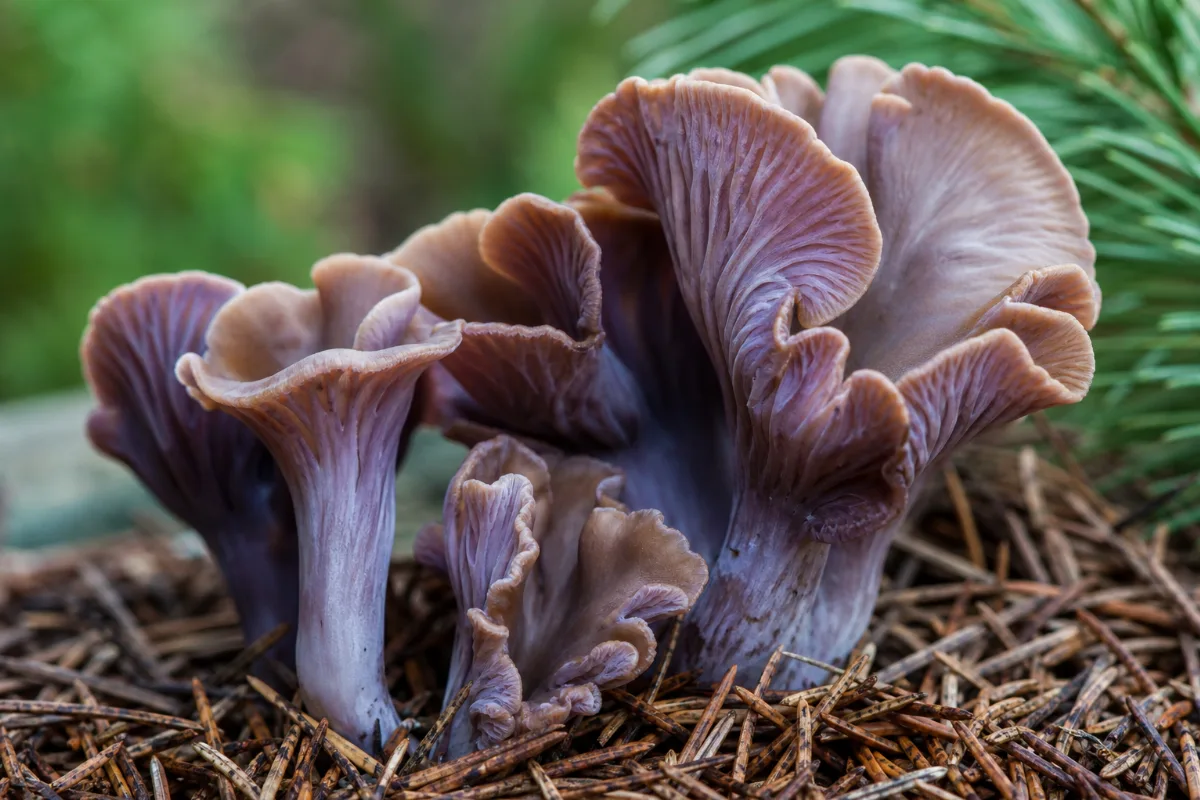
Mushrooms · Wild culinary mushroom
Pig's ear
Gomphus clavatus · also called Violet chanterelle (a nickname), pigs ears; Schweinsohr in German, orejas de cerdo in Spanish (names listed by GBIF)
Pig's ear, also called violet chanterelle, is a wild forest mushroom eaten in places including Southwest China and Mexico. It is a food, not a remedy: we found no study in people for any health outcome, and the lab and mouse findings are only early ideas. The main caution is mistaken identity when picking wild fungi. It is also threatened in parts of Europe, and one Turkish study found cadmium above the authors' limit for daily eating.
General information, not medical advice. Last substantive update · Not medically reviewed. A named clinician has not signed off on this page. How this page is made
About Pig's ear
Pig's ear (Gomphus clavatus) is a wild forest mushroom that people eat. There are no human studies on health, only test-tube and one mouse study. The main cautions are wild-mushroom mistaken identity, a cadmium result above the authors' limit for daily eating in one Turkish sample set, and its threatened status in parts of Europe. There are no data on allergy, medicines, pregnancy or children.
What it is
Pig's ear is the common English name of Gomphus clavatus, a fungus whose accepted name in GBIF is Gomphus clavatus (Pers.) Gray, first published in 1821. It is nicknamed violet chanterelle, but it belongs to a different family (Gomphaceae) from the true chanterelle (Cantharellus), which GBIF places in the Hydnaceae. It grows in association with conifer trees, particularly spruce and fir, and is a wild-harvested food.
A 2026 genetics paper sequenced its mitochondrial genome and notes that the placement of the genus Gomphus has long been controversial.
How people use it
It is a food. In a 2003 survey of 95 Zapotec people in Oaxaca, Mexico, Gomphus clavatus was named the most palatable wild mushroom and ranked highest as a multi-use food. Reviews describe it as an edible fungus with a pleasant taste and thick flesh in Southwest China. We found no traditional medicinal use in the sources we read.
What the research shows
All the health-related findings are from labs or mice. Extracts scavenged free radicals in test tubes. A solvent extract and a purified polysaccharide harmed some cancer cell lines in dishes. A purified polysaccharide improved antioxidant measures and memory tests in mice made to age with a chemical. None of this has been tested in people, and extracts are not the mushroom as eaten.
We found no nutrient table for pig's ear, so no calorie, protein or vitamin figures are given.
Threatened in parts of Europe
A 2026 study lists Gomphus clavatus among 33 threatened macrofungi proposed for protection under the Bern Convention and included on various national Red Lists. In its table, 12% of the species' predicted European habitat is protected and 2.2% strictly protected. Which countries list it, and its global status, were not read. Foraging rules and permits differ by country; leaving mushrooms in the ground helps the species.
Mushroom, extract and isolated compounds are different
The lab papers used solvent extracts and purified polysaccharides, not the mushroom as eaten, so their results cannot be applied to a meal. We found no retail extract, powder or supplement of pig's ear in our earlier search, which was not repeated in this round.
Legal and regulatory status
We did not read statements from EFSA, FDA, EMA, NCCIH, LiverTox or LactMed on pig's ear, so none is stated here. The only status information we read is the conservation listing above. Rules differ by country and change.
At a glance
Traditional uses history, not proof
- Eaten as a wild food. In a survey of 95 Zapotec people in Oaxaca, Mexico, it was named the most palatable of the wild mushrooms and ranked highest as a multi-use food (Garibay-Orijel 2007).
- Described as an edible fungus with a pleasant taste and thick flesh, of economic interest in Southwest China (Zan 2026).
- No traditional medicinal use was found in the sources we read.
Studied for research
- Eaten as a wild food, no health effect measured (insufficient)
- Antioxidant activity in test tubes, insufficient
- Cancer-cell effects in dishes, insufficient
- Ageing signs in mice (purified polysaccharide), insufficient
- Any health outcome in people, none studied
Main compounds
- Ergosterol derivatives such as ergosterol peroxide (lab work)
- Polysaccharides called GCG-1 and GPF (lab and mouse work)
- Phenolics and flavonoids linked to test-tube antioxidant activity
Common forms
- Fresh or cooked fruiting body, from a known and correctly identified source
- Solvent extracts and purified polysaccharides, which are laboratory preparations only
Research links: Conservation study: threatened fungi in Europe (abstract) · Cadmium and antioxidants in Turkish mushrooms (abstract) · Mushroom poisonings in Sardinia, 10 years (abstract) · Zapotec edible mushroom survey (abstract) · Antioxidant and cell study of G. clavatus (abstract) · GBIF record for Gomphus clavatus · Research Library · Genes & Biomarkers Library
What it is and its history
- Accepted scientific name
- Gomphus clavatus (Pers.) Gray
- Naming authority
- (Pers.) Gray, 1821 (GBIF: published in Nat. Arr. Brit. Pl. 1: 638)
- Synonyms
- Cantharellus clavatus (Pers.) Fr.; Craterellus clavatus (Pers.) Fr.; Neurophyllum clavatum (Pers.) Pat.; Merulius clavatus Pers. (plus 13 more synonyms in GBIF)
- Common names
- Pig's ear (English); Violet chanterelle (chanterelle violette) (English / French); Schweinsohr (German); Orejas de cerdo (Spanish); Køllekantarel (Danish); Fiolgubbe (Norwegian)
- Family or group
- Gomphaceae (a fungus family), not a plant. In GBIF the true chanterelle Cantharellus cibarius is in the family Hydnaceae, order Cantharellales.
- Classification
- Fungi > Basidiomycota > Agaricomycetes > Gomphales > Gomphaceae > Gomphus > Gomphus clavatus
- Native range
- Records and studies in the sources come from Europe, Southwest China, India, Turkey, Mexico and Korea; a full range was not checked.
- Habitat
- An ectomycorrhizal fungus of conifer forests, particularly spruce and fir (stated in the introduction of Zan 2026, citing other work).
- What it looks like
- Fruiting body: Not described here on purpose. This page does not give identification features for wild fungi.
- Cultivation
- Eaten from wild-collected fruiting bodies. A 2023 paper on a different Gomphus species from Southwest China says its cultivation might become feasible; no cultivation of G. clavatus was found.
- Harvest and processing
- Not checked in the sources read.
- Look-alikes and adulterants
- Name: Other wild fungi; Note: Mistaken identity is the main safety problem with wild mushrooms in general (Sardinia poisoning records). We do not teach identification here and name no specific look-alike, because no source we read does so for this species.
- Sustainability and conservation
- Threatened in parts of Europe: on a proposed list of 33 threatened macrofungi included on various national Red Lists (Copoț 2026). Global status not read.
Traditional use and history history, not clinical proof
| Tradition or era | Documented use | Source |
|---|---|---|
| Zapotec communities, Oaxaca, Mexico (survey, 2003) | In a questionnaire of 95 people, Gomphus clavatus was named the most palatable of the wild edible mushrooms and ranked highest in the multifunctional food index. Only another species was identified as a health enhancer. | p17217539 |
| Southwest China | A genetics paper describes it as an edible fungus with a pleasant taste and thick flesh that is of economic interest in several regions including Southwest China. A separate paper says a different wild edible Gomphus species has been sold in Southwest China markets and eaten there for hundreds of years; that paper is about another species and is not applied to pig's ear. | p42889526 |
Traditional use shows how it was used. It does not show that it works or is safe today.
What is inside, and how it may work
What it contains and how those compounds act in cells and animals. Laboratory and animal mechanisms are not proven effects in people.
Main compounds
| Compound | Family | Where it is concentrated | Activity studied | Level of evidence |
|---|---|---|---|---|
| Ergosterol derivatives (including ergosterol peroxide) | sterol | Fruiting body Four ergosterol derivatives were isolated from the methanol extract and three from the dichloromethane extract; amounts not given in the abstract. | Ergosterol peroxide was among the most active compounds against two cancer cell lines in dishes (IC50 35.8 and 30.6 micromolar). 8 | Laboratory research |
| Heteropolysaccharide GCG-1 | polysaccharide | Fruiting body About 50,000 Da; beta-D-glucose and alpha-D-galactose, ratio 3:2. | Scavenged free radicals and induced apoptosis in HepG-2 cells in dishes. 3 | Laboratory research |
| Heteropolysaccharide GPF | polysaccharide | Fruiting body 112.0 kDa; mannose, galactose, arabinose, xylose and glucose in a molar ratio of 3.2:1.9:1.6:1.2:1.0. | Improved antioxidant and memory-test results in ageing mice. 12 | Animal research |
| Phenolics and flavonoids | polyphenol | Fruiting body Not given in the abstracts. | Antioxidant activity of extracts correlated with phenolic and flavonoid content in test tubes. 9 1 | Laboratory research |
| Cadmium (contaminant, not a nutrient) | metal | Fruiting body Calculated intake 0.071 mg per day for a 60 kg adult from one Turkish sample set; mg per kg not read. | Not an active ingredient; a safety concern if eaten often. 9 | Lab analysis |
Mechanisms, receptors and pathways
| Target or pathway | Gene or receptor | What was found | Level |
|---|---|---|---|
| AMPK / SIRT1 / PGC-1alpha signalling | AMPK, SIRT1, PGC-1alpha | In D-galactose ageing mice, the purified polysaccharide GPF increased AMPK phosphorylation and raised SIRT1 and PGC-1alpha expression alongside better antioxidant measures. 12 | Animal research |
| Apoptosis in liver cancer cells | Not specified | The polysaccharide GCG-1 induced apoptosis of HepG-2 cells and changed mRNA expression of several housekeeping genes (abstract). 3 | Laboratory research |
| Free-radical scavenging | Not applicable | Methanol extract and GCG-1 scavenged test radicals in test tubes. 8 3 | Laboratory research |
Absorption, metabolism and elimination
- Absorption
- Not found in the sources read.
- Distribution
- Not found in the sources read.
- Metabolism
- Not found in the sources read.
- Elimination
- Not found in the sources read.
- Bioavailability
- Not established.
Isolated compounds versus whole extracts
All the activity findings come from solvent extracts or purified polysaccharides, not from the mushroom as eaten. The mouse study used a purified 112 kDa polysaccharide, and the abstract does not say how it was given. These results cannot be turned into a statement about eating pig's ear.
Nutritional composition
No open nutrient table (calories, protein, vitamins, minerals) for Gomphus clavatus was found; none is given.
5 not enough evidence
What was looked at
The 5 benefits and uses checked for Pig's ear, each with how strong the evidence is. Tap one to open it.
What is Pig's ear good for?
The uses people ask about and how strong the human evidence is for each. For pig's ear there is no human evidence for any of them. Read this together with the Safety tab.
Benefits, one by one
Each card is a research question, not a promise. Tap a goal to filter. Open a card to see the studies, doses and limits.
Eaten as a wild forest food
Not enough evidencePig's ear is a wild mushroom that people eat. In one Mexican survey it was rated the tastiest of the wild mushrooms people named. We found no nutrient table for it and no study in which people ate it and a health result was measured.
3 studiesThe fresh or cooked fruiting body from a known, correctly identified …
Studies, doses and limits
Results
Survey: Gomphus clavatus was the most palatable species and ranked highest in the multifunctional food index among the wild mushrooms named. No calorie, protein or vitamin figures were found.
Effect sizes as reported
Food use described; no health effect measured
Why this rating
Taste and food use do not show a health benefit. No nutrient values or human outcomes were found.
Form and dose studied
The fresh or cooked fruiting body from a known, correctly identified source is the usual food form. This page gives no amounts.
Limits
One survey in one community. No nutrient table was found in our earlier search (not repeated in this round).
Why researchers looked
Mostly asked as a food question: who eats it, and how well it is liked.
Traditional use
Described as an edible fungus with a pleasant taste and thick flesh in Southwest China (Zan 2026), and as the most palatable of the wild mushrooms in a survey of 95 Zapotec people in Oaxaca, Mexico (Garibay-Orijel 2007).
Proposed mechanism Other
Not a mechanism claim. These are descriptions of food use.
A proposed mechanism does not show that the effect happens in people.
Wild-picked fungi can be confused with poisonous ones, can carry metals from the soil, and this species is threatened in parts of Europe. See the Safety tab first.
Antioxidant activity in the laboratory
Not enough evidenceExtracts of pig's ear scavenged free radicals in test tubes, and in a Turkish comparison it scored high. These are chemistry tests on extracts. They do not show that eating the mushroom protects anyone's cells.
4 studiesSolvent extracts and purified polysaccharides, which are laboratory p…
Studies, doses and limits
Results
Methanol extract: 45.5% of the test radical DPPH inhibited at 3 mg/mL (collection country not stated). Turkey: very high antioxidant potential in four tests, linked to phenolic and flavonoid content. India: ranked sixth of nine wild mushrooms. GCG-1 polysaccharide: strong radical scavenging, which the authors say may be comparable to vitamin C and BHT.
Effect sizes as reported
Test-tube antioxidant activity; no human outcome
Why this rating
Laboratory chemistry only. Different solvents, assays and sample origins give different rankings, and test-tube antioxidant activity does not translate into a body effect.
Form and dose studied
Solvent extracts and purified polysaccharides, which are laboratory preparations and not the food as eaten.
Limits
Extracts are not the mushroom as eaten. Results come from wild samples of unknown soil and origin.
Why researchers looked
Mushrooms are routinely screened for antioxidant chemistry, and pig's ear has been included in several such screens.
Proposed mechanism Laboratory research
Phenolic and flavonoid compounds, and a purified polysaccharide (GCG-1), scavenge test radicals in the lab. This is a laboratory finding, not proof of a health effect.
A proposed mechanism does not show that the effect happens in people.
No safety finding in these papers. The same Turkish paper found cadmium above the authors' limit for daily eating (see the Safety tab).
Effects on cancer cells in dishes
Not enough evidenceExtracts and a purified sugar-chain (polysaccharide) from pig's ear harmed some cancer cell lines in laboratory dishes. No animal or human cancer study was found. This is not a cancer treatment.
2 studiesSolvent extracts and a purified polysaccharide; these are not the foo…
Studies, doses and limits
Results
Dichloromethane extract IC50 about 55.3 micrograms/mL (MCF-7) and 49.0 (PC-3). Ergosterol peroxide IC50 35.8 and 30.6 micromolar. GCG-1 induced apoptosis of HepG-2 cells; no figures in the abstract.
Effect sizes as reported
Cell-killing activity in dishes
Why this rating
Test tube results with laboratory extracts and a purified compound. Many compounds kill cells in dishes and fail in animals or people.
Form and dose studied
Solvent extracts and a purified polysaccharide; these are not the food.
Limits
Cell lines are not tissue in a body. Doses in dishes cannot be compared with eating the mushroom.
Why researchers looked
Cell-dish screening of wild edible mushrooms for compounds that harm cancer cells.
Proposed mechanism Laboratory research
Ergosterol peroxide and other ergosterol derivatives contributed to the effect of a dichloromethane extract on two cancer cell lines (MCF-7 and PC-3). A polysaccharide (GCG-1) induced apoptosis (programmed cell death) in HepG-2 cells.
A proposed mechanism does not show that the effect happens in people.
Not a treatment for cancer. Anyone with cancer should talk to their care team before using any mushroom product.
Ageing signs in mice (polysaccharide)
Not enough evidenceA purified sugar-chain from pig's ear improved antioxidant measures and memory tests in mice made to show ageing with a chemical. It is one animal study and does not show that pig's ear slows ageing in people.
1 studiesA purified 112 kDa polysaccharide, not the mushroom. How it was given…
Studies, doses and limits
Results
D-galactose ageing mice: antioxidant enzymes (SOD, CAT, GSH-Px) and total antioxidant capacity rose and MDA fell in serum and brain; learning and memory tests improved. The abstract gives no numbers.
Effect sizes as reported
Better antioxidant and memory-test results in one mouse model
Why this rating
One animal study of a purified polysaccharide; no numbers in the abstract; not repeated.
Form and dose studied
A purified 112 kDa polysaccharide, not the mushroom. How it was given to the mice is not stated in the abstract.
Limits
A chemical ageing model in mice is not natural ageing. Group sizes and doses not read.
Why researchers looked
Mushroom polysaccharides are tested in ageing models for antioxidant and memory effects.
Proposed mechanism Animal research
In the mice the polysaccharide (GPF) raised antioxidant enzymes and increased AMPK activation and SIRT1 and PGC-1alpha expression (abstract).
A proposed mechanism does not show that the effect happens in people.
No safety finding was reported in the abstract. This is not a recommendation to use pig's ear for ageing.
Any health outcome in people
Not enough evidenceWe did not find any study of pig's ear for immune, blood sugar, heart, gut, brain or any other health outcome in people. Results from other mushrooms should not be borrowed.
2 studiesNot applicable.
Studies, doses and limits
Results
No trials.
Effect sizes as reported
No human data
Why this rating
Nothing to rate: a search of PubMed (8 records for the name) and Europe PMC found only lab, animal, food-survey, taxonomy and conservation papers.
Limits
Absence of studies is not evidence of safety or of benefit.
Why researchers looked
This is the question most readers ask.
Proposed mechanism Other
Not applicable.
A proposed mechanism does not show that the effect happens in people.
Wild-picked fungi can be confused with poisonous ones, can carry metals from the soil, and this species is threatened in parts of Europe. See the Safety tab first.
Connections to the rest of health
How Pig's ear connects to the rest of our health knowledge graph. Every link says what kind of connection it is. A safety link (for example to the liver) is a warning, not a benefit. A study that merely mentions a topic never creates a benefit link.
Explore every connection: goals, body systems, organs, symptoms, genes
B. Body systems
| Connected to | Kind of connection | Evidence status | Context | Studies |
|---|---|---|---|---|
| Digestive System | Biological association | Not enough evidence | Studied for: Eaten as a wild forest food | 4 11 5 |
F. Functional actions
| Connected to | Kind of connection | Evidence status | Context | Studies |
|---|---|---|---|---|
| Antioxidant | Not enough evidence | Test-tube and mouse findings only; no human data. Preparation or compound: Extracts and purified polysaccharides |
9 12 |
G. Root causes and contributing factors
| Connected to | Kind of connection | Evidence status | Context | Studies |
|---|---|---|---|---|
| Heavy metal exposure | Adverse effect or risk | Not enough evidence | Cadmium above the authors' limit for daily eating in one sample set. Preparation or compound: Wild fruiting body; one Turkish sample set |
9 |
J. Genes, receptors and enzymes
L. Active compounds
| Connected to | Kind of connection | Evidence status | Context | Studies |
|---|---|---|---|---|
| Ergosterol derivatives (including ergosterol peroxide) | Biological association | In vitro | Ergosterol peroxide was among the most active compounds against two cancer cell lines in dishes (IC50 35.8 and 30.6 micromolar). Preparation or compound: Fruiting body |
8 |
| Heteropolysaccharide GCG-1 | Biological association | In vitro | Scavenged free radicals and induced apoptosis in HepG-2 cells in dishes. Preparation or compound: Fruiting body |
3 |
| Heteropolysaccharide GPF | Biological association | Animal | Improved antioxidant and memory-test results in ageing mice. Preparation or compound: Fruiting body |
12 |
| Phenolics and flavonoids | Biological association | In vitro | Antioxidant activity of extracts correlated with phenolic and flavonoid content in test tubes. Preparation or compound: Fruiting body |
9 1 |
| Cadmium (contaminant, not a nutrient) | Biological association | Lab analysis | Not an active ingredient; a safety concern if eaten often. Preparation or compound: Fruiting body |
9 |
Each connection is stored with the ingredient, the connected record, the kind of connection, the evidence status, the supporting studies, the preparation or compound involved, and a review date (last reviewed October 25, 2026).
Evidence at a glance: what the research found for 5 outcomes
Each outcome below is one thing researchers measured. Certainty is how far the evidence can be trusted, not how well it works. The full studies are on the next tab.
The evidence
The research centre for Pig's ear. Every record here was checked against PubMed or the publisher's page; we never list a study we have not verified.
Evidence by outcome
Bars show how many studies we found for each outcome, not how well it works. People are added up across trials only (reviews are not added, to avoid double counting).
How we rate evidence
High certainty
Several well-run trials or reviews agree; further research is unlikely to change the picture much.
Moderate certainty
Good trials point the same way, but some doubt remains.
Low certainty
Small, short or inconsistent trials. The finding could change with better research.
Very low certainty
Very little or very weak human data. Treat as a possibility only.
Mixed findings
Trials or reviews disagree with each other.
Not enough evidence
Not enough human research to say either way.
Evidence against
Good research found no benefit, or found harm.
We take the reviewers' own risk-of-bias and GRADE statements where they exist, and otherwise judge from study size, design, consistency, directness and whether a product matches what is sold. Many publications do not make evidence high. Method note: We read PubMed records and abstracts for 12 papers (two laboratory studies of extracts and compounds, one mouse study, two laboratory analyses of antioxidants and metals, one genetics paper, one ethnobiology survey, one genus-context paper on a different Gomphus species, one conservation modelling study, one poisoning-records study, one radioactivity review and one allergy letter read as title only) and checked the species name in GBIF. The genetics and conservation papers were also read in full text. Index Fungorum, EFSA, FDA, EMA, NCCIH, LiverTox and LactMed were not read. Only abstracts were read for most papers, so numbers come from abstracts. Certainty ratings are the compiler's own reading.
Study library: every study we checked 13
| Study | Design | People | Product, dose, length | Result |
|---|---|---|---|---|
| Bisht 2024 Exploring the Antioxidant Potential of Methanolic Extracts of Wild Medicinal and Edible Mushrooms from Darma Valley, Pithoragaph, Kumaun (Himalaya, India). International Journal of Medicinal Mushrooms · PMID 38305263 · DOI |
Laboratory analysis fungus |
Nine wild edible mushroom species from the Darma Valley, Kumaun Himalaya, India | Methanol extracts Fruiting body Not shown here |
Clavatia craniiformis had the highest antioxidant capacity of the nine. Gomphus clavatus ranked sixth in the order the abstract lists, after four Ramaria species and Clavatia. Differences matched the phenolic content. G. clavatus was mid-ranked among nine wild mushrooms in test-tube antioxidant tests Methods, limits and fundingOutcomes: Total phenolics, flavonoids, tannins, ABTS and DPPH antioxidant assays Limitations: Test-tube assays of methanol extracts. The abstract gives no figures for G. clavatus. Funding and conflicts: Not stated in the abstract Read: abstract |
| Copoț 2026 Where to improve the European protected areas network to represent threatened fungi? iScience · PMID 42893156 · DOI |
Other fungus (modelling) |
33 threatened macrofungi proposed for inclusion under the Bern Convention, across 38 European countries (habitat modelling) | Species distribution models compared with protected-area networks Not shown here |
The 33 species are described as threatened and included on various national Red Lists. In the table for Gomphus clavatus, the predicted habitat is 736,952 km2 across 30 countries; 12% is protected, 5% is protected only by Natura 2000 sites, and 2.2% is strictly protected. On a proposed list of threatened fungi; only 2.2% of predicted habitat strictly protected Methods, limits and fundingOutcomes: Predicted habitat and how much of it is protected Limitations: Habitat is modelled, not counted. Which countries list the species on their Red Lists was not read. We read the table headings as described in the text; the column wording could be misread. Funding and conflicts: Not stated in the abstract Read: abstract and full text (PMC) |
| Ding 2015 Structure elucidation, anticancer and antioxidant activities of a novel polysaccharide from Gomphus clavatus Gray. Oncology Reports · PMID 25901792 · DOI |
Laboratory research fungus (cell line) |
Purified polysaccharide from fruiting bodies; HepG-2 liver cancer cells (test tubes) | Purified polysaccharide GCG-1 (about 50,000 Da; beta-D-glucose and alpha-D-galactose, ratio 3:2) Fruiting body Not shown here |
GCG-1 had a backbone of (1-4)-beta-D-glucopyranose with branches at O-6. In test tubes it scavenged free radicals strongly, which the authors say may be comparable to vitamin C and BHT. It also induced apoptosis (programmed cell death) of HepG-2 cells and changed the mRNA expression of several housekeeping genes. Radical scavenging and cancer-cell death in test tubes Methods, limits and fundingOutcomes: Structure, free-radical scavenging, apoptosis and gene expression in HepG-2 cells Limitations: Cell-dish work with a purified polysaccharide, not the whole mushroom. The abstract gives no numbers. Not tested in animals or people. Funding and conflicts: Not stated in the abstract Read: abstract |
| Garibay-Orijel 2007 Understanding cultural significance, the edible mushrooms case. Journal of Ethnobiology and Ethnomedicine · PMID 17217539 · DOI |
Observational human (survey) |
95 95 randomly chosen informants of the Zapotec people in Oaxaca, Mexico (questionnaires in 2003) |
Questionnaires on wild edible mushrooms Not shown here |
Gomphus clavatus was the most palatable species and ranked highest in the multifunctional food index. Cantharellus cibarius s.l. was the most mentioned and most eaten species, and only Tricholoma magnivelare was identified as a health enhancer. Valued for taste and many food uses in one Mexican community; not named as a health enhancer Methods, limits and fundingOutcomes: Cultural significance index of wild edible mushrooms (eight variables including taste and food use) Limitations: One community and one survey year; reports opinions and use, not health effects. Funding and conflicts: Not stated in the abstract Read: abstract |
| Geng 2023 Preliminary exploration on the ectomycorrhizal status of a wild edible Gomphus species from Southwest China. Mycoscience · PMID 37168242 · DOI |
Laboratory analysis fungus |
A wild edible Gomphus (named G. matijun / Gomphus sp.) sold in Southwest China markets; Pinus massoniana seedlings | Fungus grown in pure culture and inoculated onto pine seedlings Fruiting body and culture Not shown here |
A wild edible Gomphus species was found in local markets from May to November in Southwest China and has been eaten there for hundreds of years. The authors say it may be related to Gomphus purpuraceus, may be an ectomycorrhizal fungus, and that identifying Gomphus taxa is difficult. This paper is about a different Gomphus species, not G. clavatus. Background on Gomphus as a wild food; not about G. clavatus Methods, limits and fundingOutcomes: Taxonomy, mycorrhizal synthesis, seedling growth Limitations: Species is not G. clavatus. Used here only as context for the genus; nothing from it is applied to pig's ear. Funding and conflicts: Not stated in the abstract Read: abstract and introduction (PMC) |
| La Rosa 2024 Epidemiology and clinical aspect of mushroom poisonings in South Sardinia: A 10-year retrospective analysis (2011-2021). Food Science & Nutrition · PMID 38268883 · DOI |
Observational human (records) |
164 164 mushroom poisoning cases recorded by Mycological Inspectorates in South Sardinia, 2011 to 2021 |
Retrospective records Not shown here |
164 cases, peaking in autumn. Species were identified in 162 cases: 81 were caused by toxic species, 60 by edible species and 45 by not-edible species. The authors say most illnesses from poisonous mushrooms are preventable and that fast, correct recognition improves the outlook. Mushroom poisonings are common in autumn, and edible species also appear among the cases Methods, limits and fundingOutcomes: Cases, season, involved species Limitations: One Italian region. Pig's ear is not named in the abstract. Funding and conflicts: Authors declared no conflict of interest Read: abstract |
| Lee Qiyu 2026 Edible mushroom allergy: a clinically heterogeneous and under-recognized condition. European Annals of Allergy and Clinical Immunology · PMID 42788552 · DOI |
Other n/a |
Not stated (letter) | n/a Not shown here |
The record has no abstract. Its title says edible mushroom allergy is clinically varied and under-recognised. Title only Methods, limits and fundingOutcomes: Edible mushroom allergy Limitations: Only the title and record were read. Nothing is claimed beyond the title. Funding and conflicts: Not stated Read: title and record only |
| Makropoulou 2012 Antioxidant and cytotoxic activity of the wild edible mushroom Gomphus clavatus. Journal of Medicinal Food · PMID 21877948 · DOI |
Laboratory research fungus (cell lines) |
Wild-collected fruiting bodies of Gomphus clavatus; cancer cell lines MCF-7 and PC-3 (test tubes) | Solvent extracts of the fruiting body (several polarities) Fruiting body Not shown here |
The methanol extract was the most active radical scavenger, with 45.5% inhibition of the test radical DPPH at 3 mg/mL. Nine compounds were isolated from it, four of them ergosterol derivatives. The dichloromethane extract was the most toxic to cancer cells, with IC50 values of 55.3 (MCF-7) and 49.0 (PC-3) micrograms per mL. Ergosterol peroxide was one of the most active parts (IC50 35.8 and 30.6 micromolar). Antioxidant and cell-killing activity in test tubes only Methods, limits and fundingOutcomes: Total phenolics, radical scavenging, cell toxicity, isolated compounds Limitations: Cell-dish work with solvent extracts; no animals or people. Test-tube activity does not show an effect from eating the mushroom. Country of collection is not stated in the abstract. Funding and conflicts: Not stated in the abstract Read: abstract |
| Sarikurkcu 2015 Metal concentration and antioxidant activity of edible mushrooms from Turkey. Food Chemistry · PMID 25577119 · DOI |
Laboratory analysis fungus |
Four wild mushrooms (including Gomphus clavatus) collected in Mugla province, South-Aegean Turkey | Dried mushroom samples analysed for metals and antioxidant tests Fruiting body Not shown here |
Gomphus clavatus and Lycoperdon perlatum showed extremely high antioxidant potential in four tests, strongly correlated with phenolic and flavonoid content. The cadmium content of G. clavatus (0.071 mg/day) was above the legal limits for daily intake for a 60 kg consumer. The authors advise that Macrolepiota procera and G. clavatus should not be consumed daily because of their cadmium and cobalt levels. Cadmium above the authors' daily-intake limit in the G. clavatus sample Methods, limits and fundingOutcomes: Antioxidant tests and heavy-metal content, with intake calculated for a 60 kg consumer Limitations: Samples from one province; metal levels depend on the soil. The abstract does not say how much mushroom was assumed per day or give mg/kg values. Only the abstract was read. Funding and conflicts: Not stated in the abstract Read: abstract |
| Strumińska-Parulska 2020 A Review of the Occurrence of Alpha-Emitting Radionuclides in Wild Mushrooms. International Journal of Environmental Research and Public Health · PMID 33172165 · DOI |
Narrative review fungus |
Literature on wild mushrooms from around the world | Review Fruiting body Not shown here |
Mushrooms bio-accumulate a range of minerals and radioactive elements to different extents and are used as indicators of pollution. The review says some consumption may expose consumers to radiotoxic particles after pollution events. General statement about wild mushrooms; nothing specific to G. clavatus was read Methods, limits and fundingOutcomes: Alpha-emitting radionuclides in wild mushrooms Limitations: General review; Gomphus clavatus is not named in the abstract. Funding and conflicts: Authors declared no conflict of interest Read: abstract |
| Zan 2026 Characterization and phylogenetic analysis of the complete mitochondrial genome of Gomphus clavatus (pers.) Gray, 1821. Mitochondrial DNA Part B: Resources · PMID 42889526 · DOI |
Other fungus |
Fresh G. clavatus collected from coniferous forest, Longquan mountain, Chengdu, China | DNA sequencing (no intervention) Fruiting body Not shown here |
The mitochondrial genome is a circular molecule of 85,207 bp and encodes 62 genes. The tree places G. clavatus in a clade with Ramaria ichnusensis. The introduction describes it as an ectomycorrhizal fungus of conifers, particularly spruce and fir, and an edible fungus with a pleasant taste and thick flesh of economic interest in several regions including Southwest China. It notes that the placement of the genus Gomphus has long been controversial. Identity and family-tree data; no health outcome Methods, limits and fundingOutcomes: Mitochondrial genome and its place in the fungal family tree Limitations: A genetics paper. Statements about food use and ecology in the introduction cite other papers that we did not read. Funding and conflicts: Authors declared no conflicts of interest Read: abstract and full text (PMC) |
| Zhang 2023 Characterization and anti-aging effects of polysaccharide from Gomphus clavatus Gray. International Journal of Biological Macromolecules · PMID 37414316 · DOI |
Animal research mouse |
Mice made to show ageing signs by D-galactose injection | Purified polysaccharide GPF (112.0 kDa; mannose, galactose, arabinose, xylose, glucose 3.2:1.9:1.6:1.2:1.0) Fruiting body Not shown here |
GPF significantly raised antioxidant enzyme activities and total antioxidant capacity, and lowered MDA, in serum and brain of the D-galactose ageing mice. It improved learning and memory deficits in behaviour tests, and increased AMPK phosphorylation and SIRT1 and PGC-1alpha expression. Better antioxidant and memory-test results in a mouse ageing model Methods, limits and fundingOutcomes: Antioxidant enzymes (SOD, CAT, GSH-Px), total antioxidant capacity, MDA, learning and memory tests, AMPK/SIRT1/PGC-1alpha signals Limitations: One mouse model of ageing; a purified polysaccharide, not food. The abstract gives no numbers or group sizes and does not say how GPF was given. No human data. Funding and conflicts: Authors declared no competing interests Read: abstract |
| n/a 2026 GBIF Backbone Taxonomy: Gomphus clavatus (Pers.) Gray (species key 5238786), checked 2026-10-25 n/a · Source |
Database record n/a |
n/a | n/a |
ACCEPTED name Gomphus clavatus (Pers.) Gray, published in Nat. Arr. Brit. Pl. 1: 638 (1821). Phylum Basidiomycota, class Agaricomycetes, order Gomphales, family Gomphaceae. GBIF lists 17 synonyms, among them Cantharellus clavatus, Craterellus clavatus, Neurophyllum clavatum and Merulius clavatus. English common names listed: Pig's Ear, pig's ears; other languages include Schweinsohr (German), chanterelle violette (French), orejas de cerdo (Spanish). Methods, limits and fundingOutcomes: Accepted name, authority, family, order and synonyms. Limitations: A database record. Index Fungorum was queried but returned nothing usable, so it was not checked. True chanterelles (Cantharellus cibarius) sit in GBIF in the family Hydnaceae, order Cantharellales. Funding and conflicts: Independent public database Read: database record, read 2026-10-25 |
What we do not know yet
- No study of pig's ear in people for any health outcome.
- No nutrient table was found, and the only metal result is one abstract-only cadmium finding.
- No data on allergy, medicines, pregnancy, breastfeeding or children.
- Global Red List status and the countries that list the species were not read.
- EFSA, FDA, EMA, NCCIH, LiverTox, LactMed and poison-centre records were not read.
How new research is added
New studies are found by a saved PubMed search and placed in a review queue. A person reads each one before it changes any evidence rating or safety wording. New publications never change ratings automatically.
Lab markers
What changed in blood or saliva tests during trials. A changed number is not the same as feeling or being healthier, and we give no "normal ranges".
Safety
What studies and official sources say about side effects, medicines and who should check first. Each point shows what kind of evidence it comes from.
Main points to know 4
- Mistaking another fungus for pig's ear is the main danger. Wild mushrooms cause real poisonings. In ten years of records from South Sardinia there were 164 poisoning cases, mostly in autumn; 81 were caused by toxic species, 60 by edible species and 45 by not-edible species. The authors say most illnesses from poisonous mushrooms are preventable and that fast, correct recognition improves the outlook. We found no pig's-ear-specific poisoning report. This page does not teach identification, and wild fungi should never be identified from text, a photo or an app. Only eat a wild mushroom that a qualified local expert has confirmed. Observational 6
- It is threatened in parts of Europe. A 2026 study lists Gomphus clavatus among 33 threatened macrofungi proposed for protection under the Bern Convention and included on various national Red Lists. Only 12% of its predicted European habitat is protected, and 2.2% strictly. If you forage, local rules and permits differ by country and some countries protect certain fungi by law. Leaving mushrooms in the ground helps the species. Modelling study 2
- One sample had cadmium above the authors' limit for daily eating. In a Turkish study of four wild mushrooms from Mugla province, the cadmium level in the Gomphus clavatus sample (calculated at 0.071 mg per day for a 60 kg adult) was above the legal limit the authors used. They advise against eating it daily. This is one abstract about one set of samples; metal levels depend on the soil where the mushroom grew. Laboratory analysis 9
- No data on allergy, medicines, pregnancy, breastfeeding or children. We found no pig's-ear-specific source on any of these. Absence of reports is not proof of safety. General mushroom cautions apply, and a doctor or pharmacist can advise. Gap
Side effects 3
| Effect | How often | Severity and recovery | Evidence |
|---|---|---|---|
| Poisoning from eating a look-alike by mistake Applies to wild-picked fungi in general. No pig's ear case was named in the abstract. | Not given for pig's ear. In South Sardinia, 164 poisoning cases in ten years, caused by toxic, edible and not-edible species | varies Not stated in the abstract | Observational 6 |
| Cadmium intake with frequent eating A calculated intake, not a measured harm. | One Turkish sample set; no rate | unknown Not described | Laboratory analysis 9 |
| Allergy to edible mushrooms Only the title of a 2026 letter was read; it calls edible mushroom allergy under-recognised. | No pig's-ear-specific report found | unknown Not described | Insufficient 7 |
Liver
No report of liver injury from eating pig's ear was found in the sources read, and we did not look for a LiverTox entry for it. This is a gap, not a safety guarantee.
How often. No rate can be given.
This is a safety connection. It is not evidence that Pig's ear supports liver health.
Medicines and supplements 1
| With | Why it matters | Importance | Evidence | What to do |
|---|---|---|---|---|
| Prescription medicines in general prescription | Unknown. No report, trial or label statement was found. | Gap Not enough evidence | Ask a pharmacist or doctor if you take regular medicines and plan to eat large amounts of wild mushrooms. |
Who should check first 3
| Situation | Advice | Evidence |
|---|---|---|
| Any wild mushroom that has not been confirmed by a qualified local expert | Do not eat it. Wild fungi are mistaken for each other, and this page does not teach how to tell them apart. Pictures and phone apps are not enough. | Observational 6 |
| Known allergy to edible mushrooms | Avoid pig's ear unless an allergy specialist advises otherwise. | Insufficient 7 |
| Pregnancy, breastfeeding and young children | No safety data were found for pig's ear in these groups. Ask a doctor or midwife. The risk of eating a wrongly identified wild mushroom applies to everyone. | Gap |
Overdose, product quality and regulators
Summary. No poisoning by Gomphus clavatus itself was described in the sources read. The documented concerns are mistaken identity, metals from the soil and possible radioactivity.
Animal. No toxicity study was found. The mouse ageing study of a purified polysaccharide reports no safety finding in its abstract.
Human doses studied. No human study. This page gives no amounts and none are advised.
High dose or long term signals. Daily eating: the Turkish authors advise against it because of cadmium in their sample.
Overdose response. No overdose description was found. Seek medical help for the urgent signs below.
Genotoxicity. Not read.
Toxic or hazardous parts. Fungus: the fruiting body is the part eaten. No source we read compared toxicity between parts.
Wild mushrooms take up metals and radioactive elements from soil to different extents. The only measurement we found for pig's ear is one cadmium result from Turkey.
Cadmium (Turkey, one sample set). The cadmium content of the G. clavatus sample (0.071 mg per day for a 60 kg consumer) was above the legal limit the authors used, and they say it should not be eaten daily. The abstract gives no mg per kg figure and does not say where within Mugla province it was collected. 9
Radioactive elements (general). A 2020 review says mushrooms accumulate radioactive elements to different extents and are used as pollution indicators; consumers may be exposed after pollution events. No measured value for pig's ear was found. 10
Supplements and extracts. No retail extract, powder or mycelium-on-grain product of pig's ear was found in our earlier search (not repeated in this round). The extracts in the papers are laboratory preparations.
| Body | Action | Date |
|---|---|---|
| Bern Convention proposal and national Red Lists (as described in a 2026 study) (Europe) | The iScience paper lists G. clavatus among 33 threatened macrofungi identified for potential inclusion under the Bern Convention and included on various national Red Lists. It does not say the Convention has adopted the list. source | 2026-10-06 |
When to get medical help
- Vomiting, belly cramps or diarrhoea after eating a wild mushroom: get medical advice the same day, and tell the clinicians exactly what was eaten.
- Any illness that gets worse, or new symptoms in the days after a wild mushroom meal: do not wait it out. Seek emergency care or call poison control, because quick and correct recognition improves the outlook (Sardinia study).
- Trouble breathing, swelling of the face or throat, or hives after eating mushrooms: call emergency services.
- Anyone else who shared the same meal should be checked too.
If someone may be poisoned or in a crisis, contact a clinician or emergency service straight away. In the US, Poison Control is 1-800-222-1222.
General information only, not medical advice. Ask a clinician or pharmacist before use, especially with medicines, in pregnancy or with a health condition. See the Natural Remedy Safety guide.
Frequently asked questions
What is pig's ear?
Is pig's ear a true chanterelle?
No. Despite the nickname violet chanterelle, GBIF places it in the family Gomphaceae, while the true chanterelle (Cantharellus cibarius) is in the Hydnaceae. Older names did put it in the chanterelle genus.
Is pig's ear safe to eat?
How do I make sure I have the right mushroom?
This page does not teach identification. Wild fungi are mistaken for each other, and text, photos and apps are not enough. Only eat a wild mushroom that a qualified local expert has confirmed.
Does pig's ear have health benefits?
Does pig's ear fight cancer?
Is pig's ear a good antioxidant food?
Does pig's ear contain heavy metals?
One Turkish study calculated cadmium intake from its Gomphus clavatus sample at 0.071 mg a day for a 60 kg adult, above the legal limit the authors used, and advised against eating it daily. It is one abstract about one sample set, and metal content depends on the soil. Wild mushrooms in general also take up radioactive elements to different extents, but we found no measured value for pig's ear.
Is pig's ear endangered?
It is threatened in parts of Europe. A 2026 study lists it among 33 threatened macrofungi proposed for protection under the Bern Convention and included on various national Red Lists. Only 2.2% of its predicted habitat is strictly protected. Its global status was not read.
Can pig's ear cause an allergy?
We found no pig's-ear-specific report. Edible mushroom allergy in general is described in a 2026 letter as under-recognised, but only its title was read. Anyone with a known mushroom allergy should avoid it unless an allergy specialist advises otherwise.
Does pig's ear interact with medicines?
No source we read tested this, so nothing is known. That is a gap, not reassurance. Ask a pharmacist or doctor if you take regular medicines.
Is pig's ear safe in pregnancy, breastfeeding or for children?
No safety data were found for these groups. Ask a doctor or midwife. The risk of eating a wrongly identified wild mushroom applies to everyone.
Explore by health goal
Editorial transparency
- Written by
- AlternativeMed editorial team. Research compiled with AI assistance, then checked against PubMed records.
- Medical review
- None. This page has not been reviewed by a physician or pharmacist.
- First published
- 2026-10-25
- Last substantive update
- 2026-10-25
- How we research
- We read PubMed records and abstracts for 12 papers (two laboratory studies of extracts and compounds, one mouse study, two laboratory analyses of antioxidants and metals, one genetics paper, one ethnobiology survey, one genus-context paper on a different Gomphus species, one conservation modelling study, one poisoning-records study, one radioactivity review and one allergy letter read as title only) and checked the species name in GBIF. The genetics and conservation papers were also read in full text. Index Fungorum, EFSA, FDA, EMA, NCCIH, LiverTox and LactMed were not read. Only abstracts were read for most papers, so numbers come from abstracts. Certainty ratings are the compiler's own reading.
- How we rate evidence
- See "How we rate evidence" in the Evidence tab.
- Independence
- No product is promoted on this page. No affiliate links are shown. This page is information, not a recommendation to eat or forage any mushroom.
Sources 13
Each source was opened and checked. Where we read only the abstract, it says so. The small numbers in the text point here.
- Bisht P, Singh B, Sharma PK, et al. Exploring the Antioxidant Potential of Methanolic Extracts of Wild Medicinal and Edible Mushrooms from Darma Valley, Pithoragaph, Kumaun (Himalaya, India).. International Journal of Medicinal Mushrooms. 2024. PMID 38305263. DOI 10.1615/IntJMedMushrooms.2023051350. (abstract)
- Copoț O, Runnel K, Lõhmus A. Where to improve the European protected areas network to represent threatened fungi?. iScience. 2026. PMID 42893156. DOI 10.1016/j.isci.2026.117758. (abstract and full text (PMC))
- Ding X, Hou Y, Zhu Y, et al. Structure elucidation, anticancer and antioxidant activities of a novel polysaccharide from Gomphus clavatus Gray.. Oncology Reports. 2015. PMID 25901792. DOI 10.3892/or.2015.3921. (abstract)
- Garibay-Orijel R, Caballero J, Estrada-Torres A, Cifuentes J. Understanding cultural significance, the edible mushrooms case.. Journal of Ethnobiology and Ethnomedicine. 2007. PMID 17217539. DOI 10.1186/1746-4269-3-4. (abstract)
- Geng Y, Zhang S, Yang N, Qin L. Preliminary exploration on the ectomycorrhizal status of a wild edible Gomphus species from Southwest China.. Mycoscience. 2023. PMID 37168242. DOI 10.47371/mycosci.2022.12.002. (abstract and introduction (PMC))
- La Rosa L, Corrias S, Pintor I, Cosentino S. Epidemiology and clinical aspect of mushroom poisonings in South Sardinia: A 10-year retrospective analysis (2011-2021).. Food Science & Nutrition. 2024. PMID 38268883. DOI 10.1002/fsn3.3793. (abstract)
- Lee Qiyu ML, Song Chia J. Edible mushroom allergy: a clinically heterogeneous and under-recognized condition.. European Annals of Allergy and Clinical Immunology. 2026. PMID 42788552. DOI 10.23822/EurAnnACI.1764-1489.452. (title and record only)
- Makropoulou M, Aligiannis N, Gonou-Zagou Z, et al. Antioxidant and cytotoxic activity of the wild edible mushroom Gomphus clavatus.. Journal of Medicinal Food. 2012. PMID 21877948. DOI 10.1089/jmf.2011.0107. (abstract)
- Sarikurkcu C, Tepe B, Kocak MS, et al. Metal concentration and antioxidant activity of edible mushrooms from Turkey.. Food Chemistry. 2015. PMID 25577119. DOI 10.1016/j.foodchem.2014.12.019. (abstract)
- Strumińska-Parulska D, Falandysz J. A Review of the Occurrence of Alpha-Emitting Radionuclides in Wild Mushrooms.. International Journal of Environmental Research and Public Health. 2020. PMID 33172165. DOI 10.3390/ijerph17218220. (abstract)
- Zan B, Zou X, Li L, et al. Characterization and phylogenetic analysis of the complete mitochondrial genome of Gomphus clavatus (pers.) Gray, 1821.. Mitochondrial DNA Part B: Resources. 2026. PMID 42889526. DOI 10.1080/23802359.2026.2742635. (abstract and full text (PMC))
- Zhang F, Ren T, Gao P, et al. Characterization and anti-aging effects of polysaccharide from Gomphus clavatus Gray.. International Journal of Biological Macromolecules. 2023. PMID 37414316. DOI 10.1016/j.ijbiomac.2023.125706. (abstract)
- n/a. GBIF Backbone Taxonomy: Gomphus clavatus (Pers.) Gray (species key 5238786), checked 2026-10-25. n/a. 2026. (database record, read 2026-10-25)


