Seaweed & Algae · Seaweed
Ao-nori (Green Laver)
Ulva spp. (listed in Japan as Enteromorpha spp.) · also called Aonori, green laver, blue-green nori
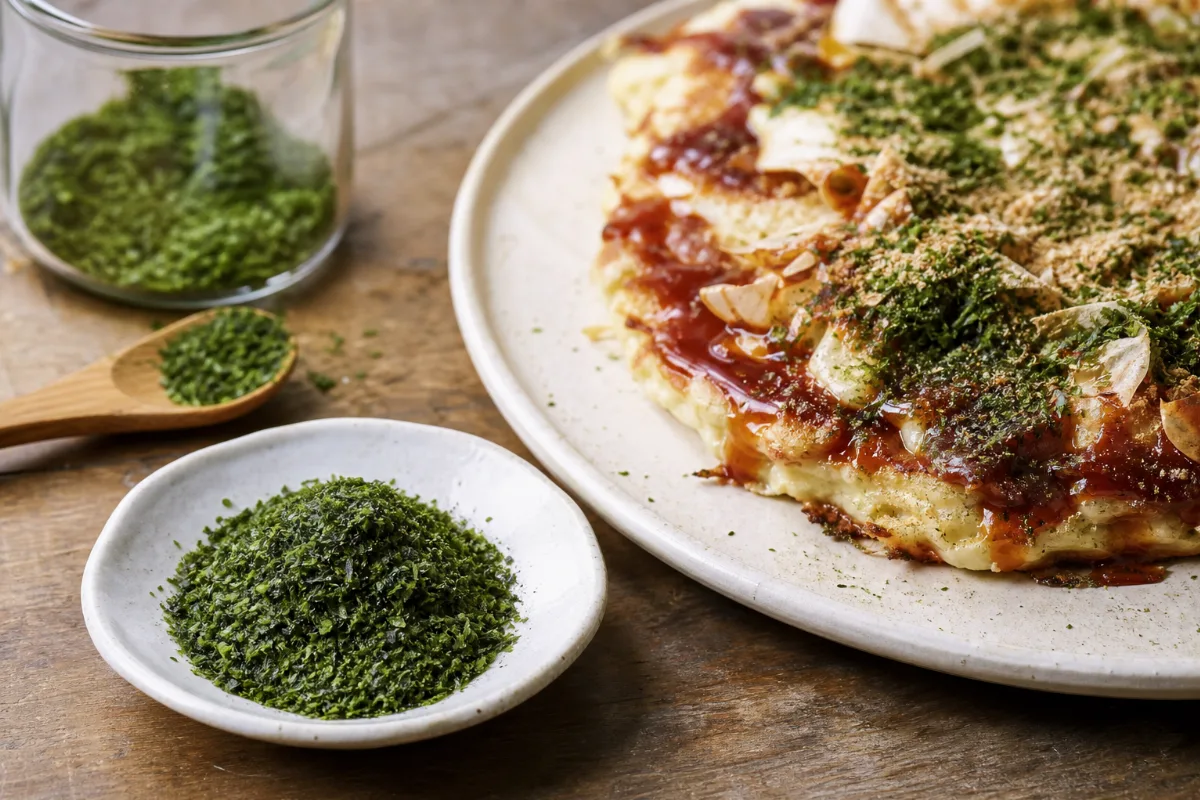
Ao-nori is a green seaweed sold as dried flakes or powder and sprinkled on dishes such as okonomiyaki and yakisoba. The Japanese food table lists it as very high in iodine, and too much iodine can disturb the thyroid. No study of ao-nori as eaten was found, so there is no good evidence for health benefits. The main cautions are iodine, salt, thyroid disease, pregnancy and metals taken up from sea water.
General information, not medical advice. Last substantive update · Not medically reviewed. A named clinician has not signed off on this page. How this page is made
About Ao-nori (Green Laver)
Ao-nori is a green seaweed sold as dried flakes or powder and used as a seasoning in Japan. It is a food, not a proven remedy. Its iodine content is very high per gram and no study of ao-nori itself was found, so iodine and salt are the first things to know.
What it is
Ao-nori ("green laver") is a green seaweed sold as dried flakes or powder. In Japan it is sprinkled on okonomiyaki, yakisoba, tempura and similar dishes. The Japanese food table lists it under the Latin name Enteromorpha spp.; GBIF treats Enteromorpha as part of the genus Ulva. It is a seaweed, not a plant.
USDA has no ao-nori entry. Per 100 g of dried ao-nori the Japanese table lists 249 kcal, 29.4 g protein, 35.2 g fibre, 77.0 mg iron, 1400 mg magnesium, 750 mg calcium, 2500 mg potassium and 3200 mg sodium. A sprinkle is about a gram, so by simple division 1 g is about 2.5 kcal, 0.35 g fibre and 0.77 mg iron: very little. Ao-nori is not nori, which is purple laver.
Iodine comes first
The table lists 2,700 microg of iodine per 100 g of dried ao-nori, about 27 microg per gram. The American Thyroid Association says more than 1,100 microg of iodine a day is not recommended and may cause thyroid dysfunction. By simple division about 41 g of dried flakes would reach that limit. That is arithmetic from one table, not advice. A light sprinkle is far less, but frequent heavy use adds up. For comparison the same table lists dried sea lettuce at 2,200 microg per 100 g.
Amounts vary by species, harvest place and processing, and the table rests on commercial samples. Seasoned mixes were not measured.
What the research shows
We found no trial of ao-nori itself. In 49 regular seaweed eaters in Norway (species not named), estimated iodine intake fell from 658 to 189 microg a day after six weeks without seaweed, and TSH decreased significantly. That is a blood-test change in a small study with no control group.
A review concluded that dried purple laver (nori) is the best plant source of vitamin B12 for vegetarians; it did not discuss green laver. The few human trials of green Ulva seaweed used a 300 mg Ulva lactuca extract (20 people, 28 days, company funded), a purified Ulva polysaccharide extract (blood fats and CRP, mixed results) and a processed Ulva flour (no allergic reactions in 31 people, gut discomfort in 16.6%). None used ao-nori flakes.
There is no good evidence for weight loss, detox, cancer or disease prevention.
Food versus supplements and extracts
The trials on antioxidants, blood fats and allergy used Ulva extracts, a purified polysaccharide or a processed flour. They are not the dried flakes sprinkled on food, and their results cannot be read as results for ao-nori. Seaweed and kelp supplements can carry far more iodine: ATA advises against iodine and kelp supplements above 500 microg a day and says many contain up to several thousand times the upper limit.
At a glance
Traditional uses history, not proof
- Sprinkled as a seasoning on okonomiyaki, yakisoba, tempura and similar dishes in Japan
- Long use as a seasoning is not proof that it treats any condition
Studied for research
- Iodine content, moderate certainty that dried ao-nori is a very concentrated source, which is also its main risk
- Fibre, protein and minerals listed in a food table, moderate certainty for the listed values (a pinch supplies little)
- Thyroid blood tests in regular seaweed eaters, low certainty (species not named)
- Vitamin B12, insufficient evidence for ao-nori
- Antioxidant and inflammation markers, very low certainty (one small trial of an Ulva extract)
- Blood fats and CRP, mixed results (extract of an Ulva species)
- Allergy and gut comfort, low certainty (small pilot of Ulva flour)
Main compounds
- Iodine
- Dietary fibre
- Sulfated polysaccharides (ulvans)
- Salt (sodium)
- Metals taken up from sea water (arsenic, cadmium)
Common forms
- Dried flakes (kake aonori) or powder, the usual forms (nutrient values read)
- Seasoning mixes such as furikake (not measured in the sources read)
- Ulva extracts and flour used in trials are not the same as the flakes
- Seaweed or iodine supplements are not covered
Research links: Japanese food composition table: dried ao-nori · 2026 study: seaweed eaters, iodine and thyroid tests · 2025 review: metals in Ulva · American Thyroid Association statement on excess iodine · Research Library · Genes & Biomarkers Library
What it is and its history
- Accepted scientific name
- Ulva Linnaeus, 1753 (genus)
- Naming authority
- GBIF accepted genus; the Japanese food table lists ao-nori under the older genus name Enteromorpha spp., which GBIF treats as a synonym of Ulva
- Synonyms
- Enteromorpha Link, 1820 (synonym of Ulva per GBIF)
- Common names
- Ao-nori (Japanese (romanised)); Aonori (English (alternative spelling)); Green laver (English); Blue-green nori (English)
- Family or group
- Ulvaceae (a family of green seaweeds), as given by GBIF. Ao-nori is a seaweed, not a land plant.
- Classification
- Plantae (GBIF) > Chlorophyta > Ulvophyceae > Ulvales > Ulvaceae > Ulva > Ulva spp. (the product is a mix of green seaweed species)
- Native range
- Not verified from a source read.
- Habitat
- Not verified from a source read.
- What it looks like
- Roots: Not verified.; Stems: Not verified.; Leaves: Not verified.
- Cultivation
- Not verified from a source read.
- Harvest and processing
- The Japanese table lists the food as "aonori, sun-dried". The existing summary mentions flakes and pressed sheets; this was not checked against a source.
- Look-alikes and adulterants
- Name: Sea lettuce (aosa); Note: Another green Ulva seaweed listed separately in the Japanese table (2,200 microg iodine per 100 g dried).; Name: Nori (purple laver); Note: A different seaweed sold as sheets. The vitamin B12 review we read is about nori, not ao-nori.; Name: Furikake and other seasoning mixes; Note: Mixes that often contain seaweed flakes; salt, allergens and iodine of the mix were not measured.
Photographs
What is inside, and how it may work
What it contains and how those compounds act in cells and animals. Laboratory and animal mechanisms are not proven effects in people.
Main compounds
| Compound | Family | Where it is concentrated | Activity studied | Level of evidence |
|---|---|---|---|---|
| Iodine | mineral (halogen) | Whole seaweed 2700 microg per 100 g dried (Japanese food table) | Needed for thyroid hormones. Too much may disturb the thyroid. 11 8 | Human data |
| Dietary fibre | carbohydrate | Whole seaweed 35.2 g per 100 g dried (Japanese food table) | Listed as a nutrient only. No effect of ao-nori fibre was studied. 11 | None |
| Sulfated polysaccharides (ulvans) | polysaccharide | Cell wall Not given | Studied as extracts of Ulva in small human trials (see the Benefits tab); not shown for ao-nori as eaten. 5 3 | Human data |
Mechanisms, receptors and pathways
| Target or pathway | Gene or receptor | What was found | Level |
|---|---|---|---|
| Thyroid hormone production | Not specified in the sources read | Iodine is needed to make thyroid hormones; high intake may cause thyroid dysfunction according to the ATA. 8 | Human data |
| Antioxidant and inflammation pathways (Ulva extracts) | GSH, GPx-1, catalase, PPAR-gamma (as measured in one trial) | In a 20-person pilot, an Ulva lactuca extract was followed by changes in these markers; the trial did not show how. 3 | Human data |
Absorption, metabolism and elimination
- Absorption
- Not found for ao-nori.
- Distribution
- Not found.
- Metabolism
- Not found.
- Elimination
- Not found.
- Bioavailability
- Not found.
Isolated compounds versus whole extracts
The human trials listed here used an Ulva lactuca extract, a purified Ulva polysaccharide and a demineralised Ulva flour. None is the dried ao-nori flakes people sprinkle on food. Their results are not claims about ao-nori.
Nutritional composition
Nutrition source: the Standard Tables of Food Composition in Japan (8th revised, 2023 supplement), item 09002, 'aonori, sun-dried', page read 2026-10-26. USDA FoodData Central has no ao-nori item. Values are per 100 g of the dried product (6.5 g water), not rehydrated and not mixed with other ingredients. Per 100 g dried: 249 kcal, 29.4 g protein, 5.2 g fat, 35.2 g fibre, 3200 mg sodium (salt equivalent 8.1 g), 2500 mg potassium, 750 mg calcium, 1400 mg magnesium, 77.0 mg iron, 13.0 mg manganese, 2700 microg iodine, 1700 microg vitamin A (retinol activity equivalents), 62 mg vitamin C, 3 microg vitamin K, 1.66 mg riboflavin and 41.6 microg vitamin B12 (see the B12 caution). The table gives no serving size. For a picture of a pinch, 1 g of flakes is about 2.5 kcal, 0.29 g protein, 0.35 g fibre, 0.77 mg iron, 32 mg sodium and 27 microg iodine (our simple division by 100). A real sprinkle varies. Values depend on species, harvest place and processing.
2 moderate certainty1 mixed findings2 low certainty1 very low certainty1 not enough evidence
What was looked at
The 7 benefits and uses checked for Ao-nori (Green Laver), each with how strong the evidence is. Tap one to open it.
- Iodine supply (nutrient content)Moderate certainty
- Thyroid blood tests in regular seaweed eatersLow certainty
- Fibre, protein, minerals and vitamins listed for dried ao-noriModerate certainty
- Vitamin B12 claimsNot enough evidence
- Antioxidant and inflammation markers (Ulva lactuca extract)Very low certainty
- Blood fats and CRP (Ulva polysaccharide extract)Mixed findings
- Allergic reactions and gut comfort (Ulva flour)Low certainty
Lab markers tracked in the studies
Urinary iodineTSH (thyroid-stimulating hormone)C-reactive protein (CRP)Non-HDL cholesterol
What is Ao-nori (Green Laver) good for?
The main studied uses and how strong the human evidence is for each. There is no study of ao-nori as eaten. Most results come from tables, from seaweed eaters in general, or from extracts of other Ulva seaweeds.
Benefits, one by one
Each card is a research question, not a promise. Tap a goal to filter. Open a card to see the studies, doses and limits.
Iodine supply (nutrient content)
Moderate certaintyDried ao-nori is a very concentrated iodine food. The Japanese food composition table lists 2,700 microg of iodine per 100 g of dried ao-nori, about 27 microg per gram. Iodine is needed for the thyroid, but too much can harm it.
3 studiesDried flakes or powder as a seasoning.
Studies, doses and limits
What the trials found
No trial tested ao-nori to correct iodine shortage. The only evidence is a food composition table. It lists dried ao-nori (listed under the older Latin name Enteromorpha spp.) at 2700 microg iodine per 100 g, and dried sea lettuce for comparison at 2200 microg per 100 g. The American Thyroid Association says more than 1,100 microg of iodine a day is not recommended.
Results
By simple division, 1 g of dried ao-nori holds about 27 microg of iodine, so about 41 g would reach 1,100 microg. That is arithmetic from one table, not advice. A light sprinkle is far less, but frequent heavy use adds up. Amounts differ with species, harvest place and processing.
Effect sizes as reported
2700 microg iodine per 100 g dried (Japanese food table); sea lettuce 2200 microg per 100 g for comparison.
Why this rating
Moderate: one national food table, based on commercial samples, gives a very high figure. No second independent measurement of ao-nori was read.
Form and dose studied
Dried flakes or powder as a seasoning.
Who was studied
Adults.
Limits
A single table. It does not say how many samples were measured, and values change between products. Not a study in people.
Why researchers looked
Seaweed is a major iodine source in East Asian diets, and iodine intake that is too high or too low affects the thyroid.
Traditional use
Ao-nori is a green seaweed sold as dried flakes or powder. In Japan it is sprinkled on okonomiyaki, yakisoba, tempura and similar dishes. Long use as a seasoning is not proof that it treats any condition.
Proposed mechanism Composition table
This is a measured amount of iodine in the food. Iodine is needed to make thyroid hormones.
A proposed mechanism does not show that the effect happens in people.
Iodine comes first; see the Safety tab.
Thyroid blood tests in regular seaweed eaters
Low certaintyIn 49 regular seaweed eaters in Norway, a thyroid hormone called TSH fell after six weeks without seaweed. The study did not name the seaweeds, so it is not about ao-nori itself. It shows that heavy seaweed eating can move thyroid tests.
2 studiesHabitual seaweed eating, species not named.
Studies, doses and limits
What the trials found
A non-randomised pre-post study in 49 habitual seaweed eaters in Norway. Median estimated iodine intake was 658 microg a day before and 189 microg a day after six weeks without seaweed. Median TSH decreased significantly after stopping; the largest drop was in people with the highest intakes. The authors say intake before stopping was above the Tolerable Upper Intake Level.
Results
Seaweed with a lot of iodine can lift TSH in some people. The change shows up in blood tests. It does not show that anyone developed thyroid disease. The species of seaweed were not named.
Effect sizes as reported
Urinary iodine 270 to 87 microg/L; estimated intake 658 to 189 microg a day; TSH significantly lower (size not in the abstract).
Why this rating
Low: one small non-randomised study with no control group, a convenience sample, and unnamed seaweeds. It is not specific to ao-nori.
Form and dose studied
Habitual seaweed eating, species not named.
Who was studied
Adults in Norway who eat seaweed often.
Limits
No control group. Not specific to ao-nori. The abstract gives no TSH numbers and does not state funding.
Why researchers looked
Researchers asked whether the iodine in people who eat seaweed often is too high for the thyroid.
Traditional use
Ao-nori is a green seaweed sold as dried flakes or powder. In Japan it is sprinkled on okonomiyaki, yakisoba, tempura and similar dishes. Long use as a seasoning is not proof that it treats any condition.
Proposed mechanism Author interpretation
The authors link the change to the high iodine intake from seaweed. This was not tested directly.
A proposed mechanism does not show that the effect happens in people.
Iodine comes first; see the Safety tab.
Fibre, protein, minerals and vitamins listed for dried ao-nori
Moderate certaintyThe Japanese food table lists dried ao-nori as rich in fibre, protein, iron, magnesium and manganese per 100 g. A pinch or sprinkle supplies very little of any of them, and no study tested ao-nori for iron, fibre or protein status.
1 studiesDried flakes or powder.
Studies, doses and limits
What the trials found
No study in people. The table lists, per 100 g dried: fibre 35.2 g, protein 29.4 g, iron 77.0 mg, magnesium 1400 mg, manganese 13.0 mg, calcium 750 mg, potassium 2500 mg, sodium 3200 mg (salt equivalent 8.1 g), vitamin A 1700 microg retinol activity equivalents (beta-carotene equivalents 21000 microg), vitamin C 62 mg, riboflavin 1.66 mg and vitamin K 3 microg.
Results
A real sprinkle is a gram or less. By simple division 1 g is about 0.35 g fibre, 0.29 g protein, 0.77 mg iron and 32 mg sodium. The same table lists a lot of salt, which matters when ao-nori is used often.
Effect sizes as reported
Per 100 g dried: fibre 35.2 g; protein 29.4 g; iron 77.0 mg; sodium 3200 mg.
Why this rating
Moderate that these are the listed values for dried ao-nori, because they come from one national table. No health outcome was studied.
Form and dose studied
Dried flakes or powder.
Who was studied
Adults.
Limits
One table, commercial samples, dried product only (not seasoned mixes). Nothing shows an effect on health.
Why researchers looked
People ask whether a seaweed seasoning adds useful nutrients.
Traditional use
Ao-nori is a green seaweed sold as dried flakes or powder. In Japan it is sprinkled on okonomiyaki, yakisoba, tempura and similar dishes. Long use as a seasoning is not proof that it treats any condition.
Proposed mechanism Composition table
These are measured amounts in the dried food, not an effect in the body.
A proposed mechanism does not show that the effect happens in people.
Salt (sodium) is high per gram; iodine comes first. See the Safety tab.
Vitamin B12 claims
Not enough evidenceThe Japanese table lists 41.6 microg of vitamin B12 per 100 g of dried ao-nori. It is not clear that this is B12 that works in people. The B12 review we read found purple laver (nori), not green laver, a useful B12 source for vegetarians.
2 studiesDried flakes or powder.
Studies, doses and limits
What the trials found
No study tested ao-nori for B12 status. A 2014 review concluded that dried purple laver (nori) is the most suitable plant B12 source for vegetarians and did not discuss green laver.
Results
We cannot say that ao-nori corrects or prevents low B12. Anyone relying on plant foods for B12 should ask a clinician or dietitian about reliable sources and blood tests.
Effect sizes as reported
Table value 41.6 microg per 100 g dried; no effect size.
Why this rating
Insufficient: a table number without proof it is active B12, and a review about a different seaweed.
Form and dose studied
Dried flakes or powder.
Who was studied
People who eat no animal foods.
Limits
The table does not say how B12 was measured. The review is about purple laver (nori), not ao-nori.
Why researchers looked
People who eat no animal foods look for plant sources of vitamin B12.
Traditional use
Ao-nori is a green seaweed sold as dried flakes or powder. In Japan it is sprinkled on okonomiyaki, yakisoba, tempura and similar dishes. Long use as a seasoning is not proof that it treats any condition.
Proposed mechanism Not tested
Some seaweeds hold B12-like compounds that may not work in the body. This was not tested for ao-nori.
A proposed mechanism does not show that the effect happens in people.
Iodine comes first; see the Safety tab.
Antioxidant and inflammation markers (Ulva lactuca extract)
Very low certaintyOne small 28-day trial gave 20 healthy adults an extract of Ulva lactuca (sea lettuce) or a placebo. The authors reported better antioxidant and inflammation blood markers. It is a supplement extract from a company-funded pilot, and it is not ao-nori as eaten.
1 studiesA 300 mg daily extract of Ulva lactuca (sea lettuce), a supplement.
Studies, doses and limits
What the trials found
A randomised, double-blind, placebo-controlled pilot (registered CTRI/2025/11/097278) in 20 healthy adults aged 20 to 35, with 18 finishing. A 300 mg Ulva lactuca extract was taken daily for 28 days. The authors reported higher GSH, GPx-1 and catalase and lower MDA, thioredoxin, CRP, IL-6, IL-11 and IL-1 beta, and called it well tolerated.
Results
Blood markers moved in the direction the authors hoped, in healthy people. No illness was treated and no symptom was measured. The result needs repeating in larger, independent trials.
Effect sizes as reported
CRP -0.91 mg/L; IL-6 -2.97 pg/mL (as reported).
Why this rating
Very low: 20 healthy people, 28 days, one centre, an extract of a different Ulva species, and company funding. The abstract mixes within-group and between-group wording.
Form and dose studied
A 300 mg daily extract of Ulva lactuca (sea lettuce), a supplement.
Who was studied
Healthy adults aged 20 to 35.
Limits
Extract, not the food. Industry-funded. Tiny and short. Marker changes are not health outcomes.
Why researchers looked
Ulva seaweeds contain sulfated sugars (ulvans) and pigments that show antioxidant and anti-inflammatory activity in lab studies.
Traditional use
Ao-nori is a green seaweed sold as dried flakes or powder. In Japan it is sprinkled on okonomiyaki, yakisoba, tempura and similar dishes. Long use as a seasoning is not proof that it treats any condition.
Proposed mechanism Author interpretation
The authors point to ulvans, polyphenols and pigments, known from lab studies. The trial did not test how it works.
A proposed mechanism does not show that the effect happens in people.
Supplement extracts are not food. Ask a doctor or pharmacist before using one.
Blood fats and CRP (Ulva polysaccharide extract)
Mixed findingsTwo trials of a purified sugar-like extract from an Ulva seaweed in overweight adults gave mixed results. Study 1 saw a 10% drop in non-HDL cholesterol at one amount and a 27% drop in CRP at a higher amount. Study 2 saw no lipid differences. It is not ao-nori as eaten.
1 studiesPurified Ulva polysaccharide extract (SXRG84), 2 g or 4 g a day, a su…
Studies, doses and limits
What the trials found
Two randomised, double-blind, placebo-controlled studies of SXRG84, a sulfated polysaccharide purified from an Ulva species, in overweight or obese adults (64 in study 1, 64 in study 2). In study 1, 2 g a day for six weeks lowered non-HDL cholesterol by 10% (p = 0.02) and 4 g a day lowered CRP by 27% (p = 0.03). In study 2 there were no significant lipid differences, but some inflammatory cytokines were lower.
Results
Mixed, small and short. A purified extract is very different from sprinkling flakes on food. No heart outcomes (heart attack, stroke) were measured.
Effect sizes as reported
Non-HDL cholesterol -10% (-0.37 mmol/L); CRP -27% (-0.78 mg/L); study 1.
Why this rating
Mixed and low: results differed between the two studies, the groups were small, and the extract came from a company whose CEO is an author.
Form and dose studied
Purified Ulva polysaccharide extract (SXRG84), 2 g or 4 g a day, a supplement.
Who was studied
Overweight or obese adults (median age about 52 to 55).
Limits
Purified extract of a different Ulva species. Industry-linked. Six weeks only.
Why researchers looked
Ulva polysaccharides have been studied for effects on blood fats, inflammation and gut bacteria.
Traditional use
Ao-nori is a green seaweed sold as dried flakes or powder. In Japan it is sprinkled on okonomiyaki, yakisoba, tempura and similar dishes. Long use as a seasoning is not proof that it treats any condition.
Proposed mechanism Author interpretation
Not shown. The authors report changes in gut bacteria in study 1 but not in study 2.
A proposed mechanism does not show that the effect happens in people.
Supplement extracts are not food. Ask a doctor or pharmacist before using one.
Allergic reactions and gut comfort (Ulva flour)
Low certaintyIn a small pilot study, 31 people ate a processed Ulva flour and none had an allergic reaction. About 1 in 6 (16.6%) reported gut discomfort. It is early safety information, not proof that Ulva never causes allergy.
1 studiesDemineralised Ulva sp. flour eaten as a food.
Studies, doses and limits
What the trials found
A pilot clinical study (NCT06452381) of demineralised Ulva sp. flour in 31 people. No allergic reactions occurred; 16.6% reported gastrointestinal discomfort. The literature review found no documented Ulva allergy.
Results
No allergic reactions in 31 people, with some gut discomfort. 31 people cannot rule out rare allergy. A flour made for a trial differs from dried ao-nori flakes.
Effect sizes as reported
0 of 31 had an allergic reaction; 16.6% had gut discomfort.
Why this rating
Low: a small pilot of a processed flour, no comparison group, and no long-term follow up.
Form and dose studied
Demineralised Ulva sp. flour eaten as a food.
Who was studied
Healthy volunteers.
Limits
Demineralised Ulva flour, not ao-nori. Too small to rule out rare reactions.
Why researchers looked
Green seaweed is being tried as a new food, so researchers checked whether it causes allergy.
Traditional use
Ao-nori is a green seaweed sold as dried flakes or powder. In Japan it is sprinkled on okonomiyaki, yakisoba, tempura and similar dishes. Long use as a seasoning is not proof that it treats any condition.
Proposed mechanism Human small study
A literature review and a protein analysis found few possible allergens. The pilot checked real reactions.
A proposed mechanism does not show that the effect happens in people.
Allergy is covered on the Safety tab.
Connections to the rest of health
How Ao-nori (Green Laver) connects to the rest of our health knowledge graph. Every link says what kind of connection it is. A safety link (for example to the liver) is a warning, not a benefit. A study that merely mentions a topic never creates a benefit link.
Explore every connection: goals, body systems, organs, symptoms, genes
A. Wellness goals
| Connected to | Kind of connection | Evidence status | Context | Studies |
|---|---|---|---|---|
| Thyroid Support | Moderate certainty | Iodine supply (nutrient content): Dried ao-nori is a very concentrated iodine food. The Japanese food composition table lists 2,700 microg of iodine per 100 g of dried ao-nori, about 27 microg per gram. Iodine is needed for the thyroid, but too much can harm it. | 11 10 8 | |
| Thyroid Support | Low certainty | Thyroid blood tests in regular seaweed eaters: In 49 regular seaweed eaters in Norway, a thyroid hormone called TSH fell after six weeks without seaweed. The study did not name the seaweeds, so it is not about ao-nori itself. It shows that heavy seaweed eating can move thyroid tests. | 1 8 | |
| Balanced Nutrition | Moderate certainty | Fibre, protein, minerals and vitamins listed for dried ao-nori: The Japanese food table lists dried ao-nori as rich in fibre, protein, iron, magnesium and manganese per 100 g. A pinch or sprinkle supplies very little of any of them, and no study tested ao-nori for iron, fibre or protein status. | 11 | |
| Balanced Nutrition | Not enough evidence | Vitamin B12 claims: The Japanese table lists 41.6 microg of vitamin B12 per 100 g of dried ao-nori. It is not clear that this is B12 that works in people. The B12 review we read found purple laver (nori), not green laver, a useful B12 source for vegetarians. | 11 7 | |
| Antioxidant Support | Very low certainty | Antioxidant and inflammation markers (Ulva lactuca extract): One small 28-day trial gave 20 healthy adults an extract of Ulva lactuca (sea lettuce) or a placebo. The authors reported better antioxidant and inflammation blood markers. It is a supplement extract from a company-funded pilot, and it is not ao-nori as eaten. | 3 | |
| Inflammation Balance | Very low certainty | Antioxidant and inflammation markers (Ulva lactuca extract): One small 28-day trial gave 20 healthy adults an extract of Ulva lactuca (sea lettuce) or a placebo. The authors reported better antioxidant and inflammation blood markers. It is a supplement extract from a company-funded pilot, and it is not ao-nori as eaten. | 3 | |
| Cholesterol Balance | Mixed findings | Blood fats and CRP (Ulva polysaccharide extract): Two trials of a purified sugar-like extract from an Ulva seaweed in overweight adults gave mixed results. Study 1 saw a 10% drop in non-HDL cholesterol at one amount and a 27% drop in CRP at a higher amount. Study 2 saw no lipid differences. It is not ao-nori as eaten. | 5 | |
| Inflammation Balance | Mixed findings | Blood fats and CRP (Ulva polysaccharide extract): Two trials of a purified sugar-like extract from an Ulva seaweed in overweight adults gave mixed results. Study 1 saw a 10% drop in non-HDL cholesterol at one amount and a 27% drop in CRP at a higher amount. Study 2 saw no lipid differences. It is not ao-nori as eaten. | 5 | |
| Digestive Health | Low certainty | Allergic reactions and gut comfort (Ulva flour): In a small pilot study, 31 people ate a processed Ulva flour and none had an allergic reaction. About 1 in 6 (16.6%) reported gut discomfort. It is early safety information, not proof that Ulva never causes allergy. | 4 |
B. Body systems
| Connected to | Kind of connection | Evidence status | Context | Studies |
|---|---|---|---|---|
| Endocrine System | Biological association | Moderate certainty | Studied for: Iodine supply (nutrient content) Studied for: Thyroid blood tests in regular seaweed eaters | 11 10 8 1 |
| Digestive System | Biological association | Moderate certainty | Studied for: Fibre, protein, minerals and vitamins listed for dried ao-nori Studied for: Allergic reactions and gut comfort (Ulva flour) | 11 4 |
| Nervous System | Biological association | Not enough evidence | Studied for: Vitamin B12 claims | 11 7 |
| Immune System | Biological association | Very low certainty | Studied for: Antioxidant and inflammation markers (Ulva lactuca extract) | 3 |
| Cardiovascular System | Biological association | Mixed findings | Studied for: Blood fats and CRP (Ulva polysaccharide extract) | 5 |
C. Body parts and organs
I. Biomarkers
| Connected to | Kind of connection | Evidence status | Context | Studies |
|---|---|---|---|---|
| TSH | Preliminary or mixed | TSH fell after six weeks without seaweed in 49 regular eaters. Not specific to ao-nori. Preparation or compound: Seaweed eaten regularly (species not named) |
1 | |
| Urinary iodine | Biological association | Low certainty | Measured in trials: raised. A lab change is not the same as a health benefit. | 1 |
| TSH (thyroid-stimulating hormone) | Biological association | Low certainty | Measured in trials: raised. A lab change is not the same as a health benefit. | 1 |
| C-reactive protein (CRP) | Biological association | Very low certainty | Measured in trials: lowered. A lab change is not the same as a health benefit. | 3 5 |
| Non-HDL cholesterol | Biological association | Mixed findings | Measured in trials: lowered. A lab change is not the same as a health benefit. | 5 |
K. Biological pathways
L. Active compounds
| Connected to | Kind of connection | Evidence status | Context | Studies |
|---|---|---|---|---|
| Iodine | Biological association | Human | Needed for thyroid hormones. Too much may disturb the thyroid. Preparation or compound: Whole seaweed |
11 8 |
| Dietary fibre | Biological association | None | Listed as a nutrient only. No effect of ao-nori fibre was studied. Preparation or compound: Whole seaweed |
11 |
| Sulfated polysaccharides (ulvans) | Biological association | Human | Studied as extracts of Ulva in small human trials (see the Benefits tab); not shown for ao-nori as eaten. Preparation or compound: Cell wall |
5 3 |
Each connection is stored with the ingredient, the connected record, the kind of connection, the evidence status, the supporting studies, the preparation or compound involved, and a review date (last reviewed October 26, 2026).
Evidence at a glance: what changed in 4 lab markers
Tap a number to show only those markers. Counts are markers, not people.
The evidence
The research centre for Ao-nori (Green Laver). Every record here was checked against PubMed or the publisher's page; we never list a study we have not verified.
Evidence by outcome
Bars show how many studies we found for each outcome, not how well it works. People are added up across trials only (reviews are not added, to avoid double counting).
How we rate evidence
High certainty
Several well-run trials or reviews agree; further research is unlikely to change the picture much.
Moderate certainty
Good trials point the same way, but some doubt remains.
Low certainty
Small, short or inconsistent trials. The finding could change with better research.
Very low certainty
Very little or very weak human data. Treat as a possibility only.
Mixed findings
Trials or reviews disagree with each other.
Not enough evidence
Not enough human research to say either way.
Evidence against
Good research found no benefit, or found harm.
We take the reviewers' own risk-of-bias and GRADE statements where they exist, and otherwise judge from study size, design, consistency, directness and whether a product matches what is sold. Many publications do not make evidence high. Method note: We started from our existing ao-nori summary, re-read the Japanese food composition table page for the numbers, read the American Thyroid Association and NHS pages, checked the genus names in GBIF, and re-read PubMed abstracts for the studies. Only abstracts were read for studies. Items we could not verify are flagged in the research gaps.
Study library: every study we checked 12
| Study | Design | People | Product, dose, length | Result |
|---|---|---|---|---|
| Aakre I et al. (11 authors) 2026 Impact of habitual seaweed consumption on iodine nutrition and thyroid function: a non-randomized pre-post clinical study. Eur J Nutr · PMID 41543576 · DOI |
Non randomised pre post trial Seaweed (mixed, not named) |
49 49 habitual seaweed eaters recruited by convenience sampling in the two largest cities in Norway |
Stopping habitual seaweed eating for six weeks (seaweed species not named in the abstract) Whole seaweeds, mixed Estimated usual iodine intake 658 microg a day before stopping 6 weeks without seaweed · vs Each person before versus after stopping |
Median urinary iodine fell from 270 to 87 microg/L and estimated iodine intake from 658 to 189 microg a day. Median iodine intake before stopping was above the Tolerable Upper Intake Level. Median TSH decreased significantly after stopping seaweed; the largest drop was in people with the highest iodine intakes. Urinary iodine 270 to 87 microg/L; intake 658 to 189 microg/day; TSH significantly lower (size not in the abstract) (Not stated in the abstract) Methods, limits and fundingOutcomes: Urinary iodine, estimated iodine intake, TSH, fT3, fT4, TPO antibodies Limitations: No control group, not randomised, convenience sample, and the seaweed species were not named, so this is not specific to ao-nori. It shows blood-test changes, not thyroid disease. Funding and conflicts: Not stated in the abstract. Read: abstract |
| Ashok 2026 Impact of different thermal treatments on heavy metals, aroma-active compounds, and protein-related nutritional quality of edible green seaweed Ulva reticulata. Food Chem · PMID 41380557 · DOI |
Laboratory analysis Ulva reticulata |
Ulva reticulata, an edible green seaweed (lab samples) | Hot water, steam, microwave and ultrasound processing of Ulva reticulata Whole seaweed · vs Untreated seaweed |
The authors say heavy metal contamination limits this green seaweed. Microwave and ultrasound treatment reduced arsenic, cadmium, tin, mercury, lead, nickel and chromium to within India's food-safety (FSSAI) limits, with microwave processing cutting metals by up to 88%. Up to 88% reduction in heavy metals with microwave processing (Not applicable) Methods, limits and fundingOutcomes: Heavy metals, odour compounds, amino acids Limitations: A lab study of one Ulva species, not ao-nori and not home cooking. Funding and conflicts: The authors declare no competing financial interests. Read: abstract |
| Jager 2026 Effect of an Ulva lactuca Extract on Systemic Antioxidant and Inflammatory Biomarkers in Healthy Adults: A Randomized, Double-Blind, Placebo-Controlled Trial. Nutrients · PMID 42514313 · DOI |
RCT Ulva lactuca |
20 20 healthy adults aged 20 to 35 (18 finished), one centre |
Ulva lactuca (sea lettuce) extract, a supplement Extract 300 mg once a day (a supplement amount, not a food amount) 28 days · vs Matched placebo |
The authors reported improvements in antioxidant markers and reductions in CRP (-0.91 mg/L), IL-6, IL-11 and IL-1 beta at day 28, and called the extract well tolerated. The abstract mixes "within-group" and "compared with placebo" wording. CRP -0.91 mg/L; IL-6 -2.97 pg/mL (as reported) (Not stated in the abstract) Methods, limits and fundingOutcomes: Antioxidant markers (GSH, MDA, catalase, GPx-1, thioredoxin) and inflammation markers (CRP, IL-6, IL-1 beta, IL-11, PPAR-gamma) Limitations: Tiny pilot, 28 days, healthy young adults, an extract of sea lettuce (Ulva lactuca), not ao-nori as eaten. Funded by BluGen LLC, whose co-founders are authors. Funding and conflicts: Funded by BluGen LLC; two authors are co-founders of BluGen LLC and two are employed by Increnovo LLC. The funder had no direct role in data collection, analysis or interpretation, per the paper. Registration: CTRI/2025/11/097278 Read: abstract |
| Kedar 2025 Initial allergenicity assessment of Ulva sp. seaweed flour. NPJ Sci Food · PMID 41339625 · DOI |
Pilot clinical study with literature and protein analysis Ulva sp. |
31 31 participants who ate Ulva flour |
Demineralised Ulva sp. flour as a food (Ulva-DBF) Whole seaweed biomass, demineralised, as flour |
No allergic reactions occurred in 31 participants. 16.6% reported gastrointestinal discomfort. A literature review found no documented Ulva allergenicity, and a protein analysis found a few putative allergens with an estimated allergenic potential below 0.02%. The authors call it a preliminary evaluation. 0 allergic reactions in 31; gut discomfort 16.6% (Not applicable) Methods, limits and fundingOutcomes: Allergic reactions, gut discomfort Limitations: Small pilot of a processed, demineralised Ulva flour, not ao-nori flakes. Too small to rule out rare allergy. Funding and conflicts: The authors declare no competing interests. Registration: NCT06452381 Read: abstract |
| Roach 2022 Improved Plasma Lipids, Anti-Inflammatory Activity, and Microbiome Shifts in Overweight Participants: Two Clinical Studies on Oral Supplementation with Algal Sulfated Polysaccharide. Mar Drugs · PMID 36005503 · DOI |
RCT Ulva sp. 84 |
Study 1: 64 overweight or obese adults (median age 55, BMI 29). Study 2: 64 adults (average age 52, median BMI 29), crossover | SXRG84, a sulfated polysaccharide purified from an Ulva species (a supplement) Purified polysaccharide extract 2 g or 4 g a day (supplement amounts, not food amounts) 6 weeks (study 1); 6 weeks each of placebo and extract (study 2) · vs Placebo |
Study 1: non-HDL cholesterol fell 10% (-0.37 mmol/L, p = 0.02) at 2 g a day; CRP fell 27% (-0.78 mg/L, p = 0.03) at 4 g a day; gut bacteria shifts were seen. Study 2: no significant lipid differences; some inflammatory cytokines were lower. Non-HDL cholesterol -10%; CRP -27% (study 1) (Not stated in the abstract) Methods, limits and fundingOutcomes: Blood lipids, insulin, CRP, cytokines, gut bacteria Limitations: A purified extract, not the whole seaweed. Results differed between the two studies. The extract was supplied by a company whose CEO is an author. Funding and conflicts: P.W. is the CEO of Venus Shell Systems, which provided the extract for this study. Read: abstract |
| Vargas-Murga 2025 Metal(oid)s in Ulva - should we be worried? Food Chem · PMID 40876378 · DOI |
Systematic style review of 176 papers Ulva spp. |
176 176 peer-reviewed papers on metals in Ulva, wild and cultivated |
Review of metal and metalloid content in Ulva |
Ulva accumulates potentially toxic trace elements, and content varied widely with environment, region, form and analytical method. The toxic forms (methylmercury and inorganic arsenic) have rarely been identified, so safety needs element speciation. The authors call for standard methods and cultivation controls. Not applicable (Not applicable) Methods, limits and fundingOutcomes: Essential and toxic element content of Ulva Limitations: About the genus Ulva as a whole, by gross shape rather than species. It gives no figure for ao-nori products. Funding and conflicts: The authors declare no competing financial interests. Read: abstract |
| Watanabe 2014 Vitamin B12-containing plant food sources for vegetarians. Nutrients · PMID 24803097 · DOI |
Narrative review Purple laver (nori) |
Review of plant-derived foods with vitamin B12 | Survey of plant foods for vitamin B12 |
The authors concluded that dried purple laver (nori) is the most suitable vitamin B12 source currently available for vegetarians. The abstract does not discuss green laver or ao-nori. Not applicable (Not applicable) Methods, limits and fundingOutcomes: Vitamin B12 content of plant foods Limitations: About purple laver (nori), a different seaweed from ao-nori. A review, not a trial in people eating ao-nori. Funding and conflicts: Not stated in the abstract. Read: abstract |
| s-ata-2013 American Thyroid Association: statement on the potential risks of excess iodine ingestion and exposure (5 June 2013) · Source |
Authoritative guidance n/a |
Methods, limits and fundingRead: full-text | ||
| s-gbif-ulva GBIF Backbone: Ulva Linnaeus, 1753 (key 9408069) and Enteromorpha Link, 1820 (key 2645431) · Source |
Reference database n/a |
Methods, limits and fundingRead: full-text | ||
| s-mext-09001 Standard Tables of Food Composition in Japan (8th revised, 2023 supplement), item 09001: aosa (sea lettuce), dried (Ulva spp.) · Source |
Reference database n/a |
Methods, limits and fundingRead: full-text | ||
| s-mext-09002 Standard Tables of Food Composition in Japan (8th revised, 2023 supplement), item 09002: aonori (green laver), dried (Latin name given as Enteromorpha spp.) · Source |
Reference database n/a |
Methods, limits and fundingRead: full-text | ||
| s-nhs-iodine NHS: Vitamins and minerals - Iodine · Source |
Authoritative guidance n/a |
Methods, limits and fundingRead: full-text |
What we do not know yet
- No study of ao-nori as eaten was found; the iodine and nutrient figures come from one Japanese food table.
- No measured arsenic, cadmium or lead value for ao-nori itself was found.
- No source on ao-nori with thyroid medicines, warfarin, pregnancy, breastfeeding or children was found.
- The human Ulva trials used extracts or flour and were small; they cannot be applied to ao-nori flakes.
- Whether the listed vitamin B12 is active in people is unknown.
How new research is added
New studies are found by a saved PubMed search and placed in a review queue before the page changes.
Lab markers
What changed in blood or saliva tests during trials. A changed number is not the same as feeling or being healthier, and we give no "normal ranges".
Other 4
Urinary iodine
Raised in trials
The amount of iodine in urine. It is the usual measure of recent iodine intake.
Low certaintyResults and what it means
Why it was measured
It shows whether a diet gives too little, enough or too much iodine.
Statistical vs. clinical meaning
Seaweed eaters can have high urinary iodine. This is a measure of exposure, not of health.
Safety implication
High intake is the reason for the iodine caution on this page.
| Study | Result | People | Product |
|---|---|---|---|
| 1 | Median 270 microg/L in habitual seaweed eaters, falling to 87 microg/L after six weeks without seaweed | 49 Norwegian habitual seaweed eaters | Stopping seaweed (species not named) |
TSH (thyroid-stimulating hormone)
Raised in trials
A hormone from the brain that tells the thyroid how hard to work. Doctors measure it in blood tests of thyroid function.
Low certaintyResults and what it means
Why it was measured
A change in TSH can signal that the thyroid is being pushed too hard or too little.
Statistical vs. clinical meaning
A higher TSH while eating a lot of seaweed. It does not mean disease on its own.
Safety implication
People with thyroid disease or thyroid medicine should ask a clinician before eating seaweed often.
| Study | Result | People | Product |
|---|---|---|---|
| 1 | Median TSH decreased significantly after six weeks without seaweed (size not in the abstract), so it was higher while people were eating seaweed | 49 Norwegian habitual seaweed eaters | Stopping seaweed (species not named) |
C-reactive protein (CRP)
Lowered in trials
A blood marker that rises with inflammation. It is often used to track low-grade inflammation.
Very low certaintyResults and what it means
Why it was measured
Long-lasting low-grade inflammation is linked with heart and metabolic disease.
Statistical vs. clinical meaning
Lower CRP in two small extract trials, both with company links. Not a health outcome.
Safety implication
None found for this measure.
| Study | Result | People | Product |
|---|---|---|---|
| 3 | -0.91 mg/L at day 28 with a 300 mg Ulva lactuca extract (abstract wording mixes within-group and placebo comparisons) | 20 healthy adults, 28 days | Ulva lactuca extract vs placebo |
| 5 | -27% (-0.78 mg/L, p = 0.03) at 4 g a day in study 1 | 64 overweight or obese adults, 6 weeks | Ulva polysaccharide extract SXRG84 vs placebo |
Non-HDL cholesterol
Lowered in trials
All cholesterol carried in particles other than "good" HDL. Higher levels are linked with heart disease risk.
Mixed findingsResults and what it means
Why it was measured
It is a blood-fat marker of heart risk.
Statistical vs. clinical meaning
A drop in one study not seen in the second.
Safety implication
None found for this measure.
| Study | Result | People | Product |
|---|---|---|---|
| 5 | -10% (-0.37 mmol/L, p = 0.02) at 2 g a day in study 1; no significant lipid differences in study 2 | 64 and 64 overweight or obese adults | Ulva polysaccharide extract SXRG84 vs placebo |
Safety
What studies and official sources say about side effects, medicines and who should check first. Each point shows what kind of evidence it comes from.
Main points to know 3
- Iodine comes first. Dried ao-nori is listed at 2,700 microg of iodine per 100 g, about 27 microg per gram. The American Thyroid Association says more than 1,100 microg of iodine a day is not recommended and may cause thyroid dysfunction. A light sprinkle is far less than that, but frequent heavy use adds up. This is arithmetic from one table, not advice. Composition table and authoritative guidance 11 8
- Thyroid disease, pregnancy and breastfeeding need extra care. People with thyroid disease or on thyroid medicine, and people who are pregnant or breastfeeding, should ask a clinician before eating seaweed often. No ao-nori-specific advice was found in the sources read. Expert guidance 8 12
- Salt and metals add up in a seasoning. Dried ao-nori is listed at 8.1 g of salt equivalent per 100 g, about 0.08 g per gram. Green seaweeds of the Ulva group take up metals from sea water, and no measured arsenic, cadmium or lead value for ao-nori itself was found. Composition table and review 11 6
Side effects 3
| Effect | How often | Severity and recovery | Evidence |
|---|---|---|---|
| Too much iodine can disturb the thyroid (thyroid dysfunction) ATA: more than 1,100 microg a day may cause thyroid dysfunction. NHS: high doses of iodine for long periods could change how the thyroid works. | Not found for ao-nori as food. | can be serious over time Not described in the sources read. | Authoritative guidance 8 12 |
| Higher TSH blood levels in people who eat seaweed regularly 49 Norwegian habitual seaweed eaters; seaweed species not named. | Not given as a rate. | A blood-test change, not a disease TSH fell significantly after six weeks without seaweed in one study. | Human observational 1 |
| Gut discomfort after eating Ulva flour A processed Ulva flour in a pilot study, not ao-nori flakes. | 16.6% of 31 participants | Mild, as reported Not stated in the abstract. | Human small study 4 |
Liver
No liver injury from eating ao-nori or other Ulva foods was found in the sources read. No liver-safety database entry for this seaweed was read.
How often. No frequency was found.
Monitoring. No agency monitoring advice was found.
This is a safety connection. It is not evidence that Ao-nori (Green Laver) supports liver health.
Medicines and supplements 2
| With | Why it matters | Importance | Evidence | What to do |
|---|---|---|---|---|
| Thyroid medicines (levothyroxine, antithyroid drugs) and thyroid disease prescription | Iodine acts on the thyroid itself. Whether ao-nori changes how thyroid medicine works was not found. | No source on ao-nori with thyroid medicine was read. Together with the iodine facts above, this is a reason to ask first. | None found Not enough evidence 8 | If you have thyroid disease or take thyroid medicine, ask your clinician or pharmacist before eating ao-nori often. |
| Warfarin and other vitamin K-sensitive blood thinners prescription | Vitamin K is a factor in blood clotting. The Japanese table lists only 3 microg of vitamin K per 100 g of dried ao-nori. | No source on ao-nori with warfarin was read. The low listed vitamin K does not prove it is safe. | None found Not enough evidence 11 | If you take a blood thinner, ask your pharmacist. |
Who should check first 4
| Situation | Advice | Evidence |
|---|---|---|
| Thyroid disease, or taking thyroid medicine | Ask your clinician before eating ao-nori often. This page does not tell anyone to eat or avoid it. | Expert guidance 8 |
| Pregnancy or breastfeeding | The American Thyroid Association says recommended iodine intakes are higher in pregnancy (220 to 250 microg a day) and breastfeeding (250 to 290 microg), while the 1,100 microg adult upper limit still applies. No ao-nori-specific advice was found. Ask your midwife or doctor. | Authoritative guidance 8 |
| Young children | No source on ao-nori or seaweed seasonings for children was read. Iodine limits for children are lower than for adults, so ask a clinician before giving seaweed seasonings often. | None found |
| Known seaweed allergy, or allergy to ingredients in seasoned mixes | A pilot of Ulva flour in 31 people found no allergic reactions, but it is too small to rule out rare allergy. Seasoned mixes, sauces and furikake can contain wheat, soy, fish or sesame, so read labels. | Human small study 4 |
Overdose, product quality and regulators
Summary. The safety points for ao-nori as food are iodine, salt and possible metals. No other toxicity from eating it was found in the sources read.
Animal. Not reviewed.
High dose or long term signals. NHS says high doses of iodine for long periods could change how the thyroid works. ATA says more than 1,100 microg a day is not recommended.
Overdose response. Not found.
Genotoxicity. Not researched.
Green seaweeds of the Ulva group take up minerals and metals from sea water. Ao-nori is listed in Japan under the older name Enteromorpha, which is now counted as part of Ulva.
Metals in Ulva. A 2025 review of 176 papers found that Ulva accumulates potentially toxic trace elements and that levels vary widely with place, form and method. The toxic forms, methylmercury and inorganic arsenic, have rarely been identified, so true risk is hard to judge. The review gave no figure for ao-nori products. 6
Processing in a lab. A 2026 lab study of Ulva reticulata (a different species) found microwave and ultrasound treatment cut heavy metals by up to 88%, to within India's food-safety limits. This was not home cooking or ao-nori. 2
Mislabelling. The Japanese table lists ao-nori (Enteromorpha spp., 2700 microg iodine per 100 g) and sea lettuce (Ulva spp., 2200) as separate foods. Names on labels can differ between products and countries. 11 10
| Body | Action | Date |
|---|---|---|
| American Thyroid Association (United States) | Statement: more than 1,100 microg of iodine a day (Tolerable Upper Limit) is not recommended and may cause thyroid dysfunction. It advises against iodine and kelp supplements above 500 microg a day. source | 2013-06-05 |
| NHS (United Kingdom) | High doses of iodine for long periods could change how the thyroid gland works. Adults need 140 microg of iodine a day. source | 2020-08-03 |
When to get medical help
Stop using the product and contact a clinician or emergency service. In the US, Poison Control is 1-800-222-1222.
General information only, not medical advice. Ask a clinician or pharmacist before use, especially with medicines, in pregnancy or with a health condition. See the Natural Remedy Safety guide.
Frequently asked questions
What is ao-nori?
What is the difference between ao-nori and nori?
Is ao-nori high in iodine?
Does ao-nori contain vitamin B12?
Is ao-nori good for the thyroid?
Does ao-nori have proven health benefits?
Is ao-nori safe in pregnancy or breastfeeding?
No ao-nori-specific advice was found. The ATA says recommended iodine intakes are higher in pregnancy and breastfeeding while the 1,100 microg adult limit still applies. Ask your midwife or doctor.
Is ao-nori safe for children?
No source on ao-nori for children was read. Iodine limits for children are lower than for adults, so ask a clinician before using seaweed seasonings often.
Does ao-nori contain a lot of salt?
The table lists 8.1 g of salt equivalent per 100 g of dried ao-nori, about 0.08 g per gram. Sauces and seasoned mixes were not measured.
Does ao-nori contain arsenic or heavy metals?
No measured value for ao-nori itself was found. A 2025 review found that Ulva takes up potentially toxic elements and that levels vary widely, and the harmful forms are rarely identified.
Can ao-nori cause an allergic reaction?
A pilot of Ulva flour in 31 people found no allergic reactions, but it is too small to rule out rare allergy. Seasoned mixes can contain wheat, soy, fish or sesame, so read labels.
Explore by health goal
Thyroid SupportBalanced NutritionInflammation BalanceAntioxidant SupportCholesterol BalanceDigestive Health
Editorial transparency
- Written by
- AlternativeMed editorial team. Research compiled with AI assistance, then checked against the sources listed.
- Medical review
- None. This page has not been reviewed by a physician or pharmacist.
- First published
- 2026-10-26
- Last substantive update
- 2026-10-26
- How we research
- We started from our existing ao-nori summary, re-read the Japanese food composition table page for the numbers, read the American Thyroid Association and NHS pages, checked the genus names in GBIF, and re-read PubMed abstracts for the studies. Only abstracts were read for studies. Items we could not verify are flagged in the research gaps.
- How we rate evidence
- See "How we rate evidence" in the Evidence tab.
- Independence
- No product is promoted on this page. No affiliate links are shown. Two of the Ulva extract trials have company funding or links, which is stated where they appear.
Sources 12
Each source was opened and checked. Where we read only the abstract, it says so. The small numbers in the text point here.
- Aakre I et al. (11 authors). Impact of habitual seaweed consumption on iodine nutrition and thyroid function: a non-randomized pre-post clinical study.. Eur J Nutr. 2026. PMID 41543576. DOI 10.1007/s00394-025-03813-8. (abstract)
- Ashok A, Policegoudra R, Chauhan OP, Kumar R. Impact of different thermal treatments on heavy metals, aroma-active compounds, and protein-related nutritional quality of edible green seaweed Ulva reticulata.. Food Chem. 2026. PMID 41380557. DOI 10.1016/j.foodchem.2025.147339. (abstract)
- Jager R, Luesch H, Purpura M, Godavarthi A et al. (6 authors). Effect of an Ulva lactuca Extract on Systemic Antioxidant and Inflammatory Biomarkers in Healthy Adults: A Randomized, Double-Blind, Placebo-Controlled Trial.. Nutrients. 2026. PMID 42514313. DOI 10.3390/nu18142244. (abstract)
- Kedar O, Golberg A, Obolski U, Steinbruch E et al. (10 authors). Initial allergenicity assessment of Ulva sp. seaweed flour.. NPJ Sci Food. 2025. PMID 41339625. DOI 10.1038/s41538-025-00638-x. (abstract)
- Roach LA, Meyer BJ, Fitton JH, Winberg P et al.. Improved Plasma Lipids, Anti-Inflammatory Activity, and Microbiome Shifts in Overweight Participants: Two Clinical Studies on Oral Supplementation with Algal Sulfated Polysaccharide.. Mar Drugs. 2022. PMID 36005503. DOI 10.3390/md20080500. (abstract)
- Vargas-Murga L, Durrani O, Adams J, Steinhagen S et al. (10 authors). Metal(oid)s in Ulva - should we be worried?. Food Chem. 2025. PMID 40876378. DOI 10.1016/j.foodchem.2025.145941. (abstract)
- Watanabe F, et al. (4 authors). Vitamin B12-containing plant food sources for vegetarians.. Nutrients. 2014. PMID 24803097. DOI 10.3390/nu6051861. (abstract)
- . American Thyroid Association: statement on the potential risks of excess iodine ingestion and exposure (5 June 2013). . . (full-text)
- . GBIF Backbone: Ulva Linnaeus, 1753 (key 9408069) and Enteromorpha Link, 1820 (key 2645431). . . (full-text)
- . Standard Tables of Food Composition in Japan (8th revised, 2023 supplement), item 09001: aosa (sea lettuce), dried (Ulva spp.). . . (full-text)
- . Standard Tables of Food Composition in Japan (8th revised, 2023 supplement), item 09002: aonori (green laver), dried (Latin name given as Enteromorpha spp.). . . (full-text)
- . NHS: Vitamins and minerals - Iodine. . . (full-text)
Where to buy
Check the label first. Whatever you buy, look for these:
- The iodine amount: seaweed can be very high in iodine, which matters for thyroid conditions
- Heavy metal testing information from the maker
- Origin and harvest area
- Organic or tested labeling
Talk to a pharmacist or doctor before you start any supplement, especially if you take medicines. See the Safety tab for interactions.
Support our free guides: as an Amazon Associate we earn from qualifying purchases. Full disclosure.


