Asafoetida (hing): Flavor, Cooking Use and Health Facts
Asafoetida (hing) smells strong and sulfurous in the jar but cooks into a mellow onion-and-garlic flavor; it is unsafe for infants and discouraged in pregnancy, and human evidence for health uses is thin.
Content last updated . This page has not been medically reviewed.
In the kitchen at a glance
Flavor:EarthyBitterHot / pungent
Aroma: Harsh and sulfurous in the jar, like onion and garlic; it turns mellow once cooked in hot oil.
Used in: curries, soups and stews, rice and grains, pickling, vegetables
Usual amount in food: A tiny pinch; one source says about one-sixteenth of a teaspoon of the compounded powder can season a dish for one person. USDA SR Legacy has no entry.
What it is
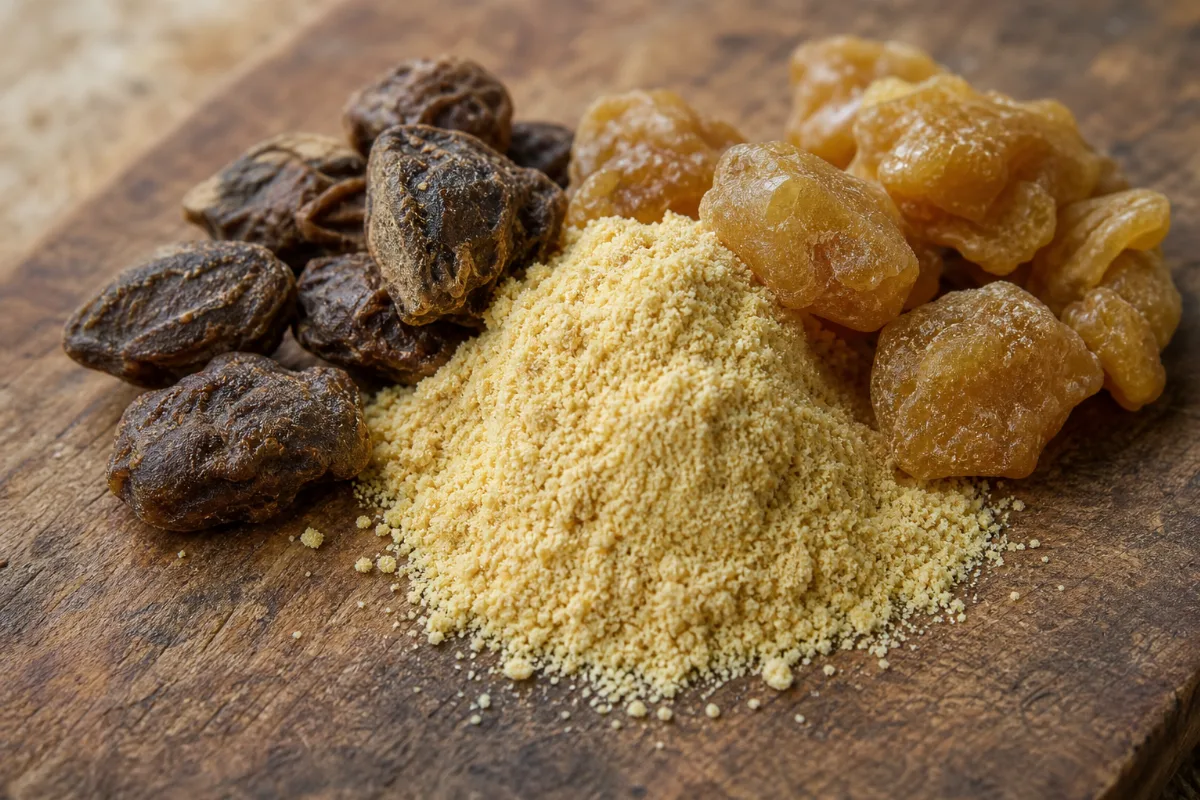
Asafoetida is a dried gum-resin (a milky sap that hardens) from the roots of several Ferula plants in the carrot family. The main sources are Ferula assa-foetida and Ferula foetida. [1] Most comes from Iran, Afghanistan and Central Asia, and India has been trying to grow it at home since 2020. [1] In India it is called hing. The name "devil's dung" appears in many Germanic languages. [1]Flavor and aroma
In the jar, asafoetida smells harsh and sulfurous, and the raw resin tastes acrid and bitter. [1] The smell is blamed mainly on sulfur compounds. [1] Cooked in hot oil, it turns mellow and savory, a bit like fried onion or garlic. [1] The smell is strong enough to taint nearby spices, so an airtight container matters. [1]It pairs naturally with lentils, beans, cabbage-family vegetables and potatoes. That pairing is common cooking practice rather than something our sources measured, so treat it as a tip.
How it is used in cooking
Whole lumps of resin are hard, so cooks grind them with something absorbent such as rice flour, then fry the powder in oil or soak it in water. [1] Most shops sell a compounded powder instead. It is the resin mixed with gum arabic, rice or wheat flour and turmeric, which softens the smell and stops clumping. [1] Such products contain roughly 30% asafoetida, so a wheat-based product is not gluten-free. [1] Check the label.- Indian cooking: curries, soups, sauces, pickles, sambar, rasam, lentil dishes, papadums and snack mixes. [1]
- Jain and some Brahmin cooking: a stand-in for onion and garlic, which these cooks avoid. [1]
- Afghanistan and Pakistan: meat rubbed with resin and salt, then air-dried for winter. [1]
- Central Asia: resin drawn on the pot before cooking rice, vegetables and meat. [1]
- Worcestershire sauce: once among its undisclosed ingredients. [1]
Add it at the start: it is quickly warmed in hot oil before the other ingredients go in, a step called tempering. [1] The sources we read give no substitute list, so we offer none.
Normal food amounts
USDA SR Legacy has no entry for this spice, so we give no gram weights per teaspoon or nutrient numbers.| Measure | Amount | Source |
|---|---|---|
| Teaspoon or tablespoon weight | Not available | USDA SR Legacy has no entry |
| Typical recipe amount | About one-sixteenth of a teaspoon of compounded powder for one person | Small 2011, as quoted in Wikipedia [1] |
Because the amount is so small, asafoetida adds almost nothing in calories or nutrients. We do not call it a source of anything.
Buying, storing and preparing
- Forms: solid resin ("tears" or mass), paste, and compounded powder. [1] Resin is sometimes called hingra when darker and oil-soluble, and hing when paler and water-soluble. [1]
- Quality: the compounded powder is a blend, so strength varies by brand. [1] Other gum-resins, such as galbanum, are sometimes confused with it. [1]
- Storing: powder keeps its aroma for several years, and pure resin can last for decades. [1]
- At home: hard resin needs crushing with a mortar and pestle. A small jar inside a second sealed container keeps the smell in.
Health: what research says
Cooking with a pinch of asafoetida is very different from taking the resin as a remedy or supplement.Food amounts vs supplements
| In normal cooking | In supplements and extracts | |
|---|---|---|
| Typical amount | A tiny pinch; no official amount found [1] | No official amount found |
| What studies mostly used | We found no study of asafoetida as a cooking spice | A 1979 German trial in irritable colon; the preparation is not stated in the abstract we read [4] |
| What we can say about benefit | Nothing; no study found | A 2020 review pooled asafoetida trials for irritable bowel symptoms [3] |
| Main safety limit | Avoid in babies; discouraged in pregnancy [2][1] | Same cautions; larger amounts bring more side effects [1] |
What the evidence shows
| Use | What the sources found | Strength of evidence | Form and population |
|---|---|---|---|
| Irritable bowel symptoms | A 2020 review of 33 double-blind trials of Western herbal medicines said asafoetida reduced overall symptoms in its pooled analysis. The authors add that apart from peppermint oil, aloe vera and asafoetida, positive trials have not been replicated. [3] | Promising but limited | Preparation not described in the abstract; adults with IBS [3] |
| Irritable colon (1979 trial) | A double-blind trial with two groups of 50 people, 91 of whom could be assessed, reported benefit at the 1% significance level. [4] | Promising but limited | Preparation not stated; adults with irritable colon [4] |
| Gas, blood pressure, colic and other traditional uses | We found no human trial we could read. | Insufficient evidence | Not applicable |
We found only abstracts of the two trial sources, so we could not check doses or study quality.
Official statements
We opened no regulator statement (EMA, EFSA, FDA, WHO, NCCIH) about asafoetida, so we report none.Related pages
Health connections for Asafoetida (hing)
What research links to this spice, and how strong the evidence is. Most studies use concentrated extracts or doses far above what you eat; each card says which.
Irritable bowel symptoms
Preliminary or mixedA 2020 review of double-blind trials reported that asafoetida reduced overall irritable bowel symptoms in its pooled analysis, with the caveat that positive trials were not yet replicated.
Supplements: Supplement or remedy finding only; no study of cooking amounts found. Not a treatment.
Irritable colon (1979 trial)
Preliminary or mixedA small double-blind German trial (91 evaluable people) reported benefit at the 1% significance level.
Supplements: Remedy finding only; not shown for food amounts.
Gas, colic, blood pressure and other traditional uses
Not enough evidenceWe found no human trial we could read for these traditional uses.
Supplements: No evidence found for food or supplements.
Connected topics
Open a group to see how each topic connects and how strong the evidence is.
Health goals (1)
- Digestive SupportPreliminary or mixed
Traditionally used for digestion; only the irritable bowel trials give human data, and they are limited.
Body systems (2)
- Digestive SystemPreliminary or mixed
Pooled trials report fewer irritable bowel symptoms; the evidence is limited and not replicated.
- Gut HealthPreliminary or mixed
Same irritable bowel finding; remedy trials, not food amounts.
Body parts (1)
- GutPreliminary or mixed
Irritable bowel trial finding; limited evidence.
Functional actions (1)
- Digestive SupportPreliminary or mixed
Limited trial evidence for irritable bowel symptoms.
Conditions & symptoms (2)
- Irritable Bowel SyndromePreliminary or mixed
Pooled double-blind trials report fewer symptoms; limited and not replicated; not a treatment.
- MethemoglobinemiaDocumented risk
A case report links the resin given to an infant with severe methemoglobinemia.
Documented risks and interactions (3)
- Infant methemoglobinemia. A 3-month-old given the resin for colic developed severe methemoglobinemia; the authors say it should be avoided in infants.
- Pregnancy caution. Use in pregnancy is generally discouraged because of reported abortion-causing effects.
- Side effects at higher amounts. Higher doses are reported to cause indigestion, belching, gas, diarrhea, headache, dizziness and lip swelling; very small doses reportedly caused convulsions in sensitive people.
Frequently asked questions
What does asafoetida taste like?
Raw, it is sharp, bitter and sulfurous. Cooked in hot oil, it becomes savory and close to onion and garlic. [1]
How much is normal?
Very little. One source says about one-sixteenth of a teaspoon of the compounded powder seasons a dish for one person. [1]
Is it safe in pregnancy?
Use is generally discouraged in pregnancy. [1] Ask your midwife or doctor before using it.
Is it safe for babies?
No. A case report describes a dangerous blood problem in an infant given the resin for colic. [2]
Can I take it with medicines?
The sources we read describe no interaction, but they are few. Ask a pharmacist if you take medicines regularly.
Does it help irritable bowel?
A 2020 review found it promising in pooled trials, but the evidence is limited and not yet replicated. [3] It is not a treatment.
More details: evidence, limits and cautions
The details behind this page: cautions, limits of the evidence and where sources disagree. Open any note to read it.
Safety note at a glance
Safety in more detail
- Medicines: the sources we read describe no drug interaction.
- Pregnancy: use is generally discouraged because of reported abortion-causing effects in traditional use. [1]
- Breastfeeding: the sources we read do not describe it.
- Children: a 3-month-old developed severe methemoglobinemia (blood that cannot carry oxygen well) after being given the gum for colic. He recovered after treatment. The paper explains that infant blood is easier to damage than adult blood. [2] A five-week-old had a similar case with a glycerin form. [1]
- Allergy: lip swelling is listed among effects of higher doses. [1] The sources we read do not describe cross-reactions with other carrot-family foods.
- Liver and kidney: the sources we read do not describe them.
- Surgery: the sources we read do not describe a surgery warning. Tell the surgical team about any supplement.
- Quality and contamination: compounded powders contain flour, so check for wheat if you avoid gluten. [1]
- Amounts that cause trouble: the article calls ingestion low in toxicity. In ten volunteers, 3 g caused no harm, and up to 15 g has been described as tolerated. Higher doses can bring indigestion, belching, gas, diarrhea, headache and dizziness, and very small doses are said to have caused convulsions in sensitive people. [1] Resin poultices on the belly have been linked to swelling of the genitals. [1]
References
- Wikipedia — Asafoetida (cites Britannica 2024, George 2012, Small 2011 and others). https://en.wikipedia.org/wiki/Asafoetida (accessed 2026-10-24)
- Severe methemoglobinemia secondary to Ferula asafoetida ingestion in an infant: a case report. Saudi J Med Med Sci 2020. https://pmc.ncbi.nlm.nih.gov/articles/PMC6945318 (accessed 2026-10-24)
- Western herbal medicines in the treatment of irritable bowel syndrome: a systematic review and meta-analysis. Complement Ther Med 2020; abstract read via Europe PMC. https://pubmed.ncbi.nlm.nih.gov/31987249/ (accessed 2026-10-24)
- Asa foetida in the treatment of the irritable colon: a double-blind trial. Dtsch Med Wochenschr 1979; abstract read via Europe PMC. https://pubmed.ncbi.nlm.nih.gov/365493/ (accessed 2026-10-24)