Spices · Spice blend
Panch phoron
A blend (no single species) · also called Panch phoran, panch puran, five-spice mix (Bengali), cinco especias bengalí (Spanish)
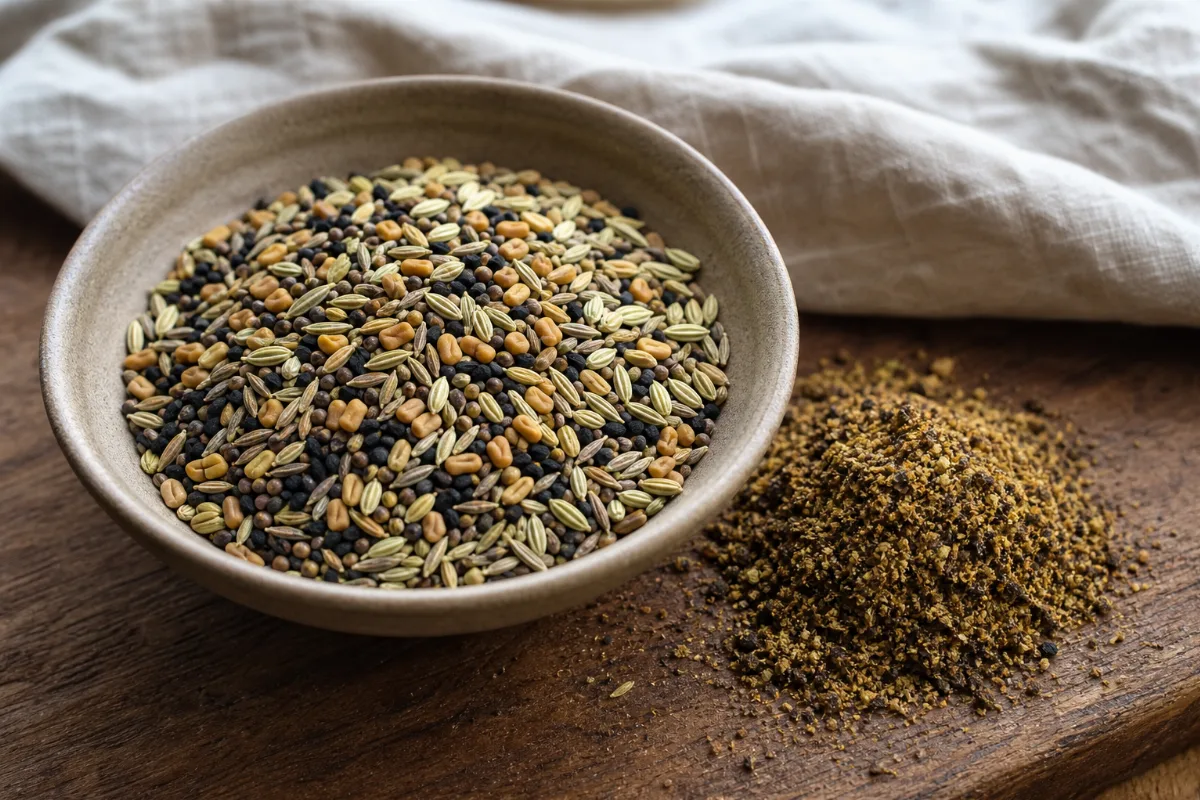
Panch phoron is a Bengali and eastern Indian blend of five whole seeds (fenugreek, cumin, nigella, black mustard and fennel), fried in hot oil to start a dish. No human study of the blend itself was found. The main caution is allergy: mustard is a listed allergen, and fenugreek can cause allergic reactions too. Fenugreek above food amounts is not safe in pregnancy.
General information, not medical advice. Last substantive update · Not medically reviewed. A named clinician has not signed off on this page. How this page is made
About Panch phoron
Panch phoron is a cooking blend of five whole seeds, not a health food or a remedy. Little research exists on the blend itself, so this page is smaller than most. The main cautions are allergy to mustard, fenugreek or cumin, and fenugreek above food amounts in pregnancy.
What it is
Panch phoron means five spices. It is a whole-seed blend from Bangladesh and eastern India, used in the cuisines of West Bengal, Odisha, Assam, Nepal and nearby regions. Typically it holds fenugreek, cumin, nigella, black mustard and fennel seed in equal parts.
Recipes vary. Black mustard is sometimes replaced by wild celery seed (radhuni), and Bong Eats lists radhuni as a fifth seed and says cumin makes an acceptable substitute for it. Some cooks use less fenugreek because it is mildly bitter. Unlike most spice mixes, panch phoron is always used whole.
Nutrition: no USDA entry and no shop-label figures were read, so no calories or nutrients are given for the blend. Seeds are used in small amounts to season oil, so a serving adds little energy or nutrients to a meal.
In the kitchen
Bong Eats describes panch phoron as a mix used to temper dals, vegetables and chutneys, and in pickles. Tempering means frying whole spices briefly in hot oil, then using the seasoned oil and seeds in the dish. Its dishes include moong and masoor dal, potato curries, a pumpkin dish and several chutneys.
To make your own, Bong Eats mixes 1 tablespoon each of five seeds, which makes 5 tablespoons, and stores them in an airtight container. The recipe has no salt and no ground spices.
What the research shows
No human study of panch phoron was found. A mouse study of a water extract of the blend found less pain and swelling in standard tests, and a computer study picked out two seed compounds as possible binders to cell-recycling proteins. Neither shows that eating the blend does anything in people.
For fenugreek on its own, a 2023 review of 10 randomised trials (706 people with type 2 diabetes or prediabetes) found lower fasting glucose, 2-hour glucose and HbA1c. NCCIH says there is not enough high-quality evidence to know whether fenugreek helps diabetes. The result is for fenugreek preparations, not a pinch of seeds in a blend.
Amounts
This page gives no amounts to eat. No source gave a usual amount per dish. Ask a doctor, pharmacist or dietitian what is right for you, especially if you are pregnant or take diabetes medicine.
At a glance
Traditional uses history, not proof
- Fried briefly in hot oil to temper dals, vegetables, chutneys and pickles in Bengali and eastern Indian cooking
- Used in Bangladesh, West Bengal, Odisha, Assam, Nepal and nearby regions, with local variations
Studied for research
- The blend as a whole: no human study found
- Fenugreek seed alone and blood sugar, low certainty (not the blend)
- Mouse study of a blend extract on pain and swelling, very low certainty (animal only)
- Computer screen of seed compounds, insufficient (no experiment)
Main compounds
- Fenugreek seed
- Cumin seed
- Nigella seed
- Black mustard seed (or radhuni)
- Fennel seed
Common forms
- Whole-seed blend, fried in hot oil (tempering)
- Home mix of equal parts, stored airtight
Research links: NCCIH: Fenugreek · FSAI: The 14 EU allergens · CDC MMWR 2018: Lead in spices, herbal remedies and ceremonial powders · Bong Eats: Panch phoron · Research Library · Genes & Biomarkers Library
What it is and its history
- Accepted scientific name
- Panch phoron (a whole-seed spice blend, no single species)
- Synonyms
- Panch phoran; Panch puran; Panch phodan; Pancha phutana; Five-spice mix (Bengali)
- Common names
- Panch phoron (English); Panch phoran (English); পাঁচ ফোড়ন (Bengali); Cinco especias bengalí (Spanish)
- Family or group
- A blend of five seeds in equal parts: fenugreek, cumin, nigella, black mustard and fennel. Wild celery seed (radhuni) sometimes replaces mustard, and Bong Eats uses radhuni with cumin as its substitute.
- Native range
- Bangladesh and eastern India (Wikipedia).
- Harvest and processing
- Seeds are mixed in equal parts and kept in an airtight container (Bong Eats). The blend is used whole, not ground (Wikipedia).
- Look-alikes and adulterants
- Name: Chinese five-spice powder; How to tell: Wikipedia lists it as a similar blend, but it is a different mix.; Name: Garam masala; How to tell: A different blend; panch phoron is whole seeds fried in oil (Wikipedia, Bong Eats).
Photographs
Traditional use and history history, not clinical proof
| Tradition or era | Documented use | Source |
|---|---|---|
Traditional use shows how it was used. It does not show that it works or is safe today.
What is inside, and how it may work
What it contains and how those compounds act in cells and animals. Laboratory and animal mechanisms are not proven effects in people.
Main compounds
| Compound | Family | Where it is concentrated | Activity studied | Level of evidence |
|---|---|---|---|---|
| Phenolic compounds and flavonoids (catechin hydrate, para-coumaric acid, vanillic acid, syringic acid) | phenolics | Seeds (water extract of the blend) Not given in the abstract | Found by HPLC in a water extract of the blend used in a mouse study. Activity in people not shown. 2 | Animal research |
| Stigmasterol and tigogenin | plant sterol and steroidal sapogenin | Seeds (from a computer screen) Not given | Predicted on a computer to bind autophagy-related proteins. Not tested in living material. 5 | In silico |
Mechanisms, receptors and pathways
| Target or pathway | Gene or receptor | What was found | Level |
|---|---|---|---|
| Pain and inflammation pathways | Opioid receptors (excluded in one test) | In mice, a water extract of the blend reduced pain and swelling in standard tests; naloxone did not reverse the effect in one test. Early animal work, mechanism not established. 2 | Animal research |
| Autophagy (cell recycling) | Not named in the abstract | Computer docking and simulation picked stigmasterol and tigogenin as the best binders. A prediction only. 5 | In silico |
Absorption, metabolism and elimination
- Absorption
- Not researched for the blend.
- Distribution
- Not researched.
- Metabolism
- Not researched.
- Elimination
- Not researched.
- Bioavailability
- Not researched.
Isolated compounds versus whole extracts
This page is about the blend as used in cooking: a small amount of whole seeds fried in oil. Its seeds (fenugreek, cumin, nigella, fennel, mustard) are also sold as concentrated supplements or oils, which are different products. The fenugreek trials on the Benefits tab are of fenugreek preparations, not the blend. The blend is not sold as a supplement in any source read.
Nutritional composition
No USDA FoodData Central entry for panch phoron was found, and no nutrition label for a shop blend was read. The USDA search service refused our request on 2026-10-26 (rate limit), so the per-seed figures on the earlier site page were not re-checked and are not repeated here. The cooking sources read give no calories or nutrients for the blend. Seeds are used in small amounts to season oil, so a serving adds little energy or nutrients to a meal. Bong Eats' recipe is 1 tablespoon of each of the five seeds, which makes 5 tablespoons of blend. No amount to eat is given.
1 low certainty1 very low certainty2 not enough evidence
What was looked at
The 4 benefits and uses checked for Panch phoron, each with how strong the evidence is. Tap one to open it.
- Panch phoron eaten as a food (health effects of the blend)Not enough evidence
- Fenugreek (one of the five seeds) and blood sugar in type 2 diabetes and prediabetesLow certainty
- Pain and swelling in mice given a water extract of panch phoron (animal study)Very low certainty
- Compounds in the five seeds and cancer-related cell processes (computer modelling)Not enough evidence
Lab markers tracked in the studies
Fasting blood glucose, 2-hour glucose and HbA1c (fenugreek)Total cholesterol, triglycerides, HDL and LDL cholesterol (fenugreek)
What is Panch phoron good for?
The main studied uses and how strong the evidence is for each. Nothing was found that studies the blend in people, so most results are for a single seed or for animals and computers.
Benefits, one by one
Each card is a research question, not a promise. Tap a goal to filter. Open a card to see the studies, doses and limits.
Panch phoron eaten as a food (health effects of the blend)
Not enough evidenceNo study of panch phoron eaten as food, in people, for any health outcome was found. It is a cooking blend of five seeds. What is known comes from its separate seeds and from two lab studies, covered on the next tab.
2 studiesWhole seeds mixed in equal parts and fried briefly in hot oil. Not so…
Studies, doses and limits
What the trials found
A PubMed search for panch phoron found two papers (one in mice, one on a computer). The cooking sources read describe what is in the blend and how it is used, not health effects.
Results
No human study of the blend was found.
Why this rating
No human study of the blend exists in the sources read, so nothing can be rated.
Form and dose studied
Whole seeds mixed in equal parts and fried briefly in hot oil. Not sold as a supplement in any source read.
Who was studied
Not studied.
Limits
Absence of studies is not proof of no effect and not proof of safety. A blend has different amounts of each seed from one cook to another.
Why researchers looked
People ask whether a blend of five seeds that are each used in traditional medicine does something for health.
Traditional use
Panch phoron is used in Bengali and eastern Indian cooking to season dals, vegetables, chutneys and pickles. Long use as food is not proof of any health effect.
Proposed mechanism Unknown
Not applicable: no human study of the blend was found.
A proposed mechanism does not show that the effect happens in people.
Mustard and fenugreek can cause allergy. See the Safety tab.
Fenugreek (one of the five seeds) and blood sugar in type 2 diabetes and prediabetes
Low certaintyA 2023 review pooled 10 randomised trials (706 people) of fenugreek in type 2 diabetes or prediabetes and found it lowered fasting blood sugar, 2-hour blood sugar and HbA1c. The US National Center for Complementary and Integrative Health (NCCIH) says many of these studies were not high quality. This is fenugreek on its own, not panch phoron, and not the small amount of seed in a blend.
2 studiesFenugreek preparations in trials (forms not given in the abstract). N…
Studies, doses and limits
What the trials found
Systematic review and meta-analysis of 10 randomised trials with control groups, 706 participants, searched in seven databases. The abstract does not list the fenugreek forms or the amounts.
Results
Fasting blood glucose, 2-hour glucose and HbA1c fell significantly; insulin resistance (HOMA-IR) did not fall significantly. No liver or kidney toxicity and no severe adverse events were reported, with mild digestive side effects in some studies. NCCIH (updated February 2025) says there is not enough high-quality evidence to know whether fenugreek is useful for diabetes.
Effect sizes as reported
No numbers in the abstract.
Why this rating
Pooled trials are the right design, but only the abstract was read, the fenugreek forms are not known, NCCIH says many studies were not high quality, and the review's authors do not report industry funding in the abstract. The result is for fenugreek, not for the blend.
Form and dose studied
Fenugreek preparations in trials (forms not given in the abstract). Not the pinch of whole seed used in cooking.
Who was studied
Adults with type 2 diabetes or prediabetes.
Limits
A trial result for a supplement-style dose does not carry over to food amounts. Large doses may harm by dropping blood sugar too far (NCCIH).
Why researchers looked
Fenugreek seed has long been used as a traditional remedy and is promoted as a supplement for diabetes, so trials have tested it.
Traditional use
Fenugreek is one of the five seeds in panch phoron. Cooks use it in smaller amounts than the other four because it is mildly bitter.
Proposed mechanism Unknown
Not shown in the abstract.
A proposed mechanism does not show that the effect happens in people.
If you take diabetes medicine, ask your doctor or pharmacist about fenugreek.
Pain and swelling in mice given a water extract of panch phoron (animal study)
Very low certaintyIn a 2020 study, mice given a water extract of panch phoron (equal parts of the five seeds) showed less pain and swelling in standard tests. This is an animal study only. It does not show that eating the blend helps pain or swelling in people.
1 studiesWater extract of the five seeds, given to mice.
Studies, doses and limits
Results
The extract reduced pain and swelling in a dose-dependent way in the mouse tests and increased paw withdrawal time after nerve surgery.
Effect sizes as reported
No effect sizes in the abstract (statistical significance p < 0.05).
Why this rating
Mouse study with 6 animals per group, a water extract at animal doses, and no human data.
Form and dose studied
Water extract of the five seeds, given to mice.
Who was studied
Male Swiss albino mice.
Limits
Findings in mice often do not hold in people. Abstract only was read.
Why researchers looked
Panch phoron is a common Bangladeshi blend and the authors wanted to see whether its seeds together affect pain and inflammation.
Traditional use
The seeds are used in cooking; use for pain is not described in the cooking sources read.
Proposed mechanism Animal study
The authors report that naloxone, which blocks opioid receptors, did not reverse the effect in one test, and that HPLC found phenolic compounds and flavonoids in the extract. Not a proven mechanism.
A proposed mechanism does not show that the effect happens in people.
None specific.
Compounds in the five seeds and cancer-related cell processes (computer modelling)
Not enough evidenceA 2025 paper used computer modelling to look for compounds in the five seeds that might affect a cell process called autophagy, and named stigmasterol and tigogenin as the best candidates. No people, animals or cells were tested. It says nothing about eating the blend.
1 studiesIsolated compounds, on a computer.
Studies, doses and limits
Results
The best computed binders were stigmasterol and tigogenin. The authors suggest they may be candidates for drugs, not that the blend treats cancer.
Why this rating
A prediction on a computer with no experiment behind it.
Form and dose studied
Isolated compounds, on a computer.
Limits
No link is shown between the amount of these compounds in a spoonful of seeds and any effect in the body. The paper does not claim the blend treats cancer.
Why researchers looked
Researchers screen plant compounds on the computer to choose which ones to test in the lab later.
Proposed mechanism In silico
Predicted binding of seed compounds to autophagy-related proteins, and a computer simulation of how stable the complexes were. Not tested in living material.
A proposed mechanism does not show that the effect happens in people.
None.
Connections to the rest of health
How Panch phoron connects to the rest of our health knowledge graph. Every link says what kind of connection it is. A safety link (for example to the liver) is a warning, not a benefit. A study that merely mentions a topic never creates a benefit link.
Explore every connection: goals, body systems, organs, symptoms, genes
B. Body systems
| Connected to | Kind of connection | Evidence status | Context | Studies |
|---|---|---|---|---|
| Digestive System | Biological association | Not enough evidence | Studied for: Panch phoron eaten as a food (health effects of the blend) | 11 7 |
| Endocrine System | Biological association | Low certainty | Studied for: Fenugreek (one of the five seeds) and blood sugar in type 2 diabetes and prediabetes | 3 10 |
| Nervous System | Biological association | Very low certainty | Studied for: Pain and swelling in mice given a water extract of panch phoron (animal study) | 2 |
| Cellular System | Biological association | Not enough evidence | Studied for: Compounds in the five seeds and cancer-related cell processes (computer modelling) | 5 |
E. Health conditions
| Connected to | Kind of connection | Evidence status | Context | Studies |
|---|---|---|---|---|
| Food allergy | Documented risk | Mustard is an EU-listed allergen; fenugreek and cumin can cause allergic reactions. Not tested on the blend. Preparation or compound: Mustard, fenugreek or cumin seed |
9 10 6 4 | |
| Lead poisoning | Documented risk | A CDC report found lead in some spice products; panch phoron is not named in the abstract. Preparation or compound: Lead in some spices |
1 | |
| Salmonella infections | Documented risk | Salmonella has been found in dried spices; not shown for this blend. Preparation or compound: Dried spices in general |
8 |
I. Biomarkers
| Connected to | Kind of connection | Evidence status | Context | Studies |
|---|---|---|---|---|
| Fasting blood glucose, 2-hour glucose and HbA1c (fenugreek) | Biological association | Low certainty | Measured in trials: lowered. A lab change is not the same as a health benefit. | 3 |
| Total cholesterol, triglycerides, HDL and LDL cholesterol (fenugreek) | Biological association | Low certainty | Measured in trials: mixed. A lab change is not the same as a health benefit. | 3 |
L. Active compounds
| Connected to | Kind of connection | Evidence status | Context | Studies |
|---|---|---|---|---|
| Phenolic compounds and flavonoids (catechin hydrate, para-coumaric acid, vanillic acid, syringic acid) | Biological association | Animal | Found by HPLC in a water extract of the blend used in a mouse study. Activity in people not shown. Preparation or compound: Seeds (water extract of the blend) |
2 |
| Stigmasterol and tigogenin | Biological association | In silico | Predicted on a computer to bind autophagy-related proteins. Not tested in living material. Preparation or compound: Seeds (from a computer screen) |
5 |
Each connection is stored with the ingredient, the connected record, the kind of connection, the evidence status, the supporting studies, the preparation or compound involved, and a review date (last reviewed October 26, 2026).
The evidence
The research centre for Panch phoron. Every record here was checked against PubMed or the publisher's page; we never list a study we have not verified.
Evidence by outcome
Bars show how many studies we found for each outcome, not how well it works. People are added up across trials only (reviews are not added, to avoid double counting).
How we rate evidence
High certainty
Several well-run trials or reviews agree; further research is unlikely to change the picture much.
Moderate certainty
Good trials point the same way, but some doubt remains.
Low certainty
Small, short or inconsistent trials. The finding could change with better research.
Very low certainty
Very little or very weak human data. Treat as a possibility only.
Mixed findings
Trials or reviews disagree with each other.
Not enough evidence
Not enough human research to say either way.
Evidence against
Good research found no benefit, or found harm.
We take the reviewers' own risk-of-bias and GRADE statements where they exist, and otherwise judge from study size, design, consistency, directness and whether a product matches what is sold. Many publications do not make evidence high. Method note: We started from the existing page, re-opened its sources (Wikipedia, Bong Eats, NCCIH, FSAI, the FDA spice update) and read PubMed abstracts for the studies. Only abstracts were read for the studies. Little research exists on the blend itself, so this page is smaller than most. Two sources on the earlier page (USDA seed weights and a Health Canada mustard review) could not be re-opened and were dropped. What we could not verify is in the research gaps.
Study library: every study we checked 11
| Study | Design | People | Product, dose, length | Result |
|---|---|---|---|---|
| Angelon-Gaetz 2018 Lead in Spices, Herbal Remedies, and Ceremonial Powders Sampled from Home Investigations for Children with Elevated Blood Lead Levels - North Carolina, 2011-2018. MMWR Morb Mortal Wkly Rep · PMID 30462630 · DOI |
Case series / surveillance report n/a |
Homes of 61 children with raised blood lead in North Carolina (59 properties) | Spices, herbal remedies and ceremonial powders sampled from the homes Not panch phoron Not given as advice See abstract · vs See abstract |
More than one fourth (28.8%) of the spices, herbal remedies and ceremonial powders sampled from these homes held 1 mg/kg lead or more. The report says a national maximum limit for lead in spices might reduce exposure. 28.8% of samples at or above 1 mg/kg (all product types together) Methods, limits and fundingOutcomes: Lead in the samples Limitations: Samples came from homes of children who already had high blood lead, not from a random sample of shops. Panch phoron is not named in the abstract. It cannot say how common lead is in this blend or its seeds. Funding and conflicts: Not stated in the abstract. Read: abstract |
| Gias 2020 A mechanistic approach to HPLC analysis, antinociceptive, anti-inflammatory and postoperative analgesic activities of panch phoron in mice. BMC Complement Med Ther · PMID 32228549 · DOI |
Animal study (mice) with chemical analysis mouse |
Male Swiss albino mice, 6 per group, five groups | Water extract of panch phoron (equal parts fennel, fenugreek, black cumin, cumin and black mustard) Seeds (extract) Not given as advice (animal doses) See abstract · vs Water, and diclofenac as a reference painkiller |
The extract showed dose-dependent pain-relieving and anti-inflammatory activity in the mouse tests (p < 0.05) and raised paw withdrawal time after nerve surgery. Naloxone did not reverse the effect in one test. HPLC found phenolic compounds and flavonoids, including catechin hydrate, para-coumaric acid, vanillic acid and syringic acid. No effect sizes in the abstract Methods, limits and fundingOutcomes: Pain and swelling tests in mice; compounds found by HPLC Limitations: Mice, 6 per group, a water extract at animal doses. It does not show any effect of eating the blend in people. Funding and conflicts: Not stated in the abstract. Read: abstract |
| Kim 2023 The Effect of Fenugreek in Type 2 Diabetes and Prediabetes: A Systematic Review and Meta-Analysis of Randomized Controlled Trials. Int J Mol Sci · PMID 37762302 · DOI |
Systematic review and meta analysis of randomised trials |
706 10 randomised trials, 706 people with type 2 diabetes or prediabetes |
Fenugreek preparations given for high blood sugar (forms not listed in the abstract); not a spice blend Fenugreek (the abstract does not say which forms) Not given as advice See abstract · vs Control groups |
Fenugreek significantly reduced fasting glucose, 2-hour glucose and HbA1c, but did not significantly reduce HOMA-IR. It significantly improved total cholesterol, triglycerides and HDL cholesterol, but not LDL cholesterol or BMI. The authors report no liver or kidney toxicity and no severe adverse events, with mild digestive side effects in some studies. No numbers in the abstract Methods, limits and fundingOutcomes: Fasting blood glucose, 2-hour glucose, HbA1c, insulin resistance (HOMA-IR), blood fats, BMI, safety Limitations: Abstract only was read, so study quality and the fenugreek forms used are not known. NCCIH says many fenugreek studies were not of high quality. This is fenugreek alone, not panch phoron, and not the small amount of seed in a blend. Funding and conflicts: Not stated in the abstract. Read: abstract |
| Lisiecka 2026 Allergic reactions to spices: a review of sensitivities to pepper, cumin, oregano, anise, mustard and other spices. Eur Ann Allergy Clin Immunol · PMID 40341008 · DOI |
Literature review |
Not applicable (review of published reports, 2010 to 2023) | Spices as allergens Not given |
The review says spice allergies are often under-recognised. Cumin allergens belong to the PR-10 family and can provoke allergic reactions, and cross-reactivity between cumin and other umbelliferae is common. It calls mustard one of the most allergenic spices, with reactions that can be severe even in small amounts. Diagnosis uses skin prick tests and blood tests for IgE antibodies. Not applicable Methods, limits and fundingOutcomes: Spice allergy and cross-reactivity Limitations: Literature review, abstract only read. It does not study panch phoron, and fennel, fenugreek and nigella are not mentioned in the abstract. Funding and conflicts: Not stated in the abstract. Read: abstract |
| Parveen 2025 Identifying Potential Autophagy Modulators in Panch Phoron Spices (P5S): An In Silico approach. ACS Omega · PMID 39829452 · DOI |
Computer modelling (in silico) in silico |
None (no people, animals or cells) | Compounds from cumin, fenugreek, fennel, black mustard and black cumin, tested on a computer 100 ns simulation |
The computer screening picked out stigmasterol and tigogenin as the best drug-like binders to the chosen targets. The authors say these molecules may be candidates for anticancer drugs. Not applicable Methods, limits and fundingOutcomes: Computed binding to autophagy-related targets Limitations: A computer prediction only. It does not show that the blend, or these compounds at food levels, has any effect on cancer or anything else. Funding and conflicts: Not stated in the abstract. Read: abstract |
| Sharma 2019 A Comprehensive Review on Mustard-Induced Allergy and Implications for Human Health. Clin Rev Allergy Immunol · PMID 29159565 · DOI |
Narrative review |
Not applicable (review of clinical reports) | Mustard as a food allergen Not given |
The review says mustard allergy has been reported for many years, is increasing where mustard use is higher, may be among the more important food allergies, and that mustard can be a hidden allergen in foods. It also discusses cross-reactivity of mustard allergens with other food allergens and says mustard sensitivity should be tested for in people with idiopathic anaphylaxis. Not applicable Methods, limits and fundingOutcomes: Allergic reactions to mustard Limitations: Narrative review, abstract only read. It does not study panch phoron. Funding and conflicts: Not stated in the abstract. Read: abstract |
| s-bong-panch Bong Eats: Panch phoron (recipe) · Source |
Cooking site recipe n/a |
Methods, limits and fundingRead: full-text | ||
| s-fda-spice-salmonella FDA: Updates spice risk profile, adds information about lower Salmonella prevalence in retail products (15 Feb 2018) · Source |
Regulator update n/a |
Methods, limits and fundingRead: full-text | ||
| s-fsai-14 FSAI (Ireland): List of the 14 allergens (EU rules) · Source |
Regulator page n/a |
Methods, limits and fundingRead: full-text | ||
| s-nccih-fenugreek NCCIH (US): Fenugreek, usefulness and safety · Source |
Regulator fact sheet n/a |
Methods, limits and fundingRead: full-text | ||
| s-wiki-panch Wikipedia: Panch phoron · Source |
Encyclopedia n/a |
Methods, limits and fundingRead: full-text |
What we do not know yet
- No human study of panch phoron as a blend was found for any health outcome.
- No nutrition entry for the blend, and no shop label, was read, so no nutrients are given.
- No source covers the blend in pregnancy, breastfeeding or childhood; the pregnancy statement is about fenugreek.
- The lead report does not name panch phoron or its seeds.
- Allergy to fennel and nigella seed and interactions of cumin, nigella, fennel and mustard seed were not researched for this page.
How new research is added
New studies are found by a saved PubMed search and placed in a review queue before the page changes.
Lab markers
What changed in blood or saliva tests during trials. A changed number is not the same as feeling or being healthier, and we give no "normal ranges".
Metabolic 1
Fasting blood glucose, 2-hour glucose and HbA1c (fenugreek)
Lowered in trials
Blood sugar measured after fasting, two hours after a sugar drink, and its three-month average (HbA1c).
Low certaintyResults and what it means
Why it was measured
They show how well blood sugar is controlled in diabetes and prediabetes.
Statistical vs. clinical meaning
A lab measure, not a health outcome such as complications.
Safety implication
Large fenugreek doses may drop blood sugar too far (NCCIH).
| Study | Result | People | Product |
|---|---|---|---|
| 3 | All three fell significantly with fenugreek compared with control groups; the abstract gives no numbers. | 706 adults with type 2 diabetes or prediabetes in 10 trials | Fenugreek preparations (forms not given in the abstract) |
Other 1
Total cholesterol, triglycerides, HDL and LDL cholesterol (fenugreek)
Mixed results in trials
Fats carried in the blood that are measured to judge heart risk.
Low certaintyResults and what it means
Why it was measured
People with diabetes often have blood fat changes.
Statistical vs. clinical meaning
Lab measures, not heart attacks or strokes.
Safety implication
None specific.
| Study | Result | People | Product |
|---|---|---|---|
| 3 | Total cholesterol, triglycerides and HDL cholesterol improved significantly; LDL cholesterol and BMI did not change significantly. No numbers in the abstract. | Adults with type 2 diabetes or prediabetes | Fenugreek preparations (forms not given in the abstract) |
Safety
What studies and official sources say about side effects, medicines and who should check first. Each point shows what kind of evidence it comes from.
Main points to know 5
- Mustard allergy: mustard is one of the five seeds. Mustard is on the EU list of 14 allergens that must be declared on food labels. A 2019 review says mustard allergy has been reported for many years, mustard can be a hidden allergen in foods, and mustard allergens can cross-react with other food allergens. A 2026 review calls mustard one of the most allergenic spices, with reactions that can be severe even in small amounts. Nothing read tests the blend itself. If you are allergic to mustard, check with your allergist before using panch phoron or any shop blend. Authoritative guidance 9 6 4
- Fenugreek: allergy, and not safe in pregnancy above food amounts. NCCIH says fenugreek can cause allergic reactions, including serious ones, and that it is not safe in pregnancy in amounts greater than those found in food, because its use has been linked to birth defects in animals and people. NCCIH believes fenugreek is safe for adults and children in the amounts common in food. Panch phoron holds only a share of one seed type, and no source read measures how much fenugreek a serving gives. Ask your midwife or doctor if you are pregnant. Authoritative guidance 10
- Cumin is also a possible allergen. A 2026 review says cumin allergens can provoke allergic reactions and that cross-reactivity between cumin and other umbelliferae is common. Cumin is a usual part of the mix (Bong Eats uses it only as a substitute for radhuni). The review's abstract does not mention fennel, fenugreek or nigella. Narrative review 4 11 7
- Lead has been found in some ground spices; no panch phoron was tested. A CDC report from North Carolina found 28.8% of spices, herbal remedies and ceremonial powders sampled from homes of children with raised blood lead held 1 mg/kg or more. The samples came from those homes, not a random sample of shops, and panch phoron is not named in the abstract read. Panch phoron is whole seeds, not ground, but no source says whole seeds are safer. Market survey 1
- Large fenugreek amounts may drop blood sugar and upset the gut. NCCIH lists diarrhea, nausea and other digestive symptoms as possible side effects of fenugreek and says large doses may cause a harmful drop in blood sugar. These statements are about fenugreek as a supplement or in large amounts, not a pinch of seeds fried in oil. If you take medicine for diabetes, ask a pharmacist. Authoritative guidance 10
Side effects 3
| Effect | How often | Severity and recovery | Evidence |
|---|---|---|---|
| Allergic reaction to mustard, fenugreek or cumin Seek urgent help for trouble breathing or swelling. | Not given for this blend. | can be serious Not stated | Authoritative guidance 9 10 6 4 |
| Diarrhea, nausea and other digestive symptoms (fenugreek) NCCIH lists these as possible side effects of fenugreek; the amounts are not food-sized. | Not given. | mild to moderate Not stated | Authoritative guidance 10 |
| Mild digestive side effects in fenugreek trials The review reports no severe adverse events and no liver or kidney toxicity; the trials used supplement-style fenugreek. | Not given in the abstract. | mild Not stated | Meta-analysis 3 |
Liver
The fenugreek review's abstract reports no liver or kidney toxicity in the trials pooled. No liver or kidney problem linked to panch phoron was found in the sources read. 3
This is a safety connection. It is not evidence that Panch phoron supports liver health.
Medicines and supplements 3
| With | Why it matters | Importance | Evidence | What to do |
|---|---|---|---|---|
| Prescription and over-the-counter medicines (fenugreek) prescription | Not described. | NCCIH advises talking with a health care provider before using fenugreek if you take any medicine, because some herbs and medicines interact in harmful ways. No interaction study of the blend was found. | Authoritative guidance Not enough evidence 10 | If you take medicine, ask a pharmacist, especially about large amounts of fenugreek. |
| Diabetes medicines and blood sugar prescription | NCCIH says large doses of fenugreek may cause a harmful drop in blood sugar. It does not name particular medicines. | Described for large fenugreek doses, not for the small amount of seed in a blend. No study of the blend was found. | Authoritative guidance Not enough evidence 10 | Ask your doctor or pharmacist if you take diabetes medicine and use fenugreek products. |
| Other interactions of cumin, nigella, fennel and mustard seed prescription | Not researched here; see each seed's own page. | None found Not enough evidence | Ask a pharmacist about any seed you eat in large amounts or take as a supplement. |
Who should check first 4
| Situation | Advice | Evidence |
|---|---|---|
| Known allergy to mustard, fenugreek or cumin | Check with your allergist before using the blend. Read the label of any shop blend. | Authoritative guidance 9 10 6 4 |
| Pregnancy | NCCIH says fenugreek is not safe in pregnancy in amounts above those in food. Ask your midwife or doctor about the blend. | Authoritative guidance 10 |
| Breastfeeding | NCCIH says little is known about fenugreek in larger-than-food amounts while breastfeeding. No source covers the blend. | Authoritative guidance 10 |
| Children | NCCIH believes fenugreek is safe for children in food amounts. No source covers the blend in children. Ask a paediatrician if there is a seed allergy. | Authoritative guidance 10 |
Overdose, product quality and regulators
Summary. No toxicity of the blend was found in the sources read. The documented concerns are allergy, fenugreek above food amounts in pregnancy, and possible contamination of spices in general.
Animal. The mouse study of a water extract reports pain-relief and anti-inflammatory activity; its abstract does not report toxicity.
Human doses studied. No source gives an unsafe amount of the blend.
High dose or long term signals. NCCIH: large fenugreek doses may drop blood sugar too far.
Genotoxicity. Not researched.
Dried spices can carry lead and germs. The sources read do not name panch phoron.
Lead. 28.8% of spice, herbal remedy and ceremonial powder samples from homes of children with raised blood lead held 1 mg/kg or more (CDC, North Carolina). Panch phoron is not named in the abstract read. 1
Salmonella. The FDA found Salmonella in 11 types of packaged retail dried spices (the seeds here are not named in the part read). Except for dehydrated garlic and basil, it was less common in retail samples than in imported shipments. The FDA says responsible manufacturers apply a germ-reducing treatment to many spices after import. 8
| Body | Action | Date |
|---|---|---|
| NCCIH (NIH) (United States) | Fenugreek is believed safe in food amounts; not safe in pregnancy above food amounts; can cause serious allergic reactions; large doses may drop blood sugar; talk to a provider if you take medicine. source | Last updated February 2025 (page read 2026-10-26) |
| EU food information rules (via FSAI) (European Union) | Mustard, celery and sesame are among 14 allergens that must be declared. source | 2026-10-26 (page read) |
| FDA (United States) | Salmonella in retail dried spices was generally less common than in imported shipments; many spices get a germ-reducing treatment after import. source | 2018-02-15 |
| CDC (MMWR report) (United States) | A 2018 report found lead at or above 1 mg/kg in 28.8% of spices, herbal remedies and ceremonial powders from homes of children with raised blood lead, and says a national limit for lead in spices might reduce exposure. source | 2018-11-23 |
When to get medical help
- Trouble breathing, swelling of the lips, tongue or throat, or widespread hives after eating food seasoned with the blend: call your emergency number.
- Pregnant and unsure about fenugreek: talk to your midwife or doctor before eating it in more than food amounts.
- A child with raised blood lead or signs such as unusual tiredness, belly pain or developmental concerns: talk to a doctor.
Stop using the product and contact a clinician or emergency service. In the US, Poison Control is 1-800-222-1222.
General information only, not medical advice. Ask a clinician or pharmacist before use, especially with medicines, in pregnancy or with a health condition. See the Natural Remedy Safety guide.
Frequently asked questions
What is panch phoron?
A Bengali and eastern Indian blend of five whole seeds, usually fenugreek, cumin, nigella, black mustard and fennel in equal parts. The name means five spices.
Is panch phoron ground or whole?
What does it taste like?
The sources read describe only one note: fenugreek is mildly bitter, which is why some cooks use less of it. No source describes the blend's whole taste.
What is radhuni?
Is panch phoron good for you?
Does it lower blood sugar?
Does it contain allergens?
Is it safe in pregnancy?
In cooking amounts, NCCIH believes fenugreek is safe for adults. It says fenugreek above food amounts is not safe in pregnancy, linked to birth defects. No source covers the blend itself, so ask your midwife or doctor.
Is it safe for children and during breastfeeding?
NCCIH believes fenugreek is safe for children in food amounts, and says little is known about larger amounts while breastfeeding. No source covers the blend itself.
Can I take it with medicines?
No interaction study of the blend was found. NCCIH advises talking to a provider about fenugreek if you take any medicine, and says large doses may drop blood sugar. Ask a pharmacist if you take diabetes medicine.
Is there lead or Salmonella in spices?
Can I make my own?
Yes. Bong Eats mixes 1 tablespoon each of fennel, radhuni (or cumin), mustard, fenugreek and nigella seeds and stores them in an airtight container. Check the allergen list before serving others.
Explore by health goal
Editorial transparency
- Written by
- AlternativeMed editorial team. Research compiled with AI assistance, then checked against the sources listed.
- Medical review
- None. This page has not been reviewed by a physician or pharmacist.
- First published
- 2026-10-26
- Last substantive update
- 2026-10-26
- How we research
- We started from the existing page, re-opened its sources (Wikipedia, Bong Eats, NCCIH, FSAI, the FDA spice update) and read PubMed abstracts for the studies. Only abstracts were read for the studies. Little research exists on the blend itself, so this page is smaller than most. Two sources on the earlier page (USDA seed weights and a Health Canada mustard review) could not be re-opened and were dropped. What we could not verify is in the research gaps.
- How we rate evidence
- See "How we rate evidence" in the Evidence tab.
- Independence
- No product is promoted on this page. No affiliate links are shown.
Sources 11
Each source was opened and checked. Where we read only the abstract, it says so. The small numbers in the text point here.
- Angelon-Gaetz KA, Klaus C, Chaudhry EA, Bean DK. Lead in Spices, Herbal Remedies, and Ceremonial Powders Sampled from Home Investigations for Children with Elevated Blood Lead Levels - North Carolina, 2011-2018.. MMWR Morb Mortal Wkly Rep. 2018. PMID 30462630. DOI 10.15585/mmwr.mm6746a2. (abstract)
- Gias ZT, Afsana F, Debnath P, et al.. A mechanistic approach to HPLC analysis, antinociceptive, anti-inflammatory and postoperative analgesic activities of panch phoron in mice.. BMC Complement Med Ther. 2020. PMID 32228549. DOI 10.1186/s12906-020-02891-x. (abstract)
- Kim J, Noh W, Kim A, et al.. The Effect of Fenugreek in Type 2 Diabetes and Prediabetes: A Systematic Review and Meta-Analysis of Randomized Controlled Trials.. Int J Mol Sci. 2023. PMID 37762302. DOI 10.3390/ijms241813999. (abstract)
- Lisiecka MF. Allergic reactions to spices: a review of sensitivities to pepper, cumin, oregano, anise, mustard and other spices.. Eur Ann Allergy Clin Immunol. 2026. PMID 40341008. DOI 10.23822/EurAnnACI.1764-1489.400. (abstract)
- Parveen S, Ikhlas S, Faruqui T, et al.. Identifying Potential Autophagy Modulators in Panch Phoron Spices (P5S): An In Silico approach.. ACS Omega. 2025. PMID 39829452. DOI 10.1021/acsomega.4c07924. (abstract)
- Sharma A, Verma AK, Gupta RK, et al.. A Comprehensive Review on Mustard-Induced Allergy and Implications for Human Health.. Clin Rev Allergy Immunol. 2019. PMID 29159565. DOI 10.1007/s12016-017-8651-2. (abstract)
- . Bong Eats: Panch phoron (recipe). . . (full-text)
- . FDA: Updates spice risk profile, adds information about lower Salmonella prevalence in retail products (15 Feb 2018). . . (full-text)
- . FSAI (Ireland): List of the 14 allergens (EU rules). . . (full-text)
- . NCCIH (US): Fenugreek, usefulness and safety. . . (full-text)
- . Wikipedia: Panch phoron. . . (full-text)
Where to buy
Check the label first. Whatever you buy, look for these:
- Whole or ground: whole spices keep their flavor longer
- The origin and a packed-on or best-by date for freshness
- Organic or non-irradiated labeling if that matters to you
- A resealable, airtight container
Talk to a pharmacist or doctor before you start any supplement, especially if you take medicines. See the Safety tab for interactions.
Support our free guides: as an Amazon Associate we earn from qualifying purchases. Full disclosure.


