Spices · Spice blend
Pumpkin pie spice
Blend of Cinnamomum, Zingiber, Myristica and Syzygium spices · also called Pumpkin spice, pumpkin pie seasoning
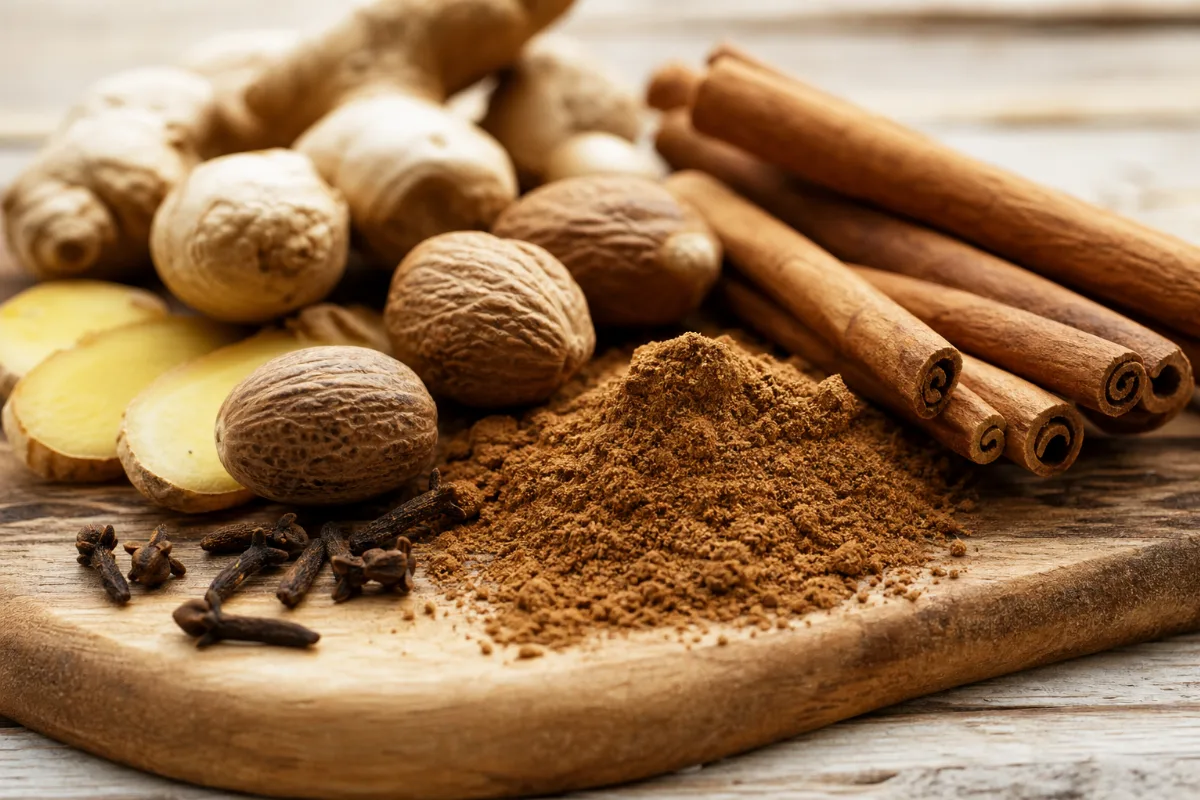
Pumpkin pie spice is a warm, sweet baking blend, usually cinnamon, ginger, nutmeg and cloves, sometimes with allspice. It contains no pumpkin. We found no study of the blend as a blend, so no health benefit can be claimed. The main cautions come from its parts: coumarin in cassia cinnamon, large amounts of nutmeg, and lead found in some spices.
General information, not medical advice. Last substantive update · Not medically reviewed. A named clinician has not signed off on this page. How this page is made
About Pumpkin pie spice
Pumpkin pie spice is a flavour blend, not a remedy. A pinch in baking is ordinary. Cassia coumarin, large amounts of nutmeg and lead in some spices are the points worth knowing.
What it is
Pumpkin pie spice is an American blend, usually mostly cinnamon with nutmeg, ginger, cloves and sometimes allspice. A history article says it is more than half cinnamon by measure. Recipes vary by maker and household. It contains no pumpkin.
A related idea is old: Le Menagier de Paris, from the early 1390s, gives a sweet spice powder of ginger, cinnamon, sugar, cloves and grains of paradise. The same article says pre-mixed pumpkin pie spice dates to the 1950s, when McCormick began selling it. Other sites give other dates, so treat the date as one source's account.
USDA data for pumpkin pie spice: 342 kcal per 100 g, with 12.6 g fat, 69.3 g carbohydrate and 14.8 g fibre. USDA lists one teaspoon as 1.7 g, which holds about 6 kcal, 0.3 g fibre, 12 mg calcium, 0.3 mg iron and 0.3 mg manganese. A pinch is mostly flavour.
What the research shows
We found no study of the blend. Whatever research exists is on single spices, and it often uses extracts or amounts far above a pinch in baking.
Food versus supplements
This is a baking blend. Concentrated spice supplements are a different thing, and results on them do not apply to a spoonful of the blend in a recipe.
Amounts
This page gives no amounts to eat. Ask a doctor or pharmacist what is right for you, especially if you take medicine, are pregnant or breastfeeding, or have liver disease.
At a glance
Traditional uses history, not proof
- Flavouring pumpkin pie and other baking
- Stirred into coffee and other drinks
- The idea of a sweet spice powder goes back centuries; use is not proof of a health effect
Studied for research
- Health effects of the blend as a whole, insufficient evidence, no study found
Main compounds
- Not studied for the blend; see the pages of cinnamon, ginger, nutmeg and cloves
Common forms
- Ready-made ground blend
- Home mix of ground spices
Research links: BfR: coumarin in cinnamon and other foods · Illinois Poison Center nutmeg poisonings, 2001-2011 · Lead in spices, North Carolina (MMWR 2018) · Research Library · Genes & Biomarkers Library
What it is and its history
- Accepted scientific name
- Spice blend (not a single species)
- Common names
- Pumpkin pie spice (English); Pumpkin spice (English); Especias para pastel de calabaza (Spanish)
- Classification
- Plantae > Mixed > Cinnamomum, Zingiber, Myristica, Syzygium (and Pimenta in some recipes) > Blend
- Harvest and processing
- Sold ready-made as a ground blend, or mixed at home from ground spices.
- Look-alikes and adulterants
- Name: British mixed spice; Note: A similar blend, per the history article read.; Name: Pumpkin spice latte flavouring; Note: Not the same as the plain spice; products vary.
- Sustainability and conservation
- Not assessed.
Photographs
Traditional use and history history, not clinical proof
| Tradition or era | Documented use | Source |
|---|---|---|
| s-medievalists | ||
| s-medievalists |
Traditional use shows how it was used. It does not show that it works or is safe today.
What is inside, and how it may work
What it contains and how those compounds act in cells and animals. Laboratory and animal mechanisms are not proven effects in people.
Absorption, metabolism and elimination
- Absorption
- Not found.
- Distribution
- Not found.
- Metabolism
- Not found.
- Elimination
- Not found.
- Bioavailability
- Not found.
Isolated compounds versus whole extracts
No study tests the blend. What is known comes from single parts: coumarin in cassia cinnamon and poisonings from large amounts of nutmeg. Neither is a measure of a pinch of the blend in a recipe.
Nutritional composition
Nutrition from USDA FoodData Central, Spices, pumpkin pie spice (FDC 171332, SR Legacy 2018), read from the project's saved copy of the USDA record on 2026-10-26. Per 100 g: 342 kcal, 5.76 g protein, 12.6 g fat, 69.3 g carbohydrate, 14.8 g fibre, 682 mg calcium, 19.7 mg iron, 15.8 mg manganese, 663 mg potassium, 52 mg sodium. USDA lists 1 teaspoon as 1.7 g and 1 tablespoon as 5.6 g. One teaspoon (1.7 g) therefore holds about 6 kcal, 0.3 g fibre, 12 mg calcium, 0.3 mg iron, 0.3 mg manganese and about 1 mg sodium. A pinch is mostly flavour; these amounts are tiny. Values vary by product.
1 not enough evidence
What was looked at
The 1 benefits and uses checked for Pumpkin pie spice, each with how strong the evidence is. Tap one to open it.
What is Pumpkin pie spice good for?
There is no study of the blend, so there is nothing to rate except that gap. Studies of single spices belong on their own pages.
Benefits, one by one
Each card is a research question, not a promise. Tap a goal to filter. Open a card to see the studies, doses and limits.
Health effects of the blend as a whole
Not enough evidenceWe found no study that tested pumpkin pie spice as a blend for any health effect, so we cannot say it helps with anything. It is a flavouring.
0 studiesGround blend used in food.
Studies, doses and limits
Results
No human trial found.
Why this rating
No study of the blend was found. Effects of cinnamon, ginger, nutmeg or cloves cannot be assumed for a blend, because the amounts differ.
Form and dose studied
Ground blend used in food.
Limits
Only a few searches were made and little research exists. Absence of a trial is not proof of no effect.
Why researchers looked
Nobody has tested it; it is a baking mix.
Traditional use
The idea of a sweet spice powder is old, and the modern blend was made to flavour pumpkin pie. Use in food is not proof of a health effect.
Proposed mechanism Unknown
None shown for the blend.
A proposed mechanism does not show that the effect happens in people.
See the Safety tab for cassia coumarin, large amounts of nutmeg and lead in some spices.
Connections to the rest of health
How Pumpkin pie spice connects to the rest of our health knowledge graph. Every link says what kind of connection it is. A safety link (for example to the liver) is a warning, not a benefit. A study that merely mentions a topic never creates a benefit link.
Explore every connection: goals, body systems, organs, symptoms, genes
C. Body parts and organs
| Connected to | Kind of connection | Evidence status | Context | Studies |
|---|---|---|---|---|
| Liver | Adverse effect or risk | Documented risk | Coumarin can harm the liver and some people are more sensitive; the daily limit is reached by heavy use of cassia. Coumarin in cassia cinnamon can harm the liver; BfR sets a daily limit. Not measured in the blend. Preparation or compound: Coumarin in cassia cinnamon (not measured in the blend) |
1 4 |
Each connection is stored with the ingredient, the connected record, the kind of connection, the evidence status, the supporting studies, the preparation or compound involved, and a review date (last reviewed October 26, 2026).
Evidence at a glance: what the research found for 1 outcome
Each outcome below is one thing researchers measured. Certainty is how far the evidence can be trusted, not how well it works. The full studies are on the next tab.
The evidence
The research centre for Pumpkin pie spice. Every record here was checked against PubMed or the publisher's page; we never list a study we have not verified.
Evidence by outcome
Bars show how many studies we found for each outcome, not how well it works. People are added up across trials only (reviews are not added, to avoid double counting).
How we rate evidence
High certainty
Several well-run trials or reviews agree; further research is unlikely to change the picture much.
Moderate certainty
Good trials point the same way, but some doubt remains.
Low certainty
Small, short or inconsistent trials. The finding could change with better research.
Very low certainty
Very little or very weak human data. Treat as a possibility only.
Mixed findings
Trials or reviews disagree with each other.
Not enough evidence
Not enough human research to say either way.
Evidence against
Good research found no benefit, or found harm.
We take the reviewers' own risk-of-bias and GRADE statements where they exist, and otherwise judge from study size, design, consistency, directness and whether a product matches what is sold. Many publications do not make evidence high. Method note: We re-checked nutrition in a saved copy of the USDA FoodData Central record, read the BfR coumarin page and a history article, and read PubMed abstracts for the other sources. Little research exists on the blend, so this page is short. Items we could not verify are flagged in the research gaps.
Study library: every study we checked 6
| Study | Design | People | Product, dose, length | Result |
|---|---|---|---|---|
| Abraham 2010 Toxicology and risk assessment of coumarin: focus on human data. Mol Nutr Food Res · PMID 20024932 · DOI |
Narrative review review |
Human and animal data on coumarin; a telephone survey of over 1000 people in Germany on Christmas-season cassia use | Coumarin (found in cassia cinnamon) Cassia bark Not advice Various |
Coumarin can harm the liver and a subgroup of people is more sensitive than the animals studied. A tolerable daily intake of 0.1 mg per kg body weight was derived from human data, matching the European Food Safety Authority value. Heavy consumers of cassia cinnamon may reach a daily coumarin intake matching that limit. Not applicable (Not applicable) Methods, limits and fundingOutcomes: Liver effects of coumarin; tolerable daily intake; exposure Limitations: Abstract only. Not about the blend. The authors are at the German risk agency (BfR). Funding and conflicts: Not stated in the abstract Read: abstract |
| Angelon-Gaetz 2018 Lead in Spices, Herbal Remedies, and Ceremonial Powders Sampled from Home Investigations for Children with Elevated Blood Lead Levels - North Carolina, 2011-2018. MMWR Morb Mortal Wkly Rep · PMID 30462630 · DOI |
Case series |
59 59 homes investigated because 61 children had raised blood lead |
Spices, herbal remedies and ceremonial powders sampled in homes 2011 to 2018 |
More than one fourth (28.8%) of the spices, herbal remedies and ceremonial powders sampled contained 1 mg/kg lead or more. The authors suggest a national maximum limit for lead in spices and herbal remedies. 28.8% at or above 1 mg/kg (Not applicable) Methods, limits and fundingOutcomes: Lead in sampled products Limitations: Products came from homes of children who already had raised blood lead, so this does not show how common lead is in spices on shop shelves. Pumpkin pie spice is not named in the abstract. Abstract read through PubMed; the CDC page was blocked. Funding and conflicts: No conflicts declared Read: abstract |
| Ehrenpreis 2014 Nutmeg poisonings: a retrospective review of 10 years experience from the Illinois Poison Center, 2001-2011. J Med Toxicol · PMID 24452991 · DOI |
Case series |
32 32 nutmeg ingestion cases reported to one US poison centre, 2001 to 2011 |
Nutmeg swallowed (intentional and accidental) Seed 2001 to 2011 |
17 of 32 exposures (53.1%) were unintentional and 10 of those (58.8%) were in children under 13; four of those were ocular exposures. 15 were intentional; 5 of those (33.3%) combined nutmeg with other drugs, all aged 15 to 20. One patient with several drugs needed ventilatory support in hospital. 17 of 32 unintentional (Not applicable) Methods, limits and fundingOutcomes: Poison-centre outcomes by age and intent Limitations: Poison-centre records only; no total of exposures, so no rate. About nutmeg alone, not the blend. Funding and conflicts: Not stated in the abstract Read: abstract |
| s-bfr-coumarin BfR (Germany): Frequently asked questions on coumarin in cinnamon and other foods · Source |
Regulator statement n/a |
Methods, limits and fundingRead: web page read 2026-10-26 | ||
| s-medievalists Medievalists.net: The Medieval Origins of Pumpkin Spice (2021) · Source |
History article n/a |
Methods, limits and fundingRead: web page read 2026-10-26 | ||
| s-usda-fdc-171332 USDA FoodData Central: Spices, pumpkin pie spice (FDC 171332, SR Legacy 2018) · Source |
Food database n/a |
Methods, limits and fundingRead: project copy |
What we do not know yet
- No study of the blend as a blend was found.
- No source gives the coumarin content of the blend.
- No statement on pregnancy or breastfeeding was found.
- Allergy, aflatoxin, adulteration and drug interactions were not researched.
- The date of the first ready-made product is given by one article only; the FDA sesame rule and CDC web page were not opened.
How new research is added
New studies are found by a saved PubMed search and placed in a review queue before the page changes.
Lab markers
What changed in blood or saliva tests during trials. A changed number is not the same as feeling or being healthier, and we give no "normal ranges".
Safety
What studies and official sources say about side effects, medicines and who should check first. Each point shows what kind of evidence it comes from.
Main points to know 3
- Cassia cinnamon in the blend brings coumarin, which has a daily limit. Cassia cinnamon contains coumarin, which can harm the liver, and some people are more sensitive than animal studies suggested. Germany's risk agency sets a tolerable intake of 0.1 mg per kg of body weight a day. It says about 2 g of cassia a day reaches that for a 60 kg adult and about 0.5 g for a 15 kg child, that going a little over for one to two weeks is seen as safe, and that a risk is possible only with very large amounts of high-coumarin cassia over a long time. No source we read gives the coumarin in the blend, so we give no estimate. Regulator statement 4 1
- Nutmeg: a pinch in food is ordinary; large amounts have poisoned people. Poison-centre reports describe harm from nutmeg swallowed in large amounts. In one Illinois series, 10 of 17 accidental exposures were in children under 13, and teenagers who mixed nutmeg with other drugs needed more care; one patient needed breathing support. Keep the jar out of young children's reach. Case series 3
- Lead has been found in some spices. A North Carolina report on products from homes of children with raised blood lead found 1 mg/kg lead or more in 28.8% of the spices, herbal remedies and ceremonial powders sampled. These homes were chosen because of lead exposure, so this does not show how common lead is in shop spices. Pumpkin pie spice is not named in the abstract and this says nothing about any brand. Case series 2
Side effects 2
| Effect | How often | Severity and recovery | Evidence |
|---|---|---|---|
| Liver irritation from coumarin with very large amounts of high-coumarin cassia over a long time Based on cassia cinnamon, not the blend. | Not established | moderate Not stated in the sources read | Regulator statement 4 1 |
| Poisoning after swallowing a large amount of nutmeg Not a cooking amount. | Not established | moderate See nutmeg page | Case series 3 |
Liver
Coumarin, found in cassia cinnamon, is described as liver-harming, and a more sensitive subgroup exists. Liver injury from the blend itself was not searched. 1 4
How often. No frequency found.
Monitoring. No agency monitoring advice found.
This is a safety connection. It is not evidence that Pumpkin pie spice supports liver health.
Medicines and supplements 1
| With | Why it matters | Importance | Evidence | What to do |
|---|---|---|---|---|
| Medicines: no interaction for the blend was found prescription | Not found | Interactions of the single spices are on their own pages. If you take a medicine and use large or concentrated amounts of any of these spices, ask a pharmacist. | Unknown Not enough evidence | Ask a pharmacist. |
Who should check first 2
| Situation | Advice | Evidence |
|---|---|---|
| Young children (cassia coumarin limit is lower for a small body; accidental nutmeg swallowing) | Keep spices out of reach. BfR says a 15 kg child reaches the coumarin limit with about 0.5 g of average cassia. | Regulator statement 4 3 |
| Pregnancy and breastfeeding | No statement on the blend was found in the sources read. Ask your midwife or doctor about anything beyond food amounts. | Unknown |
Overdose, product quality and regulators
Summary. No toxicity study of the blend was found. The concerns come from its parts.
Animal. Not searched.
High dose or long term signals. Coumarin and liver effects (cassia); large nutmeg amounts.
Overdose response. If someone has swallowed a large amount of nutmeg, call your poison centre or emergency services.
Genotoxicity. Not researched.
A US report found lead at 1 mg/kg or more in 28.8% of spices, herbal remedies and ceremonial powders from homes of children with raised blood lead.
.
| Body | Action | Date |
|---|---|---|
| BfR (Germany's Federal Institute for Risk Assessment) (Germany) | Tolerable daily intake of coumarin 0.1 mg per kg body weight; about 2 g of cassia cinnamon a day reaches it for a 60 kg adult source |
When to get medical help
- Someone has swallowed a large amount of nutmeg and is hard to wake, very confused or agitated, has a very fast heartbeat or trouble breathing: call emergency services
- A child has eaten a spice jar's contents or whole nutmeg: call your poison centre (US: 1-800-222-1222)
- Lip, mouth or throat swelling, hives or trouble breathing after eating a spice mix: get emergency help
Stop using the product and contact a clinician or emergency service. In the US, Poison Control is 1-800-222-1222.
General information only, not medical advice. Ask a clinician or pharmacist before use, especially with medicines, in pregnancy or with a health condition. See the Natural Remedy Safety guide.
Frequently asked questions
What is in pumpkin pie spice?
Usually cinnamon, ginger, nutmeg and cloves, sometimes with allspice. Recipes vary. It contains no pumpkin.
Is pumpkin pie spice good for you?
We found no study of the blend for any health effect, so we cannot say it helps with anything. It is a flavouring.
Is pumpkin pie spice safe?
What is coumarin and why does it matter?
Can nutmeg in the blend poison you?
Poison-centre reports are about large amounts of nutmeg, not a recipe pinch. Still, keep the jar away from young children and never mix spices with drugs.
Is it safe for children?
Is it safe in pregnancy or while breastfeeding?
We found no statement on the blend in the sources read. Food amounts of ordinary spices are common in recipes. Ask your midwife or doctor about anything more.
Does it interact with medicines?
We found no interaction for the blend. Ask a pharmacist if you take medicine and use large amounts of any of these spices, or if you have liver disease.
Is there lead in pumpkin pie spice?
A North Carolina report found 1 mg/kg lead or more in 28.8% of spices, herbal remedies and ceremonial powders from homes of children with raised blood lead. It does not name this blend or any brand, and the samples were not chosen at random.
Is pumpkin pie spice the same as pumpkin spice?
Often the same thing. A pumpkin spice latte flavouring or snack may be a different product, so read the label.
Can I make it at home?
Yes, from ground cinnamon, ginger, nutmeg and cloves. Recipes differ. If the cinnamon is cassia, the coumarin limit above applies; ask a pharmacist if you have liver disease.
Does it contain sesame or other allergens?
We found no source saying so. For packaged mixes, read the ingredient list for allergens, salt, sugar or anti-caking agents.
Explore by health goal
Editorial transparency
- Written by
- AlternativeMed editorial team. Research compiled with AI assistance, then checked against the sources listed.
- Medical review
- None. This page has not been reviewed by a physician or pharmacist.
- First published
- 2026-10-26
- Last substantive update
- 2026-10-26
- How we research
- We re-checked nutrition in a saved copy of the USDA FoodData Central record, read the BfR coumarin page and a history article, and read PubMed abstracts for the other sources. Little research exists on the blend, so this page is short. Items we could not verify are flagged in the research gaps.
- How we rate evidence
- See "How we rate evidence" in the Evidence tab.
- Independence
- No product is promoted on this page. No affiliate links are shown.
Sources 6
Each source was opened and checked. Where we read only the abstract, it says so. The small numbers in the text point here.
- Abraham K, Wohrlin F, Lindtner O, Heinemeyer G, Lampen A. Toxicology and risk assessment of coumarin: focus on human data.. Mol Nutr Food Res. 2010. PMID 20024932. DOI 10.1002/mnfr.200900281. (abstract)
- Angelon-Gaetz KA, Klaus C, Chaudhry EA, Bean DK. Lead in Spices, Herbal Remedies, and Ceremonial Powders Sampled from Home Investigations for Children with Elevated Blood Lead Levels - North Carolina, 2011-2018.. MMWR Morb Mortal Wkly Rep. 2018. PMID 30462630. DOI 10.15585/mmwr.mm6746a2. (abstract)
- Ehrenpreis JE, DesLauriers C, Lank P, Armstrong PK, Leikin JB. Nutmeg poisonings: a retrospective review of 10 years experience from the Illinois Poison Center, 2001-2011.. J Med Toxicol. 2014. PMID 24452991. DOI 10.1007/s13181-013-0379-7. (abstract)
- . BfR (Germany): Frequently asked questions on coumarin in cinnamon and other foods. . . (web page read 2026-10-26)
- . Medievalists.net: The Medieval Origins of Pumpkin Spice (2021). . . (web page read 2026-10-26)
- . USDA FoodData Central: Spices, pumpkin pie spice (FDC 171332, SR Legacy 2018). . . (project copy)
Where to buy
Check the label first. Whatever you buy, look for these:
- Whole or ground: whole spices keep their flavor longer
- The origin and a packed-on or best-by date for freshness
- Organic or non-irradiated labeling if that matters to you
- A resealable, airtight container
Talk to a pharmacist or doctor before you start any supplement, especially if you take medicines. See the Safety tab for interactions.
Support our free guides: as an Amazon Associate we earn from qualifying purchases. Full disclosure.


