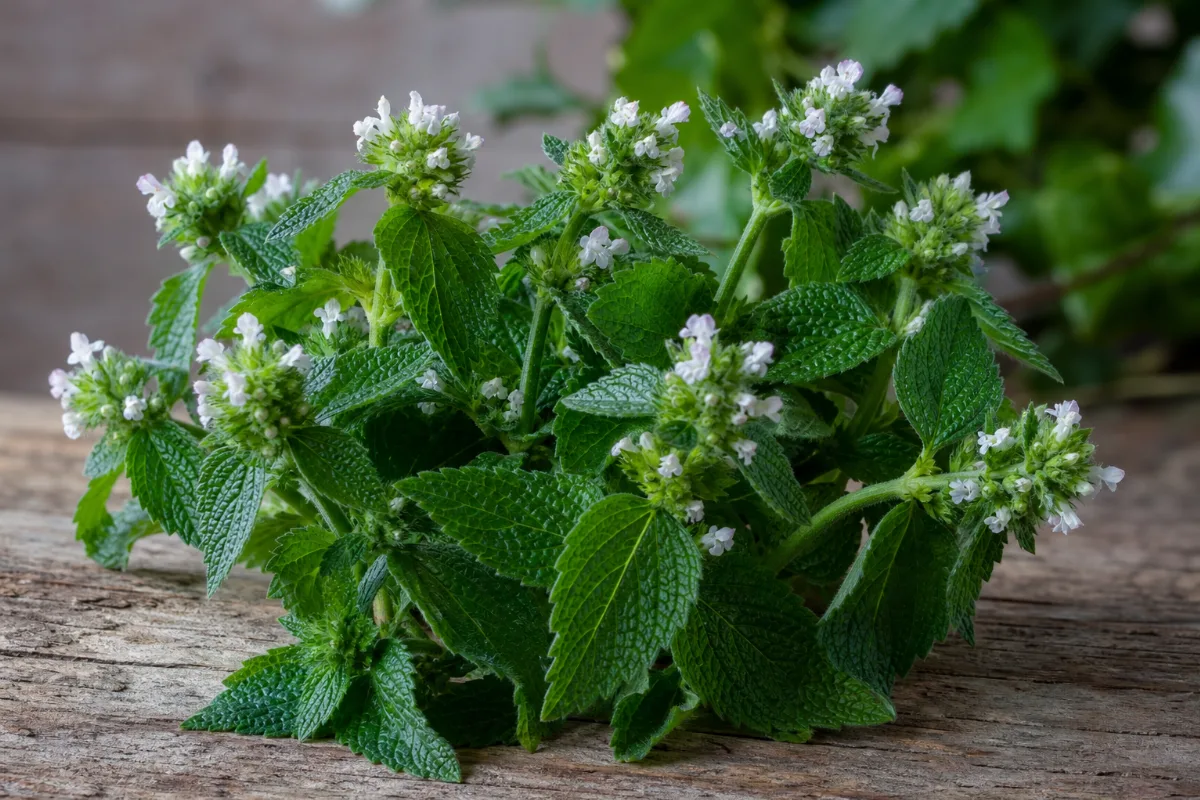
Herbs & Botanicals · Traditional calming herb
Black horehound
Ballota nigra L. · also called Black horehound, stinking horehound, black stinking horehound, ballote noire (French), marrubio negro (Spanish)
Black horehound is a strong-smelling European herb of the mint family. It is used traditionally for nervous tension, poor sleep and an upset stomach. Human research is very thin: one open study and one trial of a four-herb mix. Avoid it in pregnancy, and ask a pharmacist first if you take Parkinson's or sedating medicines.
General information, not medical advice. Last substantive update · Not medically reviewed. A named clinician has not signed off on this page. How this page is made
About Black horehound
Black horehound (Ballota nigra) is an old European herb used as a mild calming remedy and for upset stomach. Compounds in it attach to calming-type receptors in the lab, but almost nothing has been tested in people. Pregnancy and Parkinson's medicine are the main cautions.
What it is
Black horehound (Ballota nigra) is a mint-family plant (Lamiaceae). The part used is the dried flowering tops. It is not the same plant as white horehound, which is used for cough and appetite.
Its main compounds are phenylpropanoid glycosides such as verbascoside and forsythoside B, along with flavonoids, bitter diterpenes and an essential oil.
Traditional and current uses
Traditional European use is for nervous tension, mild sleep trouble, stomach cramps and spasmodic cough. The ESCOP monograph lists tenseness, restlessness and irritability with trouble falling asleep.
Some reference sources also list nausea and vomiting. We could not confirm the idea that the German Commission E or the EU herbal committee approved it for nausea: a German reference says neither has a monograph on it.
What the research shows
There is no controlled trial of black horehound on its own. ESCOP cites one open study in anxious people with a 65% responder rate after 60 days, but without a comparison group this cannot show the herb caused the change.
A 2022 placebo-controlled crossover trial in 31 healthy adults tested a product with four herbs, including ballota. Tension and stress signals were lower, but the effect cannot be credited to black horehound.
Everything else is lab or animal work: receptor binding, antioxidant activity, and lower blood glucose in rats.
At a glance
Traditional uses history, not proof
- Traditional European medicine: a mild calming herb for nervous tension and light sleep trouble; also used for stomach cramps and spasmodic cough (Altmeyers; RxList lists nausea and vomiting too).
- ESCOP monograph (2015): tenseness, restlessness and irritability with difficulty falling asleep.
Studied for research
- Tension, restlessness and sleep, very low
- Anxiety and stress response (in a multi-herb product), very low
- Nausea and vomiting, insufficient
- Stomach cramps, insufficient
- Blood sugar (rats only), insufficient
Main compounds
- Phenylpropanoid glycosides: verbascoside, forsythoside B, arenarioside, ballotetroside
- A labdane-type diterpene (13-hydroxyballonigrinolide) and flavonoids
- Rosmarinic acid and other caffeic acid derivatives; essential oil
Common forms
- Dried flowering tops (the ESCOP drug)
- Tea, liquid extract or tincture, capsules and tablets (product contents vary)
- Multi-herb sleep or tension products that include ballota
Research links: ESCOP monograph summary on black horehound · Altmeyers Encyclopedia: Ballotae nigrae herba · RxList (Natural Medicines): Black horehound · Research Library · Genes & Biomarkers Library
The plant and its history
- Accepted scientific name
- Ballota nigra L.
- Naming authority
- L. (GBIF accepted species, key 2926894)
- Synonyms
- Not listed here: the GBIF synonym list was not pulled. The accepted subspecies Ballota nigra subsp. foetida (Vis.) Hayek (GBIF key 3882777) is the 'stinking' form often used in papers and products.
- Common names
- Black horehound (English); Stinking horehound (English); Black stinking horehound (English); Ballote noire / ballote fétide (French); Marrubio negro (Spanish)
- Botanical family
- Lamiaceae (mint family), the same family as white horehound, sage, lemon balm and skullcap.
- Classification
- Plantae > Tracheophyta > Magnoliopsida > Lamiales > Lamiaceae > Ballota > Ballota nigra
- Native range
- Not verified in the sources read. The genome paper used a UK specimen.
- Habitat
- Not verified.
- What the plant looks like
- Roots: Not verified.; Stems: The herb used is the dried flowering stem tips (Altmeyers; ESCOP: dried flowering tops).; Leaves: Not verified.; Flowers: Flowering tops are the medicinal part.; Fruit: Not relevant; not verified.
- Cultivation
- Not verified.
- Harvest and processing
- Not verified.
- Look-alikes and adulterants
- Name: White horehound (Marrubium vulgare); Note: A different plant in the same family, with its own uses (cough, appetite). RxList warns not to confuse the two. See /herbs-botanicals/horehound.; Name: Other Ballota species; Note: Other Ballota species were compared in lab antioxidant work; they are not interchangeable with Ballota nigra.
- Sustainability and conservation
- Not verified.
Traditional use and history history, not clinical proof
| Tradition or era | Documented use | Source |
|---|---|---|
| Traditional European medicine | Used as a mild calming herb for nervous tension and mild sleep trouble, for stomach cramps, and for spasmodic cough (Altmeyers: empirical medicine; RxList: nausea, vomiting, spasms, cough, whooping cough, nervous disorders). | s-altmeyers-ballotae-nigrae-herba |
| Modern European herbal reference (2015) | ESCOP published a monograph on the dried flowering tops, with the indication tenseness, restlessness and irritability with difficulty falling asleep. | s-escop-black-horehound |
| EU and German regulators | Per Altmeyers, the EU herbal committee (HMPC) has not processed it and the German Commission E has no monograph. Not verified from the primary lists. | s-altmeyers-ballotae-nigrae-herba |
Traditional use shows how a plant was used. It does not show that a supplement works or is safe today.
What is inside, and how it may work
What the plant contains and how those compounds act in cells and animals. Laboratory and animal mechanisms are not proven effects in people.
Main compounds
| Compound | Family | Where it is concentrated | Activity studied | Level of evidence |
|---|---|---|---|---|
| Verbascoside (acteoside) PubChem 5281800 | phenylpropanoid glycoside | Flowering aerial parts | Bound benzodiazepine, dopamine and opioid receptor preparations in rat tissue (lab); antioxidant; inhibited LDL oxidation in test tubes. 2 9 10 | Laboratory research |
| Forsythoside B PubChem 23928102 | phenylpropanoid glycoside | Flowering aerial parts | Antioxidant; inhibited LDL oxidation in test tubes (lab). 9 10 | Laboratory research |
| Ballotetroside PubChem 44584314 | phenylpropanoid glycoside | Flowering aerial parts | Antioxidant and LDL-oxidation inhibitor in test tubes (lab). 9 10 | Laboratory research |
| Arenarioside | phenylpropanoid glycoside | Flowering aerial parts | Antioxidant and LDL-oxidation inhibitor in test tubes (lab). PubChem identifier not checked. 9 10 | Laboratory research |
| 13-Hydroxyballonigrinolide | labdane-type diterpene | Flowering aerial parts | Isolated and described; no activity tested in the sources read. PubChem identifier not checked. 9 | Laboratory research |
| Flavonoids and rosmarinic acid (and other caffeic acid derivatives) | polyphenols | Aerial parts | Listed by ESCOP and Altmeyers as main constituents; no content values read. 1 4 | Laboratory research |
Mechanisms, receptors and pathways
| Target or pathway | Gene or receptor | What was found | Level |
|---|---|---|---|
| Benzodiazepine, dopamine and opioid receptor binding | Benzodiazepine site, dopamine receptors, opioid receptors (specific genes not stated) | Four of five phenylpropanoids bound rat brain receptor preparations at 0.4 to 4.7 mg/ml. Binding does not show whether they act as agonists or antagonists. 2 | Laboratory research |
| Sedative behaviour in rodents | Extracts reduced movement, anxiety-like behaviour and lengthened barbiturate sleep time (ESCOP summary). 4 | Animal research | |
| Antioxidant action | Scavenged reactive oxygen species in cell-free tests and white blood cells; slowed copper-induced LDL oxidation. 2 10 | Laboratory research | |
| Blood-glucose lowering | Aqueous extract lowered plasma glucose in healthy and alloxan-diabetic rats. 7 | Animal research |
Absorption, metabolism and elimination
- Absorption
- No human or animal pharmacokinetic study was found.
- Distribution
- Unknown.
- Metabolism
- Unknown.
- Elimination
- Unknown.
- Bioavailability
- Unknown. Large glycosides such as verbascoside are generally thought to be poorly absorbed intact, but that was not checked for this plant.
Isolated compounds versus whole extracts
The sedative-type lab findings come from isolated compounds (verbascoside and relatives) and from extracts; whether the whole herb or tea acts the same way in people is unknown. The authors of the chemistry paper suggest these glycosides could be used to standardise the drug, but products differ. The diterpene 'marrubiin-like' bitters mentioned in some descriptions were not confirmed: marrubiin (PubChem 73401) is the known bitter of white horehound, while the diterpene isolated from black horehound in the paper read was 13-hydroxyballonigrinolide.
Nutritional composition
A nutrient table does not apply to black horehound as a medicinal herb.
2 very low certainty5 not enough evidence
What is Black horehound good for?
The main proposed uses and how strong the human evidence is for each. 'Very low' means one weak study or a mixed product; 'insufficient' means traditional use, or lab and animal work only.
Benefits, one by one
Each card is a research question, not a promise. Tap a goal to filter. Open a card to see the studies, doses and limits.
Nervous tension, restlessness and trouble falling asleep
Very low certaintyThis is the main traditional use and the one a European herbal body (ESCOP) lists. The proof for it is thin. There is one open study with no comparison group, plus animal and lab work. There is no controlled trial of black horehound on its own.
3 studiesThe ESCOP drug is the dried flowering tops. The product in the open s…
Studies, doses and limits
What the trials found
The ESCOP summary mentions one open clinical study (no comparison group) in people with generalised anxiety disorder with depression and sleep problems, with a 65% responder rate after 60 days. We could not read the study itself, so its size, product and measures are unknown. No placebo-controlled trial of black horehound alone was found.
Results
Rodents given extracts moved less, looked calmer, showed less anxiety-like behaviour and slept longer after a sleep drug (ESCOP summary of animal work). In people there is only the one open study.
Effect sizes as reported
65% responder rate after 60 days in one open study, as quoted by ESCOP. Without a placebo group this cannot show the herb caused the change. No other numbers verified.
Why this rating
One uncontrolled study read only through a regulator-style summary, and animal and lab findings. No controlled human trial.
Form and dose studied
The ESCOP drug is the dried flowering tops. The product in the open study was not visible. Ask a doctor or pharmacist about amounts.
Who was studied
Adults with anxiety symptoms, depression and sleep problems (open study, via ESCOP summary).
Limits
No control group, unknown size, summary-level source only, animal findings may not carry over to people.
Why researchers looked
The plant has a long reputation as a mild calming herb, and lab tests found its compounds can attach to receptors involved in calming.
Traditional use
Black horehound is an old European herb. It has been used for nervous tension, restlessness and mild sleep trouble, and the ESCOP herbal monograph lists these as its indication.
Proposed mechanism Laboratory research
In test-tube work, four of five phenylpropanoid compounds from the plant attached to benzodiazepine, dopamine and opioid receptor preparations from rat brain. This is a lead, not proof that the herb calms people.
A proposed mechanism does not show that the effect happens in people.
Lab binding to benzodiazepine-type receptors means added drowsiness with sedatives is plausible. See the safety section.
Anxiety and stress response (only as one ingredient in a multi-herb product)
Very low certaintyOne placebo-controlled trial tested a four-herb product that contains black horehound. Healthy adults felt a little less tense and showed a smaller stress reaction in a lab task. We cannot tell how much, if any, came from black horehound.
1 studiesEuphytose, a combination product (valerian, passionflower, hawthorn, …
Studies, doses and limits
What the trials found
Dodd 2022: 31 healthy adults aged 19 to 58 took the product Euphytose and a placebo for 14 days each, in random order, with a 28-day break. After the product, tension-anxiety was lower (p = 0.038), and salivary alpha-amylase (p = 0.041) and skin conductance (p = 0.004) rose less during a multitasking stress test.
Results
Positive on three of the measures reported in the abstract, in healthy people.
Effect sizes as reported
tension-anxiety p = 0.038; salivary alpha-amylase p = 0.041; galvanic skin response p = 0.004. Effect sizes not given in the abstract.
Why this rating
One small trial of a four-herb mix. The result cannot be assigned to black horehound, and the participants were healthy people, not patients.
Form and dose studied
Euphytose, a combination product (valerian, passionflower, hawthorn, ballota), 14 days. Product details beyond that were not read.
Who was studied
Healthy adults, 19 to 58 years.
Limits
Combination product, small crossover trial, healthy volunteers, many outcomes measured.
Why researchers looked
Each of the four herbs in the product (valerian, passionflower, hawthorn, black horehound) has a traditional calming reputation.
Traditional use
Black horehound is an old European herb. It has been used for nervous tension, restlessness and mild sleep trouble, and the ESCOP herbal monograph lists these as its indication.
Proposed mechanism Pharmacological theory
Not established for this product. For black horehound alone, only the receptor-binding lab work above exists.
A proposed mechanism does not show that the effect happens in people.
The abstract does not describe side effects.
Low mood (animal finding only)
Not enough evidenceExtract of the plant reduced giving-up behaviour in a standard mouse or rat swimming test used to screen for antidepressant-like effects. No human study of mood was found.
1 studiesNot applicable.
Studies, doses and limits
What the trials found
None found.
Results
Antidepressant-like activity in the rodent forced-swim test, as reported in the ESCOP summary.
Effect sizes as reported
Not available from the summary page.
Why this rating
Animal data only, read through a summary.
Form and dose studied
Not applicable.
Who was studied
Rodents.
Limits
The forced-swim test is a rough screening test and does not predict benefit in people.
Why researchers looked
The calming use led researchers to screen the plant in animal models of low mood.
Traditional use
Black horehound is an old European herb. It has been used for nervous tension, restlessness and mild sleep trouble, and the ESCOP herbal monograph lists these as its indication.
Proposed mechanism Animal research
Unknown. Possibly linked to the receptor binding seen in the lab, but this has not been tested.
A proposed mechanism does not show that the effect happens in people.
Not applicable.
Nausea and vomiting
Not enough evidenceBlack horehound is traditionally taken for nausea and vomiting, but we found no trial. A common claim that a German herbal commission approved it for this is not supported: the German Commission E has no monograph on it and the EU herbal committee has not assessed it.
2 studiesNot applicable.
Studies, doses and limits
What the trials found
None found. RxList rates the evidence as 'insufficient to rate'.
Results
No data.
Effect sizes as reported
Not applicable.
Why this rating
Traditional use only. No trial, review or regulator endorsement was found.
Form and dose studied
Not applicable.
Who was studied
Not applicable.
Limits
Evidence does not exist in the sources read.
Why researchers looked
Traditional European use; some references list nausea among its uses.
Traditional use
RxList lists nausea and vomiting among the traditional uses. The ESCOP indication is tension and sleep, not nausea.
Proposed mechanism Pharmacological theory
Not established. Nothing was read that tested an anti-nausea effect.
A proposed mechanism does not show that the effect happens in people.
Vomiting that does not settle can be serious, so the herb should not delay medical care. See the safety section.
Mild stomach cramps and gut spasms
Not enough evidenceUsed traditionally for mild stomach cramps, and one German reference notes it as an empirical (experience-based) use. We found no trial.
2 studiesNot applicable.
Studies, doses and limits
What the trials found
None found.
Results
No data.
Effect sizes as reported
Not applicable.
Why this rating
Traditional or empirical use only.
Form and dose studied
Not applicable.
Who was studied
Not applicable.
Limits
No trial data; secondary reference sources.
Why researchers looked
Bitter, aromatic Lamiaceae herbs are widely used for digestive complaints.
Traditional use
Altmeyers lists mild stomach and gut cramps as an empirical use; the ESCOP summary in the same entry is cited for 'mild stomach cramps'. We could not read the ESCOP text itself.
Proposed mechanism Pharmacological theory
Not established.
A proposed mechanism does not show that the effect happens in people.
Severe or lasting belly pain needs medical assessment.
Blood sugar (rat finding only)
Not enough evidenceIn rats, a water extract lowered blood glucose in both healthy and diabetic animals. Nothing like this has been tested in people, so it gives no basis for using the herb for diabetes.
2 studiesNot applicable.
Studies, doses and limits
What the trials found
None found.
Results
Significantly lower plasma glucose in healthy and alloxan-diabetic rats after an aqueous extract (abstract gives no numbers).
Effect sizes as reported
Not given.
Why this rating
One rat study with a very short abstract, plus a line in the ESCOP summary.
Form and dose studied
Not applicable.
Who was studied
Rats.
Limits
Animal only; no dose or duration in the abstract.
Why researchers looked
Many plants are screened for blood-sugar effects in rats.
Traditional use
Not a documented traditional use in the sources read.
Proposed mechanism Animal research
Unknown.
A proposed mechanism does not show that the effect happens in people.
Anyone using glucose-lowering medicines should be careful about adding any herb that might lower sugar further; this has not been tested for black horehound.
Antioxidant and anti-germ activity (lab only)
Not enough evidenceCompounds from the plant mop up reactive molecules and slow LDL (cholesterol particle) oxidation in test tubes, and plant fractions inhibited some microbes in dishes. None of this has been tested in people.
3 studiesNot applicable.
Studies, doses and limits
What the trials found
None found.
Results
Lab results only. Compounds were as active as known antioxidant drugs in cell tests; plant fractions inhibited bacteria, fungi and Leishmania in dishes.
Effect sizes as reported
LDL oxidation ED50 about 1 to 9.5 microM for the isolated compounds (quercetin 2.3 microM).
Why this rating
Test-tube and cell work only.
Form and dose studied
Not applicable.
Who was studied
Not applicable.
Limits
Antioxidant action in a test tube does not predict benefit in the body.
Why researchers looked
Phenylpropanoid compounds such as verbascoside are strong antioxidants in the lab.
Traditional use
Not a documented traditional use in the sources read.
Proposed mechanism Laboratory research
Phenylpropanoid glycosides scavenge reactive oxygen species and slowed copper-induced LDL oxidation in test tubes; they were stronger than or similar to the reference antioxidant quercetin.
A proposed mechanism does not show that the effect happens in people.
None specific.
Connections to the rest of health
How Black horehound connects to the rest of our health knowledge graph. Every link says what kind of connection it is. A safety link (for example to the liver) is a warning, not a benefit. A study that merely mentions a topic never creates a benefit link.
Explore every connection: goals, body systems, organs, symptoms, genes
A. Wellness goals
| Connected to | Kind of connection | Evidence status | Context | Studies |
|---|---|---|---|---|
| Calm Relaxation | Traditional use | Very low certainty | Nervous tension, restlessness and trouble falling asleep: This is the main traditional use and the one a European herbal body (ESCOP) lists. The proof for it is thin. There is one open study with no comparison group, plus animal and lab work. There is no controlled trial of black horehound on its own. | 4 2 1 |
| Better Sleep | Traditional use | Very low certainty | Nervous tension, restlessness and trouble falling asleep: This is the main traditional use and the one a European herbal body (ESCOP) lists. The proof for it is thin. There is one open study with no comparison group, plus animal and lab work. There is no controlled trial of black horehound on its own. | 4 2 1 |
| Anxiety Support | Preliminary mechanism | Very low certainty | Anxiety and stress response (only as one ingredient in a multi-herb product): One placebo-controlled trial tested a four-herb product that contains black horehound. Healthy adults felt a little less tense and showed a smaller stress reaction in a lab task. We cannot tell how much, if any, came from black horehound. | 3 |
| Stress Reduction | Preliminary mechanism | Very low certainty | Anxiety and stress response (only as one ingredient in a multi-herb product): One placebo-controlled trial tested a four-herb product that contains black horehound. Healthy adults felt a little less tense and showed a smaller stress reaction in a lab task. We cannot tell how much, if any, came from black horehound. | 3 |
| Mood Balance | Preliminary mechanism | Not enough evidence | Low mood (animal finding only): Extract of the plant reduced giving-up behaviour in a standard mouse or rat swimming test used to screen for antidepressant-like effects. No human study of mood was found. | 4 |
| Digestive Support | Traditional use | Not enough evidence | Nausea and vomiting: Black horehound is traditionally taken for nausea and vomiting, but we found no trial. A common claim that a German herbal commission approved it for this is not supported: the German Commission E has no monograph on it and the EU herbal committee has not assessed it. Mild stomach cramps and gut spasms: Used traditionally for mild stomach cramps, and one German reference notes it as an empirical (experience-based) use. We found no trial. | 8 1 |
| Gut Health | Traditional use | Not enough evidence | Mild stomach cramps and gut spasms: Used traditionally for mild stomach cramps, and one German reference notes it as an empirical (experience-based) use. We found no trial. | 1 8 |
| Blood Sugar Balance | Preliminary mechanism | Not enough evidence | Blood sugar (rat finding only): In rats, a water extract lowered blood glucose in both healthy and diabetic animals. Nothing like this has been tested in people, so it gives no basis for using the herb for diabetes. | 7 4 |
| Inflammation Balance | Preliminary mechanism | Not enough evidence | Antioxidant and anti-germ activity (lab only): Compounds from the plant mop up reactive molecules and slow LDL (cholesterol particle) oxidation in test tubes, and plant fractions inhibited some microbes in dishes. None of this has been tested in people. | 10 2 11 |
| Heart Health | Preliminary mechanism | Not enough evidence | Antioxidant and anti-germ activity (lab only): Compounds from the plant mop up reactive molecules and slow LDL (cholesterol particle) oxidation in test tubes, and plant fractions inhibited some microbes in dishes. None of this has been tested in people. | 10 2 11 |
B. Body systems
| Connected to | Kind of connection | Evidence status | Context | Studies |
|---|---|---|---|---|
| Reproductive system | Contraindication | Very low certainty | Avoid in pregnancy; possible menstrual-cycle effect (RxList, consumer reference). Avoid in pregnancy (RxList, consumer reference). Preparation or compound: Black horehound, oral use |
8 |
| Nervous System | Biological association | Very low certainty | Studied for: Nervous tension, restlessness and trouble falling asleep Studied for: Anxiety and stress response (only as one ingredient in a multi-herb product) | 4 2 1 3 |
| Sleep Recovery | Biological association | Very low certainty | Studied for: Nervous tension, restlessness and trouble falling asleep | 4 2 1 |
| Stress Mood | Biological association | Very low certainty | Studied for: Anxiety and stress response (only as one ingredient in a multi-herb product) Studied for: Low mood (animal finding only) | 3 4 |
| Digestive System | Biological association | Not enough evidence | Studied for: Nausea and vomiting Studied for: Mild stomach cramps and gut spasms | 8 1 |
| Endocrine System | Biological association | Not enough evidence | Studied for: Blood sugar (rat finding only) | 7 4 |
| Cardiovascular System | Biological association | Not enough evidence | Studied for: Antioxidant and anti-germ activity (lab only) | 10 2 11 |
| Immune System | Biological association | Not enough evidence | Studied for: Antioxidant and anti-germ activity (lab only) | 10 2 11 |
C. Body parts and organs
| Connected to | Kind of connection | Evidence status | Context | Studies |
|---|---|---|---|---|
| Brain | Drug or supplement interaction | Very low certainty | Lab binding to dopamine, benzodiazepine and opioid receptor preparations; RxList cautions about Parkinson's medicines. Lab binding to dopamine, benzodiazepine and opioid receptor preparations; caution with Parkinson's medicines (RxList). Preparation or compound: Ballota nigra phenylpropanoids (verbascoside, forsythoside B, arenarioside, ballotetroside) |
2 8 |
I. Biomarkers
| Connected to | Kind of connection | Evidence status | Context | Studies |
|---|---|---|---|---|
| Tension-anxiety score (State-Trait Anxiety Inventory) | Biological association | Very low certainty | Measured in trials: lowered. A lab change is not the same as a health benefit. | 3 |
| Stress body signals: salivary alpha-amylase and skin conductance | Biological association | Very low certainty | Measured in trials: lowered. A lab change is not the same as a health benefit. | 3 |
| Blood glucose (rats only) | Biological association | Not enough evidence | Measured in trials: lowered. A lab change is not the same as a health benefit. | 7 |
J. Genes, receptors and enzymes
| Connected to | Kind of connection | Evidence status | Context | Studies |
|---|---|---|---|---|
| Dopamine receptors | Preliminary mechanism | In vitro | Compounds bound dopamine receptor preparations in the lab; links to the Parkinson's medicine caution. | 2 |
| Benzodiazepine binding site (GABA-A related) | Preliminary mechanism | In vitro | Compounds bound benzodiazepine receptor preparations in the lab; links to the sedation caution. | 2 |
L. Active compounds
| Connected to | Kind of connection | Evidence status | Context | Studies |
|---|---|---|---|---|
| Verbascoside (acteoside) | Biological association | In vitro | Bound benzodiazepine, dopamine and opioid receptor preparations in rat tissue (lab); antioxidant; inhibited LDL oxidation in test tubes. Preparation or compound: Flowering aerial parts |
2 9 10 |
| Forsythoside B | Biological association | In vitro | Antioxidant; inhibited LDL oxidation in test tubes (lab). Preparation or compound: Flowering aerial parts |
9 10 |
| Ballotetroside | Biological association | In vitro | Antioxidant and LDL-oxidation inhibitor in test tubes (lab). Preparation or compound: Flowering aerial parts |
9 10 |
| Arenarioside | Biological association | In vitro | Antioxidant and LDL-oxidation inhibitor in test tubes (lab). PubChem identifier not checked. Preparation or compound: Flowering aerial parts |
9 10 |
| 13-Hydroxyballonigrinolide | Biological association | In vitro | Isolated and described; no activity tested in the sources read. PubChem identifier not checked. Preparation or compound: Flowering aerial parts |
9 |
| Flavonoids and rosmarinic acid (and other caffeic acid derivatives) | Biological association | In vitro | Listed by ESCOP and Altmeyers as main constituents; no content values read. Preparation or compound: Aerial parts |
1 4 |
Each connection is stored with the ingredient, the connected record, the kind of connection, the evidence status, the supporting studies, the preparation or compound involved, and a review date (last reviewed October 25, 2026).
The evidence
The research centre for Black horehound. Every record here was checked against PubMed or the publisher's page; we never list a study we have not verified.
Evidence by outcome
Bars show how many studies we found for each outcome, not how well it works. People are added up across trials only (reviews are not added, to avoid double counting).
How we rate evidence
High certainty
Several well-run trials or reviews agree; further research is unlikely to change the picture much.
Moderate certainty
Good trials point the same way, but some doubt remains.
Low certainty
Small, short or inconsistent trials. The finding could change with better research.
Very low certainty
Very little or very weak human data. Treat as a possibility only.
Mixed findings
Trials or reviews disagree with each other.
Not enough evidence
Not enough human research to say either way.
Evidence against
Good research found no benefit, or found harm.
We take the reviewers' own risk-of-bias and GRADE statements where they exist, and otherwise judge from study size, design, consistency, directness and whether a product matches what is sold. Many publications do not make evidence high. Method note: We read the ESCOP summary page, a German phytotherapy reference and a consumer drug reference, searched PubMed for Ballota nigra (28 records, none a human trial of the herb alone), and read the abstracts of the studies cited.
Study library: every study we checked 11
| Study | Design | People | Product, dose, length | Result |
|---|---|---|---|---|
| Altmeyers Encyclopedia (Department of Phytotherapy) 2026 Ballotae nigrae herba Altmeyers Encyclopedia (updated 19 Feb 2026) · Source |
Authoritative guidance |
Medical professionals | Black horehound herb flowering stem tips not applicable not applicable |
Quality is specified in the European Pharmacopoeia. 'HMPC: not processed.' 'Commission E: no monograph.' ESCOP indication: internal tension, restlessness and irritability with difficulty falling asleep; for mild stomach cramps. Empirical uses: mild sedative, mild insomnia, spasm relief for stomach and gut complaints, sedative for spasmodic cough. Contents: essential oil (furans give the smell), caffeic acid derivatives, diterpene bitters, flavonoids, chlorogenic acid, tannins, rosmarinic acid. Methods, limits and fundingOutcomes: Regulatory status and empirical uses Limitations: A reference entry; short and partly machine-translated from German; no dose or safety section visible. Read: summary-only |
| Daels-Rakotoarison 2000 Neurosedative and antioxidant activities of phenylpropanoids from ballota nigra. Arzneimittelforschung · PMID 10683711 · DOI |
Laboratory research in-vitro |
Rat brain tissue preparations and isolated white blood cells (lab study) | Five phenylpropanoids isolated from a hydroalcoholic extract (verbascoside, forsythoside B, arenarioside, ballotetroside, caffeoyl malic acid) aerial parts (extract) not applicable not applicable |
Four of the five compounds bound to the receptor preparations (50% inhibitory concentrations 0.4 to 4.7 mg/ml). All showed antioxidant activity in cell-free and white-blood-cell tests, comparable to mesna or N-acetylcysteine. IC50 0.4 to 4.7 mg/ml (receptor binding) Methods, limits and fundingOutcomes: Binding to benzodiazepine, dopamine and opioid (morphine-type) receptor preparations; scavenging of reactive oxygen species Limitations: Lab work on isolated compounds. Binding shows a compound can attach to a receptor; it does not show whether it switches the receptor on or off, or that it does anything in a living person. Concentrations are high. Funding and conflicts: Not stated in the abstract. Read: abstract |
| Dodd 2022 The chronic effects of a combination of herbal extracts (Euphytose) on psychological mood state and response to a laboratory stressor: A randomised, placebo-controlled, double blind study in healthy humans. J Psychopharmacol · PMID 35875924 · DOI |
Controlled trial |
31 Healthy adults aged 19 to 58 |
Euphytose, a multi-herb product containing valerian, passionflower, hawthorn and ballota (black horehound) extracts mixed (combination product) not applicable 14 days, 28-day washout · vs Placebo |
After 14 days the multi-herb product was linked to lower tension-anxiety (p = 0.038), lower salivary alpha-amylase (p = 0.041) and lower galvanic skin response (p = 0.004) than placebo. The abstract reports no change in cortisol or heart rate as a result. tension-anxiety p = 0.038; alpha-amylase p = 0.041; galvanic skin response p = 0.004 Methods, limits and fundingOutcomes: Anxiety (State-Trait Anxiety Inventory), mood, heart rate, galvanic skin response, salivary alpha-amylase and cortisol before and after a laboratory multitasking stressor Limitations: Four herbs in one product, so nothing can be credited to black horehound. Small crossover trial in healthy people, not people with an anxiety disorder. Authors report no conflicts of interest (abstract). Cortisol and heart-rate results are not described in the abstract. Funding and conflicts: No competing interests declared (abstract). Read: abstract |
| ESCOP (European Scientific Cooperative on Phytotherapy) 2015 Ballotae nigrae herba (Black Horehound): ESCOP monograph, summary page ESCOP monograph (summary page; full text is paid) · Source |
Authoritative guidance |
Adults (indication) | Dried flowering tops of Ballota nigra L. flowering tops not applicable not applicable |
Indication: tenseness, restlessness and irritability with difficulty falling asleep. Lab: affinity for benzodiazepine, dopamine and opioid receptors; antioxidant and antimicrobial activity. Animals: sedative effects in rodents (less movement, calming, less anxiety, longer barbiturate-induced sleep), antidepressant-like effect in the forced swim test, blood-sugar lowering. One open clinical study: 65% responder rate after 60 days in people with generalised anxiety disorder with depression and sleep problems. Methods, limits and fundingOutcomes: Indication, lab, animal and one open clinical study Limitations: Only the free summary page was read. Dose, contraindications, pregnancy, interactions and side-effect sections are in the paid text and were not read. The open study has no comparison group and no sample size or product details were visible. Read: summary-only |
| GBIF Secretariat 2026 GBIF Backbone Taxonomy: Ballota nigra L. (species key 2926894) GBIF species API, checked 2026-10-25 · Source |
Authoritative guidance |
not applicable | Plant name check whole plant not applicable not applicable |
Accepted species, family Lamiaceae, exact match. Methods, limits and fundingOutcomes: Accepted name Limitations: Name database only. Read: full-text |
| NCBI PubChem 2026 PubChem compound records: verbascoside (CID 5281800), forsythoside B (CID 23928102), ballotetroside (CID 44584314), marrubiin (CID 73401) PubChem PUG REST name search, checked 2026-10-25 · Source |
Authoritative guidance |
not applicable | Compound identity check not applicable not applicable not applicable |
Each name returned one compound record with the formula shown (verbascoside C29H36O15; forsythoside B C34H44O19; ballotetroside C39H52O23; marrubiin C20H28O4). Methods, limits and fundingOutcomes: Compound identifiers Limitations: Identity check only; it does not show that a compound is in a given product. Read: full-text |
| Nusier 2007 Effects of Ballota nigra on glucose and insulin in alloxan-diabetic albino rats. Neuro Endocrinol Lett · PMID 17627273 |
Animal research animal |
Healthy and alloxan-diabetic albino rats | Aqueous extract of Ballota nigra not stated in abstract not applicable not applicable |
The aqueous extract significantly lowered glucose in both healthy and diabetic rats (abstract gives no numbers). not given in the abstract Methods, limits and fundingOutcomes: Plasma glucose Limitations: Rat study, very short abstract with no numbers, dose or duration. Not evidence for people. Funding and conflicts: Not stated in the abstract. Read: abstract |
| RxList / Natural Medicines 2026 Black Horehound: Health Benefits, Side Effects, Uses, Dose and Precautions (Natural Medicines monograph on RxList) RxList (consumer drug reference) · Source |
Authoritative guidance |
General public | Black horehound, aerial parts aerial parts not applicable not applicable |
Evidence rated 'insufficient' for nausea, vomiting, nervous disorders, whooping cough, spasms, bile flow, gout and worms. 'Possibly safe' by mouth, side effects not known. Likely unsafe in pregnancy (may affect the menstrual cycle); avoid when breastfeeding. Caution in Parkinson's disease, schizophrenia and psychotic disorders. Moderate interaction rating with Parkinson's dopamine medicines (levodopa, bromocriptine, pramipexole, ropinirole). Not to be confused with white horehound. Methods, limits and fundingOutcomes: Uses, safety, pregnancy, interactions Limitations: A consumer drug reference that gives ratings without citing the underlying studies on the page read. The pregnancy and interaction statements are cautions based on reasoning about the plant's chemicals, not on reported cases. Read: summary-only |
| Seidel 1998 [Diterpene and phenylpropanoid heteroside esters from Ballota nigra L]. (article in French) Ann Pharm Fr · PMID 9770033 |
Laboratory research in-vitro |
Phytochemical isolation from flowering aerial parts | Compounds isolated from the plant flowering aerial parts not applicable not applicable |
Isolated one diterpene (13-hydroxyballonigrinolide) and four phenylpropanoid glycosides (verbascoside, forsythoside B, arenarioside, ballotetroside), new to the genus Ballota. The authors say these compounds appear characteristic of the species and could be used to standardise the drug. not applicable Methods, limits and fundingOutcomes: Chemical identification Limitations: Chemistry paper. The authors' remark that the glycosides 'could justify' the neurosedative use is a suggestion, not a test. Funding and conflicts: Not stated in the abstract. Read: abstract |
| Seidel 2000 Phenylpropanoids from Ballota nigra L. inhibit in vitro LDL peroxidation. Phytother Res · PMID 10685104 · DOI |
Laboratory research in-vitro |
Isolated human-type LDL particles in a test tube, copper-induced oxidation | Four phenylpropanoid glycosides and caffeoyl-L-malic acid isolated from Ballota nigra aerial parts not applicable not applicable |
All five compounds inhibited LDL oxidation in the test tube. ED50 about 1 microM for verbascoside and forsythoside B, 1.8 microM arenarioside, 7.5 microM ballotetroside, 9.5 microM caffeoyl-L-malic acid, versus 2.3 microM for quercetin. ED50 1 to 9.5 microM Methods, limits and fundingOutcomes: Inhibition of copper-induced LDL oxidation Limitations: Test-tube chemistry only. No animal or human data. Not shown to protect arteries or lower heart risk. Funding and conflicts: Not stated in the abstract. Read: abstract |
| Ullah 2014 In vitro antimicrobial and antiprotozoal activities, phytochemical screening and heavy metals toxicity of different parts of Ballota nigra. Biomed Res Int · PMID 25054139 · DOI |
Laboratory research in-vitro |
Plant material (root, stem, leaves) tested in the lab; plant collected in Pakistan | Solvent fractions of root, stem and leaves root, stem, leaves not applicable not applicable |
Several fractions inhibited microbes in the lab (largest zone 17 mm against E. coli). Chromium, cadmium and lead were above the permissible values used in the paper in all parts tested; nickel was above the WHO limit in root and leaves; iron was above the permissible value in all parts. Cd above 0.3 mg/kg; Pb above 2 mg/kg; Cr above 1.5 mg/kg in all parts Methods, limits and fundingOutcomes: Growth inhibition of bacteria, fungi and Leishmania; heavy metal levels in plant material Limitations: Wild plant from one region; shows that this plant can take up metals from its surroundings, not that commercial products contain them. Antimicrobial results are lab only. Funding and conflicts: Not stated in the abstract. Read: abstract |
What we do not know yet
- What the evidence supports: nothing about black horehound reaches even low certainty. The calming use rests on one open study and animal findings.
- What is uncertain: whether black horehound adds anything to multi-herb products; its dopamine-related effects in people; whether it helps nausea at all.
- What is missing: any controlled trial of the herb alone, safety data, liver data, and pharmacokinetics.
How new research is added
New studies are found by a saved PubMed search and placed in a review queue. A person checks them before they are added.
Lab markers
What changed in blood or saliva tests during trials. A changed number is not the same as feeling or being healthier, and we give no "normal ranges".
Metabolic 1
Blood glucose (rats only)
Lowered in trials
The amount of sugar in the blood.
Not enough evidenceResults and what it means
Why it was measured
The usual first check for anti-diabetic effects in animals.
Statistical vs. clinical meaning
Animal result only; no human biomarker data exist.
Safety implication
Possible additive effect with glucose-lowering medicines is a theory only.
| Study | Result | People | Product |
|---|---|---|---|
| 7 | Plasma glucose significantly reduced in healthy and alloxan-diabetic rats after aqueous extract. No values given in the abstract. | Albino rats | Aqueous extract of Ballota nigra |
Other 2
Tension-anxiety score (State-Trait Anxiety Inventory)
Lowered in trials
A short questionnaire where people rate how tense or anxious they feel right now.
Very low certaintyResults and what it means
Why it was measured
A standard way to measure how anxious someone feels, in trials of calming products.
Statistical vs. clinical meaning
Statistically significant in one small trial. Whether the change would be noticeable in daily life is not stated, and the product has four herbs.
Safety implication
None identified from this measure.
| Study | Result | People | Product |
|---|---|---|---|
| 3 | Lower tension-anxiety after 14 days of the multi-herb product than after placebo (p = 0.038). No scores given in the abstract. | 31 healthy adults, 19 to 58 years | Euphytose (valerian, passionflower, hawthorn, ballota), 14 days, crossover |
Stress body signals: salivary alpha-amylase and skin conductance
Lowered in trials
Alpha-amylase is an enzyme in saliva that rises with stress. Skin conductance (galvanic skin response) measures sweating on the skin, which also rises with stress.
Very low certaintyResults and what it means
Why it was measured
Used as body-based signs of the stress response during a lab task.
Statistical vs. clinical meaning
These are lab markers of stress arousal, not proof of health benefit. Cortisol and heart rate changes are not described in the abstract.
Safety implication
None identified from this measure.
| Study | Result | People | Product |
|---|---|---|---|
| 3 | Smaller rise in salivary alpha-amylase (p = 0.041) and in galvanic skin response (p = 0.004) during the stress task after the product than after placebo. | 31 healthy adults | Euphytose, 14 days, crossover |
Safety
What studies and official sources say about side effects, medicines and who should check first. Each point shows what kind of evidence it comes from.
Main points to know 4
- Safety is poorly documented: no clinical safety data, no case reports found. RxList calls oral use 'possibly safe' but says the side effects are not known. We found no reported side-effect case, no liver report and no trial that measured safety. 'Not documented' is not the same as 'safe'. Authoritative guidance 8
- Avoid in pregnancy and while breastfeeding. RxList rates oral use likely unsafe in pregnancy because it may affect the menstrual cycle and so threaten a pregnancy, and advises against use while breastfeeding. This is a precaution from a consumer reference, not from a reported case or a regulator. Authoritative guidance 8
- Parkinson's medicines and related brain conditions: ask first. Lab work shows compounds from the plant attach to dopamine receptor preparations, and RxList rates a moderate interaction with Parkinson's dopamine medicines such as levodopa, bromocriptine, pramipexole and ropinirole. It also advises caution in schizophrenia and psychotic disorders. No human interaction has been reported; this is a theory based on lab binding. Pharmacological theory 8 2
- Possible added drowsiness with sedatives and alcohol. The plant's compounds attach to benzodiazepine-type receptor preparations in the lab, and animals given extracts became sedated. So extra drowsiness with sleeping pills, anti-anxiety drugs, opioids, alcohol or other sedating herbs is plausible. No human case was found. Pharmacological theory 2 4
Side effects 2
| Effect | How often | Severity and recovery | Evidence |
|---|---|---|---|
| Drowsiness or sedation (expected from the animal and lab findings; not reported in people in the sources read) ESCOP lists undesirable effects in its full text, which we could not read. | Not established | unknown Unknown | Animal research 4 |
| Menstrual-cycle effects (cited as a pregnancy concern) No mechanism or case given by the source. | Not established | unknown Unknown | Authoritative guidance 8 |
Liver
We found no published case of liver injury from black horehound and no LiverTox entry for it (a search of NCBI Bookshelf found nothing). This means no data, not proof of liver safety.
How often. No frequency data exist.
Monitoring. No agency monitoring advice was found.
This is a safety connection. It is not evidence that Black horehound supports liver health.
Medicines and supplements 4
| With | Why it matters | Importance | Evidence | What to do |
|---|---|---|---|---|
| Parkinson's medicines that act on dopamine (levodopa, bromocriptine, pramipexole, ropinirole) prescription | Theory: compounds from the plant bound dopamine receptor preparations from rat brain in the lab. | RxList gives a 'moderate' rating; no human case was found. The lab study did not show whether the compounds switch dopamine receptors on or off. | Pharmacological theory Very low certainty 8 2 | If you take any Parkinson's medicine, do not add this herb without asking the doctor who prescribes it. |
| Sedatives and sleep or anti-anxiety medicines (for example benzodiazepines), opioids, alcohol, other calming herbs prescription | Theory: lab binding to benzodiazepine and opioid receptor preparations; sedation in rodents. | Added drowsiness is plausible but not reported in people. | Pharmacological theory Very low certainty 2 4 | Ask a doctor or pharmacist first. Take care when driving or using machinery if it makes you drowsy. |
| Antipsychotic medicines and other medicines that act on dopamine prescription | Theory based on dopamine receptor binding in the lab; RxList also advises caution in schizophrenia and psychotic disorders. | No human data. | Pharmacological theory Very low certainty 8 2 | Ask the prescriber before use. |
| Glucose-lowering medicines prescription | Theory: blood-sugar lowering in rats. | Never tested in people. | Animal research Not enough evidence 7 | If you use insulin or tablets for diabetes, mention any herb you add to your pharmacist. |
Who should check first 5
| Situation | Advice | Evidence |
|---|---|---|
| Pregnancy | Avoid. RxList rates oral use likely unsafe. | Authoritative guidance 8 |
| Breastfeeding | Avoid. The effects on a nursing baby are unknown. | Authoritative guidance 8 |
| Parkinson's disease | Ask the treating doctor before use (possible effect on dopamine-based treatment). | Pharmacological theory 8 2 |
| Schizophrenia or other psychotic disorders | Ask the treating doctor before use. | Pharmacological theory 8 |
| Children | No safety information was found for children. Do not use without a doctor's advice. | Authoritative guidance 8 |
Overdose, product quality and regulators
Summary. ESCOP says toxicity studies were assessed, but only the paid full text gives the results. We could not read them. No human poisoning report was found.
Animal. Not read.
Human doses studied. Not available.
High dose or long term signals. None found; also no data on long-term use.
Overdose response. Not documented in the sources read.
Genotoxicity. Not read.
Toxic plant parts. No toxic plant part is documented in the sources read. The traditional drug is the dried flowering tops.
One study of wild plants in Pakistan found heavy metals above permissible values.
Heavy metals in wild-grown plants. Chromium, cadmium and lead were above the permissible values used in the paper in root, stem and leaves; nickel was above the WHO limit in root and leaves; iron was above the permissible value in all parts. 11
Look-alike confusion. RxList warns not to confuse black horehound with white horehound (Marrubium vulgare), a different plant. 8
| Body | Action | Date |
|---|---|---|
| ESCOP (European Scientific Cooperative on Phytotherapy) (Europe) | Monograph on black horehound (published 2015): indication tenseness, restlessness and irritability with difficulty falling asleep. Contraindications, pregnancy and interactions are in the paid full text. source | 2015 |
When to get medical help
- Vomiting that will not stop, or you cannot keep fluids down (risk of dehydration). See a doctor instead of relying on a herb.
- Blood in vomit, black stools, severe or lasting belly pain, or a high fever with vomiting.
- Vomiting or nausea during pregnancy that is severe.
- Very heavy drowsiness, trouble waking up, confusion, hallucinations or sudden worsening of Parkinson's symptoms after starting it.
- Swelling of the face or lips, hives or trouble breathing (possible allergy).
Stop the supplement and contact a clinician or emergency service. In the US, Poison Control is 1-800-222-1222.
General information only, not medical advice. Ask a clinician or pharmacist before use, especially with medicines, in pregnancy or with a health condition. See the Natural Remedy Safety guide.
Frequently asked questions
What is black horehound?
Is black horehound the same as white horehound?
Does black horehound help with nausea and vomiting?
Does it help with anxiety, tension or sleep?
Is there good human research?
Can it interact with Parkinson's medicines?
Can it make me drowsy or mix badly with sleeping pills?
Is it safe in pregnancy or while breastfeeding?
Avoid it. RxList rates oral use likely unsafe in pregnancy because it may affect the menstrual cycle, and advises against it while breastfeeding. This is a precaution from a consumer reference, not a reported case.
Does it harm the liver?
No liver injury report and no LiverTox entry were found. That means there is no data, not that it is proven safe.
Is it approved by regulators?
What does the lab research show?
Should I ask a professional before using it?
Yes, especially if you are pregnant or breastfeeding, take Parkinson's, sleep or anxiety medicines, or have a psychotic disorder. A doctor or pharmacist can also advise on amounts.
Explore by health goal
Digestive SupportCalm RelaxationBetter SleepAnxiety SupportStress ReductionMood BalanceGut HealthBlood Sugar BalanceInflammation BalanceHeart Health
Editorial transparency
- Written by
- AlternativeMed editorial team. Research compiled with AI assistance, then checked against the sources listed.
- Medical review
- None. This page has not been reviewed by a physician or pharmacist.
- First published
- 2026-10-25
- Last substantive update
- 2026-10-25
- How we research
- We read the ESCOP summary page, a German phytotherapy reference and a consumer drug reference, searched PubMed for Ballota nigra (28 records, none a human trial of the herb alone), and read the abstracts of the studies cited.
- How we rate evidence
- See "How we rate evidence" in the Evidence tab.
- Independence
- No product is promoted on this page. No affiliate links are shown.
Sources 11
Each source was opened and checked. Where we read only the abstract, it says so. The small numbers in the text point here.
- Altmeyers Encyclopedia (Department of Phytotherapy). Ballotae nigrae herba. Altmeyers Encyclopedia (updated 19 Feb 2026). 2026. (summary-only)
- Daels-Rakotoarison DA, Seidel V, Gressier B, et al.. Neurosedative and antioxidant activities of phenylpropanoids from ballota nigra.. Arzneimittelforschung. 2000. PMID 10683711. DOI 10.1055/s-0031-1300158. (abstract)
- Dodd F, Kennedy D, Wightman E, et al.. The chronic effects of a combination of herbal extracts (Euphytose) on psychological mood state and response to a laboratory stressor: A randomised, placebo-controlled, double blind study in healthy humans.. J Psychopharmacol. 2022. PMID 35875924. DOI 10.1177/02698811221112933. (abstract)
- ESCOP (European Scientific Cooperative on Phytotherapy). Ballotae nigrae herba (Black Horehound): ESCOP monograph, summary page. ESCOP monograph (summary page; full text is paid). 2015. (summary-only)
- GBIF Secretariat. GBIF Backbone Taxonomy: Ballota nigra L. (species key 2926894). GBIF species API, checked 2026-10-25. 2026. (full-text)
- NCBI PubChem. PubChem compound records: verbascoside (CID 5281800), forsythoside B (CID 23928102), ballotetroside (CID 44584314), marrubiin (CID 73401). PubChem PUG REST name search, checked 2026-10-25. 2026. (full-text)
- Nusier MK, Bataineh HN, Bataineh ZM, et al.. Effects of Ballota nigra on glucose and insulin in alloxan-diabetic albino rats.. Neuro Endocrinol Lett. 2007. PMID 17627273. (abstract)
- RxList / Natural Medicines. Black Horehound: Health Benefits, Side Effects, Uses, Dose and Precautions (Natural Medicines monograph on RxList). RxList (consumer drug reference). 2026. (summary-only)
- Seidel V, Bailleul F, Tillequin F. [Diterpene and phenylpropanoid heteroside esters from Ballota nigra L]. (article in French). Ann Pharm Fr. 1998. PMID 9770033. (abstract)
- Seidel V, Verholle M, Malard Y, et al.. Phenylpropanoids from Ballota nigra L. inhibit in vitro LDL peroxidation.. Phytother Res. 2000. PMID 10685104. DOI 10.1002/(sici)1099-1573(200003)14:2<93::aid-ptr558>3.0.co;2-x. (abstract)
- Ullah N, Ahmad I, Ayaz S. In vitro antimicrobial and antiprotozoal activities, phytochemical screening and heavy metals toxicity of different parts of Ballota nigra.. Biomed Res Int. 2014. PMID 25054139. DOI 10.1155/2014/321803. (abstract)