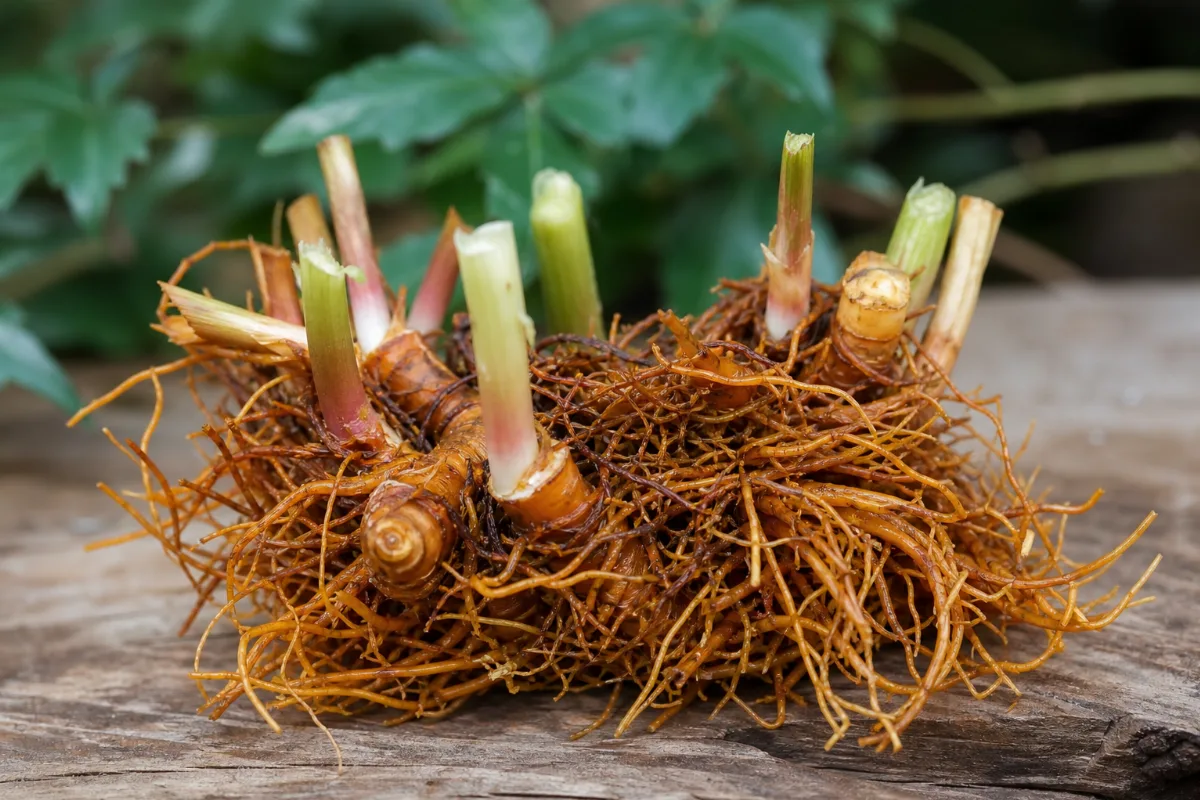
Herbs & Botanicals · Herbs · Chinese rhizome rich in berberine; trials are of formulas or berberine, not the plain root
Coptis (Goldthread)
Coptis chinensis Franch. · also called Goldthread, Chinese goldthread, huang lian, huanglian, Coptidis rhizoma, Rhizoma Coptidis
Coptis (huang lian) is the dried rhizome of Coptis chinensis, a plant in the buttercup family used in Chinese medicine. It is rich in the alkaloids berberine, coptisine and palmatine. Most human trials tested Coptis formulas with other herbs, or purified berberine. They report lower blood sugar, but the plain root has not been tested the same way. Berberine can raise levels of the transplant drug cyclosporine and is advised against in pregnancy and breastfeeding.
General information, not medical advice. Last substantive update · Not medically reviewed. A named clinician has not signed off on this page. How this page is made
About Coptis (Goldthread)
Coptis (Coptis chinensis, huang lian) is the rhizome of a plant used in Chinese medicine. Most research is on berberine or multi-herb formulas, not the plain root. Results for blood sugar and blood fats are low certainty. Berberine interacts with cyclosporine, and pregnancy and newborn cautions apply.
What it is
Coptis chinensis Franch. is a plant in the buttercup family. Its dried rhizome is called Coptidis rhizoma or huang lian. The accepted name was checked in GBIF.
A 2019 review says the official herb can come from Coptis chinensis, C. deltoidea or C. teeta, so labels may cover more than one plant.
Traditional and current uses
In China it is used for bacillary dysentery, diabetes, whooping cough, sore throat, mouth ulcers and eczema.
Today it is studied for type 2 diabetes, blood fats, H. pylori and ulcerative colitis, nearly always as a formula or as purified berberine.
What is in it and how it works
The rhizome contains berberine, coptisine, palmatine and jatrorrhizine. Berberine is the most important active compound and is also called the main toxic component in a 2019 review.
Berberine is poorly absorbed, but it can still change how other medicines are processed. In rats, Coptis rhizome had the opposite effect on cyclosporine from berberine in people, so whole root and compound may differ.
What the research shows
No trial of plain Coptis root was found. Pooled trials of Coptis formulas added to metformin report lower blood sugar and blood fats, rated mostly low certainty. Purified berberine shows lower blood sugar in 37 pooled trials.
For H. pylori, one trial found a berberine regimen about as effective as standard regimens. For ulcerative colitis, small trials of berberine added to 5-ASA report better scores.
At a glance
Traditional uses history, not proof
- Bacillary dysentery, sore throat, mouth ulcers, eczema, whooping cough and diabetes in Chinese medicine (2019 review)
- Used in formulas such as Huanglian Jiedu Tang (a combination)
Studied for research
- Type 2 diabetes: Coptis formulas added to metformin, low certainty
- Type 2 diabetes: purified berberine, low certainty
- Cholesterol and blood fats (formulas), low certainty
- H. pylori (berberine in an antibiotic regimen), low certainty
- Ulcerative colitis (berberine added to 5-ASA), low certainty
- Plain Coptis root for any use: no trial found
Main compounds
- Berberine (PubChem 2353)
- Coptisine (72322)
- Palmatine (19009)
- Jatrorrhizine (72323)
Common forms
- Dried sliced rhizome, decoction, powder, capsule or extract (content of berberine varies)
- Multi-herb formulas such as Huanglian Jiedu Tang and Jiao Tai Wan (combinations)
- Isolated berberine is a separate supplement
Research links: PubMed: Coptis formulas added to metformin (2022 meta-analysis) · PubMed: Coptidis Rhizoma comprehensive review (2019) · Memorial Sloan Kettering: Berberine · Research Library · Genes & Biomarkers Library
The plant and its history
- Accepted scientific name
- Coptis chinensis
- Naming authority
- Franch.
- Synonyms
- Coptis chinensis var. angustiloba W.Y.Kong; Coptis teeta var. chinensis (Franch.) Finet & Gagnep.
- Common names
- Chinese goldthread (en); huang lian (zh (pinyin)); 黄连 / 黃連 (zh)
- Botanical family
- Ranunculaceae (buttercup family)
- Classification
- Plantae > Tracheophyta > Magnoliopsida > Ranunculales > Ranunculaceae > Coptis > Coptis chinensis
- Native range
- Not verified in the sources read. The traditional medicine is mainly used in China.
- Habitat
- Not read.
- What the plant looks like
- Roots: The rhizome is the medicinal part (review).; Stems: Not read.; Leaves: Not read.; Flowers: Not read.; Fruit: Not read.
- Cultivation
- Not read.
- Harvest and processing
- Not read in detail.
- Look-alikes and adulterants
- Name: Other Coptis species (C. deltoidea, C. teeta); Note: The 2019 review says Coptidis rhizome is the rhizome of C. chinensis, C. deltoidea or C. teeta. Labels may cover more than one.; Name: Other berberine plants (goldenseal, barberry, Oregon grape); Note: These contain berberine too but are different plants; this page is kept separate from them. Memorial Sloan Kettering lists them together as berberine sources.
- Sustainability and conservation
- Not verified; no conservation record was read.
Traditional use and history history, not clinical proof
| Tradition or era | Documented use | Source |
|---|---|---|
| Traditional Chinese medicine | Huang lian, a bitter, cold herb, used for bacillary dysentery, diabetes, whooping cough, sore throat, mouth ulcers and eczema. | Wang et al. 2019 (PMID 30963783) |
| Singapore, 1978 to later | Rhizoma Coptidis and berberine banned after newborn jaundice cases in G6PD-deficient babies; ban later lifted after review. | Ho et al. 2014 (PMID 25610485) |
| Regulators | No EMA/HMPC monograph and no NCCIH page found for Coptis. | Searches on 2026-10-25 |
Traditional use shows how a plant was used. It does not show that a supplement works or is safe today.
What is inside, and how it may work
What the plant contains and how those compounds act in cells and animals. Laboratory and animal mechanisms are not proven effects in people.
Main compounds
| Compound | Family | Where it is concentrated | Activity studied | Level of evidence |
|---|---|---|---|---|
| Berberine PubChem 2353 | Protoberberine isoquinoline alkaloid | rhizome | The most important active constituent and the primary toxic component of the rhizome (review). 11 14 | Human data |
| Coptisine PubChem 72322 | Protoberberine alkaloid | rhizome | Activated P-gp efflux in cell tests, like berberine and palmatine. 16 | Laboratory research |
| Palmatine PubChem 19009 | Protoberberine alkaloid | rhizome | Activated P-gp efflux in cell tests. 16 | Laboratory research |
| Jatrorrhizine PubChem 72323 | Protoberberine alkaloid | rhizome | Identity confirmed in PubChem; no activity data read. 18 | Laboratory research |
Mechanisms, receptors and pathways
| Target or pathway | Gene or receptor | What was found | Level |
|---|---|---|---|
| CYP3A4 inhibition (berberine) | CYP3A4 | Trial authors put the rise in cyclosporin A levels down to CYP3A4 inhibition by berberine. 13 | Human data |
| P-gp and CYP3A activation (Coptis rhizome) | ABCB1 (P-gp), CYP3A | In rats, Coptis rhizome lowered cyclosporine levels and activated P-gp and CYP3A in cell and ex-vivo tests. 16 | Animal research |
| Metabolic and inflammation pathways (docking) | PIK3CA, JAK2, MAOA, PARP1 | Computer docking and network analysis predicted berberine binding; not tested in people. 5 | In silico |
Absorption, metabolism and elimination
- Absorption
- Berberine is poorly absorbed (rat bioavailability 0.68%; low ng/mL plasma levels in humans, per a 2026 review). In the colitis trial, mean plasma berberine was 3.5 nmol/L after 900 mg/day.
- Distribution
- Not read.
- Metabolism
- Berberine inhibits CYP3A4, CYP2D6 and CYP2C9 and affects P-gp and other transporters (review).
- Elimination
- Not read.
- Bioavailability
- Low (see absorption).
Isolated compounds versus whole extracts
Most human trials used purified berberine or multi-herb formulas, not plain Coptis root. In rats, whole Coptis rhizome lowered cyclosporine levels while purified berberine raised them in people. Whole herb and compound can behave differently.
Nutritional composition
No vitamin or mineral role for Coptis was found. It is used for its alkaloids.
7 low certainty1 not enough evidence
What is Coptis (Goldthread) good for?
The main proposed uses and how strong the human evidence is for each. "Low" means small or inconsistent studies, and "insufficient" means there is not enough to judge. Most rows describe Coptis formulas or purified berberine, not the plain root.
Benefits, one by one
Each card is a research question, not a promise. Tap a goal to filter. Open a card to see the studies, doses and limits.
Type 2 diabetes: Coptis formulas added to metformin
Low certaintyPooled trials of Coptis-containing herbal formulas given alongside metformin report lower blood sugar than metformin alone. These were formulas of several herbs, not plain Coptis root, and many trials were of poor quality.
2 studiesFormulas of several herbs; amounts and recipes differed between trial…
Studies, doses and limits
What the trials found
A 2022 pooled analysis of 33 randomised trials (2,846 people) tested Coptis chinensis prescriptions added to metformin. A 2026 pooled analysis of 19 trials (1,718 people) of Coptidis-containing formulas, mainly add-on, found lower HbA1c as well.
Results
Lower fasting glucose, 2-hour glucose, HbA1c, insulin and insulin resistance than metformin alone. Reviewers rated fasting glucose evidence moderate and the rest low.
Effect sizes as reported
Fasting glucose MD -1.16 (95% CI -1.24 to -1.07); HbA1c MD -0.78 (-0.96 to -0.60) (units as written in the abstract). 2026 analysis: HbA1c SMD -0.77 (-1.07 to -0.47).
Why this rating
The reviewers rated most outcomes low (fasting glucose moderate). Moderate publication bias and poor-quality trials. The formulas differ and are not plain root.
Form and dose studied
Formulas of several herbs; amounts and recipes differed between trials.
Who was studied
Adults with type 2 diabetes, trials mostly in China
Limits
Not plain Coptis root. Results may not apply outside the trial populations. No long-term outcomes such as complications were shown. Does not replace prescribed treatment.
Why researchers looked
Huang lian (Coptis rhizome) has long been used in Chinese medicine for a pattern called "wasting-thirst", which resembles diabetes.
Traditional use
Coptidis rhizome is used in China for diabetes, among other things (review).
Proposed mechanism Preliminary mechanism
Berberine, the main alkaloid, is thought to affect insulin and glucose handling. This is mostly lab and animal work.
A proposed mechanism does not show that the effect happens in people.
Can lower blood sugar further when taken with diabetes medicines; ask a doctor or pharmacist before combining. See the Safety tab.
Type 2 diabetes: purified berberine (Coptis compound)
Low certaintyBerberine is the main compound in Coptis. Pooled trials of purified berberine report lower blood sugar. This tells us about the compound, not about the root.
1 studiesPurified berberine; amounts varied.
Studies, doses and limits
What the trials found
A 2022 pooled analysis of 37 randomised trials (3,048 people) tested purified berberine, alone or with diabetes medicines.
Results
Lower fasting glucose, HbA1c and 2-hour glucose. Total adverse events were not higher; low blood sugar was not significantly higher.
Effect sizes as reported
Fasting glucose -0.82 mmol/L (-0.95 to -0.70); HbA1c -0.63% (-0.72 to -0.53); 2-hour glucose -1.16 mmol/L (-1.36 to -0.96).
Why this rating
Pooled randomised trials show lab-number changes, but the abstract gives no certainty rating and long-term outcomes were not shown. Purified compound, not the root.
Form and dose studied
Purified berberine; amounts varied.
Who was studied
Adults with type 2 diabetes
Limits
Lab numbers only; results are not proof for Coptis root. The effect was larger when starting levels were higher.
Why researchers looked
Berberine is the best-known active alkaloid of Coptis and is sold as a separate supplement.
Traditional use
Not a traditional single-compound use.
Proposed mechanism Preliminary mechanism
Lab work suggests berberine affects insulin release and glucose handling.
A proposed mechanism does not show that the effect happens in people.
Can lower blood sugar further when taken with diabetes medicines; ask a doctor or pharmacist before combining. See the Safety tab.
Type 2 diabetes: Huanglian Jiedu decoction (a Coptis formula)
Low certaintyHuanglian Jiedu decoction is a traditional Chinese formula built around Coptis. It is a combination, not Coptis alone. Pooled trials report better blood sugar and blood fats.
1 studiesDecoction; recipes may differ.
Studies, doses and limits
What the trials found
A 2024 pooled analysis of 40 randomised trials (3,934 people) tested the decoction alone or with other treatments.
Results
Lower HbA1c, fasting and 2-hour glucose, better insulin resistance; with other treatments, better blood fats. No higher rate of side effects including diarrhoea.
Effect sizes as reported
Numbers were not given in the abstract.
Why this rating
Formula of several herbs; no certainty rating in the abstract; authors ask for rigorous trials outside China.
Form and dose studied
Decoction; recipes may differ.
Who was studied
Adults with type 2 diabetes, trials in China
Limits
This is a combination product. It cannot show what Coptis alone does.
Why researchers looked
A classic formula (Coptis plus other herbs) used for "heat" patterns and tested in diabetes trials.
Traditional use
Traditional Chinese formula.
Proposed mechanism Preliminary mechanism
Not established; the studies are clinical.
A proposed mechanism does not show that the effect happens in people.
Can lower blood sugar further when taken with diabetes medicines; ask a doctor or pharmacist before combining. See the Safety tab.
Cholesterol and blood fats
Low certaintyPooled trials of Coptis-containing formulas report lower LDL cholesterol and triglycerides, mostly as add-on treatment. No heart outcomes were shown.
3 studiesFormulas; not specified.
Studies, doses and limits
What the trials found
The 33-trial analysis of Coptis prescriptions with metformin and the 19-trial analysis of Coptidis formulas both report lower LDL-C. The 40-trial Huanglian Jiedu analysis reports better lipids with combination treatment.
Results
Lower total cholesterol, triglycerides and LDL; HDL result is reported as MD -0.21, in the direction the authors called improvement but unclear in the abstract.
Effect sizes as reported
TC MD -0.70 (-1.00 to -0.39); TG -0.57 (-0.74 to -0.40); LDL-c -0.70 (-0.97 to -0.43); 2026: LDL-C SMD -1.10 (-1.57 to -0.62).
Why this rating
GRADE low for lipid outcomes in the 2022 analysis; formulas, not plain root; add-on designs.
Form and dose studied
Formulas; not specified.
Who was studied
Adults with type 2 diabetes or metabolic disease
Limits
Blood-fat numbers are not heart attacks or strokes. Formula results do not apply to plain root.
Why researchers looked
Blood fats often go with diabetes and are measured in the same trials.
Traditional use
Not a main traditional use in the sources read.
Proposed mechanism Preliminary mechanism
Lab and computer (docking) work suggests effects on fat-handling and inflammation pathways; not proof in people.
A proposed mechanism does not show that the effect happens in people.
Ask a doctor before adding to cholesterol or diabetes medicines.
Helicobacter pylori stomach infection (berberine inside antibiotic regimens)
Low certaintyA trial gave purified berberine with two antibiotics-type drugs. It matched two standard four-drug regimens. This is about berberine in a drug combination, not Coptis alone.
1 studiesPurified berberine with amoxicillin and vonoprazan, 14 days.
Studies, doses and limits
What the trials found
A 2023 randomised, open-label trial in China (300 people, 263 finished) compared berberine plus amoxicillin plus vonoprazan with two four-drug regimens.
Results
Eradication did not differ significantly between groups. Per-protocol rates: berberine regimen 81.4% (70/86), 86.5% and 78.4%.
Effect sizes as reported
Per-protocol 81.4% vs 86.5% vs 78.4% (p>0.05). Berberine arm intention-to-treat 70.0%.
Why this rating
One open-label single-centre trial of a combination; it shows the regimen worked about as well as others, not that berberine or Coptis clears H. pylori alone.
Form and dose studied
Purified berberine with amoxicillin and vonoprazan, 14 days.
Who was studied
Adults with H. pylori infection, China
Limits
Single trial; combination with antibiotics; not Coptis root. Treat infection under medical care.
Why researchers looked
Berberine is studied as an add-on to antibiotic treatment for H. pylori.
Traditional use
Coptis is traditionally used for bacillary dysentery and other gut infections (review).
Proposed mechanism Laboratory research
Lab work shows berberine-type alkaloids can slow some germs in a dish; not proof in people.
A proposed mechanism does not show that the effect happens in people.
Do not replace prescribed antibiotics. Berberine can interact with medicines; see Safety.
Ulcerative colitis (berberine added to standard treatment)
Low certaintyPooled small trials of purified berberine added to mesalamine (5-ASA) report better colitis scores. A small safety trial reported mostly mild effects and one liver-enzyme rise. Evidence is for berberine, not Coptis root.
2 studiesPurified berberine added to 5-ASA.
Studies, doses and limits
What the trials found
A 2024 pooled analysis of 10 randomised trials (952 people) tested berberine plus 5-ASA. A 2020 randomised double-blind safety trial (12 on berberine, 4 on placebo) gave 900 mg/day for 3 months.
Results
Better clinical response and lower activity scores with berberine plus 5-ASA; adverse reactions not significantly different. In the small trial, colon biopsy Geboes grade fell; one grade 3 transaminase rise and one mild nausea occurred on berberine.
Effect sizes as reported
Clinical efficacy RR 1.22 (1.15 to 1.30); Baron score SMD -1.72 (-2.30 to -1.13); DAI SMD -2.93 (-4.42 to -1.43).
Why this rating
Small trials, mostly in China; the pooled authors ask for higher-quality trials; the second trial was tiny and designed for safety.
Form and dose studied
Purified berberine added to 5-ASA.
Who was studied
Adults with ulcerative colitis
Limits
Not Coptis root. Colitis needs medical care; do not stop prescribed treatment.
Why researchers looked
Berberine has long been used in China for gut conditions.
Traditional use
Coptis is used traditionally for bacillary dysentery (review).
Proposed mechanism Preliminary mechanism
Lab work suggests anti-inflammatory effects; not shown in people here.
A proposed mechanism does not show that the effect happens in people.
A liver-enzyme rise was seen in one of 12 people. See Safety.
Body weight (BMI) in metabolic disease
Low certaintyA 2026 pooled analysis of Coptidis-containing formulas, mostly added to usual care, reported lower BMI. It is formulas, not plain root.
1 studiesFormulas.
Studies, doses and limits
What the trials found
19 randomised trials (1,718 people), formulas mainly as add-on treatment.
Results
Lower BMI.
Effect sizes as reported
BMI SMD -0.72 (-1.00 to -0.44)
Why this rating
Formulas of several herbs; no certainty rating in the abstract; add-on designs.
Form and dose studied
Formulas.
Who was studied
People with obesity, diabetes or high blood fats
Limits
BMI change is a lab-type measure and may not mean better health.
Why researchers looked
Studied together with diabetes and blood fats.
Traditional use
Not a main traditional use in the sources read.
Proposed mechanism Preliminary mechanism
Computer docking and network work only; not human evidence.
A proposed mechanism does not show that the effect happens in people.
Gut infections such as dysentery, mouth ulcers and skin problems (traditional use)
Not enough evidenceCoptis has long been used in China for bacillary dysentery, sore throat, mouth sores and eczema. No trial of the plain root for these uses was found.
1 studiesDried rhizome in decoctions (traditional).
Studies, doses and limits
What the trials found
No human trial of Coptis root for these uses was read; the 2019 review describes lab and animal work.
Results
No human results.
Effect sizes as reported
None.
Why this rating
Traditional use and lab work only.
Form and dose studied
Dried rhizome in decoctions (traditional).
Who was studied
Adults (traditional use)
Limits
Cannot be assumed to work in the body. The same review calls berberine the main toxic component.
Why researchers looked
The traditional uses led to modern lab work on its alkaloids.
Traditional use
Dysentery, whooping cough, sore throat, mouth ulcers and eczema in China (review).
Proposed mechanism Laboratory research
Lab tests of the alkaloids report germ-slowing; lab only.
A proposed mechanism does not show that the effect happens in people.
See Safety tab.
Connections to the rest of health
How Coptis (Goldthread) connects to the rest of our health knowledge graph. Every link says what kind of connection it is. A safety link (for example to the liver) is a warning, not a benefit. A study that merely mentions a topic never creates a benefit link.
Explore every connection: goals, body systems, organs, symptoms, genes
A. Wellness goals
| Connected to | Kind of connection | Evidence status | Context | Studies |
|---|---|---|---|---|
| Blood Sugar Balance | Demonstrated clinical effect | Low certainty | Type 2 diabetes: Coptis formulas added to metformin: Pooled trials of Coptis-containing herbal formulas given alongside metformin report lower blood sugar than metformin alone. These were formulas of several herbs, not plain Coptis root, and many trials were of poor quality. Type 2 diabetes: purified berberine (Coptis compound): Berberine is the main compound in Coptis. Pooled trials of purified berberine report lower blood sugar. This tells us about the compound, not about the root. | 10 5 14 12 |
| Metabolic Health | Demonstrated clinical effect | Low certainty | Type 2 diabetes: Coptis formulas added to metformin: Pooled trials of Coptis-containing herbal formulas given alongside metformin report lower blood sugar than metformin alone. These were formulas of several herbs, not plain Coptis root, and many trials were of poor quality. Type 2 diabetes: purified berberine (Coptis compound): Berberine is the main compound in Coptis. Pooled trials of purified berberine report lower blood sugar. This tells us about the compound, not about the root. | 10 5 14 12 |
| Cholesterol Balance | Demonstrated clinical effect | Low certainty | Cholesterol and blood fats: Pooled trials of Coptis-containing formulas report lower LDL cholesterol and triglycerides, mostly as add-on treatment. No heart outcomes were shown. | 10 5 12 |
| Digestive Support | Potential benefit | Low certainty | Helicobacter pylori stomach infection (berberine inside antibiotic regimens): A trial gave purified berberine with two antibiotics-type drugs. It matched two standard four-drug regimens. This is about berberine in a drug combination, not Coptis alone. Ulcerative colitis (berberine added to standard treatment): Pooled small trials of purified berberine added to mesalamine (5-ASA) report better colitis scores. A small safety trial reported mostly mild effects and one liver-enzyme rise. Evidence is for berberine, not Coptis root. | 1 6 15 |
| Gut Health | Potential benefit | Low certainty | Helicobacter pylori stomach infection (berberine inside antibiotic regimens): A trial gave purified berberine with two antibiotics-type drugs. It matched two standard four-drug regimens. This is about berberine in a drug combination, not Coptis alone. Ulcerative colitis (berberine added to standard treatment): Pooled small trials of purified berberine added to mesalamine (5-ASA) report better colitis scores. A small safety trial reported mostly mild effects and one liver-enzyme rise. Evidence is for berberine, not Coptis root. | 1 6 15 |
| Inflammation Balance | Potential benefit | Low certainty | Ulcerative colitis (berberine added to standard treatment): Pooled small trials of purified berberine added to mesalamine (5-ASA) report better colitis scores. A small safety trial reported mostly mild effects and one liver-enzyme rise. Evidence is for berberine, not Coptis root. | 6 15 |
| Weight Management | Potential benefit | Low certainty | Body weight (BMI) in metabolic disease: A 2026 pooled analysis of Coptidis-containing formulas, mostly added to usual care, reported lower BMI. It is formulas, not plain root. | 5 |
| Metabolic Health | Potential benefit | Low certainty | Body weight (BMI) in metabolic disease: A 2026 pooled analysis of Coptidis-containing formulas, mostly added to usual care, reported lower BMI. It is formulas, not plain root. | 5 |
| Digestive Support | Traditional use | Not enough evidence | Gut infections such as dysentery, mouth ulcers and skin problems (traditional use): Coptis has long been used in China for bacillary dysentery, sore throat, mouth sores and eczema. No trial of the plain root for these uses was found. | 11 |
| Immune Support | Traditional use | Not enough evidence | Gut infections such as dysentery, mouth ulcers and skin problems (traditional use): Coptis has long been used in China for bacillary dysentery, sore throat, mouth sores and eczema. No trial of the plain root for these uses was found. | 11 |
B. Body systems
| Connected to | Kind of connection | Evidence status | Context | Studies |
|---|---|---|---|---|
| Endocrine System | Biological association | Low certainty | Studied for: Type 2 diabetes: Coptis formulas added to metformin Studied for: Type 2 diabetes: purified berberine (Coptis compound) | 10 5 14 12 |
| Metabolism Weight | Biological association | Low certainty | Studied for: Type 2 diabetes: Coptis formulas added to metformin Studied for: Cholesterol and blood fats | 10 5 12 |
| Cardiovascular System | Biological association | Low certainty | Studied for: Cholesterol and blood fats | 10 5 12 |
| Digestive System | Biological association | Low certainty | Studied for: Helicobacter pylori stomach infection (berberine inside antibiotic regimens) Studied for: Ulcerative colitis (berberine added to standard treatment) | 1 6 15 11 |
| Immune System | Biological association | Not enough evidence | Studied for: Gut infections such as dysentery, mouth ulcers and skin problems (traditional use) | 11 |
E. Health conditions
| Connected to | Kind of connection | Evidence status | Context | Studies |
|---|---|---|---|---|
| Newborn jaundice / G6PD deficiency | Contraindication | Mixed findings | Singapore ban 1978, later lifted; evidence conflicting. Preparation or compound: Rhizoma Coptidis / berberine |
4 7 |
| Type 2 diabetes | Demonstrated clinical effect | Low certainty | Formulas and berberine lower blood sugar in pooled trials. Preparation or compound: Coptis formulas / berberine |
10 14 |
| Helicobacter pylori infection | Potential benefit | Low certainty | Berberine inside an antibiotic regimen matched standard regimens in one trial. Preparation or compound: Berberine with antibiotics |
1 |
I. Biomarkers
| Connected to | Kind of connection | Evidence status | Context | Studies |
|---|---|---|---|---|
| HbA1c (average blood sugar over about 3 months) | Biological association | Low certainty | Measured in trials: lowered. A lab change is not the same as a health benefit. | 14 10 5 |
| Fasting blood glucose | Biological association | Low certainty | Measured in trials: lowered. A lab change is not the same as a health benefit. | 14 10 |
| LDL cholesterol | Biological association | Low certainty | Measured in trials: lowered. A lab change is not the same as a health benefit. | 10 5 |
| Triglycerides | Biological association | Low certainty | Measured in trials: lowered. A lab change is not the same as a health benefit. | 10 |
| H. pylori eradication rate | Biological association | Low certainty | Measured in trials: no-change. A lab change is not the same as a health benefit. | 1 |
| Ulcerative colitis activity scores | Biological association | Low certainty | Measured in trials: lowered. A lab change is not the same as a health benefit. | 6 |
| Body mass index | Biological association | Low certainty | Measured in trials: lowered. A lab change is not the same as a health benefit. | 5 |
J. Genes, receptors and enzymes
L. Active compounds
| Connected to | Kind of connection | Evidence status | Context | Studies |
|---|---|---|---|---|
| Berberine | Biological association | Human | The most important active constituent and the primary toxic component of the rhizome (review). Preparation or compound: rhizome |
11 14 |
| Coptisine | Biological association | In vitro | Activated P-gp efflux in cell tests, like berberine and palmatine. Preparation or compound: rhizome |
16 |
| Palmatine | Biological association | In vitro | Activated P-gp efflux in cell tests. Preparation or compound: rhizome |
16 |
| Jatrorrhizine | Biological association | In vitro | Identity confirmed in PubChem; no activity data read. Preparation or compound: rhizome |
18 |
Each connection is stored with the ingredient, the connected record, the kind of connection, the evidence status, the supporting studies, the preparation or compound involved, and a review date (last reviewed October 25, 2026).
The evidence
The research centre for Coptis (Goldthread). Every record here was checked against PubMed or the publisher's page; we never list a study we have not verified.
Evidence by outcome
Bars show how many studies we found for each outcome, not how well it works. People are added up across trials only (reviews are not added, to avoid double counting).
How we rate evidence
High certainty
Several well-run trials or reviews agree; further research is unlikely to change the picture much.
Moderate certainty
Good trials point the same way, but some doubt remains.
Low certainty
Small, short or inconsistent trials. The finding could change with better research.
Very low certainty
Very little or very weak human data. Treat as a possibility only.
Mixed findings
Trials or reviews disagree with each other.
Not enough evidence
Not enough human research to say either way.
Evidence against
Good research found no benefit, or found harm.
We take the reviewers' own risk-of-bias and GRADE statements where they exist, and otherwise judge from study size, design, consistency, directness and whether a product matches what is sold. Many publications do not make evidence high. Method note: We built from our existing Coptis summary and re-read PubMed abstracts for the studies cited, checked plant names in GBIF and NCBI, compounds in PubChem, and read a Memorial Sloan Kettering berberine page. EMA and NCCIH pages for Coptis were not found; LiverTox could not be opened.
Study library: every study we checked 18
| Study | Design | People | Product, dose, length | Result |
|---|---|---|---|---|
| Chen 2023 Efficacy and safety of triple therapy containing berberine, amoxicillin, and vonoprazan for Helicobacter pylori initial treatment: A randomized controlled trial Chin Med J (Engl) · PMID 37469024 · DOI |
Controlled trial |
300 Adults with H. pylori infection, China, single centre |
Berberine plus amoxicillin plus vonoprazan (purified berberine), 14 days not applicable twice daily (see paper) 14 days · vs Two other standard four-drug regimens (with clarithromycin and bismuth) |
Eradication did not differ significantly between groups; berberine regimen per-protocol 81.4% (70/86) versus 86.5% and 78.4%. Side effects and compliance were similar. Per-protocol 81.4% vs 86.5% vs 78.4% (p>0.05); 263 of 300 finished (not given) Methods, limits and fundingOutcomes: H. pylori eradication, symptoms, adverse events Limitations: Open-label, single centre; purified berberine inside an antibiotic regimen, so it does not show berberine or Coptis alone clears H. pylori. Funding and conflicts: Authors report none. Read: abstract |
| Dumitru 2026 Berberine-Drug Interactions: Mechanisms, Clinical Relevance and Risk Stratification-A Narrative Review Pharmaceuticals (Basel) · PMID 42653808 · DOI |
Narrative review |
Not applicable | Berberine (from Berberis, Coptis chinensis, Hydrastis canadensis) not applicable not applicable |
Berberine can inhibit and induce CYP3A4, inhibit CYP2D6 and CYP2C9, and act on P-glycoprotein and other transporters; extra low blood sugar, low blood pressure and QT prolongation are possible additive effects. Human documentation exists for only a few drug pairs; the clearest is cyclosporine. Product quality varies and national limits in Europe differ a lot. Cyclosporine AUC +34.5%, trough 29.3% above control (cites the transplant trial) (not applicable) Methods, limits and fundingOutcomes: Interaction mechanisms and risk Limitations: Narrative review; most interactions are mechanistic, not shown in people. Funding and conflicts: Authors declare none. Read: abstract |
| EMA 2026 EMA/HMPC: search for a Coptis / Coptidis rhizoma herbal monograph · Source |
Search not found |
A web search on 2026-10-25 found no HMPC monograph, draft or work-plan entry for Coptis or Coptidis rhizoma. This is "not found", not proof that none exists; the EMA monograph list was not searched directly. Methods, limits and fundingOutcomes: Regulatory status Limitations: Search only. Read: not-found | ||
| Ho 2014 From prejudice to evidence: the case of rhizoma coptidis in Singapore Evid Based Complement Alternat Med · PMID 25610485 · DOI |
Narrative review |
Newborns with G6PD deficiency; general users | Rhizoma Coptidis and berberine rhizome not applicable not applicable |
In 1978 Rhizoma Coptidis was implicated in newborn jaundice and kernicterus in G6PD-deficient babies and was banned in Singapore. After later evidence and better understanding of G6PD deficiency, the Singapore Health Sciences Authority lifted the ban. Not applicable (Not applicable) Methods, limits and fundingOutcomes: Safety history of the Singapore ban Limitations: Narrative review; authors are in the traditional medicine field. Funding and conflicts: Not stated. Read: abstract |
| Kang 2026 Coptidis Rhizoma for Obesity, Diabetes, and Dyslipidemia: An Integrated Meta-Analysis and In Silico Study Int J Mol Sci · PMID 42794540 · DOI |
Meta-analysis |
1718 People with obesity, diabetes or high blood fats (19 randomised trials) |
Coptidis-containing formulations, mainly added to usual treatment rhizome (inside formulas) varied varied · vs Usual treatment |
Lower BMI, HbA1c and LDL-C. The paper also includes computer (docking) work, which is not human evidence. BMI SMD -0.72; HbA1c SMD -0.77; LDL-C SMD -1.10 (BMI -1.00 to -0.44; HbA1c -1.07 to -0.47; LDL-C -1.57 to -0.62) Methods, limits and fundingOutcomes: BMI, HbA1c, LDL cholesterol Limitations: Formulas, mostly add-on; authors call for larger standardised trials and say long-term safety is unconfirmed. No GRADE in the abstract. Funding and conflicts: Funders had no role (authors state). Read: abstract |
| Li 2024 Efficacy and safety of berberine plus 5-ASA for ulcerative colitis: A systematic review and meta-analysis PLoS One · PMID 39241013 · DOI |
Meta-analysis |
952 Adults with ulcerative colitis (10 randomised trials) |
Berberine (purified compound) added to 5-ASA (mesalamine) not applicable not stated in abstract not stated in abstract · vs 5-ASA alone |
Better clinical response and lower scores with berberine plus 5-ASA. Adverse reactions were not significantly different. Clinical efficacy RR 1.22; Baron score SMD -1.72; DAI SMD -2.93; adverse reactions RR 0.75 (not significant) (RR 1.15 to 1.30; Baron -2.30 to -1.13; DAI -4.42 to -1.43; adverse 0.42 to 1.33) Methods, limits and fundingOutcomes: Clinical response, Baron score, disease activity index, inflammation markers, adverse events Limitations: Purified berberine, not Coptis root; authors say better-quality trials are needed. Funding and conflicts: Authors declare no competing interests. Read: abstract |
| Linn 2012 Berberine-induced haemolysis revisited: safety of Rhizoma coptidis and Cortex phellodendri in chronic haematological diseases Phytother Res · PMID 22002596 · DOI |
Case series |
20 Adults with long-term low blood counts who also took herbal mixtures containing Rhizoma coptidis (Coptis) or Cortex phellodendri |
Chinese herbal decoctions containing Rhizoma coptidis, Cortex phellodendri or both rhizome (in mixtures) traditional doses Rhizoma coptidis given for 1,055 patient-days |
No organ toxicity or electrolyte problems. Three people with thalassaemia intermedia had a brief bilirubin rise without worse anaemia or liver problems. The literature on newborn jaundice and kernicterus was described as conflicting. 20 patients (not applicable) Methods, limits and fundingOutcomes: Organ toxicity, electrolytes, bilirubin Limitations: Single-arm study; subset of 20; adults, not newborns; mixtures not Coptis alone. Funding and conflicts: Not stated. Read: abstract |
| Memorial Sloan Kettering Cancer Center 2023 Memorial Sloan Kettering Cancer Center: Berberine (patient and clinical herbs page) · Source |
Authoritative guidance |
Berberine (from barberry, Chinese goldthread/Coptis chinensis, goldenseal, tree turmeric, Oregon grape) |
Page dated 12 June 2023. Advises against use in pregnancy and breastfeeding because it may worsen jaundice in infants and may cause a more severe brain-affecting condition (kernicterus). Says berberine raised cyclosporin levels in adult kidney-transplant patients and cites a child whose tacrolimus levels rose with kidney toxicity. Says repeated oral berberine lowered CYP2D6, 2C9 and 3A4 activity and may weaken drugs processed by them. Warns against use with sulfonylureas. Mild side effects: appetite loss, upset stomach, diarrhoea, constipation, rash. Diabetes studies called limited quality. It is a berberine page, not a Coptis root page. Methods, limits and fundingOutcomes: Pregnancy, breastfeeding, interactions, side effects Limitations: Page about berberine, not Coptis root. Page text read via a web fetch summary, not a full manual read. Read: web page | |
| NCCIH 2026 NIH NCCIH: no Coptis, goldthread or berberine page found · Source |
Search not found |
Direct requests on 2026-10-25 for nccih.nih.gov/health/coptis, /goldthread and /berberine returned HTTP 404. NCCIH has a goldenseal page, which is a different plant. Methods, limits and fundingOutcomes: Regulatory status Limitations: Not found. Read: not-found | ||
| Pan 2022 Systematic review and meta-analysis of Coptis chinensis Franch.-containing traditional Chinese medicine as an adjunct therapy to metformin in the treatment of type 2 diabetes mellitus Front Pharmacol · PMID 36160405 · DOI |
Meta-analysis |
2846 Adults with type 2 diabetes (33 randomised trials, mostly in China) |
Coptis chinensis-containing multi-herb prescriptions added to metformin rhizome (inside multi-herb formulas) varied by formula varied · vs Metformin alone |
Lower fasting glucose, 2-hour glucose, HbA1c, insulin resistance and blood fats than metformin alone. GRADE: moderate for fasting glucose, low for the others, very low for gut side effects. Moderate publication bias; authors say some trials were of poor quality. Fasting glucose MD -1.16; HbA1c MD -0.78; TC -0.70; TG -0.57; LDL-c -0.70; HDL-c -0.21 (units written as % in the abstract) (FBG -1.24 to -1.07; HbA1c -0.96 to -0.60; TC -1.00 to -0.39; TG -0.74 to -0.40; LDL-c -0.97 to -0.43) Methods, limits and fundingOutcomes: Fasting glucose, 2-hour glucose, HbA1c, insulin, insulin resistance (HOMA-IR), blood fats, gut side effects Limitations: Combination formulas, not plain root; different formulas in different trials; a correction notice (erratum, Front Pharmacol 2023) exists for this paper and was not read. Funding and conflicts: Authors declare no conflicts. Read: abstract |
| Wang 2019 Coptidis Rhizoma: a comprehensive review of its traditional uses, botany, phytochemistry, pharmacology and toxicology Pharm Biol · PMID 30963783 · DOI |
Narrative review |
Not applicable | Coptidis Rhizoma rhizome not applicable not applicable |
Coptidis rhizome is the rhizome of Coptis chinensis, C. deltoidea or C. teeta. Used in China for bacillary dysentery, diabetes, whooping cough, sore throat, mouth ulcers and eczema. 128 compounds identified; alkaloids are characteristic. Berberine is the most important active compound and the main toxic component. The authors say clinical effects, toxic compounds and quality-control criteria need more study. Not applicable (Not applicable) Methods, limits and fundingOutcomes: Botany, chemistry, uses, toxicology Limitations: Narrative review; much cited work is lab or animal. Funding and conflicts: Not stated. Read: abstract |
| Wang 2024 Efficacy of Huanglian Jiedu Decoction for Type 2 Diabetes Mellitus: A Systematic Review and Meta-Analysis Complement Med Res · PMID 38286111 · DOI |
Meta-analysis |
3934 Adults with type 2 diabetes (40 randomised trials) |
Huanglian Jiedu decoction (a Coptis-containing formula), alone or with other treatments rhizome plus other herbs varied varied · vs Control treatment |
Lower HbA1c, fasting glucose and 2-hour glucose and better insulin resistance. With other treatments, better blood fats. No higher rate of side effects including diarrhoea. Numbers not given in the abstract (not given in the abstract) Methods, limits and fundingOutcomes: HbA1c, fasting and 2-hour glucose, insulin resistance, blood fats, side effects Limitations: Formula of several herbs, not Coptis alone. Abstract gives no certainty rating. Authors ask for rigorous trials outside China. Funding and conflicts: No conflict statement read. Read: abstract |
| Wu 2005 Effects of berberine on the blood concentration of cyclosporin A in renal transplanted recipients: clinical and pharmacokinetic study Eur J Clin Pharmacol · PMID 16133554 · DOI |
Controlled trial |
104 Kidney transplant recipients taking cyclosporin A |
Berberine (purified) with cyclosporin A not applicable 0.2 g three times daily 3 months (12 days in the 6-person PK part) · vs Cyclosporin A without berberine |
Cyclosporin A trough level ended 29.3% higher with berberine than without. In 6 people, AUC rose 34.5%. No significant effect on liver or kidney function tests. Trough +29.3% vs no berberine; AUC +34.5% (n=6) (not given) Methods, limits and fundingOutcomes: Cyclosporin A trough level, liver and kidney tests, drug exposure (AUC) Limitations: Purified berberine, not Coptis root; one older Chinese trial; pharmacokinetic part had only 6 people. Funding and conflicts: Not stated. Read: abstract |
| Xie 2022 Glucose-lowering effect of berberine on type 2 diabetes: A systematic review and meta-analysis Front Pharmacol · PMID 36467075 · DOI |
Meta-analysis |
3048 Adults with type 2 diabetes (37 randomised trials) |
Berberine (purified compound, alone or with diabetes medicines) not applicable (purified compound) · vs Control or usual treatment |
Berberine lowered fasting glucose, HbA1c and 2-hour glucose. Total adverse events were not higher; hypoglycaemia was not significantly higher. Fasting glucose -0.82 mmol/L; HbA1c -0.63%; 2-hour glucose -1.16 mmol/L. Total adverse events RR 0.73; hypoglycaemia RR 0.48. (FPG -0.95 to -0.70; HbA1c -0.72 to -0.53; 2hPBG -1.36 to -0.96; adverse events 0.55 to 0.97; hypoglycaemia 0.21 to 1.08 (p=0.08)) Methods, limits and fundingOutcomes: Fasting plasma glucose, HbA1c, 2-hour glucose, adverse events, hypoglycaemia Limitations: Purified berberine, not Coptis root. Abstract gives no GRADE rating or trial-quality summary. Effect was larger when starting levels were higher. Funding and conflicts: No conflict statement read (abstract only). Read: abstract |
| Xu 2020 A Phase I Trial of Berberine in Chinese with Ulcerative Colitis Cancer Prev Res (Phila) · PMID 31619442 · DOI |
Controlled trial |
16 People in China with quiet ulcerative colitis on mesalamine |
Berberine (purified), double-blind versus placebo not applicable 900 mg/day 3 months · vs Placebo |
At least possibly related: one grade 3 rise in liver enzymes (transaminases) and one grade 1 nausea among 12 on berberine; none among 4 on placebo. Colon biopsy Geboes grade fell significantly; other markers did not change significantly. 12 berberine versus 4 placebo; mean plasma berberine 3.5 nmol/L versus 0.5 nmol/L (not given) Methods, limits and fundingOutcomes: Safety (main), colitis activity score, tissue and blood markers Limitations: Very small safety trial; purified berberine; funded in part by NIH per author list. Funding and conflicts: Not stated in abstract. Read: abstract |
| Yu 2018 Activation of P-glycoprotein and CYP 3A by Coptidis Rhizoma in vivo: Using cyclosporine as a probe substrate in rats J Food Drug Anal · PMID 29703381 · DOI |
Animal research animal |
Rats | Coptidis Rhizoma (Coptis chinensis rhizome) decoction, single and repeated doses rhizome 1.0 g/kg single dose and 7 doses · vs Cyclosporine alone |
In rats, Coptidis Rhizoma LOWERED blood cyclosporine (Cmax -56.9% and -70.4%; AUC -56.4% and -68.7%) and activated P-gp and CYP3A in cells and ex-vivo tests. This is the opposite direction to the human berberine result. Cmax -56.9% (single), -70.4% (7th dose); AUC -56.4%, -68.7% (not given) Methods, limits and fundingOutcomes: Blood cyclosporine levels Limitations: Animal and cell study; human effect of Coptis root on cyclosporine not tested. Funding and conflicts: Authors declare none. Read: abstract |
| s-gbif-coptis-chinensis GBIF Backbone Taxonomy: Coptis chinensis Franch. (usageKey 7277323) · Source |
Database record in-vitro |
Methods, limits and fundingRead: api | ||
| s-pubchem-coptis-alkaloids PubChem: berberine (CID 2353), coptisine (CID 72322), palmatine (CID 19009), jatrorrhizine (CID 72323) · Source |
Database record in-vitro |
Methods, limits and fundingRead: api |
What we do not know yet
- What the evidence supports: Coptis formulas and purified berberine lower blood sugar in pooled trials at low certainty; berberine raises cyclosporine levels.
- No trial of plain Coptis root for any use was found.
- Jiao Tai Wan has no human evidence read.
- EMA and NCCIH information on Coptis was not found; LiverTox could not be read.
- No Coptis adulteration paper was read.
- Only abstracts were read for nearly all studies.
How new research is added
New studies are found by a saved PubMed search and are placed in a review queue. A person reads each one before it changes any evidence rating or safety wording. New publications never change ratings automatically.
Lab markers
What changed in blood or saliva tests during trials. A changed number is not the same as feeling or being healthier, and we give no "normal ranges".
Metabolic 5
HbA1c (average blood sugar over about 3 months)
Lowered in trials
A blood test showing average blood sugar over roughly three months.
Low certaintyResults and what it means
Why it was measured
Main long-term blood-sugar marker in the diabetes trials.
Statistical vs. clinical meaning
Statistically significant in pooled trials; a lab change, not a proof of fewer complications.
Safety implication
Lowering sugar further with diabetes medicines raises low-blood-sugar concern; see Safety.
Fasting blood glucose
Lowered in trials
Blood sugar after not eating overnight.
Low certaintyResults and what it means
Why it was measured
Basic diabetes control measure.
Statistical vs. clinical meaning
Statistically significant; clinical meaning for long-term health not shown.
Safety implication
Watch for low blood sugar with diabetes medicines.
LDL cholesterol
Lowered in trials
The "bad" cholesterol carried in the blood.
Low certaintyResults and what it means
Why it was measured
Heart-risk marker.
Statistical vs. clinical meaning
Lab number only; no heart outcomes were read.
Safety implication
None specific.
Triglycerides
Lowered in trials
A type of fat in the blood.
Low certaintyBody mass index
Lowered in trials
Weight relative to height.
Low certaintyResults and what it means
Other 2
H. pylori eradication rate
No clear change in trials
The share of people whose infection test is negative after treatment.
Low certaintyResults and what it means
Why it was measured
Main outcome of the H. pylori trial.
Statistical vs. clinical meaning
Similar to standard regimens in one open-label trial.
Safety implication
Side effects were similar between regimens.
| Study | Result | People | Product |
|---|---|---|---|
| 1 | Per-protocol 81.4% (70/86) with berberine regimen vs 86.5% and 78.4% with the two standard regimens; not significantly different | Adults with H. pylori, China | Berberine + amoxicillin + vonoprazan, 14 days |
Ulcerative colitis activity scores
Lowered in trials
Doctor-rated scores of colitis activity (Baron score, disease activity index).
Low certaintyResults and what it means
Why it was measured
Main outcomes in the colitis trials.
Statistical vs. clinical meaning
Statistically significant; trials small and mostly in China.
Safety implication
One liver-enzyme rise in a small trial.
| Study | Result | People | Product |
|---|---|---|---|
| 6 | Baron SMD -1.72 (-2.30 to -1.13); DAI SMD -2.93 (-4.42 to -1.43) | Ulcerative colitis, 10 trials | Berberine plus 5-ASA |
Safety
What studies and official sources say about side effects, medicines and who should check first. Each point shows what kind of evidence it comes from.
Main points to know 3
- Berberine, the main Coptis compound, can raise levels of the transplant drug cyclosporine. In a randomised trial of kidney-transplant patients, purified berberine raised cyclosporin A blood levels by about 29% compared with no berberine, and exposure by about 35% in six people. In rats, Coptis rhizome had the opposite effect. So the direction for Coptis root is not known. People on transplant drugs should not take Coptis or berberine without their transplant team. Controlled trial 13 16 2
- Not for pregnancy, breastfeeding or newborns. Memorial Sloan Kettering advises against berberine in pregnancy and breastfeeding because it may worsen jaundice in infants. Coptis was banned in Singapore from 1978 after newborn jaundice cases and later allowed again; the evidence in the literature is conflicting. Coptis root itself has no pregnancy source read. Authoritative guidance 8 4 7
- May lower blood sugar further with diabetes medicines. Pooled berberine trials did not find significantly more low blood sugar, but berberine lowers glucose, and a review lists additive low blood sugar as a possible effect. Check with a doctor or pharmacist if you take diabetes medicines. Meta-analysis 14 2
Side effects 4
| Effect | How often | Severity and recovery | Evidence |
|---|---|---|---|
| Mild gut upset: appetite loss, upset stomach, diarrhoea, constipation; rash Memorial Sloan Kettering lists these as mild effects of berberine. No frequency given. | Not established | mild not stated | Authoritative guidance 8 |
| Total adverse events not higher with berberine in diabetes trials Total adverse events RR 0.73 (0.55 to 0.97). Purified berberine, not Coptis root. | Not established | not applicable not applicable | Meta-analysis 14 |
| Gut side effects of Coptis formulas Evidence on gut dysfunction was rated very low by the reviewers. | Not established | not stated not stated | Meta-analysis 10 |
| Huanglian Jiedu decoction: no increase in side effects including diarrhoea Formula, not Coptis alone; abstract only. | Not established | not applicable not applicable | Meta-analysis 12 |
Liver
The NIH LiverTox page for berberine could not be opened (blocked), so its rating was not read. In the human studies read: in a small ulcerative colitis trial, one of 12 people on berberine 900 mg/day for 3 months had a grade 3 transaminase (liver enzyme) rise; in the transplant trial berberine did not significantly affect liver or kidney tests; and in 20 adults taking herbal mixtures with Rhizoma coptidis, no organ toxicity was seen. No Coptis liver injury case report was found. 15 13 7
How often. Frequency cannot be given from these small studies.
Monitoring. No monitoring protocol exists. People with liver disease or on liver-affecting drugs should ask a doctor.
This is a safety connection. It is not evidence that Coptis (Goldthread) supports liver health.
Medicines and supplements 3
| With | Why it matters | Importance | Evidence | What to do |
|---|---|---|---|---|
| Cyclosporine (and possibly tacrolimus) pharmacokinetic | Berberine inhibits CYP3A4 in the gut and liver (trial authors' explanation). Rat work with Coptis rhizome shows the opposite direction, with activation of P-gp and CYP3A. | Purified berberine raised cyclosporin A trough levels by 29.3% versus controls and AUC by 34.5% in 6 patients. Memorial Sloan Kettering also cites a child whose tacrolimus levels rose. | Controlled trial Moderate certainty 13 16 8 | Do not combine with transplant drugs without the transplant team. |
| Drugs processed by CYP2D6, CYP2C9, CYP3A4 or P-glycoprotein pharmacokinetic (theory and early data) | Berberine may inhibit these enzymes and act on transporters; a review says documented in people for only a few drug pairs. | Could change levels of other drugs. Not shown specifically for Coptis root in people. | Pharmacological theory Low certainty 2 8 | Ask a pharmacist to check each medicine, especially ones with a narrow safe range. |
| Diabetes medicines (including sulfonylureas) pharmacodynamic | Both lower blood sugar. | Berberine did not significantly raise hypoglycaemia in pooled trials (RR 0.48, 0.21 to 1.08); Memorial Sloan Kettering warns about sulfonylureas. | Meta-analysis Low certainty 14 8 | Check blood sugar closely and tell your diabetes team. |
Who should check first 3
| Situation | Advice | Evidence |
|---|---|---|
| Pregnancy and breastfeeding | Avoid (Memorial Sloan Kettering advice for berberine, because of newborn jaundice risk). No source specific to Coptis root was read. | Authoritative guidance 8 |
| Newborns and infants, especially with G6PD deficiency | Avoid. The Singapore ban was linked to jaundice in G6PD-deficient babies; later reviews found conflicting evidence and the ban was lifted. | Narrative review 4 7 |
| Taking cyclosporine, tacrolimus or other narrow-range drugs | Do not combine without the prescriber. | Controlled trial 13 8 |
Overdose, product quality and regulators
Summary. A 2019 review calls berberine the main toxic component of Coptis rhizome. No poisoning case series for the plain root was read.
Animal. Not read beyond the review.
Human doses studied. Short trials of purified berberine up to 3 months and herbal mixtures with Rhizoma coptidis for 1,055 patient-days. Long-term safety is unknown.
High dose or long term signals. Not established.
Overdose response. No overdose data in the sources read.
Genotoxicity. Not read.
Toxic plant parts. The rhizome is the part used. Other parts not covered in the sources read.
Coptidis rhizome is defined as the rhizome of three species (Coptis chinensis, C. deltoidea or C. teeta), so labels may cover more than one plant. Berberine content in supplements varies, which changes exposure. No adulteration or contaminant testing paper for Coptis products was read.
More than one species is accepted. The 2019 review says Coptidis rhizome is the rhizome of Coptis chinensis, C. deltoidea or C. teeta. 11
Product quality varies. A 2026 review says unstandardised product quality widens uncertainty about the dose delivered, and European national limits differ by more than ten times. 2
| Body | Action | Date |
|---|---|---|
| Memorial Sloan Kettering Cancer Center (United States) | Berberine page (named plants include Chinese goldthread, Coptis chinensis): advises against use in pregnancy and breastfeeding; warns about drug interactions. source | Page updated 12 June 2023 |
When to get medical help
- Yellow skin or eyes, poor feeding or unusual sleepiness in a newborn exposed to berberine or Coptis through pregnancy or breastfeeding
- Yellow skin or eyes, dark urine, or severe stomach pain in an adult
- Shakes, sweating, confusion or faintness on diabetes medicines
- Signs of transplant-drug problems in someone taking cyclosporine or tacrolimus
Stop the supplement and contact a clinician or emergency service. In the US, Poison Control is 1-800-222-1222.
General information only, not medical advice. Ask a clinician or pharmacist before use, especially with medicines, in pregnancy or with a health condition. See the Natural Remedy Safety guide.
Frequently asked questions
What is Coptis?
It is the dried rhizome of Coptis chinensis, used in Chinese medicine as huang lian. It is rich in berberine.
Has Coptis itself been proven to help with diabetes?
Is Coptis the same as berberine, goldenseal, barberry or Oregon grape?
What is Huanglian Jiedu Tang?
A traditional formula built around Coptis, with other herbs. A 2024 pooled analysis of 40 trials reports better blood sugar and lipids. It is a combination, so it cannot show what Coptis does alone.
What about Jiao Tai Wan?
It is a two-herb formula that contains Coptis. A PubMed search returned mainly animal and cell studies, and no human trial was read.
Can it help with H. pylori?
One 2023 trial found a regimen with berberine and two drugs about as effective as standard regimens. It does not show Coptis alone works. Infections need medical care.
Is it used for ulcerative colitis?
Does it interact with medicines?
Is it safe in pregnancy or breastfeeding?
What are the side effects?
Can it harm the liver?
Are Coptis products always what the label says?
Explore by health goal
Metabolic HealthBlood Sugar BalanceDigestive SupportGut HealthCholesterol BalanceInflammation BalanceWeight ManagementImmune Support
Editorial transparency
- Written by
- AlternativeMed editorial team. Research compiled with AI assistance, then checked against PubMed records.
- Medical review
- None. This page has not been reviewed by a physician or pharmacist.
- First published
- 2026-10-25
- Last substantive update
- 2026-10-25
- How we research
- We built from our existing Coptis summary and re-read PubMed abstracts for the studies cited, checked plant names in GBIF and NCBI, compounds in PubChem, and read a Memorial Sloan Kettering berberine page. EMA and NCCIH pages for Coptis were not found; LiverTox could not be opened.
- How we rate evidence
- See "How we rate evidence" in the Evidence tab.
- Independence
- No product is promoted on this page. No affiliate links are shown. If one is added later it will be labelled and kept apart from the evidence.
Sources 18
Each source was opened and checked. Where we read only the abstract, it says so. The small numbers in the text point here.
- Chen S, Shen W, Liu Y, et al.. Efficacy and safety of triple therapy containing berberine, amoxicillin, and vonoprazan for Helicobacter pylori initial treatment: A randomized controlled trial. Chin Med J (Engl). 2023. PMID 37469024. DOI 10.1097/CM9.0000000000002696. (abstract)
- Dumitru CN, Marcu T, Dumitru AO, et al.. Berberine-Drug Interactions: Mechanisms, Clinical Relevance and Risk Stratification-A Narrative Review. Pharmaceuticals (Basel). 2026. PMID 42653808. DOI 10.3390/ph19081313. (abstract)
- EMA. EMA/HMPC: search for a Coptis / Coptidis rhizoma herbal monograph. . 2026. (not-found)
- Ho CE, Goh YL, Zhang C. From prejudice to evidence: the case of rhizoma coptidis in Singapore. Evid Based Complement Alternat Med. 2014. PMID 25610485. DOI 10.1155/2014/871720. (abstract)
- Kang CY, Yoo YJ, Kim JH, et al.. Coptidis Rhizoma for Obesity, Diabetes, and Dyslipidemia: An Integrated Meta-Analysis and In Silico Study. Int J Mol Sci. 2026. PMID 42794540. DOI 10.3390/ijms27188109. (abstract)
- Li J, Zhang C, Xu Y, et al.. Efficacy and safety of berberine plus 5-ASA for ulcerative colitis: A systematic review and meta-analysis. PLoS One. 2024. PMID 39241013. DOI 10.1371/journal.pone.0309144. (abstract)
- Linn YC, Lu J, Lim LC, et al.. Berberine-induced haemolysis revisited: safety of Rhizoma coptidis and Cortex phellodendri in chronic haematological diseases. Phytother Res. 2012. PMID 22002596. DOI 10.1002/ptr.3617. (abstract)
- Memorial Sloan Kettering Cancer Center. Memorial Sloan Kettering Cancer Center: Berberine (patient and clinical herbs page). . 2023. (web page)
- NCCIH. NIH NCCIH: no Coptis, goldthread or berberine page found. . 2026. (not-found)
- Pan L, Zhai X, Duan Z, et al.. Systematic review and meta-analysis of Coptis chinensis Franch.-containing traditional Chinese medicine as an adjunct therapy to metformin in the treatment of type 2 diabetes mellitus. Front Pharmacol. 2022. PMID 36160405. DOI 10.3389/fphar.2022.956313. (abstract)
- Wang J, Wang L, Lou GH, et al.. Coptidis Rhizoma: a comprehensive review of its traditional uses, botany, phytochemistry, pharmacology and toxicology. Pharm Biol. 2019. PMID 30963783. DOI 10.1080/13880209.2019.1577466. (abstract)
- Wang M, Wang T, Gu F. Efficacy of Huanglian Jiedu Decoction for Type 2 Diabetes Mellitus: A Systematic Review and Meta-Analysis. Complement Med Res. 2024. PMID 38286111. DOI 10.1159/000536453. (abstract)
- Wu X, Li Q, Xin H, et al.. Effects of berberine on the blood concentration of cyclosporin A in renal transplanted recipients: clinical and pharmacokinetic study. Eur J Clin Pharmacol. 2005. PMID 16133554. DOI 10.1007/s00228-005-0952-3. (abstract)
- Xie W, Su F, Wang G, et al.. Glucose-lowering effect of berberine on type 2 diabetes: A systematic review and meta-analysis. Front Pharmacol. 2022. PMID 36467075. DOI 10.3389/fphar.2022.1015045. (abstract)
- Xu L, Zhang Y, Xue X, et al.. A Phase I Trial of Berberine in Chinese with Ulcerative Colitis. Cancer Prev Res (Phila). 2020. PMID 31619442. DOI 10.1158/1940-6207.CAPR-19-0258. (abstract)
- Yu CP, Huang CY, Lin SP, et al.. Activation of P-glycoprotein and CYP 3A by Coptidis Rhizoma in vivo: Using cyclosporine as a probe substrate in rats. J Food Drug Anal. 2018. PMID 29703381. DOI 10.1016/j.jfda.2017.11.005. (abstract)
- . GBIF Backbone Taxonomy: Coptis chinensis Franch. (usageKey 7277323). . . (api)
- . PubChem: berberine (CID 2353), coptisine (CID 72322), palmatine (CID 19009), jatrorrhizine (CID 72323). . . (api)