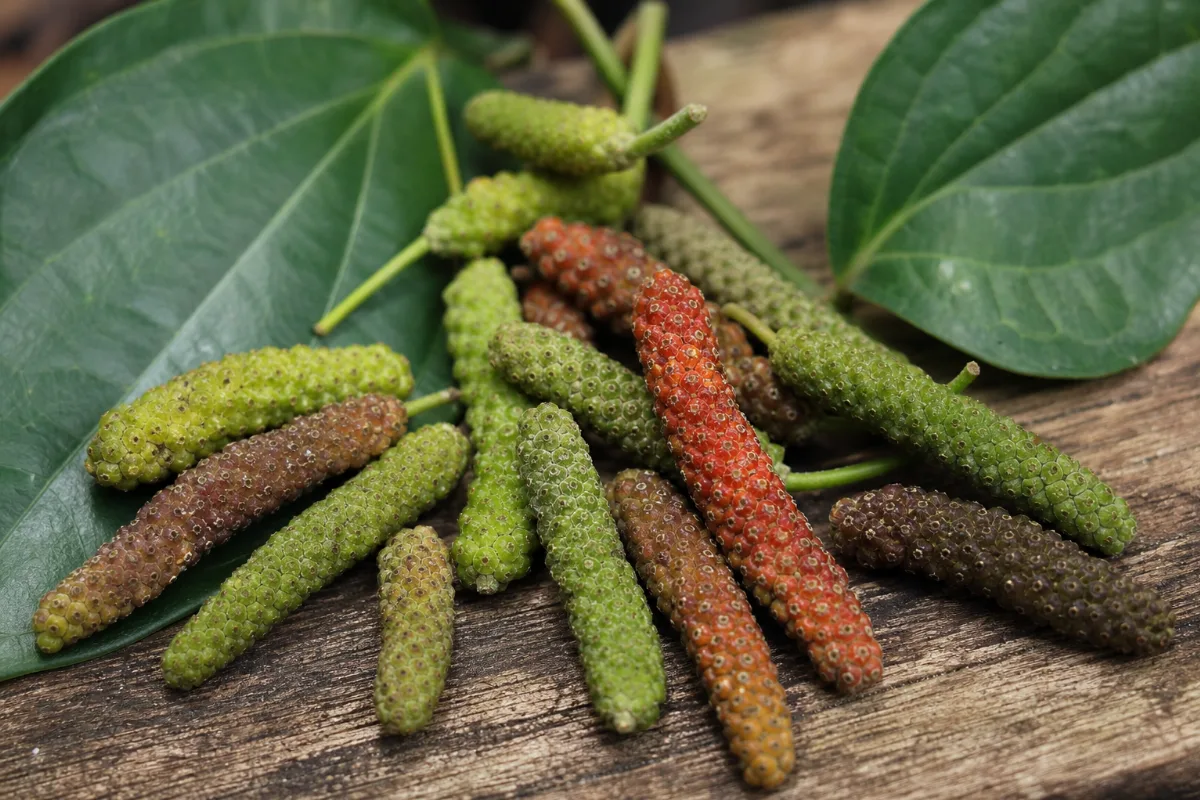
Herbs & Botanicals · Ayurvedic fruit spice
Long pepper
Piper longum · also called Pippali, Indian long pepper, long pepper
Long pepper is the dried fruit spike of an Indian vine, used as a spice and in Ayurveda for coughs, colds and digestion, often with black pepper and ginger. Most support is tradition, lab and animal work, with a few small trials. The main caution is that its pungent compound piperine can change blood levels of some medicines. Avoid it in pregnancy.
General information, not medical advice. Last substantive update · Not medically reviewed. A named clinician has not signed off on this page. How this page is made
About Long pepper
Long pepper (Piper longum) is the dried fruit spike of a climbing plant native to the Indo-Malaya region. It is used as a spice and in Ayurveda, mostly for respiratory and digestive complaints, usually with black pepper and ginger. Human research is thin: a handful of small studies of combination products or of isolated piperine. The practical risk is drug interaction, and pregnancy should be avoided.
What it is
Long pepper (Piper longum, pippali) is in the pepper family, like black pepper, but is a different species. The part used is the dried fruiting spike. It is a culinary spice and a traditional medicine in Ayurveda, Siddha and Unani systems.
Its pungent compounds include piperine, which black pepper also contains, and piperlongumine.
Traditional and current uses
Reviews describe use for bronchitis, cough and cold, for snakebite and scorpion sting, and as a contraceptive. The trikatu mix of black pepper, long pepper and ginger is prescribed routinely in Ayurveda, and one review proposes it works partly by helping other medicines be absorbed.
None of these uses has been proven in controlled human trials of long pepper itself.
Long pepper, black pepper and piperine are not the same
Black pepper is another species. Piperine, the shared compound, is also sold as an isolated supplement. Most human interaction studies used isolated piperine. Do not treat their results as proof for the long pepper fruit, or the reverse.
What the research shows
We found three small human studies. A 1997 controlled trial of a two-plant preparation reported Giardia cleared in 23 of 25 people versus about 20% in the placebo group. A 2009 Japanese randomised trial of 32 students reported faster finger warming after a cold test only in women with chills. Both are tiny and unreplicated.
A trial of trikatu with statins in India has been registered; no results exist yet. Everything else, including claims for blood sugar, liver, inflammation and cancer, is lab or animal work, mostly in narrative reviews.
At a glance
Traditional uses history, not proof
- Bronchitis, cough and cold in Ayurveda, Siddha and Unani medicine (2022 review)
- Snakebite and scorpion sting, and as a contraceptive (2022 review; no human evidence)
- Ingredient of trikatu with black pepper and ginger, prescribed in multi-drug Ayurvedic recipes (1992 review)
Studied for research
- Giardia gut infection: Pippali Rasayana combination, very low certainty
- Cold hands in young women: one tiny trial, very low certainty
- Absorption of other medicines: isolated piperine studies, low certainty (a caution)
- Cough, colds, digestion, blood fats, blood sugar, liver: no human trial of long pepper alone, insufficient
Main compounds
- Piperine (PubChem 638024)
- Piperlongumine (PubChem 637858)
- Piperlonguminine
Common forms
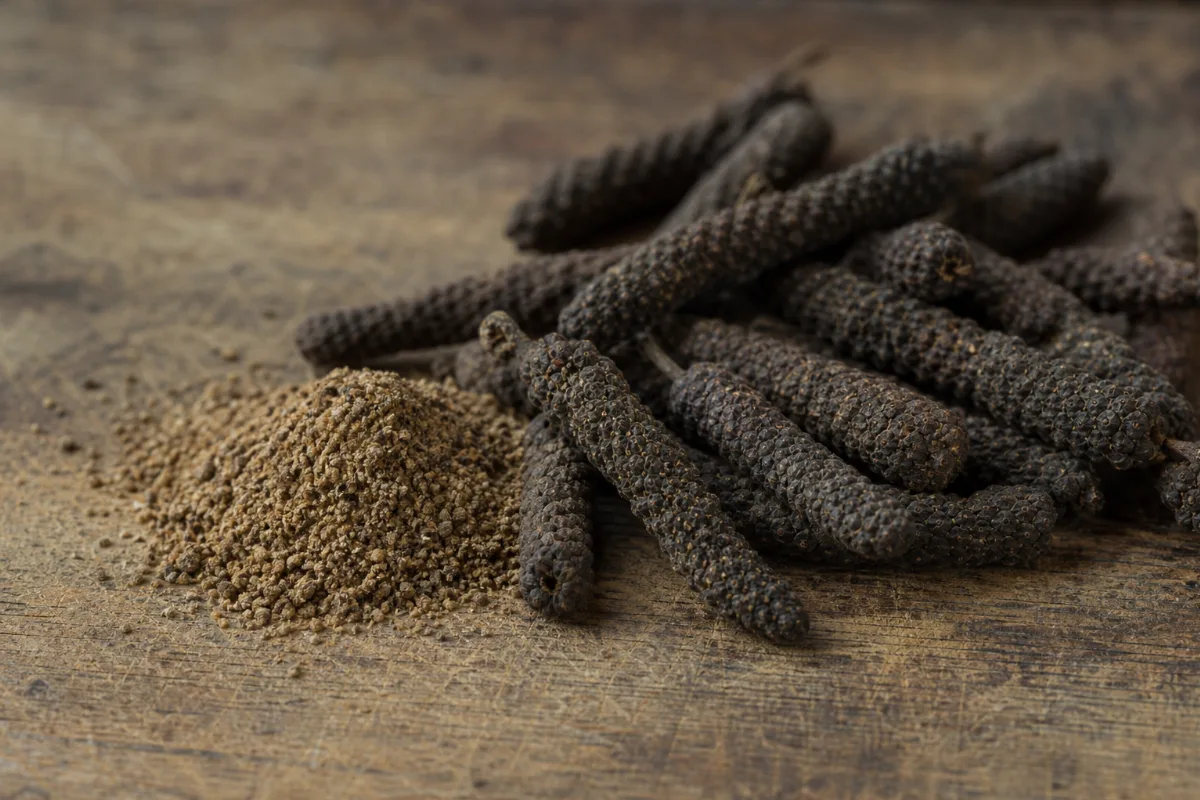
- Dried fruit spikes, whole or ground
- Extracts (piperine content varies)
- Trikatu mix with black pepper and ginger (combination)
- Isolated piperine supplements are a separate product
Research links: PubMed: Piper longum comprehensive review (2022) · PubMed: German BfR review of isolated piperine (2021) · PubMed: warfarin and Piper longum case report (2026) · Research Library · Genes & Biomarkers Library
The plant and its history
- Accepted scientific name
- Piper longum L.
- Naming authority
- L. (Linnaeus). GBIF backbone: accepted name, exact match, confidence 97.
- Common names
- Long pepper (English); Indian long pepper (English); Pippali (Sanskrit/Hindi)
- Botanical family
- Piperaceae, the pepper family, the same family as black pepper (Piper nigrum).
- Classification
- Plantae > Piperaceae > Piper > Piper longum
- Native range
- A 2022 review says it is native to the Indo-Malaya region and widely grown in tropical and subtropical areas, including the Indian subcontinent, Sri Lanka, the Middle East and America.
- Habitat
- A perennial shrub or herbaceous vine (2022 review).
- What the plant looks like
- Roots: Roots are used in some traditional systems (2022 review mentions root extracts); not the focus here.; Stems: Not described in the sources read.; Leaves: Not described in the sources read.; Flowers: Not described in the sources read.; Fruit: The dried fruiting spikes are the part used as spice and medicine.
- Cultivation
- Not described in the sources read.
- Harvest and processing
- Fruit spikes are dried; sold whole, powdered or as extract (summary-only).
- Look-alikes and adulterants
- Name: Black pepper (Piper nigrum); Note: A different species in the same genus with a similar pungent compound, piperine. Studies on black pepper or isolated piperine should not be read as studies of long pepper.; Name: Other long peppers or related Piper species; Note: Other Piper species can be sold as long pepper in some markets. NOT verified in the sources read; check the Latin name on the label.
- Sustainability and conservation
- Not found in the sources read.
The plant and the parts used
Traditional use and history history, not clinical proof
| Tradition or era | Documented use | Source |
|---|---|---|
| Ayurveda, Siddha and Unani medicine | Traditional medicine uses of the fruits against bronchitis, cough, cold, snakebite and scorpion sting, and as a contraceptive (2022 and 2026 reviews). | p36256521 |
| Ayurveda: the trikatu mix | Trikatu combines black pepper, long pepper and ginger in equal parts and is prescribed routinely as part of multi-drug prescriptions; the 1992 review suggests the mix may work by boosting the availability of other medicines. | p1434692 |
| EMA/HMPC | No herbal monograph for long pepper was found in the sources read. | s-regulators-not-found |
Traditional use shows how a plant was used. It does not show that a supplement works or is safe today.
What is inside, and how it may work
What the plant contains and how those compounds act in cells and animals. Laboratory and animal mechanisms are not proven effects in people.
Main compounds
| Compound | Family | Where it is concentrated | Activity studied | Level of evidence |
|---|---|---|---|---|
| Piperine PubChem 638024 | alkaloid (pungent amide) | Fruit Varies between products (summary-only); no figure was found in the sources read. | Blocks P-glycoprotein and CYP3A4 in the lab and raised levels of several drugs in small human studies. Also in black pepper. 4 3 19 | Laboratory research |
| Piperlongumine (piplartine) PubChem 637858 | alkaloid (amide) | Fruit, root (reviews) | Reported in lab and animal studies of anticancer and other activities (reviews); not tested as a human treatment in the sources read. 5 19 | Laboratory research |
| Piperlonguminine | alkaloid | Fruit | Named in the 2026 review; no activity detail was read. PubChem CID not looked up. 5 | Laboratory research |
Mechanisms, receptors and pathways
| Target or pathway | Gene or receptor | What was found | Level |
|---|---|---|---|
| P-glycoprotein drug pump (ABCB1) | ABCB1 / P-gp | In human Caco-2 cell layers, piperine blocked transport of digoxin (IC50 15.5 microM) and cyclosporine (IC50 74.1 microM). 4 | Laboratory research |
| CYP3A4 drug-metabolising enzyme | CYP3A4 | In human liver microsomes piperine inhibited formation of two verapamil metabolites (Ki about 36 to 77 microM). In 12 healthy volunteers piperine lowered the carbamazepine metabolite ratio, consistent with CYP3A4 inhibition. 4 3 | Human data |
| Variable effects on enzymes and transporters | Several | A 2018 review says piperine can inhibit or stimulate these proteins depending on dose, frequency and treatment duration. 14 | Mixed |
Absorption, metabolism and elimination
- Absorption
- Not found for piperine from long pepper fruit in the sources read.
- Distribution
- Not found in the sources read.
- Metabolism
- Piperine appears to block CYP3A4 and P-glycoprotein, changing how other drugs are handled.
- Elimination
- Not found in the sources read.
- Bioavailability
- Studies measured the effect of piperine on other drugs, not piperine's own blood levels.
Isolated compounds versus whole extracts
Almost all human interaction data are from isolated piperine (20 mg daily in the volunteer studies), often from black pepper. Long pepper fruit contains piperine plus many other compounds; supplements of isolated piperine are a different product. Black pepper (Piper nigrum) is a different plant. The trikatu mix adds black pepper and ginger. Findings from one should not be assumed for another.
Nutritional composition
Not checked. Long pepper is used in small amounts as a spice; no USDA entry was looked up.
1 low certainty2 very low certainty7 not enough evidence
What is Long pepper good for?
The main proposed uses and how strong the human evidence is for each. "Very low" means one small study, and "insufficient" means there is not enough to judge. Most rows describe tradition, lab work, combination products or isolated piperine, not the plain fruit.
Benefits, one by one
Each card is a research question, not a promise. Tap a goal to filter. Open a card to see the studies, doses and limits.
Cough, colds and breathing complaints
Not enough evidenceLong pepper is a classic Ayurvedic remedy for cough, colds and bronchitis, often inside the three-spice mix trikatu. We found no human trial of long pepper itself for any breathing problem. Today's support is tradition plus lab and animal work.
3 studiesDried fruit spikes and powder in Ayurveda; trikatu is a mix of black …
Studies, doses and limits
What the trials found
No human trial of long pepper for cough, colds, asthma or bronchitis was found. The 2021 trikatu review included 13 records, mostly lab and animal, and called for double-blind randomised trials. A 2022 review of Piper longum lists 'antiasthmatic' among lab-reported activities.
Results
No clinical results to report.
Effect sizes as reported
No effect sizes exist.
Why this rating
Only traditional use, lab and animal work and narrative reviews exist. No controlled human data for long pepper.
Form and dose studied
Dried fruit spikes and powder in Ayurveda; trikatu is a mix of black pepper, long pepper and ginger. Amounts are not given here.
Who was studied
Traditional use in adults and children in South Asia; no trial population.
Limits
Narrative reviews do not grade evidence. The trikatu review mostly covers a mix, not long pepper alone.
Why researchers looked
It is a long-standing traditional remedy, so researchers test whether lab findings back it up.
Traditional use
Reviews say the fruits are used in traditional medicine for bronchitis, cough and cold. A 2021 review proposed trikatu for flu-like illness.
Proposed mechanism Animal research
Lab and animal work reports anti-inflammatory and antiasthmatic activity of long pepper extracts. This has not been shown to work in people.
A proposed mechanism does not show that the effect happens in people.
See the Safety tab: piperine can change how medicines are absorbed, and a case report links a Piper longum product to a warfarin problem.
Digestion, appetite and gut comfort
Not enough evidenceLong pepper is traditionally used for digestion, mainly inside the trikatu mix. No human trial of long pepper alone for digestion was found, so this use is unproven.
2 studiesFruit spikes and powder in traditional use; trikatu mix.
Studies, doses and limits
What the trials found
No human trial of long pepper alone for digestion was found. One small registered trial of the three-spice mix is planned for blood fats, not digestion.
Results
No clinical results to report.
Effect sizes as reported
No effect sizes exist.
Why this rating
No controlled human data for this use.
Form and dose studied
Fruit spikes and powder in traditional use; trikatu mix.
Who was studied
Traditional use only.
Limits
The only reviews found are narrative and from the lab/animal literature.
Why researchers looked
Digestive use is the traditional reason trikatu is taken; researchers look for evidence behind it.
Traditional use
The trikatu mix of black pepper, long pepper and ginger is described as prescribed routinely in Ayurveda for a variety of diseases, usually inside multi-drug prescriptions.
Proposed mechanism Pharmacological theory
A review has suggested trikatu is used because it may raise the availability of the other medicines in a prescription, rather than because of a direct digestive action. This is a hypothesis.
A proposed mechanism does not show that the effect happens in people.
Spicy foods can upset the stomach in some people; no long-pepper-specific rate was found (see Safety tab).
Giardia gut infection (combination preparation)
Very low certaintyIn one small 1997 trial, a two-herb Ayurvedic preparation containing long pepper cleared Giardia from the stools of most people. Because it also contains another plant, we cannot say long pepper alone does this, and the trial is old and small.
1 studiesPippali Rasayana, a preparation of long pepper and Butea monosperma (…
Studies, doses and limits
What the trials found
A controlled clinical trial in 50 people with symptomatic giardiasis compared Pippali Rasayana with placebo. After 15 days Giardia had disappeared from the stools of 23 of 25 treated people. Symptoms and stool signs improved. About 20% of the placebo group recovered without treatment.
Results
23 of 25 treated people had no Giardia in stool after 15 days; about 20% of the placebo group recovered spontaneously.
Effect sizes as reported
Cleared 23 of 25 (92%) vs about 20% spontaneous recovery in controls.
Why this rating
One small old trial of a two-plant combination; the abstract does not explain how people were assigned, and the effect of long pepper cannot be separated from the other plant. No repeat trial was found.
Form and dose studied
Pippali Rasayana, a preparation of long pepper and Butea monosperma (combination). Standard medicines for giardiasis exist; talk to a doctor.
Who was studied
People with symptomatic giardiasis in India.
Limits
Small, 1997, combination product, abstract only, no replication found.
Why researchers looked
Giardia is a common gut parasite; researchers in India tested a classic long pepper preparation against it.
Traditional use
Pippali Rasayana is an Indian Ayurvedic preparation of pippali (long pepper) and palash (Butea monosperma).
Proposed mechanism Laboratory research
Lab studies report antiparasitic activity of Piper longum, but the mechanism in people is unknown.
A proposed mechanism does not show that the effect happens in people.
Giardiasis needs a proper diagnosis and treatment; do not rely on a herb alone.
Changing how the body absorbs medicines (a caution, not a health benefit)
Low certaintyPiperine, the main hot compound in long pepper and black pepper, raised the blood levels of several medicines in small studies of healthy volunteers. This is why Ayurveda pairs long pepper with other drugs. It is a safety issue first: higher drug levels can be harmful.
7 studiesIsolated piperine in the human studies. Long pepper and black pepper …
Studies, doses and limits
What the trials found
In healthy volunteers, piperine 20 mg daily raised blood levels of propranolol and theophylline (6 people per drug, 7 days) and raised carbamazepine peak level by 68.7% and total exposure by 47.9% (12 people, 10 days). A 2026 systematic review of phenytoin interactions suggests monitoring when piperine is used with phenytoin. In animals, a trikatu pretreatment lowered diclofenac levels instead.
Results
Higher blood levels of propranolol, theophylline and carbamazepine with isolated piperine; lower diclofenac levels with trikatu in rabbits.
Effect sizes as reported
Carbamazepine: Cmax +68.7%, AUC +47.9%, half-life +43.2%, clearance -38.9%.
Why this rating
Small crossover and open-label studies in healthy people, using isolated piperine and a few drugs. The direction of effect varies by drug and schedule. Whole long pepper fruit has not been tested in people.
Form and dose studied
Isolated piperine in the human studies. Long pepper and black pepper both contain piperine. The interaction studies used isolated piperine, not long pepper fruit.
Who was studied
Healthy adult volunteers.
Limits
Tiny studies; healthy people; single drug doses; isolated piperine, not the spice.
Why researchers looked
A traditional reason for including long pepper in mixes is that it may help other medicines work better.
Traditional use
Trikatu is thought to work partly by helping other medicines be absorbed (1992 review).
Proposed mechanism Laboratory research
In the lab, piperine blocks the drug pump P-glycoprotein and the enzyme CYP3A4, which handle many medicines.
A proposed mechanism does not show that the effect happens in people.
Higher drug levels can cause side effects, especially for drugs with a narrow safe range. Ask a pharmacist before combining. See the Safety tab.
Cold hands and feeling chilled (young women)
Very low certaintyOne small Japanese trial found that long pepper capsules helped finger temperature recover faster after a mild cold test in women who suffer from chills. It is a single short test in 32 students, so it is a first hint only.
1 studiesPiper longum capsule (form not stated in abstract), single dose befor…
Studies, doses and limits
What the trials found
A randomised trial in 32 female university students (16 with chills, 16 without) gave a Piper longum capsule or a dextrin placebo, then applied mild cold. In women with chills, both low and high doses sped up recovery of finger skin temperature. In women without chills, there was no effect.
Results
Faster recovery of finger skin temperature after a mild cold test in women with chills only.
Effect sizes as reported
Numbers not given in the abstract.
Why this rating
One tiny, short, single-centre study in Japanese; no replication found; the abstract does not give numbers.
Form and dose studied
Piper longum capsule (form not stated in abstract), single dose before testing.
Who was studied
Young Japanese women with and without chills.
Limits
Single dose; surrogate measure (skin temperature); not a measure of how people feel day to day; abstract only.
Why researchers looked
The authors say chills affect young women as well as menopausal women and can bring poor sleep and tiredness.
Traditional use
No traditional use for chills was cited in the abstract.
Proposed mechanism Pharmacological theory
Not established. The study measured skin temperature and blood flow but did not explain how long pepper might act.
A proposed mechanism does not show that the effect happens in people.
No side effects were reported in the abstract; that does not prove safety.
Cholesterol and blood fats (trikatu add-on; trial planned)
Not enough evidenceA trial of trikatu, the three-spice mix with long pepper, added to statin medicines is planned in India. No results are published yet, so this use is unproven.
2 studiesTrikatu (combination of black pepper, long pepper and ginger).
Studies, doses and limits
What the trials found
The published protocol describes a randomised, double-blind, placebo-controlled trial of 170 adults on statins, 12 weeks, with LDL cholesterol as the main outcome. It is funded by an Indian government Ayurveda council. No results were found.
Results
No results yet.
Effect sizes as reported
No effect sizes exist.
Why this rating
A study plan only; no results.
Form and dose studied
Trikatu (combination of black pepper, long pepper and ginger).
Who was studied
Planned: adults 25 to 60 years at moderate-to-high heart risk.
Limits
No data. Funded by an Ayurveda research council, so results should be read with that in mind.
Why researchers looked
Reviews of lab and animal work say trikatu improved blood fats, so a human trial was registered.
Traditional use
Trikatu is traditionally used to enhance metabolism, per the trial authors.
Proposed mechanism Animal research
Lab and animal work reports lower triglycerides and LDL and higher HDL with trikatu (2021 review). Not shown in people.
A proposed mechanism does not show that the effect happens in people.
Trikatu could change statin levels in theory because piperine affects CYP3A4; the protocol records adverse events, but no results exist.
Blood sugar (theory only)
Not enough evidenceReviews list blood-sugar lowering among lab and animal findings for long pepper. No human trial of long pepper for blood sugar was found.
2 studiesNot applicable.
Studies, doses and limits
What the trials found
No human trial found. The 2022 and 2026 reviews list antidiabetic or antihyperglycaemic activity among lab-reported effects.
Results
No clinical results.
Effect sizes as reported
No effect sizes.
Why this rating
Lab and animal reports only.
Form and dose studied
Not applicable.
Who was studied
None studied.
Limits
Narrative reviews only; abstract read.
Why researchers looked
Lab and animal work reports antidiabetic activity of long pepper, according to reviews.
Traditional use
Not a core traditional use found in the sources read.
Proposed mechanism Animal research
Reported in lab and animal studies, according to reviews. The mechanism in people is unknown.
A proposed mechanism does not show that the effect happens in people.
People on diabetes medicines should not assume long pepper is neutral. A drug-interaction effect is possible in theory; no human study was found.
Liver protection claims (lab and animal only; mixed with a cell-injury signal)
Not enough evidenceReviews mention liver-protective effects in animals. A 2026 cell study, however, found that a Piper longum extract caused injury signs in liver cells. Neither tells us what happens in people.
2 studiesNot applicable.
Studies, doses and limits
What the trials found
No human study of liver benefit or liver injury was found. A 2022 review lists liver-protective effects among lab and animal findings.
Results
No clinical results.
Effect sizes as reported
No effect sizes.
Why this rating
Findings point in opposite directions and none is from people.
Form and dose studied
Not applicable.
Who was studied
None studied.
Limits
Lab and animal only.
Why researchers looked
Lab and animal work tests whether Piper longum extracts protect the liver.
Traditional use
Not a clearly documented core use in the sources read.
Proposed mechanism Animal research
Animal studies report liver protection; one cell screening study reported injury markers (ALT/AST release) with a Piper longum extract.
A proposed mechanism does not show that the effect happens in people.
Treat the cell finding as a flag for caution, not as proof of harm. See the Safety tab.
Inflammation, antioxidant, antimicrobial and cancer-cell effects (lab only)
Not enough evidenceMany lab studies report that long pepper extracts and its compounds piperine and piperlongumine fight microbes, calm inflammation and kill cancer cells in dishes. These results have not been shown in people.
2 studiesFruit extracts and the isolated compounds piperine and piperlongumine.
Studies, doses and limits
What the trials found
No human trials back these lab findings. Reviews in 2022 and 2026 describe them but do not grade the evidence. The 2026 review's abstract says clinical and preclinical work supports safety within therapeutic ranges; we could not check that statement.
Results
No clinical results.
Effect sizes as reported
No effect sizes.
Why this rating
Lab and animal only; a dish result often fails in people.
Form and dose studied
Fruit extracts and the isolated compounds piperine and piperlongumine.
Who was studied
Cells and animals.
Limits
Narrative reviews; abstracts only.
Why researchers looked
Researchers screen traditional spices for compounds that could become drugs.
Traditional use
Long pepper is used in Ayurveda, Siddha and Unani medicine.
Proposed mechanism Laboratory research
Reported antimicrobial, antioxidant, anti-inflammatory, cardioprotective, antidiabetic and anticancer activities in lab and animal work (2022 and 2026 reviews).
A proposed mechanism does not show that the effect happens in people.
Isolated compounds at lab strength are not the same as eating the spice.
Traditional use as a contraceptive (a pregnancy caution, not a recommended use)
Not enough evidenceA 2022 review says long pepper fruit is traditionally used as a contraceptive. No human study supports this, and animal work on isolated piperine suggests possible harm to sperm production and embryos. Avoid it in pregnancy.
2 studiesFruit in traditional use; isolated piperine in animal studies.
Studies, doses and limits
What the trials found
No human study of contraceptive effect or pregnancy safety was found.
Results
No clinical results.
Effect sizes as reported
No effect sizes.
Why this rating
Traditional claim plus animal findings with isolated piperine; no human data.
Form and dose studied
Fruit in traditional use; isolated piperine in animal studies.
Who was studied
None studied in people.
Limits
Animal doses were higher than in human interaction studies; relevance to a spice or to long pepper fruit is unclear.
Why researchers looked
This traditional claim is the main reason pregnancy is flagged as a concern.
Traditional use
The 2022 review lists contraceptive use among traditional uses of the fruits.
Proposed mechanism Animal research
Animal studies of isolated piperine at higher daily doses showed disturbed sperm production and maternal reproductive and embryo-toxic effects (German BfR review).
A proposed mechanism does not show that the effect happens in people.
Do not use medicinal amounts in pregnancy or when trying to conceive without medical advice.
Connections to the rest of health
How Long pepper connects to the rest of our health knowledge graph. Every link says what kind of connection it is. A safety link (for example to the liver) is a warning, not a benefit. A study that merely mentions a topic never creates a benefit link.
Explore every connection: goals, body systems, organs, symptoms, genes
A. Wellness goals
| Connected to | Kind of connection | Evidence status | Context | Studies |
|---|---|---|---|---|
| Lung Support | Traditional use | Not enough evidence | Cough, colds and breathing complaints: Long pepper is a classic Ayurvedic remedy for cough, colds and bronchitis, often inside the three-spice mix trikatu. We found no human trial of long pepper itself for any breathing problem. Today's support is tradition plus lab and animal work. | 6 9 5 |
| Breathing Support | Traditional use | Not enough evidence | Cough, colds and breathing complaints: Long pepper is a classic Ayurvedic remedy for cough, colds and bronchitis, often inside the three-spice mix trikatu. We found no human trial of long pepper itself for any breathing problem. Today's support is tradition plus lab and animal work. | 6 9 5 |
| Immune Support | Traditional use | Not enough evidence | Cough, colds and breathing complaints: Long pepper is a classic Ayurvedic remedy for cough, colds and bronchitis, often inside the three-spice mix trikatu. We found no human trial of long pepper itself for any breathing problem. Today's support is tradition plus lab and animal work. | 6 9 5 |
| Digestive Support | Traditional use | Not enough evidence | Digestion, appetite and gut comfort: Long pepper is traditionally used for digestion, mainly inside the trikatu mix. No human trial of long pepper alone for digestion was found, so this use is unproven. | 10 6 |
| Gut Health | Traditional use | Not enough evidence | Digestion, appetite and gut comfort: Long pepper is traditionally used for digestion, mainly inside the trikatu mix. No human trial of long pepper alone for digestion was found, so this use is unproven. | 10 6 |
| Gut Health | Potential benefit | Very low certainty | Giardia gut infection (combination preparation): In one small 1997 trial, a two-herb Ayurvedic preparation containing long pepper cleared Giardia from the stools of most people. Because it also contains another plant, we cannot say long pepper alone does this, and the trial is old and small. | 1 |
| Digestive Support | Potential benefit | Very low certainty | Giardia gut infection (combination preparation): In one small 1997 trial, a two-herb Ayurvedic preparation containing long pepper cleared Giardia from the stools of most people. Because it also contains another plant, we cannot say long pepper alone does this, and the trial is old and small. | 1 |
| Metabolic Health | Drug or supplement interaction | Low certainty | Changing how the body absorbs medicines (a caution, not a health benefit): Piperine, the main hot compound in long pepper and black pepper, raised the blood levels of several medicines in small studies of healthy volunteers. This is why Ayurveda pairs long pepper with other drugs. It is a safety issue first: higher drug levels can be harmful. | 2 3 15 13 10 4 14 |
| Healthy Circulation | Potential benefit | Very low certainty | Cold hands and feeling chilled (young women): One small Japanese trial found that long pepper capsules helped finger temperature recover faster after a mild cold test in women who suffer from chills. It is a single short test in 32 students, so it is a first hint only. | 16 |
| Womens Wellness | Potential benefit | Very low certainty | Cold hands and feeling chilled (young women): One small Japanese trial found that long pepper capsules helped finger temperature recover faster after a mild cold test in women who suffer from chills. It is a single short test in 32 students, so it is a first hint only. | 16 |
| Cholesterol Balance | Potential benefit | Not enough evidence | Cholesterol and blood fats (trikatu add-on; trial planned): A trial of trikatu, the three-spice mix with long pepper, added to statin medicines is planned in India. No results are published yet, so this use is unproven. | 12 9 |
| Heart Health | Potential benefit | Not enough evidence | Cholesterol and blood fats (trikatu add-on; trial planned): A trial of trikatu, the three-spice mix with long pepper, added to statin medicines is planned in India. No results are published yet, so this use is unproven. | 12 9 |
| Blood Sugar Balance | Preliminary mechanism | Not enough evidence | Blood sugar (theory only): Reviews list blood-sugar lowering among lab and animal findings for long pepper. No human trial of long pepper for blood sugar was found. | 6 5 |
| Metabolic Health | Preliminary mechanism | Not enough evidence | Blood sugar (theory only): Reviews list blood-sugar lowering among lab and animal findings for long pepper. No human trial of long pepper for blood sugar was found. | 6 5 |
| Liver Support | Preliminary mechanism | Not enough evidence | Liver protection claims (lab and animal only; mixed with a cell-injury signal): Reviews mention liver-protective effects in animals. A 2026 cell study, however, found that a Piper longum extract caused injury signs in liver cells. Neither tells us what happens in people. | 6 7 |
| Inflammation Balance | Preliminary mechanism | Not enough evidence | Inflammation, antioxidant, antimicrobial and cancer-cell effects (lab only): Many lab studies report that long pepper extracts and its compounds piperine and piperlongumine fight microbes, calm inflammation and kill cancer cells in dishes. These results have not been shown in people. | 5 6 |
| Immune Support | Preliminary mechanism | Not enough evidence | Inflammation, antioxidant, antimicrobial and cancer-cell effects (lab only): Many lab studies report that long pepper extracts and its compounds piperine and piperlongumine fight microbes, calm inflammation and kill cancer cells in dishes. These results have not been shown in people. | 5 6 |
| Fertility Support | Traditional use | Not enough evidence | Traditional use as a contraceptive (a pregnancy caution, not a recommended use): A 2022 review says long pepper fruit is traditionally used as a contraceptive. No human study supports this, and animal work on isolated piperine suggests possible harm to sperm production and embryos. Avoid it in pregnancy. | 6 17 |
| Womens Wellness | Traditional use | Not enough evidence | Traditional use as a contraceptive (a pregnancy caution, not a recommended use): A 2022 review says long pepper fruit is traditionally used as a contraceptive. No human study supports this, and animal work on isolated piperine suggests possible harm to sperm production and embryos. Avoid it in pregnancy. | 6 17 |
B. Body systems
| Connected to | Kind of connection | Evidence status | Context | Studies |
|---|---|---|---|---|
| Reproductive system | Contraindication | Not enough evidence | Pregnancy avoidance advised; no human data. Preparation or compound: Isolated piperine (animals); traditional contraceptive use of the fruit |
17 6 |
| Respiratory System | Biological association | Not enough evidence | Studied for: Cough, colds and breathing complaints | 6 9 5 |
| Digestive System | Biological association | Not enough evidence | Studied for: Digestion, appetite and gut comfort Studied for: Giardia gut infection (combination preparation) | 10 6 1 2 3 15 13 4 14 |
| Immune System | Biological association | Very low certainty | Studied for: Giardia gut infection (combination preparation) Studied for: Inflammation, antioxidant, antimicrobial and cancer-cell effects (lab only) | 1 5 6 |
| Hepatic System | Biological association | Low certainty | Studied for: Changing how the body absorbs medicines (a caution, not a health benefit) Studied for: Liver protection claims (lab and animal only; mixed with a cell-injury signal) | 2 3 15 13 10 4 14 6 7 |
| Cardiovascular System | Biological association | Very low certainty | Studied for: Cold hands and feeling chilled (young women) Studied for: Cholesterol and blood fats (trikatu add-on; trial planned) | 16 12 9 |
| Endocrine System | Biological association | Not enough evidence | Studied for: Blood sugar (theory only) | 6 5 |
| Reproductive System | Biological association | Not enough evidence | Studied for: Traditional use as a contraceptive (a pregnancy caution, not a recommended use) | 6 17 |
E. Health conditions
| Connected to | Kind of connection | Evidence status | Context | Studies |
|---|---|---|---|---|
| Giardiasis | Potential benefit | Very low certainty | One small trial of a long pepper and Butea monosperma preparation. Preparation or compound: Pippali Rasayana (combination) |
1 |
G. Root causes and contributing factors
| Connected to | Kind of connection | Evidence status | Context | Studies |
|---|---|---|---|---|
| Medication side effects | Drug or supplement interaction | Low certainty | Can raise or lower the blood levels of some medicines. Piperine can raise or lower the levels of some medicines; human data are from isolated piperine. Preparation or compound: Piperine in long pepper (isolated piperine in the human studies) |
3 2 15 14 8 |
I. Biomarkers
| Connected to | Kind of connection | Evidence status | Context | Studies |
|---|---|---|---|---|
| Giardia in stool (clearance) | Biological association | Very low certainty | Measured in trials: lowered. A lab change is not the same as a health benefit. | 1 |
| Finger skin temperature recovery after cold | Biological association | Very low certainty | Measured in trials: raised. A lab change is not the same as a health benefit. | 16 |
| Blood levels of other medicines (drug exposure) | Biological association | Low certainty | Measured in trials: raised. A lab change is not the same as a health benefit. | 3 2 |
| ALT and AST released by liver cells in a dish | Biological association | Not enough evidence | Measured in trials: raised. A lab change is not the same as a health benefit. | 7 |
J. Genes, receptors and enzymes
L. Active compounds
| Connected to | Kind of connection | Evidence status | Context | Studies |
|---|---|---|---|---|
| Piperine | Biological association | In vitro | Blocks P-glycoprotein and CYP3A4 in the lab and raised levels of several drugs in small human studies. Also in black pepper. Preparation or compound: Fruit |
4 3 19 |
| Piperlongumine (piplartine) | Biological association | In vitro | Reported in lab and animal studies of anticancer and other activities (reviews); not tested as a human treatment in the sources read. Preparation or compound: Fruit, root (reviews) |
5 19 |
| Piperlonguminine | Biological association | In vitro | Named in the 2026 review; no activity detail was read. PubChem CID not looked up. Preparation or compound: Fruit |
5 |
Each connection is stored with the ingredient, the connected record, the kind of connection, the evidence status, the supporting studies, the preparation or compound involved, and a review date (last reviewed October 25, 2026).
Evidence at a glance: what changed in 4 lab markers
Tap a number to show only those markers. Counts are markers, not people.
The evidence
The research centre for Long pepper. Every record here was checked against PubMed or the publisher's page; we never list a study we have not verified.
Evidence by outcome
Bars show how many studies we found for each outcome, not how well it works. People are added up across trials only (reviews are not added, to avoid double counting).
How we rate evidence
High certainty
Several well-run trials or reviews agree; further research is unlikely to change the picture much.
Moderate certainty
Good trials point the same way, but some doubt remains.
Low certainty
Small, short or inconsistent trials. The finding could change with better research.
Very low certainty
Very little or very weak human data. Treat as a possibility only.
Mixed findings
Trials or reviews disagree with each other.
Not enough evidence
Not enough human research to say either way.
Evidence against
Good research found no benefit, or found harm.
We take the reviewers' own risk-of-bias and GRADE statements where they exist, and otherwise judge from study size, design, consistency, directness and whether a product matches what is sold. Many publications do not make evidence high. Method note: We built from our existing long pepper summary and re-read PubMed abstracts for every study cited, checked the plant name in GBIF and NCBI and compounds in PubChem. NCCIH had no page, an EMA monograph was not found, and LiverTox and LactMed could not be read.
Study library: every study we checked 20
| Study | Design | People | Product, dose, length | Result |
|---|---|---|---|---|
| Agarwal 1997 Management of giardiasis by a herbal drug 'Pippali Rasayana': a clinical study J Ethnopharmacol · PMID 9201614 · DOI |
Controlled clinical trial |
50 50 people with symptomatic giardiasis (Giardia in stool) |
Pippali Rasayana: Ayurvedic preparation of Butea monosperma and Piper longum (combination) not stated 1 g by mouth three times daily 15 days · vs Placebo (25 people) |
After 15 days, Giardia had gone from the stools of 23 of 25 treated people. Symptoms and stool signs improved. About 20% of the placebo group got better on their own. 23 of 25 cleared vs about 20% spontaneous recovery with placebo Methods, limits and fundingOutcomes: Giardia in stool; symptoms; blood profile Limitations: 1997 trial of a two-herb preparation, so the effect of long pepper alone cannot be separated; small; the abstract does not say how people were assigned. Only the abstract was read. Read: abstract |
| Bano 1991 Effect of piperine on bioavailability and pharmacokinetics of propranolol and theophylline in healthy volunteers Eur J Clin Pharmacol · PMID 1815977 · DOI |
Pharmacokinetic study |
12 Healthy volunteers: six in each drug group, crossover |
Isolated piperine with propranolol or theophylline fruit (compound only) Piperine 20 mg daily 7 days · vs Each drug alone |
With piperine, propranolol reached its peak earlier and had higher peak and total levels. Theophylline had higher peak, longer half-life and higher total levels. The authors suggest the extra availability could be used to improve control; the same effect could also mean unintended higher drug levels. Higher Cmax and AUC for both drugs (numbers not given in abstract) Methods, limits and fundingOutcomes: Blood levels of propranolol and theophylline Limitations: Six people per drug; single drug doses; healthy volunteers only. Authors include researchers who also study trikatu and piperine as bioenhancers. Only the abstract was read. Read: abstract |
| Bedada 2017 Effect of Piperine on the Metabolism and Pharmacokinetics of Carbamazepine in Healthy Volunteers Drug Res (Stuttg) · PMID 27776366 · DOI |
Pharmacokinetic study |
12 12 healthy volunteers |
Isolated piperine with carbamazepine fruit (compound only) Piperine 20 mg once daily 10 days · vs Carbamazepine 200 mg alone, same people before piperine |
Piperine raised carbamazepine peak level by 68.7%, total exposure (AUC) by 47.9% and half-life by 43.2%, and cut apparent clearance by 38.9%. Less of the drug was turned into its metabolite, which fits blocking of CYP3A4. The authors advise caution with drugs handled by CYP3A4. Cmax +68.7%, AUC +47.9%, half-life +43.2%, clearance -38.9% Methods, limits and fundingOutcomes: Carbamazepine blood levels and metabolite ratios Limitations: Open-label, fixed order, 12 healthy people, single carbamazepine dose; not patients on long-term treatment. Only the abstract was read. Read: abstract |
| Bhardwaj 2002 Piperine, a major constituent of black pepper, inhibits human P-glycoprotein and CYP3A4 J Pharmacol Exp Ther · PMID 12130727 · DOI |
Laboratory research in-vitro |
Human intestinal (Caco-2) cell layers and human liver microsomes (lab preparations) | Isolated piperine (from black pepper) fruit (compound only) Not applicable (lab concentrations) Lab experiment · vs Without piperine |
Piperine blocked the drug pump P-glycoprotein (digoxin IC50 15.5 microM, cyclosporine A 74.1 microM) and the liver and gut enzyme CYP3A4 (Ki about 36 to 77 microM). The authors say dietary piperine could change blood levels of drugs handled by these two proteins, especially drugs taken by mouth. IC50 15.5 and 74.1 microM; Ki 36 to 77 microM Methods, limits and fundingOutcomes: Transport of digoxin and cyclosporine across cell layers; formation of verapamil metabolites by CYP3A4 Limitations: Lab study with isolated piperine from black pepper; not a human trial and not long pepper fruit. Read: abstract |
| Bhatia 2026 From Ancient Spice to Advanced Science: Therapeutic, Nutraceutical and Nanotechnological Insights into the Fruits of Piper Longum Linn for Modern Drug Development Drug Des Devel Ther · PMID 41710585 · DOI |
Narrative review mixed |
Review of long pepper fruit chemistry and pharmacology | Piper longum fruit and its compounds (piperine, piperlongumine, piperlonguminine) fruit Various Various |
Describes use in Ayurveda, Siddha and Unani medicine and lists lab-reported antimicrobial, antioxidant, anti-inflammatory, cardioprotective, antidiabetic and anticancer activities, plus bioenhancer use and drug-delivery work. The abstract says clinical and preclinical studies support safety within therapeutic ranges; we could not verify that claim. Methods, limits and fundingOutcomes: Overview of traditional use and reported activities Limitations: Narrative review that does not grade evidence; the abstract's safety statement was not checked against the full text. Only the abstract was read. Funding and conflicts: No conflicts declared. Read: abstract |
| Biswas 2022 Piper longum L.: A comprehensive review on traditional uses, phytochemistry, pharmacology, and health-promoting activities Phytother Res · PMID 36256521 · DOI |
Narrative review mixed |
Review of the plant's traditional use, chemistry, lab, animal and human studies | Piper longum (fruit, root and extracts) fruit, root Various Various |
The fruits are used as a spice and preservative and in traditional medicine for bronchitis, cough, cold, snakebite and scorpion sting, and as a contraceptive. The long list of activities (antidiabetic, liver-protective, anti-inflammatory and others) comes from lab and animal work. The authors say research gaps remain. Methods, limits and fundingOutcomes: Traditional uses, pharmacology, safety and clinical trials Limitations: Narrative review; mixes lab, animal and human work. Only the abstract was read. Read: abstract |
| Choi 2026 Combining UHPLC profiling and random walk network-based in vitro analysis to predict herb-induced liver injury Food Chem Toxicol · PMID 41794385 · DOI |
Laboratory research in-vitro |
Human liver cancer cell line (HepG2) cultures | Piper longum extract (one of six extracts predicted to be liver-toxic) not stated in abstract Not stated in abstract Cell culture · vs Astragalus extract showed minimal change |
A computer prediction flagged Piper longum among six herbs; the extracts then caused injury-type changes, loss of mitochondrial membrane potential and more ALT and AST release in the cells. This is a screening method paper. Methods, limits and fundingOutcomes: Cell injury signs, mitochondrial membrane potential, ALT and AST in culture fluid Limitations: Cultured cells only; no human liver case was involved. Only the abstract was read. Funding and conflicts: No competing interests declared. Read: abstract |
| Huang 2026 Probable interaction between warfarin and a toothache solution containing Piper longum L. leading to ischemic stroke: a case report J Ethnopharmacol · PMID 42066825 · DOI |
Case report |
1 One patient with a mechanical heart valve taking warfarin |
Toothache solution (Chinese patent medicine) containing Piper longum (combination product) not stated Not stated in abstract Not stated in abstract |
INR (blood-clotting test) fluctuated together with an ischemic stroke. Causality scoring rated the interaction between warfarin and the Piper longum solution as probable. DIPS rating: probable Methods, limits and fundingOutcomes: INR swings and ischemic stroke; causality scored with the Drug Interaction Probability Scale Limitations: Single case; the product contained Piper longum but other ingredients may matter; the abstract does not say which. Only the abstract was read. Funding and conflicts: No competing interests declared. Read: abstract |
| Javed 2021 Is Trikatu an ayurvedic formulation effective for the management of flu-like illness? A narrative review J Complement Integr Med · PMID 34081846 · DOI |
Narrative review mixed |
13 13 records on trikatu from a search up to 1 August 2020 |
Trikatu (black pepper, long pepper, ginger; combination) fruit + rhizome Various Various |
The authors say the reviewed articles show trikatu to be safe, anti-inflammatory and immune-modulating, to improve blood fats, and to raise the availability of other drugs. They conclude it could be explored for flu-like illness but that rigorous double-blind randomised trials are needed. 13 of 21 records included Methods, limits and fundingOutcomes: Anti-inflammatory, immune, blood-fat and absorption-boosting findings Limitations: Narrative review of mostly lab and animal records; no trial in flu-like illness. The abstract's safety claim sits oddly beside the animal study showing reduced diclofenac levels. Only the abstract was read. Read: abstract |
| Johri 1992 An Ayurvedic formulation 'Trikatu' and its constituents J Ethnopharmacol · PMID 1434692 · DOI |
Narrative review mixed |
Review of studies on trikatu, its three herbs and piperine | Trikatu (black pepper, long pepper, ginger) and piperine fruit + rhizome Not applicable Not applicable |
The reviewers say trikatu is prescribed routinely in Ayurveda as part of multi-drug prescriptions, and suggest its use may be due to a bioavailability-enhancing action on other medicines. Methods, limits and fundingOutcomes: Biological activities and the idea that trikatu works by boosting the effect of other medicines Limitations: A 1992 narrative review with a short abstract; the suggestion is a hypothesis, not a trial result. Read: abstract |
| Kanabus 2025 Mycotoxins Occurrence in Herbs, Spices, Dietary Supplements, and Their Exposure Assessment Toxins (Basel) · PMID 41591166 · DOI |
Narrative review mixed |
Review of mould-toxin (mycotoxin) findings in herbs, spices and supplements | Spices in general, including various peppers fruit Not applicable Not applicable |
Spices such as chilli, paprika, ginger and various peppers are higher-risk products and are often more contaminated than dried herbs. Levels of single toxins are often low to moderate, but several toxins often occur together. Limits are incomplete or inconsistent. The abstract does not name long pepper specifically. Methods, limits and fundingOutcomes: Occurrence of aflatoxins and other mycotoxins Limitations: General spice review; no long-pepper-specific figure was read. Only the abstract was read. Funding and conflicts: No conflicts declared. Read: abstract |
| Khanduri 2026 Efficacy and safety of the ayurvedic formulation 'Trikatu' as an add-on to standard care in dyslipidemia: Study protocol for a randomized, double-blind, placebo-controlled trial evaluating lipid parameters, and gut microbiota PLoS One · PMID 42113738 · DOI |
Trial protocol |
170 Planned: adults aged 25 to 60 with moderate-to-high heart-disease risk who need statins |
Trikatu (combination) with usual statin treatment fruit + rhizome As in the protocol 12 weeks planned · vs Matching placebo |
This is a plan, not a result. The trial in India (AIIMS Bhubaneswar) will randomise 170 people to trikatu or placebo on top of statins. Methods, limits and fundingOutcomes: Planned main outcome: change in LDL cholesterol at 12 weeks Limitations: No results exist yet. Funded by CCRAS (an Indian government Ayurveda research council). Funding and conflicts: Funded by CCRAS; some authors are from CCRAS. Registration: CTRI/2023/04/051942 Read: abstract |
| Lala 2004 Pharmacokinetic and pharmacodynamic studies on interaction of Trikatu with diclofenac sodium J Ethnopharmacol · PMID 15120451 · DOI |
Animal research animal |
Rabbits (blood levels) and rats (paw swelling) | Trikatu: dried fruits of black pepper and long pepper plus dried ginger rhizome, 1:1:1 (combination) fruit + rhizome Not stated in abstract Pretreatment · vs Diclofenac alone |
Trikatu pretreatment significantly lowered diclofenac blood levels in rabbits. In rats, the anti-swelling effect of the combination was similar to trikatu alone and significantly less than diclofenac alone. The authors say trikatu might lower the availability of certain drugs. Methods, limits and fundingOutcomes: Diclofenac blood levels in rabbits; anti-inflammatory effect in rats Limitations: Animal study of a three-herb mix; human relevance unknown. Only the abstract was read. Read: abstract |
| Lee 2018 Piperine-mediated drug interactions and formulation strategy for piperine: recent advances and future perspectives Expert Opin Drug Metab Toxicol · PMID 29250980 · DOI |
Narrative review mixed |
Review of lab, animal and human interaction studies | Isolated piperine fruit (compound only) Various Various |
Piperine can change how other drugs are absorbed and cleared. It can block or switch on enzymes and transporters depending on dose, how often it is taken and for how long, so the effect on a drug can be helpful or harmful. Methods, limits and fundingOutcomes: Effects of piperine on drug-metabolising enzymes and drug transporters Limitations: Narrative review, not a systematic one. Only the abstract was read. Read: abstract |
| Orellana-Paucar 2026 Optimizing phenytoin therapy: a systematic review of clinically relevant food and herb interactions Front Pharmacol · PMID 41560756 · DOI |
Systematic review |
12 12 included articles on phenytoin with foods and herbs |
Piperine (among other foods and herbs) fruit (compound only) Various Various |
Of 12 articles, 3 found no interaction, 5 found more drug absorption, 1 found better drug effect and 3 found reduced effect. The authors suggest that piperine used with phenytoin be monitored because absorption and blood levels may rise. They describe the studies as of moderate quality (GRADE) and ask for more controlled trials. 12 of 826 articles included Methods, limits and fundingOutcomes: Interactions between the seizure medicine phenytoin and foods or herbs Limitations: Number of piperine studies within the 12 was not read. Only the abstract was read. Funding and conflicts: No commercial conflict declared. Registration: PROSPERO CRD42018117308 Read: abstract |
| Yamada 2009 Effects of Piper longum L. on chills in Japanese young women: time-dependent changes in skin surface temperature and its recovery rate following the exposure to mild cold stress (article in Japanese) Nihon Shinkei Seishin Yakurigaku Zasshi · PMID 19326811 |
Controlled trial |
32 32 female university students, 16 with chills and 16 without |
Piper longum capsule (extract or powder not stated in abstract) not stated in abstract Low dose 15 mg or high dose 30 mg (as written in abstract) Single dose before a mild cold test · vs Dextrin placebo capsule |
In women with chills, both doses sped up recovery of finger skin temperature. In women without chills there was no effect. Methods, limits and fundingOutcomes: Recovery of finger skin temperature after mild cold stress Limitations: Small, one short test, young women only; the abstract gives no numbers and does not say who funded it. Only the abstract was read. Read: abstract |
| Ziegenhagen 2021 Safety Aspects of the Use of Isolated Piperine Ingested as a Bolus Foods · PMID 34574230 · DOI |
Risk assessment review mixed |
Review of human and animal studies of isolated piperine in supplements by the German Federal Institute for Risk Assessment (BfR) | Isolated piperine as a single ingredient fruit (compound only) Various Single or short-term dosing |
Piperine taken alone often raised the blood levels of other drugs, which can cause unintended or adverse drug effects depending on the drug. Animal studies at higher daily doses than in human interaction studies pointed to disturbed sperm production and to maternal reproductive and embryo-toxic effects. The reviewers say human studies rarely reported adverse effects but were not designed to look for them, and advise considering the risks of isolated piperine supplements. Methods, limits and fundingOutcomes: Possible health risks of isolated piperine taken as a supplement Limitations: Covers isolated piperine, not long pepper fruit. Only the abstract was read. Authors are from a government risk-assessment agency. Funding and conflicts: No conflict of interest declared. Read: abstract |
| s-gbif-piper-longum GBIF Backbone Taxonomy: Piper longum L. (usageKey 3086338) · Source |
Reference database n/a |
Methods, limits and fundingRead: full-text | ||
| s-pubchem-piperine PubChem: piperine (CID 638024) and piperlongumine (CID 637858) · Source |
Reference database n/a |
Methods, limits and fundingRead: full-text | ||
| s-regulators-not-found Regulator and reference checks for long pepper (NCCIH, EMA/HMPC, LiverTox, LactMed) · Source |
Regulatory check n/a |
Methods, limits and fundingRead: not-found |
What we do not know yet
- What the evidence supports: a few tiny trials of combinations; the best-supported finding is a drug-interaction caution.
- No human trial of plain long pepper fruit for cough, digestion, blood fats, blood sugar or liver was found.
- All human drug-absorption data used isolated piperine, not the fruit.
- No pregnancy, breastfeeding or child safety data exist; the 2026 review's safety statement could not be verified.
- EMA/HMPC, LiverTox and LactMed could not be confirmed; NCCIH has no page.
How new research is added
New studies are found by a saved PubMed search and are placed in a review queue. A person reads each one before it changes any evidence rating or safety wording. New publications never change ratings automatically.
Lab markers
What changed in blood or saliva tests during trials. A changed number is not the same as feeling or being healthier, and we give no "normal ranges".
Organ function 1
ALT and AST released by liver cells in a dish
Raised in trials
Enzymes that leak out of damaged liver cells. In people they are blood tests; here they were measured in cell-culture fluid.
Not enough evidenceResults and what it means
Why it was measured
Used in a screening method to flag herbs that may injure liver cells.
Statistical vs. clinical meaning
A cell-based flag only; not a human liver test and not a clinical finding.
Safety implication
No human liver injury case was found; treat as a prompt to be careful and to report symptoms.
| Study | Result | People | Product |
|---|---|---|---|
| 7 | Piper longum extract increased ALT and AST release and lowered mitochondrial membrane potential in HepG2 cells (numbers not in abstract) | Cultured human liver cancer cells | Piper longum extract |
Other 3
Giardia in stool (clearance)
Lowered in trials
Whether stool tests still show the Giardia parasite after treatment.
Very low certaintyResults and what it means
Why it was measured
Main outcome in the giardiasis trial.
Statistical vs. clinical meaning
A clear stool-test change, but from one small combination-product trial.
Safety implication
Giardia infections should be diagnosed and treated by a clinician.
| Study | Result | People | Product |
|---|---|---|---|
| 1 | Giardia (trophozoites/cysts) absent in 23 of 25 treated people after 15 days; about 20% spontaneous recovery in placebo group | People with symptomatic giardiasis, India | Pippali Rasayana (Butea monosperma + Piper longum), 1 g three times a day |
Finger skin temperature recovery after cold
Raised in trials
How fast fingertip skin warms back up after a short cold exposure, measured by thermal camera.
Very low certaintyResults and what it means
Why it was measured
Used as a stand-in for chills.
Statistical vs. clinical meaning
A test-bench measure; it does not show that daily symptoms improve.
Safety implication
None reported in the abstract.
| Study | Result | People | Product |
|---|---|---|---|
| 16 | Faster recovery of finger skin temperature with low and high dose Piper longum than placebo in women with chills; no effect in women without chills (numbers not in abstract) | 32 young Japanese women | Piper longum capsule 15 mg or 30 mg vs dextrin placebo |
Blood levels of other medicines (drug exposure)
Raised in trials
How much of a co-taken drug is in the blood (peak level, Cmax, and total exposure, AUC).
Low certaintyResults and what it means
Why it was measured
Measures the absorption and clearance effect of piperine, which is a safety signal.
Statistical vs. clinical meaning
A bigger drug level is not automatically a benefit; for many drugs it raises the risk of side effects.
Safety implication
Possible toxicity with narrow-range drugs such as carbamazepine or theophylline.
| Study | Result | People | Product |
|---|---|---|---|
| 3 | Carbamazepine Cmax +68.7%, AUC +47.9%, half-life +43.2%, clearance -38.9% after piperine | 12 healthy volunteers | Isolated piperine 20 mg daily for 10 days |
| 2 | Higher Cmax and AUC for propranolol and theophylline with piperine; earlier peak for propranolol; longer half-life for theophylline (numbers not in abstract) | 6 healthy volunteers per drug | Isolated piperine 20 mg daily for 7 days |
Safety
What studies and official sources say about side effects, medicines and who should check first. Each point shows what kind of evidence it comes from.
Main points to know 3
- Piperine can change blood levels of other medicines, so ask a pharmacist before combining. Long pepper contains piperine, which blocks the drug pump P-glycoprotein and the enzyme CYP3A4 in lab tests. In small studies of healthy volunteers, isolated piperine raised blood levels of carbamazepine, propranolol and theophylline. A 2026 review suggests monitoring with phenytoin, and a 2026 case report links a Piper longum product to a warfarin problem. Human data come from isolated piperine, not the long pepper fruit. In animals a three-spice mix lowered diclofenac levels instead, so the direction depends on the drug. Pharmacokinetic study 4 3 2 15 8 13 14
- Avoid medicinal amounts in pregnancy and when breastfeeding. Long pepper fruit is described as a traditional contraceptive, and animal studies of isolated piperine at higher daily doses showed disturbed sperm production and maternal reproductive and embryo-toxic effects. No human study of pregnancy or breastfeeding safety was found. Normal culinary amounts in food were not tested here. Animal research 6 17
- If you take warfarin or another narrow-range medicine, do not start long pepper products on your own. A 2026 case report describes a patient with a mechanical heart valve whose INR swung and who had an ischemic stroke after using a toothache solution containing Piper longum with warfarin. The authors rated the interaction as probable. This is one case and the product may have had other ingredients. Case report 8
Side effects 3
| Effect | How often | Severity and recovery | Evidence |
|---|---|---|---|
| Higher-than-expected levels of co-taken medicines (and more drug side effects) In 12 healthy volunteers, carbamazepine peak level rose 68.7% and total exposure 47.9% with piperine 20 mg daily for 10 days. The effect depends on drug, dose and schedule. Human data come from isolated piperine, not the long pepper fruit. | Not established | moderate Not reported in the abstracts read; expected to ease once piperine is stopped, but this was not measured. | Pharmacokinetic study 3 2 15 17 |
| Possible lower levels of some medicines In rabbits and rats, a trikatu mix lowered diclofenac blood levels and weakened its effect. A review says piperine can block or stimulate drug-handling proteins depending on dose and schedule. Human relevance is unknown. | Not established | unknown Not studied in people. | Animal research 13 14 |
| Stomach upset or heartburn from a pungent spice None of the sources we read gave a rate of stomach irritation or heartburn for long pepper. Hot, pungent spices bother some people with reflux or ulcers, but this is a general expectation, not a finding for this plant. The two small trials we read did not report side effects in their abstracts, which does not prove safety. | Not established | mild Not studied. | Pharmacological theory |
Liver
We found no human case report of liver injury linked to long pepper. One 2026 cell study predicted by computer and then confirmed that a Piper longum extract caused injury signs and more ALT and AST release in cultured liver cells. That is a lab screen, not a human finding. NIH LiverTox could not be opened (blocked by a browser check), so we cannot say whether it has an entry. 7 20
How often. No frequency of human liver injury was found.
Monitoring. No agency monitoring advice was found. Stop and seek care for dark urine, yellow skin or eyes, or severe tiredness with nausea.
This is a safety connection. It is not evidence that Long pepper supports liver health.
Medicines and supplements 7
| With | Why it matters | Importance | Evidence | What to do |
|---|---|---|---|---|
| Medicines handled by the drug pump P-glycoprotein or the enzyme CYP3A4 (examples tested in the lab: digoxin, cyclosporine, verapamil) prescription | Piperine inhibited P-glycoprotein transport of digoxin and cyclosporine in cell layers and CYP3A4 formation of verapamil metabolites in human liver microsomes. | Lab result only for these three drugs. The authors say dietary piperine could affect blood levels of such drugs, especially when taken by mouth. No human trial of digoxin, cyclosporine or verapamil with piperine was read. | Laboratory research Low certainty 4 | Tell your doctor or pharmacist if you take any of these or other transplant, heart or seizure medicines before using long pepper supplements. |
| Carbamazepine (seizure and mood medicine) prescription | Piperine appears to block CYP3A4, so less carbamazepine is turned into its metabolite. | In 12 healthy volunteers, piperine 20 mg daily for 10 days raised carbamazepine Cmax by 68.7%, AUC by 47.9% and half-life by 43.2%. Isolated piperine, single carbamazepine dose, fixed-order study. | Pharmacokinetic study Low certainty 3 | Do not combine without the prescriber knowing. Carbamazepine has a narrow safe range. |
| Phenytoin (seizure medicine) prescription | Possible increased absorption and blood levels. | A 2026 systematic review (12 included articles, moderate-quality studies) suggests monitoring when piperine is used with phenytoin because absorption and blood levels may rise. | Systematic review Low certainty 15 | Do not combine without the prescriber knowing; blood-level monitoring may be needed. |
| Propranolol (beta-blocker) and theophylline (breathing medicine) prescription | Piperine raised drug availability in a small crossover study. | In six healthy volunteers per drug, piperine 20 mg daily for 7 days gave higher peak and total levels of both drugs; theophylline half-life was longer. Numbers were not in the abstract. | Pharmacokinetic study Low certainty 2 | Theophylline has a narrow safe range; talk to the prescriber first. |
| Warfarin (blood thinner) prescription | Not established. A product containing Piper longum was linked to INR swings. | One 2026 case report of INR fluctuation and ischemic stroke in a patient with a mechanical heart valve, rated probable on the Drug Interaction Probability Scale. The product may have had other ingredients. | Case report Very low certainty 8 | Avoid Piper longum products unless your anticoagulation clinic agrees; report any new herb. |
| Diclofenac (pain medicine) prescription | Trikatu pretreatment lowered diclofenac blood levels in rabbits and weakened its effect in rats. | Animal study of a three-herb mix. Not tested in people. | Animal research Very low certainty 13 | Ask a pharmacist before taking trikatu with pain medicines. |
| Diabetes medicines (blood sugar theory) prescription | Reviews list blood-sugar lowering in lab and animal studies of Piper longum, so extra lowering of blood sugar is possible in theory. | No human interaction study was found. Treat as unproven. | Pharmacological theory Very low certainty 6 5 | If you use diabetes medicines, tell your doctor and check blood sugar if you start a long pepper supplement. |
Who should check first 3
| Situation | Advice | Evidence |
|---|---|---|
| Pregnancy, and trying to conceive | Avoid medicinal or supplement amounts. Traditional contraceptive use is described, and animal studies of isolated piperine showed reproductive and embryo-toxic effects at higher doses. No human pregnancy data were found. | Animal research 6 17 |
| Breastfeeding | No data were found (LactMed was not checked). Avoid supplement amounts unless a clinician advises otherwise. | Traditional use 20 |
| Taking warfarin, carbamazepine, phenytoin, theophylline or other narrow-range medicines | Do not start long pepper or piperine supplements without the prescriber. | Pharmacokinetic study 3 15 8 |
Overdose, product quality and regulators
Summary. Long pepper is used as a spice and in traditional medicine. In the sources read, the main toxicity signals come from isolated piperine in animals, and the main human signal is drug-level changes. No poisoning or overdose reports were found.
Animal. German risk assessors (BfR, 2021) found indications of disturbed sperm production and of maternal reproductive and embryo-toxic effects in animals given higher daily piperine bolus doses than used in human interaction studies.
Human doses studied. Isolated piperine 20 mg daily for 7 to 10 days in small volunteer studies; a two-herb preparation 1 g three times daily for 15 days in a giardiasis trial. These are study doses, not recommendations.
High dose or long term signals. BfR notes that human studies were not designed to look at safety apart from drug interactions, so long-term safety is not established.
Overdose response. No overdose reports were found in the sources read.
Genotoxicity. Not found in the sources read.
Toxic plant parts. The dried fruit spikes are the part used. Toxicity of other parts (root, stem) was not found in the sources read.
Mould toxins and product quality are practical concerns for any dried spice. Our sources did not give figures for long pepper itself.
Aflatoxins and other mould toxins in spices. A 2025 review found that spices, including various peppers, chilli, paprika and ginger, are higher-risk products and are often more contaminated than dried herbs. Levels of single toxins were often low to moderate, but several toxins often appeared together, and limits are incomplete or inconsistent. The abstract does not name long pepper. 11
Piperine content differs between products. Our existing summary states that piperine content varies between extracts (summary-only; not re-checked). Because piperine drives drug interactions, an unlabelled product could be stronger or weaker than expected. 14
Adulteration and look-alike fruits. No source we read documented adulteration of long pepper. This is a gap, not proof of purity.
| Body | Action | Date |
|---|---|---|
| National Center for Complementary and Integrative Health (NCCIH), USA (United States) | No page for long pepper or black pepper was found at the expected addresses (404 on 2026-10-25). source | 2026-10-25 |
| German Federal Institute for Risk Assessment (BfR) (Germany) | 2021 review of isolated piperine as a supplement ingredient: advises considering the health risks of isolated piperine taken as a bolus, because of drug interactions and animal reproductive findings. source | 2021-09-08 |
When to get medical help
- Stroke signs (face drooping, weak arm, slurred speech) in anyone taking warfarin who has started a Piper longum product.
- Seizures, or signs of too much of a seizure medicine (unsteady walking, double vision, severe drowsiness) after starting a long pepper or piperine product.
- Fast or irregular heartbeat, shaking or vomiting while using theophylline.
- Yellow skin or eyes, dark urine or severe tiredness with nausea.
- Vaginal bleeding or cramping in pregnancy.
- Swelling of the face or throat or trouble breathing after eating the spice or a product.
Stop the supplement and contact a clinician or emergency service. In the US, Poison Control is 1-800-222-1222.
General information only, not medical advice. Ask a clinician or pharmacist before use, especially with medicines, in pregnancy or with a health condition. See the Natural Remedy Safety guide.
Frequently asked questions
What is long pepper?
Is long pepper the same as black pepper?
What is long pepper used for?
Does long pepper work for coughs or colds?
Does long pepper help digestion?
It is used that way in Ayurveda, but no human trial of long pepper alone was found, so the use is unproven.
Can long pepper treat Giardia?
One small 1997 trial of a two-plant preparation reported Giardia cleared in 23 of 25 people versus about 20% spontaneous recovery in the placebo group. It has not been repeated, and it was not long pepper alone. See a doctor for diagnosis and treatment.
Does long pepper interact with medicines?
It may. Piperine, found in long pepper, raised blood levels of carbamazepine, propranolol and theophylline in small studies of healthy volunteers, and a systematic review suggests monitoring with phenytoin. These studies used isolated piperine, not the fruit. A case report links a Piper longum product to a warfarin problem. Ask a pharmacist before combining.
Can drug levels also go down?
Is long pepper safe in pregnancy or breastfeeding?
Can long pepper upset the stomach?
It is a hot, pungent spice, so heartburn or stomach irritation is plausible in sensitive people. We found no study giving a rate for long pepper, so this is a general expectation, not a measured finding.
Can long pepper affect the liver or blood sugar?
Explore by health goal
Immune SupportDigestive SupportGut HealthMetabolic HealthWomens WellnessLung SupportBreathing SupportHealthy CirculationCholesterol BalanceHeart HealthBlood Sugar BalanceLiver SupportInflammation BalanceFertility Support
Editorial transparency
- Written by
- AlternativeMed editorial team. Research compiled with AI assistance, then checked against PubMed records.
- Medical review
- None. This page has not been reviewed by a physician or pharmacist.
- First published
- 2026-10-25
- Last substantive update
- 2026-10-25
- How we research
- We built from our existing long pepper summary and re-read PubMed abstracts for every study cited, checked the plant name in GBIF and NCBI and compounds in PubChem. NCCIH had no page, an EMA monograph was not found, and LiverTox and LactMed could not be read.
- How we rate evidence
- See "How we rate evidence" in the Evidence tab.
- Independence
- No product is promoted on this page. No affiliate links are shown. If one is added later it will be labelled and kept apart from the evidence.
Sources 20
Each source was opened and checked. Where we read only the abstract, it says so. The small numbers in the text point here.
- Agarwal AK, Tripathi DM, Sahai R, et al.. Management of giardiasis by a herbal drug 'Pippali Rasayana': a clinical study. J Ethnopharmacol. 1997. PMID 9201614. DOI 10.1016/s0378-8741(97)00037-8. (abstract)
- Bano G, Raina RK, Zutshi U, et al.. Effect of piperine on bioavailability and pharmacokinetics of propranolol and theophylline in healthy volunteers. Eur J Clin Pharmacol. 1991. PMID 1815977. DOI 10.1007/BF00314996. (abstract)
- Bedada SK, Appani R, Boga PK. Effect of Piperine on the Metabolism and Pharmacokinetics of Carbamazepine in Healthy Volunteers. Drug Res (Stuttg). 2017. PMID 27776366. DOI 10.1055/s-0042-118173. (abstract)
- Bhardwaj RK, Glaeser H, Becquemont L, et al.. Piperine, a major constituent of black pepper, inhibits human P-glycoprotein and CYP3A4. J Pharmacol Exp Ther. 2002. PMID 12130727. DOI 10.1124/jpet.102.034728. (abstract)
- Bhatia A, Mehta J, Hashmi AR, et al.. From Ancient Spice to Advanced Science: Therapeutic, Nutraceutical and Nanotechnological Insights into the Fruits of Piper Longum Linn for Modern Drug Development. Drug Des Devel Ther. 2026. PMID 41710585. DOI 10.2147/DDDT.S556602. (abstract)
- Biswas P, Ghorai M, Mishra T, et al.. Piper longum L.: A comprehensive review on traditional uses, phytochemistry, pharmacology, and health-promoting activities. Phytother Res. 2022. PMID 36256521. DOI 10.1002/ptr.7649. (abstract)
- Choi K, Park JY, Yoo S, et al.. Combining UHPLC profiling and random walk network-based in vitro analysis to predict herb-induced liver injury. Food Chem Toxicol. 2026. PMID 41794385. DOI 10.1016/j.fct.2026.116050. (abstract)
- Huang J, Sun C, Lou G. Probable interaction between warfarin and a toothache solution containing Piper longum L. leading to ischemic stroke: a case report. J Ethnopharmacol. 2026. PMID 42066825. DOI 10.1016/j.jep.2026.121788. (abstract)
- Javed D, Dixit AK. Is Trikatu an ayurvedic formulation effective for the management of flu-like illness? A narrative review. J Complement Integr Med. 2021. PMID 34081846. DOI 10.1515/jcim-2020-0485. (abstract)
- Johri RK, Zutshi U. An Ayurvedic formulation 'Trikatu' and its constituents. J Ethnopharmacol. 1992. PMID 1434692. DOI 10.1016/0378-8741(92)90067-2. (abstract)
- Kanabus J, Bryla M, Lesnowolska-Wnuczek K, et al.. Mycotoxins Occurrence in Herbs, Spices, Dietary Supplements, and Their Exposure Assessment. Toxins (Basel). 2025. PMID 41591166. DOI 10.3390/toxins18010020. (abstract)
- Khanduri S, Jameela S, Sahu S, et al.. Efficacy and safety of the ayurvedic formulation 'Trikatu' as an add-on to standard care in dyslipidemia: Study protocol for a randomized, double-blind, placebo-controlled trial evaluating lipid parameters, and gut microbiota. PLoS One. 2026. PMID 42113738. DOI 10.1371/journal.pone.0348058. (abstract)
- Lala LG, D'Mello PM, Naik SR. Pharmacokinetic and pharmacodynamic studies on interaction of Trikatu with diclofenac sodium. J Ethnopharmacol. 2004. PMID 15120451. DOI 10.1016/j.jep.2003.12.027. (abstract)
- Lee SH, Kim HY, Back SY, et al.. Piperine-mediated drug interactions and formulation strategy for piperine: recent advances and future perspectives. Expert Opin Drug Metab Toxicol. 2018. PMID 29250980. DOI 10.1080/17425255.2018.1418854. (abstract)
- Orellana-Paucar AM, Mosquera-Lopez ET, Bustamante-Alvarez NM, et al.. Optimizing phenytoin therapy: a systematic review of clinically relevant food and herb interactions. Front Pharmacol. 2026. PMID 41560756. DOI 10.3389/fphar.2025.1676685. (abstract)
- Yamada N, Nishihara C, Yoshimura H, et al.. Effects of Piper longum L. on chills in Japanese young women: time-dependent changes in skin surface temperature and its recovery rate following the exposure to mild cold stress (article in Japanese). Nihon Shinkei Seishin Yakurigaku Zasshi. 2009. PMID 19326811. (abstract)
- Ziegenhagen R, Heimberg K, Lampen A, et al.. Safety Aspects of the Use of Isolated Piperine Ingested as a Bolus. Foods. 2021. PMID 34574230. DOI 10.3390/foods10092121. (abstract)
- . GBIF Backbone Taxonomy: Piper longum L. (usageKey 3086338). . . (full-text)
- . PubChem: piperine (CID 638024) and piperlongumine (CID 637858). . . (full-text)
- . Regulator and reference checks for long pepper (NCCIH, EMA/HMPC, LiverTox, LactMed). . . (not-found)