Herbs & Botanicals · Herbs · South African herbal tea with small human studies and a few liver and drug-interaction cautions
Rooibos
Aspalathus linearis (Burm.f.) R.Dahlgren · also called Rooibos, redbush tea, red bush, green rooibos (unfermented)
Rooibos is made from the leaf and fine stem of Aspalathus linearis, a South African shrub in the pea family. It is a herbal tea, not true tea (Camellia sinensis). The red version is fermented; green rooibos is not. Human studies are few and small, and most claims come from lab and animal work.
General information, not medical advice. Last substantive update · Not medically reviewed. A named clinician has not signed off on this page. How this page is made
About Rooibos
Rooibos is a South African herbal tea made from Aspalathus linearis. Human research is limited to a few small studies; liver case reports and a possible tacrolimus interaction are the main cautions.
What it is
Rooibos is made from the leaf and fine stem of Aspalathus linearis (Burm.f.) R.Dahlgren, a shrub in the pea family (Fabaceae). GBIF lists this as the accepted name. It is a different plant from tea (Camellia sinensis) and, according to Memorial Sloan Kettering, contains no catechins and is low in caffeine.
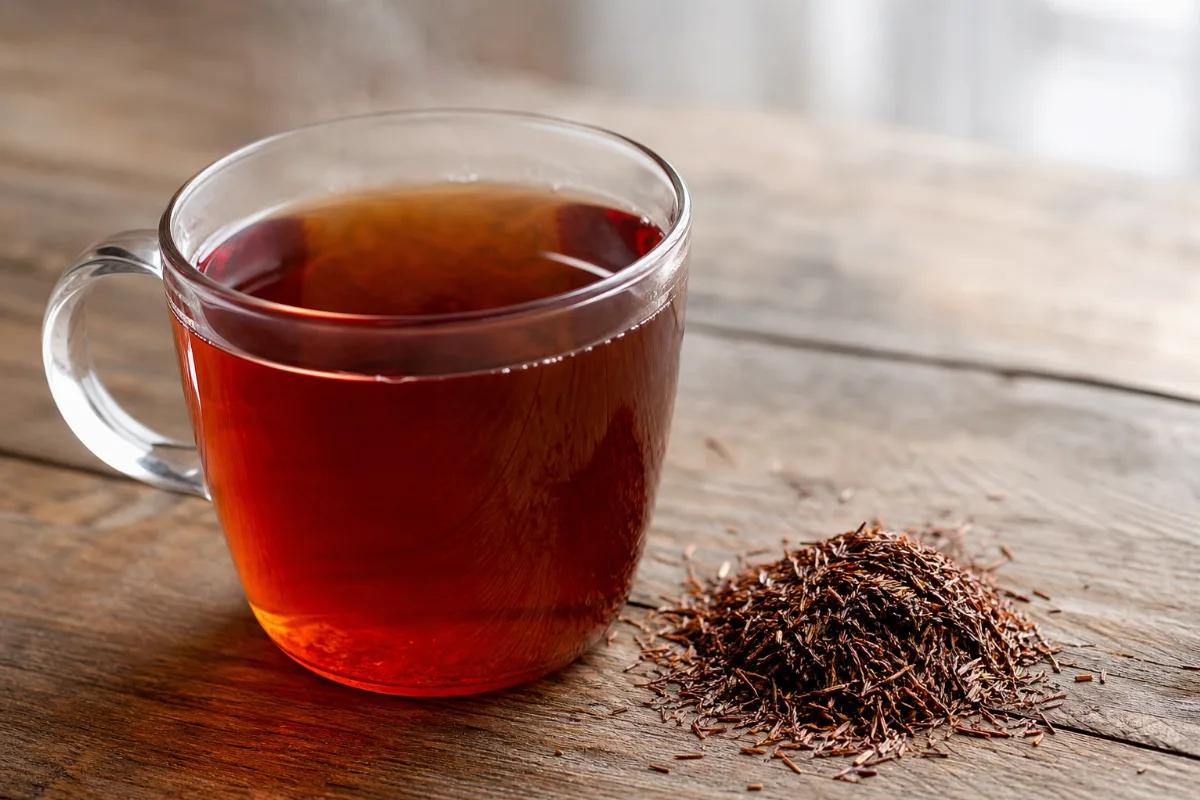
The usual red rooibos is fermented (oxidised). Green rooibos is unfermented and is also made into standardised extracts used in research. In one analysis the unfermented tea had more flavonoids per 500 mL than the fermented tea (159 vs 84 umol).
What the research shows
A 2023 scoping review found 18 human publications with 488 people. It says rooibos was shown to improve lipid profiles, antioxidant status and blood glucose, but it rests on few studies and a small total sample, and results were inconsistent. A scoping review maps research and does not rate quality.
Most of the reputation comes from animal and cell work. The one human cholesterol and oxidation trial had 40 adults and no placebo group. A 12-week placebo-controlled trial of extract capsules found small heart-ultrasound changes. There is no large randomised trial, no human blood-pressure or diabetes trial that we found, and no Cochrane review.
What happens in the body
The main rooibos flavonoids are poorly absorbed: in 10 volunteers drinking 500 mL, only 0.09% to 0.22% of flavonoids showed up in urine as metabolites and none were found in plasma. How the tea might act in the body is therefore not settled.
At a glance
Traditional uses history, not proof
- South Africa: a traditional herbal drink (redbush tea); trial authors say its medicinal reputation rests mostly on anecdote
- Western countries: popular as a low-caffeine, antioxidant-rich tea; marketed for skin conditions, ageing and cancer prevention without clinical support (Memorial Sloan Kettering)
Studied for research
- Antioxidant and oxidation blood markers, low (one small trial, one null trial)
- Cholesterol and blood fats, low (one small trial and a scoping review)
- Heart ultrasound measures, very low (one trial)
- Blood pressure and the ACE enzyme, very low (one dose, no blood pressure measured)
- Blood sugar, insufficient (animal meta-analysis; no human trial found)
- Hormone effects, insufficient (lab only)
Main compounds
- Aspalathin, a C-glucosyl dihydrochalcone and the main polyphenol; barely absorbed intact
- Nothofagin, a second main polyphenol
- Flavone C-glycosides such as orientin, isoorientin, vitexin and isovitexin
Common forms
- Brewed tea from fermented (red) leaf
- Green (unfermented) rooibos tea
- Standardised extract capsules used in some trials
- Blends with other herbs and flavourings
Research links: Rooibos Tea, Memorial Sloan Kettering · The health benefits of rooibos tea in humans: a scoping review (2023) · Effects of rooibos on oxidative stress and lipids in adults at risk (2011) · Rooibos entry, NIH LactMed (text not read) · Research Library · Genes & Biomarkers Library
The plant and its history
- Accepted scientific name
- Aspalathus linearis (Burm.f.) R.Dahlgren
- Naming authority
- (Burm.f.) R.Dahlgren; ACCEPTED in the GBIF backbone (usageKey 5348220), checked 2026-10-25.
- Synonyms
- Not listed in this file; GBIF synonym list was not pulled.
- Common names
- Rooibos (Afrikaans / English); Redbush tea (English (South Africa)); Rooibosch (Dutch (via MSK))
- Botanical family
- Fabaceae (the pea family).
- Classification
- Plantae > Tracheophyta > Fabales > Fabaceae > Aspalathus > Aspalathus linearis
- Native range
- MSK says the plant is native to South Africa; the 2023 scoping review says half of human studies were done there. A 2025 paper title refers to wild harvesting and ecotypes in South Africa (abstract not read).
- Habitat
- Not verified from a botanical source read.
- What the plant looks like
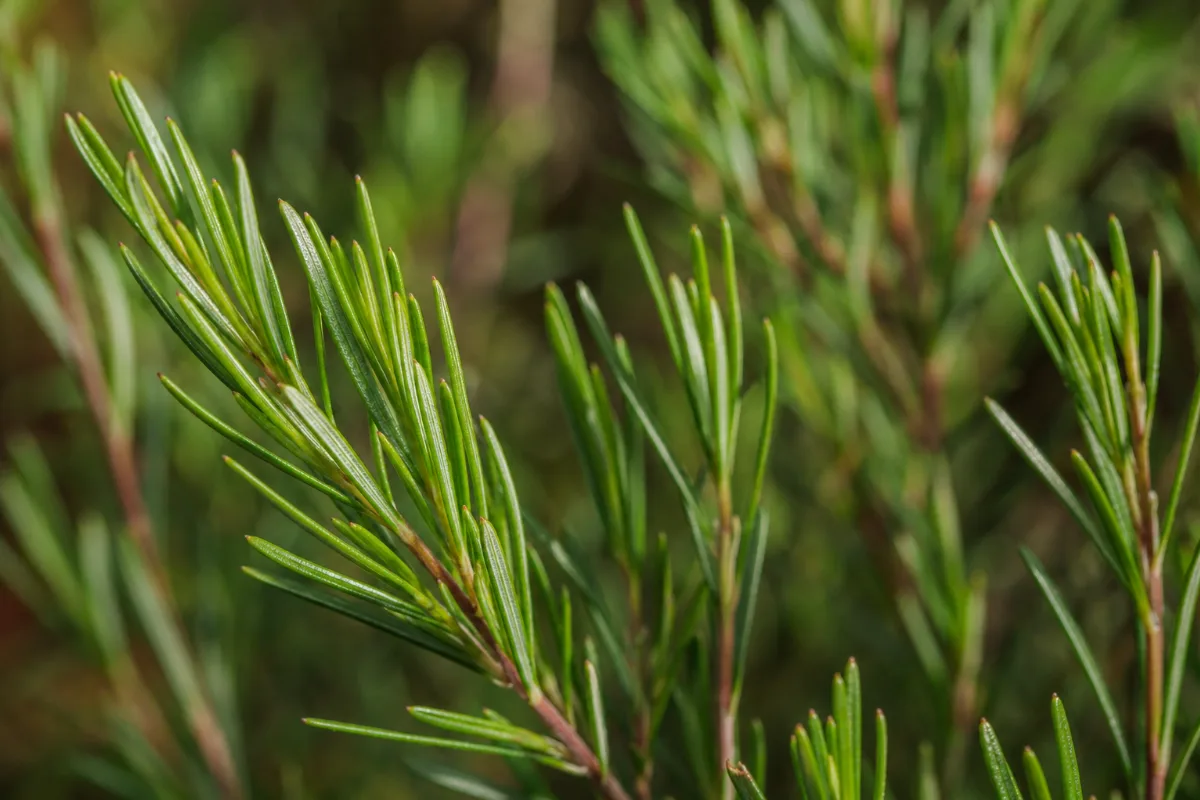
- Roots: Not verified.; Stems: The fine stems are used with the leaf (mixed leaf and stem material in studies).; Leaves: MSK says rooibos tea is prepared from the dried leaves. Fermented (oxidised) leaf gives the red-brown tea; unfermented gives green rooibos.; Flowers: Not verified.; Fruit: Not verified.
- Cultivation
- Not verified in detail.
- Harvest and processing
- Fermented (red) and unfermented (green) forms differ in flavonoid content: per 500 mL serving 84 umol total flavonoids (fermented) vs 159 umol (unfermented) in one analysis.
- Look-alikes and adulterants
- Name: Camellia sinensis (true tea); Note: Not related; contains caffeine and catechins. MSK says rooibos has no catechins.; Name: Cyclopia species (honeybush); Note: Another South African herbal tea in the same family; reviews study it alongside rooibos. Not the same plant.
- Sustainability and conservation
- Not verified.
The plant and the parts used
Traditional use and history history, not clinical proof
| Tradition or era | Documented use | Source |
|---|---|---|
| South Africa (traditional drink) | Used as a herbal tea (redbush); the 2011 trial authors say it is listed as a medicinal plant mostly on anecdotal evidence. | p20833235 |
| Modern use | Popular in western countries as a low-caffeine antioxidant-rich tea; marketed for acne, eczema, wrinkles, ageing and cancer prevention without clinical support (MSK). | s-msk-rooibos |
| Regulators | No EMA/HMPC monograph and no NCCIH page found (guessed URLs returned 404; NOT verified as non-existent). | s-ema-rooibos-notfound |
Traditional use shows how a plant was used. It does not show that a supplement works or is safe today.
What is inside, and how it may work
What the plant contains and how those compounds act in cells and animals. Laboratory and animal mechanisms are not proven effects in people.
Main compounds
| Compound | Family | Where it is concentrated | Activity studied | Level of evidence |
|---|---|---|---|---|
| Aspalathin PubChem 11282394 | C-glucosyl dihydrochalcone | Leaf (higher in unfermented) | Main rooibos polyphenol (MSK); studied in diabetic animals. Barely absorbed intact in people. 15 28 17 | Laboratory research |
| Nothofagin PubChem 21722188 | C-glucosyl dihydrochalcone | Leaf | Second main polyphenol (MSK); activates PXR in the lab. 15 7 17 | Laboratory research |
| Orientin / isoorientin PubChem 5281675 | Flavone C-glycosides (luteolin) | Leaf | Found in rooibos extracts; isoorientin CID 114776. 28 17 | Laboratory research |
| Vitexin / isovitexin PubChem 5280441 | Flavone C-glycosides (apigenin) | Leaf | Isovitexin was the most potent CYP3A4 inhibitor of the compounds tested in the lab (IC50 3.4 uM); isovitexin CID 162350. 7 17 | Laboratory research |
| Quercetin / rutin / luteolin PubChem 5280343 | Flavonoids | Leaf | Present in rooibos; quercetin is suggested by one review to suppress ovarian cell function in vitro (abstract not read). Rutin CID 5280805, luteolin CID 5280445. 17 | Laboratory research |
Mechanisms, receptors and pathways
| Target or pathway | Gene or receptor | What was found | Level |
|---|---|---|---|
| Oestrogen receptors alpha and beta | ESR1 / ESR2 | Extracts displaced oestradiol from both receptors, weak agonists with some ER-beta preference, and blocked oestradiol effects. 12 | Laboratory research |
| CYP450 enzymes and PXR | CYP3A4, CYP2C19, CYP1A2, CYP2D6, CYP2C9, NR1I2 | Methanol extract inhibited major CYPs (CYP3A4 IC50 1.7 ug/mL); aspalathin and nothofagin activated PXR with higher CYP3A4/CYP1A2 mRNA. 7 | Laboratory research |
| Intestinal CYP3A induction | CYP3A | Two weeks of rooibos tea in rats cut midazolam exposure by over 60% and raised intestinal CYP3A protein. 14 | Animal research |
| Angiotensin-converting enzyme | ACE | Single 400 ml serving lowered ACE activity at 30 and 60 minutes in 17 healthy people. 22 | Human data |
| Glucose lowering | Not specified | Lower glucose in diabetic rodents given rooibos or PPAG. 25 | Animal research |
Absorption, metabolism and elimination
- Absorption
- In 10 volunteers drinking 500 mL of tea, only 0.09% (fermented) and 0.22% (unfermented) of the flavonoids appeared in urine as metabolites; most aspalathin metabolites were excreted within 5 hours, suggesting small-intestine absorption.
- Distribution
- No flavonoid metabolites were detected in plasma despite exhaustive searches.
- Metabolism
- Eight metabolites: O-methyl, sulfate and glucuronide forms of aspalathin and an eriodictyol sulfate.
- Elimination
- Mainly urine within 24 hours.
- Bioavailability
- Very low for the main flavonoids; large-intestine metabolism of eriodictyol forms took 5 to 12 hours.
Isolated compounds versus whole extracts
Human trials used whole tea (fermented, six cups a day) or standardised water-soluble extracts in capsules (green and fermented). Many lab and animal findings come from isolated aspalathin or the extract PPAG, and cannot be assumed to apply to a cup of tea. Green (unfermented) and fermented forms differ in flavonoid content.
Nutritional composition
Rooibos is a drink, not a significant food source of vitamins. MSK describes it as low in caffeine and free of catechins. The 1979 iron study notes small amounts of minerals in the tea, but mineral values were not verified here.
5 low certainty2 very low certainty2 not enough evidence
What is Rooibos good for?
The main studied uses and how strong the human evidence is for each. 'Low' means a small study or two; 'very low' means a single study with weak measures; 'insufficient' means no usable human data.
Benefits, one by one
Each card is a research question, not a promise. Tap a goal to filter. Open a card to see the studies, doses and limits.
Antioxidant and oxidative-stress blood markers
Low certaintyOne small trial in at-risk adults found that drinking six cups of fermented rooibos a day for six weeks lowered blood markers of fat oxidation and raised glutathione. A second trial in fit men did not show a protective effect.
3 studiesFermented tea, six cups a day, in the main trial; a polyphenol produc…
Studies, doses and limits
What the trials found
Marnewick and colleagues gave 40 adults at risk of heart disease six cups of fermented rooibos a day for 6 weeks and compared with the same people's control period. Plasma polyphenols rose, and markers of lipid peroxidation (conjugated dienes, TBARS) fell, while reduced glutathione and the GSH:GSSG ratio rose. Overall plasma antioxidant capacity did not change. In a 2025 crossover trial in 40 healthy men, a rooibos polyphenol intervention did not complicate the oxidative stress made by hard exercise and the abstract reports no protective effect. The 2023 scoping review also reports improved antioxidant status across small studies.
Results
Lower lipid-oxidation markers and higher glutathione in at-risk adults; no protective effect reported after hard exercise.
Effect sizes as reported
Conjugated dienes 167.3 to 108.8 nmol/mL; TBARS 1.9 to 0.9 umol/L; reduced glutathione 797 to 1082 umol/L; GSH:GSSG 41 to 76 (vs control period, 40 people).
Why this rating
One small uncontrolled-by-placebo trial, one null trial, and a scoping review that does not rate quality. These are blood markers, not health outcomes.
Form and dose studied
Fermented tea, six cups a day, in the main trial; a polyphenol product in the exercise trial.
Who was studied
Adults at risk of cardiovascular disease; healthy young men.
Limits
No separate placebo group in the main trial; the markers are surrogate; no long-term data.
Why researchers looked
Rooibos is rich in polyphenols such as aspalathin and nothofagin, so researchers measured whether it changes oxidation markers in blood.
Traditional use
Rooibos (redbush) is a traditional South African drink. Memorial Sloan Kettering calls it popular in western countries because it is low in caffeine and rich in antioxidants; it is marketed for skin, ageing and cancer prevention, which are not supported by human evidence.
Proposed mechanism Preliminary mechanism
Polyphenols may act as antioxidants in the body, but the main rooibos flavonoids are barely absorbed intact (see the science file), so how this works in people is not settled.
A proposed mechanism does not show that the effect happens in people.
Liver and kidney tests were measured in the main trial but the abstract does not report them. See the safety file for liver case reports.
Blood fats (LDL, HDL, triglycerides)
Low certaintyIn one small trial, six cups of fermented rooibos a day for six weeks was followed by lower LDL cholesterol and triglycerides and higher HDL. This has not been confirmed in a large randomised trial.
2 studiesFermented rooibos tea, six cups a day for six weeks.
Studies, doses and limits
What the trials found
In the 40-person trial of at-risk adults, serum LDL fell from 4.6 to 3.9 mmol/L, triacylglycerols from 1.7 to 1.2 and HDL rose from 0.9 to 1.2 compared with the control period. The scoping review (18 studies, 488 people) says rooibos improved lipid profiles overall but calls the evidence limited, with inconsistent results by amount and tea type.
Results
Better lipid numbers in one small trial and a scoping review.
Effect sizes as reported
LDL 4.6 to 3.9 mmol/L; triglycerides 1.7 to 1.2; HDL 0.9 to 1.2 (40 people, no CI given in abstract).
Why this rating
One small trial without a separate placebo group; no cardiac events measured; scoping review pools nothing.
Form and dose studied
Fermented rooibos tea, six cups a day for six weeks.
Who was studied
Adults at risk of cardiovascular disease.
Limits
Lipids are risk markers, not outcomes. Not tested against statins.
Why researchers looked
High LDL and triglycerides are heart-disease risk factors, so lipid changes are a common outcome in rooibos studies.
Traditional use
Rooibos (redbush) is a traditional South African drink. Memorial Sloan Kettering calls it popular in western countries because it is low in caffeine and rich in antioxidants; it is marketed for skin, ageing and cancer prevention, which are not supported by human evidence.
Proposed mechanism Preliminary mechanism
Animal work suggests rooibos flavonoids may change fat metabolism; this is not shown in people.
A proposed mechanism does not show that the effect happens in people.
Do not replace prescribed cholesterol treatment with tea. See the safety file for drug interactions.
Heart structure on ultrasound
Very low certaintyA 12-week placebo-controlled trial of rooibos extract capsules found a few small changes on heart ultrasound, but the placebo group also changed on one measure.
1 studiesStandardised water-soluble extract capsules (green and fermented); ca…
Studies, doses and limits
What the trials found
Hartnick and colleagues ran a 12-week randomised, double-blind, placebo-controlled trial of capsules of standardised water-soluble green or fermented rooibos extract. Left atrium size fell from 3.832 to 3.675 cm (P = 0.01); left ventricle mass fell from 204.102 to 191.394 g only in the fermented group (P = 0.015). Septum thickness fell in the placebo group and the green group. Aorta, LA/AO ratio and posterior wall did not change.
Results
Small ultrasound changes; mixed pattern across groups.
Effect sizes as reported
LA 3.832 to 3.675 cm (P = 0.01); LV mass 204.1 to 191.4 g, fermented only (P = 0.015).
Why this rating
The numbers of people per group are not in the abstract, the placebo group also changed, and ultrasound size is a surrogate. The authors' wording about promising benefits goes beyond the data.
Form and dose studied
Standardised water-soluble extract capsules (green and fermented); capsule amount not in the abstract.
Who was studied
Adults at cardiovascular risk (South Africa).
Limits
Single trial; surrogate measure; details not available.
Why researchers looked
Researchers wanted to see whether rooibos polyphenols affect heart structure in people at cardiovascular risk.
Traditional use
Rooibos (redbush) is a traditional South African drink. Memorial Sloan Kettering calls it popular in western countries because it is low in caffeine and rich in antioxidants; it is marketed for skin, ageing and cancer prevention, which are not supported by human evidence.
Proposed mechanism Preliminary mechanism
Not established.
A proposed mechanism does not show that the effect happens in people.
No safety findings were given in the abstract.
Blood pressure and ACE enzyme
Very low certaintyOne cup of rooibos briefly lowered activity of ACE (an enzyme that raises blood pressure) in 17 healthy people. Blood pressure itself was not measured, so there is no good evidence rooibos lowers blood pressure.
2 studies400 ml tea once.
Studies, doses and limits
What the trials found
Persson and colleagues gave 17 healthy volunteers 400 ml of rooibos, green or black tea in a randomised crossover. Rooibos inhibited ACE activity at 30 minutes (P < 0.01) and 60 minutes (P < 0.05); nitric oxide did not change. Memorial Sloan Kettering describes this as preliminary and says human studies are very limited.
Results
Short-lived ACE change after a single serving; no blood pressure data.
Effect sizes as reported
Significant at 30 and 60 min only; no effect size given in abstract.
Why this rating
A lab enzyme measure after one dose in healthy people; no blood-pressure result.
Form and dose studied
400 ml tea once.
Who was studied
Healthy volunteers (Sweden).
Limits
One dose, 17 people, 3 hours of follow-up.
Why researchers looked
Blocking ACE is how a class of blood-pressure drugs works, so researchers tested whether tea does something similar.
Traditional use
Rooibos (redbush) is a traditional South African drink. Memorial Sloan Kettering calls it popular in western countries because it is low in caffeine and rich in antioxidants; it is marketed for skin, ageing and cancer prevention, which are not supported by human evidence.
Proposed mechanism Preliminary mechanism
Possible ACE inhibition by tea polyphenols; effect on pressure unproven.
A proposed mechanism does not show that the effect happens in people.
People taking ACE inhibitors or blood pressure drugs should ask their pharmacist; no interaction study was found.
Blood sugar
Not enough evidenceMost evidence that rooibos lowers blood sugar comes from diabetic rodents. Human data are limited to what a scoping review describes as lower glucose in some small studies.
2 studiesExtracts and the compound PPAG in rodents; tea in human studies.
Studies, doses and limits
What the trials found
A 2018 systematic review and meta-analysis of 12 diabetic rodent studies (88 treated, 85 controls) found lower blood glucose: standardised effect -0.89 (95% CI -1.44 to -0.35), I2 = 67%. The 2023 scoping review of human studies says rooibos lowered blood glucose in some small studies but the findings come from few studies with inconsistent results. We did not find a randomised trial of rooibos in people with diabetes.
Results
Lower glucose in diabetic rodents; unconfirmed in people.
Effect sizes as reported
Pooled effect size -0.89 (95% CI -1.44 to -0.35) in rodents.
Why this rating
Animal meta-analysis with high heterogeneity; human data limited to a non-rating scoping review.
Form and dose studied
Extracts and the compound PPAG in rodents; tea in human studies.
Who was studied
Diabetic rodents; mixed human groups.
Limits
Not translatable to people with diabetes without trials.
Why researchers looked
Aspalathin, a rooibos compound, has been studied in diabetic animals.
Traditional use
Rooibos (redbush) is a traditional South African drink. Memorial Sloan Kettering calls it popular in western countries because it is low in caffeine and rich in antioxidants; it is marketed for skin, ageing and cancer prevention, which are not supported by human evidence.
Proposed mechanism Animal research
Aspalathin and rooibos extracts improved glucose handling in animal and cell experiments; not shown in people.
A proposed mechanism does not show that the effect happens in people.
People on diabetes medicines should not use rooibos as a replacement; see the safety file for interaction gaps.
Rehydration after exercise
Low certaintyIn 23 wrestlers, rooibos tea rehydrated no better than plain water.
1 studiesRooibos tea matching the weight lost.
Studies, doses and limits
What the trials found
Utter and colleagues compared rooibos tea, bottled water and a 6% carbohydrate drink in 23 collegiate wrestlers after a 3% loss of body mass. After one hour, plasma and urine osmolarity changes were seen with the carbohydrate drink; rooibos was no more effective than water.
Results
No advantage over water.
Effect sizes as reported
No difference from water in the abstract; numbers not given.
Why this rating
One small crossover trial of one hour.
Form and dose studied
Rooibos tea matching the weight lost.
Who was studied
Young male athletes.
Limits
One hour; only wrestlers.
Why researchers looked
Rooibos is marketed as a sports drink because of its antioxidants and mineral content.
Traditional use
None specific to sport in the sources read.
Proposed mechanism Preliminary mechanism
None established.
A proposed mechanism does not show that the effect happens in people.
None noted.
Effect on iron absorption (not a benefit; a nutrition safety check)
Low certaintyOrdinary tea blocks iron absorption. In a small 1979 study rooibos did not.
2 studiesRooibos tea with one 16 mg iron dose.
Studies, doses and limits
What the trials found
Thirty healthy young men took 16 mg of iron with rooibos tea, ordinary tea or boiled water. Mean absorption was 7.25% with rooibos, 1.70% with ordinary tea and 9.34% with water. Rooibos did not affect iron absorption significantly, unlike ordinary tea (P < 0.0001).
Results
Rooibos did not block iron absorption in this study.
Effect sizes as reported
7.25% vs 9.34% (water) vs 1.70% (tea); rooibos not significantly different from water.
Why this rating
One old small study in healthy men, 10 per group; not repeated in our searches; not tested in iron-deficient people or with plant-based iron.
Form and dose studied
Rooibos tea with one 16 mg iron dose.
Who was studied
Healthy young men (South Africa, 1979).
Limits
Old, small, single study.
Why researchers looked
People who rely on iron from food or supplements need to know if a drink interferes.
Traditional use
None specific.
Proposed mechanism Pharmacological theory
Rooibos lacks the tannin-type catechins found in Camellia sinensis tea (MSK); the 1979 paper did not explain the result.
A proposed mechanism does not show that the effect happens in people.
People with iron deficiency or anaemia should still ask a clinician.
Oestrogen-like and anti-oestrogen effects (lab only)
Not enough evidenceIn lab experiments rooibos extracts bind oestrogen receptors and act as weak activators and blockers. No human trial of hormone effects was found.
3 studiesExtracts in cells.
Studies, doses and limits
What the trials found
A 2026 cell study of 18 green and fermented extracts found that they displaced oestradiol from both receptors, were much weaker than oestradiol at activating them, and blocked oestradiol effects about as strongly as the drug ICI-182,780; the authors call it the first report of anti-oestrogenic activity. A systematic review of lab studies suggests rooibos affects ovarian cell function. Memorial Sloan Kettering says compounds from the leaves showed estrogenic activity and advises caution in hormone-sensitive cancers. We found no human trial of hormone levels.
Results
Lab results only; direction in people unknown.
Effect sizes as reported
Not applicable (cell assays).
Why this rating
Cell experiments cannot tell whether drinking rooibos changes hormones in people.
Form and dose studied
Extracts in cells.
Who was studied
None (no human trial).
Limits
No human hormone data; effect direction in lab assays is mixed (agonist and antagonist).
Why researchers looked
Plant polyphenols with a shape like oestrogen raise the question of hormone effects.
Traditional use
None specific.
Proposed mechanism Laboratory research
Compounds in rooibos bind both oestrogen receptors (more selective for ER-beta) in cells.
A proposed mechanism does not show that the effect happens in people.
See the safety file for hormone-sensitive conditions.
Muscle and exercise oxidative stress
Low certaintyIn a validation trial, rooibos polyphenols did not change the oxidative stress made by hard exercise in 40 men.
1 studiesRooibos polyphenols, product details not in abstract.
Studies, doses and limits
What the trials found
The 2025 crossover trial's main goal was to test an exercise model that induces oxidative stress. Rooibos polyphenols were one of the interventions; the abstract says they did not complicate the onset of oxidative stress and reports no benefit.
Results
No benefit reported.
Effect sizes as reported
Not given.
Why this rating
The study tested the exercise model, not rooibos.
Form and dose studied
Rooibos polyphenols, product details not in abstract.
Who was studied
40 adult men.
Limits
Not designed to test rooibos.
Why researchers looked
Antioxidants are sometimes proposed for recovery.
Traditional use
None.
Proposed mechanism Preliminary mechanism
Not established.
A proposed mechanism does not show that the effect happens in people.
None.
Connections to the rest of health
How Rooibos connects to the rest of our health knowledge graph. Every link says what kind of connection it is. A safety link (for example to the liver) is a warning, not a benefit. A study that merely mentions a topic never creates a benefit link.
Explore every connection: goals, body systems, organs, symptoms, genes
A. Wellness goals
| Connected to | Kind of connection | Evidence status | Context | Studies |
|---|---|---|---|---|
| Healthy Aging | Potential benefit | Low certainty | Antioxidant and oxidative-stress blood markers: One small trial in at-risk adults found that drinking six cups of fermented rooibos a day for six weeks lowered blood markers of fat oxidation and raised glutathione. A second trial in fit men did not show a protective effect. | 13 11 2 |
| Heart Health | Potential benefit | Low certainty | Antioxidant and oxidative-stress blood markers: One small trial in at-risk adults found that drinking six cups of fermented rooibos a day for six weeks lowered blood markers of fat oxidation and raised glutathione. A second trial in fit men did not show a protective effect. Blood fats (LDL, HDL, triglycerides): In one small trial, six cups of fermented rooibos a day for six weeks was followed by lower LDL cholesterol and triglycerides and higher HDL. This has not been confirmed in a large randomised trial. | 13 11 2 10 |
| Cholesterol Balance | Potential benefit | Low certainty | Blood fats (LDL, HDL, triglycerides): In one small trial, six cups of fermented rooibos a day for six weeks was followed by lower LDL cholesterol and triglycerides and higher HDL. This has not been confirmed in a large randomised trial. | 13 2 |
| Blood Pressure Support | Preliminary mechanism | Very low certainty | Blood pressure and ACE enzyme: One cup of rooibos briefly lowered activity of ACE (an enzyme that raises blood pressure) in 17 healthy people. Blood pressure itself was not measured, so there is no good evidence rooibos lowers blood pressure. | 22 15 |
| Heart Health | Preliminary mechanism | Very low certainty | Blood pressure and ACE enzyme: One cup of rooibos briefly lowered activity of ACE (an enzyme that raises blood pressure) in 17 healthy people. Blood pressure itself was not measured, so there is no good evidence rooibos lowers blood pressure. | 22 15 |
| Blood Sugar Balance | Preliminary mechanism | Not enough evidence | Blood sugar: Most evidence that rooibos lowers blood sugar comes from diabetic rodents. Human data are limited to what a scoping review describes as lower glucose in some small studies. | 25 2 |
| Metabolic Health | Preliminary mechanism | Not enough evidence | Blood sugar: Most evidence that rooibos lowers blood sugar comes from diabetic rodents. Human data are limited to what a scoping review describes as lower glucose in some small studies. | 25 2 |
| Endurance Support | Potential benefit | Low certainty | Rehydration after exercise: In 23 wrestlers, rooibos tea rehydrated no better than plain water. | 29 |
| Muscle Recovery | Potential benefit | Low certainty | Rehydration after exercise: In 23 wrestlers, rooibos tea rehydrated no better than plain water. Muscle and exercise oxidative stress: In a validation trial, rooibos polyphenols did not change the oxidative stress made by hard exercise in 40 men. | 29 11 |
| Energy Boost | Biological association | Low certainty | Effect on iron absorption (not a benefit; a nutrition safety check): Ordinary tea blocks iron absorption. In a small 1979 study rooibos did not. | 31 15 |
| Hormone Balance | Preliminary mechanism | Not enough evidence | Oestrogen-like and anti-oestrogen effects (lab only): In lab experiments rooibos extracts bind oestrogen receptors and act as weak activators and blockers. No human trial of hormone effects was found. | 12 27 15 |
| Womens Wellness | Preliminary mechanism | Not enough evidence | Oestrogen-like and anti-oestrogen effects (lab only): In lab experiments rooibos extracts bind oestrogen receptors and act as weak activators and blockers. No human trial of hormone effects was found. | 12 27 15 |
| Peak Performance | Potential benefit | Low certainty | Muscle and exercise oxidative stress: In a validation trial, rooibos polyphenols did not change the oxidative stress made by hard exercise in 40 men. | 11 |
B. Body systems
| Connected to | Kind of connection | Evidence status | Context | Studies |
|---|---|---|---|---|
| Cardiovascular system | Potential benefit | Low certainty | Small trial of lipids and oxidation markers; one ultrasound trial. Preparation or compound: Fermented rooibos tea |
13 10 |
| Cardiovascular System | Biological association | Low certainty | Studied for: Antioxidant and oxidative-stress blood markers Studied for: Blood fats (LDL, HDL, triglycerides) | 13 11 2 10 22 15 |
| Metabolism Weight | Biological association | Not enough evidence | Studied for: Blood sugar | 25 2 |
| Musculoskeletal System | Biological association | Low certainty | Studied for: Rehydration after exercise Studied for: Muscle and exercise oxidative stress | 29 11 |
| Digestive System | Biological association | Low certainty | Studied for: Effect on iron absorption (not a benefit; a nutrition safety check) | 31 15 |
| Endocrine System | Biological association | Not enough evidence | Studied for: Oestrogen-like and anti-oestrogen effects (lab only) | 12 27 15 |
| Reproductive System | Biological association | Not enough evidence | Studied for: Oestrogen-like and anti-oestrogen effects (lab only) | 12 27 15 |
C. Body parts and organs
| Connected to | Kind of connection | Evidence status | Context | Studies |
|---|---|---|---|---|
| Liver | Adverse effect or risk | Low certainty | Three case reports of raised enzymes or jaundice; usually recovered after stopping. Case reports of raised enzymes or jaundice; recovered after stopping. Preparation or compound: Rooibos tea, heavy daily use |
15 5 |
| Blood vessels | Drug or supplement interaction | Not enough evidence | Short-lived ACE activity drop in one trial. Preparation or compound: Rooibos tea |
22 |
F. Functional actions
| Connected to | Kind of connection | Evidence status | Context | Studies |
|---|---|---|---|---|
| Oestrogen-receptor activity | Biological association | Not enough evidence | Weak oestrogen-receptor effects in cells; no human data. Preparation or compound: Rooibos extracts |
12 |
I. Biomarkers
| Connected to | Kind of connection | Evidence status | Context | Studies |
|---|---|---|---|---|
| ALT | Adverse effect or risk | Low certainty | Raised liver enzymes in case reports; lower ALT in rats. Preparation or compound: Rooibos tea |
15 21 |
| LDL cholesterol | Potential benefit | Low certainty | Fell 4.6 to 3.9 mmol/L in 40 at-risk adults. Preparation or compound: Fermented rooibos tea |
13 |
| LDL cholesterol | Biological association | Low certainty | Measured in trials: lowered. A lab change is not the same as a health benefit. | 13 |
| HDL cholesterol | Biological association | Low certainty | Measured in trials: raised. A lab change is not the same as a health benefit. | 13 |
| Triglycerides | Biological association | Low certainty | Measured in trials: lowered. A lab change is not the same as a health benefit. | 13 |
| Lipid peroxidation (TBARS, conjugated dienes) | Biological association | Low certainty | Measured in trials: lowered. A lab change is not the same as a health benefit. | 13 |
| Reduced glutathione and GSH:GSSG ratio | Biological association | Low certainty | Measured in trials: raised. A lab change is not the same as a health benefit. | 13 |
| Left atrium size (ultrasound) | Biological association | Very low certainty | Measured in trials: lowered. A lab change is not the same as a health benefit. | 10 |
| ACE activity | Biological association | Very low certainty | Measured in trials: lowered. A lab change is not the same as a health benefit. | 22 |
| Blood glucose (rodents) | Biological association | Not enough evidence | Measured in trials: lowered. A lab change is not the same as a health benefit. | 25 |
| Plasma and urine osmolarity | Biological association | Low certainty | Measured in trials: no-change. A lab change is not the same as a health benefit. | 29 |
| Iron absorption | Biological association | Low certainty | Measured in trials: no-change. A lab change is not the same as a health benefit. | 31 |
J. Genes, receptors and enzymes
| Connected to | Kind of connection | Evidence status | Context | Studies |
|---|---|---|---|---|
| ESR1 / ESR2 (oestrogen receptors) | Preliminary mechanism | In vitro | Extracts bound both receptors in cells. | 12 |
| CYP3A4 and PXR | Preliminary mechanism | In vitro | Inhibited and induced in lab and animal tests. | 7 14 |
| ACE | Preliminary mechanism | Human | Activity lower briefly after one serving. | 22 |
L. Active compounds
| Connected to | Kind of connection | Evidence status | Context | Studies |
|---|---|---|---|---|
| Aspalathin | Biological association | In vitro | Main rooibos polyphenol (MSK); studied in diabetic animals. Barely absorbed intact in people. Preparation or compound: Leaf (higher in unfermented) |
15 28 17 |
| Nothofagin | Biological association | In vitro | Second main polyphenol (MSK); activates PXR in the lab. Preparation or compound: Leaf |
15 7 17 |
| Orientin / isoorientin | Biological association | In vitro | Found in rooibos extracts; isoorientin CID 114776. Preparation or compound: Leaf |
28 17 |
| Vitexin / isovitexin | Biological association | In vitro | Isovitexin was the most potent CYP3A4 inhibitor of the compounds tested in the lab (IC50 3.4 uM); isovitexin CID 162350. Preparation or compound: Leaf |
7 17 |
| Quercetin / rutin / luteolin | Biological association | In vitro | Present in rooibos; quercetin is suggested by one review to suppress ovarian cell function in vitro (abstract not read). Rutin CID 5280805, luteolin CID 5280445. Preparation or compound: Leaf |
17 |
Each connection is stored with the ingredient, the connected record, the kind of connection, the evidence status, the supporting studies, the preparation or compound involved, and a review date (last reviewed October 25, 2026).
The evidence
The research centre for Rooibos. Every record here was checked against PubMed or the publisher's page; we never list a study we have not verified.
Evidence by outcome
Bars show how many studies we found for each outcome, not how well it works. People are added up across trials only (reviews are not added, to avoid double counting).
How we rate evidence
High certainty
Several well-run trials or reviews agree; further research is unlikely to change the picture much.
Moderate certainty
Good trials point the same way, but some doubt remains.
Low certainty
Small, short or inconsistent trials. The finding could change with better research.
Very low certainty
Very little or very weak human data. Treat as a possibility only.
Mixed findings
Trials or reviews disagree with each other.
Not enough evidence
Not enough human research to say either way.
Evidence against
Good research found no benefit, or found harm.
We take the reviewers' own risk-of-bias and GRADE statements where they exist, and otherwise judge from study size, design, consistency, directness and whether a product matches what is sold. Many publications do not make evidence high. Method note: We searched PubMed, read every abstract directly, checked taxonomy through GBIF and NCBI, and read the Memorial Sloan Kettering herb page. Pages from NCCIH, EMA and LactMed could not be read or were not found, and this is stated where it matters.
Study library: every study we checked 31
| Study | Design | People | Product, dose, length | Result |
|---|---|---|---|---|
| Abushammala 2021 Tacrolimus and herbs interactions: a review. Pharmazie · PMID 34620272 · DOI |
Narrative review |
Review of herb-tacrolimus interactions in human and animal models | Several herbs including rooibos tea leaf+stem not applicable not applicable · vs not applicable |
Says tacrolimus bioavailability fell when taken with St John's wort, cranberry, rooibos tea and boldo in human models, through CYP450 and/or P-gp induction; it advises patients on tacrolimus to be told about herbs. Lower tacrolimus availability reported Methods, limits and fundingOutcomes: Tacrolimus blood levels Limitations: Review; the abstract does not give the underlying rooibos study or numbers. Funding and conflicts: Not stated in the abstract. Read: abstract |
| Afrifa 2023 The health benefits of rooibos tea in humans (aspalathus linearis)-a scoping review. J Public Health Afr · PMID 38204815 · DOI |
Systematic review |
488 18 human publications; people aged 6 to 83, healthy and at risk |
Rooibos tea (fermented, unfermented or black) in the included studies leaf+stem 200 to 1,200 ml of tea varied · vs varied |
The review says rooibos has been shown to improve lipid profiles, boost antioxidant status and lower blood glucose in healthy and at-risk people, but the findings rest on few studies and a small total sample, with inconsistent results across amounts and tea types. Promising signals; authors call for dose-response studies and large trials Methods, limits and fundingOutcomes: Lipid profile, antioxidant status, blood glucose Limitations: Scoping review: it maps studies and does not rate their quality or pool results; few studies, small total sample. Funding and conflicts: Not stated in the abstract. Read: abstract |
| Areo 2021 Risk assessment of heavy metals in rooibos (Aspalathus linearis) tea consumed in South Africa. Environ Sci Pollut Res Int · PMID 34145539 · DOI |
Lab method plant |
80 80 retail rooibos tea products in South Africa |
Dry rooibos tea products leaf+stem not applicable tested 2019 · vs not applicable |
Chromium 0.17 to 11.98 mg/kg (above the WHO limit of 1.3 mg/kg cited); lead up to 2.73 mg/kg; cadmium 0.09 to 0.17; arsenic not detected to 0.51. Hazard quotients were below 1 (not a threat at the assumed intake), but the authors suggest constant monitoring. Metal levels vary by product Methods, limits and fundingOutcomes: Chromium, iron, arsenic, cadmium, lead Limitations: One country, one year; brands not named. Funding and conflicts: Not stated in the abstract. Read: abstract |
| Areo 2022 Determination of pesticide residues in rooibos (Aspalathus linearis) teas in South Africa. Toxicol Rep · PMID 36518471 · DOI |
Lab method plant |
100 100 retail rooibos teas in South Africa |
Dry rooibos tea products leaf+stem not applicable bought Nov 2019 to Apr 2020 · vs not applicable |
Deltamethrin and lambda-cyhalothrin were found in only one sample each (92.11 and 66.41 ug/kg), below EU limits. Pesticide residues rare in this sample Methods, limits and fundingOutcomes: 13 pesticide residues Limitations: One country; 13 pesticides only. Funding and conflicts: The authors declare no competing interests. Read: abstract |
| Carrier 2021 Rooibos, a fake friend. Clin Res Hepatol Gastroenterol · PMID 32828746 · DOI |
Case report |
1 One patient (France) |
Rooibos tea leaf+stem not given in the abstract not given in the abstract · vs not applicable |
Reports one case of liver injury attributed to rooibos. The authors call hepatic toxicity rare but probably under-diagnosed and say clinicians should think of it in acute hepatitis. One case Methods, limits and fundingOutcomes: Liver injury Limitations: Only the short abstract was available; no enzyme values, timing or dose. Funding and conflicts: Not stated in the abstract. Read: abstract |
| European Medicines Agency 2026 EMA/HMPC herbal monograph search for rooibos EMA website · Source |
Regulatory search |
not applicable | Rooibos (Aspalathus linearis) leaf+stem not applicable not applicable · vs not applicable |
A guessed EMA herbal-medicine page for Aspalathus linearis returned HTTP 404 on 2026-10-25. No HMPC monograph found. Reference summary Methods, limits and fundingOutcomes: Regulatory or reference summary Limitations: Absence of a page we guessed is not proof that none exists; EMA search was not run. Funding and conflicts: Not applicable (reference source). Read: summary-only |
| Fantoukh 2019 Safety Assessment of Phytochemicals Derived from the Globalized South African Rooibos Tea (Aspalathus linearis) through Interaction with CYP, PXR, and P-gp. J Agric Food Chem · PMID 30955332 · DOI |
Laboratory research in-vitro |
Lab enzyme and cell assays | Methanol extract of rooibos leaves and stems and 11 isolated compounds leaf+stem not applicable not applicable · vs not applicable |
The extract inhibited human CYP3A4 (IC50 1.7 ug/mL), CYP2C19 (4.0), CYP1A2, CYP2D6 and CYP2C9; aspalathin and nothofagin moderately activated the PXR receptor with higher CYP3A4 and CYP1A2 mRNA. The authors say high intake of rooibos nutraceuticals may risk herb-drug interactions. Lab signals in both directions (inhibition and induction) Methods, limits and fundingOutcomes: CYP450 inhibition, PXR activation Limitations: Lab only; concentrated methanol extract. Funding and conflicts: Not stated in the abstract. Read: abstract |
| GBIF Secretariat 2026 GBIF backbone: Aspalathus linearis (Burm.f.) R.Dahlgren GBIF species API · Source |
Taxonomy database plant |
not applicable | Rooibos (Aspalathus linearis) leaf+stem not applicable not applicable · vs not applicable |
Checked 2026-10-25: usageKey 5348220, status ACCEPTED, family Fabaceae, order Fabales, genus Aspalathus, rank SPECIES, exact match, confidence 99. Reference summary Methods, limits and fundingOutcomes: Regulatory or reference summary Limitations: Database record. Funding and conflicts: Not applicable (reference source). Read: full-text |
| Gabuza 2022 In vitro and in vivo hepatotoxicity study of Afriplex GRT through an inflammatory response. Toxicol Rep · PMID 36518449 · DOI |
Animal research animal |
Liver cells and rats | Afriplex GRT, a standardised green rooibos extract leaf+stem cells 0.1 to 1000 ug/mL; rats 10, 100 and 300 mg/kg cells up to 48 h; rats short term · vs untreated controls; carbon tetrachloride |
Cell viability fell at 100 and 1000 ug/mL after 48 h. In rats the highest dose (300 mg/kg) raised AST and caused mild to moderate fatty change; NF-kB expression fell. High concentrations were toxic to liver cells Methods, limits and fundingOutcomes: Cell survival, liver enzymes, liver tissue Limitations: Lab and rat only; a concentrated extract, not tea. Funding and conflicts: The authors declare no competing interests. Read: abstract |
| Hartnick 2024 Impact of Chronic Consumption of Herbal Rooibos on Cardiovascular Function in Adults with Cardiovascular Risk. J Med Food · PMID 38958559 · DOI |
Controlled trial |
Adults at risk of cardiovascular disease (South Africa); number analysed not given in the abstract | Capsules of standardised water-soluble extract of green (unfermented) or traditional fermented rooibos leaf+stem capsule dose not given in the abstract 12 weeks · vs placebo capsules |
Left atrium shrank 3.832 to 3.675 cm (P = 0.01); left ventricle mass fell 204.102 to 191.394 g only in the fermented group (P = 0.015); the septum thickness fell in the placebo and green groups; aorta, LA/AO ratio and posterior wall unchanged. Some small ultrasound changes; the placebo group also changed on one measure Methods, limits and fundingOutcomes: Heart ultrasound (echocardiography) measures Limitations: Ultrasound measures are not heart attacks or deaths; sample size and group sizes not in the abstract; the authors' conclusion ('may offer promising benefits') goes further than the data; authors include the researcher who leads rooibos work at the university. Funding and conflicts: Not stated in the abstract. Read: abstract |
| Kamati 2025 A Standardised Exercise Protocol to Induce Oxidative Stress in Humans: Validation with a Dietary Polyphenol Intervention. Nutrients · PMID 41010497 · DOI |
Controlled trial |
40 Adult men, mean age about 26 (South Africa / Austria) |
Rooibos polyphenols as one of the interventions in an exercise model leaf+stem not given in the abstract not given in the abstract · vs placebo (single-blinded crossover) |
The exercise reliably raised oxidative-damage markers; the abstract states that rooibos polyphenols did not complicate the onset of oxidative stress. It does not report that rooibos reduced the damage. No protective effect reported in the abstract Methods, limits and fundingOutcomes: Oxidative damage markers after hard exercise Limitations: The study's purpose was to validate an exercise model, not to test rooibos; men only. Funding and conflicts: Authors declare no conflicts of interest. Read: abstract |
| Marais 2026 Evaluation of the Estrogenic Activity of Green and Fermented Aspalathus linearis (Rooibos) Extracts. Planta Med · PMID 42863524 · DOI |
Laboratory research in-vitro |
18 Cell assays; 18 rooibos extracts |
Green and fermented rooibos extracts (water and other extracts) leaf+stem not applicable not applicable · vs oestradiol (E2); ICI-182,780 |
Compounds in the extracts bound both oestrogen receptors and displaced labelled oestradiol. Extracts were much weaker than oestradiol at switching the receptor on, mostly favouring ER-beta, and blocked oestradiol effects about as strongly as the drug ICI-182,780. The authors call this the first report of anti-oestrogenic activity. Weak oestrogen-receptor agonism and some blocking activity in cells Methods, limits and fundingOutcomes: Oestrogen receptor binding and activity Limitations: Cell experiments only (published online October 2026); says nothing about effects in people. Funding and conflicts: The authors declare no conflict of interest. Read: abstract |
| Marnewick 2011 Effects of rooibos (Aspalathus linearis) on oxidative stress and biochemical parameters in adults at risk for cardiovascular disease. J Ethnopharmacol · PMID 20833235 · DOI |
Controlled clinical trial |
40 Adults at risk of cardiovascular disease (South Africa) |
Fermented (traditional) rooibos tea leaf+stem six cups a day 6 weeks, after a 2-week washout, followed by a control period · vs the same people's control period (not a separate placebo group) |
Plasma total polyphenols rose 79.8 to 89.8 mg/L; lipid-peroxidation markers fell (conjugated dienes 167.3 to 108.8 nmol/mL; TBARS 1.9 to 0.9 umol/L); reduced glutathione rose 797 to 1082 umol/L; GSH:GSSG ratio 41 to 76; LDL fell 4.6 to 3.9 mmol/L; triacylglycerols 1.7 to 1.2; HDL rose 0.9 to 1.2. Plasma antioxidant capacity did not change. Liver and kidney tests were measured but their results are not in the abstract. Improved blood markers of oxidation and fats in 40 at-risk adults Methods, limits and fundingOutcomes: Lipid peroxidation, glutathione, lipids, liver and kidney function Limitations: No separate placebo group and no stated randomisation; one small trial; surrogate blood markers; liver and kidney results not reported in the abstract. Funding and conflicts: Not stated in the abstract. Read: abstract |
| Matsuda 2007 Effects of continuous ingestion of herbal teas on intestinal CYP3A in the rat. J Pharmacol Sci · PMID 17287587 · DOI |
Animal research animal |
6 Rats (6 per group) |
Rooibos tea (with tenryocha and guava tea) as the only drink leaf+stem free access 2 weeks · vs water |
Midazolam AUC and peak level fell by more than 60% with rooibos tea; intestinal CYP3A protein rose significantly; hepatic CYP3A rose slightly. Rooibos lowered a CYP3A drug's levels in rats Methods, limits and fundingOutcomes: Midazolam blood levels and intestinal CYP3A Limitations: Rats, one drug; unknown size of effect in people. Funding and conflicts: Not stated in the abstract. Read: abstract |
| Memorial Sloan Kettering Cancer Center 2026 Rooibos Tea (About Herbs) MSK Integrative Medicine herb database · Source |
Authoritative guidance |
not applicable | Rooibos (Aspalathus linearis) leaf+stem not applicable not applicable · vs not applicable |
Read in full on 2026-10-25. Lab studies suggest antioxidant richness but human studies are very limited. Compounds from the leaves showed estrogenic activity, so patients with hormone-sensitive cancers should use caution. Antioxidant effects may interfere with some chemotherapy. Three liver case reports are listed (37-year-old with raised liver enzymes and low platelets; 42-year-old woman with raised enzymes that normalised within a week; 63-year-old with jaundice, liver tests normal after stopping). Animal work: rooibos induced CYP3A; one 38-year-old woman after bone marrow transplant who drank more than 2 litres a day had lower tacrolimus levels and developed graft-versus-host disease. Rat studies suggest prolonged exposure may affect reproduction, fertility, liver and kidney. Says rooibos is low in caffeine and has no catechins. Reference summary Methods, limits and fundingOutcomes: Regulatory or reference summary Limitations: MSK page is a summary of other studies; no dates for the cases; cause-and-effect not proven. Funding and conflicts: Not applicable (reference source). Read: full-text |
| NCBI 2026 NCBI Taxonomy: Aspalathus linearis NCBI Taxonomy · Source |
Taxonomy database plant |
not applicable | Rooibos (Aspalathus linearis) leaf+stem not applicable not applicable · vs not applicable |
Checked 2026-10-25: TaxId 155124, species, common name rooibos, authority R.Dahlgren 1963, parent TaxId 70004. Reference summary Methods, limits and fundingOutcomes: Regulatory or reference summary Limitations: Database record. Funding and conflicts: Not applicable (reference source). Read: full-text |
| NCBI PubChem 2026 PubChem compound records for rooibos compounds PubChem PUG REST · Source |
Chemistry database plant |
not applicable | Rooibos (Aspalathus linearis) leaf+stem not applicable not applicable · vs not applicable |
Checked 2026-10-25: aspalathin CID 11282394 (C21H24O11); nothofagin CID 21722188 (C21H24O10); orientin CID 5281675; isoorientin CID 114776; vitexin CID 5280441; isovitexin CID 162350; quercetin CID 5280343; rutin CID 5280805; luteolin CID 5280445. Reference summary Methods, limits and fundingOutcomes: Regulatory or reference summary Limitations: Database records. Funding and conflicts: Not applicable (reference source). Read: full-text |
| NIDDK LiverTox 2026 LiverTox search for rooibos NCBI Bookshelf index · Source |
Regulatory search |
not applicable | Rooibos (Aspalathus linearis) leaf+stem not applicable not applicable · vs not applicable |
NCBI Bookshelf search for rooibos (2026-10-25) returned a LactMed Rooibos chapter but no LiverTox rooibos chapter (LiverTox chapters exist for other herbs such as buchu). No LiverTox entry found. Reference summary Methods, limits and fundingOutcomes: Regulatory or reference summary Limitations: Search of the Bookshelf index only; LiverTox pages themselves are behind a robot check. Funding and conflicts: Not applicable (reference source). Read: summary-only |
| NIH Drugs and Lactation Database 2026 Rooibos (LactMed entry NBK625593) LactMed · Source |
Authoritative guidance |
not applicable | Rooibos (Aspalathus linearis) leaf+stem not applicable not applicable · vs not applicable |
An entry titled Rooibos exists in LactMed (indexed in Europe PMC on 2026-10-23). Its text could NOT be read: NCBI returned a robot check page. No claim is made from its content. Reference summary Methods, limits and fundingOutcomes: Regulatory or reference summary Limitations: Existence verified through the NCBI Bookshelf and Europe PMC indexes only; content NOT read. Funding and conflicts: Not applicable (reference source). Read: summary-only |
| National Center for Complementary and Integrative Health 2026 NCCIH page for rooibos NCCIH website · Source |
Regulatory search |
not applicable | Rooibos (Aspalathus linearis) leaf+stem not applicable not applicable · vs not applicable |
A guessed NCCIH page nccih.nih.gov/health/rooibos returned HTTP 404 on 2026-10-25. No NCCIH rooibos fact sheet found. Reference summary Methods, limits and fundingOutcomes: Regulatory or reference summary Limitations: Absence of a page we guessed is not proof that none exists. Funding and conflicts: Not applicable (reference source). Read: summary-only |
| Opuwari 2014 In vivo effects of Aspalathus linearis (rooibos) on male rat reproductive functions. Andrologia · PMID 24007336 · DOI |
Animal research animal |
Male rats | 2% or 5% fermented or unfermented rooibos tea leaf+stem 2% or 5% tea as drink 52 days · vs water |
Unfermented rooibos improved sperm concentration, viability and motility; fermented improved vitality but raised spontaneous acrosome reaction; seminiferous tubule diameter fell; creatinine rose with higher kidney weights; ALT fell in all groups. The authors warn that prolonged exposure may subtly change the male reproductive system and that large amounts may harm liver and kidney function. Mixed signals in rats Methods, limits and fundingOutcomes: Sperm, organ weights, testosterone, liver enzymes, creatinine Limitations: Rats, 52 days; the authors' warning is their interpretation. Funding and conflicts: Not stated in the abstract. Read: abstract |
| Persson 2010 Effects of green tea, black tea and Rooibos tea on angiotensin-converting enzyme and nitric oxide in healthy volunteers. Public Health Nutr · PMID 20144258 · DOI |
Controlled trial |
17 Healthy volunteers (Sweden) |
Single 400 ml serving of rooibos tea (compared with green and black tea) leaf+stem 400 ml once single dose, measured to 180 minutes · vs crossover with green tea and black tea |
Rooibos significantly inhibited ACE activity at 30 min (P < 0.01) and 60 min (P < 0.05); no significant effect on nitric oxide. ACE activity briefly lower after one cup; blood pressure was not measured Methods, limits and fundingOutcomes: ACE activity and nitric oxide (nitrite) Limitations: 17 people, one dose, a lab enzyme measure and not blood pressure; effect not shown after 60 minutes in the abstract. Funding and conflicts: Not stated in the abstract. Read: abstract |
| Pyrzanowska 2023 The toxic contaminants of Aspalathus linearis plant material as well as herb-drug interactions may constitute the health risk factors in daily rooibos tea consumers. Int J Environ Health Res · PMID 34823434 · DOI |
Narrative review |
Review of lab, animal and human safety data | Rooibos tea and extracts leaf+stem not applicable not applicable · vs not applicable |
Rodent studies show protective or neutral liver effects; several human case reports suggest possible acute liver damage; overall consumption seems safe for the liver but some consumers may be at higher risk; contaminated plant material may add to liver injury; effects on CYP enzymes mean possible interactions. Mostly reassuring with caveats Methods, limits and fundingOutcomes: Liver effects, contaminants, herb-drug interactions Limitations: Narrative review. Funding and conflicts: Not stated in the abstract. Read: abstract |
| Reddy 2016 Hepatotoxicity due to red bush tea consumption: a case report. J Clin Anesth · PMID 27871602 · DOI |
Case report |
1 One patient before appendectomy (USA) |
Red bush (rooibos) tea leaf+stem not given in the abstract (MSK describes long-term large daily amounts) not given in the abstract · vs not applicable |
Raised liver enzymes and low platelets were found during a pre-operative check and were attributed to red bush tea; surgery went ahead as an open appendectomy without further liver worsening. One case Methods, limits and fundingOutcomes: Liver enzymes, platelets Limitations: One case; other causes were investigated but the abstract gives no numbers. Funding and conflicts: Not stated in the abstract. Read: abstract |
| Sasaki 2018 A Beneficial Role of Rooibos in Diabetes Mellitus: A Systematic Review and Meta-Analysis. Molecules · PMID 29642387 · DOI |
Meta-analysis animal |
173 12 studies of diabetic rodents (88 treated, 85 controls) |
Rooibos extracts or their main phenolic compound (PPAG) leaf+stem varied varied · vs untreated diabetic rodents |
Pooled effect size -0.89 (95% CI -1.44 to -0.35), I2 = 67% (large differences between studies); effect varied with extract type and treatment length. Lower blood glucose in diabetic rodents (-1.44 to -0.35) Methods, limits and fundingOutcomes: Blood glucose Limitations: Animals only, not people; high heterogeneity; PubMed and Embase only. Funding and conflicts: The authors declare no conflict of interest. Read: abstract |
| Sinisalo 2010 Possible hepatotoxic effect of rooibos tea: a case report. Eur J Clin Pharmacol · PMID 20072844 · DOI |
Case report |
1 One patient (Finland) |
Rooibos tea leaf+stem not available not available · vs not applicable |
Only the title and citation are on PubMed (no abstract). The title calls it a possible hepatotoxic effect. MSK describes a 42-year-old woman with raised liver enzymes that normalised within a week of stopping. One possible case Methods, limits and fundingOutcomes: Liver enzymes Limitations: No abstract was available; details come from the MSK summary. Funding and conflicts: Not stated in the abstract. Read: summary-only |
| Sirotkin 2022 Rooibos (Aspalathus linearis) influence on health and ovarian functions. J Anim Physiol Anim Nutr (Berl) · PMID 34402103 · DOI |
Systematic review in-vitro |
Review of lab studies of ovarian cells | Rooibos and its constituents leaf+stem not applicable not applicable · vs not applicable |
A limited number of in vitro studies suggest rooibos affects basic ovarian cell functions and may protect against environmental contaminants; the author says more study is needed. Lab suggestion only Methods, limits and fundingOutcomes: Ovarian cell function Limitations: Few cell studies; no human data. Funding and conflicts: Not stated in the abstract. Read: abstract |
| Stalmach 2009 Bioavailability of C-linked dihydrochalcone and flavanone glucosides in humans following ingestion of unfermented and fermented rooibos teas. J Agric Food Chem · PMID 19534535 · DOI |
Pharmacokinetic |
10 10 volunteers |
500 mL of unfermented or fermented rooibos tea leaf+stem 500 mL urine and plasma over 24 h · vs unfermented vs fermented tea |
Eight metabolites were found in urine, mostly aspalathin forms; 0.09% (fermented) and 0.22% (unfermented) of the flavonoids were excreted; most aspalathin metabolites were gone within 5 hours; no flavonoid metabolites were detected in plasma. Total flavonoid content per 500 mL was 84 umol (fermented) and 159 umol (unfermented). Very low absorption of the main rooibos flavonoids Methods, limits and fundingOutcomes: Aspalathin and nothofagin metabolites in urine and plasma Limitations: 10 people; the abstract has an internal wording slip about which tea has more aspalathin, so only the totals are quoted here. Funding and conflicts: Not stated in the abstract. Read: abstract |
| Utter 2010 Effects of rooibos tea, bottled water, and a carbohydrate beverage on blood and urinary measures of hydration after acute dehydration. Res Sports Med · PMID 20397112 · DOI |
Controlled trial |
23 Collegiate wrestlers (USA) |
Rooibos tea after a 3% loss of body mass leaf+stem 100% of body-weight loss replaced 1 hour of rehydration · vs bottled water; 6% carbohydrate drink |
Rooibos was no more effective than plain water at rehydrating. No advantage over water Methods, limits and fundingOutcomes: Urine and plasma osmolarity, urine specific gravity, plasma volume Limitations: One hour, young athletes only. Funding and conflicts: Not stated in the abstract. Read: abstract |
| Yumol 2023 Maternal Exposure to Red Rooibos Does Not Alter Bone Development in Male or Female Sprague-Dawley Rat Offspring. Curr Dev Nutr · PMID 37180851 · DOI |
Animal research animal |
Female rats and their offspring | Red (fermented) rooibos in drinking water leaf+stem 2600 mg/kg body weight per day before pregnancy through lactation · vs water |
No change in the offspring's bone development at 1, 2 or 3 months. Other outcomes (fertility, birth defects) were not reported in the abstract. No bone effect in rat pups Methods, limits and fundingOutcomes: Offspring bone density, structure and strength Limitations: Rats; only bone outcomes; not proof of safety in human pregnancy. Funding and conflicts: Not stated in the abstract. Read: abstract |
| [The effect of rooibos tea on iron absorption]. Hesseling PB, Klopper JF, van Heerden PD 1979 · PMID 462276 |
S Afr Med J Not stated in the abstract. |
controlled-clinical-trial 30 |
30 healthy young men, 10 per group Rooibos tea taken with a 16 mg iron dose leaf+stem 16 mg elemental iron with the drink (amount of tea not in the abstract) · vs iron absorption measured at 14 days |
Iron absorption by whole-body counting Mean absorption was 7.25% with rooibos, 1.70% with ordinary tea and 9.34% with water. Unlike ordinary tea (P < 0.0001), rooibos did not affect iron absorption significantly. Methods, limits and fundingOutcomes: ordinary tea (Camellia sinensis); boiled water Limitations: Rooibos did not block iron the way ordinary tea did Funding and conflicts: Old (1979) small study, young men, one iron dose; Afrikaans article, English abstract read. Read: human |
What we do not know yet
- No large randomised trial or Cochrane review of rooibos was found.
- No human trial measured blood pressure or blood sugar in people with diabetes.
- No frequency or threshold is known for liver injury.
- The LactMed rooibos entry could not be read, so breastfeeding guidance is not verified.
- No human hormone, chemotherapy or drug-interaction studies were found beyond case reports.
How new research is added
New studies are found by a saved PubMed search and placed in a review queue. A person checks each one before it is added.
Lab markers
What changed in blood or saliva tests during trials. A changed number is not the same as feeling or being healthier, and we give no "normal ranges".
Metabolic 4
LDL cholesterol
Lowered in trials
The 'bad' cholesterol carried in the blood.
Low certaintyResults and what it means
Why it was measured
A risk marker for heart disease.
Statistical vs. clinical meaning
A drop of 0.7 mmol/L in one small uncontrolled trial; not a heart outcome.
Safety implication
No safety concerns noted in the abstract.
| Study | Result | People | Product |
|---|---|---|---|
| 13 | 4.6 to 3.9 mmol/L after six weeks (vs control period) | 40 adults at cardiovascular risk | Fermented rooibos, six cups a day |
HDL cholesterol
Raised in trials
The 'good' cholesterol.
Low certaintyTriglycerides
Lowered in trials
Fats in the blood.
Low certaintyBlood glucose (rodents)
Lowered in trials
Sugar in the blood.
Not enough evidenceOther 6
Lipid peroxidation (TBARS, conjugated dienes)
Lowered in trials
Blood markers of fat oxidation.
Low certaintyResults and what it means
Reduced glutathione and GSH:GSSG ratio
Raised in trials
The body's main antioxidant and the balance of its reduced form.
Low certaintyLeft atrium size (ultrasound)
Lowered in trials
The size of one heart chamber on echocardiography.
Very low certaintyResults and what it means
ACE activity
Lowered in trials
Activity of angiotensin-converting enzyme, which affects blood vessel tightening.
Very low certaintyResults and what it means
Why it was measured
ACE-blocking drugs treat high blood pressure.
Statistical vs. clinical meaning
Short-lived lab marker; blood pressure not measured.
Safety implication
Possible overlap with blood-pressure drugs is not studied.
| Study | Result | People | Product |
|---|---|---|---|
| 22 | Lower at 30 and 60 minutes after 400 ml rooibos | 17 healthy volunteers | Single serving of rooibos tea |
Plasma and urine osmolarity
No clear change in trials
How concentrated blood and urine are; used to judge hydration.
Low certaintyIron absorption
No clear change in trials
The percentage of a swallowed iron dose absorbed into the body.
Low certaintyResults and what it means
Why it was measured
Tea drinkers can absorb less iron.
Statistical vs. clinical meaning
Old small study.
Safety implication
Favourable compared with ordinary tea but untested in iron-deficient people.
| Study | Result | People | Product |
|---|---|---|---|
| 31 | Rooibos 7.25% vs water 9.34% vs tea 1.70%; rooibos not significantly different from water | 30 healthy young men | Rooibos with 16 mg iron |
Safety
What studies and official sources say about side effects, medicines and who should check first. Each point shows what kind of evidence it comes from.
Main points to know 6
- Rare liver injury has been reported with heavy daily rooibos use; most cases got better after stopping. Three case reports of liver trouble are described by Memorial Sloan Kettering: a 37-year-old with raised liver enzymes and low platelets, a 42-year-old woman whose enzymes normalised within a week of stopping, and a 63-year-old with jaundice whose tests normalised after stopping. A 2021 case report says liver toxicity from rooibos is rare but probably under-diagnosed. A review says rooibos looks safe for the liver overall but some people may be at higher risk. Case report 15 24 5 26 23
- Rooibos may lower the level of the transplant drug tacrolimus. One reported case: a woman after bone marrow transplant drinking more than 2 litres a day had lower tacrolimus levels and graft-versus-host disease (via MSK). A 2021 review lists rooibos among herbs that lowered tacrolimus availability in human models. Rat work shows induction of an intestinal drug-handling enzyme (CYP3A). Case report 15 1 14
- Hormone-sensitive conditions: caution advised by MSK; lab data go both ways. Memorial Sloan Kettering says compounds from the leaves showed estrogenic activity and patients with hormone-sensitive cancers should use caution. A 2026 cell study found weak oestrogen-receptor activation plus blocking activity. No human hormone trial was found, so the real effect of drinking rooibos is unknown. Authoritative guidance 15 12
- Chemotherapy: antioxidant effects may interfere. Memorial Sloan Kettering says rooibos has antioxidant effects and may interfere with some chemotherapy drugs. No human study of this was found. Authoritative guidance 15
- Rooibos does not seem to block iron absorption the way ordinary tea does. A small 1979 study in 30 healthy men found 7.25% iron absorption with rooibos, 1.70% with ordinary tea and 9.34% with water; rooibos was not significantly different from water. Controlled trial 31
- Pregnancy and breastfeeding: no human safety data found. No human pregnancy study was found. A rat study with a high amount in the drinking water found no change in offspring bone development; other outcomes were not in the abstract. NIH LactMed has a rooibos entry but its text could not be read. MSK calls rooibos low in caffeine; caffeine in blends was not checked. Animal research 30 19 15
Side effects 4
| Effect | How often | Severity and recovery | Evidence |
|---|---|---|---|
| Raised liver enzymes The cases involved long-term large daily amounts according to MSK; causation was judged probable by the authors, not proven. | Not known; only case reports found | moderate (case-level) Enzymes returned to normal after stopping in the cases described | Case report 15 24 26 |
| Liver injury with jaundice Authors call it rare but probably under-diagnosed; no frequency is available. | Not known; rare per case-report authors | serious in the reported case Liver tests normalised after stopping | Case report 15 5 |
| Low platelet count together with raised liver enzymes One case found before surgery. | Not known | moderate Not described in the abstract | Case report 24 15 |
| Common effects such as stomach upset, rash or headache None of the sources we read described common side effects. Proper evidence not found. | Not known | unknown unknown | Other |
Liver
Case reports link rooibos to raised liver enzymes (two cases) and jaundice (one case), usually with large daily amounts and recovery after stopping. A review concludes rooibos seems safe for the liver in general but some consumers may be at higher risk, and that contaminated plant material could add to liver injury. In rodents, tea or extracts were protective or neutral at low doses, but a 300 mg/kg dose of a standardised green extract raised AST and caused mild fatty change in rats, and 52 days of rooibos tea in rats raised creatinine and kidney weight while lowering ALT. No LiverTox rooibos chapter was found in the NCBI Bookshelf search. 15 24 5 26 23 9 21 18
How often. No frequency can be given; only individual case reports exist.
Monitoring. No official monitoring advice was found. Anyone with liver disease, or who develops yellow skin or eyes, dark urine or belly pain while drinking a lot of rooibos, should stop and see a doctor.
- .
- .
- .
This is a safety connection. It is not evidence that Rooibos supports liver health.
Medicines and supplements 7
| With | Why it matters | Importance | Evidence | What to do |
|---|---|---|---|---|
| Tacrolimus (transplant drug) drug | Lower blood levels reported; likely CYP3A/P-gp induction. | Potentially serious because tacrolimus has a narrow safe range; one transplant case with graft-versus-host disease. | Case report Low certainty 15 1 | Do not use heavy rooibos with tacrolimus without the transplant team knowing. |
| Drugs broken down by CYP3A (for example midazolam) drug | In rats two weeks of rooibos cut midazolam levels by over 60% by inducing intestinal CYP3A; in lab tests a rooibos extract inhibited CYP3A4 and other CYP enzymes, while aspalathin and nothofagin activated the PXR receptor. | Unknown in people; lab signals point both ways. | Animal research Not enough evidence 14 7 15 | Ask a pharmacist if you take narrow-range medicines. |
| Chemotherapy drug | Antioxidant effects may interfere (MSK). | Unknown; no human study found. | Authoritative guidance Not enough evidence 15 | Tell your oncology team. |
| Hormone therapy, tamoxifen and other hormone-sensitive cancer treatments drug | Weak oestrogen-receptor activity in lab assays. | Unknown; no human study. | Laboratory research Not enough evidence 12 15 | Ask your doctor before regular use. |
| Blood pressure medicines (ACE inhibitors) drug | A single serving lowered ACE activity for about an hour in 17 healthy people. | Unknown; no interaction study found. | Controlled trial Not enough evidence 22 | Mention rooibos to your pharmacist. |
| Iron supplements supplement | In a 1979 trial rooibos did not significantly reduce iron absorption, unlike ordinary tea. | Probably no block; evidence is old and small. | Controlled trial Low certainty 31 | No known need to separate rooibos from iron, but ask a clinician if you are deficient. |
| Alcohol, caffeine, other herbs other | Not studied in the sources read. | Unknown. | Other Not enough evidence | Proper evidence not found. |
Who should check first 7
| Situation | Advice | Evidence |
|---|---|---|
| Liver disease or recent unexplained liver test changes | Avoid heavy use; ask a doctor. | Case report 15 23 |
| Organ or bone marrow transplant on tacrolimus | Ask the transplant team before drinking rooibos regularly. | Case report 15 1 |
| Hormone-sensitive cancers (breast, womb, ovarian, prostate) | Use caution and ask your cancer team. | Authoritative guidance 15 |
| Active chemotherapy | Ask your oncology team first. | Authoritative guidance 15 |
| Pregnancy and breastfeeding | No human data found; ask a doctor or midwife. This is an absence of evidence, not a known harm. | Other 30 19 |
| Children | No children's safety guidance was found; the scoping review included people from age 6. | Other 2 |
| Known allergy to rooibos or other plants in the pea family | Avoid. No case report of rooibos allergy was found in our search, so the risk is unquantified. | Other |
Overdose, product quality and regulators
Summary. Rooibos tea is widely drunk and serious harm is rarely reported. The cautions come from a few liver case reports and rat studies at high intakes.
Animal. Rats given 2% or 5% rooibos tea for 52 days showed lower ALT but higher creatinine and kidney weight, thinner seminiferous tubules and, with fermented tea, more spontaneous acrosome reaction; the authors warn that large amounts may harm liver and kidney and fertility. A standardised green extract at 300 mg/kg raised AST in rats. High concentrations (100 and 1000 ug/mL) reduced liver-cell viability in a dish. MSK says rat studies suggest prolonged exposure may affect reproduction, fertility, liver and kidney.
Human doses studied. Trials used six cups a day of fermented tea for six weeks, 200 to 1,200 ml in the scoping review, and capsules of standardised extract for 12 weeks. No toxicity was highlighted in those abstracts, but liver and kidney results from the 2011 trial were not in the abstract.
High dose or long term signals. Case reports involve long-term large daily intakes; MSK mentions more than 2 litres a day in the tacrolimus case.
Overdose response. No overdose syndrome was found in the sources.
Genotoxicity. Not covered in the abstracts read.
Toxic plant parts. No toxic plant part was identified; the leaf and fine stem are used.
Rooibos is a crop of South Africa. Product studies found metals and few pesticides.
Heavy metals. In 80 retail products, chromium ranged from 0.17 to 11.98 mg/kg, above the WHO limit of 1.3 mg/kg cited by the authors; lead up to 2.73 mg/kg, cadmium 0.09 to 0.17, arsenic up to 0.51. Hazard indices were below 1 at the assumed intake, but the authors suggest continued monitoring. 3
Pesticides. Of 100 retail teas, deltamethrin and lambda-cyhalothrin were found in one sample each, below EU limits. 4
Review of contaminants. A review says contaminated plant material may contribute to liver injury. 23
Adulteration. No rooibos-specific adulteration study was found. Blends add other herbs and flavourings, so read the label.
| Body | Action | Date |
|---|---|---|
| Memorial Sloan Kettering Cancer Center (United States) | Herb page for rooibos tea: antioxidant claims unproven in humans, estrogenic compounds (caution in hormone-sensitive cancers), may interfere with chemotherapy, liver case reports, tacrolimus case, CYP3A induction in animals. source | 2026 |
When to get medical help
- Yellow skin or eyes, dark urine, pale stools or belly pain while drinking rooibos: stop and see a doctor.
- Easy bruising or bleeding (low platelets were reported in one case).
- If you take tacrolimus and drink rooibos, tell your transplant team.
- Swelling of the lips or throat, hives or trouble breathing after rooibos: emergency care (no rooibos allergy case was found, but any allergy can be serious).
Stop the supplement and contact a clinician or emergency service. In the US, Poison Control is 1-800-222-1222.
General information only, not medical advice. Ask a clinician or pharmacist before use, especially with medicines, in pregnancy or with a health condition. See the Natural Remedy Safety guide.
Frequently asked questions
What is rooibos?
What is the difference between red and green rooibos?
Does rooibos lower cholesterol?
Does rooibos lower blood pressure?
Does rooibos help diabetes?
Is rooibos caffeine-free?
Memorial Sloan Kettering describes rooibos as low in caffeine. Blends can add other ingredients, so check the label.
Can rooibos harm the liver?
Does rooibos affect iron absorption?
Unlike ordinary tea, rooibos did not significantly reduce iron absorption in a small 1979 study of 30 men. The study is old and small.
Is rooibos safe in pregnancy or while breastfeeding?
Does rooibos act like oestrogen?
Can I drink rooibos if I take medicines?
Explore by health goal
Heart HealthMuscle RecoveryHealthy AgingCholesterol BalanceBlood Pressure SupportBlood Sugar BalanceMetabolic HealthEndurance SupportEnergy BoostHormone BalanceWomens WellnessPeak Performance
Editorial transparency
- Written by
- AlternativeMed editorial team. Research compiled with AI assistance, then checked against the original sources.
- Medical review
- None. This page has not been reviewed by a physician or pharmacist.
- First published
- 2026-10-25
- Last substantive update
- 2026-10-25
- How we research
- We searched PubMed, read every abstract directly, checked taxonomy through GBIF and NCBI, and read the Memorial Sloan Kettering herb page. Pages from NCCIH, EMA and LactMed could not be read or were not found, and this is stated where it matters.
- How we rate evidence
- See "How we rate evidence" in the Evidence tab.
- Independence
- No product is promoted on this page. No affiliate links are shown. The main human trials come from a South African research group that studies rooibos; funding was not stated in the abstracts.
Sources 31
Each source was opened and checked. Where we read only the abstract, it says so. The small numbers in the text point here.
- Abushammala I. Tacrolimus and herbs interactions: a review.. Pharmazie. 2021. PMID 34620272. DOI 10.1691/ph.2021.1684. (abstract)
- Afrifa D, Engelbrecht L, Eijnde BO, et al.. The health benefits of rooibos tea in humans (aspalathus linearis)-a scoping review.. J Public Health Afr. 2023. PMID 38204815. DOI 10.4081/jphia.2023.2784. (abstract)
- Areo OM, Njobeh PB. Risk assessment of heavy metals in rooibos (Aspalathus linearis) tea consumed in South Africa.. Environ Sci Pollut Res Int. 2021. PMID 34145539. DOI 10.1007/s11356-021-14968-2. (abstract)
- Areo OM, Olowoyo JO, Sethoga LS, et al.. Determination of pesticide residues in rooibos (Aspalathus linearis) teas in South Africa.. Toxicol Rep. 2022. PMID 36518471. DOI 10.1016/j.toxrep.2022.04.001. (abstract)
- Carrier P, Debette-Gratien M, Jacques J, et al.. Rooibos, a fake friend.. Clin Res Hepatol Gastroenterol. 2021. PMID 32828746. DOI 10.1016/j.clinre.2020.06.020. (abstract)
- European Medicines Agency. EMA/HMPC herbal monograph search for rooibos. EMA website. 2026. (summary-only)
- Fantoukh OI, Dale OR, Parveen A, et al.. Safety Assessment of Phytochemicals Derived from the Globalized South African Rooibos Tea (Aspalathus linearis) through Interaction with CYP, PXR, and P-gp.. J Agric Food Chem. 2019. PMID 30955332. DOI 10.1021/acs.jafc.9b00846. (abstract)
- GBIF Secretariat. GBIF backbone: Aspalathus linearis (Burm.f.) R.Dahlgren. GBIF species API. 2026. (full-text)
- Gabuza KB, Buthelezi N, Kappo AP, et al.. In vitro and in vivo hepatotoxicity study of Afriplex GRT through an inflammatory response.. Toxicol Rep. 2022. PMID 36518449. DOI 10.1016/j.toxrep.2022.10.006. (abstract)
- Hartnick MD, Marnewick JL, Engel-Hills P, et al.. Impact of Chronic Consumption of Herbal Rooibos on Cardiovascular Function in Adults with Cardiovascular Risk.. J Med Food. 2024. PMID 38958559. DOI 10.1089/jmf.2024.0012. (abstract)
- Kamati OV, Bragagna L, Bester DJ, et al.. A Standardised Exercise Protocol to Induce Oxidative Stress in Humans: Validation with a Dietary Polyphenol Intervention.. Nutrients. 2025. PMID 41010497. DOI 10.3390/nu17182971. (abstract)
- Marais SMJ, Averia G, Spies LL, et al.. Evaluation of the Estrogenic Activity of Green and Fermented Aspalathus linearis (Rooibos) Extracts.. Planta Med. 2026. PMID 42863524. DOI 10.1055/a-2963-2494. (abstract)
- Marnewick JL, Rautenbach F, Venter I, et al.. Effects of rooibos (Aspalathus linearis) on oxidative stress and biochemical parameters in adults at risk for cardiovascular disease.. J Ethnopharmacol. 2011. PMID 20833235. DOI 10.1016/j.jep.2010.08.061. (abstract)
- Matsuda K, Nishimura Y, Kurata N, et al.. Effects of continuous ingestion of herbal teas on intestinal CYP3A in the rat.. J Pharmacol Sci. 2007. PMID 17287587. DOI 10.1254/jphs.fp0061311. (abstract)
- Memorial Sloan Kettering Cancer Center. Rooibos Tea (About Herbs). MSK Integrative Medicine herb database. 2026. (full-text)
- NCBI. NCBI Taxonomy: Aspalathus linearis. NCBI Taxonomy. 2026. (full-text)
- NCBI PubChem. PubChem compound records for rooibos compounds. PubChem PUG REST. 2026. (full-text)
- NIDDK LiverTox. LiverTox search for rooibos. NCBI Bookshelf index. 2026. (summary-only)
- NIH Drugs and Lactation Database. Rooibos (LactMed entry NBK625593). LactMed. 2026. (summary-only)
- National Center for Complementary and Integrative Health. NCCIH page for rooibos. NCCIH website. 2026. (summary-only)
- Opuwari CS, Monsees TK. In vivo effects of Aspalathus linearis (rooibos) on male rat reproductive functions.. Andrologia. 2014. PMID 24007336. DOI 10.1111/and.12158. (abstract)
- Persson IA, Persson K, Hagg S, et al.. Effects of green tea, black tea and Rooibos tea on angiotensin-converting enzyme and nitric oxide in healthy volunteers.. Public Health Nutr. 2010. PMID 20144258. DOI 10.1017/S1368980010000170. (abstract)
- Pyrzanowska J. The toxic contaminants of Aspalathus linearis plant material as well as herb-drug interactions may constitute the health risk factors in daily rooibos tea consumers.. Int J Environ Health Res. 2023. PMID 34823434. DOI 10.1080/09603123.2021.2009780. (abstract)
- Reddy S, Mishra P, Qureshi S, et al.. Hepatotoxicity due to red bush tea consumption: a case report.. J Clin Anesth. 2016. PMID 27871602. DOI 10.1016/j.jclinane.2016.07.027. (abstract)
- Sasaki M, Nishida N, Shimada M. A Beneficial Role of Rooibos in Diabetes Mellitus: A Systematic Review and Meta-Analysis.. Molecules. 2018. PMID 29642387. DOI 10.3390/molecules23040839. (abstract)
- Sinisalo M, Enkovaara AL, Kivisto KT. Possible hepatotoxic effect of rooibos tea: a case report.. Eur J Clin Pharmacol. 2010. PMID 20072844. DOI 10.1007/s00228-009-0776-7. (summary-only)
- Sirotkin AV. Rooibos (Aspalathus linearis) influence on health and ovarian functions.. J Anim Physiol Anim Nutr (Berl). 2022. PMID 34402103. DOI 10.1111/jpn.13624. (abstract)
- Stalmach A, Mullen W, Pecorari M, et al.. Bioavailability of C-linked dihydrochalcone and flavanone glucosides in humans following ingestion of unfermented and fermented rooibos teas.. J Agric Food Chem. 2009. PMID 19534535. DOI 10.1021/jf9011642. (abstract)
- Utter AC, Quindry JC, Emerenziani GP, et al.. Effects of rooibos tea, bottled water, and a carbohydrate beverage on blood and urinary measures of hydration after acute dehydration.. Res Sports Med. 2010. PMID 20397112. DOI 10.1080/15438620903321102. (abstract)
- Yumol JL, McAlpine MD, Ward WE. Maternal Exposure to Red Rooibos Does Not Alter Bone Development in Male or Female Sprague-Dawley Rat Offspring.. Curr Dev Nutr. 2023. PMID 37180851. DOI 10.1016/j.cdnut.2023.100071. (abstract)
- [The effect of rooibos tea on iron absorption].. . 1979. Hesseling PB, Klopper JF, van Heerden PD. PMID 462276. (human)