Legumes · Legume
Black-Eyed Peas (Cowpeas)
Vigna unguiculata · also called Cowpeas, blackeye peas, southern peas, crowder peas, black-eyed beans, lobia, frijol caupi (Spanish)
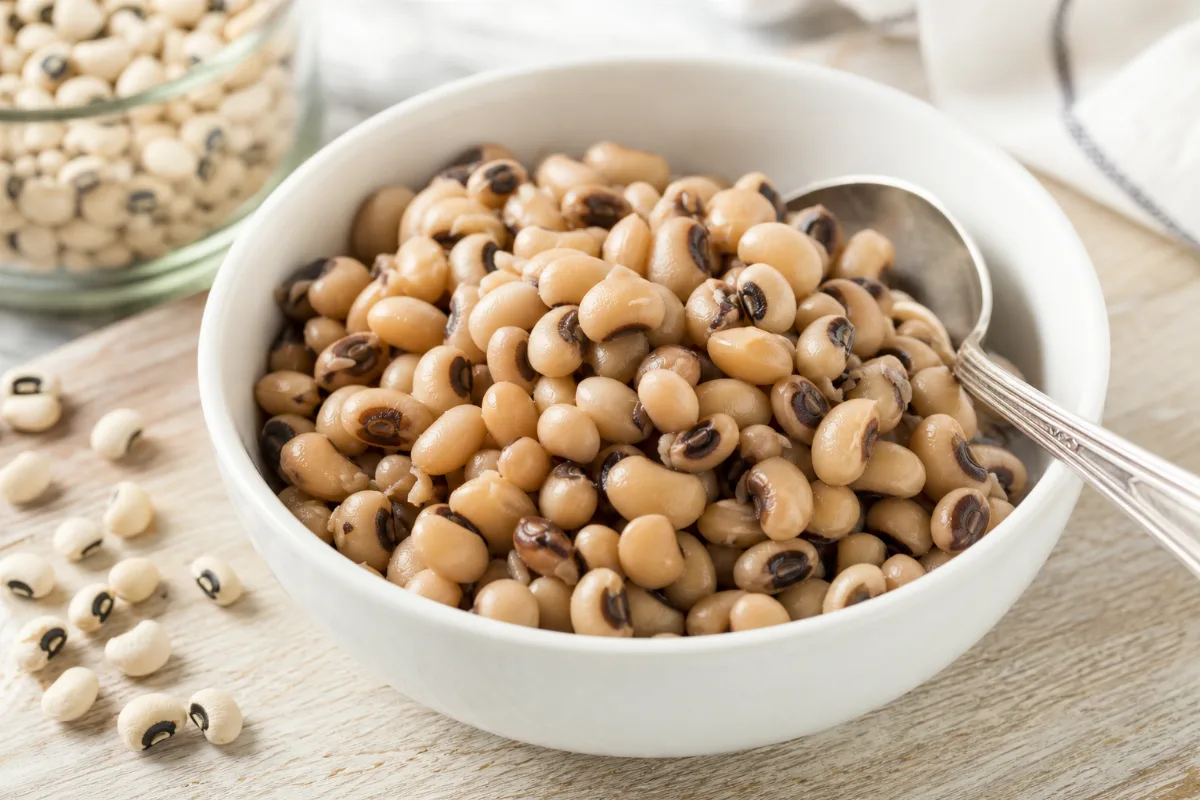
Black-eyed peas, also called cowpeas, are cream-coloured seeds with a dark spot, eaten cooked in stews, salads and rice dishes. They give fibre, plant protein, folate and iron. Studies of pulses and legumes in general link them to slightly lower cholesterol and blood pressure risk, but black-eyed peas alone have had only one very small human test. The main cautions are legume or peanut allergy, eating them fully cooked, gas in some people, and checking with your clinic if you have kidney disease or take warfarin.
General information, not medical advice. Last substantive update · Not medically reviewed. A named clinician has not signed off on this page. How this page is made
About Black-Eyed Peas (Cowpeas)
Black-eyed peas are a nutritious legume with fibre, plant protein, folate and iron. They are a healthy food, not a proven remedy: the health findings come from studies of pulses or legumes in general, plus one very small test of cowpeas.
What it is
Black-eyed peas (Vigna unguiculata), also called cowpeas, are the cream-coloured seeds with a dark spot of a legume in the pea family. They are usually boiled until tender and eaten in stews, salads and rice dishes. GBIF lists Vigna unguiculata (L.) Walp. as the accepted name.
USDA data for boiled black-eyed peas without salt: 116 kcal per 100 g. One cup (171 g) has about 198 kcal, 13.2 g protein, 11.1 g fibre, 356 micrograms folate (DFE), 4.3 mg iron, 475 mg potassium and 267 mg phosphorus. Raw dry cowpeas show 336 kcal per 100 g only because they hold little water. Canned and frozen values were not read.
What the research shows
The firmest facts are about nutrients: fibre helps bowel function and soluble fibre is linked to lower cholesterol, and folate is a B vitamin. These are not trials of black-eyed peas.
Pooled trials of pulses and legumes found LDL cholesterol 0.16 to 0.17 mmol/L lower, fasting blood sugar lower, and a very small weight loss of about 0.34 kg. Cohort studies link more legumes to lower risk of high blood pressure (RR 0.84) and a little less heart disease (RR 0.94) but not stroke. Cohort studies cannot prove cause.
For black-eyed peas alone, we found one trial: 11 healthy adults ate cooked cowpea varieties and had a lower blood sugar response than with glucose, and one variety gave the lowest hunger ratings. Cell experiments in the same paper are lab only.
Food versus flours and extracts
The cholesterol, blood sugar and weight results come from trials of whole pulses and legumes. The cowpea blood sugar test used cooked whole cowpeas, and the cell work used digested cowpea in a dish. We read no trial of cowpea flour, protein or extracts and make no claim about them.
Amounts
This page gives no amounts to eat. Ask a doctor, pharmacist or dietitian what is right for you, especially if you take warfarin, have kidney problems or have a food allergy.
At a glance
Traditional uses history, not proof
- Eaten cooked as a food, usually boiled until tender
- Long use as food is not proof that it treats any condition
Studied for research
- Fibre for bowel health, high certainty for the nutrient, no cowpea trial
- Folate and plant protein, high certainty for the nutrients
- Cholesterol, low certainty (trials of pulses and legumes as a group)
- Blood pressure, low certainty (observational, legumes as a group)
- Blood sugar, low certainty (one 11-person cowpea test and pulse trials)
- Body weight, low certainty (very small effect, pulses as a group)
- Heart disease, low certainty (observational, mixed)
Main compounds
- Fibre
- Folate
- Iron
- Potassium
- Phosphorus
- Galacto-oligosaccharides
- Cowpea storage proteins (vicilins)
Common forms
- Dry black-eyed peas, boiled until tender, as food
- Canned black-eyed peas (nutrient values not read)
- Frozen black-eyed peas (nutrient values not read)
- Fresh (green) cowpeas eaten in some regions (values not read)
- Flours, protein isolates and extracts are different products and are not covered
Research links: 2025 test: cowpea varieties, blood sugar and fullness · 2022 study: cowpea allergy and cross-reactivity with pea and peanut · 2024 meta-analysis: legumes, cholesterol and blood sugar · Research Library · Genes & Biomarkers Library
What it is and its history
- Accepted scientific name
- Vigna unguiculata
- Naming authority
- (L.) Walp. (GBIF accepted)
- Common names
- Black-eyed peas (English); Cowpeas (English); Blackeye peas (English); Southern peas (English); Crowder peas (English); Black-eyed beans (English); Lobia (Hindi/Urdu (from the existing nutrient summary)); Frijol caupi (Spanish)
- Family or group
- Fabaceae (the legume or pea family), as given by GBIF and by the existing nutrient summary (legume pulses).
- Classification
- Plantae > Tracheophyta > Magnoliopsida > Fabales > Fabaceae > Vigna > Vigna unguiculata
- Native range
- Not verified from a source read.
- Habitat
- Not verified from a source read.
- What it looks like
- Roots: Not verified.; Stems: Not verified.; Leaves: Not verified.; Flowers: Not verified.; Fruit: The cream-coloured seeds with a dark spot are eaten, usually boiled until tender (existing nutrient summary). Fresh (green) cowpeas are eaten in some regions.
- Cultivation
- Not verified from a source read.
- Harvest and processing
- Sold dry, canned or frozen; fresh (green) cowpeas in some regions (existing nutrient summary). A 2025 trial used four named Brazilian varieties.
- Look-alikes and adulterants
- Name: Other peas and beans; Note: Green peas, split peas, pigeon peas, pinto beans and chickpeas are different legumes with separate pages and different nutrient values.; Name: Mung beans and adzuki beans; Note: Other Vigna species; not the same food.
- Sustainability and conservation
- Not assessed.
Photographs
What is inside, and how it may work
What it contains and how those compounds act in cells and animals. Laboratory and animal mechanisms are not proven effects in people.
Main compounds
| Compound | Family | Where it is concentrated | Activity studied | Level of evidence |
|---|---|---|---|---|
| Dietary fibre | carbohydrate | Seed USDA: 6.5 g per 100 g boiled | Beans are named as a soluble fibre food by MedlinePlus; soluble fibre has been linked to lower cholesterol. 19 27 | Human data |
| Folate (vitamin B9) PubChem 135398658 | vitamin | Seed USDA: 208 micrograms DFE per 100 g boiled | A B vitamin needed for cell growth; MedlinePlus names dried beans and peas as folate foods. 20 27 | Human data |
| Iron | mineral | Seed USDA: 2.51 mg per 100 g boiled | Content is a USDA value. How well the body absorbs iron from black-eyed peas was not read. Some trial varieties were bred to be iron-biofortified. 27 6 | Human data |
| Potassium and phosphorus | mineral | Seed USDA: potassium 278 mg and phosphorus 156 mg per 100 g boiled | Matter for people with advanced kidney disease (MedlinePlus, National Kidney Foundation). A 2021 review found at least 50% of phytate-phosphorus in plant foods is absorbed. 27 21 25 2 | Human data |
| Galacto-oligosaccharides | oligosaccharide | Seed Not read for black-eyed peas | A hospital leaflet says these fermentable carbohydrates are mainly found in beans and pulses and can cause gut symptoms in people on a low-FODMAP plan. 16 | Human data |
| Cowpea storage proteins (vicilins and seed albumin) | protein | Seed Not given | Four IgE-binding proteins identified; they drive cross-reactivity with pea and peanut in the lab. 3 | Human data |
Mechanisms, receptors and pathways
| Target or pathway | Gene or receptor | What was found | Level |
|---|---|---|---|
| Blood sugar response after a meal | Not applicable | Cooked cowpeas gave a lower blood sugar response than glucose in 11 healthy adults. The paper suggests fibre and bioactive compounds; the mechanism was not tested. 6 | Human data |
| Inflammation switch NF-kB | NF-kB in RAW 264.7 cells | Digested cowpea reduced NF-kB activation in stimulated cells in a dish, with no change in SOD, nitric oxide, TNF-alpha or IL-10. Lab only. 6 | Laboratory research |
| Allergy (IgE cross-reactivity) | IgE binding to vicilins | Cowpea extract and its vicilin fraction strongly inhibited IgE binding to pea and peanut extract; basophils from allergic children reacted to cowpea after peanut, lentil and pea. 3 | Human data |
| Gut fermentation of galacto-oligosaccharides | Not applicable | Beans and pulses are the main food source of galacto-oligosaccharides, which ferment in the gut and can cause gas (hospital leaflet). 16 | Authoritative guidance |
Absorption, metabolism and elimination
- Absorption
- Not found for black-eyed peas. A 2021 review of human studies found at least 50% of phytate-phosphorus from plant foods is absorbed.
- Distribution
- Not found.
- Metabolism
- Not found.
- Elimination
- Not found.
- Bioavailability
- Not established for most black-eyed pea nutrients in the sources read, including iron and folate.
Isolated compounds versus whole extracts
The cholesterol, blood sugar and weight results come from trials of whole pulses and legumes of many kinds. The cowpea blood sugar test used cooked whole cowpeas. The cell experiment used digested cowpea in a dish. We read no trial of cowpea flour, protein isolate or extract and make no claim about them.
Nutritional composition
Nutrition from USDA FoodData Central (cowpeas, common (blackeyes, crowder, southern), mature seeds, boiled, without salt, FDC 173759, SR Legacy, April 2018 release; read 2026-10-26 from a saved copy of the data). Per 100 g: 116 kcal, 7.73 g protein, 0.53 g fat, 20.76 g carbohydrate, 3.3 g total sugars, 6.5 g fibre, about 70 g water, 24 mg calcium, 2.51 mg iron, 53 mg magnesium, 156 mg phosphorus, 278 mg potassium, 4 mg sodium, 1.29 mg zinc, 0.475 mg manganese, 0.268 mg copper, 0.202 mg thiamin, 0.1 mg vitamin B6, 208 micrograms folate (DFE) and 1.7 micrograms vitamin K. One cup of boiled black-eyed peas (171 g): about 198 kcal, 13.2 g protein, 0.9 g fat, 35.5 g carbohydrate, 11.1 g fibre, 5.6 g sugars, 4.3 mg iron, 475 mg potassium, 267 mg phosphorus, 90.6 mg magnesium, 356 micrograms folate and 2.9 micrograms vitamin K (the per-cup figures are the per-100 g values multiplied by 1.71). Raw dry cowpeas (FDC 173758) are 336 kcal and 23.52 g protein per 100 g only because they hold little water; do not compare them with boiled values. Values vary with variety, growing place and cooking. Canned and frozen values were not read.
3 high certainty5 low certainty2 not enough evidence
What was looked at
The 10 benefits and uses checked for Black-Eyed Peas (Cowpeas), each with how strong the evidence is. Tap one to open it.
- Fibre for bowel healthHigh certainty
- Cholesterol (pulses and legumes as a group)Low certainty
- Blood pressure (legumes, observational)Low certainty
- Blood sugar (cowpea trial and pulses as a group)Low certainty
- Body weight (pulses as a group)Low certainty
- Heart disease (legumes, observational)Low certainty
- Hunger and fullness after a mealNot enough evidence
- Folate (vitamin B9)High certainty
- Plant proteinHigh certainty
- Inflammation markers (cell study only)Not enough evidence
Lab markers tracked in the studies
LDL cholesterolFasting blood glucoseBlood sugar response after a mealBody weightCoronary heart disease risk
What is Black-Eyed Peas (Cowpeas) good for?
The main studied uses and how strong the human evidence is for each. Most results are for pulses or legumes as a group, not for eating black-eyed peas.
Benefits, one by one
Each card is a research question, not a promise. Tap a goal to filter. Open a card to see the studies, doses and limits.
Fibre for bowel health
High certaintyCooked black-eyed peas have 6.5 g of fibre per 100 g and about 11.1 g in one cup (171 g), by USDA data. MedlinePlus says beans, lentils and peas are soluble fibre foods. This is a nutrient fact, not a trial of black-eyed peas.
2 studiesCooked black-eyed peas as food. Canned and frozen forms were not stud…
Studies, doses and limits
What the trials found
MedlinePlus says soluble fibre is found in oat bran, barley, nuts, seeds, beans, lentils, peas and some fruits and vegetables, and that research has shown soluble fibre helps lower cholesterol. It does not name cowpeas. USDA lists 6.5 g of total fibre per 100 g of boiled cowpeas (6.5 x 1.71 = about 11.1 g in a 171 g cup).
Results
The fibre role is well accepted and black-eyed peas contain fibre. USDA does not split the fibre into soluble and insoluble. No trial of eating black-eyed peas for bowel function was found.
Effect sizes as reported
USDA: 6.5 g fibre per 100 g boiled cowpeas; about 11.1 g per cup (171 g).
Why this rating
High for the role of fibre and for cowpeas containing it (health-agency statement and USDA data). No cowpea bowel trial was read.
Form and dose studied
Cooked black-eyed peas as food. Canned and frozen forms were not studied in the sources read.
Who was studied
General adult diet.
Limits
A nutrient fact, not a trial of black-eyed peas. How much of the fibre is soluble was not read.
Why researchers looked
Black-eyed peas are a well-known fibre food, so people ask what the fibre does for the gut and for cholesterol.
Traditional use
Black-eyed peas (cowpeas) are eaten cooked, usually boiled until tender, in stews, salads and rice dishes. Long use as food is not proof that it treats any condition.
Proposed mechanism Authoritative guidance
Soluble fibre attracts water and turns to gel during digestion, which slows digestion; insoluble fibre adds bulk to stool and helps food pass more quickly (MedlinePlus).
A proposed mechanism does not show that the effect happens in people.
Fibre-rich beans can cause gas and bloating in some people; see the Safety tab.
Cholesterol (pulses and legumes as a group)
Low certaintyPooled trials of pulses and legumes found a small fall in LDL ("bad") cholesterol, about 0.16 to 0.17 mmol/L. No trial of black-eyed peas alone on cholesterol was found.
2 studiesPulses and legumes as food (trial detail: median 130 g a day and an 8…
Studies, doses and limits
What the trials found
A 2014 meta-analysis of 26 randomised trials (1,037 adults, at least 3 weeks) found diets emphasising pulses (median 130 g a day) lowered LDL cholesterol by 0.17 mmol/L (95% CI -0.25 to -0.09) compared with diets without pulses. A 2024 meta-analysis of 24 trials (1,938 adults, at least 6 weeks, legumes averaging 86 g a day) found moderate-certainty (GRADE) falls in total cholesterol (-0.23 mmol/L) and LDL cholesterol (-0.16 mmol/L).
Results
A small average fall in a blood marker. Apolipoprotein B and non-HDL cholesterol did not change in the 2014 analysis. The effect depended on the type and format of legume in the 2024 analysis.
Effect sizes as reported
LDL cholesterol -0.17 mmol/L (-0.25 to -0.09); -0.16 mmol/L (-0.24 to -0.08). Total cholesterol -0.23 mmol/L (-0.33 to -0.13).
Why this rating
The reviewers graded the legume-group result moderate, but it is rated low here because no trial tested black-eyed peas alone and a blood marker is not a heart-disease outcome.
Form and dose studied
Pulses and legumes as food (trial detail: median 130 g a day and an 86 g a day average, not advice).
Who was studied
Adults with and without existing conditions.
Limits
Pulses and legumes of many types; black-eyed peas were not singled out in the abstracts. A fall in LDL does not show fewer heart attacks.
Why researchers looked
Beans and peas are rich in fibre and low in saturated fat, so researchers ask whether eating them improves blood fats.
Traditional use
Black-eyed peas (cowpeas) are eaten cooked, usually boiled until tender, in stews, salads and rice dishes. Long use as food is not proof that it treats any condition.
Proposed mechanism Authoritative guidance
Not established in the abstracts read. MedlinePlus says soluble fibre helps lower cholesterol.
A proposed mechanism does not show that the effect happens in people.
None specific.
Blood pressure (legumes, observational)
Low certaintyPeople who ate the most legumes had about 16% lower risk of developing high blood pressure. It is an association from cohort studies, not proof, and not about black-eyed peas alone.
1 studiesLegumes as food, intake levels as reported in cohorts.
Studies, doses and limits
What the trials found
A 2026 meta-analysis of 12 prospective cohort studies found that high versus low legume intake was linked to lower risk of developing hypertension, RR 0.84 (95% CI 0.77 to 0.93; 10 studies, 309,853 people), and RR 0.88 (0.80 to 0.97) per 100 g a day. The reviewers judged a causal link 'probable' by World Cancer Research Fund criteria. Heterogeneity was moderate to high (I2 65%).
Results
An association in populations. It does not show that adding black-eyed peas to your diet lowers your pressure.
Effect sizes as reported
RR 0.84 (0.77 to 0.93) high versus low; RR 0.88 (0.80 to 0.97) per 100 g a day.
Why this rating
Observational studies of legumes as a group; no trial of black-eyed peas on blood pressure was found. The study is linked to a plant-based health professionals group (see the study notes).
Form and dose studied
Legumes as food, intake levels as reported in cohorts.
Who was studied
Adults in prospective cohorts.
Limits
Cannot prove cause; eating habits that go with high legume intake may matter; moderate-to-high heterogeneity; some publication bias.
Why researchers looked
Legumes are rich in potassium and fibre, so researchers ask whether eating more is linked to lower blood pressure.
Traditional use
Black-eyed peas (cowpeas) are eaten cooked, usually boiled until tender, in stews, salads and rice dishes. Long use as food is not proof that it treats any condition.
Proposed mechanism Unknown
Not established in the abstract.
A proposed mechanism does not show that the effect happens in people.
People on blood pressure medicines or with kidney disease should ask about potassium-rich foods; see the Safety tab.
Blood sugar (cowpea trial and pulses as a group)
Low certaintyIn one small test of 11 healthy adults, cooked cowpea varieties gave a lower blood sugar response than glucose. Pooled trials of pulses found lower fasting blood sugar. Evidence for black-eyed peas alone is one very small test.
3 studiesCooked cowpea seeds and pulses as food (portion detail not in the abs…
Studies, doses and limits
What the trials found
A 2025 trial in Brazil gave 11 healthy adults four cooked cowpea varieties (three iron-biofortified, one conventional) and a glucose control. All four cowpeas had a lower blood sugar response (incremental area under the curve) than glucose over 120 minutes. A 2009 meta-analysis of 41 trials found pulses alone (11 trials) lowered fasting glucose (SMD -0.82; 95% CI -1.36 to -0.27) and insulin, with large unexplained differences between trials. A 2024 meta-analysis found moderate-certainty (GRADE) evidence of a 0.18 mmol/L lower fasting glucose with legumes.
Results
Every cowpea gave a lower response than glucose, which is the reference food, so this alone is weak proof of a benefit. The abstract gives no glycaemic index numbers. The pooled pulse results are about pulses as a group.
Effect sizes as reported
Cowpea trial: lower incremental area under the glucose curve than glucose (p<0.05). Pulses alone: fasting glucose SMD -0.82 (-1.36 to -0.27). Legumes: fasting glucose -0.18 mmol/L (-0.30 to -0.06).
Why this rating
One 11-person single-meal test of black-eyed-pea-type cowpeas plus pooled trials of pulses with high unexplained differences. Not a test in people with diabetes.
Form and dose studied
Cooked cowpea seeds and pulses as food (portion detail not in the abstracts).
Who was studied
Healthy adults (cowpea trial); people with and without diabetes (pooled trials).
Limits
Tiny trial, Brazilian cultivars, comparison with glucose; pooled results are for pulses as a group.
Why researchers looked
Beans and cowpeas contain fibre, protein and slowly digested starch, so researchers ask how they change blood sugar after a meal.
Traditional use
Black-eyed peas (cowpeas) are eaten cooked, usually boiled until tender, in stews, salads and rice dishes. Long use as food is not proof that it treats any condition.
Proposed mechanism Unknown
The cowpea paper suggests fibre and slowly digested carbohydrate; this was not tested directly.
A proposed mechanism does not show that the effect happens in people.
People who take diabetes medicines should ask their clinic before changing how they eat.
Body weight (pulses as a group)
Low certaintyPooled trials found people eating pulses lost slightly more weight than people not eating them, about 0.34 kg on average over about 6 weeks. That is very small, and the trials were about pulses as a group, not black-eyed peas.
1 studiesPulses as food (trial detail: median 132 g a day, not advice).
Studies, doses and limits
What the trials found
A 2016 meta-analysis of 21 randomised trials (940 adults, median 6 weeks) found diets with about one serving a day of whole pulses (median 132 g a day) reduced body weight by 0.34 kg (95% CI -0.63 to -0.04; P=0.03) compared with diets without them. Six trials suggested a possible fall in body fat percentage.
Results
A modest average change, even when diets were not meant to cut calories. Long-term effects are unknown.
Effect sizes as reported
Weight -0.34 kg (95% CI -0.63 to -0.04).
Why this rating
Randomised trials but a very small, short-term effect; none tested black-eyed peas alone.
Form and dose studied
Pulses as food (trial detail: median 132 g a day, not advice).
Who was studied
Adults in trials.
Limits
Short trials; pulses as a group; the average change is tiny.
Why researchers looked
Pulses are filling foods rich in fibre and protein, so researchers ask whether they help weight control.
Traditional use
Black-eyed peas (cowpeas) are eaten cooked, usually boiled until tender, in stews, salads and rice dishes. Long use as food is not proof that it treats any condition.
Proposed mechanism Unknown
Not established in the abstract.
A proposed mechanism does not show that the effect happens in people.
None specific.
Heart disease (legumes, observational)
Low certaintyHigher legume intake was linked to a little less cardiovascular disease and coronary heart disease, but not stroke. It is an association from observational studies, not about black-eyed peas alone.
1 studiesLegumes as food, intake levels as reported in cohorts.
Studies, doses and limits
What the trials found
A 2023 meta-analysis of 26 observational studies (21 prospective cohorts, 5 case-control studies) compared the highest with the lowest legume intake: cardiovascular disease RR 0.94 (95% CI 0.89 to 0.99), coronary heart disease RR 0.90 (0.85 to 0.96), stroke RR 1.00 (0.93 to 1.08). The dose-response analysis for coronary heart disease levelled off at about 400 g a week.
Results
A small lower risk for heart disease and no difference for stroke in people who ate the most legumes.
Effect sizes as reported
CVD RR 0.94 (0.89 to 0.99); CHD RR 0.90 (0.85 to 0.96); stroke RR 1.00 (0.93 to 1.08).
Why this rating
Observational and for legumes as a group. The result is mixed, with a small benefit for heart disease and none for stroke.
Form and dose studied
Legumes as food, intake levels as reported in cohorts.
Who was studied
Adults in cohort and case-control studies.
Limits
Cannot prove cause; people who eat legumes may differ in other ways.
Why researchers looked
Large studies track what people eat and later heart events, so researchers ask whether legume eaters have fewer.
Traditional use
Black-eyed peas (cowpeas) are eaten cooked, usually boiled until tender, in stews, salads and rice dishes. Long use as food is not proof that it treats any condition.
Proposed mechanism Unknown
Not established in the abstract.
A proposed mechanism does not show that the effect happens in people.
None specific.
Hunger and fullness after a meal
Not enough evidenceIn one small test of 11 healthy adults, one conventional cowpea variety (Pajeu) gave the lowest hunger and highest fullness ratings. One tiny trial, so very uncertain.
1 studiesCooked cowpea seeds (portion detail not in the abstract).
Studies, doses and limits
What the trials found
In the 2025 trial of 11 healthy adults, the conventional variety BRS Pajeu had the lowest 'hunger sensation' and highest 'satiety sensation' ratings (p<0.05) over 120 minutes.
Results
One variety looked more filling than the others in one small test. It does not show that black-eyed peas help with weight control.
Effect sizes as reported
Hunger lowest and fullness highest with Pajeu (p<0.05; no numbers in the abstract).
Why this rating
A single 11-person trial with self-rated hunger over two hours and no black-eyed pea variety named.
Form and dose studied
Cooked cowpea seeds (portion detail not in the abstract).
Who was studied
Healthy adults.
Limits
Very small trial, subjective ratings, results for one variety.
Why researchers looked
Fibre and protein can make a meal more filling, so researchers measure hunger and fullness ratings.
Traditional use
Black-eyed peas (cowpeas) are eaten cooked, usually boiled until tender, in stews, salads and rice dishes. Long use as food is not proof that it treats any condition.
Proposed mechanism Unknown
Not established.
A proposed mechanism does not show that the effect happens in people.
None specific.
Folate (vitamin B9)
High certaintyCooked black-eyed peas are a rich folate food: 208 micrograms (DFE) per 100 g and about 356 micrograms in one cup, by USDA data. MedlinePlus names dried beans and peas as folate foods and advises folic acid for women planning pregnancy.
3 studiesCooked black-eyed peas as food. Canned and frozen forms were not stud…
Studies, doses and limits
What the trials found
MedlinePlus says folate occurs naturally in foods such as dark green leafy vegetables, dried beans and peas (legumes) and citrus fruit, and that higher folic acid before pregnancy and in the first trimester may lower the chances of miscarriage. USDA lists 208 micrograms folate (DFE) per 100 g of boiled cowpeas (about 356 micrograms per 171 g cup). MedlinePlus does not name black-eyed peas.
Results
A nutrient fact about the food. No trial showed that eating black-eyed peas corrects a folate shortfall.
Effect sizes as reported
USDA: 208 micrograms folate (DFE) per 100 g boiled cowpeas.
Why this rating
High for the nutrient role and the USDA value; not a trial of black-eyed peas.
Form and dose studied
Cooked black-eyed peas as food. Canned and frozen forms were not studied in the sources read.
Who was studied
General adult diet; pregnancy planning.
Limits
Nutrient fact only; cooking and canning effects on folate were not read.
Why researchers looked
Folate is needed for cell growth, and folate foods matter before and during pregnancy.
Traditional use
Black-eyed peas (cowpeas) are eaten cooked, usually boiled until tender, in stews, salads and rice dishes. Long use as food is not proof that it treats any condition.
Proposed mechanism Authoritative guidance
Folate helps the body make DNA and new cells (MedlinePlus); neural tube defects are linked to low folate early in pregnancy.
A proposed mechanism does not show that the effect happens in people.
Ask a doctor about folic acid in pregnancy; food alone may not be enough (NHS and MedlinePlus).
Plant protein
High certaintyCooked black-eyed peas have 7.73 g of protein per 100 g and about 13.2 g in one cup, by USDA data. No trial of how well the body uses that protein was read.
2 studiesCooked black-eyed peas as food. Canned and frozen forms were not stud…
Studies, doses and limits
What the trials found
USDA lists 7.73 g protein per 100 g of boiled cowpeas, 23.52 g per 100 g of raw dry cowpeas. The raw dry figure is higher only because the seeds hold little water.
Results
A nutrient fact about the food. Protein quality and digestibility were not read.
Effect sizes as reported
USDA: 7.73 g protein per 100 g boiled; 13.2 g per cup (171 g).
Why this rating
High for the USDA value; no digestibility data was read.
Form and dose studied
Cooked black-eyed peas as food. Canned and frozen forms were not studied in the sources read.
Who was studied
General adult diet.
Limits
Do not compare cooked and raw dry values; protein quality was not studied in the sources read.
Why researchers looked
Beans are a common plant protein source, so people ask how much protein they give.
Traditional use
Black-eyed peas (cowpeas) are eaten cooked, usually boiled until tender, in stews, salads and rice dishes. Long use as food is not proof that it treats any condition.
Proposed mechanism Unknown
Not applicable.
A proposed mechanism does not show that the effect happens in people.
None specific.
Inflammation markers (cell study only)
Not enough evidenceIn a dish, digested cowpea reduced the activation of an inflammation switch (NF-kB) in immune cells, but did not change several other markers. This was not tested in people.
1 studiesDigested cowpea in cell culture, not food as eaten.
Studies, doses and limits
What the trials found
In the 2025 paper, digested cowpea (1 mg/mL) was added to RAW 264.7 cells (a laboratory immune-cell line) stimulated with LPS. Pajeu and Tumucumaque improved total antioxidant capacity and the biofortified varieties reduced NF-kB activation. There was no effect on SOD, nitric oxide, TNF-alpha or IL-10. The authors summarise the effect on induced inflammation as moderate.
Results
A lab signal only. It does not show any effect on inflammation in people.
Why this rating
Lab only: cells in a dish, one paper, mixed results across markers.
Form and dose studied
Digested cowpea in cell culture, not food as eaten.
Limits
No human inflammation outcome was measured.
Why researchers looked
Researchers test digested foods on immune cells to look for signals worth studying in people.
Traditional use
Black-eyed peas (cowpeas) are eaten cooked, usually boiled until tender, in stews, salads and rice dishes. Long use as food is not proof that it treats any condition.
Proposed mechanism Laboratory research
Digested cowpea reduced NF-kB activation and translocation in RAW 264.7 cells stimulated with LPS; antioxidant capacity rose with two varieties.
A proposed mechanism does not show that the effect happens in people.
None specific.
Connections to the rest of health
How Black-Eyed Peas (Cowpeas) connects to the rest of our health knowledge graph. Every link says what kind of connection it is. A safety link (for example to the liver) is a warning, not a benefit. A study that merely mentions a topic never creates a benefit link.
Explore every connection: goals, body systems, organs, symptoms, genes
A. Wellness goals
| Connected to | Kind of connection | Evidence status | Context | Studies |
|---|---|---|---|---|
| Digestive Support | Demonstrated clinical effect | High certainty | Fibre for bowel health: Cooked black-eyed peas have 6.5 g of fibre per 100 g and about 11.1 g in one cup (171 g), by USDA data. MedlinePlus says beans, lentils and peas are soluble fibre foods. This is a nutrient fact, not a trial of black-eyed peas. | 19 27 |
| Cholesterol Balance | Low certainty | Cholesterol (pulses and legumes as a group): Pooled trials of pulses and legumes found a small fall in LDL ("bad") cholesterol, about 0.16 to 0.17 mmol/L. No trial of black-eyed peas alone on cholesterol was found. | 7 9 | |
| Heart Health | Low certainty | Cholesterol (pulses and legumes as a group): Pooled trials of pulses and legumes found a small fall in LDL ("bad") cholesterol, about 0.16 to 0.17 mmol/L. No trial of black-eyed peas alone on cholesterol was found. | 7 9 | |
| Blood Pressure Support | Low certainty | Blood pressure (legumes, observational): People who ate the most legumes had about 16% lower risk of developing high blood pressure. It is an association from cohort studies, not proof, and not about black-eyed peas alone. | 12 | |
| Blood Sugar Balance | Low certainty | Blood sugar (cowpea trial and pulses as a group): In one small test of 11 healthy adults, cooked cowpea varieties gave a lower blood sugar response than glucose. Pooled trials of pulses found lower fasting blood sugar. Evidence for black-eyed peas alone is one very small test. | 6 13 9 | |
| Weight Management | Low certainty | Body weight (pulses as a group): Pooled trials found people eating pulses lost slightly more weight than people not eating them, about 0.34 kg on average over about 6 weeks. That is very small, and the trials were about pulses as a group, not black-eyed peas. Hunger and fullness after a meal: In one small test of 11 healthy adults, one conventional cowpea variety (Pajeu) gave the lowest hunger and highest fullness ratings. One tiny trial, so very uncertain. | 10 6 | |
| Heart Health | Low certainty | Heart disease (legumes, observational): Higher legume intake was linked to a little less cardiovascular disease and coronary heart disease, but not stroke. It is an association from observational studies, not about black-eyed peas alone. | 11 | |
| Healthy Aging | Low certainty | Heart disease (legumes, observational): Higher legume intake was linked to a little less cardiovascular disease and coronary heart disease, but not stroke. It is an association from observational studies, not about black-eyed peas alone. | 11 |
B. Body systems
| Connected to | Kind of connection | Evidence status | Context | Studies |
|---|---|---|---|---|
| Digestive System | Biological association | High certainty | Studied for: Fibre for bowel health Studied for: Hunger and fullness after a meal | 19 27 6 |
| Cardiovascular System | Biological association | Low certainty | Studied for: Cholesterol (pulses and legumes as a group) Studied for: Blood pressure (legumes, observational) | 7 9 12 11 |
| Endocrine System | Biological association | Low certainty | Studied for: Blood sugar (cowpea trial and pulses as a group) | 6 13 9 |
| Metabolism Weight | Biological association | Low certainty | Studied for: Blood sugar (cowpea trial and pulses as a group) Studied for: Body weight (pulses as a group) | 6 13 9 10 |
| Blood And Immune | Biological association | High certainty | Studied for: Folate (vitamin B9) Studied for: Inflammation markers (cell study only) | 20 27 23 6 |
| Reproductive System | Biological association | High certainty | Studied for: Folate (vitamin B9) | 20 27 23 |
| Nutrition | Biological association | High certainty | Studied for: Plant protein | 27 26 |
C. Body parts and organs
| Connected to | Kind of connection | Evidence status | Context | Studies |
|---|---|---|---|---|
| Gut | Adverse effect or risk | Documented risk | 19% of people reported more gas in week 1 in small feeding studies, lower than with pinto or baked beans. Gas in some people; 19% reported more gas in week 1 in small feeding studies. Preparation or compound: Cooked black-eyed peas |
14 16 |
| Kidneys | Adverse effect or risk | Documented risk | Potassium and phosphorus matter in advanced kidney disease; ask a kidney dietitian. Preparation or compound: Potassium and phosphorus in cooked black-eyed peas |
27 21 25 |
E. Health conditions
| Connected to | Kind of connection | Evidence status | Context | Studies |
|---|---|---|---|---|
| Food allergy | Adverse effect or risk | Documented risk | Most legume-allergic children in one study were sensitised to cowpea, and cowpea proteins cross-reacted with pea and peanut in the lab. Cowpea proteins cross-reacted with pea and peanut in legume-allergic children. Preparation or compound: Cowpea storage proteins (vicilins) |
3 1 |
I. Biomarkers
| Connected to | Kind of connection | Evidence status | Context | Studies |
|---|---|---|---|---|
| LDL cholesterol | Biological association | Low certainty | Measured in trials: lowered. A lab change is not the same as a health benefit. | 7 9 |
| Fasting blood glucose | Biological association | Low certainty | Measured in trials: lowered. A lab change is not the same as a health benefit. | 13 9 |
| Blood sugar response after a meal | Biological association | Low certainty | Measured in trials: lowered. A lab change is not the same as a health benefit. | 6 |
| Body weight | Biological association | Low certainty | Measured in trials: lowered. A lab change is not the same as a health benefit. | 10 |
| Coronary heart disease risk | Biological association | Low certainty | Measured in trials: lowered. A lab change is not the same as a health benefit. | 11 |
K. Biological pathways
| Connected to | Kind of connection | Evidence status | Context | Studies |
|---|---|---|---|---|
| Fibre | Preliminary mechanism | Human | Beans are a fibre food; soluble fibre is linked to lower cholesterol. | 19 |
| Folate | Preliminary mechanism | Human | Boiled black-eyed peas are a folate food (USDA). | 20 27 |
| NF-kB signalling | Preliminary mechanism | In vitro | Reduced in immune cells in a dish by digested cowpea; not tested in people. | 6 |
| Legume and peanut allergy | Preliminary mechanism | Human | Cowpea proteins cross-react with pea and peanut. | 3 |
L. Active compounds
| Connected to | Kind of connection | Evidence status | Context | Studies |
|---|---|---|---|---|
| Dietary fibre | Biological association | Human | Beans are named as a soluble fibre food by MedlinePlus; soluble fibre has been linked to lower cholesterol. Preparation or compound: Seed |
19 27 |
| Folate (vitamin B9) | Biological association | Human | A B vitamin needed for cell growth; MedlinePlus names dried beans and peas as folate foods. Preparation or compound: Seed |
20 27 |
| Iron | Biological association | Human | Content is a USDA value. How well the body absorbs iron from black-eyed peas was not read. Some trial varieties were bred to be iron-biofortified. Preparation or compound: Seed |
27 6 |
| Potassium and phosphorus | Biological association | Human | Matter for people with advanced kidney disease (MedlinePlus, National Kidney Foundation). A 2021 review found at least 50% of phytate-phosphorus in plant foods is absorbed. Preparation or compound: Seed |
27 21 25 2 |
| Galacto-oligosaccharides | Biological association | Human | A hospital leaflet says these fermentable carbohydrates are mainly found in beans and pulses and can cause gut symptoms in people on a low-FODMAP plan. Preparation or compound: Seed |
16 |
| Cowpea storage proteins (vicilins and seed albumin) | Biological association | Human | Four IgE-binding proteins identified; they drive cross-reactivity with pea and peanut in the lab. Preparation or compound: Seed |
3 |
Each connection is stored with the ingredient, the connected record, the kind of connection, the evidence status, the supporting studies, the preparation or compound involved, and a review date (last reviewed October 26, 2026).
The evidence
The research centre for Black-Eyed Peas (Cowpeas). Every record here was checked against PubMed or the publisher's page; we never list a study we have not verified.
Evidence by outcome
Bars show how many studies we found for each outcome, not how well it works. People are added up across trials only (reviews are not added, to avoid double counting).
How we rate evidence
High certainty
Several well-run trials or reviews agree; further research is unlikely to change the picture much.
Moderate certainty
Good trials point the same way, but some doubt remains.
Low certainty
Small, short or inconsistent trials. The finding could change with better research.
Very low certainty
Very little or very weak human data. Treat as a possibility only.
Mixed findings
Trials or reviews disagree with each other.
Not enough evidence
Not enough human research to say either way.
Evidence against
Good research found no benefit, or found harm.
We take the reviewers' own risk-of-bias and GRADE statements where they exist, and otherwise judge from study size, design, consistency, directness and whether a product matches what is sold. Many publications do not make evidence high. Method note: We started from our existing black-eyed peas summary, re-checked nutrition at USDA FoodData Central, read the health agency pages (NHS, MedlinePlus, FDA, National Kidney Foundation) and re-read each study abstract at PubMed. Only abstracts were read for studies. Items we could not verify are flagged in the research gaps.
Study library: every study we checked 27
| Study | Design | People | Product, dose, length | Result |
|---|---|---|---|---|
| Abu Risha 2024 Legume Allergens Pea, Chickpea, Lentil, Lupine and Beyond. Curr Allergy Asthma Rep · PMID 38990406 · DOI |
Narrative review |
Narrative review of legume allergens (mostly case reports) | Legume allergens (pea, chickpea, lentil, lupine and others) Legumes as food |
Names cowpea among the 'non-priority' legumes (with beans, pea, lentils, chickpea, lupine, pigeon pea and fenugreek) that can cause mild to severe allergic reactions. Severe reactions were described particularly for peas and lupine. Most reactions come from IgE cross-reactions between similar proteins, and most studies are case reports. Not applicable (narrative review) (Not applicable) Methods, limits and fundingOutcomes: Which legumes besides peanut and soybean cause allergic reactions Limitations: Most evidence is case reports; geographic differences are not well mapped. The abstract does not give cowpea-specific numbers. Funding and conflicts: The authors declare no conflict of interest. Read: abstract |
| Calvo 2021 Perspective: Plant-based Whole-Grain Foods for Chronic Kidney Disease: The Phytate-Phosphorus Conundrum. Adv Nutr · PMID 34192744 · DOI |
Narrative review |
Review of human diet studies on phytate-phosphorus (people with and without kidney disease) | Phytate-phosphorus in plant foods including legumes Plant foods · vs Animal protein-bound phosphorus |
Human intervention studies suggest at least 50% of phytate-phosphorus is absorbed, which is less than from animal protein but more than the 10 to 30% often assumed. Food processing and gut bacteria may change this. At least 50% absorption (review conclusion) (Not applicable) Methods, limits and fundingOutcomes: How much phosphorus the body absorbs from phytate in plant foods Limitations: A perspective article, not a trial. It does not name black-eyed peas. Funding and conflicts: Funding is not stated in the abstract. Read: abstract |
| Chentouh 2022 Allergenic risk assessment of cowpea and its cross-reactivity with pea and peanut. Pediatr Allergy Immunol · PMID 36564874 · DOI |
Other |
27 27 children with legume allergy: 14 without peanut allergy and 13 with peanut allergy |
Cowpea protein extract tested with skin-prick tests, blood IgE, lab inhibition tests and white-blood-cell (basophil) activation tests Cowpea seed protein Single assessment |
A majority of legume-allergic children were sensitised to cowpea proteins. Skin-prick tests to cowpea were positive in 8 of 14 (no peanut allergy) and 9 of 13 (peanut allergy); blood IgE in 4 of 13 and 10 of 13. Four IgE-binding proteins were found (vicilins and seed albumin). Cowpea extract strongly inhibited IgE binding to pea and peanut extract. Basophils reacted most to peanut, lentil and pea, then cowpea, soybean, mung bean and lupin. Skin-prick positive 8/14 and 9/13; IgE positive 4/13 and 10/13 (Not given in the abstract) Methods, limits and fundingOutcomes: Skin-prick and IgE sensitisation to cowpea; IgE cross-reactivity with pea and peanut; basophil activation Limitations: Small group of children who were already allergic to legumes. Sensitisation on a test is not the same as a reaction after eating. The authors say the findings expose legume-allergic patients to a risk of clinical cross-reactivity. Funding and conflicts: The authors declare no conflicts of interest. Read: abstract |
| Choi 2004 Purine-rich foods, dairy and protein intake, and the risk of gout in men. N Engl J Med · PMID 15014182 · DOI |
Cohort study |
47150 47,150 men followed for 12 years, with 730 new cases of gout |
Purine-rich foods (meat, seafood, dairy, purine-rich vegetables and protein) Food-frequency questionnaire Observational 12 years · vs Lowest intake group |
Meat and seafood intake were linked to higher gout risk and dairy to lower risk. The level of purine-rich vegetable intake and total protein intake was not linked to higher gout risk. Meat RR 1.41; seafood RR 1.51; dairy RR 0.56; purine-rich vegetables not associated (Meat 1.07 to 1.86; seafood 1.17 to 1.95; dairy 0.42 to 0.74) Methods, limits and fundingOutcomes: New cases of gout Limitations: Men only, observational. Black-eyed peas are not named in the abstract. Funding and conflicts: PubMed lists US government (NIH) grants; no industry funding is shown in the record. Read: abstract |
| Chokchaichamnankit 2026 Proteomic and in silico identification of potential allergenic proteins in cowpea (Vigna unguiculata L. Walp) seeds. Food Chem (Oxf) · PMID 41631292 · DOI |
Other in-silico |
Cowpea seed proteins analysed in the laboratory and by computer | Proteomic analysis and in silico (computer) allergen prediction Cowpea seed proteins |
The computer search found 131 potential allergenic proteins, including known allergen types (endochitinase, beta-conglycinin, vicilin) and others not described before. The authors say this needs experimental IgE tests and clinical checks. 131 predicted allergenic proteins (Not applicable) Methods, limits and fundingOutcomes: Potential allergenic proteins in cowpea seeds Limitations: A prediction, not a test in allergic people. It does not show how often cowpea causes reactions. Funding and conflicts: Funding is not stated in the abstract. Read: abstract |
| Grancieri 2025 Glycemic Index and Appetite Response of Iron-Biofortified Cowpeas (Vigna unguiculata (l.) Walp.) in Healthy Adults and Its Effects on Inflammation and Oxidative Stress in Raw 264.7 Cells. J Am Nutr Assoc · PMID 40340696 · DOI |
Controlled trial |
11 11 healthy normal-weight adults (acute meal test); plus a cell-culture experiment |
Four cooked cowpea varieties (three iron-biofortified Brazilian varieties and one conventional variety, BRS Pajeu) versus a glucose control; digested cowpea in RAW 264.7 cells (a laboratory immune-cell line) for the lab part Cooked cowpea seeds as food Portion detail not given in the abstract (trial detail, not advice) Single test meals; blood sugar and appetite over 120 minutes · vs Glucose |
All four cowpea varieties had a lower blood sugar response than glucose. Pajeu (the conventional variety) had the lowest hunger and highest fullness ratings. In cells, Pajeu and Tumucumaque raised total antioxidant capacity, and the biofortified varieties reduced NF-kB activation. There was no effect on SOD, nitric oxide, TNF-alpha or IL-10. Lower incremental area under the glucose curve than the glucose control for every variety (p<0.05 per the abstract); hunger lowest and fullness highest with Pajeu (p<0.05). The abstract gives no glycaemic index numbers. (Not given in the abstract) Methods, limits and fundingOutcomes: Blood sugar response (incremental area under the curve), hunger and fullness ratings; in cells: antioxidant capacity, nitric oxide, SOD, TNF-alpha, IL-10 and NF-kB Limitations: Only 11 people and single meals. The comparison food (glucose) is the reference for glycaemic index, so a lower response than glucose is expected of most foods. Brazilian cultivars, not necessarily the black-eyed peas sold elsewhere. The cell results are lab only. Funding and conflicts: Funding is not stated in the abstract (PubMed lists non-US government research support). Registration: Brazilian Clinical Trials Registry RBR-7ntftdv Read: abstract |
| Ha 2014 Effect of dietary pulse intake on established therapeutic lipid targets for cardiovascular risk reduction: a systematic review and meta-analysis of randomized controlled trials. CMAJ · PMID 24710915 · DOI |
Systematic review meta analysis |
1037 1,037 adults in 26 randomised trials of at least 3 weeks |
Diets emphasising pulses (beans, chickpeas, lentils and peas), median 130 g a day (trial detail, not advice) Whole pulses as food Median 130 g a day (about 1 serving), trial detail not advice At least 3 weeks · vs Isocaloric diets without pulses |
LDL cholesterol was lower with pulse diets. Apolipoprotein B and non-HDL cholesterol did not change. LDL cholesterol mean difference -0.17 mmol/L (95% CI -0.25 to -0.09 mmol/L) Methods, limits and fundingOutcomes: LDL cholesterol, apolipoprotein B, non-HDL cholesterol Limitations: Pulses as a group, not black-eyed peas alone. The authors call for longer, higher-quality trials. Funding and conflicts: PubMed lists a Canadian Institutes of Health Research grant; other funding or conflicts were not read. Registration: ClinicalTrials.gov NCT01594567 Read: abstract |
| Haile 2026 Severe red kidney beans toxicity in an 8-year-old girl: a rare case of hypovolemic shock and prerenal acute kidney injury. Int J Emerg Med · PMID 41714947 · DOI |
Case report human-case-report |
1 One 8-year-old girl |
A home-cooked red kidney bean dish (Phaseolus vulgaris), not cowpea Insufficiently cooked red kidney beans Symptoms usually 1 to 3 hours after eating |
Raw or insufficiently cooked red kidney beans contain high levels of the lectin phytohaemagglutinin and can cause poisoning, usually nausea, vomiting and diarrhoea. In this rare case a child had shock and a brief kidney injury and recovered fully with fluids and supportive care. There is no antidote. One case (Not applicable) Methods, limits and fundingOutcomes: Poisoning from the lectin phytohaemagglutinin Limitations: A single case about red kidney beans, not cowpeas. It shows why beans should be cooked fully but says nothing about the lectin level in black-eyed peas. Funding and conflicts: Funding is not stated in the abstract. Read: abstract |
| Hossain 2024 Legume intakes on cardiometabolic profile and gut microbiome function: systematic review and meta-analyses of randomised controlled trials. Eur J Nutr · PMID 39739131 · DOI |
Systematic review meta analysis |
1938 1,938 adults in 24 randomised trials of at least 6 weeks (33 comparisons) |
Legumes of any type provided to adults, average 86 g a day (range 2 to 251; trial detail, not advice) Legumes as food Average 86 g a day (range 2 to 251), trial detail not advice At least 6 weeks · vs Control foods; 70% of comparisons used an isoenergetic control |
Moderate-certainty (GRADE) evidence that higher legume intake improved total cholesterol, LDL cholesterol and fasting blood glucose. No eligible trial reported on the gut microbiome. Results differed with the type and format of legume. Total cholesterol -0.23 mmol/L; LDL cholesterol -0.16 mmol/L; fasting glucose -0.18 mmol/L (Total cholesterol 95% CI -0.33 to -0.13; LDL -0.24 to -0.08; fasting glucose -0.30 to -0.06) Methods, limits and fundingOutcomes: Total cholesterol, LDL cholesterol, fasting blood glucose; gut microbiome (none reported) Limitations: Legumes as a group, not black-eyed peas alone. Improvements were for some blood fats and glucose, not all. Funding and conflicts: The authors declare no conflicts of interest. Registration: PROSPERO CRD42023456953 Read: abstract |
| Kim 2016 Effects of dietary pulse consumption on body weight: a systematic review and meta-analysis of randomized controlled trials. Am J Clin Nutr · PMID 27030531 · DOI |
Systematic review meta analysis |
940 940 adults in 21 randomised trials of at least 3 weeks |
Diets containing whole pulses, median 132 g a day (trial detail, not advice) Whole pulses as food Median 132 g a day (about 1 serving), trial detail not advice Median 6 weeks · vs Diets without pulses |
Pulse diets gave a very small extra weight loss, also in diets not meant to cut calories. Six trials suggested a possible fall in body fat percentage. Body weight -0.34 kg (95% CI -0.63 to -0.04 kg (P=0.03)) Methods, limits and fundingOutcomes: Body weight, waist circumference, body fat Limitations: A very small, short-term effect. Pulses as a group, not black-eyed peas alone. Funding and conflicts: Funding is not stated in the abstract. Registration: ClinicalTrials.gov NCT01594567 Read: abstract |
| Mendes 2023 Intake of legumes and cardiovascular disease: A systematic review and dose-response meta-analysis. Nutr Metab Cardiovasc Dis · PMID 36411221 · DOI |
Systematic review meta analysis |
26 observational studies (21 prospective cohorts and 5 case-control studies) | Habitual legume intake (highest versus lowest category) Legumes as food Optimal level about 400 g a week for coronary heart disease in the dose-response analysis (observational, not advice) Cohort follow-up varied · vs Lowest intake group |
Higher legume intake was linked to a little less cardiovascular disease and coronary heart disease, but not stroke. CVD RR 0.94; CHD RR 0.90; stroke RR 1.00 (CVD 0.89 to 0.99; CHD 0.85 to 0.96; stroke 0.93 to 1.08) Methods, limits and fundingOutcomes: Cardiovascular disease, coronary heart disease and stroke Limitations: Observational, so it cannot show cause. Legumes as a group, not black-eyed peas alone. Funding and conflicts: The authors declare no competing interests. Registration: PROSPERO CRD42021247565 Read: abstract |
| Metoudi 2026 Legume and soy consumption and the risk of hypertension: a systematic review and dose-response meta-analysis of prospective studies. BMJ Nutr Prev Health · PMID 42539997 · DOI |
Systematic review meta analysis |
309853 12 prospective cohort studies (legume analysis: 10 studies, 309,853 people, 86,098 cases of high blood pressure) |
Habitual legume intake (high versus low) and per 100 g a day Legumes as food Observational; the linear reduction held up to about 170 g a day (not advice) Cohort follow-up varied · vs Low intake group |
People with the highest legume intake had lower risk of developing high blood pressure. The authors rated a causal link 'probable' by World Cancer Research Fund criteria. High versus low intake RR 0.84; per 100 g a day RR 0.88 (RR 0.84 (95% CI 0.77 to 0.93, I2 65%); per 100 g a day 0.80 to 0.97) Methods, limits and fundingOutcomes: Risk of developing high blood pressure (hypertension) Limitations: Observational, so it cannot prove cause. Legumes as a group, not black-eyed peas alone. Some publication bias was suggested. Funding and conflicts: Two authors and the person consulted are linked to Plant-Based Health Professionals UK, which funded the work; the funder is stated to have had no role in design, analysis or interpretation. Read: abstract |
| Sievenpiper 2009 Effect of non-oil-seed pulses on glycaemic control: a systematic review and meta-analysis of randomised controlled experimental trials in people with and without diabetes. Diabetologia · PMID 19526214 · DOI |
Systematic review meta analysis |
41 randomised trials in people with and without diabetes | Non-oil-seed pulses (chickpeas, beans, peas, lentils and others), alone or in low-glycaemic-index or high-fibre diets Pulses as food Trial detail not given in the abstract At least 7 days · vs Control diets |
Pulses alone (11 trials) lowered fasting glucose and insulin. Pulses in low-GI diets lowered glycosylated blood proteins, and pulses in high-fibre diets lowered fasting glucose and glycosylated proteins. Differences between trials were large and mostly unexplained. Standardised mean differences: fasting glucose -0.82 and insulin -0.49 (pulses alone); glycosylated proteins -0.28 (low-GI diets) (Fasting glucose -0.82 (95% CI -1.36 to -0.27); insulin -0.49 (-0.93 to -0.04); glycosylated proteins -0.28 (-0.42 to -0.14)) Methods, limits and fundingOutcomes: Fasting blood glucose, insulin, glycosylated blood proteins (HbA1c or fructosamine) Limitations: Pulses as a group, not black-eyed peas alone. High unexplained heterogeneity; older review (2009). Funding and conflicts: Funding is not stated in the abstract (PubMed lists non-US government research support). Read: abstract |
| Winham 2011 Perceptions of flatulence from bean consumption among adults in 3 feeding studies. Nutr J · PMID 22104320 · DOI |
Controlled trial |
17 Adults in three feeding studies; the black-eyed pea arm had 17 people (randomised crossover, three 8-week phases) |
Half a cup a day of pinto beans, black-eyed peas or canned carrots (control) in study 1; baked beans and a control soup in other studies Cooked beans and black-eyed peas as food Half a cup a day (trial detail, not advice) 8 or 12 weeks · vs Canned carrots or control soup |
Fewer than 50% reported more gas from pinto or baked beans in week 1, but only 19% reported more gas with black-eyed peas. 3% to 11% reported more gas even on control diets. The authors conclude fears of gas from beans may be exaggerated and that people differ by bean type. 19% more gas with black-eyed peas in week 1 (against under 50% for pinto and baked beans) (Not given in the abstract) Methods, limits and fundingOutcomes: Weekly questionnaire on perceived gas (flatulence), stool changes and bloating Limitations: Small studies, and the black-eyed pea group had 17 people. Gas was self-reported on a questionnaire. These were studies of heart-disease markers, with gas as a side question. Funding and conflicts: Funding is not stated in the abstract. Read: abstract |
| Wyman 2026 Impacts of Fungal Infection and Mycotoxin Contamination on Nutritional Quality and Safety of Protein-Rich Pulses. Food Saf (Tokyo) · PMID 42800994 · DOI |
Narrative review |
Review of reports of fungal infection and mould toxins in pulses (through 2025) | Fungal infection and mycotoxin contamination of pulses Pulse seeds |
Fungal infections tend to lower the nutritional value of pulse seeds. The authors say pulses are understudied and there are consistent research gaps. Not applicable (narrative review) (Not applicable) Methods, limits and fundingOutcomes: How fungal infection affects the nutrition and safety of pulses Limitations: The abstract does not name cowpeas or give contamination rates. Funding and conflicts: Funding is not stated in the abstract. Read: abstract |
| s-cuh-fodmap Cambridge University Hospitals NHS Foundation Trust: Low FODMAP diet, reducing fermentable carbohydrates in your diet · Source |
Health agency n/a |
Methods, limits and fundingRead: full-text | ||
| s-fda-produce FDA: Selecting and Serving Produce Safely · Source |
Health agency n/a |
Methods, limits and fundingRead: full-text | ||
| s-gbif-vigna-unguiculata GBIF Backbone: Vigna unguiculata (L.) Walp. (usageKey 2982583) · Source |
Reference database n/a |
Methods, limits and fundingRead: full-text | ||
| s-medlineplus-fiber MedlinePlus: Insoluble vs. soluble fiber · Source |
Health agency n/a |
Methods, limits and fundingRead: full-text | ||
| s-medlineplus-folate MedlinePlus: Folic acid in the diet · Source |
Health agency n/a |
Methods, limits and fundingRead: full-text | ||
| s-medlineplus-potassium MedlinePlus: Potassium in diet · Source |
Health agency n/a |
Methods, limits and fundingRead: full-text | ||
| s-medlineplus-vitk MedlinePlus: Vitamin K · Source |
Health agency n/a |
Methods, limits and fundingRead: full-text | ||
| s-nhs-pregnancy-diet NHS: Have a healthy diet in pregnancy · Source |
Health agency n/a |
Methods, limits and fundingRead: full-text | ||
| s-nhs-warfarin NHS: Warfarin · Source |
Health agency n/a |
Methods, limits and fundingRead: full-text | ||
| s-nkf-phosphorus National Kidney Foundation: Smart eating for kidney health, understanding phosphorus in foods · Source |
Health agency n/a |
Methods, limits and fundingRead: full-text | ||
| s-usda-fdc-173758 USDA FoodData Central: Cowpeas, common (blackeyes, crowder, southern), mature seeds, raw (FDC 173758) · Source |
Reference database n/a |
Methods, limits and fundingRead: full-text | ||
| s-usda-fdc-173759 USDA FoodData Central: Cowpeas, common (blackeyes, crowder, southern), mature seeds, cooked, boiled, without salt (FDC 173759) · Source |
Reference database n/a |
Methods, limits and fundingRead: full-text |
What we do not know yet
- No trial of eating ordinary black-eyed peas was found for cholesterol, blood pressure, heart disease or weight; the only cowpea human test was a single meal in 11 healthy adults.
- The pooled trials and cohorts mix beans, lentils, chickpeas, peas and other legumes; a black-eyed-pea-only result was not in the abstracts read.
- How common cowpea allergy is, and how cowpea lectins behave, were not found; the cooking caution rests on red kidney bean reports.
- Canned and frozen nutrient values, heavy metals, pesticide residues, mycotoxins, oxalate, purines, choking risk for young children and pregnancy-specific advice were not researched.
How new research is added
New studies are found by a saved PubMed search and placed in a review queue before the page changes.
Lab markers
What changed in blood or saliva tests during trials. A changed number is not the same as feeling or being healthier, and we give no "normal ranges".
Metabolic 2
LDL cholesterol
Lowered in trials
The 'bad' cholesterol carried in the blood. Higher levels are linked to heart disease risk.
Low certaintyResults and what it means
Why it was measured
It is the usual blood marker used in diet trials for heart risk.
Statistical vs. clinical meaning
A small fall in a blood marker from pulses and legumes as a group. It does not show fewer heart attacks, and black-eyed peas alone were not tested.
Safety implication
None specific.
| Study | Result | People | Product |
|---|---|---|---|
| 7 | LDL cholesterol mean difference -0.17 mmol/L (95% CI -0.25 to -0.09) | 1,037 adults in 26 trials | Diets emphasising pulses (beans, chickpeas, lentils, peas), median 130 g a day |
| 9 | LDL cholesterol -0.16 mmol/L (95% CI -0.24 to -0.08); moderate certainty (GRADE) | 1,938 adults in 24 trials | Legumes, average 86 g a day, at least 6 weeks |
Body weight
Lowered in trials
Total body weight, measured in kilograms.
Low certaintyResults and what it means
Why it was measured
It is the basic outcome in weight-control trials.
Statistical vs. clinical meaning
A very small average difference from pulses as a group.
Safety implication
None specific.
| Study | Result | People | Product |
|---|---|---|---|
| 10 | Body weight -0.34 kg (95% CI -0.63 to -0.04; P=0.03) | 940 adults in 21 trials | Diets with whole pulses, median 132 g a day, median 6 weeks |
Other 3
Fasting blood glucose
Lowered in trials
Blood sugar measured after not eating for several hours.
Low certaintyResults and what it means
Why it was measured
It shows how well the body keeps blood sugar steady between meals.
Statistical vs. clinical meaning
A small average fall with large differences between trials. For pulses as a group.
Safety implication
None specific.
| Study | Result | People | Product |
|---|---|---|---|
| 13 | Pulses alone (11 trials) fasting glucose SMD -0.82 (95% CI -1.36 to -0.27); high unexplained heterogeneity | 41 trials in people with and without diabetes | Non-oil-seed pulses, alone or in low-GI or high-fibre diets |
| 9 | Fasting glucose -0.18 mmol/L (95% CI -0.30 to -0.06); moderate certainty (GRADE) | 1,938 adults in 24 trials | Legumes, average 86 g a day |
Blood sugar response after a meal
Lowered in trials
How far and how long blood sugar rises after eating, shown as the area under the curve over a few hours.
Low certaintyResults and what it means
Why it was measured
It shows how quickly a food's carbohydrate reaches the blood.
Statistical vs. clinical meaning
Cowpeas gave a lower response than pure glucose. That is expected for most foods and the abstract gives no glycaemic index numbers.
Safety implication
None specific.
| Study | Result | People | Product |
|---|---|---|---|
| 6 | All four cooked cowpea varieties had a lower incremental area under the glucose curve than the glucose control (p<0.05) | 11 healthy adults | Cooked cowpea varieties versus glucose, 120 minutes of testing |
Coronary heart disease risk
Lowered in trials
The chance of developing coronary heart disease over years of follow-up.
Low certaintyResults and what it means
Why it was measured
It is a real heart outcome, unlike a blood marker.
Statistical vs. clinical meaning
A small lower risk in people who ate the most legumes; observational, with no difference for stroke.
Safety implication
None specific.
| Study | Result | People | Product |
|---|---|---|---|
| 11 | CHD RR 0.90 (95% CI 0.85 to 0.96) highest versus lowest legume intake; stroke RR 1.00 (0.93 to 1.08) | 26 observational studies | Habitual legume intake |
Safety
What studies and official sources say about side effects, medicines and who should check first. Each point shows what kind of evidence it comes from.
Main points to know 5
- Legume allergy: cowpea can trigger it and cross-react with pea and peanut. In a study of 27 children who already had legume allergy, most were sensitised to cowpea on skin-prick or blood tests (skin-prick positive in 8 of 14 without peanut allergy and 9 of 13 with peanut allergy). Cowpea protein strongly blocked IgE binding to pea and peanut in the lab, so a child allergic to peanut or pea may react to black-eyed peas. A 2024 review names cowpea among the less common legumes that can cause mild to severe reactions. Sensitisation on a test is not the same as a reaction after eating, and no study here says how common cowpea allergy is. If you or your child is allergic to peanut or any legume, ask an allergist before eating black-eyed peas. Observational 3 1
- Eat them fully cooked. Raw or undercooked red kidney beans contain a lectin (phytohaemagglutinin) that can cause vomiting and diarrhoea, and rarely shock. We read no source on lectin poisoning from cowpeas, so this is a precaution drawn from red kidney bean reports, not a finding about black-eyed peas. Case report 8
- Gas and bloating: usually mild, and lower than with some other beans. In three feeding studies using half a cup of beans a day, only 19% of people reported more gas in week 1 with black-eyed peas, compared with fewer than 50% with pinto or baked beans. Black-eyed peas were eaten by 17 people. A hospital leaflet says galacto-oligosaccharides are mainly found in beans and pulses and that a low-FODMAP diet is a temporary plan with a dietitian; it does not list black-eyed peas. Controlled trial 14 16
- Kidney disease: potassium and phosphorus. Boiled black-eyed peas contain 278 mg potassium and 156 mg phosphorus per 100 g (USDA). MedlinePlus says people with kidney problems, particularly on dialysis, should not eat too many potassium-rich foods and names beans among potassium sources. The National Kidney Foundation says the body absorbs less phosphorus from plant foods than from animal foods; a 2021 review of human studies found at least 50% of phytate-phosphorus is absorbed. Neither source names black-eyed peas. Ask your kidney team or dietitian. Authoritative guidance 27 21 25 2
- Warfarin: black-eyed peas are low in vitamin K. USDA lists 1.7 micrograms of vitamin K per 100 g of boiled cowpeas, far less than the leafy greens the NHS names. The NHS says foods high in vitamin K can affect how warfarin works and to talk to your warfarin clinic; MedlinePlus says sudden changes in vitamin K intake can change the medicine's effect. Neither names black-eyed peas, so this is our reading of two separate facts. Authoritative guidance 27 24 22
Side effects 3
| Effect | How often | Severity and recovery | Evidence |
|---|---|---|---|
| Allergic reactions to cowpea, from mild symptoms to severe reactions Clinic studies of children who were already allergic. Test sensitisation does not prove a clinical reaction, and a computer prediction found 131 potential allergenic proteins in cowpea seeds (lab and in silico only). | Not found for the general population. In 27 legume-allergic children, most had a positive skin-prick or blood test to cowpea. | mild to severe (reviews describe severe reactions mainly for pea and lupine) Not found for cowpea. | Observational 3 1 5 |
| Gas and bloating Self-reported on a questionnaire in small studies. | 19% reported more gas in week 1 with black-eyed peas (17 people), against under 50% for pinto and baked beans; 3% to 11% reported more gas even on control diets. | mild Not stated in the abstract. | Controlled trial 14 |
| Lectin poisoning from undercooked beans (red kidney beans documented; cowpea not documented) No cowpea poisoning report was read. | Rare; one child case report for red kidney beans. | usually vomiting and diarrhoea 1 to 3 hours after eating; rarely shock Full recovery with supportive care in the reported case. | Case report 8 |
Liver
No liver injury from eating black-eyed peas was found in the sources read. A liver-safety source (such as LiverTox) was not searched for this food page.
How often. No frequency was found.
Monitoring. No agency monitoring advice was found.
This is a safety connection. It is not evidence that Black-Eyed Peas (Cowpeas) supports liver health.
Medicines and supplements 3
| With | Why it matters | Importance | Evidence | What to do |
|---|---|---|---|---|
| Warfarin (blood thinner) prescription | Vitamin K helps blood clot, and warfarin works by lowering vitamin K's effect. Boiled cowpeas have 1.7 micrograms vitamin K per 100 g (USDA). | The NHS says high-vitamin-K foods such as broccoli, spinach and other green leafy vegetables can affect warfarin. It does not name black-eyed peas, which are low in vitamin K. MedlinePlus says sudden changes in vitamin K intake can change warfarin's effect. | Authoritative guidance Low certainty 24 22 27 | Keep your diet steady and ask your warfarin clinic. Do not stop or change medicine on your own. |
| Medicines that raise blood potassium (ACE inhibitors, ARBs, potassium-sparing diuretics) prescription | MedlinePlus lists these medicines among causes of high blood potassium and says people with kidney problems should not eat too many potassium-rich foods. Boiled cowpeas contain 278 mg potassium per 100 g (USDA). | MedlinePlus does not name black-eyed peas; the link is our reading of two separate facts. Normal food amounts have not been tested in a trial. | Authoritative guidance Low certainty 21 27 | If you have kidney disease or take one of these medicines, ask a clinician or pharmacist about potassium-rich foods. |
| Blood-sugar-lowering medicines (insulin and others) prescription | A small cowpea trial and pooled pulse trials found lower blood sugar responses; the cowpea trial was in 11 healthy adults. | No interaction with diabetes medicines was reported in the abstracts read. The finding is a food effect on blood sugar, not a drug interaction. | Unknown Very low certainty 6 13 | If you use diabetes medicines, ask your clinic before big changes to how much legume you eat. |
Who should check first 6
| Situation | Advice | Evidence |
|---|---|---|
| Known or suspected legume allergy (especially peanut or pea) | Avoid black-eyed peas until an allergist has advised you. For trouble breathing or swelling of the face, lips or throat, call emergency services. | Observational 3 1 |
| Taking warfarin | Black-eyed peas are low in vitamin K, but keep your diet steady and follow your warfarin clinic's advice. Do not stop or change medicine on your own. | Authoritative guidance 24 22 27 |
| Kidney disease, especially on dialysis | Ask your kidney dietitian about potassium and phosphorus before changing how much you eat. | Authoritative guidance 21 25 27 2 |
| Pregnancy and breastfeeding | No advice specific to black-eyed peas was found. The NHS says to take a folic acid supplement in pregnancy as well as eating a healthy diet; ask your doctor or midwife. | Authoritative guidance 23 20 |
| Young children | No cowpea-specific advice was read. Legume allergy was studied in children, so introduce any new legume as your child's doctor advises, and ask about the best texture for the child's age. | Observational 3 |
| Gout | No black-eyed pea study was found. In a large cohort of men, the level of purine-rich vegetable intake was not linked to higher gout risk. Ask your doctor if you have gout. | Observational 4 |
Overdose, product quality and regulators
Summary. No toxicity from cooked black-eyed peas as ordinary food was found in the sources read. Raw or undercooked beans of other kinds (red kidney beans) can cause lectin poisoning.
Animal. Not reviewed.
Human doses studied. Half a cup a day of black-eyed peas for 8-week phases (17 people), with gas the only outcome reported in the abstract (trial detail, not advice).
Overdose response. Not found.
Genotoxicity. Not researched.
Toxic or hazardous parts. Raw or undercooked dry beans of other types contain lectins; no cowpea-specific source on this was read.
Fresh produce can carry germs; the FDA gives handling advice. Mould can affect dry pulses. Heavy metals, pesticide residues and mycotoxin levels in black-eyed peas were not researched.
Food safety handling. The FDA says to wash produce under running water, not to use soap or produce wash, and notes that vulnerable people should avoid raw or lightly cooked sprouts of any kind. 17
Mould in dry pulses. A 2026 review says fungal infection tends to lower the nutritional value of pulse seeds. The abstract does not name cowpeas or give contamination rates. 15
Canned and frozen black-eyed peas. No nutrient values for canned or frozen black-eyed peas were read, so sodium and other differences are not known here. Check the label.
| Body | Action | Date |
|---|---|---|
| NHS (UK) (United Kingdom) | Warfarin page: foods high in vitamin K such as broccoli, spinach and other green leafy vegetables can affect how warfarin works; you can still eat them but talk to your warfarin clinic. Black-eyed peas are not named. source | 2026-02-24 |
| NHS (UK) (United Kingdom) | Healthy diet in pregnancy: best to get vitamins and minerals from food, but in pregnancy take a folic acid supplement as well. Black-eyed peas are not named. source | 2023-04-21 |
| MedlinePlus (US National Library of Medicine) (United States) | Potassium in diet: people with kidney problems, particularly on dialysis, should not eat too many potassium-rich foods; beans are among the good potassium sources. source | 2026-04-30 |
| FDA (US) (United States) | Selecting and serving produce safely: wash produce under running water; children, older adults, pregnant women and people with weakened immune systems are more vulnerable to foodborne illness; vulnerable people should avoid raw or lightly cooked sprouts of any kind. source | 2024-03-05 |
When to get medical help
- Trouble breathing, swelling of the lips, face or throat, widespread hives, repeated vomiting or collapse after eating black-eyed peas (possible anaphylaxis): call emergency services
- Signs of serious bleeding while taking warfarin, such as blood in urine or stool, unexplained bruising or nosebleeds, coughing or vomiting blood, or a sudden bad headache with confusion (NHS)
- Severe or lasting vomiting, diarrhoea or stomach pain soon after eating beans that may have been undercooked: seek medical care
Stop using the product and contact a clinician or emergency service. In the US, Poison Control is 1-800-222-1222.
General information only, not medical advice. Ask a clinician or pharmacist before use, especially with medicines, in pregnancy or with a health condition. See the Natural Remedy Safety guide.
Frequently asked questions
What are black-eyed peas good for?
Can you be allergic to black-eyed peas?
Yes, it is possible. In a study of 27 children who already had legume allergy, most were sensitised to cowpea on tests, and cowpea proteins cross-reacted with pea and peanut in the lab. A test result is not the same as a reaction, and we found no figure for how common it is. Ask an allergist. For trouble breathing or swelling of the face or throat, call emergency services.
If I am allergic to peanuts, can I eat black-eyed peas?
Are black-eyed peas safe to eat undercooked?
No source we read shows that cowpeas are poisonous raw, but red kidney beans contain a lectin that can cause vomiting and diarrhoea, and rarely shock, when raw or undercooked. Black-eyed peas are normally boiled until tender, which is the safe way to eat them.
Do black-eyed peas cause gas?
Do black-eyed peas lower cholesterol?
Do black-eyed peas lower blood pressure?
Not shown. Cohort studies link the highest legume intake with lower risk of developing high blood pressure (RR 0.84), but this is an association and not about black-eyed peas alone.
Are black-eyed peas good for blood sugar or weight?
Are black-eyed peas safe with warfarin?
Are black-eyed peas OK with kidney disease?
Ask your kidney team. Boiled black-eyed peas contain potassium (278 mg per 100 g) and phosphorus (156 mg per 100 g). MedlinePlus says people with kidney problems, particularly on dialysis, should not eat too many potassium-rich foods. The National Kidney Foundation says the body absorbs less phosphorus from plant foods than from animal foods. Neither names black-eyed peas.
Are black-eyed peas safe in pregnancy?
Are canned or frozen black-eyed peas the same as dried ones?
We do not know. USDA values we read are for home-boiled dry black-eyed peas without salt, and canned or frozen values were not read. Check the label for sodium.
Explore by health goal
Heart HealthWeight ManagementDigestive SupportCholesterol BalanceBlood Pressure SupportBlood Sugar BalanceHealthy Aging
Editorial transparency
- Written by
- AlternativeMed editorial team. Research compiled with AI assistance, then checked against the sources listed.
- Medical review
- None. This page has not been reviewed by a physician or pharmacist.
- First published
- 2026-10-26
- Last substantive update
- 2026-10-26
- How we research
- We started from our existing black-eyed peas summary, re-checked nutrition at USDA FoodData Central, read the health agency pages (NHS, MedlinePlus, FDA, National Kidney Foundation) and re-read each study abstract at PubMed. Only abstracts were read for studies. Items we could not verify are flagged in the research gaps.
- How we rate evidence
- See "How we rate evidence" in the Evidence tab.
- Independence
- No product is promoted on this page. No affiliate links are shown.
Sources 27
Each source was opened and checked. Where we read only the abstract, it says so. The small numbers in the text point here.
- Abu Risha M, Rick EM, Plum M, Jappe U.. Legume Allergens Pea, Chickpea, Lentil, Lupine and Beyond.. Curr Allergy Asthma Rep. 2024. PMID 38990406. DOI 10.1007/s11882-024-01165-7. (abstract)
- Calvo MS, Uribarri J.. Perspective: Plant-based Whole-Grain Foods for Chronic Kidney Disease: The Phytate-Phosphorus Conundrum.. Adv Nutr. 2021. PMID 34192744. DOI 10.1093/advances/nmab066. (abstract)
- Chentouh MM, Codreanu-Morel F, Boutebba A, et al.. Allergenic risk assessment of cowpea and its cross-reactivity with pea and peanut.. Pediatr Allergy Immunol. 2022. PMID 36564874. DOI 10.1111/pai.13889. (abstract)
- Choi HK, Atkinson K, Karlson EW, Willett W, Curhan G.. Purine-rich foods, dairy and protein intake, and the risk of gout in men.. N Engl J Med. 2004. PMID 15014182. DOI 10.1056/NEJMoa035700. (abstract)
- Chokchaichamnankit D, Subhasitanont P, Audsasan T, et al.. Proteomic and in silico identification of potential allergenic proteins in cowpea (Vigna unguiculata L. Walp) seeds.. Food Chem (Oxf). 2026. PMID 41631292. DOI Not read from the abstract. (abstract)
- Grancieri M, de Souza Scherrer Medeiros L, Tomaz Sant'Ana C, et al.. Glycemic Index and Appetite Response of Iron-Biofortified Cowpeas (Vigna unguiculata (l.) Walp.) in Healthy Adults and Its Effects on Inflammation and Oxidative Stress in Raw 264.7 Cells.. J Am Nutr Assoc. 2025. PMID 40340696. DOI 10.1080/27697061.2025.2502834. (abstract)
- Ha V, Sievenpiper JL, de Souza RJ, et al.. Effect of dietary pulse intake on established therapeutic lipid targets for cardiovascular risk reduction: a systematic review and meta-analysis of randomized controlled trials.. CMAJ. 2014. PMID 24710915. DOI 10.1503/cmaj.131727. (abstract)
- Haile AM, Mengistie BT, Teshager AA, et al.. Severe red kidney beans toxicity in an 8-year-old girl: a rare case of hypovolemic shock and prerenal acute kidney injury.. Int J Emerg Med. 2026. PMID 41714947. DOI 10.1186/s12245-026-01141-0. (abstract)
- Hossain MA, Soni K, Agyei D, et al.. Legume intakes on cardiometabolic profile and gut microbiome function: systematic review and meta-analyses of randomised controlled trials.. Eur J Nutr. 2024. PMID 39739131. DOI 10.1007/s00394-024-03576-8. (abstract)
- Kim SJ, de Souza RJ, Choo VL, et al.. Effects of dietary pulse consumption on body weight: a systematic review and meta-analysis of randomized controlled trials.. Am J Clin Nutr. 2016. PMID 27030531. DOI 10.3945/ajcn.115.124677. (abstract)
- Mendes V, Niforou A, Kasdagli MI, et al.. Intake of legumes and cardiovascular disease: A systematic review and dose-response meta-analysis.. Nutr Metab Cardiovasc Dis. 2023. PMID 36411221. DOI 10.1016/j.numecd.2022.10.006. (abstract)
- Metoudi M, Sadler I, Kassam S, Aune D.. Legume and soy consumption and the risk of hypertension: a systematic review and dose-response meta-analysis of prospective studies.. BMJ Nutr Prev Health. 2026. PMID 42539997. DOI 10.1136/bmjnph-2025-001449. (abstract)
- Sievenpiper JL, Kendall CW, Esfahani A, et al.. Effect of non-oil-seed pulses on glycaemic control: a systematic review and meta-analysis of randomised controlled experimental trials in people with and without diabetes.. Diabetologia. 2009. PMID 19526214. DOI 10.1007/s00125-009-1395-7. (abstract)
- Winham DM, Hutchins AM.. Perceptions of flatulence from bean consumption among adults in 3 feeding studies.. Nutr J. 2011. PMID 22104320. DOI 10.1186/1475-2891-10-128. (abstract)
- Wyman EM, Branstad-Spates E, Rajasekaran K, et al.. Impacts of Fungal Infection and Mycotoxin Contamination on Nutritional Quality and Safety of Protein-Rich Pulses.. Food Saf (Tokyo). 2026. PMID 42800994. DOI 10.14252/foodsafetyfscj.D-25-00005. (abstract)
- . Cambridge University Hospitals NHS Foundation Trust: Low FODMAP diet, reducing fermentable carbohydrates in your diet. . . (full-text)
- . FDA: Selecting and Serving Produce Safely. . . (full-text)
- . GBIF Backbone: Vigna unguiculata (L.) Walp. (usageKey 2982583). . . (full-text)
- . MedlinePlus: Insoluble vs. soluble fiber. . . (full-text)
- . MedlinePlus: Folic acid in the diet. . . (full-text)
- . MedlinePlus: Potassium in diet. . . (full-text)
- . MedlinePlus: Vitamin K. . . (full-text)
- . NHS: Have a healthy diet in pregnancy. . . (full-text)
- . NHS: Warfarin. . . (full-text)
- . National Kidney Foundation: Smart eating for kidney health, understanding phosphorus in foods. . . (full-text)
- . USDA FoodData Central: Cowpeas, common (blackeyes, crowder, southern), mature seeds, raw (FDC 173758). . . (full-text)
- . USDA FoodData Central: Cowpeas, common (blackeyes, crowder, southern), mature seeds, cooked, boiled, without salt (FDC 173759). . . (full-text)
Where to buy
Check the label first. Whatever you buy, look for these:
- A recent packed-on date: very old dried beans cook unevenly
- Organic or not, and the country of origin
- Whether you want dried or canned
- Soak and cook thoroughly; some raw beans are unsafe
Talk to a pharmacist or doctor before you start any supplement, especially if you take medicines. See the Safety tab for interactions.
Support our free guides: as an Amazon Associate we earn from qualifying purchases. Full disclosure.


