Mushrooms · Culinary fungus
Chinese Truffle
Tuber indicum, Tuber himalayense (two names in use; they are listed as separate species) · also called Chinese black truffle, Asian black truffle, Asian truffle
Chinese truffle is a black truffle that grows underground in Asia and is sold at a lower price than the European Perigord truffle. It is eaten in small amounts for its smell, which papers describe as weaker. Scientists have shown that it can be passed off as the costly European truffle, so labels matter. There are no human health studies, only lab and mouse work.
General information, not medical advice. Last substantive update · Not medically reviewed. A named clinician has not signed off on this page. How this page is made
About Chinese Truffle
Chinese truffle (Tuber indicum, sometimes called Tuber himalayense) is a black truffle from Asia, cheaper than the European Perigord truffle. Papers say it looks very like the Perigord truffle, has a weaker smell and has been passed off as it. There are no human studies of health effects; the research is about aroma, species tests and mouse and test-tube work.
Passed off as European truffle
The authors of a near-infrared study write that the costly Perigord truffle forms fruiting bodies very like those of Tuber indicum, so there is a risk of fraud through imported Asian truffles, and that beginners cannot tell truffles apart by sight. An aroma paper says Tuber indicum is exported to Europe and often used to counterfeit the Perigord truffle, and that it is coated with artificial truffle oil to imitate the smell. That last point is the authors' statement citing an earlier paper, which we did not open.
Lab methods can separate the two: near-infrared light (up to 100% accuracy in 126 truffles of four species), NMR (100% in 80 samples of five species) and sterol patterns. A shopper cannot do this. We found no survey measuring how often the swap happens, so we do not say how common it is. This is a money and labelling problem, not a poison risk. Orchard growers also report Tuber indicum slipping in when tree seedlings are inoculated.
Which species is it?
Chinese black truffles belong to a group of look-alike species called the Tuber indicum complex. GBIF lists Tuber indicum and Tuber himalayense as two separate accepted species. A 2018 DNA study of 52 specimens treated T. formosanum as a synonym of T. himalayense, and another found two lineages in southwest China (Tuber cf. indicum and Tuber cf. himalayense).
We did not find a source saying which Latin name sellers print on the product, so 'Chinese truffle' on a label may cover more than one species. Tuber himalayense is also called the Asian black truffle, and a 2026 paper says its wild populations have declined since the 1990s from habitat loss and overharvesting.
Smell and grades
In 95 volatile compounds found across three commercial grades, the top grade had the most variety and the strongest odour activity, led by an ester (ethyl isobutyrate) and an alcohol (1-octen-3-ol). Another study of several species found the aroma intensity lowest in Tuber indicum. Smell is why truffles are sold, so weaker aroma is part of the price gap.
For the aroma chemistry of truffles in general and for truffle oil, see the page on truffles.
What the lab and mouse work shows
Lab-made polysaccharide fractions from Tuber indicum restored some T-cell and B-cell proportions and changed gut bacteria in mice whose immune systems were weakened by a cancer drug. One purified compound lowered inflammation signals in mouse cells and zebrafish. These findings are about extracts and isolated chemicals, not truffle as eaten.
A 2025 review states human trials of truffles remain absent. We therefore rate every health use very low or insufficient.
As a food
For Tuber indicum from China, a review lists roughly 52 to 80% carbohydrate, 13 to 23% protein and 2 to 7% fat by dry weight, with large differences between regions. A serving is tiny, so it is not a meaningful source of any nutrient. Truffles spoil fast, and freezing or drying changes the aroma.
At a glance
Traditional uses history, not proof
- Eaten as a lower-priced black truffle for aroma (papers read describe it as a food).
- Older medicinal traditions were not read, so none is claimed here.
Studied for research
- Aroma and grading, low (lab chemistry)
- Immune markers in mice from extracted sugar chains, very low (animal only)
- Antioxidant and anti-inflammatory activity, very low (test tube and cells)
- Nutrients as a food, insufficient
- Any human health effect, insufficient (no trials)
Main compounds
- Aroma compounds: esters, 1-octen-3-ol and sulfur compounds
- Polysaccharides (sugar chains) and sterols
- Phenolics
Common forms
- Fresh truffle, shaved or grated
- Frozen or dried truffle
- Truffle oil, sauces and pastes (often flavoured)
- Laboratory extracts (research only)
Research links: Kappacher 2022: near-infrared tests that separate Chinese from Perigord truffle · Epping 2022: marker substances in truffle aroma · Luo 2025: aroma of Chinese black truffle by grade · Ji 2026: mouse study of Tuber indicum polysaccharides · Kinoshita 2018: naming in the Tuber indicum complex · Baldelli 2025 review: truffle compounds and antioxidants · Research Library · Genes & Biomarkers Library
What it is and its history
- Accepted scientific name
- Tuber indicum
- Naming authority
- Cooke & Massee, 1892 (GBIF)
- Synonyms
- Tuber himalayense B.C.Zhang & Minter is listed by GBIF as a separate accepted species; Kinoshita 2018 treats T. formosanum as a synonym of T. himalayense
- Common names
- Chinese truffle (English); Chinese black truffle (English); Asian black truffle (English); Asian truffle (English)
- Family or group
- Tuberaceae (a fungus family, not a plant)
- Classification
- Fungi > Ascomycota > Tuberaceae > Tuber > Tuber indicum; T. himalayense (separate species in GBIF)
- Native range
- Papers read place the T. indicum complex in China (southwest China per Qiao 2018) and T. himalayense in Asia, with one nursery cultivation in Japan.
- Habitat
- Underground fungi that grow with tree roots (ectomycorrhizal).
- What it looks like
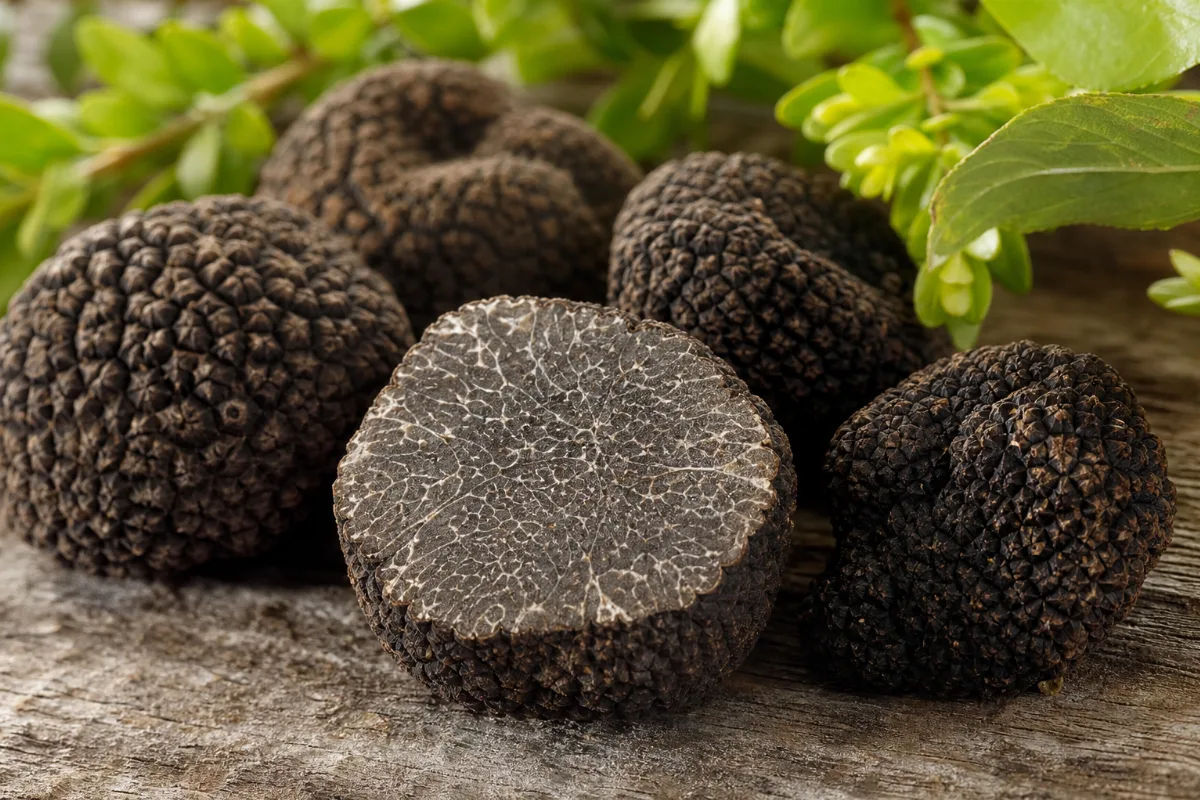
- Fruiting body: An Epping 2022 passage describes the fruiting body as dark brown, with almost tasteless black-brown flesh with small white veins, and visually similar to T. melanosporum.
- Cultivation
- A 2026 paper reports the first successful cultivation of T. himalayense in Japan after 7.5 years. Details for T. indicum were not read.
- Harvest and processing
- Not checked beyond harvest from natural habitats in the 2026 T. himalayense paper.
- Look-alikes and adulterants
- Name: Tuber melanosporum (black Perigord truffle); Note: The costly European species it is said to be passed off as; lab methods can separate them.; Name: Other members of the T. indicum complex (T. himalayense, T. formosanum, T. longispinosum); Note: DNA studies show several lookalike lineages; a label may not say which one is inside.; Name: Psilocybe 'magic truffles'; Note: A different fungus and a different product; see /mushrooms/psilocybin-truffles.
- Sustainability and conservation
- A 2026 paper says wild T. himalayense populations have declined since the 1990s from habitat degradation and overharvesting.
Traditional use and history history, not clinical proof
| Tradition or era | Documented use | Source |
|---|---|---|
| Modern gourmet cooking | Sold as a lower-priced black truffle; papers describe it being used to imitate costlier European black truffle. | p36014409 |
| Earlier history and traditional medicine | Not read, so none is stated here. | p41300498 |
Traditional use shows how it was used. It does not show that it works or is safe today.
What is inside, and how it may work
What it contains and how those compounds act in cells and animals. Laboratory and animal mechanisms are not proven effects in people.
Main compounds
| Compound | Family | Where it is concentrated | Activity studied | Level of evidence |
|---|---|---|---|---|
| Volatile aroma compounds (esters such as ethyl isobutyrate, 1-octen-3-ol, sulfur compounds) | aroma volatiles | Fruiting body | Give the truffle its smell; 95 were found across three grades. 10 | Laboratory research |
| Polysaccharides (glucose-based sugar chains) | polysaccharide | Fruiting body Water-extracted fraction up to 2.65 x 10^7 Da and alkali-extracted up to 3.87 x 10^7 Da molecular weight in the mouse paper. | Changed immune-cell proportions and gut bacteria in mice. 4 | Animal research |
| Sterols (ergosterol, brassicasterol and minor sterols) | sterol | Fruiting body | Pattern of minor sterols tells European from Chinese truffles. 14 | Laboratory research |
| Phenolics | phenolic | Fruiting body Folin-Ciocalteu total phenolics roughly 1 to 2 mg gallic acid equivalents per g dry matter in a comparison of three black truffles, per the review. | Linked to lab antioxidant activity. 2 | Laboratory research |
Mechanisms, receptors and pathways
| Target or pathway | Gene or receptor | What was found | Level |
|---|---|---|---|
| Immune-cell proportions and gut bacteria (animal) | CD3+ T cells, CD19+ B cells | Polysaccharide fractions restored the proportions in mice given cyclophosphamide and enriched Lactobacillus. 4 | Animal research |
| PI3K / Akt pathway (cells) | PI3K, Akt, PTEN | One isolated compound lowered p-PI3K and p-Akt and raised p-PTEN in mouse macrophages. 9 | Laboratory research |
Absorption, metabolism and elimination
- Absorption
- Not found in the sources read.
- Distribution
- Not found.
- Metabolism
- Not found.
- Elimination
- Not found.
- Bioavailability
- Not established.
Isolated compounds versus whole extracts
Eating fresh truffle in tiny amounts is a food use. Lab findings come from purified polysaccharides or single compounds, which are not the food. Truffle oils and pastes may contain truffle, added aroma or both.
Nutritional composition
Dry-weight ranges for T. indicum from China in a 2025 review: carbohydrate 52 to 80%, protein 13 to 23%, fat 2 to 7%. These are quoted from other papers and vary by region.
1 low certainty3 very low certainty2 not enough evidence
What was looked at
The 6 benefits and uses checked for Chinese Truffle, each with how strong the evidence is. Tap one to open it.
- Aroma and grading (the real use)Low certainty
- Immune system (mouse study of extracted sugar chains)Very low certainty
- As a food: nutrientsNot enough evidence
- Antioxidant activity (test tube)Very low certainty
- Anti-inflammatory activity of one isolated compoundVery low certainty
- Any effect on human healthNot enough evidence
What is Chinese Truffle good for?
The uses people ask about and how strong the human evidence is for each. None is proven in people. Read this together with the Safety tab.
Benefits, one by one
Each card is a research question, not a promise. Tap a goal to filter. Open a card to see the studies, doses and limits.
Aroma and grading (the real use)
Low certaintyChinese truffle is eaten for its smell, but it is the weaker-smelling truffle. One lab study found its aroma weakest among the species it tested. Another found that top-grade Chinese truffles had a richer mix of aroma compounds than lower grades.
2 studiesEaten fresh in small amounts as flavouring.
Studies, doses and limits
What the trials found
This is food chemistry, not a health effect. In 95 volatile compounds across three commercial grades, the top grade had the most variety (75) and the strongest odour activity, led by ethyl isobutyrate and 1-octen-3-ol. A separate study of several species found aroma lowest in T. indicum.
Results
Top grade: 75 of 95 volatile compounds; aroma intensity lowest in T. indicum among the species in one study.
Effect sizes as reported
Aroma difference between grades measured; no health outcome
Why this rating
One grading study and one comparison study; numbers of samples were not given in the abstracts.
Form and dose studied
Eaten fresh in small amounts as flavouring.
Who was studied
Chinese black truffle, fresh fruiting bodies
Limits
Lab chemistry only. A smell is not a health benefit.
Why researchers looked
Aroma is why truffles are bought. Chemists test whether smell can be used to grade Chinese truffles by quality and tell them from other species.
Traditional use
Eaten as a gourmet food. The sources read describe it as a food, not a remedy.
Proposed mechanism Laboratory research
Esters, alcohols such as 1-octen-3-ol and sulfur compounds drive smell in lab measurements.
A proposed mechanism does not show that the effect happens in people.
Eating truffle as flavouring has no known harm in the sources read; see the Safety tab for allergy and fake-product points.
Immune system (mouse study of extracted sugar chains)
Very low certaintySugar chains (polysaccharides) extracted from Chinese truffle in the lab brought back some white blood cell proportions in mice whose immune systems had been weakened by a cancer drug. This does not show that eating truffle helps human immunity.
1 studiesLab-made polysaccharide fractions given to mice; not a food or supple…
Studies, doses and limits
What the trials found
No human study was found. In mice given cyclophosphamide, both polysaccharide fractions restored T-cell and B-cell proportions in blood and spleen and eased gut and spleen tissue damage.
Results
Mouse cell proportions partly restored; no infection or survival outcome in the abstract.
Effect sizes as reported
Restored T and B cell proportions in drug-treated mice
Why this rating
One mouse study of purified lab fractions; not whole truffle and not people.
Form and dose studied
Lab-made polysaccharide fractions given to mice; not a food or supplement form we assessed.
Who was studied
Mice
Limits
Animal-only. Group sizes and doses were not in the abstract. No human data.
Why researchers looked
Mushroom polysaccharides are often studied for immune effects, so researchers tested truffle fractions in mice.
Traditional use
Not used for this in the sources read.
Proposed mechanism Animal research
Water- and alkali-extracted polysaccharide fractions changed gut bacteria (more Lactobacillus) and metabolite pathways in the mice (animal study).
A proposed mechanism does not show that the effect happens in people.
Never tested for safety in people as an extract.
As a food: nutrients
Not enough evidenceMeasured by dry weight, Chinese truffle is mostly carbohydrate, then protein, with little fat. It is eaten in tiny amounts, so it adds little of any nutrient.
2 studiesEaten fresh in small amounts as a garnish.
Studies, doses and limits
What the trials found
Composition only. A 2025 review table lists for Tuber indicum from China about 52 to 80% carbohydrate, 13 to 23% protein and 2 to 7% fat (dry weight) and says the profile depends on species and region. Potassium, phosphorus and calcium are main minerals in truffles generally.
Results
Carbohydrate 52 to 80%, protein 13 to 23%, fat 2 to 7% (dry weight, quoted by the review from other papers)
Effect sizes as reported
Composition values only
Why this rating
Numbers are quoted from other papers by a review; no study measured what eating it does.
Form and dose studied
Eaten fresh in small amounts as a garnish.
Who was studied
Chinese black truffle
Limits
Dry-weight figures do not describe a real serving. Regional variation is large.
Why researchers looked
A review lists the make-up of truffles to describe their food value.
Traditional use
Described as a delicacy.
Proposed mechanism Laboratory research
Not a mechanism; this is composition.
A proposed mechanism does not show that the effect happens in people.
No safety problem found in the sources read.
Antioxidant activity (test tube)
Very low certaintyIn lab tests Chinese truffle extract mops up free radicals. One review ranked it second among three truffle species. These tests do not show a benefit from eating it.
1 studiesLab extracts; not eaten.
Studies, doses and limits
What the trials found
No human study. In the review's comparison, T. magnatum was highest, then T. indicum, then T. melanosporum. Lipid oxidation was inhibited by about 23% by T. indicum extract in one cited comparison.
Results
About 23% inhibition of lipid oxidation in one cited lab comparison
Effect sizes as reported
Lab assays only
Why this rating
Test-tube assays reported by a review; the original papers were not opened.
Form and dose studied
Lab extracts; not eaten.
Who was studied
Cells and chemical tests
Limits
Antioxidant assays rarely predict benefits in people.
Why researchers looked
Truffle phenolics and polysaccharides are often tested in antioxidant assays.
Traditional use
Not used for this in the sources read.
Proposed mechanism Laboratory research
Phenolic compounds and polysaccharides react with free radicals in lab assays; one polysaccharide protected a cell line (PC12) from hydrogen peroxide damage, as described by the review.
A proposed mechanism does not show that the effect happens in people.
No safety information.
Anti-inflammatory activity of one isolated compound
Very low certaintyOne new compound purified from Chinese truffle lowered inflammation signals in mouse immune cells and in zebrafish. This is purified chemistry, not truffle as food.
1 studiesIsolated compound; not a food.
Studies, doses and limits
What the trials found
No human study. One of three new compounds had the effect in cells and zebrafish.
Results
Lower inflammatory mediators in LPS-stimulated mouse macrophages
Effect sizes as reported
One compound in cells and zebrafish
Why this rating
Cell and zebrafish findings for a purified compound.
Form and dose studied
Isolated compound; not a food.
Who was studied
Mouse macrophage cell line; zebrafish
Limits
Animals and cells only.
Why researchers looked
Researchers look for active compounds in a species used as food and medicine in China.
Traditional use
The paper calls T. indicum an edible fungus; no traditional medical use is stated in the abstract.
Proposed mechanism Laboratory research
Reduced nitric oxide, ROS, IL-6, TNF-alpha, COX-2 and iNOS in macrophages via the PI3K pathway (cell study).
A proposed mechanism does not show that the effect happens in people.
No safety information.
Any effect on human health
Not enough evidenceNo clinical trial of Chinese truffle in people was found. A 2025 review says clinical trials of truffles in humans remain absent.
2 studiesn/a
Studies, doses and limits
What the trials found
No human outcome has been measured.
Effect sizes as reported
No human data
Why this rating
Absence of trials; the claims made for truffles rest on lab and animal work.
Limits
Nothing to assess.
Why researchers looked
Included so the page states plainly what is missing.
Proposed mechanism Laboratory research
n/a
A proposed mechanism does not show that the effect happens in people.
See the Safety tab.
Connections to the rest of health
How Chinese Truffle connects to the rest of our health knowledge graph. Every link says what kind of connection it is. A safety link (for example to the liver) is a warning, not a benefit. A study that merely mentions a topic never creates a benefit link.
Explore every connection: goals, body systems, organs, symptoms, genes
B. Body systems
| Connected to | Kind of connection | Evidence status | Context | Studies |
|---|---|---|---|---|
| Immune system | Preliminary mechanism | Very low certainty | Restored some immune-cell proportions in drug-treated mice; no human data. Preparation or compound: Lab-made polysaccharide fractions |
4 |
| Immune System | Biological association | Very low certainty | Studied for: Immune system (mouse study of extracted sugar chains) Studied for: Anti-inflammatory activity of one isolated compound | 4 9 |
E. Health conditions
| Connected to | Kind of connection | Evidence status | Context | Studies |
|---|---|---|---|---|
| Mushroom allergy | Adverse effect or risk | Very low certainty | Rare anaphylaxis to edible mushrooms is reported; no Chinese truffle case found. Preparation or compound: Edible fungi (Chinese truffle data lacking) |
1 16 |
K. Biological pathways
| Connected to | Kind of connection | Evidence status | Context | Studies |
|---|---|---|---|---|
| PI3K/Akt pathway | Preliminary mechanism | In vitro | Lowered by one isolated compound in mouse macrophages. | 9 |
L. Active compounds
| Connected to | Kind of connection | Evidence status | Context | Studies |
|---|---|---|---|---|
| Volatile aroma compounds (esters such as ethyl isobutyrate, 1-octen-3-ol, sulfur compounds) | Biological association | In vitro | Give the truffle its smell; 95 were found across three grades. Preparation or compound: Fruiting body |
10 |
| Polysaccharides (glucose-based sugar chains) | Biological association | Animal | Changed immune-cell proportions and gut bacteria in mice. Preparation or compound: Fruiting body |
4 |
| Sterols (ergosterol, brassicasterol and minor sterols) | Biological association | In vitro | Pattern of minor sterols tells European from Chinese truffles. Preparation or compound: Fruiting body |
14 |
| Phenolics | Biological association | In vitro | Linked to lab antioxidant activity. Preparation or compound: Fruiting body |
2 |
Each connection is stored with the ingredient, the connected record, the kind of connection, the evidence status, the supporting studies, the preparation or compound involved, and a review date (last reviewed October 25, 2026).
Evidence at a glance: what the research found for 6 outcomes
Each outcome below is one thing researchers measured. Certainty is how far the evidence can be trusted, not how well it works. The full studies are on the next tab.
The evidence
The research centre for Chinese Truffle. Every record here was checked against PubMed or the publisher's page; we never list a study we have not verified.
Evidence by outcome
Bars show how many studies we found for each outcome, not how well it works. People are added up across trials only (reviews are not added, to avoid double counting).
How we rate evidence
High certainty
Several well-run trials or reviews agree; further research is unlikely to change the picture much.
Moderate certainty
Good trials point the same way, but some doubt remains.
Low certainty
Small, short or inconsistent trials. The finding could change with better research.
Very low certainty
Very little or very weak human data. Treat as a possibility only.
Mixed findings
Trials or reviews disagree with each other.
Not enough evidence
Not enough human research to say either way.
Evidence against
Good research found no benefit, or found harm.
We take the reviewers' own risk-of-bias and GRADE statements where they exist, and otherwise judge from study size, design, consistency, directness and whether a product matches what is sold. Many publications do not make evidence high. Method note: We read PubMed records and abstracts for 11 new papers (eight laboratory studies, one animal study and two taxonomy papers) and re-used five from the truffle page (two reviews, one oil study, two allergy papers). We read relevant passages of two full texts (an aroma paper and a 2025 review), and checked both Latin names in GBIF. Index Fungorum, EMA, FDA, EFSA, LiverTox and LactMed were not read. Only abstracts were read for most papers, so numbers come from abstracts. Certainty ratings are the compiler's own reading.
Study library: every study we checked 17
| Study | Design | People | Product, dose, length | Result |
|---|---|---|---|---|
| Ali 2024 Agaricus bisporus mushroom anaphylaxis: A case report and review of the literature. Journal of Allergy and Clinical Immunology: Global · PMID 39282616 · DOI |
Case report |
1 A 77-year-old woman with anaphylaxis after a button-mushroom omelette, plus 27 other cases from the literature |
Agaricus bisporus (button, portobello) and other edible mushrooms fruiting body Not shown here |
Reactions were positive to several boiled edible mushrooms. The review found 27 other cases (average age 28.8). Cross-sensitisation between edible mushrooms was clear but followed no consistent pattern. Mushroom allergens named in some cases included alpha-mannosidase, alpha-trehalose, mannitol and a ribosomal protein. Mushroom anaphylaxis is uncommon but reported Methods, limits and fundingOutcomes: Anaphylaxis after eating mushrooms Limitations: About button mushrooms, not truffles. No truffle case was found. Whether truffles cross-react is not known. Funding and conflicts: No funding; authors report no conflict. Read: abstract |
| Baldelli 2025 Bioactive Compounds and Antioxidant Potential of Truffles: A Comprehensive Review. Antioxidants (Basel) · PMID 41300498 · DOI |
Narrative review fungus |
Review of truffle composition and bioactivity | Truffle fruiting bodies and extracts fruiting body Not shown here |
Full text read (Europe PMC). Dry weight: carbohydrates 37 to 80%, protein 11 to 35%, fat 2 to 7%, fibre 4 to 13%. Its Table 1 gives T. aestivum carbohydrates 60 to 79%, protein 14 to 24%, fat 1 to 5%, and T. melanosporum carbohydrates 74 to 75%, protein 12 to 18%, fat 2 to 4%. Potassium, phosphorus and calcium are about 80 to 90% of the minerals. More than 200 volatile compounds across species, only about 30 to 60 aroma-active in one species. Says most studies are test-tube or preclinical, and 'clinical trials in humans remain absent'. For Tuber indicum (China) the review's Table 1 lists roughly 52 to 80% carbohydrate, 13 to 23% protein and 2 to 7% fat by dry weight, and says the profile of truffles depends on species and region. In one comparison it ranks T. magnatum highest in antioxidant activity, then T. indicum, then T. melanosporum. Re-read for this page 2026-10-25 (full text, Europe PMC). No human trial found by the authors Methods, limits and fundingOutcomes: Composition, aroma, antioxidant and anti-tumour work, storage Limitations: Narrative review; table values are ranges across studies, not measurements made by the authors. Freezing and canning lowered antioxidant capacity of processed truffles in the work it cites. Funding and conflicts: Authors declare no conflicts of interest. Read: full text |
| Epping 2022 Marker Substances in the Aroma of Truffles. Molecules · PMID 36014409 · DOI |
Laboratory study fungus |
Aroma profiles of several truffle species by headspace GC-MS, with an experiment on 19 truffle dogs | Truffle fruiting bodies, headspace analysis fruiting body Not shown here |
The abstract finds that truffle aroma is mainly dimethyl sulfide and dimethyl disulfide as far as dogs are concerned, with some uncertainty. In the full text, the authors write that the aroma intensity is lowest in Tuber indicum, that T. indicum is visually similar to T. melanosporum and is exported to Europe and often used to counterfeit it, and that for this the Asian truffle is coated with artificial truffle oil to imitate the aroma (the authors cite an earlier reference for that last point; we did not open it). Aroma weakest in T. indicum among species tested; counterfeiting statement is the authors' (cited from another paper) Methods, limits and fundingOutcomes: Marker substances in truffle aroma; dog response Limitations: The counterfeiting and oil-coating statements are the authors' own background statements referring to another paper, not measurements. We read the relevant passages of the full text only. Funding and conflicts: Not stated Read: full text (relevant passages) |
| Ji 2026 Structural Characteristics and Gut Microbiota-Mediated Immunomodulatory Mechanisms of Water- and Alkali-Extracted Polysaccharides from Tuber indicum. Nutrients · PMID 42451205 · DOI |
Animal study animal |
Mice with immune suppression caused by the drug cyclophosphamide (CTX) | Lab-made water-extracted (TIWP) and alkali-extracted (TIAP) polysaccharide fractions from T. indicum polysaccharide fractions from the fruiting body Not shown here |
Both polysaccharide fractions restored the proportions of CD3+ T cells and CD19+ B cells in blood and spleen and eased damage to spleen and colon tissue in the mice. They shifted gut bacteria in different ways (more Lactobacillus with both). The authors call this a theoretical basis for functional foods. Mouse immune-cell proportions partly restored after drug-caused suppression; no human data Methods, limits and fundingOutcomes: Blood and spleen T and B cell proportions, spleen and colon tissue damage, gut bacteria, metabolites Limitations: Mouse study of purified polysaccharide fractions, not whole truffle and not people. Doses and group sizes were not in the abstract. Not shown to prevent infections. Funding and conflicts: Not stated in the abstract Read: abstract |
| Kappacher 2022 Portable vs. Benchtop NIR-Sensor Technology for Classification and Quality Evaluation of Black Truffle. Molecules · PMID 35163862 · DOI |
Laboratory study fungus |
126 126 truffles of four species (Tuber melanosporum, T. indicum, T. aestivum, T. uncinatum) |
Whole truffles measured by four near-infrared (NIR) instruments, three of them pocket-sized fruiting body Not shown here |
The authors say T. melanosporum fruiting bodies look very like T. indicum, so there is a risk of fraud through imported Asian truffles. Near-infrared measurement separated the costly T. melanosporum from T. indicum with up to 100% accuracy and separated all four species with 100% success in their tests. It also told fresh from frozen/thawed truffle. Up to 100% accuracy for T. melanosporum vs T. indicum Methods, limits and fundingOutcomes: Species classification, fresh vs frozen, harvest date Limitations: Lab method testing; one set of samples; the study does not measure how much fraud happens. Truffles cannot be told apart by eye for inexperienced buyers, the authors say. Funding and conflicts: Not stated in the abstract Read: abstract |
| Kinoshita 2018 Using mating-type loci to improve taxonomy of the Tuber indicum complex, and discovery of a new species, T. longispinosum. PLoS ONE · PMID 29590201 · DOI |
Laboratory study fungus |
52 52 specimens: Japan (29), China (10 T. himalayense and 8 T. indicum), Taiwan (5 T. formosanum) |
Fruiting bodies compared by shape and DNA fruiting body Not shown here |
Black truffles that look like T. indicum are a group of lookalike species (the T. indicum complex). DNA at five places showed three distinct lineages among the Japanese specimens. Japanese Tuber sp. 6 grouped with T. himalayense and T. formosanum, and the authors treat T. formosanum as a synonym of T. himalayense. A third group was named as a new species, T. longispinosum. T. himalayense and T. indicum are separate names in this study; a complex with several lookalikes Methods, limits and fundingOutcomes: Taxonomy of the T. indicum complex Limitations: Taxonomy paper. It does not say what traders call the truffles they sell. Funding and conflicts: Public research support; not stated in the abstract Read: abstract |
| Kitade 2026 Sustained ascoma production and reproductive dynamics of the Asian black truffle Tuber himalayense in Japan. Mycologia · PMID 42423500 · DOI |
Laboratory study fungus |
Quercus serrata seedlings inoculated with T. himalayense spores in a nursery in Japan | Spore-inoculated seedlings fruiting body Not shown here |
The authors call T. himalayense the Asian black truffle and say it is harvested commercially from natural habitats, but its populations have declined since the 1990s from habitat loss and overharvesting. After 7.5 years two truffles appeared, then 12 more. The authors call it the first successful cultivation of T. himalayense in Japan. Cultivation success in a nursery; wild populations declining Methods, limits and fundingOutcomes: First cultivation of T. himalayense in Japan Limitations: Growing study; no food or health data. Funding and conflicts: Not stated in the abstract Read: abstract |
| Lee 2020 Potentials of truffles in nutritional and medicinal applications: a review. Fungal Biology and Biotechnology · PMID 32566240 · DOI |
Narrative review fungus |
Review of laboratory, animal and compositional work on truffles (Tuber and desert truffles) | Truffle fruiting bodies and extracts fruiting body Not shown here |
Reviews phenolics, terpenoids, polysaccharides, anandamide, fatty acids and ergosterols and lab antitumour, antioxidant, antibacterial, anti-inflammatory and liver-protection findings. Full text read (Europe PMC): says more than 200 volatile compounds have been found; says truffle-flavoured oils contain more than 60 volatiles, 2,4-dithiapentane the most common; says truffles are highly perishable; its conclusion mentions 'no known side effects'. No human trial summarised; lab and animal findings only Methods, limits and fundingOutcomes: Composition, aroma, lab and animal bioactivity, preservation Limitations: Narrative review, not systematic. Mixes Tuber and desert truffles (Terfezia, Tirmania), which are different fungi. 'No known side effects' is the authors' statement, not a safety study. Funding and conflicts: Authors declare no conflict of interest; one author affiliation is a company laboratory (Plamica Labs). Read: full text |
| Li 2024 Chemical constitutes from Tuber indicum with immunosuppressive activity uncovered by transcriptome analysis. Fitoterapia · PMID 38097020 · DOI |
Laboratory study cell |
Three new compounds isolated from T. indicum, tested in mouse macrophage cells and zebrafish | Isolated compounds (a polyketide and two lactams) from T. indicum isolated compound Not shown here |
One of the three new compounds (compound 2) lowered nitric oxide, reactive oxygen species, IL-6, TNF-alpha, COX-2 and iNOS in the cells and acted on the PI3K pathway. A zebrafish model confirmed an anti-inflammatory effect. The paper labels this activity immunosuppressive (it dampens inflammation). Cell and zebrafish findings for one isolated compound Methods, limits and fundingOutcomes: Inflammatory mediators in LPS-stimulated RAW264.7 macrophages; zebrafish model Limitations: Single purified compound from a chemical extraction, not truffle as eaten. Cells and zebrafish only. Funding and conflicts: Not stated in the abstract Read: abstract |
| Luo 2025 Insights into VOCs variation derived from Chinese black truffles (Tuber indicum) between grades via E-nose, HS-SPME-GC-MS, and HS-GC-IMS. Food Chemistry: X · PMID 41278086 · DOI |
Laboratory study fungus |
Chinese black truffles (T. indicum) of three commercial grades (G1, G2, G3) | Fresh fruiting bodies, aroma analysis fruiting body Not shown here |
95 volatile compounds were found. The top grade (G1) had the most variety (75 compounds) and unique markers such as 2-butanone, and the strongest aroma intensity driven by esters (ethyl isobutyrate) and alcohols (1-octen-3-ol). Higher grades had sulfur compounds that lower grades lacked. The authors say this gives a chemical basis for grading beyond size and look. Aroma richness differed by commercial grade Methods, limits and fundingOutcomes: Volatile organic compounds, odour activity values by grade Limitations: Chemistry of one species, three grades; sample numbers not in the abstract. It describes smell, not a health effect. Funding and conflicts: Not stated in the abstract Read: abstract |
| Mix 2023 From Nontargeted to Targeted Analysis: Feature Selection in the Differentiation of Truffle Species (Tuber spp.) Using 1H NMR Spectroscopy and Support Vector Machine. Journal of Agricultural and Food Chemistry · PMID 37934755 · DOI |
Laboratory study fungus |
80 80 truffle samples of five species (T. aestivum, T. borchii, T. indicum, T. magnatum, T. melanosporum) |
Polar extracts analysed by NMR fruiting body Not shown here |
The authors say non-professionals can hardly tell truffle species apart by sight, which makes food fraud easy. The black look-alikes T. melanosporum and T. indicum were classified 100% correctly, and a model could tell all five species apart. Betaine and ribonate were proposed as markers for two of the species (T. borchii and T. melanosporum). T. melanosporum vs T. indicum classified 100% correctly Methods, limits and fundingOutcomes: Species discrimination Limitations: Lab method on 80 samples; not a market survey. Funding and conflicts: Not stated in the abstract Read: abstract |
| Pacioni 2014 Composition of commercial truffle flavored oils with GC-MS analysis and discrimination with an electronic nose. Food Chemistry · PMID 24176309 · DOI |
Laboratory study n/a |
18 18 olive oil samples flavoured with white or black truffle, bought in Italy |
Commercial truffle-flavoured olive oils Not shown here |
63 volatile compounds detected: 32 attributed to olive oil, 19 to truffles, and 12 foreign compounds of dubious origin (synthesis and/or breakdown). The authors say the finding confirms the established malpractice of using bis(methylthio)methane in black-truffle flavourings. 19 of 63 volatiles attributed to truffle; 12 foreign Methods, limits and fundingOutcomes: Volatile compounds by GC-MS; electronic nose Limitations: Only 18 Italian samples; not a survey of all oils on sale. Bis(methylthio)methane (also called 2,4-dithiapentane) also occurs naturally in white truffle, so its presence alone does not prove a synthetic source. Funding and conflicts: Research support from non-US government sources per the record. Read: abstract |
| Qiao 2018 Phylogeography and population genetic analyses reveal the speciation of the Tuber indicum complex. Fungal Genetics and Biology · PMID 29448031 · DOI |
Laboratory study fungus |
31 wild populations of the T. indicum complex in southwest China | DNA markers (ITS, SSR) fruiting body Not shown here |
Two distinct lineages, called Tuber cf. indicum and Tuber cf. himalayense, were found within the T. indicum complex in southwest China, with different geographic patterns along river systems. The authors say the findings matter for protecting truffle diversity in the region. Two lineages in southwest China Methods, limits and fundingOutcomes: Population structure Limitations: Genetic study of wild populations; says nothing on food quality or health. Funding and conflicts: Not stated in the abstract Read: abstract |
| Sommer 2020 Differentiation of European and Chinese Truffle (Tuber sp.) Species by Means of Sterol Fingerprints. Journal of Agricultural and Food Chemistry · PMID 33138362 · DOI |
Laboratory study fungus |
Five Tuber species including T. indicum varieties | Truffle sterol patterns fruiting body Not shown here |
Sterol patterns differed in a characteristic way between five species (T. magnatum, T. melanosporum, T. aestivum, T. albidum and T. indicum varieties) whatever the country of origin. 27 sterols were measured and eight minor sterols were proposed as markers to tell European from Chinese truffles. The authors frame this as a way to prevent food fraud with valueless Tuber species. Sterol fingerprints separate European and Chinese truffles Methods, limits and fundingOutcomes: Species differentiation Limitations: Lab method; sample numbers not in the abstract. Funding and conflicts: Not stated in the abstract Read: abstract |
| Sow 2026 Rapid detection of cultivated truffle fungi (Tuber) from truffles and ectomycorrhizal root tips using LAMP. Applied and Environmental Microbiology · PMID 42663474 · DOI |
Laboratory study fungus |
Truffle fruiting bodies and root tips; rapid DNA tests for four species | DNA-based LAMP tests (T. melanosporum, T. borchii, T. aestivum, T. brumale) fruiting body Not shown here |
The authors say non-target species such as T. indicum and T. brumale often look like the target species (T. melanosporum) and can be accidentally included when tree seedlings are inoculated, causing a persistent problem for orchard growers. They built rapid tests for four other species; T. indicum itself was not one of the tests. Rapid species-specific DNA tests for four truffles Methods, limits and fundingOutcomes: Detection of target and contaminant truffle species Limitations: The new tests do not target T. indicum. It shows that mix-ups also happen on the growing side, not only at the market. Funding and conflicts: Not stated in the abstract Read: abstract |
| Xing 2022 Recent Advances in the Allergic Cross-Reactivity between Fungi and Foods. Journal of Immunology Research · PMID 36249419 · DOI |
Narrative review |
Review of allergy to fungi and fungus-related foods | Edible mushrooms, mycoprotein, foods fermented by fungi Not shown here |
Edible mushrooms and fungus-related foods can cause fungus food allergy syndrome through cross-reaction with airborne fungi. Symptoms range from oral allergy syndrome to severe anaphylaxis. Cross-reactions reported Methods, limits and fundingOutcomes: Fungus food allergy Limitations: Review; not truffle-specific. Funding and conflicts: Authors declare no conflict of interest. Read: abstract |
| n/a 2026 GBIF Backbone Taxonomy species match: Tuber indicum and Tuber himalayense (API checked 2026-10-25) n/a · Source |
Database record n/a |
n/a | n/a |
Tuber indicum Cooke & Massee, 1892 is ACCEPTED (key 5499365; Fungi, Ascomycota, family Tuberaceae). Tuber himalayense B.C.Zhang & Minter is ACCEPTED (key 5499367). GBIF lists them as two separate accepted species. Methods, limits and fundingOutcomes: Tuber indicum Cooke & Massee, 1892 is ACCEPTED (key 5499365; Fungi, Ascomycota, family Tuberaceae). Tuber himalayense B.C.Zhang & Minter is ACCEPTED (key 5499367). GBIF lists them as two separate accepted species. Limitations: A database record; names change as research updates. Index Fungorum was not opened. Funding and conflicts: Independent public information source Read: full text |
What we do not know yet
- No human study of Chinese truffle for any outcome.
- No survey measures how often Chinese truffle is sold as European truffle.
- Which Latin name sellers use (indicum or himalayense) was not found.
- No allergy, pregnancy, heavy-metal or pesticide data for Tuber indicum was read.
- EMA, FDA, EFSA, LiverTox and LactMed statements were not read; the oil-coating claim cites a paper we did not open.
How new research is added
New studies are found by a saved PubMed search and placed in a review queue. A person reads each one before it changes any evidence rating or safety wording. New publications never change ratings automatically.
Lab markers
What changed in blood or saliva tests during trials. A changed number is not the same as feeling or being healthier, and we give no "normal ranges".
Safety
What studies and official sources say about side effects, medicines and who should check first. Each point shows what kind of evidence it comes from.
Main points to know 4
- Chinese truffle is often passed off as costly European black truffle. Papers say Tuber indicum looks very like the Perigord truffle (Tuber melanosporum) and that beginners cannot tell them apart by eye. The authors of one aroma paper write that the cheaper Asian truffle is exported to Europe and often used to counterfeit the costly one, and that it is coated with artificial truffle oil to imitate the smell. This is a labelling and money issue, not a poison risk. No survey of how often it happens was found, so we make no claim about how common it is. Several lab methods can tell the species apart, but a shopper cannot do this at home. Laboratory study 5 3 11 14
- Truffle oil may be flavoured, not made from truffle. In 18 Italian truffle-flavoured olive oils, 19 of 63 volatile compounds were attributed to truffle and 12 were foreign compounds of dubious origin. The authors say this confirms the established use of bis(methylthio)methane in black-truffle flavourings. This tells you about truffle oil in general, not Chinese truffle in particular. See the truffle page for more. Laboratory study 12 8
- Names are mixed up: indicum, himalayense and look-alikes. Chinese black truffles belong to a group of look-alike species called the Tuber indicum complex. Databases list Tuber indicum and Tuber himalayense as two separate accepted species, and DNA studies found separate lineages in southwest China. We did not find a source saying which name sellers use on the product, so 'Chinese truffle' on a label may not tell you the exact species. Laboratory study 17 6 13
- No safety study exists. No poisoning, allergy case or drug interaction specific to Chinese truffle was found, but nobody has tested it for safety either. Mushroom allergy is rare but reported, including severe reactions with other edible mushrooms. No report found 2 1 16
Side effects 2
| Effect | How often | Severity and recovery | Evidence |
|---|---|---|---|
| Allergic reaction to fungi (rare) Evidence is from other edible mushrooms. | No Chinese truffle case found; in one review of button-mushroom anaphylaxis, 27 other cases were described | mild to severe Not described | Case report 1 16 |
| No other adverse effects reported in the sources read Absence of reports is not proof of safety. | Not measured; no human safety trial | unknown unknown | Narrative review 2 8 |
Liver
No liver injury from Tuber truffles was reported in the sources read. LiverTox was not searched. 2
This is a safety connection. It is not evidence that Chinese Truffle supports liver health.
Medicines and supplements 2
| With | Why it matters | Importance | Evidence | What to do |
|---|---|---|---|---|
| Prescription medicines in general prescription | No interaction with any medicine was found in the sources read. | No report found Not enough evidence 2 8 | Eating truffle as a flavouring is not known to interact with medicines. Ask a doctor or pharmacist before trying an extract or supplement, which has no safety data. | |
| Immune-suppressing medicines theoretical | Mouse work on extracted polysaccharides changed immune-cell proportions, and one isolated compound lowered inflammation signals in cells. | These are lab and animal findings only. They do not show that eating truffle changes anyone's immune system or medicines. | Animal study Not enough evidence 4 9 | No action needed for ordinary food amounts. Ask a doctor first if you take immune medicines and plan to use a concentrated extract. |
Who should check first 2
| Situation | Advice | Evidence |
|---|---|---|
| Known mushroom or mould allergy | Ask an allergy doctor before eating truffles, because cross-reaction between fungi is reported and truffle-specific data are missing. | Narrative review 16 1 |
| Pregnancy, breastfeeding and young children | No safety data specific to Chinese truffle were found. Truffle in normal meal amounts is a food, but ask a doctor or midwife if unsure, and avoid extracts and supplements. | No report found 2 |
Overdose, product quality and regulators
Summary. No poisoning from Tuber truffles was described in the sources read.
Animal. The mouse study gave extracted polysaccharide fractions; its abstract reports no safety findings, and safety was not its aim.
Human doses studied. No human feeding study found. This page gives no amounts.
High dose or long term signals. Not studied.
Overdose response. Not described. Seek medical help for any severe reaction after eating.
Genotoxicity. Not read.
Toxic or hazardous parts. Fungus fruiting body only. Wild look-alike fungi were not examined in the sources read. Wild fungi should only be eaten when an expert has identified them.
The quality problems found in papers are wrong species and fake flavour. No contaminant test for Chinese truffle was read.
Wrong species / mislabelling. Lab methods using near-infrared light, NMR and sterol patterns separated T. indicum from T. melanosporum in the authors' tests (up to 100% accuracy in two studies). On the growing side, T. indicum and T. brumale can slip into truffle orchards when seedlings are inoculated. 5 11 14 15
Added aroma. One aroma paper states that Asian truffle is coated with artificial truffle oil to imitate the aroma; the authors cite another paper for this and we did not open it. 3
Heavy metals, radioactivity, pesticides. No measurement for T. indicum was found in the sources read. 2
Spoilage. Truffles are highly perishable; freezing and drying change the aroma. 8 5
When to get medical help
- Swelling of lips, tongue or throat, wheezing, faintness or widespread hives soon after eating: call emergency services.
- Vomiting, severe belly pain or confusion after eating any wild fungus: seek urgent medical care and keep a sample if possible.
- Itchy mouth or tummy upset that returns each time you eat truffle or other mushrooms: see a doctor.
If someone may be poisoned or in a crisis, contact a clinician or emergency service straight away. In the US, Poison Control is 1-800-222-1222.
General information only, not medical advice. Ask a clinician or pharmacist before use, especially with medicines, in pregnancy or with a health condition. See the Natural Remedy Safety guide.
Frequently asked questions
What is Chinese truffle?
Is Tuber indicum the same as Tuber himalayense?
Is Chinese truffle sold as Perigord truffle?
How can I tell which truffle I am buying?
Does Chinese truffle taste as good?
Is Chinese truffle safe to eat?
Does Chinese truffle boost the immune system?
Does it have antioxidants?
Extracts show antioxidant activity in test-tube assays, ranked second of three species in one comparison. Test-tube results do not show that eating truffle helps your health.
Is it safe in pregnancy or for children?
No safety data specific to Chinese truffle were found. Ask a doctor or midwife if unsure, and avoid extracts and supplements.
Is truffle oil made from Chinese truffle?
Is it the same as magic truffles?
No. Magic truffles are Psilocybe fungi sold for psilocybin. Chinese truffle is a Tuber fungus eaten as food.
Explore by health goal
Editorial transparency
- Written by
- AlternativeMed editorial team. Research compiled with AI assistance, then checked against PubMed records.
- Medical review
- None. This page has not been reviewed by a physician or pharmacist.
- First published
- 2026-10-25
- Last substantive update
- 2026-10-25
- How we research
- We read PubMed records and abstracts for 11 new papers (eight laboratory studies, one animal study and two taxonomy papers) and re-used five from the truffle page (two reviews, one oil study, two allergy papers). We read relevant passages of two full texts (an aroma paper and a 2025 review), and checked both Latin names in GBIF. Index Fungorum, EMA, FDA, EFSA, LiverTox and LactMed were not read. Only abstracts were read for most papers, so numbers come from abstracts. Certainty ratings are the compiler's own reading.
- How we rate evidence
- See "How we rate evidence" in the Evidence tab.
- Independence
- No product is promoted on this page. No affiliate links are shown. This page is information, not a recommendation to eat or buy truffles.
Sources 17
Each source was opened and checked. Where we read only the abstract, it says so. The small numbers in the text point here.
- Ali SB, Smith W. Agaricus bisporus mushroom anaphylaxis: A case report and review of the literature.. Journal of Allergy and Clinical Immunology: Global. 2024. PMID 39282616. DOI 10.1016/j.jacig.2024.100324. (abstract)
- Baldelli S, Aiello G, De Bruno A, et al. Bioactive Compounds and Antioxidant Potential of Truffles: A Comprehensive Review.. Antioxidants (Basel). 2025. PMID 41300498. DOI 10.3390/antiox14111341. (full text)
- Epping R, Bliesener L, Weiss T. Marker Substances in the Aroma of Truffles.. Molecules. 2022. PMID 36014409. DOI 10.3390/molecules27165169. (full text (relevant passages))
- Ji H, Li M, Mao D, et al. Structural Characteristics and Gut Microbiota-Mediated Immunomodulatory Mechanisms of Water- and Alkali-Extracted Polysaccharides from Tuber indicum.. Nutrients. 2026. PMID 42451205. DOI 10.3390/nu18132202. (abstract)
- Kappacher C, Trübenbacher B, Losso K, et al. Portable vs. Benchtop NIR-Sensor Technology for Classification and Quality Evaluation of Black Truffle.. Molecules. 2022. PMID 35163862. DOI 10.3390/molecules27030589. (abstract)
- Kinoshita A, Nara K, Sasaki H, et al. Using mating-type loci to improve taxonomy of the Tuber indicum complex, and discovery of a new species, T. longispinosum.. PLoS ONE. 2018. PMID 29590201. DOI 10.1371/journal.pone.0193745. (abstract)
- Kitade Y, Mizutani K, Kinoshita A, et al. Sustained ascoma production and reproductive dynamics of the Asian black truffle Tuber himalayense in Japan.. Mycologia. 2026. PMID 42423500. DOI 10.1080/00275514.2026.2681290. (abstract)
- Lee H, Nam K, Zahra Z, et al. Potentials of truffles in nutritional and medicinal applications: a review.. Fungal Biology and Biotechnology. 2020. PMID 32566240. DOI 10.1186/s40694-020-00097-x. (full text)
- Li SN, Li XA, Zhang Q, et al. Chemical constitutes from Tuber indicum with immunosuppressive activity uncovered by transcriptome analysis.. Fitoterapia. 2024. PMID 38097020. DOI 10.1016/j.fitote.2023.105773. (abstract)
- Luo Y, Ouyang L, Zhang S, et al. Insights into VOCs variation derived from Chinese black truffles (Tuber indicum) between grades via E-nose, HS-SPME-GC-MS, and HS-GC-IMS.. Food Chemistry: X. 2025. PMID 41278086. DOI 10.1016/j.fochx.2025.102981. (abstract)
- Mix T, Janneschütz J, Ludwig R, et al. From Nontargeted to Targeted Analysis: Feature Selection in the Differentiation of Truffle Species (Tuber spp.) Using 1H NMR Spectroscopy and Support Vector Machine.. Journal of Agricultural and Food Chemistry. 2023. PMID 37934755. DOI 10.1021/acs.jafc.3c05786. (abstract)
- Pacioni G, Cerretani L, Procida G, et al. Composition of commercial truffle flavored oils with GC-MS analysis and discrimination with an electronic nose.. Food Chemistry. 2014. PMID 24176309. DOI 10.1016/j.foodchem.2013.09.016. (abstract)
- Qiao P, Tian W, Liu P, et al. Phylogeography and population genetic analyses reveal the speciation of the Tuber indicum complex.. Fungal Genetics and Biology. 2018. PMID 29448031. DOI 10.1016/j.fgb.2018.02.001. (abstract)
- Sommer K, Krauß S, Vetter W. Differentiation of European and Chinese Truffle (Tuber sp.) Species by Means of Sterol Fingerprints.. Journal of Agricultural and Food Chemistry. 2020. PMID 33138362. DOI 10.1021/acs.jafc.0c06011. (abstract)
- Sow A, Cooper A, Meadows I, et al. Rapid detection of cultivated truffle fungi (Tuber) from truffles and ectomycorrhizal root tips using LAMP.. Applied and Environmental Microbiology. 2026. PMID 42663474. DOI 10.1128/aem.01559-26. (abstract)
- Xing H, Wang J, Sun Y, et al. Recent Advances in the Allergic Cross-Reactivity between Fungi and Foods.. Journal of Immunology Research. 2022. PMID 36249419. DOI 10.1155/2022/7583400. (abstract)
- n/a. GBIF Backbone Taxonomy species match: Tuber indicum and Tuber himalayense (API checked 2026-10-25). n/a. 2026. (full text)
Where to buy
Check the label first. Whatever you buy, look for these:
- Fruiting body versus mycelium on grain: the label should say which
- The extract type and the beta-glucan amount, if stated
- A third-party testing mark
- Interactions: ask a pharmacist if you take medicines or blood thinners
Talk to a pharmacist or doctor before you start any supplement, especially if you take medicines. See the Safety tab for interactions.
Support our free guides: as an Amazon Associate we earn from qualifying purchases. Full disclosure.


