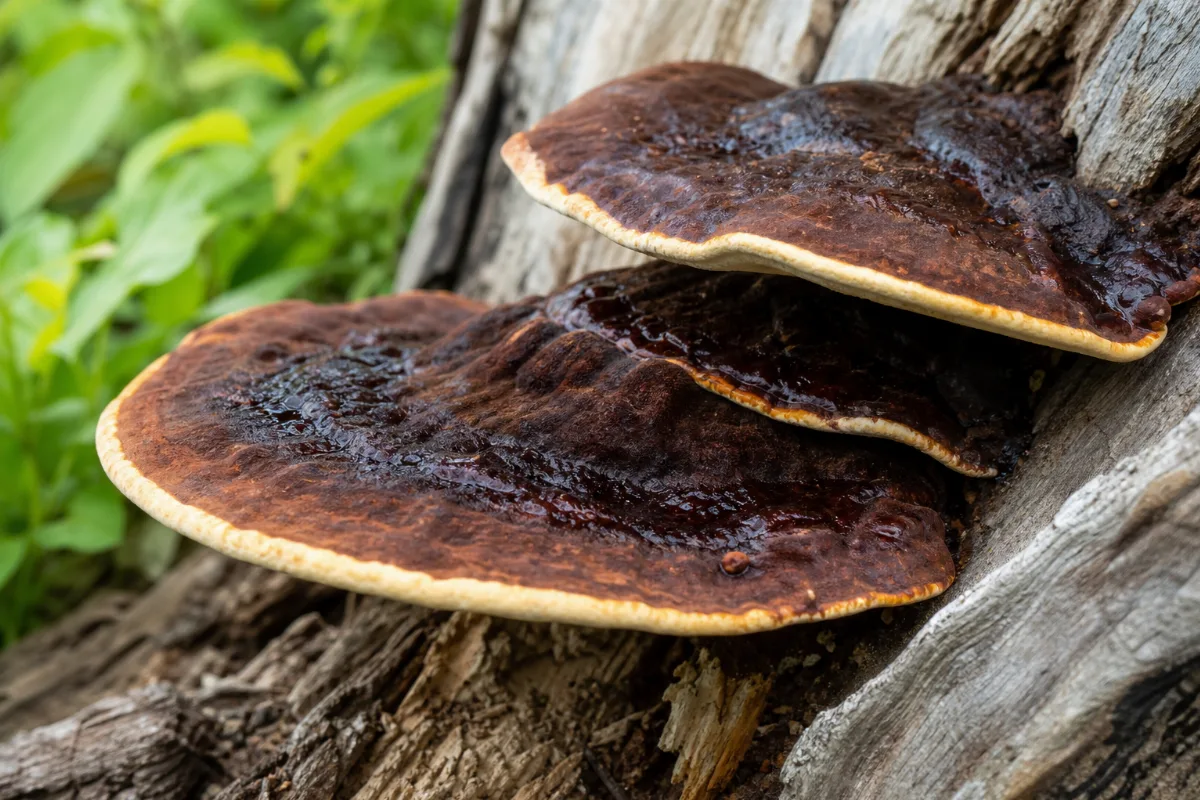
Mushrooms · Wild polypore
Resinous Polypore
Ischnoderma resinosum · also called Late fall polypore
Resinous polypore is a wild bracket fungus that grows on dead hardwood. Sources disagree on whether it is edible: one says only when very young and soft, another lists it as non-edible. The only health-type research is laboratory work on a sugar chain in cells. The main caution is that wild mushrooms need expert identification, and no safety data exist.
General information, not medical advice. Last substantive update · Not medically reviewed. A named clinician has not signed off on this page. How this page is made
About Resinous Polypore
Resinous polypore (Ischnoderma resinosum) is a wild bracket fungus on dead hardwood. Sources disagree on whether it can be eaten at all. The research is a handful of laboratory papers, with no studies in animals or people. The cautions are expert identification, disputed edibility, and missing safety data.
What it is
Ischnoderma resinosum is a wood-rotting fungus in the family Ischnodermataceae. It grows on dead or decaying hardwood, for example beech in Poland.
A 2020 paper describes young fruiting bodies as pale brown, soft and fleshy with a resin-like crust, turning cork-like with age. That description repeats an earlier source we did not open.
Which species is meant
GBIF lists Ischnoderma resinosum (Schrad.) P.Karst. as the accepted name, with many older synonyms such as Polyporus resinosus and Fomes fuliginosus.
A close relative, Ischnoderma benzoinum, appears in some papers. We did not use those results for this page.
As a food
No nutrient table was found, and no study of people eating it. Edibility statements are short remarks, not safety studies.
A Polish study measured 55 elements in 21 wood-growing species including this one. Wild mushrooms can take up metals from where they grow, so a single value is not typical.
What the research shows
A 2022 Chinese study purified a sugar chain from the dried fruiting body. In red blood cells and liver cancer cells in the lab it reduced chemical damage. This is cell work only.
Food scientists in Tennessee grew the fungus in liquid and found it makes smell compounds like anise, vanilla and almond. A 2026 genome paper found genes for wood digestion and for making terpenoids and polysaccharides.
Nothing here shows a benefit in animals or people.
At a glance
Traditional uses history, not proof
- A 2020 food-science paper says it is edible when young and soft and becomes cork-like and inedible with age (Wickramasinghe 2020).
- A 2021 Polish survey of wood-growing mushrooms lists it as non-edible (Mleczek 2021).
- We found no traditional medicine source we could read.
Studied for research
- As a food (disputed edibility), mixed
- Antioxidant sugar chain (cells only), insufficient
- Flavour compounds in lab culture (not health), insufficient
- Genes for terpenoids and polysaccharides, insufficient
Main compounds
- A glucose- and galactose-rich polysaccharide (lab)
- Benzaldehyde-type smell compounds (in culture broth)
- A sugar-binding protein (lectin)
Common forms
- Fresh young fruiting body (the only food form described, and its edibility is disputed)
- Dried powder used to make laboratory extracts (research only)
- Liquid culture (flavour research only)
Research links: Cellular antioxidant properties of Ischnoderma resinosum polysaccharide (PubMed) · First assembled genome of Ischnoderma resinosum (PubMed) · Research Library · Genes & Biomarkers Library
What it is and its history
- Accepted scientific name
- Ischnoderma resinosum
- Naming authority
- (Schrad.) P.Karst. (GBIF, species key 2543487)
- Synonyms
- GBIF lists many older names, including Boletus resinosus Schrad., Polyporus resinosus (Schrad.) Fr., Fomes fuliginosus (Scop.) Cooke, Fomitopsis resinosa (Schrad.) Rauschert and Ganoderma resinosum (Schrad.) Torrend; Ischnoderma benzoinum is a related but separate species used in some papers; we did not merge it with this one
- Common names
- Resinous polypore (English); Late fall polypore (English); Rosin-wrinkled-skin fungus (as translated in a Chinese paper) (English (translated))
- Family or group
- Ischnodermataceae (a fungus family), not a plant. One Polish paper lists it under Fomitopsidaceae, which differs from GBIF.
- Classification
- Fungi > Basidiomycota > Agaricomycetes > Polyporales > Ischnodermataceae > Ischnoderma > Ischnoderma resinosum
- Native range
- Not stated in the sources read. Isolates and fruiting bodies in the papers came from the United States (Tennessee and North Carolina), Poland and China (Jilin Province).
- Habitat
- A wood-rotting (white-rot) bracket fungus growing on dead or decaying hardwood. The Polish paper lists it as saprobic on beech.
- What it looks like
- Fruiting body: A 2020 paper says younger fruiting bodies are pale brown, fleshy and soft, with a tan-to-reddish-brown resin crust and white interior; older ones become cork-like. Taken from the paper's introduction, which cites an earlier source.
- Cultivation
- A 2026 paper calls it nondomesticated. No commercial cultivation source was read. It is grown in liquid culture in the lab.
- Harvest and processing
- Not described in the sources read, other than that fruiting bodies in the Chinese study were harvested and dried (50 degrees C) and ground before extraction.
- Look-alikes and adulterants
- Name: Look-alike fungi; Note: No source read describes look-alikes of Ischnoderma resinosum. Wild mushrooms cannot be safely identified from a description, photo or app.
- Sustainability and conservation
- Not covered by any source read.
Traditional use and history history, not clinical proof
| Tradition or era | Documented use | Source |
|---|---|---|
| Food-science and mycology descriptions | A 2020 food-science paper says the species is edible when young because of its high water content and cork-like and inedible when old, and a 2026 genome paper calls it an edible-medicinal fungus. A 2021 Polish survey lists it as non-edible. We found no historical or traditional-use source. | p32923784 |
Traditional use shows how it was used. It does not show that it works or is safe today.
What is inside, and how it may work
What it contains and how those compounds act in cells and animals. Laboratory and animal mechanisms are not proven effects in people.
Main compounds
| Compound | Family | Where it is concentrated | Activity studied | Level of evidence |
|---|---|---|---|---|
| Ischnoderma resinosum polysaccharide (IRP) | polysaccharide | Dried fruiting body (Jilin Province, China) 85.40 percent pure in the purified extract; by moles about 73 percent glucose and 20 percent galactose (full text) | Free-radical scavenging and protection of red blood cells and HepG2 cells in the lab. 3 | Laboratory research |
| Benzaldehyde, 4-methoxybenzaldehyde, 3,4-dimethoxybenzaldehyde | aromatic aldehyde (smell compounds) | Liquid culture broth (not the mushroom) Up to 12.0, 239.6 and 27.8 mg/kg in the best isolates after 30 days (2020 study) | Cherry-, anise- and vanilla-like smell. No health activity was studied. 7 8 9 | Laboratory research |
| Ischnoderma resinosum agglutinin (IRA) | lectin (protein) | Fruiting body Not given in the abstract | Binds beta-galactose sugars and clumps red blood cells in the lab. 2 | Laboratory research |
Mechanisms, receptors and pathways
| Target or pathway | Gene or receptor | What was found | Level |
|---|---|---|---|
| Cellular antioxidant enzymes | SOD, GSH-Px, CAT (enzymes) | IRP restored activity of these enzymes and lowered MDA in stressed red blood cells and HepG2 cells. 3 | Laboratory research |
| Benzaldehyde biosynthesis in culture | Not specified | Benzyl alcohol and benzoic acid are converted to benzaldehyde, then to 4-methoxybenzaldehyde and 3,4-dimethoxybenzaldehyde. 9 | Laboratory research |
| Terpenoid and polysaccharide biosynthesis genes | Predicted genes (genome annotation) | The genome contains many genes linked to terpenoid and polysaccharide making; their products were not measured. 6 | Other |
Absorption, metabolism and elimination
- Absorption
- Not found in the sources read.
- Distribution
- Not found in the sources read.
- Metabolism
- Not found in the sources read.
- Elimination
- Not found in the sources read.
- Bioavailability
- Not established.
Isolated compounds versus whole extracts
The only health-related finding is for a purified sugar chain in cells. It is not the dried or cooked mushroom, and nothing shows the fruiting body delivers it.
Nutritional composition
No nutrient table (USDA or other) was found. The 2022 Chinese paper's introduction cites an earlier source saying the fruiting body is low in protein and fat; we did not open that source, so we state no figure.
1 mixed findings4 not enough evidence
What was looked at
The 5 benefits and uses checked for Resinous Polypore, each with how strong the evidence is. Tap one to open it.
- As a food (edible only when young, and sources disagree)Mixed findings
- Antioxidant sugar chain from the fruiting body (cells and test tubes)Not enough evidence
- Anise, almond and vanilla-like flavour compounds (lab cultures)Not enough evidence
- Genes for terpenoids, polysaccharides and wood digestion (genome)Not enough evidence
- A sugar-binding protein (lectin) in the fruiting bodyNot enough evidence
What is Resinous Polypore good for?
The uses people ask about and how strong the evidence is for each. None is proven in people. Read this together with the Safety tab.
Benefits, one by one
Each card is a research question, not a promise. Tap a goal to filter. Open a card to see the studies, doses and limits.
As a food (edible only when young, and sources disagree)
Mixed findingsSources do not agree on whether resinous polypore should be eaten. A food-science paper says it is edible when young and soft and turns cork-like with age. A Polish survey of wood-growing mushrooms lists it as non-edible. No nutrient table and no study of people eating it was found.
3 studiesFresh young fruiting body is the only food form described. No amounts…
Studies, doses and limits
Results
ACS Omega 2020 (full text): edible when young because of its high water content, inedible and cork-like with age. Environ Sci Pollut Res 2021: listed as non-edible in a table of 21 Polish wood-growing species. Genomics 2026: described as an edible fungus.
Effect sizes as reported
No numbers; this is a statement about edibility
Why this rating
The sources contradict each other, and none tested eating it. We report edibility claims as the sources state them; we are not recommending that anyone eat it.
Form and dose studied
Fresh young fruiting body is the only food form described. No amounts are given on this page.
Limits
The edibility statements are short remarks, not safety studies. They do not say how many people ate it or what happened.
Why researchers looked
It is a common bracket fungus on hardwood, and some foragers and food scientists call it edible when young.
Traditional use
A 2026 genome paper calls it a nondomesticated edible fungus with medicinal potential. We found no historical or traditional-use source that we could read.
Proposed mechanism Other
Not a mechanism claim. This is about whether and when the fruiting body is eaten.
A proposed mechanism does not show that the effect happens in people.
Wild mushrooms must be identified by an expert. See the Safety tab.
Antioxidant sugar chain from the fruiting body (cells and test tubes)
Not enough evidenceChinese researchers purified a sugar chain (a polysaccharide) from dried resinous polypore. In test tubes and dishes of cells it mopped up free radicals and protected red blood cells and liver cancer cells from chemical damage. No animal or human study exists, so this says nothing about eating the mushroom.
1 studiesA purified laboratory extract made by an ultrasonic-microwave method.…
Studies, doses and limits
Results
Purified polysaccharide (85.40 percent pure, mostly glucose and galactose) reduced AAPH-induced red blood cell breakdown and raised survival of HepG2 cells stressed with 400 micromolar hydrogen peroxide, with a dose-dependent drop in cell death (p < 0.05).
Effect sizes as reported
Not given as a single number in the abstract
Why this rating
One laboratory paper on one lot of mushroom, in cells only. A purified extract in a dish is far from a food or supplement in a person.
Form and dose studied
A purified laboratory extract made by an ultrasonic-microwave method. Not a food or a product. No amounts given.
Who was studied
Red blood cells and HepG2 liver cancer cells in the lab
Limits
Cell work only. HepG2 is a cancer cell line. No animal or human data. Funders and affiliations are in the paper, but the authors state they had no role in the study design.
Why researchers looked
Mushroom sugar chains are often tested as possible natural antioxidants.
Proposed mechanism Laboratory research
In cells, the purified polysaccharide restored the cell's own antioxidant enzymes (SOD, GSH-Px, CAT), lowered MDA (a damage marker) and LDH leakage, and reduced cell death after hydrogen peroxide. These are cell findings.
A proposed mechanism does not show that the effect happens in people.
No safety information from this study.
Anise, almond and vanilla-like flavour compounds (lab cultures)
Not enough evidenceFood scientists grew resinous polypore in liquid and found it makes benzaldehyde (cherry or almond smell), 4-methoxybenzaldehyde (anise smell) and 3,4-dimethoxybenzaldehyde (vanilla smell). This is about natural flavour production, not about health.
3 studiesLiquid culture broth in the laboratory. Not a food or supplement.
Studies, doses and limits
Results
In 30-day cultures, 4-methoxybenzaldehyde reached 104.9 mg/kg on day 24 in one study (2019) and 239.6 mg/kg in the best isolate of a second study (2020). Culture broth, not mushroom.
Effect sizes as reported
Smell-compound concentrations only; no health effect measured
Why this rating
Flavour chemistry in cultures. It tells us nothing about benefit or safety of the mushroom.
Form and dose studied
Liquid culture broth in the laboratory. Not a food or supplement.
Limits
Measured in culture broth. The numbers are not what a fruiting body contains.
Why researchers looked
Companies want natural flavour compounds from fungi.
Proposed mechanism Laboratory research
The fungus converts benzyl alcohol and benzoic acid into benzaldehyde, then adds methoxy groups to make the anise and vanilla-like compounds.
A proposed mechanism does not show that the effect happens in people.
None from these studies.
Genes for terpenoids, polysaccharides and wood digestion (genome)
Not enough evidenceA 2026 study read the whole genome of resinous polypore. It found many genes for wood-digesting enzymes and genes that could make terpenoids and polysaccharides, which the authors call medicinal potential. A gene list does not show that the mushroom has any effect in a person.
1 studiesNot applicable
Studies, doses and limits
Results
34.15 Mb genome, 9418 protein-coding genes, 577 genes for 634 carbohydrate-active enzymes (abstract).
Effect sizes as reported
Gene counts only
Why this rating
Genes show potential only. No measurement of what the fruiting body contains or does was part of the paper.
Limits
Read as an abstract only.
Why researchers looked
Nobody had sequenced its genome before.
Proposed mechanism Other
Gene prediction. The genome contains genes linked to terpenoid and polysaccharide making and to carbohydrate-active enzymes.
A proposed mechanism does not show that the effect happens in people.
None from this study.
A sugar-binding protein (lectin) in the fruiting body
Not enough evidenceA 1991 biochemistry paper isolated a lectin (a protein that sticks to certain sugars and clumps red blood cells) from resinous polypore fruiting bodies and studied how it binds. It is a laboratory finding with no health outcome.
1 studiesNot applicable
Studies, doses and limits
Results
Chemical changes to several amino acid groups reduced red-cell-clumping activity.
Why this rating
Protein chemistry only; no study of effects or safety.
Limits
Abstract only; very old, single paper.
Why researchers looked
Lectins from mushrooms are studied as research tools.
Proposed mechanism Laboratory research
The lectin binds beta-galactose sugars; a tyrosine in the protein is part of the binding site.
A proposed mechanism does not show that the effect happens in people.
No safety information. We do not know if the lectin matters when the mushroom is eaten.
Connections to the rest of health
How Resinous Polypore connects to the rest of our health knowledge graph. Every link says what kind of connection it is. A safety link (for example to the liver) is a warning, not a benefit. A study that merely mentions a topic never creates a benefit link.
Explore every connection: goals, body systems, organs, symptoms, genes
B. Body systems
| Connected to | Kind of connection | Evidence status | Context | Studies |
|---|---|---|---|---|
| Digestive System | Biological association | Mixed findings | Studied for: As a food (edible only when young, and sources disagree) | 8 4 6 |
| Liver Detox | Biological association | Not enough evidence | Studied for: Antioxidant sugar chain from the fruiting body (cells and test tubes) | 3 |
G. Root causes and contributing factors
| Connected to | Kind of connection | Evidence status | Context | Studies |
|---|---|---|---|---|
| Heavy metal exposure | Low certainty | A Polish study measured many elements in this species; wild mushrooms can take up toxic metals from the place they grow. A Polish study measured many elements in this species; wild mushrooms can take up toxic metals from where they grow. Preparation or compound: Wild-collected fruiting bodies of wood-growing mushrooms |
4 |
K. Biological pathways
| Connected to | Kind of connection | Evidence status | Context | Studies |
|---|---|---|---|---|
| Cellular antioxidant defence (SOD, GSH-Px, CAT) | Preliminary mechanism | In vitro | Restored by a purified polysaccharide in stressed cells. | 3 |
L. Active compounds
| Connected to | Kind of connection | Evidence status | Context | Studies |
|---|---|---|---|---|
| Ischnoderma resinosum polysaccharide (IRP) | Biological association | In vitro | Free-radical scavenging and protection of red blood cells and HepG2 cells in the lab. Preparation or compound: Dried fruiting body (Jilin Province, China) |
3 |
| Benzaldehyde, 4-methoxybenzaldehyde, 3,4-dimethoxybenzaldehyde | Biological association | In vitro | Cherry-, anise- and vanilla-like smell. No health activity was studied. Preparation or compound: Liquid culture broth (not the mushroom) |
7 8 9 |
| Ischnoderma resinosum agglutinin (IRA) | Biological association | In vitro | Binds beta-galactose sugars and clumps red blood cells in the lab. Preparation or compound: Fruiting body |
2 |
Each connection is stored with the ingredient, the connected record, the kind of connection, the evidence status, the supporting studies, the preparation or compound involved, and a review date (last reviewed October 25, 2026).
Evidence at a glance: what the research found for 5 outcomes
Each outcome below is one thing researchers measured. Certainty is how far the evidence can be trusted, not how well it works. The full studies are on the next tab.
The evidence
The research centre for Resinous Polypore. Every record here was checked against PubMed or the publisher's page; we never list a study we have not verified.
Evidence by outcome
Bars show how many studies we found for each outcome, not how well it works. People are added up across trials only (reviews are not added, to avoid double counting).
How we rate evidence
High certainty
Several well-run trials or reviews agree; further research is unlikely to change the picture much.
Moderate certainty
Good trials point the same way, but some doubt remains.
Low certainty
Small, short or inconsistent trials. The finding could change with better research.
Very low certainty
Very little or very weak human data. Treat as a possibility only.
Mixed findings
Trials or reviews disagree with each other.
Not enough evidence
Not enough human research to say either way.
Evidence against
Good research found no benefit, or found harm.
We take the reviewers' own risk-of-bias and GRADE statements where they exist, and otherwise judge from study size, design, consistency, directness and whether a product matches what is sold. Many publications do not make evidence high. Method note: We searched PubMed for Ischnoderma resinosum (10 records), read the abstracts of the papers that mention health, food or composition, read two open-access full texts for numbers, and checked the name in GBIF. Regulators were not read. Numbers come from abstracts or full text as stated. Certainty ratings are the compiler's own reading. Edibility statements are reported as the sources state them.
Study library: every study we checked 9
| Study | Design | People | Product, dose, length | Result |
|---|---|---|---|---|
| GBIF Secretariat 2026 GBIF Backbone Taxonomy: Ischnoderma resinosum (Schrad.) P.Karst. (species key 2543487) GBIF API · Source |
Taxonomy record fungus |
Name record | n/a Not shown here |
Ischnoderma resinosum (Schrad.) P.Karst. is an accepted species in the family Ischnodermataceae, order Polyporales, phylum Basidiomycota (queried 2026-10-25). GBIF lists many older names as synonyms, for example Boletus resinosus, Polyporus resinosus, Fomes fuliginosus, Fomitopsis resinosa and Ganoderma resinosum. Accepted name Methods, limits and fundingOutcomes: Accepted name, family and synonyms Limitations: A database record; it does not say which name any product or study used. Funding and conflicts: n/a Read: database record (GBIF API, queried 2026-10-25) |
| Kawagishi 1991 Chemical modification and NMR studies on a mushroom lectin Ischnoderma resinosum agglutinin (IRA) Biochim Biophys Acta · PMID 1998718 · DOI |
Lab study fungus |
A lectin protein purified from Ischnoderma resinosum fruiting bodies | Ischnoderma resinosum agglutinin (a sugar-binding protein) fruiting body Not shown here |
A beta-galactosyl-specific lectin was isolated from fruiting bodies. Chemical changes to several amino acid groups reduced its red-cell-clumping activity, and the work indicated that a tyrosine residue is part of the sugar-binding site. Protein chemistry; no health outcome Methods, limits and fundingOutcomes: Which parts of the protein bind sugar Limitations: A biochemistry paper from 1991. It says nothing about effects or safety in people. Funding and conflicts: Not stated in the abstract. Read: abstract |
| Liao 2022 Cellular Antioxidant Properties of Ischnoderma Resinosum Polysaccharide Molecules · PMID 36431811 · DOI |
Lab study fungus |
Red blood cells and HepG2 liver cancer cells in the lab, treated with a purified polysaccharide (IRP) from dried Ischnoderma resinosum fruiting body (Jilin Province, China, harvested September 2021) | Purified Ischnoderma resinosum polysaccharide (IRP) fruiting body Not shown here |
The purified polysaccharide reduced AAPH-induced red blood cell breakdown, restored activity of the cell's own antioxidant enzymes (SOD, GSH-Px, CAT), lowered MDA and LDH leakage, and raised survival of HepG2 cells stressed with 400 micromolar hydrogen peroxide (p < 0.05). Purity of the extract was 85.40 percent (full text). By moles, glucose was 73.224 and galactose 20.018 of the sugars, with small amounts of mannose, fucose and others (full text). Cell and test-tube antioxidant effects; no animal or human outcome Methods, limits and fundingOutcomes: Free-radical scavenging, red blood cell damage, antioxidant enzymes, HepG2 cell survival Limitations: Cell and test-tube work only, from one lot of dried mushroom. HepG2 is a liver cancer cell line. Doses and concentrations in cells cannot be turned into amounts for people. No animal or human data. Funding and conflicts: Authors declare no conflict of interest; funders had no role in the study (as stated in the paper). Read: abstract (PubMed) and open-access full text (Europe PMC) |
| Mleczek 2021 Mineral composition of elements in wood-growing mushroom species collected from of two regions of Poland Environ Sci Pollut Res Int · PMID 32940836 · DOI |
Composition analysis fungus |
21 wood-growing mushroom species, including Ischnoderma resinosum, collected 2013-2019 in Lower and Upper Silesia, Poland | Wild fruiting bodies, dried and analysed for 55 elements fruiting body Not shown here |
The study measured 55 elements in 21 wood-growing species; the paper's species table lists Ischnoderma resinosum as 'non-edible' and as growing on beech. The abstract says mushrooms of the family Fomitopsidaceae had the lowest content of elements; the full text groups I. resinosum among the less enriched. We could not reliably map the table columns to individual elements, so no values for this species are quoted. Element content compared between species; no health outcome Methods, limits and fundingOutcomes: Element content of fruiting bodies Limitations: Table values for this species were not extracted. The family placement used by the authors (Fomitopsidaceae) differs from GBIF (Ischnodermataceae). Samples came from a few sites and are not typical for other places. Funding and conflicts: Authors declare no conflict of interest. Read: abstract and open-access full text (Europe PMC) |
| Penn State Extension 2024 Preparing and Preserving Mushrooms (Penn State Extension) Penn State Extension · Source |
Extension guidance fungus |
General guidance for home mushroom handling | Wild and domestic mushrooms (general; Ischnoderma not named) Not shown here |
The page says only an expert can tell poisonous from edible mushrooms, advises non-experts not to forage, and says cooking or drying does not destroy mushroom toxins. It does not mention Ischnoderma resinosum. General advice Methods, limits and fundingOutcomes: Wild-mushroom safety advice Limitations: General guidance, not specific to this species. Funding and conflicts: University extension service; no commercial funding stated. Read: full page text |
| Tang 2026 The first assembled genome of Ischnoderma resinosum (Basidiomycota, edible-medicinal fungus) contributes to insights into its medicinal properties and lignocellulosic degradation potential Genomics · PMID 41796909 · DOI |
Genome study fungus |
DNA sequencing of Ischnoderma resinosum | Ischnoderma resinosum genome fungus DNA Not shown here |
The assembled genome was 34.15 Mb with 9418 protein-coding genes on 25 contigs. 577 genes encoded 634 carbohydrate-active (wood-digesting) enzymes, and numerous genes were linked to making terpenoids and polysaccharides. The authors call the species a nondomesticated edible fungus with wood-decaying capacity and medicinal potential. Gene catalogue; no health outcome Methods, limits and fundingOutcomes: Genome size, genes, wood-digesting and terpenoid or polysaccharide genes Limitations: Genes show what the fungus could make, not what the fruiting body contains or does in a person. 'Medicinal potential' is the authors' wording, not a tested effect. Funding and conflicts: Authors declare no competing interests. Read: abstract |
| Wickramasinghe 2019 Key Odorants from the Fermentation Broth of the Edible Mushroom Ischnoderma resinosum J Agric Food Chem · PMID 30735043 · DOI |
Lab study fungus |
Liquid fermentation broth of Ischnoderma resinosum | Ischnoderma resinosum liquid culture culture broth Not shown here |
Eighteen odorants were found. Anise-smelling 4-methoxybenzaldehyde, vanilla-smelling 3,4-dimethoxybenzaldehyde and cherry-smelling benzaldehyde were the key contributors. Over 30 days, 4-methoxybenzaldehyde peaked on day 24 at 104.9 mg/kg; 3,4-dimethoxybenzaldehyde (10.7 mg/kg) and benzaldehyde (4.5 mg/kg) peaked on day 16. Smell compounds in culture broth; no health outcome Methods, limits and fundingOutcomes: Which smell compounds make the broth smell 'candy-like' Limitations: Describes the broth, not the mushroom as eaten. Says nothing about health or safety. Funding and conflicts: No funding or conflict statement in the abstract. Read: abstract |
| Wickramasinghe 2020 Fermentation Dynamics and Benzylic Derivative Production in Ischnoderma resinosum Isolates ACS Omega · PMID 32923784 · DOI |
Lab study fungus |
Liquid-culture broth of six Ischnoderma resinosum isolates collected in Tennessee and North Carolina, followed for 30 days | Ischnoderma resinosum liquid culture (not the mushroom as eaten) culture broth Not shown here |
Isolate I3 made the most benzaldehyde (12.0 mg/kg) and 4-methoxybenzaldehyde (239.6 mg/kg) in the broth; isolate I4 made the most 3,4-dimethoxybenzaldehyde (27.8 mg/kg as printed in the abstract, which also contains a typo, mg/18 kg). Isolate I2 made the most ethanol (546.4 mg/L). The full-text introduction says the species is edible when young because of its high water content and becomes inedible and cork-like with age (citing an earlier source). Flavour-compound yields in culture; no health outcome Methods, limits and fundingOutcomes: Sugars, ethanol, acids and flavour-compound production over 30 days Limitations: A culture-broth study for natural flavour production, not a nutrition or health study. Isolates came from the south-eastern United States. Funding and conflicts: Authors declare no competing financial interest. Read: abstract (PubMed) and open-access full text (Europe PMC) |
| Wickramasinghe 2020 Biosynthesis of Benzylic Derivatives in the Fermentation Broth of the Edible Mushroom, Ischnoderma resinosum J Agric Food Chem · PMID 32049524 · DOI |
Lab study fungus |
Liquid fermentation broth of Ischnoderma resinosum, with isotope-labelled starting compounds | Ischnoderma resinosum liquid culture culture broth Not shown here |
Of 26 benzylic compounds screened, 13 were found in the broth. The fungus turned benzyl alcohol and benzoic acid into benzaldehyde, then into 4-methoxybenzaldehyde and 3,4-dimethoxybenzaldehyde. The authors also made vanillin from vanillic acid in the culture. Pathway of smell-compound production; no health outcome Methods, limits and fundingOutcomes: How the culture makes benzaldehyde-type smell compounds Limitations: Flavour chemistry in a culture, with no link to health or to eating the mushroom. Funding and conflicts: No funding or conflict statement in the abstract. Read: abstract |
What we do not know yet
- No trial, animal study or nutrient table for resinous polypore.
- The only health-type result is one laboratory paper on a purified sugar chain.
- Sources disagree on edibility, and no look-alike, allergy, interaction, pregnancy, breastfeeding or child data exist.
- No regulator statement (EFSA, EMA, FDA, NCCIH, LiverTox, LactMed) was read.
- This species' element values in the Polish study were not extracted.
How new research is added
New studies are found by a saved PubMed search and placed in a review queue. A person reads each one before it changes any evidence rating or safety wording. New publications never change ratings automatically.
Lab markers
What changed in blood or saliva tests during trials. A changed number is not the same as feeling or being healthier, and we give no "normal ranges".
Safety
What studies and official sources say about side effects, medicines and who should check first. Each point shows what kind of evidence it comes from.
Main points to know 4
- Wild mushrooms must be identified by an expert, and sources disagree on whether this one is edible. Resinous polypore grows wild on dead hardwood. One food-science paper says it is edible when young and becomes inedible and cork-like with age. A Polish survey lists it as non-edible. We found no source on poisonous look-alikes, no poisoning report and no safety study, and that is a gap, not a reassurance. A description, a photo or an app is not enough to be sure of a wild mushroom. Only eat wild mushrooms that a local expert has identified. General safety principle 8 4 5
- Cooking and drying do not remove all mushroom toxins. Penn State Extension says only an expert can tell poisonous from edible mushrooms and that cooking or drying will not destroy their toxins. This is general advice and does not name this species. General safety principle 5
- No safety data for extracts or supplements. The only extract in the research is a purified sugar chain tested in cells. We found no animal toxicity study, no human study and no commercial supplement assessment. Unknown is not the same as safe. Lack of evidence 3
- No data for pregnancy, breastfeeding or young children. We found no source on eating resinous polypore, or any extract of it, in pregnancy, while breastfeeding or in children. That is missing information, not proof of safety. Lack of evidence
Side effects 1
| Effect | How often | Severity and recovery | Evidence |
|---|---|---|---|
| No adverse effect has been reported or studied for this species in the sources we read Lack of reports is not proof of safety. Any wild mushroom can cause stomach upset or allergy in some people. | Unknown: no human use has been studied | unknown Not stated | Lack of evidence |
Liver
We found no published case of liver injury linked to resinous polypore, and LiverTox was not checked. A purified sugar chain from it protected a liver cancer cell line in the lab, but that is not a safety study. 3
How often. No human rate is known.
Monitoring. No agency advice was read. Anyone with liver disease should ask their doctor before using any mushroom product.
This is a safety connection. It is not evidence that Resinous Polypore supports liver health.
Medicines and supplements 1
| With | Why it matters | Importance | Evidence | What to do |
|---|---|---|---|---|
| Any medicine (general) prescription | No source we read tested resinous polypore or its extracts with any medicine, in people or in animals. | Unknown. | Lack of evidence Not enough evidence | Absence of data is not proof of safety. Ask a pharmacist if you take regular medicines and plan to use any mushroom extract or supplement. |
Who should check first 3
| Situation | Advice | Evidence |
|---|---|---|
| Anyone who cannot have a wild mushroom identified by an expert | Do not eat it. Wild identification from a description or photo is not reliable. | General safety principle 5 |
| Pregnancy, breastfeeding and young children | No data. Avoid eating wild mushrooms or taking mushroom extracts unless a clinician agrees. | Lack of evidence |
| Old, tough, cork-like fruiting bodies | The one source that calls it edible says it is edible only when young and soft; older specimens are described as inedible. | Narrative statement 8 |
Overdose, product quality and regulators
Summary. No toxicity study of resinous polypore was found, in animals or people.
High dose or long term signals. Not studied.
Genotoxicity. Not studied.
Wild mushrooms can take up metals from the wood and soil where they grow. We found no figures for this species that we could read with confidence.
Elements. A Polish study measured 55 elements in 21 wood-growing mushroom species, including Ischnoderma resinosum, and the authors note that wild mushrooms can take up toxic metals such as mercury and arsenic from polluted substrate. We could not reliably read this species' values from the tables, so none are quoted. The abstract says Fomitopsidaceae (the family the authors place it in) had the lowest content of elements overall. 4
| Body | Action | Date |
|---|
When to get medical help
- After eating any wild mushroom: severe vomiting, diarrhoea, belly pain, confusion or fits mean call your local emergency number or poison centre now. Keep a sample or photo of what was eaten.
- Symptoms that start many hours or days after a wild mushroom meal, such as dark urine, yellow skin or eyes, or very little urine, need urgent medical care even if you felt well at first.
- Hives, swelling of the lips or face, wheeze or trouble breathing after eating a mushroom: get emergency help.
If someone may be poisoned or in a crisis, contact a clinician or emergency service straight away. In the US, Poison Control is 1-800-222-1222.
General information only, not medical advice. Ask a clinician or pharmacist before use, especially with medicines, in pregnancy or with a health condition. See the Natural Remedy Safety guide.
Frequently asked questions
What is resinous polypore?
Is resinous polypore edible?
Is resinous polypore safe?
Does resinous polypore have any health benefits?
No benefit has been shown. The only health-type work is a laboratory study in which a purified sugar chain protected cells from chemical damage. There are no animal or human studies.
Is it an antioxidant?
In one cell study a purified sugar chain from it mopped up free radicals and protected red blood cells and liver cancer cells. That is a dish experiment on an extract, not proof that the mushroom acts this way in people.
Why does it smell like anise?
Can you buy it as a supplement?
We found no assessed supplement of resinous polypore and no safety data for extracts. We do not recommend or link to any product.
Does it interact with medicines?
No interaction study exists, so the answer is unknown. Ask a pharmacist if you take regular medicines.
Is it safe in pregnancy, breastfeeding or for children?
No data exist. Unknown is not the same as safe, so ask a clinician.
Does it contain heavy metals?
Wild mushrooms can take up metals from the wood and soil where they grow. A Polish study measured 55 elements in this species and 20 others, but we could not reliably read this species' values. Levels depend on the site.
What does the genome study show?
A 2026 study sequenced its genome and found genes for wood-digesting enzymes and for making terpenoids and polysaccharides. That shows what the fungus could make, not what it does in a person.
Explore by health goal
Editorial transparency
- Written by
- AlternativeMed editorial team. Research compiled with AI assistance, then checked against PubMed records.
- Medical review
- None. This page has not been reviewed by a physician or pharmacist.
- First published
- 2026-10-25
- Last substantive update
- 2026-10-25
- How we research
- We searched PubMed for Ischnoderma resinosum (10 records), read the abstracts of the papers that mention health, food or composition, read two open-access full texts for numbers, and checked the name in GBIF. Regulators were not read. Numbers come from abstracts or full text as stated. Certainty ratings are the compiler's own reading. Edibility statements are reported as the sources state them.
- How we rate evidence
- See "How we rate evidence" in the Evidence tab.
- Independence
- No product is promoted on this page. No affiliate links are shown. This page is information, not a recommendation to eat or use any wild mushroom.
Sources 9
Each source was opened and checked. Where we read only the abstract, it says so. The small numbers in the text point here.
- GBIF Secretariat. GBIF Backbone Taxonomy: Ischnoderma resinosum (Schrad.) P.Karst. (species key 2543487). GBIF API. 2026. (database record (GBIF API, queried 2026-10-25))
- Kawagishi H, Mori H. Chemical modification and NMR studies on a mushroom lectin Ischnoderma resinosum agglutinin (IRA). Biochim Biophys Acta. 1991. PMID 1998718. DOI 10.1016/0167-4838(91)90263-y. (abstract)
- Liao C, Wu L, Zhong W, et al. Cellular Antioxidant Properties of Ischnoderma Resinosum Polysaccharide. Molecules. 2022. PMID 36431811. DOI 10.3390/molecules27227717. (abstract (PubMed) and open-access full text (Europe PMC))
- Mleczek M, Gasecka M, Budka A, et al. Mineral composition of elements in wood-growing mushroom species collected from of two regions of Poland. Environ Sci Pollut Res Int. 2021. PMID 32940836. DOI 10.1007/s11356-020-10788-y. (abstract and open-access full text (Europe PMC))
- Penn State Extension. Preparing and Preserving Mushrooms (Penn State Extension). Penn State Extension. 2024. (full page text)
- Tang LX, Jin C, Li X, et al. The first assembled genome of Ischnoderma resinosum (Basidiomycota, edible-medicinal fungus) contributes to insights into its medicinal properties and lignocellulosic degradation potential. Genomics. 2026. PMID 41796909. DOI 10.1016/j.ygeno.2026.111229. (abstract)
- Wickramasinghe PCK, Munafo JP Jr. Key Odorants from the Fermentation Broth of the Edible Mushroom Ischnoderma resinosum. J Agric Food Chem. 2019. PMID 30735043. DOI 10.1021/acs.jafc.8b06766. (abstract)
- Wickramasinghe PCK, Munafo JP Jr. Fermentation Dynamics and Benzylic Derivative Production in Ischnoderma resinosum Isolates. ACS Omega. 2020. PMID 32923784. DOI 10.1021/acsomega.0c02550. (abstract (PubMed) and open-access full text (Europe PMC))
- Wickramasinghe PCK, Munafo JP Jr. Biosynthesis of Benzylic Derivatives in the Fermentation Broth of the Edible Mushroom, Ischnoderma resinosum. J Agric Food Chem. 2020. PMID 32049524. DOI 10.1021/acs.jafc.9b07218. (abstract)


