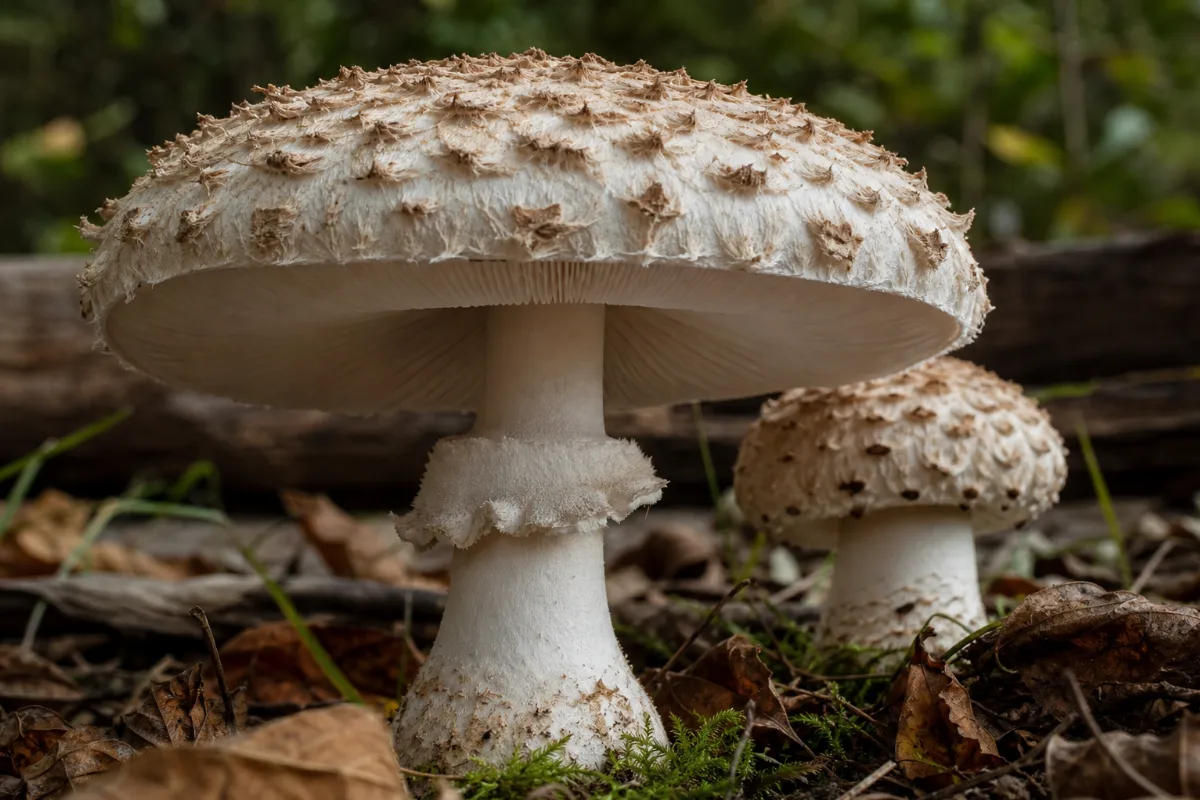
Mushrooms · Wild mushroom
Shaggy Parasol
Chlorophyllum rhacodes (formerly Macrolepiota rhacodes) · also called Shaggy parasol mushroom (the name used in the sources we read)
Shaggy parasol is a large wild mushroom that people eat cooked. It is not a proven remedy: we found no human trial of it for any health outcome. The first caution is your stomach. A conservation charity says about 1 in 25 people are upset by it even when cooked. The second is mistaken identity. A poisonous look-alike, the green-spored lepiota, causes violent gut illness, and some Lepiota relatives hold toxins that can destroy the liver.
General information, not medical advice. Last substantive update · Not medically reviewed. A named clinician has not signed off on this page. How this page is made
About Shaggy Parasol
Shaggy parasol is a large wild mushroom eaten cooked. There is no human research on health benefits. The real concerns are a stomach upset in some people even when it is cooked, poisonous and deadly look-alikes, metals taken up from soil, and missing information on allergy, medicines, pregnancy and children. Missing information is not reassurance.
What it is
Shaggy parasol is Chlorophyllum rhacodes (GBIF accepted name, family Agaricaceae), a fungus that grows on the ground and is picked wild. It was once called Lepiota rhacodes and then Macrolepiota rhacodes; the Woodland Trust says DNA studies moved it into Chlorophyllum. Several other mushrooms have 'parasol' in their name, so the name alone does not say which species is meant.
What research has tested
We found no trial in which people ate or took shaggy parasol and a health outcome was measured. The research is about composition and the lab. A Serbian study of three related edible mushrooms reports their sugars, acids, fats and vitamin E forms, and test-tube antioxidant, antimicrobial and tumour-cell activity. A 2026 study of one collection reports antioxidant and enzyme tests.
These results are ideas for future research. They are not evidence that shaggy parasol prevents or treats any condition.
Metals from the soil
Wild shaggy parasol takes up metals, and studies disagree on how much that matters. A 2026 study of one collection reported cadmium 14.78 and copper 155.77 mg per kg, and said both were above upper limits quoted in the literature. A Czech study on ground described as unpolluted found it accumulated cadmium, arsenic and thallium among other elements, but the authors expected no considerable effect on health because such mushrooms are usually eaten as a delicacy. In a Turkish national park its health-risk values were within legal limits, and a Polish forest study found high copper and said soil may matter more than the type of mushroom.
The sensible reading is that the ground decides. If you cannot say where it grew, treat the metal content as unknown.
Cooking and forms
The Woodland Trust says it is edible only when cooked. We found no other source on cooking, and none on eating it raw. No supplement, powder or extract of shaggy parasol was found, only laboratory extracts in studies. This page gives no amounts and does not recommend any product.
Rules and official statements
We found no statement specific to shaggy parasol from EFSA, the FDA, the EMA, NCCIH, LiverTox or LactMed, and we did not search them in full. The only edibility statement we read is the Woodland Trust page, which is a charity, not a regulator. Absence of a statement is not a safety guarantee.
At a glance
Traditional uses history, not proof
- The Woodland Trust says it is good to eat when cooked, and that about 1 in 25 people cannot tolerate it.
- The Woodland Trust says its rings of growth, called fairy rings, are part of European folklore. No traditional medicinal use was found in the sources we read.
Studied for research
- Food composition (low calories, unsaturated fats, vitamin E forms), no health effect shown, insufficient
- Antioxidant activity in test-tube assays, insufficient
- Germ-killing and tumour-cell tests in dishes, insufficient
- Memory-related enzyme tests in a test tube, insufficient
- Any medicinal or supplement use in people, none found
Main compounds
- Phenolic acids such as p-coumaric acid (in a study of three related mushrooms)
- Mannitol, trehalose and vitamin E forms
- Metals and trace elements taken up from soil, including cadmium and copper
Common forms
- Fresh cap, cooked, as a food (the Woodland Trust says edible only when cooked)
- Laboratory extracts used in studies only; no supplement product was found
Research links: Woodland Trust: Shaggy parasol · Mushroom poisoning by Chlorophyllum molybdites in the Midwest US (abstract) · Chlorophyllum molybdites poisoning on Reunion Island (abstract) · Chlorophyllum molybdites poisonings in Sicily (abstract) · DNA markers for toxic Chlorophyllum species (abstract) · Amatoxin-containing mushroom poisonings: a review (abstract) · Risk and essential elements in Chlorophyllum rhacodes, Czech Republic (abstract) · Three edible Macrolepiota species from Serbia (abstract) · Research Library · Genes & Biomarkers Library
What it is and its history
- Accepted scientific name
- Chlorophyllum rhacodes
- Naming authority
- (Vittad.) Vellinga (GBIF)
- Synonyms
- Macrolepiota rhacodes (Vittad.) Singer; Lepiota rhacodes (Vittad.) Quél.; Agaricus rhacodes Vittad.; Leucocoprinus rhacodes (Vittad.) Pat.; Lepiotophyllum rhacodes (Vittad.) Locq.
- Common names
- Shaggy parasol (English)
- Family or group
- Agaricaceae (a fungus family), not a plant.
- Classification
- Fungi > Basidiomycota > Agaricomycetes > Agaricales > Agaricaceae > Chlorophyllum > Chlorophyllum rhacodes
- Native range
- The Woodland Trust says it is common in the UK and Ireland and is found throughout Europe and North America.
- Habitat
- The Woodland Trust gives woods and shrubs as the habitat and June to October as the fruiting season.
- What it looks like
- Fruiting body: Not described here by design. This page gives no identification help.
- Cultivation
- Not covered by a source read. Supply is wild-picked.
- Harvest and processing
- The Woodland Trust says it is edible only when cooked. No other processing source was read.
- Look-alikes and adulterants
- Name: Green-spored lepiota (Chlorophyllum molybdites); Note: Poisonous. Sources describe severe gut illness, and a 2025 paper says toxic Chlorophyllum species are mistaken for edible mushrooms in the same genus and in Macrolepiota. No identification features are given here.; Name: Deadly Lepiota species (for example Lepiota brunneoincarnata); Note: Contain amatoxins (Sarawi 2022); L. brunneoincarnata is the most frequently reported fatal Lepiota (Diaz 2018). None of the papers read says these are mistaken for shaggy parasol, but they are a reason never to rely on appearance.; Name: Other big parasol-type mushrooms; Note: The Woodland Trust names a gilled Agaricus species and the parasol mushroom (Macrolepiota procera) as similar. See the separate parasol mushroom page for that species.
- Sustainability and conservation
- Not checked.
Traditional use and history history, not clinical proof
| Tradition or era | Documented use | Source |
|---|---|---|
| Naming history | The Woodland Trust says the species was called Lepiota rhacodes, then Macrolepiota rhacodes, and that DNA studies moved it into Chlorophyllum, a genus that previously held only green-spored species. It says the name 'rhacodes' comes from a Greek word for a piece of cloth or rag. GBIF confirms Chlorophyllum rhacodes as the accepted name. | s-woodland |
| Folklore | The Woodland Trust says its habit of growing in rings, called fairy rings, has long been part of European folklore, and that the rings come from the way the underground mycelium grows outwards. | s-woodland |
| Food use | The Woodland Trust says it is edible, but only when cooked, and may upset the stomach of about one in 25 people. No other history of use was read. | s-woodland |
| Medicinal use | No traditional medicinal use was found in the sources read. | p31746884 |
Traditional use shows how it was used. It does not show that it works or is safe today.
What is inside, and how it may work
What it contains and how those compounds act in cells and animals. Laboratory and animal mechanisms are not proven effects in people.
Main compounds
| Compound | Family | Where it is concentrated | Activity studied | Level of evidence |
|---|---|---|---|---|
| Phenolic acids (p-hydroxybenzoic and p-coumaric acids) | phenolic | Fruiting body Not given in the abstract. | Named as the main phenolic compounds in the three Macrolepiota-group species studied; antioxidant potential in tests. 14 | Laboratory research |
| Organic acids (oxalic and malic acids) | organic acid | Fruiting body Not given in the abstract. | Predominant organic acids in the three species studied. 14 | Laboratory research |
| Sugars (mannitol and trehalose) and tocopherols (alpha, beta, delta) | sugar and vitamin E | Fruiting body Not given in the abstract. | Free sugars and vitamin E forms identified in the three species studied. 14 | Laboratory research |
| Metals and trace elements (Cd, Cu, Zn, Se, As, Tl, Pb and others) | element | Fruiting body One 2026 collection: Cd 14.78, Cu 155.77, Zn 76.18, Pb 6.98 mg per kg (basis not stated). | Taken up from the soil; some are essential in small amounts and some are toxic. 1 15 | Laboratory research |
Mechanisms, receptors and pathways
| Target or pathway | Gene or receptor | What was found | Level |
|---|---|---|---|
| Cholinesterase enzymes | AChE, BChE | An extract inhibited acetylcholinesterase (IC50 94.330 ug/mL) and butyrylcholinesterase (IC50 128.397 ug/mL) in an enzyme test; the authors call the effect limited. 1 | Laboratory research |
| Radical scavenging and reducing power | Not applicable | Extracts showed antioxidant activity in DPPH and FRAP tests. 1 14 | Laboratory research |
Absorption, metabolism and elimination
- Absorption
- Not found in the sources read.
- Distribution
- Not found.
- Metabolism
- Not found.
- Elimination
- Not found.
- Bioavailability
- Not established in people.
Isolated compounds versus whole extracts
The activity findings come from laboratory extracts. Eating the cooked mushroom is not the same thing, and no human trial tested either.
Nutritional composition
The Serbian study reports a low caloric value and a high share of polyunsaturated fatty acids for three Macrolepiota-group species, one of them this one, without splitting the figures by species in the abstract. No food-database record (USDA) was found for shaggy parasol, so no typical value is given.
5 not enough evidence
What was looked at
The 5 benefits and uses checked for Shaggy Parasol, each with how strong the evidence is. Tap one to open it.
What is Shaggy Parasol good for?
What shaggy parasol has been studied for and how strong the evidence is. None of it is proven in people. Read this together with the Safety tab.
Benefits, one by one
Each card is a research question, not a promise. Tap a goal to filter. Open a card to see the studies, doses and limits.
Shaggy parasol as a food (composition)
Not enough evidenceShaggy parasol is a large wild mushroom that is eaten cooked. A Serbian study of three related edible mushrooms, one of them this species, reports a low caloric value, a high share of polyunsaturated fats and some vitamin E forms. Another study found it takes up copper and zinc as well as some toxic metals. No study shows that eating it changes anyone's health.
3 studiesFresh cooked cap as food. This page gives no amounts.
Studies, doses and limits
Results
Ćirić 2019 (three Macrolepiota species from Serbia, including this one): low caloric value; mannitol and trehalose as free sugars; oxalic and malic acids as the main organic acids; p-hydroxybenzoic and p-coumaric acids as the main phenolic compounds; rich in polyunsaturated fatty acids; three tocopherol forms. The abstract does not split the results by species. Šíma 2019: C. rhacodes accumulated copper, zinc and selenium among other elements.
Effect sizes as reported
Composition only; no health effect measured
Why this rating
Composition is measured, but nothing shows a health benefit from eating it. No food-database record was found, and the main composition paper does not separate this species from the other two.
Form and dose studied
Fresh cooked cap as food. This page gives no amounts.
Limits
Abstract-level reading; results are not split by species; the same mushroom also takes up toxic metals.
Why researchers looked
It is a wild food that people pick, so researchers measure what is in it and what the soil puts into it.
Traditional use
The Woodland Trust says it is edible when cooked. No traditional medicinal use was found in the sources read.
Proposed mechanism Other
Not a mechanism claim. These are laboratory measurements of the food.
A proposed mechanism does not show that the effect happens in people.
Some people get a stomach upset even from the cooked mushroom, and poisonous look-alikes exist. See the Safety tab first.
Antioxidant activity (test tube)
Not enough evidenceIn two laboratory studies, extracts of this mushroom showed antioxidant activity in test-tube assays. That is a test-tube result only. No study measured antioxidant effects in people who ate it.
2 studiesLaboratory extracts, not the cooked mushroom.
Studies, doses and limits
Results
Akata 2026 (one collection): total antioxidant status 3.125 mmol/L, DPPH activity 55.430 mg TE/g and FRAP 72.540 mg TE/g; the authors call this a significant level of antioxidant activity. Ćirić 2019: all three Macrolepiota species, including this one, showed antioxidant potential; no numbers in the abstract.
Effect sizes as reported
Test-tube activity; no human effect measured
Why this rating
Only test-tube assays on extracts. Test-tube antioxidant activity does not show benefit in the body.
Form and dose studied
Laboratory extracts, not the cooked mushroom.
Limits
One collection in the newer study; the older paper does not split results by species; extract strengths in assays are not what a meal provides.
Why researchers looked
Mushrooms contain phenols and other compounds, so researchers test extracts in the lab.
Proposed mechanism Laboratory research
Radical-scavenging and reducing power in test-tube assays (DPPH and FRAP).
A proposed mechanism does not show that the effect happens in people.
Lab results do not show that eating this mushroom is useful or safe for any condition. See the Safety tab.
Germ-killing and tumour-cell tests (test tube)
Not enough evidenceIn a Serbian laboratory study of three edible Macrolepiota-group mushrooms, one of them this species, the extracts showed activity against microbes and against tumour cell lines in dishes. This was done in the lab only. It says nothing about people eating the mushroom.
1 studiesLaboratory extracts, not the cooked mushroom.
Studies, doses and limits
Results
Ćirić 2019: all three species showed antimicrobial potential and cytotoxic activity within the tumour cell lines tested. The abstract gives no numbers and does not say which results belong to this species.
Effect sizes as reported
Not given
Why this rating
Lab tests on extracts only, with no numbers read and no split by species.
Form and dose studied
Laboratory extracts, not the cooked mushroom.
Limits
Abstract only. Killing cells in a dish does not mean a treatment works, and it can also mean the extract is harmful to healthy cells.
Why researchers looked
Researchers screen mushroom extracts for activity in the lab.
Proposed mechanism Laboratory research
Cell-culture and microbe-culture tests; the abstract names no mechanism.
A proposed mechanism does not show that the effect happens in people.
Do not use this mushroom as a treatment for infection or cancer. See the Safety tab.
Memory-related enzyme tests (test tube)
Not enough evidenceA 2026 laboratory study tested an extract against two enzymes linked to memory medicines. The authors call the effect limited. It is not evidence that eating the mushroom helps memory.
1 studiesLaboratory extract, not the cooked mushroom.
Studies, doses and limits
Results
Akata 2026: IC50 94.330 ug/mL for acetylcholinesterase and 128.397 ug/mL for butyrylcholinesterase. The authors say this shows a limited inhibitory effect but may show a certain level of anticholinesterase potential.
Effect sizes as reported
IC50 values as above; no comparison with a medicine was read
Why this rating
One test-tube study of one collection; abstract-level reading.
Form and dose studied
Laboratory extract, not the cooked mushroom.
Limits
Repository abstract only; no comparison to a reference drug was read.
Why researchers looked
Cholinesterase enzymes are targets of some medicines for memory loss, so extracts are tested against them.
Proposed mechanism Laboratory research
Inhibition of acetylcholinesterase and butyrylcholinesterase in an enzyme assay.
A proposed mechanism does not show that the effect happens in people.
Not a reason to eat the mushroom. See the Safety tab.
Medicinal or supplement use in people
Not enough evidenceNo human study of shaggy parasol as a medicine or supplement was found, and no established supplement product was found.
0 studiesNot applicable
Studies, doses and limits
Results
Nothing to report. Two PubMed searches and targeted searches on poisoning and allergy found no trial.
Why this rating
No human research exists in the sources we found.
Limits
Absence of research is not proof of no effect, and not a safety guarantee either.
Why researchers looked
Not studied in people.
Proposed mechanism Other
Not applicable.
A proposed mechanism does not show that the effect happens in people.
See the Safety tab.
Connections to the rest of health
How Shaggy Parasol connects to the rest of our health knowledge graph. Every link says what kind of connection it is. A safety link (for example to the liver) is a warning, not a benefit. A study that merely mentions a topic never creates a benefit link.
Explore every connection: goals, body systems, organs, symptoms, genes
B. Body systems
| Connected to | Kind of connection | Evidence status | Context | Studies |
|---|---|---|---|---|
| Digestive System | Biological association | Not enough evidence | Studied for: Shaggy parasol as a food (composition) | 14 15 13 |
| Immune System | Biological association | Not enough evidence | Studied for: Antioxidant activity (test tube) Studied for: Germ-killing and tumour-cell tests (test tube) | 1 14 |
| Nervous System | Biological association | Not enough evidence | Studied for: Memory-related enzyme tests (test tube) | 1 |
C. Body parts and organs
| Connected to | Kind of connection | Evidence status | Context | Studies |
|---|---|---|---|---|
| Gut | Adverse effect or risk | Not enough evidence | Vomiting, diarrhoea and cramps; shock in children possible after the look-alike. Preparation or compound: Cooked shaggy parasol (about 1 in 25 per a charity page) and the green-spored lepiota look-alike |
13 7 8 10 |
| Liver | Adverse effect or risk | Not enough evidence | Delayed liver injury and, in some cases, liver failure. Preparation or compound: Amatoxin Lepiota species (for example L. brunneoincarnata); not shaggy parasol |
12 2 |
J. Genes, receptors and enzymes
| Connected to | Kind of connection | Evidence status | Context | Studies |
|---|---|---|---|---|
| Cholinesterase (AChE, BChE) | Preliminary mechanism | In vitro | Weakly inhibited by an extract in a test tube. | 1 |
L. Active compounds
| Connected to | Kind of connection | Evidence status | Context | Studies |
|---|---|---|---|---|
| Phenolic acids (p-hydroxybenzoic and p-coumaric acids) | Biological association | In vitro | Named as the main phenolic compounds in the three Macrolepiota-group species studied; antioxidant potential in tests. Preparation or compound: Fruiting body |
14 |
| Organic acids (oxalic and malic acids) | Biological association | In vitro | Predominant organic acids in the three species studied. Preparation or compound: Fruiting body |
14 |
| Sugars (mannitol and trehalose) and tocopherols (alpha, beta, delta) | Biological association | In vitro | Free sugars and vitamin E forms identified in the three species studied. Preparation or compound: Fruiting body |
14 |
| Metals and trace elements (Cd, Cu, Zn, Se, As, Tl, Pb and others) | Biological association | In vitro | Taken up from the soil; some are essential in small amounts and some are toxic. Preparation or compound: Fruiting body |
1 15 |
Each connection is stored with the ingredient, the connected record, the kind of connection, the evidence status, the supporting studies, the preparation or compound involved, and a review date (last reviewed October 25, 2026).
Evidence at a glance: what the research found for 5 outcomes
Each outcome below is one thing researchers measured. Certainty is how far the evidence can be trusted, not how well it works. The full studies are on the next tab.
The evidence
The research centre for Shaggy Parasol. Every record here was checked against PubMed or the publisher's page; we never list a study we have not verified.
Evidence by outcome
Bars show how many studies we found for each outcome, not how well it works. People are added up across trials only (reviews are not added, to avoid double counting).
How we rate evidence
High certainty
Several well-run trials or reviews agree; further research is unlikely to change the picture much.
Moderate certainty
Good trials point the same way, but some doubt remains.
Low certainty
Small, short or inconsistent trials. The finding could change with better research.
Very low certainty
Very little or very weak human data. Treat as a possibility only.
Mixed findings
Trials or reviews disagree with each other.
Not enough evidence
Not enough human research to say either way.
Evidence against
Good research found no benefit, or found harm.
We take the reviewers' own risk-of-bias and GRADE statements where they exist, and otherwise judge from study size, design, consistency, directness and whether a product matches what is sold. Many publications do not make evidence high. Method note: We read PubMed records and abstracts for 12 papers (a Serbian composition and lab study, three metals analyses, two poisoning series and a US case report with review, a DNA-test paper, an amatoxin chemistry paper, an amatoxin review, a Korean case report and a mushroom allergy review), plus the Woodland Trust species page, a university repository record of a 2026 laboratory study, and the GBIF taxonomy record. Index Fungorum, EFSA, FDA, EMA, NCCIH, LiverTox and LactMed were not read. Certainty ratings are the compiler's own reading.
Study library: every study we checked 15
| Study | Design | People | Product, dose, length | Result |
|---|---|---|---|---|
| Akata 2026 Evaluation of Antioxidant Potential, Anticholinesterase Activity and Element Content of Chlorophyllum rhacodes Species. Prospects in Pharmaceutical Sciences (university repository record) · Source |
Laboratory analysis laboratory |
One collection of C. rhacodes fruiting bodies (Turkey is the authors' country; collection site not read) | Chlorophyllum rhacodes extract and dried sample fruiting body |
Antioxidant tests: TAS 3.125 mmol/L, TOS 6.821 umol/L, OSI 0.218, DPPH 55.430 mg TE/g, FRAP 72.540 mg TE/g; the authors say this shows a significant level of antioxidant activity. Enzyme inhibition: IC50 94.330 ug/mL for acetylcholinesterase and 128.397 ug/mL for butyrylcholinesterase, which the authors call a limited inhibitory effect. Elements (mg/kg, basis not stated in the record): Cd 14.78, Cr 33.17, Mn 7.35, Cu 155.77, Fe 469.30, Pb 6.98, Ni 3.66, Zn 76.18. The authors say Cd and Cu were above upper limits given in the literature and that the species tends to accumulate some heavy metals. Test-tube antioxidant and enzyme results; cadmium and copper reported high Methods, limits and fundingOutcomes: Antioxidant tests, enzyme inhibition and element content Limitations: Read from a university repository record of the abstract, not the full paper; whether the mg/kg figures are dry or fresh weight is not stated; one collection; the limits used for comparison are not named in the abstract. Funding and conflicts: Not stated in the record read. Read: repository abstract (web page read 2026-10-25) |
| Diaz 2018 Amatoxin-Containing Mushroom Poisonings: Species, Toxidromes, Treatments, and Outcomes. Wilderness Environ Med · PMID 29325729 · DOI |
Narrative review review |
Review of amatoxin poisonings | Amatoxin mushrooms (Amanita, Galerina, Lepiota) fruiting body |
The author says most mushroom poisonings are caused by unknown mushrooms and most fatal ones by amatoxin mushrooms; the most frequently reported fatal Lepiota is L. brunneoincarnata; treatment is supportive apart from liver transplantation; patients with late-appearing gut symptoms, with or without a false recovery, should go to a centre that can do liver transplants; about half of those with acute liver failure need a transplant. Late liver failure can follow a quiet spell Methods, limits and fundingOutcomes: Species, symptoms, treatment, outcomes Limitations: Narrative review; abstract only. Funding and conflicts: Not stated in the abstract record. Read: abstract |
| GBIF Secretariat 2026 GBIF: Chlorophyllum rhacodes (Vittad.) Vellinga GBIF Backbone Taxonomy (API) · Source |
Database record n/a |
n/a | n/a fruiting body |
Accepted species, key 5955395, family Agaricaceae, order Agaricales, class Agaricomycetes, phylum Basidiomycota. Synonyms include Macrolepiota rhacodes (Vittad.) Singer, Lepiota rhacodes (Vittad.) Quel., Agaricus rhacodes Vittad., Leucocoprinus rhacodes (Vittad.) Pat. and Lepiotophyllum rhacodes (Vittad.) Locq. The record also lists the spelling Macrolepiota rachodes var. rachodes as a synonym. Accepted name confirmed Methods, limits and fundingOutcomes: Accepted name, family, synonyms Limitations: Taxonomy database only; says nothing about safety. Funding and conflicts: n/a Read: database record, checked 2026-10-25 |
| Keskin 2022 Wild mushrooms from Ilgaz Mountain National Park (Western Black Sea, Turkey): element concentrations and their health risk assessment. Environ Sci Pollut Res Int · PMID 35013958 · DOI |
Laboratory analysis laboratory |
Edible, inedible and poisonous wild mushrooms from one Turkish national park, including C. rhacodes | Wild fruiting bodies fruiting body |
The authors report that daily intake and health risk index values of the edible mushrooms were within the legal limits, except for Lactarius salmonicolor, Macrolepiota mastoidea and Russula grata. C. rhacodes is not among the exceptions named. Iron was above limits in two species and cadmium in one (R. grata). C. rhacodes did not exceed the limits in this park Methods, limits and fundingOutcomes: Element content, estimated daily intake and health risk index Limitations: Abstract only; one park; the figures for C. rhacodes alone were not in the abstract. Funding and conflicts: Not stated in the abstract record. Read: abstract |
| Kim 2018 Mushroom Poisoning by Macrolepiota neomastoidea. Korean J Gastroenterol · PMID 29471607 · DOI |
Case report |
3 A Korean family of three who ate wild mushrooms |
Wild mushrooms reported as Macrolepiota neomastoidea fruiting body |
A 57-year-old man had nausea, vomiting, diarrhoea and belly pain, was admitted to intensive care and had a liver transplant for acute liver failure. His mother and sister had supportive care only. The authors call it a fatal-type M. neomastoidea intoxication; the abstract does not name the toxin. A different Macrolepiota species linked to liver failure Methods, limits and fundingOutcomes: Clinical course Limitations: One family; abstract only; M. neomastoidea is not shaggy parasol; the toxin is not named. Funding and conflicts: Authors declared no conflicts. Read: abstract |
| Koivikko 1988 Mushroom allergy. Allergy · PMID 3278649 · DOI |
Narrative review review |
Review of mushroom allergy | Mushrooms and their spores fruiting body |
The overall extent of mushroom allergy is not known. The authors say it may be very slight (1 percent) from eating, but could be as common as pollen and mould allergy (10 to 30 percent of an allergic population). They report that all mushroom species studied so far gave positive results in skin-prick tests for inhaled-type allergy. Allergy exists; extent unknown Methods, limits and fundingOutcomes: Extent of allergy Limitations: 1988 review; not about shaggy parasol; abstract only. Funding and conflicts: Not stated in the abstract record. Read: abstract |
| Lehmann 1992 Mushroom poisoning by Chlorophyllum molybdites in the Midwest United States. Cases and a review of the syndrome. Mycopathologia · PMID 1406900 · DOI |
Case series |
2 Two adult poisoning incidents in the Midwest United States plus a literature review |
Wild Chlorophyllum molybdites (the green-spored lepiota), a different species fruiting body |
The authors describe C. molybdites as a common cause of mushroom poisoning in many countries and the most common cause in North America. Both incidents were in adults with severe gastrointestinal symptoms (profuse diarrhoea, vomiting, intestinal pain) needing hospital care. One had signs suggestive of muscarine poisoning. The review covers variation in response with cooking and with individual idiosyncrasies. It warns that some books, including many written in Europe, are not suitable for identifying the species, and that occasional specimens lack its usual features. Spores are discussed as allergens. The look-alike poisons many people; response varies between people Methods, limits and fundingOutcomes: Symptoms, treatment, toxic principles, susceptible groups, effect of cooking Limitations: 1992 report; abstract only; two cases; about the look-alike, not shaggy parasol. Funding and conflicts: Not stated in the abstract record. Read: abstract |
| Maillot 2024 Chlorophyllum molybdites poisoning on Reunion Island. Toxicon · PMID 38072316 · DOI |
Case series |
19 19 people poisoned after eating wild mushrooms on Reunion Island, 2020 to 2021 |
Wild mushroom meals (C. molybdites confirmed in 4 cases) fruiting body |
Fifteen of 19 had a gastrointestinal irritant syndrome starting 30 minutes to 3 hours after eating. C. molybdites was positively identified by mycologists in 4 cases and suspected in one; one self-declared case ate paddy straw mushroom. Five of six events were clusters from shared pan-fried meals; one single case ate a raw mushroom. The authors call C. molybdites the main culprit. Shows what a green-spored lepiota mix-up looks like Methods, limits and fundingOutcomes: Symptoms and the mushroom involved Limitations: Small series from one island; not about shaggy parasol; cannot say how often parasols are mistaken for it. Funding and conflicts: No competing interests declared by the authors in the abstract record. Read: abstract |
| Mleczek 2024 Can the concentration of elements in wild-growing mushrooms be deduced from the taxonomic rank? Environ Res · PMID 38729408 · DOI |
Laboratory analysis laboratory |
16 wild saprotrophic mushroom species from a forest in central-western Poland, 2017 to 2020, including C. rhacodes | Wild fruiting bodies fruiting body |
Copper was among the highest in Macrolepiota mastoidea, M. procera and C. rhacodes (192, 175 and 180 mg per kg, in the order the abstract lists them). The authors say soil properties may matter more than the mushroom genus, and that the results are not definitive proof that taxonomic rank decides which elements a mushroom takes up. Copper high in this group; soil may matter more than species Methods, limits and fundingOutcomes: Element content by species and genus Limitations: Abstract only; basis (dry or fresh weight) not stated in the abstract; the other elements for C. rhacodes were not given. Funding and conflicts: Authors declared no competing interests. Read: abstract |
| Negrini 2022 Case series of Chlorophyllum molybdites intoxication in Sicily: an "alien" mushroom species in Europe. Ann Ist Super Sanita · PMID 36128971 · DOI |
Case series |
10 10 intoxications managed by the Pavia Poison Centre, Italy |
Wild Chlorophyllum molybdites fruiting body |
The clinical syndrome was severe gastrointestinal illness. In children or vulnerable patients it may bring hypovolaemic shock needing intensive support. The authors say C. molybdites is widespread on the eastern coast of Sicily, could be confused with "parasol mushrooms", and could be confused with amatoxin mushrooms, which can complicate management. Severe gut illness; shock possible in children Methods, limits and fundingOutcomes: Clinical syndrome Limitations: Small series; abstract only; "parasol mushrooms" is not narrowed to a species. Funding and conflicts: Not stated in the abstract record. Read: abstract |
| Parnmen 2025 Novel SCAR markers for accurate diagnosis of toxic Chlorophyllum molybdites and C. globosum. Food Chem (Oxf) · PMID 40084089 · DOI |
Laboratory analysis laboratory |
35 35 Chlorophyllum and Macrolepiota mushroom samples |
DNA tests on mushrooms fruiting body |
The authors say toxic C. molybdites and C. globosum are mistaken for wild edible mushrooms in the same genus and in Macrolepiota, that diagnostic characteristics of poisonous mushrooms are inadequate, and that eating them can cause nausea, vomiting and diarrhoea, and in severe cases dehydration, bloody stools and profuse sweating. They developed DNA markers that detected the toxic species at 1 percent in cooked samples. Confusion within the genus is documented; DNA tests can tell them apart Methods, limits and fundingOutcomes: Species-specific DNA markers Limitations: A laboratory method paper; abstract and PMC abstract page read; not a clinical study. Funding and conflicts: Authors declared no competing interests. Read: abstract |
| Sarawi 2022 Occurrence and chemotaxonomical analysis of amatoxins in Lepiota spp. (Agaricales). Phytochemistry · PMID 34965486 · DOI |
Laboratory analysis laboratory |
48 48 specimens of 16 Lepiota species |
Lepiota fruiting bodies fruiting body |
The authors say about 95 percent of fatal mushroom poisonings worldwide are caused by amatoxins and phallotoxins, mostly from Amanita, Galerina and Lepiota. They found amatoxins in Lepiota subincarnata, L. brunneoincarnata and L. elaiophylla, and none in 13 other Lepiota species tested. Some Lepiota species hold amatoxins Methods, limits and fundingOutcomes: Amatoxins by chemical analysis Limitations: Chemistry paper; abstract only; it does not say these are mistaken for shaggy parasol. Funding and conflicts: Not stated in the abstract record. Read: abstract |
| Woodland Trust 2026 Shaggy parasol (Chlorophyllum rhacodes) Woodland Trust species page (web) · Source |
Regulator statement n/a |
n/a | n/a fruiting body |
The page says shaggy parasol is edible only when cooked and that even then it can cause stomach upsets in around one in 25 people. It says the species was Lepiota rhacodes, then Macrolepiota rhacodes, and that DNA studies moved it into Chlorophyllum, a genus that previously held only green-spored species. It also covers fairy-ring folklore and gives identification notes, which this page does not repeat. Edible only when cooked; about 1 in 25 may get a stomach upset Methods, limits and fundingOutcomes: Edibility, stomach upset, name history, folklore Limitations: A conservation charity page, not a medical or food-safety assessment. No source or study is given for the one-in-25 figure, so it is a rough claim. Funding and conflicts: n/a Read: web page read 2026-10-25 |
| Ćirić 2019 Comparative investigation on edible mushrooms Macrolepiota mastoidea, M. rhacodes and M. procera: functional foods with diverse biological activities. Food Funct · PMID 31746884 · DOI |
Laboratory analysis laboratory |
Three wild edible Macrolepiota species from Serbia, including M. rhacodes (now Chlorophyllum rhacodes) | Wild fruiting bodies, extracts fruiting body |
The authors report that the three mushrooms have a low caloric value; mannitol and trehalose were the free sugars found; oxalic and malic acids were the main organic acids; p-hydroxybenzoic and p-coumaric acids were the main phenolic compounds; they were rich in polyunsaturated fatty acids; three tocopherol forms were found. All three species showed antioxidant, antimicrobial and cytotoxic activity (in tumour cell lines) in tests. The abstract gives no numbers and does not separate the species. Food composition plus test-tube activity Methods, limits and fundingOutcomes: Nutrition, chemistry, antioxidant, antimicrobial and cytotoxic tests Limitations: Abstract only; no figures were taken from it. The abstract does not say which results belong to M. rhacodes. Lab tests on extracts do not show an effect in people. Funding and conflicts: Not stated in the abstract record. Read: abstract |
| Šíma 2019 The Accumulation of Risk and Essential Elements in Edible Mushrooms Chlorophyllum rhacodes, Suillus grevillei, Imleria badia, and Xerocomellus chrysenteron Growing in the Czech Republic. Chem Biodivers · PMID 30517766 · DOI |
Laboratory analysis laboratory |
Four wild edible species and underlying soil from an unpolluted site in South Bohemia, Czech Republic | Wild Chlorophyllum rhacodes fruiting bodies fruiting body |
C. rhacodes accumulated Ag, Cu, Rb, Se, Zn, As, Cd and Tl (compared with the soil). Chromium VI was below the quantification limit in all cases. The authors say the studied mushrooms, mainly C. rhacodes, accumulated some toxic elements, but that no considerable effect on human health is expected because they are usually eaten as a delicacy and are not a major part of the diet. Accumulates several toxic elements even on unpolluted ground; authors expect little effect from occasional eating Methods, limits and fundingOutcomes: Element content and soil-to-mushroom transfer Limitations: Abstract only; no concentrations were taken from it; one site; the conclusion applies to occasional eating. Funding and conflicts: Not stated in the abstract record. Read: abstract |
What we do not know yet
- No trial of eating or taking shaggy parasol for any health outcome was found.
- No clinical study measures how often the correctly identified species upsets the stomach; the 1 in 25 figure is an uncited charity claim.
- No statement from EFSA, FDA, EMA, NCCIH, LiverTox or LactMed was read, and no USDA record was found.
- No report of food allergy, and no interaction, pregnancy, breastfeeding or children data, were found.
- None of the poisoning papers says how many patients thought they were eating a shaggy parasol.
How new research is added
New studies are found by a saved PubMed search and placed in a review queue. A person reads each one before it changes any evidence rating or safety wording. New publications never change ratings automatically.
Lab markers
What changed in blood or saliva tests during trials. A changed number is not the same as feeling or being healthier, and we give no "normal ranges".
Safety
What studies and official sources say about side effects, medicines and who should check first. Each point shows what kind of evidence it comes from.
Main points to know 4
- Some people are upset by it even when cooked. The Woodland Trust says shaggy parasol is edible only when cooked and that, even then, it can cause stomach upsets in around one in 25 people. The page gives no study for that figure, so treat it as a rough charity estimate, not a measured rate. A review of poisonings by the look-alike species says people respond very differently to the same mushroom. We found no clinical study that measured stomach upset from shaggy parasol itself. Raw eating is not covered by any other source we read; the Woodland Trust says it is edible only when cooked. Regulator statement 13 7
- Poisonous look-alikes cause severe gut illness. The green-spored lepiota (Chlorophyllum molybdites) is described in the papers we read as the most common cause of mushroom poisoning in North America, and as the main culprit in a series from Reunion Island, and a Sicilian poison centre managed 10 cases. It causes violent vomiting, diarrhoea and belly pain, often within 30 minutes to 3 hours, and in children or vulnerable people it can lead to shock needing intensive care. A 2025 paper says toxic Chlorophyllum species are mistaken for edible mushrooms in the same genus and in the related Macrolepiota group, and that the usual diagnostic features are inadequate. This page cannot teach identification, and books, photos and apps are not enough. Do not eat a wild mushroom unless a qualified local expert has confirmed it in person. See the parasol mushroom page for the other big-parasol safety points. Case series 7 8 10 11
- Some Lepiota relatives are deadly. Some Lepiota species hold amatoxins, the toxins behind most deaths from mushrooms worldwide. The most often reported fatal one is Lepiota brunneoincarnata. After amatoxin mushrooms the stomach symptoms may start many hours after the meal, a quiet spell can follow, and then the liver can fail; about half of people with acute liver failure need a transplant. A Korean family case after a wild Macrolepiota neomastoidea ended in a liver transplant for one member; the abstract does not name the toxin. None of the papers says these were mistaken for shaggy parasol, but they are a reason never to rely on appearance. Case report 12 2 5
- It takes up metals from the soil. A 2026 laboratory study of one collection reported cadmium 14.78 and copper 155.77 mg per kg and said both were above upper limits quoted in the literature. A Czech study on unpolluted ground found it accumulated cadmium, arsenic and thallium among other elements, but the authors expected little effect on health from occasional eating. In a Turkish park its health-risk values were within the legal limits. Where it grew matters more than anything. Lab analysis 1 15 4 9
Side effects 5
| Effect | How often | Severity and recovery | Evidence |
|---|---|---|---|
| Stomach upset after cooked shaggy parasol (nausea, vomiting, diarrhoea, cramps) This is about the correct species. It is separate from poisoning by look-alikes. | Around 1 in 25 people, according to the Woodland Trust; no study supports the figure. | mild to moderate (not described) Not described in the sources read. | Regulator statement 13 |
| Severe gut illness from a mix-up with the green-spored lepiota (vomiting, profuse diarrhoea, intestinal pain) These are poisonings by the look-alike, not by shaggy parasol. | 15 of 19 people in the Reunion Island series had a gut irritation syndrome 30 minutes to 3 hours after eating, and four had the green-spored lepiota confirmed. The Sicilian poison centre managed 10 cases. | moderate to severe; hospital care was needed in both US cases The abstracts do not give recovery numbers. Shock needing intensive support may happen in children or vulnerable people. | Observational 7 8 10 |
| Liver failure and death from amatoxin look-alikes in the Lepiota group No abstract says the patients thought they were eating shaggy parasol, so we do not claim that. | No rate can be given. | life-threatening Some recover with supportive care; about half of people with acute liver failure need a transplant (review). | Case report 12 2 5 |
| Metal exposure (cadmium, copper, arsenic, thallium) from wild-picked caps Results differ between places. The Czech authors expected little effect from occasional eating. | Not measured in people. | depends on the ground and how often it is eaten Not applicable | Lab analysis 1 15 4 |
| Possible mineral-absorption or digestion effects of oxalic acid Oxalic acid was one of the main organic acids found in the Serbian study. No study shows an effect in people who eat it, and we did not read amounts for this species. | Not measured in people. | mild Not applicable | Theoretical 14 |
Liver
We found no report of liver injury from eating a correctly identified shaggy parasol, and we did not search LiverTox in full. The liver danger in the sources comes from amatoxin look-alikes in the Lepiota group and from one Korean family case after a wild Macrolepiota species, which ended in liver failure and a transplant. This is a gap for shaggy parasol itself, not a safety guarantee. 5 2 12
How often. No rate can be given.
- .
This is a safety connection. It is not evidence that Shaggy Parasol supports liver health.
Medicines and supplements 4
| With | Why it matters | Importance | Evidence | What to do |
|---|---|---|---|---|
| Prescription medicines in general prescription | Unknown. No report, trial or label statement was found. | Gap Not enough evidence | Ask a pharmacist or doctor if you take regular medicines. | |
| Blood thinners and drugs that suppress the immune system prescription | Some other medicinal mushrooms carry cautions of this kind. No such caution or report was found for shaggy parasol. | Unknown. We found no report or study. | Gap Not enough evidence | Tell your pharmacist what you eat if you take these medicines. |
| Alcohol other | Unknown. We did not find any statement on this. | Gap Not enough evidence | Nothing to add beyond asking a pharmacist or doctor if unsure. | |
| Herbal and supplement products herbal | Unknown. | Gap Not enough evidence | Ask a pharmacist or doctor if you take regular medicines. |
Who should check first 6
| Situation | Advice | Evidence |
|---|---|---|
| Any wild mushroom that has not been confirmed by a qualified local expert | Do not eat it. Sources show that the green-spored lepiota is mistaken for edible Chlorophyllum and Macrolepiota mushrooms and that amatoxin Lepiota species exist. This page does not teach how to tell them apart, and pictures, books and phone apps are not enough. | Case series 10 11 12 7 |
| People who have had a stomach upset from this or a similar mushroom before | Do not eat it again. The Woodland Trust says around 1 in 25 people react even to the cooked mushroom. | Regulator statement 13 |
| Children | Children are at higher risk from the look-alike: the Sicilian series says it can cause shock in children. No safe amount of shaggy parasol is established; ask a doctor. | Case series 10 |
| Pregnancy and breastfeeding | No safety data for shaggy parasol were found. Look-alike poisoning is dangerous at any stage. Ask a doctor or midwife. | Insufficient |
| Known allergy to mushrooms | Avoid unless an allergy specialist advises otherwise. A 1988 review says the extent of mushroom allergy is not known. | Insufficient 6 |
| Frequent, regular eating of wild-picked mushrooms from uncertain ground | Metal content depends on the ground. Land near roads, industry or old contamination is the concern the papers raise. | Lab analysis 1 15 |
Overdose, product quality and regulators
Summary. The documented dangers are mistaken identity (the green-spored lepiota causes severe gut illness; amatoxin Lepiota species cause liver failure), a stomach upset in a minority who eat the correct species even cooked, and metals taken up from the soil.
Animal. Not reviewed for toxicity.
Human doses studied. No human trials. This page gives no amounts and none are advised.
High dose or long term signals. No long-term safety study was found.
Overdose response. Not described.
Genotoxicity. Not read.
Toxic or hazardous parts. Fungus: fruiting body (eaten). Raw eating is not covered by any source we read; the Woodland Trust says it is edible only when cooked.
Wild shaggy parasol takes up several metals. Amounts depend on the ground, so a source you can name matters more than the label.
Cadmium and copper in one 2026 collection. Cd 14.78, Cu 155.77, Pb 6.98 and Zn 76.18 mg per kg (basis not stated). The authors say Cd and Cu were above upper limits given in the literature and that the species tends to accumulate some heavy metals. 1
Czech site described as unpolluted. C. rhacodes accumulated Ag, Cu, Rb, Se, Zn, As, Cd and Tl compared with the soil. The authors expected no considerable effect on health because such mushrooms are usually eaten as a delicacy and are not a major part of the diet. 15
Turkish national park. Daily-intake and health-risk values were within legal limits for the edible species there, apart from three others; C. rhacodes was not named among the exceptions. 4
Polish forest. Copper was high in this species (180 mg per kg, basis not stated), along with two relatives. The authors say soil may matter more than the mushroom group. 9
| Body | Action | Date |
|---|---|---|
| Woodland Trust (UK conservation charity) (United Kingdom) | Species page says shaggy parasol is edible only when cooked, and that even then it can cause stomach upsets in around one in 25 people. source | 2026-10-25 |
| GBIF Backbone Taxonomy (International) | Accepted name Chlorophyllum rhacodes (Vittad.) Vellinga, family Agaricaceae; Macrolepiota rhacodes is a synonym. source | 2026-10-25 |
When to get medical help
- Vomiting, belly cramps or diarrhoea within hours of eating a wild mushroom: get medical advice, keep a sample and any leftovers, and call your local poison centre.
- Stomach symptoms that start many hours after a wild mushroom meal, or that settle and then return, especially with yellow skin or eyes, dark urine or severe tiredness: go to hospital at once, because amatoxin poisoning can damage the liver after a quiet spell.
- In children, repeated vomiting or diarrhoea, drowsiness or signs of dehydration after any wild mushroom: seek emergency help.
- Swelling of the lips, hives or trouble breathing after eating mushrooms: emergency help.
If someone may be poisoned or in a crisis, contact a clinician or emergency service straight away. In the US, Poison Control is 1-800-222-1222.
General information only, not medical advice. Ask a clinician or pharmacist before use, especially with medicines, in pregnancy or with a health condition. See the Natural Remedy Safety guide.
Frequently asked questions
What is shaggy parasol?
Is shaggy parasol safe to eat?
Not for everyone. The Woodland Trust says it is edible only when cooked and that about 1 in 25 people get a stomach upset even then. The bigger danger is mistaken identity. Only eat wild mushrooms confirmed by a qualified local expert.
Why does shaggy parasol upset some people?
What are the poisonous look-alikes?
The green-spored lepiota (Chlorophyllum molybdites) causes severe vomiting and diarrhoea. Some Lepiota species hold amatoxins that can destroy the liver. A 2025 paper says toxic Chlorophyllum species are mistaken for edible Chlorophyllum and Macrolepiota mushrooms. See the parasol mushroom page for more.
Can I tell the look-alikes apart from a description or an app?
What does poisoning by the green-spored lepiota look like?
What is amatoxin poisoning?
Does shaggy parasol have any health benefits?
Does shaggy parasol contain heavy metals?
Should shaggy parasol be cooked?
The Woodland Trust says it is edible only when cooked. We found no other source on cooking or on raw eating. Cooking does not make a look-alike safe.
Can shaggy parasol cause allergy?
We found no report of food allergy to it. A 1988 review says mushroom allergy exists but its extent is not known. Stop eating and get help if you get hives, swelling or trouble breathing.
Is shaggy parasol safe with medicines, in pregnancy, breastfeeding or for children?
We found no data on any of these, and that is not reassurance. The look-alike can cause shock in children. Ask a doctor or pharmacist.
Explore by health goal
Editorial transparency
- Written by
- AlternativeMed editorial team. Research compiled with AI assistance, then checked against PubMed records.
- Medical review
- None. This page has not been reviewed by a physician or pharmacist.
- First published
- 2026-10-25
- Last substantive update
- 2026-10-25
- How we research
- We read PubMed records and abstracts for 12 papers (a Serbian composition and lab study, three metals analyses, two poisoning series and a US case report with review, a DNA-test paper, an amatoxin chemistry paper, an amatoxin review, a Korean case report and a mushroom allergy review), plus the Woodland Trust species page, a university repository record of a 2026 laboratory study, and the GBIF taxonomy record. Index Fungorum, EFSA, FDA, EMA, NCCIH, LiverTox and LactMed were not read. Certainty ratings are the compiler's own reading.
- How we rate evidence
- See "How we rate evidence" in the Evidence tab.
- Independence
- No product is promoted on this page. No affiliate links are shown. This page is information, not a recommendation to eat or pick wild mushrooms.
Sources 15
Each source was opened and checked. Where we read only the abstract, it says so. The small numbers in the text point here.
- Akata I, Baba H, Kabaktepe S, Sevindik M. Evaluation of Antioxidant Potential, Anticholinesterase Activity and Element Content of Chlorophyllum rhacodes Species.. Prospects in Pharmaceutical Sciences (university repository record). 2026. (repository abstract (web page read 2026-10-25))
- Diaz JH. Amatoxin-Containing Mushroom Poisonings: Species, Toxidromes, Treatments, and Outcomes.. Wilderness Environ Med. 2018. PMID 29325729. DOI 10.1016/j.wem.2017.10.002. (abstract)
- GBIF Secretariat. GBIF: Chlorophyllum rhacodes (Vittad.) Vellinga. GBIF Backbone Taxonomy (API). 2026. (database record, checked 2026-10-25)
- Keskin F, Sarikurkcu C, Demirak A, et al. Wild mushrooms from Ilgaz Mountain National Park (Western Black Sea, Turkey): element concentrations and their health risk assessment.. Environ Sci Pollut Res Int. 2022. PMID 35013958. DOI 10.1007/s11356-021-18011-2. (abstract)
- Kim SY, Baek YH, Han SY, et al. Mushroom Poisoning by Macrolepiota neomastoidea.. Korean J Gastroenterol. 2018. PMID 29471607. DOI 10.4166/kjg.2018.71.2.94. (abstract)
- Koivikko A, Savolainen J. Mushroom allergy.. Allergy. 1988. PMID 3278649. DOI 10.1111/j.1398-9995.1988.tb02037.x. (abstract)
- Lehmann PF, Khazan U. Mushroom poisoning by Chlorophyllum molybdites in the Midwest United States. Cases and a review of the syndrome.. Mycopathologia. 1992. PMID 1406900. DOI 10.1007/BF00472564. (abstract)
- Maillot A, Marteau A, Lecot J, et al. Chlorophyllum molybdites poisoning on Reunion Island.. Toxicon. 2024. PMID 38072316. DOI 10.1016/j.toxicon.2023.107554. (abstract)
- Mleczek M, Siwulski M, Budka A, et al. Can the concentration of elements in wild-growing mushrooms be deduced from the taxonomic rank?. Environ Res. 2024. PMID 38729408. DOI 10.1016/j.envres.2024.119079. (abstract)
- Negrini VM, Lonati D, Pappalardo A, et al. Case series of Chlorophyllum molybdites intoxication in Sicily: an "alien" mushroom species in Europe.. Ann Ist Super Sanita. 2022. PMID 36128971. DOI 10.4415/ANN_22_03_11. (abstract)
- Parnmen S, Pringsulaka O, Binchai S, et al. Novel SCAR markers for accurate diagnosis of toxic Chlorophyllum molybdites and C. globosum.. Food Chem (Oxf). 2025. PMID 40084089. DOI 10.1016/j.fochms.2025.100252. (abstract)
- Sarawi S, Shi YN, Lotz-Winter H, et al. Occurrence and chemotaxonomical analysis of amatoxins in Lepiota spp. (Agaricales).. Phytochemistry. 2022. PMID 34965486. DOI 10.1016/j.phytochem.2021.113069. (abstract)
- Woodland Trust. Shaggy parasol (Chlorophyllum rhacodes). Woodland Trust species page (web). 2026. (web page read 2026-10-25)
- Ćirić A, Kruljević I, Stojković D, et al. Comparative investigation on edible mushrooms Macrolepiota mastoidea, M. rhacodes and M. procera: functional foods with diverse biological activities.. Food Funct. 2019. PMID 31746884. DOI 10.1039/c9fo01900f. (abstract)
- Šíma J, Vondruška J, Svoboda L, et al. The Accumulation of Risk and Essential Elements in Edible Mushrooms Chlorophyllum rhacodes, Suillus grevillei, Imleria badia, and Xerocomellus chrysenteron Growing in the Czech Republic.. Chem Biodivers. 2019. PMID 30517766. DOI 10.1002/cbdv.201800478. (abstract)


