Spices · Spice blend
Jamaican jerk seasoning
A blend (no single species) · also called Jerk seasoning, jerk spice, jerk rub, jerk marinade, sazonador jerk jamaicano (Spanish)
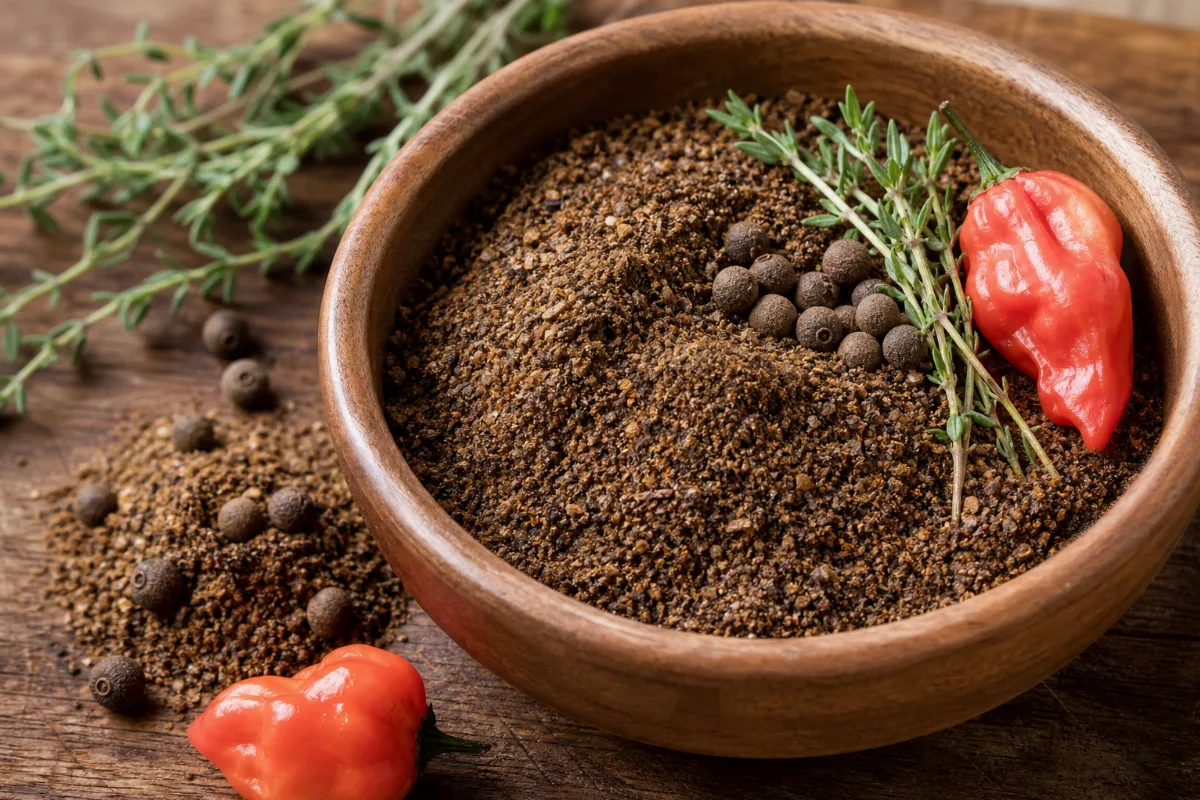
Jamaican jerk seasoning is a hot, aromatic blend built on allspice and Scotch bonnet chili, with thyme, garlic and often salt, rubbed or marinated onto chicken, pork and fish. No study of the blend itself for health was found. The main cautions are the very hot chili and the salt. Check the label for soy, wheat and other allergens if you have an allergy.
General information, not medical advice. Last substantive update · Not medically reviewed. A named clinician has not signed off on this page. How this page is made
About Jamaican jerk seasoning
Jamaican jerk seasoning is a flavour blend, not a health food or a remedy. Its main health issues are the strong chili heat and the salt. Little research exists on the blend itself, so this page is smaller than most.
What it is
Jerk is a Jamaican cooking style in which meat is dry-rubbed or marinated with a hot spice mixture. Wikipedia credits the technique to the Taino and Arawak peoples, later adopted by the Maroons, and says it is now found wherever many Caribbean families live.
There is no standard recipe. Wikipedia says the blend principally consists of allspice and Scotch bonnet peppers, and that other ingredients may include cloves, cinnamon, scallions, nutmeg, thyme, garlic, brown sugar, ginger, soy sauce, vinegar and salt. Allspice is the dried unripe berry of one tree, Pimenta dioica, and is not itself a mixture.
Nutrition: no USDA entry or bottled-product label was read, so no figures are given. Salted versions, and wet versions with soy sauce, contain sodium, and the amount varies by product.
In the kitchen
Jerk was first used on chicken and pork, and now goes on fish, shrimp, lobster, beef, lamb, goat, tofu and vegetables. Traditional jerk meat is cooked over pimento wood or charcoal, which gives a smoky taste.
The heat comes mainly from Scotch bonnet, a fruity, citrus-like chili that Wikipedia rates at 100,000 to 350,000 Scoville heat units, against 2,500 to 8,000 for most jalapenos. Dry blends, wet pastes and bottled sauces differ in heat, so taste a little first.
What the research shows
No study of jerk seasoning as a blend was found. A 148-person study found that herb and spice blends made low-salt tomato soup taste as salty as normal soup and were liked more after repeated eating. It was a soup and a different blend, and it measured taste.
Large studies of people who eat spicy food often are observational and mostly about chili in China, not this blend. One found a 14% lower relative risk of death in the most frequent spicy-food eaters. Another found that liking spicy food went with lower salt intake and blood pressure. Neither shows that jerk seasoning helps.
Amounts
This page gives no amounts to eat. No source gave a usual amount for the blend. Ask a doctor, pharmacist or dietitian what is right for you, especially if you have been told to limit salt.
At a glance
Traditional uses history, not proof
- Rubbed or marinated onto chicken or pork, then cooked over wood or charcoal, in Jamaican cooking
- Now also used on fish, shellfish, beef, lamb, goat, tofu and vegetables
Studied for research
- The blend as a whole: no study found
- Herb and spice blends making low-salt food taste saltier, low certainty (soup study, not this blend)
- Chili-heavy eating and risk of death, low certainty (observational, chili not this blend)
- Spicy-food liking and salt intake, very low certainty
Main compounds
- Allspice (eugenol scent)
- Scotch bonnet chili (capsaicin, the heat)
- Thyme
- Garlic
- Salt (varies by brand)
Common forms
- Dry rub
- Wet marinade or paste, sometimes with soy sauce and vinegar
- Bottled jerk sauce
Research links: WHO: Sodium reduction fact sheet · National Cancer Institute: Chemicals in meat cooked at high temperatures · CDC MMWR 2018: Lead in spices, herbal remedies and ceremonial powders · Wikipedia: Jerk (cooking) · Research Library · Genes & Biomarkers Library
What it is and its history
- Accepted scientific name
- Jamaican jerk seasoning (a spice blend, no single species)
- Synonyms
- Jerk seasoning; Jerk spice; Jamaican jerk spice; Jerk rub; Jerk marinade
- Common names
- Jerk seasoning (English); Jamaican jerk spice (English); Sazonador jerk jamaicano (Spanish)
- Family or group
- A spice blend. Wikipedia says it principally consists of allspice and Scotch bonnet peppers; other possible ingredients are cloves, cinnamon, scallions, nutmeg, thyme, garlic, brown sugar, ginger, soy sauce, vinegar and salt.
- Native range
- Jamaica (Wikipedia).
- Harvest and processing
- Sold as a dry rub, a wet marinade or a bottled paste or sauce. Traditional jerk meat is smoked over pimento (allspice) wood, according to Wikipedia.
- Look-alikes and adulterants
- Name: Cajun seasoning; Note: A different blend from Louisiana, usually salt, paprika, cayenne and garlic. It has its own page.; Name: Allspice on its own; Note: A single spice, the dried berry of Pimenta dioica. Not a mixture, despite the name.
Photographs
Traditional use and history history, not clinical proof
| Tradition or era | Documented use | Source |
|---|---|---|
Traditional use shows how it was used. It does not show that it works or is safe today.
What is inside, and how it may work
What it contains and how those compounds act in cells and animals. Laboratory and animal mechanisms are not proven effects in people.
Main compounds
| Compound | Family | Where it is concentrated | Activity studied | Level of evidence |
|---|---|---|---|---|
| Salt (sodium chloride) | mineral seasoning | Not found for jerk blends | Seasoning. Sodium raises blood pressure at high intake (WHO). 7 | Human data |
| Capsaicin (heat from Scotch bonnet) | capsaicinoid | Scotch bonnet fruit Not found for blends. Scotch bonnet is rated 100,000 to 350,000 Scoville units (Wikipedia). | Gives heat. Studied in the salt-taste work cited on the Benefits tab. 10 3 | Human data |
| Eugenol (aroma of allspice) | phenylpropanoid | Allspice berry Not found | Wikipedia names eugenol as one of the volatile oils that give allspice its scent. No health activity was researched here. 8 | None found |
Mechanisms, receptors and pathways
| Target or pathway | Gene or receptor | What was found | Level |
|---|---|---|---|
| Salty-taste perception | Brain regions linked to salty-taste processing (insula, orbitofrontal cortex) | In one study, capsaicin changed brain responses to salty stimuli, and the authors suggest spicy flavour may reduce salt preference. Early work. 3 | Human data |
Absorption, metabolism and elimination
- Absorption
- Not researched for the blend.
- Distribution
- Not researched.
- Metabolism
- Not researched.
- Elimination
- Not researched.
- Bioavailability
- Not researched.
Isolated compounds versus whole extracts
This page is about the seasoning as used in cooking. Single ingredients such as allspice, garlic and chili are also sold as concentrated supplements or extracts, which are different products. The blend is not sold as a supplement in any source read.
Nutritional composition
No USDA FoodData Central entry for jerk seasoning was found, and no label of a bottled jerk product or recipe nutrition panel was read, so no typical nutrition per teaspoon is given. The blend is used in small amounts, so it adds little energy or nutrients to a meal on its own. Salted versions, and wet versions with soy sauce, will contain sodium; the amount depends on the product. No amount to eat is given.
2 low certainty1 very low certainty1 not enough evidence
What was looked at
The 4 benefits and uses checked for Jamaican jerk seasoning, each with how strong the evidence is. Tap one to open it.
- Jerk seasoning eaten as a food (health effects of the blend)Not enough evidence
- Using herb and spice blends to make less-salty food taste goodLow certainty
- Eating spicy (chili) food often and risk of death (observational, chili not the blend)Low certainty
- Liking spicy food and salt intake or blood pressure (heat compound, not the blend)Very low certainty
Lab markers tracked in the studies
Perceived saltiness and liking of low-salt soup
What is Jamaican jerk seasoning good for?
The main studied uses and how strong the human evidence is for each. Nothing was found that studies the blend itself, so most results are for single ingredients or for taste, not for jerk seasoning.
Benefits, one by one
Each card is a research question, not a promise. Tap a goal to filter. Open a card to see the studies, doses and limits.
Jerk seasoning eaten as a food (health effects of the blend)
Not enough evidenceNo study of Jamaican jerk seasoning as a whole, for any health outcome, was found. It is a hot, spicy marinade and rub, and what is known comes from its separate ingredients and from general facts about salt.
3 studiesDry rub, wet marinade or bottled paste or sauce. Recipes differ widel…
Studies, doses and limits
What the trials found
A PubMed search for jerk seasoning returned nothing relevant (the hits were unrelated papers). The cooking sources read describe what is in it and how it is used, and do not describe health effects.
Results
No human study of the blend was found.
Why this rating
No study of the blend exists in the sources read, so nothing can be rated.
Form and dose studied
Dry rub, wet marinade or bottled paste or sauce. Recipes differ widely.
Who was studied
Not studied.
Limits
Absence of studies is not proof of no effect and not proof of safety. See the Safety tab for salt, heat, allergens and grilling.
Why researchers looked
People ask whether a blend of allspice, hot chili, thyme and garlic does anything for health.
Traditional use
Jerk is a Jamaican cooking style in which meat, usually chicken or pork, is rubbed or marinated with a hot spice mixture and cooked over wood or charcoal. Long use as food is not proof of any health effect.
Proposed mechanism Unknown
Not applicable: nothing was found that studies the blend.
A proposed mechanism does not show that the effect happens in people.
Many jerk blends contain salt, and wet versions may contain soy sauce. See the Safety tab.
Using herb and spice blends to make less-salty food taste good
Low certaintyIn one study of 148 volunteers, adding herb and spice blends made a low-salt tomato soup taste as salty as a normal soup, and people liked it more after three days of eating it. It was a soup and a different blend, not jerk seasoning, and it measured taste, not health.
2 studiesHerb and spice blends in soup. Not jerk seasoning.
Studies, doses and limits
What the trials found
A 5-day study in 148 adults compared a standard soup, a low-salt soup (0.26% salt) and a low-salt soup with added herb and spice seasonings. WHO also advises using herbs and spices to flavour food rather than salt.
Results
The herb-and-spice soup was rated as salty as the standard soup, and its liking rose over repeated exposure, while the plain low-salt soup did not improve.
Effect sizes as reported
No numbers in the abstract.
Why this rating
One short study of volunteers rating one soup, with a different seasoning, measuring liking and not salt eaten or blood pressure.
Form and dose studied
Herb and spice blends in soup. Not jerk seasoning.
Who was studied
148 adult volunteers in the UK.
Limits
The authors say herbs and spices should be chosen to suit the food. A jerk blend with salt in it would not give this effect on its own.
Why researchers looked
Health bodies advise cooking with less salt and flavouring food with herbs and spices instead, so researchers test whether people accept it.
Traditional use
Jerk is a strongly flavoured blend, but Wikipedia lists salt (and soy sauce) among its possible ingredients, so a ready-made jerk blend is not automatically a low-salt choice.
Proposed mechanism Hypothesis
The authors report that herbs and spices raised the perceived saltiness of the low-salt soup. Why was not shown in the abstract.
A proposed mechanism does not show that the effect happens in people.
Check the label: many jerk blends contain salt.
Eating spicy (chili) food often and risk of death (observational, chili not the blend)
Low certaintyIn a large Chinese study of about 487,000 adults, people who ate spicy food 6 or 7 days a week had a 14% lower relative risk of dying over about 7 years than people who ate it less than once a week. This is an observational link in a chili-eating population, and jerk seasoning was not studied.
1 studiesChili-containing food in Chinese diets. Not jerk seasoning.
Studies, doses and limits
What the trials found
The China Kadoorie Biobank cohort followed 199,293 men and 288,082 women aged 30 to 79 for a median of 7.2 years. Spicy food frequency was self-reported once at the start.
Results
Adjusted hazard ratios for death were 0.90, 0.86 and 0.86 for 1 to 2, 3 to 5 and 6 to 7 days a week compared with less than once a week. Inverse links were also seen for deaths from cancer, ischaemic heart disease and respiratory disease.
Effect sizes as reported
HR 0.86 (95% CI 0.82 to 0.90) for 6 to 7 days a week.
Why this rating
Observational data from one country, a single self-report of spicy food (mainly chili), and the usual risk of other differences between people. It is not about this blend or this chili.
Form and dose studied
Chili-containing food in Chinese diets. Not jerk seasoning.
Who was studied
Adults aged 30 to 79 in China.
Limits
Eating patterns differ between countries, and the study did not look at Scotch bonnet or at grilled or salted food.
Why researchers looked
Scotch bonnet chili is the main heat source in jerk, and chili-heavy diets have been studied for long-term health.
Traditional use
Scotch bonnet is rated at 100,000 to 350,000 Scoville heat units, far hotter than a jalapeno (Wikipedia). Jerk is known for strong heat.
Proposed mechanism Unknown
Not established. The study cannot show that spicy food caused the difference.
A proposed mechanism does not show that the effect happens in people.
Very hot food can upset some stomachs. No source read gives a figure for that.
Liking spicy food and salt intake or blood pressure (heat compound, not the blend)
Very low certaintyA 2017 study found adults who liked spicy food ate less salt and had lower blood pressure than those who disliked it, and the heat compound capsaicin changed brain responses to salty taste. This is early work and does not show that jerk seasoning lowers blood pressure.
1 studiesCapsaicin and spicy food. Not jerk seasoning.
Studies, doses and limits
What the trials found
A multicentre study with observational and interventional parts, including brain scans after capsaicin, plus mouse experiments.
Results
Higher spice preference went with lower salt intake and blood pressure, and the authors call spicy flavour a promising behavioural idea for reducing salt intake.
Effect sizes as reported
No numbers in the abstract.
Why this rating
The abstract gives no sample size or effect size, part of the work is in mice, and the link between liking spice and eating less salt may be explained by other things.
Form and dose studied
Capsaicin and spicy food. Not jerk seasoning.
Who was studied
Chinese adults (number not stated in the abstract) and mice.
Limits
Abstract only was read. A salted jerk blend adds salt itself.
Why researchers looked
Researchers wondered whether a love of spice might make people want less salt.
Traditional use
Capsaicin is the heat compound of chili peppers such as Scotch bonnet. A salted jerk blend adds salt itself.
Proposed mechanism Preliminary mechanism
The authors report that capsaicin changed brain activity in regions linked to salty-taste processing, in people and in mice.
A proposed mechanism does not show that the effect happens in people.
None specific.
Connections to the rest of health
How Jamaican jerk seasoning connects to the rest of our health knowledge graph. Every link says what kind of connection it is. A safety link (for example to the liver) is a warning, not a benefit. A study that merely mentions a topic never creates a benefit link.
Explore every connection: goals, body systems, organs, symptoms, genes
B. Body systems
| Connected to | Kind of connection | Evidence status | Context | Studies |
|---|---|---|---|---|
| Digestive System | Biological association | Not enough evidence | Studied for: Jerk seasoning eaten as a food (health effects of the blend) | 9 8 10 |
| Cardiovascular System | Biological association | Low certainty | Studied for: Using herb and spice blends to make less-salty food taste good Studied for: Eating spicy (chili) food often and risk of death (observational, chili not the blend) | 2 7 4 3 |
E. Health conditions
| Connected to | Kind of connection | Evidence status | Context | Studies |
|---|---|---|---|---|
| Food allergy | Documented risk | Blends and marinades can contain listed allergens; read the label. Preparation or compound: Soy, wheat, celery, mustard or sesame in a product |
5 | |
| High blood pressure | Documented risk | WHO links high sodium to raised blood pressure; the blend's own sodium was not measured in sources read. Preparation or compound: Sodium in salted blends |
7 | |
| Lead poisoning | Documented risk | A CDC report found lead in some spice products, including an all-purpose mix; no jerk blend is named. Preparation or compound: Lead in some ground spices |
1 |
I. Biomarkers
| Connected to | Kind of connection | Evidence status | Context | Studies |
|---|---|---|---|---|
| Perceived saltiness and liking of low-salt soup | Biological association | Low certainty | Measured in trials: raised. A lab change is not the same as a health benefit. | 2 |
L. Active compounds
| Connected to | Kind of connection | Evidence status | Context | Studies |
|---|---|---|---|---|
| Salt (sodium chloride) | Biological association | Human | Seasoning. Sodium raises blood pressure at high intake (WHO). | 7 |
| Capsaicin (heat from Scotch bonnet) | Biological association | Human | Gives heat. Studied in the salt-taste work cited on the Benefits tab. Preparation or compound: Scotch bonnet fruit |
10 3 |
| Eugenol (aroma of allspice) | Biological association | None found | Wikipedia names eugenol as one of the volatile oils that give allspice its scent. No health activity was researched here. Preparation or compound: Allspice berry |
8 |
Each connection is stored with the ingredient, the connected record, the kind of connection, the evidence status, the supporting studies, the preparation or compound involved, and a review date (last reviewed October 26, 2026).
Evidence at a glance: what changed in 1 lab markers
Tap a number to show only those markers. Counts are markers, not people.
The evidence
The research centre for Jamaican jerk seasoning. Every record here was checked against PubMed or the publisher's page; we never list a study we have not verified.
Evidence by outcome
Bars show how many studies we found for each outcome, not how well it works. People are added up across trials only (reviews are not added, to avoid double counting).
How we rate evidence
High certainty
Several well-run trials or reviews agree; further research is unlikely to change the picture much.
Moderate certainty
Good trials point the same way, but some doubt remains.
Low certainty
Small, short or inconsistent trials. The finding could change with better research.
Very low certainty
Very little or very weak human data. Treat as a possibility only.
Mixed findings
Trials or reviews disagree with each other.
Not enough evidence
Not enough human research to say either way.
Evidence against
Good research found no benefit, or found harm.
We take the reviewers' own risk-of-bias and GRADE statements where they exist, and otherwise judge from study size, design, consistency, directness and whether a product matches what is sold. Many publications do not make evidence high. Method note: We read the sources listed (Wikipedia, WHO, the EU allergen list through FSAI, the National Cancer Institute page, the CDC lead report through PubMed Central) and read PubMed abstracts for the studies. Only abstracts were read for the three research studies. Little research exists on the blend itself, so this page is smaller than most. What we could not verify is in the research gaps.
Study library: every study we checked 10
| Study | Design | People | Product, dose, length | Result |
|---|---|---|---|---|
| Angelon-Gaetz 2018 Lead in Spices, Herbal Remedies, and Ceremonial Powders Sampled from Home Investigations for Children with Elevated Blood Lead Levels - North Carolina, 2011-2018. MMWR Morb Mortal Wkly Rep · PMID 30462630 · DOI |
Case series / surveillance report n/a |
Homes of 61 children with raised blood lead in North Carolina (59 properties) | Spices, herbal remedies and ceremonial powders sampled from the homes Not a Cajun blend Not given as advice See abstract · vs See abstract |
More than one fourth (28.8%) of the spices, herbal remedies and ceremonial powders sampled from these homes held 1 mg/kg lead or more. The report says a national maximum limit for lead in spices might reduce exposure. Full text (PMC6289082) read 2026-10-26: its table lists "spice mix (all purpose)" with 3 samples, mean 1.8 mg/kg, range 0.2 to 4.8, and says no US permissible limit for lead in spices exists. Turmeric dominated the high results (34 samples, mean 66.4 mg/kg). 28.8% of samples at or above 1 mg/kg (all product types together) Methods, limits and fundingOutcomes: Lead in the samples Limitations: Samples came from homes of children who already had high blood lead, not from a random sample of shops, and no Cajun seasoning is named. It cannot say how common lead is in Cajun seasoning. Funding and conflicts: No conflicts disclosed. Read: abstract and full text (PMC6289082) |
| Ghawi 2014 Enhancing consumer liking of low salt tomato soup over repeated exposure by herb and spice seasonings. Appetite · PMID 24879887 · DOI |
Randomised exposure study |
148 148 adult volunteers in a UK university study |
Tomato soup with 0.26% salt, with and without added herb and spice blends (not Cajun seasoning) Not a Cajun blend Not given as advice See abstract · vs See abstract |
Cutting the salt made the soup less liked. Adding herbs and spices did not raise liking at first, but made the low-salt soup taste as salty as the standard soup, and liking of the herb-and-spice soup rose over three days of repeated eating. The authors say herbs and spices should be chosen carefully to suit the food. Perceived saltiness of the low-salt soup rose to the level of the standard soup (abstract gives no numbers). Methods, limits and fundingOutcomes: Liking and perceived saltiness over 5 days Limitations: One soup, five days, volunteers rating taste. It measured liking, not salt eaten or blood pressure, and did not use a Cajun blend. Funding and conflicts: Not stated in the abstract. Research Support, Non-U.S. Gov't. Read: abstract |
| Li 2017 Enjoyment of Spicy Flavor Enhances Central Salty-Taste Perception and Reduces Salt Intake and Blood Pressure. Hypertension · PMID 29089370 · DOI |
Observational and interventional study (random order, double blind), plus mouse work |
Chinese adults (number not stated in the abstract), plus mice | Spice preference, and capsaicin (the heat compound of chili) given in brain-imaging tests Not a Cajun blend Not given as advice See abstract · vs See abstract |
Adults who liked spicy food had lower salt intake and blood pressure than those who disliked it. Capsaicin raised brain responses to salty taste and the authors conclude that enjoying spicy flavour may reduce salt preference, salt intake and blood pressure; they call it a promising behavioural idea. No numbers in the abstract Methods, limits and fundingOutcomes: Salt intake, salt preference, blood pressure, brain activity Limitations: Part of the evidence is observational and part is brain imaging and mouse work. It does not test Cajun seasoning or show that using it lowers anyone's blood pressure. Funding and conflicts: Not stated in the abstract. Research Support, Non-U.S. Gov't. Read: abstract |
| Lv 2015 Consumption of spicy foods and total and cause specific mortality: population based cohort study. BMJ · PMID 26242395 · DOI |
Prospective cohort |
487375 199,293 men and 288,082 women aged 30 to 79 in 10 areas of China (China Kadoorie Biobank) |
Self-reported spicy food (mostly chili) eating frequency Not a Cajun blend Not given as advice See abstract · vs See abstract |
Over a median 7.2 years, people who ate spicy food 6 or 7 days a week had 14% lower relative risk of death than those who ate it less than once a week (adjusted hazard ratio 0.86, 95% CI 0.82 to 0.90). Inverse links were also seen for deaths from cancer, ischaemic heart disease and respiratory disease. The link was stronger in people who did not drink alcohol. HR 0.86 (0.82 to 0.90) for 6 to 7 days a week versus less than once a week Methods, limits and fundingOutcomes: Total and cause-specific death Limitations: Observational: spicy-food eaters differ from others in ways that may not be fully adjusted for. Food frequency was reported once. It is chili in Chinese diets, not Cajun seasoning. Funding and conflicts: Authors declare no support from any organisation for the submitted work and no relevant financial relationships. Read: abstract |
| s-fsai-14 FSAI (Ireland): List of the 14 allergens (EU rules) · Source |
Regulator page n/a |
Methods, limits and fundingRead: full-text | ||
| s-nci-hca National Cancer Institute: Chemicals in Meat Cooked at High Temperatures and Cancer Risk · Source |
Regulator fact sheet n/a |
Methods, limits and fundingRead: full-text | ||
| s-who-sodium WHO: Sodium reduction fact sheet · Source |
Regulator fact sheet n/a |
Methods, limits and fundingRead: full-text | ||
| s-wiki-allspice Wikipedia: Allspice · Source |
Encyclopedia n/a |
Methods, limits and fundingRead: full-text | ||
| s-wiki-jerk Wikipedia: Jerk (cooking) · Source |
Encyclopedia n/a |
Methods, limits and fundingRead: full-text | ||
| s-wiki-scotch Wikipedia: Scotch bonnet · Source |
Encyclopedia n/a |
Methods, limits and fundingRead: full-text |
What we do not know yet
- No study of jerk seasoning as a blend was found for any health outcome.
- No nutrition entry for the blend, and no label of a bottled product, was read, so typical sodium per teaspoon is not known from these sources.
- No source covers the blend in pregnancy, breastfeeding or childhood.
- The lead report does not name jerk seasoning and its samples were not a random shop sample.
- No interaction study of the blend; ingredient interactions were not researched here.
How new research is added
New studies are found by a saved PubMed search and placed in a review queue before the page changes.
Lab markers
What changed in blood or saliva tests during trials. A changed number is not the same as feeling or being healthier, and we give no "normal ranges".
Other 1
Perceived saltiness and liking of low-salt soup
Raised in trials
How salty and how pleasant volunteers rated a soup on a taste scale.
Low certaintyResults and what it means
Why it was measured
It shows whether people will accept less salt in food.
Statistical vs. clinical meaning
A taste rating, not salt intake or blood pressure.
Safety implication
None specific.
| Study | Result | People | Product |
|---|---|---|---|
| 2 | Herbs and spices brought the perceived saltiness of low-salt soup up to the level of standard soup, and liking rose with repeated exposure. | 148 adult volunteers | Low-salt tomato soup with herb and spice blends, for 5 days |
Safety
What studies and official sources say about side effects, medicines and who should check first. Each point shows what kind of evidence it comes from.
Main points to know 5
- Heat: Scotch bonnet is a very hot chili. Wikipedia rates Scotch bonnet at 100,000 to 350,000 Scoville heat units, against 2,500 to 8,000 for most jalapenos, and names it as the source of jerk's heat. Hot chili can burn the mouth and upset the stomach. Handling the fresh pepper and then touching the eyes is a common kitchen mishap, but no source read states this, so it is common sense only. Take extra care with children. Encyclopedia and common sense 10 9
- Salt: many jerk blends contain it. Wikipedia lists salt among the possible jerk ingredients, and wet versions may also use soy sauce, which is salty. WHO says the main health effect of high sodium is raised blood pressure, which raises the risk of heart and blood vessel disease, and advises adults to keep sodium under 2000 mg a day (under 5 g of salt). No label of a bottled jerk product was read here, so how much salt a teaspoon holds is not known from these sources. Check the label, and ask a doctor if you have been told to limit salt. Authoritative guidance 7 9
- Allergens: soy, wheat, celery, mustard and sesame can hide in a bottled blend. Wikipedia lists soy sauce as a possible jerk ingredient, and soy sauce usually contains soy and often wheat. The EU list of 14 allergens includes cereals containing gluten, soybeans, celery, mustard and sesame. No source read says which allergens a given jerk product holds, so read the whole label. Authoritative guidance 5 9
- Grilling meat over flame makes chemicals the NCI advises limiting. Jerk meat is usually cooked over wood or charcoal. The US National Cancer Institute says high-temperature, smoky cooking forms chemicals (HCAs and PAHs) that cause cancer in animals at very high doses, that human studies have not established a definitive link, and that exposure can be reduced by avoiding direct flame, avoiding long cooking, turning meat often and removing charred parts. This is about the cooking method, not the spices. Authoritative guidance 6
- Lead has been found in some ground spices; no jerk blend was tested. A CDC report from North Carolina found 28.8% of spices, herbal remedies and ceremonial powders from homes of children with raised blood lead held 1 mg/kg or more. An all-purpose spice mix averaged 1.8 mg/kg in 3 samples. Turmeric accounted for the highest results. The samples came from those homes, not from a random sample of shops, and no jerk seasoning is named. Market survey 1
Side effects 3
| Effect | How often | Severity and recovery | Evidence |
|---|---|---|---|
| Mouth burning or stomach upset from very hot chili The heat rating comes from Wikipedia; the effect itself is common sense, not a finding. | Not given in any source read. | usually mild Not stated | Encyclopedia and common sense 10 |
| High sodium intake from salty seasoning WHO's limit applies to the whole day's food, not the blend alone. | Not given for this blend. WHO says high sodium raises blood pressure at the whole-diet level. | depends on total diet Not stated | Authoritative guidance 7 |
| Allergic reaction to an ingredient such as soy, wheat, celery, mustard or sesame Only if the particular product contains the allergen. Seek urgent help for trouble breathing or swelling. | Not found for this blend. | can be serious Not stated | Authoritative guidance 5 |
Liver
No liver or kidney problem linked to jerk seasoning was found in the sources read.
This is a safety connection. It is not evidence that Jamaican jerk seasoning supports liver health.
Medicines and supplements 1
| With | Why it matters | Importance | Evidence | What to do |
|---|---|---|---|---|
| Prescription and over-the-counter medicines prescription | No interaction study of the blend was found. Interactions of single ingredients (for example allspice, garlic or concentrated chili) were not researched for this page. | None found Not enough evidence | If you take medicine, ask a pharmacist about the single spices you eat in large amounts, and about salt if you take blood pressure medicine. |
Who should check first 3
| Situation | Advice | Evidence |
|---|---|---|
| Known allergy to soy, wheat, celery, mustard or sesame | Read the full ingredient list and "contains" line of the product, or make your own mix. | Authoritative guidance 5 |
| Told by a clinician to limit salt | Look for a salt-free blend or a home mix, and ask your clinician. | Authoritative guidance 7 |
| Pregnancy, breastfeeding and young children | No source read covers the blend in these groups. Ask your midwife, doctor or paediatrician, and mind the heat. | Gap |
Overdose, product quality and regulators
Summary. No toxicity of the blend itself was found in the sources read. The documented concerns are heat, salt, allergens, grilling chemicals and possible lead in some ground spices.
Human doses studied. No source gives an unsafe amount of the blend.
High dose or long term signals. WHO says long-term high sodium raises blood pressure.
Genotoxicity. Not researched.
Dried spices can carry lead. One source was read; it does not name jerk seasoning.
Lead. 28.8% of 386 mixed samples (spices, herbal remedies and ceremonial powders) from homes of children with raised blood lead held 1 mg/kg or more. An all-purpose spice mix averaged 1.8 mg/kg (3 samples, range 0.2 to 4.8). The report says no US limit for lead in spices exists and suggests setting one. 1
| Body | Action | Date |
|---|---|---|
| WHO (International) | Adults should have less than 2000 mg of sodium a day (less than 5 g salt) and can use herbs and spices to flavour food rather than salt. source | 2026-10-26 (page read; fact sheet is undated in the text read) |
| EU food information rules (via FSAI) (European Union) | Cereals containing gluten, soybeans, celery, mustard and sesame are among 14 allergens that must be declared. source | 2026-10-26 (page read) |
| National Cancer Institute (United States) | States that no federal guidelines exist for chemicals from high-temperature cooking of meat, and lists ways to reduce exposure. source | 2026-10-26 (page read; page date not captured) |
| CDC (MMWR report) (United States) | A 2018 report says no national limit exists for lead in spices and that setting one might reduce exposure. source | 2018-11-23 |
When to get medical help
- Trouble breathing, swelling of the lips, tongue or throat, or widespread hives after eating a seasoned food: call your emergency number.
- A child with raised blood lead or signs such as unusual tiredness, belly pain or developmental concerns: talk to a doctor.
Stop using the product and contact a clinician or emergency service. In the US, Poison Control is 1-800-222-1222.
General information only, not medical advice. Ask a clinician or pharmacist before use, especially with medicines, in pregnancy or with a health condition. See the Natural Remedy Safety guide.
Frequently asked questions
What is Jamaican jerk seasoning?
A hot, aromatic Jamaican blend built mainly on allspice and Scotch bonnet chili, often with thyme, garlic, ginger, cinnamon, brown sugar and salt. There is no standard recipe.
What does the word jerk mean here?
It names the spice rub, a wet marinade made from it, and the cooking style. Wikipedia suggests the word may come from a Spanish term for dried meat, but it is a said-to-be origin.
Is jerk seasoning very hot?
Usually. The heat comes from Scotch bonnet, rated at 100,000 to 350,000 Scoville units against 2,500 to 8,000 for most jalapenos. Dry rubs, pastes and sauces differ, so taste a little first.
Is allspice a mix of spices?
No. It is the dried unripe berry of one tree, Pimenta dioica, named for tasting like cinnamon, nutmeg and clove.
Does jerk seasoning contain salt?
Often. Wikipedia lists salt, and soy sauce, among the possible ingredients. How much a product holds varies, so check the label.
Is jerk seasoning good for you?
Is it bad for blood pressure?
A salty blend or soy-based marinade can add sodium, and WHO says high sodium raises blood pressure. If you have been told to limit salt, ask your clinician.
Does spicy food lower the risk of dying earlier?
In a large Chinese cohort, frequent spicy-food eaters had a lower relative risk of death. It is observational, about chili, and does not show cause or apply to this blend.
Does it contain allergens?
Is grilled jerk meat a cancer risk?
The National Cancer Institute says smoky, high-heat cooking of meat forms chemicals that cause cancer in animals at very high doses, and that human studies have not established a definitive link. It lists ways to reduce exposure. This is about the cooking, not the spices.
Is there lead in spice blends?
A CDC report found lead at or above 1 mg/kg in 28.8% of spices, herbal remedies and ceremonial powders from homes of children with raised blood lead. No jerk blend is named.
Is it safe in pregnancy or for children?
No source read covers the blend. Check salt and heat level, and ask your midwife, doctor or paediatrician.
Explore by health goal
Editorial transparency
- Written by
- AlternativeMed editorial team. Research compiled with AI assistance, then checked against the sources listed.
- Medical review
- None. This page has not been reviewed by a physician or pharmacist.
- First published
- 2026-10-26
- Last substantive update
- 2026-10-26
- How we research
- We read the sources listed (Wikipedia, WHO, the EU allergen list through FSAI, the National Cancer Institute page, the CDC lead report through PubMed Central) and read PubMed abstracts for the studies. Only abstracts were read for the three research studies. Little research exists on the blend itself, so this page is smaller than most. What we could not verify is in the research gaps.
- How we rate evidence
- See "How we rate evidence" in the Evidence tab.
- Independence
- No product is promoted on this page. No affiliate links are shown.
Sources 10
Each source was opened and checked. Where we read only the abstract, it says so. The small numbers in the text point here.
- Angelon-Gaetz KA, Klaus C, Chaudhry EA, Bean DK. Lead in Spices, Herbal Remedies, and Ceremonial Powders Sampled from Home Investigations for Children with Elevated Blood Lead Levels - North Carolina, 2011-2018.. MMWR Morb Mortal Wkly Rep. 2018. PMID 30462630. DOI 10.15585/mmwr.mm6746a2. (abstract and full text (PMC6289082))
- Ghawi SK, Rowland I, Methven L. Enhancing consumer liking of low salt tomato soup over repeated exposure by herb and spice seasonings.. Appetite. 2014. PMID 24879887. DOI 10.1016/j.appet.2014.05.029. (abstract)
- Li Q, Cui Y, Jin R, et al.. Enjoyment of Spicy Flavor Enhances Central Salty-Taste Perception and Reduces Salt Intake and Blood Pressure.. Hypertension. 2017. PMID 29089370. DOI 10.1161/HYPERTENSIONAHA.117.09950. (abstract)
- Lv J, Qi L, Yu C, et al.. Consumption of spicy foods and total and cause specific mortality: population based cohort study.. BMJ. 2015. PMID 26242395. DOI 10.1136/bmj.h3942. (abstract)
- . FSAI (Ireland): List of the 14 allergens (EU rules). . . (full-text)
- . National Cancer Institute: Chemicals in Meat Cooked at High Temperatures and Cancer Risk. . . (full-text)
- . WHO: Sodium reduction fact sheet. . . (full-text)
- . Wikipedia: Allspice. . . (full-text)
- . Wikipedia: Jerk (cooking). . . (full-text)
- . Wikipedia: Scotch bonnet. . . (full-text)
Where to buy
Check the label first. Whatever you buy, look for these:
- Whole or ground: whole spices keep their flavor longer
- The origin and a packed-on or best-by date for freshness
- Organic or non-irradiated labeling if that matters to you
- A resealable, airtight container
Talk to a pharmacist or doctor before you start any supplement, especially if you take medicines. See the Safety tab for interactions.
Support our free guides: as an Amazon Associate we earn from qualifying purchases. Full disclosure.


