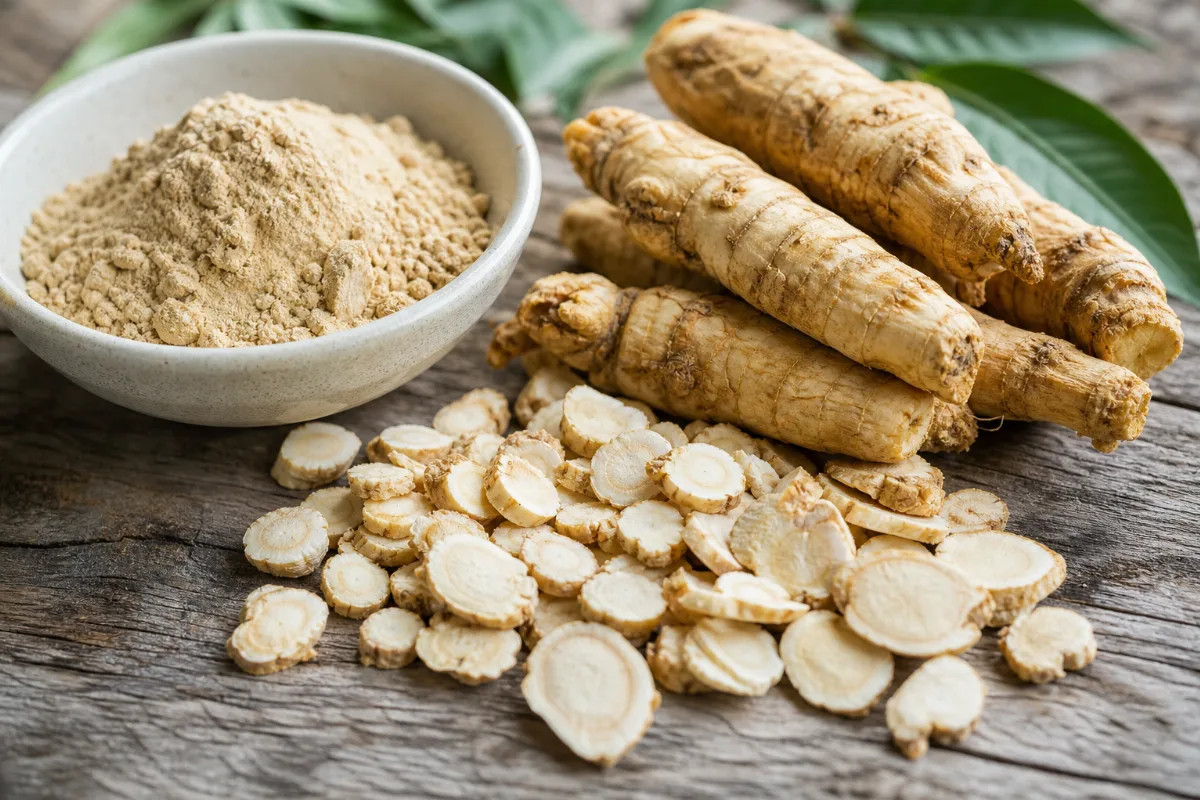
Adaptogens · Herbs & Botanicals · Japanese and Chinese tonic root
Japanese Ginseng
Panax japonicus · also called Chikusetsu ginseng, bamboo ginseng, chikusetsu ninjin (Japanese), zhu jie shen, zhu zi shen (Chinese)
Japanese ginseng is the knobby rhizome of a ginseng-family plant, used as a tonic and for bleeding and inflammation in China, Japan and Korea. It is not the same plant as Asian ginseng. We found no human trial for any use: the research is lab and animal work only. If you take blood thinners or diabetes medicine, ask your pharmacist before using it.
General information, not medical advice. Last substantive update · Not medically reviewed. A named clinician has not signed off on this page. How this page is made
About Japanese Ginseng
Japanese ginseng is a lightly researched tonic root. Almost all of what is known comes from the lab, so the honest verdict is that we do not yet know whether it works or how safe it is.
What it is
Japanese ginseng is the rhizome (underground stem) of Panax japonicus, a plant in the ginseng family. In Chinese it is called zhu jie shen (bamboo-joint ginseng); in Japanese, chikusetsu ninjin.
Its main ingredients are triterpenoid saponins, including chikusetsusaponins IVa, IV and V and ginsenoside Ro, plus phenolic acids and polysaccharides. Saponins are soap-like plant chemicals.
How it differs from other ginsengs
Japanese ginseng (Panax japonicus) is not Asian ginseng (Panax ginseng), American ginseng (Panax quinquefolius) or notoginseng (Panax notoginseng). Trial results and cautions for those species do not transfer to Japanese ginseng.
Mix-ups happen. A look-alike species, Panax stipuleanatus, is sold as or mixed into Japanese ginseng, and non-Panax roots are used to adulterate ginseng products.
Traditional and current uses
Reviews describe it as a tonic, a bleeding-stopper and an anti-inflammatory in China, Japan and Korea, and as a ginseng substitute among some minority groups in China.
Tradition is not proof. We did not read original historical texts.
What the research shows
Humans: the only human experiment found was a small 2004 test in 12 healthy adults comparing eight ginseng types before a sugar drink. Its abstract does not report the Japanese-rhizome result.
Lab and animal: saponin extracts lowered inflammation in rats and mice, slowed cancer cells in dishes and blocked a fat-digesting enzyme in a test tube. Such findings often do not carry over to people.
Reviews call this research preliminary.
At a glance
Traditional uses history, not proof
- Tonic in Chinese, Japanese and Korean medicine
- Stopping bleeding
- Anti-inflammatory use
- Used by some minority groups in China in place of ginseng root
- In Chinese medicine described as tonifying the lungs and nourishing yin
Studied for research
- Inflammation and joint swelling, insufficient (rat and cell studies only)
- Ageing and antioxidant action, insufficient (test tube and animal)
- Cancer cells, insufficient (lab only)
- Fat digestion, insufficient (test tube and mice)
- Blood sugar, insufficient (one 12-person experiment without a stated result for this plant)
Main compounds
- Chikusetsusaponins IVa, IV and V (oleanolic-acid-type saponins)
- Ginsenoside Ro and ginsenoside Rb1
- Phenolic acids, polysaccharides and volatile oils (less studied)
Common forms
- Dried rhizome (slices or powder)
- Saponin extracts used in lab studies
- Steamed rhizome (changed chemistry and lab strength in one study)
Research links: GBIF: Panax japonicus (accepted species record) · Review 2023: Panax japonicus comprehensive review (Chin Med) · Experiment 2004: eight types of ginseng and blood sugar · NCCIH: Asian ginseng (a different species, for context) · Research Library · Genes & Biomarkers Library
The plant and its history
- Accepted scientific name
- Panax japonicus
- Naming authority
- (T.Nees) C.A.Mey.
- Synonyms
- Panax ginseng var. japonicus (Nees) Makino; Panax angustatus (Makino) Honda; Aralia japonica (T.Nees) Makino; Aralia repens (Steud. ex Maxim.) Matsum.
- Common names
- Japanese ginseng (English); chikusetsu ginseng (English); bamboo ginseng (English); chikusetsu ninjin (Japanese); zhu jie shen (Zhujieshen) (Chinese); zhu zi shen (Zhuzishen, var. major) (Chinese)
- Botanical family
- Araliaceae (ginseng family)
- Classification
- Plantae > Tracheophyta > Magnoliopsida > Apiales > Araliaceae > Panax > Panax japonicus
- Native range
- Not checked in this work.
- Habitat
- Not checked.
- What the plant looks like
- Roots: Creeping, knobby rhizome with a bamboo-joint look (from the description in the existing summary; not re-checked).; Stems: Not checked; Leaves: Not checked; Flowers: Not checked; Fruit: Not checked
- Cultivation
- Not checked.
- Harvest and processing
- The rhizome is used dried; one 2025 lab study found steaming changes its chemistry.
- Look-alikes and adulterants
- Name: Panax stipuleanatus; Note: Sold as or mixed into Japanese ginseng; chemical fingerprinting can tell it apart (p35996250).; Name: Asian ginseng (Panax ginseng) and American ginseng (Panax quinquefolius); Note: Different species with different evidence and cautions; their trial results do not transfer to Japanese ginseng.; Name: Notoginseng (Panax notoginseng; sanqi) and pseudoginseng names; Note: Another Panax species. The name 'pseudoginseng' has been applied loosely to some Panax roots in older English texts (general knowledge, NOT verified here), so check the Latin name. Do not assume it is the same as Japanese ginseng.; Name: Codonopsis pilosula and Platycodon grandiflorus; Note: Non-Panax roots used as adulterants of ginseng species (p42262747).
- Sustainability and conservation
- Not checked.
Traditional use and history history, not clinical proof
| Tradition or era | Documented use | Source |
|---|---|---|
| China (Chinese medicine; Naxi, Yi, Tibetan and other minority medicine) | Tonic, stopping bleeding, anti-inflammatory; tonifying the lungs and nourishing yin; used as a ginseng substitute by minority groups. | p37950271; p41324223 |
| Japan and Korea | Tonic, bleeding-stopper and anti-inflammatory, per the 2023 review. The Japanese name chikusetsu ninjin is the source of the name 'chikusetsu saponin'. | p37950271 |
| EMA/HMPC or other regulator | No monograph read. | NOT verified |
| Long history 'spanning thousands of years' (claimed by one review) | General statement about Zhuzishen in Chinese medicine. | p41415562 |
Traditional use shows how a plant was used. It does not show that a supplement works or is safe today.
What is inside, and how it may work
What the plant contains and how those compounds act in cells and animals. Laboratory and animal mechanisms are not proven effects in people.
Main compounds
| Compound | Family | Where it is concentrated | Activity studied | Level of evidence |
|---|---|---|---|---|
| Chikusetsusaponin IVa PubChem 13909684 | triterpenoid saponin (oleanolic-acid type) | Rhizome | Proposed quality marker; an isolated saponin studied in ageing models (animal/cell). 15 17 | Animal research |
| Chikusetsusaponin IV PubChem 10079497 | triterpenoid saponin (oleanolic-acid type) | Rhizome | Studied with chikusetsusaponin IVa and V in cancer cell work. 4 | Cell |
| Ginsenoside Ro PubChem 11815492 | oleanane-type saponin | Rhizome | Proposed quality marker. 15 | Chemistry |
| Oleanolic acid PubChem 10494 | pentacyclic triterpene (the core of the oleanane saponins) | Rhizome (as the saponin core) | Core structure only; its own effects were not examined here. 12 | Chemistry |
| Ginsenoside Rb1 | dammarane (protopanaxadiol-type) saponin | Rhizome | Proposed quality marker with Ro and chikusetsusaponin IVa. CID not looked up. 15 | Chemistry |
| Phenolic acids, polysaccharides, volatile oils | various | Rhizome | Listed in reviews; little studied. 6 2 | Chemistry |
Mechanisms, receptors and pathways
| Target or pathway | Gene or receptor | What was found | Level |
|---|---|---|---|
| Macrophage polarization and glycolysis (inflammation) | HIF-1alpha, GLUT1, HK2, LDHA | Total saponins shifted macrophages toward the anti-inflammatory type and lowered these markers in arthritic rat joints. 22 | Animal research |
| Iron handling in macrophages | Ferritin heavy chain (Fth); JNK pathway | Saponins lowered iron and inflammation signals in ageing fat tissue. 23 | Animal research |
| Fat digestion and fat cells | Pancreatic lipase; PPARG, CEBPA, FASN, ACACA | An extract fraction blocked lipase and lowered fat-cell gene activity. 18 | Laboratory research |
| Cancer cell signalling | PI3K/Akt, NF-kB, Wnt; AKT1, EGFR, STAT3 | Saponins and steamed rhizome act on these pathways in cancer cell work. 4 21 | In vitro and animal |
Absorption, metabolism and elimination
- Absorption
- The 2023 review has a pharmacokinetics section, but the abstract gives no numbers.
- Distribution
- Not read.
- Metabolism
- Not read.
- Elimination
- Not read.
- Bioavailability
- Not read. Saponins generally have low absorption, but that was not verified for this plant.
Isolated compounds versus whole extracts
Most lab studies used total saponin extracts or isolated saponins (chikusetsusaponin IVa), not the plain dried rhizome. Their results should not be taken as results for the whole herb or for a shop product. Steaming changed the chemistry and lab strength in one 2025 study.
Nutritional composition
Not a nutrient. It has no established nutritional role.
8 not enough evidence
What was looked at
The 8 benefits and uses checked for Japanese Ginseng, each with how strong the evidence is. Tap one to open it.
- Traditional tonic for tiredness and stressNot enough evidence
- Inflammation and joint swelling (lab and animal only)Not enough evidence
- Antioxidant and anti-ageing findings (lab and animal only)Not enough evidence
- Heart, brain and liver protection (lab and animal only)Not enough evidence
- Blood sugar (one small experiment in healthy adults)Not enough evidence
- Weight and fat digestion (test-tube findings)Not enough evidence
- Cancer cells (lab only)Not enough evidence
- Stopping bleeding and clotting (tradition versus lab)Not enough evidence
Lab markers tracked in the studies
Blood glucose and insulin after a sugar drink
What is Japanese Ginseng good for?
The main proposed uses and how strong the evidence is for each. No use has any human trial behind it, so every use is rated insufficient.
Benefits, one by one
Each card is a research question, not a promise. Tap a goal to filter. Open a card to see the studies, doses and limits.
Traditional tonic for tiredness and stress
Not enough evidenceJapanese ginseng is used in China, Japan and Korea as a tonic, and some groups in China use it in place of true ginseng. We found no human trial testing it for tiredness, stress, sleep or memory, so its 'adaptogen' label rests on tradition alone.
2 studiesNo tested human amount, form or product exists for this use. Lab work…
Studies, doses and limits
What the trials found
No human trial of Japanese ginseng was found for this use. Two recent reviews cover traditional use and lab work and call the research preliminary.
Results
Traditional use only. Nothing shows a measurable effect on energy, stress or sleep in people.
Why this rating
Only traditional use and lab work exist. No trial, no human measure.
Form and dose studied
No tested human amount, form or product exists for this use. Lab work mostly used total saponin extracts, which are not the same as the plain dried rhizome.
Who was studied
Not tested in people for this use.
Limits
No human data at all; the reviews are narrative and their abstracts do not give trial results.
Why researchers looked
It is a rhizome in the ginseng genus, so it is often described as a cheaper or local ginseng.
Traditional use
Reviews describe it as a tonic and bleeding-stopper in China, Japan and Korea, and as a ginseng substitute for minority peoples in China. One review lists traditional effects as tonifying the lungs, nourishing yin, stopping bleeding and activating collaterals. Tradition is not proof that it works.
Proposed mechanism Preliminary mechanism
No mechanism for tonic or anti-fatigue action is established; reviews only list lab activity such as antioxidant and anti-inflammatory effects.
A proposed mechanism does not show that the effect happens in people.
Unknown. Human safety data are missing (see the safety tab).
Inflammation and joint swelling (lab and animal only)
Not enough evidenceIn rats with induced arthritis, a saponin extract reduced joint swelling and inflammation signals. Similar anti-inflammatory results were seen in mice and cells. These are animal and cell findings; no person has been tested.
4 studiesNo tested human amount, form or product exists for this use. Lab work…
Studies, doses and limits
What the trials found
No human trial of Japanese ginseng was found for this use. Evidence is rat, mouse and cell studies (Zhou 2025, Zhu 2025, Dun 2026) summarised in the Chen 2023 review.
Results
Lower joint swelling in arthritic rats and lower inflammation signals in mice. Nothing is known for people.
Why this rating
Animal and cell research only. Animal arthritis models often fail to predict human results.
Form and dose studied
No tested human amount, form or product exists for this use. Lab work mostly used total saponin extracts, which are not the same as the plain dried rhizome.
Who was studied
Rats, mice and cultured mouse cells.
Limits
Total saponin extracts of unknown content, doses not given in the abstracts, no human data, funding not stated.
Why researchers looked
The plant is used in ethnomedicine for joint problems and as an anti-inflammatory.
Traditional use
Reviews describe an anti-inflammatory use in China, Japan and Korea.
Proposed mechanism Preliminary mechanism
In rat and cell studies, total saponins shifted macrophages (immune cells) from an inflammatory type to a calming type, lowered the sugar-burning pathway in inflamed joints and changed gut bacteria. In ageing rats and mice, saponins lowered iron and inflammation signals in fat tissue. In high-fat-fed mice, saponins reduced inflammation in the small intestine.
A proposed mechanism does not show that the effect happens in people.
Unknown in people.
Antioxidant and anti-ageing findings (lab and animal only)
Not enough evidenceExtracts showed antioxidant action in test tubes, and one isolated saponin (chikusetsu saponin IVa) was reported to slow signs of ageing in cells and mice. No ageing or longevity study exists in people.
2 studiesNo tested human amount, form or product exists for this use. Lab work…
Studies, doses and limits
What the trials found
No human trial of Japanese ginseng was found for this use. Evidence is test-tube and animal work.
Results
Antioxidant results in a test tube. Ageing results for a single isolated compound that we did not fully read.
Why this rating
Lab only.
Form and dose studied
No tested human amount, form or product exists for this use. Lab work mostly used total saponin extracts, which are not the same as the plain dried rhizome.
Who was studied
Test tubes, cells and mice.
Limits
Isolated compound tested, not the whole rhizome; test-tube antioxidant tests do not show benefit in the body.
Why researchers looked
Ageing research looks for plant compounds that protect cells from oxidative damage.
Traditional use
Not part of the traditional description in the reviews read.
Proposed mechanism Preliminary mechanism
A methanol extract fraction showed antioxidant activity in test tubes. An isolated saponin was tested in an ageing model through cell self-cleaning (autophagy and mitophagy); we read only the start of that abstract.
A proposed mechanism does not show that the effect happens in people.
Unknown in people.
Heart, brain and liver protection (lab and animal only)
Not enough evidenceReviews list liver, heart and brain protection, anti-clotting and immune effects for Japanese ginseng, based on cells and animals. No human trial confirms any of them.
3 studiesNo tested human amount, form or product exists for this use. Lab work…
Studies, doses and limits
What the trials found
No human trial of Japanese ginseng was found for this use. Four reviews summarise lab work (Chen 2023, Huang 2025, Zeting 2026).
Results
Lab results listed in reviews; the abstracts give no human outcome.
Why this rating
Reviews call the field preliminary.
Form and dose studied
No tested human amount, form or product exists for this use. Lab work mostly used total saponin extracts, which are not the same as the plain dried rhizome.
Who was studied
Lab only.
Limits
Narrative reviews, abstracts only, no human data.
Why researchers looked
Reviewers sorted decades of lab results into organ-protection headings.
Traditional use
Traditional use as a bleeding-stopper and tonic is described; protection of organs is a modern lab idea.
Proposed mechanism Preliminary mechanism
Reviews link the saponins to signalling pathways and to chemical structure; none of this is shown in people.
A proposed mechanism does not show that the effect happens in people.
A plant that is said to be anti-clotting in the lab could matter for people on blood thinners (see safety).
Blood sugar (one small experiment in healthy adults)
Not enough evidenceOne small test in 12 healthy adults compared eight types of ginseng, including a Japanese-rhizome ginseng, before a sugar drink. Results differed by type, but the abstract does not say what the Japanese type did, so nothing can be said about it.
1 studiesNo tested human amount, form or product exists for this use. Lab work…
Studies, doses and limits
What the trials found
Sievenpiper 2004: a double-blind, multiple-crossover test in 12 healthy adults. The abstract reports the other types but not the Japanese-rhizome result.
Results
Ginseng type changed responses in both directions; Asian ginseng raised peak glucose; American and Vietnamese tended to lower it. The Japanese result is not stated in the abstract.
Why this rating
One tiny single-dose experiment in healthy people with no reported result for this plant.
Form and dose studied
No tested human amount, form or product exists for this use. Lab work mostly used total saponin extracts, which are not the same as the plain dried rhizome.
Who was studied
12 healthy adults; insulin effects only in 6 overweight people.
Limits
Single occasion, healthy volunteers, no result stated for Japanese ginseng. Not evidence for people with diabetes.
Why researchers looked
Some ginsengs, especially American ginseng, have been studied for blood sugar.
Traditional use
Not a traditional use described in the reviews read.
Proposed mechanism Preliminary mechanism
The authors suggested the ratio of two ginsenoside groups might play a part, but the effect was small.
A proposed mechanism does not show that the effect happens in people.
People taking diabetes drugs should ask a clinician before using any ginseng product.
Weight and fat digestion (test-tube findings)
Not enough evidenceAn extract blocked a fat-digesting enzyme and slowed fat-cell development in laboratory tests, and saponins reduced fat build-up in the gut of mice on a high-fat diet. This is not a weight-loss result in people.
2 studiesNo tested human amount, form or product exists for this use. Lab work…
Studies, doses and limits
What the trials found
No human trial of Japanese ginseng was found for this use. Test-tube (Yang 2025) and mouse (Dun 2026) work only.
Results
Enzyme blocking and cell findings only.
Why this rating
Lab only.
Form and dose studied
No tested human amount, form or product exists for this use. Lab work mostly used total saponin extracts, which are not the same as the plain dried rhizome.
Who was studied
Test-tube enzyme tests do not show weight loss.
Limits
Cells and mice only; no human data.
Why researchers looked
Researchers looked for plant extracts that block fat digestion.
Traditional use
Not a traditional use described in the reviews read.
Proposed mechanism Preliminary mechanism
The extract blocked pancreatic lipase in a test tube and lowered fat-cell gene activity in cells. In mice, saponins reduced fat build-up in gut cells.
A proposed mechanism does not show that the effect happens in people.
Unknown in people.
Cancer cells (lab only)
Not enough evidenceIn dishes and animals, Japanese ginseng saponins slowed several kinds of cancer cells, and steaming the rhizome made the effect stronger in one lung cancer cell test. No person with cancer has been treated, so it cannot be called a cancer treatment.
2 studiesNo tested human amount, form or product exists for this use. Lab work…
Studies, doses and limits
What the trials found
No human trial of Japanese ginseng was found for this use. Evidence is cell and animal work in a 2025 review and a 2025 lab study.
Results
Slower cancer-cell growth in dishes and animals; nothing in people.
Why this rating
Lab only. Lab cancer results rarely carry over to people.
Form and dose studied
No tested human amount, form or product exists for this use. Lab work mostly used total saponin extracts, which are not the same as the plain dried rhizome.
Who was studied
Cells and animals only.
Limits
No human data; doses and extracts vary.
Why researchers looked
Many saponin-containing plants are screened against cancer cells.
Traditional use
Not a traditional use described in the reviews read.
Proposed mechanism Preliminary mechanism
Reviews describe effects on cell death, growth and spread through several signalling pathways. Steaming raised ten metabolites and strengthened the effect on lung cancer cells in a dish.
A proposed mechanism does not show that the effect happens in people.
Do not use any herb in place of cancer treatment. Ask a cancer team before using it alongside treatment.
Stopping bleeding and clotting (tradition versus lab)
Not enough evidenceTradition uses the rhizome to stop bleeding, yet lab reviews list anti-clotting activity. These point in opposite directions, and no human study has tested either.
2 studiesNo tested human amount, form or product exists for this use. Lab work…
Studies, doses and limits
What the trials found
No human trial of Japanese ginseng was found for this use. Evidence is traditional use plus lab review statements.
Results
Contradictory lab and traditional claims; no human data.
Why this rating
Tradition and lab reviews disagree; nothing is measured in people.
Form and dose studied
No tested human amount, form or product exists for this use. Lab work mostly used total saponin extracts, which are not the same as the plain dried rhizome.
Who was studied
Not tested.
Limits
Because the lab and tradition conflict, the effect on bleeding in a person is simply unknown.
Why researchers looked
'Stopping bleeding' is one of the stated traditional effects.
Traditional use
Reviews list stopping bleeding as a traditional use in China, Japan and Korea.
Proposed mechanism Preliminary mechanism
Reviews list anti-thrombotic (anti-clotting) activity from lab work. The two ideas conflict, and no mechanism for either is shown in people.
A proposed mechanism does not show that the effect happens in people.
Until it is known, treat it as something that could affect bleeding, especially with blood thinners or before surgery.
Connections to the rest of health
How Japanese Ginseng connects to the rest of our health knowledge graph. Every link says what kind of connection it is. A safety link (for example to the liver) is a warning, not a benefit. A study that merely mentions a topic never creates a benefit link.
Explore every connection: goals, body systems, organs, symptoms, genes
A. Wellness goals
| Connected to | Kind of connection | Evidence status | Context | Studies |
|---|---|---|---|---|
| Reduce Fatigue | Not enough evidence | Traditional tonic for tiredness and stress: Japanese ginseng is used in China, Japan and Korea as a tonic, and some groups in China use it in place of true ginseng. We found no human trial testing it for tiredness, stress, sleep or memory, so its 'adaptogen' label rests on tradition alone. | 2 6 | |
| Stress Reduction | Not enough evidence | Traditional tonic for tiredness and stress: Japanese ginseng is used in China, Japan and Korea as a tonic, and some groups in China use it in place of true ginseng. We found no human trial testing it for tiredness, stress, sleep or memory, so its 'adaptogen' label rests on tradition alone. | 2 6 | |
| Inflammation Balance | Not enough evidence | Inflammation and joint swelling (lab and animal only): In rats with induced arthritis, a saponin extract reduced joint swelling and inflammation signals. Similar anti-inflammatory results were seen in mice and cells. These are animal and cell findings; no person has been tested. | 22 23 3 2 | |
| Joint Support | Not enough evidence | Inflammation and joint swelling (lab and animal only): In rats with induced arthritis, a saponin extract reduced joint swelling and inflammation signals. Similar anti-inflammatory results were seen in mice and cells. These are animal and cell findings; no person has been tested. | 22 23 3 2 | |
| Anti Aging Support | Not enough evidence | Antioxidant and anti-ageing findings (lab and animal only): Extracts showed antioxidant action in test tubes, and one isolated saponin (chikusetsu saponin IVa) was reported to slow signs of ageing in cells and mice. No ageing or longevity study exists in people. | 18 17 | |
| Cellular Protection | Not enough evidence | Antioxidant and anti-ageing findings (lab and animal only): Extracts showed antioxidant action in test tubes, and one isolated saponin (chikusetsu saponin IVa) was reported to slow signs of ageing in cells and mice. No ageing or longevity study exists in people. Cancer cells (lab only): In dishes and animals, Japanese ginseng saponins slowed several kinds of cancer cells, and steaming the rhizome made the effect stronger in one lung cancer cell test. No person with cancer has been treated, so it cannot be called a cancer treatment. | 18 17 4 21 | |
| Heart Health | Not enough evidence | Heart, brain and liver protection (lab and animal only): Reviews list liver, heart and brain protection, anti-clotting and immune effects for Japanese ginseng, based on cells and animals. No human trial confirms any of them. | 2 6 20 | |
| Brain Health | Not enough evidence | Heart, brain and liver protection (lab and animal only): Reviews list liver, heart and brain protection, anti-clotting and immune effects for Japanese ginseng, based on cells and animals. No human trial confirms any of them. | 2 6 20 | |
| Liver Support | Not enough evidence | Heart, brain and liver protection (lab and animal only): Reviews list liver, heart and brain protection, anti-clotting and immune effects for Japanese ginseng, based on cells and animals. No human trial confirms any of them. | 2 6 20 | |
| Blood Sugar Balance | Not enough evidence | Blood sugar (one small experiment in healthy adults): One small test in 12 healthy adults compared eight types of ginseng, including a Japanese-rhizome ginseng, before a sugar drink. Results differed by type, but the abstract does not say what the Japanese type did, so nothing can be said about it. | 16 | |
| Weight Management | Not enough evidence | Weight and fat digestion (test-tube findings): An extract blocked a fat-digesting enzyme and slowed fat-cell development in laboratory tests, and saponins reduced fat build-up in the gut of mice on a high-fat diet. This is not a weight-loss result in people. | 18 3 | |
| Metabolic Health | Not enough evidence | Weight and fat digestion (test-tube findings): An extract blocked a fat-digesting enzyme and slowed fat-cell development in laboratory tests, and saponins reduced fat build-up in the gut of mice on a high-fat diet. This is not a weight-loss result in people. | 18 3 | |
| Healthy Circulation | Not enough evidence | Stopping bleeding and clotting (tradition versus lab): Tradition uses the rhizome to stop bleeding, yet lab reviews list anti-clotting activity. These point in opposite directions, and no human study has tested either. | 2 6 |
B. Body systems
| Connected to | Kind of connection | Evidence status | Context | Studies |
|---|---|---|---|---|
| Nervous System | Biological association | Not enough evidence | Studied for: Traditional tonic for tiredness and stress Studied for: Inflammation and joint swelling (lab and animal only) | 2 6 22 23 3 18 17 20 |
| Immune System | Biological association | Not enough evidence | Studied for: Inflammation and joint swelling (lab and animal only) Studied for: Cancer cells (lab only) | 22 23 3 2 4 21 |
| Cardiovascular System | Biological association | Not enough evidence | Studied for: Heart, brain and liver protection (lab and animal only) Studied for: Stopping bleeding and clotting (tradition versus lab) | 2 6 20 |
| Hepatic System | Biological association | Not enough evidence | Studied for: Heart, brain and liver protection (lab and animal only) | 2 6 20 |
| Endocrine System | Biological association | Not enough evidence | Studied for: Blood sugar (one small experiment in healthy adults) Studied for: Weight and fat digestion (test-tube findings) | 16 18 3 |
D. Symptoms
| Connected to | Kind of connection | Evidence status | Context | Studies |
|---|---|---|---|---|
| Joint inflammation | Not enough evidence | Rat and cell studies only. Preparation or compound: Total saponins |
22 | |
| Bleeding risk with blood thinners | Drug or supplement interaction | Not enough evidence | Unknown for Japanese ginseng; trials of other ginsengs disagree. Preparation or compound: Rhizome |
19 9 10 |
E. Health conditions
| Connected to | Kind of connection | Evidence status | Context | Studies |
|---|---|---|---|---|
| Diabetes | Drug or supplement interaction | Not enough evidence | One 12-person experiment; Japanese result not stated. Preparation or compound: Ginseng types |
16 |
| Pregnancy | Not enough evidence | No data for Japanese ginseng. Preparation or compound: Asian ginseng (NIH) |
14 |
I. Biomarkers
| Connected to | Kind of connection | Evidence status | Context | Studies |
|---|---|---|---|---|
| Blood glucose and insulin after a sugar drink | Biological association | Not enough evidence | Measured in trials: mixed. A lab change is not the same as a health benefit. | 16 |
J. Genes, receptors and enzymes
K. Biological pathways
| Connected to | Kind of connection | Evidence status | Context | Studies |
|---|---|---|---|---|
| PI3K/Akt and NF-kB signalling | Preliminary mechanism | In vitro | Reported in cancer cell work. | 4 |
L. Active compounds
| Connected to | Kind of connection | Evidence status | Context | Studies |
|---|---|---|---|---|
| Chikusetsusaponin IVa | Biological association | Animal | Proposed quality marker; an isolated saponin studied in ageing models (animal/cell). Preparation or compound: Rhizome |
15 17 |
| Chikusetsusaponin IV | Biological association | Cell | Studied with chikusetsusaponin IVa and V in cancer cell work. Preparation or compound: Rhizome |
4 |
| Ginsenoside Ro | Biological association | Chemistry | Proposed quality marker. Preparation or compound: Rhizome |
15 |
| Oleanolic acid | Biological association | Chemistry | Core structure only; its own effects were not examined here. Preparation or compound: Rhizome (as the saponin core) |
12 |
| Ginsenoside Rb1 | Biological association | Chemistry | Proposed quality marker with Ro and chikusetsusaponin IVa. CID not looked up. Preparation or compound: Rhizome |
15 |
| Phenolic acids, polysaccharides, volatile oils | Biological association | Chemistry | Listed in reviews; little studied. Preparation or compound: Rhizome |
6 2 |
Each connection is stored with the ingredient, the connected record, the kind of connection, the evidence status, the supporting studies, the preparation or compound involved, and a review date (last reviewed October 25, 2026).
Evidence at a glance: what changed in 1 lab markers
Tap a number to show only those markers. Counts are markers, not people.
The evidence
The research centre for Japanese Ginseng. Every record here was checked against PubMed or the publisher's page; we never list a study we have not verified.
Evidence by outcome
Bars show how many studies we found for each outcome, not how well it works. People are added up across trials only (reviews are not added, to avoid double counting).
How we rate evidence
High certainty
Several well-run trials or reviews agree; further research is unlikely to change the picture much.
Moderate certainty
Good trials point the same way, but some doubt remains.
Low certainty
Small, short or inconsistent trials. The finding could change with better research.
Very low certainty
Very little or very weak human data. Treat as a possibility only.
Mixed findings
Trials or reviews disagree with each other.
Not enough evidence
Not enough human research to say either way.
Evidence against
Good research found no benefit, or found harm.
We take the reviewers' own risk-of-bias and GRADE statements where they exist, and otherwise judge from study size, design, consistency, directness and whether a product matches what is sold. Many publications do not make evidence high. Method note: We started from our existing summary of this plant and re-read PubMed abstracts for the studies cited, plus the NCCIH page for Asian ginseng. We checked the accepted name in GBIF and NCBI Taxonomy and compound records in PubChem. LiverTox returned a bot-check and the EMA, LactMed, Commission E and WHO pages were not checked. Certainty ratings are the compilers' own reading. No study is cited that we could not verify. Two abstracts were only partly read and are marked so.
Study library: every study we checked 23
| Study | Design | People | Product, dose, length | Result |
|---|---|---|---|---|
| Chen 2011 Clinical herbal interactions with conventional drugs: from molecules to maladies. Current medicinal chemistry · PMID 21919844 · DOI |
Narrative review human (reports) |
Review of published human herb-drug interaction reports | Many herbs incl. ginseng (Panax ginseng) various |
Names warfarin as a narrow-margin drug likely to interact with herbs. States that ginseng reduced blood levels of warfarin and alcohol and induced mania when taken with phenelzine, an antidepressant. Methods, limits and fundingOutcomes: Herb-drug interactions Limitations: Narrative review of reports on Panax ginseng, not Japanese ginseng. Funding and conflicts: Not stated in the abstract. Read: abstract |
| Chen 2023 Panax japonicus C.A. Meyer: a comprehensive review on botany, phytochemistry, pharmacology, pharmacokinetics and authentication. Chinese medicine · PMID 37950271 · DOI |
Narrative review review-of-lab-animal |
Review of laboratory, animal and chemistry papers on Zhujieshen (Panax japonicus) | Panax japonicus (Zhujieshen) rhizome |
Lists anti-inflammatory, liver-protective, heart-protective, nerve-protective, anti-tumour, antioxidant, anti-clotting and immune-modulating activity in lab and animal work. Says the plant is used as a tonic, a bleeding-stopper and an anti-inflammatory in China, Japan and Korea, and as a ginseng substitute by minority groups in China. Concludes the research is at a preliminary stage. Methods, limits and fundingOutcomes: Botany, chemistry, lab pharmacology, pharmacokinetics, authentication Limitations: Narrative review; the abstract gives no human trial results. Funding and conflicts: No conflicts declared. Read: abstract |
| Dun 2026 Treatment with saponins from Panax japonicus decreases jejunal inflammation in mice fed a high-fat diet. Nutrition research and practice · PMID 42582639 · DOI |
Animal research mouse |
Mice fed a high-fat diet | Saponins from Panax japonicus (SPJs), high dose · vs High-fat-diet mice without extract |
High-dose SPJs reduced fat build-up in gut cells, stress in the cell's protein-folding machinery, and inflammation in the jejunum. Methods, limits and fundingOutcomes: Fat build-up and inflammation in the small intestine Limitations: Mouse study only. Funding and conflicts: Not stated in the abstract. Read: abstract |
| Fang 2025 Multitarget antitumor effects of panacis japonici rhizoma. Frontiers in pharmacology · PMID 41415562 · DOI |
Narrative review review-of-lab-animal |
Review of preclinical (lab and animal) cancer studies | Panacis Japonici Rhizoma, total saponins and chikusetsusaponins IVa, IV and V rhizome |
Says preclinical studies show anti-cancer activity against lung, liver, cervical, ovarian, prostate and colorectal cancers, by promoting cell death and slowing growth and spread, and by raising sensitivity to chemotherapy. The abstract describes pathways (PI3K/Akt, NF-kB, Wnt) but no human trial. Methods, limits and fundingOutcomes: Anti-cancer activity in cells and animals Limitations: Preclinical only. Cell and animal results often fail in people. Funding and conflicts: Authors declare no commercial or financial conflicts. Read: abstract |
| GBIF Secretariat 2026 GBIF Backbone Taxonomy: Panax japonicus (T.Nees) C.A.Mey. (species key 5372238) GBIF API (name match and synonyms) · Source |
Database record not applicable |
Taxonomy record | Panax japonicus |
API returned ACCEPTED, exact match, family Araliaceae, order Apiales. Synonyms listed include Panax ginseng var. japonicus (Nees) Makino, Panax angustatus (Makino) Honda, Aralia japonica and Aralia repens. Methods, limits and fundingOutcomes: Accepted name, family, synonyms Limitations: Database record; a name check, not a safety source. Funding and conflicts: Public database. Read: API read |
| Huang 2025 Research progress on chemical composition, pharmacological activity and clinical application of Panax japonicus. Natural product research · PMID 41324223 · DOI |
Narrative review review-of-lab-animal |
Review of the chemistry, pharmacology, clinical application and quality control of P. japonicus var. major | Panax japonicus var. major rhizome |
Describes the rhizome as a traditional medicine of the Naxi, Yi and Tibetan peoples, with traditional effects of tonifying the lungs, nourishing yin, stopping bleeding and activating collaterals. Main chemicals are triterpenoid saponins plus phenolic acids and polysaccharides. Lists anti-tumour, heart and brain protection, antioxidant and liver-protective activity. The abstract does not name any human trial. Methods, limits and fundingOutcomes: Chemistry, lab activity, clinical application, quality control Limitations: Abstract only; the abstract does not say which clinical applications were found or how strong they are. Funding and conflicts: Not stated in the abstract. Read: abstract |
| Jiang 2004 Effect of St John's wort and ginseng on the pharmacokinetics and pharmacodynamics of warfarin in healthy subjects. British journal of clinical pharmacology · PMID 15089812 · DOI |
Crossover |
12 12 healthy men given a single warfarin dose |
Ginseng (species not stated in the abstract) and St John's wort 7 days before and 7 days after the warfarin dose · vs Warfarin alone |
Ginseng did not change INR, platelet aggregation or warfarin handling. St John's wort did lower warfarin's effect. Methods, limits and fundingOutcomes: INR, platelet aggregation and warfarin levels Limitations: Healthy men, single warfarin dose, ginseng species not stated. Funding and conflicts: Not stated in the abstract. Read: abstract |
| Kulkamp 2026 Microscopy Combined with LC-UV Analysis as a Tool for Authentication of Ginseng Species Used in Traditional Medicine and Detection of Their Adulterants. Journal of dietary supplements · PMID 42262747 · DOI |
Chemical analysis not applicable (chemistry) |
Roots and powders of four Panax species (P. ginseng, P. quinquefolius, P. japonicus, P. notoginseng) and two adulterants (Codonopsis pilosula, Platycodon grandiflorus) | Four Panax species and two adulterants roots, rhizomes and powders · vs Authentic species compared with each other |
Panax species share secretory ducts and many starch grains, which the adulterants lack. Xylem structure told most species apart, but P. ginseng and P. quinquefolius were very similar anatomically. The abstract was read up to this point; the rest was not read. Methods, limits and fundingOutcomes: Microscopic and HPLC-UV features that tell species apart Limitations: Only the first part of the abstract was read. Species mix-ups in the herb trade are a recognised problem. Funding and conflicts: Not stated. Read: abstract-partial |
| Lee 2008 Interaction between warfarin and Panax ginseng in ischemic stroke patients. Journal of alternative and complementary medicine · PMID 18637764 · DOI |
Controlled trial |
25 25 stroke patients not previously on warfarin |
Panax ginseng (Asian ginseng), not Japanese ginseng 2 weeks · vs Warfarin alone |
No significant difference in INR or prothrombin time between the ginseng and warfarin-alone groups. The abstract notes that earlier case reports and volunteer trials disagreed about the direction of any effect. Methods, limits and fundingOutcomes: Prothrombin time and INR Limitations: Small, open-label, 2 weeks. A different Panax species. Funding and conflicts: Not stated in the abstract. Read: abstract |
| Lee 2010 Interaction between warfarin and Korean red ginseng in patients with cardiac valve replacement. International journal of cardiology · PMID 19913311 · DOI |
Crossover |
25 25 patients with a heart-valve replacement taking warfarin |
Korean red ginseng (steamed Panax ginseng), not Japanese ginseng root 3 and 6 weeks in each period · vs Placebo |
No significant difference in INR change between red ginseng and placebo. The authors concluded it could be used with close monitoring. Methods, limits and fundingOutcomes: INR and warfarin levels Limitations: Small. A different Panax species and steamed product. Funding and conflicts: Not stated in the abstract. Read: abstract |
| NCBI 2026 NCBI Taxonomy: Panax japonicus (taxid 44685) NCBI Taxonomy (E-utilities) · Source |
Database record not applicable |
Taxonomy record | Panax japonicus |
E-utilities returned scientific name Panax japonicus, rank species, taxid 44685. Methods, limits and fundingOutcomes: Name and rank Limitations: Database record only. Funding and conflicts: Public database. Read: API read |
| NCBI PubChem 2026 PubChem compound records: oleanolic acid (CID 10494), chikusetsusaponin IVa (CID 13909684), chikusetsusaponin IV (CID 10079497), ginsenoside Ro (CID 11815492) PubChem PUG REST · Source |
Database record not applicable |
Compound records | Named compounds |
Name lookups returned oleanolic acid C30H48O3, chikusetsusaponin IVa C42H66O14, chikusetsusaponin IV C47H74O18 and ginsenoside Ro C48H76O19. Methods, limits and fundingOutcomes: Compound identity and formula Limitations: Confirms identity and formula only; whether each is present in a given product is not shown. Funding and conflicts: Public database. Read: API read |
| NIH 2026 LiverTox (NIH): no Panax japonicus record found LiverTox / NCBI Bookshelf |
Regulator page not applicable |
Not found | Panax japonicus |
The one LiverTox address tried loaded a bot-check page, so nothing could be read. A record for Panax japonicus was not confirmed either way. Methods, limits and fundingOutcomes: Liver injury record Limitations: Not read; absence is NOT confirmed. Funding and conflicts: Not applicable Read: not read |
| National Center for Complementary and Integrative Health 2025 Asian Ginseng: Usefulness and Safety (NCCIH, NIH) - a different species, used for context only. NCCIH web page · Source |
Regulator page regulator-text |
General public | Panax ginseng (Asian ginseng) root |
Says insomnia is the most common side effect; uncommon reports include severe rash, liver damage and severe allergic reactions; it may worsen autoimmune disorders and interfere with blood clotting; some evidence suggests it might lower blood sugar; some studies suggest it may be unsafe by mouth in pregnancy and one chemical in it caused birth defects in animals; little is known about breastfeeding; some experts advise against use in infants, children and women who are pregnant or breastfeeding. It also says herbs may interact with medicines. Methods, limits and fundingOutcomes: Safety statements for Asian ginseng Limitations: Written about Panax ginseng. NCCIH has no page for Panax japonicus; these cautions are context, not proof for Japanese ginseng. Funding and conflicts: Public agency. Read: page text read |
| Qiu 2023 Identification of the Origin, Authenticity and Quality of Panax Japonicus Based on a Multistrategy Platform. Combinatorial chemistry & high throughput screening · PMID 35996250 · DOI |
Chemical analysis not applicable (chemistry) |
Chemical fingerprints of P. japonicus samples from different places, compared with P. stipuleanatus | Panax japonicus samples rhizome · vs Panax stipuleanatus |
Samples from different regions differed clearly and could be told apart from the look-alike P. stipuleanatus, which the abstract says often appears as a fake or inferior product. Three marker compounds were proposed: ginsenoside Ro, ginsenoside Rb1 and chikusetsu saponin IVa. Methods, limits and fundingOutcomes: Origin, authenticity and quality markers Limitations: Lab method paper; does not measure real product quality in shops. Funding and conflicts: Not stated in the abstract. Read: abstract |
| Sievenpiper 2004 Decreasing, null and increasing effects of eight popular types of ginseng on acute postprandial glycemic indices in healthy humans: the role of ginsenosides. Journal of the American College of Nutrition · PMID 15190050 · DOI |
Controlled trial |
12 12 healthy adults (6 men, 6 women, average age 34, average BMI 25.8) |
Eight ginseng types incl. 'Japanese-rhizome' ginseng (Panax japonicus) and sanchi ginseng root / rhizome 3 g of each type, single amount One occasion each, 40 minutes before a 75 g glucose drink · vs Two placebos |
Ginseng type changed blood glucose and insulin responses. American and Vietnamese ginseng tended to lower 90-minute glucose (p<0.06), while Asian ginseng raised peak glucose and Siberian ginseng raised later glucose. The abstract does not report the Japanese-rhizome result separately. Effects on insulin were seen only in the 6 overweight people. Methods, limits and fundingOutcomes: Blood glucose and insulin over 2 hours after a glucose drink Limitations: Tiny single-dose study in healthy people. The Japanese-rhizome result is not stated in the abstract, so it cannot be quoted. Not evidence about treating diabetes. Funding and conflicts: Not stated in the abstract. Read: abstract |
| Wan 2025 Chikusetsu saponin IVa attenuates aging by improving autophagy and mitophagy. Free radical biology and medicine · PMID 39894375 · DOI |
Animal research cell / mouse (summary-only) |
Cell and animal ageing models (only the start of the abstract was read) | Chikusetsu saponin IVa (CHS), an isolated saponin found in Panax japonicus, Aralia taibaiensis and Aralia elata Not read Not read · vs Not read |
Only the opening of the abstract was read: it says CHS is an active saponin found in several plants including P. japonicus. The results were not read here. A nutrient-database summary says it slowed signs of ageing in cells and mice (summary-only). Methods, limits and fundingOutcomes: Tested whether CHS affects ageing through cell self-cleaning (autophagy and mitophagy) Limitations: Isolated compound, not the whole herb. Results not read by us. Funding and conflicts: Not read. Read: abstract-partial |
| Yang 2025 Antioxidant and Pancreatic Lipase Inhibitory Activities of Panax japonicus (T. Nees) C.A. Meyer. Plants (Basel) · PMID 40648014 · DOI |
Laboratory research in vitro |
Test-tube and fat-cell experiments | Methanol extract of P. japonicus and its fractions · vs Fractions compared with each other |
The ethyl acetate fraction was strongest: it showed antioxidant activity, blocked pancreatic lipase and slowed fat-cell development in cultured cells. Methods, limits and fundingOutcomes: Antioxidant tests, fat-digesting enzyme (pancreatic lipase) blocking, fat-cell development Limitations: Test tube and cell work only. Funding and conflicts: Not stated in the abstract. Read: abstract |
| Yuan 2004 Brief communication: American ginseng reduces warfarin's effect in healthy patients: a randomized, controlled trial. Annals of internal medicine · PMID 15238367 · DOI |
Controlled trial |
20 20 healthy volunteers given warfarin for 3 days at the start and end of a 4-week study |
American ginseng (Panax quinquefolius), not Japanese ginseng root 2 weeks of ginseng in a 4-week study · vs Placebo |
Peak INR fell after 2 weeks of American ginseng compared with placebo (difference -0.19, 95% CI -0.36 to -0.07). Warfarin levels also fell. Peak INR difference -0.19 (-0.36 to -0.07) Methods, limits and fundingOutcomes: INR (clotting time) and warfarin blood levels Limitations: Young healthy volunteers, not patients on regular warfarin. A different Panax species. Funding and conflicts: Not stated in the abstract. Read: abstract |
| Zeting 2026 A comprehensive review on chemical structure, quality control, pharmacological effects, and structure-activity relationship of saponins from Zhuzishen. Journal of traditional Chinese medicine · PMID 42365423 · DOI |
Narrative review review-of-lab-animal |
Review of saponins from Zhuzishen (rhizome and root of P. japonicus var. major or var. bipinnatifidus) | Saponins from Panax japonicus var. major / bipinnatifidus rhizome and root |
Says the main active ingredients are triterpenoid saponins of two kinds, pentacyclic and tetracyclic. Lists protection of the heart, brain and liver, plus anti-inflammatory and anti-tumour effects. Links activity to chemical structure and signalling pathways. Methods, limits and fundingOutcomes: Saponin structure, quality control, pharmacology Limitations: Abstract only; no human data in the abstract. Funding and conflicts: Not stated in the abstract. Read: abstract |
| Zhang 2025 Enhanced Anti-Lung Cancer Effects of Steamed Panacis Japonici Rhizoma: Insights from Metabolomics, Network Pharmacology and Molecular Dynamics Simulation. International journal of molecular sciences · PMID 41465428 · DOI |
Laboratory research cell-culture |
Lung cancer cell experiments plus computer modelling | Steamed versus raw Panacis Japonici Rhizoma rhizome · vs Raw rhizome |
Steaming raised ten metabolites. Computer models predicted core targets (AKT1, EGFR, STAT3 and others). In dish experiments the steamed rhizome had markedly stronger anti-tumour effects than the raw one. Methods, limits and fundingOutcomes: Chemistry changes with steaming and effect on lung cancer cells in a dish Limitations: Cells and computer models only; no animal or human data in the abstract. Funding and conflicts: Authors declare no conflicts. Read: abstract |
| Zhou 2025 Total saponins of Panax japonicus alleviate adjuvant-induced arthritis in rats by regulating macrophage polarization and intestinal microbiota. Journal of ginseng research · PMID 41268308 · DOI |
Animal research rat / cell |
Rats with induced arthritis, plus mouse macrophage cells | Total saponins of Panax japonicus (TSPJ) rhizome (plant part not stated in abstract) · vs Untreated arthritic rats |
TSPJ lowered joint swelling, inflammation signals, lactate and LPS in the rats, and restored gut bacteria diversity. In cells it calmed pro-inflammatory macrophages. Methods, limits and fundingOutcomes: Joint swelling, inflammation signals, gut bacteria Limitations: Rat and cell study. Not a human result. Funding and conflicts: Not stated in the abstract. Read: abstract |
| Zhu 2025 Total saponins from Panax Japonicus regulate the ferritin heavy chain to reduce inflammation in aging adipose tissue by mediating iron metabolism. Journal of ginseng research · PMID 40061486 · DOI |
Animal research rat / mouse / cell |
Naturally aging rats and mice, plus mouse macrophage cells | Total saponins from Panax japonicus (TSPJs) · vs Untreated aging animals / cells |
TSPJs lowered iron in macrophages, shifted them toward an anti-inflammatory type and lowered inflammatory signals in fat tissue. Methods, limits and fundingOutcomes: Inflammation and iron content in fat tissue Limitations: Animal and cell study only. Funding and conflicts: Not stated in the abstract. Read: abstract |
What we do not know yet
- No human trial of Japanese ginseng was found for any use.
- The Japanese-rhizome result of the 2004 glucose experiment is not in its abstract.
- No human safety, interaction, pregnancy or liver data exist for this plant in the sources read.
- Regulator monographs (EMA, LiverTox, LactMed) could not be confirmed.
How new research is added
New studies are found by a saved PubMed search and placed in a review queue. A person reads each one before it changes any rating or safety wording. New publications never change ratings automatically.
Lab markers
What changed in blood or saliva tests during trials. A changed number is not the same as feeling or being healthier, and we give no "normal ranges".
Other 1
Blood glucose and insulin after a sugar drink
Mixed results in trials
How high and how long blood sugar and insulin rise after drinking 75 g of glucose.
Not enough evidenceResults and what it means
Why it was measured
Used to test whether a food or herb changes how the body handles sugar.
Statistical vs. clinical meaning
No usable result for Japanese ginseng; healthy volunteers only.
Safety implication
Possible additive effect with diabetes medicines is unstudied for this plant.
| Study | Result | People | Product |
|---|---|---|---|
| 16 | Ginseng type changed glucose and insulin responses; Asian ginseng raised peak glucose, American and Vietnamese tended to lower 90-minute glucose (p<0.06). The Japanese-rhizome result is not stated in the abstract. | 12 healthy adults | 3 g single amount of each of eight ginseng types, 40 minutes before a glucose drink |
Safety
What studies and official sources say about side effects, medicines and who should check first. Each point shows what kind of evidence it comes from.
Main points to know 4
- No human safety data. We found no human trial, case report or safety study of Japanese ginseng in the sources read. Cautions below come from related Panax species (mainly Asian ginseng) and from lab work, and may or may not apply. Absence of evidence 2 14
- Do not mix it up with other ginsengs or look-alikes. A look-alike species (Panax stipuleanatus) is sold as or mixed into Japanese ginseng, and other Panax species and non-Panax roots are common adulterants in the herb trade. Japanese ginseng (Panax japonicus) is not Asian ginseng (Panax ginseng) or notoginseng (Panax notoginseng). Authentication study 15 8
- Possible effect on blood thinners. Reviews list anti-clotting action in the lab, and NIH says Asian ginseng may interfere with blood clotting. Whether Japanese ginseng changes warfarin is unknown. Trials of other ginsengs and warfarin disagree. Lab plus related species 2 14 19 9
- Pregnancy and breastfeeding. There is no information on Japanese ginseng. NIH says some experts advise against Asian ginseng in pregnancy and breastfeeding and in children. Related species 14
Side effects 4
| Effect | How often | Severity and recovery | Evidence |
|---|---|---|---|
| No adverse effects documented for Japanese ginseng No human report found. Not the same as proven safe. | Not established | unknown unknown | Absence of evidence 2 |
| Insomnia (reported for Asian ginseng) NIH calls insomnia the most common side effect of Asian ginseng. Not shown for Japanese ginseng. | Not established | mild reversible | Related species 14 |
| Severe rash, severe allergic reaction (reported for Asian ginseng) Allergy to one Panax species could matter for others; not tested. | uncommon | can be serious unknown | Related species 14 |
| Stomach and gut upset from saponins Saponins are soap-like plant chemicals that can irritate the gut in some people. No Japanese ginseng gut-upset data were found; this is a general caution, not a finding. | Not established | unknown unknown | Theoretical 20 |
Liver
No liver injury case from Japanese ginseng was found. NIH lists liver damage as a rare report with Asian ginseng. The LiverTox address tried returned a bot-check page, so a LiverTox record for this plant was not confirmed either way. Lab reviews say the plant protects the liver in animals, which is not a safety guarantee for people. 14 13
How often. Unknown.
Monitoring. If you have liver disease or take liver-affecting drugs, ask your clinician or pharmacist before use and report yellow skin or eyes, dark urine or severe tiredness.
This is a safety connection. It is not evidence that Japanese Ginseng supports liver health.
Medicines and supplements 5
| With | Why it matters | Importance | Evidence | What to do |
|---|---|---|---|---|
| Warfarin and other blood thinners drug | Lab reviews list anti-clotting activity; NIH says Asian ginseng may interfere with blood clotting. Two trials of other ginsengs found no INR change (Panax ginseng, Korean red ginseng, 25 patients each) and one trial of American ginseng in 20 healthy volunteers found a lower warfarin effect. The direction is therefore not predictable. | Possible, unknown for Japanese ginseng. Warfarin has a narrow safety margin. | Related species human trials Not enough evidence 19 9 10 7 1 14 | Tell the warfarin clinic or pharmacist before starting or stopping any ginseng product. Do not guess. |
| Diabetes medicines (insulin, metformin, sulfonylureas) drug | One small healthy-volunteer test of eight ginseng types showed blood-sugar responses that varied by type; the Japanese result is not given in the abstract. NIH says some evidence suggests Asian ginseng might lower blood sugar. | Possible low blood sugar or loss of control; unknown for this plant. | Single small experiment Not enough evidence 16 14 | Check blood sugar more closely and ask your diabetes clinician before use. |
| Immune-suppressing or immune-boosting drugs and autoimmune disease drug | Lab reviews list immune-modulating action; NIH says Asian ginseng may worsen autoimmune disorders. | Possible, unknown. | Lab plus related species Not enough evidence 2 14 | Ask a clinician if you have an autoimmune disease or take immune drugs, including after a transplant. |
| Blood pressure drugs drug | No Japanese ginseng blood pressure data were found. Reviews list heart-protective activity from lab work only. | Unknown; no data. | Absence of evidence Not enough evidence 2 | Mention it to the clinician managing your blood pressure. |
| Surgery procedure | Possible effect on bleeding is untested for this plant. | Unknown. | Theoretical Not enough evidence 2 14 | Tell your surgical team about any herb before a procedure. |
Who should check first 5
| Situation | Advice | Evidence |
|---|---|---|
| Pregnancy, breastfeeding and children | No safety data. NIH says some experts advise against Asian ginseng in these groups; avoid unless a clinician agrees. | Related species 14 |
| Taking warfarin or other blood thinners, or having a bleeding disorder or surgery planned | Speak to your clinician first; effects on clotting are unknown. | Lab plus related species 14 2 |
| Diabetes or low blood sugar | Ask your clinician; blood sugar effects are unknown. | Single small experiment 16 |
| Autoimmune disease or immune-suppressing drugs | Ask your clinician. | Related species 14 |
| Allergy to ginseng or other plants in the ginseng family | Avoid; cross-reaction is possible. | Theoretical 14 |
Overdose, product quality and regulators
Summary. No formal human toxicity data. A nutrient-database summary reports an animal safety study of a lab-grown cell culture of the plant that found no skin irritation and few blood changes at high single amounts (summary-only; not re-read).
Animal. Cell-culture biomass study in animals (summary-only).
High dose or long term signals. Unknown.
Overdose response. Unknown.
Genotoxicity. Not found.
Toxic plant parts. Rhizome is the medicinal part. No toxic part has been identified in sources read.
The main quality risk is identity: look-alike species and other roots can be sold as Japanese ginseng, and origin changes the chemistry. No contaminant testing of Japanese ginseng products was read.
Look-alike species. Fake and inferior products such as Panax stipuleanatus appear in the market; chemical fingerprints could tell them apart from true P. japonicus. 15
Adulterants. A 2026 authentication study compared four Panax species and two non-Panax adulterants (Codonopsis, Platycodon); the Panax species share features absent from the adulterants. Only the first part of the abstract was read. 8
| Body | Action | Date |
|---|---|---|
| NCCIH (NIH) (United States) | No page for Panax japonicus. The Asian ginseng page was read for context. source |
When to get medical help
- Trouble breathing, swelling of the face or throat, or a spreading severe rash after taking it (get emergency help).
- Unusual bleeding or black stools, especially if you take blood thinners.
- Yellow skin or eyes, dark urine or severe stomach pain.
- Very high or very low blood sugar symptoms if you have diabetes.
Stop the supplement and contact a clinician or emergency service. In the US, Poison Control is 1-800-222-1222.
General information only, not medical advice. Ask a clinician or pharmacist before use, especially with medicines, in pregnancy or with a health condition. See the Natural Remedy Safety guide.
Frequently asked questions
What is Japanese ginseng?
Is Japanese ginseng the same as Asian ginseng?
Does Japanese ginseng work for energy or stress?
We found no human trial testing it for energy, stress, sleep or memory. It is used as a tonic by tradition only.
Is there any human research?
Almost none. The only human experiment found was a small 2004 test in 12 healthy adults that included a Japanese-rhizome ginseng, but its abstract does not report the result for this plant.
What do the lab studies show?
Can it help with arthritis?
Only in rats so far. Saponins reduced joint swelling in rats with induced arthritis. No person with arthritis has been tested.
Is it safe with warfarin or other blood thinners?
Can it affect blood sugar or blood pressure?
Possibly, but no Japanese ginseng data exist. A small 2004 test showed that blood sugar responses differ by ginseng type. Ask a clinician if you take diabetes or blood pressure medicine.
Is it safe in pregnancy or breastfeeding?
Unknown. There is no information on this plant. NIH says some experts advise against Asian ginseng in pregnancy and breastfeeding. Ask a doctor first.
Can it upset the stomach?
Saponins can irritate the gut in some people, but no data on this plant were found. Stop using it and ask a clinician if it upsets you.
How can I be sure I am buying the right plant?
How much should I take?
This page gives no amount, because no human trial has tested one. Ask a doctor or pharmacist before using it.
Explore by health goal
Cellular ProtectionReduce FatigueStress ReductionInflammation BalanceJoint SupportAnti Aging SupportHeart HealthBrain HealthLiver SupportBlood Sugar BalanceWeight ManagementMetabolic HealthHealthy Circulation
Editorial transparency
- Written by
- AlternativeMed editorial team. Research compiled with AI assistance, then checked against PubMed records.
- Medical review
- None. This page has not been reviewed by a physician or pharmacist.
- First published
- 2026-10-25
- Last substantive update
- 2026-10-25
- How we research
- We started from our existing summary of this plant and re-read PubMed abstracts for the studies cited, plus the NCCIH page for Asian ginseng. We checked the accepted name in GBIF and NCBI Taxonomy and compound records in PubChem. LiverTox returned a bot-check and the EMA, LactMed, Commission E and WHO pages were not checked. Certainty ratings are the compilers' own reading. No study is cited that we could not verify. Two abstracts were only partly read and are marked so.
- How we rate evidence
- See "How we rate evidence" in the Evidence tab.
- Independence
- No product is promoted on this page. No affiliate links are shown. If one is added later it will be labelled and kept apart from the evidence.
Sources 23
Each source was opened and checked. Where we read only the abstract, it says so. The small numbers in the text point here.
- Chen XW, Serag ES, Sneed KB, et al.. Clinical herbal interactions with conventional drugs: from molecules to maladies.. Current medicinal chemistry. 2011. PMID 21919844. DOI 10.2174/092986711797535317. (abstract)
- Chen Y, Liu M, Wen J, et al.. Panax japonicus C.A. Meyer: a comprehensive review on botany, phytochemistry, pharmacology, pharmacokinetics and authentication.. Chinese medicine. 2023. PMID 37950271. DOI 10.1186/s13020-023-00857-y. (abstract)
- Dun Y, Dong J, Xiang H, et al.. Treatment with saponins from Panax japonicus decreases jejunal inflammation in mice fed a high-fat diet.. Nutrition research and practice. 2026. PMID 42582639. DOI 10.4162/nrp.2026.20.4.590. (abstract)
- Fang X, Yang X, Zhou C, et al.. Multitarget antitumor effects of panacis japonici rhizoma.. Frontiers in pharmacology. 2025. PMID 41415562. DOI 10.3389/fphar.2025.1591638. (abstract)
- GBIF Secretariat. GBIF Backbone Taxonomy: Panax japonicus (T.Nees) C.A.Mey. (species key 5372238). GBIF API (name match and synonyms). 2026. (API read)
- Huang Y, Ning WY, Wang CE, et al.. Research progress on chemical composition, pharmacological activity and clinical application of Panax japonicus.. Natural product research. 2025. PMID 41324223. DOI 10.1080/14786419.2025.2595534. (abstract)
- Jiang X, Williams KM, Liauw WS, et al.. Effect of St John's wort and ginseng on the pharmacokinetics and pharmacodynamics of warfarin in healthy subjects.. British journal of clinical pharmacology. 2004. PMID 15089812. DOI 10.1111/j.1365-2125.2003.02051.x. (abstract)
- Kulkamp J, Osman AG, Katragunta K, et al.. Microscopy Combined with LC-UV Analysis as a Tool for Authentication of Ginseng Species Used in Traditional Medicine and Detection of Their Adulterants.. Journal of dietary supplements. 2026. PMID 42262747. DOI 10.1080/19390211.2026.2680314. (abstract-partial)
- Lee SH, Ahn YM, Ahn SY, et al.. Interaction between warfarin and Panax ginseng in ischemic stroke patients.. Journal of alternative and complementary medicine. 2008. PMID 18637764. DOI 10.1089/acm.2007.0799. (abstract)
- Lee YH, Lee BK, Choi YJ, et al.. Interaction between warfarin and Korean red ginseng in patients with cardiac valve replacement.. International journal of cardiology. 2010. PMID 19913311. DOI 10.1016/j.ijcard.2009.09.553. (abstract)
- NCBI. NCBI Taxonomy: Panax japonicus (taxid 44685). NCBI Taxonomy (E-utilities). 2026. (API read)
- NCBI PubChem. PubChem compound records: oleanolic acid (CID 10494), chikusetsusaponin IVa (CID 13909684), chikusetsusaponin IV (CID 10079497), ginsenoside Ro (CID 11815492). PubChem PUG REST. 2026. (API read)
- NIH. LiverTox (NIH): no Panax japonicus record found. LiverTox / NCBI Bookshelf. 2026. (not read)
- National Center for Complementary and Integrative Health. Asian Ginseng: Usefulness and Safety (NCCIH, NIH) - a different species, used for context only.. NCCIH web page. 2025. (page text read)
- Qiu Z, Zhao X, Liu M, et al.. Identification of the Origin, Authenticity and Quality of Panax Japonicus Based on a Multistrategy Platform.. Combinatorial chemistry & high throughput screening. 2023. PMID 35996250. DOI 10.2174/1386207325666220822102014. (abstract)
- Sievenpiper JL, Arnason JT, Leiter LA, Vuksan V.. Decreasing, null and increasing effects of eight popular types of ginseng on acute postprandial glycemic indices in healthy humans: the role of ginsenosides.. Journal of the American College of Nutrition. 2004. PMID 15190050. DOI 10.1080/07315724.2004.10719368. (abstract)
- Wan JZ, Li CQ, Li YN, et al.. Chikusetsu saponin IVa attenuates aging by improving autophagy and mitophagy.. Free radical biology and medicine. 2025. PMID 39894375. DOI 10.1016/j.freeradbiomed.2025.01.055. (abstract-partial)
- Yang J, Jiang W, Park JH, et al.. Antioxidant and Pancreatic Lipase Inhibitory Activities of Panax japonicus (T. Nees) C.A. Meyer.. Plants (Basel). 2025. PMID 40648014. DOI 10.3390/plants14132003. (abstract)
- Yuan CS, Wei G, Dey L, et al.. Brief communication: American ginseng reduces warfarin's effect in healthy patients: a randomized, controlled trial.. Annals of internal medicine. 2004. PMID 15238367. DOI 10.7326/0003-4819-141-1-200407060-00011. (abstract)
- Zeting M, Qianqian XU, Mengqiong S, et al.. A comprehensive review on chemical structure, quality control, pharmacological effects, and structure-activity relationship of saponins from Zhuzishen.. Journal of traditional Chinese medicine. 2026. PMID 42365423. DOI 10.19852/j.cnki.jtcm.2026.03.016. (abstract)
- Zhang Y, Yang J, Qu B, et al.. Enhanced Anti-Lung Cancer Effects of Steamed Panacis Japonici Rhizoma: Insights from Metabolomics, Network Pharmacology and Molecular Dynamics Simulation.. International journal of molecular sciences. 2025. PMID 41465428. DOI 10.3390/ijms262411999. (abstract)
- Zhou K, Yu H, Duan H, et al.. Total saponins of Panax japonicus alleviate adjuvant-induced arthritis in rats by regulating macrophage polarization and intestinal microbiota.. Journal of ginseng research. 2025. PMID 41268308. DOI 10.1016/j.jgr.2025.07.001. (abstract)
- Zhu L, Zhang J, Hu Y, et al.. Total saponins from Panax Japonicus regulate the ferritin heavy chain to reduce inflammation in aging adipose tissue by mediating iron metabolism.. Journal of ginseng research. 2025. PMID 40061486. DOI 10.1016/j.jgr.2024.11.001. (abstract)
Where to buy
Check the label first. Whatever you buy, look for these:
- The plant part and extract type
- A third-party testing mark (USP, NSF or ConsumerLab)
- Other ingredients and fillers
- Interactions: ask a pharmacist if you take medicines, are pregnant or have a thyroid condition
Talk to a pharmacist or doctor before you start any supplement, especially if you take medicines. See the Safety tab for interactions.
Support our free guides: as an Amazon Associate we earn from qualifying purchases. Full disclosure.


