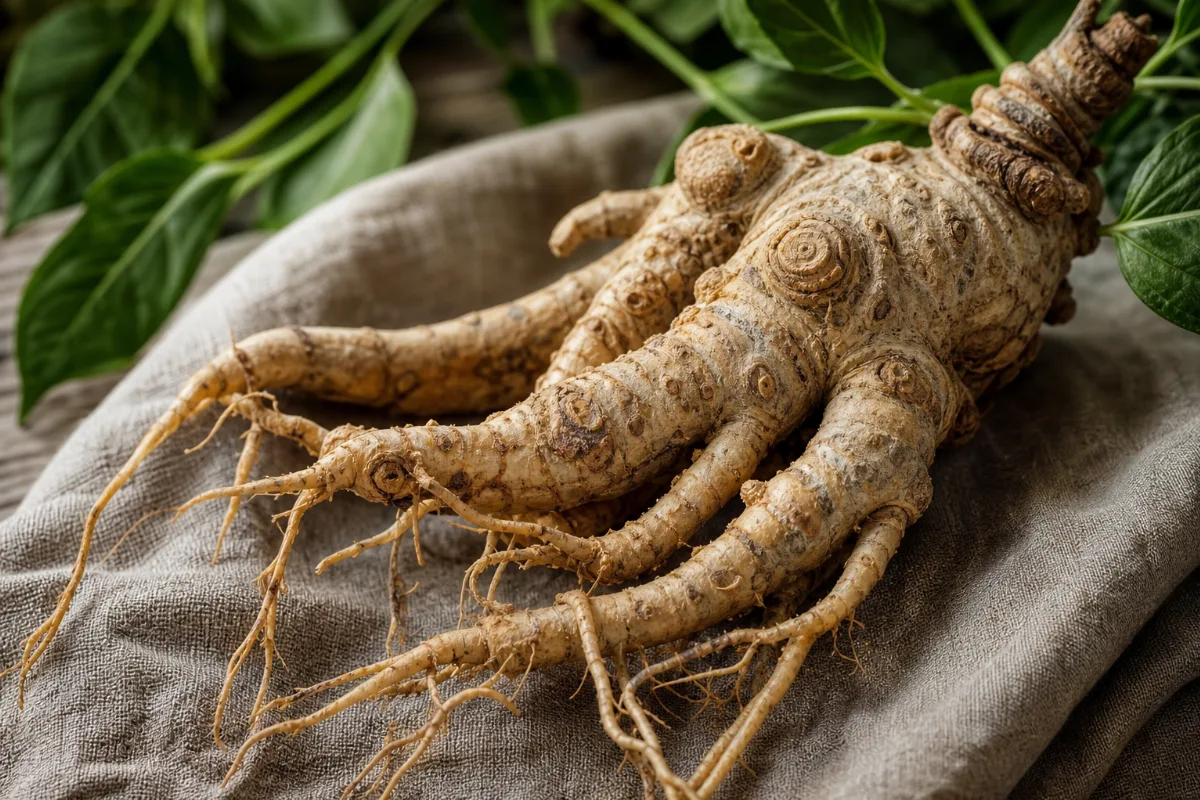
Adaptogens · Herbs & Botanicals · Chinese root studied for stroke and angina, with low-certainty evidence and bleeding cautions
Notoginseng (Sanqi, Tianqi)
Panax notoginseng (Burkill) F.H.Chen ex C.H.Chow · also called Sanqi, san qi, tianqi, tian qi, sanchi ginseng, tienchi ginseng, South China ginseng, notoginseng, 三七 (Chinese)
Notoginseng is the root of a plant in the ginseng family. In Chinese medicine it is used to stop bleeding, move 'stuck' blood and ease swelling and pain. Most modern research is on concentrated saponin products made from the root (Xuesaitong, Xueshuantong), mainly in China, for stroke, angina and heart attack. One large 2023 stroke trial found more people independent after 3 months, but nearly all the other evidence is low or very low certainty. The root also lowers platelet clumping, so it can add to blood thinners and may matter before surgery. It is not the same as Asian ginseng, and a liver-toxic look-alike called Tu-San-Qi (Gynura) is sometimes mistaken for it.
General information, not medical advice. Last substantive update · Not medically reviewed. A named clinician has not signed off on this page. How this page is made
About Notoginseng (Sanqi, Tianqi)
Notoginseng (Panax notoginseng, sanqi, tianqi) is a ginseng-family root used in Chinese medicine for bleeding and circulation. Research is mostly on concentrated saponin capsules and injections for stroke and angina in China. A large 2023 trial supports modest benefit after stroke, but other evidence is weak. It lowers platelet clumping, so bleeding and blood-thinner cautions are important.
What it is
Notoginseng is the root of Panax notoginseng, a plant in the same family and genus as Asian ginseng and American ginseng. Its accepted name is Panax notoginseng (Burkill) F.H.Chen ex C.H.Chow (GBIF). It is called sanqi or tianqi in Chinese.
Its main ingredients are saponins such as notoginsenoside R1 and ginsenosides Rg1, Rb1, Rd and Re, plus dencichine, an amino acid studied for stopping bleeding in rats.
What makes it different from ginseng
A 2020 review says ginseng has more polysaccharides and amino acids, while notoginseng has more saponins, volatile oil and polyacetylenes. In Chinese medicine theory ginseng reinforces vital energy and notoginseng promotes blood circulation.
In a 2009 lab study notoginseng reduced platelet clumping more than Asian or American ginseng, and steamed root more than raw.
Historical and current uses
Traditionally it is used to stop bleeding, clear 'stuck' blood and ease swelling and pain. We did not read original texts, so no dates are given.
Today in China, concentrated saponin products are widely used in hospitals for stroke and angina. A 2008 Cochrane review called sanchi one of the most widely used herbal medicines for ischaemic stroke in China.
What the research shows
Stroke: the 2023 JAMA Network Open trial gave 3,072 Chinese stroke patients Xuesaitong capsules or placebo for 3 months. More were independent on the capsule (89.3% versus 82.4%, odds ratio 1.95). Meta-analyses of many smaller, lower-quality trials, oral and injected, agree, but rate the evidence moderate to very low.
Heart: pooled trials of mostly injections in unstable angina and heart attack found fewer attacks and better lab markers, but the trials are small and no large trial shows fewer deaths.
Other uses: bleeding in the brain, diabetic kidney disease, COPD, diabetic eye disease, endurance and blood sugar are all very low certainty or insufficient. For stopping bleeding itself, there is no trial of notoginseng alone in people.
At a glance
Traditional uses history, not proof
- Chinese medicine: to stop bleeding, clear 'blood stasis' (blood thought to be stuck), reduce swelling and relieve pain
- Raw root for bleeding and circulation; steamed root as a tonic
- In China today, concentrated saponin products are given for ischemic stroke and angina
Studied for research
- Ischemic stroke recovery, low certainty (one large placebo-controlled capsule trial plus many small, lower-quality trials)
- Unstable angina and heart attack, low to very low certainty (mostly injections added to hospital care)
- Brain hemorrhage, very low certainty; stopping bleeding, insufficient evidence in people
- Diabetic kidney disease, COPD with high clotting tendency and diabetic eye disease, very low certainty
- Endurance and blood sugar in healthy people, very low certainty (one small trial each)
Main compounds
- Notoginsenoside R1 and ginsenosides Rg1, Rb1, Rd and Re (saponins)
- Dencichine, a non-protein amino acid studied for stopping bleeding in rats
- Polysaccharides, volatile oil and polyacetylenes (less studied)
Common forms
- Concentrated saponin products used in Chinese trials: Xuesaitong soft capsule, Sanchitongshu capsule, and hospital injections (Xuesaitong, Xueshuantong)
- Raw and steamed root, which differ in lab antiplatelet strength
- Powder: little research in people; the root powder trials were small
- Mixed products such as Yunnan Baiyao or Astragalus-plus-notoginseng blends: their results cannot be credited to notoginseng alone
Research links: GBIF: Panax notoginseng (accepted species record) · JAMA Network Open 2023: large stroke trial of Xuesaitong capsules · Cochrane review 2008: Sanchi for acute ischaemic stroke · Review 2021: Tu-San-Qi (Gynura) liver injury · Research Library · Genes & Biomarkers Library
The plant and its history
- Accepted scientific name
- Panax notoginseng (Burkill) F.H.Chen ex C.H.Chow
- Naming authority
- (Burkill) F.H.Chen ex C.H.Chow; GBIF records the publication as Chen, F.H. (1975), Acta Phytotax. Sin. 13(2): 41. The shorter authority '(Burkill) F.H.Chen' is common in papers and is listed by GBIF as a synonym form.
- Synonyms
- Aralia quinquefolia var. notoginseng Burkill (basionym); Panax notoginseng (Burkill) F.H.Chen (authority variant); Panax pseudoginseng var. notoginseng (Burkill) G.Hoo & C.J.Tseng
- Common names
- South China ginseng (English); notoginseng (English); san qi (Chinese); san-qi ginseng (English); sanchi ginseng (English); tian qi (Chinese); tienchi ginseng (English); všehoj ženšenovitý (Slovak); サンシチニンジン (Japanese); 三七 (Chinese); 田七 (Chinese); sanqi (Chinese (pinyin; also written san qi)); tianqi (Chinese (pinyin; also written tian qi))
- Botanical family
- Araliaceae (the ginseng or ivy family, order Apiales), the same family and genus as Asian ginseng (Panax ginseng) and American ginseng (Panax quinquefolius).
- Classification
- Plantae > Tracheophyta > Magnoliopsida > Apiales > Araliaceae > Panax > Panax notoginseng
- Native range
- Not verified from a primary source read. The root samples in one quality study came from Yunnan, China, but this file did not read a source on the plant's natural range.
- Habitat
- Not verified in a source read for this file.
- What the plant looks like
- Roots: The medicinal part in nearly all studies is the root (main root and sometimes rhizome). Details of shape not verified here.; Stems: Not verified in a source read.; Leaves: Not verified in a source read.; Flowers: A review title refers to 'flower buds' as a separate material, but its abstract was not read.; Fruit: Not verified in a source read.
- Cultivation
- Not verified from a source read. Soil studies cited in PubMed searches discuss pesticide and heavy-metal levels in growing areas, but the cultivation method itself was not read.
- Harvest and processing
- Raw and steamed root are different materials. A 2009 study found steamed root had stronger antiplatelet and anticoagulant effects than raw root in the lab, increasing with steaming time (p19665534). The processing used for Xuesaitong and Xueshuantong is not described in the abstracts read.
- Look-alikes and adulterants
- Name: Tu-San-Qi, Gynura japonica (Thunb.) Juel (and relatives); Note: A different plant (daisy family) with a similar-sounding name. It contains pyrrolizidine alkaloids and has caused serious liver injury in China; a 2021 review says it is sometimes mistaken for or used in place of San-Qi, and describes how to tell them apart (p33154553).; Name: Sedum aizoon (a non-alkaloid 'Tu-San-Qi'); Note: The same review lists this succulent as another plant sold as Tu-San-Qi that does not contain the liver-toxic alkaloids (p33154553).; Name: Asian ginseng (Panax ginseng) and American ginseng (Panax quinquefolius); Note: Related species with different chemistry and traditional use. A 2020 review says ginseng contains more polysaccharides and amino acids, notoginseng more saponins, volatile oil and polyacetylenes (p33127555), and a 2009 lab study found notoginseng had stronger antiplatelet activity than both (p19665534). Results on one species should not be copied to another.; Name: Panax pseudoginseng; Note: GBIF lists 'Panax pseudoginseng var. notoginseng' as a synonym of Panax notoginseng. Older papers may use that name (GBIF).
- Sustainability and conservation
- Not verified. No IUCN or CITES check was made.
Traditional use and history history, not clinical proof
| Tradition or era | Documented use | Source |
|---|---|---|
| Traditional Chinese medicine | Used to stop bleeding, clear 'blood stasis' (blood thought to be stuck), reduce swelling and relieve pain (as described in a 2023 review). Raw root is used for its stop-bleeding and circulation effects, and steamed root as a tonic (as described in a 2009 lab study). | p36754189 |
| Traditional Chinese medicine theory | In TCM theory, ginseng 'reinforces vital energy' while notoginseng 'promotes blood circulation' (as described in a 2020 comparison of the two plants). | p33127555 |
| China, modern | Concentrated saponin extracts are given for stroke and angina: a 2008 Cochrane review called sanchi 'one of the most widely used herbal medicines for ischaemic stroke in China'. Products include Xuesaitong, Xueshuantong and Sanchitongshu. | p18843711 |
| Early written sources (for example Ming dynasty herbals) | No primary source on the first written record of notoginseng was read for this file, so no date is given. NOT verified. | |
| Regulation | No EU herbal monograph and no NCCIH page for notoginseng were found; see the safety file. | s-ema-notoginseng-not-found |
Traditional use shows how a plant was used. It does not show that a supplement works or is safe today.
What is inside, and how it may work
What the plant contains and how those compounds act in cells and animals. Laboratory and animal mechanisms are not proven effects in people.
Main compounds
| Compound | Family | Where it is concentrated | Activity studied | Level of evidence |
|---|---|---|---|---|
| Notoginsenoside R1 PubChem 441934 | dammarane (protopanaxatriol-type) saponin, specific to notoginseng | Root | One of the main substances in the blood after injection of XueShuanTong in people; lab work on brain protection (animal). 25 43 38 | Animal research |
| Ginsenoside Rg1 PubChem 441923 | protopanaxatriol-type saponin | Root | Estrogen-like effect in breast cancer cells in the dish; a main substance in the blood after injection. 2 25 43 | Laboratory research |
| Ginsenoside Rb1 PubChem 9898279 | protopanaxadiol-type saponin | Root | Main substance behind the predicted OATP1B3 interaction; stays in the body for days (terminal half-life 32-57 h after injection). 25 43 | Human data |
| Ginsenoside Rd PubChem 11679800 | protopanaxadiol-type saponin | Root | Long terminal half-life in people after injection (58-307 h). 25 43 | Human data |
| Ginsenoside Re PubChem 441921 | protopanaxatriol-type saponin | Root | Listed as a main bioactive saponin of XueShuanTong; effects not detailed in the abstracts read. 43 | Human data |
| Dencichine (beta-N-oxalyl-L-alpha,beta-diaminopropionic acid) PubChem 440259 | non-protein amino acid | Root | Shortened bleeding time in rats and acted on platelets through AMPA receptors. 17 | Animal research |
| Panaxatriol saponins (PTS) and notoginseng total saponins (PNS) as extracts | saponin extract groups | Root | In pooled trials with aspirin PNS and PTS acted differently on clotting measures (PTS lengthened prothrombin time and INR; PNS lowered fibrinogen and D-dimer). 5 | Human data |
| Polysaccharides, volatile oil and polyacetylenes | other constituents | Root | A 2020 review says notoginseng has more volatile oil and polyacetylenes than ginseng; effects were not detailed in the abstract. 22 | Other |
Mechanisms, receptors and pathways
| Target or pathway | Gene or receptor | What was found | Level |
|---|---|---|---|
| Platelet activation and clumping (COX-1 and thromboxane pathway; GPIIb/IIIa) | PTGS1 (COX-1); ITGA2B/ITGB3 (GPIIb/IIIa) | In 42 people with coronary disease, adding notoginseng saponins to aspirin suppressed platelet COX-1 activity and platelet activation more than aspirin alone (human). In rats, saponins lowered GPIIb/IIIa activation and clot formation (animal). 31 32 | Human data |
| Stopping bleeding by platelet receptor (dencichine) | AMPA-type glutamate receptors on platelets | Dencichine shortened bleeding time in rats and raised platelet calcium and thromboxane A2; a receptor blocker (CNQX) cancelled this. 17 | Animal research |
| Clotting cascade | Prothrombin time, aPTT, thrombin time | Raw and steamed extracts lengthened clotting times in lab tests, steamed more than raw; panaxatriol saponins lengthened prothrombin time and INR in pooled human trials. 18 5 | Laboratory research |
| Brain protection after oxygen loss | Inflammation, oxidative stress, mitochondria, cell death pathways (not single genes) | A 2020 review of lab and animal work found saponins lowered inflammation and oxidative stress, protected mitochondria and the blood-brain barrier and helped nerve-cell growth. 38 | Animal research |
| Estrogen-like signalling | Estrogen response element; estrogen receptor-positive cells | Ginsenoside Rg1 stimulated MCF-7 cell growth and an estrogen-response reporter, blocked by an estrogen antagonist, but did not displace estradiol from receptors, suggesting no direct receptor binding. 2 | Laboratory research |
| Drug-metabolising enzymes and transporters | CYP1A2, CYP3A4, CYP2C9, OATP1B3, P-glycoprotein | Rat studies: PNS induced CYP1A2 and lowered CYP3A4; no CYP3A induction in people after 15 days of injection; OATP1B3 inhibition predicted from lab data. 21 26 25 6 35 | Animal research |
Absorption, metabolism and elimination
- Absorption
- The main saponins are described as poorly absorbed from the gut, which is why injection forms exist (p32035876). No human blood-level data after oral notoginseng were found in the abstracts read.
- Distribution
- After injection, ginsenosides Rb1 and Rd are highly bound to blood proteins (unbound 0.8-2.9% and 0.4-3.0%) (p31358899). Distribution into tissues in people was not found.
- Metabolism
- After injection the unchanged saponins are the main forms in blood (p32035876). With repeated oral dosing in rats, gut bacteria split sugar groups from protopanaxatriol saponins and oxidised metabolites accumulated, mirroring earlier human findings according to the authors (p40274033).
- Elimination
- After injection of XueShuanTong in volunteers, protopanaxadiol-type ginsenosides had long terminal half-lives (Rb1 32-57 h, Rd 58-307 h by vein; 46-106 h by muscle), while protopanaxatriol-type ones were short (1.1-1.4 h) (p31358899, p32035876).
- Bioavailability
- Injection into muscle gave 100%-112% of the exposure of the same dose by vein (150 mg per person, human). Oral bioavailability in people was not found in the abstracts read.
Isolated compounds versus whole extracts
The root contains compounds that pull in opposite directions. Dencichine shortened bleeding time in rats, while the saponins reduced platelet clumping and clotting in lab and human tests. The mix therefore matters: raw versus steamed root differ in antiplatelet strength, panaxatriol saponins and total saponins act differently on clotting measures, and two injection brands differ in saponin make-up. No single compound has been shown to account for the stroke or angina results seen in trials of whole-saponin products.
Nutritional composition
A nutrient table is not meaningful for the medicinal use of notoginseng: it is taken in small amounts as a medicine, and the studies measure effects of its saponins, not vitamins or minerals.
6 low certainty7 very low certainty1 not enough evidence
What is Notoginseng (Sanqi, Tianqi) good for?
The main proposed uses and how strong the human evidence is for each. No use is rated above low certainty, and most of the research is on Chinese saponin products, not on the plain root.
Benefits, one by one
Each card is a research question, not a promise. Tap a goal to filter. Open a card to see the studies, doses and limits.
Ischemic stroke: recovery of independence (oral Xuesaitong capsule)
Low certaintyOne large Chinese trial of 2,966 stroke patients found that more people taking Xuesaitong soft capsules for 3 months could look after themselves (89.3%) than those on placebo (82.4%). Many smaller trials in meta-analyses agree, but they are mostly low quality and from China.
7 studiesXuesaitong soft capsule 120 mg twice a day for 3 months in the large …
Studies, doses and limits
What the trials found
The 2023 JAMA Network Open trial (Wu et al., 67 hospitals, 3,072 randomized, mild to moderate strokes, started within 14 days) tested Xuesaitong soft capsules 120 mg twice a day against placebo for 3 months. A 2023 meta-analysis of 46 trials (7,957 patients) found better function with Xuesaitong, rated moderate to very low certainty with high risk of bias. A 2022 meta-analysis of 8 trials of oral preparations rated the evidence very low by GRADE. A 2022 meta-analysis of 17 soft-capsule trials found better scores and lower blood thickness but gave no numbers in its abstract. A 2011 trial of 140 people found the concentrated extract Sanchitongshu added to low-dose aspirin improved stroke and daily-living scores.
Results
Most of the evidence says more people reach independence with the capsules added to usual care. The one large, well-designed, placebo-controlled trial supports this, but it has not been repeated outside China and its funding is not stated in the abstract.
Effect sizes as reported
Large trial: functional independence (mRS 0 to 2) at 3 months 89.3% versus 82.4%, odds ratio 1.95 (95% CI 1.56 to 2.44). Meta-analysis (46 trials): functional independence RR 1.08 (1.05 to 1.12); mRS mean difference -0.67 (-0.92 to -0.42). Oral-only meta-analysis (8 trials, 827): NIHSS mean difference -3.22 (-4.52 to -1.92).
Why this rating
Only one large, double-blind placebo-controlled trial. The pooled analyses are of mostly small, high-risk-of-bias Chinese trials, and the authors of two of them rated the evidence very low to moderate-to-very-low. We rate it low rather than moderate because the large trial's funding is not shown and nothing outside China confirms it.
Form and dose studied
Xuesaitong soft capsule 120 mg twice a day for 3 months in the large trial. Sanchitongshu capsule 200 mg three times a day plus aspirin 50 mg a day in the 2011 trial. These are named products and doses from trials, not advice on how much to take.
Who was studied
Adults 18 to 75 with mild to moderate ischemic stroke, started within 14 days (large trial). All studies were done in China.
Limits
All evidence is from China. Mostly small trials with high risk of bias. Benefit measured after 3 months only. No trials on hemorrhagic stroke recovery in this entry (see the other uses). Not tested against modern stroke care in other countries.
Why researchers looked
Ischemic stroke (a blocked brain artery) leaves many survivors disabled and few drugs help recovery. Xuesaitong is a standardised Panax notoginseng root saponin product widely used in China to treat it.
Traditional use
Notoginseng (sanqi, tianqi) root has been used in Chinese medicine for centuries, mainly to stop bleeding, move blood that is thought to be stuck (blood stasis) and relieve swelling and pain. Its use for stroke and chest pain is largely a modern development of concentrated saponin products. Dates and original texts for the older uses were not checked here.
Proposed mechanism Preliminary mechanism
Lab and animal work, summarised in a 2020 review, suggests the root saponins (ginsenoside Rb1, Rg1 and notoginsenoside R1) may lower brain inflammation and oxidative stress, protect nerve-cell mitochondria and the blood-brain barrier, and slow nerve-cell death after oxygen loss. A 2026 rat study found the saponins lowered platelet activity and clot formation. None of this proves the same thing happens in people at usual doses.
A proposed mechanism does not show that the effect happens in people.
Serious adverse events were similar in the large trial (1.0% versus 1.1%). The product thins the blood a little (see the safety section). Do not use it in place of emergency stroke care.
Ischemic stroke: Xuesaitong or notoginseng saponin injection added to hospital care
Low certaintyPooled Chinese trials find that adding a notoginseng saponin injection to hospital stroke care gives higher 'effective rate' and better neurological scores. These injection trials are lower quality than the capsule trial and the injection has its own safety issues.
3 studiesInjection into a vein in hospital; dose and brand vary. Xuesaitong an…
Studies, doses and limits
What the trials found
A 2021 meta-analysis of 12 trials (1,769 patients) of Xuesaitong injection plus Western medicine found a higher effective rate (OR 4.04, 95% CI 2.86 to 5.73) and a lower NIHSS (mean difference -3.17), with no significant difference in adverse reactions. A 2026 meta-analysis (Phytomedicine) reported response RR 1.20 and lower deficit score and plasma viscosity, with low-to-moderate GRADE and comparable adverse events. The 2008 Cochrane review of 'sanchi' (forms not specified in the abstract; 8 trials, 660 patients, 7 of poor quality) found lower death or dependency at 28 days in 2 trials (RR 0.63, CI 0.45 to 0.88) and better neurological deficit in 7 (RR 0.29, CI 0.18 to 0.47), and concluded firm conclusions were not possible.
Results
Better scores on locally used scales, with similar rates of adverse events in pooled data. 'Total effective rate' is a locally defined measure and not the same as independence or survival.
Effect sizes as reported
Effective rate OR 4.04 (2.86 to 5.73); NIHSS mean difference -3.17 (-4.14 to -2.20) in the 2021 review. 2026 review: response RR 1.20 (1.17 to 1.24). Cochrane 2008: death or dependency RR 0.63 (0.45 to 0.88).
Why this rating
Pooled trials are mostly small and from China; the 2008 Cochrane review rated 7 of 8 trials poor quality; the 2026 review rates evidence low to moderate. Effective-rate scores are not the same as patient-important outcomes.
Form and dose studied
Injection into a vein in hospital; dose and brand vary. Xuesaitong and Xueshuantong injections are different products with different saponin make-up.
Who was studied
Hospital patients with acute ischemic stroke in China.
Limits
Injection trials are not the same as swallowing capsules. Injection safety reports (including allergy-like reactions) exist; see the safety section. Searches in the 2008 Cochrane review ended before the large 2023 trial.
Why researchers looked
In China, notoginseng saponin injections (Xuesaitong, and the related Xueshuantong) are given by vein in hospital for acute stroke.
Traditional use
Notoginseng (sanqi, tianqi) root has been used in Chinese medicine for centuries, mainly to stop bleeding, move blood that is thought to be stuck (blood stasis) and relieve swelling and pain. Its use for stroke and chest pain is largely a modern development of concentrated saponin products. Dates and original texts for the older uses were not checked here.
Proposed mechanism Preliminary mechanism
Lab and animal work, summarised in a 2020 review, suggests the root saponins (ginsenoside Rb1, Rg1 and notoginsenoside R1) may lower brain inflammation and oxidative stress, protect nerve-cell mitochondria and the blood-brain barrier, and slow nerve-cell death after oxygen loss. A 2026 rat study found the saponins lowered platelet activity and clot formation. None of this proves the same thing happens in people at usual doses.
A proposed mechanism does not show that the effect happens in people.
Injections can cause allergy-like (pseudo-allergic) reactions. They are used only in hospital and must not be used at home.
Ischemic stroke after clot-busting treatment (thrombolysis): notoginseng saponin injections
Low certaintyA 2024 pooled analysis of 20 trials found people who also got notoginseng saponin injections after clot-busting treatment had better neurological and daily-living scores without more side effects or bleeding into the stroke area. The bleeding comparison has wide uncertainty.
1 studiesInjection added to hospital care; doses vary.
Studies, doses and limits
What the trials found
Liu et al. (Frontiers in Pharmacology, 2024) pooled 20 randomized trials (1,856 people) in which usual care plus notoginseng saponin injection was compared with usual care. No trial reported death or disability. Adverse events (RR 1.04, 95% CI 0.60 to 1.81) and hemorrhagic transformation (RR 0.99, CI 0.36 to 2.70) did not differ. NIHSS was 2.91 points lower (CI -4.76 to -1.06), Barthel index 9.37 points higher (CI 1.86 to 16.88), and the nerve-injury marker neuron-specific enolase lower.
Results
Short-term scores were better; the bleeding comparison cannot rule out meaningful harm or benefit because the confidence intervals are wide.
Effect sizes as reported
NIHSS mean difference -2.91 (-4.76 to -1.06); Barthel +9.37 (1.86 to 16.88); hemorrhagic transformation RR 0.99 (0.36 to 2.70).
Why this rating
The authors rated certainty moderate to very low. No data on death or disability; short-term only; wide bleeding intervals.
Form and dose studied
Injection added to hospital care; doses vary.
Who was studied
Adults with acute ischemic stroke given intravenous thrombolysis.
Limits
Only one meta-analysis; primary outcomes (death, disability) were not reported by any trial. Cannot say if rare serious bleeding is increased.
Why researchers looked
After clot-busting drugs, there is a risk of bleeding into the brain. Researchers asked whether the saponin injection helps recovery without adding to that risk.
Traditional use
Notoginseng (sanqi, tianqi) root has been used in Chinese medicine for centuries, mainly to stop bleeding, move blood that is thought to be stuck (blood stasis) and relieve swelling and pain. Its use for stroke and chest pain is largely a modern development of concentrated saponin products. Dates and original texts for the older uses were not checked here.
Proposed mechanism Preliminary mechanism
Lab and animal work, summarised in a 2020 review, suggests the root saponins (ginsenoside Rb1, Rg1 and notoginsenoside R1) may lower brain inflammation and oxidative stress, protect nerve-cell mitochondria and the blood-brain barrier, and slow nerve-cell death after oxygen loss. A 2026 rat study found the saponins lowered platelet activity and clot formation. None of this proves the same thing happens in people at usual doses.
A proposed mechanism does not show that the effect happens in people.
Anything that affects platelets or clotting deserves attention around thrombolysis; this is a hospital decision.
Ischemic stroke: notoginseng saponins plus aspirin compared with other antiplatelet regimens
Low certaintyA 2026 network analysis of 50 trials (18,424 patients) found notoginseng saponins plus aspirin were linked to better 90-day function than aspirin alone, aspirin plus clopidogrel, or indobufen. It ranked fourth overall, and the comparison is indirect.
1 studiesPNS with aspirin within 14 days of stroke onset; products and doses v…
Studies, doses and limits
What the trials found
Zhang et al. (Journal of Ethnopharmacol, 2026) pooled 50 randomized trials in a network meta-analysis of notoginseng saponins (PNS) and seven antiplatelet regimens, started within 14 days of symptoms. PNS plus aspirin versus aspirin: mRS RR 1.08 (1.05 to 1.12), NIHSS mean difference -3.17 (-5.08 to -1.27). No significant differences in adverse events between regimens. PNS plus aspirin did worse than tirofiban plus aspirin plus clopidogrel or ozagrel plus aspirin on the Barthel index.
Results
Possible small gain in function when added to aspirin, based on indirect comparisons that include the large 2023 trial.
Effect sizes as reported
mRS RR 1.08 (1.05 to 1.12) versus aspirin; NIHSS mean difference -3.17 (-5.08 to -1.27) versus aspirin; SUCRA rank 4th (57.2%).
Why this rating
Network (indirect) comparison; many comparisons rest on few trials; no certainty rating was given in the abstract.
Form and dose studied
PNS with aspirin within 14 days of stroke onset; products and doses vary.
Who was studied
Adults with ischemic stroke in China.
Limits
Does not prove it can replace clopidogrel or other drugs. Not tested in people on anticoagulants.
Why researchers looked
Doctors want to know whether the herbal product adds something to standard antiplatelet drugs, or can replace any of them.
Traditional use
Notoginseng (sanqi, tianqi) root has been used in Chinese medicine for centuries, mainly to stop bleeding, move blood that is thought to be stuck (blood stasis) and relieve swelling and pain. Its use for stroke and chest pain is largely a modern development of concentrated saponin products. Dates and original texts for the older uses were not checked here.
Proposed mechanism Animal research
Rat and cell work suggests the saponins reduce platelet clumping and clot formation and may protect heart muscle after a blocked artery. A 2026 rat heart-attack model found lower platelet activation and less heart injury with the saponin extract. These are lab and animal findings, not proof of effect in people.
A proposed mechanism does not show that the effect happens in people.
Combining it with aspirin lowers platelet function further (see safety).
Unstable angina: fewer angina attacks and better ECG (added to usual care)
Low certaintyTwo meta-analyses of Chinese trials (mostly injections) found fewer angina attacks and better ECG with notoginseng added to usual treatment. Reporting quality was poor, and a small 2026 trial used a very low dose of the same product as the comparison.
3 studiesMostly injections (16 of 18 trials in the 2017 review); oral PNS in t…
Studies, doses and limits
What the trials found
Song et al. (Phytotherapy Research, 2017) pooled 18 trials (1,828 patients; 16 injection, 2 oral): fewer cardiovascular events (RR 0.35, CI 0.13 to 0.94), better angina symptoms (RR 1.23, CI 1.18 to 1.29), better ECG (RR 1.22, CI 1.15 to 1.28), fewer attacks (mean difference -1.48, CI -2.49 to -0.48); cardiac mortality and attack duration were not significantly different. Duan et al. (Phytomedicine, 2018) pooled 17 trials of oral PNS and reported fewer and shorter attacks (mean difference -1.88, CI -2.03 to -1.72, for attack frequency and duration as the abstract reports it) and less nitroglycerin use (mean difference -1.13, CI -1.70 to -0.56). A 2026 trial (Wang et al., 59 people, 10 days) found a 500 mg Xueshuantong injection lowered CRP more than a 25 mg dose.
Results
Most outcomes improved, but they are symptom counts and lab markers from low-quality trials.
Effect sizes as reported
Song 2017: cardiovascular events RR 0.35 (0.13 to 0.94); angina frequency mean difference -1.48 (-2.49 to -0.48). Duan 2018: nitroglycerin dose mean difference -1.13 (-1.70 to -0.56).
Why this rating
Poor reporting in the 2017 review; small trials; mostly injections from China; the 2026 trial compared a high with a very low dose and no placebo.
Form and dose studied
Mostly injections (16 of 18 trials in the 2017 review); oral PNS in the 2018 review.
Who was studied
Adults with unstable angina in China.
Limits
No large trial of heart attacks or death. People with chest pain need emergency assessment, not self-treatment.
Why researchers looked
Unstable angina is chest pain that can precede a heart attack. Notoginseng saponins are widely used in China as add-on treatment.
Traditional use
Notoginseng (sanqi, tianqi) root has been used in Chinese medicine for centuries, mainly to stop bleeding, move blood that is thought to be stuck (blood stasis) and relieve swelling and pain. Its use for stroke and chest pain is largely a modern development of concentrated saponin products. Dates and original texts for the older uses were not checked here.
Proposed mechanism Animal research
Rat and cell work suggests the saponins reduce platelet clumping and clot formation and may protect heart muscle after a blocked artery. A 2026 rat heart-attack model found lower platelet activation and less heart injury with the saponin extract. These are lab and animal findings, not proof of effect in people.
A proposed mechanism does not show that the effect happens in people.
Do not replace aspirin, nitrates or any heart medicine. Chest pain needs a doctor.
Heart attack (acute myocardial infarction): saponin injection added to hospital care
Very low certaintyPooled Chinese trials report smaller heart damage markers and better heart pumping when notoginseng saponin injection is added to hospital care. The trials are small and low in quality.
2 studiesInjection; doses and brands vary.
Studies, doses and limits
What the trials found
Chen et al. (Frontiers in Pharmacology, 2024) pooled 20 trials (1,881 people) of PNS injection plus conventional treatment: major adverse cardiac events OR 0.32; infarct size, troponin and CK-MB lower; ejection fraction 5.91 points higher; CRP and IL-6 lower; adverse events OR 1.00. Hua et al. (Medicine, 2021) pooled 5 trials (539 people) of Xuesaitong injection: ejection fraction +3.18 points (CI 1.69 to 4.67), lower troponin T, CK-MB, CRP and IL-6, and described the trials as relatively low quality.
Results
Lab markers and heart function measures improved in pooled trials. No large trial has shown fewer deaths or fewer heart attacks.
Effect sizes as reported
2024: MACE OR 0.32 (P < 0.05); LVEF mean difference +5.91. 2021: LVEF +3.18 (1.69 to 4.67); efficacy RR 1.09 (1.01 to 1.17).
Why this rating
Small Chinese trials (blinding not stated in the abstracts); the 2021 authors say quality was relatively low; intervals missing from the 2024 abstract.
Form and dose studied
Injection; doses and brands vary.
Who was studied
Adults after acute myocardial infarction in hospital, China.
Limits
No large, high-quality trial; death and long-term heart failure results are not shown. A 2022 trial in this area (Compound Xueshuantong capsule after PCI) was a registered protocol only and had no results to cite.
Why researchers looked
Researchers asked whether the saponin injection reduces heart-muscle damage and later heart failure after a heart attack.
Traditional use
Notoginseng (sanqi, tianqi) root has been used in Chinese medicine for centuries, mainly to stop bleeding, move blood that is thought to be stuck (blood stasis) and relieve swelling and pain. Its use for stroke and chest pain is largely a modern development of concentrated saponin products. Dates and original texts for the older uses were not checked here.
Proposed mechanism Animal research
Rat and cell work suggests the saponins reduce platelet clumping and clot formation and may protect heart muscle after a blocked artery. A 2026 rat heart-attack model found lower platelet activation and less heart injury with the saponin extract. These are lab and animal findings, not proof of effect in people.
A proposed mechanism does not show that the effect happens in people.
Do not delay emergency care. Injection-specific reactions occur.
Bleeding inside the brain (intracerebral hemorrhage): saponin injection added to hospital care
Very low certaintyPooled Chinese trials report better outcomes with notoginseng saponin injection after a brain bleed, and one small trial found a smaller blood clot on scans. The evidence is weak. Because notoginseng also affects platelets, it must only be given by a hospital team.
2 studiesInjection in hospital; 175 mg a day of Xueshuantong in the small tria…
Studies, doses and limits
What the trials found
Xu et al. (Frontiers in Neurology, 2014) pooled 20 randomized trials: 984 patients with PNS injection and 907 on usual treatment. PNS-treated patients had better outcomes on effectiveness, neurological score, hematoma volume, brain swelling, Barthel index, deaths and adverse events (the abstract gives no numbers). Several trials also gave vitamin C and brain-cell activators, which muddies the result. Gao et al. (Journal of the Neurological Sciences, 2012) randomized 63 patients to Xueshuantong injection 175 mg a day or control for 2 weeks: lower NIHSS (P < 0.01) and smaller hematoma volume (P < 0.05) on CT, with lower white blood cells, neutrophil share and CRP.
Results
Both sources point to benefit, but the meta-analysis abstract gives no numbers and the randomized trial is small and short.
Effect sizes as reported
Meta-analysis: no numbers in the abstract. Gao 2012: NIHSS P < 0.01 and hematoma volume P < 0.05 versus control after 2 weeks (63 people).
Why this rating
Quality was judged with the older Jadad scale; the abstract gives no numbers; one small 63-person trial; mixed co-treatments. Whether a platelet-active product raises re-bleeding risk is not answered.
Form and dose studied
Injection in hospital; 175 mg a day of Xueshuantong in the small trial. This is a trial dose, not advice.
Who was studied
Adults with acute spontaneous brain hemorrhage. Studies searched Chinese and international sources.
Limits
Longer-term outcomes (months, years) were not shown. Not studied against modern intensive care for brain bleeds outside China.
Why researchers looked
There is no proven drug for brain bleeds. Chinese doctors have tried notoginseng saponins because of the root's traditional use for bleeding and 'stuck' blood.
Traditional use
Notoginseng (sanqi, tianqi) root has been used in Chinese medicine for centuries, mainly to stop bleeding, move blood that is thought to be stuck (blood stasis) and relieve swelling and pain. Dates and original texts for the older uses were not checked here.
Proposed mechanism Preliminary mechanism
The 2014 review lists many possible effects from lab and animal work, including hemostasis, anti-coagulation, wider brain blood vessels, and less inflammation and oxidative stress. Some of these point in opposite directions, so the net effect in people is not settled by this evidence.
A proposed mechanism does not show that the effect happens in people.
Brain bleeding is an emergency. Notoginseng also affects platelets (see the safety section).
Stopping bleeding (hemostasis): the traditional use, with little direct human evidence
Not enough evidenceNotoginseng is traditionally used to stop bleeding. We found no randomized human trial of notoginseng alone for stopping bleeding. Rat studies show a shorter bleeding time, and a mixed Chinese product (Yunnan Baiyao) lowered blood loss in one surgery trial. The same root also lowers platelet clumping, so its overall effect on bleeding is unclear.
4 studiesThe rat study used notoginseng applied to the skin; the surgery trial…
Studies, doses and limits
What the trials found
Fan et al. (2005) cut rat tails: bleeding time was 29.7% shorter with notoginseng applied to the skin than with placebo. Huang et al. (2014) gave dencichine to rats by mouth and found a shorter bleeding time. In people, Tang et al. (2009) randomized 87 jaw-surgery patients to Yunnan Baiyao capsules or placebo for 3 days before surgery: blood loss 330.5 ml versus 420.3 ml. A 2014 meta-analysis of 55 trials (5,150 patients) of Yunnan Baiyao reported better bleeding control (RR 1.16 alone, 1.23 added to routine drugs) but said effects were unstable when high-risk trials were removed, and that large differences between trials and likely publication bias prevented firm conclusions. Yunnan Baiyao is a mixed product, and these abstracts do not say that notoginseng is what produced the effect.
Results
Animal and mixed-product human findings only. This is not evidence that notoginseng by itself helps stop bleeding in people.
Effect sizes as reported
Rat tail: 29.7% shorter bleeding time (topical). Surgery trial (Yunnan Baiyao): 330.5 versus 420.3 ml blood loss. Meta-analysis (Yunnan Baiyao): RR 1.16 (1.06 to 1.28) alone; RR 1.23 (1.17 to 1.29) added to haemostatic drugs.
Why this rating
No human trial of notoginseng alone for bleeding was found in our searches. The human evidence is for a different multi-ingredient product. Animal and lab results are not proof for people.
Form and dose studied
The rat study used notoginseng applied to the skin; the surgery trial used Yunnan Baiyao capsules before surgery; no notoginseng-only human dose is established.
Who was studied
Rats (animal studies); adults having jaw surgery (Yunnan Baiyao trial).
Limits
The same root also reduces platelet clumping in studies of people with heart disease, so its overall effect on bleeding risk is unclear. It should not be used to treat serious bleeding.
Why researchers looked
This is the oldest recorded use, and one reason notoginseng is famous.
Traditional use
Notoginseng (sanqi, tianqi) root has been used in Chinese medicine for centuries, mainly to stop bleeding, move blood that is thought to be stuck (blood stasis) and relieve swelling and pain. Dates and original texts for the older uses were not checked here.
Proposed mechanism Animal research
One compound in the root, dencichine, shortened bleeding time in rats and activated platelets through a receptor called AMPA. Other saponins reduce platelet clumping. So the root contains both kinds of ingredient, and how they net out is not known in people.
A proposed mechanism does not show that the effect happens in people.
Serious bleeding needs emergency care.
Blood-clotting measures when taken with aspirin (coronary disease)
Low certaintyIn people with coronary disease taking aspirin, notoginseng saponins lowered platelet clumping and some clotting measures more than aspirin alone in pooled trials. This is a lab-test effect. It is also the reason the bleeding warnings matter.
3 studiesDoses and products vary across the pooled trials.
Studies, doses and limits
What the trials found
Dai et al. (Frontiers in Pharmacology, 2022) pooled 20 randomized trials (2,216 patients) of notoginseng saponins (PNS) or panaxatriol saponins (PTS) plus aspirin versus aspirin alone in coronary disease or ischemic stroke. Platelet aggregation was lower (PNS weighted mean difference -6.10, CI -7.25 to -4.95; PTS -3.53, CI -4.68 to -2.38). PNS lowered fibrinogen and D-dimer; PTS lengthened prothrombin time and INR. Five listed bleeding events and stomach side effects did not differ significantly. Wang et al. (Biomedicine and Pharmacotherapy, 2021) randomized 42 patients with stable coronary disease and chronic gastritis to aspirin or aspirin plus PNS for 2 months: more platelet inhibition and less dyspepsia with the combination.
Results
Measurable extra antiplatelet effect in lab tests; the pooled trials did not show more bleeding but were not built to detect it.
Effect sizes as reported
Platelet aggregation WMD -6.10 (PNS; -7.25 to -4.95) and -3.53 (PTS; -4.68 to -2.38) versus aspirin alone; PTS prothrombin time +1.90 and INR +0.22 (units as reported).
Why this rating
Pooled trials are small and not designed to detect rare or serious bleeding. A lab result is not a clinical outcome. Authors report no conflicts.
Form and dose studied
Doses and products vary across the pooled trials.
Who was studied
Adults with coronary heart disease or ischemic stroke taking aspirin, in China.
Limits
Whether stronger platelet inhibition improves outcomes or raises bleeding is not shown. Not studied with clopidogrel or warfarin in people.
Why researchers looked
Aspirin can irritate the stomach, and some people respond poorly. Researchers asked whether adding notoginseng saponins strengthens platelet control or protects the stomach.
Traditional use
Notoginseng (sanqi, tianqi) root has been used in Chinese medicine for centuries, mainly to stop bleeding, move blood that is thought to be stuck (blood stasis) and relieve swelling and pain. Dates and original texts for the older uses were not checked here.
Proposed mechanism Animal research
A 2026 study in rats and mice found notoginseng saponins lowered platelet activation and clot formation and changed the platelet's fatty-acid (oxylipin) signals, while the authors say basic bleeding was preserved in mice. This is animal work and does not show safety in people taking blood thinners.
A proposed mechanism does not show that the effect happens in people.
This is the reason to ask a doctor about notoginseng if you take aspirin, other antiplatelets or anticoagulants (see the safety section).
COPD with a high blood-clotting tendency: lung function and clotting markers
Very low certaintyA 2024 pooled analysis of 20 Chinese trials found better lung function and lower clotting markers with notoginseng saponin products added to usual COPD care, without extra bleeding. The abstract gives no numbers.
1 studiesVarious PNS preparations.
Studies, doses and limits
What the trials found
Zhou et al. (Phytomedicine, 2024) pooled 20 randomized trials (1,831 patients with COPD and blood hypercoagulability): higher total clinical efficiency, FEV1 percent of predicted and FEV1/FVC, lower fibrinogen, D-dimer and whole-blood and plasma viscosity, higher partial pressure of oxygen and lower carbon dioxide. aPTT and prothrombin time were not significantly different. The authors concluded there was no added bleeding risk and a good safety profile.
Results
Improvements in lab and breathing tests, but no numbers or quality rating in the abstract.
Effect sizes as reported
No numbers in the abstract.
Why this rating
The abstract gives no numbers, bias assessment or certainty grade. The 'no extra bleeding' conclusion comes from small trials.
Form and dose studied
Various PNS preparations.
Who was studied
Adults with COPD and blood hypercoagulability.
Limits
No data on flare-ups, hospital stays or death in the abstract.
Why researchers looked
People with COPD can have more clot-prone blood, which raises risks. Researchers tested saponin products for this.
Traditional use
Notoginseng (sanqi, tianqi) root has been used in Chinese medicine for centuries, mainly to stop bleeding, move blood that is thought to be stuck (blood stasis) and relieve swelling and pain. Dates and original texts for the older uses were not checked here.
Proposed mechanism Pharmacological theory
The review says in vivo studies have shown a benefit of saponin products in COPD with high clotting tendency, but the abstract gives no detail. The idea is that the saponins lower platelet activity and blood thickness.
A proposed mechanism does not show that the effect happens in people.
The authors describe it as a possible 'modulating agent and anticoagulant', so clotting effects matter for people on blood thinners.
Diabetic kidney disease: less protein in the urine (added to usual medicines)
Very low certaintyA 2020 pooled analysis of 24 trials (1,918 people) found lower urine albumin and protein and lower creatinine and blood fats when notoginseng preparations were added to usual diabetes medicines. A 2023 analysis of Astragalus-plus-notoginseng products reported similar results. Neither abstract gives a certainty grade.
2 studiesXuesaitong, Xueshuantong, Lulutong and other products were searched; …
Studies, doses and limits
What the trials found
Tang et al. (Pharmaceutical Biology, 2020) pooled 24 trials (1,918 people): albuminuria -26.89 mg (CI -33.35 to -20.42), proteinuria -0.32 g/24 h (-0.36 to -0.27), serum creatinine -4.52 umol/L (-8.71 to -0.32), total cholesterol -1.56 mmol/L, triglycerides -0.56 mmol/L, LDL -0.94 mmol/L (-1.49 to -0.40). An et al. (2023) pooled 17 trials (1,342 people) of Astragalus plus notoginseng as the main components: effective rate OR 5.12, albumin excretion -26.67, creatinine -13.78, HbA1c SMD -1.30; the authors noted uncertainty of the evidence and suboptimal risk of bias.
Results
Lab markers improved in pooled trials. No trial showed fewer people reaching kidney failure.
Effect sizes as reported
Albuminuria MD -26.89 mg (-33.35 to -20.42); proteinuria -0.32 g/24 h (-0.36 to -0.27); creatinine -4.52 umol/L (-8.71 to -0.32); LDL -0.94 mmol/L (-1.49 to -0.40).
Why this rating
Abstracts do not give risk of bias or GRADE for the 2020 review; several different products are pooled; the 2023 analysis mixes two herbs; no hard outcomes like dialysis.
Form and dose studied
Xuesaitong, Xueshuantong, Lulutong and other products were searched; doses are not given in the abstracts.
Who was studied
Adults with diabetic kidney disease, in China.
Limits
Kidney failure, dialysis or death were not outcomes. Safety data are minimal.
Why researchers looked
Diabetic kidney disease is a leading cause of kidney failure, and notoginseng products are used as add-on treatment in China.
Traditional use
Notoginseng (sanqi, tianqi) root has been used in Chinese medicine for centuries, mainly to stop bleeding, move blood that is thought to be stuck (blood stasis) and relieve swelling and pain. Dates and original texts for the older uses were not checked here.
Proposed mechanism Pharmacological theory
The abstracts read do not describe a mechanism.
A proposed mechanism does not show that the effect happens in people.
People with kidney disease should ask their kidney doctor before use.
Diabetic eye disease (retinopathy)
Very low certaintyThe Cochrane review of single herbs for diabetic retinopathy included three notoginseng-root products among ten trials and drew no conclusions about any single herb. Pooled herbs may have improved vision slightly, with low certainty.
1 studiesThree notoginseng-root products among six herbal treatments.
Studies, doses and limits
What the trials found
Zhang et al. (Cochrane Database of Systematic Reviews, 2018) found 10 trials (754 people; 9 in China, 1 in Poland) of single herbs, including Sanqi Tongshu capsule, Xueshuantong injection and Xuesaitong injection. All trials had high risk of bias, mainly no blinding. None reported progression of retinopathy. Pooled, herbs plus usual care were more likely to gain 2 or more lines of vision (RR 1.26, CI 1.08 to 1.48; 5 trials, 541 people; low-certainty). Two trials of tetramethylpyrazine or Xueshuantong showed little effect on HbA1c (mean difference 0.00, CI -0.58 to 0.58). Adverse event evidence was very low certainty.
Results
No conclusion about any single herb. A possible small vision gain when herbs are pooled.
Effect sizes as reported
Visual acuity gain of 2 or more lines RR 1.26 (1.08 to 1.48), all herbs pooled; HbA1c MD 0.00 (-0.58 to 0.58) in 2 trials.
Why this rating
High risk of bias in all trials; no placebo controls; herbs pooled; the Cochrane authors said the placebo effect could not be ruled out.
Form and dose studied
Three notoginseng-root products among six herbal treatments.
Who was studied
Adults with diabetic retinopathy (9 of 10 trials in China).
Limits
Eye specialists treat diabetic retinopathy with proven methods; herbs were only add-ons in these trials.
Why researchers looked
Diabetes can damage the retina. Notoginseng products are used in China as add-on treatment.
Traditional use
Notoginseng (sanqi, tianqi) root has been used in Chinese medicine for centuries, mainly to stop bleeding, move blood that is thought to be stuck (blood stasis) and relieve swelling and pain. Dates and original texts for the older uses were not checked here.
Proposed mechanism Pharmacological theory
The abstract does not describe a mechanism.
A proposed mechanism does not show that the effect happens in people.
Eye (retinal) bleeding is a particular concern with blood-affecting products; ask the eye doctor.
Exercise endurance in healthy adults (one small trial)
Very low certaintyOne small US trial of 29 healthy untrained adults found a long endurance gain after 30 days of notoginseng capsules. We found no larger replication. A review of the whole Panax genus was not used because it mixes species.
1 studies1,350 mg a day in this trial; product not described.
Studies, doses and limits
What the trials found
Liang et al. (Journal of Strength and Conditioning Research, 2005) randomly assigned 29 untrained adults aged 20-35 to 1,350 mg a day of Panax notoginseng (13) or a starch capsule (16) for 30 days. Endurance time rose by more than 7 minutes; maximal mean arterial pressure and oxygen use at minute 24 were lower.
Results
A single small positive result.
Effect sizes as reported
Endurance time +7 minutes or more; maximal MAP 113 to 109 mm Hg.
Why this rating
Only 29 people, one lab, no replication found; the product and plant part are not described in the abstract.
Form and dose studied
1,350 mg a day in this trial; product not described.
Who was studied
Healthy untrained adults aged 20-35.
Limits
Not tested in athletes or older adults.
Why researchers looked
Sometimes marketed for energy and sport, but the evidence is slim.
Traditional use
Notoginseng (sanqi, tianqi) root has been used in Chinese medicine for centuries, mainly to stop bleeding, move blood that is thought to be stuck (blood stasis) and relieve swelling and pain. Dates and original texts for the older uses were not checked here.
Proposed mechanism Pharmacological theory
Not established in humans.
A proposed mechanism does not show that the effect happens in people.
Not studied with other medicines.
Blood sugar after a sugar drink in healthy men (one small trial)
Very low certaintyOne small trial in 52 healthy untrained men found blood sugar 30 minutes after a glucose drink was lower after 3 days of notoginseng powder. It was not tested in people with diabetes.
1 studies3 g a day for 3 days in this trial.
Studies, doses and limits
What the trials found
Liang et al. (Journal of Complementary and Integrative Medicine, 2012) randomized 52 men to notoginseng 3 g a day or cornstarch for 3 days, with or without a 30-minute bike ride. Blood glucose 30 minutes after a 75 g glucose drink was 26.3 +/- 11 mg/dl lower with notoginseng than placebo (P < 0.05); area under the curve was lower with notoginseng alone and with notoginseng plus exercise.
Results
A short-lived, small lab-test difference in healthy men.
Effect sizes as reported
30-minute glucose difference 26.3 +/- 11 mg/dl; AUC difference 96.5 +/- 42 mg/dl (notoginseng alone versus placebo).
Why this rating
Healthy men only, 12-14 per group, 3 days, no replication found.
Form and dose studied
3 g a day for 3 days in this trial.
Who was studied
Healthy untrained men aged 20-45.
Limits
Not tested in women or people with diabetes.
Why researchers looked
Researchers tested whether short-term notoginseng changes blood sugar spikes after a glucose load.
Traditional use
Notoginseng (sanqi, tianqi) root has been used in Chinese medicine for centuries, mainly to stop bleeding, move blood that is thought to be stuck (blood stasis) and relieve swelling and pain. Dates and original texts for the older uses were not checked here.
Proposed mechanism Pharmacological theory
Not established in humans.
A proposed mechanism does not show that the effect happens in people.
People taking diabetes medicines should ask a doctor before use.
Connections to the rest of health
How Notoginseng (Sanqi, Tianqi) connects to the rest of our health knowledge graph. Every link says what kind of connection it is. A safety link (for example to the liver) is a warning, not a benefit. A study that merely mentions a topic never creates a benefit link.
Explore every connection: goals, body systems, organs, symptoms, genes
A. Wellness goals
| Connected to | Kind of connection | Evidence status | Context | Studies |
|---|---|---|---|---|
| Brain Health | Demonstrated clinical effect | Low certainty | Ischemic stroke: recovery of independence (oral Xuesaitong capsule): One large Chinese trial of 2,966 stroke patients found that more people taking Xuesaitong soft capsules for 3 months could look after themselves (89.3%) than those on placebo (82.4%). Many smaller trials in meta-analyses agree, but they are mostly low quality and from China. Ischemic stroke: Xuesaitong or notoginseng saponin injection added to hospital care: Pooled Chinese trials find that adding a notoginseng saponin injection to hospital stroke care gives higher 'effective rate' and better neurological scores. These injection trials are lower quality than the capsule trial and the injection has its own safety issues. | 34 27 13 11 14 38 32 9 24 3 |
| Resilience Support | Demonstrated clinical effect | Low certainty | Ischemic stroke: recovery of independence (oral Xuesaitong capsule): One large Chinese trial of 2,966 stroke patients found that more people taking Xuesaitong soft capsules for 3 months could look after themselves (89.3%) than those on placebo (82.4%). Many smaller trials in meta-analyses agree, but they are mostly low quality and from China. | 34 27 13 11 14 38 32 |
| Brain Health | Potential benefit | Low certainty | Ischemic stroke after clot-busting treatment (thrombolysis): notoginseng saponin injections: A 2024 pooled analysis of 20 trials found people who also got notoginseng saponin injections after clot-busting treatment had better neurological and daily-living scores without more side effects or bleeding into the stroke area. The bleeding comparison has wide uncertainty. Ischemic stroke: notoginseng saponins plus aspirin compared with other antiplatelet regimens: A 2026 network analysis of 50 trials (18,424 patients) found notoginseng saponins plus aspirin were linked to better 90-day function than aspirin alone, aspirin plus clopidogrel, or indobufen. It ranked fourth overall, and the comparison is indirect. | 23 44 36 10 |
| Heart Health | Potential benefit | Low certainty | Unstable angina: fewer angina attacks and better ECG (added to usual care): Two meta-analyses of Chinese trials (mostly injections) found fewer angina attacks and better ECG with notoginseng added to usual treatment. Reporting quality was poor, and a small 2026 trial used a very low dose of the same product as the comparison. Heart attack (acute myocardial infarction): saponin injection added to hospital care: Pooled Chinese trials report smaller heart damage markers and better heart pumping when notoginseng saponin injection is added to hospital care. The trials are small and low in quality. | 28 7 33 4 15 |
| Inflammation Balance | Potential benefit | Very low certainty | Heart attack (acute myocardial infarction): saponin injection added to hospital care: Pooled Chinese trials report smaller heart damage markers and better heart pumping when notoginseng saponin injection is added to hospital care. The trials are small and low in quality. | 4 15 |
| Healthy Aging | Traditional use | Not enough evidence | Stopping bleeding (hemostasis): the traditional use, with little direct human evidence: Notoginseng is traditionally used to stop bleeding. We found no randomized human trial of notoginseng alone for stopping bleeding. Rat studies show a shorter bleeding time, and a mixed Chinese product (Yunnan Baiyao) lowered blood loss in one surgery trial. The same root also lowers platelet clumping, so its overall effect on bleeding is unclear. | 8 17 29 37 |
| Heart Health | Biological association | Low certainty | Blood-clotting measures when taken with aspirin (coronary disease): In people with coronary disease taking aspirin, notoginseng saponins lowered platelet clumping and some clotting measures more than aspirin alone in pooled trials. This is a lab-test effect. It is also the reason the bleeding warnings matter. | 5 31 32 |
| Longevity | Potential benefit | Very low certainty | COPD with a high blood-clotting tendency: lung function and clotting markers: A 2024 pooled analysis of 20 Chinese trials found better lung function and lower clotting markers with notoginseng saponin products added to usual COPD care, without extra bleeding. The abstract gives no numbers. | 45 |
| Blood Sugar Balance | Potential benefit | Very low certainty | Diabetic kidney disease: less protein in the urine (added to usual medicines): A 2020 pooled analysis of 24 trials (1,918 people) found lower urine albumin and protein and lower creatinine and blood fats when notoginseng preparations were added to usual diabetes medicines. A 2023 analysis of Astragalus-plus-notoginseng products reported similar results. Neither abstract gives a certainty grade. Blood sugar after a sugar drink in healthy men (one small trial): One small trial in 52 healthy untrained men found blood sugar 30 minutes after a glucose drink was lower after 3 days of notoginseng powder. It was not tested in people with diabetes. | 30 1 20 |
| Metabolic Health | Potential benefit | Very low certainty | Diabetic kidney disease: less protein in the urine (added to usual medicines): A 2020 pooled analysis of 24 trials (1,918 people) found lower urine albumin and protein and lower creatinine and blood fats when notoginseng preparations were added to usual diabetes medicines. A 2023 analysis of Astragalus-plus-notoginseng products reported similar results. Neither abstract gives a certainty grade. | 30 1 |
| Healthy Aging | Potential benefit | Very low certainty | Diabetic eye disease (retinopathy): The Cochrane review of single herbs for diabetic retinopathy included three notoginseng-root products among ten trials and drew no conclusions about any single herb. Pooled herbs may have improved vision slightly, with low certainty. | 42 |
| Endurance Support | Potential benefit | Very low certainty | Exercise endurance in healthy adults (one small trial): One small US trial of 29 healthy untrained adults found a long endurance gain after 30 days of notoginseng capsules. We found no larger replication. A review of the whole Panax genus was not used because it mixes species. | 19 |
| Physical Stamina | Potential benefit | Very low certainty | Exercise endurance in healthy adults (one small trial): One small US trial of 29 healthy untrained adults found a long endurance gain after 30 days of notoginseng capsules. We found no larger replication. A review of the whole Panax genus was not used because it mixes species. | 19 |
B. Body systems
| Connected to | Kind of connection | Evidence status | Context | Studies |
|---|---|---|---|---|
| Nervous System | Biological association | Low certainty | Studied for: Ischemic stroke: recovery of independence (oral Xuesaitong capsule) Studied for: Ischemic stroke: Xuesaitong or notoginseng saponin injection added to hospital care | 34 27 13 11 14 38 32 9 24 3 23 44 36 10 42 |
| Cardiovascular System | Biological association | Low certainty | Studied for: Ischemic stroke: recovery of independence (oral Xuesaitong capsule) Studied for: Ischemic stroke: Xuesaitong or notoginseng saponin injection added to hospital care | 34 27 13 11 14 38 32 9 24 3 23 44 28 7 33 4 15 36 10 8 17 29 37 5 31 45 |
| Respiratory System | Biological association | Very low certainty | Studied for: COPD with a high blood-clotting tendency: lung function and clotting markers | 45 |
| Urinary System | Biological association | Very low certainty | Studied for: Diabetic kidney disease: less protein in the urine (added to usual medicines) | 30 1 |
| Endocrine System | Biological association | Very low certainty | Studied for: Diabetic kidney disease: less protein in the urine (added to usual medicines) Studied for: Diabetic eye disease (retinopathy) | 30 1 42 20 |
| Musculoskeletal System | Biological association | Very low certainty | Studied for: Exercise endurance in healthy adults (one small trial) | 19 |
| Metabolism Weight | Biological association | Very low certainty | Studied for: Blood sugar after a sugar drink in healthy men (one small trial) | 20 |
C. Body parts and organs
| Connected to | Kind of connection | Evidence status | Context | Studies |
|---|---|---|---|---|
| Liver | Adverse effect or risk | Not enough evidence | Substitution with the PA-containing look-alike is the documented liver risk. The documented liver risk is the look-alike Gynura (Tu-San-Qi), not notoginseng. Preparation or compound: Look-alike Gynura japonica (Tu-San-Qi), not Panax notoginseng |
46 |
| Blood and blood vessels | Biological association | Low certainty | Lower platelet aggregation, fibrinogen and blood viscosity in trials; clinical meaning unproven. Preparation or compound: Notoginseng root saponins |
5 13 45 |
| Blood and platelets | Biological association | Low certainty | Lower platelet aggregation in trials with aspirin. Preparation or compound: Saponins |
5 31 |
D. Symptoms
| Connected to | Kind of connection | Evidence status | Context | Studies |
|---|---|---|---|---|
| Bleeding risk with blood thinners | Drug or supplement interaction | Low certainty | More platelet inhibition than aspirin alone in people; warfarin clearance and clotting times changed in rats; no human warfarin study. Preparation or compound: Notoginseng root saponins (PNS) |
31 5 26 |
| Allergy-like reactions to injection | Adverse effect or risk | Very low certainty | Dose-dependent in mice; human rates not found. Preparation or compound: Notoginseng total saponin injection |
41 16 |
| Ischemic stroke recovery | Potential benefit | Low certainty | One large placebo-controlled capsule trial plus lower-quality pooled trials. Preparation or compound: Xuesaitong saponin capsule |
34 27 |
| Unstable angina | Potential benefit | Low certainty | Fewer attacks in pooled trials, mostly injection. Preparation or compound: Saponin preparations |
28 7 |
| Heart attack (acute myocardial infarction) | Potential benefit | Very low certainty | Better markers in small trials. Preparation or compound: Saponin injection |
4 15 |
| Intracerebral hemorrhage | Potential benefit | Very low certainty | Small trial and pooled low-quality trials. Preparation or compound: Saponin injection |
36 10 |
| Stopping bleeding | Traditional use | Not enough evidence | No trial of notoginseng alone in people. Preparation or compound: Root; mixed product Yunnan Baiyao |
8 37 |
| Diabetic kidney disease | Potential benefit | Very low certainty | Lab markers improved in pooled trials. Preparation or compound: Notoginseng preparations |
30 1 |
| COPD with high clotting tendency | Potential benefit | Very low certainty | Pooled Chinese trials, no numbers in the abstract. Preparation or compound: Saponin preparations |
45 |
| Diabetic retinopathy | Potential benefit | Very low certainty | Cochrane review drew no conclusions on single herbs. Preparation or compound: Three notoginseng-root products |
42 |
E. Health conditions
I. Biomarkers
| Connected to | Kind of connection | Evidence status | Context | Studies |
|---|---|---|---|---|
| Estrogen | Biological association | Very low certainty | Estrogen-like activity in breast cancer cells in the dish; unknown in people. Estrogen-like effect of ginsenoside Rg1 in cells. Preparation or compound: Ginsenoside Rg1 |
2 |
| Blood glucose | Drug or supplement interaction | Very low certainty | Lower after a glucose drink in healthy men; could add to diabetes drugs. Preparation or compound: Notoginseng powder 3 g a day |
20 |
| Blood glucose | Potential benefit | Very low certainty | Lower after a glucose drink in healthy men. Preparation or compound: Notoginseng powder |
20 |
| Functional independence after stroke (modified Rankin Scale 0 to 2) | Biological association | Low certainty | Measured in trials: raised. A lab change is not the same as a health benefit. | 34 27 |
| Stroke severity score (NIHSS) | Biological association | Low certainty | Measured in trials: lowered. A lab change is not the same as a health benefit. | 13 9 23 44 |
| Daily living ability (Barthel index) | Biological association | Low certainty | Measured in trials: raised. A lab change is not the same as a health benefit. | 27 23 14 |
| Number of angina attacks | Biological association | Low certainty | Measured in trials: lowered. A lab change is not the same as a health benefit. | 28 7 |
| Need for nitroglycerin tablets | Biological association | Low certainty | Measured in trials: lowered. A lab change is not the same as a health benefit. | 7 |
| ECG improvement | Biological association | Low certainty | Measured in trials: raised. A lab change is not the same as a health benefit. | 28 7 |
| Major adverse cardiac events (MACE) | Biological association | Very low certainty | Measured in trials: lowered. A lab change is not the same as a health benefit. | 4 28 |
| Heart-injury markers (troponin T/I and CK-MB) | Biological association | Very low certainty | Measured in trials: lowered. A lab change is not the same as a health benefit. | 4 15 |
| Heart pumping strength (ejection fraction) | Biological association | Very low certainty | Measured in trials: raised. A lab change is not the same as a health benefit. | 4 15 |
| Inflammation markers after heart events (CRP and IL-6) | Biological association | Very low certainty | Measured in trials: lowered. A lab change is not the same as a health benefit. | 15 4 33 |
| Serious adverse events in the large stroke trial | Biological association | Moderate certainty | Measured in trials: no-change. A lab change is not the same as a health benefit. | 34 |
| Brain hematoma (blood clot) size on CT scan | Biological association | Very low certainty | Measured in trials: lowered. A lab change is not the same as a health benefit. | 10 36 |
| Fibrinogen and blood or plasma thickness (viscosity) | Biological association | Low certainty | Measured in trials: lowered. A lab change is not the same as a health benefit. | 13 9 11 45 |
| Platelet aggregation (clumping) | Biological association | Low certainty | Measured in trials: lowered. A lab change is not the same as a health benefit. | 5 31 32 |
| D-dimer (clot breakdown marker) | Biological association | Low certainty | Measured in trials: lowered. A lab change is not the same as a health benefit. | 5 45 |
| Clotting times (PT, INR, aPTT) | Biological association | Low certainty | Measured in trials: mixed. A lab change is not the same as a health benefit. | 5 45 |
| Bleeding events (stomach, skin, urine) | Biological association | Low certainty | Measured in trials: no-change. A lab change is not the same as a health benefit. | 5 23 |
| Albumin in urine (albuminuria) | Biological association | Very low certainty | Measured in trials: lowered. A lab change is not the same as a health benefit. | 30 1 |
| 24-hour urine protein | Biological association | Very low certainty | Measured in trials: lowered. A lab change is not the same as a health benefit. | 30 1 |
| Serum creatinine | Biological association | Very low certainty | Measured in trials: lowered. A lab change is not the same as a health benefit. | 30 1 |
| Cholesterol and triglycerides (LDL, total, TG) in diabetic kidney disease | Biological association | Very low certainty | Measured in trials: lowered. A lab change is not the same as a health benefit. | 30 1 |
| Lung function (FEV1 percent predicted) | Biological association | Very low certainty | Measured in trials: raised. A lab change is not the same as a health benefit. | 45 |
| Visual acuity (lines gained) | Biological association | Very low certainty | Measured in trials: raised. A lab change is not the same as a health benefit. | 42 |
| HbA1c (long-term blood sugar) | Biological association | Very low certainty | Measured in trials: mixed. A lab change is not the same as a health benefit. | 42 1 |
| Blood sugar after a 75 g glucose drink | Biological association | Very low certainty | Measured in trials: lowered. A lab change is not the same as a health benefit. | 20 |
| Time to exhaustion on exercise | Biological association | Very low certainty | Measured in trials: raised. A lab change is not the same as a health benefit. | 19 |
| Blood lost during surgery (with Yunnan Baiyao, a mixed product) | Biological association | Not enough evidence | Measured in trials: lowered. A lab change is not the same as a health benefit. | 29 |
J. Genes, receptors and enzymes
| Connected to | Kind of connection | Evidence status | Context | Studies |
|---|---|---|---|---|
| PTGS1 (COX-1) | Preliminary mechanism | Human | Platelet COX-1 activity was suppressed more by aspirin plus notoginseng saponins than by aspirin alone. | 31 |
| CYP3A4 | Preliminary mechanism | Animal | Lower CYP3A4 levels with PNS in liver cells and rats, but no change in activity in a rat in vivo test and no induction in people after injection. | 26 21 25 |
| CYP1A2 | Preliminary mechanism | Animal | Induced by PNS in rats (caffeine test). | 21 |
| SLCO1B3 (OATP1B3 transporter) | Preliminary mechanism | In vitro | Predicted interaction target for ginsenoside Rb1 from XueShuanTong. | 25 |
| AMPA-type glutamate receptor (platelets) | Preliminary mechanism | Animal | Dencichine's stop-bleeding effect in rats depended on it. | 17 |
K. Biological pathways
| Connected to | Kind of connection | Evidence status | Context | Studies |
|---|---|---|---|---|
| Arachidonic acid / thromboxane pathway | Preliminary mechanism | Human | Reduced thromboxane B2 and related fats in platelets in the combination trial and in rats. | 31 32 |
| Estrogen response | Preliminary mechanism | In vitro | Rg1 activated an estrogen-response reporter in cells. | 2 |
L. Active compounds
| Connected to | Kind of connection | Evidence status | Context | Studies |
|---|---|---|---|---|
| Notoginsenoside R1 | Biological association | Animal | One of the main substances in the blood after injection of XueShuanTong in people; lab work on brain protection (animal). Preparation or compound: Root |
25 43 38 |
| Ginsenoside Rg1 | Biological association | In vitro | Estrogen-like effect in breast cancer cells in the dish; a main substance in the blood after injection. Preparation or compound: Root |
2 25 43 |
| Ginsenoside Rb1 | Biological association | Human | Main substance behind the predicted OATP1B3 interaction; stays in the body for days (terminal half-life 32-57 h after injection). Preparation or compound: Root |
25 43 |
| Ginsenoside Rd | Biological association | Human | Long terminal half-life in people after injection (58-307 h). Preparation or compound: Root |
25 43 |
| Ginsenoside Re | Biological association | Human | Listed as a main bioactive saponin of XueShuanTong; effects not detailed in the abstracts read. Preparation or compound: Root |
43 |
| Dencichine (beta-N-oxalyl-L-alpha,beta-diaminopropionic acid) | Biological association | Animal | Shortened bleeding time in rats and acted on platelets through AMPA receptors. Preparation or compound: Root |
17 |
| Panaxatriol saponins (PTS) and notoginseng total saponins (PNS) as extracts | Biological association | Human | In pooled trials with aspirin PNS and PTS acted differently on clotting measures (PTS lengthened prothrombin time and INR; PNS lowered fibrinogen and D-dimer). Preparation or compound: Root |
5 |
| Polysaccharides, volatile oil and polyacetylenes | Biological association | Other | A 2020 review says notoginseng has more volatile oil and polyacetylenes than ginseng; effects were not detailed in the abstract. Preparation or compound: Root |
22 |
Each connection is stored with the ingredient, the connected record, the kind of connection, the evidence status, the supporting studies, the preparation or compound involved, and a review date (last reviewed October 25, 2026).
Evidence at a glance: what changed in 27 lab markers
Tap a number to show only those markers. Counts are markers, not people.
The evidence
The research centre for Notoginseng (Sanqi, Tianqi). Every record here was checked against PubMed or the publisher's page; we never list a study we have not verified.
Evidence by outcome
Bars show how many studies we found for each outcome, not how well it works. People are added up across trials only (reviews are not added, to avoid double counting).
How we rate evidence
High certainty
Several well-run trials or reviews agree; further research is unlikely to change the picture much.
Moderate certainty
Good trials point the same way, but some doubt remains.
Low certainty
Small, short or inconsistent trials. The finding could change with better research.
Very low certainty
Very little or very weak human data. Treat as a possibility only.
Mixed findings
Trials or reviews disagree with each other.
Not enough evidence
Not enough human research to say either way.
Evidence against
Good research found no benefit, or found harm.
We take the reviewers' own risk-of-bias and GRADE statements where they exist, and otherwise judge from study size, design, consistency, directness and whether a product matches what is sold. Many publications do not make evidence high. Method note: We searched PubMed and recorded each study's design, people, product and result as reported. Only abstracts were read. We checked the plant's accepted name in GBIF and NCBI Taxonomy and the compound records in PubChem. We looked for an NCCIH page, an EMA herbal monograph and LiverTox or LactMed entries and found none (the EMA check was incomplete). The FDA, German Commission E, WHO and Chinese regulator pages were not checked. Certainty ratings are the compilers' own reading unless a review's own grading is quoted. No study is cited that we could not verify.
Study library: every study we checked 52
| Study | Design | People | Product, dose, length | Result |
|---|---|---|---|---|
| An 2023 Combination of Astragalus membranaceus and Panax notoginseng as Main Components in the Treatment of Diabetic Nephropathy: A Systematic Review and Meta-Analysis. Evidence-based complementary and alternative medicine : eCAM · PMID 37101717 · DOI |
Meta-analysis |
1342 Adults with diabetic nephropathy; 17 randomized trials |
Astragalus (Astragalus membranaceus) plus Panax notoginseng as the main components (combination products) root Various Various · vs Control treatment |
Better effective rate, lower urinary albumin and protein, lower creatinine and BUN, lower HbA1c and lipids. No obvious adverse effects were reported. The authors said evidence was uncertain with suboptimal bias risk. Albumin excretion mean difference -26.67; creatinine MD -13.78; HbA1c SMD -1.30 (Albumin -31.30 to -22.04; creatinine -25.39 to -2.17; HbA1c -2.33 to -0.27) Methods, limits and fundingOutcomes: Effective rate, urinary albumin and protein, kidney function, HbA1c, lipids Limitations: Two-herb combination, so results cannot be credited to Panax notoginseng alone. Abstract only was read. Funding and conflicts: No conflicts declared. Read: abstract |
| Chan 2002 Estrogen-like activity of ginsenoside Rg1 derived from Panax notoginseng. The Journal of clinical endocrinology and metabolism · PMID 12161497 · DOI |
Laboratory research in-vitro |
Human cell lines (MCF-7 estrogen-receptor-positive breast cancer cells; MDA-MB-231 receptor-negative; HeLa cells) | Ginsenoside Rg1 (a compound from Panax notoginseng) in the dish root 10^-15 to 10^-7 M Not stated in abstract · vs Estrogen blocker ICI 182780 |
Rg1 (not its aglycone) stimulated growth of estrogen-receptor-positive MCF-7 cells in a dose-dependent way and switched on an estrogen-response reporter in HeLa cells; both were blocked by an estrogen blocker. No effect on receptor-negative cells. The authors classed Rg1 as a novel phytoestrogen. Methods, limits and fundingOutcomes: Cell growth, estrogen-response gene activity Limitations: Lab cells only. Rg1 is one compound; the effect of a whole-root product in women or men with hormone-sensitive conditions has not been shown. Abstract only was read. Funding and conflicts: Funding and conflicts not stated in the abstract. Read: abstract |
| Chen 2008 Sanchi for acute ischaemic stroke. The Cochrane database of systematic reviews · PMID 18843711 · DOI |
Systematic review |
660 Adults with acute ischaemic stroke (within 30 days); 8 trials, 7 of poor quality |
Sanchi (Panax notoginseng) preparations root Various Mostly under 1 month follow-up · vs Placebo or no treatment |
Only 2 trials reported death or dependency: fewer events with sanchi. Neurological deficit improved more in a pool of 7 trials. Few adverse events were reported. The reviewers said small samples and poor quality prevented a firm conclusion. Death or dependency RR 0.63; neurological deficit RR 0.29 (Death or dependency 0.45 to 0.88; deficit 0.18 to 0.47) Methods, limits and fundingOutcomes: Death or dependency at 28 days, neurological deficit, adverse events Limitations: Searches ended in 2007-2008, so this predates the large 2023 trial; 7 of 8 trials poor quality; short follow-up. Abstract only was read. Funding and conflicts: Cochrane review; conflicts not stated in the abstract. Read: abstract |
| Chen 2024 Efficacy and safety of Panax notoginseng saponin injection in the treatment of acute myocardial infarction: a systematic review and meta-analysis of randomized controlled trials. Frontiers in pharmacology · PMID 38576488 · DOI |
Meta-analysis |
1881 Adults with acute myocardial infarction (heart attack); 20 randomized trials |
Panax notoginseng saponin injection added to usual care root Injection Various · vs Usual care alone |
Lower rate of major adverse cardiac events, smaller infarct size, lower troponin and CK-MB, higher ejection fraction and lower CRP and IL-6. No difference in adverse events. Major adverse cardiac events OR 0.32; ejection fraction mean difference +5.91; adverse events OR 1.00 (Intervals not given in the abstract (P < 0.05 reported)) Methods, limits and fundingOutcomes: Major adverse cardiac events, infarct size, troponin, CK-MB, heart function, inflammation, adverse events Limitations: Intervals and risk-of-bias results are not in the abstract; the search used mainly Chinese-trial sources (Chinese and international databases). Abstract only was read. Funding and conflicts: No conflicts declared. Registration: PROSPERO CRD42023480131 Read: abstract |
| Dai 2022 Panax notoginseng preparation plus aspirin versus aspirin alone on platelet aggregation and coagulation in patients with coronary heart disease or ischemic stroke: A meta-analysis of randomized controlled trials. Frontiers in pharmacology · PMID 36569332 · DOI |
Meta-analysis |
2216 Adults with coronary heart disease or ischemic stroke already taking aspirin; 20 randomized trials |
Panax notoginseng saponins (PNS) or panaxatriol saponins (PTS) plus aspirin root Various Various · vs Aspirin alone |
Platelet aggregation was lower with PNS or PTS plus aspirin than with aspirin alone. PNS lowered fibrinogen and D-dimer; PTS lengthened prothrombin time and INR. The pooled trials did not show more of five listed bleeding events (positive stool blood test, stomach bleeding, bleeding under the skin, eye surface bleeding, blood in urine) or more stomach side effects. Platelet aggregation: PNS -6.10; PTS -3.53 (weighted mean difference) (PNS -7.25 to -4.95; PTS -4.68 to -2.38) Methods, limits and fundingOutcomes: Platelet aggregation, fibrinogen, D-dimer, clotting times, bleeding-related events Limitations: The bleeding counts come from small trials not designed to detect rare or serious bleeds; a longer prothrombin time/INR with PTS shows measurable effects on clotting. Abstract only was read. Funding and conflicts: No conflicts declared. Registration: PROSPERO CRD42022339234 Read: abstract |
| Deng 2025 Risk assessment of CYP3A induction by ginsenoside's metabolites from oral Panax notoginseng (sanqi) extract. Journal of ethnopharmacology · PMID 40274033 · DOI |
Animal research animal |
Human-gut-microbiota-associated rats; rat and human liver cells | Oral Panax notoginseng (Sanqi) root extract root Repeated oral dosing Not stated in abstract · vs Control |
Repeated oral Sanqi extract did not induce rat Cyp3a; ginsenoside metabolites and their combinations did not induce rat Cyp3a or human CYP3A in liver cells. The authors concluded a low propensity to induce CYP3A. Oxidized metabolites of protopanaxatriol accumulated with repeated dosing, which they said mirrored earlier human findings. Methods, limits and fundingOutcomes: CYP3A activity and mRNA; ginsenoside metabolites Limitations: Rats and cells; human evidence only indirectly referred to. Abstract only was read. Funding and conflicts: No conflicts declared. Read: abstract |
| Duan 2018 Efficacy and safety of oral Panax notoginseng saponins for unstable angina patients: A meta-analysis and systematic review. Phytomedicine : international journal of phytotherapy and phytopharmacology · PMID 30166105 · DOI |
Meta-analysis |
Adults with unstable angina; 17 randomized trials | Oral Panax notoginseng saponins added to usual care root Various Various · vs Usual care |
Lower end-point rate, better ECG, fewer and shorter angina attacks and less nitroglycerin use. Adverse events were described in 9 trials. The authors called oral PNS safe 'up to now' and asked for larger high-quality trials. Angina frequency and duration mean difference -1.88; nitroglycerin dose mean difference -1.13 (Attacks -2.03 to -1.72; nitroglycerin -1.70 to -0.56) Methods, limits and fundingOutcomes: End points, ECG, angina frequency and duration, nitroglycerin use, lipids, adverse events Limitations: Number of patients and trial quality are not given in the abstract; the abstract's interval for the main end point is not clear, so no number is quoted for it. Abstract only was read. Funding and conflicts: Conflicts not stated in the abstract. Read: abstract |
| Fan 2005 A comparision of the hemostatic effects of notoginseng and yun nan bai yao to placebo control. Journal of herbal pharmacotherapy · PMID 16260405 |
Animal research animal |
37 Rats with tail tip cut |
Panax notoginseng applied to the skin (external use) unspecified Not stated Single test · vs Wheat flour placebo |
Bleeding time was 29.7% shorter with notoginseng and 22.3% shorter with Yunnan Baiyao than placebo. 29.7% shorter bleeding time Methods, limits and fundingOutcomes: Bleeding time Limitations: Rats, topical use only. Does not show oral notoginseng stops bleeding in people. Abstract only was read. Funding and conflicts: Funding and conflicts not stated in the abstract. Read: abstract |
| Feng 2021 The efficacy and safety of Xuesaitong injection combined with western medicines in the treatment of ischemic stroke: an updated systematic review and meta-analysis. Annals of palliative medicine · PMID 34628878 · DOI |
Meta-analysis |
1769 Adults with ischemic stroke; 12 randomized trials |
Xuesaitong injection plus Western medicine root Injection; doses not stated in abstract Not stated in abstract · vs Western medicine alone |
Higher total effective rate and lower NIHSS with the injection plus usual care. Plasma viscosity, fibrinogen and whole-blood viscosity were lower. Adverse reactions did not differ significantly between groups. Effective rate OR 4.04; NIHSS weighted mean difference -3.17 (Effective rate 2.86 to 5.73; NIHSS -4.14 to -2.20) Methods, limits and fundingOutcomes: Total effective rate, NIHSS, blood thickness, fibrinogen, adverse reactions Limitations: Trial quality and blinding are not described in the abstract. Abstract only was read. Read: abstract |
| Gao 2012 Improvement of hematoma absorption and neurological function in patients with acute intracerebral hemorrhage treated with Xueshuantong. Journal of the neurological sciences · PMID 23062408 · DOI |
Controlled trial |
63 Adults with acute spontaneous intracerebral hemorrhage in China |
Xueshuantong injection (lyophilized Panax notoginseng root extract) root 175 mg a day by injection 2 weeks · vs Control group (usual care) |
NIHSS and hematoma volume were lower after treatment than in the control group, and white blood cells, neutrophil percentage and CRP were lower. NIHSS P < 0.01; hematoma volume P < 0.05 Methods, limits and fundingOutcomes: NIHSS, hematoma volume on CT, inflammation markers Limitations: Small trial (34 treated, 29 control); only 2 weeks; unclear whether the comparison was a placebo; no longer-term outcome. Abstract only was read. Funding and conflicts: Funding and conflicts not stated in the abstract. Read: abstract |
| Gao 2022 The efficacy and safety of the Xuesaitong soft capsule in the treatment of patients with ischemic stroke: systematic review and meta-analysis. Annals of palliative medicine · PMID 36064360 · DOI |
Meta-analysis |
1942 Adults with ischemic stroke; 17 randomized trials |
Xuesaitong soft capsule (Panax notoginseng root saponins) root Various 2 to 8 weeks across trials (subgroups by treatment time) · vs Conventional or other drug treatment |
Higher total effective rate; better stroke score or Barthel score; lower plasma and whole-blood viscosity, fibrinogen and hematocrit. Longer treatment (4 and 8 weeks) improved stroke scores more than 2 weeks. The abstract gives no numbers or certainty grading. Methods, limits and fundingOutcomes: Effective rate, Clinical Severity Score, Barthel index, blood thickness Limitations: The abstract gives no effect sizes, bias assessment or certainty rating; no numbers are quoted here. Abstract only was read. Read: abstract |
| Geng 2019 Assessment of heavy metals, fungicide quintozene and its hazardous impurity residues in medical Panax notoginseng (Burk) F.H.Chen root. Biomedical chromatography : BMC · PMID 30176061 · DOI |
Other n/a |
50 50 root samples bought at markets and planting bases in Yunnan |
Panax notoginseng roots (not an intervention) root n/a n/a · vs n/a |
In the 50 samples 60% exceeded the stated limit for quintozene, 16% for arsenic, 56% for cadmium, 2% for lead and 6% for copper (limits from WM/T2-2004, a trade standard for medicinal plants). Quintozene ranged from below the detection limit to 1.50 mg/kg. Methods, limits and fundingOutcomes: Heavy metals; fungicide quintozene and its impurity hexachlorobenzene Limitations: Yunnan samples only, from 2018 or earlier; the limits are a trade standard. Abstract only was read. Funding and conflicts: Funding and conflicts not stated in the abstract. Read: abstract |
| Geng 2022 Xuesaitong oral preparation as adjuvant therapy for treating acute cerebral infarction: A systematic review and meta-analysis of randomized controlled trials. Journal of ethnopharmacology · PMID 34800648 · DOI |
Meta-analysis |
827 Adults with acute cerebral infarction; 8 randomized trials, all in China |
Xuesaitong oral preparations added to usual care root Various Various · vs Usual care alone |
Better total effective rate and lower NIHSS and China Stroke Scale scores with Xuesaitong plus usual care. Blood and plasma thickness and fibrinogen were lower. No significant adverse reactions were reported. The authors graded the evidence 'very low' (GRADE). Effective rate OR 4.53; NIHSS mean difference -3.22; China Stroke Scale mean difference -6.53 (Effective rate 2.85 to 7.19; NIHSS -4.52 to -1.92; CSS -9.07 to -3.99) Methods, limits and fundingOutcomes: Effective rate, stroke scales, blood thickness (viscosity), fibrinogen, adverse reactions Limitations: Very low certainty by the authors' own GRADE; small trials; all in China; 'total effective rate' is a locally defined score. Abstract only was read. Read: abstract |
| He 2011 Radix/rhizoma notoginseng extract (sanchitongtshu) for ischemic stroke: a randomized controlled study. Phytomedicine : international journal of phytotherapy and phytopharmacology · PMID 21094030 · DOI |
Controlled trial |
140 Adults with mild to moderate ischemic stroke in the front of the brain, within 30 days of onset; 4 hospitals in China |
Sanchitongshu capsule (a concentrated Panax notoginseng extract) plus low-dose aspirin root 200 mg three times a day with aspirin 50 mg a day Not stated in abstract · vs Placebo capsule plus aspirin 50 mg a day |
Both scores improved more with the extract plus aspirin than with aspirin alone. Side effects were equal in both groups, light to moderate and went away without treatment. ESS t = -5.02 (P < 0.0001); Barthel t = -2.4 (P = 0.0178) Methods, limits and fundingOutcomes: Neurological score (ESS) and daily living (Barthel index) Limitations: Small trial; only 50 mg of aspirin a day was used in both groups; the abstract does not say who funded it. Abstract only was read. Funding and conflicts: Funding and conflicts not stated in the abstract. Read: abstract |
| Hua 2021 Xuesaitong injection treating acute myocardial infarction: A systematic review and meta-analysis. Medicine · PMID 34664828 · DOI |
Meta-analysis |
539 Adults with acute myocardial infarction; 5 randomized trials |
Xuesaitong injection added to usual care root Injection Various · vs Usual care |
Better 'clinical efficacy', ejection fraction 3.18 points higher, and lower CRP, IL-6, troponin T and CK-MB. The authors said the trials were of relatively low quality. Efficacy RR 1.09; LVEF mean difference 3.18 (Efficacy 1.01 to 1.17; LVEF 1.69 to 4.67) Methods, limits and fundingOutcomes: Clinical efficacy, ejection fraction, CRP, IL-6, troponin T, CK-MB Limitations: Only 5 small trials; low quality by the authors' statement. Abstract only was read. Funding and conflicts: No conflicts declared. Read: abstract |
| Huajuan 2023 Chinese herbal injection for cardio-cerebrovascular disease: Overview and challenges. Frontiers in pharmacology · PMID 36909150 · DOI |
Narrative review mixed |
Chinese herbal injections used for heart and brain-vessel disease | Chinese herbal injections, including those made from Panax notoginseng root Various Various · vs Various |
A narrative review. It says injections put herbal compounds straight into the bloodstream, which may produce new effects or adverse reactions compared with traditional oral forms, and it discusses causes of adverse reactions and suggestions for safe use. The abstract gives no frequencies. Methods, limits and fundingOutcomes: Clinical use, mechanisms and causes of adverse reactions Limitations: No numbers in the abstract and notoginseng is only one of several herbs covered. Abstract only was read. Funding and conflicts: No conflicts declared. Read: abstract |
| Huang 2014 Decichine enhances hemostasis of activated platelets via AMPA receptors. Thrombosis research · PMID 24630643 · DOI |
Animal research animal |
Rats and rat platelets | Dencichine (a non-protein amino acid from notoginseng root), given by mouth root Dose-dependent Not stated · vs Control |
Shortened bleeding time and activated platelets through AMPA receptors in rats. The authors suggested possible use for hemorrhage. Not given in abstract Methods, limits and fundingOutcomes: Tail bleeding time, clotting times, platelet signalling Limitations: Lab and animal study of one compound; says nothing about whole-root products or people. Abstract only was read. Funding and conflicts: Funding and conflicts not stated in the abstract. Read: abstract |
| Lau 2009 Antiplatelet and anticoagulant effects of Panax notoginseng: comparison of raw and steamed Panax notoginseng with Panax ginseng and Panax quinquefolium. Journal of ethnopharmacology · PMID 19665534 · DOI |
Laboratory research in-vitro |
Human blood samples in vitro; ex vivo and in rats | Raw and steamed Panax notoginseng extracts, compared with Panax ginseng and Panax quinquefolium (American ginseng) root Not stated in abstract Single tests · vs Other Panax species |
Raw and steamed notoginseng both reduced platelet clumping and clotting. Steamed notoginseng was more potent than raw, and longer steaming increased the effect. Notoginseng had a stronger antiplatelet effect than Asian or American ginseng. Oral extracts lengthened rat bleeding time. Methods, limits and fundingOutcomes: Platelet aggregation, clotting times (PT, aPTT, TT), rat bleeding time Limitations: Lab and rat work; the abstract does not say whether the plasma was human. Abstract only was read. Funding and conflicts: Funding and conflicts not stated in the abstract. Read: abstract |
| Liang 2005 Panax notoginseng supplementation enhances physical performance during endurance exercise. Journal of strength and conditioning research · PMID 15744902 · DOI |
Controlled trial |
29 Healthy untrained adults aged 20-35 in the USA |
Panax notoginseng capsule (plant part not stated) unspecified 1,350 mg a day 30 days · vs Starch capsule |
Endurance time rose by more than 7 minutes in the notoginseng group; maximal mean arterial pressure and oxygen use at minute 24 were lower. Endurance time increase more than 7 minutes; MAP 113 to 109 mm Hg Methods, limits and fundingOutcomes: Time to exhaustion on an exercise cycle, blood pressure, oxygen use Limitations: Only 29 people; healthy, untrained young adults; product and source not described in the abstract; not repeated by a larger trial that we found. Abstract only was read. Funding and conflicts: Funding and conflicts not stated in the abstract. Read: abstract |
| Liang 2012 Effects of Panax notoginseng (Chinese ginseng) and acute exercise on postprandial glycemia in non-diabetic adults. Journal of complementary & integrative medicine · PMID 22499718 · DOI |
Controlled trial |
52 Untrained non-diabetic men aged 20-45 |
Panax notoginseng powder (plant part not stated) unspecified 3 g a day 3 days · vs Cornstarch placebo, with and without a 30-minute bike ride |
Blood sugar 30 minutes after the glucose drink was lower with notoginseng than with placebo (difference 26.3 mg/dl). Area under the curve was lower with notoginseng alone and with notoginseng plus exercise. 30-minute glucose difference 26.3 +/- 11 mg/dl; AUC difference 96.5 +/- 42 mg/dl Methods, limits and fundingOutcomes: Blood sugar after a glucose drink (OGTT), area under the curve Limitations: Healthy men, 3 days, 12-14 per group, a lab test result rather than any disease outcome; no data on women or on people with diabetes. Abstract only was read. Funding and conflicts: Funding and conflicts not stated in the abstract. Read: abstract |
| Liu 2012 Effects of Panax notoginseng saponins on the activities of CYP1A2, CYP2C9, CYP2D6 and CYP3A4 in rats in vivo. Phytotherapy research : PTR · PMID 22162298 · DOI |
Animal research animal |
Rats | Panax notoginseng saponins (PNS), pretreated for 1 week root Not stated in abstract 1 week · vs Saline |
PNS induced CYP1A2 (caffeine peak level fell 36.3%, clearance rose 27.03%) and raised CYP1A2 protein. No significant change in CYP2C9, 2D6 or 3A4 activity. Caffeine Cmax -36.3%; CL/F +27.03% Methods, limits and fundingOutcomes: Activity of CYP1A2, CYP2C9, CYP2D6 and CYP3A4 using probe drugs Limitations: Rats only; dose conversion to people is unclear. Abstract only was read. Funding and conflicts: Funding and conflicts not stated in the abstract. Read: abstract |
| Liu 2020 Chemical constituents of Panax ginseng and Panax notoginseng explain why they differ in therapeutic efficacy. Pharmacological research · PMID 33127555 · DOI |
Narrative review mixed |
Chemistry and pharmacology literature | Panax ginseng compared with Panax notoginseng root n/a n/a · vs n/a |
Ginseng has more polysaccharides and amino acids; notoginseng has more saponins, volatile oil and polyacetylenes. In traditional Chinese medicine theory, ginseng reinforces vital energy and notoginseng promotes blood circulation. The authors say notoginseng shows superior protection against cerebrovascular disease and ginseng against cardiovascular disease, nerve disease, cancer and diabetes. Methods, limits and fundingOutcomes: Chemical and pharmacological differences Limitations: A narrative review. Abstract only was read. Funding and conflicts: Funding and conflicts not stated in the abstract. Read: abstract |
| Liu 2024 The use of Panax notoginseng saponins injections after intravenous thrombolysis in acute ischemic stroke: a systematic review and meta-analysis. Frontiers in pharmacology · PMID 38898926 · DOI |
Meta-analysis |
1856 Adults with acute ischemic stroke who had received intravenous clot-dissolving treatment (thrombolysis); 20 randomized trials |
Panax notoginseng saponins injections added to usual care root Injection Short term · vs Usual care alone |
No trial reported death or disability. Adverse events and hemorrhagic transformation did not differ (RR 1.04 and 0.99, with wide intervals). Neurological score was better and daily living score higher. The authors rated certainty moderate to very low. Adverse events RR 1.04; hemorrhagic transformation RR 0.99; NIHSS mean difference -2.91; Barthel mean difference 9.37 (Adverse events 0.60 to 1.81; hemorrhagic transformation 0.36 to 2.70; NIHSS -4.76 to -1.06; Barthel 1.86 to 16.88) Methods, limits and fundingOutcomes: Adverse events, bleeding into the stroke area (hemorrhagic transformation), NIHSS, Barthel index Limitations: Wide intervals on bleeding (cannot rule out a real difference); no death or disability data; short-term only. Abstract only was read. Funding and conflicts: No conflicts declared. Registration: PROSPERO CRD42023466851 Read: abstract |
| Liu 2026 Xuesaitong injection for acute cerebral infarction: Efficacy and safety meta-analysis of randomized controlled trials. Phytomedicine : international journal of phytotherapy and phytopharmacology · PMID 41421278 · DOI |
Meta-analysis |
Adults with acute cerebral infarction; randomized trials published before March 2025 | Xuesaitong injection added to usual care root Injection Various · vs Usual care alone |
Higher response rate, lower deficit score and lower plasma viscosity. Adverse event rates were similar. The authors graded evidence low to moderate and noted most research came from China. Response rate RR 1.20; deficit score SMD -0.93; plasma viscosity SMD -0.89 (Response 1.17 to 1.24; deficit -1.14 to -0.72; viscosity -1.34 to -0.45) Methods, limits and fundingOutcomes: Response rate, neurological deficit score, plasma viscosity, adverse events Limitations: Number of patients is not given in the abstract; most trials from China; abstract only was read. Read: abstract |
| Pintusophon 2019 Intravenous formulation of Panax notoginseng root extract: human pharmacokinetics of ginsenosides and potential for perpetrating drug interactions. Acta pharmacologica Sinica · PMID 31358899 · DOI |
Pharmacokinetic study |
Healthy human volunteers; human liver cells (hepatocytes); in vitro transporter tests | XueShuanTong (lyophilized Panax notoginseng root extract for intravenous use), repeated dosing for 15 days root Not stated in abstract 15 days of dosing · vs Midazolam used as a test substance for CYP3A |
Dosing for 15 days did not induce CYP3A in the volunteers. Ginsenosides Rb1, Rd, Rg1 and notoginsenoside R1 were the main substances in blood. Rb1 and Rd stayed in the body a long time (terminal half-lives 32-57 h and 58-307 h) and were tightly bound to blood proteins. In vitro, XueShuanTong was predicted to have high potential for OATP1B3-mediated drug interactions, mainly through Rb1; a clinical interaction study was suggested. Methods, limits and fundingOutcomes: Ginsenoside blood levels; CYP3A induction; OATP1B inhibition Limitations: Injection, not oral. The OATP1B3 finding is a prediction from lab data. Number of volunteers not given in the abstract. Abstract only was read. Funding and conflicts: No conflicts declared. Read: abstract |
| Qian 2022 Effects and Mechanism of Action of Panax notoginseng Saponins on the Pharmacokinetics of Warfarin. European journal of drug metabolism and pharmacokinetics · PMID 35138605 · DOI |
Animal research animal |
Rats, and HepG2 liver cells in the dish | Panax notoginseng saponins (PNS) given with warfarin root Low, medium and high dose 72 hours measured · vs Warfarin alone |
PT and INR rose when PNS was added to warfarin; the abstract gives rises of 110%, 122% and 126% in PT and 111%, 124% and 128% in INR at low, medium and high doses (wording is unclear on whether this is relative to warfarin alone). Warfarin clearance fell by 23% (medium dose) and 33% (high dose), both significant. In liver cells and rats CYP3A4 was lower; CYP2C9 was not changed. CYP1A2 changed in a dose-dependent way. Warfarin clearance -23% (medium) and -33% (high dose); exposure (AUC) +119% and +134% Methods, limits and fundingOutcomes: Prothrombin time, INR, warfarin blood levels, CYP enzyme levels Limitations: Rats and cells, not people. The abstract's background calls the product 'Panax ginseng total saponins' while the title says notoginseng saponins. Abstract only was read. Funding and conflicts: Funding and conflicts not stated in the abstract. Read: abstract |
| Shi 2023 Efficacy and safety of Panax notoginseng saponins (Xuesaitong) for patients with acute ischemic stroke: a systematic review and meta-analysis of randomized controlled trials. Frontiers in pharmacology · PMID 37908976 · DOI |
Meta-analysis |
7957 Adults with acute ischemic stroke treated within 14 days; 46 randomized trials |
Xuesaitong (Panax notoginseng saponins), oral and injection forms pooled root Various Various · vs Conventional care or other treatment |
Lower mRS scores with Xuesaitong and more people independent (mRS 2 or less). Little or no difference in death or in adverse events. The authors rated certainty from moderate to very low and said risk of bias was high. mRS mean difference -0.67; functional independence RR 1.08; Barthel index mean difference 10.17; NIHSS mean difference -3.39 (mRS -0.92 to -0.42; independence 1.05 to 1.12; Barthel 7.28 to 13.06; NIHSS -3.94 to -2.84) Methods, limits and fundingOutcomes: Function (mRS), daily living, neurological deficit, death, adverse events Limitations: Most included trials were at high risk of bias; all were in China, so results may not apply to other populations. Abstract only was read. Funding and conflicts: No conflicts declared. Registration: PROSPERO CRD42023446208 Read: abstract |
| Song 2017 Panax notoginseng Preparations for Unstable Angina Pectoris: A Systematic Review and Meta-Analysis. Phytotherapy research : PTR · PMID 28634988 · DOI |
Meta-analysis |
1828 Adults with unstable angina; 18 randomized trials (16 injection, 2 oral) |
Panax notoginseng preparations (mostly injections) added to usual care root Various Various · vs Usual care |
Fewer cardiovascular events, better angina symptoms, better ECG and fewer angina attacks. Cardiac death and angina duration were not significantly different. The authors said reporting quality was generally poor. Cardiovascular events RR 0.35; symptom relief RR 1.23; ECG improvement RR 1.22; attack frequency mean difference -1.48 (Events 0.13 to 0.94; symptoms 1.18 to 1.29; ECG 1.15 to 1.28; attacks -2.49 to -0.48) Methods, limits and fundingOutcomes: Cardiovascular events, angina symptoms, ECG, angina frequency, adverse events Limitations: Poor reporting; mostly injection trials from China; abstract does not state blinding. Abstract only was read. Funding and conflicts: Conflicts not stated in the abstract. Read: abstract |
| Tang 2009 Effects of the preoperative administration of Yunnan Baiyao capsules on intraoperative blood loss in bimaxillary orthognathic surgery: a prospective, randomized, double-blind, placebo-controlled study. International journal of oral and maxillofacial surgery · PMID 19153029 · DOI |
Controlled trial |
87 Adults having jaw-correction (bimaxillary orthognathic) surgery |
Yunnan Baiyao capsules (a multi-ingredient Chinese product, not notoginseng alone) unspecified Not stated in abstract 3 days before surgery · vs Placebo capsules |
Blood loss was lower with Yunnan Baiyao (mean 330.5 ml) than placebo (mean 420.3 ml). No allergic reactions or clots were reported. Mean blood loss 330.5 vs 420.3 ml Methods, limits and fundingOutcomes: Blood loss during surgery Limitations: Yunnan Baiyao is a mixed product; this abstract does not list the ingredients or confirm notoginseng is what worked; used together with blood-pressure-lowering (hypotension) anaesthesia. Abstract only was read. Funding and conflicts: Funding and conflicts not stated in the abstract. Read: abstract |
| Tang 2020 Panax notoginseng preparations as adjuvant therapy for diabetic kidney disease: a systematic review and meta-analysis. Pharmaceutical biology · PMID 31967924 · DOI |
Meta-analysis |
1918 Adults with diabetic kidney disease; 24 randomized trials |
Panax notoginseng preparations added to conventional medicines root Various Various · vs Conventional medicines alone |
Lower albuminuria, 24-hour protein in urine, serum creatinine, total cholesterol, triglycerides and LDL cholesterol compared with usual medicines alone. Albuminuria MD -26.89 mg; proteinuria -0.32 g/24 h; creatinine -4.52 umol/L; LDL -0.94 mmol/L (Albuminuria -33.35 to -20.42; proteinuria -0.36 to -0.27; creatinine -8.71 to -0.32; LDL -1.49 to -0.40) Methods, limits and fundingOutcomes: Albuminuria, proteinuria, creatinine, cholesterol, triglycerides, LDL Limitations: The abstract does not give risk of bias or certainty grades; includes several different products (Xuesaitong, Xueshuantong, Lulutong); kidney failure or death were not outcomes. Abstract only was read. Funding and conflicts: No conflicts declared. Read: abstract |
| Wang 2021 Combination of Panax notoginseng saponins and aspirin potentiates platelet inhibition with alleviated gastric injury via modulating arachidonic acid metabolism. Biomedicine & pharmacotherapy = Biomedecine & pharmacotherapie · PMID 33370633 · DOI |
Controlled trial |
42 Adults with stable coronary heart disease and chronic gastritis; one center |
Panax notoginseng saponins (PNS) plus aspirin root Not stated in the abstract 2 months · vs Aspirin alone |
Platelet activation and aggregation were lowered more with PNS plus aspirin than with aspirin alone, and dyspepsia symptoms were less severe. The rat part of the study found PNS reduced aspirin stomach injury. Platelet inhibition greater with the combination (numbers not in abstract) Methods, limits and fundingOutcomes: Platelet activation and aggregation, dyspepsia symptoms Limitations: Only 42 people; assessor-blinded, not double-blind; a lab (platelet) result is not a clinical outcome. Abstract only was read. Funding and conflicts: Conflicts not stated in the abstract. Read: abstract |
| Wang 2026 Panax notoginseng saponins inhibit platelet activation and thrombosis while preserving hemostasis: involvement of platelet oxylipin metabolic reprogramming. BMC complementary medicine and therapies · PMID 42168950 · DOI |
Animal research animal |
Rats and mice (heart-attack, clot and tail-bleeding models) | Panax notoginseng saponins (PNS) root Several doses Not stated in abstract · vs Aspirin and control |
PNS lowered platelet activation and clot formation and protected the heart in rats, and the authors reported basal bleeding was preserved in mice. High-dose PNS blocked ADP-triggered platelet clumping more than aspirin did. Methods, limits and fundingOutcomes: Platelet activity, clot formation, heart injury after infarct, bleeding time Limitations: Animal study only. 'Preserved bleeding' in mice does not show people on aspirin or warfarin are safe. Abstract only was read. Funding and conflicts: No competing interests declared. Read: abstract |
| Wang 2026 Efficacy of Xueshuantong Injection in Reducing Residual Inflammatory Risk in Unstable Angina Patients: A Randomized Double-Blind Controlled Trial. Chinese journal of integrative medicine · PMID 41111082 · DOI |
Controlled trial |
60 Adults with unstable angina in 2 hospitals in Beijing; 59 completed |
Xueshuantong injection (lyophilized Panax notoginseng root extract), 500 mg, plus standard treatment root 500 mg by vein daily 10 days · vs Xueshuantong 25 mg (a very low dose, not placebo) plus standard treatment |
CRP fell more in the 500 mg group (P < 0.01), with better IL-6, MMP-9, HMGB1, symptom scores and angina class (P < 0.05). No serious adverse events. CRP difference P < 0.01 (size not given in abstract) Methods, limits and fundingOutcomes: CRP change; IL-6, MMP-9, HMGB1; angina class; adverse events Limitations: Small (59 people), 10 days; the comparison group got a low dose of the same product, not a true placebo; a lab marker (CRP) was the main outcome, not heart attacks. Abstract only was read. Funding and conflicts: No conflict of interest declared. Registration: ITMCTR2025000552 Read: abstract |
| Wu 2023 Efficacy and Safety of Panax notoginseng Saponins in the Treatment of Adults With Ischemic Stroke in China: A Randomized Clinical Trial. JAMA network open · PMID 37338907 · DOI |
Controlled trial |
3072 Adults 18-75 with ischemic stroke (NIHSS 4-15), randomized within 14 days of onset; 2,966 in the main analysis; 67 hospitals in China |
Xuesaitong soft capsule (Panax notoginseng root saponins) root 120 mg twice a day 3 months · vs Placebo capsule |
Functional independence: 1,328 people (89.3%) with Xuesaitong versus 1,218 people (82.4%) with placebo (the abstract gives the counts and percentages; the control group total is not stated). Serious adverse events 15 of 1,488 (1.0%) versus 16 of 1,482 (1.1%). Odds ratio 1.95 for functional independence (95% CI 1.56 to 2.44; P < .001) Methods, limits and fundingOutcomes: Functional independence at 3 months (modified Rankin Scale 0-2); serious adverse events Limitations: Done at 67 hospitals in China only; included strokes scoring 4 to 15 on the NIHSS (mild to moderate); only 3 months of follow-up; the abstract does not say who paid for the trial or who made the capsules, so industry links cannot be ruled out. Abstract only was read. Funding and conflicts: Conflict-of-interest statement: none reported. Funding not stated in the abstract. Registration: ChiCTR1800016363 Read: abstract |
| Xie 2023 Herb-drug interactions between Panax notoginseng or its biologically active compounds and therapeutic drugs: A comprehensive pharmacodynamic and pharmacokinetic review. Journal of ethnopharmacology · PMID 36754189 · DOI |
Systematic review mixed |
Published studies 2005-2022 on notoginseng and drugs (lab, animal and some clinical) | Panax notoginseng and its compounds with therapeutic drugs root Various Various · vs Various |
A narrative review. It reports that notoginseng and its compounds interact with many drugs, including antiplatelet, anticancer and antimicrobial agents, and that it shapes other drugs' absorption and clearance mainly by acting on cytochrome P450 enzymes and the P-glycoprotein pump. The authors call this a 'red flag' for drugs with a narrow safety margin. Methods, limits and fundingOutcomes: Drug interactions (pharmacodynamic and pharmacokinetic) Limitations: Not a systematic review of human trials; the abstract does not give which interactions were shown in people. Abstract only was read. Funding and conflicts: No conflicts declared. Read: abstract |
| Xu 2014 Efficacy and Safety of Panax notoginseng Saponin Therapy for Acute Intracerebral Hemorrhage, Meta-Analysis, and Mini Review of Potential Mechanisms of Action. Frontiers in neurology · PMID 25620952 · DOI |
Meta-analysis |
1891 Adults with acute intracerebral hemorrhage (bleeding inside the brain); 20 randomized trials |
Panax notoginseng saponin (PNS) injection added to usual care root Injection Various · vs Usual treatment |
The authors report better outcomes with PNS on every measure listed, including fewer deaths and fewer adverse events. The abstract gives no numbers. Methods, limits and fundingOutcomes: Effective rate, neurological score, hematoma and swelling volume, Barthel index, death, adverse events Limitations: Quality was judged only with the Jadad scale; the abstract gives no numbers; several trials gave vitamin C and brain-cell activators together, which makes the PNS effect hard to separate. Abstract only was read. Funding and conflicts: Conflicts not stated in the abstract. Read: abstract |
| Yang 2014 The efficacy of Yunnan Baiyao on haemostasis and antiulcer: a systematic review and meta-analysis of randomized controlled trials. International journal of clinical and experimental medicine · PMID 24753739 |
Meta-analysis |
5150 Patients with bleeding or ulcers; 55 randomized trials |
Yunnan Baiyao (a multi-ingredient Chinese product, not notoginseng alone), alone or with routine drugs unspecified Various Various · vs Routine drugs or none |
Yunnan Baiyao alone: bleeding RR 1.16. Added to routine haemostatic drugs: RR 1.23. Effects were unstable once high-risk-of-bias trials were removed, and the authors reported big differences between trials and likely publication bias, which prevented firm conclusions. Bleeding RR 1.16 (alone); RR 1.23 (added to routine drugs) (1.06 to 1.28 (alone); 1.17 to 1.29 (added)) Methods, limits and fundingOutcomes: Bleeding stopped, ulcer healed Limitations: Mixed product; high heterogeneity; funnel-plot asymmetry; abstract only was read. Funding and conflicts: Funding and conflicts not stated in the abstract. Read: abstract |
| Yang 2020 Panax notoginseng for Cerebral Ischemia: A Systematic Review. The American journal of Chinese medicine · PMID 32907361 · DOI |
Systematic review animal |
Laboratory and animal studies of cerebral (brain) ischemia | Panax notoginseng saponins (ginsenoside Rb1, Rg1, notoginsenoside R1 and others) root Various Various · vs Various |
Review of lab and animal work: the saponins reduced inflammation, oxidative stress and cell death, protected mitochondria and the blood-brain barrier, and promoted nerve-cell growth. This is not human trial evidence. Methods, limits and fundingOutcomes: Mechanisms in brain ischemia Limitations: A mechanism review of preclinical work; says nothing on whether these effects happen at usual doses in people. Abstract only was read. Funding and conflicts: Conflicts not stated in the abstract. Read: abstract |
| Yang 2022 Rapid determination and dietary intake risk assessment of 249 pesticide residues in Panax notoginseng. Ecotoxicology and environmental safety · PMID 35240504 · DOI |
Other n/a |
121 121 notoginseng root samples tested for 249 pesticides |
Panax notoginseng main roots (not an intervention) root n/a n/a · vs n/a |
Pesticides were found in 93.39% of the 121 samples (19 different pesticides). Pass rates were 100% by US rules, 99.17% by the Chinese Pharmacopoeia method and 89.26% by Japan's positive list. Dietary risk quotients were very low (0.00-0.12% chronic). Methods, limits and fundingOutcomes: Pesticide residues Limitations: Samples and sources are not described in the abstract. Abstract only was read. Funding and conflicts: Funding and conflicts not stated in the abstract. Read: abstract |
| Yao 2017 UHPLC-Q-TOF-MS-based metabolomics approach to compare the saponin compositions of Xueshuantong injection and Xuesaitong injection. Journal of separation science · PMID 27935213 · DOI |
Other n/a |
Commercial injection products | Xueshuantong injection and Xuesaitong injection (both from notoginseng total saponins) root n/a n/a · vs n/a |
Their saponin make-up differs between products and manufacturers (one Xueshuantong contained more notoginsenoside R1, Rg1, Re and Rb1 but less Rd). The differences were not explained by plant part, but possibly by manufacturing methods. Methods, limits and fundingOutcomes: Saponin make-up of the two injections Limitations: A chemistry study, not a clinical one. Abstract only was read. Funding and conflicts: Funding and conflicts not stated in the abstract. Read: abstract |
| Yu 2015 [Material for evaluation of notoginseng total saponin preparation induced pseudoanaphylactoid reactions]. Zhongguo Zhong yao za zhi = Zhongguo zhongyao zazhi = China journal of Chinese materia medica · PMID 26666018 |
Animal research animal |
50 Mice (50 ICR mice, 5 groups) |
Notoginseng total saponin preparation injection at low, middle and high dose root Up to 8 times the clinical dose in some tests 30-minute observation · vs Control and positive drug |
Middle and high doses caused pseudo-allergic (allergy-like) reactions in mice, with higher histamine, VEGF and TNF-alpha in a dose-dependent way. IL-6 and IL-10 rose at much higher doses. Methods, limits and fundingOutcomes: Ear dye leakage (pseudo-allergic reaction) and histamine, VEGF, TNF-alpha, IL-6, IL-10 levels Limitations: Mice, published in Chinese; the English abstract does not say how this scales to people. Abstract only was read. Funding and conflicts: Funding and conflicts not stated in the abstract. Read: abstract |
| Zhang 2018 Single herbal medicine for diabetic retinopathy. The Cochrane database of systematic reviews · PMID 30566763 · DOI |
Systematic review |
754 Adults with diabetic retinopathy; 10 trials (9 in China, 1 in Poland) |
Single herbs, including three notoginseng-root products: Sanqi Tongshu capsule, Xueshuantong injection, Xuesaitong injection (also Ruscus, tetramethylpyrazine and puerarin) root Various Various · vs Conventional care, in some cases a blood-vessel drug |
The reviewers could draw no conclusions about any single herb. All studies were at high risk of bias. Pooled herbs raised the chance of gaining 2 or more lines of vision (low-certainty). No study reported disease progression. Notoginseng products were not shown to differ from other herbs. Visual acuity gain of 2 or more lines RR 1.26 (all herbs pooled, 5 trials, 541 people) (1.08 to 1.48) Methods, limits and fundingOutcomes: Progression, visual acuity, retinal bleeding, HbA1c, adverse effects Limitations: Mixed herbs pooled; no placebo control; all trials high risk of bias; very low certainty on adverse events. Abstract only was read. Funding and conflicts: Cochrane review; authors state no known conflicts. Read: abstract |
| Zhang 2020 Comparison of intramuscular and intravenous pharmacokinetics of ginsenosides in humans after dosing XueShuanTong, a lyophilized extract of Panax notoginseng roots. Journal of ethnopharmacology · PMID 32035876 · DOI |
Pharmacokinetic study |
Healthy human volunteers | XueShuanTong (lyophilized Panax notoginseng root extract), by muscle injection or 1.5-hour vein infusion root 150 mg per person by each route Single dose · vs Intravenous route |
Unchanged saponins were the main circulating forms after both routes; metabolites were barely detected. Muscle injection gave 100%-112% of the vein exposure. Protopanaxadiol-type ginsenosides had long terminal half-lives (46-106 h); protopanaxatriol-type ones short (1.1-1.4 h). Methods, limits and fundingOutcomes: Plasma and urine levels of ginsenosides Limitations: Injection only, healthy volunteers, single dose; number not given in the abstract. Abstract only was read. Funding and conflicts: Funding and conflicts not stated in the abstract. Read: abstract |
| Zhang 2026 Comparative effectiveness of Panax notoginseng saponins-related agents and antiplatelet agents in ischemic stroke: A systematic review and network meta-analysis. Journal of ethnopharmacology · PMID 40769440 · DOI |
Meta-analysis |
18424 Adults with ischemic stroke; 50 randomized trials, network (indirect comparison) analysis |
Panax notoginseng saponins (PNS) alone or with antiplatelet drugs, compared with seven antiplatelet regimens root Various Outcomes at about 90 days · vs Aspirin, clopidogrel plus aspirin, indobufen and others |
PNS plus aspirin was linked to better function than aspirin alone, clopidogrel plus aspirin or indobufen. No significant differences in adverse events between regimens. On daily-living score PNS plus aspirin did worse than two stronger drug combinations. PNS plus aspirin ranked only fourth out of the regimens. PNS plus aspirin versus aspirin: mRS RR 1.08; NIHSS mean difference -3.17 (mRS 1.05 to 1.12; NIHSS -5.08 to -1.27) Methods, limits and fundingOutcomes: Good function (mRS 2 or less at 90 days), NIHSS, Barthel index, adverse effects Limitations: Indirect comparisons; includes the large 2023 trial; PNS-alone arms are few. Abstract only was read. Funding and conflicts: No conflicts declared. Read: abstract |
| Zhou 2024 Clinical efficacy and safety of Panax notoginseng saponins in treating chronic obstructive pulmonary disease with blood hypercoagulability: A meta-analysis of randomized controlled trials. Phytomedicine : international journal of phytotherapy and phytopharmacology · PMID 38216446 · DOI |
Meta-analysis |
1831 Adults with chronic obstructive pulmonary disease (COPD) and a high blood-clotting tendency; 20 randomized trials |
Panax notoginseng saponin (PNS) preparations added to usual care root Various Various · vs Usual COPD care |
Higher lung function (FEV1 percent of predicted and FEV1/FVC), lower fibrinogen, D-dimer and blood thickness, higher blood oxygen and lower carbon dioxide. aPTT and prothrombin time did not change significantly. The authors concluded no added bleeding risk. Numbers not in abstract Methods, limits and fundingOutcomes: Lung function, oxygen and carbon dioxide levels, clotting measures, bleeding Limitations: The abstract gives no numbers or risk-of-bias results; the authors' 'no bleeding risk' claim rests on small trials. Abstract only was read. Funding and conflicts: No conflicts declared. Read: abstract |
| Zhu 2021 Tu-San-Qi (Gynura japonica): the culprit behind pyrrolizidine alkaloid-induced liver injury in China. Acta pharmacologica Sinica · PMID 33154553 · DOI |
Systematic review |
2214 People with liver injury (hepatic sinusoidal obstruction syndrome, HSOS) in China |
Tu-San-Qi (Gynura japonica), a pyrrolizidine-alkaloid plant that is not Panax notoginseng unspecified Not stated Reports 1980-2019 · vs None |
About 2,156 Tu-San-Qi-linked HSOS cases reported in China from 1980-2019 are reviewed; 2,214 PA-containing Tu-San-Qi cases in total. Over 50% of HSOS cases came from G. japonica. The review says G. japonica is often misused with non-PA Tu-San-Qi (Sedum aizoon) or even San-Qi (Panax notoginseng) for self-medication, and explains how to tell them apart. Methods, limits and fundingOutcomes: Plant identification and liver injury cases Limitations: This is about the look-alike plant, not about Panax notoginseng itself. Abstract only was read. Funding and conflicts: Authors declare no competing interests. Read: abstract |
| s-ema-notoginseng-not-found 2026 EMA/HMPC herbal monograph for Panax notoginseng: not found · Source |
Authoritative guidance n/a |
Methods, limits and fundingRead: not found | ||
| s-gbif-panax-notoginseng 2026 GBIF Backbone: Panax notoginseng (Burkill) F.H.Chen ex C.H.Chow (usageKey 8877811) · Source |
Reference database n/a |
Methods, limits and fundingRead: full-text | ||
| s-livertox-lactmed-not-found 2026 LiverTox and LactMed search for notoginseng: no record found · Source |
Authoritative guidance n/a |
Methods, limits and fundingRead: not found | ||
| s-ncbi-taxonomy-panax-notoginseng 2026 NCBI Taxonomy: Panax notoginseng (taxid 44586) · Source |
Reference database n/a |
Methods, limits and fundingRead: full-text | ||
| s-nccih-notoginseng-not-found 2026 NCCIH herb page for notoginseng: not found · Source |
Authoritative guidance n/a |
Methods, limits and fundingRead: not found | ||
| s-pubchem-notoginseng-compounds 2026 PubChem compound records for notoginseng saponins and dencichine · Source |
Reference database n/a |
Methods, limits and fundingRead: full-text |
What we do not know yet
- The large 2023 stroke trial has not been repeated outside China, and its abstract does not state who paid for it or who made the capsules.
- No trial of notoginseng alone for stopping bleeding in people was found.
- No human study of notoginseng with warfarin, clopidogrel or the newer anticoagulants was found.
- No regulator guidance on surgery timing, pregnancy or breastfeeding was found.
- Injection reaction rates in people were not found in the abstracts read.
- Heart-attack and angina trials are small, mostly injections, and none shows fewer deaths.
- Diabetic kidney disease, COPD and eye disease results rely on pooled low-quality trials and mixed products.
- Hormone effects are from one cell-culture paper; nothing in people.
- Only abstracts were read for every study.
How new research is added
New studies are found by a saved PubMed search and are placed in a review queue. A person reads each one before it changes any evidence rating or safety wording. New publications never change ratings automatically.
Lab markers
What changed in blood or saliva tests during trials. A changed number is not the same as feeling or being healthier, and we give no "normal ranges".
Metabolic 3
Cholesterol and triglycerides (LDL, total, TG) in diabetic kidney disease
Lowered in trials
Blood fats linked to heart risk.
Very low certaintyResults and what it means
Why it was measured
Lipid control is part of diabetic kidney care.
Statistical vs. clinical meaning
Pooled values; the abstracts give no bias rating.
Safety implication
None specific.
HbA1c (long-term blood sugar)
Mixed results in trials
A 2-3 month average of blood sugar.
Very low certaintyResults and what it means
Why it was measured
The standard diabetes control marker.
Statistical vs. clinical meaning
The two results disagree; the second is a two-herb combination.
Safety implication
People on diabetes medicines should check with a doctor.
Blood sugar after a 75 g glucose drink
Lowered in trials
Blood glucose 30 minutes after the drink and the area under the curve.
Very low certaintyResults and what it means
Why it was measured
A short-term test of glucose handling.
Statistical vs. clinical meaning
Small trial in healthy men.
Safety implication
Could add to the effect of diabetes medicines (not tested).
| Study | Result | People | Product |
|---|---|---|---|
| 20 | 30-minute glucose 26.3 +/- 11 mg/dl lower; AUC 96.5 +/- 42 mg/dl lower | 52 healthy men | Notoginseng 3 g a day, 3 days |
Organ function 1
Serum creatinine
Lowered in trials
A waste product; higher levels suggest poorer kidney filtering.
Very low certaintyResults and what it means
Why it was measured
A kidney function marker.
Statistical vs. clinical meaning
Small change; intervals wide.
Safety implication
None specific.
Other 23
Functional independence after stroke (modified Rankin Scale 0 to 2)
Raised in trials
A 0 to 6 scale of disability after stroke; 0 to 2 means able to look after yourself with little or no help.
Low certaintyResults and what it means
Why it was measured
The main outcome of the large 2023 trial.
Statistical vs. clinical meaning
A clinically meaningful outcome (real-life independence), but the pooled trials are low quality.
Safety implication
None specific.
| Study | Result | People | Product |
|---|---|---|---|
| 34 | 89.3% versus 82.4% independent at 3 months; odds ratio 1.95 (95% CI 1.56 to 2.44) | 2,966 adults, ischemic stroke | Xuesaitong soft capsule 120 mg twice daily, 3 months |
| 27 | RR 1.08 (1.05 to 1.12) for mRS 2 or less; mean mRS -0.67 (-0.92 to -0.42) | 46 trials, 7,957 people | Xuesaitong, various forms |
Stroke severity score (NIHSS)
Lowered in trials
A 0 to 42 clinical score of stroke symptoms such as weakness and speech trouble; lower is better.
Low certaintyResults and what it means
Why it was measured
Measures neurological deficit; used in most stroke trials.
Statistical vs. clinical meaning
A 3-point drop is meaningful on the scale if real, but trials are mostly small and of low quality, and the abstracts do not describe blinding.
Safety implication
None specific.
| Study | Result | People | Product |
|---|---|---|---|
| 13 | Mean difference -3.22 (95% CI -4.52 to -1.92) | 8 trials, 827 people with cerebral infarction | Xuesaitong oral plus usual care |
| 9 | Weighted mean difference -3.17 (-4.14 to -2.20) | 12 trials, 1,769 people | Xuesaitong injection plus Western medicine |
| 23 | Mean difference -2.91 (-4.76 to -1.06) | 20 trials, 1,856 people after thrombolysis | Notoginseng saponin injection |
Daily living ability (Barthel index)
Raised in trials
A 0 to 100 scale of self-care such as bathing and walking; higher is better.
Low certaintyResults and what it means
Why it was measured
Shows how well people manage everyday tasks.
Statistical vs. clinical meaning
Improvements seem large but the confidence intervals are wide in some pools.
Safety implication
None specific.
| Study | Result | People | Product |
|---|---|---|---|
| 27 | Mean difference 10.17 (7.28 to 13.06), low-quality evidence | Acute ischemic stroke | Xuesaitong |
| 23 | Mean difference +9.37 (1.86 to 16.88) | After thrombolysis | Notoginseng saponin injection |
| 14 | Barthel score improved more than with aspirin alone (t = -2.4, P = 0.0178) | 140 adults, ischemic stroke | Sanchitongshu 200 mg three times daily plus aspirin 50 mg |
Number of angina attacks
Lowered in trials
How often chest pain from poor heart blood flow occurs, as counted by patients.
Low certaintyResults and what it means
Why it was measured
A symptom outcome for angina trials.
Statistical vs. clinical meaning
Counted by patients; the abstracts do not describe blinding and the 2017 review called reporting poor.
Safety implication
None specific.
| Study | Result | People | Product |
|---|---|---|---|
| 28 | Mean difference -1.48 attacks (-2.49 to -0.48) | 18 trials, 1,828 people, unstable angina | Notoginseng preparations (mostly injection) plus usual care |
| 7 | Mean difference -1.88 (-2.03 to -1.72) for frequency and duration pooled as reported | 17 trials of oral PNS | Oral PNS plus usual care |
Need for nitroglycerin tablets
Lowered in trials
The amount of rescue nitroglycerin people with angina need.
Low certaintyResults and what it means
Why it was measured
A practical sign of how often attacks need relief.
Statistical vs. clinical meaning
Based on one pooled analysis with limited details in the abstract.
Safety implication
None specific.
| Study | Result | People | Product |
|---|---|---|---|
| 7 | Mean difference -1.13 (-1.70 to -0.56), as reported | 17 trials of oral PNS in unstable angina | Oral PNS plus usual care |
ECG improvement
Raised in trials
Whether electrocardiogram signs of poor heart blood flow improved.
Low certaintyResults and what it means
Why it was measured
A test result in angina trials.
Statistical vs. clinical meaning
A test result, not a symptom or survival outcome. How ECG 'improvement' was defined varies by trial.
Safety implication
None specific.
Major adverse cardiac events (MACE)
Lowered in trials
A combined count of serious heart events such as death, repeat heart attack or heart failure; definitions vary by trial.
Very low certaintyResults and what it means
Why it was measured
The nearest measure of real heart outcomes in these trials.
Statistical vs. clinical meaning
Events were few; definitions differ; quality low; the benefit is not confirmed by a large trial.
Safety implication
None specific.
Heart-injury markers (troponin T/I and CK-MB)
Lowered in trials
Blood proteins released when heart muscle is damaged; lower means less damage.
Very low certaintyResults and what it means
Why it was measured
Measures the size of heart muscle injury after a heart attack.
Statistical vs. clinical meaning
Lab markers vary with timing of blood tests; units differ between trials; not the same as better survival.
Safety implication
None specific.
Heart pumping strength (ejection fraction)
Raised in trials
The share of blood the left heart chamber pumps out with each beat.
Very low certaintyResults and what it means
Why it was measured
Shows heart pump function after a heart attack.
Statistical vs. clinical meaning
Measured by ultrasound; methods differ between trials and blinding is not described in the abstracts.
Safety implication
None specific.
Inflammation markers after heart events (CRP and IL-6)
Lowered in trials
Blood signs of inflammation.
Very low certaintyResults and what it means
Why it was measured
Used to test an anti-inflammatory effect.
Statistical vs. clinical meaning
A lab marker, not a clinical outcome; the 2026 trial compared two doses, not placebo.
Safety implication
None specific.
| Study | Result | People | Product |
|---|---|---|---|
| 15 | CRP -2.58 (-5.04 to -0.12); IL-6 -26.00 (-38.85 to -13.16) | 5 trials, acute MI | Xuesaitong injection |
| 4 | CRP -2.99; IL-6 -24.46; TNF-alpha -6.47 (P < 0.05) | 20 trials | PNS injection |
| 33 | CRP fell more with 500 mg than 25 mg Xueshuantong (P < 0.01) | 59 people, unstable angina | Xueshuantong injection 500 mg vs 25 mg, 10 days |
Serious adverse events in the large stroke trial
No clear change in trials
Serious harmful events reported during the trial.
Moderate certaintyResults and what it means
Why it was measured
A direct safety outcome.
Statistical vs. clinical meaning
One large, double-blind trial found no difference over 3 months; it was not designed to find rare harms.
Safety implication
Only covers the oral capsule over 3 months.
| Study | Result | People | Product |
|---|---|---|---|
| 34 | 1.0% (15 of 1,488) with Xuesaitong versus 1.1% (16 of 1,482) with placebo, P = .85 | 2,966 adults, ischemic stroke | Xuesaitong 120 mg twice daily, 3 months |
Brain hematoma (blood clot) size on CT scan
Lowered in trials
The volume of the blood collection in the brain after a bleed.
Very low certaintyResults and what it means
Why it was measured
Used in brain-bleed trials as a measure of recovery.
Statistical vs. clinical meaning
A scan measure; not the same as survival or independence.
Safety implication
Raises the question of re-bleeding with a platelet-active product.
Fibrinogen and blood or plasma thickness (viscosity)
Lowered in trials
Fibrinogen is a clotting protein; viscosity is how thick the blood is.
Low certaintyResults and what it means
Why it was measured
These are the lab markers behind the 'blood stasis' idea in Chinese medicine.
Statistical vs. clinical meaning
These are lab values; their link to better outcomes is not proven.
Safety implication
Lower fibrinogen and thinner blood add to the bleeding questions with other blood thinners.
| Study | Result | People | Product |
|---|---|---|---|
| 13 | Plasma viscosity MD -0.74 (-0.96 to -0.51); fibrinogen -23.78 (-28.57 to -18.99) | 8 trials, acute cerebral infarction | Xuesaitong oral |
| 9 | Lower plasma viscosity, fibrinogen and whole-blood viscosity (P < 0.01) | 12 trials | Xuesaitong injection |
| 45 | Lower fibrinogen, D-dimer and blood viscosity (no numbers in the abstract) | 20 trials, COPD | PNS preparations |
Platelet aggregation (clumping)
Lowered in trials
How readily blood platelets stick together to form clots.
Low certaintyResults and what it means
Why it was measured
Used to test a blood-thinning effect.
Statistical vs. clinical meaning
A lab result with possible bleeding implications.
Safety implication
This is why interactions with blood thinners matter.
D-dimer (clot breakdown marker)
Lowered in trials
A blood protein made when clots break down.
Low certaintyResults and what it means
Why it was measured
A marker of clotting activity.
Statistical vs. clinical meaning
Lab marker only.
Safety implication
None specific.
Clotting times (PT, INR, aPTT)
Mixed results in trials
Lab tests of how long blood takes to clot.
Low certaintyResults and what it means
Why it was measured
Safety-relevant for people on warfarin.
Statistical vs. clinical meaning
Different saponin groups act differently; changes in INR are what matters for warfarin users.
Safety implication
A rise in INR hints at an effect on clotting; warfarin users should be cautious.
Bleeding events (stomach, skin, urine)
No clear change in trials
Counts of bleeding side effects in trials.
Low certaintyResults and what it means
Why it was measured
Safety outcome.
Statistical vs. clinical meaning
Wide intervals and small trials cannot rule out harm.
Safety implication
Not a guarantee of safety.
Albumin in urine (albuminuria)
Lowered in trials
Protein leaking through damaged kidney filters; lower is better.
Very low certaintyResults and what it means
Why it was measured
A marker of diabetic kidney damage.
Statistical vs. clinical meaning
A marker; the clinical benefit (less kidney failure) is not shown.
Safety implication
None specific.
24-hour urine protein
Lowered in trials
Total protein lost in urine over a day.
Very low certaintyResults and what it means
Why it was measured
A marker of kidney damage.
Statistical vs. clinical meaning
Marker only.
Safety implication
None specific.
Lung function (FEV1 percent predicted)
Raised in trials
How much air a person can blow out in one second compared with expected.
Very low certaintyResults and what it means
Visual acuity (lines gained)
Raised in trials
Whether eyesight improved by 2 or more lines on an eye chart.
Very low certaintyResults and what it means
Why it was measured
A functional outcome in diabetic retinopathy.
Statistical vs. clinical meaning
Low-certainty pooled result; not specific to notoginseng.
Safety implication
None specific.
| Study | Result | People | Product |
|---|---|---|---|
| 42 | RR 1.26 (1.08 to 1.48) for gaining 2 or more lines, all herbs pooled | 5 trials, 541 people | Single herbs including notoginseng products plus usual care |
Time to exhaustion on exercise
Raised in trials
How long a person can keep exercising.
Very low certaintyBlood lost during surgery (with Yunnan Baiyao, a mixed product)
Lowered in trials
Estimated volume of blood lost in an operation.
Not enough evidenceResults and what it means
Why it was measured
Tests a hemostatic effect.
Statistical vs. clinical meaning
Not notoginseng alone, so it does not support the root by itself.
Safety implication
Any herb that affects blood should be disclosed to the surgeon.
| Study | Result | People | Product |
|---|---|---|---|
| 29 | 330.5 ml versus 420.3 ml with placebo | 87 jaw-surgery patients | Yunnan Baiyao capsules for 3 days before surgery (not notoginseng alone) |
Safety
What studies and official sources say about side effects, medicines and who should check first. Each point shows what kind of evidence it comes from.
Main points to know 8
- Blood thinners and bleeding: ask before combining. Notoginseng root saponins reduce platelet clumping, and the root changed clotting tests in some studies. In 42 people with coronary disease, adding notoginseng saponins to aspirin lowered platelet activity more than aspirin alone. In rats, adding the saponins to warfarin raised clotting times and slowed warfarin clearance. No human study of notoginseng with warfarin, clopidogrel or the newer anticoagulants was found, so the size of the risk in people is unknown. Pooled trials in people on aspirin did not show more bleeding, but they were small and not built to find rare serious bleeds. If you take aspirin, clopidogrel, warfarin, a newer anticoagulant or heparin, do not add notoginseng without telling the doctor who prescribes it. Controlled trial 31 5 26 18 32
- Tell your surgeon and dentist; no agency rule was found on timing. Because notoginseng affects platelets, any planned operation or tooth extraction is a reason to tell the surgical team. We found no regulator or guideline that gives a notoginseng-specific stop date, and no study of surgery timing, so we cannot give a number of days. The reasoning is a precaution based on its antiplatelet effects (lab, animal and aspirin-combination data), not on a trial of surgical bleeding with notoginseng alone. One surgery trial used Yunnan Baiyao, a different mixed product, and found less blood loss; that does not show notoginseng alone is safe or unsafe before surgery. Pharmacological theory 18 5 29
- Injection is not the same as capsules or powder. Most of the stroke and heart evidence is for hospital injections (Xuesaitong, Xueshuantong) or standardised capsules (Xuesaitong soft capsule). Injections go straight into the blood. A mouse study found notoginseng saponin injection caused allergy-like (pseudo-allergic) reactions that depended on dose, and a review warns that herbal injections can cause new adverse reactions. No frequency for injection reactions in people was found in the abstracts read. The large 2023 capsule trial found serious adverse events in about 1% of people on both capsule and placebo over 3 months. Injections must only be given by a hospital team that can treat a reaction. The safety of loose powder or tea made from the root has had little study. Animal research 41 16 34 23 43
- Do not confuse San-Qi with Tu-San-Qi (Gynura): a liver poison look-alike. A herb sold as 'Tu-San-Qi' (a name that sounds like San-Qi) may be Gynura japonica, which contains pyrrolizidine alkaloids that can cause a serious liver disease (hepatic sinusoidal obstruction syndrome). A 2021 review gathered about 2,214 such cases in China and said this plant is sometimes mistaken for or used in place of San-Qi (Panax notoginseng). Look for the botanical name Panax notoginseng on the label. Systematic review 46
- Hormone-sensitive conditions: lab signal, unknown in people. In the dish, ginsenoside Rg1 from notoginseng acted like an estrogen: it made estrogen-receptor-positive breast cancer cells grow and switched on estrogen-response genes, and an estrogen blocker stopped this. No study in people with breast, uterine or ovarian cancer, endometriosis or fibroids was found. The effect of a whole-root product on hormones in people is not established. If you have or had a hormone-sensitive condition, or take anti-hormone treatment, ask your specialist. Laboratory research 2
- Pregnancy and breastfeeding: avoid. No human safety study in pregnancy or breastfeeding was found, and no regulator monograph or LactMed record was found. Because the root affects platelets and has an estrogen-like compound in lab tests, avoiding it is the cautious choice. This is based on lack of safety data and mechanism, not on a report of harm. Pharmacological theory 2 18 49
- Not a substitute for emergency care. Stroke, brain bleed, chest pain and heart attack need emergency treatment. The trials add notoginseng to hospital care; none replaces it. Controlled trial 34 4
- Quality varies and some roots carry contaminants. A 2018-19 study of 50 root samples from Yunnan found many exceeded a trade-standard limit for the fungicide quintozene (60%), cadmium (56%) and arsenic (16%). A 2022 study of 121 samples found pesticide traces in 93%, though most passed the rules used. Raw and steamed root differ: steamed root had stronger anti-platelet effects in lab tests. Two injection brands also differ in saponin make-up. Choose a product that names Panax notoginseng and the part used, and check with a pharmacist. Other 12 39 18 40
Side effects 10
| Effect | How often | Severity and recovery | Evidence |
|---|---|---|---|
| Serious adverse events (oral Xuesaitong capsule, 3 months) Large trial in China; does not say what the events were. Not designed to find rare harms. | 15 of 1,488 (1.0%) with Xuesaitong versus 16 of 1,482 (1.1%) with placebo, P = .85 | varies Not stated in the abstract | Controlled trial 34 |
| Any adverse event (pooled Xuesaitong trials, all forms) The meta-analyses combine oral and injection forms with trials of mixed quality. | No significant difference from controls in the 2023 meta-analysis; no rates in the abstract | mixed Not stated | Meta-analysis 27 9 24 |
| Mild stomach upset, hives, dizziness, headache These were minor events with Xuesaitong or Xueshuantong-type products and other herbs pooled. | Reported by 2 of the 10 trials in the Cochrane review of herbs for diabetic retinopathy; no rates | mild Not stated | Systematic review 42 |
| Light to moderate side effects (Sanchitongshu capsule plus aspirin) | Equal in both arms; no counts in the abstract | mild to moderate Went away without special treatment, per the abstract | Controlled trial 14 |
| Allergy-like (pseudo-allergic) reactions to injection A mouse study showed dose-dependent histamine release; a review says herbal injections can cause new adverse reactions. Human frequencies were not found in the abstracts read. | No rate in people found | Not known in people Not known | Animal research 41 16 |
| Bleeding events when added to aspirin Small trials not designed to find rare bleeding; panaxatriol saponins lengthened prothrombin time and INR. | No significant difference for stool blood, stomach bleeding, bleeding under the skin, eye surface bleeding or blood in urine (pooled trials) | varies Not stated | Meta-analysis 5 |
| Bleeding into the stroke area after clot-busting treatment Wide interval; cannot rule out meaningful harm or benefit. | Hemorrhagic transformation RR 0.99 (95% CI 0.36 to 2.70) | serious if it happens Not stated | Meta-analysis 23 |
| Stronger platelet inhibition than aspirin alone A lab result; the clinical meaning for bleeding risk is not shown. | Platelet aggregation lower by WMD -6.10 (PNS) and -3.53 (PTS) | lab effect Presumably while taking it (not studied) | Controlled trial 5 31 |
| Lower blood sugar after a glucose drink (healthy men) Could add to diabetes medicines; not tested in diabetes. | 26.3 +/- 11 mg/dl lower at 30 minutes after 3 g a day for 3 days | lab effect Not studied | Controlled trial 20 |
| Lower maximal blood pressure during exercise (healthy adults) Single small trial. | MAP 113 to 109 mm Hg | small Not studied | Controlled trial 19 |
Liver
We found no published case of liver injury from true Panax notoginseng root in the abstracts read, and no LiverTox record for notoginseng. The main liver risk is substitution: Tu-San-Qi (Gynura japonica) contains pyrrolizidine alkaloids and has caused thousands of cases of hepatic sinusoidal obstruction syndrome in China, and a 2021 review says it is sometimes confused with, or used in place of, San-Qi. The small 2026 angina trial monitored liver and kidney tests and reported no serious adverse events. 46 49 33
How often. No frequency of liver injury from true notoginseng was found. For the look-alike plant, about 2,214 cases of liver injury from PA-containing Tu-San-Qi were reviewed in China from 1980 to 2019. Not finding reports is not proof of safety.
Monitoring. No agency monitoring advice for notoginseng was found. Stop and seek care for yellow skin or eyes, dark urine, a swollen belly or severe belly pain, and tell the doctor exactly which plant you took.
This is a safety connection. It is not evidence that Notoginseng (Sanqi, Tianqi) supports liver health.
Medicines and supplements 11
| With | Why it matters | Importance | Evidence | What to do |
|---|---|---|---|---|
| Aspirin prescription | Human study: notoginseng saponins plus aspirin lowered platelet activation and clumping more than aspirin alone. Rat work points to changes in arachidonic-acid signalling. | In 42 people with stable coronary disease and gastritis, the combination (2 months) gave more platelet inhibition and less dyspepsia than aspirin alone. A pooled analysis of 20 trials found lower platelet aggregation without more of five listed bleeding events. These trials are small and not built for serious bleeding. | Controlled trial Low certainty 31 5 | Do not add notoginseng to aspirin without the prescriber knowing; the combination is used in Chinese practice under supervision. |
| Warfarin prescription | Rat and liver-cell data: PNS raised prothrombin time and INR, slowed warfarin clearance and lowered CYP3A4 levels. Notoginseng also reduces platelet clumping. | No human study found. In rats, clotting times rose and warfarin clearance fell by 23% and 33% at medium and high PNS doses (the abstract's background calls the product 'Panax ginseng total saponins', which is unclear). Warfarin needs a stable INR, so any change matters. | Animal research Very low certainty 26 35 | Avoid unless your anticoagulant clinic agrees and monitors INR. |
| Clopidogrel, prasugrel, ticagrelor and other antiplatelet drugs prescription | Added platelet inhibition (theory from aspirin data). | No study of notoginseng with these drugs in people was found in the abstracts read. A network meta-analysis compared PNS plus aspirin with clopidogrel plus aspirin as separate regimens; it did not test PNS added to both. | Pharmacological theory Not enough evidence 44 5 | Ask the prescriber before combining. |
| Anticoagulants such as rivaroxaban, apixaban, dabigatran, heparin prescription | Added bleeding risk by theory because the root affects platelets and some clotting tests. | No study found. | Pharmacological theory Not enough evidence 18 5 | Avoid unless the prescriber agrees. |
| Other products that may affect platelets or clotting (for example ginkgo, garlic supplements, high-dose fish oil, NSAIDs) supplement | Theory: stacking effects on platelets. | No study of these combinations was found; this is a precaution, not a reported harm. | Pharmacological theory Not enough evidence 35 | Tell the pharmacist about everything you take. |
| Drugs cleared by CYP3A4 prescription | Rat and cell data: PNS lowered CYP3A4 levels (warfarin study), but a rat study found no change in CYP3A4 activity in vivo. Human study of intravenous XueShuanTong for 15 days found no CYP3A induction (midazolam test). Oral Sanqi extract did not induce CYP3A in rats or human liver cells. | Evidence disagrees and is mostly animal or cell-based. The only human test was for induction after injection. | Other Very low certainty 25 6 26 21 | If you take a narrow-margin drug, ask the pharmacist. |
| Drugs cleared by CYP1A2 (for example caffeine, theophylline, tizanidine, clozapine) prescription | Rats: PNS induced CYP1A2 (caffeine peak fell 36.3%, clearance rose 27%). In cells and rats CYP1A2 changed in a dose-dependent way. | Animal data only; human relevance not shown. | Animal research Very low certainty 21 26 | Mention it to the pharmacist if on a narrow-margin CYP1A2 drug. |
| Drugs moved by the OATP1B transporter (for example some statins) prescription | In vitro and human blood-level data: XueShuanTong ginsenosides, mainly Rb1, were predicted to have high potential for OATP1B3-mediated interactions; the authors called for a clinical interaction study. Rb1 and Rd stay in the blood for days. | A prediction for the injection, not a measured interaction in people; oral risk unknown. | Laboratory research Very low certainty 25 43 | Mention it to the pharmacist if on a statin or other OATP substrate. |
| P-glycoprotein substrates and narrow-margin drugs (general) prescription | A 2023 review says notoginseng acts on P450 enzymes and P-glycoprotein and calls this a red flag for narrow-margin drugs. | A review of lab, animal and some clinical papers; no specific human interaction is named in the abstract. | Systematic review Very low certainty 35 | Ask before combining with narrow-margin drugs. |
| Diabetes medicines (insulin, sulfonylureas, others) prescription | One trial in healthy men found lower blood sugar after a glucose drink after notoginseng. | Might add to the effect of diabetes medicines; not tested in people with diabetes. | Pharmacological theory Very low certainty 20 | People with diabetes should tell their doctor. |
| Anti-hormone treatments (tamoxifen, aromatase inhibitors) and estrogen products prescription | Rg1 acted like an estrogen in cell tests and an estrogen blocker stopped this. | Lab cell findings only; no human data. | Laboratory research Not enough evidence 2 | Ask the specialist. |
Who should check first 10
| Situation | Advice | Evidence |
|---|---|---|
| Active bleeding, bleeding disorders, easy bruising, or low platelets | Avoid without specialist advice; the root affects platelets and clotting tests. | Pharmacological theory 18 5 |
| Taking aspirin, clopidogrel or other antiplatelets, warfarin or other anticoagulants | Do not combine without the prescriber agreeing. | Controlled trial 31 26 |
| Surgery or dental extraction planned | Tell the surgeon and dentist. No agency stop date was found. | Pharmacological theory 18 |
| Recent brain bleed, stomach ulcer bleeding or other recent serious bleeding | Use only if a hospital team decides; the trials in brain bleeds were hospital-supervised. | Pharmacological theory 36 10 |
| Pregnancy | Avoid. No safety data in human pregnancy were found. | Pharmacological theory 2 49 |
| Breastfeeding | Avoid. No LactMed record or human data were found. | Pharmacological theory 49 |
| Breast, uterine or ovarian cancer, endometriosis, fibroids or other hormone-sensitive conditions | Ask the specialist; lab cells showed an estrogen-like action from ginsenoside Rg1. | Laboratory research 2 |
| Children and teenagers | Not recommended; no pediatric safety data were found. | Pharmacological theory 49 |
| Kidney or liver disease | Ask your doctor; some trials used it in diabetic kidney disease but only under care, and safety data are limited. | Insufficient 30 |
| A past reaction to notoginseng, an injection of it, or a product containing it | Do not use again; allergy-like reactions occurred to the injection in mice. | Animal research 41 |
Overdose, product quality and regulators
Summary. We found no acute-toxicity or overdose report for Panax notoginseng root in the abstracts read, and no standard animal toxicity study. Human trials used a range of products and doses without a pattern of serious harm, but they were short and not designed to find rare problems. The main hazards are bleeding tendency, allergy-like reactions to injection, and substitution with a toxic look-alike.
Animal. Mouse study: notoginseng total saponin injection caused dose-dependent allergy-like reactions at middle and high doses (up to 8 times clinical dose in some tests). Rat bleeding times were longer after oral steamed and raw extracts. No standard LD50 or long-term toxicity data were read.
Human doses studied. Xuesaitong soft capsule 120 mg twice a day for 3 months (2,966 people). Sanchitongshu capsule 200 mg three times a day with aspirin 50 mg for an unstated period. Notoginseng capsule 1,350 mg a day for 30 days (29 people). Notoginseng powder 3 g a day for 3 days (52 men). Xueshuantong injection 175 mg a day for 2 weeks and 500 mg for 10 days. A single 150 mg injection by vein or muscle in the pharmacokinetic study. These are what trials used, not recommended doses.
High dose or long term signals. Long-term safety beyond 3 months is not shown for oral capsules. Higher doses of saponin injection caused more allergy-like reactions in mice. Lab data show a dose-related effect on platelets and clotting.
Overdose response. No overdose case was found in the abstracts read. If you notice unusual bleeding, black stools, vomiting blood or a severe headache after a large dose, get emergency care.
Genotoxicity. Not found. A mouse study (cisplatin-induced genetic damage) was not used because it concerns protection, not toxicity.
Toxic plant parts. No toxic part of true Panax notoginseng (root, rhizome, flower bud, leaf) was identified in the abstracts read. The relevant hazard is a look-alike: Tu-San-Qi (Gynura japonica) contains liver-toxic pyrrolizidine alkaloids.
Quality problems in the abstracts read: pesticide and heavy-metal residues in some Yunnan roots, mix-ups with Gynura 'Tu-San-Qi', and differences between brands and between raw and steamed root.
Pesticide residues. Of 121 root samples, 93.39% had traces of 19 pesticides. Pass rates were 100% under the US rule, 99.17% under the Chinese Pharmacopoeia method and 89.26% under Japan's positive list. Calculated dietary risk was very low. 39
Heavy metals and a fungicide. In 50 Yunnan root samples, 60% exceeded the limit for the fungicide quintozene, 56% for cadmium, 16% for arsenic, 6% for copper and 2% for lead under a trade standard (WM/T2-2004). 12
Species mix-up with Tu-San-Qi. Gynura japonica (PA-containing Tu-San-Qi) is sometimes taken for San-Qi; the review explains how to tell them apart and links the look-alike to thousands of liver injury cases. 46
Raw versus steamed root. Steamed notoginseng reduced platelet clumping and clotting more than raw in the lab, and longer steaming increased the effect. Product processing therefore matters. 18
Different brands of injection. Two notoginseng injections and different manufacturers differ in saponin make-up (for example more notoginsenoside R1 and Rg1 in one brand). 40
| Body | Action | Date |
|---|
When to get medical help
- Chest pain or pressure, sudden weakness or numbness on one side, trouble speaking, or a sudden severe headache: call emergency services.
- Black or bloody stools, vomiting blood, blood in the urine, nosebleeds that do not stop, or large unexplained bruises.
- Hives, swelling of the face or throat, wheezing or trouble breathing, especially during or soon after an injection.
- Yellow skin or eyes, dark urine or a swollen belly.
- Heavy bleeding after surgery, dental work or injury.
Stop the supplement and contact a clinician or emergency service. In the US, Poison Control is 1-800-222-1222.
General information only, not medical advice. Ask a clinician or pharmacist before use, especially with medicines, in pregnancy or with a health condition. See the Natural Remedy Safety guide.
Frequently asked questions
What is notoginseng, and what are sanqi and tianqi?
Is notoginseng the same as ginseng?
Does notoginseng help recovery after a stroke?
Possibly a little. One large Chinese trial of Xuesaitong capsules found more people independent at 3 months than on placebo, and pooled trials agree, but those are mostly small and of low quality and the capsule trial has not been repeated outside China. It does not replace emergency stroke care.
Does it help angina or a heart attack?
Does notoginseng stop bleeding?
Is it safe with aspirin, warfarin or other blood thinners?
Should I stop it before surgery?
Is it a problem for breast cancer or other hormone-sensitive conditions?
Unknown. In lab cells, ginsenoside Rg1 acted like an estrogen and made estrogen-receptor-positive breast cancer cells grow. No study in people was found, so ask your specialist.
Is it safe in pregnancy or breastfeeding?
Avoid it. No human safety data were found and no LactMed record was found. This is caution from missing data, not a report of harm.
What side effects have been reported?
What is Tu-San-Qi and why does it matter?
Tu-San-Qi (Gynura japonica) is a different plant with liver-toxic pyrrolizidine alkaloids. A 2021 review gathered about 2,214 liver-injury cases in China and says it is sometimes confused with San-Qi. Look for the Latin name Panax notoginseng.
How reliable is the research?
Explore by health goal
Brain HealthHeart HealthHealthy AgingBlood Sugar BalanceResilience SupportInflammation BalanceLongevityMetabolic HealthEndurance SupportPhysical Stamina
Editorial transparency
- Written by
- AlternativeMed editorial team. Research compiled with AI assistance, then checked against PubMed records.
- Medical review
- None. This page has not been reviewed by a physician or pharmacist.
- First published
- 2026-10-25
- Last substantive update
- 2026-10-25
- How we research
- We searched PubMed and recorded each study's design, people, product and result as reported. Only abstracts were read. We checked the plant's accepted name in GBIF and NCBI Taxonomy and the compound records in PubChem. We looked for an NCCIH page, an EMA herbal monograph and LiverTox or LactMed entries and found none (the EMA check was incomplete). The FDA, German Commission E, WHO and Chinese regulator pages were not checked. Certainty ratings are the compilers' own reading unless a review's own grading is quoted. No study is cited that we could not verify.
- How we rate evidence
- See "How we rate evidence" in the Evidence tab.
- Independence
- No product is promoted on this page. No affiliate links are shown. If one is added later it will be labelled and kept apart from the evidence.
Sources 52
Each source was opened and checked. Where we read only the abstract, it says so. The small numbers in the text point here.
- An X, Xu Y, Gui D. Combination of Astragalus membranaceus and Panax notoginseng as Main Components in the Treatment of Diabetic Nephropathy: A Systematic Review and Meta-Analysis.. Evidence-based complementary and alternative medicine : eCAM. 2023. PMID 37101717. DOI 10.1155/2023/2945234. (abstract)
- Chan RY, Chen WF, Dong A, et al.. Estrogen-like activity of ginsenoside Rg1 derived from Panax notoginseng.. The Journal of clinical endocrinology and metabolism. 2002. PMID 12161497. DOI 10.1210/jcem.87.8.8717. (abstract)
- Chen X, Zhou M, Li Q, et al.. Sanchi for acute ischaemic stroke.. The Cochrane database of systematic reviews. 2008. PMID 18843711. DOI 10.1002/14651858.CD006305.pub2. (abstract)
- Chen P, Gao Z, Guo M, et al.. Efficacy and safety of Panax notoginseng saponin injection in the treatment of acute myocardial infarction: a systematic review and meta-analysis of randomized controlled trials.. Frontiers in pharmacology. 2024. PMID 38576488. DOI 10.3389/fphar.2024.1353662. (abstract)
- Dai L, Zhang Y, Jiang Y, et al.. Panax notoginseng preparation plus aspirin versus aspirin alone on platelet aggregation and coagulation in patients with coronary heart disease or ischemic stroke: A meta-analysis of randomized controlled trials.. Frontiers in pharmacology. 2022. PMID 36569332. DOI 10.3389/fphar.2022.1015048. (abstract)
- Deng Y, Du J, He X, et al.. Risk assessment of CYP3A induction by ginsenoside's metabolites from oral Panax notoginseng (sanqi) extract.. Journal of ethnopharmacology. 2025. PMID 40274033. DOI 10.1016/j.jep.2025.119864. (abstract)
- Duan L, Xiong X, Hu J, et al.. Efficacy and safety of oral Panax notoginseng saponins for unstable angina patients: A meta-analysis and systematic review.. Phytomedicine : international journal of phytotherapy and phytopharmacology. 2018. PMID 30166105. DOI 10.1016/j.phymed.2018.04.044. (abstract)
- Fan C, Song J, White CM. A comparision of the hemostatic effects of notoginseng and yun nan bai yao to placebo control.. Journal of herbal pharmacotherapy. 2005. PMID 16260405. (abstract)
- Feng L, Wu XJ, Cao T, et al.. The efficacy and safety of Xuesaitong injection combined with western medicines in the treatment of ischemic stroke: an updated systematic review and meta-analysis.. Annals of palliative medicine. 2021. PMID 34628878. DOI 10.21037/apm-21-1828. (abstract)
- Gao L, Zhao H, Liu Q, et al.. Improvement of hematoma absorption and neurological function in patients with acute intracerebral hemorrhage treated with Xueshuantong.. Journal of the neurological sciences. 2012. PMID 23062408. DOI 10.1016/j.jns.2012.09.028. (abstract)
- Gao Y, Chen Z, Li X, et al.. The efficacy and safety of the Xuesaitong soft capsule in the treatment of patients with ischemic stroke: systematic review and meta-analysis.. Annals of palliative medicine. 2022. PMID 36064360. DOI 10.21037/apm-22-748. (abstract)
- Geng Y, Jiang L, Jiang H, et al.. Assessment of heavy metals, fungicide quintozene and its hazardous impurity residues in medical Panax notoginseng (Burk) F.H.Chen root.. Biomedical chromatography : BMC. 2019. PMID 30176061. DOI 10.1002/bmc.4378. (abstract)
- Geng H, Zhang L, Xin C, et al.. Xuesaitong oral preparation as adjuvant therapy for treating acute cerebral infarction: A systematic review and meta-analysis of randomized controlled trials.. Journal of ethnopharmacology. 2022. PMID 34800648. DOI 10.1016/j.jep.2021.114849. (abstract)
- He L, Chen X, Zhou M, et al.. Radix/rhizoma notoginseng extract (sanchitongtshu) for ischemic stroke: a randomized controlled study.. Phytomedicine : international journal of phytotherapy and phytopharmacology. 2011. PMID 21094030. DOI 10.1016/j.phymed.2010.10.004. (abstract)
- Hua Y, Shao M, Wang Y, et al.. Xuesaitong injection treating acute myocardial infarction: A systematic review and meta-analysis.. Medicine. 2021. PMID 34664828. DOI 10.1097/MD.0000000000027027. (abstract)
- Huajuan J, Xulong H, Bin X, et al.. Chinese herbal injection for cardio-cerebrovascular disease: Overview and challenges.. Frontiers in pharmacology. 2023. PMID 36909150. DOI 10.3389/fphar.2023.1038906. (abstract)
- Huang LF, Shi HL, Gao B, et al.. Decichine enhances hemostasis of activated platelets via AMPA receptors.. Thrombosis research. 2014. PMID 24630643. DOI 10.1016/j.thromres.2014.02.009. (abstract)
- Lau AJ, Toh DF, Chua TK, et al.. Antiplatelet and anticoagulant effects of Panax notoginseng: comparison of raw and steamed Panax notoginseng with Panax ginseng and Panax quinquefolium.. Journal of ethnopharmacology. 2009. PMID 19665534. DOI 10.1016/j.jep.2009.07.038. (abstract)
- Liang MT, Podolka TD, Chuang WJ. Panax notoginseng supplementation enhances physical performance during endurance exercise.. Journal of strength and conditioning research. 2005. PMID 15744902. DOI 10.1519/00124278-200502000-00019. (abstract)
- Liang MTC, Lau WYJ, Sokmen B, et al.. Effects of Panax notoginseng (Chinese ginseng) and acute exercise on postprandial glycemia in non-diabetic adults.. Journal of complementary & integrative medicine. 2012. PMID 22499718. DOI 10.2202/1553-3840.1402. (abstract)
- Liu R, Qin M, Hang P, et al.. Effects of Panax notoginseng saponins on the activities of CYP1A2, CYP2C9, CYP2D6 and CYP3A4 in rats in vivo.. Phytotherapy research : PTR. 2012. PMID 22162298. DOI 10.1002/ptr.3688. (abstract)
- Liu H, Lu X, Hu Y, et al.. Chemical constituents of Panax ginseng and Panax notoginseng explain why they differ in therapeutic efficacy.. Pharmacological research. 2020. PMID 33127555. DOI 10.1016/j.phrs.2020.105263. (abstract)
- Liu Y, Niu P, Ji H, et al.. The use of Panax notoginseng saponins injections after intravenous thrombolysis in acute ischemic stroke: a systematic review and meta-analysis.. Frontiers in pharmacology. 2024. PMID 38898926. DOI 10.3389/fphar.2024.1376025. (abstract)
- Liu Y, Chai K, Guo M, et al.. Xuesaitong injection for acute cerebral infarction: Efficacy and safety meta-analysis of randomized controlled trials.. Phytomedicine : international journal of phytotherapy and phytopharmacology. 2026. PMID 41421278. DOI 10.1016/j.phymed.2025.157707. (abstract)
- Pintusophon S, Niu W, Duan XN, et al.. Intravenous formulation of Panax notoginseng root extract: human pharmacokinetics of ginsenosides and potential for perpetrating drug interactions.. Acta pharmacologica Sinica. 2019. PMID 31358899. DOI 10.1038/s41401-019-0273-1. (abstract)
- Qian J, Chen W, Wu J, et al.. Effects and Mechanism of Action of Panax notoginseng Saponins on the Pharmacokinetics of Warfarin.. European journal of drug metabolism and pharmacokinetics. 2022. PMID 35138605. DOI 10.1007/s13318-022-00753-0. (abstract)
- Shi X, Feng L, Li Y, et al.. Efficacy and safety of Panax notoginseng saponins (Xuesaitong) for patients with acute ischemic stroke: a systematic review and meta-analysis of randomized controlled trials.. Frontiers in pharmacology. 2023. PMID 37908976. DOI 10.3389/fphar.2023.1280559. (abstract)
- Song H, Wang P, Liu J, et al.. Panax notoginseng Preparations for Unstable Angina Pectoris: A Systematic Review and Meta-Analysis.. Phytotherapy research : PTR. 2017. PMID 28634988. DOI 10.1002/ptr.5848. (abstract)
- Tang ZL, Wang X, Yi B, et al.. Effects of the preoperative administration of Yunnan Baiyao capsules on intraoperative blood loss in bimaxillary orthognathic surgery: a prospective, randomized, double-blind, placebo-controlled study.. International journal of oral and maxillofacial surgery. 2009. PMID 19153029. DOI 10.1016/j.ijom.2008.12.003. (abstract)
- Tang X, Huang M, Jiang J, et al.. Panax notoginseng preparations as adjuvant therapy for diabetic kidney disease: a systematic review and meta-analysis.. Pharmaceutical biology. 2020. PMID 31967924. DOI 10.1080/13880209.2020.1711782. (abstract)
- Wang W, Yang L, Song L, et al.. Combination of Panax notoginseng saponins and aspirin potentiates platelet inhibition with alleviated gastric injury via modulating arachidonic acid metabolism.. Biomedicine & pharmacotherapy = Biomedecine & pharmacotherapie. 2021. PMID 33370633. DOI 10.1016/j.biopha.2020.111165. (abstract)
- Wang W, Li C, Wang M, et al.. Panax notoginseng saponins inhibit platelet activation and thrombosis while preserving hemostasis: involvement of platelet oxylipin metabolic reprogramming.. BMC complementary medicine and therapies. 2026. PMID 42168950. DOI 10.1186/s12906-026-05401-7. (abstract)
- Wang YX, Lyu J, Lu ZK, et al.. Efficacy of Xueshuantong Injection in Reducing Residual Inflammatory Risk in Unstable Angina Patients: A Randomized Double-Blind Controlled Trial.. Chinese journal of integrative medicine. 2026. PMID 41111082. DOI 10.1007/s11655-025-4023-6. (abstract)
- Wu L, Song H, Zhang C, et al.. Efficacy and Safety of Panax notoginseng Saponins in the Treatment of Adults With Ischemic Stroke in China: A Randomized Clinical Trial.. JAMA network open. 2023. PMID 37338907. DOI 10.1001/jamanetworkopen.2023.17574. (abstract)
- Xie Y, Wang C. Herb-drug interactions between Panax notoginseng or its biologically active compounds and therapeutic drugs: A comprehensive pharmacodynamic and pharmacokinetic review.. Journal of ethnopharmacology. 2023. PMID 36754189. DOI 10.1016/j.jep.2023.116156. (abstract)
- Xu D, Huang P, Yu Z, et al.. Efficacy and Safety of Panax notoginseng Saponin Therapy for Acute Intracerebral Hemorrhage, Meta-Analysis, and Mini Review of Potential Mechanisms of Action.. Frontiers in neurology. 2014. PMID 25620952. DOI 10.3389/fneur.2014.00274. (abstract)
- Yang B, Xu ZQ, Zhang H, et al.. The efficacy of Yunnan Baiyao on haemostasis and antiulcer: a systematic review and meta-analysis of randomized controlled trials.. International journal of clinical and experimental medicine. 2014. PMID 24753739. (abstract)
- Yang F, Ma Q, Matsabisa MG, et al.. Panax notoginseng for Cerebral Ischemia: A Systematic Review.. The American journal of Chinese medicine. 2020. PMID 32907361. DOI 10.1142/S0192415X20500652. (abstract)
- Yang Y, Zheng K, Guo LP, et al.. Rapid determination and dietary intake risk assessment of 249 pesticide residues in Panax notoginseng.. Ecotoxicology and environmental safety. 2022. PMID 35240504. DOI 10.1016/j.ecoenv.2022.113348. (abstract)
- Yao C, Yang W, Zhang J, et al.. UHPLC-Q-TOF-MS-based metabolomics approach to compare the saponin compositions of Xueshuantong injection and Xuesaitong injection.. Journal of separation science. 2017. PMID 27935213. DOI 10.1002/jssc.201601122. (abstract)
- Yu TT, Li J, Zhao JW, et al.. [Material for evaluation of notoginseng total saponin preparation induced pseudoanaphylactoid reactions].. Zhongguo Zhong yao za zhi = Zhongguo zhongyao zazhi = China journal of Chinese materia medica. 2015. PMID 26666018. (abstract)
- Zhang HW, Zhang H, Grant SJ, et al.. Single herbal medicine for diabetic retinopathy.. The Cochrane database of systematic reviews. 2018. PMID 30566763. DOI 10.1002/14651858.CD007939.pub2. (abstract)
- Zhang HY, Niu W, Olaleye OE, et al.. Comparison of intramuscular and intravenous pharmacokinetics of ginsenosides in humans after dosing XueShuanTong, a lyophilized extract of Panax notoginseng roots.. Journal of ethnopharmacology. 2020. PMID 32035876. DOI 10.1016/j.jep.2020.112658. (abstract)
- Zhang H, Feng L, Lai X, et al.. Comparative effectiveness of Panax notoginseng saponins-related agents and antiplatelet agents in ischemic stroke: A systematic review and network meta-analysis.. Journal of ethnopharmacology. 2026. PMID 40769440. DOI 10.1016/j.jep.2025.120364. (abstract)
- Zhou R, Zhang J, Zhang W, et al.. Clinical efficacy and safety of Panax notoginseng saponins in treating chronic obstructive pulmonary disease with blood hypercoagulability: A meta-analysis of randomized controlled trials.. Phytomedicine : international journal of phytotherapy and phytopharmacology. 2024. PMID 38216446. DOI 10.1016/j.phymed.2023.155244. (abstract)
- Zhu L, Zhang CY, Li DP, et al.. Tu-San-Qi (Gynura japonica): the culprit behind pyrrolizidine alkaloid-induced liver injury in China.. Acta pharmacologica Sinica. 2021. PMID 33154553. DOI 10.1038/s41401-020-00553-9. (abstract)
- . EMA/HMPC herbal monograph for Panax notoginseng: not found. . 2026. (not found)
- . GBIF Backbone: Panax notoginseng (Burkill) F.H.Chen ex C.H.Chow (usageKey 8877811). . 2026. (full-text)
- . LiverTox and LactMed search for notoginseng: no record found. . 2026. (not found)
- . NCBI Taxonomy: Panax notoginseng (taxid 44586). . 2026. (full-text)
- . NCCIH herb page for notoginseng: not found. . 2026. (not found)
- . PubChem compound records for notoginseng saponins and dencichine. . 2026. (full-text)