Asian Ginseng
What Asian ginseng (Panax ginseng) is, what research found for fatigue, thinking, blood sugar and more, and cautions about warfarin, diabetes medicines, insomnia and pregnancy.
Content last updated . This page has not been medically reviewed.
Safety first. Supplements can cause side effects and interact with medicines. Read mushroom safety and interactions before you use any mushroom product.
What is Asian ginseng good for?
What the body uses it for, and how strong the evidence is. A normal job in the body is not proof that extra supplements add benefit; each card says which.
Traditional use for tiredness and weakness
Preliminary or mixedIn the EU, ginseng root is registered only as a traditional herbal medicine for tiredness and weakness. This rests on long use, not on clinical trials.
Supplements: Traditional-use status only; it is not proof that it works.
Fatigue
Preliminary or mixedA 2023 review of 19 studies found a small benefit for general fatigue from ginseng alone. Some ginseng-containing formulas may help chronic fatigue, but not all research agrees.
Supplements: Mixed evidence; small benefit at most for general fatigue.
Thinking and attention
Preliminary or mixedA small amount of research suggests better abstract thinking, attention, arithmetic and reaction time in middle-aged adults, but not in young adults. Any memory effect seems to depend on adding ginkgo.
Supplements: Preliminary; not established.
Blood sugar and cardiometabolic markers
Preliminary or mixedA 2022 review of 20 studies in people with prediabetes or diabetes found better fasting glucose, total cholesterol and some inflammation markers. Evidence on blood sugar control in diabetes alone is inconclusive and conflicting.
Supplements: Preliminary and conflicting; not a substitute for diabetes treatment.
Erectile dysfunction
Preliminary or mixedSome research shows oral use improves sexual function in erectile dysfunction, but MSK says the effect may be trivial and the evidence quality is generally low.
Supplements: Low-certainty evidence of a small effect.
Immune function and flu
Preliminary or mixedVery preliminary research suggests it may lower the risk of getting flu but not its severity or length. Small studies hint at immune enhancement.
Supplements: Preliminary only.
Athletic performance
Not enough evidenceMost research shows ginseng does not improve athletic performance.
Supplements: No good evidence of benefit.
Cancer-related uses
Lab or animal research onlyLaboratory studies show ginsenosides slow cancer cell growth, but this is not established in people. Human data are limited to observational and small trials.
Supplements: Lab findings do not show benefit in people.
Connected topics
Open a group to see how each topic connects and how strong the evidence is.
Health goals (8)
- Blood Sugar BalancePreliminary or mixed
Some evidence it may lower blood sugar, but findings conflict and it can add to diabetes medicine effects.
- Reduce FatiguePreliminary or mixed
A 2023 review found a small benefit for general fatigue; results are mixed and trials small.
- Cognitive PerformancePreliminary or mixed
Small research suggests benefits in middle-aged adults, not young adults; memory effect depends on adding ginkgo.
- Daily VitalityPreliminary or mixed
Traditionally used for tiredness and weakness (EU traditional-use status); trial evidence is limited and mixed.
- Immune SupportPreliminary or mixed
Small, early studies suggest possible immune effects and a lower flu risk; not established.
- Men’s VitalityPreliminary or mixed
Some research shows better sexual function in erectile dysfunction; effect may be trivial and evidence is low quality.
- Metabolic HealthPreliminary or mixed
A 2022 review found better fasting glucose, cholesterol and some inflammation markers in prediabetes or diabetes.
- Stress ReductionLab or animal research only
Called an adaptogen in traditional use, but no source read shows trial benefit for stress.
Body systems (10)
- Blood Sugar SupportPreliminary or mixed
May lower blood sugar; evidence conflicting; caution with diabetes medicines.
- Energy & FatiguePreliminary or mixed
Small benefit for general fatigue in a 2023 review; mixed; EU traditional use for tiredness.
- Brain & FocusPreliminary or mixed
Small research suggests benefits in middle-aged adults; not shown in young adults.
- Hepatic / Liver SystemDocumented risk
Liver damage is an uncommon reported effect.
- Immune SupportPreliminary or mixed
Preliminary evidence of lower flu risk; may worsen autoimmune disorders.
- Immune SystemPreliminary or mixed
Preliminary evidence of lower flu risk; may worsen autoimmune disorders.
- Liver & DetoxDocumented risk
Liver damage is an uncommon reported effect.
- Metabolism & WeightPreliminary or mixed
Prediabetes/diabetes review found small improvements in glucose and cholesterol.
- Nervous SystemDocumented risk
Insomnia is the common side effect; case reports of mania.
- Reproductive HealthPreliminary or mixed
Some research on erectile dysfunction; low-quality evidence.
Body parts (6)
- Blood VesselsDocumented risk
May interfere with blood clotting.
- BrainPreliminary or mixed
Small research on attention and thinking in middle-aged adults.
- Immune SystemPreliminary or mixed
Preliminary evidence on flu risk and immune function.
- LiverDocumented risk
Liver damage is an uncommon reported effect.
- Nervous SystemDocumented risk
Insomnia is the common side effect; case reports of mania.
- Reproductive OrgansPreliminary or mixed
Some research on erectile dysfunction; low-quality evidence.
Functional actions (5)
- AdaptogenicLab or animal research only
NCCIH says it has been used as an adaptogen in traditional medicine; this is a traditional label, not shown by trials read.
- Blood Sugar RegulationPreliminary or mixed
Some evidence it lowers blood sugar; findings conflict.
- Cognitive EnhancementPreliminary or mixed
Small research suggests benefit in middle-aged adults only.
- Energy ProductionPreliminary or mixed
Small benefit for general fatigue; this does not show effects on energy production itself.
- Immune ModulationPreliminary or mixed
Small studies suggest possible immune effects; may worsen autoimmune disorders.
Root causes (1)
- Medication Side EffectsDocumented risk
Interacts with insulin, sulfonylureas, MAOIs, warfarin (mixed), aspirin, imatinib and raltegravir.
Biomarkers (1)
- Blood GlucosePreliminary or mixed
A 2022 review found better fasting glucose in prediabetes or diabetes; evidence conflicting.
Conditions & symptoms (7)
- DiabetesPreliminary or mixed
Evidence on blood sugar control is inconclusive and conflicting; may add to diabetes medicine effects.
- Erectile DysfunctionPreliminary or mixed
Some research shows improvement; effect may be trivial and evidence low quality.
- FatiguePreliminary or mixed
A 2023 review found a small benefit for general fatigue; mixed results.
- Primary InsomniaDocumented risk
Insomnia is the common side effect of Asian ginseng. (The database has only subtype insomnia entries; plain Insomnia not found.)
- AstheniaPreliminary or mixed
EU traditional-use indication for asthenia (fatigue and weakness) based on long use, not trials.
- Drug-Induced Liver DiseaseDocumented risk
Liver damage reported as uncommon; case reports with imatinib.
- InfluenzaPreliminary or mixed
Very preliminary research suggests lower risk of flu but not shorter illness.
Documented risks and interactions (5)
- Blood sugar lowering: risk with diabetes medicines. Ginseng may lower blood sugar, so people with diabetes should talk with a provider first. MSK says it may increase low blood sugar with insulin and sulfonylureas.
- Blood thinners, clotting and surgery. Ginseng may interfere with blood clotting. Results with warfarin are mixed, and MSK suggests it may raise aspirin levels. MSK advises stopping at least one week before surgery.
- Insomnia and other side effects. Insomnia is the common side effect. MSK also lists dry mouth, fast heart rate, nausea, nervousness, and case reports of mania. With MAOI medicines it may cause manic-like symptoms.
- Liver damage, allergy and autoimmune conditions. NCCIH lists severe rash, liver damage and severe allergic reactions as uncommon, and says it may worsen autoimmune disorders. MSK names imatinib and raltegravir as medicines where liver or drug-level problems were reported.
- Pregnancy, breastfeeding and children. Some studies suggest oral use may be unsafe in pregnancy, and one of its chemicals caused birth defects in animals. The EU lists pregnancy and breastfeeding as do-not-use and it is not for under-18s.
What it is
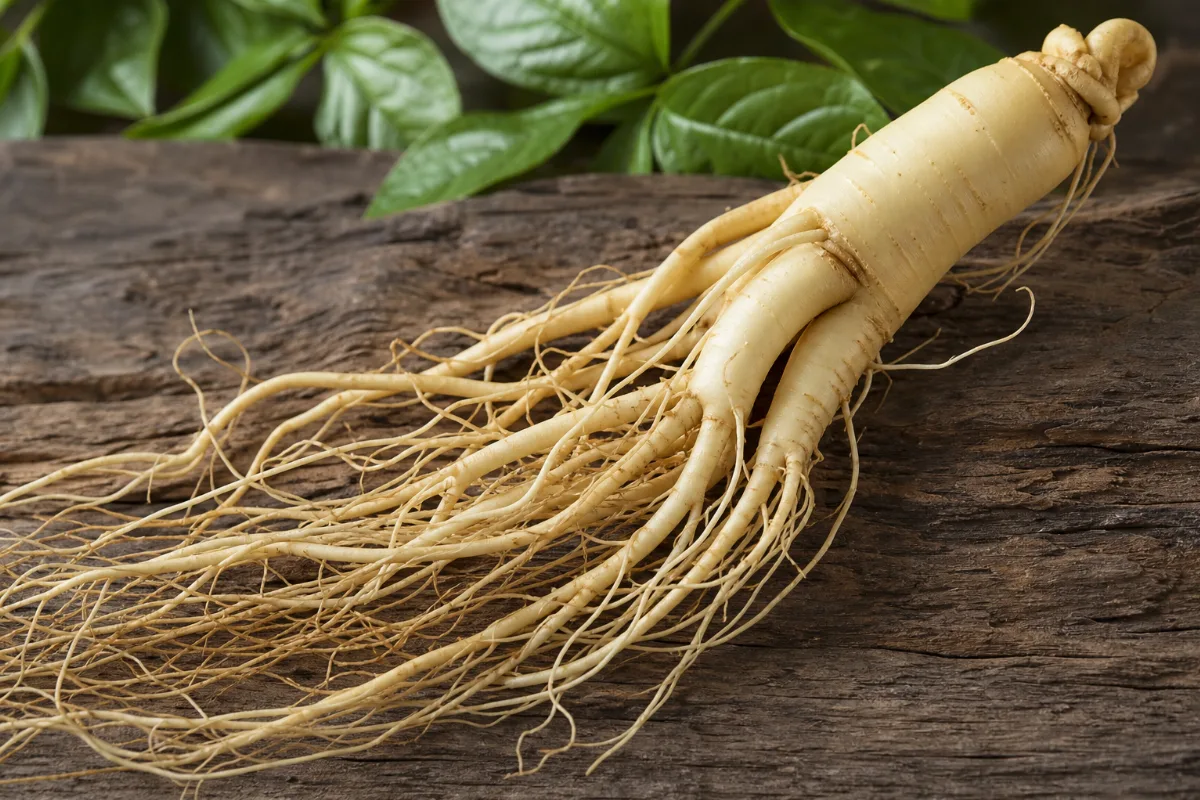
Asian ginseng is Panax ginseng C.A.Mey., in the Araliaceae family. [5] The root is the part most used. [4] NIH says it is native to Korea, northeastern China and far-eastern Siberia, and that "red ginseng" and "white ginseng" are the same species prepared in two ways. [4] The EMA herbal committee describes white ginseng as dried root and red ginseng as root treated with steam and then dried. [6] Compounds called ginsenosides are thought to be the most important. [4]Name traps. Memorial Sloan Kettering says Asian ginseng is not the same as American ginseng, Siberian ginseng or Panax notoginseng. [1] See ginseng types compared and red versus white ginseng.
Is it an "adaptogen"?
"Adaptogen" is a contested term. NIH says Asian ginseng has been used as an adaptogen, defined as an herb thought to help the body resist physical and psychological stress. [4] A 2026 review lists Panax ginseng among prominent adaptogens, while noting many trials are small and short. [7] See what adaptogens are.Traditional use (not proof)
NIH says Asian ginseng has been used as a calming agent in traditional Chinese medicine. [4] The EMA herbal committee (2024 monograph) recognizes a traditional use for symptoms of asthenia such as fatigue and weakness, based on long-standing use and not on clinical studies. [8][6] See ginseng in Chinese medicine and Korean red ginseng.What research shows
NIH says most clinical trials were small (fewer than 200 participants) and shorter than 3 months. [4]| Use | What the source found | Strength of evidence | Population and form studied |
|---|---|---|---|
| Fatigue | A 2023 review of 19 trials found no significant reduction in fatigue overall, but a small benefit for general (not disease-specific) fatigue and for herbal formulas containing ginseng. [9] | Mixed | Adults; ginseng and ginseng formulas |
| Thinking | A Cochrane review found a lack of convincing evidence of a cognitive-enhancing effect in healthy people and no high-quality evidence in dementia. [10] NIH says small research suggests benefit in middle-aged but not young adults. [4] | Insufficient evidence | Mostly healthy adults |
| Blood sugar | NIH describes a 2022 review of 20 studies that found better fasting glucose in prediabetes and diabetes, but says research on blood sugar control is inconclusive and conflicting. [4] | Mixed | Adults with prediabetes or diabetes |
| Erectile dysfunction | A Cochrane review of nine trials found a trivial effect on a standard score, with low certainty. [11] | Insufficient evidence | Men; any type of ginseng |
| Athletic performance | NIH says the majority of research shows no improvement. [4] | No good evidence of benefit | Adults |
| Flu | NIH describes very small preliminary research suggesting lower risk but not shorter illness. [4] | Insufficient evidence | Adults; extract |
Forms matter
Red and white preparations, extracts and powders are different products, and results for one preparation do not transfer to another. NIH says it is unclear whether topical use is safe and that it might cause irritation or burning. [4] Memorial Sloan Kettering recommends avoiding non-standardized products, especially with anticoagulants. [1] See quality testing and certifications.Official statements
- EMA/HMPC (EU, 2024): traditional use for fatigue and weakness; adults only; use up to 3 months; not recommended under 18, in pregnancy or during breastfeeding; side effects may include stomach upset, skin reactions and insomnia. [8]
- NIH NCCIH (US, February 2025): short-term oral use up to 6 months appears safe for most people; long-term safety is questioned. [4]
Where to go next
Ginseng for energy, fatigue and thinking, blood sugar, blood thinners and other cautions, and Asian versus American ginseng.Frequently asked questions
Does ginseng help with fatigue?
The evidence is mixed. A 2023 review found no significant overall effect, though general fatigue improved slightly. [9]
Is Asian ginseng the same as American or Siberian ginseng?
No. They are different plants with different research and cautions. [1]
Is it safe with warfarin?
Sources disagree on the size of any effect, so ask a prescriber or pharmacist before combining. [2][1]
Can it cause insomnia?
Yes. NIH calls insomnia the herb's most common side effect. [4]
How long has it been studied?
Most trials lasted under 3 months. [4]
More details: evidence, limits and cautions
The details behind this page: cautions, limits of the evidence and where sources disagree. Open any note to read it.
Safety points first
- Blood thinners. Memorial Sloan Kettering Cancer Center advises people who take warfarin to talk with a provider, because Asian ginseng may raise bleeding risk. [1] The evidence is mixed: a small crossover trial of 25 people with heart valve replacements on warfarin found no significant INR change with Korean red ginseng, [2] and a review of nine trials said it was difficult to draw conclusions about herbs and warfarin. [3] NIH also says Asian ginseng may interfere with blood clotting. [4] Ask the prescriber or pharmacist; do not change warfarin on your own.
- Blood sugar medicines. NIH says some evidence suggests Asian ginseng might lower blood sugar, and people with diabetes should consult a provider first. [4] Memorial Sloan Kettering names insulin specifically. [1]
- Sleep and mood. Insomnia is the most common side effect according to NIH. [4] Memorial Sloan Kettering lists case reports of mania after chronic use. [1]
- Liver and allergy. NIH lists severe rash, liver damage and severe allergic reactions as uncommon reports. [4] Memorial Sloan Kettering names imatinib and raltegravir as medicines where ginseng may raise the risk of liver damage. [1]
- Pregnancy, breastfeeding, children. NIH says some studies suggest it may be unsafe by mouth in pregnancy, one of its chemicals caused birth defects in animals, and some experts advise against use in infants, children and breastfeeding. [4]
- Autoimmune conditions and surgery. NIH says it may worsen autoimmune disorders. [4] Memorial Sloan Kettering advises stopping at least one week before surgery and describes a case of severe bleeding after cardiac surgery linked to high ginseng intake. [1] Tell the surgical team.
References
- Memorial Sloan Kettering Cancer Center. Asian Ginseng: Purported Benefits, Side Effects & More. Information About Herbs, Botanicals and Other Products. Read 2026-10-23.
- Lee et al. Interaction between warfarin and Korean red ginseng in patients with cardiac valve replacement. International journal of cardiology 2010. PubMed 19913311. Read 2026-10-23.
- Choi et al. A systematic review of the pharmacokinetic and pharmacodynamic interactions of herbal medicine with warfarin. PloS one 2017. PubMed 28797065. Read 2026-10-23.
- National Center for Complementary and Integrative Health (NIH). Asian Ginseng: Usefulness and Safety. Page dated February 2025. Read 2026-10-23.
- GBIF Secretariat. GBIF Backbone Taxonomy. Names checked through the species match API on 2026-10-23. Read 2026-10-23.
- European Medicines Agency, Committee on Herbal Medicinal Products (HMPC). Ginseng radix: herbal medicinal product summary. Page read 2026. Read 2026-10-23.
- Rao Y et al. Phyto adaptogens in stress management and health optimization: Current understanding and future perspectives. Complementary medicine research 2026. PubMed 42721096. Read 2026-10-23.
- European Medicines Agency, Committee on Herbal Medicinal Products (HMPC). European Union herbal monograph on Panax ginseng C.A.Mey., radix (EMA/HMPC/27744/2023, final revision 1, 29 May 2024). Read 2026-10-23.
- Li et al. Ginseng and Ginseng Herbal Formulas for Symptomatic Management of Fatigue: A Systematic Review and Meta-Analysis. Journal of integrative and complementary medicine 2023. PubMed 36730693. Read 2026-10-23.
- Geng et al. Ginseng for cognition. The Cochrane database of systematic reviews 2010. PubMed 21154383. Read 2026-10-23.
- Lee et al. Ginseng for Erectile Dysfunction: A Cochrane Systematic Review. The world journal of men's health 2022. PubMed 34169686. Read 2026-10-23.