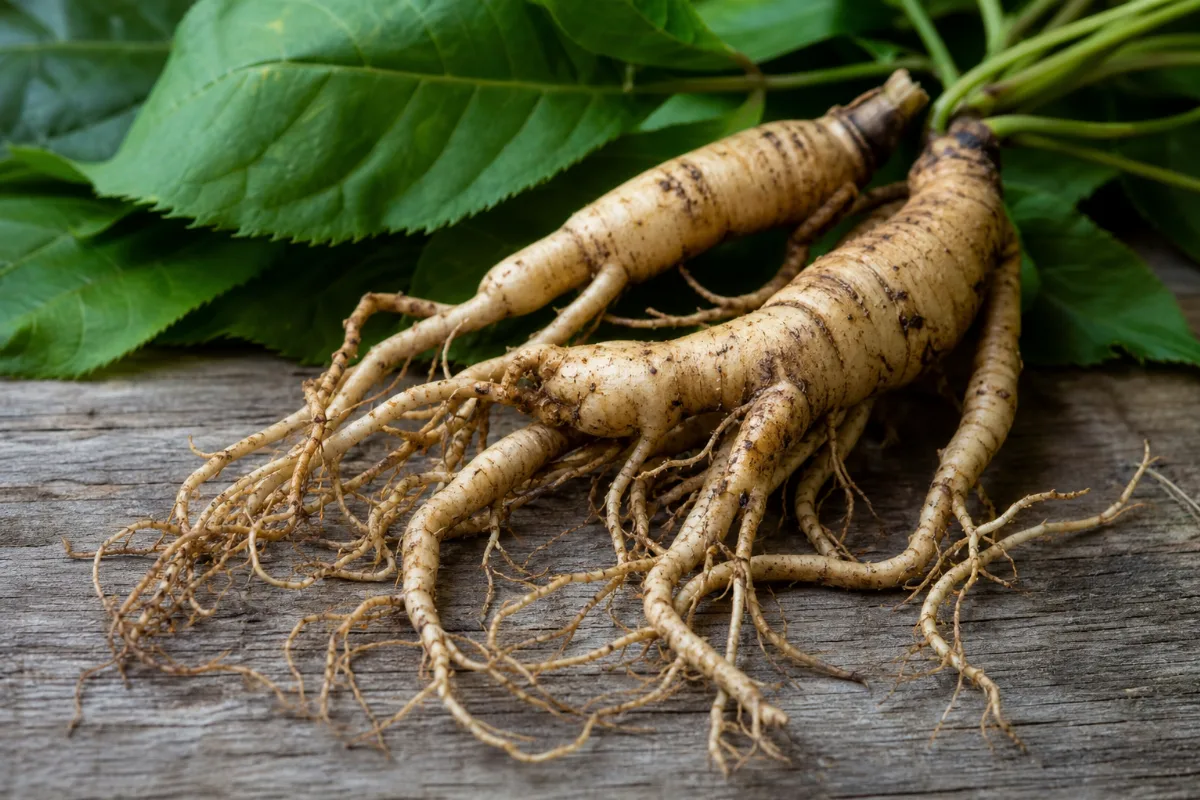
Adaptogens · Herbs & Botanicals · Root used for tiredness, with weak evidence and a history of product mix-ups
Eleuthero
Eleutherococcus senticosus (Rupr. & Maxim.) Maxim. (synonym Acanthopanax senticosus) · also called Siberian ginseng, eleuthero, Taigawurzel (German), ginseng siberiano (Spanish), ci wu jia (Chinese), Russian root
Eleuthero is a woody shrub from Northeast Asia. Its root is sold as 'Siberian ginseng', but it is not true ginseng. It is used for tiredness and stress. The evidence it works is weak: one trial in long-lasting fatigue found no difference from placebo overall, and the EU says no study proves benefit. The main safety points are product identity (past mix-ups with another plant, Periploca, that contains heart-active compounds), a possible effect on digoxin blood tests, and caution with blood pressure, diabetes and blood-thinning medicines, in pregnancy, breastfeeding and hormone-sensitive conditions.
General information, not medical advice. Last substantive update · Not medically reviewed. A named clinician has not signed off on this page. How this page is made
About Eleuthero
Eleuthero (Eleutherococcus senticosus) is a shrub whose root is sold as 'Siberian ginseng'. It is used for tiredness, stress and endurance. The honest picture is that the evidence is weak: one trial in long-lasting tiredness found no overall difference from placebo, a trial in stress found no benefit when added to training, and exercise trials disagree. The EU allows it as a traditional medicine for tiredness and weakness based on long use but says no study proves benefit. Safety comes first: past products sold as pure Siberian ginseng were found to be mixed with Periploca, a plant with heart-active compounds. Some digoxin blood tests misread certain products. Sources disagree about blood pressure, blood sugar is uncertain, bleeding with some medicines has been reported, and it is not recommended in pregnancy, breastfeeding or under age 12. Ask a doctor or pharmacist about amounts.
What it is
Eleuthero is the root of Eleutherococcus senticosus, a woody shrub from Northeast Asia in the ginseng family (Araliaceae). Older papers and many Chinese sources call it Acanthopanax senticosus, a synonym. It is not true ginseng (Panax) and has different active compounds, mainly eleutherosides.
The root and rhizome are the traditional parts. Leaf, stem and fruit extracts also exist and have been tested separately, so results for one part should not be assumed for another.
What makes it distinctive
The word 'adaptogen' was coined in the Soviet Union in the 1960s by Brekhman, who studied this plant, according to the EU assessment report. The idea is that a substance helps the body resist many kinds of stress without upsetting normal function.
Its marker compounds are eleutherosides B and E. No single compound has been shown to explain its effects, and a review found the whole water extract the most potent for immune signals in the lab.
Historical and current uses
It is known in Chinese medicine as 'ci wu jia' and was studied heavily in the Soviet Union from the 1950s. A root extract was approved there in 1962 as a stimulant. It is used in France, Germany, Russia, the UK and China.
The EU recognises it as a traditional herbal medicine for symptoms of tiredness and weakness, in adults and adolescents over 12, based on long use. The EU's own review says the root does not reach well-established use because the clinical data are inconclusive.
What the research shows
The older Soviet-era studies were mostly small and uncontrolled. Among modern trials, one with 96 people found no difference from placebo for long-lasting tiredness overall, and one with 144 people found no extra benefit when added to stress training. Exercise trials disagree. The positive-looking results for colds, pneumonia, memory and burnout come from mixed products.
A 2025 review concluded that the trials are too different and too low in quality to judge effectiveness.
At a glance
Traditional uses history, not proof
- Traditional Chinese, Korean and Japanese medicine: a tonic known as 'ci wu jia' for strength and stress resistance
- Soviet Union from the 1960s: an extract approved in 1962 as a stimulant and used by athletes and workers; the term 'adaptogen' was coined for it
- European use for decades in France, Germany, Russia and the UK as a tonic for tiredness
- EU: recognised as a traditional herbal medicine for tiredness and weakness, based on long use only (adults and adolescents over 12)
Studied for research
- Long-lasting tiredness and stress, very low certainty (one null trial; the EU says the evidence is inconclusive)
- Exercise and endurance, mixed (two null trials, one small positive)
- Coughs, colds and pneumonia recovery, very low or insufficient (only in mixed products)
- Blood sugar, blood pressure, cholesterol, bone, hangover and swelling, very low or insufficient
- Mood and thinking, insufficient (mixed products or no placebo)
Main compounds
- Eleutheroside B (syringin) and eleutheroside E: marker compounds used to identify and standardise the root
- Isofraxidin (a coumarin) and chlorogenic acid
- Triterpene saponins and polysaccharides
- The root, rhizome and bark are medicinal parts; leaf and fruit extracts have been tested separately
Common forms
- Root, in forms recognised by the EU monograph (teas, powders, liquid and dry extracts, tinctures)
- Mixed products: Kan Jang (with Adhatoda and Echinacea), ADAPT-232/Chisan (with Rhodiola and Schisandra), others; their results cannot be credited to eleuthero alone
- Fruit and leaf extracts used in a few trials are different plant parts
- Beware products labelled only 'ginseng': check for the species name and the root
Research links: EMA herbal page: Eleutherococci radix · EU herbal monograph on Eleutherococcus root (EMA, 2014) · EU assessment report on Eleutherococcus root (EMA) · Research Library · Genes & Biomarkers Library
The plant and its history
- Accepted scientific name
- Eleutherococcus senticosus (Rupr. & Maxim.) Maxim.
- Naming authority
- (Rupr. & Maxim.) Maxim., published in Mem. Div. Sav. Acad. Sci. St.-Petersb. 9: 132 (1859) (GBIF). Accepted (GBIF key 3035369; NCBI taxid 82096).
- Synonyms
- Acanthopanax senticosus (Rupr. & Maxim.) Harms (still widely used, especially in Chinese and Japanese literature); Hedera senticosa Rupr. & Maxim.; Eleutherococcus senticosus f. inermis Kom.; Eleutherococcus senticosus var. subinermis Regel; Acanthopanax senticosus var. brevistamineus S.F.Gu
- Common names
- Eleuthero (English); Siberian ginseng (English); Devil's bush (English); Taigawurzel (German); Ginseng siberiano (Spanish); Jinsém-siberiano (Portuguese); Russian root (rysk rot, russisk rot) (Swedish / Norwegian); Ci wu jia (刺五加) (Chinese); Ezo-ukogi (エゾウコギ) (Japanese); Gasiogalpi (가시오갈피) (Korean); Элеутерококк колючий (Russian)
- Botanical family
- Araliaceae (the ivy and ginseng family, order Apiales). The true ginsengs (Panax) are in the same family but are a different genus; LactMed says eleuthero is not related to true ginseng and has different constituents.
- Classification
- Plantae > Tracheophyta > Magnoliopsida > Apiales > Araliaceae > Eleutherococcus > Eleutherococcus senticosus
- Native range
- A 2025 review says it is native to Northeast Asia (not checked against a flora).
- Habitat
- Not verified in a source read.
- What the plant looks like
- Roots: The dried root, and underground parts (rhizome), are the part used in medicine (EMA). Stem bark, stems, leaf and fruit are used in some products and studies, with their own research.; Stems: Not verified from a source read. The name 'senticosus' means thorny; prickly stems are not described in the sources read.; Leaves: Leaf extracts were tested in one human trial (Tohda 2020); not the usual medicinal part.; Flowers: Not verified.; Fruit: Fruit extracts have been tested in a trial of blood pressure (Oh 2020).; Cultivation: Not verified.; Harvest processing: Not verified. The EMA lists the preparations (comminuted root, powder, liquid and dry extracts, tincture, wine extracts) recognised in the monograph.
- Cultivation
- A 2025 review says the plant is endangered in some areas and calls for sustainable cultivation.
- Harvest and processing
- Not verified in a source read.
- Look-alikes and adulterants
- Name: Periploca sepium Bunge (Chinese silk vine); Note: Different family (Apocynaceae, GBIF key 5526185). The EMA report says it contains cardiac glycosides and was found as an adulterant in a product sold as 'pure Siberian ginseng', linked to a newborn case and possibly to a digoxin case. Avoid products that cannot show species identity.; Name: Other Eleutherococcus species; Note: In a UK DNA test, 36% of 25 Siberian ginseng supplements contained another Eleutherococcus species as well as E. senticosus.; Name: Panax ginseng, Panax quinquefolius; Note: True ginseng, a different genus with ginsenosides. Eleuthero is not true ginseng, and the name 'Siberian ginseng' is confusing.
- Sustainability and conservation
- A 2025 review says the plant is endangered in some areas. No IUCN assessment was retrieved.
Traditional use and history history, not clinical proof
| Tradition or era | Documented use | Source |
|---|---|---|
| Traditional Chinese, Korean and Japanese medicine | Used as 'ci wu jia' (Chinese). A 2025 review says it is used in traditional Chinese, Korean and Japanese medicine as an adaptogen for stress resistance, endurance and immune strength. A 2021 review adds invigorating the liver and kidneys, strengthening bones, stimulating appetite and improving memory. One review calls it a traditional medicine for twenty centuries; this was not checked against a primary source. | p40572479 |
| Soviet Union, 1950s to 1980s | The EMA report dates papers back to 1957 and the first article by Brekhman to 1960, and says over 1,000 articles have appeared. In 1962 a root extract was approved in the former Soviet Union as a 'stimulant', and in 1966 it was recommended for the Soviet space programme. Brekhman published the first book in 1968 and coined the term 'adaptogen'. | s-ema-hmpc-eleutherococcus-radix-ar |
| Europe, 20th century to now | The report says root preparations have been in medicinal use in France, Germany (products notified before January 1978), Russia, the UK and China. Names used in EU languages include Taigawurzel (German) and Russian root. | s-ema-hmpc-eleutherococcus-radix-ar |
| European Union regulation | Recognised as a traditional herbal medicine for symptoms of asthenia such as fatigue and weakness, based on long-standing use, for adults and adolescents over 12. The monograph was first adopted on 8 May 2008 and revised on 25 March 2014. The EMA states the root does not reach well-established use because clinical data are inconclusive. | s-ema-hmpc-eleutherococcus-radix-monograph |
| Naming | The first English name 'Eleuthero' was created in the USA (Baranov, 1979); 'Siberian ginseng' has been used there since 1971 (both per the EMA report). LactMed says it is not related to true ginseng and has different constituents. | s-ema-hmpc-eleutherococcus-radix-ar |
Traditional use shows how a plant was used. It does not show that a supplement works or is safe today.
What is inside, and how it may work
What the plant contains and how those compounds act in cells and animals. Laboratory and animal mechanisms are not proven effects in people.
Main compounds
| Compound | Family | Where it is concentrated | Activity studied | Level of evidence |
|---|---|---|---|---|
| Eleutheroside B (syringin) PubChem 5316860 | phenylpropanoid glycoside | root About 0.5% of the root (EMA report) | A marker compound. Patyra 2025 says syringin helps tell E. senticosus from other Araliaceae plants. Lab work links it to adaptogenic action; not shown in people. 34 47 53 | Laboratory research |
| Eleutheroside E (syringaresinol diglucoside) PubChem 71312557 | lignan glycoside | root About 0.1% (EMA report) | A marker compound. Activated a vessel receptor (Tie2) in lymphatic cells in the lab; reviewed as important in the adaptogenic response. 34 13 47 53 | Laboratory research |
| Isofraxidin (with eleutheroside B1) PubChem 5318565 | coumarin | root Not given | Modulated immune function in lab studies. 28 47 53 | Laboratory research |
| Chlorogenic acid and caffeic acid derivatives PubChem 1794427 | phenolic acid | root Chlorogenic acid up to 0.3% (EMA report) | Caffeoylquinic acids are among the main constituents according to Patyra 2025. 34 47 53 | Laboratory research |
| Sesamin (eleutheroside B4) PubChem 72307 | lignan | root About 0.023% (EMA report) | No specific activity read. 47 53 | Laboratory research |
| Beta-hederin (eleutheroside K) PubChem 441929 | triterpene saponin | root Not given | A saponin listed by the EMA report. No activity read. 47 53 | Laboratory research |
| Daucosterol (eleutheroside A, sitogluside) PubChem 5742590 | sterol glycoside | root Not given | Listed by the EMA report. No activity read. 47 53 | Laboratory research |
| Coniferaldehyde and its glucoside PubChem 5280536 | phenylpropanoid | root Not given | Listed by the EMA report. No activity read. 47 53 | Laboratory research |
| Polysaccharides (eleutherans, heteroglycans) | polysaccharide | root Not given | Polysaccharide-rich extracts were used in a hangover trial; water extract was the most potent for immune signals in a review. 47 28 | Laboratory research |
Mechanisms, receptors and pathways
| Target or pathway | Gene or receptor | What was found | Level |
|---|---|---|---|
| Inflammation and immune signalling | MAPK, Akt, NF-kB | Patyra 2025 says preclinical studies show root extract inhibits MAPK, Akt and NF-kB activation, linked to anti-inflammatory and immune-modulating effects. Lab and animal findings only; not shown in people. 34 | Laboratory research |
| Nerve growth factor | BDNF | Per the same review, preclinical studies show an increase of brain-derived neurotrophic factor, which may contribute to stress and fatigue reduction and memory effects. Not shown in people. 34 29 | Animal research |
| Immune cell signals | Cytokines from human blood cells | Isofraxidin, syringin and eleutheroside E modulated immune function in lab tests; the whole aqueous extract was the most potent, and the authors compared cytokine release from human blood cells. 28 | Laboratory research |
| Lymph vessel stabilisation | Tie2 receptor; eNOS; VE-cadherin | Siberian ginseng and eleutheroside E triggered Tie2 phosphorylation in lymphatic cells and made vessel cells migrate and form cords. In 50 healthy women, a single serving reduced lower-leg swelling at 2 and 4 hours. 13 | Laboratory research |
| Stress-hormone receptors | Glucocorticoid, mineralocorticoid and oestrogen receptors | The EMA report describes a 30% ethanol root extract binding oestrogen receptors in rat uterus and mineralocorticoid and glucocorticoid receptors in rat kidney in vitro, not androgen receptors, and raising corticosterone in rats given an extract by injection. 47 | Animal research |
| Stress-hormone breakdown (idea) | COMT | A theory paper proposes the root may inhibit the enzyme COMT, giving a two-way effect on stress responses. Not tested in that paper. 15 | Preliminary mechanism |
| Human stress-hormone indices | Cortisol, testosterone | In athletes, a 6-week extract lowered the testosterone-to-cortisol ratio (28.7%, P = 0.03) with a non-significant 31% cortisol rise. This is a human finding and went against the hoped-for direction. 14 | Human data |
| Drug transport | P-glycoprotein, peptide transporter | In human gut-lining cells the extract suppressed P-glycoprotein and a peptide transporter and increased digoxin passage. Cell data only. 42 | Laboratory research |
| Drug-metabolising enzymes (human) | CYP2D6, CYP3A4 | No effect in 12 healthy volunteers. 10 | Human data |
| Drug-metabolising enzymes (rat) | CYP2C9, CYP2E1 | Isolated eleutherosides B and E weakly inhibited CYP2C9 and CYP2E1 in rat liver microsomes; no effect on CYP2D6 or CYP3A4. 18 | Laboratory research |
Absorption, metabolism and elimination
- Absorption
- No human blood-level data for eleutheroside B or E were found in the sources read.
- Distribution
- Not established in humans.
- Metabolism
- Not established in humans. In rat blood, eleutheroside E showed enterohepatic circulation after an oral aqueous extract (cited in the EMA report; original not read).
- Elimination
- In rats given 3H-labelled eleutheroside B by injection, the blood peak was at 15 minutes, then fell sharply by 4 hours; about 90% was excreted in urine within 48 hours versus up to 3% in faeces (EMA report citing ESCOP). Rat data only.
- Bioavailability
- Not established in humans.
Isolated compounds versus whole extracts
No single compound has been shown to explain the effects. Eleutherosides B and E are used as marker compounds to standardise products. A 2019 lab review found the whole water extract was more potent than the single compounds for immune signalling, and argued for water extracts. The 2025 review says the lack of standard preparations makes trial results hard to compare.
Nutritional composition
A nutrient table is not meaningful for the medicinal use of the root.
2 mixed findings3 very low certainty16 not enough evidence1 evidence against
What was looked at
The 22 benefits and uses checked for Eleuthero, each with how strong the evidence is. Tap one to open it.
- Long-lasting unexplained fatigueVery low certainty
- Stress-related tiredness and weak work capacityNot enough evidence
- Burnout (in a four-ingredient product)Not enough evidence
- Quality of life in older peopleNot enough evidence
- Attention and speed when tired (in a three-herb product)Not enough evidence
- Memory and thinking tests (leaf extract with another herb)Not enough evidence
- Mood: added to lithium in bipolar disorder (teenagers)Not enough evidence
- Cancer-related fatigueNot enough evidence
- Stress physiology: heart rate variability in older adultsNot enough evidence
- Stress hormones in athletesNot enough evidence
- Exercise and enduranceMixed findings
- Coughs and colds (in three-herb products)Very low certainty
- Recovery from pneumonia (three-herb product plus antibiotics)Not enough evidence
- Immune cell numbersEvidence against
- Fever attacks in children with Familial Mediterranean FeverNot enough evidence
- Blood sugarNot enough evidence
- Blood pressureMixed findings
- Cholesterol and blood fatsNot enough evidence
- Bone health after menopauseVery low certainty
- Hangover symptomsNot enough evidence
- Leg swellingNot enough evidence
- Female sexual function (in a combined supplement)Not enough evidence
Lab markers tracked in the studies
Cortisol (stress hormone)Testosterone-to-cortisol ratioHeart rate variability (CVRR, HF, LF/HF)Antioxidant-to-oxidant ratio (BAP/d-ROMs)Oxygen use at peak effort (VO2 peak)Time to exhaustionBlood glucoseSystolic blood pressureOsteocalcin (bone-turnover marker)Bone mineral density (DXA scan)C-reactive protein (CRP)Immune cell counts (T-cells, NK cells, B-cells)Total cholesterol, LDL and triglycerides
What is Eleuthero good for?
The main proposed uses and how strong the human evidence is for each. 'Mixed' means trials disagree, and 'very low' and 'insufficient' mean few, small, uncontrolled or mixed-product studies. None of these is a proven treatment for you. Many ratings are this profile's own reading, not formal grades. Several positive results come from mixed products or from the fruit or leaf, and are marked. Ask a doctor or pharmacist about amounts.
Benefits, one by one
Each card is a research question, not a promise. Tap a goal to filter. Open a card to see the studies, doses and limits.
Long-lasting unexplained fatigue
Very low certaintyIn one US trial of 96 people with fatigue for six months or more, Siberian ginseng did not beat placebo overall. A hint of benefit in people with less severe fatigue was an exploratory finding.
3 studiesStandardised root extract in the trial; products differ a lot.
Studies, doses and limits
What the trials found
One randomised placebo-controlled trial (Hartz 2004, 96 people, 2 months) found fatigue fell a lot in both groups with no significant difference overall. Pre-planned subgroup analyses suggested a benefit at 2 months in 45 people with less severe fatigue (P = 0.04, unadjusted for multiple comparisons). The 2025 review by Patyra and colleagues says the clinical trials are too different and too poor in quality to judge effectiveness. The EMA assessment concluded none of the studies is enough to prove efficacy in a clearly defined condition.
Results
No overall benefit over placebo; a subgroup hint only.
Effect sizes as reported
Overall difference not significant; subgroup P = 0.04 unadjusted.
Why this rating
One modest trial with a null main result and an exploratory subgroup finding; reviewers call the evidence inconclusive.
Form and dose studied
Standardised root extract in the trial; products differ a lot.
Who was studied
Adults with fatigue of 6 months or more and no known cause.
Limits
Single trial; about 20% of people did not give 2-month data; subgroup result is not reliable.
Why researchers looked
Fatigue and weakness are the main traditional uses and the uses the EU accepts for the root.
Traditional use
Eleutherococcus root has been used in Soviet-era and later European medicine as a tonic for tiredness and weakness, and in traditional Chinese medicine as 'ci wu jia'. The EU recognises it as a traditional herbal medicine for symptoms of asthenia (tiredness and weakness) based on long use, not on proof from trials.
Proposed mechanism Preliminary mechanism
Lab and animal work suggests eleutherosides and other root compounds may influence stress-hormone signalling and inflammation pathways. The EMA report notes that an extract raised corticosterone in rats and bound several hormone receptors in rat tissue in vitro. None of this shows what happens in tired people.
A proposed mechanism does not show that the effect happens in people.
The same trial had similar side-effect rates on extract and placebo (24% and 28% per the EMA report).
Stress-related tiredness and weak work capacity
Not enough evidenceA German trial of 144 people found that adding eleutherococcus root extract to stress training gave no extra benefit. Everyone in every group got better over time.
2 studiesRoot extract; single product.
Studies, doses and limits
What the trials found
Schaffler 2013 randomised 144 people with stress-related weakness to the root extract, a 2-day stress management course, or both. Almost every score improved over time with no difference between groups. Adding the extract to training gave no benefit that could be separated from chance. There was no placebo-only arm, so the improvement cannot be credited to any one treatment.
Results
No added benefit from the extract.
Effect sizes as reported
No meaningful group differences on almost all measures.
Why this rating
One trial without a placebo-only arm, and its authors found no extra benefit.
Form and dose studied
Root extract; single product.
Who was studied
Adults with chronic stress, tiredness and reduced work capacity.
Limits
No placebo-only arm; short (8 weeks).
Why researchers looked
Tested as an adaptogen: a plant said to help the body cope with stress.
Traditional use
Eleutherococcus root has been used in Soviet-era and later European medicine as a tonic for tiredness and weakness, and in traditional Chinese medicine as 'ci wu jia'. The EU recognises it as a traditional herbal medicine for symptoms of asthenia (tiredness and weakness) based on long use, not on proof from trials.
Proposed mechanism Preliminary mechanism
Lab and animal work suggests eleutherosides and other root compounds may influence stress-hormone signalling and inflammation pathways. The EMA report notes that an extract raised corticosterone in rats and bound several hormone receptors in rat tissue in vitro. None of this shows what happens in tired people.
A proposed mechanism does not show that the effect happens in people.
All treatments were well tolerated.
Burnout (in a four-ingredient product)
Not enough evidenceA French trial of a four-ingredient supplement that includes Eleutherococcus found more improvement than placebo in burnout scores. This cannot be credited to Eleutherococcus alone.
1 studiesBranded combination (TARGET 1).
Studies, doses and limits
What the trials found
Jacquet 2015 randomised 87 workers with burnout to a supplement (casozepine, taurine, Eleutherococcus senticosus and extramel) or placebo for 12 weeks. The product group improved on all five scores and more than placebo; placebo also improved. Values are not in the abstract.
Results
Greater improvement than placebo, but for a mixed product.
Effect sizes as reported
Not reported in the abstract.
Why this rating
A combination product: the result cannot be assigned to Eleutherococcus. Numbers were not read. Funding not stated.
Form and dose studied
Branded combination (TARGET 1).
Who was studied
Workers with burnout in client-facing jobs.
Limits
Cannot separate one ingredient from another.
Why researchers looked
Burnout is a common reason people try adaptogen products.
Traditional use
Not specific to eleuthero.
Proposed mechanism Pharmacological theory
Not tested for this product.
A proposed mechanism does not show that the effect happens in people.
No safety signal in the abstract.
Quality of life in older people
Not enough evidenceA tiny trial of 20 older people found a better social-functioning score after 4 weeks, which was gone by 8 weeks.
1 studiesDry extract.
Studies, doses and limits
What the trials found
Cicero 2004 gave 20 older people with high blood pressure who took digitalis either root dry extract or placebo for 8 weeks. Social functioning on the SF-36 was higher at 4 weeks (P = 0.02) but not at 8 weeks. No difference in blood pressure control or digoxin level. More people on the extract guessed they were on active treatment.
Results
Small, short-lived gain on one scale.
Effect sizes as reported
Social functioning higher at week 4 (P = 0.02), not at week 8.
Why this rating
Ten people per group, many scales tested, effect did not last.
Form and dose studied
Dry extract.
Who was studied
Older adults with high blood pressure on digitalis.
Limits
Very small; possible loss of blinding.
Why researchers looked
Fatigue and low energy are common in older age and a traditional reason to use tonics.
Traditional use
Eleutherococcus root has been used in Soviet-era and later European medicine as a tonic for tiredness and weakness, and in traditional Chinese medicine as 'ci wu jia'. The EU recognises it as a traditional herbal medicine for symptoms of asthenia (tiredness and weakness) based on long use, not on proof from trials.
Proposed mechanism Pharmacological theory
Lab and animal work suggests eleutherosides and other root compounds may influence stress-hormone signalling and inflammation pathways. The EMA report notes that an extract raised corticosterone in rats and bound several hormone receptors in rat tissue in vitro. None of this shows what happens in tired people.
A proposed mechanism does not show that the effect happens in people.
No adverse events and no change in digoxin level in this trial.
Attention and speed when tired (in a three-herb product)
Not enough evidenceOne single-dose pilot found a three-herb mix improved attention in 40 stressed women within two hours. This cannot be credited to Eleutherococcus alone.
1 studiesADAPT-232 combination tablet.
Studies, doses and limits
What the trials found
Aslanyan 2010 compared one tablet of ADAPT-232 (Rhodiola, Schisandra and Eleutherococcus extracts) with placebo in 40 stressed women. The mix group scored higher for attention, speed and accuracy two hours later (P < 0.05).
Results
Better d2 attention scores for a three-herb mix after one dose.
Effect sizes as reported
P < 0.05 on the d2 test (values not in the abstract).
Why this rating
Single dose, 40 people, three herbs together, pilot.
Form and dose studied
ADAPT-232 combination tablet.
Who was studied
Healthy women aged 20 to 68 reporting long-term stress.
Limits
Cannot separate the herbs; effect after one dose may not carry to longer use.
Why researchers looked
Adaptogen mixes are tested for mental performance under stress.
Traditional use
Not specific to eleuthero.
Proposed mechanism Pharmacological theory
Not tested for this product.
A proposed mechanism does not show that the effect happens in people.
Minor events (sleepiness, cold extremities) in both groups.
Memory and thinking tests (leaf extract with another herb)
Not enough evidenceA Japanese trial of the plant's leaf extract combined with Drynaria rhizome found small gains in one memory test. It used leaf, not the usual root, so it says little about eleuthero root products.
1 studiesWater extracts of leaf plus Drynaria rhizome.
Studies, doses and limits
What the trials found
Tohda 2020 gave a combination of E. senticosus leaf and Drynaria rhizome water extracts to healthy adults for 12 weeks. The combination beat placebo on the figure-recall subscore (P = 0.045); other gains were within-group only.
Results
One subtest higher than placebo.
Effect sizes as reported
Figure recall P = 0.045; other results within-group.
Why this rating
Leaf and a second herb; sample size not in the abstract; many tests.
Form and dose studied
Water extracts of leaf plus Drynaria rhizome.
Who was studied
Healthy adults.
Limits
Different plant part, combination, many comparisons.
Why researchers looked
Mouse studies by the same group suggested the leaf extract improved memory.
Traditional use
Not part of the main traditional use of the root.
Proposed mechanism Animal research
Animal work reported by the authors, not read in detail.
A proposed mechanism does not show that the effect happens in people.
No adverse effects reported.
Mood: added to lithium in bipolar disorder (teenagers)
Not enough evidenceA Chinese trial of 76 teenagers on lithium found the herb performed about the same as fluoxetine, with fewer people switching to mania. There was no placebo group.
2 studiesRoot-derived herb, details not in the part read.
Studies, doses and limits
What the trials found
Weng 2007 randomised 76 adolescents with bipolar disorder (all taking lithium) to added Acanthopanax senticosus or added fluoxetine for 6 weeks. Response was 67.6% versus 71.8% and remission 51.4% versus 48.7%. Three on fluoxetine switched to mania; none on the herb.
Results
Similar to fluoxetine, no placebo comparison.
Effect sizes as reported
Response 67.6% vs 71.8%; remission 51.4% vs 48.7%.
Why this rating
One trial, no placebo arm, young patients, single country.
Form and dose studied
Root-derived herb, details not in the part read.
Who was studied
Adolescents aged 12 to 17 with bipolar disorder on lithium.
Limits
No placebo; cannot show the herb works.
Why researchers looked
Some Chinese studies have examined mood effects of the herb.
Traditional use
Traditional Chinese use includes calming and memory.
Proposed mechanism Animal research
Lab studies suggest effects on nerve signalling and inflammation; a review of mostly animal work supports this.
A proposed mechanism does not show that the effect happens in people.
Bipolar disorder needs specialist care. Do not add any herb without the treating doctor knowing. Side effects in the trial were nausea, rash and diarrhoea.
Cancer-related fatigue
Not enough evidenceA small Japanese feasibility study found only half of 15 patients completed 28 days; milder cases may have improved. It is too small to say anything about benefit.
1 studiesFood drink containing Acanthopanax senticosus.
Studies, doses and limits
What the trials found
Kawano 2024: 15 patients drank an Acanthopanax senticosus drink for 28 days; 7 finished. Four with milder fatigue had lower scores. No adverse events attributed to the drink.
Results
No reliable result.
Effect sizes as reported
7 of 15 completed.
Why this rating
No control group; feasibility only.
Form and dose studied
Food drink containing Acanthopanax senticosus.
Who was studied
Adults with cancer-related fatigue.
Limits
No control group, high dropout.
Why researchers looked
Cancer-related fatigue has few treatments, so adaptogen foods are being explored.
Traditional use
Not a traditional indication.
Proposed mechanism Pharmacological theory
None established.
A proposed mechanism does not show that the effect happens in people.
If you are having cancer treatment, ask your oncology team first.
Stress physiology: heart rate variability in older adults
Not enough evidenceA small Japanese trial of a supplement found better heart-rate-variability readings after 4 weeks. It is a lab measure and the supplement maker was involved.
1 studiesASH supplement (preparation not detailed in abstract).
Studies, doses and limits
What the trials found
Sato 2024 randomised 28 older adults to Acanthopanax senticosus Harms supplement or placebo for 4 weeks; CVRR, HF, LF/HF, systolic blood pressure and heart rate improved significantly in the supplement group only (numbers not in the abstract).
Results
Better heart-rate-variability readings.
Effect sizes as reported
Significant group-time effects for CVRR, HF and delta LF/HF.
Why this rating
28 people, a lab marker not a symptom, industry-linked authors.
Form and dose studied
ASH supplement (preparation not detailed in abstract).
Who was studied
Healthy older adults.
Limits
Industry-linked; surrogate outcome.
Why researchers looked
Heart rate variability reflects the stress-related balance of the nervous system.
Traditional use
Anti-stress use in Japanese and Chinese practice.
Proposed mechanism Pharmacological theory
Not established.
A proposed mechanism does not show that the effect happens in people.
Blood pressure fell in the supplement group in this trial.
Stress hormones in athletes
Not enough evidenceIn endurance athletes, eleutherococcus extract made a stress-hormone ratio go the wrong way for a benefit: the testosterone-to-cortisol ratio fell and cortisol tended to rise.
2 studies33% ethanol root extract.
Studies, doses and limits
What the trials found
Gaffney 2001: in athletes taking a 33% ethanol extract for 6 weeks, TCR fell 28.7% (P = 0.03), cortisol tended to rise 31% (P = 0.07, not significant), testosterone dropped 7% (not significant). No immune counts changed.
Results
Stress-hormone index moved against the hoped-for direction.
Effect sizes as reported
TCR -28.7% (P = 0.03).
Why this rating
One study; the cortisol change was not significant; group sizes not in the abstract.
Form and dose studied
33% ethanol root extract.
Who was studied
Competitive endurance athletes.
Limits
Small; athletes in heavy training.
Why researchers looked
Adaptogens are said to normalise stress hormones.
Traditional use
Soviet-era athletes used the extract as a tonic.
Proposed mechanism Preliminary mechanism
A theory paper proposes a two-way effect through COMT; untested.
A proposed mechanism does not show that the effect happens in people.
The result suggests the herb does not simply 'lower stress hormones'.
Exercise and endurance
Mixed findingsTwo small US trials in trained athletes found no boost in endurance or race performance. A small Taiwanese trial of 9 men found a 12% higher oxygen capacity and 23% longer time to exhaustion. The results conflict.
4 studiesExtracts of different strengths and durations.
Studies, doses and limits
What the trials found
Dowling 1996 (20 trained runners, 6 weeks) and Eschbach 2000 (9 trained cyclists, 7 days, crossover) found no benefit on endurance or time trial. Kuo 2010 (9 recreationally trained men, 8 weeks, crossover) found VO2 peak up 12% and endurance time up 23%. The EMA assessment says the Kuo group is too small to prove efficacy.
Results
Two null trials and one small positive trial.
Effect sizes as reported
Kuo: VO2 peak +12%, endurance time +23% (both P < 0.05). Dowling and Eschbach: no significant difference.
Why this rating
Three small trials pointing in different directions; participants and doses differ.
Form and dose studied
Extracts of different strengths and durations.
Who was studied
Trained runners and cyclists; recreationally trained young men.
Limits
All trials have 9 to 20 people; the positive one is a 9-person crossover.
Why researchers looked
Sports use was one of the first modern uses of the root.
Traditional use
Soviet researchers in the 1960s promoted the root as a tonic for athletes and workers under strain, and it was approved in 1962 in the former Soviet Union as a 'stimulant' (EMA assessment report). Traditional Chinese medicine calls it 'ci wu jia'.
Proposed mechanism Preliminary mechanism
Lab work suggests compounds may change how the body uses fats and sugars, but no mechanism has been shown in people.
A proposed mechanism does not show that the effect happens in people.
Taken close to bedtime it may disturb sleep (EMA report). Trial participants reported no problems.
Coughs and colds (in three-herb products)
Very low certaintyTrials of Kan Jang, a mix of Adhatoda, Echinacea and Eleutherococcus, found faster relief of cough. It cannot be credited to Eleutherococcus alone.
2 studiesFixed three-herb combination (Kan Jang).
Studies, doses and limits
What the trials found
Narimanian 2005 found KanJang gave a general symptom benefit and a 2-day shorter recovery than bromhexine. Barth 2015 (177 adults, 5 days) found Kan Jang and bromhexine both eased cough more than placebo, with faster improvement on days 3 and 4 with Kan Jang.
Results
Cough eased faster with the mixture.
Effect sizes as reported
Recovery 2 days shorter (Narimanian); better cough relief than placebo (Barth).
Why this rating
Combination product; numbers not in abstracts; funding unknown.
Form and dose studied
Fixed three-herb combination (Kan Jang).
Who was studied
Adults with colds and mild respiratory infections.
Limits
Cannot separate the herbs from each other.
Why researchers looked
Adaptogen mixes are tested for respiratory infections.
Traditional use
Not a main traditional use of eleuthero.
Proposed mechanism Laboratory research
Immune effects in lab studies (see the immune review).
A proposed mechanism does not show that the effect happens in people.
No major adverse effects in the trials. Swedish spontaneous reports for a similar Echinacea, Eleutherococcus and Adhatoda product included allergic reactions (see safety file).
Recovery from pneumonia (three-herb product plus antibiotics)
Not enough evidenceOne pilot of 60 people found a three-herb mix, taken with antibiotics, shortened antibiotic treatment by 2 days.
1 studiesADAPT-232 combination.
Studies, doses and limits
What the trials found
Narimanian 2005 (Chisan, ADAPT-232) added to standard treatment shortened antibiotic need by 2 days and raised quality-of-life scores.
Results
Shorter antibiotic treatment.
Effect sizes as reported
2 days shorter.
Why this rating
Pilot, three herbs, 60 patients.
Form and dose studied
ADAPT-232 combination.
Who was studied
Adults with acute non-specific pneumonia.
Limits
Not enough to change how pneumonia is treated.
Why researchers looked
Tested as an add-on to antibiotics.
Traditional use
Not traditional.
Proposed mechanism Pharmacological theory
Not established.
A proposed mechanism does not show that the effect happens in people.
Pneumonia needs a doctor and proven medicines.
Immune cell numbers
Evidence againstA study of athletes found no change in immune cell counts. Lab reviews suggest effects on immune signalling, but human proof is lacking.
3 studiesEthanol extract; Taiga Wurzel preparation.
Studies, doses and limits
What the trials found
Gaffney 2001: no change in T-cell, NK or B-cell counts after 6 weeks. Szolomicki 2000 reported effects on 'cellular defence' for a Taiga Wurzel preparation, without a placebo group and without numbers in the abstract.
Results
No change in a controlled trial.
Effect sizes as reported
No significant change.
Why this rating
A controlled trial found no change; the positive-looking study had no placebo.
Form and dose studied
Ethanol extract; Taiga Wurzel preparation.
Who was studied
Athletes; healthy volunteers.
Limits
Counts of cells are not the same as fewer infections.
Why researchers looked
Called an immunostimulant in older literature.
Traditional use
Historical 'immune tonic' use.
Proposed mechanism Laboratory research
Lab studies show isofraxidin, syringin and eleutheroside E can change immune signals; the whole water extract looked strongest.
A proposed mechanism does not show that the effect happens in people.
None specific.
Fever attacks in children with Familial Mediterranean Fever
Not enough evidenceA pilot in 24 children found a four-herb product reduced attack severity. It also contained licorice and cannot be credited to Eleutherococcus.
1 studiesImmunoGuard (four-herb mix).
Studies, doses and limits
What the trials found
Amaryan 2003: 14 children on the mix and 10 on placebo for 1 month; attack duration, frequency and severity improved more with the mix.
Results
Better attack scores.
Effect sizes as reported
All three features significantly improved.
Why this rating
Pilot, 24 children, four herbs.
Form and dose studied
ImmunoGuard (four-herb mix).
Who was studied
Children aged 3 to 15 with FMF.
Limits
Tiny pilot; licorice can raise blood pressure.
Why researchers looked
Pilot work on an inherited fever disorder.
Traditional use
Not traditional.
Proposed mechanism Pharmacological theory
Not established.
A proposed mechanism does not show that the effect happens in people.
This should only be tried under the care of the child's specialist.
Blood sugar
Not enough evidenceIn 12 healthy people, Siberian ginseng raised blood sugar after a sugar drink. Hints of lower blood sugar come from animal work and one exercise trial. Anyone on diabetes medicines should watch this closely.
2 studiesPowder in Sievenpiper; extract in Kuo.
Studies, doses and limits
What the trials found
Sievenpiper 2004: a single dose of Siberian ginseng raised blood glucose compared with placebo after a sugar drink (P < 0.05) in 12 healthy adults. Kuo 2010: blood glucose was lower at 30 minutes of hard cycling on the extract. No trial in people with diabetes was found.
Results
Mixed signals; none in people with diabetes.
Effect sizes as reported
Higher glucose after a sugar drink (P < 0.05, values not in the abstract); lower glucose at 30 min cycling (P < 0.05).
Why this rating
Two small studies pointing in different directions, neither in diabetes.
Form and dose studied
Powder in Sievenpiper; extract in Kuo.
Who was studied
Healthy adults.
Limits
Single-dose study; acute effect only.
Why researchers looked
Reviews describe 'antidiabetic' effects, mostly from animal studies.
Traditional use
Some sources describe use for blood sugar.
Proposed mechanism Animal research
Animal and lab studies report glucose-lowering by individual compounds; not shown in people.
A proposed mechanism does not show that the effect happens in people.
LactMed warns eleuthero may raise blood sugar; the EMA report says to consider drugs that lower blood sugar. Anyone with diabetes should talk to their doctor.
Blood pressure
Mixed findingsEvidence is mixed and thin. Two trials showed no blood-pressure change, a fruit-extract trial lowered it, an old Russian child study raised low blood pressure, and one review lists Siberian ginseng among supplements that raise it.
5 studiesRoot extract and fruit extract.
Studies, doses and limits
What the trials found
Cicero 2004 (older adults on digitalis) found no difference in blood pressure control. In Hartz 2004 blood pressure did not differ between groups (EMA report). Oh 2020 used the FRUIT and found a systolic pressure fall (-7.7 vs +0.1 mmHg) at the lower dose. Kaloeva 1986 (Russian abstract) reported raised pressure in children with low pressure. Rasmussen 2012 lists Siberian ginseng among supplements consistently associated with raised blood pressure.
Results
Mixed: no change, fall (fruit), rise (children, review).
Effect sizes as reported
Oh 2020: -7.7 vs +0.1 mmHg systolic (P = 0.044).
Why this rating
Small trials, different plant parts, one review claim not traceable from its abstract.
Form and dose studied
Root extract and fruit extract.
Who was studied
Older adults; healthy adults with borderline pressure; children with low pressure.
Limits
The fruit is not the root. Old Russian data are weak.
Why researchers looked
Old sources both used it for low blood pressure and warned against it in high blood pressure.
Traditional use
Older guides listed high blood pressure as a reason to avoid it; the EMA removed that warning in its 2014 review for lack of evidence.
Proposed mechanism Pharmacological theory
Not established.
A proposed mechanism does not show that the effect happens in people.
People with heart disease or high blood pressure should check with their doctor. EMA lists tachycardia as a possible effect.
Cholesterol and blood fats
Not enough evidenceOne small study with no placebo group saw changes in cholesterol and triglycerides after 30 days, but the abstract does not say which direction.
2 studiesTaiga Wurzel (root preparation).
Studies, doses and limits
What the trials found
Szolomicki 2000: in 35 people taking Taiga Wurzel for 30 days, total cholesterol, LDL, triglycerides and glucose changed; no change in 15 people on Echinacea. Direction and size are not in the abstract. The EMA report says old trials claimed lower cholesterol but lacked proper methods.
Results
Changes noted, direction not stated.
Effect sizes as reported
No numbers in abstract.
Why this rating
No placebo, no numbers in the abstract.
Form and dose studied
Taiga Wurzel (root preparation).
Who was studied
Healthy volunteers.
Limits
Cannot say whether cholesterol rose or fell.
Why researchers looked
Old Soviet reports mention cholesterol falls.
Traditional use
Noted in the EMA report as a claim from old trials.
Proposed mechanism Pharmacological theory
Not established.
A proposed mechanism does not show that the effect happens in people.
None specific.
Bone health after menopause
Very low certaintyIn 81 postmenopausal Korean women a bone-building marker rose after 6 months, but bone density did not change.
1 studiesExtract of A. senticosus.
Studies, doses and limits
What the trials found
Hwang 2009: 3 g a day of extract plus calcium vs calcium alone for 6 months. Osteocalcin higher (P = 0.041); BMD unchanged; adverse events similar.
Results
Marker up, bone density no different.
Effect sizes as reported
Osteocalcin P = 0.041; BMD no change.
Why this rating
One trial with no placebo; the clinical outcome (BMD) did not change.
Form and dose studied
Extract of A. senticosus.
Who was studied
Postmenopausal women with osteopenia or osteoporosis.
Limits
No placebo; no fracture data.
Why researchers looked
Animal work has examined bone effects; none was read here.
Traditional use
Chinese tradition says it strengthens bones.
Proposed mechanism Animal research
Animal work only (not read here).
A proposed mechanism does not show that the effect happens in people.
No difference in adverse events. Hormone-sensitive conditions are discussed in the safety file.
Hangover symptoms
Not enough evidenceA crossover trial of a polysaccharide-rich extract found less severe hangover symptoms the next morning, though it did not lower blood alcohol.
1 studiesPolysaccharide-rich extract.
Studies, doses and limits
What the trials found
Bang 2015: blood alcohol was the same, but hangover score and several items improved, and rises in glucose disturbance and CRP were reduced (numbers not in the abstract).
Results
Hangover score improved.
Effect sizes as reported
Significant improvement in total hangover score (values not given).
Why this rating
Single small crossover; numbers missing.
Form and dose studied
Polysaccharide-rich extract.
Who was studied
Healthy adults.
Limits
Abstract has no group size.
Why researchers looked
Tested because of the plant's liver-protecting reputation in East Asia.
Traditional use
Traditional East Asian use for the liver.
Proposed mechanism Animal research
Animal work on alcohol and the liver.
A proposed mechanism does not show that the effect happens in people.
Alcohol is harmful regardless; the herb is not a way to drink safely.
Leg swelling
Not enough evidenceIn a 50-woman crossover study, a single serving of Siberian ginseng powder reduced lower-leg swelling at 2 and 4 hours. The authors work for a cosmetics company.
1 studiesSiberian ginseng powder.
Studies, doses and limits
What the trials found
Fukada 2016: swelling lower at 2 and 4 hours than control.
Results
Less leg swelling for a few hours.
Effect sizes as reported
Significant reduction at 2 and 4 hours (numbers not in the abstract).
Why this rating
Short-term, one study, industry-linked.
Form and dose studied
Siberian ginseng powder.
Who was studied
Healthy women.
Limits
Short-term; industry authors.
Why researchers looked
Looked at because lab tests suggest effects on lymph vessels.
Traditional use
Not traditional.
Proposed mechanism Laboratory research
Lab cell tests: eleutheroside E and the extract activated a vessel receptor (Tie2).
A proposed mechanism does not show that the effect happens in people.
None specific.
Female sexual function (in a combined supplement)
Not enough evidenceA trial of a vitamin E plus two-ginseng supplement found better desire and satisfaction scores but no difference in the total score.
1 studiesVitamin E plus Korean ginseng plus Siberian ginseng.
Studies, doses and limits
What the trials found
Ghamari 2020: 69 women enrolled, 31 per group finished; the supplement beat placebo for desire and satisfaction domains only.
Results
Two sub-scores better, total score not.
Effect sizes as reported
Total FSFI no difference.
Why this rating
Mixed product with a small amount of Siberian ginseng.
Form and dose studied
Vitamin E plus Korean ginseng plus Siberian ginseng.
Who was studied
Women with sexual dysfunction.
Limits
Dropouts; cannot credit Siberian ginseng.
Why researchers looked
Tested as a ginseng-type supplement.
Traditional use
Not traditional for eleuthero.
Proposed mechanism Pharmacological theory
Not established.
A proposed mechanism does not show that the effect happens in people.
None specific.
Connections to the rest of health
How Eleuthero connects to the rest of our health knowledge graph. Every link says what kind of connection it is. A safety link (for example to the liver) is a warning, not a benefit. A study that merely mentions a topic never creates a benefit link.
Explore every connection: goals, body systems, organs, symptoms, genes
A. Wellness goals
| Connected to | Kind of connection | Evidence status | Context | Studies |
|---|---|---|---|---|
| Reduce Fatigue | Potential benefit | Very low certainty | Long-lasting unexplained fatigue: In one US trial of 96 people with fatigue for six months or more, Siberian ginseng did not beat placebo overall. A hint of benefit in people with less severe fatigue was an exploratory finding. Quality of life in older people: A tiny trial of 20 older people found a better social-functioning score after 4 weeks, which was gone by 8 weeks. | 19 34 47 6 24 |
| Energy Boost | Potential benefit | Very low certainty | Long-lasting unexplained fatigue: In one US trial of 96 people with fatigue for six months or more, Siberian ginseng did not beat placebo overall. A hint of benefit in people with less severe fatigue was an exploratory finding. | 19 34 47 |
| Stress Reduction | Biological association | Not enough evidence | Stress-related tiredness and weak work capacity: A German trial of 144 people found that adding eleutherococcus root extract to stress training gave no extra benefit. Everyone in every group got better over time. Stress hormones in athletes: In endurance athletes, eleutherococcus extract made a stress-hormone ratio go the wrong way for a benefit: the testosterone-to-cortisol ratio fell and cortisol tended to rise. | 38 47 14 15 |
| Reduce Fatigue | Biological association | Not enough evidence | Stress-related tiredness and weak work capacity: A German trial of 144 people found that adding eleutherococcus root extract to stress training gave no extra benefit. Everyone in every group got better over time. | 38 47 |
| Resilience Support | Biological association | Not enough evidence | Stress-related tiredness and weak work capacity: A German trial of 144 people found that adding eleutherococcus root extract to stress training gave no extra benefit. Everyone in every group got better over time. | 38 47 |
| Burnout Recovery | Potential benefit | Not enough evidence | Burnout (in a four-ingredient product): A French trial of a four-ingredient supplement that includes Eleutherococcus found more improvement than placebo in burnout scores. This cannot be credited to Eleutherococcus alone. | 21 |
| Stress Reduction | Potential benefit | Not enough evidence | Burnout (in a four-ingredient product): A French trial of a four-ingredient supplement that includes Eleutherococcus found more improvement than placebo in burnout scores. This cannot be credited to Eleutherococcus alone. | 21 |
| Healthy Aging | Potential benefit | Not enough evidence | Quality of life in older people: A tiny trial of 20 older people found a better social-functioning score after 4 weeks, which was gone by 8 weeks. Stress physiology: heart rate variability in older adults: A small Japanese trial of a supplement found better heart-rate-variability readings after 4 weeks. It is a lab measure and the supplement maker was involved. | 6 37 20 |
| Better Focus | Potential benefit | Not enough evidence | Attention and speed when tired (in a three-herb product): One single-dose pilot found a three-herb mix improved attention in 40 stressed women within two hours. This cannot be credited to Eleutherococcus alone. | 2 |
| Mental Clarity | Potential benefit | Not enough evidence | Attention and speed when tired (in a three-herb product): One single-dose pilot found a three-herb mix improved attention in 40 stressed women within two hours. This cannot be credited to Eleutherococcus alone. | 2 |
| Cognitive Performance | Potential benefit | Not enough evidence | Attention and speed when tired (in a three-herb product): One single-dose pilot found a three-herb mix improved attention in 40 stressed women within two hours. This cannot be credited to Eleutherococcus alone. Memory and thinking tests (leaf extract with another herb): A Japanese trial of the plant's leaf extract combined with Drynaria rhizome found small gains in one memory test. It used leaf, not the usual root, so it says little about eleuthero root products. | 2 43 |
| Memory Support | Potential benefit | Not enough evidence | Memory and thinking tests (leaf extract with another herb): A Japanese trial of the plant's leaf extract combined with Drynaria rhizome found small gains in one memory test. It used leaf, not the usual root, so it says little about eleuthero root products. | 43 |
| Mood Balance | Potential benefit | Not enough evidence | Mood: added to lithium in bipolar disorder (teenagers): A Chinese trial of 76 teenagers on lithium found the herb performed about the same as fluoxetine, with fewer people switching to mania. There was no placebo group. | 44 29 |
| Resilience Support | Potential benefit | Not enough evidence | Stress physiology: heart rate variability in older adults: A small Japanese trial of a supplement found better heart-rate-variability readings after 4 weeks. It is a lab measure and the supplement maker was involved. | 37 |
| Adrenal Support | Biological association | Not enough evidence | Stress hormones in athletes: In endurance athletes, eleutherococcus extract made a stress-hormone ratio go the wrong way for a benefit: the testosterone-to-cortisol ratio fell and cortisol tended to rise. | 14 15 |
| Endurance Support | Potential benefit | Mixed findings | Exercise and endurance: Two small US trials in trained athletes found no boost in endurance or race performance. A small Taiwanese trial of 9 men found a 12% higher oxygen capacity and 23% longer time to exhaustion. The results conflict. | 11 12 26 47 |
| Physical Stamina | Potential benefit | Mixed findings | Exercise and endurance: Two small US trials in trained athletes found no boost in endurance or race performance. A small Taiwanese trial of 9 men found a 12% higher oxygen capacity and 23% longer time to exhaustion. The results conflict. | 11 12 26 47 |
| Peak Performance | Potential benefit | Mixed findings | Exercise and endurance: Two small US trials in trained athletes found no boost in endurance or race performance. A small Taiwanese trial of 9 men found a 12% higher oxygen capacity and 23% longer time to exhaustion. The results conflict. | 11 12 26 47 |
| Immune Support | Potential benefit | Very low certainty | Coughs and colds (in three-herb products): Trials of Kan Jang, a mix of Adhatoda, Echinacea and Eleutherococcus, found faster relief of cough. It cannot be credited to Eleutherococcus alone. Recovery from pneumonia (three-herb product plus antibiotics): One pilot of 60 people found a three-herb mix, taken with antibiotics, shortened antibiotic treatment by 2 days. | 31 5 32 1 |
| Immune Support | Biological association | Evidence against | Immune cell numbers: A study of athletes found no change in immune cell counts. Lab reviews suggest effects on immune signalling, but human proof is lacking. | 14 41 28 |
| Inflammation Balance | Potential benefit | Not enough evidence | Fever attacks in children with Familial Mediterranean Fever: A pilot in 24 children found a four-herb product reduced attack severity. It also contained licorice and cannot be credited to Eleutherococcus. | 1 |
| Blood Sugar Balance | Biological association | Not enough evidence | Blood sugar: In 12 healthy people, Siberian ginseng raised blood sugar after a sugar drink. Hints of lower blood sugar come from animal work and one exercise trial. Anyone on diabetes medicines should watch this closely. | 39 26 |
| Metabolic Health | Biological association | Not enough evidence | Blood sugar: In 12 healthy people, Siberian ginseng raised blood sugar after a sugar drink. Hints of lower blood sugar come from animal work and one exercise trial. Anyone on diabetes medicines should watch this closely. | 39 26 |
| Blood Pressure Support | Biological association | Mixed findings | Blood pressure: Evidence is mixed and thin. Two trials showed no blood-pressure change, a fruit-extract trial lowered it, an old Russian child study raised low blood pressure, and one review lists Siberian ginseng among supplements that raise it. | 6 33 23 35 47 |
| Heart Health | Biological association | Mixed findings | Blood pressure: Evidence is mixed and thin. Two trials showed no blood-pressure change, a fruit-extract trial lowered it, an old Russian child study raised low blood pressure, and one review lists Siberian ginseng among supplements that raise it. | 6 33 23 35 47 |
| Cholesterol Balance | Potential benefit | Not enough evidence | Cholesterol and blood fats: One small study with no placebo group saw changes in cholesterol and triglycerides after 30 days, but the abstract does not say which direction. | 41 47 |
| Menopause Support | Potential benefit | Very low certainty | Bone health after menopause: In 81 postmenopausal Korean women a bone-building marker rose after 6 months, but bone density did not change. | 20 |
| Digestive Support | Potential benefit | Not enough evidence | Hangover symptoms: A crossover trial of a polysaccharide-rich extract found less severe hangover symptoms the next morning, though it did not lower blood alcohol. | 4 |
| Healthy Skin | Potential benefit | Not enough evidence | Leg swelling: In a 50-woman crossover study, a single serving of Siberian ginseng powder reduced lower-leg swelling at 2 and 4 hours. The authors work for a cosmetics company. | 13 |
| Womens Wellness | Potential benefit | Not enough evidence | Leg swelling: In a 50-woman crossover study, a single serving of Siberian ginseng powder reduced lower-leg swelling at 2 and 4 hours. The authors work for a cosmetics company. Female sexual function (in a combined supplement): A trial of a vitamin E plus two-ginseng supplement found better desire and satisfaction scores but no difference in the total score. | 13 17 |
| Libido Support | Potential benefit | Not enough evidence | Female sexual function (in a combined supplement): A trial of a vitamin E plus two-ginseng supplement found better desire and satisfaction scores but no difference in the total score. | 17 |
B. Body systems
| Connected to | Kind of connection | Evidence status | Context | Studies |
|---|---|---|---|---|
| Cardiovascular system | Adverse effect or risk | Low certainty | Tachycardia and palpitations listed; blood pressure effects disputed. Preparation or compound: Root extract |
48 35 |
| Nervous System | Biological association | Very low certainty | Studied for: Long-lasting unexplained fatigue Studied for: Stress-related tiredness and weak work capacity | 19 34 47 38 6 2 43 44 29 24 37 |
| Stress Mood | Biological association | Very low certainty | Studied for: Long-lasting unexplained fatigue Studied for: Stress-related tiredness and weak work capacity | 19 34 47 38 21 |
| Cardiovascular System | Biological association | Not enough evidence | Studied for: Stress physiology: heart rate variability in older adults Studied for: Exercise and endurance | 37 11 12 26 47 6 33 23 35 41 13 |
| Endocrine System | Biological association | Not enough evidence | Studied for: Stress hormones in athletes Studied for: Blood sugar | 14 15 39 26 |
| Musculoskeletal System | Biological association | Mixed findings | Studied for: Exercise and endurance Studied for: Bone health after menopause | 11 12 26 47 20 |
| Respiratory System | Biological association | Very low certainty | Studied for: Coughs and colds (in three-herb products) Studied for: Recovery from pneumonia (three-herb product plus antibiotics) | 31 5 32 |
| Immune System | Biological association | Very low certainty | Studied for: Coughs and colds (in three-herb products) Studied for: Recovery from pneumonia (three-herb product plus antibiotics) | 31 5 32 14 41 28 1 |
| Metabolism Weight | Biological association | Not enough evidence | Studied for: Blood sugar Studied for: Hangover symptoms | 39 26 4 |
| Reproductive System | Biological association | Not enough evidence | Studied for: Female sexual function (in a combined supplement) | 17 |
D. Symptoms
| Connected to | Kind of connection | Evidence status | Context | Studies |
|---|---|---|---|---|
| Fatigue | Traditional use | Very low certainty | Traditional use accepted by the EU; one trial found no overall difference from placebo. Preparation or compound: Root extract |
19 48 |
| Stress and burnout | Potential benefit | Not enough evidence | No added benefit over stress training in one trial; burnout result is from a four-ingredient product. Preparation or compound: Root extract; combination product |
38 21 |
| Exercise performance | Potential benefit | Mixed findings | Two null trials and one small positive trial. Preparation or compound: Extract |
11 12 26 |
E. Health conditions
| Connected to | Kind of connection | Evidence status | Context | Studies |
|---|---|---|---|---|
| Pregnancy | Contraindication | Not enough evidence | Not recommended; safety not established. Preparation or compound: Root preparations |
48 |
| Breastfeeding | Contraindication | Not enough evidence | No data in nursing mothers; most sources advise against use. Preparation or compound: Root preparations |
27 |
| Diabetes | Drug or supplement interaction | Very low certainty | May raise or lower blood sugar; no trial in diabetes. Blood sugar rose in healthy people after a sugar drink; no trial in diabetes. Preparation or compound: Root extract or powder |
39 27 |
| Bleeding | Adverse effect or risk | Very low certainty | Case reports of bleeding with antidepressants; LactMed says it may increase bleeding. Preparation or compound: Root extract with antidepressants or alone |
40 27 |
| Hormone-sensitive conditions | Contraindication | Not enough evidence | Receptor binding in rat tissue and breast tenderness in one trial; no human data in cancers. Preparation or compound: Root extract |
47 19 |
| Pregnancy and breastfeeding | Contraindication | Not enough evidence | Safety not established; use not recommended by the EU. Preparation or compound: Root |
48 27 |
| Bleeding and blood thinners | Drug or supplement interaction | Very low certainty | Case reports with antidepressants; LactMed says it may increase bleeding. Preparation or compound: Extract |
40 27 |
I. Biomarkers
| Connected to | Kind of connection | Evidence status | Context | Studies |
|---|---|---|---|---|
| Cortisol (stress hormone) | Biological association | Very low certainty | Measured in trials: mixed. A lab change is not the same as a health benefit. | 14 38 |
| Testosterone-to-cortisol ratio | Biological association | Very low certainty | Measured in trials: lowered. A lab change is not the same as a health benefit. | 14 |
| Heart rate variability (CVRR, HF, LF/HF) | Biological association | Not enough evidence | Measured in trials: raised. A lab change is not the same as a health benefit. | 37 |
| Antioxidant-to-oxidant ratio (BAP/d-ROMs) | Biological association | Not enough evidence | Measured in trials: no-change. A lab change is not the same as a health benefit. | 24 |
| Oxygen use at peak effort (VO2 peak) | Biological association | Very low certainty | Measured in trials: raised. A lab change is not the same as a health benefit. | 26 11 12 |
| Time to exhaustion | Biological association | Mixed findings | Measured in trials: mixed. A lab change is not the same as a health benefit. | 26 11 12 |
| Blood glucose | Biological association | Not enough evidence | Measured in trials: mixed. A lab change is not the same as a health benefit. | 39 26 |
| Systolic blood pressure | Biological association | Mixed findings | Measured in trials: mixed. A lab change is not the same as a health benefit. | 33 6 |
| Osteocalcin (bone-turnover marker) | Biological association | Very low certainty | Measured in trials: raised. A lab change is not the same as a health benefit. | 20 |
| Bone mineral density (DXA scan) | Biological association | Low certainty | Measured in trials: no-change. A lab change is not the same as a health benefit. | 20 |
| C-reactive protein (CRP) | Biological association | Not enough evidence | Measured in trials: lowered. A lab change is not the same as a health benefit. | 4 |
| Immune cell counts (T-cells, NK cells, B-cells) | Biological association | Low certainty | Measured in trials: no-change. A lab change is not the same as a health benefit. | 14 |
| Total cholesterol, LDL and triglycerides | Biological association | Not enough evidence | Measured in trials: mixed. A lab change is not the same as a health benefit. | 41 |
J. Genes, receptors and enzymes
| Connected to | Kind of connection | Evidence status | Context | Studies |
|---|---|---|---|---|
| BDNF (brain-derived neurotrophic factor) | Preliminary mechanism | Animal | Increased in preclinical studies, per the 2025 review | 34 |
| TEK (Tie2 receptor) | Preliminary mechanism | In vitro | Phosphorylated by Siberian ginseng and eleutheroside E in lymphatic cells | 13 |
| NOS3 (endothelial nitric oxide synthase, eNOS) | Preliminary mechanism | In vitro | Phosphorylated in lymphatic cells; the phospho-eNOS to eNOS ratio was also higher in healthy adults taking a low dose of an A. senticosus FRUIT extract (different plant part; trial abstract) | 13 33 |
| ABCB1 (P-glycoprotein) | Preliminary mechanism | In vitro | Suppressed by extract in Caco-2 gut cells | 42 |
| CYP2C9 and CYP2E1 | Preliminary mechanism | In vitro | Weakly inhibited by eleutherosides in rat microsomes | 18 |
| COMT | Preliminary mechanism | Preliminary mechanism | Proposed (untested) target in a theory paper | 15 |
| Glucocorticoid, mineralocorticoid and oestrogen receptors | Preliminary mechanism | Animal | Extract bound these in rat tissue in vitro (EMA report) | 47 |
K. Biological pathways
| Connected to | Kind of connection | Evidence status | Context | Studies |
|---|---|---|---|---|
| NF-kB / MAPK / Akt signalling | Preliminary mechanism | In vitro | Inhibited by root extract in preclinical studies, per the 2025 review | 34 |
L. Active compounds
| Connected to | Kind of connection | Evidence status | Context | Studies |
|---|---|---|---|---|
| Eleutheroside B (syringin) | Biological association | In vitro | A marker compound. Patyra 2025 says syringin helps tell E. senticosus from other Araliaceae plants. Lab work links it to adaptogenic action; not shown in people. Preparation or compound: root |
34 47 53 |
| Eleutheroside E (syringaresinol diglucoside) | Biological association | In vitro | A marker compound. Activated a vessel receptor (Tie2) in lymphatic cells in the lab; reviewed as important in the adaptogenic response. Preparation or compound: root |
34 13 47 53 |
| Isofraxidin (with eleutheroside B1) | Biological association | In vitro | Modulated immune function in lab studies. Preparation or compound: root |
28 47 53 |
| Chlorogenic acid and caffeic acid derivatives | Biological association | In vitro | Caffeoylquinic acids are among the main constituents according to Patyra 2025. Preparation or compound: root |
34 47 53 |
| Sesamin (eleutheroside B4) | Biological association | In vitro | No specific activity read. Preparation or compound: root |
47 53 |
| Beta-hederin (eleutheroside K) | Biological association | In vitro | A saponin listed by the EMA report. No activity read. Preparation or compound: root |
47 53 |
| Daucosterol (eleutheroside A, sitogluside) | Biological association | In vitro | Listed by the EMA report. No activity read. Preparation or compound: root |
47 53 |
| Coniferaldehyde and its glucoside | Biological association | In vitro | Listed by the EMA report. No activity read. Preparation or compound: root |
47 53 |
| Polysaccharides (eleutherans, heteroglycans) | Biological association | In vitro | Polysaccharide-rich extracts were used in a hangover trial; water extract was the most potent for immune signals in a review. Preparation or compound: root |
47 28 |
Each connection is stored with the ingredient, the connected record, the kind of connection, the evidence status, the supporting studies, the preparation or compound involved, and a review date (last reviewed October 25, 2026).
Evidence at a glance: what changed in 13 lab markers
Tap a number to show only those markers. Counts are markers, not people.
The evidence
The research centre for Eleuthero. Every record here was checked against PubMed or the publisher's page; we never list a study we have not verified.
Evidence by outcome
Bars show how many studies we found for each outcome, not how well it works. People are added up across trials only (reviews are not added, to avoid double counting).
How we rate evidence
High certainty
Several well-run trials or reviews agree; further research is unlikely to change the picture much.
Moderate certainty
Good trials point the same way, but some doubt remains.
Low certainty
Small, short or inconsistent trials. The finding could change with better research.
Very low certainty
Very little or very weak human data. Treat as a possibility only.
Mixed findings
Trials or reviews disagree with each other.
Not enough evidence
Not enough human research to say either way.
Evidence against
Good research found no benefit, or found harm.
We take the reviewers' own risk-of-bias and GRADE statements where they exist, and otherwise judge from study size, design, consistency, directness and whether a product matches what is sold. Many publications do not make evidence high. Method note: We searched PubMed, the EU herbal monograph and assessment report, LactMed and other regulators' pages, and recorded each study's design, people, product and result as reported. Only abstracts were read for most studies; the EU documents were read in full. Some sources (the original 1996 Awang letter beyond its title, Commission E, WHO, ESCOP, FDA, NCCIH and LiverTox) could not be read and are marked not verified or not found. Certainty ratings for many uses are the compiler's own reading, not formal grades. No study is cited that we could not verify.
Study library: every study we checked 53
| Study | Design | People | Product, dose, length | Result |
|---|---|---|---|---|
| Amaryan 2003 Double-blind, placebo-controlled, randomized, pilot clinical trial of ImmunoGuard--a standardized fixed combination of Andrographis paniculata Nees, with Eleutherococcus senticosus Maxim, Schizandra chinensis Bail. and Glycyrrhiza glabra L. extracts in patients with Familial Mediterranean Fever. Phytomedicine · PMID 12809357 · DOI |
Controlled trial |
24 Children aged 3 to 15 with Familial Mediterranean Fever |
ImmunoGuard: Andrographis paniculata with Eleutherococcus senticosus, Schisandra chinensis and Glycyrrhiza glabra (licorice) extracts combination 12 tablets a day (andrographolide 48 mg/day) 1 month · vs Placebo |
All three attack features improved with the combination compared with placebo; severity improved most. Labelled a pilot. Attack duration, frequency, severity improved vs placebo Methods, limits and fundingOutcomes: Duration, frequency and severity of fever attacks Limitations: A four-herb mix that includes licorice; 24 children; pilot. Numbers not in the abstract. Read: abstract |
| Aslanyan 2010 Double-blind, placebo-controlled, randomised study of single dose effects of ADAPT-232 on cognitive functions. Phytomedicine · PMID 20374974 · DOI |
Controlled trial |
40 Healthy women aged 20 to 68 who felt long-term stress, tested after a tiring Stroop task |
ADAPT-232: fixed combination of Rhodiola rosea, Schisandra chinensis and Eleutherococcus senticosus extracts combination (parts not stated in abstract) One 270 mg tablet, single dose Single dose, tested 2 hours later · vs Placebo |
The ADAPT-232 group had better attention, speed and accuracy scores two hours after the dose than placebo (P < 0.05), and a tendency to fewer errors. Minor side effects (sleepiness, cold extremities) occurred in both groups. Significant difference in d2 test scores (P < 0.05) Methods, limits and fundingOutcomes: Attention, speed and accuracy on the d2 test of attention Limitations: A three-herb combination, so the result cannot be credited to Eleutherococcus. Single dose, 40 women, pilot (phase IIa). Funding and conflicts: Funding not stated in the abstract. Read: abstract |
| Awang 1996 Siberian ginseng toxicity may be case of mistaken identity. CMAJ · PMID 8964001 |
Comment |
Letter commenting on the McRae case report | Siberian ginseng products unspecified |
PubMed carries only the title and a short reference list (no abstract). The title says the toxicity may be a case of mistaken identity. The Periploca explanation comes from the EMA assessment report, which cites this letter. Methods, limits and fundingOutcomes: Possible product mix-up Limitations: NOT verified beyond the title and reference list: no abstract or full text was read. Read: title-only |
| Bang 2015 Clinical effect of a polysaccharide-rich extract of Acanthopanax senticosus on alcohol hangover. Pharmazie · PMID 26012258 |
Controlled trial |
Healthy adults given alcohol (crossover) | Polysaccharide-rich extract of Acanthopanax senticosus (PEA) unspecified Before and after a drinking session · vs Placebo (crossover) |
Blood alcohol was unchanged. Hangover items (tired, headache, dizziness, stomachache, nausea) and the total score improved. The rise in glucose disturbance and CRP caused by alcohol was reduced. Hangover total score improved (values not given) Methods, limits and fundingOutcomes: Blood alcohol level, Acute Hangover Scale, glucose, CRP Limitations: Sample size and numbers are not in the abstract. One drinking session. Read: abstract |
| Barth 2015 Antitussive effect of a fixed combination of Justicia adhatoda, Echinacea purpurea and Eleutherococcus senticosus extracts in patients with acute upper respiratory tract infection: A comparative, randomized, double-blind, placebo-controlled study. Phytomedicine · PMID 26598919 · DOI |
Controlled trial |
177 Adults aged 18 to 65 with acute upper respiratory infection (cough) |
Kan Jang oral solution: Justicia adhatoda leaf, Echinacea purpurea root and Eleutherococcus senticosus root leaf + root + root 30 mL/day (0.03 mg/mL eleutherosides B and E) 5 days · vs Placebo and bromhexine |
Kan Jang and bromhexine relieved cough more than placebo. On days 3 and 4 improvement was faster with Kan Jang. Well tolerated. Cough relief better than placebo Methods, limits and fundingOutcomes: Cough frequency Limitations: A three-herb mix; the abstract gives no numbers. Read: abstract |
| Cicero 2004 Effects of Siberian ginseng (Eleutherococcus senticosus maxim.) on elderly quality of life: a randomized clinical trial. Arch Gerontol Geriatr Suppl · PMID 15207399 · DOI |
Controlled trial |
20 Elderly people (65+) with high blood pressure who were taking digitalis (digoxin) |
Eleutherococcus senticosus dry extract unspecified 300 mg/day 8 weeks · vs Placebo |
At 4 weeks the social functioning score was higher on the extract (P = 0.02); this did not persist at 8 weeks. No adverse events in either group. No significant difference in blood pressure control or digoxin levels. 70% of the extract group guessed they were on active treatment, against 20% of placebo (P < 0.05). Social functioning higher at week 4 only (P = 0.02) Methods, limits and fundingOutcomes: Quality of life (SF-36v2) at baseline, 4 and 8 weeks; digoxin level and blood pressure checks Limitations: Only 20 people (10 per group). Many scales were tested. Blinding may have been imperfect (more people on extract guessed correctly). Effect faded by week 8. Read: abstract |
| Dasgupta 2003 Effect of Asian and Siberian ginseng on serum digoxin measurement by five digoxin immunoassays. Significant variation in digoxin-like immunoreactivity among commercial ginsengs. Am J Clin Pathol · PMID 12580002 · DOI |
Lab study in-vitro |
Lab testing of 5 digoxin blood tests; mice; patient serum pools | Asian and Siberian ginseng products (3 Asian, 3 Siberian) unspecified · vs Digoxin-free and digoxin-containing serum |
Some Siberian ginseng products (a liquid extract and one capsule) showed apparent digoxin activity with the FPIA test. Mice fed ginseng also showed it. Serum from digoxin patients mixed with ginseng gave falsely raised values with FPIA and falsely lowered values with the MEIA test. No interference was seen with 3 other digoxin tests. False highs (FPIA) or lows (MEIA) in some tests; none in 3 other tests Methods, limits and fundingOutcomes: Interference with digoxin immunoassays Limitations: Lab study with added ginseng, not patients taking ginseng. Products varied a lot. Read: abstract |
| Dasgupta 2008 Effect of Asian ginseng, Siberian ginseng, and Indian ayurvedic medicine Ashwagandha on serum digoxin measurement by Digoxin III, a new digoxin immunoassay. J Clin Lab Anal · PMID 18623124 · DOI |
Lab study in-vitro |
Lab testing of the Digoxin III assay | Asian ginseng, Siberian ginseng and ashwagandha supplements unspecified · vs Digoxin-free and digoxin pool |
Modest apparent digoxin (0.31 to 0.57 ng/mL) in drug-free serum with all three herbs on Digoxin III, with little on the Tina-quant assay. In digoxin pools the herbs gave falsely raised values; for example Asian ginseng raised one by 48.2%. Modest false highs on Digoxin III Methods, limits and fundingOutcomes: Interference with a newer digoxin assay Limitations: Lab study. The 48.2% example was for Asian ginseng, not Siberian. Read: abstract |
| Dasgupta 2011 Effect of Chinese medicines Chan Su, Asian ginseng, Siberian ginseng, and American ginseng on a new digoxin immunoassay based on luminescent oxygen channeling technology. Ther Drug Monit · PMID 21860344 · DOI |
Lab study in-vitro |
Lab testing of the LOCI digoxin assay | Chan Su, Asian, Siberian and American ginseng unspecified · vs Serum pools |
Chan Su (a Chinese medicine) interfered clearly. The ginsengs, including Siberian ginseng, showed negligible effects at clinically relevant concentrations. No measurable interference from ginsengs Methods, limits and fundingOutcomes: Interference with the LOCI digoxin test Limitations: Lab study. Read: abstract |
| Donovan 2003 Siberian ginseng (Eleutheroccus senticosus) effects on CYP2D6 and CYP3A4 activity in normal volunteers. Drug Metab Dispos · PMID 12695337 · DOI |
Controlled trial |
12 Healthy volunteers |
Standardised Siberian ginseng extract unspecified 485 mg twice daily 14 days · vs Before-and-after (baseline vs treatment) |
No significant change in either enzyme. No effect Methods, limits and fundingOutcomes: Drug-metabolising enzyme activity (CYP2D6 via dextromethorphan; CYP3A4 via alprazolam) Limitations: Healthy volunteers, single product, 12 people. Read: abstract |
| Dowling 1996 Effect of Eleutherococcus senticosus on submaximal and maximal exercise performance. Med Sci Sports Exerc · PMID 8778554 · DOI |
Controlled trial |
20 Highly trained distance runners |
Eleutherococcus senticosus extract (ESML) unspecified 3.4 mL extract a day 6 weeks of supplement within an 8-week study (tests every 2 weeks, plus 2 weeks after stopping) · vs Placebo |
No significant differences between extract and placebo on any measure, including time to exhaustion and lactate. The authors say the data do not support an ergogenic (performance-boosting) effect. No difference on any measure Methods, limits and fundingOutcomes: Heart rate, oxygen use, breathing, perceived effort and lactate during a 10-minute race-pace run and a maximal treadmill test Limitations: Only 20 well-trained runners; one extract. Read: abstract |
| Eschbach 2000 The effect of siberian ginseng (Eleutherococcus senticosus) on substrate utilization and performance. Int J Sport Nutr Exerc Metab · PMID 11099371 · DOI |
Controlled trial |
9 Highly trained male endurance cyclists (crossover) |
Siberian ginseng (Eleutherococcus senticosus) unspecified 1,200 mg a day 7 days before each trial · vs Placebo (crossover) |
No significant differences. Time trial 18.10 +/- 0.42 min on extract vs 17.83 +/- 0.47 min on placebo (P > 0.05). Fuel use during steady cycling was unchanged. No significant difference Methods, limits and fundingOutcomes: Fuel use, oxygen use, heart rate, lactate and glucose during 120 minutes of cycling, then a 10-km time trial Limitations: Only 9 men; only 7 days of use. Read: abstract |
| Fukada 2016 Antiedema effects of Siberian ginseng in humans and its molecular mechanism of lymphatic vascular function in vitro. Nutr Res · PMID 27333960 · DOI |
Controlled trial |
50 50 healthy women (two-way crossover) |
Siberian ginseng powder unspecified Single ingestion; swelling checked at 2 and 4 hours · vs Control (crossover) |
Lower-leg swelling was significantly reduced at 2 and 4 hours after ingestion. The paper also reports lab work on lymph-vessel cells. Swelling reduced vs control at 2 and 4 hours Methods, limits and fundingOutcomes: Lower-leg swelling (edema) Limitations: Short-term, healthy women; the authors are from a cosmetics company research centre. Funding and conflicts: Both authors work at Shiseido Research Center. Industry-linked. Read: abstract |
| Gaffney 2001 The effects of Eleutherococcus senticosus and Panax ginseng on steroidal hormone indices of stress and lymphocyte subset numbers in endurance athletes. Life Sci · PMID 11798012 · DOI |
Controlled trial |
Competitive club-level endurance athletes in normal training | Eleutherococcus senticosus 33% ethanol extract (or Panax ginseng, or placebo) root (extract equal to 4 g dried root a day per the abstract) 8 mL/day 6 weeks · vs Placebo (and Panax ginseng arm) |
In the Eleutherococcus group TCR fell 28.7% (0.0464 to 0.0331, P = 0.03), mainly because cortisol tended to rise by 31% (P = 0.07, not significant); testosterone fell 7% (P = 0.36, not significant). No significant change in the Panax ginseng group. None of the immune cell counts changed. The authors read this as Eleutherococcus raising rather than lowering stress hormone indices. TCR -28.7% (P = 0.03); cortisol +31% (P = 0.07) Methods, limits and fundingOutcomes: Cortisol, testosterone, testosterone-to-cortisol ratio (TCR) and lymphocyte subsets Limitations: The abstract does not give group sizes. The cortisol change was not significant. Athletes in training are not the same as people with long-term stress. Read: abstract |
| Gaffney 2001 Panax ginseng and Eleutherococcus senticosus may exaggerate an already existing biphasic response to stress via inhibition of enzymes which limit the binding of stress hormones to their receptors. Med Hypotheses · PMID 11388770 · DOI |
Hypothesis in-vitro |
None (theory paper) | Eleutherococcus senticosus and Panax ginseng root |
Proposes that Eleutherococcus may inhibit the enzyme COMT, which breaks down stress hormones, leading to a two-way effect on the stress response. Methods, limits and fundingOutcomes: Proposed mechanism for a two-way stress response Limitations: A proposed idea, not tested in this paper. Read: abstract |
| Gafner 2023 Botanical Ingredient Forensics: Detection of Attempts to Deceive Commonly Used Analytical Methods for Authenticating Herbal Dietary and Food Ingredients and Supplements. J Nat Prod · PMID 36716213 · DOI |
Review n/a |
Review of botanical adulteration methods | Many botanicals, including eleuthero root extracts root |
The review lists eleuthero (Eleutherococcus senticosus) root among extracts at risk of adulteration; details are not in the abstract. Methods, limits and fundingOutcomes: Which botanical ingredients are at risk of adulteration Limitations: Only the abstract was read; the specific eleuthero findings are not given there. Read: abstract |
| Ghamari 2020 Vitamin E and ginseng supplementation to enhance female sexual function: a randomized, double-blind, placebo-controlled, clinical trial. Women Health · PMID 32893745 · DOI |
Controlled trial |
69 Women with sexual dysfunction (69 enrolled; 31 per group completed) |
Vitamin E 100 IU plus Korean ginseng 67 mg plus Siberian ginseng 40 mg (combined supplement) combination As stated 6 weeks · vs Placebo |
Total score did not differ between supplement and placebo. The supplement did better than placebo on desire and satisfaction. Desire and satisfaction better; total score not Methods, limits and fundingOutcomes: Female Sexual Function Index (FSFI) Limitations: Three-ingredient supplement; many dropouts; the Siberian ginseng dose was small. Read: abstract |
| Guo 2014 Effects of eleutheroside B and eleutheroside E on activity of cytochrome P450 in rat liver microsomes. BMC Complement Altern Med · PMID 24383621 · DOI |
Laboratory research in-vitro |
Rat liver microsomes | Eleutheroside B and eleutheroside E (isolated) · vs Control |
Weak inhibition of CYP2C9 and CYP2E1; no effect on CYP2D6 or CYP3A4. IC50 for CYP2E1 was 193.20 and 188.36 micromolar for B and E; for CYP2C9 595.66 and 261.82 micromolar. Weak inhibition at high concentrations Methods, limits and fundingOutcomes: CYP2C9, CYP2D6, CYP2E1, CYP3A4 activity Limitations: Rat enzymes and isolated compounds, not human or whole herb. Read: abstract |
| Hartz 2004 Randomized controlled trial of Siberian ginseng for chronic fatigue. Psychol Med · PMID 14971626 · DOI |
Controlled trial |
96 Adults with unexplained fatigue for at least 6 months (96 randomised, 76 gave 2-month data) |
Siberian ginseng (Eleutherococcus senticosus) standardised root extract root 2 months · vs Placebo |
Fatigue fell a lot in both groups. The difference between treatment and placebo was not statistically significant in the full group. In pre-planned subgroups, those with less severe fatigue (45 people) did better on Siberian ginseng at 2 months (P = 0.04, not adjusted for multiple comparisons); those with fatigue for 5 years or more (41 people) P = 0.09. Overall no significant difference; subgroup P = 0.04 (not adjusted) Methods, limits and fundingOutcomes: Change in a fatigue measure at 1 and 2 months Limitations: The authors concluded overall efficacy was not demonstrated. Subgroup findings are exploratory. About 20% of people did not give 2-month data. Dose and extract details come from the EMA report, not the abstract. Read: abstract |
| Hwang 2009 The effects of Acanthopanax senticosus extract on bone turnover and bone mineral density in Korean postmenopausal women. J Bone Miner Metab · PMID 19452124 · DOI |
Controlled trial |
81 Postmenopausal Korean women with osteopenia or osteoporosis under 65 |
Acanthopanax senticosus extract plus calcium unspecified (extract) 3 g/day extract plus 500 mg/day calcium 6 months · vs Calcium alone (500 mg/day) |
Serum osteocalcin was higher in the extract group (P = 0.041). Bone mineral density on DXA scan did not change significantly. No difference in adverse events. Osteocalcin higher (P = 0.041); BMD unchanged Methods, limits and fundingOutcomes: Bone turnover markers and bone mineral density Limitations: Control had calcium only (no placebo extract). A bone marker is not a fracture outcome. Read: abstract |
| Jacquet 2015 Burnout: evaluation of the efficacy and tolerability of TARGET 1® for professional fatigue syndrome (burnout). J Int Med Res · PMID 25537278 · DOI |
Controlled trial |
87 Workers in contact with patients, students or clients with burnout (Burnout Measure Scale score of 4 or more) |
TARGET 1: dietary supplement combining casozepine, taurine, Eleutherococcus senticosus and extramel unspecified 12 weeks · vs Placebo |
Both groups improved on several scores. The supplement group improved on all five scores and improved more than placebo. Exact values are not in the abstract. Greater improvement than placebo on all scores (values not given) Methods, limits and fundingOutcomes: Burnout Measure Scale (BMS-10); Maslach Burnout Inventory (MBI-HSS); Beck Depression Inventory Limitations: A four-ingredient product, so the result cannot be credited to Eleutherococcus. The placebo group also improved significantly. Numbers are not in the abstract. Funding and conflicts: Funding not stated in the abstract. Read: abstract |
| Jia 2021 A review of Acanthopanax senticosus (Rupr and Maxim.) harms: From ethnopharmacological use to modern application. J Ethnopharmacol · PMID 33212178 · DOI |
Review n/a |
Review of Acanthopanax senticosus | A. senticosus unspecified |
The review says A. senticosus is safe and has no significant adverse effects at normal doses. Methods, limits and fundingOutcomes: Overview including toxicology Limitations: Narrative review; only the abstract was read; it is a statement, not a safety study. Read: abstract |
| Kaloeva 1986 [Effect of the glycosides of Eleutherococcus senticosus on the hemodynamic indices of children with hypotensive states]. Farmakol Toksikol · PMID 3770180 |
Clinical |
Children aged 7 to 10 with neurocirculatory low blood pressure | Eleutherococcus senticosus fluid extract (extractum eleutherococci fluidum) unspecified |
Both systolic and diastolic pressure, low before treatment, rose significantly and total peripheral resistance increased. Symptoms improved. Blood pressure rose Methods, limits and fundingOutcomes: Blood pressure and symptoms Limitations: A 1986 Russian-language abstract only; design, size and controls are not given. Read: abstract |
| Kawano 2024 Feasibility and Safety of Food Containing Acanthopanax senticosus for Treating Patients with Cancer-Related Fatigue. Palliat Med Rep · PMID 39281184 · DOI |
Single arm feasibility |
15 Adults with cancer-related fatigue |
Food (drink) containing Acanthopanax senticosus Harms (ASH) unspecified 28 days |
Only 7 of 15 people finished. The 4 people with milder fatigue at the start (Brief Fatigue Inventory under 5.5) had a lower fatigue score. The antioxidant-to-oxidant ratio rose but not significantly (P = 0.063). No adverse events attributable to the drink. 7 of 15 completed; antioxidant ratio P = 0.063 Methods, limits and fundingOutcomes: Completion rate (primary); Brief Fatigue Inventory; oxidative stress markers; adverse events Limitations: No control group, very small, half dropped out. Feasibility study only. Read: abstract |
| Kos 2025 Eleutherococcus senticosus (Acanthopanax senticosus): An Important Adaptogenic Plant. Molecules · PMID 40572479 · DOI |
Review |
Narrative review of Eleutherococcus senticosus | E. senticosus (rhizome and bark used medicinally) root/rhizome/bark |
A broad review of chemistry and pharmacology. It says the plant is used in traditional Chinese, Korean and Japanese medicine and is endangered in some areas. Methods, limits and fundingOutcomes: Overview of composition, traditional roles, pharmacology Limitations: Narrative review; only the abstract was read. It does not grade the clinical evidence. Funding and conflicts: No conflicts declared Read: abstract |
| Kuo 2010 The effect of eight weeks of supplementation with Eleutherococcus senticosus on endurance capacity and metabolism in human. Chin J Physiol · PMID 21793317 · DOI |
Controlled trial |
9 Recreationally trained young men (crossover) |
Eleutherococcus senticosus root or rhizome (per EMA report); extract 800 mg a day 8 weeks (4-week washout between) · vs Starch placebo (crossover) |
VO2 peak rose 12% (P < 0.05); endurance time improved 23% (P < 0.05); the highest heart rate rose 4%. At 30 minutes, free fatty acids were higher and glucose lower (both P < 0.05) on the extract. VO2 peak +12%; endurance time +23% Methods, limits and fundingOutcomes: Time to exhaustion at 75% VO2 peak, VO2 peak, heart rate, blood free fatty acids and glucose Limitations: Only 9 participants. The EMA assessment says the number is too small to show clinical efficacy. Results conflict with the two larger null trials. Read: abstract |
| LactMed (NLM/NICHD) 2024 Eleuthero. Drugs and Lactation Database (LactMed), NICHD · PMID 30000865 |
Authoritative guidance |
Breastfeeding mothers and infants (drug database entry) | Eleuthero (Eleutherococcus senticosus) as a dietary supplement unspecified |
LactMed (updated 2024-09-15): no data on safety or efficacy in nursing mothers or infants. In general well tolerated. May increase blood pressure, bleeding and blood sugar. Breast tenderness has been reported. Most sources recommend against use during breastfeeding because of a lack of safety data. No good human evidence supports its common uses. Methods, limits and fundingOutcomes: Safety in breastfeeding Limitations: Database entry, not a study; the statements are summaries of other sources. The entry was read in full on PubMed (no author names or journal are listed). Read: abstract |
| Lau 2019 A review on the immunomodulatory activity of Acanthopanax senticosus and its active components. Chin Med · PMID 31388349 · DOI |
Review in-vitro |
Review of immune-regulating activity of Acanthopanax senticosus | Aqueous and ethanol extracts and compounds root, rhizome, stem |
Isofraxidin, syringin and eleutheroside E modulate immune function in lab studies, but the whole aqueous extract was the most potent. The review argues the aqueous extract rather than the ethanol extract should be used for immune effects. Methods, limits and fundingOutcomes: Immune effects in lab studies Limitations: Lab-based review, no human trial data. Only the abstract was read. Funding and conflicts: No competing interests declared. Read: abstract |
| Li 2022 Pharmacological effects of Eleutherococcus senticosus on the neurological disorders. Phytother Res · PMID 35844057 · DOI |
Review in-vitro |
Review of E. senticosus and nerve-related conditions | Eleutherococcus senticosus root |
Summarises traditional use and mostly lab and animal findings on antioxidant, anti-inflammatory and nerve-growth effects. Methods, limits and fundingOutcomes: Summary of effects on fatigue, depression, Alzheimer disease, Parkinson disease, brain blood-flow loss Limitations: Narrative review, mostly lab and animal work; only the abstract was read. Read: abstract |
| McRae 1996 Elevated serum digoxin levels in a patient taking digoxin and Siberian ginseng. CMAJ · PMID 8705908 |
Case report |
1 74-year-old man taking digoxin for many years |
Siberian ginseng (product not authenticated) unspecified · vs Own baseline (stop and restart) |
Digoxin level was high with no signs of toxicity. It returned to the usual range when Siberian ginseng was stopped, rose again when restarted, and fell again when stopped. It is unclear whether a plant component was read as digoxin by the test, interfered with elimination, or was converted. One patient: high level on ginseng, normal off it Methods, limits and fundingOutcomes: Serum digoxin level Limitations: One patient. The product was not tested for eleutherosides, so it may not have been Eleutherococcus (the EMA report says it may have been adulterated with Periploca sepium). Read: abstract |
| Narimanian 2005 Randomized trial of a fixed combination (KanJang) of herbal extracts containing Adhatoda vasica, Echinacea purpurea and Eleutherococcus senticosus in patients with upper respiratory tract infections. Phytomedicine · PMID 16121513 · DOI |
Controlled trial |
Adults with non-complicated acute respiratory infections | KanJang: fixed combination of Echinacea purpurea, Adhatoda vasica and Eleutherococcus senticosus extracts combination · vs Echinacea plus Eleutherococcus mixture (double blind) and bromhexine (open) |
Several symptoms improved more with KanJang than with bromhexine. Recovery time was 2 days shorter in the KanJang and the Echinacea mixture groups than with bromhexine. No adverse reactions reported by completers. Recovery 2 days shorter than with bromhexine Methods, limits and fundingOutcomes: Cough, mucus, nasal congestion, general feeling of sickness; recovery time Limitations: A three-herb mix; no placebo; one comparison was open-label. Numbers not in the abstract. Read: abstract |
| Narimanian 2005 Impact of Chisan (ADAPT-232) on the quality-of-life and its efficacy as an adjuvant in the treatment of acute non-specific pneumonia. Phytomedicine · PMID 16323290 · DOI |
Controlled trial |
60 Adults aged 18 to 65 with acute non-specific pneumonia, all on standard antibiotics |
Chisan (ADAPT-232): Rhodiola rosea, Schisandra chinensis and Eleutherococcus senticosus extracts combination Twice daily 10 to 15 days · vs Placebo (added to standard treatment) |
Antibiotic treatment needed was 2 days shorter with Chisan. Quality-of-life scores were higher, significantly so on day 5 after recovery. 2 days shorter antibiotic treatment Methods, limits and fundingOutcomes: Duration of antibiotic treatment, mental performance, quality of life (WHOQOL-Bref) Limitations: A three-herb mix; 60 patients; pilot. Read: abstract |
| Oh 2020 The fruit of Acanthopanax senticosus Harms improves arterial stiffness and blood pressure: a randomized, placebo-controlled trial. Nutr Res Pract · PMID 32765813 · DOI |
Controlled trial |
76 Healthy adults with at least 2 of: borderline high blood pressure, smoking, borderline blood fats |
Acanthopanax senticosus Harms FRUIT extract fruit 500 mg/day (low) or 1,000 mg/day (high) 12 weeks · vs Placebo |
Low-dose group had a greater drop in systolic blood pressure than placebo (-7.7 vs +0.1 mmHg, P = 0.044) and in baPWV (-98.7 vs +31.3 cm/s, P = 0.007). The abstract reports benefits only for the low dose. Systolic BP -7.7 vs +0.1 mmHg; baPWV -98.7 vs +31.3 cm/s Methods, limits and fundingOutcomes: Arterial stiffness (baPWV), flow-mediated dilation, carotid thickness, blood pressure Limitations: This used the FRUIT, not the root. 76 people. Only the lower dose showed an effect. Funding and conflicts: Authors report no conflicts of interest. Registered KCT0001072. Read: abstract |
| Patyra 2025 Eleutherococcus root: a comprehensive review of its phytochemistry and pharmacological potential in the context of its adaptogenic effect. Front Pharmacol · PMID 41235111 · DOI |
Review |
Review of phytochemistry and clinical evidence of Eleutherococcus root | Eleutherococcus senticosus root preparations root |
The review says the EMA accepts root for symptoms of asthenia such as fatigue and weakness, but the main problem is the lack of robust clinical evidence. Trials are very different from each other and of low quality, and preparations are poorly standardised, which makes it impossible to judge effectiveness. Methods, limits and fundingOutcomes: Critical review of clinical trials for symptoms of asthenia Limitations: Narrative review. Only the abstract was read. Funding and conflicts: No conflict of interest declared (one author is a Frontiers editorial board member). Read: abstract |
| Rasmussen 2012 Dietary supplements and hypertension: potential benefits and precautions. J Clin Hypertens (Greenwich) · PMID 22747620 · DOI |
Review |
Review of dietary supplements and blood pressure | Several supplements including Siberian ginseng unspecified |
Found 4 supplements with possible benefit (coenzyme Q10, fish oil, garlic, vitamin C) and 4 consistently associated with raised blood pressure: ephedra, Siberian ginseng, bitter orange, licorice. Methods, limits and fundingOutcomes: Which supplements may help or raise blood pressure Limitations: Only the abstract was read; the evidence behind the Siberian ginseng statement is not given there. The EMA later found no clinical-trial support for a blood-pressure contraindication. Read: abstract |
| Ruhsam 2018 Authentication of Eleutherococcus and Rhodiola herbal supplement products in the United Kingdom. J Pharm Biomed Anal · PMID 29154110 · DOI |
Authentication study n/a |
25 25 Siberian ginseng and 14 roseroot supplements sold in the UK |
DNA barcoding of Siberian ginseng supplements unspecified |
All 25 Siberian ginseng supplements contained E. senticosus, but 36% also contained another Eleutherococcus species. The authors conclude substitution or mixing is common in the two popular supplements studied. 36% contained another Eleutherococcus species Methods, limits and fundingOutcomes: Whether the labelled species was in the product Limitations: UK market, small sample, DNA test shows presence not amount. Read: abstract |
| Sato 2024 Effects of continuous supplementation of Acanthopanax senticosus Harms on the cardiac autonomic function of community-dwelling elderly individuals during resting and standing tests: a randomized controlled trial. Front Cardiovasc Med · PMID 38525193 · DOI |
Controlled trial |
28 Community-dwelling older adults (average 72.5 years) |
Acanthopanax senticosus Harms (ASH) supplement unspecified 4 weeks · vs Placebo |
Group-by-time effects were significant for CVRR, HF and the change in LF/HF ratio. After 4 weeks, CVRR, HF, LF/HF ratio, systolic blood pressure, heart rate and the standing changes improved significantly in the ASH group only. Numbers are not in the abstract. Significant group-time interaction for CVRR, HF and delta LF/HF Methods, limits and fundingOutcomes: Heart-rate variability and blood pressure while seated and on standing (cardiac autonomic function) Limitations: Only 28 people. Heart-rate variability is a lab measure, not a symptom or outcome. Which part of the plant and how it was made are not in the abstract. Funding and conflicts: Two authors are employees of Sun Chlorella Corporation, which supplied information about the supplements. Industry-linked. Read: abstract |
| Schaffler 2013 No benefit adding eleutherococcus senticosus to stress management training in stress-related fatigue/weakness, impaired work or concentration, a randomized controlled study. Pharmacopsychiatry · PMID 23740477 · DOI |
Controlled trial |
144 Adults with stress-related fatigue or weakness, reduced work capacity or concentration |
Eleutherococcus senticosus root extract, alone, with 2-day stress management training (SMT), or SMT alone root 120 mg/day root extract (as in the abstract) 8 weeks (checked at 2 and 8 weeks) · vs Three active arms (extract, SMT, both); no placebo-only arm named in the abstract |
Almost all measures improved over time with no differences between groups. Adding the extract to stress training gave no extra benefit (differences, if any, negligible). Cortisol awakening response was lower at week 2 in all groups, again without group differences. All treatments were well tolerated. No group differences on almost all measures Methods, limits and fundingOutcomes: Cognitive tests, stress, fatigue, mood, sleep, quality of life, cortisol awakening response Limitations: No placebo-only arm, so improvement over time cannot be credited to any treatment. Registered as DRKS00000692. Funding and conflicts: The lead author is affiliated with a company (HPR Dr. Schaffler GmbH); funder not stated in the abstract. Read: abstract |
| Sievenpiper 2004 Decreasing, null and increasing effects of eight popular types of ginseng on acute postprandial glycemic indices in healthy humans: the role of ginsenosides. J Am Coll Nutr · PMID 15190050 · DOI |
Controlled trial |
12 12 healthy adults (crossover) |
Eight kinds of ginseng, including Siberian ginseng (Eleutherococcus) unspecified 3 g, 40 minutes before a 75 g sugar-drink test Single test day each · vs Two placebos |
Siberian ginseng raised blood glucose at 90 and 120 minutes and total glucose over the test (AUC) compared with placebo (P < 0.05). Asian ginseng also raised glucose; American and Vietnamese ginseng tended to lower it. Numbers for Siberian ginseng alone are not in the abstract. Higher glucose (P < 0.05) Methods, limits and fundingOutcomes: Blood glucose and insulin over 2 hours after a sugar drink Limitations: Single dose in 12 healthy people; not people with diabetes. Read: abstract |
| Siwek 2023 Harder, better, faster, stronger? Retrospective chart review of adverse events of interactions between adaptogens and antidepressant drugs. Front Pharmacol · PMID 37829299 · DOI |
Chart review |
1816 Adverse event reports from a Polish drug-safety centre (1,816 reports) |
Adaptogens taken with antidepressants unspecified |
Adaptogens were involved in 9% of reports. For Eleutherococcus senticosus the paper lists: upper gastrointestinal bleeding with duloxetine, nosebleed with paroxetine, vaginal bleeding with sertraline, and irritability, agitation, headache and dizziness with agomelatine. 30 causal reports in total across all adaptogens. Bleeding events with SSRIs/SNRIs in single cases Methods, limits and fundingOutcomes: Adverse events in adaptogen plus antidepressant users Limitations: Reports and a retrospective chart review; cannot show how common it is or prove cause. The abstract does not give how many Eleutherococcus reports there were. Read: abstract |
| Szołomicki 2000 The influence of active components of Eleutherococcus senticosus on cellular defence and physical fitness in man. Phytother Res · PMID 10641044 · DOI |
Controlled trial |
50 50 healthy volunteers; 20 men had exercise testing |
Taiga Wurzel (Eleutherococcus senticosus preparation) compared with Echinacea unspecified 25 drops three times a day 30 days · vs Echinacea preparation (not placebo); 35 vs 15 people |
Total cholesterol, LDL, triglycerides and glucose changed in the Taiga Wurzel group but not in the Echinacea group (the abstract does not state which way). A higher oxygen plateau was seen on the Eleutherococcus preparation in the exercise test. Changes in lipids and glucose (direction and size not given in abstract) Methods, limits and fundingOutcomes: Blood cholesterol, triglycerides, glucose, blood cells; exercise oxygen plateau Limitations: No placebo; Echinacea is a different herb; direction and numbers are not in the abstract; unequal group sizes. Read: abstract |
| Takahashi 2010 Effects of Acanthopanax senticosus HARMS extract on drug transport in human intestinal cell line Caco-2. J Nat Med · PMID 20091240 · DOI |
Laboratory research in-vitro |
Human intestinal Caco-2 cell line | Acanthopanax senticosus extract unspecified · vs Control cells |
The extract increased movement of digoxin across the cell layer and reduced P-glycoprotein transport of a test dye, which means it may block this drug-pump. It decreased movement of the drug cephalexin through a peptide transporter. P-gp and peptide transporter activity suppressed in cells Methods, limits and fundingOutcomes: Drug transporter (P-glycoprotein) activity Limitations: Cell study only; no human data. Read: abstract |
| Tohda 2020 Combined Treatment with Two Water Extracts of Eleutherococcus senticosus Leaf and Rhizome of Drynaria fortunei Enhances Cognitive Function: A Placebo-Controlled, Randomized, Double-Blind Study in Healthy Adults. Nutrients · PMID 31979283 · DOI |
Controlled trial |
Healthy adults (number not given in the abstract) | Water extracts of Eleutherococcus senticosus LEAF combined with Drynaria fortunei rhizome leaf (E. senticosus) + rhizome (Drynaria) 12 weeks · vs Placebo |
The combined extracts raised the figure-recall subscore compared with placebo (P = 0.045). Within-group improvements were seen in language (P = 0.040), semantic fluency (P = 0.021) and anxiety/uncertainty score (P = 0.022). No adverse effects were observed. Figure recall higher than placebo (P = 0.045); other gains were within-group only Methods, limits and fundingOutcomes: RBANS neuropsychological test; anti-stress scores Limitations: This used the LEAF of the plant (not the root) in a two-herb combination. Sample size is not in the abstract. Many tests were run, and most positive findings were within-group, not versus placebo. Funding and conflicts: One author affiliation is a company (Resilio Co. Ltd.); the authors state no conflict of interest and that funders had no role. Read: abstract |
| Weng 2007 Comparison of the Addition of Siberian Ginseng (Acanthopanax senticosus) Versus Fluoxetine to Lithium for the Treatment of Bipolar Disorder in Adolescents: A Randomized, Double-Blind Trial. Curr Ther Res Clin Exp · PMID 24683218 · DOI |
Controlled trial |
76 Adolescents aged 12 to 17 with bipolar disorder, all taking lithium |
Acanthopanax senticosus (Eleutherococcus senticosus) added to lithium, versus fluoxetine added to lithium root (eleutherosides and polysaccharides, per the abstract) 6 weeks · vs Fluoxetine plus lithium (no placebo arm) |
Response was 67.6% with the herb versus 71.8% with fluoxetine; remission 51.4% versus 48.7%. No significant difference between groups. Three people on fluoxetine switched to mania, none on the herb. Side effects on the herb: nausea 2 (5.4%), rash 1 (2.7%), diarrhoea 1 (2.7%). Response 67.6% vs 71.8%; remission 51.4% vs 48.7%; no group difference Methods, limits and fundingOutcomes: Depression score (HAMD-17), mania score, response, remission, switching to mania, side effects Limitations: No placebo group, so improvement cannot be credited to the herb. Single-country (China) study of 76 teenagers. Bipolar disorder needs specialist care. Read: abstract |
| s-books-search-livertox NCBI Bookshelf search for a LiverTox entry on eleuthero / Eleutherococcus · Source |
Reference database n/a |
Methods, limits and fundingRead: search | ||
| s-ema-eleutherococci-radix-page EMA herbal medicine page: Eleutherococci radix · Source |
Authoritative guidance n/a |
Methods, limits and fundingRead: full-text | ||
| s-ema-hmpc-eleutherococcus-radix-ar EMA/HMPC Assessment report on Eleutherococcus senticosus (Rupr. et Maxim.) Maxim., radix (EMA/HMPC/680615/2013) · Source |
Authoritative guidance n/a |
Methods, limits and fundingRead: full-text | ||
| s-ema-hmpc-eleutherococcus-radix-monograph EMA/HMPC Community herbal monograph on Eleutherococcus senticosus (Rupr. et Maxim.) Maxim., radix (EMA/HMPC/680618/2013), 25 March 2014 · Source |
Authoritative guidance n/a |
Methods, limits and fundingRead: full-text | ||
| s-gbif-eleutherococcus-senticosus GBIF Backbone: Eleutherococcus senticosus (Rupr. & Maxim.) Maxim. (usageKey 3035369) · Source |
Reference database n/a |
Methods, limits and fundingRead: api | ||
| s-gbif-periploca-sepium GBIF Backbone: Periploca sepium Bunge (usageKey 5526185) · Source |
Reference database n/a |
Methods, limits and fundingRead: api | ||
| s-ncbi-taxonomy-eleutherococcus-senticosus NCBI Taxonomy: Eleutherococcus senticosus (taxid 82096) · Source |
Reference database n/a |
Methods, limits and fundingRead: api | ||
| s-nccih-eleuthero-not-found NCCIH: no eleuthero or Siberian ginseng health page found · Source |
Reference database n/a |
Methods, limits and fundingRead: search | ||
| s-pubchem-eleutherococcus-compounds PubChem compound records: syringin, eleutheroside E, isofraxidin, chlorogenic acid, sesamin, beta-hederin, sitogluside, coniferaldehyde · Source |
Reference database n/a |
Methods, limits and fundingRead: api |
What we do not know yet
- What the evidence supports: nothing is rated above very low or mixed. The EU says none of the studies proves benefit in a defined condition.
- What is uncertain: whether any benefit exists for tiredness, stress or endurance, and whether blood pressure and blood sugar go up or down.
- What is missing: large well-run placebo-controlled trials of a standardised root extract, trials in people with diabetes or high blood pressure, and any human data in pregnancy, breastfeeding or hormone-sensitive cancers.
- Most positive results come from mixed products (Kan Jang, ADAPT-232, TARGET 1), the fruit or the leaf, so cannot be credited to the root.
- Digoxin: it is unresolved whether there is a true effect or only test interference and past product mix-ups.
- Commission E, WHO, ESCOP, FDA, NCCIH and LiverTox: no primary page on eleuthero was read; NCCIH and LiverTox were not found.
How new research is added
New studies are found by a saved PubMed search and are placed in a review queue. A person reads each one before it changes any evidence rating or safety wording. New publications never change ratings automatically.
Lab markers
What changed in blood or saliva tests during trials. A changed number is not the same as feeling or being healthier, and we give no "normal ranges".
Hormonal 2
Cortisol (stress hormone)
Mixed results in trials
A hormone from the adrenal glands that rises with stress.
Very low certaintyResults and what it means
Why it was measured
Adaptogens are said to modulate the stress response.
Statistical vs. clinical meaning
Neither trial shows a benefit that can be told apart from chance or from time.
Safety implication
Hormone changes in a lab test do not show symptom change.
| Study | Result | People | Product |
|---|---|---|---|
| 14 | Cortisol tended to rise 31% (P = 0.07, not significant); testosterone-to-cortisol ratio fell 28.7% (P = 0.03). | Endurance athletes | 33% ethanol extract of E. senticosus, 6 weeks |
| 38 | Cortisol awakening response was lower at week 2 in all groups, with no group differences. | Adults with stress-related fatigue | 120 mg/day root extract, alone or with stress training |
Testosterone-to-cortisol ratio
Lowered in trials
A rough marker of whether the body is in 'build up' or 'break down' mode in athletes.
Very low certaintyResults and what it means
Why it was measured
Used in sport science as a training-stress marker.
Statistical vs. clinical meaning
One small study, mainly driven by a non-significant cortisol rise.
Safety implication
A falling ratio is usually read as more stress, not less.
| Study | Result | People | Product |
|---|---|---|---|
| 14 | Fell from 0.0464 to 0.0331 (-28.7%, P = 0.03) in the Eleutherococcus group; no change with Panax ginseng or placebo. | Endurance athletes | E. senticosus extract, 6 weeks |
Metabolic 2
Blood glucose
Mixed results in trials
Sugar in the blood.
Not enough evidenceResults and what it means
Why it was measured
Key for diabetes.
Statistical vs. clinical meaning
Opposite directions in different settings.
Safety implication
No data in diabetes.
| Study | Result | People | Product |
|---|---|---|---|
| 39 | Siberian ginseng raised glucose at 90 and 120 minutes and total glucose (AUC) after a sugar drink (P < 0.05) | Healthy adults, n = 12 | 3 g Siberian ginseng, single dose |
| 26 | Plasma glucose was lower at 30 min of cycling on the extract (P < 0.05) | Recreationally trained men | 800 mg/day for 8 weeks |
Total cholesterol, LDL and triglycerides
Mixed results in trials
Blood fats.
Not enough evidenceResults and what it means
Why it was measured
Linked to heart disease risk.
Statistical vs. clinical meaning
Direction unknown.
Safety implication
Cannot interpret.
| Study | Result | People | Product |
|---|---|---|---|
| 41 | Total cholesterol, LDL, triglycerides and glucose changed in the Taiga Wurzel group; direction not stated in the abstract | Healthy volunteers | Taiga Wurzel 30 days |
Inflammatory 1
C-reactive protein (CRP)
Lowered in trials
A blood marker of inflammation.
Not enough evidenceResults and what it means
Why it was measured
Used here as a stress-on-the-body marker after alcohol.
Statistical vs. clinical meaning
One small crossover.
Safety implication
None.
| Study | Result | People | Product |
|---|---|---|---|
| 4 | The alcohol-induced change in CRP was reduced (numbers not in abstract) | Healthy adults, crossover | Polysaccharide-rich extract |
Organ function 1
Immune cell counts (T-cells, NK cells, B-cells)
No clear change in trials
Types of white blood cells.
Low certaintyResults and what it means
Other 7
Heart rate variability (CVRR, HF, LF/HF)
Raised in trials
The small beat-to-beat changes in heart rhythm that reflect the nervous system's balance.
Not enough evidenceResults and what it means
Why it was measured
Used as a lab marker of stress and ageing of the autonomic nervous system.
Statistical vs. clinical meaning
28 people and a lab marker only.
Safety implication
Statistical change; no symptom or outcome change shown.
| Study | Result | People | Product |
|---|---|---|---|
| 37 | CVRR, HF, LF/HF ratio and heart rate improved significantly in the ASH group only; group-time interaction significant for CVRR, HF and delta LF/HF (numbers not in abstract). | Older adults | ASH supplement, 4 weeks |
Antioxidant-to-oxidant ratio (BAP/d-ROMs)
No clear change in trials
A blood test balance of antioxidant power against oxidant products.
Not enough evidenceResults and what it means
Why it was measured
Oxidative stress is higher in some cancer patients.
Statistical vs. clinical meaning
Not significant; no control group.
Safety implication
None.
| Study | Result | People | Product |
|---|---|---|---|
| 24 | Antioxidant potential ratio rose but not significantly (P = 0.063). | Cancer-related fatigue, 15 people | Acanthopanax senticosus drink, 28 days |
Oxygen use at peak effort (VO2 peak)
Raised in trials
The most oxygen the body can use during hard exercise.
Very low certaintyResults and what it means
Why it was measured
A standard measure of aerobic fitness.
Statistical vs. clinical meaning
Significant in a 9-person crossover; two other trials found no change in performance.
Safety implication
Fitness lab measure; not a health outcome.
| Study | Result | People | Product |
|---|---|---|---|
| 26 | VO2 peak up 12% (P < 0.05) after 8 weeks; endurance time up 23% | Recreationally trained men, n = 9 | 800 mg/day E. senticosus |
Time to exhaustion
Mixed results in trials
How long a person can keep exercising at a set hard effort.
Mixed findingsResults and what it means
Why it was measured
Measures performance.
Statistical vs. clinical meaning
One positive and two null trials.
Safety implication
Conflicting.
| Study | Result | People | Product |
|---|---|---|---|
| 26 | Endurance time improved 23% (P < 0.05) | Recreationally trained men | 800 mg/day for 8 weeks |
| 11 | No significant difference in time to exhaustion on a maximal treadmill test | Highly trained runners | 3.4 mL extract/day for 6 weeks |
| 12 | 10-km time trial 18.10 vs 17.83 min, not significant | Trained cyclists | 1,200 mg/day for 7 days |
Systolic blood pressure
Mixed results in trials
The top blood-pressure number.
Mixed findingsResults and what it means
Why it was measured
Linked to heart and stroke risk.
Statistical vs. clinical meaning
Different plant parts and people.
Safety implication
A small drop in healthy people does not show lower heart-attack or stroke risk.
Osteocalcin (bone-turnover marker)
Raised in trials
A blood protein made by bone-building cells.
Very low certaintyBone mineral density (DXA scan)
No clear change in trials
The amount of mineral in bone.
Low certaintySafety
What studies and official sources say about side effects, medicines and who should check first. Each point shows what kind of evidence it comes from.
Main points to know 8
- Buy only a product that names Eleutherococcus senticosus and the root: past mix-ups with Periploca (a heart-poison plant) and other species. An older case report describes a newborn with male-hormone (androgenising) effects after the mother took a product sold as 'pure Siberian ginseng'. The EMA assessment report says follow-up research found that product was adulterated with Periploca sepium, a plant that contains cardiac (heart-active) glycosides. The report also says a case of high digoxin in a man taking 'Siberian ginseng' may have been a mix-up with Periploca, because the product was never tested. These are old reports; no recent case of Periploca in a product was found in the sources read. In a 2018 DNA test of 25 UK Siberian ginseng supplements, all contained E. senticosus but 36% also contained another Eleutherococcus species. A 2023 review lists eleuthero root extract among botanicals at risk of adulteration. Case report 47 3 36 16 30
- Heart medicine (digoxin): tell your doctor and the lab. One older man's digoxin blood level rose each time he took 'Siberian ginseng' and fell when he stopped, without signs of toxicity. The EMA report says this may be a lab-test artefact or a product mix-up. In the lab, some digoxin blood tests (FPIA and MEIA) read falsely high or low in the presence of some Siberian ginseng products; other tests showed no interference. A small trial of older people taking digoxin and Eleutherococcus extract found no change in digoxin level. In cells the extract may block a drug pump (P-glycoprotein), which could in theory raise digoxin levels. Evidence is low certainty, but anyone taking digoxin should tell their cardiologist and the lab before using it. Case report 30 7 8 9 42 6 47
- Blood pressure and heart rhythm: sources disagree, so check with your doctor. Older guides said people with high blood pressure should avoid it. The EMA removed that warning in its 2014 review because the original study did not support it and later trials reported no rise in blood pressure. A 2012 review still lists Siberian ginseng among supplements associated with raised blood pressure, and the EMA monograph lists a fast heartbeat (tachycardia) as a possible effect, frequency not known. The trials we read in older adults showed no blood-pressure change. Authoritative guidance 47 48 35 6
- Diabetes medicines: blood sugar may go up or down. In 12 healthy adults a dose of Siberian ginseng raised blood sugar after a sugar drink. In one exercise trial blood sugar was lower during cycling. LactMed says eleuthero may increase blood sugar, while the EMA report says medicines that lower blood sugar should be considered. No trial in people with diabetes was found. If you use insulin or diabetes pills, ask your doctor and check your blood sugar more often. Controlled trial 39 27 47
- Blood thinners and bleeding. LactMed says eleuthero may increase bleeding. The EMA report says medicines that thin the blood should be considered, and cites a single multi-herb bleeding case in the brain (not attributed to eleuthero alone). A safety-centre chart review listed gut bleeding, nosebleed and vaginal bleeding in people who took Eleutherococcus with antidepressants. No controlled trial with warfarin or aspirin was found; a rat study of a Kan Jang mixture found no real warfarin effect (as reported by the EMA). Case report 27 40 47
- Pregnancy, breastfeeding and children under 12: not recommended. The EU monograph says safety in pregnancy and breastfeeding has not been established and use is not recommended, and use under 12 is not recommended. LactMed says most sources recommend against use while breastfeeding because of missing safety data. Animal studies reported by the EMA found no birth defects, and old Russian reports on pregnant women are described as uncontrolled or poorly described. Authoritative guidance 48 27 47
- Hormone-sensitive conditions: no good human data, so ask your doctor. In rat tissue the extract bound oestrogen and other hormone receptors in a lab test (as reported by the EMA), and in the chronic fatigue trial breast tenderness and uterine bleeding were more common on the extract (14% versus 4%, not a significant difference). LactMed also mentions breast tenderness. No study in breast, ovarian, uterine or prostate cancer, endometriosis or fibroids was found. The sensible position is to ask your doctor before use if you have a hormone-sensitive condition. Laboratory research 47 19 27
- Sleep, mood and nerves. Insomnia, irritability and headache are listed in the EU monograph (frequency not known). The EMA report says insomnia can happen if it is taken too close to bedtime. If you have a mood disorder such as bipolar disorder, do not add any herb without your prescriber knowing. Authoritative guidance 48 47 44
Side effects 10
| Effect | How often | Severity and recovery | Evidence |
|---|---|---|---|
| Insomnia (trouble sleeping) Listed in the EU monograph; frequency not known. The EMA report says it may occur if taken too close to bedtime and cites 1966 studies in heart patients. | Not established | mild Presumed to ease after stopping | Authoritative guidance 48 47 |
| Irritability, nervousness, anxiety Listed in the EU monograph; the EMA report mentions irritability, melancholy and anxiety at higher doses in a 1966 study of 11 patients. | Not established | mild Presumed reversible | Authoritative guidance 48 47 |
| Fast heartbeat (tachycardia), palpitations, shifts in rhythm Listed in the EU monograph; in 1966 studies of heart patients (EMA report) some had heart rhythm shifts and extra beats. Frequency not known. | Not established | moderate Presumed reversible | Authoritative guidance 48 47 |
| Headache Listed in the monograph; nervousness and headache were reported in the chronic-fatigue trial at similar rates on extract and placebo (EMA report). | Not established | mild Presumed reversible | Authoritative guidance 48 19 |
| Breast tenderness and uterine bleeding From the Hartz trial as reported in the EMA assessment; LactMed also notes breast tenderness. | 14% on extract versus 4% on placebo in one trial (not significantly different) | mild Not stated | Controlled trial 19 47 27 |
| Nausea, rash, diarrhoea Adolescents on lithium plus the herb. | Nausea 2 of 37 (5.4%), rash 1 (2.7%), diarrhoea 1 (2.7%) in the herb group of one trial | mild Not stated | Controlled trial 44 |
| Sleepiness, possible low blood sugar The report says occasional sleepiness was seen in 1,500 athletes and was linked to a low-blood-sugar state; the original studies had no controls. | Occasional, per the EMA report on Soviet athlete studies | mild Not stated | Case series 47 |
| Allergic reactions (hives, swelling, anaphylaxis) with a mixed product These reports are a count of spontaneous reports for a mixed product, not a rate. They also included raised liver enzymes and fever. | 57 reports among 64,493 Swedish reports for an Echinacea, Eleutherococcus and Adhatoda product | moderate Not stated | Case series 47 |
| Bleeding (gut, nose, vaginal) with antidepressants Duloxetine, paroxetine and sertraline cases in a chart review; cause is not proven. | Single reports | moderate Not stated | Case series 40 |
| Raised blood pressure 2 of 55 rheumatic heart patients at high dose in a 1966 study (EMA report); a 2012 review lists it. The EMA removed the high-blood-pressure contraindication in 2014 for lack of support. Trials in older adults did not show a rise. | Not known | moderate Presumed reversible | Authoritative guidance 47 35 |
Liver
No LiverTox entry for eleuthero was found in a Bookshelf search (not fully proven; the LiverTox site itself could not be checked). The LactMed entry does not mention liver injury. The EMA report lists no laboratory findings and no serious events or deaths for oral root preparations. The only liver-related item found was in Swedish spontaneous reports for a mixed Echinacea, Eleutherococcus and Adhatoda product, which included raised liver enzymes (EMA report). No published human case of liver injury from eleuthero alone was found. 45 47 27
How often. No frequency of human liver injury was found. Not finding reports is not proof that none exist.
Monitoring. No agency monitoring advice was found. Stop and seek care for yellow skin or eyes, dark urine, pale stools or severe itching.
This is a safety connection. It is not evidence that Eleuthero supports liver health.
Medicines and supplements 11
| With | Why it matters | Importance | Evidence | What to do |
|---|---|---|---|---|
| Digoxin (blood levels) prescription | Not settled. Possibilities: a true effect on elimination (the extract blocked P-glycoprotein in cells), a lab-test artefact, or a mix-up with a Periploca-contaminated product. | One case report of a high level (no toxicity) that came and went with the herb; lab tests show interference with some digoxin assays; a small trial in 20 older people on digitalis (10 on the extract) found no change in level. | Case report Low certainty 30 42 6 47 | If you take digoxin, tell your cardiologist before using eleuthero. Tell the lab which herb you take, since some tests misread it. |
| Digoxin blood tests (assay interference) laboratory test | Plant compounds resemble digoxin in structure, so some antibody tests detect them. | FPIA read falsely high and MEIA falsely low in the presence of some Siberian ginseng products; Digoxin III showed modest false highs; three other tests and the LOCI test showed no or negligible interference. | Laboratory Moderate certainty 7 8 9 | Ask your lab which digoxin test they use if you take eleuthero. |
| Heart medicines and blood pressure drugs prescription | Theory: the herb may change blood pressure or heart rate. | The EMA report cites a textbook recommendation to consider interaction with drugs that affect blood pressure. A small trial found no change in blood pressure control in older adults on digitalis. | Pharmacological theory Very low certainty 47 6 | Tell your doctor and check your blood pressure if you start it. |
| Diabetes medicines (insulin, metformin, sulfonylureas) prescription | Theory: effects on blood sugar in both directions (raised in one test, lowered in another). | LactMed says it may increase blood sugar; the EMA report says to consider medicines that lower sugar. No trial in diabetes. | Pharmacological theory Very low certainty 39 27 47 | If you have diabetes, talk to your doctor and check blood sugar more often. |
| Blood thinners and antiplatelets (warfarin, aspirin, clopidogrel) prescription | Theory only: LactMed and the EMA report both flag bleeding risk; a coumarin-containing multi-herb case is cited. | No trial with warfarin was found. A rat study of a Kan Jang mixture with warfarin found practically no effect (EMA report). | Pharmacological theory Very low certainty 27 47 | Tell the doctor managing your blood thinner; report unusual bleeding. |
| Antidepressants (SSRIs, SNRIs, agomelatine) prescription | Possible additive effect on bleeding or on nerve signalling. | Chart review: GI bleeding with duloxetine, nosebleed with paroxetine, vaginal bleeding with sertraline, agitation with agomelatine. | Case report Very low certainty 40 | Tell your prescriber; report bleeding or agitation. |
| Drugs cleared by CYP2D6 or CYP3A4 (for example dextromethorphan, alprazolam) prescription | Tested directly. | No effect on either pathway in 12 healthy volunteers taking the extract for 14 days. | Controlled trial Low certainty 10 | No change expected for these two pathways; other pathways were not tested. |
| Drugs cleared by CYP2C9 or CYP2E1 prescription | Weak enzyme inhibition by isolated eleutherosides in rat liver microsomes at high concentrations. | Not tested in people. | Laboratory research Very low certainty 18 | No action based on this alone. |
| Drugs moved by P-glycoprotein (digoxin and others) prescription | The extract blocked P-glycoprotein and a peptide transporter in a human gut cell line. | Not tested in people. | Laboratory research Very low certainty 42 47 | Raise with your pharmacist if you take narrow-margin drugs. |
| Oestrogens, hormone therapy, hormone-blocking cancer medicines prescription | The extract bound oestrogen receptors in rat uterus in a lab test (reported by EMA). | No human data. | Laboratory research Very low certainty 47 | Ask your doctor, especially in hormone-sensitive cancer. |
| Caffeine and other stimulants non-prescription | Theory: insomnia, irritability and fast heartbeat are listed side effects, so effects may add up. | No study found. | Pharmacological theory Very low certainty 48 | Go easy on caffeine if you notice poor sleep or a racing heart. |
Who should check first 10
| Situation | Advice | Evidence |
|---|---|---|
| Allergy to the plant or to Eleutherococcus products | Do not use. The EU monograph lists hypersensitivity to the active substance as the only contraindication; the EMA report cites WHO for hypersensitivity to Araliaceae family plants but found no literature showing general allergy across the family. | Authoritative guidance 48 47 |
| Pregnancy | Not recommended; safety not established. | Authoritative guidance 48 47 |
| Breastfeeding | Not recommended; no data on nursing mothers or infants. | Authoritative guidance 48 27 |
| Children under 12 | Not recommended; lack of adequate data. | Authoritative guidance 48 |
| High blood pressure | Older guides said avoid; the EMA removed this contraindication in 2014. Ask your doctor and check your blood pressure. | Authoritative guidance 47 35 |
| Taking digoxin or other heart medicines, or heart rhythm problems | Ask your cardiologist first; tell the lab about it before digoxin tests. | Case report 30 7 47 |
| Diabetes or taking blood-sugar medicines | Ask your doctor and monitor sugar closely. | Pharmacological theory 39 27 |
| Taking blood thinners, or a bleeding disorder, or before surgery | Ask your doctor. LactMed says it may increase bleeding; the bleeding evidence is thin and mostly case reports. | Pharmacological theory 27 40 |
| Hormone-sensitive conditions (some breast, ovarian, uterine or prostate cancers, endometriosis, fibroids) | Ask your doctor first; no human safety data. | Laboratory research 47 |
| Bipolar disorder or other mood disorders | Do not add on your own; tell your prescriber. | Case report 44 40 |
Overdose, product quality and regulators
Summary. Animal tests report very low acute toxicity for Eleutherococcus root extracts. No overdose case and no serious event or death from oral root preparations were found by the EMA. Clinical records in the 1960s to 1980s are old and uncontrolled.
Animal. The EMA report gives oral LD50 values in mice of about 30 g/kg for powdered root and about 14.5 g/kg for a 33% ethanol extract. It says toxic signs at very high doses (sedation, ataxia, tremor, vomiting) were thought to come more from the alcohol in the extract than from the plant. Rats given extracts at up to 400 mg/kg a day for 33 to 47 days showed no appreciable difference from controls.
Human doses studied. Trial doses ranged from short single doses to 8 weeks in healthy volunteers and patients; see the individual studies.
High dose or long term signals. The EMA report says side effects are more likely if normal doses are exceeded (herbal safety guide quoted) and that insomnia, irritability and palpitations were seen at higher doses in 1966 studies. The EU monograph limits the period of use (not for more than 2 months) and says to see a doctor if symptoms last longer than 2 weeks. Long-term safety beyond that was not found.
Overdose response. No case of overdose is reported (EU monograph).
Genotoxicity. Aqueous and ethanolic root extracts were negative in the Ames test (strains TA 100 and TA 98) and the mouse micronucleus test (EMA). The EMA notes adequate reproductive toxicity and carcinogenicity tests have not been done; it also notes one Ames strain was missing from the published test.
Toxic plant parts. No toxic part of E. senticosus was identified in the sources read. The root and rhizome are the traditional parts; leaf, stem and fruit products have separate and smaller safety records. The toxic-plant concern is a different plant: Periploca sepium, which the EMA report says contains cardiac (heart-active) glycosides.
The best-documented quality problems are mix-ups with other species. The historical Periploca mix-up involved a heart-active plant. In a modern DNA test, about one in three UK Siberian ginseng supplements contained another Eleutherococcus species as well. The European Pharmacopoeia sets a minimum content of eleutheroside B plus E for the root.
Periploca sepium found in a product sold as pure Siberian ginseng. The EMA report says a case of newborn male-hormone effects attributed to maternal use of 'pure Siberian ginseng' was traced to a product adulterated with Periploca sepium, and that the digoxin case may also have been a mix-up. Periploca sepium (GBIF key 5526185, family Apocynaceae) is a different plant from E. senticosus (family Araliaceae). The original 1996 letter could only be read as a title (no abstract). 47 3 50
Another Eleutherococcus species in supplements. Of 25 Siberian ginseng supplements tested by DNA barcoding in the UK, all contained E. senticosus but 36% also contained another Eleutherococcus species. 36
Eleuthero root listed as at risk of adulteration. A 2023 review of the American Botanical Council adulterants programme lists eleuthero root extract among botanical extracts at risk of adulteration. 16
Standard for the root. The EMA report states the European Pharmacopoeia requires dried root with at least 0.08% for the sum of eleutheroside B and eleutheroside E, and that products on the market do not always meet pharmacopoeial requirements. 47
Not true ginseng. LactMed says eleuthero is not related to true ginseng (Panax) and has different constituents. The EMA report says the US Ginseng Labelling Act of 2002 restricted the name 'Siberian ginseng' (this is second-hand; the law was not read). 27 47
| Body | Action | Date |
|---|---|---|
| European Medicines Agency, Committee on Herbal Medicinal Products (HMPC) (European Union) | Community herbal monograph on Eleutherococcus senticosus root (EMA/HMPC/680618/2013): traditional herbal medicinal product, based on long use only, for symptoms of asthenia such as fatigue and weakness; adults and adolescents over 12. Contraindication: hypersensitivity. Pregnancy and breastfeeding not recommended. No interactions reported. Side effects: insomnia, irritability, tachycardia, headache. Not well-established use. source | 2014-03-25 |
| European Medicines Agency, HMPC (assessment report and EU list entry) (European Union) | Assessment report EMA/HMPC/680615/2013: clinical data inconclusive, none of the studies enough to prove efficacy in a defined condition; no specific safety concern; the contraindication 'arterial hypertension' was removed at the 5-year review; extracts are included in the EU list of traditional herbal substances; a second review call for data closed 31 May 2025. source | 2014-03-25 |
| LactMed (US National Library of Medicine) (United States) | Eleuthero entry (updated 15 Sep 2024): no data for nursing mothers or infants; may increase blood pressure, bleeding and blood sugar; breast tenderness reported; most sources advise against use while breastfeeding. source | 2024-09-15 |
When to get medical help
- Chest pain, a very fast or irregular heartbeat with dizziness or fainting: call emergency services. Do not wait.
- Swelling of the face, lips or tongue, hives, or trouble breathing after taking it: call emergency services (allergic reaction).
- Black or bloody stools, vomiting blood, a nosebleed that will not stop, or heavy unexpected vaginal bleeding, especially if you take blood thinners or antidepressants: seek urgent care.
- If you take digoxin: nausea, vomiting, blurred or yellow-tinged vision, or a very slow pulse: seek urgent care (these are signs of too much digoxin, whatever the cause).
- Shakiness, sweating and confusion if you take diabetes medicines (possible low blood sugar): treat with sugar and seek care.
- Yellow skin or eyes, dark urine or pale stools: stop it and see a doctor.
- Severe headache with very high blood pressure readings: seek urgent care.
- A newborn or infant with unusual symptoms after the mother used a product sold as Siberian ginseng: tell the paediatrician about the product.
Stop the supplement and contact a clinician or emergency service. In the US, Poison Control is 1-800-222-1222.
General information only, not medical advice. Ask a clinician or pharmacist before use, especially with medicines, in pregnancy or with a health condition. See the Natural Remedy Safety guide.
Frequently asked questions
What is eleuthero?
Does eleuthero fight tiredness?
Probably not much, and the evidence is weak. One trial of 96 people with long-lasting tiredness found no difference from placebo overall. The EU allows it as a traditional medicine for tiredness and weakness based on long use, but the EU's own review says none of the studies is enough to prove it works.
Does it help with stress or burnout?
Can it improve sports performance?
Does it lower or raise blood sugar?
Is eleuthero safe for people with high blood pressure or heart problems?
Sources disagree. Older guides said to avoid it in high blood pressure, but the EU removed that warning in 2014 because it was not supported by trials. A review still lists it among supplements linked to higher blood pressure, and the EU lists a fast heartbeat as a possible side effect. If you have high blood pressure or a heart condition, check with your doctor first.
Can I take it with digoxin or other heart medicines?
Ask your cardiologist first. One man's digoxin blood level rose each time he took a Siberian ginseng product, but the product was never tested and may have been mixed up with another plant. Some lab tests for digoxin also misread certain Siberian ginseng products. A small trial of older people on digitalis found no change in digoxin level.
What is the Periploca problem?
In the past, at least one product sold as 'pure Siberian ginseng' was found to contain Periploca sepium, a different plant with heart-active compounds. The EU assessment links this to a newborn case and says it may explain a digoxin case. In a 2018 test, 36% of UK Siberian ginseng supplements contained another Eleutherococcus species. Choose products that name Eleutherococcus senticosus and the root and are tested by an independent lab.
Can I take it with blood thinners or antidepressants?
What are the side effects?
The EU monograph lists trouble sleeping, irritability, fast heartbeat and headache, with the frequency not known. Taken close to bedtime it may disturb sleep. Breast tenderness and uterine bleeding were more common on the extract in one trial, but the difference was not statistically significant. One mixed product was linked to allergic reactions in spontaneous reports.
Is it safe in pregnancy, breastfeeding or for children?
Explore by health goal
Reduce FatigueImmune SupportStress ReductionHealthy AgingResilience SupportCognitive PerformanceWomens WellnessEnergy BoostBurnout RecoveryBetter FocusMental ClarityMemory SupportMood BalanceAdrenal SupportEndurance SupportPhysical StaminaPeak PerformanceInflammation BalanceBlood Sugar BalanceMetabolic HealthBlood Pressure SupportHeart HealthCholesterol BalanceMenopause SupportDigestive SupportHealthy SkinLibido Support
Editorial transparency
- Written by
- AlternativeMed editorial team. Research compiled with AI assistance, then checked against PubMed records.
- Medical review
- None. This page has not been reviewed by a physician or pharmacist.
- First published
- 2026-10-25
- Last substantive update
- 2026-10-25
- How we research
- We searched PubMed, the EU herbal monograph and assessment report, LactMed and other regulators' pages, and recorded each study's design, people, product and result as reported. Only abstracts were read for most studies; the EU documents were read in full. Some sources (the original 1996 Awang letter beyond its title, Commission E, WHO, ESCOP, FDA, NCCIH and LiverTox) could not be read and are marked not verified or not found. Certainty ratings for many uses are the compiler's own reading, not formal grades. No study is cited that we could not verify.
- How we rate evidence
- See "How we rate evidence" in the Evidence tab.
- Independence
- No product is promoted on this page. No affiliate links are shown. If one is added later it will be labelled and kept apart from the evidence.
Sources 53
Each source was opened and checked. Where we read only the abstract, it says so. The small numbers in the text point here.
- Amaryan G, Astvatsatryan V, Gabrielyan E et al.. Double-blind, placebo-controlled, randomized, pilot clinical trial of ImmunoGuard--a standardized fixed combination of Andrographis paniculata Nees, with Eleutherococcus senticosus Maxim, Schizandra chinensis Bail. and Glycyrrhiza glabra L. extracts in patients with Familial Mediterranean Fever.. Phytomedicine. 2003. PMID 12809357. DOI 10.1078/094471103322004767. (abstract)
- Aslanyan G, Amroyan E, Gabrielyan E et al.. Double-blind, placebo-controlled, randomised study of single dose effects of ADAPT-232 on cognitive functions.. Phytomedicine. 2010. PMID 20374974. DOI 10.1016/j.phymed.2010.02.005. (abstract)
- Awang DV. Siberian ginseng toxicity may be case of mistaken identity.. CMAJ. 1996. PMID 8964001. (title-only)
- Bang JS, Chung YH, Chung SJ et al.. Clinical effect of a polysaccharide-rich extract of Acanthopanax senticosus on alcohol hangover.. Pharmazie. 2015. PMID 26012258. (abstract)
- Barth A, Hovhannisyan A, Jamalyan K et al.. Antitussive effect of a fixed combination of Justicia adhatoda, Echinacea purpurea and Eleutherococcus senticosus extracts in patients with acute upper respiratory tract infection: A comparative, randomized, double-blind, placebo-controlled study.. Phytomedicine. 2015. PMID 26598919. DOI 10.1016/j.phymed.2015.10.001. (abstract)
- Cicero AF, Derosa G, Brillante R et al.. Effects of Siberian ginseng (Eleutherococcus senticosus maxim.) on elderly quality of life: a randomized clinical trial.. Arch Gerontol Geriatr Suppl. 2004. PMID 15207399. DOI 10.1016/j.archger.2004.04.012. (abstract)
- Dasgupta A, Wu S, Actor J et al.. Effect of Asian and Siberian ginseng on serum digoxin measurement by five digoxin immunoassays. Significant variation in digoxin-like immunoreactivity among commercial ginsengs.. Am J Clin Pathol. 2003. PMID 12580002. DOI 10.1309/34BJ-ECP7-UK6F-H13V. (abstract)
- Dasgupta A, Tso G, Wells A. Effect of Asian ginseng, Siberian ginseng, and Indian ayurvedic medicine Ashwagandha on serum digoxin measurement by Digoxin III, a new digoxin immunoassay.. J Clin Lab Anal. 2008. PMID 18623124. DOI 10.1002/jcla.20252. (abstract)
- Dasgupta A, Syklawer E, Johnson M et al.. Effect of Chinese medicines Chan Su, Asian ginseng, Siberian ginseng, and American ginseng on a new digoxin immunoassay based on luminescent oxygen channeling technology.. Ther Drug Monit. 2011. PMID 21860344. DOI 10.1097/FTD.0b013e3182252103. (abstract)
- Donovan JL, DeVane CL, Chavin KD et al.. Siberian ginseng (Eleutheroccus senticosus) effects on CYP2D6 and CYP3A4 activity in normal volunteers.. Drug Metab Dispos. 2003. PMID 12695337. DOI 10.1124/dmd.31.5.519. (abstract)
- Dowling EA, Redondo DR, Branch JD et al.. Effect of Eleutherococcus senticosus on submaximal and maximal exercise performance.. Med Sci Sports Exerc. 1996. PMID 8778554. DOI 10.1097/00005768-199604000-00013. (abstract)
- Eschbach LF, Webster MJ, Boyd JC et al.. The effect of siberian ginseng (Eleutherococcus senticosus) on substrate utilization and performance.. Int J Sport Nutr Exerc Metab. 2000. PMID 11099371. DOI 10.1123/ijsnem.10.4.444. (abstract)
- Fukada K, Kajiya-Sawane M, Matsumoto Y et al.. Antiedema effects of Siberian ginseng in humans and its molecular mechanism of lymphatic vascular function in vitro.. Nutr Res. 2016. PMID 27333960. DOI 10.1016/j.nutres.2016.02.012. (abstract)
- Gaffney BT, Hügel HM, Rich PA. The effects of Eleutherococcus senticosus and Panax ginseng on steroidal hormone indices of stress and lymphocyte subset numbers in endurance athletes.. Life Sci. 2001. PMID 11798012. DOI 10.1016/s0024-3205(01)01394-7. (abstract)
- Gaffney BT, Hügel HM, Rich PA. Panax ginseng and Eleutherococcus senticosus may exaggerate an already existing biphasic response to stress via inhibition of enzymes which limit the binding of stress hormones to their receptors.. Med Hypotheses. 2001. PMID 11388770. DOI 10.1054/mehy.2000.1163. (abstract)
- Gafner S, Blumenthal M, Foster S et al.. Botanical Ingredient Forensics: Detection of Attempts to Deceive Commonly Used Analytical Methods for Authenticating Herbal Dietary and Food Ingredients and Supplements.. J Nat Prod. 2023. PMID 36716213. DOI 10.1021/acs.jnatprod.2c00929. (abstract)
- Ghamari K, Kashani L, Jafarinia M et al.. Vitamin E and ginseng supplementation to enhance female sexual function: a randomized, double-blind, placebo-controlled, clinical trial.. Women Health. 2020. PMID 32893745. DOI 10.1080/03630242.2020.1803465. (abstract)
- Guo S, Liu Y, Lin Z et al.. Effects of eleutheroside B and eleutheroside E on activity of cytochrome P450 in rat liver microsomes.. BMC Complement Altern Med. 2014. PMID 24383621. DOI 10.1186/1472-6882-14-1. (abstract)
- Hartz AJ, Bentler S, Noyes R et al.. Randomized controlled trial of Siberian ginseng for chronic fatigue.. Psychol Med. 2004. PMID 14971626. DOI 10.1017/s0033291703008791. (abstract)
- Hwang YC, Jeong IK, Ahn KJ et al.. The effects of Acanthopanax senticosus extract on bone turnover and bone mineral density in Korean postmenopausal women.. J Bone Miner Metab. 2009. PMID 19452124. DOI 10.1007/s00774-009-0093-3. (abstract)
- Jacquet A, Grolleau A, Jove J et al.. Burnout: evaluation of the efficacy and tolerability of TARGET 1® for professional fatigue syndrome (burnout).. J Int Med Res. 2015. PMID 25537278. DOI 10.1177/0300060514558324. (abstract)
- Jia A, Zhang Y, Gao H et al.. A review of Acanthopanax senticosus (Rupr and Maxim.) harms: From ethnopharmacological use to modern application.. J Ethnopharmacol. 2021. PMID 33212178. DOI 10.1016/j.jep.2020.113586. (abstract)
- Kaloeva ZD. [Effect of the glycosides of Eleutherococcus senticosus on the hemodynamic indices of children with hypotensive states].. Farmakol Toksikol. 1986. PMID 3770180. (abstract)
- Kawano Y, Watanabe N, Nishiyama M et al.. Feasibility and Safety of Food Containing Acanthopanax senticosus for Treating Patients with Cancer-Related Fatigue.. Palliat Med Rep. 2024. PMID 39281184. DOI 10.1089/pmr.2024.0041. (abstract)
- Kos G, Czarnek K, Sadok I et al.. Eleutherococcus senticosus (Acanthopanax senticosus): An Important Adaptogenic Plant.. Molecules. 2025. PMID 40572479. DOI 10.3390/molecules30122512. (abstract)
- Kuo J, Chen KW, Cheng IS et al.. The effect of eight weeks of supplementation with Eleutherococcus senticosus on endurance capacity and metabolism in human.. Chin J Physiol. 2010. PMID 21793317. DOI 10.4077/cjp.2010.amk018. (abstract)
- LactMed (NLM/NICHD). Eleuthero.. Drugs and Lactation Database (LactMed), NICHD. 2024. PMID 30000865. (abstract)
- Lau KM, Yue GG, Chan YY et al.. A review on the immunomodulatory activity of Acanthopanax senticosus and its active components.. Chin Med. 2019. PMID 31388349. DOI 10.1186/s13020-019-0250-0. (abstract)
- Li XT, Zhou JC, Zhou Y et al.. Pharmacological effects of Eleutherococcus senticosus on the neurological disorders.. Phytother Res. 2022. PMID 35844057. DOI 10.1002/ptr.7555. (abstract)
- McRae S. Elevated serum digoxin levels in a patient taking digoxin and Siberian ginseng.. CMAJ. 1996. PMID 8705908. (abstract)
- Narimanian M, Badalyan M, Panosyan V et al.. Randomized trial of a fixed combination (KanJang) of herbal extracts containing Adhatoda vasica, Echinacea purpurea and Eleutherococcus senticosus in patients with upper respiratory tract infections.. Phytomedicine. 2005. PMID 16121513. DOI 10.1016/j.phymed.2004.10.001. (abstract)
- Narimanian M, Badalyan M, Panosyan V et al.. Impact of Chisan (ADAPT-232) on the quality-of-life and its efficacy as an adjuvant in the treatment of acute non-specific pneumonia.. Phytomedicine. 2005. PMID 16323290. DOI 10.1016/j.phymed.2004.11.004. (abstract)
- Oh E, Kim Y, Park SY et al.. The fruit of Acanthopanax senticosus Harms improves arterial stiffness and blood pressure: a randomized, placebo-controlled trial.. Nutr Res Pract. 2020. PMID 32765813. DOI 10.4162/nrp.2020.14.4.322. (abstract)
- Patyra A, Kołtun-Jasion M, Kupniewska K et al.. Eleutherococcus root: a comprehensive review of its phytochemistry and pharmacological potential in the context of its adaptogenic effect.. Front Pharmacol. 2025. PMID 41235111. DOI 10.3389/fphar.2025.1683795. (abstract)
- Rasmussen CB, Glisson JK, Minor DS. Dietary supplements and hypertension: potential benefits and precautions.. J Clin Hypertens (Greenwich). 2012. PMID 22747620. DOI 10.1111/j.1751-7176.2012.00642.x. (abstract)
- Ruhsam M, Hollingsworth PM. Authentication of Eleutherococcus and Rhodiola herbal supplement products in the United Kingdom.. J Pharm Biomed Anal. 2018. PMID 29154110. DOI 10.1016/j.jpba.2017.11.025. (abstract)
- Sato T, Aoki T, Ito Y et al.. Effects of continuous supplementation of Acanthopanax senticosus Harms on the cardiac autonomic function of community-dwelling elderly individuals during resting and standing tests: a randomized controlled trial.. Front Cardiovasc Med. 2024. PMID 38525193. DOI 10.3389/fcvm.2024.1336676. (abstract)
- Schaffler K, Wolf OT, Burkart M. No benefit adding eleutherococcus senticosus to stress management training in stress-related fatigue/weakness, impaired work or concentration, a randomized controlled study.. Pharmacopsychiatry. 2013. PMID 23740477. DOI 10.1055/s-0033-1347178. (abstract)
- Sievenpiper JL, Arnason JT, Leiter LA et al.. Decreasing, null and increasing effects of eight popular types of ginseng on acute postprandial glycemic indices in healthy humans: the role of ginsenosides.. J Am Coll Nutr. 2004. PMID 15190050. DOI 10.1080/07315724.2004.10719368. (abstract)
- Siwek M, Woroń J, Wrzosek A et al.. Harder, better, faster, stronger? Retrospective chart review of adverse events of interactions between adaptogens and antidepressant drugs.. Front Pharmacol. 2023. PMID 37829299. DOI 10.3389/fphar.2023.1271776. (abstract)
- Szołomicki J, Samochowiec L, Wójcicki J et al.. The influence of active components of Eleutherococcus senticosus on cellular defence and physical fitness in man.. Phytother Res. 2000. PMID 10641044. DOI 10.1002/(sici)1099-1573(200002)14:1<30::aid-ptr543>3.3.co;2-m. (abstract)
- Takahashi T, Kaku T, Sato T et al.. Effects of Acanthopanax senticosus HARMS extract on drug transport in human intestinal cell line Caco-2.. J Nat Med. 2010. PMID 20091240. DOI 10.1007/s11418-009-0371-3. (abstract)
- Tohda C, Matsui M, Inada Y et al.. Combined Treatment with Two Water Extracts of Eleutherococcus senticosus Leaf and Rhizome of Drynaria fortunei Enhances Cognitive Function: A Placebo-Controlled, Randomized, Double-Blind Study in Healthy Adults.. Nutrients. 2020. PMID 31979283. DOI 10.3390/nu12020303. (abstract)
- Weng S, Tang J, Wang G et al.. Comparison of the Addition of Siberian Ginseng (Acanthopanax senticosus) Versus Fluoxetine to Lithium for the Treatment of Bipolar Disorder in Adolescents: A Randomized, Double-Blind Trial.. Curr Ther Res Clin Exp. 2007. PMID 24683218. DOI 10.1016/j.curtheres.2007.08.004. (abstract)
- . NCBI Bookshelf search for a LiverTox entry on eleuthero / Eleutherococcus. . . (search)
- . EMA herbal medicine page: Eleutherococci radix. . . (full-text)
- . EMA/HMPC Assessment report on Eleutherococcus senticosus (Rupr. et Maxim.) Maxim., radix (EMA/HMPC/680615/2013). . . (full-text)
- . EMA/HMPC Community herbal monograph on Eleutherococcus senticosus (Rupr. et Maxim.) Maxim., radix (EMA/HMPC/680618/2013), 25 March 2014. . . (full-text)
- . GBIF Backbone: Eleutherococcus senticosus (Rupr. & Maxim.) Maxim. (usageKey 3035369). . . (api)
- . GBIF Backbone: Periploca sepium Bunge (usageKey 5526185). . . (api)
- . NCBI Taxonomy: Eleutherococcus senticosus (taxid 82096). . . (api)
- . NCCIH: no eleuthero or Siberian ginseng health page found. . . (search)
- . PubChem compound records: syringin, eleutheroside E, isofraxidin, chlorogenic acid, sesamin, beta-hederin, sitogluside, coniferaldehyde. . . (api)
Where to buy
Check the label first. Whatever you buy, look for these:
- The plant part and extract type
- A third-party testing mark (USP, NSF or ConsumerLab)
- Other ingredients and fillers
- Interactions: ask a pharmacist if you take medicines, are pregnant or have a thyroid condition
Talk to a pharmacist or doctor before you start any supplement, especially if you take medicines. See the Safety tab for interactions.
Support our free guides: as an Amazon Associate we earn from qualifying purchases. Full disclosure.


