Schisandra
What schisandra (Schisandra chinensis) is, where the adaptogen idea began, what little human research exists, and cautions about enzyme interactions and the tacrolimus findings.
Content last updated . This page has not been medically reviewed.
Safety first. Supplements can cause side effects and interact with medicines. Read mushroom safety and interactions before you use any mushroom product.
What is Schisandra good for?
What the body uses it for, and how strong the evidence is. A normal job in the body is not proof that extra supplements add benefit; each card says which.
Traditional tonic for fatigue, sleep and stamina
Preliminary or mixedIn traditional Chinese medicine the dried fruit is used as a tonic and in formulas for fatigue and sleep. Long use is not proof that it works.
Supplements: Traditional use; human evidence is limited and too small to draw conclusions (MSK).
Adaptogen concept (Russian research)
Preliminary or mixedSchisandra was recognised as an adaptogen in Soviet medicine in the early 1960s. In animals it raised physical working capacity and protected against stress. 'Adaptogen' is a contested term.
Supplements: Animal-based findings; the human trials are not independently verified.
Blood sugar markers (mixture trial)
Preliminary or mixedIn 80 adults with mildly raised fasting glucose, a 12-week schisandra-and-soybean extract mixture lowered glucose, insulin and LDL markers versus placebo.
Supplements: Single small trial of a mixture; not enough to recommend for blood sugar.
Liver function (small studies)
Preliminary or mixedSmall human studies in fatty liver and hepatitis C (combined with other substances) suggest possible liver-function benefit. Some were uncontrolled.
Supplements: Preliminary only.
Muscle strength and menopausal symptoms
Not enough evidenceMSK describes a small trial in older adults suggesting better muscle strength, and small studies for menopausal hot flushes and sweating. Some results are uncontrolled or inconclusive.
Supplements: Insufficient evidence to conclude.
Antioxidant and anti-inflammatory effects (lab)
Lab or animal research onlyLab and animal studies suggest antioxidant, anti-inflammatory, liver- and nerve-protective effects. This has not been shown in people.
Supplements: No human proof.
Connected topics
Open a group to see how each topic connects and how strong the evidence is.
Health goals (3)
- Blood Sugar BalancePreliminary or mixed
One placebo-controlled trial of a schisandra-soybean mixture lowered glucose and insulin markers in adults with mildly raised glucose; schisandra alone has not been shown to do this.
- Liver SupportPreliminary or mixed
Traditional use for liver conditions; small, partly uncontrolled human studies suggest possible benefit, and larger studies are needed.
- Resilience SupportPreliminary or mixed
Adaptogen claims for stress resistance come mainly from animal work and a narrative Russian review; modern controlled human evidence is limited.
Body systems (4)
- Blood Sugar SupportPreliminary or mixed
One placebo-controlled trial of a schisandra-soybean mixture lowered glucose markers; not schisandra alone.
- Hepatic / Liver SystemPreliminary or mixed
Small human studies in fatty liver and hepatitis C (combined with other substances) hint at benefit; evidence is limited.
- Liver & DetoxPreliminary or mixed
Traditional use for liver conditions with small, limited human studies. It can also alter how liver enzyme blood tests read.
- Stress & MoodLab or animal research only
Stress-protective effects are described in animals; human evidence is limited.
Body parts (1)
- LiverPreliminary or mixed
The fruit is used traditionally for the liver; small human studies are limited. It also lowers ALT and AST on tests.
Functional actions (7)
- AdaptogenicPreliminary or mixed
Schisandra is called an adaptogen in Russian research and by Memorial Sloan Kettering, but the term is contested and it describes an idea, not proven benefit. Animal findings are strong in the review; human evidence is limited.
- Anti-InflammatoryLab or animal research only
Lab and animal studies suggest anti-inflammatory effects; no human proof.
- AntioxidantLab or animal research only
Lab and animal studies suggest antioxidant effects; this has not been shown to matter in people.
- Blood Sugar RegulationPreliminary or mixed
One 12-week placebo-controlled trial of 80 adults with mildly raised fasting glucose found lower glucose and insulin markers, but the product was a schisandra-and-soybean mixture, not schisandra alone.
- Cardiovascular SupportLab or animal research only
Lab and animal studies suggest heart-protective effects; no human proof.
- Liver SupportPreliminary or mixed
Used traditionally for liver conditions. Small human studies, some uncontrolled and some combined with other substances, suggest possible liver-function benefit; larger studies are needed.
- NeuroprotectiveLab or animal research only
Lab and animal studies suggest nerve-protective effects; no human proof.
Root causes (2)
- Medication Side EffectsDocumented risk
Schisandra may change blood levels of medicines handled by liver enzymes or P-glycoprotein, and raised tacrolimus levels in transplant patients. Check with a pharmacist or doctor first.
- Blood Sugar ImbalancePreliminary or mixed
One trial of a schisandra-soybean mixture lowered glucose markers in adults with mildly raised glucose; schisandra alone is unproven.
Biomarkers (5)
- ALTDocumented risk
MSK says schisandra can lower ALT on lab tests, which could affect how liver tests are read.
- ASTDocumented risk
MSK says schisandra can lower AST on lab tests, which could affect how liver tests are read.
- Blood GlucosePreliminary or mixed
Fasting and after-meal glucose fell more than placebo in one trial of a schisandra-soybean mixture; not schisandra alone.
- InsulinPreliminary or mixed
Insulin markers fell more than placebo in one trial of a schisandra-soybean mixture; not schisandra alone.
- LDL CholesterolPreliminary or mixed
LDL cholesterol was lower than placebo in the same single trial of a schisandra-soybean mixture; this was a secondary finding.
Documented risks and interactions (5)
- Medicine interactions via liver enzymes and P-glycoprotein. Lab and animal studies suggest schisandra can affect medicines broken down by CYP1A2, CYP3A4 or CYP3A5 and may raise side effects of P-glycoprotein substrate drugs. Clinical relevance is not yet determined.
- Tacrolimus blood levels. A meta-analysis of 11 studies found a capsule made from the related species Schisandra sphenanthera (Wuzhi) raised blood tacrolimus levels. MSK reports the same in liver transplant patients.
- Effect on liver blood tests. MSK says schisandra can lower the liver enzymes ALT and AST on lab tests, which could change how liver tests are read. It did not change bilirubin.
- Species and product variation. 'Wu wei zi' may be S. chinensis (north) or S. sphenanthera (south); lignan profiles differ, and extracts, powders and mixtures vary.
- Pregnancy, breastfeeding and surgery: no safety data found. The sources read give no safety statement for pregnancy, breastfeeding, children or surgery. Animal studies describe effects on uterine muscle activity, so ask a clinician.
What it is
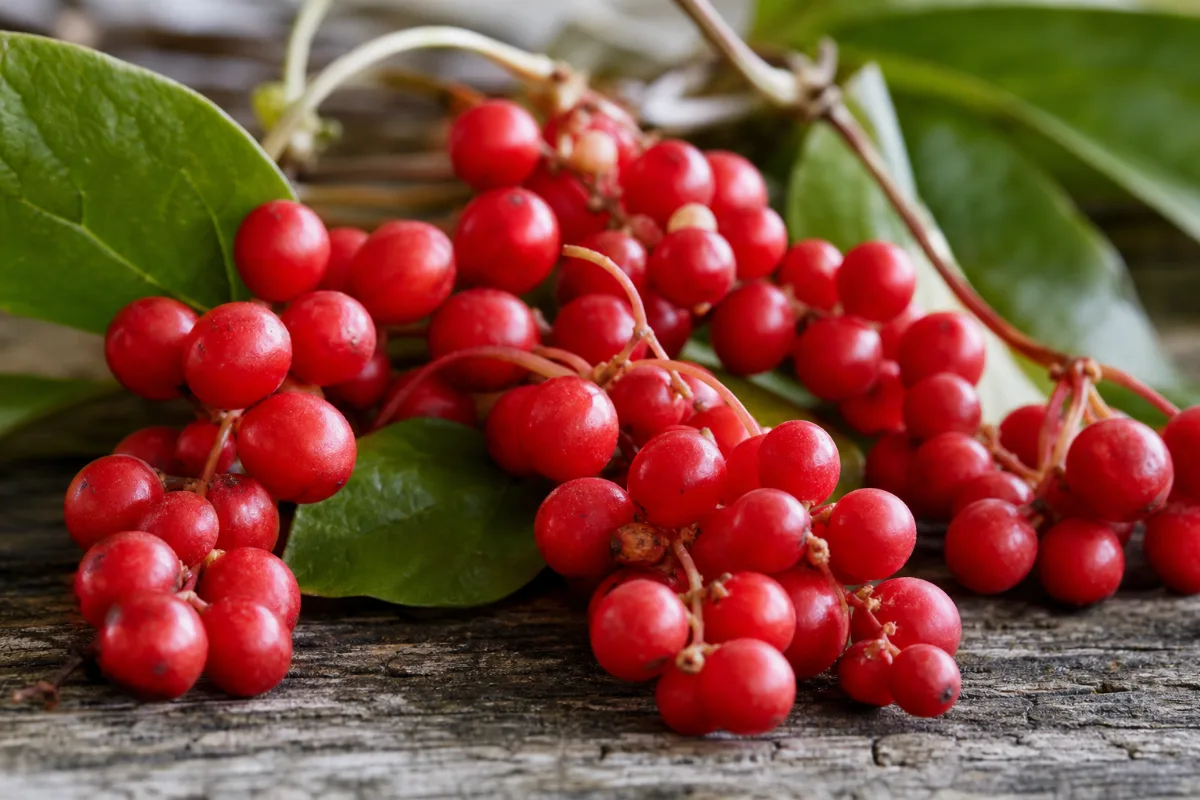
Schisandra is Schisandra chinensis (Turcz.) Baill., family Schisandraceae. [6] The part used is the dried fruit, called wu wei zi ("five-flavor berry") in Chinese. [7][1] Name trap: wu wei zi can be the fruit of S. chinensis ("north") or S. sphenanthera ("south"), and the two have different lignan profiles. [7] Tacrolimus findings come from S. sphenanthera products, so they should not be assumed to apply to S. chinensis, nor ruled out.Is it an "adaptogen"?
"Adaptogen" is a contested term, and schisandra is central to its history. A review of Russian research says S. chinensis first gained recognition as an adaptogen in the official medicine of the USSR in the early 1960s, mainly through Russian pharmacological and clinical studies. [5] A 2026 review also lists it among prominent adaptogens. [8] Memorial Sloan Kettering lists "as an adaptogen" among its traditional Chinese medicine uses. [1] Whether a plant counts as an adaptogen is a matter of definition, not an approval category. See the history of the adaptogen concept.Traditional use (not proof)
Memorial Sloan Kettering says schisandra has a long history in traditional Chinese medicine for coughs, liver conditions, stomach disorders, sweating and as a tonic, and in formulas for fatigue and sleep. [1] See schisandra (wu wei zi) in Chinese medicine.What research shows
Memorial Sloan Kettering says only a small number of human studies exist and they are too limited to draw conclusions. [1]| Use | What the source found | Strength of evidence | Population and form studied |
|---|---|---|---|
| Animal and laboratory findings | Increased working capacity and stress-protective effects in animals are described in a review of Russian research. [5] | Preclinical (cells or animals) | Animals, isolated tissues |
| Russian clinical research | The same review says numerous clinical trials showed benefit in conditions such as asthenia; it is a narrative overview and we did not read the trials. [5] | Mixed (not independently checked) | Various patients; various preparations |
| Blood sugar | In 80 adults with mildly raised fasting glucose, a 12-week mixture of schisandra extract and soybean lowered glucose and insulin markers versus placebo. [9] | Promising but limited (a mixture, so not schisandra alone) | Adults; extract-soybean mixture |
| Muscle strength, menopausal symptoms, liver disease | Memorial Sloan Kettering describes small studies, some uncontrolled, and says larger, more rigorous studies are needed. [1] | Insufficient evidence | Older adults, women, liver patients; extracts |
NIH's complementary health center did not have a schisandra page we could read, and we did not find an EMA herbal monograph page for schisandra fruit; we state no regulator conclusion.
Forms matter
Extracts, powders and mixtures differ, and the species on a label matters. See plant species and ingredient identification and quality testing and certifications.Where to go next
Adaptogen medicine interactions, the A to Z directory, and adaptogens for people taking many medicines.Frequently asked questions
Is schisandra an adaptogen?
It is called one in Russian research and by Memorial Sloan Kettering, but the term is contested. [5][1]
Does schisandra interact with medicines?
Laboratory and animal work suggests it can affect enzymes and P-glycoprotein; clinical relevance is not determined. [1]
What about tacrolimus?
A meta-analysis found a related species' capsule raised tacrolimus levels, so ask the transplant team first. [3]
Is it safe in pregnancy?
Proper evidence not found in the sources we read. Ask a clinician.
Is *S. chinensis* the same as *S. sphenanthera*?
No. They are different species with different lignan profiles. [7]
More details: evidence, limits and cautions
The details behind this page: cautions, limits of the evidence and where sources disagree. Open any note to read it.
Safety points first
- Medicines cleared by liver enzymes and P-glycoprotein. Memorial Sloan Kettering Cancer Center says laboratory and animal studies suggest schisandra can affect how drugs processed by CYP1A2, CYP3A4 or CYP3A5 are metabolized, and may raise side effects of P-glycoprotein substrates; clinical relevance is not yet determined. [1] A 2026 review adds that for lignans from S. chinensis animal and modeling studies support interaction potential, while direct human evidence is limited. [2]
- Transplant medicine (tacrolimus). A meta-analysis of 11 studies found that a capsule made from the related species Schisandra sphenanthera raised blood tacrolimus levels. [3] This is a different species and a specific product, but anyone taking tacrolimus or similar narrow-margin medicines must ask the transplant team or pharmacist before using any schisandra product.
- Lab tests. Memorial Sloan Kettering notes schisandra can reduce levels of certain liver enzymes on lab tests, which could affect how liver tests are read. [1]
- Antidepressants. A review of 1,816 adverse-event reports lists S. chinensis with bupropion (joint pain, low platelets), amitriptyline (delirium) and fluoxetine (painful urination); these are reports, not proof of cause. [4] Ask the prescriber or pharmacist; do not change a prescribed medicine on your own. In the US, call or text 988 in a crisis.
- Pregnancy, breastfeeding, children, kidney conditions, surgery. Proper evidence not found. We searched Memorial Sloan Kettering, PubMed and Europe PMC and found no safety statement for these groups. One overview lists effects on uterine muscle activity in animal studies, so a clinician should be asked. [5]
- See how interactions work.
References
- Memorial Sloan Kettering Cancer Center. Schisandra: Purported Benefits, Side Effects & More. Information About Herbs, Botanicals and Other Products. Read 2026-10-23.
- Jeyaraj et al. Schisandrol A and Schisandrol B from Schisandra chinensis: Drug Metabolism, Transporter Interactions, and Herb-Drug Interaction Potential. Drug metabolism reviews 2026. PubMed 42904383. Read 2026-10-23.
- Zhang et al. Effects of Wuzhi Capsule on Whole-Blood Tacrolimus Concentration Levels: A Systematic Review and Meta-Analysis. Therapeutic drug monitoring 2024. PubMed 38150711. Read 2026-10-23.
- Siwek et al. Harder, better, faster, stronger? Retrospective chart review of adverse events of interactions between adaptogens and antidepressant drugs. Frontiers in pharmacology 2023. PubMed 37829299. Read 2026-10-23.
- Panossian et al. Pharmacology of Schisandra chinensis Bail.: an overview of Russian research and uses in medicine. Journal of ethnopharmacology 2008. PubMed 18515024. Read 2026-10-23.
- GBIF Secretariat. GBIF Backbone Taxonomy. Names checked through the species match API on 2026-10-23. Read 2026-10-23.
- Zhang et al. A Comprehensive Review of the Main Lignan Components of Schisandra chinensis (North Wu Wei Zi) and Schisandra sphenanthera (South Wu Wei Zi) and the Lignan-Induced Drug-Drug Interactions Based on the Inhibition of Cytochrome P450 and P-Glycoprotein Activities. Frontiers in pharmacology 2022. PubMed 35359848. Read 2026-10-23.
- Rao Y et al. Phyto adaptogens in stress management and health optimization: Current understanding and future perspectives. Complementary medicine research 2026. PubMed 42721096. Read 2026-10-23.
- Kim et al. Efficacy and Safety of Omija (Schisandra chinensis) Extract Mixture on the Improvement of Hyperglycemia: A Randomized, Double-Blind, and Placebo-Controlled Clinical Trial. Nutrients 2022. PubMed 35956334. Read 2026-10-23.