Herbal Teas & Extracts · Herbal tea
Butterfly Pea Tea
Clitoria ternatea · also called Blue tea, butterfly pea flower tea, blue pea tea, Asian pigeonwings. Shankhpushpi is a regional name that is also used for other plants.
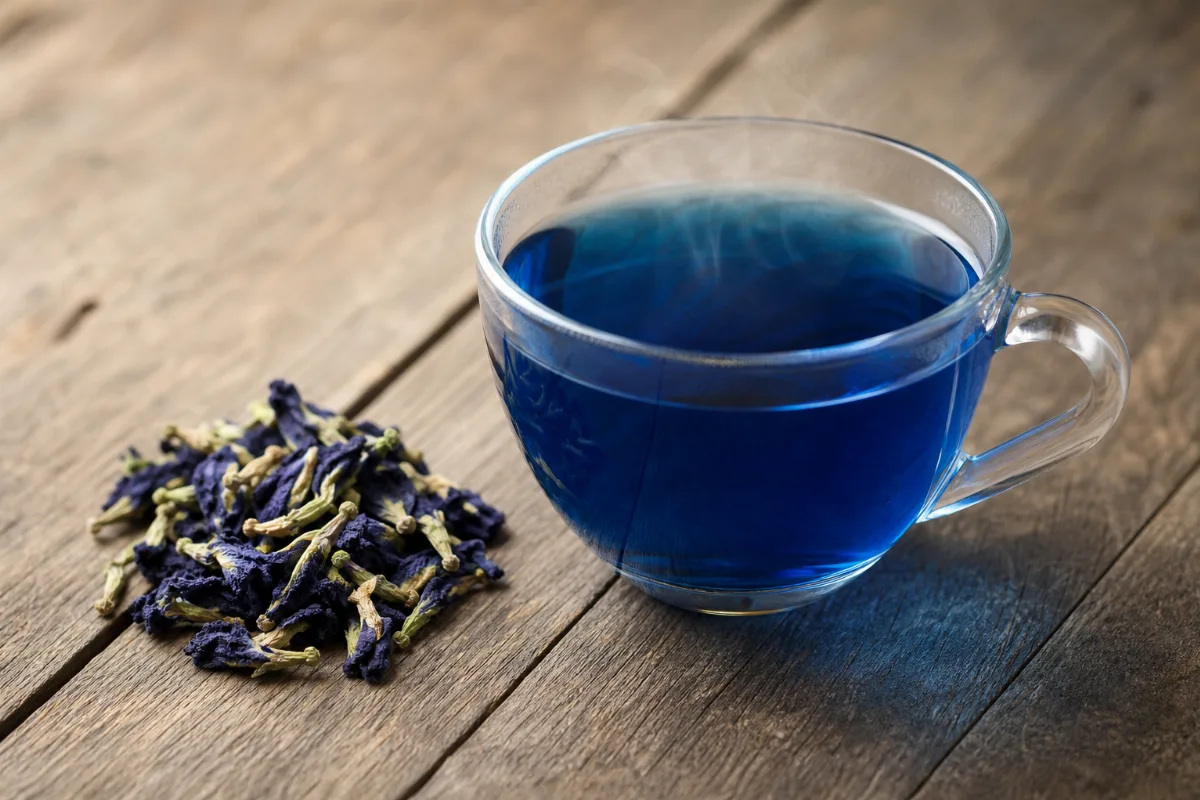
Butterfly pea tea is a deep blue drink made by steeping dried flowers in hot water. It turns purple when you add lemon. People drink it for its colour and as a traditional Ayurvedic and Southeast Asian plant. Research is small: two trials of flower extract drinks and one weak 12-week study. The main caution is that safety in pregnancy, allergy and medicines has barely been studied.
General information, not medical advice. Last substantive update · Not medically reviewed. A named clinician has not signed off on this page. How this page is made
About Butterfly Pea Tea
Butterfly pea tea is the deep blue infusion of Clitoria ternatea flowers. It is a flower tea, not true tea, and it turns purple with acid. Human research is limited to two tiny single-meal trials of extract drinks and one weakly designed 12-week study, so health claims are not established. No problems were reported in them, but pregnancy, allergy and medicine interactions are largely unstudied.
What it is
Clitoria ternatea is the accepted name (GBIF), in the pea and bean family, Fabaceae. The flowers are deep blue and pea-shaped. It is a flower infusion and is not made from the plant that gives black and green tea.
The blue comes from ternatins, a family of delphinidin pigments. The flowers also hold other anthocyanins and flavonols such as quercetin compounds.
No source we read measured caffeine in butterfly pea tea. A 2026 paper describes herbal teas as caffeine-free drinks in general. Blends can add true tea, so read the label.
Why it changes colour
Anthocyanins change colour with acidity. Lemon juice turns the blue tea purple (2023 review). School pupils aged 7 to 14 used the hot-water extract as an indicator to tell acids from bases (2024 paper).
In a 2025 review, films made with the pigment showed red, purple, blue, green and yellow shades across a pH range of 1 to 13.
This is chemistry. It does not mean the tea is stronger, weaker or safer.
What the research shows
Blood sugar: one trial of 15 healthy men found lower glucose and insulin at 30 minutes after a sugary drink with the extract. A second trial of 16 overweight men found no glucose difference after a fatty meal.
Blood fats and antioxidants: the larger amount of extract gave a smaller triglyceride rise after a fatty meal. Blood antioxidant tests rose in both trials. These are markers, not health outcomes.
Diabetes: a 2026 study in India moved two lab markers over 12 weeks, but its design is weak.
Everything else, including memory, calm, sleep and anti-cancer claims, rests on tradition, cells or animals.
Forms and quality
Both blood-sugar trials used flower-extract drinks. Their results cannot be read as results for a cup of tea in either direction.
In a lab digestion model about 42% of the pigments remained, and in rats breakdown products of the pigments reached the blood. How much a person absorbs from tea is not known.
No analysis of pesticides, metals or plant toxins in butterfly pea tea was found. Check that the pack names Clitoria ternatea and lists only flowers, or the blend ingredients.
Pregnancy, breastfeeding and children
No study of the tea in pregnancy, breastfeeding or children was found. We found no animal fertility study of the flower.
A review of Ayurvedic texts lists the plant root in an abortifacient formula inserted in the vagina. This is a traditional-text statement about the root, not a study of the tea.
Ask a doctor or midwife before regular use if pregnant or breastfeeding.
At a glance
Traditional uses history, not proof
- A 2008 review says Ayurveda has used the plant for centuries as a memory aid, anti-stress and calming agent.
- The 2025 review says the flowers colour rice blue in Malaysian cooking, for example Nasi Kerabu.
- A 2026 paper says external use for skin irritation and wounds is traditional in India, Thailand and Indonesia.
Studied for research
- Blood sugar after a sugary drink or meal, mixed (extract drinks)
- Antioxidant markers in the blood, very low
- Blood fats after a fatty meal, very low (one trial)
- Diabetes-related distress, very low (weak study)
- Memory, calm and sleep, insufficient (traditional)
- Skin use, insufficient (lab only)
Main compounds
- Ternatins (blue delphinidin pigments)
- Other anthocyanins
- Quercetin and other flavonols
Common forms
- Dried flowers, loose or in tea bags, steeped in hot water
- Blends that mix butterfly pea with other flowers, herbs or true tea
- Flower extracts and powders (the form used in the human trials)
- Natural blue food colouring
Research links: Trial: blood sugar after a sugary drink, 2018 (abstract) · Trial: blood fats after a fatty meal, 2021 (abstract) · Study in type 2 diabetes, 2026 (abstract) · Review: foods and health benefits, 2025 (abstract) · Review: Ayurvedic use, 2008 (abstract) · Review: plant food dyes and allergy, 2023 (abstract) · Research Library · Genes & Biomarkers Library
What it is and its history
- Accepted scientific name
- Clitoria ternatea
- Naming authority
- L.
- Common names
- Butterfly pea (English); Blue tea / butterfly pea flower tea / blue pea tea (English); Asian pigeonwings (English); Sweta Aparajita (Sanskrit (Ayurveda)); Shankhpushpi (regional name used in India for this plant in one study; also used for other plants) (Indian languages)
- Family or group
- Fabaceae (the pea and bean family)
- Classification
- Plantae > Fabales > Fabaceae > Clitoria > Clitoria ternatea
- Native range
- Not checked.
- Habitat
- Not checked.
- What it looks like
- Roots: Not checked.; Stems: A perennial vine (2026 India paper).; Leaves: Not checked.; Flowers: Deep blue pea-shaped flowers are the part used for the tea.; Fruit: Not checked.
- Cultivation
- The 2026 India paper says the plant is widely grown in southern India, in gardens and hedges.
- Harvest and processing
- Dried flowers are steeped in hot water for tea (our existing summary). Extracts are made with water, ethanol or acidified solvents in studies.
- Look-alikes and adulterants
- Name: Other blue-flower teas; Note: Names such as blue tea are sometimes used for other flowers. Check that the pack names Clitoria ternatea. This is a labelling caution, not from a source we read.; Name: Shankhpushpi products; Note: Shankhpushpi is the name of several different plants in Ayurveda, so a product with that name may not be butterfly pea.; Name: True tea (Camellia sinensis); Note: Black, green and white tea come from another plant. Butterfly pea tea is a flower infusion, not made from that plant, though blends may add it.
- Sustainability and conservation
- Not checked.
Photographs
Traditional use and history history, not clinical proof
| Tradition or era | Documented use | Source |
|---|---|---|
| Ayurveda (India) | A 2008 review says the plant has been used for centuries in Ayurveda as a memory enhancer, nootropic, anti-stress, anxiolytic, antidepressant, anticonvulsant, tranquilizing and sedative agent. | p18926895 |
| Malaysian cooking | The 2025 review says the flowers are used in Malaysian cuisine, for example to colour the rice dish Nasi Kerabu blue. | p41225871 |
| Ayurveda, India, Thailand and Indonesia (skin and wounds) | A 2026 paper says the plant has a well-established role in Ayurvedic and Southeast Asian traditional medicine, with external use for skin irritation, wounds and inflammation in India, Thailand and Indonesia. | p41130581 |
| South India (garden flower) | The 2026 India study says the flower is a common garden flower in its area used for both drinking and worship. | p42153010 |
Traditional use shows how it was used. It does not show that it works or is safe today.
What is inside, and how it may work
What it contains and how those compounds act in cells and animals. Laboratory and animal mechanisms are not proven effects in people.
Main compounds
| Compound | Family | Where it is concentrated | Activity studied | Level of evidence |
|---|---|---|---|---|
| Ternatins (polyacylated delphinidin anthocyanins) | anthocyanin | Petals The 2025 review lists ternatins A1 to D3 as the main pigments. Amount in a cup of tea was not found. | Responsible for the blue colour; antioxidant in lab tests. 6 5 | Lab animal |
| Delphinidin 3-glucoside PubChem 443650 | anthocyanin | Petals (breakdown product found in rat blood) Not found for tea. | Found as a breakdown product in rat blood after the extract; antioxidant in a rat model. 11 13 | Animal research |
| Delphinidin PubChem 128853 | anthocyanidin | Petals Not found for tea. | The core pigment structure of ternatins. 6 13 | Lab animal |
| Quercetin glycosides (flavonols) PubChem 5280343 | flavonol | Petals Not found for tea. | Antioxidant in the lab; quercetin was among key antioxidant compounds in rats. 11 5 13 | Animal research |
Mechanisms, receptors and pathways
| Target or pathway | Gene or receptor | What was found | Level |
|---|---|---|---|
| Colour change with acidity | n/a | Anthocyanins change colour with pH. Lemon juice turns the blue tea purple (2023 review). School pupils used the hot-water extract as an indicator across many colours to separate acids from bases (2024 paper). Films made with the pigment showed red, purple, blue, green and yellow hues across pH 1 to 13 (2025 review). This is chemistry and has no known health meaning. 5 9 6 | Lab chemistry |
| Digestive enzymes (alpha-amylase, alpha-glucosidase, fat-digesting enzymes) | n/a | Extracts block these enzymes in the lab, which could slow sugar and fat uptake after meals. Not shown to explain the human trial results. 6 10 | Lab |
| Antioxidant activity | n/a | Antioxidant effects in the lab and in a rat model; blood antioxidant markers rose in two small trials of extract drinks. 11 3 10 | Lab animal and human markers |
Absorption, metabolism and elimination
- Absorption
- In a lab digestion model, about 42% of total anthocyanins from a flower extract remained. Absorption in people drinking the tea was not measured in the sources read.
- Distribution
- Not covered.
- Metabolism
- In rats, 4 original compounds and 27 breakdown products were found in blood or urine, including delphinidin 3-glucoside and cyanidin-3-glucoside.
- Elimination
- Not covered.
- Bioavailability
- Not measured in people.
Isolated compounds versus whole extracts
A cup of tea is a water infusion of the flowers. The human trials used flower-extract drinks, and the lab work often used concentrated or solvent extracts, so their results should not be assumed for a cup of tea.
Nutritional composition
Butterfly pea tea is not described as a meaningful source of nutrients in the sources read.
1 mixed findings3 very low certainty4 not enough evidence
What was looked at
The 8 benefits and uses checked for Butterfly Pea Tea, each with how strong the evidence is. Tap one to open it.
- Blood sugar after a sugary drink or mealMixed findings
- Antioxidant markers in the bloodVery low certainty
- Blood fats after a fatty mealVery low certainty
- Diabetes-related distress (lab markers)Very low certainty
- Memory, calm and sleep (traditional use)Not enough evidence
- Antidiabetic, anti-obesity, liver-protective and anti-cancer claims (lab and animal only)Not enough evidence
- What happens to the pigments in the bodyNot enough evidence
- Use on the skin (lab tests only)Not enough evidence
Lab markers tracked in the studies
Blood glucose and insulin after a sugary drinkBlood antioxidant capacity (FRAP, ORAC, TEAC, thiols)Blood triglycerides after a fatty mealProtein carbonyls and urine 5-HIAAAnthocyanins left after digestion (lab)
What is Butterfly Pea Tea good for?
The uses people ask about and how strong the human evidence is for each. The human trials tested flower extract drinks rather than an ordinary cup of tea, and each row says which.
Benefits, one by one
Each card is a research question, not a promise. Tap a goal to filter. Open a card to see the studies, doses and limits.
Blood sugar after a sugary drink or meal
Mixed findingsOne small trial of 15 healthy young men found lower blood sugar and insulin 30 minutes after a sugary drink when butterfly pea flower extract was added. A second small trial in overweight men found no significant blood sugar difference after a fatty meal. The results are mixed and the drinks were extracts, not ordinary tea.
3 studiesFlower extract drinks, taken once with food. Not a steeped tea. Amoun…
Studies, doses and limits
What the trials found
Trial 1 (healthy men, 2018): after 30 minutes, blood glucose and insulin were lower with sugar plus extract than with sugar alone. The extract alone did not change fasting glucose or insulin. Trial 2 (overweight men, 2021, high-fat meal): no significant difference in blood glucose between the groups.
Results
Trial 1: lower glucose and insulin at 30 minutes only. Trial 2: no difference. Neither tested people with diabetes.
Effect sizes as reported
No effect sizes quoted in the abstracts.
Why this rating
Two very small, short trials of young men that disagree. Different meals were used. Both tested a flower-extract drink, not a tea. Neither tested people with diabetes. The first trial was registered after it began.
Form and dose studied
Flower extract drinks, taken once with food. Not a steeped tea. Amounts are not repeated here.
Who was studied
Healthy or overweight young men in Thailand.
Limits
Single meals only, 3 to 6 hours of follow-up, young men only. No long trial of blood sugar in healthy people or in people with diabetes using ordinary butterfly pea tea.
Why researchers looked
The blue pigments (anthocyanins) block sugar-digesting enzymes in lab tests, so researchers asked whether they change blood sugar after eating.
Traditional use
Not described in the sources read for this use.
Proposed mechanism Lab
Lab studies show the extract can block starch- and sugar-digesting enzymes (alpha-amylase and alpha-glucosidase), which would slow sugar release (2025 review). Not shown to be the cause in these trials.
A proposed mechanism does not show that the effect happens in people.
No low blood sugar was seen in the fasting state in the first trial. People who take diabetes medicine should ask a pharmacist (see Safety).
Antioxidant markers in the blood
Very low certaintyIn both small trials, blood tests that measure antioxidant capacity rose after butterfly pea flower extract. These are lab markers. Neither trial showed that this protects against any illness.
3 studiesFlower extract drinks taken once. Not a steeped tea.
Studies, doses and limits
What the trials found
Trial 1 (15 healthy men): blood antioxidant capacity (FRAP, ORAC, TEAC, thiols) rose and the damage marker MDA fell with the extract, including after a sugar drink. Trial 2 (16 overweight men): blood FRAP and thiol levels rose with the larger amount, and glutathione peroxidase activity was higher at 3 hours.
Results
Higher blood antioxidant measures in both trials. No health outcome measured.
Effect sizes as reported
No effect sizes quoted in the abstracts.
Why this rating
Blood antioxidant tests are surrogate markers. Both trials are tiny, short and of extract drinks. A 2025 review says most evidence is preclinical.
Form and dose studied
Flower extract drinks taken once. Not a steeped tea.
Who was studied
Healthy or overweight young men.
Limits
Marker changes lasted hours. Antioxidant tests do not predict that anyone gets healthier.
Why researchers looked
The flowers are rich in anthocyanins, which are strong antioxidants in the lab.
Traditional use
Not described in the sources read for this use.
Proposed mechanism Lab
Anthocyanins and flavonoids can neutralise free radicals in the lab. Whether that matters inside the body is not shown.
A proposed mechanism does not show that the effect happens in people.
No safety problems were reported in the abstracts.
Blood fats after a fatty meal
Very low certaintyIn one small trial of 16 overweight men, the larger amount of butterfly pea extract with a high-fat meal gave a smaller rise in blood triglycerides after the meal. That is one trial of an extract and it is not a cholesterol or heart result.
2 studiesFlower extract taken once with a high-fat meal. Not a tea.
Studies, doses and limits
What the trials found
The larger amount of extract lowered the area under the post-meal triglyceride curve and free fatty acids at 6 hours. The abstract reports these effects only for the larger amount. Inflammation markers did not differ.
Results
Lower triglyceride rise and free fatty acids with the larger amount only.
Effect sizes as reported
No effect sizes quoted in the abstract.
Why this rating
One tiny trial, one meal, young men, an extract, and the effect appeared with only one of two amounts.
Form and dose studied
Flower extract taken once with a high-fat meal. Not a tea.
Who was studied
Overweight or obese young men in Thailand.
Limits
No trial over weeks. Triglycerides after one meal are not heart disease.
Why researchers looked
Blood fats rise after a fatty meal, more in overweight people, and researchers look for foods that blunt this.
Traditional use
Not described in the sources read for this use.
Proposed mechanism Lab
The extract blocks fat-digesting enzymes in the lab (the trial paper says this was shown in vitro). Not shown to be the cause here.
A proposed mechanism does not show that the effect happens in people.
No safety problems were reported in the abstract.
Diabetes-related distress (lab markers)
Very low certaintyA 2026 study from India gave butterfly pea flower tea for 12 weeks to people with type 2 diabetes and moderate distress. Two oxidative-stress and serotonin-related lab markers moved in the hoped-for direction. The study design is weak and the abstract does not show that people felt better.
2 studiesA boiled water extract of the flowers, called herbal tea in the paper…
Studies, doses and limits
What the trials found
The abstract reports that, alongside usual diabetes medicine, 12 weeks of the tea lowered serum protein carbonyls and raised urine 5-HIAA compared with the untreated diabetic group (p<0.001 as reported). The full text says liver and kidney blood tests showed no adverse events.
Results
Both tea groups differed from the untreated diabetic group on two lab markers. No effect sizes in the abstract.
Why this rating
Weak design: described as a comparative study, with unclear random assignment, no clear blinding and unclear group numbers. The abstract reports lab markers, not symptoms. Small, one region. It has not been repeated.
Form and dose studied
A boiled water extract of the flowers, called herbal tea in the paper, taken daily for 12 weeks. Amounts are not repeated here.
Who was studied
Adults with type 2 diabetes and moderate diabetes distress in India.
Limits
Needs a randomised, blinded trial with distress scores and blood sugar as the main outcomes.
Why researchers looked
Many people with diabetes feel burdened by it. Researchers tested whether the tea changes markers linked to oxidative stress and serotonin.
Traditional use
The paper says the flower is a garden flower in south India used for both drinking and worship, and uses the regional name shankhpushpi for it.
Proposed mechanism Proposed
The authors suggest antioxidant and serotonin-related actions. This was not tested directly.
A proposed mechanism does not show that the effect happens in people.
The full text reports no adverse events on liver and kidney tests. Anyone on diabetes medicine should still ask a pharmacist.
Memory, calm and sleep (traditional use)
Not enough evidenceIn Ayurveda, butterfly pea has been used for centuries for memory, anxiety, stress and sedation. No human trial of the flower tea for these uses was found.
2 studiesNot applicable.
Studies, doses and limits
What the trials found
No clinical trial of butterfly pea tea for memory, mood, anxiety or sleep was found in the sources read. A 2025 review says most evidence is preclinical.
Results
No human results.
Why this rating
Support is tradition and lab or animal work. Tradition is not proof of benefit.
Limits
No human data. Ayurvedic use often involved other plant parts, such as the root.
Why researchers looked
The plant has a long history in Ayurveda as a brain tonic.
Traditional use
A 2008 review says Clitoria ternatea has been used for centuries in Ayurveda as a memory enhancer, nootropic, anti-stress, anxiolytic, antidepressant, anticonvulsant, tranquilizing and sedative agent.
Proposed mechanism Not established
Not established in people.
A proposed mechanism does not show that the effect happens in people.
Not applicable.
Antidiabetic, anti-obesity, liver-protective and anti-cancer claims (lab and animal only)
Not enough evidenceReviews list many promising findings in cells and animals for butterfly pea. The authors of the 2025 review say most of the evidence is preclinical and that human studies are needed to confirm both benefit and safety.
2 studiesMostly concentrated extracts in the lab, not tea.
Studies, doses and limits
Results
Lab and animal findings only.
Why this rating
Cells and animals are a poor guide to what a cup of tea does in people.
Form and dose studied
Mostly concentrated extracts in the lab, not tea.
Who was studied
Cells and animals.
Limits
Extracts vary greatly in how they are made, which makes studies hard to compare.
Why researchers looked
Extracts of the flower, leaf, seed and root are easy to test in cells and animals.
Traditional use
Not described for this use.
Proposed mechanism Animal and lab
Cell and animal studies point to blocked digestive enzymes, antioxidant activity and effects on fat cells. Not shown in people.
A proposed mechanism does not show that the effect happens in people.
No human safety conclusion can be drawn from these studies.
What happens to the pigments in the body
Not enough evidenceIn the lab, less than half of the blue pigments survived digestion. In rats, breakdown products of the pigments reached the blood. This tells us what is absorbed, not whether it helps.
1 studiesExtract, not tea.
Studies, doses and limits
What the trials found
About 42% of the total anthocyanins in a flower extract remained after lab digestion. In rats, 4 original compounds and 27 breakdown products were found in blood or urine. Not measured in people drinking tea.
Results
Lab digestion left 42.03% of total anthocyanins; rat blood levels were in the nanomolar range.
Effect sizes as reported
About 42% remained after lab digestion.
Why this rating
Rat and lab work only, on an extract.
Form and dose studied
Extract, not tea.
Who was studied
Rats and a lab model.
Limits
Not tested in people.
Why researchers looked
Researchers want to know whether the pigments actually reach the blood.
Traditional use
Not described for this use.
Proposed mechanism Animal and lab
Digestion breaks down much of the anthocyanin; smaller breakdown products such as delphinidin 3-glucoside and cyanidin-3-glucoside were found in rat blood.
A proposed mechanism does not show that the effect happens in people.
No safety conclusion.
Use on the skin (lab tests only)
Not enough evidenceIn lab tests, a water extract of the flowers did not trigger skin sensitisation, and an alcohol extract was light-sensitive (phototoxic) at high concentrations. These are skin-cell tests for cosmetics, not drinking tea.
1 studiesHot-water extract and alcohol extract, for skin.
Studies, doses and limits
What the trials found
Lab tests on cells and skin models only. No human skin study of the flower extract was found in the sources read.
Results
Both extracts non-sensitizing in the lab; the ethanol extract was phototoxic at high concentrations.
Why this rating
Cell and model tests only.
Form and dose studied
Hot-water extract and alcohol extract, for skin.
Who was studied
Skin cells and models.
Limits
Lab only; not drinking.
Why researchers looked
Southeast Asian and Ayurvedic traditions include external use of the flower on the skin.
Traditional use
The 2026 paper says external use for skin irritations, wounds and inflammation is traditional in India, Thailand and Indonesia.
Proposed mechanism Lab
Reduced pollution-induced inflammation markers in skin cells in the lab.
A proposed mechanism does not show that the effect happens in people.
Lab results do not guarantee that a product is safe on every skin.
Connections to the rest of health
How Butterfly Pea Tea connects to the rest of our health knowledge graph. Every link says what kind of connection it is. A safety link (for example to the liver) is a warning, not a benefit. A study that merely mentions a topic never creates a benefit link.
Explore every connection: goals, body systems, organs, symptoms, genes
A. Wellness goals
| Connected to | Kind of connection | Evidence status | Context | Studies |
|---|---|---|---|---|
| Blood Sugar Balance | Mixed findings | Blood sugar after a sugary drink or meal: One small trial of 15 healthy young men found lower blood sugar and insulin 30 minutes after a sugary drink when butterfly pea flower extract was added. A second small trial in overweight men found no significant blood sugar difference after a fatty meal. The results are mixed and the drinks were extracts, not ordinary tea. | 3 10 6 | |
| Cellular Protection | Very low certainty | Antioxidant markers in the blood: In both small trials, blood tests that measure antioxidant capacity rose after butterfly pea flower extract. These are lab markers. Neither trial showed that this protects against any illness. | 3 10 6 | |
| Heart Health | Very low certainty | Blood fats after a fatty meal: In one small trial of 16 overweight men, the larger amount of butterfly pea extract with a high-fat meal gave a smaller rise in blood triglycerides after the meal. That is one trial of an extract and it is not a cholesterol or heart result. | 10 6 | |
| Blood Sugar Balance | Very low certainty | Diabetes-related distress (lab markers): A 2026 study from India gave butterfly pea flower tea for 12 weeks to people with type 2 diabetes and moderate distress. Two oxidative-stress and serotonin-related lab markers moved in the hoped-for direction. The study design is weak and the abstract does not show that people felt better. | 7 6 | |
| Stress Reduction | Very low certainty | Diabetes-related distress (lab markers): A 2026 study from India gave butterfly pea flower tea for 12 weeks to people with type 2 diabetes and moderate distress. Two oxidative-stress and serotonin-related lab markers moved in the hoped-for direction. The study design is weak and the abstract does not show that people felt better. | 7 6 | |
| Memory Support | Not enough evidence | Memory, calm and sleep (traditional use): In Ayurveda, butterfly pea has been used for centuries for memory, anxiety, stress and sedation. No human trial of the flower tea for these uses was found. | 8 6 | |
| Calm Relaxation | Not enough evidence | Memory, calm and sleep (traditional use): In Ayurveda, butterfly pea has been used for centuries for memory, anxiety, stress and sedation. No human trial of the flower tea for these uses was found. | 8 6 | |
| Metabolic Health | Not enough evidence | Antidiabetic, anti-obesity, liver-protective and anti-cancer claims (lab and animal only): Reviews list many promising findings in cells and animals for butterfly pea. The authors of the 2025 review say most of the evidence is preclinical and that human studies are needed to confirm both benefit and safety. | 6 2 | |
| Liver Support | Not enough evidence | Antidiabetic, anti-obesity, liver-protective and anti-cancer claims (lab and animal only): Reviews list many promising findings in cells and animals for butterfly pea. The authors of the 2025 review say most of the evidence is preclinical and that human studies are needed to confirm both benefit and safety. | 6 2 | |
| Cellular Protection | Not enough evidence | What happens to the pigments in the body: In the lab, less than half of the blue pigments survived digestion. In rats, breakdown products of the pigments reached the blood. This tells us what is absorbed, not whether it helps. | 11 | |
| Healthy Skin | Not enough evidence | Use on the skin (lab tests only): In lab tests, a water extract of the flowers did not trigger skin sensitisation, and an alcohol extract was light-sensitive (phototoxic) at high concentrations. These are skin-cell tests for cosmetics, not drinking tea. | 4 |
B. Body systems
| Connected to | Kind of connection | Evidence status | Context | Studies |
|---|---|---|---|---|
| Endocrine System | Biological association | Mixed findings | Studied for: Blood sugar after a sugary drink or meal Studied for: Diabetes-related distress (lab markers) | 3 10 6 7 |
| Cardiovascular System | Biological association | Very low certainty | Studied for: Antioxidant markers in the blood Studied for: Blood fats after a fatty meal | 3 10 6 |
| Nervous System | Biological association | Very low certainty | Studied for: Diabetes-related distress (lab markers) Studied for: Memory, calm and sleep (traditional use) | 7 6 8 |
| Hepatic System | Biological association | Not enough evidence | Studied for: Antidiabetic, anti-obesity, liver-protective and anti-cancer claims (lab and animal only) | 6 2 |
| Digestive System | Biological association | Not enough evidence | Studied for: What happens to the pigments in the body | 11 |
| Integumentary System | Biological association | Not enough evidence | Studied for: Use on the skin (lab tests only) | 4 |
I. Biomarkers
| Connected to | Kind of connection | Evidence status | Context | Studies |
|---|---|---|---|---|
| Blood glucose | Low certainty | Lower glucose at 30 minutes after a sugary drink in one trial of 15 healthy men; no difference in another trial. Preparation or compound: Butterfly pea flower extract drink |
3 10 | |
| Blood glucose and insulin after a sugary drink | Biological association | Mixed findings | Measured in trials: lower at 30 minutes (one trial); no difference (another trial, fatty meal). A lab change is not the same as a health benefit. | 3 10 |
| Blood antioxidant capacity (FRAP, ORAC, TEAC, thiols) | Biological association | Very low certainty | Measured in trials: raised. A lab change is not the same as a health benefit. | 3 10 |
| Blood triglycerides after a fatty meal | Biological association | Very low certainty | Measured in trials: smaller rise (larger amount only). A lab change is not the same as a health benefit. | 10 |
| Protein carbonyls and urine 5-HIAA | Biological association | Very low certainty | Measured in trials: protein carbonyls lower, 5-HIAA higher (reported). A lab change is not the same as a health benefit. | 7 |
| Anthocyanins left after digestion (lab) | Biological association | Not enough evidence | Measured in trials: about 42% remained. A lab change is not the same as a health benefit. | 11 |
K. Biological pathways
| Connected to | Kind of connection | Evidence status | Context | Studies |
|---|---|---|---|---|
| Carbohydrate digestion (alpha-amylase) | Preliminary mechanism | Lab | Blocked by extracts in the lab; not shown in people as the cause of the trial results. | 6 |
L. Active compounds
| Connected to | Kind of connection | Evidence status | Context | Studies |
|---|---|---|---|---|
| Ternatins (polyacylated delphinidin anthocyanins) | Biological association | Lab animal | Responsible for the blue colour; antioxidant in lab tests. Preparation or compound: Petals |
6 5 |
| Delphinidin 3-glucoside | Biological association | Animal | Found as a breakdown product in rat blood after the extract; antioxidant in a rat model. Preparation or compound: Petals (breakdown product found in rat blood) |
11 13 |
| Delphinidin | Biological association | Lab animal | The core pigment structure of ternatins. Preparation or compound: Petals |
6 13 |
| Quercetin glycosides (flavonols) | Biological association | Animal | Antioxidant in the lab; quercetin was among key antioxidant compounds in rats. Preparation or compound: Petals |
11 5 13 |
Each connection is stored with the ingredient, the connected record, the kind of connection, the evidence status, the supporting studies, the preparation or compound involved, and a review date (last reviewed October 25, 2026).
Evidence at a glance: what changed in 1 lab markers
Tap a number to show only those markers. Counts are markers, not people.
The evidence
The research centre for Butterfly Pea Tea. Every record here was checked against PubMed or the publisher's page; we never list a study we have not verified.
Evidence by outcome
Bars show how many studies we found for each outcome, not how well it works. People are added up across trials only (reviews are not added, to avoid double counting).
How we rate evidence
High certainty
Several well-run trials or reviews agree; further research is unlikely to change the picture much.
Moderate certainty
Good trials point the same way, but some doubt remains.
Low certainty
Small, short or inconsistent trials. The finding could change with better research.
Very low certainty
Very little or very weak human data. Treat as a possibility only.
Mixed findings
Trials or reviews disagree with each other.
Not enough evidence
Not enough human research to say either way.
Evidence against
Good research found no benefit, or found harm.
We take the reviewers' own risk-of-bias and GRADE statements where they exist, and otherwise judge from study size, design, consistency, directness and whether a product matches what is sold. Many publications do not make evidence high. Method note: We searched PubMed and Europe PMC and read the abstracts of the studies listed. For five of them we also read selected passages of the open full text. We checked the plant name in GBIF and three compounds in PubChem.
Study library: every study we checked 13
| Study | Design | People | Product, dose, length | Result |
|---|---|---|---|---|
| Bhatt 2021 A Critical Review and Scientific Prospective on Contraceptive Therapeutics from Ayurveda and Allied Ancient Knowledge Frontiers in Pharmacology · PMID 34149405 · DOI |
Narrative review review |
Review of Ayurvedic texts on contraception and abortifacient plants | Butterfly pea ROOT (Sweta Aparajita) named in a traditional formula root |
The abstract says classical Ayurvedic texts describe plants and formulas claimed to have sterilizing, contraceptive and abortifacient properties and that a few are known to be toxic. In the full text, the root of Clitoria ternatea (Sweta Aparajita) is listed in an abortifacient formula that is inserted in the vagina. This is a traditional-text statement. Not applicable (review of texts) Methods, limits and fundingOutcomes: Traditional fertility-limiting and abortifacient formulas Limitations: A traditional text claim, not a study. It concerns the root and a vaginal formula, not a flower tea. No fertility study of the flower tea was found. Funding and conflicts: Not stated in the abstract Read: abstract+full-text-selected-passages |
| Caroline Paz Goncalves 2024 A green method for anthocyanin extraction from Clitoria ternatea flowers cultivated in southern Brazil: Characterization, in vivo toxicity, and biological activity Food Chemistry · PMID 37776651 · DOI |
Animal toxicity lab invertebrate and lab |
Butterfly pea flower extract tested in wax-moth larvae (Galleria mellonella) and in the lab | Anthocyanin-rich extract made with an acidified solvent flower · vs Control larvae |
The extract held 13 anthocyanins and 9 other phenolic compounds. In the larvae it showed a safe concentration up to the highest amount tested. It showed antioxidant activity and antibacterial action against food pathogens in the lab. Not applicable Methods, limits and fundingOutcomes: Anthocyanin and phenol content, toxicity in larvae, antioxidant and antibacterial activity Limitations: Insect-larva and lab work on a concentrated extract. Not a human safety result. Funding and conflicts: Authors declare no competing interests. Read: abstract |
| Chusak 2018 Acute effect of Clitoria ternatea flower beverage on glycemic response and antioxidant capacity in healthy subjects: a randomized crossover trial BMC Complementary and Alternative Medicine · PMID 29310631 · DOI |
Randomized crossover trial |
15 15 healthy young men (mean age about 22, normal weight) in Thailand |
Butterfly pea flower extract (a flower-extract drink, not described as a steeped tea) with or without sugar water flower Two amounts of extract tested; figures not repeated here Single drinks, blood measured over 3 hours · vs Sugar water alone |
After 30 minutes, blood glucose and insulin were lower when the extract was drunk with sugar than with sugar alone. The extract alone did not change glucose or insulin in the fasting state. Blood antioxidant measures rose and the damage marker MDA fell with the extract. The authors conclude that a single dose raised blood antioxidant capacity without low blood sugar in the fasting state. Lower glucose and insulin at 30 minutes after sugar; higher blood antioxidant measures Methods, limits and fundingOutcomes: Blood glucose, insulin, uric acid, antioxidant capacity and a fat-damage marker (MDA) over 3 hours Limitations: One small acute trial in healthy young men. Measured for 3 hours only. The drink was a flower extract, not clearly a cup of tea. Registered after the study began (retrospectively). People with diabetes were not studied. Antioxidant blood measures are not health outcomes. Funding and conflicts: Authors declare no competing interests. Registration: TCTR20170609003 (registered retrospectively) Read: abstract |
| Fu 2026 Assessment of skin safety and anti-pollution activity of Clitoria ternatea L. (butterfly pea) flower extract Journal of Ethnopharmacology · PMID 41130581 · DOI |
Lab in vitro cells and lab models |
Lab tests on skin cells and skin-absorption models | Butterfly pea flower extracts: a traditional hot-water extract and an ultrasound-assisted ethanol extract flower · vs Controls |
Both extracts were non-sensitizing in the lab tests and showed favourable skin safety with no systemic exposure in the model. The ethanol extract was phototoxic at high concentrations; the water extract was not described as such and did better against pollution-induced inflammation in skin cells. The abstract notes a long Ayurvedic and Southeast Asian traditional role, with external use in India, Thailand and Indonesia. Not applicable Methods, limits and fundingOutcomes: Skin sensitisation, cell toxicity, phototoxicity, skin absorption and anti-pollution effects Limitations: Lab only and for skin, not drinking. Not a human result. Funding and conflicts: Authors declare no competing interests. Read: abstract |
| Lis 2023 Plant Food Dyes with Antioxidant Properties and Allergies-Friend or Enemy? Antioxidants (Basel) · PMID 37507897 · DOI |
Narrative review review |
Review of plant food dyes and allergy | Plant food dyes including butterfly pea flower extracts flower |
In the section on butterfly pea (full text), the authors say the available data do not indicate that intense blue butterfly pea flower extracts cause hypersensitivity reactions, and that there are no reports of allergy after drinking infusions of the flowers or eating foods coloured with them. They also describe the pH colour effect (lemon juice turns the blue tea purple) and say the blue colour comes from ternatins, delphinidin-based pigments. Not applicable (review) Methods, limits and fundingOutcomes: Allergic reactions to plant dyes Limitations: A lack of reports is not proof that no one is allergic. A review of dyes in general, not a study of tea drinkers. Abstract and the butterfly pea passage of the full text read. Funding and conflicts: Authors declare no conflicts. Read: abstract+full-text-selected-passages |
| Maia 2025 Clitoria ternatea: Perspectives on Its Application in Foods and Potential Health Benefits Plants (Basel) · PMID 41225871 · DOI |
Narrative review review |
Review of lab, animal and a few human studies on butterfly pea | Butterfly pea (mainly flower) extracts and pigments flower, also seed, root, leaf |
Reports antioxidant, antidiabetic, anti-obesity, liver-protective and anti-cancer activity in studies, and uses as a natural blue colour. Says most evidence is preclinical with limited clinical validation and that more human studies are needed to confirm efficacy and safety. Full text names the ternatins (polyacylated delphinidin pigments) as the source of the blue colour, mentions the use of the flowers to colour rice blue in Malaysian cooking (Nasi Kerabu), and describes the two small human trials and the 12-week trial. Not applicable (review) Methods, limits and fundingOutcomes: Food uses, bioactive compounds and health findings Limitations: A narrative review, not a systematic one. Mostly describes lab and animal work. Abstract and selected full-text passages read; not every section read. Funding and conflicts: Authors declare no conflicts. Read: abstract+full-text-selected-passages |
| Mani 2026 A clinical study on Clitoria ternatea tea therapy to manage diabetic distress in people with type 2 diabetes Avicenna Journal of Phytomedicine · PMID 42153010 · DOI |
Comparative study |
90 People with type 2 diabetes and moderate diabetes-related distress in India, plus a healthy control group (114 enrolled, 90 analysed; group counts unclear in the abstract) |
Water extract of butterfly pea flowers made by boiling (called herbal tea in the paper; also called shankhpushpi) flower Two amounts compared; figures not repeated here 12 weeks · vs Diabetic group without the tea; healthy control group |
The abstract says the diabetic-distress group had higher protein carbonyls and lower 5-HIAA than healthy controls. After 12 weeks of the tea alongside usual diabetes medicine, both tea groups had lower protein carbonyls and higher 5-HIAA than the untreated diabetic group (p<0.001 as reported). The authors conclude the tea helps diabetic distress. The full text says liver and kidney blood tests showed no adverse events. Lab markers moved in the direction the authors wanted; no effect size in the abstract Methods, limits and fundingOutcomes: Blood protein carbonyls (an oxidative damage marker) and urine 5-HIAA (a serotonin breakdown product); distress scores in the full text Limitations: The design is described as a comparative study; the abstract does not clearly say people were randomly assigned or that anyone was blinded, and the group counts are unclear. The outcomes in the abstract are lab markers, not how people felt. The paper uses the name shankhpushpi for the plant. Small, single-region, 12 weeks. Needs confirming by a properly blinded trial. Funding and conflicts: No funding and no conflicts reported (paper text). Read: abstract+full-text-selected-passages |
| Mukherjee 2008 The Ayurvedic medicine Clitoria ternatea--from traditional use to scientific assessment Journal of Ethnopharmacology · PMID 18926895 · DOI |
Narrative review review |
Review of chemistry, lab and animal findings, and traditional use | Butterfly pea (several plant parts) flower, root, seed, leaf |
The abstract says the plant has been used in Ayurvedic medicine for centuries as a memory enhancer, nootropic, anti-stress, anxiolytic, antidepressant, anticonvulsant, tranquilizing and sedative agent, and lists many activities seen with extracts (for example antimicrobial, anti-inflammatory, antidiabetic). It says the review covers chemistry, pharmacology and toxicity studies. Not applicable (review) Methods, limits and fundingOutcomes: Traditional use, chemistry, pharmacology and toxicity studies Limitations: Abstract read only. The abstract lists activities but gives no results; the toxicity details were not read. Funding and conflicts: Not stated in the abstract Read: abstract |
| Naimi 2024 Teaching Acid-Base Fundamentals and Introducing pH using Butterfly Pea Flower Tea Journal of Chemical Education · PMID 38516052 · DOI |
Classroom activity human (students, no ingestion) |
School pupils aged 7 to 14 using a hot-water extract as a colour indicator (not drinking it) | Hot-water extract of butterfly pea flowers used as a pH indicator flower Classroom activity |
Pupils extracted the colour pigments (anthocyanins) with hot water and used the indicator and its range of colours to compare household acids and bases. Most recorded answers correctly told acids from bases. The authors describe the flower as a non-toxic, easily available indicator. Not applicable Methods, limits and fundingOutcomes: Whether pupils could tell acids from bases using the colour Limitations: A teaching activity, not a health study. It shows the colour chemistry only. Funding and conflicts: Authors declare no conflict of interest. Read: abstract |
| Thilavech 2021 Clitoria ternatea Flower Extract Attenuates Postprandial Lipemia and Increases Plasma Antioxidant Status Responses to a High-Fat Meal Challenge in Overweight and Obese Participants Biology (Basel) · PMID 34681074 · DOI |
Randomized trial |
16 16 overweight or obese young men in Thailand (mean age about 23) |
Butterfly pea flower extract taken with a high-fat meal flower Two amounts of extract tested; figures not repeated here Single meal, blood measured over 6 hours · vs High-fat meal without extract |
Blood glucose after the meal was not significantly different between the three groups. With the larger amount of extract, the post-meal triglyceride rise was smaller and free fatty acids were lower at 6 hours. Blood antioxidant measures (FRAP, thiols) were higher. Inflammation markers (IL-6, IL-1 beta, TNF-alpha) did not differ at 6 hours. No glucose difference; lower triglyceride area and free fatty acids with the larger amount Methods, limits and fundingOutcomes: Blood glucose, blood fats (triglycerides, free fatty acids), antioxidant measures and inflammation markers over 6 hours Limitations: Very small, one meal, young men only. The extract, not a tea, was tested. The benefit appeared only with the larger of the two amounts. Blood fat after one meal is not heart disease. Funding and conflicts: Authors declare no conflict of interest. Read: abstract |
| Yu 2024 In Vitro and In Vivo Evaluating Bioaccessibility, Bioavailability, and Antioxidant Activities of Butterfly Pea Flower Containing Bioactive Constitutes Foods · PMID 38790785 · DOI |
Animal and lab rat and lab |
Lab digestion model and rats | Butterfly pea flower extract flower · vs Control rats |
After lab digestion about 42% of the total anthocyanins remained, so digestion reduced the pigments. In rats the team found 4 original compounds and 27 breakdown products in blood or urine, including delphinidin 3-glucoside and cyanidin-3-glucoside. In a rat model of oxidative damage the extract improved antioxidant enzyme measures. 42.03% of anthocyanins left after lab digestion Methods, limits and fundingOutcomes: How much pigment survives digestion, which breakdown products reach the blood, antioxidant enzymes in rats Limitations: Lab and rat work. Not shown in people. Funding and conflicts: Authors declare no conflicts. Read: abstract |
| n/a 2026 GBIF Backbone Taxonomy: Clitoria ternatea L. (usage key 2946519) n/a · Source |
Database record n/a |
n/a | n/a |
Accepted species name Clitoria ternatea L., family Fabaceae (the pea and bean family), order Fabales, kingdom Plantae. Retrieved 2026-10-25 from the GBIF species match API. Methods, limits and fundingOutcomes: Accepted name and family Limitations: A taxonomy database record. Read: full-text |
| n/a 2026 PubChem records: delphinidin (CID 128853), delphinidin 3-O-glucoside cation (CID 443650), quercetin (CID 5280343) n/a · Source |
Database record n/a |
n/a | n/a |
Delphinidin CID 128853. Delphinidin 3-O-glucoside cation CID 443650, formula C21H21O12+. Quercetin CID 5280343, formula C15H10O7. Retrieved 2026-10-25 from the PubChem PUG REST API. The ternatins themselves are large, acylated delphinidin glycosides and were not looked up. Methods, limits and fundingOutcomes: Compound identity Limitations: Identity records only; they say nothing about effects. Read: full-text |
What we do not know yet
- What the evidence supports: mixed blood sugar results and higher blood antioxidant markers in two very small trials of extract drinks, and a weakly designed 12-week study.
- No trial of an ordinary cup of butterfly pea tea in healthy people was found.
- No human trial for memory, calm, sleep, skin or liver health.
- No drug-interaction, pregnancy, breastfeeding or children study of the tea.
- No animal fertility study of the flower was found; the only fertility-related statement is a traditional text about the root.
- No regulator statement was read, and no source measured caffeine or contaminants in the tea.
How new research is added
New studies are found by a saved PubMed search and are placed in a review queue. A person reads each one before it changes any evidence rating or safety wording. New publications never change ratings automatically.
Lab markers
What changed in blood or saliva tests during trials. A changed number is not the same as feeling or being healthier, and we give no "normal ranges".
Other 5
Blood glucose and insulin after a sugary drink
Lower at 30 minutes (one trial); no difference (another trial, fatty meal) in trials
Blood sugar and insulin measured at set times after drinking sugar water.
Mixed findingsResults and what it means
Why it was measured
Shows how quickly sugar reaches the blood after eating.
Statistical vs. clinical meaning
Blood sugar curves after one meal are a short-term marker. They do not show better long-term control.
Safety implication
No low blood sugar was seen in the fasting state in the first trial.
| Study | Result | People | Product |
|---|---|---|---|
| 3 | Glucose and insulin were lower at 30 minutes with sugar plus extract than with sugar alone | 15 healthy young men | Butterfly pea flower extract drink with sugar water |
| 10 | No significant difference in post-meal glucose between groups | 16 overweight or obese young men | Flower extract with a high-fat meal |
Blood antioxidant capacity (FRAP, ORAC, TEAC, thiols)
Raised in trials
Lab tests of how well a blood sample neutralises free radicals.
Very low certaintyResults and what it means
Why it was measured
Used as a stand-in for antioxidant protection.
Statistical vs. clinical meaning
A surrogate marker that lasts hours. It is not a health result.
Safety implication
None noted in the abstracts.
Blood triglycerides after a fatty meal
Smaller rise (larger amount only) in trials
The rise in blood fats in the hours after a high-fat meal.
Very low certaintyResults and what it means
Why it was measured
A high, long rise after eating is linked to heart risk in people who are overweight.
Statistical vs. clinical meaning
One tiny, one-meal trial.
Safety implication
None noted in the abstract.
| Study | Result | People | Product |
|---|---|---|---|
| 10 | The larger amount lowered the area under the triglyceride curve and free fatty acids at 6 hours | 16 overweight or obese young men | Flower extract with a high-fat meal |
Protein carbonyls and urine 5-HIAA
Protein carbonyls lower, 5-HIAA higher (reported) in trials
Protein carbonyls are a blood marker of oxidative damage to proteins. 5-HIAA is a breakdown product of serotonin measured in urine.
Very low certaintyResults and what it means
Why it was measured
The authors used them as markers of oxidative stress and serotonin activity in diabetes distress.
Statistical vs. clinical meaning
Lab markers in a weakly designed study. They are not the same as feeling less distressed.
Safety implication
No liver or kidney adverse events on blood tests (full text).
| Study | Result | People | Product |
|---|---|---|---|
| 7 | Both tea groups had lower protein carbonyls and higher 5-HIAA than the untreated diabetic group (p<0.001 as reported) | People with type 2 diabetes and moderate distress, India | Boiled water extract of butterfly pea flowers, 12 weeks |
Anthocyanins left after digestion (lab)
About 42% remained in trials
The share of the flower pigments that survive a lab model of digestion.
Not enough evidenceResults and what it means
Why it was measured
Shows how much of the pigment could reach the blood.
Statistical vs. clinical meaning
A lab measurement, not a measurement in people.
Safety implication
None noted.
| Study | Result | People | Product |
|---|---|---|---|
| 11 | 42.03 percent of total anthocyanins remained after in vitro digestion | Lab digestion model | Butterfly pea flower extract |
Safety
What studies and official sources say about side effects, medicines and who should check first. Each point shows what kind of evidence it comes from.
Main points to know 3
- Little safety research: human trials were short and small. Two single-meal trials in young men and one 12-week study found no safety problem reported, but the research is too small to rule out rare effects. A 2025 review says human studies are needed to confirm safety. Human trial 3 10 7 6
- If you take diabetes medicine, ask a pharmacist. In one small trial, butterfly pea flower extract lowered blood sugar and insulin 30 minutes after a sugary drink in healthy men. No interaction with medicine has been reported, but this is a reason to ask, in case blood sugar goes lower than expected. Theoretical 3
- Pregnancy and breastfeeding: not studied, and one old text names the root. No study of the flower tea in pregnancy or breastfeeding was found. A review of Ayurvedic texts lists the plant ROOT in a traditional formula used as an abortifacient, applied in the vagina. That is a root and a different use, not a tea, but it is a reason to check with a doctor or midwife before using the plant in pregnancy. Traditional text 1
Side effects 2
| Effect | How often | Severity and recovery | Evidence |
|---|---|---|---|
| No side effects were reported in the trials read The first trial noted no low blood sugar in the fasting state. The 12-week study says liver and kidney blood tests showed no adverse events. The trials were small, so rare effects would not show up. | Not established | Not applicable Not applicable | Human trial 3 10 7 |
| Allergic reaction A 2023 review says the available data do not indicate hypersensitivity reactions to the blue flower extracts and that no allergy reports after drinking the infusion or eating coloured foods were found. That is an absence of reports, not proof of safety. | No reports found | Not applicable Not applicable | Narrative review 5 |
Liver
No case of liver injury linked to butterfly pea tea was found in the sources read. The full text of a 12-week study in people with diabetes says liver and kidney blood tests showed no adverse events. Liver-protective effects are claimed in animal work, which is not a human result. 7 6
How often. No rate could be given.
Monitoring. No monitoring advice from an agency was read for butterfly pea tea.
This is a safety connection. It is not evidence that Butterfly Pea Tea supports liver health.
Medicines and supplements 3
| With | Why it matters | Importance | Evidence | What to do |
|---|---|---|---|---|
| Diabetes medicines (and blood sugar in general) prescription | In one small trial the flower extract lowered blood glucose and insulin 30 minutes after a sugary drink. A second trial found no glucose difference. | No interaction has been reported. This is a precaution based on a small effect on blood sugar after eating, not a documented interaction. The 12-week study gave the tea alongside usual diabetes medicine and its full text reports no adverse events on liver and kidney tests. | Theoretical Not enough evidence 3 10 7 | Ask your doctor or pharmacist if you take medicine for diabetes and want to drink it regularly. |
| Medicines in general (including blood thinners) prescription | Not established. | No source read describes a drug interaction with butterfly pea tea. This is not proof that none exists. | Not reported Not enough evidence 6 | Ask your doctor or pharmacist if you take regular medicine. |
| Acids such as lemon juice (colour only) food | The blue pigments change colour with acidity: lemon juice turns the blue tea purple. | This is a colour effect. No source read says it changes safety or benefit. | Narrative review Not enough evidence 5 9 | None needed. |
Who should check first 4
| Situation | Advice | Evidence |
|---|---|---|
| Pregnancy and breastfeeding | No safety data for the tea. Ask a doctor or midwife first, especially because a traditional text names the root as an abortifacient. | Traditional text 1 6 |
| Taking diabetes medicine | Ask a pharmacist before drinking it regularly (precaution, not a documented interaction). | Theoretical 3 |
| Children | No safety data for butterfly pea tea in children were found. Pupils aged 7 to 14 handled a hot-water extract as a colour indicator in a classroom study, which did not involve drinking it. | Not reported 9 |
| Known allergy to peas, beans or other legumes (Fabaceae) | Butterfly pea is in the pea and bean family. No source read says whether people with legume allergy react to the tea, so ask an allergy doctor. | Not reported 12 5 |
Overdose, product quality and regulators
Summary. No human case of poisoning from butterfly pea tea was found. An anthocyanin-rich flower extract showed no toxicity in wax-moth larvae up to the highest amount tested. This is not a human result.
Animal. Wax-moth larvae (an invertebrate), no toxicity up to the highest amount tested (2024 paper). No mammal toxicity study was read.
High dose or long term signals. Unknown. The longest human study read lasted 12 weeks.
Overdose response. No case reported in the sources read.
Genotoxicity. Not tested in the sources read.
Toxic or hazardous parts. The flower is the part used for the tea. The 2008 review covers toxicity studies of several plant parts; those details were not read.
No analysis of pesticides, heavy metals or plant toxins in butterfly pea tea was found in the sources read.
Pesticides, metals and plant toxins in butterfly pea tea. No survey of butterfly pea tea products was found. Surveys of other herbal teas have found contaminants in some products, but that cannot be assumed for this tea. 6
When to get medical help
- Swelling of the lips, face or tongue, hives, or trouble breathing after drinking it: get emergency help.
- Shakiness, sweating or confusion that could be low blood sugar in someone taking diabetes medicine: treat as low blood sugar and tell the doctor.
- Bleeding, cramps or other pregnancy concerns after using the plant or any herbal formula: contact a doctor or midwife.
Stop using the product and contact a clinician or emergency service. In the US, Poison Control is 1-800-222-1222.
General information only, not medical advice. Ask a clinician or pharmacist before use, especially with medicines, in pregnancy or with a health condition. See the Natural Remedy Safety guide.
Frequently asked questions
What is butterfly pea tea?
Why does it turn purple with lemon?
The blue colour comes from pigments called anthocyanins (ternatins). These change colour with acidity, so lemon juice turns the blue tea purple. School pupils have used the flower extract as a colour indicator to tell acids from bases. The colour change is chemistry and does not mean the tea is stronger or safer.
Does butterfly pea tea lower blood sugar?
The research is small and mixed. One trial of 15 healthy men found lower blood sugar and insulin 30 minutes after a sugary drink when a flower extract was added. A second trial in overweight men found no blood sugar difference after a fatty meal. Neither tested people with diabetes, and both used extract drinks.
Is it good for people with diabetes?
Is it an antioxidant drink?
Does it contain caffeine?
Does it help with memory, anxiety or sleep?
Is butterfly pea tea safe?
Can I drink it in pregnancy or while breastfeeding?
Not studied. A review of Ayurvedic texts lists the plant root in a traditional formula used as an abortifacient and applied in the vagina. That is the root and a different use, not a tea, but it is a reason to ask a doctor or midwife first.
Can it be an allergy risk?
Does it interact with medicines?
How much of the blue pigment does the body take in?
Not known in people. In a lab digestion model about 42% of the pigments remained, and in rats breakdown products reached the blood. This tells us what is absorbed, not whether it helps.
Explore by health goal
Blood Sugar BalanceCellular ProtectionHeart HealthStress ReductionMemory SupportCalm RelaxationMetabolic HealthLiver SupportHealthy Skin
Editorial transparency
- Written by
- AlternativeMed editorial team. Research compiled with AI assistance, then checked against PubMed records.
- Medical review
- None. This page has not been reviewed by a physician or pharmacist.
- First published
- 2026-10-25
- Last substantive update
- 2026-10-25
- How we research
- We searched PubMed and Europe PMC and read the abstracts of the studies listed. For five of them we also read selected passages of the open full text. We checked the plant name in GBIF and three compounds in PubChem.
- How we rate evidence
- See "How we rate evidence" in the Evidence tab.
- Independence
- No product is promoted on this page. No affiliate links are shown. This page is information, not a recommendation to drink or take anything.
Sources 13
Each source was opened and checked. Where we read only the abstract, it says so. The small numbers in the text point here.
- Bhatt N, Deshpande M. A Critical Review and Scientific Prospective on Contraceptive Therapeutics from Ayurveda and Allied Ancient Knowledge. Frontiers in Pharmacology. 2021. PMID 34149405. DOI 10.3389/fphar.2021.629591. (abstract+full-text-selected-passages)
- Caroline Paz Goncalves G, Lizandra Gomes Rosas A, Carneiro de Sousa R, et al. A green method for anthocyanin extraction from Clitoria ternatea flowers cultivated in southern Brazil: Characterization, in vivo toxicity, and biological activity. Food Chemistry. 2024. PMID 37776651. DOI 10.1016/j.foodchem.2023.137575. (abstract)
- Chusak C, Thilavech T, Henry CJ, Adisakwattana S. Acute effect of Clitoria ternatea flower beverage on glycemic response and antioxidant capacity in healthy subjects: a randomized crossover trial. BMC Complementary and Alternative Medicine. 2018. PMID 29310631. DOI 10.1186/s12906-017-2075-7. (abstract)
- Fu H, Yang CY, So PB, Yen CH, Wu TH, Yen FL. Assessment of skin safety and anti-pollution activity of Clitoria ternatea L. (butterfly pea) flower extract. Journal of Ethnopharmacology. 2026. PMID 41130581. DOI 10.1016/j.jep.2025.120739. (abstract)
- Lis K, Bartuzi Z. Plant Food Dyes with Antioxidant Properties and Allergies-Friend or Enemy?. Antioxidants (Basel). 2023. PMID 37507897. DOI 10.3390/antiox12071357. (abstract+full-text-selected-passages)
- Maia NMA, Andressa I, Cunha JS, Costa NA, de Oliveira EB, Leite Junior BRC, Vieira ENR. Clitoria ternatea: Perspectives on Its Application in Foods and Potential Health Benefits. Plants (Basel). 2025. PMID 41225871. DOI 10.3390/plants14213322. (abstract+full-text-selected-passages)
- Mani V, Badrachalam R, Santhnakrishnan B, Natrajan M, Chandrashekar S, Kuppan N, Garikimukkala SD, Undru S. A clinical study on Clitoria ternatea tea therapy to manage diabetic distress in people with type 2 diabetes. Avicenna Journal of Phytomedicine. 2026. PMID 42153010. DOI 10.22038/ajp.2025.26573. (abstract+full-text-selected-passages)
- Mukherjee PK, Kumar V, Kumar NS, Heinrich M. The Ayurvedic medicine Clitoria ternatea--from traditional use to scientific assessment. Journal of Ethnopharmacology. 2008. PMID 18926895. DOI 10.1016/j.jep.2008.09.009. (abstract)
- Naimi W, Vinnacombe-Willson GA, Saldana S, Ronduen L, Domjan H, Chiang N. Teaching Acid-Base Fundamentals and Introducing pH using Butterfly Pea Flower Tea. Journal of Chemical Education. 2024. PMID 38516052. DOI 10.1021/acs.jchemed.3c01058. (abstract)
- Thilavech T, Adisakwattana S, Channuwong P, Radarit K, Jantarapat K, Ngewlai K, Sonprasan N, Chusak C. Clitoria ternatea Flower Extract Attenuates Postprandial Lipemia and Increases Plasma Antioxidant Status Responses to a High-Fat Meal Challenge in Overweight and Obese Participants. Biology (Basel). 2021. PMID 34681074. DOI 10.3390/biology10100975. (abstract)
- Yu F, Yu Q, Yin N, Sun G, Peng Y, Zeng Y, Sun Y, Wang X, Zhang H. In Vitro and In Vivo Evaluating Bioaccessibility, Bioavailability, and Antioxidant Activities of Butterfly Pea Flower Containing Bioactive Constitutes. Foods. 2024. PMID 38790785. DOI 10.3390/foods13101485. (abstract)
- n/a. GBIF Backbone Taxonomy: Clitoria ternatea L. (usage key 2946519). n/a. 2026. (full-text)
- n/a. PubChem records: delphinidin (CID 128853), delphinidin 3-O-glucoside cation (CID 443650), quercetin (CID 5280343). n/a. 2026. (full-text)
Where to buy
Check the label first. Whatever you buy, look for these:
- The herb is the first or only ingredient
- Organic or lab-tested if that matters to you
- Loose leaf or tea bags, and how long they have been stored
- If you take medicines or are pregnant, ask a pharmacist about the herb first
Talk to a pharmacist or doctor before you start any supplement, especially if you take medicines. See the Safety tab for interactions.
Support our free guides: as an Amazon Associate we earn from qualifying purchases. Full disclosure.


