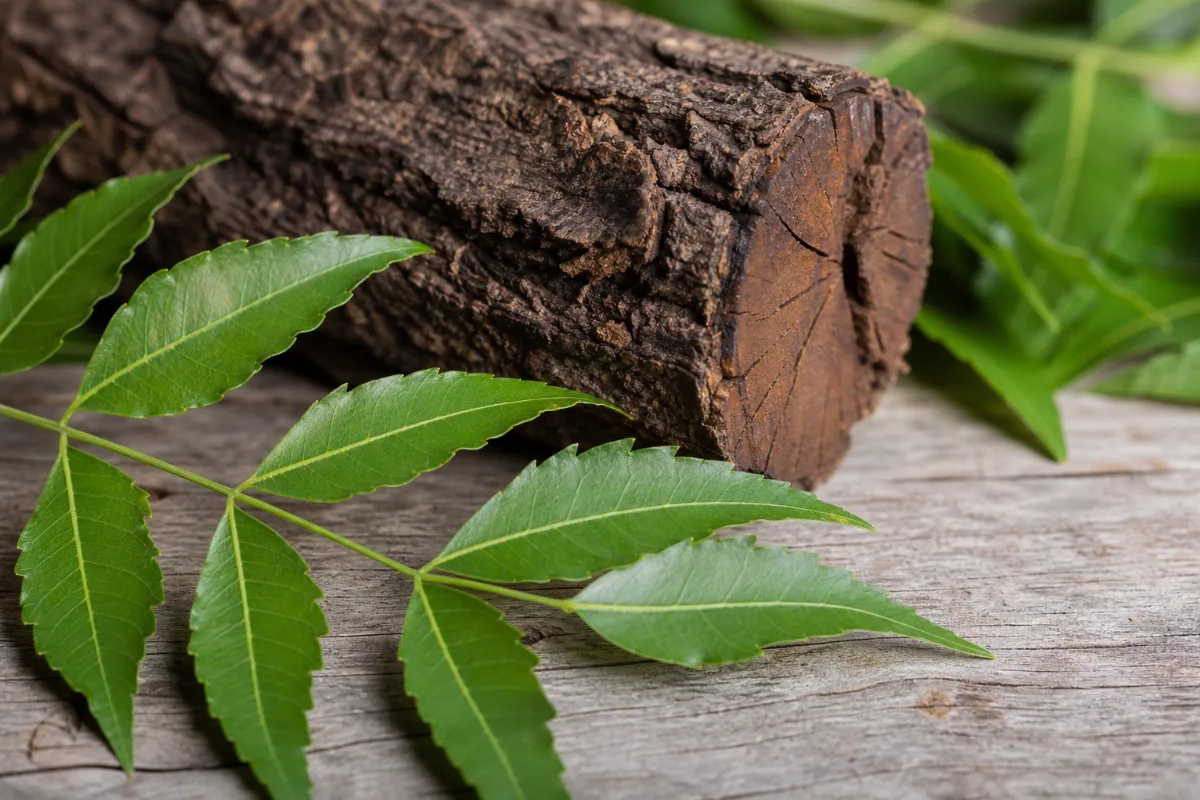
Herbs & Botanicals · Herbs · Tree used in South Asian medicine, with only low-certainty evidence for any use and a serious warning about swallowed oil
Neem
Azadirachta indica A.Juss. · also called Neem, margosa (oil), nim
Neem is a tree in the mahogany family. Its leaf, twig, seed oil and bark are used in traditional medicine and in mouth, skin and supplement products. Swallowed seed oil is dangerous, especially for infants and children.
General information, not medical advice. Last substantive update · Not medically reviewed. A named clinician has not signed off on this page. How this page is made
About Neem
Neem (Azadirachta indica) is a tree of South Asia whose leaf, twig, seed oil and bark are used in traditional medicine. The research is mostly small trials for mouth rinses and skin uses, one research group's blood sugar trials, and lab studies. Nothing is rated moderate or high. The seed oil is dangerous if swallowed and has poisoned infants and children.
What it is
Neem (Azadirachta indica A.Juss.) is a tree in the mahogany family (Meliaceae). Its accepted name was checked in GBIF and NCBI Taxonomy. Different parts are used: leaf and twig for extracts and rinses, seed oil (also called margosa oil) on the skin, and bark and flower in traditional remedies. This page keeps them separate because their safety is very different.
Neem seed oil is not the same thing as neem pesticide products, and a related tree, chinaberry (Melia azedarach), is a different plant.
Traditional and current uses
Research papers describe neem paste for scabies and skin ulcers in Ayurvedic and Siddha medicine, neem and coconut oil for sand fleas in Kenya, neem leaf decoctions for malaria in Ghana, and decades of use in Indian dentistry. Margosa oil has also been given by mouth to newborns in some communities, which has caused poisoning. These are traditional uses and are not proof of benefit.
Today neem is sold as mouth products, skin products, leaf capsules and teas, and seed oil.
What is in it and how it works
Neem contains limonoids such as azadirachtin (mainly in the seed), nimbolide (flower and leaf), nimbin and salannin, and other compounds such as gedunin and nimbidiol. Lab and animal work suggests anti-inflammatory, antibacterial and blood-sugar actions, but most of this has not been shown in people. The seed oil also acts on liver cell energy units (mitochondria), which is how it is thought to cause the Reye-like illness.
Purified compounds and whole extracts behave differently, so results from one cannot be applied to another.
What the research shows
Nothing about neem is rated above low certainty. Mouth rinses and gel (low), blood sugar with a leaf and twig extract (low) and mosquito repellent (low) have small trials. Scabies, head lice, acne, toothpaste, and immune markers in HIV are very low. The wound and sand-flea trials had mixed results. Malaria, contraception, hair loss, cancer and kidney work is lab or animal only (insufficient).
Plant part matters: the mouth, blood sugar and HIV studies used leaf, twig or mixed extracts; the repellent, lice shampoo and sand flea studies used seed oil or seed extract. Several products also mix neem with turmeric, hypericum or other herbs. For amounts, ask a doctor or pharmacist.
At a glance
Traditional uses history, not proof
- Ayurvedic and Siddha medicine: neem and turmeric paste for chronic ulcers and scabies (as described in a 1992 study).
- India, Sri Lanka, Malaysia and nearby countries: seed (margosa) oil used on the skin and sometimes given by mouth to babies, which has caused poisoning.
- Kenya: neem oil in coconut oil for sand flea infestation.
- Ghana: neem leaf decoctions for malaria.
- India: use in dentistry for several decades.
Studied for research
- Gum health and plaque (mouthrinse, gel), low
- Blood sugar in type 2 diabetes and metabolic syndrome (leaf and twig extract), low
- Mosquito repellent on skin, low
- Sand-flea skin infestation, mixed
- Wounds and radiation skin reactions (combination products), mixed
- Scabies, head lice, acne, toothpaste, immune markers in HIV, very low
- Malaria, contraception, dandruff and hair loss, cancer and kidney disease (lab or animal only), insufficient
Main compounds
- Azadirachtin, a limonoid mainly in the seed
- Nimbolide, a limonoid from flower and leaf
- Nimbin and salannin, other limonoids
- Gedunin and nimbidiol, other compounds with lab activity
- Fatty acids of the seed oil
Common forms
- Leaf and twig extracts and decoctions
- Seed oil (margosa oil)
- Mouth rinse, gel and toothpaste
- Skin pastes, face washes and shampoos
- Bark and flower in traditional remedies (no human trials found)
- Combination products with turmeric, hypericum or other herbs
Research links: LiverTox: Margosa Oil (US National Institutes of Health) · Systematic review of neem mouthrinse for plaque and gingivitis (PubMed) · Neem leaf and twig extract in type 2 diabetes, randomized trial (PubMed) · Margosa oil poisoning in infants, Lancet 1981 (PubMed) · GBIF: Azadirachta indica · Research Library · Genes & Biomarkers Library
The plant and its history
- Accepted scientific name
- Azadirachta indica
- Naming authority
- A.Juss.
- Synonyms
- Melia azadirachta (INCI cosmetic name 'Melia azadirachta seed oil' is cited in a case report)
- Common names
- Neem (English); Margosa (oil) (English); Nim oil (English)
- Botanical family
- Meliaceae (mahogany family)
- Classification
- Plantae > Tracheophyta > Magnoliopsida > Sapindales > Meliaceae > Azadirachta > Azadirachta indica
- Native range
- Not verified in this build (the papers describe it as an Indian medicinal plant widely used in South Asia and Africa).
- Habitat
- Not verified.
- What the plant looks like
- Roots: Not verified.; Stems: Not verified.; Leaves: Not verified.; Flowers: Not verified.; Fruit: Not verified.
- Cultivation
- Not verified.
- Harvest and processing
- Seed oil is described as obtained from the seed by cold pressing (case report); leaf and twig extracts in trials were aqueous or acetone-water.
- Look-alikes and adulterants
- Name: Melia azedarach (chinaberry, dharek); Note: A related tree in the same family (GBIF accepted, key 5914287). Its seed extract was also tested in rats alongside neem (PMID 15933789) and its oil in a mosquito repellent trial (PMID 25935845). Chinaberry is a different species and should not be assumed to share neem's safety data.
- Sustainability and conservation
- Not assessed.
Traditional use and history history, not clinical proof
| Tradition or era | Documented use | Source |
|---|---|---|
| Ayurvedic and Siddha medicine (India) | Paste of neem and turmeric for chronic ulcers and scabies | Charles V, Charles SX 1992 (PMID 1496714) |
| India, Sri Lanka, Burma, Thailand, Malaysia, Indonesia | Margosa oil used mainly externally but often given by mouth to newborns and infants in small amounts | Lai SM et al 1990 (PMID 2259944) |
| Kenya (coast) | Neem oil mixed with coconut oil for sand flea infestation of the feet | Elson L et al 2019 (PMID 31756189) |
| Ghana | Neem leaf decoctions for malaria and neem with Cryptolepis in herbal products | Korsah 2026 (PMID 42677102); Adoley 2026 (PMID 42017189) |
| India | Neem used for several decades in medicine and dentistry | Chatterjee 2011 introduction (PMID 22368367) |
| Regulation | EMA/HMPC monograph: not found. NCCIH page: not found (404). | Checked 2026-10-25; Wikipedia claims about neem history NOT verified and not used. |
Traditional use shows how a plant was used. It does not show that a supplement works or is safe today.
What is inside, and how it may work
What the plant contains and how those compounds act in cells and animals. Laboratory and animal mechanisms are not proven effects in people.
Main compounds
| Compound | Family | Where it is concentrated | Activity studied | Level of evidence |
|---|---|---|---|---|
| Azadirachtin PubChem 5281303 | Limonoid (tetranortriterpenoid) | Seed | Insect-harming compound; named as implicated in neem oil poisoning by one case report's authors (not proven). 31 12 39 | Case report authors' view; lab |
| Nimbolide PubChem 12313376 | Limonoid | Flower and leaf | Anti-inflammatory and anti-cancer effects in lab and animal studies. 48 40 | In vitro / animal |
| Nimbin PubChem 108058 | Limonoid | Not stated in sources read | Not described in the abstracts read. 41 | Identity only |
| Salannin PubChem 6437066 | Limonoid | Not stated in sources read | Not described in the abstracts read. 42 | Identity only |
| Gedunin PubChem 12004512 | Limonoid | Not stated in sources read | Studied in cancer stem cell work (a 2025 paper title); not read. 43 | Identity only |
| Nimbidiol PubChem 11334829 | Diterpenoid | Not stated in sources read | Blocks glucosidase enzymes; reduced kidney scarring in diabetic mice. 22 44 | Animal research |
| Fatty acids of the seed oil (margosa oil) | Long-chain fatty acid oil | Seed | Described as a fatty-acid-rich extract that uncouples mitochondria in rat liver tests. 24 54 | In vitro / animal |
Mechanisms, receptors and pathways
| Target or pathway | Gene or receptor | What was found | Level |
|---|---|---|---|
| Mitochondria (energy production) in liver | Not specified | Margosa oil uncoupled isolated rat liver mitochondria and lowered ATP; in mice it caused fatty liver like Reye's syndrome within hours. 24 54 | In vitro / animal |
| Sperm membrane | Not specified | NIM-76 made pores in human sperm heads in the lab; leaf extract killed human sperm in 20 seconds. 51 23 | Laboratory research |
| Blood sugar handling | GLUT4, intestinal glucosidases, Nrf2 | Reviewed animal and lab work reports raised GLUT4, blocked glucosidase and boosted antioxidant defences. Nimbidiol blocks glucosidase. 58 22 36 | Animal / review |
| Inflammatory and cancer signalling | NF-kB, MAPK, PI3K/AKT, Wnt/beta-catenin, TGF-beta, VEGF | Nimbolide modulates these pathways in lab studies. 48 | In vitro / animal (review) |
| Mouth bacteria | Not applicable | Neem gel lowered S. mutans and lactobacilli counts in people over 90 days, similar to chlorhexidine gel (no placebo group). 33 | Human data |
| Malaria parasite | Not specified | Neem extract slowed P. falciparum growth in culture; leaf extract reduced sticking of infected red cells to vessel cells in the lab. 25 57 | Laboratory research |
| Endothelial function and inflammation | IL-6, TNF-alpha | A leaf and twig extract improved vessel function and lowered inflammation markers in people with type 2 diabetes in one trial. 37 | Human data |
Absorption, metabolism and elimination
- Absorption
- No human absorption data were found for neem leaf extract, seed oil or its compounds in the sources read.
- Distribution
- Not found.
- Metabolism
- Not found.
- Elimination
- Not found.
- Bioavailability
- Not found.
Isolated compounds versus whole extracts
Whole extracts, fractions and purified compounds behave differently. The neem oil fraction NIM-76 kills sperm while avoiding the abortifacient (pregnancy-ending) effect of the whole oil, and combining neem with soapnut and mint oil made the spermicidal effect eight times stronger. A trial author notes that what neem does depends on the plant part, the extraction method and the solvent used. Evidence from purified compounds like nimbolide or nimbidiol (cells and mice) cannot be applied to neem tea, capsules or oil.
Nutritional composition
Neem is not studied as a nutrient source; no verified data on vitamins, minerals or calories were read for this profile.
2 mixed findings5 low certainty5 very low certainty4 not enough evidence
What was looked at
The 16 benefits and uses checked for Neem, each with how strong the evidence is. Tap one to open it.
- Gum health: neem mouthrinse for plaque and gingivitisLow certainty
- Plaque and mouth bacteria: neem gel versus chlorhexidine gelLow certainty
- Neem toothpaste for plaque and gum rednessVery low certainty
- Scabies: neem and turmeric pasteVery low certainty
- Head lice: neem seed extract shampooVery low certainty
- Sand-flea skin infestation (tungiasis): neem seed oil in coconut oilMixed findings
- Acne and oily skin: neem and turmeric face washVery low certainty
- Wounds and radiation skin reactions: hypericum plus neem oil productsMixed findings
- Dandruff and hair loss (lab only)Not enough evidence
- Blood sugar in type 2 diabetes (leaf and twig extract)Low certainty
- Metabolic syndrome: blood sugar and insulin resistanceLow certainty
- Malaria (lab and animal studies only)Not enough evidence
- Contraception and fertility (research on sperm and animals)Not enough evidence
- Immune markers in HIV (small uncontrolled studies)Very low certainty
- Mosquito repellent on skin (neem oil)Low certainty
- Cancer, kidney and other chronic diseases (lab and animal only)Not enough evidence
Lab markers tracked in the studies
Dental plaque indexGingival (gum) indexStreptococcus mutans countAcne lesion countsSkin oil (sebum) levelFasting blood sugarPost-meal blood sugarHbA1cInsulin resistanceBlood fats (lipid profile)CD4 cell countSperm movement (lab)
What is Neem good for?
The main proposed uses and how strong the human evidence is for each. "Low" means small or inconsistent studies, "very low" means a single small or unclear study, "mixed" means the results point different ways, and "insufficient" means not enough to judge, usually lab or animal work only. Nothing about neem is rated higher than low. Results come from specific extracts, rinses, oils and combination products and cannot be moved to other neem products or to other plant parts.
Benefits, one by one
Each card is a research question, not a promise. Tap a goal to filter. Open a card to see the studies, doses and limits.
Gum health: neem mouthrinse for plaque and gingivitis
Low certaintyRinsing with a neem mouthwash lowered plaque and gum redness in small trials, about as much as chlorhexidine, the standard antiseptic rinse. The trials are small and short and the reviewers call their quality weak.
4 studiesRinses of 2% to about 15 ml twice daily were used in the trials. Plan…
Studies, doses and limits
What the trials found
A systematic review (Dhingra 2017) found only three randomized trials of neem mouthrinse against chlorhexidine in people with gingivitis. It reported that neem rinse was as effective as chlorhexidine as an add-on to toothbrushing, did not pool the data because the trials differed, and called the evidence flawed with unclear risk of bias. Chatterjee 2011 (45 adults with gingivitis, 15 ml twice daily, neem versus chlorhexidine versus saline) found both rinses lowered gum, bleeding and plaque indices over 21 days compared with saline. Jalaluddin 2017 (40 adults, crossover, 2% neem rinse versus 0.2% chlorhexidine) found no significant difference between them on plaque, and gum scores fell in both. Dandekar 2020 (30 children, three groups) found plaque improved in neem, mango and chlorhexidine groups over 21 days; the mango rinse had better gum scores than neem.
Results
Neem rinses were reported as similar to chlorhexidine in these small trials. No trial shows neem is better than chlorhexidine, and long-term results are unknown.
Effect sizes as reported
No pooled numbers. Individual trials give mostly p-values only in the abstracts.
Why this rating
Several small trials point the same way, but a systematic review of them rated the quality as flawed with unclear risk of bias. The plant part and the strength of the products differ between trials. Certainty is low.
Form and dose studied
Rinses of 2% to about 15 ml twice daily were used in the trials. Plant part and extract details are mostly not stated in the abstracts. The trials were short (about 3 to 4 weeks).
Who was studied
Adults with mild gum inflammation and healthy students or children in India.
Limits
Small, short trials; abstracts give few numbers; no long-term data; chlorhexidine is the comparison, not placebo, in several. All came from one region and many from Indian dental colleges.
Why researchers looked
Neem has been used in India for decades in medicine and dentistry (per the trial authors), and researchers tested whether neem rinses can lower plaque and gum inflammation.
Traditional use
One trial report says neem has been used in India for several decades in medicine and dentistry. This is traditional use only and is not proof of benefit.
Proposed mechanism Preliminary mechanism
Neem extracts slowed the growth of mouth bacteria in lab tests, and some compounds are anti-inflammatory in lab work. Whether this explains the gum results in people has not been shown.
A proposed mechanism does not show that the effect happens in people.
No side effects were noted in the gel trial. One trial claims fewer side effects than chlorhexidine but gives no numbers in the abstract.
Plaque and mouth bacteria: neem gel versus chlorhexidine gel
Low certaintyIn 60 teachers a 2.5% neem gel lowered plaque, gum scores and mouth bacteria counts over 90 days, about the same as a 0.2% chlorhexidine gel. There was no placebo group.
1 studies2.5% neem gel for 90 days (frequency not stated in the abstract).
Studies, doses and limits
What the trials found
Nimbulkar 2020 randomized 60 school teachers aged 20 to 30 to 2.5% neem gel or 0.2% chlorhexidine gel for 90 days. Plaque, gingival scores and counts of S. mutans and lactobacilli all fell at day 30 and day 90 in both groups, with no difference between the gels. No side effects were reported for neem gel.
Results
Similar to chlorhexidine gel on all measures. Without a placebo or no-treatment group the trial cannot show how much of the change was caused by neem.
Effect sizes as reported
Within-group falls were significant (P < 0.05); between-group differences were not (P > 0.05).
Why this rating
One randomized trial of 60 healthy adults with no placebo group. Certainty is low.
Form and dose studied
2.5% neem gel for 90 days (frequency not stated in the abstract).
Who was studied
Healthy adults aged 20 to 30, India.
Limits
One small trial, no placebo, healthy adults, one setting.
Why researchers looked
Chlorhexidine can stain teeth and change taste with long use, so researchers wanted a plant-based option to compare.
Traditional use
The trial authors describe neem as a long-used plant in Indian dentistry; traditional use only.
Proposed mechanism Preliminary mechanism
Neem extract slows the growth of mouth bacteria such as Streptococcus mutans in lab cultures. The trial counted these bacteria in people.
A proposed mechanism does not show that the effect happens in people.
None reported in the trial.
Neem toothpaste for plaque and gum redness
Very low certaintyTwo small trials of toothpastes containing neem reported lower plaque and gum scores. One of them was a mix of four ingredients, so neem's own part cannot be judged.
2 studiesDaily toothbrushing; neem part and amount not stated.
Studies, doses and limits
What the trials found
Abhishek 2015 (30 dental students) found neem toothpaste gave lower plaque and gum scores than a control toothpaste, but the abstract gives no numbers or duration. Tadikonda 2017 tested a toothpaste with papain, bromelain, miswak and neem together in people wearing fixed braces for one month: plaque index 0.88 versus 1.17 and gum index 0.87 versus 1.14 compared with standard toothpaste (both p<0.001).
Results
Positive in both, but one is a four-ingredient mix and one is a 30-student trial with no numbers.
Effect sizes as reported
Tadikonda 2017: plaque 0.88 +/- 0.05 vs 1.17 +/- 0.05; gum 0.87 +/- 0.04 vs 1.14 +/- 0.04.
Why this rating
The trials are small or mix several ingredients, and the abstracts give little detail. Certainty is very low.
Form and dose studied
Daily toothbrushing; neem part and amount not stated.
Who was studied
Dental students; people with braces.
Limits
Combination product; very small trial; short duration; no information on long-term use.
Why researchers looked
Toothpaste is the easiest way to use neem in daily oral care, so it has been tested.
Traditional use
Neem use in Indian dentistry is described as long-standing by the trial authors; traditional use only.
Proposed mechanism Preliminary mechanism
Possible antibacterial and anti-inflammatory action in the mouth; not shown in these trials.
A proposed mechanism does not show that the effect happens in people.
Not reported.
Scabies: neem and turmeric paste
Very low certaintyOne 1992 pilot study from India reported that a paste of neem and turmeric cleared scabies in 97% of 814 people in 3 to 15 days. It had no control group and mixed two plants, so it cannot show that neem works.
2 studiesPaste of neem (part not stated) and turmeric, applied to the skin.
Studies, doses and limits
What the trials found
Charles 1992 treated 814 villagers with a paste of neem and turmeric and reported cure in 97% of cases within 3 to 15 days with no toxic reaction noticed. The authors themselves say more research is needed. A 2020 narrative review (Akram 2020) lists neem among plants proposed for scabies and says there are limited pre-clinical and clinical data.
Results
A 97% cure rate was reported, but there was no comparison group and no clear definition of cure.
Effect sizes as reported
97% reported cured within 3 to 15 days (no confidence interval).
Why this rating
One uncontrolled pilot study from 1992 using a two-plant mix. Certainty is very low.
Form and dose studied
Paste of neem (part not stated) and turmeric, applied to the skin.
Who was studied
People with scabies in villages in India.
Limits
No control group; unclear definition of cure; two plants; old study; not repeated in modern trials I could find.
Why researchers looked
Scabies is an itchy skin infestation by a mite, and neem and turmeric pastes are a village remedy in India.
Traditional use
The authors write that neem and turmeric have been used in Ayurvedic and Siddha medicine for chronic ulcers and scabies. This is traditional use.
Proposed mechanism Pharmacological theory
Neem compounds are toxic to some insects and mites in lab tests; not shown for human scabies in this pilot.
A proposed mechanism does not show that the effect happens in people.
Applied to skin. Neem oil can cause contact allergy (see the Safety tab).
Head lice: neem seed extract shampoo
Very low certaintyA single uncontrolled study in 60 Egyptian children reported that a neem seed extract shampoo was highly effective against head lice and caused no skin irritation. There was no comparison group.
1 studiesNeem seed extract shampoo, 20 to 30 ml per wash, left on for 5 to 30 …
Studies, doses and limits
What the trials found
Abdel-Ghaffar 2007 treated 60 heavily infested children aged 4 to 15 with the shampoo left on 5 to 30 minutes. It reported the shampoo highly effective against all stages of lice with no difference between 10, 15 and 30 minutes, and no irritation. The abstract gives no kill percentages.
Results
Reported as highly effective, but without numbers or a control group.
Effect sizes as reported
No numbers in the abstract.
Why this rating
One uncontrolled study from 2007 with no numbers in the abstract. Certainty is very low.
Form and dose studied
Neem seed extract shampoo, 20 to 30 ml per wash, left on for 5 to 30 minutes.
Who was studied
Children aged 4 to 15, Egypt.
Limits
No control group; no efficacy numbers; one study.
Why researchers looked
Head lice are becoming resistant to common treatments, so plant-based products are tested.
Traditional use
Neem seed products are used against insects in traditional agriculture and household remedies; I did not verify a specific tradition for lice.
Proposed mechanism Pharmacological theory
Neem seed compounds such as azadirachtin harm insects in the lab.
A proposed mechanism does not show that the effect happens in people.
No irritation reported in the study. Do not give neem oil by mouth.
Sand-flea skin infestation (tungiasis): neem seed oil in coconut oil
Mixed findingsIn 96 Kenyan children a neem and coconut oil mix did not kill more sand fleas than the standard foot bath, but it led to less skin damage and more children free of pain.
1 studies20% neem seed oil in coconut oil on the feet; frequency not stated in…
Studies, doses and limits
What the trials found
Elson 2019 randomized 96 children aged 6 to 14 to 20% neem seed oil in coconut oil or a 0.05% potassium permanganate foot bath. About 40% of embedded fleas were killed within 6 days with no difference between treatments (the main goal was not met). The neem mix did better on secondary outcomes: odds of fleas ageing abnormally 3.4 (95% CI 1.22 to 9.49), less acute skin damage (p<0.005), and odds of being pain free 3.5 (p=0.001).
Results
Mixed. The main aim (killing fleas) was not better than the comparison. Secondary outcomes were better.
Effect sizes as reported
Abnormal flea ageing OR 3.4 (95% CI 1.22 to 9.49, p=0.019); pain free OR 3.5 (p=0.001).
Why this rating
A randomized trial where the primary outcome was not met but secondary outcomes were better. Certainty is mixed.
Form and dose studied
20% neem seed oil in coconut oil on the feet; frequency not stated in the abstract.
Who was studied
Children aged 6 to 14, coastal Kenya.
Limits
Proof-of-principle trial; compared with a standard that was itself weak; secondary outcomes only; external use only.
Why researchers looked
Tungiasis is a painful skin disease of poorer communities with few safe home treatments, and neem and coconut oil is used traditionally.
Traditional use
The authors describe the mix as traditionally used and readily available in coastal Kenya.
Proposed mechanism Preliminary mechanism
Neem seed oil may disturb flea development; not proven in people.
A proposed mechanism does not show that the effect happens in people.
Applied to skin only; no safety problem was highlighted in the abstract.
Acne and oily skin: neem and turmeric face wash
Very low certaintyIn a four-week open study of 120 adults, a neem and turmeric face wash was linked with fewer pimples and less skin oil. There was no comparison group and one author works for the maker.
1 studiesA commercial neem and turmeric face wash for four weeks.
Studies, doses and limits
What the trials found
Rajaiah Yogesh 2022 followed 120 adults with mild-to-moderate acne or oily skin using the Purifying Neem Face Wash (neem and turmeric) for four weeks. At visits 3 and 4, 79% and 72% showed fewer or no new inflammatory and non-inflammatory lesions, sebum fell and hydration rose (p<0.001). The study was open-label with no control group and one author is an employee of the maker.
Results
Positive, but the design cannot separate the product from natural improvement or the effect of face washing itself.
Effect sizes as reported
79% inflammatory and 72% non-inflammatory lesions reduced or no new lesions at visits 3 and 4.
Why this rating
Open-label, single-arm, industry-linked, short, and a two-ingredient product. Certainty is very low.
Form and dose studied
A commercial neem and turmeric face wash for four weeks.
Who was studied
Adults with mild-to-moderate acne or oily skin, India.
Limits
No control group; industry-linked; short; includes some people without acne.
Why researchers looked
Neem is a common ingredient in skin products for oily or acne-prone skin.
Traditional use
Neem leaf and oil are widely used in South Asian skin care; I did not verify a specific tradition from a source.
Proposed mechanism Preliminary mechanism
Neem has antibacterial and anti-inflammatory activity in lab tests; not shown in this study.
A proposed mechanism does not show that the effect happens in people.
Face wash; no side effects reported in the abstract. Neem oil can cause contact allergy.
Wounds and radiation skin reactions: hypericum plus neem oil products
Mixed findingsProducts that combine St John's wort (hypericum) with neem oil have been tested on opened surgical wounds and on skin burned by radiotherapy. Neem's own contribution cannot be separated, and the wound trial did not beat silver dressings on wound score.
2 studiesHypericum and neem oil dressing or ointment (commercial products); am…
Studies, doses and limits
What the trials found
Arena 2022 randomized 99 patients with opened-up surgical wounds to a hypericum and neem oil dressing or silver dressings for 28 days. The overall wound score was similar (p=0.81), and pain was lower with the hypericum and neem dressing (p<0.0001). Franco 2014 followed 28 head-and-neck cancer patients using Holoil on radiation skin damage; the worst skin reaction was grade 2 in 68% and grade 3 in 25%, with no comparison group.
Results
Mixed. Wound score was not better than silver; pain was lower; the radiation study had no control group.
Effect sizes as reported
Wound score t=0.23, p=0.81; pain reduction p<0.0001.
Why this rating
One randomized trial with a null main result and a better pain score, one uncontrolled study, both of a two-ingredient product. Certainty is mixed.
Form and dose studied
Hypericum and neem oil dressing or ointment (commercial products); amounts not stated in the abstracts.
Who was studied
Post-surgical wound patients and head and neck cancer patients, Italy.
Limits
Combination product; single-blinded, so patients may have known which dressing they had; no placebo.
Why researchers looked
Neem oil has been used on wounds, and a commercial hypericum and neem oil product was tested in cancer and surgical care.
Traditional use
Neem oil on wounds is a traditional use in South Asia; traditional use only.
Proposed mechanism Preliminary mechanism
Anti-inflammatory and antibacterial action in lab tests; not shown here.
A proposed mechanism does not show that the effect happens in people.
Used on skin; do not swallow neem oil.
Dandruff and hair loss (lab only)
Not enough evidenceA rosemary and neem extract beat standard antifungal and hair-growth drugs in lab tests, but there is no human trial.
1 studiesNot applicable.
Studies, doses and limits
What the trials found
Hashem 2024 is a lab and animal-model study of a rosemary and neem extract (2:1) hair gel and tonic. It reports better results than ketoconazole against two scalp fungi and than minoxidil in a hair-growth model. No people were tested.
Results
No human result.
Why this rating
Lab and animal-model only with a two-plant extract. Certainty is insufficient.
Limits
No human data; two-plant extract.
Why researchers looked
Lab work on a hair gel and tonic.
Traditional use
No tradition verified.
Proposed mechanism Laboratory research
The combined extract blocked scalp fungi in the lab and was anti-inflammatory in lab tests.
A proposed mechanism does not show that the effect happens in people.
Contact allergy to neem oil on the scalp has been reported (see Safety).
Blood sugar in type 2 diabetes (leaf and twig extract)
Low certaintyIn one 12-week trial of 80 people with type 2 diabetes who already took metformin, a standardised neem leaf and twig extract lowered blood sugar, HbA1c and insulin resistance more than placebo. It is a small trial from one research group and has not been repeated.
3 studiesStandardised aqueous leaf and twig extract, 125 to 500 mg twice daily…
Studies, doses and limits
What the trials found
Pingali 2020 randomized 80 adults with type 2 diabetes on metformin to 125, 250 or 500 mg of a standardised aqueous neem leaf and twig extract (named NEEM) twice daily or placebo for 12 weeks. All doses lowered post-meal blood sugar, fasting blood sugar, HbA1c and insulin resistance versus placebo, with the largest drops at 500 mg twice daily. It also improved vessel function and lowered inflammation markers, but had no effect on platelet clumping or blood fats. Reviews (Patil 2022; Yarmohammadi 2021) summarise mainly animal and lab studies and call for clinical testing.
Results
Positive in one placebo-controlled trial. At 500 mg twice daily: post-meal sugar 205.9 to 159.3 mg/dL, fasting 120.7 to 97.3 mg/dL, HbA1c 7.78% to 6.26%.
Effect sizes as reported
Pingali 2020 (500 mg twice daily group): PPBS 205.9 to 159.3 mg/dL; FBS 120.7 to 97.3 mg/dL; HbA1c 7.78% to 6.26% (placebo-group values not given in the abstract).
Why this rating
One placebo-controlled randomized trial of about 20 people per group for 12 weeks from one research group, an unreplicated finding on top of metformin. Reviews are of preclinical work. Certainty is low.
Form and dose studied
Standardised aqueous leaf and twig extract, 125 to 500 mg twice daily for 12 weeks. A named extract; results do not apply to teas, powders or seed oil.
Who was studied
Adults with type 2 diabetes already taking metformin, India.
Limits
Small, 12 weeks, one research group, a specific extract, no long-term or heart/kidney outcomes. Not tested without metformin. Placebo group values not in the abstract.
Why researchers looked
Neem has been reported to lower blood sugar in animals, so a placebo-controlled trial was run in people with diabetes.
Traditional use
Neem leaf is used in South Asian folk medicine for diabetes; I did not verify a specific source beyond the reviews cited, so this is stated as traditional use only.
Proposed mechanism Preliminary mechanism
Animal and lab work reports that neem extracts block starch-digesting enzymes, raise a glucose transporter (GLUT4) and boost antioxidant defences. A neem compound, nimbidiol, blocks glucosidase enzymes in lab work. None of this has been shown to explain the human results.
A proposed mechanism does not show that the effect happens in people.
Neem may lower blood sugar further when combined with diabetes medicines. See the Safety tab.
Metabolic syndrome: blood sugar and insulin resistance
Low certaintyA second small 12-week trial of the same neem extract in 80 people with metabolic syndrome reported better blood sugar, insulin resistance and HbA1c, in a dose-related way. It came from the same research group, so it is not fully independent.
1 studiesStandardised aqueous leaf and twig extract, 125 to 500 mg twice daily.
Studies, doses and limits
What the trials found
Pingali 2021 randomized people with metabolic syndrome to placebo or 125, 250 or 500 mg of the NEEM extract twice daily (20 per group) for 12 weeks. Fasting and post-meal blood sugar, insulin resistance and HbA1c improved in a dose-related way, as did vessel function and most inflammation and oxidative stress markers. The abstract gives no numbers.
Results
Positive in a small trial. The abstract gives no numbers.
Effect sizes as reported
Numbers not given in the abstract.
Why this rating
One small randomized trial, 12 weeks, abstract without numbers, same group and extract as the diabetes trial. Certainty is low.
Form and dose studied
Standardised aqueous leaf and twig extract, 125 to 500 mg twice daily.
Who was studied
Adults with metabolic syndrome, India.
Limits
Small, short, one group, no hard outcomes.
Why researchers looked
Metabolic syndrome is a cluster of high blood sugar, blood pressure and blood fats; neem has been reported to help the blood sugar part in animals.
Traditional use
Traditional use only; no source verified.
Proposed mechanism Preliminary mechanism
Same proposed pathways as above (glucose uptake, enzyme blocking, antioxidant); animal and lab work only.
A proposed mechanism does not show that the effect happens in people.
See the blood sugar drug warning on the Safety tab.
Malaria (lab and animal studies only)
Not enough evidenceNeem leaf is widely used as a home remedy for malaria in parts of Africa and South Asia, but no good human trial shows it treats or prevents malaria. Lab and mouse studies show some activity. Neem is not a substitute for malaria medicine.
3 studiesNot applicable; no human dose established.
Studies, doses and limits
What the trials found
I found no randomized trial of neem for malaria in people. A 2026 lab study (Korsah) found aqueous neem extract active against two P. falciparum strains (IC50 at or below 10 micrograms/mL), and stronger together with another plant. Adoley 2026 made neem leaf capsules and found activity in culture (IC50 2.74 micrograms/mL). Brou 2026 gave a neem, lemongrass and guava mix to infected mice and cut parasites by 76% at 90 mg/kg versus 92% for hydroxychloroquine, with no toxicity signs in rats. None of these involved patients.
Results
No human efficacy data. Lab and mouse activity only.
Effect sizes as reported
IC50 values only (lab). 76% parasite reduction in mice with a three-plant mix.
Why this rating
No human trial found; only lab and mouse studies. Certainty is insufficient.
Limits
No human data; lab activity often does not lead to a treatment; mixed plant extracts cannot be assigned to neem alone.
Why researchers looked
Plants used in traditional malaria remedies are tested against the parasite in the lab.
Traditional use
The reviews and lab papers cite neem leaf decoctions as a traditional malaria remedy in Ghana and West Africa. Traditional use only.
Proposed mechanism Laboratory research
Neem extracts slowed growth of the malaria parasite Plasmodium falciparum in culture, including a chloroquine-resistant strain. A three-plant mix reduced parasites in mice.
A proposed mechanism does not show that the effect happens in people.
Delaying proper malaria treatment is dangerous. See a clinic for fever in malaria areas.
Contraception and fertility (research on sperm and animals)
Not enough evidenceNeem leaf and seed oil extracts stop and kill human sperm in the test tube, and neem has reduced fertility in animals. No trial shows that neem prevents pregnancy in women or men. Swallowing neem is not a safe or tested birth control method.
6 studiesNot applicable; no tested dose for contraception.
Studies, doses and limits
What the trials found
Khillare 2003 found aqueous neem leaf extract stopped all human sperm moving and killed them within 20 seconds at about 3 mg per million sperm. Sharma 1996 reported that NIM-76 from neem oil reduced sperm movement and made pores in the sperm head. Raghuvanshi 2001 tested a vaginal pessary combining neem leaf extract, soapnut and mint oil: it killed human sperm, blocked sperm entering cervical mucus in most women in post-coital tests, and prevented pregnancy in 15 rabbits (13 of 15 controls became pregnant). Joshi 2005, a 14-day safety study of a similar tablet in 20 women, found genital irritation in 9 (45%) and no serious adverse events. Patil 2021 reviewed 27 mostly animal studies and noted a dearth of clinical studies. Roop 2005 reported that neem seed extracts sharply cut ovarian follicle numbers in rats.
Results
No efficacy trial of contraception in people. Lab sperm killing and animal findings only; a combination vaginal product has early safety data.
Effect sizes as reported
Spermicidal concentration about 2.75 to 2.91 mg per million sperm (lab). 13 of 15 control rabbits pregnant.
Why this rating
No human pregnancy-prevention trial exists. Lab, rabbit and short post-coital tests only. Certainty is insufficient.
Limits
No clinical trials of contraceptive efficacy; products are combinations; doses in animals are not applicable to people.
Why researchers looked
Neem has long been reported in India to reduce fertility, so scientists tested its effect on sperm and developed vaginal products.
Traditional use
Neem is reported in India as a traditional antifertility plant; traditional use only.
Proposed mechanism Laboratory research
Neem leaf extract and an oil fraction (NIM-76) kill human sperm in the test tube, in the oil fraction by damaging the sperm cell membrane. In rats, neem seed extract strongly reduced ovarian follicles. A review of animal studies reports temporary, reversible contraceptive activity.
A proposed mechanism does not show that the effect happens in people.
Neem may reduce fertility. People trying to conceive and pregnant women should avoid oral neem products. See the Safety tab.
Immune markers in HIV (small uncontrolled studies)
Very low certaintyTwo small uncontrolled studies from one Nigerian group reported higher CD4 immune cell counts in people with HIV after 12 weeks of a neem leaf extract. They had no control group and neem is not a treatment for HIV.
2 studiesAcetone-water leaf extract (IRAB), 1 g daily; not the same as tea or …
Studies, doses and limits
What the trials found
Mbah 2007 gave 60 untreated adults with HIV/AIDS 1 g a day of an acetone-water neem leaf extract (IRAB) for 12 weeks. Mean CD4 rose by 266 cells/microL; no adverse effects and no abnormal kidney or liver tests were reported. Udeinya 2004 treated 10 patients with 1000 mg daily for 30 days: mean CD4 rose from 126 to 241 cells/microL; the same paper includes lab results. Neither study had a control group.
Results
CD4 counts rose in single-arm studies; no placebo-controlled trial.
Effect sizes as reported
CD4 +266 cells/microL (P<0.001) in 50 of 60 people; 126 to 241 cells/microL in 10 people.
Why this rating
Two uncontrolled studies from one group; viral load is not reported in the abstract. Certainty is very low.
Form and dose studied
Acetone-water leaf extract (IRAB), 1 g daily; not the same as tea or powder.
Who was studied
Adults with HIV/AIDS, Nigeria.
Limits
No control group; one research group; one specific extract; no viral load.
Why researchers looked
A neem leaf extract that showed antimalarial activity was checked for effects on immune cells in HIV.
Traditional use
No tradition verified.
Proposed mechanism Laboratory research
In the lab the extract reduced sticking of infected red cells and protected lymphocytes from HIV invasion.
A proposed mechanism does not show that the effect happens in people.
People on HIV medicines or immune-suppressing drugs should discuss neem with a doctor.
Mosquito repellent on skin (neem oil)
Low certaintyIn a six-volunteer field test in Ethiopia, 20% neem oil kept more than 70% of malaria mosquitoes off for about 3 hours, much less than DEET.
1 studies20% neem oil on the skin.
Studies, doses and limits
What the trials found
Abiy 2015 compared DEET, p-menthane-diol, 20% neem oil and 20% chinaberry oil on six volunteers in a Latin square. DEET and p-menthane-diol gave over 96% protection (DEET for 8 hours). Neem oil gave over 70% with complete protection for about 3 hours.
Results
Moderate repellency for a short time, weaker than DEET.
Effect sizes as reported
Neem more than 70% protection, 3 hours complete protection; DEET more than 96%, 8 hours.
Why this rating
One small field trial of six volunteers. Certainty is low.
Form and dose studied
20% neem oil on the skin.
Who was studied
Six adult volunteers, Ethiopia.
Limits
Tiny trial; short protection time.
Why researchers looked
Neem oil is promoted as a plant-based repellent.
Traditional use
Neem products are traditionally used against insects; no source verified for this use.
Proposed mechanism Pharmacological theory
Neem oil compounds repel or harm insects in lab studies.
A proposed mechanism does not show that the effect happens in people.
Skin contact allergy to neem oil exists. Never swallow neem oil.
Cancer, kidney and other chronic diseases (lab and animal only)
Not enough evidenceNeem compounds such as nimbolide and nimbidiol are being studied for cancer and kidney disease, but only in cells and animals. No human trial shows a benefit.
2 studiesNot applicable.
Studies, doses and limits
What the trials found
Rajendran 2024 reviewed lab and animal studies of nimbolide and called it promising for chronic disease, including cancer. Juin 2022 found nimbidiol (0.40 mg/kg/day for 8 weeks) reduced kidney scarring in type 1 diabetic mice. No human trials were found.
Results
No human result.
Why this rating
Lab and mouse studies only. Certainty is insufficient.
Limits
No human data; purified compounds are not the same as neem products.
Why researchers looked
Purified neem compounds act on many cell-signalling pathways in the lab.
Traditional use
No tradition verified.
Proposed mechanism Laboratory research
Nimbolide affects NF-kB, MAPK, PI3K/AKT and Wnt pathways in lab studies. Nimbidiol reduced kidney scarring in diabetic mice.
A proposed mechanism does not show that the effect happens in people.
None.
Connections to the rest of health
How Neem connects to the rest of our health knowledge graph. Every link says what kind of connection it is. A safety link (for example to the liver) is a warning, not a benefit. A study that merely mentions a topic never creates a benefit link.
Explore every connection: goals, body systems, organs, symptoms, genes
A. Wellness goals
| Connected to | Kind of connection | Evidence status | Context | Studies |
|---|---|---|---|---|
| Blood sugar balance | Potential benefit | Low certainty | Two small placebo-controlled trials from one group; neem may add to diabetes drugs. Blood sugar in type 2 diabetes (leaf and twig extract): In one 12-week trial of 80 people with type 2 diabetes who already took metformin, a standardised neem leaf and twig extract lowered blood sugar, HbA1c and insulin resistance more than placebo. It is a small trial from one research group and has not been repeated. Preparation or compound: Neem leaf and twig extract |
37 38 36 58 |
| Healthy skin | Potential benefit | Very low certainty | Uncontrolled studies for scabies, lice and acne; mixed results for sand fleas and wounds. Head lice: neem seed extract shampoo: A single uncontrolled study in 60 Egyptian children reported that a neem seed extract shampoo was highly effective against head lice and caused no skin irritation. There was no comparison group. Preparation or compound: Neem paste, seed oil, face wash |
10 1 16 47 6 17 |
| Healthy Skin | Traditional use | Very low certainty | Scabies: neem and turmeric paste: One 1992 pilot study from India reported that a paste of neem and turmeric cleared scabies in 97% of 814 people in 3 to 15 days. It had no control group and mixed two plants, so it cannot show that neem works. | 10 5 |
| Healthy Skin | Demonstrated clinical effect | Mixed findings | Sand-flea skin infestation (tungiasis): neem seed oil in coconut oil: In 96 Kenyan children a neem and coconut oil mix did not kill more sand fleas than the standard foot bath, but it led to less skin damage and more children free of pain. | 16 |
| Hair Support | Preliminary mechanism | Not enough evidence | Dandruff and hair loss (lab only): A rosemary and neem extract beat standard antifungal and hair-growth drugs in lab tests, but there is no human trial. | 19 |
| Metabolic Health | Potential benefit | Low certainty | Blood sugar in type 2 diabetes (leaf and twig extract): In one 12-week trial of 80 people with type 2 diabetes who already took metformin, a standardised neem leaf and twig extract lowered blood sugar, HbA1c and insulin resistance more than placebo. It is a small trial from one research group and has not been repeated. Metabolic syndrome: blood sugar and insulin resistance: A second small 12-week trial of the same neem extract in 80 people with metabolic syndrome reported better blood sugar, insulin resistance and HbA1c, in a dose-related way. It came from the same research group, so it is not fully independent. | 37 36 58 38 |
| Fertility Support | Preliminary mechanism | Not enough evidence | Contraception and fertility (research on sperm and animals): Neem leaf and seed oil extracts stop and kill human sperm in the test tube, and neem has reduced fertility in animals. No trial shows that neem prevents pregnancy in women or men. Swallowing neem is not a safe or tested birth control method. | 23 51 45 21 35 50 |
| Immune Support | Potential benefit | Very low certainty | Immune markers in HIV (small uncontrolled studies): Two small uncontrolled studies from one Nigerian group reported higher CD4 immune cell counts in people with HIV after 12 weeks of a neem leaf extract. They had no control group and neem is not a treatment for HIV. | 29 57 |
B. Body systems
| Connected to | Kind of connection | Evidence status | Context | Studies |
|---|---|---|---|---|
| Reproductive system | Contraindication | Not enough evidence | Avoid in pregnancy and when trying to conceive. Preparation or compound: Neem extracts |
12 35 |
| Immune system | Drug or supplement interaction | Not enough evidence | Possible opposition to immunosuppressant drugs (theory); no study. Preparation or compound: Neem leaf extract |
29 57 |
| Digestive System | Biological association | Low certainty | Studied for: Gum health: neem mouthrinse for plaque and gingivitis Studied for: Plaque and mouth bacteria: neem gel versus chlorhexidine gel | 14 11 20 13 33 2 56 |
| Integumentary System | Biological association | Very low certainty | Studied for: Scabies: neem and turmeric paste Studied for: Head lice: neem seed extract shampoo | 10 5 1 16 47 6 17 19 3 |
| Endocrine System | Biological association | Low certainty | Studied for: Blood sugar in type 2 diabetes (leaf and twig extract) Studied for: Metabolic syndrome: blood sugar and insulin resistance | 37 36 58 38 48 22 |
| Metabolism Weight | Biological association | Low certainty | Studied for: Blood sugar in type 2 diabetes (leaf and twig extract) Studied for: Metabolic syndrome: blood sugar and insulin resistance | 37 36 58 38 |
| Immune System | Biological association | Not enough evidence | Studied for: Malaria (lab and animal studies only) Studied for: Immune markers in HIV (small uncontrolled studies) | 25 4 9 29 57 |
| Reproductive System | Biological association | Not enough evidence | Studied for: Contraception and fertility (research on sperm and animals) | 23 51 45 21 35 50 |
C. Body parts and organs
| Connected to | Kind of connection | Evidence status | Context | Studies |
|---|---|---|---|---|
| Liver | Adverse effect or risk | Low certainty | Fatty liver and Reye-like illness in infants; rare liver and multi-organ failure in LiverTox. Preparation or compound: Neem seed oil (margosa oil) swallowed |
52 28 54 |
| Kidneys | Adverse effect or risk | Low certainty | Kidney failure and fatty kidney tubes reported in poisoning cases. Preparation or compound: Neem seed oil swallowed |
30 52 |
| Brain | Adverse effect or risk | Low certainty | Encephalopathy, seizures and vision loss in case reports. Preparation or compound: Neem seed oil swallowed |
27 55 |
| Reproductive organs | Adverse effect or risk | Not enough evidence | Spermicidal in the lab and fertility-reducing in animals; no human trials. Preparation or compound: Neem leaf and seed extracts |
23 35 50 |
| Skin | Adverse effect or risk | Low certainty | Contact allergy and rash in case reports. Preparation or compound: Neem oil on skin |
59 49 34 |
I. Biomarkers
| Connected to | Kind of connection | Evidence status | Context | Studies |
|---|---|---|---|---|
| Blood glucose | Drug or supplement interaction | Low certainty | Lowered blood sugar on top of metformin; possible added effect with diabetes drugs. Preparation or compound: Neem leaf and twig extract |
37 |
| Dental plaque index | Biological association | Low certainty | Measured in trials: lowered. A lab change is not the same as a health benefit. | 33 56 20 14 |
| Gingival (gum) index | Biological association | Low certainty | Measured in trials: lowered. A lab change is not the same as a health benefit. | 11 13 14 |
| Streptococcus mutans count | Biological association | Low certainty | Measured in trials: lowered. A lab change is not the same as a health benefit. | 33 |
| Acne lesion counts | Biological association | Very low certainty | Measured in trials: lowered. A lab change is not the same as a health benefit. | 47 |
| Skin oil (sebum) level | Biological association | Very low certainty | Measured in trials: lowered. A lab change is not the same as a health benefit. | 47 |
| Fasting blood sugar | Biological association | Low certainty | Measured in trials: lowered. A lab change is not the same as a health benefit. | 37 38 |
| Post-meal blood sugar | Biological association | Low certainty | Measured in trials: lowered. A lab change is not the same as a health benefit. | 37 |
| HbA1c | Biological association | Low certainty | Measured in trials: lowered. A lab change is not the same as a health benefit. | 37 38 |
| Insulin resistance | Biological association | Low certainty | Measured in trials: lowered. A lab change is not the same as a health benefit. | 37 38 |
| Blood fats (lipid profile) | Biological association | Low certainty | Measured in trials: no-change. A lab change is not the same as a health benefit. | 37 |
| CD4 cell count | Biological association | Very low certainty | Measured in trials: raised. A lab change is not the same as a health benefit. | 29 57 |
| Sperm movement (lab) | Biological association | Not enough evidence | Measured in trials: lowered. A lab change is not the same as a health benefit. | 23 51 |
J. Genes, receptors and enzymes
| Connected to | Kind of connection | Evidence status | Context | Studies |
|---|---|---|---|---|
| GLUT4 (SLC2A4) | Preliminary mechanism | Animal / review | Up-regulated by neem in animal and lab studies per a review | 58 |
| Nrf2 (NFE2L2) | Preliminary mechanism | Animal / review | Over-expression proposed as a route for neem antioxidant and glucose effects (review of animal work) | 58 |
| Glucosidase (intestinal) | Preliminary mechanism | In vitro / animal | Blocked by nimbidiol and by neem extracts in lab work | 22 58 |
K. Biological pathways
L. Active compounds
| Connected to | Kind of connection | Evidence status | Context | Studies |
|---|---|---|---|---|
| Azadirachtin | Biological association | Case report authors' view; lab | Insect-harming compound; named as implicated in neem oil poisoning by one case report's authors (not proven). Preparation or compound: Seed |
31 12 39 |
| Nimbolide | Biological association | In vitro / animal | Anti-inflammatory and anti-cancer effects in lab and animal studies. Preparation or compound: Flower and leaf |
48 40 |
| Nimbin | Biological association | Identity only | Not described in the abstracts read. | 41 |
| Salannin | Biological association | Identity only | Not described in the abstracts read. | 42 |
| Gedunin | Biological association | Identity only | Studied in cancer stem cell work (a 2025 paper title); not read. | 43 |
| Nimbidiol | Biological association | Animal | Blocks glucosidase enzymes; reduced kidney scarring in diabetic mice. | 22 44 |
| Fatty acids of the seed oil (margosa oil) | Biological association | In vitro / animal | Described as a fatty-acid-rich extract that uncouples mitochondria in rat liver tests. Preparation or compound: Seed |
24 54 |
Each connection is stored with the ingredient, the connected record, the kind of connection, the evidence status, the supporting studies, the preparation or compound involved, and a review date (last reviewed October 25, 2026).
The evidence
The research centre for Neem. Every record here was checked against PubMed or the publisher's page; we never list a study we have not verified.
Evidence by outcome
Bars show how many studies we found for each outcome, not how well it works. People are added up across trials only (reviews are not added, to avoid double counting).
How we rate evidence
High certainty
Several well-run trials or reviews agree; further research is unlikely to change the picture much.
Moderate certainty
Good trials point the same way, but some doubt remains.
Low certainty
Small, short or inconsistent trials. The finding could change with better research.
Very low certainty
Very little or very weak human data. Treat as a possibility only.
Mixed findings
Trials or reviews disagree with each other.
Not enough evidence
Not enough human research to say either way.
Evidence against
Good research found no benefit, or found harm.
We take the reviewers' own risk-of-bias and GRADE statements where they exist, and otherwise judge from study size, design, consistency, directness and whether a product matches what is sold. Many publications do not make evidence high. Method note: We searched PubMed, read the LiverTox chapter on margosa oil as an abstract only, and checked the plant name in GBIF and NCBI Taxonomy and compounds in PubChem. Only abstracts were read for nearly all studies, and five case reports have a title only. Some sources were not verified: no EMA herbal monograph for neem was found by search and was not confirmed on the EMA site; the NCCIH has no neem page (it returned 404); LactMed has no neem record in our search; FDA, Commission E and WHO were not checked. Certainty ratings are the compiler's own reading, not formal grades. No study is cited that we could not verify.
Study library: every study we checked 59
| Study | Design | People | Product, dose, length | Result |
|---|---|---|---|---|
| Abdel-Ghaffar 2007 Efficacy of neem seed extract shampoo on head lice of naturally infected humans in Egypt. Parasitol Res · PMID 16900389 · DOI |
Clinical trial |
60 Children aged 4 to 15 with heavy head-lice infestation, Egypt |
Neem seed extract shampoo seed 20 to 30 ml shampoo, left on 5, 10, 15 or 30 minutes Single treatment |
The shampoo was reported highly effective against all lice stages, with no difference between 10, 15 and 30 minutes. No skin irritation, burning or redness. Numbers not given in the abstract. Methods, limits and fundingOutcomes: Lice killed; skin irritation Limitations: No control group, no kill percentages in the abstract, short follow-up, a single study. Read: abstract |
| Abhishek 2015 Effect of Neem containing Toothpaste on Plaque and Gingivitis--A Randomized Double Blind Clinical Trial. J Contemp Dent Pract · PMID 26718296 · DOI |
Controlled trial |
30 First-year dental students, India |
Neem-containing toothpaste (brand and neem part not stated) unspecified · vs Control toothpaste (not described in the abstract) |
A statistically significant difference between neem and control toothpaste after use for both plaque and gingival index. Numbers not given in the abstract. Methods, limits and fundingOutcomes: Silness-Loe plaque index and Loe-Silness gingival index Limitations: Only 30 students, not people with gum disease, no numbers in the abstract, duration not stated. Read: abstract |
| Abiy 2015 Repellent efficacy of DEET, MyggA, neem (Azedirachta indica) oil and chinaberry (Melia azedarach) oil against Anopheles arabiensis, the principal malaria vector in Ethiopia. Malar J · PMID 25935845 · DOI |
Other |
6 Six volunteers in a village field trial, Ethiopia |
20% neem oil applied to skin (as a mosquito repellent) seed oil 20% neem oil Dusk to dawn · vs DEET and p-menthane-diol; diluent oil; untreated |
Neem oil gave over 70% protection with full protection for about 3 hours. DEET gave over 96% protection for 8 hours. Neem >70% protection, 3 hours complete protection. Methods, limits and fundingOutcomes: Mosquito landings Limitations: Six volunteers; neem was weaker and shorter-lasting than DEET. Read: abstract |
| Adoley 2026 Formulation and Evaluation of Capsules From Azadirachta indica and Khaya senegalensis for Malaria Treatment. J Trop Med · PMID 42017189 · DOI |
Laboratory research in-vitro |
Lab capsule-making and parasite culture | Neem leaf decoction formulated into capsules leaf |
Capsules passed quality tests. The neem leaf product showed antiplasmodial activity (IC50 2.74 +/- 0.70 ug/mL) in culture. IC50 2.74 +/- 0.70 ug/mL Methods, limits and fundingOutcomes: Capsule quality, antiplasmodial activity in culture Limitations: Lab and pharmacy study only. No human or animal efficacy data. Read: abstract |
| Akram 2020 Therapeutic potential of medicinal plants for the management of scabies. Dermatol Ther · PMID 31830356 · DOI |
Narrative review |
Review of plants proposed for scabies | Neem (Azadirachta indica) among many plants unspecified Various Various · vs Various |
Lists neem among medicinal plants reviewed for scabies and states there is a lack of sufficient data because of limited pre-clinical trials. Not applicable. Methods, limits and fundingOutcomes: Scabies Limitations: Narrative review; limited data. Read: abstract |
| Arena 2022 Hypericum and neem oil for dehisced post-surgical wounds: a randomised, controlled, single-blinded phase III study. J Wound Care · PMID 35678785 · DOI |
Controlled trial |
99 Patients with opened-up surgical wounds with infection signs, Italy |
Hypericum and neem oil dressing (investigational combination product) seed oil (neem oil) plus hypericum Dressing (frequency not stated in the abstract) 28 days · vs Silver-based dressings |
Wound-score outcomes were similar to silver dressings. Pain was lower with the hypericum and neem dressing. Overall wound score t=0.23, p=0.81; pain reduction p<0.0001. Methods, limits and fundingOutcomes: Bates-Jensen wound score, pain Limitations: Single-blinded, combination product, comparator was another dressing not placebo, 97 of 99 finished. Pain finding comes from a patient-rated scale in an unblinded-to-patient design; the product is made by Kerecis AG per the abstract; funding is not stated in the abstract. Read: abstract |
| Bernaola 2020 Occupational allergic contact dermatitis to neem oil used in natural cosmetic. Contact Dermatitis · PMID 32043597 · DOI |
Case report |
Worker exposed to neem oil in a cosmetic | Neem oil seed oil Occupational |
Title reports occupational allergic contact dermatitis to neem oil in a natural cosmetic. No abstract available. Not available. Methods, limits and fundingOutcomes: Contact allergy Limitations: Only the title was available. Read: title-only |
| Bhaskar 2010 MR imaging findings of neem oil poisoning. AJNR Am J Neuroradiol · PMID 20448012 · DOI |
Case report |
Patient(s) with neem oil poisoning | Neem oil seed oil |
Letter on brain scan (MR) findings in neem oil poisoning. No abstract available. Not available. Methods, limits and fundingOutcomes: Brain scan findings Limitations: Only the title was available. Read: title-only |
| Brou 2026 Antimalarial potential and toxicity assessment of a polyherbal combination of Azadirachta indica A. Juss., Cymbopogon citratus (DC.) Stapf., and Psidium guajava L. in rodents. J Ethnopharmacol · PMID 41352469 · DOI |
Animal research animal |
Plasmodium berghei-infected mice; rats for toxicity | Polyherbal extract of neem, lemongrass and guava (combination) unspecified 30 to 120 mg/kg in mice 4-day cure test; 28 and 90-day toxicity · vs Hydroxychloroquine 25 mg/kg |
Combination extract cut parasites by 76% at 90 mg/kg versus 92% with hydroxychloroquine. No signs of toxicity in rats in 28 and 90-day tests. 76% inhibition at 90 mg/kg vs 92% for hydroxychloroquine. Methods, limits and fundingOutcomes: Parasite count, toxicity Limitations: Mouse study of a three-plant mixture. Not human evidence and not neem alone. Read: abstract |
| Charles 1992 The use and efficacy of Azadirachta indica ADR ('Neem') and Curcuma longa ('Turmeric') in scabies. A pilot study. Trop Geogr Med · PMID 1496714 |
Case series |
814 People with scabies in villages, India |
Paste of neem plus turmeric (Curcuma longa); neem part not stated unspecified Paste applied to skin (amount not stated) 3 to 15 days |
97 percent of cases were reported cured within 3 to 15 days. No toxic or adverse reaction was noticed. 97% reported cure (no confidence interval). Methods, limits and fundingOutcomes: Cure of scabies Limitations: Pilot study from 1992, no control group, no clear definition of cure in the abstract, a neem-plus-turmeric mixture, so neem alone cannot be judged. The authors themselves say more research is needed. Read: abstract |
| Chatterjee 2011 To evaluate the antigingivitis and antipalque effect of an Azadirachta indica (neem) mouthrinse on plaque induced gingivitis: A double-blind, randomized, controlled trial. J Indian Soc Periodontol · PMID 22368367 · DOI |
Controlled trial |
45 Adults with plaque-induced gingivitis, Bareilly, India |
Neem mouthrinse, 15 ml twice daily unspecified 15 ml twice daily 21 days to 1 month (readings weekly) · vs Chlorhexidine mouthrinse; saline rinse (placebo-like) |
Neem and chlorhexidine both reduced gingival, bleeding and plaque indices over 21 days compared with saline. Authors report neem was about as effective as chlorhexidine. Numbers not given in the abstract. Methods, limits and fundingOutcomes: Sulcus bleeding index, gingival index, plaque index Limitations: Small (15 per group), single centre, abstract gives no scores. The claim of 'fewer side effects' is not backed by numbers in the abstract. Funding and conflicts: Authors declare no conflict of interest Read: abstract |
| Dallaqua 2012 Treatment with Azadirachta indica in diabetic pregnant rats: negative effects on maternal outcome. J Ethnopharmacol · PMID 22921950 · DOI |
Animal research animal |
Pregnant rats, non-diabetic and mildly diabetic | Neem seed oil (1.2 mL/day) and azadirachtin (1 mg/mL/day) seed oil / azadirachtin By mouth throughout pregnancy Whole pregnancy · vs Untreated rats |
Neem oil and azadirachtin did not lower blood sugar and increased the share of small-for-age fetuses; they raised a marker of oxidative damage in non-diabetic rats. Not given in the abstract. Methods, limits and fundingOutcomes: Blood sugar, fetal growth, oxidative stress Limitations: Rat study only; but it is a pregnancy warning signal. Read: abstract |
| Dandekar 2020 Assessment of Antiplaque and Anti-Gingivitis Efficacy of Mouthwashes Prepared from Neem and Mango Extracts. Front Dent · PMID 35968157 · DOI |
Controlled trial |
30 Children, India; three parallel groups (neem, mango, chlorhexidine), n=30 in total as stated |
Neem twig-extract mouthwash (also mango twig mouthwash) twig Mouthwash made at the 25% extract level found effective in the lab test (frequency not stated in the abstract) 21 days · vs 0.2% chlorhexidine mouthwash |
All groups improved over 21 days; neem did not differ from mango on plaque. The mango mouthwash had better gingival scores than neem and chlorhexidine. Neem versus mango plaque difference P = 0.674; mango better on gingival index (P<0.001). Methods, limits and fundingOutcomes: Plaque index, gingival index, salivary pH, taste Limitations: Very small (30 children in three groups), no placebo, neem not better than mango on gums. In-lab MIC step is not clinical. Funding and conflicts: Authors declare no conflict of interest Read: abstract |
| Dhingra 2017 Effectiveness of Azadirachta indica (neem) mouthrinse in plaque and gingivitis control: a systematic review. Int J Dent Hyg · PMID 26876277 · DOI |
Systematic review |
3 Adults with gingivitis; three randomized trials of neem mouthrinse compared with chlorhexidine |
Neem-based herbal mouthrinse (products differ between trials) unspecified · vs Chlorhexidine mouthrinse |
Neem mouthrinse was as effective as chlorhexidine rinse as an add-on to toothbrushing in the three trials. No pooled analysis was done because the trials were too different. No pooled numbers (meta-analysis not done). Methods, limits and fundingOutcomes: Plaque and gingival inflammation Limitations: Only three trials; reporting and methods generally flawed, unclear risk of bias. The reviewers say the evidence is lacking and needs better trials. Read: abstract |
| Dhongade 2008 Neem oil poisoning. Indian Pediatr · PMID 18250509 |
Case report |
1 A previously healthy 5-year-old child |
Neem oil swallowed seed oil Single exposure |
Refractory seizures and metabolic acidosis; later hearing and vision problems and unsteady walking (ataxia). 1 child. Methods, limits and fundingOutcomes: Poisoning features Limitations: One case. Read: abstract |
| Elson 2019 Efficacy of a mixture of neem seed oil (Azadirachta indica) and coconut oil (Cocos nucifera) for topical treatment of tungiasis. A randomized controlled, proof-of-principle study. PLoS Negl Trop Dis · PMID 31756189 · DOI |
Controlled trial |
96 Children aged 6 to 14 with embedded sand fleas (tungiasis), coastal Kenya |
20% neem seed oil in coconut oil seed Mixture applied to the feet (frequency not stated in the abstract) Fleas watched for 6 days · vs 0.05% potassium permanganate foot bath |
The neem mixture killed about 40% of embedded fleas by day 6, no more than the standard foot bath. It was better for secondary outcomes (abnormal flea development, less skin damage, more children pain free). Odds of abnormal flea ageing 3.4 (95% CI 1.22 to 9.49, p=0.019); odds of being pain free 3.5 (p=0.001). Methods, limits and fundingOutcomes: Flea viability, abnormal flea development, pathology score, pain and itching Limitations: Proof-of-principle study, flea-kill was not better; the main outcome was not met. External use only; do not apply the results to swallowed oil. Funding and conflicts: Authors declare no competing interests Registration: PACTR201901905832601 Read: abstract |
| Franco 2014 Hypericum perforatum and neem oil for the management of acute skin toxicity in head and neck cancer patients undergoing radiation or chemo-radiation: a single-arm prospective observational study. Radiat Oncol · PMID 25544371 · DOI |
Observational |
28 Head and neck cancer patients having radiotherapy, Italy |
Holoil (hypericum plus neem oil; combination product) seed oil (neem oil) plus hypericum Applied to irritated skin during radiotherapy Through radiotherapy and recovery |
Worst skin reaction was grade 2 in 68% and grade 3 in 25%; all grade 3 reactions fell back to grade 2 (median 7 days). The authors call it safe and active but say a controlled trial is needed. Counts as stated in the abstract. Methods, limits and fundingOutcomes: Grade of radiation skin damage Limitations: No comparison group. Combination with St John's wort, so neem's own share is unknown. Cannot tell what happened without the product. Read: abstract |
| GBIF 2026 GBIF backbone match: Azadirachta indica A.Juss. (ACCEPTED, key 3190474) GBIF API · Source |
Authoritative guidance |
Not applicable | Azadirachta indica unspecified |
Accepted name Azadirachta indica A.Juss., family Meliaceae, order Sapindales. Methods, limits and fundingOutcomes: Reference record Limitations: Single database check. Read: summary-only |
| Hashem 2024 Rosemary and neem: an insight into their combined anti-dandruff and anti-hair loss efficacy. Sci Rep · PMID 38565924 · DOI |
Laboratory research in-vitro |
Lab fungi, tissue samples and animals (no human trial) | Combined rosemary and neem extract (2:1) in a hair gel and tonic unspecified · vs Ketoconazole, minoxidil |
Combined extract beat ketoconazole against two scalp fungi in the lab and beat minoxidil in a hair-growth model. No human result. Not applicable. Methods, limits and fundingOutcomes: Antifungal activity, hair growth in a lab model Limitations: Lab and animal-model only, combination extract, not a clinical trial. Read: abstract |
| Jalaluddin 2017 Comparative Evaluation of Neem Mouthwash on Plaque and Gingivitis: A Double-blind Crossover Study. J Contemp Dent Pract · PMID 28713109 · DOI |
Controlled trial |
40 Adults aged 18 to 35, India |
2% neem mouthwash unspecified 2% neem mouthwash versus 0.2% chlorhexidine; amount per rinse not stated in the abstract Two crossover phases separated by a 1-week washout (phase length not stated in the abstract) · vs 0.2% chlorhexidine gluconate |
Plaque fell slightly in both phases with no significant difference between neem and chlorhexidine. Gingival index fell in both groups. Between-group plaque difference not significant. Gingival index p-values are given for baseline versus after use (0.005 and 0.01). Methods, limits and fundingOutcomes: Plaque and gingival index Limitations: Small crossover trial, short, abstract gives few numbers, no placebo group, the 'reduction' wording is vague. Reported in a low-impact journal. Read: abstract |
| Joshi 2005 Phase I safety study of Praneem polyherbal vaginal tablet use among HIV-uninfected women in Pune, India. Trans R Soc Trop Med Hyg · PMID 16084547 · DOI |
Clinical trial |
20 HIV-negative women, Pune, India |
Praneem polyherbal vaginal tablet (neem-based combination) leaf (neem) plus other plants One tablet daily in the vagina 14 days |
Nine of 20 women (45%) had genital irritation, mostly itching (40%). Two had tiny bleeding spots on examination; no serious adverse events. Authors judged it safe for 14 days. 9/20 (45%) had irritation episodes. Methods, limits and fundingOutcomes: Safety Limitations: Tiny open-label safety study of a combination product. Not an efficacy trial. Read: abstract |
| Juin 2022 Glucosidase inhibitor, Nimbidiol ameliorates renal fibrosis and dysfunction in type-1 diabetes. Sci Rep · PMID 36522378 · DOI |
Animal research animal |
Type 1 diabetic mice | Nimbidiol (a neem compound) unspecified 0.40 mg/kg/day 8 weeks · vs Saline |
Nimbidiol reduced kidney scarring and improved kidney function in diabetic mice. Not given as a single number in the abstract. Methods, limits and fundingOutcomes: Kidney scarring and function Limitations: Mouse study of a purified compound, not neem as sold. Read: abstract |
| Khillare 2003 Spermicidal activity of Azadirachta indica (neem) leaf extract. Contraception · PMID 14561544 · DOI |
Laboratory research in-vitro |
Human sperm in the laboratory | Aqueous extract of neem leaves (old and tender) leaf About 2.75 to 2.91 mg per million sperm 20 seconds |
Both extracts stopped all human sperm moving and killed them within 20 seconds at about 3 mg per million sperm. Minimum effective concentration 2.91 +/- 0.669 (tender) and 2.75 +/- 0.754 (old) mg/million sperm. Methods, limits and fundingOutcomes: Sperm movement and survival Limitations: Test-tube only. Not a trial of contraception in people. Read: abstract |
| Koga 1987 Inhibition of mitochondrial functions by margosa oil: possible implications in the pathogenesis of Reye's syndrome. Pediatr Res · PMID 3658544 · DOI |
Laboratory research in-vitro |
Isolated rat liver mitochondria | Margosa oil seed oil |
Margosa oil acted as an uncoupler of mitochondria, lowering ATP; the effect was eased by coenzyme Q and carnitine in the test tube. Not applicable. Methods, limits and fundingOutcomes: Mitochondrial function Limitations: Test-tube study. Read: abstract |
| Korsah 2026 Synergistic Combination of Cryptolepis sanguinolenta (Lindl.) Schlechter (Apocynaceae) and Azadirachta Indica (A. Juss) (Meliaceae) Against 3D7 and DD2 Strains of Plasmodium Falciparum. Adv Pharmacol Pharm Sci · PMID 42677102 · DOI |
Laboratory research in-vitro |
Cultured Plasmodium falciparum (3D7 and DD2 strains) | Aqueous neem extract, alone and with Cryptolepis sanguinolenta unspecified Lab concentrations |
Neem extract alone had activity at IC50 at or below 10 micrograms/mL against both strains; combined with Cryptolepis the effect was synergistic in the lab. IC50 <= 10 ug/mL; combination index 0.15 to 0.61. Methods, limits and fundingOutcomes: Parasite growth in culture Limitations: Test-tube only; no animal or human data in this paper. Lab activity often does not lead to a treatment. Read: abstract |
| Kumar 2014 Neem oil poisoning as a cause of toxic encephalopathy in an infant. Indian J Pediatr · PMID 24522945 · DOI |
Case report |
1 An infant |
Neem oil seed oil Single exposure |
Title reports neem oil poisoning as a cause of toxic encephalopathy in an infant. No abstract available. Not available. Methods, limits and fundingOutcomes: Poisoning Limitations: Only the title was available. Read: title-only |
| Lai 1990 Margosa oil poisoning as a cause of toxic encephalopathy. Singapore Med J · PMID 2259944 |
Case series |
2 Two infants |
Margosa oil swallowed seed oil Single exposure |
Two infants had toxic encephalopathy after margosa oil. The authors say the oil is often given by mouth to newborns and infants in small amounts, that vomiting, drowsiness, fast breathing and repeated seizures are usual, and that prognosis is usually good but deaths and lasting nerve damage have been reported. 2 infants. Methods, limits and fundingOutcomes: Poisoning features Limitations: Two cases plus the authors' general summary; no frequency of death given. Read: abstract |
| LiverTox (NIDDK) 2012 Margosa Oil. · PMID 31643748 |
Authoritative guidance |
Drug-induced liver injury reference chapter 'Margosa Oil' | Margosa (neem) oil seed oil |
The abstract says margosa or neem oil is a yellow oil with a disagreeable smell and bitter taste used as a remedy in India and Southeast Asia for centuries, and that there have been rare reports of severe metabolic acidosis, hepatic and multiorgan failure and death after swallowing it. Not applicable. Methods, limits and fundingOutcomes: Liver injury Limitations: Only the chapter abstract was read; the likelihood score was not read. Read: abstract |
| Mbah 2007 Fractionated neem leaf extract is safe and increases CD4+ cell levels in HIV/AIDS patients. Am J Ther · PMID 17667213 · DOI |
Clinical trial |
60 Untreated adults with HIV/AIDS, CD4 below 300, Nigeria |
Acetone-water neem leaf extract (named IRAB) leaf 1.0 g daily 12 weeks |
Average CD4 rose by 266 cells/microL (159%); no adverse effects and no abnormal kidney or liver test results were reported. CD4 rise 266 cells/microL (P < 0.001). Methods, limits and fundingOutcomes: CD4 count, safety, ESR, weight Limitations: Single-arm, no placebo, all from the same group, and the extract is a lab-fractionated product. Not a proven HIV treatment. Viral load not reported in the abstract. Read: abstract |
| Meeran 2013 "Herbal remedy is natural and safe"--truth or myth? J Assoc Physicians India · PMID 24974507 |
Case report |
1 A previously normal adult |
Neem oil swallowed seed oil Single exposure |
Authors state that swallowing neem oil, even in small doses, can cause severe metabolic acidosis, seizures, kidney failure and encephalopathy, that care is supportive, that prognosis is generally good but that deaths may occur. 1 patient plus the authors' summary. Methods, limits and fundingOutcomes: Poisoning Limitations: One case plus a general statement without numbers. Read: abstract |
| Mishra 2013 Neem oil poisoning: Case report of an adult with toxic encephalopathy. Indian J Crit Care Med · PMID 24339648 · DOI |
Case report |
1 An elderly man |
Neem oil swallowed seed oil Single exposure |
Vomiting, seizures, metabolic acidosis and toxic encephalopathy. He recovered fully with supportive care. The authors call poisoning in adults rare and implicate azadirachtin. 1 patient. Methods, limits and fundingOutcomes: Poisoning features Limitations: One case. Read: abstract |
| NCBI 2026 NCBI Taxonomy: Azadirachta indica (taxid 124943), common name neem NCBI Taxonomy · Source |
Authoritative guidance |
Not applicable | Azadirachta indica unspecified |
Species record, taxid 124943, common name neem. Methods, limits and fundingOutcomes: Reference record Limitations: Single database check. Read: summary-only |
| Nimbulkar 2020 Microbiological and Clinical evaluation of Neem gel and Chlorhexidine gel on Dental Plaque and Gingivitis in 20-30 Years Old Adults: A Randomized Parallel-Armed, Double-Blinded Controlled Trial. J Pharm Bioallied Sci · PMID 33149484 · DOI |
Controlled trial |
60 School teachers aged 20 to 30, Maharashtra, India |
2.5% neem gel unspecified 2.5% neem gel (frequency not stated in the abstract) 90 days · vs 0.2% chlorhexidine gel |
Plaque, gingival scores and the two bacterial counts all fell at day 30 and day 90 in both groups, with no significant difference between the neem and chlorhexidine gels. No side effects were reported with neem gel. Within-group falls significant (P < 0.05); between-group P > 0.05. Methods, limits and fundingOutcomes: Plaque index, gingival index, Streptococcus mutans and lactobacilli counts Limitations: No placebo or no-treatment group, so the fall could partly reflect oral-hygiene attention. Healthy adults, single region. Funding and conflicts: Authors declare no conflict of interest Read: abstract |
| Patel 2024 Botanical Briefs: Neem Oil (Azadirachta indica). Cutis · PMID 38478934 · DOI |
Case report |
1 A 77-year-old man |
Neem oil rubbed on skin seed oil 6 months of repeated use |
A pale (hypopigmented) rash on the lower back, flanks and buttocks after six months of neem oil for arthritis and back pain. 1 patient. Methods, limits and fundingOutcomes: Skin changes Limitations: One case plus a short review. Read: abstract |
| Patil 2021 Azadirachta indica A. Juss (neem) as a contraceptive: An evidence-based review on its pharmacological efficiency. Phytomedicine · PMID 34092456 · DOI |
Systematic review animal |
27 Animal studies mostly (27 studies, 1980-2020) |
Neem leaf, seed, bark and flower preparations leaf, seed, bark, flower Various Various · vs Various |
In animals neem showed temporary and reversible contraceptive activity without lowering libido. The review states there is a dearth of clinical studies. Not applicable. Methods, limits and fundingOutcomes: Antifertility, antispermatogenic, anti-ovulation, hormone effects Limitations: Mostly animal work; low quality control of preparations; no human contraception trials. Read: abstract |
| Patil 2022 Azadirachta indica A. Juss (neem) against diabetes mellitus: a critical review on its phytochemistry, pharmacology, and toxicology. J Pharm Pharmacol · PMID 34562010 · DOI |
Narrative review animal |
Mostly animal and lab studies (63 pharmacology studies reviewed) | Various neem extracts and compounds unspecified Various Various · vs Various |
Reviewers call neem a potent antidiabetic herbal medicine on the basis of mainly preclinical work and call for systematic clinical evaluation. Not applicable. Methods, limits and fundingOutcomes: Blood sugar, lipids, glucose uptake, diabetic complications Limitations: A narrative review; most evidence preclinical; the authors recommend clinical testing. Read: abstract |
| Pingali 2020 Evaluation of the Effect of an Aqueous Extract of Azadirachta indica (Neem) Leaves and Twigs on Glycemic Control, Endothelial Dysfunction and Systemic Inflammation in Subjects with Type 2 Diabetes Mellitus - A Randomized, Double-Blind, Placebo-Controlled Clinical Study. Diabetes Metab Syndr Obes · PMID 33244247 · DOI |
Controlled trial |
80 Adults with type 2 diabetes already taking metformin, India |
Standardised aqueous extract of neem leaves and twigs (named NEEM) leaf+twig 125, 250 or 500 mg twice daily (or placebo) 12 weeks · vs Placebo |
All three doses lowered post-meal blood sugar, fasting blood sugar, HbA1c and insulin resistance more than placebo, most at 500 mg. No effect on platelet clumping or blood fats. Example at 500 mg twice daily: post-meal sugar 205.9 to 159.3 mg/dL, fasting 120.7 to 97.3 mg/dL, HbA1c 7.78% to 6.26% (placebo values not given in the abstract). Methods, limits and fundingOutcomes: Post-meal and fasting blood sugar, HbA1c, insulin resistance, vessel function, inflammation, lipids Limitations: Small (about 20 per group), 12 weeks only, single research group, a specific extract, results are mean changes from the abstract and the placebo-group numbers are not given. Not tested in people not on metformin, no hard outcomes such as heart attacks. Funding and conflicts: Authors declare no competing interests Read: abstract |
| Pingali 2021 Aqueous Azadirachta indica (Neem) Extract Attenuates Insulin Resistance to Improve Glycemic Control and Endothelial Function in Subjects with Metabolic Syndrome. J Med Food · PMID 34582720 · DOI |
Controlled trial |
80 Adults with metabolic syndrome, India |
Standardised aqueous extract of neem leaves and twigs (named NEEM) leaf+twig 125, 250 or 500 mg twice daily (or placebo) 12 weeks · vs Placebo |
Blood sugar, insulin resistance and HbA1c improved over time in a dose-related way, as did vessel function and most inflammation and oxidative stress markers. Numbers not given in the abstract. Methods, limits and fundingOutcomes: Fasting and post-meal blood sugar, insulin, insulin resistance, HbA1c, vessel function, inflammation, lipids, platelets Limitations: Small (20 per group), 12 weeks, same research group and extract as the diabetes trial, so the two trials are not fully independent. The abstract gives no numbers. Registration: CTRI/2019/03/018034 Read: abstract |
| PubChem 2026 PubChem: Azadirachtin (CID 5281303) PubChem · Source |
Authoritative guidance |
Not applicable | Azadirachta indica unspecified |
C35H44O16 Methods, limits and fundingOutcomes: Reference record Limitations: Identifier check only. Read: summary-only |
| PubChem 2026 PubChem: Nimbolide (CID 12313376) PubChem · Source |
Authoritative guidance |
Not applicable | Azadirachta indica unspecified |
C27H30O7 Methods, limits and fundingOutcomes: Reference record Limitations: Identifier check only. Read: summary-only |
| PubChem 2026 PubChem: Nimbin (CID 108058) PubChem · Source |
Authoritative guidance |
Not applicable | Azadirachta indica unspecified |
C30H36O9 Methods, limits and fundingOutcomes: Reference record Limitations: Identifier check only. Read: summary-only |
| PubChem 2026 PubChem: Salannin (CID 6437066) PubChem · Source |
Authoritative guidance |
Not applicable | Azadirachta indica unspecified |
C34H44O9 Methods, limits and fundingOutcomes: Reference record Limitations: Identifier check only. Read: summary-only |
| PubChem 2026 PubChem: Gedunin (CID 12004512) PubChem · Source |
Authoritative guidance |
Not applicable | Azadirachta indica unspecified |
C28H34O7 Methods, limits and fundingOutcomes: Reference record Limitations: Identifier check only. Read: summary-only |
| PubChem 2026 PubChem: Nimbidiol (CID 11334829) PubChem · Source |
Authoritative guidance |
Not applicable | Azadirachta indica unspecified |
C17H22O3 Methods, limits and fundingOutcomes: Reference record Limitations: Identifier check only. Read: summary-only |
| Raghuvanshi 2001 Spermicidal & contraceptive properties of Praneem polyherbal pessary. Indian J Med Res · PMID 11558322 |
Other |
Lab human sperm, women (post-coital test), rabbits | Praneem polyherbal pessary (purified neem leaf ingredients, Sapindus fruit and mint oil: combination) leaf (neem) plus other plants Vaginal pessary |
The combination killed human sperm in lab tests, stopped sperm entering cervical mucus in most women in post-coital tests, and prevented pregnancy in rabbits (13 of 15 control rabbits became pregnant). 13 of 15 control rabbits became pregnant; pregnancy was prevented in the 15 treated rabbits. Methods, limits and fundingOutcomes: Sperm killing, sperm in cervical mucus, rabbit pregnancy Limitations: Combination product, no pregnancy-prevention trial in women. Results are lab, rabbit and short post-coital tests. Read: abstract |
| Rahman 2001 Effects of Vepacide (Azadirachta indica) on aspartate and alanine aminotransferase profiles in a subchronic study with rats. Hum Exp Toxicol · PMID 11476156 · DOI |
Animal research animal |
Wistar rats | Vepacide, a neem-based pesticide, in coconut oil unspecified (pesticide formulation) 80, 160 and 320 mg/kg by mouth 90 days · vs Vehicle control |
Liver enzymes in serum rose with a matching fall in liver tissue, a pattern the authors read as liver cell damage, dose- and time-dependent; enzymes recovered 28 days after stopping. Dose- and time-dependent changes. Methods, limits and fundingOutcomes: Liver and organ enzymes Limitations: Rat study of a pesticide product, not a supplement. Read: abstract |
| Rajaiah Yogesh 2022 Clinical study to assess efficacy and safety of Purifying Neem Face Wash in prevention and reduction of acne in healthy adults. J Cosmet Dermatol · PMID 34590784 · DOI |
Clinical trial |
120 Adults with mild-to-moderate acne or oily skin, India |
Purifying Neem Face Wash (neem and turmeric; a commercial product) unspecified Face wash use (frequency not stated in the abstract) 4 weeks |
79% and 72% of people showed fewer or no new inflammatory and non-inflammatory lesions at visits 3 and 4. Sebum fell and hydration rose (p<0.001). 79% inflammatory and 72% non-inflammatory lesions reduced or no new lesions. Methods, limits and fundingOutcomes: Acne lesion counts, sebum, skin hydration Limitations: Open-label, no control group, four weeks, includes people without acne, face wash is a neem-and-turmeric product, and one author works for the company that makes it. Funding and conflicts: One author is an employee of the company that makes the product (Himalaya) Read: abstract |
| Rajendran 2024 Nimbolide: promising agent for prevention and treatment of chronic diseases (recent update). Food Nutr Res · PMID 38571915 · DOI |
Narrative review in-vitro |
Lab and animal studies | Nimbolide (a compound mainly from neem leaves and flowers) leaf, flower Various Various |
Nimbolide acts on pathways including NF-kB, MAPK, PI3K/AKT and Wnt in lab studies and is called promising for chronic diseases. Not applicable. Methods, limits and fundingOutcomes: Signalling pathways Limitations: A review of preclinical work; no clinical evidence of benefit in this review. Read: abstract |
| Reutemann 2008 Neem oil: an herbal therapy for alopecia causes dermatitis. Dermatitis · PMID 18627678 |
Case report |
1 One patient |
Neem oil on the scalp seed oil |
Acute contact dermatitis of the scalp and face after neem oil used for hair loss; the authors note both systemic and contact reactions have occurred with neem oil. 1 patient. Methods, limits and fundingOutcomes: Contact dermatitis Limitations: One case. Read: abstract |
| Roop 2005 Extracts of Azadirachta indica and Melia azedarach seeds inhibit folliculogenesis in albino rats. Braz J Med Biol Res · PMID 15933789 · DOI |
Animal research animal |
48 Female rats |
Neem seed extract fractions (polar and non-polar) seed 3 and 6 mg/kg/day by mouth 18 days · vs Control |
Both fractions strongly reduced normal follicle numbers compared with control. Total normal follicles about 1 to 15 versus 216 in controls. Methods, limits and fundingOutcomes: Number of ovarian follicles Limitations: Rat study; doses not comparable with human exposure. Read: abstract |
| Sharma 1996 Mechanism of action of NIM-76: a novel vaginal contraceptive from neem oil. Contraception · PMID 8968666 · DOI |
Laboratory research in-vitro |
Human sperm in the laboratory | NIM-76, a fraction of neem oil seed oil fraction 10 to 1000 micrograms/mL |
NIM-76 reduced sperm movement in a dose-dependent way and made pores in the sperm head membrane. Dose-dependent fall in motility. Methods, limits and fundingOutcomes: Sperm movement and membrane damage Limitations: Test-tube only. Read: abstract |
| Sinniah 1981 Margosa oil poisoning as a cause of Reye's syndrome. Lancet · PMID 6110100 · DOI |
Case series |
13 Infants in Malaysia |
Margosa (neem seed) oil swallowed seed oil Given by mouth (amount not stated) Single exposure |
13 infants developed vomiting, drowsiness, metabolic acidosis, raised white cells and encephalopathy within hours. A liver biopsy of one infant and mouse tests showed fatty change in the liver and kidney tubules, brain swelling and damage to mitochondria. The authors link margosa oil to Reye's syndrome. 13 infants. Methods, limits and fundingOutcomes: Illness after swallowing Limitations: Case series from 1981. Doses unknown. Deaths are not counted in the abstract. Read: abstract |
| Sinniah 1982 Reye-like syndrome due to margosa oil poisoning: report of a case with postmortem findings. Am J Gastroenterol · PMID 7081175 |
Case report |
1 One child (postmortem report) |
Margosa oil swallowed seed oil Single exposure |
Report of a Reye-like syndrome due to margosa oil with post-mortem findings (title only; no abstract available). Not available. Methods, limits and fundingOutcomes: Post-mortem findings Limitations: Only the title was available to me. Read: title-only |
| Sinniah 1989 Animal model of margosa oil ingestion with Reye-like syndrome. Pathogenesis of microvesicular fatty liver. J Pathol · PMID 2593049 · DOI |
Animal research animal |
Mice given margosa oil | Margosa oil seed oil Minutes to hours · vs Untreated mice |
Within 30 minutes margosa oil acted on liver cell nuclei, followed by mitochondrial injury and fat droplets, producing fatty liver like Reye's syndrome. The authors state margosa oil has been shown to cause a Reye-like syndrome with death from liver-brain failure in children in Malaysia and India. Not applicable. Methods, limits and fundingOutcomes: Liver changes Limitations: Animal study from 1989. Read: abstract |
| Suresha 2014 A rare case of toxic optic neuropathy secondary to consumption of neem oil. Indian J Ophthalmol · PMID 24722271 · DOI |
Case report |
1 A 35-year-old woman |
About 150 ml of neem oil swallowed seed oil About 150 ml Single exposure |
Both eyes lost vision; brain scans showed changes in the putamen. Vision improved to 20/200 after two months of treatment. 1 patient. Methods, limits and fundingOutcomes: Vision loss Limitations: One case. Read: abstract |
| Tadikonda 2017 Anti-plaque and anti-gingivitis effect of Papain, Bromelain, Miswak and Neem containing dentifrice: A randomized controlled trial. J Clin Exp Dent · PMID 28512541 · DOI |
Controlled trial |
Patients wearing fixed orthodontic braces, India | Toothpaste with papain, bromelain, miswak AND neem (combination, not neem alone) unspecified Daily toothpaste use (amount not stated in the abstract) 1 month · vs Standard toothpaste |
Plaque index 0.88 vs 1.17 and gingival index 0.87 vs 1.14 (test vs control, adjusted), both p<0.001. Plaque 0.88 +/- 0.05 vs 1.17 +/- 0.05; gingival 0.87 +/- 0.04 vs 1.14 +/- 0.04. Methods, limits and fundingOutcomes: Plaque index, gingival index Limitations: Combination product, so neem's own share cannot be separated. Single-blind, single centre; number of participants not in the abstract. Funding and conflicts: Authors declare no conflict of interest Read: abstract |
| Udeinya 2004 An antimalarial extract from neem leaves is antiretroviral. Trans R Soc Trop Med Hyg · PMID 15138081 · DOI |
Other |
10 10 adults with HIV/AIDS plus lab tests |
Acetone-water neem leaf extract leaf 1000 mg daily 30 days |
In patients mean CD4 rose from 126 to 241 cells/microL and haemoglobin from 9.8 to 12.1 g/dL; no adverse effects. Lab results showed less parasite and cancer cell sticking to vessel cells. CD4 126 to 241 cells/microL. Methods, limits and fundingOutcomes: Lab: parasite adhesion, HIV protection; patients: CD4, haemoglobin Limitations: Only 10 patients, no control group, same Nigerian research group as the larger study. Read: abstract |
| Yarmohammadi 2021 The protective effect of Azadirachta indica (neem) against metabolic syndrome: A review. Iran J Basic Med Sci · PMID 33995939 · DOI |
Narrative review animal |
Animal and lab studies | Various neem extracts unspecified Various Various · vs Various |
Reports neem in animal and lab work raised antioxidant defences, up-regulated glucose transporter GLUT4 and blocked intestinal glucosidase enzymes. Not applicable. Methods, limits and fundingOutcomes: Metabolic syndrome mechanisms Limitations: Narrative review of mostly non-human work. Read: abstract |
| de Groot 2017 Contact Allergy to Neem Oil. Dermatitis · PMID 29059091 · DOI |
Case report |
1 One person |
Neem (seed) oil on skin seed oil |
A case of allergic contact dermatitis from neem oil. The authors state contact allergy had been described in only three patients before; the allergen is unknown. 1 patient. Methods, limits and fundingOutcomes: Allergic contact dermatitis Limitations: One case. Read: abstract |
What we do not know yet
- What the evidence supports: nothing about neem is above low certainty. Gum health and plaque with rinses and gel, blood sugar with a leaf and twig extract, and mosquito repellent are low; sand fleas and wound dressings are mixed; scabies, lice, acne, toothpaste and HIV immune markers are very low; malaria, contraception, dandruff, cancer and kidney work is insufficient.
- What is uncertain: the blood sugar trials are from one group with one extract, mouth trials are small and flawed, and many skin products combine neem with turmeric or hypericum. Plant part and extract details are often missing from the abstracts.
- What is not known: no frequency of neem oil poisoning is known, no drug-interaction study exists, no pregnancy or breastfeeding safety data exist, and long-term safety of leaf extracts is unstudied. No malaria, contraception or HIV trial of good quality exists. Regulatory status could not be confirmed with EMA, FDA, Commission E or WHO.
How new research is added
New studies are found by a saved PubMed search and are placed in a review queue. A person reads each one before it changes any evidence rating or safety wording. New publications never change ratings automatically.
Lab markers
What changed in blood or saliva tests during trials. A changed number is not the same as feeling or being healthier, and we give no "normal ranges".
Metabolic 5
Fasting blood sugar
Lowered in trials
Blood sugar after a night without food.
Low certaintyResults and what it means
Why it was measured
The standard day-to-day measure of diabetes control.
Statistical vs. clinical meaning
Statistically significant versus placebo; one research group, small trials. Biomarker change is not the same as fewer diabetes complications.
Safety implication
Combined with diabetes drugs it may add to blood sugar lowering.
| Study | Result | People | Product |
|---|---|---|---|
| 37 | Fell more than placebo at all doses; at 500 mg twice daily 120.7 to 97.3 mg/dL. | 80 adults with type 2 diabetes on metformin | Neem leaf and twig extract, 12 weeks |
| 38 | Improved over 12 weeks in a dose-related way (numbers not in abstract). | Adults with metabolic syndrome | Same extract, 12 weeks |
Post-meal blood sugar
Lowered in trials
Blood sugar after a meal.
Low certaintyResults and what it means
Why it was measured
Shows how well the body handles sugar after eating.
Statistical vs. clinical meaning
One trial. Placebo-group values not given in the abstract.
Safety implication
As above.
| Study | Result | People | Product |
|---|---|---|---|
| 37 | At 500 mg twice daily 205.9 to 159.3 mg/dL; falls at all three doses. | 80 adults with type 2 diabetes on metformin | Neem leaf and twig extract, 12 weeks |
HbA1c
Lowered in trials
Average blood sugar over about three months.
Low certaintyResults and what it means
Why it was measured
Used to judge long-term diabetes control.
Statistical vs. clinical meaning
Small, 12-week trials from one group. Twelve weeks is about one HbA1c cycle.
Safety implication
As above.
Insulin resistance
Lowered in trials
How poorly the body responds to insulin (HOMA-IR style index).
Low certaintyResults and what it means
Why it was measured
Insulin resistance underlies type 2 diabetes.
Statistical vs. clinical meaning
As above.
Safety implication
As above.
Blood fats (lipid profile)
No clear change in trials
Cholesterol and triglyceride levels.
Low certaintyResults and what it means
Other 7
Dental plaque index
Lowered in trials
A dentist's score of how much plaque covers the teeth. A lower score means less plaque.
Low certaintyResults and what it means
Why it was measured
The standard way to see if a rinse or toothpaste cleans teeth.
Statistical vs. clinical meaning
Statistically lower scores in small trials. A lower score is not the same as fewer cavities, which these trials did not measure.
Safety implication
None noted.
| Study | Result | People | Product |
|---|---|---|---|
| 33 | Plaque scores fell at day 30 and day 90 with neem gel, with no difference from chlorhexidine gel. | 60 adults | 2.5% neem gel, 90 days |
| 56 | Plaque index 0.88 vs 1.17 with the test toothpaste (adjusted). | Adults with braces | Four-ingredient toothpaste, 1 month |
| 20 | Slight fall with neem 2% rinse; no difference from chlorhexidine. | 40 adults | 2% neem rinse, crossover |
Gingival (gum) index
Lowered in trials
A dentist's score of how red, swollen or bleeding the gums are. Lower is better.
Low certaintyResults and what it means
Why it was measured
Shows whether gum inflammation improves.
Statistical vs. clinical meaning
Short, small trials. Gum scores can improve with any extra attention to cleaning.
Safety implication
None noted.
Streptococcus mutans count
Lowered in trials
How many cavity-linked bacteria grow from a mouth swab.
Low certaintyResults and what it means
Why it was measured
A lab count of a bacterium linked to tooth decay.
Statistical vs. clinical meaning
A culture count is a marker, not a measure of cavities.
Safety implication
None noted.
| Study | Result | People | Product |
|---|---|---|---|
| 33 | S. mutans and lactobacilli counts fell at day 30 and 90 with neem gel, similar to chlorhexidine gel. | 60 adults | 2.5% neem gel |
Acne lesion counts
Lowered in trials
The number of pimples counted by an observer.
Very low certaintyResults and what it means
Why it was measured
Direct measure of acne.
Statistical vs. clinical meaning
Open-label, no control group, industry-linked.
Safety implication
None noted.
| Study | Result | People | Product |
|---|---|---|---|
| 47 | 79% had fewer or no new inflammatory lesions and 72% fewer or no new non-inflammatory lesions at visits 3 and 4. | 120 adults | Neem and turmeric face wash, 4 weeks |
Skin oil (sebum) level
Lowered in trials
How oily the skin is, measured with a probe.
Very low certaintyResults and what it means
Why it was measured
Oily skin goes with acne.
Statistical vs. clinical meaning
Open-label with no control; skin oil also changes with washing.
Safety implication
None noted.
| Study | Result | People | Product |
|---|---|---|---|
| 47 | Sebum level fell significantly (p<0.001) at visits 3 and 4 and hydration rose. | 120 adults | Neem and turmeric face wash |
CD4 cell count
Raised in trials
Number of CD4 immune cells per microlitre of blood, a marker of immune health in HIV.
Very low certaintyResults and what it means
Why it was measured
Tracks HIV disease.
Statistical vs. clinical meaning
Uncontrolled studies from one group. A higher CD4 count here is not proof of slowed disease.
Safety implication
No viral load reported in the abstracts; do not replace HIV medicines.
Sperm movement (lab)
Lowered in trials
How well sperm swim, tested in the laboratory.
Not enough evidenceResults and what it means
Why it was measured
A test-tube measure of spermicidal action.
Statistical vs. clinical meaning
Test-tube only; not contraception in people.
Safety implication
Suggests neem could reduce fertility.
Safety
What studies and official sources say about side effects, medicines and who should check first. Each point shows what kind of evidence it comes from.
Main points to know 6
- Swallowed neem seed oil has poisoned infants and children, and some have died. Neem seed oil (also called margosa oil) is meant for the skin, but it has often been given by mouth to babies in some communities. A 1981 Lancet report described 13 infants who developed vomiting, drowsiness, acid build-up in the blood and brain illness within hours. A liver biopsy of one infant and mouse tests showed fatty change in the liver and kidney tubes and brain swelling, a picture like Reye's syndrome. A later paper notes that deaths and lasting nerve damage have been reported. A 5-year-old had repeated seizures with late hearing, vision and walking problems. Never give neem oil to a baby or child by mouth. Case series 52 27 15 54 26 53
- Swallowed neem oil can also poison adults. Case reports in adults describe vomiting, seizures, acid build-up in the blood, brain illness, kidney failure and, in one woman who drank about 150 ml, loss of vision in both eyes that only partly recovered. One report says swallowing even small amounts can cause these effects and that deaths may occur. These are single case reports, so how often this happens is not known. Case report 31 30 55 8
- Liver and kidney: the reference source lists margosa oil as a rare cause of liver and organ failure. The US LiverTox chapter on margosa oil says there have been rare reports of severe acid build-up, liver and multi-organ failure and death after swallowing it. I read the chapter abstract only, not the full text or its likelihood score. Animal studies of a neem pesticide at high doses for 90 days showed liver enzyme changes. A 12-week study of a leaf extract in 60 adults with HIV reported no abnormal liver or kidney tests, but that is one uncontrolled study. Authoritative guidance 28 46 29
- Neem may reduce fertility; avoid it when pregnant or trying to conceive. Neem leaf extract kills human sperm in the test tube, neem seed extract sharply cut ovarian follicles in rats, and a review of 27 mostly animal studies concluded neem has temporary, reversible contraceptive effects. In pregnant rats neem seed oil and azadirachtin led to more small-for-age fetuses. There are no safety trials in pregnant women, so oral neem should be avoided in pregnancy and while trying to conceive. This is a precaution based on animal and lab data, not proof of harm in people. Animal research 23 50 35 12 51
- Neem on the skin can cause allergy and rash. Case reports describe allergic contact dermatitis from neem oil on the scalp and in a cosmetic worker, and a pale rash after six months of repeated use. Contact allergy is described as rare, with the allergen unknown. Vaginal tablets that combine neem with other herbs caused genital irritation in 9 of 20 women (45%) in a 14-day study. Case report 59 49 7 34 21
- Mouth products and leaf extracts were tolerated in small, short trials. In trials of neem mouth gel, no side effects were reported over 90 days. A leaf and twig extract for 12 weeks was tested in people with diabetes, but the abstract does not report side effects. These trials are small and short, so they cannot rule out uncommon problems. Controlled trial 33 37 38 29
Side effects 5
| Effect | How often | Severity and recovery | Evidence |
|---|---|---|---|
| Poisoning after swallowing neem seed oil: vomiting, drowsiness, acid build-up in blood, seizures, brain illness (encephalopathy), Reye-like illness Most reports are in infants and young children given the oil by mouth. No rate of occurrence is given by any source I read. | Not established | Life-threatening; deaths reported Many recover with hospital care; lasting nerve, hearing and vision damage reported | Case series 52 27 15 31 30 |
| Loss of vision (toxic optic neuropathy) after swallowing about 150 ml of neem oil One adult. | Not established | Severe Partly: vision improved to 20/200 in two months | Case report 55 |
| Allergic contact dermatitis and rash from neem oil on the skin Described in several case reports; described as uncommon by the authors. | Not established | Mild to moderate Not stated in the abstracts | Case report 59 49 7 34 |
| Genital itching and irritation with neem-based vaginal tablets A neem-containing combination tablet; the study was open-label with no control group. | 9 of 20 women (45%) had irritation episodes in a 14-day open study of a combination tablet | Mild Settled without treatment in the two with tiny bleeding spots | Controlled trial 21 |
| Liver enzyme changes at high doses in rats A neem pesticide formulation, not a supplement. | Not established | Not applicable to people Recovered 28 days after stopping in rats | Animal research 46 |
Liver
Swallowed margosa (neem seed) oil has caused fatty liver and Reye-like illness in children, and LiverTox lists it for rare severe liver and multi-organ failure. Neem leaf extract at 1 g daily for 12 weeks was reported to cause no liver test abnormalities in 60 adults with HIV, but that was one uncontrolled study. High doses of a neem pesticide altered liver enzymes in rats. 28 52 29 46
How often. No frequency is given in any source read.
Monitoring. No monitoring protocol was found. See a doctor promptly for yellow skin or eyes, dark urine or severe stomach pain.
This is a safety connection. It is not evidence that Neem supports liver health.
Medicines and supplements 5
| With | Why it matters | Importance | Evidence | What to do |
|---|---|---|---|---|
| Diabetes medicines (metformin, insulin, sulfonylureas and others) drug | Neem leaf and twig extract lowered blood sugar further in people already taking metformin. | Blood sugar could fall too low when combined with diabetes drugs. Low blood sugar was not reported as an outcome in the abstracts, so how likely this is has not been measured. | Controlled trial Low certainty 37 38 | If you take diabetes medicines, talk to your doctor before using neem and check blood sugar as advised. |
| Immunosuppressants (for example after an organ transplant) and immune-modulating drugs drug | Some neem extracts raised CD4 immune cell counts in small uncontrolled studies and affect immune signals in the lab, so they could oppose drugs that hold the immune system down. | Unknown. No interaction study was found. | Pharmacological theory Not enough evidence 29 57 | People on immunosuppressants should not use neem unless their specialist agrees. |
| Contraceptives, fertility treatment and pregnancy planning condition | Neem kills sperm in the lab and reduced fertility in animals. | Unknown in people. It is not a reliable birth control. | Laboratory research Not enough evidence 23 35 45 | Do not rely on neem for birth control, and avoid oral neem when trying to conceive. |
| Medicines that harm the liver or kidneys drug | Margosa oil poisoning can injure liver and kidneys; whether other neem products add to the risk of other drugs is unknown. | Unknown; no study. | Pharmacological theory Not enough evidence 28 | Ask a doctor or pharmacist if you take liver- or kidney-affecting medicines. |
| Other drugs (blood thinners, blood pressure drugs, antiretrovirals and others) drug | No drug-interaction study of neem was found. | Unknown. | Pharmacological theory Not enough evidence | Tell your pharmacist you use neem so they can check your medicines. |
Who should check first 8
| Situation | Advice | Evidence |
|---|---|---|
| Infants and children (any neem oil swallowed) | Do not give neem oil or neem products by mouth to infants or children. Call poison control or emergency services if swallowed. | Case series 52 27 15 |
| Pregnancy | Avoid oral neem. Rat studies show harm to fetal growth and neem has anti-fertility effects. No human safety data. | Animal research 12 35 |
| Trying to conceive | Avoid oral neem and vaginal neem products; spermicidal in the lab and fertility-reducing in animals. | Laboratory research 23 50 35 |
| Breastfeeding | No data on neem in breast milk were found. Avoid oral use unless a clinician agrees. The LactMed database search found no neem record. | Authoritative guidance |
| Liver or kidney disease | Avoid neem oil. Margosa oil poisoning can injure liver and kidneys. | Authoritative guidance 28 |
| Diabetes treated with medicines | Use only with medical supervision because blood sugar may fall further. | Controlled trial 37 |
| Organ transplant or autoimmune disease treated with immunosuppressants | Avoid unless a specialist agrees; interaction unknown. | Pharmacological theory 29 |
| Known allergy to neem oil | Avoid skin products containing neem. | Case report 59 49 |
Overdose, product quality and regulators
Summary. The seed oil (margosa oil) is the dangerous part when swallowed. Poisoning has caused brain, liver and kidney injury and deaths, mostly in infants and young children. Azadirachtin, a seed compound, is named by one case report's authors as implicated, but this is not proven. Leaf and twig extracts have been tested in people in small trials for up to 12 weeks without reported harm, though safety data are limited.
Animal. Margosa oil in mice produced fatty liver within hours that resembles Reye's syndrome; in isolated rat liver mitochondria it acted as an uncoupler that lowered ATP. A neem pesticide at 80 to 320 mg/kg for 90 days changed liver enzymes in rats, which recovered after 28 days.
Human doses studied. Leaf and twig extract 125 to 500 mg twice daily for 12 weeks in 80 adults; leaf extract 1 g daily for 12 weeks in 60 adults with HIV; neem gel 2.5% for 90 days in the mouth; mouthrinse 2% to 15 ml twice daily for weeks. These are trial conditions, not recommendations.
High dose or long term signals. Swallowing about 150 ml of oil caused blindness in one woman. Long-term safety of leaf extracts beyond 12 weeks is unstudied.
Overdose response. Treatment in the reports was hospital supportive care (seizure control, correcting acid build-up). I found no antidote. Call poison control or emergency services.
Genotoxicity. Not assessed in the sources I read.
Toxic plant parts. Seed oil (margosa oil) is the most dangerous when swallowed. Leaf, twig, bark and flower were not linked to poisoning in the sources read, but their safety is not well studied. Neem-based pesticides are not for people.
I found no study testing neem supplements for heavy metals, pesticides, adulteration or true neem content, so nothing can be said about product quality.
Neem pesticide products. A neem-based pesticide (Vepacide) altered liver enzymes in rats at high doses, showing garden or farm products are not medicines. 46
Supplement quality testing. No testing studies found.
| Body | Action | Date |
|---|---|---|
| NCCIH (US National Center for Complementary and Integrative Health) (US) | No neem page: https://www.nccih.nih.gov/health/neem returned 404 and the Herbs at a Glance list had no neem entry in the text checked. Not found. source | 2026-10-25 |
| LiverTox (NIDDK) (US) | Has a chapter 'Margosa Oil'. Abstract says rare reports of severe metabolic acidosis, hepatic and multiorgan failure and death after swallowing it. Likelihood score not read. source | 2020-02-05 |
When to get medical help
- A baby or child who has swallowed neem oil: vomiting, unusual sleepiness, fast breathing or seizures. Call emergency services or poison control now.
- An adult who has swallowed neem oil: vomiting, confusion, seizures, vision loss, very little urine. Seek emergency care.
- Yellow skin or eyes, dark urine or severe stomach pain after using neem.
- Spreading rash, swelling or trouble breathing after using neem on the skin.
- Shaking, sweating, confusion or fainting from low blood sugar in people taking diabetes medicines with neem.
- Fever in a malaria area: get tested and treated; do not rely on neem.
Stop the supplement and contact a clinician or emergency service. In the US, Poison Control is 1-800-222-1222.
General information only, not medical advice. Ask a clinician or pharmacist before use, especially with medicines, in pregnancy or with a health condition. See the Natural Remedy Safety guide.
Frequently asked questions
Is neem safe?
Can neem oil poison a child?
Does neem harm the liver or kidneys?
Swallowed margosa oil has caused fatty liver, kidney failure and rare liver and multi-organ failure according to LiverTox and case reports. For leaf extracts, a 12-week uncontrolled study in 60 adults reported normal liver and kidney tests. High doses of a neem pesticide altered liver enzymes in rats.
Does neem lower blood sugar?
Does neem mouthwash work for gums and plaque?
Does neem treat scabies or lice?
Does neem treat or prevent malaria?
Is neem a birth control method?
Is neem safe in pregnancy or while breastfeeding?
Can neem interact with my medicines?
Can neem skin products cause allergy?
Does neem repel mosquitoes?
Somewhat. In a six-volunteer field trial, 20% neem oil gave over 70% protection for about 3 hours, much less than DEET.
Explore by health goal
Healthy SkinBlood Sugar BalanceMetabolic HealthHair SupportFertility SupportImmune Support
Editorial transparency
- Written by
- AlternativeMed editorial team. Research compiled with AI assistance, then checked against PubMed records.
- Medical review
- None. This page has not been reviewed by a physician or pharmacist.
- First published
- 2026-10-25
- Last substantive update
- 2026-10-25
- How we research
- We searched PubMed, read the LiverTox chapter on margosa oil as an abstract only, and checked the plant name in GBIF and NCBI Taxonomy and compounds in PubChem. Only abstracts were read for nearly all studies, and five case reports have a title only. Some sources were not verified: no EMA herbal monograph for neem was found by search and was not confirmed on the EMA site; the NCCIH has no neem page (it returned 404); LactMed has no neem record in our search; FDA, Commission E and WHO were not checked. Certainty ratings are the compiler's own reading, not formal grades. No study is cited that we could not verify.
- How we rate evidence
- See "How we rate evidence" in the Evidence tab.
- Independence
- No product is promoted on this page. No affiliate links are shown. If one is added later it will be labelled and kept apart from the evidence.
Sources 59
Each source was opened and checked. Where we read only the abstract, it says so. The small numbers in the text point here.
- Abdel-Ghaffar F, Semmler M. Efficacy of neem seed extract shampoo on head lice of naturally infected humans in Egypt.. Parasitol Res. 2007. PMID 16900389. DOI 10.1007/s00436-006-0264-2. (abstract)
- Abhishek KN, Supreetha S, Sam G, et al.. Effect of Neem containing Toothpaste on Plaque and Gingivitis--A Randomized Double Blind Clinical Trial.. J Contemp Dent Pract. 2015. PMID 26718296. DOI 10.5005/jp-journals-10024-1776. (abstract)
- Abiy E, Gebre-Michael T, Balkew M, et al.. Repellent efficacy of DEET, MyggA, neem (Azedirachta indica) oil and chinaberry (Melia azedarach) oil against Anopheles arabiensis, the principal malaria vector in Ethiopia.. Malar J. 2015. PMID 25935845. DOI 10.1186/s12936-015-0705-4. (abstract)
- Adoley WN, Johnson R, Boakye-Gyasi ME, et al.. Formulation and Evaluation of Capsules From Azadirachta indica and Khaya senegalensis for Malaria Treatment.. J Trop Med. 2026. PMID 42017189. DOI 10.1155/jotm/8366410. (abstract)
- Akram M, Riaz M, Noreen S, et al.. Therapeutic potential of medicinal plants for the management of scabies.. Dermatol Ther. 2020. PMID 31830356. DOI 10.1111/dth.13186. (abstract)
- Arena R, Strazzeri MG, Bianchi T, et al.. Hypericum and neem oil for dehisced post-surgical wounds: a randomised, controlled, single-blinded phase III study.. J Wound Care. 2022. PMID 35678785. DOI 10.12968/jowc.2022.31.6.492. (abstract)
- Bernaola M, Valls A, de Frutos C, et al.. Occupational allergic contact dermatitis to neem oil used in natural cosmetic.. Contact Dermatitis. 2020. PMID 32043597. DOI 10.1111/cod.13490. (title-only)
- Bhaskar MV, Pramod SJ, Jeevika MU, et al.. MR imaging findings of neem oil poisoning.. AJNR Am J Neuroradiol. 2010. PMID 20448012. DOI 10.3174/ajnr.A2146. (title-only)
- Brou SEP, Kouassi KAB, Baidoo MF, et al.. Antimalarial potential and toxicity assessment of a polyherbal combination of Azadirachta indica A. Juss., Cymbopogon citratus (DC.) Stapf., and Psidium guajava L. in rodents.. J Ethnopharmacol. 2026. PMID 41352469. DOI 10.1016/j.jep.2025.120999. (abstract)
- Charles V, Charles SX. The use and efficacy of Azadirachta indica ADR ('Neem') and Curcuma longa ('Turmeric') in scabies. A pilot study.. Trop Geogr Med. 1992. PMID 1496714. (abstract)
- Chatterjee A, Saluja M, Singh N, et al.. To evaluate the antigingivitis and antipalque effect of an Azadirachta indica (neem) mouthrinse on plaque induced gingivitis: A double-blind, randomized, controlled trial.. J Indian Soc Periodontol. 2011. PMID 22368367. DOI 10.4103/0972-124X.92578. (abstract)
- Dallaqua B, Saito FH, Rodrigues T, et al.. Treatment with Azadirachta indica in diabetic pregnant rats: negative effects on maternal outcome.. J Ethnopharmacol. 2012. PMID 22921950. DOI 10.1016/j.jep.2012.07.023. (abstract)
- Dandekar NV, Winnier JJ. Assessment of Antiplaque and Anti-Gingivitis Efficacy of Mouthwashes Prepared from Neem and Mango Extracts.. Front Dent. 2020. PMID 35968157. DOI 10.18502/fid.v17i11.4128. (abstract)
- Dhingra K, Vandana KL. Effectiveness of Azadirachta indica (neem) mouthrinse in plaque and gingivitis control: a systematic review.. Int J Dent Hyg. 2017. PMID 26876277. DOI 10.1111/idh.12191. (abstract)
- Dhongade RK, Kavade SG, Damle RS. Neem oil poisoning.. Indian Pediatr. 2008. PMID 18250509. (abstract)
- Elson L, Randu K, Feldmeier H, et al.. Efficacy of a mixture of neem seed oil (Azadirachta indica) and coconut oil (Cocos nucifera) for topical treatment of tungiasis. A randomized controlled, proof-of-principle study.. PLoS Negl Trop Dis. 2019. PMID 31756189. DOI 10.1371/journal.pntd.0007822. (abstract)
- Franco P, Potenza I, Moretto F, et al.. Hypericum perforatum and neem oil for the management of acute skin toxicity in head and neck cancer patients undergoing radiation or chemo-radiation: a single-arm prospective observational study.. Radiat Oncol. 2014. PMID 25544371. DOI 10.1186/s13014-014-0297-0. (abstract)
- GBIF. GBIF backbone match: Azadirachta indica A.Juss. (ACCEPTED, key 3190474). GBIF API. 2026. (summary-only)
- Hashem MM, Attia D, Hashem YA, et al.. Rosemary and neem: an insight into their combined anti-dandruff and anti-hair loss efficacy.. Sci Rep. 2024. PMID 38565924. DOI 10.1038/s41598-024-57838-w. (abstract)
- Jalaluddin M, Rajasekaran UB, Paul S, et al.. Comparative Evaluation of Neem Mouthwash on Plaque and Gingivitis: A Double-blind Crossover Study.. J Contemp Dent Pract. 2017. PMID 28713109. DOI 10.5005/jp-journals-10024-2085. (abstract)
- Joshi SN, Katti U, Godbole S, et al.. Phase I safety study of Praneem polyherbal vaginal tablet use among HIV-uninfected women in Pune, India.. Trans R Soc Trop Med Hyg. 2005. PMID 16084547. DOI 10.1016/j.trstmh.2005.01.007. (abstract)
- Juin SK, Pushpakumar S, Tyagi SC, et al.. Glucosidase inhibitor, Nimbidiol ameliorates renal fibrosis and dysfunction in type-1 diabetes.. Sci Rep. 2022. PMID 36522378. DOI 10.1038/s41598-022-25848-1. (abstract)
- Khillare B, Shrivastav TG. Spermicidal activity of Azadirachta indica (neem) leaf extract.. Contraception. 2003. PMID 14561544. DOI 10.1016/s0010-7824(03)00165-3. (abstract)
- Koga Y, Yoshida I, Kimura A, et al.. Inhibition of mitochondrial functions by margosa oil: possible implications in the pathogenesis of Reye's syndrome.. Pediatr Res. 1987. PMID 3658544. DOI 10.1203/00006450-198708000-00017. (abstract)
- Korsah S, Nortey NND, Akakpo C, et al.. Synergistic Combination of Cryptolepis sanguinolenta (Lindl.) Schlechter (Apocynaceae) and Azadirachta Indica (A. Juss) (Meliaceae) Against 3D7 and DD2 Strains of Plasmodium Falciparum.. Adv Pharmacol Pharm Sci. 2026. PMID 42677102. DOI 10.1155/adpp/1273876. (abstract)
- Kumar S, Kumar N. Neem oil poisoning as a cause of toxic encephalopathy in an infant.. Indian J Pediatr. 2014. PMID 24522945. DOI 10.1007/s12098-013-1327-x. (title-only)
- Lai SM, Lim KW, Cheng HK. Margosa oil poisoning as a cause of toxic encephalopathy.. Singapore Med J. 1990. PMID 2259944. (abstract)
- LiverTox (NIDDK). Margosa Oil.. . 2012. PMID 31643748. (abstract)
- Mbah AU, Udeinya IJ, Shu EN, et al.. Fractionated neem leaf extract is safe and increases CD4+ cell levels in HIV/AIDS patients.. Am J Ther. 2007. PMID 17667213. DOI 10.1097/MJT.0b013e3180a72199. (abstract)
- Meeran M, Murali A, Balakrishnan R, et al.. "Herbal remedy is natural and safe"--truth or myth?. J Assoc Physicians India. 2013. PMID 24974507. (abstract)
- Mishra A, Dave N. Neem oil poisoning: Case report of an adult with toxic encephalopathy.. Indian J Crit Care Med. 2013. PMID 24339648. DOI 10.4103/0972-5229.120330. (abstract)
- NCBI. NCBI Taxonomy: Azadirachta indica (taxid 124943), common name neem. NCBI Taxonomy. 2026. (summary-only)
- Nimbulkar G, Garacha V, Shetty V, et al.. Microbiological and Clinical evaluation of Neem gel and Chlorhexidine gel on Dental Plaque and Gingivitis in 20-30 Years Old Adults: A Randomized Parallel-Armed, Double-Blinded Controlled Trial.. J Pharm Bioallied Sci. 2020. PMID 33149484. DOI 10.4103/jpbs.JPBS_101_20. (abstract)
- Patel N, Knabel M, Speiser J. Botanical Briefs: Neem Oil (Azadirachta indica).. Cutis. 2024. PMID 38478934. DOI 10.12788/cutis.0928. (abstract)
- Patil SM, Shirahatti PS, V B CK, et al.. Azadirachta indica A. Juss (neem) as a contraceptive: An evidence-based review on its pharmacological efficiency.. Phytomedicine. 2021. PMID 34092456. DOI 10.1016/j.phymed.2021.153596. (abstract)
- Patil SM, Shirahatti PS, Ramu R. Azadirachta indica A. Juss (neem) against diabetes mellitus: a critical review on its phytochemistry, pharmacology, and toxicology.. J Pharm Pharmacol. 2022. PMID 34562010. DOI 10.1093/jpp/rgab098. (abstract)
- Pingali U, Ali MA, Gundagani S, et al.. Evaluation of the Effect of an Aqueous Extract of Azadirachta indica (Neem) Leaves and Twigs on Glycemic Control, Endothelial Dysfunction and Systemic Inflammation in Subjects with Type 2 Diabetes Mellitus - A Randomized, Double-Blind, Placebo-Controlled Clinical Study.. Diabetes Metab Syndr Obes. 2020. PMID 33244247. DOI 10.2147/DMSO.S274378. (abstract)
- Pingali U, Vuppalanchi B, Nutalapati C, et al.. Aqueous Azadirachta indica (Neem) Extract Attenuates Insulin Resistance to Improve Glycemic Control and Endothelial Function in Subjects with Metabolic Syndrome.. J Med Food. 2021. PMID 34582720. DOI 10.1089/jmf.2020.4838. (abstract)
- PubChem. PubChem: Azadirachtin (CID 5281303). PubChem. 2026. (summary-only)
- PubChem. PubChem: Nimbolide (CID 12313376). PubChem. 2026. (summary-only)
- PubChem. PubChem: Nimbin (CID 108058). PubChem. 2026. (summary-only)
- PubChem. PubChem: Salannin (CID 6437066). PubChem. 2026. (summary-only)
- PubChem. PubChem: Gedunin (CID 12004512). PubChem. 2026. (summary-only)
- PubChem. PubChem: Nimbidiol (CID 11334829). PubChem. 2026. (summary-only)
- Raghuvanshi P, Bagga R, Malhotra D, et al.. Spermicidal & contraceptive properties of Praneem polyherbal pessary.. Indian J Med Res. 2001. PMID 11558322. (abstract)
- Rahman MF, Siddiqui MK, Jamil K. Effects of Vepacide (Azadirachta indica) on aspartate and alanine aminotransferase profiles in a subchronic study with rats.. Hum Exp Toxicol. 2001. PMID 11476156. DOI 10.1191/096032701678227730. (abstract)
- Rajaiah Yogesh H, Gajjar T, Patel N, et al.. Clinical study to assess efficacy and safety of Purifying Neem Face Wash in prevention and reduction of acne in healthy adults.. J Cosmet Dermatol. 2022. PMID 34590784. DOI 10.1111/jocd.14486. (abstract)
- Rajendran P, Renu K, Abdallah BM, et al.. Nimbolide: promising agent for prevention and treatment of chronic diseases (recent update).. Food Nutr Res. 2024. PMID 38571915. DOI 10.29219/fnr.v68.9650. (abstract)
- Reutemann P, Ehrlich A. Neem oil: an herbal therapy for alopecia causes dermatitis.. Dermatitis. 2008. PMID 18627678. (abstract)
- Roop JK, Dhaliwal PK, Guraya SS. Extracts of Azadirachta indica and Melia azedarach seeds inhibit folliculogenesis in albino rats.. Braz J Med Biol Res. 2005. PMID 15933789. DOI 10.1590/s0100-879x2005000600017. (abstract)
- Sharma SK, SaiRam M, Ilavazhagan G, et al.. Mechanism of action of NIM-76: a novel vaginal contraceptive from neem oil.. Contraception. 1996. PMID 8968666. DOI 10.1016/s0010-7824(96)00204-1. (abstract)
- Sinniah D, Baskaran G. Margosa oil poisoning as a cause of Reye's syndrome.. Lancet. 1981. PMID 6110100. DOI 10.1016/s0140-6736(81)91861-4. (abstract)
- Sinniah D, Baskaran G, Looi LM, et al.. Reye-like syndrome due to margosa oil poisoning: report of a case with postmortem findings.. Am J Gastroenterol. 1982. PMID 7081175. (title-only)
- Sinniah R, Sinniah D, Chia LS, et al.. Animal model of margosa oil ingestion with Reye-like syndrome. Pathogenesis of microvesicular fatty liver.. J Pathol. 1989. PMID 2593049. DOI 10.1002/path.1711590313. (abstract)
- Suresha AR, Rajesh P, Anil Raj KS, et al.. A rare case of toxic optic neuropathy secondary to consumption of neem oil.. Indian J Ophthalmol. 2014. PMID 24722271. DOI 10.4103/0301-4738.121129. (abstract)
- Tadikonda A, Pentapati KC, Urala AS, et al.. Anti-plaque and anti-gingivitis effect of Papain, Bromelain, Miswak and Neem containing dentifrice: A randomized controlled trial.. J Clin Exp Dent. 2017. PMID 28512541. DOI 10.4317/jced.53593. (abstract)
- Udeinya IJ, Mbah AU, Chijioke CP, et al.. An antimalarial extract from neem leaves is antiretroviral.. Trans R Soc Trop Med Hyg. 2004. PMID 15138081. DOI 10.1016/j.trstmh.2003.10.016. (abstract)
- Yarmohammadi F, Mehri S, Najafi N, et al.. The protective effect of Azadirachta indica (neem) against metabolic syndrome: A review.. Iran J Basic Med Sci. 2021. PMID 33995939. DOI 10.22038/ijbms.2021.48965.11218. (abstract)
- de Groot A, Jagtman BA, Woutersen M. Contact Allergy to Neem Oil.. Dermatitis. 2017. PMID 29059091. DOI 10.1097/DER.0000000000000309. (abstract)
Where to buy
Check the label first. Whatever you buy, look for these:
- The plant part and the extract type or ratio on the label
- A standardized amount of the active compounds, where relevant
- A third-party testing mark (USP, NSF or ConsumerLab)
- Interactions: ask a pharmacist if you take medicines, are pregnant or have a medical condition
Talk to a pharmacist or doctor before you start any supplement, especially if you take medicines. See the Safety tab for interactions.
Support our free guides: as an Amazon Associate we earn from qualifying purchases. Full disclosure.


