Mushrooms · Medicinal fungus
Poria
Wolfiporia cocos (also written Poria cocos) · also called Fu ling, fuling; Poria cocos is the older name still common on labels
Poria, or fu ling, is the dried, hardened body (sclerotium) of a fungus that Chinese medicine has used for over 2,000 years, mostly inside multi-herb formulas, for water balance and a calm mind. We found no human trial of poria on its own. The human results come from formulas and blends, such as lower blood sugar measures when formulas were added to diabetes medicines. Ask a pharmacist if you take water tablets, blood pressure, diabetes or kidney medicines.
General information, not medical advice. Last substantive update · Not medically reviewed. A named clinician has not signed off on this page. How this page is made
About Poria
Poria (fu ling) is the hardened body of the fungus Wolfiporia cocos, long used in Chinese medicine inside formulas. We found no human trial of poria alone. Formula trials report lower blood sugar measures and some women's health and prostate results, but they cannot be credited to poria, and most were of low quality. Reported side effects were mostly mild, yet there are no safety data for pregnancy or children, and the sources mention product quality problems such as sulfur fumigation and heavy metals.
What it is
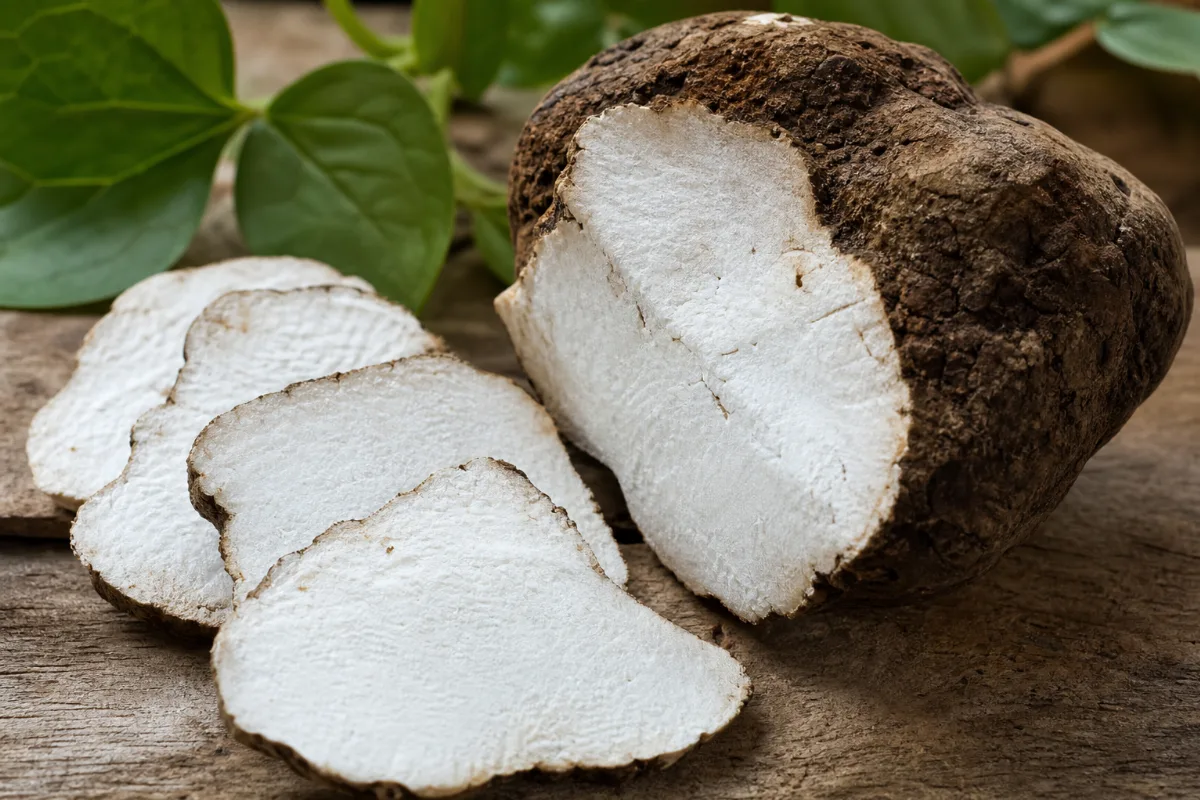
Poria is the dried sclerotium, a hardened mass of fungal tissue, of the fungus Wolfiporia cocos. GBIF lists Wolfiporia cocos as the accepted name and Poria cocos as a synonym. Other old names include Pachyma cocos and Macrohyporia cocos. 'Fu ling' is its Chinese name, so 'Poria cocos' on a label and Wolfiporia cocos in a journal are the same fungus.
It is cultivated on pine wood or substitute materials. The outer layer, called the surface layer, is handled as a separate material in some studies. Fermented mycelium grown in liquid culture is also sold and has different chemistry.
Traditional and current uses
Chinese medicine uses poria to promote urine flow, 'drain dampness', 'invigorate the spleen' and calm the mind, and reviews say its use spans over 2,500 years. It is usually part of a formula rather than taken alone. Traditional use is not proof that it works or is safe.
Modern uses include functional foods and cosmetic ingredients as well as medicines (Lei 2025). Our reading of the trials follows below.
What the research shows for poria in blends and mixtures
A review of 73 trials of diabetes formulas that contain poria found lower fasting glucose, after-meal glucose and HbA1c when added to diabetes medicines. Most trials had a risk of bias, and the formulas held many herbs.
Two trials of an aloe, rosemary and poria blend (11 and 50 healthy adults) changed some blood immune markers, but a 56-day trial found no difference in respiratory symptoms or quality of life, and the product's maker funded it. One 4-week trial of a poria, Ziziphus and GABA mixture in 70 people reported better sleep scores; poria's part is unknown. Kidney, liver, antioxidant and anti-tumour effects are reported in animals and cells only.
Formula research is a separate question
Much of the human research is on the classic Guizhi Fuling formula, which has five herbs: peach kernel, cinnamon twig, poria, white peony and moutan bark. Reviews of the formula report smaller fibroids when added to mifepristone (28 trials), more pain relief in period pain (14 trials), higher ovulation and pregnancy rates in PCOS (16 trials), and lower symptom scores in men with prostate conditions (23 trials). Poria-based formulas added to chemotherapy in ovarian cancer (13 trials) were reported to improve tumour response and reduce side effects.
These are results for whole formulas, often added to a drug, from trials the authors call low quality or uncertain. They say nothing reliable about poria on its own, and they are not a reason to treat these conditions at home.
Sclerotium, outer layer and mycelium are different
Results from one poria product cannot be applied to another. In one comparison fermented mycelia held several times more water-soluble polysaccharides and triterpenoids than cultivated sclerotium. In another, 31 triterpene acids were found in the outer layer, 24 in the inner part and 19 in fermented mycelia. A 2025 review lists unclear testing of active ingredients, sulfur fumigation and heavy-metal pollution among poria's challenges. DNA testing could not detect poria in 56 commercial samples of an 11-herb pill that lists it, a limit of the method that also shows how hard such products are to check.
Legal and regulatory status
We did not read statements from the FDA, the European Medicines Agency, NCCIH, LactMed or LiverTox on poria, so none is given here. Rules differ by country and change. A pharmacist can tell you how a product is sold where you live.
At a glance
Traditional uses history, not proof
- Used in Chinese medicine to promote urine flow and 'drain dampness' (Wang 2013).
- Used to 'invigorate the spleen' and calm the mind (Wang 2013).
- Medicinal use is said to span over 2,500 years, mostly inside formulas (Lei 2025).
- Part of the classic Guizhi Fuling formula, used in China and Japan (Rong 2023; Wang 2026).
Studied for research
- Blood sugar in type 2 diabetes, as part of formulas, low
- Immune blood markers (in a blend), very low
- Sleep (in a mixture, and in animals), very low
- Fibroids, period pain, PCOS fertility and prostate symptoms (Guizhi Fuling formula, not poria alone), low to very low
- Alongside chemotherapy for ovarian cancer (formulas), very low
- Swelling, kidney and liver protection (animal and cell work), insufficient
Main compounds
- Triterpenes such as pachymic acid and tumulosic acid
- Polysaccharides, including a (1,3)-beta-D-glucan type
- Volatile oil, mainly linalool and methyl phenylacetate
Common forms
- Dried sclerotium (slices or pieces), mostly in formulas
- Outer layer (surface layer or epidermis), handled as a separate material
- Fermented mycelium grown in liquid culture
- Extracts and isolated polysaccharide or triterpene fractions
- Capsules, pills and decoctions
Research links: Diabetes formulas with Fuling: meta-analysis (abstract) · Aloe, rosemary and poria blend with flu vaccine (abstract) · Guizhi Fuling capsule safety review (abstract) · Poria review: traditional uses and pharmacology, 2013 (abstract) · Poria review: kidney research, 2025 (abstract) · Poria review: quality and safety challenges, 2025 (abstract) · Research Library · Genes & Biomarkers Library
What it is and its history
- Accepted scientific name
- Wolfiporia cocos
- Naming authority
- (F.A.Wolf) Ryvarden & Gilb. (GBIF)
- Synonyms
- Poria cocos F.A.Wolf; Macrohyporia cocos (Schwein.) I.Johans. & Ryvarden; Pachyma cocos (Schwein.) Fr.; Sclerotium cocos Schwein.
- Common names
- Poria (English); Fu ling / fuling (Chinese (pinyin))
- Family or group
- Fomitopsidaceae (a fungus family; bracket and polypore fungi), not a plant
- Classification
- Fungi > Basidiomycota > Agaricomycetes > Polyporales > Fomitopsidaceae > Wolfiporia > Wolfiporia cocos
- Native range
- Not checked in the sources read.
- Habitat
- Not checked in the sources read. Nie 2020 and Lei 2025 describe it as grown on pine; the abstracts give no more detail.
- What it looks like
- Sclerotium: The part used is the dried sclerotium, a hardened mass of fungal tissue (Nie 2020). Its outer layer, called the surface layer or epidermis, is handled as a separate material in some studies (Guo 2025; Jin 2019).
- Cultivation
- Lei 2025 says cultivation uses pine segment wood or substitute materials, with trade-offs between yield, cost and environment. Wang 2020 notes the long cultivation period and the pine trunks consumed, and studies fermenting mycelia in liquid culture as an alternative source.
- Harvest and processing
- Not read in detail. Lei 2025 names sulfur fumigation as a risk in processing.
- Look-alikes and adulterants
- Name: Other fungi sold as 'fu ling' or sold under similar names; Note: No look-alike information was read. Do not collect or identify wild sclerotia yourself; products should name the species.
- Sustainability and conservation
- Not checked.
Traditional use and history history, not clinical proof
| Tradition or era | Documented use | Source |
|---|---|---|
| Traditional Chinese medicine | Wang 2013 describes a long history of use for inducing diuresis (making more urine), excreting 'dampness', invigorating the spleen and calming the mind. Lei 2025 says medicinal use spans over 2500 years. These are traditional ideas, not tested claims. | p23528366 |
| Formulas | Poria is used inside multi-herb formulas, for example the five-herb Guizhi Fuling formula (peach kernel, cinnamon twig, poria, white peony, moutan bark), which is used in China and Japan (as Keishibukuryogan). | p23528366 |
| Modern use | Lei 2025 says modern applications have expanded to functional foods, cosmetic ingredients and veterinary products. | p40280371 |
Traditional use shows how it was used. It does not show that it works or is safe today.
What is inside, and how it may work
What it contains and how those compounds act in cells and animals. Laboratory and animal mechanisms are not proven effects in people.
Main compounds
| Compound | Family | Where it is concentrated | Activity studied | Level of evidence |
|---|---|---|---|---|
| Triterpenes (triterpene acids and triterpenoids) | triterpenoid | Sclerotium, especially the outer layer; also fermented mycelia One lab found 31 triterpene acids in the outer layer, 24 in the inner part and 19 in fermented mycelia; dehydropachymic acid 1.07 mg/g and pachymic acid 0.61 mg/g in the mycelia of that study (one lab, not a typical value). | Reviews report anti-tumour, anti-inflammatory and kidney effects in cells and animals. Tumulosic acid caused cell death in one cell experiment. 4 7 10 | Laboratory research |
| Polysaccharides (water-soluble and alkaline-soluble) | polysaccharide | Sclerotium and fermented mycelia Fermented mycelia held several times more water-soluble polysaccharides than cultivated sclerotium in one comparison (Wang 2020). | Zhao 2023 says the alkaline-soluble type has a (1,3)-beta-D-glucan backbone and is studied for anti-tumour, anti-inflammatory and immune effects in the lab. 19 16 | Laboratory research |
| Essential oil (volatile compounds) | volatile | Outer layer and fermentation medium 62 compounds identified; linalool and methyl phenylacetate were the two main shared scents (Wang 2020). | Not studied for effects in the sources read. 16 | Lab analysis |
Mechanisms, receptors and pathways
| Target or pathway | Gene or receptor | What was found | Level |
|---|---|---|---|
| GABA-A receptor | GABA-A | A poria extract lengthened sleep in mice and rats, and the authors link this to GABA-A receptors in nerve-cell experiments. Animal and cell work. 5 | Animal research |
| Kidney cell pathways | TGF-beta1/Smad, Wnt/beta-catenin, NF-kappaB, Nrf2, renin-angiotensin system | A 2025 review lists these pathways for the diuretic and kidney-protecting effects of poria triterpenes in models. Animal and cell work. 2 | Animal research |
| PI3K/AKT signalling and BCL2L1 | BCL2L1 | Tumulosic acid caused ovarian cancer cells to die in a cell experiment, linked by the authors to PI3K/AKT and BCL2L1. Cell work only. 10 | Laboratory research |
| Immune cell activity | Not specified | Reviews report immune effects of poria polysaccharides in cells and animals; a three-ingredient blend changed some blood immune markers in people. Labelled lab for the polysaccharides and human (blend) for the markers. 19 18 | Laboratory research |
Absorption, metabolism and elimination
- Absorption
- Not found in the sources read.
- Distribution
- Not found in the sources read.
- Metabolism
- Not found in the sources read.
- Elimination
- Not found in the sources read.
- Bioavailability
- Not established.
Isolated compounds versus whole extracts
Poria products differ: dried sclerotium, the outer layer, water or alcohol extracts, isolated polysaccharide or triterpene fractions, and fermented mycelium. The chemistry differs between mycelium and sclerotium, and most human research uses whole multi-herb formulas, so results for one form do not carry over to another.
Nutritional composition
Poria is a medicine and food-medicine ingredient, not an everyday food or a nutrient source. No nutrition claim is made. Wang 2020 and Lei 2025 describe it as medicinal and edible.
4 low certainty4 very low certainty2 not enough evidence
What was looked at
The 10 benefits and uses checked for Poria, each with how strong the evidence is. Tap one to open it.
- Blood sugar in type 2 diabetes (as part of herbal formulas)Low certainty
- Immune system markers (in blends)Very low certainty
- SleepVery low certainty
- Water balance, swelling and kidney health (traditional diuretic use)Not enough evidence
- Uterine fibroids (Guizhi Fuling formula, not poria alone)Low certainty
- Painful periods (Guizhi Fuling formula)Low certainty
- Fertility in polycystic ovary syndrome (Guizhi Fuling formula)Low certainty
- Prostate symptoms (Guizhi Fuling / Keishibukuryogan formula)Very low certainty
- Alongside chemotherapy for ovarian cancer (poria-based formulas)Very low certainty
- Liver protection, antioxidant and anti-tumour activity (laboratory only)Not enough evidence
Lab markers tracked in the studies
Fasting blood glucoseHaemoglobin A1c (HbA1c)Sleep quality score (PSQI) and sleep timeGamma-delta T cells and influenza B antibody (IgG)FSH, LH, total testosterone and insulin resistance (HOMA-IR) in PCOSProstate symptom scores (IPSS and NIH-CPSI)
What is Poria good for?
The uses people ask about and how strong the human evidence is for each. None is proven, and every human result below comes from a formula, a blend or a mixture rather than poria alone. Read this together with the Safety tab.
Benefits, one by one
Each card is a research question, not a promise. Tap a goal to filter. Open a card to see the studies, doses and limits.
Blood sugar in type 2 diabetes (as part of herbal formulas)
Low certaintyPoria is one of the most often prescribed herbs for type 2 diabetes in China. A review of 73 trials found lower blood sugar measures when formulas that contain poria were added to diabetes medicines. The formulas held many herbs, most trials had a risk of bias, and no trial tested poria on its own.
2 studiesDifferent multi-herb formulas that each contained poria, taken togeth…
Studies, doses and limits
What the trials found
The 2022 review pooled 73 randomised trials with 6,489 people with type 2 diabetes. Each trial added a herbal formula that contained poria (Fuling) to glucose-lowering medicines and compared it with the medicines alone. Fasting glucose, 2-hour glucose and HbA1c were all lower with the formulas. Heterogeneity was high and most trials were at risk of bias.
Results
Fasting glucose MD -0.82 (95% CI -0.93 to -0.71); 2-hour glucose MD -1.15 (-1.31 to -0.98); HbA1c MD -0.64 (-0.75 to -0.53). Adverse events: RR 0.99 (0.93 to 1.06), no clear difference.
Effect sizes as reported
Lower glucose measures when formulas were added to medicines
Why this rating
The reviewers rated the strength of evidence low to moderate, but most trials were at risk of bias, heterogeneity was high (I2 about 80 to 85%), and the formulas differed. The result belongs to whole formulas, not to poria.
Form and dose studied
Different multi-herb formulas that each contained poria, taken together with diabetes medicines.
Who was studied
Adults with type 2 diabetes in China-based trials
Limits
Cannot be credited to poria alone. Units of the differences are not given in the abstract. Trials were added to medicines, so this is not a test of poria replacing anything.
Why researchers looked
Chinese doctors often put poria in formulas for type 2 diabetes, so researchers pooled the trials of those formulas.
Traditional use
Poria is a long-standing Chinese medicine ingredient; its traditional uses are for water balance, the spleen and calming the mind, not blood sugar.
Proposed mechanism Animal research
Reviews attribute lab and animal anti-hyperglycaemic effects to poria triterpenes and polysaccharides. This is laboratory work and is not shown in people.
A proposed mechanism does not show that the effect happens in people.
Do not change a diabetes medicine because of this page. If you take medicines that lower blood sugar, ask a doctor or pharmacist before adding any poria product.
Immune system markers (in blends)
Very low certaintyTwo small trials of a branded blend of aloe gel, rosemary and poria extract reported changes in some blood immune markers. The blend, not poria alone, was tested. Neither trial showed fewer colds or better health.
3 studiesA branded blend (UP360) of aloe gel, poria extract and rosemary extra…
Studies, doses and limits
What the trials found
In 11 healthy adults, one serving of the blend changed several blood immune measures over 3 hours compared with placebo. In 50 adults aged 40 to 80 who had a flu vaccine, gamma-delta T cells and influenza B antibody (IgG) were higher with the blend, but there was no difference in respiratory symptoms or quality of life.
Results
Cross-over trial (11 people): IP-10 up at 1 to 2 hours (P<0.05, P<0.01), G-CSF up at 2 hours (P<0.05). Vaccine trial (50 people): gamma-delta T cells higher (p<0.001), influenza B IgG +15.6% (p=0.0006), no difference in symptoms or quality of life.
Effect sizes as reported
Some blood marker changes; no change in symptoms
Why this rating
Tiny and short trials of a three-ingredient commercial blend, lab markers only, one funded by the maker. Poria cannot be separated from aloe and rosemary.
Form and dose studied
A branded blend (UP360) of aloe gel, poria extract and rosemary extract. Amounts are not shown here.
Who was studied
Healthy adults
Limits
Blood markers are not health outcomes. Many markers were tested. Cannot be credited to poria alone.
Why researchers looked
Poria polysaccharides are reported to act on immune cells in lab work, and a company tested a poria-containing blend.
Traditional use
Not a main traditional use of poria in the sources read.
Proposed mechanism Laboratory research
Reviews report immune-modulating effects of poria polysaccharides in cells and animals, for example from a (1,3)-beta-D-glucan type. This is laboratory work, not proof of a health effect.
A proposed mechanism does not show that the effect happens in people.
The vaccine trial reported no differences in clinical chemistry, vital signs or adverse events. If you take medicines that suppress the immune system, ask your doctor before any immune supplement.
Sleep
Very low certaintyPoria is traditionally used to calm the mind. One small trial of a mixture of poria, Ziziphus and GABA reported better sleep scores, and an extract helped mice and rats sleep. No trial tested poria alone in people.
3 studiesA liquid mixture of poria, Ziziphus spinosa and GABA. Amounts are not…
Studies, doses and limits
What the trials found
One 4-week trial in 70 people with sleep problems compared a liquid mixture of poria, Ziziphus spinosa and GABA with placebo. The authors report better sleep duration and sleep-quality scores than placebo, without between-group figures in the abstract.
Results
Mixture group: total sleep time +12.96% (p=.006) and PSQI score -59.94% from baseline; greater improvement than placebo reported for sleep duration and PSQI. Animal study: shorter sleep latency and longer sleep time in mice and rats.
Effect sizes as reported
Better sleep scores than placebo with a mixture; between-group size not shown
Why this rating
One short trial of a mixture, run by authors working for the companies that make plant products; poria cannot be separated from the other two ingredients. The rest is animal work.
Form and dose studied
A liquid mixture of poria, Ziziphus spinosa and GABA. Amounts are not shown here.
Who was studied
Adults with sleep problems
Limits
Percent changes are from baseline. Only 4 weeks. Industry-linked.
Why researchers looked
The traditional use of calming the mind led researchers to test sleep.
Traditional use
Used in Chinese medicine to calm the mind (a traditional idea, not a tested claim).
Proposed mechanism Animal research
In mice and rats a poria extract shortened the time to fall asleep and lengthened sleep, and the authors link this to GABA-A receptors. This is animal and cell work.
A proposed mechanism does not show that the effect happens in people.
The trial reported no adverse effects. If you take sleep medicines or sedatives, ask a pharmacist before adding a sleep product.
Water balance, swelling and kidney health (traditional diuretic use)
Not enough evidencePoria is a traditional Chinese diuretic, used to drain 'dampness' and swelling. Animal and cell studies, especially of the outer layer, report diuretic and kidney-protecting effects. We found no human trial of poria alone.
3 studiesDried sclerotium and its outer layer are described as different mater…
Studies, doses and limits
What the trials found
No human trial of poria alone for swelling, fluid balance or kidney disease was found in the sources read.
Results
Animal and cell: diuretic and kidney-protective effects reported. People: no data.
Effect sizes as reported
Not available in people
Why this rating
Traditional use and laboratory work only.
Form and dose studied
Dried sclerotium and its outer layer are described as different materials in the lab literature.
Who was studied
Cell and animal models
Limits
Does not show a benefit for swelling or kidney disease in people.
Why researchers looked
The traditional use to promote urine flow led to lab work on the kidney.
Traditional use
A long history of use for inducing diuresis (making more urine) and excreting dampness (two reviews).
Proposed mechanism Animal research
A 2025 review says the surface layer of poria showed a stronger diuretic effect than poria and that triterpenes improved kidney injury models through several cell pathways. These are animal and cell models.
A proposed mechanism does not show that the effect happens in people.
Because poria is a traditional diuretic, ask a pharmacist before using it if you take water tablets, blood pressure, diabetes or kidney medicines. This is a precaution, not a reported harm.
Uterine fibroids (Guizhi Fuling formula, not poria alone)
Low certaintyGuizhi Fuling is a classic five-herb formula that includes poria. A review of 28 Chinese trials found smaller fibroids and lower hormone levels when the formula was added to the drug mifepristone. The result belongs to the whole formula.
1 studiesGuizhi Fuling capsule plus mifepristone.
Studies, doses and limits
What the trials found
28 randomised trials with 2,813 women compared the formula capsule plus low-dose mifepristone with mifepristone alone. Fibroid volume, uterine volume, menstrual flow and several hormones were lower with the combination, and adverse reactions were not clearly higher.
Results
All reported differences p<0.001; adverse drug reactions p=0.16; evidence quality very low to moderate.
Effect sizes as reported
Smaller fibroids and lower hormones in combination with a drug
Why this rating
The authors call the quality of the included trials poor, and GRADE ranged from very low to moderate. The test was of a formula added to a drug.
Form and dose studied
Guizhi Fuling capsule plus mifepristone.
Who was studied
Women with uterine fibroids in China-based trials
Limits
Not poria alone. Mifepristone is a prescription drug with its own risks; it is outside this page.
Why researchers looked
The formula is widely used in China for women's gynaecological conditions.
Traditional use
A classic formula; poria is one of its five herbs (peach kernel, cinnamon twig, poria, white peony, moutan bark).
Proposed mechanism Unknown
Not established. Laboratory papers propose several pathways, but none was read here for fibroids.
A proposed mechanism does not show that the effect happens in people.
Not for self-treatment of fibroids. Fibroid care needs a clinician.
Painful periods (Guizhi Fuling formula)
Low certaintyA 2026 review of 14 short Chinese trials found more women reported pain relief with the Guizhi Fuling capsule, but the pooled pain-score result was inconclusive.
1 studiesGuizhi Fuling capsules alone or added to usual treatment.
Studies, doses and limits
What the trials found
14 trials with 1,280 women, all in China and about three cycles long. Pain-relief rates were higher with the formula, but the pain scale (VAS) result from three trials was inconclusive.
Results
Pain relief RR 1.62 (95% CI 1.23 to 2.14); total effective rate RR 1.42 (1.17 to 1.73); VAS MD -1.26 (-4.21 to 1.70); adverse events OR 0.42 (0.23 to 0.76) from 4 trials.
Effect sizes as reported
Higher pain-relief rates; pain score unclear
Why this rating
High heterogeneity (I2 62 to 98%), short follow-up, incomplete reporting, trials only from China.
Form and dose studied
Guizhi Fuling capsules alone or added to usual treatment.
Who was studied
Women with primary dysmenorrhoea
Limits
A five-herb formula, not poria alone. Pain relief rates are trial-defined.
Why researchers looked
The formula is used in China for period pain.
Traditional use
Classic formula in which poria is one of five herbs.
Proposed mechanism Unknown
Unknown; cytokine results in the review were mechanistically uncertain.
A proposed mechanism does not show that the effect happens in people.
Severe or new pelvic pain needs a clinician.
Fertility in polycystic ovary syndrome (Guizhi Fuling formula)
Low certaintyA review of 16 trials found higher ovulation and pregnancy rates when the Guizhi Fuling formula was added to Western medicine for PCOS. Miscarriage rates did not clearly differ. The authors call the evidence uncertain.
1 studiesGuizhi Fuling formula plus Western medicine.
Studies, doses and limits
What the trials found
16 randomised trials with 1,385 women with PCOS compared the formula plus Western medicine with Western medicine alone.
Results
Ovulation RR 1.24 (1.15 to 1.34); pregnancy RR 1.53 (1.38 to 1.69); miscarriage RR 0.89 (0.36 to 2.20, no clear difference); estradiol no clear difference.
Effect sizes as reported
Higher ovulation and pregnancy rates in combination
Why this rating
The authors stress uncertainty of the evidence and need for larger multicentre trials.
Form and dose studied
Guizhi Fuling formula plus Western medicine.
Who was studied
Women with PCOS and reduced fertility potential
Limits
Not poria alone. Pregnancy safety of the formula is not addressed in the abstract.
Why researchers looked
The formula is widely applied for gynaecological disease in China.
Traditional use
Classic five-herb formula containing poria.
Proposed mechanism Unknown
The authors suggest effects may relate to lower FSH, testosterone and LH and less insulin resistance; this is their interpretation of blood tests.
A proposed mechanism does not show that the effect happens in people.
Do not use any herbal formula when trying to conceive or when pregnant without asking a doctor.
Prostate symptoms (Guizhi Fuling / Keishibukuryogan formula)
Very low certaintyA 2026 review of 23 trials found lower symptom scores in men with an enlarged prostate or chronic prostatitis when treated with the Guizhi Fuling formula. It is a formula result, not a poria result.
1 studiesGuizhi Fuling Wan (pills) compared with control treatments.
Studies, doses and limits
What the trials found
23 randomised trials (11 on BPH, 12 on chronic prostatitis) in Chinese, Japanese and Korean databases. Symptom scores, residual urine, prostate volume and urine flow improved.
Results
IPSS MD -3.19 (-5.35 to -1.02); NIH-CPSI MD -4.09 (-5.04 to -3.15); residual urine MD -6.73; prostate volume MD -2.59; max flow MD 1.61 (1.11 to 2.10). No severe adverse effects reported.
Effect sizes as reported
Lower symptom scores
Why this rating
The abstract gives no certainty rating or risk-of-bias result; the authors ask for rigorously designed trials.
Form and dose studied
Guizhi Fuling Wan (pills) compared with control treatments.
Who was studied
Men with BPH or chronic prostatitis
Limits
Not poria alone. Control treatments varied.
Why researchers looked
The formula (called Keishibukuryogan in Japan) is used for prostate conditions in China and Japan.
Traditional use
Classic formula in which poria is one of five herbs.
Proposed mechanism Unknown
Not described in the abstract.
A proposed mechanism does not show that the effect happens in people.
Urinary symptoms can come from serious conditions; see a clinician rather than self-treat.
Alongside chemotherapy for ovarian cancer (poria-based formulas)
Very low certaintyA 2022 review of 13 trials reported that poria-based formulas added to chemotherapy went with better tumour response and fewer chemotherapy side effects. This is not a cancer treatment, and the abstract gives no numbers.
1 studiesDifferent poria-based formulas plus chemotherapy.
Studies, doses and limits
What the trials found
13 randomised trials with 922 women compared poria-based formulas plus paclitaxel-carboplatin with chemotherapy alone.
Results
Reported improved tumour response, symptom score, Karnofsky score and function, and fewer side effects; no figures in the abstract.
Effect sizes as reported
Not given in the abstract
Why this rating
No effect sizes, mixed formulas, and the review adds computer and cell work to trials.
Form and dose studied
Different poria-based formulas plus chemotherapy.
Who was studied
Women with ovarian cancer
Limits
Cannot be credited to poria. No survival result in the abstract.
Why researchers looked
Poria-based formulas are used in China with chemotherapy to improve wellbeing.
Traditional use
Used in formulas; not a cancer treatment.
Proposed mechanism Laboratory research
In a cell experiment a compound called tumulosic acid caused cancer-cell death, linked by the authors to the PI3K/AKT pathway. This is laboratory work.
A proposed mechanism does not show that the effect happens in people.
Tell your cancer team about any herbal formula before using it.
Liver protection, antioxidant and anti-tumour activity (laboratory only)
Not enough evidenceReviews report that poria triterpenes and polysaccharides protect the liver, fight oxidation and slow tumour cells in cells and animals. None of this has been shown in people.
4 studiesPolysaccharide and triterpene fractions, and extracts, in lab studies.
Studies, doses and limits
Results
Cell and animal results only.
Effect sizes as reported
Not available in people
Why this rating
Laboratory and animal work only; reviews do not separate cell, animal and human findings in their abstracts.
Form and dose studied
Polysaccharide and triterpene fractions, and extracts, in lab studies.
Who was studied
Cells and animals
Limits
Animal liver protection does not show safety or benefit for human livers.
Why researchers looked
Researchers look for the active parts behind the traditional uses.
Traditional use
Not a traditional claim for poria in the sources read.
Proposed mechanism Laboratory research
Reviews list triterpenes and polysaccharides with anti-tumour, antioxidant, anti-inflammatory, immune and liver and kidney protecting activities in cells and animals.
A proposed mechanism does not show that the effect happens in people.
Do not use poria to treat liver disease or cancer.
Connections to the rest of health
How Poria connects to the rest of our health knowledge graph. Every link says what kind of connection it is. A safety link (for example to the liver) is a warning, not a benefit. A study that merely mentions a topic never creates a benefit link.
Explore every connection: goals, body systems, organs, symptoms, genes
A. Wellness goals
| Connected to | Kind of connection | Evidence status | Context | Studies |
|---|---|---|---|---|
| Blood Sugar Balance | Low certainty | Blood sugar in type 2 diabetes (as part of herbal formulas): Poria is one of the most often prescribed herbs for type 2 diabetes in China. A review of 73 trials found lower blood sugar measures when formulas that contain poria were added to diabetes medicines. The formulas held many herbs, most trials had a risk of bias, and no trial tested poria on its own. | 1 14 | |
| Immune Support | Very low certainty | Immune system markers (in blends): Two small trials of a branded blend of aloe gel, rosemary and poria extract reported changes in some blood immune markers. The blend, not poria alone, was tested. Neither trial showed fewer colds or better health. | 18 8 19 | |
| Better Sleep | Very low certainty | Sleep: Poria is traditionally used to calm the mind. One small trial of a mixture of poria, Ziziphus and GABA reported better sleep scores, and an extract helped mice and rats sleep. No trial tested poria alone in people. | 3 5 14 | |
| Sleep Quality | Very low certainty | Sleep: Poria is traditionally used to calm the mind. One small trial of a mixture of poria, Ziziphus and GABA reported better sleep scores, and an extract helped mice and rats sleep. No trial tested poria alone in people. | 3 5 14 | |
| Womens Wellness | Low certainty | Uterine fibroids (Guizhi Fuling formula, not poria alone): Guizhi Fuling is a classic five-herb formula that includes poria. A review of 28 Chinese trials found smaller fibroids and lower hormone levels when the formula was added to the drug mifepristone. The result belongs to the whole formula. Painful periods (Guizhi Fuling formula): A 2026 review of 14 short Chinese trials found more women reported pain relief with the Guizhi Fuling capsule, but the pooled pain-score result was inconclusive. | 6 11 12 | |
| Fertility Support | Low certainty | Fertility in polycystic ovary syndrome (Guizhi Fuling formula): A review of 16 trials found higher ovulation and pregnancy rates when the Guizhi Fuling formula was added to Western medicine for PCOS. Miscarriage rates did not clearly differ. The authors call the evidence uncertain. | 12 | |
| Mens Vitality | Very low certainty | Prostate symptoms (Guizhi Fuling / Keishibukuryogan formula): A 2026 review of 23 trials found lower symptom scores in men with an enlarged prostate or chronic prostatitis when treated with the Guizhi Fuling formula. It is a formula result, not a poria result. | 17 | |
| Liver Support | Not enough evidence | Liver protection, antioxidant and anti-tumour activity (laboratory only): Reviews report that poria triterpenes and polysaccharides protect the liver, fight oxidation and slow tumour cells in cells and animals. None of this has been shown in people. | 9 14 19 7 | |
| Cellular Protection | Not enough evidence | Liver protection, antioxidant and anti-tumour activity (laboratory only): Reviews report that poria triterpenes and polysaccharides protect the liver, fight oxidation and slow tumour cells in cells and animals. None of this has been shown in people. | 9 14 19 7 | |
| Inflammation Balance | Not enough evidence | Liver protection, antioxidant and anti-tumour activity (laboratory only): Reviews report that poria triterpenes and polysaccharides protect the liver, fight oxidation and slow tumour cells in cells and animals. None of this has been shown in people. | 9 14 19 7 |
B. Body systems
| Connected to | Kind of connection | Evidence status | Context | Studies |
|---|---|---|---|---|
| Kidney and urinary | Very low certainty | Traditional diuretic; animal diuretic effect. Possible interaction with water tablets and kidney medicines; no human data. Preparation or compound: Poria and its outer layer |
2 14 | |
| Immune system | Biological association | Very low certainty | Some blood immune markers changed; no change in symptoms. Studied for: Immune system markers (in blends) Preparation or compound: Aloe, rosemary and poria blend |
18 8 19 10 |
| Blood Sugar Support | Biological association | Low certainty | Studied for: Blood sugar in type 2 diabetes (as part of herbal formulas) | 1 14 |
| Sleep Recovery | Biological association | Very low certainty | Studied for: Sleep | 3 5 14 |
| Kidney Urinary | Biological association | Not enough evidence | Studied for: Water balance, swelling and kidney health (traditional diuretic use) | 2 14 9 |
| Reproductive System | Biological association | Low certainty | Studied for: Uterine fibroids (Guizhi Fuling formula, not poria alone) Studied for: Painful periods (Guizhi Fuling formula) | 6 11 12 |
| Urinary System | Biological association | Very low certainty | Studied for: Prostate symptoms (Guizhi Fuling / Keishibukuryogan formula) | 17 |
| Hepatic System | Biological association | Not enough evidence | Studied for: Liver protection, antioxidant and anti-tumour activity (laboratory only) | 9 14 19 7 |
C. Body parts and organs
E. Health conditions
| Connected to | Kind of connection | Evidence status | Context | Studies |
|---|---|---|---|---|
| Diabetes | Very low certainty | Lower blood sugar when formulas were added to diabetes medicines. Preparation or compound: Formulas containing poria |
1 | |
| Pregnancy and breastfeeding | Contraindication | Not enough evidence | No safety data found. Preparation or compound: All poria products |
15 |
| Diabetes | Potential benefit | Low certainty | Lower glucose and HbA1c in 73 trials; not poria alone. Preparation or compound: Herbal formulas that contain poria (Fuling), added to diabetes medicines |
1 |
I. Biomarkers
| Connected to | Kind of connection | Evidence status | Context | Studies |
|---|---|---|---|---|
| Fasting blood glucose | Biological association | Low certainty | Measured in trials: lowered. A lab change is not the same as a health benefit. | 1 |
| Haemoglobin A1c (HbA1c) | Biological association | Low certainty | Measured in trials: lowered. A lab change is not the same as a health benefit. | 1 |
| Sleep quality score (PSQI) and sleep time | Biological association | Very low certainty | Measured in trials: improved. A lab change is not the same as a health benefit. | 3 |
| Gamma-delta T cells and influenza B antibody (IgG) | Biological association | Very low certainty | Measured in trials: raised. A lab change is not the same as a health benefit. | 8 |
| FSH, LH, total testosterone and insulin resistance (HOMA-IR) in PCOS | Biological association | Low certainty | Measured in trials: lowered. A lab change is not the same as a health benefit. | 12 |
| Prostate symptom scores (IPSS and NIH-CPSI) | Biological association | Very low certainty | Measured in trials: lowered. A lab change is not the same as a health benefit. | 17 |
J. Genes, receptors and enzymes
K. Biological pathways
| Connected to | Kind of connection | Evidence status | Context | Studies |
|---|---|---|---|---|
| TGF-beta1/Smad and Nrf2 (kidney) | Preliminary mechanism | Animal | Pathways proposed for kidney protection in models. | 2 |
L. Active compounds
| Connected to | Kind of connection | Evidence status | Context | Studies |
|---|---|---|---|---|
| Triterpenes (triterpene acids and triterpenoids) | Biological association | In vitro | Reviews report anti-tumour, anti-inflammatory and kidney effects in cells and animals. Tumulosic acid caused cell death in one cell experiment. Preparation or compound: Sclerotium, especially the outer layer; also fermented mycelia |
4 7 10 |
| Polysaccharides (water-soluble and alkaline-soluble) | Biological association | In vitro | Zhao 2023 says the alkaline-soluble type has a (1,3)-beta-D-glucan backbone and is studied for anti-tumour, anti-inflammatory and immune effects in the lab. Preparation or compound: Sclerotium and fermented mycelia |
19 16 |
| Essential oil (volatile compounds) | Biological association | Lab analysis | Not studied for effects in the sources read. Preparation or compound: Outer layer and fermentation medium |
16 |
Each connection is stored with the ingredient, the connected record, the kind of connection, the evidence status, the supporting studies, the preparation or compound involved, and a review date (last reviewed October 25, 2026).
The evidence
The research centre for Poria. Every record here was checked against PubMed or the publisher's page; we never list a study we have not verified.
Evidence by outcome
Bars show how many studies we found for each outcome, not how well it works. People are added up across trials only (reviews are not added, to avoid double counting).
How we rate evidence
High certainty
Several well-run trials or reviews agree; further research is unlikely to change the picture much.
Moderate certainty
Good trials point the same way, but some doubt remains.
Low certainty
Small, short or inconsistent trials. The finding could change with better research.
Very low certainty
Very little or very weak human data. Treat as a possibility only.
Mixed findings
Trials or reviews disagree with each other.
Not enough evidence
Not enough human research to say either way.
Evidence against
Good research found no benefit, or found harm.
We take the reviewers' own risk-of-bias and GRADE statements where they exist, and otherwise judge from study size, design, consistency, directness and whether a product matches what is sold. Many publications do not make evidence high. Method note: We read PubMed records and abstracts for 20 papers (seven systematic reviews or meta-analyses, mostly of formulas, three trials of blends or mixtures, five narrative reviews, one animal study, one cell-based genotoxicity study, one DNA study of a pill and two laboratory analyses) and checked the species names in the GBIF database. Only abstracts were read, so numbers come from abstracts. Certainty ratings are the compiler's own reading. FDA, EMA, NCCIH, MSK, LactMed and LiverTox statements were not read.
Study library: every study we checked 21
| Study | Design | People | Product, dose, length | Result |
|---|---|---|---|---|
| Di 2022 Benefits of herbal formulae containing Poria cocos (Fuling) for type 2 diabetes mellitus: A systematic review and meta-analysis. PLoS One · PMID 36455062 · DOI |
Meta-analysis |
6489 People with type 2 diabetes; 73 randomised trials |
Herbal formulas that include Fuling (Poria cocos), added to glucose-lowering medicines Not shown here Varied · vs Glucose-lowering medicines alone |
Adding Fuling formulas to glucose-lowering medicines went with lower fasting glucose (MD -0.82), 2-hour glucose (MD -1.15) and HbA1c (MD -0.64). Heterogeneity was high (I2 about 80 to 85%). Most trials were at risk of bias and the authors rated the strength of evidence low to moderate. For adverse events the abstract gives RR 0.99 (0.93 to 1.06), which shows no clear difference, although its text calls events 'significantly lower'. Lower blood glucose measures when formulas containing Fuling were added to medicines (FBG MD -0.82 (-0.93 to -0.71); 2h glucose MD -1.15 (-1.31 to -0.98); HbA1c MD -0.64 (-0.75 to -0.53)) Methods, limits and fundingOutcomes: Fasting blood glucose, 2-hour after-meal glucose, haemoglobin A1c, adverse events Limitations: The formulas contained many other herbs, so the result cannot be credited to Fuling alone. Most trials had risk of bias and heterogeneity was high. Units of the differences are not given in the abstract. The abstract's wording on adverse events does not match its own numbers, so only the numbers are used here. Funding and conflicts: No competing interests declared; authors from universities and hospitals of Chinese medicine in China and Australia Registration: PROSPERO CRD42020214635 Read: abstract |
| Guo 2025 Poria cocos: traditional uses, triterpenoid components and their renoprotective pharmacology. Acta Pharmacologica Sinica · PMID 39482471 · DOI |
Narrative review review |
Narrative review of laboratory kidney research | n/a |
Says the ethanol extract of the surface layer and its components improved models of acute kidney injury, chronic kidney disease and kidney scarring, and that the surface layer showed a stronger diuretic effect than poria. It lists cell pathways involved. Kidney protection in cell and animal models Methods, limits and fundingOutcomes: Diuretic and kidney effects of poria and its surface layer Limitations: The abstract does not state that any of this was tested in people; no human trial is described. Funding and conflicts: No competing interests declared Read: abstract |
| Hao 2024 Effects of a combination of Poria Cocos, Ziziphus spinose, and gamma-aminobutyric acid (GABA) on sleep quality and skin health: A randomized double-blind placebo-controlled clinical trial. Food Science & Nutrition · PMID 38873452 · DOI |
Controlled trial |
70 70 people with sleep disorders |
A liquid supplement combining Poria cocos, Ziziphus spinosa and GABA (PZG) Not shown here 4 weeks · vs Placebo |
In the PZG group total sleep duration rose 12.96% (p=.006) and the PSQI score fell 59.94% from baseline. The authors report greater improvements than placebo in sleep duration, PSQI, skin hydration, wrinkle severity and roughness, but the abstract gives no between-group figures. No adverse effects were reported. Better sleep scores than placebo with a three-ingredient mixture (Not given in the abstract) Methods, limits and fundingOutcomes: Total sleep time by wrist actigraphy, Pittsburgh Sleep Quality Index (PSQI), skin measures Limitations: The mixture contains two other active ingredients (Ziziphus and GABA), so poria's part is unknown. Percent changes are from baseline, not between groups. Only 4 weeks. Funding and conflicts: Authors are employed by companies in the Yunnan Botanee / Medaesthee group, which makes plant products; no conflict declared; industry-linked Read: abstract |
| Jin 2019 Insights into Triterpene Acids in Fermented Mycelia of Edible Fungus Poria cocos by a Comparative Study. Molecules · PMID 30987348 · DOI |
Lab analysis lab |
Fermented poria mycelia, and the outer layer and inner part of natural sclerotia | n/a |
19 triterpene acids were identified in fermented mycelia, 31 in the outer layer (epidermis) and 24 in the inner part of natural sclerotia. Dehydropachymic acid reached 1.07 mg/g and pachymic acid 0.61 mg/g in the mycelia, higher than in the two natural parts. Mycelium and the outer layer of the sclerotium differ in triterpene acids Methods, limits and fundingOutcomes: Triterpene acids identified and measured Limitations: One laboratory's samples; not a typical value for products, and nothing about effects or safety. Funding and conflicts: No conflict declared Read: abstract |
| Kim 2022 The Positive Effects of Poria cocos Extract on Quality of Sleep in Insomnia Rat Models. International Journal of Environmental Research and Public Health · PMID 35682214 · DOI |
Animal research animal |
Mice and rats (sleep tests), plus rat nerve-cell experiments | Poria cocos extract (PCET) · vs Control animals |
After oral gavage of the extract, sleep latency fell and sleep time rose in normal mice and in caffeine-disturbed mice, and non-REM sleep rose in rats with disturbed sleep. The authors link this to GABA-A receptors. More and faster sleep in mice and rats (Not given in the abstract) Methods, limits and fundingOutcomes: Sleep onset, sleep duration, EEG sleep stages, GABA-A receptor activity Limitations: Animal and cell work only. It does not show an effect in people. Funding and conflicts: No conflicts declared; funders had no role Read: abstract |
| Lei 2023 The efficacy and safety of Chinese herbal medicine Guizhi Fuling capsule combined with low dose mifepristone in the treatment of uterine fibroids: a systematic review and meta-analysis of 28 randomized controlled trials. BMC Complementary Medicine and Therapies · PMID 36803997 · DOI |
Meta-analysis |
2813 Women with uterine fibroids; 28 randomised trials |
Guizhi Fuling capsule (a five-herb Chinese formula that includes Poria) plus low-dose mifepristone formula Not shown here Varied · vs Low-dose mifepristone alone |
Compared with mifepristone alone, the combination was linked to lower FSH, estradiol, progesterone, LH, fibroid volume, uterine volume and menstrual flow (all p<0.001) and a higher clinical efficiency rate. Adverse drug reactions were not clearly higher (p=0.16). Evidence quality ranged from very low to moderate. Smaller fibroids and lower hormone levels when the formula was added to mifepristone (p values only in the abstract) Methods, limits and fundingOutcomes: Hormone levels, fibroid and uterine volume, menstrual flow, clinical efficiency rate, adverse reactions Limitations: This is a whole formula added to another drug, not poria alone. The authors call the quality of the included trials poor and ask for larger, better trials. Funding and conflicts: No competing interests declared Read: abstract |
| Lei 2025 A multidimensional perspective on Poria cocos, an ancient fungal traditional Chinese medicine. Journal of Ethnopharmacology · PMID 40280371 · DOI |
Narrative review review |
Narrative review | n/a |
Says medicinal use spans over 2500 years, 120 triterpenoids have been reported, and polysaccharides and triterpenes are the main active parts. Lists challenges: standardised testing of active ingredients, the risk of sulfur fumigation, and heavy-metal pollution. Descriptive review of laboratory-level pharmacology and quality Methods, limits and fundingOutcomes: History, production, constituents, pharmacology, quality and safety Limitations: Abstract only; the review's toxicity and safety section was not read. 'Confirmed' pharmacology in this review is cell and animal work. Funding and conflicts: No competing interests declared Read: abstract |
| Lewis 2023 Healthy adults supplemented with a nutraceutical formulation containing Aloe vera gel, rosemary and Poria cocos enhances the effect of influenza vaccination in a randomized, triple-blind, placebo-controlled trial. Frontiers in Nutrition · PMID 37168053 · DOI |
Controlled trial |
50 Healthy adults aged 40 to 80 who had not yet had a flu vaccine; 25 per group |
UP360, a branded blend of rosemary extract, Poria cocos extract and Aloe vera gel powder Not shown here 56 days (flu vaccine on day 28) · vs Placebo |
After vaccination, gamma-delta T cells were higher with the blend than placebo (p<0.001) and influenza B-specific IgG rose 15.6% (p=0.0006). Glutathione peroxidase rose from baseline at day 28 (p=0.0214). There were no differences in upper respiratory symptoms or quality of life, and no differences in clinical chemistry, vital signs or adverse events. Some blood immune markers were higher after vaccination; no change in symptoms (p values only in the abstract) Methods, limits and fundingOutcomes: Immune cells, antibodies and cytokines in blood; daily upper respiratory symptoms (WURSS-24); quality of life; safety Limitations: Blend of three ingredients, so poria's part is unknown. Small trial; many markers tested. No difference in symptoms. Funded by the product's maker. Funding and conflicts: Industry-funded: authors employed by KGK Science; funding from Unigen Inc., which was involved in study design and reviewed the manuscript Registration: ISRCTN15838713 Read: abstract |
| Nie 2020 Phytochemistry and Pharmacological Activities of Wolfiporia cocos (F.A. Wolf) Ryvarden & Gilb. Frontiers in Pharmacology · PMID 33071776 · DOI |
Narrative review review |
Narrative review | n/a |
States that Wolfiporia cocos is the current accepted name, formerly Macrohyporia cocos, Pachyma cocos, Poria cocos and Sclerotium cocos, and that the dried sclerotium is used in traditional Chinese medicine. Says triterpenes and polysaccharides have reported anti-tumour, antibacterial, antioxidant, anti-inflammatory, immunomodulating and liver and kidney protecting effects. Descriptive review of laboratory pharmacology Methods, limits and fundingOutcomes: Names, constituents and pharmacological effects Limitations: Does not separate cell, animal and human findings in the abstract. Funding and conflicts: No funding or conflict statement in the abstract Read: abstract |
| Peng 2022 Efficacy and Pharmacological Mechanism of Poria cocos-Based Formulas Combined With Chemotherapy for Ovarian Cancer: A Integrated Systems Pharmacology Study. Frontiers in Pharmacology · PMID 35401186 · DOI |
Systematic review |
922 Women with ovarian cancer; 13 randomised trials |
Poria cocos-based formulas plus paclitaxel-carboplatin chemotherapy formulas Not shown here Varied · vs Chemotherapy alone |
The abstract says the formulas plus chemotherapy improved tumour response, a Chinese medicine symptom score, Karnofsky score and physical and social function and reduced chemotherapy side effects compared with chemotherapy alone, with no figures given. A compound called tumulosic acid caused cell death in a cell experiment. Better tumour response and function reported with formulas added to chemotherapy (Not given in the abstract) Methods, limits and fundingOutcomes: Tumour response, quality-of-life scores, chemotherapy side effects; plus network pharmacology and cell experiments Limitations: No numbers in the abstract. Formulas differ between trials. The cell and computer work is laboratory work and does not show a benefit in people. Funding and conflicts: No commercial relationships declared Read: abstract |
| Qiu 2026 Anti-Dysmenorrhea Effects and Safety of Guizhi Fuling Capsules for Primary Dysmenorrhea: A Systematic Review and Meta-Analysis of Randomized Controlled Trials. Journal of Pain Research · PMID 42746361 · DOI |
Meta-analysis |
1280 Women with primary dysmenorrhoea; 14 randomised trials, all in China |
Guizhi Fuling capsules (a Chinese formula that includes Poria), alone or added to treatment formula Not shown here About three menstrual cycles · vs Placebo or conventional medicines |
Pain-relief rates were higher (11 trials, RR 1.62, 1.23 to 2.14) and total effective rates were higher (RR 1.42, 1.17 to 1.73). The pooled pain score (VAS) result was inconclusive (MD -1.26, -4.21 to 1.70). Four trials (512 people) gave safety data: events were mild (OR 0.42, 0.23 to 0.76). Higher pain-relief rates but an inconclusive pain score (RR 1.62 (1.23 to 2.14) for pain relief) Methods, limits and fundingOutcomes: Pain-relief rate, total effective rate, pain score (VAS), adverse events, cytokines Limitations: A whole formula, not poria alone. High heterogeneity (I2 62 to 98%), short follow-up, incomplete reporting and trials only from China. Funding and conflicts: No competing interests declared Registration: PROSPERO CRD420251271957 Read: abstract |
| Rong 2023 Add-on effect of the Guizhi Fuling formula for management of reduced fertility potential in women with polycystic ovary syndrome: A systematic review and meta-analysis of randomized controlled trials. Frontiers in Endocrinology · PMID 37143960 · DOI |
Meta-analysis |
1385 Women with polycystic ovary syndrome (PCOS); 16 randomised trials |
Guizhi Fuling formula (peach kernel, cinnamon twig, Poria, white peony, moutan bark) plus Western medicine formula Not shown here Varied · vs Western medicine alone |
Adding the formula to Western medicine went with a higher ovulation rate (RR 1.24, 1.15 to 1.34) and pregnancy rate (RR 1.53, 1.38 to 1.69), and lower FSH, total testosterone, LH and HOMA-IR. There was no clear difference in miscarriage rate (RR 0.89, 0.36 to 2.20) or estradiol. Higher ovulation and pregnancy rates when the formula was added (Ovulation RR 1.24 (1.15 to 1.34); pregnancy RR 1.53 (1.38 to 1.69)) Methods, limits and fundingOutcomes: Ovulation, pregnancy and miscarriage rates; hormones; insulin resistance (HOMA-IR) Limitations: A five-herb formula, so poria's part is unknown. The authors say the evidence is uncertain and ask for larger multicentre trials. Funding and conflicts: No commercial relationships declared Registration: PROSPERO CRD42022354530 Read: abstract |
| Sun 2021 A genotoxicity assessment approach for botanical materials demonstrated with Poria cocos. Food and Chemical Toxicology · PMID 34461192 · DOI |
Laboratory research in-vitro |
A Poria cocos material tested in laboratory cell tests (Ames test and human lymphocyte micronucleus test) | A Poria cocos botanical material (characterised before testing) · vs Standard test controls |
A literature search and a computer screen found no DNA-damage concern. The Ames test and the human lymphocyte micronucleus test were both negative. No DNA-damage signal in two laboratory tests (Negative results; no statistics in the abstract) Methods, limits and fundingOutcomes: Whether the material damages DNA in two standard laboratory tests Limitations: Cell tests on one material; they do not show safety in people. Written to demonstrate a testing approach. Funding and conflicts: Industry: all authors work for Procter & Gamble Read: abstract |
| Wang 2013 Mycology, cultivation, traditional uses, phytochemistry and pharmacology of Wolfiporia cocos (Schwein.) Ryvarden et Gilb.: a review. Journal of Ethnopharmacology · PMID 23528366 · DOI |
Narrative review review |
Narrative review of the literature 1980 to 2012 | n/a |
States a long history of use for inducing diuresis, excreting dampness, invigorating the spleen and tranquilizing the mind. Reports anti-tumour, antioxidant, anti-rejection, anti-hyperglycaemic, antibacterial and anti-inflammatory activities attributed to triterpenes and polysaccharides. Descriptive review; mostly laboratory work Methods, limits and fundingOutcomes: Traditional uses, constituents, laboratory pharmacology Limitations: Narrative review that does not separate cell, animal and human work in the abstract. It says 'validated' traditional uses, which laboratory work cannot do for people. Funding and conflicts: No funding or conflict statement in the abstract Read: abstract |
| Wang 2018 [Post-marketing surveillance on Guizhi Fuling Jiaonang based on literature review]. Zhongguo Zhong Yao Za Zhi (China Journal of Chinese Materia Medica) · PMID 29600661 · DOI |
Systematic review |
234 papers: 164 randomised trials, 7 quasi-randomised, 8 non-randomised, 56 case series and 1 cohort | Guizhi Fuling capsule (a Chinese formula that includes Poria), alone in 56 studies and combined with other drugs in 178 formula Not shown here Varied · vs Varied |
Total adverse reaction or event rate was 1.99% when the capsule was used alone and 8.21% when combined with other drugs. No severe adverse reactions were reported. Stomach and gut problems were the most common mild reactions. The authors call overall safety acceptable but say long-term prospective studies are lacking. Mostly mild gut-related reactions for one Chinese formula (Rates only (1.99% alone; 8.21% combined)) Methods, limits and fundingOutcomes: Adverse drug reactions and adverse events reported in the literature Limitations: Chinese-language paper; abstract read only. Pools many study types and reports from trials, which under-detect rare harms. It concerns a five-herb formula, not poria alone. Funding and conflicts: Authors declare no relevant financial relationships Read: abstract |
| Wang 2020 Comparative Studies on Polysaccharides, Triterpenoids, and Essential Oil from Fermented Mycelia and Cultivated Sclerotium of a Medicinal and Edible Mushroom, Poria Cocos. Molecules · PMID 32168852 · DOI |
Lab analysis lab |
Fermented poria mycelia and cultivated sclerotium measured in the laboratory | n/a |
Water-soluble polysaccharides and triterpenoids in the fermented mycelia were several times higher than in the cultivated sclerotium. Of 62 compounds in the essential oil, linalool and methyl phenylacetate were the two main shared scents. Mycelium and sclerotium differ in their chemistry Methods, limits and fundingOutcomes: Water-soluble polysaccharides, triterpenoids and essential oil Limitations: Laboratory measurements of the authors' samples; says nothing about effects or safety. Exact values were not read here (abstract only). Funding and conflicts: No conflict declared Read: abstract |
| Wang 2026 Effectiveness and Safety of Guizhi Fuling Wan (Keishibukuryogan) on Prostate Diseases: A Systematic Review and Meta-Analysis. Journal of Integrative and Complementary Medicine · PMID 41084266 · DOI |
Meta-analysis |
Men with benign prostatic hyperplasia (11 studies) or chronic prostatitis (12 studies); 23 randomised trials | Guizhi Fuling Wan / Keishibukuryogan (a Chinese and Kampo formula that includes Poria) formula Not shown here Varied · vs Control treatments |
Effective rates were higher in BPH (risk difference 0.14) and chronic prostatitis (0.19). The IPSS score was lower (MD -3.19, -5.35 to -1.02), the NIH-CPSI score was lower (MD -4.09, -5.04 to -3.15), and maximum urine flow was higher (MD 1.61, 1.11 to 2.10). No severe adverse effects were reported. Lower symptom scores in men with BPH and prostatitis (IPSS MD -3.19 (-5.35 to -1.02)) Methods, limits and fundingOutcomes: Effective rate, symptom scores (IPSS, NIH-CPSI), residual urine, prostate volume, urine flow Limitations: A whole formula, not poria alone. The abstract does not give a certainty rating or risk of bias, and the authors ask for rigorous trials. Funding and conflicts: No competing interests declared Read: abstract |
| Yu 2023 Rapid increase in immune surveillance and expression of NKT and γδT cell activation markers after consuming a nutraceutical supplement containing Aloe vera gel, extracts of Poria cocos and rosemary. A randomized placebo-controlled cross-over trial. PLoS One · PMID 37699014 · DOI |
Controlled trial |
11 11 healthy adults |
UP360, a branded blend of Aloe vera gel, Poria cocos extract and rosemary extract (single serving) Not shown here Single serving, blood sampled over 3 hours · vs Placebo (cross-over) |
Compared with placebo, chemokine IP-10 rose from 1 hour (P<0.05) and peaked at 2 hours (P<0.01); G-CSF rose at 2 hours (P<0.05); NKT, CD8+ and gamma-delta T cell numbers rose at 2 to 3 hours; superoxide dismutase (P<0.05) and catalase (P<0.01) activity rose at 2 hours. Short-lived changes in blood immune markers after one serving of a three-ingredient blend (P values only in the abstract) Methods, limits and fundingOutcomes: Immune cell counts and activation markers, cytokines and chemokines, antioxidant enzyme activity over 3 hours Limitations: Very small cross-over trial of a blend, looking at blood markers for 3 hours only. Poria cannot be separated from aloe and rosemary. No health outcome was measured. Several results are P<0.1 or P<0.05 among many markers tested. Funding and conflicts: Authors work at NIS Labs (a research company); the abstract declares no competing interests; funder not stated in the abstract Read: abstract |
| Zhao 2023 The differences between the water- and alkaline-soluble Poria cocos polysaccharide: A review. International Journal of Biological Macromolecules · PMID 36871682 · DOI |
Narrative review review |
Narrative review of poria polysaccharides | n/a |
Says poria polysaccharides split into water-soluble and alkaline-soluble types that differ in structure and activity: the water-soluble types are reported with anti-tumour, antidepressant, anti-Alzheimer, anti-atherosclerosis and liver-protecting effects, and the alkaline-soluble type (a (1,3)-beta-D-glucan backbone) with anti-tumour, anti-inflammatory and immune effects. Descriptive review; activities come from laboratory studies Methods, limits and fundingOutcomes: Structure and activity of water-soluble and alkaline-soluble polysaccharides Limitations: Abstract only; the activities listed are laboratory findings, not shown in people. Funding and conflicts: No conflicts declared Read: abstract |
| Zhou 2025 DNA metabarcoding unveils authenticity and adulteration in commercial Chinese polyherbal preparations: Renshen Jianpi Wan as a critical case study. Frontiers in Pharmacology · PMID 40356966 · DOI |
Other other |
56 56 commercial Renshen Jianpi Wan products (an 11-herb pill that lists Poria cocos) and 8 lab-made reference samples |
n/a |
Poria cocos was consistently undetectable in the commercial products, which the authors attribute to DNA damaged by processing and hard fungal DNA extraction. Many non-listed species (from legume, carrot, mustard and other plant families) were frequently found as possible contaminants. Poria could not be detected by DNA testing in one multi-herb pill; unlisted species were common Methods, limits and fundingOutcomes: Which species DNA was found in each product Limitations: This is a limit of the DNA method, so it does not prove poria was missing. It concerns one pill type, not poria products in general. Funding and conflicts: No competing interests declared Read: abstract |
| n/a 2026 GBIF Backbone Taxonomy: Wolfiporia cocos (F.A.Wolf) Ryvarden & Gilb. (record 2549306) and synonyms n/a · Source |
Reference database n/a |
n/a | n/a |
GBIF lists Wolfiporia cocos (F.A.Wolf) Ryvarden & Gilb. as ACCEPTED (key 2549306), in family Fomitopsidaceae, order Polyporales. Poria cocos F.A.Wolf (5248135), Macrohyporia cocos (2549304), Pachyma cocos (2549300) and Sclerotium cocos (2549303) are listed as synonyms. Methods, limits and fundingOutcomes: Accepted name and synonyms Limitations: A taxonomy database record; other databases may differ. Index Fungorum was not checked. Funding and conflicts: Public database Read: API record, checked 2026-10-25 |
What we do not know yet
- No trial of poria alone in people was found; every human result is from a formula, blend or mixture.
- Formula trials come from East Asian databases and are mostly low quality or at risk of bias.
- No safety data for pregnancy, breastfeeding, children or kidney disease, and no interaction study.
- FDA, EMA/HMPC, NCCIH, MSK, LactMed and LiverTox statements were not read; no measured heavy-metal or sulfur-residue levels were read.
How new research is added
New studies are found by a saved PubMed search and placed in a review queue. A person reads each one before it changes any evidence rating or safety wording. New publications never change ratings automatically.
Lab markers
What changed in blood or saliva tests during trials. A changed number is not the same as feeling or being healthier, and we give no "normal ranges".
Metabolic 2
Fasting blood glucose
Lowered in trials
The blood sugar level after a night without food.
Low certaintyResults and what it means
Why it was measured
A standard way to follow type 2 diabetes.
Statistical vs. clinical meaning
Statistically clear but with high heterogeneity and mostly biased trials.
Safety implication
Added to medicines, formulas could in theory add to blood-sugar lowering; ask a doctor or pharmacist.
| Study | Result | People | Product |
|---|---|---|---|
| 1 | MD -0.82 (95% CI -0.93 to -0.71) when Fuling formulas were added to glucose-lowering medicines; units not stated in the abstract. | People with type 2 diabetes in 73 trials | Herbal formulas containing Fuling plus medicines versus medicines alone |
Haemoglobin A1c (HbA1c)
Lowered in trials
A blood test that reflects average blood sugar over the past two to three months.
Low certaintyResults and what it means
Why it was measured
Used to judge long-term blood sugar control.
Statistical vs. clinical meaning
Statistically clear; clinical size depends on units, which the abstract does not state.
Safety implication
Do not change diabetes medicines because of this finding.
| Study | Result | People | Product |
|---|---|---|---|
| 1 | MD -0.64 (-0.75 to -0.53) with formulas added; I2 84.7%. | People with type 2 diabetes | Herbal formulas containing Fuling plus medicines versus medicines alone |
Other 4
Sleep quality score (PSQI) and sleep time
Improved in trials
The Pittsburgh Sleep Quality Index is a questionnaire about sleep; sleep time was measured with a wrist device.
Very low certaintyResults and what it means
Why it was measured
Used to see whether sleep got better.
Statistical vs. clinical meaning
A single short trial of a mixture by industry-linked authors.
Safety implication
No adverse effects were reported in the trial.
| Study | Result | People | Product |
|---|---|---|---|
| 3 | PSQI score -59.94% from baseline and total sleep time +12.96% (p=.006) in the mixture group; between-group figures not in the abstract. | 70 people with sleep problems | Poria, Ziziphus spinosa and GABA mixture versus placebo, 4 weeks |
Gamma-delta T cells and influenza B antibody (IgG)
Raised in trials
Gamma-delta T cells are a type of immune cell. Influenza B IgG is the antibody level against flu B after vaccination.
Very low certaintyResults and what it means
Why it was measured
Used as stand-ins for immune response to a vaccine.
Statistical vs. clinical meaning
Blood marker changes in one industry-funded trial of a blend; not shown to mean fewer infections.
Safety implication
No differences in adverse events were reported.
| Study | Result | People | Product |
|---|---|---|---|
| 8 | Gamma-delta T cells higher than placebo after vaccination (p<0.001); influenza B IgG +15.6% (p=0.0006). No difference in respiratory symptoms or quality of life. | 50 healthy adults aged 40 to 80 | Aloe, rosemary and poria blend versus placebo, 56 days |
FSH, LH, total testosterone and insulin resistance (HOMA-IR) in PCOS
Lowered in trials
Hormone and insulin measures used to follow polycystic ovary syndrome.
Low certaintyResults and what it means
Why it was measured
They describe how well the ovaries and insulin are working.
Statistical vs. clinical meaning
Statistically clear; the authors call the evidence uncertain.
Safety implication
Hormone changes in women trying to conceive need medical supervision.
| Study | Result | People | Product |
|---|---|---|---|
| 12 | FSH MD -0.48 U/l (-0.80 to -0.15); total testosterone SMD -1.07 (-1.71 to -0.44); LH MD -2.19 U/l (-3.04 to -1.34); HOMA-IR MD -0.47 (-0.60 to -0.34). No clear change in estradiol. | 1,385 women with PCOS in 16 trials | Guizhi Fuling formula plus Western medicine versus Western medicine alone |
Prostate symptom scores (IPSS and NIH-CPSI)
Lowered in trials
Questionnaires that score urinary symptoms (IPSS) and chronic prostatitis symptoms (NIH-CPSI).
Very low certaintyResults and what it means
Why it was measured
Used to measure how bothersome symptoms are.
Statistical vs. clinical meaning
Statistically clear; no certainty rating in the abstract.
Safety implication
None reported as severe.
| Study | Result | People | Product |
|---|---|---|---|
| 17 | IPSS MD -3.19 (-5.35 to -1.02); NIH-CPSI MD -4.09 (-5.04 to -3.15). | Men with BPH or chronic prostatitis, 23 trials | Guizhi Fuling Wan versus control treatments |
Safety
What studies and official sources say about side effects, medicines and who should check first. Each point shows what kind of evidence it comes from.
Main points to know 5
- No safety trial of poria on its own was found. We found no human trial that tested poria alone and reported safety, and no regulator statement we could read. Not finding harm is not the same as showing it is safe. Most of what is known about side effects comes from multi-herb formulas, blends and short trials. Gap 15 1 8
- Side effects reported for a poria-containing formula were mostly mild. A review of 234 papers on the Guizhi Fuling capsule (a five-herb formula that includes poria) found reaction or event rates of 1.99% when used alone and 8.21% when combined with other drugs, mostly mild stomach and gut problems, with no severe reactions reported. This is about the formula, not poria alone, and published trials under-report rare harms. Systematic review 15
- Possible effects with water tablets, blood pressure, diabetes and kidney medicines. Poria is a traditional diuretic and animal studies of its outer layer report a diuretic effect. Formulas with poria were also linked to lower blood sugar when added to diabetes medicines. No interaction study was found, so this is a theoretical caution. Ask a pharmacist if you take any of these medicines. Pharmacological theory 2 1
- Product quality is hard to judge from a label. A 2025 review lists unclear testing standards, the risk of sulfur fumigation and heavy-metal pollution among poria's challenges. Fermented mycelium and natural sclerotium differ in chemistry, so a result for one cannot be applied to the other. Narrative review 7 16 4
- Pregnancy, breastfeeding and children: no data. None of the abstracts we read tested poria in pregnancy, breastfeeding or children. Ask a clinician rather than assume it is safe. Gap 15
Side effects 3
| Effect | How often | Severity and recovery | Evidence |
|---|---|---|---|
| Stomach and gut upset A formula with five herbs, not poria alone. | Most common mild reaction among reports for the Guizhi Fuling capsule; overall 1.99% alone and 8.21% combined with other drugs | mild Not described | Systematic review 15 |
| Mild adverse events in trials of formulas Event reporting in these trials is limited. | Four dysmenorrhoea trials (512 women) reported mild events; no clear excess in diabetes or fibroid formula trials | mild Not described | Meta-analysis 11 1 6 |
| No adverse events or lab changes in a vaccine trial of a poria-containing blend Funded by the maker of the blend; poria is one of three ingredients. | No differences from placebo in clinical chemistry, vital signs or adverse events in 50 adults over 56 days | none reported n/a | Controlled trial 8 |
Liver
We found no case report of liver injury from poria. Our PubMed search for liver injury with poria returned animal studies that suggest poria extracts protect the liver in mice and rats, plus reviews that repeat this. Animal protection does not show that poria is safe for human livers, and the LiverTox entry could not be read (its page showed a bot check). Poria is often taken inside formulas, so a liver problem from another herb in a formula would be hard to trace. 9 14
How often. No rate can be given. No cases were found, but no monitoring system was read.
Monitoring. No agency monitoring advice was read. Anyone with liver disease should ask a doctor before using any herbal product.
This is a safety connection. It is not evidence that Poria supports liver health.
Medicines and supplements 6
| With | Why it matters | Importance | Evidence | What to do |
|---|---|---|---|---|
| Diuretics (water tablets), blood pressure medicines and kidney medicines prescription | Poria is a traditional diuretic, and animal studies report a diuretic effect, strongest in the outer layer. | Theoretical. No human interaction study was found. | Pharmacological theory Very low certainty 2 14 | Tell your prescriber or pharmacist before using poria if you take these medicines. |
| Diabetes medicines (including insulin) prescription | Trials of formulas containing poria, added to glucose-lowering medicines, went with lower blood sugar. Poria's own part is unknown. | Theoretical for poria alone. Adding any blood-sugar-lowering product to diabetes medicines can change how much medicine is needed. | Pharmacological theory Very low certainty 1 | Do not change any diabetes medicine without your doctor. Tell them about any herbal product. |
| Sleep medicines and sedatives prescription | A poria extract acted through GABA-A receptors and lengthened sleep in mice and rats. | Theoretical; the human trial was of a mixture and reported no adverse effects. | Animal research Very low certainty 5 3 | Ask a pharmacist before combining poria with sleep medicines or sedatives. |
| Immune-suppressing medicines prescription | Blend trials changed blood immune markers; poria polysaccharides are reported to modulate immune cells in lab work. | Theoretical and unproven; the markers were from a three-ingredient blend. | Pharmacological theory Very low certainty 18 8 19 | If you take medicines that suppress the immune system, ask your doctor first. |
| Chemotherapy prescription | Poria-based formulas were added to paclitaxel-carboplatin in trials without the abstract naming a harmful interaction. | No interaction study was read; the trials did not test this question. | Systematic review Very low certainty 10 | Tell your cancer team about any herbal formula. |
| Other herbs in multi-herb formulas herb | Poria is normally taken inside formulas, so effects and side effects belong to the whole mixture. | Interactions of the formula (for example with the drug mifepristone in trials) cannot be assigned to poria. | Systematic review Very low certainty 6 12 | Read the full ingredient list of any formula and ask a pharmacist. |
Who should check first 5
| Situation | Advice | Evidence |
|---|---|---|
| Pregnancy and breastfeeding | No data were found. Ask a doctor rather than assume safety. | Gap 15 |
| Children | No data were found. Do not give poria products to children without medical advice. | Gap 15 |
| Taking diuretics, blood pressure, diabetes or kidney medicines | Ask a pharmacist first because poria is a traditional diuretic and formulas with poria were linked to lower blood sugar. | Pharmacological theory 2 1 |
| Kidney disease or low blood pressure | Ask your doctor first. Animal studies report a diuretic effect, and no human safety data for kidney disease were found. | Pharmacological theory 2 |
| Planned surgery or chemotherapy | Tell the surgical or cancer team about any herbal product. No specific rule was read for poria. | Gap 10 |
Overdose, product quality and regulators
Summary. No poisoning from poria was described in the abstracts read. One poria material was negative in two standard laboratory DNA-damage tests. Rodent toxicity studies were not read.
Animal. Not reviewed in depth. Many animal studies test poria extracts for liver protection and report no harm in their abstracts; this is not a toxicity assessment.
Human doses studied. Trials ran from a single serving to 56 days. This page does not give amounts, and none are advised.
High dose or long term signals. Long-term safety is not known. Formula trials were short, often about three menstrual cycles.
Overdose response. No overdose description was found. Seek medical help for the urgent signs below.
Genotoxicity. A 2021 study found a Poria cocos material negative in the Ames test and the human lymphocyte micronucleus test, and a computer screen found no structural alert. The authors work for Procter & Gamble. Cell tests do not prove safety in people.
Toxic or hazardous parts. The sclerotium, its outer layer (surface layer), and fermented mycelium are used. No source we read compared their toxicity.
Poria products are not covered by the same quality rules as approved medicines. The sources we read describe quality problems rather than measured contamination rates.
Sulfur fumigation and heavy metals. A 2025 review lists unclear testing of active ingredients, sulfur fumigation risk and heavy-metal pollution among the challenges for poria. No measured levels were read. 7
Sclerotium versus fermented mycelium. Fermented mycelia had several times more water-soluble polysaccharides and triterpenoids than cultivated sclerotium in one comparison, and 19 triterpene acids against 31 (outer layer) and 24 (inner part) in natural sclerotia in another study. Products labelled poria may be either. 16 4
Hard to confirm poria in a multi-herb pill. In 56 commercial samples of an 11-herb pill that lists Poria cocos, DNA tests could not detect poria, which the authors blame on processing and fungal DNA extraction, and many unlisted species were found. This is a limit of the DNA method and one pill type, not proof about poria products in general. 20
| Body | Action | Date |
|---|
When to get medical help
- Swelling of the face or throat, wheeze, hives or trouble breathing after taking a poria product: call emergency services.
- Yellow skin or eyes, dark urine, pale stools or severe belly pain after using any herbal formula: stop it and get medical help now.
- Fainting, severe dizziness, very little urine or muscle cramps if you take water tablets or blood pressure medicines with a diuretic herb: get medical help.
- Very low blood sugar signs (shaking, sweating, confusion) if you take diabetes medicines together with a herbal formula: treat as your doctor has taught you and get help.
If someone may be poisoned or in a crisis, contact a clinician or emergency service straight away. In the US, Poison Control is 1-800-222-1222.
General information only, not medical advice. Ask a clinician or pharmacist before use, especially with medicines, in pregnancy or with a health condition. See the Natural Remedy Safety guide.
Frequently asked questions
What is poria (fu ling)?
Is Poria cocos the same as Wolfiporia cocos?
Does poria work?
Is poria safe?
Does poria interact with medicines?
Can poria harm the liver or kidneys?
Does poria help with sleep?
Does poria lower blood sugar?
Formulas containing poria, added to diabetes medicines, were linked to lower glucose and HbA1c in a review of 73 trials. Most trials were at risk of bias and no trial tested poria alone. Do not change diabetes medicines because of this.
Does poria boost the immune system?
What is the Guizhi Fuling formula, and is it the same as poria?
What is the difference between sclerotium, outer layer and mycelium products?
Explore by health goal
Womens WellnessBlood Sugar BalanceImmune SupportBetter SleepSleep QualityFertility SupportMens VitalityLiver SupportCellular ProtectionInflammation Balance
Editorial transparency
- Written by
- AlternativeMed editorial team. Research compiled with AI assistance, then checked against PubMed records.
- Medical review
- None. This page has not been reviewed by a physician or pharmacist.
- First published
- 2026-10-25
- Last substantive update
- 2026-10-25
- How we research
- We read PubMed records and abstracts for 20 papers (seven systematic reviews or meta-analyses, mostly of formulas, three trials of blends or mixtures, five narrative reviews, one animal study, one cell-based genotoxicity study, one DNA study of a pill and two laboratory analyses) and checked the species names in the GBIF database. Only abstracts were read, so numbers come from abstracts. Certainty ratings are the compiler's own reading. FDA, EMA, NCCIH, MSK, LactMed and LiverTox statements were not read.
- How we rate evidence
- See "How we rate evidence" in the Evidence tab.
- Independence
- No product is promoted on this page. No affiliate links are shown. This page is information, not a recommendation to use poria.
Sources 21
Each source was opened and checked. Where we read only the abstract, it says so. The small numbers in the text point here.
- Di YM, Sun L, Lu C, et al. Benefits of herbal formulae containing Poria cocos (Fuling) for type 2 diabetes mellitus: A systematic review and meta-analysis.. PLoS One. 2022. PMID 36455062. DOI 10.1371/journal.pone.0278536. (abstract)
- Guo ZY, Wu X, Zhang SJ, et al. Poria cocos: traditional uses, triterpenoid components and their renoprotective pharmacology.. Acta Pharmacologica Sinica. 2025. PMID 39482471. DOI 10.1038/s41401-024-01404-7. (abstract)
- Hao Y, Song W, Qu L. Effects of a combination of Poria Cocos, Ziziphus spinose, and gamma-aminobutyric acid (GABA) on sleep quality and skin health: A randomized double-blind placebo-controlled clinical trial.. Food Science & Nutrition. 2024. PMID 38873452. DOI 10.1002/fsn3.4048. (abstract)
- Jin J, Zhou R, Xie J, et al. Insights into Triterpene Acids in Fermented Mycelia of Edible Fungus Poria cocos by a Comparative Study.. Molecules. 2019. PMID 30987348. DOI 10.3390/molecules24071331. (abstract)
- Kim H, Park I, Park K, et al. The Positive Effects of Poria cocos Extract on Quality of Sleep in Insomnia Rat Models.. International Journal of Environmental Research and Public Health. 2022. PMID 35682214. DOI 10.3390/ijerph19116629. (abstract)
- Lei Y, Yang L, Yang H, et al. The efficacy and safety of Chinese herbal medicine Guizhi Fuling capsule combined with low dose mifepristone in the treatment of uterine fibroids: a systematic review and meta-analysis of 28 randomized controlled trials.. BMC Complementary Medicine and Therapies. 2023. PMID 36803997. DOI 10.1186/s12906-023-03842-y. (abstract)
- Lei J, Gong D, Duan L, et al. A multidimensional perspective on Poria cocos, an ancient fungal traditional Chinese medicine.. Journal of Ethnopharmacology. 2025. PMID 40280371. DOI 10.1016/j.jep.2025.119869. (abstract)
- Lewis ED, Crowley DC, Guthrie N, et al. Healthy adults supplemented with a nutraceutical formulation containing Aloe vera gel, rosemary and Poria cocos enhances the effect of influenza vaccination in a randomized, triple-blind, placebo-controlled trial.. Frontiers in Nutrition. 2023. PMID 37168053. DOI 10.3389/fnut.2023.1116634. (abstract)
- Nie A, Chao Y, Zhang X, et al. Phytochemistry and Pharmacological Activities of Wolfiporia cocos (F.A. Wolf) Ryvarden & Gilb.. Frontiers in Pharmacology. 2020. PMID 33071776. DOI 10.3389/fphar.2020.505249. (abstract)
- Peng X, Jia C, Chi H, et al. Efficacy and Pharmacological Mechanism of Poria cocos-Based Formulas Combined With Chemotherapy for Ovarian Cancer: A Integrated Systems Pharmacology Study.. Frontiers in Pharmacology. 2022. PMID 35401186. DOI 10.3389/fphar.2022.788810. (abstract)
- Qiu T, Wang T, Huang W. Anti-Dysmenorrhea Effects and Safety of Guizhi Fuling Capsules for Primary Dysmenorrhea: A Systematic Review and Meta-Analysis of Randomized Controlled Trials.. Journal of Pain Research. 2026. PMID 42746361. DOI 10.2147/JPR.S631424. (abstract)
- Rong A, Ta N, E L, et al. Add-on effect of the Guizhi Fuling formula for management of reduced fertility potential in women with polycystic ovary syndrome: A systematic review and meta-analysis of randomized controlled trials.. Frontiers in Endocrinology. 2023. PMID 37143960. DOI 10.3389/fendo.2022.995106. (abstract)
- Sun B, Huang B, Sica VP, et al. A genotoxicity assessment approach for botanical materials demonstrated with Poria cocos.. Food and Chemical Toxicology. 2021. PMID 34461192. DOI 10.1016/j.fct.2021.112521. (abstract)
- Wang YZ, Zhang J, Zhao YL, et al. Mycology, cultivation, traditional uses, phytochemistry and pharmacology of Wolfiporia cocos (Schwein.) Ryvarden et Gilb.: a review.. Journal of Ethnopharmacology. 2013. PMID 23528366. DOI 10.1016/j.jep.2013.03.027. (abstract)
- Wang GQ, Gao Y, Liu FM, et al. [Post-marketing surveillance on Guizhi Fuling Jiaonang based on literature review].. Zhongguo Zhong Yao Za Zhi (China Journal of Chinese Materia Medica). 2018. PMID 29600661. DOI 10.19540/j.cnki.cjcmm.20180126.002. (abstract)
- Wang D, Huang C, Zhao Y, et al. Comparative Studies on Polysaccharides, Triterpenoids, and Essential Oil from Fermented Mycelia and Cultivated Sclerotium of a Medicinal and Edible Mushroom, Poria Cocos.. Molecules. 2020. PMID 32168852. DOI 10.3390/molecules25061269. (abstract)
- Wang Y, Li H, Jiang Y, et al. Effectiveness and Safety of Guizhi Fuling Wan (Keishibukuryogan) on Prostate Diseases: A Systematic Review and Meta-Analysis.. Journal of Integrative and Complementary Medicine. 2026. PMID 41084266. DOI 10.1177/27683605251385894. (abstract)
- Yu L, McGarry S, Cruickshank D, et al. Rapid increase in immune surveillance and expression of NKT and γδT cell activation markers after consuming a nutraceutical supplement containing Aloe vera gel, extracts of Poria cocos and rosemary. A randomized placebo-controlled cross-over trial.. PLoS One. 2023. PMID 37699014. DOI 10.1371/journal.pone.0291254. (abstract)
- Zhao M, Guan Z, Tang N, et al. The differences between the water- and alkaline-soluble Poria cocos polysaccharide: A review.. International Journal of Biological Macromolecules. 2023. PMID 36871682. DOI 10.1016/j.ijbiomac.2023.123925. (abstract)
- Zhou S, Zhou T, Zhang Y, et al. DNA metabarcoding unveils authenticity and adulteration in commercial Chinese polyherbal preparations: Renshen Jianpi Wan as a critical case study.. Frontiers in Pharmacology. 2025. PMID 40356966. DOI 10.3389/fphar.2025.1584065. (abstract)
- n/a. GBIF Backbone Taxonomy: Wolfiporia cocos (F.A.Wolf) Ryvarden & Gilb. (record 2549306) and synonyms. n/a. 2026. (API record, checked 2026-10-25)
Where to buy
Check the label first. Whatever you buy, look for these:
- Fruiting body versus mycelium on grain: the label should say which
- The extract type and the beta-glucan amount, if stated
- A third-party testing mark
- Interactions: ask a pharmacist if you take medicines or blood thinners
Talk to a pharmacist or doctor before you start any supplement, especially if you take medicines. See the Safety tab for interactions.
Support our free guides: as an Amazon Associate we earn from qualifying purchases. Full disclosure.


