Spices · Spice blend
Berbere
Spice blend (no single species) · also called Berberé, bärbäre (Amharic)
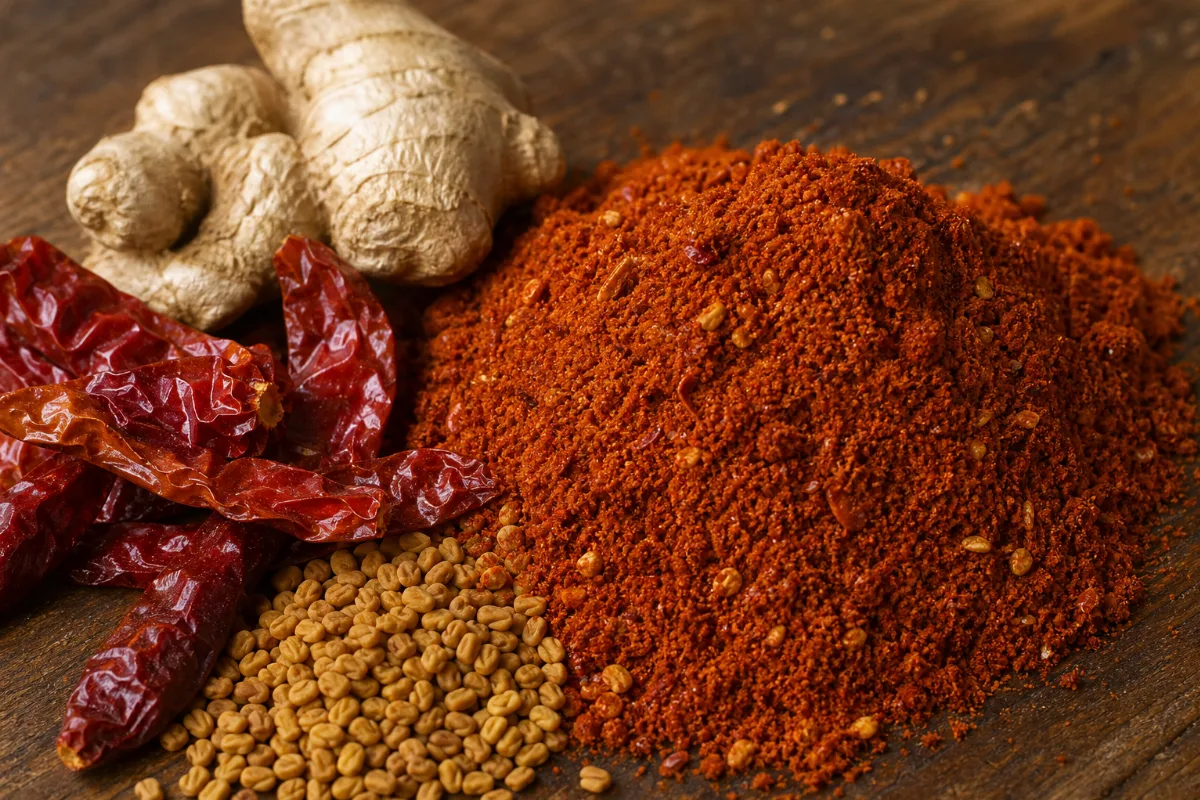
Berbere is a red, hot chili blend at the heart of Ethiopian and Eritrean cooking. It usually also holds fenugreek, korarima, coriander, garlic and ginger, but every cook makes it a little differently. No study of the blend itself was found, only studies of single ingredients such as chili and fenugreek. The main caution is fenugreek, a legume-family seed that can cause allergic reactions and is not safe in pregnancy above food amounts.
General information, not medical advice. Last substantive update · Not medically reviewed. A named clinician has not signed off on this page. How this page is made
About Berbere
Berbere is a hot, warm and earthy Ethiopian and Eritrean spice blend. It is a flavoring, not a proven remedy. There is little research on the blend itself, so this page is shorter than most. The main caution is the fenugreek in it.
What it is
Berbere is a spice mixture that is a key ingredient in the cuisines of Ethiopia and Eritrea. According to Wikipedia its usual parts include chili peppers, coriander, garlic, ginger, Ethiopian holy basil seeds, korarima, rue, ajwain or radhuni, nigella and fenugreek. Recipes differ, so this is a typical list and not a fixed formula.
Korarima, also called Ethiopian cardamom, is a ginger-family plant whose seeds taste comparable to green cardamom, says Wikipedia. Fenugreek seed smells and tastes like maple syrup, says NCCIH.
What a teaspoon gives
USDA FoodData Central has no berbere entry. Its chili powder blend entry is the nearest and is used here only as a stand-in. A teaspoon of that blend is 2.7 g and gives about 8 kcal, 0.9 g fibre, 0.5 mg iron, 53 mg potassium and 77 mg sodium (our arithmetic from per-100 g values).
So berbere is a flavoring, not a main source of nutrients. If a maker adds salt, the sodium can add up. No source read states the salt in berbere.
What the research shows
No study of berbere was found. The research is on single ingredients. One umbrella review of 11 reviews of chili and spicy food found links with lower metabolic problems, deaths and heart disease, and higher stomach, food-pipe and gallbladder cancer. The authors say the overall effect is unclear.
NCCIH says fenugreek may lower blood sugar in people with type 2 diabetes, but many studies were not of high quality. These findings do not show that a pinch of berbere in a stew does the same.
The blend versus its single ingredients
Fenugreek supplements and capsaicin products are concentrated. Their results and warnings do not carry over directly to berbere in food, and berbere has not been studied itself.
Amounts
This page gives no amounts to eat or take. No source read gives a usual amount of berbere. Ask a doctor, pharmacist or dietitian what is right for you, especially in pregnancy, with a legume allergy, or if you use diabetes medicines.
At a glance
Traditional uses history, not proof
- A key seasoning in the cooking of Ethiopia and Eritrea
- Sometimes made into a paste called awaze (named in Wikipedia's list of related items)
Studied for research
- Berbere as a blend: no study found, insufficient evidence
- Chili and spicy food intake in general, mixed certainty
- Fenugreek products and blood sugar in type 2 diabetes, low certainty (not the blend)
- Nutrients in a teaspoon: small amounts, high certainty for the fact
Main compounds
- Capsaicin (the chili heat compound)
- Fenugreek seed
- Korarima (Ethiopian cardamom)
- Sodium (77 mg per teaspoon of USDA chili powder blend, a stand-in)
Common forms
- Ground blend
- Whole-spice blend ground at home
- Paste mixed with oil (awaze)
- Salt-free or salted versions (check the label)
Research links: NCCIH: Fenugreek, usefulness and safety · EMA: Fenugreek seed herbal medicine page · USDA FoodData Central: Spices, chili powder (stand-in) · Spicy food and chili peppers, umbrella review (Mol Nutr Food Res, 2022) · Research Library · Genes & Biomarkers Library
What it is and its history
- Accepted scientific name
- Spice blend (no single species)
- Common names
- Berbere (English); Berberé (English); በርበሬ (bärbäre) (Amharic); በርበረ (bärbärä) (Tigrinya)
- Native range
- Key ingredient in the cuisines of Ethiopia and Eritrea (Wikipedia).
- Harvest and processing
- Not found in a source read. No recipe or processing steps are given here because the cooking blogs that described them were not re-opened.
- Look-alikes and adulterants
- Name: Mitmita; Note: Another Ethiopian spice mixture, listed in Wikipedia's see-also list. Not the same blend.; Name: Awaze; Note: An Ethiopian spice paste, listed in Wikipedia's see-also list.
Photographs
Traditional use and history history, not clinical proof
| Tradition or era | Documented use | Source |
|---|---|---|
Traditional use shows how it was used. It does not show that it works or is safe today.
What is inside, and how it may work
What it contains and how those compounds act in cells and animals. Laboratory and animal mechanisms are not proven effects in people.
Main compounds
| Compound | Family | Where it is concentrated | Activity studied | Level of evidence |
|---|---|---|---|---|
| Capsaicin PubChem 1548943 | capsaicinoid (chili heat compound) | Chili pepper | Named by the umbrella review authors as the primary ingredient of spicy foods and chili peppers. The amount in a given berbere is not known; it depends on the chili used. 2 | Human data |
Mechanisms, receptors and pathways
| Target or pathway | Gene or receptor | What was found | Level |
|---|---|---|---|
| Capsaicin intake and gastric cancer risk | The review abstract reports a nonlinear dose-response link between capsaicin intake and gastric cancer risk in observational data. This is an association, not a shown mechanism. 2 | Human data |
Absorption, metabolism and elimination
- Absorption
- Not found.
- Distribution
- Not found.
- Metabolism
- Not found for berbere. MSK mentions animal findings that capsaicin may alter drug absorption and metabolism.
- Elimination
- Not found.
- Bioavailability
- Not established.
Isolated compounds versus whole extracts
No study of the whole blend exists in what we read. Health findings are about chili intake in general or fenugreek products. They do not carry over directly to a pinch of berbere in a stew.
Nutritional composition
USDA FoodData Central has no berbere entry. The nearest is Spices, chili powder (FDC 171319, SR Legacy April 2018, read 2026-10-26), which is itself a blend. Per 100 g: 282 kcal, 13.5 g protein, 14.3 g fat, 49.7 g carbohydrate, 34.8 g fibre, 330 mg calcium, 17.3 mg iron, 1950 mg potassium and 2870 mg sodium. The record lists a teaspoon as 2.7 g and a tablespoon as 8.0 g. One teaspoon (our arithmetic) gives about 8 kcal, 0.9 g fibre, 0.5 mg iron, 53 mg potassium and 77 mg sodium. These are stand-in numbers; real berbere differs by recipe and salt content. A teaspoon gives small amounts, so berbere is a flavoring, not a main source of nutrients.
1 high certainty1 mixed findings1 low certainty1 very low certainty1 not enough evidence
What was looked at
The 5 benefits and uses checked for Berbere, each with how strong the evidence is. Tap one to open it.
- Berbere eaten as a blend (health effects of kitchen amounts)Not enough evidence
- Chili and spicy food intake (the main ingredient, not berbere itself)Mixed findings
- Blood sugar in type 2 diabetes (fenugreek products, an ingredient of berbere)Low certainty
- Milk supply and menstrual cramps (fenugreek products)Very low certainty
- What a teaspoon provides (nutrient fact)High certainty
What is Berbere good for?
The main studied uses and how strong the human evidence is for each. None of it is about berbere itself; it is about its ingredients.
Benefits, one by one
Each card is a research question, not a promise. Tap a goal to filter. Open a card to see the studies, doses and limits.
Berbere eaten as a blend (health effects of kitchen amounts)
Not enough evidenceNo study of berbere as a blend was found for any health outcome. Any evidence belongs to single ingredients such as chili or fenugreek.
1 studiesGround blend or paste used in cooking. Not found sold as a supplement.
Studies, doses and limits
Results
No human study of berbere was found.
Why this rating
No study of the blend was found, so nothing can be rated.
Form and dose studied
Ground blend or paste used in cooking. Not found sold as a supplement.
Who was studied
Not studied.
Limits
Absence of studies is not proof of no effect, and not proof of safety. This page is smaller than most because there is little research on the blend itself.
Why researchers looked
Berbere is a daily seasoning in Ethiopian and Eritrean cooking, so people ask whether it does anything for health.
Traditional use
It is a key ingredient in the cooking of Ethiopia and Eritrea. Long use as food is not proof that it treats any condition.
Proposed mechanism Unknown
Not established. The blend varies by cook, so there is no single set of compounds to study.
A proposed mechanism does not show that the effect happens in people.
Fenugreek is usually in the blend and can cause allergic reactions. See the Safety tab.
Chili and spicy food intake (the main ingredient, not berbere itself)
Mixed findingsReviews of mostly observational studies link eating chili and spicy food with lower rates of some problems (metabolic problems, deaths, heart disease) and higher rates of some stomach, food-pipe and gallbladder cancers. The authors say the overall effect is unclear.
1 studiesSpicy food and chili pepper intake in general. Not berbere, and not c…
Studies, doses and limits
What the trials found
One umbrella review of 11 systematic reviews and meta-analyses (27 findings) of spicy food and chili pepper intake.
Results
Inverse links were reported for metabolism, mortality and cardiovascular disease. Direct links were reported for esophageal, gastric and gallbladder cancer, with a nonlinear dose-response link between capsaicin intake and gastric cancer. The authors conclude the health effect is unclear and that chili is typically safe, but that high-quality proof is lacking.
Effect sizes as reported
No pooled numbers are given in the abstract.
Why this rating
Observational data pooled across reviews, with opposite directions for different outcomes and no certainty grades in the abstract. Regions and diets differ.
Form and dose studied
Spicy food and chili pepper intake in general. Not berbere, and not capsaicin supplements.
Who was studied
Adults in many world regions, mostly in cohort and case-control studies.
Limits
Only the abstract was read. Eating habits that go with spicy food could explain some links. A study of chili intake does not tell us what a berbere-spiced stew does.
Why researchers looked
Chili is eaten daily in many countries, and capsaicin, its hot compound, has been studied for possible benefits.
Traditional use
Chili is the base of berbere (Wikipedia lists chili peppers first among its usual ingredients).
Proposed mechanism Unknown
Capsaicin is named by the review authors as the primary ingredient of spicy foods and chili peppers. The abstract does not describe how it might act.
A proposed mechanism does not show that the effect happens in people.
Chili can irritate the stomach and mouth. See the Safety tab.
Blood sugar in type 2 diabetes (fenugreek products, an ingredient of berbere)
Low certaintyNCCIH says fenugreek may lower blood sugar in people with type 2 diabetes, but many studies were not of high quality. This is about fenugreek products, not berbere in food.
1 studiesFenugreek seed products and supplements. A pinch in a blend is a diff…
Studies, doses and limits
What the trials found
The NCCIH page summarises research on fenugreek seed. It also says there is not enough high-quality evidence to decide whether fenugreek helps diabetes. We did not open the underlying trials.
Results
Research has suggested fenugreek may help lower blood sugar in type 2 diabetes, but many studies were not of high quality.
Why this rating
A health-agency summary of studies that were often weak; we did not read the trials, and none tested berbere or food amounts.
Form and dose studied
Fenugreek seed products and supplements. A pinch in a blend is a different thing, and no study of that was found.
Who was studied
Adults with type 2 diabetes.
Limits
Second-hand summary only. People using diabetes medicines should not treat a spice as a replacement.
Why researchers looked
Fenugreek seed is a long-used spice and traditional medicine, and is usually part of berbere.
Traditional use
NCCIH says fenugreek has been used as a medicinal plant for about 6,000 years.
Proposed mechanism Unknown
Not described in the page read.
A proposed mechanism does not show that the effect happens in people.
NCCIH says large doses may cause a harmful drop in blood sugar. See the Safety tab.
Milk supply and menstrual cramps (fenugreek products)
Very low certaintyNCCIH says results for milk supply in breastfeeding women were mixed and evidence for menstrual cramps was low quality and uncertain. Again, these are fenugreek products, not berbere.
1 studiesFenugreek supplements and preparations.
Studies, doses and limits
What the trials found
NCCIH reports a few studies on milk supply with mixed results and only a small number on menstrual cramps. We did not open them.
Results
Uncertain for both uses.
Why this rating
Small numbers of studies, mixed or low quality, read only as a summary.
Form and dose studied
Fenugreek supplements and preparations.
Who was studied
Breastfeeding women; women with menstrual cramps.
Limits
Second-hand summary. NCCIH says little is known about safety above food amounts while breastfeeding.
Why researchers looked
Fenugreek has traditionally been used for menstrual cramps and to stimulate milk production.
Traditional use
Listed by NCCIH among traditional uses.
Proposed mechanism Unknown
Not described in the page read.
A proposed mechanism does not show that the effect happens in people.
NCCIH says fenugreek is not safe in pregnancy above food amounts. See the Safety tab.
What a teaspoon provides (nutrient fact)
High certaintyUSDA has no berbere entry. Its chili powder blend entry, used as a stand-in, shows a teaspoon gives only small amounts of nutrients.
1 studiesStand-in values for ground chili powder blend.
Studies, doses and limits
Results
One teaspoon (2.7 g) of USDA chili powder blend: about 8 kcal, 0.9 g fibre, 0.5 mg iron, 53 mg potassium and 77 mg sodium (our arithmetic from per-100 g values). Berbere differs by recipe.
Why this rating
The numbers are database facts for a different but similar product; they say nothing about benefit.
Form and dose studied
Stand-in values for ground chili powder blend.
Limits
Chili powder is not berbere. Real berbere may have more or less salt.
Why researchers looked
People ask whether a spice blend is a useful source of nutrients.
Proposed mechanism Reference data
A nutrient fact, not a trial.
A proposed mechanism does not show that the effect happens in people.
Salt: the chili powder entry has about 77 mg sodium per teaspoon, so a blend with salt adds sodium.
Connections to the rest of health
How Berbere connects to the rest of our health knowledge graph. Every link says what kind of connection it is. A safety link (for example to the liver) is a warning, not a benefit. A study that merely mentions a topic never creates a benefit link.
Explore every connection: goals, body systems, organs, symptoms, genes
B. Body systems
| Connected to | Kind of connection | Evidence status | Context | Studies |
|---|---|---|---|---|
| Digestive System | Biological association | Not enough evidence | Studied for: Berbere eaten as a blend (health effects of kitchen amounts) Studied for: Chili and spicy food intake (the main ingredient, not berbere itself) | 9 2 |
| Cardiovascular System | Biological association | Mixed findings | Studied for: Chili and spicy food intake (the main ingredient, not berbere itself) | 2 |
| Endocrine System | Biological association | Low certainty | Studied for: Blood sugar in type 2 diabetes (fenugreek products, an ingredient of berbere) | 7 |
| Reproductive System | Biological association | Very low certainty | Studied for: Milk supply and menstrual cramps (fenugreek products) | 7 |
E. Health conditions
| Connected to | Kind of connection | Evidence status | Context | Studies |
|---|---|---|---|---|
| Food Allergy | Documented risk | Fenugreek in berbere can cause allergic reactions; EMA lists legume allergy as a reason not to use fenugreek medicines. Fenugreek in berbere can cause allergic reactions; EMA lists peanut, soya and legume allergy as a reason not to use fenugreek medicines. Preparation or compound: Fenugreek |
7 4 |
L. Active compounds
| Connected to | Kind of connection | Evidence status | Context | Studies |
|---|---|---|---|---|
| Capsaicin | Biological association | Human | Named by the umbrella review authors as the primary ingredient of spicy foods and chili peppers. The amount in a given berbere is not known; it depends on the chili used. Preparation or compound: Chili pepper |
2 |
Each connection is stored with the ingredient, the connected record, the kind of connection, the evidence status, the supporting studies, the preparation or compound involved, and a review date (last reviewed October 26, 2026).
Evidence at a glance: what the research found for 5 outcomes
Each outcome below is one thing researchers measured. Certainty is how far the evidence can be trusted, not how well it works. The full studies are on the next tab.
The evidence
The research centre for Berbere. Every record here was checked against PubMed or the publisher's page; we never list a study we have not verified.
Evidence by outcome
Bars show how many studies we found for each outcome, not how well it works. People are added up across trials only (reviews are not added, to avoid double counting).
How we rate evidence
High certainty
Several well-run trials or reviews agree; further research is unlikely to change the picture much.
Moderate certainty
Good trials point the same way, but some doubt remains.
Low certainty
Small, short or inconsistent trials. The finding could change with better research.
Very low certainty
Very little or very weak human data. Treat as a possibility only.
Mixed findings
Trials or reviews disagree with each other.
Not enough evidence
Not enough human research to say either way.
Evidence against
Good research found no benefit, or found harm.
We take the reviewers' own risk-of-bias and GRADE statements where they exist, and otherwise judge from study size, design, consistency, directness and whether a product matches what is sold. Many publications do not make evidence high. Method note: We started from our existing berbere summary, re-checked nutrition at USDA FoodData Central, read the NCCIH, EMA, MSK and FDA pages, and read PubMed abstracts. Only abstracts were read for studies. Because almost nothing has been published on the blend itself, the page is smaller than most. Items we could not verify are flagged in the research gaps.
Study library: every study we checked 10
| Study | Design | People | Product, dose, length | Result |
|---|---|---|---|---|
| Angelon-Gaetz 2023 Lead Levels in Spices From Market Basket and Home Lead Investigation Samples in North Carolina. Public Health Rep · PMID 35060792 · DOI |
Product survey n/a |
423 423 spice and consumable product samples: 50 store-bought products in 2017 and samples from 103 homes of children with high blood lead |
Median lead in the store-bought set was 0.07 mg/kg (maximum 0.88). In home-investigation samples the median was 0.26 mg/kg and the maximum 6504 mg/kg, in turmeric bought in India. Products bought in India had more than triple the median lead of those bought in the United States (0.71 versus 0.19 mg/kg). Not applicable. Methods, limits and fundingOutcomes: Lead in mg/kg Limitations: Not specific to berbere or chili; the abstract names turmeric as the highest sample. Home samples came from lead investigations, so they are not typical of shop products. Funding and conflicts: No conflict of interest declared by the authors. Read: abstract | |
| Ao 2022 Spicy Food and Chili Peppers and Multiple Health Outcomes: Umbrella Review. Mol Nutr Food Res · PMID 36111960 · DOI |
Umbrella review |
Humans; 11 systematic reviews and meta-analyses with 27 findings, mostly observational data on spicy food and chili pepper intake | The authors say the health effect of spicy food and chili is unclear. Direct links were found with esophageal, gastric and gallbladder cancer; inverse links were reported for metabolism, mortality and cardiovascular disease. A nonlinear dose-response link was found between capsaicin intake and gastric cancer risk. They call chili generally safe to eat but say high-quality proof is lacking. No pooled effect size given in the abstract. Methods, limits and fundingOutcomes: Metabolism, mortality, cardiovascular disease, and esophageal, gastric and gallbladder cancer Limitations: Umbrella review of mostly observational studies; the abstract gives no certainty grades. Spicy diets differ by region. Not a study of berbere. Funding and conflicts: No conflict of interest declared by the authors. Read: abstract | |
| Essuman 2023 Pesticide Residues and Unauthorized Dyes as Adulteration Markers in Chilli Pepper and Tomato. Int J Food Sci · PMID 36684413 · DOI |
Alert database analysis n/a |
446 446 EU food-alert notifications (from 887 assessed) about chilli pepper and tomato, over four decades |
Unauthorized dyes (Sudan I, III, IV, orange II, rhodamine B, para red) were reported in chilli pepper or tomato in the supply chain, almost all above the EU detection range of 0.5 to 1 mg/kg. India had the most reported chilli pepper contamination cases. Several pesticides not approved in the EU were also found. Not applicable. Methods, limits and fundingOutcomes: Unauthorized dyes and pesticide residues Limitations: Counts of alerts, not a measure of how common the problem is in shops. Not specific to berbere. Funding and conflicts: No conflict of interest declared by the authors. Read: abstract | |
| s-ema-fenugreek EMA (HMPC): Trigonellae foenugraeci semen, fenugreek seed herbal medicinal product page · Source |
Regulator summary page n/a |
Methods, limits and fundingRead: full-text | ||
| s-fda-spice-2018 FDA: FDA Updates Spice Risk Profile, Adds Information About Lower Salmonella Prevalence in Retail Products (Constituent Update, 15 February 2018) · Source |
Regulator update n/a |
Methods, limits and fundingRead: full-text | ||
| s-msk-cayenne Memorial Sloan Kettering Cancer Center: About Herbs, Cayenne · Source |
Health agency n/a |
Methods, limits and fundingRead: partial | ||
| s-nccih-fenugreek NCCIH (US National Institutes of Health): Fenugreek, Usefulness and Safety · Source |
Health agency n/a |
Methods, limits and fundingRead: full-text | ||
| s-usda-fdc-171319 USDA FoodData Central: Spices, chili powder (FDC 171319), the nearest entry to berbere · Source |
Reference database n/a |
Methods, limits and fundingRead: full-text | ||
| s-wiki-berbere Wikipedia: Berbere (article text read 2026-10-26) · Source |
Encyclopedia n/a |
Methods, limits and fundingRead: full-text | ||
| s-wiki-korarima Wikipedia: Aframomum corrorima, korarima (article text read 2026-10-26) · Source |
Encyclopedia n/a |
Methods, limits and fundingRead: full-text |
What we do not know yet
- No study of berbere as a blend was found for any health outcome.
- The amount of fenugreek, chili or salt in berbere varies by recipe and was not found.
- No source sets a safe amount for berbere in pregnancy or breastfeeding.
- The studies behind the NCCIH fenugreek summary and the EMA monograph PDFs were not opened.
- No berbere-specific result for Salmonella, dyes or lead was found.
- USDA has no berbere entry; the stand-in is its chili powder blend.
How new research is added
New studies are found by a saved PubMed search and placed in a review queue before the page changes.
Lab markers
What changed in blood or saliva tests during trials. A changed number is not the same as feeling or being healthier, and we give no "normal ranges".
Safety
What studies and official sources say about side effects, medicines and who should check first. Each point shows what kind of evidence it comes from.
Main points to know 3
- Fenugreek is usually in berbere and is a legume-family seed. Wikipedia lists fenugreek among the usual ingredients of berbere. NCCIH says fenugreek can cause allergic reactions, including serious ones. The EMA's page for fenugreek medicines says not to use them if you are allergic to fenugreek, peanut, soya or other legume-family plants. That wording is for medicines, but it is a sensible warning for anyone with a legume or peanut allergy to ask an allergy doctor before eating berbere. Authoritative guidance 9 7 4
- Pregnancy: fenugreek above food amounts is not safe. NCCIH says fenugreek is not safe in pregnancy in amounts greater than those found in food, and links such use to birth defects in animals and people. The sources read set no limit for berbere itself. Ask your midwife or doctor. Authoritative guidance 7
- Heat can irritate. MSK lists stomach irritation and referred stomach pain as common effects of eating chili. Skin burns and rare allergic reactions to chili have been reported as case reports. Authoritative guidance 6
Side effects 4
| Effect | How often | Severity and recovery | Evidence |
|---|---|---|---|
| Stomach irritation and pain from chili The MSK page is about cayenne and does not say how this applies to a spice blend. | Described as common for oral cayenne; no frequency given. | mild to moderate Not described. | Authoritative guidance 6 |
| Allergic reaction to fenugreek, including serious reactions NCCIH says fenugreek can cause allergic reactions, including serious reactions, in some people. | Not given. | can be serious Not described. | Authoritative guidance 7 |
| Anaphylaxis after a meal containing a chilli pepper (one case report) Cited by MSK. It was after pepperoncini, a chilli pepper, not berbere. | One case in a 30-year-old man with asthma and allergic rhinitis; symptoms resolved with antihistamines. | serious in that case Resolved after treatment. | Case report 6 |
| Digestive upset, such as diarrhea and nausea (fenugreek) NCCIH lists these as potential side effects of fenugreek. | Not given. | mild Not described. | Authoritative guidance 7 |
Liver
No source read describes liver injury from berbere or from eating chili or fenugreek in food.
Monitoring. No agency monitoring advice was found.
This is a safety connection. It is not evidence that Berbere supports liver health.
Medicines and supplements 2
| With | Why it matters | Importance | Evidence | What to do |
|---|---|---|---|---|
| Diabetes medicines prescription | NCCIH says fenugreek may lower blood sugar and that large doses may cause a harmful drop in blood sugar. It advises talking to a health care provider before using fenugreek if you take any medicine. | The statement is about fenugreek products and larger amounts. Nothing was found about berbere or kitchen amounts. | Authoritative guidance Low certainty 7 | If you use diabetes medicines and want to use fenugreek supplements, ask your doctor or pharmacist. Do not change a prescribed medicine on your own. |
| Blood pressure medicines (ACE inhibitors), ciclosporin and some other medicines (capsaicin) prescription | MSK says capsaicin may affect blood pressure medicines or increase cough linked to ACE inhibitors, and that in animals high-dose capsaicin raised ciclosporin levels. It also lists animal findings for antiplatelet effects and for effects on drug absorption and metabolism, and says clinical relevance has yet to be determined. | These are statements about capsaicin and cayenne, mostly from animal studies. MSK does not say they apply to chili in food. | Animal research Very low certainty 6 | If you take ciclosporin or other transplant medicines, ask your transplant team about chili supplements. Ask a pharmacist if you are unsure. |
Who should check first 4
| Situation | Advice | Evidence |
|---|---|---|
| Allergy to peanut, soya or other legumes, or to fenugreek | Ask an allergy doctor before eating berbere. Check labels and ask the maker, since recipes differ. | Authoritative guidance 4 7 |
| Pregnancy | NCCIH says fenugreek is not safe above food amounts. MSK says cayenne should be avoided in pregnancy and breastfeeding. No source sets a berbere limit, so ask your midwife or doctor. | Authoritative guidance 7 6 |
| Breastfeeding | MSK cites red, inflamed skin in two infants soon after their mothers ate food flavored with red pepper. NCCIH says little is known about fenugreek above food amounts while breastfeeding. | Case report 6 7 |
| Children | NCCIH says fenugreek is believed safe for adults and children in food amounts. The EMA does not recommend fenugreek medicines under 18. Neither says anything about berbere, and chili heat may bother small children. | Authoritative guidance 7 4 |
Overdose, product quality and regulators
Summary. No toxicity from berbere in cooking was found in the sources read.
Animal. Not researched for this page.
Human doses studied. No safe intake for berbere is set in the sources read. NCCIH says fenugreek is believed safe in food amounts for adults and children.
High dose or long term signals. NCCIH says large fenugreek doses may cause a harmful drop in blood sugar and that fenugreek above food amounts is linked to birth defects. MSK lists bleeding of the stomach lining in healthy volunteers who ate dietary capsicum (a case-level finding).
Overdose response. Not described in the sources read.
Genotoxicity. Not researched.
Toxic or hazardous parts. Some recipes list rue, a medicinal herb and not an everyday spice. No primary source on rue was opened for this page, so no rue claim is made here.
Berbere is a dried, ground chili-based spice. Studies of spices and chili in general point to Salmonella, illegal red dyes and lead as quality concerns. None is specific to berbere.
Salmonella in dried spices. FDA's 2018 update says Salmonella was significantly less common in retail samples than in imported shipments for all of 11 tested spice types except dehydrated garlic and basil. Berbere and chili were not among the 11 named in the update text read. 5
Illegal dyes and pesticides in chili. An analysis of EU food alerts found unauthorized dyes (Sudan I, III, IV, orange II, rhodamine B, para red) in chilli pepper or tomato in the supply chain, mostly above the EU detection range, with India the most reported origin for chilli pepper cases. Counts of alerts do not show how common this is in shops. 3
Lead in spices. In North Carolina, 50 store-bought spice and consumable products had median lead of 0.07 mg/kg (maximum 0.88). Samples from homes of children with high blood lead had a maximum of 6504 mg/kg, in turmeric bought in India. Products bought in India had more than triple the median lead of those bought in the United States. The study did not single out berbere. 1
Salt in blends. USDA's chili powder blend entry lists about 77 mg sodium per teaspoon. No source read states the salt content of berbere, which depends on the maker. 8
| Body | Action | Date |
|---|---|---|
| NCCIH (US National Institutes of Health) (United States) | Fenugreek page: believed safe for adults and children in food amounts; can cause allergic reactions, including serious ones; large doses may harmfully lower blood sugar; not safe in pregnancy above food amounts. No statement about berbere. source | Undated page, read 2026-10-26 |
| EMA, Committee on Herbal Medicinal Products (EU) (European Union) | Fenugreek seed herbal medicine page: traditional use for temporary loss of appetite and, on the skin, minor inflammations; do not use under 18, in pregnancy, while breastfeeding, or with allergy to fenugreek, peanut, soya or other legumes. It covers medicines only, not food. source | Revision date not shown in the page text read (read 2026-10-26) |
| FDA (US) (United States) | Constituent update of 15 February 2018 on the spice risk profile: Salmonella prevalence was significantly lower in retail samples than in imported shipments for nine of eleven spice types. No berbere-specific statement. source | 2018-02-15 |
When to get medical help
- Trouble breathing, swelling of the lips, face or throat, widespread hives, or fainting after eating berbere: call your emergency number. This can be a serious allergy.
- Severe or lasting stomach pain, vomiting or bleeding after very hot food: seek medical care.
- Shakiness, sweating, confusion or faintness in someone who uses diabetes medicines: check blood sugar and get help.
Stop using the product and contact a clinician or emergency service. In the US, Poison Control is 1-800-222-1222.
General information only, not medical advice. Ask a clinician or pharmacist before use, especially with medicines, in pregnancy or with a health condition. See the Natural Remedy Safety guide.
Frequently asked questions
What is berbere?
A hot, red Ethiopian and Eritrean spice blend. It is made mostly from chili peppers, with spices such as coriander, garlic, ginger, korarima and fenugreek. Recipes differ from cook to cook.
What is in berbere?
Wikipedia lists chili peppers, coriander, garlic, ginger, Ethiopian holy basil seeds, korarima, rue, ajwain or radhuni, nigella and fenugreek as usual parts. Not every recipe has all of them.
Is berbere hot?
Chili is its base, so it is typically hot. How hot depends on the chili and the recipe. No source read gives a heat measure for berbere.
Is berbere good for you?
Does berbere contain fenugreek, and does that matter for allergy?
Is berbere safe in pregnancy and breastfeeding?
Can I eat berbere with medicines?
Can berbere lower blood sugar?
NCCIH says fenugreek products may lower blood sugar in type 2 diabetes, but many studies were not of high quality. Berbere itself has not been tested, and a spice is no replacement for diabetes care.
Can berbere upset the stomach?
Is berbere safe for children?
NCCIH says fenugreek is believed safe for children in food amounts. No source describes berbere for children, and the heat may be too much for small children.
What should I check on the label?
What does the research say about chili and health?
One umbrella review of 11 reviews found links with lower metabolic problems, deaths and heart disease but higher stomach, food-pipe and gallbladder cancer. The authors say the overall effect is unclear.
Explore by health goal
Editorial transparency
- Written by
- AlternativeMed editorial team. Research compiled with AI assistance, then checked against the sources listed.
- Medical review
- None. This page has not been reviewed by a physician or pharmacist.
- First published
- 2026-10-26
- Last substantive update
- 2026-10-26
- How we research
- We started from our existing berbere summary, re-checked nutrition at USDA FoodData Central, read the NCCIH, EMA, MSK and FDA pages, and read PubMed abstracts. Only abstracts were read for studies. Because almost nothing has been published on the blend itself, the page is smaller than most. Items we could not verify are flagged in the research gaps.
- How we rate evidence
- See "How we rate evidence" in the Evidence tab.
- Independence
- No product is promoted on this page. No affiliate links are shown.
Sources 10
Each source was opened and checked. Where we read only the abstract, it says so. The small numbers in the text point here.
- Angelon-Gaetz KA, Segule MN, Wilson M. Lead Levels in Spices From Market Basket and Home Lead Investigation Samples in North Carolina.. Public Health Rep. 2023. PMID 35060792. DOI 10.1177/00333549211066152. (abstract)
- Ao Z, Huang Z, Liu H. Spicy Food and Chili Peppers and Multiple Health Outcomes: Umbrella Review.. Mol Nutr Food Res. 2022. PMID 36111960. DOI 10.1002/mnfr.202200167. (abstract)
- Essuman EK, Teye E, Dadzie RG, et al.. Pesticide Residues and Unauthorized Dyes as Adulteration Markers in Chilli Pepper and Tomato.. Int J Food Sci. 2023. PMID 36684413. DOI 10.1155/2023/5337150. (abstract)
- . EMA (HMPC): Trigonellae foenugraeci semen, fenugreek seed herbal medicinal product page. . . (full-text)
- . FDA: FDA Updates Spice Risk Profile, Adds Information About Lower Salmonella Prevalence in Retail Products (Constituent Update, 15 February 2018). . . (full-text)
- . Memorial Sloan Kettering Cancer Center: About Herbs, Cayenne. . . (partial)
- . NCCIH (US National Institutes of Health): Fenugreek, Usefulness and Safety. . . (full-text)
- . USDA FoodData Central: Spices, chili powder (FDC 171319), the nearest entry to berbere. . . (full-text)
- . Wikipedia: Berbere (article text read 2026-10-26). . . (full-text)
- . Wikipedia: Aframomum corrorima, korarima (article text read 2026-10-26). . . (full-text)
Where to buy
Check the label first. Whatever you buy, look for these:
- Whole or ground: whole spices keep their flavor longer
- The origin and a packed-on or best-by date for freshness
- Organic or non-irradiated labeling if that matters to you
- A resealable, airtight container
Talk to a pharmacist or doctor before you start any supplement, especially if you take medicines. See the Safety tab for interactions.
Support our free guides: as an Amazon Associate we earn from qualifying purchases. Full disclosure.


