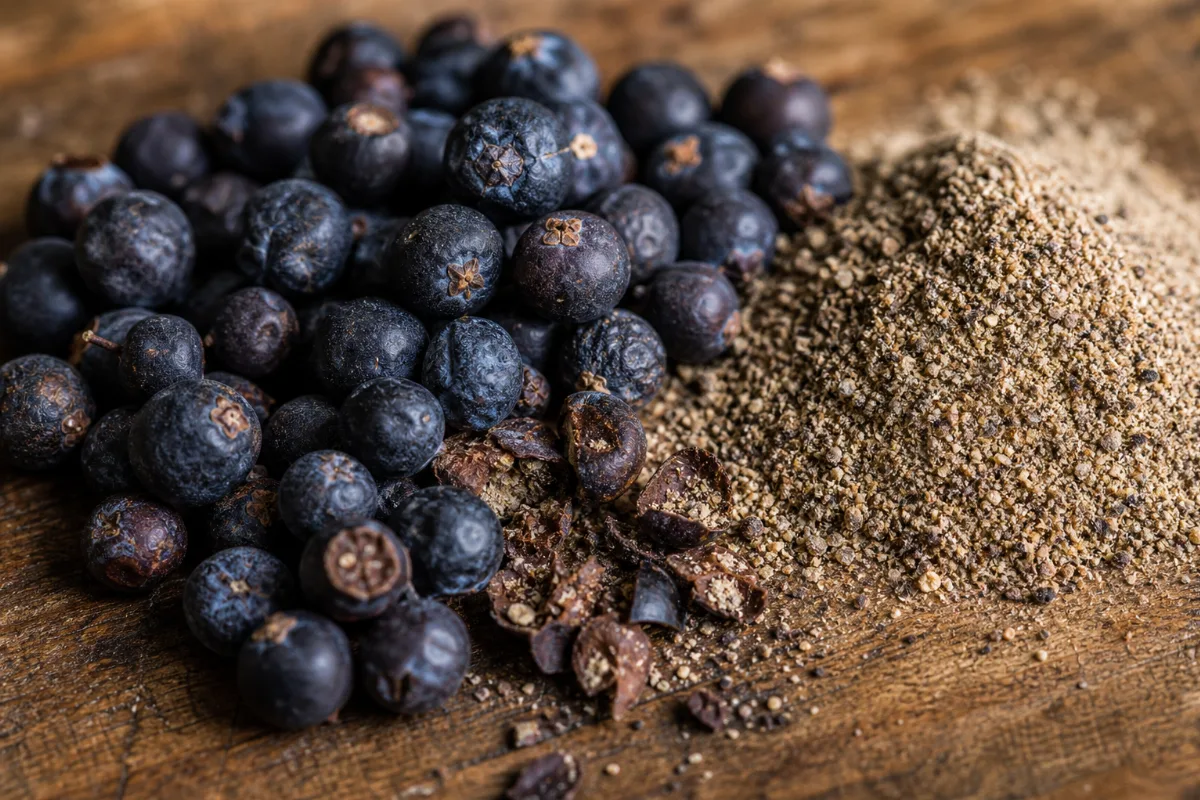
Spices · Herbs · Spice and traditional urinary and stomach herb, with very little human research
Juniper Berry
Juniperus communis L. · also called Juniper berry, juniper cone berry, common juniper, enebro (Spanish), genievre (French), Wacholderbeere (German)
Juniper berry is the small blue-black cone of the common juniper, a conifer of the cypress family. It flavours gin and cooking, and has long been used as a tea or tincture for the stomach and to pass more urine. This profile covers it as a health product. The research is thin and several cautions matter.
General information, not medical advice. Last substantive update · Not medically reviewed. A named clinician has not signed off on this page. How this page is made
About Juniper Berry
Juniper berry (Juniperus communis) is the dried blue-black cone of a common conifer. It is a spice and gin flavouring, and for centuries a European remedy for the stomach and for passing urine. Today the EU accepts it only as a traditional herbal medicine for minor urinary complaints and for indigestion and gas, because the committee found no clinical studies of the berry. One recent small trial of a juniper oil product helped indigestion. Everything else is animal or lab work. Safety cautions matter more than benefits here: kidney disease, pregnancy, skin reactions and a poisonous look-alike.
What it is
Juniperus communis is an evergreen conifer of the cypress family (Cupressaceae), native to Europe, West and Central Asia, North Africa and North America. The 'berry' is a small fleshy cone, up to 10 mm wide, violet-brown to blackish with a bluish bloom, holding three hard seeds.
Cooking with juniper berries is a normal food use and is not the concern. This profile is about juniper as a health product: tea, tincture, extract, capsules and oil.
Traditional and current uses
The EU herbal committee (2023) accepts two traditional uses for adults: flushing the urinary tract in minor complaints, and symptom relief of indigestion and gas. 'Traditional' means it rests on long use, not on proof that it works.
Older books also list gout, arthritis, coughs, painful periods and diabetes. The EU does not accept these.
What the research shows
The EU assessment report (2023) found no published clinical studies of juniper berry or its preparations. Since then we found two small human trials. One, in 76 adults with indigestion, used a standardised juniper oil product for 28 days and beat placebo on symptom scores. The other, in 62 women with painful periods, compared juniper capsules with mefenamic acid and had no placebo group.
The rest is rat, mouse and cell work, mostly on blood sugar, inflammation, germs and cancer cells. Animal results often do not carry over to people.
What is not known
No trial of berry tea, tincture or powder exists. Kidney risk in people is unknown. Pregnancy, genotoxicity and cancer-risk data are missing. The US NIH pages on liver safety and breastfeeding could not be read, and no NCCIH page was found.
At a glance
Traditional uses history, not proof
- Medieval and early modern Europe: the EU assessment report says berries were used to 'clean the kidneys' (Dodonaeus, 1608, citing Galen). This is a secondary-source statement, not checked against the old text.
- Folk medicine in Europe: tea or tincture for indigestion, bladder and kidney complaints, gout and arthritis; oil on skin for muscle aches (EU report, citing handbooks).
- Kneipp (1891) advised a 21-day cure with a few chewed berries a day for a weak stomach.
- Unani medicine: the berry ('abhal') is used for menstrual pain.
Studied for research
- Indigestion, low
- Gas and bloating, insufficient
- Urinary flushing, insufficient
- Painful periods, very low
- Blood sugar, insufficient (animals only)
- Joint and muscle aches, insufficient
- Lab and animal effects, insufficient
Main compounds
- Essential oil rich in alpha-pinene, sabinene, myrcene, limonene and terpinen-4-ol
- Flavonoids and biflavonoids, named in lab work but not shown to do anything alone
- About 30% sugars (glucose and fructose), per the EU report
- Resins and tannins, noted by the EU report, not studied here
Common forms
- Berries as a spice and in gin
- Berry tea (infusion)
- Liquid extract and tincture (contain alcohol)
- Soft extract and capsules
- Essential oil (a separate product with its own rules; not for swallowing without advice)
Research links: EU herbal monograph on juniper cone berry (European Medicines Agency) · EU assessment report on juniper cone berry (European Medicines Agency) · EU assessment report on juniper essential oil (European Medicines Agency) · Research Library · Genes & Biomarkers Library
What it is and its history
- Accepted scientific name
- Juniperus communis L.
- Naming authority
- L. (GBIF, usageKey 2684709, status ACCEPTED)
- Synonyms
- Not listed here. No synonym list was retrieved beyond the accepted-name match.
- Common names
- Juniper cone berry (en); Common juniper (en); Enebro, baya de (es); Genievre (baie de) (fr); Wacholderbeeren (de); Ginepro pseudofrutto (it); Zimbro (pt); Jeneverbes (nl)
- Family or group
- Cupressaceae (the cypress family). Juniper is a conifer, not a true berry plant.
- Classification
- Plantae > Tracheophyta > Pinopsida > Pinales > Cupressaceae > Juniperus > Juniperus communis
- Native range
- Per the EU report: Europe, West and Central Asia, North Africa and North America.
- Habitat
- Not verified from a primary botanical source.
- What it looks like
- Roots: Not verified.; Stems: Not verified.; Leaves: Needle-shaped, in clusters of three on the branches (EU report).; Flowers: Not verified.; Fruit: The 'berry' is a small fleshy cone: globular, up to 10 mm, violet-brown or blackish with a bluish bloom, with 3 fleshy scales and usually 3 hard seeds (EU report).
- Cultivation
- Not verified.
- Harvest and processing
- The European Pharmacopoeia describes the dried ripe cone berry with at least 10 mL of essential oil per kg (EU report, citing Ph. Eur.).
- Look-alikes and adulterants
- Name: Savin (Juniperus sabina L.); Note: Poisonous look-alike. Almost black fruits only 5 to 8 mm. GBIF accepts it as a separate species (key 7963890). Savin oil was toxic to embryos and liver in pregnant mice.; Name: Prickly or cade juniper (Juniperus oxycedrus L.); Note: Fruits brown-red and larger than genuine berries (EU report). GBIF key 2684451.
- Sustainability and conservation
- Not verified; no IUCN assessment was retrieved.
Photographs
Traditional use and history history, not clinical proof
| Tradition or era | Documented use | Source |
|---|---|---|
| Ancient Greece to 1600s Europe | Berries used to 'clean the kidneys' (Dodonaeus 1608, citing Galen). | s-ema-ar-juniper-berry |
| 19th century Europe | Tea or tincture for dyspepsia, cystitis, gout, cough and diabetes; oil on skin for muscle pain (EU report citing handbooks). | s-ema-ar-juniper-berry |
| Kneipp (1891) | A cure of 5 up to 15 chewed berries a day for a weak stomach, 21 days in all; counted by the EU as a historical tradition. | s-ema-ar-juniper-berry |
| Germany 1984 | Commission E accepted juniper only for dyspepsia. | s-ema-ar-juniper-berry |
| European Union 2009, revised 2023 | HMPC monograph accepts traditional use for minor urinary complaints and for indigestion and gas. | s-ema-monograph-juniper-berry |
| Unani medicine (India) | Berry ('abhal') used for menstrual pain; tested in a 2025 trial. | p39842749 |
Traditional use shows how it was used. It does not show that it works or is safe today.
What is inside, and how it may work
What it contains and how those compounds act in cells and animals. Laboratory and animal mechanisms are not proven effects in people.
Main compounds
| Compound | Family | Where it is concentrated | Activity studied | Level of evidence |
|---|---|---|---|---|
| alpha-Pinene PubChem 6654 | monoterpene | essential oil of berry 20 to 50% of the oil (Ph. Eur. requirement) | Main oil component; no activity shown for the berry's uses. 7 | Chemistry only |
| Sabinene PubChem 18818 | monoterpene | essential oil up to 20% of the oil (Ph. Eur.) | Oil component. 7 | Chemistry only |
| beta-Pinene PubChem 14896 | monoterpene | essential oil 1 to 12% of the oil (Ph. Eur.) | Oil component. 7 | Chemistry only |
| beta-Myrcene PubChem 31253 | monoterpene | essential oil 1 to 35% of the oil (Ph. Eur.) | Oil component. 7 | Chemistry only |
| Limonene PubChem 22311 | monoterpene | essential oil 2 to 12% of the oil (Ph. Eur.) | Oil component. 7 | Chemistry only |
| Terpinen-4-ol PubChem 11230 | monoterpene alcohol | essential oil 0.5 to 10% of the oil (Ph. Eur.) | Once thought to cause the diuretic effect and kidney irritation; 400 mg/kg for 28 days did not change kidneys in rats. 7 17 | Animal research |
| beta-Caryophyllene PubChem 5281515 | sesquiterpene | essential oil up to 7% of the oil (Ph. Eur.) | Oil component. 7 | Chemistry only |
| Bornyl acetate PubChem 247573 | monoterpene ester | essential oil up to 2% of the oil (Ph. Eur.) | Oil component. 7 | Chemistry only |
| Flavonoids and biflavonoids (class) | polyphenols | berries | The authors of a 2023 mouse and cell study suggest these explain the activity of a methanol extract; not shown for single compounds. 3 | Laboratory research |
| Isocupressic acid PubChem 6438138 | diterpene acid | needles (2.0% dry weight in the plant material tested) 2.0% of dry plant material (needles) | Abortion-causing compound in cattle given pine and juniper needles; berry content not reported. 9 | Animal research |
Mechanisms, receptors and pathways
| Target or pathway | Gene or receptor | What was found | Level |
|---|---|---|---|
| Urine output (diuresis) | not established | Old rat work found an increase in urine; the EU report calls the effect inconsistent, seen at relatively high doses, and not only water but minerals too. 7 | Animal research |
| PPAR-alpha, PPAR-gamma, LXR | PPARA, PPARG, NR1H3 | A methanol extract switched on these receptors in liver cells and raised glucose uptake in muscle cells. 3 | Laboratory research |
| Glucose handling | not stated | In rats a decoction lowered blood glucose, possibly by more tissue glucose use and a stronger insulin response. 16 | Animal research |
| Inflammation | NF-kB, AMPK | An extract reduced kidney injury and NF-kB signalling in a rat toxin model and in kidney cells. 11 | Animal research |
| Colon cell growth and cell death | Ki-67, COX-2, caspase-3 | Berry oil changed these markers in rat colon tissue. 19 | Animal research |
| Drug-metabolising enzyme | CYP3A4 | A long-brewed berry decoction blocked CYP3A4 in a lab assay (EU report citing Tam 2014; original not read). 7 | Laboratory research |
| Digestive effect | none known | The EU report says there is no experimental evidence for use in dyspepsia. 7 | None |
Absorption, metabolism and elimination
- Absorption
- No data (EU report: none found).
- Distribution
- No data.
- Metabolism
- No data in people. The EU report says the complex chemistry makes a representative study hard.
- Elimination
- No data.
- Bioavailability
- Unknown.
Isolated compounds versus whole extracts
No single compound is known to explain juniper's effects. The EU committee found no constituent with known therapeutic activity or active marker. A rat test suggested the diuretic effect is not only from the oil or terpinen-4-ol but also from water-soluble parts, so the whole berry matters.
Nutritional composition
Juniper berries are a spice and herbal tea ingredient, not a nutrient source. The EU report says they contain about 30% sugars (glucose and fructose).
1 low certainty1 very low certainty6 not enough evidence
What was looked at
The 8 benefits and uses checked for Juniper Berry, each with how strong the evidence is. Tap one to open it.
- Indigestion (functional dyspepsia)Low certainty
- Gas and bloatingNot enough evidence
- Urinary flushing (increasing urine) in minor urinary complaintsNot enough evidence
- Painful periods (primary dysmenorrhea)Very low certainty
- Blood sugarNot enough evidence
- Joint and muscle aches (rheumatic complaints)Not enough evidence
- Antimicrobial, antioxidant and anti-inflammatory effects in the labNot enough evidence
- Colon cancer prevention (rat study)Not enough evidence
Lab markers tracked in the studies
Blood glucose
What is Juniper Berry good for?
The main proposed uses and how strong the human evidence is for each. "Low" means one small or inconsistent study, "very low" means a single small study with a weak design, and "insufficient" means there is not enough human evidence to judge.
Benefits, one by one
Each card is a research question, not a promise. Tap a goal to filter. Open a card to see the studies, doses and limits.
Indigestion (functional dyspepsia)
Low certaintyOne 4-week placebo-controlled trial of a standardised juniper oil product found less upper-belly discomfort, pressure and fullness. It is a single trial and the product was an oil, not berry tea.
3 studiesNot given here. The trial used a standardised oil preparation once da…
Studies, doses and limits
What the trials found
One randomised, double-blind, placebo-controlled trial (76 adults with functional dyspepsia, 28 days) of Roleca Juniper 100 mg, a standardised juniper essential-oil product. No trial of juniper berry tea, tincture or powder was found. The EU assessment report (2023) found no published clinical studies of the berry or its preparations.
Results
Composite score of upper abdominal discomfort, pressure and fullness fell more with juniper than with placebo at day 28 (p < 0.001). Doctor and patient ratings improved at days 14 and 28 (p <= 0.001) and quality of life improved. Side effects were infrequent, mostly digestive, and similar in both groups; none were serious.
Effect sizes as reported
p-values only in the abstract; no effect size or confidence interval was given
Why this rating
A single small trial (39 juniper, 37 placebo) of a specific oil product, not yet repeated, with a short follow-up and an abstract that gives no effect size. Authors are from a consulting company and a clinic; funding is not stated. Berry tea or tincture have no trial.
Form and dose studied
Not given here. The trial used a standardised oil preparation once daily for 28 days. Ask a doctor or pharmacist about amounts.
Who was studied
Adults with functional dyspepsia. Nobody under 18, pregnant or with kidney disease was studied.
Limits
Results cannot be carried over to berry tea or tincture. Only 28 days were tested.
Why researchers looked
Juniper berry is an old European remedy for a heavy or unsettled stomach, and the EU committee accepts it as a traditional herbal medicine for indigestion.
Traditional use
Berry tea, tincture and extracts have been used for stomach complaints in Europe for a long time. The EU committee accepts this as a traditional use based on long use only.
Proposed mechanism Pharmacological theory
No mechanism has been shown for the digestive use. The EU assessment report says there is no experimental evidence for use in dyspeptic complaints.
A proposed mechanism does not show that the effect happens in people.
The EU committee does not recommend juniper berry in severe kidney disease or kidney or bladder infection, or for people told to limit fluids. See the safety tab.
Gas and bloating
Not enough evidenceGas relief is an accepted traditional use in the EU, but no trial measured it on its own.
3 studiesNot given here.
Studies, doses and limits
What the trials found
No clinical study of gas or bloating alone was found. The dyspepsia trial scored fullness and pressure, which overlap with bloating but are not gas.
Results
No separate result.
Why this rating
Traditional use only; no trial measured gas.
Form and dose studied
Not given here.
Who was studied
Not studied.
Limits
No human data to judge.
Why researchers looked
Flatulence is named with dyspepsia in the EU traditional-use indication for juniper berry.
Traditional use
The EU committee accepts relief of digestive disorders 'such as dyspepsia and flatulence' as a traditional use, resting only on long-standing use.
Proposed mechanism Pharmacological theory
None shown.
A proposed mechanism does not show that the effect happens in people.
The EU committee does not recommend juniper berry in severe kidney disease or kidney or bladder infection, or for people told to limit fluids. See the safety tab.
Urinary flushing (increasing urine) in minor urinary complaints
Not enough evidenceThe EU committee accepts juniper berry for flushing the urinary tract in minor complaints, but only because it has been used for a very long time. No human trial tested it, and it is also the use where the kidney warning matters most.
3 studiesNot given here. The EU monograph is for adults only and says to drink…
Studies, doses and limits
What the trials found
No clinical study of juniper berry for urinary flushing exists in the sources we read. The EU assessment report (2023) says there are no published clinical studies and that well-established use cannot be accepted. A 28-day rat study found no kidney damage from juniper oil at the doses tested.
Results
Animal and handbook statements only.
Why this rating
Traditional use accepted by the EU; no human trial, and animal findings are old and not always consistent.
Form and dose studied
Not given here. The EU monograph is for adults only and says to drink enough fluid; ask a doctor or pharmacist about amounts.
Who was studied
Adults with minor urinary complaints (EU wording). Not for severe kidney disease or kidney or bladder infection.
Limits
Some handbooks warn of kidney irritation; the EU committee calls these warnings contradictory and mostly not based on clinical data. Both the benefit and the risk rest on weak evidence.
Why researchers looked
Juniper berry has been called a 'kidney cleaner' since the Middle Ages and is still sold as a water-passing herb.
Traditional use
Dodonaeus (1608), citing Galen, wrote that the berries 'clean the kidneys'. The EU report also lists use for cystitis and kidney complaints in older books.
Proposed mechanism Animal research
Old rat studies (from the 1950s and 1960s, only titles found in PubMed) tested a diuretic effect. The EU report says the diuretic effect is not always consistent, needs relatively high doses, and also raises mineral loss, so it is not just extra water.
A proposed mechanism does not show that the effect happens in people.
The EU committee does not recommend juniper berry in severe kidney disease or kidney or bladder infection, or for people told to limit fluids. See the safety tab. Fever, painful urination, spasms or blood in the urine need a doctor.
Painful periods (primary dysmenorrhea)
Very low certaintyOne small trial in India compared juniper berry capsules with mefenamic acid. Pain fell a lot in both groups, but there was no placebo group, so it cannot show that juniper works.
2 studiesCapsules of juniper berry were given on the first three days of the p…
Studies, doses and limits
What the trials found
One double-blind randomised trial (62 women aged 18-35) compared juniper berry capsules with mefenamic acid 250 mg for 3 days of each period over two cycles. No placebo group.
Results
Mean pain score fell from 8.1 (SD 1.3) to 2.87 (SD 1.17) with juniper and from 8.1 (SD 1.13) to 3.61 (SD 1.14) with mefenamic acid. Symptom and quality-of-life scores did not differ between the groups. Doppler changes in the juniper group were small to medium.
Effect sizes as reported
Pain change in each group; between-group difference not clearly reported in the abstract
Why this rating
One small trial with no placebo; pain also falls on its own and with a placebo. Run at a Unani medicine institute; Doppler results are exploratory.
Form and dose studied
Capsules of juniper berry were given on the first three days of the period (reported as 750 mg per dose by the authors). Ask a doctor or pharmacist about amounts.
Who was studied
Women aged 18-35 with painful periods.
Limits
No placebo; short; one centre; not repeated.
Why researchers looked
Juniper berry is used in Unani medicine for menstrual pain, and a trial tested this.
Traditional use
Menstruation pain is on the EU report's list of old uses, together with cough, gout and arthritis.
Proposed mechanism Preliminary mechanism
The trial reports changes in uterine artery blood flow; no mechanism was shown.
A proposed mechanism does not show that the effect happens in people.
Pregnancy: the EU committee does not recommend juniper berry in pregnancy, and animal tests point to possible effects on implantation. Do not use if there is any chance of pregnancy. See the safety tab.
Blood sugar
Not enough evidenceRat and mouse studies found lower blood sugar with juniper berry. No human trial exists, and other animal reports found no effect.
4 studiesNot applicable: animal doses are not human doses.
Studies, doses and limits
What the trials found
No human trial of any juniper product for blood sugar was found. Animal work: a berry decoction lowered blood glucose in normal and diabetic rats (1994); berries in diet and drinking water slowed the rise in blood sugar in diabetic mice (1990); a methanol extract lowered fasting glucose by 39% and body weight by 21% in high-fat-diet mice (2023). The EU report also cites a mouse report (Gray and Flatt, 1997) with no effect, noting little method detail.
Results
Animal glucose lowered in several studies; no human result.
Effect sizes as reported
Mouse: fasting glucose down 39% at 12.5 mg/kg; body weight down 21% at 25 mg/kg (methanol extract)
Why this rating
Only animal and cell studies, with mixed results; no human data.
Limits
Animal results often do not carry over to people. The mouse extract was a laboratory methanol extract.
Why researchers looked
Juniper berry is listed in old books as a folk remedy for diabetes.
Traditional use
Diabetes is on the EU report's list of old uses.
Proposed mechanism Animal research
In cell and mouse work a methanol extract switched on PPAR receptors and raised glucose uptake in muscle cells; in rats a decoction raised glucose use by tissues and insulin response to glucose.
A proposed mechanism does not show that the effect happens in people.
Anyone taking diabetes medicine should ask their doctor before using a juniper product, because animal studies suggest it may lower blood sugar; the EU did not find enough evidence to add a warning.
Joint and muscle aches (rheumatic complaints)
Not enough evidenceUsed for centuries inside and on the skin, but no trial was found.
2 studiesNot given here.
Studies, doses and limits
What the trials found
No clinical study was found. The EU report mentions historical case descriptions for rheumatoid arthritis with an oil-ether mixture (Leclerc 1966), without data.
Results
No human result.
Why this rating
Traditional use only; not accepted by the EU as an indication.
Form and dose studied
Not given here.
Who was studied
Not studied.
Limits
Oil on the skin can irritate (see safety).
Why researchers looked
Juniper berry and its oil were used by mouth and on the skin for arthritis, gout and muscle pain.
Traditional use
The EU report lists muscle pain and acute arthritic conditions (topical use) and rheumatism among old uses. These uses are not part of the EU monograph.
Proposed mechanism Animal research
A single-dose rat paw-swelling test (ethanol extract) showed less swelling than a standard drug in the EU report, but only one dose was tested.
A proposed mechanism does not show that the effect happens in people.
Do not use the essential oil on skin undiluted; it can irritate or cause allergy.
Antimicrobial, antioxidant and anti-inflammatory effects in the lab
Not enough evidenceIn test tubes and animals juniper extracts and oils show many effects, but these are early findings and say nothing yet about benefits in people.
3 studiesNot applicable.
Studies, doses and limits
What the trials found
No human trial supports these. Reviews summarise lab and animal work and call for clinical trials.
Results
Lab and animal findings only.
Why this rating
Only cell and animal studies, mixed preparations, no human data.
Who was studied
Not studied in people.
Limits
Lab results rarely predict human benefit.
Why researchers looked
Juniper contains oil compounds and flavonoids that show activity in the lab.
Traditional use
Old uses as an antiseptic are disputed in the EU report.
Proposed mechanism Laboratory research
Lab and animal assays of extracts and oils (antimicrobial, antioxidant, anti-inflammatory); a rat kidney-injury model; cell tests on skin and nerve cells.
A proposed mechanism does not show that the effect happens in people.
A rat study of kidney injury (an extract protecting kidneys in rats) should not be taken as a reason to use juniper with kidney disease; the EU advises against it.
Colon cancer prevention (rat study)
Not enough evidenceJuniper berry oil reduced chemically induced colon tumours in rats. This is one animal study and says nothing about people.
1 studiesNot applicable.
Studies, doses and limits
What the trials found
No human data.
Results
Fewer and smaller colon tumours in rats given a cancer-causing chemical.
Effect sizes as reported
Not given in the abstract
Why this rating
One rat study.
Who was studied
Rats.
Limits
A chemical model, no human data.
Why researchers looked
Researchers tested juniper berry oil in a rat colon-cancer model.
Traditional use
No traditional use for this.
Proposed mechanism Animal research
The rat study found less cell growth (Ki-67 down), less COX-2, more cell-death signal (caspase-3 up) and better antioxidant defences in colon tissue.
A proposed mechanism does not show that the effect happens in people.
None to apply to people.
Connections to the rest of health
How Juniper Berry connects to the rest of our health knowledge graph. Every link says what kind of connection it is. A safety link (for example to the liver) is a warning, not a benefit. A study that merely mentions a topic never creates a benefit link.
Explore every connection: goals, body systems, organs, symptoms, genes
A. Wellness goals
| Connected to | Kind of connection | Evidence status | Context | Studies |
|---|---|---|---|---|
| Digestive Support | Potential benefit | Low certainty | Indigestion (functional dyspepsia): One 4-week placebo-controlled trial of a standardised juniper oil product found less upper-belly discomfort, pressure and fullness. It is a single trial and the product was an oil, not berry tea. | 1 6 7 |
| Gut Health | Potential benefit | Low certainty | Indigestion (functional dyspepsia): One 4-week placebo-controlled trial of a standardised juniper oil product found less upper-belly discomfort, pressure and fullness. It is a single trial and the product was an oil, not berry tea. | 1 6 7 |
| Digestive Support | Traditional use | Not enough evidence | Gas and bloating: Gas relief is an accepted traditional use in the EU, but no trial measured it on its own. Urinary flushing (increasing urine) in minor urinary complaints: The EU committee accepts juniper berry for flushing the urinary tract in minor complaints, but only because it has been used for a very long time. No human trial tested it, and it is also the use where the kidney warning matters most. | 6 7 1 17 |
| Gut Health | Traditional use | Not enough evidence | Gas and bloating: Gas relief is an accepted traditional use in the EU, but no trial measured it on its own. | 6 7 1 |
| Womens Wellness | Potential benefit | Very low certainty | Painful periods (primary dysmenorrhea): One small trial in India compared juniper berry capsules with mefenamic acid. Pain fell a lot in both groups, but there was no placebo group, so it cannot show that juniper works. | 2 7 |
| Blood Sugar Balance | Preliminary mechanism | Not enough evidence | Blood sugar: Rat and mouse studies found lower blood sugar with juniper berry. No human trial exists, and other animal reports found no effect. | 16 18 3 7 |
| Metabolic Health | Preliminary mechanism | Not enough evidence | Blood sugar: Rat and mouse studies found lower blood sugar with juniper berry. No human trial exists, and other animal reports found no effect. | 16 18 3 7 |
| Joint Support | Traditional use | Not enough evidence | Joint and muscle aches (rheumatic complaints): Used for centuries inside and on the skin, but no trial was found. | 7 4 |
| Inflammation Balance | Traditional use | Not enough evidence | Joint and muscle aches (rheumatic complaints): Used for centuries inside and on the skin, but no trial was found. | 7 4 |
| Immune Support | Preliminary mechanism | Not enough evidence | Antimicrobial, antioxidant and anti-inflammatory effects in the lab: In test tubes and animals juniper extracts and oils show many effects, but these are early findings and say nothing yet about benefits in people. | 10 15 11 |
| Inflammation Balance | Preliminary mechanism | Not enough evidence | Antimicrobial, antioxidant and anti-inflammatory effects in the lab: In test tubes and animals juniper extracts and oils show many effects, but these are early findings and say nothing yet about benefits in people. | 10 15 11 |
| Healthy Aging | Preliminary mechanism | Not enough evidence | Antimicrobial, antioxidant and anti-inflammatory effects in the lab: In test tubes and animals juniper extracts and oils show many effects, but these are early findings and say nothing yet about benefits in people. | 10 15 11 |
B. Body systems
| Connected to | Kind of connection | Evidence status | Context | Studies |
|---|---|---|---|---|
| Urinary system | Traditional use | Not enough evidence | Accepted EU traditional use for flushing in minor urinary complaints; no human trials. Preparation or compound: Juniper berry tea, tincture, extract |
6 7 |
| Digestive system | Demonstrated clinical effect | Low certainty | One placebo-controlled trial in functional dyspepsia; mostly digestive side effects similar to placebo. One placebo-controlled trial in functional dyspepsia. Preparation or compound: Standardised juniper oil product (Roleca Juniper 100 mg) |
1 |
| Digestive System | Biological association | Low certainty | Studied for: Indigestion (functional dyspepsia) Studied for: Gas and bloating | 1 6 7 19 |
| Urinary System | Biological association | Not enough evidence | Studied for: Urinary flushing (increasing urine) in minor urinary complaints | 6 7 17 |
| Reproductive System | Biological association | Very low certainty | Studied for: Painful periods (primary dysmenorrhea) | 2 7 |
| Endocrine System | Biological association | Not enough evidence | Studied for: Blood sugar | 16 18 3 7 |
| Metabolism Weight | Biological association | Not enough evidence | Studied for: Blood sugar | 16 18 3 7 |
| Musculoskeletal System | Biological association | Not enough evidence | Studied for: Joint and muscle aches (rheumatic complaints) | 7 4 |
| Immune System | Biological association | Not enough evidence | Studied for: Antimicrobial, antioxidant and anti-inflammatory effects in the lab | 10 15 11 |
C. Body parts and organs
| Connected to | Kind of connection | Evidence status | Context | Studies |
|---|---|---|---|---|
| Kidneys | Contraindication | Low certainty | Not recommended in severe kidney disease or kidney infection (EU). Handbook kidney-irritation warnings are disputed; a rat study of the oil found none. Not recommended in severe kidney disease or kidney infection (EU). Handbook kidney warnings are disputed. Preparation or compound: Juniper berry preparations and oil |
6 7 17 |
| Reproductive organs | Contraindication | Very low certainty | Not recommended in pregnancy. Rat and cattle findings; no human data. Not recommended in pregnancy; rat and cattle findings, no human data. Preparation or compound: Juniper berry extract, oil, needles |
6 7 9 4 |
| Skin | Adverse effect or risk | Low certainty | Irritation and some allergy on patch testing. Preparation or compound: Berry extract; oil |
7 5 |
I. Biomarkers
| Connected to | Kind of connection | Evidence status | Context | Studies |
|---|---|---|---|---|
| Blood glucose | Drug or supplement interaction | Not enough evidence | Lowered glucose in animals; possible additive effect with diabetes medicines. Preparation or compound: Berry decoction, infusion, methanol extract |
16 18 3 |
| Blood glucose | Biological association | Not enough evidence | Measured in trials: lowered. A lab change is not the same as a health benefit. | 16 18 3 |
J. Genes, receptors and enzymes
| Connected to | Kind of connection | Evidence status | Context | Studies |
|---|---|---|---|---|
| PPARG | Preliminary mechanism | In vitro | Switched on by a berry extract in liver cells (10.9-fold). | 3 |
| PPARA | Preliminary mechanism | In vitro | Switched on 3.77-fold in cells. | 3 |
| CYP3A4 | Preliminary mechanism | In vitro | Blocked by a long-brewed decoction in a lab assay. | 7 |
K. Biological pathways
| Connected to | Kind of connection | Evidence status | Context | Studies |
|---|---|---|---|---|
| NF-kB | Preliminary mechanism | Animal | Reduced by an extract in rat kidney injury. | 11 |
L. Active compounds
| Connected to | Kind of connection | Evidence status | Context | Studies |
|---|---|---|---|---|
| alpha-Pinene | Biological association | Chemistry only | Main oil component; no activity shown for the berry's uses. Preparation or compound: essential oil of berry |
7 |
| Sabinene | Biological association | Chemistry only | Oil component. Preparation or compound: essential oil |
7 |
| beta-Pinene | Biological association | Chemistry only | Oil component. Preparation or compound: essential oil |
7 |
| beta-Myrcene | Biological association | Chemistry only | Oil component. Preparation or compound: essential oil |
7 |
| Limonene | Biological association | Chemistry only | Oil component. Preparation or compound: essential oil |
7 |
| Terpinen-4-ol | Biological association | Animal | Once thought to cause the diuretic effect and kidney irritation; 400 mg/kg for 28 days did not change kidneys in rats. Preparation or compound: essential oil |
7 17 |
| beta-Caryophyllene | Biological association | Chemistry only | Oil component. Preparation or compound: essential oil |
7 |
| Bornyl acetate | Biological association | Chemistry only | Oil component. Preparation or compound: essential oil |
7 |
| Flavonoids and biflavonoids (class) | Biological association | In vitro | The authors of a 2023 mouse and cell study suggest these explain the activity of a methanol extract; not shown for single compounds. Preparation or compound: berries |
3 |
| Isocupressic acid | Biological association | Animal | Abortion-causing compound in cattle given pine and juniper needles; berry content not reported. Preparation or compound: needles (2.0% dry weight in the plant material tested) |
9 |
Each connection is stored with the ingredient, the connected record, the kind of connection, the evidence status, the supporting studies, the preparation or compound involved, and a review date (last reviewed October 25, 2026).
Evidence at a glance: what changed in 1 lab markers
Tap a number to show only those markers. Counts are markers, not people.
The evidence
The research centre for Juniper Berry. Every record here was checked against PubMed or the publisher's page; we never list a study we have not verified.
Evidence by outcome
Bars show how many studies we found for each outcome, not how well it works. People are added up across trials only (reviews are not added, to avoid double counting).
How we rate evidence
High certainty
Several well-run trials or reviews agree; further research is unlikely to change the picture much.
Moderate certainty
Good trials point the same way, but some doubt remains.
Low certainty
Small, short or inconsistent trials. The finding could change with better research.
Very low certainty
Very little or very weak human data. Treat as a possibility only.
Mixed findings
Trials or reviews disagree with each other.
Not enough evidence
Not enough human research to say either way.
Evidence against
Good research found no benefit, or found harm.
We take the reviewers' own risk-of-bias and GRADE statements where they exist, and otherwise judge from study size, design, consistency, directness and whether a product matches what is sold. Many publications do not make evidence high. Method note: We searched PubMed, read the EU herbal monograph and assessment report on juniper cone berry in full, read the EU assessment report on juniper oil in part, and checked plant names in GBIF and the NCBI taxonomy and compounds in PubChem. Every study was checked against its PubMed record and abstract.
Study library: every study we checked 19
| Study | Design | People | Product, dose, length | Result |
|---|---|---|---|---|
| Albrecht 2025 Efficacy and safety of Roleca juniper 100 mg in the treatment of functional dyspepsia: A randomized, double-blind, placebo-controlled trial. Phytomedicine · PMID 41240546 · DOI |
Controlled trial |
76 Adults with functional dyspepsia (upper abdominal discomfort, pressure, fullness) |
Roleca Juniper 100 mg, a standardised juniper essential-oil product fruit (cone berry), essential oil 100 mg once daily 28 days · vs placebo (n=37 vs 39 on juniper) |
Composite symptom score fell more than with placebo at day 28 (p < 0.001); doctor and patient ratings improved at days 14 and 28 (p <= 0.001); quality of life improved. Side effects were infrequent, mostly digestive, and similar between groups; no serious ones. Group difference reported as p-values; effect size and confidence interval not given in the abstract Methods, limits and fundingOutcomes: Composite score of upper abdominal discomfort, pressure and fullness at day 28; doctor and patient ratings; quality of life (Nepean Dyspepsia Index); side effects Limitations: One 4-week trial of 76 people. The product is a standardised oil preparation, not berry tea. Authors are from Mediconomics GmbH and a clinic; funding source not stated in the abstract (authors declare no conflicts). Not yet repeated. Funding and conflicts: Not stated in the abstract; authors declare no competing interests Read: abstract |
| Banu 2025 Efficacy and safety of abhal (Juniperus communis L) on pain intensity, uterine artery doppler flow, and quality of life in primary dysmenorrhea: A double-blind, randomized controlled trial. Journal of Ethnopharmacology · PMID 39842749 · DOI |
Controlled trial |
62 Women aged 18-35 with painful periods (primary dysmenorrhea) |
Juniper berry capsules ('abhal', Unani medicine) fruit (cone berry) Two capsules (750 mg) three times daily on days 1-3 of the period Two menstrual cycles · vs Mefenamic acid 250 mg three times daily (no placebo group) |
Mean pain score fell from 8.1 (SD 1.3) to 2.87 (SD 1.17) with juniper and from 8.1 (SD 1.13) to 3.61 (SD 1.14) with mefenamic acid (p = 0.012 for the comparison, as reported). Symptom and quality-of-life scores did not differ between groups. Doppler changes in the juniper group were small to medium (effect sizes 0.2 to 0.5). Pain score change in both groups; no placebo to separate drug effect from placebo effect Methods, limits and fundingOutcomes: Pain on a 0-10 style visual scale, symptom ratings, SF-12 quality of life, uterine artery Doppler Limitations: No placebo group; small; run by a Unani medicine institute; abstract does not give between-group differences clearly; Doppler findings are exploratory. Funding and conflicts: No conflicts declared in the abstract Read: abstract |
| Chae 2023 Juniper Berries Regulate Diabetes and Obesity Markers Through Modulating PPARalpha, PPARgamma, and LXR: In Vitro and In Vivo Effects. Journal of Medicinal Food · PMID 37186895 · DOI |
Animal research animal |
Liver, fat and muscle cells; high-fat-diet mice | Methanol extract of juniper berries fruit (cone berry) 25 ug/mL in cells; 12.5 and 25 mg/kg in mice |
In cells the extract switched on PPAR-alpha (3.77-fold), PPAR-gamma (10.90-fold) and LXR (4.43-fold) and raised glucose uptake in muscle cells (90%). In mice on a high-fat diet, 25 mg/kg gave 21% lower body weight and 12.5 mg/kg gave 39% lower fasting glucose. Methods, limits and fundingOutcomes: Receptor activation, glucose uptake, body weight, fasting glucose Limitations: Lab and mouse work with a methanol extract that people do not take as such. Abstract does not give duration or group sizes. Read: abstract |
| Cosmetic Ingredient Review (no authors listed) 2001 Final report on the safety assessment of Juniperus communis Extract, Juniperus oxycedrus Extract, Juniperus oxycedrus Tar, Juniperus phoenicea extract, and Juniperus virginiana Extract. International Journal of Toxicology · PMID 11558640 · DOI |
Systematic review animal |
Juniper extracts and oils used in cosmetics fruit (cone berry), extract and oil |
Oils showed little acute toxicity and were not skin irritants in animals. Clinical tests of the oils found no irritation or sensitisation, but some sensitisation to the tar. Juniperus communis extract affected fertility and was abortifacient in albino rats. The panel judged the data insufficient to support safety in cosmetics. Methods, limits and fundingOutcomes: Skin irritation, sensitisation, fertility, genotoxicity Limitations: Cosmetic-ingredient review from 2001; not a review of swallowed products. Abstract only. Read: abstract | |
| European Medicines Agency 2010 Assessment report on Juniperus communis L., aetheroleum (EMA/HMPC/12401/2010) EMA · Source |
Authoritative guidance |
Juniper berry essential oil fruit (cone berry), essential oil |
Reports kidney irritation and damage in older handbooks (disputed by Schilcher and Heil), skin irritation and some allergic reactions to the oil in patch tests, and lists kidney inflammation as a contraindication in several references. Reports uterine effects and pregnancy warnings as old handbook statements. Methods, limits and fundingOutcomes: Review of the essential oil, safety, history Limitations: The text layer of the downloaded PDF was partly garbled, so only the clearly readable passages were used; wording may be incomplete. Older (2010) than the berry monograph (2023). Read: summary-only | |
| European Medicines Agency 2023 European Union herbal monograph on Juniperus communis L., galbulus (pseudo-fructus), Final - Revision 1 (EMA/HMPC/241320/2021) EMA · Source |
Authoritative guidance |
Adults; traditional herbal medicinal products | Juniper cone berry: tea, liquid extract, tincture, soft extract fruit (cone berry) |
Two traditional uses accepted (urinary flushing in minor urinary complaints; indigestion and gas), based only on long-standing use. Not recommended in severe kidney disease, with advised fluid restriction, in pregnancy or breastfeeding, or under 18. Interactions: none reported. Undesirable effects: none known. Overdose: none reported. Date of last revision 15 March 2023. Methods, limits and fundingOutcomes: Accepted uses, warnings, pregnancy, interactions, undesirable effects Limitations: A traditional-use monograph does not need trials, so it does not show that the herb works. Read: full-text |
| European Medicines Agency 2023 Assessment report on Juniperus communis L., galbulus (pseudo-fructus) (EMA/HMPC/241319/2021) EMA · Source |
Authoritative guidance |
Juniper cone berry preparations fruit (cone berry) |
No published clinical studies with juniper cone berries or their preparations were found, so well-established use could not be accepted. Non-clinical data are scarce. EudraVigilance (to January 2020): 5 cases with Juniperus communis, all with other medicines taken at the same time, no new safety issues. One case report of a possible fall in INR on a vitamin K blocker. Patch test: 14 of 26 patients being tested for plant dermatitis reacted to a juniper berry extract (Mathias 1979, as cited). Kidney warnings in handbooks are described as contradictory and mostly not based on clinical data. Methods, limits and fundingOutcomes: Review of non-clinical and clinical data, safety, history Limitations: Secondary source: findings of other authors are quoted as the committee reports them; we did not read the original papers it cites. Read: full-text | |
| GBIF Secretariat 2026 GBIF Backbone Taxonomy: Juniperus communis L. (usageKey 2684709) GBIF API · Source |
Authoritative guidance in-vitro |
unspecified |
Accepted species Juniperus communis L., family Cupressaceae, order Pinales, class Pinopsida. Match type EXACT, status ACCEPTED. Juniperus sabina L. (key 7963890) and Juniperus oxycedrus L. (key 2684451) are separate accepted species. Methods, limits and fundingOutcomes: Accepted name, family Read: full-text | |
| Gardner 1998 Abortifacient effects of lodgepole pine (Pinus contorta) and common juniper (Juniperus communis) on cattle. Veterinary and Human Toxicology · PMID 9778758 |
Animal research animal |
4 Pregnant cows (2 per plant group) |
Ground dry needles (leaves) of common juniper or lodgepole pine leaf 4.5 to 5.5 kg of needles a day by stomach tube Until abortion (3 to 10 days) |
Both cows given common juniper needles aborted after 3 and 4 days. Isocupressic acid in the juniper material was 2.0% of dry weight. Methods, limits and fundingOutcomes: Abortion Limitations: Needles, not berries; cattle; very large doses; 2 animals. Shows that the plant can contain an abortion-causing compound in cattle, not that berries do this in women. Read: abstract |
| Goncalves 2022 Zimbro (Juniperus communis L.) as a Promising Source of Bioactive Compounds and Biomedical Activities: A Review on Recent Trends. International Journal of Molecular Sciences · PMID 35328621 · DOI |
Systematic review animal |
Juniperus communis (all parts, many preparations) unspecified |
Describes lab and animal findings (antimicrobial, antioxidant, anti-inflammatory, blood sugar and cholesterol lowering, cancer-cell and brain-cell effects) and states that these suggest possible future uses. It does not report human trials. Methods, limits and fundingOutcomes: Narrative review of lab and animal studies Limitations: Narrative review of mostly lab and animal studies; no pooled analysis or certainty rating. Read: abstract | |
| Lin 2022 Juniperus communis extract ameliorates lipopolysaccharide-induced acute kidney injury through the adenosine monophosphate-activated protein kinase pathway. Food Science and Nutrition · PMID 36249972 · DOI |
Animal research animal |
Rats with bacterial-toxin kidney injury; kidney cells | Juniperus communis extract (part not stated in the abstract) unspecified |
The extract improved survival and reduced kidney injury scores in rats and reduced inflammation signals in kidney cells. Methods, limits and fundingOutcomes: Survival, kidney injury scores and markers Limitations: Rat and cell work only; which plant part was used is not stated in the abstract. It does not show that juniper protects human kidneys; the EU warning for people with kidney disease still stands. Read: abstract |
| NCBI 2026 NCBI Taxonomy: Juniperus communis (taxid 58039) NCBI Taxonomy · Source |
Authoritative guidance in-vitro |
unspecified |
Taxid 58039, rank species, name Juniperus communis (seed plants). Methods, limits and fundingOutcomes: Species record Read: full-text | |
| Pages 1989 Teratological evaluation of Juniperus sabina essential oil in mice. Planta Medica · PMID 2748731 · DOI |
Animal research animal |
Pregnant mice | Savin (Juniperus sabina) essential oil, not common juniper essential oil (savin) 15 to 135 mg/kg under the skin on gestation days 6 to 15 10 days |
Savin oil was toxic to the embryos (more affected litters); the mothers in the two higher groups lost weight, and liver toxicity was seen in females that lost whole litters. Methods, limits and fundingOutcomes: Maternal weight, liver, embryo and fetal harm Limitations: A different species (savin), injected, in mice. Included here only because savin is a poisonous look-alike. Read: abstract |
| Pan 2024 Phytochemistry, Pharmacology, and Traditional Medicine Applications of Juniperus sabina L.: A Comprehensive Overview. Molecules · PMID 39769965 · DOI |
Systematic review animal |
Savin (Juniperus sabina), not common juniper berries, branches, leaves |
Describes savin as a different species used in Uyghur medicine, with 279 compounds identified; the abstract says toxicity is covered in the review but gives no toxicity details. Methods, limits and fundingOutcomes: Review of chemistry, traditional use, effects and toxicity Limitations: Only the abstract was read; the toxicity section was not read. Read: abstract | |
| Raina 2019 Potential of Juniperus communis L as a nutraceutical in human and veterinary medicine. Heliyon · PMID 31508527 · DOI |
Systematic review animal |
Juniperus communis berries, oil and extracts unspecified |
Lists traditional uses (diuretic, anti-arthritis, anti-diabetes, antiseptic, stomach and gut) and lab and animal findings, and calls for well-designed clinical trials with well-characterised extract or oil. Methods, limits and fundingOutcomes: Narrative review Limitations: Narrative review; no pooled analysis. Read: abstract | |
| Sanchez de Medina 1994 Hypoglycemic activity of juniper "berries". Planta Medica · PMID 8073081 · DOI |
Animal research animal |
Normal rats and streptozotocin-diabetic rats | Juniper berry decoction fruit (cone berry) 250 mg/kg in normal rats; 125 mg/kg in diabetic rats 24 days in diabetic rats |
The decoction lowered blood glucose in normal rats and, over 24 days, in diabetic rats, and reduced deaths and body weight loss. The authors suggest more glucose use by tissues and a stronger insulin response to glucose. Methods, limits and fundingOutcomes: Blood glucose, insulin secretion, mortality, body weight Limitations: Rats only; abstract gives no group sizes or numbers. Read: abstract |
| Schilcher 1997 [The potential nephrotoxic effects of essential juniper oil]. Arzneimittel-Forschung · PMID 9324932 |
Animal research animal |
Male Sprague-Dawley rats | Two batches of juniper essential oil; terpinen-4-ol fruit (cone berry), essential oil Oil 100, 333 or 1000 mg/kg (batch 1) and 100, 300 or 900 mg/kg (batch 2); terpinen-4-ol 400 mg/kg 28 days |
No change in kidney function or structure at any tested dose; the authors call the oil and terpinen-4-ol non-toxic in this test. Methods, limits and fundingOutcomes: Kidney function and kidney tissue structure Limitations: Rats, 28 days, oil by mouth; does not show what happens in people with kidney disease or with long use. Article is in German; only the English abstract was read. Read: abstract |
| Swanston-Flatt 1990 Traditional plant treatments for diabetes. Studies in normal and streptozotocin diabetic mice. Diabetologia · PMID 2210118 · DOI |
Animal research animal |
Normal and streptozotocin-diabetic mice (screen of 11 plants) | Dried juniper berries in the diet and as an infusion fruit (cone berry) 6.25% of the diet; infusion 1 g per 400 ml in place of drinking water 12 days before streptozotocin, then follow-up |
Juniper did not change glucose or insulin in normal mice. In diabetic mice it reduced the rise in blood sugar, thirst and weight loss; plasma insulin was not changed. Methods, limits and fundingOutcomes: Blood glucose, insulin, food and water intake, body weight Limitations: Mice; one of 11 plants screened; abstract has no numbers. A separate report (Gray and Flatt 1997, as cited by EMA) found no glucose effect. Read: abstract |
| Yaman 2021 Chemopreventive efficacy of juniper berry oil (Juniperus communis L.) on azoxymethane-induced colon carcinogenesis in rat. Nutrition and Cancer · PMID 31617778 · DOI |
Animal research animal |
32 Male Wistar rats given a colon-cancer-causing chemical |
Juniper berry oil fruit (cone berry), essential oil 100 ul/kg by mouth 16 weeks |
Juniper oil reduced the number and size of colon adenomas and adenocarcinomas and changed tissue markers (CEA, COX-2 and Ki-67 down, caspase-3 up). Methods, limits and fundingOutcomes: Colon tumours and tissue markers Limitations: Rats, a chemical cancer model; no human data. Read: abstract |
What we do not know yet
- What the evidence supports: nothing about juniper berry is above low certainty. The best result is one small placebo-controlled trial of a juniper oil product for indigestion.
- What is uncertain: whether berry tea or tincture does anything for the stomach or urinary tract, since the EU found no clinical studies of the berry.
- Kidney risk in people is unknown. Handbook warnings are disputed and only one rat study of the oil exists.
- Pregnancy, breastfeeding and children are not studied; genotoxicity and cancer risk are not studied.
- The painful-periods trial has no placebo group.
- The NIH LiverTox and LactMed pages could not be read, and no NCCIH page was found.
How new research is added
New studies are found by a saved PubMed search and are placed in a review queue. A person reads each one before it changes any evidence rating or safety wording. New publications never change ratings automatically.
Lab markers
What changed in blood or saliva tests during trials. A changed number is not the same as feeling or being healthier, and we give no "normal ranges".
Metabolic 1
Blood glucose
Lowered in trials
The amount of sugar in the blood.
Not enough evidenceResults and what it means
Why it was measured
To see whether a product could help blood sugar control.
Statistical vs. clinical meaning
Animal glucose changes only. Lower glucose in a mouse is not a clinical benefit in people.
Safety implication
Animal findings suggest a possible additive effect with diabetes medicines; not tested in people.
| Study | Result | People | Product |
|---|---|---|---|
| 16 | Lower blood glucose with berry decoction in normal rats (250 mg/kg) and in diabetic rats (125 mg/kg for 24 days); numbers not in the abstract. | Rats | Juniper berry decoction |
| 18 | Smaller rise in blood glucose after streptozotocin in diabetic mice; no change in normal mice. | Mice | Dried berries 6.25% of diet and infusion |
| 3 | Fasting glucose 39% lower at 12.5 mg/kg. | High-fat-diet mice | Methanol extract of berries |
Safety
What studies and official sources say about side effects, medicines and who should check first. Each point shows what kind of evidence it comes from.
Main points to know 9
- Kidney disease and kidney or bladder infection. The EU herbal monograph (2023) says juniper berry is not recommended in severe kidney disease, including infection-related kidney inflammation (interstitial nephritis, pyelitis, pyelonephritis). It is also not recommended for people whose doctor has told them to limit fluids, because the traditional urinary use needs plenty of fluid. Fever, painful urination, spasms or blood in the urine while using it need a doctor. Handbooks have long warned about kidney irritation. The EU committee calls those warnings contradictory and mostly not based on clinical data, and a 28-day rat study of the oil at up to 1000 mg/kg found no kidney change. The warning is kept because the evidence cannot rule it out. Authoritative guidance 6 7 17
- Pregnancy and breastfeeding: do not use. The EU monograph says safety in pregnancy and breastfeeding has not been established and use is not recommended. Reasons are the missing safety data and old animal findings: in rats, juniper berry extracts reduced implantation, and the cosmetic-ingredient panel notes the extract affected fertility and was abortifacient in rats. The EU report says these rat tests were incomplete and do not allow a firm conclusion. Older handbooks, as far as the partly readable EU oil report shows, describe juniper as irritating to the uterus and say the oil in overdose can cause uterine bleeding or abortion; that is a traditional warning, not a measured human rate. In cattle, large amounts of juniper needles (not berries) caused abortion within days. No human pregnancy study exists. Authoritative guidance 6 7 4 9 5
- Savin (Juniperus sabina) is a poisonous look-alike. Savin is a different juniper. Its fruits are almost black and smaller (5 to 8 mm) than genuine juniper cone berries, and the EU report says berries are occasionally adulterated with other Juniperus species. In Belgium only savin is named as prohibited in foods and supplements (EU oil report, second-hand). Savin oil was toxic to embryos and liver in pregnant mice. Only buy berries sold under the botanical name Juniperus communis, and never pick wild berries without expert identification. Animal research 7 5 13 14
- Skin contact can irritate or cause allergy. In patch testing, 14 of 26 patients being checked for plant dermatitis reacted to a juniper berry extract, and the report put this down to irritation (EU report, citing a 1979 study). The EU oil report, in text we could only partly read, mentions 2 irritation reactions in 20 people tested with the oil and allergic reactions in 6 of 86 allergy patients. The EU later removed 'allergic skin reactions' from the monograph because no further case reports were found. Anyone who reacts to juniper or other conifer or cypress-family plants should avoid it. Case series 7 5 4
- Diabetes and blood-sugar medicines. Animal studies found lower blood glucose with juniper berry. No human data exist, and the EU oil report decided not to add a warning because the animal results conflict. Anyone using diabetes medicines should ask a doctor or pharmacist before a juniper product. Animal research 16 18 3 5
- Water tablets (diuretics). The EU report says combining juniper with synthetic diuretics does not seem logical, but no clinical interaction was reported, so no warning is in the monograph. This is a pharmacological-theory caution: two products that both raise urine output could add up. Ask a doctor or pharmacist if you take a diuretic. Pharmacological theory 7
- Long-term use has not been tested. The EU monograph says to see a doctor if symptoms last more than 2 weeks. A Belgian rule for food supplements (as cited by the EU) limits berries to 6 weeks without medical advice. A German reference (Schilcher 2016, as cited) warns against long-term use and suggests 4 to 6 weeks at most. Web claims that seizures and kidney damage follow more than 10 g a day or more than 4 weeks are from an undocumented web source and could not be verified. Authoritative guidance 6 7 5
- Children and teenagers. Not recommended under 18 because there are not enough data. Authoritative guidance 6 7
- The essential oil is a separate product. The EU berry monograph does not cover the essential oil. The EU oil report lists old handbook statements of kidney irritation, strong urine output, purple or violet-smelling urine, stomach upset, faster heartbeat and, in overdose, effects on the nervous system and uterus. These are not measured rates. Do not swallow the oil or put it on skin undiluted without professional advice. Authoritative guidance 5
Side effects 5
| Effect | How often | Severity and recovery | Evidence |
|---|---|---|---|
| None known (EU monograph) EudraVigilance to January 2020 had 5 cases with Juniperus communis, all with other medicines at the same time, and the EU found no new safety issue. Absence of reports is not proof of safety. | Not established | not stated not stated | Authoritative guidance 6 7 |
| Digestive upset In the 28-day oil trial side effects were infrequent, mostly digestive and similar to placebo; no serious ones. No numbers in the abstract. | Not established | mild not stated | Controlled trial 1 |
| Skin irritation or allergy on contact 14 of 26 plant-dermatitis patients reacted to a berry extract on patch testing (irritant reaction per the report). | Not established | mild to moderate not stated | Case series 7 5 |
| Kidney irritation Warned about in handbooks, disputed by the EU committee, and not seen in a 28-day rat study of the oil. No human case with proven cause was found. | Not established | unknown unknown | Authoritative guidance 7 5 17 |
| Possible lower effect of a blood thinner (INR fall) One case: a person on phenprocoumon needed a 28% higher dose while eating 5 to 7 berries daily; rated 'possible' (Naranjo score 3). No re-challenge. The EU did not add a warning. | Not established | unknown slow fall after stopping the berries | Case report 7 |
Liver
We found no human case of liver injury from juniper berry in the sources read. The EU berry assessment lists no liver warning. The LiverTox page for juniper could not be read (the site asked for a browser check), so its content is not verified. 6 7
How often. No frequency of liver injury was found. Not finding reports is not proof of safety.
Monitoring. No agency monitoring advice was found.
This is a safety connection. It is not evidence that Juniper Berry supports liver health.
Medicines and supplements 5
| With | Why it matters | Importance | Evidence | What to do |
|---|---|---|---|---|
| Vitamin K blockers (warfarin, phenprocoumon) blood thinner | Unknown. An unconfirmed claim of high vitamin K content in the berries was not supported by other sources. | One case report; possible, not proven. | Case report Very low certainty 7 | Tell your doctor or anticoagulant clinic before starting or stopping juniper berries, so INR can be checked. |
| Diuretics (water tablets) diuretic | Both increase urine output (theory). | No clinical interaction reported. | Pharmacological theory Not enough evidence 7 | Ask a doctor or pharmacist. Drink enough fluid as the EU monograph says for urinary use. |
| Diabetes medicines blood sugar | Animal studies show lower blood glucose. | Not tested in people. | Animal research Not enough evidence 16 18 3 | Check blood sugar closely and ask your doctor before using a juniper product. |
| Medicines broken down by the liver enzyme CYP3A4 enzyme | In a lab test, a juniper berry decoction brewed for a long time strongly blocked CYP3A4 (EU report, citing Tam 2014; original not read). | Lab only; not tested in people. | Laboratory research Not enough evidence 7 | Ask a pharmacist if you take medicines that depend on this enzyme. |
| Other medicines (general) general | The EU monograph states 'none reported'. | Authoritative guidance Not enough evidence 6 | Absence of reports does not mean no interaction; tell your pharmacist about all products you use. |
Who should check first 6
| Situation | Advice | Evidence |
|---|---|---|
| Severe kidney disease; kidney or bladder infection or inflammation (nephritis, pyelitis, pyelonephritis) | Do not use unless a doctor says so (EU: not recommended). | Authoritative guidance 6 7 |
| Pregnancy and breastfeeding | Avoid. Safety not established (EU); rat findings and traditional uterine-stimulant warnings. | Authoritative guidance 6 7 4 |
| Doctor has told you to limit fluids (for example some heart or kidney conditions) | Not recommended: urinary use needs plenty of fluid (EU). | Authoritative guidance 6 |
| Children and teenagers under 18 | Not recommended (EU). | Authoritative guidance 6 |
| Known allergy or skin reaction to juniper | Avoid (EU: hypersensitivity is the only formal contraindication). | Authoritative guidance 6 7 |
| Taking a blood thinner of the vitamin K blocker type, or diabetes medicine | Ask a doctor first (case report; animal data). | Case report 7 16 |
Overdose, product quality and regulators
Summary. The EU committee sees no serious concern about acute toxicity of the berry, but says data on repeat dosing, genotoxicity and cancer risk are missing, and that reproductive tests were incomplete.
Animal. Mice: LD50 3000 mg/kg for a freeze-dried water extract injected into the belly (EU report). Rats: no kidney change after 28 days of oil by mouth up to 1000 mg/kg. Rats: extracts of the berries reduced implantation and, in one test, pregnancies. Cattle: large doses of juniper needles caused abortion.
Human doses studied. Human trials used an oil product (28 days) and capsules for 3 days a month over two cycles. No safety trial of berry tea or tincture was found.
High dose or long term signals. Handbooks describe kidney irritation with high doses of oil or long use; the EU calls these statements unreliable but keeps the kidney warning. Seizure claims at over 10 g a day are from an undocumented web source.
Overdose response. Berries: no overdose case reported (EU). Oil: older handbook statements of kidney pain, bloody or violet-smelling urine, stomach upset and nervous-system effects, not measured rates.
Genotoxicity. No genotoxicity or cancer-risk data exist for the berry (EU). This is why no EU list entry was possible.
Toxic or hazardous parts. Berries are the used part. Needles, other Juniperus species (especially savin, J. sabina) and the essential oil carry extra risks. Needles caused cattle abortions.
Look-alike species and quality are the main concerns.
Adulteration with other junipers. The EU report says fruits of J. oxycedrus (brown-red, larger) and J. sabina (almost black, 5 to 8 mm) are occasionally mixed in. Genuine berries are violet-brown to blackish with a bluish bloom, up to 10 mm. The European Pharmacopoeia limits unripe or discoloured berries to 5% and foreign matter to 2%. 7
| Body | Action | Date |
|---|---|---|
| European Medicines Agency (HMPC) (EU) | Traditional herbal medicine for minor urinary complaints and for indigestion and gas; based on long use only. Not recommended in severe kidney disease, with fluid limits, in pregnancy or breastfeeding, or under 18. source | 2023-03-15 |
| European Medicines Agency (HMPC) (EU) | Assessment report on the berry: no published clinical studies; well-established use not possible; no entry on the EU list because genotoxicity and cancer risk are unstudied. source | 2023 |
When to get medical help
- Fever, pain on passing urine, spasms or blood in the urine while using juniper (EU: see a doctor).
- Little or no urine, swelling or severe flank pain.
- Any vaginal bleeding or cramping in pregnancy after using a juniper product.
- A rash, swelling, or trouble breathing after contact or swallowing.
- Swallowing essential oil or an unknown wild berry: call a poison centre or emergency services.
- INR change if you take a vitamin K blocker.
Stop using the product and contact a clinician or emergency service. In the US, Poison Control is 1-800-222-1222.
General information only, not medical advice. Ask a clinician or pharmacist before use, especially with medicines, in pregnancy or with a health condition. See the Natural Remedy Safety guide.
Frequently asked questions
Does juniper berry help indigestion?
Possibly. One 4-week placebo-controlled trial of 76 adults with functional dyspepsia found a standardised juniper oil product eased upper-belly discomfort, pressure and fullness more than placebo. The certainty is low: it is one trial of an oil product, not berry tea, and it has not been repeated.
Does juniper berry flush the kidneys or help the bladder?
Is juniper berry safe for the kidneys?
Not for everyone. The EU says it is not recommended in severe kidney disease or kidney or bladder infection. Handbooks have long warned of kidney irritation; the EU committee calls those warnings contradictory and mostly not based on clinical data, and a 28-day rat study of the oil found no kidney change. If you have any kidney problem, ask your doctor first.
Can I take juniper berry in pregnancy or while breastfeeding?
Does juniper berry lower blood sugar?
Can juniper berry interact with my medicines?
The EU monograph says no interactions have been reported. A few cautions remain: one case report of a possible fall in blood-thinner effect (INR) in a person on a vitamin K blocker, a lab result on the CYP3A4 enzyme, animal blood-sugar lowering, and the idea that it should not be combined with water tablets. Tell your pharmacist about everything you take.
What is the difference between juniper berry and savin?
Savin (Juniperus sabina) is a different, poisonous juniper. Its fruits are almost black and only 5 to 8 mm wide, and the EU says berries are sometimes adulterated with other junipers. Savin oil was toxic to embryos and liver in pregnant mice. Buy products that name Juniperus communis, and do not pick wild berries without expert help.
Can juniper berry or its oil irritate the skin?
How long can juniper berry be used?
Is juniper berry safe for children?
Not recommended under 18, because there are not enough data.
Does juniper berry help period pain?
One small trial in India found much less pain after juniper berry capsules, but the comparison group took the drug mefenamic acid and there was no placebo, so a juniper effect cannot be confirmed. Certainty is very low.
Explore by health goal
Digestive SupportGut HealthInflammation BalanceWomens WellnessBlood Sugar BalanceMetabolic HealthJoint SupportImmune SupportHealthy Aging
Editorial transparency
- Written by
- AlternativeMed editorial team. Research compiled with AI assistance, then checked against PubMed records.
- Medical review
- None. This page has not been reviewed by a physician or pharmacist.
- First published
- 2026-10-25
- Last substantive update
- 2026-10-25
- How we research
- We searched PubMed, read the EU herbal monograph and assessment report on juniper cone berry in full, read the EU assessment report on juniper oil in part, and checked plant names in GBIF and the NCBI taxonomy and compounds in PubChem. Every study was checked against its PubMed record and abstract.
- How we rate evidence
- See "How we rate evidence" in the Evidence tab.
- Independence
- No product is promoted on this page. No affiliate links are shown. If one is added later it will be labelled and kept apart from the evidence.
Sources 19
Each source was opened and checked. Where we read only the abstract, it says so. The small numbers in the text point here.
- Albrecht U, Madisch A, Stefenelli U, et al.. Efficacy and safety of Roleca juniper 100 mg in the treatment of functional dyspepsia: A randomized, double-blind, placebo-controlled trial.. Phytomedicine. 2025. PMID 41240546. DOI 10.1016/j.phymed.2025.157542. (abstract)
- Banu T, Sultana A, Begum A, et al.. Efficacy and safety of abhal (Juniperus communis L) on pain intensity, uterine artery doppler flow, and quality of life in primary dysmenorrhea: A double-blind, randomized controlled trial.. Journal of Ethnopharmacology. 2025. PMID 39842749. DOI 10.1016/j.jep.2025.119388. (abstract)
- Chae HS, Dale O, Mir TM, et al.. Juniper Berries Regulate Diabetes and Obesity Markers Through Modulating PPARalpha, PPARgamma, and LXR: In Vitro and In Vivo Effects.. Journal of Medicinal Food. 2023. PMID 37186895. DOI 10.1089/jmf.2022.0146. (abstract)
- Cosmetic Ingredient Review (no authors listed). Final report on the safety assessment of Juniperus communis Extract, Juniperus oxycedrus Extract, Juniperus oxycedrus Tar, Juniperus phoenicea extract, and Juniperus virginiana Extract.. International Journal of Toxicology. 2001. PMID 11558640. DOI 10.1080/10915810160233758. (abstract)
- European Medicines Agency, Committee on Herbal Medicinal Products (HMPC). Assessment report on Juniperus communis L., aetheroleum (EMA/HMPC/12401/2010). EMA. 2010. (summary-only)
- European Medicines Agency, Committee on Herbal Medicinal Products (HMPC). European Union herbal monograph on Juniperus communis L., galbulus (pseudo-fructus), Final - Revision 1 (EMA/HMPC/241320/2021). EMA. 2023. (full-text)
- European Medicines Agency, Committee on Herbal Medicinal Products (HMPC). Assessment report on Juniperus communis L., galbulus (pseudo-fructus) (EMA/HMPC/241319/2021). EMA. 2023. (full-text)
- GBIF Secretariat. GBIF Backbone Taxonomy: Juniperus communis L. (usageKey 2684709). GBIF API. 2026. (full-text)
- Gardner DR, Panter KE, James LF, et al.. Abortifacient effects of lodgepole pine (Pinus contorta) and common juniper (Juniperus communis) on cattle.. Veterinary and Human Toxicology. 1998. PMID 9778758. (abstract)
- Goncalves AC, Flores-Felix JD, Coutinho P, et al.. Zimbro (Juniperus communis L.) as a Promising Source of Bioactive Compounds and Biomedical Activities: A Review on Recent Trends.. International Journal of Molecular Sciences. 2022. PMID 35328621. DOI 10.3390/ijms23063197. (abstract)
- Lin TC, Lu CW, Chang KF, et al.. Juniperus communis extract ameliorates lipopolysaccharide-induced acute kidney injury through the adenosine monophosphate-activated protein kinase pathway.. Food Science and Nutrition. 2022. PMID 36249972. DOI 10.1002/fsn3.2941. (abstract)
- NCBI. NCBI Taxonomy: Juniperus communis (taxid 58039). NCBI Taxonomy. 2026. (full-text)
- Pages N, Fournier G, Chamorro G, et al.. Teratological evaluation of Juniperus sabina essential oil in mice.. Planta Medica. 1989. PMID 2748731. DOI 10.1055/s-2006-961908. (abstract)
- Pan L, Zhou T, Chen C, et al.. Phytochemistry, Pharmacology, and Traditional Medicine Applications of Juniperus sabina L.: A Comprehensive Overview.. Molecules. 2024. PMID 39769965. DOI 10.3390/molecules29245876. (abstract)
- Raina R, Verma PK, Peshin R, et al.. Potential of Juniperus communis L as a nutraceutical in human and veterinary medicine.. Heliyon. 2019. PMID 31508527. DOI 10.1016/j.heliyon.2019.e02376. (abstract)
- Sanchez de Medina F, Gamez MJ, Jimenez I, et al.. Hypoglycemic activity of juniper "berries".. Planta Medica. 1994. PMID 8073081. DOI 10.1055/s-2006-959457. (abstract)
- Schilcher H, Leuschner F. [The potential nephrotoxic effects of essential juniper oil].. Arzneimittel-Forschung. 1997. PMID 9324932. (abstract)
- Swanston-Flatt SK, Day C, Bailey CJ, et al.. Traditional plant treatments for diabetes. Studies in normal and streptozotocin diabetic mice.. Diabetologia. 1990. PMID 2210118. DOI 10.1007/BF00405106. (abstract)
- Yaman T, Uyar A, Kömüroğlu AU, et al.. Chemopreventive efficacy of juniper berry oil (Juniperus communis L.) on azoxymethane-induced colon carcinogenesis in rat.. Nutrition and Cancer. 2021. PMID 31617778. DOI 10.1080/01635581.2019.1673450. (abstract)
Where to buy
Check the label first. Whatever you buy, look for these:
- Whole or ground: whole spices keep their flavor longer
- The origin and a packed-on or best-by date for freshness
- Organic or non-irradiated labeling if that matters to you
- A resealable, airtight container
Talk to a pharmacist or doctor before you start any supplement, especially if you take medicines. See the Safety tab for interactions.
Support our free guides: as an Amazon Associate we earn from qualifying purchases. Full disclosure.


