Horsetail (Equisetum arvense): Uses, Evidence and Safety
Horsetail (Equisetum arvense) is used for urine flow, wounds and hair or nail claims. What EU assessments and trials show, plus thiaminase, nicotine, look-alike species and medicine cautions.
Content last updated . This page has not been medically reviewed.
Safety first. Supplements can cause side effects and interact with medicines. Read mushroom safety and interactions before you use any mushroom product.
What is Horsetail good for?
What the body uses it for, and how strong the evidence is. A normal job in the body is not proof that extra supplements add benefit; each card says which.
Traditional use to increase urine flow
Preliminary or mixedHorsetail herb preparations are registered in the EU as traditional medicines to increase urine flow as an extra measure in minor urinary complaints. This rests on long-standing use, not on proven efficacy.
Supplements: Traditional-use status only. The one human trial was small and in healthy men, so benefit for any urinary condition is not shown.
Diuretic effect in healthy men (one small trial)
Preliminary or mixedIn a small double-blind trial in 36 healthy men, a dry extract produced a net loss of body water similar to a standard water pill, without a significant change in urinary sodium or potassium.
Supplements: Not shown to help any condition; healthy volunteers, four days, one extract.
Skin use for superficial wounds and pain after childbirth
Preliminary or mixedHorsetail preparations for the skin are an EU traditional use for supportive care of superficial wounds. In one trial of 108 first-time mothers, a 3% ointment gave better wound and pain scores than placebo after episiotomy.
Supplements: One trial of a specific ointment; results may not apply to teas, capsules or other products.
Silicon source (absorption only)
Not enough evidenceThe herb is rich in silica. In a pilot study of 12 healthy men, drinking horsetail tea raised blood silicon levels and silicon did not build up; the stronger tea caused diarrhoea in 4 of 12.
Supplements: No health outcome tested; no evidence that extra silicon from horsetail improves hair, nails, skin or bone.
Hair, nail and bone claims
Not enough evidenceHorsetail is traditionally used for hair loss and fissured nails. No trial of horsetail alone for hair or nails was identified in the EMA report, and EFSA (2009) found the plant not sufficiently characterised for maintenance of hair or bone.
Supplements: No good evidence of benefit.
Lab and animal findings (diuretic, wound closure)
Lab or animal research onlyOlder animal studies reported increased urine output, and rat studies of skin extracts reported faster wound closure. These do not show effects in people.
Supplements: No human evidence from these studies.
Connected topics
Open a group to see how each topic connects and how strong the evidence is.
Body systems (8)
- Kidney & UrinaryPreliminary or mixed
Horsetail is an EU traditional herbal medicine for increasing urine flow in minor urinary complaints. This is based on long use; one small trial in healthy men showed a diuretic effect, and benefit for urinary conditions is unproven.
- Nervous SystemDocumented risk
Horsetail contains thiaminase, which breaks down thiamine; Canada requires thiaminase-free products because of possible irreversible brain damage in people already thiamine deficient.
- Urinary SystemPreliminary or mixed
Horsetail is an EU traditional herbal medicine for increasing urine flow in minor urinary complaints. This is based on long use; one small trial in healthy men showed a diuretic effect, and benefit for urinary conditions is unproven.
- Cardiovascular SystemDocumented risk
The EU monograph says horsetail for urinary use should not be used in severe heart disease where fluids are restricted. The effect on the heart is not otherwise established.
- Heart & CirculationDocumented risk
The EU monograph says horsetail for urinary use should not be used in severe heart disease where fluids are restricted. The effect on the heart is not otherwise established.
- Hepatic / Liver SystemDocumented risk
Case reports of hepatitis after horsetail use exist; cause is uncertain.
- Integumentary SystemPreliminary or mixed
Traditional skin use for superficial wounds; supported by one trial of a specific ointment.
- Reproductive HealthDocumented risk
Safety in pregnancy and breastfeeding is not established, so use is not recommended. This reflects missing data, not proven harm.
Body parts (5)
- BrainDocumented risk
Thiamine destruction by thiaminase can contribute to brain damage in people who are already thiamine deficient, per the Canadian position cited by EMA.
- Nervous SystemDocumented risk
Thiamine destruction by thiaminase can harm the nervous system in people already deficient in thiamine.
- KidneysDocumented risk
The EU monograph says not to use horsetail for urinary use where fluid must be limited, for example in severe kidney disease.
- LiverDocumented risk
Case reports of hepatitis after horsetail use exist; cause is uncertain.
- SkinPreliminary or mixed
A traditional skin use for superficial wounds; one trial of a 3% ointment after episiotomy found better wound and pain scores than placebo.
Root causes (2)
- Nutrient DeficiencyDocumented risk
The thiaminase in raw or dried horsetail can destroy thiamine (vitamin B1), so it may worsen a thiamine shortage.
- Medication Side EffectsDocumented risk
The EU monograph reports no interactions, but a case report describes lithium toxicity with a mixed herbal diuretic containing another horsetail species. Ask a pharmacist if on lithium or water pills.
Habits (1)
- HydrationDocumented risk
The EU monograph advises appropriate fluid intake with non-tea preparations and says not to use it where fluids must be limited.
Conditions & symptoms (1)
- Thiamine DeficiencyDocumented risk
Raw or dried horsetail contains thiaminase, which destroys thiamine; people already deficient are at most risk of harm.
Documented risks and interactions (7)
- Thiaminase: destroys thiamine (vitamin B1). Raw and dried horsetail contains thiaminase, an enzyme that breaks down thiamine. Health Canada requires makers to show their products are free of thiaminase activity because of a risk of irreversible brain damage in people who are already thiamine deficient.
- Fluid intake, heart and kidney disease. The EU monograph says horsetail for urinary use should not be used where reduced fluid intake is recommended, for example severe heart or kidney disease.
- Pregnancy, breastfeeding and children. Safety in pregnancy and breastfeeding has not been established and use is not recommended; use in children under 12 is not recommended. Products should not be applied to the breast of breastfeeding women.
- Look-alike species and adulteration. Other horsetail species can differ: Equisetum palustre contains a potentially toxic compound, and adulteration of horsetail with it is possible when harvested by untrained people. EMA advises quality-controlled product only.
- Allergy, stomach upset and nicotine sensitivity. Mild stomach complaints and allergic reactions such as rash and facial swelling have been reported. The EMA report notes small amounts of nicotine are possible (information is contradictory) and a reaction in a nicotine-sensitive person was described.
- Reports of liver injury. The EMA report describes a man with chronic hepatitis B who developed severe hepatitis after two weeks of drinking horsetail juice, and a patient who took a multi-herb mix containing horsetail. These are case reports, so a causal link is uncertain.
- Lithium and diuretic-herb case; low-potassium case. The monograph lists no interactions, but the EMA report describes lithium toxicity in a woman using a mixed herbal diuretic that contained a different horsetail species, and low potassium plus low thiamine in a patient using an unidentified Mexican weight-loss herbal product. EMA drew no conclusion for E. arvense from either.
Key points first
- Other horsetail species differ. A European assessment report says Equisetum palustre is toxic, that adulteration of horsetail with it is possible, and that correct plant identification is important. [1]
- Horsetail contains an enzyme, thiaminase, that destroys thiamine. Canada requires manufacturers to prove their Equisetum arvense products are free of thiaminase activity, because it can lead to irreversible brain damage in people who are already thiamine deficient. [1]
- The EU herbal monograph lists conditions where reduced fluid intake is recommended, for example severe heart or kidney disease, as a contraindication for the urinary use. It also says use in pregnancy and breastfeeding is not recommended. [2]
- Evidence that horsetail helps hair or nails: Proper evidence not found (see the table).
- If someone has eaten a plant they cannot identify, call Poison Help at 1-800-222-1222 (US) or see plant and mushroom poisoning. For other countries see poison help by country.
Overview
Horsetail has been used in traditional European medicine for kidney and bladder complaints, wounds and many other purposes. The EMA report says it contains about 5 to 7.7% silicic acid or silicates. [1] This page is about the herb and what is claimed for it. It does not give identification, foraging or preparation instructions. For diuretic teas as a group, see diuretic teas and fluid balance.Names, plant part and look-alikes
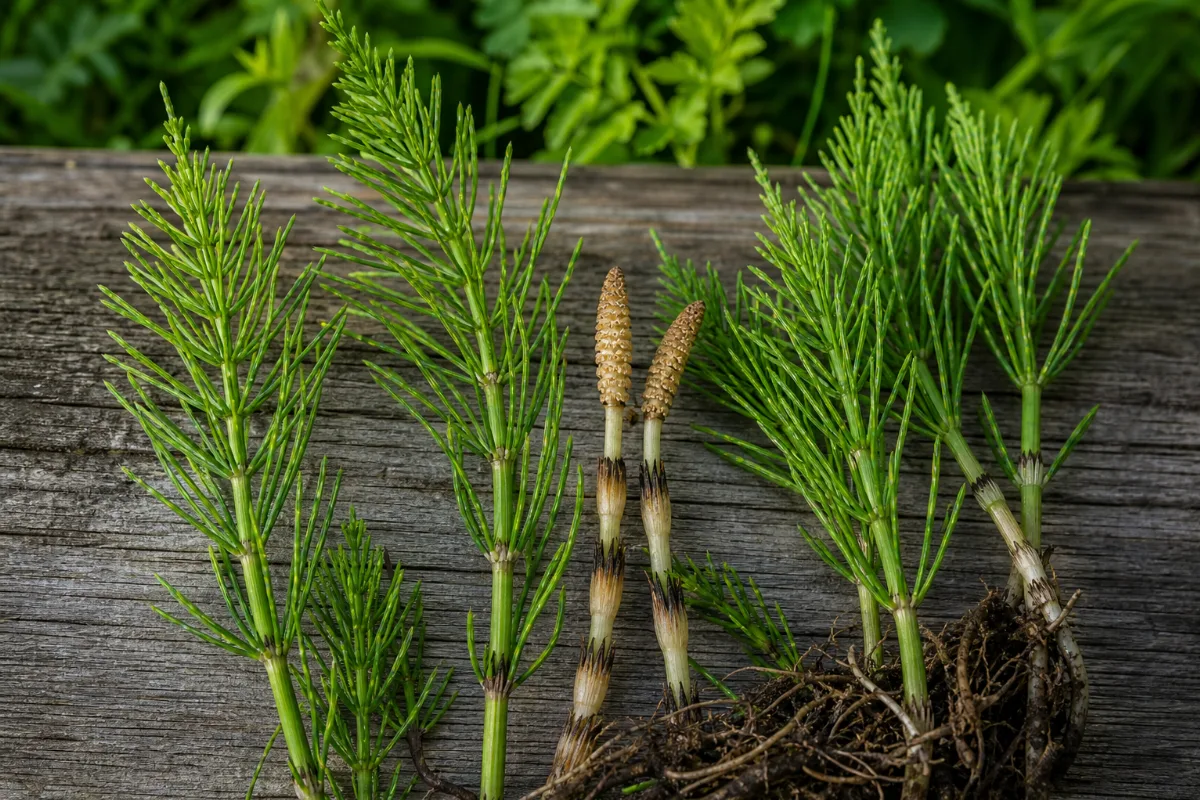
The accepted scientific name is Equisetum arvense L., in the horsetail family (Equisetaceae). [3] The EMA report lists synonyms Allosites arvense Brongn. and Equisetum boreale (L.) Borner, and says the drug is the whole or cut dried sterile aerial parts. [1] The genus Equisetum has 41 recognized species, and sixteen are documented in traditional medicine. [4] Adulteration with E. palustre, E. hyemale, E. fluviatile and E. sylvaticum is possible, and the European Pharmacopoeia includes a test for the absence of E. palustre. [1] The EMA report advises that only quality-controlled horsetail should be consumed because of this. [1] Because look-alikes exist, this page gives no identification advice. If you have a question about a wild plant, ask an expert local botanist or extension service.Traditional use (not proof of effect)
The EMA report describes a broad traditional use, for example to promote elimination of water in kidney and bladder conditions, to stop bleeding, for fissured nails and loss of hair, and for poorly healing wounds. [1] The EU monograph lists two traditional herbal uses, based only on long-standing use: to increase the amount of urine to flush the urinary tract as an adjuvant in minor urinary complaints, and for supportive treatment of superficial wounds. [2] A 2023 review says species of Equisetum are widely used in traditional practices worldwide for genitourinary and rheumatic problems, hypertension and wound healing. [4] Traditional use is a record of use, not proof of effect.What research shows
| Use | What the source found | Strength of evidence | Population and form studied |
|---|---|---|---|
| Diuretic effect (more urine) | In a randomized, double-blind trial a dry extract produced a negative fluid balance, similar to a standard diuretic, and did not significantly change urinary sodium or potassium. The EMA said the trial was limited by only 36 healthy volunteers and little information on the extract. [1] | Promising but limited | 36 healthy men, four consecutive days of treatment, dry extract [1] |
| Wound healing and pain after childbirth | In a double-blind trial of 108 first-time mothers after episiotomy, a 3% ointment gave lower (better) pain and wound scores than placebo. [5] | Promising but limited | 108 women; topical ointment [5] |
| Silicon intake | In 12 healthy men, a tea raised blood silicon levels; silicon did not accumulate. The stronger tea caused diarrhea in 4 of 12. [6] | Absorption only; no health outcome | 12 healthy men; tea [6] |
| Hair growth or thickness | Proper evidence not found. We searched PubMed for Equisetum arvense clinical trials and read the EMA assessment report. The EFSA panel (2009) said the plant had not been sufficiently characterized for maintenance of hair. [1] | No good evidence found | None |
| Nails | One trial in the EMA report tested a product combining horsetail with a sulfur compound on nails. It cannot show the effect of horsetail alone. [1] | Insufficient evidence | 36 women; topical combination [1] |
| Bone strength, weight loss, other uses | Proper evidence not found in the sources we read. The 2023 review says detailed scientific investigation is still needed to understand the efficacy of this genus. [4] | No good evidence found | None |
Forms and why the form matters
The EU monograph lists teas made from the cut herb, expressed juice, liquid extracts, dry extracts and preparations for use on the skin. [2] The EMA report says the high silica content of the plant is hard to extract by making tea in the usual way. [1] It also says no thiaminase activity was observed in the industrial aqueous dry extract and the fluid extract made with 30% ethanol that it examined, while the dried plant itself showed high thiaminase. [1] This is not a how-to. It shows that the form matters, and that a label saying "thiaminase-free" is something to check with a pharmacist.Safety
- Thiamine: see above. People who are already thiamine deficient are most at risk of harm, according to the Canadian position described in the EMA report. [1]
- Nicotine-like effects: the report says small amounts of nicotine are possible in the plant (contradictory information), and that people sensitive to nicotine may react. [1] In animals, especially horses, a thiamine-destroying factor has been linked to muscle weakness, weight loss, abnormal pulse, cold extremities and fever, similar to nicotine poisoning. [1]
- Fluids, heart and kidney disease: the EU monograph names conditions where reduced fluid intake is recommended, such as severe cardiac or renal disease, as a contraindication. [2] See herbs and kidney disease.
- Potassium: in the 36-man trial, potassium excretion did not change significantly. [1] The EMA report also describes a woman who collapsed with a serum potassium of 2.8 mEq/l and a low thiamine level after using an herbal weight-loss medication from Mexico of unknown plants, and her authors suggested high-dose horsetail could be responsible. The product's contents were unknown. [1] So potassium loss is a reported concern, not a proven effect.
- Lithium and diuretic medicines: the EU monograph says no interactions were reported. [2] The EMA report describes a woman on lithium who developed toxicity (lithium level 4.5 mmol/l) after 2 to 3 weeks of an herbal mix with several diuretic herbs, including Equisetum hyemale, a different horsetail species. The assessor said no conclusion for Equisetum arvense was possible from this case. [1] The authors in general advised that people on lithium who use diuretic herbs may get dehydration and lithium toxicity. [1] Ask the prescriber or pharmacist; see narrow-range medicines.
- Pregnancy, breastfeeding, children: the EU monograph says safety has not been established, that use in pregnancy and breastfeeding is not recommended, and that use in children under 12 is not recommended. [2]
- Side effects and allergy: mild stomach problems and allergic reactions such as rash and facial swelling have been reported. [2] A patient allergic to cooked carrot reacted while using horsetail, and the authors thought a similar protein might be involved. [1]
- Surgery, liver: not described in the sources we read. Tell the surgical team about any herb (supplements before surgery).
- Quality: see quality testing and certifications.
Frequently asked questions
Is horsetail good for hair growth?
Proper evidence not found. The EMA report says the plant has not been sufficiently characterized for maintenance of hair. [1]
Is horsetail a diuretic?
One small trial in 36 healthy men found a diuretic effect similar to a standard diuretic. The EMA called it limited. [1]
Why do some horsetail products say thiaminase-free?
Horsetail contains thiaminase, which destroys thiamine. Canada requires manufacturers to prove their products are free of it. [1]
Can I take horsetail with lithium or water pills?
The EU monograph reports no interactions, but a case report involved lithium toxicity with an herbal diuretic mix. Ask your prescriber or pharmacist first. [2] [1]
What is the scientific name?
Equisetum arvense L., family Equisetaceae. Other horsetail species can differ. [3] [1]
References
- EMA Committee on Herbal Medicinal Products (HMPC), Assessment report on Equisetum arvense L., herba, 2016 (EMA/HMPC/278089/2015). Read 2026-10-23.
- EMA Committee on Herbal Medicinal Products (HMPC), European Union herbal monograph on Equisetum arvense L., herba, 2 February 2016 (EMA/HMPC/278091/2015). Read 2026-10-23.
- GBIF Backbone Taxonomy, species match: Equisetum arvense. Read 2026-10-23.
- Genus Equisetum L: Taxonomy, toxicology, phytochemistry and pharmacology. J Ethnopharmacol 2023. Read 2026-10-23.
- The effect of equisetum arvense (horse tail) ointment on wound healing and pain intensity after episiotomy: a randomized placebo-controlled trial. Iran Red Crescent Med J 2015. Read 2026-10-23.
- Silicon Resorption from Equisetum arvense Tea: a randomized, three-armed pilot study. Planta Med 2022. Read 2026-10-23.