Goldenrod (Solidago virgaurea): Uses, Evidence and Safety
Goldenrod (Solidago virgaurea): the EU traditional-use monograph for minor urinary complaints, why it is not trial-proven, and heart, kidney, diuretic and daisy-family cautions.
Content last updated . This page has not been medically reviewed.
Safety first. Supplements can cause side effects and interact with medicines. Read mushroom safety and interactions before you use any mushroom product.
What is Goldenrod good for?
What the body uses it for, and how strong the evidence is. A normal job in the body is not proof that extra supplements add benefit; each card says which.
Traditional use to increase urine (minor urinary complaints)
Not enough evidenceGoldenrod herb is accepted in the EU as a traditional herbal medicine to increase the amount of urine, as an add-on in minor urinary complaints. This rests on long-standing use only.
Supplements: No human trial showing benefit was found in our search; traditional use is not proof it works.
Not proven in human trials
Not enough evidenceA search of Europe PMC for goldenrod trials in urinary, kidney or bladder conditions found no human trial among the first results.
Supplements: No trial evidence found.
Marketed claims: kidney stones, infections, swelling, allergies
Not enough evidenceThese uses are advertised but proper evidence was not found in the sources we read.
Supplements: Not supported by sources read.
Species and quality vary
Not enough evidenceMany goldenrod species exist; findings on one do not automatically apply to another, so the scientific name (Solidago virgaurea for the EU monograph) should be on the label.
Supplements: Not applicable.
Connected topics
Open a group to see how each topic connects and how strong the evidence is.
Root causes (1)
- Medication Side EffectsDocumented risk
The EU monograph does not recommend using goldenrod together with synthetic diuretics (water pills).
Conditions & symptoms (3)
- Heart FailureDocumented risk
Not recommended where reduced fluid intake is advised, such as severe heart disease.
- HypersensitivityDocumented risk
Allergy to daisy-family plants is a listed contraindication; hypersensitivity reactions may occur.
- Kidney Failure, ChronicDocumented risk
Not recommended where reduced fluid intake is advised, such as severe kidney disease.
Documented risks and interactions (6)
- Fluid intake and heart or kidney disease. Not suitable where less fluid is advised, such as severe heart or kidney disease. Preparations need enough fluid intake.
- Combination with water pills. The EU monograph does not recommend taking goldenrod with synthetic diuretics.
- Daisy-family allergy. People allergic to plants of the daisy family (Asteraceae) should not use it. Allergic reactions or digestive upset may occur; frequency is not known.
- Pregnancy, breastfeeding and children. Use in pregnancy, breastfeeding and in children under 12 is not recommended because data are lacking.
- Incomplete toxicity data. Tests for reproductive toxicity, genotoxicity and carcinogenicity have not been performed for the monograph preparations.
- See a doctor for fever, painful urination, blood in urine. Fever, painful urination, spasms or blood in the urine need medical assessment rather than self-treatment.
Quick safety points
- The EU monograph lists as contraindications hypersensitivity to plants of the Asteraceae (daisy) family and conditions where reduced fluid intake is recommended, such as severe heart or kidney disease. [1]
- It does not recommend use together with synthetic diuretics (water pills). [1]
- Use in pregnancy and breastfeeding, and in children under 12, is not recommended. [1]
What it is
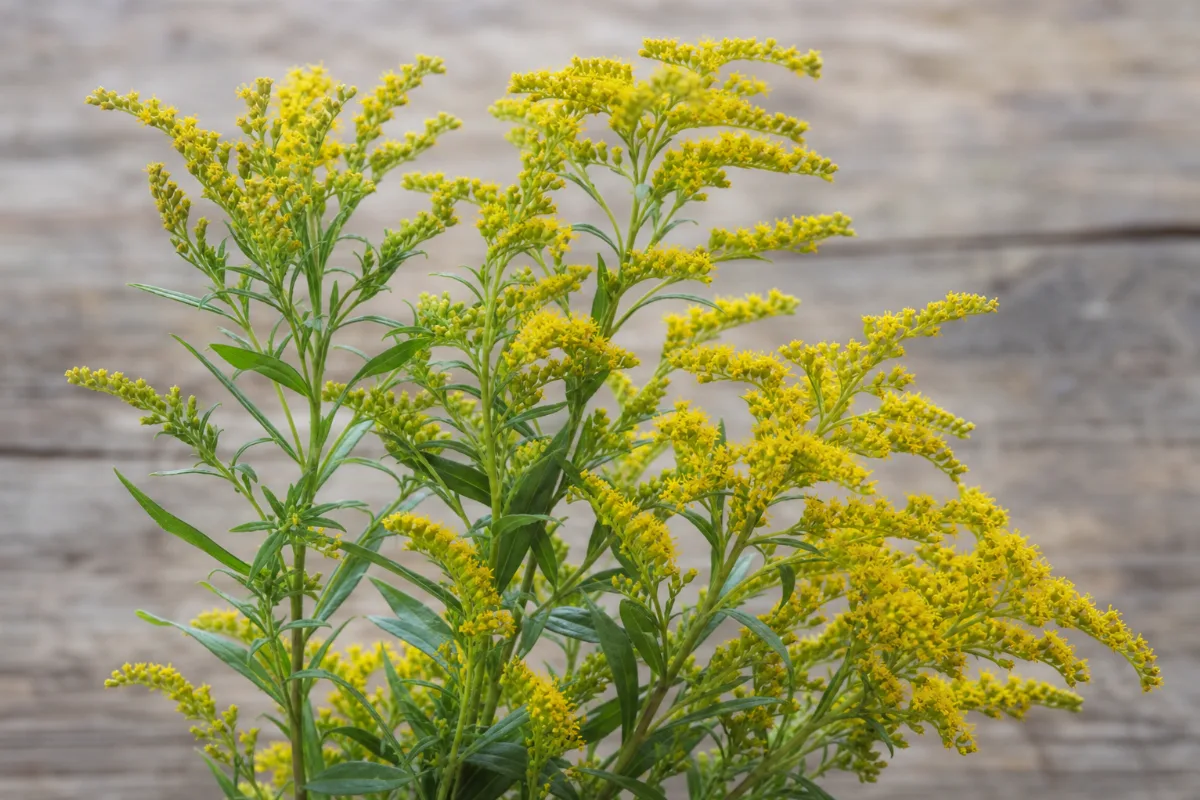
The monograph is for European goldenrod, Solidago virgaurea L., a flowering plant in the daisy family (Asteraceae). [2] The part used in the herbal substance is the herb, described in the consultation draft as dried flowering aerial parts. [3] There are many other goldenrod species; research on one does not automatically apply to another, so a label should give the scientific name. See Plant Names and Botanical Nomenclature. This page gives no identification advice.Traditional use
The EU herbal committee (HMPC) accepts goldenrod herb as a traditional herbal medicinal product used to increase the amount of urine, as an adjuvant (add-on) in minor urinary complaints. [1] The monograph says it is for use exclusively based upon long-standing use. [1] It also says the herbal substance is traditionally used over 2 up to 4 weeks, and that a doctor or qualified practitioner should be consulted if symptoms persist. [1]What research shows
| Use | What the source found | Strength of evidence |
|---|---|---|
| Increasing urine, minor urinary complaints | Registered on long-standing use only. [1] We also searched Europe PMC (2026-10-23) for goldenrod or Solidago virgaurea with randomized trial, clinical trial or systematic review plus urinary, kidney or bladder terms, and found no goldenrod human trial among the first results. | Traditional use only; Proper evidence not found for trials |
| Kidney stones, infections, swelling, allergies and other marketed claims | Proper evidence not found in the sources we read. | Marketing claim |
We did not read the EU assessment report or its 2021 addendum, which may describe lab or clinical data in more detail.
Safety
- Fluid and diuretics: extracts require appropriate fluid intake, and combination with synthetic diuretics is not recommended. [1] See Herbs and Diabetes, Blood Pressure and Heart Medicines and How Interactions Work.
- Heart and kidney conditions: the contraindication above applies to severe cardiac or renal diseases where less fluid is advised. [1] See Herbs and Kidney Disease.
- Allergy: hypersensitivity reactions or digestive upset may occur, frequency not known. [1]
- Pregnancy and breastfeeding: not recommended in the absence of sufficient data. [1]
- Children: not recommended under 12 because of the lack of available experience. [1]
- Toxicity data: tests on reproductive toxicity, genotoxicity and carcinogenicity have not been performed. [1]
- Liver, surgery: not described in the sources we read. Tell the surgical team about herbs you use.
- Fever, painful urination, spasms or blood in the urine should be seen by a doctor. [1]
Official statements
European Medicines Agency, HMPC, community herbal monograph on Solidago virgaurea L., herba, 4 September 2008. [1]Frequently asked questions
Is goldenrod good for the bladder or kidneys?
The EU monograph accepts it only as a traditional medicine to increase urine in minor urinary complaints, on long-standing use alone. [1] Proper evidence not found in our search for human trials.
Can I use goldenrod if I am allergic to ragweed?
The monograph lists hypersensitivity to plants of the Asteraceae family as a contraindication. [1] Ask a clinician.
Does goldenrod cause hay fever?
Not described in the sources we read.
Can goldenrod be combined with water pills?
The monograph says concomitant treatment with synthetic diuretics is not recommended. [1] Ask a pharmacist.
Is goldenrod safe in pregnancy?
Not recommended in the absence of sufficient data. [1]
References
- European Medicines Agency, HMPC. Community herbal monograph on Solidago virgaurea L., herba (EMEA/HMPC/285758/2007), 4 September 2008. Read 2026-10-23.
- GBIF Backbone Taxonomy. Solidago virgaurea L., accepted name, family Asteraceae. Read 2026-10-23.
- European Medicines Agency, HMPC. Draft community herbal monograph on Solidago virgaurea L., herba, 2007 draft for consultation. Read 2026-10-23.