Spices · Spice
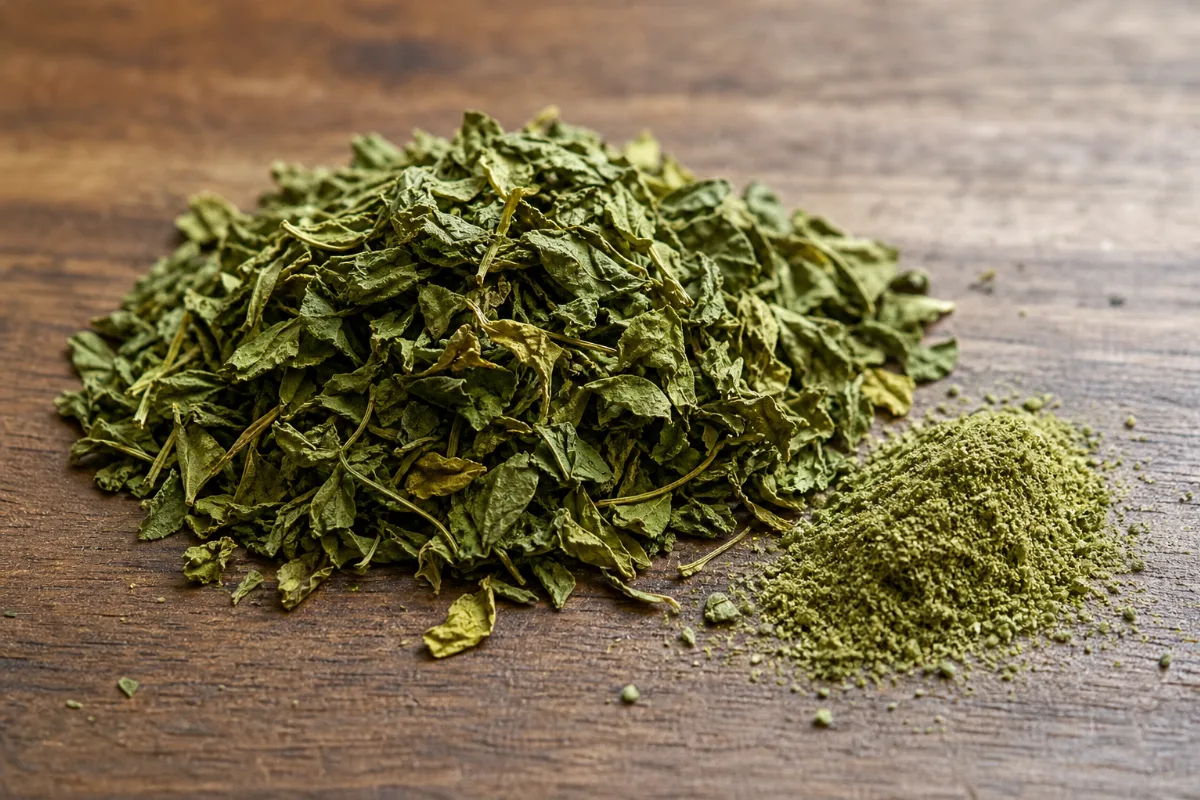
Dried fenugreek leaf (kasuri methi)
Trigonella foenum-graecum · also called Kasuri methi, kasoori methi, dried methi leaves, hoja seca de alholva (Spanish)
Kasuri methi is dried fenugreek leaf, an earthy, slightly bitter herb used to finish curries and breads. We found no study of the leaf itself in people. Pooled trials of fenugreek seed products suggest small, low-certainty effects on blood sugar, but that is not a pinch of leaf in a dish. The main cautions are allergy (fenugreek is a legume and can cross-react with peanut), pregnancy above food amounts, and diabetes or warfarin medicines with seed products.
General information, not medical advice. Last substantive update · Not medically reviewed. A named clinician has not signed off on this page. How this page is made
About Dried fenugreek leaf (kasuri methi)
Kasuri methi is dried fenugreek leaf, a kitchen herb with an earthy, nutty, slightly bitter taste. It is used for flavour. It is not a proven remedy, and almost all fenugreek research is on the seed.
What it is
Kasuri methi is the dried leaf of fenugreek (Trigonella foenum-graecum), a clover-like plant in the legume family. Methi is the Hindi name for fenugreek. The name kasuri is said to come from Kasur in Punjab, where the leaves were traditionally dried and used.
The seeds of the same plant are a separate spice, harder and more bitter. Most health research is on the seed.
Flavor and cooking
The cooking pages we read describe the taste as earthy, nutty and slightly bitter, with a hint of maple that is sweeter once cooked. The smell in the jar is strong, but it blends mildly into food. It pairs with tomato, cream, lentils, chickpeas, potato, pumpkin, chicken and lamb.
Rub or crush the leaves between your palms just before adding them. The sources disagree on timing: one says stir them in during the last few minutes because long cooking dulls the flavor, another says you can add them early or sprinkle them on at the end. Taste as you go, because too much turns a dish bitter. It is used in butter chicken, dal and creamy gravies, and mixed into dough for parathas and naan.
Cooking pages suggest fresh methi leaves, celery leaves or a little toasted, crushed fenugreek seed as stand-ins. Each changes the flavor. Store it in an airtight container away from heat, light and steam. One page says to avoid the fridge, and gives a shelf life of 6 to 12 months; another says up to 6 months.
What the research shows
We found no study of dried fenugreek leaf in people. The pooled trials that exist tested fenugreek seed products, mostly in adults with type 2 diabetes or prediabetes, and found small falls in blood sugar and HbA1c. They were mostly low quality and disagreed a lot. NCCIH says there is not enough high-quality evidence to say whether fenugreek helps diabetes.
Milk supply results are mixed and menstrual cramp evidence is too thin to judge.
Nutrition
We did not find a confirmed nutrition table for the dried leaf. One cooking blog gives a rough estimate of about 13 kcal, 1 g protein and 2 g fibre in a tablespoon (about 5 g); it gives no source, so treat it as a guide only. In cooking you use it by the pinch, so it adds mostly flavour.
At a glance
Traditional uses history, not proof
- Crushed over curries, dal, creamy gravies and breads in North Indian cooking (cooking pages)
- Home uses such as a leaf infusion after meals or a skin paste; the blog that describes them says they may not be backed by science
Studied for research
- Blood sugar and HbA1c, low certainty, for fenugreek seed products (not the leaf)
- Blood fats, low certainty, seed products in people with raised blood sugar
- Eating dried leaf in cooking, insufficient: no study found
- Milk supply, mixed, seed products
- Menstrual cramps, insufficient
Main compounds
- Sotolone: the maple-syrup flavour compound
Common forms
- Whole crumbled dried leaf
- Dried leaf powder
- Fresh leaves (methi) that are dried at home
- Fenugreek seed, a separate spice with most of the research
Research links: US National Center for Complementary and Integrative Health: Fenugreek · EU draft herbal monograph on fenugreek seed (European Medicines Agency) · LactMed: Fenugreek (breastfeeding) · Research Library · Genes & Biomarkers Library
What it is and its history
- Accepted scientific name
- Trigonella foenum-graecum
- Naming authority
- L.
- Common names
- Dried fenugreek leaf (English); Kasuri methi (Hindi/English); Kasoori methi (English); Dried methi leaves (English); Hoja seca de alholva (hojas de fenogreco secas) (Spanish)
- Family or group
- Fabaceae (legume family)
- Classification
- Plantae > Fabaceae (legume family), as stated by the EU monograph and The Spice People > Trigonella > Trigonella foenum-graecum
- Native range
- NCCIH: a clover-like herb native to the Mediterranean region, southern Europe and western Asia.
- Habitat
- Not verified from a source read.
- What it looks like
- Roots: Not verified.; Stems: Not verified.; Leaves: The leaves are dried and sold as light green flakes (cooking pages).; Flowers: Not verified.; Fruit: Pods hold the seeds, which are a separate spice (The Spice People says fruit and seeds are harvested).
- Cultivation
- Not verified from a source read.
- Harvest and processing
- Leaves are harvested and dried, then rubbed or crushed (cooking pages). One page describes drying in direct sun for 2 to 3 days; no single method is stated.
- Look-alikes and adulterants
- Name: Fenugreek seed; Note: Same plant, different part: harder and more bitter. Most health research is on the seed.; Name: Fresh fenugreek leaves (methi); Note: The green leaves before drying; the cooking page read says to use more of them as they are milder.
- Sustainability and conservation
- Not assessed.
Photographs
Traditional use and history history, not clinical proof
| Tradition or era | Documented use | Source |
|---|---|---|
Traditional use shows how it was used. It does not show that it works or is safe today.
What is inside, and how it may work
What it contains and how those compounds act in cells and animals. Laboratory and animal mechanisms are not proven effects in people.
Main compounds
| Compound | Family | Where it is concentrated | Activity studied | Level of evidence |
|---|---|---|---|---|
| Sotolone (sotolon) | flavour compound | Not stated for the leaf | Called a well-known flavour impact compound of fenugreek and lovage. Maple syrup also contains it. It explains a maple-syrup smell of body fluids after eating fenugreek. 9 5 7 | Human data |
Mechanisms, receptors and pathways
| Target or pathway | Gene or receptor | What was found | Level |
|---|---|---|---|
| Maple-syrup odour | Not specified | Sotolone from fenugreek is excreted and gives urine and sweat a maple-syrup smell. 9 5 7 | Human data |
| Allergen cross-reaction | Fenugreek 7S-vicilin and 11S-legumin versus peanut Ara h 1 and Ara h 3 | Fenugreek proteins resemble major peanut allergens, which gives a lab explanation for cross-reaction. 3 | Laboratory research |
| Drug-metabolising liver enzymes CYP2D6 and CYP3A4 | CYP2D6, CYP3A4 | Seed extract blocked them in the lab; one week of seed powder did not significantly change them in 6 volunteers. 1 | Laboratory research |
Absorption, metabolism and elimination
- Absorption
- Not found.
- Distribution
- Not found.
- Metabolism
- Not found.
- Elimination
- Sotolone appears in urine and sweat and possibly breast milk (LactMed).
- Bioavailability
- Not found.
Isolated compounds versus whole extracts
Almost all the health research is on fenugreek seed, seed extracts or products whose form is not stated. A pinch of dried leaf in a dish is a different product and amount, so those results do not carry over.
Nutritional composition
No USDA FoodData Central entry for dried fenugreek leaf was found in the earlier check for this site, and the USDA service was rate-limited when we tried again on 2026-10-26, so we could not re-confirm it. We therefore give no USDA figures. One cooking blog (Beyond Chutney, unsourced) estimates about 13 kcal, 1 g protein and 2 g fibre in one tablespoon (about 5 g) and says iron and calcium are present in small amounts; treat that as a rough guide only. The fenugreek seed entry in USDA is a different product and should not be read as the leaf. In cooking the leaf is used by the pinch, so it adds mostly flavour.
1 mixed findings2 low certainty3 not enough evidence
What was looked at
The 6 benefits and uses checked for Dried fenugreek leaf (kasuri methi), each with how strong the evidence is. Tap one to open it.
- Blood sugar and HbA1c in type 2 diabetes (fenugreek seed products)Low certainty
- Blood sugar from eating dried fenugreek leaf in cookingNot enough evidence
- Blood fats (cholesterol and triglycerides), fenugreek seed productsLow certainty
- Breast milk supply (fenugreek seed products)Mixed findings
- Menstrual cramps (fenugreek seed products)Not enough evidence
- Traditional home uses of the leaf (digestion, skin, scalp)Not enough evidence
Lab markers tracked in the studies
Fasting blood glucoseHbA1cTotal cholesterol and triglycerides
What is Dried fenugreek leaf (kasuri methi) good for?
The main studied uses and how strong the human evidence is for each. Almost all of it is about fenugreek seed, not the dried leaf.
Benefits, one by one
Each card is a research question, not a promise. Tap a goal to filter. Open a card to see the studies, doses and limits.
Blood sugar and HbA1c in type 2 diabetes (fenugreek seed products)
Low certaintyPooled small trials of fenugreek seed products found lower fasting blood sugar, after-drink sugar and HbA1c in adults with type 2 diabetes or prediabetes. This is about seed preparations taken as health products, not about dried leaf in cooking. The US National Center for Complementary and Integrative Health says there is not enough high-quality evidence to say whether fenugreek helps diabetes.
3 studiesSeed preparations in the trials; the amounts differ and are not advic…
Studies, doses and limits
What the trials found
Neelakantan 2014 pooled 10 trials of fenugreek seeds and found fasting glucose 0.96 mmol/l lower, 2-hour glucose 2.19 mmol/l lower and HbA1c 0.85 points lower (3 trials). Disagreement between trials was large, most trials were low quality, and the glucose effect was only significant at medium or high amounts in people with diabetes. Kim 2023 pooled 10 trials (706 people) and also reported lower fasting glucose, 2-hour glucose and HbA1c, with no clear change in insulin resistance. NCCIH says many studies were not high quality.
Results
Small lowering of blood sugar numbers in pooled trials of seed products, with low quality and large disagreement. No trial of dried leaf in cooking was found.
Effect sizes as reported
Neelakantan 2014: fasting glucose -0.96 mmol/l (95% CI -1.52 to -0.40; I2 80%), 2-hour glucose -2.19 mmol/l (95% CI -3.19 to -1.19), HbA1c -0.85% (95% CI -1.49 to -0.22).
Why this rating
Pooled trials agree in direction, but they are small, mostly low quality and disagree a lot, and the form and amounts differ. This is certainty for seed products only. For eating dried leaf as a spice there is no human study (see the next item).
Form and dose studied
Seed preparations in the trials; the amounts differ and are not advice.
Who was studied
Adults with type 2 diabetes or prediabetes.
Limits
Seed, not leaf. Lab numbers, not health outcomes such as heart attacks. Not a replacement for diabetes treatment.
Why researchers looked
Fenugreek seed is a traditional food and medicine for blood sugar, so trials have tested seed products.
Traditional use
Fenugreek has been used as a medicinal plant for about 6,000 years in many cultures (NCCIH). Kasuri methi is the dried leaf; the trials used seed.
Proposed mechanism Unknown
No mechanism for dried leaf was read. Seed fibre and seed compounds are suggested in the wider literature, but those were not read for this page.
A proposed mechanism does not show that the effect happens in people.
Seed products may add to diabetes medicines; see the Safety tab.
Blood sugar from eating dried fenugreek leaf in cooking
Not enough evidenceWe found no study of dried fenugreek leaf (kasuri methi) used as a cooking spice in people. A pinch of leaf in a curry has not been tested for blood sugar, blood fats or any other health outcome.
3 studiesDried leaf used as a spice or herb in food.
Studies, doses and limits
What the trials found
The trials and pooled analyses read used fenugreek seed or did not say which form was used. NCCIH discusses fenugreek seed. The EU monograph covers the seed only. A retail blog lists blood-sugar benefits for the leaf without a study we could check; those claims were not used.
Results
No human evidence for dried leaf in cooking.
Why this rating
No human study of dried leaf was found. Results from seed cannot be moved to the leaf.
Form and dose studied
Dried leaf used as a spice or herb in food.
Limits
Absence of studies is not proof of no effect, and it is not proof of benefit.
Why researchers looked
People ask whether the research on fenugreek also applies to the leaf they cook with.
Traditional use
Kasuri methi is a kitchen herb used to finish curries and breads (cooking pages read).
Proposed mechanism Unknown
None read.
A proposed mechanism does not show that the effect happens in people.
Food use is a different matter from seed supplements; see the Safety tab.
Blood fats (cholesterol and triglycerides), fenugreek seed products
Low certaintyThe same 2023 pooling of 10 trials found better total cholesterol, triglycerides and HDL with fenugreek, but no clear change in LDL or body mass index. The abstract does not say which form was used, and no trial of dried leaf in cooking was found.
1 studiesFenugreek, form not stated in the abstract.
Studies, doses and limits
What the trials found
Kim 2023 (10 trials, 706 people with type 2 diabetes or prediabetes) reported significant improvement in total cholesterol, triglycerides and HDL, and no significant difference in LDL or BMI. The abstract gives no pooled numbers.
Results
Reported improvement in some blood fat numbers in people with raised blood sugar; LDL and weight unchanged.
Effect sizes as reported
Not given in the abstract.
Why this rating
One pooled analysis, abstract read only, no numbers, form not stated, trials in people with diabetes or prediabetes.
Form and dose studied
Fenugreek, form not stated in the abstract.
Who was studied
Adults with type 2 diabetes or prediabetes.
Limits
Abstract only. Not about the leaf and not about healthy people.
Why researchers looked
Blood fats were measured together with blood sugar in the diabetes trials.
Traditional use
Not specific to the leaf.
Proposed mechanism Unknown
None read.
A proposed mechanism does not show that the effect happens in people.
See the Safety tab.
Breast milk supply (fenugreek seed products)
Mixed findingsFenugreek seed is widely used to try to boost breast milk, but results are mixed. NCCIH says a few studies had mixed results, and LactMed says the evidence is mixed and the effect may be mostly psychological. Nothing was found for dried leaf in cooking.
2 studiesSeed products; mixtures.
Studies, doses and limits
What the trials found
NCCIH: a few studies, mixed results. LactMed: one meta-analysis found a mild effect and unknown safety, another found no good evidence; in a US survey of 122 mothers 43% thought it increased supply and 5% thought it decreased it. Some studies used mixtures in which fenugreek was only one part. The individual trials were not read.
Results
Mixed.
Why this rating
Two health-agency summaries call the evidence mixed; the underlying trials were not read.
Form and dose studied
Seed products; mixtures.
Who was studied
Breastfeeding mothers.
Limits
Agency summaries only. Not about the leaf.
Why researchers looked
Fenugreek is a common traditional milk booster.
Traditional use
Used in many regions to increase milk supply (NCCIH; LactMed).
Proposed mechanism Preliminary mechanism
LactMed notes that some studies suggest effects on insulin, prolactin and oxytocin, and that the effect may be mostly psychological. This is not established.
A proposed mechanism does not show that the effect happens in people.
Little is known about safety above food amounts while breastfeeding; urine, sweat and possibly breast milk may smell of maple syrup. See the Safety tab.
Menstrual cramps (fenugreek seed products)
Not enough evidenceNCCIH says only a small number of studies looked at fenugreek for menstrual cramps, the evidence is of low quality and the effect is uncertain.
1 studiesSeed products.
Studies, doses and limits
What the trials found
NCCIH: a small number of studies, low quality, uncertain effect. The individual studies were not read.
Results
Uncertain.
Why this rating
Few, low-quality studies according to NCCIH; none read directly.
Form and dose studied
Seed products.
Who was studied
Women with menstrual cramps.
Limits
Agency summary only. Not about the leaf.
Why researchers looked
Fenugreek has been used traditionally for menstrual cramps.
Traditional use
Used as a remedy for menstrual cramps in various cultures (NCCIH).
Proposed mechanism Unknown
None read.
A proposed mechanism does not show that the effect happens in people.
Not for use in pregnancy above food amounts; see the Safety tab.
Traditional home uses of the leaf (digestion, skin, scalp)
Not enough evidenceHome uses of kasuri methi include a leaf infusion after heavy meals, a paste for minor skin irritation, and a rinse for a flaky scalp. These come from a cooking blog that itself says they may not be backed by modern science. We found no study of them.
2 studiesLeaf infusion, paste or rinse in home use.
Studies, doses and limits
What the trials found
No human study was found. Retail pages also claim fibre helps digestion, but no study of the leaf in people was read.
Results
No evidence.
Why this rating
Tradition only; no study found.
Form and dose studied
Leaf infusion, paste or rinse in home use.
Limits
Tradition is not evidence. The blog is a cooking site, not a health source.
Why researchers looked
These are tradition-based home uses, not studied outcomes.
Traditional use
Described by Beyond Chutney as grandmother-style home cures for small discomforts.
Proposed mechanism Unknown
None read.
A proposed mechanism does not show that the effect happens in people.
Allergic reactions after local application (facial swelling, wheezing) are listed in the EU monograph for the seed.
Connections to the rest of health
How Dried fenugreek leaf (kasuri methi) connects to the rest of our health knowledge graph. Every link says what kind of connection it is. A safety link (for example to the liver) is a warning, not a benefit. A study that merely mentions a topic never creates a benefit link.
Explore every connection: goals, body systems, organs, symptoms, genes
A. Wellness goals
| Connected to | Kind of connection | Evidence status | Context | Studies |
|---|---|---|---|---|
| Blood Sugar Balance | Potential benefit | Low certainty | Blood sugar and HbA1c in type 2 diabetes (fenugreek seed products): Pooled small trials of fenugreek seed products found lower fasting blood sugar, after-drink sugar and HbA1c in adults with type 2 diabetes or prediabetes. This is about seed preparations taken as health products, not about dried leaf in cooking. The US National Center for Complementary and Integrative Health says there is not enough high-quality evidence to say whether fenugreek helps diabetes. | 8 4 12 |
| Metabolic Health | Potential benefit | Low certainty | Blood sugar and HbA1c in type 2 diabetes (fenugreek seed products): Pooled small trials of fenugreek seed products found lower fasting blood sugar, after-drink sugar and HbA1c in adults with type 2 diabetes or prediabetes. This is about seed preparations taken as health products, not about dried leaf in cooking. The US National Center for Complementary and Integrative Health says there is not enough high-quality evidence to say whether fenugreek helps diabetes. | 8 4 12 |
| Blood Sugar Balance | Not enough evidence | Blood sugar from eating dried fenugreek leaf in cooking: We found no study of dried fenugreek leaf (kasuri methi) used as a cooking spice in people. A pinch of leaf in a curry has not been tested for blood sugar, blood fats or any other health outcome. | 12 11 10 | |
| Cholesterol Balance | Potential benefit | Low certainty | Blood fats (cholesterol and triglycerides), fenugreek seed products: The same 2023 pooling of 10 trials found better total cholesterol, triglycerides and HDL with fenugreek, but no clear change in LDL or body mass index. The abstract does not say which form was used, and no trial of dried leaf in cooking was found. | 4 |
| Heart Health | Potential benefit | Low certainty | Blood fats (cholesterol and triglycerides), fenugreek seed products: The same 2023 pooling of 10 trials found better total cholesterol, triglycerides and HDL with fenugreek, but no clear change in LDL or body mass index. The abstract does not say which form was used, and no trial of dried leaf in cooking was found. | 4 |
| Womens Wellness | Potential benefit | Mixed findings | Breast milk supply (fenugreek seed products): Fenugreek seed is widely used to try to boost breast milk, but results are mixed. NCCIH says a few studies had mixed results, and LactMed says the evidence is mixed and the effect may be mostly psychological. Nothing was found for dried leaf in cooking. | 12 7 |
| Womens Wellness | Not enough evidence | Menstrual cramps (fenugreek seed products): NCCIH says only a small number of studies looked at fenugreek for menstrual cramps, the evidence is of low quality and the effect is uncertain. | 12 | |
| Digestive Wellness | Traditional use | Not enough evidence | Traditional home uses of the leaf (digestion, skin, scalp): Home uses of kasuri methi include a leaf infusion after heavy meals, a paste for minor skin irritation, and a rinse for a flaky scalp. These come from a cooking blog that itself says they may not be backed by modern science. We found no study of them. | 10 11 |
B. Body systems
| Connected to | Kind of connection | Evidence status | Context | Studies |
|---|---|---|---|---|
| Endocrine System | Biological association | Low certainty | Studied for: Blood sugar and HbA1c in type 2 diabetes (fenugreek seed products) | 8 4 12 |
| Metabolism Weight | Biological association | Low certainty | Studied for: Blood sugar and HbA1c in type 2 diabetes (fenugreek seed products) Studied for: Blood fats (cholesterol and triglycerides), fenugreek seed products | 8 4 12 |
| Digestive System | Biological association | Not enough evidence | Studied for: Blood sugar from eating dried fenugreek leaf in cooking Studied for: Traditional home uses of the leaf (digestion, skin, scalp) | 12 11 10 |
| Cardiovascular System | Biological association | Low certainty | Studied for: Blood fats (cholesterol and triglycerides), fenugreek seed products | 4 |
| Reproductive System | Biological association | Mixed findings | Studied for: Breast milk supply (fenugreek seed products) Studied for: Menstrual cramps (fenugreek seed products) | 12 7 |
| Skin Hair | Biological association | Not enough evidence | Studied for: Traditional home uses of the leaf (digestion, skin, scalp) | 10 11 |
E. Health conditions
| Connected to | Kind of connection | Evidence status | Context | Studies |
|---|---|---|---|---|
| Peanut allergy | Contraindication | Documented risk | Fenugreek proteins resemble peanut allergens; cross-reaction is described. Fenugreek is a legume whose proteins resemble peanut allergens. Preparation or compound: Fenugreek seed powder (same plant as the leaf) |
2 3 11 |
I. Biomarkers
| Connected to | Kind of connection | Evidence status | Context | Studies |
|---|---|---|---|---|
| Fasting blood glucose | Biological association | Measured in trials: lowered. A lab change is not the same as a health benefit. | ||
| HbA1c | Biological association | Measured in trials: lowered. A lab change is not the same as a health benefit. | ||
| Total cholesterol and triglycerides | Biological association | Measured in trials: lowered. A lab change is not the same as a health benefit. |
K. Biological pathways
L. Active compounds
Each connection is stored with the ingredient, the connected record, the kind of connection, the evidence status, the supporting studies, the preparation or compound involved, and a review date (last reviewed October 26, 2026).
The evidence
The research centre for Dried fenugreek leaf (kasuri methi). Every record here was checked against PubMed or the publisher's page; we never list a study we have not verified.
Evidence by outcome
Bars show how many studies we found for each outcome, not how well it works. People are added up across trials only (reviews are not added, to avoid double counting).
How we rate evidence
High certainty
Several well-run trials or reviews agree; further research is unlikely to change the picture much.
Moderate certainty
Good trials point the same way, but some doubt remains.
Low certainty
Small, short or inconsistent trials. The finding could change with better research.
Very low certainty
Very little or very weak human data. Treat as a possibility only.
Mixed findings
Trials or reviews disagree with each other.
Not enough evidence
Not enough human research to say either way.
Evidence against
Good research found no benefit, or found harm.
We take the reviewers' own risk-of-bias and GRADE statements where they exist, and otherwise judge from study size, design, consistency, directness and whether a product matches what is sold. Many publications do not make evidence high. Method note: We started from our existing summary of dried fenugreek leaf, re-read the NCCIH page, the EU draft monograph and the LactMed record, and checked PubMed abstracts for each study. Cooking facts come from two cooking pages and were used for flavour and kitchen use only. Because the leaf itself has almost no research, this is a smaller page than a seed or herb page. Items we could not verify are listed in the research gaps.
Study library: every study we checked 13
| Study | Design | People | Product, dose, length | Result |
|---|---|---|---|---|
| Al-Jenoobi 2015 Effect of Trigonella foenum-graecum L. on Metabolic Activity of CYP2D6 and CYP3A4. Forsch Komplementmed · PMID 26335391 · DOI |
Non randomised trial |
6 6 healthy volunteers, plus human liver microsomes in the lab |
Fenugreek seed powder and its alcoholic extract seed Powder for 1 week 1 week · vs Same people before taking fenugreek |
In the lab the extract blocked CYP2D6 and, at higher concentrations, CYP3A4. In the 6 volunteers, one week of seed powder did not significantly change the activity of either enzyme. Methods, limits and fundingOutcomes: Activity of the liver enzymes CYP2D6 and CYP3A4 Limitations: Very small study of seed, not leaf. Funding and conflicts: Not stated in the abstract Read: abstract |
| Faeste 2009 Allergenicity and antigenicity of fenugreek (Trigonella foenum-graecum) proteins in foods. J Allergy Clin Immunol · PMID 18930518 · DOI |
Cross sectional |
29 Blood samples from 29 patients with IgE to peanut and other legumes; 2 patients also had a skin prick test and open food challenge |
Fenugreek seed powder seed About 2 mg set off objective symptoms in the open challenge |
Most samples had IgE to both peanut and fenugreek. Fenugreek sensitisation is believed to come from cross-reaction in peanut-allergic people. Primary fenugreek allergy was suspected in only 1 case. In a food survey about one third of fenugreek-containing products were labelled correctly. Methods, limits and fundingOutcomes: IgE binding, fenugreek allergens, labelling of spiced foods Limitations: Lab study plus 2 challenged patients. Seed powder, not leaf. Funding and conflicts: Not stated in the abstract Read: abstract |
| Faeste 2010 Characterization of potential allergens in fenugreek (Trigonella foenum-graecum) using patient sera and MS-based proteomic analysis. J Proteomics · PMID 20219717 · DOI |
Other |
13 Blood samples from 13 patients with IgE to peanut and fenugreek |
Fenugreek proteins |
Fenugreek proteins resembled major peanut allergens (Ara h 1 and Ara h 3), which gives a molecular reason for cross-reaction between fenugreek and peanut. Methods, limits and fundingOutcomes: IgE-binding fenugreek proteins Limitations: Lab study of blood samples; it does not say how often reactions happen. Funding and conflicts: Not stated in the abstract Read: abstract |
| Kim 2023 The Effect of Fenugreek in Type 2 Diabetes and Prediabetes: A Systematic Review and Meta-Analysis of Randomized Controlled Trials. Int J Mol Sci · PMID 37762302 · DOI |
Meta-analysis |
706 People with type 2 diabetes or prediabetes in 10 randomized trials |
Fenugreek (form not given in the abstract) Various Various · vs Control groups |
Fenugreek lowered fasting glucose, 2-hour glucose and HbA1c and improved total cholesterol, triglycerides and HDL. It did not clearly change insulin resistance (HOMA-IR), LDL or BMI. No liver or kidney harm was seen and there were no severe adverse events; some trials had mild stomach and gut upset. Significant reductions reported; the abstract gives no pooled numbers Methods, limits and fundingOutcomes: Fasting glucose, 2-hour glucose, HbA1c, HOMA-IR, blood fats, BMI, safety Limitations: Abstract only. The abstract does not say which fenugreek form was used. Preparations and amounts differed. Funding and conflicts: Authors report no conflict of interest Read: abstract |
| Korman 2001 Pseudo-maple syrup urine disease due to maternal prenatal ingestion of fenugreek. J Paediatr Child Health · PMID 11532065 · DOI |
Case report |
Newborn babies whose mothers ate fenugreek during labour | Fenugreek (form not stated) Around labour |
Fenugreek, maple syrup and the urine of people with maple syrup urine disease share an odour from sotolone. Mothers eating fenugreek during labour gave their newborns a maple-syrup smell, which led to a false suspicion of the disease. Methods, limits and fundingOutcomes: Odour of newborns Limitations: Short report. The number of babies is not in the abstract. Funding and conflicts: Not stated Read: abstract |
| Lambert 2001 Potential interaction between warfarin and boldo-fenugreek. Pharmacotherapy · PMID 11310527 · DOI |
Case report |
1 One patient taking warfarin for atrial fibrillation |
Boldo and fenugreek natural products (form not stated) |
Her INR rose while she took boldo and fenugreek and returned to normal about a week after she stopped. It rose again when both were restarted. The Naranjo score suggested a probable link to the combination. Methods, limits and fundingOutcomes: INR (a blood-clotting test) Limitations: One case. Two products were taken together, so fenugreek alone is not proven to be the cause. Funding and conflicts: Not stated Read: abstract |
| National Institute of Child Health and Human Development 2006 Fenugreek. Drugs and Lactation Database (LactMed) LactMed (updated 2026-10-15) · PMID 30000838 |
Authoritative guidance |
Breastfeeding mothers and infants | Fenugreek seed products seed |
LactMed says fenugreek is generally recognized as safe (GRAS) by the US FDA as a flavoring, that limited data exist on safety in nursing mothers or infants, and that stomach and gut effects, allergy, asthma worsening, liver toxicity reports and a maple-syrup odour of urine, sweat and possibly breast milk have been reported. It says milk-supply evidence is mixed and cross-reaction with chickpeas, peanuts and other legumes is possible. Methods, limits and fundingOutcomes: Safety in breastfeeding Limitations: Concerns seed products used for milk supply. The reports it cites were not read. Read: abstract |
| Neelakantan 2014 Effect of fenugreek (Trigonella foenum-graecum L.) intake on glycemia: a meta-analysis of clinical trials. Nutr J · PMID 24438170 · DOI |
Meta-analysis |
Adults in 10 trials of at least 1 week that compared fenugreek seeds with a control | Fenugreek seeds seed Low, medium and high amounts At least 1 week · vs Control interventions |
Fasting glucose changed by -0.96 mmol/l (95% CI -1.52 to -0.40; I2 80%; 10 trials), 2-hour glucose by -2.19 mmol/l (95% CI -3.19 to -1.19; I2 71%; 7 trials) and HbA1c by -0.85% (95% CI -1.49 to -0.22; I2 0%; 3 trials). Effects on glucose were only significant at medium or high amounts in people with diabetes. Most trials were of low methodological quality. Fasting glucose -0.96 mmol/l; 2-hour glucose -2.19 mmol/l; HbA1c -0.85% Methods, limits and fundingOutcomes: Fasting glucose, 2-hour postload glucose, HbA1c Limitations: Results disagreed a lot between trials. The authors call for better trials with a well-described preparation. Seeds, not leaf. The abstract does not give the total number of people. Funding and conflicts: Not stated in the abstract Read: abstract |
| Podebrad 1999 4,5-dimethyl-3-hydroxy-2[5H]-furanone (sotolone)--the odour of maple syrup urine disease. J Inherit Metab Dis · PMID 10234605 · DOI |
Other |
7 Urine from 7 patients with maple syrup urine disease and healthy controls |
n/a (urine analysis) · vs Healthy urine |
Sotolone, called a well-known flavour compound of fenugreek and lovage, was found in the urine of all seven patients and not in controls. Maple syrup also contains it. Methods, limits and fundingOutcomes: Source of the maple-syrup odour Limitations: Explains why the smells are alike. It is not a study of eating fenugreek. Funding and conflicts: Not stated in the abstract Read: abstract |
| s-beyond-chutney Beyond Chutney: Kasuri Methi (Dried Fenugreek Leaves) · Source |
Other n/a |
Methods, limits and fundingRead: full-text | ||
| s-ema-hmpc-fenugreek-draft EMA/HMPC European Union herbal monograph on Trigonella foenum-graecum L., semen, Draft - Revision 1 (EMA/HMPC/179591/2018), 2021 · Source |
Authoritative guidance n/a |
Methods, limits and fundingRead: full-text | ||
| s-nccih-fenugreek NCCIH (US National Center for Complementary and Integrative Health): Fenugreek · Source |
Authoritative guidance n/a |
Methods, limits and fundingRead: full-text | ||
| s-spice-people The Spice People (Australia): What is Kasoori Methi or Dried Fenugreek Leaves? · Source |
Other n/a |
Methods, limits and fundingRead: full-text |
What we do not know yet
- No study of dried fenugreek leaf in people was found for any outcome.
- The trial evidence is on fenugreek seed; the form in the 2023 pooled analysis was not stated in its abstract.
- Nutrition values for the dried leaf were not confirmed.
- No safety or contamination study of the leaf was found.
- Milk-supply and menstrual-pain studies were not read individually, only the agency summaries.
How new research is added
New studies are found by a saved PubMed search and placed in a review queue before the page changes.
Lab markers
What changed in blood or saliva tests during trials. A changed number is not the same as feeling or being healthier, and we give no "normal ranges".
Metabolic 2
Fasting blood glucose
Lowered in trials
The sugar level in blood after not eating overnight.
Results and what it means
Why it was measured
Main blood sugar measure in fenugreek trials.
HbA1c
Lowered in trials
A blood test that reflects average blood sugar over about 2 to 3 months.
Other 1
Total cholesterol and triglycerides
Lowered in trials
Fats in the blood that are measured in a routine blood test.
Results and what it means
Why it was measured
Heart health marker.
| Study | Result | People | Product |
|---|---|---|---|
| 4 | Significant improvement in total cholesterol, triglycerides and HDL; no significant change in LDL or BMI; no numbers in the abstract | Type 2 diabetes or prediabetes | Fenugreek, form not stated |
Safety
What studies and official sources say about side effects, medicines and who should check first. Each point shows what kind of evidence it comes from.
Main points to know 4
- Allergy: fenugreek is a legume and can cross-react with peanut. Fenugreek is in the legume family. The EU monograph lists hypersensitivity to fenugreek, peanut, soya and other legumes as a reason not to use the seed. In a lab study of 29 people with peanut or other legume allergy, most had IgE to both peanut and fenugreek, and one person reacted to about 2 mg of seed powder in a food challenge. Another study found fenugreek proteins resemble major peanut allergens. These studies used seed, not leaf, but it is the same plant. If you have a peanut or legume allergy, ask an allergy doctor before using it. Other 11 2 3 7
- Pregnancy: food amounts versus larger amounts. NCCIH says fenugreek is not safe in pregnancy in amounts greater than those found in food, and links this to birth-defect risk in animals and people. The EU monograph does not recommend the seed in pregnancy, breastfeeding or women who could become pregnant without contraception. Sources do not describe a problem with a pinch of leaf in a dish. Ask your midwife or doctor. Authoritative guidance 12 11
- Diabetes medicines: seed products may add to the effect. The EU monograph says fenugreek may lower blood sugar and that people treated for diabetes should have close monitoring. NCCIH says large doses may cause a harmful drop in blood sugar. This is about seed products, not a pinch of leaf. If you take diabetes medicine, tell your doctor or pharmacist before adding fenugreek products. Authoritative guidance 11 12
- Warfarin: one case report. One case report describes a rise in INR in a woman on warfarin who also took boldo and fenugreek. It returned to normal when she stopped and rose again when restarted. LactMed says fenugreek can interact with warfarin and cause bleeding and urges caution at high amounts. If you take warfarin, tell your prescriber before using fenugreek products. Case report 6 7
Side effects 4
| Effect | How often | Severity and recovery | Evidence |
|---|---|---|---|
| Stomach and gut upset (wind, diarrhoea, nausea) Described for seed products. A retail blog says the leaf is high in fibre and large amounts may cause bloating; no study. | Frequency not known (EU monograph) | mild Not stated | Authoritative guidance 11 12 |
| Dizziness Listed in the EU monograph for oral use of seed. | Frequency not known | not stated Not stated | Authoritative guidance 11 |
| Allergic reactions: asthma, allergic rhinitis, facial swelling, wheezing NCCIH says allergic reactions can be serious. | Frequency not known | can be serious Not stated | Authoritative guidance 11 12 2 |
| Maple-syrup smell of urine and sweat, and in newborns Caused by sotolone. Mothers who ate fenugreek around labour gave their newborns a maple-syrup smell that led doctors to suspect maple syrup urine disease. Tell the baby's doctors if the mother used fenugreek. | Not established | harmless smell but can cause a false alarm Not stated | Case report 5 9 7 |
Liver
LactMed says liver toxicity has been reported with fenugreek alone and in herbal mixtures; the reports it cites were not read. The 2023 pooled analysis of seed trials saw no liver or kidney toxicity. Nothing was found on the leaf. 7 4
How often. No frequency found.
Monitoring. No official monitoring advice was found. Stop and seek care for yellow skin or eyes, dark urine or pain in the upper right belly.
This is a safety connection. It is not evidence that Dried fenugreek leaf (kasuri methi) supports liver health.
Medicines and supplements 3
| With | Why it matters | Importance | Evidence | What to do |
|---|---|---|---|---|
| Diabetes medicines (metformin, sulfonylureas, insulin) prescription | Seed products lower blood sugar in trials, so they may add to diabetes medicines. | The EU monograph asks for close monitoring of blood sugar control. NCCIH warns of a harmful drop with large doses. | Authoritative guidance Low certainty 11 12 | If you take diabetes medicine, do not add fenugreek products without your doctor knowing. |
| Warfarin and other blood thinners prescription | Unknown. | One case with boldo and fenugreek together; LactMed says an interaction with bleeding is possible. | Case report Very low certainty 6 7 | Tell your prescriber before using fenugreek products and have the INR checked after starting or stopping. |
| Medicines broken down by the liver enzymes CYP2D6 and CYP3A4 prescription | In the lab, fenugreek seed extract blocked these enzymes; in 6 healthy volunteers one week of seed powder did not significantly change their activity. | The volunteer result suggests no major effect; the study was tiny. | Laboratory research Very low certainty 1 | Ask a pharmacist if you take several medicines and use fenugreek products. |
Who should check first 5
| Situation | Advice | Evidence |
|---|---|---|
| Allergy to fenugreek, peanut, soya, chickpea or other legumes | Do not use seed products. For leaf in food, ask an allergy doctor first. | Authoritative guidance 11 2 3 7 |
| Pregnancy | Not safe above food amounts (NCCIH); the EU monograph does not recommend the seed. A pinch of leaf in a dish is not described as a problem in the sources read. Ask your midwife or doctor. | Authoritative guidance 12 11 |
| Breastfeeding | NCCIH says little is known above food amounts; the EU monograph does not recommend the seed. LactMed lists limited safety data. Ask a lactation consultant or doctor. | Authoritative guidance 12 11 7 |
| Children and teenagers | NCCIH believes food amounts are safe for children and says there is not enough information about larger amounts. The EU monograph does not recommend the seed under 18. | Authoritative guidance 12 11 |
| Diabetes treated with medicines, or taking warfarin | Talk to your prescriber before using fenugreek products. | Authoritative guidance 11 12 6 |
Overdose, product quality and regulators
Summary. NCCIH believes fenugreek is safe for adults and children in the amounts commonly found in foods and possibly safe for adults in larger amounts. The EU monograph says animal studies showed reproductive toxicity. No toxicity study of the leaf was found.
Animal. EU monograph: animal studies of the seed showed reproductive toxicity including effects on male and female fertility.
High dose or long term signals. NCCIH: large doses may cause a harmful drop in blood sugar. EU monograph: minor gut symptoms at very large amounts of seed powder.
Overdose response. Gut symptoms (EU monograph).
Genotoxicity. Not covered in the sources read for this page.
Toxic or hazardous parts. No toxic part was identified in the sources read.
No survey of dried fenugreek leaf for contaminants was found. The one quality problem found in the sources read is that fenugreek can be a hidden allergen in spiced foods.
Allergen labelling. In a food survey, about one third of fenugreek-containing products were labelled correctly (seed powder was tested). 2
Heavy metals, pesticides, mould toxins, adulteration of dried leaf. Not found in the sources read. The cooking pages read do not describe any for the dried leaf. 10
Storage. Cooking pages say to keep it in an airtight container away from heat, light and steam. One page says to avoid the fridge. 10 13
| Body | Action | Date |
|---|---|---|
| US National Center for Complementary and Integrative Health (NCCIH) (United States) | Fenugreek page: believed safe in amounts commonly found in foods; not safe in pregnancy above food amounts; not enough high-quality evidence for diabetes or menstrual cramps; mixed results for milk supply. source | 2025-02 |
| European Medicines Agency, Committee on Herbal Medicinal Products (HMPC) (European Union) | Draft herbal monograph on fenugreek seed (revision 1): traditional use only; covers the seed, not the leaf; contraindicated in hypersensitivity to fenugreek, peanut, soya and other legumes; not recommended in pregnancy, breastfeeding, women who could become pregnant without contraception, or under 18; monitor blood sugar in diabetes. source | 2021 |
| US Food and Drug Administration, as reported by LactMed (United States) | Fenugreek is generally recognized as safe (GRAS) as a flavoring. source | 2026-10-15 |
When to get medical help
- Swelling of the face, lips or throat, trouble breathing, wheezing, fainting or widespread hives after fenugreek: call emergency services now (possible anaphylaxis), especially with a peanut or legume allergy.
- Shaking, sweating, confusion, severe weakness or fainting, especially if you take diabetes medicine: check blood sugar and get urgent help.
- Black or bloody stools, vomiting blood, nosebleeds that will not stop or unusual bruising while on warfarin: seek urgent care.
- Yellow skin or eyes, dark urine or severe upper-right belly pain: stop and seek care.
- A newborn who smells of maple syrup: tell doctors the mother used fenugreek, but a baby who is feeding poorly, very sleepy or vomiting still needs urgent medical assessment.
Stop using the product and contact a clinician or emergency service. In the US, Poison Control is 1-800-222-1222.
General information only, not medical advice. Ask a clinician or pharmacist before use, especially with medicines, in pregnancy or with a health condition. See the Natural Remedy Safety guide.
Frequently asked questions
What is kasuri methi?
What does kasuri methi taste like?
Is kasuri methi healthy?
Does it lower blood sugar?
Is it safe in pregnancy?
Is it safe while breastfeeding?
Can I eat it if I am allergic to peanuts?
Does it interact with medicines?
Can it make my sweat or urine smell of maple syrup?
What is the difference between kasuri methi and fenugreek seed?
Does it help with milk supply?
Explore by health goal
Blood Sugar BalanceWomens WellnessMetabolic HealthCholesterol BalanceHeart HealthDigestive Wellness
Editorial transparency
- Written by
- AlternativeMed editorial team. Research compiled with AI assistance, then checked against the sources listed.
- Medical review
- None. This page has not been reviewed by a physician or pharmacist.
- First published
- 2026-10-26
- Last substantive update
- 2026-10-26
- How we research
- We started from our existing summary of dried fenugreek leaf, re-read the NCCIH page, the EU draft monograph and the LactMed record, and checked PubMed abstracts for each study. Cooking facts come from two cooking pages and were used for flavour and kitchen use only. Because the leaf itself has almost no research, this is a smaller page than a seed or herb page. Items we could not verify are listed in the research gaps.
- How we rate evidence
- See "How we rate evidence" in the Evidence tab.
- Independence
- No product is promoted on this page. No affiliate links are shown.
Sources 13
Each source was opened and checked. Where we read only the abstract, it says so. The small numbers in the text point here.
- Al-Jenoobi FI, Al-Thukair AA, Alam MA, et al.. Effect of Trigonella foenum-graecum L. on Metabolic Activity of CYP2D6 and CYP3A4.. Forsch Komplementmed. 2015. PMID 26335391. DOI 10.1159/000432412. (abstract)
- Faeste CK, Namork E, Lindvik H. Allergenicity and antigenicity of fenugreek (Trigonella foenum-graecum) proteins in foods.. J Allergy Clin Immunol. 2009. PMID 18930518. DOI 10.1016/j.jaci.2008.09.012. (abstract)
- Faeste CK, Christians U, Egaas E, Jonscher KR. Characterization of potential allergens in fenugreek (Trigonella foenum-graecum) using patient sera and MS-based proteomic analysis.. J Proteomics. 2010. PMID 20219717. DOI 10.1016/j.jprot.2010.02.011. (abstract)
- Kim J, Noh W, Kim A, et al.. The Effect of Fenugreek in Type 2 Diabetes and Prediabetes: A Systematic Review and Meta-Analysis of Randomized Controlled Trials.. Int J Mol Sci. 2023. PMID 37762302. DOI 10.3390/ijms241813999. (abstract)
- Korman SH, Cohen E, Preminger A. Pseudo-maple syrup urine disease due to maternal prenatal ingestion of fenugreek.. J Paediatr Child Health. 2001. PMID 11532065. DOI 10.1046/j.1440-1754.2001.00617.x. (abstract)
- Lambert JP, Cormier J. Potential interaction between warfarin and boldo-fenugreek.. Pharmacotherapy. 2001. PMID 11310527. DOI 10.1592/phco.21.5.509.34492. (abstract)
- National Institute of Child Health and Human Development. Fenugreek. Drugs and Lactation Database (LactMed). LactMed (updated 2026-10-15). 2006. PMID 30000838. (abstract)
- Neelakantan N, Narayanan M, de Souza RJ, van Dam RM. Effect of fenugreek (Trigonella foenum-graecum L.) intake on glycemia: a meta-analysis of clinical trials.. Nutr J. 2014. PMID 24438170. DOI 10.1186/1475-2891-13-7. (abstract)
- Podebrad F, Heil M, Reichert S, et al.. 4,5-dimethyl-3-hydroxy-2[5H]-furanone (sotolone)--the odour of maple syrup urine disease.. J Inherit Metab Dis. 1999. PMID 10234605. DOI 10.1023/a:1005433516026. (abstract)
- . Beyond Chutney: Kasuri Methi (Dried Fenugreek Leaves). . . (full-text)
- . EMA/HMPC European Union herbal monograph on Trigonella foenum-graecum L., semen, Draft - Revision 1 (EMA/HMPC/179591/2018), 2021. . . (full-text)
- . NCCIH (US National Center for Complementary and Integrative Health): Fenugreek. . . (full-text)
- . The Spice People (Australia): What is Kasoori Methi or Dried Fenugreek Leaves?. . . (full-text)
Where to buy
Check the label first. Whatever you buy, look for these:
- Whole or ground: whole spices keep their flavor longer
- The origin and a packed-on or best-by date for freshness
- Organic or non-irradiated labeling if that matters to you
- A resealable, airtight container
Talk to a pharmacist or doctor before you start any supplement, especially if you take medicines. See the Safety tab for interactions.
Support our free guides: as an Amazon Associate we earn from qualifying purchases. Full disclosure.


