Vegetables · Vegetable
Asparagus
Asparagus officinalis · also called Garden asparagus, espárrago (Spanish)
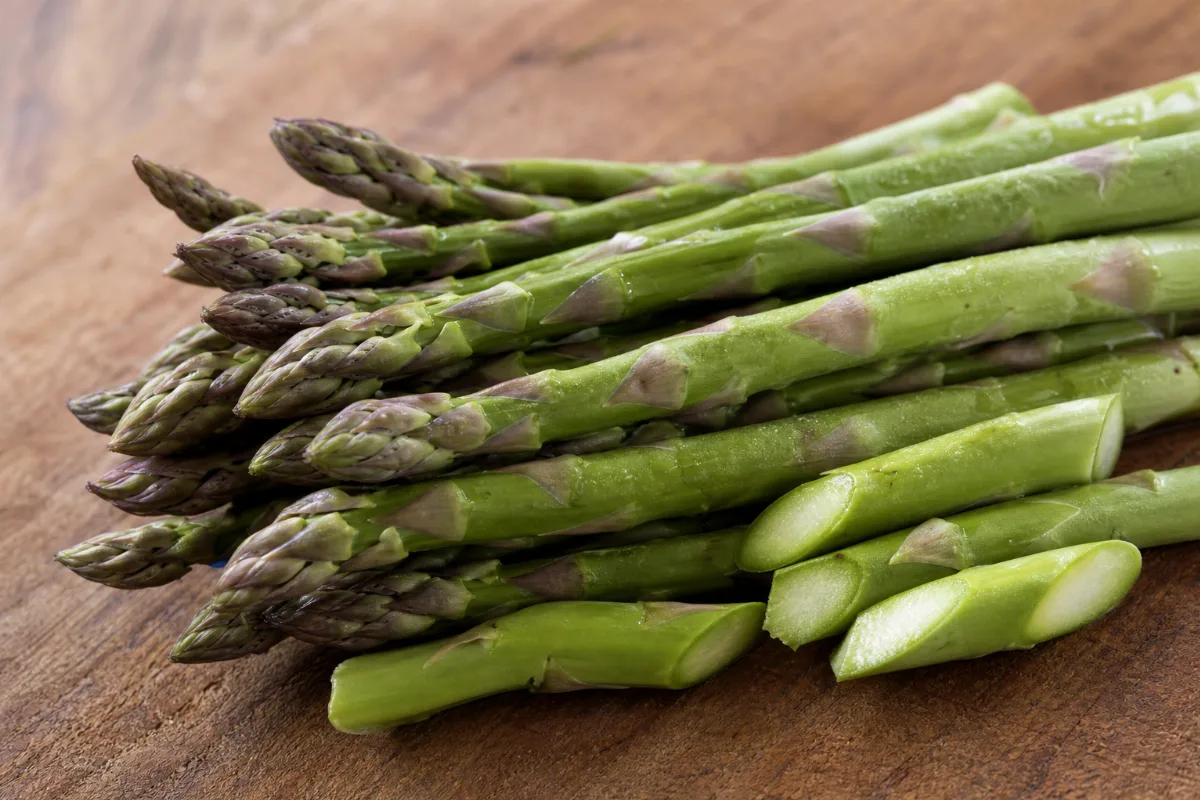
Asparagus is the young shoot, or spear, of a perennial garden plant, eaten raw or cooked. It supplies folate and vitamin K, but those are nutrient facts and no trial of eating asparagus was found for any disease. The studies of cancer care, mouth pain and exercise used extracts or products, not the vegetable. The main cautions are warfarin (because of vitamin K) and, rarely, allergy; the smelly urine many people notice afterwards looks harmless.
General information, not medical advice. Last substantive update · Not medically reviewed. A named clinician has not signed off on this page. How this page is made
About Asparagus
Asparagus is a spring vegetable that supplies folate, vitamin K and some fibre. It is a healthy food, not a proven remedy: the health studies we found tested extracts and products, not the vegetable.
What it is
Asparagus (Asparagus officinalis) is a long-lived perennial plant in the asparagus family. The edible part is the young shoot, or spear. Green spears are the most common; white spears are harvested before light reaches them.
USDA data for raw asparagus: 20 kcal per 100 g. One cup (134 g) has about 27 kcal, 2.9 g protein, 2.8 g fibre, 70 micrograms folate (DFE), 56 micrograms vitamin K, 7.5 mg vitamin C and 271 mg potassium. One medium spear (16 g) has about 8 micrograms of folate and 7 micrograms of vitamin K. The NHS counts 80 g of fresh, canned or frozen vegetables as one 5 A Day portion. Cooked values were not read.
What the research shows
The firmest facts are about nutrients: folate is a B vitamin and vitamin K is needed for blood to clot. Asparagus contains both, but these are not trials of asparagus.
We found no human trial of eating asparagus for any disease. The cancer-care, burning-mouth and exercise studies used granules, syrup, oral liquid, capsules or a root extract, and the reviewers rate the evidence low certainty or the results are mixed.
For gout, a review of diet in people with gout suggests more vegetables in general may help, but asparagus is not mentioned.
Food versus extracts and products
The cancer-care review covered granules, syrup and oral liquid, the mouth-pain review covered capsules and oral liquid, and the exercise trials used a root extract. Results for a product or extract do not carry over to eating the spears.
Amounts
This page gives no amounts to eat. Ask a doctor, pharmacist or dietitian what is right for you, especially if you take warfarin or are planning a pregnancy.
At a glance
Traditional uses history, not proof
- Eaten as a spring vegetable, steamed, boiled, roasted or raw
- A 2019 review says asparagus has been used for centuries as herbal medicine; long use is not proof that it treats any condition
Studied for research
- Folate from a vegetable source, high certainty for the nutrient, no asparagus trial
- Vitamin K for blood clotting, high certainty for the nutrient, no asparagus trial
- Iron from a plant source, insufficient evidence
- Gout and uric acid, insufficient evidence for asparagus itself
- Gut bacteria (extracted polysaccharides), insufficient evidence
- Cancer care and burning mouth (products, not food), low certainty
- Weight and blood markers (root extract with exercise), mixed results
Main compounds
- Vitamin K (phylloquinone)
- Folate
- Lutein and zeaxanthin
- Beta-carotene
- Asparagusic acid
- Polysaccharides
- 20-Hydroxyecdysone (root extract)
Common forms
- Fresh green spears as food
- White spears (grown without light)
- Frozen or canned asparagus as food
- A. officinalis granules, syrup, oral liquid, capsules and root extract (the trials used these, not the vegetable)
Research links: MedlinePlus: Vitamin K and warfarin · 2026 review: A. officinalis in cancer care · Asparagus allergy: a series of 27 patients · Research Library · Genes & Biomarkers Library
What it is and its history
- Accepted scientific name
- Asparagus officinalis
- Naming authority
- L. (GBIF accepted)
- Common names
- Asparagus (English); Garden asparagus (English); Espárrago (Spanish)
- Family or group
- Asparagaceae (the asparagus family), as given by GBIF and NC State Extension. A 2000 case report places the genus in Liliaceae, an older grouping.
- Classification
- Plantae > Tracheophyta > Liliopsida > Asparagales > Asparagaceae > Asparagus > Asparagus officinalis
- Native range
- NC State Extension says it is native to Europe, Africa and Asia and has naturalised in the United States, often found along roadsides and ditches.
- Habitat
- Needs full sun and moist, sandy, well-drained soil (NC State Extension).
- What it looks like
- Roots: Rhizomatous roots that spread (NC State Extension).; Stems: The edible part is the young shoot or spear. Mature plants grow to 3 to 5 feet with thin, branching stems (NC State Extension).; Leaves: Soft, green, feathery, needle-like leaves in whorls on mature plants (NC State Extension).; Flowers: Male and female flowers with small yellow-green tepals in June or July (NC State Extension).; Fruit: Female plants make hard, shiny red berries in late summer (NC State Extension). The berries are not eaten.
- Cultivation
- A long-lived perennial. Green spears are harvested in early spring; white spears are harvested before light reaches them (NC State Extension; Pegiou 2019 review). The review says it is one of the world's top 20 vegetable crops, with China, Western Europe, North America and Peru the largest producers.
- Harvest and processing
- Eaten fresh, frozen or canned; frozen and canned vegetables count as portions (NHS). Cooking effects on nutrients were not read from a source.
- Look-alikes and adulterants
- Name: Other plants in the genus Asparagus (ornamental asparagus ferns); Note: The genus has some 300 species (2000 case report). A. officinalis is the vegetable. No human source on ornamental asparagus ferns was read, so no claim is made.; Name: White asparagus; Note: The same species grown without light; the review says green and white crops have different chemical makeups.
- Sustainability and conservation
- Not assessed.
Photographs
Traditional use and history history, not clinical proof
| Tradition or era | Documented use | Source |
|---|---|---|
| Long use as food and herbal medicine | A 2019 review says asparagus materials have been used for centuries as herbal medicine, and that the plant is one of the world's top 20 vegetable crops. | Pegiou 2019 (PubMed 31881716), abstract read |
| Name | NC State Extension says the species name officinalis is Latin for 'of the offices' and indicates the plant was used in medicine and sold as an herb. | NC State Extension Gardener Plant Toolbox, read 2026-10-26 |
Traditional use shows how it was used. It does not show that it works or is safe today.
What is inside, and how it may work
What it contains and how those compounds act in cells and animals. Laboratory and animal mechanisms are not proven effects in people.
Main compounds
| Compound | Family | Where it is concentrated | Activity studied | Level of evidence |
|---|---|---|---|---|
| Vitamin K (phylloquinone) PubChem 5284607 | vitamin | Spear USDA: 41.6 micrograms per 100 g raw | Needed for blood-clotting proteins (MedlinePlus). Affects warfarin. 21 26 | Human data |
| Folate (vitamin B9) PubChem 135398658 | vitamin | Spear USDA: 52 micrograms DFE per 100 g raw | B vitamin; asparagus is a listed natural source (MedlinePlus). 18 20 26 | Human data |
| Lutein (with zeaxanthin) PubChem 5281243 | carotenoid | Spear USDA: 710 micrograms lutein plus zeaxanthin per 100 g raw | Yellow plant pigment. No asparagus trial for any health outcome was read. 26 | Composition only |
| Beta-carotene PubChem 5280489 | carotenoid | Spear USDA: 449 micrograms per 100 g raw | Orange-yellow pigment. No asparagus trial for any health outcome was read. 26 | Composition only |
| Asparagusic acid (1,2-dithiolane-4-carboxylic acid) | sulfur compound | Spear Not given in the sources read | Described as apparently harmless in toxicology terms and a likely source of the urine odour (review). 4 | Human data |
| 20-Hydroxyecdysone (and other ecdysteroids) | ecdysteroid | Root extract Trial extracts supplied 1.71 mg per kg per day | The root extract trials used it as the active marker. Not measured in the spears in any source read. 6 9 | Human data |
| Polysaccharides | complex sugars | Extract Not given | Reviewed for effects on gut bacteria and immunity in extract studies; human evidence not shown in the abstract. 15 | Review |
Mechanisms, receptors and pathways
| Target or pathway | Gene or receptor | What was found | Level |
|---|---|---|---|
| Vitamin K and blood clotting | Clotting factors II, VII, IX and X (named by MedlinePlus) | Vitamin K is used by the liver to make clotting proteins; warfarin works against this, so changes in vitamin K intake change warfarin's effect. 21 25 | Human data |
| Urine odour | Smell-receptor gene cluster variant rs4481887 (inability to smell the odour) | Making the odour and smelling it are separate traits; the inability to smell it was linked to a DNA variant in a 50-gene cluster of smell receptors. Making the odour appears to be inherited. 8 3 | Human data |
| Allergy | Lipid transfer proteins (Aspa o 1.01 and 1.02) | Lipid transfer proteins seem to play a major role in IgE-mediated asparagus allergy. In two patients the allergen was heat-sensitive. 14 1 | Human data |
Absorption, metabolism and elimination
- Absorption
- Not found for asparagus nutrients.
- Distribution
- Not found.
- Metabolism
- Asparagusic acid is thought to be the precursor of the urine odour compounds (review).
- Elimination
- The odour effect on urine had an estimated half-life of 4.7 hours in 87 meeting attendees.
- Bioavailability
- Not established for most asparagus nutrients in the sources read. MedlinePlus says iron from plants is absorbed less well than iron from animal foods.
Isolated compounds versus whole extracts
The cancer-care, burning-mouth and exercise studies used manufactured granules, syrup, oral liquid, capsules or a root extract. The polysaccharide review is about extracted sugars. Results for those products do not carry over to eating the spears.
Nutritional composition
Nutrition from USDA FoodData Central (Asparagus, raw, FDC 168389, SR Legacy April 2018 release). The values were read from the project's saved copy of that record on 2026-10-26; a fresh request to the USDA feed that day was refused for rate limiting. Per 100 g raw: 20 kcal, about 93 g water, 2.2 g protein, 0.12 g fat, 3.88 g carbohydrate of which 1.88 g sugars, 2.1 g fibre, 202 mg potassium, 24 mg calcium, 14 mg magnesium, 2.14 mg iron, 0.19 mg copper, 5.6 mg vitamin C, 52 micrograms folate (DFE), 41.6 micrograms vitamin K, 38 micrograms vitamin A (RAE), 710 micrograms lutein plus zeaxanthin and 449 micrograms beta-carotene. One cup of raw asparagus (134 g): about 27 kcal, 2.9 g protein, 2.8 g fibre, 271 mg potassium, 7.5 mg vitamin C, 70 micrograms folate (DFE) and 56 micrograms vitamin K. One medium spear (16 g): about 4 kcal, 8 micrograms folate and 7 micrograms vitamin K. Figures were calculated from the per-100 g values and USDA portion weights. NHS says 80 g of fresh, canned or frozen vegetables counts as one 5 A Day portion. Values vary with variety, ripeness and storage; cooked values were not read.
2 high certainty1 mixed findings2 low certainty3 not enough evidence
What was looked at
The 8 benefits and uses checked for Asparagus, each with how strong the evidence is. Tap one to open it.
- Folate (vitamin B9) from asparagusHigh certainty
- Vitamin K for normal blood clottingHigh certainty
- Iron from asparagusNot enough evidence
- Gout and uric acidNot enough evidence
- Gut bacteria (asparagus polysaccharides)Not enough evidence
- Cancer care (A. officinalis products added to treatment)Low certainty
- Burning mouth syndrome (A. officinalis capsules and oral liquid)Low certainty
- Weight, blood fats and inflammation with exercise (asparagus root extract)Mixed findings
Lab markers tracked in the studies
Burning mouth pain score (10-point scale)Objective response rate (tumour shrinkage) with chemotherapyHeart rate variabilityOxidative stress markers (SOD and malondialdehyde)
What is Asparagus good for?
The main studied uses and how strong the human evidence is for each. Most results are nutrient facts or come from products and extracts, not from eating asparagus.
Benefits, one by one
Each card is a research question, not a promise. Tap a goal to filter. Open a card to see the studies, doses and limits.
Folate (vitamin B9) from asparagus
High certaintyFolate is a B vitamin. MedlinePlus lists asparagus among foods that supply it. USDA gives 52 micrograms of folate (DFE) per 100 g of raw spears, about 70 micrograms in one cup (134 g). MedlinePlus says it can be hard to get enough folate from food, so women thinking about pregnancy are advised to take folic acid. This is a nutrient fact, not a trial of asparagus.
3 studiesFresh spears as food. How cooking changes folate in asparagus was not…
Studies, doses and limits
What the trials found
MedlinePlus lists asparagus and broccoli first among folate food sources, and says folate occurs naturally in dark green leafy vegetables, dried beans and citrus. It says taking the right amount of folic acid before and during pregnancy helps prevent neural tube defects such as spina bifida. USDA lists 52 micrograms of folate (DFE) per 100 g of raw asparagus.
Results
Asparagus is a recognised folate food. No trial of eating asparagus and folate status, anaemia or pregnancy outcomes was read. The pregnancy evidence is for folic acid from supplements and fortified foods.
Effect sizes as reported
USDA: 52 micrograms folate (DFE) per 100 g raw asparagus; about 70 micrograms per cup (134 g); about 8 micrograms in one medium spear (16 g).
Why this rating
High for the nutrient role and for asparagus being a folate food (MedlinePlus and USDA). There is no asparagus-specific trial, and MedlinePlus says the folic acid advice for pregnancy applies to supplements and fortified foods, not to the folate in food.
Form and dose studied
Fresh spears as food. How cooking changes folate in asparagus was not read from a source.
Who was studied
Everyone; women planning pregnancy are given special advice by MedlinePlus.
Limits
Nutrient information, not a trial of asparagus. Food folate and folic acid are not the same thing.
Why researchers looked
Asparagus is often named as a folate food, so people ask whether it supplies enough.
Traditional use
Asparagus is eaten as a vegetable, steamed, boiled, roasted or raw. Long use as food is not proof that it treats any condition.
Proposed mechanism Authoritative guidance
Folate helps tissues grow and cells work, helps form red blood cells and helps make DNA (MedlinePlus). Folic acid is the man-made form used in supplements and fortified foods.
A proposed mechanism does not show that the effect happens in people.
Folic acid supplements have an upper limit and can hide a vitamin B12 shortage (MedlinePlus); ask a clinician.
Vitamin K for normal blood clotting
High certaintyVitamin K is needed for blood to clot. MedlinePlus lists asparagus among dark green vegetables that contain it. USDA gives 41.6 micrograms per 100 g of raw spears, about 56 micrograms in one cup (134 g). This is a nutrient fact, not an asparagus trial. If you take warfarin, the same vitamin K matters for a different reason: see the Safety tab.
3 studiesFresh spears as food. Values vary with variety, ripeness and storage.
Studies, doses and limits
What the trials found
MedlinePlus calls vitamin K the clotting vitamin and lists green leafy vegetables, broccoli and other vegetables as sources; its general vitamins page names asparagus among dark green vegetables for vitamin K. USDA lists 41.6 micrograms of vitamin K (phylloquinone) per 100 g of raw asparagus.
Results
The clotting role of vitamin K is well accepted and asparagus contains it. No trial of asparagus for clotting was read. MedlinePlus says vitamin K deficiency is very rare.
Effect sizes as reported
USDA: 41.6 micrograms vitamin K per 100 g raw asparagus; about 56 micrograms per cup (134 g); about 7 micrograms in one medium spear (16 g).
Why this rating
High for the nutrient role and for asparagus containing vitamin K (MedlinePlus and USDA). There is no asparagus-specific trial, and a varied diet normally supplies enough vitamin K.
Form and dose studied
Fresh spears as food. Values vary with variety, ripeness and storage.
Who was studied
Anyone eating a varied diet; MedlinePlus links deficiency to problems absorbing the vitamin and to long-term antibiotic treatment.
Limits
Nutrient fact, not a trial of asparagus. Extra vitamin K from any source is not shown to add benefit in someone who already has enough.
Why researchers looked
Asparagus contains vitamin K, so people ask what it does for the body and for medicines such as warfarin.
Traditional use
Asparagus is eaten as a vegetable, steamed, boiled, roasted or raw. Long use as food is not proof that it treats any condition.
Proposed mechanism Authoritative guidance
The liver uses vitamin K to make clotting proteins (clotting factors II, VII, IX and X). Without it, blood would not clot (MedlinePlus).
A proposed mechanism does not show that the effect happens in people.
People taking warfarin should keep vitamin K intake steady and ask their clinic; see the Safety tab.
Iron from asparagus
Not enough evidenceAsparagus has iron (2.14 mg per 100 g by USDA) and MedlinePlus lists it among plant sources of iron. But MedlinePlus also says iron from plants is harder for the body to absorb than iron from meat, fish and poultry. No trial of asparagus for low iron was read.
2 studiesFresh spears as food.
Studies, doses and limits
What the trials found
MedlinePlus lists asparagus among vegetable sources of iron alongside broccoli, spinach, kale, collards and dandelion greens. USDA lists 2.14 mg of iron per 100 g of raw asparagus.
Results
Asparagus contains iron, but it is a plant source that is harder to absorb. No trial of asparagus for iron status was read.
Effect sizes as reported
USDA: 2.14 mg iron per 100 g raw asparagus; about 2.9 mg per cup (134 g).
Why this rating
There is no trial of asparagus for iron status. The agency statement supports the nutrient content, not any effect on a shortage.
Form and dose studied
Fresh spears as food.
Who was studied
General adult diet.
Limits
A food containing a nutrient is not proof it treats a shortage of that nutrient. Absorption from asparagus was not measured in any source read.
Why researchers looked
Asparagus is a green vegetable often named as an iron food, so people ask whether it helps with low iron.
Traditional use
Asparagus is eaten as a vegetable, steamed, boiled, roasted or raw. Long use as food is not proof that it treats any condition.
Proposed mechanism Authoritative guidance
Iron in plant foods is absorbed less well than iron in meat, fish and poultry. MedlinePlus says mixing a little lean meat, fish or poultry with a plant source, or eating vitamin C-rich foods, improves absorption.
A proposed mechanism does not show that the effect happens in people.
Suspected low iron or anaemia needs a blood test and a clinician's advice, not a food swap.
Gout and uric acid
Not enough evidenceNo study of asparagus and gout was found. Reviews say that more vegetables in the diet may reduce gout flares, and that purines from meat, alcohol and obesity raise risk. Asparagus is not named in either abstract.
3 studiesVegetables as part of the diet.
Studies, doses and limits
What the trials found
A 2025 systematic review of 8 studies (47,879 adults with gout) suggested that more vegetables, fish rich in polyunsaturated fat and regular exercise may reduce flares, and that high purine intake (especially from animal sources), heavy alcohol use and obesity are risk factors. A 2022 review lists meat, alcohol and high fructose corn syrup as dietary causes of high uric acid. The NHS gives general diet advice and does not name asparagus.
Results
Nothing specific to asparagus. The vegetable result is for vegetables as a group and comes mostly from observational studies.
Effect sizes as reported
No effect sizes in the abstracts.
Why this rating
No source read tests or names asparagus for gout. The general vegetable finding comes from mostly observational studies with recall bias.
Form and dose studied
Vegetables as part of the diet.
Who was studied
Adults with gout (review population).
Limits
Cannot be applied to asparagus alone. Mostly observational. Asparagus purine content was not found.
Why researchers looked
People with gout often ask whether vegetables such as asparagus are allowed.
Traditional use
Asparagus is eaten as a vegetable, steamed, boiled, roasted or raw. Long use as food is not proof that it treats any condition.
Proposed mechanism Authoritative guidance
Gout comes from too much uric acid in the blood, which can form crystals in joints (NHS). Purines in food are broken down into uric acid. Asparagus purine content was not read from a source.
A proposed mechanism does not show that the effect happens in people.
Anyone with gout should follow their own clinician's diet advice. See a GP for sudden severe joint pain.
Gut bacteria (asparagus polysaccharides)
Not enough evidenceA 2026 review says the plant sugars (polysaccharides) extracted from asparagus have been reported to affect gut bacteria and the immune system. It does not say these effects happen in people who eat asparagus. We found no human trial of eating asparagus for gut health.
2 studiesPolysaccharide extracts in the studies reviewed.
Studies, doses and limits
What the trials found
The 2026 review abstract lists reported effects of the extracted polysaccharides, including cell-killing effects, immune regulation and regulation of gut bacteria. It does not say how many of the underlying studies were in people. USDA lists 2.1 g of fibre per 100 g of raw spears.
Results
No human result is given in the abstract.
Why this rating
The review is about extracted polysaccharides and the abstract gives no human data. Eating asparagus was not tested for this.
Form and dose studied
Polysaccharide extracts in the studies reviewed.
Limits
Narrative review of mixed, mostly non-food studies. An extract is not the vegetable.
Why researchers looked
Asparagus is a plant with a lot of fibre-like sugars, and researchers study extracts of them.
Traditional use
Asparagus is eaten as a vegetable, steamed, boiled, roasted or raw. Long use as food is not proof that it treats any condition.
Proposed mechanism Review claim
The review calls regulation of gut bacteria the most important reported benefit of the extracted polysaccharides. The abstract does not describe how.
A proposed mechanism does not show that the effect happens in people.
None found in the abstract.
Cancer care (A. officinalis products added to treatment)
Low certaintyA 2026 review of 10 studies of A. officinalis granules, syrup or oral liquid given with chemotherapy or radiotherapy found low-certainty signs of benefit. These are processed products used alongside cancer treatment, mostly in trials in China. They are not the vegetable and do not show that eating asparagus helps in cancer. Anyone with cancer should talk to their care team before taking them.
2 studiesGranules, syrup and oral liquid of A. officinalis; amounts not given …
Studies, doses and limits
What the trials found
The 2026 review pooled 10 studies (7 randomised trials, 2 non-randomised studies, 1 cohort study, 8,898 participants in total). Granules plus chemotherapy beat chemotherapy alone on a survival-based effective rate (RR 1.55, 95% CI 1.24-1.92, 2 studies) and a quality-of-life-based effective rate (RR 1.76, 1.47-2.11, 3 studies), and granules or syrup plus chemotherapy improved the objective response rate (RR 1.88, 1.43-2.48, 4 studies). All three were rated low certainty. Immune markers (CD4, CD4/CD8) were better with products plus chemotherapy or radiotherapy, and oral liquid with chemotherapy was linked to fewer adverse events, nausea and vomiting, and myelosuppression.
Results
Low-certainty signals favouring the add-on products. The authors say the evidence is limited and needs verification in cancer-type-specific trials with standardised extracts.
Effect sizes as reported
RR 1.55 (survival-based effective rate), RR 1.76 (quality-of-life-based effective rate), RR 1.88 (objective response rate); all low certainty.
Why this rating
The reviewers rate the findings low certainty because of few studies and study limitations. The products are not standardised and are not the vegetable.
Form and dose studied
Granules, syrup and oral liquid of A. officinalis; amounts not given in the abstract.
Who was studied
People with cancer receiving chemotherapy or radiotherapy.
Limits
Few studies per outcome; an 'effective rate' is not survival time; the abstract does not explain the large participant total; processed products, not food.
Why researchers looked
Products made from Asparagus officinalis are used in some places as an add-on to cancer treatment.
Traditional use
A. officinalis products have been used as herbal medicine (Pegiou 2019 review).
Proposed mechanism Unknown
Not explained in the abstract.
A proposed mechanism does not show that the effect happens in people.
Tell your cancer team about any extract or supplement. Interaction studies with chemotherapy were not read.
Burning mouth syndrome (A. officinalis capsules and oral liquid)
Low certaintyA 2026 review of 6 small trials (336 people) found that A. officinalis capsules or oral liquid, alone or with usual medicines, may ease burning mouth pain. The reviewers rate all the evidence low certainty. These are products, not the vegetable.
1 studiesCapsules or oral liquid of A. officinalis; amounts not given in the a…
Studies, doses and limits
What the trials found
Six randomised trials with 336 people. Capsules alone beat vitamin B complex alone on a pain-based effective rate (RR 6.00, 95% CI 1.61-22.34). Oral liquid added to mecobalamin lowered the 10-point pain scale (mean difference -1.40, 95% CI -2.19 to -0.61) and raised unstimulated saliva flow. Capsules added to usual medicines improved symptom scores and lowered anxiety and depression scores.
Results
Possible pain relief in small trials. The authors graded all outcomes low certainty and call for large, well-designed studies.
Effect sizes as reported
Capsules vs vitamin B complex: RR 6.00. Oral liquid plus mecobalamin: pain scale mean difference -1.40.
Why this rating
Reviewers' own GRADE rating is low for all outcomes: small trials with study limitations.
Form and dose studied
Capsules or oral liquid of A. officinalis; amounts not given in the abstract.
Who was studied
Adults with burning mouth syndrome.
Limits
Small samples; products not the vegetable; the abstract does not list side effects.
Why researchers looked
Burning mouth syndrome is a chronic pain problem with few good treatments, and A. officinalis products have been tried.
Traditional use
A. officinalis products have been used as herbal medicine (Pegiou 2019 review).
Proposed mechanism Authors interpretation
The review describes the plant as having anti-inflammatory and antioxidant properties; the abstract does not test how it works.
A proposed mechanism does not show that the effect happens in people.
See a dentist or doctor for mouth pain that lasts. Safety of these products was not described in the abstract.
Weight, blood fats and inflammation with exercise (asparagus root extract)
Mixed findingsTwo 12-week trials of 72 overweight adults each tested an asparagus root extract with or without exercise. Exercise alone changed cholesterol and blood sugar. The extract's results were mixed: some markers improved only when it was combined with exercise, and on its own it raised both a helpful and a harmful marker. This is an extract rich in a plant steroid-like compound, not asparagus spears.
2 studiesRoot extract supplying 20-hydroxyecdysone at 1.71 mg per kg of body w…
Studies, doses and limits
What the trials found
Trial 1 (72 adults, 12 weeks): training plus extract improved heart rate variability, some lung measures and waist-to-hip ratio versus control; no significant differences in heart rate, blood pressure or lung volumes. Trial 2 (72 adults aged 18-30, 12 weeks): training alone lowered total cholesterol, the cholesterol/HDL ratio and blood glucose; training plus extract lowered protein carbonyls, interleukin-6 and the cholesterol/HDL ratio; the extract-only group had higher SOD (p < 0.001) and also higher malondialdehyde (p = 0.017).
Results
Mixed. Benefits appeared mainly in the groups that also exercised, and extract alone had one marker move each way.
Effect sizes as reported
Only p values are given in the abstracts.
Why this rating
Small four-arm trials with many outcomes and only p values in the abstracts; the extract alone gave mixed results. The two reports are from the same research group and may share volunteers.
Form and dose studied
Root extract supplying 20-hydroxyecdysone at 1.71 mg per kg of body weight per day in both trials (trial dose, not advice).
Who was studied
Overweight or obese adults.
Limits
Extract, not the vegetable. Exercise confounds the extract effect. Many markers tested.
Why researchers looked
The root extract contains 20-hydroxyecdysone, a plant compound studied for body-building effects, so it was tested with exercise.
Traditional use
A. officinalis root extract is a supplement-type product, not a traditional food.
Proposed mechanism Authors interpretation
The authors describe the extract as rich in ecdysteroids such as 20-hydroxyecdysone with antioxidant and anti-inflammatory activity. This is their framing, not a result.
A proposed mechanism does not show that the effect happens in people.
The abstracts do not report side effects.
Connections to the rest of health
How Asparagus connects to the rest of our health knowledge graph. Every link says what kind of connection it is. A safety link (for example to the liver) is a warning, not a benefit. A study that merely mentions a topic never creates a benefit link.
Explore every connection: goals, body systems, organs, symptoms, genes
B. Body systems
| Connected to | Kind of connection | Evidence status | Context | Studies |
|---|---|---|---|---|
| Blood And Immune | Biological association | High certainty | Studied for: Folate (vitamin B9) from asparagus Studied for: Vitamin K for normal blood clotting | 18 20 26 21 19 |
| Reproductive System | Biological association | High certainty | Studied for: Folate (vitamin B9) from asparagus | 18 20 26 |
| Cardiovascular System | Biological association | High certainty | Studied for: Vitamin K for normal blood clotting Studied for: Weight, blood fats and inflammation with exercise (asparagus root extract) | 21 20 26 6 9 |
| Musculoskeletal System | Biological association | Not enough evidence | Studied for: Gout and uric acid | 5 2 24 |
| Digestive System | Biological association | Not enough evidence | Studied for: Gut bacteria (asparagus polysaccharides) | 15 26 |
| Immune System | Biological association | Not enough evidence | Studied for: Gut bacteria (asparagus polysaccharides) Studied for: Cancer care (A. officinalis products added to treatment) | 15 26 12 7 |
| Cellular | Biological association | Low certainty | Studied for: Cancer care (A. officinalis products added to treatment) | 12 7 |
| Nervous System | Biological association | Low certainty | Studied for: Burning mouth syndrome (A. officinalis capsules and oral liquid) | 13 |
| Pain Inflammation | Biological association | Low certainty | Studied for: Burning mouth syndrome (A. officinalis capsules and oral liquid) | 13 |
| Metabolism Weight | Biological association | Mixed findings | Studied for: Weight, blood fats and inflammation with exercise (asparagus root extract) | 6 9 |
E. Health conditions
| Connected to | Kind of connection | Evidence status | Context | Studies |
|---|---|---|---|---|
| Food allergy | Adverse effect or risk | Case reports | Allergy to asparagus is uncommon but reported, including anaphylaxis and work-related asthma. Preparation or compound: Raw or handled asparagus |
14 1 |
I. Biomarkers
| Connected to | Kind of connection | Evidence status | Context | Studies |
|---|---|---|---|---|
| Burning mouth pain score (10-point scale) | Biological association | Low certainty | Measured in trials: lowered. A lab change is not the same as a health benefit. | 13 |
| Objective response rate (tumour shrinkage) with chemotherapy | Biological association | Low certainty | Measured in trials: improved. A lab change is not the same as a health benefit. | 12 |
| Heart rate variability | Biological association | Very low certainty | Measured in trials: improved. A lab change is not the same as a health benefit. | 6 |
| Oxidative stress markers (SOD and malondialdehyde) | Biological association | Mixed findings | Measured in trials: mixed. A lab change is not the same as a health benefit. | 9 |
J. Genes, receptors and enzymes
| Connected to | Kind of connection | Evidence status | Context | Studies |
|---|---|---|---|---|
| rs4481887 (smell-receptor cluster variant) | Preliminary mechanism | Human | Linked to being unable to smell the asparagus odour in urine. | 8 |
K. Biological pathways
| Connected to | Kind of connection | Evidence status | Context | Studies |
|---|---|---|---|---|
| Vitamin K | Preliminary mechanism | Human | Asparagus contains vitamin K; vitamin K is needed for clotting and affects warfarin. | 21 26 |
| Folate (vitamin B9) | Preliminary mechanism | Human | Asparagus is a natural folate source; folic acid is advised before and during pregnancy. | 18 26 |
L. Active compounds
| Connected to | Kind of connection | Evidence status | Context | Studies |
|---|---|---|---|---|
| Vitamin K (phylloquinone) | Biological association | Human | Needed for blood-clotting proteins (MedlinePlus). Affects warfarin. Preparation or compound: Spear |
21 26 |
| Folate (vitamin B9) | Biological association | Human | B vitamin; asparagus is a listed natural source (MedlinePlus). Preparation or compound: Spear |
18 20 26 |
| Lutein (with zeaxanthin) | Biological association | Composition only | Yellow plant pigment. No asparagus trial for any health outcome was read. Preparation or compound: Spear |
26 |
| Beta-carotene | Biological association | Composition only | Orange-yellow pigment. No asparagus trial for any health outcome was read. Preparation or compound: Spear |
26 |
| Asparagusic acid (1,2-dithiolane-4-carboxylic acid) | Biological association | Human | Described as apparently harmless in toxicology terms and a likely source of the urine odour (review). Preparation or compound: Spear |
4 |
| 20-Hydroxyecdysone (and other ecdysteroids) | Biological association | Human | The root extract trials used it as the active marker. Not measured in the spears in any source read. Preparation or compound: Root extract |
6 9 |
| Polysaccharides | Biological association | Review | Reviewed for effects on gut bacteria and immunity in extract studies; human evidence not shown in the abstract. Preparation or compound: Extract |
15 |
Each connection is stored with the ingredient, the connected record, the kind of connection, the evidence status, the supporting studies, the preparation or compound involved, and a review date (last reviewed October 26, 2026).
Evidence at a glance: what changed in 2 lab markers
Tap a number to show only those markers. Counts are markers, not people.
The evidence
The research centre for Asparagus. Every record here was checked against PubMed or the publisher's page; we never list a study we have not verified.
Evidence by outcome
Bars show how many studies we found for each outcome, not how well it works. People are added up across trials only (reviews are not added, to avoid double counting).
How we rate evidence
High certainty
Several well-run trials or reviews agree; further research is unlikely to change the picture much.
Moderate certainty
Good trials point the same way, but some doubt remains.
Low certainty
Small, short or inconsistent trials. The finding could change with better research.
Very low certainty
Very little or very weak human data. Treat as a possibility only.
Mixed findings
Trials or reviews disagree with each other.
Not enough evidence
Not enough human research to say either way.
Evidence against
Good research found no benefit, or found harm.
We take the reviewers' own risk-of-bias and GRADE statements where they exist, and otherwise judge from study size, design, consistency, directness and whether a product matches what is sold. Many publications do not make evidence high. Method note: We started from our existing asparagus summary, re-checked nutrition from the USDA FoodData Central record, read the health agency pages (NHS, MedlinePlus, FDA, NC State Extension) and read PubMed abstracts for reviews, trials and allergy reports. Only abstracts were read for studies. Items we could not verify are flagged in the research gaps.
Study library: every study we checked 26
| Study | Design | People | Product, dose, length | Result |
|---|---|---|---|---|
| Eng 1996 Inhalant allergy to fresh asparagus. Clin Exp Allergy · PMID 8729671 |
Case report |
2 2 atopic patients |
Fresh asparagus (handled and prepared) Raw spears · vs Cooked asparagus |
Both patients had itchy conjunctivitis, runny nose, throat tightness and cough while preparing fresh asparagus. Eating cooked asparagus did not cause symptoms. Skin tests with raw green and white asparagus were strongly positive and negative with cooked asparagus. The allergen was heat-sensitive. Methods, limits and fundingOutcomes: Symptoms during preparation; skin prick tests; specific IgE Limitations: Two patients only. Funding and conflicts: Not stated in the abstract. Read: abstract |
| Helget 2022 Environmental Triggers of Hyperuricemia and Gout. Rheum Dis Clin North Am · PMID 36333002 · DOI |
Narrative review review |
People with high uric acid or gout (review) | Dietary and environmental triggers Foods, drinks and medicines |
The review says causes of high uric acid include purine intake from meat, alcohol and high fructose corn syrup, and some medicines. Triggers of flares include more purine intake and some medicines. Asparagus is not named in the abstract. Methods, limits and fundingOutcomes: High uric acid and gout flares Limitations: Narrative review; no asparagus-specific information in the abstract. Funding and conflicts: One author reports consulting for drug companies (Horizon, Pfizer, Gilead, Sanofi); not about asparagus. Read: abstract |
| Mitchell 1987 Odorous urine following asparagus ingestion in man. Experientia · PMID 3569485 · DOI |
Observational |
800 800 volunteers |
Asparagus eaten as food Spears Not given in the abstract Reproducible over 12 months |
43% of 800 volunteers made odorous urine after eating asparagus. The trait was reproducible over 12 months and appeared to last a lifetime. Family studies suggest it is inherited as an autosomal dominant trait. 43% of 800 made the odour Methods, limits and fundingOutcomes: Production of odorous urine Limitations: Old study; the abstract is brief. Another study found that not smelling the odour is a separate trait, so the 43% may mix those traits. Funding and conflicts: Not stated in the abstract. Read: abstract |
| Mitchell 2013 Asparagus, urinary odor, and 1,2-dithiolane-4-carboxylic acid. Perspect Biol Med · PMID 24375116 · DOI |
Narrative review review |
Historical and chemical review | Asparagusic acid (1,2-dithiolane-4-carboxylic acid) in asparagus Spears |
The review says asparagusic acid, though apparently innocuous toxicologically, may be responsible for the distinctive urine odour, and collects historical reports linking asparagus with the odour. Methods, limits and fundingOutcomes: Cause of the urine odour Limitations: Narrative and historical review; the cause is described as likely, not proven in this abstract. Funding and conflicts: Not stated in the abstract. Read: abstract |
| Mustafa 2025 Impact of lifestyle factors and dietary patterns on serum uric acid levels and disease activity in gout: a systematic review. J Health Popul Nutr · PMID 40605100 · DOI |
Systematic review |
47879 Adults with gout in 8 studies (5 prospective cohort studies, 2 case-crossover studies, 1 randomised trial) |
Lifestyle and dietary patterns, including vegetable intake Foods and diet patterns (asparagus not named in the abstract) Varied · vs Lower intake or usual diet |
The findings suggest that fish rich in polyunsaturated fat, regular exercise and increased vegetable intake may reduce gout flares, while high purine intake (especially from animal sources), heavy alcohol use and obesity are risk factors. Some studies found lower uric acid with diet change and others found no significant effect. Methods, limits and fundingOutcomes: Serum uric acid and gout flares Limitations: Mostly observational studies with recall bias and variable results (the authors say so). Vegetables as a group, not asparagus. Asparagus is not mentioned in the abstract. Funding and conflicts: Authors declared no competing interests; they report using ChatGPT only to proofread. Read: abstract |
| Padkao 2025 Effects of High-Intensity Intermittent Training Combined with Asparagus officinalis Extract Supplementation on Cardiovascular and Pulmonary Function Parameters in Obese and Overweight Individuals: A Randomized Control Trial. J Funct Morphol Kinesiol · PMID 40566452 · DOI |
Controlled trial |
72 72 obese and overweight adults in four groups of 18 |
Asparagus officinalis extract (supplying 20-hydroxyecdysone, 1.71 mg/kg/day), with or without high-intensity intermittent training Extract (the abstract does not name the plant part) 20-hydroxyecdysone 1.71 mg/kg/day (trial dose, not advice) 12 weeks · vs Control group; training-only group |
Training plus extract improved heart rate variability, some lung measures and waist-to-hip ratio compared with the control group. The extract-only group is not reported as improving these in the abstract. There were no significant differences in heart rate, blood pressure, blood pressure variability or lung volume measures among groups. Training plus extract vs control: heart rate variability p = 0.038; waist-to-hip ratio p = 0.043 (Not given in the abstract (p values only)) Methods, limits and fundingOutcomes: Heart rate variability, blood flow, blood pressure, lung function, respiratory muscle strength, body composition Limitations: Small groups of 18, 12 weeks, four-arm design, many outcomes measured, p values without confidence intervals. The extract was combined with exercise, so effects cannot be pinned on the extract. An extract, not the vegetable. Funding and conflicts: The authors declared no conflicts of interest. Read: abstract |
| Pegiou 2019 Green and White Asparagus (Asparagus officinalis): A Source of Developmental, Chemical and Urinary Intrigue. Metabolites · PMID 31881716 · DOI |
Narrative review review |
Review of the literature on green and white asparagus | Green and white asparagus spears Spears |
The review says asparagus is one of the top 20 vegetable crops, that green and white spears are produced (white are harvested before light exposure), that asparagus materials have been used for centuries as herbal medicine, that it has excellent nutritional properties, and that its flavour is attributed to volatile compounds including pyrazines and sulphur compounds. The authors say little is known about the crop biochemistry and call for more work. Methods, limits and fundingOutcomes: Chemistry, nutrition, flavour Limitations: Short narrative review; no health outcome results in the abstract. Funding and conflicts: Authors state no conflict of interest. One author works at Unilever Foods Innovation Centre, which says it has no connection to the subject. Read: abstract |
| Pelchat 2011 Excretion and perception of a characteristic odor in urine after asparagus ingestion: a psychophysical and genetic study. Chem Senses · PMID 20876394 · DOI |
Observational experimental |
Volunteers tested for making and smelling the asparagus odour in urine (number not given in the abstract) | Asparagus eaten as food Spears Not given in the abstract Single exposures |
Urine of people who recently ate asparagus has a sulfurous odour similar to cooked cabbage. People differ both in making the odour and in smelling it. The inability to smell it was linked to a single-letter DNA variant (rs4481887) within a 50-gene cluster of smell receptors. Why some people do not make the odour is unknown. Methods, limits and fundingOutcomes: Production and perception of the urine odour Limitations: Abstract gives no sample size. A harmless-trait study, not a safety trial. Funding and conflicts: Not stated in the abstract. Read: abstract |
| Prasertsri 2025 Synergistic Effects of High-Intensity Interval Training and Asparagus officinalis L. Root Extract Supplementation on Metabolic Regulation, Oxidative Stress, and Inflammation in Overweight and Obese Adults. Int J Mol Sci · PMID 41465480 · DOI |
Controlled trial |
72 72 overweight or obese adults aged 18-30 (BMI 23 or more) in four groups |
Asparagus officinalis L. root extract (supplying 20-hydroxyecdysone, 1.71 mg/kg/day), with or without high-intensity interval training Root extract 20-hydroxyecdysone 1.71 mg/kg/day (trial dose, not advice) 12 weeks · vs Control group; training-only group |
Training alone lowered total cholesterol, the cholesterol/HDL ratio and blood glucose and raised HDL and superoxide dismutase (SOD). Training plus extract lowered protein carbonyls, interleukin-6 and the cholesterol/HDL ratio and raised SOD. The extract-only group had higher SOD and also higher malondialdehyde, a marker of oxidative damage. The authors conclude that the combination improved oxidative and inflammatory status while training alone mainly improved metabolic regulation. Extract alone: SOD p < 0.001; malondialdehyde p = 0.017 (both higher) (Not given in the abstract (p values only)) Methods, limits and fundingOutcomes: Cholesterol, glucose, oxidative stress markers, inflammation markers, white blood cell counts Limitations: Small groups, four-arm design, many markers tested, p values without confidence intervals. Extract-only results were mixed (higher SOD, higher malondialdehyde). A root extract rich in ecdysteroids, not the spears. Both this trial and the cardiovascular one above come from the same research group with 72 participants each; the abstracts do not say whether the volunteers overlap. Funding and conflicts: The authors declared no conflicts of interest. Read: abstract |
| Rademaker 2000 Contact dermatitis to Asparagus officinalis. Australas J Dermatol · PMID 11105376 · DOI |
Case report |
1 One 53-year-old farm worker |
Handling asparagus (work exposure) Young shoots 3-year history |
A farm worker had a 3-year history of work-related allergic contact dermatitis to asparagus. It cleared with steroid courses and relapsed within days of new exposure. The authors suggest the allergen may be a growth-inhibiting compound present in young shoots. Methods, limits and fundingOutcomes: Occupational allergic contact dermatitis Limitations: One case. Funding and conflicts: Not stated in the abstract. Read: abstract |
| Ramamoorthy 2018 Crowdsourced Asparagus Urinary Odor Population Kinetics. CPT Pharmacometrics Syst Pharmacol · PMID 29239147 · DOI |
Observational experimental |
87 87 attendees of two clinical pharmacology meetings |
Asparagus spears eaten as food (number of spears randomised) Spears Randomised number of spears (not given in the abstract) Self-reported odour over time |
The estimated half-life of the effect on urine odour was 4.7 hours. A dose-response relationship was found, and age predicted differences between people. Half-life 4.7 hours (relative standard error 13.2%) Methods, limits and fundingOutcomes: Self-reported urine odour Limitations: Self-reported smell by conference attendees, a demonstration project rather than a clinical trial. Funding and conflicts: Not stated in the abstract. Authors work for the US FDA, drug companies and universities. Read: abstract |
| Shen 2026 Asparagus officinalis potentially supports cancer care: a systematic review of randomized and non-randomized clinical studies. Front Nutr · PMID 41909047 · DOI |
Systematic review |
8898 People with cancer in 10 studies (7 randomised trials, 2 non-randomised studies, 1 cohort study) |
A. officinalis products (granules, syrup or oral liquid) added to chemotherapy or radiotherapy Processed products, not the vegetable Not given in the abstract Not given in the abstract · vs Chemotherapy or radiotherapy alone |
Granules plus chemotherapy improved a survival-based effective rate and a quality-of-life-based effective rate. Granules or syrup plus chemotherapy improved the objective response rate. Products plus chemotherapy or radiotherapy were linked to better CD4 and CD4/CD8 immune markers. The oral liquid with chemotherapy was linked to fewer adverse events, nausea and vomiting, and myelosuppression. The authors rate every finding low certainty and call for better trials. Survival-based effective rate RR 1.55; quality-of-life-based effective rate RR 1.76; objective response rate RR 1.88 (RR 1.55 (95% CI 1.24-1.92, 2 studies); RR 1.76 (1.47-2.11, 3 studies); RR 1.88 (1.43-2.48, 4 studies); all low certainty) Methods, limits and fundingOutcomes: Survival-based effective rate, quality-of-life-based effective rate, objective response rate, immune markers Limitations: Few studies, low GRADE certainty, mixed designs, products not standardised. "Effective rate" is not the same as survival time. The abstract does not explain the size of the participant total (8,898) or how it is spread across studies. These are products given with cancer treatment, not eating the vegetable. Funding and conflicts: Not stated in the abstract. Authors declared no commercial or financial relationships. Read: abstract |
| Shen 2026 Effects of Asparagus officinalis for burning mouth syndrome: A systematic review of randomized controlled trials. Integr Med Res · PMID 40950801 · DOI |
Systematic review |
336 Adults with burning mouth syndrome in 6 randomised trials |
A. officinalis capsules or oral liquid, alone or with conventional medicines Processed products, not the vegetable Not given in the abstract Not given in the abstract · vs Vitamin B complex or conventional medicines |
Capsules alone beat vitamin B complex alone on a pain-based effective rate. Capsules added to conventional medicines improved symptom scores and reduced anxiety and depression scores. Oral liquid added to mecobalamin lowered the 10-point pain scale and raised unstimulated saliva flow. The authors graded all of the evidence as low certainty. Capsules vs vitamin B complex: pain-based effective rate RR 6.00. Oral liquid plus mecobalamin: pain scale MD -1.40 (RR 6.00 (95% CI 1.61-22.34); pain scale MD -1.40 (95% CI -2.19 to -0.61)) Methods, limits and fundingOutcomes: Pain, symptoms, psychological outcomes, salivary flow Limitations: Small trials (336 people in total), low certainty for every outcome, products not the vegetable. The abstract uses wording for the capsule add-on result (MD 1.51 on a subjective pain score) that does not make clear whether higher means better, so that figure is not used here. Funding and conflicts: Not stated in the abstract. Two authors are editorial board members of the journal; no commercial conflicts declared. Read: abstract |
| Tabar 2004 Diversity of asparagus allergy: clinical and immunological features. Clin Exp Allergy · PMID 14720273 · DOI |
Case series |
27 27 patients diagnosed with asparagus allergy over 5 years |
Asparagus (eaten or handled) Spears Retrospective |
Of 27 people, 8 had allergic contact dermatitis, 17 had IgE-mediated allergy and 2 had both. Ten had hives after handling asparagus. Eight were diagnosed with occupational asthma by a positive inhalation challenge. Four had immediate reactions after eating asparagus: three had anaphylaxis and one had oral allergy syndrome. Lipid transfer proteins seem to play a major role. The authors call asparagus a relevant source of occupational allergy and say severe disease is common in this group. 27 patients: 8 contact dermatitis, 17 IgE-mediated, 2 both; 4 food reactions (3 anaphylaxis) Methods, limits and fundingOutcomes: Types of allergic reaction Limitations: Retrospective series from an allergy clinic, so it shows that serious reactions occur but not how common allergy is among people who eat asparagus. The abstract counts 10 patients with contact dermatitis in one place and 8+2 in another. Funding and conflicts: Not stated in the abstract. Read: abstract |
| Wu 2026 Polysaccharides from Asparagus officinalis L.: phytochemistry, health benefits, biomedical, and food industry applications. Front Pharmacol · PMID 42318347 · DOI |
Narrative review review-of-mixed-studies |
Not given in the abstract; the review covers studies of extracted polysaccharides | Polysaccharides extracted from A. officinalis Plant material (extracted sugars) |
The review says the polysaccharides have been reported to have cytotoxic and cell-death effects, immune regulation, regulation of gut bacteria and other effects, and calls regulation of gut bacteria the most important health benefit. The abstract does not say how many of the underlying studies were in people. Methods, limits and fundingOutcomes: Reported effects of the polysaccharides, including on gut bacteria Limitations: Narrative review; the abstract does not give the study types, numbers or certainty. Extracted polysaccharides are not the same as eating asparagus. Funding and conflicts: Authors declared no commercial or financial relationships. Read: abstract |
| s-fda-produce FDA: Selecting and Serving Produce Safely · Source |
Health agency n/a |
Methods, limits and fundingRead: full-text | ||
| s-gbif-asparagus-officinalis GBIF Backbone: Asparagus officinalis L. (usageKey 2768885) · Source |
Reference database n/a |
Methods, limits and fundingRead: full-text | ||
| s-medlineplus-folate MedlinePlus: Folic acid in the diet · Source |
Health agency n/a |
Methods, limits and fundingRead: full-text | ||
| s-medlineplus-iron MedlinePlus: Iron in diet · Source |
Health agency n/a |
Methods, limits and fundingRead: full-text | ||
| s-medlineplus-vitamins MedlinePlus: Vitamins · Source |
Health agency n/a |
Methods, limits and fundingRead: full-text | ||
| s-medlineplus-vitk MedlinePlus: Vitamin K · Source |
Health agency n/a |
Methods, limits and fundingRead: full-text | ||
| s-ncsu-asparagus NC State Extension Gardener Plant Toolbox: Asparagus officinalis · Source |
Reference database plant |
Methods, limits and fundingRead: full-text | ||
| s-nhs-5aday NHS: 5 A Day, what counts? · Source |
Health agency n/a |
Methods, limits and fundingRead: full-text | ||
| s-nhs-gout NHS: Gout · Source |
Health agency n/a |
Methods, limits and fundingRead: full-text | ||
| s-nhs-warfarin NHS: Warfarin · Source |
Health agency n/a |
Methods, limits and fundingRead: full-text | ||
| s-usda-fdc-168389 USDA FoodData Central: Asparagus, raw (FDC 168389, SR Legacy, April 2018 release) · Source |
Reference database n/a |
Methods, limits and fundingRead: full-text |
What we do not know yet
- No trial of eating asparagus itself was found for any health outcome.
- The only health trials and reviews read tested processed A. officinalis products or a root extract; their abstracts give no side effects.
- How common asparagus allergy is among people who eat it was not found.
- Oxalate, purine, nitrate and FODMAP content, pesticide residues, heavy metals and the effect of cooking were not researched.
- The USDA nutrition values were read from a saved copy of the record, because the live feed refused a fresh request on the day of writing.
How new research is added
New studies are found by a saved PubMed search and placed in a review queue before the page changes.
Lab markers
What changed in blood or saliva tests during trials. A changed number is not the same as feeling or being healthier, and we give no "normal ranges".
Other 4
Burning mouth pain score (10-point scale)
Lowered in trials
A self-rated pain score from 0 to 10 in people with burning mouth syndrome.
Low certaintyResults and what it means
Why it was measured
Pain is the main problem in burning mouth syndrome.
Statistical vs. clinical meaning
Lower pain in a small pooled analysis; rated low certainty by the reviewers.
Safety implication
Not described in the abstract.
| Study | Result | People | Product |
|---|---|---|---|
| 13 | Oral liquid plus mecobalamin versus mecobalamin: mean difference -1.40 (95% CI -2.19 to -0.61). | People with burning mouth syndrome in the pooled trials (336 across 6 trials) | A. officinalis oral liquid added to mecobalamin |
Objective response rate (tumour shrinkage) with chemotherapy
Improved in trials
The share of people whose tumours shrank by a set amount during treatment.
Low certaintyResults and what it means
Why it was measured
It is a common measure of whether cancer treatment is working.
Statistical vs. clinical meaning
A low-certainty signal for processed products used as an add-on; not about eating the vegetable.
Safety implication
Interactions with chemotherapy were not described in the abstract.
| Study | Result | People | Product |
|---|---|---|---|
| 12 | Granules or syrup plus chemotherapy versus chemotherapy alone: RR 1.88 (95% CI 1.43-2.48), 4 studies, low certainty. | People with cancer in the pooled studies | A. officinalis granules or syrup added to chemotherapy |
Heart rate variability
Improved in trials
How much the time between heartbeats varies; higher variability is generally a sign of a more flexible heart rhythm control.
Very low certaintyResults and what it means
Why it was measured
It is used as an indirect sign of heart and nervous system health.
Statistical vs. clinical meaning
Small groups of 18, many outcomes tested and no confidence intervals in the abstract.
Safety implication
Not reported in the abstract.
| Study | Result | People | Product |
|---|---|---|---|
| 6 | Training plus extract versus control: higher high-frequency power and lower low-frequency/high-frequency ratio (both p = 0.038). | 72 overweight and obese adults | Root extract with high-intensity interval training, 12 weeks |
Oxidative stress markers (SOD and malondialdehyde)
Mixed results in trials
SOD is an enzyme that helps the body handle oxidative stress. Malondialdehyde is a by-product that is higher when cell fats are damaged.
Mixed findingsResults and what it means
Why it was measured
They are lab markers of oxidative stress.
Statistical vs. clinical meaning
One marker moved in a helpful direction and one in a possibly harmful direction with the extract alone; the abstract does not say what this means.
Safety implication
Higher malondialdehyde with the extract alone is not explained in the abstract.
| Study | Result | People | Product |
|---|---|---|---|
| 9 | Extract alone: SOD higher (p < 0.001) and malondialdehyde higher (p = 0.017). Training plus extract: SOD higher (p = 0.002) and protein carbonyls and IL-6 lower. | 72 overweight or obese adults aged 18-30 | Root extract with or without interval training, 12 weeks |
Safety
What studies and official sources say about side effects, medicines and who should check first. Each point shows what kind of evidence it comes from.
Main points to know 5
- Warfarin: asparagus contains vitamin K, so keep intake steady and ask your clinic. MedlinePlus says sudden changes in vitamin K intake can change how warfarin works, and that people on warfarin should keep vitamin K steady day to day. MedlinePlus lists asparagus among foods with vitamin K, and USDA gives 41.6 micrograms per 100 g of raw spears. The NHS names broccoli, spinach and other green leafy vegetables rather than asparagus, so the asparagus link is our reading of two facts. Ask your warfarin clinic and do not change your medicine on your own. Authoritative guidance 21 20 25 26
- Allergy to asparagus is uncommon but can be serious. A series of 27 allergy-clinic patients included contact dermatitis, hives after handling, occupational asthma and, in four people, immediate reactions after eating asparagus (three with anaphylaxis). Two people reacted to fresh asparagus while preparing it (eye, nose and throat symptoms) but not to eating it cooked. This shows that serious reactions happen, not how common they are. Case series 14 1
- Handling raw young shoots can cause contact dermatitis. A farm worker developed allergic contact dermatitis to asparagus that came back within days of each new exposure, and NC State Extension advises wearing gloves with young raw shoots. Case report 10 22
- Smelly urine after eating asparagus is common and looks harmless. About 43% of 800 volunteers made odorous urine after eating asparagus. People also differ in whether they can smell it. A review calls the likely source, asparagusic acid, apparently harmless in toxicology terms. Persistent smelly urine with pain or fever is not explained by asparagus: see a clinician. Observational 3 8 4 11
- Asparagus berries are not food. NC State Extension lists the fruits and stems of the garden plant as low in poison severity and says eating the red berries may cause stomach problems. Keep them away from children. Authoritative guidance 22
Side effects 4
| Effect | How often | Severity and recovery | Evidence |
|---|---|---|---|
| Sulfur smell in urine Whether you make the odour and whether you can smell it are separate traits. | 43% of 800 volunteers made the odour | mild Half-life of the effect about 4.7 hours in a small crowdsourced study | Observational 3 11 |
| Allergic reactions: contact dermatitis, hives, asthma, anaphylaxis No source read says how common asparagus allergy is among people who eat it. | 27 patients in one clinic series; 4 had immediate reactions to eating asparagus | can be severe Not stated in the abstracts | Case series 14 1 10 |
| Stomach upset after eating the red berries of the garden plant The berries are not the vegetable. | Not established | low severity (NC State) Not stated | Authoritative guidance 22 |
| Effects of A. officinalis products (granules, capsules, oral liquid, root extract) The abstracts do not list side effects of the products, and these are not the vegetable. | Not established | not stated Not stated | Systematic review 12 13 |
Liver
No liver injury from eating asparagus was found. A liver-safety source (such as LiverTox) was not searched for this food page.
How often. No frequency was found.
Monitoring. No agency monitoring advice was found.
This is a safety connection. It is not evidence that Asparagus supports liver health.
Medicines and supplements 3
| With | Why it matters | Importance | Evidence | What to do |
|---|---|---|---|---|
| Warfarin (blood thinner) prescription | Vitamin K helps blood clot, and warfarin works by lowering vitamin K activity. Asparagus contains vitamin K (USDA 41.6 micrograms per 100 g). | MedlinePlus says sudden changes in vitamin K intake can change warfarin's effect. The NHS says foods high in vitamin K can affect warfarin and you should talk to your warfarin clinic; it names broccoli, spinach and other green leafy vegetables, not asparagus. No asparagus-specific study was read. | Authoritative guidance Moderate certainty 21 25 26 | Ask your warfarin clinic. Do not change your medicine on your own. The NHS says not to take vitamin K supplements while on warfarin. |
| Chemotherapy or radiotherapy (with A. officinalis granules, syrup or oral liquid) prescription | Not described in the abstract. | The review pooled studies in which products were given with cancer treatment and reported low-certainty benefits and fewer adverse events with the oral liquid. Interaction studies were not read, and this is about products, not the vegetable. | Systematic review Low certainty 12 | Tell your cancer team about any extract or supplement before taking it. |
| Other medicines and supplements other | No other asparagus-specific medicine interaction was found in the sources read. Absence of a report does not prove there is none. | None found Not enough evidence | Ask a pharmacist if you take regular medicines and plan to take asparagus extracts or supplements. |
Who should check first 6
| Situation | Advice | Evidence |
|---|---|---|
| Taking warfarin | Keep vitamin K intake steady and follow your warfarin clinic's advice. Do not stop or change medicine on your own. | Authoritative guidance 21 25 |
| Known allergy to asparagus | Avoid it and ask an allergist. Call emergency services for trouble breathing or swelling of the face or throat. | Case series 14 1 |
| Planning a pregnancy (folate) | MedlinePlus says women thinking about becoming pregnant should take folic acid supplements, because folate can be hard to get from food alone. Ask a clinician. | Authoritative guidance 18 |
| Pregnancy, young children, older age or weakened immunity (foodborne illness) | The FDA says these groups can be especially vulnerable to foodborne illness. Wash produce under running water and keep it cold. | Authoritative guidance 16 |
| Having cancer treatment and considering asparagus extracts or granules | Ask your cancer team first. | Systematic review 12 |
| Gout | No asparagus-specific advice was found. Follow your own clinician's diet advice. | Authoritative guidance 24 5 |
Overdose, product quality and regulators
Summary. No toxicity from asparagus as ordinary food was found in the sources read. The cautions are allergy, contact dermatitis and the garden plant's berries.
Animal. Not reviewed.
Human doses studied. Trials of root extract used 20-hydroxyecdysone at 1.71 mg per kg of body weight per day for 12 weeks; the abstracts do not report side effects.
Overdose response. Not found.
Genotoxicity. Not researched.
Toxic or hazardous parts. NC State lists the fruits (red berries) and stems of the garden plant as low-severity poison parts; the berries may cause stomach problems.
Fresh produce can carry germs. Pesticide residues, heavy metals, nitrate and canned-asparagus additives were not researched.
Food safety handling. The FDA says to wash all produce under running water, including produce grown at home, and not to use soap, detergent or commercial produce wash. Washing reduces but does not eliminate bacteria. Keep perishable produce at 40 F (4 C) or below and keep raw produce away from raw meat, poultry and seafood. 16
| Body | Action | Date |
|---|---|---|
| NHS (UK) (United Kingdom) | Warfarin page: foods high in vitamin K such as broccoli, spinach and other green leafy vegetables can affect warfarin; you can still eat them but talk to your warfarin clinic; do not take vitamin K supplements. Asparagus is not named. source | 2026-02-24 |
| MedlinePlus (US National Library of Medicine) (United States) | Vitamin K page: sudden changes in vitamin K intake can change warfarin's effect; keep vitamin K steady source | 2025-01-21 |
| MedlinePlus (US National Library of Medicine) (United States) | Folic acid page: women thinking about becoming pregnant should take folic acid because folate can be hard to get from food source | 2025-02-03 |
| FDA (US) (United States) | Selecting and serving produce safely: wash under running water, no soap, keep cold, pregnant women and others can be especially vulnerable to foodborne illness source | 2024-03-05 |
When to get medical help
- Trouble breathing, swelling of the lips, face or throat, or widespread hives after eating or handling asparagus
- Signs of serious bleeding while taking warfarin, such as blood in urine or stool, unexplained bruising or nosebleeds (NHS)
- Vomiting, diarrhoea, stomach pain or fever after eating raw produce (FDA lists these as symptoms of foodborne illness)
- Urine that stays smelly with pain or fever: asparagus does not explain this
Stop using the product and contact a clinician or emergency service. In the US, Poison Control is 1-800-222-1222.
General information only, not medical advice. Ask a clinician or pharmacist before use, especially with medicines, in pregnancy or with a health condition. See the Natural Remedy Safety guide.
Frequently asked questions
What is asparagus good for?
Is asparagus safe with warfarin?
Why does asparagus make my urine smell?
Can I not smell asparagus urine?
Yes, that is common. Making the odour and smelling it are separate traits. Not being able to smell it was linked to a DNA variant in a cluster of smell-receptor genes.
How long does the urine smell last?
In a small crowdsourced study of 87 meeting attendees, the half-life of the effect was about 4.7 hours. This was self-reported smell, not a clinical trial.
Is asparagus good for pregnancy?
Can I be allergic to asparagus?
Can handling raw asparagus cause a rash?
Does asparagus help or harm gout?
Is asparagus extract the same as eating asparagus?
Is asparagus a good source of iron?
Are asparagus berries safe to eat?
No. NC State Extension says eating the red berries of the garden plant may cause stomach problems. Keep them away from children.
Explore by health goal
Editorial transparency
- Written by
- AlternativeMed editorial team. Research compiled with AI assistance, then checked against the sources listed.
- Medical review
- None. This page has not been reviewed by a physician or pharmacist.
- First published
- 2026-10-26
- Last substantive update
- 2026-10-26
- How we research
- We started from our existing asparagus summary, re-checked nutrition from the USDA FoodData Central record, read the health agency pages (NHS, MedlinePlus, FDA, NC State Extension) and read PubMed abstracts for reviews, trials and allergy reports. Only abstracts were read for studies. Items we could not verify are flagged in the research gaps.
- How we rate evidence
- See "How we rate evidence" in the Evidence tab.
- Independence
- No product is promoted on this page. No affiliate links are shown.
Sources 26
Each source was opened and checked. Where we read only the abstract, it says so. The small numbers in the text point here.
- Eng PA, Yman L, Maaninen E, et al.. Inhalant allergy to fresh asparagus.. Clin Exp Allergy. 1996. PMID 8729671. (abstract)
- Helget LN, Mikuls TR. Environmental Triggers of Hyperuricemia and Gout.. Rheum Dis Clin North Am. 2022. PMID 36333002. DOI 10.1016/j.rdc.2022.06.009. (abstract)
- Mitchell SC, Waring RH, Land D, Thorpe WV. Odorous urine following asparagus ingestion in man.. Experientia. 1987. PMID 3569485. DOI 10.1007/BF01940418. (abstract)
- Mitchell SC. Asparagus, urinary odor, and 1,2-dithiolane-4-carboxylic acid.. Perspect Biol Med. 2013. PMID 24375116. DOI 10.1353/pbm.2013.0031. (abstract)
- Mustafa M, Alshamrani S, Alghamdi L, et al.. Impact of lifestyle factors and dietary patterns on serum uric acid levels and disease activity in gout: a systematic review.. J Health Popul Nutr. 2025. PMID 40605100. DOI 10.1186/s41043-025-00982-4. (abstract)
- Padkao T, Prasertsri P. Effects of High-Intensity Intermittent Training Combined with Asparagus officinalis Extract Supplementation on Cardiovascular and Pulmonary Function Parameters in Obese and Overweight Individuals: A Randomized Control Trial.. J Funct Morphol Kinesiol. 2025. PMID 40566452. DOI 10.3390/jfmk10020202. (abstract)
- Pegiou E, Mumm R, Acharya P, et al.. Green and White Asparagus (Asparagus officinalis): A Source of Developmental, Chemical and Urinary Intrigue.. Metabolites. 2019. PMID 31881716. DOI 10.3390/metabo10010017. (abstract)
- Pelchat ML, Bykowski C, Duke FF, et al.. Excretion and perception of a characteristic odor in urine after asparagus ingestion: a psychophysical and genetic study.. Chem Senses. 2011. PMID 20876394. DOI 10.1093/chemse/bjq081. (abstract)
- Prasertsri P, Padkao T, Boonla O, et al.. Synergistic Effects of High-Intensity Interval Training and Asparagus officinalis L. Root Extract Supplementation on Metabolic Regulation, Oxidative Stress, and Inflammation in Overweight and Obese Adults.. Int J Mol Sci. 2025. PMID 41465480. DOI 10.3390/ijms262412054. (abstract)
- Rademaker M, Yung A. Contact dermatitis to Asparagus officinalis.. Australas J Dermatol. 2000. PMID 11105376. DOI 10.1046/j.1440-0960.2000.00451.x. (abstract)
- Ramamoorthy A, Sadler BM, van Hasselt JGC, et al.. Crowdsourced Asparagus Urinary Odor Population Kinetics.. CPT Pharmacometrics Syst Pharmacol. 2018. PMID 29239147. DOI 10.1002/psp4.12264. (abstract)
- Shen C, Wu XT, Wang XF, et al.. Asparagus officinalis potentially supports cancer care: a systematic review of randomized and non-randomized clinical studies.. Front Nutr. 2026. PMID 41909047. DOI 10.3389/fnut.2026.1621710. (abstract)
- Shen C, Wang XF, Wu XT, et al.. Effects of Asparagus officinalis for burning mouth syndrome: A systematic review of randomized controlled trials.. Integr Med Res. 2026. PMID 40950801. DOI 10.1016/j.imr.2025.101223. (abstract)
- Tabar AI, Alvarez-Puebla MJ, Gomez B, et al.. Diversity of asparagus allergy: clinical and immunological features.. Clin Exp Allergy. 2004. PMID 14720273. DOI 10.1111/j.1365-2222.2004.01856.x. (abstract)
- Wu L, Bi H, Zhang M, et al.. Polysaccharides from Asparagus officinalis L.: phytochemistry, health benefits, biomedical, and food industry applications.. Front Pharmacol. 2026. PMID 42318347. DOI 10.3389/fphar.2026.1842554. (abstract)
- . FDA: Selecting and Serving Produce Safely. . . (full-text)
- . GBIF Backbone: Asparagus officinalis L. (usageKey 2768885). . . (full-text)
- . MedlinePlus: Folic acid in the diet. . . (full-text)
- . MedlinePlus: Iron in diet. . . (full-text)
- . MedlinePlus: Vitamins. . . (full-text)
- . MedlinePlus: Vitamin K. . . (full-text)
- . NC State Extension Gardener Plant Toolbox: Asparagus officinalis. . . (full-text)
- . NHS: 5 A Day, what counts?. . . (full-text)
- . NHS: Gout. . . (full-text)
- . NHS: Warfarin. . . (full-text)
- . USDA FoodData Central: Asparagus, raw (FDC 168389, SR Legacy, April 2018 release). . . (full-text)


