Essential Oils & Aromatherapy · Essential oil
Dill Oil
Anethum graveolens L. · also called Dill seed oil, dill weed oil, dill herb oil
Dill oil is the fresh, caraway-like oil distilled from the seeds or leafy tops of the dill plant. It is used as a flavouring and in massage blends, and people try it for itchy skin, belly fat and colic. Only two small trials from Iran exist, so no benefit is proven. The main cautions: do not swallow it, it can irritate skin, and some dill oils may contain dill apiole, which reviewers advise avoiding in pregnancy.
General information, not medical advice. Last substantive update · Not medically reviewed. A named clinician has not signed off on this page. How this page is made
About Dill Oil
Dill oil is a fresh, caraway-like oil used as a flavouring and in massage blends. One small trial found less itch in dialysis patients using a dill oil preparation, but it was not repeated and sesame oil also helped. Safety comes first: it is not for swallowing, should be diluted and kept off damaged skin, is a recognised skin and breathing sensitiser, and reviewers advise avoiding apiole-rich oils in pregnancy. Its safety in babies, children and pets is not established.
What dill oil is
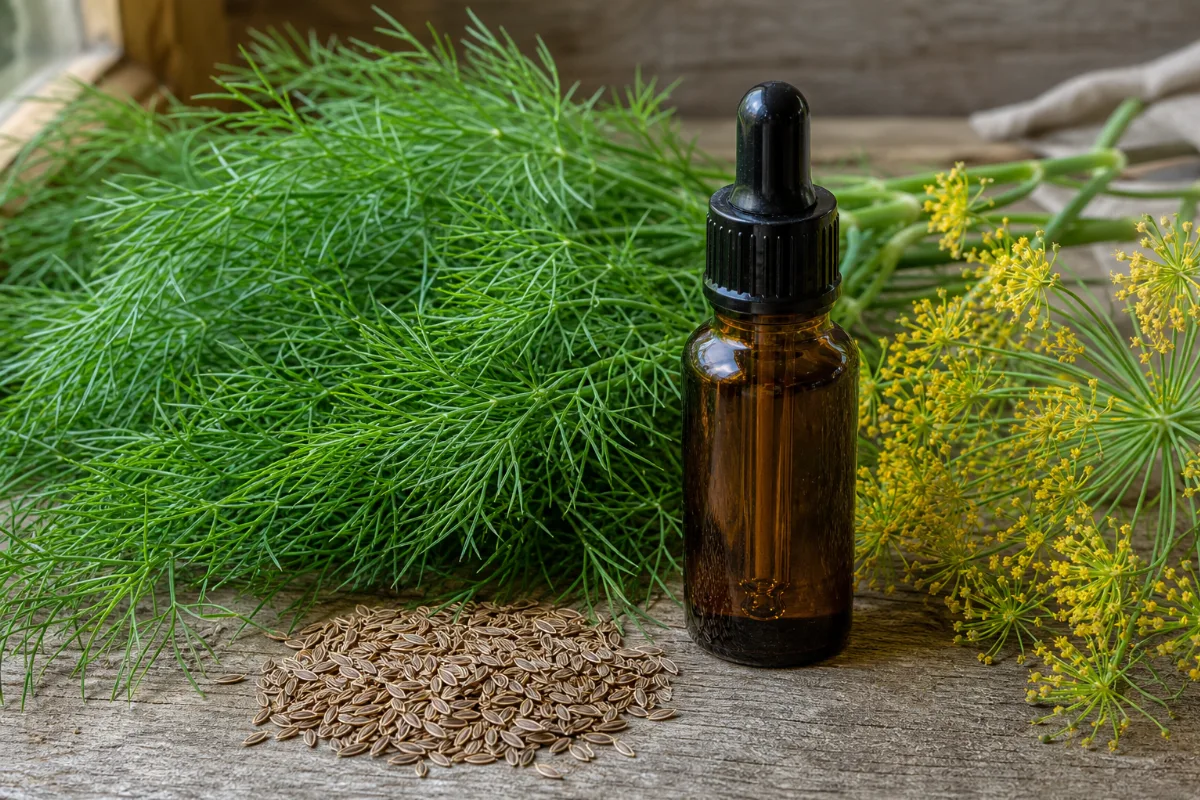
Dill oil is distilled from Anethum graveolens, a plant in the carrot family (Apiaceae). Two oils share the name: dill seed oil, from the dry fruits, and dill herb or weed oil, from the leafy tops. EFSA assessed them as separate products.
The make-up differs. Papers name carvone, limonene and camphor in seed oil, carvone, limonene and dillapiole in a 2025 oil, and one steam-distilled oil was 63.66% anethole. Indian dill (Anethum sowa) is a different species, accepted by GBIF, whose seed oil is rich in dill apiole.
What people use it for, and how strong the evidence is
The best human study is a 2024 trial of 106 dialysis patients. A dill oil preparation on itchy skin twice a day for a month lowered itch and quality-of-life scores more than sesame oil or no treatment. The abstract does not say whether it was an essential oil, dry skin improved with sesame oil too, and the result has not been repeated.
A 60-woman trial of a chamomile plus dill oil mix on the belly found a bigger drop in waist size than sesame oil, but dill alone was not tested and the abstract gives no averages.
Many online claims rest on other things. Blood fats and period pain have been studied with dill as a supplement or seed, not the oil. We found no trial of dill oil or dill water for baby colic. Mosquito, germ-killing, antioxidant, rat and mouse results are lab or animal work.
The research in one view
Only two small human trials on dill oil were found, both from Iran, both with a plant oil on the skin and neither with precise product details. Neither has been repeated.
No scent (aromatherapy) trial and no trial of swallowing the oil was found. Reviews of dill for blood fats and period pain are about the herb or seed.
Seed oil, herb oil, mixes and the herb itself are different things
The belly trial used a two-oil mix. The EFSA opinions cover herb oil and a fruit tincture. The cholesterol, period pain and milk-supply findings are about dill as a seed or supplement. A result for one form does not carry over to another.
Poison Control says it can be hard to know the species, strength and contaminants in a bottle.
What regulators say
EFSA (2022, 2023) judged dill herb oil and a dill fruit tincture safe as animal-feed flavourings at low levels (7 mg/kg feed for dogs, 5 mg/kg for cats for the herb oil), and said both should be considered skin and eye irritants and skin and breathing sensitisers. That concerns pet-food flavouring only.
An industry panel (FEMA, 2020) affirmed dill oil as a safe flavour ingredient. NIH's LactMed treats dill as a food and says it is generally well tolerated. We did not read IFRA, Tisserand, SCCS, NCCIH or LiverTox statements about dill oil.
At a glance
Traditional uses history, not proof
- Dill is used in Persian medicine as a skin softener and purifying agent (2024 trial introduction; tradition, not proof).
- Chamomile and dill oils were applied to the belly for obesity in Persian medicine (2025 trial introduction).
- Dill oil is a flavour ingredient in food (FEMA panel 2020).
Studied for research
- Itchy, dry skin in dialysis patients, low
- Sleep in dialysis patients, very-low
- Belly fat, chamomile plus dill mix, very-low
- Mosquito repellent, very-low
- Germ-killing, antioxidant and animal tests, insufficient
- Blood fats and period pain (herb or seed, not oil), insufficient
- Baby colic, insufficient
- Milk supply, insufficient
Main compounds
- Carvone, a main constituent of seed oil
- Limonene, a main constituent of seed oil
- Dillapiole, found in some preparations
- Anethole, main compound in one oil
Common forms
- Dill seed essential oil (from the dry fruits)
- Dill herb or weed oil (from the leafy tops)
- Topical oil preparations used in two Iranian trials
- Dill tincture (a different product)
- Indian dill oil (a different species)
Research links: Poison Control: Essential oils · EFSA opinion on dill herb oil (abstract) · Review of essential oils and pregnancy, including apiole (abstract) · Dill oil for itch in dialysis patients (abstract) · LactMed: Dill · GBIF: Anethum graveolens · Research Library · Genes & Biomarkers Library
What it is and its history
- Accepted scientific name
- Anethum graveolens
- Naming authority
- L.
- Common names
- Dill (English); Dill seed oil (English); Dill weed oil (English); Dill herb oil (English)
- Family or group
- Apiaceae, the carrot family (GBIF).
- Classification
- Plantae > Tracheophyta > Magnoliopsida > Apiales > Apiaceae > Anethum > Anethum graveolens
- Native range
- Not checked in a source read for this page.
- Habitat
- Not checked in a source read for this page.
- What it looks like
- Part used: Two oils are sold: dill seed oil, from the dry fruits (seeds), and dill herb or dill weed oil, from the leafy aerial parts. EFSA assessed the herb oil and a fruit tincture as separate products.
- Look-alikes and adulterants
- Name: Indian dill (Anethum sowa); Note: Accepted by GBIF as a separate species. A 2021 review gives its seed oil 20.7 to 52.5% dill apiole, so it is not interchangeable with A. graveolens oil.; Name: Dill seed oil versus dill herb oil; Note: Different plant parts with different chemistry; EFSA treats them as separate products.; Name: Parsley and parsley apiole; Note: Parsley seed oil contains a related compound, parsley apiole, linked to abortion and toxicity. It is not dill.
- Sustainability and conservation
- Not checked (no IUCN or CITES source read).
Traditional use and history history, not clinical proof
| Tradition or era | Documented use | Source |
|---|---|---|
| Persian medicine | A 2024 trial introduction says dill is traditionally used in Persian medicine as a skin softener and purifying agent; a 2025 trial says chamomile and dill oils were applied to the belly for obesity. | Shaki et al. 2024; Bashiri et al. 2025 (abstracts) |
| Food flavouring | Dill oil is an accepted flavour ingredient (FEMA GRAS panel, 2020), and dill herb is recognised for flavouring food by EFSA. | Cohen et al. 2020; EFSA 2022 (abstracts) |
Traditional use shows how it was used. It does not show that it works or is safe today.
What is inside, and how it may work
What it contains and how those compounds act in cells and animals. Laboratory and animal mechanisms are not proven effects in people.
Main compounds
| Compound | Family | Where it is concentrated | Activity studied | Level of evidence |
|---|---|---|---|---|
| Carvone PubChem 7439 | monoterpene ketone | Seed oil No typical value given; varies by oil. | Named main compound of dill seed oil (LactMed and lab papers). Antioxidant in test tubes. A possible allergen (l-carvone patch test; dill's form is d-carvone). 25 15 12 9 | Laboratory research |
| Limonene PubChem 22311 | monoterpene | Seed oil No typical value given. | Named main compound of dill seed oil. Forms skin-sensitising hydroperoxides in air (patch-test registry). 25 15 2 | Human correlational |
| Dillapiole PubChem 10231 | phenylpropene ether | Young seedlings; Indian dill seed oil Negligible in dry seeds and flowering plants (Plant J); named a key component in two 2025 preparations; 20.7 to 52.5% as dill apiole in Indian dill seed oil (review). | The compound behind the pregnancy and toxicity concern, argued by similarity to parsley apiole. 25 13 10 6 | Review only |
| Anethole PubChem 637563 | phenylpropene | Oil (one study) 63.66% in one steam-distilled dill oil. | Main compound in that oil; its antimicrobial effect was seen in dishes only. 25 5 | Laboratory research |
Mechanisms, receptors and pathways
| Target or pathway | Gene or receptor | What was found | Level |
|---|---|---|---|
| Inflammation in a rat paw | Not identified | An oil-based dill extract lowered formalin-induced paw swelling in rats. 14 | In vivo animal |
| Radical scavenging | Not applicable | Dill oil and some compounds neutralised radicals in test-tube assays, always less than a standard antioxidant. 12 10 | Laboratory research |
| Bacterial growth | Not applicable | A steam-distilled dill oil slowed E. coli and Listeria in dishes and on surfaces. 5 | Laboratory research |
| Cadmium-induced oxidative stress | Not identified | A seed-oil nanoemulsion improved markers of oxidative stress and inflammation in mice given cadmium. 18 | In vivo animal |
Absorption, metabolism and elimination
- Absorption
- Not established for the oil.
- Distribution
- Not established.
- Metabolism
- Not established.
- Elimination
- Not established.
- Bioavailability
- Not established. Small amounts of d-carvone reached breast milk in two studies where mothers were given the chemical (not the oil).
Isolated compounds versus whole extracts
Dill oil is a mixture whose make-up depends on plant part, species and extraction. In one lab study the whole extract was more active against bacteria than its main components alone, so single-compound results should not be assumed for the oil.
Nutritional composition
Dill oil is not a nutrient and not a food to take for health.
1 low certainty3 very low certainty8 not enough evidence
What is Dill Oil good for?
The uses people ask about and how strong the evidence is for each. Read the certainty label first: none is better than low, and several are about the herb or seed, or lab work.
Benefits, one by one
Each card is a research question, not a promise. Tap a goal to filter. Open a card to see the studies, doses and limits.
Itchy, dry skin in dialysis patients (dill oil preparation on the skin)
Low certaintyIn a 106-patient trial, a dill oil preparation rubbed on itchy skin twice a day for a month lowered itch scores and quality-of-life scores more than sesame oil or no treatment. Dry skin improved with sesame oil too.
1 studiesNot covered. This page gives no amounts and no way to use the oil.
Studies, doses and limits
What the trials found
One randomised, double-blind, three-arm trial in Iran (dill preparation, sesame oil, no treatment).
Results
Itch severity fell by 17.28 with dill, 5.91 with sesame oil and 3.43 with no treatment (P < 0.001). Itch-related quality of life changed by -14.88, -5.34 and -1.92 (P < 0.001). Skin dryness improved with dill (-1.65) and sesame oil (-1.11) compared with no treatment (-0.38).
Effect sizes as reported
Itch fell about 11 points more with dill than with sesame oil (our subtraction).
Why this rating
One trial from one research group. The abstract does not say whether the dill product was an essential oil or an infused oil. A plant oil is hard to hide from patients, so blinding may be weak, and the sesame oil group improved too.
Form and dose studied
Not covered. This page gives no amounts and no way to use the oil.
Who was studied
Adults on hemodialysis with itching, in Iran.
Limits
One month, 106 people, one country, no replication found.
Why researchers looked
Itching is common and hard to treat in people on hemodialysis, and a skin oil is simple to offer.
Traditional use
Dill is used in Persian medicine as a skin softener and purifying agent (from a 2024 trial introduction). That is tradition, not proof.
Proposed mechanism Preliminary mechanism
Not established. A 2012 rat paw experiment with an oil-based dill extract showed less swelling, but that does not show how it might ease itch in people.
A proposed mechanism does not show that the effect happens in people.
Skin and general oil cautions apply (see Safety).
Sleep quality in dialysis patients (dill oil preparation on the skin)
Very low certaintyIn the same dialysis trial, the dill group had a better sleep score after one month than the sesame oil and no-treatment groups. It was a side result, and sleep is likely to be better when the itch is less.
1 studiesNot covered. This page gives no amounts and no way to use the oil.
Studies, doses and limits
What the trials found
A secondary outcome of the same trial of 106 hemodialysis patients.
Results
Mean sleep score (PSQI, lower is better) after one month: 3.24 with dill, 4.54 with sesame oil and 5.05 with no treatment (P = 0.032).
Effect sizes as reported
About 1.3 points lower than sesame oil (our subtraction).
Why this rating
A secondary result of one trial, reported as a final score (the abstract gives no starting scores), self-rated, and probably follows the itch change rather than a direct effect on sleep.
Form and dose studied
Not covered. This page gives no amounts and no way to use the oil.
Who was studied
Adults on hemodialysis with itching, in Iran.
Limits
Self-rated; one month; the abstract gives no baseline sleep scores.
Why researchers looked
Itching keeps people awake, so researchers also measured sleep.
Traditional use
Dill is used in Persian medicine as a skin softener and purifying agent (from a 2024 trial introduction). That is tradition, not proof.
Proposed mechanism Preliminary mechanism
Not established.
A proposed mechanism does not show that the effect happens in people.
Skin and general oil cautions apply (see Safety).
Waist size and belly skin-folds (chamomile plus dill oil on the abdomen)
Very low certaintyIn a 60-woman trial, a chamomile and dill oil mix rubbed on the belly for 6 weeks was followed by a bigger drop in waist size and skin-fold thickness than sesame oil. Dill alone was not tested.
1 studiesNot covered. This page gives no amounts and no way to use the oil.
Studies, doses and limits
What the trials found
One randomised, double-blind trial in Tehran: 30 women with the oil mix and 30 with sesame oil.
Results
Waist circumference fell more with the mix (P = 0.027). Skin-fold thickness above the navel, below the navel and above the hip bone was lower (P = 0.005, P < 0.001, P < 0.001). The abstract gives no averages and no body weight.
Effect sizes as reported
No numbers in the abstract.
Why this rating
A two-oil mix, so nothing can be credited to dill alone. No averages are reported in the abstract, only one short trial, and diet and exercise are not described. It measures tape and skin-fold size, not health.
Form and dose studied
Not covered. This page gives no amounts and no way to use the oil.
Who was studied
Women aged 25 to 55 with abdominal obesity in Iran.
Limits
6 weeks, one centre, type of oil not stated.
Why researchers looked
Persian medicine used chamomile and dill oils on the belly for obesity.
Traditional use
In Persian medicine, chamomile and dill oils were applied to the abdomen for obesity (2025 trial introduction). That is tradition, not proof.
Proposed mechanism Preliminary mechanism
Not established.
A proposed mechanism does not show that the effect happens in people.
A two-oil mix; effect of dill alone is unknown. Skin and general oil cautions apply (see Safety).
Mosquito repellent (dill essential oil against Aedes aegypti)
Very low certaintyIn a 2007 screening of ten oils, dill oil gave a median 30 minutes of full protection against Aedes aegypti mosquitoes. That is short, and the abstract gives no test details.
1 studiesNot covered. This page gives no amounts and no way to use the oil.
Studies, doses and limits
What the trials found
One laboratory repellency screening; the abstract does not describe the volunteers or numbers.
Results
Median complete-protection time: Zanthoxylum piperitum oil 1 h, dill 0.5 h, Kaempferia galanga 0.25 h. Adding 10% vanillin lengthened protection. Mixing oils did not beat the best single oil.
Effect sizes as reported
Dill oil protected for about 30 minutes in this test.
Why this rating
One old screening with few details in the abstract, a very short protection time, and no replication found.
Form and dose studied
Not covered. This page gives no amounts and no way to use the oil.
Who was studied
Aedes aegypti mosquitoes.
Limits
Not a guide to protection from mosquito-borne disease.
Why researchers looked
People look for natural mosquito repellents.
Traditional use
None specific.
Proposed mechanism Preliminary mechanism
Not established.
A proposed mechanism does not show that the effect happens in people.
Skin and general oil cautions apply (see Safety).
Germ-killing action (dill oil against Listeria and E. coli on dairy-work surfaces, laboratory)
Not enough evidenceIn a 2026 laboratory study, a steam-distilled dill oil stopped E. coli and Listeria growing in dishes and on cleaned plastic and wood. It does not show any use on skin or in the body.
1 studiesNot covered. This page gives no amounts and no way to use the oil.
Studies, doses and limits
What the trials found
No human study. Culture dishes and plastic and wood surfaces only.
Results
Inhibition zones 13.7 mm (E. coli) and 12.3 mm (Listeria). On plastic: complete inhibition of E. coli and over 92% reduction of Listeria. On wood: up to 87.9%.
Effect sizes as reported
Not applicable.
Why this rating
Laboratory work on bacteria; a result on a table is not a result in a body.
Form and dose studied
Not covered. This page gives no amounts and no way to use the oil.
Who was studied
None (bacteria).
Limits
The dill oil in this study was mainly anethole (63.66%), which may differ from other bottles.
Why researchers looked
Researchers look for natural cleaners for artisan cheese-making equipment.
Traditional use
None specific.
Proposed mechanism Preliminary mechanism
Not established for health use.
A proposed mechanism does not show that the effect happens in people.
Not applicable (laboratory).
Antioxidant tests (dill oil and its compounds, test tube)
Not enough evidenceTest-tube tests find that dill oil, made by different methods, and some of its compounds can mop up free radicals. All were weaker than the standard used, and this does not show a benefit in people.
2 studiesNot covered. This page gives no amounts and no way to use the oil.
Studies, doses and limits
What the trials found
No human study.
Results
Superheated-steam oil: DPPH scavenging 87.48%, FRAP 163.06 mg/L. In a dill seed oil study, carveol and perillyl alcohol were the most active and all compounds were weaker than the standard.
Effect sizes as reported
Not applicable.
Why this rating
Chemistry assays only.
Form and dose studied
Not covered. This page gives no amounts and no way to use the oil.
Who was studied
None.
Limits
Results depend on the extraction method.
Why researchers looked
Food scientists look for natural antioxidants.
Traditional use
None specific.
Proposed mechanism Preliminary mechanism
Radical-scavenging in chemical assays.
A proposed mechanism does not show that the effect happens in people.
Not applicable (laboratory).
Swelling (dill oil-based extract on rat paws)
Not enough evidenceA 2012 rat experiment found less paw swelling after a daily oil-based dill extract than with no treatment, and it looked at least as good as diclofenac gel. It is animal work with six rats per group.
1 studiesNot covered. This page gives no amounts and no way to use the oil.
Studies, doses and limits
What the trials found
Rats only (18 in total).
Results
On day 2, paw swelling averaged 0.44 (untreated), 0.15 (dill oil) and 0.36 (diclofenac gel). Both treatments lowered swelling over 8 days (p < 0.001).
Effect sizes as reported
Not applicable to people.
Why this rating
A small rat experiment with an oil-based extract, not distilled essential oil.
Form and dose studied
Not covered. This page gives no amounts and no way to use the oil.
Who was studied
Male rats.
Limits
No replication in people found.
Why researchers looked
Researchers wanted to test the traditional use on skin.
Traditional use
Dill is used in Persian medicine as a skin softener and purifying agent (from a 2024 trial introduction). That is tradition, not proof.
Proposed mechanism Preliminary mechanism
Not established.
A proposed mechanism does not show that the effect happens in people.
Not applicable (animal).
Protection against a toxic metal (dill seed oil nanoemulsion in mice)
Not enough evidenceIn mice given cadmium, a lab-made nanoemulsion of dill seed oil in the drinking water lowered liver cadmium and some damage markers. This is animal work with a special preparation, and it is not a detox claim for people.
1 studiesNot covered. This page gives no amounts and no way to use the oil.
Studies, doses and limits
What the trials found
No human study.
Results
Compared with cadmium alone, mice given the nanoemulsion had less weight loss, less liver cadmium and better oxidative-stress and inflammation markers.
Effect sizes as reported
No figures in the abstract.
Why this rating
One mouse study with a nanoemulsion given by drinking water.
Form and dose studied
Not covered. This page gives no amounts and no way to use the oil.
Who was studied
Mice.
Limits
Not the ordinary oil.
Why researchers looked
Cadmium is a toxic metal and researchers test plant compounds against its damage.
Traditional use
None specific.
Proposed mechanism Preliminary mechanism
Proposed: carvone and limonene may limit oxidative stress (not shown in people).
A proposed mechanism does not show that the effect happens in people.
Not applicable (animal).
Blood fats (dill supplementation, not the essential oil)
Not enough evidenceA review of 6 trials of dill as a supplement found small drops in total cholesterol, LDL and triglycerides. The abstract does not say what form of dill was used, and none of the trials is about the essential oil.
1 studiesNot covered. This page gives no amounts and no way to use the oil.
Studies, doses and limits
What the trials found
Pooled analysis of six randomised trials with 171 people given dill.
Results
Pooled mean differences: total cholesterol -3.71, LDL -1.51, triglycerides -2.48. The abstract also lists HDL -2.19 but says HDL did not improve, so it contradicts itself.
Effect sizes as reported
Small average changes.
Why this rating
Evidence is for dill intake in an unstated form, not the oil, and the abstract contradicts itself on HDL.
Form and dose studied
Not covered. This page gives no amounts and no way to use the oil.
Who was studied
People with high blood fats or type 2 diabetes in some trials.
Limits
Not about the oil. Do not read it as a benefit of dill oil.
Why researchers looked
Dill is a common kitchen herb and seed, so researchers ask whether it affects blood fats.
Traditional use
None specific.
Proposed mechanism Preliminary mechanism
Not established.
A proposed mechanism does not show that the effect happens in people.
This is about dill supplements, not about the oil.
Period pain (dill seed among Apiaceae herbs, not the essential oil)
Not enough evidenceA 2026 review of herbs from the carrot family, including dill seed, found they may help period pain compared with standard pain medicine. The authors want better trials, and the review is not about the essential oil.
1 studiesNot covered. This page gives no amounts and no way to use the oil.
Studies, doses and limits
What the trials found
A review of 14 trials, 7 in the meta-analysis.
Results
Pooled results against standard treatments were statistically significant with low heterogeneity, and a fennel and dill seed subgroup was also positive. Risk-of-bias concerns were noted for dill and fennel trials against standard treatments.
Effect sizes as reported
No pooled numbers in the abstract.
Why this rating
Evidence is for the seed and mixed herbs, with bias concerns, and none is for the essential oil.
Form and dose studied
Not covered. This page gives no amounts and no way to use the oil.
Who was studied
Women with primary dysmenorrhea.
Limits
Not about the oil.
Why researchers looked
Dill and fennel seed are used traditionally for period pain.
Traditional use
Used in traditional medicine for period pain (from the 2026 review abstract). That is tradition, not proof.
Proposed mechanism Preliminary mechanism
Not established.
A proposed mechanism does not show that the effect happens in people.
This is about seed and herbs, not about the oil.
Baby colic (dill oil or dill water; gripe water)
Not enough evidenceWe found no trial of dill oil or dill water for baby colic. A survey of 335 mothers found more colic, vomiting and constipation in babies given gripe water, and a case report describes serious infection from a contaminated colic product. The abstracts do not say whether dill was in those products.
2 studiesNot covered. This page gives no amounts and no way to use the oil.
Studies, doses and limits
What the trials found
One survey and one case report; no trial of dill oil.
Results
Survey: 64.18% of mothers gave gripe water; colic, vomiting and constipation were more common in those babies (p = 0.0001, 0.0373, 0.0007). Authors: gripe water does not seem to prevent colic. Case: a 9-month-old in septic shock after a contaminated herbal colic product.
Effect sizes as reported
Not applicable.
Why this rating
Associations only; the products and herbs are not named; no trial of dill oil.
Form and dose studied
Not covered. This page gives no amounts and no way to use the oil.
Who was studied
Infants aged 1 to 6 months (survey).
Limits
Do not take these as results for dill oil.
Why researchers looked
Dill water has long been a home remedy for colic.
Traditional use
Home remedy in several places; no source on this was read for this page.
Proposed mechanism Preliminary mechanism
Not established.
A proposed mechanism does not show that the effect happens in people.
Babies are more at risk from essential oils. See Safety.
Breast-milk supply (dill as a herb or seed)
Not enough evidenceLactMed says no scientifically valid trial supports dill for increasing milk, and one small old study found no effect of d-carvone, a main dill compound. This is about the herb and seed, not the oil.
1 studiesNot covered. This page gives no amounts and no way to use the oil.
Studies, doses and limits
What the trials found
No valid clinical trial; one small old study of d-carvone.
Results
No effect on milk supply was found in the one small study of d-carvone; dill was one part of an herbal mixture that showed some evidence of effect.
Effect sizes as reported
Not applicable.
Why this rating
No valid trials; mixtures confuse the picture.
Form and dose studied
Not covered. This page gives no amounts and no way to use the oil.
Who was studied
Breastfeeding mothers.
Limits
Not about the oil.
Why researchers looked
Dill is a purported milk booster in folk use.
Traditional use
Folk use, as LactMed describes it. That is tradition, not proof.
Proposed mechanism Preliminary mechanism
Not established.
A proposed mechanism does not show that the effect happens in people.
LactMed covers the food and herb, not the oil.
Connections to the rest of health
How Dill Oil connects to the rest of our health knowledge graph. Every link says what kind of connection it is. A safety link (for example to the liver) is a warning, not a benefit. A study that merely mentions a topic never creates a benefit link.
Explore every connection: goals, body systems, organs, symptoms, genes
A. Wellness goals
| Connected to | Kind of connection | Evidence status | Context | Studies |
|---|---|---|---|---|
| Healthy Skin | Low certainty | Itchy, dry skin in dialysis patients (dill oil preparation on the skin): In a 106-patient trial, a dill oil preparation rubbed on itchy skin twice a day for a month lowered itch scores and quality-of-life scores more than sesame oil or no treatment. Dry skin improved with sesame oil too. | 19 | |
| Better Sleep | Very low certainty | Sleep quality in dialysis patients (dill oil preparation on the skin): In the same dialysis trial, the dill group had a better sleep score after one month than the sesame oil and no-treatment groups. It was a side result, and sleep is likely to be better when the itch is less. | 19 | |
| Weight Management | Very low certainty | Waist size and belly skin-folds (chamomile plus dill oil on the abdomen): In a 60-woman trial, a chamomile and dill oil mix rubbed on the belly for 6 weeks was followed by a bigger drop in waist size and skin-fold thickness than sesame oil. Dill alone was not tested. | 1 | |
| Preventive Wellness | Very low certainty | Mosquito repellent (dill essential oil against Aedes aegypti): In a 2007 screening of ten oils, dill oil gave a median 30 minutes of full protection against Aedes aegypti mosquitoes. That is short, and the abstract gives no test details. | 3 | |
| Immune Support | Not enough evidence | Germ-killing action (dill oil against Listeria and E. coli on dairy-work surfaces, laboratory): In a 2026 laboratory study, a steam-distilled dill oil stopped E. coli and Listeria growing in dishes and on cleaned plastic and wood. It does not show any use on skin or in the body. | 5 | |
| Cellular Protection | Not enough evidence | Antioxidant tests (dill oil and its compounds, test tube): Test-tube tests find that dill oil, made by different methods, and some of its compounds can mop up free radicals. All were weaker than the standard used, and this does not show a benefit in people. | 10 12 | |
| Inflammation Balance | Not enough evidence | Swelling (dill oil-based extract on rat paws): A 2012 rat experiment found less paw swelling after a daily oil-based dill extract than with no treatment, and it looked at least as good as diclofenac gel. It is animal work with six rats per group. | 14 | |
| Detoxification Support | Not enough evidence | Protection against a toxic metal (dill seed oil nanoemulsion in mice): In mice given cadmium, a lab-made nanoemulsion of dill seed oil in the drinking water lowered liver cadmium and some damage markers. This is animal work with a special preparation, and it is not a detox claim for people. | 18 | |
| Cholesterol Balance | Not enough evidence | Blood fats (dill supplementation, not the essential oil): A review of 6 trials of dill as a supplement found small drops in total cholesterol, LDL and triglycerides. The abstract does not say what form of dill was used, and none of the trials is about the essential oil. | 16 | |
| Womens Wellness | Not enough evidence | Period pain (dill seed among Apiaceae herbs, not the essential oil): A 2026 review of herbs from the carrot family, including dill seed, found they may help period pain compared with standard pain medicine. The authors want better trials, and the review is not about the essential oil. | 20 | |
| Digestive Support | Not enough evidence | Baby colic (dill oil or dill water; gripe water): We found no trial of dill oil or dill water for baby colic. A survey of 335 mothers found more colic, vomiting and constipation in babies given gripe water, and a case report describes serious infection from a contaminated colic product. The abstracts do not say whether dill was in those products. | 11 17 | |
| Womens Wellness | Not enough evidence | Breast-milk supply (dill as a herb or seed): LactMed says no scientifically valid trial supports dill for increasing milk, and one small old study found no effect of d-carvone, a main dill compound. This is about the herb and seed, not the oil. | 15 |
B. Body systems
| Connected to | Kind of connection | Evidence status | Context | Studies |
|---|---|---|---|---|
| Skin Hair Beauty | Biological association | Low certainty | Studied for: Itchy, dry skin in dialysis patients (dill oil preparation on the skin) Studied for: Sleep quality in dialysis patients (dill oil preparation on the skin) | 19 1 |
| Integumentary System | Biological association | Low certainty | Studied for: Itchy, dry skin in dialysis patients (dill oil preparation on the skin) | 19 |
| Nervous System | Biological association | Very low certainty | Studied for: Sleep quality in dialysis patients (dill oil preparation on the skin) | 19 |
| Metabolism Weight | Biological association | Very low certainty | Studied for: Waist size and belly skin-folds (chamomile plus dill oil on the abdomen) | 1 |
| Immune Support | Biological association | Very low certainty | Studied for: Mosquito repellent (dill essential oil against Aedes aegypti) | 3 |
| Immune System | Biological association | Not enough evidence | Studied for: Germ-killing action (dill oil against Listeria and E. coli on dairy-work surfaces, laboratory) | 5 |
| Whole Body Balance | Biological association | Not enough evidence | Studied for: Antioxidant tests (dill oil and its compounds, test tube) | 10 12 |
| Pain Inflammation | Biological association | Not enough evidence | Studied for: Swelling (dill oil-based extract on rat paws) | 14 |
| Hepatic System | Biological association | Not enough evidence | Studied for: Protection against a toxic metal (dill seed oil nanoemulsion in mice) | 18 |
| Cardiovascular System | Biological association | Not enough evidence | Studied for: Blood fats (dill supplementation, not the essential oil) | 16 |
| Reproductive System | Biological association | Not enough evidence | Studied for: Period pain (dill seed among Apiaceae herbs, not the essential oil) Studied for: Breast-milk supply (dill as a herb or seed) | 20 15 |
| Digestive System | Biological association | Not enough evidence | Studied for: Baby colic (dill oil or dill water; gripe water) | 11 17 |
E. Health conditions
| Connected to | Kind of connection | Evidence status | Context | Studies |
|---|---|---|---|---|
| Contact dermatitis | Documented risk | EFSA treats dill herb oil as an irritant and skin sensitiser; LactMed notes allergic skin reactions with dill. Preparation or compound: Dill oil on the skin |
7 15 | |
| Uremic pruritus | Low certainty | One 106-patient trial found less itch than sesame oil or no treatment. Preparation or compound: Topical dill preparation |
19 |
I. Biomarkers
| Connected to | Kind of connection | Evidence status | Context | Studies |
|---|---|---|---|---|
| Itch severity (Duo's Uremic Pruritus Scale) | Biological association | Low certainty | Measured in trials: decrease. A lab change is not the same as a health benefit. | 19 |
| Pittsburgh Sleep Quality Index (PSQI) | Biological association | Very low certainty | Measured in trials: decrease. A lab change is not the same as a health benefit. | 19 |
| Skin dryness score | Biological association | Low certainty | Measured in trials: decrease. A lab change is not the same as a health benefit. | 19 |
| Waist (abdominal) circumference and belly skin-fold thickness | Biological association | Very low certainty | Measured in trials: decrease. A lab change is not the same as a health benefit. | 1 |
| LDL cholesterol | Biological association | Not enough evidence | Measured in trials: decrease. A lab change is not the same as a health benefit. | 16 |
| DPPH radical scavenging (laboratory antioxidant test) | Biological association | Not enough evidence | Measured in trials: increase. A lab change is not the same as a health benefit. | 10 |
L. Active compounds
| Connected to | Kind of connection | Evidence status | Context | Studies |
|---|---|---|---|---|
| Carvone | Biological association | In vitro | Named main compound of dill seed oil (LactMed and lab papers). Antioxidant in test tubes. A possible allergen (l-carvone patch test; dill's form is d-carvone). Preparation or compound: Seed oil |
25 15 12 9 |
| Limonene | Biological association | Human correlational | Named main compound of dill seed oil. Forms skin-sensitising hydroperoxides in air (patch-test registry). Preparation or compound: Seed oil |
25 15 2 |
| Dillapiole | Biological association | Review only | The compound behind the pregnancy and toxicity concern, argued by similarity to parsley apiole. Preparation or compound: Young seedlings; Indian dill seed oil |
25 13 10 6 |
| Anethole | Biological association | In vitro | Main compound in that oil; its antimicrobial effect was seen in dishes only. Preparation or compound: Oil (one study) |
25 5 |
Each connection is stored with the ingredient, the connected record, the kind of connection, the evidence status, the supporting studies, the preparation or compound involved, and a review date (last reviewed October 25, 2026).
The evidence
The research centre for Dill Oil. Every record here was checked against PubMed or the publisher's page; we never list a study we have not verified.
Evidence by outcome
Bars show how many studies we found for each outcome, not how well it works. People are added up across trials only (reviews are not added, to avoid double counting).
How we rate evidence
High certainty
Several well-run trials or reviews agree; further research is unlikely to change the picture much.
Moderate certainty
Good trials point the same way, but some doubt remains.
Low certainty
Small, short or inconsistent trials. The finding could change with better research.
Very low certainty
Very little or very weak human data. Treat as a possibility only.
Mixed findings
Trials or reviews disagree with each other.
Not enough evidence
Not enough human research to say either way.
Evidence against
Good research found no benefit, or found harm.
We take the reviewers' own risk-of-bias and GRADE statements where they exist, and otherwise judge from study size, design, consistency, directness and whether a product matches what is sold. Many publications do not make evidence high. Method note: We read the abstracts of 20 PubMed records (and the full text of one review), the Poison Control and Pet Poison Helpline pages, checked the plant names in GBIF and the compounds in PubChem. We did not read IFRA, Tisserand, SCCS, NCCIH or LiverTox statements.
Study library: every study we checked 25
| Study | Design | People | Product, dose, length | Result |
|---|---|---|---|---|
| Bashiri 2025 Efficacy of Topical Chamomile and Dill Oil on Abdominal Obesity in Women Ages 25-55 Years: A Randomized Clinical Trial. Medical Journal of the Islamic Republic of Iran · PMID 42021801 · DOI |
Randomised, double blind clinical trial |
60 Women with abdominal obesity, aged 25 to 55, Tehran, Iran |
Chamomile oil plus dill oil, applied together to the whole abdomen (type of oil not stated in the abstract) not stated in the abstract Not reported here Once a day for 6 weeks · vs Sesame oil on the abdomen (30 per group) |
Reduction in abdominal circumference was larger in the oil-mix group (P = 0.027). Skin-fold thickness at all three sites was also lower (P = 0.005, P < 0.001 and P < 0.001). The abstract gives no mean values or body weight. Methods, limits and fundingOutcomes: Waist (abdominal) circumference by tape measure; skin-fold thickness above and below the navel and above the hip bone Limitations: A two-oil mix, so the effect of dill alone is unknown. No numbers in the abstract. Short, one centre, no weight or health outcome, and no diet or exercise details in the abstract. Funding and conflicts: Authors declare no competing interests. Funding not stated in the abstract. Read: abstract |
| Botvid 2026 Ten Years of Patch Testing to Hydroperoxides of Limonene and Linalool: Prevalence, Patterns and Clinical Insights. Contact Dermatitis · PMID 41638887 · DOI |
Retrospective patch test registry analysis |
6719 Consecutively patch-tested patients, Gentofte Hospital, Denmark, 2014 to 2025 |
Limonene hydroperoxides (formed when limonene meets air), patch test n/a n/a n/a · vs n/a |
1.6% reacted to limonene hydroperoxides and 3.1% to linalool hydroperoxides; there was co-reactivity with other fragrance allergens. Limonene turns into these sensitisers on air exposure. Methods, limits and fundingOutcomes: Positive patch-test reactions Limitations: Did not test dill oil. Limonene is one main compound of dill seed oil according to other papers. Funding and conflicts: Authors declare no conflicts of interest. Read: abstract |
| Choochote 2007 Repellent activity of selected essential oils against Aedes aegypti. Fitoterapia · PMID 17512681 · DOI |
Laboratory repellency screening of ten essential oils human or mosquito test (not specified in the abstract) |
Aedes aegypti mosquitoes (test details not in the abstract) | Essential oil of Anethum graveolens (part not stated in the abstract) not stated in the abstract Not reported here Protection time measured in hours · vs Other essential oils tested |
Three of ten oils protected: Zanthoxylum piperitum (median 1 h), Anethum graveolens (0.5 h) and Kaempferia galanga (0.25 h). Adding 10% vanillin lengthened protection. Mixtures of the effective oils were not better than the best single oil. Methods, limits and fundingOutcomes: Median complete-protection time against mosquito bites Limitations: Short protection time (30 minutes). The abstract does not give the number of volunteers or how the test was done. 2007 study; no replication found. Funding and conflicts: Funding not stated in the abstract. Read: abstract |
| Cohen 2020 FEMA GRAS assessment of natural flavor complexes: Mint, buchu, dill and caraway derived flavoring ingredients. Food and Chemical Toxicology · PMID 31604112 · DOI |
Expert panel assessment (flavour industry association) regulatory/industry |
Flavour ingredients | Natural flavour complexes including Dill Oil (FEMA 2383) n/a Flavour-ingredient use only n/a · vs n/a |
The FEMA Expert Panel affirmed the GRAS status of Dill Oil (FEMA 2383), along with spearmint, peppermint, caraway and others, for use as flavour ingredients. Methods, limits and fundingOutcomes: Generally recognised as safe (GRAS) status as flavouring Limitations: A panel of the Flavor and Extract Manufacturers Association (an industry body). It concerns tiny flavouring amounts in food, not skin use, aromatherapy or swallowing the oil for health. Funding and conflicts: Industry association panel. Read: abstract |
| Contero 2026 Essential Oils of Dill and Nettle as a Natural Alternative to Reduce Pathogenic Bacteria on Dairy Production Surfaces. Microorganisms · PMID 41753699 · DOI |
Laboratory study bacteria (lab) |
Listeria monocytogenes and Escherichia coli in culture dishes and on wood and plastic | Steam-distilled dill (Anethum graveolens) essential oil, main compound anethole 63.66% plant part not stated in the abstract Not reported here 40 minutes on surfaces · vs Nettle essential oil |
Dill oil made inhibition zones of 13.7 +/- 1.5 mm (E. coli) and 12.3 +/- 1.5 mm (Listeria). On plastic it gave complete inhibition of E. coli and over 92% reduction of Listeria; on wood, up to 87.9%. Methods, limits and fundingOutcomes: Inhibition zones, minimum inhibitory concentration, bacterial reduction on surfaces Limitations: Laboratory and surface test only. Says nothing about skin, the body or infection in people. Funding and conflicts: Authors declare no conflicts of interest. Read: abstract |
| Dosoky 2021 Maternal Reproductive Toxicity of Some Essential Oils and Their Constituents. International Journal of Molecular Sciences · PMID 33673548 · DOI |
Narrative review (full text read) review |
Review of essential oils and pregnancy | Essential oils rich in apiole, thujone, camphor, pulegone and others; includes Indian dill (Anethum sowa) seed oil seed oils and others n/a n/a · vs n/a |
Says parsley apiole is blamed for abortions that sometimes ended in death, and that parsley apiole poisoning gave fever, severe abdominal pain, vaginal bleeding, abortion, convulsions, vomiting and diarrhoea. Dill apiole is found in Indian dill (Anethum sowa) seed oil (20.7 to 52.5%) and in parsley leaf oil (0.2 to 5.2%). The authors say the structural similarity to parsley apiole suggests dill apiole could carry the same toxicity and could be hazardous in pregnancy, and that it is best to avoid apiole-rich oils by all routes throughout pregnancy and breastfeeding. Their table lists Indian dill seed oil as hepatotoxic, nephrotoxic and abortifacient. Methods, limits and fundingOutcomes: Pregnancy and fetal risks of essential-oil constituents Limitations: A narrative review. The warning for dill apiole is by analogy with parsley apiole; the abstract and text we read give no direct human or animal study of dill apiole poisoning. The review does not assess Anethum graveolens oil. Funding and conflicts: Authors declare no conflict of interest. Read: full-text |
| EFSA FEEDAP Panel (Bampidis 2022 Safety and efficacy of a feed additive consisting of an essential oil from the aerial parts of Anethum graveolens L. (dill herb oil) for use in dogs and cats (FEFANA asbl). EFSA Journal · PMID 36570349 · DOI |
Regulatory scientific opinion dog and cat (regulatory) |
Dogs and cats (feed flavouring) | Dill herb oil from the aerial parts of Anethum graveolens aerial parts Feed-flavouring use levels only; not exposure advice n/a · vs n/a |
EFSA concluded dill herb oil is safe at use levels in complete feed of 7 mg/kg for dogs and 5 mg/kg for cats, and that the additive should be considered an irritant to skin and eyes and a dermal and respiratory sensitiser. Methods, limits and fundingOutcomes: Safety for animals, users and efficacy as a feed flavouring Limitations: About flavouring in pet food, not about skin use, diffusing or aromatherapy. Funding and conflicts: Regulator opinion. Read: abstract |
| EFSA FEEDAP Panel (Bampidis 2023 Safety and efficacy of a feed additive consisting of a tincture derived from the fruit of Anethum graveolens L. (dill tincture) for use in all animal species (FEFANA asbl). EFSA Journal · PMID 36655164 · DOI |
Regulatory scientific opinion animals (regulatory) |
All animal species (feed flavouring) | Dill tincture from the fruit (seed) of Anethum graveolens; low in volatile oil (0.003% carvone) fruit Feed-flavouring use levels only; not exposure advice n/a · vs n/a |
Judged safe at proposed feed-flavouring levels. EFSA said the tincture should be considered an irritant to skin and eyes and a dermal and respiratory sensitiser, and that estragole exposure of unprotected users could not be excluded. Methods, limits and fundingOutcomes: Safety for animals, consumers, users and the environment Limitations: A tincture, not an essential oil. About feed flavouring. Funding and conflicts: Regulator opinion. Read: abstract |
| Enberg 2023 The use of carvone in consecutive patch testing. Contact Dermatitis · PMID 36399045 · DOI |
Retrospective patch test analysis |
3554 Dermatitis patients tested 2017 to 2021, Sweden |
l-carvone (the mint-type form), patch test n/a n/a n/a · vs n/a |
28 of 3,554 patients (0.79%) reacted. Half of those had a relevant reaction. The authors say carvone allergy may be overlooked if not tested. Methods, limits and fundingOutcomes: Positive allergic skin reactions to carvone Limitations: Tested l-carvone (mint type). Dill's main form is d-carvone (per LactMed), so this is only a hint about dill. Funding and conflicts: Authors declare no pertinent conflicts. Read: abstract |
| Fatima 2025 The Effect of Different Extraction Techniques on the Bioactive Characteristics of Dill (Anethum graveolens) Essential Oil. Food Science & Nutrition · PMID 40129996 · DOI |
Laboratory chemistry study none (chemistry) |
Dill oil from four extraction methods | Dill (Anethum graveolens) essential oil made by superheated steam, hydro-distillation, steam distillation or supercritical carbon dioxide not stated in the abstract Not reported here n/a · vs Other extraction methods |
Superheated-steam oil scored highest: DPPH scavenging 87.48% and FRAP 163.06 mg/L. The authors name carvone, limonene and dillapiole as key components. Methods, limits and fundingOutcomes: Yield, antioxidant tests (DPPH, FRAP) and antimicrobial tests Limitations: Test-tube chemistry. Does not show any effect in the body. Funding and conflicts: Funding not stated in the abstract. Read: abstract |
| Jain 2015 Gripe Water Administration in Infants 1-6 months of Age-A Cross-sectional Study. Journal of Clinical and Diagnostic Research · PMID 26673749 · DOI |
Cross sectional interview study |
335 Mothers of infants aged 1 to 6 months at a clinic in Puducherry, India |
Gripe water (a herbal colic product; the abstract does not say which herbs it contained) n/a n/a n/a · vs Infants not given gripe water |
64.18% of mothers gave gripe water. Colic, vomiting and constipation were more common in infants given gripe water (p = 0.0001, 0.0373 and 0.0007). The authors concluded gripe water does not seem to prevent colic. Methods, limits and fundingOutcomes: Why mothers give gripe water, and colic, vomiting and constipation in each group Limitations: A survey, so it shows association only. Infants with more colic may be given gripe water more. The abstract does not say whether dill was an ingredient. Funding and conflicts: Funding not stated in the abstract. Read: abstract |
| Kaur 2019 Antioxidant activity of Anethum graveolens L. essential oil constituents and their chemical analogues. Journal of Food Biochemistry · PMID 31353585 · DOI |
Laboratory study none (chemistry) |
Dill seed oil and parts of it | Dill seed essential oil, its fractions, and isolated carvone, limonene and camphor seed Not reported here n/a · vs A standard antioxidant |
Dill seed oil's main compounds were carvone, limonene and camphor. Carveol and perillyl alcohol (made from them) were the most active (IC50 below 0.16 mg/ml); camphor was least active. All tested compounds were weaker than the standard. Methods, limits and fundingOutcomes: Antioxidant (radical scavenging) tests Limitations: Test-tube assays only. Funding and conflicts: Funding not stated in the abstract. Read: abstract |
| Koeduka 2023 Biosynthesis of dillapiole/apiole in dill (Anethum graveolens): characterization of regioselective phenylpropene O-methyltransferase. The Plant Journal · PMID 36534115 · DOI |
Plant biochemistry study plant |
Dill plants at different growth stages | Volatile compounds of dill plants (dillapiole and apiole) seedlings, flowering plants, dry seeds n/a n/a · vs n/a |
Young dill seedlings accumulate high levels of dillapiole and apiole; only a negligible proportion was found in flowering plants and dry seeds. Methods, limits and fundingOutcomes: Where dillapiole and apiole are found in the plant Limitations: Plant chemistry, not a safety study. It does not say what commercial dill oils contain. Funding and conflicts: Funding not stated in the abstract. Read: abstract |
| Naseri 2012 The Study of Anti-Inflammatory Activity of Oil-Based Dill (Anethum graveolens L.) Extract Used Topically in Formalin-Induced Inflammation Male Rat Paw. Iranian Journal of Pharmaceutical Research · PMID 24250550 |
Animal experiment rat |
18 Male rats (6 per group) with formalin-induced paw swelling |
Oil-based dill extract (aerial parts and seed) applied to the paw aerial parts and seed Not reported here Daily for 8 days · vs Formalin only, and diclofenac gel |
On day 2 the average paw swelling was 0.44 (formalin), 0.15 (dill oil) and 0.36 (diclofenac gel). Over 8 days both treatments reduced paw swelling compared with the untreated group (p < 0.001). Methods, limits and fundingOutcomes: Paw volume Limitations: Rats only, 6 per group, an oil-based extract rather than distilled essential oil. Funding and conflicts: Funding not stated in the abstract. Read: abstract |
| National Institute of Child Health and Human Development 2026 Dill. Drugs and Lactation Database (LactMed), entry dated 2026 Oct 15. LactMed (NCBI Bookshelf) · PMID 30000937 |
Drug and lactation database entry review |
Breastfeeding | Dill (Anethum graveolens) seeds and herb as food; d-carvone given to mothers in two studies seeds n/a n/a · vs n/a |
Says dill seeds contain an essential oil rich in carvone and limonene. As a galactogogue (milk booster) no scientifically valid clinical trials support it, and one small old study found no effect of d-carvone. Two studies found small but measurable amounts of d-carvone in the milk of mothers given the chemical, with no adverse effects noted in mothers or infants. Dill is generally recognised as safe as a food (FDA GRAS); it is generally well tolerated but occasional allergic skin reactions have been reported, especially after contact with fresh dill. Methods, limits and fundingOutcomes: Use of dill while breastfeeding, and milk supply claims Limitations: About dill as a food or herb and the chemical d-carvone, not the essential oil. Funding and conflicts: Public health database. Read: abstract |
| Sadeghi 2022 Anethum graveolens L. (Dill) Effect on Human Lipid Profile: An Updated Systematic Review. Current Problems in Cardiology · PMID 34838903 · DOI |
Systematic review of randomised trials with pooled analysis |
171 Six randomised trials (171 people given dill); some with high blood fats or type 2 diabetes |
Dill (Anethum graveolens) supplementation; form not described in the abstract and not the essential oil not stated in the abstract Not reported here n/a · vs Control groups |
Pooled mean differences: total cholesterol -3.71, LDL -1.51, triglycerides -2.48. The abstract also lists an HDL change of -2.19 but then says HDL did not improve, so its HDL statement is inconsistent. Methods, limits and fundingOutcomes: Total cholesterol, LDL, triglycerides, HDL Limitations: Small trials; the abstract does not say what form of dill was used, and the review is not about the essential oil. Internal inconsistency in the abstract about HDL. Funding and conflicts: Funding not stated in the abstract. Read: abstract |
| Sas 2004 Pseudomonas aeruginosa septic shock secondary to "gripe water" ingestion. Pediatric Infectious Disease Journal · PMID 14872189 · DOI |
Case report |
1 A 9-month-old girl, USA |
A contaminated herbal supplement sold for colic (called gripe water); the abstract does not say which herbs it contained n/a n/a n/a · vs n/a |
The girl presented in septic shock after swallowing a contaminated herbal colic supplement. The authors warn that variable manufacturing and packaging of herbal supplements can lead to contamination with infectious agents. Methods, limits and fundingOutcomes: Illness after swallowing the product Limitations: A single case. Not about dill oil; the abstract does not name dill. Funding and conflicts: n/a Read: abstract |
| Shafaei 2020 Protective Effects of Anethum graveolens Seed's Oil Nanoemulsion Against Cadmium-Induced Oxidative Stress in Mice. Biological Trace Element Research · PMID 32152873 · DOI |
Animal experiment mouse |
Mice given cadmium | Dill seed oil made into a nanoemulsion (tiny droplets), main compounds carvone and limonene seed Not reported here 30 days in drinking water · vs Cadmium without the oil |
Mice given the nanoemulsion had less weight loss, less cadmium in the liver and better oxidative-stress and inflammation markers than mice given cadmium alone. Methods, limits and fundingOutcomes: Body weight, liver cadmium, markers of oxidative stress and inflammation in liver, kidney and brain Limitations: Mouse study with a lab-made nanoemulsion, not an ordinary oil. Says nothing about people. Funding and conflicts: Funding not stated in the abstract. Read: abstract |
| Shaki 2024 Effect of Dill (Anethum graveolens) Oil on Pruritus and Quality of Life of Hemodialysis Patients: A Randomized Double-Blind Three-Arm Controlled Trial. Evidence-Based Complementary and Alternative Medicine · PMID 38264189 · DOI |
Randomised, double blind, three arm, placebo controlled trial |
106 Hemodialysis patients with itching (pruritus), Iran |
Topical Anethum graveolens (dill) preparation; the abstract does not say whether it was an essential oil or an infused oil not stated in the abstract Not reported here Twice a day for one month, on itchy skin · vs Sesame oil (placebo) or no treatment |
After one month the dill group had a lower mean sleep score (3.24 +/- 2.41) than sesame oil (4.54 +/- 3.11) and no treatment (5.05 +/- 3.21), P = 0.032. Itch severity fell by 17.28 +/- 8.938 with dill, 5.91 +/- 5.398 with sesame oil and 3.43 +/- 3.228 with no treatment (P < 0.001). Quality-of-life scores changed by -14.88, -5.34 and -1.92 (P < 0.001). Skin dryness improved with both dill (-1.65) and sesame oil (-1.11) compared with no treatment (-0.38), P < 0.001. Itch score fell about 11 points more with dill than with sesame oil (our subtraction of the reported mean changes). Methods, limits and fundingOutcomes: Sleep quality (Pittsburgh Sleep Quality Index), itch severity (Duo's Uremic Pruritus Scale), itch-related quality of life (Itchy QoL), skin dryness Limitations: One country and one research group. The scent and feel of a plant oil are hard to hide, so blinding may be weak. The abstract does not say how the preparation was made or what the dill material was. One month only. Dry skin improved with sesame oil too, so part of the benefit is from oiling dry skin. Funding and conflicts: Authors declare no conflicts of interest. Funding not stated in the abstract. Registration: IRCT2017022032671N1 Read: abstract |
| Thaliyil Poduval 2026 Efficacy of herbaceous Apiaceae plants in primary dysmenorrhea: A systematic review and meta-analysis of RCTs. Annales Pharmaceutiques Francaises · PMID 41653970 · DOI |
Systematic review and meta analysis of randomised trials |
Women with period pain (14 trials in the review, 7 in the meta-analysis) | Apiaceae herbs including dill seed (Anethum graveolens), fennel, anise and cumin; NOT dill essential oil seed and other parts Not reported here n/a · vs Mefenamic acid or ibuprofen, or placebo |
Pooled results against standard pain medicines showed a significant effect with low heterogeneity; a fennel-seed and dill-seed subgroup compared with mefenamic acid or ibuprofen was also positive. Studies of dill and fennel against standard treatments had concerns about deviations from intended treatment and selective reporting. Methods, limits and fundingOutcomes: Period pain Limitations: Mixed herbs, mostly seed, not essential oil. The abstract does not give pooled numbers for dill alone. Funding and conflicts: Funding not stated in the abstract. Registration: PROSPERO CRD42024538888 Read: abstract |
| n/a 2026 Poison Control (National Capital Poison Center): Essential oils: Poisonous when misused n/a · Source |
Poison centre education page n/a |
n/a | n/a n/a n/a n/a · vs n/a |
General essential-oil page, not about dill. Says misuse can cause serious poisoning; some oils are poisonous if swallowed or absorbed through the skin; swallowing an oil and choking can cause pneumonia; children have thin skin and immature livers and may be more susceptible; pure oils are potent and diluting in a carrier oil is the best way to avoid a bad reaction from direct skin contact; do not use oils on damaged skin; oils may interact with medications; allergy is a real possibility, usually a rash (wash off; any difficulty breathing is an emergency); it is hard to know species, concentration or contaminants in a bottle; lock bottles away from children and pets. Poison help line 1-800-222-1222 (US). Methods, limits and fundingOutcomes: Safety statements for essential oils in general Limitations: Not specific to dill oil. Read: full-text |
| n/a 2026 GBIF Backbone Taxonomy: Anethum sowa Roxb. ex Fleming (match API, usage key 3631014) n/a · Source |
Registry or database n/a |
n/a | n/a n/a n/a n/a · vs n/a |
Anethum sowa Roxb. ex Fleming: rank species, status ACCEPTED, family Apiaceae (match confidence 99). GBIF lists it as its own species. Methods, limits and fundingOutcomes: Accepted name of Indian dill Limitations: Checked by API on 2026-10-25. Read: full-text |
| n/a 2026 Pet Poison Helpline: Essential Oils n/a · Source |
Animal poison centre education page n/a |
n/a | n/a n/a n/a n/a · vs n/a |
Says cats and birds are at greatest risk from essential oils. Signs include drooling, vomiting, lethargy, loss of appetite and irritation of the airways, skin and mouth. Oral exposure is the highest risk, then skin, then breathing. Its list of oils that can cause poisoning does not include dill, but that is not proof dill is safe. Methods, limits and fundingOutcomes: Essential oil poisoning in pets Limitations: General page; not specific to dill oil. Read: full-text |
| n/a 2026 GBIF Backbone Taxonomy: Anethum graveolens L. (match API, usage key 3034646) n/a · Source |
Registry or database n/a |
n/a | n/a n/a n/a n/a · vs n/a |
Anethum graveolens L.: rank species, status ACCEPTED, family Apiaceae, order Apiales (match confidence 99). Methods, limits and fundingOutcomes: Accepted name and family Limitations: Checked by API on 2026-10-25. Read: full-text |
| n/a 2026 PubChem compound records: carvone (CID 7439), limonene (22311), dillapiole (10231), anethole (637563) n/a · Source |
Registry or database n/a |
n/a | n/a n/a n/a n/a · vs n/a |
Carvone C10H14O (CID 7439); limonene C10H16 (CID 22311); dillapiole C12H14O4 (CID 10231, 4,5-dimethoxy-6-prop-2-enyl-1,3-benzodioxole); anethole C10H12O (CID 637563). Parsley apiole is a different molecule with the same formula (CID 10659). Methods, limits and fundingOutcomes: Identity of main dill oil compounds Limitations: Checked by API on 2026-10-25. Read: full-text |
What we do not know yet
- What the evidence supports: itchy skin in dialysis patients is low certainty; everything else is very-low or insufficient.
- No trial of dill oil alone for belly fat; no scent, colic, sleep or mood trial of dill oil.
- No human allergy data for dill oil, and no study in pregnancy, breastfeeding, children or pets.
- How much dill apiole ordinary dill seed and herb oils contain was not found.
- No IFRA, Tisserand, SCCS, NCCIH or LiverTox statement was read.
How new research is added
New studies are found by a saved PubMed search and are placed in a review queue. A person reads each one before it is added.
Lab markers
What changed in blood or saliva tests during trials. A changed number is not the same as feeling or being healthier, and we give no "normal ranges".
Metabolic 1
LDL cholesterol
Decrease in trials
The 'bad' cholesterol measured in a blood test.
Not enough evidenceResults and what it means
Why it was measured
Main measure in the dill supplement review.
Statistical vs. clinical meaning
Small change, for dill intake and not for the oil.
Safety implication
Not a reason to change cholesterol medicine.
| Study | Result | People | Product |
|---|---|---|---|
| 16 | Pooled mean difference -1.51 with dill supplementation (form not stated; not the oil). |
Other 5
Itch severity (Duo's Uremic Pruritus Scale)
Decrease in trials
A questionnaire score for how bad itching is in people on dialysis; a bigger fall means less itch.
Low certaintyResults and what it means
Why it was measured
Main outcome of the dialysis trial.
Statistical vs. clinical meaning
Self-rated, from one trial; sesame oil also lowered it.
Safety implication
A lower itch score does not show the oil is safe for long use or for broken skin.
| Study | Result | People | Product |
|---|---|---|---|
| 19 | Fell by 17.28 with the dill preparation, 5.91 with sesame oil and 3.43 with no treatment. |
Pittsburgh Sleep Quality Index (PSQI)
Decrease in trials
A questionnaire score for how well someone has slept; lower is better.
Very low certaintyResults and what it means
Why it was measured
Secondary outcome in the dialysis trial.
Statistical vs. clinical meaning
Self-rated secondary result; likely tied to itch.
Safety implication
A better score does not show the oil treats a sleep disorder.
| Study | Result | People | Product |
|---|---|---|---|
| 19 | After a month: 3.24 with dill, 4.54 with sesame oil, 5.05 with no treatment. |
Skin dryness score
Decrease in trials
A rating of how dry the skin looks and feels.
Low certaintyResults and what it means
Why it was measured
Dry skin is a main cause of itch in dialysis.
Statistical vs. clinical meaning
Both oils helped, so oiling dry skin probably explains much of it.
Safety implication
None identified.
| Study | Result | People | Product |
|---|---|---|---|
| 19 | Improved by 1.65 with dill and 1.11 with sesame oil, against 0.38 with no treatment. |
Waist (abdominal) circumference and belly skin-fold thickness
Decrease in trials
Tape-measure waist size and caliper-measured fat folds near the navel and hip bone.
Very low certaintyResults and what it means
Why it was measured
Main outcome of the belly oil trial.
Statistical vs. clinical meaning
A size measure, not a health outcome, and for a two-oil mix.
Safety implication
None identified.
| Study | Result | People | Product |
|---|---|---|---|
| 1 | Waist fell more with chamomile plus dill oil than sesame oil (P = 0.027); skin-folds also lower (P = 0.005, < 0.001, < 0.001). No averages given in the abstract. |
DPPH radical scavenging (laboratory antioxidant test)
Increase in trials
A test-tube measure of how well a material neutralises a stable free radical.
Not enough evidenceSafety
What studies and official sources say about side effects, medicines and who should check first. Each point shows what kind of evidence it comes from.
Main points to know 8
- Do not swallow essential oil. No dill-oil poisoning case was found, but poison centres warn about all oils.. Poison Control says some essential oils are poisonous if swallowed or absorbed through the skin, and that oil that enters the lungs can cause pneumonia. We found no case report, safe amount or toxic amount for dill oil, and this page gives none. Do not take it by mouth. Authoritative guidance 21
- Skin and breathing allergy: EFSA says dill herb oil should be treated as an irritant and a sensitiser.. EFSA's animal-feed panel said dill herb oil (from the leafy tops) should be considered an irritant to skin and eyes and a dermal and respiratory sensitiser. It said the same of a dill fruit tincture. These opinions are about people handling the feed flavouring, but they are the clearest regulator statement we found about the oil. LactMed adds that occasional allergic skin reactions have been reported with dill, especially after contact with fresh dill. Regulatory 7 8 15
- The dill apiole concern: a related oil contains a compound that reviewers link to pregnancy loss and organ toxicity.. A 2021 review says dill apiole is a main compound of Indian dill (Anethum sowa) seed oil (20.7 to 52.5%) and a minor one in parsley leaf oil. It notes that parsley apiole, a close cousin, has caused abortions, severe poisoning and, in mice, liver and kidney toxicity, and it argues by similarity that dill apiole could be just as hazardous in pregnancy. The authors advise avoiding apiole-rich oils by all routes throughout pregnancy and breastfeeding. That is a warning by analogy, not a direct study of dill apiole. A plant-science paper found dillapiole and apiole high in young dill seedlings but negligible in flowering plants and dry seeds, and two 2025 papers list dillapiole among key components of some Anethum graveolens preparations. We did not find the dill apiole content of ordinary bottled dill seed or dill herb oil. Check the species and plant part on the label, and ask a clinician if pregnant or breastfeeding. Review by analogy 6 13 10 22
- Never put essential oil on the skin undiluted, and not on damaged skin.. Poison Control says pure essential oils are potent, diluting in a carrier oil is the best way to avoid a bad skin reaction, and oils should not be used on damaged skin. We read no dill-specific dilution advice and give no figure. If a rash appears, stop and wash the oil off. Authoritative guidance 21
- Possible allergens in dill oil: carvone and limonene (hints only).. Carvone and limonene are named main compounds of dill seed oil. In a Swedish study of 3,554 dermatitis patients, 28 (0.79%) reacted to l-carvone, the mint-type form; dill's main form is d-carvone, so this is only a hint. In a Danish study of 6,719 patients, 1.6% reacted to limonene hydroperoxides, which form when limonene is exposed to air, so old or air-exposed oil may be more likely to cause a reaction. Neither study tested dill oil. Human observational 9 2 15
- Babies and children: we found nothing that supports dill oil for infants, and children may be more at risk.. Poison Control says children have thin skin and immature livers and may be more susceptible to toxic effects. We found no trial of dill oil or dill water for infant colic. A survey found more colic in babies given gripe water, and a case report describes a baby in septic shock after a contaminated herbal colic product; neither abstract says whether dill was in it. Keep bottles locked away and ask a paediatrician before giving a baby any herbal product. Authoritative guidance 21 11 17
- Pets: cats and birds are most at risk from essential oils.. Pet Poison Helpline says cats and birds are at greatest risk and that swallowing is the highest-risk route, then skin, then breathing. Dill is not on its list of oils that can cause poisoning, but that is not proof of safety. EFSA's low feed-flavouring levels for dill herb oil in dogs and cats concern pet-food flavouring only, not diffusing or skin use. Authoritative guidance 23 7
- Breathing it in: EFSA lists a respiratory-sensitising effect, and diffuser safety was not studied.. EFSA's respiratory sensitiser statement concerns handlers of the feed additive. We found no study of diffusing dill oil and no source on asthma. Not described is not proof of none. Regulatory 7
Side effects 3
| Effect | How often | Severity and recovery | Evidence |
|---|---|---|---|
| Skin rash or allergy EFSA labels dill herb oil and fruit tincture as irritant and sensitiser. | Not found for dill oil. The one trial of a topical dill preparation does not report side effects in its abstract. | Not stated. Poison Control advises stopping and washing the oil off. | Authoritative guidance 21 7 19 |
| Poisoning or lung inflammation if swallowed General warning for essential oils. | No dill-oil cases found. | Poison Control describes serious poisoning from essential oils in general. n/a | Authoritative guidance 21 |
| Eye and airway irritation for people handling the oil From EFSA feed-additive opinions. | Not reported in people. | Not stated. n/a | Regulatory 7 8 |
Liver
No liver injury linked to dill essential oil was found in the sources we read. A 2021 review lists Indian dill seed oil as hepatotoxic by analogy with parsley apiole (parsley apiole killed mice through liver and kidney toxicity). LiverTox was not read. 6
How often. Not established.
Monitoring. Not applicable.
This is a safety connection. It is not evidence that Dill Oil supports liver health.
Medicines and supplements 3
| With | Why it matters | Importance | Evidence | What to do |
|---|---|---|---|---|
| Medicines, in general general | Poison Control says essential oils may interact with medications. | General statement, not specific to dill. | Authoritative guidance Not enough evidence 21 | Ask a pharmacist before using any essential oil if you take medicines. |
| Other fragrance and flavour allergens allergy | In patch testing, reactions to limonene hydroperoxides often occurred together with reactions to other fragrance allergens. | Dill oil itself was not tested. | Human observational Not enough evidence 2 | If you have reacted to a perfume or an oil, tell a pharmacist or dermatologist before using another. |
| Medicines handled by the liver medicine-by-compound | Theoretical only: the apiole warning concerns liver toxicity, but no dill-oil interaction case or study was found. | Unknown. | Theoretical Not enough evidence 6 | Ask a pharmacist. |
Who should check first 5
| Situation | Advice | Evidence |
|---|---|---|
| Swallowing essential oil, especially by or near children | Do not swallow. If a child or pet may have swallowed any essential oil, call poison control (US: 1-800-222-1222) or your emergency number. | Authoritative guidance 21 |
| Pregnancy and breastfeeding | Safety is not established, and a review advises avoiding apiole-rich oils at all times in pregnancy and breastfeeding. Ask a midwife or doctor. | Review by analogy 6 15 |
| Known allergy to dill, other carrot-family plants, fragrances or essential oils | Avoid it, or ask a dermatologist first. A rash means stop and wash the oil off. | Authoritative guidance 21 15 |
| Broken or damaged skin | Poison Control says do not use essential oils on damaged skin. | Authoritative guidance 21 |
| Babies and young children | No dill-oil safety data. Ask a paediatrician before giving a baby any herbal product. | Insufficient 21 |
Overdose, product quality and regulators
Summary. No lethal or toxic amount for dill oil is described in the sources we read, and none is stated here. Poison centres warn about essential oils in general.
Amounts. No safe amount is established, and this page gives none.
Onset and course. Not described for dill.
Repeated use. Not described for dill.
Animal data. EFSA set low safe levels for dill herb oil as a feed flavouring in dogs and cats. A mouse study used a dill seed oil nanoemulsion and reported benefit, not harm. Parsley apiole killed mice by liver and kidney toxicity in a study cited by the 2021 review; that is a different oil.
Toxic parts. Possible concern: dillapiole and apiole, found in high levels in young dill seedlings and Indian dill seed oil, and listed among key components of some A. graveolens preparations. Allergen candidates: carvone and limonene.
Not read. IFRA, Tisserand Institute and SCCS limits for dill oil, LiverTox, and the full EFSA opinions were not read. The apiole warning comes from a review, not from a direct study of dill apiole.
Poison Control notes it can be hard to know what is in a bottle. Dill oils differ by plant part, species and distillation.
Unknown species, strength and contaminants. Poison Control says it can be hard to know what species, concentration or contaminants are in an essential oil bottle. 21
Seed oil, herb oil and Indian dill are different. EFSA assessed dill herb oil (leafy tops) and a dill fruit tincture as separate products. Indian dill (Anethum sowa) is accepted by GBIF as its own species and its seed oil is high in dill apiole. 7 8 6 22
Composition varies a lot. One steam-distilled dill oil was 63.66% anethole; another study named carvone, limonene and dillapiole as key components, and an older seed-oil paper named carvone, limonene and camphor. Extraction method changed antioxidant results. 5 10 12
Adulteration. We found no source on mixing or fake dill oil.
| Body | Action | Date |
|---|---|---|
| European Food Safety Authority (EFSA), animal feed panel (European Union) | Dill herb oil judged safe as a feed flavouring at 7 mg/kg complete feed for dogs and 5 mg/kg for cats; considered an irritant to skin and eyes and a dermal and respiratory sensitiser. source | 2022 |
| European Food Safety Authority (EFSA), animal feed panel (European Union) | Dill fruit tincture judged safe as a feed flavouring at stated levels; irritant to skin and eyes, dermal and respiratory sensitiser; estragole exposure of unprotected users cannot be excluded. source | 2023 |
| Flavor and Extract Manufacturers Association (FEMA) Expert Panel (industry body) (United States) | Affirmed GRAS status of Dill Oil (FEMA 2383) as a flavour ingredient. source | 2020 |
| NIH LactMed (United States) | Dill (herb and seed as food) is GRAS per FDA, generally well tolerated, occasional allergic skin reactions; no valid trials for milk supply. source | 2026-10-15 |
When to get medical help
- If a child or pet may have swallowed any essential oil, call poison control (US: 1-800-222-1222) or your local emergency number right away.
- Swelling of the face or throat, trouble breathing, or a spreading rash after contact with an oil needs urgent medical care.
- Choking or coughing after oil is swallowed can mean it has entered the lungs: seek emergency care.
- A rash that appears after use: stop and wash the oil off, and see a doctor if it does not clear.
- Bleeding, severe belly pain or convulsions after swallowing a dill or parsley-type oil in pregnancy need emergency care.
Stop using the product and contact a clinician or emergency service. In the US, Poison Control is 1-800-222-1222.
General information only, not medical advice. Ask a clinician or pharmacist before use, especially with medicines, in pregnancy or with a health condition. See the Natural Remedy Safety guide.
Frequently asked questions
Is dill oil safe to swallow?
No. Do not swallow essential oil. Poison Control warns that some oils are poisonous if swallowed and that oil entering the lungs can cause pneumonia. We found no dill-oil case and no safe amount. If a child or pet may have swallowed any essential oil, call poison control (US: 1-800-222-1222) or your emergency number.
Can I put dill oil on my skin?
Not undiluted. Poison Control says pure oils are potent, diluting in a carrier oil is the best way to avoid a bad reaction, and not to use oils on damaged skin. EFSA says dill herb oil is an irritant and sensitiser. We found no dill-specific dilution guidance, so no figure is given. Stop and wash it off if a rash appears.
Can dill oil cause an allergic reaction?
Yes, it is possible. EFSA calls dill herb oil and a dill fruit tincture skin and breathing sensitisers, and LactMed notes occasional allergic skin reactions to dill, especially fresh dill. Carvone and limonene, two compounds in dill oil, caused patch-test reactions in other studies, though dill oil itself was not tested.
What is the dill apiole concern?
Dill apiole is a compound found in Indian dill seed oil. A 2021 review says parsley apiole, a close cousin, has caused abortions and severe poisoning, and argues that dill apiole could be just as hazardous in pregnancy. It is a warning by similarity, not a direct study. Dillapiole was high in young dill seedlings but negligible in dry seeds, and we could not find how much ordinary dill oils contain.
Is dill oil safe in pregnancy or breastfeeding?
Can dill oil or dill water help baby colic?
We found no trial showing that. A survey of 335 mothers found more colic, vomiting and constipation in babies given gripe water, and a case report describes serious infection from a contaminated colic product. Poison Control says children may be more susceptible to oils. Ask a paediatrician rather than giving a baby oils or herbal products.
Is dill oil safe for pets?
Does dill oil help itchy skin?
Possibly, in one small group. In a 106-patient dialysis trial, a topical dill oil preparation lowered itch scores more than sesame oil or no treatment over a month. It is one trial, the abstract does not say whether it was an essential oil, and sesame oil also helped dry skin. Ask a doctor about persistent itch.
Does dill oil reduce belly fat?
Not shown for dill oil. A 60-woman trial of a chamomile and dill oil mix on the belly found a bigger drop in waist size than sesame oil over 6 weeks, but dill alone was not tested, the abstract gives no averages, and it measures size, not health.
What is the difference between dill seed oil, dill herb oil and Indian dill oil?
Is it safe to diffuse dill oil?
Not assessed. EFSA lists a respiratory-sensitising effect for people handling the feed additive, and we found no diffuser study and no source on asthma. Keep it away from children and pets.
Does dill oil interact with medicines?
No dill-oil interaction was found in the sources we read. Poison Control says essential oils in general may interact with medications, so ask a pharmacist if you take any.
Explore by health goal
Womens WellnessHealthy SkinBetter SleepWeight ManagementPreventive WellnessImmune SupportCellular ProtectionInflammation BalanceDetoxification SupportCholesterol BalanceDigestive Support
Editorial transparency
- Written by
- AlternativeMed editorial team. Research compiled with AI assistance, then checked against PubMed records.
- Medical review
- None. This page has not been reviewed by a physician or pharmacist.
- First published
- 2026-10-25
- Last substantive update
- 2026-10-25
- How we research
- We read the abstracts of 20 PubMed records (and the full text of one review), the Poison Control and Pet Poison Helpline pages, checked the plant names in GBIF and the compounds in PubChem. We did not read IFRA, Tisserand, SCCS, NCCIH or LiverTox statements.
- How we rate evidence
- See "How we rate evidence" in the Evidence tab.
- Independence
- No product is promoted on this page. No affiliate links are shown. Funding was not stated in most abstracts and is flagged where unknown.
Sources 25
Each source was opened and checked. Where we read only the abstract, it says so. The small numbers in the text point here.
- Bashiri M, Eghbalian F, Yousefsani BS, et al (as listed on PubMed). Efficacy of Topical Chamomile and Dill Oil on Abdominal Obesity in Women Ages 25-55 Years: A Randomized Clinical Trial.. Medical Journal of the Islamic Republic of Iran. 2025. PMID 42021801. DOI 10.47176/mjiri.39.155. (abstract)
- Botvid S, Søgaard R, Schwensen JFB, Johansen JD. Ten Years of Patch Testing to Hydroperoxides of Limonene and Linalool: Prevalence, Patterns and Clinical Insights.. Contact Dermatitis. 2026. PMID 41638887. DOI 10.1111/cod.70102. (abstract)
- Choochote W, Chaithong U, Kamsuk K, et al (as listed on PubMed). Repellent activity of selected essential oils against Aedes aegypti.. Fitoterapia. 2007. PMID 17512681. DOI 10.1016/j.fitote.2007.02.006. (abstract)
- Cohen SM, Eisenbrand G, Fukushima S, et al (as listed on PubMed). FEMA GRAS assessment of natural flavor complexes: Mint, buchu, dill and caraway derived flavoring ingredients.. Food and Chemical Toxicology. 2020. PMID 31604112. DOI 10.1016/j.fct.2019.110870. (abstract)
- Contero R, Cachipuendo C, Felicita O, et al (as listed on PubMed). Essential Oils of Dill and Nettle as a Natural Alternative to Reduce Pathogenic Bacteria on Dairy Production Surfaces.. Microorganisms. 2026. PMID 41753699. DOI 10.3390/microorganisms14020412. (abstract)
- Dosoky NS, Setzer WN. Maternal Reproductive Toxicity of Some Essential Oils and Their Constituents.. International Journal of Molecular Sciences. 2021. PMID 33673548. DOI 10.3390/ijms22052380. (full-text)
- EFSA FEEDAP Panel (Bampidis V, Azimonti G, et al). Safety and efficacy of a feed additive consisting of an essential oil from the aerial parts of Anethum graveolens L. (dill herb oil) for use in dogs and cats (FEFANA asbl).. EFSA Journal. 2022. PMID 36570349. DOI 10.2903/j.efsa.2022.7689. (abstract)
- EFSA FEEDAP Panel (Bampidis V, Azimonti G, et al). Safety and efficacy of a feed additive consisting of a tincture derived from the fruit of Anethum graveolens L. (dill tincture) for use in all animal species (FEFANA asbl).. EFSA Journal. 2023. PMID 36655164. DOI 10.2903/j.efsa.2023.7691. (abstract)
- Enberg J, Hamnerius N, Kroona L, Svedman C. The use of carvone in consecutive patch testing.. Contact Dermatitis. 2023. PMID 36399045. DOI 10.1111/cod.14249. (abstract)
- Fatima A, Ayub MA, Choobkar N, et al (as listed on PubMed). The Effect of Different Extraction Techniques on the Bioactive Characteristics of Dill (Anethum graveolens) Essential Oil.. Food Science & Nutrition. 2025. PMID 40129996. DOI 10.1002/fsn3.70089. (abstract)
- Jain K, Gunasekaran D, Venkatesh C, et al (as listed on PubMed). Gripe Water Administration in Infants 1-6 months of Age-A Cross-sectional Study.. Journal of Clinical and Diagnostic Research. 2015. PMID 26673749. DOI 10.7860/JCDR/2015/13727.6738. (abstract)
- Kaur N, Chahal KK, Kumar A, et al (as listed on PubMed). Antioxidant activity of Anethum graveolens L. essential oil constituents and their chemical analogues.. Journal of Food Biochemistry. 2019. PMID 31353585. DOI 10.1111/jfbc.12782. (abstract)
- Koeduka T, Watanabe B, Shirahama K, et al (as listed on PubMed). Biosynthesis of dillapiole/apiole in dill (Anethum graveolens): characterization of regioselective phenylpropene O-methyltransferase.. The Plant Journal. 2023. PMID 36534115. DOI 10.1111/tpj.16068. (abstract)
- Naseri M, Mojab F, Khodadoost M, et al (as listed on PubMed). The Study of Anti-Inflammatory Activity of Oil-Based Dill (Anethum graveolens L.) Extract Used Topically in Formalin-Induced Inflammation Male Rat Paw.. Iranian Journal of Pharmaceutical Research. 2012. PMID 24250550. (abstract)
- National Institute of Child Health and Human Development. Dill. Drugs and Lactation Database (LactMed), entry dated 2026 Oct 15.. LactMed (NCBI Bookshelf). 2026. PMID 30000937. (abstract)
- Sadeghi M, Kabiri S, Amerizadeh A, et al (as listed on PubMed). Anethum graveolens L. (Dill) Effect on Human Lipid Profile: An Updated Systematic Review.. Current Problems in Cardiology. 2022. PMID 34838903. DOI 10.1016/j.cpcardiol.2021.101072. (abstract)
- Sas D, Enrione MA, Schwartz RH. Pseudomonas aeruginosa septic shock secondary to "gripe water" ingestion.. Pediatric Infectious Disease Journal. 2004. PMID 14872189. DOI 10.1097/01.inf.0000109722.53766.4f. (abstract)
- Shafaei N, Barkhordar SMA, Rahmani F, et al (as listed on PubMed). Protective Effects of Anethum graveolens Seed's Oil Nanoemulsion Against Cadmium-Induced Oxidative Stress in Mice.. Biological Trace Element Research. 2020. PMID 32152873. DOI 10.1007/s12011-020-02093-z. (abstract)
- Shaki Z, Ghaffari F, Alijaniha F, et al (as listed on PubMed). Effect of Dill (Anethum graveolens) Oil on Pruritus and Quality of Life of Hemodialysis Patients: A Randomized Double-Blind Three-Arm Controlled Trial.. Evidence-Based Complementary and Alternative Medicine. 2024. PMID 38264189. DOI 10.1155/2024/3077603. (abstract)
- Thaliyil Poduval A, Ramalekshmi VL, Vijayan Sarangi N, et al (as listed on PubMed). Efficacy of herbaceous Apiaceae plants in primary dysmenorrhea: A systematic review and meta-analysis of RCTs.. Annales Pharmaceutiques Francaises. 2026. PMID 41653970. DOI 10.1016/j.pharma.2026.01.005. (abstract)
- n/a. Poison Control (National Capital Poison Center): Essential oils: Poisonous when misused. n/a. 2026. (full-text)
- n/a. GBIF Backbone Taxonomy: Anethum sowa Roxb. ex Fleming (match API, usage key 3631014). n/a. 2026. (full-text)
- n/a. Pet Poison Helpline: Essential Oils. n/a. 2026. (full-text)
- n/a. GBIF Backbone Taxonomy: Anethum graveolens L. (match API, usage key 3034646). n/a. 2026. (full-text)
- n/a. PubChem compound records: carvone (CID 7439), limonene (22311), dillapiole (10231), anethole (637563). n/a. 2026. (full-text)