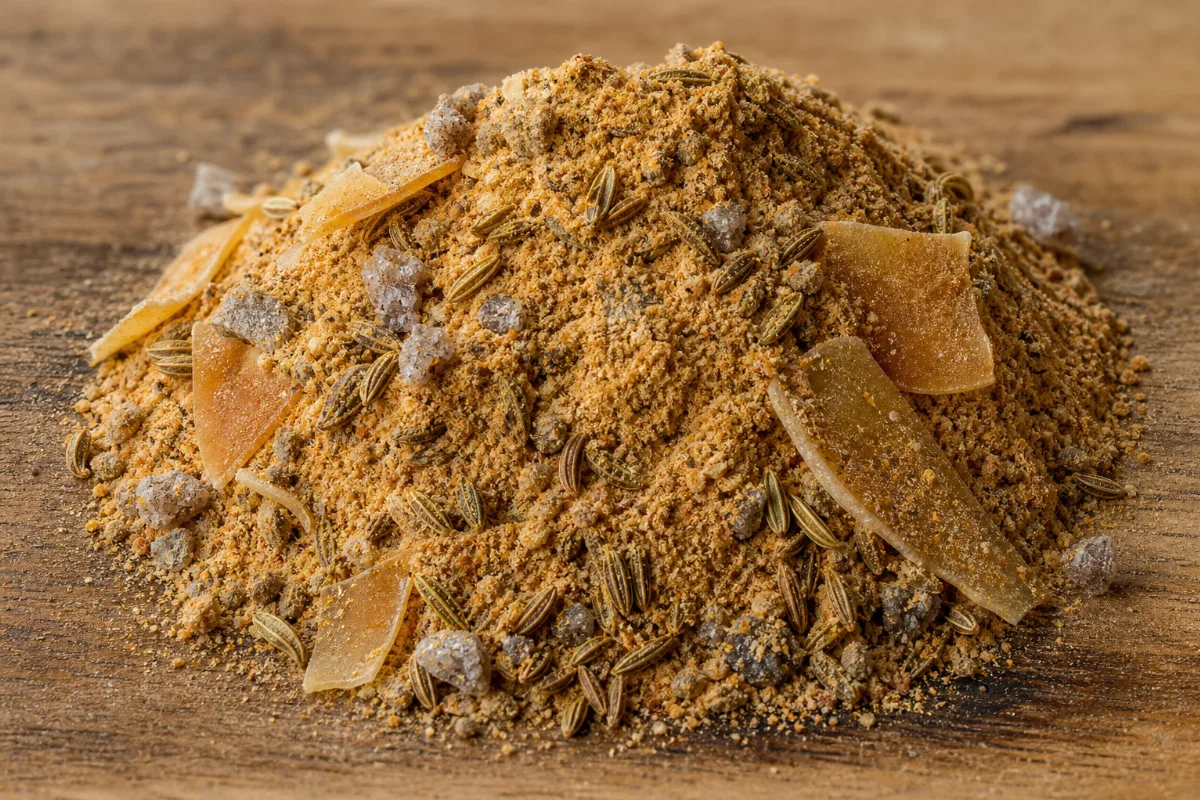
Spices · Spice blend
Chaat masala
A blend (no single species) · also called Chat masala, masala para chaat (Spanish)
Chaat masala is a tangy, salty Indian spice blend with dried mango powder (amchoor), black salt, cumin and coriander, sprinkled on snacks, fruit and salads. No study of the blend itself for health was found. The main caution is salt, because it is a salted mix. Read the label if you have a food allergy.
General information, not medical advice. Last substantive update · Not medically reviewed. A named clinician has not signed off on this page. How this page is made
About Chaat masala
Chaat masala is a flavour blend, not a health food or a remedy. Its main health issue is salt. Little research exists on the blend itself, so this page is smaller than most.
What it is
Chaat masala is a spice blend from the Indian subcontinent, used in Indian and Pakistani cooking, mainly to flavour chaat, a family of savoury street snacks.
There is no single recipe. Wikipedia lists typical ingredients: dried mango powder (amchoor), cumin, coriander, dried ginger, salt (often black salt), black pepper, asafoetida and chili powder, with garam masala in some versions. One home recipe uses cumin, coriander, peppercorns, black salt, amchur, asafoetida and salt.
Amchoor is made from unripe green mangoes that are peeled, sliced and sun-dried, and has a sour, fruity taste. Black salt (kala namak) is mostly sodium chloride with traces of sulphur compounds that give a savoury, sulphur smell.
Nutrition: no USDA entry or label was read, so no calories or sodium per teaspoon are given.
In the kitchen
It is usually sprinkled over food at the end. Wikipedia lists chaat, Indian fruit salads (papaya, sapodilla, apples, bananas), potatoes, fruit, egg toast and plain salads. Street vendors dust it on cut fruit and raw white radish. A home recipe also stirs it into buttermilk, raita and dahi vada.
Fruit chaat masala has less cumin, coriander and ginger and more chili, black salt, amchoor and asafoetida. Some vendors use only black salt and chili powder.
What the research shows
No study of chaat masala as a blend was found. A PubMed search for the name returned one paper, a spice-dye survey, not a health study.
Black salt is traditionally called a cooling spice and digestive aid. That is tradition, not trial evidence, and the source itself calls some other traditional uses dubious.
WHO says high sodium intake mainly raises blood pressure. That is a general fact about salt in the whole diet.
Amounts
This page gives no amounts to eat. No source gave a usual amount; recipes say to sprinkle to taste. Ask a doctor, pharmacist or dietitian what is right for you, especially if you were told to limit salt.
At a glance
Traditional uses history, not proof
- Sprinkled on chaat, a family of savoury street snacks, and on potatoes, fruit, egg toast and plain salads
- Stirred into buttermilk, raita and dahi vada in one home recipe
- Black salt, a key ingredient, is traditionally called a digestive aid in Ayurveda
Studied for research
- The blend as a whole: no study found
- Black salt as a digestive aid, insufficient evidence (traditional use only)
- Sodium and blood pressure, high certainty for sodium in general, not this blend
Main compounds
- Salt, often black salt (kala namak)
- Amchoor (dried green mango powder)
- Cumin
- Coriander seed
- Black pepper
- Dried ginger
- Asafoetida
- Chili (in some versions)
Common forms
- Ready-ground blend
- Home mix (dry-roasted and ground)
- Fruit chaat masala with more chili and black salt
Research links: WHO: Sodium reduction fact sheet · FDA: Questions and answers on improving the safety of spices · CDC MMWR 2018: Lead in spices, herbal remedies and ceremonial powders · Sudan dyes in spices, Karachi (PubMed) · Research Library · Genes & Biomarkers Library
What it is and its history
- Accepted scientific name
- Chaat masala (a spice blend, no single species)
- Synonyms
- Chat masala
- Common names
- Chaat masala (English); Chat masala (English); Chaat masala (masala para chaat) (Spanish)
- Family or group
- A spice blend. Typical ingredients: amchoor (dried mango powder), cumin, coriander, dried ginger, salt often black salt, black pepper, asafoetida, chili powder, sometimes garam masala.
- Native range
- Indian subcontinent; used in Indian and Pakistani cooking (Wikipedia).
- Harvest and processing
- One home recipe dry-roasts cumin, coriander and peppercorns, cools them, then grinds them with black salt, amchur, asafoetida and salt.
- Look-alikes and adulterants
- Name: Garam masala; Note: A different warm spice blend; it is sometimes added to chaat masala.
Photographs
Traditional use and history history, not clinical proof
| Tradition or era | Documented use | Source |
|---|---|---|
Traditional use shows how it was used. It does not show that it works or is safe today.
What is inside, and how it may work
What it contains and how those compounds act in cells and animals. Laboratory and animal mechanisms are not proven effects in people.
Main compounds
| Compound | Family | Where it is concentrated | Activity studied | Level of evidence |
|---|---|---|---|---|
| Sodium chloride (salt, including black salt) | mineral seasoning | Not found for the blend | Seasoning. Sodium raises blood pressure at high intake (WHO). 7 10 | Human data |
| Hydrogen sulphide and other sulphur compounds (from black salt) | sulphur compounds | Traces | Give black salt its sulphur smell; amounts in food are small (Wikipedia). 10 | Traditional |
Absorption, metabolism and elimination
- Absorption
- Not researched for the blend.
- Distribution
- Not researched.
- Metabolism
- Not researched.
- Elimination
- Not researched.
- Bioavailability
- Not researched.
Isolated compounds versus whole extracts
This page is about the blend as used in cooking, sprinkled on food. Single ingredients such as cumin, ginger or asafoetida are also sold as concentrated supplements, which are different products. The blend is not sold as a supplement in any source read.
Nutritional composition
No USDA FoodData Central entry for chaat masala was found and no label of a bottled blend or recipe nutrition was read, so no calories, sodium or other nutrient numbers per teaspoon are given. The blend contains salt, so sodium is the figure that matters; check the product label. Seasoning amounts are small. No amount to eat is given.
1 high certainty3 not enough evidence
What was looked at
The 4 benefits and uses checked for Chaat masala, each with how strong the evidence is. Tap one to open it.
- Chaat masala eaten as a food (health effects of the blend)Not enough evidence
- Black salt (kala namak) as a digestive aid (traditional use)Not enough evidence
- Sodium in salted foods and blood pressure (general fact, not this blend)High certainty
- The single spices inside the blend (cumin, coriander, pepper, ginger, asafoetida)Not enough evidence
What is Chaat masala good for?
The main studied uses and how strong the human evidence is for each. Nothing was found that studies the blend itself, so most results are about single ingredients or general facts, not chaat masala.
Benefits, one by one
Each card is a research question, not a promise. Tap a goal to filter. Open a card to see the studies, doses and limits.
Chaat masala eaten as a food (health effects of the blend)
Not enough evidenceNo study of chaat masala as a whole, for any health outcome, was found. It is a tangy, salty flavouring sprinkled on snacks and fruit. What is known comes from cooking sources and from general facts about salt.
2 studiesReady-ground blend or home mix. Recipes differ.
Studies, doses and limits
What the trials found
A PubMed search for chaat masala returned one paper, a spice-dye market survey (see the Safety tab), not a health study.
Results
No human study of the blend was found.
Why this rating
No study of the blend exists in the sources read.
Form and dose studied
Ready-ground blend or home mix. Recipes differ.
Who was studied
Not studied.
Limits
Absence of studies is not proof of no effect and not proof of safety. See the Safety tab for salt, allergens and contamination.
Why researchers looked
People ask whether a blend of cumin, coriander, mango powder and black salt does anything for digestion or health.
Traditional use
Sprinkled on chaat, fruit, potatoes and salads in India and Pakistan. Long use as food is not proof of any health effect.
Proposed mechanism Unknown
Not applicable: nothing was found that studies the blend.
A proposed mechanism does not show that the effect happens in people.
The blend contains salt. See the Safety tab.
Black salt (kala namak) as a digestive aid (traditional use)
Not enough evidenceAyurveda calls black salt a cooling spice and digestive aid, and it is also said to ease gas and heartburn. These are traditional uses. No trial was found, and the source itself calls some other traditional uses dubious.
1 studiesBlack salt as a condiment.
Studies, doses and limits
Results
No human study was found.
Why this rating
Tradition only; no trial read.
Form and dose studied
Black salt as a condiment.
Who was studied
Not studied.
Limits
Secondary source (encyclopedia) only.
Why researchers looked
Black salt is a key ingredient of chaat masala and is traditionally linked to digestion.
Traditional use
Ayurveda; reported use as a laxative and digestive aid (Wikipedia).
Proposed mechanism Unknown
Not established.
A proposed mechanism does not show that the effect happens in people.
Black salt is mostly sodium chloride, so it adds sodium. See the Safety tab.
Sodium in salted foods and blood pressure (general fact, not this blend)
High certaintyWHO says high sodium intake mainly raises blood pressure, which raises the risk of heart and blood vessel disease. Chaat masala contains salt, often black salt, so it adds sodium. The sodium in a teaspoon of the blend was not found.
2 studiesSalted spice blend.
Studies, doses and limits
What the trials found
WHO fact sheet read; it is guidance for the whole diet, not a test of the blend.
Results
Adults: under 2000 mg sodium (under 5 g salt) a day, according to WHO.
Why this rating
The link between high sodium and blood pressure is well established per WHO, but this rating is for sodium in general, not for chaat masala, whose sodium is unknown.
Form and dose studied
Salted spice blend.
Who was studied
Adults and children (children's limit scaled down).
Limits
No label or sodium figure for the blend was read.
Why researchers looked
Salt is a main ingredient, so the salt guidance applies to the whole day's food.
Proposed mechanism Authoritative guidance
Sodium raises blood pressure (WHO).
A proposed mechanism does not show that the effect happens in people.
Ask your clinician if you were told to limit salt.
The single spices inside the blend (cumin, coriander, pepper, ginger, asafoetida)
Not enough evidenceThese spices have their own pages. Most human studies of them use concentrated supplements, not a pinch on food, so they cannot be read as evidence for the blend.
1 studiesFood amounts in a blend.
Studies, doses and limits
What the trials found
Not researched for this page.
Results
Not summarised here. See each spice page.
Why this rating
Not studied as the blend; ingredient research was not part of this page.
Form and dose studied
Food amounts in a blend.
Who was studied
Not studied.
Limits
Ingredient evidence does not carry over to a blend of small amounts.
Why researchers looked
People ask whether the ingredients add up to a benefit.
Traditional use
Common in Indian cooking.
Proposed mechanism Unknown
Not applicable.
A proposed mechanism does not show that the effect happens in people.
See each spice page.
Connections to the rest of health
How Chaat masala connects to the rest of our health knowledge graph. Every link says what kind of connection it is. A safety link (for example to the liver) is a warning, not a benefit. A study that merely mentions a topic never creates a benefit link.
Explore every connection: goals, body systems, organs, symptoms, genes
B. Body systems
| Connected to | Kind of connection | Evidence status | Context | Studies |
|---|---|---|---|---|
| Digestive System | Biological association | Not enough evidence | Studied for: Chaat masala eaten as a food (health effects of the blend) Studied for: Black salt (kala namak) as a digestive aid (traditional use) | 9 3 10 |
| Cardiovascular System | Biological association | High certainty | Studied for: Sodium in salted foods and blood pressure (general fact, not this blend) | 7 3 |
E. Health conditions
| Connected to | Kind of connection | Evidence status | Context | Studies |
|---|---|---|---|---|
| High blood pressure | Documented risk | WHO links high sodium to raised blood pressure; the blend's own sodium was not measured. Preparation or compound: Sodium in salted blends |
7 | |
| Food allergy | Documented risk | Read the label. Preparation or compound: Celery, mustard, sesame, wheat or mango in a product |
6 4 | |
| Lead poisoning | Documented risk | A US report found lead in some spice products; chaat masala not named. Preparation or compound: Lead in some ground spices |
1 |
L. Active compounds
| Connected to | Kind of connection | Evidence status | Context | Studies |
|---|---|---|---|---|
| Sodium chloride (salt, including black salt) | Biological association | Human | Seasoning. Sodium raises blood pressure at high intake (WHO). | 7 10 |
| Hydrogen sulphide and other sulphur compounds (from black salt) | Biological association | Traditional | Give black salt its sulphur smell; amounts in food are small (Wikipedia). | 10 |
Each connection is stored with the ingredient, the connected record, the kind of connection, the evidence status, the supporting studies, the preparation or compound involved, and a review date (last reviewed October 26, 2026).
Evidence at a glance: what the research found for 4 outcomes
Each outcome below is one thing researchers measured. Certainty is how far the evidence can be trusted, not how well it works. The full studies are on the next tab.
The evidence
The research centre for Chaat masala. Every record here was checked against PubMed or the publisher's page; we never list a study we have not verified.
Evidence by outcome
Bars show how many studies we found for each outcome, not how well it works. People are added up across trials only (reviews are not added, to avoid double counting).
How we rate evidence
High certainty
Several well-run trials or reviews agree; further research is unlikely to change the picture much.
Moderate certainty
Good trials point the same way, but some doubt remains.
Low certainty
Small, short or inconsistent trials. The finding could change with better research.
Very low certainty
Very little or very weak human data. Treat as a possibility only.
Mixed findings
Trials or reviews disagree with each other.
Not enough evidence
Not enough human research to say either way.
Evidence against
Good research found no benefit, or found harm.
We take the reviewers' own risk-of-bias and GRADE statements where they exist, and otherwise judge from study size, design, consistency, directness and whether a product matches what is sold. Many publications do not make evidence high. Method note: We started from the existing page, re-opened its sources (Wikipedia, Archana's Kitchen, WHO, FDA), added FSAI, FDA sesame and two PubMed records read as abstracts. Little research exists on the blend itself, so this page is smaller than most. What we could not verify is in the research gaps.
Study library: every study we checked 10
| Study | Design | People | Product, dose, length | Result |
|---|---|---|---|---|
| Angelon-Gaetz 2018 Lead in Spices, Herbal Remedies, and Ceremonial Powders Sampled from Home Investigations for Children with Elevated Blood Lead Levels - North Carolina, 2011-2018. MMWR Morb Mortal Wkly Rep · PMID 30462630 · DOI |
Surveillance report n/a |
Methods, limits and fundingFunding and conflicts: No conflicts disclosed. Read: abstract | ||
| Ullah 2023 Banned Sudan dyes in spices available at markets in Karachi, Pakistan. Food Addit Contam Part B Surveill · PMID 35909386 · DOI |
Market survey (laboratory test) n/a (laboratory test of spices) |
Methods, limits and fundingRead: abstract | ||
| s-archana Archana's Kitchen: Chaat masala recipe · Source |
Recipe n/a |
Methods, limits and fundingRead: full-text | ||
| s-fda-sesame FDA: Sesame is the ninth major food allergen · Source |
Regulator page n/a |
Methods, limits and fundingRead: full-text | ||
| s-fda-spices FDA: Questions and answers on improving the safety of spices · Source |
Regulator Q&A n/a |
Methods, limits and fundingRead: full-text | ||
| s-fsai-14 FSAI: List of 14 allergens · Source |
Regulator list n/a |
Methods, limits and fundingRead: full-text | ||
| s-who-sodium WHO: Sodium reduction fact sheet · Source |
Regulator fact sheet n/a |
Methods, limits and fundingRead: full-text | ||
| s-wiki-amchoor Wikipedia: Amchoor · Source |
Encyclopedia n/a |
Methods, limits and fundingRead: full-text | ||
| s-wiki-chaat Wikipedia: Chaat masala · Source |
Encyclopedia n/a |
Methods, limits and fundingRead: full-text | ||
| s-wiki-kala Wikipedia: Kala namak · Source |
Encyclopedia n/a |
Methods, limits and fundingRead: full-text |
What we do not know yet
- No study of chaat masala as a blend was found for any health outcome.
- No nutrition entry or label was read, so sodium per teaspoon is not known.
- No source covers the blend in pregnancy, breastfeeding or childhood.
- The lead report does not name chaat masala; the dye survey is from Karachi only, abstract only, and its erratum was not read.
- No interaction study of the blend; ingredient evidence was not researched here.
How new research is added
New studies are found by a saved PubMed search and placed in a review queue before the page changes.
Lab markers
What changed in blood or saliva tests during trials. A changed number is not the same as feeling or being healthier, and we give no "normal ranges".
Safety
What studies and official sources say about side effects, medicines and who should check first. Each point shows what kind of evidence it comes from.
Main points to know 4
- Salt: the blend is salted, often with black salt. Chaat masala typically contains salt, often black salt (kala namak, mostly sodium chloride). One home recipe uses 2 teaspoons of black salt plus more salt to taste for about 9 tablespoons of other spices; it is one recipe, not a standard. WHO says high sodium mainly raises blood pressure and advises adults to keep sodium under 2000 mg a day (under 5 g of salt). No label figure for the blend was read, so how much sodium a teaspoon holds is unknown. Check the label, and ask a doctor if you were told to limit salt or have kidney disease. Authoritative guidance 7 10 3
- Allergens: read the label. There is no fixed recipe. Celery, mustard, sesame and cereals containing gluten are among the 14 EU allergens. Sesame in a spice blend must still be named on a US label. The blend's allergen content was not checked in any source read. Amchoor is made from mango, so people with a mango allergy should be careful. Whether mango allergy crosses to other foods was not verified here. Authoritative guidance 6 4 8
- Contamination: lead, banned dyes and germs have been found in some spices. A North Carolina report found lead at 1 mg/kg or more in 28.8% of spices, herbal remedies and ceremonial powders from homes of children with raised blood lead; chaat masala is not named in the abstract. A Karachi market survey found banned Sudan dyes above the legal limit in non-branded spices and none in branded ones; its lowest reading (1.50 mg/kg Sudan IV) was in chaat masala. These are specific places and samples, not proof for every product. FDA found Salmonella in about 6.6% of imported spice shipments in 2007 to 2009 and less in retail spices. Surveillance and market surveys 1 2 5
- Strong smell is normal. Black salt smells of sulphur (mainly hydrogen sulphide). Wikipedia says the amount in food is small and its effects negligible. Encyclopedia 10
Side effects 2
| Effect | How often | Severity and recovery | Evidence |
|---|---|---|---|
| High sodium intake from salty seasoning WHO's limit applies to the whole day's food, not the blend alone. | Not given for this blend. | depends on total diet Not stated | Authoritative guidance 7 |
| Allergic reaction to an ingredient such as celery, mustard, sesame, wheat or mango Only if the particular product contains the allergen. Seek urgent help for trouble breathing or swelling. | Not found for this blend. | can be serious Not stated | Authoritative guidance 6 4 |
Liver
No liver problem linked to chaat masala was found in the sources read. WHO lists kidney disease among conditions linked to high sodium in general. 7
This is a safety connection. It is not evidence that Chaat masala supports liver health.
Medicines and supplements 1
| With | Why it matters | Importance | Evidence | What to do |
|---|---|---|---|---|
| Prescription and over-the-counter medicines prescription | No interaction study of the blend was found. Interactions of single ingredients were not researched. Salt matters if you take blood pressure or kidney medicine. | None found Not enough evidence 7 | Ask a pharmacist about the single spices you eat in large amounts, and about salt if you take blood pressure or kidney medicine. |
Who should check first 4
| Situation | Advice | Evidence |
|---|---|---|
| Known allergy to celery, mustard, sesame, wheat or mango | Read the full ingredient list and the contains line, or make your own mix. | Authoritative guidance 6 4 |
| Told by a clinician to limit salt | Ask your clinician before using a salted blend. | Authoritative guidance 7 |
| Pregnancy, breastfeeding | No source read covers the blend. Ask your midwife or doctor. | Gap |
| Children | WHO says the adult salt limit should be scaled down for children aged 2 to 15 by their energy needs. Nothing on the blend itself was found. | Authoritative guidance 7 |
Overdose, product quality and regulators
Summary. No toxicity of the blend itself was found. The documented concerns are salt, allergens and contamination in some spices.
Human doses studied. No source gives an unsafe amount of the blend.
High dose or long term signals. WHO says long-term high sodium raises blood pressure.
Genotoxicity. Not researched.
Three sources were read on spice contamination; one names chaat masala.
Lead. 28.8% of spices, herbal remedies and ceremonial powders sampled from homes of children with raised blood lead held 1 mg/kg or more. Authors say a national limit might reduce exposure. Chaat masala is not named in the abstract. 1
Banned Sudan dyes. In Karachi markets, non-branded spice samples exceeded the 0.1 mg/kg limit and branded samples had none. The lowest reading, 1.50 mg/kg Sudan IV, was in chaat masala. Abstract only; the record has an erratum that was not read. 2
Salmonella. About 6.6% of imported spice shipments had Salmonella (2007 to 2009); retail spices were lower for nine of 11 types tested. FDA does not recommend consumers change how they use spices. 5
| Body | Action | Date |
|---|---|---|
| WHO (International) | Adults should have under 2000 mg sodium (under 5 g salt) a day; herbs and spices can season food instead of salt. source | 2026-10-26 (page read; undated in text) |
| FDA (United States) | Not recommending consumers change use of spices; Salmonella lower in retail spices than imports. Sesame must be declared on labels since 2023. source | 2018-03-02 (Q&A); sesame page read 2026-10-26 |
| EU food information rules (via FSAI) (European Union) | Celery, mustard, sesame and gluten cereals are among 14 declarable allergens. source | 2026-10-26 (page read) |
When to get medical help
- Trouble breathing, swelling of the lips, tongue or throat, or widespread hives after eating a seasoned food: call your emergency number.
- A child with raised blood lead or signs such as unusual tiredness, belly pain or developmental concerns: talk to a doctor.
Stop using the product and contact a clinician or emergency service. In the US, Poison Control is 1-800-222-1222.
General information only, not medical advice. Ask a clinician or pharmacist before use, especially with medicines, in pregnancy or with a health condition. See the Natural Remedy Safety guide.
Frequently asked questions
What is chaat masala?
A tangy, salty spice blend from the Indian subcontinent with dried mango powder, black salt, cumin, coriander and other spices, used to flavour chaat snacks.
What does chaat masala taste like?
What is black salt (kala namak)?
Mostly sodium chloride with traces of sulphur compounds, which give it a strong sulphur smell. It is essential to chaat masala.
What is amchoor?
Powder from unripe green mangoes that are sliced, sun-dried and ground. It adds sourness without moisture.
How is chaat masala used?
Is chaat masala good for you?
Is chaat masala high in salt?
Does black salt help digestion?
Ayurveda calls it a digestive aid. That is tradition only, and no trial was found.
Does it contain allergens?
Is there lead or dye in spice blends?
Is it safe in pregnancy or for children?
No source read covers the blend. WHO says the adult salt limit is scaled down for children aged 2 to 15. Ask your midwife, doctor or paediatrician.
Does it interact with medicines?
No interaction study of the blend was found. Ask a pharmacist, especially about salt if you take blood pressure or kidney medicine.
Explore by health goal
Editorial transparency
- Written by
- AlternativeMed editorial team. Research compiled with AI assistance, then checked against the sources listed.
- Medical review
- None. This page has not been reviewed by a physician or pharmacist.
- First published
- 2026-10-26
- Last substantive update
- 2026-10-26
- How we research
- We started from the existing page, re-opened its sources (Wikipedia, Archana's Kitchen, WHO, FDA), added FSAI, FDA sesame and two PubMed records read as abstracts. Little research exists on the blend itself, so this page is smaller than most. What we could not verify is in the research gaps.
- How we rate evidence
- See "How we rate evidence" in the Evidence tab.
- Independence
- No product is promoted on this page. No affiliate links are shown.
Sources 10
Each source was opened and checked. Where we read only the abstract, it says so. The small numbers in the text point here.
- Angelon-Gaetz KA, Klaus C, Chaudhry EA, Bean DK. Lead in Spices, Herbal Remedies, and Ceremonial Powders Sampled from Home Investigations for Children with Elevated Blood Lead Levels - North Carolina, 2011-2018.. MMWR Morb Mortal Wkly Rep. 2018. PMID 30462630. DOI 10.15585/mmwr.mm6746a2. (abstract)
- Ullah A, Chan MWH, Aslam S, et al.. Banned Sudan dyes in spices available at markets in Karachi, Pakistan.. Food Addit Contam Part B Surveill. 2023. PMID 35909386. DOI 10.1080/19393210.2022.2100489. (abstract)
- . Archana's Kitchen: Chaat masala recipe. . . (full-text)
- . FDA: Sesame is the ninth major food allergen. . . (full-text)
- . FDA: Questions and answers on improving the safety of spices. . . (full-text)
- . FSAI: List of 14 allergens. . . (full-text)
- . WHO: Sodium reduction fact sheet. . . (full-text)
- . Wikipedia: Amchoor. . . (full-text)
- . Wikipedia: Chaat masala. . . (full-text)
- . Wikipedia: Kala namak. . . (full-text)
Where to buy
Check the label first. Whatever you buy, look for these:
- Whole or ground: whole spices keep their flavor longer
- The origin and a packed-on or best-by date for freshness
- Organic or non-irradiated labeling if that matters to you
- A resealable, airtight container
Talk to a pharmacist or doctor before you start any supplement, especially if you take medicines. See the Safety tab for interactions.
Support our free guides: as an Amazon Associate we earn from qualifying purchases. Full disclosure.


