Adaptogens · Herbs & Botanicals · Thai rhizome tonic
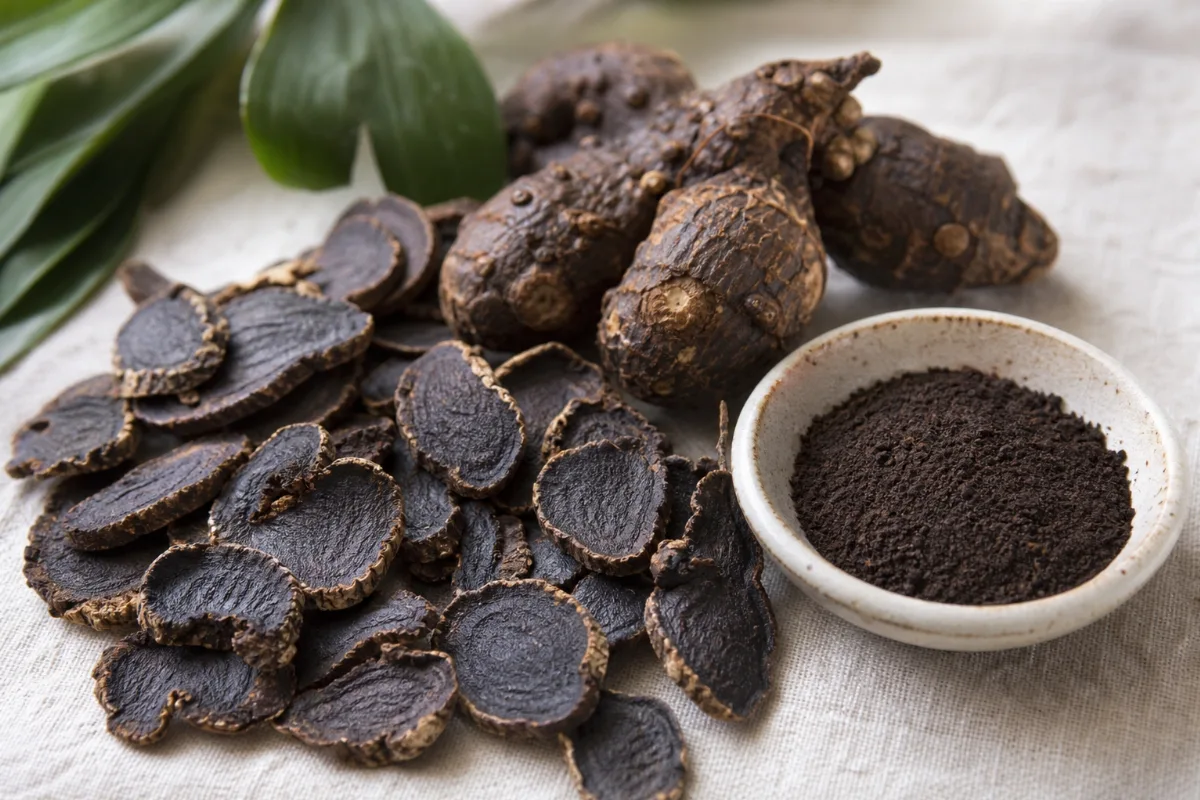
Black Ginger
Kaempferia parviflora · also called Krachai dam, Thai black ginger, Thai ginseng
Black ginger is the dark rhizome of a ginger-family plant used in Thai tonic medicine for stamina and male vitality. Small trials suggest better grip strength and less belly fat, but most were short and some were linked to extract makers. Lab and animal work shows it can block drug-processing enzymes, so ask a pharmacist before using it with medicines.
General information, not medical advice. Last substantive update · Not medically reviewed. A named clinician has not signed off on this page. How this page is made
About Black Ginger
Black ginger (Kaempferia parviflora, krachai dam) is the dark rhizome of a Thai ginger-family plant, used as a tonic for stamina and male vitality. Human trials are small and mostly 8 to 12 weeks; fitness and body-fat results lean positive but several were linked to extract makers. Sexual-function evidence is very thin. The most important caution is lab and animal work showing it can block drug-processing enzymes and gut pumps.
What it is
Black ginger is the rhizome (underground stem) of Kaempferia parviflora, a plant in the ginger family. In Thailand it is called krachai dam. It is also sold as Thai ginseng, although it is not related to ginseng.
Its main compounds are polymethoxyflavones such as 5,7-dimethoxyflavone and pentamethoxyflavone.
Not the same as ginger or galangal
Black ginger is a different plant from common ginger (Zingiber officinale) and from galangal. Evidence and safety for one do not carry over to the other.
See the pages on ginger and galangal for those plants.
What it has been used and studied for
Traditional use is as a tonic and for male sexual function. Human trials looked at grip strength and fitness in young athletes and older adults, body fat in overweight adults, a short-term rise in calorie burning, and erectile scores in a small pilot.
Knee pain and blood flow have been studied only in rats and cell dishes, or in a three-herb blend.
How strong is the research
No use reaches more than low certainty. A 2017 systematic review of seven small studies called the evidence inconclusive. A single dose before exercise did not help. Several trials were run or written by people connected to the extract makers.
A 2024 meta-analysis reports lower fasting glucose and better sexual function and fitness, but the human studies behind it are small.
At a glance
Traditional uses history, not proof
- Thai and Lao tonic for stamina and male sexual function
- Traditionally used to improve blood flow and for inflammatory and gut complaints
- Taken by hill-tribe workers before work to reduce perceived effort (as reported in a 2010 paper)
Studied for research
- Grip strength and fitness: low certainty
- Body fat in overweight adults: low
- Sexual function: very low (one open-label pilot)
- Blood sugar: mixed
- Energy expenditure: very low (single dose)
- Knee joint and hormones: lab or animal only
Main compounds
- 5,7-Dimethoxyflavone
- 3,5,7,3',4'-Pentamethoxyflavone
- 5,7,4'-Trimethoxyflavone (polymethoxyflavones)
Common forms
- Standardised rhizome extracts in capsules or tablets (branded)
- Ethanol, alcohol and water extracts differ in what they contain
- Blends with other herbs (cannot be read as black ginger alone)
Research links: Systematic review of krachaidum trials, 2017 · Meta-analysis of animal and human studies, 2024 · CYP3A inhibition by black ginger, 2022 · Research Library · Genes & Biomarkers Library
The plant and its history
- Accepted scientific name
- Kaempferia parviflora Wall. ex Baker
- Naming authority
- Wall. ex Baker
- Synonyms
- Not listed here: GBIF returns the name as ACCEPTED, exact match.
- Common names
- Black ginger (English); Thai black ginger (English); Thai ginseng (English); Krachai dam (also written Krachaidum, Krachai-dam) (Thai)
- Botanical family
- Zingiberaceae (the ginger family), order Zingiberales.
- Classification
- Plantae > Zingiberales > Zingiberaceae > Kaempferia > Kaempferia parviflora
- Native range
- Not verified from a source read; the sources describe Southeast Asia (Thailand, Laos).
- Habitat
- Not verified.
- What the plant looks like
- Roots: The rhizome (underground stem) is the part used; it is dark, which gives the name.; Stems: Not verified.; Leaves: Not verified.; Flowers: Not verified.; Fruit: Not used.
- Cultivation
- Not verified.
- Harvest and processing
- Not verified.
- Look-alikes and adulterants
- Name: Common ginger (Zingiber officinale); Note: Different genus; the page /herbs-botanicals/ginger covers it. Its safety and evidence do not carry over.; Name: Galangal / Kaempferia galanga; Note: Same genus as black ginger (Kaempferia) in one case, but a different accepted species (GBIF key 5301451). See /herbs-botanicals/galangal for the kitchen spice.
- Sustainability and conservation
- Not verified.
The plant and the parts used
Traditional use and history history, not clinical proof
| Tradition or era | Documented use | Source |
|---|---|---|
| Traditional medicine of Thailand and Laos | The rhizome is used as a tonic and to enhance male sexual function; a 2019 toxicology paper says it was used to improve blood flow and for inflammatory, allergic and gut complaints. A 2010 sports paper says hill-tribe workers believe it reduces perceived effort. These are the papers' statements, not verified from historical texts. | p31249788 |
Traditional use shows how a plant was used. It does not show that a supplement works or is safe today.
What is inside, and how it may work
What the plant contains and how those compounds act in cells and animals. Laboratory and animal mechanisms are not proven effects in people.
Main compounds
| Compound | Family | Where it is concentrated | Activity studied | Level of evidence |
|---|---|---|---|---|
| 5,7-Dimethoxyflavone PubChem 88881 | polymethoxyflavone | Rhizome | Weak PDE5 inhibition in a test tube; CYP3A and P-gp/BCRP effects in lab and animals; not found in human blood in one trial. 18 9 1 14 12 | In vitro+animal |
| 3,5,7,3',4'-Pentamethoxyflavone (PMF) PubChem 97332 | polymethoxyflavone | Rhizome | Most potent P-gp inhibitor among six flavones in cells; blocked CYP3A in liver preparations; found in human blood after a dose. 10 5 14 12 | In vitro+human pharmacokinetics |
| 5,7,4'-Trimethoxyflavone (TMF) PubChem 79730 | polymethoxyflavone | Rhizome | Lowered cartilage-degrading MMP enzymes in cartilage cells; found in human blood at the higher dose. 6 14 12 | In vitro+human pharmacokinetics |
Mechanisms, receptors and pathways
| Target or pathway | Gene or receptor | What was found | Level |
|---|---|---|---|
| PDE5 enzyme | PDE5, PDE6 | Black ginger methoxyflavones inhibited PDE5 moderately in a test tube (5,7-dimethoxyflavone IC50 10.64 uM, 3.71 times selective over PDE6). Authors call it low affinity. 18 | Laboratory research |
| CYP3A drug metabolism | CYP3A4/5 (human), CYP3A11/25 (mouse) | Extract and flavones blocked CYP3A in human liver microsomes; extract raised midazolam levels in rats; 5,7-DMF lowered CYP3A expression and raised midazolam exposure in mice. 5 9 | In vitro+animal |
| Efflux pumps | P-gp (ABCB1), BCRP (ABCG2) | Extract and flavones blocked P-gp and BCRP in cell systems, raising passage of digoxin, estrone sulfate and paclitaxel. 1 10 | Laboratory research |
| Brown fat and energy expenditure | Brown adipose tissue | A single dose raised energy expenditure in men, with a larger rise in those with active brown fat on PET. 7 | Human data |
| Cartilage MMP enzymes | MMPs | Extract and two flavones lowered MMPs in human cartilage cells. 6 | Laboratory research |
Absorption, metabolism and elimination
- Absorption
- In healthy volunteers, pentamethoxyflavone and trimethoxyflavone were found in blood but 5,7-dimethoxyflavone was not.
- Distribution
- Not found.
- Metabolism
- Extract and flavones inhibit CYP3A in the lab; see mechanisms.
- Elimination
- At the higher dose PMF and TMF had Cmax 71.2 and 63.0 ng/mL, AUC 291.9 and 412.2 ng.h/mL and Tmax about 4.0 and 6.0 hours (abstract). PMF was eliminated faster than TMF.
- Bioavailability
- Not measured as a percentage.
Isolated compounds versus whole extracts
Lab studies often use one pure flavone (5,7-dimethoxyflavone) whereas products are whole extracts and may contain many. The compound that dominates the tests may not reach the blood in people, so lab results for one flavone should not be read as results for a product.
Nutritional composition
The rhizome is a medicinal herb rather than a food source of nutrients. No nutrient table was built for it.
1 mixed findings3 low certainty3 very low certainty3 not enough evidence1 evidence against
What was looked at
The 11 benefits and uses checked for Black Ginger, each with how strong the evidence is. Tap one to open it.
- Physical fitness and stamina in young athletesLow certainty
- Physical function in older adultsLow certainty
- One-off dose before exerciseEvidence against
- Sexual function and erectile performanceVery low certainty
- Stress response (heart rate variability)Very low certainty
- Body fat and weightLow certainty
- Energy expenditure (metabolism)Very low certainty
- Blood sugarMixed findings
- Knee osteoarthritis and joint painNot enough evidence
- Blood flow and nitric oxideNot enough evidence
- Testosterone and hormonesNot enough evidence
Lab markers tracked in the studies
Hand-grip strengthMaximal oxygen use (VO2 max)30-second chair stand and 6-minute walkHeart rate variability (SDNN, RMSSD, HF norm)International Index of Erectile Function (IIEF) scoreAbdominal (visceral) fat areaTriglyceridesFasting blood glucoseWhole-body energy expenditureNitrate and nitrite (nitric oxide markers)Serum testosterone (rats)Oxidative stress markers (MDA, SOD, catalase, GSH-Px)
What is Black Ginger good for?
The traditional and studied uses, and how strong the evidence is for each. Human trials are small and short.
Benefits, one by one
Each card is a research question, not a promise. Tap a goal to filter. Open a card to see the studies, doses and limits.
Physical fitness and stamina in young athletes
Low certaintyIn two Thai trials with sports-school students, 12 weeks of a standardised black ginger extract raised grip strength in both. In the larger trial it also improved back-and-leg strength, maximal oxygen use and 50-metre sprint time. In the smaller soccer trial the other tests did not change. The evidence is small and mixed.
3 studiesStandardised extracts in capsules were used in the trials; extracts d…
Studies, doses and limits
What the trials found
A 2017 systematic review found 7 small human studies, with higher grip strength in 2 of them and called the evidence positive but inconclusive. A 2022 trial of 194 male adolescent athletes found higher right-hand grip, back-and-leg strength, VO2 max and a faster 50 m sprint on 360 mg/day for 12 weeks; flexibility and agility did not change. A 2015 trial of 60 soccer players (180 mg/day, 12 weeks) found only the grip-strength gain; sprint, back-and-leg and cardiorespiratory fitness did not differ.
Results
Right-hand grip rose in both trials. Larger trial: back-and-leg strength, VO2 max and 50 m sprint also improved. Smaller trial: no change in sprint, back-and-leg strength or cardiorespiratory fitness.
Effect sizes as reported
Numbers not given in the abstracts
Why this rating
Two placebo-controlled trials in young male athletes with mixed results between tests, a systematic review that calls the evidence inconclusive, and no independent replication. Many tests were run, so some gains may be chance.
Form and dose studied
Standardised extracts in capsules were used in the trials; extracts differ between brands.
Who was studied
Healthy male adolescents and young soccer players in Thailand
Limits
Abstracts only. Young men from one region. Only the grip result repeated across the two trials.
Why researchers looked
The rhizome is a Thai tonic for stamina, and young athletes were an obvious group to test.
Traditional use
Thai and Lao traditional medicine uses the black rhizome (krachai dam) as a tonic. A 2008 rat paper and a 2011 lab paper both describe use to enhance male sexual function; a 2019 toxicology paper says it was used traditionally to improve blood flow and for inflammatory, allergic and gut complaints.
Proposed mechanism Preliminary mechanism
Not shown in people. Lab work suggests the methoxyflavones act on metabolism and blood vessels, but this is not proven for fitness.
A proposed mechanism does not show that the effect happens in people.
No adverse events in the athlete trial; blood tests were normal.
Physical function in older adults
Low certaintyOne small trial in healthy older adults found better chair-stand and 6-minute-walk performance after 8 weeks of black ginger extract, along with higher antioxidant enzyme activity. It has not been repeated.
1 studiesTwo low doses of an unspecified extract.
Studies, doses and limits
What the trials found
A randomised trial of 45 healthy elderly volunteers compared placebo with 25 mg or 90 mg of extract once daily for 8 weeks. The 30-second chair stand and 6-minute walk improved, antioxidant enzyme activity rose and the oxidative marker MDA fell. Hand grip and tandem tests were measured; the abstract reports gains only in the chair-stand and walk tests.
Results
Better chair-stand and 6-minute-walk performance; higher SOD, catalase and GSH-Px; lower MDA.
Effect sizes as reported
Numbers not given in the abstract
Why this rating
One small trial of 45 people with 8 weeks of follow-up, no replication, and blood antioxidant markers that are not clinical outcomes.
Form and dose studied
Two low doses of an unspecified extract.
Who was studied
Healthy elderly volunteers
Limits
Small, short, abstract only; authors say further study is needed.
Why researchers looked
Traditional use for tiredness and long life led researchers to test older volunteers.
Traditional use
A 2012 paper calls the plant reputed for anti-fatigue, longevity-promoting and antioxidant effects (the authors' wording).
Proposed mechanism Preliminary mechanism
The authors suggest less oxidative stress may explain better fitness. This is an idea, not shown.
A proposed mechanism does not show that the effect happens in people.
Safety was not the focus of this abstract.
One-off dose before exercise
Evidence againstA single dose taken 90 minutes before exercise did not improve repeated sprints or time to exhaustion in college men. So any fitness effect, if real, appears to need regular use rather than a one-off dose.
1 studiesSingle dose, preparation not described in the abstract.
Studies, doses and limits
What the trials found
A 2010 crossover trial: 19 men did three Wingate sprint tests and 16 cycled to exhaustion, each after black ginger or a starch placebo. Power, fatigue, lactate, effort rating, heart rate and time to exhaustion did not differ.
Results
No difference in any measure.
Effect sizes as reported
No effect
Why this rating
One small, well-controlled null trial of a single dose in young men. The authors say longer use or other groups cannot be excluded.
Form and dose studied
Single dose, preparation not described in the abstract.
Who was studied
College-age men
Limits
Single dose only; does not test the 12-week pattern used in other trials.
Why researchers looked
Hill-tribe workers in northern Thailand are said to take it before daily work to cut perceived effort.
Traditional use
The 2010 paper says the Mong hill tribe widely believe it reduces perceived effort and improves work capacity.
Proposed mechanism Preliminary mechanism
None shown.
A proposed mechanism does not show that the effect happens in people.
Not assessed in the abstract.
Sexual function and erectile performance
Very low certaintyBlack ginger is a traditional Thai remedy for male sexual function. The human evidence is thin: one 30-day pilot with 13 men and no placebo group showed better erectile scores, and a systematic review of 7 trials found only one study of sexual response. Lab work shows weak PDE5 inhibition, and the alcohol extract raised testis blood flow and changed mating behaviour in rats.
5 studiesDifferent extracts (ethanol, alcohol, water) behave differently in ra…
Studies, doses and limits
What the trials found
A 2018 open-label pilot gave 100 mg/day of an ethanol extract (KaempMax) to 14 men aged 50 to 68 with mild self-reported erectile dysfunction for 30 days; 13 finished. IIEF scores for erectile function, intercourse satisfaction and the total improved, but there was no placebo group. The authors said the effect was smaller than with prescription medicines. The 2017 systematic review found one study of sexual response to erotic stimuli. A 2024 meta-analysis says sexual function improved but its pooled numbers for this are not in the abstract.
Results
IIEF improved from baseline in 13 completers (no placebo). Rat alcohol extract shortened mount and ejaculation latency; hexane and water extracts did nothing. No effect on fertility or sperm movement in rats.
Effect sizes as reported
Numbers not in abstracts
Why this rating
One 13-person open-label pilot, one study in the systematic review, and lab/rat work. No randomised placebo-controlled trial of erectile function was found. One author is linked to a supplement company.
Form and dose studied
Different extracts (ethanol, alcohol, water) behave differently in rats.
Who was studied
Middle-aged and older men with mild self-reported erectile problems
Limits
No control group, self-reported scores, 30 days.
Why researchers looked
It is sold in Thailand and online as a male vitality herb, and a lab enzyme (PDE5) that sildenafil blocks was found to be weakly blocked by its flavones.
Traditional use
A 2008 rat paper and a 2011 lab paper describe traditional use to enhance male sexual performance.
Proposed mechanism Laboratory research
5,7-Dimethoxyflavone blocked the PDE5 enzyme in a test tube (IC50 10.64 uM), which the authors call low affinity. In rats the alcohol extract raised blood flow to the testis. Neither is shown in men.
A proposed mechanism does not show that the effect happens in people.
Lab PDE5 effect is a theory-level reason for caution with PDE5 drugs and nitrates, not a documented interaction. See safety.
Stress response (heart rate variability)
Very low certaintyIn the adolescent athlete trial, extract users showed higher heart rate variability measures (SDNN, RMSSD, HF norm). The authors read this as better stress resistance. Heart rate variability is a measure, not a proven benefit, and no mood or stress questionnaire results were given.
1 studies360 mg/day standardised extract.
Studies, doses and limits
What the trials found
In 194 adolescent male athletes, 360 mg/day for 12 weeks raised SDNN, RMSSD and HF norm and lowered a stress index, without changing LF norm or the LF/HF ratio or overall nervous-system balance.
Results
Higher SDNN, RMSSD and HF norm; lower stress index.
Effect sizes as reported
Numbers not in abstract
Why this rating
One trial, a surrogate measure and no symptom outcome.
Form and dose studied
360 mg/day standardised extract.
Who was studied
Male adolescent athletes
Limits
Surrogate outcome; abstract only.
Why researchers looked
Researchers wanted to check how the autonomic nervous system behaved during training.
Traditional use
Not a traditional use in the sources we read.
Proposed mechanism Preliminary mechanism
Not shown.
A proposed mechanism does not show that the effect happens in people.
Not assessed.
Body fat and weight
Low certaintyTwo 12-week trials in overweight adults (one Japanese, one Korean) found less body fat on black ginger extract than on placebo. Both were linked to the extract makers. The effect sizes are not in the abstracts and neither trial studied long-term weight.
3 studiesTwo different branded extracts.
Studies, doses and limits
What the trials found
Japan: 76 adults with BMI 24 to under 30 took 150 mg of extract (KPE) or placebo for 12 weeks. Visceral, subcutaneous and total abdominal fat area (by CT) and triglycerides fell more with the extract. Korea: 83 analysed adults took SIRTMAX or placebo for 12 weeks. Body fat (DXA), weight, BMI and fat areas fell more than with placebo, but waist and hip circumference did not differ.
Results
Abdominal fat area and triglycerides lower than placebo (Japan); body fat, weight and BMI lower (Korea).
Effect sizes as reported
Numbers not given in the abstracts
Why this rating
Two placebo-controlled trials with the same direction, but 12 weeks, company-linked authors and no numbers in the abstracts. A 2020 erratum exists for the Japanese trial.
Form and dose studied
Two different branded extracts.
Who was studied
Overweight adults in Japan and Korea
Limits
Short, no long-term follow-up; diet and exercise handling not in abstracts.
Why researchers looked
Mouse studies suggested it prevents obesity, so researchers tested people.
Traditional use
Not a long-standing traditional use in the sources we read.
Proposed mechanism Preliminary mechanism
Lab work suggests it may affect fat-cell breakdown and brown fat. Brown fat activity was linked to energy expenditure in one human test.
A proposed mechanism does not show that the effect happens in people.
No related adverse events in either trial.
Energy expenditure (metabolism)
Very low certaintyOne small, single-dose test in healthy men found a short rise in calorie burning about an hour after an ethanol extract, mainly in men with active brown fat. This is a one-hour effect and says little about weight loss.
1 studiesEthanol extract, single dose.
Studies, doses and limits
What the trials found
Healthy men took an ethanol extract of black ginger. Energy expenditure rose by about 229 (plus or minus 69) kJ/day at 60 minutes and did not change after placebo. In men with high brown fat activity the rise was 351 (plus or minus 50) kJ/day; the low-brown-fat group did not respond.
Results
About +229 kJ/day at 60 minutes (all); +351 kJ/day (high brown fat).
Effect sizes as reported
Reported as mean plus or minus SE
Why this rating
A single acute dose in a small number of men; no weight outcome.
Form and dose studied
Ethanol extract, single dose.
Who was studied
Healthy men
Limits
Number of participants not in the abstract; acute effect only.
Why researchers looked
Animal work suggested more heat production through brown fat.
Traditional use
Not traditional.
Proposed mechanism Preliminary mechanism
The authors link the rise to brown fat activity, based on PET scans.
A proposed mechanism does not show that the effect happens in people.
Not assessed.
Blood sugar
Mixed findingsA 2024 meta-analysis found lower fasting blood glucose with black ginger extract in animals and in humans. But a 28-day trial in healthy volunteers found no change in the glucose tolerance test. Evidence in people with diabetes is missing.
2 studiesBranded and unbranded extracts pooled.
Studies, doses and limits
What the trials found
The meta-analysis (57 articles, animal and human) found fasting glucose SMD -0.88 (95% CI -1.63 to -0.14) in animals and -0.51 (95% CI -0.98 to -0.05) in humans. A separate randomised trial in healthy volunteers (90 or 180 mg/day for 28 days) found the oral glucose tolerance test unchanged.
Results
SMD -0.51 (-0.98 to -0.05) fasting glucose in human studies; OGTT unchanged in healthy volunteers.
Effect sizes as reported
See left
Why this rating
Pooled human studies are small and varied; a direct test in healthy people was null; no trials in diabetes were found.
Form and dose studied
Branded and unbranded extracts pooled.
Who was studied
Mostly healthy or overweight adults
Limits
Different populations pooled; abstract only.
Why researchers looked
Animal studies of metabolic syndrome.
Traditional use
Not traditional.
Proposed mechanism Preliminary mechanism
Not established; lab work suggests effects on fat and sugar handling.
A proposed mechanism does not show that the effect happens in people.
If it does lower sugar, it could add to diabetes drugs. Theory only.
Knee osteoarthritis and joint pain
Not enough evidenceRat and cell studies suggest black ginger extract and two of its flavones may protect cartilage and ease pain. We found no human knee trial.
1 studiesExtract and two pure flavones.
Studies, doses and limits
Results
Lower pain sensitivity and cartilage damage in rats; fewer MMP enzymes in cells.
Why this rating
Animal and cell work only.
Form and dose studied
Extract and two pure flavones.
Who was studied
Rats; human cartilage cells in dishes
Limits
No human trial found.
Why researchers looked
Black ginger is traditionally used for inflammatory complaints.
Traditional use
A 2019 paper says it was used traditionally for inflammatory disorders.
Proposed mechanism Laboratory research
Lowered cartilage-damaging MMP enzymes in human cartilage cells.
A proposed mechanism does not show that the effect happens in people.
None noted.
Blood flow and nitric oxide
Not enough evidenceThe extract raised testis blood flow in rats. A three-herb blend containing black ginger raised nitric oxide markers in the blood and saliva of 24 men after one dose. We found no human trial of black ginger alone for blood flow.
2 studiesThree-herb blend.
Studies, doses and limits
What the trials found
A single-dose trial of the blend Fitnox (black ginger methoxyflavones plus pomegranate peel and moringa leaf) in 24 healthy men found higher nitrate and nitrite than placebo for at least 12 hours. Black ginger's share cannot be separated.
Results
Higher nitrate and nitrite than placebo (combination product, single dose).
Effect sizes as reported
Not given
Why this rating
A combination product, a marker not a blood-flow measure, and company authors.
Form and dose studied
Three-herb blend.
Who was studied
Healthy men; rats
Limits
Combination product; markers only.
Why researchers looked
Traditional use to improve blood flow.
Traditional use
A 2019 paper says it was used traditionally to improve blood flow.
Proposed mechanism Animal research
Possible relaxation of blood vessels through nitric oxide; shown only as markers or in rats.
A proposed mechanism does not show that the effect happens in people.
Any real effect on blood vessels could matter for people on blood-pressure drugs or nitrates. Theory.
Testosterone and hormones
Not enough evidenceOnly rat data exist. In castrated young rats, blood testosterone was higher after 5 days at a high dose but reproductive organs did not grow, so the authors concluded no testosterone-like effect. No human hormone data were found.
1 studiesRhizome material, oral.
Studies, doses and limits
What the trials found
No human trial reported testosterone in the abstracts we read.
Results
Testosterone higher in treated castrated rats; LH, FSH and organ weights not significantly different.
Why this rating
Rats only, 1,000 mg/kg for 5 days.
Form and dose studied
Rhizome material, oral.
Who was studied
Castrated immature male rats
Limits
Not human.
Why researchers looked
It is sold as a male vitality herb, so hormone effects are a natural question.
Traditional use
Traditional male-vitality use.
Proposed mechanism Animal research
Unknown.
A proposed mechanism does not show that the effect happens in people.
If hormone effects occur in people, those with hormone-sensitive conditions should ask a clinician. Theory.
Connections to the rest of health
How Black Ginger connects to the rest of our health knowledge graph. Every link says what kind of connection it is. A safety link (for example to the liver) is a warning, not a benefit. A study that merely mentions a topic never creates a benefit link.
Explore every connection: goals, body systems, organs, symptoms, genes
A. Wellness goals
| Connected to | Kind of connection | Evidence status | Context | Studies |
|---|---|---|---|---|
| Physical stamina | Traditional use | Low certainty | Traditional tonic; small trials with mixed fitness results. Preparation or compound: Standardised rhizome extract |
15 11 |
| Physical Stamina | Demonstrated clinical effect | Low certainty | Physical fitness and stamina in young athletes: In two Thai trials with sports-school students, 12 weeks of a standardised black ginger extract raised grip strength in both. In the larger trial it also improved back-and-leg strength, maximal oxygen use and 50-metre sprint time. In the smaller soccer trial the other tests did not change. The evidence is small and mixed. One-off dose before exercise: A single dose taken 90 minutes before exercise did not improve repeated sprints or time to exhaustion in college men. So any fitness effect, if real, appears to need regular use rather than a one-off dose. | 13 15 11 20 |
| Endurance Support | Demonstrated clinical effect | Low certainty | Physical fitness and stamina in young athletes: In two Thai trials with sports-school students, 12 weeks of a standardised black ginger extract raised grip strength in both. In the larger trial it also improved back-and-leg strength, maximal oxygen use and 50-metre sprint time. In the smaller soccer trial the other tests did not change. The evidence is small and mixed. One-off dose before exercise: A single dose taken 90 minutes before exercise did not improve repeated sprints or time to exhaustion in college men. So any fitness effect, if real, appears to need regular use rather than a one-off dose. | 13 15 11 20 |
| Peak Performance | Demonstrated clinical effect | Low certainty | Physical fitness and stamina in young athletes: In two Thai trials with sports-school students, 12 weeks of a standardised black ginger extract raised grip strength in both. In the larger trial it also improved back-and-leg strength, maximal oxygen use and 50-metre sprint time. In the smaller soccer trial the other tests did not change. The evidence is small and mixed. | 13 15 11 |
| Healthy Aging | Potential benefit | Low certainty | Physical function in older adults: One small trial in healthy older adults found better chair-stand and 6-minute-walk performance after 8 weeks of black ginger extract, along with higher antioxidant enzyme activity. It has not been repeated. | 21 |
| Physical Stamina | Potential benefit | Low certainty | Physical function in older adults: One small trial in healthy older adults found better chair-stand and 6-minute-walk performance after 8 weeks of black ginger extract, along with higher antioxidant enzyme activity. It has not been repeated. | 21 |
| Reduce Fatigue | Potential benefit | Low certainty | Physical function in older adults: One small trial in healthy older adults found better chair-stand and 6-minute-walk performance after 8 weeks of black ginger extract, along with higher antioxidant enzyme activity. It has not been repeated. | 21 |
| Mens Vitality | Preliminary mechanism | Very low certainty | Sexual function and erectile performance: Black ginger is a traditional Thai remedy for male sexual function. The human evidence is thin: one 30-day pilot with 13 men and no placebo group showed better erectile scores, and a systematic review of 7 trials found only one study of sexual response. Lab work shows weak PDE5 inhibition, and the alcohol extract raised testis blood flow and changed mating behaviour in rats. Testosterone and hormones: Only rat data exist. In castrated young rats, blood testosterone was higher after 5 days at a high dose but reproductive organs did not grow, so the authors concluded no testosterone-like effect. No human hormone data were found. | 16 13 8 18 2 19 |
| Libido Support | Preliminary mechanism | Very low certainty | Sexual function and erectile performance: Black ginger is a traditional Thai remedy for male sexual function. The human evidence is thin: one 30-day pilot with 13 men and no placebo group showed better erectile scores, and a systematic review of 7 trials found only one study of sexual response. Lab work shows weak PDE5 inhibition, and the alcohol extract raised testis blood flow and changed mating behaviour in rats. | 16 13 8 18 2 |
| Fertility Support | Preliminary mechanism | Very low certainty | Sexual function and erectile performance: Black ginger is a traditional Thai remedy for male sexual function. The human evidence is thin: one 30-day pilot with 13 men and no placebo group showed better erectile scores, and a systematic review of 7 trials found only one study of sexual response. Lab work shows weak PDE5 inhibition, and the alcohol extract raised testis blood flow and changed mating behaviour in rats. | 16 13 8 18 2 |
| Stress Reduction | Preliminary mechanism | Very low certainty | Stress response (heart rate variability): In the adolescent athlete trial, extract users showed higher heart rate variability measures (SDNN, RMSSD, HF norm). The authors read this as better stress resistance. Heart rate variability is a measure, not a proven benefit, and no mood or stress questionnaire results were given. | 15 |
| Resilience Support | Preliminary mechanism | Very low certainty | Stress response (heart rate variability): In the adolescent athlete trial, extract users showed higher heart rate variability measures (SDNN, RMSSD, HF norm). The authors read this as better stress resistance. Heart rate variability is a measure, not a proven benefit, and no mood or stress questionnaire results were given. | 15 |
| Weight Management | Demonstrated clinical effect | Low certainty | Body fat and weight: Two 12-week trials in overweight adults (one Japanese, one Korean) found less body fat on black ginger extract than on placebo. Both were linked to the extract makers. The effect sizes are not in the abstracts and neither trial studied long-term weight. | 22 17 8 |
| Metabolic Health | Demonstrated clinical effect | Low certainty | Body fat and weight: Two 12-week trials in overweight adults (one Japanese, one Korean) found less body fat on black ginger extract than on placebo. Both were linked to the extract makers. The effect sizes are not in the abstracts and neither trial studied long-term weight. | 22 17 8 |
| Metabolic Health | Preliminary mechanism | Very low certainty | Energy expenditure (metabolism): One small, single-dose test in healthy men found a short rise in calorie burning about an hour after an ethanol extract, mainly in men with active brown fat. This is a one-hour effect and says little about weight loss. Blood sugar: A 2024 meta-analysis found lower fasting blood glucose with black ginger extract in animals and in humans. But a 28-day trial in healthy volunteers found no change in the glucose tolerance test. Evidence in people with diabetes is missing. | 7 8 14 |
| Weight Management | Preliminary mechanism | Very low certainty | Energy expenditure (metabolism): One small, single-dose test in healthy men found a short rise in calorie burning about an hour after an ethanol extract, mainly in men with active brown fat. This is a one-hour effect and says little about weight loss. | 7 |
| Energy Boost | Preliminary mechanism | Very low certainty | Energy expenditure (metabolism): One small, single-dose test in healthy men found a short rise in calorie burning about an hour after an ethanol extract, mainly in men with active brown fat. This is a one-hour effect and says little about weight loss. | 7 |
| Blood Sugar Balance | Preliminary mechanism | Mixed findings | Blood sugar: A 2024 meta-analysis found lower fasting blood glucose with black ginger extract in animals and in humans. But a 28-day trial in healthy volunteers found no change in the glucose tolerance test. Evidence in people with diabetes is missing. | 8 14 |
| Joint Support | Preliminary mechanism | Not enough evidence | Knee osteoarthritis and joint pain: Rat and cell studies suggest black ginger extract and two of its flavones may protect cartilage and ease pain. We found no human knee trial. | 6 |
| Inflammation Balance | Preliminary mechanism | Not enough evidence | Knee osteoarthritis and joint pain: Rat and cell studies suggest black ginger extract and two of its flavones may protect cartilage and ease pain. We found no human knee trial. | 6 |
| Heart Health | Preliminary mechanism | Not enough evidence | Blood flow and nitric oxide: The extract raised testis blood flow in rats. A three-herb blend containing black ginger raised nitric oxide markers in the blood and saliva of 24 men after one dose. We found no human trial of black ginger alone for blood flow. | 4 2 |
| Physical Stamina | Preliminary mechanism | Not enough evidence | Blood flow and nitric oxide: The extract raised testis blood flow in rats. A three-herb blend containing black ginger raised nitric oxide markers in the blood and saliva of 24 men after one dose. We found no human trial of black ginger alone for blood flow. | 4 2 |
| Hormone Balance | Preliminary mechanism | Not enough evidence | Testosterone and hormones: Only rat data exist. In castrated young rats, blood testosterone was higher after 5 days at a high dose but reproductive organs did not grow, so the authors concluded no testosterone-like effect. No human hormone data were found. | 19 |
B. Body systems
| Connected to | Kind of connection | Evidence status | Context | Studies |
|---|---|---|---|---|
| Hepatic system | Drug or supplement interaction | In vitro+animal | Blocks CYP3A in the lab and in rodents; could change levels of other drugs. Preparation or compound: Extract; 5,7-dimethoxyflavone |
5 9 |
| Musculoskeletal System | Biological association | Low certainty | Studied for: Physical fitness and stamina in young athletes Studied for: Physical function in older adults | 13 15 11 21 20 6 |
| Cardiovascular System | Biological association | Low certainty | Studied for: Physical fitness and stamina in young athletes Studied for: Sexual function and erectile performance | 13 15 11 16 8 18 2 4 |
| Reproductive System | Biological association | Very low certainty | Studied for: Sexual function and erectile performance | 16 13 8 18 2 |
| Nervous System | Biological association | Very low certainty | Studied for: Stress response (heart rate variability) | 15 |
| Metabolism Weight | Biological association | Low certainty | Studied for: Body fat and weight Studied for: Energy expenditure (metabolism) | 22 17 8 7 14 |
| Endocrine System | Biological association | Mixed findings | Studied for: Blood sugar Studied for: Testosterone and hormones | 8 14 19 |
C. Body parts and organs
| Connected to | Kind of connection | Evidence status | Context | Studies |
|---|---|---|---|---|
| Blood vessels | Drug or supplement interaction | Theory | Weak PDE5 inhibition in a test tube; caution with nitrates and blood-pressure drugs. Preparation or compound: Methoxyflavones |
18 |
I. Biomarkers
| Connected to | Kind of connection | Evidence status | Context | Studies |
|---|---|---|---|---|
| Hand-grip strength | Biological association | Low certainty | Measured in trials: raised. A lab change is not the same as a health benefit. | 11 15 13 |
| Maximal oxygen use (VO2 max) | Biological association | Very low certainty | Measured in trials: mixed. A lab change is not the same as a health benefit. | 15 11 |
| 30-second chair stand and 6-minute walk | Biological association | Low certainty | Measured in trials: raised. A lab change is not the same as a health benefit. | 21 |
| Heart rate variability (SDNN, RMSSD, HF norm) | Biological association | Very low certainty | Measured in trials: raised. A lab change is not the same as a health benefit. | 15 |
| International Index of Erectile Function (IIEF) score | Biological association | Very low certainty | Measured in trials: raised. A lab change is not the same as a health benefit. | 16 |
| Abdominal (visceral) fat area | Biological association | Low certainty | Measured in trials: lowered. A lab change is not the same as a health benefit. | 22 17 |
| Triglycerides | Biological association | Low certainty | Measured in trials: lowered. A lab change is not the same as a health benefit. | 22 |
| Fasting blood glucose | Biological association | Mixed findings | Measured in trials: mixed. A lab change is not the same as a health benefit. | 8 14 |
| Whole-body energy expenditure | Biological association | Very low certainty | Measured in trials: raised. A lab change is not the same as a health benefit. | 7 |
| Nitrate and nitrite (nitric oxide markers) | Biological association | Not enough evidence | Measured in trials: raised. A lab change is not the same as a health benefit. | 4 |
| Serum testosterone (rats) | Biological association | Not enough evidence | Measured in trials: raised. A lab change is not the same as a health benefit. | 19 |
| Oxidative stress markers (MDA, SOD, catalase, GSH-Px) | Biological association | Low certainty | Measured in trials: mixed. A lab change is not the same as a health benefit. | 21 |
L. Active compounds
| Connected to | Kind of connection | Evidence status | Context | Studies |
|---|---|---|---|---|
| 5,7-Dimethoxyflavone | Biological association | In vitro+animal | Weak PDE5 inhibition in a test tube; CYP3A and P-gp/BCRP effects in lab and animals; not found in human blood in one trial. Preparation or compound: Rhizome |
18 9 1 14 12 |
| 3,5,7,3',4'-Pentamethoxyflavone (PMF) | Biological association | In vitro+human pharmacokinetics | Most potent P-gp inhibitor among six flavones in cells; blocked CYP3A in liver preparations; found in human blood after a dose. Preparation or compound: Rhizome |
10 5 14 12 |
| 5,7,4'-Trimethoxyflavone (TMF) | Biological association | In vitro+human pharmacokinetics | Lowered cartilage-degrading MMP enzymes in cartilage cells; found in human blood at the higher dose. Preparation or compound: Rhizome |
6 14 12 |
Each connection is stored with the ingredient, the connected record, the kind of connection, the evidence status, the supporting studies, the preparation or compound involved, and a review date (last reviewed October 25, 2026).
The evidence
The research centre for Black Ginger. Every record here was checked against PubMed or the publisher's page; we never list a study we have not verified.
Evidence by outcome
Bars show how many studies we found for each outcome, not how well it works. People are added up across trials only (reviews are not added, to avoid double counting).
How we rate evidence
High certainty
Several well-run trials or reviews agree; further research is unlikely to change the picture much.
Moderate certainty
Good trials point the same way, but some doubt remains.
Low certainty
Small, short or inconsistent trials. The finding could change with better research.
Very low certainty
Very little or very weak human data. Treat as a possibility only.
Mixed findings
Trials or reviews disagree with each other.
Not enough evidence
Not enough human research to say either way.
Evidence against
Good research found no benefit, or found harm.
We take the reviewers' own risk-of-bias and GRADE statements where they exist, and otherwise judge from study size, design, consistency, directness and whether a product matches what is sold. Many publications do not make evidence high. Method note: We searched PubMed, read each abstract we cite, and checked the GBIF taxonomy record and PubChem. Only abstracts were read. EMA, NCCIH, LiverTox and LactMed were not opened and are marked not verified. Certainty ratings are the compiler's own reading, not formal grades. No study is cited that we could not verify.
Study library: every study we checked 24
| Study | Design | People | Product, dose, length | Result |
|---|---|---|---|---|
| Boonnop 2023 Black ginger extract and its active compound, 5,7-dimethoxyflavone, increase intestinal drug absorption via efflux drug transporter inhibitions. Drug metabolism and pharmacokinetics · PMID 36948091 · DOI |
Laboratory research in-vitro |
Caco-2 and canine kidney cells carrying human P-gp or BCRP | Black ginger extract (10 ug/ml) and 5,7-dimethoxyflavone (5 uM) rhizome Cell concentrations Laboratory assay · vs Untreated cells |
The extract and 5,7-dimethoxyflavone raised passage of digoxin, estrone sulfate and paclitaxel across the cell layer and lowered efflux. The authors say co-administered drugs that are P-gp or BCRP substrates might change in blood levels. Efflux transporter inhibition in cells (Not given) Methods, limits and fundingOutcomes: Transport of digoxin (P-gp), estrone sulfate (BCRP) and paclitaxel Limitations: Cell culture only. No human or animal absorption data in this study. Funding and conflicts: Authors declared none. Read: abstract |
| Chaturapanich 2008 Effects of Kaempferia parviflora extracts on reproductive parameters and spermatic blood flow in male rats. Reproduction (Cambridge, England) · PMID 18614624 · DOI |
Animal research animal |
Male rats | Alcohol, hexane and water extracts of black ginger rhizome Alcohol extract 70 mg/kg/day (oral); 10 to 40 mg/kg (intravenous, acute) 3 to 5 weeks · vs Control rats |
The alcohol extract shortened mount and ejaculation latency and increased blood flow to the testis (also when injected). Hexane and water extracts did nothing. No effect on fertility or sperm movement. Aphrodisiac-type effect in rats with the alcohol extract (Not applicable) Methods, limits and fundingOutcomes: Sexual behaviour; sperm; fertility; testis blood flow Limitations: Rats only. Injected doses are not oral use. Funding and conflicts: Not stated in the abstract. Read: abstract |
| GBIF 2026 GBIF backbone: Kaempferia parviflora Wall. ex Baker (key 5301424) and Kaempferia galanga (key 5301451) GBIF · Source |
Database record not applicable |
Not applicable | Not applicable |
Kaempferia parviflora Wall. ex Baker returned ACCEPTED, exact match, confidence 98, family Zingiberaceae, order Zingiberales. Kaempferia galanga returned ACCEPTED as a separate species. Checked 2026-10-25 with the GBIF species/match API. Not applicable (Not applicable) Methods, limits and fundingOutcomes: Accepted name check Limitations: NCBI taxonomy was not queried. Read: full-text |
| Jacob 2018 A Randomized Single Dose Parallel Study on Enhancement of Nitric Oxide in Serum and Saliva with the Use of Natural Sports Supplement in Healthy Adults. Journal of dietary supplements · PMID 28641022 · DOI |
Controlled trial |
24 Healthy adult men |
Fitnox: a blend of black ginger methoxyflavones, pomegranate peel polyphenols and moringa leaf saponins (a combination product) blend 250 mg single dose (as in the trial; not guidance) Single dose, followed 24 hours · vs Placebo |
Nitrate and nitrite were higher than with placebo in both fluids for at least 12 hours. Higher nitric oxide metabolites after one dose of a blend (Not given) Methods, limits and fundingOutcomes: Nitrate and nitrite in serum and saliva Limitations: Three-herb blend, so black ginger's own share cannot be separated. Nitric oxide metabolites are a marker, not blood flow or performance. Abstract only. Funding and conflicts: Authors work at the product company (Aurea Biolabs) and a contract research firm. Read: abstract |
| Kashiwabuchi 2022 Inhibition of CYP3A-mediated Midazolam Metabolism by Kaempferia Parviflora. Food safety (Tokyo, Japan) · PMID 35510070 · DOI |
In vitro+animal in-vitro+animal |
Human liver microsomes; rats | Black ginger extract, 5,7-dimethoxyflavone, 3,5,7,3',4'-pentamethoxyflavone rhizome Rats: 135 mg/kg extract, midazolam 15 mg/kg Single oral treatment in rats · vs Control rats |
The extract and both flavones blocked CYP3A in human liver preparations in a time-, NADPH- and concentration-dependent way. In rats, giving the extract 2 hours before midazolam raised midazolam AUC 2.3-fold and peak level 1.9-fold. Giving midazolam 18 hours after the extract had a weaker effect. Strong CYP3A inhibition in the lab and in rats (Not given) Methods, limits and fundingOutcomes: CYP3A activity; blood level of midazolam Limitations: Not tested in people. Rat doses are not human doses. Funding and conflicts: Authors declared no conflict of interest. Read: abstract |
| Kobayashi 2018 Effect of Kaempferia parviflora extract on knee osteoarthritis. Journal of natural medicines · PMID 28823024 · DOI |
Animal+in vitro animal+in-vitro |
Rats with chemically induced knee arthritis; human knee cartilage cells in a dish | Black ginger extract; 5,7-dimethoxyflavone; 5,7,4'-trimethoxyflavone rhizome Not in abstract Not in abstract · vs Untreated controls |
The extract reduced pain and cartilage lesions in rats, and lowered cartilage-degrading MMP enzymes in human cartilage cells. Animal and cell-culture effect only (Not applicable) Methods, limits and fundingOutcomes: Pain threshold, cartilage damage, MMP enzymes Limitations: Rat and cell work only. No human knee trial was found. Funding and conflicts: Authors from Japanese universities and a company; funding not read. Read: abstract |
| Matsushita 2015 Kaempferia parviflora extract increases whole-body energy expenditure in humans: roles of brown adipose tissue. Journal of nutritional science and vitaminology · PMID 25994142 · DOI |
Crossover challenge |
Healthy men (number not in abstract) | Ethanol extract of black ginger, single oral dose rhizome Single dose Acute (hours) · vs Placebo ingestion |
Energy expenditure rose by about 229 (plus or minus 69) kJ/day at 60 minutes and did not change after placebo. In people with high brown fat activity the rise was 351 (plus or minus 50) kJ/day; the low-brown-fat group did not respond. Short-term rise in energy expenditure (Not given) Methods, limits and fundingOutcomes: Whole-body energy expenditure; brown fat activity by FDG-PET Limitations: Single dose; number of men not in the abstract; the rise was largest at 60 minutes. Not a weight-loss trial. Abstract only. Funding and conflicts: Not stated in abstract. Read: abstract |
| Na Takuathung 2024 A systematic review and meta-analysis of animal and human studies demonstrates the beneficial effects of Kaempferia parviflora on metabolic syndrome and erectile dysfunction. Nutrition research (New York, N.Y.) · PMID 38194854 · DOI |
Meta-analysis human+animal |
57 articles (animal studies and randomised trials) from 664 screened | Black ginger extract (polymethoxyflavone-enriched) rhizome Varied Varied · vs Placebo |
Black ginger extract lowered fasting blood glucose in animal studies and in human studies. The reviewers also report better sexual function and physical performance. Fasting glucose SMD -0.88 in animals; SMD -0.51 in humans (Animals: -1.63 to -0.14; humans: -0.98 to -0.05) Methods, limits and fundingOutcomes: Metabolic syndrome measures, erectile dysfunction, physical performance Limitations: Abstract only. Mixes animal and human data. The human sexual-function pooled numbers are not in the abstract. Many included trials were small and some were product-company studies. Funding and conflicts: Authors declared no conflict of interest. Read: abstract |
| Ochiai 2018 Effect of the active ingredient of Kaempferia parviflora, 5,7-dimethoxyflavone, on the pharmacokinetics of midazolam. Journal of natural medicines · PMID 29550915 · DOI |
Animal research animal |
Mice | 5,7-Dimethoxyflavone (pure compound) for 10 days, then oral midazolam rhizome Not in abstract 10 days · vs Control mice |
After 10 days of 5,7-dimethoxyflavone, midazolam AUC rose by 130% and its half-life lengthened by about 100 minutes, with lower liver CYP3A11 and CYP3A25 expression. Higher drug exposure after repeated dosing in mice (Not given) Methods, limits and fundingOutcomes: Midazolam blood levels; liver CYP3A expression Limitations: Mouse study of one pure compound. Funding and conflicts: Not stated in the abstract. Read: abstract |
| Patanasethanont 2007 Effects of Kaempferia parviflora extracts and their flavone constituents on P-glycoprotein function. Journal of pharmaceutical sciences · PMID 17031860 · DOI |
Laboratory research in-vitro |
Pig kidney cells carrying human MDR1 (P-gp) | Ethanol and water extracts and six flavones rhizome Cell concentrations Laboratory assay · vs Cells without P-gp |
The ethanol extract raised accumulation clearly and the water extract less so. 3,5,7,3',4'-pentamethoxyflavone was most potent, 5,7-dimethoxyflavone less so; four other flavones did not. P-gp inhibition in cells (Not given) Methods, limits and fundingOutcomes: Accumulation of P-gp substrates (rhodamine 123, daunorubicin) Limitations: Cell culture only. Funding and conflicts: Not stated in the abstract. Read: abstract |
| Promthep 2015 Effect of Kaempferia parviflora Extract on Physical Fitness of Soccer Players: A Randomized Double-Blind Placebo-Controlled Trial. Medical science monitor basic research · PMID 25957542 · DOI |
Controlled trial |
60 Soccer players at a sports school |
Black ginger extract, capsule rhizome 180 mg once daily (as in the trial; not guidance) 12 weeks · vs Placebo |
Right-hand grip strength rose at weeks 4, 8 and 12 and left-hand grip at week 8. Back-and-leg strength, 40-yard test, sit-and-reach, 50-metre sprint and cardiorespiratory fitness did not differ from placebo. Some grip-strength gain; other tests no different (Not given in abstract) Methods, limits and fundingOutcomes: Six fitness tests every 4 weeks Limitations: Small. Many tests were run, so a few significant results can arise by chance. Abstract only. Funding and conflicts: Not stated in the abstract. Read: abstract |
| PubChem (NCBI) 2026 PubChem compound records: 5,7-dimethoxyflavone, 3,5,7,3',4'-pentamethoxyflavone, 5,7,4'-trimethoxyflavone PubChem · Source |
Database record not applicable |
Not applicable | Not applicable |
CID 88881 = 5,7-dimethoxyflavone (C17H14O4); CID 97332 = 3,5,7,3',4'-pentamethoxyflavone (C20H20O7); CID 79730 = 5,7,4'-trimethoxyflavone (C18H16O5). Checked 2026-10-25 by PUG REST name lookup. Not applicable (Not applicable) Methods, limits and fundingOutcomes: Compound identity check Limitations: Identity only. Read: full-text |
| Saokaew 2017 Clinical Effects of Krachaidum (Kaempferia parviflora): A Systematic Review. Journal of evidence-based complementary & alternative medicine · PMID 27694558 · DOI |
Systematic review |
Human trials of black ginger in any use (7 studies included from 683 records) | Black ginger rhizome preparations (various) rhizome Varied; not summarised in the abstract Varied · vs Placebo or none in the included studies |
Two studies found higher hand-grip strength and one study found more response to erotic stimuli. No adverse events were reported across the included studies, including at 1.35 g/day of the herb. Positive but inconclusive (Not given in abstract) Methods, limits and fundingOutcomes: Clinical effects; harms Limitations: Only 7 small studies; grip strength rested on 2 studies and sexual response on 1. Funding and conflicts: One author is a government official in the Thai Ministry of Public Health traditional medicine department; others declared none. Read: abstract |
| Sripanidkulchai 2019 Glucose Tolerance Test and Pharmacokinetic Study of Kaempferia parviflora Extract in Healthy Subjects. Nutrients · PMID 31130666 · DOI |
Controlled trial |
Healthy volunteers | Black ginger extract rhizome 90 or 180 mg/day (as in the trial; not guidance) 28 days (plus a single-dose blood-level test) · vs Placebo |
The extract did not change the glucose tolerance test. Only PMF and TMF were found in blood, not 5,7-dimethoxyflavone. At the higher dose PMF peaked at 71.2 ng/mL after about 4 hours. No effect on glucose tolerance; two flavones absorbed (Not applicable) Methods, limits and fundingOutcomes: Oral glucose tolerance test; blood levels of methoxyflavones Limitations: Healthy people only, number not in abstract, so it cannot tell whether blood sugar changes in people with diabetes. Funding and conflicts: Authors declared no conflict. Read: abstract |
| Sripanidkulchai 2022 Supplementation of Kaempferia parviflora Extract Enhances Physical Fitness and Modulates Parameters of Heart Rate Variability in Adolescent Student-Athletes: A Randomized, Double-Blind, Placebo-Controlled Clinical Study. Journal of dietary supplements · PMID 33272042 · DOI |
Controlled trial |
194 Male adolescent students at a sports school (97 per group) |
Standardised black ginger extract, capsule rhizome 360 mg/day (as in the trial; not guidance) 12 weeks · vs Placebo |
Higher right-hand grip strength, back-and-leg strength and maximal oxygen use (VO2 max), and a shorter 50-metre sprint time. No change in flexibility or the 40-yard agility test. Heart rate variability measures SDNN, RMSSD and HF norm rose. Blood tests normal. Significant improvement in some fitness tests (Not given in abstract) Methods, limits and fundingOutcomes: Fitness tests, heart rate variability, blood safety tests Limitations: Young male athletes only. The abstract gives no effect sizes. Heart rate variability is a measure, not a health outcome. Funding and conflicts: Funding not stated in the abstract; full text not read. Read: abstract |
| Stein 2018 Kaempferia parviflora ethanol extract improves self-assessed sexual health in men: a pilot study. Journal of integrative medicine · PMID 29880257 · DOI |
Open label single arm |
14 Men aged 50-68 with self-reported mild erectile dysfunction, not on prescription treatment (13 finished) |
KaempMax ethanol extract of black ginger rhizome rhizome 100 mg daily (as in the study; not guidance) 30 days |
Improvements in erectile function, intercourse satisfaction and total IIEF score. The authors say effects were smaller than with prescription medicines and that longer placebo-controlled trials are needed. Statistically significant IIEF improvement (numbers not in abstract) (Not given in abstract) Methods, limits and fundingOutcomes: International Index of Erectile Function (IIEF); global assessment question Limitations: Open-label, no placebo, 13 completers, 30 days. Self-reported outcomes are open to expectation effects. Abstract only. Funding and conflicts: One author's contact address is at a supplement company (Life Extension). Funding not read in full. Registered NCT03389867. Registration: NCT03389867 Read: abstract |
| Sung 2025 Kaempferia parviflora Extract (SIRTMAX) reduces body fat in adults who are overweight: a 12-week randomized, double-blind, placebo-controlled trial. Frontiers in nutrition · PMID 40661686 · DOI |
Controlled trial |
83 Korean overweight adults (83 analysed of 108 screened) |
SIRTMAX black ginger extract rhizome Not in abstract 12 weeks · vs Placebo |
Body fat, body weight and BMI fell more than with placebo, as did total, subcutaneous and visceral fat area. Waist and hip circumference did not differ. The food was judged safe. Significant fat reduction vs placebo (numbers not in abstract) (Not given in abstract) Methods, limits and fundingOutcomes: Body fat mass and percentage by DXA (primary); lean mass; fat areas; blood fats; weight Limitations: 12 weeks; 83 analysed. Abstract only. Funding and conflicts: Three authors work for the two companies named in the disclosure (Daehan Chemtech, Tokiwa Phytochemical). Read: abstract |
| Temkitthawon 2011 Kaempferia parviflora, a plant used in traditional medicine to enhance sexual performance contains large amounts of low affinity PDE5 inhibitors. Journal of ethnopharmacology · PMID 21884777 · DOI |
Laboratory research in-vitro |
Enzymes from mouse lung and chicken retina | Black ginger rhizome extract and 7-methoxyflavones rhizome 50 ug/ml extract; 10 uM pure compounds Laboratory assay · vs Other plant extracts |
Black ginger and its 7-methoxyflavones inhibited PDE5 moderately. The strongest was 5,7-dimethoxyflavone (IC50 10.64 uM; 3.71 times more selective for PDE5 than PDE6). Moderate PDE5 inhibition in a test tube (IC50 10.64 +/- 2.09 uM) Methods, limits and fundingOutcomes: PDE5 and PDE6 enzyme inhibition Limitations: Enzyme assay only. The authors call the PDE5 activity low affinity. Funding and conflicts: Not stated in the abstract. Read: abstract |
| Trisomboon 2007 Effect of daily treatment with Thai herb, Kaempferia parviflora, in Hershberger assay using castrated immature rats. The Journal of reproduction and development · PMID 17179656 · DOI |
Animal research animal |
Castrated immature male rats (7-8 per group) | Black ginger rhizome, oral rhizome 1,000 mg/kg 5 days · vs Water |
Blood testosterone was higher in treated rats, but organ weights did not differ significantly and LH, FSH, progesterone and corticosterone did not differ. The authors conclude no testosterone-like effect on reproduction. No testosterone-like effect on organs in rats (Not applicable) Methods, limits and fundingOutcomes: Hormones; reproductive organ weights Limitations: Rats only. A high dose. Not in people. Funding and conflicts: Not stated in the abstract. Read: abstract |
| Wasuntarawat 2010 No effect of acute ingestion of Thai ginseng (Kaempferia parviflora) on sprint and endurance exercise performance in humans. Journal of sports sciences · PMID 20845210 · DOI |
Controlled trial |
35 College-age men (study 1: 19, study 2: 16), crossover |
Black ginger, single dose 90 minutes before exercise rhizome Single dose Acute (one session) · vs Starch placebo |
No difference in peak or mean power, fatigue, lactate, time to exhaustion, effort rating or heart rate. No effect (Not applicable) Methods, limits and fundingOutcomes: Repeated 30-second sprints; time to exhaustion at moderate cycling Limitations: Single dose in young men; longer use or other groups cannot be excluded (the authors' words). Funding and conflicts: Not stated in the abstract. Read: abstract |
| Wattanathorn 2012 Positive Modulation Effect of 8-Week Consumption of Kaempferia parviflora on Health-Related Physical Fitness and Oxidative Status in Healthy Elderly Volunteers. Evidence-based complementary and alternative medicine : eCAM · PMID 22899957 · DOI |
Controlled trial |
45 Healthy elderly volunteers |
Black ginger extract rhizome 25 mg or 90 mg once daily (as in the trial; not guidance) 8 weeks · vs Placebo |
Chair-stand and 6-minute-walk performance improved, with higher antioxidant enzyme activity (SOD, catalase, GSH-Px) and lower malondialdehyde (MDA). Improved chair stand and walk tests (Not given in abstract) Methods, limits and fundingOutcomes: 30-second chair stand, hand grip, 6-minute walk, tandem test; oxidative markers Limitations: Small, 8 weeks, healthy older adults. Blood antioxidant markers are not clinical outcomes. Abstract only. Funding and conflicts: Not stated in the abstract. Read: abstract |
| Yoshino 2018 Daily intake of Kaempferia parviflora extract decreases abdominal fat in overweight and preobese subjects: a randomized, double-blind, placebo-controlled clinical study. Diabetes, metabolic syndrome and obesity : targets and therapy · PMID 30214264 · DOI |
Controlled trial |
76 Japanese adults aged 20 to under 65, BMI 24 to under 30 |
Black ginger extract (KPE), capsule rhizome 150 mg extract once daily (as in the trial; not guidance) 12 weeks · vs Placebo |
Compared with placebo, abdominal fat (visceral, subcutaneous and total) and triglycerides fell after 12 weeks. No related adverse events and no clinically relevant lab changes. Significant reduction vs placebo (numbers not in abstract) (Not given in abstract) Methods, limits and fundingOutcomes: Visceral fat area by CT (primary); subcutaneous and total fat area; triglycerides; safety Limitations: Single centre, 12 weeks. An erratum was published in 2020 (content not read). Abstract only. Funding and conflicts: Several authors are employees of Maruzen Pharmaceuticals, which makes the extract. Read: abstract |
| Yoshino 2019 Evaluation of the Safety of Daily Consumption of Kaempferia parviflora Extract (KPFORCE): A Randomized Double-Blind Placebo-Controlled Trial. Journal of medicinal food · PMID 31517555 · DOI |
Controlled trial |
52 Healthy Japanese men and women |
KPFORCE black ginger extract, tablets rhizome Five 150 mg tablets daily (as in the trial; not guidance) 4 weeks · vs Placebo |
No adverse events related to the extract and no abnormalities in the measured parameters compared with placebo. No safety difference from placebo (Not applicable) Methods, limits and fundingOutcomes: Adverse events; body measures, heart and blood pressure, blood and urine tests Limitations: Healthy people, 4 weeks only; cannot detect rare or long-term harms. Abstract only. Funding and conflicts: Several authors are employees of Maruzen Pharmaceuticals, the extract maker. Read: abstract |
| Yoshino 2019 Toxicological evaluation of standardized Kaempferia parviflora extract: Sub-chronic and mutagenicity studies. Toxicology reports · PMID 31249788 · DOI |
Animal research animal |
Rats (90 days) and bacterial mutation tests | Standardised hydroalcoholic black ginger extract rhizome Up to 249 mg/kg/day in rats 90 days · vs Control rats |
No gene mutations. At the highest dose there was extra salivation; platelets rose at the low dose but stayed within the normal range. No toxic changes in organs. The authors conclude a high safety margin. No toxicity found in rats (Not applicable) Methods, limits and fundingOutcomes: Mutation tests; blood, organ and tissue checks Limitations: Rat study; an erratum was published in 2020 (content not read). The first author has the same name as the first author of the two Maruzen-linked human trials (not confirmed to be the same person); funding not read. Funding and conflicts: Funding and conflicts not read in the abstract. Read: abstract |
What we do not know yet
- No placebo-controlled trial of erectile function.
- No human trial of knee pain or of blood flow with black ginger alone.
- No human drug-interaction study for CYP3A or P-gp.
- No data in pregnancy, breastfeeding or long-term use.
- Several trials were run by people tied to extract makers.
How new research is added
New studies are found by a saved PubMed search and placed in a review queue. A person reads each one before it changes any evidence rating or safety wording. New publications never change ratings automatically.
Lab markers
What changed in blood or saliva tests during trials. A changed number is not the same as feeling or being healthier, and we give no "normal ranges".
Metabolic 1
Triglycerides
Lowered in trials
Blood fats.
Low certaintyOther 11
Hand-grip strength
Raised in trials
How hard a person can squeeze a measuring handle.
Low certaintyResults and what it means
Why it was measured
Simple test of muscle strength.
Statistical vs. clinical meaning
A statistically significant gain; the size is not in the abstracts and may or may not matter in sport.
Safety implication
None specific.
Maximal oxygen use (VO2 max)
Mixed results in trials
How much oxygen the body can use at peak effort.
Very low certaintyResults and what it means
Why it was measured
Marker of aerobic fitness.
Statistical vs. clinical meaning
Two trials disagree.
Safety implication
None specific.
30-second chair stand and 6-minute walk
Raised in trials
Functional tests of leg strength and walking endurance.
Low certaintyHeart rate variability (SDNN, RMSSD, HF norm)
Raised in trials
Beat-to-beat changes in heart rhythm, used as a rough sign of how well the body recovers from stress.
Very low certaintyResults and what it means
Why it was measured
Used to judge stress response and recovery.
Statistical vs. clinical meaning
A surrogate marker; not a symptom or health outcome.
Safety implication
None specific.
| Study | Result | People | Product |
|---|---|---|---|
| 15 | SDNN, RMSSD and HF norm rose; stress index fell | 194 adolescent male athletes | 360 mg/day extract, 12 weeks |
International Index of Erectile Function (IIEF) score
Raised in trials
A questionnaire scoring erectile function, satisfaction and desire.
Very low certaintyResults and what it means
Why it was measured
Standard self-report scale.
Statistical vs. clinical meaning
Open-label, no placebo, tiny group.
Safety implication
If it truly acted like a PDE5 drug there would be nitrate and blood-pressure-drug concerns; this is theory.
| Study | Result | People | Product |
|---|---|---|---|
| 16 | Erectile function, intercourse satisfaction and total score improved from baseline | 13 men aged 50 to 68 with mild erectile dysfunction | 100 mg/day ethanol extract for 30 days, no placebo |
Abdominal (visceral) fat area
Lowered in trials
Fat around the organs, measured by CT scan.
Low certaintyResults and what it means
Why it was measured
Linked to metabolic risk.
Statistical vs. clinical meaning
Statistically significant; size not in abstracts.
Safety implication
None noted.
Fasting blood glucose
Mixed results in trials
Blood sugar after fasting.
Mixed findingsResults and what it means
Why it was measured
Core diabetes marker.
Statistical vs. clinical meaning
Pooled studies disagree with the direct healthy-volunteer trial.
Safety implication
Low-sugar effects could add to diabetes medicines (theory).
Whole-body energy expenditure
Raised in trials
Calories burned at rest, measured by gas exchange.
Very low certaintyNitrate and nitrite (nitric oxide markers)
Raised in trials
Breakdown products of nitric oxide in blood and saliva.
Not enough evidenceResults and what it means
Why it was measured
Used as a marker of nitric oxide production.
Statistical vs. clinical meaning
Marker only, combination product.
Safety implication
Possible additive effect with nitrate drugs (theory).
| Study | Result | People | Product |
|---|---|---|---|
| 4 | Higher than placebo for at least 12 hours | 24 healthy men | Single dose of a three-herb blend |
Serum testosterone (rats)
Raised in trials
Male sex hormone.
Not enough evidenceOxidative stress markers (MDA, SOD, catalase, GSH-Px)
Mixed results in trials
Blood measures of oxidative stress and antioxidant enzymes.
Low certaintyResults and what it means
Safety
What studies and official sources say about side effects, medicines and who should check first. Each point shows what kind of evidence it comes from.
Main points to know 5
- Possible drug interactions through liver enzymes and gut pumps (strong lab and animal signal, no human test). The extract and its main flavones blocked the drug-processing enzyme CYP3A in human liver preparations. In rats a single dose of extract raised the blood level of midazolam about 2.3-fold, and in mice 10 days of 5,7-dimethoxyflavone raised midazolam exposure by 130%. In cells the extract also blocked the P-gp and BCRP pumps that push drugs out of the gut. We found no study in people. If this carries over, some medicines could build up. Ask a pharmacist before using it with prescription medicines. In vitro+animal 5 9 1 10
- Human safety data are short and mostly from the makers of the extracts. Two placebo-controlled trials (4 and 12 weeks) found no related adverse events or lab abnormalities, and a systematic review of 7 small studies found no adverse events. These were healthy people, so rare or long-term harms cannot be ruled out. Controlled trial 23 22 13
- PDE5 drugs, nitrates and blood-pressure medicines (theory). 5,7-Dimethoxyflavone weakly blocked the PDE5 enzyme in a test tube. PDE5-blocking drugs and nitrate medicines can drop blood pressure when combined. Whether black ginger at supplement doses does this in people is unknown. No interaction report was found. Theory 18
- Pregnancy, breastfeeding and children: no safety data. No study of use in pregnancy, breastfeeding or young children was found. Avoid unless a clinician who knows the herb agrees. The only studies in teenagers were in healthy male athletes. Evidence gap 15
- Products vary. Trials used different branded extracts (KPFORCE, SIRTMAX, KaempMax and others), so results for one cannot be assumed for another. Only two of the flavones were found in blood in one trial. Controlled trial 14 22 17 16
Side effects 3
| Effect | How often | Severity and recovery | Evidence |
|---|---|---|---|
| No related adverse events in healthy-volunteer and overweight-adult trials Healthy people, up to 12 weeks, extract-maker-linked authors in two of the trials. | No related events reported in the 76-person abdominal-fat trial or the 52-person safety trial; the systematic review reported none across 7 studies | Not applicable Not applicable | Controlled trial 22 23 13 |
| Extra salivation and a platelet rise in rats Rat doses are not human doses. | Salivation in rats at 249 mg/kg/day for 90 days; platelets higher at 25 mg/kg/day but within normal range | Mild; no organ damage Not stated | Animal research 24 |
| Well tolerated in a 30-day pilot Open-label, no placebo, supplement-company-linked author. | Described as well tolerated in 14 men; no numbers in the abstract | Not stated Not stated | Case series 16 |
Liver
We found no case report of liver injury from black ginger and no LiverTox entry was checked (not verified). In the 90-day rat study, blood chemistry and liver tissue showed no toxic changes. In the human safety trials, blood tests showed no abnormalities. The CYP3A-blocking finding is about how the liver processes other drugs, not about liver damage. Absence of reports is not proof of safety. 24 23 15
How often. No frequency found.
Monitoring. No agency monitoring advice was found.
This is a safety connection. It is not evidence that Black Ginger supports liver health.
Medicines and supplements 8
| With | Why it matters | Importance | Evidence | What to do |
|---|---|---|---|---|
| Medicines broken down by the CYP3A enzyme (for example the sedative midazolam used in the studies; many other drugs are processed this way, so a pharmacist can check yours) drug | Black ginger extract and its flavones 5,7-dimethoxyflavone and pentamethoxyflavone blocked CYP3A in human liver microsomes. In rats, midazolam AUC rose 2.3-fold and peak 1.9-fold when given 2 hours after the extract, with a weaker effect after 18 hours. In mice, 10 days of 5,7-dimethoxyflavone raised midazolam AUC by 130%, extended half-life by about 100 minutes and cut liver CYP3A11/25 expression. | No human interaction study was found. If the effect carries over, drug levels could rise. | In vitro+animal Low certainty 5 9 | Ask a pharmacist before combining with prescription medicines, especially ones with a narrow safety margin, and tell them about the herb. |
| Medicines moved by the P-gp or BCRP gut pumps (digoxin and paclitaxel were the test drugs in cells) drug | In cell layers the extract and 5,7-dimethoxyflavone raised passage of digoxin, estrone sulfate and paclitaxel and lowered efflux. In P-gp cells, extract and pentamethoxyflavone raised accumulation of P-gp substrates. | Higher drug absorption is possible. No human data. | Laboratory research Very low certainty 1 10 | Ask a pharmacist, especially if you take digoxin or cancer medicines. |
| Sedatives and sleeping medicines drug | Theory: midazolam was the CYP3A test drug, so sedatives processed the same way could last longer or be stronger. | No human study; midazolam is a sedative where level changes matter. | Theory Very low certainty 5 9 | Tell your prescriber if you use sedatives or take medicines before a procedure. |
| PDE5 inhibitors (sildenafil, tadalafil and similar) and nitrate medicines drug | Theory: 5,7-dimethoxyflavone inhibits PDE5 in a test tube (IC50 10.64 uM, described as low affinity). | Not shown in people. The PDE5-plus-nitrate combination is known to be risky with real PDE5 drugs; whether black ginger adds to it is unknown. | Theory Very low certainty 18 | Do not combine without asking a doctor, especially if you take nitrates. |
| Blood-pressure medicines drug | Theory: possible effects on blood vessels (nitric oxide markers rose with a three-herb blend; testis blood flow rose in rats). | No blood-pressure outcome was reported in the abstracts we read. | Theory Very low certainty 4 2 | Tell your doctor if you take blood-pressure medicines. |
| Blood thinners (anticoagulants and antiplatelet drugs) drug | No study or case report was found. Platelets rose slightly in rats at one dose. We cannot say whether black ginger affects bleeding. | Unknown. | Evidence gap Not enough evidence 24 | Ask the clinic that manages your blood thinner before starting. |
| Diabetes medicines drug | A meta-analysis found lower fasting glucose in human studies, though a healthy-volunteer trial found glucose tolerance unchanged. | Possible additive effect; no interaction study. | Meta-analysis Very low certainty 8 14 | Tell your prescriber; watch for symptoms of low blood sugar. |
| Hormone treatments and hormone-sensitive conditions drug | In castrated rats, blood testosterone was higher after 5 days at a high dose, but reproductive organs did not enlarge. No human hormone data were found. | Unknown in people. | Animal research Not enough evidence 19 | Ask a clinician if you have a hormone-sensitive condition or take hormone therapy. |
Who should check first 5
| Situation | Advice | Evidence |
|---|---|---|
| Pregnancy and breastfeeding | Avoid unless a knowledgeable clinician agrees; no safety data were found. | Evidence gap |
| Taking prescription medicines with a narrow safety margin or that are broken down by CYP3A | Ask a pharmacist first (strong lab and animal signal, not tested in people). | In vitro+animal 5 9 |
| Using nitrate medicines or PDE5 drugs | Ask a doctor first (theory from a test-tube result). | Theory 18 |
| Planned surgery or procedures needing sedation | Tell the care team you use it (CYP3A and sedative theory). | Theory 5 9 |
| Children | No data in young children; the one adolescent trial was in healthy male athletes. | Evidence gap 15 |
Overdose, product quality and regulators
Summary. A 90-day rat study and bacterial mutation tests found no toxic changes and no gene mutations. Human data come from healthy people over weeks.
Animal. In rats, 90 days of extract up to 249 mg/kg/day caused extra salivation at the top dose and a platelet rise at a low dose within normal range; no organ damage.
Human doses studied. Trials used standardised extracts for 4 to 12 weeks; those doses are in each study record and are not guidance.
High dose or long term signals. No long-term human data found.
Overdose response. Not described. Seek medical help for any severe reaction.
Genotoxicity. Not mutagenic in the bacterial reverse-mutation tests (extract only).
Toxic plant parts. The rhizome is the part used; we found no toxicity report for other plant parts.
No contamination survey of black ginger products was found (not verified). Products vary in which flavones they contain.
Different extracts. Ethanol, hexane and water extracts behaved differently in rats and in P-gp cells, so extract type matters. 2 10
What reaches the blood. In healthy volunteers only pentamethoxyflavone and trimethoxyflavone were found in blood, and 5,7-dimethoxyflavone was not, even though it is a main ingredient. 14
Look-alikes. Black ginger (Kaempferia parviflora) is not common ginger (Zingiber officinale), galangal, or Kaempferia galanga, which GBIF lists as a separate accepted species. Check the Latin name on the label. 3
| Body | Action | Date |
|---|---|---|
| Japan Food Safety Commission journal (Japan) | A Japanese food-safety paper reported the CYP3A interaction finding and called the extract a dietary supplement of recent interest in Japan. source | 2022 |
When to get medical help
- Severe dizziness, fainting, chest pain or a very low blood pressure after combining with nitrates or PDE5 drugs
- Unusual drowsiness or a slowed breathing rate if you take sedatives
- Signs of low blood sugar if you use diabetes medicines (shaking, sweating, confusion)
- Yellow skin or eyes, dark urine or severe stomach pain
- Swelling of the face or throat, hives, or trouble breathing
Stop the supplement and contact a clinician or emergency service. In the US, Poison Control is 1-800-222-1222.
General information only, not medical advice. Ask a clinician or pharmacist before use, especially with medicines, in pregnancy or with a health condition. See the Natural Remedy Safety guide.
Frequently asked questions
What is black ginger?
It is the dark rhizome of Kaempferia parviflora, a Thai plant in the ginger family. In Thai it is krachai dam. It is a different plant from common ginger and from galangal.
Is it the same as ginger or galangal?
No. Common ginger (Zingiber officinale) and galangal are different plants with their own evidence and safety. Black ginger has not been shown to share their effects.
What is it traditionally used for?
Does it improve physical fitness?
Does it help with erectile function?
Does it help with weight or belly fat?
Does it lower blood sugar?
Is it good for knee pain or joints?
Only rat and cell studies exist. No human knee trial was found.
Can it interact with my medicines?
Is it safe with PDE5 drugs or blood-pressure medicines?
Not known. Black ginger weakly blocked PDE5 in a test tube. PDE5 drugs plus nitrates can drop blood pressure, so ask a doctor before combining.
Is it safe in pregnancy or breastfeeding?
No safety data were found, so avoid it unless a clinician who knows the herb agrees.
Explore by health goal
Physical StaminaMetabolic HealthEndurance SupportMens VitalityWeight ManagementPeak PerformanceHealthy AgingReduce FatigueLibido SupportFertility SupportStress ReductionResilience SupportEnergy BoostBlood Sugar BalanceJoint SupportInflammation BalanceHeart HealthHormone Balance
Editorial transparency
- Written by
- AlternativeMed editorial team. Research compiled with AI assistance, then checked against PubMed records.
- Medical review
- None. This page has not been reviewed by a physician or pharmacist.
- First published
- 2026-10-25
- Last substantive update
- 2026-10-25
- How we research
- We searched PubMed, read each abstract we cite, and checked the GBIF taxonomy record and PubChem. Only abstracts were read. EMA, NCCIH, LiverTox and LactMed were not opened and are marked not verified. Certainty ratings are the compiler's own reading, not formal grades. No study is cited that we could not verify.
- How we rate evidence
- See "How we rate evidence" in the Evidence tab.
- Independence
- No product is promoted on this page. No affiliate links are shown. If one is added later it will be labelled and kept apart from the evidence.
Sources 24
Each source was opened and checked. Where we read only the abstract, it says so. The small numbers in the text point here.
- Boonnop R, Meetam P, Siangjong L et al.. Black ginger extract and its active compound, 5,7-dimethoxyflavone, increase intestinal drug absorption via efflux drug transporter inhibitions.. Drug metabolism and pharmacokinetics. 2023. PMID 36948091. DOI 10.1016/j.dmpk.2023.100500. (abstract)
- Chaturapanich G, Chaiyakul S, Verawatnapakul V et al.. Effects of Kaempferia parviflora extracts on reproductive parameters and spermatic blood flow in male rats.. Reproduction (Cambridge, England). 2008. PMID 18614624. DOI 10.1530/REP-08-0069. (abstract)
- GBIF. GBIF backbone: Kaempferia parviflora Wall. ex Baker (key 5301424) and Kaempferia galanga (key 5301451). GBIF. 2026. (full-text)
- Jacob J, Gopi S, Divya C. A Randomized Single Dose Parallel Study on Enhancement of Nitric Oxide in Serum and Saliva with the Use of Natural Sports Supplement in Healthy Adults.. Journal of dietary supplements. 2018. PMID 28641022. DOI 10.1080/19390211.2017.1331944. (abstract)
- Kashiwabuchi Y, Nishimura Y, Kurata N et al.. Inhibition of CYP3A-mediated Midazolam Metabolism by Kaempferia Parviflora.. Food safety (Tokyo, Japan). 2022. PMID 35510070. DOI 10.14252/foodsafetyfscj.D-21-00013. (abstract)
- Kobayashi H, Suzuki R, Sato K et al.. Effect of Kaempferia parviflora extract on knee osteoarthritis.. Journal of natural medicines. 2018. PMID 28823024. DOI 10.1007/s11418-017-1121-6. (abstract)
- Matsushita M, Yoneshiro T, Aita S et al.. Kaempferia parviflora extract increases whole-body energy expenditure in humans: roles of brown adipose tissue.. Journal of nutritional science and vitaminology. 2015. PMID 25994142. DOI 10.3177/jnsv.61.79. (abstract)
- Na Takuathung M, Klinjan P, Koonrungsesomboon N. A systematic review and meta-analysis of animal and human studies demonstrates the beneficial effects of Kaempferia parviflora on metabolic syndrome and erectile dysfunction.. Nutrition research (New York, N.Y.). 2024. PMID 38194854. DOI 10.1016/j.nutres.2023.12.001. (abstract)
- Ochiai W, Kobayashi H, Kitaoka S et al.. Effect of the active ingredient of Kaempferia parviflora, 5,7-dimethoxyflavone, on the pharmacokinetics of midazolam.. Journal of natural medicines. 2018. PMID 29550915. DOI 10.1007/s11418-018-1184-z. (abstract)
- Patanasethanont D, Nagai J, Yumoto R et al.. Effects of Kaempferia parviflora extracts and their flavone constituents on P-glycoprotein function.. Journal of pharmaceutical sciences. 2007. PMID 17031860. DOI 10.1002/jps.20769. (abstract)
- Promthep K, Eungpinichpong W, Sripanidkulchai B et al.. Effect of Kaempferia parviflora Extract on Physical Fitness of Soccer Players: A Randomized Double-Blind Placebo-Controlled Trial.. Medical science monitor basic research. 2015. PMID 25957542. DOI 10.12659/MSMBR.894301. (abstract)
- PubChem (NCBI). PubChem compound records: 5,7-dimethoxyflavone, 3,5,7,3',4'-pentamethoxyflavone, 5,7,4'-trimethoxyflavone. PubChem. 2026. (full-text)
- Saokaew S, Wilairat P, Raktanyakan P et al.. Clinical Effects of Krachaidum (Kaempferia parviflora): A Systematic Review.. Journal of evidence-based complementary & alternative medicine. 2017. PMID 27694558. DOI 10.1177/2156587216669628. (abstract)
- Sripanidkulchai B, Mekjaruskul C, Areemit R et al.. Glucose Tolerance Test and Pharmacokinetic Study of Kaempferia parviflora Extract in Healthy Subjects.. Nutrients. 2019. PMID 31130666. DOI 10.3390/nu11051176. (abstract)
- Sripanidkulchai B, Promthep K, Tuntiyasawasdikul S et al.. Supplementation of Kaempferia parviflora Extract Enhances Physical Fitness and Modulates Parameters of Heart Rate Variability in Adolescent Student-Athletes: A Randomized, Double-Blind, Placebo-Controlled Clinical Study.. Journal of dietary supplements. 2022. PMID 33272042. DOI 10.1080/19390211.2020.1852356. (abstract)
- Stein RA, Schmid K, Bolivar J et al.. Kaempferia parviflora ethanol extract improves self-assessed sexual health in men: a pilot study.. Journal of integrative medicine. 2018. PMID 29880257. DOI 10.1016/j.joim.2018.05.005. (abstract)
- Sung HK, Kim J, Oh D et al.. Kaempferia parviflora Extract (SIRTMAX) reduces body fat in adults who are overweight: a 12-week randomized, double-blind, placebo-controlled trial.. Frontiers in nutrition. 2025. PMID 40661686. DOI 10.3389/fnut.2025.1576024. (abstract)
- Temkitthawon P, Hinds TR, Beavo JA et al.. Kaempferia parviflora, a plant used in traditional medicine to enhance sexual performance contains large amounts of low affinity PDE5 inhibitors.. Journal of ethnopharmacology. 2011. PMID 21884777. DOI 10.1016/j.jep.2011.08.025. (abstract)
- Trisomboon H, Watanabe G, Wetchasit P et al.. Effect of daily treatment with Thai herb, Kaempferia parviflora, in Hershberger assay using castrated immature rats.. The Journal of reproduction and development. 2007. PMID 17179656. DOI 10.1262/jrd.18092. (abstract)
- Wasuntarawat C, Pengnet S, Walaikavinan N et al.. No effect of acute ingestion of Thai ginseng (Kaempferia parviflora) on sprint and endurance exercise performance in humans.. Journal of sports sciences. 2010. PMID 20845210. DOI 10.1080/02640414.2010.506221. (abstract)
- Wattanathorn J, Muchimapura S, Tong-Un T et al.. Positive Modulation Effect of 8-Week Consumption of Kaempferia parviflora on Health-Related Physical Fitness and Oxidative Status in Healthy Elderly Volunteers.. Evidence-based complementary and alternative medicine : eCAM. 2012. PMID 22899957. DOI 10.1155/2012/732816. (abstract)
- Yoshino S, Awa R, Miyake Y et al.. Daily intake of Kaempferia parviflora extract decreases abdominal fat in overweight and preobese subjects: a randomized, double-blind, placebo-controlled clinical study.. Diabetes, metabolic syndrome and obesity : targets and therapy. 2018. PMID 30214264. DOI 10.2147/DMSO.S169925. (abstract)
- Yoshino S, Awa R, Miyake Y et al.. Evaluation of the Safety of Daily Consumption of Kaempferia parviflora Extract (KPFORCE): A Randomized Double-Blind Placebo-Controlled Trial.. Journal of medicinal food. 2019. PMID 31517555. DOI 10.1089/jmf.2018.4372. (abstract)
- Yoshino S, Awa R, Ohto N et al.. Toxicological evaluation of standardized Kaempferia parviflora extract: Sub-chronic and mutagenicity studies.. Toxicology reports. 2019. PMID 31249788. DOI 10.1016/j.toxrep.2019.06.003. (abstract)
Where to buy
Check the label first. Whatever you buy, look for these:
- The plant part and extract type
- A third-party testing mark (USP, NSF or ConsumerLab)
- Other ingredients and fillers
- Interactions: ask a pharmacist if you take medicines, are pregnant or have a thyroid condition
Talk to a pharmacist or doctor before you start any supplement, especially if you take medicines. See the Safety tab for interactions.
Support our free guides: as an Amazon Associate we earn from qualifying purchases. Full disclosure.


