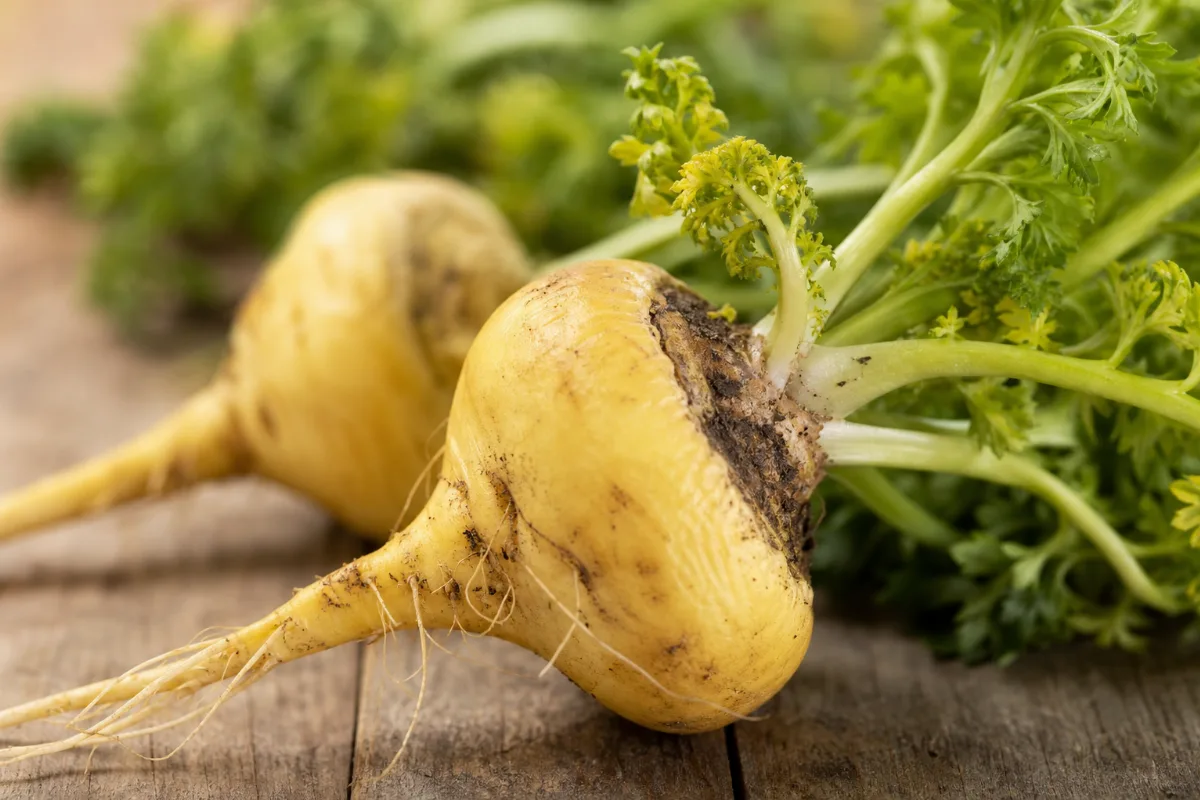
Adaptogens · Herbs & Botanicals · Herbs · Andean root vegetable sold for libido and menopause, with low-certainty evidence
Maca
Lepidium meyenii Walp. (also written Lepidium peruvianum) · also called Maca, Peruvian maca, Peruvian ginseng (a trade name; not related to ginseng)
Maca is a root vegetable of the cabbage family, grown high in the Peruvian Andes. The swollen root (hypocotyl) is eaten and sold as powder, capsules and extracts, mostly for sexual desire, fertility, energy and menopause symptoms. The evidence is small and low certainty. Most trials found no change in testosterone or oestrogen, results on fertility are mixed, and performance trials were negative. Ask a doctor first if you have a hormone-sensitive condition, thyroid disease, high blood pressure or liver disease, or if you are pregnant, breastfeeding or take medicine. Some maca powders have contained lead.
General information, not medical advice. Last substantive update · Not medically reviewed. A named clinician has not signed off on this page. How this page is made
About Maca
Maca (Lepidium meyenii) is a cabbage-family root grown in the Peruvian Andes and sold for libido, fertility, energy and menopause. Small trials suggest slightly higher self-rated sexual desire and lower menopause symptom scores, but reviews call the evidence limited and the trials are small and often from the same few groups. Most trials found no change in testosterone or oestrogen, though four trials of one branded product did. Fertility results are mixed and athletic performance trials were negative. Ask a doctor first if you have a hormone-sensitive condition, thyroid disease, blood-pressure problems or liver disease, are pregnant or breastfeeding, or take medicines; some maca powders have contained lead.
What it is
Maca (Lepidium meyenii) is a root vegetable of the cabbage family. It is grown high in the Peruvian Andes. The part eaten and studied is the hypocotyl, a swollen root-like storage organ that comes in many colours; yellow, red and black are the most studied.
It is sold as a powder, in capsules and as extracts, and is often called 'Peruvian ginseng', although it is not related to ginseng. The same plant can appear on labels as Lepidium peruvianum.
What makes it distinctive
Maca is a food crop that was turned into a supplement. People in the Andes have eaten it for a very long time, and traditional use is not proof that it works.
Its distinctive chemistry includes macamides, which form when the root is dried, and glucosinolates, sulfur compounds common in cabbage-family plants. No single compound has been shown to explain an effect in people.
Historical and current uses
In the Andes it has been used as a tonic and to support fertility, in people and livestock. Since the 1990s it has been sold worldwide for libido, fertility, energy and menopause.
Health Canada notes that maca root powder has a history of use as food, but it did not permit maca root extract in supplemented foods because public safety data were insufficient.
What the research shows
The human research is made up of small trials, many from a few research groups and many with industry or product links. Reviews call the evidence limited. The best-supported signals are small gains in self-rated sexual desire and symptom scores. Even these rest on trials that are small, short and use different products.
Fertility results are mixed, and a meta-analysis found no clear gain in sperm concentration. Most trials found no change in testosterone or oestrogen, although four trials of one branded product reported hormone shifts. Athletic performance trials were negative.
Blood pressure, altitude sickness, blood sugar and inflammation results are weak or conflicting. Prostate, memory and nerve findings are from animals and cells only.
At a glance
Traditional uses history, not proof
- Andean food and tonic grown at 4,000 to 4,500 m in central Peru, eaten cooked, baked, fermented as a drink or as porridge
- Traditional fertility aid for people and livestock
- Used for ailments such as rheumatism, respiratory problems and anaemia in Andean medicine
- Since the 1990s a global supplement for libido, fertility, energy and menopause
Studied for research
- Sexual desire and mild erectile dysfunction, low to very low certainty (small trials)
- Menopause symptom scores and mood scores, low certainty (hormone results conflict)
- Sexual side effects of antidepressants, low certainty (two small pilot trials)
- Male fertility and semen quality, mixed (meta-analysis not significant)
- Blood pressure, high-altitude symptoms, blood sugar and inflammation, very low or insufficient
- Athletic performance, against (two placebo-controlled trials negative)
Main compounds
- Macamides (fatty-acid amides that form when the root is dried)
- Glucosinolates such as glucotropaeolin (sulfur compounds typical of cabbage-family plants)
- Imidazole alkaloids (lepidilines) and a beta-carboline
- Starch, fibre and fatty acids (nutrient values not verified)
Common forms
- Powdered root, raw or processed ('gelatinized'), as used in most trials
- Extracts, including dry, spray-dried and water or alcohol extracts, tested in some trials
- A branded gelatinized product (Maca-GO) used in several menopause trials by one team; results from it conflict with other trials
- Different colours (yellow, red, black) differ in chemistry and in animal results; trials seldom say which was used
- Maca medicinal liquor (alcohol-based): one probable liver injury case
Research links: Health Canada: decision on maca root extract (2024) · Systematic review: maca for sexual function (Shin 2010, PubMed) · Systematic review and meta-analysis: maca and semen quality (Lee 2022, PubMed) · Review of reproductive health claims (Beharry and Heinrich 2018, PubMed) · Research Library · Genes & Biomarkers Library
The plant and its history
- Accepted scientific name
- Lepidium meyenii Walp. (maca, Peruvian maca)
- Naming authority
- Walp. (GBIF lists the accepted name as Lepidium meyenii Walp., status ACCEPTED, key 5377042, exact match)
- Synonyms
- Lepidium peruvianum Chacon de Popovici (GBIF: SYNONYM of L. meyenii; also written Lepidium peruvianum G.Chacon); Other GBIF synonyms: Lepidium affine Wedd., Lepidium gelidum Wedd., Lepidium orbignyanum Wedd., Lepidium weddellii J.F.Macbr., and several forms and varieties of L. meyenii
- Common names
- Maca (English / Spanish); Peruvian ginseng (English); Maka (Quechua); Maca-peruana (Portuguese); Macoa (Portuguese); řeřicha peruánská (Czech); マカ (Japanese); 瑪卡 (Chinese); 秘魯人參 (Chinese)
- Botanical family
- Brassicaceae (mustard or cabbage family), the same family as cabbage, broccoli and mustard. This is why maca contains glucosinolates.
- Classification
- Plantae > Tracheophyta > Magnoliopsida > Brassicales > Brassicaceae > Lepidium > Lepidium meyenii
- Native range
- Cultivated exclusively between about 4,000 and 4,500 m in the central Andes of Peru (Junin plateau), per two reviews. Now also grown elsewhere, including Yunnan, China, per a review.
- Habitat
- High, cold Andean plateau at about 4,000 to 4,500 m, per the reviews read.
- What the plant looks like
- Roots: The hypocotyl, a swollen root-like storage organ, is the part eaten and studied. It comes in many colours (white to black; yellow, red, black most studied; a 2024 review counts up to seventeen).; Stems: Not described in the sources read.; Leaves: Leaves are not the usual medicinal part; not covered in the sources read.; Flowers: Not described in the sources read.; Fruit: Not described in the sources read.
- Cultivation
- Traditionally grown in the high Andes; a review says demand moved production toward mass cultivation with fertilisers and pesticides and to areas outside the Andes such as Yunnan.
- Harvest and processing
- Macamides are essentially absent from fresh hypocotyls and form during drying (traditional Andean drying with freeze-thaw cycles, or oven drying). The 'gelatinized' powder used in several trials is a processed form; its exact process was not described in the sources read.
- Look-alikes and adulterants
- Name: Lepidium peruvianum; Note: A synonym of L. meyenii in GBIF. Some trials and products use this name (for example the Maca-GO product), which is not a different plant according to GBIF.; Name: Other peppergrass or Lepidium species; Note: The genus Lepidium has many species. A DNA test separated maca from 19 possible adulterants in one study; the study abstract does not name them.; Name: Macadamia; Note: An unrelated tree nut. 'Maca' on a label should not be confused with macadamia products.
- Sustainability and conservation
- Not verified. No IUCN assessment was retrieved.
Traditional use and history history, not clinical proof
| Tradition or era | Documented use | Source |
|---|---|---|
| Andean Peru, pre-Columbian to present | Cultivated in the high Andes as a food and tonic; one review says for over 2,000 years, another 1,300 to 2,000 years. Eaten cooked, baked, fermented as a drink or made into porridge, and used traditionally for fertility, as a tonic and for ailments such as rheumatism, respiratory problems and anaemia. | p28811221 |
| 17th century | A toxicology review says the first recorded knowledge of maca dates to the seventeenth century. | p16042502 |
| Since the 1990s, global market | Maca reached the world market as an energy and libido product and in China as a herbal medicine; Peru named it one of seven 'flag products' in 2005. Exports from Peru rose between 2001 and 2010. | p20090350 |
| Regulation, Canada | Health Canada notes maca root powder has a history of food use but did not permit maca root extract in supplemented foods (page dated 2024-08-15). | s-health-canada-maca-extract |
| Regulation, EU | A 2024 review says maca is treated as a traditional food in the EU while purified extracts are not. Not verified at the EU catalogue. | p38440178 |
Traditional use shows how a plant was used. It does not show that a supplement works or is safe today.
What is inside, and how it may work
What the plant contains and how those compounds act in cells and animals. Laboratory and animal mechanisms are not proven effects in people.
Main compounds
| Compound | Family | Where it is concentrated | Activity studied | Level of evidence |
|---|---|---|---|---|
| Macamides (benzylalkamides, for example N-benzylhexadecanamide and N-benzyloleamide) PubChem 11198769 (N-benzylhexadecanamide); 49865534 (N-benzyloleamide) | fatty-acid benzylamides | Dried hypocotyl; essentially absent from fresh hypocotyl Up to 800 ug/g dry weight in dried hypocotyls; commercial products with total macamides 3.29 mg/g or more were found | Strong inhibition of soluble epoxide hydrolase (sEH) in the lab; N-benzyl-linoleamide reduced inflammatory pain in rats. 12 49 | Laboratory research |
| Glucosinolates (glucotropaeolin / benzyl glucosinolate, glucolimnanthin, sinalbin, glucolepigramin) PubChem 9548605 (glucotropaeolin); 76956748 (sinalbin) | sulfur-containing plant glycosides | Hypocotyl Glucotropaeolin to glucolimnanthin 1:0.19 across 42 products | Break down to isothiocyanates (benzyl isothiocyanate, CID 2346) and then partly to benzylamine (CID 7504), which feeds macamide formation during drying. Their effect in people is unknown. 60 12 | Laboratory research |
| Imidazole alkaloids (lepidilines A, B, E, F, G) PubChem 404702 (lepidiline A); 9862174 (lepidiline B) | imidazolium alkaloids | Hypocotyl | Newly described compounds; activity in people not shown. A worm study linked toxicity to alkaloids in an extract. 28 43 | Laboratory research |
| Methyl-tetrahydro-beta-carboline acid (MTCA) PubChem 73530 | beta-carboline | Hypocotyl | Present as a natural constituent; the authors found no toxicity on consumption. Maca extracts did not inhibit MAO-A in a separate lab test. 19 23 28 | Laboratory research |
| Free fatty acids | fatty acids | Hypocotyl Free fatty acids up to 1,200 ug/g dry weight after drying | Released from storage lipids during drying and used, with benzylamine, to form macamides; activity in people not shown. 12 | Laboratory research |
| Polysaccharides, starch, protein and minerals | nutrients | Hypocotyl Not read from a primary source | Maca is eaten as a starchy food. Nutrient values were not verified from primary sources. 40 20 | Other |
Mechanisms, receptors and pathways
| Target or pathway | Gene or receptor | What was found | Level |
|---|---|---|---|
| Soluble epoxide hydrolase (sEH) inhibition and inflammatory pain | EPHX2 (sEH enzyme) | Most of 19 synthesised macamides inhibited recombinant mouse, rat and human sEH at nanomolar levels; N-benzyl-linoleamide reduced inflammatory pain in rats. Not shown in people. 49 | Laboratory research |
| Androgen action | Androgen receptor (AR), PSA gene | Maca extracts did not activate a hormone response element (no direct androgenic activity); a red maca extract raised AR and PSA mRNA at some doses in prostate cancer cells; rat prostate size fell with red maca without a testosterone change. 4 11 17 | Laboratory research |
| Pituitary hormone release | LH and FSH | In female rats fed 50% maca powder for 7 weeks, LH rose 4.5-fold and FSH 19-fold in the pro-oestrus surge. Most human trials found no change in LH or FSH. 54 16 5 | Animal research |
| Human serum sex hormones | Testosterone, oestradiol | No change in most placebo-controlled human trials; changes reported in four trials of one branded product. 16 5 52 35 | Human data |
| Mood-related enzyme MAO-A | MAOA | Maca root extracts did not inhibit human MAO-A in a lab test, unlike St John's wort and Peganum harmala extracts. 23 | Laboratory research |
| Learning and mood tests in mice | Not identified | In ovariectomised mice all three maca colours reduced immobility in the forced swimming test; black maca improved a learning task. 46 | Animal research |
| Nerve cell protection | Not identified | A pentane extract protected crayfish neurons in a dish; in rat stroke a low intravenous dose lowered infarct size and higher doses raised it. 44 | Animal research |
| Drug metabolism | CYP3A | Maca produced less than 50% CYP3A inhibition in human intestinal tissue models. 33 | Laboratory research |
Absorption, metabolism and elimination
- Absorption
- No human study of how macamides, glucosinolates or other maca compounds are absorbed was found in the sources read.
- Distribution
- No human tissue-distribution data found.
- Metabolism
- Glucosinolates break down to isothiocyanates and benzylamine during drying and chewing (plant chemistry). Human metabolism of maca compounds was not found.
- Elimination
- Not found for humans.
- Bioavailability
- Not established in people. In rats, oral N-benzyl-linoleamide showed 'acceptable' pharmacokinetics (numbers not in the abstract).
Isolated compounds versus whole extracts
No single compound has been shown to explain maca's effects in people. Macamides inhibit an enzyme in the lab, but that has not been linked to a human result. Colour matters in animal studies (black maca for sperm production and learning, red maca for the rat prostate), and a 2024 review (by authors tied to a maca seller) says colour, location and processing change chemistry. Health Canada notes that extracts cannot be assumed to match the powder, which is why extract and powder results should not be mixed.
Nutritional composition
Maca is eaten as a starchy root, but nutrient values were not verified from primary sources. A 2024 review (read through a summary) mentions that mineral content differs between Peruvian and Chinese-grown maca. No table of nutrients is given.
2 mixed findings5 low certainty4 very low certainty4 not enough evidence1 evidence against
What was looked at
The 16 benefits and uses checked for Maca, each with how strong the evidence is. Tap one to open it.
- Sexual desire (libido)Low certainty
- Erectile dysfunction (mild)Very low certainty
- Symptoms of low testosterone in older men (late-onset hypogonadism symptoms)Low certainty
- Sexual problems caused by antidepressantsLow certainty
- Menopause symptoms (hot flushes, mood, sexual symptoms)Low certainty
- Mood, anxiety and depression scoresLow certainty
- Energy, wellbeing and quality of lifeVery low certainty
- Male fertility and semen qualityMixed findings
- Hormone levels (testosterone, oestrogen, FSH, LH, thyroid)Mixed findings
- Blood pressureVery low certainty
- High altitude: chronic mountain sickness score and hemoglobinVery low certainty
- Exercise performance and recoveryEvidence against
- Blood sugar and blood fatsNot enough evidence
- Inflammation (interleukin-6)Not enough evidence
- Prostate health (benign enlargement)Not enough evidence
- Memory and nerve protection (animal and lab findings only)Not enough evidence
Lab markers tracked in the studies
IIEF-5 erectile function scoreSelf-rated sexual desire scoreSexual function scales for antidepressant side effects (ASEX, MGH-SFQ)Greene Climacteric Scale and Kupperman Index (menopause symptom scores)Depression and anxiety scale scoresAging Males' Symptoms scale (AMS) and ADAM questionnaireMood, energy and health-related quality of life scoresSperm concentrationSperm motilitySemen volumeTestosterone (total and free)Oestradiol, FSH and LHThyroid-stimulating hormone (TSH)Diastolic blood pressureHemoglobinBlood glucoseInterleukin-6 (IL-6)40 km cycling time trial
What is Maca good for?
The main proposed uses and how strong the human evidence is for each. 'Low' is the best rating any maca use reached here. 'Very low', 'mixed' and 'insufficient' mean few, small, conflicting or animal-only studies, and none of these is a proven treatment for you. Many of these ratings are this profile's own reading of the reviews, not formal grades. Several trials come from a few research groups or have product links. Do not use maca instead of treatment for erectile problems, menopause, infertility or depression.
Benefits, one by one
Each card is a research question, not a promise. Tap a goal to filter. Open a card to see the studies, doses and limits.
Sexual desire (libido)
Low certaintyA 12-week Peruvian trial in healthy men found self-rated sexual desire improved with gelatinized maca from week 8, apart from any change in testosterone or mood scores. A tiny cyclist study also found higher desire than placebo. Evidence is small and low certainty.
4 studiesGelatinized maca root powder 1,500 to 3,000 mg a day for 12 weeks (Go…
Studies, doses and limits
What the trials found
Gonzales 2002 (healthy men aged 21 to 56, gelatinized maca 1,500 mg or 3,000 mg a day versus placebo for 12 weeks): desire improved from week 8 and the effect did not depend on testosterone, oestradiol, depression or anxiety scores. Stone 2009 (8 trained cyclists, 14 days of maca extract, crossover): self-rated desire was higher than on placebo (P=0.03). The 2010 systematic review of 4 RCTs judged the evidence for sexual function limited because trials were few, small and of limited quality.
Results
Desire rose on self-rated scales in two small trials.
Effect sizes as reported
Gonzales 2002: improved desire from week 8 (no numbers in the abstract). Stone 2009: desire higher than placebo, P=0.03.
Why this rating
Two small trials, one with no numbers in its abstract and one with 8 people; self-reported outcome; reviewers call the evidence limited.
Form and dose studied
Gelatinized maca root powder 1,500 to 3,000 mg a day for 12 weeks (Gonzales); a maca extract for 14 days (Stone). Products differ.
Who was studied
Healthy men; one small cyclist group.
Limits
Few and small trials; the desire result comes from one research group in Peru; self-rated outcome; the sexual-function review (searches to 2010) is old.
Why researchers looked
Maca is sold mainly as a libido and fertility aid, so desire is the most studied use.
Traditional use
Maca root is an Andean food crop grown at 4,000 to 4,500 m in central Peru and traditionally used as a tonic and fertility aid. Traditional use is not proof that it works.
Proposed mechanism Preliminary mechanism
Maca does not appear to act through testosterone or oestrogen in people: most trials that measured hormones found no change. Lab work suggests other routes (for example macamides, glucosinolates and plant alkaloids), but none has been shown to explain an effect in people.
A proposed mechanism does not show that the effect happens in people.
No serious adverse effects were reported in these trials. See the safety tab.
Erectile dysfunction (mild)
Very low certaintyOne 12-week Italian trial in 50 men with mild erectile dysfunction found a small extra gain over placebo on a standard questionnaire (about 1 point on a 25-point scale). A 2026 review of herbs for erectile dysfunction called the maca evidence insufficient.
3 studiesMaca dry extract 2,400 mg a day for 12 weeks.
Studies, doses and limits
What the trials found
Zenico 2009 (50 men with mild ED, maca dry extract 2,400 mg a day versus placebo for 12 weeks): IIEF-5 rose +1.6 +/- 1.1 with maca versus +0.5 +/- 0.6 with placebo (P<0.001); both groups improved. Ho 2026 (14 RCTs of herbs for ED, 1,227 men) found the evidence for maca insufficient. Shin 2023 (men with late-onset hypogonadism symptoms) also reported higher IIEF scores; see that benefit.
Results
Small gain over placebo in one trial.
Effect sizes as reported
IIEF-5 +1.6 versus +0.5 (about 1.1 points more than placebo).
Why this rating
One small trial; the reviewers of herbal ED trials call the evidence insufficient; a gain of about one point may not be noticeable.
Form and dose studied
Maca dry extract 2,400 mg a day for 12 weeks.
Who was studied
Caucasian men with mild ED in Italy.
Limits
One trial of 50 men; mild ED only; funding not stated in the abstract; both groups improved, so part of the change is placebo response.
Why researchers looked
Maca is marketed to men with erectile problems.
Traditional use
Maca root is an Andean food crop grown at 4,000 to 4,500 m in central Peru and traditionally used as a tonic and fertility aid. Traditional use is not proof that it works.
Proposed mechanism Preliminary mechanism
Maca does not appear to act through testosterone or oestrogen in people: most trials that measured hormones found no change. Lab work suggests other routes (for example macamides, glucosinolates and plant alkaloids), but none has been shown to explain an effect in people.
A proposed mechanism does not show that the effect happens in people.
Do not replace prescribed ED treatment. ED can signal heart or blood-vessel disease: see a doctor. Some online ED products have been found to contain hidden drugs (see safety tab).
Symptoms of low testosterone in older men (late-onset hypogonadism symptoms)
Low certaintyOne 12-week Korean-led trial in 80 men with symptoms of late-onset hypogonadism but normal testosterone found better symptom scores on gelatinized maca than placebo. The abstract gives no score values and no testosterone result.
2 studiesGelatinized maca, reported as 1,000 mg, two pills at a time, three ti…
Studies, doses and limits
What the trials found
Shin 2023 (80 men, 41 maca and 39 placebo, gelatinized maca for 12 weeks): AMS, IIEF and IPSS scores improved versus placebo (P<0.05) and the ADAM-positive rate fell (P<0.0001). The men had normal testosterone ('eugonadal'). A 2024 review of 'testosterone boosters' listed 2 maca studies and did not rate maca among the effective ones for raising total testosterone.
Results
Symptom scores better than placebo in one trial.
Effect sizes as reported
AMS, IIEF, IPSS improved (P<0.05); ADAM-positive rate P<0.0001. Numbers not in abstract.
Why this rating
One moderately sized placebo-controlled trial; self-completed questionnaires; no numbers in the abstract; two authors work for a supplement company although the conflict statement says none.
Form and dose studied
Gelatinized maca, reported as 1,000 mg, two pills at a time, three times a day, for 12 weeks.
Who was studied
Men with symptoms but normal testosterone.
Limits
One trial; no testosterone result in the abstract; symptom scores are subjective; company affiliation of two authors.
Why researchers looked
Men with tiredness, low desire and low mood often seek non-drug options.
Traditional use
Maca root is an Andean food crop grown at 4,000 to 4,500 m in central Peru and traditionally used as a tonic and fertility aid. Traditional use is not proof that it works.
Proposed mechanism Preliminary mechanism
Maca does not appear to act through testosterone or oestrogen in people: most trials that measured hormones found no change. Lab work suggests other routes (for example macamides, glucosinolates and plant alkaloids), but none has been shown to explain an effect in people.
A proposed mechanism does not show that the effect happens in people.
This does not show maca raises testosterone. See the hormone discussion in the body tab.
Sexual problems caused by antidepressants
Low certaintyTwo small trials from Massachusetts General Hospital tested maca for sexual side effects of antidepressants. The first (no placebo group) suggested benefit at 3 g a day. The second (placebo-controlled, 45 women) found slightly higher remission rates with maca, mainly in postmenopausal women, and gave no significance test for them.
4 studiesMaca root 1.5 g or 3.0 g a day; 3.0 g in the placebo trial for 12 wee…
Studies, doses and limits
What the trials found
Dording 2008 (20 remitted depressed outpatients; 16 analysed; maca 1.5 g or 3.0 g a day, no placebo): at 3.0 g ASEX fell from 22.8 to 16.9 (P=0.028) and MGH-SFQ from 24.1 to 17.0 (P=0.017); 1.5 g was not significant. Dording 2015 (45 women, 42 analysed, maca 3.0 g a day versus placebo for 12 weeks): ASEX remission 9.5% versus 4.8%; MGH-SFQ 12 or less 30.0% versus 20.0%; better in postmenopausal women. A 2025 meta-analysis of drugs for this problem pooled only two studies and judged bupropion the most effective, with low-quality evidence.
Results
Small signals in two small trials.
Effect sizes as reported
ASEX 22.8 to 16.9 and MGH-SFQ 24.1 to 17.0 at 3.0 g (no placebo); remission 9.5% versus 4.8% (ASEX), 30% versus 20% (MGH-SFQ).
Why this rating
Two small pilot trials, one without placebo, one with no significance test for the main differences; the best-supported treatment in a 2025 meta-analysis was a drug, not maca.
Form and dose studied
Maca root 1.5 g or 3.0 g a day; 3.0 g in the placebo trial for 12 weeks.
Who was studied
Mostly women whose depression had remitted on SSRIs or SNRIs.
Limits
Small numbers, 10 of 20 finished the first study; remission was uncommon in both groups; benefit suggested only for postmenopausal women; the authors of both trials disclose broad drug-company research ties (not maca makers).
Why researchers looked
Antidepressant sexual side effects are common and hard to treat, so people look for add-ons.
Traditional use
Maca root is an Andean food crop grown at 4,000 to 4,500 m in central Peru and traditionally used as a tonic and fertility aid. Traditional use is not proof that it works.
Proposed mechanism Preliminary mechanism
Not established. Lab tests found maca extracts did not inhibit the mood-related enzyme MAO-A, so that is not how it would act.
A proposed mechanism does not show that the effect happens in people.
Never stop or change an antidepressant on your own. Maca has not been shown safe to combine with antidepressants (see safety tab: interactions).
Menopause symptoms (hot flushes, mood, sexual symptoms)
Low certaintySmall trials report easier menopause symptom scores with maca, but they disagree about whether hormones change. A Hong Kong and an Australian trial found no hormone change; four trials of a branded gelatinized product (Maca-GO) from one research team reported rising oestradiol and falling FSH. A 2011 review called the evidence limited and said safety had not been proved.
8 studiesPowdered maca 3.3 to 3.5 g a day for 6 weeks (crossover trials) or Ma…
Studies, doses and limits
What the trials found
Brooks 2008 (14 postmenopausal women, 3.5 g a day, crossover): no change in oestradiol, FSH, LH or SHBG; Greene psychological and sexual-dysfunction scores fell versus placebo (P<0.05). Stojanovska 2015 (29 Chinese postmenopausal women, 3.3 g a day, crossover): no change in oestradiol, FSH, TSH, SHBG, lipids or glucose. The Maca-GO trials, a pre-gelatinized organic product (2 g a day): Meissner 2006 (168 enrolled, 124 finished) reported E2 up (P<0.001), FSH down (P<0.05) and the Kupperman Index down from 22 to 10; smaller trials reported similar. The 2011 systematic review (4 RCTs) found favourable Kupperman and Greene scores and called evidence limited.
Results
Symptom scores improved in all of the small trials; hormone results conflict.
Effect sizes as reported
Kupperman Index 22 to 10 in the 168-woman Maca-GO trial (P<0.001); Greene psychological and sexual scores P<0.05 in the 14-woman trial.
Why this rating
Trials are small and short; symptom scores improved but hormone findings conflict; the largest trial is of a branded product with funding not stated in its abstract; a placebo effect was clear in several.
Form and dose studied
Powdered maca 3.3 to 3.5 g a day for 6 weeks (crossover trials) or Maca-GO 2 g a day for 2 to 4 months.
Who was studied
Peri- and postmenopausal women (Australia, Hong Kong; country not stated in the Maca-GO abstracts).
Limits
Small, short trials; conflicting hormone results; the hormone-changing results come from one research team whose lead author co-wrote a 2024 review by authors with ties to a maca seller (Minich 2024); funding of the trials is not stated in their abstracts.
Why researchers looked
Women look for non-hormonal options for hot flushes and low mood.
Traditional use
Maca root is an Andean food crop grown at 4,000 to 4,500 m in central Peru and traditionally used as a tonic and fertility aid. Traditional use is not proof that it works.
Proposed mechanism Preliminary mechanism
Maca does not appear to act through testosterone or oestrogen in people: most trials that measured hormones found no change. Lab work suggests other routes (for example macamides, glucosinolates and plant alkaloids), but none has been shown to explain an effect in people.
A proposed mechanism does not show that the effect happens in people.
If you have or have had a hormone-sensitive cancer, or take hormone therapy, ask your doctor first (see safety tab).
Mood, anxiety and depression scores
Low certaintyIn small trials in postmenopausal women, anxiety, depression and psychological scores were lower on maca than on placebo. These are secondary outcomes in menopause and sexual-function trials, not tests in people with depression, and no trial treated clinical depression or anxiety disorders.
7 studiesPowdered maca 3.3 to 3.5 g a day; red or black maca extract 3 g a day.
Studies, doses and limits
What the trials found
Brooks 2008: Greene anxiety and depression subscale scores fell versus baseline and placebo (P<0.05; 14 women). Stojanovska 2015: depression scores and diastolic blood pressure fell after maca (29 women). Gonzales 2002: the desire effect was independent of Hamilton depression and anxiety scores. Gonzales-Arimborgo 2016 (175 adults, red or black maca extract 3 g a day for 12 weeks) reported improved mood versus placebo. Mouse tests (Rubio 2006) found all three colours reduced immobility in forced swimming.
Results
Lower anxiety and depression scores in small trials.
Effect sizes as reported
Greene anxiety and depression subscales P<0.05 versus placebo (Brooks); Stojanovska: significant fall in depression score (no value in abstract).
Why this rating
Small trials; scores were secondary outcomes; the largest trial gives no numbers in its abstract and its author runs a supplement firm; no trial in clinical depression or anxiety disorders.
Form and dose studied
Powdered maca 3.3 to 3.5 g a day; red or black maca extract 3 g a day.
Who was studied
Postmenopausal women and adults at low and high altitude in Peru.
Limits
Not tested in people with diagnosed depression or anxiety; cultural differences in symptom reporting were noted by the Hong Kong authors.
Why researchers looked
Mood changes often come with menopause and low libido, and maca is sold as an energiser.
Traditional use
Maca root is an Andean food crop grown at 4,000 to 4,500 m in central Peru and traditionally used as a tonic and fertility aid. Traditional use is not proof that it works.
Proposed mechanism Preliminary mechanism
Lab and animal work suggests maca extracts reduce immobility in mouse swimming tests, but this does not show an antidepressant effect in people. Maca extracts did not inhibit the enzyme MAO-A in a lab test.
A proposed mechanism does not show that the effect happens in people.
Maca is not a treatment for depression. Two case reports link herbal products including maca to psychotic episodes, with cause unclear (see safety tab).
Energy, wellbeing and quality of life
Very low certaintyA 175-person Peruvian trial reported better mood, energy and health scores with red or black maca extract than placebo over 12 weeks, but its abstract gives no numbers. There is no high-quality trial of maca for fatigue as a medical problem.
4 studiesSpray-dried red or black maca extract 3 g a day for 12 weeks.
Studies, doses and limits
What the trials found
Gonzales-Arimborgo 2016 (175 adults at low or high altitude; spray-dried red or black maca extract 3 g a day for 12 weeks): improvement in mood, energy and health status, with red maca better for mood, energy and chronic mountain sickness score; no serious adverse effects. Gonzales 2013 (cross-sectional, 50 people at 4,100 m): maca consumers had higher health scores. A 2024 review of maca for physical performance pooled mostly animal tests.
Results
Higher self-rated energy and health in one trial; association in one cross-sectional study.
Effect sizes as reported
No numbers in the abstracts.
Why this rating
One trial with no numbers in its abstract and an author who runs a maca-product company; a cross-sectional study cannot show cause.
Form and dose studied
Spray-dried red or black maca extract 3 g a day for 12 weeks.
Who was studied
Adults living at low and high altitude in Peru.
Limits
No trial in people with chronic fatigue; self-rated outcomes.
Why researchers looked
Maca is called an energiser or adaptogen in the Andes and in the supplement trade.
Traditional use
Used as a daily food and tonic by Andean farmers; not proof it works.
Proposed mechanism Preliminary mechanism
Not established. Animal fatigue studies exist but do not show how it would work in people.
A proposed mechanism does not show that the effect happens in people.
Maca can be marketed as a stimulant; a 2024 letter raises questions about sleep, but it is opinion without data.
Male fertility and semen quality
Mixed findingsTrials give mixed results. A 2022 meta-analysis of 5 randomised trials found no clear gain in sperm concentration, and a 2021 trial in 50 infertile men found no benefit. Small trials in healthy men and a 12-week Spanish trial in 69 men with mild semen problems found higher sperm concentration.
7 studiesMaca 1.5 to 3 g a day for 12 to 16 weeks in trials; colour and produc…
Studies, doses and limits
What the trials found
Gonzales 2001 (9 healthy men, uncontrolled, 4 months): higher semen volume, sperm count and motility. Melnikovova 2015 (20 healthy men, 1.75 g a day for 12 weeks): rising trends in sperm concentration and motility, not significant. Alcalde 2020 (69 men with mild asthenozoospermia or oligozoospermia, 2 g a day for 12 weeks): sperm concentration higher with maca (15.04 +/- 5.61 vs 10.16 +/- 3.59; P=0.011); volume, motility and normal forms not significantly different. Melnikovova 2021 (50 infertile patients, yellow maca, 16 weeks): sperm concentration +40% with maca vs +76% with placebo, not significant. Lee 2022 meta-analysis (5 RCTs): pooled sperm concentration difference 2.22 (95% CI -2.94 to 7.37; P=0.4). Lee 2016 systematic review: suggestive evidence.
Results
Mixed: improvement in some small trials, none in the pooled data.
Effect sizes as reported
Pooled WMD 2.22 (95% CI -2.94 to 7.37) for sperm concentration; Alcalde P=0.011 for concentration only.
Why this rating
Trials point in different directions; the pooled analysis is not significant; none of the trials measured pregnancy or live birth.
Form and dose studied
Maca 1.5 to 3 g a day for 12 to 16 weeks in trials; colour and product differ.
Who was studied
Healthy men and men with mild semen problems.
Limits
Small trials; one measure out of several positive; no pregnancy outcomes; Peruvian and Czech trials differ.
Why researchers looked
Maca is traditionally given to people and livestock to raise fertility.
Traditional use
Maca root is an Andean food crop grown at 4,000 to 4,500 m in central Peru and traditionally used as a tonic and fertility aid. Traditional use is not proof that it works.
Proposed mechanism Preliminary mechanism
Not established. A review of the Peruvian group's animal work says black maca raised sperm production more than yellow, and red maca had none; this is not shown in people.
A proposed mechanism does not show that the effect happens in people.
Not tested in women trying to conceive. Pregnancy advice is on the safety tab.
Hormone levels (testosterone, oestrogen, FSH, LH, thyroid)
Mixed findingsMost human trials found that maca did not change testosterone, oestradiol, LH, FSH or TSH. Four trials of one branded gelatinized product reported rising oestradiol and falling FSH in women. A systematic review of testosterone boosters did not list maca among the effective ones.
13 studiesPowdered maca 1.5 to 3.5 g a day; Maca-GO 2 g a day.
Studies, doses and limits
What the trials found
No change: Gonzales 2003 (men, 12 weeks, LH, FSH, prolactin, 17-OH progesterone, testosterone, oestradiol), Gonzales 2001, Brooks 2008 (oestradiol, FSH, LH, SHBG), Stojanovska 2015 (oestradiol, FSH, TSH, SHBG), Melnikovova 2015 (hormones unchanged). Melnikovova 2021 found lower free testosterone in infertile men. Changes: the Maca-GO trials reported E2 up and FSH down in women (Meissner 2006 II, P<0.001 and P<0.05), with T3, ACTH and cortisol lower in a crossover trial. Lab: Bogani 2006 found no direct androgen-like action; Brooks 2008 found no oestrogen- or androgen-like action in a yeast assay. Rats at very high intake showed higher LH and FSH in the pro-oestrus surge (Uchiyama 2014). Morgado 2024 systematic review of testosterone boosters: maca was not among the effective ones. One case report (Srikugan 2011) found a false-high testosterone reading caused by maca interfering with a lab test.
Results
Mostly no change in people; results from one product line differ.
Effect sizes as reported
No effect on LH, FSH, prolactin, testosterone, oestradiol (Gonzales 2003); E2 up P<0.001, FSH down P<0.05 (Meissner 2006 II).
Why this rating
Independent trials mostly show no hormone change; four trials of a branded product show change; they cannot all be right.
Form and dose studied
Powdered maca 1.5 to 3.5 g a day; Maca-GO 2 g a day.
Who was studied
Healthy men, postmenopausal and perimenopausal women.
Limits
Small trials; the changes were not repeated outside one research team.
Why researchers looked
Maca is often sold as hormone balancing, so researchers measured hormones.
Traditional use
Marketed as a hormone balancer; this is not a traditional Andean claim that has been tested.
Proposed mechanism Preliminary mechanism
In people, most trials that measured hormones found no change after maca. Some lab and animal work suggests other routes, but none has been shown to explain a human effect.
A proposed mechanism does not show that the effect happens in people.
Hormone-sensitive conditions and lab-test interference are discussed on the safety tab.
Blood pressure
Very low certaintyResults disagree. A Hong Kong trial in 29 postmenopausal women found a fall in diastolic blood pressure, and a small perimenopause pilot reported lower blood pressure, but a 90-day study of maca with silymarin reported a moderate rise in diastolic pressure. Blood pressure was a planned outcome of the 175-person Peruvian trial but its abstract reports no result.
5 studiesMaca 3.3 g a day (Hong Kong); silymarin+maca combination (Czech).
Studies, doses and limits
What the trials found
Stojanovska 2015 (29 women, maca 3.3 g a day, crossover): diastolic blood pressure fell. Meissner 2006 pilot (20 perimenopausal women, 2 months of Maca-GO): blood pressure fell with other changes. Valentova 2008 (90 days, volunteers with metabolic syndrome, silymarin+maca): moderate rise in diastolic pressure and AST in the maca group. Gonzales-Arimborgo 2016 listed blood pressure as an outcome; the abstract gives no result for it.
Results
Mixed direction.
Effect sizes as reported
No numbers in the abstracts.
Why this rating
Opposite findings in a small crossover trial and a combination-product study; no numbers.
Form and dose studied
Maca 3.3 g a day (Hong Kong); silymarin+maca combination (Czech).
Who was studied
Postmenopausal women; people with metabolic syndrome.
Limits
Mostly secondary outcomes; the maca-plus-silymarin trial cannot separate the effects.
Why researchers looked
Blood pressure is checked in trials because maca is sold for menopause and for high-altitude living.
Traditional use
Maca root is an Andean food crop grown at 4,000 to 4,500 m in central Peru and traditionally used as a tonic and fertility aid. Traditional use is not proof that it works.
Proposed mechanism Preliminary mechanism
Not established.
A proposed mechanism does not show that the effect happens in people.
People on blood pressure medicine or with high blood pressure should ask a doctor first (Health Canada lists blood pressure as a data gap).
High altitude: chronic mountain sickness score and hemoglobin
Very low certaintyIn a 175-person trial in Peru, red and black maca extracts lowered a chronic mountain sickness score versus placebo, and black maca lowered hemoglobin only in highlanders whose hemoglobin was abnormally high. A cross-sectional study found lower scores among people who eat maca at 4,100 m.
2 studiesSpray-dried red or black maca extract 3 g a day for 12 weeks.
Studies, doses and limits
What the trials found
Gonzales-Arimborgo 2016 (175 adults, red or black maca extract 3 g a day, 12 weeks): lower chronic mountain sickness score; black maca (less so red) lowered hemoglobin only in highlanders with abnormally high hemoglobin and not in lowlanders. Gonzales 2013 (50 people at 4,100 m): maca consumers had lower CMS score and lower IL-6.
Results
Lower self-rated score in one trial and one association study.
Effect sizes as reported
No numbers in the abstracts.
Why this rating
One trial with no numbers in the abstract; an author runs a maca-product company; the other study is cross-sectional.
Form and dose studied
Spray-dried red or black maca extract 3 g a day for 12 weeks.
Who was studied
Adults living at high and low altitude in Peru.
Limits
Applies to residents of the Andes, not to travellers with acute mountain sickness.
Why researchers looked
Maca grows at high altitude and is eaten by people who live there.
Traditional use
Eaten daily as food in the high Andes; traditional use is not proof of benefit.
Proposed mechanism Preliminary mechanism
Not established.
A proposed mechanism does not show that the effect happens in people.
Do not use maca instead of the standard care for altitude illness.
Exercise performance and recovery
Evidence againstHuman trials are tiny and disagree. Eight cyclists showed no gain in a 40 km time trial beyond placebo; ten basketball players saw no benefit over 2 weeks. A meta-analysis reporting large effects mixes mostly animal tests with a few human studies.
5 studiesMaca extract 14 days; 2,000 mg a day for 2 weeks; black maca extract …
Studies, doses and limits
What the trials found
Stone 2009 (8 male cyclists, 14 days, crossover): 40 km time improved versus baseline (P=0.01) but not versus placebo (P>0.05). Wu 2025 (10 basketball players, 2,000 mg a day, 2 weeks): no difference from placebo in jump, shooting, sprints, fatigue index or lactate clearance. Lee 2023 (44 elite athletes, black maca extract 2,500 mg twice a day for 8 weeks): the authors report changes in energy-system tests, but the abstract does not say if there was a control group. Huerta Ojeda 2024 pooled 21 studies, mostly animal tests (swimming, rota-rod, grip): large pooled effects. A 2026 meta-analysis of animal studies found no significant change in muscle-damage markers.
Results
No clear benefit in controlled human trials.
Effect sizes as reported
Stone: P>0.05 vs placebo; Wu 2025: all P>0.2 vs placebo.
Why this rating
The two placebo-controlled trials with performance outcomes found no benefit over placebo; the positive pooled figures are mostly from animals.
Form and dose studied
Maca extract 14 days; 2,000 mg a day for 2 weeks; black maca extract 8 weeks.
Who was studied
Trained male cyclists and basketball players; elite athletes.
Limits
Very small and short; the 2023 study lacks a stated control group.
Why researchers looked
Maca is sold to athletes as an energiser.
Traditional use
Used by Andean farmers for daily work, not tested as a sports aid.
Proposed mechanism Preliminary mechanism
Fatigue tests have been done in animals (mostly swimming tests in mice and rats), but this is not shown in people.
A proposed mechanism does not show that the effect happens in people.
None specific.
Blood sugar and blood fats
Not enough evidenceBlack maca lowered blood glucose in the 175-person Peruvian trial (abstract gives no number). A Hong Kong trial found no change in glucose or lipids. Maca raised HDL in one product trial and LDL in another.
5 studiesVarious.
Studies, doses and limits
What the trials found
Gonzales-Arimborgo 2016: black maca reduced blood glucose. Stojanovska 2015: no difference in glucose or lipid profile. Meissner 2006 II: HDL up (P<0.05); Meissner 2006 III: LDL up (P<0.05); Meissner pilot: triglycerides and cholesterol fell. Valentova 2008 measured lipids and glucose in a silymarin combination study.
Results
No consistent pattern.
Effect sizes as reported
No numbers in the abstracts for glucose.
Why this rating
Conflicting small studies; no numbers; different products.
Form and dose studied
Various.
Who was studied
Adults in Peru; postmenopausal women.
Limits
Secondary outcomes in trials not designed for metabolic questions.
Why researchers looked
Metabolic markers are routinely measured in supplement trials.
Traditional use
Maca root is an Andean food crop grown at 4,000 to 4,500 m in central Peru and traditionally used as a tonic and fertility aid. Traditional use is not proof that it works.
Proposed mechanism Preliminary mechanism
Not established.
A proposed mechanism does not show that the effect happens in people.
People with diabetes on glucose-lowering drugs should ask a doctor before adding maca.
Inflammation (interleukin-6)
Not enough evidenceA cross-sectional study at 4,100 m found lower IL-6 in maca consumers, but a trial in postmenopausal women found no change in serum cytokines.
3 studiesHabitual consumption; maca 3.3 g a day.
Studies, doses and limits
What the trials found
Gonzales 2013 (50 people): lower IL-6 (P<0.05) in consumers. Stojanovska 2015: no difference in cytokines. Singh 2020: N-benzyl-linoleamide reduced inflammatory pain in rats and inhibited the enzyme sEH in the lab.
Results
Association in one study; no change in a trial.
Effect sizes as reported
IL-6 lower (P<0.05) in the cross-sectional study.
Why this rating
One cross-sectional study cannot show cause; the trial found no change.
Form and dose studied
Habitual consumption; maca 3.3 g a day.
Who was studied
Highland residents; postmenopausal women.
Limits
No trial in people with an inflammatory disease.
Why researchers looked
IL-6 is an inflammation marker.
Traditional use
Maca root is an Andean food crop grown at 4,000 to 4,500 m in central Peru and traditionally used as a tonic and fertility aid. Traditional use is not proof that it works.
Proposed mechanism Preliminary mechanism
Lab studies report macamides block the enzyme sEH and have anti-inflammatory effects in rats, but this has not been shown in people.
A proposed mechanism does not show that the effect happens in people.
None specific.
Prostate health (benign enlargement)
Not enough evidenceRed maca shrank the rat prostate and blocked testosterone-induced enlargement. No human trial of maca for prostate enlargement was found. Lab work on a human prostate cancer cell line found maca raised androgen-receptor and PSA gene signals, so people with prostate disease should ask a doctor.
3 studiesNot applicable.
Studies, doses and limits
What the trials found
Gonzales 2005 (rats): red maca, not yellow or black, reduced ventral prostate size. Diaz 2016 (LNCaP cells): red maca extract did not change cell viability but raised androgen receptor and PSA mRNA at 20 and 40 ug/ml. Shin 2023 reported better IPSS (urinary symptom) scores in men with late-onset hypogonadism symptoms (see mind file; not a prostate-enlargement trial).
Results
Animal and cell findings only.
Why this rating
Rat and cell studies; no human BPH trial found.
Who was studied
Rats, cells.
Limits
No human data.
Why researchers looked
Cruciferous plants are linked in studies to lower prostate cancer risk, so researchers tested maca.
Traditional use
Maca root is an Andean food crop grown at 4,000 to 4,500 m in central Peru and traditionally used as a tonic and fertility aid. Traditional use is not proof that it works.
Proposed mechanism Preliminary mechanism
Rat study: aqueous red maca extract reduced prostate size without changing serum testosterone or oestradiol. The mechanism is not established.
A proposed mechanism does not show that the effect happens in people.
Cell study suggests androgen signals could rise; ask your urologist if you have prostate disease.
Memory and nerve protection (animal and lab findings only)
Not enough evidenceMaca extracts improved learning in mice and, in one rat experiment, protected neurons at a low dose but not at higher doses. No human trials of memory, bone or skin were found.
3 studiesNot applicable.
Studies, doses and limits
What the trials found
Rubio 2006 (ovariectomised mice): black maca best for learning; all colours reduced swimming immobility. Pino-Figueroa 2010: pentane extract protected crayfish neurons in a dish; in rats a low intravenous dose reduced stroke damage but higher doses increased it. No human trials were found.
Results
No human data.
Why this rating
Animal and cell studies only; results for the neuron study went both ways by dose.
Who was studied
Mice, rats, cells.
Limits
Cannot be applied to people.
Why researchers looked
Lab researchers tested maca for other traditional claims.
Traditional use
Maca root is an Andean food crop grown at 4,000 to 4,500 m in central Peru and traditionally used as a tonic and fertility aid. Traditional use is not proof that it works.
Proposed mechanism Animal research
Not established; macamides and glucosinolates are the candidate compounds.
A proposed mechanism does not show that the effect happens in people.
None specific.
Connections to the rest of health
How Maca connects to the rest of our health knowledge graph. Every link says what kind of connection it is. A safety link (for example to the liver) is a warning, not a benefit. A study that merely mentions a topic never creates a benefit link.
Explore every connection: goals, body systems, organs, symptoms, genes
A. Wellness goals
| Connected to | Kind of connection | Evidence status | Context | Studies |
|---|---|---|---|---|
| Blood pressure support | Biological association | Very low certainty | Results go both ways; Health Canada lists it as a data gap. Blood pressure: Results disagree. A Hong Kong trial in 29 postmenopausal women found a fall in diastolic blood pressure, and a small perimenopause pilot reported lower blood pressure, but a 90-day study of maca with silymarin reported a moderate rise in diastolic pressure. Blood pressure was a planned outcome of the 175-person Peruvian trial but its abstract reports no result. Preparation or compound: Maca |
52 56 67 37 22 |
| Libido support | Potential benefit | Low certainty | Small trials; self-rated outcomes. Sexual desire (libido): A 12-week Peruvian trial in healthy men found self-rated sexual desire improved with gelatinized maca from week 8, apart from any change in testosterone or mood scores. A tiny cyclist study also found higher desire than placebo. Evidence is small and low certainty. Preparation or compound: Maca |
15 53 47 40 62 24 48 41 9 10 64 23 |
| Menopause support | Potential benefit | Low certainty | Limited evidence per a 2011 systematic review. Menopause symptoms (hot flushes, mood, sexual symptoms): Small trials report easier menopause symptom scores with maca, but they disagree about whether hormones change. A Hong Kong and an Australian trial found no hormone change; four trials of a branded gelatinized product (Maca-GO) from one research team reported rising oestradiol and falling FSH. A 2011 review called the evidence limited and said safety had not been proved. Preparation or compound: Maca |
29 5 52 35 36 34 37 40 |
| Fertility support | Potential benefit | Mixed findings | Mixed trials; no pregnancy outcomes. Male fertility and semen quality: Trials give mixed results. A 2022 meta-analysis of 5 randomised trials found no clear gain in sperm concentration, and a 2021 trial in 50 infertile men found no benefit. Small trials in healthy men and a 12-week Spanish trial in 69 men with mild semen problems found higher sperm concentration. Preparation or compound: Maca |
31 30 1 39 38 14 18 |
| Mens Vitality | Potential benefit | Low certainty | Sexual desire (libido): A 12-week Peruvian trial in healthy men found self-rated sexual desire improved with gelatinized maca from week 8, apart from any change in testosterone or mood scores. A tiny cyclist study also found higher desire than placebo. Evidence is small and low certainty. Erectile dysfunction (mild): One 12-week Italian trial in 50 men with mild erectile dysfunction found a small extra gain over placebo on a standard questionnaire (about 1 point on a 25-point scale). A 2026 review of herbs for erectile dysfunction called the maca evidence insufficient. | 15 53 47 40 62 24 48 41 31 30 1 39 38 14 18 |
| Hormone Balance | Potential benefit | Low certainty | Symptoms of low testosterone in older men (late-onset hypogonadism symptoms): One 12-week Korean-led trial in 80 men with symptoms of late-onset hypogonadism but normal testosterone found better symptom scores on gelatinized maca than placebo. The abstract gives no score values and no testosterone result. Menopause symptoms (hot flushes, mood, sexual symptoms): Small trials report easier menopause symptom scores with maca, but they disagree about whether hormones change. A Hong Kong and an Australian trial found no hormone change; four trials of a branded gelatinized product (Maca-GO) from one research team reported rising oestradiol and falling FSH. A 2011 review called the evidence limited and said safety had not been proved. | 48 41 29 5 52 35 36 34 37 40 |
| Womens Wellness | Potential benefit | Low certainty | Sexual problems caused by antidepressants: Two small trials from Massachusetts General Hospital tested maca for sexual side effects of antidepressants. The first (no placebo group) suggested benefit at 3 g a day. The second (placebo-controlled, 45 women) found slightly higher remission rates with maca, mainly in postmenopausal women, and gave no significance test for them. Menopause symptoms (hot flushes, mood, sexual symptoms): Small trials report easier menopause symptom scores with maca, but they disagree about whether hormones change. A Hong Kong and an Australian trial found no hormone change; four trials of a branded gelatinized product (Maca-GO) from one research team reported rising oestradiol and falling FSH. A 2011 review called the evidence limited and said safety had not been proved. | 9 10 64 23 29 5 52 35 36 34 37 40 15 22 46 68 |
| Mood Balance | Potential benefit | Low certainty | Mood, anxiety and depression scores: In small trials in postmenopausal women, anxiety, depression and psychological scores were lower on maca than on placebo. These are secondary outcomes in menopause and sexual-function trials, not tests in people with depression, and no trial treated clinical depression or anxiety disorders. | 5 52 15 22 46 23 68 |
| Anxiety Support | Potential benefit | Low certainty | Mood, anxiety and depression scores: In small trials in postmenopausal women, anxiety, depression and psychological scores were lower on maca than on placebo. These are secondary outcomes in menopause and sexual-function trials, not tests in people with depression, and no trial treated clinical depression or anxiety disorders. | 5 52 15 22 46 23 68 |
| Energy Boost | Potential benefit | Very low certainty | Energy, wellbeing and quality of life: A 175-person Peruvian trial reported better mood, energy and health scores with red or black maca extract than placebo over 12 weeks, but its abstract gives no numbers. There is no high-quality trial of maca for fatigue as a medical problem. | 22 21 26 8 |
| Reduce Fatigue | Potential benefit | Very low certainty | Energy, wellbeing and quality of life: A 175-person Peruvian trial reported better mood, energy and health scores with red or black maca extract than placebo over 12 weeks, but its abstract gives no numbers. There is no high-quality trial of maca for fatigue as a medical problem. | 22 21 26 8 |
| Resilience Support | Potential benefit | Very low certainty | Energy, wellbeing and quality of life: A 175-person Peruvian trial reported better mood, energy and health scores with red or black maca extract than placebo over 12 weeks, but its abstract gives no numbers. There is no high-quality trial of maca for fatigue as a medical problem. High altitude: chronic mountain sickness score and hemoglobin: In a 175-person trial in Peru, red and black maca extracts lowered a chronic mountain sickness score versus placebo, and black maca lowered hemoglobin only in highlanders whose hemoglobin was abnormally high. A cross-sectional study found lower scores among people who eat maca at 4,100 m. | 22 21 26 8 |
| Hormone Balance | Biological association | Mixed findings | Hormone levels (testosterone, oestrogen, FSH, LH, thyroid): Most human trials found that maca did not change testosterone, oestradiol, LH, FSH or TSH. Four trials of one branded gelatinized product reported rising oestradiol and falling FSH in women. A systematic review of testosterone boosters did not list maca among the effective ones. | 16 14 5 52 38 39 35 36 37 4 41 51 54 |
| Menopause Support | Biological association | Mixed findings | Hormone levels (testosterone, oestrogen, FSH, LH, thyroid): Most human trials found that maca did not change testosterone, oestradiol, LH, FSH or TSH. Four trials of one branded gelatinized product reported rising oestradiol and falling FSH in women. A systematic review of testosterone boosters did not list maca among the effective ones. | 16 14 5 52 38 39 35 36 37 4 41 51 54 |
| Mens Vitality | Biological association | Mixed findings | Hormone levels (testosterone, oestrogen, FSH, LH, thyroid): Most human trials found that maca did not change testosterone, oestradiol, LH, FSH or TSH. Four trials of one branded gelatinized product reported rising oestradiol and falling FSH in women. A systematic review of testosterone boosters did not list maca among the effective ones. | 16 14 5 52 38 39 35 36 37 4 41 51 54 |
| Heart Health | Biological association | Very low certainty | Blood pressure: Results disagree. A Hong Kong trial in 29 postmenopausal women found a fall in diastolic blood pressure, and a small perimenopause pilot reported lower blood pressure, but a 90-day study of maca with silymarin reported a moderate rise in diastolic pressure. Blood pressure was a planned outcome of the 175-person Peruvian trial but its abstract reports no result. | 52 37 56 22 67 |
| Healthy Aging | Potential benefit | Very low certainty | High altitude: chronic mountain sickness score and hemoglobin: In a 175-person trial in Peru, red and black maca extracts lowered a chronic mountain sickness score versus placebo, and black maca lowered hemoglobin only in highlanders whose hemoglobin was abnormally high. A cross-sectional study found lower scores among people who eat maca at 4,100 m. | 22 21 |
| Physical Stamina | Potential benefit | Evidence against | Exercise performance and recovery: Human trials are tiny and disagree. Eight cyclists showed no gain in a 40 km time trial beyond placebo; ten basketball players saw no benefit over 2 weeks. A meta-analysis reporting large effects mixes mostly animal tests with a few human studies. | 53 58 32 26 45 |
| Endurance Support | Potential benefit | Evidence against | Exercise performance and recovery: Human trials are tiny and disagree. Eight cyclists showed no gain in a 40 km time trial beyond placebo; ten basketball players saw no benefit over 2 weeks. A meta-analysis reporting large effects mixes mostly animal tests with a few human studies. | 53 58 32 26 45 |
| Muscle Recovery | Potential benefit | Evidence against | Exercise performance and recovery: Human trials are tiny and disagree. Eight cyclists showed no gain in a 40 km time trial beyond placebo; ten basketball players saw no benefit over 2 weeks. A meta-analysis reporting large effects mixes mostly animal tests with a few human studies. | 53 58 32 26 45 |
| Blood Sugar Balance | Biological association | Not enough evidence | Blood sugar and blood fats: Black maca lowered blood glucose in the 175-person Peruvian trial (abstract gives no number). A Hong Kong trial found no change in glucose or lipids. Maca raised HDL in one product trial and LDL in another. | 22 52 35 36 37 |
| Metabolic Health | Biological association | Not enough evidence | Blood sugar and blood fats: Black maca lowered blood glucose in the 175-person Peruvian trial (abstract gives no number). A Hong Kong trial found no change in glucose or lipids. Maca raised HDL in one product trial and LDL in another. | 22 52 35 36 37 |
| Cholesterol Balance | Biological association | Not enough evidence | Blood sugar and blood fats: Black maca lowered blood glucose in the 175-person Peruvian trial (abstract gives no number). A Hong Kong trial found no change in glucose or lipids. Maca raised HDL in one product trial and LDL in another. | 22 52 35 36 37 |
| Inflammation Balance | Biological association | Not enough evidence | Inflammation (interleukin-6): A cross-sectional study at 4,100 m found lower IL-6 in maca consumers, but a trial in postmenopausal women found no change in serum cytokines. | 21 52 49 |
| Mens Vitality | Preliminary mechanism | Not enough evidence | Prostate health (benign enlargement): Red maca shrank the rat prostate and blocked testosterone-induced enlargement. No human trial of maca for prostate enlargement was found. Lab work on a human prostate cancer cell line found maca raised androgen-receptor and PSA gene signals, so people with prostate disease should ask a doctor. | 17 11 48 |
| Memory Support | Preliminary mechanism | Not enough evidence | Memory and nerve protection (animal and lab findings only): Maca extracts improved learning in mice and, in one rat experiment, protected neurons at a low dose but not at higher doses. No human trials of memory, bone or skin were found. | 46 44 20 |
| Brain Health | Preliminary mechanism | Not enough evidence | Memory and nerve protection (animal and lab findings only): Maca extracts improved learning in mice and, in one rat experiment, protected neurons at a low dose but not at higher doses. No human trials of memory, bone or skin were found. | 46 44 20 |
B. Body systems
| Connected to | Kind of connection | Evidence status | Context | Studies |
|---|---|---|---|---|
| Nervous system | Adverse effect or risk | Very low certainty | Two reported psychotic episodes with herbal products including maca and matcha; cause unclear. Preparation or compound: Herbal products including maca |
68 7 |
| Endocrine system | Biological association | Mixed findings | Hormone results conflict between trials. Most trials show no sex-hormone change; some branded-product trials do. Preparation or compound: Maca root; Maca-GO |
35 52 5 41 16 15 53 47 40 48 29 36 34 37 14 38 39 4 51 54 |
| Reproductive system | Adverse effect or risk | Not enough evidence | Reproductive toxicity in worms; pregnancy safety not studied in people. Preparation or compound: Aqueous maca extract |
43 67 |
| Reproductive system | Potential benefit | Low certainty | Most of the research is on desire, sexual function and semen; pregnancy safety is not established. Preparation or compound: Maca |
15 31 67 |
| Reproductive System | Biological association | Low certainty | Studied for: Sexual desire (libido) Studied for: Erectile dysfunction (mild) | 15 53 47 40 62 24 48 41 9 10 64 23 29 5 52 35 36 34 37 31 30 1 39 38 14 18 17 11 |
| Cardiovascular System | Biological association | Very low certainty | Studied for: Erectile dysfunction (mild) Studied for: Blood pressure | 62 24 47 52 37 56 22 67 21 35 36 |
| Nervous System | Biological association | Low certainty | Studied for: Sexual problems caused by antidepressants Studied for: Mood, anxiety and depression scores | 9 10 64 23 5 52 15 22 46 68 21 26 8 44 20 |
| Stress Mood | Biological association | Low certainty | Studied for: Mood, anxiety and depression scores | 5 52 15 22 46 23 68 |
| Metabolism Weight | Biological association | Very low certainty | Studied for: Energy, wellbeing and quality of life Studied for: Blood sugar and blood fats | 22 21 26 8 52 35 36 37 |
| Respiratory System | Biological association | Very low certainty | Studied for: High altitude: chronic mountain sickness score and hemoglobin | 22 21 |
| Musculoskeletal System | Biological association | Evidence against | Studied for: Exercise performance and recovery | 53 58 32 26 45 |
| Immune System | Biological association | Not enough evidence | Studied for: Inflammation (interleukin-6) | 21 52 49 |
| Urinary System | Biological association | Not enough evidence | Studied for: Prostate health (benign enlargement) | 17 11 48 |
C. Body parts and organs
| Connected to | Kind of connection | Evidence status | Context | Studies |
|---|---|---|---|---|
| Thyroid | Drug or supplement interaction | Not enough evidence | Brassica-plant glucosinolates raise a thyroid question; a 2024 review found no harm from brassica vegetables with adequate iodine; maca itself has little thyroid data (TSH unchanged in one trial). Brassica glucosinolates raise a question; little maca data. Preparation or compound: Maca root (glucosinolates) |
13 52 36 |
| Reproductive organs | Contraindication | Mixed findings | Most trials found no sex-hormone change; some branded-product trials found changes; ask a specialist if you have a hormone-sensitive condition. Preparation or compound: Maca root powder and extracts |
16 5 35 11 |
| Liver | Adverse effect or risk | Very low certainty | One probable liver injury after maca liquor; a moderate AST rise in a combination study. One probable liver injury after maca liquor. Preparation or compound: Maca medicinal liquor; maca+silymarin combination |
59 56 |
| Blood vessels | Drug or supplement interaction | Very low certainty | Diastolic pressure fell in one trial and rose in another. Preparation or compound: Maca 3.3 g a day; maca+silymarin |
52 56 |
D. Symptoms
| Connected to | Kind of connection | Evidence status | Context | Studies |
|---|---|---|---|---|
| Low sexual desire | Potential benefit | Low certainty | Self-rated desire rose in a 12-week trial in healthy men and a tiny cyclist trial. Preparation or compound: Gelatinized maca root powder; maca extract |
15 53 |
| Erectile dysfunction | Potential benefit | Very low certainty | Small questionnaire gain in one trial; review evidence insufficient. Preparation or compound: Maca dry extract |
62 24 |
| Menopause symptoms | Potential benefit | Low certainty | Lower symptom scores in small trials; hormone results conflict. Preparation or compound: Maca powder; Maca-GO |
29 5 35 |
| Male infertility | Potential benefit | Mixed findings | Meta-analysis of sperm concentration not significant. Preparation or compound: Maca |
31 1 |
| Antidepressant-related sexual problems | Potential benefit | Low certainty | Two small pilot trials. Preparation or compound: Maca root |
9 10 |
G. Root causes and contributing factors
| Connected to | Kind of connection | Evidence status | Context | Studies |
|---|---|---|---|---|
| Medication side effects | Potential benefit | Low certainty | Maca was tested for antidepressant sexual side effects. Preparation or compound: Maca root |
9 10 |
I. Biomarkers
| Connected to | Kind of connection | Evidence status | Context | Studies |
|---|---|---|---|---|
| Testosterone | Drug or supplement interaction | Mixed findings | No change in most trials; a false-high immunoassay result was reported in one woman. Preparation or compound: Maca extract |
16 51 39 |
| TSH | Biological association | Very low certainty | TSH unchanged in 29 postmenopausal women over 6 weeks. Preparation or compound: Maca 3.3 g a day |
52 |
| Testosterone | Biological association | Mixed findings | Mostly no change; false-high immunoassay result in one case. Preparation or compound: Maca |
16 51 |
| IIEF-5 erectile function score | Biological association | Very low certainty | Measured in trials: raised. A lab change is not the same as a health benefit. | 62 48 24 |
| Self-rated sexual desire score | Biological association | Low certainty | Measured in trials: raised. A lab change is not the same as a health benefit. | 15 53 |
| Sexual function scales for antidepressant side effects (ASEX, MGH-SFQ) | Biological association | Low certainty | Measured in trials: lowered. A lab change is not the same as a health benefit. | 9 10 |
| Greene Climacteric Scale and Kupperman Index (menopause symptom scores) | Biological association | Low certainty | Measured in trials: lowered. A lab change is not the same as a health benefit. | 5 35 29 52 |
| Depression and anxiety scale scores | Biological association | Low certainty | Measured in trials: lowered. A lab change is not the same as a health benefit. | 5 52 15 |
| Aging Males' Symptoms scale (AMS) and ADAM questionnaire | Biological association | Low certainty | Measured in trials: lowered. A lab change is not the same as a health benefit. | 48 |
| Mood, energy and health-related quality of life scores | Biological association | Very low certainty | Measured in trials: raised. A lab change is not the same as a health benefit. | 22 |
| Sperm concentration | Biological association | Mixed findings | Measured in trials: mixed. A lab change is not the same as a health benefit. | 1 39 31 |
| Sperm motility | Biological association | Mixed findings | Measured in trials: mixed. A lab change is not the same as a health benefit. | 14 1 38 30 |
| Semen volume | Biological association | Mixed findings | Measured in trials: mixed. A lab change is not the same as a health benefit. | 14 1 |
| Testosterone (total and free) | Biological association | Mixed findings | Measured in trials: no-change. A lab change is not the same as a health benefit. | 16 39 41 51 48 |
| Oestradiol, FSH and LH | Biological association | Mixed findings | Measured in trials: mixed. A lab change is not the same as a health benefit. | 5 52 35 36 34 37 |
| Thyroid-stimulating hormone (TSH) | Biological association | Very low certainty | Measured in trials: no-change. A lab change is not the same as a health benefit. | 52 36 |
| Diastolic blood pressure | Biological association | Very low certainty | Measured in trials: mixed. A lab change is not the same as a health benefit. | 52 56 37 |
| Hemoglobin | Biological association | Very low certainty | Measured in trials: lowered. A lab change is not the same as a health benefit. | 22 |
| Blood glucose | Biological association | Not enough evidence | Measured in trials: mixed. A lab change is not the same as a health benefit. | 22 52 |
| Interleukin-6 (IL-6) | Biological association | Not enough evidence | Measured in trials: lowered. A lab change is not the same as a health benefit. | 21 52 |
| 40 km cycling time trial | Biological association | Evidence against | Measured in trials: no-change. A lab change is not the same as a health benefit. | 53 |
J. Genes, receptors and enzymes
| Connected to | Kind of connection | Evidence status | Context | Studies |
|---|---|---|---|---|
| EPHX2 (soluble epoxide hydrolase) | Preliminary mechanism | In vitro | Macamides inhibit the enzyme in the lab; rat pain study. | 49 |
| AR (androgen receptor) and KLK3 (PSA) | Preliminary mechanism | In vitro | Red maca extract raised AR and PSA mRNA in LNCaP cells at 20 to 40 ug/ml. | 11 |
| MAOA (monoamine oxidase A) | Preliminary mechanism | In vitro | Maca root extracts did not inhibit MAO-A. | 23 |
| CYP3A4 | Preliminary mechanism | In vitro | Less than 50% CYP3A inhibition in human intestinal tissue models. | 33 |
K. Biological pathways
L. Active compounds
| Connected to | Kind of connection | Evidence status | Context | Studies |
|---|---|---|---|---|
| Macamides (benzylalkamides, for example N-benzylhexadecanamide and N-benzyloleamide) | Biological association | In vitro | Strong inhibition of soluble epoxide hydrolase (sEH) in the lab; N-benzyl-linoleamide reduced inflammatory pain in rats. Preparation or compound: Dried hypocotyl; essentially absent from fresh hypocotyl |
12 49 |
| Glucosinolates (glucotropaeolin / benzyl glucosinolate, glucolimnanthin, sinalbin, glucolepigramin) | Biological association | In vitro | Break down to isothiocyanates (benzyl isothiocyanate, CID 2346) and then partly to benzylamine (CID 7504), which feeds macamide formation during drying. Their effect in people is unknown. Preparation or compound: Hypocotyl |
60 12 |
| Imidazole alkaloids (lepidilines A, B, E, F, G) | Biological association | In vitro | Newly described compounds; activity in people not shown. A worm study linked toxicity to alkaloids in an extract. Preparation or compound: Hypocotyl |
28 43 |
| Methyl-tetrahydro-beta-carboline acid (MTCA) | Biological association | In vitro | Present as a natural constituent; the authors found no toxicity on consumption. Maca extracts did not inhibit MAO-A in a separate lab test. Preparation or compound: Hypocotyl |
19 23 28 |
| Free fatty acids | Biological association | In vitro | Released from storage lipids during drying and used, with benzylamine, to form macamides; activity in people not shown. Preparation or compound: Hypocotyl |
12 |
| Polysaccharides, starch, protein and minerals | Biological association | Other | Maca is eaten as a starchy food. Nutrient values were not verified from primary sources. Preparation or compound: Hypocotyl |
40 20 |
Each connection is stored with the ingredient, the connected record, the kind of connection, the evidence status, the supporting studies, the preparation or compound involved, and a review date (last reviewed October 25, 2026).
Evidence at a glance: what changed in 18 lab markers
Tap a number to show only those markers. Counts are markers, not people.
The evidence
The research centre for Maca. Every record here was checked against PubMed or the publisher's page; we never list a study we have not verified.
Evidence by outcome
Bars show how many studies we found for each outcome, not how well it works. People are added up across trials only (reviews are not added, to avoid double counting).
How we rate evidence
High certainty
Several well-run trials or reviews agree; further research is unlikely to change the picture much.
Moderate certainty
Good trials point the same way, but some doubt remains.
Low certainty
Small, short or inconsistent trials. The finding could change with better research.
Very low certainty
Very little or very weak human data. Treat as a possibility only.
Mixed findings
Trials or reviews disagree with each other.
Not enough evidence
Not enough human research to say either way.
Evidence against
Good research found no benefit, or found harm.
We take the reviewers' own risk-of-bias and GRADE statements where they exist, and otherwise judge from study size, design, consistency, directness and whether a product matches what is sold. Many publications do not make evidence high. Method note: We searched PubMed, Health Canada, a breastfeeding database, GBIF, NCBI Taxonomy and PubChem, and recorded each study's design, people, product, dose and result as reported. Only abstracts were read for nearly every study (one case report and the Health Canada page were read in full). Several sources (LiverTox, Natural Medicines, the EU catalogue) could not be opened and are marked not verified. Certainty ratings are the compiler's own reading unless a review's own wording is quoted. No study is cited that we could not verify.
Study library: every study we checked 68
| Study | Design | People | Product, dose, length | Result |
|---|---|---|---|---|
| Alcalde 2020 Does Lepidium meyenii (Maca) improve seminal quality? Andrologia · PMID 32654242 · DOI |
Controlled trial |
69 Men with mild asthenozoospermia and/or oligozoospermia (Spain) |
Maca root (hypocotyl) 2 g a day 12 weeks · vs Placebo |
Sperm concentration was higher with maca (15.04 +/- 5.61 versus 10.16 +/- 3.59; P=0.011). No significant difference in semen volume, motility or normal morphology. Higher sperm concentration only Methods, limits and fundingOutcomes: Semen volume, sperm concentration, motility, normal morphology Limitations: Only the abstract was read. Pilot trial. Whether the values are final values or changes is not stated in the abstract. Only one of four semen measures was positive. Read: abstract |
| Baker 2024 Nutraceuticals known to promote hair growth do not interfere with the inhibitory action of tamoxifen in MCF7, T47D and BT483 breast cancer cell lines. PLoS One · PMID 38408073 · DOI |
Laboratory research in-vitro |
Breast cancer cell lines MCF7, T47D, BT483 | Nine nutraceuticals including maca, with oestradiol and tamoxifen root (hypocotyl) |
Overall the nutraceuticals did not interfere with tamoxifen's blocking of oestrogen-driven growth; some added to the effect. The abstract does not give a separate maca result. Group result only Methods, limits and fundingOutcomes: Cell proliferation; oestrogen receptor expression Limitations: Only the abstract was read. Cell study. Maca-specific data not in the abstract. Funded by a nutraceutical company. Funding and conflicts: Supported by Nutraceutical Wellness, Inc. Read: abstract |
| Beharry 2018 Is the hype around the reproductive health claims of maca (Lepidium meyenii Walp.) justified? J Ethnopharmacol · PMID 28811221 · DOI |
Narrative review |
Maca and reproductive health claims | Maca root (hypocotyl) Various Various · vs Various |
The authors conclude the health claims cannot be fully supported scientifically. Trials gave inconclusive results with limits in method and sample size, and they describe mass-production practices (fertilisers, pesticides, growth outside the Andes) that may change quality and safety. Claims not supported Methods, limits and fundingOutcomes: Reproductive health claims Limitations: Only the abstract was read. A narrative review. Read: abstract |
| Bogani 2006 Lepidium meyenii (Maca) does not exert direct androgenic activities. J Ethnopharmacol · PMID 16239088 · DOI |
Laboratory research in-vitro |
Cell reporter assay | Maca extracts (methanol, ethanol, hexane, chloroform) root (hypocotyl) |
The extracts did not activate the response element, so no direct androgen-like activity was shown. No direct androgenic activity Methods, limits and fundingOutcomes: Hormone-response element activation Limitations: Only the abstract was read. Used a glucocorticoid response element reporter; the authors say further work is needed. Read: abstract |
| Brooks 2008 Beneficial effects of Lepidium meyenii (Maca) on psychological symptoms and measures of sexual dysfunction in postmenopausal women are not related to estrogen or androgen content. Menopause · PMID 18784609 · DOI |
Controlled trial |
14 Postmenopausal women (Australia) |
Powdered maca root (hypocotyl) 3.5 g a day 6 weeks maca and 6 weeks placebo (crossover) · vs Matching placebo |
No change in oestradiol, FSH, LH or SHBG. Greene scores fell for psychological symptoms (including anxiety and depression) and for sexual dysfunction versus both baseline and placebo (P<0.05). The maca extracts showed no physiologically significant hormone-like activity in the yeast assay. Lower psychological and sexual-dysfunction scores; no hormone change Methods, limits and fundingOutcomes: Oestradiol, FSH, LH, SHBG; Greene Climacteric Scale; yeast reporter assay for oestrogen-like and androgen-like activity of maca extracts Limitations: Only the abstract was read. Only 14 women completed it; the authors call the findings preliminary. Funding and conflicts: Not stated in the abstract Read: abstract |
| Chen 2015 Identification of maca (Lepidium meyenii Walp.) and its adulterants by a DNA-barcoding approach based on the ITS sequence. Chin J Nat Med · PMID 26412424 · DOI |
Other n/a |
43 43 maca samples from different regions or vendors and 19 potential adulterants |
Maca (DNA barcoding by ITS sequence) root (hypocotyl) |
The ITS sequence of maca was the same in all 43 samples and different from all 19 adulterants, so DNA barcoding can identify maca and tell it from adulterants. A usable identity test Methods, limits and fundingOutcomes: DNA identification Limitations: Only the abstract was read. Shows a method works; does not measure how common adulteration is. Read: abstract |
| Corazza 2014 Sexual enhancement products for sale online: raising awareness of the psychoactive effects of yohimbine, maca, horny goat weed, and Ginkgo biloba. Biomed Res Int · PMID 25025070 · DOI |
Other |
Online sexual-enhancement products (203 websites) | Products with yohimbine, maca, horny goat weed, Ginkgo biloba root (hypocotyl) |
The four ingredients were reported with adverse events, mood changes, anxiety, hallucinations and addictive behaviours; the authors call for monitoring. Qualitative signal Methods, limits and fundingOutcomes: Reported adverse events and psychological symptoms Limitations: Only the abstract was read. Web and forum reports, not clinical data; cannot say which ingredient caused what. Read: abstract |
| Dokkedal-Silva 2024 The increasing popularity of Peruvian maca (Lepidium meyenii) and its potential impacts on sleep and quality of life. Clinics (Sao Paulo) · PMID 38848635 · DOI |
Other |
Letter on maca, sleep and quality of life | Maca root (hypocotyl) |
The letter notes maca is used for energy and says stimulant-like properties raise questions about sleep and possible reinforcing effects. Opinion; raises questions Methods, limits and fundingOutcomes: Opinion Limitations: Only the abstract was read. A short opinion letter without new data. Read: abstract |
| Dording 2008 A double-blind, randomized, pilot dose-finding study of maca root (L. meyenii) for the management of SSRI-induced sexual dysfunction. CNS Neurosci Ther · PMID 18801111 · DOI |
Controlled trial |
20 Remitted depressed outpatients (17 of 20 women) with SSRI-induced sexual dysfunction (USA) |
Maca root root (hypocotyl) 1.5 g or 3.0 g a day · vs Low dose versus high dose; no placebo group |
Of 20 randomised, 16 were analysed (10 finished). At 3.0 g a day ASEX fell from 22.8 +/- 3.8 to 16.9 +/- 6.2 (P=0.028) and MGH-SFQ from 24.1 +/- 1.9 to 17.0 +/- 5.7 (P=0.017); 1.5 g a day did not give a significant change. Libido improved (P<0.05) overall. Well tolerated. Before-and-after improvement at 3.0 g a day only Methods, limits and fundingOutcomes: Arizona Sexual Experience Scale (ASEX) and MGH Sexual Function Questionnaire (MGH-SFQ) Limitations: Only the abstract was read. Pilot dose-finding study with no placebo group; only 10 finished. Funding and conflicts: The authors list research support or consulting from many drug companies; none is stated to be a maca maker Read: abstract |
| Dording 2015 A double-blind placebo-controlled trial of maca root as treatment for antidepressant-induced sexual dysfunction in women. Evid Based Complement Alternat Med · PMID 25954318 · DOI |
Controlled trial |
45 Women with SSRI/SNRI-induced sexual dysfunction whose depression had remitted (USA); 42 analysed |
Maca root root (hypocotyl) 3.0 g a day 12 weeks · vs Placebo |
Remission rates were higher with maca than placebo: ASEX total 10 or less, 9.5% versus 4.8%; MGH-SFQ 12 or less, 30.0% versus 20.0%; MGH-SFQ 8 or less, 9.5% versus 5.0%. Higher rates were linked to postmenopausal status. The abstract reports no significance test for these differences. Well tolerated. Small differences in remission rates Methods, limits and fundingOutcomes: ASEX and MGH-SFQ remission rates Limitations: Only the abstract was read. Small trial; remission was rare in both groups; no p-values for the main differences in the abstract; benefit suggested only in postmenopausal women (12 of the 42). Registration: NCT00568126 Read: abstract |
| Díaz 2016 Red Maca (Lepidium meyenii) did not affect cell viability despite increased androgen receptor and prostate-specific antigen gene expression in the human prostate cancer cell line LNCaP. Andrologia · PMID 27681649 · DOI |
Laboratory research in-vitro |
Human prostate cancer cell line LNCaP | Red maca aqueous extract root (hypocotyl) 10 to 80 ug/ml 12 to 48 hours · vs Untreated cells |
No effect on viability and no change in the cell-killing action of two anticancer drugs. Androgen receptor and PSA mRNA rose at 20 and 40 ug/ml but not 80 ug/ml. Increased androgen-signalling genes in cells Methods, limits and fundingOutcomes: Cell viability; androgen receptor and PSA mRNA Limitations: Only the abstract was read. Cells in a dish; not shown in people. Read: abstract |
| Esparza 2015 Bioactive maca (Lepidium meyenii) alkamides are a result of traditional Andean postharvest drying practices. Phytochemistry · PMID 25817836 · DOI |
Other n/a |
Maca hypocotyls dried by traditional Andean methods and in ovens | Maca hypocotyls root (hypocotyl) Nine-week drying trials |
Macamides are essentially absent from fresh hypocotyls; traditionally or oven-dried hypocotyls contain up to 800 ug/g dry weight. Macamides form during drying Methods, limits and fundingOutcomes: Macamide formation Limitations: Only the abstract was read. Plant chemistry only. Read: abstract |
| Galanty 2024 Do Brassica Vegetables Affect Thyroid Function?-A Comprehensive Systematic Review. Int J Mol Sci · PMID 38612798 · DOI |
Systematic review |
123 articles on brassica vegetables and thyroid function | Brassica vegetables and extracts (not maca specifically) various |
Most results cast doubt on antithyroid effects of brassica plants in people; with adequate iodine, brassica vegetables posed no adverse effect on thyroid function. No harm with adequate iodine Methods, limits and fundingOutcomes: TSH, T3, T4, iodine uptake Limitations: Only the abstract was read. About vegetables eaten as food, not maca extracts or high-dose supplements. Funding and conflicts: Declared none Read: abstract |
| Gonzales 2001 Lepidium meyenii (Maca) improved semen parameters in adult men. Asian J Androl · PMID 11753476 |
Uncontrolled trial |
9 Nine healthy men aged 24 to 44 |
Maca tablets root (hypocotyl) 1,500 or 3,000 mg a day 4 months |
Seminal volume, sperm count per ejaculate, motile sperm count and sperm motility rose. Serum hormones did not change. The sperm-count rise was not related to dose. Improvement in semen measures, no hormone change Methods, limits and fundingOutcomes: Semen analysis (WHO method); serum LH, FSH, prolactin, testosterone, oestradiol Limitations: Only the abstract was read. Only nine men and no control group, so the changes cannot be credited to maca. Funding and conflicts: Not stated in the abstract Read: abstract |
| Gonzales 2002 Effect of Lepidium meyenii (MACA) on sexual desire and its absent relationship with serum testosterone levels in adult healthy men. Andrologia · PMID 12472620 · DOI |
Controlled trial |
Healthy men aged 21 to 56 (Peru) | Maca Gelatinizada (gelatinized maca root powder) root (hypocotyl) 1,500 mg or 3,000 mg a day 12 weeks · vs Placebo |
Sexual desire improved with maca from week 8. Testosterone and oestradiol did not differ from placebo. The desire effect held after adjusting for depression, anxiety, testosterone and oestradiol. Improved sexual desire from week 8 (no numbers in the abstract) Methods, limits and fundingOutcomes: Self-rated sexual desire; Hamilton depression and anxiety scores; serum testosterone and oestradiol Limitations: Only the abstract was read. The abstract gives no group sizes, scores or confidence intervals. Sexual desire was self-reported. One research group in Peru. Funding and conflicts: Not stated in the abstract Read: abstract |
| Gonzales 2003 Effect of Lepidium meyenii (Maca), a root with aphrodisiac and fertility-enhancing properties, on serum reproductive hormone levels in adult healthy men. J Endocrinol · PMID 12525260 · DOI |
Controlled trial |
Healthy men aged 21 to 56 (Peru); apparently the same trial as the sexual-desire paper | Maca Gelatinizada (gelatinized maca root powder) root (hypocotyl) 1,500 mg or 3,000 mg a day 12 weeks · vs Placebo |
Compared with placebo, maca had no effect on any hormone measured and the hormones did not change over time. No hormone effect Methods, limits and fundingOutcomes: Serum LH, FSH, prolactin, 17-alpha hydroxyprogesterone, testosterone, 17-beta oestradiol at baseline and weeks 2, 4, 8, 12 Limitations: Only the abstract was read. Group sizes are not in the abstract. The abstract does not say it is the same trial as the sexual-desire paper; the matching dose, duration and authors suggest it. Funding and conflicts: Not stated in the abstract Read: abstract |
| Gonzales 2005 Red maca (Lepidium meyenii) reduced prostate size in rats. Reprod Biol Endocrinol · PMID 15661081 · DOI |
Animal research animal |
Male rats | Aqueous extracts of yellow, black and red maca root (hypocotyl) Up to 42 days · vs Untreated and testosterone-enanthate groups |
Red maca (not yellow or black) reduced ventral prostate size and blocked the testosterone-induced increase; serum testosterone and oestradiol were unchanged. Rat prostate smaller with red maca Methods, limits and fundingOutcomes: Prostate weight and structure; testosterone and oestradiol Limitations: Only the abstract was read. Rats only. Read: abstract |
| Gonzales 2009 Lepidium meyenii (Maca): a plant from the highlands of Peru--from tradition to science. Forsch Komplementmed · PMID 20090350 · DOI |
Narrative review |
Review: maca from tradition to science | Yellow, black and red maca root (hypocotyl) |
Black maca raised sperm production better than yellow, red maca did not and shrank induced prostate enlargement in rats; trials show favourable effects on energy, mood, anxiety and desire; sex hormones were not affected. Narrative; authors are the trialists Methods, limits and fundingOutcomes: Colour types and experimental evidence Limitations: Only the abstract was read. Written by the research group behind several of the trials. Read: abstract |
| Gonzales 2009 The Methyltetrahydro-{beta}-Carbolines in Maca (Lepidium meyenii). Evid Based Complement Alternat Med · PMID 18955346 · DOI |
Other n/a |
Maca chemistry note | Maca root (hypocotyl) |
MTCA, a methyl-tetrahydro-beta-carboline, is a natural constituent of maca; the authors found no toxicity on consumption. Compound present Methods, limits and fundingOutcomes: Presence of MTCA Limitations: Only the abstract was read. A short note by maca researchers. Read: abstract |
| Gonzales 2012 Ethnobiology and Ethnopharmacology of Lepidium meyenii (Maca), a Plant from the Peruvian Highlands. Evid Based Complement Alternat Med · PMID 21977053 · DOI |
Narrative review |
Review of maca ethnobiology and ethnopharmacology | Maca root (hypocotyl) |
Cultivated for over 2,000 years between 4,000 and 4,500 m in the central Andes; used as food and for nutrition, energy and fertility; the author says clinical trials show efficacy on sexual dysfunction and sperm count and calls maca promising. Positive narrative review by a maca researcher Methods, limits and fundingOutcomes: Traditional use and experimental evidence Limitations: Only the abstract was read. Author is the lead researcher on several of the trials reviewed. Read: abstract |
| Gonzales 2013 Role of maca (Lepidium meyenii) consumption on serum interleukin-6 levels and health status in populations living in the Peruvian Central Andes over 4000 m of altitude. Plant Foods Hum Nutr · PMID 23934543 · DOI |
Cross sectional |
50 People living at 4,100 m in Junin, Peru: 27 maca consumers and 23 non-consumers |
Habitual maca consumption root (hypocotyl) · vs Non-consumers |
Maca consumers had lower IL-6 (P<0.05), lower testosterone/oestradiol ratio (P<0.05) and lower CMS score, and higher health scores (P<0.01). Association only Methods, limits and fundingOutcomes: SF-20 health status, chair-stand test, hemoglobin, blood pressure, sex hormones, serum IL-6, chronic mountain sickness score Limitations: Only the abstract was read. Cross-sectional; consumers may differ from non-consumers in other ways. Small. Funding and conflicts: Declared no conflict of interest Read: abstract |
| Gonzales-Arimborgo 2016 Acceptability, Safety, and Efficacy of Oral Administration of Extracts of Black or Red Maca (Lepidium meyenii) in Adult Human Subjects: A Randomized, Double-Blind, Placebo-Controlled Study. Pharmaceuticals (Basel) · PMID 27548190 · DOI |
Controlled trial |
175 Adults living at low altitude and at high altitude in Peru |
Spray-dried extracts of red maca or black maca root (hypocotyl) 3 g a day 12 weeks · vs Placebo |
Both extracts improved mood, energy and health status and lowered the chronic mountain sickness score versus placebo; red maca did better for mood, energy and CMS score. Black maca (less so red) lowered hemoglobin only in highlanders whose hemoglobin was abnormally high. Black maca lowered blood glucose. No serious adverse effects. Improvements in questionnaire scores; the abstract gives no numbers Methods, limits and fundingOutcomes: Sexual desire, mood, energy, health-related quality of life, chronic mountain sickness score, blood glucose, blood pressure, hemoglobin; acceptability and side effects Limitations: Only the abstract was read. The abstract gives no numbers. The 175 participants are as stated; the starting groups listed add up to more. Outcome scores are self-reported. Funding and conflicts: Grants from Peruvian government funds. Author G.F. Gonzales is manager of Cayenatur EIRL, a small company making nutraceuticals. Read: abstract |
| Herraiz 2018 Monoamine Oxidase-A Inhibition and Associated Antioxidant Activity in Plant Extracts with Potential Antidepressant Actions. Biomed Res Int · PMID 29568754 · DOI |
Laboratory research in-vitro |
Human MAO-A enzyme | Maca root extracts, St John's wort, Peganum harmala root (hypocotyl) |
St John's wort and Peganum harmala extracts inhibited human MAO-A; maca root extracts did not. Maca did not inhibit MAO-A Methods, limits and fundingOutcomes: MAO-A inhibition Limitations: Only the abstract was read. Lab test. Read: abstract |
| Ho 2026 Herbal dietary supplements for erectile dysfunction: A systematic review and meta-analysis of randomized-controlled trials. J Tradit Complement Med · PMID 41696741 · DOI |
Meta-analysis |
1227 14 RCTs of herbal supplements for erectile dysfunction |
Various herbs (saffron, ginseng, Tribulus, maca) root (hypocotyl) 1 to 6 months · vs Placebo or none |
Herbs overall improved these outcomes; saffron and ginseng did so in specific outcomes; for Tribulus terrestris and maca the evidence remains insufficient. Maca evidence insufficient Methods, limits and fundingOutcomes: Erectile function, desire, satisfaction, testosterone Limitations: Only the abstract was read. Pooled herbs together. Funding and conflicts: Declared none Read: abstract |
| Huang 2016 Identification of a new sildenafil analogue adulterant, desethylcarbodenafil, in a herbal supplement. Food Addit Contam Part A Chem Anal Control Expo Risk Assess · PMID 27645562 · DOI |
Other n/a |
1 One maca-containing herbal supplement sold for erectile dysfunction (Taiwan) |
Supplement containing maca root (hypocotyl) |
A new sildenafil analogue, desethylcarbodenafil, was found and identified. One adulterated product Methods, limits and fundingOutcomes: Adulterant screening Limitations: Only the abstract was read. One product; says nothing about maca-only products. Read: abstract |
| Huerta Ojeda Á 2024 Effects of Maca (Lepidium meyenii Walp.) on Physical Performance in Animals and Humans: A Systematic Review and Meta-Analysis. Nutrients · PMID 39796542 · DOI |
Meta-analysis |
21 studies (animal and human) of maca and physical performance; 16 in the meta-analysis | Maca root (hypocotyl) Various Various · vs Various |
Large pooled effects were reported (SMD: forced swim 2.26, rota-rod 6.26, grip strength 5.23, lactic acid -1.01, blood lactic acid -1.70). The abstract does not separate animal from human results. Large pooled standardized effects (mostly animal outcomes) Methods, limits and fundingOutcomes: Forced swimming test, rota-rod, grip strength, blood lactate Limitations: Only the abstract was read. Outcomes named in the abstract are animal tests (swimming, rota-rod, grip). Human quality was scored with the Newcastle-Ottawa Scale. These pooled numbers cannot be read as human results. Funding and conflicts: Declared no conflicts Read: abstract |
| Johnson-Arbor 2018 Unintentional and Sequential Lead Exposure from a Ceramic Mug and Maca (Lepidium meyenii). J Med Toxicol · PMID 29313251 · DOI |
Case report |
1 A 32-year-old woman (USA) |
Maca root powder supplement (store-bought) root (hypocotyl) |
Blood lead was 44 ug/dL. A leaded-glaze ceramic mug used while pregnant was the first likely source; lead fell, then rose a year later after she began maca powder, and fell again after she stopped it. The authors say imported products may contain significant lead. One case Methods, limits and fundingOutcomes: Blood lead Limitations: One person; the powder's lead content is not stated in the abstract. Funding and conflicts: Declared none Read: abstract |
| Le 2021 Alkaloids from Lepidium meyenii (Maca), structural revision of macaridine and UPLC-MS/MS feature-based molecular networking. Phytochemistry · PMID 34242970 · DOI |
Other n/a |
Chemical study of maca | Maca root (hypocotyl) |
Three new imidazole alkaloids (lepidiline E, F, G) and two amidine alkaloids were identified, plus a known beta-carboline; macaridine was revised to macapyrrolin C. New compounds described Methods, limits and fundingOutcomes: Alkaloid identification Limitations: Only the abstract was read. Chemistry only. Read: abstract |
| Lee 2011 Maca (Lepidium meyenii) for treatment of menopausal symptoms: A systematic review. Maturitas · PMID 21840656 · DOI |
Systematic review |
Peri- and postmenopausal women; 4 RCTs | Any maca-based intervention root (hypocotyl) Various Various · vs Placebo |
All four RCTs reported favourable effects on these scores. The authors call the evidence limited because trials were few, small and of limited quality, and say safety has not been proved. Limited evidence, favourable scores Methods, limits and fundingOutcomes: Menopausal symptoms (Kupperman Index, Greene Climacteric Score) Limitations: Only the abstract was read. Searches ended June 2011. Read: abstract |
| Lee 2016 The use of maca (Lepidium meyenii) to improve semen quality: A systematic review. Maturitas · PMID 27621241 · DOI |
Systematic review |
Infertile and healthy men; 3 RCTs and 2 uncontrolled studies | Any maca root (hypocotyl) Various Various · vs Various |
One RCT found better sperm motility in infertile men; two RCTs found positive effects on several semen parameters in healthy men; two uncontrolled studies were also favourable. The authors call it suggestive evidence and cannot draw firm conclusions. Suggestive evidence Methods, limits and fundingOutcomes: Semen quality Limitations: Only the abstract was read. Searches ended March 2016. Read: abstract |
| Lee 2022 Maca (Lepidium meyenii Walp.) on semen quality parameters: A systematic review and meta-analysis. Front Pharmacol · PMID 36110519 · DOI |
Meta-analysis |
Men with infertility or healthy men; 5 RCTs | Any maca root (hypocotyl) Various Various · vs Placebo |
Three RCTs gave mixed results in infertile men. The pooled sperm-concentration difference was 2.22 (weighted mean difference; 95% CI -2.94 to 7.37; P=0.4), not significant. Two RCTs in healthy men were also mixed. The authors judge the effects unclear. WMD 2.22 (not significant) (-2.94 to 7.37) Methods, limits and fundingOutcomes: Semen quality (sperm concentration, motility) Limitations: Only the abstract was read. Few trials; the meta-analysis could pool only sperm concentration. Funding and conflicts: Declared no conflicts Read: abstract |
| Lee 2023 Effect of Black Maca Supplementation on Inflammatory Markers and Physical Fitness in Male Elite Athletes. Nutrients · PMID 37049458 · DOI |
Not stated in abstract |
44 Elite athletes (shooting, racket sports, fin swimming; Korea) |
Black maca extract (100% concentrated) root (hypocotyl) 2,500 mg capsule twice a day 8 weeks |
The authors report changes in the ATP-PC and aerobic energy systems, mainly in fin swimmers, and call the findings preliminary. Not given in abstract Methods, limits and fundingOutcomes: Physical strength and inflammatory markers Limitations: Only the abstract was read. The abstract does not say whether there was a control group and gives no numbers. Funding and conflicts: Declared no conflict of interest Read: abstract |
| Loretz 2020 Application of Cryopreserved Human Intestinal Mucosa and Cryopreserved Human Enterocytes in the Evaluation of Herb-Drug Interactions: Evaluation of CYP3A Inhibitory Potential of Grapefruit Juice and Commercial Formulations of Twenty-Nine Herbal Supplements. Drug Metab Dispos · PMID 32719085 · DOI |
Laboratory research in-vitro |
Human intestinal tissue and enterocytes | Commercial formulations of 29 herbal supplements, including maca root (hypocotyl) Label doses in 200 ml medium |
Maca was among the supplements with less than 50% CYP3A inhibition. Green tea extract, St John's wort, valerian root and horehound had over 80%. Less than 50% inhibition Methods, limits and fundingOutcomes: CYP3A inhibition Limitations: Only the abstract was read. Lab model; not a human drug-interaction study. Read: abstract |
| Meissner 2005 Use of gelatinized maca (lepidium peruvianum) in early postmenopausal women. Int J Biomed Sci · PMID 23674952 |
Controlled trial |
28 Early-postmenopausal women: 20 in trial I, 8 in trial II |
Gelatinized maca root powder (Maca-GO, Lepidium peruvianum) root (hypocotyl) 2 g a day 2 or 8 months · vs Placebo month first |
FSH fell and LH rose; E2 and progesterone rose after eight months only. Discomfort fell, with a clear placebo effect. Hormone shifts; symptoms fell with a marked placebo response Methods, limits and fundingOutcomes: FSH, LH, E2, progesterone; Greene index Limitations: Only the abstract was read. Very small pilot. The authors report a distinct placebo effect. Funding and conflicts: Funding not stated in the abstract Read: abstract |
| Meissner 2006 Hormone-Balancing Effect of Pre-Gelatinized Organic Maca (Lepidium peruvianum Chacon): (II) Physiological and Symptomatic Responses of Early-Postmenopausal Women to Standardized doses of Maca in Double Blind, Randomized, Placebo-Controlled, Multi-Centre Clinical Study. Int J Biomed Sci · PMID 23675005 |
Controlled trial |
168 Early-postmenopausal Caucasian women (FSH above 30 IU/ml, E2 below 40 pg/ml); 124 finished |
Pre-gelatinized organic maca (Maca-GO, Lepidium peruvianum Chacon) root (hypocotyl) 2 g a day 3 or 4 months · vs Placebo |
Maca-GO raised E2 (P<0.001), lowered FSH (P<0.05), raised HDL (P<0.05) and lowered the Kupperman Index from 22 to 10 (P<0.001), with fewer hot flushes and night sweats. Kupperman Index 22 to 10 Methods, limits and fundingOutcomes: FSH, E2, progesterone, LH, lipids; Greene score and Kupperman Index Limitations: Only the abstract was read. Abstract does not state funding. The hormone result disagrees with the other maca trials that measured hormones. Names the plant Lepidium peruvianum (a synonym). The product is a branded one. Funding and conflicts: Funding not stated in the abstract; see the industry note on the 2024 review by the same lead author Read: abstract |
| Meissner 2006 Hormone-Balancing Effect of Pre-Gelatinized Organic Maca (Lepidium peruvianum Chacon): (III) Clinical responses of early-postmenopausal women to Maca in double blind, randomized, Placebo-controlled, crossover configuration, outpatient study. Int J Biomed Sci · PMID 23675006 |
Controlled trial |
34 Early-postmenopausal Caucasian women |
Pre-gelatinized organic maca (Maca-GO, Lepidium peruvianum) root (hypocotyl) 2 g a day 4 months crossover · vs Placebo |
Two months of Maca-GO raised E2, lowered FSH, T3, ACTH, cortisol and BMI, raised LDL and blood iron, relieved menopausal symptoms (P<0.001) and increased bone-density markers. Hormone shifts plus symptom relief Methods, limits and fundingOutcomes: Hormones, lipids, minerals, blood pressure, BMI, bone markers, Greene and Kupperman scores Limitations: Only the abstract was read. Small crossover; the abstract's group numbers (34 women, 2 groups of 11) do not add up. Funding not stated. Funding and conflicts: Funding not stated in the abstract Read: abstract |
| Meissner 2006 Therapeutic Effects of Pre-Gelatinized Maca (Lepidium Peruvianum Chacon) used as a Non-Hormonal Alternative to HRT in Perimenopausal Women - Clinical Pilot Study. Int J Biomed Sci · PMID 23674976 |
Controlled trial |
20 Perimenopausal women aged 41 to 50 |
Pre-gelatinized maca (Maca-GO, Lepidium peruvianum) root (hypocotyl) 2 g a day 2 months then crossover for 2 months · vs Placebo |
Symptoms eased in 74 to 87% of women. Estrogen, FSH, progesterone and ACTH rose; blood pressure, body weight, triglycerides and cholesterol fell. A distinct placebo effect was seen at the start. Symptom relief with hormone and blood-pressure changes Methods, limits and fundingOutcomes: Hormones, lipids, blood pressure, weight, Kupperman Index Limitations: Only the abstract was read. Pilot of 20 women; the benefit claims rest on 20 women. Funding and conflicts: Funding not stated in the abstract Read: abstract |
| Melnikovova 2015 Effect of Lepidium meyenii Walp. on Semen Parameters and Serum Hormone Levels in Healthy Adult Men: A Double-Blind, Randomized, Placebo-Controlled Pilot Study. Evid Based Complement Alternat Med · PMID 26421049 · DOI |
Controlled trial |
20 Healthy men aged 20 to 40 (Czech Republic) |
Milled maca hypocotyl root (hypocotyl) 1.75 g a day 12 weeks · vs Placebo |
Sperm concentration and motility showed rising trends compared with placebo; hormone levels did not change significantly. Non-significant trends (abstract does not give a p-value) Methods, limits and fundingOutcomes: Semen parameters at 6 and 12 weeks; serum hormones Limitations: Only the abstract was read. Pilot study of 20 men. The authors' conclusion that maca enhances fertility goes further than a 'trend'. Read: abstract |
| Melnikovova 2021 Evaluation of the effect of Lepidium meyenii Walpers in infertile patients: A randomized, double-blind, placebo-controlled trial. Phytother Res · PMID 34585449 · DOI |
Controlled trial |
50 Infertile patients with reproduction-related problems (Czech Republic, Italy) |
Yellow maca root (hypocotyl) 16 weeks · vs Placebo |
Sperm concentration improved 40% with maca versus 76% with placebo at 8 and 16 weeks; not statistically significant. No significant hormone change except a decrease in free testosterone. No benefit shown Methods, limits and fundingOutcomes: Semen quality and serum hormones Limitations: Only the abstract was read. The authors say the results are not enough to judge efficacy. Funding and conflicts: Declared no conflict of interest Read: abstract |
| Minich 2024 Not All Maca Is Created Equal: A Review of Colors, Nutrition, Phytochemicals, and Clinical Uses. Nutrients · PMID 38398854 · DOI |
Narrative review |
Maca colors, nutrition, phytochemicals, clinical uses | Maca (black, red, yellow, purple, gray, blends) root (hypocotyl) |
Up to seventeen colours exist; colour, size, location, cultivation and processing change content; research separating the colours is limited. Colour matters but is under-studied Methods, limits and fundingOutcomes: Colour-specific research Limitations: Only the abstract was read. All authors have commercial ties to Symphony Natural Health, a maca supplement seller. A co-author (H.O. Meissner) led several of the Maca-GO trials. Funding and conflicts: All authors are contractors of, or have a commercial interest in, Symphony Natural Health Read: abstract |
| Morgado 2024 Do "testosterone boosters" really increase serum total testosterone? A systematic review. Int J Impot Res · PMID 37697053 · DOI |
Systematic review |
52 studies of 27 proposed testosterone boosters in athletes, men with late-onset hypogonadism, infertile men and healthy men | Various, including Lepidium meyenii (2 studies) root (hypocotyl) · vs Placebo |
Most boosters failed to raise total testosterone. Maca is not among the ones judged effective or possibly effective. Maca not listed as effective Methods, limits and fundingOutcomes: Total testosterone Limitations: Only the abstract was read. Abstract gives no maca-specific numbers. Funding and conflicts: See abstract Read: abstract |
| Orellana Mendoza 2021 Heavy metals in soils and edible tissues of Lepidium meyenii (maca) and health risk assessment in areas influenced by mining activity in the Central region of Peru. Toxicol Rep · PMID 34401355 · DOI |
Other n/a |
Soils and maca hypocotyls from three districts in Junin, Peru, near mining | Maca hypocotyls (two ecotypes) root (hypocotyl) |
Mean cadmium (0.32 +/- 0.23 mg/kg) and lead (0.20 +/- 0.12 mg/kg) in maca exceeded FAO/WHO values. Estimated daily intake was below reference doses and hazard quotient under 1, but cancer-risk estimates for arsenic and cadmium were above the tolerable limit; arsenic risk in children in Ondores exceeded the acceptable limit. Metals above limits in mining-affected districts Methods, limits and fundingOutcomes: Arsenic, cadmium, lead, iron, zinc; health-risk estimates Limitations: Only the abstract was read. Samples were from mining-influenced areas; not a survey of products on sale. Funding and conflicts: Declared none Read: abstract |
| Pilissão 2023 Reprotoxicity induced by acute exposure to aqueous tuber extract of Peruvian Maca (Lepidium meyenii Walp.) in Caenorhabditis elegans. J Appl Toxicol · PMID 36735643 · DOI |
Animal research animal |
The nematode worm Caenorhabditis elegans | Aqueous extract of maca tuber powder bought from a shop root (hypocotyl) 40 to 330 ug/ul Acute exposure, 48 hours · vs Untreated worms |
Maca extract reduced egg numbers and raised germline cell death; the authors link it to alkaloids and call it reproductive toxicity in worms. Reproductive toxicity in worms Methods, limits and fundingOutcomes: Egg number, lipid peroxidation, germline cell death Limitations: Only the abstract was read. A worm model; not shown in people. The authors note human trials on fertility have given paradoxical results. Read: abstract |
| Pino-Figueroa 2010 Neuroprotective effects of Lepidium meyenii (Maca). Ann N Y Acad Sci · PMID 20633111 · DOI |
Animal research animal |
Crayfish neurons and rats | Maca pentane extract root (hypocotyl) · vs Vehicle |
Protected neurons in a dish. Intravenously in rats, a lower dose reduced infarct volume but higher doses increased it. Mixed lab and animal result Methods, limits and fundingOutcomes: Neuron survival; stroke infarct volume Limitations: Only the abstract was read. Intravenous pentane extract, unlike supplement use. Read: abstract |
| Rodríguez Rojas 2026 Lepidium Meyenii Walp. (Maca) and Blood Biomarkers of Muscle Damage and Post-Exertion Protein Degradation: A Systematic Review and Meta-Analysis of Preclinical Studies. Nutrients · PMID 42356395 · DOI |
Meta-analysis animal |
15 animal studies of maca and exercise-related blood markers | Maca root (hypocotyl) Various Various · vs Various |
No significant change: LDH SMD -1.37 (95% CI -3.34 to 0.59), BUN -0.37 (-2.16 to 1.42), CK 0.29 (-5.45 to 6.03); very high heterogeneity (I2 above 97%). The authors say the evidence does not support a robust effect. No significant effect (see results) Methods, limits and fundingOutcomes: Creatine kinase, LDH, blood urea nitrogen after exertion Limitations: Only the abstract was read. Animal studies only. Funding and conflicts: See abstract Read: abstract |
| Rubio 2006 Effect of three different cultivars of Lepidium meyenii (Maca) on learning and depression in ovariectomized mice. BMC Complement Altern Med · PMID 16796734 · DOI |
Animal research animal |
Ovariectomised mice | Yellow, red and black maca root (hypocotyl) 21 days · vs Control |
Black maca did best for learning; all three varieties reduced immobility time in the forced swimming test. Mouse tests only Methods, limits and fundingOutcomes: Learning (water-finding task); forced swimming test Limitations: Only the abstract was read. Mice. Read: abstract |
| Shin 2010 Maca (L. meyenii) for improving sexual function: a systematic review. BMC Complement Altern Med · PMID 20691074 · DOI |
Systematic review |
Healthy people or patients with sexual dysfunction; 4 RCTs | Any maca preparation root (hypocotyl) Various Various · vs Placebo |
Four RCTs. Two suggested benefit on sexual dysfunction (menopausal women) or desire (healthy men); one in cyclists found no effect; one in men with ED showed significant effects. The authors judged the evidence limited because trials were few, small and of limited quality. Limited evidence Methods, limits and fundingOutcomes: Sexual function Limitations: Only the abstract was read. Searches ended April 2010; later trials are not covered. Read: abstract |
| Shin 2023 Efficacy and Safety of Maca (Lepidium meyenii) in Patients with Symptoms of Late-Onset Hypogonadism: A Randomized, Double-Blind, Placebo-Controlled Clinical Trial. World J Mens Health · PMID 36593713 · DOI |
Controlled trial |
80 Eugonadal men with symptoms of late-onset hypogonadism (Korea, China) |
Gelatinized maca root (hypocotyl) Reported as 1,000 mg, two pills at a time, three times a day 12 weeks · vs Placebo |
AMS, IIEF and IPSS scores improved more with maca than placebo (P<0.05). The ADAM-positive rate fell (P<0.0001). Maca group 41, placebo 39. Questionnaire scores improved; effect sizes not in abstract Methods, limits and fundingOutcomes: Aging Males' Symptoms scale (AMS), ADAM questionnaire, IPSS, IIEF; testosterone, lipids, weight, waist Limitations: Only the abstract was read. The abstract gives no score values and no testosterone result. Self-completed questionnaires. Two authors list Yuhan Care Co., Ltd as their employer; the conflict statement says nothing to disclose; funding is not stated in the abstract. Funding and conflicts: Conflict statement: none. Two authors are at Yuhan Care Co., Ltd. Read: abstract |
| Singh 2020 N-Benzyl-linoleamide, a Constituent of Lepidium meyenii (Maca), Is an Orally Bioavailable Soluble Epoxide Hydrolase Inhibitor That Alleviates Inflammatory Pain. J Nat Prod · PMID 33320645 · DOI |
Animal research animal |
Recombinant enzymes and rats | 19 synthesised macamides; commercial maca products analysed root (hypocotyl) |
Most macamides strongly inhibited the enzyme in the lab. N-benzyl-linoleamide was acceptable orally in rats and reduced inflammatory pain. Lab and rat only Methods, limits and fundingOutcomes: Soluble epoxide hydrolase inhibition; rat pharmacokinetics and inflammatory pain Limitations: Only the abstract was read. Not tested in people. Read: abstract |
| Siwek 2023 Harder, better, faster, stronger? Retrospective chart review of adverse events of interactions between adaptogens and antidepressant drugs. Front Pharmacol · PMID 37829299 · DOI |
Other |
1816 Adverse-event reports: 30 reports with a probable adaptogen-antidepressant interaction |
Various adaptogens including Lepidium meyenii with antidepressants root (hypocotyl) |
30 reports in all. For Lepidium meyenii the abstract lists one: with mianserin, restless legs syndrome. One maca report Methods, limits and fundingOutcomes: Adverse events from adaptogen-antidepressant combinations Limitations: Only the abstract was read. Retrospective chart review; one report for maca; cannot show how often it happens. Funding and conflicts: Abstract shows one author employed by a company Read: abstract |
| Srikugan 2011 First case report of testosterone assay-interference in a female taking maca (Lepidium meyenii). BMJ Case Rep · PMID 22700073 · DOI |
Case report |
1 A young woman with prolonged intermenstrual bleeding (UK) |
Maca extract root (hypocotyl) |
Total testosterone read 25.8 nmol/l on one assay (normal under 2.9) without signs of virilisation; a few months earlier it was 0.8. A more specific assay on the same sample gave 2.9 nmol/l. Maca interference with the first assay was suspected. One case of a false-high lab result Methods, limits and fundingOutcomes: Total testosterone by immunoassay Limitations: Only the abstract was read. One person; interference was suspected rather than proven. Funding and conflicts: Declared none Read: abstract |
| Stojanovska 2015 Maca reduces blood pressure and depression, in a pilot study in postmenopausal women. Climacteric · PMID 24931003 · DOI |
Controlled trial |
29 Postmenopausal Hong Kong Chinese women |
Maca root (hypocotyl) 3.3 g a day 6 weeks maca and 6 weeks placebo (crossover) · vs Placebo |
No differences in oestradiol, FSH, TSH, SHBG, glucose, lipid profile or cytokines. Diastolic blood pressure and depression scores fell after maca. Lower diastolic blood pressure and depression scores; no hormone, TSH, glucose or lipid change Methods, limits and fundingOutcomes: Oestradiol, FSH, SHBG, TSH, lipids, glucose, cytokines, blood pressure, menopausal symptom and quality-of-life scales Limitations: Only the abstract was read. Small pilot crossover study. Values for the changes are not in the abstract. Read: abstract |
| Stone 2009 A pilot investigation into the effect of maca supplementation on physical activity and sexual desire in sportsmen. J Ethnopharmacol · PMID 19781622 · DOI |
Controlled trial |
8 Trained male cyclists (UK) |
Maca extract (ME) root (hypocotyl) 14 days · vs Placebo (crossover) |
40 km time improved versus baseline (P=0.01) but not versus placebo (P>0.05). Self-rated sexual desire rose versus baseline (P=0.01) and versus placebo (P=0.03). Time-trial gain not beyond placebo; desire higher than placebo Methods, limits and fundingOutcomes: 40 km cycling time trial; sexual desire inventory Limitations: Only the abstract was read. Only eight cyclists; pilot. Read: abstract |
| Uchiyama 2014 Lepidium meyenii (Maca) enhances the serum levels of luteinising hormone in female rats. J Ethnopharmacol · PMID 24333960 · DOI |
Animal research animal |
Female rats | Maca powder in feed (5, 25 or 50%) root (hypocotyl) 7 weeks · vs Normal feed |
At 50% maca, LH rose 4.5-fold and FSH 19-fold in the pro-oestrus surge; GH, prolactin, ACTH and TSH were unchanged. Hormone rise in rats at very high intake Methods, limits and fundingOutcomes: Pituitary hormones in pro-oestrus Limitations: Only the abstract was read. Rats at up to 50% of feed; cannot be applied to people. Read: abstract |
| Ulloa Del Carpio 2024 Exploring the chemical and pharmacological variability of Lepidium meyenii: a comprehensive review of the effects of maca. Front Pharmacol · PMID 38440178 · DOI |
Narrative review |
Review of maca chemical and pharmacological variability | Maca root (hypocotyl) |
Describes maca as having a good safety profile with mostly mild gastrointestinal upset, headache and irritability; notes case reports of vaginal bleeding and a manic episode; says maca is treated as traditional food in the EU while purified extracts are not. Narrative review Methods, limits and fundingOutcomes: Chemistry, pharmacology, safety, regulatory status Limitations: Only part of the full text was read through a page summary, so the case reports it mentions were not traced to their sources. Read: summary-only |
| Valentová 2008 Maca (Lepidium meyenii) and yacon (Smallanthus sonchifolius) in combination with silymarin as food supplements: in vivo safety assessment. Food Chem Toxicol · PMID 18054420 · DOI |
Controlled trial |
Volunteers with metabolic syndrome (Czech Republic) | Maca with silymarin (combination) root (hypocotyl) Reported as silymarin+maca 0.6+0.2 g/day; the abstract also says 0.6 g/day for maca 90 days · vs Placebo |
No adverse effects were found with silymarin, silymarin+yacon or silymarin+maca. A moderate rise in AST and in diastolic blood pressure was found in volunteers using maca (0.6 g/day). The authors say this should be considered with high doses of maca powder and may be reversed by silymarin. Moderate AST and diastolic BP rise Methods, limits and fundingOutcomes: Lipids, glucose, safety parameters Limitations: Only the abstract was read. A combination with silymarin; the abstract's two descriptions of the maca dose do not match; sizes not given. Read: abstract |
| Valerio LG Jr 2005 Toxicological aspects of the South American herbs cat's claw (Uncaria tomentosa) and Maca (Lepidium meyenii) : a critical synopsis. Toxicol Rev · PMID 16042502 · DOI |
Narrative review |
Review of cat's claw and maca toxicology | Maca root (hypocotyl) Various Various · vs Various |
Maca has a low degree of acute oral toxicity in animals and low cellular toxicity in vitro. Published clinical studies relate to nutrition, male fertility and energy. The authors stress the need for standardisation and more clinical research. Low acute toxicity in animals Methods, limits and fundingOutcomes: Composition, clinical pharmacology, toxicology Limitations: Only the abstract was read. Co-author G.F. Gonzales is a maca researcher. Read: abstract |
| Wu 2025 The Impact of Lepidium meyenii (MACA) Supplementation on Basketball-related Performance and Antifatigue Ability: A Double-blind Crossover Study. J Physiol Investig · PMID 40960048 · DOI |
Controlled trial |
10 Well-trained male college basketball players (Taiwan) |
Maca root (hypocotyl) 2,000 mg a day 2 weeks (crossover) · vs Placebo |
No significant differences from placebo in jump height (P=0.352), shooting accuracy, repeated sprints, fatigue index (P=0.266) or lactate clearance (P=0.258). No benefit Methods, limits and fundingOutcomes: Countermovement jump, jump-shooting accuracy, repeated sprints, fatigue index, blood lactate clearance Limitations: Only the abstract was read. Only ten players; two weeks. Read: abstract |
| Xiao 2017 Drug-induced Liver Injury Due to Lepidium meyenii (Maca) Medicinal Liquor. Chin Med J (Engl) · PMID 29237937 · DOI |
Case report |
1 A 30-year-old man (China) |
Maca medicinal liquor (about 50% alcohol) root (hypocotyl) 300 ml on one occasion Single drink, 10 days before admission |
Jaundice after the drink. ALT 1886 U/L, AST 609 U/L, total bilirubin 83.7 umol/L. Viral and autoimmune hepatitis were excluded. RUCAM score 9 (highly probable); hepatocellular pattern. Recovered with treatment; ALT 41 and AST 28 U/L by 27 March 2017, though tests stayed mildly abnormal for a time. One probable case Methods, limits and fundingOutcomes: Liver tests, causality scoring Limitations: Alcohol and the other herbs in the liquor cannot be fully excluded; the authors argue alcohol alone is unlikely. One person. Funding and conflicts: Declared no conflicts Read: full-text |
| Xu 2021 Controlling the quality of maca (Lepidium meyenii) dietary supplements: Development of compendial procedures for the determination of intact glucosinolates in maca root powder products. J Pharm Biomed Anal · PMID 33862504 · DOI |
Other n/a |
42 42 maca root powder products from 11 manufacturers |
Maca root powder root (hypocotyl) |
Sinalbin, glucolepigramin, glucolimnanthin and glucotropaeolin were the main glucosinolates. Glucotropaeolin to glucolimnanthin was 1:0.19 across all products (correlation 0.994), which could help authentication. A fingerprint useful for quality control Methods, limits and fundingOutcomes: Glucosinolate content (new method) Limitations: Only the abstract was read. A method paper; does not report contamination. Funding and conflicts: Declared none Read: abstract |
| Zaukuu 2024 Non-invasive prediction of maca powder adulteration using a pocket-sized spectrophotometer and machine learning techniques. Sci Rep · PMID 38714752 · DOI |
Other n/a |
Red, black and yellow maca powders mixed with soy or maize flour (0 to 50%) | Maca powder root (hypocotyl) |
Models could predict added flour (R2 0.91 to 0.95). Soy flour was the more potent adulterant; red powder may be more susceptible to adulteration. Adulteration detectable in the lab Methods, limits and fundingOutcomes: Near-infrared detection of added soy or maize Limitations: Only the abstract was read. Deliberately mixed samples; does not show how common adulteration is. Funding and conflicts: Declared none Read: abstract |
| Zenico 2009 Subjective effects of Lepidium meyenii (Maca) extract on well-being and sexual performances in patients with mild erectile dysfunction: a randomised, double-blind clinical trial. Andrologia · PMID 19260845 · DOI |
Controlled trial |
50 Caucasian men with mild erectile dysfunction (Italy) |
Maca dry extract root (hypocotyl) 2,400 mg a day 12 weeks · vs Placebo |
IIEF-5 rose in both groups, more with maca: +1.6 +/- 1.1 versus +0.5 +/- 0.6 (P<0.001). Psychological SAT-P rose +9 +/- 6 versus +6 +/- 5 (P<0.05). Only the maca group improved on physical and social SAT-P versus baseline. IIEF-5 difference of about 1.1 points over placebo Methods, limits and fundingOutcomes: IIEF-5 (erectile function) and Satisfaction Profile (SAT-P) Limitations: Only the abstract was read. Small trial; the authors call the effect small. Funding is not stated in the abstract. Funding and conflicts: Not stated in the abstract Read: abstract |
| Zhang 2019 Screening for CYP3A4 inhibition and induction coupled to parallel artificial membrane permeability assay (PAMPA) for prediction of botanical-drug interactions: The case of açaí and maca. Phytomedicine · PMID 30981185 · DOI |
Laboratory research in-vitro |
Human liver microsomes and hepatocytes | Maca root and acai extracts root (hypocotyl) |
The abstract reports results only for the acai extract (inhibition and induction). It does not state the maca result. Maca result not in abstract Methods, limits and fundingOutcomes: CYP3A4 inhibition and induction Limitations: Only the abstract was read. Do not read this as showing no maca effect. Read: abstract |
| de Aquino 2025 Pharmacological treatment of antidepressant-induced sexual dysfunction in women: A systematic review and meta-analysis of randomized clinical trials. Clinics (Sao Paulo) · PMID 39985829 · DOI |
Meta-analysis |
859 11 RCTs in women with antidepressant-induced sexual dysfunction |
Various drugs and herbs, including maca root root (hypocotyl) · vs Placebo |
Bupropion SR 150 mg twice daily was judged most effective (low-quality evidence). Only two studies were pooled. A maca-specific result is not in the abstract. Bupropion best; maca result not in abstract Methods, limits and fundingOutcomes: Desire, arousal, orgasm, depression Limitations: Only the abstract was read. Maca is only named in the list of interventions. Funding and conflicts: Declared none Read: abstract |
| s-elactancia-maca Maca (Lepidium meyenii): breastfeeding compatibility (e-lactancia.org) · Source |
Reference database n/a |
Methods, limits and fundingRead: summary-only | ||
| s-gbif-lepidium-meyenii GBIF Backbone: Lepidium meyenii Walp. (usageKey 5377042) · Source |
Reference database n/a |
Methods, limits and fundingRead: full-text | ||
| s-health-canada-maca-extract Decision on maca root extract as a supplemental ingredient in foods (Health Canada) · Source |
Authoritative guidance n/a |
Methods, limits and fundingRead: full-text | ||
| Şair 2024 From garden to madness: herbal products and psychotic experiences. Neurocase · PMID 39611748 · DOI |
Case report |
2 Two people with acute psychotic episodes (Turkey) |
Herbal products including maca and matcha root (hypocotyl) Regular use |
The authors link two acute psychotic episodes to regular herbal-product use and discuss maca and matcha effects on neurotransmitters. Two cases, cause unclear Methods, limits and fundingOutcomes: Psychotic symptoms Limitations: Only the abstract was read. Abstract does not say which product each person took or how other causes were excluded. Read: abstract |
What we do not know yet
- What the evidence supports: small, low-certainty gains in self-rated sexual desire and menopause symptom scores. Nothing is rated above low.
- What is uncertain: hormone effects (most trials none, four branded-product trials some), fertility (meta-analysis not significant), blood pressure (both directions).
- What has not been studied: pregnancy, breastfeeding, children, thyroid disease, hormone-sensitive cancers, liver disease, and use with thyroid, hormone, blood-pressure or diabetes medicines.
- No controlled trials longer than about 16 weeks; no trials measuring pregnancy or live birth.
- Most abstracts give no numbers or only p-values, and only abstracts were read for nearly every study.
- Several positive reports come from authors with product ties: the Peruvian trial group (one author manages a nutraceutical firm), the Maca-GO trial team (lead author co-wrote a 2024 seller-linked review) and two case-series authors with product-maker ties.
- The frequency of lead, cadmium or hidden drugs in products on sale is unknown; only case reports and small lab studies exist.
- No head-to-head trials against approved treatments for erectile dysfunction, menopause or sexual side effects.
- Colour (yellow, red, black), drying and extract type change chemistry, but trials seldom say which was used.
- The LiverTox and Natural Medicines entries and the EU novel-food catalogue were not read; NCCIH has no maca page at the address checked.
How new research is added
New studies are found by a saved PubMed search and placed in a review queue. A person reads each one before it changes any evidence rating or safety wording. New publications never change ratings automatically.
Lab markers
What changed in blood or saliva tests during trials. A changed number is not the same as feeling or being healthier, and we give no "normal ranges".
Hormonal 3
Testosterone (total and free)
No clear change in trials
The main male sex hormone, measured in blood.
Mixed findingsResults and what it means
Why it was measured
Maca is marketed as a testosterone booster.
Statistical vs. clinical meaning
Mostly no change; one fall in free testosterone; a false-high lab reading was reported in one woman.
Safety implication
Tell your lab and doctor you take maca before hormone tests (a case report found assay interference).
Oestradiol, FSH and LH
Mixed results in trials
Sex hormones and pituitary signals that rise and fall around menopause.
Mixed findingsResults and what it means
Why it was measured
Maca is sold as a menopause hormone balancer.
Statistical vs. clinical meaning
Conflicting; the changes appear only in trials of one branded product.
Safety implication
Relevant to hormone-sensitive conditions; see the safety tab.
| Study | Result | People | Product |
|---|---|---|---|
| 5 | No change in oestradiol, FSH, LH, SHBG | 14 postmenopausal women | Maca 3.5 g a day, 6 weeks |
| 52 | No change in oestradiol, FSH, SHBG | 29 postmenopausal women | Maca 3.3 g a day, 6 weeks |
| 35 | E2 up (P<0.001), FSH down (P<0.05) | 124 finished of 168 early-postmenopausal women | Maca-GO 2 g a day, 3 to 4 months |
Thyroid-stimulating hormone (TSH)
No clear change in trials
A pituitary signal that rises when the thyroid underperforms.
Very low certaintyResults and what it means
Why it was measured
Maca is a brassica plant with glucosinolates, so thyroid effects were checked.
Statistical vs. clinical meaning
Short trials in people without thyroid disease.
Safety implication
No trial in people with thyroid disease or on thyroid medicine.
Metabolic 1
Blood glucose
Mixed results in trials
Sugar level in the blood.
Not enough evidenceResults and what it means
Why it was measured
Measured in trials as a metabolic marker.
Statistical vs. clinical meaning
No numbers; opposite findings.
Safety implication
Caution with glucose-lowering drugs (theory).
Inflammatory 1
Interleukin-6 (IL-6)
Lowered in trials
An inflammation signal in the blood.
Not enough evidenceOrgan function 1
Hemoglobin
Lowered in trials
The oxygen-carrying protein in red blood cells.
Very low certaintyResults and what it means
Why it was measured
Raised hemoglobin is part of chronic mountain sickness at altitude.
Statistical vs. clinical meaning
Limited to those with high levels; no numbers in the abstract.
Safety implication
Not studied in people with anemia.
| Study | Result | People | Product |
|---|---|---|---|
| 22 | Black maca (less so red) lowered hemoglobin only in highlanders with abnormally high levels, not in lowlanders | 175 adults in Peru | Spray-dried extracts 3 g a day, 12 weeks |
Other 12
IIEF-5 erectile function score
Raised in trials
A 5-question score of erectile function; higher is better (range 5 to 25).
Very low certaintyResults and what it means
Why it was measured
Standard outcome in erectile dysfunction trials.
Statistical vs. clinical meaning
About 1 point is statistically significant but small; whether men notice it is unknown.
Safety implication
None specific.
| Study | Result | People | Product |
|---|---|---|---|
| 62 | +1.6 +/- 1.1 with maca versus +0.5 +/- 0.6 with placebo (P<0.001) | 50 men with mild ED | Maca dry extract 2,400 mg a day for 12 weeks |
| 48 | IIEF improved more than placebo (P<0.05); score values not in the abstract | 80 men with late-onset hypogonadism symptoms | Gelatinized maca for 12 weeks |
Self-rated sexual desire score
Raised in trials
A questionnaire or rating of how strong sexual desire feels.
Low certaintyResults and what it means
Why it was measured
Main outcome in maca libido trials.
Statistical vs. clinical meaning
Subjective score; no minimum meaningful change was reported.
Safety implication
None specific.
Sexual function scales for antidepressant side effects (ASEX, MGH-SFQ)
Lowered in trials
Questionnaires scoring sexual function; lower scores mean better function.
Low certaintyResults and what it means
Why it was measured
Outcome in trials of antidepressant-related sexual problems.
Statistical vs. clinical meaning
Remission was uncommon in both groups and no test shows the gap exceeds chance.
Safety implication
None specific.
| Study | Result | People | Product |
|---|---|---|---|
| 9 | At 3.0 g a day ASEX 22.8 to 16.9 and MGH-SFQ 24.1 to 17.0; 1.5 g not significant; no placebo group | 16 analysed | Maca root 1.5 or 3.0 g a day |
| 10 | Remission ASEX 9.5% versus 4.8%; MGH-SFQ 30.0% versus 20.0% (no significance test in abstract) | 42 women analysed | Maca 3.0 g a day versus placebo, 12 weeks |
Greene Climacteric Scale and Kupperman Index (menopause symptom scores)
Lowered in trials
Questionnaires scoring menopause symptoms; lower is better.
Low certaintyResults and what it means
Why it was measured
Standard menopause symptom outcomes.
Statistical vs. clinical meaning
Scores fell, but several trials showed a strong placebo response.
Safety implication
None specific.
Depression and anxiety scale scores
Lowered in trials
Questionnaire scores of low mood and anxiety; lower is better.
Low certaintyResults and what it means
Why it was measured
Checks whether any desire or menopause effect is just a mood effect.
Statistical vs. clinical meaning
Not diagnosed depression; scores are secondary outcomes.
Safety implication
None specific.
| Study | Result | People | Product |
|---|---|---|---|
| 5 | Anxiety and depression subscales fell versus baseline and placebo (P<0.05) | 14 postmenopausal women | Maca 3.5 g a day |
| 52 | Depression score fell after maca (value not in abstract) | 29 postmenopausal Chinese women | Maca 3.3 g a day |
| 15 | Desire effect independent of Hamilton depression and anxiety scores | Healthy men | Gelatinized maca |
Aging Males' Symptoms scale (AMS) and ADAM questionnaire
Lowered in trials
Questionnaires of symptoms such as low energy and low desire in older men.
Low certaintyResults and what it means
Why it was measured
Outcome in the late-onset hypogonadism trial.
Statistical vs. clinical meaning
Subjective scores; the abstract gives no testosterone result.
Safety implication
None specific.
| Study | Result | People | Product |
|---|---|---|---|
| 48 | AMS better than placebo (P<0.05); ADAM-positive rate lower (P<0.0001); values not in the abstract | 80 men with symptoms and normal testosterone | Gelatinized maca 12 weeks |
Mood, energy and health-related quality of life scores
Raised in trials
Questionnaire scores of mood, energy and health status.
Very low certaintyResults and what it means
Why it was measured
Primary outcomes in the Peruvian 175-person trial.
Statistical vs. clinical meaning
Self-rated; no numbers; author runs a supplement company.
Safety implication
None specific.
| Study | Result | People | Product |
|---|---|---|---|
| 22 | Improved with red and black maca extracts versus placebo; red maca better for mood and energy; numbers not in the abstract | 175 adults at low and high altitude | Spray-dried red or black maca extract 3 g a day, 12 weeks |
Sperm concentration
Mixed results in trials
Number of sperm per millilitre of semen.
Mixed findingsResults and what it means
Why it was measured
Main fertility lab outcome.
Statistical vs. clinical meaning
Sperm count is a lab marker, not pregnancy.
Safety implication
None specific.
| Study | Result | People | Product |
|---|---|---|---|
| 1 | 15.04 +/- 5.61 with maca vs 10.16 +/- 3.59 with placebo (P=0.011) | 69 men with mild semen problems | Maca 2 g a day, 12 weeks |
| 39 | +40% with maca vs +76% with placebo, not significant | 50 infertile patients | Yellow maca, 16 weeks |
| 31 | Pooled WMD 2.22 (95% CI -2.94 to 7.37; P=0.4) | 5 RCTs | Various maca |
Sperm motility
Mixed results in trials
Share of sperm that swim.
Mixed findingsResults and what it means
Why it was measured
Fertility lab outcome.
Statistical vs. clinical meaning
Only the uncontrolled study found a rise.
Safety implication
None specific.
Semen volume
Mixed results in trials
Amount of semen per ejaculate.
Mixed findingsResults and what it means
Why it was measured
Standard semen analysis.
Statistical vs. clinical meaning
Only the uncontrolled study found a rise.
Safety implication
None specific.
Diastolic blood pressure
Mixed results in trials
The lower number in a blood pressure reading.
Very low certaintyResults and what it means
Why it was measured
Reported as a change in several maca studies.
Statistical vs. clinical meaning
Opposite directions; secondary outcomes.
Safety implication
People with blood pressure problems should monitor.
40 km cycling time trial
No clear change in trials
Time to ride 40 km.
Evidence againstResults and what it means
Safety
What studies and official sources say about side effects, medicines and who should check first. Each point shows what kind of evidence it comes from.
Main points to know 10
- Hormone-sensitive conditions: most trials show no direct hormone change, but the evidence conflicts. If you have or have had breast, ovarian, uterine or prostate cancer, or another condition that depends on sex hormones, ask your specialist before using maca. In human trials, most measurements of testosterone, oestradiol, FSH and LH showed no change after maca (healthy men, 12 weeks; postmenopausal women, 6 weeks). Lab tests found no direct androgen-like or oestrogen-like activity. But four trials of one branded gelatinized product (Maca-GO) reported higher oestradiol and lower FSH in women, and one trial in infertile men found lower free testosterone. A cell study found a red maca extract raised androgen-receptor and PSA gene signals in a prostate cancer cell line. No trial tested maca in people with hormone-sensitive cancers. So the real picture is mixed: no direct hormone change in most trials, but theory and a few findings keep the question open. Controlled trial 16 5 52 35 39 4 11 2 41
- Thyroid: maca is a brassica plant with glucosinolates, but there is little thyroid data. Maca belongs to the cabbage family and contains glucosinolates, the compounds behind the old worry that cabbage-family foods can slow the thyroid. A 2024 systematic review of 123 studies found that eating brassica vegetables did not harm thyroid function in people when iodine intake was adequate. That review is about vegetables as food, not maca extracts or capsules. For maca itself, one 29-woman trial found no change in TSH over 6 weeks, and a crossover trial reported lower T3. No trial tested maca in people with thyroid disease or on thyroid medicine. If you have thyroid disease or take thyroid hormone, ask your doctor and have your levels checked if you start maca. Systematic review 13 52 36 60
- Blood pressure: results disagree. One small trial found lower diastolic blood pressure after maca; a 90-day study of maca combined with silymarin reported a moderate rise in diastolic pressure and in the liver enzyme AST. Health Canada lists the effect on people with high blood pressure as an information gap. If you have high or low blood pressure or take blood-pressure medicine, ask a doctor and check your readings. Controlled trial 52 56 67
- Pregnancy and breastfeeding: not enough evidence; the cautious choice is to ask first. No trial tested maca in pregnant or breastfeeding women. Health Canada lists reproductive and developmental effects, including for people who are pregnant or planning pregnancy, as an information gap. A worm study reported reproductive toxicity from a maca extract. One breastfeeding database (e-lactancia, updated April 2023) rates maca compatible with breastfeeding on the basis of no reported toxicity, but that is a judgement from absence of reports, not from studies in nursing mothers. Lead contamination in some maca powder (see the lead case report) is an extra reason for care in pregnancy. Authoritative guidance 67 65 43 27
- Lead and other metals have been found in maca. A case report describes a woman whose blood lead rose after she took a store-bought maca powder and fell after she stopped. A study of maca grown in mining-affected districts of Peru found cadmium and lead above FAO/WHO values in the roots. This does not mean every product is contaminated, but it is the best-documented product-quality problem. Choose a product with a batch test for heavy metals, and do not give imported maca powder to children or use it in pregnancy without asking a doctor. Case report 27 42
- Liver: one probable case of liver injury from a maca liquor. A 30-year-old man developed jaundice after drinking 300 ml of maca medicinal liquor (about 50% alcohol). His ALT was 1886 U/L, viral and autoimmune hepatitis were excluded, and the causality score was 9 (highly probable). He recovered with treatment. Alcohol and the other ingredients of the liquor could not be fully excluded. Separately, a 90-day study of maca with silymarin reported a moderate AST rise. In larger trials of maca alone, no serious adverse effects were reported. Case report 59 56 22
- Hidden drugs and fillers in some products. Lab testing of one maca-containing supplement sold for erectile dysfunction found a new sildenafil analogue that was not on the label. This was one product, but it shows why online sexual-enhancement products with maca can be risky, especially for people who take nitrate heart medicines. Soy or maize flour added to maca powder has also been shown to be detectable in lab tests, which shows adulteration is possible, not how common it is. Other 25 61 7
- Mental health: rare case reports of psychotic episodes; not a treatment for depression. One report describes two people with acute psychotic episodes after regular use of herbal products including maca and matcha; the abstract does not say which product caused it. A 2014 review of online sexual-enhancement products listed maca among ingredients reported with mood changes, anxiety and hallucinations. These are weak reports, but if you have bipolar disorder or psychosis, ask your doctor first. Case report 68 7
- Antidepressants: no proven interaction, one case report, and an information gap. Two small trials gave maca alongside SSRIs or SNRIs and called it well tolerated. A pharmacovigilance review found one report of restless legs with maca and mianserin. Health Canada lists interactions with drug-metabolising enzymes, including for SSRI users, as a data gap. Do not stop or change an antidepressant on your own. Case report 9 10 50 67
- Lab tests: maca may cause a false-high testosterone reading. In one case a young woman's testosterone read 25.8 nmol/l on one test and 2.9 on a more specific test of the same blood. Maca interference with the first test was suspected. Tell your doctor and lab that you take maca before hormone tests. Case report 51
Side effects 8
| Effect | How often | Severity and recovery | Evidence |
|---|---|---|---|
| No serious adverse effects in the trials that reported on safety The 175-person Peruvian trial (3 g a day for 12 weeks) reports good tolerance and no serious adverse effects; the two Massachusetts trials called maca well tolerated. Trial abstracts rarely give event counts, so the true rates are unknown. | Not established | not stated Not applicable | Controlled trial 22 9 10 |
| Stomach upset, headache, irritability Listed by a 2024 review of maca; the page was read through a summary, so the original sources were not traced. | Not established | mild Not stated | Other 55 |
| Moderate rise in AST and diastolic blood pressure 90-day trial in people with metabolic syndrome, silymarin plus maca combination. | Not established | moderate The authors say it may be reversed by silymarin; not shown here | Controlled trial 56 |
| Liver injury (hepatocellular, jaundice) One man after a maca medicinal liquor; alcohol content confounds. | Not established | moderate to severe Recovered over about 3 months with treatment | Case report 59 |
| Raised blood lead One woman; sequential exposure from a ceramic mug and maca powder. | Not established | not stated Fell after stopping | Case report 27 |
| Acute psychotic episodes Two cases linked to herbal products including maca and matcha. | Not established | severe Not stated in the abstract | Case report 68 |
| Restless legs syndrome One report with mianserin in a pharmacovigilance chart review. | Not established | not stated Not stated | Case report 50 |
| False-high testosterone lab result Immunoassay interference suspected in one woman. | Not established | not a physical effect Resolved on a different assay | Case report 51 |
Liver
One well-documented case report links liver injury to maca: a 30-year-old man with jaundice after a single 300 ml drink of maca medicinal liquor (50% alcohol), ALT 1886 U/L, AST 609 U/L, total bilirubin 83.7 umol/L, RUCAM score 9 (highly probable), hepatocellular pattern, recovered over about three months. Viral and autoimmune hepatitis were excluded; the authors argue a single drink is unlikely to explain the injury but alcohol and other herbs in the liquor remain possible contributors. A 90-day trial of maca with silymarin reported a moderate AST rise. In larger placebo-controlled trials, no serious adverse effects were reported. The NIH LiverTox entry could not be read here, so its likelihood score is not given. 59 56 22
How often. No frequency of liver injury from maca is known. One case report cannot give a rate; absence of other reports is not proof of safety.
Monitoring. No agency monitoring advice was found. Stop and get care for yellow skin or eyes, dark urine, pale stools or severe itching. People with liver disease, or who drink heavily, should ask a doctor first.
- p29237937.
This is a safety connection. It is not evidence that Maca supports liver health.
Medicines and supplements 8
| With | Why it matters | Importance | Evidence | What to do |
|---|---|---|---|---|
| Antidepressants (SSRIs, SNRIs, mianserin) prescription | Unknown. Maca extracts did not inhibit MAO-A in a lab test. | Two small trials gave maca with SSRIs/SNRIs and called it well tolerated. One pharmacovigilance report: restless legs with mianserin. Health Canada lists interactions with drug-metabolising enzymes, including for SSRI users, as an information gap. | Case report Very low certainty 9 10 50 23 67 | Do not combine without telling your prescriber. Never stop an antidepressant on your own. |
| Hormone therapy, birth-control pills, anti-hormone cancer drugs (tamoxifen, aromatase inhibitors) and testosterone prescription | Theory: if maca altered hormone levels or signalling it could add to or work against these drugs. Most trials found no hormone change. | No human interaction study. A cell study of nine nutraceuticals found no interference with tamoxifen overall (maca-specific result not in the abstract; funded by a nutraceutical company). A cell study found raised androgen-receptor signals in prostate cancer cells. | Pharmacological theory Not enough evidence 2 11 16 5 | Ask the prescriber or cancer team before combining. |
| Thyroid medicine (for example levothyroxine) and thyroid disease prescription | Theory: glucosinolates in brassicas, and a reported fall in T3 in one trial. | No study of maca with thyroid medicine. TSH was unchanged in one trial of healthy postmenopausal women. | Pharmacological theory Not enough evidence 13 52 36 | Tell your doctor; have thyroid tests rechecked after starting. |
| Blood-pressure medicines prescription | Theory only; results on blood pressure in trials go both ways. | Diastolic pressure fell in one trial and rose in a combination-product study. | Controlled trial Very low certainty 52 56 | Monitor blood pressure if you add maca. |
| Diabetes medicines prescription | Theory: black maca lowered blood glucose in one trial. | No interaction study. | Pharmacological theory Not enough evidence 22 52 | Ask your doctor; check glucose more often. |
| Drugs broken down by the CYP3A enzyme prescription | In human intestinal tissue models, maca produced less than 50% CYP3A inhibition. | Lab only; no human drug-interaction trial. The 2019 maca/acai CYP3A4 paper reports only the acai result in its abstract. | Laboratory research Very low certainty 33 63 67 | Likely a small effect from this lab model, but not tested in people. |
| Hidden sildenafil-type drugs in sexual-enhancement products, and nitrate heart medicines adulterant | One maca-containing supplement contained an undeclared sildenafil analogue. General drug knowledge says sildenafil-type drugs must not be used with nitrates (this point is general pharmacology, not from the studies read). | One product analysed; the frequency is unknown. | Other Low certainty 25 | Avoid unlabelled sexual-enhancement products, especially if you take nitrates. |
| Blood tests for testosterone lab-test | Maca (or a constituent) suspected of interfering with one immunoassay. | One case; the second, more specific assay was normal. | Case report Very low certainty 51 | Tell the lab and your doctor you take maca. |
Who should check first 10
| Situation | Advice | Evidence |
|---|---|---|
| Hormone-sensitive cancer or conditions (breast, ovarian, uterine, prostate; endometriosis, fibroids) | Ask your specialist first. No trial tested maca in these groups. | Pharmacological theory 11 2 5 |
| Thyroid disease or thyroid medicine | Ask your doctor first; no trial tested maca in these groups. | Pharmacological theory 13 52 |
| Pregnancy or trying to conceive | Not enough evidence. Health Canada flags reproductive and developmental effects as an information gap. Ask your doctor; the cautious choice is to avoid it. | Authoritative guidance 67 43 27 |
| Breastfeeding | Evidence conflicts: one database rates it compatible; another reference (Natural Medicines) was not read, and a search snippet suggested avoiding it (not verified). Ask your doctor. | Authoritative guidance 65 |
| Children and teenagers | No studies in children were found. Do not give maca supplements without a doctor's advice. | Authoritative guidance 67 |
| Liver disease, heavy alcohol use, or taking liver-affecting medicines | Ask a doctor first. One probable liver injury has been reported after maca liquor. | Case report 59 |
| High or low blood pressure, or taking blood-pressure medicine | Monitor blood pressure and talk to your doctor. | Controlled trial 52 56 |
| Bipolar disorder, psychosis, or a history of mania | Ask your doctor first; there are weak case reports of psychotic episodes. | Case report 68 7 |
| Taking antidepressants | Tell your prescriber. Do not stop or swap medicines on your own. | Case report 50 67 |
| Allergy to maca or to cabbage-family plants | Avoid. No maca allergy report was found in the sources read; this is a general precaution based on plant family. | Pharmacological theory 66 |
Overdose, product quality and regulators
Summary. Maca root has a long history as a daily food in the Andes. Animal studies and cell tests suggest low acute toxicity. Controlled trials in people used about 1.5 to 3.5 g of maca a day for up to 4 months; those that reported on safety noted no serious adverse effects. Safety beyond that is not established, and Health Canada declined to permit maca root extract in supplemented foods because public data were insufficient.
Animal. A critical review reports a low degree of acute oral toxicity in animals and low cellular toxicity in vitro (it does not give numbers in its abstract). An extract of maca caused reproductive toxicity in a worm (C. elegans) model, with the authors linking it to alkaloids. In rats, a pentane extract given intravenously reduced stroke damage at a low dose but increased it at higher doses.
Human doses studied. Doses from 1.5 to 3.5 g a day of powder or extract, for 6 to 16 weeks, in many small trials; 3 g a day of red or black extract for 12 weeks in 175 people. The longest placebo-controlled trial found was 16 weeks. A 90-day combination study reported AST and diastolic pressure rises. Doses are quoted from trials, not as advice.
High dose or long term signals. A moderate AST and diastolic blood pressure rise in a 90-day silymarin+maca combination study. No long-term safety trials beyond a few months were found.
Overdose response. No overdose case was found.
Genotoxicity. Not found in the sources read; Health Canada lists repeated-dose toxicity and genotoxicity data as gaps for extracts.
Toxic plant parts. The hypocotyl (root) is the part eaten and studied. No toxic part was identified in the sources read.
The documented problems are heavy metals in some roots and powders, hidden drugs and fillers in some products, and confusing names. These findings come from case reports and lab studies, not from a survey of what is on shelves.
Lead exposure linked to a maca powder. A 32-year-old woman's blood lead was 44 ug/dL; it rose after she began a maca root powder supplement and fell after she stopped. 27
Cadmium and lead in roots from mining areas. In three Junin districts near mining, mean cadmium (0.32 +/- 0.23 mg/kg) and lead (0.20 +/- 0.12 mg/kg) in maca exceeded FAO/WHO values; cancer-risk estimates for arsenic and cadmium were above the tolerable limit. 42
Hidden sildenafil analogue. A new sildenafil analogue, desethylcarbodenafil, was found in one maca-containing erectile dysfunction supplement. 25
Flour fillers. Soy and maize flour mixed into maca powder at up to 50% could be detected with a handheld near-infrared device; red powder may be more susceptible to adulteration. This was a lab test of deliberately mixed samples. 61
Identity and quality testing. DNA barcoding told maca apart from 19 possible adulterants in 43 samples; a glucosinolate ratio (glucotropaeolin to glucolimnanthin 1:0.19) was consistent across 42 products from 11 makers and could help authentication. 6 60
Mass production and extracts. A review notes a shift to mass production with fertilisers and pesticides and cultivation outside the Andes, and that purified maca extracts are not covered by the EU's traditional-food status for the root. Health Canada did not permit maca root extract in supplemented foods. 3 55 67
Names on labels. Lepidium peruvianum is a synonym of Lepidium meyenii in GBIF, so both names can appear on labels. Colours (yellow, red, black) differ in chemistry; trials seldom say which was used. 66 40
| Body | Action | Date |
|---|---|---|
| Health Canada, Food and Nutrition Directorate (Canada) | Decided not to permit maca root extract (water and alcoholic extracts) as a supplemental ingredient in supplemented foods because public data were insufficient; powdered maca root has a history of food use. Lists information gaps: repeated-dose toxicity, genotoxicity, reproductive and developmental effects, blood pressure, enzyme interactions including SSRIs, and nutrient absorption. source | 2024-08-15 (page date) |
| e-lactancia (APILAM breastfeeding database) (Spain) | Rates maca 'compatible' with breastfeeding (safest category), page last updated 3 April 2023. source | 2023-04-03 |
| NIH National Center for Complementary and Integrative Health (NCCIH) (United States) | No maca page found: https://www.nccih.nih.gov/health/maca returned HTTP 404 on 2026-10-25. |
When to get medical help
- Yellow skin or eyes, dark urine, pale stools or severe itching (possible liver injury).
- Hallucinations, strange beliefs, severe agitation or a sudden manic episode.
- Swelling of the face or lips, hives or trouble breathing (allergy).
- Chest pain, a severe headache or a very high blood pressure reading.
- Unexplained vaginal bleeding, or a new breast lump, while using a product that may act on hormones.
- If you are pregnant or may be pregnant and have used imported maca powder: ask for a blood lead test.
- Chest pain or fainting after an online sexual-enhancement product (possible hidden drug), especially if you take nitrates.
Stop the supplement and contact a clinician or emergency service. In the US, Poison Control is 1-800-222-1222.
General information only, not medical advice. Ask a clinician or pharmacist before use, especially with medicines, in pregnancy or with a health condition. See the Natural Remedy Safety guide.
Frequently asked questions
Does maca raise testosterone?
Probably not directly. In a 12-week placebo-controlled trial in healthy men, maca had no effect on testosterone, oestradiol, LH or FSH. A review of testosterone boosters did not list maca among the ones that work. Maca may raise self-rated desire without changing hormones. It can also falsely raise a testosterone lab reading on one type of test, so tell your doctor you take it.
Does maca help sex drive or erectile dysfunction?
It may help a little, with low certainty. One 12-week trial found higher self-rated desire in healthy men, and one trial in 50 men with mild erectile dysfunction found a small extra gain of about 1 point on a questionnaire. A 2026 review called the maca evidence for erectile dysfunction insufficient. See a doctor for erectile problems.
Does maca help with menopause symptoms?
Is maca safe if I have a hormone-sensitive condition such as breast cancer?
Nobody knows. Most trials found no change in sex hormones, and lab tests found no direct oestrogen-like or androgen-like action. But some trials of a branded product found hormone changes, one cell study found raised androgen-signal genes in prostate cancer cells, and no trial tested people with hormone-sensitive cancers. Ask your specialist before using it.
Does maca affect the thyroid?
There is very little data. Maca is a cabbage-family plant, and a 2024 review found that cabbage-family vegetables did not harm the thyroid in people with enough iodine. That is about vegetables, not maca capsules. One trial found no TSH change in 29 women, but none tested people with thyroid disease. Ask your doctor if you have thyroid disease or take thyroid medicine.
Does maca change blood pressure?
Is maca safe in pregnancy, breastfeeding or for children?
Not established. No trial tested maca in pregnant or breastfeeding women or in children, and Health Canada lists reproductive and developmental effects as an information gap. A worm study reported reproductive toxicity. One breastfeeding database rates it compatible, but that rests on a lack of reports. Ask your doctor.
Does maca help male fertility?
Can maca contain lead or other contaminants?
Sometimes, yes. A case report links one woman's raised blood lead to a maca powder, and roots from mining-affected districts of Peru had cadmium and lead above FAO/WHO values. Hidden drugs and cheaper flours have also been found or shown possible in maca products. These are not surveys, so we do not know how common this is. Look for a batch test for heavy metals.
Can I take maca with antidepressants or other medicines?
Ask your prescriber or pharmacist first. Two small trials gave maca with SSRIs or SNRIs and called it well tolerated, one report links maca and mianserin to restless legs, and lab tests suggest only a weak effect on the CYP3A drug-handling enzyme. Interactions with thyroid, hormone, blood-pressure and diabetes medicines have not been studied.
Does maca harm the liver?
Probably rarely, but one probable case exists. A man developed jaundice after drinking 300 ml of maca liquor containing about 50% alcohol; alcohol and other ingredients could not be fully excluded. A 90-day study of maca with silymarin found a moderate AST rise. Stop and get care for yellow skin or dark urine.
Does maca improve athletic performance or energy?
Explore by health goal
Mens VitalityLibido SupportHormone BalanceWomens WellnessMenopause SupportResilience SupportMood BalanceAnxiety SupportEnergy BoostReduce FatigueFertility SupportBlood Pressure SupportHeart HealthHealthy AgingPhysical StaminaEndurance SupportMuscle RecoveryBlood Sugar BalanceMetabolic HealthCholesterol BalanceInflammation BalanceMemory SupportBrain Health
Editorial transparency
- Written by
- AlternativeMed editorial team. Research compiled with AI assistance, then checked against PubMed records.
- Medical review
- None. This page has not been reviewed by a physician or pharmacist.
- First published
- 2026-10-25
- Last substantive update
- 2026-10-25
- How we research
- We searched PubMed, Health Canada, a breastfeeding database, GBIF, NCBI Taxonomy and PubChem, and recorded each study's design, people, product, dose and result as reported. Only abstracts were read for nearly every study (one case report and the Health Canada page were read in full). Several sources (LiverTox, Natural Medicines, the EU catalogue) could not be opened and are marked not verified. Certainty ratings are the compiler's own reading unless a review's own wording is quoted. No study is cited that we could not verify.
- How we rate evidence
- See "How we rate evidence" in the Evidence tab.
- Independence
- No product is promoted on this page. No affiliate links are shown. If one is added later it will be labelled and kept apart from the evidence.
Sources 68
Each source was opened and checked. Where we read only the abstract, it says so. The small numbers in the text point here.
- Alcalde AM, Rabasa J. Does Lepidium meyenii (Maca) improve seminal quality?. Andrologia. 2020. PMID 32654242. DOI 10.1111/and.13755. (abstract)
- Baker R, Dell'Acqua G, Richards A, et al.. Nutraceuticals known to promote hair growth do not interfere with the inhibitory action of tamoxifen in MCF7, T47D and BT483 breast cancer cell lines.. PLoS One. 2024. PMID 38408073. DOI 10.1371/journal.pone.0297080. (abstract)
- Beharry S, Heinrich M. Is the hype around the reproductive health claims of maca (Lepidium meyenii Walp.) justified?. J Ethnopharmacol. 2018. PMID 28811221. DOI 10.1016/j.jep.2017.08.003. (abstract)
- Bogani P, Simonini F, Iriti M, et al.. Lepidium meyenii (Maca) does not exert direct androgenic activities.. J Ethnopharmacol. 2006. PMID 16239088. DOI 10.1016/j.jep.2005.09.028. (abstract)
- Brooks NA, Wilcox G, Walker KZ, et al.. Beneficial effects of Lepidium meyenii (Maca) on psychological symptoms and measures of sexual dysfunction in postmenopausal women are not related to estrogen or androgen content.. Menopause. 2008. PMID 18784609. DOI 10.1097/gme.0b013e3181732953. (abstract)
- Chen JJ, Zhao QS, Liu YL, et al.. Identification of maca (Lepidium meyenii Walp.) and its adulterants by a DNA-barcoding approach based on the ITS sequence.. Chin J Nat Med. 2015. PMID 26412424. DOI 10.1016/S1875-5364(15)30062-5. (abstract)
- Corazza O, Martinotti G, Santacroce R, et al.. Sexual enhancement products for sale online: raising awareness of the psychoactive effects of yohimbine, maca, horny goat weed, and Ginkgo biloba.. Biomed Res Int. 2014. PMID 25025070. DOI 10.1155/2014/841798. (abstract)
- Dokkedal-Silva V, Morelhão PK, Tufik S, et al.. The increasing popularity of Peruvian maca (Lepidium meyenii) and its potential impacts on sleep and quality of life.. Clinics (Sao Paulo). 2024. PMID 38848635. DOI 10.1016/j.clinsp.2024.100398. (abstract)
- Dording CM, Fisher L, Papakostas G, et al.. A double-blind, randomized, pilot dose-finding study of maca root (L. meyenii) for the management of SSRI-induced sexual dysfunction.. CNS Neurosci Ther. 2008. PMID 18801111. DOI 10.1111/j.1755-5949.2008.00052.x. (abstract)
- Dording CM, Schettler PJ, Dalton ED, et al.. A double-blind placebo-controlled trial of maca root as treatment for antidepressant-induced sexual dysfunction in women.. Evid Based Complement Alternat Med. 2015. PMID 25954318. DOI 10.1155/2015/949036. (abstract)
- Díaz P, Cardenas H, Orihuela PA. Red Maca (Lepidium meyenii) did not affect cell viability despite increased androgen receptor and prostate-specific antigen gene expression in the human prostate cancer cell line LNCaP.. Andrologia. 2016. PMID 27681649. DOI 10.1111/and.12681. (abstract)
- Esparza E, Hadzich A, Kofer W, et al.. Bioactive maca (Lepidium meyenii) alkamides are a result of traditional Andean postharvest drying practices.. Phytochemistry. 2015. PMID 25817836. DOI 10.1016/j.phytochem.2015.02.030. (abstract)
- Galanty A, Grudzińska M, Paździora W, et al.. Do Brassica Vegetables Affect Thyroid Function?-A Comprehensive Systematic Review.. Int J Mol Sci. 2024. PMID 38612798. DOI 10.3390/ijms25073988. (abstract)
- Gonzales GF, Cordova A, Gonzales C, et al.. Lepidium meyenii (Maca) improved semen parameters in adult men.. Asian J Androl. 2001. PMID 11753476. (abstract)
- Gonzales GF, Córdova A, Vega K, et al.. Effect of Lepidium meyenii (MACA) on sexual desire and its absent relationship with serum testosterone levels in adult healthy men.. Andrologia. 2002. PMID 12472620. DOI 10.1046/j.1439-0272.2002.00519.x. (abstract)
- Gonzales GF, Córdova A, Vega K, et al.. Effect of Lepidium meyenii (Maca), a root with aphrodisiac and fertility-enhancing properties, on serum reproductive hormone levels in adult healthy men.. J Endocrinol. 2003. PMID 12525260. DOI 10.1677/joe.0.1760163. (abstract)
- Gonzales GF, Miranda S, Nieto J, et al.. Red maca (Lepidium meyenii) reduced prostate size in rats.. Reprod Biol Endocrinol. 2005. PMID 15661081. DOI 10.1186/1477-7827-3-5. (abstract)
- Gonzales GF, Gonzales C, Gonzales-Castañeda C. Lepidium meyenii (Maca): a plant from the highlands of Peru--from tradition to science.. Forsch Komplementmed. 2009. PMID 20090350. DOI 10.1159/000264618. (abstract)
- Gonzales GF, Gonzales-Castañeda C. The Methyltetrahydro-{beta}-Carbolines in Maca (Lepidium meyenii).. Evid Based Complement Alternat Med. 2009. PMID 18955346. DOI 10.1093/ecam/nen041. (abstract)
- Gonzales GF. Ethnobiology and Ethnopharmacology of Lepidium meyenii (Maca), a Plant from the Peruvian Highlands.. Evid Based Complement Alternat Med. 2012. PMID 21977053. DOI 10.1155/2012/193496. (abstract)
- Gonzales GF, Gasco M, Lozada-Requena I. Role of maca (Lepidium meyenii) consumption on serum interleukin-6 levels and health status in populations living in the Peruvian Central Andes over 4000 m of altitude.. Plant Foods Hum Nutr. 2013. PMID 23934543. DOI 10.1007/s11130-013-0378-5. (abstract)
- Gonzales-Arimborgo C, Yupanqui I, Montero E, et al.. Acceptability, Safety, and Efficacy of Oral Administration of Extracts of Black or Red Maca (Lepidium meyenii) in Adult Human Subjects: A Randomized, Double-Blind, Placebo-Controlled Study.. Pharmaceuticals (Basel). 2016. PMID 27548190. DOI 10.3390/ph9030049. (abstract)
- Herraiz T, Guillén H. Monoamine Oxidase-A Inhibition and Associated Antioxidant Activity in Plant Extracts with Potential Antidepressant Actions.. Biomed Res Int. 2018. PMID 29568754. DOI 10.1155/2018/4810394. (abstract)
- Ho CY, Hsu CH, Chien TJ. Herbal dietary supplements for erectile dysfunction: A systematic review and meta-analysis of randomized-controlled trials.. J Tradit Complement Med. 2026. PMID 41696741. DOI 10.1016/j.jtcme.2025.11.001. (abstract)
- Huang YC, Lee HC, Lin YL, et al.. Identification of a new sildenafil analogue adulterant, desethylcarbodenafil, in a herbal supplement.. Food Addit Contam Part A Chem Anal Control Expo Risk Assess. 2016. PMID 27645562. DOI 10.1080/19440049.2016.1236402. (abstract)
- Huerta Ojeda Á, Rodríguez Rojas J, Cancino-López J, et al.. Effects of Maca (Lepidium meyenii Walp.) on Physical Performance in Animals and Humans: A Systematic Review and Meta-Analysis.. Nutrients. 2024. PMID 39796542. DOI 10.3390/nu17010107. (abstract)
- Johnson-Arbor K, Vo K, Wong F, et al.. Unintentional and Sequential Lead Exposure from a Ceramic Mug and Maca (Lepidium meyenii).. J Med Toxicol. 2018. PMID 29313251. DOI 10.1007/s13181-017-0649-x. (abstract)
- Le HTN, Van Roy E, Dendooven E, et al.. Alkaloids from Lepidium meyenii (Maca), structural revision of macaridine and UPLC-MS/MS feature-based molecular networking.. Phytochemistry. 2021. PMID 34242970. DOI 10.1016/j.phytochem.2021.112863. (abstract)
- Lee MS, Shin BC, Yang EJ, et al.. Maca (Lepidium meyenii) for treatment of menopausal symptoms: A systematic review.. Maturitas. 2011. PMID 21840656. DOI 10.1016/j.maturitas.2011.07.017. (abstract)
- Lee MS, Lee HW, You S, et al.. The use of maca (Lepidium meyenii) to improve semen quality: A systematic review.. Maturitas. 2016. PMID 27621241. DOI 10.1016/j.maturitas.2016.07.013. (abstract)
- Lee HW, Lee MS, Qu F, et al.. Maca (Lepidium meyenii Walp.) on semen quality parameters: A systematic review and meta-analysis.. Front Pharmacol. 2022. PMID 36110519. DOI 10.3389/fphar.2022.934740. (abstract)
- Lee E, Park M, Kim B, et al.. Effect of Black Maca Supplementation on Inflammatory Markers and Physical Fitness in Male Elite Athletes.. Nutrients. 2023. PMID 37049458. DOI 10.3390/nu15071618. (abstract)
- Loretz C, Ho MD, Alam N, et al.. Application of Cryopreserved Human Intestinal Mucosa and Cryopreserved Human Enterocytes in the Evaluation of Herb-Drug Interactions: Evaluation of CYP3A Inhibitory Potential of Grapefruit Juice and Commercial Formulations of Twenty-Nine Herbal Supplements.. Drug Metab Dispos. 2020. PMID 32719085. DOI 10.1124/dmd.120.000033. (abstract)
- Meissner HO, Kapczynski W, Mscisz A, et al.. Use of gelatinized maca (lepidium peruvianum) in early postmenopausal women.. Int J Biomed Sci. 2005. PMID 23674952. (abstract)
- Meissner HO, Mscisz A, Reich-Bilinska H, et al.. Hormone-Balancing Effect of Pre-Gelatinized Organic Maca (Lepidium peruvianum Chacon): (II) Physiological and Symptomatic Responses of Early-Postmenopausal Women to Standardized doses of Maca in Double Blind, Randomized, Placebo-Controlled, Multi-Centre Clinical Study.. Int J Biomed Sci. 2006. PMID 23675005. (abstract)
- Meissner HO, Mscisz A, Reich-Bilinska H, et al.. Hormone-Balancing Effect of Pre-Gelatinized Organic Maca (Lepidium peruvianum Chacon): (III) Clinical responses of early-postmenopausal women to Maca in double blind, randomized, Placebo-controlled, crossover configuration, outpatient study.. Int J Biomed Sci. 2006. PMID 23675006. (abstract)
- Meissner HO, Reich-Bilinska H, Mscisz A, et al.. Therapeutic Effects of Pre-Gelatinized Maca (Lepidium Peruvianum Chacon) used as a Non-Hormonal Alternative to HRT in Perimenopausal Women - Clinical Pilot Study.. Int J Biomed Sci. 2006. PMID 23674976. (abstract)
- Melnikovova I, Fait T, Kolarova M, et al.. Effect of Lepidium meyenii Walp. on Semen Parameters and Serum Hormone Levels in Healthy Adult Men: A Double-Blind, Randomized, Placebo-Controlled Pilot Study.. Evid Based Complement Alternat Med. 2015. PMID 26421049. DOI 10.1155/2015/324369. (abstract)
- Melnikovova I, Russo D, Fait T, et al.. Evaluation of the effect of Lepidium meyenii Walpers in infertile patients: A randomized, double-blind, placebo-controlled trial.. Phytother Res. 2021. PMID 34585449. DOI 10.1002/ptr.7287. (abstract)
- Minich DM, Ross K, Frame J, et al.. Not All Maca Is Created Equal: A Review of Colors, Nutrition, Phytochemicals, and Clinical Uses.. Nutrients. 2024. PMID 38398854. DOI 10.3390/nu16040530. (abstract)
- Morgado A, Tsampoukas G, Sokolakis I, et al.. Do "testosterone boosters" really increase serum total testosterone? A systematic review.. Int J Impot Res. 2024. PMID 37697053. DOI 10.1038/s41443-023-00763-9. (abstract)
- Orellana Mendoza E, Cuadrado W, Yallico L, et al.. Heavy metals in soils and edible tissues of Lepidium meyenii (maca) and health risk assessment in areas influenced by mining activity in the Central region of Peru.. Toxicol Rep. 2021. PMID 34401355. DOI 10.1016/j.toxrep.2021.07.016. (abstract)
- Pilissão LEB, Rodrigues CF, Porto D, et al.. Reprotoxicity induced by acute exposure to aqueous tuber extract of Peruvian Maca (Lepidium meyenii Walp.) in Caenorhabditis elegans.. J Appl Toxicol. 2023. PMID 36735643. DOI 10.1002/jat.4441. (abstract)
- Pino-Figueroa A, Nguyen D, Maher TJ. Neuroprotective effects of Lepidium meyenii (Maca).. Ann N Y Acad Sci. 2010. PMID 20633111. DOI 10.1111/j.1749-6632.2009.05174.x. (abstract)
- Rodríguez Rojas J, Huerta Ojeda Á, Barahona-Fuentes G, et al.. Lepidium Meyenii Walp. (Maca) and Blood Biomarkers of Muscle Damage and Post-Exertion Protein Degradation: A Systematic Review and Meta-Analysis of Preclinical Studies.. Nutrients. 2026. PMID 42356395. DOI 10.3390/nu18122009. (abstract)
- Rubio J, Caldas M, Dávila S, et al.. Effect of three different cultivars of Lepidium meyenii (Maca) on learning and depression in ovariectomized mice.. BMC Complement Altern Med. 2006. PMID 16796734. DOI 10.1186/1472-6882-6-23. (abstract)
- Shin BC, Lee MS, Yang EJ, et al.. Maca (L. meyenii) for improving sexual function: a systematic review.. BMC Complement Altern Med. 2010. PMID 20691074. DOI 10.1186/1472-6882-10-44. (abstract)
- Shin D, Jeon SH, Piao J, et al.. Efficacy and Safety of Maca (Lepidium meyenii) in Patients with Symptoms of Late-Onset Hypogonadism: A Randomized, Double-Blind, Placebo-Controlled Clinical Trial.. World J Mens Health. 2023. PMID 36593713. DOI 10.5534/wjmh.220112. (abstract)
- Singh N, Barnych B, Morisseau C, et al.. N-Benzyl-linoleamide, a Constituent of Lepidium meyenii (Maca), Is an Orally Bioavailable Soluble Epoxide Hydrolase Inhibitor That Alleviates Inflammatory Pain.. J Nat Prod. 2020. PMID 33320645. DOI 10.1021/acs.jnatprod.0c00938. (abstract)
- Siwek M, Woroń J, Wrzosek A, et al.. Harder, better, faster, stronger? Retrospective chart review of adverse events of interactions between adaptogens and antidepressant drugs.. Front Pharmacol. 2023. PMID 37829299. DOI 10.3389/fphar.2023.1271776. (abstract)
- Srikugan L, Sankaralingam A, McGowan B. First case report of testosterone assay-interference in a female taking maca (Lepidium meyenii).. BMJ Case Rep. 2011. PMID 22700073. DOI 10.1136/bcr.01.2011.3781. (abstract)
- Stojanovska L, Law C, Lai B, et al.. Maca reduces blood pressure and depression, in a pilot study in postmenopausal women.. Climacteric. 2015. PMID 24931003. DOI 10.3109/13697137.2014.929649. (abstract)
- Stone M, Ibarra A, Roller M, et al.. A pilot investigation into the effect of maca supplementation on physical activity and sexual desire in sportsmen.. J Ethnopharmacol. 2009. PMID 19781622. DOI 10.1016/j.jep.2009.09.012. (abstract)
- Uchiyama F, Jikyo T, Takeda R, et al.. Lepidium meyenii (Maca) enhances the serum levels of luteinising hormone in female rats.. J Ethnopharmacol. 2014. PMID 24333960. DOI 10.1016/j.jep.2013.11.058. (abstract)
- Ulloa Del Carpio N, Alvarado-Corella D, Quiñones-Laveriano DM, et al.. Exploring the chemical and pharmacological variability of Lepidium meyenii: a comprehensive review of the effects of maca.. Front Pharmacol. 2024. PMID 38440178. DOI 10.3389/fphar.2024.1360422. (summary-only)
- Valentová K, Stejskal D, Bartek J, et al.. Maca (Lepidium meyenii) and yacon (Smallanthus sonchifolius) in combination with silymarin as food supplements: in vivo safety assessment.. Food Chem Toxicol. 2008. PMID 18054420. DOI 10.1016/j.fct.2007.10.031. (abstract)
- Valerio LG Jr, Gonzales GF. Toxicological aspects of the South American herbs cat's claw (Uncaria tomentosa) and Maca (Lepidium meyenii) : a critical synopsis.. Toxicol Rev. 2005. PMID 16042502. DOI 10.2165/00139709-200524010-00002. (abstract)
- Wu PS, Wu SH, Jiang RS, et al.. The Impact of Lepidium meyenii (MACA) Supplementation on Basketball-related Performance and Antifatigue Ability: A Double-blind Crossover Study.. J Physiol Investig. 2025. PMID 40960048. DOI 10.4103/ejpi.EJPI-D-25-00037. (abstract)
- Xiao A, He HY, Chen Q, et al.. Drug-induced Liver Injury Due to Lepidium meyenii (Maca) Medicinal Liquor.. Chin Med J (Engl). 2017. PMID 29237937. DOI 10.4103/0366-6999.220314. (full-text)
- Xu Q, Monagas MJ, Kassymbek ZK, et al.. Controlling the quality of maca (Lepidium meyenii) dietary supplements: Development of compendial procedures for the determination of intact glucosinolates in maca root powder products.. J Pharm Biomed Anal. 2021. PMID 33862504. DOI 10.1016/j.jpba.2021.114063. (abstract)
- Zaukuu JZ, Adams ZS, Donkor-Boateng NA, et al.. Non-invasive prediction of maca powder adulteration using a pocket-sized spectrophotometer and machine learning techniques.. Sci Rep. 2024. PMID 38714752. DOI 10.1038/s41598-024-61220-1. (abstract)
- Zenico T, Cicero AF, Valmorri L, et al.. Subjective effects of Lepidium meyenii (Maca) extract on well-being and sexual performances in patients with mild erectile dysfunction: a randomised, double-blind clinical trial.. Andrologia. 2009. PMID 19260845. DOI 10.1111/j.1439-0272.2008.00892.x. (abstract)
- Zhang Y, Rants'o TA, Jung D, et al.. Screening for CYP3A4 inhibition and induction coupled to parallel artificial membrane permeability assay (PAMPA) for prediction of botanical-drug interactions: The case of açaí and maca.. Phytomedicine. 2019. PMID 30981185. DOI 10.1016/j.phymed.2019.152915. (abstract)
- de Aquino ACQ, Sarmento ACA, Teixeira RLA, et al.. Pharmacological treatment of antidepressant-induced sexual dysfunction in women: A systematic review and meta-analysis of randomized clinical trials.. Clinics (Sao Paulo). 2025. PMID 39985829. DOI 10.1016/j.clinsp.2025.100602. (abstract)
- . Maca (Lepidium meyenii): breastfeeding compatibility (e-lactancia.org). . . (summary-only)
- . GBIF Backbone: Lepidium meyenii Walp. (usageKey 5377042). . . (full-text)
- . Decision on maca root extract as a supplemental ingredient in foods (Health Canada). . . (full-text)
- Şair YB, Yılmaz Yıldırım E, Zeybek RE, et al.. From garden to madness: herbal products and psychotic experiences.. Neurocase. 2024. PMID 39611748. DOI 10.1080/13554794.2024.2436217. (abstract)
Where to buy
Check the label first. Whatever you buy, look for these:
- The plant part and extract type
- A third-party testing mark (USP, NSF or ConsumerLab)
- Other ingredients and fillers
- Interactions: ask a pharmacist if you take medicines, are pregnant or have a thyroid condition
Talk to a pharmacist or doctor before you start any supplement, especially if you take medicines. See the Safety tab for interactions.
Support our free guides: as an Amazon Associate we earn from qualifying purchases. Full disclosure.


