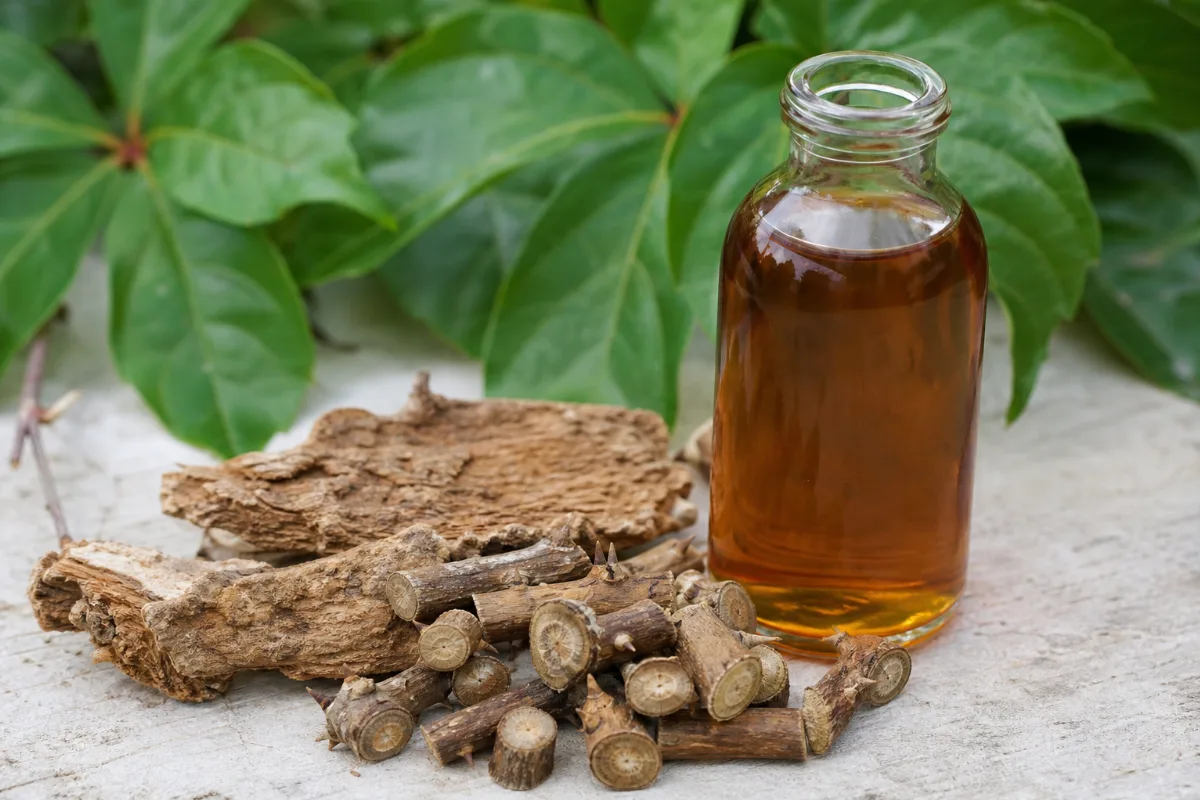
Adaptogens · Herbs & Botanicals · Russian Far East root bark
Zamaniha
Oplopanax elatus · also called Tall oplopanax, zamanika
Zamaniha is the root bark and root of a spiny shrub of the ginseng family from the Russian Far East, northern China and Korea. It was named a classical adaptogen in Soviet Russia and used as a tincture. No study of zamaniha in people was found except one 1982 report in which it was given with another herb and antibiotics. Safety in people is unknown: ask a doctor or pharmacist first, especially if you take prescription medicines.
General information, not medical advice. Last substantive update · Not medically reviewed. A named clinician has not signed off on this page. How this page is made
About Zamaniha
Zamaniha is the root bark and root of a spiny shrub of the ginseng family from the Russian Far East, northern China and Korea. It was named a classical adaptogen in Soviet Russia and used as a tincture. No study of zamaniha in people was found except one 1982 report in which it was given with another herb and antibiotics. Safety in people is unknown: ask a doctor or pharmacist first, especially if you take prescription medicines.
What it is
Zamaniha is a Russian name for Oplopanax elatus, a spiny shrub of the ginseng family (Araliaceae). It grows in north-eastern Asia: China, Russia and Korea. The parts studied are root bark, roots, stems and leaves, including roots grown in culture.
Wild plants are scarce, and growing roots in culture is one way researchers hope to ease the shortage.
Is it an adaptogen?
A 2014 review says it was designated a classical adaptogen in Russia. The adaptogen idea is an old Soviet-era concept, not a medical category.
The label tells you where the plant came from in Russian pharmacology. It does not show that the plant works in people.
What it has been used and studied for
Traditional use is for nervous exhaustion, schizophrenia and heart problems. Studies are on extracts in cells and mice: inflammation, arthritis, liver protection and cancer cells.
The only human report is from 1982: 258 children with dysentery, where two herbs were given together with antibiotics and the authors reported a shorter illness.
How strong is the research
Every use is rated insufficient. We found no modern trial of zamaniha in people. Results in cells and mice often do not carry over to people, and different extracts are different products.
Look-alike plants
Zamaniha is not devil's club (Oplopanax horridus, from North America) and not Siberian ginseng (Eleutherococcus). The cheaper Aralia cordata looks similar and shares a Korean name, so substitution is possible.
At a glance
Traditional uses history, not proof
- China, Russia and Korea: used for different disorders, especially nervous exhaustion (neurasthenia)
- Soviet Russia: designated a classical adaptogen and made into alcohol tinctures
Studied for research
- Stress and fatigue: insufficient (adaptogen label only)
- Inflammation and arthritis: insufficient (cells and mice)
- Liver protection: insufficient (one mouse study)
- Cancer cells: insufficient (cell lines only)
Main compounds
- Falcarindiol and oplopandiol: polyacetylenes, the main compounds named in lab work
- Syringin and chlorogenic acids in some extracts
Common forms
- Alcohol tinctures (Soviet era; how they were made is not described in sources we read)
- Root bark, stem, hot-water and culture-grown root extracts studied in the lab
Research links: Oplopanax elatus: chemistry, traditional use and pharmacology, Chin J Nat Med 2014 · Progress in Oplopanax elatus research, J Ethnopharmacol 2025 · Adaptogens with antibiotics in children with dysentery, Antibiotiki 1982 · Research Library · Genes & Biomarkers Library
The plant and its history
- Accepted scientific name
- Oplopanax elatus (Nakai) Nakai
- Naming authority
- (Nakai) Nakai
- Synonyms
- Echinopanax elatum Nakai (older name, seen in the 1974 and 1982 papers)
- Common names
- Zamaniha (Russian); Zamanika (Russian (variant spelling in our summary)); Tall oplopanax (English)
- Classification
- Plantae > Apiales > Araliaceae > Oplopanax > Oplopanax elatus
- Look-alikes and adulterants
- Name: Aralia cordata; Note: Cheaper, similar-looking root with a shared Korean name; a DNA test exists to tell it apart.; Name: Oplopanax horridus (devil's club); Note: A different species from North America in the same genus; safety and evidence do not transfer.; Name: Eleutherococcus senticosus (Siberian ginseng); Note: A different plant in the same family, given alongside zamaniha in the 1982 report.
The plant and the parts used
Traditional use and history history, not clinical proof
| Tradition or era | Documented use | Source |
|---|---|---|
| Traditional medicine of China, Russia and Korea | Used for different disorders, particularly neurasthenia, schizophrenia and cardiovascular disease (2025 review abstract). | p40107473 |
| Soviet pharmacology | Designated in Russia as a classical adaptogen (2014 review). Soviet-era products were mainly alcohol tinctures, but how they were made is not described in sources we read (NOT verified). | p25443364 |
| Traditional Chinese medicine | A 2021 laboratory paper says it has been used as an adaptogen in TCM for thousands of years. This is an introductory claim, not verified by us. | p34900430 |
Traditional use shows how a plant was used. It does not show that a supplement works or is safe today.
What is inside, and how it may work
What the plant contains and how those compounds act in cells and animals. Laboratory and animal mechanisms are not proven effects in people.
Main compounds
| Compound | Family | Where it is concentrated | Activity studied | Level of evidence |
|---|---|---|---|---|
| Falcarindiol | polyacetylene (polyyne) | Root bark and stem | Strongest anti-growth effect in colon cancer cells in a dish; broken down by gut bacteria in a lab incubation. 13 11 | Laboratory research |
| Oplopandiol | polyacetylene (polyyne) | Root bark and stem | Isolated from the stem extract; weaker than falcarindiol in the cell test. 13 11 | Laboratory research |
| Syringin | phenylpropanoid glycoside | Hot-water extract 214.0 micrograms per gram of dried plant in one hot-water extract | A major constituent of the extract that reduced inflammation signals in mouse cells. 3 | In vitro/animal |
| Chlorogenic and isochlorogenic acid A | phenolic acids | Adventitious roots | Fraction rich in these lowered liver enzymes in overdose-model mice and lowered CYP2E1 and CYP3A11 activity. 2 | Animal research |
| Saponins, flavonoids, anthraquinones, terpenes | various | Not stated | Named in the 2014 review abstract as potential sources of activity. 8 | Review listing |
Mechanisms, receptors and pathways
| Target or pathway | Gene or receptor | What was found | Level |
|---|---|---|---|
| MAP-kinase / AP-1 signalling, COX-2 enzyme activity, iNOS | p38, ERK, JNK, COX-2, iNOS | A hot-water extract blocked these inflammation pathways in mouse cells. 3 | Laboratory research |
| Liver enzymes CYP2E1 and CYP3A11; PPAR signalling | CYP2E1, CYP3A11, PPAR | A chlorogenic-acid fraction lowered activity of these enzymes in mice and changed fat-handling signalling. 2 | Animal research |
| Neutrophil reactive oxygen species and NETs | ROS, NETosis | Culture-grown root extract lowered ROS and NET formation in patient neutrophils (dish) and arthritis in mice. 4 | In vitro/animal |
| Apoptosis and caspase-3 | Caspase-3 | Plant fractions induced apoptosis in colon cancer cells and increased the effect of irinotecan in a dish. 13 12 | Laboratory research |
| Gut-bacteria metabolism | Not applicable | Human gut bacteria in a lab incubation made 62 metabolites from the root bark extract; the authors suggest gut bacteria may mediate its activity. 11 | Laboratory research |
Absorption, metabolism and elimination
- Absorption
- Not found. The 2025 review has a pharmacokinetics section but its abstract gives no findings.
- Distribution
- Not found.
- Metabolism
- Human gut bacteria transformed falcarindiol and oplopandiol into many metabolites in a lab incubation.
- Elimination
- Not found.
- Bioavailability
- Not found.
Isolated compounds versus whole extracts
Almost every result is for a particular extract (hot-water, root bark, stem fraction, culture-grown root fraction) or an isolated compound, tested in cells or mice. These cannot be read as results for a tincture or product, and results from one extract do not carry over to another.
Nutritional composition
Zamaniha is a medicinal herb, not a food. No nutrient table was built for it.
8 not enough evidence
What was looked at
The 8 benefits and uses checked for Zamaniha, each with how strong the evidence is. Tap one to open it.
- Stress resilience and fatigue (the adaptogen label)Not enough evidence
- Nervous exhaustion and mental-health uses (traditional)Not enough evidence
- Added to antibiotics for dysentery in children (1982 report)Not enough evidence
- Inflammation (cells and mice only)Not enough evidence
- Rheumatoid arthritis (cells and mice only)Not enough evidence
- Liver protection after a paracetamol overdose (mice)Not enough evidence
- Cancer cells in a dishNot enough evidence
- Blood pressure and blood sugar (listed in a review, no data seen)Not enough evidence
Lab markers tracked in the studies
Inflammation signals (PGE2, nitric oxide, IL-6, TNF-alpha) in mouse cellsLiver enzymes ALT and AST (mice)Reactive oxygen species and NETs in neutrophils
What is Zamaniha good for?
The traditional and studied uses, and how strong the evidence is for each. Almost everything here comes from tradition, cells or mice.
Benefits, one by one
Each card is a research question, not a promise. Tap a goal to filter. Open a card to see the studies, doses and limits.
Stress resilience and fatigue (the adaptogen label)
Not enough evidenceIn Russia zamaniha was named a classical adaptogen, an old idea of herbs that help the body cope with stress. We found no trial in people showing it helps with stress or tiredness.
2 studiesSoviet-era products were mainly alcohol tinctures, according to our e…
Studies, doses and limits
Results
No result in people. The label comes from Soviet-era pharmacology, not from a trial we could find.
Why this rating
Only a label and traditional use. No human trial of zamaniha for stress or fatigue was found.
Form and dose studied
Soviet-era products were mainly alcohol tinctures, according to our existing summary; how they were made is not described in the sources we read.
Limits
Only abstracts were read. The adaptogen review does not mention zamaniha.
Why researchers looked
The plant was designated a classical adaptogen in Russia, so it is described in that framework.
Traditional use
The 2014 review says it is used for different disorders in the medicine systems of China, Russia and Korea and was designated in Russia as a classical adaptogen.
Proposed mechanism Theory
Not shown for this plant. The adaptogen review proposes effects on the stress, nervous and immune systems for adaptogens in general, but its abstract does not name zamaniha.
A proposed mechanism does not show that the effect happens in people.
See the safety tab. Safety in people has not been described in the sources we could read.
Nervous exhaustion and mental-health uses (traditional)
Not enough evidenceA 2025 review lists neurasthenia (an old term for nervous exhaustion) and schizophrenia among the long-standing traditional uses. No trial was found for either.
1 studiesNot described.
Studies, doses and limits
Results
No result. Traditional use does not show that it works, and schizophrenia in particular needs proper medical treatment.
Why this rating
Traditional listing only; no trial found.
Form and dose studied
Not described.
Limits
Abstract only. We do not know how old or how well documented these uses are.
Why researchers looked
These are the traditional uses the reviewers name first.
Traditional use
China, South Korea and Russia, per the 2025 review abstract.
Proposed mechanism Theory
Not described in the abstracts we read.
A proposed mechanism does not show that the effect happens in people.
Do not replace prescribed treatment for a mental-health condition with an herb.
Added to antibiotics for dysentery in children (1982 report)
Not enough evidenceOne old Russian report of 258 children found a shorter illness when antibiotics were combined with two adaptogens (Eleutherococcus and zamaniha). Zamaniha cannot be judged alone.
1 studiesForm of zamaniha not stated in the abstract.
Studies, doses and limits
What the trials found
One 1982 report, 258 children aged 0 to 14: 157 got monomycin and kanamycin plus the two adaptogens, 101 got the antibiotics alone.
Results
The authors report shorter disease periods with the adaptogens. The abstract gives no numbers and no statistics.
Effect sizes as reported
Not given
Why this rating
Very old, abstract only, two herbs given together, no description of how children were assigned, no numbers.
Form and dose studied
Form of zamaniha not stated in the abstract.
Who was studied
Children with Shigella dysentery or Proteus enterocolitis
Limits
Not a modern trial. Cannot separate zamaniha from Eleutherococcus.
Why researchers looked
Soviet-era interest in adaptogens as add-ons to treatment.
Traditional use
Adaptogen tradition of the Soviet period.
Proposed mechanism Human data
The authors measured immune markers but the abstract does not explain a mechanism.
A proposed mechanism does not show that the effect happens in people.
Never give an herb to a sick child in place of medical care. Dysentery in children needs a doctor.
Inflammation (cells and mice only)
Not enough evidenceA hot-water extract lowered inflammation signals in mouse cells and ear swelling in mice. No human study.
2 studiesHot-water extract; results do not carry to other extracts or products.
Studies, doses and limits
Results
Lower PGE2, nitric oxide, interleukin-6 and tumour necrosis factor-alpha in mouse cells; less croton-oil ear swelling in mice by mouth.
Effect sizes as reported
Dose-dependent in the abstract; no human size
Why this rating
Cells and mice only.
Form and dose studied
Hot-water extract; results do not carry to other extracts or products.
Who was studied
Mouse cells; mice
Limits
Abstract only.
Why researchers looked
The 2014 review lists anti-inflammatory effects from experiments.
Traditional use
Not specific.
Proposed mechanism In vitro/animal
The extract reduced prostaglandin E2 and nitric oxide and blocked MAP-kinase signalling in mouse cells.
A proposed mechanism does not show that the effect happens in people.
None specific.
Rheumatoid arthritis (cells and mice only)
Not enough evidenceAn extract of culture-grown roots reduced arthritis in mice and lowered reactive oxygen species in white cells taken from patients and tested in a dish. Nobody with arthritis took it.
1 studiesAdventitious (culture-grown) root extract.
Studies, doses and limits
What the trials found
Patient blood and joint-fluid samples were used for cell tests only.
Results
Fewer cases and less severe arthritis in collagen-induced arthritis mice; less NET formation in patient neutrophils in a dish.
Effect sizes as reported
Not given in the abstract
Why this rating
Cell and mouse work; no treatment trial.
Form and dose studied
Adventitious (culture-grown) root extract.
Who was studied
Mice; patient cells
Limits
Abstract only. 2026 paper, not yet repeated.
Why researchers looked
Researchers tested an anti-inflammatory extract in an inflammatory joint disease.
Traditional use
Not specific.
Proposed mechanism In vitro/animal
Less reactive oxygen species, so fewer neutrophil extracellular traps (NETs).
A proposed mechanism does not show that the effect happens in people.
Do not stop prescribed arthritis medicines.
Liver protection after a paracetamol overdose (mice)
Not enough evidenceA chlorogenic-acid-rich fraction of culture-grown roots lowered liver enzymes in mice given a paracetamol overdose. It also changed liver enzymes that handle medicines.
1 studiesAdventitious-root fraction, not the whole plant.
Studies, doses and limits
Results
Lower ALT and AST and lower paracetamol metabolites in mouse serum.
Effect sizes as reported
Not given in the abstract
Why this rating
One mouse study of a purified fraction.
Form and dose studied
Adventitious-root fraction, not the whole plant.
Who was studied
Mice
Limits
Abstract only. Overdose model.
Why researchers looked
To see whether the extract could protect against drug-caused liver injury.
Traditional use
Not specific.
Proposed mechanism Animal research
Lower CYP2E1 and CYP3A11 activity and changed PPAR signalling.
A proposed mechanism does not show that the effect happens in people.
Changing medicine-processing enzymes is also an interaction concern. Never use an herb as a cure for a paracetamol overdose; call emergency services.
Cancer cells in a dish
Not enough evidenceStem and root extracts and two compounds (falcarindiol, oplopandiol) slowed growth of human cancer cells in a dish. This is far from a cancer treatment.
3 studiesEthyl-acetate and dichloromethane fractions; isolated compounds.
Studies, doses and limits
Results
Growth of breast, stomach and colon cancer cell lines was reduced; in colon cells a plant fraction plus the chemotherapy drug irinotecan gave a combination index of 0.56 (synergy).
Effect sizes as reported
Cell-line results only
Why this rating
Cell lines only.
Form and dose studied
Ethyl-acetate and dichloromethane fractions; isolated compounds.
Who was studied
Human cancer cell lines
Limits
Abstracts only. Dish results rarely predict results in patients.
Why researchers looked
Polyacetylenes in the plant are active in cell tests.
Traditional use
Not specific.
Proposed mechanism Laboratory research
Induction of apoptosis and caspase-3 activation in colon cancer cells.
A proposed mechanism does not show that the effect happens in people.
If you are having cancer treatment, tell your oncology team about any herb you take; do not use an herb as a substitute.
Blood pressure and blood sugar (listed in a review, no data seen)
Not enough evidenceA 2014 review lists blood-pressure-modulating and anti-diabetic effects from experiments. We did not see the data, so we treat this as a flag only.
2 studiesNot stated.
Studies, doses and limits
Results
The abstract gives no data.
Why this rating
Mention in a review abstract only.
Limits
We could not read the review text.
Why researchers looked
Listed in the review abstract.
Traditional use
The 2025 review lists cardiovascular disease among traditional uses.
Proposed mechanism Theory
Not described in the abstract.
A proposed mechanism does not show that the effect happens in people.
People on blood-pressure or diabetes medicines should ask a pharmacist first.
Connections to the rest of health
How Zamaniha connects to the rest of our health knowledge graph. Every link says what kind of connection it is. A safety link (for example to the liver) is a warning, not a benefit. A study that merely mentions a topic never creates a benefit link.
Explore every connection: goals, body systems, organs, symptoms, genes
A. Wellness goals
| Connected to | Kind of connection | Evidence status | Context | Studies |
|---|---|---|---|---|
| Stress reduction | Traditional use | Not enough evidence | Adaptogen label only; no trial found. Stress resilience and fatigue (the adaptogen label): In Russia zamaniha was named a classical adaptogen, an old idea of herbs that help the body cope with stress. We found no trial in people showing it helps with stress or tiredness. Preparation or compound: Zamaniha (various preparations) |
8 7 |
| Reduce Fatigue | Traditional use | Not enough evidence | Stress resilience and fatigue (the adaptogen label): In Russia zamaniha was named a classical adaptogen, an old idea of herbs that help the body cope with stress. We found no trial in people showing it helps with stress or tiredness. | 8 7 |
| Resilience Support | Traditional use | Not enough evidence | Stress resilience and fatigue (the adaptogen label): In Russia zamaniha was named a classical adaptogen, an old idea of herbs that help the body cope with stress. We found no trial in people showing it helps with stress or tiredness. | 8 7 |
| Mental Clarity | Traditional use | Not enough evidence | Nervous exhaustion and mental-health uses (traditional): A 2025 review lists neurasthenia (an old term for nervous exhaustion) and schizophrenia among the long-standing traditional uses. No trial was found for either. | 14 |
| Calm Relaxation | Traditional use | Not enough evidence | Nervous exhaustion and mental-health uses (traditional): A 2025 review lists neurasthenia (an old term for nervous exhaustion) and schizophrenia among the long-standing traditional uses. No trial was found for either. | 14 |
| Burnout Recovery | Traditional use | Not enough evidence | Nervous exhaustion and mental-health uses (traditional): A 2025 review lists neurasthenia (an old term for nervous exhaustion) and schizophrenia among the long-standing traditional uses. No trial was found for either. | 14 |
| Immune Support | Not enough evidence | Added to antibiotics for dysentery in children (1982 report): One old Russian report of 258 children found a shorter illness when antibiotics were combined with two adaptogens (Eleutherococcus and zamaniha). Zamaniha cannot be judged alone. | 10 | |
| Digestive Support | Not enough evidence | Added to antibiotics for dysentery in children (1982 report): One old Russian report of 258 children found a shorter illness when antibiotics were combined with two adaptogens (Eleutherococcus and zamaniha). Zamaniha cannot be judged alone. | 10 | |
| Inflammation Balance | Preliminary mechanism | Not enough evidence | Inflammation (cells and mice only): A hot-water extract lowered inflammation signals in mouse cells and ear swelling in mice. No human study. Rheumatoid arthritis (cells and mice only): An extract of culture-grown roots reduced arthritis in mice and lowered reactive oxygen species in white cells taken from patients and tested in a dish. Nobody with arthritis took it. | 3 8 4 |
| Joint Support | Preliminary mechanism | Not enough evidence | Rheumatoid arthritis (cells and mice only): An extract of culture-grown roots reduced arthritis in mice and lowered reactive oxygen species in white cells taken from patients and tested in a dish. Nobody with arthritis took it. | 4 |
| Liver Support | Preliminary mechanism | Not enough evidence | Liver protection after a paracetamol overdose (mice): A chlorogenic-acid-rich fraction of culture-grown roots lowered liver enzymes in mice given a paracetamol overdose. It also changed liver enzymes that handle medicines. | 2 |
| Detoxification Support | Preliminary mechanism | Not enough evidence | Liver protection after a paracetamol overdose (mice): A chlorogenic-acid-rich fraction of culture-grown roots lowered liver enzymes in mice given a paracetamol overdose. It also changed liver enzymes that handle medicines. | 2 |
| Preventive Wellness | Preliminary mechanism | Not enough evidence | Cancer cells in a dish: Stem and root extracts and two compounds (falcarindiol, oplopandiol) slowed growth of human cancer cells in a dish. This is far from a cancer treatment. | 13 12 11 |
| Blood Pressure Support | Traditional use | Not enough evidence | Blood pressure and blood sugar (listed in a review, no data seen): A 2014 review lists blood-pressure-modulating and anti-diabetic effects from experiments. We did not see the data, so we treat this as a flag only. | 8 14 |
| Blood Sugar Balance | Traditional use | Not enough evidence | Blood pressure and blood sugar (listed in a review, no data seen): A 2014 review lists blood-pressure-modulating and anti-diabetic effects from experiments. We did not see the data, so we treat this as a flag only. | 8 14 |
B. Body systems
| Connected to | Kind of connection | Evidence status | Context | Studies |
|---|---|---|---|---|
| Stress Mood | Biological association | Not enough evidence | Studied for: Stress resilience and fatigue (the adaptogen label) Studied for: Nervous exhaustion and mental-health uses (traditional) | 8 7 14 |
| Energy Fatigue | Biological association | Not enough evidence | Studied for: Stress resilience and fatigue (the adaptogen label) | 8 7 |
| Nervous System | Biological association | Not enough evidence | Studied for: Nervous exhaustion and mental-health uses (traditional) | 14 |
| Immune System | Biological association | Not enough evidence | Studied for: Added to antibiotics for dysentery in children (1982 report) Studied for: Rheumatoid arthritis (cells and mice only) | 10 4 |
| Digestive System | Biological association | Not enough evidence | Studied for: Added to antibiotics for dysentery in children (1982 report) | 10 |
| Pain Inflammation | Biological association | Not enough evidence | Studied for: Inflammation (cells and mice only) | 3 8 |
| Bones Joints Muscles | Biological association | Not enough evidence | Studied for: Rheumatoid arthritis (cells and mice only) | 4 |
| Liver Detox | Biological association | Not enough evidence | Studied for: Liver protection after a paracetamol overdose (mice) | 2 |
| Hepatic System | Biological association | Not enough evidence | Studied for: Liver protection after a paracetamol overdose (mice) | 2 |
| Wellness Prevention | Biological association | Not enough evidence | Studied for: Cancer cells in a dish | 13 12 11 |
| Cardiovascular System | Biological association | Not enough evidence | Studied for: Blood pressure and blood sugar (listed in a review, no data seen) | 8 14 |
| Endocrine System | Biological association | Not enough evidence | Studied for: Blood pressure and blood sugar (listed in a review, no data seen) | 8 14 |
C. Body parts and organs
E. Health conditions
| Connected to | Kind of connection | Evidence status | Context | Studies |
|---|---|---|---|---|
| Contact dermatitis | Case report | Skin diseases reported; type unverified. Preparation or compound: Extracts (1974 title only) |
5 |
I. Biomarkers
| Connected to | Kind of connection | Evidence status | Context | Studies |
|---|---|---|---|---|
| Inflammation signals (PGE2, nitric oxide, IL-6, TNF-alpha) in mouse cells | Biological association | Not enough evidence | Measured in trials: lowered. A lab change is not the same as a health benefit. | 3 |
| Liver enzymes ALT and AST (mice) | Biological association | Not enough evidence | Measured in trials: lowered. A lab change is not the same as a health benefit. | 2 |
| Reactive oxygen species and NETs in neutrophils | Biological association | Not enough evidence | Measured in trials: lowered. A lab change is not the same as a health benefit. | 4 |
L. Active compounds
| Connected to | Kind of connection | Evidence status | Context | Studies |
|---|---|---|---|---|
| Falcarindiol | Biological association | In vitro | Strongest anti-growth effect in colon cancer cells in a dish; broken down by gut bacteria in a lab incubation. Preparation or compound: Root bark and stem |
13 11 |
| Oplopandiol | Biological association | In vitro | Isolated from the stem extract; weaker than falcarindiol in the cell test. Preparation or compound: Root bark and stem |
13 11 |
| Syringin | Biological association | In vitro/animal | A major constituent of the extract that reduced inflammation signals in mouse cells. Preparation or compound: Hot-water extract |
3 |
| Chlorogenic and isochlorogenic acid A | Biological association | Animal | Fraction rich in these lowered liver enzymes in overdose-model mice and lowered CYP2E1 and CYP3A11 activity. Preparation or compound: Adventitious roots |
2 |
| Saponins, flavonoids, anthraquinones, terpenes | Biological association | Review listing | Named in the 2014 review abstract as potential sources of activity. | 8 |
Each connection is stored with the ingredient, the connected record, the kind of connection, the evidence status, the supporting studies, the preparation or compound involved, and a review date (last reviewed October 25, 2026).
Evidence at a glance: what changed in 3 lab markers
Tap a number to show only those markers. Counts are markers, not people.
The evidence
The research centre for Zamaniha. Every record here was checked against PubMed or the publisher's page; we never list a study we have not verified.
Evidence by outcome
Bars show how many studies we found for each outcome, not how well it works. People are added up across trials only (reviews are not added, to avoid double counting).
How we rate evidence
High certainty
Several well-run trials or reviews agree; further research is unlikely to change the picture much.
Moderate certainty
Good trials point the same way, but some doubt remains.
Low certainty
Small, short or inconsistent trials. The finding could change with better research.
Very low certainty
Very little or very weak human data. Treat as a possibility only.
Mixed findings
Trials or reviews disagree with each other.
Not enough evidence
Not enough human research to say either way.
Evidence against
Good research found no benefit, or found harm.
We take the reviewers' own risk-of-bias and GRADE statements where they exist, and otherwise judge from study size, design, consistency, directness and whether a product matches what is sold. Many publications do not make evidence high. Method note: We built this page from our existing summary of zamaniha and checked PubMed records, the GBIF taxonomy record and a search for LiverTox and LactMed entries. Only abstracts were read. EMA, FDA, NCCIH, LiverTox and LactMed were not opened and are marked not verified. Certainty ratings are the compiler's own reading, not formal grades. No study is cited that we could not verify.
Study library: every study we checked 14
| Study | Design | People | Product, dose, length | Result |
|---|---|---|---|---|
| GBIF 2026 GBIF backbone: Oplopanax elatus (Nakai) Nakai (key 3036347) GBIF · Source |
Database record not applicable |
Not applicable | Not applicable |
GBIF species/match API returned ACCEPTED, exact match, confidence 99, family Araliaceae, order Apiales, no synonym flag, checked 2026-10-25. Not applicable (Not applicable) Methods, limits and fundingOutcomes: Not applicable Limitations: A database record only; it does not describe the plant or its safety. Read: full-text |
| Jiang 2022 Hepatoprotective Effect of Oplopanax elatus Nakai Adventitious Roots Extract by Regulating CYP450 and PPAR Signaling Pathway Front Pharmacol · PMID 35586046 · DOI |
Animal research mouse |
Mice given a paracetamol (acetaminophen) overdose | Chlorogenic-acid-enriched fraction of Oplopanax elatus adventitious-root extract (OEB) adventitious (culture-grown) roots 7 days by mouth before the overdose |
The fraction lowered the liver enzymes ALT and AST after the overdose. It lowered paracetamol and its metabolites APAP-CYS and APAP-NAC in serum by inhibiting the activity of the liver enzymes CYP2E1 and CYP3A11, changed PPAR (fat-handling) signalling, and raised the gut bacteria Akkermansia and Parabacteroides. Lower ALT and AST in mice; reduced CYP2E1 and CYP3A11 activity (Not given in abstract) Methods, limits and fundingOutcomes: Liver enzymes in blood, paracetamol metabolites, liver immune cells, gut bacteria Limitations: Mouse study of a purified fraction, not the whole plant. It shows the extract can change how the liver handles a medicine, which is also why it raises an interaction question. No human data. Only the abstract was read. Funding and conflicts: Not stated in the abstract Read: abstract |
| Kwon 2020 Inhibitory Mechanisms of Water Extract of Oplopanax elatus on Lipopolysaccharide-Induced Inflammatory Responses in RAW 264.7 Murine Macrophage Cells Chin J Integr Med · PMID 31970677 · DOI |
In vitro and animal mouse |
Mouse macrophage cells and mice with croton-oil ear swelling | Hot-water extract of Oplopanax elatus (syringin 214.0 micrograms per gram of dried plant) plant (part not stated in the abstract) · vs Untreated cells and mice (assumed) |
In mouse cells the extract reduced PGE2 and nitric oxide production and lowered interleukin-6 and tumour necrosis factor-alpha. It blocked activation of three MAP-kinase signalling enzymes. In mice, oral extract reduced croton-oil ear swelling in a dose-dependent way. Dose-dependent reduction in cells and mouse ear swelling; no human data (Not given in abstract) Methods, limits and fundingOutcomes: Prostaglandin E2 and nitric oxide production, signalling enzymes, cytokines; ear swelling Limitations: Cells and mice only. One extract type. Results in cells and mice often do not carry over to people. Only the abstract was read. Funding and conflicts: Not stated in the abstract Read: abstract |
| Lin 2026 Adventitial root extract of Oplopanax elatus alleviates rheumatoid arthritis via inhibiting NETosis Clin Rheumatol · PMID 42461565 · DOI |
In vitro and animal mouse |
Blood and joint fluid and neutrophils from people with rheumatoid arthritis (cell tests); mice with collagen-induced arthritis | Adventitial (culture-grown) root extract of Oplopanax elatus adventitious roots · vs Untreated cells and mice (assumed) |
Cell-free DNA was higher in patients than in healthy controls and rose with disease activity scores. The extract was not obviously toxic to patient neutrophils and reduced their reactive oxygen species and NET production. In arthritis mice it reduced how many got arthritis, its severity and NET deposition. People were not treated with the extract. Reduced arthritis in mice; reduced NETs in patient cells in a dish (Not given in abstract) Methods, limits and fundingOutcomes: Reactive oxygen species and neutrophil extracellular traps (NETs) in cells; arthritis rate and severity in mice Limitations: Patient samples were used only for cell tests. No one took the extract. Only the abstract was read. Funding and conflicts: Not stated in the abstract Read: abstract |
| Lopatin 1974 [Skin diseases caused by the use of extracts of Echinopanax elatum Nacai] (Russian) Vestn Dermatol Venerol · PMID 4275406 |
Title only human (inferred from the title) |
Not available | Extracts of Echinopanax elatum (old name of Oplopanax elatus) not available |
Only the title could be read: it reports skin diseases caused by the use of extracts of the plant. No abstract is held by PubMed, so the type of skin problem, how many people, which extract and how it was used are unknown. Not available (Not given in abstract) Methods, limits and fundingOutcomes: Not available Limitations: Title only. We cannot say what kind of skin reaction it was, how common, or whether it was allergy or irritation. Funding and conflicts: Not available Read: title-only |
| NCBI Bookshelf (esearch) 2026 NCBI Bookshelf search for LiverTox / LactMed entries on Oplopanax, Echinopanax or zamaniha NCBI Bookshelf · Source |
Database record not applicable |
Not applicable | Not applicable |
The search returned 0 results, checked 2026-10-25. The LiverTox and LactMed sites themselves were not opened. Not applicable (Not applicable) Methods, limits and fundingOutcomes: Not applicable Limitations: A zero-result search is not proof that no entry exists. Read: search-only |
| Panossian 2021 Evolution of the adaptogenic concept from traditional use to medical systems: Pharmacology of stress- and aging-related diseases Med Res Rev · PMID 33103257 · DOI |
Narrative review mixed |
Not applicable (literature review of adaptogenic plants) | Adaptogenic plants in general various |
The abstract describes adaptogens as herbal products said to promote resilience in stress, with effects on the neuroendocrine-immune system and a biphasic dose response. It calls the potential of adaptogens poorly explored. The abstract does not mention zamaniha. Descriptive review (Not given in abstract) Methods, limits and fundingOutcomes: Concept of adaptogens and their proposed actions Limitations: Only the abstract was read. Used here only to show that "adaptogen" is a concept and not a proven effect. The abstract does not name Oplopanax elatus. Funding and conflicts: Not stated in the abstract Read: abstract |
| Shikov 2014 Oplopanax elatus (Nakai) Nakai: chemistry, traditional use and pharmacology Chin J Nat Med · PMID 25443364 · DOI |
Narrative review mixed |
Not applicable (literature review) | Oplopanax elatus, various preparations as reviewed plant (parts as reviewed) |
The abstract says the plant is used in the medicine systems of China, Russia and Korea and was designated in Russia as a classical adaptogen. It lists adaptogenic, anticonvulsant, anti-diabetic, antifungal, anti-inflammatory, antioxidant, blood-pressure-modulating and reproductive-function effects from experimental studies and clinical applications. The abstract gives no numbers and no safety findings. Descriptive review; no pooled effect (Not given in abstract) Methods, limits and fundingOutcomes: Chemistry, traditional use, pharmacology and safety summary Limitations: Only the abstract was read. It does not say which of the listed effects were seen in people. Narrative review, no stated method for choosing papers. Funding and conflicts: Not stated in the abstract Read: abstract |
| Uh et al. 2023 Development of real-time PCR-based markers for differentiation of Oplopanax elatus and Aralia cordata in commercial food products Food Sci Biotechnol · PMID 37869529 · DOI |
Laboratory method not applicable |
10 commercial products and 14 non-target plant species | DNA test (real-time PCR) to tell Oplopanax elatus from Aralia cordata plant material in food products |
The abstract says both plants are called "Dureub" in Korea and look alike in the root, that O. elatus is rare, endangered and expensive while A. cordata is cheaper and more abundant, so fraud is possible. The authors developed species-specific DNA markers, tested them on 14 non-target species and 10 commercial products, and report reliable results in a blind test. A working identity test; no fraud rate reported (Not given in abstract) Methods, limits and fundingOutcomes: Species-specific identification Limitations: The abstract does not say how many products were found to be mislabelled. Only the abstract was read. Funding and conflicts: Not stated in the abstract Read: abstract |
| Vereshchagin 1982 [Increased effectiveness of antibiotic therapy with adaptogens in dysentery and Proteus infection in children] (Russian) Antibiotiki · PMID 7036851 |
Non randomised clinical report |
258 258 children aged 0 to 14 with acute dysentery (Shigella sonnei and flexneri) or Proteus enterocolitis |
Eleutherococcus plus Echinopanax elatum (zamaniha) "adaptogens" added to monomycin and kanamycin; form not stated · vs Antibiotics alone (101 children) |
157 children got antibiotics with the two adaptogens and 101 got antibiotics alone. The authors report that the adaptogens shortened the periods of the disease and conclude they raise the effect of antibiotics. The abstract gives no durations, no statistics and does not say how children were assigned to groups. Shorter illness reported; size not given (Not given) Methods, limits and fundingOutcomes: Course of illness and immune measures (immunoglobulins, antibody titres, blood bactericidal activity) Limitations: 1982 report, abstract only. Zamaniha was given together with Eleutherococcus, so its own effect cannot be separated. Randomisation, blinding and numbers are not described in the abstract. Not a modern trial. Funding and conflicts: Not stated Read: abstract |
| Wan 2021 Chemical profiling of root bark extract from Oplopanax elatus and its in vitro biotransformation by human intestinal microbiota PeerJ · PMID 34900430 · DOI |
Laboratory research in vitro |
Laboratory chemistry with human gut bacteria | Root bark extract of Oplopanax elatus root bark |
18 compounds were identified in the root bark extract and 62 metabolites were made by human intestinal bacteria in a lab incubation. Two polyynes, falcarindiol and oplopandiol, were the main components. Chemistry; no health outcome (Not given in abstract) Methods, limits and fundingOutcomes: Compounds identified; metabolites made by gut bacteria Limitations: No health outcome measured. Only the abstract was read. Funding and conflicts: Not stated in the abstract Read: abstract |
| Wang et al. 2019 Synergetic Inhibition of Human Colorectal Cancer Cells by Combining Polyyne-Enriched Fraction from Oplopanax elatus and Irinotecan Nutr Cancer · PMID 30372160 · DOI |
Laboratory research in vitro |
Human colorectal cancer cells (SW-480) in a dish | Polyyne-enriched dichloromethane fraction of Oplopanax elatus (OED) with the chemotherapy drug irinotecan plant (part not stated in the abstract) |
The fraction with irinotecan stopped cell growth more than expected from each alone (combination index 0.56) and raised the share of cells undergoing apoptosis, from 69.57% (irinotecan) or 72.7% (fraction) to 95.6% with both. Synergy in cells (combination index 0.56) (Not given in abstract) Methods, limits and fundingOutcomes: Cell growth, combination index, apoptosis, caspase-3 Limitations: Cells in a dish only. It shows the extract can change how cells respond to a chemotherapy drug in the laboratory; it does not say whether it is helpful or harmful for a patient. Only the abstract was read. Funding and conflicts: Not stated in the abstract Read: abstract |
| Yang 2018 Anticancer Activity of an Oplopanax elatus Stem Extract and Biologically Active Isolated Compounds Curr Pharm Biotechnol · PMID 29766799 · DOI |
Laboratory research in vitro |
Human breast (MCF-7), colon (HCT-116) and stomach (AGS) cancer cell lines in a dish | Ethyl-acetate fraction of Oplopanax elatus; isolated polyacetylenes falcarindiol and oplopandiol stem · vs Untreated cells |
The fraction strongly suppressed growth of the three cancer cell lines and induced apoptosis in colon cancer cells. Falcarindiol was the most active compound in colon cancer cells. Reduced growth of cancer cells in a dish (Not given in abstract) Methods, limits and fundingOutcomes: Cell growth and programmed cell death Limitations: Cell-line work only. Not a cancer treatment result and no animals or people. Only the abstract was read. Funding and conflicts: Not stated in the abstract Read: abstract |
| Zhou 2025 Progress in Oplopanax elatus research: Resources, propagation, traditional uses, phytochemistry, pharmacology, pharmacokinetics, quality control, and toxicity J Ethnopharmacol · PMID 40107473 · DOI |
Narrative review mixed |
Not applicable (literature review to June 2024) | Oplopanax elatus, various preparations as reviewed plant (roots, adventitious roots and other parts as reviewed) |
The abstract says the plant has long ethnomedical use in China, South Korea and Russia, particularly for neurasthenia, schizophrenia and cardiovascular disease. It says raw material is scarce because wild stocks are depleted and cultivation is underdeveloped, that adventitious-root culture could ease this, and that more work on quality control and molecular biology is needed. Toxicity is a section of the review but the abstract gives no toxicity findings. Descriptive review; no pooled effect (Not given in abstract) Methods, limits and fundingOutcomes: Resources, traditional uses, chemistry, pharmacology, pharmacokinetics, quality control, toxicity Limitations: Only the abstract was read, so the toxicity and pharmacokinetics findings are unknown to us. Funding and conflicts: Not stated in the abstract Read: abstract |
What we do not know yet
- No trial of zamaniha alone in people for any use.
- No human safety or interaction data.
- The safety and toxicity sections of the reviews could not be read.
- The 1974 skin-disease paper was read by title only.
How new research is added
New studies are found by a saved PubMed search and placed in a review queue. A person reads each one before it changes any evidence rating or safety wording. New publications never change ratings automatically.
Lab markers
What changed in blood or saliva tests during trials. A changed number is not the same as feeling or being healthier, and we give no "normal ranges".
Other 3
Inflammation signals (PGE2, nitric oxide, IL-6, TNF-alpha) in mouse cells
Lowered in trials
Chemical messengers that rise when cells are inflamed.
Not enough evidenceResults and what it means
Liver enzymes ALT and AST (mice)
Lowered in trials
Enzymes that leak into the blood when liver cells are damaged.
Not enough evidenceResults and what it means
Why it was measured
Measures of liver injury.
Statistical vs. clinical meaning
Animal result; also shows the fraction changes medicine-handling enzymes.
Safety implication
Possible interaction with medicines cleared by these enzymes (theory).
| Study | Result | People | Product |
|---|---|---|---|
| 2 | Lower ALT and AST after an overdose; lower CYP2E1 and CYP3A11 activity | Mice given a paracetamol overdose | Chlorogenic-acid-rich fraction of adventitious roots, 7 days by mouth |
Reactive oxygen species and NETs in neutrophils
Lowered in trials
Oxygen radicals and DNA webs released by white cells that can drive joint inflammation.
Not enough evidenceResults and what it means
Why it was measured
Linked to rheumatoid arthritis activity.
Statistical vs. clinical meaning
Cell and mouse result.
Safety implication
None specific.
| Study | Result | People | Product |
|---|---|---|---|
| 4 | Lower ROS and NET production; less arthritis and NET deposition in mice | Neutrophils from rheumatoid arthritis patients (in a dish); collagen-induced arthritis mice | Adventitial root extract of Oplopanax elatus |
Safety
What studies and official sources say about side effects, medicines and who should check first. Each point shows what kind of evidence it comes from.
Main points to know 6
- Safety in people is not established. We found no safety trial and no modern human study of zamaniha. Both reviews cover safety or toxicity, but their abstracts give no findings, and we could not read the full text. Unknown does not mean safe. Evidence gap 8 14
- A skin-disease report from 1974 (title only). A 1974 Russian paper title says skin diseases were caused by extracts of this plant (under its old name Echinopanax elatum). We could not read the abstract, so the kind of reaction, how often and with what extract are unknown. Case report 5
- May change how the liver processes some medicines (mouse data). In mice a chlorogenic-acid fraction of culture-grown roots lowered the activity of the liver enzymes CYP2E1 and CYP3A11 and changed paracetamol metabolism. No interaction study in people exists. Ask a pharmacist before combining it with prescription medicines. Animal research 2
- Cancer treatment: lab synergy with irinotecan. In a dish a polyyne-rich fraction made irinotecan work more strongly on colon cancer cells. This does not show benefit or harm in patients. Tell your oncology team about any herb before or during treatment. Laboratory research 12
- Look-alike and adulteration risk. The plant is rare and expensive. A 2023 study says the cheaper Aralia cordata looks similar and shares a Korean name (Dureub), so substitution is possible, and developed a DNA test to tell them apart. Wild stocks are depleted. Laboratory 9 14
- Pregnancy and breastfeeding: no data. No safety information for pregnancy, breastfeeding or children was found. Avoid unless a clinician who knows the herb agrees. Evidence gap
Side effects 2
| Effect | How often | Severity and recovery | Evidence |
|---|---|---|---|
| Skin disease reported after extracts (1974 title) Title only; the abstract is not available. Do not assume it was allergy. | Not established | Not stated Not stated | Case report 5 |
| No adverse events reported in the 1982 children's report The abstract does not mention adverse events either way; that is not evidence of safety. | Not established | Not applicable Not applicable | Other 10 |
Liver
No case of liver injury from zamaniha was found. A search of NCBI Bookshelf found no LiverTox or LactMed entry (0 results; the sites themselves were not opened). Mouse work shows an extract fraction can alter liver medicine-processing enzymes and, in an overdose model, lowered liver enzymes. That is animal data and does not mean it is safe for the liver in people. Absence of reports is not proof of safety. 2 6
How often. No frequency found.
Monitoring. No agency monitoring advice was found.
This is a safety connection. It is not evidence that Zamaniha supports liver health.
Medicines and supplements 6
| With | Why it matters | Importance | Evidence | What to do |
|---|---|---|---|---|
| Medicines cleared by liver enzymes (CYP2E1, CYP3A family), including paracetamol (acetaminophen) drug | In mice a chlorogenic-acid-rich fraction lowered CYP2E1 and CYP3A11 activity and the amount of paracetamol and its metabolites in serum. | Unknown in people. If similar, levels of some medicines could change. | Animal research Very low certainty 2 | Ask a pharmacist before combining it with prescription medicines, especially ones with a narrow safety margin. |
| Chemotherapy (irinotecan) drug | In colon cancer cells in a dish a plant polyyne fraction plus irinotecan gave synergy (combination index 0.56). | Unknown. Could mean stronger effect on cells, and nothing is known about side effects in patients. | Laboratory research Very low certainty 12 | Tell your oncology team about any herb before or during treatment. |
| Blood-pressure and diabetes medicines drug | Theory: a 2014 review lists blood-pressure-modulating and anti-diabetic effects from experiments. | No data seen. If real, effects could add up. | Theory Very low certainty 8 | Ask a prescriber or pharmacist first if you take these medicines. |
| Antibiotics drug | Not studied as an interaction. A 1982 report gave zamaniha with Eleutherococcus alongside two antibiotics. | No interaction was assessed in the abstract. | Clinical report Very low certainty 10 | Do not add herbs to an antibiotic course without asking the prescriber. |
| Alcohol (if taken as an alcohol tincture) other | Soviet-era products were alcohol tinctures. Alcohol itself interacts with many medicines and with liver disease and pregnancy. This is a general point about tinctures, not a finding about this plant. | Depends on the product. | Theory Very low certainty | Check the label for alcohol, and ask a pharmacist if you take sedatives or other interacting medicines. |
| Other herbs and supplements herb | Not studied. | Unknown. | Evidence gap Not enough evidence | Tell a pharmacist about every herb you use. |
Who should check first 6
| Situation | Advice | Evidence |
|---|---|---|
| Pregnancy and breastfeeding | Avoid unless a knowledgeable clinician agrees; no data were found. | Evidence gap |
| Children | Only an old combined report exists, for sick children under medical care. Do not self-treat children. | Evidence gap 10 |
| Liver disease, or taking medicines with a narrow safety margin | Ask first; the liver-enzyme effect in mice is a reason for care (theory). | Animal research 2 |
| Kidney disease | Not described in any source we read. Ask a clinician. | Evidence gap |
| Skin problems or a history of reactions to plants of the ginseng family | A 1974 title reports skin diseases from extracts. Stop and see a doctor if a rash appears. | Case report 5 |
| Surgery planned | No data found; tell your surgical team about any herb. | Evidence gap |
Overdose, product quality and regulators
Summary. The 2025 review has a toxicity section but its abstract states no findings, so we cannot report them. No other toxicity assessment was found.
Animal. Not found in the abstracts read.
Human doses studied. No safety study in people. Not guidance.
Overdose response. Not described. Seek medical help for any severe reaction.
Genotoxicity. Not found.
Toxic plant parts. Not described. The studied parts are root bark, roots, adventitious roots, stems and leaves; no part is stated to be toxic in what we read. The stems are spiny; we did not verify handling irritation.
Supply is scarce and the plant is easily mixed up with others. We found no contamination survey (heavy metals, pesticides).
Substitution. The abstract says Oplopanax elatus and the cheaper Aralia cordata look alike in the root and share the Korean name Dureub, so fraud is possible. A DNA test was developed and tested on 10 commercial products; the abstract does not give how many were mislabelled. 9
Different extracts are different products. Studies used root bark, stem, adventitious-root and hot-water extracts. Results from one do not transfer to another. 11 3 2
| Body | Action | Date |
|---|
When to get medical help
- Rash, hives, swelling of the lips or throat, or trouble breathing (allergy)
- Yellow skin or eyes, dark urine or severe stomach pain (possible liver problem)
- Severe or bloody diarrhoea, fever or dehydration in a child (needs a doctor, not an herb)
- Any serious reaction when taking it with prescription medicines
Stop the supplement and contact a clinician or emergency service. In the US, Poison Control is 1-800-222-1222.
General information only, not medical advice. Ask a clinician or pharmacist before use, especially with medicines, in pregnancy or with a health condition. See the Natural Remedy Safety guide.
Frequently asked questions
What is zamaniha?
Is zamaniha an adaptogen?
Does zamaniha help with stress or tiredness?
Is there any human research?
One 1982 Russian report of 258 children with dysentery, where zamaniha and Eleutherococcus were given together with antibiotics. Its abstract reports a shorter illness but gives no numbers, so zamaniha alone cannot be judged.
Is zamaniha safe?
Can it interact with medicines?
Is it safe in pregnancy or breastfeeding?
No data were found, so avoid it unless a clinician who knows the herb agrees.
What about the liver and kidneys?
No case of liver injury was found, but no human liver safety study exists either. Mouse work shows it can change how the liver handles medicines. Kidney effects are not described in any source we read.
Can people be allergic to it?
A 1974 Russian paper title reports skin diseases caused by extracts. We could not read the abstract, so the type of reaction is unknown. Stop and seek advice if a rash, swelling or breathing trouble appears.
Is it the same as devil's club or Siberian ginseng?
Could I be sold the wrong plant?
Possibly. A 2023 study says the cheaper Aralia cordata looks like zamaniha root and shares a Korean name, and developed a DNA test to tell them apart. Check that a label names Oplopanax elatus.
Explore by health goal
Inflammation BalanceStress ReductionReduce FatigueResilience SupportMental ClarityCalm RelaxationBurnout RecoveryImmune SupportDigestive SupportJoint SupportLiver SupportDetoxification SupportPreventive WellnessBlood Pressure SupportBlood Sugar Balance
Editorial transparency
- Written by
- AlternativeMed editorial team. Research compiled with AI assistance, then checked against PubMed records.
- Medical review
- None. This page has not been reviewed by a physician or pharmacist.
- First published
- 2026-10-25
- Last substantive update
- 2026-10-25
- How we research
- We built this page from our existing summary of zamaniha and checked PubMed records, the GBIF taxonomy record and a search for LiverTox and LactMed entries. Only abstracts were read. EMA, FDA, NCCIH, LiverTox and LactMed were not opened and are marked not verified. Certainty ratings are the compiler's own reading, not formal grades. No study is cited that we could not verify.
- How we rate evidence
- See "How we rate evidence" in the Evidence tab.
- Independence
- No product is promoted on this page. No affiliate links are shown. If one is added later it will be labelled and kept apart from the evidence.
Sources 14
Each source was opened and checked. Where we read only the abstract, it says so. The small numbers in the text point here.
- GBIF. GBIF backbone: Oplopanax elatus (Nakai) Nakai (key 3036347). GBIF. 2026. (full-text)
- Jiang XL, Luo PY, Zhou YY, et al.. Hepatoprotective Effect of Oplopanax elatus Nakai Adventitious Roots Extract by Regulating CYP450 and PPAR Signaling Pathway. Front Pharmacol. 2022. PMID 35586046. DOI 10.3389/fphar.2022.761618. (abstract)
- Kwon KS, Lim H, Kwon YS. Inhibitory Mechanisms of Water Extract of Oplopanax elatus on Lipopolysaccharide-Induced Inflammatory Responses in RAW 264.7 Murine Macrophage Cells. Chin J Integr Med. 2020. PMID 31970677. DOI 10.1007/s11655-020-3188-2. (abstract)
- Lin Z, Ji H, Wu S, et al.. Adventitial root extract of Oplopanax elatus alleviates rheumatoid arthritis via inhibiting NETosis. Clin Rheumatol. 2026. PMID 42461565. DOI 10.1007/s10067-026-08266-w. (abstract)
- Lopatin AI, Kolesnikova NP. [Skin diseases caused by the use of extracts of Echinopanax elatum Nacai] (Russian). Vestn Dermatol Venerol. 1974. PMID 4275406. (title-only)
- NCBI Bookshelf (esearch). NCBI Bookshelf search for LiverTox / LactMed entries on Oplopanax, Echinopanax or zamaniha. NCBI Bookshelf. 2026. (search-only)
- Panossian AG, Efferth T, et al.. Evolution of the adaptogenic concept from traditional use to medical systems: Pharmacology of stress- and aging-related diseases. Med Res Rev. 2021. PMID 33103257. DOI 10.1002/med.21743. (abstract)
- Shikov AN, Pozharitskaya ON, Makarov VG. Oplopanax elatus (Nakai) Nakai: chemistry, traditional use and pharmacology. Chin J Nat Med. 2014. PMID 25443364. DOI 10.1016/S1875-5364(14)60111-4. (abstract)
- Uh et al.. Development of real-time PCR-based markers for differentiation of Oplopanax elatus and Aralia cordata in commercial food products. Food Sci Biotechnol. 2023. PMID 37869529. DOI 10.1007/s10068-023-01313-1. (abstract)
- Vereshchagin IA, Geskina OD, Bukhteeva ER, et al.. [Increased effectiveness of antibiotic therapy with adaptogens in dysentery and Proteus infection in children] (Russian). Antibiotiki. 1982. PMID 7036851. (abstract)
- Wan JY, Wan JX, Wang S, et al.. Chemical profiling of root bark extract from Oplopanax elatus and its in vitro biotransformation by human intestinal microbiota. PeerJ. 2021. PMID 34900430. DOI 10.7717/peerj.12513. (abstract)
- Wang et al.. Synergetic Inhibition of Human Colorectal Cancer Cells by Combining Polyyne-Enriched Fraction from Oplopanax elatus and Irinotecan. Nutr Cancer. 2019. PMID 30372160. DOI 10.1080/01635581.2018.1516788. (abstract)
- Yang J, Lee YJ, Kwon YS. Anticancer Activity of an Oplopanax elatus Stem Extract and Biologically Active Isolated Compounds. Curr Pharm Biotechnol. 2018. PMID 29766799. DOI 10.2174/1389201019666180515105447. (abstract)
- Zhou ZY, Liu JS, Gao R, et al.. Progress in Oplopanax elatus research: Resources, propagation, traditional uses, phytochemistry, pharmacology, pharmacokinetics, quality control, and toxicity. J Ethnopharmacol. 2025. PMID 40107473. DOI 10.1016/j.jep.2025.119650. (abstract)
Where to buy
Check the label first. Whatever you buy, look for these:
- The plant part and extract type
- A third-party testing mark (USP, NSF or ConsumerLab)
- Other ingredients and fillers
- Interactions: ask a pharmacist if you take medicines, are pregnant or have a thyroid condition
Talk to a pharmacist or doctor before you start any supplement, especially if you take medicines. See the Safety tab for interactions.
Support our free guides: as an Amazon Associate we earn from qualifying purchases. Full disclosure.


