Herbs & Botanicals · Herbs · A creeping tropical herb used in Asian and European medicine, with only low-certainty evidence for any use
Gotu Kola
Centella asiatica (L.) Urb. · also called Gotu kola, Indian pennywort, Asiatic pennywort, thankuni, brahmi-buti (India), hierba de clavo and oreja de ratón (Spanish), écuelle d'eau (French)
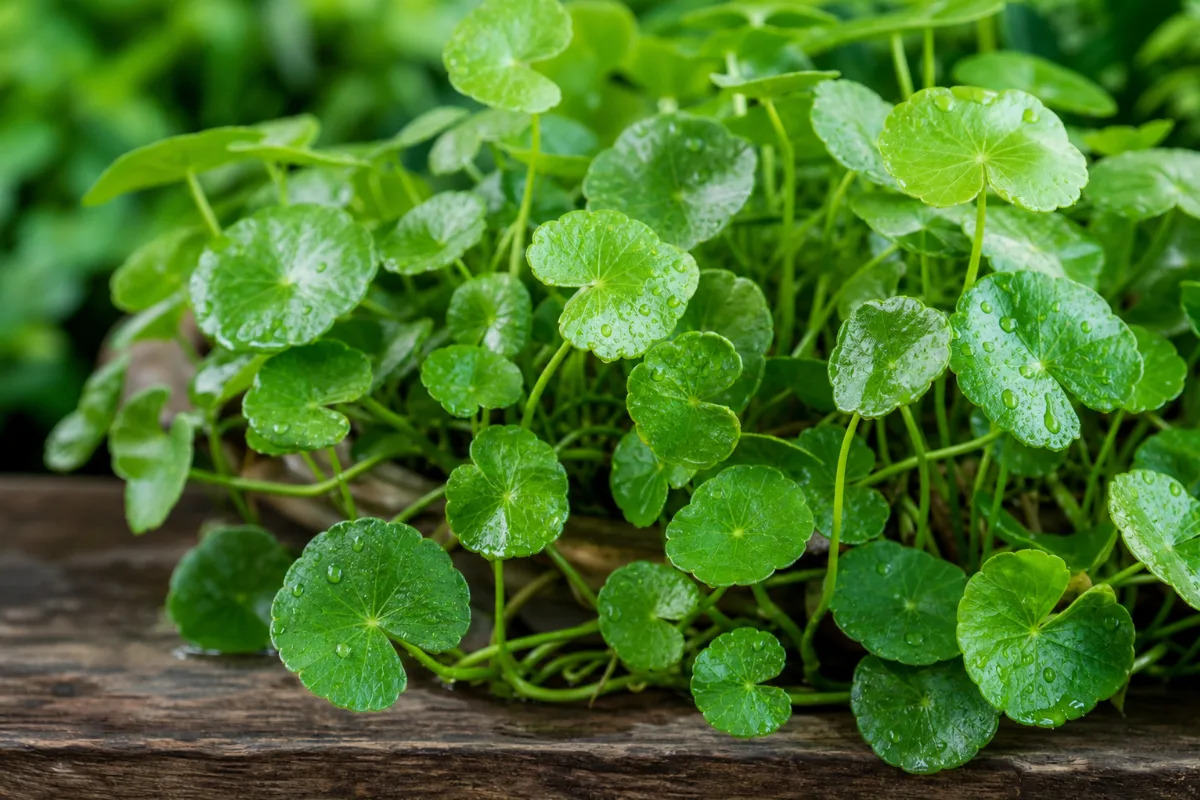
Gotu kola is a creeping, leafy plant of damp tropical places in the carrot family. The leaves and stems are used as a food, a traditional medicine and, as purified triterpene extracts, in some European leg-vein and wound products. It is not related to the kola nut.
General information, not medical advice. Last substantive update · Not medically reviewed. A named clinician has not signed off on this page. How this page is made
About Gotu Kola
Gotu kola (Centella asiatica) is a creeping herb used for centuries in Asian medicine and as a vegetable. In Europe, purified extracts from it are used in some leg-vein and wound products. Research is limited: small trials suggest less leg swelling with purified extracts, there is no clear memory benefit, and the best-documented harms are rare liver injury after oral use and allergic skin reactions. It is not advised in pregnancy.
What it is
Gotu kola (Centella asiatica) is a low, creeping plant of damp tropical places in the carrot family (Apiaceae). It is an accepted species in the GBIF and NCBI databases. The leaves and stems (the aerial parts) are the part used. It is also known as Indian pennywort or Asiatic pennywort and in India by names such as brahmi-buti and mandookaparni (EU report).
It is not related to the kola nut tree, and it should not be mixed up with look-alike pennyworts such as Hydrocotyle umbellata.
Traditional and current uses
In Ayurvedic and traditional Chinese medicine it has been used for centuries for skin problems, wounds, swelling and as a memory tonic, and it is eaten as a vegetable in parts of Asia. In Europe purified triterpene extracts are used in some medicines for leg veins and skin dressings; one dressing has been authorised in France since 1976.
The EU herbal committee accepts the powdered or infused herb on the skin for minor wounds, for 1 week, as a traditional use. It did not accept oral uses because of liver and fertility concerns.
What is in it and how it works
The best-known compounds are the triterpenes asiaticoside and madecassoside and their acid forms, asiatic acid and madecassic acid. In people, the sugar-bound forms are barely absorbed and the acids reach the blood. Water extracts also contain caffeoylquinic acids.
Most ideas about how it works come from cells and animals: effects on nerve growth signals, antioxidant genes, GABA and collagen. None of these has been shown to cause a benefit in people.
What the research shows
Leg veins: small, mostly older trials of purified triterpene extracts show less swelling and heaviness, and the Cochrane review of leg-vein products finds a small effect on swelling for the class. Memory and mood: one small positive trial, a pooled review with no clear gain on thinking tests, and a small alertness effect an hour after a dose. Anxiety: one lab test and one open study. Skin: small trials, many with mixed products. Blood sugar: one null trial.
Nothing is rated above low certainty. Most trials are small, short and from a few research groups, and only abstracts were read for nearly every paper.
At a glance
Traditional uses history, not proof
- Ayurvedic and traditional Chinese medicine: used for centuries for skin problems, wounds, swelling and as a memory tonic, and eaten as a vegetable and in salads (LiverTox).
- Europe: the British Herbal Pharmacopoeia (1983) lists the herb for indolent wounds and skin conditions; a titrated-extract dressing has been authorised in France since 1976 (EU report).
- EU herbal monograph (2022): powdered or infused herb on the skin to aid healing of minor wounds, for 1 week, as a traditional use. Oral use is not accepted.
Studied for research
- Leg swelling and heaviness from weak veins (purified triterpene extracts), low
- Diabetic small-vessel problems (skin blood-flow tests), low
- Alertness and mood, low
- Wrinkles and dry skin, low
- Memory in healthy older adults, mixed
- Wounds, burns, scars and stretch marks, very low
- Anxiety, post-stroke thinking, leg strength, very low
- Blood sugar and cholesterol, memory loss with exercise, sleep, insufficient (one null trial, or animal work only)
Main compounds
- Asiaticoside and madecassoside: the main triterpene glycosides (marker compounds)
- Asiatic acid and madecassic acid: the acid forms that reach the blood after oral extracts
- Caffeoylquinic acids: phenolic acids in water extracts
- Small amounts of essential oil terpenes (beta-caryophyllene, farnesene and others)
Common forms
- Dried leaf or herb, powder or infusion (the form covered by the EU monograph, on the skin)
- Water and alcohol extracts in capsules and tablets
- Purified triterpene extracts (TECA, TTFCA), about 40% asiaticoside and 60% acids, used in leg-vein trials
- Creams, ointments, gels and wound dressings
Research links: EU assessment report on Centella asiatica herb (European Medicines Agency) · EMA page: Centellae asiaticae herba herbal medicinal product · NIH LiverTox: Centella asiatica · Research Library · Genes & Biomarkers Library
The plant and its history
- Accepted scientific name
- Centella asiatica (L.) Urb.
- Naming authority
- (L.) Urb. - named by Linnaeus, moved to Centella by Urban. GBIF Backbone: accepted species, key 3034128. NCBI Taxonomy: species, taxid 48106, active.
- Synonyms
- Hydrocotyle asiatica L. - named as a synonym in the EU assessment report. GBIF lists several varieties and forms as synonyms, for example Centella asiatica var. asiatica, f. crispata and Centella boninensis.
- Common names
- Gotu kola (English); Indian pennywort (English); Asiatic pennywort (English); Asian pennywort (English); Hierba de clavo (Spanish); Oreja de ratón (Spanish); Sombrerito (Spanish); Écuelle d'eau (French); Pé-de-cavalo (Portuguese); Brahma-manduki, Brahmi-Buti, Mandookaparni, Jal Brahmi (Hindi / Indian names (EU report)); Indischer Wassernabel (German); Thankuni (Bengali)
- Botanical family
- Apiaceae (carrot or parsley family, also called Umbelliferae), order Apiales.
- Classification
- Plantae > Tracheophyta > Magnoliopsida > Apiales > Apiaceae > Centella > Centella asiatica
- Native range
- LiverTox says it is native to tropical areas of Southeast Asia and Australia and is now found in many tropical and subtropical areas. The EU report says it grows in damp areas in different tropical countries. Not checked against a floristic database.
- Habitat
- Damp, swampy places in the tropics (EU report and LiverTox).
- What the plant looks like
- Roots: Creeping plant that roots at the nodes (EU report). Root is not the part used.; Stems: Slender creeping stolons (EU report).; Leaves: Leaf stalk is 5 to 15 times longer than the blade; blade 10 to 40 mm long and 20 to 40 mm wide, sometimes up to 70 mm (EU report). The leaves and aerial parts are the parts used.; Flowers: Not verified in a source we read.; Fruit: Not verified in a source we read.
- Cultivation
- Not verified from a source read.
- Harvest and processing
- The European Pharmacopoeia describes the herbal substance as the dried, fragmented aerial parts containing at least 6% total triterpenoid derivatives expressed as asiaticoside (EU report). Methods of harvest were not verified.
- Look-alikes and adulterants
- Name: Hydrocotyle umbellata L. (a pennywort); Note: Looks similar. A 2024 study separated the two by leaf shape, stipules, petioles, inflorescences and fruit, by chemical fingerprint and by DNA markers. H. umbellata lacked the triterpene saponins and its extract was more toxic than Centella in lab tests. GBIF places H. umbellata in the family Araliaceae.; Name: Bacopa monnieri (L.) Pennell; Note: Different plant (family Plantaginaceae in GBIF). The European Pharmacopoeia monograph for Centella includes a test for adulteration with Bacopa monnieri.; Name: Kola nut (Cola nitida and related Cola species); Note: Not related to gotu kola (family Malvaceae in GBIF). The name 'kola' causes confusion on labels.
- Sustainability and conservation
- Not verified. No IUCN assessment was retrieved.
Traditional use and history history, not clinical proof
| Tradition or era | Documented use | Source |
|---|---|---|
| Europe, medicinal use (herbal pharmacopoeia and medicines) | The British Herbal Pharmacopoeia (1983) reports the herb for rheumatic conditions, skin conditions (taken by mouth) and, on the skin, for healing of indolent wounds. A titrated Centella extract (TECA) dressing, Madecassol, has been authorised in France since 1976 to help the healing phase of wounds, skin ulcers and gangrene. | s-ema-ar-centella-2020 |
| European Union herbal monograph, 2022 | The EU herbal committee accepted the powdered or infused herb on the skin to aid healing of minor wounds as a traditional use, for 1 week. It did not accept oral uses because of liver and fertility concerns. | s-ema-opinion-centella-2022 |
| Ayurvedic and traditional Chinese medicine; food use in Asia | LiverTox says gotu kola is eaten as a vegetable and in salads and has been used for centuries in Ayurvedic and traditional Chinese medicine for many conditions, including minor wounds, skin disease, leg vein problems, swelling and as a memory tonic. It adds that none of these traditional claims has been proven in controlled human trials. | s-livertox-centella |
| Reviews describing very old use | A 2014 dermatology overview says the plant was used as a 'panacea' 3000 years ago. We did not trace this to a primary historical source. | p24399761 |
Traditional use shows how a plant was used. It does not show that a supplement works or is safe today.
What is inside, and how it may work
What the plant contains and how those compounds act in cells and animals. Laboratory and animal mechanisms are not proven effects in people.
Main compounds
| Compound | Family | Where it is concentrated | Activity studied | Level of evidence |
|---|---|---|---|---|
| Asiaticoside PubChem 11954171 | Ursane-type pentacyclic triterpene saponin (glycoside) | Leaves and aerial parts The European Pharmacopoeia requires at least 6% total triterpenoid derivatives, expressed as asiaticoside, in the dried aerial parts (EU report). Saponins account for up to 8% of dry mass according to the EU report. | Main marker compound. In people taking oral extracts it is hardly absorbed and is turned into asiatic acid. 38 44 47 53 | Human data |
| Madecassoside PubChem 24825675 | Ursane-type triterpene saponin (glycoside) | Leaves and aerial parts | Marker compound with asiaticoside. In older adults it was not found in blood after oral extract. 44 53 | Human data |
| Asiatic acid PubChem 119034 | Ursane-type triterpene acid (aglycone of asiaticoside) | Leaves and aerial parts | Reaches the blood after oral extracts; blood levels roughly doubled when the dose doubled from 250 to 500 mg of ECa 233 and built up over 7 days. Acted at the GABA-A benzodiazepine site in rats. 37 38 9 53 | Human data |
| Madecassic acid PubChem 73412 | Ursane-type triterpene acid (aglycone of madecassoside) | Leaves and aerial parts | Reaches the blood after oral extracts, like asiatic acid. 37 44 53 | Human data |
| Caffeoylquinic acids (mono- and di-caffeoylquinic acids) | Phenolic acids | Leaves; abundant in water extracts | Found in low amounts in blood after oral water extract; their metabolites were measured. Their role in effects is still being studied. 44 43 | Human data |
| Essential oil constituents (beta-caryophyllene, farnesene, germacrene D, alpha-humulene and others); a small amount of pulegone (0.21%) | Terpenes | Aerial parts About 0.1% essential oil (EU report); one source cited there gives 0.21% pulegone in the oil. | Not linked to any effect studied here. 47 | Other |
| TECA / TTFCA / TTF (titrated or total triterpenic fraction extracts) | Purified triterpene mixture used in medicines and trials | Aerial parts (purified) About 40% asiaticoside and 60% asiatic and madecassic acids according to the EU report; the acronyms refer to the same type of extract. | The extract used in the leg-vein and diabetic microangiopathy trials in the Body file. It is a purified fraction, not the whole herb. 47 31 13 | Human data |
Mechanisms, receptors and pathways
| Target or pathway | Gene or receptor | What was found | Level |
|---|---|---|---|
| Brain-derived neurotrophic factor signalling (BDNF, TrkB receptor, ERK1/2) | BDNF; NTRK2 (TrkB); MAPK3/MAPK1 (ERK1/2) | A 600 mg/kg dose of Centella ethanol extract improved maze memory in stressed rats and raised BDNF, TrkB and ERK1/2 in the hippocampus. 36 | Animal research |
| CREB phosphorylation (memory-related gene switch) | CREB; ERK/RSK pathway | A gotu kola extract increased CREB phosphorylation in nerve cells carrying amyloid beta and in rat cortical neuron cultures; ERK/RSK blockers reduced the effect. 45 | Laboratory research |
| GABA-making enzyme activity | Glutamic acid decarboxylase (GAD) | Centella extract raised GAD activity by more than 40% at 1 mg/mL in rat brain tissue assays. 4 | Laboratory research |
| GABA-A receptor, benzodiazepine site | GABA-A receptor | Injected asiatic acid had anti-anxiety-type effects in rats that the benzodiazepine blocker flumazenil reduced. 9 | Animal research |
| Antioxidant response and mitochondria | Nrf2-dependent antioxidant genes; electron transport chain enzymes | A Centella water extract raised antioxidant-response genes, lowered amyloid-linked oxidative stress and improved mitochondrial function in mouse hippocampal nerve cells. 17 | Laboratory research |
| NRF2 gene activity in human blood cells | NFE2L2 (NRF2) | In 4 older adults with mild dementia a single dose of a water extract product changed NRF2 gene activity over time, following the asiatic acid blood curve in an unexpected dose pattern. 43 | Human data |
| Choline metabolism | Not specified | In 12 healthy volunteers taking ECa 233 for 7 days, choline levels rose significantly. The authors link this to possible cognitive effects, which was not tested. 38 | Human data |
| Sleep architecture | Not specified | Centella water extract in chow changed REM sleep and arousals in aged mice in a sex-dependent way. 14 | Animal research |
| Capillary leakage and swelling | Not specified | In patients with venous hypertension, TTFCA lowered capillary filtration rate and ankle swelling; the symptoms improved in step with these measures. 13 | Human data |
| Collagen, growth factors and inflammation in wounds | Collagen I; FGF; VEGF; IL-1 beta, IL-6, TNF-alpha, PGE2, COX-2 | A systematic review of wound studies proposes that Centella may improve healing by raising collagen I, FGF and VEGF and lowering inflammation messengers. This is a proposed mechanism drawn from lab and animal work. 3 8 | Animal research |
| Drug-metabolising enzymes | CYP1A2, 2B6, 2C8, 2C9, 2C19, 2D6, 3A4/5 | A water extract did not induce CYP1A2, 2B6 or 3A4 in human liver cells and weakly inhibited most CYPs in microsomes (CYP2C9 strongest, IC50 330 ug/ml). 42 | Laboratory research |
Absorption, metabolism and elimination
- Absorption
- After oral Centella extract the parent glycosides asiaticoside and madecassoside were barely detectable in blood while the acids asiatic acid and madecassic acid were measured. In healthy volunteers the parent compounds had very low peak levels. Human results did not match animal results.
- Distribution
- No human tissue or brain distribution data found in the sources we read.
- Metabolism
- The glycosides appear to be converted to their acid forms (aglycones) in the gut, with possible elimination in the stool. Water-extract caffeoylquinic acids showed delayed absorption and their metabolites were measured.
- Elimination
- The parent glycosides had limited kidney excretion in older adults; a faecal route is suggested. Half-lives are not given in the abstracts we read.
- Bioavailability
- Low for the parent glycosides. Asiatic acid levels about doubled when the dose doubled from 250 to 500 mg ECa 233 and accumulated over 7 days of dosing in healthy volunteers. A water-extract product at 2 g and 4 g single doses was safe in 8 healthy older adults and 4 adults with mild dementia.
Isolated compounds versus whole extracts
The triterpenes (asiaticoside, madecassoside and their acids) are the best-known active group and the basis for the purified TECA and TTFCA extracts used in leg-vein trials. Whole-herb water extracts used in cognition research also contain caffeoylquinic acids, which are being studied too. No trial compares purified triterpenes with the whole herb. The EU agency treats the purified extracts and the herb as different preparations, so results from one do not carry over to the other.
Nutritional composition
LiverTox says gotu kola is eaten as a vegetable and in salads in Asia. No nutrient table was read, so none is given. The vitamins and minerals in the leaf are not a reason to take it as a supplement.
1 mixed findings4 low certainty10 very low certainty4 not enough evidence
What was looked at
The 19 benefits and uses checked for Gotu Kola, each with how strong the evidence is. Tap one to open it.
- Memory and thinking in healthy older adultsMixed findings
- Mild memory loss (mild cognitive impairment), added to exerciseNot enough evidence
- Thinking problems after a stroke (vascular cognitive impairment)Very low certainty
- Alertness and moodLow certainty
- Anxiety (startle response test in healthy people)Very low certainty
- Generalised anxiety disorderVery low certainty
- SleepNot enough evidence
- Heavy, swollen legs from chronic venous insufficiencyLow certainty
- Leg and ankle swelling on long flightsVery low certainty
- Small-vessel circulation problems in diabetesLow certainty
- Wound, burn and ulcer healing (on the skin)Very low certainty
- Scar appearanceVery low certainty
- Stretch marks in pregnancyVery low certainty
- Fine lines and wrinklesLow certainty
- Dry skin and skin barrierVery low certainty
- Blood sugar and cholesterol in type 2 diabetesNot enough evidence
- Leg strength and quality of life in older adultsVery low certainty
- Chronic anal fissureVery low certainty
- Jaw joint (temporomandibular) painNot enough evidence
Lab markers tracked in the studies
Acoustic startle response (blink or jump to a sudden loud sound)Anxiety, stress and depression rating scale scoresMoCA-Ina (Montreal Cognitive Assessment, Indonesian version) scoreMini-Mental State Examination (MMSE) and digit spanWorking memory score and N100 brain-wave amplitudeSelf-rated alertness and anger (Bond-Lader and similar mood scales)TNF-alpha (an inflammation messenger in the blood)Ankle circumference and rate of ankle swellingCapillary filtration rateVancouver Scar Scale (VSS)Skin surface hydration (corneometer)HbA1c (average blood sugar over about 3 months)LDL cholesterol30-second chair stand test
What is Gotu Kola good for?
The main proposed uses and how strong the human evidence is for each. "Low" means small or inconsistent studies, "very low" means one small, open or mixed-product study, "mixed" means studies disagree, and "insufficient" means there is not enough to judge. Nothing about gotu kola is rated higher than low. Many results come from purified triterpene extracts, creams, mixed products or animal work, which cannot be moved to other products. For amounts, ask a doctor or pharmacist.
Benefits, one by one
Each card is a research question, not a promise. Tap a goal to filter. Open a card to see the studies, doses and limits.
Memory and thinking in healthy older adults
Mixed findingsIn healthy older people, one small trial found better working memory at the highest dose. A pooled review of all trials found no clear benefit for memory or thinking. The evidence is mixed and weak.
3 studiesThe positive trial used a Centella extract at 250, 500 or 750 mg once…
Studies, doses and limits
What the trials found
Wattanathorn 2008 (28 healthy older adults, Thailand) gave a Centella extract once a day for 2 months at three doses. The highest dose improved working memory and raised the N100 brain-wave amplitude. Puttarak 2017 pooled 5 trials of Centella alone and 6 of Centella-containing products and found no significant difference from placebo in any cognitive domain. The 2026 systematic review of clinical trials describes the clinical evidence as mixed and limited.
Results
Small positive result for working memory at the high dose in one trial; no significant difference from placebo in any cognitive domain when trials were pooled.
Effect sizes as reported
Pooled review: no significant differences in all cognitive domains (numbers not given in the abstract).
Why this rating
One small positive trial (28 people in four groups) against a pooled review with no benefit. Doses, plant preparations and test batteries differed between trials.
Form and dose studied
The positive trial used a Centella extract at 250, 500 or 750 mg once a day for 2 months; other trials used different products.
Who was studied
Healthy adults aged about 60 and over; trials mainly from Thailand.
Limits
Tiny groups, short trials, many different products, mostly one research group. A thinking-test score in healthy people is not the same as better daily memory.
Why researchers looked
Gotu kola has a long reputation as a memory herb, so researchers tested it in healthy older adults and in people with memory problems.
Traditional use
Gotu kola (Centella asiatica) is used in Ayurvedic and traditional Chinese medicine as a 'brain tonic' for memory and mood (as described in the trials and reviews below). It is also eaten as a leafy vegetable in parts of Asia (LiverTox).
Proposed mechanism Preliminary mechanism
Lab and animal work suggests Centella extracts raise nerve-growth signals (BDNF/TrkB/ERK) in rat brain, increase CREB signalling in nerve cells, and protect nerve cells from oxidative stress. Isolated asiatic acid acted at the GABA-A receptor in rats. None of this has been shown to cause a benefit in people.
A proposed mechanism does not show that the effect happens in people.
Gotu kola taken by mouth has been linked to rare cases of liver injury, and the EU herbal agency does not support oral use because of liver and fertility concerns. See the Safety tab.
Mild memory loss (mild cognitive impairment), added to exercise
Not enough evidenceIn one trial in older adults with mild memory loss, exercise helped thinking tests and gotu kola did not add anything extra on top of exercise.
2 studiesGotu kola extract capsules twice a day for 12 weeks, alongside a supe…
Studies, doses and limits
What the trials found
Phoemsapthawee 2022 randomised 60 older adults with mild cognitive impairment (average age 74.6) to exercise alone, exercise plus gotu kola extract capsules, or a placebo-only group for 12 weeks. Both exercise groups did better than placebo on a mental status test (MMSE) and digit span, and had lower TNF-alpha and 8-iso-PGF2-alpha. Gotu kola gave no added effect on thinking tests. In the gotu kola group, the change in digit span was linked to a fall in TNF-alpha (r = -0.504), which the authors suggest may help executive function.
Results
Exercise helped thinking and inflammation markers. Gotu kola did not add to the thinking-test gains.
Effect sizes as reported
Exercise with or without gotu kola better than placebo (P<0.01); no extra cognitive effect from gotu kola; correlation digit span vs TNF-alpha r = -0.504 (P<0.05) in the gotu kola group.
Why this rating
One trial, 20 people per group. It finds no added cognitive benefit, which is a null result rather than proof of no effect.
Form and dose studied
Gotu kola extract capsules twice a day for 12 weeks, alongside a supervised exercise programme.
Who was studied
Adults with mild cognitive impairment, average age 74.6, Thailand.
Limits
Small trial. The TNF-alpha link is a correlation inside one group and does not show that gotu kola caused better thinking.
Why researchers looked
Researchers wanted to know whether gotu kola would add to the known benefit of exercise in people with mild cognitive impairment.
Traditional use
Gotu kola (Centella asiatica) is used in Ayurvedic and traditional Chinese medicine as a 'brain tonic' for memory and mood (as described in the trials and reviews below). It is also eaten as a leafy vegetable in parts of Asia (LiverTox).
Proposed mechanism Preliminary mechanism
Lab and animal work suggests Centella extracts raise nerve-growth signals (BDNF/TrkB/ERK) in rat brain, increase CREB signalling in nerve cells, and protect nerve cells from oxidative stress. Isolated asiatic acid acted at the GABA-A receptor in rats. None of this has been shown to cause a benefit in people.
A proposed mechanism does not show that the effect happens in people.
Gotu kola taken by mouth has been linked to rare cases of liver injury, and the EU herbal agency does not support oral use because of liver and fertility concerns. See the Safety tab.
Thinking problems after a stroke (vascular cognitive impairment)
Very low certaintyIn one small trial after stroke, memory and thinking scores improved about as much with gotu kola as with folic acid. There was no placebo group.
2 studiesGotu kola extract 750 or 1000 mg a day for 6 weeks (as tested).
Studies, doses and limits
What the trials found
Farhana 2016 (48 people, Indonesia) gave gotu kola extract (17 people at 1000 mg/day, 17 at 750 mg/day) or folic acid 3 mg/day (14 people) for 6 weeks. All groups improved on the MoCA-Ina score and there was no significant difference between groups. Gotu kola was better than folic acid for the memory domain.
Results
All three groups improved by a similar amount.
Effect sizes as reported
No significant difference in change in MoCA-Ina between the groups.
Why this rating
Only one small trial with no placebo group. Improvement after stroke can happen without treatment, and folic acid is not a proven comparison.
Form and dose studied
Gotu kola extract 750 or 1000 mg a day for 6 weeks (as tested).
Who was studied
Adults with thinking problems after stroke, Indonesia.
Limits
No placebo, small groups, short follow-up, only the abstract read.
Why researchers looked
Gotu kola is thought to help blood flow and nerve cells, so it was tried for thinking problems after stroke.
Traditional use
Gotu kola (Centella asiatica) is used in Ayurvedic and traditional Chinese medicine as a 'brain tonic' for memory and mood (as described in the trials and reviews below). It is also eaten as a leafy vegetable in parts of Asia (LiverTox).
Proposed mechanism Preliminary mechanism
Lab and animal work suggests Centella extracts raise nerve-growth signals (BDNF/TrkB/ERK) in rat brain, increase CREB signalling in nerve cells, and protect nerve cells from oxidative stress. Isolated asiatic acid acted at the GABA-A receptor in rats. None of this has been shown to cause a benefit in people.
A proposed mechanism does not show that the effect happens in people.
Gotu kola taken by mouth has been linked to rare cases of liver injury, and the EU herbal agency does not support oral use because of liver and fertility concerns. See the Safety tab.
Alertness and mood
Low certaintyA pooled review found higher alertness and lower anger scores about an hour after a dose. The result is small and uncertain.
3 studiesDifferent doses and plant preparations were pooled.
Studies, doses and limits
What the trials found
Puttarak 2017 pooled mood scales from the trials. One hour after a dose, alert scores were higher (SMD 0.71, 95% CI 0.01 to 1.41) and anger scores lower (SMD -0.81, 95% CI -1.51 to -0.09). None of the trials of Centella alone reported adverse effects. A 2026 scoping review that looked at mood disorders found that two randomised trials in healthy people (58 people in all) reported better alertness and called the evidence preliminary.
Results
Slightly higher self-rated alertness and lower anger one hour after a dose.
Effect sizes as reported
Alert SMD 0.71 (0.01 to 1.41); anger SMD -0.81 (-1.51 to -0.09), both at 1 hour.
Why this rating
The pooled results come from few small trials and the lower limit of the alertness range is barely above zero. The effect is for an hour after a dose, not long-term mood.
Form and dose studied
Different doses and plant preparations were pooled.
Who was studied
Mostly healthy adults.
Limits
Self-rated scales; wide confidence intervals; short follow-up; no trial in people with depression is covered by this result.
Why researchers looked
Gotu kola is used traditionally to lift mood and clear the mind, so trials measured self-rated mood scales.
Traditional use
Gotu kola (Centella asiatica) is used in Ayurvedic and traditional Chinese medicine as a 'brain tonic' for memory and mood (as described in the trials and reviews below). It is also eaten as a leafy vegetable in parts of Asia (LiverTox).
Proposed mechanism Preliminary mechanism
Lab and animal work suggests Centella extracts raise nerve-growth signals (BDNF/TrkB/ERK) in rat brain, increase CREB signalling in nerve cells, and protect nerve cells from oxidative stress. Isolated asiatic acid acted at the GABA-A receptor in rats. None of this has been shown to cause a benefit in people.
A proposed mechanism does not show that the effect happens in people.
Gotu kola taken by mouth has been linked to rare cases of liver injury, and the EU herbal agency does not support oral use because of liver and fertility concerns. See the Safety tab.
Anxiety (startle response test in healthy people)
Very low certaintyA single large dose lowered the startle reaction to a sudden loud noise in healthy volunteers. This is a lab test linked to anxiety, not a treatment trial.
3 studiesA single 12 g oral dose was used.
Studies, doses and limits
What the trials found
Bradwejn 2000 gave 40 healthy volunteers either a single 12 g oral dose of gotu kola or placebo. Startle amplitude was lower than placebo 30 and 60 minutes later. Self-rated mood, heart rate and blood pressure did not change. The authors called it preliminary evidence that the herb may reduce anxiety.
Results
Lower startle reaction at 30 and 60 minutes after one dose.
Effect sizes as reported
Significant reduction vs placebo at 30 and 60 minutes (numbers not in the abstract).
Why this rating
One small trial in healthy volunteers, one dose, a lab proxy for anxiety. It does not show that the herb treats anxiety.
Form and dose studied
A single 12 g oral dose was used.
Who was studied
Healthy volunteers (40).
Limits
A startle test is not an anxiety diagnosis; a 12 g dose is large; no repeat in other labs was found.
Why researchers looked
Rat studies suggested gotu kola dampens startle reactions, a measure used in anxiety research.
Traditional use
Gotu kola (Centella asiatica) is used in Ayurvedic and traditional Chinese medicine as a 'brain tonic' for memory and mood (as described in the trials and reviews below). It is also eaten as a leafy vegetable in parts of Asia (LiverTox).
Proposed mechanism Laboratory research
In a rat brain-tissue test, Centella extract raised activity of GAD, the enzyme that makes the calming messenger GABA. Isolated asiatic acid had anxiety-type effects in rats that a GABA-A blocker reduced. Lab and animal findings only.
A proposed mechanism does not show that the effect happens in people.
A calming effect (sedation) has been reported as a possible side effect in trials of Centella-containing products and the EU report advises caution with sedative medicines. Gotu kola taken by mouth has been linked to rare cases of liver injury, and the EU herbal agency does not support oral use because of liver and fertility concerns. See the Safety tab.
Generalised anxiety disorder
Very low certaintyIn one open study without a placebo group, anxiety scores fell over 60 days. This cannot show that the herb works.
2 studies70% hydro-ethanolic extract, 500 mg twice daily for 60 days (as teste…
Studies, doses and limits
What the trials found
Jana 2010 gave 33 adults with generalised anxiety disorder a 70% hydro-ethanolic Centella extract, 500 mg twice daily, for 60 days. Anxiety, stress and related depression scores fell (p<0.01), and cognition and willingness to adjust improved. There was no placebo or comparison group. The 2026 scoping review also counts this as an open-label study.
Results
Lower anxiety, stress and depression scores compared with the start.
Effect sizes as reported
p<0.01 vs baseline on rating scales (numbers not in the abstract).
Why this rating
Single group, no placebo or blinding. Improvement in anxiety trials is often large on placebo.
Form and dose studied
70% hydro-ethanolic extract, 500 mg twice daily for 60 days (as tested).
Who was studied
Adults with generalised anxiety disorder, average age 33.
Limits
Not a controlled trial; small; only the abstract was read; no longer follow-up.
Why researchers looked
A small open study asked whether a Centella extract could help people with generalised anxiety.
Traditional use
Gotu kola (Centella asiatica) is used in Ayurvedic and traditional Chinese medicine as a 'brain tonic' for memory and mood (as described in the trials and reviews below). It is also eaten as a leafy vegetable in parts of Asia (LiverTox).
Proposed mechanism Preliminary mechanism
Lab and animal work suggests Centella extracts raise nerve-growth signals (BDNF/TrkB/ERK) in rat brain, increase CREB signalling in nerve cells, and protect nerve cells from oxidative stress. Isolated asiatic acid acted at the GABA-A receptor in rats. None of this has been shown to cause a benefit in people.
A proposed mechanism does not show that the effect happens in people.
Gotu kola taken by mouth has been linked to rare cases of liver injury, and the EU herbal agency does not support oral use because of liver and fertility concerns. See the Safety tab.
Sleep
Not enough evidenceNo human sleep trial was found. In aged mice a water extract changed sleep patterns in a moderate, sex-dependent way.
1 studiesNot applicable.
Studies, doses and limits
What the trials found
We found no human trial of gotu kola for sleep.
Results
No human result.
Effect sizes as reported
Not available for people; mouse result only.
Why this rating
Evidence is from mice only.
Limits
No human data.
Why researchers looked
Researchers tested whether Centella extract changes sleep in aged animals because poor sleep may add to memory decline.
Traditional use
Gotu kola (Centella asiatica) is used in Ayurvedic and traditional Chinese medicine as a 'brain tonic' for memory and mood (as described in the trials and reviews below). It is also eaten as a leafy vegetable in parts of Asia (LiverTox).
Proposed mechanism Animal research
In 18-month-old mice, Centella water extract in food (1000 mg/kg/day) lengthened REM sleep and REM theta power in males and reduced sleep arousals in females.
A proposed mechanism does not show that the effect happens in people.
Gotu kola taken by mouth has been linked to rare cases of liver injury, and the EU herbal agency does not support oral use because of liver and fertility concerns. See the Safety tab.
Heavy, swollen legs from chronic venous insufficiency
Low certaintyA titrated Centella extract eased heaviness and swelling in small older trials. The trials are small, old and mostly from one research group, so the evidence is low.
5 studiesTrials used TECA (60 or 120 mg/day for 2 months) or TTFCA (90 or 180 …
Studies, doses and limits
What the trials found
Pointel 1987 (94 people, France) compared the titrated extract TECA at two doses with placebo for 2 months: heaviness, oedema and the patient's overall rating improved more with TECA (p<0.05). De Sanctis 2001 (52 patients with venous hypertension) gave the total triterpenic fraction TTFCA for 4 weeks: capillary filtration, ankle circumference and ankle oedema fell, more with the higher dose, and symptoms improved; placebo (12 people) did not change. Chong 2013 systematically reviewed 8 randomised trials: microcirculation measures and ankle swelling improved, but poor reporting left the risk of bias unclear. The Cochrane review of phlebotonics (56 trials, 7,690 people, only 2 of Centella) found that the drug class probably reduces leg swelling slightly (moderate certainty) but makes little or no difference to quality of life and probably causes slightly more side effects.
Results
Less heaviness and swelling in small trials; for the drug class as a whole, a small reduction in swelling and no clear quality-of-life gain.
Effect sizes as reported
Class-wide (all phlebotonics): oedema RR 0.70 (0.63 to 0.78); ankle circumference MD -4.27 mm (-5.61 to -2.93). Quality of life SMD -0.06 (-0.22 to 0.10). Centella-specific numbers are not in the abstracts.
Why this rating
Cochrane gives moderate certainty for the class, but only 2 of its 56 trials used Centella, the Centella reviews rate the risk of bias unclear, and the TTFCA trials come from one research group.
Form and dose studied
Trials used TECA (60 or 120 mg/day for 2 months) or TTFCA (90 or 180 mg/day for 4 weeks). These are purified triterpene extracts, not dried leaf or tea.
Who was studied
Adults with leg vein problems, mostly in Europe.
Limits
Small, mostly short trials; old; the products are standardised triterpene extracts that are not the same as supplements sold as leaf powder or tea; no trial shows fewer leg ulcers.
Why researchers looked
Chronic venous insufficiency (weak leg veins) causes heavy, swollen, tired legs. Centella triterpene extracts (TECA, TTFCA) are sold in Europe as 'venoactive' products.
Traditional use
Centella herb and extracts have been used in Europe for decades for leg vein problems: the EU report notes a medicine with a titrated Centella extract (TECA) authorised in France since 1976 as a dressing for wounds and ulcers. Oral Centella for leg swelling is not an EU-approved herbal use.
Proposed mechanism Preliminary mechanism
Lab and animal work: triterpenes (asiaticoside, madecassoside, asiatic acid, madecassic acid) are thought to reduce capillary leakage, calm inflammation and affect collagen. The EU report lists six proposed actions from expert opinion: oedema control, antioxidant, anti-inflammatory, collagen modulation, growth-factor modulation and angiogenesis modulation. Not proven in people.
A proposed mechanism does not show that the effect happens in people.
Taken by mouth, gotu kola has been linked to rare cases of liver injury, and the EU herbal agency does not support oral use. On the skin it can cause allergic contact dermatitis. See the Safety tab.
Leg and ankle swelling on long flights
Very low certaintyIn people with mild varicose veins, taking a Centella extract around a flight reduced ankle swelling compared with taking nothing.
1 studiesTTFCA 60 mg three times a day for 4 days around a flight (as tested).
Studies, doses and limits
What the trials found
Cesarone 2001 randomised passengers aged 30 to 50 with mild to moderate varicose vein disease on flights of 3 hours or more to either TTFCA (60 mg three times a day, from 2 days before to 1 day after the flight) or no treatment. Ankle swelling rate and oedema score were significantly lower in the TTFCA group (p<0.025); other measures changed in the same direction but not significantly.
Results
Less ankle swelling during long flights.
Effect sizes as reported
Rate of ankle swelling and oedema lower with TTFCA (p<0.025).
Why this rating
One trial, no placebo, same research group as other TTFCA trials, group size not stated in the abstract.
Form and dose studied
TTFCA 60 mg three times a day for 4 days around a flight (as tested).
Who was studied
Adults aged 30 to 50 with mild to moderate varicose veins.
Limits
No placebo; not blinded; one study; swelling is a measurement, not leg clots.
Why researchers looked
Long flights cause ankle swelling, especially in people with varicose veins.
Traditional use
Centella herb and extracts have been used in Europe for decades for leg vein problems: the EU report notes a medicine with a titrated Centella extract (TECA) authorised in France since 1976 as a dressing for wounds and ulcers. Oral Centella for leg swelling is not an EU-approved herbal use.
Proposed mechanism Preliminary mechanism
Lab and animal work: triterpenes (asiaticoside, madecassoside, asiatic acid, madecassic acid) are thought to reduce capillary leakage, calm inflammation and affect collagen. The EU report lists six proposed actions from expert opinion: oedema control, antioxidant, anti-inflammatory, collagen modulation, growth-factor modulation and angiogenesis modulation. Not proven in people.
A proposed mechanism does not show that the effect happens in people.
Taken by mouth, gotu kola has been linked to rare cases of liver injury, and the EU herbal agency does not support oral use. On the skin it can cause allergic contact dermatitis. See the Safety tab.
Small-vessel circulation problems in diabetes
Low certaintyIn people with diabetes and small-vessel damage, a Centella triterpene extract improved skin blood-flow tests and ankle swelling over 12 months in one trial.
2 studiesTTFCA tablets, 60 mg twice daily for 12 months (as tested).
Studies, doses and limits
What the trials found
Incandela 2001 randomised people with diabetic microangiopathy (with or without neuropathy) to TTFCA 60 mg twice daily or placebo tablets for 12 months. In patients with neuropathy, skin flux, rate of ankle swelling and oedema fell (p<0.05); flux and venoarteriolar response changed by 38% and ankle swelling fell 28%. Without neuropathy the changes were smaller (flux -22%, swelling -9.5%). Untreated patients worsened. No side effects were reported. The EU report adds that blood sugar and HbA1c did not change in this study.
Results
Better skin blood-flow tests and less ankle swelling in patients; worsening in the untreated group.
Effect sizes as reported
Neuropathy group: flux and venoarteriolar response 38%, rate of ankle swelling -28% (p<0.05). No-neuropathy group: flux -22%, swelling -9.5%.
Why this rating
A placebo-controlled trial, but the group sizes are not in the abstract and the outcomes are blood-flow tests, not ulcers or amputations. Same research group as the other TTFCA trials.
Form and dose studied
TTFCA tablets, 60 mg twice daily for 12 months (as tested).
Who was studied
People with diabetic microangiopathy.
Limits
Not repeated by an independent group; no clinical outcomes such as foot ulcers.
Why researchers looked
Diabetes can damage small blood vessels and cause swelling and nerve problems.
Traditional use
Centella herb and extracts have been used in Europe for decades for leg vein problems: the EU report notes a medicine with a titrated Centella extract (TECA) authorised in France since 1976 as a dressing for wounds and ulcers. Oral Centella for leg swelling is not an EU-approved herbal use.
Proposed mechanism Preliminary mechanism
Lab and animal work: triterpenes (asiaticoside, madecassoside, asiatic acid, madecassic acid) are thought to reduce capillary leakage, calm inflammation and affect collagen. The EU report lists six proposed actions from expert opinion: oedema control, antioxidant, anti-inflammatory, collagen modulation, growth-factor modulation and angiogenesis modulation. Not proven in people.
A proposed mechanism does not show that the effect happens in people.
Taken by mouth, gotu kola has been linked to rare cases of liver injury, and the EU herbal agency does not support oral use. On the skin it can cause allergic contact dermatitis. See the Safety tab.
Wound, burn and ulcer healing (on the skin)
Very low certaintySmall trials of Centella ointments on burns suggest faster healing than a standard burn cream. A diabetic foot ulcer trial found no difference. The overall evidence is very low.
5 studiesTopical Centella ointment or cream; the product make-up is not descri…
Studies, doses and limits
What the trials found
Arribas-López 2022 reviewed 4 clinical trials and concluded Centella might help wound healing but that studies are too few to pool. Saeidinia 2017 (75 randomised, 60 analysed) compared Centiderm ointment with silver sulfadiazine cream on partial-thickness burns: objective and subjective signs, time to new skin and time to full healing were better with Centiderm (P<0.05) and there were no infections in that group. Kuo 2012 (24 people with diabetic foot ulcers) compared a cream with Plectranthus amboinicus plus Centella against a hydrocolloid dressing for 2 weeks: no statistically significant difference in wound size. The EU report says clinical studies show a trend towards faster healing but sample sizes are small and the herbal preparations are not described well enough.
Results
Faster burn healing than silver sulfadiazine in one trial; no difference in one diabetic foot trial.
Effect sizes as reported
Burn trial: P<0.05 for all outcomes (numbers not in abstract). Foot ulcer trial: no significant difference.
Why this rating
Few small trials; different products; one compares with another cream rather than a dummy cream; the foot ulcer cream also contains another herb.
Form and dose studied
Topical Centella ointment or cream; the product make-up is not described in the abstract.
Who was studied
Adults with burns or diabetic foot ulcers (Iran, Taiwan).
Limits
Not standardised; no large trial; the EU report accepts only short use (1 week) for minor wounds.
Why researchers looked
Centella is best known in skin care as a wound-healing herb. Madecassol-type ointments and dressings with a Centella extract are used in Europe.
Traditional use
British Herbal Pharmacopoeia (1983) lists Centella for indolent wounds and skin conditions; the EU herbal agency accepts only short topical use of powdered or infused herb to help minor wounds heal.
Proposed mechanism Preliminary mechanism
Lab and animal work: triterpenes are reported to stimulate collagen and new blood vessel growth in wounds and to lower inflammation messengers (IL-1 beta, IL-6, TNF-alpha) in the systematic review of wound studies. These are proposals, not proven effects in people.
A proposed mechanism does not show that the effect happens in people.
On the skin: the EU herbal agency accepts powdered or infused gotu kola herb only for short (1 week) use to help minor wounds heal, and only on the basis of traditional use. Allergic skin reactions are possible. Allergic contact dermatitis has been reported.
Scar appearance
Very low certaintyA 1% Centella extract cream improved scar scores after hand surgery in one open trial. A mixed herbal gel helped scar redness in a second trial. The evidence is very low.
3 studies1% Centella extract cream for 6 months, or a four-herb gel with silic…
Studies, doses and limits
What the trials found
Balevi 2023 randomised 280 people after open carpal tunnel surgery to a cream with 1% Centella extract for 6 months or no treatment. The Vancouver Scar Scale improved more in the cream group at 3 to 6 months (-1.260, p=0.040); hand function (QuickDASH) was 18.54 vs 28.70 and satisfaction scores also favoured the cream. Surakunprapha 2020 (46 people after heart surgery) compared silicone gel plus a four-herb gel (onion, Centella, aloe, paper mulberry) with silicone gel alone for 6 months: scar score was lower at 3 months (p=0.018) and borderline at 6 months (p=0.051).
Results
Slightly better scar scores and satisfaction.
Effect sizes as reported
VSS change -1.260 (p=0.040) in the single-herb trial; mixed-gel trial VSS p=0.018 at 3 months and p=0.051 at 6 months.
Why this rating
No placebo cream in the larger trial, so people knew who was treated; the second trial used a four-herb mix, so Centella cannot be credited.
Form and dose studied
1% Centella extract cream for 6 months, or a four-herb gel with silicone (as tested).
Who was studied
Adults after hand or chest surgery.
Limits
Scar scales are partly subjective; only abstracts read.
Why researchers looked
Centella is added to scar creams because of its reputed effect on collagen.
Traditional use
British Herbal Pharmacopoeia (1983) lists Centella for indolent wounds and skin conditions; the EU herbal agency accepts only short topical use of powdered or infused herb to help minor wounds heal.
Proposed mechanism Preliminary mechanism
Lab and animal work: triterpenes are reported to stimulate collagen and new blood vessel growth in wounds and to lower inflammation messengers (IL-1 beta, IL-6, TNF-alpha) in the systematic review of wound studies. These are proposals, not proven effects in people.
A proposed mechanism does not show that the effect happens in people.
On the skin: the EU herbal agency accepts powdered or infused gotu kola herb only for short (1 week) use to help minor wounds heal, and only on the basis of traditional use. Allergic skin reactions are possible.
Stretch marks in pregnancy
Very low certaintyIn one old trial, a cream containing Centella extract, vitamin E and collagen-elastin hydrolysates lowered the share of women who got stretch marks. The cream had three active parts, so Centella cannot be credited alone.
1 studiesA cream with three actives, applied to the skin (as tested).
Studies, doses and limits
What the trials found
Mallol 1991 gave 80 pregnant women either an anti-stretch-mark cream (Centella extract, alpha-tocopherol, collagen-elastin hydrolysates) or placebo cream. Stretch marks appeared in 14 treated women (34%) and 22 placebo women (56%) (p<0.05); severity scores were 1.42 vs 2.13 (p=0.014).
Results
About 22 percentage points fewer women with stretch marks.
Effect sizes as reported
34% vs 56% (p<0.05); severity 1.42 vs 2.13 (p=0.014).
Why this rating
One old trial, three active ingredients, no replication found.
Form and dose studied
A cream with three actives, applied to the skin (as tested).
Who was studied
Pregnant women.
Limits
Cannot separate Centella from the other ingredients; the EU report advises against gotu kola use in pregnancy because safety has not been established.
Why researchers looked
Stretch marks (striae gravidarum) are common in pregnancy and Centella creams are sold to prevent them.
Traditional use
British Herbal Pharmacopoeia (1983) lists Centella for indolent wounds and skin conditions; the EU herbal agency accepts only short topical use of powdered or infused herb to help minor wounds heal.
Proposed mechanism Preliminary mechanism
Lab and animal work: triterpenes are reported to stimulate collagen and new blood vessel growth in wounds and to lower inflammation messengers (IL-1 beta, IL-6, TNF-alpha) in the systematic review of wound studies. These are proposals, not proven effects in people.
A proposed mechanism does not show that the effect happens in people.
On the skin: the EU herbal agency accepts powdered or infused gotu kola herb only for short (1 week) use to help minor wounds heal, and only on the basis of traditional use. Allergic skin reactions are possible. The EU report does not recommend use in pregnancy or breastfeeding.
Fine lines and wrinkles
Low certaintyA review of five small trials found improved lip and eye-area wrinkles with Centella gels, creams or lipstick in Asian women. Products were not standardised.
1 studiesCreams, gels and lipstick with Centella extract or asiaticoside for 8…
Studies, doses and limits
What the trials found
Kongkaew 2020 reviewed 5 double-blind randomised trials (172 Asian women). Two placebo-controlled trials used gel or cream with Centella or asiaticoside on the skin around the eyes for 12 weeks; asiaticoside lipstick for 8 weeks reduced lip wrinkles. In network meta-analysis Centella looked better than Pueraria mirifica and possibly weaker than tretinoin. Skin hydration rose markedly with Centella. One study counted 10 adverse events with Centella and 35 with tretinoin.
Results
Better lip and eye-area wrinkles in small trials.
Effect sizes as reported
Numbers not given in the abstract.
Why this rating
The review judged the risk of bias generally low but reporting was weak, the trials were small and all in Asian women, and Centella was not standardised.
Form and dose studied
Creams, gels and lipstick with Centella extract or asiaticoside for 8 to 12 weeks.
Who was studied
Asian women, mostly.
Limits
Cosmetic outcomes; long-term safety not established.
Why researchers looked
Centella and asiaticoside are common ingredients in anti-ageing creams.
Traditional use
British Herbal Pharmacopoeia (1983) lists Centella for indolent wounds and skin conditions; the EU herbal agency accepts only short topical use of powdered or infused herb to help minor wounds heal.
Proposed mechanism Laboratory research
Lab work suggests asiaticoside raises collagen production in skin cells; this is not proven in people.
A proposed mechanism does not show that the effect happens in people.
On the skin: the EU herbal agency accepts powdered or infused gotu kola herb only for short (1 week) use to help minor wounds heal, and only on the basis of traditional use. Allergic skin reactions are possible.
Dry skin and skin barrier
Very low certaintyIn 30 batik workers with dry hands, a Centella cream improved skin hydration over 4 weeks, about as much as a ceramide cream. There was no dummy-cream group.
2 studiesCentella cream twice a day for 4 weeks (as tested).
Studies, doses and limits
What the trials found
Anggraeni 2021 gave 30 batik workers with dry skin a Centella cream or a ceramide cream twice a day for 4 weeks. Hydration rose with the Centella cream (palm p=0.007; back of hand p=0.001) and skin acidity on the back of the hand improved (p=0.017). The Centella and ceramide creams did not differ. The creams were made and labelled by a manufacturer named in the abstract. A separate trial of a serum with Centella, galactomyces ferment filtrate and dexpanthenol for post-acne dark marks (Anwar 2021, 51 people) improved melanin index and skin lightness against placebo in some skin types, but it was a three-ingredient product.
Results
More skin hydration after 4 weeks.
Effect sizes as reported
Corneometer palm p=0.007; back of hand p=0.001; skin acidity back of hand p=0.017.
Why this rating
Small, no placebo, manufacturer-made creams. The post-acne serum trial has three actives.
Form and dose studied
Centella cream twice a day for 4 weeks (as tested).
Who was studied
Workers with dry hands (Indonesia).
Limits
Short; only abstracts read.
Why researchers looked
Dry, irritated skin is common in people who handle chemicals at work.
Traditional use
British Herbal Pharmacopoeia (1983) lists Centella for indolent wounds and skin conditions; the EU herbal agency accepts only short topical use of powdered or infused herb to help minor wounds heal.
Proposed mechanism Preliminary mechanism
Lab and animal work: triterpenes are reported to stimulate collagen and new blood vessel growth in wounds and to lower inflammation messengers (IL-1 beta, IL-6, TNF-alpha) in the systematic review of wound studies. These are proposals, not proven effects in people.
A proposed mechanism does not show that the effect happens in people.
On the skin: the EU herbal agency accepts powdered or infused gotu kola herb only for short (1 week) use to help minor wounds heal, and only on the basis of traditional use. Allergic skin reactions are possible.
Blood sugar and cholesterol in type 2 diabetes
Not enough evidenceOne placebo-controlled trial found no effect on blood sugar (HbA1c), fasting glucose or LDL cholesterol after 6 months.
2 studiesExtract capsules 1,200 mg a day for 6 months (as tested).
Studies, doses and limits
What the trials found
Tawanwongsri 2025 (70 completers, Thailand) gave Centella extract capsules 1,200 mg a day or matched placebo for 6 months to adults with type 2 diabetes. In the planned analysis adjusted for baseline HbA1c, diabetes length and sulfonylurea use, there was no difference in HbA1c, fasting glucose or LDL cholesterol. An unadjusted HbA1c difference (p=0.006) disappeared after adjustment. Mild stomach symptoms occurred in 5 of 34 (14.7%). The EU report notes a separate TTFCA trial in which fasting blood sugar and HbA1c did not change.
Results
No difference from placebo after adjustment.
Effect sizes as reported
Adjusted: no significant difference in HbA1c, fasting glucose or LDL-C (LDL-C p=0.536).
Why this rating
One small trial with a null result. The authors call for larger, longer, higher-dose trials.
Form and dose studied
Extract capsules 1,200 mg a day for 6 months (as tested).
Who was studied
Adults with type 2 diabetes.
Limits
Small; one centre; the EU report notes an old trial reporting raised blood sugar and cholesterol in 1969 (not verified).
Why researchers looked
Animal studies suggested Centella might help blood sugar and lipids, so a trial tested it in type 2 diabetes.
Traditional use
Not a traditional use in the sources we read.
Proposed mechanism Preliminary mechanism
Animal and lab work suggests effects on inflammation and oxidative stress; not shown to affect blood sugar in people.
A proposed mechanism does not show that the effect happens in people.
If you take diabetes or cholesterol medicines, ask a doctor or pharmacist before adding gotu kola. Taken by mouth, gotu kola has been linked to rare cases of liver injury, and the EU herbal agency does not support oral use. On the skin it can cause allergic contact dermatitis. See the Safety tab.
Leg strength and quality of life in older adults
Very low certaintyIn healthy older adults, higher doses improved a 30-second chair stand test after 2 months. Walking and grip tests are not reported as improved.
1 studiesStandardised extract 250 to 750 mg once a day for 90 days (as tested).
Studies, doses and limits
What the trials found
Mato 2011 randomised 80 healthy older adults to placebo or standardised Centella extract (250, 500 or 750 mg once a day) for 90 days. After 2 months the 500 and 750 mg groups did better on the 30-second chair stand test, and higher doses improved the life-satisfaction part of the SF-36 physical subscale.
Results
More chair stands in 30 seconds at the higher doses.
Effect sizes as reported
Significant for chair stand at 500 and 750 mg (numbers not in the abstract).
Why this rating
One small trial from one research group in healthy people; hand grip and walk tests are not reported as improved.
Form and dose studied
Standardised extract 250 to 750 mg once a day for 90 days (as tested).
Who was studied
Healthy older adults, Thailand.
Limits
Only abstract read; no replication found.
Why researchers looked
Gotu kola is traditionally thought to boost strength and vigour in older people.
Traditional use
Gotu kola (Centella asiatica) is used in Ayurvedic and traditional Chinese medicine as a 'brain tonic' for memory and mood (as described in the trials and reviews below). It is also eaten as a leafy vegetable in parts of Asia (LiverTox).
Proposed mechanism Preliminary mechanism
Lab work suggests antioxidant effects; not shown to build muscle in people.
A proposed mechanism does not show that the effect happens in people.
Taken by mouth, gotu kola has been linked to rare cases of liver injury, and the EU herbal agency does not support oral use. On the skin it can cause allergic contact dermatitis. See the Safety tab.
Chronic anal fissure
Very low certaintyAdding Centella to standard care eased pain sooner in one trial but did not clearly shorten bleeding. Everyone healed within 8 weeks.
1 studiesNot stated in the abstract.
Studies, doses and limits
What the trials found
Chiaretti 2018 (98 outpatients) added Centella (36 people) or a flavonoid product (30) to standard care or gave standard care alone (32). Median time to stop bleeding was 3 weeks with Centella and 4 weeks with standard care (p=0.070, not significant); flavonoids stopped bleeding in 1 week. Pain by week 2 was lower with Centella than with standard care alone (p=0.035). All patients healed by week 8.
Results
Earlier pain relief; no clear gain for bleeding.
Effect sizes as reported
Bleeding Centella vs control p=0.070; pain at week 2 p=0.035.
Why this rating
Open add-on design, no dummy treatment, form and dose of Centella not given in the abstract.
Who was studied
Adults with chronic anal fissure (Italy).
Limits
Small groups; only abstract read.
Why researchers looked
Centella is used on skin lesions and has been tried for healing of the anal lining.
Traditional use
British Herbal Pharmacopoeia (1983) lists Centella for indolent wounds and skin conditions; the EU herbal agency accepts only short topical use of powdered or infused herb to help minor wounds heal.
Proposed mechanism Preliminary mechanism
Lab and animal work: triterpenes are reported to stimulate collagen and new blood vessel growth in wounds and to lower inflammation messengers (IL-1 beta, IL-6, TNF-alpha) in the systematic review of wound studies. These are proposals, not proven effects in people.
A proposed mechanism does not show that the effect happens in people.
On the skin: the EU herbal agency accepts powdered or infused gotu kola herb only for short (1 week) use to help minor wounds heal, and only on the basis of traditional use. Allergic skin reactions are possible.
Jaw joint (temporomandibular) pain
Not enough evidenceA 23-person pilot trial found pain fell at one week with the higher dose but not at two weeks, and placebo also improved.
1 studiesECa233 250 or 500 mg twice a day for 14 days (as tested).
Studies, doses and limits
What the trials found
Potewiratnanond 2025 randomised 23 adults with acute jaw-joint pain to ibuprofen, ECa233 250 mg, ECa233 500 mg or placebo, twice daily for 14 days. At 1 week pain fell with 500 mg (P=0.016) and with placebo (P=0.030). At day 14 there were no significant differences among the groups.
Results
Short-lived pain reduction at the higher dose, also seen with placebo.
Effect sizes as reported
Day 7: P=0.016 (500 mg), P=0.030 (placebo); day 14: no significant differences.
Why this rating
Pilot with about 6 people per group; the placebo group improved too.
Form and dose studied
ECa233 250 or 500 mg twice a day for 14 days (as tested).
Who was studied
Adults with acute jaw-joint pain (Thailand).
Limits
Registered NCT06231212; too small to show a benefit.
Why researchers looked
A standardised Centella extract (ECa233) has been tested for short-term pain.
Traditional use
Gotu kola (Centella asiatica) is used in Ayurvedic and traditional Chinese medicine as a 'brain tonic' for memory and mood (as described in the trials and reviews below). It is also eaten as a leafy vegetable in parts of Asia (LiverTox).
Proposed mechanism Preliminary mechanism
Lab work suggests anti-inflammatory effects; not shown to cause pain relief.
A proposed mechanism does not show that the effect happens in people.
Taken by mouth, gotu kola has been linked to rare cases of liver injury, and the EU herbal agency does not support oral use. On the skin it can cause allergic contact dermatitis. See the Safety tab.
Connections to the rest of health
How Gotu Kola connects to the rest of our health knowledge graph. Every link says what kind of connection it is. A safety link (for example to the liver) is a warning, not a benefit. A study that merely mentions a topic never creates a benefit link.
Explore every connection: goals, body systems, organs, symptoms, genes
A. Wellness goals
| Connected to | Kind of connection | Evidence status | Context | Studies |
|---|---|---|---|---|
| Memory Support | Preliminary mechanism | Mixed findings | Memory and thinking in healthy older adults: In healthy older people, one small trial found better working memory at the highest dose. A pooled review of all trials found no clear benefit for memory or thinking. The evidence is mixed and weak. Thinking problems after a stroke (vascular cognitive impairment): In one small trial after stroke, memory and thinking scores improved about as much with gotu kola as with folic acid. There was no placebo group. | 41 33 46 15 |
| Cognitive Performance | Preliminary mechanism | Mixed findings | Memory and thinking in healthy older adults: In healthy older people, one small trial found better working memory at the highest dose. A pooled review of all trials found no clear benefit for memory or thinking. The evidence is mixed and weak. Thinking problems after a stroke (vascular cognitive impairment): In one small trial after stroke, memory and thinking scores improved about as much with gotu kola as with folic acid. There was no placebo group. | 41 33 46 15 |
| Brain Health | Preliminary mechanism | Mixed findings | Memory and thinking in healthy older adults: In healthy older people, one small trial found better working memory at the highest dose. A pooled review of all trials found no clear benefit for memory or thinking. The evidence is mixed and weak. Thinking problems after a stroke (vascular cognitive impairment): In one small trial after stroke, memory and thinking scores improved about as much with gotu kola as with folic acid. There was no placebo group. | 41 33 46 15 |
| Mental Clarity | Preliminary mechanism | Mixed findings | Memory and thinking in healthy older adults: In healthy older people, one small trial found better working memory at the highest dose. A pooled review of all trials found no clear benefit for memory or thinking. The evidence is mixed and weak. | 41 33 46 |
| Memory Support | Biological association | Not enough evidence | Mild memory loss (mild cognitive impairment), added to exercise: In one trial in older adults with mild memory loss, exercise helped thinking tests and gotu kola did not add anything extra on top of exercise. | 30 46 |
| Brain Health | Biological association | Not enough evidence | Mild memory loss (mild cognitive impairment), added to exercise: In one trial in older adults with mild memory loss, exercise helped thinking tests and gotu kola did not add anything extra on top of exercise. | 30 46 |
| Cognitive Performance | Biological association | Not enough evidence | Mild memory loss (mild cognitive impairment), added to exercise: In one trial in older adults with mild memory loss, exercise helped thinking tests and gotu kola did not add anything extra on top of exercise. | 30 46 |
| Mood Balance | Potential benefit | Low certainty | Alertness and mood: A pooled review found higher alertness and lower anger scores about an hour after a dose. The result is small and uncertain. | 33 28 46 |
| Mental Clarity | Potential benefit | Low certainty | Alertness and mood: A pooled review found higher alertness and lower anger scores about an hour after a dose. The result is small and uncertain. | 33 28 46 |
| Better Focus | Potential benefit | Low certainty | Alertness and mood: A pooled review found higher alertness and lower anger scores about an hour after a dose. The result is small and uncertain. | 33 28 46 |
| Anxiety Support | Preliminary mechanism | Very low certainty | Anxiety (startle response test in healthy people): A single large dose lowered the startle reaction to a sudden loud noise in healthy volunteers. This is a lab test linked to anxiety, not a treatment trial. Generalised anxiety disorder: In one open study without a placebo group, anxiety scores fell over 60 days. This cannot show that the herb works. | 7 4 9 19 46 |
| Calm Relaxation | Preliminary mechanism | Very low certainty | Anxiety (startle response test in healthy people): A single large dose lowered the startle reaction to a sudden loud noise in healthy volunteers. This is a lab test linked to anxiety, not a treatment trial. | 7 4 9 |
| Stress Reduction | Preliminary mechanism | Very low certainty | Anxiety (startle response test in healthy people): A single large dose lowered the startle reaction to a sudden loud noise in healthy volunteers. This is a lab test linked to anxiety, not a treatment trial. Generalised anxiety disorder: In one open study without a placebo group, anxiety scores fell over 60 days. This cannot show that the herb works. | 7 4 9 19 46 |
| Mood Balance | Preliminary mechanism | Very low certainty | Generalised anxiety disorder: In one open study without a placebo group, anxiety scores fell over 60 days. This cannot show that the herb works. | 19 46 |
| Better Sleep | Preliminary mechanism | Not enough evidence | Sleep: No human sleep trial was found. In aged mice a water extract changed sleep patterns in a moderate, sex-dependent way. | 14 |
| Sleep Quality | Preliminary mechanism | Not enough evidence | Sleep: No human sleep trial was found. In aged mice a water extract changed sleep patterns in a moderate, sex-dependent way. | 14 |
| Heart Health | Potential benefit | Low certainty | Heavy, swollen legs from chronic venous insufficiency: A titrated Centella extract eased heaviness and swelling in small older trials. The trials are small, old and mostly from one research group, so the evidence is low. Leg and ankle swelling on long flights: In people with mild varicose veins, taking a Centella extract around a flight reduced ankle swelling compared with taking nothing. | 25 12 31 13 6 10 18 46 |
| Blood Sugar Balance | Potential benefit | Low certainty | Small-vessel circulation problems in diabetes: In people with diabetes and small-vessel damage, a Centella triterpene extract improved skin blood-flow tests and ankle swelling over 12 months in one trial. | 18 46 |
| Healthy Skin | Traditional use | Very low certainty | Wound, burn and ulcer healing (on the skin): Small trials of Centella ointments on burns suggest faster healing than a standard burn cream. A diabetic foot ulcer trial found no difference. The overall evidence is very low. | 3 34 23 8 47 |
| Healthy Skin | Potential benefit | Very low certainty | Scar appearance: A 1% Centella extract cream improved scar scores after hand surgery in one open trial. A mixed herbal gel helped scar redness in a second trial. The evidence is very low. Stretch marks in pregnancy: In one old trial, a cream containing Centella extract, vitamin E and collagen-elastin hydrolysates lowered the share of women who got stretch marks. The cream had three active parts, so Centella cannot be credited alone. | 5 39 8 24 22 1 2 |
| Womens Wellness | Potential benefit | Very low certainty | Stretch marks in pregnancy: In one old trial, a cream containing Centella extract, vitamin E and collagen-elastin hydrolysates lowered the share of women who got stretch marks. The cream had three active parts, so Centella cannot be credited alone. | 24 |
| Healthy Aging | Potential benefit | Low certainty | Fine lines and wrinkles: A review of five small trials found improved lip and eye-area wrinkles with Centella gels, creams or lipstick in Asian women. Products were not standardised. Leg strength and quality of life in older adults: In healthy older adults, higher doses improved a 30-second chair stand test after 2 months. Walking and grip tests are not reported as improved. | 22 26 |
| Blood Sugar Balance | Biological association | Not enough evidence | Blood sugar and cholesterol in type 2 diabetes: One placebo-controlled trial found no effect on blood sugar (HbA1c), fasting glucose or LDL cholesterol after 6 months. | 40 47 |
| Cholesterol Balance | Biological association | Not enough evidence | Blood sugar and cholesterol in type 2 diabetes: One placebo-controlled trial found no effect on blood sugar (HbA1c), fasting glucose or LDL cholesterol after 6 months. | 40 47 |
| Metabolic Health | Biological association | Not enough evidence | Blood sugar and cholesterol in type 2 diabetes: One placebo-controlled trial found no effect on blood sugar (HbA1c), fasting glucose or LDL cholesterol after 6 months. | 40 47 |
| Physical Stamina | Potential benefit | Very low certainty | Leg strength and quality of life in older adults: In healthy older adults, higher doses improved a 30-second chair stand test after 2 months. Walking and grip tests are not reported as improved. | 26 |
| Digestive Support | Potential benefit | Very low certainty | Chronic anal fissure: Adding Centella to standard care eased pain sooner in one trial but did not clearly shorten bleeding. Everyone healed within 8 weeks. | 11 |
| Joint Support | Potential benefit | Not enough evidence | Jaw joint (temporomandibular) pain: A 23-person pilot trial found pain fell at one week with the higher dose but not at two weeks, and placebo also improved. | 32 |
B. Body systems
| Connected to | Kind of connection | Evidence status | Context | Studies |
|---|---|---|---|---|
| Nervous system | Drug or supplement interaction | Very low certainty | Possible additive sedation with sedatives; animal interactions with seizure medicines and amitriptyline. Preparation or compound: Centella extracts; asiatic acid |
9 47 |
| Nervous System | Biological association | Mixed findings | Studied for: Memory and thinking in healthy older adults Studied for: Mild memory loss (mild cognitive impairment), added to exercise | 41 33 46 30 15 28 7 4 9 19 14 |
| Cardiovascular System | Biological association | Very low certainty | Studied for: Thinking problems after a stroke (vascular cognitive impairment) Studied for: Heavy, swollen legs from chronic venous insufficiency | 15 46 25 12 31 13 6 10 18 |
| Sleep Recovery | Biological association | Not enough evidence | Studied for: Sleep | 14 |
| Endocrine System | Biological association | Low certainty | Studied for: Small-vessel circulation problems in diabetes Studied for: Blood sugar and cholesterol in type 2 diabetes | 18 46 40 47 |
| Integumentary System | Biological association | Very low certainty | Studied for: Wound, burn and ulcer healing (on the skin) Studied for: Scar appearance | 3 34 23 8 47 5 39 24 22 1 2 |
| Metabolism Weight | Biological association | Not enough evidence | Studied for: Blood sugar and cholesterol in type 2 diabetes | 40 47 |
| Musculoskeletal System | Biological association | Very low certainty | Studied for: Leg strength and quality of life in older adults Studied for: Jaw joint (temporomandibular) pain | 26 32 |
| Digestive System | Biological association | Very low certainty | Studied for: Chronic anal fissure | 11 |
C. Body parts and organs
| Connected to | Kind of connection | Evidence status | Context | Studies |
|---|---|---|---|---|
| Liver | Adverse effect or risk | Low certainty | Rare cases of liver injury with jaundice after oral use; LiverTox score C. Recovery after stopping; one recurrence on re-taking. Rare liver injury with jaundice in case reports; LiverTox score C; the EU agency did not accept oral use. Preparation or compound: Oral Centella asiatica products (tablets, capsules; product details not stated) |
21 51 47 |
| Skin | Adverse effect or risk | Low certainty | Allergic contact dermatitis in case reports; 3 of 122 patients with reactions to botanical products had positive patch tests. Allergic contact dermatitis in case reports and patch-test data. Preparation or compound: Topical creams and ointments with Centella extract |
16 54 47 |
| Reproductive organs | Contraindication | Very low certainty | Rat studies show lower fertility and more post-implantation loss; no human fertility data. EU advises avoiding in pregnancy and breastfeeding. Preparation or compound: Ethanol extracts of Centella asiatica (animal) and oral use in general |
47 |
| Blood vessels | Potential benefit | Low certainty | Less leg swelling and capillary leakage in small trials; the class-wide Cochrane result is a small reduction in swelling. Preparation or compound: Purified triterpene extracts (TECA, TTFCA) |
25 13 31 |
I. Biomarkers
| Connected to | Kind of connection | Evidence status | Context | Studies |
|---|---|---|---|---|
| ALT | Adverse effect or risk | Low certainty | ALT reached 1193, 1694 and 324 U/L in three women with liver injury; transient abnormal liver tests in a 52-week trial of a purified extract. Preparation or compound: Oral Centella asiatica |
21 47 |
| Blood glucose | Drug or supplement interaction | Not enough evidence | No change in fasting glucose or HbA1c in a 6-month placebo-controlled trial; an old report of raised blood sugar was not verified. Preparation or compound: Centella asiatica extract 1,200 mg a day |
40 47 |
| Acoustic startle response (blink or jump to a sudden loud sound) | Biological association | Very low certainty | Measured in trials: lowered. A lab change is not the same as a health benefit. | 7 |
| Anxiety, stress and depression rating scale scores | Biological association | Very low certainty | Measured in trials: lowered. A lab change is not the same as a health benefit. | 19 |
| MoCA-Ina (Montreal Cognitive Assessment, Indonesian version) score | Biological association | Very low certainty | Measured in trials: raised. A lab change is not the same as a health benefit. | 15 |
| Mini-Mental State Examination (MMSE) and digit span | Biological association | Not enough evidence | Measured in trials: mixed. A lab change is not the same as a health benefit. | 30 |
| Working memory score and N100 brain-wave amplitude | Biological association | Low certainty | Measured in trials: raised. A lab change is not the same as a health benefit. | 41 |
| Self-rated alertness and anger (Bond-Lader and similar mood scales) | Biological association | Low certainty | Measured in trials: mixed. A lab change is not the same as a health benefit. | 33 |
| TNF-alpha (an inflammation messenger in the blood) | Biological association | Not enough evidence | Measured in trials: lowered. A lab change is not the same as a health benefit. | 30 |
| Ankle circumference and rate of ankle swelling | Biological association | Low certainty | Measured in trials: lowered. A lab change is not the same as a health benefit. | 13 10 25 |
| Capillary filtration rate | Biological association | Low certainty | Measured in trials: lowered. A lab change is not the same as a health benefit. | 13 |
| Vancouver Scar Scale (VSS) | Biological association | Very low certainty | Measured in trials: lowered. A lab change is not the same as a health benefit. | 5 39 |
| Skin surface hydration (corneometer) | Biological association | Low certainty | Measured in trials: raised. A lab change is not the same as a health benefit. | 1 22 |
| HbA1c (average blood sugar over about 3 months) | Biological association | Not enough evidence | Measured in trials: no-change. A lab change is not the same as a health benefit. | 40 |
| LDL cholesterol | Biological association | Not enough evidence | Measured in trials: no-change. A lab change is not the same as a health benefit. | 40 |
| 30-second chair stand test | Biological association | Very low certainty | Measured in trials: raised. A lab change is not the same as a health benefit. | 26 |
J. Genes, receptors and enzymes
| Connected to | Kind of connection | Evidence status | Context | Studies |
|---|---|---|---|---|
| NFE2L2 (NRF2, antioxidant response master switch) | Preliminary mechanism | Human | Gene activity in blood cells changed after a single dose of a water extract in 4 older adults; antioxidant genes rose in mouse nerve cells. | 43 17 |
| BDNF and NTRK2 (TrkB) | Preliminary mechanism | Animal | Raised in the hippocampus of stressed rats given a high-dose ethanol extract. | 36 |
| CREB and ERK/RSK pathway | Preliminary mechanism | In vitro | CREB phosphorylation rose in nerve cells exposed to amyloid beta. | 45 |
| TNF (tumour necrosis factor alpha) | Preliminary mechanism | Human | Lower in older adults with mild cognitive impairment who exercised, with or without gotu kola; the herb's added effect was not shown. | 30 |
| GAD (glutamate decarboxylase) | Preliminary mechanism | In vitro | Activity rose more than 40% in a rat brain tissue assay. | 4 |
| CYP2C9 | Preliminary mechanism | In vitro | The strongest of the weak reversible CYP inhibition effects by a water extract (IC50 330 ug/ml). | 42 |
L. Active compounds
| Connected to | Kind of connection | Evidence status | Context | Studies |
|---|---|---|---|---|
| Asiaticoside | Biological association | Human | Main marker compound. In people taking oral extracts it is hardly absorbed and is turned into asiatic acid. Preparation or compound: Leaves and aerial parts |
38 44 47 53 |
| Madecassoside | Biological association | Human | Marker compound with asiaticoside. In older adults it was not found in blood after oral extract. Preparation or compound: Leaves and aerial parts |
44 53 |
| Asiatic acid | Biological association | Human | Reaches the blood after oral extracts; blood levels roughly doubled when the dose doubled from 250 to 500 mg of ECa 233 and built up over 7 days. Acted at the GABA-A benzodiazepine site in rats. Preparation or compound: Leaves and aerial parts |
37 38 9 53 |
| Madecassic acid | Biological association | Human | Reaches the blood after oral extracts, like asiatic acid. Preparation or compound: Leaves and aerial parts |
37 44 53 |
| Caffeoylquinic acids (mono- and di-caffeoylquinic acids) | Biological association | Human | Found in low amounts in blood after oral water extract; their metabolites were measured. Their role in effects is still being studied. Preparation or compound: Leaves; abundant in water extracts |
44 43 |
| Essential oil constituents (beta-caryophyllene, farnesene, germacrene D, alpha-humulene and others); a small amount of pulegone (0.21%) | Biological association | Other | Not linked to any effect studied here. Preparation or compound: Aerial parts |
47 |
| TECA / TTFCA / TTF (titrated or total triterpenic fraction extracts) | Biological association | Human | The extract used in the leg-vein and diabetic microangiopathy trials in the Body file. It is a purified fraction, not the whole herb. Preparation or compound: Aerial parts (purified) |
47 31 13 |
Each connection is stored with the ingredient, the connected record, the kind of connection, the evidence status, the supporting studies, the preparation or compound involved, and a review date (last reviewed October 25, 2026).
Evidence at a glance: what changed in 14 lab markers
Tap a number to show only those markers. Counts are markers, not people.
The evidence
The research centre for Gotu Kola. Every record here was checked against PubMed or the publisher's page; we never list a study we have not verified.
Evidence by outcome
Bars show how many studies we found for each outcome, not how well it works. People are added up across trials only (reviews are not added, to avoid double counting).
How we rate evidence
High certainty
Several well-run trials or reviews agree; further research is unlikely to change the picture much.
Moderate certainty
Good trials point the same way, but some doubt remains.
Low certainty
Small, short or inconsistent trials. The finding could change with better research.
Very low certainty
Very little or very weak human data. Treat as a possibility only.
Mixed findings
Trials or reviews disagree with each other.
Not enough evidence
Not enough human research to say either way.
Evidence against
Good research found no benefit, or found harm.
We take the reviewers' own risk-of-bias and GRADE statements where they exist, and otherwise judge from study size, design, consistency, directness and whether a product matches what is sold. Many publications do not make evidence high. Method note: We searched PubMed, read the full EU assessment report on Centella asiatica herb and the committee opinion, read the LiverTox entry through a public mirror because the NCBI page blocked automated access, and checked plant names in GBIF and NCBI and compound IDs in PubChem. Only abstracts were read for the studies. Some sources were not verified: the contact dermatitis case reports have no abstract, several facts are known only as summarised in the EU report, and no NCCIH, FDA, LactMed, Commission E, WHO or ESCOP entry was read directly. Certainty ratings are the compiler's own reading, not formal grades.
Study library: every study we checked 54
| Study | Design | People | Product, dose, length | Result |
|---|---|---|---|---|
| Anggraeni 2021 Role of Centella asiatica and ceramide in skin barrier improvement: a double blind clinical trial of Indonesian batik workers. J Basic Clin Physiol Pharmacol · PMID 34214362 · DOI |
Controlled trial |
30 Batik workers with dry skin and no dermatitis, Indonesia |
Cream with Centella asiatica (compared with a ceramide cream) unspecified Hands and arms twice a day 4 weeks · vs Ceramide cream |
Skin hydration improved with the Centella cream (palm p=0.007, back of hand p=0.001) and skin acidity on the back of the hand improved (p=0.017). Ceramide cream did about the same; the two did not differ. p=0.007 and p=0.001 for hydration Methods, limits and fundingOutcomes: Skin water loss, skin hydration, skin acidity Limitations: No dummy cream group. 30 people. Creams were made and labelled by a manufacturer (named in the abstract), so the study may be industry-linked. Funding and conflicts: Creams formulated by the manufacturer PT Paragon Technology and Innovation; funding otherwise not stated in the abstract. Read: abstract |
| Anwar 2021 The Effectiveness of Galactomyces Ferment Filtrate, Dexpanthenol, and Centella Asiatica Combination Serum in the Treatment of Post-Acne Hyperpigmentation in Subjects with Skin of Color. Skinmed · PMID 33938432 |
Controlled trial |
51 People with post-acne dark marks, skin types IV and V, Indonesia |
Serum with galactomyces ferment filtrate, dexpanthenol and Centella asiatica (a mixed product) unspecified Three drops twice daily 8 weeks · vs Placebo serum |
In skin type IV melanin index was lower than placebo after 8 weeks; in type V lightness was higher at weeks 4 and 6 (P<0.05). P<0.05; numbers not in the abstract Methods, limits and fundingOutcomes: Melanin index, skin lightness Limitations: Three active ingredients; the result cannot be credited to Centella. Small subgroups. Funding and conflicts: Not stated in abstract. Read: abstract |
| Arribas-López 2022 A Systematic Review of the Effect of Centella asiatica on Wound Healing. Int J Environ Res Public Health · PMID 35328954 · DOI |
Systematic review |
People with wounds (4 clinical trials included) | Centella asiatica preparations (topical and other) unspecified Various Various · vs Various |
Four clinical trials met the criteria. The authors say Centella might help wounds heal and that more studies are needed before a meta-analysis is possible. Not pooled Methods, limits and fundingOutcomes: Wound contraction and granulation, healing time, re-epithelialisation, pain scores, redness Limitations: Only 4 trials, too different to combine. Only the abstract was read. Funding and conflicts: Authors report no conflict of interest. Read: abstract |
| Awad 2007 Effects of traditionally used anxiolytic botanicals on enzymes of the gamma-aminobutyric acid (GABA) system. Can J Physiol Pharmacol · PMID 18066140 · DOI |
Laboratory research in-vitro |
Rat brain tissue extracts in the lab | Centella asiatica (gotu kola) extracts, among many plants unspecified 1 mg/mL |
Centella and valerian extracts increased GAD activity by over 40% at 1 mg/mL. Lemon balm blocked GABA-T most; chamomile and hops blocked GAD. GAD stimulation over 40% at 1 mg/mL Methods, limits and fundingOutcomes: GABA-producing enzyme (GAD) and GABA-breaking enzyme (GABA-T) Limitations: Test-tube enzyme assay, not proof of an effect in the living brain. Funding and conflicts: Research support from a non-US government source. Read: abstract |
| Balevi 2023 The effect of Centella Asiatica cream on scar development in patients who underwent open carpal tunnel release surgery. J Hand Ther · PMID 36918311 · DOI |
Controlled trial |
280 Adults after open carpal tunnel release surgery, Turkey |
Cream with 1% Centella asiatica extract unspecified Applied to the wrist 6 months after stitches were removed · vs No treatment (no placebo cream) |
Scar score improved more in the cream group at 3 to 6 months (-1.260, p=0.040). At 6 months QuickDASH was 18.54 vs 28.70 (p<0.04) and satisfaction scores favoured the cream (p<0.03). VSS change -1.260 (p=0.040) Methods, limits and fundingOutcomes: Vancouver Scar Scale, QuickDASH hand function, satisfaction scale Limitations: The control group got nothing, so people knew who used the cream and the scores are partly subjective. Only the abstract was read. Funding and conflicts: Not stated in abstract. Read: abstract |
| Belcaro 2011 TECA (Titrated Extract of Centella Asiatica): new microcirculatory, biomolecular, and vascular application in preventive and clinical medicine. A status paper. Panminerva Med · PMID 22108486 |
Other |
Expert meeting summary (not a trial) | TECA (titrated extract of Centella asiatica) aerial parts (titrated extract) |
A status paper from an expert meeting. It lists six proposed actions (oedema control, antioxidant, anti-inflammatory, collagen modulation, growth-factor modulation, angiogenesis modulation) and says more studies are needed. n/a Methods, limits and fundingOutcomes: Summary of reported actions and uses of TECA Limitations: Opinion paper, not a systematic review. Authors are linked to the research group that ran many of the TTFCA trials. Treat as background only. Funding and conflicts: Not stated in abstract. Read: abstract |
| Bradwejn 2000 A double-blind, placebo-controlled study on the effects of Gotu Kola (Centella asiatica) on acoustic startle response in healthy subjects. J Clin Psychopharmacol · PMID 11106141 · DOI |
Controlled trial |
40 Healthy volunteers |
Gotu kola (Centella asiatica) taken by mouth unspecified Single 12 g dose One dose, tested 30 and 60 minutes later · vs Placebo |
Startle amplitude was lower than placebo at 30 and 60 minutes. No effect on self-rated mood, heart rate or blood pressure. Significant reduction at 30 and 60 min; numbers not in abstract Methods, limits and fundingOutcomes: Peak acoustic startle response; mood, heart rate, blood pressure Limitations: One dose in healthy people, not anxious patients. The authors call the findings preliminary. Funding and conflicts: Research support from a non-US government source; no industry funding stated in the abstract. Read: abstract |
| Bylka 2014 Centella asiatica in dermatology: an overview. Phytother Res · PMID 24399761 · DOI |
Other |
Narrative review | Centella asiatica and its triterpenes aerial parts |
An overview of lab and animal work on small wounds, hypertrophic scars and burns, with notes on constituents, preparations and potential side effects. See results Methods, limits and fundingOutcomes: Wound, scar and burn healing; preparations; side effects Limitations: Overview of mostly preclinical studies; abstract only. Funding and conflicts: Not stated in abstract. Read: abstract |
| Ceremuga 2015 Evaluation of the anxiolytic and antidepressant effects of asiatic acid, a compound from Gotu kola or Centella asiatica, in the male Sprague Dawley rat. AANA J · PMID 26016167 |
Animal research animal |
55 Male rats |
Asiatic acid (a compound from Centella), injected Injection into the abdomen (dose not in abstract) Single dose · vs Vehicle, midazolam |
Asiatic acid showed anti-anxiety-type effects, and flumazenil reduced them, suggesting action at the benzodiazepine site of the GABA-A receptor. P<.05 on several measures Methods, limits and fundingOutcomes: Elevated plus maze and forced swim test Limitations: Rats, injected isolated compound. Not the same as eating the whole herb. Funding and conflicts: Research support from a non-US government source. Read: abstract |
| Cesarone 2001 Flight microangiopathy in medium- to long-distance flights: prevention of edema and microcirculation alterations with total triterpenic fraction of Centella asiatica. Angiology · PMID 11666121 |
Controlled trial |
Economy-class passengers aged 30 to 50 with mild to moderate superficial venous disease and varicose veins | Total triterpenic fraction of Centella asiatica (TTFCA) aerial parts (triterpene fraction) 60 mg three times a day 2 days before the flight, the flight day and 1 day after · vs No treatment (control group had no placebo) |
Swelling and oedema were significantly lower in the treated group (p<0.025). Other measures changed less in treated people but not significantly (p>0.05). p<0.025 for rate of ankle swelling and oedema Methods, limits and fundingOutcomes: Rate of ankle swelling, oedema score, skin blood flow, skin oxygen and carbon dioxide Limitations: The control group got no placebo, so people knew whether they were treated. Group size not in the abstract. Same research group as the other TTFCA trials. Funding and conflicts: Not stated in abstract. Read: abstract |
| Chiaretti 2018 Comparison of Flavonoids and Centella asiatica for the treatment of chronic anal fissure. A randomized clinical trial. Ann Ital Chir · PMID 29844250 |
Controlled trial |
98 Outpatients with chronic anal fissure |
Centella asiatica (form not stated in the abstract) added to standard treatment, compared with a flavonoid product unspecified 8 weeks of weekly follow-up · vs Standard treatment alone (and a flavonoid group) |
Median time to stop bleeding: 1 week with flavonoids, 3 weeks with Centella, 4 weeks with standard treatment alone. Centella vs standard alone was not significant for bleeding (p=0.070) but pain at week 2 was lower (p=0.035). Everyone healed within 8 weeks. Bleeding Centella vs control p=0.070; pain p=0.035 Methods, limits and fundingOutcomes: Time to stop bleeding, pain score, healing Limitations: Extra treatment added to standard care, no dummy treatment, small groups, form and dose of Centella not stated in the abstract. Funding and conflicts: Not stated in abstract. Read: abstract |
| Chong 2013 A Systematic Review of the Efficacy of Centella asiatica for Improvement of the Signs and Symptoms of Chronic Venous Insufficiency. Evid Based Complement Alternat Med · PMID 23533507 · DOI |
Systematic review |
Adults with chronic venous insufficiency (8 randomised trials) | Centella asiatica products (mostly triterpene extracts) aerial parts (extract) Various Various · vs Placebo or other |
Pooled data showed improvement in skin oxygen and carbon dioxide pressure, rate of ankle swelling and venoarteriolar response. Three trials gave no numbers but reported less heaviness, pain and oedema. Not given in the abstract Methods, limits and fundingOutcomes: Microcirculation measures, ankle swelling rate, leg heaviness, pain, oedema Limitations: Most studies had poor reporting and unclear risk of bias, so the authors say the conclusion must be read with caution. Funding and conflicts: Not stated in abstract. Read: abstract |
| De Sanctis 2001 Treatment of edema and increased capillary filtration in venous hypertension with total triterpenic fraction of Centella asiatica: a clinical, prospective, placebo-controlled, randomized, dose-ranging trial. Angiology · PMID 11666125 |
Controlled trial |
62 52 patients with venous hypertension plus 10 normal volunteers |
Total triterpenic fraction of Centella asiatica (TTFCA) aerial parts (triterpene fraction) 180 mg/day (60 mg three times) or 90 mg/day (30 mg three times) 4 weeks · vs Placebo (12 patients) |
Capillary filtration rate, ankle circumference and oedema time fell significantly in treated patients, more with the higher dose. No change on placebo or in normal volunteers. Symptoms improved with both doses. Described as significant; numbers not in the abstract Methods, limits and fundingOutcomes: Capillary filtration rate, ankle circumference, ankle oedema time, symptom scale Limitations: Small groups (12 on placebo). Only the abstract was read. The authors belong to one research group (Irvine Vascular Laboratory) that ran many TTFCA studies; funding is not stated. Funding and conflicts: Not stated in abstract. Read: abstract |
| Dovek 2025 Centella asiatica improves sleep quality and quantity in aged mice. Sleep Adv · PMID 41104326 · DOI |
Animal research animal |
Aged (18-month) male and female mice | Centella asiatica water extract in chow aerial parts (water extract) 1000 mg/kg/day · vs Control chow |
In aged male mice REM sleep and REM theta power rose; in aged females the number of arousals during sleep fell. The authors call the effect moderate and sex-dependent. See results Methods, limits and fundingOutcomes: EEG and EMG sleep recordings Limitations: Mouse study; effect on human sleep not tested. Funding and conflicts: Not stated in the abstract. Read: abstract |
| Farhana 2016 Effectiveness of Gotu Kola Extract 750 mg and 1000 mg Compared with Folic Acid 3 mg in Improving Vascular Cognitive Impairment after Stroke. Evid Based Complement Alternat Med · PMID 27340413 · DOI |
Controlled trial |
48 Adults with cognitive impairment after stroke, Indonesia |
Gotu kola extract unspecified 750 or 1000 mg a day 6 weeks · vs Folic acid 3 mg a day (no placebo) |
All three groups improved on the MoCA-Ina. There was no significant difference between groups, so gotu kola did about as well as folic acid. Gotu kola was better for the memory part of the test. No difference in change in MoCA-Ina score between groups Methods, limits and fundingOutcomes: MoCA-Ina cognitive score Limitations: No placebo group, so improvement may be due to recovery or practice. 48 people. Funding and conflicts: Not stated in abstract. Read: abstract |
| Gomes 2010 Contact dermatitis due to Centella asiatica. Contact Dermatitis · PMID 20136880 · DOI |
Case report |
1 One woman (42) with severe eczema on neck and chest after using an ointment on a thyroid scar (details from the EMA report) |
Ointment containing Centella asiatica purified material unspecified |
Title shows a case of contact dermatitis. The EMA report describes a positive patch test to the ointment and to Centella extract (1% and 5%), and negative tests in 20 controls. See results Methods, limits and fundingOutcomes: Patch test Limitations: No PubMed abstract. Details come from the EMA assessment report summary; the original paper was not read. Funding and conflicts: Not available. Read: summary-only |
| Gray 2017 Centella asiatica Attenuates Mitochondrial Dysfunction and Oxidative Stress in Aβ-Exposed Hippocampal Neurons. Oxid Med Cell Longev · PMID 28883904 · DOI |
Laboratory research in-vitro |
Hippocampal nerve cells from amyloid-model and normal mice | Centella asiatica water extract (CAW) aerial parts (water extract) Lab concentrations · vs Untreated cells |
CAW raised antioxidant-response gene expression, cut amyloid-linked oxidative stress and improved mitochondrial function in nerve cells. See results Methods, limits and fundingOutcomes: Antioxidant response genes, reactive oxygen species, mitochondrial function Limitations: Cell study only. Funding and conflicts: Not stated in the abstract. Read: abstract |
| Incandela 2001 Treatment of diabetic microangiopathy and edema with total triterpenic fraction of Centella asiatica: a prospective, placebo-controlled randomized study. Angiology · PMID 11666119 |
Controlled trial |
People with diabetic microangiopathy, with or without neuropathy, plus healthy controls | Total triterpenic fraction of Centella asiatica (TTFCA) tablets aerial parts (triterpene fraction) 60 mg twice daily 12 months · vs Placebo tablets |
In patients with neuropathy, flux and rate of ankle swelling fell (p<0.05); oedema also fell. Without neuropathy the changes were smaller (flux -22%, ankle swelling -9.5%). Untreated patients got worse over time. No side effects reported. Flux and venoarteriolar response changed 38%; ankle swelling fell 28% in the neuropathy group Methods, limits and fundingOutcomes: Skin blood flux, venoarteriolar response, rate of ankle swelling, oedema Limitations: Total number not in the abstract. These are tests of skin blood flow, not foot ulcers or amputations. Same research group as the other TTFCA trials. Funding and conflicts: Not stated in abstract. Read: abstract |
| Jana 2010 A clinical study on the management of generalized anxiety disorder with Centella asiatica. Nepal Med Coll J · PMID 20677602 |
Other |
33 Adults with generalised anxiety disorder (average age 33), India |
70% hydro-ethanolic Centella asiatica extract capsules unspecified 500 mg twice daily 60 days |
Anxiety, stress and linked depression scores fell (p<0.01); willingness to adjust and cognition improved. p<0.01 vs baseline Methods, limits and fundingOutcomes: Anxiety, stress and depression rating scales at day 0, 30, 60 Limitations: One group, no placebo, so improvement may reflect time or expectation. Only abstract read. Funding and conflicts: Research support from a non-US government source. Read: abstract |
| Johnson W Jr 2023 Safety Assessment of Centella asiatica-Derived Ingredients as Used in Cosmetics. Int J Toxicol · PMID 36812692 · DOI |
Other |
Expert panel review of 9 Centella-derived cosmetic ingredients | Centella asiatica extract, leaf, root, callus and cell-culture ingredients used in cosmetics various Cosmetic use levels |
The Cosmetic Ingredient Review panel concluded the nine ingredients are safe in present cosmetic practices of use and concentration when formulated to be non-sensitizing. See results Methods, limits and fundingOutcomes: Safety of cosmetic use Limitations: Applies to cosmetics only, not supplements. Funding of the panel is not stated in the abstract and was not checked. Funding and conflicts: Not stated in the abstract. Read: abstract |
| Jorge 2005 Hepatotoxicity associated with the ingestion of Centella asiatica. Rev Esp Enferm Dig · PMID 15801887 · DOI |
Case series |
3 Three women aged 61, 52 and 49 who developed jaundice |
Centella asiatica (product details not given in the abstract) unspecified 30, 20 and 60 days before jaundice |
ALT 1193, 1694 and 324 U/L; alkaline phosphatase 503, 472 and 484 U/L; bilirubin 4.23, 19.89 and 3.9 mg/dl. Biopsies showed granulomatous hepatitis with necrosis, and chronic hepatitis with cirrhotic change. All improved after stopping (with ursodeoxycholic acid). The first woman took it again and the damage returned. See results Methods, limits and fundingOutcomes: ALT, alkaline phosphatase, bilirubin, liver biopsy, recovery Limitations: Three cases only; the authors say stopping the herb alone may explain the recovery; contamination or other causes not excluded in the report. Funding and conflicts: Not stated in abstract. Read: abstract |
| Kongkaew 2020 Efficacy and Safety of Centella Asiatica (L.) Urb. on Wrinkles: A Systematic Review of Published Data and Network Meta-Analysis. J Cosmet Sci · PMID 33413787 |
Systematic review |
172 Asian women in 5 double-blind randomised trials |
Gels, creams or lipstick with Centella asiatica extract or asiaticoside unspecified Various 8 to 12 weeks · vs Placebo, tretinoin or Pueraria mirifica |
Centella improved lip and eye-area wrinkles in these small trials. It looked better than Pueraria mirifica and possibly weaker than tretinoin. Skin hydration rose markedly with Centella. One study counted 10 adverse events with Centella and 35 with tretinoin. Not given as numbers in the abstract Methods, limits and fundingOutcomes: Wrinkle scores by eye and image analysis, satisfaction, skin hydration, adverse events Limitations: Only 5 small trials, all in Asian women; reporting was weak; Centella products were not standardised; long-term safety not known. Funding and conflicts: Not stated in abstract. Read: abstract |
| Kuo 2012 Plectranthus amboinicus and Centella asiatica Cream for the Treatment of Diabetic Foot Ulcers. Evid Based Complement Alternat Med · PMID 22693530 · DOI |
Controlled trial |
24 Adults with grade 3 diabetic foot ulcers after surgical cleaning (Taiwan) |
WH-1 cream: Plectranthus amboinicus plus Centella asiatica (a mixed product) unspecified Twice daily 2 weeks · vs Hydrocolloid fibre dressing |
No statistically significant difference in wound size at 7 or 14 days. Ten of 12 in the cream group improved a Wagner grade, a little more than the dressing group, not significant. No significant difference Methods, limits and fundingOutcomes: Percent change in wound size, Wagner grade Limitations: Tiny, open-label, 2 weeks, and the cream contains another herb, so any effect cannot be credited to Centella. Funding and conflicts: Not stated in abstract. Read: abstract |
| Mallol 1991 Prophylaxis of Striae gravidarum with a topical formulation. A double blind trial. Int J Cosmet Sci · PMID 19291041 · DOI |
Controlled trial |
80 Pregnant women |
Anti-stretch-mark cream with Centella asiatica extract, alpha-tocopherol and collagen-elastin hydrolysates (a mixed product) unspecified Applied to skin During the pregnancy · vs Placebo cream |
Stretch marks appeared in 14 of the treated women (34%) and 22 of the placebo group (56%) (p<0.05). Severity score 1.42 vs 2.13 (p=0.014). 34% vs 56% (p<0.05) Methods, limits and fundingOutcomes: Share of women who got stretch marks, severity score Limitations: The cream has three active ingredients, so the benefit cannot be credited to Centella alone. Old trial; only the abstract was read; the abstract does not describe side effects. Funding and conflicts: Not stated in abstract. Read: abstract |
| Martinez-Zapata 2020 Phlebotonics for venous insufficiency. Cochrane Database Syst Rev · PMID 33141449 · DOI |
Systematic review |
7690 Adults with chronic venous insufficiency of the legs (mean age 50 years); 56 trials gave usable efficacy data |
Oral phlebotonics as a class (rutosides, diosmin and others); 2 of the trials used Centella asiatica unspecified Various Various · vs Placebo |
Across all phlebotonics: oedema probably reduced slightly (moderate certainty); little or no difference in quality of life (moderate); little or no effect on ulcer healing (low); slightly more adverse events than placebo (moderate). No separate Centella result is given in the abstract. Oedema RR 0.70; ankle circumference MD -4.27 mm (all phlebotonics together) (Oedema 0.63 to 0.78; ankle circumference -5.61 to -2.93 mm) Methods, limits and fundingOutcomes: Leg swelling (oedema), ankle circumference, quality of life, ulcer healing, adverse events Limitations: Only abstract read. The pooled numbers are for the whole drug class, not Centella alone. Only 2 of 56 trials with data tested Centella. Short follow-up for safety. Funding and conflicts: Authors report no conflicts; three authors were on one included calcium dobesilate trial and were not involved in judging it. Read: abstract |
| Mato 2011 Centella asiatica Improves Physical Performance and Health-Related Quality of Life in Healthy Elderly Volunteer. Evid Based Complement Alternat Med · PMID 19880441 · DOI |
Controlled trial |
80 Healthy older adults, Thailand |
Standardised Centella asiatica extract unspecified 250, 500 or 750 mg once a day 90 days (plus 1 month after stopping) · vs Placebo |
After 2 months, 500 and 750 mg a day improved the chair stand test (leg strength). Higher doses improved the life-satisfaction part of the physical subscale of SF-36. Grip and walk tests are not reported as improved in the abstract. Significant for chair stand at 500 and 750 mg; numbers not in abstract Methods, limits and fundingOutcomes: 30-second chair stand test, hand grip, 6-minute walk, SF-36 quality of life Limitations: Healthy older adults only, one research group in Thailand, only abstract read. Funding and conflicts: Not stated in abstract. Read: abstract |
| Noppradit 2024 Centella asiatica (L.) Urb. and Hydrocotyle umbellata L. identification and quality assessment: A methodology comparison. Phytochem Anal · PMID 38747201 · DOI |
Other in-vitro |
Plant samples compared in the lab | Centella asiatica compared with Hydrocotyle umbellata aerial parts |
The two plants look alike but can be told apart by leaf shape, stipules, petioles, flowers and fruit. Hydrocotyle umbellata had no triterpene saponins and its extract was more toxic than Centella in the lab tests. See results Methods, limits and fundingOutcomes: Leaf shape, chemical fingerprints, DNA markers, toxicity Limitations: Lab and botanical study; toxicity in people was not studied. Funding and conflicts: Not stated in abstract. Read: abstract |
| Pedregosa 2026 Therapeutic Potential of Gotu Kola (Centella asiatica), Phosphatidylcholine, and Taurine in Mood Disorders: A Systematic Scoping Review. Complement Med Res · PMID 42391143 · DOI |
Systematic review |
130 29 studies: 12 on gotu kola (human n = 130 plus 13 animal studies) |
Gotu kola, phosphatidylcholine and taurine (reviewed separately) unspecified Various Various · vs Various |
For gotu kola: two randomised trials in healthy people (58 people) reported better alertness, and one open-label study in generalised anxiety disorder (33 people) reported lower anxiety and depression scores. Animal studies mostly showed antidepressant-like effects under stress. No serious adverse events in human studies. The authors say the evidence is too thin and varied to pool. Not pooled Methods, limits and fundingOutcomes: Mood-related effects Limitations: Scoping review organised around a commercial product name (Neurotain Plus); the authors found no study of that product. Only the abstract was read. The n=130 counts all human gotu kola studies as stated. Funding and conflicts: Not stated in abstract. Read: abstract |
| Philips 2024 A comprehensive review on the hepatotoxicity of herbs used in the Indian (Ayush) systems of alternative medicine. Medicine (Baltimore) · PMID 38640296 · DOI |
Other |
Narrative review of herbs used in Indian traditional medicine | Several herbs; Centella asiatica is named among herbs with liver injury reports unspecified |
The review names Centella asiatica among traditional herbs with reported liver injury, says most such injuries are self-limiting but can progress to liver failure, and notes that contamination and adulteration also cause injury. See results Methods, limits and fundingOutcomes: Liver injury reports Limitations: The abstract does not give Centella-specific numbers. Narrative review. Funding and conflicts: Authors report no conflicts. Read: abstract |
| Phoemsapthawee 2022 Does Gotu kola supplementation improve cognitive function, inflammation, and oxidative stress more than multicomponent exercise alone? - a randomized controlled study. J Exerc Rehabil · PMID 36420467 · DOI |
Controlled trial |
60 Older adults with mild cognitive impairment (average age 74.6) |
Gotu kola extract capsules with exercise unspecified 500 mg twice a day 12 weeks · vs Exercise alone, and a placebo-only group |
Exercise with or without gotu kola raised MMSE and digit span and lowered TNF-alpha and 8-iso-PGF2-alpha compared with the placebo-only group. Gotu kola gave no added benefit for thinking tests. In the gotu kola plus exercise group, change in digit span was linked to a fall in TNF-alpha (r=-0.504). Exercise groups better than placebo-only; no extra effect of gotu kola on cognition Methods, limits and fundingOutcomes: MMSE, digit span, TNF-alpha, 8-iso-prostaglandin F2-alpha Limitations: 20 per group. The benefit came from exercise, not the herb. Not a stand-alone test of gotu kola. Funding and conflicts: No conflicts reported. Read: abstract |
| Pointel 1987 Titrated extract of Centella asiatica (TECA) in the treatment of venous insufficiency of the lower limbs. Angiology · PMID 3544968 · DOI |
Controlled trial |
94 Adults with venous insufficiency of the lower limbs (multicentre) |
Titrated extract of Centella asiatica (TECA) aerial parts (titrated triterpene extract) 120 mg/day or 60 mg/day 2 months · vs Placebo |
TECA beat placebo for heaviness and oedema and for the patient's overall rating (p<0.05). Venous distensibility improved in TECA groups and worsened in placebo. p<0.05 for the main symptoms Methods, limits and fundingOutcomes: Heaviness in the legs, oedema, overall patient rating, venous distensibility (plethysmography) Limitations: Old trial; only the abstract was read; sample sizes per group not given; no information on funding. Funding and conflicts: Not stated in abstract. Read: abstract |
| Potewiratnanond 2025 Efficacy of Centella asiatica on mitigating temporomandibular pain and improving functionality: a randomized, double blind, pilot clinical trial. Head Face Med · PMID 40253389 · DOI |
Controlled trial |
23 Adults with acute jaw-joint (temporomandibular) pain |
ECa233 standardised Centella asiatica extract unspecified 250 mg or 500 mg twice a day 14 days · vs Ibuprofen and placebo |
At 1 week pain fell with 500 mg (P=0.016) and also with placebo (P=0.030). At day 14 there were no significant differences between groups. Day 14: no significant differences Methods, limits and fundingOutcomes: Pain score, jaw movement, tenderness Limitations: Pilot with 23 people in 4 groups. Registered: NCT06231212. Funding and conflicts: No competing interests declared. Read: abstract |
| Puttarak 2017 Effects of Centella asiatica (L.) Urb. on cognitive function and mood related outcomes: A Systematic Review and Meta-analysis. Sci Rep · PMID 28878245 · DOI |
Meta-analysis |
Adults and others in 5 randomised trials of Centella alone and 6 of Centella-containing products | Centella asiatica alone and Centella-containing products unspecified Various Various · vs Placebo |
No significant difference from placebo in any cognitive domain. Mood: alert scores higher (SMD 0.71) and anger lower (SMD -0.81) at 1 hour after a dose. No adverse effects reported in the trials of Centella alone. Alert SMD 0.71; anger SMD -0.81 (1 hour after dose) (Alert 0.01 to 1.41; anger -1.51 to -0.09) Methods, limits and fundingOutcomes: Cognitive domains, alertness, anger and other mood scales, adverse events Limitations: Few small trials, different doses and plant preparations, not standardised. The confidence intervals nearly touch zero. Funding and conflicts: Authors report no relevant financial relationships (one author is a Thai government official in traditional medicine). Read: abstract |
| Saeidinia 2017 Partial-thickness burn wounds healing by topical treatment: A randomized controlled comparison between silver sulfadiazine and centiderm. Medicine (Baltimore) · PMID 28248871 · DOI |
Controlled trial |
75 Adults (mean age about 31) with partial-thickness burns, Iran; 60 analysed |
Centiderm ointment (Centella asiatica product; exact make-up not given in the abstract) unspecified Once daily to the burn Until healed · vs Silver sulfadiazine cream |
Objective and subjective signs, time to new skin and time to complete healing were all better with Centiderm than silver sulfadiazine (P<0.05). No infection in the Centiderm group. P<0.05; numbers not in the abstract Methods, limits and fundingOutcomes: Signs and symptoms, pain score, time to new skin, days to complete healing Limitations: Small. 15 of 75 randomised people were not analysed. The comparison is with another cream, not a dummy cream. Only the abstract was read. Funding and conflicts: Authors report no conflicts. Read: abstract |
| Santos 2021 Profile of herbal and dietary supplements induced liver injury in Latin America: A systematic review of published reports. Phytother Res · PMID 32525269 · DOI |
Systematic review |
23 23 published cases of herbal or supplement liver injury in Latin America (1976 to 2020) |
Herbal and dietary supplements; Centella asiatica, Carthamus tinctorius and Herbalife were the most reported products unspecified |
Centella asiatica was among the most reported products. Cases were mostly young women with damage to liver cells; the authors note a high rate of acute liver failure and mortality across the group and that multi-ingredient products make cause hard to prove. See results Methods, limits and fundingOutcomes: Pattern and severity of liver injury Limitations: Counts for Centella alone are not given in the abstract. Mixed products complicate cause. Funding and conflicts: Not stated in abstract. Read: abstract |
| Sari 2019 Centella asiatica (Gotu kola) ethanol extract up-regulates hippocampal brain-derived neurotrophic factor (BDNF), tyrosine kinase B (TrkB) and extracellular signal-regulated protein kinase 1/2 (ERK1/2) signaling in chronic electrical stress model in rats. Iran J Basic Med Sci · PMID 31998466 · DOI |
Animal research animal |
20 Male rats under chronic electrical stress |
Centella asiatica ethanol extract aerial parts (ethanol extract) 150, 300 or 600 mg/kg by mouth 4 weeks · vs Water |
The 600 mg/kg dose improved memory-maze performance and raised hippocampal BDNF, TrkB and ERK1/2. Significant at 600 mg/kg Methods, limits and fundingOutcomes: Maze memory test; BDNF, TrkB, ERK1/2 in the hippocampus Limitations: Rat study with an ethanol extract; no proof this happens in people. Funding and conflicts: No conflict declared. Read: abstract |
| Songvut 2019 Safety and Pharmacokinetics of Standardized Extract of Centella asiatica (ECa 233) Capsules in Healthy Thai Volunteers: A Phase I Clinical Study. Planta Med · PMID 30699457 · DOI |
Other |
Healthy Thai volunteers | ECa 233 standardised Centella asiatica extract capsules aerial parts (extract) 250 and 500 mg, single and repeated Single and repeated doses |
Parent glycosides (madecassoside, asiaticoside) were very low in blood while their acids (madecassic acid, asiatic acid) were higher. Asiatic acid levels doubled when the dose rose from 250 to 500 mg and the acids built up with repeated dosing. Doses were well tolerated and nobody stopped because of side effects. Asiatic acid Cmax and AUC about 2-fold from 250 to 500 mg Methods, limits and fundingOutcomes: Blood levels of asiaticoside, madecassoside and their acids; tolerability Limitations: Open-label, healthy volunteers, small; human blood levels did not match animal studies. Funding and conflicts: No conflicts declared. Read: abstract |
| Songvut 2021 Pharmacokinetics and metabolomics investigation of an orally modified formula of standardized Centella asiatica extract in healthy volunteers. Sci Rep · PMID 33767223 · DOI |
Other |
12 Twelve healthy Thai volunteers |
Modified-formula ECa 233 standardised Centella extract aerial parts (extract) 250 and 500 mg Single dose and 7 days |
Madecassoside and asiaticoside were rarely absorbed and were turned into madecassic acid and asiatic acid, possibly leaving through the stool. Asiatic acid built up over 7 days. Choline levels rose. Choline rise significant (numbers not in abstract) Methods, limits and fundingOutcomes: Blood levels of triterpenes; five human metabolites Limitations: Open-label, 12 people; the choline finding is a lab signal, not a clinical benefit. Funding and conflicts: No competing interests declared. Read: abstract |
| Surakunprapha 2020 Adding herbal extracts to silicone gel on post-sternotomy scar: a prospective randomised double-blind study. J Wound Care · PMID 32279615 · DOI |
Controlled trial |
46 Adults with a chest scar after heart surgery (median sternotomy), Thailand |
Silicone gel plus herbal gel (onion Allium cepa, Centella asiatica, Aloe vera and paper mulberry): a mixed product unspecified Applied to the scar 6 months · vs Silicone gel alone |
Scar score was lower with the herbal mix at 3 months (p=0.018) and borderline at 6 months (p=0.051). Redness (vascularity) and pigmentation scores improved from baseline in the herbal group. VSS p=0.018 (3 months), p=0.051 (6 months) Methods, limits and fundingOutcomes: Vancouver Scar Scale, vascularity and pigmentation scores, patient scar scale Limitations: The mixed herbal gel has four herbs, so the effect cannot be credited to Centella. Small trial. The authors say results 'trend' towards better scars. Funding and conflicts: Not stated in abstract. Read: abstract |
| Tawanwongsri 2025 Efficacy and safety of Centella asiatica (L.) Urb. [Apiaceae] as a dietary supplement for glycemic control and lipid regulation in patients with type 2 diabetes: a randomized controlled trial in Thailand. Front Pharmacol · PMID 41383475 · DOI |
Controlled trial |
70 Adults with type 2 diabetes (70 finished; median age 57 vs 60) |
Centella asiatica extract capsules unspecified 1,200 mg a day 6 months · vs Matching placebo |
No difference between groups in HbA1c, fasting glucose or LDL cholesterol in the planned adjusted analysis. An unadjusted HbA1c difference (p=0.006) disappeared after adjusting for baseline HbA1c, diabetes length and sulfonylurea use. Mild stomach symptoms in 5 of 34 (14.7%) on Centella. Adjusted: no significant between-group difference; LDL-C p=0.536 Methods, limits and fundingOutcomes: HbA1c (primary), fasting glucose, LDL cholesterol, safety Limitations: Small, one centre. The abstract says larger, longer and higher-dose studies are needed. Registered: TCTR20221219003. Funding and conflicts: No commercial relationships declared. Read: abstract |
| Wattanathorn 2008 Positive modulation of cognition and mood in the healthy elderly volunteer following the administration of Centella asiatica. J Ethnopharmacol · PMID 18191355 · DOI |
Controlled trial |
28 Healthy older adults, Thailand |
Centella asiatica extract unspecified 250, 500 or 750 mg once a day 2 months · vs Placebo |
The highest dose improved working memory and raised the N100 wave amplitude; self-rated mood improved with treatment. Significant; numbers not in the abstract Methods, limits and fundingOutcomes: Computerised memory tests, event-related brain potentials, self-rated mood Limitations: 28 people split across 4 groups, so very small groups. Only abstract read. Funding and conflicts: Not stated in abstract. Read: abstract |
| Wright 2020 Centella asiatica Water Extract Shows Low Potential for Cytochrome P450-Mediated Drug Interactions. Drug Metab Dispos · PMID 32581050 · DOI |
Laboratory research in-vitro |
Human liver cells and liver microsomes in the lab | Centella asiatica water extract (CAW-R61J) aerial parts (water extract) Lab concentrations up to 1000 ug/ml |
No induction up to 16.7 ug/ml. Weak reversible inhibition of most enzymes; strongest was CYP2C9 (IC50 330 ug/ml). No time-dependent inhibition. The authors say blood levels seen in their trials suggest minimal risk. IC50 for CYP2C9 330 ug/ml Methods, limits and fundingOutcomes: Induction and inhibition of CYP1A2, 2B6, 2C8, 2C9, 2C19, 2D6, 3A4/5 Limitations: Lab study of one water extract; effects of ethanol extracts or high-dose triterpene products on drug enzymes in people are not tested. Funding and conflicts: US government and NIH-funded research; authors name no commercial conflicts in this abstract. Read: abstract |
| Wright 2022 Pharmacokinetics and Pharmacodynamics of Key Components of a Standardized Centella asiatica Product in Cognitively Impaired Older Adults: A Phase I, Double-Blind, Randomized Clinical Trial. Antioxidants (Basel) · PMID 35204098 · DOI |
Controlled trial |
4 Four older adults with mild dementia taking cholinesterase inhibitors (crossover) |
Standardised Centella asiatica water extract product (CAP) aerial parts (water extract) 2 g and 4 g, single dose Single dose, 10 hours |
Single doses were safe and well tolerated. Asiatic acid and madecassic acid appeared in blood; the parent glycosides did not. NRF2 gene activity changed over time, following the acid levels in an unexpected dose pattern. See results Methods, limits and fundingOutcomes: Blood and urine levels; NRF2 gene activity in blood cells; acute safety Limitations: Four people, single dose; gene activity change is a lab marker, not a benefit. Funding and conflicts: One author is a consultant to the company that made the trial product; NIH-funded. Read: abstract |
| Wright 2023 Bioanalytical method validation and application to a phase I, double-blind, randomized pharmacokinetic trial of a standardized Centella asiatica (L.) Urban water extract product in healthy older adults. Front Pharmacol · PMID 37680716 · DOI |
Controlled trial |
8 Eight healthy older adults (crossover) |
Standardised Centella asiatica water extract product (CAP) aerial parts (water extract) 2 g and 4 g, single dose Single dose, blood sampled for 12 hours |
Asiaticoside and madecassoside were not found in blood; asiatic acid and madecassic acid were readily measured. Single doses were well tolerated and safe. See results Methods, limits and fundingOutcomes: Blood and urine levels of triterpenes and caffeoylquinic acids; acute safety Limitations: 8 people, single dose only. Funding and conflicts: One author is a consultant to the company that made the trial product; research funded by an NIH grant. Read: abstract |
| Xu 2008 Gotu Kola (Centella Asiatica) extract enhances phosphorylation of cyclic AMP response element binding protein in neuroblastoma cells expressing amyloid beta peptide. J Alzheimers Dis · PMID 18431001 · DOI |
Laboratory research in-vitro |
Nerve cell lines and rat nerve cells in culture | Gotu kola (Centella asiatica) leaf extract leaf Lab concentrations |
The extract increased CREB phosphorylation in nerve cells carrying amyloid beta, apparently through the ERK/RSK pathway. See results Methods, limits and fundingOutcomes: CREB phosphorylation Limitations: Cell study only. Funding and conflicts: NIH-supported research. Read: abstract |
| Yuwadee 2026 Pharmacological Activities of Centella asiatica: A Systematic Review of Preclinical and Clinical Evidence on Cardiovascular, Neurological, Antioxidant, and Anti-inflammatory Effects. Planta Med · PMID 42906579 · DOI |
Systematic review |
62 studies: 54 preclinical, 8 clinical trials (dermatology excluded) | Centella asiatica extracts and compounds unspecified Various Various · vs Various |
Clinical evidence was mixed and limited: gotu kola matched folic acid after stroke; three TTFCA trials improved microcirculation; a type 2 diabetes trial and a mild cognitive impairment trial found no benefit; preclinical dosing varied about 800-fold. Not pooled Methods, limits and fundingOutcomes: Heart, brain, antioxidant and anti-inflammatory effects Limitations: Online-ahead-of-print abstract; only the abstract was read. Funding and conflicts: No conflicts declared. Read: abstract |
| s-ema-ar-centella-2020 European Medicines Agency, HMPC: Assessment report on Centella asiatica (L.) Urb., herba (revision 1), EMA/HMPC/489140/2020 · Source |
Authoritative guidance n/a |
Methods, limits and fundingRead: full-text | ||
| s-ema-opinion-centella-2022 European Medicines Agency, HMPC: Opinion on a European Union herbal monograph on Centella asiatica (L.) Urb., herba, 30 March 2022, EMA/HMPC/592095/2022 · Source |
Authoritative guidance n/a |
Methods, limits and fundingRead: full-text | ||
| s-gbif-centella-asiatica GBIF Backbone Taxonomy: Centella asiatica (L.) Urb., key 3034128 · Source |
Reference database n/a |
Methods, limits and fundingRead: full-text | ||
| s-gbif-hydrocotyle-umbellata GBIF Backbone Taxonomy: Hydrocotyle umbellata L., key 3034614 · Source |
Reference database n/a |
Methods, limits and fundingRead: full-text | ||
| s-livertox-centella LiverTox (NIDDK/NLM): Centella asiatica, last update April 24, 2024 · Source |
Reference database n/a |
Methods, limits and fundingRead: full-text | ||
| s-ncbi-taxonomy-centella-asiatica NCBI Taxonomy: Centella asiatica, taxid 48106 · Source |
Reference database n/a |
Methods, limits and fundingRead: full-text | ||
| s-pubchem-centella-triterpenes PubChem compound records: asiaticoside (CID 11954171), madecassoside (CID 24825675), asiatic acid (CID 119034), madecassic acid (CID 73412) · Source |
Reference database n/a |
Methods, limits and fundingRead: full-text | ||
| Özkaya 2024 Allergic contact dermatitis from Centella asiatica extract and fragrance allergens: Report of two patients from Turkey. Contact Dermatitis · PMID 38567908 · DOI |
Case report |
2 Two patients |
Topical products containing Centella asiatica extract unspecified |
The title reports two patients with allergic contact dermatitis from Centella asiatica extract and fragrance allergens. PubMed shows no abstract. See title Methods, limits and fundingOutcomes: Allergic skin reaction Limitations: Title only; no abstract was available, so details are not stated. Funding and conflicts: Not available. Read: summary-only |
What we do not know yet
- What the evidence supports: nothing about gotu kola is above low certainty.
- Most leg-vein trials come from one research group and are 20 years old or more; no large modern placebo-controlled trial of oral Centella for leg veins was found.
- The Cochrane review pooled leg-vein products as a class and only two of its trials used Centella.
- The memory trials are small and use different products, so they cannot be added up reliably.
- No placebo-controlled trial for anxiety in patients and no human sleep trial was found.
- Many skin trials use mixed products or have no dummy treatment.
- How often oral gotu kola causes liver injury is unknown, and no human fertility, pregnancy or breastfeeding data exist.
- No drug-interaction study in people was found; all interaction statements rest on lab, animal or theory work.
- Long-term (over 1 year) oral safety is not established.
How new research is added
New studies are found by a saved PubMed search and are placed in a review queue. A person reads each one before it changes any evidence rating or safety wording. New publications never change ratings automatically.
Lab markers
What changed in blood or saliva tests during trials. A changed number is not the same as feeling or being healthier, and we give no "normal ranges".
Metabolic 2
HbA1c (average blood sugar over about 3 months)
No clear change in trials
A blood test that shows average blood sugar over about 3 months.
Not enough evidenceResults and what it means
Why it was measured
The main outcome of the type 2 diabetes trial.
Statistical vs. clinical meaning
No evidence that gotu kola lowers HbA1c.
Safety implication
Do not stop or change diabetes medicine without medical advice.
| Study | Result | People | Product |
|---|---|---|---|
| 40 | No between-group difference in the planned adjusted analysis; the unadjusted difference (p=0.006) disappeared after adjustment. | 70 adults with type 2 diabetes | Centella extract 1,200 mg a day for 6 months |
LDL cholesterol
No clear change in trials
The cholesterol carried in low-density lipoproteins; high levels raise heart risk.
Not enough evidenceResults and what it means
Why it was measured
A secondary outcome of the type 2 diabetes trial.
Statistical vs. clinical meaning
Not significant.
Safety implication
None specific.
| Study | Result | People | Product |
|---|---|---|---|
| 40 | Small within-group falls but no adjusted between-group difference (p=0.536); treated as exploratory by the authors. | 70 adults with type 2 diabetes | Centella extract 1,200 mg a day for 6 months |
Inflammatory 1
TNF-alpha (an inflammation messenger in the blood)
Lowered in trials
A blood protein that rises during inflammation.
Not enough evidenceResults and what it means
Why it was measured
High levels are linked to poorer brain health in older people.
Statistical vs. clinical meaning
A fall in a blood marker is not a proven clinical benefit; the herb did not clearly add to exercise.
Safety implication
None specific.
| Study | Result | People | Product |
|---|---|---|---|
| 30 | Both exercise groups had lower TNF-alpha than the placebo-only group (P<0.01). In the gotu kola group, a fall in TNF-alpha went with a rise in digit span (r = -0.504). | 60 older adults with mild cognitive impairment | Exercise alone vs exercise plus gotu kola |
Other 11
Acoustic startle response (blink or jump to a sudden loud sound)
Lowered in trials
The size of the reflex reaction to a sudden loud noise, used in anxiety research.
Very low certaintyResults and what it means
Why it was measured
Fear and anxiety states strengthen the startle reflex, so a weaker reflex is read as a sign of calmer nerves.
Statistical vs. clinical meaning
A weaker reflex in a lab test does not mean less anxiety in daily life.
Safety implication
None specific; see sedation caution in the Safety tab.
| Study | Result | People | Product |
|---|---|---|---|
| 7 | Peak startle amplitude was lower than placebo at 30 and 60 minutes after a single dose (numbers not in the abstract). Mood, heart rate and blood pressure did not change. | 40 healthy volunteers | Gotu kola, single 12 g oral dose |
Anxiety, stress and depression rating scale scores
Lowered in trials
Questionnaire scores filled in by a rater or by the patient.
Very low certaintyResults and what it means
Why it was measured
Measures how anxious or stressed someone feels.
Statistical vs. clinical meaning
A fall from baseline with no placebo group may be due to time or expectation.
Safety implication
None specific.
| Study | Result | People | Product |
|---|---|---|---|
| 19 | Scores fell at day 30 and 60 compared with baseline (p<0.01). No placebo group. | 33 adults with generalised anxiety disorder | 70% hydro-ethanolic Centella extract 500 mg twice daily |
MoCA-Ina (Montreal Cognitive Assessment, Indonesian version) score
Raised in trials
A 30-point screening test of memory, attention and thinking.
Very low certaintyResults and what it means
Why it was measured
Used to follow thinking ability after stroke.
Statistical vs. clinical meaning
Same improvement as the comparison drug and no placebo group; it cannot be credited to gotu kola.
Safety implication
None specific.
| Study | Result | People | Product |
|---|---|---|---|
| 15 | Scores rose in all three groups after 6 weeks. The change did not differ significantly between gotu kola (750 or 1000 mg/day) and folic acid; gotu kola was better for the memory part. | 48 people with thinking problems after stroke | Gotu kola extract vs folic acid 3 mg/day |
Mini-Mental State Examination (MMSE) and digit span
Mixed results in trials
A paper test of orientation and memory (MMSE) and a test of short-term number recall (digit span).
Not enough evidenceResults and what it means
Why it was measured
Used to follow mild cognitive impairment.
Statistical vs. clinical meaning
The gain came from exercise, not from the herb.
Safety implication
None specific.
| Study | Result | People | Product |
|---|---|---|---|
| 30 | Both exercise groups scored higher than the placebo-only group on MMSE and digit span (P<0.01). Gotu kola added no further gain. | 60 older adults with mild cognitive impairment | Exercise alone vs exercise plus gotu kola 500 mg twice daily for 12 weeks |
Working memory score and N100 brain-wave amplitude
Raised in trials
A computer memory test and an electrical brain-wave response recorded from the scalp.
Low certaintyResults and what it means
Why it was measured
Used to follow attention and short-term memory in healthy older adults.
Statistical vs. clinical meaning
Statistically significant in a very small trial. The brain-wave change is a lab marker.
Safety implication
None specific.
| Study | Result | People | Product |
|---|---|---|---|
| 41 | The high-dose group had better working memory and a larger N100 amplitude; self-rated mood also improved. | 28 healthy older adults | Centella extract 250, 500 or 750 mg once daily for 2 months |
Self-rated alertness and anger (Bond-Lader and similar mood scales)
Mixed results in trials
Visual scales where people rate how alert or angry they feel.
Low certaintyResults and what it means
Why it was measured
Used to track short-term mood after a dose.
Statistical vs. clinical meaning
Small effect with a wide confidence interval; effect at one hour only.
Safety implication
None specific.
| Study | Result | People | Product |
|---|---|---|---|
| 33 | One hour after a dose, alertness was higher (SMD 0.71, CI 0.01 to 1.41) and anger lower (SMD -0.81, CI -1.51 to -0.09) than placebo. | Pooled trials of Centella alone or in products, mostly healthy adults | Centella asiatica, various preparations |
Ankle circumference and rate of ankle swelling
Lowered in trials
The distance around the ankle and how quickly the ankle swells, measured by tape or a plethysmograph.
Low certaintyResults and what it means
Why it was measured
Measures leg swelling from weak veins.
Statistical vs. clinical meaning
A few millimetres of ankle circumference is small. It is a measurement, not a symptom the person feels.
Safety implication
Phlebotonics as a class cause slightly more side effects than placebo (RR 1.14).
| Study | Result | People | Product |
|---|---|---|---|
| 13 | Ankle circumference and oedema time fell significantly after 4 weeks of TTFCA, more at the higher dose; no change on placebo. | 52 patients with venous hypertension | TTFCA 90 or 180 mg a day |
| 10 | Rate of ankle swelling lower with TTFCA than no treatment (p<0.025). | Flight passengers with varicose veins | TTFCA 60 mg three times a day |
| 25 | For all phlebotonics together, ankle circumference was 4.27 mm smaller (95% CI -5.61 to -2.93) than placebo. Not Centella-specific. | Adults with chronic venous insufficiency | Phlebotonics as a class |
Capillary filtration rate
Lowered in trials
How fast fluid leaks from small blood vessels into the tissue, measured by venous occlusion plethysmography.
Low certaintyResults and what it means
Why it was measured
A raised rate is linked to swelling in venous disease.
Statistical vs. clinical meaning
A lab measure; the symptom improvement tracked it in the same trial.
Safety implication
None specific.
| Study | Result | People | Product |
|---|---|---|---|
| 13 | Capillary filtration rate fell significantly with TTFCA, more at the higher dose; no change with placebo or in healthy volunteers. | 52 patients with venous hypertension and 10 healthy volunteers | TTFCA 90 or 180 mg a day for 4 weeks |
Vancouver Scar Scale (VSS)
Lowered in trials
A clinician's score of scar colour, thickness, pliability and height; lower is better.
Very low certaintyResults and what it means
Why it was measured
Used to rate scar appearance.
Statistical vs. clinical meaning
Partly subjective; the control had no dummy cream in the larger trial.
Safety implication
Allergic skin reaction is possible.
| Study | Result | People | Product |
|---|---|---|---|
| 5 | Overall VSS improved more in the Centella cream group at 3 to 6 months (-1.260, p=0.040). | 280 people after carpal tunnel surgery | 1% Centella cream for 6 months vs no treatment |
| 39 | VSS lower with silicone plus herbal gel than silicone alone at 3 months (p=0.018) and borderline at 6 months (p=0.051). | 46 people after chest surgery | Silicone gel plus four-herb gel (includes Centella) vs silicone gel |
Skin surface hydration (corneometer)
Raised in trials
Water content of the top skin layer measured with a probe.
Low certaintyResults and what it means
Why it was measured
Dry skin has a weak barrier.
Statistical vs. clinical meaning
Short-term cosmetic change.
Safety implication
Allergic skin reaction is possible.
| Study | Result | People | Product |
|---|---|---|---|
| 1 | Hydration rose on the palm (p=0.007) and back of hand (p=0.001) after 4 weeks of Centella cream; similar to a ceramide cream. | 30 batik workers | Centella cream twice daily |
| 22 | Review of wrinkle trials: skin hydration rose markedly with Centella but not with tretinoin. | 172 women in 5 trials | Centella or asiaticoside products |
30-second chair stand test
Raised in trials
How many times a person can stand up from a chair in 30 seconds; a measure of leg strength.
Very low certaintyResults and what it means
Why it was measured
Tracks leg strength in older adults.
Statistical vs. clinical meaning
Small change in healthy adults; one research group.
Safety implication
None specific.
| Study | Result | People | Product |
|---|---|---|---|
| 26 | Improved after 2 months at 500 and 750 mg a day (numbers not in the abstract). | 80 healthy older adults | Standardised Centella extract once daily for 90 days |
Safety
What studies and official sources say about side effects, medicines and who should check first. Each point shows what kind of evidence it comes from.
Main points to know 6
- Taking gotu kola by mouth has been linked to liver injury. There are published cases of liver injury with jaundice after people took gotu kola tablets or capsules by mouth, including three women in Argentina and a 15-year-old girl. In one woman the damage came back when she took it again. LiverTox calls it a probable rare cause of liver injury (score C). The cause is unknown and other causes could not always be ruled out. The EU herbal agency chose not to support oral use partly for this reason. If you have liver disease or take medicines that can harm the liver, speak to a doctor or pharmacist first. Case series 21 51 47
- Avoid in pregnancy and breastfeeding. Gotu kola is reputed to bring on periods and to cause abortion. Rat studies with alcohol extracts showed lower fertility and more post-implantation loss at doses that were lower than traditional human doses when converted. These studies had flaws and no human fertility data exist. The EU agency does not recommend use during pregnancy and breastfeeding, and a monograph it cites says not to use it in pregnancy without medical advice. Creams used in pregnancy for stretch marks have been tested, but safety in pregnancy has not been established. Authoritative guidance 47 24
- Skin allergy is possible with creams and ointments. Allergic contact dermatitis (itchy, red, sometimes severe eczema) has been reported after using creams containing Centella extract, including a woman who needed oral steroids after using a scar ointment. In an Italian study 3 of 122 people with skin reactions to botanical products (2.5%) had a positive patch test to a Centella extract. Some reactions may have been caused by other ingredients. Stop using it and ask a doctor or pharmacist if a rash appears. Case report 16 54 47
- It may add to drowsiness from sedatives. Sedation has been listed as an adverse event in trials of Centella-containing products, and the EU report advises caution in people already taking sedative medicines. This is a precaution based on theory and report listings, not on a trial of the combination. Do not drive if you feel drowsy. Pharmacological theory 47
- Limit the length of use, especially by mouth. The EU agency limits topical use of the herb to 1 week for minor wounds. For oral products there is no agreed safe long-term use: the Cochrane review of leg-vein products says only short-term safety data exist, and the longest oral Centella trial the EU report describes lasted 52 weeks in 43 people, with transient abnormal liver and kidney test results among the adverse events. Ask a doctor or pharmacist about how long to use any gotu kola product. Authoritative guidance 47 25
- Gotu kola is not kola nut, and look-alike plants exist. Gotu kola (Centella asiatica) is a leafy herb in the carrot family and is unrelated to the kola nut tree (a different plant family). The lawn weed Hydrocotyle umbellata (also called a pennywort) looks similar; in lab tests its extract was more toxic than Centella and it lacks the Centella triterpenes. The European Pharmacopoeia added a test for adulteration of Centella with another herb, Bacopa monnieri. Buy products that name the full Latin name Centella asiatica. Other 27 47 50 49
Side effects 9
| Effect | How often | Severity and recovery | Evidence |
|---|---|---|---|
| Stomach and gut upset (abdominal pain, nausea, vomiting, wind, constipation, heartburn) The EU report names gut symptoms as the most frequent effect after oral use in trials and post-marketing reports; they were not significant versus placebo in one trial it cites. | Thai national reports 2000 to 2008: 42 Centella reports with 200 adverse events, 47.5% in the gut (95 events). In a type 2 diabetes trial, mild transient stomach symptoms in 5 of 34 on Centella (14.7%). | mild Reported as transient or resolving. | Authoritative guidance 47 40 |
| Loss of appetite, dizziness, palpitations Reports rated at least 'possible' by a causality scale; they do not prove the herb caused them. | Thai reports: anorexia 21 events, dizziness 13, palpitations 12 (counts of reports, not rates). | mild to moderate Not stated. | Authoritative guidance 47 |
| Headache, reduced appetite, sedation, rash (mainly in Centella-containing combination products) No adverse effects were reported in the five trials of Centella alone in the cognition meta-analysis. | Not given. Four trials of combination products reported mild adverse events; two had rates like placebo and two lower. | mild Not stated. | Meta-analysis 33 47 |
| Allergic contact dermatitis from creams and ointments Some reactions may be due to other ingredients (fragrance, lavender oil, propylene glycol). | Patch test positive in 3 of 122 people with reactions to botanical products (2.5%), Italian study cited in the EU report. Frequency in all users cannot be established. | mild to severe (one case needed systemic steroids) Resolved with treatment in the case described; details not read in full. | Case report 16 54 47 |
| Severe skin reaction (exfoliative dermatitis) A single report; cause not proven. | One case among the Thai reports. | serious Not stated. | Case report 47 |
| Itching, redness and sun sensitivity after oral titrated extract Taken from the product information of one authorised titrated extract (TECA) cited in the EU report; the product information itself was not read. | Not given. | mild to moderate Not stated. | Authoritative guidance 47 |
| Pain or burning with powder on the skin or injections Reported in older papers cited by the EU report. | Not given. | mild Not stated. | Authoritative guidance 47 |
| Abnormal liver or kidney blood tests during a long trial This is how the EU report describes the trial (Lou 2018); the original paper was not read. | In a 52-week trial of a highly purified Centella extract (43 people with type 2 diabetes), 80% on Centella and 56% on placebo had at least one adverse event (difference not significant); events included transient abnormal liver and kidney tests, gut symptoms and abnormal ECGs, which were linked to existing conditions or later normalised. One person dropped out with abnormal liver function. | mild, resolved on their own Resolved on their own according to the report. | Controlled trial 47 |
| Blood sugar and cholesterol The 1969 report was not verified. | The EU report cites a 1969 trial reporting raised blood sugar and cholesterol; the 2025 placebo-controlled trial of 1,200 mg a day found no change. | unclear Not stated. | Authoritative guidance 47 40 |
Liver
Rare cases of liver injury have been published after people took gotu kola by mouth. Jorge and Jorge (2005) described three women aged 61, 52 and 49 who developed jaundice after 30, 20 and 60 days of use, with liver enzyme (ALT) levels of 1193, 1694 and 324 U/L. Biopsies showed granulomatous hepatitis and chronic hepatitis with cirrhotic change. All improved after stopping (with ursodeoxycholic acid, which the authors say may not have been needed). One woman took it again and her liver damage came back. A fourth case, a 15-year-old girl taking an internet-bought Gotu Kola product for acne, is described in the EU report; she also took lymecycline, but the authors judged the timing to point to the herb. LiverTox rates Centella asiatica likelihood score C (probable rare cause of clinically apparent liver injury), with onset 3 to 8 weeks, liver-cell injury, recovery in 1 to 2 months and some immune-type features, and notes that contamination or other liver toxins in the products were not excluded. The cause is unknown. In the controlled trials the EU report reviewed, liver injury was not seen, and an extract tested in rats for 90 days did not cause significant liver toxicity, while powdered aerial parts caused liver damage in rats at doses equivalent to about 4 g in a 50 kg person. The EU agency says there is no conclusive causal link in humans but that the case reports raise concern for oral use. 21 51 47 35 29
How often. No rate of liver injury is known. LiverTox describes it as rare. A systematic review of herbal and supplement liver injury reports from Latin America (23 cases in all) listed Centella asiatica among the most reported products, but the abstract does not give the Centella count.
Monitoring. LiverTox advises stopping the product promptly if clinically evident liver injury appears and avoiding rechallenge. No agency advice on routine blood tests was found. Seek medical help if you have jaundice, dark urine or severe tiredness.
- .
- .
- .
- .
This is a safety connection. It is not evidence that Gotu Kola supports liver health.
Medicines and supplements 7
| With | Why it matters | Importance | Evidence | What to do |
|---|---|---|---|---|
| Sedatives and sleep medicines (benzodiazepines, sleeping pills, alcohol) prescription | Theory and animal work: asiatic acid acted on the GABA-A (benzodiazepine) site in rats, and Centella raised GABA-making enzyme activity in rat brain tissue. Sedation is listed among adverse events in trials of Centella-containing products. | No trial tested the combination. The EU report advises caution in people already taking sedative substances to avoid an additive effect. | Pharmacological theory Very low certainty 9 4 47 | Ask a doctor or pharmacist before combining. Avoid driving if drowsy. |
| Seizure medicines (gabapentin, phenytoin, valproate, phenobarbital) prescription | Animal work: Centella strengthened the effect of gabapentin, phenytoin and valproate in mice and weakened the effect of phenobarbital in rats. | Animal data only, as reported in the EU assessment. No human data. | Animal research Very low certainty 47 | Do not add gotu kola to seizure treatment without a doctor's agreement. |
| Amitriptyline (and possibly other tricyclic antidepressants) prescription | Animal work: in rats given Centella for 7 days then amitriptyline, the drug's peak level rose 14.3%, total exposure 22.8% and half-life 13.8%. | Rat data from a small study (6 rats per group), reported in the EU assessment. Effect in people unknown. | Animal research Very low certainty 47 | Tell your doctor or pharmacist if you take amitriptyline. |
| Diabetes medicines (insulin, sulfonylureas, metformin) prescription | Theory only. A 1969 report cited in the EU document found raised blood sugar; a 2025 placebo-controlled trial found no change in HbA1c or fasting glucose. | No evidence of a drug interaction. The trial included people taking sulfonylureas; the planned analysis found no difference. | Pharmacological theory Not enough evidence 40 47 | If you have diabetes, ask a doctor or pharmacist; keep monitoring blood sugar as usual. |
| Cholesterol medicines (statins and others) prescription | Theory only. The EU report cites an old report of raised cholesterol; the 2025 trial found no between-group change in LDL cholesterol. | No evidence of interaction. Liver risk may add up if a liver-straining medicine is used (see below). | Pharmacological theory Not enough evidence 40 47 | Tell your doctor or pharmacist you take gotu kola. |
| Medicines broken down by liver enzymes (CYP enzymes) prescription | Lab work: a Centella water extract did not induce CYP1A2, 2B6 or 3A4 in human liver cells and was a weak reversible inhibitor of most CYPs tested (strongest CYP2C9, IC50 330 ug/ml). The EU report adds that ethanol extracts inhibited CYP2C9 and CYP1A2 in vitro (IC50 below 100 ug/ml). | The authors judge the risk of enzyme-mediated interactions from the water extract to be low based on blood levels in their trials. Ethanol extracts have not been tested in people. | Laboratory research Low certainty 42 47 | Not known to need a change in other medicines, but tell your pharmacist. |
| Other liver-straining medicines, alcohol or herbs prescription | Precaution based on the published liver injury cases. No interaction study exists. | Unknown; we are not aware of data on additive liver injury. | Pharmacological theory Not enough evidence 21 51 | Check with a doctor or pharmacist if you already take medicines that can affect the liver. |
Who should check first 6
| Situation | Advice | Evidence |
|---|---|---|
| Allergy to gotu kola or to plants of the carrot family (Apiaceae/Umbelliferae) | Do not use. The EU report and the monographs it cites (WHO 1999, ESCOP 2009, not read directly) list this as a contraindication. | Authoritative guidance 47 |
| Pregnancy and breastfeeding | Avoid. The EU agency does not recommend use in pregnancy and breastfeeding because safety is not established, and it points to reputed menstrual and abortion effects and rat fertility data. | Authoritative guidance 47 |
| Children and adolescents under 18 | Not recommended by the EU agency because of lack of data. A 15-year-old girl developed acute hepatitis after taking a gotu kola product. | Authoritative guidance 47 |
| Liver disease or past liver injury (including from gotu kola) | Avoid oral use. LiverTox says rechallenge should be avoided after liver injury. This is a precaution drawn from the case reports, not a formal agency contraindication. | Case series 21 51 |
| Previous skin reaction to a product containing Centella extract | Do not use topical products again unless an allergy specialist has tested you. | Case report 16 54 47 |
| Taking sedatives, seizure medicines or amitriptyline | Ask a doctor or pharmacist first; see the Interactions section. | Pharmacological theory 47 |
Overdose, product quality and regulators
Summary. We found no sign of toxicity in animals after single oral doses up to 2000 mg/kg. Repeated oral doses of powdered aerial parts for 30 days caused liver and kidney damage in rats at doses that correspond to about 4 g in a 50 kg person. A standardised extract tested for 90 days in rats up to 1000 mg/kg did not cause significant chronic toxicity. Ethanol extracts reduced fertility in rats. Human reports of harm are mainly liver injury and skin allergy.
Animal. Single oral doses up to 2000 mg/kg were tolerated in mice and rats. In a 30-day rat study (Oruganti 2010, as described in the EU report) dried powdered aerial parts raised ALT, AST, urea and creatinine and reduced liver and kidney cell viability at 500 and 1000 mg/kg (human equivalent about 4 g); the 250 mg/kg dose raised enzymes without tissue damage. The standardised extract ECa 233 given for 90 days at 10 to 1000 mg/kg did not cause significant chronic toxicity. An ethanol extract at up to 2000 mg/kg for 30 days in mice showed no liver or kidney damage. Ethanol extracts reduced sperm viability and motility and damaged the seminiferous tubules in male rats at oral doses of 10 to 300 mg/kg, and reduced birth rate and increased post-implantation death in pregnant rats at 200 and 225 mg/kg; the EU report notes small groups and no check for reversibility.
Human doses studied. Trials the EU report and this profile cite used oral extracts from 40 mg to 12 g a day (the 12 g was a single dose in a startle test), titrated triterpene extracts for up to 12 months, a purified extract up to 240 mg a day for 52 weeks, and water extract 2 g and 4 g single doses in older adults. These are trial exposures, not recommended amounts.
High dose or long term signals. Transient abnormal liver and kidney tests occurred in a 52-week trial of a highly purified extract; rare liver injury cases occurred after 20 to 60 days of use. Long-term safety of oral gotu kola is not established.
Genotoxicity. A Centella water extract was not mutagenic in an Ames test up to 5 mg/plate, but only two bacterial strains were tested and no positive control information was given. The EU agency did not support adding the herb to the EU list because of inadequate genotoxicity data.
Toxic plant parts. No toxic part of the leaf or aerial herb is identified in the sources we read. The herb used in medicine is the dried aerial parts (leaves and stems). The look-alike Hydrocotyle umbellata is more toxic in lab tests.
The best-documented quality issue is mistaken identity: look-alike plants and mix-ups with Bacopa monnieri. We found no study that tested commercial gotu kola products for heavy metals, pesticides or mislabelled content.
Hydrocotyle umbellata can be mistaken for Centella asiatica. The two plants look alike but differ in leaf shape, stipules, petioles, flowers and fruit. Hydrocotyle umbellata had no triterpenoid saponins and its extract was more toxic than Centella extract in the lab. 27 50
Adulteration with Bacopa monnieri. The European Pharmacopoeia monograph for Centella asiatica herb was revised to include a test for adulteration with Bacopa monnieri. 47
Cosmetic ingredients. The Cosmetic Ingredient Review panel judged nine Centella-derived cosmetic ingredients safe at current use levels when formulated to be non-sensitizing. 20
Unknown content in liver injury reports. LiverTox says the possibility of contamination or other liver toxins in the products was not ruled out in the liver injury reports. 51
| Body | Action | Date |
|---|---|---|
| European Medicines Agency, Committee on Herbal Medicinal Products (HMPC) (European Union) | Community herbal monograph on Centella asiatica (L.) Urb., herba: traditional use of the comminuted or powdered herb on the skin to aid healing of minor wounds, for 1 week; not recommended under 18 or in pregnancy and breastfeeding; not for people allergic to plants of the carrot family. source | 2022-03-30 |
| European Medicines Agency, HMPC (assessment report) (European Union) | Oral traditional use for skin conditions and rheumatic complaints was not included in the monograph because of rat liver and kidney toxicity, rat fertility findings and liver injury case reports. The report also says there are too many methodological problems in studies of skin ageing, anxiety and cognition to support a well-established use. No EU list entry is supported because of inadequate genotoxicity data. source | 2020 |
| European Medicines Agency, HMPC (earlier public statement) (European Union) | An earlier HMPC public statement (2010) concluded that no monograph could be proposed because the data did not refer to a herbal preparation; the committee reviewed new data from 2018 and later issued the monograph. source | 2010 |
| LiverTox, NIDDK and National Library of Medicine (United States) | Centella asiatica: likelihood score C (probable rare cause of clinically apparent liver injury); not approved in the US for any medical condition; widely sold as an over-the-counter supplement and in skin creams. source | 2024-04-24 |
| Cosmetic Ingredient Review Expert Panel (United States) | Nine Centella asiatica-derived cosmetic ingredients judged safe in present practices of use and concentration when formulated to be non-sensitizing. source | 2023 |
When to get medical help
- Yellow skin or eyes (jaundice), dark urine, pale stool, severe tiredness or pain in the upper right belly after taking gotu kola. Stop it and see a doctor urgently.
- Widespread rash, blistering or peeling skin, or swelling of the face, lips or throat. Stop it and seek urgent care.
- Itchy, red, weeping skin where a cream was used. Stop using it and ask a doctor or pharmacist.
- Heavy drowsiness or confusion, especially if you also take sedatives or seizure medicines.
- If you are pregnant or think you might be, stop taking it and tell your doctor.
Stop the supplement and contact a clinician or emergency service. In the US, Poison Control is 1-800-222-1222.
General information only, not medical advice. Ask a clinician or pharmacist before use, especially with medicines, in pregnancy or with a health condition. See the Natural Remedy Safety guide.
Frequently asked questions
Does gotu kola improve memory?
Not reliably. One small trial of healthy older adults found better working memory at the highest dose, but a pooled review of the trials found no clear gain in any thinking test. In people with mild memory loss, exercise helped and gotu kola added nothing extra. The research is small and uses many different products.
Does gotu kola help anxiety?
Does gotu kola help swollen legs or varicose veins?
Purified Centella triterpene extracts reduced leg heaviness and swelling in small, older trials, mostly from one research group. The Cochrane review of leg-vein products found a small reduction in swelling and no clear gain in quality of life, and only two of its trials used Centella. These extracts are not the same as leaf powder or tea.
Does gotu kola help wounds and scars?
Can gotu kola harm the liver?
Rare cases of liver injury with jaundice have been reported after people took it by mouth, including three women in Argentina, one of whom had the damage return when she took it again, and a 15-year-old girl. LiverTox rates it a probable rare cause of liver injury. The cause is unknown and other causes could not always be excluded. Stop and seek medical help if you develop jaundice or dark urine.
Is it safe to use gotu kola in pregnancy or while breastfeeding?
No. The EU agency does not recommend it because safety is not established, gotu kola is reputed to affect periods and pregnancy, and alcohol extracts reduced fertility in rats. No human fertility data exist.
Can gotu kola cause a skin allergy?
Does gotu kola interact with medicines?
No interaction has been tested in people. The EU report advises caution with sedatives. Animal studies suggest it could change the effect of some seizure medicines and raise amitriptyline levels. Lab work suggests low risk with liver enzymes for a water extract. Ask a doctor or pharmacist if you take any regular medicine.
Does gotu kola lower blood sugar or cholesterol?
A 6-month placebo-controlled trial in 70 adults with type 2 diabetes found no difference in HbA1c, fasting glucose or LDL cholesterol after adjustment. If you take diabetes or cholesterol medicine, ask a doctor or pharmacist before using gotu kola.
Is gotu kola sedating, and does it help sleep?
Is gotu kola the same as kola nut?
No. Gotu kola (Centella asiatica) is a creeping leafy herb in the carrot family. Kola nut comes from a different tree in a different plant family. The names are only similar.
How can I be sure I am buying the right plant?
Explore by health goal
Healthy SkinMemory SupportCognitive PerformanceBrain HealthHeart HealthMental ClarityMood BalanceAnxiety SupportStress ReductionBlood Sugar BalanceHealthy AgingBetter FocusCalm RelaxationBetter SleepSleep QualityWomens WellnessCholesterol BalanceMetabolic HealthPhysical StaminaDigestive SupportJoint Support
Editorial transparency
- Written by
- AlternativeMed editorial team. Research compiled with AI assistance, then checked against PubMed records.
- Medical review
- None. This page has not been reviewed by a physician or pharmacist.
- First published
- 2026-10-25
- Last substantive update
- 2026-10-25
- How we research
- We searched PubMed, read the full EU assessment report on Centella asiatica herb and the committee opinion, read the LiverTox entry through a public mirror because the NCBI page blocked automated access, and checked plant names in GBIF and NCBI and compound IDs in PubChem. Only abstracts were read for the studies. Some sources were not verified: the contact dermatitis case reports have no abstract, several facts are known only as summarised in the EU report, and no NCCIH, FDA, LactMed, Commission E, WHO or ESCOP entry was read directly. Certainty ratings are the compiler's own reading, not formal grades.
- How we rate evidence
- See "How we rate evidence" in the Evidence tab.
- Independence
- No product is promoted on this page. No affiliate links are shown. If one is added later it will be labelled and kept apart from the evidence.
Sources 54
Each source was opened and checked. Where we read only the abstract, it says so. The small numbers in the text point here.
- Anggraeni S, Umborowati MA, Damayanti D, et al.. Role of Centella asiatica and ceramide in skin barrier improvement: a double blind clinical trial of Indonesian batik workers.. J Basic Clin Physiol Pharmacol. 2021. PMID 34214362. DOI 10.1515/jbcpp-2020-0510. (abstract)
- Anwar AI, Adriani A, Rimayani S, et al.. The Effectiveness of Galactomyces Ferment Filtrate, Dexpanthenol, and Centella Asiatica Combination Serum in the Treatment of Post-Acne Hyperpigmentation in Subjects with Skin of Color.. Skinmed. 2021. PMID 33938432. (abstract)
- Arribas-López E, Zand N, Ojo O, et al.. A Systematic Review of the Effect of Centella asiatica on Wound Healing.. Int J Environ Res Public Health. 2022. PMID 35328954. DOI 10.3390/ijerph19063266. (abstract)
- Awad R, Levac D, Cybulska P, et al.. Effects of traditionally used anxiolytic botanicals on enzymes of the gamma-aminobutyric acid (GABA) system.. Can J Physiol Pharmacol. 2007. PMID 18066140. DOI 10.1139/Y07-083. (abstract)
- Balevi M, Balevi A. The effect of Centella Asiatica cream on scar development in patients who underwent open carpal tunnel release surgery.. J Hand Ther. 2023. PMID 36918311. DOI 10.1016/j.jht.2022.11.001. (abstract)
- Belcaro G, Maquart FX, Scoccianti M, et al.. TECA (Titrated Extract of Centella Asiatica): new microcirculatory, biomolecular, and vascular application in preventive and clinical medicine. A status paper.. Panminerva Med. 2011. PMID 22108486. (abstract)
- Bradwejn J, Zhou Y, Koszycki D, et al.. A double-blind, placebo-controlled study on the effects of Gotu Kola (Centella asiatica) on acoustic startle response in healthy subjects.. J Clin Psychopharmacol. 2000. PMID 11106141. DOI 10.1097/00004714-200012000-00015. (abstract)
- Bylka W, Znajdek-Awiżeń P, Studzińska-Sroka E, et al.. Centella asiatica in dermatology: an overview.. Phytother Res. 2014. PMID 24399761. DOI 10.1002/ptr.5110. (abstract)
- Ceremuga TE, Valdivieso D, Kenner C, et al.. Evaluation of the anxiolytic and antidepressant effects of asiatic acid, a compound from Gotu kola or Centella asiatica, in the male Sprague Dawley rat.. AANA J. 2015. PMID 26016167. (abstract)
- Cesarone MR, Incandela L, De Sanctis MT, et al.. Flight microangiopathy in medium- to long-distance flights: prevention of edema and microcirculation alterations with total triterpenic fraction of Centella asiatica.. Angiology. 2001. PMID 11666121. (abstract)
- Chiaretti M, Fegatelli DA, Ceccarelli G, et al.. Comparison of Flavonoids and Centella asiatica for the treatment of chronic anal fissure. A randomized clinical trial.. Ann Ital Chir. 2018. PMID 29844250. (abstract)
- Chong NJ, Aziz Z. A Systematic Review of the Efficacy of Centella asiatica for Improvement of the Signs and Symptoms of Chronic Venous Insufficiency.. Evid Based Complement Alternat Med. 2013. PMID 23533507. DOI 10.1155/2013/627182. (abstract)
- De Sanctis MT, Belcaro G, Incandela L, et al.. Treatment of edema and increased capillary filtration in venous hypertension with total triterpenic fraction of Centella asiatica: a clinical, prospective, placebo-controlled, randomized, dose-ranging trial.. Angiology. 2001. PMID 11666125. (abstract)
- Dovek L, Tinsley CE, Gutowsky K, et al.. Centella asiatica improves sleep quality and quantity in aged mice.. Sleep Adv. 2025. PMID 41104326. DOI 10.1093/sleepadvances/zpaf060. (abstract)
- Farhana KM, Malueka RG, Wibowo S, et al.. Effectiveness of Gotu Kola Extract 750 mg and 1000 mg Compared with Folic Acid 3 mg in Improving Vascular Cognitive Impairment after Stroke.. Evid Based Complement Alternat Med. 2016. PMID 27340413. DOI 10.1155/2016/2795915. (abstract)
- Gomes J, Pereira T, Vilarinho C, et al.. Contact dermatitis due to Centella asiatica.. Contact Dermatitis. 2010. PMID 20136880. DOI 10.1111/j.1600-0536.2009.01651.x. (summary-only)
- Gray NE, Zweig JA, Matthews DG, et al.. Centella asiatica Attenuates Mitochondrial Dysfunction and Oxidative Stress in Aβ-Exposed Hippocampal Neurons.. Oxid Med Cell Longev. 2017. PMID 28883904. DOI 10.1155/2017/7023091. (abstract)
- Incandela L, Belcaro G, Cesarone MR, et al.. Treatment of diabetic microangiopathy and edema with total triterpenic fraction of Centella asiatica: a prospective, placebo-controlled randomized study.. Angiology. 2001. PMID 11666119. (abstract)
- Jana U, Sur TK, Maity LN, et al.. A clinical study on the management of generalized anxiety disorder with Centella asiatica.. Nepal Med Coll J. 2010. PMID 20677602. (abstract)
- Johnson W Jr, Bergfeld WF, Belsito DV, et al.. Safety Assessment of Centella asiatica-Derived Ingredients as Used in Cosmetics.. Int J Toxicol. 2023. PMID 36812692. DOI 10.1177/10915818231158272. (abstract)
- Jorge OA, Jorge AD. Hepatotoxicity associated with the ingestion of Centella asiatica.. Rev Esp Enferm Dig. 2005. PMID 15801887. DOI 10.4321/s1130-01082005000200006. (abstract)
- Kongkaew C, Meesomperm P, Scholfield CN, et al.. Efficacy and Safety of Centella Asiatica (L.) Urb. on Wrinkles: A Systematic Review of Published Data and Network Meta-Analysis.. J Cosmet Sci. 2020. PMID 33413787. (abstract)
- Kuo YS, Chien HF, Lu W. Plectranthus amboinicus and Centella asiatica Cream for the Treatment of Diabetic Foot Ulcers.. Evid Based Complement Alternat Med. 2012. PMID 22693530. DOI 10.1155/2012/418679. (abstract)
- Mallol J, Belda MA, Costa D, et al.. Prophylaxis of Striae gravidarum with a topical formulation. A double blind trial.. Int J Cosmet Sci. 1991. PMID 19291041. DOI 10.1111/j.1467-2494.1991.tb00547.x. (abstract)
- Martinez-Zapata MJ, Vernooij RW, Simancas-Racines D, et al.. Phlebotonics for venous insufficiency.. Cochrane Database Syst Rev. 2020. PMID 33141449. DOI 10.1002/14651858.CD003229.pub4. (abstract)
- Mato L, Wattanathorn J, Muchimapura S, et al.. Centella asiatica Improves Physical Performance and Health-Related Quality of Life in Healthy Elderly Volunteer.. Evid Based Complement Alternat Med. 2011. PMID 19880441. DOI 10.1093/ecam/nep177. (abstract)
- Noppradit B, Klinnawee L, Leeratiwong C, et al.. Centella asiatica (L.) Urb. and Hydrocotyle umbellata L. identification and quality assessment: A methodology comparison.. Phytochem Anal. 2024. PMID 38747201. DOI 10.1002/pca.3371. (abstract)
- Pedregosa BIC, Navarro JC, Baroque GAB, et al.. Therapeutic Potential of Gotu Kola (Centella asiatica), Phosphatidylcholine, and Taurine in Mood Disorders: A Systematic Scoping Review.. Complement Med Res. 2026. PMID 42391143. DOI 10.1159/000553172. (abstract)
- Philips CA, Theruvath AH. A comprehensive review on the hepatotoxicity of herbs used in the Indian (Ayush) systems of alternative medicine.. Medicine (Baltimore). 2024. PMID 38640296. DOI 10.1097/MD.0000000000037903. (abstract)
- Phoemsapthawee J, Ammawat W, Prasertsri P, et al.. Does Gotu kola supplementation improve cognitive function, inflammation, and oxidative stress more than multicomponent exercise alone? - a randomized controlled study.. J Exerc Rehabil. 2022. PMID 36420467. DOI 10.12965/jer.2244388.194. (abstract)
- Pointel JP, Boccalon H, Cloarec M, et al.. Titrated extract of Centella asiatica (TECA) in the treatment of venous insufficiency of the lower limbs.. Angiology. 1987. PMID 3544968. DOI 10.1177/000331978703800106. (abstract)
- Potewiratnanond P, Surarit R, Tantisira MH, et al.. Efficacy of Centella asiatica on mitigating temporomandibular pain and improving functionality: a randomized, double blind, pilot clinical trial.. Head Face Med. 2025. PMID 40253389. DOI 10.1186/s13005-025-00503-y. (abstract)
- Puttarak P, Dilokthornsakul P, Saokaew S, et al.. Effects of Centella asiatica (L.) Urb. on cognitive function and mood related outcomes: A Systematic Review and Meta-analysis.. Sci Rep. 2017. PMID 28878245. DOI 10.1038/s41598-017-09823-9. (abstract)
- Saeidinia A, Keihanian F, Lashkari AP, et al.. Partial-thickness burn wounds healing by topical treatment: A randomized controlled comparison between silver sulfadiazine and centiderm.. Medicine (Baltimore). 2017. PMID 28248871. DOI 10.1097/MD.0000000000006168. (abstract)
- Santos G, Gasca J, Parana R, et al.. Profile of herbal and dietary supplements induced liver injury in Latin America: A systematic review of published reports.. Phytother Res. 2021. PMID 32525269. DOI 10.1002/ptr.6746. (abstract)
- Sari DCR, Arfian N, Tranggono U, et al.. Centella asiatica (Gotu kola) ethanol extract up-regulates hippocampal brain-derived neurotrophic factor (BDNF), tyrosine kinase B (TrkB) and extracellular signal-regulated protein kinase 1/2 (ERK1/2) signaling in chronic electrical stress model in rats.. Iran J Basic Med Sci. 2019. PMID 31998466. DOI 10.22038/ijbms.2019.29012.7002. (abstract)
- Songvut P, Chariyavilaskul P, Tantisira MH, et al.. Safety and Pharmacokinetics of Standardized Extract of Centella asiatica (ECa 233) Capsules in Healthy Thai Volunteers: A Phase I Clinical Study.. Planta Med. 2019. PMID 30699457. DOI 10.1055/a-0835-6671. (abstract)
- Songvut P, Chariyavilaskul P, Khemawoot P, et al.. Pharmacokinetics and metabolomics investigation of an orally modified formula of standardized Centella asiatica extract in healthy volunteers.. Sci Rep. 2021. PMID 33767223. DOI 10.1038/s41598-021-86267-2. (abstract)
- Surakunprapha P, Winaikosol K, Chowchuen B, et al.. Adding herbal extracts to silicone gel on post-sternotomy scar: a prospective randomised double-blind study.. J Wound Care. 2020. PMID 32279615. DOI 10.12968/jowc.2020.29.Sup4.S36. (abstract)
- Tawanwongsri W, Mordmuang A, Phenwan T, et al.. Efficacy and safety of Centella asiatica (L.) Urb. [Apiaceae] as a dietary supplement for glycemic control and lipid regulation in patients with type 2 diabetes: a randomized controlled trial in Thailand.. Front Pharmacol. 2025. PMID 41383475. DOI 10.3389/fphar.2025.1680647. (abstract)
- Wattanathorn J, Mator L, Muchimapura S, et al.. Positive modulation of cognition and mood in the healthy elderly volunteer following the administration of Centella asiatica.. J Ethnopharmacol. 2008. PMID 18191355. DOI 10.1016/j.jep.2007.11.038. (abstract)
- Wright KM, Magana AA, Laethem RM, et al.. Centella asiatica Water Extract Shows Low Potential for Cytochrome P450-Mediated Drug Interactions.. Drug Metab Dispos. 2020. PMID 32581050. DOI 10.1124/dmd.120.090860. (abstract)
- Wright KM, Bollen M, David J, et al.. Pharmacokinetics and Pharmacodynamics of Key Components of a Standardized Centella asiatica Product in Cognitively Impaired Older Adults: A Phase I, Double-Blind, Randomized Clinical Trial.. Antioxidants (Basel). 2022. PMID 35204098. DOI 10.3390/antiox11020215. (abstract)
- Wright KM, Bollen M, David J, et al.. Bioanalytical method validation and application to a phase I, double-blind, randomized pharmacokinetic trial of a standardized Centella asiatica (L.) Urban water extract product in healthy older adults.. Front Pharmacol. 2023. PMID 37680716. DOI 10.3389/fphar.2023.1228030. (abstract)
- Xu Y, Cao Z, Khan I, et al.. Gotu Kola (Centella Asiatica) extract enhances phosphorylation of cyclic AMP response element binding protein in neuroblastoma cells expressing amyloid beta peptide.. J Alzheimers Dis. 2008. PMID 18431001. DOI 10.3233/jad-2008-13311. (abstract)
- Yuwadee A, Boonprasert K, Na-Bangchang K. Pharmacological Activities of Centella asiatica: A Systematic Review of Preclinical and Clinical Evidence on Cardiovascular, Neurological, Antioxidant, and Anti-inflammatory Effects.. Planta Med. 2026. PMID 42906579. DOI 10.1055/a-2969-6239. (abstract)
- . European Medicines Agency, HMPC: Assessment report on Centella asiatica (L.) Urb., herba (revision 1), EMA/HMPC/489140/2020. . . (full-text)
- . European Medicines Agency, HMPC: Opinion on a European Union herbal monograph on Centella asiatica (L.) Urb., herba, 30 March 2022, EMA/HMPC/592095/2022. . . (full-text)
- . GBIF Backbone Taxonomy: Centella asiatica (L.) Urb., key 3034128. . . (full-text)
- . GBIF Backbone Taxonomy: Hydrocotyle umbellata L., key 3034614. . . (full-text)
- . LiverTox (NIDDK/NLM): Centella asiatica, last update April 24, 2024. . . (full-text)
- . NCBI Taxonomy: Centella asiatica, taxid 48106. . . (full-text)
- . PubChem compound records: asiaticoside (CID 11954171), madecassoside (CID 24825675), asiatic acid (CID 119034), madecassic acid (CID 73412). . . (full-text)
- Özkaya E, Toprak İD. Allergic contact dermatitis from Centella asiatica extract and fragrance allergens: Report of two patients from Turkey.. Contact Dermatitis. 2024. PMID 38567908. DOI 10.1111/cod.14557. (summary-only)
Where to buy
Check the label first. Whatever you buy, look for these:
- The plant part and the extract type or ratio on the label
- A standardized amount of the active compounds, where relevant
- A third-party testing mark (USP, NSF or ConsumerLab)
- Interactions: ask a pharmacist if you take medicines, are pregnant or have a medical condition
Talk to a pharmacist or doctor before you start any supplement, especially if you take medicines. See the Safety tab for interactions.
Support our free guides: as an Amazon Associate we earn from qualifying purchases. Full disclosure.


