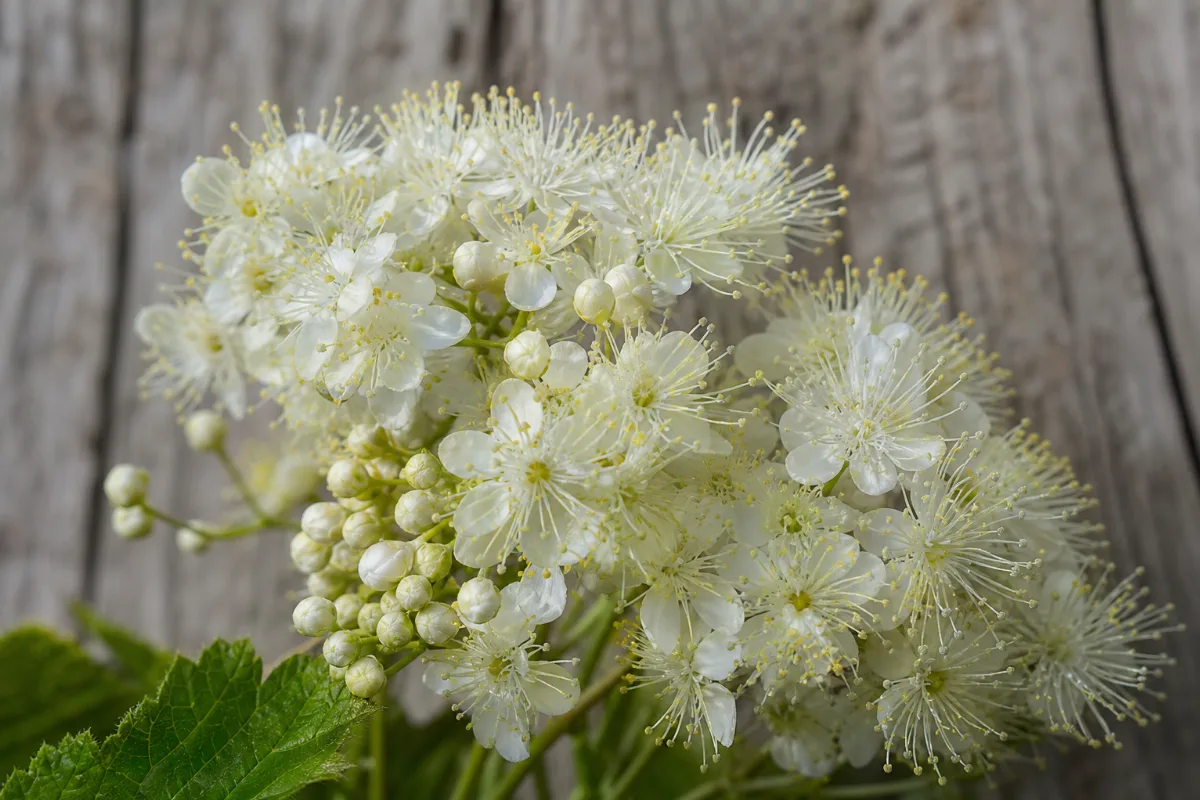
Herbs & Botanicals · Herbs · A flowering meadow plant used in Europe for joint pain and colds, with almost no human research
Meadowsweet
Filipendula ulmaria (L.) Maxim. (flowering tops and flowers) · also called Queen of the meadows, bridewort; Spiraea ulmaria (old name); Filipendulae ulmariae herba
Meadowsweet is a tall flowering plant of European wet meadows. The dried flowering tops are used as tea, powder or tincture. It contains salicylate-type compounds, flavonoids and tannins. The EU accepts it only as a traditional herbal medicine for supportive treatment of the common cold and for relief of minor joint pain, based on long use and not on clinical trials. Only one small human study was found, of a three-herb drink in healthy adults, and it was inconclusive. People allergic or sensitive to aspirin-type compounds should not use it, and it is not recommended for children, in pregnancy or while breastfeeding.
General information, not medical advice. Last substantive update · Not medically reviewed. A named clinician has not signed off on this page. How this page is made
About Meadowsweet
Meadowsweet is a European meadow plant with a long traditional use for colds and minor joint pain. The EU accepts these uses on tradition only. We found no trial of meadowsweet alone in people. The biggest cautions are for people sensitive to salicylates (aspirin-type compounds), children and teenagers, pregnancy and breastfeeding, and blood thinners or NSAIDs.
What it is
Meadowsweet (Filipendula ulmaria) is a tall plant in the rose family that grows in wet meadows and floodlands. The part used in medicine is the dried flowering tops or the flowers. Its old name was Spiraea ulmaria.
It contains salicylate-type compounds (such as salicylaldehyde and methyl salicylate), flavonoids such as spiraeoside, and tannins such as rugosin D. The EU reviewers estimate that salicylates are below 0.5 percent of the herb and mostly bound to sugars. The lab shows its extracts block the same COX enzymes as aspirin-type drugs, but that has not been shown to help people.
What the research shows
No randomized trial of meadowsweet on its own was found. In 2011 the EU reviewers found one old report of an ointment in cervical dysplasia and no other human data. A 2020 EU review of 60 newer papers found one human study: a four-week trial of a drink of chamomile, meadowsweet and willow bark in 20 healthy adults, which the authors and the EU called inconclusive.
The rest is lab and animal work: COX enzyme blocking, antioxidant tests, mixed results on stomach ulcers in animals, and tests on cells. These show what the plant does in a dish or in animals, not whether it helps people.
At a glance
Traditional uses history, not proof
- Supportive treatment of the common cold (EU traditional use)
- Relief of minor joint pain (EU traditional use)
- Stomach and urinary complaints in older British herbal books
Studied for research
- Minor joint pain, insufficient
- Common cold, insufficient
- Inflammation (lab and one combination trial), very low
- Fever (animals), insufficient
- Stomach protection (animals), insufficient
- Antioxidant activity (lab), very low
- Cervical dysplasia (one old report), insufficient
Main compounds
- Salicylaldehyde and methyl salicylate (salicylate-type)
- Spiraeoside and other flavonoids
- Rugosin D and other tannins
Common forms
- Tea (infusion) of the dried flowering tops
- Powder in capsules
- Tincture
- Dry or liquid extracts (EU reviewers said information was not enough to qualify them)
Research links: EMA: meadowsweet herb (EU herbal monograph) · EMA assessment report on meadowsweet herb and flowers · Three-herb drink trial (PubMed) · Research Library · Genes & Biomarkers Library
The plant and its history
- Accepted scientific name
- Filipendula ulmaria (L.) Maxim.
- Naming authority
- GBIF (read 2026-10-25): ACCEPTED species, key 2987999. NCBI Taxonomy: taxid 57917. Spiraea ulmaria L. is a GBIF synonym.
- Synonyms
- Spiraea ulmaria L.; Filipendulae ulmariae herba (herbal drug name, flowering tops); Filipendulae ulmariae flos (flowers)
- Common names
- Meadowsweet (English); Queen of the meadows (English); Bridewort (English); Reine des prés (French); Mädesüß (Echtes Mädesüß) (German); Ulmaria (Spanish)
- Botanical family
- Rosaceae (rose family).
- Classification
- Plantae > Not read > Not read > Rosales > Rosaceae > Filipendula > Filipendula ulmaria
- Native range
- Not stated in the sources read. A 2023 study describes the plant as widely distributed in Europe and growing wild in floodlands.
- Habitat
- Wild in floodlands in Lithuania, per a 2023 field study.
- What the plant looks like
- Roots: Not verified.; Stems: Not verified.; Leaves: Not verified.; Flowers: The herb used in medicine is the whole or cut dried flowering tops (EU and Ph. Eur.). Flowers are used as a separate material (flos).; Fruit: Not verified.
- Cultivation
- Not verified. The 2023 study treats wild floodland stands as a possible crop area.
- Harvest and processing
- Early flowering gives more volatile oil, late flowering gives more dried material per hectare (2023 Lithuanian field study).
- Look-alikes and adulterants
- Name: Dropwort (Filipendula vulgaris); Note: A related species studied alongside meadowsweet. Compounds tested in some studies came from dropwort, not meadowsweet.; Name: Filipendula palmata; Note: A related species tested in lab and mouse studies. Results do not automatically apply to meadowsweet.; Name: Willow bark (Salix species); Note: Not a look-alike, but a different salicylate-rich herb (0.5 to 10 percent salicylates per EMA) often compared with meadowsweet.
- Sustainability and conservation
- Not assessed in the sources read.
Traditional use and history history, not clinical proof
| Tradition or era | Documented use | Source |
|---|---|---|
| Europe, late 16th to 17th century onward | Medicinal use of meadowsweet is described from the late 16th and 17th century. It was used for inflammatory diseases and as a diuretic. Over time the main use moved from diuretic toward antirheumatic. | s-ema-assessment-report |
| Britain (British Herbal Pharmacopoeia 1974/1983 and Compendium 1992) | Listed as stomachic, mild urinary antiseptic, anti-inflammatory and antacid, for acid indigestion, gastritis, peptic ulcer, and rheumatic and arthritic pains, as tea, liquid extract or 1:5 tincture. | s-ema-assessment-report |
| France (marketed from 1980) | Powdered flowering tops in capsules were sold from 1980 and authorised in 1988 as a traditional medicine for minor painful joint conditions and to support kidney and digestive elimination. Water extracts have been marketed since 1986. | s-ema-assessment-report |
| Germany (Commission E, 1998) | Herb and flowers listed as supportive therapy for colds (as quoted by the EU reviewers). | s-ema-assessment-report |
| European Union (2011 monograph) | Traditional herbal medicinal product for supportive treatment of the common cold and for relief of minor joint pain. A periodic review began again in 2026. | s-ema-monograph-herba |
| Popular story about aspirin | The popular story that aspirin's name comes from the old plant name Spiraea (meadowsweet) was NOT verified: no source we read states it. | none |
Traditional use shows how a plant was used. It does not show that a supplement works or is safe today.
What is inside, and how it may work
What the plant contains and how those compounds act in cells and animals. Laboratory and animal mechanisms are not proven effects in people.
Main compounds
| Compound | Family | Where it is concentrated | Activity studied | Level of evidence |
|---|---|---|---|---|
| Salicylaldehyde PubChem 6998 | phenolic aldehyde (salicylate-type, volatile) | Flowering tops (essential oil) Up to 70 percent of the volatile oil (EMA); main salicylate in the oil, varies with flowering stage | Salicylate-type compound; contributes to the contraindication for salicylate hypersensitivity. 6 13 16 | Review |
| Methyl salicylate PubChem 4133 | salicylate ester (volatile) | Flowering tops (essential oil) Main salicylate with salicylaldehyde in the oil; they trade off with each other | Salicylate-type compound. 13 16 | Laboratory research |
| Salicylic acid PubChem 338 | phenolic acid (salicylate) | Herb (dry tincture) 18.84 mg per g of dry extract in one Bulgarian tincture | Salicylate. The EU reviewers estimate salicylates are below 0.5 percent of the herb, mostly as glycosides. 2 6 16 | Laboratory research |
| Spiraeoside (quercetin 4'-O-glucoside) PubChem 5320844 | flavonol glycoside | Flowering herb Flavonoids 3 to 4 percent of the flowering herb, spiraeoside the main one (EMA) | Antioxidant; blocked 12-HETE in human platelets (compound from F. vulgaris); turned into quercetin in a gut-digestion model. 6 21 22 16 | Laboratory research |
| Rutin PubChem 5280805 | flavonol glycoside | Herb 9.97 mg per g of dry extract in one tincture | Antioxidant; broken down in a gut model. 2 22 16 | Laboratory research |
| Hyperoside PubChem 5281643 | flavonol glycoside | Flowering herb Not quantified in sources read | Listed by the EU reviewers among the flavonoids. 6 16 | Review |
| Rugosin D PubChem 16129626 | ellagitannin (hydrolysable tannin) | Herb and flowers Hydrolysable tannins 1 percent in ethanolic to 12 percent in aqueous extracts, mainly rugosin D (EMA) | Anti-tumour in mice (older study); binds serum albumin in vitro. 6 16 | Animal research |
| Ellagic acid PubChem 5281855 | phenolic acid | Aerial parts (tincture) 70 to 120 mg/L in the tincture assessed by EFSA | A marker in the tincture assessed by EFSA. 4 16 | Review |
Mechanisms, receptors and pathways
| Target or pathway | Gene or receptor | What was found | Level |
|---|---|---|---|
| COX-1 and COX-2 enzymes | COX-1 (PTGS1), COX-2 (PTGS2) | A meadowsweet extract and its gut-bacteria breakdown products blocked COX-1 more than COX-2 in test-tube work. 22 | Laboratory research |
| Prostaglandin and 12-HETE production | Platelet eicosanoid pathway | Spiraeoside and a gallate flavonoid from dropwort blocked 12-HETE and PGE2 in human platelets taken from people. 21 | Laboratory research |
| Complement and T-cell activity | Classical complement pathway | Herb and flower extracts inhibited complement activation, T-cell growth and chemiluminescence in the lab (older studies cited by EMA). 6 | Laboratory research |
| Xanthine oxidase | XO | Methanol flower extracts strongly blocked xanthine oxidase in vitro (Kazazi 2009, cited by EMA; original not read). 6 | Laboratory research |
| Stomach lining protection | Not specified | Flower infusions kept the stomach lining intact in rats after ethanol injury; EU reviewers call the wider ulcer results contradictory. 21 6 | Animal research |
| Brain stress signals after burns | BDNF, GABA-A receptor alpha 2, melatonin and opioid receptors | In burned rats, the extract with hyperbaric oxygen reduced anxiety-like behaviour and changed these gene signals. 12 | Animal research |
| Skin barrier genes | Barrier and renewal genes in keratinocytes | Some extract fractions raised these genes in cultured human skin cells. 19 | Laboratory research |
| Human evidence | IL-1 beta, IL-6, TNF alpha | One 4-week trial of a three-herb drink in 20 healthy adults found no significant overall change in these markers. 3 | Human data |
Absorption, metabolism and elimination
- Absorption
- No data on absorption in people (EU reviewers, 2011).
- Distribution
- No data.
- Metabolism
- In a simulated colon model, glycoside flavonoids (rutin, spiraeoside, isoquercitrin) fell and aglycones (quercetin, apigenin, naringenin, kaempferol) rose, as gut bacteria would do. Not measured in people.
- Elimination
- No data.
- Bioavailability
- Unknown.
Isolated compounds versus whole extracts
The active compounds are not exactly known. A 2023 lab study suggests the anti-inflammatory activity may come from several compounds and their gut breakdown products acting together. The EU reviewers also doubt that salicylates play a big role in the effects. Results for one extract, isolated compound or related plant (dropwort) do not carry over to tea or capsules.
Nutritional composition
Meadowsweet is not a nutrient source. The Council of Europe lists the herb as a natural flavouring for foods in small amounts (as quoted in the EU report). Ascorbic acid and carbohydrates are listed in trace or minor amounts in the herb.
4 very low certainty8 not enough evidence
What is Meadowsweet good for?
The main proposed uses and how strong the human evidence is for each. For most, there is no human trial of meadowsweet at all.
Benefits, one by one
Each card is a research question, not a promise. Tap a goal to filter. Open a card to see the studies, doses and limits.
Minor joint pain (traditional use)
Not enough evidenceThe EU accepts meadowsweet tea, powder or tincture as a traditional herbal medicine for relief of minor joint pain. This rests on long use only. EU reviewers found no clinical trials of meadowsweet for joint pain. It is not for acute arthritis.
4 studiesTraditional EU preparations are tea, powder and a 1:5 tincture of the…
Studies, doses and limits
What the trials found
The EU reviewers (2011) found no clinical data for painful joint conditions. A 2020 EU review of 60 new papers found one human study (Drummond 2013), a three-herb drink in healthy adults, judged inconclusive. We found no randomized trial of meadowsweet alone in people with joint pain.
Results
No trial of meadowsweet alone. In the one three-herb trial, the treatment group showed better joint function and less pain on movement at the knee and lower back, but there was no significant effect on inflammation markers overall, and meadowsweet cannot be separated from chamomile and willow bark.
Effect sizes as reported
Not available for meadowsweet alone.
Why this rating
No clinical trials of the herb alone. The one human study mixed three herbs, had 20 healthy people and was called inconclusive by its authors and by the EU reviewers.
Form and dose studied
Traditional EU preparations are tea, powder and a 1:5 tincture of the herb. This page gives no amounts: ask a doctor or pharmacist.
Who was studied
Adults only. The EU does not recommend use under 18.
Limits
Traditional-use status says nothing about how well it works. Willow bark in the same drink may have contributed.
Why researchers looked
Meadowsweet has been used for rheumatic and joint pain in Europe since at least the 17th century, and products for minor joint pain have been sold in France since 1980.
Traditional use
Used as tea and as a 1:5 alcohol tincture in British herbal books. The EU monograph (2011) lists relief of minor articular pain as a traditional use. The monograph says it is not for acute arthritis, which needs medical advice, and not for more than 4 weeks.
Proposed mechanism Preliminary mechanism
Lab and animal studies show anti-inflammatory, immune and pain-related effects. The EU reviewers said these support the plausibility of long use, not proof of benefit.
A proposed mechanism does not show that the effect happens in people.
Contains salicylate-type compounds. Not for people with salicylate hypersensitivity. See the Safety tab.
Common cold, fever and chills (traditional use)
Not enough evidenceThe EU accepts meadowsweet tea or powder as a traditional herbal medicine for supportive treatment of the common cold. No clinical trial was found. In animals, flower preparations lowered body temperature.
3 studiesTea or powder in EU traditional use. No amounts here.
Studies, doses and limits
What the trials found
No human trial of meadowsweet in colds was found by the EU reviewers (2011). The 2020 EU review noted one new paper on common cold but gave no result.
Results
No human results exist. Animal results are reduced rectal temperature (EU reviewers, older studies).
Effect sizes as reported
None.
Why this rating
No trials in people.
Form and dose studied
Tea or powder in EU traditional use. No amounts here.
Who was studied
Adults only; not under 18.
Limits
Fever and cold symptoms usually pass on their own, and the EU monograph tells people to see a doctor if fever is above 39 C, lasts, or comes with severe headache.
Why researchers looked
Meadowsweet flowers and herb have been used as a sweating remedy for colds, flu and chills in German and British herbal tradition.
Traditional use
German Commission E (as quoted by the EU reviewers) lists it as supportive therapy for colds. The EU monograph says to start at the first signs of a cold and to see a doctor if symptoms last longer than 7 days, or if fever is above 39 C or comes with severe headache.
Proposed mechanism Animal research
In animals, flower preparations lowered rectal temperature; lab studies show antibacterial and immune effects. No study showed an effect on cold symptoms.
A proposed mechanism does not show that the effect happens in people.
See the Safety tab for salicylate cautions.
Inflammation (lab findings and one combination trial)
Very low certaintyIn the lab, meadowsweet extracts and their gut-bacteria breakdown products blocked the COX-1 enzyme more than COX-2. One small trial of a three-herb drink found no significant fall in inflammation markers.
4 studiesCombination drink in a berry extract matrix (human); extracts and iso…
Studies, doses and limits
What the trials found
One randomized placebo-controlled trial (Drummond 2013, 20 healthy adults, 4 weeks) tested a drink of chamomile, meadowsweet and willow bark. IL-1 beta fell 21.7 percent in the treatment group and 3 percent in placebo, not significant. The authors called the evidence inconclusive and asked for a larger trial in people with raised inflammation.
Results
No significant anti-inflammatory effect overall. IL-6 fell in one subgroup (people with higher baseline TNF alpha), a quartile analysis.
Effect sizes as reported
IL-1 beta -21.7 percent (treatment) vs -3 percent (placebo), not significant
Why this rating
Human data are one tiny combination trial with a null main result. The rest is lab work on extracts and isolated compounds, partly from a different Filipendula species.
Form and dose studied
Combination drink in a berry extract matrix (human); extracts and isolated compounds (lab).
Who was studied
Healthy adults (human); cell, platelet and chemical tests (lab).
Limits
Combination product. Healthy volunteers with little inflammation. Lab findings do not show that people benefit.
Why researchers looked
Meadowsweet contains salicylate-type compounds, flavonoids and tannins. Researchers ask which of these, or their breakdown products, could explain its traditional anti-inflammatory use.
Traditional use
Traditional herbal books describe meadowsweet as anti-inflammatory.
Proposed mechanism Laboratory research
A 2023 gut-digestion model found the original and the digested extract both blocked COX-1 more than COX-2; a mix of aglycones (quercetin, apigenin, naringenin, kaempferol) did so significantly. In human platelets, spiraeoside blocked 12-HETE production in a 2018 study, though the tested compounds were from the related species F. vulgaris.
A proposed mechanism does not show that the effect happens in people.
Blocking COX enzymes is also how aspirin-type drugs act; this is one reason for the salicylate cautions on the Safety tab.
Lowering body temperature (animal findings)
Not enough evidenceIn animals, meadowsweet flower preparations lowered rectal temperature. No human fever study was found.
2 studiesNot applicable.
Studies, doses and limits
What the trials found
No human data. The animal effect is cited from older studies that the EU reviewers described but did not re-test.
Results
Animal result only: reduced rectal temperature.
Effect sizes as reported
None.
Why this rating
Animal studies only, secondhand through a 2011 EU report.
Form and dose studied
Not applicable.
Who was studied
Animals.
Limits
Details of the animal studies were not read.
Why researchers looked
Traditional use as a sweating remedy for fever and chills led researchers to test temperature in animals.
Traditional use
French traditional use includes febrile and influenza conditions (EU reviewers).
Proposed mechanism Animal research
Reduced rectal temperature in animals, with reduced motor activity (older Russian studies cited by the EU reviewers).
A proposed mechanism does not show that the effect happens in people.
Fever above 39 C or fever with severe headache needs a doctor, per the EU monograph.
Stomach ulcers and stomach lining (animal results)
Not enough evidenceIn rats, meadowsweet flower infusions protected the stomach lining from alcohol injury. EU reviewers call animal results on ulcers contradictory because one flower decoction made histamine ulcers worse in guinea pigs. No human trial was found.
3 studiesFlower infusions (rats).
Studies, doses and limits
What the trials found
No human trial found.
Results
In rats, 100 to 300 mg/kg of freeze-dried flower infusion kept the stomach lining intact after ethanol injury. In older studies, flower preparations protected against ulcers in mice and rats, but a decoction worsened histamine-induced ulcers in guinea pigs.
Effect sizes as reported
No human data.
Why this rating
Only animal and lab findings, and they conflict.
Form and dose studied
Flower infusions (rats).
Who was studied
Rats, mice, guinea pigs.
Limits
Tested compounds were partly from the related F. vulgaris. Results in animals do not show a safe effect in people with stomach disease.
Why researchers looked
British herbal books list meadowsweet for acid indigestion, gastritis and peptic ulcer.
Traditional use
Listed in the British Herbal Pharmacopoeia and Compendium for acid dyspepsia and peptic ulcer, as reported by the EU reviewers (traditional use).
Proposed mechanism Animal research
Flavonoids (such as spiraeoside) and a tannin (tellimagrandin II) showed ulcer-preventing ability in rats.
A proposed mechanism does not show that the effect happens in people.
People with stomach ulcers should ask a doctor first. The EU willow-bark monograph lists active peptic ulcer as a contraindication for that salicylate-rich herb; no meadowsweet statement was found.
Antioxidant activity (lab)
Very low certaintyMeadowsweet extracts act as antioxidants in chemical tests. This is a test-tube property and does not show a health benefit.
3 studiesExtracts and tinctures (lab).
Studies, doses and limits
What the trials found
No human data.
Results
Strong antioxidant activity in lab tests (several studies).
Effect sizes as reported
Not applicable.
Why this rating
Chemical and cell tests only; antioxidant power in a test tube is not benefit in people.
Form and dose studied
Extracts and tinctures (lab).
Who was studied
Laboratory.
Limits
No human or animal outcome is shown by these tests.
Why researchers looked
Meadowsweet is rich in flavonoids, tannins and phenolic acids.
Traditional use
Not applicable.
Proposed mechanism Laboratory research
Radical-scavenging tests: flower infusion and spiraeoside matched positive controls; a Bulgarian dry tincture was strong in four tests and protected DNA from oxidative damage in a test system.
A proposed mechanism does not show that the effect happens in people.
Not applicable.
Antibacterial effects (lab)
Not enough evidenceIn lab tests, flower extracts slowed the growth of many bacteria, including some that cause urinary infections. No human infection study was found.
1 studiesEthanol and water flower extracts (lab).
Studies, doses and limits
What the trials found
No human data. Do not treat a urinary infection with meadowsweet.
Results
Growth inhibition in test dishes (older studies cited by the EU reviewers).
Effect sizes as reported
Not applicable.
Why this rating
Test-dish results only, secondhand.
Form and dose studied
Ethanol and water flower extracts (lab).
Who was studied
Laboratory.
Limits
Older studies, not read in the original.
Why researchers looked
Traditional use included mild urinary antiseptic and cystitis.
Traditional use
British herbal books list it for cystitis (EU reviewers).
Proposed mechanism Laboratory research
Bacteriostatic action of flower extracts against urinary pathogens in the lab.
A proposed mechanism does not show that the effect happens in people.
A urinary infection needs medical care.
Immune-system effects (lab and animal)
Not enough evidenceLab studies found meadowsweet extracts reduce parts of the immune system's activity, such as complement and T-cell growth. A decoction raised the growth of mouse immune cells. No human study was found.
1 studiesExtracts (lab).
Studies, doses and limits
What the trials found
No human data.
Results
Immune-modulating activity in lab and animal studies (secondhand).
Effect sizes as reported
Not applicable.
Why this rating
Older preclinical studies only.
Form and dose studied
Extracts (lab).
Who was studied
Laboratory, mice.
Limits
Active compounds not identified in the cited studies.
Why researchers looked
Traditional use in inflammatory disease prompted the tests.
Traditional use
Not applicable.
Proposed mechanism Laboratory research
Inhibition of complement activation, T-cell proliferation and chemiluminescence in vitro; macrophage growth stimulation in mice (older studies cited by the EU reviewers).
A proposed mechanism does not show that the effect happens in people.
Not applicable.
Anti-cancer activity in cells and animals (lab only)
Very low certaintyFlower decoctions reduced tumours in older animal studies, and a tincture slowed growth of liver cancer cells in a dish. This is not evidence that it treats or prevents cancer in people.
2 studiesFlower decoctions, rugosin D, dry tincture (lab).
Studies, doses and limits
What the trials found
No human data.
Results
Animal tumour reduction (older studies, secondhand); HepG2 growth slowed (2024 lab study).
Effect sizes as reported
Not applicable.
Why this rating
Cells and animals only.
Form and dose studied
Flower decoctions, rugosin D, dry tincture (lab).
Who was studied
Cell lines, mice, rats.
Limits
Lab results rarely carry over to people. Do not use meadowsweet in place of cancer care.
Why researchers looked
Researchers screen many traditional herbs for cell-growth effects.
Traditional use
Not applicable.
Proposed mechanism Animal research
Isolated rugosin D showed anti-tumour activity in transplanted mouse tumours (older study); tincture slowed HepG2 cell growth.
A proposed mechanism does not show that the effect happens in people.
Not applicable.
Cervical dysplasia (one old report)
Not enough evidenceThe only human study the EU reviewers found put an ointment made from a flower decoction on the cervix: 32 of 48 women improved. The EU reviewers could not judge the study. It is not a reason to skip cervical screening or treatment.
1 studiesOintment from a flower decoction applied locally.
Studies, doses and limits
What the trials found
One uncontrolled report, described secondhand: improvement in 32 of 48 patients (67 percent), complete regression in 25 (52 percent), and no recurrence in 10 completely cured patients within 10 months.
Results
32 of 48 improved; 25 of 48 complete regression (EU reviewers' summary).
Effect sizes as reported
32/48 (67%) improved; 25/48 (52%) complete regression
Why this rating
EU reviewers: data too limited to judge the quality and design; no control group is described.
Form and dose studied
Ointment from a flower decoction applied locally.
Who was studied
48 women with cervical dysplasia.
Limits
Original study not read; design unknown.
Why researchers looked
Local use of a flower decoction.
Traditional use
Not a standard traditional use.
Proposed mechanism Pharmacological theory
Not studied.
A proposed mechanism does not show that the effect happens in people.
Locally applied ointment is a different product from tea or capsules. Cervical dysplasia needs medical follow-up.
Urine flow and kidney-bladder use (traditional)
Not enough evidenceMeadowsweet was traditionally used to raise urine flow and help the kidneys and bladder. The EU reviewers found no evidence of an effect on kidney or digestive elimination.
1 studiesTea (traditional).
Studies, doses and limits
What the trials found
No human data. EU reviewers: no effects on renal and digestive elimination functions have been reported, and the EU monograph does not list this use.
Results
None.
Effect sizes as reported
Not applicable.
Why this rating
Traditional use only; the EU did not accept it as a use.
Form and dose studied
Tea (traditional).
Who was studied
Adults.
Limits
No study.
Why researchers looked
Early European use was as a diuretic, shifting over time toward use for rheumatism.
Traditional use
Tea is described in the German tradition for kidney and bladder complaints.
Proposed mechanism Pharmacological theory
No mechanism shown.
A proposed mechanism does not show that the effect happens in people.
People with kidney disease should ask a doctor. See Safety tab.
Burn healing and anxiety-like behaviour (rats) and skin cells (lab)
Very low certaintyIn rats with burns, a meadowsweet extract with oxygen therapy improved wound healing and reduced anxiety-like behaviour. In cultured skin cells, some extract fractions raised activity of genes linked to skin barrier and renewal.
2 studiesOral extract, 100 mg/kg in rats; hydroalcoholic extract on skin cells.
Studies, doses and limits
What the trials found
No human data.
Results
Rats: less anxiety-like behaviour and better wound healing with meadowsweet extract plus hyperbaric oxygen. Skin cells: gene activity linked to barrier function rose with some fractions.
Effect sizes as reported
Not applicable.
Why this rating
Rat and cell work. The rat studies combined the extract with hyperbaric oxygen.
Form and dose studied
Oral extract, 100 mg/kg in rats; hydroalcoholic extract on skin cells.
Who was studied
Rats, cultured human skin cells.
Limits
The skin-cell paper was by a cosmetics company's research team. The effects of the extract alone cannot be separated in the combined rat protocol.
Why researchers looked
Researchers asked whether the antioxidant plant extract helps burn recovery and the skin barrier.
Traditional use
Not applicable.
Proposed mechanism Animal research
Lower inflammation and cell-death markers and higher BDNF in the rat hippocampus; skin-cell gene activity in culture.
A proposed mechanism does not show that the effect happens in people.
Not applicable.
Connections to the rest of health
How Meadowsweet connects to the rest of our health knowledge graph. Every link says what kind of connection it is. A safety link (for example to the liver) is a warning, not a benefit. A study that merely mentions a topic never creates a benefit link.
Explore every connection: goals, body systems, organs, symptoms, genes
A. Wellness goals
| Connected to | Kind of connection | Evidence status | Context | Studies |
|---|---|---|---|---|
| Joint Support | Traditional use | Not enough evidence | Minor joint pain (traditional use): The EU accepts meadowsweet tea, powder or tincture as a traditional herbal medicine for relief of minor joint pain. This rests on long use only. EU reviewers found no clinical trials of meadowsweet for joint pain. It is not for acute arthritis. | 5 6 8 3 |
| Inflammation Balance | Traditional use | Not enough evidence | Minor joint pain (traditional use): The EU accepts meadowsweet tea, powder or tincture as a traditional herbal medicine for relief of minor joint pain. This rests on long use only. EU reviewers found no clinical trials of meadowsweet for joint pain. It is not for acute arthritis. | 5 6 8 3 |
| Immune Support | Traditional use | Not enough evidence | Common cold, fever and chills (traditional use): The EU accepts meadowsweet tea or powder as a traditional herbal medicine for supportive treatment of the common cold. No clinical trial was found. In animals, flower preparations lowered body temperature. | 5 6 8 |
| Inflammation Balance | Preliminary mechanism | Very low certainty | Inflammation (lab findings and one combination trial): In the lab, meadowsweet extracts and their gut-bacteria breakdown products blocked the COX-1 enzyme more than COX-2. One small trial of a three-herb drink found no significant fall in inflammation markers. | 3 22 21 6 |
| Immune Support | Preliminary mechanism | Not enough evidence | Lowering body temperature (animal findings): In animals, meadowsweet flower preparations lowered rectal temperature. No human fever study was found. Antibacterial effects (lab): In lab tests, flower extracts slowed the growth of many bacteria, including some that cause urinary infections. No human infection study was found. | 6 5 |
| Digestive Support | Preliminary mechanism | Not enough evidence | Stomach ulcers and stomach lining (animal results): In rats, meadowsweet flower infusions protected the stomach lining from alcohol injury. EU reviewers call animal results on ulcers contradictory because one flower decoction made histamine ulcers worse in guinea pigs. No human trial was found. | 21 6 7 |
| Healthy Aging | Preliminary mechanism | Very low certainty | Antioxidant activity (lab): Meadowsweet extracts act as antioxidants in chemical tests. This is a test-tube property and does not show a health benefit. Anti-cancer activity in cells and animals (lab only): Flower decoctions reduced tumours in older animal studies, and a tincture slowed growth of liver cancer cells in a dish. This is not evidence that it treats or prevents cancer in people. | 21 2 20 6 |
| Womens Wellness | Traditional use | Not enough evidence | Cervical dysplasia (one old report): The only human study the EU reviewers found put an ointment made from a flower decoction on the cervix: 32 of 48 women improved. The EU reviewers could not judge the study. It is not a reason to skip cervical screening or treatment. | 6 |
| Detoxification Support | Traditional use | Not enough evidence | Urine flow and kidney-bladder use (traditional): Meadowsweet was traditionally used to raise urine flow and help the kidneys and bladder. The EU reviewers found no evidence of an effect on kidney or digestive elimination. | 6 |
| Healthy Skin | Preliminary mechanism | Very low certainty | Burn healing and anxiety-like behaviour (rats) and skin cells (lab): In rats with burns, a meadowsweet extract with oxygen therapy improved wound healing and reduced anxiety-like behaviour. In cultured skin cells, some extract fractions raised activity of genes linked to skin barrier and renewal. | 12 19 |
B. Body systems
| Connected to | Kind of connection | Evidence status | Context | Studies |
|---|---|---|---|---|
| Immune system | Contraindication | Low certainty | EU contraindication for salicylate hypersensitivity. Preparation or compound: Meadowsweet herb (salicylate content) |
5 6 |
| Blood and bleeding | Drug or supplement interaction | Very low certainty | Possible added bleeding risk with blood thinners (reviews, theory; heparin-like extract thinned blood in animals by injection). Preparation or compound: Meadowsweet herb |
11 1 6 |
| Respiratory system | Adverse effect or risk | Very low certainty | Raised bronchial tone and worsened histamine airway spasm in animals (older studies); willow bark is contraindicated in salicylate-sensitive asthma. Preparation or compound: Flower extracts |
6 7 |
| Musculoskeletal system | Traditional use | Not enough evidence | EU traditional use for minor joint pain; no trial of the herb alone. Preparation or compound: Meadowsweet herb (tea, powder, tincture) |
5 6 |
| Musculoskeletal System | Biological association | Not enough evidence | Studied for: Minor joint pain (traditional use) Studied for: Inflammation (lab findings and one combination trial) | 5 6 8 3 22 21 |
| Immune System | Biological association | Not enough evidence | Studied for: Common cold, fever and chills (traditional use) Studied for: Inflammation (lab findings and one combination trial) | 5 6 8 3 22 21 2 20 |
| Respiratory System | Biological association | Not enough evidence | Studied for: Common cold, fever and chills (traditional use) | 5 6 8 |
| Digestive System | Biological association | Not enough evidence | Studied for: Stomach ulcers and stomach lining (animal results) | 21 6 7 |
| Urinary System | Biological association | Not enough evidence | Studied for: Antibacterial effects (lab) Studied for: Urine flow and kidney-bladder use (traditional) | 6 |
| Reproductive System | Biological association | Not enough evidence | Studied for: Cervical dysplasia (one old report) | 6 |
| Integumentary System | Biological association | Very low certainty | Studied for: Burn healing and anxiety-like behaviour (rats) and skin cells (lab) | 12 19 |
| Nervous System | Biological association | Very low certainty | Studied for: Burn healing and anxiety-like behaviour (rats) and skin cells (lab) | 12 19 |
I. Biomarkers
| Connected to | Kind of connection | Evidence status | Context | Studies |
|---|---|---|---|---|
| Interleukin-1 beta (IL-1 beta) | Biological association | Very low certainty | Measured in trials: no-change. A lab change is not the same as a health benefit. | 3 |
| Interleukin-6 (IL-6) | Biological association | Very low certainty | Measured in trials: mixed. A lab change is not the same as a health benefit. | 3 |
| Tumour necrosis factor alpha (TNF alpha) | Biological association | Very low certainty | Measured in trials: no-change. A lab change is not the same as a health benefit. | 3 |
| Joint flexibility and pain on movement | Biological association | Very low certainty | Measured in trials: lowered. A lab change is not the same as a health benefit. | 3 |
J. Genes, receptors and enzymes
| Connected to | Kind of connection | Evidence status | Context | Studies |
|---|---|---|---|---|
| COX-1 | Preliminary mechanism | Lab | Blocked more than COX-2 by an extract in the lab. | 22 |
| Xanthine oxidase | Preliminary mechanism | Lab | Blocked by flower extracts in vitro (cited by EMA). | 6 |
| BDNF | Preliminary mechanism | Animal | Higher in rat hippocampus after burn and extract plus oxygen. | 12 |
L. Active compounds
| Connected to | Kind of connection | Evidence status | Context | Studies |
|---|---|---|---|---|
| Salicylaldehyde | Biological association | Review | Salicylate-type compound; contributes to the contraindication for salicylate hypersensitivity. Preparation or compound: Flowering tops (essential oil) |
6 13 16 |
| Methyl salicylate | Biological association | In vitro | Salicylate-type compound. Preparation or compound: Flowering tops (essential oil) |
13 16 |
| Salicylic acid | Biological association | In vitro | Salicylate. The EU reviewers estimate salicylates are below 0.5 percent of the herb, mostly as glycosides. Preparation or compound: Herb (dry tincture) |
2 6 16 |
| Spiraeoside (quercetin 4'-O-glucoside) | Biological association | In vitro | Antioxidant; blocked 12-HETE in human platelets (compound from F. vulgaris); turned into quercetin in a gut-digestion model. Preparation or compound: Flowering herb |
6 21 22 16 |
| Rutin | Biological association | In vitro | Antioxidant; broken down in a gut model. Preparation or compound: Herb |
2 22 16 |
| Hyperoside | Biological association | Review | Listed by the EU reviewers among the flavonoids. Preparation or compound: Flowering herb |
6 16 |
| Rugosin D | Biological association | Animal | Anti-tumour in mice (older study); binds serum albumin in vitro. Preparation or compound: Herb and flowers |
6 16 |
| Ellagic acid | Biological association | Review | A marker in the tincture assessed by EFSA. Preparation or compound: Aerial parts (tincture) |
4 16 |
Each connection is stored with the ingredient, the connected record, the kind of connection, the evidence status, the supporting studies, the preparation or compound involved, and a review date (last reviewed October 25, 2026).
Evidence at a glance: what changed in 4 lab markers
Tap a number to show only those markers. Counts are markers, not people.
The evidence
The research centre for Meadowsweet. Every record here was checked against PubMed or the publisher's page; we never list a study we have not verified.
Evidence by outcome
Bars show how many studies we found for each outcome, not how well it works. People are added up across trials only (reviews are not added, to avoid double counting).
How we rate evidence
High certainty
Several well-run trials or reviews agree; further research is unlikely to change the picture much.
Moderate certainty
Good trials point the same way, but some doubt remains.
Low certainty
Small, short or inconsistent trials. The finding could change with better research.
Very low certainty
Very little or very weak human data. Treat as a possibility only.
Mixed findings
Trials or reviews disagree with each other.
Not enough evidence
Not enough human research to say either way.
Evidence against
Good research found no benefit, or found harm.
We take the reviewers' own risk-of-bias and GRADE statements where they exist, and otherwise judge from study size, design, consistency, directness and whether a product matches what is sold. Many publications do not make evidence high. Method note: We searched PubMed, read the abstract of every PubMed study cited, read the EU herbal monograph, assessment report, 2020 addendum and 2026 call in full, read the EU willow-bark monograph's contraindications, read a page extract from NINDS on Reye syndrome, and checked plant names in GBIF and NCBI Taxonomy and compounds in PubChem. Not verified: NCCIH (page not found), LiverTox and LactMed (one search, no result), FDA, WHO, the EU flowers monograph document, and original sources EMA quotes. Most studies were read as abstracts only. Certainty ratings are the compiler's reading.
Study library: every study we checked 22
| Study | Design | People | Product, dose, length | Result |
|---|---|---|---|---|
| Abebe 2002 Herbal medication: potential for adverse interactions with analgesic drugs J Clin Pharm Ther · PMID 12472978 · DOI |
Narrative review |
Review of herbs and analgesic drugs | Meadowsweet is among herbs listed unspecified not stated in the abstract |
Lists meadowsweet among herbs 'known to possess antiplatelet activity' that could add to bleeding risk with NSAIDs and aspirin, and among salicylate-containing herbs (with willow) that could add to kidney harm when taken with acetaminophen. The author says most interaction information comes from case reports, animal studies and in-vitro data, and that clinical significance is unconfirmed. Not given Methods, limits and fundingOutcomes: Potential interactions with NSAIDs, aspirin and acetaminophen Limitations: Narrative review from 2002. The abstract does not say what evidence supports the meadowsweet entries. Some statements here are in conflict with the more careful EMA assessment, which found no clinical interaction data. Read: abstract |
| Andonova 2024 DNA-Protective, Antioxidant and Anti-Carcinogenic Potential of Meadowsweet (Filipendula ulmaria) Dry Tincture Antioxidants (Basel) · PMID 39456454 · DOI |
Laboratory research in-vitro |
Laboratory tests, HepG2 liver cancer cells | Dry tincture of meadowsweet herb from Bulgaria herb (herba) not stated in the abstract |
HPLC found 12 phenolics. Major ones per gram of dry extract: salicylic acid 18.84 mg, rutin 9.97 mg, p-coumaric acid 6.80 mg, quercetin 4.47 mg, rosmarinic acid 4.01 mg, vanillic acid 3.82 mg. The tincture showed strong antioxidant activity in four chemical tests, protected DNA from oxidative damage in a test system, and slowed growth of HepG2 liver cancer cells. Not given Methods, limits and fundingOutcomes: Phenolic profile, antioxidant tests, DNA protection, cell growth Limitations: Cell and test-tube work only. Amounts are per gram of a dry extract, so they cannot be compared directly with the EMA estimate for the dried herb. Funding and conflicts: Authors declare no conflict of interest Read: abstract |
| Drummond 2013 An in vivo study examining the antiinflammatory effects of chamomile, meadowsweet, and willow bark in a novel functional beverage J Diet Suppl · PMID 24237191 · DOI |
Controlled trial |
20 Healthy adults, Ireland |
Herbal beverage of chamomile, meadowsweet and willow bark in a berry extract matrix (three-herb combination) unspecified (EMA review notes the plant parts were not stated) not stated in the abstract 4 weeks · vs Placebo (berry extract matrix alone) |
IL-1 beta fell on average 21.7 percent in the treatment group and 3 percent in the placebo group; the difference was not statistically significant. The treatment group showed improved joint function and less pain on movement at the knee and lower back. The authors concluded no significant anti-inflammatory effect overall and that the evidence is inconclusive. IL-1 beta -21.7 percent (treatment) vs -3 percent (placebo), not significant Methods, limits and fundingOutcomes: Blood IL-1 beta, IL-6, TNF alpha; joint flexibility and pain on movement Limitations: Only 20 healthy people. Three herbs together, so the effect of meadowsweet alone cannot be separated. Participants had little inflammation to start with. The abstract does not give funding. Read: abstract |
| EFSA FEEDAP Panel (Villa 2026 Safety and efficacy of a feed additive consisting of a tincture derived from the aerial parts of Filipendula ulmaria (L.) Maxim. (meadowsweet tincture) for use in all animal species (FEFANA asbl) EFSA J · PMID 42835906 · DOI |
Regulatory document animal |
Farm, companion and ornamental animals | Water/ethanol tincture of aerial parts (70 to 120 mg/L ellagic acid, 30 to 80 mg/L rutin) aerial parts not stated in the abstract |
The EFSA panel set maximum safe levels for animal feed for each species and found no safety concern for consumers or the environment from use in feed. It considers the tincture an irritant to skin and eyes and a skin and respiratory sensitiser, and says exposure of users by any route is a risk. Not given Methods, limits and fundingOutcomes: Animal, consumer, user and environmental safety Limitations: An animal-feed opinion. It does not assess meadowsweet as a human supplement. Some text in the abstract is redacted. Funding: requested by the European Commission; applicant was FEFANA asbl. Funding and conflicts: Applicant: FEFANA asbl (feed additives trade body) Read: abstract |
| European Medicines Agency 2011 Community herbal monograph on Filipendula ulmaria (L.) Maxim., herba (EMA/HMPC/434881/2010), adopted 12 July 2011 EMA · Source |
Regulatory document n/a |
Adults (EU traditional use) | Meadowsweet herb (dried flowering tops): tea, powder, 1:5 tincture flowering tops (herba) not stated in the abstract |
Traditional use only: supportive treatment of the common cold and relief of minor joint pain (tincture for joint pain only). Contraindicated in hypersensitivity to salicylates. Not recommended under 18, in pregnancy or breastfeeding. Use with salicylates or other NSAIDs not recommended without medical advice. Interactions: none reported. Undesirable effects: none known. No overdose reported. Tests for reproductive toxicity, genotoxicity and cancer risk have not been performed. Not given Methods, limits and fundingOutcomes: Traditional-use indications, contraindications, warnings Limitations: Traditional-use monograph: based on long use, not on clinical trials. Read from the official EMA PDF; identical text to the copy first read. Read: full-text |
| European Medicines Agency 2011 Assessment report on Filipendula ulmaria (L.) Maxim., herba and Filipendula ulmaria (L.) Maxim., flos (EMA/HMPC/434892/2010) EMA · Source |
Regulatory document n/a |
Not applicable | Meadowsweet herb and flowers, all preparations on the EU market in 2010 herb and flowers not stated in the abstract |
No adequate clinical studies: only one report of a flower-decoction ointment in cervical dysplasia (32 of 48 women improved), judged impossible to assess. Lab and animal findings: anti-inflammatory, immune, antibacterial, anti-tumour; stomach-ulcer findings contradictory. No pharmacokinetic data. Injected LD50 figures in mice and rabbits. No clinical interaction data; salicylates assumed under 0.5 percent, mostly as glycosides, so aspirin-type effects are considered unlikely. 15 member states reported no pharmacovigilance actions (situation July 2010). Not given Methods, limits and fundingOutcomes: Pharmacology, toxicology, clinical data, safety, conclusions Limitations: 2011 document; literature search date 28 September 2009. Many cited sources are older and secondary. Read: full-text |
| European Medicines Agency 2019 European Union herbal monograph on Salix [various species], cortex (EMA/HMPC/80630/2016) EMA · Source |
Regulatory document n/a |
Adults | Willow bark (a different plant that is richer in salicylates) bark not stated in the abstract |
Willow bark is contraindicated in hypersensitivity to salicylates or other NSAIDs, asthma due to salicylate sensitivity, active peptic ulcer, third trimester of pregnancy, G6PD deficiency, children and adolescents under 18 because of the risk of Reye's syndrome, severe liver or kidney problems, and coagulation disorders. Not given Methods, limits and fundingOutcomes: Contraindications Limitations: This is a different plant. It is used here only to show what the EU lists for a salicylate-rich herb. It does not say these risks apply to meadowsweet. Year is the copyright year printed on the copy read. Read: full-text |
| European Medicines Agency 2020 Addendum to Assessment report on Filipendula ulmaria (L.) Maxim. (= Spiraea ulmaria L.), herba (EMA/HMPC/595722/2019) EMA · Source |
Regulatory document n/a |
Not applicable | Meadowsweet herb herb not stated in the abstract |
60 new references found, 15 judged relevant, only 3 about the herb itself. One human study (Drummond 2013) judged inconclusive. EudraVigilance held 6 cases, all with other herbs and drugs taken together. Two genotoxicity papers (methanol extracts) were judged not enough to justify a list entry or to change the monograph. No revision proposed (adopted 6 May 2020). Not given Methods, limits and fundingOutcomes: Periodic review of new data 2011 to 2018 Limitations: Review of the monograph, not a new safety assessment. Case details were not given in the parts read. Read: full-text |
| European Medicines Agency 2026 Call for scientific data for the periodic review of the monograph on Filipendulae ulmariae herba (EMA/HMPC/39822/2026) EMA · Source |
Regulatory document n/a |
Not applicable | Meadowsweet herb herb not stated in the abstract |
The EU committee invited scientific data from 15 March to 15 June 2026 for a new periodic review of the herb monograph. The EMA web page lists the monograph status as an ongoing call for scientific data. Not given Methods, limits and fundingOutcomes: Process notice Limitations: A process notice only. It contains no findings. Read: full-text |
| GBIF 2026 GBIF Backbone Taxonomy: Filipendula ulmaria (L.) Maxim. (usageKey 2987999) api.gbif.org · Source |
Database plant |
unspecified not stated in the abstract |
Accepted name Filipendula ulmaria (L.) Maxim., rank species, family Rosaceae, order Rosales (strict exact match, read 2026-10-25). Spiraea ulmaria L. is listed as a synonym. Not given Methods, limits and fundingLimitations: Taxonomy only. Read: full-text | |
| Heck 2000 Potential interactions between alternative therapies and warfarin Am J Health Syst Pharm · PMID 10902065 |
Narrative review |
Review of herbs and warfarin | Meadowsweet is among herbs listed unspecified not stated in the abstract |
Lists meadowsweet among herbs that 'may potentially increase the risk of bleeding or potentiate the effects of warfarin', separate from products with documented warfarin reports. The authors say nearly all of the information is in-vitro, animal or single case reports and more study is needed. Not given Methods, limits and fundingOutcomes: Possible increased bleeding or warfarin effect Limitations: Narrative review from 2000 listing 'potential' interactions. The abstract does not say what evidence supports meadowsweet. Read: abstract |
| Krstic 2024 Complex Hippocampal Response to Thermal Skin Injury and Protocols with Hyperbaric Oxygen Therapy and Filipendula ulmaria Extract in Rats Int J Mol Sci · PMID 38474277 · DOI |
Animal research animal |
Male Wistar rats with a burn injury | Meadowsweet extract alone or with hyperbaric oxygen unspecified 100 mg/kg body weight by mouth 7 days · vs Untreated burned rats |
Hyperbaric oxygen and the meadowsweet extract each reduced anxiety-like behaviour after a burn injury in rats, with lower inflammation and cell-death markers and higher BDNF in the hippocampus. Not given Methods, limits and fundingOutcomes: Anxiety-like behaviour tests, brain gene activity Limitations: Rat study. Part and extract type not stated in the abstract. Tested with hyperbaric oxygen. No human relevance shown. Read: abstract |
| Ložienė 2023 Variations in Yield, Essential Oil, and Salicylates of Filipendula ulmaria Inflorescences at Different Blooming Stages Plants (Basel) · PMID 36679011 · DOI |
Phytochemistry plant |
Wild plants from five floodland sites, Lithuania | Meadowsweet flower heads (inflorescences) and their essential oil inflorescence not stated in the abstract |
Salicylaldehyde and methyl salicylate were the main salicylates in the essential oil at both blooming stages. Early bloom gave 1.2 to 2 times more volatile oil than late bloom. When salicylaldehyde rose, methyl salicylate fell. Not given Methods, limits and fundingOutcomes: Essential oil and salicylate content by blooming stage Limitations: Measures the essential oil, not tea or extracts, so it does not tell how much salicylate a person would take in. Agricultural study. Funding and conflicts: Authors declare no conflict of interest Read: abstract |
| NCBI 2026 NCBI Taxonomy: Filipendula ulmaria (taxid 57917) eutils.ncbi.nlm.nih.gov · Source |
Database plant |
unspecified not stated in the abstract |
The NCBI Taxonomy search for Filipendula ulmaria returned taxon id 57917 on 2026-10-25. Not given Methods, limits and fundingLimitations: Taxon id only; lineage not read. Read: full-text | |
| NCBI Bookshelf search 2026 NIH LiverTox and LactMed: no meadowsweet entry found eutils.ncbi.nlm.nih.gov · Source |
Database n/a |
unspecified not stated in the abstract |
A search of NCBI Bookshelf for 'meadowsweet livertox' returned no results on 2026-10-25. No LiverTox or LactMed meadowsweet record was identified. This is a search result, not a confirmation that no record exists. Not given Methods, limits and fundingLimitations: The LiverTox and LactMed sites themselves were not searched. Read: summary-only | |
| NCBI PubChem 2026 PubChem compound records for meadowsweet constituents pubchem.ncbi.nlm.nih.gov · Source |
Database compound |
unspecified not stated in the abstract |
Name lookups on 2026-10-25 returned: salicylaldehyde CID 6998 (C7H6O2); methyl salicylate CID 4133 (C8H8O3); salicylic acid CID 338 (C7H6O3); spiraeoside = quercetin 4'-O-glucoside CID 5320844 (C21H20O12); rutin CID 5280805 (C27H30O16); hyperoside CID 5281643 (C21H20O12); rugosin D CID 16129626 (C82H58O52); ellagic acid CID 5281855 (C14H6O8). Not given Methods, limits and fundingLimitations: Identifiers and formulas only. Read: full-text | |
| NCCIH 2026 NCCIH page for meadowsweet: not found nccih.nih.gov · Source |
Database n/a |
unspecified not stated in the abstract |
The address https://www.nccih.nih.gov/health/meadowsweet returned HTTP 404 on 2026-10-25. No NCCIH herb page for meadowsweet was found. Not given Methods, limits and fundingLimitations: One address tried; the NCCIH site search was not used. Read: summary-only | |
| National Institute of Neurological Disorders and Stroke 2026 Reye's syndrome (NINDS, NIH patient information) NINDS website · Source |
Regulatory document n/a |
Children and teens | Aspirin (salicylate) during viral illness not applicable not stated in the abstract |
Studies have shown a link between taking aspirin (salicylate) during a viral illness and developing Reye's syndrome. Health professionals therefore recommend acetaminophen or ibuprofen instead of aspirin for children. Not given Methods, limits and fundingOutcomes: Reye's syndrome Limitations: About aspirin, not meadowsweet. No source read reports Reye's syndrome with meadowsweet. Read as a page extract on 2026-10-25; page date not captured. Read: summary-only |
| Pannakal 2023 Rapid Chemical Profiling of Filipendula ulmaria Using CPC Fractionation, 2-D Mapping of 13C NMR Data, and High-Resolution LC-MS Molecules · PMID 37687176 · DOI |
Laboratory research in-vitro |
Laboratory; human skin cells (keratinocytes) in culture | Hydroalcoholic extract of meadowsweet aerial parts aerial parts not stated in the abstract |
28 compounds were identified, including quercetin and kaempferol glycosides, ursolic acid, pomolic acid, naringenin, beta-sitosterol and tellimagrandins I and II. Fractions with these compounds raised the activity of genes linked to skin barrier function and renewal in cultured skin cells. Not given Methods, limits and fundingOutcomes: Compounds identified; skin-cell gene activity Limitations: Cell culture only, aimed at a skin-care use. Authors work at L'Oreal Research and Innovation (affiliations in the abstract); they declare no conflict of interest. Funding and conflicts: Authors are employed at L'Oreal Research and Innovation Read: abstract |
| Pukalskienė 2018 Genotoxicity and antioxidant activity of five Agrimonia and Filipendula species plant extracts evaluated by comet and micronucleus assays in human lymphocytes and Ames Salmonella/microsome test Food Chem Toxicol · PMID 29269060 · DOI |
Laboratory research in-vitro |
Human lymphocytes in vitro and Salmonella bacteria | Methanol extracts of F. ulmaria and four other Agrimonia and Filipendula species unspecified not stated in the abstract |
All extracts raised DNA damage in the comet assay but did not cause mutations in the Ames test and were not genotoxic in the micronucleus test. Cell division index fell slightly but significantly. The authors classed the extracts as non-mutagenic and non-clastogenic in vitro under their conditions. The EMA 2020 review judged these results not enough to change the monograph because methanol is not a solvent covered by the monograph. Not given Methods, limits and fundingOutcomes: DNA damage and mutation tests Limitations: Methanol extracts, not tea or ethanol tincture. Lab tests only. Mixed result (comet up, other tests negative). Read: abstract |
| Samardžić 2018 Antioxidant, anti-inflammatory and gastroprotective activity of Filipendula ulmaria (L.) Maxim. and Filipendula vulgaris Moench. J Ethnopharmacol · PMID 29132911 · DOI |
Animal research animal |
Chemical tests, human platelets (ex vivo) and rats | Freeze-dried flower infusions of F. ulmaria and the related F. vulgaris, plus compounds isolated from F. vulgaris (spiraeoside, a tannin) flowers Infusions 100 to 300 mg/kg by mouth in rats; spiraeoside 50 mg/kg; tellimagrandin II 40 mg/kg |
Flower infusions and spiraeoside matched the positive control in two antioxidant tests. Spiraeoside blocked 12-HETE production in human platelets (IC50 4.69 ug/mL) and astragalin 2''-O-gallate blocked PGE2 (IC50 141.1 ug/mL). The infusions kept the stomach lining intact in rats with ethanol injury, and spiraeoside and tellimagrandin II showed ulcer-preventing ability. Not given Methods, limits and fundingOutcomes: Antioxidant tests, platelet prostaglandin and 12-HETE, ethanol-induced gastric injury in rats Limitations: Lab and rat work. Several compounds tested were isolated from F. vulgaris (dropwort), not meadowsweet. Ethanol-injury model. Read: abstract |
| Van der Auwera 2023 In Vitro Biotransformation and Anti-Inflammatory Activity of Constituents and Metabolites of Filipendula ulmaria Pharmaceutics · PMID 37111776 · DOI |
Laboratory research in-vitro |
Laboratory model | Meadowsweet extract run through a simulated gut-digestion model unspecified not stated in the abstract |
In the simulated colon, glycoside flavonoids such as rutin, spiraeoside and isoquercitrin decreased while aglycones such as quercetin, apigenin, naringenin and kaempferol increased. Both the original and the digested extract blocked the COX-1 enzyme more than COX-2. A mix of aglycones blocked COX-1 significantly. Not given Methods, limits and fundingOutcomes: COX-1, COX-2 and NF-kB tests Limitations: Test-tube and simulated-digestion work only. No people or animals. Funding and conflicts: Authors declare no conflict of interest Read: abstract |
What we do not know yet
- No randomized trial of meadowsweet alone for any use.
- No safety trial, adverse-event series or clotting study in people.
- No data on aspirin-sensitive asthma, children or pregnancy.
- Genotoxicity, cancer and reproductive tests have not been done (EU).
- No NCCIH, LiverTox or LactMed page found; FDA and WHO not checked.
How new research is added
New studies are found by a saved PubMed search and placed in a review queue. A person reads each one before it changes any rating or safety wording.
Lab markers
What changed in blood or saliva tests during trials. A changed number is not the same as feeling or being healthier, and we give no "normal ranges".
Inflammatory 2
Interleukin-6 (IL-6)
Mixed results in trials
A blood signal that rises with inflammation.
Very low certaintyResults and what it means
Why it was measured
Second inflammation marker in the same trial.
Statistical vs. clinical meaning
A subgroup result in a very small trial. It may be chance.
Safety implication
None identified.
| Study | Result | People | Product |
|---|---|---|---|
| 3 | IL-6 fell in the treatment group in a quartile analysis of people with higher starting TNF alpha; no overall significant effect | 20 healthy adults, 4 weeks | Combination drink |
Tumour necrosis factor alpha (TNF alpha)
No clear change in trials
A blood signal involved in inflammation.
Very low certaintyResults and what it means
Why it was measured
Measured in the same trial and used to split people into groups.
Statistical vs. clinical meaning
Only used for subgroup analysis; no result numbers in the abstract.
Safety implication
None identified.
| Study | Result | People | Product |
|---|---|---|---|
| 3 | Measured; no significant overall change reported in the abstract | 20 healthy adults, 4 weeks | Combination drink |
Other 2
Interleukin-1 beta (IL-1 beta)
No clear change in trials
A blood signal made during inflammation.
Very low certaintyResults and what it means
Why it was measured
Used as a measure of whole-body inflammation in the only human study.
Statistical vs. clinical meaning
Not statistically significant, so no firm conclusion. A blood marker, not a symptom.
Safety implication
None identified in the abstract.
| Study | Result | People | Product |
|---|---|---|---|
| 3 | Average fall of 21.7 percent in the treatment group vs 3 percent in placebo; not statistically significant | 20 healthy adults, 4 weeks | Chamomile, meadowsweet and willow bark drink (combination) |
Joint flexibility and pain on movement
Lowered in trials
Measured bending of the joint and pain when moving it.
Very low certaintyResults and what it means
Why it was measured
The trial looked at knee and lower back function.
Statistical vs. clinical meaning
No numbers or comparison with placebo given in the abstract, healthy people, and three herbs together.
Safety implication
None identified.
| Study | Result | People | Product |
|---|---|---|---|
| 3 | Improved joint function and less pain on movement at the knee and lower back in the treatment group (no numbers in the abstract) | 20 healthy adults, 4 weeks | Combination drink |
Safety
What studies and official sources say about side effects, medicines and who should check first. Each point shows what kind of evidence it comes from.
Main points to know 6
- Salicylate or aspirin allergy, and salicylate-sensitive asthma. The EU monograph lists hypersensitivity to salicylates as a contraindication because meadowsweet contains salicylate-type compounds. The EU reviewers think aspirin-type effects are unlikely because the amount is small, but still say not to use it if you are sensitive. The EU monograph for willow bark (a salicylate-rich herb) also lists asthma due to salicylate sensitivity. No source says meadowsweet causes asthma attacks in people. In animals, flower extracts raised bronchial tone and made histamine-induced airway spasm worse. Authoritative guidance 5 6 7
- Children and teenagers: Reye syndrome concern. The EU does not recommend meadowsweet under 18 because there is not enough data. Aspirin, a salicylate, is linked to Reye syndrome when taken by children during a viral illness. The EU lists Reye syndrome as the reason willow bark is contraindicated under 18. No source we read reports Reye syndrome with meadowsweet. The concern is by comparison with other salicylates, not shown for this herb. Authoritative guidance 5 7 18
- Bleeding and blood thinners. Two reviews list meadowsweet among herbs that might add to bleeding with NSAIDs, aspirin or warfarin. The abstracts say most such information comes from case reports, animal studies and lab tests and that clinical importance is not confirmed. The EU reviewers found no clinical interaction data and think salicylate-related interactions are unlikely at the low amounts in the herb. A heparin-like extract from the flowers thinned blood in animals when injected. No human bleeding case with meadowsweet alone was found. Pharmacological theory 1 11 6
- Pregnancy and breastfeeding. The EU does not recommend meadowsweet in pregnancy or breastfeeding because safety has not been established. There are no fertility data. Tests for reproductive toxicity have not been performed. Authoritative guidance 5 6
- Kidney, liver and stomach. No human liver injury was found and the EU reviewers saw no liver effect in rat and rabbit pharmacology studies. No LiverTox entry was found. A review suggests salicylate-containing herbs such as meadowsweet might add to kidney harm when taken with acetaminophen (theory only). The animal results on stomach ulcers conflict. The EU willow-bark monograph lists active peptic ulcer and severe liver or kidney problems as contraindications for that herb; no matching meadowsweet statement was found. Authoritative guidance 6 1 7
- Safety testing is incomplete. The EU says tests for genetic damage, cancer risk and reproductive harm have not been performed, so no EU safety list entry was granted. Lab tests of methanol extracts gave mixed results: more DNA damage in one test, but no mutation and no chromosome damage in others. The EU reviewers judged these studies too limited to change the monograph. Laboratory research 5 8 20
Side effects 3
| Effect | How often | Severity and recovery | Evidence |
|---|---|---|---|
| No undesirable effects known (EU monograph) No pharmacovigilance actions were reported by 15 EU member states (situation July 2010). The 2020 review found 6 EudraVigilance cases, all taken with other herbs and drugs. No details on those cases were read. | Not established | Not stated Not stated | Authoritative guidance 5 6 |
| Allergic reaction in people sensitive to salicylates (expected, not reported for meadowsweet) The contraindication is stated by the EU monograph. No case of a reaction to meadowsweet was found in the sources read. | Not established | Not stated Not stated | Authoritative guidance 5 6 |
| Skin and eye irritation and skin or breathing sensitisation (occupational, concentrated tincture) EFSA says a meadowsweet tincture feed additive is a skin and eye irritant and a skin and respiratory sensitiser, so handlers face risk by any route. This concerns the animal-feed additive, not tea or capsules. | Not established | Not stated Not stated | Authoritative guidance 4 |
Liver
We found no published human case of liver injury attributed to meadowsweet. The EU reviewers saw no effect on liver function in rat and rabbit studies of flowers and flower extracts. A search for a NIH LiverTox entry found nothing, but the LiverTox site itself was not searched directly. This is not a clean bill of health. 6 15
How often. No human case reports found; frequency unknown.
Monitoring. No agency monitoring advice found. People with liver disease should ask a doctor first.
This is a safety connection. It is not evidence that Meadowsweet supports liver health.
Medicines and supplements 6
| With | Why it matters | Importance | Evidence | What to do |
|---|---|---|---|---|
| Aspirin, other salicylates and NSAIDs (ibuprofen, naproxen and similar) salicylate or NSAID | Meadowsweet contains salicylate-type compounds; lab studies show it blocks COX enzymes, as aspirin and NSAIDs do. | The EU monograph says use together is not recommended without medical advice. The EU assessment says the interaction is theoretical and unlikely because the herb contains little salicylate, and that no clinical interaction is documented. | Authoritative guidance Not enough evidence 5 6 22 | Ask a pharmacist or doctor before combining, especially with daily aspirin. |
| Warfarin, other anticoagulants and antiplatelet drugs blood thinner | Listed as a possible herb for added bleeding risk; a heparin-like flower extract was anticoagulant in animals by injection. | Two reviews list it as a potential interaction. Neither review's abstract gives meadowsweet-specific evidence. The EU reviewers found no clinical data. | Pharmacological theory Very low certainty 11 1 6 | Tell the prescriber or pharmacist if you use it. Report unusual bruising or bleeding. |
| Acetaminophen (paracetamol) analgesic | A review suggests salicylate-containing herbs could add to kidney strain with acetaminophen. | Theory from a 2002 review; no meadowsweet data in the abstract. | Pharmacological theory Very low certainty 1 | Ask a pharmacist, particularly with kidney disease or regular acetaminophen use. |
| Sedatives, anaesthetics and opioid medicines sedative | In mice, flower preparations lowered activity and extended the effect of narcotic drugs (older studies). | Animal result described secondhand by EU reviewers; no human data. | Animal research Very low certainty 6 | Ask a pharmacist if you use sedating medicines. |
| Medicines that are processed by liver enzymes (CYP and similar) drug-metabolism | Not studied. | The EU reviewers found no pharmacokinetic data on interactions with other medicines. We found no study of meadowsweet and CYP enzymes. | Pharmacological theory Not enough evidence 6 | No evidence either way. Ask a pharmacist if your medicine has a narrow safe range. |
| Alcohol in tinctures (people avoiding alcohol; medicines that conflict with alcohol) alcohol | Tinctures are made with ethanol (45 percent in the EU preparation). | The EU monograph requires an ethanol warning on labels of extracts containing alcohol. | Authoritative guidance Low certainty 5 6 | People avoiding alcohol should choose tea or capsules and ask a pharmacist about medicines that conflict with alcohol. |
Who should check first 7
| Situation | Advice | Evidence |
|---|---|---|
| Hypersensitivity (allergy or intolerance) to salicylates or to meadowsweet | Do not use. This is an EU monograph contraindication. | Authoritative guidance 5 6 |
| Asthma triggered by aspirin or salicylates | No meadowsweet-specific statement found. The EU lists this as a contraindication for salicylate-rich willow bark, so ask a doctor before using meadowsweet. | Authoritative guidance 7 6 |
| Pregnancy and breastfeeding | Not recommended: safety is not established and there are no fertility data. | Authoritative guidance 5 6 |
| Children and adolescents under 18 | Not recommended (insufficient data). The Reye syndrome concern is by comparison with aspirin and willow bark, not shown for meadowsweet. | Authoritative guidance 5 7 18 |
| Taking aspirin, NSAIDs or blood thinners | Use together is not recommended without medical advice. | Authoritative guidance 5 11 1 |
| Acute arthritis | The EU says meadowsweet is not intended for acute arthritis, which needs medical advice. | Authoritative guidance 5 |
| Active stomach ulcer, bleeding disorders, or severe liver or kidney disease | No meadowsweet-specific statement found. The EU lists these for willow bark, so ask a doctor first. | Authoritative guidance 7 |
Overdose, product quality and regulators
Summary. No human overdose has been reported. The only toxicity figures are animal injection doses, which do not apply to tea or capsules.
Animal. Injected LD50: ethanolic flower extract 1770 mg/kg (mouse, intraperitoneal) and 75.7 mg/kg (rabbit, intravenous). Flower decoction 1:20: 535 mg/kg and 1050 mg/kg (male and female mouse, intraperitoneal) and 141.5 mg/kg (rabbit, intravenous). No oral LD50 was found. Flower preparations did not change liver function in rats and rabbits.
Human doses studied. Not covered here. The EU traditional-use preparations are tea, powder and a 1:5 tincture; ask a doctor or pharmacist about amounts.
High dose or long term signals. The EU says data on prolonged use are lacking, so the monograph limits cold use to a short course and joint use to 4 weeks.
Overdose response. No case of overdose has been reported (EU monograph).
Genotoxicity. Mixed lab results with methanol extracts: more DNA damage in the comet test, but no mutations in the Ames test and no chromosome damage in the micronucleus test. The EU says no proper genotoxicity, cancer or reproductive tests have been done.
Toxic plant parts. No toxic plant part is identified in the sources read. Flowering tops and flowers are the parts used.
No contamination or adulteration data for meadowsweet products were found.
Product testing. No heavy metal, pesticide or adulteration survey for meadowsweet was found in the sources read. 6
Plant identity and quality. The EU cites a European Pharmacopoeia standard for the dried flowering tops (Ph. Eur. 1868) that sets a minimum for volatile oil. Related species such as dropwort (Filipendula vulgaris) and F. palmata are studied in the lab but are different plants. 5 6 21 20
Salicylate content varies. The EU reviewers estimate salicylates are below 0.5 percent of the herb and mostly bound to sugar. A 2024 lab study of one dry tincture measured salicylic acid at 18.84 mg per gram of dry extract, a different basis. A 2023 study found the early flowering stage gave more volatile oil than late flowering. 6 2 13
| Body | Action | Date |
|---|---|---|
| European Medicines Agency (HMPC) (European Union) | EU herbal monograph (herba): traditional use for supportive treatment of the common cold and relief of minor joint pain. Contraindication: salicylate hypersensitivity. Not recommended under 18, in pregnancy or breastfeeding. No list entry because of missing genotoxicity, cancer and reproductive tests. source | 2011-07 |
| European Medicines Agency (HMPC) (European Union) | Periodic review: 2020 addendum found no new data requiring a change (no revision proposed). A new call for scientific data ran 15 March to 15 June 2026. EMA lists the herba status as an ongoing call for scientific data. source | 2020-05 and 2026-03 |
| EFSA (animal feed panel) (European Union) | 2026 opinion on a meadowsweet tincture as an animal feed flavouring: safe at stated levels for animals and no consumer concern; irritant and sensitiser for users handling it. source | 2026-10 |
When to get medical help
- Hives, swelling of the face, lips or throat, wheezing or trouble breathing after taking it (possible allergy to salicylates). Get urgent help.
- Unusual bruising, nosebleeds that will not stop, black or bloody stools or vomiting blood, especially if you take aspirin, NSAIDs or a blood thinner (general warning, not specific to meadowsweet).
- A child or teenager who is recovering from a viral illness and develops repeated vomiting, confusion or unusual sleepiness: urgent medical care (general Reye syndrome warning).
- Fever above 39 C, fever that lasts, or severe headache while using it for a cold (EU monograph).
- Joint pain that is severe, hot and swollen (acute arthritis) needs a doctor, not self-treatment.
Stop the supplement and contact a clinician or emergency service. In the US, Poison Control is 1-800-222-1222.
General information only, not medical advice. Ask a clinician or pharmacist before use, especially with medicines, in pregnancy or with a health condition. See the Natural Remedy Safety guide.
Frequently asked questions
What is meadowsweet?
Does meadowsweet work for joint pain?
Does meadowsweet help colds?
Is meadowsweet like aspirin?
It contains salicylate-type compounds, and in the lab it blocks the same COX enzymes. But the EU reviewers estimate salicylates are below 0.5 percent of the herb, mostly bound to sugars, and consider aspirin-type effects unlikely. One lab study of a concentrated dry tincture found 18.84 mg of salicylic acid per gram of dry extract, a different basis. Amounts vary by product.
Can I take it if I am allergic to aspirin or have asthma?
The EU monograph says not to use it if you are hypersensitive to salicylates. For asthma, the EU lists salicylate-sensitive asthma as a contraindication for willow bark, a salicylate-rich herb; we found no meadowsweet statement on asthma. Flower extracts raised airway tone in animals. Ask a doctor first.
Is meadowsweet safe for children? What about Reye syndrome?
The EU does not recommend it under 18 because data are lacking. Aspirin is linked to Reye syndrome in children with viral illness, and the EU lists that as the reason willow bark is contraindicated under 18. No source we read reports Reye syndrome with meadowsweet. Treat the concern as a reason for caution, not as proven.
Does meadowsweet thin the blood?
Two reviews list meadowsweet among herbs that might add to bleeding with aspirin, NSAIDs or warfarin, mostly from theory and lab or animal data. A heparin-like flower extract thinned blood in animals when injected. The EU reviewers found no clinical interaction data. If you take a blood thinner, tell your doctor or pharmacist.
Is it safe for the kidneys, liver and stomach?
We found no human case of liver or kidney injury, and the EU saw no liver effect in rats and rabbits. A review suggests salicylate herbs might add to kidney strain with acetaminophen (theory). Stomach ulcer results in animals conflict. No LiverTox entry was found, but that site was not searched directly. This is not a clean bill of health.
Is it safe in pregnancy or breastfeeding?
What medicines might interact?
What side effects does meadowsweet have?
Explore by health goal
Immune SupportInflammation BalanceHealthy AgingJoint SupportDigestive SupportWomens WellnessDetoxification SupportHealthy Skin
Editorial transparency
- Written by
- AlternativeMed editorial team. Research compiled with AI assistance, then checked against PubMed records.
- Medical review
- None. This page has not been reviewed by a physician or pharmacist.
- First published
- 2026-10-25
- Last substantive update
- 2026-10-25
- How we research
- We searched PubMed, read the abstract of every PubMed study cited, read the EU herbal monograph, assessment report, 2020 addendum and 2026 call in full, read the EU willow-bark monograph's contraindications, read a page extract from NINDS on Reye syndrome, and checked plant names in GBIF and NCBI Taxonomy and compounds in PubChem. Not verified: NCCIH (page not found), LiverTox and LactMed (one search, no result), FDA, WHO, the EU flowers monograph document, and original sources EMA quotes. Most studies were read as abstracts only. Certainty ratings are the compiler's reading.
- How we rate evidence
- See "How we rate evidence" in the Evidence tab.
- Independence
- No product is promoted on this page. No affiliate links are shown.
Sources 22
Each source was opened and checked. Where we read only the abstract, it says so. The small numbers in the text point here.
- Abebe W. Herbal medication: potential for adverse interactions with analgesic drugs. J Clin Pharm Ther. 2002. PMID 12472978. DOI 10.1046/j.1365-2710.2002.00444.x. (abstract)
- Andonova T, Muhovski Y, Apostolova E, et al.. DNA-Protective, Antioxidant and Anti-Carcinogenic Potential of Meadowsweet (Filipendula ulmaria) Dry Tincture. Antioxidants (Basel). 2024. PMID 39456454. DOI 10.3390/antiox13101200. (abstract)
- Drummond EM, Harbourne N, Marete E, et al.. An in vivo study examining the antiinflammatory effects of chamomile, meadowsweet, and willow bark in a novel functional beverage. J Diet Suppl. 2013. PMID 24237191. DOI 10.3109/19390211.2013.830680. (abstract)
- EFSA FEEDAP Panel (Villa RE, Azimonti G, Bonos E, et al.). Safety and efficacy of a feed additive consisting of a tincture derived from the aerial parts of Filipendula ulmaria (L.) Maxim. (meadowsweet tincture) for use in all animal species (FEFANA asbl). EFSA J. 2026. PMID 42835906. DOI 10.2903/j.efsa.2026.10344. (abstract)
- European Medicines Agency, HMPC. Community herbal monograph on Filipendula ulmaria (L.) Maxim., herba (EMA/HMPC/434881/2010), adopted 12 July 2011. EMA. 2011. (full-text)
- European Medicines Agency, HMPC. Assessment report on Filipendula ulmaria (L.) Maxim., herba and Filipendula ulmaria (L.) Maxim., flos (EMA/HMPC/434892/2010). EMA. 2011. (full-text)
- European Medicines Agency, HMPC. European Union herbal monograph on Salix [various species], cortex (EMA/HMPC/80630/2016). EMA. 2019. (full-text)
- European Medicines Agency, HMPC. Addendum to Assessment report on Filipendula ulmaria (L.) Maxim. (= Spiraea ulmaria L.), herba (EMA/HMPC/595722/2019). EMA. 2020. (full-text)
- European Medicines Agency, HMPC. Call for scientific data for the periodic review of the monograph on Filipendulae ulmariae herba (EMA/HMPC/39822/2026). EMA. 2026. (full-text)
- GBIF. GBIF Backbone Taxonomy: Filipendula ulmaria (L.) Maxim. (usageKey 2987999). api.gbif.org. 2026. (full-text)
- Heck AM, DeWitt BA, Lukes AL. Potential interactions between alternative therapies and warfarin. Am J Health Syst Pharm. 2000. PMID 10902065. (abstract)
- Krstic B, Selakovic D, Jovicic N, et al.. Complex Hippocampal Response to Thermal Skin Injury and Protocols with Hyperbaric Oxygen Therapy and Filipendula ulmaria Extract in Rats. Int J Mol Sci. 2024. PMID 38474277. DOI 10.3390/ijms25053033. (abstract)
- Ložienė K, Būdienė J, Vaitiekūnaitė U, et al.. Variations in Yield, Essential Oil, and Salicylates of Filipendula ulmaria Inflorescences at Different Blooming Stages. Plants (Basel). 2023. PMID 36679011. DOI 10.3390/plants12020300. (abstract)
- NCBI. NCBI Taxonomy: Filipendula ulmaria (taxid 57917). eutils.ncbi.nlm.nih.gov. 2026. (full-text)
- NCBI Bookshelf search. NIH LiverTox and LactMed: no meadowsweet entry found. eutils.ncbi.nlm.nih.gov. 2026. (summary-only)
- NCBI PubChem. PubChem compound records for meadowsweet constituents. pubchem.ncbi.nlm.nih.gov. 2026. (full-text)
- NCCIH. NCCIH page for meadowsweet: not found. nccih.nih.gov. 2026. (summary-only)
- National Institute of Neurological Disorders and Stroke. Reye's syndrome (NINDS, NIH patient information). NINDS website. 2026. (summary-only)
- Pannakal ST, Eilstein J, Hubert J, et al.. Rapid Chemical Profiling of Filipendula ulmaria Using CPC Fractionation, 2-D Mapping of 13C NMR Data, and High-Resolution LC-MS. Molecules. 2023. PMID 37687176. DOI 10.3390/molecules28176349. (abstract)
- Pukalskienė M, Slapšytė G, Dedonytė V, et al.. Genotoxicity and antioxidant activity of five Agrimonia and Filipendula species plant extracts evaluated by comet and micronucleus assays in human lymphocytes and Ames Salmonella/microsome test. Food Chem Toxicol. 2018. PMID 29269060. DOI 10.1016/j.fct.2017.12.031. (abstract)
- Samardžić S, Arsenijević J, Božić D, et al.. Antioxidant, anti-inflammatory and gastroprotective activity of Filipendula ulmaria (L.) Maxim. and Filipendula vulgaris Moench.. J Ethnopharmacol. 2018. PMID 29132911. DOI 10.1016/j.jep.2017.11.013. (abstract)
- Van der Auwera A, Peeters L, Foubert K, et al.. In Vitro Biotransformation and Anti-Inflammatory Activity of Constituents and Metabolites of Filipendula ulmaria. Pharmaceutics. 2023. PMID 37111776. DOI 10.3390/pharmaceutics15041291. (abstract)