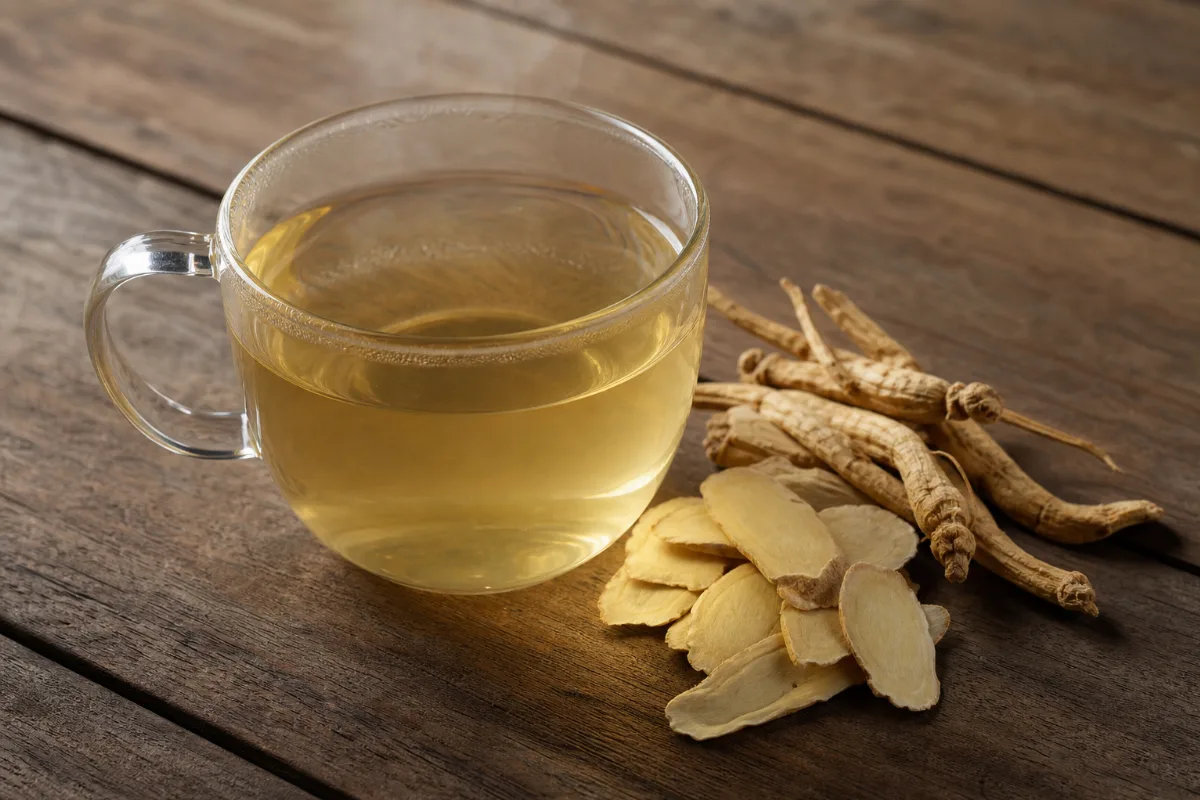
Herbal Teas & Extracts · Herbal tea
Ginseng Tea
Panax ginseng C.A.Mey. and Panax quinquefolius L. · also called Asian ginseng tea, Korean ginseng tea, American ginseng tea, red ginseng tea, white ginseng tea, Panax root tea, té de ginseng
Ginseng tea is a herbal drink made from the root of Asian or American ginseng. The EU accepts the root as a traditional remedy for tiredness and weakness, based on long use rather than trials. Nearly all trials tested extracts and capsules, not tea, and we found only one tiny tea study. Main cautions: warfarin, diabetes medicines and MAOIs, insomnia, liver disease, and pregnancy.
General information, not medical advice. Last substantive update · Not medically reviewed. A named clinician has not signed off on this page. How this page is made
About Ginseng Tea
Ginseng tea is a herbal tea from the root of Asian ginseng (Panax ginseng) or American ginseng (Panax quinquefolius). The EU accepts the root, including as a herbal tea, as a traditional remedy for tiredness and weakness. Almost all trials used extracts, not tea. The cautions are diabetes medicines, warfarin, MAOIs, insomnia, liver disease, allergy and pregnancy.
What it is
Ginseng tea is made from the root of ginseng, a plant in the Araliaceae family. Two species are mainly used: Asian ginseng (Panax ginseng C.A.Mey.) and American ginseng (Panax quinquefolius L.). Both names are accepted in the GBIF plant database. NIH says 'red ginseng' and 'white ginseng' are two ways of preparing Asian ginseng root.
Ginseng is not the tea plant (Camellia sinensis), so no caffeine is expected from the root. No source we read measured caffeine in ginseng tea, so this is an inference. Blends may include true tea, so read the label. Siberian ginseng (eleuthero) is a different plant and its research does not apply here.
What the research shows
For the tea itself, the evidence is very thin: one pilot study of 14 people who drank one cup of American ginseng tea (a lab marker of DNA damage was lower 2 hours later), and one Korean cohort study of 5,926 adults, which linked frequent ginseng tea to higher liver cancer risk in people with liver disease. That study is observational and cannot show cause.
The EU accepts ginseng root, including as a herbal tea, as a traditional remedy for tiredness and weakness, and says clinical-trial evidence is insufficient. The trials that exist tested extracts and capsules. They found small effects on fatigue and on fasting blood sugar, a small memory gain, and no overall effect on blood pressure. NIH says most trials were small and shorter than 3 months, and calls the research limited.
Tea, extract and capsule
The tea is broken-up or sliced root steeped or simmered in water, so its strength varies. Most trials used standardised extracts, ethanol extracts or root powder in capsules, which are more concentrated and more consistent than a cup. No study compared their safety with tea. A result for an extract cannot be assumed for tea, and a concentrated supplement may carry different risks. Any amounts are a question for your doctor or pharmacist.
Where it is used
The EU bases its view on at least 30 years of use, 15 of them in the EU. NIH says Asian ginseng has been used in traditional Chinese medicine as a calming agent and as an adaptogen, a term for herbs thought to help the body resist stress. We did not research older history, so none is claimed.
What happens in the body
How ginseng tea might act in the body is not established. NIH names ginsenosides as the substances thought most important. Animal studies summarised by Memorial Sloan Kettering found that ginsenosides prolonged drug-induced sleep in mice. That is animal work. For tea, a lab marker moved in one tiny study, and the mechanism is not shown.
At a glance
Traditional uses history, not proof
- Europe: the EU herbal committee lists ginseng root, including the comminuted root as herbal tea, as a traditional medicine for symptoms of tiredness and weakness, on at least 30 years of use
- Traditional Chinese medicine: NIH says Asian ginseng has been used as a calming agent and as an adaptogen
- Korea and wider Asia: ginseng tea is drunk as a tonic; we did not research older history, so none is claimed
Studied for research
- Ginseng tea itself (DNA-damage marker), very low (one pilot study of 14 people)
- Tiredness and weakness, insufficient for the tea (EU traditional use); low for extracts
- Thinking and memory (extracts), low
- Blood sugar (extracts), low
- Blood pressure (supplements), low: no overall effect
- Colds and respiratory infections (extracts), very low
- Erectile dysfunction (supplements), low
Main compounds
- Ginsenosides, the saponins NIH names as the most important substances in Asian ginseng
- Ginsenosides Rb1, Rg1, Re and Rg3 are identified in PubChem (identity only)
- No caffeine expected from the root: ginseng is not the tea plant (an inference; no source measured it)
Common forms
- Herbal tea from comminuted (broken-up) root, a listed form in the EU monograph
- Tea bags and instant granules, often sweetened or blended; contents vary, so read the label
- Red and white ginseng: two ways of preparing Panax ginseng root (NIH)
- Extracts, capsules and tablets (the trials tested these; results do not carry over to tea)
Research links: EMA public summary on ginseng root · EU herbal monograph on Panax ginseng root (2024) · NIH (NCCIH): Asian ginseng · American ginseng tea and cellular DNA: pilot study (2015) · Ginseng tea and liver cancer risk: Korean cohort (2026) · American ginseng and warfarin: randomised trial (2004) · Research Library · Genes & Biomarkers Library
What it is and its history
- Accepted scientific name
- Panax ginseng C.A.Mey. (Asian ginseng) and Panax quinquefolius L. (American ginseng); Araliaceae
- Naming authority
- Both names are ACCEPTED in the GBIF backbone: Panax ginseng C.A.Mey. (usageKey 5372262) and Panax quinquefolius L. (usageKey 5372246), checked by API on 2026-10-25.
- Synonyms
- Not listed here; GBIF synonym lists were not pulled for this page.
- Common names
- Ginseng tea (English); Asian ginseng tea (English (graph summary)); Korean ginseng tea (English (graph summary)); American ginseng tea (English (graph summary)); Red ginseng tea / white ginseng tea (English (two ways of preparing Panax ginseng root, per NIH)); Té de ginseng (Spanish (common usage; not checked in a database))
- Family or group
- Araliaceae (ginseng or ivy family)
- Classification
- Plantae > Apiales > Araliaceae > Panax > Panax ginseng; Panax quinquefolius
- Native range
- Not verified from a source read here.
- Habitat
- Not verified.
- What it looks like
- Roots: The root is the part used (EU monograph, NIH).; Stems: Not verified.; Leaves: Not verified.; Flowers: Not verified.; Fruit: Not verified.
- Cultivation
- Not verified.
- Harvest and processing
- The EU summary says white ginseng is the dried root and red ginseng is root treated with steam and then dried; the root is comminuted (broken up) for tea.
- Look-alikes and adulterants
- Name: Siberian ginseng (eleuthero, Eleutherococcus senticosus); Note: A different genus; research on it does not apply to Panax tea.; Name: Panax notoginseng (sanqi); Note: A different species with different compounds.; Name: Ginseng extract capsules and tablets; Note: The form used in most trials; stronger and more standardised than a cup of tea.; Name: Ginseng blends and instant tea granules; Note: May contain sugar, other herbs or true tea; read the label.
- Sustainability and conservation
- Not verified.
Photographs
Traditional use and history history, not clinical proof
| Tradition or era | Documented use | Source |
|---|---|---|
| European regulatory view | The EU herbal committee accepts ginseng root, including as a herbal tea, as a traditional medicine for tiredness and weakness, based on at least 30 years of use, 15 of them in the EU. | s-ema-summary |
| Traditional Chinese medicine and Asian use | NIH says Asian ginseng has been used as a calming agent in traditional Chinese medicine and as an adaptogen, a term for herbs thought to help the body resist stress. We did not read older texts, so no older history is claimed. | s-nccih-asian-ginseng |
Traditional use shows how it was used. It does not show that it works or is safe today.
What is inside, and how it may work
What it contains and how those compounds act in cells and animals. Laboratory and animal mechanisms are not proven effects in people.
Main compounds
| Compound | Family | Where it is concentrated | Activity studied | Level of evidence |
|---|---|---|---|---|
| Ginsenosides (general) | Saponins (triterpene glycosides) | Root | NIH says the substances thought most important in Asian ginseng are the ginsenosides (panaxosides). How much ends up in a cup of tea was not found. 34 | Authoritative guidance |
| Ginsenoside Rb1 PubChem 9898279 | Saponin | Root | Identity only; activity not assessed here. 36 | Database record |
| Ginsenoside Rg1 PubChem 441923 | Saponin | Root | Identity only. 36 | Database record |
| Ginsenoside Re PubChem 441921 | Saponin | Root | Identity only. 36 | Database record |
| Ginsenoside Rg3 PubChem 9918693 | Saponin | Root | Identity only. 36 | Database record |
Mechanisms, receptors and pathways
| Target or pathway | Gene or receptor | What was found | Level |
|---|---|---|---|
| Central nervous system (sleep time in mice) | Not specified | MSK reports animal studies in which ginsenosides prolonged drug-induced sleeping time in mice and showed other depressant effects on the central nervous system. This is animal work and does not describe tea. 29 | Animal research |
| Antioxidant defence in blood cells | Not specified | A tiny tea study and a 4-week extract trial suggest lower oxidative-stress markers. These are lab markers and the mechanism is not shown. 43 15 | Preliminary human marker |
Absorption, metabolism and elimination
- Absorption
- Not established for tea. The EU monograph says pharmacokinetic data are not required for this traditional-use product.
- Distribution
- Not found.
- Metabolism
- MSK reports lab findings that ginsenosides may affect CYP3A4 enzymes; a 2019 review found no significant enzyme or transporter interactions for Korean red ginseng at the extract amounts reviewed.
- Elimination
- Not found.
- Bioavailability
- Not found for ginseng tea.
Isolated compounds versus whole extracts
A cup of ginseng tea is a water extract of broken-up or sliced root, with the strength varying by how it is made. The monograph lists a herbal tea of the comminuted root. Nearly all trials tested standardised or ethanol extracts, root powder in capsules or combination products. These are more concentrated and consistent than a cup of tea, and no study compared their safety with tea. A result for an extract cannot be assumed for tea. Ask a doctor or pharmacist about concentrated products and amounts.
Nutritional composition
Ginseng tea is a drink, not a meaningful source of vitamins or minerals; no nutrient data for it were read for this page.
5 low certainty3 very low certainty1 not enough evidence
What was looked at
The 9 benefits and uses checked for Ginseng Tea, each with how strong the evidence is. Tap one to open it.
- American ginseng tea and DNA damage in blood cells (one cup)Very low certainty
- Tiredness and weakness (asthenia): ginseng root as a traditional medicine, including herbal teaNot enough evidence
- Fatigue: trials and reviews of ginseng supplements (extracts, not tea)Low certainty
- Thinking, memory and mood: trials of ginseng supplements (not tea)Low certainty
- Blood sugar: trials of ginseng root and extracts (not tea)Low certainty
- Blood pressure: trials of ginseng (not tea)Low certainty
- Colds and respiratory infections: trials of ginseng extracts (not tea)Very low certainty
- Erectile dysfunction: Cochrane review of ginseng (not tea)Low certainty
- Overall picture: an umbrella review of ginseng reviewsVery low certainty
Lab markers tracked in the studies
Fatigue score (trial questionnaires)DNA damage score after UV light (comet assay)Memory test scoresFasting blood glucoseBlood pressureRisk of respiratory infectionErectile function score (IIEF-15)
What is Ginseng Tea good for?
The main studied uses of ginseng tea and how strong the evidence is for each. 'Insufficient' means no usable trial of the tea; 'low' means reviews or trials of a different product; 'very low' means a single small study or poor-quality reviews. Where a result comes from an extract or capsule, it is said so.
Benefits, one by one
Each card is a research question, not a promise. Tap a goal to filter. Open a card to see the studies, doses and limits.
American ginseng tea and DNA damage in blood cells (one cup)
Very low certaintyA tiny pilot study found that blood taken 2 hours after one cup of American ginseng tea showed less UV-induced DNA damage in a lab test than blood from water drinkers. It is a lab marker, not a health benefit.
2 studiesNot reproduced.
Studies, doses and limits
What the trials found
Fourteen healthy volunteers took part: 7 drank one cup of American ginseng (Panax quinquefolius) tea-bag infusion and 7 drank water. Blood was taken before and 2 hours after, exposed to UV-B light, and DNA damage was scored with a comet assay. The score fell in the tea group and did not change in the water group. The tea-bag product and strength were not described in the abstract.
Results
Lower lab score of DNA damage after one cup of tea, in 7 people.
Effect sizes as reported
Lower comet score; no numbers given in the abstract.
Why this rating
This is the only controlled study of ginseng tea itself that we found. It has 14 people, one cup and a laboratory marker, and no follow-up.
Form and dose studied
Not reproduced.
Who was studied
Healthy adults in Hong Kong.
Limits
Tiny; one cup; lab marker; does not show any lasting health effect; funding not stated.
Why researchers looked
Researchers in Hong Kong wanted to see whether an ordinary cup of ginseng tea has any measurable biological effect.
Traditional use
NIH says Asian ginseng has been used in traditional Chinese medicine as a calming agent and adaptogen. The study did not describe a traditional use of this tea.
Proposed mechanism Preliminary mechanism
The authors suggest an antioxidant protective effect on cell DNA. This is their interpretation of a lab test (the comet assay) on blood cells after UV light, not shown in a living body.
A proposed mechanism does not show that the effect happens in people.
None reported in the abstract.
Tiredness and weakness (asthenia): ginseng root as a traditional medicine, including herbal tea
Not enough evidenceEU regulators accept ginseng root, including as a herbal tea, as a traditional medicine for tiredness and weakness. They say this rests on long use and not on clinical trials.
2 studiesThe monograph lists herbal tea among the forms. Amounts are not given…
Studies, doses and limits
What the trials found
The EU committee says that although there is insufficient evidence from clinical trials, the effect is plausible and the traditional use is long-standing. No clinical trial of ginseng tea for tiredness was found. The monograph covers Panax ginseng (Asian ginseng); American ginseng is not covered.
Results
Traditional-use status only; no trial of the tea.
Why this rating
Regulators call it traditional use. We found no trial of the tea itself.
Form and dose studied
The monograph lists herbal tea among the forms. Amounts are not given here. Ask a doctor or pharmacist.
Who was studied
Adults; not for under 18 according to the EU.
Limits
Traditional use is not proof of benefit. The monograph says to see a doctor if symptoms last longer than 2 weeks.
Why researchers looked
Ginseng is best known as a tonic for tiredness and low energy.
Traditional use
The EU herbal committee lists Panax ginseng root as a traditional herbal medicine for symptoms of asthenia such as fatigue and weakness, on at least 30 years of use, 15 of them in the EU. The comminuted (broken-up) root made as a herbal tea is one of the listed forms.
Proposed mechanism Not established
Not established. The EU monograph requires no pharmacology data for traditional-use products.
A proposed mechanism does not show that the effect happens in people.
See the Safety tab: allergy, insomnia, medicine interactions and pregnancy.
Fatigue: trials and reviews of ginseng supplements (extracts, not tea)
Low certaintyReviews of trials of ginseng supplements found a small reduction in fatigue in some analyses and none in others. The trials tested extracts and capsules, not tea.
5 studiesExtracts and capsules in the trials. They are more concentrated than …
Studies, doses and limits
What the trials found
A 2022 meta-analysis of 12 randomised trials (1,298 people with disease-related fatigue) found a small reduction with ginseng supplements (standardised mean difference 0.33). A 2023 meta-analysis of 19 trials found no significant fall overall (SMD -0.36, 95% CI -0.82 to 0.11), but did find reductions for general, non-disease fatigue (SMD -0.48) and for ginseng herbal formulas, with small effect sizes. A 2016 meta-analysis of 12 trials (630 people) found a small benefit for fatigue (SMD 0.34, from four trials) and none for physical performance, and called the evidence insufficient. In one 4-week trial of 90 adults with unexplained chronic fatigue using a 20% ethanol extract of Panax ginseng, total fatigue scores did not differ significantly from placebo, but mental fatigue improved. NIH says a 2023 review suggested a small benefit of ginseng alone for general fatigue and that not all research agrees.
Results
Small benefits in some reviews; no effect in the pooled overall result of one; no benefit for physical performance.
Effect sizes as reported
SMD 0.33 (disease fatigue), 0.34 (fatigue), -0.01 (performance); overall -0.36 not significant.
Why this rating
Several meta-analyses, but small trials, mixed results, small effects and different products, none a tea.
Form and dose studied
Extracts and capsules in the trials. They are more concentrated than tea, and results may not carry over.
Who was studied
Adults with cancer-related, chronic or general fatigue.
Limits
Small, short trials; different products; reviews disagree; none tested tea.
Why researchers looked
Fatigue is the most common reason people try ginseng and the use best covered by trials.
Traditional use
See the traditional-use entry above.
Proposed mechanism Preliminary mechanism
Not established in the trials. One 4-week trial measured blood antioxidant markers, which moved in the direction of less oxidative stress. That is a lab marker and does not explain the result.
A proposed mechanism does not show that the effect happens in people.
Side effects were no more common than placebo in these reviews (see the Safety tab).
Thinking, memory and mood: trials of ginseng supplements (not tea)
Low certaintyA 2024 review found a small memory gain with ginseng products but no gain in overall thinking, attention or executive function. A trial in healthy young adults found no change in mood.
3 studiesCapsules and extracts; not tea.
Studies, doses and limits
What the trials found
A 2024 meta-analysis of 15 randomised trials (671 people, healthy people and people with cognitive impairment, schizophrenia or Alzheimer disease) found a small memory gain (SMD 0.19, 95% CI 0.02 to 0.36) but no gain in overall cognition, attention or executive function. A trial in 83 healthy young adults using a Panax ginseng concentrate (G115) in capsules for 8 weeks found no effect on mood. NIH says a small amount of research suggests benefits for attention, reaction time and arithmetic in middle-aged but not young adults, and that any memory benefit seemed to depend on adding ginkgo.
Results
A small memory gain in a pooled analysis; no benefit for other thinking measures or for mood in young adults.
Effect sizes as reported
SMD 0.19 for memory (CI 0.02 to 0.36); no effect on attention or executive function.
Why this rating
One meta-analysis with a weak lower bound, mixed groups of people, and a null mood trial.
Form and dose studied
Capsules and extracts; not tea.
Who was studied
Mixed: healthy and ill adults.
Limits
Mixed groups; different products; no tea trials.
Why researchers looked
Ginseng has a reputation as a brain tonic.
Traditional use
NIH says Asian ginseng has been promoted for stress, cognitive function and fatigue; the EU monograph does not list thinking or memory.
Proposed mechanism Not established
Not established in the trials.
A proposed mechanism does not show that the effect happens in people.
None specific.
Blood sugar: trials of ginseng root and extracts (not tea)
Low certaintyReviews of trials found a small drop in fasting blood sugar with ginseng products, and some individual trials of American ginseng saw lower sugar after a sugar drink. NIH calls the evidence on blood sugar control inconclusive.
7 studiesExtracts and capsules. Not tea.
Studies, doses and limits
What the trials found
A 2014 meta-analysis of 16 trials of 30 days or more (fasting glucose in 770 people) found a small fall in fasting blood glucose (-0.31 mmol/L, 95% CI -0.59 to -0.03) but no significant change in HbA1c or insulin overall; most trials were short. A 2022 meta-analysis of 20 trials in prediabetes and type 2 diabetes found lower fasting glucose, total cholesterol, IL-6 and insulin resistance (HOMA-IR) but higher heart rate and TNF-alpha. In 10 people without diabetes, single amounts of ground American ginseng root lowered the blood sugar rise after a 25 g sugar drink. In 24 adults with type 2 diabetes on usual treatment, 8 weeks of an American ginseng extract lowered HbA1c by 0.29% and fasting glucose by 0.71 mmol/L more than placebo, and a 36-person trial from 1995 also found lower fasting glucose. NIH says the research on blood sugar control in diabetes is overall inconclusive and conflicting and that ginseng might lower blood sugar.
Results
Small average fall in fasting glucose; HbA1c effect inconsistent.
Effect sizes as reported
Fasting glucose -0.31 mmol/L (CI -0.59 to -0.03); HbA1c -0.29% in one 24-person trial.
Why this rating
Meta-analyses agree on a small fasting-glucose effect, but trials are short and small, products differ, and they were extracts or root powder in capsules, not tea.
Form and dose studied
Extracts and capsules. Not tea.
Who was studied
People with and without diabetes.
Limits
Short; small; many products; one author group ran several American ginseng trials and holds ginseng research grants; no tea trial.
Why researchers looked
Ginseng has been tested for blood sugar in people with and without diabetes.
Traditional use
MSK lists diabetes among ginseng's purported uses; we did not read older texts.
Proposed mechanism Not established
Not established.
A proposed mechanism does not show that the effect happens in people.
Ginseng may lower blood sugar. People on insulin or diabetes tablets should ask their prescriber first (see the Safety tab).
Blood pressure: trials of ginseng (not tea)
Low certaintyReviews found no overall effect of ginseng on blood pressure. Korean red ginseng showed small falls in a few trials; North American ginseng did not.
6 studiesCapsules and extracts; not tea.
Studies, doses and limits
What the trials found
A 2016 meta-analysis of 17 trials of 4 weeks or more (1,381 people) found no significant effect on systolic, diastolic or mean arterial pressure and called the effect neutral. A 2017 review of 9 trials in pre-hypertension and hypertension found small falls with Korean red ginseng (about 6.5 and 5.2 mmHg acutely; about 3 mmHg over longer use in two studies) but no effect with North American ginseng in two acute trials. A 16-person trial and a 52-person 12-week trial of North American ginseng in people with hypertension found no overall effect on blood pressure or on a kidney marker.
Results
No average effect; small falls only with Korean red ginseng in a few trials.
Effect sizes as reported
Pooled MD not significant; Korean red ginseng about -3 mmHg in longer trials.
Why this rating
Reviews agree on no clear effect; the only favourable results come from a few trials of one type.
Form and dose studied
Capsules and extracts; not tea.
Who was studied
Mostly adults with hypertension or normal pressure.
Limits
Different ginseng types; mixed results; no tea trials.
Why researchers looked
Some early reports suggested ginseng might raise blood pressure, and others that it might lower it.
Traditional use
Not reported.
Proposed mechanism Preliminary mechanism
Not established. MSK mentions ginseng may improve nitric oxide production in blood vessels; this is lab work.
A proposed mechanism does not show that the effect happens in people.
One case report links a hypertensive crisis and a stroke-like event to Panax ginseng (title only). See the Safety tab.
Colds and respiratory infections: trials of ginseng extracts (not tea)
Very low certaintyA review of ten trials suggested fewer respiratory infections with ginseng products, but the authors say the trials had high risk of bias and conclusions cannot be drawn. A large trial of an American ginseng extract missed its main target.
3 studiesBranded extracts; not tea.
Studies, doses and limits
What the trials found
A 2020 systematic review of 9 articles (10 trials) of Panax ginseng or P. quinquefolius pooled a lower risk of infection (RR 0.69, 95% CI 0.52 to 0.90) and shorter illness in healthy people, but the authors say risk of bias was high to unclear and publication bias cannot be excluded. In 783 adults who had a flu vaccination, a proprietary American ginseng extract (CVT-E002) for 6 months did not change laboratory-confirmed infections (5.5% placebo vs 5.2% and 4.6%, p = 0.89) but lowered infections defined by symptom criteria (p < 0.04). NIH calls the flu research very preliminary.
Results
Possible benefit, low-quality evidence; main target missed in the largest trial.
Effect sizes as reported
RR 0.69 (CI 0.52 to 0.90) pooled; lab-confirmed infection p = 0.89 in the large trial.
Why this rating
High risk of bias, mixed result in the biggest trial, branded products.
Form and dose studied
Branded extracts; not tea.
Who was studied
Healthy adults, mostly older adults in the CVT-E002 trial.
Limits
High risk of bias; branded extract; secondary outcome.
Why researchers looked
Ginseng is often taken during the cold and flu season.
Traditional use
Not reported.
Proposed mechanism Not established
Not established.
A proposed mechanism does not show that the effect happens in people.
Side effects were not worse than placebo in these abstracts.
Erectile dysfunction: Cochrane review of ginseng (not tea)
Low certaintyThe Cochrane review found ginseng may have only a trivial effect on erectile function scores, though more men said they could have intercourse. Certainty was mostly low.
2 studiesVarious ginseng products; not tea.
Studies, doses and limits
What the trials found
The Cochrane review pooled 9 placebo-controlled trials in 587 men with mild to moderate erectile dysfunction, with follow-up up to 12 weeks. The change on the main erectile function score (IIEF-15 domain, mean difference 3.52) was below the review's 'clinically important' threshold of 4 (low certainty). More men reported being able to have intercourse (risk ratio 2.55, 95% CI 1.76 to 3.69; low certainty). Side effects did not clearly differ from placebo.
Results
Trivial score changes; more men reported being able to have intercourse (low certainty).
Effect sizes as reported
IIEF-15 domain MD 3.52 (CI 1.79 to 5.25); intercourse ability RR 2.55.
Why this rating
Cochrane review; mostly low-certainty evidence from short trials.
Form and dose studied
Various ginseng products; not tea.
Who was studied
Men aged 20 to 70 with mild to moderate erectile dysfunction.
Limits
Short follow-up; no comparison with standard treatments.
Why researchers looked
Ginseng is traditionally linked to male vitality.
Traditional use
MSK lists erectile dysfunction among ginseng's purported uses; the EU monograph does not list it.
Proposed mechanism Not established
Not established.
A proposed mechanism does not show that the effect happens in people.
Side effects did not clearly differ from placebo.
Overall picture: an umbrella review of ginseng reviews
Very low certaintyAn umbrella review of 19 reviews found benefits reported for many outcomes, but it rated the methodological quality of the reviews as low or critically low.
1 studiesSupplements and extracts.
Studies, doses and limits
What the trials found
The 2023 umbrella review of 19 meta-analyses found ginseng, compared with controls (mainly placebo), was beneficial for fatigue and physical function, sexual function, menopausal symptoms, metabolic indicators, inflammatory markers, unstable angina and respiratory diseases. Methodological quality was relatively poor: 5 reviews were low quality and 14 critically low. Adverse events included gut symptoms and potential bleeding; no serious adverse events were reported. The authors say high-quality trials are needed.
Results
Many reported benefits, resting on poor-quality reviews.
Why this rating
The reviews underneath are mostly critically low quality, and the products are supplements and extracts, not tea.
Form and dose studied
Supplements and extracts.
Who was studied
Mixed populations.
Limits
Quality of the reviews, not just the trials, is low.
Why researchers looked
To summarise the whole ginseng literature.
Proposed mechanism Not established
Not applicable.
A proposed mechanism does not show that the effect happens in people.
Possible bleeding is listed among adverse events (see the Safety tab).
Connections to the rest of health
How Ginseng Tea connects to the rest of our health knowledge graph. Every link says what kind of connection it is. A safety link (for example to the liver) is a warning, not a benefit. A study that merely mentions a topic never creates a benefit link.
Explore every connection: goals, body systems, organs, symptoms, genes
A. Wellness goals
| Connected to | Kind of connection | Evidence status | Context | Studies |
|---|---|---|---|---|
| Healthy Aging | Very low certainty | American ginseng tea and DNA damage in blood cells (one cup): A tiny pilot study found that blood taken 2 hours after one cup of American ginseng tea showed less UV-induced DNA damage in a lab test than blood from water drinkers. It is a lab marker, not a health benefit. Overall picture: an umbrella review of ginseng reviews: An umbrella review of 19 reviews found benefits reported for many outcomes, but it rated the methodological quality of the reviews as low or critically low. | 43 34 24 | |
| Reduce Fatigue | Not enough evidence | Tiredness and weakness (asthenia): ginseng root as a traditional medicine, including herbal tea: EU regulators accept ginseng root, including as a herbal tea, as a traditional medicine for tiredness and weakness. They say this rests on long use and not on clinical trials. | 8 7 | |
| Energy Boost | Not enough evidence | Tiredness and weakness (asthenia): ginseng root as a traditional medicine, including herbal tea: EU regulators accept ginseng root, including as a herbal tea, as a traditional medicine for tiredness and weakness. They say this rests on long use and not on clinical trials. | 8 7 | |
| Reduce Fatigue | Low certainty | Fatigue: trials and reviews of ginseng supplements (extracts, not tea): Reviews of trials of ginseng supplements found a small reduction in fatigue in some analyses and none in others. The trials tested extracts and capsules, not tea. | 49 23 2 15 34 | |
| Energy Boost | Low certainty | Fatigue: trials and reviews of ginseng supplements (extracts, not tea): Reviews of trials of ginseng supplements found a small reduction in fatigue in some analyses and none in others. The trials tested extracts and capsules, not tea. | 49 23 2 15 34 | |
| Physical Stamina | Low certainty | Fatigue: trials and reviews of ginseng supplements (extracts, not tea): Reviews of trials of ginseng supplements found a small reduction in fatigue in some analyses and none in others. The trials tested extracts and capsules, not tea. | 49 23 2 15 34 | |
| Memory Support | Low certainty | Thinking, memory and mood: trials of ginseng supplements (not tea): A 2024 review found a small memory gain with ginseng products but no gain in overall thinking, attention or executive function. A trial in healthy young adults found no change in mood. | 48 4 34 | |
| Mental Clarity | Low certainty | Thinking, memory and mood: trials of ginseng supplements (not tea): A 2024 review found a small memory gain with ginseng products but no gain in overall thinking, attention or executive function. A trial in healthy young adults found no change in mood. | 48 4 34 | |
| Mood Balance | Low certainty | Thinking, memory and mood: trials of ginseng supplements (not tea): A 2024 review found a small memory gain with ginseng products but no gain in overall thinking, attention or executive function. A trial in healthy young adults found no change in mood. | 48 4 34 | |
| Blood Sugar Balance | Low certainty | Blood sugar: trials of ginseng root and extracts (not tea): Reviews of trials found a small drop in fasting blood sugar with ginseng products, and some individual trials of American ginseng saw lower sugar after a sugar drink. NIH calls the evidence on blood sugar control inconclusive. | 38 33 44 45 40 34 29 | |
| Metabolic Health | Low certainty | Blood sugar: trials of ginseng root and extracts (not tea): Reviews of trials found a small drop in fasting blood sugar with ginseng products, and some individual trials of American ginseng saw lower sugar after a sugar drink. NIH calls the evidence on blood sugar control inconclusive. | 38 33 44 45 40 34 29 | |
| Blood Pressure Support | Low certainty | Blood pressure: trials of ginseng (not tea): Reviews found no overall effect of ginseng on blood pressure. Korean red ginseng showed small falls in a few trials; North American ginseng did not. | 16 21 41 42 27 29 | |
| Heart Health | Low certainty | Blood pressure: trials of ginseng (not tea): Reviews found no overall effect of ginseng on blood pressure. Korean red ginseng showed small falls in a few trials; North American ginseng did not. | 16 21 41 42 27 29 | |
| Immune Support | Very low certainty | Colds and respiratory infections: trials of ginseng extracts (not tea): A review of ten trials suggested fewer respiratory infections with ginseng products, but the authors say the trials had high risk of bias and conclusions cannot be drawn. A large trial of an American ginseng extract missed its main target. | 1 28 34 | |
| Mens Vitality | Low certainty | Erectile dysfunction: Cochrane review of ginseng (not tea): The Cochrane review found ginseng may have only a trivial effect on erectile function scores, though more men said they could have intercourse. Certainty was mostly low. | 22 29 | |
| Libido Support | Low certainty | Erectile dysfunction: Cochrane review of ginseng (not tea): The Cochrane review found ginseng may have only a trivial effect on erectile function scores, though more men said they could have intercourse. Certainty was mostly low. | 22 29 |
B. Body systems
| Connected to | Kind of connection | Evidence status | Context | Studies |
|---|---|---|---|---|
| Liver | Very low certainty | Observational liver cancer signal in people with liver disease; one case report. Preparation or compound: Ginseng tea |
32 25 | |
| Nervous system | Not enough evidence | EU traditional use for tiredness and weakness; no trial of the tea. Preparation or compound: Ginseng root herbal tea |
8 7 | |
| Immune System | Biological association | Very low certainty | Studied for: American ginseng tea and DNA damage in blood cells (one cup) Studied for: Colds and respiratory infections: trials of ginseng extracts (not tea) | 43 34 1 28 24 |
| Nervous System | Biological association | Not enough evidence | Studied for: Tiredness and weakness (asthenia): ginseng root as a traditional medicine, including herbal tea Studied for: Fatigue: trials and reviews of ginseng supplements (extracts, not tea) | 8 7 49 23 2 15 34 48 4 |
| Musculoskeletal System | Biological association | Low certainty | Studied for: Fatigue: trials and reviews of ginseng supplements (extracts, not tea) | 49 23 2 15 34 |
| Metabolism Weight | Biological association | Low certainty | Studied for: Blood sugar: trials of ginseng root and extracts (not tea) | 38 33 44 45 40 34 29 |
| Endocrine System | Biological association | Low certainty | Studied for: Blood sugar: trials of ginseng root and extracts (not tea) | 38 33 44 45 40 34 29 |
| Cardiovascular System | Biological association | Low certainty | Studied for: Blood pressure: trials of ginseng (not tea) | 16 21 41 42 27 29 |
| Respiratory System | Biological association | Very low certainty | Studied for: Colds and respiratory infections: trials of ginseng extracts (not tea) | 1 28 34 |
| Reproductive System | Biological association | Low certainty | Studied for: Erectile dysfunction: Cochrane review of ginseng (not tea) | 22 29 |
E. Health conditions
| Connected to | Kind of connection | Evidence status | Context | Studies |
|---|---|---|---|---|
| Diabetes medicines and blood sugar | Drug or supplement interaction | Low certainty | NIH and MSK warn ginseng may lower blood sugar and add to insulin and sulfonylureas. May lower blood sugar and add to diabetes medicines (NIH, MSK). Preparation or compound: Ginseng root and extracts |
34 29 |
| Warfarin and blood thinners | Drug or supplement interaction | Mixed findings | One 20-person trial lowered warfarin effect; two patient trials found no significant difference. Preparation or compound: American ginseng; Panax ginseng |
47 17 18 |
| Pregnancy and breastfeeding | Contraindication | Low certainty | Not recommended by the EU for lack of data. Preparation or compound: Ginseng root |
7 37 |
I. Biomarkers
| Connected to | Kind of connection | Evidence status | Context | Studies |
|---|---|---|---|---|
| Fatigue score (trial questionnaires) | Biological association | Low certainty | Measured in trials: lowered. A lab change is not the same as a health benefit. | 49 23 2 |
| DNA damage score after UV light (comet assay) | Biological association | Very low certainty | Measured in trials: lowered. A lab change is not the same as a health benefit. | 43 |
| Memory test scores | Biological association | Low certainty | Measured in trials: raised. A lab change is not the same as a health benefit. | 48 |
| Fasting blood glucose | Biological association | Low certainty | Measured in trials: lowered. A lab change is not the same as a health benefit. | 38 33 45 |
| Blood pressure | Biological association | Low certainty | Measured in trials: unchanged. A lab change is not the same as a health benefit. | 16 21 41 42 |
| Risk of respiratory infection | Biological association | Very low certainty | Measured in trials: lowered. A lab change is not the same as a health benefit. | 1 28 |
| Erectile function score (IIEF-15) | Biological association | Low certainty | Measured in trials: raised. A lab change is not the same as a health benefit. | 22 |
L. Active compounds
| Connected to | Kind of connection | Evidence status | Context | Studies |
|---|---|---|---|---|
| Ginsenosides (general) | Biological association | Authoritative guidance | NIH says the substances thought most important in Asian ginseng are the ginsenosides (panaxosides). How much ends up in a cup of tea was not found. Preparation or compound: Root |
34 |
| Ginsenoside Rb1 | Biological association | Database record | Identity only; activity not assessed here. Preparation or compound: Root |
36 |
| Ginsenoside Rg1 | Biological association | Database record | Identity only. Preparation or compound: Root |
36 |
| Ginsenoside Re | Biological association | Database record | Identity only. Preparation or compound: Root |
36 |
| Ginsenoside Rg3 | Biological association | Database record | Identity only. Preparation or compound: Root |
36 |
Each connection is stored with the ingredient, the connected record, the kind of connection, the evidence status, the supporting studies, the preparation or compound involved, and a review date (last reviewed October 25, 2026).
Evidence at a glance: what changed in 6 lab markers
Tap a number to show only those markers. Counts are markers, not people.
The evidence
The research centre for Ginseng Tea. Every record here was checked against PubMed or the publisher's page; we never list a study we have not verified.
Evidence by outcome
Bars show how many studies we found for each outcome, not how well it works. People are added up across trials only (reviews are not added, to avoid double counting).
How we rate evidence
High certainty
Several well-run trials or reviews agree; further research is unlikely to change the picture much.
Moderate certainty
Good trials point the same way, but some doubt remains.
Low certainty
Small, short or inconsistent trials. The finding could change with better research.
Very low certainty
Very little or very weak human data. Treat as a possibility only.
Mixed findings
Trials or reviews disagree with each other.
Not enough evidence
Not enough human research to say either way.
Evidence against
Good research found no benefit, or found harm.
We take the reviewers' own risk-of-bias and GRADE statements where they exist, and otherwise judge from study size, design, consistency, directness and whether a product matches what is sold. Many publications do not make evidence high. Method note: We read the EU ginseng root monograph in full, the EMA public summary, the NCCIH page and the Memorial Sloan Kettering pages for Asian and American ginseng, checked plant names through GBIF and compound identities through PubChem, searched PubMed, and read every cited abstract directly. Three case reports have no abstract in PubMed and are cited by title only. The no-caffeine statement is an inference and is labelled so.
Study library: every study we checked 49
| Study | Design | People | Product, dose, length | Result |
|---|---|---|---|---|
| Antonelli 2020 Ginseng integrative supplementation for seasonal acute upper respiratory infections: A systematic review and meta-analysis. Complement Ther Med · PMID 32951718 · DOI |
Systematic review and meta analysis |
Healthy people and others; 9 articles describing 10 trials | Panax ginseng or P. quinquefolius supplements, often with flu vaccination (not tea) root products Not reproduced here Varied · vs Controls |
Pooled results suggested fewer infections (RR 0.69, 95% CI 0.52 to 0.90) and shorter illness in healthy people. The authors say risk of bias was high to unclear and publication bias could not be excluded, so no conclusion can be drawn. Possible fewer infections, but low-quality evidence (RR 0.69 (0.52 to 0.90)) Methods, limits and fundingOutcomes: Incidence and duration of seasonal upper respiratory infections Limitations: High to unclear risk of bias; the authors do not draw conclusions. Funding and conflicts: Not funded; no conflicts disclosed. Registration: PROSPERO CRD42020156235 Read: abstract |
| Bach 2016 Efficacy of Ginseng Supplements on Fatigue and Physical Performance: a Meta-analysis. J Korean Med Sci · PMID 27822924 · DOI |
Systematic review and meta analysis |
630 Adults in 12 randomised trials (4 for fatigue, 8 for physical performance) |
Ginseng supplements (not tea) root products Not reproduced here Not given · vs Placebo |
Fatigue was lower with ginseng in four trials (SMD 0.34, 95% CI 0.16 to 0.52). Physical performance was not improved in eight trials (SMD -0.01, 95% CI -0.29 to 0.27). The authors call the evidence insufficient because only a few small trials exist. Fatigue small benefit; no performance benefit (SMD 0.34 (0.16 to 0.52)) Methods, limits and fundingOutcomes: Fatigue; physical performance Limitations: Few small trials; the authors judge the evidence insufficient. Funding and conflicts: No conflicts declared. Read: abstract |
| Bilgi 2010 Imatinib and Panax ginseng: a potential interaction resulting in liver toxicity. Ann Pharmacother · PMID 20332334 · DOI |
Case report |
1 26-year-old man with chronic myeloid leukaemia on long-term imatinib |
Panax ginseng energy drinks for 3 months Not reproduced here 3 months |
He had acute liver inflammation (ALT 1069 U/L). Imatinib was judged the likely cause, with a probable interaction with ginseng; imatinib restarted later without a rise in liver enzymes. Possible interaction reported Methods, limits and fundingOutcomes: Liver enzymes Limitations: One case; energy drinks, not tea; mechanism proposed, not shown. Funding and conflicts: Not stated in the abstract. Read: abstract |
| Cardinal 2001 Ginseng does not enhance psychological well-being in healthy, young adults: results of a double-blind, placebo-controlled, randomized clinical trial. J Am Diet Assoc · PMID 11424544 · DOI |
Randomised placebo controlled trial |
83 Healthy young adults (mean age 25.7) |
Panax ginseng G115 concentrate in capsules (not tea) root extract Not reproduced here 8 weeks · vs Placebo (lactose) |
Ginseng had no effect on mood or affect at either of the two amounts tested. No effect Methods, limits and fundingOutcomes: Positive and negative mood and total mood disturbance Limitations: Young healthy adults only; one branded extract; capsules. Funding and conflicts: Not stated in the abstract. Read: abstract |
| Choi 2019 Interactions of ginseng with therapeutic drugs. Arch Pharm Res · PMID 31493264 · DOI |
Narrative review |
Ginseng-drug interactions | Ginseng (Korean red ginseng and others) root Not reproduced here |
Daily Korean red ginseng at the extract amounts reviewed did not cause significant drug interactions through drug-metabolising enzymes and transporters. The reviewers say limited information on ginsenoside content in products and in patients calls for standardisation. No significant enzyme-based interaction at studied amounts Methods, limits and fundingOutcomes: Enzyme and transporter interactions; diabetes and anticoagulant drugs Limitations: Narrative; extract amounts, not tea. Funding and conflicts: Not stated in the abstract. Read: abstract |
| Coon 2002 Panax ginseng: a systematic review of adverse effects and drug interactions. Drug Saf · PMID 12020172 · DOI |
Systematic review of adverse effects |
Clinical trials, case reports and spontaneous reports on Panax ginseng root extracts | Panax ginseng root extracts (not tea) root extracts Not reproduced here |
In trials, side effects with ginseng alone were similar to placebo. The most common were headache, sleep problems and gut problems. Serious events appeared in isolated case reports, with causation hard to judge. Possible drug interactions were reported with warfarin, phenelzine and alcohol. The authors conclude ginseng alone is rarely linked to side effects or interactions, and those documented are usually mild and passing. Mostly mild effects; some case-report interactions Methods, limits and fundingOutcomes: Adverse events and drug interactions Limitations: Published in 2002; case reports cannot prove cause; combination products muddy the picture. Funding and conflicts: Not stated in the abstract. Read: abstract |
| European Medicines Agency 2024 European Union herbal monograph on Panax ginseng C.A.Mey., radix, Revision 1 (EMA/HMPC/27744/2023) EMA herbal monograph (compiled 29 May 2024) · Source |
Authoritative guidance n/a |
not applicable | Panax ginseng root; comminuted root as herbal tea is a listed form root |
Traditional herbal medicinal product for symptoms of asthenia such as fatigue and weakness, exclusively on long-standing use. Herbal tea (comminuted root) is a listed form alongside powders, dry and liquid extracts. Contraindication: hypersensitivity. Use under 18 not established. Interactions: none reported. Pregnancy and lactation: not recommended for lack of data. Undesirable effects: stomach discomfort, nausea, vomiting, diarrhoea, constipation, itching and hives, insomnia; frequency not known. No overdose case reported. No genotoxicity in the tests described; reproductive toxicity tests not performed. Reference statement Methods, limits and fundingOutcomes: Regulatory or reference summary Limitations: The monograph is for P. ginseng; American ginseng is not covered. Herbal tea doses in the monograph are not repeated here. Funding and conflicts: Not applicable. Read: read in full |
| European Medicines Agency 2026 Ginseng radix: herbal medicinal product (EMA overview page and public summary) EMA herbal medicine page (assessment report summary last updated 12 March 2026) · Source |
Authoritative guidance n/a |
not applicable | Panax ginseng root, including comminuted root as herbal tea root |
Traditional use for symptoms of asthenia such as fatigue and weakness, based on long use (at least 30 years, 15 in the EU) and not on clinical studies. Herbal medicines are usually available as herbal tea or liquid or solid forms. Not for children and adolescents under 18, or in pregnancy or breastfeeding, for lack of data, or if allergic to the plant. Side effects: stomach discomfort, nausea, vomiting, diarrhoea, constipation, itching or hives, insomnia; frequency not known. See a doctor if symptoms last longer than 2 weeks. Reference statement Methods, limits and fundingOutcomes: Regulatory or reference summary Limitations: Traditional-use status is not proof of benefit. Covers P. ginseng only. Funding and conflicts: Not applicable. Read: read in full |
| GBIF Secretariat 2026 GBIF backbone match: Panax ginseng C.A.Mey. GBIF species API · Source |
Taxonomy database plant |
not applicable | Panax ginseng root |
Checked by API on 2026-10-25: usageKey 5372262, Panax ginseng C.A.Mey., rank SPECIES, status ACCEPTED, family Araliaceae, order Apiales, exact match. Reference statement Methods, limits and fundingOutcomes: Regulatory or reference summary Limitations: Taxonomy only. Funding and conflicts: Not applicable. Read: api |
| GBIF Secretariat 2026 GBIF backbone match: Panax quinquefolius L. GBIF species API · Source |
Taxonomy database plant |
not applicable | Panax quinquefolius root |
Checked by API on 2026-10-25: usageKey 5372246, Panax quinquefolius L., rank SPECIES, status ACCEPTED, family Araliaceae, order Apiales, exact match. Reference statement Methods, limits and fundingOutcomes: Regulatory or reference summary Limitations: Taxonomy only. Funding and conflicts: Not applicable. Read: api |
| Harkey 2001 Variability in commercial ginseng products: an analysis of 25 preparations. Am J Clin Nutr · PMID 11382666 · DOI |
Analytical survey product analysis |
25 25 commercial ginseng products in one US health food store (2001) |
Ginseng capsules and liquids (Panax or Eleutherococcus; not tea) mixed Not reproduced here · vs Labelled amounts |
Products were correctly named by plant genus, but marker-compound amounts differed from labels, with 15-fold (capsules) and 36-fold (liquids) differences in ginsenosides between products. Large product-to-product variation Methods, limits and fundingOutcomes: Marker compounds (ginsenosides, eleutherosides) Limitations: Old; capsules and liquids, not teas; one store. Funding and conflicts: Not stated in the abstract. Read: abstract |
| Ichim 2020 A Review of Authenticity and Authentication of Commercial Ginseng Herbal Medicines and Food Supplements. Front Pharmacol · PMID 33505315 · DOI |
Systematic review of authenticity studies product analysis |
507 507 ginseng-containing products in 12 countries |
Ginseng herbal medicines and food supplements mixed Not reproduced here |
76% were authentic and 24% adulterated; most adulteration was substitution with another Panax species, and some used leaves, stems or flowers instead of root. Rates varied by country. About 1 in 4 products adulterated Methods, limits and fundingOutcomes: Authenticity (species and plant part) Limitations: Products were mostly supplements; teas were not reported separately. Funding and conflicts: Not stated in the abstract. Read: abstract |
| Janetzky 1997 Probable interaction between warfarin and ginseng. Am J Health Syst Pharm · PMID 9075501 · DOI |
Case report |
1 One person (title only) |
Ginseng and warfarin (title: "Probable interaction") Not reproduced here |
PubMed lists only the title and authors, with no abstract. The title says an interaction with warfarin was judged probable. Probable interaction (title only) Methods, limits and fundingOutcomes: Possible warfarin interaction Limitations: No abstract available; details not read; a single case. Funding and conflicts: Not stated in the abstract. Read: title only |
| Jones 1987 Interaction of ginseng with phenelzine. J Clin Psychopharmacol · PMID 3597812 · DOI |
Case report letter |
Not stated (title only) | Ginseng with phenelzine, an MAOI medicine Not reproduced here |
PubMed lists only the title and authors, with no abstract. The 2002 systematic review lists phenelzine among possible ginseng interactions, and Memorial Sloan Kettering describes manic-like symptoms when ginseng is combined with MAOI medicines. Reported interaction (title only) Methods, limits and fundingOutcomes: Possible interaction Limitations: No abstract; details not read. Funding and conflicts: Not stated in the abstract. Read: title only |
| Kim 2013 Antifatigue effects of Panax ginseng C.A. Meyer: a randomised, double-blind, placebo-controlled trial. PLoS One · PMID 23613825 · DOI |
Randomised placebo controlled trial |
90 Adults with unexplained chronic fatigue, Korea |
20% ethanol extract of Panax ginseng (not tea) root extract Not reproduced here 4 weeks · vs Placebo |
The total fatigue score fell but not significantly more than placebo. Mental fatigue score improved more than placebo, and the higher-amount group had a larger fall in a visual fatigue scale (p < 0.01). Reactive oxygen species and malondialdehyde were lower than with placebo. Mixed: mental fatigue improved, total score not significantly different Methods, limits and fundingOutcomes: Fatigue scores and blood antioxidant markers Limitations: One 4-week trial; a custom extract, not tea; mixed primary results. Funding and conflicts: No competing interests declared. Registration: CRIS KCT0000048 Read: abstract |
| Komishon 2016 The effect of ginseng (genus Panax) on blood pressure: a systematic review and meta-analysis of randomized controlled clinical trials. J Hum Hypertens · PMID 27074879 · DOI |
Systematic review and meta analysis |
1381 17 randomised trials of 4 weeks or more |
Ginseng (genus Panax; not tea) root products Not reproduced here 4 weeks or more · vs Controls |
No significant effect of ginseng on blood pressure. The authors describe ginseng as having neutral vascular effects and say it should not be discouraged for fear of raising blood pressure. No effect on blood pressure (n/a (no significant effect)) Methods, limits and fundingOutcomes: Systolic, diastolic and mean arterial blood pressure Limitations: Mixed ginseng types; heterogeneous; blood pressure was often not the main outcome. Funding and conflicts: Not stated in the abstract. Read: abstract |
| Lee 2008 Interaction between warfarin and Panax ginseng in ischemic stroke patients. J Altern Complement Med · PMID 18637764 · DOI |
Randomised open label controlled study |
25 25 people with ischaemic stroke who had not taken warfarin before |
Panax ginseng with warfarin (not tea) root Not reproduced here 2 weeks · vs Warfarin alone |
INR and prothrombin time rose in both groups with no statistically significant difference between the ginseng and control groups; the authors suggest ginseng did not change warfarin action. No interaction detected Methods, limits and fundingOutcomes: INR and prothrombin time Limitations: Small, open-label, short, 2 weeks; people new to warfarin. Funding and conflicts: Not stated in the abstract. Read: abstract |
| Lee 2010 Interaction between warfarin and Korean red ginseng in patients with cardiac valve replacement. Int J Cardiol · PMID 19913311 · DOI |
Randomised crossover trial |
25 25 patients with a heart-valve replacement on warfarin |
Korean red ginseng with warfarin (not tea) root Not reproduced here Two crossover periods; INR checked at weeks 3 and 6 of each · vs Placebo |
No statistically significant difference in INR changes between Korean red ginseng and placebo. The authors say it could be used with close monitoring and education. No significant interaction Methods, limits and fundingOutcomes: INR and warfarin concentration Limitations: Small trial; one product; the authors still advise monitoring. Funding and conflicts: Not stated in the abstract. Read: abstract |
| Lee 2012 A case of korean ginseng-induced anaphylaxis confirmed by open oral challenge and basophil activation test. Allergy Asthma Immunol Res · PMID 22379608 · DOI |
Case report |
1 44-year-old man in Korea with seasonal rhinitis |
Fresh Korean ginseng, oral challenge root Not reproduced here Single challenge |
After eating fresh ginseng he developed wheeze, breathing difficulty and abdominal pain. Skin-prick and a basophil test were positive. The authors conclude eating Korean ginseng can cause anaphylaxis by direct activation of mast cells. Anaphylaxis reported Methods, limits and fundingOutcomes: Allergic reaction Limitations: One case; fresh root, not tea. Funding and conflicts: Not stated in the abstract. Read: abstract |
| Lee 2012 Safety and tolerability of Panax ginseng root extract: a randomized, placebo-controlled, clinical trial in healthy Korean volunteers. J Altern Complement Med · PMID 22909282 · DOI |
Randomised placebo controlled trial |
Healthy Korean volunteers | Panax ginseng root extract (not tea) root extract Not reproduced here 4 weeks · vs Placebo |
Mild side effects such as dyspepsia, hot flush, insomnia and constipation occurred in both ginseng and placebo groups. No serious reactions. Blood tests did not change significantly. No serious effects Methods, limits and fundingOutcomes: Safety and tolerability, blood tests Limitations: Four weeks only; healthy volunteers. Funding and conflicts: Not stated in the abstract. Read: abstract |
| Lee 2017 Ginseng for Treating Hypertension: A Systematic Review and Meta-Analysis of Double Blind, Randomized, Placebo-Controlled Trials. Curr Vasc Pharmacol · PMID 28707603 · DOI |
Systematic review and meta analysis |
People with pre-hypertension or hypertension (9 randomised trials) | Korean red ginseng and North American ginseng (not tea) root products Not reproduced here Acute and up to long-term · vs Placebo |
Two trials of Korean red ginseng showed an acute fall in systolic (about 6.5 mmHg) and diastolic (about 5.2 mmHg) pressure; two trials of North American ginseng did not. In longer use, two Korean red ginseng studies showed small falls (about 3 mmHg) compared with placebo. Small falls with Korean red ginseng; none with North American Methods, limits and fundingOutcomes: Blood pressure Limitations: Few trials per comparison; different ginseng types give different results. Funding and conflicts: Not stated in the abstract. Read: abstract |
| Lee 2021 Ginseng for erectile dysfunction. Cochrane Database Syst Rev · PMID 33871063 · DOI |
Cochrane systematic review |
587 Men aged 20 to 70 with mild to moderate erectile dysfunction (9 trials) |
Ginseng of any type, compared with placebo (not tea) root products Not reproduced here Up to 12 weeks · vs Placebo |
Ginseng may have only a trivial effect on erectile function scores (IIEF-15 domain mean difference 3.52, below the minimum clinically important difference of 4; low certainty). Men were more likely to report being able to have intercourse (risk ratio 2.55, 95% CI 1.76 to 3.69; low certainty). Side effects did not clearly differ from placebo. Trivial change on scores; low-certainty self-reports of improvement Methods, limits and fundingOutcomes: Erectile function scores, side effects, intercourse ability Limitations: Short follow-up; mostly low-certainty evidence. Funding and conflicts: Not stated in the abstract. Read: abstract |
| Li 2023 Ginseng and Ginseng Herbal Formulas for Symptomatic Management of Fatigue: A Systematic Review and Meta-Analysis. J Integr Complement Med · PMID 36730693 · DOI |
Systematic review and meta analysis |
Adults with fatigue (19 randomised trials) | Ginseng and ginseng herbal formulas (not tea) root products Not reproduced here Not given · vs Controls |
Overall, no significant fall in fatigue severity with ginseng (SMD -0.36, 95% CI -0.82 to 0.11). Ginseng herbal formulas did reduce fatigue (SMD -0.39), as did ginseng for chronic fatigue (SMD -0.30) and for general, non-disease fatigue (SMD -0.48, 95% CI -0.71 to -0.25). Effect sizes were small. Ginseng did not increase side effects. Small effect in some subgroups; overall result not significant (SMD -0.36 (-0.82 to 0.11)) Methods, limits and fundingOutcomes: Fatigue severity, quality of life, adverse events Limitations: Overall result not significant; subgroup findings; small effects; products not tea. Funding and conflicts: Authors report grants from Chinese companies outside this work. Read: abstract |
| Li 2023 Ginseng and health outcomes: an umbrella review. Front Pharmacol · PMID 37465522 · DOI |
Umbrella review |
19 meta-analyses of ginseng | Ginseng (mainly extracts and supplements) root products Not reproduced here · vs Control treatments (mainly placebo) |
Compared with controls, ginseng was beneficial for fatigue and physical function, sexual function, menopausal symptoms, metabolic indicators, inflammatory markers, unstable angina and respiratory diseases. Methodological quality was relatively poor: 5 were low quality and 14 critically low. Adverse events included gut symptoms and potential bleeding; no serious adverse events were reported. Many possible benefits, but built on poor-quality reviews Methods, limits and fundingOutcomes: Many health outcomes; adverse events Limitations: Only low and critically low quality reviews; the authors call for high-quality trials. Funding and conflicts: No commercial or financial relationships declared. Read: abstract |
| Lin 2018 Ginseng-Related Drug-Induced Liver Injury. Case Rep Gastroenterol · PMID 30186097 · DOI |
Case report |
1 45-year-old woman, menopause symptoms |
Ginseng tea plus a ginseng supplement, for almost 3 months Not reproduced here About 3 months before illness |
She had a month of upper-abdominal pain, very high liver enzymes (AST 717, ALT 343 U/L) and a raised bilirubin; viral and other causes were excluded and liver biopsy showed marked inflammation and necrosis. She improved over 6 weeks. The authors report idiosyncratic drug-induced liver injury from ginseng. Liver injury reported after ginseng tea and supplement Methods, limits and fundingOutcomes: Liver enzymes and biopsy Limitations: One case; she took tea and a supplement together, so the tea alone cannot be blamed; other causes were excluded but cause is still presumed. Funding and conflicts: Not stated in the abstract. Read: abstract |
| Liu 2019 Investigation of the Presence of 22 Organochlorine Pesticide Residues in Ginseng from Jilin Province, China. J Food Prot · PMID 31441687 · DOI |
Analytical survey plant material |
186 186 ginseng samples from Jilin Province, China (2019) |
Raw or dried ginseng (not tea) root Not reproduced here · vs Chinese Pharmacopoeia limits |
Hexachlorobenzene and quintozene were found in 11.8% and 52.1% of samples; the abstract reports residues above the Pharmacopoeia limit at 4.3% and 8.6% respectively. Benzene hexachloride was found in two samples, one above the limit. Residues found; some above limits Methods, limits and fundingOutcomes: Organochlorine pesticide residues Limitations: One Chinese province; raw root, not tea products. Funding and conflicts: Not stated in the abstract. Read: abstract |
| Martínez-Mir 2004 Transient ischemic attack secondary to hypertensive crisis related to Panax ginseng. Ann Pharmacother · PMID 15479769 · DOI |
Case report letter |
1 One patient (title only) |
Panax ginseng Not reproduced here |
PubMed lists only the title, which links a transient ischaemic attack to a hypertensive crisis related to Panax ginseng. No abstract is available. Reported event (title only) Methods, limits and fundingOutcomes: Blood pressure and stroke-like event Limitations: No abstract; a single case; cause not established. Funding and conflicts: Not stated in the abstract. Read: title only |
| McElhaney 2011 Efficacy and Safety of CVT-E002, a Proprietary Extract of Panax quinquefolius in the Prevention of Respiratory Infections in Influenza-Vaccinated Community-Dwelling Adults: A Multicenter, Randomized, Double-Blind, and Placebo-Controlled Trial. Influenza Res Treat · PMID 23074661 · DOI |
Randomised placebo controlled trial |
783 Community-dwelling adults who had flu vaccination |
CVT-E002, a proprietary American ginseng extract (not tea) root extract Not reproduced here 6 months · vs Placebo |
The primary outcome, laboratory-confirmed clinical infections, did not differ (5.5% placebo, 5.2% and 4.6% in the two ginseng groups; p = 0.89). Infections confirmed by a symptom-based (Jackson) definition were lower in the treated groups (p < 0.04). Primary outcome null; a secondary outcome favoured the extract Methods, limits and fundingOutcomes: Laboratory-confirmed respiratory infections (primary); infections by symptom criteria (secondary) Limitations: Primary result null; secondary result; branded extract; funding not stated in the abstract (authors from the product research group). Funding and conflicts: Not stated in the abstract. Read: abstract |
| Memorial Sloan Kettering Cancer Center 2026 Ginseng (Panax ginseng): herb summary MSK Integrative Medicine About Herbs · Source |
Authoritative guidance n/a |
not applicable | Panax ginseng (Asian ginseng) root |
Warnings: stop ginseng at least 1 week before surgery. Adverse reactions: dry mouth, fast heartbeat, nausea, vomiting, diarrhoea, insomnia, nervousness. Case reports include mania, a bleeding problem after cardiac surgery linked to high pre-surgery intake, and liver toxicity with imatinib. Interactions: may increase the blood-sugar-lowering effect of insulin and sulfonylureas; studies on anticoagulants are mixed; manic-like symptoms with MAOIs; possible effect on CYP3A4 drug clearance. In animal studies ginsenosides prolonged drug-induced sleep in mice. Reference statement Methods, limits and fundingOutcomes: Regulatory or reference summary Limitations: Cancer-centre summary; undated page; mechanism statements are from animal or lab work. Funding and conflicts: Not applicable. Read: read in full |
| Memorial Sloan Kettering Cancer Center 2026 American ginseng (Panax quinquefolius): herb summary MSK Integrative Medicine About Herbs · Source |
Authoritative guidance n/a |
not applicable | Panax quinquefolius (American ginseng) root |
American ginseng has been shown to antagonise warfarin effects in humans. Lab studies suggest some ginsenosides may affect CYP3A4 drug metabolism; clinical relevance is not determined. Reductions in clotting times and blood glucose may occur. A breast-cancer-cell finding was judged by MSK to have no clinical relevance. Reference statement Methods, limits and fundingOutcomes: Regulatory or reference summary Limitations: Undated page; lab findings. Funding and conflicts: Not applicable. Read: read in full |
| Miedziaszczyk 2022 Controversial Interactions of Tacrolimus with Dietary Supplements, Herbs and Food. Pharmaceutics · PMID 36297591 · DOI |
Narrative review |
Tacrolimus (anti-rejection drug) and supplements | Panax ginseng among others Not reproduced here |
The review calls the use of Panax ginseng, green tea, Schisandra and melatonin with tacrolimus highly controversial and urges patients to tell their doctor about supplements. Interaction possible, unclear Methods, limits and fundingOutcomes: Interactions with tacrolimus Limitations: Narrative review; abstract gives no detail on ginseng. Funding and conflicts: Not stated in the abstract. Read: abstract |
| Moon 2026 Ginseng Tea Consumption and Liver Cancer Risk: A Prospective Korean Multi-center Cancer Cohort Study. J Cancer Prev · PMID 42079340 · DOI |
Prospective cohort |
5926 Korean adults without cancer at the start (Korean Multi-Center Cancer Cohort), questionnaire 2000-2005, followed up to 14 years |
Self-reported ginseng tea drinking (type and strength not given in the abstract) Not reproduced here Median follow-up 10.9 years · vs People drinking less or no ginseng tea |
Drinking ginseng tea 2 or more cups a week was linked to higher liver cancer risk (adjusted HR 2.15, 95% CI 1.08 to 4.25), with the highest risk in daily drinkers (HR 3.35, 95% CI 1.40 to 8.01). The link was stronger in people with existing liver disease (HR 3.57, 95% CI 1.40 to 9.07) and not significant in people without liver disease. Higher liver cancer risk among frequent drinkers, mainly those with liver disease (HR 2.15 (1.08 to 4.25)) Methods, limits and fundingOutcomes: Liver cancer (61 cases) by tea frequency and liver disease status Limitations: Observational, so it cannot show cause; only 61 cancers; tea was self-reported by questionnaire; other habits or what else people took may play a part; one cohort. Funding and conflicts: No competing interests disclosed; one author sits on the journal editorial board but was not involved in review. Read: abstract |
| Naseri 2022 The Efficacy of Ginseng (Panax) on Human Prediabetes and Type 2 Diabetes Mellitus: A Systematic Review and Meta-Analysis. Nutrients · PMID 35745129 · DOI |
Systematic review and meta analysis |
People with prediabetes or type 2 diabetes (20 randomised trials) | Ginseng supplements (Panax; not tea) root products Not reproduced here Varied · vs Controls |
Ginseng lowered fasting plasma glucose, total cholesterol, IL-6 and HOMA-IR, but raised heart rate and TNF-alpha. The authors suggest it may be an effective strategy for cardiometabolic profiles. Lower fasting glucose and some markers; some markers went the other way Methods, limits and fundingOutcomes: Fasting glucose, cholesterol, inflammation markers Limitations: Mixed markers; short trials; supplements not tea. Funding and conflicts: No conflicts declared. Read: abstract |
| National Center for Complementary and Integrative Health (NIH) 2025 Asian Ginseng: Usefulness and Safety NCCIH health information page · Source |
Authoritative guidance n/a |
not applicable | Panax ginseng (Asian ginseng), mostly extracts and supplements root |
Most clinical trials were small (under 200 people) and shorter than 3 months. Possible small benefit for general fatigue; mixed evidence overall; cognition benefit in middle-aged but not young adults; flu research very preliminary; evidence on blood sugar control inconclusive; most research shows no athletic benefit. Short-term oral use (up to 6 months) appears safe for most people. Insomnia is the most common side effect; uncommon reports are severe rash, liver damage and severe allergic reactions. It may worsen autoimmune disorders, interfere with blood clotting and lower blood sugar. Some experts recommend against use for infants, children and women who are pregnant or breastfeeding; a chemical in it caused birth defects in animals. Reference statement Methods, limits and fundingOutcomes: Regulatory or reference summary Limitations: Page is about Asian ginseng; it does not describe tea. Funding and conflicts: Not applicable. Read: read in full |
| Norelli 2015 Manic psychosis associated with ginseng: a report of two cases and discussion of the literature. J Diet Suppl · PMID 24689505 · DOI |
Case reports and literature review |
2 Two men with new-onset mania |
Panax ginseng (high-amount chronic use) in one case with cannabis and in another with yohimbine root Not reproduced here Weeks of daily use |
Mania developed during daily ginseng use and cleared within days of stopping it and supportive care. The authors say causation cannot be proven but the pattern suggests ginseng-induced mania in at-risk people. Mania reported with heavy use Methods, limits and fundingOutcomes: Mania Limitations: Two cases; other substances were also involved. Funding and conflicts: Not stated in the abstract. Read: abstract |
| PubChem (NCBI) 2026 PubChem compound records: ginsenosides Rb1, Rg1, Re, Rg3 PubChem PUG REST · Source |
Chemistry database chemical |
not applicable | Ginsenosides root |
Looked up by name on 2026-10-25: Ginsenoside Rb1 CID 9898279 (C54H92O23); Rg1 CID 441923 (C42H72O14); Re CID 441921 (C48H82O18); Rg3 CID 9918693 (C42H72O13). Reference statement Methods, limits and fundingOutcomes: Regulatory or reference summary Limitations: Identity only. Funding and conflicts: Not applicable. Read: api |
| Seely 2008 Safety and efficacy of panax ginseng during pregnancy and lactation. Can J Clin Pharmacol · PMID 18204104 |
Systematic review |
Pregnancy and breastfeeding literature on Panax ginseng | Panax ginseng (various) root Not reproduced here |
The review found a cohort study without adverse effects in pregnancy, a report of androgenization that was due to an adulterant, and lab evidence of harm to animal embryos from isolated ginsenosides at levels higher than normal eating would give. There were no human lactation studies. It concludes ginseng should be used with caution in pregnancy, especially the first trimester, and during lactation. Caution advised; data thin Methods, limits and fundingOutcomes: Pregnancy and lactation safety Limitations: 2008 review; evidence mostly lab and one cohort. Funding and conflicts: Not stated in the abstract. Read: abstract |
| Shishtar 2014 The effect of ginseng (the genus panax) on glycemic control: a systematic review and meta-analysis of randomized controlled clinical trials. PLoS One · PMID 25265315 · DOI |
Systematic review and meta analysis |
770 People with and without diabetes (16 randomised trials of 30 days or more) |
Ginseng (genus Panax; mostly extracts; not tea) root products Not reproduced here Mostly under 12 weeks · vs Controls |
Fasting blood glucose fell by 0.31 mmol/L (95% CI -0.59 to -0.03). HbA1c, fasting insulin and insulin resistance were not significantly changed overall. Most trials were short and in people with fairly good control. Small drop in fasting glucose; other measures unchanged (MD -0.31 mmol/L (-0.59 to -0.03)) Methods, limits and fundingOutcomes: Fasting blood glucose, HbA1c, insulin Limitations: Short trials; modest effect; the authors call for larger, longer trials. Funding and conflicts: Authors list ginseng research grants and industry links; see the paper. Registration: ClinicalTrials.gov NCT01841229 Read: abstract |
| Song 2018 Safety and tolerability of Korean Red Ginseng in healthy adults: a multicenter, double-blind, randomized, placebo-controlled trial. J Ginseng Res · PMID 30337818 · DOI |
Randomised placebo controlled trial |
1000 Healthy adults in Korea |
Korean red ginseng (not tea) root extract Not reproduced here 24 weeks · vs Placebo |
Adverse events occurred in 39.2% with ginseng and 42.0% with placebo (p = 0.361); reactions judged related occurred in 12.0% and 11.4%. Commonly reported were itching, headache, diarrhoea and dizziness, similar in both groups. No significant abnormal lab or vital-sign changes. No difference in side effects from placebo over 24 weeks Methods, limits and fundingOutcomes: All adverse events and adverse drug reactions Limitations: Healthy adults; one extract; 24 weeks. Funding and conflicts: Not stated in the abstract. Read: abstract |
| Sotaniemi 1995 Ginseng therapy in non-insulin-dependent diabetic patients. Diabetes Care · PMID 8721940 · DOI |
Randomised placebo controlled trial |
36 Newly diagnosed non-insulin-dependent diabetes (1995) |
Ginseng (type not given in the abstract; not tea) root Not reproduced here 8 weeks · vs Placebo |
Ginseng lowered fasting blood glucose and body weight and lifted mood; the higher amount also improved HbA1c. Lower fasting glucose Methods, limits and fundingOutcomes: Fasting glucose, HbA1c, mood, weight Limitations: Old, small trial; ginseng type not stated. Funding and conflicts: Not stated in the abstract. Read: abstract |
| Stavro 2005 North American ginseng exerts a neutral effect on blood pressure in individuals with hypertension. Hypertension · PMID 15998708 · DOI |
Randomised crossover trial |
16 16 people with hypertension (13 on blood pressure medicines) |
North American ginseng root powder in capsules, six batches (not tea) root Not reproduced here Single doses · vs Placebo |
None of the batches differed from placebo in overall blood pressure change. The authors concluded ginseng has a neutral acute effect on blood pressure in hypertension. No overall effect Methods, limits and fundingOutcomes: Blood pressure for about 160 minutes after the dose Limitations: Sixteen people; single doses only. Funding and conflicts: Not stated in the abstract. Read: abstract |
| Stavro 2006 Long-term intake of North American ginseng has no effect on 24-hour blood pressure and renal function. Hypertension · PMID 16520410 · DOI |
Randomised crossover trial |
52 Adults with hypertension |
North American ginseng (not tea) root Not reproduced here 12 weeks per period · vs Placebo |
In the 37 people analysed, 12-week ginseng had a neutral effect on all 24-hour blood pressure measures and did not change the kidney marker cystatin C. No effect Methods, limits and fundingOutcomes: 24-hour blood pressure and kidney marker Limitations: Only 37 analysed; 23% did not complete; one ginseng type. Funding and conflicts: Not stated in the abstract. Read: abstract |
| Szeto 2015 American ginseng tea protects cellular DNA within 2 h from consumption: results of a pilot study in healthy human volunteers. Int J Food Sci Nutr · PMID 26393910 · DOI |
Pilot study (labelled randomised trial in PubMed) |
14 14 healthy volunteers (6 men, 8 women), Hong Kong team |
American ginseng (Panax quinquefolius) tea-bag infusion, one cup root (tea bag) Not reproduced here Single cup; blood taken before and 2 hours after · vs Water |
7 people drank one cup of the infusion and 7 drank water. The comet score (a lab measure of DNA damage) fell in the tea group and did not change in the water group. The authors conclude a cup could protect cellular DNA from oxidative stress for at least 2 hours. Lower comet score after tea than before; no change with water Methods, limits and fundingOutcomes: DNA damage in blood cells after UV-B light (comet score) Limitations: Seven people per group; one cup; a lab marker, not a health outcome; no long-term follow-up; the abstract does not describe how people were assigned; funding not stated. Funding and conflicts: Not stated in the abstract. Read: abstract |
| Vuksan 2000 American ginseng improves glycemia in individuals with normal glucose tolerance: effect of dose and time escalation. J Am Coll Nutr · PMID 11194526 · DOI |
Randomised crossover trial |
10 Ten people without diabetes |
Ground American ginseng root in capsules (not tea) root Not reproduced here Single doses on 12 occasions · vs Placebo |
Blood sugar after a 25 g glucose drink was lower after American ginseng than after placebo (area under the curve down 26.6% to 38.5% depending on the amount used). Lower blood sugar rise after a sugar drink in the short term Methods, limits and fundingOutcomes: Blood sugar after a sugar drink Limitations: Ten people; single short tests; root powder in capsules, not tea. Funding and conflicts: Not stated in the abstract. Read: abstract |
| Vuksan 2019 Efficacy and safety of American ginseng (Panax quinquefolius L.) extract on glycemic control and cardiovascular risk factors in individuals with type 2 diabetes: a double-blind, randomized, cross-over clinical trial. Eur J Nutr · PMID 29478187 · DOI |
Randomised crossover trial |
24 Adults with type 2 diabetes on their usual treatment |
American ginseng extract added to usual treatment (not tea) root extract Not reproduced here 8 weeks per period · vs Placebo |
Compared with placebo, HbA1c fell by 0.29% (p = 0.041) and fasting glucose by 0.71 mmol/L. Systolic blood pressure fell and LDL cholesterol fell. Liver and kidney safety markers were unaffected. Small drops in HbA1c and glucose Methods, limits and fundingOutcomes: HbA1c, fasting glucose, blood pressure, lipids, liver and kidney tests Limitations: 24 people; extract not tea; authors call for larger studies. Funding and conflicts: Not stated in the abstract. Registration: ClinicalTrials.gov NCT02923453 Read: abstract |
| Xu 2025 Assessment of Pesticide Residues and Dietary Risks in Ginseng from Northeastern China. Foods · PMID 40282782 · DOI |
Analytical survey and risk assessment plant material |
Ginseng from 15 counties and 3 markets in northeast China, 2020-2022 | Ginseng root (not tea) root Not reproduced here · vs Dietary risk quotients |
Of 325 pesticides screened, 39 pesticides and 3 breakdown products were identified. Acute and long-term dietary risks stayed within acceptable limits, so the authors judge ginseng products generally safe and manageable. Residues found; risk judged acceptable Methods, limits and fundingOutcomes: Pesticide residues and dietary risk Limitations: One region; risk model assumptions; root, not tea. Funding and conflicts: No conflicts declared. Read: abstract |
| Yuan 2004 Brief communication: American ginseng reduces warfarin's effect in healthy patients: a randomized, controlled Trial. Ann Intern Med · PMID 15238367 · DOI |
Randomised placebo controlled trial |
20 20 healthy volunteers |
American ginseng with short courses of warfarin (not tea) root Not reproduced here 4 weeks · vs Placebo |
Peak INR was lower after 2 weeks of American ginseng than after placebo (difference -0.19, 95% CI -0.36 to -0.07, p = 0.0012). Peak warfarin blood level and warfarin exposure were also lower. The authors conclude American ginseng reduces warfarin effect and doctors should ask patients about ginseng use. Weaker warfarin effect Methods, limits and fundingOutcomes: INR (clotting test) and warfarin blood level Limitations: Young healthy volunteers, not patients on regular warfarin; the abstract does not say what form of ginseng was used. Funding and conflicts: Not stated in the abstract. Read: abstract |
| Zeng 2024 Effects of Ginseng on Cognitive Function: A Systematic Review and Meta-Analysis. Phytother Res · PMID 39474788 · DOI |
Systematic review and meta analysis |
671 Healthy people and people with cognitive impairment, schizophrenia or Alzheimer disease (15 randomised trials) |
Ginseng preparations (not tea) root products Not reproduced here Not given · vs Controls |
Memory improved a little (SMD 0.19, 95% CI 0.02 to 0.36), more in the higher-amount subgroup. Overall cognition, attention and executive function did not improve. Small memory gain; no gain in other thinking measures (SMD 0.19 (0.02 to 0.36)) Methods, limits and fundingOutcomes: Memory, overall cognition, attention, executive function Limitations: Mixed populations; a lower-bound near zero; ginseng products not tea. Funding and conflicts: Not stated in the abstract. Registration: PROSPERO CRD42024514231 Read: abstract |
| Zhu 2022 Efficacy of ginseng supplements on disease-related fatigue: A systematic review and meta-analysis. Medicine (Baltimore) · PMID 35776997 · DOI |
Systematic review and meta analysis |
1298 Adults with disease-related fatigue (12 randomised trials) |
Ginseng supplements (extracts and preparations; not tea) root products Not reproduced here Trial lengths not given in the abstract · vs Control treatments |
Fixed-effect pooled result favoured ginseng (standardised mean difference 0.33; the abstract prints the interval as 0.44 to 0.22). Small reduction in fatigue (SMD 0.33 (0.22 to 0.44)) Methods, limits and fundingOutcomes: Disease-related fatigue Limitations: Fixed-effect model; ginseng products not tea; many different diseases; the abstract gives little on trial quality. Funding and conflicts: No conflicts declared. Read: abstract |
What we do not know yet
- Only one controlled study of ginseng tea was found: 14 people, one cup, a lab marker.
- No trial of ginseng tea for tiredness, thinking, blood sugar, blood pressure or colds was found.
- The liver cancer finding is observational, from one Korean cohort.
- No trial tested ginseng tea with warfarin, diabetes medicines or MAOIs.
- Caffeine in ginseng tea was not measured in any source we read.
- No safety study of ginseng tea in pregnancy, breastfeeding or children was found.
- The full EMA assessment report was not read; only the monograph and public summary were. LiverTox, LactMed, FDA and WHO entries were not checked.
- Gynostemma and eleuthero are not covered here.
How new research is added
New studies are found by a saved PubMed search and placed in a review queue. A person checks each one before it is added.
Lab markers
What changed in blood or saliva tests during trials. A changed number is not the same as feeling or being healthier, and we give no "normal ranges".
Other 7
Fatigue score (trial questionnaires)
Lowered in trials
How tired people say they are on a rating scale.
Low certaintyResults and what it means
Why it was measured
Main outcome of the fatigue trials.
Statistical vs. clinical meaning
Self-rated; effects small; mixed overall.
Safety implication
No excess side effects in the reviews.
| Study | Result | People | Product |
|---|---|---|---|
| 49 | Standardised mean difference 0.33 in favour of ginseng | 1,298 people with disease-related fatigue (12 trials) | Ginseng supplements |
| 23 | Overall SMD -0.36 (95% CI -0.82 to 0.11), not significant; general fatigue SMD -0.48 | 19 trials | Ginseng and ginseng formulas |
| 2 | SMD 0.34 for fatigue (4 trials); -0.01 for physical performance (8 trials) | 630 people in 12 trials | Ginseng supplements |
DNA damage score after UV light (comet assay)
Lowered in trials
A lab test counting broken DNA in blood cells after exposure to UV light.
Very low certaintyResults and what it means
Memory test scores
Raised in trials
Scores on memory tests in trials.
Low certaintyFasting blood glucose
Lowered in trials
Blood sugar after not eating overnight.
Low certaintyResults and what it means
Why it was measured
Most-used blood sugar marker.
Statistical vs. clinical meaning
A small fall; short trials.
Safety implication
May add to diabetes medicines; see Safety.
Blood pressure
Unchanged in trials
Pressure of blood in the arteries (systolic and diastolic).
Low certaintyResults and what it means
Why it was measured
Early worry that ginseng raises blood pressure.
Statistical vs. clinical meaning
Neutral on average.
Safety implication
One case report of a hypertensive crisis (title only).
Risk of respiratory infection
Lowered in trials
How often people caught colds or other upper respiratory infections.
Very low certaintyResults and what it means
Why it was measured
Main outcome of the infection trials.
Statistical vs. clinical meaning
Pooled benefit is low quality; the large trial missed its main target.
Safety implication
No excess side effects.
Erectile function score (IIEF-15)
Raised in trials
Questionnaire score of erectile function, higher is better.
Low certaintyResults and what it means
Why it was measured
Main outcome of the Cochrane review.
Statistical vs. clinical meaning
Statistically significant but trivial.
Safety implication
No clear excess of side effects.
| Study | Result | People | Product |
|---|---|---|---|
| 22 | Mean difference 3.52 (95% CI 1.79 to 5.25), below the clinically important threshold of 4 | 3 trials in the pooled score | Ginseng vs placebo |
Safety
What studies and official sources say about side effects, medicines and who should check first. Each point shows what kind of evidence it comes from.
Main points to know 6
- Ginseng tea may have different effects than the extracts studied, and we found almost no safety data for the tea itself. Nearly all safety information comes from extracts and capsules. For tea, we found one liver-injury case report in a woman who also took a supplement, and one Korean cohort study linking frequent ginseng tea to higher liver cancer risk in people with liver disease. These are signals, not proof. Case report 25 32
- Liver: possible higher liver cancer risk with frequent ginseng tea in people with liver disease. In a Korean cohort of 5,926 adults (61 liver cancers), drinking ginseng tea 2 or more cups a week was linked to higher liver cancer risk (HR 2.15, 95% CI 1.08 to 4.25), highest in daily drinkers (HR 3.35). The link was stronger in people with existing liver disease (HR 3.57) and not significant in people without it. This is observational and cannot prove cause. NIH lists liver damage among uncommon reports, and a 2018 case report describes serious liver injury after ginseng tea plus a supplement for about 3 months. Observational 32 25 34
- Medicines: diabetes medicines, blood thinners (warfarin), MAOI antidepressants and others. NIH says ginseng might lower blood sugar and may interfere with blood clotting. Memorial Sloan Kettering says ginseng may add to insulin and sulfonylureas, that studies on blood thinners are mixed, and that manic-like symptoms were reported with MAOIs. In a 4-week trial of 20 healthy volunteers, American ginseng lowered warfarin's effect; two later trials of Panax ginseng or Korean red ginseng in patients found no significant difference. Ask a pharmacist before drinking it regularly if you take any of these. Authoritative guidance 34 29 47 17 18
- Insomnia and nerves. NIH, MSK and the EU all list insomnia among side effects, and NIH calls it the most common. Two case reports describe mania after heavy daily ginseng use. No source we read measured caffeine in ginseng tea; ginseng root is not the tea plant, so no caffeine is expected from the root, but blends may contain true tea, so check the label. Authoritative guidance 34 7 29 35
- Pregnancy, breastfeeding and children. The EU does not recommend ginseng root in pregnancy or breastfeeding, or under 18, for lack of data. NIH says some experts advise against use in infants, children and pregnant or breastfeeding women, and one chemical in it caused birth defects in animals. A 2008 review advises caution, especially in the first trimester. Authoritative guidance 7 8 34 37
- Allergy, autoimmune conditions and surgery. Allergic reactions are listed by the EU (itching, hives) and by NIH (severe rash and severe allergic reactions). A case report describes anaphylaxis after fresh Korean ginseng. NIH says ginseng may worsen autoimmune disorders. MSK says to stop ginseng at least 1 week before surgery. Authoritative guidance 7 34 19 29
Side effects 8
| Effect | How often | Severity and recovery | Evidence |
|---|---|---|---|
| Insomnia From extracts and capsules; tea not studied. | Most common side effect according to NIH; frequency not known (EU) | mild to moderate Not stated | Authoritative guidance 34 7 |
| Stomach discomfort, nausea, vomiting, diarrhoea, constipation In a 24-week trial of 1,000 healthy adults, diarrhoea was similar with Korean red ginseng and placebo. | Not known (EU monograph) | mild Not stated | Authoritative guidance 7 8 |
| Headache, itching, dizziness Adverse events overall were 39.2% with ginseng and 42.0% with placebo. | About 1 to 2% each, similar to placebo, in a 24-week trial | mild Passes | Human trial 39 6 |
| Skin reactions: itching, hives, severe rash NIH lists severe rash among uncommon reports. | Not known | mild to severe Not stated | Authoritative guidance 7 34 |
| Allergic reaction including anaphylaxis A single case; fresh root, not tea. | Rare; one case report of eaten fresh ginseng | can be serious Not stated | Case report 19 34 |
| Fast heartbeat and nervousness Listed by MSK among adverse reactions. | Not known | mild to moderate Not stated | Authoritative guidance 29 |
| Mania or manic-like symptoms with heavy daily use Other substances were involved in the reported cases. | Rare; two case reports and MSK case summaries | serious Cleared within days of stopping in the cases | Case report 35 29 |
| Possible bleeding Listed as potential bleeding in an umbrella review; MSK summarises a case of severe bleeding problems after heart surgery linked to high pre-surgery intake. | Not known | can be serious Not stated | Authoritative guidance 24 34 29 |
Liver
A 2026 Korean cohort of 5,926 adults found higher liver cancer risk among frequent ginseng tea drinkers, mainly those with liver disease. A 2018 case report describes a 45-year-old woman who took ginseng tea and a ginseng supplement for almost 3 months and developed very high liver enzymes, with other causes excluded and a biopsy showing marked inflammation; she improved over 6 weeks. NIH lists liver damage among uncommon reports. In contrast, 24-week and 4-week trials of ginseng extracts found no significant lab changes in healthy adults. A LiverTox entry was not read. 32 25 34 39 20
How often. Frequency unknown; one case report and one observational signal for tea.
Monitoring. No monitoring advice exists for tea. Yellow skin or eyes, dark urine, pale stools or upper-belly pain: stop and see a doctor.
- . 45-year-old woman, ginseng tea and supplement, about 3 months; AST 717, ALT 343 U/L; biopsy inflammation and necrosis; recovered over 6 weeks. 25
This is a safety connection. It is not evidence that Ginseng Tea supports liver health.
Medicines and supplements 6
| With | Why it matters | Importance | Evidence | What to do |
|---|---|---|---|---|
| Diabetes medicines (insulin, sulfonylureas and others) prescription | Ginseng may lower blood sugar, so effects can add up. | NIH says ginseng might lower blood sugar. MSK says it may increase the effect of insulin and sulfonylureas. Trials of ginseng alongside usual diabetes care did not report serious low sugar in the abstracts we read, but they were small. | Authoritative guidance Low certainty 34 29 45 38 | Ask your prescriber or pharmacist before drinking ginseng tea regularly, and tell them if you do. Know the signs of low blood sugar. |
| Warfarin and other blood thinners prescription | Not settled. Ginseng may change warfarin levels or clotting. | A 4-week randomised trial in 20 healthy volunteers found American ginseng lowered peak INR (difference -0.19, 95% CI -0.36 to -0.07) and warfarin levels. Trials in patients with Panax ginseng (25 stroke patients; 25 heart-valve patients) found no significant difference. A 1997 case report (title only) calls an interaction 'probable'. NIH says ginseng may interfere with clotting. Results disagree and have been mixed across ginseng types. | Human trial Mixed findings 47 17 18 13 34 29 30 | Do not start or stop ginseng tea without telling the clinic that manages your warfarin. Your INR may need checking. |
| MAOI antidepressants (e.g. phenelzine) prescription | Not established. | A 1987 letter (title only, no abstract) reports an interaction of ginseng with phenelzine, and the 2002 systematic review lists phenelzine among possible interactions. MSK describes manic-like symptoms when ginseng is combined with MAOIs. | Case report Low certainty 14 6 29 | Avoid unless a clinician who knows both says otherwise. |
| Stimulants (caffeine, other stimulant supplements) and drinks that contain them supplement | Additive stimulation is possible but not shown. | No source we read measured an interaction between ginseng tea and caffeine. Heavy daily use of ginseng in two mania case reports also involved cannabis or yohimbine. A 2001 review compared ginseng, ephedrine and caffeine on mental performance but is not an interaction study. | Other Not enough evidence 35 29 | Watch sleep and jitteriness if you combine ginseng with strong coffee, energy drinks or stimulant supplements, and ask a pharmacist. |
| Imatinib, tacrolimus and other medicines cleared by the liver enzyme CYP3A4 prescription | Ginsenosides may change CYP3A4 activity (lab findings); clinical relevance unclear. | A case report describes liver inflammation in a man on imatinib who drank ginseng energy drinks for 3 months. A 2022 review calls ginseng use with tacrolimus highly controversial. A 2019 review found Korean red ginseng at the extract amounts reviewed did not cause significant enzyme or transporter interactions. MSK says effects in humans may not be clinically significant. | Case report Not enough evidence 3 31 5 29 | If you take transplant medicines, cancer medicines or other narrow-margin drugs, ask your specialist before drinking ginseng tea. |
| Other medicines (general) general | Not described. | The EU monograph says no interactions have been reported. That means none were reported at assessment, not that none exist; the sources above report several. | Authoritative guidance Not enough evidence 7 8 | Tell your pharmacist you drink it. |
Who should check first 8
| Situation | Advice | Evidence |
|---|---|---|
| Allergy to ginseng or other plants in the ginseng (Araliaceae) family | Do not use. | Authoritative guidance 7 8 19 |
| Pregnancy and breastfeeding | Not recommended by the EU for lack of data; ask a doctor or midwife. | Authoritative guidance 7 34 37 |
| Children and adolescents under 18 | Not recommended by the EU for lack of data. | Authoritative guidance 7 8 34 |
| Liver disease | Ask your doctor first. A cohort study linked frequent ginseng tea to higher liver cancer risk in people with existing liver disease. | Observational 32 |
| Autoimmune conditions | Ask your doctor first. NIH says ginseng may worsen autoimmune disorders. | Authoritative guidance 34 |
| Taking diabetes medicines, warfarin or other blood thinners, or MAOIs | Ask your prescriber or pharmacist first. | Authoritative guidance 34 29 47 |
| Before planned surgery | MSK says to stop ginseng at least 1 week before surgery. Tell the surgical team. | Authoritative guidance 29 |
| Trouble sleeping, anxiety, bipolar disorder or a history of mania | Insomnia is the most common side effect and mania has been reported; ask a doctor first. | Authoritative guidance 34 35 |
Overdose, product quality and regulators
Summary. The EU monograph reports no overdose case. Tests described there found no genotoxicity and no carcinogenicity in a 2-year animal study of an ethanol extract, but adequate reproductive toxicity tests have not been performed. These tests used extracts, not tea.
Animal. The monograph cites animal tests of ethanol extracts; no animal study was read in full for this page.
Human doses studied. Trials of 4 to 24 weeks in healthy adults found no serious toxicity for extracts; amounts are not reproduced here and are not those of a tea.
High dose or long term signals. Heavy daily use was linked to mania in two case reports.
Overdose response. No case of overdose has been reported (EU monograph).
Genotoxicity. No signs in the tests described in the EU monograph (extracts).
Contamination and adulteration findings below concern ginseng root and supplements, not tea bags specifically.
Pesticide residues. In 186 ginseng samples from Jilin Province, China, residues of hexachlorobenzene and quintozene were found in 11.8% and 52.1% of samples, with residues above the Pharmacopoeia limit reported at 4.3% and 8.6%. A 2025 survey in northeast China identified 39 pesticides and 3 breakdown products and judged acute and long-term dietary risk acceptable. 26 46
Adulteration and mislabelling. A review of 507 ginseng-containing products in 12 countries found 24% adulterated, mostly by substitution with another Panax species and sometimes with leaves, stems or flowers instead of root. 12
Product variability. A 2001 US analysis of 25 capsule and liquid products found marker-compound amounts differed from labels and varied 15-fold (capsules) to 36-fold (liquids) between products. Teas were not analysed. 11
| Body | Action | Date |
|---|---|---|
| European Medicines Agency, HMPC (monograph) (European Union) | EU herbal monograph on Panax ginseng root: traditional herbal medicinal product for symptoms of asthenia (fatigue and weakness), based only on long use; comminuted root as herbal tea is a listed form; contraindicated in hypersensitivity; not established under 18; not recommended in pregnancy and lactation; interactions none reported; side effects stomach and gut upset, itching, hives, insomnia. source | 2024-07-12 |
| European Medicines Agency, HMPC (public summary page) (European Union) | Plain-language summary: traditional use for fatigue and weakness since at least 30 years; herbal medicines usually available as herbal tea or liquid/solid forms; not for under 18, pregnancy, breastfeeding or allergy; see a doctor if symptoms last longer than 2 weeks. source | 2026-03-12 |
| National Center for Complementary and Integrative Health (NIH) (United States) | Short-term oral use (up to 6 months) appears safe for most people; insomnia most common side effect; may worsen autoimmune disorders, interfere with clotting and lower blood sugar; some experts advise against use in infants, children, and during pregnancy or breastfeeding; research limited. source | Page date not shown (read 2026-10-25) |
| Memorial Sloan Kettering Cancer Center (United States) | Stop ginseng at least 1 week before surgery; may increase effect of insulin and sulfonylureas; anticoagulant studies mixed; manic-like symptoms with MAOIs; American ginseng antagonised warfarin in humans. source | Page date not shown (read 2026-10-25) |
When to get medical help
- Swelling of the lips, face or throat, hives, wheeze or trouble breathing after ginseng: emergency care.
- Yellow skin or eyes, dark urine, pale stools or upper-belly pain: stop and see a doctor.
- Unusual bleeding or bruising, especially if you take warfarin or other blood thinners: seek medical advice.
- Racing thoughts, little need for sleep, agitation or confusion after heavy ginseng use, or with an MAOI: seek medical advice.
- Shakiness, sweating, confusion or fainting if you take diabetes medicines (possible low blood sugar): seek medical advice.
- A baby or young child who becomes very sleepy, floppy or breathes fast after any herbal drink: emergency care.
Stop using the product and contact a clinician or emergency service. In the US, Poison Control is 1-800-222-1222.
General information only, not medical advice. Ask a clinician or pharmacist before use, especially with medicines, in pregnancy or with a health condition. See the Natural Remedy Safety guide.
Frequently asked questions
What is ginseng tea?
Is ginseng tea caffeine-free?
No caffeine is expected from the root, because ginseng is not the tea plant. No source we read measured caffeine in ginseng tea, so this is an inference. Blends may add true tea or other ingredients, so check the label. Insomnia is the most common side effect of ginseng, so sensitive people should watch their sleep.
Does ginseng tea give you energy?
Do the ginseng trials apply to tea?
Does ginseng tea interact with warfarin?
Possibly, and the evidence is mixed. In a 4-week trial of 20 healthy volunteers, American ginseng lowered warfarin's effect. Two trials in patients with Panax ginseng or Korean red ginseng found no significant difference. NIH says ginseng may interfere with blood clotting. Tell the clinic that manages your warfarin.
Can ginseng tea affect people with diabetes?
Is ginseng tea safe with MAOI antidepressants or stimulants?
Avoid it with MAOIs unless a clinician says otherwise: a 1987 letter reports an interaction with the MAOI phenelzine (title only, no abstract), and Memorial Sloan Kettering describes manic-like symptoms. No source we read tested ginseng tea with caffeine or other stimulants. Two case reports describe mania after heavy daily ginseng use.
Does ginseng tea raise or lower blood pressure?
On average, neither. A 2016 meta-analysis of 17 trials (1,381 people) found no significant effect. Small falls were seen in a few trials of Korean red ginseng. One case report links a high-blood-pressure crisis to Panax ginseng (title only), so people with blood pressure problems should ask their doctor.
Can ginseng tea cause insomnia?
Is ginseng tea safe in pregnancy, while breastfeeding or for children?
The EU does not recommend ginseng root in pregnancy or breastfeeding, or under 18, because safety has not been established. NIH says some experts advise against use in infants, children and pregnancy, and one chemical in it caused birth defects in animals. A 2008 review advises caution, especially in the first trimester. Ask a doctor, midwife or paediatrician.
Is ginseng tea bad for the liver?
Possibly for some people, but it is not proven. A 2026 Korean cohort found higher liver cancer risk in frequent drinkers, mainly those with existing liver disease. It is observational and cannot show cause. A 2018 case report describes serious liver injury after ginseng tea plus a supplement. If you have liver disease, ask your doctor first.
Can ginseng products be contaminated or fake?
Explore by health goal
Healthy AgingReduce FatigueEnergy BoostPhysical StaminaMemory SupportMental ClarityMood BalanceBlood Sugar BalanceMetabolic HealthBlood Pressure SupportHeart HealthImmune SupportMens VitalityLibido Support
Editorial transparency
- Written by
- AlternativeMed editorial team. Research compiled with AI assistance, then checked against the original sources.
- Medical review
- None. This page has not been reviewed by a physician or pharmacist.
- First published
- 2026-10-25
- Last substantive update
- 2026-10-25
- How we research
- We read the EU ginseng root monograph in full, the EMA public summary, the NCCIH page and the Memorial Sloan Kettering pages for Asian and American ginseng, checked plant names through GBIF and compound identities through PubChem, searched PubMed, and read every cited abstract directly. Three case reports have no abstract in PubMed and are cited by title only. The no-caffeine statement is an inference and is labelled so.
- How we rate evidence
- See "How we rate evidence" in the Evidence tab.
- Independence
- No product is promoted on this page. No affiliate links are shown. Several American ginseng trials come from one research group that reports ginseng research grants.
Sources 49
Each source was opened and checked. Where we read only the abstract, it says so. The small numbers in the text point here.
- Antonelli M, Donelli D, Firenzuoli F. Ginseng integrative supplementation for seasonal acute upper respiratory infections: A systematic review and meta-analysis.. Complement Ther Med. 2020. PMID 32951718. DOI 10.1016/j.ctim.2020.102457. (abstract)
- Bach HV, Kim J, Myung SK, Cho YA. Efficacy of Ginseng Supplements on Fatigue and Physical Performance: a Meta-analysis.. J Korean Med Sci. 2016. PMID 27822924. DOI 10.3346/jkms.2016.31.12.1879. (abstract)
- Bilgi N, Bell K, Ananthakrishnan AN, Atallah E. Imatinib and Panax ginseng: a potential interaction resulting in liver toxicity.. Ann Pharmacother. 2010. PMID 20332334. DOI 10.1345/aph.1M715. (abstract)
- Cardinal BJ, Engels HJ. Ginseng does not enhance psychological well-being in healthy, young adults: results of a double-blind, placebo-controlled, randomized clinical trial.. J Am Diet Assoc. 2001. PMID 11424544. DOI 10.1016/S0002-8223(01)00165-1. (abstract)
- Choi MK, Song IS. Interactions of ginseng with therapeutic drugs.. Arch Pharm Res. 2019. PMID 31493264. DOI 10.1007/s12272-019-01184-3. (abstract)
- Coon JT, Ernst E. Panax ginseng: a systematic review of adverse effects and drug interactions.. Drug Saf. 2002. PMID 12020172. DOI 10.2165/00002018-200225050-00003. (abstract)
- European Medicines Agency, Committee on Herbal Medicinal Products (HMPC). European Union herbal monograph on Panax ginseng C.A.Mey., radix, Revision 1 (EMA/HMPC/27744/2023). EMA herbal monograph (compiled 29 May 2024). 2024. (read in full)
- European Medicines Agency, Committee on Herbal Medicinal Products (HMPC). Ginseng radix: herbal medicinal product (EMA overview page and public summary). EMA herbal medicine page (assessment report summary last updated 12 March 2026). 2026. (read in full)
- GBIF Secretariat. GBIF backbone match: Panax ginseng C.A.Mey.. GBIF species API. 2026. (api)
- GBIF Secretariat. GBIF backbone match: Panax quinquefolius L.. GBIF species API. 2026. (api)
- Harkey MR, Henderson GL, Gershwin ME, Stern JS, Hackman RM. Variability in commercial ginseng products: an analysis of 25 preparations.. Am J Clin Nutr. 2001. PMID 11382666. DOI 10.1093/ajcn/73.6.1101. (abstract)
- Ichim MC, de Boer HJ. A Review of Authenticity and Authentication of Commercial Ginseng Herbal Medicines and Food Supplements.. Front Pharmacol. 2020. PMID 33505315. DOI 10.3389/fphar.2020.612071. (abstract)
- Janetzky K, Morreale AP. Probable interaction between warfarin and ginseng.. Am J Health Syst Pharm. 1997. PMID 9075501. DOI 10.1093/ajhp/54.6.692. (title only)
- Jones BD, Runikis AM. Interaction of ginseng with phenelzine.. J Clin Psychopharmacol. 1987. PMID 3597812. DOI 10.1097/00004714-198706000-00030. (title only)
- Kim HG, Cho JH, Yoo SR, Lee JS, Han JM, Lee NH et al.. Antifatigue effects of Panax ginseng C.A. Meyer: a randomised, double-blind, placebo-controlled trial.. PLoS One. 2013. PMID 23613825. DOI 10.1371/journal.pone.0061271. (abstract)
- Komishon AM, Shishtar E, Ha V, Sievenpiper JL, de Souza RJ, Jovanovski E et al.. The effect of ginseng (genus Panax) on blood pressure: a systematic review and meta-analysis of randomized controlled clinical trials.. J Hum Hypertens. 2016. PMID 27074879. DOI 10.1038/jhh.2016.18. (abstract)
- Lee SH, Ahn YM, Ahn SY, Doo HK, Lee BC. Interaction between warfarin and Panax ginseng in ischemic stroke patients.. J Altern Complement Med. 2008. PMID 18637764. DOI 10.1089/acm.2007.0799. (abstract)
- Lee YH, Lee BK, Choi YJ, Yoon IK, Chang BC, Gwak HS. Interaction between warfarin and Korean red ginseng in patients with cardiac valve replacement.. Int J Cardiol. 2010. PMID 19913311. DOI 10.1016/j.ijcard.2009.09.553. (abstract)
- Lee JY, Jin HJ, Park JW, Jung SK, Jang JY, Park HS. A case of korean ginseng-induced anaphylaxis confirmed by open oral challenge and basophil activation test.. Allergy Asthma Immunol Res. 2012. PMID 22379608. DOI 10.4168/aair.2012.4.2.110. (abstract)
- Lee NH, Yoo SR, Kim HG, Cho JH, Son CG. Safety and tolerability of Panax ginseng root extract: a randomized, placebo-controlled, clinical trial in healthy Korean volunteers.. J Altern Complement Med. 2012. PMID 22909282. DOI 10.1089/acm.2011.0591. (abstract)
- Lee HW, Lim HJ, Jun JH, Choi J, Lee MS. Ginseng for Treating Hypertension: A Systematic Review and Meta-Analysis of Double Blind, Randomized, Placebo-Controlled Trials.. Curr Vasc Pharmacol. 2017. PMID 28707603. DOI 10.2174/1570161115666170713092701. (abstract)
- Lee HW, Lee MS, Kim TH, Alraek T, Zaslawski C, Kim JW et al.. Ginseng for erectile dysfunction.. Cochrane Database Syst Rev. 2021. PMID 33871063. DOI 10.1002/14651858.CD012654.pub2. (abstract)
- Li X, Yang M, Zhang YL, Hou YN, Smith CM, Korenstein D et al.. Ginseng and Ginseng Herbal Formulas for Symptomatic Management of Fatigue: A Systematic Review and Meta-Analysis.. J Integr Complement Med. 2023. PMID 36730693. DOI 10.1089/jicm.2022.0532. (abstract)
- Li Z, Wang Y, Xu Q, Ma J, Li X, Tian Y et al.. Ginseng and health outcomes: an umbrella review.. Front Pharmacol. 2023. PMID 37465522. DOI 10.3389/fphar.2023.1069268. (abstract)
- Lin K, Lin AN, Linn S, Hlaing PP, Vasudevan V, Reddy M. Ginseng-Related Drug-Induced Liver Injury.. Case Rep Gastroenterol. 2018. PMID 30186097. DOI 10.1159/000490525. (abstract)
- Liu X, Wang L, Li H, Yin J, Lv S, Zhu K. Investigation of the Presence of 22 Organochlorine Pesticide Residues in Ginseng from Jilin Province, China.. J Food Prot. 2019. PMID 31441687. DOI 10.4315/0362-028X.JFP-18-490. (abstract)
- Martínez-Mir I, Rubio E, Morales-Olivas FJ, Palop-Larrea V. Transient ischemic attack secondary to hypertensive crisis related to Panax ginseng.. Ann Pharmacother. 2004. PMID 15479769. DOI 10.1345/aph.1E213. (title only)
- McElhaney JE, Simor AE, McNeil S, Predy GN. Efficacy and Safety of CVT-E002, a Proprietary Extract of Panax quinquefolius in the Prevention of Respiratory Infections in Influenza-Vaccinated Community-Dwelling Adults: A Multicenter, Randomized, Double-Blind, and Placebo-Controlled Trial.. Influenza Res Treat. 2011. PMID 23074661. DOI 10.1155/2011/759051. (abstract)
- Memorial Sloan Kettering Cancer Center. Ginseng (Panax ginseng): herb summary. MSK Integrative Medicine About Herbs. 2026. (read in full)
- Memorial Sloan Kettering Cancer Center. American ginseng (Panax quinquefolius): herb summary. MSK Integrative Medicine About Herbs. 2026. (read in full)
- Miedziaszczyk M, Bajon A, Jakielska E, Primke M, Sikora J, Skowrońska D et al.. Controversial Interactions of Tacrolimus with Dietary Supplements, Herbs and Food.. Pharmaceutics. 2022. PMID 36297591. DOI 10.3390/pharmaceutics14102154. (abstract)
- Moon S, Sung S, Lee S, Park SK. Ginseng Tea Consumption and Liver Cancer Risk: A Prospective Korean Multi-center Cancer Cohort Study.. J Cancer Prev. 2026. PMID 42079340. DOI 10.15430/JCP.25.037. (abstract)
- Naseri K, Saadati S, Sadeghi A, Asbaghi O, Ghaemi F, Zafarani F et al.. The Efficacy of Ginseng (Panax) on Human Prediabetes and Type 2 Diabetes Mellitus: A Systematic Review and Meta-Analysis.. Nutrients. 2022. PMID 35745129. DOI 10.3390/nu14122401. (abstract)
- National Center for Complementary and Integrative Health (NIH). Asian Ginseng: Usefulness and Safety. NCCIH health information page. 2025. (read in full)
- Norelli LJ, Xu C. Manic psychosis associated with ginseng: a report of two cases and discussion of the literature.. J Diet Suppl. 2015. PMID 24689505. DOI 10.3109/19390211.2014.902001. (abstract)
- PubChem (NCBI). PubChem compound records: ginsenosides Rb1, Rg1, Re, Rg3. PubChem PUG REST. 2026. (api)
- Seely D, Dugoua JJ, Perri D, Mills E, Koren G. Safety and efficacy of panax ginseng during pregnancy and lactation.. Can J Clin Pharmacol. 2008. PMID 18204104. (abstract)
- Shishtar E, Sievenpiper JL, Djedovic V, Cozma AI, Ha V, Jayalath VH et al.. The effect of ginseng (the genus panax) on glycemic control: a systematic review and meta-analysis of randomized controlled clinical trials.. PLoS One. 2014. PMID 25265315. DOI 10.1371/journal.pone.0107391. (abstract)
- Song SW, Kim HN, Shim JY, Yoo BY, Kim DH, Lee SH et al.. Safety and tolerability of Korean Red Ginseng in healthy adults: a multicenter, double-blind, randomized, placebo-controlled trial.. J Ginseng Res. 2018. PMID 30337818. DOI 10.1016/j.jgr.2018.07.002. (abstract)
- Sotaniemi EA, Haapakoski E, Rautio A. Ginseng therapy in non-insulin-dependent diabetic patients.. Diabetes Care. 1995. PMID 8721940. DOI 10.2337/diacare.18.10.1373. (abstract)
- Stavro PM, Woo M, Heim TF, Leiter LA, Vuksan V. North American ginseng exerts a neutral effect on blood pressure in individuals with hypertension.. Hypertension. 2005. PMID 15998708. DOI 10.1161/01.HYP.0000173424.77483.1e. (abstract)
- Stavro PM, Woo M, Leiter LA, Heim TF, Sievenpiper JL, Vuksan V. Long-term intake of North American ginseng has no effect on 24-hour blood pressure and renal function.. Hypertension. 2006. PMID 16520410. DOI 10.1161/01.HYP.0000205150.43169.2c. (abstract)
- Szeto YT, Sin YS, Pak SC, Kalle W. American ginseng tea protects cellular DNA within 2 h from consumption: results of a pilot study in healthy human volunteers.. Int J Food Sci Nutr. 2015. PMID 26393910. DOI 10.3109/09637486.2015.1088937. (abstract)
- Vuksan V, Stavro MP, Sievenpiper JL, Koo VY, Wong E, Beljan-Zdravkovic U et al.. American ginseng improves glycemia in individuals with normal glucose tolerance: effect of dose and time escalation.. J Am Coll Nutr. 2000. PMID 11194526. DOI 10.1080/07315724.2000.10718073. (abstract)
- Vuksan V, Xu ZZ, Jovanovski E, Jenkins AL, Beljan-Zdravkovic U, Sievenpiper JL et al.. Efficacy and safety of American ginseng (Panax quinquefolius L.) extract on glycemic control and cardiovascular risk factors in individuals with type 2 diabetes: a double-blind, randomized, cross-over clinical trial.. Eur J Nutr. 2019. PMID 29478187. DOI 10.1007/s00394-018-1642-0. (abstract)
- Xu X, Zhang M, Meng X, Chen Y, Leng X, Liang S et al.. Assessment of Pesticide Residues and Dietary Risks in Ginseng from Northeastern China.. Foods. 2025. PMID 40282782. DOI 10.3390/foods14081381. (abstract)
- Yuan CS, Wei G, Dey L, Karrison T, Nahlik L, Maleckar S et al.. Brief communication: American ginseng reduces warfarin's effect in healthy patients: a randomized, controlled Trial.. Ann Intern Med. 2004. PMID 15238367. DOI 10.7326/0003-4819-141-1-200407060-00011. (abstract)
- Zeng M, Zhang K, Yang J, Zhang Y, You P, Yan L et al.. Effects of Ginseng on Cognitive Function: A Systematic Review and Meta-Analysis.. Phytother Res. 2024. PMID 39474788. DOI 10.1002/ptr.8359. (abstract)
- Zhu J, Xu X, Zhang X, Zhuo Y, Chen S, Zhong C et al.. Efficacy of ginseng supplements on disease-related fatigue: A systematic review and meta-analysis.. Medicine (Baltimore). 2022. PMID 35776997. DOI 10.1097/MD.0000000000029767. (abstract)
Where to buy
Check the label first. Whatever you buy, look for these:
- The herb is the first or only ingredient
- Organic or lab-tested if that matters to you
- Loose leaf or tea bags, and how long they have been stored
- If you take medicines or are pregnant, ask a pharmacist about the herb first
Talk to a pharmacist or doctor before you start any supplement, especially if you take medicines. See the Safety tab for interactions.
Support our free guides: as an Amazon Associate we earn from qualifying purchases. Full disclosure.


