Spices · Herbs · Costly kitchen spice also sold as extracts, with only low or mixed evidence for any use
Saffron
Crocus sativus L. · also called Saffron, saffron crocus, azafran (Spanish), safran (French), Echter Safran (German), zafferano (Italian), acafrao (Portuguese)
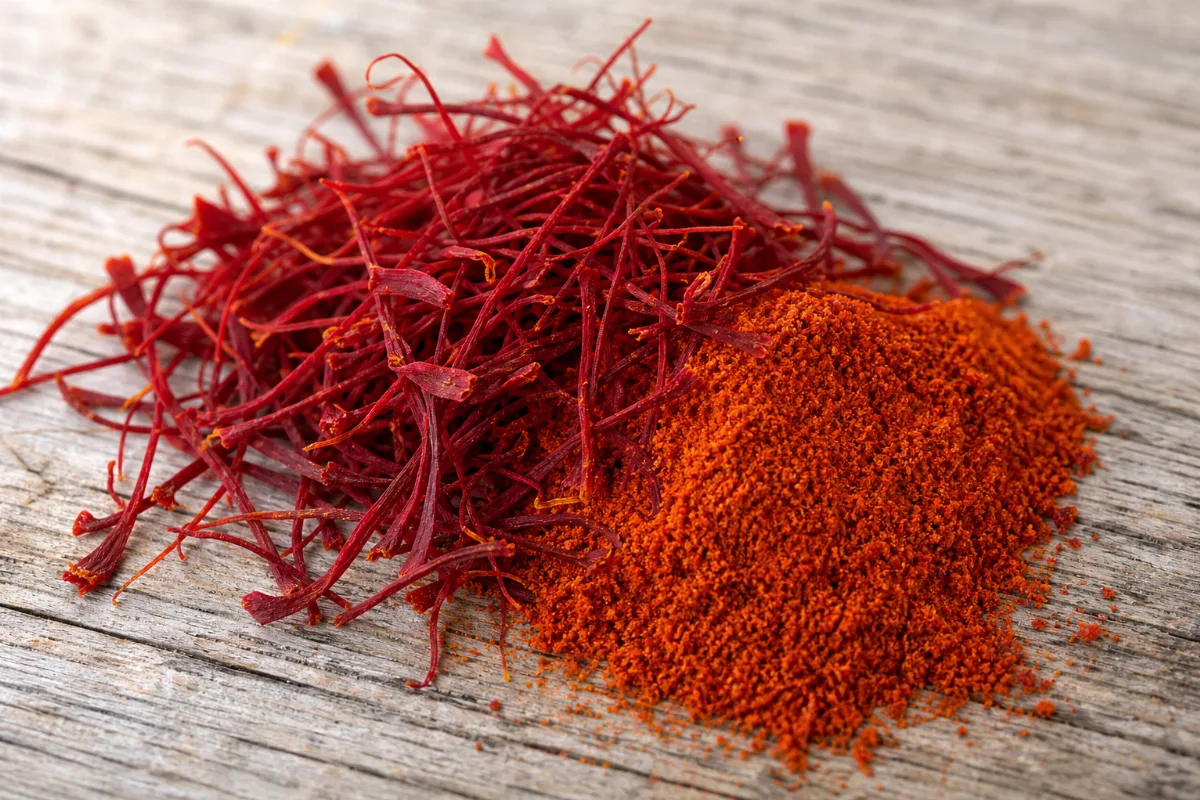
Saffron is the dried red stigma of a purple crocus flower, used as a spice and food colour for centuries and also sold as capsules, standardised extracts and tea. This profile is about saffron as a health product, not the pinch used in cooking. Research is mostly small trials of mood, sleep, PMS, memory, eyes and metabolic health.
General information, not medical advice. Last substantive update · Not medically reviewed. A named clinician has not signed off on this page. How this page is made
About Saffron
Saffron (Crocus sativus) is the dried red stigma of a purple crocus, best known as a costly kitchen spice and colour. It is also sold as capsules and standardised extracts, mainly for mood, stress and sleep. The research is mostly small trials, many from Iran and many funded by extract makers. Nothing about saffron is rated better than low or mixed certainty. Large amounts, pregnancy, bipolar disorder and fake saffron are the main cautions.
What it is
Saffron comes from Crocus sativus L., a plant of the iris family. GBIF lists it as an accepted species, and the spice is the dried stigma (the red threads) of the flower. The NCBI taxonomy gives the same name with the common name saffron crocus.
Trials use different things: saffron stigma powder or capsules, standardised stigma extracts sold under brand names, and purified compounds such as crocin and crocetin. Results from one of these do not automatically apply to another.
Traditional and current uses
A 2005 trial abstract says saffron is used for depression in Persian traditional medicine and is considered good for stomach ailments, as an antispasmodic and to help digestion. Other sources read describe it as a traditional aphrodisiac, and a review says pregnant women in South Asia and the Middle East use it for labour readiness and to improve their baby's complexion. These are traditions, not proof.
Today saffron is taken for mood, stress, sleep, PMS, weight, eye health and sexual wellbeing. A 2022 clinician guideline listed saffron among herbs with positive evidence for unipolar depression.
What is in it and how it works
Saffron's main compounds are crocins (the colour), crocetin (what crocins turn into in the gut), safranal (the smell) and picrocrocin (the bitter taste). Crocin does not reach the blood whole in rats; crocetin does, and in volunteers it peaks within hours.
In the lab, crocetin and saffron extract bind the NMDA (glutamate) and sigma-1 receptors, and in rats crocins lowered anxiety through the calming GABA-A system. These are lab and animal findings. Human trials have not shown how the mood effect works.
What the research shows
Mood, anxiety, sleep and PMS have the most trials, and benefits are small and mostly on self-rated scales. The latest depression review of 34 trials found lower scores on one self-rated questionnaire but not on the doctor-rated scale, with very high differences between trials. Memory trials are few. Eye trials show small electrical changes but almost no change in sight.
For weight, blood sugar, cholesterol and blood pressure, pooled results are small and mixed. For erectile dysfunction, small trials were positive and the largest trial was negative. No trial tested heart attacks, strokes, dementia progression or loss of vision. Several of the most positive trials were funded by or linked to extract makers.
At a glance
Traditional uses history, not proof
- Persian traditional medicine: used for depression, stomach ailments and as an antispasmodic and digestive, according to a 2005 trial abstract.
- Aphrodisiac use in several cultures, and use by pregnant women in South Asia and the Middle East, according to review and trial abstracts.
- Modern use: supplements taken for mood, stress, sleep, PMS and eye health.
Studied for research
- Mild to moderate depression, sleep, PMS, macular degeneration, blood sugar, blood fats, blood pressure, sexual function with antidepressants and inflammation markers, low
- Anxiety, low mood in adults without depression, weight and snacking, erectile dysfunction, mixed
- Teen mood, postpartum depression, memory and Alzheimer disease, diabetic macular swelling, very low
Main compounds
- Crocins, the red-yellow colour compounds that turn into crocetin in the gut
- Crocetin, the form that reaches the blood
- Safranal, the main aroma compound, and picrocrocin, the bitter taste
Common forms
- Saffron threads or powder as a spice
- Capsules and tablets of stigma powder or standardised extract
- Tea (infusion of stigmas)
Research links: 2026 systematic review of saffron adverse events (Health Sci Rep) · 2026 meta-analysis of saffron for depression and anxiety, GRADE assessed (Nutr Neurosci) · 2022 clinician guideline on nutraceuticals and herbs for psychiatric disorders (WFSBP and CANMAT) · 2026 systematic review of saffron adulteration (Crit Rev Food Sci Nutr) · GBIF species record for Crocus sativus · Research Library · Genes & Biomarkers Library
What it is and its history
- Accepted scientific name
- Crocus sativus L.
- Naming authority
- L.; published in Species Plantarum, page 36 (1753) (GBIF)
- Synonyms
- Crocus officinalis Martyn (1795); Crocus officinalis (L.) Honck.; Crocus autumnalis Sm.; Crocus cashmerianus Royle (1839); Crocus orsinii Parl.; Crocus pendulus Stokes; Crocus setifolius Stokes; Crocus vernalis Salisb. (1796); Crocus sativus var. officinalis L.; Crocus sativus var. cashmerianus Royle; Crocus sativus var. orsinii (Parl.) Maw; Crocus sativus subsp. orsinii (Parl.) K.Richt.; Geanthus autumnalis Raf.; Safran officinarum Medik.
- Common names
- Saffron (English); Saffron crocus (English); Azafrán (Spanish); Safran (French); Echter Safran (German); Zafferano vero (Italian); Açafrão (Portuguese); Kunkuma (Sanskrit); Шафран посевной (Russian)
- Family or group
- Iridaceae (iris family). NCBI lineage: Asparagales; Iridaceae; Crocoideae; Croceae; Crocus.
- Classification
- Plantae > Tracheophyta > Liliopsida > Asparagales > Iridaceae > Crocus > Crocus sativus
- Native range
- Not verified from a primary botanical source in this work. General knowledge (NOT verified): saffron is a cultivated plant with a long history in the Mediterranean and Asia and today is grown mainly in Iran.
- Habitat
- Not verified from a primary source read.
- What it looks like
- Roots: Not covered in the sources read. The plant grows from a corm (bulb-like underground stem); this is general knowledge, NOT verified here.; Stems: Not verified.; Leaves: Not verified.; Flowers: A purple crocus flower. The spice is the dried red stigma (the female part), taken from the flower (from the trial abstracts: "dried stigma of Crocus sativus L.").; Fruit: Not relevant to the medicinal use; not verified.
- Cultivation
- Not verified from a primary source read.
- Harvest and processing
- Not verified in detail. The product studied in nearly all trials is the dried stigma, either as powder or as a standardised extract (for example Affron, Satiereal).
- Look-alikes and adulterants
- Name: Colchicum autumnale L. (meadow saffron, autumn crocus); Note: GBIF key 2739622, family Colchicaceae. Contains colchicine (PubChem CID 6167). A fatal poisoning in Croatia followed accidental ingestion of its leaves mistaken for wild garlic (p15749368). It is not related to the spice.; Name: Carthamus tinctorius L. (safflower, "bastard saffron"); Note: GBIF key 3138327, family Asteraceae. One of the plants reported as a cheap substitute in adulterated saffron (p40792566).; Name: Calendula officinalis L. (marigold); Note: GBIF key 5391480, family Asteraceae. Reported as an adulterant (p40792566).; Name: Curcuma longa L. (turmeric); Note: GBIF key 2757624, family Zingiberaceae. Reported as an adulterant (p40792566).; Name: Other Crocus species, such as Crocus vernus and Crocus speciosus; Note: GBIF keys 2747567 and 2747718. Garden crocuses of the same genus; they are not the source of the spice and their safety as a supplement was not studied.
- Sustainability and conservation
- Not verified. Saffron is a farmed crop; no IUCN assessment was retrieved.
Photographs
Traditional use and history history, not clinical proof
| Tradition or era | Documented use | Source |
|---|---|---|
| Persian traditional medicine | The 2005 trial abstract (Akhondzadeh) says saffron is considered excellent for stomach ailments and as an antispasmodic, to help digestion and to increase appetite, and that it is used for depression in Persian traditional medicine. | p15852492 |
| Long history of medicinal use | A 2024 meta-analysis abstract says saffron has been used for thousands of years as a herbal medicine for many diseases, including type 2 diabetes, especially in Sri Lanka. A mouse study abstract says saffron use spans more than 3,500 years. These are secondary statements, not checked against ancient texts. | p37778521 |
| Aphrodisiac use in several cultures | The abstracts of two trials describe saffron as one of the traditional aphrodisiacs used in various cultures and as a perceived strong aphrodisiac. | p36186931 |
| South Asia and the Middle East (pregnancy) | A 2026 integrative review says saffron is widely used by pregnant women in South Asia and the Middle East, who take it to improve fetal complexion, maternal strength and labour readiness. These are cultural beliefs, not proof, and the review warns about excess consumption. | p42186868 |
| Modern use | Standardised extracts are sold for mood, stress and sleep. In 2021 EFSA reviewed one extract's mood claim and did not accept it as proven (known only from a web summary, NOT verified). A 2022 guideline lists saffron among herbs with positive evidence for unipolar depression. | s-efsa-affron-2021 |
| Common general claims (NOT verified) | Saffron is often described as having ancient Mediterranean and Persian origins. No source read here verifies these claims; the only related statement read is that a 2026 review calls saffron the world's most valuable spice (p40792566). | p40792566 |
Traditional use shows how it was used. It does not show that it works or is safe today.
What is inside, and how it may work
What it contains and how those compounds act in cells and animals. Laboratory and animal mechanisms are not proven effects in people.
Main compounds
| Compound | Family | Where it is concentrated | Activity studied | Level of evidence |
|---|---|---|---|---|
| Crocin (and other crocins) PubChem 5281233 | apocarotenoid glycoside (water-soluble red-yellow colour) | Stigma A good-quality saffron specification proposed in a lab study is over 20% crocins (Lechtenberg 2008). This is a proposed quality limit, not a measured average. | Gives most of saffron's colour. In rats, crocin is not absorbed whole; it is broken down in the gut to crocetin. In rats it lowered blood fats by blocking pancreatic lipase and improved depression-like behaviour. Crocin tablets 20 mg for one month were generally safe in healthy volunteers. 89 80 54 53 38 37 | Animal research |
| Crocetin (trans-crocetin) PubChem 5281232 | apocarotenoid (fat-soluble acid, the sugar-free core of crocin) | Stigma (mainly formed from crocins in the gut) | The compound that reaches the blood after saffron or crocin is eaten. In human volunteers a single dose of 7.5 to 22.5 mg was absorbed within an hour, peaked at about 4 to 4.8 hours and had a half-life of about 6 to 7.5 hours. In lab tests it bound the NMDA receptor and sigma-1 receptor and reduced glutamate signalling in rat brain slices; it crossed a blood-brain barrier model slowly. 87 5 38 14 37 24 | Laboratory research |
| Safranal PubChem 61041 | monoterpene aldehyde (main aroma compound) | Stigma (its content rose about twofold in a lab digestion model) | Gives saffron its smell. In a lab digestion model the safranal content rose about twofold (Almodóvar 2020). In rats, 21 days of safranal lowered red cells and platelets and changed the kidney and lung; oral LD50 5.53 to 21.42 mL/kg in rats and mice. Crocin and safranal by injection caused malformations in pregnant mice. 5 29 50 | Animal research |
| Picrocrocin PubChem 130796 | monoterpene glycoside (bitter taste) | Stigma A good-quality saffron specification proposed in a lab study is over 6% picrocrocin (Lechtenberg 2008). | Gives the bitter taste. No separate effect shown in people. In the lab, picrocrocin did not bind the NMDA or sigma-1 receptor. 38 | Laboratory research |
| Colchicine (NOT in saffron; in the look-alike meadow saffron) PubChem 6167 | tropolone alkaloid | Colchicum autumnale corm, leaves and seeds | The toxic compound in meadow saffron (autumn crocus), the cause of the fatal poisoning in the case report. Not present in the spice. 81 | Human data |
Mechanisms, receptors and pathways
| Target or pathway | Gene or receptor | What was found | Level |
|---|---|---|---|
| NMDA receptor (glutamate) and sigma-1 receptor | GRIN (NR2B subunit); SIGMAR1 | In lab binding tests saffron extracts and crocetin bound the NMDA receptor (PCP site) and the sigma-1 receptor; crocins and picrocrocin did not. In rat brain slices, saffron extract and trans-crocetin reduced glutamate-driven nerve signals and NMDA-induced depolarisation. In depressed rats crocetin reduced NMDA currents in the hippocampus. 38 14 54 | Laboratory research |
| GABA-A receptor | GABRA/GABRB/GABRG | Crocins lowered anxiety-like behaviour in rats and the GABA-A blocker flumazenil removed the effect, suggesting involvement of the brain's calming system. 62 | Animal research |
| Serotonin, stress hormone and brain growth signalling | SLC6A4 (serotonin transporter); BDNF; CREB | In stressed rats crocin and crocetin raised serum serotonin, lowered corticosterone and raised brain signalling proteins (BDNF, CREB, ERK). Computer docking predicted binding to the serotonin transporter, as fluoxetine does. Docking is a prediction, not a measurement, and the human trials did not measure serotonin. 54 | Animal research |
| Melatonin | MTNR (melatonin receptors); melatonin production | In 120 adults with poor sleep, evening saliva melatonin rose on saffron versus placebo; evening cortisol did not change. 42 | Human data |
| Cytochrome P450 CYP1A2 (liver drug-clearing enzyme) | CYP1A2 | Six days of saffron tea lowered a caffeine-based CYP1A2 activity marker about 13.7% in 34 healthy volunteers, mainly in men; CYP2A6, xanthine oxidase and NAT2 were unchanged. 13 | Human data |
| Pancreatic lipase (fat digestion) | PNLIP | In rats crocin selectively inhibited pancreatic lipase, which led to fat and cholesterol malabsorption. 80 | Animal research |
| Gut conversion of crocin to crocetin | Intestinal enzymes; gut bacteria | Crocins are hydrolysed to trans-crocetin mainly by intestinal cells and to a lesser extent by gut bacteria; human stool bacteria also make further products (dihydro and tetrahydro crocetins). 37 24 | Laboratory research |
| Retinal protection | Photoreceptors; oxidative stress | A systematic review reports that in lab and animal work saffron protected photoreceptors from light-induced damage and crocetin prevented retinal degeneration; the human AMD trials measure retinal electrical responses only. 73 | Animal research |
| Inflammation and oxidative stress | NF-kB; TNF-alpha; IL-6 | A pooled analysis of human trials did not find lower CRP, TNF-alpha or IL-6 overall, so lab anti-inflammatory claims are not shown in people. 10 | Human data |
Absorption, metabolism and elimination
- Absorption
- In rats, oral crocin is not found in blood; crocetin appears at low levels, and most crocin leaves in the faeces (Xi 2007). A cell-layer test found crocin-1 does not cross the gut cell layer, but trans-crocetin does (about 32% in 2 hours). In 13 healthy volunteers a standardised saffron extract (56 or 84 mg) gave a crocetin peak in blood at 60 to 90 minutes. In 10 volunteers a single dose of pure crocetin (7.5 to 22.5 mg) peaked at about 4 to 4.8 hours.
- Distribution
- Crocetin crossed a blood-brain barrier model slowly but steadily over 29 hours (lab model). No human tissue data were found.
- Metabolism
- Crocins are broken down in the gut wall (mainly) and by gut bacteria to crocetin; bacteria in human stool then produced dihydro and tetrahydro crocetins. Crocetin is a P-glycoprotein substrate in a cell test.
- Elimination
- Crocetin half-life in 10 volunteers was 6.1 to 7.5 hours. Most oral crocin is excreted in faeces in rats.
- Bioavailability
- Whole crocins are poorly absorbed; crocetin is the main compound in blood. Peak crocetin differed between the two human studies because the products and doses differed. The extract study was paid for by the extract maker.
Isolated compounds versus whole extracts
Saffron is a mix. The crocins, crocetin, safranal and picrocrocin differ in what they do in the lab: crocetin (not crocins) binds the NMDA and sigma-1 receptors, safranal is the aroma and is the compound with toxicity data, and crocin is the colour. Many trials use whole stigma powder, while others use standardised extracts (for example Affron, Satiereal, Safr'Inside) or purified crocin; the results from one product may not carry over to another. Crocins are broken down to crocetin in the gut, so what the body sees after eating saffron or crocin is largely crocetin. A 2024 meta-analysis found extracts and crocin helped glucose and blood pressure in more parameters than powder, which raised BMI slightly; the authors called extract the better performer.
Nutritional composition
A nutrient table does not apply to saffron as a medicine: the spice is used in tiny amounts, so it gives essentially no calories or vitamins. No nutrient values were read for this file.
4 mixed findings10 low certainty4 very low certainty
What was looked at
The 18 benefits and uses checked for Saffron, each with how strong the evidence is. Tap one to open it.
- Mild to moderate depressionLow certainty
- Saffron compared with antidepressant drugsLow certainty
- AnxietyMixed findings
- Low mood and everyday wellbeing in adults without depressionMixed findings
- Anxiety and low mood in teenagersVery low certainty
- Postpartum depression (new mothers)Very low certainty
- Sleep quality and insomnia symptomsLow certainty
- Premenstrual syndrome (PMS) and PMDDLow certainty
- Memory and thinking in mild cognitive impairment and Alzheimer diseaseVery low certainty
- Early to moderate age-related macular degeneration (AMD)Low certainty
- Diabetic macular swelling and Stargardt diseaseVery low certainty
- Appetite, snacking and body weightMixed findings
- Blood sugar control (diabetes and prediabetes)Low certainty
- Cholesterol and blood fatsLow certainty
- Blood pressureLow certainty
- Erectile dysfunction in menMixed findings
- Sexual problems caused by antidepressants, and in womenLow certainty
- Inflammation markers in the bloodLow certainty
Lab markers tracked in the studies
Beck Depression Inventory (BDI) scoreHamilton Depression Rating Scale (HDRS)Beck Anxiety Inventory (BAI) scorePittsburgh Sleep Quality Index (PSQI)Athens Insomnia Scale (AIS)Evening salivary melatoninSerum or saliva cortisolDaily Record of Severity of Problems (DRSP) / premenstrual symptom diaryAlzheimer's Disease Assessment Scale, cognitive part (ADAS-cog)Mini-Mental State Examination (MMSE)C-reactive protein (CRP)Fasting blood glucoseHbA1cTriglyceridesTotal cholesterolLDL cholesterolHDL cholesterolSystolic blood pressureBody weight and BMIC-reactive protein (CRP)AST and ALT (liver enzymes)CreatinineRetinal electrical response (fERG / mfERG)Best-corrected visual acuity (letters read)International Index of Erectile Function (IIEF)Female Sexual Function Index (FSFI)
What is Saffron good for?
The main proposed uses and how strong the human evidence is for each. "Low" means small or inconsistent studies, "mixed" means studies disagree, "very low" means a single small or unclear study, and "insufficient" means there is not enough to judge. Nothing about saffron is rated higher than low. This table is not medical advice.
Benefits, one by one
Each card is a research question, not a promise. Tap a goal to filter. Open a card to see the studies, doses and limits.
Mild to moderate depression
Low certaintyIn small trials, saffron capsules lowered depression scores more than a dummy pill in adults with mild to moderate depression, and worked about as well as the antidepressants it was compared with. The gains show up on self-rated questionnaires more than on doctor-rated scales, and the trials are small and often from the same few research groups. Saffron is not a replacement for treatment of depression.
9 studiesTrials used saffron stigma capsules or standardised stigma extracts (…
Studies, doses and limits
What the trials found
Meta-analyses: Tóth 2019 (9 trials pooled) found saffron better than placebo (Hedges g 0.891) and not clearly different from antidepressants (g -0.246, p = 0.053). Dai 2020 (12 studies) reached the same direction. Ghaderi 2020 (21 trials) found lower Beck Depression Inventory (BDI) scores but no change in Hamilton depression scores. Mahmoudi 2026 (34 trials, 1,769 people) found lower BDI scores (14 trials, WMD -4.39) but no significant effect on the Hamilton scale or POMS; its authors rated overall certainty moderate on GRADE while noting very high heterogeneity (I2 92.3%). Musazadeh 2022, an umbrella review of 7 meta-analyses, found BDI fell (-3.87) but Hamilton scores did not, and concluded saffron cannot be seen as a single treatment. Single trials: Akhondzadeh 2005 (40 outpatients, 30 mg/day stigma capsule, 6 weeks) was positive versus placebo; Mazidi 2016 (60 people, 12 weeks, BDI and BAI) was positive; a 12-week Affron trial of 202 adults with low mood (Lopresti 2025) found a small gain on the DASS-21 depression score (d = 0.39). A 2022 clinician guideline from two psychiatric societies (Sarris, WFSBP and CANMAT) listed saffron (++) among herbs with positive Grade A evidence for unipolar depression, advising that herbs be used mainly alongside standard care (abstract only).
Results
Mostly positive on self-rated scales (BDI), with no clear effect on doctor-rated Hamilton scales in the larger pooled reviews.
Effect sizes as reported
Mahmoudi 2026: BDI WMD -4.39 (95% CI -6.64 to -2.15; 14 trials, 817 people). Tóth 2019 versus placebo: g = 0.891 (95% CI 0.369 to 1.412). Ghaderi 2020: BDI WMD -4.86 (95% CI -6.58 to -3.14). Hamilton scale: no significant change in Mahmoudi 2026, Musazadeh 2022 (ES -2.10, 95% CI -5.05 to 0.86) or Ghaderi 2020.
Why this rating
Many small, short trials (often 40 to 60 people, 6 to 12 weeks), several from the same research networks, and very high heterogeneity (I2 over 90%). Benefit appears on self-rated questionnaires but not reliably on clinician-rated scales. The 2026 meta-analysis authors graded their evidence moderate; we rate it low because of these limits and because several recent trials were funded by extract makers.
Form and dose studied
Trials used saffron stigma capsules or standardised stigma extracts (for example Affron). Products and doses differ between trials, so results should not be moved from one product to another.
Who was studied
Adults with mild to moderate depression (DSM-IV), people with heart disease and depression, and adults with low mood who do not have a diagnosis.
Limits
Small trials; mostly self-rated outcomes; short follow-up (6 to 12 weeks); several industry-linked trials; trials concentrated in Iran; publication bias cannot be excluded.
Why researchers looked
Saffron has long been used in Persian and other traditional medicine for low spirits, and early lab work suggested effects on brain chemistry, so Iranian research groups ran the first trials in 2005.
Traditional use
Persian traditional medicine used saffron for low mood (the 2005 trial authors say so). This is traditional use only and is not proof that it works.
Proposed mechanism Preliminary mechanism
Lab and animal work suggests that a breakdown product of crocin, trans-crocetin, blocks NMDA (glutamate) receptors and the sigma-1 receptor, and rat work points to the GABA-A calming system. These are test-tube and animal findings; they have not been shown to explain the effect in people.
A proposed mechanism does not show that the effect happens in people.
Side effects in these trials were mostly mild. Saffron is not studied for severe depression or in bipolar disorder (see safety section).
Saffron compared with antidepressant drugs
Low certaintyIn head-to-head trials, saffron capsules gave about the same score change as the antidepressants tested (fluoxetine, and in the pooled review, SSRIs in general), with fewer side effects. These trials have no placebo group in most cases, so "about the same" does not prove either one works better than a dummy pill.
3 studiesSaffron stigma capsules in the trial named above; fluoxetine as the d…
Studies, doses and limits
What the trials found
Shafiee 2025 (meta-analysis of randomized trials comparing saffron with SSRIs; 8 for depression, 4 for anxiety) found no significant difference in depression (SMD 0.10, 95% CI -0.09 to 0.29) or anxiety (SMD 0.04, 95% CI -0.22 to 0.29), and fewer adverse events with saffron (risk difference -0.06, 95% CI -0.09 to -0.04, I2 0%). Shahmansouri 2014 (40 people after a heart stent procedure, saffron 30 mg/day versus fluoxetine 40 mg/day, 6 weeks) found no significant difference in Hamilton score (p = 0.62), response (p = 0.67) or remission (p = 1.00). Tóth 2019 also found saffron not clearly different from antidepressant drugs (g -0.246, p = 0.053).
Results
No significant difference from SSRIs in depression or anxiety scores; fewer adverse events with saffron.
Effect sizes as reported
Shafiee 2025: depression SMD 0.10 (95% CI -0.09 to 0.29); anxiety SMD 0.04 (95% CI -0.22 to 0.29); adverse events risk difference -0.06 (95% CI -0.09 to -0.04).
Why this rating
No difference in small trials is not the same as equal benefit; most trials had no placebo group, and drug doses and populations differed. The meta-analysis authors call for larger trials.
Form and dose studied
Saffron stigma capsules in the trial named above; fluoxetine as the drug comparator.
Who was studied
Adults with mild to moderate depression or anxiety, including one trial after a heart stent procedure.
Limits
Mostly no placebo arm; small samples; short trials; mild to moderate depression only.
Why researchers looked
People want to know if a herb can stand in for an SSRI in mild depression, so researchers compared them directly.
Proposed mechanism Preliminary mechanism
Saffron compounds are proposed to act on glutamate (NMDA) and calming (GABA-A) systems rather than on serotonin reuptake. These are lab and animal findings and do not prove how it acts in people.
A proposed mechanism does not show that the effect happens in people.
Do not switch or stop a prescribed antidepressant because of these trials. Combining saffron with SSRIs has not been properly studied (see safety section).
Anxiety
Mixed findingsPooled trials show lower scores on one self-rated anxiety questionnaire (the Beck Anxiety Inventory), but not on the doctor-rated Hamilton anxiety scale, and a large comparison of 12 herbs did not find a clear saffron effect on that scale. Evidence is mixed.
5 studiesStigma capsules or standardised extracts; products differ.
Studies, doses and limits
What the trials found
Mahmoudi 2026 (6 trials, 339 people): Beck Anxiety Inventory WMD -5.06 (95% CI -8.44 to -1.68, I2 94.8%); no significant effect on the Hamilton Anxiety Scale. Ghaderi 2020 (5 trials): BAI WMD -5.29 (95% CI -8.27 to -2.31), no change in the Hamilton anxiety scale. Zhang 2022 (network meta-analysis of 12 herbs in 29 trials): saffron did not significantly lower Hamilton anxiety scores (mean difference -2.71, 95% credible interval -6.06 to 0.57), though the authors thought it worth more study. Mazidi 2016 (60 people with anxiety and depression, 12 weeks) found lower BAI scores than placebo.
Results
Mixed: better on a self-rated questionnaire, not on the doctor-rated scale.
Effect sizes as reported
BAI WMD -5.06 (95% CI -8.44 to -1.68) in Mahmoudi 2026; Hamilton anxiety MD -2.71 (95% CrI -6.06 to 0.57) in Zhang 2022.
Why this rating
Self-rated and doctor-rated scales disagree, heterogeneity is very high (I2 about 95%), and the network meta-analysis did not find a significant effect.
Form and dose studied
Stigma capsules or standardised extracts; products differ.
Who was studied
Adults with anxiety, mixed anxiety and depression, and people with low mood.
Limits
Few anxiety-specific trials; mixed populations; self-rated outcomes.
Why researchers looked
Anxiety often goes with low mood, and several mood trials recorded anxiety as a second outcome.
Traditional use
Not established from the sources read.
Proposed mechanism Animal research
In rats, crocins reduced anxiety-like behaviour, and the effect disappeared when a GABA-A blocker (flumazenil) was given, suggesting the brain's calming system is involved (Pitsikas 2020). This is animal work only.
A proposed mechanism does not show that the effect happens in people.
Mild stomach upset, headache and dry mouth are the usual reported effects (see safety section).
Low mood and everyday wellbeing in adults without depression
Mixed findingsSeveral trials of standardised extracts (Affron, and others) in adults with low mood but no depression diagnosis reported better mood scores, but a fresh 2025 trial in 51 people found no effect on the main outcome, and the European food-safety agency judged one extract's mood claim not proven. Most of the positive trials were paid for or written by the extract makers.
6 studiesStandardised stigma extracts (Affron, UO SAF 02, others) and saffron …
Studies, doses and limits
What the trials found
Kell 2017 (128 adults with low mood, Affron 28 mg/day for 4 weeks): large improvement versus placebo on the POMS Total Mood Disturbance (p < 0.001, d = -1.10); the 22 mg/day dose did not differ from placebo. Lopresti 2025 (202 adults, Affron 28 mg/day, 12 weeks): DASS-21 depression beta -2.92 (95% CI -5.13 to -0.71, d = 0.39); 72.3% versus 54.3% had a clinically important drop; other scales did not differ and placebo responses were large. Shah 2026 (56 adults, a standardised extract, 56 days): POMS fell 48.46 versus 5.67 on placebo; the extract maker funded and co-authored it. Amadieu 2025 (51 adults, 6 weeks): no effect on the main combined outcome or on depression, anxiety or fatigue alone; a small gain on a self-rated mental health score (p = 0.04). Delam 2023 (72 postmenopausal women, saffron tea against a control group; placebo is not mentioned in the abstract): happiness score rose from 42.93 to 61.58 (p < 0.001). In 2021 the European Food Safety Authority panel reviewed an Affron mood claim and concluded the evidence did not establish a cause-and-effect link (summary only, not verified from the opinion itself).
Results
Mixed: several positive trials, many industry-linked, and one recent null trial.
Effect sizes as reported
Kell 2017 d = -1.10; Lopresti 2025 d = 0.39 (95% CI of beta -5.13 to -0.71).
Why this rating
Positive results come mainly from small to medium trials linked to extract makers, effect sizes differ widely (d 0.39 to 1.10), a placebo-controlled trial without industry link found no main effect, and the European regulator did not accept the mood claim.
Form and dose studied
Standardised stigma extracts (Affron, UO SAF 02, others) and saffron tea. Different products; no conclusion about "the best" one can be drawn.
Who was studied
Adults with self-reported low mood or subclinical depressive symptoms, postmenopausal women.
Limits
Self-reported inclusion; industry sponsorship; short follow-up; one tea trial without placebo.
Why researchers looked
Because saffron seemed to lift mood in depression trials, makers tested lower doses of standardised extracts in people who feel low but are not clinically depressed.
Traditional use
Not specifically traditional.
Proposed mechanism Preliminary mechanism
Unproven. The authors of the 2025 trial that found no effect measured inflammation and stress-hormone response and saw no change (Amadieu 2025).
A proposed mechanism does not show that the effect happens in people.
No serious adverse events in these trials.
Anxiety and low mood in teenagers
Very low certaintyOne 8-week trial in 80 teenagers aged 12 to 16 found that a standardised saffron extract lowered self-reported anxiety and depression scores more than placebo, but their parents saw less clear changes. One trial is too little to rely on.
1 studiesAffron standardised extract in the trial.
Studies, doses and limits
What the trials found
Lopresti 2018 (80 youth aged 12 to 16, 68 finished, Affron 14 mg twice a day for 8 weeks): by youth self-report, total internalising symptoms fell 33% on saffron versus 17% on placebo (p = 0.029); depression p = 0.016, separation anxiety p = 0.003, social phobia p = 0.023. Parent reports: improvement 40% versus 26% (p = 0.026) but no other significant differences.
Results
Positive by teenagers' own report; parents saw it only partly.
Effect sizes as reported
Total internalising score drop 33% versus 17% (p = 0.029).
Why this rating
One small trial, self-report, a single dose, and authors from the extract maker.
Form and dose studied
Affron standardised extract in the trial.
Who was studied
Youth aged 12 to 16 with mild to moderate symptoms.
Limits
Single trial; short; non-clinical sample; industry-linked authors.
Why researchers looked
Adult trials were positive, so researchers tried teenagers with mild to moderate symptoms.
Proposed mechanism Pharmacological theory
Not studied in this trial.
A proposed mechanism does not show that the effect happens in people.
Well tolerated in the trial; a trend toward fewer headaches on saffron. Saffron is not established as safe long term in children.
Postpartum depression (new mothers)
Very low certaintyOne trial of 60 breastfeeding mothers with mild to moderate postpartum depression found a much bigger fall in depression scores on saffron than placebo. A single small trial cannot be relied on, and saffron during breastfeeding has not been properly checked for safety.
2 studiesStigma capsules in the trial.
Studies, doses and limits
What the trials found
Tabeshpour 2017 (60 new mothers, saffron 15 mg twice a day versus placebo, 8 weeks): BDI-II fell from 20.3 to 8.4 on saffron and from 19.8 to 15.1 on placebo; remission 96% versus 43% (p < .01); complete response 66% versus 6%.
Results
Positive in one small trial; the remission rate is unusually high.
Effect sizes as reported
BDI-II 20.3 to 8.4 (saffron) versus 19.8 to 15.1 (placebo).
Why this rating
One trial of 60 mothers, not replicated, with an unusually large effect.
Form and dose studied
Stigma capsules in the trial.
Who was studied
Breastfeeding mothers with BDI-II up to 29.
Limits
Single small trial; infant outcomes not reported in the abstract.
Why researchers looked
Many breastfeeding mothers prefer herbs to antidepressant drugs, so researchers tested saffron.
Proposed mechanism Pharmacological theory
Not studied in this trial.
A proposed mechanism does not show that the effect happens in people.
High doses of saffron are advised against during pregnancy and nursing in toxicology reviews; breast-milk safety was only studied in mice (see safety section).
Sleep quality and insomnia symptoms
Low certaintyPooled trials show better sleep scores with saffron than with placebo. The improvement is modest and mostly on questionnaires. Most of the newer trials used standardised extracts and were linked to the extract makers.
8 studiesStandardised saffron extracts and capsules; doses and products differ.
Studies, doses and limits
What the trials found
Lian 2022 (meta-analysis of randomized trials): Pittsburgh Sleep Quality Index (PSQI) MD -2.14 (95% CI -2.86 to -1.42), Insomnia Severity Index MD -2.63 (95% CI -3.70 to -2.55), restorative sleep score MD 7.05. Ghaderi 2020 found PSQI WMD -2.22 (95% CI -2.73 to -1.72, 3 studies). Rafiei 2023 (systematic review of 5 trials, 379 people) concluded saffron seems to help sleep quality and duration. Single trials: Pachikian 2021 (66 adults with sleep problems and anxiety, 15.5 mg/day, 6 weeks) improved PSQI and ease of falling asleep; Lopresti 2021 (120 adults with poor sleep, Affron 14 mg or 28 mg before bed, 28 days) improved sleep quality ratings, with higher evening melatonin; Lang 2025 (52 older adults, 30 mg/day, 4 weeks) improved subjective and tracker-measured sleep onset; Schuster 2025 (165 adults with moderate insomnia, 20 or 30 mg/day, 4 weeks) lowered the Athens Insomnia Scale by about 1 point (beta -0.95, 95% CI -1.79 to -0.11); Tajaddini 2021 (70 overweight adults with type 2 diabetes, 100 mg/day, 8 weeks) improved PSQI.
Results
Consistently positive on sleep questionnaires, with small sizes; some objective tracker data in two trials.
Effect sizes as reported
PSQI MD -2.14 (95% CI -2.86 to -1.42) in Lian 2022; AIS beta -0.95 (95% CI -1.79 to -0.11) in Schuster 2025.
Why this rating
Trials are small, short (4 to 8 weeks) and rely on self-rated scales; several were funded by extract makers; the one clear insomnia-scale difference is about one point. No trial in people with a diagnosed insomnia disorder.
Form and dose studied
Standardised saffron extracts and capsules; doses and products differ.
Who was studied
Healthy adults with poor sleep, older adults, adults with moderate insomnia symptoms, people with type 2 diabetes.
Limits
Self-reported sleep; short trials; industry links in Lopresti 2021, Schuster 2025 and Pachikian 2021.
Why researchers looked
Sleep is often poor with low mood and anxiety, so trials measured it as an outcome or as the main outcome.
Traditional use
Not specifically traditional in the sources read.
Proposed mechanism Preliminary mechanism
Possible links through the calming (GABA-A) system and melatonin: one trial found evening melatonin rose on saffron but not stress hormone (Lopresti 2021). Early evidence only.
A proposed mechanism does not show that the effect happens in people.
No significant adverse events in these trials.
Premenstrual syndrome (PMS) and PMDD
Low certaintySmall trials and a 2026 pooled review found fewer premenstrual symptoms with saffron than with placebo; in one trial it worked about like fluoxetine. The number of trials is small.
3 studiesStigma capsules in the trials.
Studies, doses and limits
What the trials found
Agha-Hosseini 2008 (women aged 20 to 45 with PMS, saffron 15 mg twice a day for two cycles): symptoms and Hamilton scores improved more than with placebo in cycles 3 and 4. Rajabi 2020 (120 women with PMDD, saffron 15 mg twice a day versus fluoxetine versus placebo, luteal phase only, two cycles): all three groups improved; saffron beat placebo on the Daily Record of Severity of Problems (p = 0.027) but Hamilton scores did not differ; fluoxetine had more side effects (p = 0.01). Mohammadi 2026 (meta-analysis): PMS SMD -0.64 (95% CI -0.84 to -0.44); dysmenorrhea SMD -0.51 (95% CI -1.01 to -0.01).
Results
Positive in small trials; large placebo response in the PMDD trial.
Effect sizes as reported
PMS SMD -0.64 (95% CI -0.84 to -0.44); dysmenorrhea SMD -0.51 (95% CI -1.01 to -0.01).
Why this rating
Few small trials (the 2008 abstract does not even report group size), mostly from one country.
Form and dose studied
Stigma capsules in the trials.
Who was studied
Women with PMS or PMDD.
Limits
Small samples; short; mostly Iranian groups.
Why researchers looked
PMS mood symptoms resemble mild depression, so saffron was tried alongside the depression work.
Traditional use
Not specifically traditional in the sources read.
Proposed mechanism Pharmacological theory
Possibly the same mood pathways as in depression; not studied directly.
A proposed mechanism does not show that the effect happens in people.
Saffron should not be taken in medicinal amounts in pregnancy (see safety section).
Memory and thinking in mild cognitive impairment and Alzheimer disease
Very low certaintyA few small trials found that saffron capsules did better than placebo on memory tests in mild to moderate Alzheimer disease and worked about like donepezil and memantine in two other trials. These trials are small, mostly from the same research network, and the reviewers say the evidence is not enough to recommend saffron for dementia.
7 studiesSaffron capsules or extract in the trials.
Studies, doses and limits
What the trials found
Ayati 2020 (meta-analysis of 4 trials): saffron improved ADAS-cog and CDR-SB versus placebo and looked similar to conventional drugs; no serious adverse events; the authors say there is insufficient evidence for clinical recommendations. Trials: Akhondzadeh 2010 (46 people, mild to moderate Alzheimer disease, 30 mg/day, 16 weeks): better than placebo (ADAS-cog p = 0.04); Akhondzadeh 2010 (54 people, 22 weeks): similar to donepezil, with less vomiting; Farokhnia 2014 (68 people with moderate to severe Alzheimer disease, 12 months): similar to memantine (p = 0.38 on the scale); Tsolaki 2016 (35 people with mild cognitive impairment, 12 months, versus a waiting list, not placebo): Mini-Mental State Examination better on saffron (p = 0.015).
Results
Positive versus placebo in one trial; similar to drugs in two trials without placebo.
Effect sizes as reported
ADAS-cog and CDR-SB F = 4.12, p = 0.04 (Akhondzadeh 2010, 16 weeks).
Why this rating
Only four small trials, only one placebo-controlled trial in Alzheimer disease, results only just significant, no replication outside the same network. Reviewers: evidence insufficient.
Form and dose studied
Saffron capsules or extract in the trials.
Who was studied
People with mild cognitive impairment or Alzheimer disease.
Limits
No placebo in two trials; single blind in one; small sizes.
Why researchers looked
Lab work on animals suggested saffron compounds may protect brain cells and limit amyloid build-up, so Alzheimer trials followed.
Traditional use
Not specific in the sources read.
Proposed mechanism Laboratory research
In rat brain slices, saffron extract and crocetin reduced glutamate nerve signals through NMDA receptors (Berger 2011). A test-tube study found crocetin crosses a blood-brain barrier model slowly (Lautenschläger 2015). This is not shown in people.
A proposed mechanism does not show that the effect happens in people.
Adverse events were similar to the drugs in the comparison trials.
Early to moderate age-related macular degeneration (AMD)
Low certaintySmall trials from Italy and Australia found that daily saffron slightly improved how the central retina responds to light on electrical tests. In the one trial that measured reading letters, the gain was under one letter, too small to notice. A 12-month follow-up found letter reading slightly worse, perhaps from cataract. Saffron has not been shown to slow or stop AMD.
6 studiesSaffron stigma supplement in the trials (20 mg/day in four, 30 mg/day…
Studies, doses and limits
What the trials found
Falsini 2010 (25 people with early AMD, 20 mg/day for 3 months, then crossover): the focal electroretinogram (fERG) amplitude rose on saffron (+0.25 log microvolts) but not on placebo (p < 0.01). Marangoni 2013 (33 early AMD patients, 20 mg/day, average 11 months, no placebo group): fERG improved against baseline (p < 0.01) whatever the risk gene type. Lashay 2016 (60 people, 30 mg/day, 6 months): some retinal electrical gains at 3 months that faded by 6 months; optical coherence tomography improved in wet AMD only (p = 0.05). Broadhead 2019 (100 adults, 20 mg/day for 3 months crossover, placebo-controlled): best-corrected visual acuity +0.69 letters (p = 0.001) and multifocal electroretinogram latency -0.17 ms (p = 0.04). Broadhead 2024 (93 adults, open-label extension of 12 months): mfERG response density higher in the central rings (p < 0.001), latency not changed, visual acuity 1.6 letters worse (p < 0.05). Sepahi 2021 (systematic review of 29 articles) concluded more clinical work is needed.
Results
Small gains on electrical retina tests in short trials; vision gain under one letter; 12-month acuity slightly worse.
Effect sizes as reported
BCVA +0.69 letters (p = 0.001); mfERG latency -0.17 ms (p = 0.04); fERG +0.25 log microvolts versus -0.003 on placebo (Falsini 2010).
Why this rating
Small trials (25 to 100 people) from a few groups, crossover designs, tiny visual acuity gain that is not noticeable, one open-label extension with worse acuity, mixed results over time. No trial shows slower progression or fewer people losing vision.
Form and dose studied
Saffron stigma supplement in the trials (20 mg/day in four, 30 mg/day in one). Products were not compared.
Who was studied
Adults over 50 with early or mild to moderate AMD; some also took AREDS vitamins.
Limits
Electrical tests are not the same as seeing better; one trial without placebo; short follow-up; a patent by one of the research groups (not the authors of the main trials).
Why researchers looked
Lab work on animal retinas suggested saffron compounds (crocin, crocetin) protect light-sensing cells, so Italian and Australian researchers tested a low daily dose in AMD.
Proposed mechanism Preliminary mechanism
A systematic review abstract (Sepahi 2021) reports that in lab and animal work saffron protected light-sensing cells from light-induced damage and crocetin prevented retinal degeneration. The Italian authors suggest the effect on AMD may go beyond antioxidant action. This is not proven in people.
A proposed mechanism does not show that the effect happens in people.
No saffron-related serious adverse events were reported. See the safety section.
Diabetic macular swelling and Stargardt disease
Very low certaintyOne 3-month phase II trial of purified crocin (the saffron colour compound, not whole saffron) in 60 people with diabetic macular swelling that had not responded to usual care found better vision and thinner retina with the 15 mg dose. A pilot in Stargardt disease (a rare inherited eye disease) found no benefit, only that saffron was tolerated.
3 studiesCrocin tablets (diabetic macular edema) and saffron 20 mg/day (Starga…
Studies, doses and limits
What the trials found
Sepahi 2018 (60 people, 101 eyes, diabetic macular edema that did not respond to conventional treatment): crocin 15 mg/day for 3 months lowered HbA1c (p = 0.024), central macular thickness (p = 0.005) and improved visual acuity (p = 0.012) versus placebo; the 5 mg dose did not differ significantly. Piccardi 2019 (31 people with Stargardt disease/fundus flavimaculatus, saffron 20 mg/day, 6 months then crossover): retinal electrical response and visual acuity were unchanged on saffron; the authors only conclude it was tolerated.
Results
One positive short phase II trial of crocin; one pilot without benefit.
Effect sizes as reported
Crocin 15 mg: macular thickness p = 0.005 (95% CI of difference 32.75 to 126.99); BCVA p = 0.012; HbA1c p = 0.024 (95% CI 0.3 to 0.96).
Why this rating
One trial for each condition, 31 and 60 people; the crocin trial uses a purified compound rather than saffron; the authors say clinical significance is not shown.
Form and dose studied
Crocin tablets (diabetic macular edema) and saffron 20 mg/day (Stargardt).
Who was studied
People with refractory diabetic macular edema; people with ABCA4-related Stargardt disease.
Limits
Single small trials; different products; short follow-up; a patent interest is declared in the Stargardt trial.
Why researchers looked
Crocin is an antioxidant and reduced inflammation in lab models of eye disease.
Proposed mechanism Preliminary mechanism
Antioxidant and anti-inflammatory activity in lab and animal retina work. Not shown in people.
A proposed mechanism does not show that the effect happens in people.
Well tolerated in both trials. People with eye disease should not replace eye treatment with saffron.
Appetite, snacking and body weight
Mixed findingsOne 8-week trial in 60 mildly overweight women found less snacking and more weight loss with a branded saffron extract (Satiereal) than with placebo. A combination supplement trial found nothing, and a pooled review of 25 trials in people with overweight found no change in weight or BMI. The evidence for weight loss is mixed.
4 studiesSatiereal (a branded saffron stigma extract) in two trials; plain saf…
Studies, doses and limits
What the trials found
Gout 2010 (60 healthy mildly overweight women, Satiereal 176.5 mg/day, 8 weeks): body weight fell more than on placebo (p < .01) and snacking episodes were fewer (p < .05); numbers were not given in the abstract. Gonzalez 2018 (20 overweight adults, 28 days, a combination of Satiereal 178 mg, naringin 100 mg and vitamin D): no difference from placebo in weight, BMI, waist, intake or cravings. Tahmasbi 2022 (meta-analysis of 25 trials in overweight and obese people): weight -0.32 kg (95% CI -3.15 to 2.51), BMI -0.06, waist -1.23 cm, all not significant; waist-to-hip ratio SMD -0.41 (95% CI -0.73 to -0.09). Rahmani 2019 (14 trials): no significant effect on weight.
Results
Mixed: one positive branded-extract trial, one null combination trial, null pooled analyses for weight.
Effect sizes as reported
Weight -0.32 kg (95% CI -3.15 to 2.51) in Tahmasbi 2022; waist-to-hip SMD -0.41.
Why this rating
The only positive snacking trial is small, 8 weeks, uses the maker's own extract and gives no numbers in its abstract; the pooled analyses show no weight change.
Form and dose studied
Satiereal (a branded saffron stigma extract) in two trials; plain saffron in the pooled trials.
Who was studied
Mildly overweight healthy women; overweight adults.
Limits
Small trials; self-recorded snacking; industry-linked extract.
Why researchers looked
Saffron was tested for snacking linked to stress and low mood, based on the idea that better mood could curb snacking.
Traditional use
Saffron was traditionally said to affect appetite (the 2005 Akhondzadeh abstract mentions increase of appetite); not proof of any weight effect.
Proposed mechanism Pharmacological theory
Suggested through mood: the authors of the Satiereal trial proposed it reduces snacking through its mood-lifting effect. Not shown directly.
A proposed mechanism does not show that the effect happens in people.
No product-related withdrawals in the Satiereal trial.
Blood sugar control (diabetes and prediabetes)
Low certaintyPooled trials found small drops in fasting blood sugar and HbA1c with saffron in people with diabetes and prediabetes. The reviewers describe the quality of the studies as mixed, and one review that used GRADE says the effect sizes are not clinically important.
7 studiesSaffron stigma powder, extract tablets or crocin, with large differen…
Studies, doses and limits
What the trials found
Liu 2024 (10 trials, 562 people with diabetes): fasting plasma glucose WMD -8.42 mg/dL (95% CI -13.37 to -3.47) and HbA1c -0.22% (95% CI -0.33 to -0.10); no effect on insulin or HOMA-IR. Rahmani 2020 (9 articles, 595 people): fasting glucose -6.54 mg/dl (95% CI -10.22 to -2.85), HbA1c -0.13 (not significant). Amatto 2024 (type 2 diabetes): saffron extract lowered HbA1c (-0.35, 95% CI -0.65 to -0.06) and fasting glucose (-26.90), crocin lowered HbA1c (-0.43) and fasting glucose (-14.10); 14 of 15 studies had moderate risk of bias. Zhang 2025 (13 trials, GRADE assessed): fasting glucose SMD -0.57 (low certainty); the authors say effect sizes are not clinically important. Trials: Sepahi 2022 (150 people with uncontrolled type 2 diabetes, 3 months): HbA1c fell more than with placebo on crocin and saffron; Karimi-Nazari 2019 (75 people with prediabetes, 15 mg/day, 8 weeks): fasting glucose -7.97 mg/dL and HbA1c -0.15% versus placebo; Tajaddini 2021 (70 people with type 2 diabetes, 100 mg/day, 8 weeks): glucose, insulin and triglycerides fell.
Results
Small positive effects on fasting glucose and HbA1c in most analyses.
Effect sizes as reported
HbA1c WMD -0.22% (95% CI -0.33 to -0.10, Liu 2024); fasting glucose WMD -8.42 mg/dL (95% CI -13.37 to -3.47).
Why this rating
Small, short trials with moderate risk of bias; GRADE low certainty for glucose in the Zhang 2025 review; effects small compared with diabetes medicines.
Form and dose studied
Saffron stigma powder, extract tablets or crocin, with large differences in dose between trials.
Who was studied
People with type 2 diabetes, prediabetes or metabolic syndrome.
Limits
Many trials from one region; different products; short follow-up; no outcome trials (heart attacks, complications).
Why researchers looked
Animal work suggested saffron compounds improve blood sugar, and many Iranian trials tested it in diabetes.
Traditional use
Saffron has some traditional use for diabetes (the 2024 meta-analysis cites it); not proof.
Proposed mechanism Animal research
Rat studies suggest crocin improves insulin resistance and blocks a fat-digesting enzyme; these are animal results.
A proposed mechanism does not show that the effect happens in people.
People on diabetes medicines should talk to their doctor first because of possible low blood sugar (see safety section; this is a theory not shown in the trials read).
Cholesterol and blood fats
Low certaintyPooled trials found small drops in triglycerides and total cholesterol with saffron, but not in LDL ("bad") cholesterol in some reviews. One review found no consistent change in HDL. Effects are small and trials are small.
4 studiesSaffron stigma and extracts in varied amounts.
Studies, doses and limits
What the trials found
Rahmani 2019 (14 trials): total cholesterol WMD -6.36 mg/dl (95% CI -10.58 to -2.18), triglycerides -5.37 (95% CI -10.25 to -0.48); no significant LDL change. Asbaghi 2019 (6 studies): triglycerides -8.93 mg/dl, total cholesterol -5.72, HDL +2.7 (all small), LDL and fasting glucose not significant. Zamani 2022 (32 trials, 1,674 people): triglycerides -8.81, total cholesterol -6.87, LDL -6.71 mg/dl. Zhang 2025 (25 trials in metabolic syndrome): total cholesterol -4.77 mg/dL; no significant change in LDL, HDL or triglycerides.
Results
Small and inconsistent changes; the LDL result differs between reviews.
Effect sizes as reported
Triglycerides -8.81 mg/dl (95% CI -14.33 to -3.28, Zamani 2022); total cholesterol -6.87 mg/dl (95% CI -11.19 to -2.56).
Why this rating
Reviews disagree on LDL, triglyceride changes are of a few mg/dl, and trials are small. No trial measured heart attacks or strokes.
Form and dose studied
Saffron stigma and extracts in varied amounts.
Who was studied
Adults with and without metabolic disease.
Limits
Small effects; heterogeneity; no clinical outcome trials.
Why researchers looked
Saffron carotenoids were thought to affect fat absorption and handling.
Proposed mechanism Animal research
Crocin blocked a fat-digesting enzyme (pancreatic lipase) in rats. Not shown in people.
A proposed mechanism does not show that the effect happens in people.
No serious events in the reviews read.
Blood pressure
Low certaintyPooled trials found very small falls in blood pressure with saffron, from about 1 to 3 mmHg. The reviewers say the effects may not matter in practice.
5 studiesSaffron stigma and extract in varied amounts.
Studies, doses and limits
What the trials found
Setayesh 2021 (8 trials): systolic -0.65 mmHg (95% CI -1.12 to -0.18) and diastolic -1.23 mmHg (95% CI -1.64 to -0.81); the authors say this may not reach clinical importance. Zamani 2022: systolic -3.42 mmHg (95% CI -5.80 to -1.04). Zhang 2025: systolic -1.15, diastolic -1.61 mmHg. Zhang JW 2025 (people with diabetes or prediabetes, 13 trials): systolic SMD -0.57, rated high certainty by GRADE, but the authors say the effect is not clinically important. Modaghegh 2008 (30 healthy volunteers, 7 days of 200 or 400 mg tablets): standing systolic pressure fell at 400 mg.
Results
Statistically significant but tiny changes.
Effect sizes as reported
Systolic -0.65 to -3.42 mmHg; diastolic -1.23 to -1.61 mmHg across reviews.
Why this rating
The size of change is small; reviews differ (-0.65 to -3.42 mmHg); no study of people with raised blood pressure as such.
Form and dose studied
Saffron stigma and extract in varied amounts.
Who was studied
Mixed adult groups, people with diabetes, healthy volunteers.
Limits
Small changes; heterogeneity.
Why researchers looked
Many metabolic and diabetes trials of saffron recorded blood pressure as a second outcome.
Proposed mechanism Pharmacological theory
Not established.
A proposed mechanism does not show that the effect happens in people.
People on blood pressure medicine should ask their doctor (a theoretical additive effect; not tested in the trials read).
Erectile dysfunction in men
Mixed findingsA small pilot trial reported better erection scores in 10 days, and a meta-analysis of six trials said erectile function improved. But the largest trial (346 men), which also compared saffron with sildenafil, found no benefit from saffron. Results conflict.
3 studiesSaffron tablets or capsules in different amounts.
Studies, doses and limits
What the trials found
Shamsa 2009 (20 men, 200 mg per morning, 10 days, no placebo): IIEF-15 rose from 22.15 to 39.20 (p < 0.001). Maleki-Saghooni 2018 (6 trials): erectile function mean difference 5.36, orgasmic function 1.12, satisfaction with intercourse 2.18; semen results contradictory; authors cite method flaws. Safarinejad 2010 (346 men, saffron 30 mg twice a day versus sildenafil, open label crossover, 12 weeks each): no significant improvements with saffron; 4.2% answered yes that it improved erections versus 91.2% for sildenafil.
Results
Mixed: small positive studies and a large negative trial.
Effect sizes as reported
Erectile function domain mean difference 5.36 (Maleki-Saghooni 2018, pooled 3 trials); 4.2% vs 91.2% "yes" in the large trial.
Why this rating
The two largest data sources disagree: the pooled small trials are positive; the 346-man trial is clearly negative.
Form and dose studied
Saffron tablets or capsules in different amounts.
Who was studied
Men with erectile dysfunction.
Limits
Small pilot trials; open-label large trial; flaws noted by the authors of the meta-analysis.
Why researchers looked
Saffron has a reputation as an aphrodisiac and was tested in small pilot studies.
Traditional use
Traditional aphrodisiac use (the 2010 and 2022 trial authors describe it); not proof.
Proposed mechanism Animal research
Not established in these trials; rat work shows effects on mating behaviour.
A proposed mechanism does not show that the effect happens in people.
Do not use saffron in place of tested treatment for erectile dysfunction.
Sexual problems caused by antidepressants, and in women
Low certaintyTwo small 4-week trials in people taking fluoxetine found better erectile function in men and better arousal, lubrication and pain scores in women on saffron than on placebo. One three-centre trial in women with sexual dysfunction found a borderline benefit (p = 0.050), and a combination of saffron and vitamin E beat vitamin E alone. All are small.
6 studiesSaffron capsules; one trial used saffron plus vitamin E.
Studies, doses and limits
What the trials found
Modabbernia 2012 (36 men on fluoxetine, saffron 15 mg twice a day, 4 weeks): erectile function and intercourse satisfaction improved more than on placebo (time x treatment p = 0.009); 60% versus 7% reached normal erectile function (p = 0.005). Kashani 2013 (38 women on fluoxetine 40 mg, saffron 30 mg/day, 4 weeks): total FSFI improved more than placebo; arousal p = 0.028, lubrication p = 0.035, pain p = 0.016; desire, satisfaction and orgasm no. Kashani 2022 (74 women with severe sexual dysfunction, 15 mg twice a day, 6 weeks): time x treatment p = 0.050; desire, lubrication and satisfaction domains favoured saffron; both groups improved. Izadi 2024 (50 women, saffron plus vitamin E versus vitamin E alone, 8 weeks): FSFI adjusted mean difference 4.6 (95% CI 3.1 to 6.1); this is a combination product. Ranjbar 2019 (5 studies, 173 people): pooled standardised difference 0.811 (95% CI 0.356 to 1.265), heterogeneity I2 about 60%. De Aquino 2025 (review of treatments for antidepressant-induced sexual dysfunction in women) found bupropion was the best-supported drug, with low-quality evidence.
Results
Small positive findings in short trials.
Effect sizes as reported
FSFI adjusted mean difference 4.6 (95% CI 3.1 to 6.1) in Izadi 2024; 60% versus 7% with normal erectile function in Modabbernia 2012.
Why this rating
Each trial is small (36 to 74 people) and short; effects differ by domain; one is a combination product; the 2025 review ranks a prescription drug above saffron.
Form and dose studied
Saffron capsules; one trial used saffron plus vitamin E.
Who was studied
Men and women on fluoxetine with sexual problems; women with sexual dysfunction.
Limits
Small, short; mostly from one research network; placebo responses.
Why researchers looked
SSRI antidepressants often cause sexual side effects, and saffron was tried as a remedy.
Traditional use
Aphrodisiac reputation; not proof.
Proposed mechanism Pharmacological theory
Not established.
A proposed mechanism does not show that the effect happens in people.
Ask a doctor before adding saffron to an antidepressant (see safety section).
Inflammation markers in the blood
Low certaintyA pooled analysis of eight trials found no clear change in C-reactive protein, TNF-alpha or IL-6 with saffron. Some subgroups of the analysis looked better, but these are exploratory.
3 studiesSaffron or crocin in varied amounts.
Studies, doses and limits
What the trials found
Asbaghi 2021 (8 trials): CRP WMD -0.43 mg/L (95% CI -1.04 to 0.17), TNF-alpha -1.29 pg/mL (95% CI -4.13 to 1.55), IL-6 0.11 pg/mL (95% CI -0.79 to 1.00), none significant; subgroups with high baseline CRP or crocin showed lower CRP. Zamani 2022 found TNF-alpha lower (-2.54 pg/mL).
Results
No consistent effect overall.
Effect sizes as reported
CRP WMD -0.43 mg/L (95% CI -1.04 to 0.17).
Why this rating
Eight trials; null overall; positive subgroup findings are exploratory.
Form and dose studied
Saffron or crocin in varied amounts.
Who was studied
Adults with and without disease.
Limits
Heterogeneous; small.
Why researchers looked
Saffron compounds are anti-inflammatory in lab work, so trials measured blood inflammation markers.
Proposed mechanism Preliminary mechanism
Anti-inflammatory activity in the lab; not confirmed in people by this analysis.
A proposed mechanism does not show that the effect happens in people.
None.
Connections to the rest of health
How Saffron connects to the rest of our health knowledge graph. Every link says what kind of connection it is. A safety link (for example to the liver) is a warning, not a benefit. A study that merely mentions a topic never creates a benefit link.
Explore every connection: goals, body systems, organs, symptoms, genes
A. Wellness goals
| Connected to | Kind of connection | Evidence status | Context | Studies |
|---|---|---|---|---|
| Mood Balance | Potential benefit | Low certainty | Mild to moderate depression: In small trials, saffron capsules lowered depression scores more than a dummy pill in adults with mild to moderate depression, and worked about as well as the antidepressants it was compared with. The gains show up on self-rated questionnaires more than on doctor-rated scales, and the trials are small and often from the same few research groups. Saffron is not a replacement for treatment of depression. Saffron compared with antidepressant drugs: In head-to-head trials, saffron capsules gave about the same score change as the antidepressants tested (fluoxetine, and in the pooled review, SSRIs in general), with fewer side effects. These trials have no placebo group in most cases, so "about the same" does not prove either one works better than a dummy pill. | 45 18 86 57 25 2 48 43 70 76 78 34 77 7 19 20 41 82 12 1 65 55 |
| Stress Reduction | Potential benefit | Low certainty | Mild to moderate depression: In small trials, saffron capsules lowered depression scores more than a dummy pill in adults with mild to moderate depression, and worked about as well as the antidepressants it was compared with. The gains show up on self-rated questionnaires more than on doctor-rated scales, and the trials are small and often from the same few research groups. Saffron is not a replacement for treatment of depression. Anxiety: Pooled trials show lower scores on one self-rated anxiety questionnaire (the Beck Anxiety Inventory), but not on the doctor-rated Hamilton anxiety scale, and a large comparison of 12 herbs did not find a clear saffron effect on that scale. Evidence is mixed. | 45 18 86 57 25 2 48 43 70 91 62 34 77 7 19 20 |
| Resilience Support | Potential benefit | Low certainty | Mild to moderate depression: In small trials, saffron capsules lowered depression scores more than a dummy pill in adults with mild to moderate depression, and worked about as well as the antidepressants it was compared with. The gains show up on self-rated questionnaires more than on doctor-rated scales, and the trials are small and often from the same few research groups. Saffron is not a replacement for treatment of depression. Low mood and everyday wellbeing in adults without depression: Several trials of standardised extracts (Affron, and others) in adults with low mood but no depression diagnosis reported better mood scores, but a fresh 2025 trial in 51 people found no effect on the main outcome, and the European food-safety agency judged one extract's mood claim not proven. Most of the positive trials were paid for or written by the extract makers. | 45 18 86 57 25 2 48 43 70 34 77 7 19 20 |
| Anxiety Support | Potential benefit | Mixed findings | Anxiety: Pooled trials show lower scores on one self-rated anxiety questionnaire (the Beck Anxiety Inventory), but not on the doctor-rated Hamilton anxiety scale, and a large comparison of 12 herbs did not find a clear saffron effect on that scale. Evidence is mixed. Anxiety and low mood in teenagers: One 8-week trial in 80 teenagers aged 12 to 16 found that a standardised saffron extract lowered self-reported anxiety and depression scores more than placebo, but their parents saw less clear changes. One trial is too little to rely on. | 45 25 91 48 62 41 |
| Calm Relaxation | Potential benefit | Mixed findings | Anxiety: Pooled trials show lower scores on one self-rated anxiety questionnaire (the Beck Anxiety Inventory), but not on the doctor-rated Hamilton anxiety scale, and a large comparison of 12 herbs did not find a clear saffron effect on that scale. Evidence is mixed. | 45 25 91 48 62 |
| Womens Wellness | Potential benefit | Very low certainty | Postpartum depression (new mothers): One trial of 60 breastfeeding mothers with mild to moderate postpartum depression found a much bigger fall in depression scores on saffron than placebo. A single small trial cannot be relied on, and saffron during breastfeeding has not been properly checked for safety. Premenstrual syndrome (PMS) and PMDD: Small trials and a 2026 pooled review found fewer premenstrual symptoms with saffron than with placebo; in one trial it worked about like fluoxetine. The number of trials is small. | 82 12 1 65 55 51 32 33 30 66 94 |
| Better Sleep | Potential benefit | Low certainty | Sleep quality and insomnia symptoms: Pooled trials show better sleep scores with saffron than with placebo. The improvement is modest and mostly on questionnaires. Most of the newer trials used standardised extracts and were linked to the extract makers. | 39 25 67 59 42 35 71 84 |
| Sleep Quality | Potential benefit | Low certainty | Sleep quality and insomnia symptoms: Pooled trials show better sleep scores with saffron than with placebo. The improvement is modest and mostly on questionnaires. Most of the newer trials used standardised extracts and were linked to the extract makers. | 39 25 67 59 42 35 71 84 |
| Hormone Balance | Potential benefit | Low certainty | Premenstrual syndrome (PMS) and PMDD: Small trials and a 2026 pooled review found fewer premenstrual symptoms with saffron than with placebo; in one trial it worked about like fluoxetine. The number of trials is small. | 1 65 55 |
| Memory Support | Potential benefit | Very low certainty | Memory and thinking in mild cognitive impairment and Alzheimer disease: A few small trials found that saffron capsules did better than placebo on memory tests in mild to moderate Alzheimer disease and worked about like donepezil and memantine in two other trials. These trials are small, mostly from the same research network, and the reviewers say the evidence is not enough to recommend saffron for dementia. | 11 3 4 22 85 14 37 |
| Brain Health | Potential benefit | Very low certainty | Memory and thinking in mild cognitive impairment and Alzheimer disease: A few small trials found that saffron capsules did better than placebo on memory tests in mild to moderate Alzheimer disease and worked about like donepezil and memantine in two other trials. These trials are small, mostly from the same research network, and the reviewers say the evidence is not enough to recommend saffron for dementia. Early to moderate age-related macular degeneration (AMD): Small trials from Italy and Australia found that daily saffron slightly improved how the central retina responds to light on electrical tests. In the one trial that measured reading letters, the gain was under one letter, too small to notice. A 12-month follow-up found letter reading slightly worse, perhaps from cataract. Saffron has not been shown to slow or stop AMD. | 11 3 4 22 85 14 37 21 47 36 16 17 73 |
| Cognitive Performance | Potential benefit | Very low certainty | Memory and thinking in mild cognitive impairment and Alzheimer disease: A few small trials found that saffron capsules did better than placebo on memory tests in mild to moderate Alzheimer disease and worked about like donepezil and memantine in two other trials. These trials are small, mostly from the same research network, and the reviewers say the evidence is not enough to recommend saffron for dementia. | 11 3 4 22 85 14 37 |
| Healthy Aging | Potential benefit | Low certainty | Early to moderate age-related macular degeneration (AMD): Small trials from Italy and Australia found that daily saffron slightly improved how the central retina responds to light on electrical tests. In the one trial that measured reading letters, the gain was under one letter, too small to notice. A 12-month follow-up found letter reading slightly worse, perhaps from cataract. Saffron has not been shown to slow or stop AMD. Diabetic macular swelling and Stargardt disease: One 3-month phase II trial of purified crocin (the saffron colour compound, not whole saffron) in 60 people with diabetic macular swelling that had not responded to usual care found better vision and thinner retina with the 15 mg dose. A pilot in Stargardt disease (a rare inherited eye disease) found no benefit, only that saffron was tolerated. | 21 47 36 16 17 73 72 61 |
| Weight Management | Potential benefit | Mixed findings | Appetite, snacking and body weight: One 8-week trial in 60 mildly overweight women found less snacking and more weight loss with a branded saffron extract (Satiereal) than with placebo. A combination supplement trial found nothing, and a pooled review of 25 trials in people with overweight found no change in weight or BMI. The evidence for weight loss is mixed. | 27 26 83 63 |
| Blood Sugar Balance | Potential benefit | Low certainty | Blood sugar control (diabetes and prediabetes): Pooled trials found small drops in fasting blood sugar and HbA1c with saffron in people with diabetes and prediabetes. The reviewers describe the quality of the studies as mixed, and one review that used GRADE says the effect sizes are not clinically important. | 40 64 8 92 74 31 84 |
| Metabolic Health | Potential benefit | Low certainty | Blood sugar control (diabetes and prediabetes): Pooled trials found small drops in fasting blood sugar and HbA1c with saffron in people with diabetes and prediabetes. The reviewers describe the quality of the studies as mixed, and one review that used GRADE says the effect sizes are not clinically important. Cholesterol and blood fats: Pooled trials found small drops in triglycerides and total cholesterol with saffron, but not in LDL ("bad") cholesterol in some reviews. One review found no consistent change in HDL. Effects are small and trials are small. | 40 64 8 92 74 31 84 63 9 90 93 |
| Cholesterol Balance | Potential benefit | Low certainty | Cholesterol and blood fats: Pooled trials found small drops in triglycerides and total cholesterol with saffron, but not in LDL ("bad") cholesterol in some reviews. One review found no consistent change in HDL. Effects are small and trials are small. | 63 9 90 93 |
| Heart Health | Potential benefit | Low certainty | Cholesterol and blood fats: Pooled trials found small drops in triglycerides and total cholesterol with saffron, but not in LDL ("bad") cholesterol in some reviews. One review found no consistent change in HDL. Effects are small and trials are small. Blood pressure: Pooled trials found very small falls in blood pressure with saffron, from about 1 to 3 mmHg. The reviewers say the effects may not matter in practice. | 63 9 90 93 75 92 52 |
| Blood Pressure Support | Potential benefit | Low certainty | Blood pressure: Pooled trials found very small falls in blood pressure with saffron, from about 1 to 3 mmHg. The reviewers say the effects may not matter in practice. | 75 90 93 92 52 |
| Mens Vitality | Potential benefit | Mixed findings | Erectile dysfunction in men: A small pilot trial reported better erection scores in 10 days, and a meta-analysis of six trials said erectile function improved. But the largest trial (346 men), which also compared saffron with sildenafil, found no benefit from saffron. Results conflict. Sexual problems caused by antidepressants, and in women: Two small 4-week trials in people taking fluoxetine found better erectile function in men and better arousal, lubrication and pain scores in women on saffron than on placebo. One three-centre trial in women with sexual dysfunction found a borderline benefit (p = 0.050), and a combination of saffron and vitamin E beat vitamin E alone. All are small. | 79 46 69 51 32 33 30 66 94 |
| Libido Support | Potential benefit | Mixed findings | Erectile dysfunction in men: A small pilot trial reported better erection scores in 10 days, and a meta-analysis of six trials said erectile function improved. But the largest trial (346 men), which also compared saffron with sildenafil, found no benefit from saffron. Results conflict. Sexual problems caused by antidepressants, and in women: Two small 4-week trials in people taking fluoxetine found better erectile function in men and better arousal, lubrication and pain scores in women on saffron than on placebo. One three-centre trial in women with sexual dysfunction found a borderline benefit (p = 0.050), and a combination of saffron and vitamin E beat vitamin E alone. All are small. | 79 46 69 51 32 33 30 66 94 |
| Inflammation Balance | Potential benefit | Low certainty | Inflammation markers in the blood: A pooled analysis of eight trials found no clear change in C-reactive protein, TNF-alpha or IL-6 with saffron. Some subgroups of the analysis looked better, but these are exploratory. | 10 90 44 |
B. Body systems
| Connected to | Kind of connection | Evidence status | Context | Studies |
|---|---|---|---|---|
| Reproductive system | Contraindication | Low certainty | Linked with miscarriage in exposed women (web summary of a review), uterine stimulation near term, and fetal malformations in mice at high injected doses. Preparation or compound: Saffron at medicinal amounts |
15 68 50 6 |
| Nervous system | Drug or supplement interaction | Very low certainty | Theory: calming (GABA-A) and glutamate (NMDA) effects may add to sedatives; animal and lab work only. Preparation or compound: Crocins; trans-crocetin |
62 14 38 |
| Immune system | Adverse effect or risk | Not enough evidence | A case report of anaphylaxis; no frequency known. Preparation or compound: Saffron |
88 |
| Digestive system | Adverse effect or risk | Moderate certainty | Nausea, poor appetite, stomach upset were the most common side effects in the 2026 review. Preparation or compound: Saffron stigma capsules and extracts |
28 44 |
| Endocrine system | Drug or supplement interaction | Very low certainty | Lowers blood glucose a little; could add to diabetes medicines. Preparation or compound: Saffron stigma |
40 8 |
| Stress and mood | Contraindication | Not enough evidence | No data in bipolar disorder; theoretical risk of mood switching. Preparation or compound: Saffron stigma |
70 |
| Nervous system | Potential benefit | Low certainty | Small improvements in mood, anxiety and sleep scores; mostly self-rated. Preparation or compound: Saffron stigma and standardised extracts |
45 39 |
| Endocrine system | Potential benefit | Low certainty | Small drops in fasting glucose and HbA1c in people with diabetes. Preparation or compound: Saffron stigma, extracts, crocin |
40 92 |
| Cardiovascular system | Potential benefit | Low certainty | Tiny falls in blood pressure and small changes in blood fats. Preparation or compound: Saffron stigma |
75 90 |
| Nervous System | Biological association | Low certainty | Studied for: Mild to moderate depression Studied for: Saffron compared with antidepressant drugs | 45 18 86 57 25 2 48 43 70 76 78 91 62 34 77 7 19 20 41 82 12 39 67 59 42 35 71 84 11 3 4 22 85 14 37 21 47 36 16 17 73 72 61 51 32 33 30 66 94 |
| Stress Mood | Biological association | Low certainty | Studied for: Mild to moderate depression Studied for: Saffron compared with antidepressant drugs | 45 18 86 57 25 2 48 43 70 76 78 91 62 34 77 7 19 20 41 1 65 55 |
| Reproductive System | Biological association | Very low certainty | Studied for: Postpartum depression (new mothers) Studied for: Premenstrual syndrome (PMS) and PMDD | 82 12 1 65 55 79 46 69 51 32 33 30 66 94 |
| Sleep Recovery | Biological association | Low certainty | Studied for: Sleep quality and insomnia symptoms | 39 25 67 59 42 35 71 84 |
| Endocrine System | Biological association | Very low certainty | Studied for: Diabetic macular swelling and Stargardt disease Studied for: Blood sugar control (diabetes and prediabetes) | 72 61 73 40 64 8 92 74 31 84 |
| Metabolism Weight | Biological association | Mixed findings | Studied for: Appetite, snacking and body weight Studied for: Blood sugar control (diabetes and prediabetes) | 27 26 83 63 40 64 8 92 74 31 84 9 90 93 |
| Cardiovascular System | Biological association | Low certainty | Studied for: Cholesterol and blood fats Studied for: Blood pressure | 63 9 90 93 75 92 52 |
| Immune System | Biological association | Low certainty | Studied for: Inflammation markers in the blood | 10 90 44 |
C. Body parts and organs
| Connected to | Kind of connection | Evidence status | Context | Studies |
|---|---|---|---|---|
| Liver | Adverse effect or risk | Not enough evidence | No human liver injury was found; enzymes fell in trials. LiverTox not checked. Preparation or compound: Saffron stigma |
84 92 |
| Kidneys | Adverse effect or risk | Very low certainty | Creatinine rose with crocin in a pooled analysis and slightly with 400 mg tablets; kidney changes in animals at high doses. Preparation or compound: Crocin; saffron 400 mg tablets |
8 52 29 |
| Blood vessels | Drug or supplement interaction | Very low certainty | Small blood pressure falls could add to blood pressure medicines. Preparation or compound: Saffron stigma |
52 75 |
I. Biomarkers
| Connected to | Kind of connection | Evidence status | Context | Studies |
|---|---|---|---|---|
| Beck Depression Inventory (BDI) score | Biological association | Low certainty | Measured in trials: lowered. A lab change is not the same as a health benefit. | 45 82 25 |
| Hamilton Depression Rating Scale (HDRS) | Biological association | Mixed findings | Measured in trials: no-change. A lab change is not the same as a health benefit. | 45 57 2 25 |
| Beck Anxiety Inventory (BAI) score | Biological association | Mixed findings | Measured in trials: lowered. A lab change is not the same as a health benefit. | 45 25 91 |
| Pittsburgh Sleep Quality Index (PSQI) | Biological association | Low certainty | Measured in trials: lowered. A lab change is not the same as a health benefit. | 39 25 59 |
| Athens Insomnia Scale (AIS) | Biological association | Low certainty | Measured in trials: lowered. A lab change is not the same as a health benefit. | 71 |
| Evening salivary melatonin | Biological association | Very low certainty | Measured in trials: raised. A lab change is not the same as a health benefit. | 42 |
| Serum or saliva cortisol | Biological association | Mixed findings | Measured in trials: mixed. A lab change is not the same as a health benefit. | 77 42 7 |
| Daily Record of Severity of Problems (DRSP) / premenstrual symptom diary | Biological association | Low certainty | Measured in trials: lowered. A lab change is not the same as a health benefit. | 65 1 55 |
| Alzheimer's Disease Assessment Scale, cognitive part (ADAS-cog) | Biological association | Very low certainty | Measured in trials: lowered. A lab change is not the same as a health benefit. | 3 4 11 |
| Mini-Mental State Examination (MMSE) | Biological association | Very low certainty | Measured in trials: raised. A lab change is not the same as a health benefit. | 85 |
| C-reactive protein (CRP) | Biological association | Low certainty | Measured in trials: no-change. A lab change is not the same as a health benefit. | 25 7 10 |
| Fasting blood glucose | Biological association | Low certainty | Measured in trials: lowered. A lab change is not the same as a health benefit. | 40 31 64 92 |
| HbA1c | Biological association | Low certainty | Measured in trials: lowered. A lab change is not the same as a health benefit. | 40 93 64 |
| Triglycerides | Biological association | Low certainty | Measured in trials: lowered. A lab change is not the same as a health benefit. | 90 9 93 |
| Total cholesterol | Biological association | Low certainty | Measured in trials: lowered. A lab change is not the same as a health benefit. | 63 90 |
| LDL cholesterol | Biological association | Low certainty | Measured in trials: mixed. A lab change is not the same as a health benefit. | 90 63 9 |
| HDL cholesterol | Biological association | Low certainty | Measured in trials: mixed. A lab change is not the same as a health benefit. | 9 93 |
| Systolic blood pressure | Biological association | Low certainty | Measured in trials: lowered. A lab change is not the same as a health benefit. | 75 90 92 |
| Body weight and BMI | Biological association | Mixed findings | Measured in trials: no-change. A lab change is not the same as a health benefit. | 83 27 26 |
| AST and ALT (liver enzymes) | Biological association | Low certainty | Measured in trials: mixed. A lab change is not the same as a health benefit. | 92 90 84 |
| Creatinine | Biological association | Low certainty | Measured in trials: mixed. A lab change is not the same as a health benefit. | 8 52 |
| Retinal electrical response (fERG / mfERG) | Biological association | Low certainty | Measured in trials: raised. A lab change is not the same as a health benefit. | 21 17 16 |
| Best-corrected visual acuity (letters read) | Biological association | Low certainty | Measured in trials: mixed. A lab change is not the same as a health benefit. | 16 17 72 |
| International Index of Erectile Function (IIEF) | Biological association | Mixed findings | Measured in trials: mixed. A lab change is not the same as a health benefit. | 79 51 69 |
| Female Sexual Function Index (FSFI) | Biological association | Low certainty | Measured in trials: raised. A lab change is not the same as a health benefit. | 32 33 30 |
J. Genes, receptors and enzymes
| Connected to | Kind of connection | Evidence status | Context | Studies |
|---|---|---|---|---|
| NMDA receptor (glutamate), NR2B subunit | Preliminary mechanism | In vitro | Bound by saffron extract and trans-crocetin in lab tests; crocetin reduced NMDA currents in rat hippocampus. | 38 14 54 |
| Sigma-1 receptor (SIGMAR1) | Preliminary mechanism | In vitro | Saffron extract and crocetin bound it in lab tests. | 38 |
| GABA-A receptor | Preliminary mechanism | Animal | Crocins' anxiety-lowering effect in rats was removed by flumazenil. | 62 |
| SLC6A4 (serotonin transporter) | Preliminary mechanism | Animal | Computer docking predicts crocin and crocetin bind the transporter at the fluoxetine site; not measured in people. | 54 |
| BDNF / CREB / ERK signalling | Preliminary mechanism | Animal | Raised in the hippocampus of stressed rats treated with crocin or crocetin. | 54 |
| CYP1A2 | Preliminary mechanism | Human | Saffron tea lowered activity about 13.7% in healthy volunteers. | 13 |
| PNLIP (pancreatic lipase) | Preliminary mechanism | Animal | Inhibited by crocin in rats. | 80 |
K. Biological pathways
| Connected to | Kind of connection | Evidence status | Context | Studies |
|---|---|---|---|---|
| Melatonin production | Preliminary mechanism | Human | Evening melatonin higher on Affron than placebo in adults with poor sleep. | 42 |
L. Active compounds
| Connected to | Kind of connection | Evidence status | Context | Studies |
|---|---|---|---|---|
| Crocin (and other crocins) | Biological association | Animal | Gives most of saffron's colour. In rats, crocin is not absorbed whole; it is broken down in the gut to crocetin. In rats it lowered blood fats by blocking pancreatic lipase and improved depression-like behaviour. Crocin tablets 20 mg for one month were generally safe in healthy volunteers. Preparation or compound: Stigma |
89 80 54 53 38 37 |
| Crocetin (trans-crocetin) | Biological association | In vitro | The compound that reaches the blood after saffron or crocin is eaten. In human volunteers a single dose of 7.5 to 22.5 mg was absorbed within an hour, peaked at about 4 to 4.8 hours and had a half-life of about 6 to 7.5 hours. In lab tests it bound the NMDA receptor and sigma-1 receptor and reduced glutamate signalling in rat brain slices; it crossed a blood-brain barrier model slowly. Preparation or compound: Stigma (mainly formed from crocins in the gut) |
87 5 38 14 37 24 |
| Safranal | Biological association | Animal | Gives saffron its smell. In a lab digestion model the safranal content rose about twofold (Almodóvar 2020). In rats, 21 days of safranal lowered red cells and platelets and changed the kidney and lung; oral LD50 5.53 to 21.42 mL/kg in rats and mice. Crocin and safranal by injection caused malformations in pregnant mice. Preparation or compound: Stigma (its content rose about twofold in a lab digestion model) |
5 29 50 |
| Picrocrocin | Biological association | In vitro | Gives the bitter taste. No separate effect shown in people. In the lab, picrocrocin did not bind the NMDA or sigma-1 receptor. Preparation or compound: Stigma |
38 |
| Colchicine (NOT in saffron; in the look-alike meadow saffron) | Biological association | Human | The toxic compound in meadow saffron (autumn crocus), the cause of the fatal poisoning in the case report. Not present in the spice. Preparation or compound: Colchicum autumnale corm, leaves and seeds |
81 |
Each connection is stored with the ingredient, the connected record, the kind of connection, the evidence status, the supporting studies, the preparation or compound involved, and a review date (last reviewed October 25, 2026).
Evidence at a glance: what changed in 26 lab markers
Tap a number to show only those markers. Counts are markers, not people.
The evidence
The research centre for Saffron. Every record here was checked against PubMed or the publisher's page; we never list a study we have not verified.
Evidence by outcome
Bars show how many studies we found for each outcome, not how well it works. People are added up across trials only (reviews are not added, to avoid double counting).
How we rate evidence
High certainty
Several well-run trials or reviews agree; further research is unlikely to change the picture much.
Moderate certainty
Good trials point the same way, but some doubt remains.
Low certainty
Small, short or inconsistent trials. The finding could change with better research.
Very low certainty
Very little or very weak human data. Treat as a possibility only.
Mixed findings
Trials or reviews disagree with each other.
Not enough evidence
Not enough human research to say either way.
Evidence against
Good research found no benefit, or found harm.
We take the reviewers' own risk-of-bias and GRADE statements where they exist, and otherwise judge from study size, design, consistency, directness and whether a product matches what is sold. Many publications do not make evidence high. Method note: We searched PubMed, read the abstracts of the studies cited, and checked plant names in GBIF and the NCBI taxonomy and compounds in PubChem. A web search summary of the European Food Safety Authority opinion on an Affron mood claim and of a toxicology review were used and are marked as not verified; the EU herbal monograph, US National Center for Complementary and Integrative Health and LiverTox pages for saffron were not found or could not be opened.
Study library: every study we checked 94
| Study | Design | People | Product, dose, length | Result |
|---|---|---|---|---|
| Agha-Hosseini 2008 Crocus sativus L. (saffron) in the treatment of premenstrual syndrome: a double-blind, randomised and placebo-controlled trial. BJOG · PMID 18271889 · DOI |
Controlled trial |
Women aged 20 to 45 with premenstrual syndrome for at least 6 months, Iran | Saffron stigma capsule stigma 15 mg twice a day Two menstrual cycles · vs Placebo |
Saffron reduced premenstrual symptoms and Hamilton scores more than placebo in cycles 3 and 4. Abstract gives no numbers beyond "significant difference". Methods, limits and fundingOutcomes: Daily Symptom Report (primary), Hamilton Depression Rating Scale Limitations: Abstract does not give the number of women. Short, one country. Read: abstract |
| Akhondzadeh 2005 Crocus sativus L. in the treatment of mild to moderate depression: a double-blind, randomized and placebo-controlled trial. Phytother Res · PMID 15852492 · DOI |
Controlled trial |
40 Adult outpatients with major depression (DSM-IV), Hamilton score 18 or more, Iran |
Crocus sativus stigma capsule stigma 30 mg/day 6 weeks · vs Placebo |
Saffron produced a better Hamilton score than placebo at 6 weeks. No significant difference in side effects. F = 18.89, p < 0.001 (no group means in the abstract). Methods, limits and fundingOutcomes: Hamilton Depression Rating Scale Limitations: Small (40 people), single centre, 6 weeks. This is the first trial many later reviews build on. Read: abstract |
| Akhondzadeh 2010 Saffron in the treatment of patients with mild to moderate Alzheimer's disease: a 16-week, randomized and placebo-controlled trial. J Clin Pharm Ther · PMID 20831681 · DOI |
Controlled trial |
46 Adults with mild to moderate Alzheimer disease |
Saffron capsule stigma 15 mg twice a day 16 weeks · vs Placebo |
Saffron did better than placebo on both tests at 16 weeks. ADAS-cog F = 4.12, p = 0.04; CDR-SB F = 4.12, p = 0.04. Methods, limits and fundingOutcomes: ADAS-cog and CDR-SB Limitations: Small and short; only just reached significance. Read: abstract |
| Akhondzadeh 2010 A 22-week, multicenter, randomized, double-blind controlled trial of Crocus sativus in the treatment of mild-to-moderate Alzheimer's disease. Psychopharmacology (Berl) · PMID 19838862 · DOI |
Controlled trial |
54 Persian-speaking adults aged 55 or more with mild to moderate Alzheimer disease |
Saffron capsule versus donepezil stigma Saffron 15 mg twice a day; donepezil 5 mg twice a day 22 weeks · vs Donepezil (active comparator, no placebo) |
Saffron worked similarly to donepezil; vomiting was more common with donepezil. Abstract gives no numbers. Methods, limits and fundingOutcomes: ADAS-cog and CDR-SB Limitations: No placebo group; 54 people. Read: abstract |
| Almodóvar 2020 Bioaccessibility and Pharmacokinetics of a Commercial Saffron (Crocus sativus L.) Extract. Evid Based Complement Alternat Med · PMID 32089715 · DOI |
Controlled trial |
13 13 healthy volunteers; lab digestion test |
Standardised saffron extract tablets stigma 56 mg or 84 mg of extract Single dose; blood samples to 24 h |
About 40% of crocin isomers survived the lab digestion model; crocin turned into crocetin quickly, with peak blood crocetin 60 to 90 minutes after taking it. Crocetin peak at 60 to 90 minutes. Methods, limits and fundingOutcomes: Crocetin in blood; bioaccessibility in a digestion model Limitations: Small; extract maker paid for the study. Funding and conflicts: Industry-linked: funded by Pharmactive Biotech Products; authors disclose conflict. Read: abstract |
| Alshdefat 2026 Saffron and Pregnancy: Cultural Practices, Beliefs, and Safety Evidence: An Integrative Review. J Evid Based Integr Med · PMID 42186868 · DOI |
Systematic review |
Integrative review of 12 studies on saffron in pregnancy | Saffron stigma |
Low-dose saffron (about 250 mg daily) may help cervical ripening and shorten labour at term. Higher doses or workplace exposure were linked to uterine stimulation and more miscarriage. Authors say evidence is limited and inconclusive. No pooled numbers. Methods, limits and fundingOutcomes: Cultural use, cervical ripening, labour, miscarriage risk Limitations: Integrative review of few studies; no recommendation possible. Funding and conflicts: No conflicts declared Read: abstract |
| Amadieu 2025 Effect of saffron extract supplementation on mood in healthy adults with subclinical symptoms of depression: a randomized, double-blind placebo-controlled study. Am J Clin Nutr · PMID 41047129 · DOI |
Controlled trial |
51 Healthy adults with subclinical depressive symptoms (low mood, fatigue, anxiety) |
Saffron extract (product not named in the abstract) stigma 6 weeks · vs Placebo |
No effect on the main combined outcome or on depression, anxiety or fatigue alone. A small improvement on a self-rated mental health score (SF-12) was reported, and the authors say it needs replication. Primary outcome not significant. SF-12 mental health: time x treatment p = 0.04. (The abstract prints group means in a way that is hard to read, so they are not quoted here.) Methods, limits and fundingOutcomes: Composite z-score of depression (BDI-II), anxiety (STAI) and fatigue (MFI-20); mental health score; inflammation; stress hormone response Limitations: Small (51). A null main result with one secondary hint. Registered NCT05690126. Funding and conflicts: No conflicts declared in the abstract Read: abstract |
| Amatto 2024 Effect of Crocus sativus L. (saffron) and crocin in the treatment of patients with type-2 diabetes mellitus: A systematic review and meta-analysis. J Ethnopharmacol · PMID 37778521 · DOI |
Meta-analysis |
People with type 2 diabetes; 15 of 29 studies included | Saffron powder, saffron extract and crocin (analysed separately) stigma Varied · vs Before-after and control comparisons |
Extract and crocin lowered HbA1c and fasting glucose; crocin lowered systolic blood pressure but raised creatinine; powder raised BMI slightly. 14 of 15 studies had moderate risk of bias. Extract: HbA1c WMD -0.35, FBG -26.90. Crocin: HbA1c -0.43, SBP -8.18, creatinine +0.24. (Extract HbA1c -0.65 to -0.06; crocin SBP -12.75 to -3.61; crocin creatinine 0.17 to 0.32) Methods, limits and fundingOutcomes: HbA1c, fasting glucose, blood pressure, liver and kidney markers Limitations: Moderate risk of bias in 14 of 15 studies; the creatinine rise with crocin is a safety signal to watch. Funding and conflicts: No conflict declared Read: abstract |
| Asbaghi 2019 The effect of saffron supplementation on blood glucose and lipid profile: A systematic review and meta-analysis of randomized controlled trials. Complement Ther Med · PMID 31779990 · DOI |
Meta-analysis |
Adults; 6 randomized trials of saffron on blood glucose and blood fats | Saffron stigma · vs Placebo |
Triglycerides and total cholesterol fell slightly, HDL rose slightly; LDL and fasting glucose did not change significantly. TG WMD -8.93 mg/dl; TC -5.72 mg/dl; HDL +2.7 mg/dl; LDL -2.30 (ns); FBG -5.30 (ns). (TG -16.49 to -1.37; TC -11.10 to -0.34; HDL 0.22 to 5.18) Methods, limits and fundingOutcomes: Triglycerides, total cholesterol, HDL, LDL, fasting glucose Limitations: Only six small studies. Read: abstract |
| Asbaghi 2021 Effects of saffron (Crocus sativus L.) supplementation on inflammatory biomarkers: A systematic review and meta-analysis. Phytother Res · PMID 32525606 · DOI |
Meta-analysis |
Adults; 8 randomized trials | Saffron stigma · vs Placebo |
No significant change in the three inflammation markers overall; some subgroups showed lower CRP or TNF-alpha. CRP WMD -0.43 mg/L; TNF-alpha -1.29 pg/mL; IL-6 0.11 pg/mL. (CRP -1.04 to 0.17; TNF-alpha -4.13 to 1.55; IL-6 -0.79 to 1.00) Methods, limits and fundingOutcomes: CRP, TNF-alpha, IL-6 Limitations: Subgroup findings are exploratory. Read: abstract |
| Ayati 2020 Saffron for mild cognitive impairment and dementia: a systematic review and meta-analysis of randomised clinical trials. BMC Complement Med Ther · PMID 33167948 · DOI |
Meta-analysis |
People with mild cognitive impairment or Alzheimer-type dementia; 4 randomized trials | Saffron stigma · vs Placebo or conventional drugs |
Saffron beat placebo on ADAS-cog and CDR-SB and looked similar to the conventional drugs tested. Daily living improved, not significantly. The authors say evidence is insufficient to recommend use. No pooled numbers in the abstract. Methods, limits and fundingOutcomes: ADAS-cog, CDR-SB, daily living, adverse events Limitations: Only four small trials from related research groups. Funding and conflicts: No competing interests declared Read: abstract |
| Bahmani 2014 Nephrotoxicity and hepatotoxicity evaluation of Crocus sativus stigmas in neonates of nursing mice. J Nephropathol · PMID 24772401 · DOI |
Animal research animal |
32 Nursing mice and their pups |
Saffron stigma by stomach tube stigma 500, 1000 or 2000 mg/kg/day 21 days · vs Saline |
LD50 in adult mice was 4120 mg/kg. Pups of treated mothers showed raised urea nitrogen and kidney tissue changes but no liver toxicity. The authors advise nursing mothers to avoid high doses. LD50 4120 +/- 556 mg/kg (mice). Methods, limits and fundingOutcomes: Pup kidney and liver tests and tissue Limitations: Mouse study, very high doses. Read: abstract |
| Begas 2019 Effects of short-term saffron (Crocus sativus L.) intake on the in vivo activities of xenobiotic metabolizing enzymes in healthy volunteers. Food Chem Toxicol · PMID 31082462 · DOI |
Controlled trial |
34 34 healthy volunteers |
Saffron stigma infusion (tea) for six days stigma Infusion; amount not given in the abstract 6 days · vs Before-after |
CYP1A2 activity fell about 13.7% (saliva test), mainly in men. No effect on CYP2A6, XO or NAT2. The authors judge significant herb-drug interaction unlikely except possibly for CYP1A2 substrates in men. CYP1A2 saliva index 0.51 to 0.44 (p = 0.002); urine index -6.0% (p = 0.054). Methods, limits and fundingOutcomes: Caffeine-based test of liver enzyme activity (CYP1A2, CYP2A6, xanthine oxidase, NAT2) Limitations: No control group; test uses caffeine; only short use. Read: abstract |
| Berger 2011 Saffron extract and trans-crocetin inhibit glutamatergic synaptic transmission in rat cortical brain slices. Neuroscience · PMID 21352900 · DOI |
Animal research animal |
Rat brain slices | Hydro-ethanolic saffron extract and trans-crocetin stigma |
Saffron extract and trans-crocetin reduced glutamate-driven nerve signals, in part through NMDA receptors. Extract 10 to 200 microgram/ml; crocetin 1 to 50 micromolar. Methods, limits and fundingOutcomes: Nerve signal transmission (glutamate) Limitations: Brain slices; not in people. Read: abstract |
| Bostan 2017 Toxicology effects of saffron and its constituents: a review. Iran J Basic Med Sci · PMID 28293386 · DOI |
Review animal |
Review of saffron toxicity studies (animal and human, acute to chronic) | Saffron and its compounds crocin and safranal stigma |
Therapeutic doses of saffron show no significant toxicity. Full text (PMC) lists saffron stigma extract LD50 of 1.6 g/kg by injection in mice, higher rates of miscarriage in pregnant saffron harvesters with high exposure, and malformations in mouse studies at high doses. Stigma extract injection LD50 1.6 g/kg (mice), as quoted in the review. Methods, limits and fundingOutcomes: Toxicology Limitations: Narrative review; the full text was read through a web summary tool, not line by line, so numbers should be checked against the paper before reuse. Read: summary-only |
| Broadhead 2019 Saffron therapy for the treatment of mild/moderate age-related macular degeneration: a randomised clinical trial. Graefes Arch Clin Exp Ophthalmol · PMID 30343354 · DOI |
Controlled trial |
100 Adults over 50 with mild to moderate AMD, vision better than 20/70 in at least one eye, Australia |
Saffron supplement stigma 20 mg/day 3 months saffron and 3 months placebo, crossover · vs Placebo (crossover) |
A very small gain in letters read and a small shift in the electrical test. No difference in side effects. BCVA +0.69 letters (p = 0.001); mfERG latency -0.17 ms (p = 0.04); with AREDS vitamins BCVA +0.73 letters (p = 0.006). Methods, limits and fundingOutcomes: Best-corrected visual acuity (BCVA) and multifocal electroretinogram (mfERG) Limitations: The gain of under one letter is too small to be noticeable to a patient. Short follow-up. Read: abstract |
| Broadhead 2024 Saffron therapy for the ongoing treatment of age-related macular degeneration. BMJ Open Ophthalmol · PMID 38485112 · DOI |
Controlled trial |
93 Adults over 50 with mild to moderate AMD, extension of the 2019 trial |
Saffron supplement stigma 20 mg/day 12 months · vs No placebo (open-label extension) |
mfERG response density was higher in the central rings; latency did not change; visual acuity was 1.6 letters worse, possibly from cataract. No saffron-related serious adverse events. mfERG density p < 0.001 in rings 1, 2 and overall; BCVA 1.6 letters worse (p < 0.05). Methods, limits and fundingOutcomes: mfERG response density and latency, BCVA, microperimetry Limitations: Open-label, no placebo; visual acuity got worse, not better. Funding and conflicts: One author consulted for several eye-drug companies; none for saffron stated Read: abstract |
| Dai 2020 Safety and Efficacy of Saffron (Crocus sativus L.) for Treating Mild to Moderate Depression: A Systematic Review and Meta-analysis. J Nerv Ment Dis · PMID 32221179 · DOI |
Meta-analysis |
Adults with mild to moderate depression; 12 studies | Saffron (stigma and extracts) stigma · vs Placebo or standard antidepressants |
Saffron beat placebo and looked about as effective as synthetic antidepressants, with no significant difference in adverse effects. Abstract gives no pooled numbers. Methods, limits and fundingOutcomes: Hamilton Rating Scale for Depression or BDI, response, remission, adverse effects Limitations: Abstract reports no effect sizes. The authors themselves ask for larger multicentre trials, longer treatment and other ethnic groups. Read: abstract |
| Delam 2023 The effect of Crocus sativus L. (saffron) herbal tea on happiness in postmenopausal women: a randomized controlled trial. BMC Complement Med Ther · PMID 37264347 · DOI |
Controlled trial |
72 Postmenopausal women, Iran |
Saffron stigma herbal tea stigma 30 mg dried stigma boiled in 300 ml water, once daily · vs No treatment (control group) |
Happiness score rose in the tea group and not in the control group. Intervention group 42.93 to 61.58 (p < 0.001 within group); between-group difference p < 0.001. Methods, limits and fundingOutcomes: Oxford Happiness Questionnaire Limitations: No placebo (control group not described as receiving one), so expectation effects cannot be ruled out. Registered IRCT20210403050818N1. Funding and conflicts: No competing interests declared Read: abstract |
| EFSA Panel on Nutrition 2021 EFSA NDA Panel scientific opinion on a health claim for affron (saffron extract) and positive mood (EFSA Journal 2021;19(6):6669) EFSA Journal · Source · DOI |
Authoritative guidance |
Adults, mood claim | Affron aqueous saffron extract stigma 28 mg/day for 4 weeks (the supportive study) |
Search summary of the opinion: EFSA concluded the evidence was insufficient to show a cause-and-effect link between affron and increased positive mood, mainly because one supportive study was not replicated and no plausible mechanism was provided; it also said affron is sufficiently characterised. The opinion itself could not be opened (publisher blocked the page), so this is not verified. Methods, limits and fundingOutcomes: Health claim assessment Limitations: Not verified from the primary document; DOI and number taken from a web search result. Read: summary-only |
| Falsini 2010 Influence of saffron supplementation on retinal flicker sensitivity in early age-related macular degeneration. Invest Ophthalmol Vis Sci · PMID 20688744 · DOI |
Controlled trial |
25 People with early age-related macular degeneration (AMD), Italy |
Saffron supplement stigma 20 mg/day 3 months, then crossover to the other treatment for 3 months · vs Placebo (crossover) |
The retina's flicker response increased on saffron but not on placebo. This is an electrical test of retinal function, not sight. Mean fERG change +0.25 log microvolts on saffron versus -0.003 on placebo (p < 0.01); thresholds -0.26 log units on saffron. Methods, limits and fundingOutcomes: Focal electroretinogram (fERG) amplitude and thresholds Limitations: Only 25 people. Clinical meaning not known (authors say it must be replicated). NCT00951288. Read: abstract |
| Farokhnia 2014 Comparing the efficacy and safety of Crocus sativus L. with memantine in patients with moderate to severe Alzheimer's disease: a double-blind randomized clinical trial. Hum Psychopharmacol · PMID 25163440 · DOI |
Controlled trial |
68 Adults with moderate to severe Alzheimer disease (MMSE 8 to 14) |
Saffron extract versus memantine stigma Saffron 30 mg/day; memantine 20 mg/day 12 months · vs Memantine (active comparator, no placebo) |
No difference between saffron and memantine; adverse events were similar. SCIRS p = 0.38; FAST p = 0.87. Methods, limits and fundingOutcomes: Severe Cognitive Impairment Rating Scale and Functional Assessment Staging Limitations: No placebo group, so it cannot show benefit over doing nothing. Read: abstract |
| GBIF Secretariat 2026 GBIF Backbone Taxonomy: Crocus sativus L. (key 2747430) GBIF species API · Source |
Authoritative guidance |
Plant taxonomy | Crocus sativus L. whole plant |
Accepted species, family Iridaceae, published in Sp. Pl.: 36 (1753); 14 synonyms returned on 2026-10-25. Methods, limits and fundingOutcomes: Accepted name, family, synonyms, vernacular names Limitations: Database record. Read: full-text |
| García 2024 New findings in the metabolism of the saffron apocarotenoids, crocins and crocetin, by the human gut microbiota. Food Funct · PMID 39171480 · DOI |
Laboratory research in-vitro |
Human stool samples from two donors | Crocin-1 and crocetin (10 micromolar) stigma compounds 0 to 240 hours |
Gut bacteria turned crocin-1 into crocetin within 6 hours and then into new products (dihydro and tetrahydro crocetins). Complete conversion to crocetin in 6 hours. Methods, limits and fundingOutcomes: Breakdown products by gut bacteria Limitations: Two donors; test tube. Read: abstract |
| Ghaderi 2020 The effects of saffron (Crocus sativus L.) on mental health parameters and C-reactive protein: A meta-analysis of randomized clinical trials. Complement Ther Med · PMID 31987241 · DOI |
Meta-analysis |
Adults; 21 trials of saffron on depression, anxiety, sleep and CRP | Saffron stigma · vs Placebo or control |
Saffron lowered BDI, BAI and PSQI scores but did not change Hamilton depression or anxiety scores or CRP. BDI WMD -4.86 (11 studies); BAI WMD -5.29 (5 studies); PSQI WMD -2.22 (3 studies). (BDI -6.58 to -3.14; BAI -8.27 to -2.31; PSQI -2.73 to -1.72) Methods, limits and fundingOutcomes: BDI, BAI, PSQI sleep score, Hamilton scales, C-reactive protein Limitations: Self-rated scales improved while clinician-rated scales did not. Funding and conflicts: No conflict declared Read: abstract |
| Gonzalez 2018 Effect of Multi-Ingredient Supplement Containing Satiereal, Naringin, and Vitamin D on Body Composition, Mood, and Satiety in Overweight Adults. J Diet Suppl · PMID 29336628 · DOI |
Controlled trial |
20 Overweight adults (10 per group), 28 days |
Combination: Satiereal 178 mg + naringin 100 mg + vitamin D3 2,000 IU stigma extract (combined) See substance 28 days · vs Placebo |
No detectable difference between the supplement and placebo on any measure. This is a combination product, not saffron alone. Body mass p = 0.34; BMI p = 0.24; waist p = 0.56 to 0.94. Methods, limits and fundingOutcomes: Body mass, BMI, waist, food intake, mood, cravings Limitations: Only 20 people; combination product. Read: abstract |
| Gout 2010 Satiereal, a Crocus sativus L extract, reduces snacking and increases satiety in a randomized placebo-controlled study of mildly overweight, healthy women. Nutr Res · PMID 20579522 · DOI |
Controlled trial |
60 Healthy, mildly overweight women |
Satiereal (Inoreal) saffron stigma extract stigma 176.5 mg/day (two capsules) 8 weeks · vs Placebo |
Weight fell more on Satiereal than placebo and snacking episodes were fewer. Weight p < .01; snacking p < .05 (no means in the abstract). Methods, limits and fundingOutcomes: Body weight, snacking frequency (diary) Limitations: Small, 8 weeks, self-recorded snacking. The extract is the company's own. Funding and conflicts: Industry-linked: the extract is made by Inoreal; study support not detailed in the abstract. Read: abstract |
| Hasheminasab 2026 Adverse Events of Saffron (Crocus sativus L.): Systematic Review of Current Evidence. Health Sci Rep · PMID 42057871 · DOI |
Systematic review |
Systematic review: 102 clinical trials and 1 case report of single-ingredient saffron | Saffron stigma powder and extracts stigma · vs Various |
About 78% of trials reported on safety. About 56% reported at least one adverse effect during the study. Estimated incidence of adverse events about 17.5%. Most common were stomach and gut complaints, mild and self-limiting. Authors advise clinical monitoring for higher doses or long use. Incidence of adverse events about 17.5%. Methods, limits and fundingOutcomes: Adverse events Limitations: Adverse event reporting in trials is inconsistent; no pooled comparison with placebo is given in the abstract. Funding and conflicts: No conflicts declared Read: abstract |
| Hosseinzadeh 2013 Acute and subacute toxicity of safranal, a constituent of saffron, in mice and rats. Iran J Pharm Res · PMID 24250576 |
Animal research animal |
Mice and rats | Safranal (a saffron aroma compound), not whole saffron stigma compound Oral LD50 5.53 to 21.42 mL/kg; 21 days daily oral dosing in rats 2 and 21 days · vs Control |
Safranal was low in toxicity by injection and practically non-toxic by mouth. In 21-day rat dosing, red cells, haemoglobin and platelets fell, urea and LDH rose, and the kidney and lung showed changes. Oral LD50 in rats 5.53 mL/kg. Methods, limits and fundingOutcomes: Lethal dose, blood counts, chemistry, tissue examination Limitations: Animal study of one compound, not whole saffron. Read: abstract |
| Izadi 2024 Effect of vitamin E with and without saffron on the sexual function in women of reproductive age with sexual dysfunction: a randomized controlled trial. BMC Womens Health · PMID 38408971 · DOI |
Controlled trial |
50 Women with sexual dysfunction |
Combination: saffron 15 mg + vitamin E vs vitamin E alone stigma (with vitamin E) See substance 8 weeks · vs Vitamin E plus saffron placebo |
Saffron plus vitamin E beat vitamin E alone for sexual function, mood and stress. This is a combination. FSFI adjusted mean difference 4.6. (3.1 to 6.1) Methods, limits and fundingOutcomes: Female Sexual Function Index; DASS-21 Limitations: Combination product; compared with vitamin E not placebo. Funding and conflicts: No competing interests Read: abstract |
| Karimi-Nazari 2019 Effect of saffron (Crocus sativus L.) on lipid profile, glycemic indices and antioxidant status among overweight/obese prediabetic individuals: A double-blinded, randomized controlled trial. Clin Nutr ESPEN · PMID 31677703 · DOI |
Controlled trial |
75 Overweight or obese adults with prediabetes (75 completed) |
Saffron tablets stigma 15 mg/day 8 weeks · vs Placebo |
Fasting glucose and HbA1c fell more than with placebo; lipids and body measures did not change. Adjusted FBS -7.97 mg/dL; HbA1c -0.15%. Methods, limits and fundingOutcomes: Lipids, fasting glucose, HbA1c, kidney markers, antioxidant activity Limitations: Small; 8 weeks. Read: abstract |
| Kashani 2013 Saffron for treatment of fluoxetine-induced sexual dysfunction in women: randomized double-blind placebo-controlled study. Hum Psychopharmacol · PMID 23280545 · DOI |
Controlled trial |
38 Women on fluoxetine 40 mg with sexual problems (34 finished) |
Saffron stigma 30 mg/day 4 weeks · vs Placebo |
Better arousal, lubrication and pain scores; no change in desire, satisfaction or orgasm. FSFI total p < 0.001 at week 4; arousal p = 0.028; lubrication p = 0.035. Methods, limits and fundingOutcomes: Female Sexual Function Index (FSFI) Limitations: Small; 4 weeks. Read: abstract |
| Kashani 2022 Crocus sativus (saffron) in the treatment of female sexual dysfunction: a three-center, double-blind, randomized, and placebo-controlled clinical trial. Avicenna J Phytomed · PMID 36186931 · DOI |
Controlled trial |
74 Married women aged 18 to 55 with severe sexual dysfunction (34 per group finished) |
Saffron capsule stigma 15 mg twice a day 6 weeks · vs Placebo |
Both groups improved; saffron was ahead of placebo over time at the borderline threshold of p = 0.050. Time x treatment p = 0.050; 62% improvement from baseline at week 6 in the saffron group. Methods, limits and fundingOutcomes: Female Sexual Function Index Limitations: Borderline result; both groups improved. Funding and conflicts: No conflict declared Read: abstract |
| Kell 2017 affron(®) a novel saffron extract (Crocus sativus L.) improves mood in healthy adults over 4 weeks in a double-blind, parallel, randomized, placebo-controlled clinical trial. Complement Ther Med · PMID 28735826 · DOI |
Controlled trial |
128 Adults with self-reported low mood, no depression diagnosis |
Affron standardised saffron stigma extract stigma 28 mg/day or 22 mg/day 4 weeks · vs Placebo |
28 mg/day lowered negative mood, stress and anxiety scores; 22 mg/day did not differ from placebo. POMS Total Mood Disturbance, 28 mg vs placebo: p < 0.001, d = -1.10. Methods, limits and fundingOutcomes: POMS Total Mood Disturbance (primary), PANAS, DASS-21, PSQI sleep Limitations: Self-reported screening and testing. Very large effect size for a mood supplement, not replicated at that size. Funding and conflicts: Industry-linked: author affiliation includes Pharmactive Biotech Products (maker of Affron). Read: abstract |
| Lang 2025 A standardised saffron extract improves subjective and objective sleep quality in healthy older adults with sleep complaints: results from the gut-sleep-brain axis randomised, double-blind, placebo-controlled pilot study. Food Funct · PMID 40762630 · DOI |
Controlled trial |
52 Healthy adults aged 55 to 85 with self-reported sleep complaints (pilot) |
Standardised saffron extract stigma 30 mg/day 4 weeks · vs Placebo |
Better subjective sleep quality and sleep efficiency, shorter time to fall asleep on the tracker, and changes in gut bacteria. Subjective sleep quality p = 0.02; sleep efficiency p = 0.04; latency to persistent sleep p = 0.003; sleep onset latency p = 0.03. Methods, limits and fundingOutcomes: Sleep questionnaires, EEG-based sleep tracker, gut bacteria Limitations: Pilot of 52 people; gut analysis in 26 only. Funding not shown in the abstract. Read: abstract |
| Lashay 2016 Short-term Outcomes of Saffron Supplementation in Patients with Age-related Macular Degeneration: A Double-blind, Placebo-controlled, Randomized Trial. Med Hypothesis Discov Innov Ophthalmol · PMID 28289690 |
Controlled trial |
60 People with wet or dry AMD, Iran |
Saffron supplement stigma 30 mg/day 6 months · vs Placebo |
Some improvement in the retinal electrical test at 3 months, which faded by 6 months. OCT improved in wet AMD only. No significant OCT change in dry AMD. Dry AMD OCT p = 0.282; ERG at 3 months p = 0.027; wet AMD OCT p = 0.05; wet AMD ERG at 3 months p = 0.01, at 6 months p = 0.213. Methods, limits and fundingOutcomes: Optical coherence tomography (OCT) retinal measures, electroretinogram, visual acuity Limitations: Small subgroups; mixed results that changed by time point; published in a small journal. Funding and conflicts: No funding, no conflicts declared Read: abstract |
| Lautenschläger 2015 Intestinal formation of trans-crocetin from saffron extract (Crocus sativus L.) and in vitro permeation through intestinal and blood brain barrier. Phytomedicine · PMID 25636868 · DOI |
Laboratory research in-vitro |
Lab cell and tissue models | Saffron extract, crocin-1 and trans-crocetin stigma |
Crocin-1 did not cross the gut-cell layer in useful amounts, but trans-crocetin did. Crocins were mainly broken down by gut-wall enzymes. Crocetin crossed a blood-brain barrier model slowly. Crocetin moved about 32% across a gut-cell layer in 2 hours. Methods, limits and fundingOutcomes: Gut wall and blood-brain barrier passage Limitations: Cell and animal-tissue models, not people. Read: abstract |
| Lechtenberg 2008 Quality and functionality of saffron: quality control, species assortment and affinity of extract and isolated saffron compounds to NMDA and sigma1 (sigma-1) receptors. Planta Med · PMID 18496783 · DOI |
Laboratory research in-vitro |
Lab binding tests and saffron market samples | Saffron extracts, crocetin, crocins stigma |
Market saffron varied a lot in quality. Saffron extracts and crocetin bound to the NMDA receptor (PCP site) and the sigma-1 receptor in the lab; crocins and picrocrocin did not. Proposed quality limits: over 20% crocins, over 6% picrocrocin, at least 0.3% volatiles. Methods, limits and fundingOutcomes: Quality of market saffron; binding to NMDA and sigma-1 receptors Limitations: Binding in test tubes does not show an effect in people. Read: abstract |
| Lian 2022 Effects of saffron supplementation on improving sleep quality: a meta-analysis of randomized controlled trials. Sleep Med · PMID 35325766 · DOI |
Meta-analysis |
Healthy adults, people with insomnia or type 2 diabetes, people on methadone | Saffron stigma Subgroup analysis suggested 100 mg/day gave the most stable effect Varied · vs Placebo |
Saffron improved all three sleep scores versus placebo; no serious adverse events were reported. PSQI MD -2.14; ISI MD -2.63; RSQ MD 7.05. (PSQI -2.86 to -1.42; ISI -3.70 to -2.55; RSQ 1.48 to 12.62) Methods, limits and fundingOutcomes: PSQI, Insomnia Severity Index, Restorative Sleep Questionnaire Limitations: Few trials, mixed populations, self-rated sleep scales. Read: abstract |
| Liu 2024 Effect of saffron supplementation on the glycemic outcomes in diabetes: a systematic review and meta-analysis. Front Nutr · PMID 38559777 · DOI |
Meta-analysis |
562 People with diabetes; 10 trials |
Saffron (5 mg to 1 g/day across trials) stigma 5 mg to 1 g/day across trials · vs Placebo |
Lower fasting glucose and HbA1c; no effect on insulin or insulin resistance. FPG WMD -8.42 mg/dL; HbA1c WMD -0.22%. (FPG -13.37 to -3.47; HbA1c -0.33 to -0.10) Methods, limits and fundingOutcomes: Fasting plasma glucose, HbA1c, insulin, HOMA-IR Limitations: Study quality was mixed; registered CRD42023426353. Funding and conflicts: No conflict declared Read: abstract |
| Lopresti 2018 affron(®), a standardised extract from saffron (Crocus sativus L.) for the treatment of youth anxiety and depressive symptoms: A randomised, double-blind, placebo-controlled study. J Affect Disord · PMID 29510352 · DOI |
Controlled trial |
80 Youth aged 12 to 16 with mild to moderate anxiety or depressive symptoms (68 completed) |
Affron standardised saffron extract stigma 14 mg twice a day 8 weeks · vs Placebo |
Youth self-reports improved more on saffron (total internalising scores fell 33% versus 17%). Parent reports were less consistent. Youth total: p = 0.029; depression p = 0.016; separation anxiety p = 0.003; social phobia p = 0.023. Parent reports: 40% vs 26% improvement (p = 0.026) but no other significant differences. Methods, limits and fundingOutcomes: Revised Child Anxiety and Depression Scale (RCADS), youth and parent versions Limitations: Small, self-report, one dose, non-clinical sample. Funding and conflicts: Industry-linked: authors from Pharmactive Biotech Products (maker of Affron). Read: abstract |
| Lopresti 2021 An investigation into an evening intake of a saffron extract (affron®) on sleep quality, cortisol, and melatonin concentrations in adults with poor sleep: a randomised, double-blind, placebo-controlled, multi-dose study. Sleep Med · PMID 34438361 · DOI |
Controlled trial |
120 Adults with unsatisfactory sleep |
Affron standardised saffron extract stigma 14 mg or 28 mg, 1 hour before bed 28 days · vs Placebo |
Both doses beat placebo on sleep quality ratings and insomnia classification; evening melatonin rose; cortisol did not change. Several other measures showed no difference. Abstract gives no effect sizes. Methods, limits and fundingOutcomes: Sleep diary quality ratings (primary), insomnia questionnaire, melatonin and cortisol in saliva Limitations: Subjective measures mainly; no objective sleep test. Authors ask for trials in diagnosed insomnia. Funding and conflicts: Industry-linked: Affron is made by Pharmactive Biotech Products (funding not shown in the abstract). Read: abstract |
| Lopresti 2025 An Examination into the Effects of a Saffron Extract (Affron) on Mood and General Wellbeing in Adults Experiencing Low Mood: A Randomized, Double-Blind, Placebo-Controlled Trial. J Nutr · PMID 40414301 · DOI |
Controlled trial |
202 Adults aged 18 to 70 with low mood and depressive symptoms (not a depression diagnosis) |
Saffron extract (Affron) stigma 28 mg/day 12 weeks · vs Placebo |
Saffron lowered the DASS-21 depression score more than placebo. Other secondary scales showed no difference. Placebo responses were large. DASS-21 depression: beta -2.92 points, Cohen d 0.39. A reduction of 7 points or more happened in 72.3% on saffron versus 54.3% on placebo (p = 0.010). (beta 95% CI -5.13 to -0.71) Methods, limits and fundingOutcomes: DASS-21 depression score (primary), sleep, well-being, daily mood ratings Limitations: Largest saffron trial to date at the time (per the authors). Large placebo response. Registered ACTRN12623001358639. Funding and conflicts: Industry-linked: sponsor Pharmactive Biotech Products (maker of Affron); some authors employed by the sponsor or by a contract research company paid by nutraceutical firms. Read: abstract |
| Lu 2021 Saffron (Crocus sativus L.) and health outcomes: a meta-research review of meta-analyses and an evidence mapping study. Phytomedicine · PMID 34419735 · DOI |
Systematic review |
Overview of 19 meta-analyses of saffron trials | Saffron stigma · vs Mixed |
Meta-analyses reported lower glucose, waist, diastolic pressure, cholesterol and LDL, and better depression, cognition and sexual function. Common side effects were nausea, dry mouth, poor appetite, headache. The meta-analyses themselves were often poorly reported. No pooled numbers. Methods, limits and fundingOutcomes: Quality of the meta-analyses; health outcomes Limitations: Review of reviews; the authors say review quality needs improvement and call for large trials. Read: abstract |
| Mahmoudi 2026 Effect of saffron on depression, anxiety and mood disorder: a GRADE assessed systematic review and meta-analysis of 34 randomized controlled trials. Nutr Neurosci · PMID 41693488 · DOI |
Meta-analysis |
1769 Adults with depression, anxiety or low mood; 34 randomized trials, saffron as the only difference between groups, at least 4 weeks |
Saffron (various products, stigma and extracts) stigma Varied across trials At least 4 weeks per trial · vs Placebo or control |
Saffron lowered BDI and BAI scores but not clinician-rated Hamilton scales or POMS. Authors rated overall certainty moderate on GRADE, but heterogeneity was very high. BDI: 14 trials, 817 people, WMD -4.39 points. BAI: 6 trials, 339 people, WMD -5.06 points. I2 92.3% (BDI) and 94.8% (BAI). No significant effect on HDRS, HARS or POMS. (BDI 95% CI -6.64 to -2.15; BAI 95% CI -8.44 to -1.68) Methods, limits and fundingOutcomes: Beck Depression Inventory (BDI), Beck Anxiety Inventory (BAI), Hamilton depression and anxiety scales, POMS Limitations: Very high heterogeneity (I2 over 90%). Effects seen on self-rated scales only, not on clinician-rated scales. Authors call for high-quality trials. Read: abstract |
| Maleki-Saghooni 2018 A systematic review and meta-analysis of clinical trials on saffron (Crocus sativus) effectiveness and safety on erectile dysfunction and semen parameters. Avicenna J Phytomed · PMID 29881706 |
Meta-analysis |
Men with erectile dysfunction; 6 trials | Saffron stigma · vs Placebo or control |
Better erectile function scores in 3 pooled trials; semen results were contradictory. Erectile function mean difference 5.36; orgasmic function 1.12; satisfaction with intercourse 2.18. (Not given in the abstract) Methods, limits and fundingOutcomes: International Index of Erectile Function (IIEF) domains, semen Limitations: Authors cite methodological flaws and large heterogeneity. Read: abstract |
| Marangoni 2013 Functional effect of Saffron supplementation and risk genotypes in early age-related macular degeneration: a preliminary report. J Transl Med · PMID 24067115 · DOI |
Controlled trial |
33 People with early AMD, tested for CFH and ARMS2 risk genes (preliminary report) |
Saffron supplement stigma 20 mg/day Average 11 months (range 6 to 12) · vs No control group (before-and-after comparison) |
fERG amplitude and sensitivity were better than baseline after 3 months and stayed stable. Gene risk type did not change the response. Improvement versus baseline p < 0.01. Methods, limits and fundingOutcomes: fERG amplitude and macular sensitivity Limitations: No placebo group: this is an uncontrolled follow-up, so it cannot show saffron caused the change. Read: abstract |
| Mazidi 2016 A double-blind, randomized and placebo-controlled trial of Saffron (Crocus sativus L.) in the treatment of anxiety and depression. J Complement Integr Med · PMID 27101556 · DOI |
Controlled trial |
60 Adults with anxiety and depression (54 completed) |
Saffron stigma capsule stigma 50 mg twice a day 12 weeks · vs Placebo |
Saffron lowered both BDI and BAI scores compared with placebo at 12 weeks. Side effects were rare. p < 0.001 on both scales (no means in the abstract). Methods, limits and fundingOutcomes: Beck Depression Inventory and Beck Anxiety Inventory Limitations: Small, no numbers in the abstract. Read: abstract |
| Mehdizadeh 2026 Combating saffron fraud: a systematic review of adulteration practices, detection technologies, recommendations and challenges. Crit Rev Food Sci Nutr · PMID 40792566 · DOI |
Systematic review |
23 studies of saffron adulteration | Commercial saffron stigma |
The review reports that 20 to 30% of commercial saffron worldwide is adulterated, with regional differences (3.5% in regulated EU markets versus 60% in India). Common fakes use safflower, marigold or turmeric, dilution with other plant material, and illegal dyes such as Sudan dyes and auramine-O. Adulteration prevalence 20 to 30% globally. Methods, limits and fundingOutcomes: Adulteration practices and detection methods Limitations: The percentages come from varied studies and markets; the abstract does not say how samples were chosen. Read: abstract |
| Moallem 2016 Evaluation of teratogenic effects of crocin and safranal, active ingredients of saffron, in mice. Toxicol Ind Health · PMID 24097366 · DOI |
Animal research animal |
75 Pregnant BALB/c mice |
Crocin and safranal by injection (not whole saffron) stigma compounds Crocin 200 or 600 mg/kg; safranal 0.075 or 0.225 mL/kg daily Gestation days 6 to 15 · vs Saline or paraffin |
Fetuses were smaller and had mostly minor skeletal malformations. Reductions in fetal length and weight in all treated groups (p < 0.05). Methods, limits and fundingOutcomes: Fetal weight, length and skeleton Limitations: Injected doses in mice; not directly comparable with eating saffron. Read: abstract |
| Modabbernia 2012 Effect of saffron on fluoxetine-induced sexual impairment in men: randomized double-blind placebo-controlled trial. Psychopharmacology (Berl) · PMID 22552758 · DOI |
Controlled trial |
36 Married men with depression on fluoxetine who had sexual problems (30 finished) |
Saffron stigma 15 mg twice a day 4 weeks · vs Placebo |
Better erectile function and intercourse satisfaction; no difference in orgasm, desire or overall satisfaction. Time x treatment p = 0.009; 60% vs 7% reached normal erectile function (p = 0.005). Methods, limits and fundingOutcomes: IIEF Limitations: Small; 4 weeks. Read: abstract |
| Modaghegh 2008 Safety evaluation of saffron (Crocus sativus) tablets in healthy volunteers. Phytomedicine · PMID 18693099 · DOI |
Controlled trial |
30 Healthy volunteers, 10 per group (5 men and 5 women) |
Saffron stigma tablets stigma 200 mg or 400 mg/day 7 days · vs Placebo |
No gross changes. At 400 mg, standing systolic pressure and mean arterial pressure fell; red cells, haemoglobin, haematocrit and platelets fell slightly; sodium, urea nitrogen and creatinine rose. All stayed in normal ranges. Abstract gives no numbers. Methods, limits and fundingOutcomes: Blood counts, blood chemistry, ECG, blood pressure Limitations: Only 30 people and 7 days. Read: abstract |
| Mohamadpour 2013 Safety Evaluation of Crocin (a constituent of saffron) Tablets in Healthy Volunteers. Iran J Basic Med Sci · PMID 23638291 |
Controlled trial |
44 Healthy adult volunteers, 22 per group |
Crocin tablets (purified compound) stigma (purified compound) 20 mg/day 1 month · vs Placebo |
No major adverse events. Amylase, mixed white cells and PTT (a clotting test) were lower after one month. Abstract gives no numbers. Methods, limits and fundingOutcomes: Blood counts, chemistry, hormones, urine Limitations: Short, crocin only (not whole saffron); PTT change is a clotting-test signal to follow up. Read: abstract |
| Mohammadi 2023 Saffron carotenoids reversed the UCMS-induced depression and anxiety in rats: Behavioral and biochemical parameters, and hippocampal BDNF/ERK/CREB and NR2B signaling markers. Phytomedicine · PMID 37506574 · DOI |
Animal research animal |
Rats with stress-induced depression-like behaviour | Crocin and crocetin (purified), compared with fluoxetine stigma compounds · vs Fluoxetine and vehicle |
Both compounds improved the behaviour tests, raised serum serotonin, lowered corticosterone, and changed brain signalling proteins (BDNF, CREB, ERK). Computer docking predicted binding to the serotonin transporter and the NR2B part of the NMDA receptor; crocetin reduced NMDA currents in rat hippocampus. No numbers in the abstract. Methods, limits and fundingOutcomes: Behaviour tests, serotonin, corticosterone, brain signalling proteins, computer docking, patch clamp Limitations: Rat study; docking is a computer prediction, not a measurement. Read: abstract |
| Mohammadi 2026 Effect of saffron on premenstrual syndrome and dysmenorrhea: a systematic review and meta-analysis. Korean J Fam Med · PMID 41151539 · DOI |
Meta-analysis |
Women with premenstrual syndrome or painful periods | Saffron stigma · vs Placebo or control |
Pooled effect favoured saffron for PMS and for painful periods. PMS SMD -0.64; dysmenorrhea SMD -0.51. (PMS -0.84 to -0.44; dysmenorrhea -1.01 to -0.01) Methods, limits and fundingOutcomes: PMS symptoms, dysmenorrhea Limitations: Few trials; the dysmenorrhea interval nearly touches zero. Funding and conflicts: No conflicts reported Read: abstract |
| Moshiri 2015 Moshiri M et al. Drug Res 2015: toxic-dose statement as summarised by a web search (not read in full) Drug Res (Stuttg) · PMID 24848002 · DOI |
Review |
Narrative review | Saffron stigma Less than 1.5 g nontoxic; over 5 g toxic; about 20 g/day possibly lethal (secondary summary) |
A web-search summary of this review quotes: less than 1.5 g is nontoxic, over 5 g is toxic, and about 20 g/day could be lethal. The abstract on PubMed does not contain these figures and the full text was not read, so they are NOT verified and are rough estimates. Methods, limits and fundingOutcomes: Human toxic dose statement Limitations: Secondary summary only. Read: summary-only |
| Musazadeh 2022 Saffron, as an adjunct therapy, contributes to relieve depression symptoms: An umbrella meta-analysis. Pharmacol Res · PMID 34757208 · DOI |
Meta-analysis |
Umbrella review of 7 earlier meta-analyses on saffron and depression | Saffron stigma · vs Placebo or control |
Saffron lowered BDI scores but did not change Hamilton scores or mixed scores. Authors conclude it may help as an add-on but cannot be seen as a single treatment. BDI: effect size -3.87. HAMD: -2.10 (not significant). Mixed scores: 0.02 (not significant). (BDI 95% CI -5.27 to -2.46; HAMD -5.05 to 0.86; mixed -0.39 to 0.43) Methods, limits and fundingOutcomes: BDI, Hamilton depression scale, mixed scales Limitations: Umbrella reviews reuse the same small trials, so the evidence is not independent. Read: abstract |
| NCBI 2026 NCBI Taxonomy: Crocus sativus (TaxId 82528) NCBI Taxonomy · Source |
Authoritative guidance |
Plant taxonomy | Crocus sativus whole plant |
Crocus sativus L., 1753, TaxId 82528, common name saffron crocus; lineage Asparagales, Iridaceae, Crocoideae, Croceae, Crocus. Methods, limits and fundingOutcomes: Name, authority, lineage Limitations: Database record. Read: full-text |
| Pachikian 2021 Effects of Saffron Extract on Sleep Quality: A Randomized Double-Blind Controlled Clinical Trial. Nutrients · PMID 33925432 · DOI |
Controlled trial |
66 Adults with mild to moderate sleep problems linked with anxiety |
Saffron extract stigma 15.5 mg/day 6 weeks · vs Placebo (maltodextrin) |
Saffron improved ease of getting to sleep and PSQI scores; time in bed on the tracker rose. The placebo group did not change. Abstract gives p-values only in words; no numbers. Methods, limits and fundingOutcomes: Actigraphy (sleep tracker), LSEQ and PSQI questionnaires, SF-36 Limitations: Small. The abstract does not compare groups directly in numbers. Funding and conflicts: Industry-linked: the funder helped design the study and write the paper, per the conflict statement. Read: abstract |
| Petrakis 2017 Sudan dyes in adulterated saffron (Crocus sativus L.): Identification and quantification by (1)H NMR. Food Chem · PMID 27664653 · DOI |
Laboratory research in-vitro |
Lab method study of adulterated saffron | Saffron mixed with Sudan dyes I-IV stigma |
A lab method can detect Sudan dyes in saffron and measure them (tested from 0.14 to 7.1 g per kg). Quantified Sudan III between 0.14 and 7.1 g/kg. Methods, limits and fundingOutcomes: Detection and measurement of Sudan dyes by NMR Limitations: Method paper; no human data. Read: abstract |
| Piccardi 2019 Antioxidant Saffron and Central Retinal Function in ABCA4-Related Stargardt Macular Dystrophy. Nutrients · PMID 31618812 · DOI |
Controlled trial |
31 People with Stargardt macular dystrophy (ABCA4 gene), a rare inherited eye disease |
Saffron supplement stigma 20 mg/day 6 months, then crossover for 6 months · vs Placebo (crossover) |
Saffron did not change retinal electrical response or vision. The placebo group trended down. The authors say saffron "had no detrimental effects" and that longer trials are needed. This is not a positive result. After saffron: amplitude unchanged. After placebo: -0.18 log microvolts (p < 0.05). Visual acuity unchanged. Methods, limits and fundingOutcomes: fERG amplitude and phase; visual acuity Limitations: Small pilot (31). No demonstration of benefit. Funding and conflicts: A patent on saffron for eye disease is held by Hortus Novus Srl; one author is a named inventor (non-paid relationship). Read: abstract |
| Pitsikas 2020 The GABA(A)-Benzodiazepine Receptor Antagonist Flumazenil Abolishes the Anxiolytic Effects of the Active Constituents of Crocus sativus L. Crocins in Rats. Molecules · PMID 33266149 · DOI |
Animal research animal |
Rats | Crocins by injection stigma compounds 50 mg/kg, intraperitoneal Single dose · vs Flumazenil blocker |
Crocins lowered anxiety-like behaviour in rats, and the GABA-A blocker flumazenil removed the effect, which suggests the calming system is involved. Effect abolished by flumazenil 10 mg/kg. Methods, limits and fundingOutcomes: Anxiety tests (light/dark box, open field) Limitations: Rat study with injections. Funding and conflicts: No conflict declared Read: abstract |
| Rahmani 2019 The effect of saffron on weight and lipid profile: A systematic review, meta-analysis, and dose-response of randomized clinical trials. Phytother Res · PMID 31264281 · DOI |
Meta-analysis |
Adults; 14 trials of saffron on weight and blood fats | Saffron stigma · vs Placebo |
Small fall in total cholesterol and triglycerides; no effect on weight or LDL. Cholesterol WMD -6.36 mg/dl; triglycerides WMD -5.37 mg/dl. (Cholesterol -10.58 to -2.18; triglycerides -10.25 to -0.48) Methods, limits and fundingOutcomes: Weight, total cholesterol, triglycerides, LDL, HDL Limitations: Small effects; authors ask for well-powered trials. Read: abstract |
| Rahmani 2020 The effect of Saffron supplementation on waist circumference, HA1C, and glucose metabolism: A systematic review and meta-analysis of randomized clinical trials. Complement Ther Med · PMID 32147057 · DOI |
Meta-analysis |
595 Adults; 9 articles, 12 arms |
Saffron stigma · vs Placebo |
Waist and fasting glucose fell; HbA1c did not change. Waist WMD -2.18 cm; FPG WMD -6.54 mg/dl; HbA1c WMD -0.13. (Waist -4.05 to -0.32; FPG -10.22 to -2.85; HbA1c -0.31 to 0.04) Methods, limits and fundingOutcomes: Waist, fasting glucose, HbA1c Limitations: Small number of trials. Read: abstract |
| Rajabi 2020 Saffron for the Management of Premenstrual Dysphoric Disorder: A Randomized Controlled Trial. Adv Biomed Res · PMID 33457343 · DOI |
Controlled trial |
120 Women with premenstrual dysphoric disorder (PMDD) |
Saffron versus fluoxetine versus placebo stigma Saffron 15 mg twice a day; fluoxetine 20 mg twice a day 2 weeks of the luteal phase in two cycles · vs Placebo and fluoxetine |
All three groups improved. Saffron beat placebo on DRSP (p = 0.027), but Hamilton scores did not differ between groups. Fluoxetine had more side effects. DRSP saffron vs placebo p = 0.027; Hamilton p > 0.05; fluoxetine side effects p = 0.01. Methods, limits and fundingOutcomes: Daily Record of Severity of Problems (DRSP), Hamilton scales, adverse effects Limitations: Large improvement in the placebo group too; medium size. Funding and conflicts: No conflicts declared Read: abstract |
| Ranjbar 2019 Effects of saffron (Crocus sativus) on sexual dysfunction among men and women: A systematic review and meta-analysis. Avicenna J Phytomed · PMID 31516855 |
Meta-analysis |
173 Men and women with sexual dysfunction; 5 studies |
Saffron stigma · vs Placebo or control |
Pooled benefit with notable heterogeneity. Standardised difference in means 0.811 (all scores) and 0.493 (subscales). (0.356 to 1.265; 0.261 to 0.724) Methods, limits and fundingOutcomes: Sexual dysfunction scores Limitations: Only 5 small studies; I2 about 60%. Funding and conflicts: No conflict declared Read: abstract |
| Sadat Rafiei 2023 Saffron and Sleep Quality: A Systematic Review of Randomized Controlled Trials. Nutr Metab Insights · PMID 37484523 · DOI |
Systematic review |
379 Five randomized trials from three countries |
Saffron stigma · vs Placebo |
Authors conclude saffron seems to help sleep quality and duration. The abstract gives no numbers and the results sentence is incomplete. No numbers in the abstract. Methods, limits and fundingOutcomes: Sleep quality and duration Limitations: Only 5 trials; abstract is thin. Funding and conflicts: No conflicts declared Read: abstract |
| Sadi 2016 Effect of Saffron (Fan Hong Hua) On the Readiness of The Uterine Cervix In Term Pregnancy: A Placebo-Controlled Randomized Trial. Iran Red Crescent Med J · PMID 28180016 · DOI |
Controlled trial |
50 Women at 39 to 41 weeks of pregnancy with an unripe cervix, Iran |
Saffron pills stigma Three 250 mg pills in 24 hours 24 hours · vs Placebo |
Bishop score was higher 20 to 24 hours after treatment and at the start of active contractions. No difference in timing of contractions, labour length or Apgar scores. No adverse events reported. Bishop score at 20-24 h p = 0.029; at onset of active contractions p = 0.003. Methods, limits and fundingOutcomes: Cervical ripeness (Bishop score), labour and newborn outcomes Limitations: Only 50 women, term pregnancy, a 24-hour dose. This is evidence that saffron can affect the cervix, so it does not show safety earlier in pregnancy. Read: abstract |
| Safarinejad 2010 An open label, randomized, fixed-dose, crossover study comparing efficacy and safety of sildenafil citrate and saffron (Crocus sativus Linn.) for treating erectile dysfunction in men naïve to treatment. Int J Impot Res · PMID 20520621 · DOI |
Controlled trial |
346 Men with erectile dysfunction who had not been treated before |
Saffron versus sildenafil stigma Saffron 30 mg twice a day 12 weeks of each treatment in crossover · vs Sildenafil and placebo |
No improvement with saffron. Authors say the findings do not support a benefit in erectile dysfunction. Share answering yes to "has the medicine improved your erections": 91.2% on sildenafil versus 4.2% on saffron (p = 0.0001). Partner treatment-satisfaction scores were very low with saffron (reported as 72.4 vs 25.4, p = 0.001; the abstract does not say which number is which group). Methods, limits and fundingOutcomes: IIEF domains and sexual encounter profile Limitations: Open label. Larger than the positive pilot studies. Read: abstract |
| Sarris 2022 Clinician guidelines for the treatment of psychiatric disorders with nutraceuticals and phytoceuticals: The World Federation of Societies of Biological Psychiatry (WFSBP) and Canadian Network for Mood and Anxiety Treatments (CANMAT) Taskforce. World J Biol Psychiatry · PMID 35311615 · DOI |
Authoritative guidance |
Clinician guideline from two psychiatric societies (WFSBP and CANMAT) covering nutraceuticals and herbs for psychiatric disorders | Saffron (one of many herbs and nutrients reviewed) stigma |
Saffron (++) was among herbs with Grade A evidence and positive direction for unipolar depression, with a recommendation level of provisional or weak. The guideline said all interventions reviewed were of acceptable safety for low-risk over-the-counter use in most circumstances, and that such use should mainly be adjunctive within standard care. It also raised poor quality and standardisation of herbal products as a key problem. Saffron rated (++) for unipolar depression. Methods, limits and fundingOutcomes: Guideline recommendations with levels of evidence Limitations: Guideline summary read from the PubMed abstract only; the full recommendation text was not read. Several authors have also run saffron trials. Read: abstract |
| Schuster 2025 Effect of a saffron extract on sleep quality in adults with moderate insomnia: A decentralized, randomized, double-blind, placebo-controlled trial. Sleep Med X · PMID 40698027 · DOI |
Controlled trial |
165 Adults with moderate insomnia symptoms (150 completed), online trial |
Standardised saffron extract (Safr'Inside) stigma 30 mg or 20 mg/day 4 weeks · vs Placebo |
Small improvement in insomnia score and stress versus placebo. AIS: beta -0.95 points. Perceived stress: 30 mg beta -1.87, 20 mg beta -1.89. (AIS 95% CI -1.79 to -0.11; PSS 30 mg -3.23 to -0.53) Methods, limits and fundingOutcomes: Athens Insomnia Scale (primary); sleep quality scale; Perceived Stress Scale Limitations: Small difference on the insomnia scale (about 1 point). Decentralised trial. Funding and conflicts: Industry-linked: financial support from Activ'Inside SAS (maker of the extract). Read: abstract |
| Sepahi 2018 Effects of Crocin on Diabetic Maculopathy: A Placebo-Controlled Randomized Clinical Trial. Am J Ophthalmol · PMID 29550187 · DOI |
Controlled trial |
60 60 people (101 eyes) with diabetic macular edema that had not responded to usual treatments |
Crocin (main saffron colour compound) tablets stigma (purified compound) 5 mg or 15 mg/day 3 months · vs Placebo |
The 15 mg dose improved acuity and reduced macular thickness and HbA1c versus placebo; the 5 mg dose did not differ significantly. At 15 mg: HbA1c p = 0.024; macular thickness p = 0.005; BCVA p = 0.012. (HbA1c 0.3 to 0.96; thickness 32.75 to 126.99; BCVA (logMAR) 0.23 to 0.69) Methods, limits and fundingOutcomes: Visual acuity (BCVA), central macular thickness, HbA1c, fasting blood sugar Limitations: This is purified crocin, not whole saffron. Phase II, 3 months. Clinical significance not shown. Read: abstract |
| Sepahi 2021 Pharmacological Effects of Saffron and its Constituents in Ocular Disorders from in vitro Studies to Clinical Trials: A Systematic Review. Curr Neuropharmacol · PMID 32379589 · DOI |
Systematic review |
Systematic review: 29 articles on saffron in eye disorders, 9 of them clinical trials | Saffron and its compounds (crocin, crocetin) stigma · vs Mixed |
The authors conclude saffron and crocin may help eye inflammation and AMD, but more clinical work is needed. No pooled numbers. Methods, limits and fundingOutcomes: Eye function and structure Limitations: No strict inclusion criteria; mixes lab, animal and human work. Read: abstract |
| Sepahi 2022 Effect of crocin on diabetic patients: A placebo-controlled, triple-blinded clinical trial. Clin Nutr ESPEN · PMID 35871933 · DOI |
Controlled trial |
150 Adults with uncontrolled type 2 diabetes |
Crocin or saffron stigma (crocin = purified compound) 3 months · vs Placebo |
Crocin and saffron lowered HbA1c more than placebo; fasting glucose fell more with crocin; lipids did not change. Abstract gives p-values in words only. Methods, limits and fundingOutcomes: Fasting glucose, HbA1c, insulin, lipids, kidney and liver tests Limitations: Three arms; no numbers in abstract. Funding and conflicts: One author is involved in producing crocin for the pharmaceutical industry; no industry funding. Read: abstract |
| Setayesh 2021 The Effect of Saffron Supplementation on Blood Pressure in Adults: A Systematic Review and Dose-Response Meta-Analysis of Randomized Controlled Trials. Nutrients · PMID 34444896 · DOI |
Meta-analysis |
Adults; 8 randomized trials of saffron on blood pressure | Saffron stigma · vs Placebo |
Statistically significant but very small fall. The authors say it may not reach clinical importance. SBP WMD -0.65 mmHg; DBP WMD -1.23 mmHg. (SBP -1.12 to -0.18; DBP -1.64 to -0.81) Methods, limits and fundingOutcomes: Systolic and diastolic blood pressure Limitations: Very small effect. Funding and conflicts: No conflict declared Read: abstract |
| Shafiee 2025 Effect of Saffron Versus Selective Serotonin Reuptake Inhibitors (SSRIs) in Treatment of Depression and Anxiety: A Meta-analysis of Randomized Controlled Trials. Nutr Rev · PMID 38913392 · DOI |
Meta-analysis |
Adults with depression or anxiety; trials comparing saffron with SSRIs (8 for depression, 4 for anxiety) | Saffron stigma · vs SSRI antidepressants |
No significant difference between saffron and SSRIs for depression or anxiety, and fewer adverse events with saffron. This is a head-to-head comparison, not proof either works better than placebo. Depression SMD 0.10; anxiety SMD 0.04; adverse events risk difference -0.06. (Depression -0.09 to 0.29; anxiety -0.22 to 0.29; adverse events -0.09 to -0.04 (I2 0%)) Methods, limits and fundingOutcomes: Depression and anxiety scores, adverse events Limitations: No difference does not show equal benefit when trials are small. Comparison drugs and doses varied. Registered in PROSPERO (CRD42023443236). Read: abstract |
| Shah 2026 Standardized Saffron Extract Formulation for Low Mood and Subclinical Depressive Symptoms: A Randomized, Double-Blind, Placebo-Controlled Trial. Cureus · PMID 42465135 · DOI |
Controlled trial |
56 Adults 18 to 65 with low mood and BDI scores 10 to 20 |
Standardised saffron extract (UO SAF 02) stigma 15 mg/day 56 days · vs Placebo |
Mood scores improved on the extract; cortisol and sleep scores also improved. POMS at day 56: -48.46 (saffron) versus -5.67 (placebo), p < 0.0005 for saffron group. Methods, limits and fundingOutcomes: POMS (primary), PANAS, DASS-21, sleep (PSQI), cortisol Limitations: Small (56), journal Cureus, effect size unusually large. Not independently replicated. Funding and conflicts: Industry-linked: funded by Xtractiva Life Science; authors employed by the sponsor or its parent company; a patent filed by the sponsor is noted as relevant. Read: abstract |
| Shahmansouri 2014 A randomized, double-blind, clinical trial comparing the efficacy and safety of Crocus sativus L. with fluoxetine for improving mild to moderate depression in post percutaneous coronary intervention patients. J Affect Disord · PMID 24289892 · DOI |
Controlled trial |
40 Adults with mild to moderate depression who had a coronary stent procedure in the last six months |
Saffron capsule versus fluoxetine stigma Saffron 30 mg/day; fluoxetine 40 mg/day 6 weeks · vs Fluoxetine (active comparator, no placebo) |
No significant difference between saffron and fluoxetine on Hamilton score, response or remission, and adverse events were similar. Hamilton score change p = 0.62; remission p = 1.00; response p = 0.67. Methods, limits and fundingOutcomes: Hamilton Depression Rating Scale, response and remission, adverse events Limitations: Small (40 people), 6 weeks, no placebo group, so it cannot show that either drug beat placebo. Read: abstract |
| Shamsa 2009 Evaluation of Crocus sativus L. (saffron) on male erectile dysfunction: a pilot study. Phytomedicine · PMID 19427775 · DOI |
Controlled trial |
20 20 men with erectile dysfunction (pilot, Iran) |
Saffron tablet stigma 200 mg each morning 10 days · vs Before-after (no placebo) |
IIEF scores rose in 10 days and erection tests improved. IIEF-15 total 22.15 to 39.20 (p < 0.001). Methods, limits and fundingOutcomes: Night-time erection test and IIEF-15 Limitations: 20 men, no placebo group, 10 days. Read: abstract |
| Sheng 2006 Mechanism of hypolipidemic effect of crocin in rats: crocin inhibits pancreatic lipase. Eur J Pharmacol · PMID 16828739 · DOI |
Animal research animal |
Rats fed a high-fat diet | Crocin (purified) stigma compound 25 to 100 mg/kg/day 10 days · vs Control diet |
Crocin lowered blood fats and blocked pancreatic lipase, leading to less fat and cholesterol absorption. Triglycerides, total cholesterol and LDL fell in the 25 to 100 mg/kg range (no numbers in the abstract). Methods, limits and fundingOutcomes: Blood fats, fat absorption, pancreatic lipase Limitations: Rat study of a purified compound. Read: abstract |
| Sundov 2005 Fatal colchicine poisoning by accidental ingestion of meadow saffron-case report. Forensic Sci Int · PMID 15749368 · DOI |
Case report |
1 62-year-old man in Croatia |
Colchicum autumnale (meadow saffron or autumn crocus), a different plant not saffron Accidental ingestion of leaves taken for wild garlic Died 5 days later |
Fatal colchicine poisoning after eating the wrong plant. Shown here to explain the look-alike danger: meadow saffron is not the saffron spice. Death after five days; liver and kidney damage on autopsy. Methods, limits and fundingOutcomes: Clinical course Limitations: Single case about a different plant. Read: abstract |
| Tabeshpour 2017 A double-blind, randomized, placebo-controlled trial of saffron stigma (Crocus sativus L.) in mothers suffering from mild-to-moderate postpartum depression. Phytomedicine · PMID 29157808 · DOI |
Controlled trial |
60 New mothers (breastfeeding) with mild to moderate postpartum depression, BDI-II up to 29 |
Saffron stigma capsule stigma 15 mg twice a day 8 weeks · vs Placebo |
Large drop in BDI-II on saffron; remission 96% versus 43%. BDI-II fell from 20.3 to 8.4 (saffron) and from 19.8 to 15.1 (placebo). Remission 96% vs 43% (p < .01); complete response 66% vs 6%. Methods, limits and fundingOutcomes: BDI-II change; response and remission Limitations: Small (60), single country. The remission rate of 96% is unusually high and has not been replicated. Read: abstract |
| Tahmasbi 2022 Effects of saffron (Crocus sativus L.) on anthropometric and cardiometabolic indices in overweight and obese patients: A systematic review and meta-analysis of randomized controlled trials. Phytother Res · PMID 35866520 · DOI |
Meta-analysis |
Overweight and obese adults; 25 randomized trials | Saffron stigma · vs Placebo |
No significant change in weight, BMI or waist circumference; waist-to-hip ratio fell slightly. The authors say more high-quality evidence is needed. Weight -0.32 kg; BMI -0.06; waist -1.23 cm; waist-to-hip SMD -0.41. (Weight -3.15 to 2.51; waist -4.14 to 1.68; waist-to-hip -0.73 to -0.09) Methods, limits and fundingOutcomes: Weight, BMI, waist, waist-to-hip ratio, blood sugar Limitations: Heterogeneity between studies. Read: abstract |
| Tajaddini 2021 Saffron improves life and sleep quality, glycaemic status, lipid profile and liver function in diabetic patients: A double-blind, placebo-controlled, randomised clinical trial. Int J Clin Pract · PMID 33960081 · DOI |
Controlled trial |
70 Overweight or obese adults with type 2 diabetes |
Saffron stigma 100 mg/day 8 weeks · vs Placebo |
Saffron improved sleep, mood, quality of life, fasting glucose, triglycerides, insulin, AST and ALT. FPG, TG, insulin, AST, ALT and BDI-II all p < .001; only the saffron group reached a "good" sleep band. Methods, limits and fundingOutcomes: Mood (BDI-II), sleep (PSQI), quality of life, blood sugar, lipids, liver enzymes Limitations: Small (70); 8 weeks; high dose; no numbers in abstract for group means. Read: abstract |
| Tsolaki 2016 Efficacy and Safety of Crocus sativus L. in Patients with Mild Cognitive Impairment: One Year Single-Blind Randomized, with Parallel Groups, Clinical Trial. J Alzheimers Dis · PMID 27472878 · DOI |
Controlled trial |
35 People with amnestic multi-domain mild cognitive impairment |
Crocus (saffron) preparation unspecified 12 months · vs Waiting list (no placebo), single blind |
MMSE scores were better with saffron while the waiting-list group got worse. MMSE improvement p = 0.015. Methods, limits and fundingOutcomes: Mini-Mental State Examination, MRI, EEG Limitations: Only 35 people (17 and 18), single blind, no placebo. Read: abstract |
| Tóth 2019 The Efficacy of Saffron in the Treatment of Mild to Moderate Depression: A Meta-analysis. Planta Med · PMID 30036891 · DOI |
Meta-analysis |
Adults with mild to moderate depression; 11 trials, 9 pooled | Saffron by mouth (pharmacological doses) stigma · vs Placebo or antidepressant drugs |
Saffron was better than placebo and not clearly different from the antidepressant drugs tested. Versus placebo: g = 0.891. Versus antidepressants: g = -0.246 (p = 0.053). (Versus placebo 95% CI 0.369 to 1.412; versus antidepressants -0.495 to 0.004) Methods, limits and fundingOutcomes: Depression severity, Hedges g Limitations: Wide confidence interval versus placebo. Trials were small, and the authors note the result rests on a limited number of studies. Funding and conflicts: No conflict of interest declared Read: abstract |
| Umigai 2011 The pharmacokinetic profile of crocetin in healthy adult human volunteers after a single oral administration. Phytomedicine · PMID 21112749 · DOI |
Controlled trial |
10 10 healthy volunteers |
Crocetin (purified), single oral doses stigma compound 7.5, 15 and 22.5 mg Single doses one week apart · vs Open-label dose escalation |
Crocetin was absorbed within an hour and peaked at about 4 to 4.8 hours; half-life 6.1 to 7.5 hours. No serious adverse events up to 22.5 mg. Cmax 100.9 to 279.7 ng/ml; half-life 6.1 to 7.5 h. Methods, limits and fundingOutcomes: Blood levels of crocetin over 24 hours Limitations: Purified crocetin, not saffron; only 10 people. Read: abstract |
| Wüthrich 1997 Anaphylaxis to saffron. Allergy · PMID 9188936 · DOI |
Case report |
1 One reported case |
Saffron (spice) stigma |
Anaphylaxis to saffron is reported in the title. The PubMed record has no abstract, so details were not read. No details available. Methods, limits and fundingOutcomes: Allergic reaction Limitations: No abstract; details not verified. Read: summary-only |
| Xi 2007 Pharmacokinetic properties of crocin (crocetin digentiobiose ester) following oral administration in rats. Phytomedicine · PMID 17215113 · DOI |
Animal research animal |
Rats | Crocin by mouth (purified) stigma compound Single and repeated oral doses (6 days) |
Crocin was not found in blood after oral doses; crocetin appeared at low levels; most crocin left in the faeces; the gut is where crocin is broken down. No numbers in the abstract. Methods, limits and fundingOutcomes: Blood levels of crocin and crocetin Limitations: Rat study; human data differ in details. Read: abstract |
| Zamani 2022 The effects of saffron supplementation on cardiovascular risk factors in adults: A systematic review and dose-response meta-analysis. Front Nutr · PMID 36570145 · DOI |
Meta-analysis |
1674 Adults; 32 randomized trials of saffron on heart and metabolic risk factors |
Saffron stigma · vs Placebo |
Small improvements in triglycerides, cholesterol, LDL, glucose, HbA1c, insulin resistance, systolic pressure and waist. TG WMD -8.81 mg/dl; TC -6.87; LDL -6.71; FBG -7.59; HbA1c -0.18%; SBP -3.42 mmHg. (TG -14.33 to -3.28; LDL -10.51 to -2.91; SBP -5.80 to -1.04) Methods, limits and fundingOutcomes: Lipids, blood sugar, blood pressure, weight, inflammation Limitations: Small effects; many outcomes tested. Funding and conflicts: No conflicts declared Read: abstract |
| Zhang 2022 Medicinal herbs for the treatment of anxiety: A systematic review and network meta-analysis. Pharmacol Res · PMID 35378276 · DOI |
Meta-analysis |
Adults with anxiety; network meta-analysis of 12 medicinal herbs in 29 trials | Saffron (one of 12 herbs) stigma · vs Placebo or standard treatment |
Saffron did not significantly lower HAMA scores in the main network, though the authors called it worth further study. Saffron MD -2.71 on HAMA. (95% credible interval -6.06 to 0.57) Methods, limits and fundingOutcomes: Hamilton Anxiety Rating Scale (HAMA) Limitations: Few saffron trials; wide interval. Read: abstract |
| Zhang 2025 The effect of saffron supplementation on liver and kidney function, blood glucose and pressure in patients with diabetes and prediabetes: A grade assessed systematic review and meta-analysis of randomized controlled trials. Prostaglandins Other Lipid Mediat · PMID 39818282 · DOI |
Meta-analysis |
People with diabetes or prediabetes; 13 studies; GRADE assessed | Saffron or crocin stigma · vs Placebo |
Lower systolic pressure (rated high certainty), fasting glucose and AST (low certainty); no effect on ALT, kidney markers or diastolic pressure. The authors state the sizes are not clinically important. SBP SMD -0.57; FBG SMD -0.57; AST SMD -0.49. (SBP -0.8 to -0.34; FBG -0.93 to -0.22; AST -0.97 to -0.00) Methods, limits and fundingOutcomes: Systolic and diastolic blood pressure, fasting glucose, liver enzymes, kidney markers Limitations: Authors judge the effect sizes as not clinically important. Funding and conflicts: No conflict declared Read: abstract |
| Zhang 2025 Effects of Saffron Supplementation on Glycolipid Metabolism and Blood Pressure in Patients With Metabolic Syndrome and Related Disorders: A Systematic Review and Meta-Analysis of Randomized Controlled Trials. Phytother Res · PMID 39931766 · DOI |
Meta-analysis |
1486 People with metabolic syndrome and related conditions; 25 trials |
Saffron stigma · vs Placebo |
Small drops in fasting glucose, HbA1c, total cholesterol and blood pressure; no change in LDL, HDL, triglycerides, BMI or waist. FBG -6.67 mg/dL; HbA1c -0.25%; SBP -1.15 mmHg; DBP -1.61 mmHg. (SBP -1.66 to -0.64; DBP -1.88 to -1.34) Methods, limits and fundingOutcomes: Glucose, HbA1c, lipids, blood pressure, weight Limitations: Blood pressure effects of 1 to 2 mmHg are tiny. Funding and conflicts: No conflicts declared Read: abstract |
| de Aquino 2025 Pharmacological treatment of antidepressant-induced sexual dysfunction in women: A systematic review and meta-analysis of randomized clinical trials. Clinics (Sao Paulo) · PMID 39985829 · DOI |
Meta-analysis |
859 Women with antidepressant-induced sexual dysfunction; 11 studies in the review, 2 in the meta-analysis |
Several treatments including saffron (saffron was one of many tested) stigma · vs Placebo |
Bupropion SR was the best-supported treatment (low-quality evidence). Saffron is listed as one of the treatments tested; the abstract does not give saffron-specific results. Bupropion: desire 1.74, arousal 1.30, orgasm 1.90 (the abstract gives no saffron numbers). (Bupropion desire 1.03 to 2.44) Methods, limits and fundingOutcomes: Sexual function domains, depression scores Limitations: Only 2 studies pooled; GRADE low. Funding and conflicts: No conflicts declared Read: abstract |
What we do not know yet
- What the evidence supports: all uses are low, mixed or very low certainty. Mild to moderate depression, sleep, PMS, macular degeneration, blood sugar, blood fats, blood pressure, sexual function with antidepressants and inflammation markers are low; anxiety, low mood in healthy adults, weight and erectile dysfunction are mixed; teen, postpartum, memory and other eye uses are very low.
- What is uncertain: most trials are small, short and from a few research groups, many results are self-rated, products differ (powder, extracts, crocin), and several positive trials were funded by extract makers. Safety in long use, in children, in breastfeeding and with common medicines is not tested.
- What has never been tested: saffron in severe depression or bipolar disorder; saffron with antidepressants, blood thinners, blood pressure or diabetes medicines; long trials of 6 months or more; independent replication of the sleep and low-mood extract trials; whether saffron keeps vision or slows macular degeneration; and heart attacks, strokes or dementia progression.
How new research is added
New studies are found by a saved PubMed search and are placed in a review queue. A person reads each one before it changes any evidence rating or safety wording. New publications never change ratings automatically.
Lab markers
What changed in blood or saliva tests during trials. A changed number is not the same as feeling or being healthier, and we give no "normal ranges".
Hormonal 2
Evening salivary melatonin
Raised in trials
A hormone released in the evening that helps time sleep; measured in saliva.
Very low certaintyResults and what it means
Why it was measured
Measured to look for a possible way saffron might help sleep.
Statistical vs. clinical meaning
A hormone change is not a clinical benefit by itself.
Safety implication
None identified.
| Study | Result | People | Product |
|---|---|---|---|
| 42 | Evening melatonin higher than placebo (no numbers in the abstract); evening cortisol not changed | 120 adults with poor sleep | Affron 14 mg or 28 mg before bed, 28 days |
Serum or saliva cortisol
Mixed results in trials
The main stress hormone.
Mixed findingsResults and what it means
Why it was measured
Tested as a possible link between saffron and mood.
Statistical vs. clinical meaning
Two of three trials found no cortisol effect; the positive one was funded by the extract maker.
Safety implication
None identified.
| Study | Result | People | Product |
|---|---|---|---|
| 77 | Serum cortisol significantly lower at day 28 and 56 (p < 0.05) | 56 adults with low mood | UO SAF 02 saffron extract 15 mg/day, 56 days |
| 42 | Evening salivary cortisol not changed | 120 adults with poor sleep | Affron 14 mg or 28 mg |
| 7 | No effect on stress-hormone (HPA axis) reactivity | 51 adults | Saffron extract, 6 weeks |
Metabolic 6
Fasting blood glucose
Lowered in trials
Blood sugar after not eating overnight.
Low certaintyResults and what it means
Why it was measured
A basic diabetes control marker.
Statistical vs. clinical meaning
A few mg/dL; reviewers using GRADE judged the size not clinically important.
Safety implication
Possible additive effect with diabetes drugs (not shown in the trials read).
HbA1c
Lowered in trials
A 3-month average of blood sugar. Higher means worse control.
Low certaintyResults and what it means
Why it was measured
The main long-term blood sugar marker.
Statistical vs. clinical meaning
Drops of 0.2% are small compared with diabetes drugs.
Safety implication
None identified.
Triglycerides
Lowered in trials
A type of fat in the blood.
Low certaintyResults and what it means
Why it was measured
A heart risk marker.
Statistical vs. clinical meaning
A change of under 10 mg/dl is small; one review found none.
Safety implication
None identified.
Total cholesterol
Lowered in trials
All the cholesterol in the blood.
Low certaintyLDL cholesterol
Mixed results in trials
The "bad" cholesterol.
Low certaintyResults and what it means
Why it was measured
A heart risk marker.
Statistical vs. clinical meaning
Reviews disagree.
Safety implication
None identified.
HDL cholesterol
Mixed results in trials
The "good" cholesterol.
Low certaintyInflammatory 2
C-reactive protein (CRP)
No clear change in trials
A blood marker of inflammation.
Low certaintyResults and what it means
Why it was measured
Tested because inflammation is linked to depression.
Statistical vs. clinical meaning
No inflammatory pathway for the mood effect is supported by these data.
Safety implication
None identified.
C-reactive protein (CRP)
No clear change in trials
A blood marker of inflammation.
Low certaintyOrgan function 2
AST and ALT (liver enzymes)
Mixed results in trials
Blood enzymes that rise when liver cells are damaged.
Low certaintyResults and what it means
Why it was measured
Checked as a safety marker, not a benefit.
Statistical vs. clinical meaning
Liver enzymes are a safety question; no sign of liver harm was found in these trials.
Safety implication
No liver harm signal in these trials; see safety section.
| Study | Result | People | Product |
|---|---|---|---|
| 92 | AST SMD -0.49 (95% CI -0.97 to 0.00, low certainty); no effect on ALT | People with diabetes or prediabetes | Saffron or crocin |
| 90 | ALT WMD -2.16 U/L (95% CI -4.10 to -0.23) | 1,674 adults | Saffron |
| 84 | AST and ALT lower on saffron (p < .001) | 70 people with type 2 diabetes | Saffron 100 mg/day, 8 weeks |
Creatinine
Mixed results in trials
A blood marker of kidney filtering.
Low certaintyResults and what it means
Why it was measured
Checked as a safety marker.
Statistical vs. clinical meaning
Opposite directions with different products; a safety point to watch.
Safety implication
Kidney function could be checked in people with kidney disease taking saffron.
Other 14
Beck Depression Inventory (BDI) score
Lowered in trials
A 21-question self-rated depression questionnaire. A higher score means more depressive symptoms.
Low certaintyResults and what it means
Why it was measured
The most commonly used depression score in saffron trials.
Statistical vs. clinical meaning
A drop of 4 points is statistically significant but heterogeneous; self-rated scores are also affected by expectations.
Safety implication
None identified from this measure.
| Study | Result | People | Product |
|---|---|---|---|
| 45 | WMD -4.39 points (95% CI -6.64 to -2.15) across 14 trials and 817 people; heterogeneity I2 92.3% | Adults, 34 trials overall | Saffron, various products, at least 4 weeks |
| 82 | BDI-II 20.3 to 8.4 on saffron versus 19.8 to 15.1 on placebo | 60 new mothers | Saffron 15 mg twice a day, 8 weeks |
Hamilton Depression Rating Scale (HDRS)
No clear change in trials
A depression scale scored by a clinician after an interview. A higher score means more depression.
Mixed findingsResults and what it means
Why it was measured
A clinician-rated check that is less affected by expectations than self-rating.
Statistical vs. clinical meaning
Single trials were positive; the pooled results were not.
Safety implication
None identified.
| Study | Result | People | Product |
|---|---|---|---|
| 45 | No significant effect on the Hamilton depression scale in the pooled analysis | Adults with depression | Saffron, various products |
| 57 | Hamilton ES -2.10 (95% CI -5.05 to 0.86, p = 0.164) in the umbrella review | Adults with depression | Saffron |
| 2 | Single trial: saffron better than placebo at 6 weeks (F = 18.89, p < 0.001) | 40 outpatients with major depression | Saffron 30 mg/day, 6 weeks |
Beck Anxiety Inventory (BAI) score
Lowered in trials
A 21-question self-rated anxiety questionnaire.
Mixed findingsResults and what it means
Why it was measured
Used in several saffron trials for anxiety.
Statistical vs. clinical meaning
Large heterogeneity; the doctor-rated Hamilton Anxiety Scale did not change.
Safety implication
None identified.
Pittsburgh Sleep Quality Index (PSQI)
Lowered in trials
A self-rated sleep questionnaire. A lower score means better sleep.
Low certaintyResults and what it means
Why it was measured
The usual sleep score in saffron trials.
Statistical vs. clinical meaning
A 2 point drop is meaningful on this scale but based on small trials and self-report.
Safety implication
None identified.
Athens Insomnia Scale (AIS)
Lowered in trials
An 8-item insomnia questionnaire. A lower score means fewer insomnia symptoms.
Low certaintyResults and what it means
Why it was measured
Primary outcome in one saffron insomnia trial.
Statistical vs. clinical meaning
About one point on an 8-item scale is a small change.
Safety implication
None identified.
| Study | Result | People | Product |
|---|---|---|---|
| 71 | beta -0.95 points (95% CI -1.79 to -0.11) versus placebo | 150 adults who completed, moderate insomnia | Standardised saffron extract 20 or 30 mg/day, 4 weeks |
Daily Record of Severity of Problems (DRSP) / premenstrual symptom diary
Lowered in trials
A daily diary of premenstrual symptoms rated by the woman.
Low certaintyResults and what it means
Why it was measured
Main outcome in PMDD and PMS trials.
Statistical vs. clinical meaning
Placebo also improved a lot in the PMDD trial.
Safety implication
None identified.
Alzheimer's Disease Assessment Scale, cognitive part (ADAS-cog)
Lowered in trials
A memory and thinking test used in Alzheimer trials. A higher score means worse thinking.
Very low certaintyResults and what it means
Why it was measured
Main measure in saffron Alzheimer trials.
Statistical vs. clinical meaning
Statistically just significant in one small trial.
Safety implication
None identified.
Mini-Mental State Examination (MMSE)
Raised in trials
A 30-point memory and orientation test. A higher score means better thinking.
Very low certaintyResults and what it means
Why it was measured
Primary measure in the mild cognitive impairment trial.
Statistical vs. clinical meaning
35 people, single blind, no placebo.
Safety implication
None identified.
| Study | Result | People | Product |
|---|---|---|---|
| 85 | Saffron group improved (p = 0.015) while the waiting-list group got worse | 35 people with mild cognitive impairment | Crocus (saffron) preparation, 12 months |
Systolic blood pressure
Lowered in trials
The top blood pressure number.
Low certaintyResults and what it means
Why it was measured
A heart risk marker.
Statistical vs. clinical meaning
1 to 3 mmHg is small; the reviewers say it may not be clinically important.
Safety implication
Could add to blood pressure drugs (theory).
Body weight and BMI
No clear change in trials
Weight and weight for height.
Mixed findingsResults and what it means
Why it was measured
Weight loss claims for saffron.
Statistical vs. clinical meaning
The one positive trial is small and industry-linked; pooled results are null.
Safety implication
None identified.
Retinal electrical response (fERG / mfERG)
Raised in trials
An electrical test of how the central retina responds to flickering light.
Low certaintyResults and what it means
Why it was measured
The main outcome in saffron AMD trials.
Statistical vs. clinical meaning
Electrical responses are not the same as seeing better.
Safety implication
None identified.
Best-corrected visual acuity (letters read)
Mixed results in trials
The number of letters a person can read on an eye chart with glasses.
Low certaintyResults and what it means
Why it was measured
A direct measure of sight.
Statistical vs. clinical meaning
Less than one letter is too small to notice.
Safety implication
None identified.
| Study | Result | People | Product |
|---|---|---|---|
| 16 | +0.69 letters on saffron versus placebo (p = 0.001) | 100 adults with AMD | Saffron 20 mg/day, 3 months |
| 17 | 1.6 letters worse at 12 months (p < 0.05) | 93 adults with AMD | Saffron 20 mg/day, open label |
| 72 | Visual acuity improved (p = 0.012) with crocin 15 mg | 60 people with diabetic macular edema | Crocin 15 mg/day, 3 months |
International Index of Erectile Function (IIEF)
Mixed results in trials
A questionnaire on erection, desire, orgasm and satisfaction.
Mixed findingsResults and what it means
Why it was measured
The main score in erectile dysfunction trials.
Statistical vs. clinical meaning
Small positive trials versus a large negative trial.
Safety implication
None identified.
| Study | Result | People | Product |
|---|---|---|---|
| 79 | IIEF-15 rose from 22.15 to 39.20 in 10 days (p < 0.001) | 20 men with erectile dysfunction | Saffron 200 mg/day, no placebo |
| 51 | Erectile function domain better than placebo (p < 0.001) at 4 weeks | 30 men on fluoxetine | Saffron 15 mg twice a day |
| 69 | No significant improvement on IIEF domains with saffron | 346 men with erectile dysfunction | Saffron 30 mg twice a day |
Female Sexual Function Index (FSFI)
Raised in trials
A questionnaire on desire, arousal, lubrication, orgasm, satisfaction and pain in women.
Low certaintyResults and what it means
Why it was measured
The main score in female sexual function trials.
Statistical vs. clinical meaning
Small trials; one combination.
Safety implication
None identified.
| Study | Result | People | Product |
|---|---|---|---|
| 32 | Total FSFI better than placebo at week 4 (p < 0.001) | 34 women on fluoxetine | Saffron 30 mg/day, 4 weeks |
| 33 | Time x treatment p = 0.050 | 68 women who finished | Saffron 15 mg twice a day, 6 weeks |
| 30 | Adjusted mean difference 4.6 (95% CI 3.1 to 6.1) | 50 women | Saffron plus vitamin E versus vitamin E alone |
Safety
What studies and official sources say about side effects, medicines and who should check first. Each point shows what kind of evidence it comes from.
Main points to know 7
- Saffron as a spice in food is low-risk; the concern is large amounts and concentrated products. Saffron the spice is used in tiny amounts in cooking. Trials of saffron capsules and standardised extracts in healthy volunteers and patients mostly found mild side effects. A 2026 systematic review of 102 clinical trials and one case report found that about 56% of trials reported at least one adverse effect and put the incidence of saffron-related adverse events at about 17.5%; the most common were stomach and gut complaints, mostly minor and self-limiting. The authors still advise clinical monitoring for higher doses or long use. A 2022 clinician guideline said the herbs it reviewed, saffron among them, had acceptable safety for low-risk over-the-counter use in most circumstances. Systematic review 28 70 44
- Very large amounts can be toxic; do not take more than a product label or a doctor advises. No lethal dose in people was found in the sources read in full. A review summary found by web search says less than 1.5 g is nontoxic, more than 5 g is toxic and about 20 g a day could be lethal, but we could not verify these figures from the review itself and the same source says typical trial amounts are far lower, so treat them as rough estimates. In animals, a saffron stigma extract killed half of mice at 1.6 g per kg by injection, and about 4.1 g per kg in another mouse study (route not given in the abstract). Safranal (a saffron aroma compound) given daily for 21 days to rats lowered red cells and platelets and changed the kidney and lung. In a one-week trial, healthy adults taking 200 or 400 mg tablets had small drops in red cells, haemoglobin and platelets and rises in creatinine and urea nitrogen that stayed within normal ranges. Animal research 56 15 12 29 52
- Pregnancy: avoid medicinal amounts of saffron. A review of toxicology studies (read through a web summary of the full text) says a higher miscarriage rate was reported in pregnant women with high saffron exposure, and advises pregnant women to avoid high doses. In mice, high doses of crocin and safranal by injection reduced fetal size and caused mostly minor skeletal malformations. A 2016 trial gave saffron pills (three 250 mg pills in 24 hours) to 50 women at 39 to 41 weeks and found a riper cervix, which shows saffron can act on the cervix near term. A 2026 integrative review of 12 studies says evidence is limited and inconclusive, and that higher doses or workplace exposure were linked to uterine stimulation and more miscarriage. Food amounts are not the question. Other 15 50 68 6
- Breastfeeding and children: data are thin. One trial treated 60 breastfeeding mothers with saffron capsules for 8 weeks; the abstract does not report infant outcomes. In nursing mice given 500 to 2,000 mg/kg a day, the pups showed raised urea nitrogen and kidney tissue changes but no liver toxicity, and the authors advise nursing mothers to avoid high doses. One trial gave a saffron extract to 80 teenagers aged 12 to 16 for 8 weeks and found it well tolerated, but there is no long-term safety data in children. Animal research 82 12 41
- Bipolar disorder: no data, so use only with a doctor. We found no report of saffron causing mania or hypomania in people in the sources read, and no trial of saffron in bipolar depression. The 2022 WFSBP and CANMAT guideline rates saffron for unipolar depression only. Mood-lifting supplements can in theory push some people with bipolar disorder toward mania, as some antidepressants do; this is an unproven theory for saffron. People with bipolar disorder or a past manic episode should not start saffron without their psychiatrist. Pharmacological theory 70
- Saffron is often adulterated, and fakes can contain illegal dyes. A 2026 systematic review of 23 studies reports that 20 to 30% of commercial saffron worldwide is adulterated, from about 3.5% in regulated EU markets to about 60% in India. Fakes use safflower, marigold or turmeric, dilute saffron with other plant material, or add dyes such as Sudan compounds and auramine-O, which are carcinogenic dyes. A lab study shows Sudan dyes can be found in saffron at 0.14 to 7.1 g per kg. Buying from a trusted source matters more for saffron than for most herbs. Systematic review 49 60
- Do not confuse saffron with meadow saffron (autumn crocus), which is deadly. Colchicum autumnale, called "meadow saffron" or "autumn crocus", is a different plant that contains colchicine. A man in Croatia died five days after eating its leaves, mistaken for wild garlic. The saffron spice comes from Crocus sativus, not from this plant. Case report 81
Side effects 9
| Effect | How often | Severity and recovery | Evidence |
|---|---|---|---|
| Stomach and gut complaints (nausea, poor appetite), headache, dry mouth, dizziness The 2026 review of 102 trials says gut problems were the most common and mostly minor and self-limiting. A 2021 overview of 19 meta-analyses lists nausea, dry mouth, poor appetite and headache as the usual effects and found no serious reactions. The estimated incidence of saffron-related adverse events was about 17.5% in the 2026 review. | 0.175 | mild Usually mild and goes away without treatment | Systematic review 28 44 |
| Small shifts in blood counts and chemistry In 30 healthy adults, 400 mg tablets for 7 days lowered standing systolic blood pressure and slightly lowered red cells, haemoglobin, haematocrit and platelets, and raised sodium, urea nitrogen and creatinine, all within normal ranges. | Not established | mild Values stayed in normal ranges in the trial | Controlled trial 52 |
| Lower amylase, white cells and a longer clotting-test time (PTT) with crocin Crocin 20 mg tablets for one month in 44 healthy volunteers did not cause major adverse events; amylase, mixed white cells and PTT (a clotting test) were lower after a month. Crocin is a purified compound, not whole saffron. | Not established | mild Not stated | Controlled trial 53 |
| Higher creatinine with crocin in people with type 2 diabetes A meta-analysis found crocin raised creatinine (WMD +0.24) while saffron extract lowered it (WMD -0.12). This is a possible kidney-marker signal with purified crocin in 15 diabetes trials of moderate risk of bias. | Not established | moderate Not stated | Meta-analysis 8 |
| Slightly lower CYP1A2 enzyme activity after saffron tea Six days of saffron infusion in 34 healthy volunteers lowered CYP1A2 activity about 13.7% (saliva test), mainly in men. The authors judge major herb-drug interactions unlikely except possibly for CYP1A2 substrates in men. | Not established | mild Short-term in the study | Controlled trial 13 |
| Severe allergic reaction (anaphylaxis) A 1997 case report is titled "Anaphylaxis to saffron". The PubMed record has no abstract, so the details were not read. No frequency is known. | Not established | serious Not stated | Case report 88 |
| Kidney and lung changes, drop in red cells and platelets in rats (safranal, 21 days) Rats fed safranal daily for 21 days showed these changes; safranal is one compound, not whole saffron, and the doses were high. | Not established | serious Not tested | Animal research 29 |
| Smaller fetuses and skeletal malformations in mice (crocin and safranal by injection) Injected doses during pregnancy in mice. Not proof of the same effect when saffron is eaten, but a reason for caution in pregnancy. | Not established | serious Not applicable | Animal research 50 |
| Kidney tissue changes in pups of nursing mice given high saffron doses Doses were 500 to 2,000 mg/kg a day in the mothers, much larger than trial doses. | Not established | moderate Not tested | Animal research 12 |
Liver
We found no published human case of liver injury caused by saffron in the sources read. In 70 people with type 2 diabetes taking saffron 100 mg a day for 8 weeks, AST and ALT liver enzymes fell, not rose. Pooled analyses of trials in people with diabetes or prediabetes found AST slightly lower with saffron (low certainty) and no effect on ALT, and a larger pooled analysis found ALT slightly lower. In nursing mice, saffron did not cause liver tissue damage in pups. In rats, 21 days of safranal did not damage the heart, liver or spleen tissue but did affect the kidney and lung. We could not open an NIH LiverTox page for saffron, so no LiverTox likelihood score is given. 84 92 90 12 29 28
How often. No frequency of human liver injury was found. Not finding reports is not proof that none exist; the trials are small and short.
Monitoring. No agency monitoring advice was found. People with liver disease should ask a doctor first. Stop and seek care for yellow skin or eyes, dark urine, pale stools or severe itching. The 2026 review authors suggest clinical monitoring with higher doses or long use.
This is a safety connection. It is not evidence that Saffron supports liver health.
Medicines and supplements 7
| With | Why it matters | Importance | Evidence | What to do |
|---|---|---|---|---|
| Antidepressants (SSRIs and others) prescription | Saffron was added to fluoxetine in two trials aimed at sexual side effects, and it is proposed to act on mood, so effects could add. How is not known. | Trials added saffron to fluoxetine for sexual side effects with similar rates of side effects to placebo. None of the abstracts read reports looking for serotonin syndrome or other interactions, and combined effects on mood were not studied. | Controlled trial Very low certainty 51 32 76 | Do not stop or swap a prescribed antidepressant. If you want to add saffron, ask your doctor or pharmacist first. |
| Blood pressure medicines prescription | Theory: saffron slightly lowered blood pressure in trials and in a 400 mg safety study. | The drops were 1 to 3 mmHg in pooled analyses; added to a blood pressure medicine this could matter little or more in some people. Not studied. | Pharmacological theory Very low certainty 75 90 52 | Tell your doctor if you take blood pressure medicine and plan to take saffron supplements; watch for dizziness. |
| Diabetes medicines (insulin, tablets) prescription | Theory: saffron lowered fasting glucose and HbA1c a little in trials. | Added to glucose-lowering drugs this could add to the effect. Trials did not report low blood sugar in the abstracts read. Not studied. | Pharmacological theory Very low certainty 40 8 | People with diabetes should ask their doctor and keep monitoring blood sugar. |
| Medicines cleared by the CYP1A2 enzyme (caffeine is the test drug) prescription | In 34 healthy volunteers saffron tea lowered CYP1A2 activity about 13.7% (saliva), mainly in men. | The authors judge it unlikely to matter except for CYP1A2 substrates in men. The study used caffeine as the test and did not test other medicines. | Controlled trial Very low certainty 13 | Ask a pharmacist whether any medicine you take is cleared mainly by CYP1A2. |
| Blood thinners and clotting tests prescription | Theory only: crocin lengthened a clotting test (PTT) and 400 mg of saffron slightly lowered platelets in short safety trials. | No bleeding problem was reported in the abstracts read. No study of saffron with warfarin or other blood thinners was found. | Pharmacological theory Very low certainty 53 52 | If you take a blood thinner or have a bleeding disorder, ask your doctor first. Tell the surgical team about supplements before any operation. |
| Sedatives and sleep medicines prescription | Theory: crocins calmed rats through the GABA-A system, the same system many sedatives act on. | Animal work only; no human interaction data. | Animal research Very low certainty 62 | Ask a pharmacist before combining saffron with sleep or anxiety medicines or alcohol. |
| Other mood or sleep supplements (St John's wort, 5-HTP, melatonin) supplement | Theory: overlapping effects on mood or sleep; one trial found saffron raised evening melatonin. | No combination studies were found. | Pharmacological theory Very low certainty 42 | Do not stack mood or sleep supplements without advice. |
Who should check first 11
| Situation | Advice | Evidence |
|---|---|---|
| Pregnancy | Do not use medicinal amounts of saffron. Food amounts are not the issue. High exposure was linked with miscarriage in one report and high doses harmed mouse fetuses; a term-pregnancy trial showed saffron ripens the cervix. | Other 15 50 68 6 |
| Breastfeeding | Avoid high doses. One trial treated breastfeeding mothers but did not report infant outcomes; nursing mice pups had kidney changes at very high doses. | Animal research 82 12 |
| Children | Not established. One 8-week trial in teenagers aged 12 to 16 found a standardised extract well tolerated; no long-term data and no data for younger children. | Controlled trial 41 |
| Bipolar disorder or a past manic episode | Ask a psychiatrist first. No data; theoretical risk of mood switching. | Pharmacological theory 70 |
| Severe depression, suicidal thoughts, or any need for psychiatric treatment | Saffron is not a replacement for treatment. Trials were in mild to moderate depression only. | Authoritative guidance 70 45 |
| Allergy to saffron | Do not use. A case report describes anaphylaxis to saffron. | Case report 88 |
| Taking antidepressants, blood pressure, diabetes or blood-thinning medicines | Ask a doctor or pharmacist first. See the interactions list. | Pharmacological theory 28 |
| Low blood pressure | Saffron slightly lowered blood pressure in trials; ask a doctor if you already have low pressure or dizziness. | Controlled trial 52 75 |
| Kidney disease | Crocin raised creatinine in a pooled analysis and creatinine rose slightly at 400 mg in healthy volunteers. People with kidney disease should ask a doctor first. | Meta-analysis 8 52 |
| Liver disease | No harm signal was found but data are limited. Ask a doctor first. | Authoritative guidance 28 |
| Surgery within two weeks | Theory only: clotting-test changes and small platelet drops in short trials. Tell the surgical team about all supplements. | Pharmacological theory 53 52 |
Overdose, product quality and regulators
Summary. Saffron has low toxicity at food and trial amounts in the sources read. Very large amounts are the concern. No human lethal dose was found in the sources read in full; a second-hand summary quotes 5 g as toxic and about 20 g a day as potentially lethal, but that is not verified.
Animal. In mice, the stigma extract killed half the animals at 1.6 g/kg by injection (petal extract 6 g/kg) and at 4,120 mg/kg in another mouse study (route not stated in the abstract; a review lists it as by mouth). Safranal given by mouth: LD50 5.53 to 21.42 mL/kg in rats and mice; by injection about 1.5 mL/kg. Crocin and safranal by injection in pregnant mice reduced fetal size and caused minor skeletal malformations. A review concluded crocin showed high activity with no major toxicity in experiments.
Human doses studied. Trials of saffron or standardised extracts ran from about 15 mg to 100 mg a day for 4 to 12 weeks; a safety study used 200 and 400 mg a day for 7 days; one pregnancy trial used three 250 mg pills in 24 hours; one trial in diabetes used 100 mg a day for 8 weeks. Reviews pooled doses from 5 mg to 1 g a day. These are what researchers studied, not dosing advice.
High dose or long term signals. At 400 mg for a week, small drops in blood pressure, red cells, haemoglobin and platelets and small rises in creatinine, urea nitrogen and sodium, all within normal ranges. The 2026 safety review warns of potentially significant events at higher doses or with prolonged use and suggests monitoring. Safranal for 21 days in rats changed the kidney and lung.
Overdose response. One web summary of a toxicology review lists nausea, vomiting, diarrhoea and bleeding at about 1.2 to 2 g, with unclear units, and another summary mentions dizziness, numbness, yellow skin and eyes and bleeding at higher amounts. These details are NOT verified. Anyone who has swallowed a large amount should call a poison centre or emergency services.
Genotoxicity. A toxicology review (web summary of the full text) said saffron was not mutagenic in one bacterial test at 50 to 1,500 mg per plate, but showed co-mutagenic activity with another chemical, attributed to safranal; in other tests saffron reduced the genotoxicity of some chemotherapy drugs in animals. Not verified further.
Toxic or hazardous parts. The spice is the dried stigma of Crocus sativus. Petals, stamens and leaves are not the usual product, and one trial used a petal extract (not included here). The deadly look-alike is the corm and leaves of Colchicum autumnale (meadow saffron), a different plant.
Quality is a real issue with saffron. It is the costliest spice by weight and is a commonly adulterated spice.
How common is adulteration. A 2026 systematic review of 23 studies reports 20 to 30% of commercial saffron worldwide is adulterated, from about 3.5% in regulated EU markets to about 60% in India. The abstract does not say how samples were chosen. 49
What is used to fake it. Safflower, marigold or turmeric as substitutes; dilution with other plant material; added dyes such as Sudan compounds and auramine-O, which are hazardous. 49
Illegal dyes can be found in the lab. Sudan I-IV dyes in saffron can be identified and measured by NMR at 0.14 to 7.1 g per kg. 60
Market quality varies. A lab survey of saffron on the global market found high variability of quality, especially in the volatile compounds. The authors propose a specification of over 20% crocins, over 6% picrocrocin and at least 0.3% volatiles. 38
Different plant with a similar name. Meadow saffron or autumn crocus (Colchicum autumnale) contains colchicine and has caused a fatal poisoning when eaten by mistake. 81
Heavy metals and pesticides. No data on heavy metals or pesticide residues in saffron supplements were found in the sources read.
| Body | Action | Date |
|---|---|---|
| WFSBP and CANMAT clinician guideline (2022) (International) | Listed saffron (++) among herbs with Grade A positive evidence for unipolar depression; said the interventions reviewed had acceptable safety for low-risk over-the-counter use in most circumstances; advised use mainly alongside standard care and raised product quality as a limit. source | 2022-03 |
When to get medical help
- Swallowed a large amount of saffron or any product that contains it, or a child ate a supplement: call a poison centre or emergency services right away (US poison control 1-800-222-1222).
- Hives, swelling of the lips or throat, wheezing, or collapse after saffron: this may be anaphylaxis; call emergency services now.
- Bleeding that will not stop, or blood in vomit or stool, after a large amount of saffron (bleeding is mentioned only in an unverified second-hand summary of high-dose toxicity): get medical care promptly.
- Pregnant and having cramps, bleeding or fluid loss after taking saffron: contact your maternity care team or emergency services immediately.
- Yellow skin or eyes, dark urine, pale stools, or severe itching: stop and get medical care.
- Vomiting, severe diarrhoea, burning in the mouth and throat, or collapse after eating a plant picked as "wild saffron" or "wild garlic": call emergency services; this may be colchicine poisoning from autumn crocus.
- Racing thoughts, little need for sleep, unusual energy or reckless behaviour after starting saffron if you have bipolar disorder: stop it and call your doctor or psychiatrist.
- Thoughts of suicide or self-harm: call or text a crisis line (988 in the US) or emergency services. Saffron is not a treatment for this.
Stop using the product and contact a clinician or emergency service. In the US, Poison Control is 1-800-222-1222.
General information only, not medical advice. Ask a clinician or pharmacist before use, especially with medicines, in pregnancy or with a health condition. See the Natural Remedy Safety guide.
Frequently asked questions
Does saffron help depression?
A little, in small trials of mild to moderate depression, and the certainty is low. The biggest 2026 review (34 trials) found lower scores on self-rated questionnaires but not on the doctor-rated Hamilton scale. In head-to-head trials saffron scored about the same as fluoxetine, but most had no placebo group. A 2022 guideline listed saffron among herbs with positive evidence for unipolar depression, advising use mainly alongside standard care. It is not a replacement for treatment, and it has not been studied in severe depression. Talk to a doctor if your low mood lasts.
Does saffron help anxiety?
Does saffron help sleep?
Slightly, in small short trials, and the certainty is low. A pooled analysis found better sleep scores (about 2 points on the Pittsburgh scale) than placebo. One online trial in 165 people with moderate insomnia symptoms found a drop of about 1 point on its insomnia scale. Most trials used extracts made by the companies that funded them, and none tested people with diagnosed insomnia.
Does saffron help premenstrual syndrome?
Does saffron help memory or Alzheimer disease?
There are four small trials, and the evidence is very low. One placebo-controlled trial in mild to moderate Alzheimer disease was positive. Two trials without placebo found saffron about the same as donepezil and memantine. The reviewers say the evidence is not enough to recommend saffron for dementia.
Does saffron help eyesight or macular degeneration?
Not for sight itself. Small trials show slightly better electrical responses from the central retina. In the placebo-controlled trial that counted letters read, the gain was under one letter, too small to notice, and in a 12-month open follow-up letters read were slightly worse. Saffron has not been shown to slow AMD, so it does not replace eye care.
Does saffron help with weight loss?
Does saffron lower blood sugar, cholesterol or blood pressure?
Slightly, in small trials, and the certainty is low. Pooled analyses found drops in fasting blood sugar and HbA1c, small drops in triglycerides and total cholesterol, and falls of about 1 to 3 mmHg in blood pressure. A GRADE review says the sizes are not clinically important. No trial checked heart attacks or complications.
Is saffron safe in pregnancy or while breastfeeding?
Do not take medicinal amounts in pregnancy. A toxicology review (read through a summary) reports more miscarriages in pregnant women with high saffron exposure, high doses harmed mouse fetuses, and a trial at term pregnancy showed saffron ripens the cervix. For breastfeeding, one trial treated mothers but did not report infant outcomes, and nursing mice pups had kidney changes at very high doses. Saffron as a spice in food is a different matter; ask your midwife or doctor.
Can too much saffron be dangerous, and is meadow saffron the same thing?
Yes, very large amounts are described as toxic. No human lethal dose was found in the sources read in full; a second-hand summary says several grams is toxic and about 20 grams a day could be lethal, but we could not verify this. Safranal and crocin harmed animals at high doses. Meadow saffron (autumn crocus, Colchicum autumnale) is a different, deadly plant: a man died five days after eating its leaves. Call a poison centre if someone has swallowed a lot.
Is saffron safe with bipolar disorder or with antidepressants and other medicines?
Ask a doctor first. There is no study of saffron in bipolar disorder, and mood-lifting supplements could in theory push some people toward mania. No study has tested saffron with antidepressants for mood, with blood thinners, or with blood pressure or diabetes medicines; small falls in blood pressure and blood sugar and lower CYP1A2 enzyme activity (a liver enzyme) are the main theoretical concerns.
How can I tell if saffron is fake?
You often cannot at home. A 2026 review reports 20 to 30% of commercial saffron worldwide is adulterated, from about 3.5% in regulated EU markets to about 60% in India. Fakes use safflower, marigold or turmeric, and sometimes illegal dyes such as Sudan dyes. Buy from sellers who name the species (Crocus sativus), the stigma and independent testing.
Explore by health goal
Mood BalanceStress ReductionWomens WellnessResilience SupportAnxiety SupportBrain HealthHealthy AgingMetabolic HealthHeart HealthMens VitalityLibido SupportCalm RelaxationBetter SleepSleep QualityHormone BalanceMemory SupportCognitive PerformanceWeight ManagementBlood Sugar BalanceCholesterol BalanceBlood Pressure SupportInflammation Balance
Editorial transparency
- Written by
- AlternativeMed editorial team. Research compiled with AI assistance, then checked against PubMed records.
- Medical review
- None. This page has not been reviewed by a physician or pharmacist.
- First published
- 2026-10-25
- Last substantive update
- 2026-10-25
- How we research
- We searched PubMed, read the abstracts of the studies cited, and checked plant names in GBIF and the NCBI taxonomy and compounds in PubChem. A web search summary of the European Food Safety Authority opinion on an Affron mood claim and of a toxicology review were used and are marked as not verified; the EU herbal monograph, US National Center for Complementary and Integrative Health and LiverTox pages for saffron were not found or could not be opened.
- How we rate evidence
- See "How we rate evidence" in the Evidence tab.
- Independence
- No product is promoted on this page. No affiliate links are shown. If one is added later it will be labelled and kept apart from the evidence.
Sources 94
Each source was opened and checked. Where we read only the abstract, it says so. The small numbers in the text point here.
- Agha-Hosseini M, Kashani L, Aleyaseen A et al.. Crocus sativus L. (saffron) in the treatment of premenstrual syndrome: a double-blind, randomised and placebo-controlled trial.. BJOG. 2008. PMID 18271889. DOI 10.1111/j.1471-0528.2007.01652.x. (abstract)
- Akhondzadeh S, Tahmacebi-Pour N, Noorbala AA et al.. Crocus sativus L. in the treatment of mild to moderate depression: a double-blind, randomized and placebo-controlled trial.. Phytother Res. 2005. PMID 15852492. DOI 10.1002/ptr.1647. (abstract)
- Akhondzadeh S, Sabet MS, Harirchian MH et al.. Saffron in the treatment of patients with mild to moderate Alzheimer's disease: a 16-week, randomized and placebo-controlled trial.. J Clin Pharm Ther. 2010. PMID 20831681. DOI 10.1111/j.1365-2710.2009.01133.x. (abstract)
- Akhondzadeh S, Shafiee Sabet M, Harirchian MH et al.. A 22-week, multicenter, randomized, double-blind controlled trial of Crocus sativus in the treatment of mild-to-moderate Alzheimer's disease.. Psychopharmacology (Berl). 2010. PMID 19838862. DOI 10.1007/s00213-009-1706-1. (abstract)
- Almodóvar P, Briskey D, Rao A et al.. Bioaccessibility and Pharmacokinetics of a Commercial Saffron (Crocus sativus L.) Extract.. Evid Based Complement Alternat Med. 2020. PMID 32089715. DOI 10.1155/2020/1575730. (abstract)
- Alshdefat A, Ayed A, Aqtam I et al.. Saffron and Pregnancy: Cultural Practices, Beliefs, and Safety Evidence: An Integrative Review.. J Evid Based Integr Med. 2026. PMID 42186868. DOI 10.1177/2515690X261455162. (abstract)
- Amadieu C, Leyrolle Q, Farneti M et al.. Effect of saffron extract supplementation on mood in healthy adults with subclinical symptoms of depression: a randomized, double-blind placebo-controlled study.. Am J Clin Nutr. 2025. PMID 41047129. DOI 10.1016/j.ajcnut.2025.09.050. (abstract)
- Amatto PPG, Chaves L, Braga GG et al.. Effect of Crocus sativus L. (saffron) and crocin in the treatment of patients with type-2 diabetes mellitus: A systematic review and meta-analysis.. J Ethnopharmacol. 2024. PMID 37778521. DOI 10.1016/j.jep.2023.117255. (abstract)
- Asbaghi O, Soltani S, Norouzi N et al.. The effect of saffron supplementation on blood glucose and lipid profile: A systematic review and meta-analysis of randomized controlled trials.. Complement Ther Med. 2019. PMID 31779990. DOI 10.1016/j.ctim.2019.07.017. (abstract)
- Asbaghi O, Sadeghian M, Sadeghi O et al.. Effects of saffron (Crocus sativus L.) supplementation on inflammatory biomarkers: A systematic review and meta-analysis.. Phytother Res. 2021. PMID 32525606. DOI 10.1002/ptr.6748. (abstract)
- Ayati Z, Yang G, Ayati MH et al.. Saffron for mild cognitive impairment and dementia: a systematic review and meta-analysis of randomised clinical trials.. BMC Complement Med Ther. 2020. PMID 33167948. DOI 10.1186/s12906-020-03102-3. (abstract)
- Bahmani M, Rafieian M, Baradaran A et al.. Nephrotoxicity and hepatotoxicity evaluation of Crocus sativus stigmas in neonates of nursing mice.. J Nephropathol. 2014. PMID 24772401. DOI 10.12860/jnp.2014.16. (abstract)
- Begas E, Bounitsi M, Kilindris T et al.. Effects of short-term saffron (Crocus sativus L.) intake on the in vivo activities of xenobiotic metabolizing enzymes in healthy volunteers.. Food Chem Toxicol. 2019. PMID 31082462. DOI 10.1016/j.fct.2019.05.013. (abstract)
- Berger F, Hensel A, Nieber K. Saffron extract and trans-crocetin inhibit glutamatergic synaptic transmission in rat cortical brain slices.. Neuroscience. 2011. PMID 21352900. DOI 10.1016/j.neuroscience.2011.02.037. (abstract)
- Bostan HB, Mehri S, Hosseinzadeh H. Toxicology effects of saffron and its constituents: a review.. Iran J Basic Med Sci. 2017. PMID 28293386. DOI 10.22038/ijbms.2017.8230. (summary-only)
- Broadhead GK, Grigg JR, McCluskey P et al.. Saffron therapy for the treatment of mild/moderate age-related macular degeneration: a randomised clinical trial.. Graefes Arch Clin Exp Ophthalmol. 2019. PMID 30343354. DOI 10.1007/s00417-018-4163-x. (abstract)
- Broadhead GK, Grigg J, McCluskey PJ et al.. Saffron therapy for the ongoing treatment of age-related macular degeneration.. BMJ Open Ophthalmol. 2024. PMID 38485112. DOI 10.1136/bmjophth-2023-001399. (abstract)
- Dai L, Chen L, Wang W. Safety and Efficacy of Saffron (Crocus sativus L.) for Treating Mild to Moderate Depression: A Systematic Review and Meta-analysis.. J Nerv Ment Dis. 2020. PMID 32221179. DOI 10.1097/NMD.0000000000001118. (abstract)
- Delam H, Keshtkaran Z, Shokrpour N et al.. The effect of Crocus sativus L. (saffron) herbal tea on happiness in postmenopausal women: a randomized controlled trial.. BMC Complement Med Ther. 2023. PMID 37264347. DOI 10.1186/s12906-023-04014-8. (abstract)
- EFSA Panel on Nutrition, Novel Foods and Food Allergens. EFSA NDA Panel scientific opinion on a health claim for affron (saffron extract) and positive mood (EFSA Journal 2021;19(6):6669). EFSA Journal. 2021. DOI 10.2903/j.efsa.2021.6669. (summary-only)
- Falsini B, Piccardi M, Minnella A et al.. Influence of saffron supplementation on retinal flicker sensitivity in early age-related macular degeneration.. Invest Ophthalmol Vis Sci. 2010. PMID 20688744. DOI 10.1167/iovs.09-4995. (abstract)
- Farokhnia M, Shafiee Sabet M, Iranpour N et al.. Comparing the efficacy and safety of Crocus sativus L. with memantine in patients with moderate to severe Alzheimer's disease: a double-blind randomized clinical trial.. Hum Psychopharmacol. 2014. PMID 25163440. DOI 10.1002/hup.2412. (abstract)
- GBIF Secretariat. GBIF Backbone Taxonomy: Crocus sativus L. (key 2747430). GBIF species API. 2026. (full-text)
- García CJ, Beltrán D, Frutos-Lisón MD et al.. New findings in the metabolism of the saffron apocarotenoids, crocins and crocetin, by the human gut microbiota.. Food Funct. 2024. PMID 39171480. DOI 10.1039/d4fo02233e. (abstract)
- Ghaderi A, Asbaghi O, Reiner Ž et al.. The effects of saffron (Crocus sativus L.) on mental health parameters and C-reactive protein: A meta-analysis of randomized clinical trials.. Complement Ther Med. 2020. PMID 31987241. DOI 10.1016/j.ctim.2019.102250. (abstract)
- Gonzalez AM, Sell KM, Ghigiarelli JJ et al.. Effect of Multi-Ingredient Supplement Containing Satiereal, Naringin, and Vitamin D on Body Composition, Mood, and Satiety in Overweight Adults.. J Diet Suppl. 2018. PMID 29336628. DOI 10.1080/19390211.2017.1407385. (abstract)
- Gout B, Bourges C, Paineau-Dubreuil S. Satiereal, a Crocus sativus L extract, reduces snacking and increases satiety in a randomized placebo-controlled study of mildly overweight, healthy women.. Nutr Res. 2010. PMID 20579522. DOI 10.1016/j.nutres.2010.04.008. (abstract)
- Hasheminasab FS, Hajimonfarednejad M, Najibi SM et al.. Adverse Events of Saffron (Crocus sativus L.): Systematic Review of Current Evidence.. Health Sci Rep. 2026. PMID 42057871. DOI 10.1002/hsr2.72212. (abstract)
- Hosseinzadeh H, Sadeghi Shakib S, Khadem Sameni A et al.. Acute and subacute toxicity of safranal, a constituent of saffron, in mice and rats.. Iran J Pharm Res. 2013. PMID 24250576. (abstract)
- Izadi S, Mohammad-Alizadeh-Charandabi S, Yadollahi P et al.. Effect of vitamin E with and without saffron on the sexual function in women of reproductive age with sexual dysfunction: a randomized controlled trial.. BMC Womens Health. 2024. PMID 38408971. DOI 10.1186/s12905-024-02980-w. (abstract)
- Karimi-Nazari E, Nadjarzadeh A, Masoumi R et al.. Effect of saffron (Crocus sativus L.) on lipid profile, glycemic indices and antioxidant status among overweight/obese prediabetic individuals: A double-blinded, randomized controlled trial.. Clin Nutr ESPEN. 2019. PMID 31677703. DOI 10.1016/j.clnesp.2019.07.012. (abstract)
- Kashani L, Raisi F, Saroukhani S et al.. Saffron for treatment of fluoxetine-induced sexual dysfunction in women: randomized double-blind placebo-controlled study.. Hum Psychopharmacol. 2013. PMID 23280545. DOI 10.1002/hup.2282. (abstract)
- Kashani L, Aslzadeh S, Shokraee K et al.. Crocus sativus (saffron) in the treatment of female sexual dysfunction: a three-center, double-blind, randomized, and placebo-controlled clinical trial.. Avicenna J Phytomed. 2022. PMID 36186931. DOI 10.22038/AJP.2022.19714. (abstract)
- Kell G, Rao A, Beccaria G et al.. affron(®) a novel saffron extract (Crocus sativus L.) improves mood in healthy adults over 4 weeks in a double-blind, parallel, randomized, placebo-controlled clinical trial.. Complement Ther Med. 2017. PMID 28735826. DOI 10.1016/j.ctim.2017.06.001. (abstract)
- Lang L, Ditton A, Stanescu A et al.. A standardised saffron extract improves subjective and objective sleep quality in healthy older adults with sleep complaints: results from the gut-sleep-brain axis randomised, double-blind, placebo-controlled pilot study.. Food Funct. 2025. PMID 40762630. DOI 10.1039/d5fo00917k. (abstract)
- Lashay A, Sadough G, Ashrafi E et al.. Short-term Outcomes of Saffron Supplementation in Patients with Age-related Macular Degeneration: A Double-blind, Placebo-controlled, Randomized Trial.. Med Hypothesis Discov Innov Ophthalmol. 2016. PMID 28289690. (abstract)
- Lautenschläger M, Sendker J, Hüwel S et al.. Intestinal formation of trans-crocetin from saffron extract (Crocus sativus L.) and in vitro permeation through intestinal and blood brain barrier.. Phytomedicine. 2015. PMID 25636868. DOI 10.1016/j.phymed.2014.10.009. (abstract)
- Lechtenberg M, Schepmann D, Niehues M et al.. Quality and functionality of saffron: quality control, species assortment and affinity of extract and isolated saffron compounds to NMDA and sigma1 (sigma-1) receptors.. Planta Med. 2008. PMID 18496783. DOI 10.1055/s-2008-1074535. (abstract)
- Lian J, Zhong Y, Li H et al.. Effects of saffron supplementation on improving sleep quality: a meta-analysis of randomized controlled trials.. Sleep Med. 2022. PMID 35325766. DOI 10.1016/j.sleep.2022.03.001. (abstract)
- Liu J, Yang Y, Qi Y. Effect of saffron supplementation on the glycemic outcomes in diabetes: a systematic review and meta-analysis.. Front Nutr. 2024. PMID 38559777. DOI 10.3389/fnut.2024.1349006. (abstract)
- Lopresti AL, Drummond PD, Inarejos-García AM et al.. affron(®), a standardised extract from saffron (Crocus sativus L.) for the treatment of youth anxiety and depressive symptoms: A randomised, double-blind, placebo-controlled study.. J Affect Disord. 2018. PMID 29510352. DOI 10.1016/j.jad.2018.02.070. (abstract)
- Lopresti AL, Smith SJ, Drummond PD. An investigation into an evening intake of a saffron extract (affron®) on sleep quality, cortisol, and melatonin concentrations in adults with poor sleep: a randomised, double-blind, placebo-controlled, multi-dose study.. Sleep Med. 2021. PMID 34438361. DOI 10.1016/j.sleep.2021.08.001. (abstract)
- Lopresti AL, Smith SJ, Marx W et al.. An Examination into the Effects of a Saffron Extract (Affron) on Mood and General Wellbeing in Adults Experiencing Low Mood: A Randomized, Double-Blind, Placebo-Controlled Trial.. J Nutr. 2025. PMID 40414301. DOI 10.1016/j.tjnut.2025.05.024. (abstract)
- Lu C, Ke L, Li J et al.. Saffron (Crocus sativus L.) and health outcomes: a meta-research review of meta-analyses and an evidence mapping study.. Phytomedicine. 2021. PMID 34419735. DOI 10.1016/j.phymed.2021.153699. (abstract)
- Mahmoudi R, Mohammadi-Sartang M, Servatyari K et al.. Effect of saffron on depression, anxiety and mood disorder: a GRADE assessed systematic review and meta-analysis of 34 randomized controlled trials.. Nutr Neurosci. 2026. PMID 41693488. DOI 10.1080/1028415X.2025.2602153. (abstract)
- Maleki-Saghooni N, Mirzaeii K, Hosseinzadeh H et al.. A systematic review and meta-analysis of clinical trials on saffron (Crocus sativus) effectiveness and safety on erectile dysfunction and semen parameters.. Avicenna J Phytomed. 2018. PMID 29881706. (abstract)
- Marangoni D, Falsini B, Piccardi M et al.. Functional effect of Saffron supplementation and risk genotypes in early age-related macular degeneration: a preliminary report.. J Transl Med. 2013. PMID 24067115. DOI 10.1186/1479-5876-11-228. (abstract)
- Mazidi M, Shemshian M, Mousavi SH et al.. A double-blind, randomized and placebo-controlled trial of Saffron (Crocus sativus L.) in the treatment of anxiety and depression.. J Complement Integr Med. 2016. PMID 27101556. DOI 10.1515/jcim-2015-0043. (abstract)
- Mehdizadeh M, Omidi A, Morya S et al.. Combating saffron fraud: a systematic review of adulteration practices, detection technologies, recommendations and challenges.. Crit Rev Food Sci Nutr. 2026. PMID 40792566. DOI 10.1080/10408398.2025.2544767. (abstract)
- Moallem SA, Afshar M, Etemad L et al.. Evaluation of teratogenic effects of crocin and safranal, active ingredients of saffron, in mice.. Toxicol Ind Health. 2016. PMID 24097366. DOI 10.1177/0748233713500818. (abstract)
- Modabbernia A, Sohrabi H, Nasehi AA et al.. Effect of saffron on fluoxetine-induced sexual impairment in men: randomized double-blind placebo-controlled trial.. Psychopharmacology (Berl). 2012. PMID 22552758. DOI 10.1007/s00213-012-2729-6. (abstract)
- Modaghegh MH, Shahabian M, Esmaeili HA et al.. Safety evaluation of saffron (Crocus sativus) tablets in healthy volunteers.. Phytomedicine. 2008. PMID 18693099. DOI 10.1016/j.phymed.2008.06.003. (abstract)
- Mohamadpour AH, Ayati Z, Parizadeh MR et al.. Safety Evaluation of Crocin (a constituent of saffron) Tablets in Healthy Volunteers.. Iran J Basic Med Sci. 2013. PMID 23638291. (abstract)
- Mohammadi S, Naseri M, Faridi N et al.. Saffron carotenoids reversed the UCMS-induced depression and anxiety in rats: Behavioral and biochemical parameters, and hippocampal BDNF/ERK/CREB and NR2B signaling markers.. Phytomedicine. 2023. PMID 37506574. DOI 10.1016/j.phymed.2023.154989. (abstract)
- Mohammadi MM, Karimi Z. Effect of saffron on premenstrual syndrome and dysmenorrhea: a systematic review and meta-analysis.. Korean J Fam Med. 2026. PMID 41151539. DOI 10.4082/kjfm.24.0259. (abstract)
- Moshiri M, Vahabzadeh M, Hosseinzadeh H. Moshiri M et al. Drug Res 2015: toxic-dose statement as summarised by a web search (not read in full). Drug Res (Stuttg). 2015. PMID 24848002. DOI 10.1055/s-0034-1375681. (summary-only)
- Musazadeh V, Zarezadeh M, Faghfouri AH et al.. Saffron, as an adjunct therapy, contributes to relieve depression symptoms: An umbrella meta-analysis.. Pharmacol Res. 2022. PMID 34757208. DOI 10.1016/j.phrs.2021.105963. (abstract)
- NCBI. NCBI Taxonomy: Crocus sativus (TaxId 82528). NCBI Taxonomy. 2026. (full-text)
- Pachikian BD, Copine S, Suchareau M et al.. Effects of Saffron Extract on Sleep Quality: A Randomized Double-Blind Controlled Clinical Trial.. Nutrients. 2021. PMID 33925432. DOI 10.3390/nu13051473. (abstract)
- Petrakis EA, Cagliani LR, Tarantilis PA et al.. Sudan dyes in adulterated saffron (Crocus sativus L.): Identification and quantification by (1)H NMR.. Food Chem. 2017. PMID 27664653. DOI 10.1016/j.foodchem.2016.08.078. (abstract)
- Piccardi M, Fadda A, Martelli F et al.. Antioxidant Saffron and Central Retinal Function in ABCA4-Related Stargardt Macular Dystrophy.. Nutrients. 2019. PMID 31618812. DOI 10.3390/nu11102461. (abstract)
- Pitsikas N, Tarantilis PA. The GABA(A)-Benzodiazepine Receptor Antagonist Flumazenil Abolishes the Anxiolytic Effects of the Active Constituents of Crocus sativus L. Crocins in Rats.. Molecules. 2020. PMID 33266149. DOI 10.3390/molecules25235647. (abstract)
- Rahmani J, Manzari N, Thompson J et al.. The effect of saffron on weight and lipid profile: A systematic review, meta-analysis, and dose-response of randomized clinical trials.. Phytother Res. 2019. PMID 31264281. DOI 10.1002/ptr.6420. (abstract)
- Rahmani J, Bazmi E, Clark C et al.. The effect of Saffron supplementation on waist circumference, HA1C, and glucose metabolism: A systematic review and meta-analysis of randomized clinical trials.. Complement Ther Med. 2020. PMID 32147057. DOI 10.1016/j.ctim.2020.102298. (abstract)
- Rajabi F, Rahimi M, Sharbafchizadeh MR et al.. Saffron for the Management of Premenstrual Dysphoric Disorder: A Randomized Controlled Trial.. Adv Biomed Res. 2020. PMID 33457343. DOI 10.4103/abr.abr_49_20. (abstract)
- Ranjbar H, Ashrafizaveh A. Effects of saffron (Crocus sativus) on sexual dysfunction among men and women: A systematic review and meta-analysis.. Avicenna J Phytomed. 2019. PMID 31516855. (abstract)
- Sadat Rafiei SK, Abolghasemi S, Frashidi M et al.. Saffron and Sleep Quality: A Systematic Review of Randomized Controlled Trials.. Nutr Metab Insights. 2023. PMID 37484523. DOI 10.1177/11786388231160317. (abstract)
- Sadi R, Mohammad-Alizadeh-Charandabi S, Mirghafourvand M et al.. Effect of Saffron (Fan Hong Hua) On the Readiness of The Uterine Cervix In Term Pregnancy: A Placebo-Controlled Randomized Trial.. Iran Red Crescent Med J. 2016. PMID 28180016. DOI 10.5812/ircmj.27241. (abstract)
- Safarinejad MR, Shafiei N, Safarinejad S. An open label, randomized, fixed-dose, crossover study comparing efficacy and safety of sildenafil citrate and saffron (Crocus sativus Linn.) for treating erectile dysfunction in men naïve to treatment.. Int J Impot Res. 2010. PMID 20520621. DOI 10.1038/ijir.2010.10. (abstract)
- Sarris J, Ravindran A, Yatham LN et al.. Clinician guidelines for the treatment of psychiatric disorders with nutraceuticals and phytoceuticals: The World Federation of Societies of Biological Psychiatry (WFSBP) and Canadian Network for Mood and Anxiety Treatments (CANMAT) Taskforce.. World J Biol Psychiatry. 2022. PMID 35311615. DOI 10.1080/15622975.2021.2013041. (abstract)
- Schuster J, Mundhenke C, Nordsieck H et al.. Effect of a saffron extract on sleep quality in adults with moderate insomnia: A decentralized, randomized, double-blind, placebo-controlled trial.. Sleep Med X. 2025. PMID 40698027. DOI 10.1016/j.sleepx.2025.100147. (abstract)
- Sepahi S, Mohajeri SA, Hosseini SM et al.. Effects of Crocin on Diabetic Maculopathy: A Placebo-Controlled Randomized Clinical Trial.. Am J Ophthalmol. 2018. PMID 29550187. DOI 10.1016/j.ajo.2018.03.007. (abstract)
- Sepahi S, Ghorani-Azam A, Hossieni SM et al.. Pharmacological Effects of Saffron and its Constituents in Ocular Disorders from in vitro Studies to Clinical Trials: A Systematic Review.. Curr Neuropharmacol. 2021. PMID 32379589. DOI 10.2174/1570159X18666200507083346. (abstract)
- Sepahi S, Golfakhrabadi M, Bonakdaran S et al.. Effect of crocin on diabetic patients: A placebo-controlled, triple-blinded clinical trial.. Clin Nutr ESPEN. 2022. PMID 35871933. DOI 10.1016/j.clnesp.2022.05.006. (abstract)
- Setayesh L, Ashtary-Larky D, Clark CCT et al.. The Effect of Saffron Supplementation on Blood Pressure in Adults: A Systematic Review and Dose-Response Meta-Analysis of Randomized Controlled Trials.. Nutrients. 2021. PMID 34444896. DOI 10.3390/nu13082736. (abstract)
- Shafiee A, Jafarabady K, Seighali N et al.. Effect of Saffron Versus Selective Serotonin Reuptake Inhibitors (SSRIs) in Treatment of Depression and Anxiety: A Meta-analysis of Randomized Controlled Trials.. Nutr Rev. 2025. PMID 38913392. DOI 10.1093/nutrit/nuae076. (abstract)
- Shah S, Shah N, Shah J et al.. Standardized Saffron Extract Formulation for Low Mood and Subclinical Depressive Symptoms: A Randomized, Double-Blind, Placebo-Controlled Trial.. Cureus. 2026. PMID 42465135. DOI 10.7759/cureus.110935. (abstract)
- Shahmansouri N, Farokhnia M, Abbasi SH et al.. A randomized, double-blind, clinical trial comparing the efficacy and safety of Crocus sativus L. with fluoxetine for improving mild to moderate depression in post percutaneous coronary intervention patients.. J Affect Disord. 2014. PMID 24289892. DOI 10.1016/j.jad.2013.11.003. (abstract)
- Shamsa A, Hosseinzadeh H, Molaei M et al.. Evaluation of Crocus sativus L. (saffron) on male erectile dysfunction: a pilot study.. Phytomedicine. 2009. PMID 19427775. DOI 10.1016/j.phymed.2009.03.008. (abstract)
- Sheng L, Qian Z, Zheng S et al.. Mechanism of hypolipidemic effect of crocin in rats: crocin inhibits pancreatic lipase.. Eur J Pharmacol. 2006. PMID 16828739. DOI 10.1016/j.ejphar.2006.05.038. (abstract)
- Sundov Z, Nincevic Z, Definis-Gojanovic M et al.. Fatal colchicine poisoning by accidental ingestion of meadow saffron-case report.. Forensic Sci Int. 2005. PMID 15749368. DOI 10.1016/j.forsciint.2004.06.034. (abstract)
- Tabeshpour J, Sobhani F, Sadjadi SA et al.. A double-blind, randomized, placebo-controlled trial of saffron stigma (Crocus sativus L.) in mothers suffering from mild-to-moderate postpartum depression.. Phytomedicine. 2017. PMID 29157808. DOI 10.1016/j.phymed.2017.10.005. (abstract)
- Tahmasbi F, Araj-Khodaei M, Mahmoodpoor A et al.. Effects of saffron (Crocus sativus L.) on anthropometric and cardiometabolic indices in overweight and obese patients: A systematic review and meta-analysis of randomized controlled trials.. Phytother Res. 2022. PMID 35866520. DOI 10.1002/ptr.7530. (abstract)
- Tajaddini A, Roshanravan N, Mobasseri M et al.. Saffron improves life and sleep quality, glycaemic status, lipid profile and liver function in diabetic patients: A double-blind, placebo-controlled, randomised clinical trial.. Int J Clin Pract. 2021. PMID 33960081. DOI 10.1111/ijcp.14334. (abstract)
- Tsolaki M, Karathanasi E, Lazarou I et al.. Efficacy and Safety of Crocus sativus L. in Patients with Mild Cognitive Impairment: One Year Single-Blind Randomized, with Parallel Groups, Clinical Trial.. J Alzheimers Dis. 2016. PMID 27472878. DOI 10.3233/JAD-160304. (abstract)
- Tóth B, Hegyi P, Lantos T et al.. The Efficacy of Saffron in the Treatment of Mild to Moderate Depression: A Meta-analysis.. Planta Med. 2019. PMID 30036891. DOI 10.1055/a-0660-9565. (abstract)
- Umigai N, Murakami K, Ulit MV et al.. The pharmacokinetic profile of crocetin in healthy adult human volunteers after a single oral administration.. Phytomedicine. 2011. PMID 21112749. DOI 10.1016/j.phymed.2010.10.019. (abstract)
- Wüthrich B, Schmid-Grendelmeyer P, Lundberg M. Anaphylaxis to saffron.. Allergy. 1997. PMID 9188936. DOI 10.1111/j.1398-9995.1997.tb01034.x. (summary-only)
- Xi L, Qian Z, Du P et al.. Pharmacokinetic properties of crocin (crocetin digentiobiose ester) following oral administration in rats.. Phytomedicine. 2007. PMID 17215113. DOI 10.1016/j.phymed.2006.11.028. (abstract)
- Zamani M, Zarei M, Nikbaf-Shandiz M et al.. The effects of saffron supplementation on cardiovascular risk factors in adults: A systematic review and dose-response meta-analysis.. Front Nutr. 2022. PMID 36570145. DOI 10.3389/fnut.2022.1055517. (abstract)
- Zhang W, Yan Y, Wu Y et al.. Medicinal herbs for the treatment of anxiety: A systematic review and network meta-analysis.. Pharmacol Res. 2022. PMID 35378276. DOI 10.1016/j.phrs.2022.106204. (abstract)
- Zhang JW, Zhao Q, Li Z et al.. The effect of saffron supplementation on liver and kidney function, blood glucose and pressure in patients with diabetes and prediabetes: A grade assessed systematic review and meta-analysis of randomized controlled trials.. Prostaglandins Other Lipid Mediat. 2025. PMID 39818282. DOI 10.1016/j.prostaglandins.2025.106949. (abstract)
- Zhang X, Miao J, Song Y et al.. Effects of Saffron Supplementation on Glycolipid Metabolism and Blood Pressure in Patients With Metabolic Syndrome and Related Disorders: A Systematic Review and Meta-Analysis of Randomized Controlled Trials.. Phytother Res. 2025. PMID 39931766. DOI 10.1002/ptr.8421. (abstract)
- de Aquino ACQ, Sarmento ACA, Teixeira RLA et al.. Pharmacological treatment of antidepressant-induced sexual dysfunction in women: A systematic review and meta-analysis of randomized clinical trials.. Clinics (Sao Paulo). 2025. PMID 39985829. DOI 10.1016/j.clinsp.2025.100602. (abstract)
Where to buy
Check the label first. Whatever you buy, look for these:
- Whole or ground: whole spices keep their flavor longer
- The origin and a packed-on or best-by date for freshness
- Organic or non-irradiated labeling if that matters to you
- A resealable, airtight container
Talk to a pharmacist or doctor before you start any supplement, especially if you take medicines. See the Safety tab for interactions.
Support our free guides: as an Amazon Associate we earn from qualifying purchases. Full disclosure.


