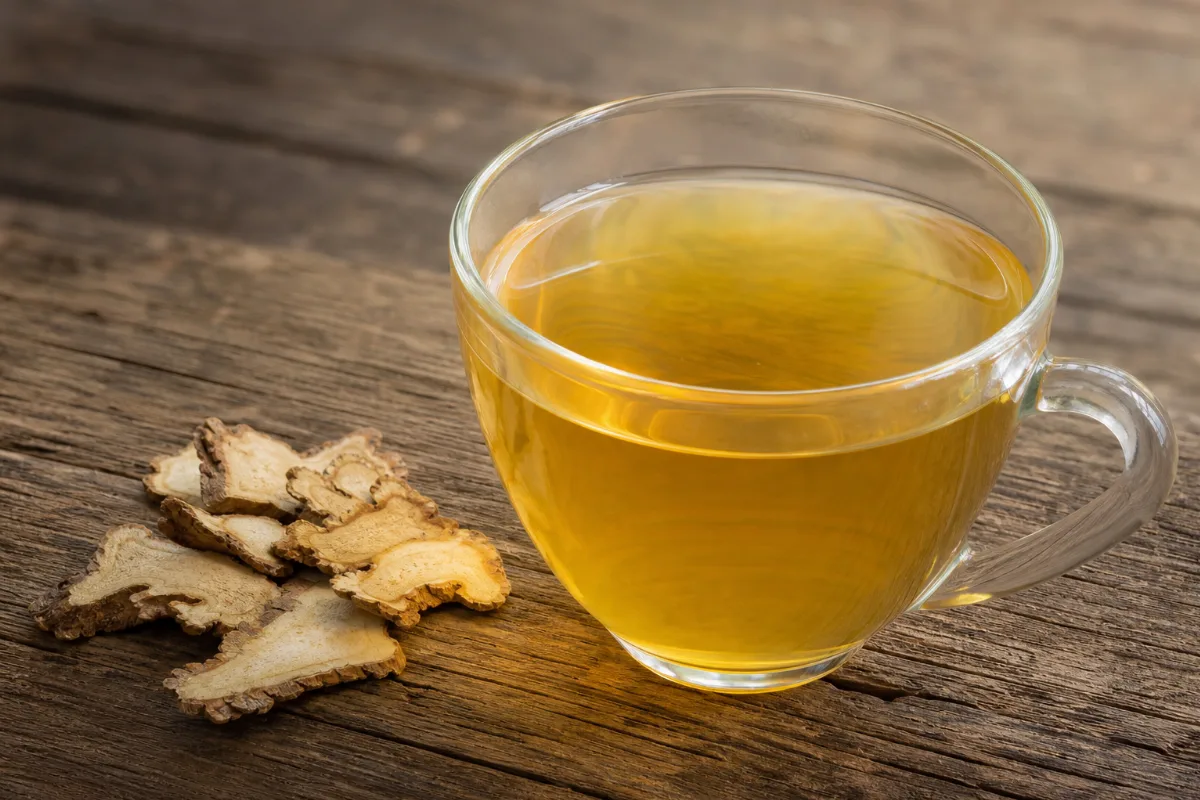
Herbal Teas & Extracts · Herbal tea
Dong Quai Tea
Angelica sinensis (Oliv.) Diels · also called Dang gui tea, danggui tea, tang kuei tea, Chinese angelica root tea. Not the same as dong quai capsules, extracts or multi-herb formulas.
Dong quai tea is a hot-water drink made from the dried root of Angelica sinensis, a carrot-family plant from western China. It is used in Chinese medicine for women's health and "blood". No trial of the tea itself was found, and the best trial of the root alone found no benefit for hot flashes. The most important caution: dong quai has been linked to a raised INR in a person on warfarin, so ask a doctor first if you take a blood thinner.
General information, not medical advice. Last substantive update · Not medically reviewed. A named clinician has not signed off on this page. How this page is made
About Dong Quai Tea
Dong quai tea is a hot-water drink made from the dried root of Angelica sinensis, called danggui in China. In Chinese medicine the root is a leading herb for "blood" and women's complaints, almost always inside formulas with other herbs. No human trial of the tea itself was found, so what we know comes from the root in other forms. The one placebo-controlled trial of dong quai alone found no benefit for menopause hot flashes in 71 women over 24 weeks. Small trials of combination products reported fewer hot flashes but cannot be credited to dong quai. Safety first: one case report of a doubled INR on warfarin; a brain bleed with a mixed supplement; furocoumarins that can sensitise skin to sunlight; safrole of unknown amount; unclear effects on hormone-sensitive conditions; and no pregnancy data. The EU medicines committee could not set a herbal monograph. For amounts, ask a doctor or pharmacist.
What it is
Dong quai tea is made from the dried root of Angelica sinensis (Oliv.) Diels, a tall perennial of the carrot family (Apiaceae) that grows in the mountains of western China. The root is sold sliced, powdered, as extracts, in capsules and as part of formulas. In China it is called danggui or dang gui. A tea is a water extract of the root; it is not the same as a capsule or concentrated extract.
Other Angelica roots are sold under similar names: Japanese toki (A. acutiloba), Korean dang-gui (A. gigas), bai zhi (A. dahurica), du huo (A. pubescens) and European garden angelica (A. archangelica). They have different chemistry. A 2025 study shows leaf and gene markers can separate A. sinensis from the Japanese and Korean species. Research on one cannot be swapped for another.
Traditional and current uses
The EU assessment report says the Chinese Pharmacopoeia lists the root to enrich blood, activate blood circulation, regulate menstruation, relieve pain and relax the bowels, for anaemia, absent and painful periods, constipation and injuries. A famous two-herb formula, Danggui Buxue Tang (Astragalus with dong quai, 5 to 1), is dated to AD 1247 in a review.
In Europe a Merck extract called Eumenol was sold from about 1899 until 1946 for absent and painful periods. After 2002 many dong quai food supplements appeared. Today it is sold in the West mainly for menopause and period problems. "Traditional" means long use, not proof from modern trials.
What is in it and how it works
The root contains ferulic acid, phthalides such as ligustilide, polysaccharides, and coumarins. It also contains furocoumarins (bergapten, psoralen, imperatorin) that can make skin sensitive to sunlight and, according to the EU report, safrole and isosafrole, which are genotoxic or cancer-causing in animals. The EU report found no data on how much of these are in the root. Ligustilide is unstable and breaks down in light, and in rats it is poorly absorbed by mouth.
In animals, extracts and ferulic acid reduce platelet clumping, and ligustilide relaxes muscle. Lab and animal work on estrogen-like action conflicts. A liver-enzyme test tube study found dong quai blocks CYP2C19. Almost all of this is lab or animal work and has not been shown to explain any benefit in people.
What the research shows
For menopause, the one placebo-controlled trial of dong quai alone found nothing: 71 women, 24 weeks, no difference in hot flushes, symptom score, womb lining or vaginal cells. A 22-man trial of hot flashes from prostate cancer treatment also found no benefit. Positive small trials all used combinations (dong quai plus chamomile; a six-herb mix; dong quai plus Astragalus). Cochrane found little or no difference from placebo for Chinese herbal medicine as a whole.
For period pain, reviews of formulas containing dong quai found better pain relief than painkillers, but trial quality was poor and few used placebo. In healthy volunteers dong quai did not alter clotting tests. Other studies are small, add Astragalus, or are animal work. Certainty is low to very low everywhere.
Tea compared with capsules and extracts
We found no study that tested dong quai tea, and none that measured what passes from the root into hot water. Trials used root extracts, capsules, injections or multi-herb formulas. That means the research on benefits and on safety cannot be matched exactly to a cup of tea. The cautions are best treated as applying to the tea too, because the root is the same.
At a glance
Traditional uses history, not proof
- Chinese Pharmacopoeia (1963, 1977), as quoted by the EU report: to enrich blood, activate blood circulation, regulate menstruation, relieve pain and relax the bowels; for anaemia, absent and painful periods, constipation and injuries.
- Danggui Buxue Tang, a two-herb formula with Astragalus, dated to AD 1247 in a review, used for women's ailments.
- Europe 1899 to 1946: Eumenol, a Merck extract sold for absent and painful periods, authorised in Sweden 1939 to 1946.
- EU 2013: a herbal monograph could not be established because well-established or traditional EU use was not shown and there were toxicological concerns. "Traditional" means long use, not proof from modern trials.
Studied for research
- Dong quai tea itself, insufficient (no human trial found)
- Menopausal hot flashes with dong quai alone, against (one trial in women, one in men, both null)
- Menopausal symptoms with combination products, very low
- Estrogen-like effects, low (no effect in women)
- Period pain with formulas containing dong quai, very low
- Blood clotting and platelets in healthy volunteers, low
- Iron and exercise recovery (two-herb formula), very low
- Dementia, lung fibrosis (formulas), very low
- Irregular periods, PMS, stroke, colitis, insufficient
Main compounds
- Ferulic acid, a marker compound that reduced platelet clumping in rats
- Ligustilide and other phthalides, relax muscle in lab work, unstable and poorly absorbed
- Furocoumarins (bergapten, psoralen, imperatorin) that can sensitise skin to sunlight
- Safrole and isosafrole, genotoxic or carcinogenic in animals; amount in the root unknown
Common forms
- Dried or sliced root, steeped or simmered as a tea
- Tablets and capsules of root powder or extract (not tea)
- Tinctures and liquid extracts (not tea)
- Multi-herb formulas such as Danggui Buxue Tang (not the single-herb tea)
Research links: EU public statement on Angelica sinensis root (European Medicines Agency) · EU assessment report on Angelica sinensis root (European Medicines Agency) · Dong quai in the US Drugs and Lactation Database (LactMed) · Trial of dong quai alone in postmenopausal women (abstract) · Case report of dong quai and warfarin (abstract) · Healthy-volunteer clotting trial (abstract) · Research Library · Genes & Biomarkers Library
What it is and its history
- Accepted scientific name
- Angelica sinensis (Oliv.) Diels
- Naming authority
- Described by Diels in Botanische Jahrbücher für Systematik 29: 500 (1900), based on Angelica polymorpha var. sinensis Oliv. (1891) (EMA assessment report citing IPNI)
- Synonyms
- Angelica polymorpha var. sinensis Oliv. (the only synonym GBIF lists on 2026-10-25)
- Common names
- Dong quai (also dong gui, dang qui, tang kuei) (English / transliterated Chinese); Chinese angelica (English); Danggui (当归 / 當歸) (Chinese); Chinesische Engelwurz (German); Angélica china (Spanish (not in GBIF; common usage, unverified)); Kinakvanne (Swedish); Kiinankarhunputki (Finnish); ホントウキ (Japanese)
- Family or group
- Apiaceae (carrot or parsley family; also holds celery, fennel, parsley, carrot and other Angelica species)
- Classification
- Plantae > Tracheophyta > Magnoliopsida > Apiales > Apiaceae > Angelica > Angelica sinensis
- Native range
- Gansu, Hubei, Shaanxi, Sichuan and Yunnan provinces of China, per the Flora of China as quoted by the EU assessment report; wild or cultivated in forests at altitudes of 2,500 to 3,000 m. Gansu is the best-known growing area (a 2025 plant study collected it there).
- Habitat
- Mountain forests and cultivated mountain fields (EU report quoting Flora of China).
- What it looks like
- Roots: Cylindrical, branched, succulent roots with many rootlets, strongly aromatic (EU report). The medicinal drug is the root.; Stems: Purplish green, ribbed, branched above; plant 0.4 to 1 m tall (EU report).; Leaves: Ovate blades, 2 to 3 times pinnate; leaf margin irregularly coarse-cuspidate-serrate (EU report; a 2025 study uses this to tell it from A. acutiloba and A. gigas).; Flowers: White, rarely purplish red petals in umbels; flowers June to July (EU report).; Fruit: Ellipsoid or round, 4 to 6 by 3 to 4 mm, with thin-winged lateral ribs; fruiting July to September (EU report).
- Cultivation
- Not verified from a primary source beyond the EU report's statement that it is wild or cultivated in the provinces above.
- Harvest and processing
- The European Pharmacopoeia drug is the smoke-dried whole or fragmented root with rootlets removed, collected in late autumn, with at least 0.050 percent trans-ferulic acid (EU report). In Chinese practice different parts are used: whole root, root head, body, tails and fine roots, and the root may be stir-fried or fried with wine (EU report; Hook 2014).
- Look-alikes and adulterants
- Name: Angelica dahurica (bai zhi); Note: GBIF key 5537813, accepted. A different Chinese medicine (root) also described in the European Pharmacopoeia.; Name: Angelica pubescens (du huo); Note: GBIF key 5537546, accepted. A different Chinese medicine (root), also in the European Pharmacopoeia.; Name: Angelica acutiloba (Japanese toki); Note: GBIF key 5537879. Used as the same traditional medicine as dong quai; leaf shape and chloroplast genes differ (Li 2025).; Name: Angelica gigas (Korean dang-gui); Note: GBIF key 5537749. Used as the same traditional medicine in Korea but a different species. A trial of its extract on triglycerides cannot be used for dong quai.; Name: Angelica archangelica (garden angelica); Note: GBIF key 5371808. European Angelica, a different plant used in cooking and liqueurs.; Name: Levisticum officinale (lovage); Note: GBIF key 5371772. The EU report says modern DNA work places dong quai nearer lovage than the true Angelica group.
- Sustainability and conservation
- Not verified. No IUCN assessment was retrieved.
Photographs
Traditional use and history history, not clinical proof
| Tradition or era | Documented use | Source |
|---|---|---|
| Traditional Chinese medicine, at least from the 1963 and 1977 Pharmacopoeia entries onward | The EU report says the Chinese Pharmacopoeia (1963, 1977) lists the root "to enrich blood, activate blood circulation, regulate menstruation, relieve pain and relax bowels" for anaemia, menstrual disorders, absent and painful periods, constipation, injuries and boils. | s-ema-hmpc-angelica-sinensis-ar |
| Formula tradition: Danggui Buxue Tang (AD 1247) | A review says the two-herb formula (Astragalus : dong quai 5 : 1) was stipulated in AD 1247 and is used for women's ailments. | p28163116 |
| Europe, 1899 to 1946: Eumenol | The EU report describes a Merck fluid extract or tablets called Eumenol, sold from about 1899 in continental Europe and authorised in Sweden 1939 to 1946 for absent and painful periods. It disappeared after 1946. | s-ema-hmpc-angelica-sinensis-ar |
| Europe, 2002 onward: food supplements | After the 2002 EU food supplements directive, many products containing dong quai appeared in Europe. The EU report cites about 150 in Belgium. No medicinal product was on the market. | s-ema-hmpc-angelica-sinensis-ar |
| EU regulators, 2013 | The HMPC could not establish an EU herbal monograph (see safety). | s-ema-hmpc-angelica-sinensis-ps |
| Modern Western use | Sold as a menopause and period supplement. A 2014 review says the translation from Chinese use (processing, combination with other herbs, user ethnicity) may lose important features. | p24365638 |
Traditional use shows how it was used. It does not show that it works or is safe today.
What is inside, and how it may work
What it contains and how those compounds act in cells and animals. Laboratory and animal mechanisms are not proven effects in people.
Main compounds
| Compound | Family | Where it is concentrated | Activity studied | Level of evidence |
|---|---|---|---|---|
| Ligustilide (Z-ligustilide) PubChem 5319022 | phthalide (essential oil) | Root (major oil component per WHO as quoted in the EU report) | In animals it relaxes muscle and lowered clot weight in a rat model; in lab work anti-inflammatory and nerve-protecting. Unstable: degrades in light. Poor oral absorption in rats. 9 7 36 3 | Animal research |
| Ferulic acid (trans-ferulic acid) PubChem 445858 | phenolic acid | Root (hydrophilic; in water and alcohol extracts) At least 0.050% in the European Pharmacopoeia drug (EU report) | Reduced platelet clumping and thrombus weight in rats (intravenous). Used as the marker for quality. 9 30 | Animal research |
| Butylidenephthalide PubChem 5352899 | phthalide | Root (essential oil) | In lab screens bound serotonin 5-HT7 receptors and suppressed brain tumour cells. Not shown in people. 9 30 | Laboratory research |
| Coniferyl ferulate PubChem 6441913 | phenylpropanoid ester | Root | Listed as a characteristic non-volatile constituent. No health activity read. 9 30 | Laboratory research |
| Safrole PubChem 5144 | phenylpropene | Root (essential oil) No quantitative data (EU report) | Described by the EU food-safety compendium as a weak carcinogen and genotoxic compound in rats and mice. 9 30 | Animal research |
| Isosafrole PubChem 637796 | phenylpropene | Root (essential oil) No quantitative data (EU report) | Weak liver carcinogen in rats and mice per the same compendium. 9 30 | Animal research |
| Bergapten (5-MOP) PubChem 2355 | furocoumarin | Root No systematic data (EU report) | Phototoxic with UV light; the EU report says bergapten with UV is probably carcinogenic in humans. 9 30 | Authoritative guidance |
| Psoralen PubChem 6199 | furocoumarin | Root No data | Phototoxic furocoumarin. 9 30 | Authoritative guidance |
| Imperatorin PubChem 10212 | furocoumarin | Root No data | Phototoxic furocoumarin; also bound 5-HT7 receptors in a lab screen. 9 30 | Laboratory research |
| Xanthotoxin (8-MOP) PubChem 4114 | furocoumarin | Root No data | Phototoxic furocoumarin named in the EU report's conclusions. 9 30 | Authoritative guidance |
| Oxypeucedanin PubChem 33306 | furocoumarin | Root No data | Furocoumarin named in the EU report. 9 30 | Authoritative guidance |
| Osthole PubChem 10228 | coumarin | Root No data | A coumarin listed among constituents. 9 30 | Authoritative guidance |
| Scopoletin PubChem 5280460 | coumarin | Root No data | A coumarin listed among constituents. 9 30 | Authoritative guidance |
| Umbelliferone PubChem 5281426 | coumarin | Root No data | A coumarin listed among constituents. 9 30 | Authoritative guidance |
| Vanillic acid PubChem 8468 | phenolic acid | Root No data | Listed among benzenoids. 9 30 | Authoritative guidance |
| Polysaccharides (arabinogalactans and others) | polysaccharides | Root Significant amounts (EU report) | Listed as a main group of constituents; effects in animals and cells are studied but none were read. 9 | Laboratory research |
Mechanisms, receptors and pathways
| Target or pathway | Gene or receptor | What was found | Level |
|---|---|---|---|
| Platelet clumping and thrombus formation | In rats, intravenous aqueous extract and sodium ferulate reduced platelet clumping and thrombus weight; ligustilide by mouth lowered clot weight in a rat shunt model without changing coagulation time (all quoted by the EU report). In healthy volunteers an Angelica sinensis preparation did not change clotting tests. 9 11 | Animal research | |
| Smooth muscle relaxation (antispasmodic) | Essential oil and Z-ligustilide had mild non-specific antispasmodic effects and inhibited uterine contraction in lab work (EU report). This is the proposed link to period pain. 9 | Animal research | |
| Serotonin 5-HT7 receptor binding | HTR7 | Several root compounds (p-hydroxyphenethyl trans-ferulate, butylidenephthalide, falcarindiol, imperatorin) bound 5-HT7 receptors in a competitive binding screen (Deng 2006, quoted second-hand by the EU report). 9 | Laboratory research |
| Estrogen receptors | ESR1 / ESR2 | Conflicting: weak binding in a cell screen (Liu 2001); no receptor activation but faster MCF-7 cell growth (Amato 2002); estrogen-like effects in ovariectomised rats with an ethanol extract (Circosta 2006). No effect on womb lining or vaginal cells in women (Hirata 1997). 26 2 5 15 | Laboratory research |
| Calycosin-driven estrogen signalling in the two-herb formula | ESR1 | Danggui Buxue Tang's estrogen-like signals in MCF-7 cells fell when calycosin (from Astragalus) was removed. Calycosin alone was not enough. So estrogen-like findings for the formula may come from the Astragalus part. 13 38 | Laboratory research |
| Drug-metabolising liver enzyme CYP2C19 | CYP2C19 | Methanol extract inhibited CYP2C19 (IC50 13.7 to 14.3 micrograms per mL) in human liver microsomes. 34 | Laboratory research |
| Hepcidin and iron handling | HAMP | In a small human trial a two-herb formula lowered hepcidin and raised blood iron after hard exercise. Mechanism proposed by the authors, not proven. 4 | Human data |
| Brain damage after stroke (ligustilide) | Isolated ligustilide reduced infarct size in 13 animal studies; the authors link it to less oxidative stress and inflammation. 3 | Animal research |
Absorption, metabolism and elimination
- Absorption
- No human pharmacokinetic data (EU report). In rats ligustilide has poor oral bioavailability from heavy first-pass metabolism (review). The EU report says low bioavailability of phthalides may limit their effects and that ferulic acid may matter more.
- Distribution
- No human data. For ferulic acid in mice after a dong quai-peony powder the EU report quotes a peak at about 2.6 hours (secondhand).
- Metabolism
- Phthalides are broken down by the liver in animals (EU report, citing studies of related compounds from Chuanxiong, another herb: oral bioavailability about 8 percent for senkyunolide A in rats). Ligustilide degrades in light and air before it is absorbed.
- Elimination
- Not established for people.
- Bioavailability
- Unknown in people. Poor in rats for ligustilide.
Isolated compounds versus whole extracts
Dong quai is a mixture. Ferulic acid and the phthalides (ligustilide) are the best-known compounds, but ligustilide is unstable and poorly absorbed, so the root's effects may not follow it. Furocoumarins and safrole are unwanted compounds in the same root. How the root is processed (smoke-dried, stir-fried, with wine) and combined with other herbs changes what a person actually takes. Most clinical work tests whole formulas (Danggui Buxue Tang, Danggui Shaoyao San), not the root alone, so results cannot be credited to one compound.
Nutritional composition
A nutrient table does not apply: dong quai is used as a medicine in small amounts, not as a food, though in China the root is also cooked in soups. No nutrient data were read.
2 low certainty5 very low certainty5 not enough evidence2 evidence against
What was looked at
The 14 benefits and uses checked for Dong Quai Tea, each with how strong the evidence is. Tap one to open it.
- Menopausal hot flashes: dong quai on its ownEvidence against
- Menopausal symptoms: combination products containing dong quaiVery low certainty
- Does dong quai act like estrogen?Low certainty
- Period pain (primary dysmenorrhea): formulas that include dong quaiVery low certainty
- Irregular or missed periodsNot enough evidence
- Premenstrual symptoms (PMS)Not enough evidence
- Dong quai tea itself (water extract of the root)Not enough evidence
- Blood clotting and platelets (blood-thinning effect)Low certainty
- Iron balance and exercise recovery (Danggui Buxue Tang)Very low certainty
- Low blood counts during chemotherapy (Danggui Buxue Decoction)Evidence against
- Idiopathic pulmonary fibrosis (Astragalus plus dong quai)Very low certainty
- Dementia (Danggui-Shaoyao-San formula)Very low certainty
- Stroke damage and recoveryNot enough evidence
- Platelet activation in ulcerative colitis (injection)Not enough evidence
Lab markers tracked in the studies
Number of hot flushesKupperman indexWomb lining (endometrial) thicknessVaginal maturation indexEstradiol and FSHPeriod pain score (visual analogue scale)Platelet aggregationProthrombin time (PT) and APTTHepcidin and serum ironGrade 3-4 neutropeniaMini-Mental State Examination (MMSE)Platelet activation markers (GMP-140, thromboxane B2, vWF)
What is Dong Quai Tea good for?
The proposed uses and how strong the human evidence is. No trial tested the tea, so all results below come from the root in other forms, and most positive results come from mixtures.
Benefits, one by one
Each card is a research question, not a promise. Tap a goal to filter. Open a card to see the studies, doses and limits.
Menopausal hot flashes: dong quai on its own
Evidence againstThe one good trial of dong quai taken alone found it was no better than a dummy pill for hot flashes in women after menopause. A small trial in men with prostate cancer found the same.
4 studiesDong quai taken alone as a capsule or extract; details not given in t…
Studies, doses and limits
What the trials found
Hirata 1997: 71 postmenopausal women with hot flashes took dong quai or placebo for 24 weeks. There were no significant differences in hot flush count, Kupperman index, womb lining thickness or vaginal cell maturation. Hot flushes fell about 25 to 30 percent in both groups (as described in the EU report). Al-Bareeq 2010: 22 men on hormone treatment for prostate cancer took dong quai or placebo for 3 months (17 finished); no significant difference in hot flash frequency, severity or duration. A 2026 review of treatments for hot flashes in men on this treatment says supplements including dong quai appear ineffective. The EU HMPC assessment found no trial supporting a benefit.
Results
Null in the only placebo-controlled trial in women and the only one in men.
Effect sizes as reported
Hirata 1997: no statistically significant difference on any outcome (P values not in abstract). Al-Bareeq 2010: no significant difference; baseline hot flash number was higher in the dong quai group (P = 0.02).
Why this rating
The best evidence is two placebo-controlled trials, both with no benefit. They are small (71 and 22 people) and the dong quai products were not described in detail, so certainty of "no benefit" is itself low. Nothing positive from dong quai alone has been found.
Form and dose studied
Dong quai taken alone as a capsule or extract; details not given in the abstracts. For amounts, ask a doctor or pharmacist.
Who was studied
Postmenopausal women with hot flashes (Hirata); men with prostate cancer on hormone treatment (Al-Bareeq).
Limits
Few trials, small, one product each, older (1997). The women were postmenopausal with high FSH; results might differ in perimenopause. Dong quai alone is not how it is used in Chinese practice.
Why researchers looked
Dong quai is sold as a "female ginseng" and is one of the best-known herbs in the West for menopause. Many women ask whether it works.
Traditional use
In Chinese medicine the root (danggui) has long been used for "blood" and period problems, usually inside formulas with other herbs. The EU assessment report notes that its use for menopause hot flashes is a Western idea, not a classic indication.
Proposed mechanism Preliminary mechanism
No proven mechanism for hot flashes. The EU report says it found no evidence of estrogen-like action in lab or clinical work, and suggests, from a lab screen, that some components may touch serotonin receptors. That is a guess, not shown in women.
A proposed mechanism does not show that the effect happens in people.
See the safety section: bleeding with blood thinners, sun sensitivity, hormone-sensitive conditions, pregnancy.
Menopausal symptoms: combination products containing dong quai
Very low certaintySome products that mix dong quai with other herbs reduced hot flashes in small trials. Because dong quai alone did not help, these results cannot be credited to dong quai.
7 studiesClimex chewable tablets; Phyto-Female Complex capsules; Danggui Buxue…
Studies, doses and limits
What the trials found
Combination products: Climex (dong quai plus chamomile), 55 postmenopausal women, 12 weeks, hot flushes fell 90 to 96 percent versus 15 to 25 percent on placebo (Kupfersztain 2003, a preliminary report). Phyto-Female Complex (black cohosh, dong quai, milk thistle, red clover, American ginseng, chaste-tree berry), 50 women, 3 months, 73 percent fewer hot flushes and 69 percent fewer night sweats, hot flushes stopped in 47 percent versus 19 percent on placebo (Rotem 2007, pilot). Danggui Buxue Tang (dong quai plus Astragalus): a third trial (12 weeks, high dose) reported better quality of life scores on all four MENQOL domains and said this repeated two earlier trials; the abstract gives no numbers or sample size, and we could not find the earlier two trials on PubMed. Reviews of Chinese herbs in general: the Cochrane review (22 trials, 2,902 women) found little or no difference from placebo on hot flushes per day (MD 0.00, 95% CI -0.88 to 0.89, 199 women), and a 2019 meta-analysis of 19 trials found lower hot flush severity against placebo (MD -0.70, 95% CI -1.00 to -0.40). Neither review says how many of the formulas contained dong quai.
Results
Positive but small, mixed with herbs that have their own evidence; the Cochrane review of Chinese herbs as a whole did not find a clear benefit.
Effect sizes as reported
Climex 90-96% vs 15-25% fewer flushes; Phyto-Female 73% fewer hot flushes, 47% vs 19% complete stop; Cochrane MD 0.00 (-0.88 to 0.89); 2019 meta-analysis severity MD -0.70 (-1.00 to -0.40).
Why this rating
The trials are small, from a few groups, and test mixtures. Climex and Phyto-Female effects are far larger than in most hot flush trials, which is itself a reason for caution. The Cochrane authors rate evidence for Chinese herbs as very low to moderate.
Form and dose studied
Climex chewable tablets; Phyto-Female Complex capsules; Danggui Buxue Tang decoction or extract. Amounts are not given here; ask a doctor or pharmacist.
Who was studied
Peri- and postmenopausal women, mostly in Israel and Hong Kong or China.
Limits
Combination products; brand-named products with funding not stated; abstracts lack key numbers; risk of bias in the reviewed trials.
Why researchers looked
In Chinese medicine dong quai is nearly always used inside formulas. Several modern products combine it with other herbs for menopause.
Traditional use
Danggui Buxue Tang (a decoction of Astragalus root and dong quai root in a 5 to 1 ratio) dates from 1247 AD according to a formula review, and is used for women's complaints.
Proposed mechanism Laboratory research
Unknown. Lab work on Danggui Buxue Tang shows estrogen-like signals in cells that are credited mainly to a compound (calycosin) from the Astragalus part. A trial paper reports no estrogen-like blood signs in people.
A proposed mechanism does not show that the effect happens in people.
Mixed products add the risks of every herb in them (black cohosh and red clover have their own cautions). See the safety section.
Does dong quai act like estrogen?
Low certaintyIn women, no. A 24-week trial found no effect on the womb lining or vaginal cells. Lab results are mixed: weak in cell tests, a clear effect in rats, and breast cancer cells grew faster in one test.
6 studiesLab extracts of many types; not comparable to products.
Studies, doses and limits
What the trials found
Hirata 1997 (71 postmenopausal women, 24 weeks): no difference from placebo in womb lining thickness or vaginal cell maturation. In the EU report the lining went from 2.6 to 3.5 mm on dong quai and 2.5 to 4.7 mm on placebo, not significantly different. Climex and Phyto-Female trials found no change in hormone levels or ultrasound.
Results
No estrogen-like response in women in the one trial that looked. Lab findings conflict.
Effect sizes as reported
No numbers beyond endometrial thickness above; Amato 2002 MCF-7 growth 16-fold vs untreated cells.
Why this rating
One human trial is clear but small and old; the lab and animal findings point in different directions. Women with hormone-sensitive conditions should still ask a doctor.
Form and dose studied
Lab extracts of many types; not comparable to products.
Who was studied
Postmenopausal women; rats; cell lines.
Limits
Single human trial, one product, 24 weeks. Cell results do not show harm in people but are a reason for caution.
Why researchers looked
The idea that dong quai is a plant estrogen drives both its use for menopause and the worry that it could be risky in hormone-sensitive conditions.
Traditional use
Not a traditional concept. Chinese medicine describes dong quai as acting on "blood", not hormones.
Proposed mechanism Animal research
A rat study found an ethanol root extract stimulated the womb and vagina and lowered LH. Cell studies found weak estrogen receptor binding (Liu 2001) or no receptor activation but 16-fold faster growth of MCF-7 breast cancer cells (Amato 2002). The EU report found no clear evidence of estrogenic activity.
A proposed mechanism does not show that the effect happens in people.
Because lab results are mixed, women with breast, ovarian or womb cancers or fibroids, endometriosis, or on tamoxifen or hormone therapy should check with their doctor.
Period pain (primary dysmenorrhea): formulas that include dong quai
Very low certaintyChinese herbal formulas that include dong quai beat painkillers in several reviews, but the trials are poor quality, the formulas contain many herbs, and almost none used a dummy pill.
5 studiesDecoctions, granules and tablets of named formulas. Amounts not given…
Studies, doses and limits
What the trials found
Formula reviews: Danggui Shaoyao San, 4 trials, all high risk of bias, beat analgesics (RR 1.31, 95% CI 1.06 to 1.63; I2 73%) and one trial beat placebo on pain (Lee 2016). Danggui Sini Decoction, 11 trials, 1,005 women, higher effective rate than western medicine (Ma 2021). Siwutang and derived formulas, 38 trials, 3,982 women, lower pain than conventional medicine (3 trials, MD -2.61, 95% CI -3.72 to -1.51) and higher response rate (RR 1.28, 95% CI 1.22 to 1.34); only 1 placebo-controlled trial (Li 2020). The Cochrane review of Chinese herbs for period pain found better pain relief than drugs (14 trials, RR 1.99, 95% CI 1.52 to 2.60) but unclear results against placebo (Zhu 2008). An older Chinese observational study quoted in the EU report found a similar response from two dong quai products and could not show efficacy.
Results
Favourable against comparators, but the quality is low and there is almost no placebo evidence.
Effect sizes as reported
DSS vs analgesics RR 1.31 (1.06-1.63); Siwutang pain MD -2.61 (-3.72 to -1.51); Cochrane pain relief vs drugs RR 1.99 (1.52-2.60).
Why this rating
The reviews themselves call trial quality poor or high risk of bias, most comparisons are with other drugs rather than placebo, and the formulas contain several herbs, so dong quai cannot be separated.
Form and dose studied
Decoctions, granules and tablets of named formulas. Amounts not given here; ask a doctor or pharmacist.
Who was studied
Young women with primary period pain, in China or Korea.
Limits
Trials are mostly Chinese-language and open-label; formulas differ; publication bias is possible.
Why researchers looked
Dong quai is one of the most common herbs in Chinese formulas for period pain, and was sold in Europe from 1899 as a product called Eumenol for painful or absent periods.
Traditional use
The EU assessment report says dong quai is traditionally used to "invigorate blood" and relieve pain in menstrual disorders, and was used in Chinese pharmacopoeia entries for painful periods and missing periods.
Proposed mechanism Animal research
Lab work shows ligustilide and related phthalides relax muscle (antispasmodic) and weakly inhibit womb contractions. Oral absorption of these compounds is poor in animals.
A proposed mechanism does not show that the effect happens in people.
Heavy periods or bleeding disorders and blood-thinning drugs are cautions with dong quai. Period pain that is new, severe or getting worse needs a doctor to look for a cause.
Irregular or missed periods
Not enough evidenceDong quai is traditionally used to "regulate" periods. We found no placebo-controlled trial of it for this.
1 studiesNot applicable.
Studies, doses and limits
What the trials found
One older Chinese observational study of 200 women, described by the EU report, compared two dong quai products with no placebo group and groups were unbalanced; the report says it cannot show efficacy. Chinese herbal medicines in general have been reviewed for perimenopausal abnormal uterine bleeding (15 trials) but the abstract does not say what was in the formulas.
Results
No usable evidence for dong quai specifically.
Why this rating
No controlled trial of dong quai for this use was found.
Who was studied
Women with irregular or missed periods.
Limits
Observational study only, no placebo.
Why researchers looked
The best-known traditional use in Chinese medicine, and the use behind its European sale as Eumenol for absent periods.
Traditional use
EU assessment report: used for irregular menstruation, absent periods and painful periods in Chinese and Korean medicine and in European commerce from 1899.
Proposed mechanism Pharmacological theory
The EU report says no data explain the use for "regulating menstruation".
A proposed mechanism does not show that the effect happens in people.
Irregular or missed periods can have many causes including pregnancy. A doctor should check first.
Premenstrual symptoms (PMS)
Not enough evidenceDong quai is used for PMS in books and shops, but we found no clinical trial of it for PMS.
2 studiesNot applicable.
Studies, doses and limits
What the trials found
A PubMed search for dong quai or Angelica sinensis with premenstrual or PMS returned no clinical trial. Reviews mention it as a traditional women's herb without trial data.
Results
No human evidence found.
Why this rating
No trial found.
Limits
Absence of trials is not evidence of no effect.
Why researchers looked
Listed among women's health uses in reviews of botanicals.
Traditional use
The EU report says some authors suggest dong quai helps premenstrual pain, but offers no estrogen explanation for it.
Proposed mechanism Pharmacological theory
Speculation only: weak muscle-relaxing effects of phthalides and possible serotonin receptor binding found in lab screens.
A proposed mechanism does not show that the effect happens in people.
See the safety section.
Dong quai tea itself (water extract of the root)
Not enough evidenceNo human trial of dong quai tea was found. Everything known about benefits comes from root extracts, capsules or multi-herb formulas, so it cannot be assumed for a cup of tea.
1 studiesNot applicable. For amounts, ask a doctor or pharmacist.
Studies, doses and limits
What the trials found
A PubMed search on 2026-10-25 for dong quai or Angelica sinensis together with tea or infusion returned 11 records. None was a human trial of dong quai tea.
Results
No human results for the tea.
Why this rating
No human trial of the tea exists in what we found.
Limits
Tea strength and the amounts of root compounds in a cup are unknown, so safety cautions for the root apply as a precaution.
Why researchers looked
Dong quai root is sometimes drunk as a hot-water drink, and readers ask whether the tea does what the research on the root describes.
Traditional use
The EU assessment report describes the root in Chinese medicine and in European extracts and tablets. It does not give a tea trial.
Proposed mechanism None
Not studied for the tea. Which compounds pass into hot water, and how much, was not found in the sources read.
A proposed mechanism does not show that the effect happens in people.
Warfarin and other blood thinners, sun sensitivity, pregnancy and hormone-sensitive conditions: see the safety section.
Blood clotting and platelets (blood-thinning effect)
Low certaintyIn healthy volunteers a dong quai preparation did not change clotting tests or add to aspirin's effect, apart from small platelet changes in 2 of 24 people. Case reports show bleeding problems can still happen with warfarin.
2 studiesAn Angelica sinensis herbal preparation (details not in the abstract)…
Studies, doses and limits
What the trials found
Fung 2017: 25 healthy volunteers took an Angelica sinensis preparation, aspirin, or both in three 3-week phases against placebo. There was no clinically relevant effect on platelets or clotting; 2 of 24 had less platelet clumping with one trigger (arachidonic acid). Dong quai did not add to aspirin's effect; PT, APTT and thrombin generation were not impaired; no significant bleeding. The authors say this is good evidence of no bleeding risk for healthy people at these amounts. Warfarin and other blood-thinner combinations were not tested; see the safety section for the INR case report and the rabbit study.
Results
No clinically relevant effect in healthy volunteers over 3 weeks.
Effect sizes as reported
2 of 24 on dong quai had lowered arachidonic-acid-induced aggregation; no PT/APTT change.
Why this rating
One crossover-style placebo-controlled trial in healthy people, 3 weeks, one preparation. It cannot speak for people on warfarin or with bleeding disorders.
Form and dose studied
An Angelica sinensis herbal preparation (details not in the abstract). For amounts, ask a doctor or pharmacist.
Who was studied
Healthy volunteers.
Limits
Healthy people, short trial, no warfarin or heparin arm.
Why researchers looked
Dong quai is traditionally used to "invigorate blood", it contains coumarins, and lab work shows ferulic acid and ligustilide reduce platelet clumping in animals, so doctors worry about bleeding.
Traditional use
Chinese pharmacopoeia entries list "activate blood circulation" among its actions (EU report). Different root parts are used for different effects.
Proposed mechanism Animal research
In rats, intravenous extract and ferulate reduced platelet clumping and thrombus weight, and ligustilide by mouth lowered clot weight in a rat shunt model. These are animal findings at amounts far above human use.
A proposed mechanism does not show that the effect happens in people.
Warfarin, other blood thinners and bleeding disorders: see the safety section.
Iron balance and exercise recovery (Danggui Buxue Tang)
Very low certaintyA two-herb formula of dong quai and Astragalus made healthy men run a hard 13 km faster and kept more iron in the blood in one small trial.
1 studiesDanggui Buxue Tang decoction/supplement; amounts not given here. Ask …
Studies, doses and limits
What the trials found
Chang 2018: 36 recreationally active men took Danggui Buxue Tang or placebo for 11 days and ran a 13-km race on day 8. Finish times were 14.0 percent (12.3 minutes) shorter on DBT. Hepcidin was lower and iron higher (+63.3 percent right after the run, +31.4 percent at 72 hours). No clear anti-inflammatory or red-cell-protecting effect.
Results
Positive in one small trial; a formula with two herbs, so dong quai cannot be separated.
Effect sizes as reported
Finish time 14.0% shorter; iron +63.3% post-run, +31.4% at 72 h.
Why this rating
One small trial of 36 healthy men, a two-herb formula, short, and a large effect not repeated.
Form and dose studied
Danggui Buxue Tang decoction/supplement; amounts not given here. Ask a doctor or pharmacist.
Who was studied
Healthy recreationally active men.
Limits
Single trial, young men, running only, not repeated.
Why researchers looked
Danggui Buxue Tang is traditionally used to "supplement blood", and lab work links it to red blood cell production (erythropoietin).
Traditional use
Used for blood deficiency, fatigue and women's complaints, with Astragalus in a 5 to 1 ratio.
Proposed mechanism Preliminary mechanism
The trial paper suggests the formula lowers hepcidin, a hormone that locks iron away, so more iron stays in the blood. Lab work says Astragalus and dong quai together raise erythropoietin in cells. These are mechanism ideas, not proven.
A proposed mechanism does not show that the effect happens in people.
See the safety section.
Low blood counts during chemotherapy (Danggui Buxue Decoction)
Evidence againstA randomised trial found the same two-herb formula did not prevent low white cells, anaemia or low platelets in women having chemotherapy for breast cancer.
1 studiesNot applicable.
Studies, doses and limits
What the trials found
Hong 2017: 106 women (89 analysed) on adjuvant chemotherapy for breast cancer were randomised to the formula or control. Grade 3-4 neutropenia occurred in 57.1 percent on the formula and 59.6 percent in controls (P = 0.816). Anaemia 54.8 versus 66.6 percent (P = 0.280); low platelets 11.9 versus 4.3 percent (P = 0.248).
Results
Null.
Effect sizes as reported
Neutropenia 57.1% vs 59.6% (P = 0.816).
Why this rating
A randomised phase II trial found no benefit; it was small with 17 withdrawals.
Who was studied
Women with breast cancer on chemotherapy.
Limits
Phase II, 17 dropouts, formula only.
Why researchers looked
The formula is traditionally used to build blood, so it was tested for chemotherapy-related low blood counts.
Traditional use
Used in China as supportive care.
Proposed mechanism Preliminary mechanism
Hypothesis: promotes blood cell formation; not shown in this trial.
A proposed mechanism does not show that the effect happens in people.
People having chemotherapy should talk to their oncology team before any herb, because of bleeding and drug interaction questions.
Idiopathic pulmonary fibrosis (Astragalus plus dong quai)
Very low certaintyA review of 17 Chinese trials says herbs from Astragalus and dong quai, added to usual care, improved lung function and walking distance, but the abstract has no numbers and the trials are likely low quality.
1 studiesVarious Chinese formulas. Ask a doctor.
Studies, doses and limits
What the trials found
Zhang 2020: a meta-analysis of 17 randomised trials of Astragalus and dong quai (alone or in formulas, with usual care) says effective rates, main lung function measures, six-minute walk distance and breathlessness score were statistically better, with fewer adverse reactions. The abstract gives no numbers or bias findings.
Results
Favourable according to the review, details not available.
Effect sizes as reported
Not given in abstract.
Why this rating
Abstract only; Chinese trials, a two-herb combination, no numbers, no bias assessment in abstract.
Form and dose studied
Various Chinese formulas. Ask a doctor.
Who was studied
People with idiopathic pulmonary fibrosis in China.
Limits
Combination of two herbs; quality unknown.
Why researchers looked
Both roots are used in Chinese medicine for lung disease and for "qi and blood".
Traditional use
Chinese lung-disease prescriptions.
Proposed mechanism Preliminary mechanism
Unclear. Lab work suggests anti-fibrotic polysaccharides, but this is not shown in people.
A proposed mechanism does not show that the effect happens in people.
Serious lung disease needs specialist care, not self-treatment.
Dementia (Danggui-Shaoyao-San formula)
Very low certaintyA review of nine small Chinese and Korean trials found better memory test scores with a formula named for dong quai and white peony, but the trials were small and low quality.
1 studiesFormula; amounts not given here.
Studies, doses and limits
What the trials found
Kim 2020: 567 people in 9 trials (5 Alzheimer disease, 4 vascular dementia). In Alzheimer disease pooled MMSE favoured the formula (mean difference 4.60 points, 95% CI 4.29 to 4.91) and daily-living scores (11.40, 95% CI 10.94 to 11.86). In vascular dementia scores differed from nootropic drugs. Authors say each trial was small and some were low quality.
Results
Positive in small, low-quality trials; implausibly narrow intervals.
Effect sizes as reported
AD MMSE MD 4.60 (4.29 to 4.91).
Why this rating
Small low-quality trials, combination formula, mixed comparators, implausibly narrow intervals.
Form and dose studied
Formula; amounts not given here.
Who was studied
People with Alzheimer disease or vascular dementia.
Limits
Combination formula; small trials.
Why researchers looked
Danggui-Shaoyao-San is a classic women's formula that has been tried in dementia.
Traditional use
Traditional formula for women's complaints.
Proposed mechanism Animal research
Lab work on ligustilide and ferulic acid suggests nerve-protecting effects in animals. Not shown in people.
A proposed mechanism does not show that the effect happens in people.
Anyone with dementia should keep prescribed medicines and see their doctor.
Stroke damage and recovery
Not enough evidenceAnimal studies of one compound from dong quai (ligustilide) show less brain damage after stroke. No good human trials of oral dong quai were found.
4 studiesIsolated ligustilide in animals; Angelica injections (not a supplemen…
Studies, doses and limits
Results
Animal findings only.
Effect sizes as reported
Animal: infarct SMD 3.26 (2.31 to 4.22).
Why this rating
Animal and isolated-compound evidence only; no oral dong quai trial in people found.
Form and dose studied
Isolated ligustilide in animals; Angelica injections (not a supplement) in Chinese hospitals.
Who was studied
Rodent stroke models.
Limits
Animal data do not show benefit in people; ligustilide is unstable and poorly absorbed by mouth.
Why researchers looked
Dong quai injections and compounds are widely studied in China for stroke.
Traditional use
Used to "invigorate blood".
Proposed mechanism Animal research
Lab and animal work shows anti-inflammatory, antioxidant, anti-platelet and blood-vessel growth effects of ligustilide, butylphthalide and ferulic acid.
A proposed mechanism does not show that the effect happens in people.
Stroke is an emergency. Dong quai is not a substitute for care.
Platelet activation in ulcerative colitis (injection)
Not enough evidenceA 2004 Chinese trial found an Angelica sinensis injection reduced platelet-activation markers in people with ulcerative colitis. It was an injection, not a supplement.
2 studiesInjection; not applicable to oral products.
Studies, doses and limits
What the trials found
Dong 2004: 64 people with ulcerative colitis got routine treatment with or without the injection for 3 weeks. Platelet markers improved only in the injection group. The EU assessor says this was not followed up.
Results
Positive laboratory markers; no symptom outcomes.
Effect sizes as reported
P < 0.05-0.01 for platelet markers.
Why this rating
One old trial of an injection, markers only.
Form and dose studied
Injection; not applicable to oral products.
Who was studied
People with ulcerative colitis in China.
Limits
Injection form; no clinical outcomes.
Why researchers looked
Platelets are overactive in ulcerative colitis.
Traditional use
Not traditional for colitis.
Proposed mechanism Preliminary mechanism
Authors suggest the injection reduces platelet activation and helps vessel lining and microcirculation.
A proposed mechanism does not show that the effect happens in people.
Not applicable to oral dong quai.
Connections to the rest of health
How Dong Quai Tea connects to the rest of our health knowledge graph. Every link says what kind of connection it is. A safety link (for example to the liver) is a warning, not a benefit. A study that merely mentions a topic never creates a benefit link.
Explore every connection: goals, body systems, organs, symptoms, genes
A. Wellness goals
| Connected to | Kind of connection | Evidence status | Context | Studies |
|---|---|---|---|---|
| Menopause Support | Potential benefit | Evidence against | Menopausal hot flashes: dong quai on its own: The one good trial of dong quai taken alone found it was no better than a dummy pill for hot flashes in women after menopause. A small trial in men with prostate cancer found the same. Menopausal symptoms: combination products containing dong quai: Some products that mix dong quai with other herbs reduced hot flashes in small trials. Because dong quai alone did not help, these results cannot be credited to dong quai. | 15 1 33 9 20 32 35 25 40 22 13 |
| Womens Wellness | Potential benefit | Evidence against | Menopausal hot flashes: dong quai on its own: The one good trial of dong quai taken alone found it was no better than a dummy pill for hot flashes in women after menopause. A small trial in men with prostate cancer found the same. Menopausal symptoms: combination products containing dong quai: Some products that mix dong quai with other herbs reduced hot flashes in small trials. Because dong quai alone did not help, these results cannot be credited to dong quai. | 15 1 33 9 20 32 35 25 40 22 13 |
| Hormone Balance | Potential benefit | Evidence against | Menopausal hot flashes: dong quai on its own: The one good trial of dong quai taken alone found it was no better than a dummy pill for hot flashes in women after menopause. A small trial in men with prostate cancer found the same. | 15 1 33 9 |
| Sleep Quality | Potential benefit | Very low certainty | Menopausal symptoms: combination products containing dong quai: Some products that mix dong quai with other herbs reduced hot flashes in small trials. Because dong quai alone did not help, these results cannot be credited to dong quai. | 20 32 35 25 40 22 13 |
| Hormone Balance | Biological association | Low certainty | Does dong quai act like estrogen?: In women, no. A 24-week trial found no effect on the womb lining or vaginal cells. Lab results are mixed: weak in cell tests, a clear effect in rats, and breast cancer cells grew faster in one test. | 15 5 2 26 38 9 |
| Menopause Support | Biological association | Low certainty | Does dong quai act like estrogen?: In women, no. A 24-week trial found no effect on the womb lining or vaginal cells. Lab results are mixed: weak in cell tests, a clear effect in rats, and breast cancer cells grew faster in one test. | 15 5 2 26 38 9 |
| Womens Wellness | Biological association | Low certainty | Does dong quai act like estrogen?: In women, no. A 24-week trial found no effect on the womb lining or vaginal cells. Lab results are mixed: weak in cell tests, a clear effect in rats, and breast cancer cells grew faster in one test. | 15 5 2 26 38 9 |
| Womens Wellness | Traditional use | Very low certainty | Period pain (primary dysmenorrhea): formulas that include dong quai: Chinese herbal formulas that include dong quai beat painkillers in several reviews, but the trials are poor quality, the formulas contain many herbs, and almost none used a dummy pill. Irregular or missed periods: Dong quai is traditionally used to "regulate" periods. We found no placebo-controlled trial of it for this. | 21 28 23 39 9 17 |
| Inflammation Balance | Traditional use | Very low certainty | Period pain (primary dysmenorrhea): formulas that include dong quai: Chinese herbal formulas that include dong quai beat painkillers in several reviews, but the trials are poor quality, the formulas contain many herbs, and almost none used a dummy pill. | 21 28 23 39 9 |
| Hormone Balance | Traditional use | Not enough evidence | Irregular or missed periods: Dong quai is traditionally used to "regulate" periods. We found no placebo-controlled trial of it for this. | 9 |
| Mood Balance | Traditional use | Not enough evidence | Premenstrual symptoms (PMS): Dong quai is used for PMS in books and shops, but we found no clinical trial of it for PMS. | 9 17 |
| Heart Health | Demonstrated clinical effect | Low certainty | Blood clotting and platelets (blood-thinning effect): In healthy volunteers a dong quai preparation did not change clotting tests or add to aspirin's effect, apart from small platelet changes in 2 of 24 people. Case reports show bleeding problems can still happen with warfarin. | 11 27 |
| Physical Stamina | Potential benefit | Very low certainty | Iron balance and exercise recovery (Danggui Buxue Tang): A two-herb formula of dong quai and Astragalus made healthy men run a hard 13 km faster and kept more iron in the blood in one small trial. | 4 |
| Muscle Recovery | Potential benefit | Very low certainty | Iron balance and exercise recovery (Danggui Buxue Tang): A two-herb formula of dong quai and Astragalus made healthy men run a hard 13 km faster and kept more iron in the blood in one small trial. | 4 |
| Reduce Fatigue | Potential benefit | Very low certainty | Iron balance and exercise recovery (Danggui Buxue Tang): A two-herb formula of dong quai and Astragalus made healthy men run a hard 13 km faster and kept more iron in the blood in one small trial. | 4 |
| Immune Support | Potential benefit | Evidence against | Low blood counts during chemotherapy (Danggui Buxue Decoction): A randomised trial found the same two-herb formula did not prevent low white cells, anaemia or low platelets in women having chemotherapy for breast cancer. Idiopathic pulmonary fibrosis (Astragalus plus dong quai): A review of 17 Chinese trials says herbs from Astragalus and dong quai, added to usual care, improved lung function and walking distance, but the abstract has no numbers and the trials are likely low quality. | 16 37 |
| Healthy Aging | Potential benefit | Very low certainty | Idiopathic pulmonary fibrosis (Astragalus plus dong quai): A review of 17 Chinese trials says herbs from Astragalus and dong quai, added to usual care, improved lung function and walking distance, but the abstract has no numbers and the trials are likely low quality. | 37 |
| Memory Support | Potential benefit | Very low certainty | Dementia (Danggui-Shaoyao-San formula): A review of nine small Chinese and Korean trials found better memory test scores with a formula named for dong quai and white peony, but the trials were small and low quality. | 19 |
| Brain Health | Potential benefit | Very low certainty | Dementia (Danggui-Shaoyao-San formula): A review of nine small Chinese and Korean trials found better memory test scores with a formula named for dong quai and white peony, but the trials were small and low quality. | 19 |
| Brain Health | Preliminary mechanism | Not enough evidence | Stroke damage and recovery: Animal studies of one compound from dong quai (ligustilide) show less brain damage after stroke. No good human trials of oral dong quai were found. | 14 3 7 36 |
| Heart Health | Preliminary mechanism | Not enough evidence | Stroke damage and recovery: Animal studies of one compound from dong quai (ligustilide) show less brain damage after stroke. No good human trials of oral dong quai were found. | 14 3 7 36 |
| Digestive Support | Preliminary mechanism | Not enough evidence | Platelet activation in ulcerative colitis (injection): A 2004 Chinese trial found an Angelica sinensis injection reduced platelet-activation markers in people with ulcerative colitis. It was an injection, not a supplement. | 6 9 |
| Gut Health | Preliminary mechanism | Not enough evidence | Platelet activation in ulcerative colitis (injection): A 2004 Chinese trial found an Angelica sinensis injection reduced platelet-activation markers in people with ulcerative colitis. It was an injection, not a supplement. | 6 9 |
B. Body systems
| Connected to | Kind of connection | Evidence status | Context | Studies |
|---|---|---|---|---|
| Reproductive System | Biological association | Evidence against | Studied for: Menopausal hot flashes: dong quai on its own Studied for: Menopausal symptoms: combination products containing dong quai | 15 1 33 9 20 32 35 25 40 22 13 5 2 26 38 21 28 23 39 17 |
| Endocrine System | Biological association | Evidence against | Studied for: Menopausal hot flashes: dong quai on its own Studied for: Menopausal symptoms: combination products containing dong quai | 15 1 33 9 20 32 35 25 40 22 13 5 2 26 38 |
| Cardiovascular System | Biological association | Low certainty | Studied for: Blood clotting and platelets (blood-thinning effect) Studied for: Iron balance and exercise recovery (Danggui Buxue Tang) | 11 27 4 14 3 7 36 |
| Musculoskeletal System | Biological association | Very low certainty | Studied for: Iron balance and exercise recovery (Danggui Buxue Tang) | 4 |
| Immune System | Biological association | Evidence against | Studied for: Low blood counts during chemotherapy (Danggui Buxue Decoction) | 16 |
| Respiratory System | Biological association | Very low certainty | Studied for: Idiopathic pulmonary fibrosis (Astragalus plus dong quai) | 37 |
| Nervous System | Biological association | Very low certainty | Studied for: Dementia (Danggui-Shaoyao-San formula) Studied for: Stroke damage and recovery | 19 14 3 7 36 |
| Digestive System | Biological association | Not enough evidence | Studied for: Platelet activation in ulcerative colitis (injection) | 6 9 |
C. Body parts and organs
| Connected to | Kind of connection | Evidence status | Context | Studies |
|---|---|---|---|---|
| Blood vessels | Drug or supplement interaction | Very low certainty | Raised INR on warfarin in one case; healthy volunteers showed no clotting change. Preparation or compound: Dong quai root; coumarins |
31 11 |
| Brain | Adverse effect or risk | Very low certainty | One case of subarachnoid haemorrhage. Preparation or compound: Supplement with red clover, dong quai, Siberian ginseng |
10 |
| Skin | Adverse effect or risk | Very low certainty | Root contains compounds that can sensitise skin to sunlight; no case reports found. Preparation or compound: Furocoumarins (bergapten, psoralen, imperatorin) |
9 |
| Reproductive organs | Contraindication | Very low certainty | Avoid in pregnancy; hormone-sensitive conditions need a doctor. Preparation or compound: Dong quai root |
9 15 |
| Liver | Adverse effect or risk | Very low certainty | A few spontaneous WHO reports of liver injury; causality unknown. Preparation or compound: Dong quai products |
9 |
I. Biomarkers
| Connected to | Kind of connection | Evidence status | Context | Studies |
|---|---|---|---|---|
| Prothrombin time / INR | Drug or supplement interaction | Very low certainty | INR more than doubled in one case. Preparation or compound: Dong quai with warfarin |
31 |
| Number of hot flushes | Biological association | Evidence against | Measured in trials: no-change. A lab change is not the same as a health benefit. | 15 1 20 32 |
| Kupperman index | Biological association | Evidence against | Measured in trials: no-change. A lab change is not the same as a health benefit. | 15 40 |
| Womb lining (endometrial) thickness | Biological association | Low certainty | Measured in trials: no-change. A lab change is not the same as a health benefit. | 15 9 |
| Vaginal maturation index | Biological association | Low certainty | Measured in trials: no-change. A lab change is not the same as a health benefit. | 15 |
| Estradiol and FSH | Biological association | Low certainty | Measured in trials: no-change. A lab change is not the same as a health benefit. | 32 35 |
| Period pain score (visual analogue scale) | Biological association | Very low certainty | Measured in trials: lowered. A lab change is not the same as a health benefit. | 23 21 |
| Platelet aggregation | Biological association | Low certainty | Measured in trials: no-change. A lab change is not the same as a health benefit. | 11 |
| Prothrombin time (PT) and APTT | Biological association | Mixed findings | Measured in trials: no-change. A lab change is not the same as a health benefit. | 11 31 |
| Hepcidin and serum iron | Biological association | Very low certainty | Measured in trials: lowered. A lab change is not the same as a health benefit. | 4 |
| Grade 3-4 neutropenia | Biological association | Evidence against | Measured in trials: no-change. A lab change is not the same as a health benefit. | 16 |
| Mini-Mental State Examination (MMSE) | Biological association | Very low certainty | Measured in trials: raised. A lab change is not the same as a health benefit. | 19 |
| Platelet activation markers (GMP-140, thromboxane B2, vWF) | Biological association | Not enough evidence | Measured in trials: lowered. A lab change is not the same as a health benefit. | 6 |
J. Genes, receptors and enzymes
| Connected to | Kind of connection | Evidence status | Context | Studies |
|---|---|---|---|---|
| HTR7 (serotonin receptor 7) | Preliminary mechanism | In vitro | Bound by several root compounds in a lab screen. | 9 |
| CYP2C19 | Preliminary mechanism | In vitro | Inhibited by a dong quai extract in human liver microsomes. | 34 |
| ESR1 / ESR2 (estrogen receptors) | Preliminary mechanism | In vitro | Weak binding or no activation in cells; mixed. | 26 2 |
| HAMP (hepcidin) | Preliminary mechanism | Human | Lowered after exercise in a small trial of a two-herb formula. | 4 |
K. Biological pathways
| Connected to | Kind of connection | Evidence status | Context | Studies |
|---|---|---|---|---|
| Platelet aggregation / thromboxane | Preliminary mechanism | Animal | Reduced in rat and lab work by ferulate and extract. | 9 |
L. Active compounds
| Connected to | Kind of connection | Evidence status | Context | Studies |
|---|---|---|---|---|
| Ligustilide (Z-ligustilide) | Biological association | Animal | In animals it relaxes muscle and lowered clot weight in a rat model; in lab work anti-inflammatory and nerve-protecting. Unstable: degrades in light. Poor oral absorption in rats. Preparation or compound: Root (major oil component per WHO as quoted in the EU report) |
9 7 36 3 |
| Ferulic acid (trans-ferulic acid) | Biological association | Animal | Reduced platelet clumping and thrombus weight in rats (intravenous). Used as the marker for quality. Preparation or compound: Root (hydrophilic; in water and alcohol extracts) |
9 30 |
| Butylidenephthalide | Biological association | In vitro | In lab screens bound serotonin 5-HT7 receptors and suppressed brain tumour cells. Not shown in people. Preparation or compound: Root (essential oil) |
9 30 |
| Coniferyl ferulate | Biological association | In vitro | Listed as a characteristic non-volatile constituent. No health activity read. Preparation or compound: Root |
9 30 |
| Safrole | Biological association | Animal | Described by the EU food-safety compendium as a weak carcinogen and genotoxic compound in rats and mice. Preparation or compound: Root (essential oil) |
9 30 |
| Isosafrole | Biological association | Animal | Weak liver carcinogen in rats and mice per the same compendium. Preparation or compound: Root (essential oil) |
9 30 |
| Bergapten (5-MOP) | Biological association | Authoritative guidance | Phototoxic with UV light; the EU report says bergapten with UV is probably carcinogenic in humans. Preparation or compound: Root |
9 30 |
| Psoralen | Biological association | Authoritative guidance | Phototoxic furocoumarin. Preparation or compound: Root |
9 30 |
| Imperatorin | Biological association | In vitro | Phototoxic furocoumarin; also bound 5-HT7 receptors in a lab screen. Preparation or compound: Root |
9 30 |
| Xanthotoxin (8-MOP) | Biological association | Authoritative guidance | Phototoxic furocoumarin named in the EU report's conclusions. Preparation or compound: Root |
9 30 |
| Oxypeucedanin | Biological association | Authoritative guidance | Furocoumarin named in the EU report. Preparation or compound: Root |
9 30 |
| Osthole | Biological association | Authoritative guidance | A coumarin listed among constituents. Preparation or compound: Root |
9 30 |
| Scopoletin | Biological association | Authoritative guidance | A coumarin listed among constituents. Preparation or compound: Root |
9 30 |
| Umbelliferone | Biological association | Authoritative guidance | A coumarin listed among constituents. Preparation or compound: Root |
9 30 |
| Vanillic acid | Biological association | Authoritative guidance | Listed among benzenoids. Preparation or compound: Root |
9 30 |
| Polysaccharides (arabinogalactans and others) | Biological association | In vitro | Listed as a main group of constituents; effects in animals and cells are studied but none were read. Preparation or compound: Root |
9 |
Each connection is stored with the ingredient, the connected record, the kind of connection, the evidence status, the supporting studies, the preparation or compound involved, and a review date (last reviewed October 25, 2026).
Evidence at a glance: what changed in 12 lab markers
Tap a number to show only those markers. Counts are markers, not people.
The evidence
The research centre for Dong Quai Tea. Every record here was checked against PubMed or the publisher's page; we never list a study we have not verified.
Evidence by outcome
Bars show how many studies we found for each outcome, not how well it works. People are added up across trials only (reviews are not added, to avoid double counting).
How we rate evidence
High certainty
Several well-run trials or reviews agree; further research is unlikely to change the picture much.
Moderate certainty
Good trials point the same way, but some doubt remains.
Low certainty
Small, short or inconsistent trials. The finding could change with better research.
Very low certainty
Very little or very weak human data. Treat as a possibility only.
Mixed findings
Trials or reviews disagree with each other.
Not enough evidence
Not enough human research to say either way.
Evidence against
Good research found no benefit, or found harm.
We take the reviewers' own risk-of-bias and GRADE statements where they exist, and otherwise judge from study size, design, consistency, directness and whether a product matches what is sold. Many publications do not make evidence high. Method note: We searched PubMed (including for tea or infusion trials, none found), read the EU public statement and assessment report on Angelica sinensis root in full, and checked plant names in GBIF and the NCBI taxonomy and compounds in PubChem. Only abstracts were read for nearly all studies. Some sources were not verified: no NCCIH page and no LiverTox entry could be found; the LactMed entry and the Health Canada monograph were seen only in search results; the WHO monograph is known only through the EU report; the German Commission E monograph was not found. Trial details quoted from the EU report (such as rates of burping and womb-lining thickness) are second-hand. Certainty ratings are the compiler's own reading, not formal grades. No study is cited that we could not verify.
Study library: every study we checked 40
| Study | Design | People | Product, dose, length | Result |
|---|---|---|---|---|
| Al-Bareeq 2010 Dong Quai (angelica sinensis) in the treatment of hot flashes for men on androgen deprivation therapy: results of a randomized double-blind placebo controlled trial. Can Urol Assoc J · PMID 20165579 · DOI |
Controlled trial |
22 Men on LHRH-agonist hormone treatment for prostate cancer with bothersome hot flashes (17 finished) |
Dong quai (Angelica sinensis) alone; product and dose not given in the abstract 3 months · vs Placebo |
No significant difference in hot flash severity, frequency or duration between dong quai and placebo. The dong quai group had more hot flashes at the start (P = 0.02). No PSA rise or exam change in any man. No significant differences (no effect sizes in abstract) Methods, limits and fundingOutcomes: Frequency, duration and severity of hot flashes; PSA; INR and partial thromboplastin time Limitations: Very small pilot (22 enrolled, 17 finished), groups unbalanced at baseline, one product, men only. Funding and conflicts: Not stated in abstract. Read: abstract |
| Amato 2002 Estrogenic activity of herbs commonly used as remedies for menopausal symptoms. Menopause · PMID 11875334 · DOI |
In vitro and mouse study in-vitro |
Human breast cancer cells (MCF-7), HeLa cells, mice | Dong quai extract (preparation details not in abstract) root (presumed) 4 days in mice · vs Untreated cells and mice |
Dong quai made MCF-7 breast cancer cells grow 16-fold over untreated cells, independent of estrogen receptor activity. It did not activate estrogen receptor alpha or beta and did not change uterine weight in mice. The authors urge caution pending further study. MCF-7 growth 16-fold vs control Methods, limits and fundingOutcomes: Cell growth, estrogen receptor activation, mouse uterine weight Limitations: Cell and mouse work only. Growth in breast cancer cells was not through the estrogen receptor, but still a signal for caution. Read: abstract |
| An 2025 Preclinical evidence and mechanistic insights of ligustilide in ischemic stroke: a systematic review and meta-analysis. Front Pharmacol · PMID 41451361 · DOI |
Meta analysis (animal studies) animal |
Animal models of ischemic stroke (13 studies) | Ligustilide (a compound found in dong quai and Chuanxiong), not whole dong quai isolated compound varied varied · vs Control animals |
Ligustilide reduced stroke damage (SMD 3.26, 95% CI 2.31 to 4.22) and improved neurological scores (SMD 1.64, 95% CI 1.13 to 2.15) in animals. The authors call for large animal studies and human trials. Infarct SMD 3.26 (2.31 to 4.22) in animals (2.31 to 4.22) Methods, limits and fundingOutcomes: Infarct volume and neurological score in animals Limitations: Animal studies only, an isolated compound (not the root), heterogeneity between studies. Read: abstract |
| Chang 2018 Repressed Exercise-Induced Hepcidin Levels after Danggui Buxue Tang Supplementation in Male Recreational Runners. Nutrients · PMID 30231484 · DOI |
Controlled trial |
36 Recreationally active healthy men |
Danggui Buxue Tang (Astragalus root and dong quai root; combination) root (both herbs) 11 days · vs Placebo |
Run time was 14.0 percent (12.3 minutes) shorter on DBT than placebo. DBT lowered hepcidin and raised iron levels (by 63.3 percent right after the run and 31.4 percent at 72 hours). No clear anti-inflammatory or haemolysis-preventing effect. Finish time 14.0% shorter; iron +63.3% post-run, +31.4% at 72 h Methods, limits and fundingOutcomes: 13-km run time, serum hepcidin, iron, inflammation and haemolysis markers Limitations: Small, healthy young men, 11 days, a two-herb formula, single run. Authors report no competing interests. Funding and conflicts: No competing interests reported. Read: abstract |
| Circosta 2006 Estrogenic activity of standardized extract of Angelica sinensis. Phytother Res · PMID 16691630 · DOI |
Animal study animal |
Ovariectomised rats and intact female rats | Standardised ethanol extract of Angelica sinensis root (commercial extract) root · vs Control rats |
In ovariectomised rats the extract stimulated uterine tissue, made vaginal cells more cornified and lowered LH, which the authors call estrogenic. In intact rats it changed the estrous cycle in 67 percent, with a longer estrus stage. Cycle changed in 67% of intact rats Methods, limits and fundingOutcomes: Uterine tissue, vaginal cell cornification, serum LH, estrous cycle Limitations: Rat study; does not show the same in women. Contradicts the human trial and some other lab work. Read: abstract |
| Dong 2004 Abnormal function of platelets and role of angelica sinensis in patients with ulcerative colitis. World J Gastroenterol · PMID 14966927 · DOI |
Clinical trial |
64 39 people with active ulcerative colitis, 25 in remission, 30 healthy controls; 64 UC patients split into two treatment groups |
Angelica sinensis injection plus routine treatment (an injection, not an oral product) root (injection) 3 weeks 3 weeks · vs Routine treatment alone |
Platelets were more active in UC. After 3 weeks, the injection group improved on these measures while the routine-treatment group changed little. The authors conclude the injection reduced platelet activation. Improved platelet markers on injection (P<0.05-0.01); no numbers in abstract Methods, limits and fundingOutcomes: Platelet count, platelet aggregation, GMP-140, thromboxane B2, vWF Limitations: Injection form only (not a supplement), no clinical outcomes, 3 weeks, not clearly randomised in the abstract. Read: abstract |
| Duric 2019 Studying Mass Balance and the Stability of (Z)-Ligustilide from Angelica sinensis Helps to Bridge a Botanical Instability-Bioactivity Chasm. J Nat Prod · PMID 31478376 · DOI |
Lab study in-vitro |
Chemistry experiment | Purified (Z)-ligustilide and essential oil from Angelica sinensis root |
(Z)-ligustilide is unstable and degrades quickly, especially with light, forming dimers and trimers. It is most stable inside the plant material. The authors say reports crediting it as a main active compound are called into question. Methods, limits and fundingOutcomes: Stability of ligustilide Limitations: Chemistry study; no health outcome. Read: abstract |
| EMA Committee on Herbal Medicinal Products (HMPC) 2013 Public statement on Angelica sinensis (Oliv.) Diels, radix (final) EMA/HMPC/681574/2012 · Source |
Authoritative guidance |
Adults | Angelica sinensis root root |
Adopted 9 July 2013: the HMPC concluded a Community herbal monograph cannot be established. Requirements for well-established use and for traditional use (30 years including 15 in the EU) were not met, and the committee found preliminary evidence of toxicological concerns related to the phytochemistry of the preparations. Methods, limits and fundingOutcomes: Whether an EU herbal monograph can be established Limitations: A regulatory statement; it is not a ban and not a verdict that the herb does nothing. Read: full-text |
| EMA Committee on Herbal Medicinal Products (HMPC); rapporteur W. Dymowski 2013 Assessment report on Angelica sinensis (Oliv.) Diels, radix (final) EMA/HMPC/614586/2012 · Source |
Authoritative guidance |
Adults; assessment of root for possible EU monograph | Angelica sinensis root (liquid extract, dried liquid extract) root |
No monograph could be established. The report found no systematic safety data, no human pharmacokinetics and no dose-response data. It lists safrole and isosafrole (genotoxic and carcinogenic in animals) and phototoxic furocoumarins (bergapten, psoralen, imperatorin, oxypeucedanin, xanthotoxin) among constituents, with no content data. Concludes there is no evidence of estrogenic activity in lab or clinical work. The only controlled trial it found was Hirata 1997 (no difference from placebo). Methods, limits and fundingOutcomes: Identity, constituents, traditional use, pharmacology, toxicology, clinical data, safety Limitations: Assessment of one root; it relies on a small number of older studies. Dated 2013, with a call for new data in 2018. Read: full-text |
| Friedman 2007 Multifocal and recurrent subarachnoid hemorrhage due to an herbal supplement containing natural coumarins. Neurocrit Care · PMID 17634840 · DOI |
Case report |
1 53-year-old woman with spontaneous subarachnoid haemorrhage |
A supplement containing red clover, dong quai and Siberian ginseng (combination) mixed |
Spontaneous subarachnoid haemorrhage attributed by the authors to coumarins in the supplement. The report notes no intracranial bleeds had been reported before for these herbs. Single case Methods, limits and fundingOutcomes: Brain bleeding Limitations: One person, three herbs together, cause not proven. Read: abstract |
| Fung 2017 A randomized, double-blind, placebo- controlled study on the anti-haemostatic effects of Curcuma longa, Angelica sinensis and Panax ginseng. Phytomedicine · PMID 28732813 · DOI |
Controlled trial |
25 Healthy volunteers (25 enrolled for the dong quai arm, 24 analysed; turmeric and ginseng were separate arms); each person did herb alone, aspirin alone and both |
Angelica sinensis herbal preparation (details not given in abstract) 3 weeks per phase, 2 weeks washout between 3 weeks · vs Placebo |
Overall no clinically relevant effect on platelets or clotting. In the dong quai group 2 of 24 people had less platelet clumping with one trigger (arachidonic acid). Dong quai did not add to aspirin effects. PT, APTT and thrombin generation were not impaired. No significant bleeding. 2 of 24 dong quai participants had lowered arachidonic-acid-induced aggregation; PT/APTT unchanged Methods, limits and fundingOutcomes: Prothrombin time (PT), partial thromboplastin time (APTT), platelet aggregation, thrombin generation, bleeding Limitations: Healthy volunteers only, 3 weeks, one preparation. Not tested with warfarin. Does not rule out rare interactions in people on blood thinners. Read: abstract |
| GBIF Secretariat 2026 GBIF Backbone Taxonomy: Angelica sinensis (Oliv.) Diels (usageKey 6027415) GBIF API (api.gbif.org/v1/species/match), queried 2026-10-25 · Source |
Database plant |
Not applicable | Angelica sinensis plant |
Accepted species in family Apiaceae; only listed synonym is Angelica polymorpha var. sinensis Oliv. Other species checked as accepted: A. dahurica (5537813), A. pubescens (5537546), A. gigas (5537749), A. acutiloba (5537879), A. archangelica (5371808), Levisticum officinale (5371772). Methods, limits and fundingOutcomes: Accepted name, family, synonyms Limitations: Taxonomy database. Read: api |
| Gong 2016 The estrogenic properties of Danggui Buxue Tang, a Chinese herbal decoction, are triggered predominantly by calycosin in MCF-7 cells. J Ethnopharmacol · PMID 27196297 · DOI |
In vitro study in-vitro |
MCF-7 breast cancer cells | Danggui Buxue Tang (Astragalus and dong quai 5 to 1) and calycosin root (both herbs) · vs calycosin-depleted formula |
The formula's estrogen-like signals fell sharply when calycosin (a compound from Astragalus, not dong quai) was removed and rose 2 to 5-fold when added back. 2-5 fold Methods, limits and fundingOutcomes: Estrogen response element, ER alpha, Erk1/2 signalling Limitations: Cell test of a two-herb formula; the estrogen-like effect is credited to the Astragalus part. Read: abstract |
| Han 2021 Overview of therapeutic potentiality of Angelica sinensis for ischemic stroke. Phytomedicine · PMID 34362631 · DOI |
Systematic review mixed |
Ischemic stroke (mostly lab and animal work, with Angelica injections) | Angelica sinensis extracts and compounds (Z-ligustilide, 3-n-butylphthalide, ferulic acid) root varied varied · vs varied |
Concludes that extracts and compounds show anti-inflammatory, antioxidant, anti-platelet and vessel-protecting effects relevant to stroke recovery. The abstract gives no human trial results. Methods, limits and fundingOutcomes: Anti-inflammation, antioxidant, angiogenesis and platelet effects relevant to stroke Limitations: The authors call it a key agent for stroke; the abstract has no human efficacy numbers, so that claim is stronger than the evidence shown. Read: abstract |
| Hirata 1997 Does dong quai have estrogenic effects in postmenopausal women? A double-blind, placebo-controlled trial. Fertil Steril · PMID 9418683 · DOI |
Controlled trial |
71 Postmenopausal women (mean age 52.4) with hot flashes and FSH above 30 mIU/mL |
Dong quai (Angelica sinensis) taken alone; product details not given in the abstract (the EU assessment report calls it a water extract) root (per EU report) 24 weeks · vs Placebo |
No statistically significant differences between groups in endometrial thickness, vaginal maturation, hot flush number or Kupperman index. The authors say dong quai alone gave no estrogen-like response and was no more helpful than placebo. No difference on any outcome (P values not given in the abstract). The EU assessment report adds: Kupperman index and hot flushes fell about 25 to 30 percent in both groups; endometrial thickness rose from 2.6 to 3.5 mm on dong quai and 2.5 to 4.7 mm on placebo, not significantly different. Methods, limits and fundingOutcomes: Endometrial thickness (ultrasound), vaginal cell maturation, number of hot flushes, Kupperman index Limitations: One trial from 1997, 24 weeks, one product, one type of woman. Dong quai was not tested with other herbs as it is in Chinese practice. Funding and conflicts: Not stated in abstract (Kaiser Permanente authors). Read: abstract |
| Hong 2017 Danggui Buxue Decoction, a Classical Formula of Traditional Chinese Medicine, Fails to Prevent Myelosuppression in Breast Cancer Patients Treated With Adjuvant Chemotherapy: A Prospective Study. Integr Cancer Ther · PMID 28818031 · DOI |
Controlled trial |
89 Women with breast cancer having adjuvant chemotherapy (106 enrolled, 89 analysed) |
Danggui Buxue Decoction (Astragalus and dong quai; combination) root (both herbs) 4 chemotherapy cycles · vs Control group (no herbal formula) |
Grade 3-4 neutropenia occurred in 57.1 percent on the formula and 59.6 percent in controls (P = 0.816). Anaemia 54.8 vs 66.6 percent (P = 0.280); low platelets 11.9 vs 4.3 percent (P = 0.248). The formula failed to prevent chemotherapy-related low blood counts. Neutropenia 57.1% vs 59.6% (P = 0.816) Methods, limits and fundingOutcomes: Grade 3-4 neutropenia, anaemia, low platelets Limitations: Phase II, 17 of 106 withdrew, open (no placebo stated). A null result. Funding and conflicts: No conflicts declared. Read: abstract |
| Hook 2014 Danggui to Angelica sinensis root: are potential benefits to European women lost in translation? A review. J Ethnopharmacol · PMID 24365638 · DOI |
Narrative review |
Not applicable | Angelica sinensis root (danggui, dong quai) root |
Says many things can be lost when danggui moves from Chinese to Western use: plant identity and quality, how the root is processed (smoke-drying, stir-frying, with or without wine), use in combination with other herbs, and ethnic differences. Concludes that well-designed Western-style trials with authenticated, chemically standardised root are in short supply. Methods, limits and fundingOutcomes: Identity, quality, tradition of use, processing, ethnic differences, efficacy, safety and herb-drug interactions Limitations: Narrative review by one author; not a systematic search. Read: abstract |
| Jung 2020 A Randomized, Double-Blind, Placebo-Controlled Clinical Trial Assessing the Effects of Angelica Gigas Nakai Extract on Blood Triglycerides. Nutrients · PMID 32023922 · DOI |
Controlled trial |
100 Korean adults with fasting triglycerides 130 to 200 mg/dL |
Angelica gigas Nakai (Korean dang-gui) extract, a DIFFERENT species from dong quai root not shown 12 weeks · vs Placebo |
Triglycerides and VLDL-C were lower than placebo after 12 weeks (P < 0.05); no safety parameter changed. This is a different species and cannot be used for dong quai. Triglycerides lower vs placebo (P < 0.05) Methods, limits and fundingOutcomes: Triglycerides, VLDL-C, safety Limitations: Different species (A. gigas); used here only to show look-alike risk. Read: abstract |
| Kim 2020 Danggui-Shaoyao-San for dementia: A PRISMA-compliant systematic review and meta-analysis. Medicine (Baltimore) · PMID 31977846 · DOI |
Meta-analysis |
567 People with Alzheimer disease (5 trials) or vascular dementia (4 trials) |
Danggui-Shaoyao-San (DSS), a multi-herb formula named for dong quai and white peony, alone or with acupuncture or drugs (combination) mixed varied varied · vs Nootropic drugs, acupuncture or usual care |
For Alzheimer disease pooled MMSE favoured DSS (mean difference 4.60 points, 95% CI 4.29 to 4.91) and daily-living scores (MD 11.40, 95% CI 10.94 to 11.86). In vascular dementia scores also differed from nootropic drugs. The authors say each trial was small and some were low quality. AD MMSE MD 4.60 (4.29 to 4.91) (4.29 to 4.91) Methods, limits and fundingOutcomes: Mini-Mental State Examination (MMSE), daily living scores, dementia scales Limitations: Very narrow intervals from small, low-quality trials suggest the pooled figure is not reliable. Several comparators were add-ons. Read: abstract |
| Kupfersztain 2003 The immediate effect of natural plant extract, Angelica sinensis and Matricaria chamomilla (Climex) for the treatment of hot flushes during menopause. A preliminary report. Clin Exp Obstet Gynecol · PMID 14664413 |
Controlled trial |
55 Postmenopausal women with hot flushes who refused hormone therapy |
Climex: a combination chewable tablet of Angelica sinensis and chamomile (Matricaria chamomilla) extracts (combination product, not dong quai alone) not shown 12 weeks · vs Placebo tablets |
Hot flushes fell by 90 to 96 percent with Climex versus 15 to 25 percent with placebo (P < 0.001). A response was seen in the first month (68 percent fewer day flushes, 74 percent fewer night flushes). The authors also report less sleep disturbance and fatigue. Reductions 90-96% vs 15-25% (P < 0.001) Methods, limits and fundingOutcomes: Number and intensity of hot flushes (Kupperman questionnaire), hormones, ultrasound Limitations: Called a preliminary report. A combination product, so the result cannot be credited to dong quai. Effect sizes are very large compared with most hot flush trials, and the abstract gives no randomisation, blinding or dropout detail. Funding not stated. Funding and conflicts: Not stated in abstract; the product maker is not named in the abstract. Read: abstract |
| Lee 2016 Herbal medicine (Danggui Shaoyao San) for treating primary dysmenorrhea: A systematic review and meta-analysis of randomized controlled trials. Maturitas · PMID 26857875 · DOI |
Meta-analysis |
Women with primary period pain (4 randomised trials) | Danggui Shaoyao San (DSS): a traditional multi-herb formula named for dong quai (danggui) and white peony (combination) mixed varied varied · vs Analgesics or placebo |
Three trials favoured DSS over conventional medicine on response rate, and pooled DSS beat analgesics (RR 1.31, 95% CI 1.06 to 1.63, I2 = 73%). One trial showed less pain than placebo. All four trials had high risk of bias; the authors rate the evidence low to moderate. Response vs analgesics RR 1.31 (1.06 to 1.63) (1.06 to 1.63) Methods, limits and fundingOutcomes: Response rate, pain Limitations: Only 4 trials, all high risk of bias, high inconsistency (I2 73%). The formula contains several herbs. Read: abstract |
| Li 2019 Chinese herbal formulae for the treatment of menopausal hot flushes: A systematic review and meta-analysis. PLoS One · PMID 31536531 · DOI |
Meta-analysis |
2469 Women with menopausal hot flushes (19 randomised trials) |
Chinese herbal formulae in general (Kun Tai capsule most studied; the most common single herb was white peony) mixed varied varied · vs Placebo or menopausal hormone therapy |
Against placebo the formulae reduced hot flush severity (MD -0.70, 95% CI -1.00 to -0.40) and Kupperman score (MD -12.61, 95% CI -15.21 to -10.01). Hormone levels did not change significantly. Most adverse events were mild stomach and gut reactions. Over half the trials had low risk of bias in selection, performance, attrition and reporting. Severity MD -0.70 (-1.00 to -0.40) (-1.00 to -0.40) Methods, limits and fundingOutcomes: Hot flush severity, Kupperman index, blood flow, hormone levels, safety Limitations: Many different formulae; the abstract does not say how many contained dong quai. Not specific to dong quai. Funding and conflicts: Authors declare no competing interests. Read: abstract |
| Li 2020 Chinese herbal formula siwutang for treating primary dysmenorrhea: A systematic review and meta-analysis of randomized controlled trials. Maturitas · PMID 32631585 · DOI |
Meta-analysis |
3982 Women with primary period pain (38 randomised trials) |
Siwutang and derived formulas: a Chinese multi-herb formula (the abstract does not list its herbs; the formula is classically understood to include dong quai) (combination) mixed varied varied · vs Placebo, no treatment or conventional medicine |
Against conventional medicine the formula lowered pain scores (3 trials, 220 people; MD -2.61, 95% CI -3.72 to -1.51) and had a higher response rate (35 trials; RR 1.28, 95% CI 1.22 to 1.34). Against placebo there was only 1 trial, so the result was unclear. Trial quality was generally poor; the authors rate evidence low. Pain MD -2.61 (-3.72 to -1.51); response RR 1.28 (1.22 to 1.34) (-3.72 to -1.51) Methods, limits and fundingOutcomes: Pain on a visual scale, response rate, adverse events Limitations: Mostly trials against painkillers or other drugs, poor quality. That dong quai is in the formula comes from general knowledge, not from the abstract. Registration: PROSPERO CRD42019136230 Read: abstract |
| Li 2025 Differences in morphological characteristics, photosynthetic capacity and Chloroplast genomes reveal molecular markers to distinguish Angelica sinensis, A. acutiloba and A. gigas. BMC Plant Biol · PMID 40713508 · DOI |
Plant study plant |
Plants grown from Gansu, Hubei and Heilongjiang provinces | Angelica sinensis, A. acutiloba and A. gigas roots (identification study) root and plant · vs Comparison of the three species |
Says the roots of the three species are used as the same traditional medicine, and gives leaf features and chloroplast gene markers that can tell them apart. Identification markers (no health result) Methods, limits and fundingOutcomes: Leaf shape, chloroplast genome Limitations: Plant identification study, no health outcomes. Read: abstract |
| Lin 2017 Danggui Buxue Tang (Astragali Radix and Angelicae Sinensis Radix) for menopausal symptoms: A review. J Ethnopharmacol · PMID 28163116 · DOI |
Narrative review |
Not applicable (review of lab and clinical work on one formula) | Danggui Buxue Tang (Astragalus root and dong quai root, 5 to 1) root (both herbs) |
Reviews how the formula is made and how it may work. The abstract reports no clinical trial results. Methods, limits and fundingOutcomes: Chemical, biological and mechanism work on the formula for menopausal symptoms Limitations: Narrative review by a lab group that studies this formula; no clinical conclusions. Funding and conflicts: Not stated in abstract. Read: abstract |
| Liu 2001 Evaluation of estrogenic activity of plant extracts for the potential treatment of menopausal symptoms. J Agric Food Chem · PMID 11368622 · DOI |
In vitro study in-vitro |
Cell tests (estrogen receptor binding, endometrial and breast cell lines) | Methanol extract of dong quai (Angelica sinensis (Oliv.) Diels) among eight botanicals root · vs Controls |
Dong quai and licorice showed only weak estrogen receptor binding and weak progesterone-receptor and pS2 gene activity. Red clover, hops and chasteberry were much stronger. Weak activity only Methods, limits and fundingOutcomes: Estrogen receptor binding, progesterone receptor and pS2 gene activity Limitations: Cell tests; do not show effects in women. Read: abstract |
| Lo 1995 Danggui (Angelica sinensis) affects the pharmacodynamics but not the pharmacokinetics of warfarin in rabbits. Eur J Drug Metab Pharmacokinet · PMID 7588995 · DOI |
Animal study animal |
12 Rabbits (6 per experiment) |
Danggui extract by mouth (amount not shown here) with warfarin root not shown 3 days · vs Warfarin without danggui |
Danggui alone did not change PT. With a single dose of warfarin, danggui significantly lowered PT at day 3 (the abstract says lowered, not raised). Warfarin blood levels did not change. In rabbits already on steady warfarin, the PT rise was not significant and two rabbits died after day 7. The authors advise caution for patients taking danggui with warfarin. PT lowered with single-dose warfarin; no PK change Methods, limits and fundingOutcomes: Prothrombin time, warfarin blood levels Limitations: Rabbit study, direction of PT change differs from the human case report, small numbers. Read: abstract |
| Ma 2021 Danggui Sini Decoction (herbal medicine) for the treatment of primary dysmenorrhoea: a systematic review and meta-analysis. J Obstet Gynaecol · PMID 33228406 · DOI |
Meta-analysis |
1005 Women with primary period pain (11 randomised trials) |
Danggui Sini Decoction: a traditional multi-herb formula that has dong quai (danggui) in its name (combination) mixed varied varied · vs Western medicine |
The formula had a better clinical effective rate than western medicine. The authors say bias risk was high and better trials are needed. Favourable effective rate (numbers not in abstract) Methods, limits and fundingOutcomes: Clinical effective rate Limitations: High risk of bias; abstract gives no numbers or comparison details. Funding and conflicts: Protocol registered in PROSPERO (CRD 42017074062). Registration: PROSPERO CRD42017074062 Read: abstract |
| NCBI 2026 NCBI Taxonomy: Angelica sinensis (taxid 165353) NCBI Taxonomy via E-utilities, queried 2026-10-25 · Source |
Database plant |
Not applicable | Angelica sinensis plant |
Species, taxid 165353, common name Chinese angelica. Methods, limits and fundingOutcomes: Species record Limitations: Taxonomy database. Read: api |
| NCBI PubChem 2026 PubChem compound records (ligustilide, ferulic acid, butylidenephthalide, senkyunolide A, safrole, isosafrole, bergapten, imperatorin, psoralen, xanthotoxin, osthole, scopoletin, umbelliferone, coniferyl ferulate) PubChem PUG REST, queried 2026-10-25 · Source |
Database compound |
Not applicable | Constituents named in the EU assessment report compounds |
CIDs looked up by name; each returned a record with the formula shown in the compound table. Methods, limits and fundingOutcomes: Compound identifiers and formulas Limitations: Name lookup only; for ligustilide the record is the generic entry (not specifically the Z isomer). Read: api |
| Page RL 2nd 1999 Potentiation of warfarin by dong quai. Pharmacotherapy · PMID 10417036 · DOI |
Case report |
1 46-year-old woman with atrial fibrillation stable on warfarin |
Dong quai supplement (details not given in abstract) root 4 weeks |
After 4 weeks of dong quai her PT and INR rose more than 2-fold with no other cause found. Values returned to acceptable levels 1 month after stopping dong quai. INR more than doubled Methods, limits and fundingOutcomes: Prothrombin time (PT) and INR Limitations: One person. Cause not proven; a mechanism is unknown. Shows something can happen, not how often. Read: abstract |
| Rotem 2007 Phyto-Female Complex for the relief of hot flushes, night sweats and quality of sleep: randomized, controlled, double-blind pilot study. Gynecol Endocrinol · PMID 17454163 · DOI |
Controlled trial |
50 Healthy pre- and postmenopausal women aged 44 to 65 |
Phyto-Female Complex (SupHerb): a six-herb combination of standardized extracts of black cohosh, dong quai, milk thistle, red clover, American ginseng and chaste-tree berry (combination, not dong quai alone) mixed twice daily (amount not in abstract) 3 months · vs Matched placebo |
By 3 months hot flushes fell 73 percent and night sweats 69 percent in the herb group, with better sleep quality. Hot flushes stopped completely in 47 percent of women on the herbs versus 19 percent on placebo. No change in estradiol, FSH, liver enzymes, TSH or vaginal ultrasound in either group. 73% fewer hot flushes, 69% fewer night sweats; complete stop 47% vs 19% Methods, limits and fundingOutcomes: Frequency and intensity of menopausal symptoms (questionnaire), sleep, hormones, liver enzymes, ultrasound Limitations: Small pilot. Six herbs together, so no result is specific to dong quai. Product-brand trial; funding not stated in abstract. Funding and conflicts: Product brand named in abstract; funding not stated. Read: abstract |
| Schaldemose 2026 Treatment of Hot Flashes in Men With Prostate Cancer Undergoing Androgen Deprivation Therapy. Prostate · PMID 42542970 · DOI |
Systematic review |
Men with prostate cancer on androgen deprivation therapy (35 studies on hot flash treatments) | Dietary supplements including Dong quai / Angelica sinensis (among many treatments) root varied varied · vs varied |
Hormone drugs worked best; acupuncture and CBT may help; the authors say dietary supplements, including dong quai, appear ineffective. Methods, limits and fundingOutcomes: Hot flash frequency reduction Limitations: Search of PubMed only, narrative review of 35 studies. Read: abstract |
| Sevior 2010 Rapid screening of commercially available herbal products for the inhibition of major human hepatic cytochrome P450 enzymes using the N-in-one cocktail. Xenobiotica · PMID 20218935 · DOI |
In vitro study in-vitro |
Human liver microsomes | Methanol and water extracts of ten commercial herbal products including dong quai root · vs Controls |
Dong quai methanol extract inhibited CYP2C19 with an IC50 of 13.7 to 14.3 micrograms per mL, which the authors call of particular concern for interactions. CYP2C19 IC50 13.7-14.3 ug/mL Methods, limits and fundingOutcomes: Inhibition of nine CYP drug-metabolising enzymes Limitations: Liver-enzyme test tube study; not shown in people. Read: abstract |
| Wong 2022 The Efficacy of Herbal Supplement Danggui Buxue Tang for Relieving Menopausal Symptoms. J Menopausal Med · PMID 35534429 · DOI |
Clinical trial (third of a series) |
Women with menopausal symptoms (number not given in the abstract) | Danggui Buxue Tang (DBT): a two-herb decoction of Astragalus root and dong quai root (Angelica sinensis) in a 5 to 1 ratio, high dose (combination) root (both herbs) high dose (amount not in abstract) 12 weeks |
The abstract reports overall improvement in the four MENQOL domains and says this repeated two earlier trials. The three cytokines showed no steady rise or fall, which the authors take as indirect sign that DBT did not work through estrogen. Overall improvement in the four MENQOL domains (no numbers in abstract) Methods, limits and fundingOutcomes: Menopause-Specific Quality of Life (MENQOL) domains; blood IL-6, IL-8 and TNF-alpha as an indirect check of estrogen-like action Limitations: Abstract gives no sample size, comparison group or numbers. Authors include researchers who have published on DBT in the lab; the abstract says no conflict of interest. The two earlier trials could not be found on PubMed in our search. A formula of two herbs, so not specific to dong quai. Funding and conflicts: No conflict of interest reported. Read: abstract |
| Xie 2020 Z-ligustilide: A review of its pharmacokinetics and pharmacology. Phytother Res · PMID 32135035 · DOI |
Narrative review animal |
Not applicable | Z-ligustilide (isolated compound from Angelica sinensis and Ligusticum chuanxiong) isolated compound |
Says Z-ligustilide has poor oral bioavailability in rats because of heavy first-pass metabolism, and lists anticancer, anti-inflammatory, antioxidant and neuroprotective actions from lab work. Methods, limits and fundingOutcomes: Pharmacokinetics and pharmacology Limitations: Narrative review of mostly lab work. Read: abstract |
| Zhang 2020 Radix Astragali and Radix Angelicae Sinensis in the Treatment of Idiopathic Pulmonary Fibrosis: A Systematic Review and Meta-analysis. Front Pharmacol · PMID 32425767 · DOI |
Meta-analysis |
People with idiopathic pulmonary fibrosis (17 randomised trials) | Astragalus root and dong quai root (Radix Astragali and Radix Angelicae Sinensis), alone or as formulas, added to usual care (combination) root (both herbs) varied varied · vs Control treatment (usual care) |
The authors report that effective rates, main lung function measures, six-minute walk distance and breathlessness score were statistically better with the herbs, with fewer adverse reactions. The abstract gives no numbers. Favourable on all listed outcomes (no numbers in abstract) Methods, limits and fundingOutcomes: Effective rate, lung function, 6-minute walk distance, breathlessness score, adverse reactions Limitations: No numbers or bias findings in the abstract; Chinese trials; two herbs together, so dong quai cannot be separated out. Read: abstract |
| Zhou 2021 A standardized extract of Danggui Buxue Tang decoction selectively exerts estrogenic activities distinctly from tamoxifen. Phytother Res · PMID 33063371 · DOI |
Animal and in vitro study animal |
Ovariectomised rats and estrogen-receptor-positive cell lines | Standardised Danggui Buxue Tang extract (Astragalus and dong quai) root (both herbs) · vs Tamoxifen and control |
The formula raised bone mineral density 31.4 percent in rats, did not raise uterus weight (tamoxifen did), but caused mild breast gland growth, and stimulated estrogen response in several cell lines. It did not significantly change tamoxifen effects in rats. Bone mineral density +31.4% in rats Methods, limits and fundingOutcomes: Bone, brain, uterus and breast tissue effects Limitations: Animal and cell work on a two-herb formula. Read: abstract |
| Zhu 2008 Chinese herbal medicine for primary dysmenorrhoea. Cochrane Database Syst Rev · PMID 18425916 · DOI |
Meta analysis (Cochrane) |
3475 Women with primary period pain (39 trials) |
Chinese herbal medicine in general (many formulas; the abstract does not say which contain dong quai) mixed varied up to 3 months follow-up · vs Placebo, no treatment, pharmaceutical drugs, acupuncture, heat |
Results against placebo were unclear because data could not be combined (3 trials). Compared with drugs, herbs gave better pain relief (14 trials; RR 1.99, 95% CI 1.52 to 2.60). The authors found promising evidence but said many trials were small and poorly done. Pain relief vs drugs RR 1.99 (1.52 to 2.60) (1.52 to 2.60) Methods, limits and fundingOutcomes: Pain relief, overall symptoms, extra medication use Limitations: Older review (search to 2007), poor-quality trials, herbs as a group. Not specific to dong quai. Funding and conflicts: One author recently completed a trial of Chinese herbs for this condition; no other conflicts. Read: abstract |
| Zhu 2016 Chinese herbal medicine for menopausal symptoms. Cochrane Database Syst Rev · PMID 26976671 · DOI |
Meta analysis (Cochrane) |
2902 Women over 18 with menopausal symptoms (22 trials, mostly Chinese women) |
Chinese herbal medicine in general (many different formulas; the abstract does not say which contain dong quai) mixed varied varied · vs Placebo, hormone therapy, drugs, acupuncture or another herbal formula |
Against placebo (8 trials) the herbs made little or no difference in pooled hot flushes per day (MD 0.00, 2 trials, 199 women, moderate-quality evidence) or in MENQOL vasomotor score. One trial using the Kupperman index found lower scores (low-quality evidence). The authors found insufficient evidence that Chinese herbs were more or less effective than placebo or hormone therapy and said safety effects were inconclusive. Hot flushes per day: MD 0.00 (95% CI -0.88 to 0.89) (-0.88 to 0.89) Methods, limits and fundingOutcomes: Hot flushes per day, hot flush scores, MENQOL vasomotor score, adverse events Limitations: Covers Chinese herbs as a whole, not dong quai. Evidence quality ranged from very low to moderate. Funding and conflicts: Conflict of interest: none known. Read: abstract |
What we do not know yet
- No human trial of dong quai tea was found. All evidence is for the root in other forms.
- What the evidence supports: nothing about dong quai is above low certainty. Dong quai alone for menopause hot flashes is against (one trial in women, one in men). Period pain and combination menopause products are very low. Clotting and estrogen-like effects are low. Irregular periods, PMS, stroke and colitis are insufficient.
- What is uncertain: nearly all positive trials used mixtures, so none can be credited to dong quai. Reviews cover Chinese herbs as a group. Two products are brand-named with funding not stated. Several trial abstracts lack sample sizes or numbers.
- No trial tested dong quai with warfarin or newer blood thinners, in women with hormone-sensitive conditions, in pregnancy, or beyond 24 weeks.
- The amount of safrole, isosafrole and furocoumarins in root and supplements has not been measured as far as we could find.
- No supplement-quality survey (species, contaminants) was found, and no human pharmacokinetic data exist.
- Not verified: NCCIH and LiverTox have no entry for dong quai that we could find; LactMed and a Health Canada monograph exist but were not read; the WHO monograph and German Commission E were not read; the outcome of the EU 2018 data call was not checked.
How new research is added
New studies are found by a saved PubMed search and are placed in a review queue. A person reads each one before it changes any evidence rating or safety wording. New publications never change ratings automatically.
Lab markers
What changed in blood or saliva tests during trials. A changed number is not the same as feeling or being healthier, and we give no "normal ranges".
Other 12
Number of hot flushes
No clear change in trials
How many hot flushes a person records in a diary, per day or per week.
Evidence againstResults and what it means
Why it was measured
The main way trials judge whether a menopause product works.
Statistical vs. clinical meaning
A symptom diary is subjective and placebo response is large (25 to 30 percent in the dong quai trial). Dong quai alone: no change. Combinations: large falls in small trials.
Safety implication
None identified from this measure.
| Study | Result | People | Product |
|---|---|---|---|
| 15 | No significant difference between dong quai and placebo (both groups fell about 25 to 30 percent per the EU report) | 71 postmenopausal women | Dong quai alone, 24 weeks |
| 1 | No significant difference in daily number; baseline number was higher in the dong quai group (P = 0.02) | 17 men finishing, prostate cancer on hormone treatment | Dong quai alone, 3 months |
| 20 | 90 to 96 percent fewer with Climex versus 15 to 25 percent with placebo (P < 0.001) | 55 postmenopausal women | Dong quai plus chamomile combination, 12 weeks |
| 32 | 73 percent fewer hot flushes; stopped completely in 47 percent vs 19 percent on placebo | 50 pre- and postmenopausal women | Six-herb combination including dong quai, 3 months |
Kupperman index
No clear change in trials
A score that adds up menopause symptoms (hot flushes, sleep, nerves, joint aches and others) rated 0 to 3 each.
Evidence againstResults and what it means
Why it was measured
Gives an overall menopause symptom score.
Statistical vs. clinical meaning
Null for dong quai alone. The Cochrane review counted the one positive Chinese-herb result as low-quality evidence.
Safety implication
None identified.
| Study | Result | People | Product |
|---|---|---|---|
| 15 | No significant difference between groups (EU report: fell about 25 to 30 percent in both) | 71 postmenopausal women | Dong quai alone, 24 weeks |
| 40 | One of the Chinese herb trials reported a lower Kupperman score (MD -4.79, 95% CI -5.52 to -4.06; 69 women; low-quality evidence); the review does not say what was in the formula | Women with menopausal symptoms | Chinese herbal medicine (mixed) |
Womb lining (endometrial) thickness
No clear change in trials
Thickness of the womb lining measured by vaginal ultrasound.
Low certaintyResults and what it means
Why it was measured
Estrogen thickens the womb lining, so this is a way to check for estrogen-like action and a safety check.
Statistical vs. clinical meaning
Not significant. Placebo group lining thickened slightly more.
Safety implication
Suggests dong quai alone did not thicken the lining over 24 weeks. Not proof for long-term use or other products.
| Study | Result | People | Product |
|---|---|---|---|
| 15 | No significant difference between groups. EU report: 2.6 to 3.5 mm on dong quai, 2.5 to 4.7 mm on placebo | 71 postmenopausal women | Dong quai alone, 24 weeks |
Vaginal maturation index
No clear change in trials
A lab count of the types of cells in a vaginal smear. More mature surface cells indicate estrogen action.
Low certaintyResults and what it means
Estradiol and FSH
No clear change in trials
Blood levels of the main female sex hormone (estradiol) and the pituitary hormone FSH.
Low certaintyResults and what it means
Why it was measured
A direct check of whether a product changes hormone levels.
Statistical vs. clinical meaning
No hormone effect seen in small trials of combinations.
Safety implication
Reassuring but short and small.
| Study | Result | People | Product |
|---|---|---|---|
| 32 | No changes in estradiol or FSH in either group | 50 women | Six-herb combination including dong quai, 3 months |
| 35 | Inflammatory cytokines IL-6, IL-8 and TNF-alpha, used as an indirect estrogen check, showed no steady rise or fall | Women with menopausal symptoms | Danggui Buxue Tang, 12 weeks |
Period pain score (visual analogue scale)
Lowered in trials
A 0 to 10 pain scale marked by the patient.
Very low certaintyResults and what it means
Why it was measured
How patients judge period pain.
Statistical vs. clinical meaning
Statistically significant, but based on poor-quality trials.
Safety implication
None identified from this measure.
| Study | Result | People | Product |
|---|---|---|---|
| 23 | Siwutang formulas lowered pain scores more than conventional medicine (3 trials, n = 220; MD -2.61, 95% CI -3.72 to -1.51) | Women with primary period pain | Siwutang-type formulas |
| 21 | One trial showed less pain than placebo with Danggui Shaoyao San | Women with primary period pain | Danggui Shaoyao San |
Platelet aggregation
No clear change in trials
How strongly platelets clump together in a lab test after a trigger such as arachidonic acid or ADP.
Low certaintyResults and what it means
Why it was measured
Platelet clumping starts blood clots; reduced clumping suggests a blood-thinning effect.
Statistical vs. clinical meaning
Authors judged no clinically relevant effect.
Safety implication
No added bleeding signal in healthy people.
| Study | Result | People | Product |
|---|---|---|---|
| 11 | No effect with most triggers; 2 of 24 people on dong quai had less clumping with arachidonic acid. No extra effect added to aspirin. | 24 healthy volunteers | Angelica sinensis preparation, 3 weeks |
Prothrombin time (PT) and APTT
No clear change in trials
Standard clotting tests. PT is also the basis of the INR used for warfarin.
Mixed findingsResults and what it means
Why it was measured
Shows whether clotting is slowed.
Statistical vs. clinical meaning
Healthy people: no change. On warfarin: one reported large rise. Different populations.
Safety implication
If you take warfarin, an INR check is the safety step.
| Study | Result | People | Product |
|---|---|---|---|
| 11 | Neither PT nor APTT was impaired | 24 healthy volunteers | Angelica sinensis preparation, 3 weeks |
| 31 | In one woman on warfarin, PT and INR more than doubled after 4 weeks of dong quai and returned to acceptable levels 1 month after stopping | 1 woman with atrial fibrillation | Dong quai supplement plus warfarin |
Hepcidin and serum iron
Lowered in trials
Hepcidin is a hormone that traps iron; serum iron is iron in the blood.
Very low certaintyResults and what it means
Why it was measured
Exercise raises hepcidin and temporarily lowers iron absorption.
Statistical vs. clinical meaning
One small trial; changes in a blood marker, not a health outcome.
Safety implication
Higher blood iron is not a benefit in itself; people with iron overload conditions should ask a doctor.
| Study | Result | People | Product |
|---|---|---|---|
| 4 | Hepcidin lower post-run and at 24 h; iron +63.3% post-run and +31.4% at 72 h versus placebo | 36 recreationally active men | Danggui Buxue Tang, 11 days |
Grade 3-4 neutropenia
No clear change in trials
Severe drop in white blood cells (neutrophils) during chemotherapy.
Evidence againstResults and what it means
Mini-Mental State Examination (MMSE)
Raised in trials
A 30-point test of orientation, memory, language and attention.
Very low certaintyResults and what it means
Why it was measured
Standard dementia screening score.
Statistical vs. clinical meaning
A 4.6-point gain would be large, but intervals this narrow from small low-quality trials are not credible.
Safety implication
None identified.
| Study | Result | People | Product |
|---|---|---|---|
| 19 | Pooled mean difference 4.60 points (95% CI 4.29 to 4.91) favouring Danggui-Shaoyao-San in Alzheimer disease | People with Alzheimer disease, 5 trials | Danggui-Shaoyao-San formula |
Platelet activation markers (GMP-140, thromboxane B2, vWF)
Lowered in trials
Blood markers that rise when platelets are overactive.
Not enough evidenceResults and what it means
Why it was measured
Platelets are overactive in ulcerative colitis.
Statistical vs. clinical meaning
Markers only; injection.
Safety implication
Injection is not an oral supplement.
| Study | Result | People | Product |
|---|---|---|---|
| 6 | These markers fell after 3 weeks of Angelica sinensis injection plus routine treatment; little change with routine treatment alone | 64 people with ulcerative colitis | Angelica sinensis injection |
Safety
What studies and official sources say about side effects, medicines and who should check first. Each point shows what kind of evidence it comes from.
Main points to know 8
- The tea has not been tested: treat the root's cautions as applying. No human trial or safety study of dong quai tea was found, and the amounts of furocoumarins, safrole and coumarins that reach a cup of tea are not known from the sources read. Cautions below come from the root, root extracts and supplements, and are sensible to apply to the tea until shown otherwise.
- Dong quai can interact with warfarin and may raise bleeding risk. One reported case: a woman with atrial fibrillation on stable warfarin had a more than 2-fold rise in PT and INR after 4 weeks of dong quai, back to normal a month after stopping. A supplement of red clover, dong quai and Siberian ginseng was blamed in one case of brain bleeding. In healthy volunteers over 3 weeks, dong quai did not change clotting tests or add to aspirin. Case reports show something can happen but not how often. If you take warfarin or any blood thinner, do not start dong quai without telling your doctor. Case report 31 10 11 27
- The root contains compounds that can cause sun sensitivity. The EU assessment report lists furocoumarins in the root (bergapten, psoralen, imperatorin, xanthotoxin, oxypeucedanin) that can make skin burn or blister in sunlight. No data on how much is in the root or in products were found, and we found no published case of a sunlight reaction to dong quai itself. Sun sensitivity is therefore a theoretical risk from the plant's chemistry, not a measured one. Authoritative guidance 9
- Safrole in the essential oil: genotoxic in animals; content unknown. The EU report lists safrole and isosafrole among compounds in the root. Safrole is described by the EU food-safety compendium (as quoted by EMA) as a weak carcinogen in rats and mice and a genotoxic compound. There is no data on how much safrole is in the root or in supplements. This is why the EU committee said it could not set a herbal monograph. Authoritative guidance 9 8
- Hormone-sensitive conditions: lab results conflict. In women, dong quai alone did not change womb lining or vaginal cells in a 24-week trial. In rats an ethanol extract acted estrogen-like, and in a cell test dong quai made breast cancer cells (MCF-7) grow 16-fold faster without activating the estrogen receptor. The EU report found no evidence of estrogenic activity. People with breast, ovarian or womb cancer, fibroids, endometriosis or on tamoxifen or hormone therapy should ask their doctor. Animal research 15 5 2 9
- Pregnancy and breastfeeding: avoid. No human pregnancy or breastfeeding safety data were found; the EU report says there are no data on reproductive toxicity. Dong quai is traditionally used to start or regulate periods and was sold in Europe from 1899 for absent periods, which is a reason to avoid it in pregnancy, but that is an inference, not a study. A LactMed entry exists but we could not read it here. Authoritative guidance 9
- Safe for how long is not known. The EU assessment found no safety trials, no human pharmacokinetic data and no dose-response data. Trials of dong quai ran from 3 weeks to 24 weeks. Nothing longer was found. For amounts and time limits ask a doctor or pharmacist. Authoritative guidance 9 15
- Label and species matter. Dong quai (Angelica sinensis) is easily confused with other Angelica roots (Japanese, Korean, European, bai zhi). Their chemistry differs, so safety and effects cannot be swapped. Authoritative guidance 24 17 9
Side effects 7
| Effect | How often | Severity and recovery | Evidence |
|---|---|---|---|
| Burping, gas, headache Rates are from the EU report's account of the trial, not the abstract. | Not established | mild Similar in the dong quai and placebo groups of the 24-week trial; the EU report quotes burping 22.9% vs 31.4%, gas 22.2% vs 25%, headache 14.4% vs 16.7% (dong quai vs placebo). | Controlled trial 15 9 |
| Mild nausea From an observational Chinese study of a dong quai product; no counts given. | Not established | mild Settled when treatment stopped | Case series 9 |
| Bleeding or raised INR in people on warfarin One case. Frequency unknown. | Not established | serious INR returned to acceptable levels 1 month after stopping dong quai in the reported case | Case report 31 |
| Brain bleeding (subarachnoid haemorrhage) with a mixed herbal supplement The product had three herbs, so dong quai is not proven as the cause. | Not established | life-threatening Not stated in the abstract | Case report 10 |
| Stomach and gut upset, breast tenderness, unpleasant taste with Chinese herbal medicine in general Reported for Chinese herbs as a group, not dong quai alone. | Not established | mild Not stated | Meta-analysis 40 22 |
| Rash, itching, hives, angioedema Single spontaneous reports in the WHO adverse-reaction database quoted by the EU report. Causality unknown; no counts of users. | Not established | moderate Not stated | Authoritative guidance 9 |
| Other spontaneous reports to the WHO database (coagulopathy, longer prothrombin time, gut and vaginal bleeding, convulsions, irregular periods, breast pain) The EU report lists 35 reports, one each of most types, including 3 puzzling Creutzfeldt-Jakob entries it could not explain. Spontaneous reports cannot show cause or frequency. | Not established | varied Not stated | Authoritative guidance 9 |
Liver
No LiverTox entry for dong quai was found. No published case series of liver injury from dong quai alone was found. The EU assessment report lists single spontaneous reports in the WHO database of abnormal ALT, raised bilirubin, hepatic failure, acute hepatitis, toxic hepatitis and cholestatic jaundice, and for a dong quai plus chamomile product 2 jaundice and 1 liver injury. Cause is not shown, and many of the reports involve products with other ingredients. 9 32
How often. No frequency of liver injury is known. Not finding published cases does not mean it cannot happen.
Monitoring. No agency monitoring advice found. Anyone with liver disease should ask their doctor before using it.
This is a safety connection. It is not evidence that Dong Quai Tea supports liver health.
Medicines and supplements 9
| With | Why it matters | Importance | Evidence | What to do |
|---|---|---|---|---|
| Warfarin (Coumadin) and other vitamin K blockers prescription | Dong quai contains coumarins and compounds that reduce platelet clumping in animals. Rabbit work found a change in PT with warfarin but no change in warfarin blood levels. How it acts in people is not known. | One case report of INR more than doubling; a rabbit study; no controlled human study with warfarin. | Case report Low certainty 31 27 | Do not combine without your doctor. If you already do, tell the clinic running your INR. |
| Aspirin prescription | Theory: both reduce platelet clumping. | In 24 healthy volunteers dong quai did not add to the effect of aspirin on platelets or clotting over 3 weeks. | Controlled trial Low certainty 11 | Reassuring but short and in healthy people. Still tell your doctor. |
| Other blood thinners, clopidogrel and NSAIDs prescription | Theory: coumarins and platelet effects could add to bleeding risk. | Not tested. | Pharmacological theory Very low certainty 9 | Ask your doctor or pharmacist. |
| Drugs cleared by the liver enzyme CYP2C19 prescription | In human liver microsomes a methanol extract of dong quai inhibited CYP2C19 (IC50 13.7 to 14.3 micrograms per mL); the authors called it of particular concern. | Test-tube result only; no human study. Some common medicines (for example some acid-reducing drugs and clopidogrel) use this enzyme. | Laboratory research Very low certainty 34 | Ask a pharmacist if you take any medicine processed by CYP2C19. |
| Tamoxifen, other hormone treatments, and estrogen medicines prescription | Mixed lab findings on estrogen-like action. In rats a standardised Danggui Buxue Tang extract did not significantly change tamoxifen's effects. | No human interaction study. Unknown. | Animal research Very low certainty 38 2 5 | Ask the doctor who prescribes your hormone treatment. |
| Erythropoietin (EPO) for anaemia prescription | Unknown. The EU report quotes one case where an anaemic patient resistant to EPO improved on dong quai root and needed much less EPO. | Single case; second-hand. | Case report Very low certainty 9 | Do not change anaemia treatment without your doctor. |
| Other herbs and supplements that thin the blood or contain coumarins (for example red clover, ginkgo, garlic, ginseng) herb | Theory: additive bleeding effects. A brain bleed was reported with a red clover, dong quai and Siberian ginseng supplement. | Case report only. | Case report Very low certainty 10 | Avoid stacking blood-affecting herbs without advice. |
| Medicines that cause sun sensitivity (for example some antibiotics, retinoids and psoralen treatments) prescription | Theory: the root contains furocoumarins. | Not tested. | Pharmacological theory Very low certainty 9 | Use sun protection if you combine them. |
| Planned surgery or dental procedures procedure | Theory: bleeding concern. | Precaution only; no surgery study was found. | Pharmacological theory Very low certainty 9 | Tell the surgical team and ask when to stop. |
Who should check first 9
| Situation | Advice | Evidence |
|---|---|---|
| Taking warfarin or other blood thinners | Avoid unless your doctor agrees and monitors your INR. | Case report 31 |
| Bleeding disorders, heavy periods, or recent or upcoming surgery | Avoid or ask your doctor first. Precaution based on coumarin content and platelet effects. | Pharmacological theory 9 |
| Pregnancy | Avoid. No safety data; traditional use to regulate periods. | Traditional use 9 |
| Breastfeeding | Avoid unless a clinician advises. No safety data found; a LactMed entry exists but was not read. | Authoritative guidance |
| Breast, ovarian or womb cancers, fibroids, endometriosis, or other hormone-sensitive conditions | Ask your doctor first. Lab findings on estrogen-like action conflict. | Animal research 2 5 15 |
| Allergy to carrot-family plants (celery, fennel, parsley, other Angelica) or to a past dong quai product | Avoid. The EU report lists hives and angioedema among spontaneous reports; cross-allergy within the family is a general precaution, not studied here. | Pharmacological theory 9 |
| Children | No data. Avoid. | Authoritative guidance 9 |
| Liver disease | Ask your doctor first. A few spontaneous reports of liver problems exist. | Authoritative guidance 9 |
| Heavy sun exposure or sunbeds | Take care. Root contains furocoumarins that can sensitise skin. | Authoritative guidance 9 |
Overdose, product quality and regulators
Summary. There is little toxicology. The EU report found no genotoxicity, cancer-risk or reproductive-toxicity data for the root itself, and no human safety trials. It names constituents of concern: safrole and isosafrole (genotoxic or carcinogenic in animals) and phototoxic furocoumarins.
Animal. EU report, quoting a reference book: single-dose lethal levels in rats were very high for a concentrated extract and for one of its phthalides. In a rabbit warfarin study two rabbits on steady warfarin plus danggui died after day 7, which the authors did not explain.
Human doses studied. Trials ran 3 weeks to 24 weeks. Amounts are not given in the abstracts read; ask a doctor or pharmacist.
Overdose response. No overdose reports found.
Genotoxicity. No data on the root itself (EU report). Safrole is genotoxic in animals; its content in the root has not been measured.
Toxic or hazardous parts. The root is the medicinal part; the EU report lists safrole, isosafrole and furocoumarins as constituents of the root and its essential oil. Pure essential oil is the more concentrated source.
The main issue is identity: several Angelica roots are traded as "dong quai" or "dang gui", with different chemistry. The EU report also notes that smoke-drying is the traditional Chinese processing and that no information on washing the roots was found, so microbial and mineral contamination is unknown.
Look-alike Angelica species. A 2025 study says the roots of A. sinensis, A. acutiloba (Japanese) and A. gigas (Korean) are used as the same medicine, but differ in leaf shape and chloroplast genes and can be told apart by DNA markers. The EU report notes the European Pharmacopoeia also describes A. dahurica and A. pubescens roots. A. gigas extract has been tested in a trial for triglycerides, a different species. 24 18 9
Smoke-dried roots and microbes. The EU assessor says smoke-dried roots are not washed in the traditional process, microbial load after smoke-drying is unclear, and Korea and Vietnam use radiation sterilisation. 9
Unknown content of safrole and furocoumarins. No quantitative data on safrole, isosafrole or furocoumarins in the root or in European products. About 150 food supplements containing dong quai were reported in Belgium alone at the time of the report. 9
Unstable main compound. Ligustilide, often used to judge quality, degrades quickly in light and forms dimers and trimers, so product potency may differ from label. 7
| Body | Action | Date |
|---|---|---|
| European Medicines Agency, Committee on Herbal Medicinal Products (HMPC) (European Union) | Public statement on Angelica sinensis (Oliv.) Diels, radix (EMA/HMPC/681574/2012), adopted 9 July 2013: a Community herbal monograph cannot be established. Well-established use and traditional use (30 years including 15 in the EU) were not shown, and preliminary toxicological concerns related to the phytochemistry were found. The EMA page also lists a 2018 call for data to review the assessment. source | 2013-07-09 |
When to get medical help
- Black or tarry stools, vomiting blood, blood in urine, or bleeding that will not stop: get urgent medical care. This matters most if you take a blood thinner.
- A sudden, severe headache ("worst of your life"), confusion, weakness or trouble speaking: call emergency services. Brain bleeds have been reported with a mixed herbal supplement containing dong quai.
- Heavy vaginal bleeding, or any bleeding in pregnancy: contact a doctor now and stop the herb.
- Facial swelling, trouble breathing, or widespread hives: stop and get urgent help.
- Yellow skin or eyes, dark urine, pale stools or severe stomach pain: stop and see a doctor.
- Severe sunburn-like rash or blisters after sun exposure: stop and see a doctor.
- If you take warfarin and have started dong quai, ask your INR clinic to re-check soon.
Stop using the product and contact a clinician or emergency service. In the US, Poison Control is 1-800-222-1222.
General information only, not medical advice. Ask a clinician or pharmacist before use, especially with medicines, in pregnancy or with a health condition. See the Natural Remedy Safety guide.
Frequently asked questions
Has dong quai tea itself been studied?
We found no human trial of dong quai tea. A PubMed search for dong quai or Angelica sinensis with tea or infusion returned 11 records and none was a tea trial. The research on the root uses extracts, capsules or multi-herb formulas, so it cannot be assumed to apply to the tea.
Does dong quai help hot flashes?
On its own, probably not. In the one good placebo-controlled trial of dong quai alone (71 postmenopausal women, 24 weeks) it was no better than placebo, and a small trial in men with hot flashes from prostate cancer treatment also found no benefit. Some small trials of products that mix dong quai with other herbs reported large drops in hot flashes, but those cannot be credited to dong quai. Certainty is low.
Does dong quai work like estrogen?
Not in women, as far as the one trial shows. It did not thicken the womb lining or change vaginal cells. Lab results conflict: weak or no estrogen receptor action in cells, an estrogen-like effect in rats, and faster growth of breast cancer cells in one test. The EU assessment found no clear evidence of estrogenic activity.
Does dong quai help period pain?
Chinese formulas that contain dong quai did better than painkillers in several reviews, but the trials were mostly poor quality and few used placebo. The formulas have many herbs, so the result cannot be credited to dong quai. Certainty is very low. Painful periods that are new or severe need a doctor.
Is dong quai safe with warfarin or other blood thinners?
Treat it as risky. There is a case report of a woman on warfarin whose INR more than doubled after 4 weeks of dong quai, and a rabbit study that found a change in clotting time. In healthy volunteers it did not change clotting tests or add to aspirin over 3 weeks. Case reports show it can happen, not how often. Ask your doctor before combining.
Can dong quai make you sensitive to the sun?
It might. The root contains furocoumarins (bergapten, psoralen, imperatorin) that can sensitise skin to sunlight, according to the EU assessment. We found no published case of a sun reaction to dong quai itself, and no data on how much is in the root, so this is a theoretical risk. Use sun protection.
Is dong quai safe in pregnancy or while breastfeeding?
No. There are no safety data, the EU report found none on reproductive toxicity, and the herb has long been used to start or regulate periods. Avoid it in pregnancy. For breastfeeding, a LactMed entry exists but could not be read here; ask a doctor.
Is dong quai safe if I have breast cancer or another hormone-sensitive condition?
Ask your oncologist or gynaecologist first. Dong quai alone did not act like estrogen in women in one trial, but lab results conflict, including faster growth of breast cancer cells in one test and a rat study showing estrogen-like effects. No study has tested it in women with these conditions.
What are the side effects?
In the 24-week trial, stomach gas, burping and headache were as common on placebo as on dong quai (as described in the EU report). Mild nausea was reported in a Chinese study. Reviews of Chinese herbs in general list mild diarrhoea, stomach upset, breast tenderness and unpleasant taste. Rare reports include bleeding, rash and a few liver problems, with cause unknown.
Is dong quai bad for the liver?
No LiverTox entry exists and no case series was found. The EU report lists a few single reports of liver problems in a WHO database (for example hepatitis and jaundice), some from products with other ingredients, and cause is not shown. Frequency is unknown. Ask a doctor if you have liver disease.
Is dong quai the same as other kinds of angelica?
No. Dong quai is Angelica sinensis from China. Japanese toki, Korean dang-gui (A. gigas), bai zhi, du huo and European garden angelica are different plants with different chemistry. A trial of Korean A. gigas on triglycerides says nothing about dong quai. Check the label for the species name.
Why has Europe not approved dong quai as a herbal medicine?
In 2013 the EU herbal committee said it could not set a monograph. Well-established or traditional use in the EU was not shown, and it found preliminary toxicological concerns from the root's chemistry, such as safrole and furocoumarins. That is not a ban. It means no EU-approved herbal product with this root exists.
Explore by health goal
Womens WellnessMenopause SupportHormone BalanceHeart HealthImmune SupportBrain HealthSleep QualityInflammation BalanceMood BalancePhysical StaminaMuscle RecoveryReduce FatigueHealthy AgingMemory SupportDigestive SupportGut Health
Editorial transparency
- Written by
- AlternativeMed editorial team. Research compiled with AI assistance, then checked against PubMed records.
- Medical review
- None. This page has not been reviewed by a physician or pharmacist.
- First published
- 2026-10-25
- Last substantive update
- 2026-10-25
- How we research
- We searched PubMed (including for tea or infusion trials, none found), read the EU public statement and assessment report on Angelica sinensis root in full, and checked plant names in GBIF and the NCBI taxonomy and compounds in PubChem. Only abstracts were read for nearly all studies. Some sources were not verified: no NCCIH page and no LiverTox entry could be found; the LactMed entry and the Health Canada monograph were seen only in search results; the WHO monograph is known only through the EU report; the German Commission E monograph was not found. Trial details quoted from the EU report (such as rates of burping and womb-lining thickness) are second-hand. Certainty ratings are the compiler's own reading, not formal grades. No study is cited that we could not verify.
- How we rate evidence
- See "How we rate evidence" in the Evidence tab.
- Independence
- No product is promoted on this page. No affiliate links are shown. If one is added later it will be labelled and kept apart from the evidence.
Sources 40
Each source was opened and checked. Where we read only the abstract, it says so. The small numbers in the text point here.
- Al-Bareeq RJ, Ray AA, Nott L, et al.. Dong Quai (angelica sinensis) in the treatment of hot flashes for men on androgen deprivation therapy: results of a randomized double-blind placebo controlled trial.. Can Urol Assoc J. 2010. PMID 20165579. DOI 10.5489/cuaj.775. (abstract)
- Amato P, Christophe S, Mellon PL. Estrogenic activity of herbs commonly used as remedies for menopausal symptoms.. Menopause. 2002. PMID 11875334. DOI 10.1097/00042192-200203000-00010. (abstract)
- An H, Guo S, Wang W, et al.. Preclinical evidence and mechanistic insights of ligustilide in ischemic stroke: a systematic review and meta-analysis.. Front Pharmacol. 2025. PMID 41451361. DOI 10.3389/fphar.2025.1666207. (abstract)
- Chang CW, Chen CY, Yen CC, et al.. Repressed Exercise-Induced Hepcidin Levels after Danggui Buxue Tang Supplementation in Male Recreational Runners.. Nutrients. 2018. PMID 30231484. DOI 10.3390/nu10091318. (abstract)
- Circosta C, Pasquale RD, Palumbo DR, et al.. Estrogenic activity of standardized extract of Angelica sinensis.. Phytother Res. 2006. PMID 16691630. DOI 10.1002/ptr.1928. (abstract)
- Dong WG, Liu SP, Zhu HH, et al.. Abnormal function of platelets and role of angelica sinensis in patients with ulcerative colitis.. World J Gastroenterol. 2004. PMID 14966927. DOI 10.3748/wjg.v10.i4.606. (abstract)
- Duric K, Liu Y, Chen SN, et al.. Studying Mass Balance and the Stability of (Z)-Ligustilide from Angelica sinensis Helps to Bridge a Botanical Instability-Bioactivity Chasm.. J Nat Prod. 2019. PMID 31478376. DOI 10.1021/acs.jnatprod.8b00962. (abstract)
- EMA Committee on Herbal Medicinal Products (HMPC). Public statement on Angelica sinensis (Oliv.) Diels, radix (final). EMA/HMPC/681574/2012. 2013. (full-text)
- EMA Committee on Herbal Medicinal Products (HMPC); rapporteur W. Dymowski. Assessment report on Angelica sinensis (Oliv.) Diels, radix (final). EMA/HMPC/614586/2012. 2013. (full-text)
- Friedman JA, Taylor SA, McDermott W, et al.. Multifocal and recurrent subarachnoid hemorrhage due to an herbal supplement containing natural coumarins.. Neurocrit Care. 2007. PMID 17634840. DOI 10.1007/s12028-007-0075-z. (abstract)
- Fung FY, Wong WH, Ang SK, et al.. A randomized, double-blind, placebo- controlled study on the anti-haemostatic effects of Curcuma longa, Angelica sinensis and Panax ginseng.. Phytomedicine. 2017. PMID 28732813. DOI 10.1016/j.phymed.2017.04.004. (abstract)
- GBIF Secretariat. GBIF Backbone Taxonomy: Angelica sinensis (Oliv.) Diels (usageKey 6027415). GBIF API (api.gbif.org/v1/species/match), queried 2026-10-25. 2026. (api)
- Gong AG, Lau KM, Xu ML, et al.. The estrogenic properties of Danggui Buxue Tang, a Chinese herbal decoction, are triggered predominantly by calycosin in MCF-7 cells.. J Ethnopharmacol. 2016. PMID 27196297. DOI 10.1016/j.jep.2016.05.035. (abstract)
- Han Y, Chen Y, Zhang Q, et al.. Overview of therapeutic potentiality of Angelica sinensis for ischemic stroke.. Phytomedicine. 2021. PMID 34362631. DOI 10.1016/j.phymed.2021.153652. (abstract)
- Hirata JD, Swiersz LM, Zell B, et al.. Does dong quai have estrogenic effects in postmenopausal women? A double-blind, placebo-controlled trial.. Fertil Steril. 1997. PMID 9418683. DOI 10.1016/s0015-0282(97)00397-x. (abstract)
- Hong J, Chen X, Huang J, et al.. Danggui Buxue Decoction, a Classical Formula of Traditional Chinese Medicine, Fails to Prevent Myelosuppression in Breast Cancer Patients Treated With Adjuvant Chemotherapy: A Prospective Study.. Integr Cancer Ther. 2017. PMID 28818031. DOI 10.1177/1534735416675952. (abstract)
- Hook IL. Danggui to Angelica sinensis root: are potential benefits to European women lost in translation? A review.. J Ethnopharmacol. 2014. PMID 24365638. DOI 10.1016/j.jep.2013.12.018. (abstract)
- Jung SJ, Kim WR, Oh MR, et al.. A Randomized, Double-Blind, Placebo-Controlled Clinical Trial Assessing the Effects of Angelica Gigas Nakai Extract on Blood Triglycerides.. Nutrients. 2020. PMID 32023922. DOI 10.3390/nu12020377. (abstract)
- Kim Y, Cho SH. Danggui-Shaoyao-San for dementia: A PRISMA-compliant systematic review and meta-analysis.. Medicine (Baltimore). 2020. PMID 31977846. DOI 10.1097/MD.0000000000018507. (abstract)
- Kupfersztain C, Rotem C, Fagot R, et al.. The immediate effect of natural plant extract, Angelica sinensis and Matricaria chamomilla (Climex) for the treatment of hot flushes during menopause. A preliminary report.. Clin Exp Obstet Gynecol. 2003. PMID 14664413. (abstract)
- Lee HW, Jun JH, Kil KJ, et al.. Herbal medicine (Danggui Shaoyao San) for treating primary dysmenorrhea: A systematic review and meta-analysis of randomized controlled trials.. Maturitas. 2016. PMID 26857875. DOI 10.1016/j.maturitas.2015.11.013. (abstract)
- Li M, Hung A, Lenon GB, et al.. Chinese herbal formulae for the treatment of menopausal hot flushes: A systematic review and meta-analysis.. PLoS One. 2019. PMID 31536531. DOI 10.1371/journal.pone.0222383. (abstract)
- Li G, Liu A, Lin M, et al.. Chinese herbal formula siwutang for treating primary dysmenorrhea: A systematic review and meta-analysis of randomized controlled trials.. Maturitas. 2020. PMID 32631585. DOI 10.1016/j.maturitas.2020.03.009. (abstract)
- Li X, Zhao W, Zhao Y, et al.. Differences in morphological characteristics, photosynthetic capacity and Chloroplast genomes reveal molecular markers to distinguish Angelica sinensis, A. acutiloba and A. gigas.. BMC Plant Biol. 2025. PMID 40713508. DOI 10.1186/s12870-025-06987-9. (abstract)
- Lin HQ, Gong AG, Wang HY, et al.. Danggui Buxue Tang (Astragali Radix and Angelicae Sinensis Radix) for menopausal symptoms: A review.. J Ethnopharmacol. 2017. PMID 28163116. DOI 10.1016/j.jep.2017.01.044. (abstract)
- Liu J, Burdette JE, Xu H, et al.. Evaluation of estrogenic activity of plant extracts for the potential treatment of menopausal symptoms.. J Agric Food Chem. 2001. PMID 11368622. DOI 10.1021/jf0014157. (abstract)
- Lo AC, Chan K, Yeung JH, et al.. Danggui (Angelica sinensis) affects the pharmacodynamics but not the pharmacokinetics of warfarin in rabbits.. Eur J Drug Metab Pharmacokinet. 1995. PMID 7588995. DOI 10.1007/BF03192289. (abstract)
- Ma C, Liang N, Gao L, et al.. Danggui Sini Decoction (herbal medicine) for the treatment of primary dysmenorrhoea: a systematic review and meta-analysis.. J Obstet Gynaecol. 2021. PMID 33228406. DOI 10.1080/01443615.2020.1820461. (abstract)
- NCBI. NCBI Taxonomy: Angelica sinensis (taxid 165353). NCBI Taxonomy via E-utilities, queried 2026-10-25. 2026. (api)
- NCBI PubChem. PubChem compound records (ligustilide, ferulic acid, butylidenephthalide, senkyunolide A, safrole, isosafrole, bergapten, imperatorin, psoralen, xanthotoxin, osthole, scopoletin, umbelliferone, coniferyl ferulate). PubChem PUG REST, queried 2026-10-25. 2026. (api)
- Page RL 2nd, Lawrence JD. Potentiation of warfarin by dong quai.. Pharmacotherapy. 1999. PMID 10417036. DOI 10.1592/phco.19.10.870.31558. (abstract)
- Rotem C, Kaplan B. Phyto-Female Complex for the relief of hot flushes, night sweats and quality of sleep: randomized, controlled, double-blind pilot study.. Gynecol Endocrinol. 2007. PMID 17454163. DOI 10.1080/09513590701200900. (abstract)
- Schaldemose EL, Poulsen MH, Nørby B, et al.. Treatment of Hot Flashes in Men With Prostate Cancer Undergoing Androgen Deprivation Therapy.. Prostate. 2026. PMID 42542970. DOI 10.1002/pros.70229. (abstract)
- Sevior DK, Hokkanen J, Tolonen A, et al.. Rapid screening of commercially available herbal products for the inhibition of major human hepatic cytochrome P450 enzymes using the N-in-one cocktail.. Xenobiotica. 2010. PMID 20218935. DOI 10.3109/00498251003592683. (abstract)
- Wong ELY, Cheung AWL, Haines CJ, et al.. The Efficacy of Herbal Supplement Danggui Buxue Tang for Relieving Menopausal Symptoms.. J Menopausal Med. 2022. PMID 35534429. DOI 10.6118/jmm.21024. (abstract)
- Xie Q, Zhang L, Xie L, et al.. Z-ligustilide: A review of its pharmacokinetics and pharmacology.. Phytother Res. 2020. PMID 32135035. DOI 10.1002/ptr.6662. (abstract)
- Zhang Y, Gu L, Xia Q, et al.. Radix Astragali and Radix Angelicae Sinensis in the Treatment of Idiopathic Pulmonary Fibrosis: A Systematic Review and Meta-analysis.. Front Pharmacol. 2020. PMID 32425767. DOI 10.3389/fphar.2020.00415. (abstract)
- Zhou L, Wong KY, Cao S, et al.. A standardized extract of Danggui Buxue Tang decoction selectively exerts estrogenic activities distinctly from tamoxifen.. Phytother Res. 2021. PMID 33063371. DOI 10.1002/ptr.6909. (abstract)
- Zhu X, Proctor M, Bensoussan A, et al.. Chinese herbal medicine for primary dysmenorrhoea.. Cochrane Database Syst Rev. 2008. PMID 18425916. DOI 10.1002/14651858.CD005288.pub3. (abstract)
- Zhu X, Liew Y, Liu ZL. Chinese herbal medicine for menopausal symptoms.. Cochrane Database Syst Rev. 2016. PMID 26976671. DOI 10.1002/14651858.CD009023.pub2. (abstract)
Where to buy
Check the label first. Whatever you buy, look for these:
- The herb is the first or only ingredient
- Organic or lab-tested if that matters to you
- Loose leaf or tea bags, and how long they have been stored
- If you take medicines or are pregnant, ask a pharmacist about the herb first
Talk to a pharmacist or doctor before you start any supplement, especially if you take medicines. See the Safety tab for interactions.
Support our free guides: as an Amazon Associate we earn from qualifying purchases. Full disclosure.


