Red Clover Tea: What Research Shows About the Tea, Safety and Cautions
What research shows about red clover tea and menopause hot flashes, why the trials tested extracts and not tea, and the cautions: pregnancy, hormone-sensitive conditions and blood thinners.
Content last updated . This page has not been medically reviewed.
Safety first. Natural products can cause side effects and interact with medicines. Read herbal tea and extract safety before you use anything on this page.
Read this first: who should be careful
- Pregnancy and breastfeeding. NIH says red clover supplements may be unsafe during pregnancy or while breastfeeding. [1] Ask a clinician; see pregnancy and breastfeeding.
- Hormone-sensitive conditions. Red clover contains isoflavones, substances that NIH describes as structurally similar to estrogen. [1] A systematic review on breast cancer found evidence on red clover limited, with existing studies suggesting it may not have breast-cancer-promoting effects, and said better evidence is needed before high-dose isoflavones can be recommended for breast cancer patients. [2] If you have, or have had, a hormone-sensitive condition, ask your oncologist or clinician before using red clover in any form.
- Blood thinners. A pharmacy review of herbs and warfarin lists red clover among herbal products that may potentially increase bleeding risk or add to warfarin's effect, while noting that nearly all of that information comes from lab data, animal studies or single case reports. [3] Ask the prescriber or pharmacist; never change a prescribed medicine on your own. See how interactions work.
- Before surgery. Tell the surgical team about herbal teas (supplements before surgery).
What red clover tea is
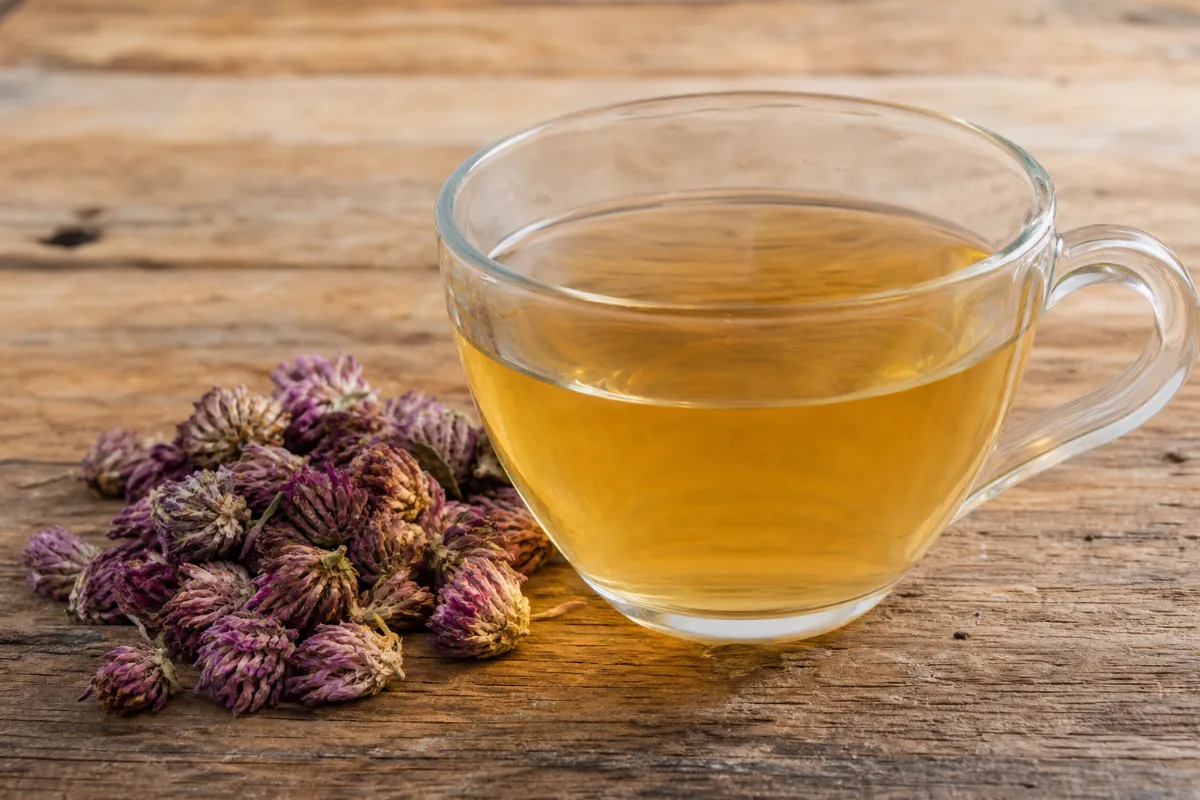
Red clover tea is an infusion of red clover plant material (the plant part varies by product, so check the label), Trifolium pratense L., a legume in the pea family (Fabaceae). [4][1] NIH says it is native to Europe, central Asia and northern Africa. [1] The warfarin review lists sweet clover separately from red clover, so check the botanical name on the label (see herbal tea quality and labels). The plant profile and extract evidence are in Red Clover in Herbs & Botanicals.Traditional use and what regulators concluded
Our sources give little detail on red-clover tea traditions, so we do not describe any here. NIH notes only that supplements containing red clover are promoted for women's health conditions. [1] No EU herbal committee (HMPC) summary for red clover was found in the sources we read, so no regulator conclusion is reported here.What research found
Almost all trials tested isoflavone extracts or supplements, not tea. Labels used here: mixed, promising but limited, insufficient evidence.| Question | What the source found | Strength of evidence | Population and form studied |
|---|---|---|---|
| Menopause hot flashes (older review) | A Cochrane review of 43 trials found no conclusive evidence that phytoestrogen supplements reduce hot flushes or night sweats; a strong placebo effect was noted in most trials. [5] | Mixed | Foods, extracts and supplements, including red clover extract |
| Hot flashes (2026 meta-analysis) | Nine randomized trials of red clover isoflavone supplements found a modest but statistically significant reduction in hot flash frequency versus placebo. [6] | Promising but limited | Isoflavone supplements, 37.1 to 160 mg isoflavones daily across trials, 12 weeks to 12 months |
| NIH summary | Studies on hot flashes have had inconsistent results and some had a high risk of bias. [1] | Mixed | Red clover supplements |
| Cholesterol, bone density | Cholesterol findings were conflicting and only a small number of bone density studies were done, with inconsistent results. [1] | Mixed / insufficient evidence | Red clover supplements, postmenopausal women |
| The tea itself | Proper evidence not found |
Proper evidence not found for human trials of red clover tea: PubMed phrase searches for "red clover tea" in titles and abstracts returned no records, with or without a randomized-trial filter. [7] The sources we read do not say how many isoflavones a cup of tea contains. Do not assume tea works like the standardized extracts in these trials.
Safety details
- Length of use. NIH says red clover extracts have been used in clinical studies for as long as 2 years with apparent safety and appear well tolerated. [1] The Cochrane review found no indication of estrogen-like stimulation of the womb lining or vagina, or other adverse effects, in use up to two years. [5] These findings are for extracts.
- Vaginal bleeding after menopause. A scoping review of herbal products with assumed estrogen-like activity found that their use was associated with postmenopausal bleeding. [8] Tell your clinician about any bleeding after menopause; see Women's Health: When to Get Help.
- Other medicines, liver, kidney, allergy, children: Proper evidence not found in the sources we read for red clover tea.
- Quality. See quality testing and certifications for how product testing works in general.
What research found and what to check: Red Clover Tea
Findings about drinking the tea itself, kept apart from capsules, extracts and concentrated supplements. Each card says what was studied, in whom, and how strong the evidence is.
Red clover tea and menopause hot flashes (tea vs extract)
Preliminary or mixedNo trial of red clover tea was found. Trials tested isoflavone extracts: a 2026 meta-analysis of 9 randomized trials found a small-to-moderate reduction in hot flash frequency, while NIH calls the results inconsistent and a Cochrane review found no conclusive benefit of phytoestrogen products.
Supplements: Extract only: mixed results; tea not tested.
What is in the tea: isoflavones
Lab or animal research onlyA lab study found that red clover infusions and decoctions contain isoflavone compounds (including biochanin A and formononetin), with a different chemical profile from tinctures. It did not test health effects.
Supplements: Lab chemistry only; no health effect shown.
Cholesterol and bone density
Not enough evidenceNIH says cholesterol findings for red clover supplements conflict and that only a few bone density studies exist, with inconsistent results. Tea was not studied.
Supplements: Insufficient evidence.
Connected topics
Open a group to see how each topic connects and how strong the evidence is.
Health goals (1)
- Menopause SupportPreliminary or mixed
Extract trials give mixed results (a 2026 meta-analysis modest benefit; NIH inconsistent). Tea itself was not tested.
Root causes (2)
- Medication Side EffectsDocumented risk
Listed in a pharmacy review as potentially adding to warfarin's effect, from mostly lab, animal and case-report data.
- Hormone DeclinePreliminary or mixed
Menopause hot flash trials used red clover extracts; results mixed; tea not tested.
Conditions & symptoms (1)
- Menopausal SymptomPreliminary or mixed
Extract trials mixed; no trial of the tea found.
Documented risks and interactions (4)
- Hormone-sensitive conditions. NIH describes red clover isoflavones as structurally similar to estrogen. A systematic review found evidence on red clover limited and suggested it may not promote breast cancer, but called for better evidence on high-dose isoflavones. The studies were of isoflavone products, not tea.
- Pregnancy and breastfeeding. NIH says red clover supplements may be unsafe during pregnancy or while breastfeeding. No source read addresses the tea specifically.
- Blood thinners (warfarin). A pharmacy review lists red clover among herbal products that may potentially increase bleeding risk or add to warfarin's effect, but notes that nearly all such information comes from lab data, animal studies or single case reports. It also lists sweet clover separately.
- Bleeding after menopause. A scoping review of herbal products with assumed estrogen-like activity found that use was associated with postmenopausal bleeding (this was across many plants including red clover). Tell a clinician about any bleeding after menopause.
Frequently asked questions
Does red clover tea help with hot flashes?
Proper evidence not found for the tea. Trials of red clover isoflavone supplements are mixed: a 2026 meta-analysis found a modest benefit, while NIH calls the results inconsistent. [6][1] See Herbal Tea for Period Cramps and Menopause Symptoms.
Is red clover tea safe if I have had breast cancer?
Ask your oncologist. A systematic review found limited evidence that red clover may not promote breast cancer, and called for better evidence on high-dose isoflavones. [2]
Can I drink red clover tea with warfarin?
It has been listed as a herb that may potentially increase bleeding risk or add to warfarin's effect, based mostly on lab, animal or case-report data. [3] Ask your prescriber or pharmacist.
Is red clover tea safe in pregnancy?
NIH says red clover supplements may be unsafe in pregnancy or while breastfeeding. [1] Ask your clinician.
Is red clover tea the same as the supplements studied in trials?
No. The trials tested isoflavone supplements and extracts, and no tea trial was found. [6][7]
References
- National Center for Complementary and Integrative Health (NIH). Red Clover: Usefulness and Safety. Page last updated April 2025. Read 2026-10-23.
- Fritz H, et al. Soy, red clover, and isoflavones and breast cancer: a systematic review. PLoS One 2013. Read 2026-10-23 (abstract).
- Heck AM, DeWitt BA, Lukes AL. Potential interactions between alternative therapies and warfarin. Am J Health Syst Pharm 2000. Read 2026-10-23 (abstract).
- GBIF Secretariat. GBIF Backbone Taxonomy, species match for Trifolium pratense L. (Fabaceae), Silybum marianum (L.) Gaertn. (Asteraceae), Echinacea purpurea (L.) Moench and Echinacea angustifolia DC. (Asteraceae), Rubus idaeus L. (Rosaceae), Zea mays L. and Hordeum vulgare L. (Poaceae), Jasminum sambac (L.) Aiton (Oleaceae), Chrysanthemum x morifolium Ramat. ex Hemsl. (Asteraceae). All returned as accepted names by the API on 2026-10-23.
- Lethaby A, et al. Phytoestrogens for menopausal vasomotor symptoms. Cochrane Database of Systematic Reviews 2013. Read 2026-10-23 (abstract).
- Jiang W, Wu K. The effectiveness of red clover on hot-flash in menopausal women: a GRADE-assessed systematic review and meta-analysis. Eur J Obstet Gynecol Reprod Biol 2026. Read 2026-10-23 (abstract).
- National Library of Medicine. PubMed search records, E-utilities esearch, phrase searches in title/abstract run 2026-10-23, with and without a randomized-controlled-trial filter: "red clover tea" (0 records), "milk thistle tea" (0), "echinacea tea" (0), "raspberry leaf tea" (9; 2 with the trial filter), "barley tea" (28; 3 with the trial filter), "mugicha" (11; 3), "chrysanthemum tea" (40; 0), "jasmine tea" (79; 0), "corn silk tea" (6; 0).
- Tjeerdsma AM, et al. Analysis of safety concerns on herbal products with assumed phytoestrogenic activity. Pharmaceuticals 2023. Read 2026-10-23 (abstract).