Sacha Inchi (Inca Peanut): Nutrients, What Research Shows and Safety
Sacha inchi (Inca peanut) seeds as a food: omega-3 ALA, protein, why raw seeds are roasted, EU status of the oil, small trials of the oil, and what is not known.
Content last updated . This page has not been medically reviewed.
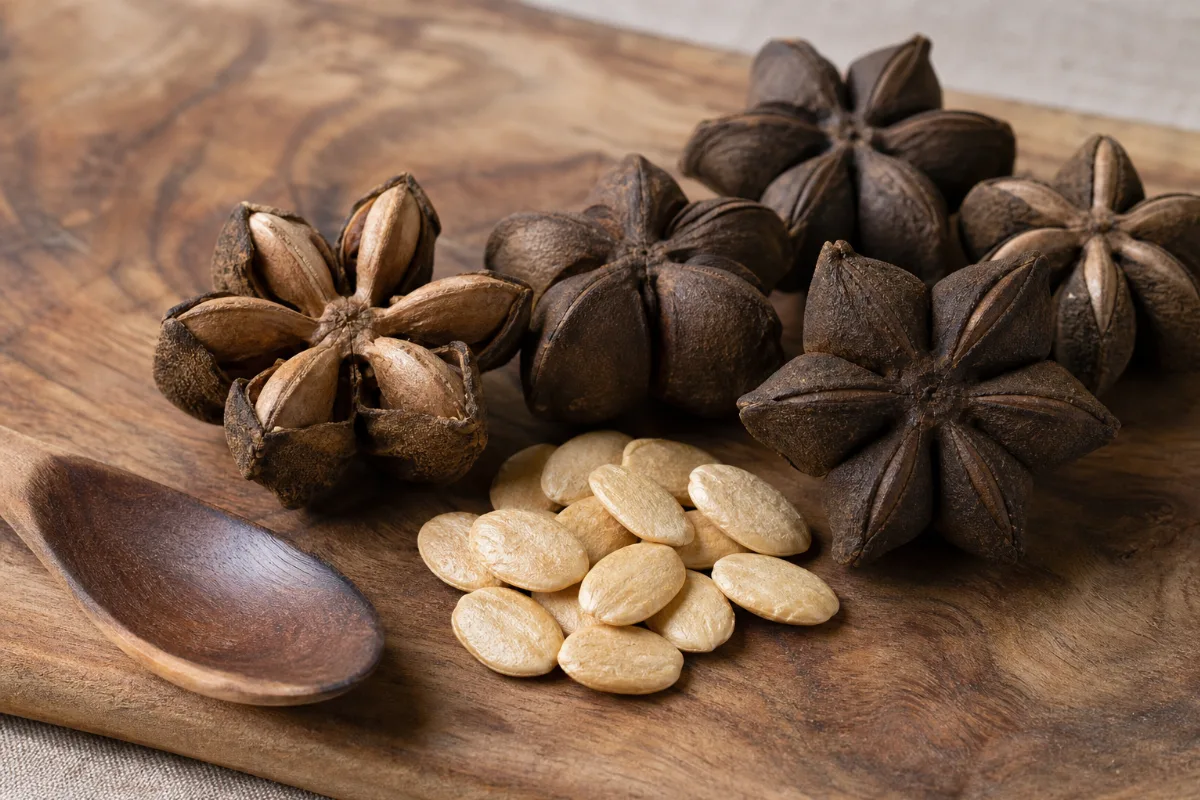
Sacha inchi, also called the Inca peanut, is the seed of a climbing plant from the Amazon region, Plukenetia volubilis, in the spurge family (Euphorbiaceae). Despite the nickname it is not a peanut or a nut. It grows as star-shaped pods, and the part eaten is the small seed kernel inside, usually sold roasted, or pressed into oil. People eat it for its plant omega-3 fat (ALA) and protein. This page covers the seed as a food and keeps it apart from the oil in capsules, which is where most of the human trials come from. There is no USDA entry for sacha inchi, so the numbers below come from published research papers.
Read this first
- Raw seeds may contain natural plant compounds (alkaloids, lectins and saponins) linked in one review to mild-to-severe toxicity. The review's authors say roasting is "mandatory" before eating the seeds, based on a lab study of liver cells. [1] Buy seeds sold as roasted or ready to eat, and do not eat raw seeds or leaves.
- Seed allergy is possible but has been little studied. We found one report of occupational allergy and asthma in a worker who crushed the seeds. [1] For trouble breathing or swelling of the face or throat, call 911 (or your local emergency number).
- The best human trial we found tested the oil in capsules, not the seeds: 54 adults for 12 weeks, with small lipid changes. The oil was supplied by the company that funded it. [3]
- Honest summary: sacha inchi is a very rich plant source of ALA and a good source of protein and some minerals. Health claims rest on small studies of the oil and on lab and animal work.
What is in it (research values, not USDA)
USDA FoodData Central has no entry for sacha inchi. The values below come from a 2022 review that collected published analyses of the seed kernel (Heliyon). [1] They are ranges across studies, so they differ by variety, growing place and method. The per-serving column is our calculation for 1 ounce (28 g, the USDA/MyPlate unit) using a factor of 0.2835 on the per-100 g numbers. The review gave no energy (calorie) value, so we do not list one.
| Nutrient | Per 100 g (range reported) | Per 1 ounce (28 g), our calculation | % Daily Value per ounce |
|---|---|---|---|
| Total fat | 33.4 to 54.7 g | 9.5 to 15.5 g | 12 to 20% |
| Protein | 24.2 to 33.3 g | 6.9 to 9.4 g | 14 to 19% |
| Fiber (total) | 6.59 to 13.86 g | 1.9 to 3.9 g | 7 to 14% |
| Alpha-linolenic acid (ALA, omega-3) | 12.8 to 47.0% of the fatty acids | at least about 1.2 g in our lowest-case calculation | no DV |
| Linoleic acid (omega-6) | 12.4 to 35.0% of the fatty acids | not calculated | no DV |
| Magnesium | about 344 mg | about 98 mg | 23% |
| Phosphorus | about 520 mg | about 147 mg | 12% |
| Potassium | about 489 mg | about 139 mg | 3% |
| Calcium | about 126 mg | about 36 mg | 3% |
| Vitamin E as alpha-tocopherol | 1.13 to 1.27 mg | 0.3 to 0.4 mg | 2% |
Source: Rodzi and Lee 2022. [1] A separate 2021 review gives the oil as 35 to 60% of the seed, protein 25 to 33%, and ALA 47 to 51% of the fatty acids, with linoleic acid 34 to 37%. [2] % Daily Value uses the FDA 2016 Daily Values (fat 78 g, protein 50 g, fiber 28 g, magnesium 420 mg, phosphorus 1,250 mg, potassium 4,700 mg, calcium 1,300 mg, vitamin E 15 mg). Zinc, iron, manganese and copper were reported much lower than the minerals above. [1] The ALA range is wide, so treat any single number with care.
The seed is also rich in other vitamin E forms: the review lists gamma-tocopherol at 57 to 68 mg and delta-tocopherol at 29 to 48 mg per 100 g of seed. [1] Only alpha-tocopherol counts toward the vitamin E Daily Value. These measurements come from lab analysis, and we did not read a human trial of tocopherols from this seed.
What research says
| Health goal | What the sources found | Strength of evidence | What was studied |
|---|---|---|---|
| Plant omega-3 (ALA) and protein | Analyses report ALA as roughly 13 to 51% of the seed's fatty acids and protein at 24 to 33 g per 100 g. [1][2] | Established (nutrient content) | Food composition analyses |
| Blood cholesterol | In a 12-week randomized, placebo-controlled trial of 54 adults with high blood sugar, blood pressure and blood fats, total cholesterol and LDL fell and HDL rose in the oil group compared with corn oil; triglycerides did not change. [3] Earlier small trials in 24 people with high cholesterol (oil) and 28 volunteers (30 g a day of roasted seeds) are described in a review, which we did not read in detail. [1] | Promising but limited | Mostly capsules of sacha inchi oil (1,000 mg a day); one small trial of roasted seeds |
| Blood pressure | The 2025 trial reported lower blood pressure in the oil group. [3] | Promising but limited | Oil capsules; 54 adults; participants kept taking their usual medicines |
| Blood sugar | The 2025 trial found no effect on blood sugar markers. [3] A 4-month placebo-controlled trial found no significant change in glucose, as summarized in a review. [1] | No good evidence of benefit | Oil |
| Triglycerides in rats on a high-fat diet | The oil lowered triglycerides and VLDL cholesterol in 24 rats over 6 weeks. [8] | Lab or animal only | Oil in rats |
| Skin, inflammation, brain, other claims | Proper evidence not found in the sources we read, beyond small or lab studies. [1][7] | Insufficient evidence | Not applicable |
Eaten as food vs taken as oil, extract or supplement. Almost all human evidence we found is about the oil, in capsules. The 2025 trial used a 1,000 mg soft gel a day, which is a small amount compared with eating a handful of seeds, so it cannot be used to say what the seeds do. [3] The trial reports that Orient Biotech funded it and supplied the oil, and one author declared a competing interest. [3] The authors call it preliminary and ask for larger, longer studies. [3] The review authors note the same need for larger human trials. [1] The lipid changes are blood markers, not heart attacks or strokes. Observational studies, if any exist, would show association rather than proof; we did not read any on sacha inchi.
ALA is an omega-3 fat from plants. The Linus Pauling Institute page says that in healthy young adults about 8% of dietary ALA was converted to EPA in men and about 21% in women, with 0 to 4% in men and about 9% in women going on to DHA. [6] So ALA from seeds should not be treated as a replacement for fish oil.
How much is a normal serving
We did not find an official portion for sacha inchi. We use 1 ounce (28 g), the USDA/MyPlate unit for nuts and seeds, so the numbers above can be compared with other pages on this site. This is information, not a prescription. The US Institute of Medicine (now the National Academy of Medicine) set an Adequate Intake of 1.6 g of ALA a day for men and 1.1 g for women in 2002. [6] Our lowest-case calculation puts one ounce of seeds at about 1.2 g of ALA, but studies differ widely, so the real amount may be much higher or lower. The seeds are fatty, so they are energy dense, but we have no energy figure from a source we read. We found no meta-analysis on sacha inchi and body weight, so we make no weight claim.Seeds are sold roasted, often lightly salted, and the oil is sold as a cooking or salad oil. We did not find a source on how roasting changes the nutrients beyond the safety point above.
Safety, allergy and medicines
- Raw seeds and leaves. A 2022 review says raw seeds may contain alkaloids, lectins and saponins linked to mild-to-severe toxicity. In one liver-cell study these dropped after heating, and the authors state roasting is mandatory before eating the seeds and leaves. [1] That is lab evidence, not a human safety trial. We did not find an official limit or measured amounts for these compounds in the sources we read.
- Safety testing of the pressed cake. The same review notes de-oiled cake caused no deaths or illness in mice and rats at a high dose, and no genotoxicity in a longer test. [1] That is animal work.
- Allergy. The review reports one case of occupational allergy and asthma in a worker who crushed the seeds. [1] The Irish food safety authority judged allergenicity not a concern for the pressed oil because it has almost no protein (under 0.1%). [4] That does not apply to the whole seed, which is about a quarter to a third protein. [1] If you have a tree nut, peanut or seed allergy, ask your allergist before trying it. See nut and seed allergy basics and food allergy basics and emergency signs. For trouble breathing or swelling of the face or throat, call 911.
- Side effects in the trials. In the 2025 trial, mild nausea (4 people) and stomach discomfort (2 people) were reported in the first week; no clinical adverse events were reported. [3] A review described early mild nausea in a 4-month oil trial in 30 people that eased over time. [2]
- EU rules. In Europe, new foods need approval under the Novel Food rules. The Food Safety Authority of Ireland (FSAI) found the virgin oil from four Peruvian producers substantially equivalent to Inca inchi oil already on the EU market, in an opinion on an application made in October 2013. [4] An earlier FSAI opinion in 2012 found the Inca inchi oil equivalent to linseed (flaxseed) oil. [4] A Dutch trade guide says the oil was allowed onto the European market for the first time in 2013. [5] We could not open the European Food Safety Authority's own 2020 report on roasted seeds, so we make no statement about the status of whole seeds in the EU. See EU rules on novel foods.
- Medicines. Proper evidence not found for sacha inchi in the sources we read. For comparison only: the Linus Pauling Institute says high doses of flaxseed oil may inhibit platelet aggregation, so people on blood thinners should use it with caution. [6] We did not read a source that tested this for sacha inchi. See foods and medicine interactions.
- Kidney disease. One ounce has roughly 98 mg magnesium, 147 mg phosphorus and 139 mg potassium by our calculation from the review. [1] We did not read a kidney-diet source naming sacha inchi, so ask your kidney team. See foods, kidney disease, potassium and oxalates.
- Pregnancy and children. Proper evidence not found in the sources we read. We did not read a choking source specific to sacha inchi; for young children see foods for babies and toddlers.
Choosing, storing and food safety
- Choose seeds sold roasted or ready to eat, not raw. [1]
- The oil is high in polyunsaturated fat and oxidizes easily, which makes storage and processing difficult. [7] Keep oils and seeds cool, dark and sealed; see storing nuts and seeds: rancidity, mold and aflatoxin.
- We did not read a sacha-inchi-specific source on aflatoxin or mold.
Related pages
Health connections for Sacha Inchi (Inca Peanut)
What research links to eating or drinking this food, and how strong the evidence is. Many studies are observational or use juice, powder, oil or extracts rather than the food as eaten; each card says which.
Plant omega-3 fat (ALA)
Established roleAnalyses report the seed kernel at about 33 to 55 g fat per 100 g, with alpha-linolenic acid (ALA, a plant omega-3) at roughly 13 to 51% of the fatty acids depending on the study.
Supplements: Oil capsules are a different product from the seed; nutrient content does not prove a health effect.
Protein, fiber and minerals
Established roleThe seed kernel is reported at 24 to 33 g protein and 6.6 to 13.9 g fiber per 100 g, with about 344 mg magnesium and 520 mg phosphorus. One ounce gives about 23% of the magnesium Daily Value (our calculation).
Supplements: Values are ranges from different studies; USDA has no entry.
Sacha inchi oil and blood cholesterol
Preliminary or mixedA 12-week trial in 54 adults found lower total cholesterol and LDL and higher HDL with 1,000 mg of the oil a day than with corn oil; triglycerides did not change. The oil was supplied by its funder.
Supplements: Oil capsules were tested, not the seeds; small preliminary trial.
Sacha inchi oil and blood pressure
Preliminary or mixedThe same 2025 trial reported lower blood pressure in the oil group; participants kept taking their usual medicines.
Supplements: One small trial of oil capsules; larger studies are needed.
Blood sugar
Not enough evidenceThe 2025 trial found no effect of the oil on blood sugar markers, and a 4-month placebo-controlled trial found no significant change in glucose, as summarized in a review.
Supplements: No good evidence of benefit for blood sugar.
Triglycerides in animals
Lab or animal research onlyIn 24 rats fed a high-fat diet for 6 weeks, the oil lowered triglycerides and VLDL cholesterol.
Supplements: Animal evidence does not show the same effect in people.
Limited conversion of ALA to EPA and DHA
Not enough evidenceIn healthy young adults about 8% of dietary ALA was converted to EPA in men and about 21% in women, with 0 to 4% (men) and about 9% (women) going on to DHA.
Supplements: No trial of sacha inchi changing EPA or DHA levels was read.
Connected topics
Open a group to see how each topic connects and how strong the evidence is.
Health goals (2)
- Blood Pressure SupportPreliminary or mixed
The same trial reported lower blood pressure with the oil; larger studies are needed.
- Cholesterol BalancePreliminary or mixed
One 12-week trial of the oil (not the seed) in 54 adults found lower total cholesterol and LDL than corn oil. It was small and the oil was supplied by its funder.
Body systems (1)
- Immune SystemDocumented risk
An occupational allergy and asthma case is reported for the seeds.
Body parts (1)
- Immune SystemDocumented risk
An occupational allergy and asthma case is reported for the seeds.
Root causes (1)
- Poor DietEstablished role
The seed is a source of plant omega-3 fat, protein and minerals in an overall diet.
Habits (1)
- Balanced NutritionEstablished role
Roasted seeds can be one plant source of omega-3 fat and protein in a varied diet.
Biomarkers (2)
- HDL CholesterolPreliminary or mixed
HDL rose with the oil in the same trial; the seeds were not tested.
- LDL CholesterolPreliminary or mixed
LDL fell with the oil in one 12-week trial in 54 adults; the seeds were not tested.
Conditions & symptoms (3)
- AsthmaDocumented risk
Occupational asthma was reported in one worker crushing the seeds.
- Food AllergyDocumented risk
Seed allergy is possible; only an occupational allergy case was found in the sources read.
- HyperlipidemiaPreliminary or mixed
One small 12-week trial of the oil (not the seeds) in adults with high blood fats found lower total cholesterol and LDL; triglycerides did not change.
Documented risks and interactions (2)
- Raw seeds: natural toxins and the need to roast. A 2022 review says raw seeds may contain alkaloids, lectins and saponins linked to mild-to-severe toxicity, and its authors state roasting is mandatory before eating the seeds or leaves, based on a liver-cell study.
- Seed allergy. One case of occupational allergy and asthma was reported in a worker crushing the seeds. The pressed oil has almost no protein, so allergy is not expected from the oil; the whole seed is a quarter to a third protein.
Frequently asked questions
Is sacha inchi a peanut or a nut?
No. It is the seed of a climbing Amazon plant in the spurge family. "Inca peanut" is a nickname. [1] Even so, ask an allergist if you have a nut, peanut or seed allergy.
Can you eat sacha inchi seeds raw?
Reviewers say no. Raw seeds may contain alkaloids, lectins and saponins, and the authors of a 2022 review state roasting is mandatory before eating the seeds. [1] That conclusion rests on a lab study, so choose seeds sold roasted.
Does sacha inchi lower cholesterol?
One 12-week trial in 54 adults found lower total cholesterol and LDL with sacha inchi oil capsules than with corn oil. [3] The oil, not the seed, was tested, the study was small, and the oil's maker supplied and funded it. [3] It is promising but not settled.
How much omega-3 is in sacha inchi?
ALA is reported as roughly 13 to 51% of the fatty acids, depending on the study. [1][2] Your body converts only some ALA into EPA and DHA. [6]
Is sacha inchi oil allowed in Europe?
Yes, the oil was assessed as substantially equivalent to Inca inchi oil already on the EU market, and a trade guide says it entered the market in 2013. [4][5] We could not confirm the status of the whole seeds.
References
- Rodzi NARM, Lee LK. Sacha Inchi (Plukenetia volubilis L.): recent insight on phytochemistry, pharmacology, organoleptic, safety and toxicity perspectives. Heliyon 2022;8(9):e10572. Read 2026-10-23 (first part of the text).
- Cárdenas DM, Gómez Rave LJ, Soto JA. Biological Activity of Sacha Inchi (Plukenetia volubilis Linneo) and Potential Uses in Human Health: A Review. Food Technol Biotechnol 2021;59(3):253-266. Read 2026-10-23.
- Rodzi NARM, Sopian MM, Lee LK. Effects of Sacha Inchi (Plukenetia volubilis L.) Oil Supplementation on Hyperglycaemia, Hypertension and Hyperlipidaemia (3Hs) Patients: A Preliminary Human Trial. Plant Foods Hum Nutr 2025;80(1):80. Read 2026-10-23.
- Food Safety Authority of Ireland. Substantial Equivalence Opinion: Sacha Inchi Oil. Opinion dated 2014 per the file name; application received October 2013. Read 2026-10-23.
- CBI (Centre for the Promotion of Imports, Netherlands). Exporting sacha inchi oil to Europe. Last updated 12 December 2016. Read 2026-10-23 (opening text only).
- Linus Pauling Institute, Oregon State University. Essential Fatty Acids. Read 2026-10-23 (ALA Adequate Intake of the US Institute of Medicine, 2002; conversion rates; safety).
- Redjeki SG et al. Sacha Inchi (Plukenetia volubilis): Potential Bioactivity, Extraction Methods, and Microencapsulation Techniques. Molecules 2025;30(1). PMID 39795216. Abstract read 2026-10-23 via Europe PMC.
- Mendoza-Almeida T, Ramirez-Roca EG, Suarez-Cunza S. Fatty acid profile and effect of Plukenetia volubilis L. (sacha inchi) oil on lipid metabolism in rats fed a high-fat diet. Braz J Med Biol Res 2025;58. PMID 41124441. Abstract read 2026-10-23 via Europe PMC.