Rice Bran Oil: Nutrients, What Research Shows and Safety
Rice bran oil as a food: USDA fat and vitamin E values, what pooled trials found on LDL cholesterol, heating and storage limits, and which safety questions have no answer yet.
Content last updated . This page has not been medically reviewed.
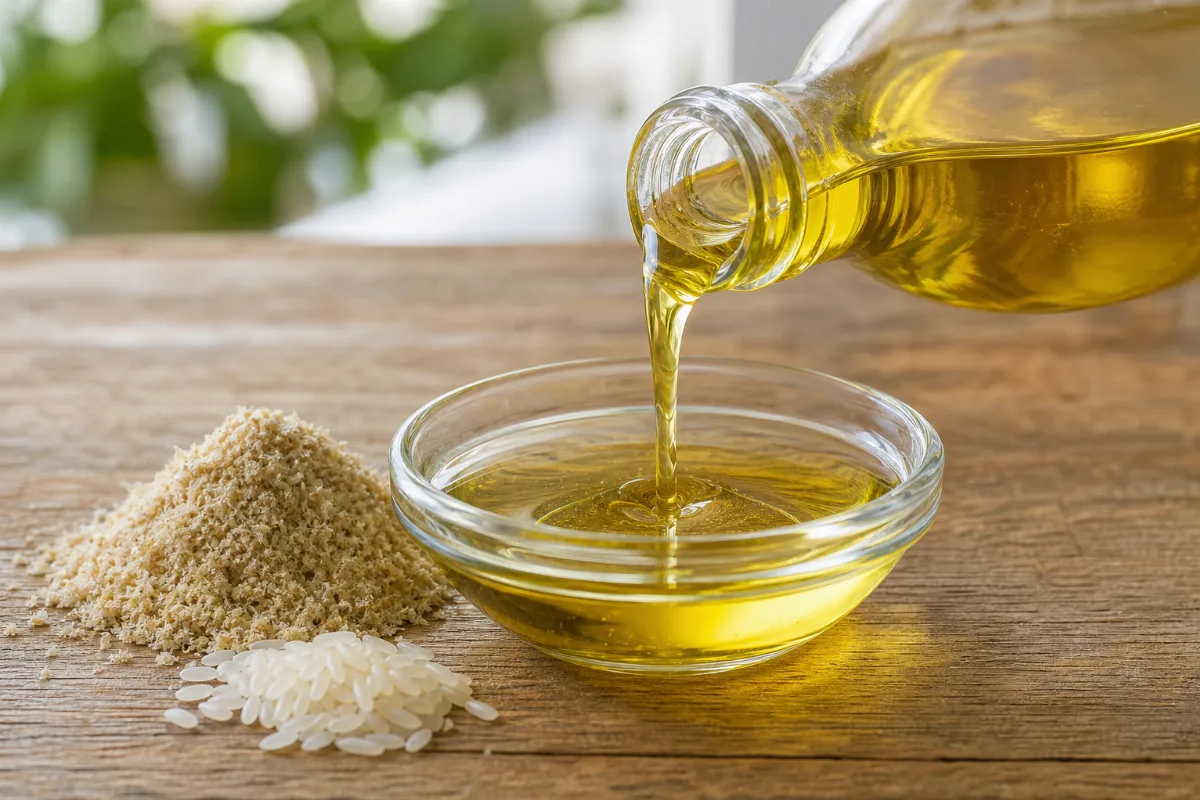
Rice bran oil is pressed from the bran, the outer layer of the rice grain (Oryza sativa, a grass in the family Poaceae). It is sold as a cooking oil and is mixed into some blends. People choose it mostly for heart health reasons and for its vitamin E. This page keeps the oil as a food apart from rice bran itself, from isolated compounds such as gamma-oryzanol, and from hype.
Read this first
- The best-supported finding is a modest drop in LDL ("bad") cholesterol. Pooled randomized trials found it, but the trials were small and short. It is a blood measure, not proof of fewer heart attacks. [2] [4]
- It is still a fat. USDA lists about 120 calories in 1 tablespoon (13.6 g), and about 2.7 g of saturated fat. [1] WHO advises keeping saturated fat to 10% or less of daily energy. [10]
- Rice bran oil reached a high peroxide value (an early rancidity marker) faster than the other oils in one laboratory storage test. Store it cool and tightly closed. [12]
- Allergy: rice is not on the list of major food allergens. We found no source about rice bran oil allergy either way. [11] If you ever have trouble breathing or swelling of the face or throat after any food, call 911 (or your local emergency number).
- Not enough is known about contaminants such as arsenic in this oil. We did not find a source we could read that measured it. See the safety section.
What is in it (USDA values)
The values below are for rice bran oil (USDA FoodData Central item 171013, SR Legacy). [1] The serving column is the USDA household portion of 1 tablespoon, 13.6 g. [1] Serving values are the per-100-g values multiplied by 0.136.
| Nutrient | Per 100 g | Per 1 tbsp (13.6 g) | % Daily Value per serving |
|---|---|---|---|
| Energy | 884 kcal | 120 kcal | not set |
| Total fat | 100 g | 13.6 g | 17% |
| Saturated fat | 19.7 g | 2.7 g | 13% |
| Monounsaturated fat | 39.3 g | 5.3 g | no DV |
| Polyunsaturated fat | 35.0 g | 4.8 g | no DV |
| Vitamin E (alpha-tocopherol) | 32.3 mg | 4.4 mg | 29% |
| Vitamin K (phylloquinone) | 24.7 mcg | 3.4 mcg | 3% |
| Phytosterols | 1,190 mg | 162 mg | no DV |
| Protein, carbohydrate, fiber, cholesterol | 0 g | 0 g | 0% |
| Omega-3 (ALA) | not listed by USDA | not listed | no DV |
% Daily Value uses the FDA 2016 Daily Values; values vary with the rice, the refining and storage. USDA also lists vitamin D values for this item that look implausible for an oil, so we do not use them here. [1]
Plant compounds: rice bran oil contains plant sterols (USDA lists 1,190 mg per 100 g) [1] and gamma-oryzanol, a group of compounds found in rice bran. A 2025 review covers gamma-oryzanol's antioxidant and lipid-lowering activity, mostly from lab studies and a few clinical trials. [8] Here we separate what was tested in people (below) from lab findings.
What research says
| Health goal | What the sources found | Strength of evidence | What was studied |
|---|---|---|---|
| LDL and total cholesterol | A pooled analysis of 11 randomized trials found LDL fell by 6.91 mg/dL and total cholesterol by 12.65 mg/dL. [2] A 10-week crossover trial in 14 people found LDL about 7% lower on rice bran oil, while defatted rice bran did not help. [4] A 2024 pooled analysis of 11 trials of rice bran products found lower LDL, and the oil effect on LDL and total cholesterol was larger than whole bran. [3] | Supported for this blood measure; trials are small and short | Rice bran oil in adults, mostly with raised cholesterol; comparison oils varied |
| Role of gamma-oryzanol | In 30 men with mildly raised cholesterol, rice bran oil with low or high oryzanol gave similar LDL drops. [5] | Mixed / Promising but limited | Rice bran oil in men; one author was at a food company |
| Plant sterols from the oil | In 60 adults, 2.1 g a day of sterols from rice bran oil lowered LDL by 0.20 mmol/L. [6] | Promising but limited | Isolated sterol preparation, not the oil as eaten |
| Blood pressure and blood sugar | A pooled analysis of 26 trials of rice bran supplementation found lower blood pressure and HbA1c. [7] A 60-day open-label study of a sesame and rice bran oil blend reported lower blood pressure, with no control for the blend alone. [14] | Insufficient evidence for the oil | Mostly rice bran, not the oil; one blended oil |
| Heart attacks and strokes | We did not find a trial of rice bran oil that measured these. | No good evidence found in the sources we read | Not applicable |
| Weight loss | We did not read a trial showing rice bran oil changes body weight. | No good evidence found in the sources we read | Not applicable |
The AHA's 2017 advisory says lowering saturated fat and replacing it with unsaturated fats lowers heart disease. [9] That supports unsaturated oils as a group. It is not a trial of rice bran oil itself.
Eaten as food vs taken as an extract or supplement. The cholesterol trials used the oil or whole rice bran as food. The oryzanol and sterol findings come from isolated or concentrated preparations. Some studies had links to food companies; we note this where the abstract does.
How much is a normal serving
The USDA household portion is 1 tablespoon (13.6 g), about 120 kcal and 2.7 g saturated fat. [1] That is information from USDA data, not a prescription. We did not read an official body that sets a serving size for rice bran oil specifically. WHO's general limits are total fat 30% or less of energy and saturated fat 10% or less. [10]
Safety, allergy and medicines
- Calories: all oils are energy dense: 884 kcal per 100 g. [1]
- Saturated fat: 19.7 g per 100 g, or 13% of the Daily Value per tablespoon. [1] WHO and the AHA both advise limiting it. [9] [10]
- Heating and storage: in a laboratory storage and heating test, rice bran oil reached a peroxide value of 10 faster than the other refined oils tested, and all oils lost about 30% of oxidative stability after 12 months. [12] Frying breaks oils down through oxidation and polymerization; one review covers rice bran oil among others and gives no rice-bran-specific verdict. [13] We did not read a source with a reliable smoke point, so we give none. See smoke points and cooking with oil.
- Contaminants: rice itself can carry arsenic, but we did not find a source we could read that measured arsenic in rice bran oil. We do not claim it is safe or unsafe on this point. See heavy metals and contaminants in foods.
- Allergy: rice is not among the nine major allergens (milk, eggs, fish, shellfish, tree nuts, peanuts, wheat, soy, sesame). [11] We found no source on rice bran oil allergy. For trouble breathing or swelling of the face or throat, call 911 (or your local emergency number). [11]
- Vitamin E: a tablespoon gives 29% of the FDA Daily Value. [1] The NHS says needs are met from food and that 540 mg a day or less from supplements is unlikely to cause harm; that is about supplements, not oil. [15]
- Medicines, pregnancy, children, kidney disease, diabetes: we found no source that tests rice bran oil for any of these, so we make no claim. Ask a clinician or pharmacist if you take a cholesterol medicine and plan to change your fats a lot.
Choosing, storing and food safety
- Keep the bottle tightly closed, cool and away from light. A laboratory test found oils lose oxidative stability over a year. [12]
- Use fresh oil for frying and do not reuse it many times; heating breaks oils down. [13]
- Labels differ: some bottles are blends (for example with sesame oil). Read the ingredient list. [14]
Related pages
Health connections for Rice Bran Oil
What research links to eating or drinking this food, and how strong the evidence is. Many studies are observational or use juice, powder, oil or extracts rather than the food as eaten; each card says which.
Rice bran oil and LDL cholesterol
Clinically supportedPooled randomized trials found rice bran oil lowers LDL and total cholesterol a little compared with other fats. The trials were small and short.
Supplements: This is about a blood measure in adults, not about heart attacks. Isolated oryzanol or sterol products are separate.
Replacing saturated fat with unsaturated oils
Preliminary or mixedThe AHA advises lowering saturated fat and replacing it with unsaturated fats. Rice bran oil is mostly mono- and polyunsaturated fat (USDA 39.3 g and 35.0 g per 100 g) with 19.7 g saturated fat.
Supplements: No trial of rice bran oil on heart attacks or strokes was found in the sources read.
Gamma-oryzanol and plant sterols in the oil
Preliminary or mixedRice bran oil contains plant sterols (USDA 1,190 mg per 100 g) and gamma-oryzanol. In 30 men, oil with low or high oryzanol gave similar LDL drops; isolated rice bran oil sterols lowered LDL in 60 adults.
Supplements: Concentrated sterol or oryzanol products are not the same as the oil as a food.
Vitamin E (alpha-tocopherol) from the oil
Established roleOne tablespoon gives about 4.4 mg vitamin E, 29% of the FDA Daily Value (USDA 32.3 mg per 100 g).
Supplements: Food sources meet needs per NHS; supplements are a separate question.
Rice bran products and blood pressure or blood sugar
Preliminary or mixedA pooled analysis of 26 trials of rice bran supplementation found lower blood pressure and HbA1c; a blended oil study was open-label. These are mostly not the oil.
Supplements: Insufficient evidence for the oil itself.
Connected topics
Open a group to see how each topic connects and how strong the evidence is.
Health goals (2)
- Cholesterol BalanceClinically supported
Pooled randomized trials found modest LDL and total cholesterol drops with rice bran oil. These are blood measures in small, short trials.
- Heart HealthPreliminary or mixed
Replacing saturated fat with unsaturated fat helps the heart per the AHA; no trial of rice bran oil on heart attacks or strokes was found.
Body systems (2)
- Cardiovascular SystemClinically supported
Same evidence as heart and circulation: LDL cholesterol lowering in small trials.
- Heart & CirculationClinically supported
Cholesterol lowering is the best-supported finding.
Body parts (1)
- HeartPreliminary or mixed
Lowering LDL is one heart risk factor; heart outcomes were not tested for the oil.
Functional actions (2)
- Cardiovascular SupportClinically supported
Lowers LDL and total cholesterol in pooled randomized trials.
- AntioxidantLab or animal research only
Gamma-oryzanol has antioxidant activity mostly shown in the lab; the oil itself also oxidizes quickly in storage tests.
Root causes (1)
- Poor DietPreliminary or mixed
Swapping saturated fats for unsaturated oils is an AHA-supported diet change; the oil is one option.
Habits (1)
- Balanced NutritionPreliminary or mixed
Used as part of an overall pattern that limits saturated fat.
Biomarkers (2)
- LDL CholesterolClinically supported
LDL fell by 6.91 mg/dL in a pooled analysis of 11 randomized trials.
- TriglyceridesPreliminary or mixed
A pooled analysis of rice bran products found lower triglycerides; the oil alone was not separated.
Conditions & symptoms (4)
- HypercholesterolemiaClinically supported
Trials in people with mildly raised cholesterol found LDL lowering; this does not replace medical care.
- Food AllergyDocumented risk
Rice is not a major allergen, and no study of rice bran oil allergy was found; this row records the general emergency rule.
- HyperlipidemiaPreliminary or mixed
Trial participants often had raised blood fats; results varied between studies.
- Vitamin E DeficiencyDeficiency link
The oil is a food source of vitamin E (4.4 mg a tablespoon), but the sources read did not test it for deficiency.
Documented risks and interactions (4)
- Energy density and saturated fat. USDA lists 884 kcal per 100 g (about 120 kcal per tablespoon) and 19.7 g saturated fat per 100 g (13% Daily Value per tablespoon). WHO advises saturated fat of 10% or less of energy.
- Heating, oxidation and storage. In a laboratory test rice bran oil reached a peroxide value of 10 faster than the other refined oils tested, and oxidative stability of all oils fell about 30% after 12 months. Frying degrades any oil.
- Arsenic and other contaminants. Rice grain can carry arsenic, but no source we read measured arsenic in rice bran oil, so the question is open.
- Food allergy. Rice is not among the nine major allergens. No source on rice bran oil allergy was found. Emergency line for any food reaction: trouble breathing or swelling of face or throat, call 911.
Frequently asked questions
Does rice bran oil lower cholesterol?
Pooled randomized trials found a small drop in LDL cholesterol, about 7 mg/dL in one analysis of 11 trials. [2] The trials were small and short, and this is a blood measure, not proof of fewer heart attacks. [4]
Is the gamma-oryzanol in rice bran oil what does the work?
Not clearly. In one trial in 30 men, oil with low and high oryzanol gave similar LDL drops. [5] Isolated oryzanol is a separate product from the oil. [8]
Is rice bran oil good for frying?
We did not find a source giving a reliable answer. Laboratory tests show all oils break down with heat and time, and rice bran oil reached an early rancidity marker quickly in one test. [12] [13]
Does rice bran oil contain arsenic?
We did not find a source we could read that measured it, so we cannot say. Rice grain can contain arsenic. See our page on contaminants in foods.
Is rice bran oil safe if I have a food allergy?
Rice is not one of the nine major allergens, but we found no study of rice bran oil allergy. [11] If you have any food allergy, ask your allergist. Call 911 for trouble breathing or swelling of the face or throat. [11]
References
- U.S. Department of Agriculture. FoodData Central: Oil, rice bran (SR Legacy, FDC 171013). April 2018 release. Read 2026-10-24.
- Jolfaie NR et al. Rice bran oil decreases total and LDL cholesterol in humans: a systematic review and meta-analysis of randomized controlled trials. Horm Metab Res 2016 (abstract read via Europe PMC). Read 2026-10-24.
- Park SY et al. Rice bran consumption improves lipid profiles: a systematic review and meta-analysis of randomized controlled trials. Nutrients 2024 (abstract read via Europe PMC). Read 2026-10-24.
- Most MM et al. Rice bran oil, not fiber, lowers cholesterol in humans. Am J Clin Nutr 2005 (abstract read via Europe PMC). Read 2026-10-24.
- Berger A et al. Similar cholesterol-lowering properties of rice bran oil, with varied gamma-oryzanol, in mildly hypercholesterolemic men. Eur J Nutr 2005 (abstract read via Europe PMC). Read 2026-10-24.
- Vissers MN et al. Effect of plant sterols from rice bran oil and triterpene alcohols from sheanut oil on serum lipoprotein concentrations in humans. Am J Clin Nutr 2000 (abstract read via Europe PMC). Read 2026-10-24.
- Tantayakhom S et al. Effects of rice bran supplementation on metabolic syndrome-related parameters: a systematic review and meta-analysis. Int J Mol Sci 2025 (abstract read via Europe PMC). Read 2026-10-24.
- Juricic H et al. Biochemical, biological, and clinical properties of gamma-oryzanol. Antioxidants 2025 (abstract read via Europe PMC). Read 2026-10-24.
- Sacks FM et al., American Heart Association. Dietary fats and cardiovascular disease: a presidential advisory. Circulation 2017 (abstract read via Europe PMC). Read 2026-10-24.
- WHO. Healthy diet fact sheet. Page dated 26 January 2026. Read 2026-10-24.
- MedlinePlus. Food allergy. Updated 19 November 2025. Read 2026-10-24.
- Maszewska M et al. Oxidative stability of selected edible oils. Molecules 2018 (abstract read via Europe PMC). Read 2026-10-24.
- Abrante-Pascual S et al. Vegetable oils and their use for frying: a review of their compositional differences and degradation. Foods 2024 (abstract read via Europe PMC). Read 2026-10-24.
- Devarajan S et al. A blend of sesame oil and rice bran oil lowers blood pressure and improves the lipid profile in mild-to-moderate hypertensive patients. J Clin Lipidol 2016 (abstract read via Europe PMC; one author is affiliated with an oil company). Read 2026-10-24.
- NHS. Vitamins and minerals: Vitamin E. Last reviewed 3 August 2020. Read 2026-10-24.