Hawthorn Tea: What Research Shows About the Tea, Safety and Cautions
Hawthorn tea comes from Crataegus leaf, flower or berry. Trials tested standardized extracts, not tea. EU monograph, heart medicine cautions, pregnancy and a toxic mislabeling warning.
Content last updated . This page has not been medically reviewed.
Safety first. Natural products can cause side effects and interact with medicines. Read herbal tea and extract safety before you use anything on this page.
If you have a heart condition or take heart medicines, speak with your prescriber or pharmacist before using hawthorn tea. NIH LactMed says hawthorn can possibly increase the effect of anticoagulants, digoxin and blood-pressure-lowering medicines. [1] NCCIH reports one study in which a specific hawthorn preparation may have been linked to early heart failure progression, possibly through interaction with patients' drugs. [2] The EU monograph says to see a doctor immediately for swollen ankles or legs, pain in the heart region that may spread to the arms, or breathing difficulty. [3] In the US, call 911 for chest pain or trouble breathing.
A second warning concerns labels. In January 2024 the FDA published a list of products labeled "tejocote root" (Crataegus mexicana) that actually contain yellow oleander, a toxic plant, and said they may cause severe harm or be fatal. [2] For poisoning, call Poison Help (1-800-222-1222) and see Plant and Mushroom Poisoning.
What hawthorn tea is
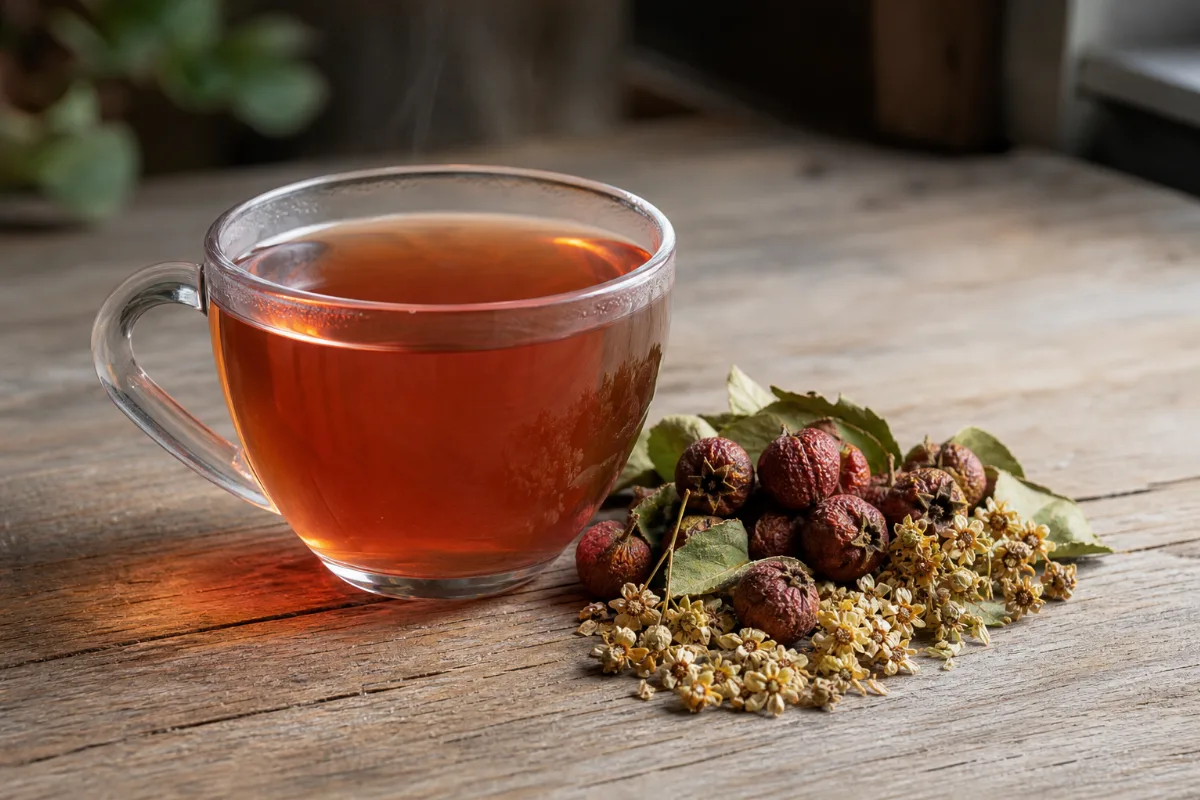
Hawthorn (Crataegus) is a flowering shrub or tree of the rose family (Rosaceae). [2] Species named in sources include Crataegus monogyna Jacq. and Crataegus laevigata (Poir.) DC. [4][5] Different parts are sold: the EU monograph covers leaf with flower, while LactMed notes leaves, fruit and flowers all contain flavonoids and oligomeric proanthocyanidins. [3][1] A study of one part or extract does not transfer to another, so check the label. The herb profile is at Hawthorn (herb profile).Traditional use
NCCIH says hawthorn was traditionally used for heart disease, digestion, blood circulation and kidney and bladder problems. [2] That is traditional use only.What research shows
| Question | What the source found | Strength of evidence | Form and population |
|---|---|---|---|
| Does hawthorn tea help any condition? | Proper evidence not found. We searched PubMed for "hawthorn tea blood pressure" and Crataegus reviews, trials and interactions, and found no trial of the tea. | Insufficient evidence | Tea |
| Chronic heart failure | A Cochrane review (2008) pooled ten trials in 855 patients and found better exercise capacity and symptoms with hawthorn leaf and flower extract than placebo, mostly added to standard treatment; no data on deaths or heart events. [6] NCCIH calls the evidence conflicting. [2] | Mixed | Standardized extracts, people with heart failure |
| Heart failure, later review | A 2018 review of one extract reported benefits in heart failure; its authors disclosed honoraria from the extract's maker. [7] | Promising but limited, with a conflict of interest | One standardized leaf-and-flower extract, not tea |
| Blood pressure | In 79 adults with type 2 diabetes taking medicines, 1,200 mg of hawthorn extract daily for 16 weeks lowered diastolic pressure more than placebo; there was no group difference in systolic pressure. [8] | Mixed | Extract (form not stated in the abstract), 16 weeks |
| Anxiety, weight loss | NCCIH says it is unclear for anxiety and that there is no evidence for weight loss. [2] | Insufficient evidence | Mixed |
Safety
- Medicines. Sources disagree. The EU monograph reports no interactions, while LactMed says hawthorn can possibly increase the effect of anticoagulants, digoxin and hypotensive medicines. [3][1] A lab study found hawthorn interfered with one type of digoxin blood test and acted on heart muscle cells from rats in a way that suggested overlap with digoxin; the authors advised people on digoxin to avoid it. [9] That is preclinical evidence, not a documented case in people. See How Interactions Work and Supplements and Blood Pressure and Heart Medicines.
- Side effects. NCCIH lists dizziness, nausea, vomiting, diarrhea and muscle pain, and says no study has tested use beyond 16 weeks. [2] The EU monograph says none known. [3]
- Pregnancy and breastfeeding. The EU monograph does not recommend use. [3] NCCIH says little is known. [2] LactMed says no data exist on excretion into breast milk and that the German Commission E saw no reason to contraindicate flowers or leaves but said to avoid the fruit. [1]
- Children. The EU monograph says use under 18 is not recommended for heart complaints. [3]
- Liver, kidney, surgery, allergy: not described in the sources we read. Tell a surgical team about herbal teas before a procedure.
Official statements
The EU herbal monograph (HMPC, 2016) accepts hawthorn leaf and flower as a traditional herbal medicine for temporary nervous heart complaints such as palpitations, only after a doctor has excluded serious conditions, and for mild mental stress and sleep. [3] The committee noted a lack of clinical studies. [10] For the heart indication in adults it describes an herbal tea of 1 to 2 g of comminuted herbal substance in 150 ml of boiling water up to four times daily, maximum 6 g. [3] That is a description of the monograph for a licensed medicine, not advice. See also Herbal Tea for Blood Pressure and Heart Health.What research found and what to check: Hawthorn Tea
Findings about drinking the tea itself, kept apart from capsules, extracts and concentrated supplements. Each card says what was studied, in whom, and how strong the evidence is.
Hawthorn tea itself: proper evidence not found
Not enough evidenceWe found no human trial of hawthorn tea for any condition. The only tea study found was in rats with induced colitis.
Supplements: Tea: not tested in people.
Chronic heart failure (extract only)
Preliminary or mixedA Cochrane review of 14 randomized trials (10 in the pooled analysis, 855 people) found better exercise capacity and symptoms with hawthorn leaf-and-flower extract than placebo, mostly added to usual treatment; no data on deaths or heart events. NIH calls the evidence conflicting.
Supplements: Extract only (for example WS 1442); a manufacturer-linked review reported benefit too.
Blood pressure in type 2 diabetes (extract only)
Preliminary or mixedIn 79 adults with type 2 diabetes on medicines, a hawthorn extract for 16 weeks lowered diastolic pressure more than placebo; there was no group difference in systolic pressure.
Supplements: Extract only; 16 weeks.
EU traditional use: nervous heart complaints, mild stress, sleep
Preliminary or mixedThe EU accepts hawthorn leaf with flower as a traditional herbal medicine for temporary nervous heart complaints such as palpitations (after a doctor rules out serious causes), and for mild mental stress and sleep. The committee noted a lack of clinical studies.
Supplements: Traditional use only.
Connected topics
Open a group to see how each topic connects and how strong the evidence is.
Body systems (1)
- Cardiovascular SystemDocumented risk
Possible interactions with digoxin, anticoagulants and blood-pressure medicines (LactMed); the EU monograph reports none, so sources differ.
Body parts (1)
- HeartDocumented risk
Heart medicine interaction cautions and a tejocote look-alike warning; see a doctor for heart symptoms (EMA).
Root causes (1)
- Medication Side EffectsDocumented risk
Possible interactions with anticoagulants, digoxin and blood-pressure medicines (LactMed); NIH raises a possible drug interaction in one heart failure study.
Documented risks and interactions (5)
- Heart medicines: digoxin, blood thinners, blood pressure medicines. LactMed says hawthorn can possibly increase the effect of anticoagulants, digoxin and blood-pressure-lowering medicines. NIH reports one study where a specific preparation may have contributed to early heart failure progression, possibly through drug interaction. The EU monograph reports no interactions. A lab study found hawthorn interfered with one digoxin blood test.
- Pregnancy and breastfeeding. The EU monograph says safety in pregnancy and lactation has not been established and use is not recommended. NIH says little is known. LactMed notes no data on breast milk.
- Children and teenagers. The EU monograph says use under 18 is not recommended for heart complaints, and under 12 for stress and sleep has not been established.
- Side effects and when to see a doctor. NIH lists dizziness, nausea, vomiting, diarrhea and muscle pain, and says no study tested use beyond 16 weeks. The EU says to see a doctor right away for swollen ankles or legs, heart-region pain that may spread to the arms, or breathing difficulty. In the US call 911 for chest pain or trouble breathing.
- Toxic look-alike products sold as 'tejocote root'. In January 2024 the FDA listed products labeled 'tejocote root' that contained yellow oleander, a toxic plant, and warned they may cause severe harm or be fatal. Call a poison center (US: 1-800-222-1222) after a suspected poisoning.
Frequently asked questions
Does hawthorn tea lower blood pressure?
We found no trial of the tea. One 16-week trial of a hawthorn extract in people with diabetes found a lower diastolic pressure but no systolic difference. [8]
Is hawthorn safe with heart medicines?
Not established. LactMed says it can possibly increase the effect of anticoagulants, digoxin and hypotensive medicines, so ask a pharmacist. [1]
Can I use hawthorn tea for heart failure?
Heart failure needs medical care. Trials tested standardized extracts added to standard treatment, and NCCIH calls the overall evidence conflicting. [6][2]
What is the "tejocote root" warning?
The FDA warned that some products labeled "tejocote root" actually contained yellow oleander, a toxic plant. [2]
Is hawthorn tea safe in pregnancy?
The EU monograph does not recommend it in pregnancy and lactation. [3] Ask your clinician.
References
- Drugs and Lactation Database (LactMed), NICHD/NIH. Hawthorn, updated 15 Feb 2021 Read 2026-10-23.
- National Center for Complementary and Integrative Health (NCCIH). Hawthorn Read 2026-10-23.
- European Medicines Agency (EMA), HMPC. European Union herbal monograph on Crataegus spp., folium cum flore (EMA/HMPC/159075/2014), 5 April 2016 Read 2026-10-23.
- GBIF Secretariat. Crataegus monogyna Jacq., GBIF Backbone Taxonomy Read 2026-10-23.
- GBIF Secretariat. Crataegus laevigata (Poir.) DC., GBIF Backbone Taxonomy Read 2026-10-23.
- Pittler MH, Guo R, Ernst E. Hawthorn extract for treating chronic heart failure. Cochrane Database Syst Rev. 2008;(1):CD005312 Read 2026-10-23.
- Holubarsch CJF, Colucci WS, Eha J. Benefit-risk assessment of Crataegus extract WS 1442: an evidence-based review. Am J Cardiovasc Drugs. 2018;18(1):25-36 Read 2026-10-23.
- Walker AF, Marakis G, Simpson E, et al. Hypotensive effects of hawthorn for patients with diabetes taking prescription drugs: a randomised controlled trial. Br J Gen Pract. 2006;56(527):437-43 Read 2026-10-23.
- Dasgupta A, Kidd L, Poindexter BJ, Bick RJ. Interference of hawthorn on serum digoxin measurements by immunoassays and pharmacodynamic interaction with digoxin. Arch Pathol Lab Med. 2010;134(8):1188-92 Read 2026-10-23.
- European Medicines Agency (EMA), HMPC. Crataegi folium cum flore – herbal medicinal product (hawthorn leaf and flower): overview and public summary Read 2026-10-23.