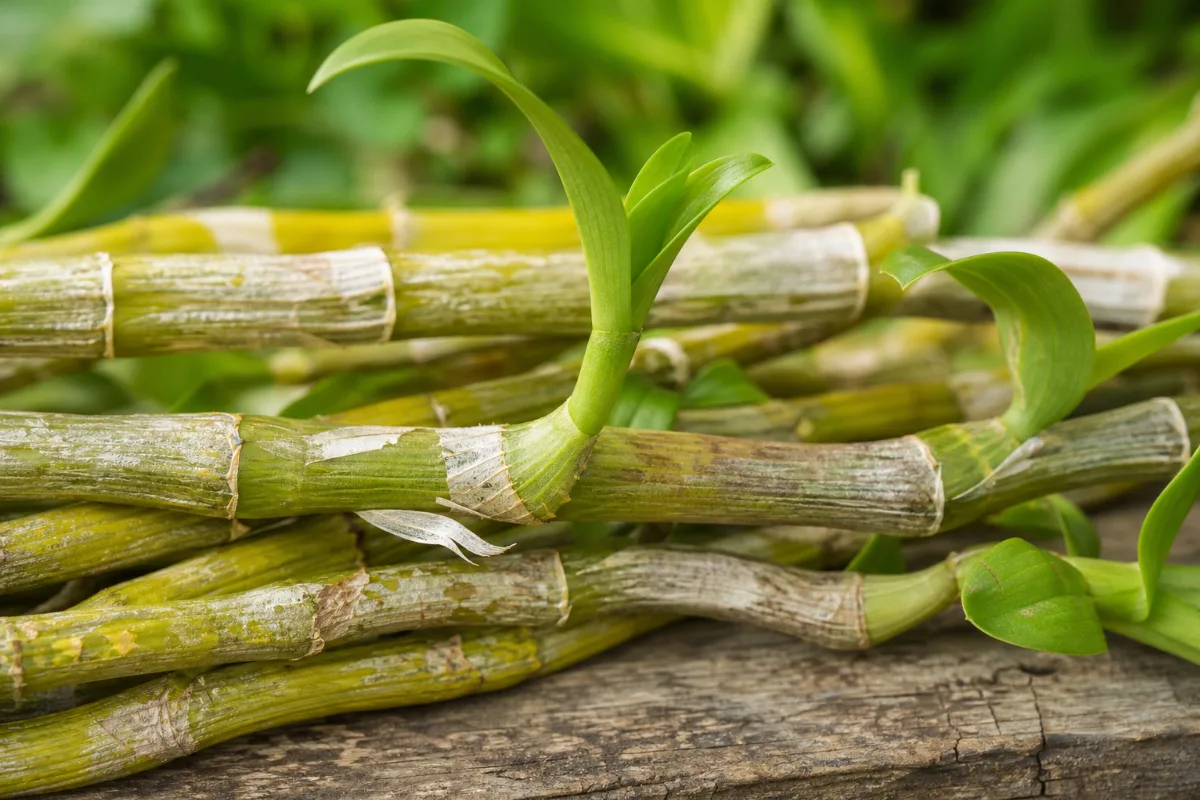
Herbs & Botanicals · Chinese orchid stem for dryness
Dendrobium
Dendrobium officinale, D. nobile, D. huoshanense · also called Shi hu, Tie pi shi hu
Dendrobium, or shi hu, is the dried stem of certain Asian orchids used in Chinese medicine for dry mouth, dry eyes and a dry stomach. Human research is small: a few Chinese trials for mouth sores and dry mouth, and one trial where vaccine antibodies came out lower. Most other claims come from lab and animal studies. Ask your doctor first if you take diabetes, blood pressure, seizure or immune-related medicine.
General information, not medical advice. Last substantive update · Not medically reviewed. A named clinician has not signed off on this page. How this page is made
About Dendrobium
Dendrobium is the dried stem of Asian orchids used in Chinese medicine for dryness. Human research is small and mixed. Cautions: dendrobine in D. nobile, vaccine response, diabetes and blood pressure medicine, wrong-species products and wild plant conservation.
What it is
Dendrobium is a large orchid family. The medicine is the stem of a few species. The Chinese Pharmacopoeia has two entries: tie pi shi hu, from Dendrobium officinale, and shi hu, from D. nobile, D. huoshanense and others. These are different plants and are not interchangeable. Its main compounds are polysaccharides, bibenzyls and alkaloids. Dendrobine is an alkaloid linked mainly to D. nobile. It is not the same as the herb, and ornamental Dendrobium orchids are not medicines.
What the research shows
Human trials are few and small. A 2025 trial of 60 people with radiotherapy mouth sores favoured a D. officinale tea drink plus a B12 rinse over the rinse alone. A 2011 trial of 16 people with Sjögren's syndrome reported more saliva, but the plant name is unclear. In a 2023 study of healthy volunteers an extract was followed by lower vaccine antibodies than placebo. A 2021 three-herb capsule improved near vision, so dendrobium's share is unknown. For blood sugar and fats the support is lab and animal work; the only human study found is a plan with no results. We found no trial for fatigue.
Quality, species and conservation
Adulteration with other Dendrobium species is described as widespread, and common DNA tests cannot separate close species. Wild D. officinale is described as critically endangered, and farmed plants differ chemically from wild ones. Wikipedia lists D. nobile in CITES Appendix II; other species were not confirmed. Look for farmed material with the species named.
At a glance
Traditional uses history, not proof
- Chinese medicine to 'nourish yin': dry mouth and throat
- Dry, sore eyes, often with goji berry and chrysanthemum
- A dry, weak stomach
Studied for research
- Mouth sores during radiotherapy (D. officinale tea drink), low
- Dry mouth in Sjögren's syndrome, very low
- Immune response and vaccination (lower antibodies), low
- Blood sugar and metabolic syndrome, insufficient
- Near vision (three-herb capsule), very low
- Gut bacteria changes, insufficient
- Dry stomach, insufficient
- Liver and heart protection (animals only), insufficient
Main compounds
- Polysaccharides (the most studied)
- Bibenzyls such as moscatilin and erianin
- Alkaloids, including dendrobine (mainly linked to D. nobile)
Common forms
- Dried or fresh stem, decoction or cooked (traditional)
- Powder, capsules, granules
- Tea drink or water extract
- Teas, gummies and wines (no evidence found)
Research links: Mouth sores during radiotherapy, trial (2025) · Vaccine antibodies and D. officinale extract, trial (2023) · Dry mouth in Sjögren's syndrome (2011) · Metabolic syndrome trial plan, D. nobile (2021) · Dendrobium species and metabolic syndrome, review (2023) · Adulteration of D. officinale (2026) · Research Library · Genes & Biomarkers Library
The plant and its history
- Accepted scientific name
- Dendrobium officinale Kimura & Migo
- Naming authority
- ACCEPTED in the GBIF backbone (key 5317472, Orchidaceae), checked 2026-10-25. Also covered under the Chinese entry 'shi hu': D. nobile Lindl. (GBIF key 5317489, accepted) and D. huoshanense Z.Z.Tang & S.J.Cheng (GBIF key 5317552, accepted).
- Synonyms
- Name: Dendrobium candidum Wall. ex Lindl.; Note: GBIF lists this as a SYNONYM (accepted key 5317412) of a different species; Chinese papers often use it for D. officinale. The 2011 Sjögren's trial used this name, so its plant identity is unclear.
- Common names
- Shi hu (Chinese (pinyin)); Tie pi shi hu (Chinese (pinyin), the D. officinale entry)
- Botanical family
- Orchidaceae (orchid family).
- Classification
- Plantae > Orchidaceae > Dendrobium > Dendrobium officinale
- Native range
- Not verified at source; a review says it grows in southern China and Southeast Asia.
- Habitat
- Not verified.
- What the plant looks like
- Stems: The stem is the part used.; Note: Other parts were not verified.
- Cultivation
- Wild D. officinale is described as critically endangered from overharvesting and habitat loss; farming is the alternative, and farmed plants differ chemically from wild ones.
- Harvest and processing
- Not verified.
- Look-alikes and adulterants
- Name: Other Dendrobium species sold as shi hu; Note: Close species have near-identical looks and common DNA markers cannot separate them.; Name: Ornamental Dendrobium orchids; Note: Not medicines.; Name: Gastrodia (tian ma); Note: Another Chinese orchid herb; a separate plant.
- Sustainability and conservation
- Wild D. officinale is described as critically endangered (Metabolites 2026) and D. huoshanense as second-class wild endangered in China (review 2022). Wikipedia lists D. nobile in CITES Appendix II; CITES entries for the other species were not confirmed. Choose farmed, traceable material.
Traditional use and history history, not clinical proof
| Tradition or era | Documented use | Source |
|---|---|---|
| Traditional Chinese medicine | Used to nourish yin: for dry mouth and throat, dry sore eyes and a weak, dry stomach, often with goji, chrysanthemum or other yin herbs. | p42428914 |
| Chinese Pharmacopoeia | Two entries: tie pi shi hu (D. officinale) and shi hu (D. nobile, D. fimbriatum, D. chrysotoxum, D. huoshanense and others). Read only through review papers. | p33485987 |
Traditional use shows how a plant was used. It does not show that a supplement works or is safe today.
What is inside, and how it may work
What the plant contains and how those compounds act in cells and animals. Laboratory and animal mechanisms are not proven effects in people.
Main compounds
| Compound | Family | Where it is concentrated | Activity studied | Level of evidence |
|---|---|---|---|---|
| Dendrobine PubChem 442523 | Sesquiterpene alkaloid | stem | Mainly linked to D. nobile; a convulsant in animals at high injected doses; lab anti-inflammatory and nerve effects reported. 16 15 8 14 | Animal research |
| Moscatilin PubChem 176096 | Bibenzyl | stem | Lab studies only. 14 1 | Laboratory research |
| Erianin PubChem 356759 | Bibenzyl | stem | Lab and mouse studies only. 14 | Animal research |
| Polysaccharides | Polysaccharide | stem | The most studied group; effects on gut bacteria, immunity and sugar metabolism in lab and animal work. 18 3 | Animal research |
Mechanisms, receptors and pathways
| Target or pathway | Gene or receptor | What was found | Level |
|---|---|---|---|
| Gut bacteria and short-chain acids | Polysaccharides are fermented in the large bowel; bacteria changes seen in the vaccine trial (human) and lab work. 18 3 | Human marker | |
| Immune signalling | IL-10 | IL-10 rose in the radiotherapy mouth-sore trial; lower vaccine antibodies in another trial. 20 3 | Human marker |
| Salivary water channel | Aquaporin-5 | More aquaporin-5 staining in biopsies of 16 Sjögren's patients taking an extract. 19 | Human marker |
| Sugar and fat metabolism | Insulin signalling and fat metabolism effects in animals. 7 | Animal research |
Absorption, metabolism and elimination
- Absorption
- Not found for people.
- Distribution
- Not found.
- Metabolism
- Polysaccharides are broken down by gut bacteria in the large bowel (review).
- Elimination
- Not found.
- Bioavailability
- Not found.
Isolated compounds versus whole extracts
Human studies tested a tea drink, a water extract and an unclear 'extracted liquid' of D. officinale or D. candidum, plus a three-herb capsule. None used purified dendrobine, and results for one species or preparation should not be applied to another.
Nutritional composition
Not covered: no nutrient data were read. The stem is also eaten as a food-medicine in China according to the reviews.
2 low certainty2 very low certainty4 not enough evidence
What is Dendrobium good for?
The main studied and promoted uses and how strong the human evidence is. Almost all of it is small, from China, or from labs and animals. Where a product is a mix of herbs or an unclear species, it is said so.
Benefits, one by one
Each card is a research question, not a promise. Tap a goal to filter. Open a card to see the studies, doses and limits.
Mouth sores during radiotherapy (D. officinale tea drink)
Low certaintyOne trial of 60 people with nasopharyngeal cancer found better saliva flow and mouth-lining scores with a Dendrobium officinale tea drink plus a vitamin B12 rinse than with the rinse alone.
1 studiesD. officinale tea drink; dose not stated in the abstract.
Studies, doses and limits
What the trials found
A 2025 randomised trial (Yang) at Zhejiang Cancer Hospital in 60 patients. The study group got a Dendrobium officinale tea drink plus compound vitamin B12 rinse; the control group got the rinse alone, so there was no placebo drink. After about a month, saliva flow and mouth-lining scores were better in the tea group (P < .05) and blood IL-10 rose in that group. Types of mouth bacteria differed, but overall diversity changed little.
Results
Saliva flow and mouth score better than rinse alone (P < .05). The abstract gives no effect sizes.
Effect sizes as reported
Not reported as numbers in the abstract.
Why this rating
One small single-hospital trial, no placebo drink, no numbers in the abstract. Benefit during cancer treatment is a first signal only.
Form and dose studied
D. officinale tea drink; dose not stated in the abstract.
Who was studied
Adults with nasopharyngeal cancer having radiotherapy.
Limits
Control group had no placebo, so people knew what they took. Not repeated elsewhere.
Why researchers looked
Radiotherapy to the head and neck dries the mouth and causes sores, and dendrobium is a traditional dryness remedy.
Traditional use
In Chinese medicine shi hu (and tie pi shi hu for D. officinale) is used to 'nourish yin': for dry mouth and throat, dry sore eyes and a dry, weak stomach. A 2026 review says it is often combined with other herbs such as goji and chrysanthemum.
Proposed mechanism Preliminary mechanism
Lab work links dendrobium polysaccharides to gland and immune effects. The trial authors suggest better salivary gland function and changes in the mouth bacteria.
A proposed mechanism does not show that the effect happens in people.
Anyone having cancer treatment should ask the oncology team before taking it. The abstract reports no safety numbers.
Dry mouth in Sjögren's syndrome
Very low certaintyA 2011 trial of 16 people with Sjögren's syndrome reported about 65% more saliva after one week of a dendrobium extract liquid.
2 studiesExtracted liquid of 'D. candidum'; amount not stated.
Studies, doses and limits
What the trials found
A 2011 study (Xiao) in 16 patients with Sjögren's syndrome. After one week of Dendrobium candidum extracted liquid, saliva secretion was about 65% higher than in the control group, and biopsies showed more aquaporin-5. The control group is not described in the abstract. The plant is named D. candidum, a name GBIF now treats as a synonym of another species, so it may not be the D. officinale of tie pi shi hu.
Results
About 65% more saliva than control after 1 week.
Effect sizes as reported
Percentage only; no confidence interval in the abstract.
Why this rating
Very small, one week, unclear control group and unclear species.
Form and dose studied
Extracted liquid of 'D. candidum'; amount not stated.
Who was studied
Adults with Sjögren's syndrome.
Limits
16 people. No longer-term follow-up found. Not repeated.
Why researchers looked
Sjögren's is an autoimmune condition that dries the mouth and eyes. Dry mouth is the oldest traditional use.
Traditional use
In Chinese medicine shi hu (and tie pi shi hu for D. officinale) is used to 'nourish yin': for dry mouth and throat, dry sore eyes and a dry, weak stomach. A 2026 review says it is often combined with other herbs such as goji and chrysanthemum.
Proposed mechanism Preliminary mechanism
The authors report more of the water channel aquaporin-5 in lip-gland biopsies of treated people. This is a lab marker in a few patients.
A proposed mechanism does not show that the effect happens in people.
Sjögren's is treated by doctors; do not replace prescribed treatment.
Immune response and COVID-19 vaccination
Low certaintyIn healthy volunteers a D. officinale water extract changed immune markers, but antibodies after COVID-19 vaccination were lower than with placebo.
1 studiesD. officinale aqueous extract; dose not stated in the abstract.
Studies, doses and limits
What the trials found
A 2023 placebo-controlled study (Gao) in healthy volunteers having COVID-19 vaccination. The extract 'enhanced immunity and preserved immune cell homeostasis', yet neutralizing antibody levels were lower than with cornstarch placebo. The authors conclude that its anti-inflammatory activity affects antibody production. Group sizes are not in the abstract.
Results
Neutralizing antibodies lower than placebo; size not in the abstract.
Effect sizes as reported
Not given.
Why this rating
Small human study; the result is unfavourable, not a benefit, but numbers are missing.
Form and dose studied
D. officinale aqueous extract; dose not stated in the abstract.
Who was studied
Healthy adults.
Limits
Surrogate antibody level, not infection. Small study.
Why researchers looked
Dendrobium is promoted as an immune tonic, so researchers tested it around vaccination.
Traditional use
In Chinese medicine shi hu (and tie pi shi hu for D. officinale) is used to 'nourish yin': for dry mouth and throat, dry sore eyes and a dry, weak stomach. A 2026 review says it is often combined with other herbs such as goji and chrysanthemum.
Proposed mechanism Preliminary mechanism
The authors describe immune-regulating and anti-inflammatory effects and more anti-inflammatory gut bacteria.
A proposed mechanism does not show that the effect happens in people.
Might weaken the antibody response to vaccines. Ask a doctor about timing around vaccination.
Blood sugar, blood fats and metabolic syndrome
Not enough evidenceReviews describe blood sugar and fat effects from lab and animal work. The one human trial found is only a plan for D. nobile powder in 30 people, with no results.
3 studiesD. nobile stem powder in the trial plan; polysaccharide extracts in l…
Studies, doses and limits
What the trials found
A 2023 review (Oskouei) says blood pressure, sugar, weight and fat effects are shown in the scientific evidence it reviewed and calls for clinical trials on safety and effectiveness. A 2026 review says clinical observations support blood sugar steadiness but trials are limited and not standardised. The registered human study (Zhang 2021, ChiCTR2000034550) is a single-arm plan of D. nobile powder for 8 weeks in 30 people; the paper contains no results.
Results
No human results read.
Effect sizes as reported
None.
Why this rating
Support is lab and animal work; the only human item is a trial plan without results.
Form and dose studied
D. nobile stem powder in the trial plan; polysaccharide extracts in lab work.
Who was studied
People with metabolic syndrome (planned).
Limits
No human results. Lab effects may not translate.
Why researchers looked
Polysaccharides from dendrobium lowered blood sugar and fats in animals, so metabolic syndrome is a popular claim.
Traditional use
In Chinese medicine shi hu (and tie pi shi hu for D. officinale) is used to 'nourish yin': for dry mouth and throat, dry sore eyes and a dry, weak stomach. A 2026 review says it is often combined with other herbs such as goji and chrysanthemum.
Proposed mechanism Animal research
Lab and animal work links dendrobium polysaccharides to insulin signalling and fat metabolism.
A proposed mechanism does not show that the effect happens in people.
Could add to the effect of diabetes or blood pressure medicine (theory only). Ask a doctor if on these.
Near vision and dry eyes
Very low certaintyA three-herb capsule that included Dendrobium huoshanense improved near-focusing power, but the effect cannot be credited to dendrobium. Dry-eye relief is a traditional claim without a trial found.
2 studiesThree-herb capsule with D. huoshanense; 1 to 3 capsules a day.
Studies, doses and limits
What the trials found
A 2021 study (Horng) of 400 adults aged 45 to 70 tested a capsule of Cassiae semen 200 mg, wolfberry 200 mg and Dendrobium huoshanense 40 mg. In the randomised part (160 people with a placebo group) the best near-focusing gain was 2.8 D, 2.9 D and 3.2 D in low, middle and high groups after 6 months (P < 0.05). The abstract does not give the placebo result. The 2026 review lists dry-eye relief as a clinical interest but calls trials limited.
Results
Near-focusing gain 2.8 to 3.2 D by group after 6 months; placebo value not in the abstract.
Effect sizes as reported
Not given.
Why this rating
Combination product, placebo result missing, developed by the authors.
Form and dose studied
Three-herb capsule with D. huoshanense; 1 to 3 capsules a day.
Who was studied
Adults 45 to 70 with presbyopia.
Limits
Cannot separate dendrobium from the other two herbs.
Why researchers looked
Dendrobium is traditionally paired with goji and chrysanthemum for dry, sore eyes.
Traditional use
In Chinese medicine shi hu (and tie pi shi hu for D. officinale) is used to 'nourish yin': for dry mouth and throat, dry sore eyes and a dry, weak stomach. A 2026 review says it is often combined with other herbs such as goji and chrysanthemum.
Proposed mechanism Animal research
Reviews describe eye-protective effects in lab work.
A proposed mechanism does not show that the effect happens in people.
None reported in the abstract.
Gut bacteria
Not enough evidenceDendrobium polysaccharides are fermented by gut bacteria, and changes in bacteria groups were seen in the vaccine trial. Bacteria changes are markers, not proven health gains.
2 studiesAqueous extract / polysaccharides.
Studies, doses and limits
What the trials found
The 2023 vaccine study (Gao) reported more anti-inflammatory gut bacteria in the extract group. The 2026 review describes gut bacteria changes from trials and lab work. No outcome such as bowel symptoms was tested in the human work read.
Results
No health outcome measured.
Effect sizes as reported
None.
Why this rating
Bacteria changes are not proven health outcomes.
Form and dose studied
Aqueous extract / polysaccharides.
Who was studied
Healthy volunteers.
Limits
Marker only.
Why researchers looked
The polysaccharides are not digested by us, so they reach gut bacteria.
Traditional use
In Chinese medicine shi hu (and tie pi shi hu for D. officinale) is used to 'nourish yin': for dry mouth and throat, dry sore eyes and a dry, weak stomach. A 2026 review says it is often combined with other herbs such as goji and chrysanthemum.
Proposed mechanism Animal research
Reviews say the large-bowel bacteria break the polysaccharides into short-chain acids.
A proposed mechanism does not show that the effect happens in people.
Not assessed.
Dry, weak stomach (traditional 'stomach yin deficiency')
Not enough evidenceA traditional use. Reviews list stomach-lining protection as an area of interest but say trials are limited.
1 studiesDried stem, decoction.
Studies, doses and limits
What the trials found
No human trial for the stomach was found. A 2026 review lists gastric protection among clinical observations and calls trials limited and not standardised.
Results
None.
Effect sizes as reported
None.
Why this rating
Traditional use only plus a narrative-review statement.
Form and dose studied
Dried stem, decoction.
Who was studied
Not applicable.
Limits
No trial.
Why researchers looked
Shi hu is a classic stomach-moistening herb.
Traditional use
In Chinese medicine shi hu (and tie pi shi hu for D. officinale) is used to 'nourish yin': for dry mouth and throat, dry sore eyes and a dry, weak stomach. A 2026 review says it is often combined with other herbs such as goji and chrysanthemum.
Proposed mechanism Animal research
Animal work exists but was not read.
A proposed mechanism does not show that the effect happens in people.
No safety data read.
Liver and heart protection (laboratory and animal only)
Not enough evidenceReviews and papers report liver and blood vessel protection in mice and rats. No human study was read.
1 studiesPolysaccharides, bibenzyls and dendrobine in lab work.
Studies, doses and limits
What the trials found
The 2026 review describes liver protection in animals. Heart outcomes such as heart attacks or deaths were not found in any human study. No human liver or heart trial of dendrobium was found.
Results
None.
Effect sizes as reported
None.
Why this rating
Lab and animal only.
Form and dose studied
Polysaccharides, bibenzyls and dendrobine in lab work.
Who was studied
Mice and rats.
Limits
Not shown in people.
Why researchers looked
Antioxidant and anti-inflammatory effects of polysaccharides and bibenzyls in lab models.
Traditional use
In Chinese medicine shi hu (and tie pi shi hu for D. officinale) is used to 'nourish yin': for dry mouth and throat, dry sore eyes and a dry, weak stomach. A 2026 review says it is often combined with other herbs such as goji and chrysanthemum.
Proposed mechanism Animal research
Mouse studies report effects on alcohol- or chemical-induced liver injury and on blood fats; mechanisms are proposed, not proven in people.
A proposed mechanism does not show that the effect happens in people.
Liver protection in mice is not proof that supplements are safe for the liver.
Connections to the rest of health
How Dendrobium connects to the rest of our health knowledge graph. Every link says what kind of connection it is. A safety link (for example to the liver) is a warning, not a benefit. A study that merely mentions a topic never creates a benefit link.
Explore every connection: goals, body systems, organs, symptoms, genes
A. Wellness goals
| Connected to | Kind of connection | Evidence status | Context | Studies |
|---|---|---|---|---|
| Digestive Support | Potential benefit | Low certainty | Mouth sores during radiotherapy (D. officinale tea drink): One trial of 60 people with nasopharyngeal cancer found better saliva flow and mouth-lining scores with a Dendrobium officinale tea drink plus a vitamin B12 rinse than with the rinse alone. Dry mouth in Sjögren's syndrome: A 2011 trial of 16 people with Sjögren's syndrome reported about 65% more saliva after one week of a dendrobium extract liquid. | 20 19 9 |
| Immune Support | Biological association | Low certainty | Immune response and COVID-19 vaccination: In healthy volunteers a D. officinale water extract changed immune markers, but antibodies after COVID-19 vaccination were lower than with placebo. | 3 |
| Blood Sugar Balance | Preliminary mechanism | Not enough evidence | Blood sugar, blood fats and metabolic syndrome: Reviews describe blood sugar and fat effects from lab and animal work. The one human trial found is only a plan for D. nobile powder in 30 people, with no results. | 7 18 21 |
| Metabolic Health | Preliminary mechanism | Not enough evidence | Blood sugar, blood fats and metabolic syndrome: Reviews describe blood sugar and fat effects from lab and animal work. The one human trial found is only a plan for D. nobile powder in 30 people, with no results. | 7 18 21 |
| Healthy Aging | Potential benefit | Very low certainty | Near vision and dry eyes: A three-herb capsule that included Dendrobium huoshanense improved near-focusing power, but the effect cannot be credited to dendrobium. Dry-eye relief is a traditional claim without a trial found. | 4 18 |
| Gut Health | Biological association | Not enough evidence | Gut bacteria: Dendrobium polysaccharides are fermented by gut bacteria, and changes in bacteria groups were seen in the vaccine trial. Bacteria changes are markers, not proven health gains. | 3 18 |
| Digestive Support | Traditional use | Not enough evidence | Dry, weak stomach (traditional 'stomach yin deficiency'): A traditional use. Reviews list stomach-lining protection as an area of interest but say trials are limited. | 18 |
| Liver Support | Preliminary mechanism | Not enough evidence | Liver and heart protection (laboratory and animal only): Reviews and papers report liver and blood vessel protection in mice and rats. No human study was read. | 18 |
| Heart Health | Preliminary mechanism | Not enough evidence | Liver and heart protection (laboratory and animal only): Reviews and papers report liver and blood vessel protection in mice and rats. No human study was read. | 18 |
B. Body systems
| Connected to | Kind of connection | Evidence status | Context | Studies |
|---|---|---|---|---|
| Digestive system | Potential benefit | Low certainty | Saliva flow and mouth sores in 60 radiotherapy patients. Preparation or compound: D. officinale tea drink |
20 |
| Digestive System | Biological association | Low certainty | Studied for: Mouth sores during radiotherapy (D. officinale tea drink) Studied for: Gut bacteria | 20 3 18 |
| Immune System | Biological association | Very low certainty | Studied for: Dry mouth in Sjögren's syndrome Studied for: Immune response and COVID-19 vaccination | 19 9 3 |
| Metabolism Weight | Biological association | Not enough evidence | Studied for: Blood sugar, blood fats and metabolic syndrome | 7 18 21 |
| Integumentary System | Biological association | Very low certainty | Studied for: Near vision and dry eyes | 4 18 |
| Hepatic System | Biological association | Not enough evidence | Studied for: Liver and heart protection (laboratory and animal only) | 18 |
| Cardiovascular System | Biological association | Not enough evidence | Studied for: Liver and heart protection (laboratory and animal only) | 18 |
I. Biomarkers
| Connected to | Kind of connection | Evidence status | Context | Studies |
|---|---|---|---|---|
| Saliva flow | Biological association | Low certainty | Measured in trials: raised. A lab change is not the same as a health benefit. | 20 19 |
| Neutralizing antibody level after vaccination | Biological association | Low certainty | Measured in trials: lowered. A lab change is not the same as a health benefit. | 3 |
| Interleukin-10 (IL-10) | Biological association | Very low certainty | Measured in trials: raised. A lab change is not the same as a health benefit. | 20 |
| Near-focusing power (amplitude of accommodation) | Biological association | Very low certainty | Measured in trials: raised. A lab change is not the same as a health benefit. | 4 |
K. Biological pathways
| Connected to | Kind of connection | Evidence status | Context | Studies |
|---|---|---|---|---|
| Aquaporin-5 | Preliminary mechanism | Human marker | Water channel in salivary glands; raised staining in 16 patients' biopsies. | 19 |
L. Active compounds
| Connected to | Kind of connection | Evidence status | Context | Studies |
|---|---|---|---|---|
| Dendrobine | Adverse effect or risk | Not enough evidence | Convulsant in animals at high injected doses; no human data. Preparation or compound: Purified dendrobine (injection, animals) |
8 |
| Dendrobine | Biological association | Animal | Mainly linked to D. nobile; a convulsant in animals at high injected doses; lab anti-inflammatory and nerve effects reported. Preparation or compound: stem |
16 15 8 14 |
| Moscatilin | Biological association | In vitro | Lab studies only. Preparation or compound: stem |
14 1 |
| Erianin | Biological association | Animal | Lab and mouse studies only. Preparation or compound: stem |
14 |
| Polysaccharides | Biological association | Animal | The most studied group; effects on gut bacteria, immunity and sugar metabolism in lab and animal work. Preparation or compound: stem |
18 3 |
Each connection is stored with the ingredient, the connected record, the kind of connection, the evidence status, the supporting studies, the preparation or compound involved, and a review date (last reviewed October 25, 2026).
Evidence at a glance: what changed in 4 lab markers
Tap a number to show only those markers. Counts are markers, not people.
The evidence
The research centre for Dendrobium. Every record here was checked against PubMed or the publisher's page; we never list a study we have not verified.
Evidence by outcome
Bars show how many studies we found for each outcome, not how well it works. People are added up across trials only (reviews are not added, to avoid double counting).
How we rate evidence
High certainty
Several well-run trials or reviews agree; further research is unlikely to change the picture much.
Moderate certainty
Good trials point the same way, but some doubt remains.
Low certainty
Small, short or inconsistent trials. The finding could change with better research.
Very low certainty
Very little or very weak human data. Treat as a possibility only.
Mixed findings
Trials or reviews disagree with each other.
Not enough evidence
Not enough human research to say either way.
Evidence against
Good research found no benefit, or found harm.
We take the reviewers' own risk-of-bias and GRADE statements where they exist, and otherwise judge from study size, design, consistency, directness and whether a product matches what is sold. Many publications do not make evidence high. Method note: We searched PubMed and read each abstract directly, and checked plant names through GBIF and compound IDs through PubChem. Some review papers were searched by keyword in open full text. NCCIH has no page; LiverTox and LactMed returned no record; EMA, CITES and the 1935 dendrobine paper could not be opened.
Study library: every study we checked 22
| Study | Design | People | Product, dose, length | Result |
|---|---|---|---|---|
| Fan 2023 Therapeutic potential of the chemical composition of Dendrobium nobile Lindl. Front Pharmacol · PMID 37497110 · DOI |
Narrative review review |
Review of D. nobile chemistry and lab/animal work | Dendrobium nobile Lindl. stem and whole plant not covered here not applicable · vs not applicable |
Lists alkaloids, bibenzyls and polysaccharides as main compounds and reports blood sugar, fat, anti-ageing and tumour effects from lab and animal work. No toxicity section was found by keyword search. None Methods, limits and fundingOutcomes: Chemical classes (alkaloids, bibenzyls, sesquiterpenes, phenanthrenes, polysaccharides) and reported activities Limitations: Open-access full text searched by keyword only; lab and animal work. Funding and conflicts: Not stated. Read: full-text |
| Fan 2026 Authenticity Identification and Quantitative Analysis of Dendrobium officinale Based on Near-Infrared Spectroscopy Combined with Chemometrics Foods · PMID 41517187 · DOI |
Lab study in-vitro |
Laboratory method study on D. officinale powders | Dendrobium officinale vs adulterated powders stem powder not covered here not applicable · vs not applicable |
Says adulteration of D. officinale is widespread, mainly by mixing in other Dendrobium species, and that there is no conclusive evidence the adulterants have the same effects. Says the Chinese Pharmacopoeia lists D. officinale as 'Tie Pi Shi Hu' and D. nobile, D. fimbriatum and others as 'Shi Hu'. None Methods, limits and fundingOutcomes: Detecting and measuring adulteration Limitations: Method paper; full text searched by keyword. It does not test health effects. Funding and conflicts: Not stated. Read: full-text |
| Gao 2023 Dendrobium officinale aqueous extract influences the immune response following vaccination against SARS-CoV-2 Biomed Pharmacother · PMID 37062221 · DOI |
Controlled trial |
Healthy volunteers having COVID-19 vaccination (number not given in the abstract) | Dendrobium officinale aqueous extract not stated in abstract not covered here not stated in abstract (antibodies measured at three-week intervals) · vs Placebo (cornstarch) |
The extract changed immune markers and favoured anti-inflammatory gut bacteria, but neutralizing antibody levels were lower than in the placebo group. The authors say the anti-inflammatory activity affects antibody production. Neutralizing antibodies lower than placebo (size not given in the abstract) Methods, limits and fundingOutcomes: Immune markers, neutralizing antibody levels, gut bacteria Limitations: Small study of healthy people; the abstract gives no numbers or group sizes. The effect on antibodies is unfavourable for a vaccine. Funding and conflicts: Not stated in the abstract. Read: abstract |
| Horng 2021 Improvement of Presbyopia Using a Mixture of Traditional Chinese Herbal Medicines, Including Cassiae Semen, Wolfberry, and Dendrobium huoshanense Evid Based Complement Alternat Med · PMID 34354761 · DOI |
Controlled trial |
400 400 adults aged 45 to 70; the randomised part had 160 people |
Capsule of Cassiae semen 200 mg, wolfberry 200 mg and Dendrobium huoshanense 40 mg (a three-herb mixture) not stated in abstract 1, 2 or 3 capsules a day in the randomised part 6 months, then 6 months follow-up · vs Placebo group |
In the randomised part the best near-focusing gain was 2.8 D, 2.9 D and 3.2 D in the low, middle and high groups after 6 months (P < 0.05). Gain rose with the number of capsules. Near-focusing gain 2.8 to 3.2 D by group; placebo result not given in the abstract Methods, limits and fundingOutcomes: Amplitude of accommodation (near-focusing power) and near and far vision Limitations: Three herbs in one capsule, so the effect cannot be put down to dendrobium. Placebo numbers not in the abstract. Authors developed the mixture. Funding and conflicts: Not stated in the abstract. Read: abstract |
| Lee 2016 Acute toxicity and cytotoxicity evaluation of Dendrobium moniliforme aqueous extract in vivo and in vitro Lab Anim Res · PMID 27729930 · DOI |
Animal study animal |
40 Sprague-Dawley rats (5 per sex per dose) and human kidney cells |
Dendrobium moniliforme aqueous extract (a different species) stem Single oral doses of 0, 2,500 and 5,000 mg/kg single dose, then observation · vs Untreated rats |
No treatment-related deaths or adverse findings; minimal lethal dose over 5,000 mg/kg. In kidney cells, viability fell below 50% at 10 mg/mL for 24 hours. No toxicity up to 5,000 mg/kg once, in rats Methods, limits and fundingOutcomes: Deaths, clinical signs, weight, blood chemistry, organs; cell viability Limitations: Single dose, rats, a different species. Does not cover repeated use, people, or alkaloid-rich extracts. Funding and conflicts: Not stated in the abstract. Read: abstract |
| Li 2026 Metabolomic Profiling Reveals Geographical Origin, Tissue-Specific Specialization, and Environmental Plasticity in Secondary Metabolism of Dendrobium officinale Metabolites · PMID 42042924 · DOI |
Lab study in-vitro |
Three cultivars of D. officinale grown in greenhouse and outdoors | Dendrobium officinale stem and leaf not covered here not applicable · vs not applicable |
Calls wild D. officinale 'critically endangered' from overharvesting and habitat loss. Farmed plants differ in their chemistry by origin, tissue and growing conditions. 41 flavonoids and 8 dendrobine-type alkaloids were annotated; amounts differed by tissue and condition. None Methods, limits and fundingOutcomes: Chemical profile by origin, tissue and growing conditions Limitations: Chemistry study of three cultivars; not a safety study; full text searched by keyword. Funding and conflicts: Not stated. Read: full-text |
| Oskouei 2023 The effects of Dendrobium species on the metabolic syndrome: A review Iran J Basic Med Sci · PMID 37396948 · DOI |
Narrative review review |
Review of Dendrobium species and metabolic syndrome | Several Dendrobium species stem and others not covered here not applicable · vs not applicable |
Reports blood-pressure, blood-sugar, weight and fat-lowering effects from the scientific evidence it reviewed. It says more clinical trials are needed to study safety, effectiveness and how the body handles Dendrobium. None Methods, limits and fundingOutcomes: Blood pressure, blood sugar, weight and blood fats Limitations: Abstract only; the review itself says clinical trials are lacking. Funding and conflicts: Not stated. Read: abstract |
| Record or database 1935 Dendrobine hydrochloride: lowest published lethal doses (RTECS listing via DrugFuture) · Source |
Animal toxicology record not applicable |
Methods, limits and fundingLimitations: Secondary toxicology listing of 1935 animal work (J Pharmacol Exp Ther 55:319). Intravenous lowest published lethal dose: rat 20 mg/kg, mouse 20 mg/kg, rabbit 17 mg/kg, guinea pig 22 mg/kg; effects listed as convulsions and spastic paralysis. Original 1935 paper not opened. Injection in animals, not eating the herb. Read: secondary-listing | ||
| Record or database 2026 GBIF Backbone Taxonomy species match (D. officinale, D. nobile, D. huoshanense, D. candidum) · Source |
Database not applicable |
Methods, limits and fundingLimitations: Checked 2026-10-25. Accepted: D. officinale Kimura & Migo (key 5317472), D. nobile Lindl. (5317489), D. huoshanense Z.Z.Tang & S.J.Cheng (5317552), all Orchidaceae. D. candidum Wall. ex Lindl. is a SYNONYM (accepted key 5317412). Read: full-text | ||
| Record or database 2026 LiverTox and LactMed (NCBI Bookshelf) search for Dendrobium · Source |
Regulator not found not applicable |
Methods, limits and fundingLimitations: Checked 2026-10-25: Bookshelf search for 'dendrobium AND livertox' and 'dendrobium AND lactmed' returned 0 records. Not found; this does not show safety. Read: not-found | ||
| Record or database 2026 EMA / HMPC herbal monographs: Dendrobium (not confirmed) · Source |
Regulator not found not applicable |
Methods, limits and fundingLimitations: Checked 2026-10-25: the EMA search page returned 401 (blocked). No monograph for Dendrobium was found in the nutrient-graph review either. Absence is NOT confirmed. Read: not-found | ||
| Record or database 2026 NCCIH: Dendrobium (page not found) · Source |
Regulator not found not applicable |
Methods, limits and fundingLimitations: Checked 2026-10-25: the address returned 404. No NCCIH page on dendrobium was found. Read: not-found | ||
| Record or database 2026 Dendrobium nobile (Wikipedia), conservation status box · Source |
Secondary source not applicable |
Methods, limits and fundingLimitations: Secondary source. States CITES Appendix II for D. nobile. NOT verified at CITES: cites.org returned 403 and Species+ could not be read. No source read confirms the CITES entry for D. officinale or D. huoshanense; Orchidaceae are generally said to be in Appendix II but that was not confirmed. Read: summary-only | ||
| Record or database 2026 PubChem compound records: dendrobine, moscatilin, erianin · Source |
Database not applicable |
Methods, limits and fundingLimitations: Checked 2026-10-25 by name: dendrobine CID 442523 (C16H25NO2); moscatilin CID 176096 (C17H20O5); erianin CID 356759 (C18H22O5). Read: full-text | ||
| Sarsaiya 2025 Unveiling the potential of dendrobine: insights into bioproduction, bioactivities, safety, circular economy, and future prospects Crit Rev Biotechnol · PMID 39762029 · DOI |
Narrative review review |
Review of lab, animal and production literature on dendrobine | Dendrobine (purified alkaloid) not applicable (purified compound) not covered here not applicable · vs not applicable |
The abstract lists anti-inflammatory, antioxidant, nerve-protective, immune and anticancer effects in lab work and says it also covers 'potential toxicity' and safety; the abstract gives no toxicity numbers. None in abstract Methods, limits and fundingOutcomes: Biological activity, mechanisms, toxicity and safety (as listed in the abstract) Limitations: Only the abstract was read. Toxicity details were not seen. Funding and conflicts: Not stated. Read: abstract |
| Song 2022 Natural Composition and Biosynthetic Pathways of Alkaloids in Medicinal Dendrobium Species Front Plant Sci · PMID 35599884 · DOI |
Narrative review review |
Review of Dendrobium alkaloids | Dendrobium alkaloids stem and whole plant not covered here not applicable · vs not applicable |
Full text (open access) shows dendrobine listed under D. nobile; several alkaloids are known in D. officinale but 'no relevant pharmacological effects have been reported' for them; D. huoshanense is a second-class wild endangered plant in China. None Methods, limits and fundingOutcomes: Which alkaloids occur in which species Limitations: Partial full-text reading by keyword search. Not a safety review. Funding and conflicts: Not stated. Read: full-text |
| Wang 2021 Traditional uses, chemical constituents, pharmacological activities, and toxicological effects of Dendrobium leaves: A review J Ethnopharmacol · PMID 33485987 · DOI |
Narrative review review |
Review of Dendrobium leaf literature | Leaves of many Dendrobium species leaf not covered here not applicable · vs not applicable |
Says shi hu (stems of D. chrysotoxum, D. fimbriatum, D. huoshanense or D. nobile) and tie pi shi hu (D. officinale stems) are listed in the Chinese Pharmacopoeia. D. officinale leaves showed no reproductive toxicity in male rats; D. speciosum leaves showed slight genotoxicity in an in-vitro study. None Methods, limits and fundingOutcomes: Traditional uses and toxicology Limitations: Leaves, not the stem; rats and cells. Funding and conflicts: Not stated. Read: abstract |
| Wu 2026 Merits of bioactivity and products of Dendrobium officinale and other related species Front Plant Sci · PMID 42428914 · DOI |
Narrative review review |
Review of D. officinale chemistry, activity, clinical use and products | Dendrobium officinale and related species stem not covered here not applicable · vs not applicable |
Traditional use is for yin deficiency with internal heat, dry mouth and throat and dry sore eyes, often with other herbs. Clinical observations are said to support effects on blood sugar, dry eye, stomach protection and immunity, but trials 'remain limited in scale and standardization'. It says alkaloids have low toxicity and that further work is needed on long-term safety. None Methods, limits and fundingOutcomes: Traditional use, clinical observations, products Limitations: Narrative review; the 'low toxicity' statement is the authors' view, not a safety trial. Full text searched by keyword. Funding and conflicts: Not stated. Read: full-text |
| Xiao 2011 Dendrobium candidum extract increases the expression of aquaporin-5 in labial glands from patients with Sjögren's syndrome Phytomedicine · PMID 20655712 · DOI |
Clinical trial uncontrolled or unclear |
16 16 people with Sjögren's syndrome and dry mouth, one hospital in Chongqing, China |
Dendrobium candidum extracted liquid (named D. candidum in the paper) stem not stated in abstract not covered here 1 week · vs 'The control group' (not described in the abstract) |
Saliva secretion rose by about 65% compared with the control group, and aquaporin-5 staining was higher in biopsies of treated patients. About 65% more saliva vs control after 1 week Methods, limits and fundingOutcomes: Saliva secretion; aquaporin-5 in lip-gland biopsies Limitations: Very small, one week, control group not described. The product is named D. candidum; GBIF lists that name as a synonym of a different species, so it may not be D. officinale. Funding and conflicts: Not stated in the abstract. Read: abstract |
| Yang 2025 Effect of Dendrobium Officinale on Radioactive Oral Mucositis of Nasopharyngeal Carcinoma and Changes of Oral Microecology Integr Cancer Ther · PMID 39811879 · DOI |
Controlled trial |
60 60 people with nasopharyngeal cancer and radiotherapy-related mouth sores, one hospital in China |
Dendrobium officinale tea drink plus compound vitamin B12 rinse not stated in abstract (tea drink) not covered here about 1 month, until the end of radiotherapy · vs Compound vitamin B12 rinse alone (no placebo drink) |
Saliva flow and mouth-lining score were better in the tea group than in the rinse-only group (P < .05). IL-10 rose within the tea group. Mouth bacteria differed in type but not in overall diversity. Better saliva flow and mouth score than rinse alone; numbers not given in the abstract Methods, limits and fundingOutcomes: Unstimulated saliva flow, mouth-lining score and clinical efficacy; saliva EGF; blood IL-10 and IL-11; mouth bacteria Limitations: The abstract gives no effect sizes. The control group had no placebo drink, so it cannot be fully blinded despite the 'double-blind' label. One hospital, 60 people. Funding and conflicts: Not stated in the abstract. Read: abstract |
| Zhang 2021 Clinical study of Dendrobium Nobile Lindl intervention on patients with metabolic syndrome Medicine (Baltimore) · PMID 33761635 · DOI |
Trial protocol |
30 Planned: 30 people with metabolic syndrome (single-arm, open) |
Dendrobium nobile powder stem (powder) 6 g twice a day (planned) 8 weeks plus 4 weeks follow-up (planned) · vs None (single arm) |
This is a trial plan. No results are in this paper. None (protocol) Methods, limits and fundingOutcomes: Planned: lipid and glucose metabolism, weight, BMI, adverse events Limitations: Describes a plan only. It says D. nobile 'has been proved' to lower sugar and fats, but gives no source for that in the abstract. Funding and conflicts: Authors declare no conflicts. Registration: ChiCTR2000034550 Read: abstract |
| Zhu 2018 Accurate authentication of Dendrobium officinale and its closely related species by comparative analysis of complete plastomes Acta Pharm Sin B · PMID 30505665 · DOI |
Lab study in-vitro |
63 Dendrobium plastomes (40 newly sequenced) | Dendrobium officinale and 5 close relatives not applicable not covered here not applicable · vs not applicable |
D. officinale is frequently adulterated with other Dendrobium species. Common DNA markers (ITS, ITS2, matK+rbcL) could not separate it from 5 close relatives; whole plastome sequences could. None Methods, limits and fundingOutcomes: Whether DNA markers can tell the species apart Limitations: Laboratory identification study; no information on health effects of the substitutes. Funding and conflicts: Not stated. Read: abstract |
What we do not know yet
- No trial of D. nobile or D. huoshanense alone; no trial for fatigue.
- No completed human blood sugar or blood fat results.
- No human toxicity, pregnancy, breastfeeding, child or liver data.
- Dendrobine amounts per species and product are unknown.
- EMA, CITES, FDA and WHO were not confirmed.
How new research is added
New studies are found by a saved PubMed search and placed in a review queue. A person checks each one before it is added.
Lab markers
What changed in blood or saliva tests during trials. A changed number is not the same as feeling or being healthier, and we give no "normal ranges".
Other 4
Saliva flow
Raised in trials
How much saliva is made, measured in the mouth without stimulation.
Low certaintyResults and what it means
Why it was measured
Low saliva causes dry mouth, sores and tooth problems.
Statistical vs. clinical meaning
Saliva volume is a useful sign but not the same as relief of symptoms. Both studies are small.
Safety implication
Not assessed.
| Study | Result | People | Product |
|---|---|---|---|
| 20 | Unstimulated saliva flow better than rinse alone after treatment (P < .05); values not in the abstract | 60 people with radiotherapy mouth sores | D. officinale tea drink plus B12 rinse |
| 19 | Saliva secretion about 65% higher than control after 1 week | 16 people with Sjögren's syndrome | 'D. candidum' extracted liquid |
Neutralizing antibody level after vaccination
Lowered in trials
The amount of antibody that can block the virus after COVID-19 vaccination.
Low certaintyResults and what it means
Why it was measured
It shows how strongly a vaccine has worked.
Statistical vs. clinical meaning
A lower antibody level is not a benefit and may mean a weaker vaccine response.
Safety implication
Possible weaker vaccine response.
| Study | Result | People | Product |
|---|---|---|---|
| 3 | Lower in the extract group than in the placebo group; numbers not in the abstract | Healthy volunteers | D. officinale aqueous extract |
Interleukin-10 (IL-10)
Raised in trials
A blood messenger that calms inflammation.
Very low certaintyResults and what it means
Why it was measured
Used as a marker of immune balance.
Statistical vs. clinical meaning
A change from baseline inside one group; not compared with the control group in the abstract.
Safety implication
Not assessed.
| Study | Result | People | Product |
|---|---|---|---|
| 20 | IL-10 increased in the study group after treatment compared with before (P < .05) | 30 people in the study group | D. officinale tea drink plus B12 rinse |
Near-focusing power (amplitude of accommodation)
Raised in trials
How much the eye can adjust to focus close objects, in dioptres (D).
Very low certaintyResults and what it means
Why it was measured
It falls with age and causes reading difficulty.
Statistical vs. clinical meaning
A change in a measurement; the combination makes the herb's share unknown.
Safety implication
None reported.
| Study | Result | People | Product |
|---|---|---|---|
| 4 | Maximum gain 2.8, 2.9 and 3.2 D in low, middle and high-dose groups after 6 months (P < 0.05); placebo value not in the abstract | 160 adults 45 to 70 | Cassiae, wolfberry and D. huoshanense capsule |
Safety
What studies and official sources say about side effects, medicines and who should check first. Each point shows what kind of evidence it comes from.
Main points to know 4
- Dendrobine, an alkaloid found mainly in D. nobile, is a convulsant at high injected doses in animals. Old animal work listed in a toxicology database gives lowest lethal doses by vein of 17 to 22 mg/kg in rats, mice, rabbits and guinea pigs, with convulsions and spastic paralysis. This is the purified compound by injection, not the stem. No human toxic dose was found. Animal research 8 16
- Human safety data are almost absent. The human studies found were small and their abstracts do not report side-effect numbers. A 2026 review itself says long-term safety still needs clinical confirmation. Narrative review 18 20
- Possible weaker vaccine response. In healthy volunteers a D. officinale water extract was followed by lower neutralizing antibodies after COVID-19 vaccination than placebo. Controlled trial 3
- Species mix-ups are common. Adulteration with other Dendrobium species is described as widespread, and it is not known whether substitutes act the same. Lab study 2 22
Side effects 4
| Effect | How often | Severity and recovery | Evidence |
|---|---|---|---|
| Lower antibody response after vaccination Seen as a group difference in healthy volunteers; the abstract gives no numbers. | Not established | not stated not stated | Controlled trial 3 |
| Stomach and gut upset No gut side-effect data were found in the abstracts read. This is absence of data, not proof that none occur. | Not established | not stated not stated | None found 20 |
| Low blood sugar or low blood pressure Reviews report sugar- and pressure-lowering in lab and animal work. No human case was found. | Not established | not stated not stated | Pharmacological theory 7 |
| Convulsions or seizures Seen with injected purified dendrobine in animals only. No human case found. | Not established | serious if it happened not stated | Animal research 8 |
Liver
No human liver injury case reports for Dendrobium were found. LiverTox: no record found (NCBI Bookshelf search returned 0). Mouse papers report liver protection, which does not show safety in people. 10 18
How often. No frequency data; no case reports found.
Monitoring. No advice found from any regulator. People with liver disease should ask their doctor.
This is a safety connection. It is not evidence that Dendrobium supports liver health.
Medicines and supplements 5
| With | Why it matters | Importance | Evidence | What to do |
|---|---|---|---|---|
| Diabetes medicines (insulin, metformin and others) drug | Reviews report blood-sugar-lowering effects in animals; could add to the drugs. | Unknown in people. Theory only. | Pharmacological theory Not enough evidence 7 | Ask the prescriber; watch for low blood sugar. |
| Blood pressure medicines drug | A review says Dendrobium has a pressure-lowering effect through nitric oxide in lab work. | Unknown in people. Theory only. | Pharmacological theory Not enough evidence 7 | Ask the prescriber. |
| Vaccines vaccine | The extract changed immune markers and was followed by lower neutralizing antibodies in healthy volunteers. | One small trial; a weaker response is possible. | Controlled trial Low certainty 3 | Ask a doctor about timing around vaccination. |
| Immune-suppressing and cancer medicines drug | The extract changes immune signals (IL-10 rose, Th1 cell effects are described in lab work). | Not tested for interactions. The radiotherapy trial did not report on treatment safety in its abstract. | Pharmacological theory Not enough evidence 20 18 | Ask the oncology team or transplant team before using it. |
| Seizure-threshold drugs and medicines that can cause seizures drug | Dendrobine, mainly from D. nobile, is a convulsant in animals at high injected doses. | Unknown in people; the amount of dendrobine in products is not known. | Animal research Not enough evidence 8 | People with epilepsy should avoid D. nobile alkaloid products unless their neurologist agrees. |
Who should check first 6
| Situation | Advice | Evidence |
|---|---|---|
| Pregnancy | No human or reliable animal safety data were found. Avoid unless a doctor advises otherwise. | None found 10 |
| Breastfeeding | LactMed: no record found. Avoid unless a doctor advises otherwise. | None found 10 |
| Children | No data found. Not advised without medical guidance. | None found |
| Epilepsy or seizure history | Precaution because dendrobine is a convulsant in animals. Not a documented human effect. | Animal research 8 |
| Diabetes, low blood pressure or planned surgery | Precaution only, from lab effects on sugar and pressure. Ask a doctor. | Pharmacological theory 7 |
| Around vaccination or during immune-suppressing treatment | Ask a doctor first; the one vaccine trial found lower antibodies. | Controlled trial 3 |
Overdose, product quality and regulators
Summary. The stem of D. officinale has no human toxicity record found. Dendrobine, an alkaloid linked mainly to D. nobile, is toxic in animals when injected. A rat study of a different species' water extract found no deaths after one very large dose.
Animal. Dendrobine hydrochloride, intravenous lowest published lethal dose: rat 20 mg/kg, mouse 20 mg/kg, rabbit 17 mg/kg, guinea pig 22 mg/kg, with convulsions and spastic paralysis (1935 work, via a toxicology listing; original not opened). Separately, a D. moniliforme water extract given once by mouth to rats had no deaths or adverse findings up to 5,000 mg/kg, and killed over half of kidney cells at 10 mg/mL in a dish.
Human doses studied. Not covered here. The planned metabolic syndrome trial lists a stem powder; no safety results.
High dose or long term signals. No long-term human or animal data read. A 2026 review says long-term safety needs confirmation and calls alkaloids low in toxicity; that is the authors' view.
Overdose response. Not found. Seek medical help for severe symptoms.
Genotoxicity. D. officinale leaves: no male reproductive toxicity in rats per a review. D. speciosum leaves: slight genotoxicity in a dish (different species and part).
By species. Dendrobine is listed under D. nobile. A review says several alkaloids are known in D. officinale but no pharmacology is reported for them, and one metabolomics study annotated eight dendrobine-type alkaloids in D. officinale (amounts compared by tissue, not by safety). No source read gives dendrobine content per species or product, and no source says D. officinale is free of it.
Toxic plant parts. The stem is the traditional part. Leaves and flowers are also studied in some species. Dendrobium orchids sold as ornamentals are not medicines and were not studied for safety.
Adulteration is the main quality problem described. Heavy metal, pesticide and sulphur-dioxide testing of dendrobium products was not found.
Mixing with other Dendrobium species. A 2026 study calls adulteration of D. officinale widespread, mainly by other Dendrobium species, with no conclusive evidence the substitutes act the same. 2
Common DNA tests cannot tell close species apart. ITS, ITS2 and matK+rbcL markers could not separate D. officinale from 5 close relatives; whole plastome sequences could. 22
Wild versus farmed material differs. Farmed D. officinale differs chemically by origin, tissue and growing conditions. 6
When to get medical help
- Seizures, muscle rigidity or spasms after any dendrobium or dendrobine product
- Fainting, very low blood sugar signs (shaking, sweating, confusion) when taking diabetes medicine
- Hives, swelling of the face or throat or trouble breathing
- Yellow skin or eyes, dark urine or severe stomach pain
Stop the supplement and contact a clinician or emergency service. In the US, Poison Control is 1-800-222-1222.
General information only, not medical advice. Ask a clinician or pharmacist before use, especially with medicines, in pregnancy or with a health condition. See the Natural Remedy Safety guide.
Frequently asked questions
What is dendrobium (shi hu)?
Does it help dry mouth?
Does it boost the immune system?
Not proven. In healthy volunteers an extract changed immune markers, but vaccine antibodies were lower than with placebo.
Does it lower blood sugar?
Is it good for the eyes?
What is dendrobine and is it dangerous?
Do D. officinale and D. nobile have the same safety?
Could it affect diabetes or blood pressure medicine?
It is a theory from lab and animal findings, not a documented human interaction. Ask your doctor or pharmacist.
Is it safe in pregnancy or while breastfeeding?
No data were found. LactMed has no record. Avoid unless a doctor advises.
Can it harm the liver or stomach?
Are the plants endangered?
Explore by health goal
Digestive SupportImmune SupportBlood Sugar BalanceMetabolic HealthHealthy AgingGut HealthLiver SupportHeart Health
Editorial transparency
- Written by
- AlternativeMed editorial team. Research compiled with AI assistance, then checked against the original sources.
- Medical review
- None. This page has not been reviewed by a physician or pharmacist.
- First published
- 2026-10-25
- Last substantive update
- 2026-10-25
- How we research
- We searched PubMed and read each abstract directly, and checked plant names through GBIF and compound IDs through PubChem. Some review papers were searched by keyword in open full text. NCCIH has no page; LiverTox and LactMed returned no record; EMA, CITES and the 1935 dendrobine paper could not be opened.
- How we rate evidence
- See "How we rate evidence" in the Evidence tab.
- Independence
- No product is promoted on this page. No affiliate links are shown.
Sources 22
Each source was opened and checked. Where we read only the abstract, it says so. The small numbers in the text point here.
- Fan C, Sun X, Wang X, et al.. Therapeutic potential of the chemical composition of Dendrobium nobile Lindl.. Front Pharmacol. 2023. PMID 37497110. DOI 10.3389/fphar.2023.1163830. (full-text)
- Fan ZL, Li Q, Zhang ZT, et al.. Authenticity Identification and Quantitative Analysis of Dendrobium officinale Based on Near-Infrared Spectroscopy Combined with Chemometrics. Foods. 2026. PMID 41517187. DOI 10.3390/foods15010121. (full-text)
- Gao X, Ye T, Lei Y, et al.. Dendrobium officinale aqueous extract influences the immune response following vaccination against SARS-CoV-2. Biomed Pharmacother. 2023. PMID 37062221. DOI 10.1016/j.biopha.2023.114702. (abstract)
- Horng CT, Ma JW, Shieh PC, et al.. Improvement of Presbyopia Using a Mixture of Traditional Chinese Herbal Medicines, Including Cassiae Semen, Wolfberry, and Dendrobium huoshanense. Evid Based Complement Alternat Med. 2021. PMID 34354761. DOI 10.1155/2021/9902211. (abstract)
- Lee MJ, Jung HK, Kim MS, et al.. Acute toxicity and cytotoxicity evaluation of Dendrobium moniliforme aqueous extract in vivo and in vitro. Lab Anim Res. 2016. PMID 27729930. DOI 10.5625/lar.2016.32.3.144. (abstract)
- Li Z, Li J, Hu Y, et al.. Metabolomic Profiling Reveals Geographical Origin, Tissue-Specific Specialization, and Environmental Plasticity in Secondary Metabolism of Dendrobium officinale. Metabolites. 2026. PMID 42042924. DOI 10.3390/metabo16040279. (full-text)
- Oskouei Z, Ghasemzadeh Rahbardar M, Hosseinzadeh H. The effects of Dendrobium species on the metabolic syndrome: A review. Iran J Basic Med Sci. 2023. PMID 37396948. DOI 10.22038/IJBMS.2023.65997.14512. (abstract)
- Record or database. Dendrobine hydrochloride: lowest published lethal doses (RTECS listing via DrugFuture). . 1935. (secondary-listing)
- Record or database. GBIF Backbone Taxonomy species match (D. officinale, D. nobile, D. huoshanense, D. candidum). . 2026. (full-text)
- Record or database. LiverTox and LactMed (NCBI Bookshelf) search for Dendrobium. . 2026. (not-found)
- Record or database. EMA / HMPC herbal monographs: Dendrobium (not confirmed). . 2026. (not-found)
- Record or database. NCCIH: Dendrobium (page not found). . 2026. (not-found)
- Record or database. Dendrobium nobile (Wikipedia), conservation status box. . 2026. (summary-only)
- Record or database. PubChem compound records: dendrobine, moscatilin, erianin. . 2026. (full-text)
- Sarsaiya S, Jain A, Shu F, et al.. Unveiling the potential of dendrobine: insights into bioproduction, bioactivities, safety, circular economy, and future prospects. Crit Rev Biotechnol. 2025. PMID 39762029. DOI 10.1080/07388551.2024.2438161. (abstract)
- Song C, Ma J, Li G, et al.. Natural Composition and Biosynthetic Pathways of Alkaloids in Medicinal Dendrobium Species. Front Plant Sci. 2022. PMID 35599884. DOI 10.3389/fpls.2022.850949. (full-text)
- Wang YH. Traditional uses, chemical constituents, pharmacological activities, and toxicological effects of Dendrobium leaves: A review. J Ethnopharmacol. 2021. PMID 33485987. DOI 10.1016/j.jep.2021.113851. (abstract)
- Wu S, He J, Zhang Y, et al.. Merits of bioactivity and products of Dendrobium officinale and other related species. Front Plant Sci. 2026. PMID 42428914. DOI 10.3389/fpls.2026.1864437. (full-text)
- Xiao L, Ng TB, Feng YB, et al.. Dendrobium candidum extract increases the expression of aquaporin-5 in labial glands from patients with Sjögren's syndrome. Phytomedicine. 2011. PMID 20655712. DOI 10.1016/j.phymed.2010.05.002. (abstract)
- Yang J, Liu Y, Yao H, et al.. Effect of Dendrobium Officinale on Radioactive Oral Mucositis of Nasopharyngeal Carcinoma and Changes of Oral Microecology. Integr Cancer Ther. 2025. PMID 39811879. DOI 10.1177/15347354251313524. (abstract)
- Zhang X, Wang M, Zhang C, et al.. Clinical study of Dendrobium Nobile Lindl intervention on patients with metabolic syndrome. Medicine (Baltimore). 2021. PMID 33761635. DOI 10.1097/MD.0000000000024574. (abstract)
- Zhu S, Niu Z, Xue Q, et al.. Accurate authentication of Dendrobium officinale and its closely related species by comparative analysis of complete plastomes. Acta Pharm Sin B. 2018. PMID 30505665. DOI 10.1016/j.apsb.2018.05.009. (abstract)